Research Articles
Unlocking Metalloprotein Function: A Comprehensive Guide to ICP-MS Analysis in Biomedical Research
This article provides a comprehensive resource for researchers and drug development professionals on the application of Inductively Coupled Plasma Mass Spectrometry (ICP-MS) for metalloprotein analysis.
Validating Metal Oxidation States: A Multi-Technique Framework for Materials and Drug Development
Accurate determination of metal oxidation states is critical for understanding material properties, catalytic activity, and the biological interactions of metal-containing compounds in drug development.
Validating DFT Calculations with Experimental Spectroscopic Data for Metal Complexes: A Comprehensive Guide for Biomedical Research
This article provides a comprehensive framework for researchers, scientists, and drug development professionals on integrating Density Functional Theory (DFT) with experimental spectroscopy to validate the properties of metal complexes.
Optimizing DFT Parameters for Metal Complexes: Best Practices for Accuracy in Drug Development and Materials Science
Density Functional Theory (DFT) is indispensable for studying metal complexes in catalysis, drug design, and materials science, but its predictive power hinges on the selection of computational parameters.
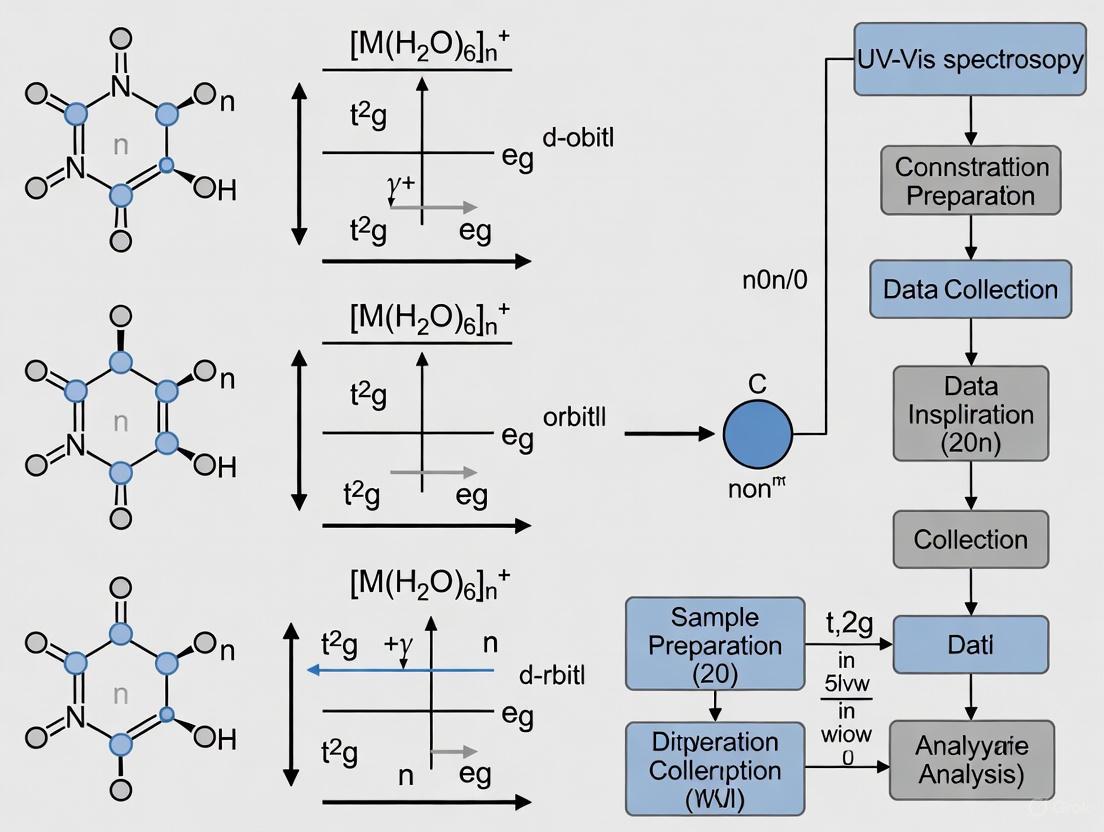
UV-Vis Spectroscopy for d-d Transition Analysis: A Comprehensive Guide for Octahedral Complex Characterization in Biomedical Research
This article provides a comprehensive guide to the theory, application, and validation of UV-Vis spectroscopy for analyzing d-d transitions in octahedral transition metal complexes.
Benchmarking Supercritical Fluid Chromatography for Inorganic Complex Analysis: Techniques, Applications, and Performance Metrics
This article provides a comprehensive performance benchmark of Supercritical Fluid Chromatography (SFC) for separating and analyzing diverse inorganic complexes.
StrongSCF vs TightSCF: Achieving Chemical Accuracy in Transition Metal Thermochemistry
This article provides a comprehensive guide for computational chemists and researchers on selecting and implementing SCF convergence criteria for accurate transition metal thermochemistry.
Energy vs. Density Convergence in DFT: A Practical Guide for Robust Electronic Structure Calculations in Drug Discovery
Accurate electronic structure calculations are fundamental to rational drug design, yet achieving convergence in Density Functional Theory (DFT) simulations for inorganic complexes remains a significant challenge.

Mastering KDIIS and SOSCF Protocols for Robust Open-Shell Transition Metal Calculations
This article provides a comprehensive guide to achieving self-consistent field (SCF) convergence for challenging open-shell transition metal complexes using the KDIIS and Second-Order SCF (SOSCF) protocols.
Mastering TRAH SCF for Challenging Inorganic Complexes: A Comprehensive Guide for Computational Chemists
This article provides a complete guide to utilizing the Trust Region Augmented Hessian (TRAH) SCF algorithm in ORCA for achieving robust convergence in difficult inorganic and organometallic systems.