Validating DFT Calculations with Experimental Spectroscopic Data for Metal Complexes: A Comprehensive Guide for Biomedical Research
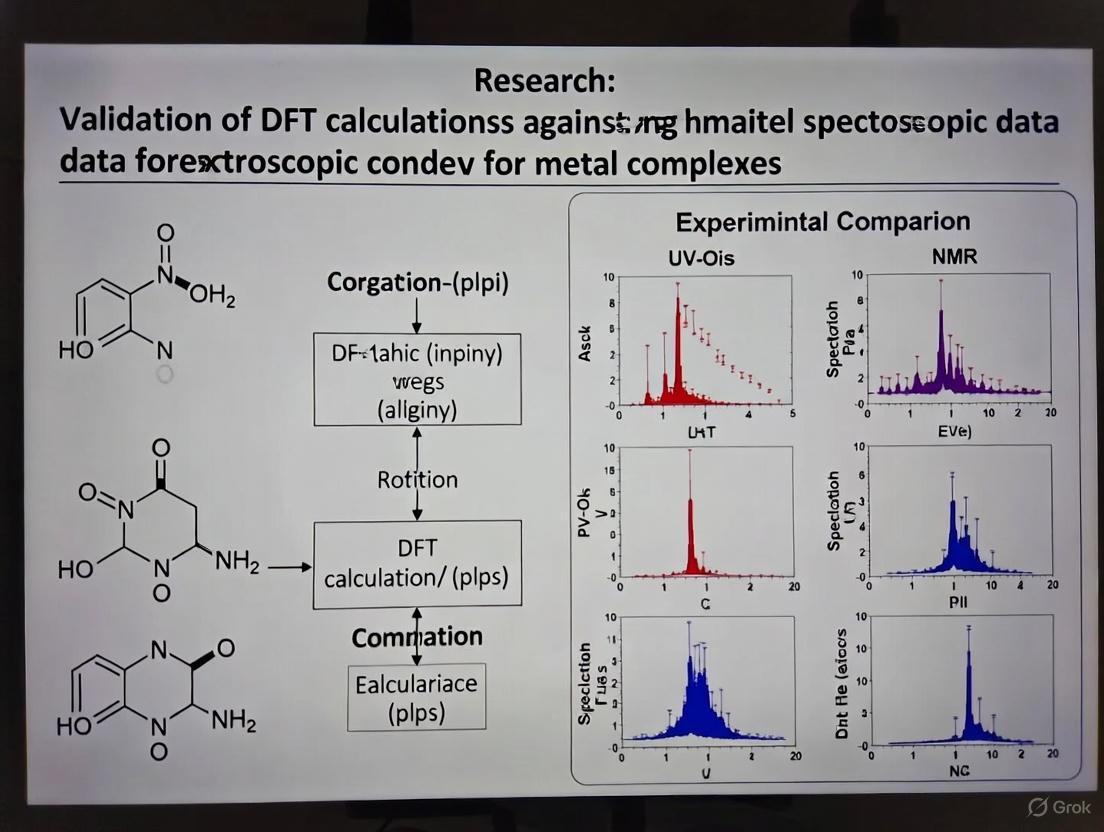
This article provides a comprehensive framework for researchers, scientists, and drug development professionals on integrating Density Functional Theory (DFT) with experimental spectroscopy to validate the properties of metal complexes.
Validating DFT Calculations with Experimental Spectroscopic Data for Metal Complexes: A Comprehensive Guide for Biomedical Research
Abstract
This article provides a comprehensive framework for researchers, scientists, and drug development professionals on integrating Density Functional Theory (DFT) with experimental spectroscopy to validate the properties of metal complexes. It covers foundational principles, practical methodological protocols, troubleshooting for common pitfalls, and robust validation strategies. By synthesizing insights from recent studies on antimicrobial complexes, antioxidant mechanisms, and catalytic centers, this guide aims to enhance the reliability of computational models in predicting geometric structures, electronic properties, and reactive sites, thereby accelerating the design of metallodrugs and functional materials.
The Essential Partnership: Understanding DFT and Spectroscopy for Metal Complex Characterization
Density Functional Theory (DFT) has established itself as the computational workhorse in quantum mechanics, bridging the gap between theoretical principles and predictive materials science. Its evolution from the foundational Hohenberg-Kohn theorems to sophisticated hybrid functionals has transformed computational chemistry and materials design, particularly for complex systems like metal complexes and biological molecules [1]. This guide examines DFT's performance across various methodological approaches, focusing on its critical validation through direct comparison with experimental spectroscopic data—the cornerstone of credible computational research in drug development and materials science.
Theoretical Framework and Functional Performance
DFT Fundamentals
DFT revolutionized quantum calculations by replacing the N-electron wavefunction with the electron density as the fundamental variable, significantly reducing computational complexity while incorporating electron correlation [1]. The Kohn-Sham approach implements this theory through a system of non-interacting electrons, with accuracy primarily dependent on the approximation used for the exchange-correlation functional [1].
Functional Comparison and Performance
The choice of functional profoundly impacts calculation accuracy. Different approximations balance computational cost with performance across various chemical properties:
Table 1: Comparison of DFT Functional Types and Their Applications
| Functional Type | Examples | Key Features | Optimal Applications | Known Limitations |
|---|---|---|---|---|
| GGA | BP86, PBE | Good geometries, fast computation | Structural optimization, large systems | Less accurate for energetics, spectroscopy |
| Hybrid GGA | B3LYP, B3PW91 | 20-25% HF exchange; balanced performance | General purpose for transition metals | Charge transfer states, long-range interactions |
| Meta-GGA | TPSSh | Improved energetics | Transition metal systems | Varying performance for spectroscopic properties |
| Range-Separated Hybrid | CAM-B3LYP, ωB97XD | Distance-dependent HF exchange | Charge transfer, optical properties, NLO materials | Parameter-dependent performance |
| Double Hybrid | B2PLYP | Incorporates MP2 correlation | High-accuracy energetics | Computationally expensive |
Recent systematic evaluations reveal how functional selection impacts practical accuracy. For structural parameters, most functionals perform adequately, with GGA functionals often providing excellent geometries at lower computational cost [1]. However, for electronic and spectroscopic properties, hybrid functionals with exact exchange admixture typically outperform pure GGAs [2] [3].
Experimental Validation: Case Studies in Metal Complexes Research
Spectroscopic Characterization of Schiff Base Metal Complexes
A comprehensive study of trivalent metal complexes (Cr(III), Ru(III), Fe(III), Al(III), Ti(III)) with N,N,O-Schiff base ligands demonstrates DFT's predictive power when validated experimentally [4]. Researchers synthesized and characterized complexes using FT-IR, UV-Vis spectroscopy, and elemental analysis, then compared results with DFT calculations at the B3LYP/LANL2DZ level [4].
The experimental-computational workflow yielded exceptional agreement:
- Structural predictions: Optimized geometries proposed distorted octahedral structures around metal ions, consistent with experimental data [4]
- Electronic properties: Calculated HOMO-LUMO gaps revealed distinct reactivity profiles, with ΔE values ranging from 1.64 eV (Al(III)) to 3.68 eV (Ru(III)) [4]
- Antioxidant activity: DFT-calculated reactivity parameters correlated with experimental DPPH and ABTS radical scavenging assays (Ru(III) complex: IC₅₀ = 1.69 ± 2.68 µM for DPPH) [4]
- Biological activity: Molecular docking studies against bacterial DNA gyrase enzymes (2XCT, 5BOD, 5L3J) explained observed antimicrobial efficacy through predicted binding interactions [4]
DFT-Experimental Validation Workflow: Integrating computational predictions with experimental verification for metal complexes research.
Advanced Spectroscopic Validation Protocols
Antioxidant Mechanism Elucidation
A combined experimental-theoretical approach elucidated the antioxidant mechanism of crocin, a natural carotenoid [5]. The protocol employed:
Experimental Component:
- UV-vis spectroscopy: Measured DPPH radical scavenging efficiency (32% within 60 minutes)
- NMR analysis: Detected merging of C5 and C14 proton doublets into singlets, indicating enhanced symmetry post-reaction
- Fluorescence spectroscopy: Monitored excited state interactions with DPPH radicals
Computational Component:
- DFT calculations: M062X/6-311+G(d,p) level with PCM solvation
- Electronic analysis: Minimal energy gap (0.12 eV) between crocin's LUMO and ·OH's HOMO supported electron-transfer mechanism
- Fukui function analysis: Localized nucleophilic active sites at C3 and C5
- Transition state calculations: Activation energies identified C3 as predominant reactive site (972.22 kcal/mol vs 973.00 kcal/mol for C5) [5]
This integrated approach demonstrated crocin eliminates free radicals via synergistic electron transfer and hydrogen bonding, with C3 exhibiting optimal activity [5].
Nonlinear Optical Material Development
Comprehensive DFT investigations guide the development of advanced materials with specific optical properties. For thiosemicarbazone Schiff base compounds, researchers compared B3LYP and HSEH1PBE functionals for predicting nonlinear optical (NLO) properties [3]. Experimental validation confirmed:
- HOMO-LUMO gaps: 2.57 eV (Compound 1, HSEH1PBE) and 2.45 eV (Compound 2, B3LYP)
- First-order hyperpolarizability: βtot values of 5.47×10⁻³⁰ esu (Compound 1) and 6.12×10⁻³⁰ esu (Compound 2)
- Structure-property relationships: Molecular electrostatic potential maps guided understanding of charge transfer interactions
- Pharmacological potential: Molecular docking against HMGCS2 enzyme revealed binding affinities of -6.7 kcal/mol and -7.3 kcal/mol, demonstrating dual applicability as drug candidates and NLO materials [3]
Methodological Protocols for DFT Validation
Standard Validation Workflow
Robust DFT validation requires systematic protocols integrating computational and experimental components:
Table 2: Standard Experimental-Computational Validation Protocol for Metal Complexes
| Step | Experimental Component | Computational Component | Validation Metric |
|---|---|---|---|
| 1. Structure Elucidation | X-ray crystallography, EXAFS | Geometry optimization (B3LYP/6-311G(d,p)) | Bond lengths (≤2 pm), angles (≤2°) |
| 2. Electronic Properties | UV-Vis spectroscopy, cyclic voltammetry | TD-DFT, HOMO-LUMO calculations | Absorption maxima (±15 nm), band gaps (±0.1 eV) |
| 3. Vibrational Analysis | FT-IR, Raman spectroscopy | Frequency calculations, potential energy distribution | Peak positions (±10 cm⁻¹), intensity patterns |
| 4. Reactivity Assessment | Radical scavenging assays, kinetic studies | Fukui functions, molecular electrostatic potential | Reactivity trends, site-specific activity |
| 5. Biological Activity | Antimicrobial assays, enzyme inhibition | Molecular docking, binding energy calculations | Binding affinity correlations (±1 kcal/mol) |
Addressing Dispersion Interactions
Standard DFT functionals often poorly describe van der Waals interactions, crucial in biological systems and molecular crystals. Specialized corrections address this limitation:
- Empirical dispersion corrections (DFT-D): Grimme's approach adding atom-pairwise C₆/R⁶ terms [6]
- Dispersion-correcting potentials (DCP): Atom-centered potentials with Gaussian functions [7]
- Non-local functionals: vdW-DF series, VV10 [6]
For biochemical applications, the B3LYP-DCP method demonstrated remarkable accuracy, with mean absolute deviation of 0.50 kcal/mol for tripeptide isomer energies compared to CCSD(T) benchmarks [7]. These corrections enable realistic modeling of aromatic interactions, CH-π interactions, and hydrogen bonding in drug-biomolecule complexes [7].
Computational Methodology Decision Tree: Selecting appropriate DFT approaches based on system properties and target applications.
Computational Software and Analysis Tools
Successful DFT research requires specialized software tools integrated into coherent workflows:
Table 3: Essential Computational Tools for DFT Research
| Tool Category | Specific Software | Primary Function | Application Example |
|---|---|---|---|
| Quantum Chemistry Packages | Gaussian 09, Q-Chem | Perform DFT calculations | Geometry optimization, frequency analysis, TD-DFT [5] [8] |
| Visualization & Analysis | GaussView, Multiwfn | Results visualization, advanced analysis | Electron density maps, Fukui functions, NCI analysis [8] |
| Spectroscopic Prediction | VEDA | Vibrational frequency analysis | Potential energy distribution, spectral assignments [8] |
| Docking & Drug Design | AutoDock, MOE | Biomolecular docking studies | Protein-ligand interactions, binding affinity prediction [4] |
Basis Set Selection Guidelines
Basis set choice critically impacts DFT accuracy and computational efficiency:
- Main group elements: 6-311G(d,p) provides excellent balance for organic molecules and metal complexes [2]
- Transition metals: LANL2DZ with effective core potentials efficiently handles relativistic effects [4]
- Diffuse functions: aug-cc-pVDZ or 6-311++G(d,p) essential for anions and weak interactions [5]
- Solid-state systems: Plane-wave basis sets with pseudopotentials for periodic systems
Current Limitations and Future Directions
Despite its successes, DFT faces inherent limitations. Systematic errors persist in formation energy predictions, with MAE values of 0.076-0.133 eV/atom compared to experimental data [9]. Hybrid approaches combining artificial intelligence with DFT show promise, achieving MAE of 0.064 eV/atom on experimental test sets—surpassing pure DFT accuracy [9].
Future developments focus on:
- Machine learning-enhanced functionals: Improving accuracy while maintaining physical rigor [9]
- Advanced dispersion corrections: More sophisticated treatments of non-covalent interactions [6]
- High-throughput screening: Rapid materials discovery through automated computational workflows [9]
- Multiscale modeling: Bridging quantum mechanics with classical simulations for biological systems
DFT maintains its position as the computational workhorse in quantum mechanics through continuous methodological refinement and rigorous experimental validation. For metal complexes research and drug development, success depends on selecting appropriate functionals, applying necessary corrections for weak interactions, and systematically validating predictions against spectroscopic data. The integration of DFT with emerging machine learning approaches promises unprecedented accuracy, further solidifying its role as an indispensable tool in modern chemical research.
In the field of metal complexes research, the synergy between computational chemistry and experimental analysis has become indispensable for accurate molecular characterization. Density Functional Theory (DFT) calculations provide powerful predictions of molecular properties, geometries, and electronic structures. However, these theoretical computations require rigorous validation against experimental data to ensure their reliability. Spectroscopic techniques serve as this critical bridge between theory and experiment, offering diverse methods for confirming computational predictions through empirical observation. Each major spectroscopic method—UV-Vis, IR, NMR, and EPR—interrogates different molecular properties and provides complementary evidence for verifying DFT-calculated parameters, from electronic transitions and vibrational modes to nuclear environments and unpaired electron systems. This guide provides a comprehensive comparison of these core spectroscopic techniques within the specific context of validating DFT calculations for metal complexes, with particular relevance to researchers in pharmaceutical development and materials science.
Fundamental Principles and Comparison of Techniques
Core Physical Principles
Each spectroscopic technique operates on distinct physical principles, probing different aspects of molecular structure and electronic configuration:
UV-Visible Spectroscopy measures the absorption of ultraviolet and visible light (190-900 nm), resulting from electronic transitions between molecular orbitals. These transitions typically involve the promotion of electrons from highest occupied molecular orbitals (HOMO) to lowest unoccupied molecular orbitals (LUMO) in chromophores, particularly conjugated systems and metal-ligand charge transfer complexes [10] [11].
Infrared Spectroscopy detects molecular vibrations when molecules absorb infrared radiation (typically 4000-400 cm⁻¹). The technique reveals information about functional groups and chemical bonds through their characteristic stretching and bending vibrations, with absorption occurring when the vibrational frequency matches the incident IR radiation frequency [10].
Nuclear Magnetic Resonance Spectroscopy exploits the magnetic properties of certain atomic nuclei when placed in a strong magnetic field. NMR measures transitions between nuclear spin states induced by radiofrequency radiation (typically in the MHz range), providing detailed information about the local chemical environment, molecular structure, and dynamics [10] [11].
Electron Paramagnetic Resonance Spectroscopy (also known as Electron Spin Resonance) detects the resonance absorption of microwave radiation by unpaired electrons in a magnetic field. Similar to NMR but focusing on electrons rather than nuclei, EPR provides information about paramagnetic centers, including free radicals, transition metal complexes, and defect sites in materials [12] [13].
Comparative Analysis of Spectroscopic Techniques
The table below provides a comprehensive comparison of the four spectroscopic techniques, highlighting their key characteristics and applications in metal complexes research:
Table 1: Fundamental Comparison of Core Spectroscopic Techniques
| Parameter | UV-Visible Spectroscopy | Infrared Spectroscopy | NMR Spectroscopy | EPR Spectroscopy |
|---|---|---|---|---|
| Radiation Type | Ultraviolet/Visible light | Infrared light | Radio waves | Microwaves |
| Wavelength Range | 190-900 nm [11] | 700 nm - 1 mm [10] | - | - |
| Energy Transition | Electronic energy levels | Molecular vibrations | Nuclear spin states | Electron spin states |
| Primary Information | Chromophores, conjugated systems, charge transfer transitions | Functional groups, chemical bonds, molecular vibrations | Molecular structure, chemical environment, dynamics | Unpaired electrons, oxidation states, coordination environment |
| Sample Form | Liquid solutions (typically) [10] | Gases, liquids, solids [10] | Primarily liquids (solution NMR) [10] | Solids, frozen solutions, liquids |
| Key Parameters | Absorption maxima (λ_max), extinction coefficient (ε) | Wavenumber (cm⁻¹), absorption intensity | Chemical shift (ppm), coupling constants (J) | g-factor, hyperfine coupling constants |
| Detection Limit | ~10⁻⁶ M (for strong chromophores) | ~1% component identification | ~10⁻³ M (for ¹H NMR) | ~10⁻⁸ M for stable radicals |
| Quantitative Application | Concentration determination (Beer-Lambert Law) | Functional group quantification | Structure quantification, kinetics | Paramagnetic center concentration |
| Typical Experiment Time | Seconds to minutes | Minutes | Minutes to hours | Minutes to hours |
| Key Applications in Metal Complexes | d-d transitions, LMCT/MLCT bands, solvatochromism | Metal-ligand bonding, coordination geometry | Ligand conformation, dynamics, purity | Oxidation state, radical characterization |
Experimental Protocols and Methodologies
Sample Preparation Requirements
Proper sample preparation is critical for obtaining high-quality spectroscopic data that can reliably validate DFT calculations:
UV-Visible Spectroscopy: Samples are typically prepared as solutions in spectroscopically suitable solvents placed in quartz or glass cuvettes with standard path lengths of 1 cm. The solvent must not absorb significantly in the spectral region of interest, and appropriate reference measurements with pure solvent are essential for baseline correction [11].
Infrared Spectroscopy: Various sampling techniques include transmission methods for KBr pellets of solid samples, attenuated total reflectance (ATR) requiring minimal sample preparation, and solution cells for liquid samples. The technique is particularly versatile for different sample states—gases, liquids, and solids [10].
NMR Spectroscopy: Samples are dissolved in deuterated solvents (CDCl₃, DMSO-d₆, etc.) to provide a lock signal and minimize interfering proton signals. NMR tubes with standard 5 mm outer diameter are used, often with an internal standard such as tetramethylsilane (TMS) for chemical shift referencing [11].
EPR Spectroscopy: Samples can be analyzed as solids, frozen solutions, or liquids. For quantitative studies, sample concentration must be optimized to avoid dipolar broadening, and careful sample positioning in the resonant cavity is essential for reproducible results [12] [13].
Data Collection Protocols
Standardized data collection protocols ensure reproducibility and reliability when comparing experimental results with DFT predictions:
UV-Visible Protocol for Metal Complexes:
- Prepare sample solution at appropriate concentration (typically 10⁻⁵-10⁻³ M)
- Record baseline with matched solvent in reference cuvette
- Scan from 800 nm to 190 nm (or instrument limit) with 1 nm resolution
- Use slow scan speed for better signal-to-noise ratio
- Repeat measurements at different concentrations to confirm Beer-Lambert behavior
IR Protocol for Coordination Compounds:
- Select appropriate sampling technique (ATR, transmission, or reflection)
- Acquire background spectrum without sample
- Collect sample spectrum with sufficient scans (typically 16-64) for acceptable S/N
- Use 4 cm⁻¹ resolution for most applications
- Examine key regions: metal-ligand vibrations (<600 cm⁻¹), fingerprint region (600-1500 cm⁻¹), and functional group region (>1500 cm⁻¹)
NMR Protocol for Structural Validation:
- Dissolve 2-10 mg sample in 0.6 mL deuterated solvent
- Insert internal standard if not present in solvent
- Lock, tune, and shim the spectrometer
- Collect ¹H NMR spectrum with sufficient digital resolution
- For metal complexes, acquire multinuclear NMR (³¹P, ¹⁹F, ¹³C) as needed
EPR Protocol for Paramagnetic Centers:
- Prepare sample with appropriate paramagnetic center concentration (~mM)
- Select microwave power to avoid saturation (typically 0.1-20 mW)
- Sweep magnetic field across resonance condition with appropriate modulation amplitude
- Record spectrum at optimal temperature (often 77K for improved resolution)
- Measure g-factor using reference standard such as DPPH (g = 2.0036) [13]
Validation of DFT Calculations with Experimental Data
Correlation Strategies and Metrics
Successful validation of DFT calculations requires systematic correlation between computed and experimental spectroscopic parameters:
UV-Vis Validation: Compare calculated electronic transition energies and oscillator strengths with experimental absorption maxima and intensities. Time-Dependent DFT (TD-DFT) calculations directly predict electronic spectra, allowing direct comparison with experimental λ_max values and band shapes. For metal complexes, specific transitions (d-d, LMCT, MLCT) provide critical validation of DFT-predicted orbital energies and compositions [4].
IR Validation: Match computed harmonic vibrational frequencies with experimental IR absorption bands. Scale factors (typically 0.96-0.98) are often applied to calculated frequencies to account for anharmonicity and computational limitations. Both frequency positions and relative intensities provide validation metrics, with metal-ligand vibrations being particularly diagnostic for coordination geometry [4].
NMR Validation: Compare calculated chemical shifts with experimental NMR spectra. DFT methods with specific functionals (e.g., WP04, B3LYP) and basis sets can predict ¹H and ¹³C chemical shifts with accuracy sufficient for structural assignment. Chemical shift deviations <0.2 ppm for ¹H and <5 ppm for ¹³C generally indicate good agreement between calculated and experimental structures.
EPR Validation: Match computed spin Hamiltonian parameters (g-tensors, A-tensors) with experimental EPR spectra. DFT calculations can predict g-values and hyperfine coupling constants for paramagnetic systems, providing direct validation of electronic structure descriptions for open-shell systems [12].
Case Study: Schiff Base Metal Complexes
A recent study on N,N,O-Schiff base trivalent metal complexes demonstrates the integrated validation approach [4]:
Table 2: Experimental and Computational Data for Schiff Base Metal Complexes
| Compound | Experimental UV-Vis λ_max (nm) | Calculated λ_max (TD-DFT) | Experimental IR ν(C=N) (cm⁻¹) | Calculated ν(C=N) | ΔE (eV) Experimental | ΔE (eV) Calculated |
|---|---|---|---|---|---|---|
| HL (Ligand) | 325, 275 | 328, 281 | 1625 | 1631 | 4.60 | 4.52 |
| Cr(III) Complex | 420, 320 | 415, 318 | 1605 | 1612 | 2.59 | 2.48 |
| Ru(III) Complex | 480, 350 | 485, 345 | 1598 | 1605 | 3.68 | 3.59 |
| Fe(III) Complex | 455, 325 | 450, 322 | 1602 | 1608 | 3.15 | 3.06 |
| Ti(III) Complex | 435, 310 | 430, 308 | 1595 | 1601 | 2.75 | 2.68 |
This case study demonstrates excellent correlation between experimental spectroscopic data and DFT calculations, validating both the methodology and the proposed structures. The bathochromic shifts in both experimental and calculated UV-Vis spectra confirm metal coordination, while the calculated HOMO-LUMO gaps (ΔE) closely match experimental values derived from UV-Vis edge absorption.
Workflow Integration and Data Interpretation
Integrated Validation Workflow
The following diagram illustrates the systematic workflow for validating DFT calculations using multiple spectroscopic techniques:
Spectroscopic Validation Workflow for DFT Calculations
Troubleshooting Common Discrepancies
When discrepancies occur between calculated and experimental spectroscopic data, systematic troubleshooting is essential:
Systematic UV-Vis Deviations: Consistent overestimation or underestimation of transition energies often indicates inappropriate functional selection. Hybrid functionals (e.g., B3LYP, PBE0) typically perform better for charge transfer transitions, while range-separated functionals (e.g., CAM-B3LYP) improve accuracy for Rydberg transitions [4].
IR Frequency Scaling: Consistent offsets between calculated and experimental vibrational frequencies require application of scaling factors. Different scaling factors are needed for specific functional/basis set combinations and for different frequency regions (e.g., high-frequency X-H stretches vs. low-frequency metal-ligand vibrations).
NMR Solvent Effects: Differences between calculated (gas-phase) and experimental (solution) chemical shifts may result from solvent effects. Implicit solvation models (PCM, SMD) in calculations can significantly improve agreement for polar molecules and ions.
EPR Parameter Accuracy: Discrepancies in g-values and hyperfine couplings may indicate inadequate treatment of spin-orbit coupling or insufficient basis set flexibility near the metal center. Relativistic methods or specialized basis sets may be necessary for heavy metal complexes.
Essential Research Reagents and Materials
Table 3: Essential Research Reagents for Spectroscopic Studies of Metal Complexes
| Reagent/Material | Specification Requirements | Primary Application | Handling Considerations |
|---|---|---|---|
| Deuterated Solvents (CDCl₃, DMSO-d₆) | 99.8% D minimum, with or without TMS | NMR spectroscopy for signal locking and referencing | Store under inert atmosphere; protect from moisture |
| DPPH Standard (Diphenyl-Picryl-Hydrazyl) | High-purity crystalline solid | EPR g-factor calibration and sensitivity testing | Protect from light; prepare fresh solutions |
| IR Sampling Accessories (ATR crystals, KBr) | Spectroscopic grade, anhydrous | Sample preparation for IR measurements | Store desiccated; clean crystals with appropriate solvents |
| UV-Vis Cuvettes | Quartz (UV range), glass (Vis range) | Sample containment for UV-Vis measurements | Meticulous cleaning; proper optical alignment |
| NMR Reference Standards (TMS, DSS) | High-purity, volatile or non-volatile | Chemical shift referencing in NMR | Use at appropriate concentrations; compatibility check |
| EPR Sample Tubes | High-purity quartz, specific diameters | Sample containment for EPR measurements | Correct positioning in cavity; avoid air bubbles |
| Inert Atmosphere Equipment (Glove boxes, septa) | Oxygen <1 ppm, moisture <1 ppm | Air-sensitive sample preparation | Regular atmosphere monitoring; proper sealing |
The integration of multiple spectroscopic techniques provides a powerful validation framework for DFT calculations in metal complexes research. Each method offers complementary information that collectively constrains the possible structural interpretations and confirms computational predictions. UV-Visible spectroscopy validates electronic structure, IR spectroscopy confirms bonding and functional groups, NMR provides detailed structural information for diamagnetic systems, and EPR characterizes paramagnetic centers. The continuing advancement in both spectroscopic instrumentation and computational methods promises even tighter integration between theory and experiment, enabling more reliable characterization of complex metal-containing systems with applications across pharmaceutical development, materials science, and catalysis research.
Density Functional Theory (DFT) has become an indispensable computational tool for researchers investigating metal complexes, particularly in pharmaceutical and materials science applications. The reliability of these calculations, however, hinges on rigorous validation against experimental data. This guide provides a structured comparison of validation methodologies focused on three fundamental properties: molecular geometry, electronic structure, and vibrational frequencies. By examining the performance of different computational approaches against experimental benchmarks, researchers can make informed decisions when studying metal-containing systems for drug development and other advanced applications.
Computational Methodologies and Basis Sets in DFT
The accuracy of DFT calculations depends significantly on the selected exchange-correlation functionals and basis sets. Different approaches offer distinct advantages for specific properties and systems.
Table 1: Common DFT Functionals and Basis Sets for Metal Complexes
| Computational Method | System Type | Strengths | Validation Performance | Citation |
|---|---|---|---|---|
| B3LYP/6-311++G(d,p) | Organic molecules, main group elements | Excellent for molecular geometry optimization | Superior for triclosan bond lengths (MAD: 0.0353 Å) | [14] |
| B3LYP/GENECP | Transition metal complexes | Mixed basis sets (e.g., 6-311G(d,p) for ligands, LANL2DZ for metals) | Accurate geometry and electronic structure for Cu(II)-PQMHC complex | [15] |
| M06-2X/6-311++G(d,p) | Systems with non-covalent interactions | High parameterization for dispersion forces | Best overall for structural prediction of triclosan | [14] |
| HSE06 | Solid-state materials, band gaps | Corrects GGA band gap underestimation | 50% improvement in band gap MAE (0.62 eV vs. 1.35 eV for PBE) | [16] |
| CAM-B3LYP | Excited states, electronic spectra | Long-range correction for charge transfer | Accurate electronic absorption spectra via TD-DFT | [15] |
| LSDA/6-311G | Vibrational frequency calculations | Computational efficiency | Best performance for predicting triclosan vibrational spectra | [14] |
Experimental Protocols for Validation
Validating computational predictions requires robust experimental techniques that provide complementary structural and electronic information.
Structural Characterization Techniques
X-ray Diffraction (XRD): Single-crystal XRD provides the most definitive geometrical parameters, including bond lengths, bond angles, and coordination geometry. When single crystals are unavailable, powder XRD offers alternative structural insights, as demonstrated in the characterization of novel Schiff base metal complexes [17]. The experimental protocol involves mounting a crystal on a diffractometer, collecting reflection data, and solving the structure through direct methods and refinement.
Spectroscopic Methods: Nuclear Magnetic Resonance (NMR) spectroscopy, particularly ¹H and ¹³C, provides information about the chemical environment and connectivity in organic ligands and their metal complexes. The Gauge Independent Atomic Orbital (GIAO) method enables computational prediction of NMR chemical shifts for direct comparison with experimental data [18].
Electronic Structure Characterization
Electronic Absorption Spectroscopy: UV-Vis spectroscopy measures electronic transitions between energy states. For metal complexes, this includes d-d transitions, charge transfer bands, and ligand-centered transitions. Time-Dependent DFT (TD-DFT) calculations simulate these excitations, with functionals like CAM-B3LYP providing enhanced accuracy for excited states [15].
Band Structure Analysis: For solid-state materials, experimental band gaps can be determined through optical absorption spectroscopy or photoelectron spectroscopy. These measurements benchmark the accuracy of DFT-predected electronic band structures and density of states, where hybrid functionals like HSE06 significantly outperform GGA functionals [16].
Vibrational Analysis
Fourier-Transform Infrared (FT-IR) Spectroscopy: Experimental IR spectra are recorded across the 400-4000 cm⁻¹ range, identifying characteristic functional group vibrations. For the calix[4]arene derivative, solid-phase FT-IR spectra provided the experimental benchmark for validating DFT-calculated harmonic vibrational frequencies and infrared intensities [18]. Wavenumber-linear scaling (WLS) methods correct for systematic overestimation of computed frequencies due to anharmonicity effects and basis set limitations [14].
Vibrational Circular Dichroism (VCD): VCD measures the differential absorption of left and right circularly polarized IR radiation by chiral molecules. This technique provides stereochemical information beyond conventional IR, though its intensity can be enhanced by low-lying electronic states in metal complexes, presenting both challenges and opportunities for theoretical simulation [19].
Quantitative Comparison of Computational vs. Experimental Data
Systematic validation requires quantitative metrics to assess computational accuracy across different molecular properties.
Table 2: Performance Metrics for DFT Validation
| Validation Property | Computational Method | Mean Absolute Deviation | System Studied | Key Finding | |
|---|---|---|---|---|---|
| Bond Lengths | M06-2X/6-311++G(d,p) | 0.0353 Å | Triclosan | Superior to B3LYP, LSDA, PBEPBE, CAM-B3LYP | [14] |
| Formation Energies | HSE06 vs. PBEsol | 0.15 eV/atom | 7,024 inorganic materials | HSE06 provides lower formation energies | [16] |
| Band Gaps | HSE06 vs. PBEsol | MAD: 0.77 eV | 7,024 inorganic materials | HSE06 corrects GGA underestimation | [16] |
| Band Gaps (Exp.) | HSE06 vs. Experiment | MAE: 0.62 eV | 121 binary materials | >50% improvement over PBEsol (MAE: 1.35 eV) | [16] |
| Vibrational Frequencies | LSDA/6-311G | Best performance after scaling | Triclosan | Optimal for vibrational spectra prediction | [14] |
Research Reagent Solutions for Experimental Validation
Table 3: Essential Materials and Reagents for Metal Complex Studies
| Reagent/Material | Function/Application | Example Specification | Citation |
|---|---|---|---|
| o-Vanillin | Precursor for tridentate Schiff base ligands | Sigma-Aldrich, 99% purity | [17] |
| 2-amino-4-chlorophenol | Amine component for Schiff base synthesis | TCI Chemicals | [17] |
| Transition Metal Salts | Metal center source for complexation | Cu(II), Co(II), Ni(II) chlorides (Merck, 97-98%) | [17] |
| Deuterated Solvents | NMR spectroscopy | CDCl₃ for conformational studies | [19] |
| Crystallization Solvents | Single crystal growth | Ethanol, diethyl ether, DMF (99% purity) | [15] |
| Silica Gel | Chromatographic purification | 60-120 mesh for column chromatography | [17] |
Workflow for DFT Validation in Metal Complex Research
The following diagram illustrates the integrated computational and experimental workflow for validating DFT studies of metal complexes:
Advanced Applications and Special Considerations
Challenges in Chiral and Open-Shell Systems
Transition metal complexes with chiral ligands or open-shell electronic configurations present unique validation challenges. For Co(II)-salen-chxn complexes, VCD enhancement through low-lying electronic states creates intense monosignate bands that current DFT simulations struggle to reproduce accurately [19]. Similarly, spin state considerations are crucial, as different spin multiplicities (high-spin vs. low-spin) can lead to significantly different geometric and electronic structures that require careful computational treatment [19].
High-Throughput Database Validation
Large-scale materials databases built from hybrid functional DFT calculations, such as the 7,024-material database constructed using HSE06, provide valuable benchmarks for method validation [16]. These resources enable systematic assessment of computational accuracy across diverse chemical spaces and reveal functional-dependent trends in predicting properties like thermodynamic stability and electronic band gaps.
Validating DFT calculations for metal complexes requires a multifaceted approach comparing computational results with experimental data across geometric, electronic, and vibrational properties. The selection of appropriate functionals and basis sets remains system-dependent, with B3LYP/GENECP excelling for transition metal complexes, HSE06 providing superior electronic properties, and M06-2X/6-311++G(d,p) offering excellent structural predictions. As computational methods advance, integrating high-throughput databases and addressing challenges in chiral and open-shell systems will further enhance validation protocols, providing drug development researchers with increasingly reliable tools for metal complex characterization.
The Critical Role of Metal Complexes in Biomedicine and Catalysis
Metal complexes, characterized by a central metal ion bonded to organic or inorganic ligands, have evolved from fundamental chemical curiosities to indispensable tools in modern science and technology. Their unique electronic properties, diverse coordination geometries, and versatile reactivity profiles enable applications that are often unattainable with purely organic compounds [20]. In biomedicine, this translates to the development of novel therapeutic and diagnostic agents capable of interacting with biological systems through unique mechanisms of action. In catalysis, metal complexes drive chemical transformations with exceptional efficiency and selectivity, even within complex biological environments like living cells [21] [22]. The performance and potential of these complexes can be profoundly understood and predicted through a combination of experimental spectroscopic characterization and computational modeling, primarily using Density Functional Theory (DFT). This guide provides a comparative overview of the applications of metal complexes, detailing experimental data and methodologies central to research in this field.
Biomedical Applications of Metal Complexes
Metal complexes offer distinct advantages in biomedicine due to their ability to adopt specific three-dimensional geometries, undergo redox reactions, and engage in ligand exchange processes [20] [23]. These properties are harnessed for therapeutic effects against a range of diseases, from cancer to infectious diseases.
Anticancer Agents
Platinum-based drugs like cisplatin, carboplatin, and oxaliplatin are cornerstone treatments in oncology, demonstrating the profound impact of metal complexes in medicine [20] [23]. Their success has spurred the investigation of other metals, with recent studies highlighting the efficacy of non-platinum complexes, sometimes even against cisplatin-resistant cancer cells [23]. For instance, ruthenium-based complexes have been shown to effectively activate prodrugs inside cancer cells. A notable example is the Ru(IV) allyl complex (4, Fig. 2B) that catalyzes the uncaging of an N-Alloc protected doxorubicin prodrug (5) within HeLa cells, leading to a dramatic decrease in cell viability (to 2-7%), whereas the prodrug or catalyst alone showed no effect [21].
Table 1: Comparative Anticancer Activity of Selected Metal Complexes
| Complex | Metal | Target/Cell Line | Reported Activity | Key Finding |
|---|---|---|---|---|
| Cisplatin [23] | Pt(II) | Various Cancers | Clinical Efficacy | Standard of care; associated with side effects and resistance |
| Complex 4 [21] | Ru(IV) | HeLa mammalian cells | Catalytic prodrug activation | 20 μM catalyst with 100 μM prodrug reduced cell viability to 2% |
| Λ-OS1 [20] | Ru(II) | Glycogen synthase kinase 3α (GSK3α) | IC~50~ = 0.9 nM | 15- to >111,000-fold selectivity over 5 other protein kinases |
| Pd/Pt with mpo/dppf [24] | Pd(II), Pt(II) | Trypanosoma cruzi (parasite) | IC~50~ = 0.28 - 0.64 μM | 10-20x more active than reference drug Nifurtimox |
Antimicrobial and Antiparasitic Agents
The rise of drug-resistant pathogens has renewed interest in metal complexes as antimicrobial and antiparasitic agents. The inherent ability of metals to engage in multiple modes of action can help overcome existing resistance mechanisms [24]. Silver complexes, for example, have long been known for their broad-spectrum antimicrobial activity and are used in treating burns and wounds [25] [20].
Table 2: Comparative Antimicrobial and Antiparasitic Activity of Metal Complexes
| Complex | Metal | Target Pathogen | Reported Activity (IC~50~) | Selectivity Index (SI) |
|---|---|---|---|---|
| [RuCp(PPh~3~)~2~(CTZ)]^+^ (1) [24] | Ru(II) | Trypanosoma cruzi | 0.25 μM | >7.6 (vs. mammalian cells) |
| Trypanosoma brucei | 0.6 μM | 3.2 (vs. mammalian cells) | ||
| Na mpo (Ligand for 2 & 3) [24] | - | Trypanosoma cruzi | 1.33 - 2.42 μM | Not Specified |
| [M(mpo)(dppf)]^+^ (M=Pd 2, Pt 3) [24] | Pd(II), Pt(II) | Trypanosoma cruzi | 0.28 - 0.64 μM | ~10-20 (vs. reference drug) |
| Mycobacterium tuberculosis | 1.6 - 2.8 μM | Not Specified | ||
| 5MeOBM Ag(I) Complex [25] | Ag(I) | Various Bacteria/Fungi | (In vitro activity confirmed) | More effective than free ligand |
Catalytic Applications in Chemistry and Biology
Beyond their direct therapeutic action, metal complexes serve as powerful catalysts, enabling chemical reactions that are essential in synthetic chemistry and, more recently, within biological systems.
Intracellular Catalysis
The deployment of metal complexes as catalysts inside living cells represents a frontier in chemical biology. These catalysts can perform bio-orthogonal reactions, activating prodrugs or revealing fluorescent probes with spatial and temporal control [21]. Ruthenium complexes have been pioneers in this field. For example, the complex [Cp*Ru(cod)Cl] (1) was shown to catalyze the uncaging of an Alloc-protected rhodamine profluorophore (2) inside HeLa cells, leading to a 10-fold increase in fluorescence, a significant boost over the 3.5-fold increase observed in control experiments without the catalyst [21]. A key requirement for these reactions in a cellular environment is compatibility with aqueous media and the presence of biological nucleophiles like thiols, which can be essential for catalytic activity [21].
Synthetic Catalysis
Macromolecular Metal Complexes (MMCs) demonstrate high efficacy and reusability as catalysts in a wide array of chemical reactions. Their structural arrangement enhances stability and selectivity [22]. MMCs have been successfully employed as catalysts for:
- Polymerization and oligomerization of ethylene and vinyl monomers.
- Cross-coupling reactions (e.g., Heck and Suzuki reactions).
- Oxidation reactions (e.g., of cyclohexene, catechol, and ethylbenzene).
- Epoxidation of alkenes and styrene.
- Hydroxylation of alkanes and aryl-alkane [22].
Experimental and Computational Characterization
A critical aspect of modern research on metal complexes is the synergistic use of experimental characterization and computational modeling to understand their structure, properties, and reactivity.
Spectroscopic and Analytical Methods
A multi-technique approach is essential for fully characterizing metal complexes. The primary methods include:
- Elemental Analysis: Determines the chemical formula purity [25].
- NMR Spectroscopy: Probes the chemical environment of atoms, particularly hydrogen and carbon, in the ligand and complex [25].
- FT-IR Spectroscopy: Identifies functional groups and can confirm metal-ligand coordination by observing shifts in vibrational frequencies [25].
- UV-Vis Spectroscopy: Investigates electronic properties and optical characteristics [25].
- Mass Spectrometry: Confirms molecular mass and fragmentation patterns [25].
- X-ray Diffraction (XRD): The gold standard for determining solid-state molecular structure [22].
- Thermal Analysis (TGA/DTA): Assesses thermal stability and decomposition patterns [22].
- Cyclic Voltammetry: Elucidates redox properties [22].
Density Functional Theory (DFT) Calculations
DFT is a cornerstone computational method for modeling the structures and properties of metal complexes. It is used to:
- Optimize Molecular Geometry: Calculating the most stable structure and confirming it against experimental data (e.g., from XRD) [25].
- Predict Vibrational Frequencies: Simulating IR spectra and assigning vibrational modes [25].
- Analyze Electronic Structure: Calculating Frontier Molecular Orbitals (HOMO/LUMO) to determine chemical reactivity, hardness, and other quantum chemical parameters [25].
- Perform Natural Bond Orbital (NBO) Analysis: Understanding intramolecular interactions, hybridization, and bond nature [25].
- Model Molecular Electrostatic Potential (MEP): Visualizing charge distribution and identifying potential reactive sites [25].
- Predict NMR Chemical Shifts: Using methods like GIAO (Gauge-Independent Atomic Orbital) to compare with experimental NMR data [25].
A Case Study in Validation: 5-Methoxy-1H-benzo[d]imidazole Ag(I) Complex
A 2024 study provides a clear protocol for the synergistic use of experiment and DFT [25].
- Synthesis: The Ag(I) complex was prepared in a 2:1 (ligand:metal) molar ratio by reacting 5-methoxy-1H-benzo[d]imidazole (5MeOBM) with AgNO~3~ in ethanol at 50°C [25].
- Characterization:
- FT-IR: Experimental spectra showed a shift in the C=N stretching vibration of the imidazole ring upon complexation, indicating coordination through the nitrogen atom. This shift was paralleled in DFT-calculated vibrational frequencies [25].
- NMR: Experimental ^1^H NMR data correlated well with chemical shifts calculated using the GIAO method, confirming the molecular structure [25].
- UV-Vis and HOMO-LUMO: Experimental UV-Vis spectra were used in conjunction with DFT-calculated HOMO-LUMO energy levels to determine the energy gap (ΔE=4.475 eV for the complex), which is related to the complex's chemical stability and reactivity [25].
- Bioactivity Validation: The enhanced antimicrobial activity of the Ag(I) complex compared to the free ligand was confirmed through in vitro antimicrobial assays, demonstrating the functional payoff of the characterized structure [25].
DFT-Experimental Validation Workflow
The Scientist's Toolkit: Essential Research Reagents and Materials
Table 3: Key Reagents and Materials for Metal Complex Research
| Reagent/Material | Function in Research | Example Application |
|---|---|---|
| Silver Nitrate (AgNO₃) [25] | Source of Ag(I) ions for complex synthesis | Synthesis of antimicrobial Ag(I)-benzimidazole complexes [25]. |
| Ruthenium Precursors (e.g., [Cp*Ru(cod)Cl]) [21] | Catalyst/precursor for bio-orthogonal catalysis | Intracellular uncaging of pro-fluorophores and prodrugs in living cells [21]. |
| Schiff Base Ligands [22] [23] | Versatile chelating ligands for diverse metal ions | Forming stable complexes with antimicrobial and catalytic properties. |
| Ferrocene Derivatives (e.g., dppf) [24] | Lipophilic, redox-active ligand to enhance cell membrane penetration | Incorporated into Pd(II)/Pt(II) complexes to boost activity against T. cruzi [24]. |
| 5-Methoxy-1H-benzo[d]imidazole [25] | A biologically active heterocyclic ligand | Studying enhanced bioactivity upon complexation with Ag(I) [25]. |
| Density Functional Theory (DFT) Codes (e.g., B3LYP) [25] [26] | Computational modeling of structure, energy, and properties | Predicting geometry, IR spectra, and HOMO-LUMO gaps for comparison with experiment [25]. |
Metal complexes continue to prove their critical value across biomedicine and catalysis. Their unique structural and electronic features enable the design of potent anticancer and antimicrobial agents, as well as sophisticated catalysts that can operate even within living systems. The fidelity of DFT calculations in predicting experimental outcomes has made the partnership between computation and experiment a fundamental paradigm in the field. Future progress will likely involve designing more sophisticated complexes that overcome challenges of toxicity and resistance, expanding the repertoire of metals used, and further refining computational models to accelerate the rational design of the next generation of metal-based tools and medicines.
In the field of metal complexes research, two seemingly distinct approaches—experimental spectroscopy and computational density functional theory (DFT)—have evolved from parallel paths into powerfully complementary tools. Experimental methods provide tangible data from the physical world, while computational modeling offers atomic-level insights and predictive power. When strategically combined, they form a validation cycle that accelerates discovery, particularly in developing new catalytic materials and pharmaceutical agents. This guide objectively compares the performance of these integrated approaches, demonstrating how researchers can leverage their combined strengths to obtain more reliable and insightful data than either method could provide alone.
The synergy is particularly evident in studying metal complexes of Schiff bases and similar ligands, which are crucial in biological systems and industrial applications. For researchers and drug development professionals, understanding how to effectively bridge these methodologies is becoming essential practice. This article provides a detailed comparison of their capabilities, supported by experimental data and clear protocols for implementation.
Experimental Protocols: Methodologies for Data Generation
Synthesis of Metal Complexes
The foundational step involves synthesizing ligands and their corresponding metal complexes with precise characterization. The following protocol, adapted from recent studies, ensures reproducible results:
Ligand Synthesis: The Schiff base ligand H₂L is typically prepared by condensing salicylaldehyde with o-phenylenediamine in absolute ethanol under reflux conditions for 2-4 hours [27]. The product is purified through recrystallization from ethanol and characterized for purity before complexation.
Metal Complex Formation: For a Cu(II) complex with a pyranoquinoline-based semicarbazone ligand (PQMHC), an aqueous solution of LiOH·H₂O is added dropwise to a hot solution of the H₂L ligand. CuSO₄·5H₂O in ethanol is gradually added under continuous stirring at a 1:1 molar ratio. The reaction mixture is refluxed for 6 hours, during which a colored solid forms. The product is filtered, washed with ethanol and diethyl ether, and air-dried [15].
Purification and Storage: Complexes are purified using recrystallization from appropriate solvents like DMF/ethanol mixtures and stored in desiccators to prevent hydration or decomposition [28].
Spectroscopic Characterization Techniques
Experimental characterization employs multiple spectroscopic techniques to obtain comprehensive structural information:
FT-IR Spectroscopy: Samples are prepared as KBr pellets and analyzed across the 4000-400 cm⁻¹ range. Specific attention is paid to shifts in key vibrational frequencies, particularly the azomethine (C=N) stretch, which typically appears around 1658 cm⁻¹ in free ligands and shifts to lower frequencies (1597-1620 cm⁻¹) upon metal coordination [28].
Electronic Spectroscopy: UV-Vis spectra are recorded in DMSO or methanol solutions within the 200-800 nm range. Charge transfer bands and d-d transitions provide information about coordination geometry and electronic properties [4].
NMR Spectroscopy: For diamagnetic complexes, ¹H and ¹³C NMR spectra are recorded in DMSO-d⁶. The disappearance of the phenolic OH proton signal (typically around 13.12 ppm) and shifts in the azomethine proton signal provide evidence of metal coordination [28].
Single-Crystal X-ray Diffraction: Suitable crystals are selected and mounted on a Bruker APEX-II CCD diffractometer using MoKα radiation (λ = 0.71073) at 273.15 K. Structures are solved using Olex2 software with Charge Flipping for initial structure solution and refined with the NoSpherA2 method for enhanced accuracy of hydrogen atom positions [29].
Computational Methods
DFT calculations provide the theoretical framework for interpreting experimental results:
Geometry Optimization: Initial structures from crystallographic data are optimized using Gaussian 09 software with the B3LYP functional. For main group elements, the 6-311G(d,p) basis set is employed, while transition metals are handled with LANL2DZ effective core potentials [15] [27].
Electronic Property Calculations: Time-Dependent DFT (TD-DFT) calculations are performed at the CAM-B3LYP level to simulate electronic absorption spectra, accounting for solvation effects using the CPCM model [15] [29].
Wavefunction Analysis: Natural Bond Orbital (NBO) analysis and molecular electrostatic potential (MEP) maps are generated to understand charge distribution and reactive sites [15] [27].
Band Gap and Reactivity Descriptor Calculations: HOMO-LUMO energies are calculated to determine energy gaps (ΔE), which are correlated with stability and reactivity. Global reactivity descriptors (electronegativity, hardness, softness) are derived from frontier molecular orbital energies [4] [27].
Table 1: Key Characterization Techniques and Their Information Output
| Technique | Experimental Data Obtained | Structural Information Revealed |
|---|---|---|
| FT-IR | Vibrational frequencies | Coordination sites, binding mode |
| UV-Vis | Electronic transitions | Coordination geometry, band gaps |
| NMR | Chemical shifts, integration | Coordination environment, diamagnetic complexes |
| X-ray Diffraction | Atomic coordinates, bond lengths/angles | Precise molecular geometry, crystal packing |
| Elemental Analysis | Percentage of C, H, N elements | Complex stoichiometry, purity |
| Molar Conductance | Conductivity measurements | Electrolyte nature, counter ion position |
Comparative Performance Analysis: Experimental vs. Computational Approaches
Structural Determination Accuracy
The complementary nature of experimental and computational methods is particularly evident in structural determination, where each approach compensates for the limitations of the other.
X-ray crystallography provides the most authoritative experimental structural data, with the NoSpherA2 refinement method offering enhanced accuracy for hydrogen atom positioning [29]. However, this technique requires high-quality single crystals, which can be challenging to obtain for all complexes. Computational optimization using DFT methods like B3LYP/LANL2DZ provides reliable structural models that closely match experimental results, with typical metal-ligand bond length deviations of only 0.01-0.02 Å and bond angle deviations of 1-2 degrees [27].
For the SalophH₂ ligand system, experimental data confirms a planar geometry, while metal complexes display varied coordination geometries: Sr²⁺ and Mg²⁺ complexes adopt distorted octahedral geometries, Li⁺ and Ca²⁺ show trigonal bipyramidal coordination, and the Ni²⁺ complex displays square planar geometry—all successfully predicted by DFT calculations [27].
Electronic Properties and Spectral Matching
Electronic properties represent an area where the synergy between experimental and computational approaches is particularly powerful, with each method validating and explaining observations from the other.
Table 2: Experimental vs. Computational Electronic Property Analysis
| Compound | Experimental Band Gap (eV) | Computational Band Gap (eV) | Method/Basis Set | Key Applications |
|---|---|---|---|---|
| PQMHC Ligand | 4.60 (UV-Vis) | 4.55 (DFT) | B3LYP/6-311G(d,p) | Semiconductor devices [15] |
| Cu(II)-PQMHC Complex | 2.75 (UV-Vis) | 2.70 (DFT) | B3LYP/GENECP | Optical materials [15] |
| Schiff Base (HL) | 4.60 (UV-Vis) | 4.52 (DFT) | B3LYP/LANL2DZ | Antioxidant applications [4] |
| Cr(III) Complex (C1) | 2.59 (UV-Vis) | 2.55 (DFT) | B3LYP/LANL2DZ | Antimicrobial agents [4] |
| Ti(III) Complex (C5) | 2.75 (UV-Vis) | 2.71 (DFT) | B3LYP/LANL2DZ | Photocatalytic applications [4] |
TD-DFT calculations using the CAM-B3LYP functional have demonstrated remarkable accuracy in reproducing experimental UV-Vis spectra. For N-phenyl-o-benzenedisulfonimide, TD-DFT correctly predicted the predominant π→π* transitions between benzene rings observed experimentally in both DMSO and chloroform solvents [29]. The combination of experimental and computational approaches provides a complete picture of electronic structures, with experimental data validating computational models, and computational methods explaining the electronic origins of observed spectral features.
Biological Activity Prediction
The combination of experimental and computational methods significantly enhances the prediction and understanding of biological activity in metal complexes.
Experimental assays provide direct evidence of biological efficacy. For instance, trivalent metal complexes of N,N,O-Schiff bases demonstrated excellent dose-dependent free radical scavenging activity, with Ru(III) and Ti(III) complexes showing IC₅₀ values of 1.69 ± 2.68 µM and 8.70 ± 2.78 µM for DPPH and ABTS radicals, respectively [4]. These complexes also exhibited higher antimicrobial activities compared to the free ligand against designated bacterial strains.
Computational methods complement these findings by providing mechanistic insights. DFT calculations reveal that complexes with smaller HOMO-LUMO gaps (like the Mg²⁺ complex at 1.64 eV) generally exhibit enhanced charge transfer properties, which often correlate with biological activity [27]. Molecular docking studies further explain structure-activity relationships by showing how complexes interact with biological targets like DNA gyrase enzymes through classical O—H⋯O and N—H⋯O hydrogen bonds, as well as hydrophobic contacts [4].
Essential Research Tools and Reagents
Successful integration of experimental and computational approaches requires specific reagents and computational resources. The following table details essential materials and their functions in metal complex research.
Table 3: Essential Research Reagent Solutions for Metal Complex Studies
| Reagent/Resource | Function | Specific Examples |
|---|---|---|
| Salicylaldehyde Derivatives | Ligand precursor for Schiff base formation | 5-chloro-salicylaldehyde for enhanced biological activity [28] |
| o-Phenylenediamine | Diamine component for tetradentate SalophH₂ ligand | Forms N₂O₂ donor set for metal coordination [27] |
| Metal Salts | Metal ion sources for complexation | CuSO₄·5H₂O, Ni(NO₃)₂·6H₂O, La(NO₃)₃·6H₂O [15] [28] |
| DFT Software Packages | Quantum chemical calculations | Gaussian 09, VASP for geometry optimization and property prediction [27] [30] |
| Spectroscopic Solvents | Medium for spectral analysis | DMSO-d⁶ for NMR, ethanol for UV-Vis studies [28] |
| Basis Sets | Mathematical functions for electron distribution | 6-311G(d,p) for main elements, LANL2DZ for transition metals [15] [27] |
| X-ray Crystallography Equipment | Definitive structural determination | Bruker APEX-II CCD diffractometer with MoKα radiation [29] |
Advanced Integration: Machine Learning and High-Throughput Methods
The integration of computational and experimental approaches is evolving beyond simple validation cycles toward predictive frameworks incorporating machine learning (ML). Recent studies demonstrate that ML models trained on DFT+U results can accurately predict band gaps and lattice parameters of metal oxides at a fraction of the computational cost [30]. For rutile TiO₂, optimal (Up, Ud/f) pairs of (8 eV, 8 eV) were identified through extensive DFT+U calculations and successfully generalized using ML approaches [30].
Similarly, benchmarking studies of neural network potentials (NNPs) trained on large computational datasets like OMol25 show promising results in predicting charge-related properties such as reduction potentials, sometimes surpassing the accuracy of low-cost DFT methods for organometallic species [31]. These approaches represent the next frontier in computational-experimental integration, where machine learning models trained on validated computational data can rapidly screen new compounds before resource-intensive experimental synthesis.
The integration of computational and experimental approaches represents a paradigm shift in metal complex research, offering capabilities exceeding either method in isolation. Experimental spectroscopy provides essential validation of computational predictions, while DFT calculations offer atomic-level insights that explain experimental observations and guide new synthetic targets.
For researchers and drug development professionals, the strategic implementation of both approaches involves: (1) using initial computational screening to prioritize synthetic targets, (2) employing multiple experimental techniques to comprehensively characterize new complexes, (3) validating and refining computational models against experimental data, and (4) leveraging the validated models for predicting properties and activities of related compounds.
This synergistic approach significantly accelerates the development of new materials and pharmaceutical agents while providing deeper fundamental understanding of structure-property relationships. As both computational power and experimental techniques continue to advance, this integration will become increasingly central to research and development in metal complex chemistry and related fields.
From Theory to Practice: Protocols for Integrating DFT and Spectroscopy in Research
Density Functional Theory (DFT) serves as the cornerstone of modern computational chemistry, enabling researchers to predict the structure, reactivity, and electronic properties of molecules and materials. However, the accuracy of these predictions critically depends on the selection of appropriate exchange-correlation functionals and basis sets. This guide provides an objective comparison of computational methods based on recent benchmarking studies from authoritative sources like the National Institute of Standards and Technology (NIST) and other research institutions, with a specific focus on validating calculations against experimental spectroscopic data for metal complexes.
The challenge for researchers lies in navigating the vast landscape of available computational approaches without clear guidance on which methods perform best for specific chemical systems, particularly for transition metals which present unique difficulties due to their multiconfigurational nature and strong electron correlation effects. This guide synthesizes recent benchmarking data to help researchers make informed choices that balance computational cost with predictive accuracy, especially when working with experimental spectroscopic validation.
Performance Comparison of Computational Methods
Benchmarking Ground-State Geometries of Iron Complexes
A comprehensive 2025 benchmark study evaluated 16 computational methods for predicting ground-state geometries of mononuclear iron coordination complexes against experimental X-ray structures. The study encompassed 17 structurally diverse iron complexes with variations in oxidation state, coordination number, and ligand environments [32].
Table 1: Performance of Computational Methods for Iron Complex Geometries
| Computational Method | Type | Performance Ranking | Key Strengths |
|---|---|---|---|
| TPSSh(D4) | Hybrid Meta-GGA | 1st (Best) | Superior accuracy for diverse iron coordination complexes |
| r²SCAN-3c | Composite Method | Competitive | Balanced performance for geometry optimization |
| PBEh-3c | Composite Method | Competitive | Good accuracy with computational efficiency |
| B3LYP/G(D4) | Hybrid GGA | Moderate | Widely used but outperformed by meta-hybrids |
| GFN1-xTB | Tight-Binding | Lower | Computational efficiency but reduced accuracy |
The meta-hybrid functional TPSSh(D4) demonstrated the best overall performance, establishing it as the preferred method for geometry optimizations of iron coordination complexes. The study found that higher rungs on Jacob's ladder do not necessarily deliver more robust results, with hybrid methods like TPSSh and B3LYP generally outperforming more computationally expensive alternatives [32].
Benchmarking UV-Vis Spectral Predictions for Iron Complexes
The same study conducted extensive benchmarking of 13 density functionals for predicting UV-Vis absorption spectra of iron complexes using time-dependent DFT (TD-DFT) calculations. Performance was evaluated based on both excitation energies and overall spectral shape similarity to experimental spectra [32].
Table 2: Performance of TD-DFT Functionals for Iron Complex UV-Vis Spectra
| Functional | Type | Excitation Energy Accuracy | Spectral Shape Reproduction | Overall Recommendation |
|---|---|---|---|---|
| O3LYP | Hybrid GGA | 1st (Best) | Moderate | Best for excitation energies |
| revM06-L | Meta-GGA | Moderate | 1st (Best) | Best for spectral shape |
| ωB97X | Range-Separated Hybrid | High | High | Balanced performance |
| CAM-B3LYP | Range-Separated Hybrid | High | High | Good for charge transfer |
| B3LYP/G | Hybrid GGA | Moderate | Moderate | Commonly used benchmark |
For excitation energies, the hybrid functional O3LYP provided the most accurate results with the lowest average energy shift. Meanwhile, the meta-GGA functional revM06-L demonstrated exceptional performance for reproducing the overall spectral shape, achieving the highest median similarity to experimental spectra. Range-separated functionals like ωB97X and CAM-B3LYP showed robust performance across both metrics, particularly important for systems with metal-ligand charge transfer (MLCT) character [32].
Alternative Methods for Charge-Related Properties
Beyond traditional DFT, recent studies have benchmarked neural network potentials (NNPs) against DFT and semiempirical methods for predicting charge-related properties like reduction potentials and electron affinities.
Table 3: Performance Comparison for Reduction Potential Prediction (Mean Absolute Error in V)
| Method | Main-Group Species (OROP) | Organometallic Species (OMROP) | Notes |
|---|---|---|---|
| B97-3c | 0.260 | 0.414 | Consistent performer across systems |
| UMA-S (NNP) | 0.261 | 0.262 | Superior for organometallics |
| UMA-M (NNP) | 0.407 | 0.365 | Moderate performance |
| eSEN-S (NNP) | 0.505 | 0.312 | Excellent for organometallics only |
| GFN2-xTB | 0.303 | 0.733 | Poor for organometallic systems |
Surprisingly, certain OMol25-trained neural network potentials (particularly UMA-S) demonstrated accuracy comparable to or exceeding traditional DFT methods for predicting reduction potentials of organometallic species, despite not explicitly incorporating charge-based physics in their architecture. This suggests their potential as efficient alternatives for specific computational tasks involving transition metal complexes [31].
Experimental Protocols and Methodologies
Benchmarking Workflow for Computational Methods
The validation of computational methods follows a systematic workflow that ensures direct comparability between theoretical predictions and experimental measurements. The benchmark study on iron complexes established a rigorous protocol that can be adapted for validating other metal complex systems [32].
Reference Data Collection and Processing
The benchmarking methodology begins with careful selection of experimental reference data. For the iron complexes study, 17 structurally diverse complexes were selected from the Cambridge Structural Database (CSD), with counterions and solvent molecules excluded to focus solely on the metal complex [32].
Experimental UV-Vis spectra were digitized from literature and converted from wavelength to energy units using the Jacobian transformation factor (hc/E²) to properly scale intensity. Spectra were then smoothed and interpolated to a standard 100 cm⁻¹ interval between points to enable direct comparison with computed spectra. This standardization process is crucial for ensuring fair and quantitative comparisons between theoretical and experimental results [32].
Spectral Comparison Methodology
For UV-Vis spectral predictions, the study employed a quantitative ranking analysis that considered both excitation energies and overall spectral shape. The computed spectra were processed using optimized Gaussian broadening parameters and energy shifts before comparison with experimental data. This approach addresses the challenge that computed excited-state properties cannot be directly compared with experimental measurements without appropriate spectral modeling [32].
The similarity between computed and experimental spectra was quantified using a rigorous metric that accounts for both the positions and relative intensities of absorption features. This methodology represents a significant advancement over qualitative comparisons or single-excitation energy evaluations that have limited reliability for assessing complete spectral profiles.
Research Reagent Solutions: Computational Tools
This section details essential computational tools and resources referenced in the benchmarking studies that researchers can utilize for their own computational workflows.
Table 4: Essential Computational Resources for DFT Benchmarking
| Resource Name | Type | Primary Function | Access |
|---|---|---|---|
| NIST CCCBDB | Database | Experimental reference data for benchmarking | Online [33] |
| Cambridge Structure Database | Database | Experimental crystallographic structures | Subscription |
| BenchQC | Toolkit | Benchmarking toolkit for quantum computations | Open Source [34] [35] |
| Qiskit Nature | Software | Quantum computation of electronic structure | Open Source [35] |
| Interatomic Potentials Repository | Database | Validated interatomic potentials | NIST Website [36] [37] |
The NIST Computational Chemistry Comparison and Benchmark Database (CCCBDB) provides extensive reference data for validating computational methods, containing carefully curated experimental results that serve as reliability benchmarks [33]. The Cambridge Structure Database remains an essential source for experimental crystallographic data used in geometry benchmarking studies [32].
For emerging quantum computing approaches, BenchQC offers a specialized benchmarking toolkit for evaluating variational quantum algorithms like the Variational Quantum Eigensolver (VQE) when applied to chemical systems. This toolkit systematically evaluates key parameters including classical optimizers, circuit types, basis sets, and noise models [34] [35].
The Interatomic Potentials Repository maintained by NIST provides validated potentials for molecular dynamics simulations, including recently developed machine learning interatomic potentials with DFT-level accuracy for specific metallic systems like α-Fe [36] [37].
The benchmarking studies conducted by NIST and other research institutions provide clear guidance for researchers selecting computational methods for metal complexes research. For ground-state geometry optimization of iron complexes, the meta-hybrid functional TPSSh(D4) delivers superior performance. For UV-Vis spectral predictions, the choice depends on the priority: O3LYP for excitation energy accuracy versus revM06-L for overall spectral shape reproduction.
The integration of rigorous benchmarking workflows, utilizing standardized reference data from sources like the NIST CCCBDB and Cambridge Structural Database, ensures that computational methods can be objectively validated against experimental measurements. As computational chemistry continues to evolve, with emerging approaches like neural network potentials and quantum computing algorithms, these benchmarking methodologies will remain essential for establishing reliability and guiding method selection in metal complexes research.
In modern drug development, accurately predicting the antioxidant activity of potential therapeutic compounds is crucial. Density Functional Theory (DFT) calculations provide a powerful theoretical framework for modeling molecular interactions and predicting antioxidant behavior at the atomic level. However, the true test of these computational predictions lies in their validation against robust experimental data. This case study examines the antioxidant mechanisms of crocin, a primary bioactive compound in saffron, focusing specifically on its interaction with hydroxyl radicals (•OH). We explore how computational chemistry, particularly DFT, provides a theoretical foundation for understanding these mechanisms and how experimental spectroscopic techniques serve to confirm these predictions. The integration of these approaches provides a comprehensive validation framework essential for pharmaceutical development, where understanding precise molecular interactions guides the creation of more effective and targeted antioxidant-based therapies.
Crocin as a Model Antioxidant: Properties and Therapeutic Potential
Crocin, a water-soluble carotenoid, has garnered significant research interest due to its potent antioxidant and anti-inflammatory properties. Numerous studies have demonstrated its therapeutic potential across various disease models. For instance, crocin administration has been shown to significantly alleviate anxiety and depressive-like behaviors in animal models, with biochemical analysis revealing that its mechanism involves improving the balance between oxidative stress and antioxidant biomarkers [38]. Furthermore, crocin protects cardiac cells and inhibits inflammation by modulating key molecular signaling pathways, including TLR4/PTEN/AKT/mTOR/NF-κB and microRNA (miR-21) [39]. Its protective effects extend to neutralizing excess free radicals and preventing their formation, positioning it as a multi-faceted antioxidant compound [40]. The extensive pharmacological profile of crocin, combined with its natural origin, makes it an ideal candidate for a case study on validating antioxidant mechanisms.
Computational Approaches: Predicting Antioxidant Activity with DFT
Fundamentals of DFT in Antioxidant Research
Density Functional Theory (DFT) is a computational quantum mechanical modeling method used to investigate the electronic structure of molecules. In antioxidant research, it helps predict how a molecule like crocin will interact with free radicals. DFT calculations can model various antioxidant mechanisms, including:
- Formal Hydrogen Atom Transfer (f-HAT)
- Single Electron Transfer (SET)
- Sequential Proton Loss Electron Transfer (SPLET)
- Radical Adduct Formation (RAF) [41] [42]
These computational approaches allow researchers to determine thermodynamic parameters such as bond dissociation energies (BDE) and ionization potentials (IP), which indicate how easily a molecule can donate a hydrogen atom or electron to neutralize a free radical. Kinetic calculations further provide theoretical rate constants for these reactions, offering a prediction of antioxidant efficacy before laboratory testing [41] [42].
Practical Application: Modeling Metal Complex Antioxidants
The predictive power of DFT extends to metal complexes, which often exhibit enhanced antioxidant activity compared to their free ligands. For example, studies on novel copper(II) complexes use B3LYP/GENECP level theory with mixed basis sets (6-311G(d, P) for light atoms and LANL2DZ for metals) to optimize molecular geometry and calculate electronic properties [15]. These calculations predict key characteristics such as:
- HOMO-LUMO energy gaps (indicating chemical stability and reactivity)
- Molecular electrostatic potential (MEP) maps (showing charge distribution)
- Natural bond orbital (NBO) analysis (revealing intramolecular interactions)
- Global and local chemical reactivity descriptors [15] [4] [43]
Similar computational approaches have been applied to trivalent metal complexes of Schiff base ligands, where DFT calculations successfully predicted that the metal complexes would be more stable than the free ligand and provided insights into their electronic transitions and nonlinear optical properties [4]. The table below summarizes key parameters derived from DFT studies of crocin and relevant metal complexes with antioxidant potential.
Table 1: Key Computational Parameters from DFT Studies of Antioxidant Compounds
| Compound | Calculation Method | HOMO-LUMO Gap (eV) | Predicted Mechanism | Global Reactivity Descriptors |
|---|---|---|---|---|
| Crocin (theoretical) | M06-2X/6-311++G(d,p) | Data not specified in sources | HAT, SET, RAF | Data not specified in sources |
| Cu(II)-PQMHC Complex [15] | B3LYP/GENECP | Non-zero (specific value not provided) | Coordination via O₂N tridentate | High dipole moment, detailed NBO analysis |
| Schiff Base Metal Complexes [4] | B3LYP/LANL2DZ | 1.64 - 3.68 (varies by metal) | Radical scavenging | Varying chemical hardness/softness based on metal |
| Benzothiazole Metal Complexes [43] | B3LYP/TD-DFT | Small gaps indicating ICT | DNA binding, enzyme inhibition | High polarity, NLO properties |
Experimental Validation: Spectroscopic and Biochemical Assays
Spectroscopic Characterization of Antioxidant Compounds
Experimental validation of DFT predictions requires comprehensive spectroscopic characterization. For metal complexes, this typically includes:
- FT-IR Spectroscopy: Identifies functional groups and coordination sites
- Electronic Spectroscopy (UV-Vis): Determines electronic transitions and complex geometry
- Electron Spin Resonance (ESR): Provides information on unpaired electrons in metal complexes
- Thermal Analysis (TGA/DTA): Assesses thermal stability and decomposition patterns [15] [4] [43]
For example, in the study of a novel Cu(II)-pyranoquinoline complex, these techniques confirmed that the ligand behaves as an O₂N tridentate donor, coordinating through hydroxyl groups, azomethine nitrogen, and keto oxygen to form a square planar geometry—a finding that aligned with DFT-predicted optimized geometries [15].
Biochemical Assays for Antioxidant Activity
Several well-established biochemical assays provide experimental validation of predicted antioxidant activity:
DPPH Radical Scavenging Assay
- Principle: Measures hydrogen atom transfer ability to stable DPPH radical
- Methodology: DPPH solution (100 µM) mixed with test compound, absorbance measured at 517nm after 30 minutes
- Output: IC₅₀ value (concentration causing 50% reduction of DPPH)
- Crocin Performance: Demonstrates significant radical scavenging capacity in this assay [39] [40]
ORAC (Oxygen Radical Absorbance Capacity) Assay
- Principle: Measures antioxidant inhibition of peroxyl radical-induced oxidation
- Methodology: Uses AAPH as peroxyl radical generator and fluorescein as fluorescent probe
- Output: ORAC values expressed as Trolox equivalents
- Crocin Performance: Shows potent peroxyl radical scavenging activity [39]
Metal Chelation Studies
- Principle: Evaluates ability to sequester transition metals that catalyze Fenton reactions
- Methodology: Spectrophotometric measurement of complex formation with Fe²⁺/Cu²⁺ ions
- Significance: Confirms secondary antioxidant mechanism predicted computationally
- Crocin Performance: Chelates Cu(II) and Fe(III) ions, preventing redox cycling [44] [39]
Table 2: Experimental Antioxidant Activity Data for Crocin and Reference Metal Complexes
| Compound | DPPH IC₅₀ (μM) | ORAC Value | Metal Chelation | Cellular Protection |
|---|---|---|---|---|
| Crocin [39] [40] | Dose-dependent (specific IC₅₀ not provided) | High Trolox equivalents | Effective for Cu(II), Fe(III) | Protects HUVECs from oxidative stress |
| Ru(III) Schiff Base Complex [4] | 1.69 ± 2.68 µM | Not tested | Not tested | Antimicrobial activity |
| Ti(III) Schiff Base Complex [4] | Not tested | IC₅₀ = 8.70 ± 2.78 µM (ABTS) | Not tested | Antimicrobial activity |
| Benzothiazole Metal Complexes [43] | Not tested | Not tested | Not tested | Antibacterial, anticancer activity |
Integrated Workflow: From Computational Prediction to Experimental Confirmation
The validation of antioxidant mechanisms follows a systematic workflow that integrates computational and experimental approaches. The diagram below illustrates this multi-step validation process for studying crocin's interaction with •OH radicals.
Diagram Title: Antioxidant Mechanism Validation Workflow
Comparative Analysis: Crocin Versus Synthetic Metal Complex Antioxidants
While crocin represents a natural antioxidant compound, synthetic metal complexes offer interesting comparative examples of designed antioxidant systems. Studies on trivalent metal complexes of Schiff base ligands reveal that coordination with specific metal centers can significantly enhance antioxidant properties compared to the free ligands [4]. For instance, Ru(III) and Ti(III) complexes demonstrated exceptional radical scavenging capabilities in DPPH and ABTS assays, with IC₅₀ values in the low micromolar range [4]. Similarly, benzothiazole-derived metal complexes with copper, nickel, and zinc showed intriguing optical properties and biological activities, including antioxidant potential [43].
The advantage of metal complexes lies in their ability to engage in multiple antioxidant mechanisms simultaneously:
- Primary antioxidant activity via radical scavenging
- Secondary antioxidant activity through metal chelation
- Enzyme modulation capabilities
- DNA binding and protective effects [4] [43]
However, natural antioxidants like crocin may offer better biocompatibility and lower toxicity profiles, highlighting the trade-offs in therapeutic development.
The Scientist's Toolkit: Essential Reagents and Methods
Table 3: Essential Research Reagents and Instrumentation for Antioxidant Studies
| Category | Specific Reagents/Equipment | Research Function | Example Applications |
|---|---|---|---|
| Computational Software | Gaussian 09 [44], B3LYP/LANL2DZ [15] [43] | Molecular geometry optimization, electronic property calculation | Predicting HOMO-LUMO gaps, reaction mechanisms |
| Radical Sources | DPPH [39], AAPH [39] | Generating stable or peroxyl radicals for scavenging assays | DPPH assay, ORAC assay |
| Spectroscopic Instruments | FT-IR Spectrophotometer [43], UV-Vis Spectrometer [39] | Structural characterization, concentration measurements | Confirming functional groups, monitoring reaction kinetics |
| Cell Culture Components | HUVECs [39], RPMI medium [39] | In vitro models for biological activity assessment | Testing cellular protection from oxidative stress |
| Biochemical Assay Kits | MDA/TBARS assay [38], Total Antioxidant Status kits [39] | Measuring oxidative stress markers and antioxidant capacity | Quantifying lipid peroxidation, overall antioxidant status |
| Metal Salts | CuSO₄·5H₂O [15], FeCl₃ [44] | Studying metal chelation properties, synthesizing complexes | Testing secondary antioxidant mechanism |
This case study demonstrates that validating antioxidant mechanisms requires a multidisciplinary approach combining computational predictions with experimental verification. For crocin, DFT calculations provide the theoretical framework for understanding its interactions with •OH radicals, while spectroscopic data and biochemical assays confirm these mechanisms empirically. The consistent findings across multiple studies—showing crocin's potent free radical scavenging ability, metal chelation properties, and protective effects in cellular models—strengthen the validity of both the computational and experimental methods employed.
This integrated validation framework has significant implications for drug development, particularly in designing antioxidant-based therapies for oxidative stress-related conditions. Future research should continue to refine these methodologies, potentially incorporating more complex biological systems and advanced computational models to further bridge the gap between theoretical predictions and clinical applications.
The escalating global challenge of antibiotic resistance underscores the critical need for innovative antimicrobial strategies. [45] Schiff bases, organic compounds characterized by an imine or azomethine group (>C=N–), have emerged as promising candidates in this field due to their remarkable chelating ability, particularly when complexed with transition metal ions. [46] [45] These compounds are synthesized via a simple condensation reaction between a primary amine and a carbonyl compound, which facilitates the creation of diverse structural architectures. [46] [47] The exceptional popularity of Schiff bases in coordination chemistry and medicinal chemistry can be attributed to their straightforward synthesis techniques, use of inexpensive materials, and ability to stabilize metals across various oxidation states. [46] [48] Critically, the presence of the imine group is fundamental to their biological activity, and coordination with metal ions often enhances this activity, leading to more effective antimicrobial agents compared to the free ligands. [46] [49] This case study examines the integrated approach of experimental characterization and density functional theory (DFT) calculations for validating the properties of novel antimicrobial Schiff base metal complexes, providing a framework for future research and development.
Experimental Characterization of Schiff Base Complexes
Synthesis and Structural Analysis
The synthesis of Schiff base ligands and their metal complexes typically involves straightforward condensation and coordination reactions. A common methodology involves refluxing an equimolar mixture of a chosen aldehyde and amine in an alcoholic solvent (e.g., ethanol or methanol), often with an acid catalyst like glacial acetic acid, for several hours. [50] [45] The corresponding metal complexes are then prepared by reacting this ligand with metal salts (e.g., acetates or chlorides of Cu(II), Co(II), Ni(II), Zn(II)) in a 1:1 or 1:2 (metal:ligand) stoichiometric ratio in methanol, followed by agitation with heat. [50] [51] The purity of the synthesized compounds is confirmed through sharp melting points and elemental (CHN) analysis, which verifies the empirical formula. [50] [51] [45]
A multi-technique spectroscopic approach is essential for confirming the structure of the synthesized compounds:
- FT-IR Spectroscopy: This technique verifies the formation of the Schiff base by identifying the characteristic azomethine υ(C=N) stretching frequency, typically observed around 1590-1620 cm⁻¹. [50] [47] A shift in this frequency upon complexation indicates coordination of the imine nitrogen to the metal ion. Additional bands related to υ(C=O) and other functional groups provide further structural insights. [47]
- Nuclear Magnetic Resonance (NMR): ¹H and ¹³C NMR spectra, recorded in deuterated solvents like DMSO-d6, confirm the molecular structure of the organic ligand. The proton of the azomethine group (HC=N) appears as a distinctive singlet typically between 8.9-9.2 ppm. [50] [45]
- Electronic Absorption Spectroscopy (UV-Vis): UV-Vis spectra, often recorded in DMSO, show intra-ligand charge transfer bands and, for paramagnetic metal complexes, d-d transition bands, which provide information about the geometry around the metal center (e.g., octahedral or square planar). [50] [45]
- Magnetic Susceptibility and Molar Conductivity: Magnetic moment measurements help determine the oxidation state of the metal ion and the complex's geometry. [52] [50] Molar conductivity measurements in suitable solvents (e.g., DMF) indicate the electrolytic nature of the complexes—whether they are non-electrolytes or 1:1 electrolytes. [50]
Table 1: Summary of Key Spectroscopic Techniques for Characterizing Schiff Base Complexes
| Technique | Key Information Obtained | Representative Observation |
|---|---|---|
| FT-IR Spectroscopy | Formation of imine bond; Metal-ligand coordination | υ(C=N) stretch at ~1598 cm⁻¹; Shift to lower wavenumber upon complexation [47] |
| NMR Spectroscopy | Molecular structure confirmation of the ligand | Azomethine proton (HC=N) signal at ~8.90 ppm [45] |
| UV-Vis Spectroscopy | Electronic transitions; Complex geometry | d-d transitions observed at ~450-650 nm for octahedral Co(II) complexes [45] |
| Magnetic Susceptibility | Metal oxidation state and geometry | Magnetic moment consistent with octahedral Co(II) complexes [52] |
| Molar Conductivity | Electrolytic nature in solution | Low values indicating non-electrolytic nature [50] |
Antimicrobial Activity Evaluation
The synthesized Schiff base ligands and their metal complexes are screened for antimicrobial efficacy using standardized biological assays.
- Antibacterial Assay: The well-diffusion method is commonly employed to determine the zone of inhibition (IZD) against a panel of Gram-positive and Gram-negative bacteria. [47] [51] Typical test organisms include Staphylococcus aureus, Bacillus subtilis, Escherichia coli, and Pseudomonas aeruginosa. [47] [51] [45] The Minimum Inhibitory Concentration (MIC), the lowest concentration that prevents visible microbial growth, is often determined using the macro-dilution (tube) broth method. [52] [51] [49] Positive controls like cephradine and cefepime are used for comparison. [51]
- Antifungal Assay: Similar to antibacterial testing, the well-diffusion or broth dilution method can be used against fungal strains such as Candida species, with amphotericin B as a common positive control. [51]
Table 2: Exemplary Antimicrobial Activity Data for Various Schiff Base Metal Complexes
| Complex / Compound | Antimicrobial Activity (MIC or IZD) | Test Organism | Reference |
|---|---|---|---|
| Cu(II) Complex (CuL) | IZD = 13.83 ± 0.44 mm | Staphylococcus aureus | [47] |
| Ni(II) Complex (NiL2) | MIC = 3.9 µg/mL | Bacillus subtilis | [45] |
| Cu(II) Complex (CuLV) | MIC = 100 µg/L (Fungi) | A. Niger | [51] |
| Schiff Base 3 | MIC = 7.81 µg/mL | Staphylococcus epidermidis | [46] |
| Co(II) Complex | Active vs. ESBL & MBL producers | Uropathogens | [52] |
Computational Validation via Density Functional Theory (DFT)
Role of DFT Calculations and Molecular Orbital Analysis
Density Functional Theory (DFT) calculations serve as a powerful complementary tool to experimental data, providing atomic-level insights into the electronic structure and properties of Schiff base complexes. [50] [47] [45] The geometrical optimization of the ligand and its metal complexes is typically performed using functionals like B3LYP and basis sets such as 6-31G(d,p). [50] [45] A key aspect of the analysis involves Frontier Molecular Orbital (FMO) theory. The energy of the Highest Occupied Molecular Orbital (HOMO) and the Lowest Unoccupied Molecular Orbital (LUMO) is calculated, and the energy gap (Egap) between them is determined. [47] A lower HOMO-LUMO energy gap is often associated with increased chemical reactivity and biological activity, as it facilitates charge transfer interactions with biological targets. [47] Global reactivity descriptors, including chemical potential, hardness, softness, and electrophilicity index, can be derived from these HOMO and LUMO energies to further quantify the complex's reactivity. [50]
Molecular Docking for Predicting Biological Activity
Molecular docking simulations predict the binding affinity and mode of interaction between the synthesized compounds and specific microbial target proteins. [50] [47] [45] This in silico approach helps rationalize the observed antimicrobial activity. Common protein targets include:
- MurA Enzyme (PDB ID: 3KR6): A crucial enzyme in peptidoglycan biosynthesis in bacteria, making it a promising drug target. [47] Docking studies can reveal strong binding affinities, such as a binding energy of -10.5 kcal/mol for a Ni(II) complex, suggesting inhibition potential. [47]
- HER2 Protein (PDB ID: 3MZW): While more common in cancer research, it can be used in broader biological evaluations of Schiff base complexes. [50] The docking analysis is performed using software like AUTODOCK 4.0.1, and the resulting poses are visualized with molecular graphics systems such as PyMOL. [50]
Research Workflow for Characterizing Antimicrobial Schiff Base Complexes
Correlation of Experimental and Computational Data
The synergy between experimental results and computational predictions is crucial for validating the structure and understanding the bioactivity of Schiff base complexes. Successful validation is achieved when:
- The optimized geometry from DFT calculations is consistent with inferences from experimental techniques like magnetic moments and electronic spectra (e.g., both suggesting an octahedral geometry). [50] [45]
- The calculated electronic absorption spectrum from Time-Dependent DFT (TD-DFT) shows good agreement with the experimental UV-Vis spectrum, confirming the accuracy of the electronic structure model. [50]
- The global reactivity parameters from FMO analysis correlate with the observed biological activity; complexes with lower HOMO-LUMO gaps often exhibit superior antimicrobial effects. [47]
- Docking results provide a plausible mechanism of action by showing strong binding affinity to essential bacterial enzymes, which aligns with high activity in microbial assays. [47] [45]
This integrated approach not only validates the proposed chemical structures but also provides a deeper understanding of the structure-activity relationships, guiding the rational design of more potent antimicrobial agents.
The Scientist's Toolkit: Essential Research Reagents and Materials
Table 3: Key Reagents and Materials for Schiff Base Complex Research
| Item / Reagent | Function / Application | Representative Examples |
|---|---|---|
| Carbonyl Precursors | Provides aldehyde/ketone component for Schiff base condensation | 4-(Diethylamino)-2-hydroxybenzaldehyde, 4-Nitrobenzaldehyde [50] [45] |
| Amine Precursors | Provides primary amine component for Schiff base condensation | 4-Nitrobenzene-1,2-diamine, 2-Aminophenol, Isoniazid [50] [47] [45] |
| Metal Salts | Source of metal ion for complex formation | Acetates or chlorides of Cu(II), Co(II), Ni(II), Zn(II) [50] [51] [45] |
| Solvents | Medium for synthesis and purification | Ethanol, Methanol, DMSO, DMF [50] [45] |
| Microbial Strains | For evaluating antimicrobial efficacy | S. aureus, E. coli, B. subtilis, P. aeruginosa [52] [47] [45] |
| Target Proteins | For molecular docking studies | MurA (PDB: 3KR6), HER2 (PDB: 3MZW) [50] [47] |
The combination of experimental spectroscopic characterization and DFT-based computational analysis provides a robust framework for validating the structure and understanding the antimicrobial potential of novel Schiff base metal complexes. The consistent observation that metal complexes often exhibit enhanced activity compared to their parent ligands highlights the importance of metal coordination in modulating biological effects. [46] [48] [49] This case study demonstrates a validated pathway from synthesis and characterization to activity prediction, establishing a reliable foundation for the rational design of new metallodrugs. Future research in this field will likely focus on exploring more complex ligand architectures, investigating a broader range of metal ions, elucidating detailed in-vivo mechanisms of action, and developing Schiff base-functionalized nanoparticles to further enhance bioavailability and efficacy against drug-resistant pathogens. [46] [51]
In the field of metal complexes research, the accurate prediction and interpretation of spectroscopic properties represents a cornerstone for advancements in drug development, materials science, and catalysis. Density functional theory (DFT) has emerged as a powerful computational tool for modeling molecular systems and predicting their spectroscopic signatures. However, the reliability of these predictions is inherently dependent on their validation against experimental data. This guide provides a comprehensive comparison of methodologies for calculating UV-Vis excitations and vibrational frequencies, objectively evaluating the performance of different computational approaches against experimental benchmarks. By examining the integration of theoretical predictions with experimental validation through specific case studies, this review aims to equip researchers with practical frameworks for enhancing the accuracy of their spectroscopic analyses of metal complexes, thereby strengthening the bridge between computational chemistry and experimental observation in metal-based drug and materials development.
Computational Methodologies for Spectroscopic Prediction
Density Functional Theory Fundamentals
Density Functional Theory provides the theoretical foundation for most modern computational approaches to predicting spectroscopic parameters of metal complexes. The core principle involves solving the Kohn-Sham equations to determine the electronic structure of molecules, from which properties such as molecular orbitals, electron densities, and vibrational frequencies can be derived. For metal complexes, which often contain open-shell transition metals with unpaired electrons, the selection of appropriate exchange-correlation functionals and basis sets becomes particularly critical. The B3LYP (Becke's 3-parameter hybrid functional with Lee-Yang-Parr correlation) functional has demonstrated strong performance in determining vibrational band positions on the wavenumber scale for large basis sets and calculating chemical shifts using the gauge-independent atomic orbital (GIAO) method [25]. For systems requiring more sophisticated treatment of electron correlation, particularly in transition metal complexes with significant multireference character, functionals such as M06-L and ωB97X-D have shown improved performance for certain spectroscopic properties.
The basis set selection must balance computational cost with accuracy, with polarized triple-zeta basis sets (such as 6-311++G(d,p)) generally providing satisfactory results for both geometry optimization and spectroscopic parameter calculation [53]. For metal centers, effective core potentials (ECPs) are often employed to reduce computational cost while maintaining accuracy for valence electrons. The integration of solvation models, such as the polarizable continuum model (PCM) or conductor-like screening model (COSMO), further enhances the realism of calculations by accounting for solvent effects that significantly influence spectroscopic properties, particularly in UV-Vis spectra where solvatochromism is common.
Approaches for UV-Vis Spectral Calculations
Time-Dependent DFT (TD-DFT) represents the most widely employed method for calculating UV-Vis excitation energies and oscillator strengths in metal complexes. This approach models electronic excitations as linear responses of the electron density to a time-dependent external potential, providing information about excited states from ground-state DFT calculations. The performance of different functionals for TD-DFT calculations varies significantly, with hybrid and range-separated functionals generally providing superior results for charge-transfer excitations common in metal complexes.
For the interpretation of experimental UV-Vis spectra, particularly those with vibronic progression, the Pekarian function (PF) has recently emerged as a powerful fitting tool [54]. This modified function enables high-accuracy fitting of both absorption and fluorescence spectra for conjugated organic compounds in solution through optimization of five key parameters: the Huang-Rhys factor (S), the electronic transition origin (ν₀), the effective vibrational mode wavenumber (Ω), the Gaussian broadening parameter (σ₀), and a global correction factor (δ) for contributions from other modes. The PF approach addresses limitations of conventional Gaussian or Lorentzian fitting functions by accounting for the non-centrosymmetric nature of fundamental absorption and emission bands, providing more physically meaningful parameters that can be directly compared with quantum mechanical calculations.
Approaches for Vibrational Frequency Calculations
The calculation of vibrational frequencies through DFT involves determining the second derivatives of energy with respect to nuclear coordinates, resulting in the Hessian matrix, which upon diagonalization provides normal modes and their associated frequencies. Scaling factors (typically ranging from 0.95 to 0.99) are often applied to calculated harmonic frequencies to improve agreement with experimental fundamental frequencies, accounting for systematic errors arising from the harmonic approximation, basis set limitations, and incomplete treatment of electron correlation.
For complex systems where vibrational spectra contain overlapping bands, DFT-assisted deconvolution enables more accurate assignment. The integration of computational results with experimental infrared and Raman spectroscopy allows researchers to address challenges such as mode coupling, anharmonicity, and resonance effects. Topological analyses performed using software such as Multiwfn can further identify primary binding areas and weak interactions in metal complexes, providing deeper insight into the relationship between molecular structure and vibrational signatures [25].
Table 1: Comparison of Computational Methods for Spectroscopic Predictions
| Method | Strengths | Limitations | Ideal Applications |
|---|---|---|---|
| B3LYP | Good performance for vibrational frequencies; widely validated | Limited accuracy for charge-transfer excitations; dispersion challenges | Ground-state geometries; vibrational spectra of organic/light metal complexes |
| M06-L | Improved treatment of transition metals; good for dispersion | Higher computational cost; fewer validation studies | Open-shell transition metal complexes; non-covalent interactions |
| ωB97X-D | Excellent for charge-transfer excitations; includes dispersion | Significant computational cost; slow convergence | TD-DFT calculations for UV-Vis spectra; systems with extended conjugation |
| Pekarian Function Fit | Handles vibronic progression; physically meaningful parameters | Requires high-quality experimental data; complex implementation | Analysis of conjugated molecules; temperature-dependent spectra |
Experimental Validation Frameworks
UV-Vis Spectroscopy Validation Protocols
The validation of computational UV-Vis predictions requires carefully designed experimental protocols with particular attention to sample preparation, solvent effects, and concentration considerations. For metal complexes in solution, spectroscopic-grade solvents should be employed to minimize interfering absorbances, with concentrations typically ranging from 10⁻⁵ to 10⁻³ M to ensure adherence to the Beer-Lambert law. Temperature control is essential, as demonstrated in studies of rubrene in toluene, where lowering the temperature from 90°C to 5°C resulted in systematic intensity increases, band narrowing, and bathochromic shifts of the overall absorption band [54].
For quantitative comparison with TD-DFT calculations, experimental spectra should be recorded with appropriate baseline correction and instrument calibration using standard reference materials. The recently developed Pekarian function fitting approach enables more rigorous comparison by extracting physically meaningful parameters from experimental spectra [54]. The fitting procedure involves optimizing the five PF parameters (S, ν₀, Ω, σ₀, and δ) to reproduce experimental band shapes, with the weighted average 〈ν˅ge*〉 = ν₀ + Ω × S providing a direct comparison point for theoretical excitation energies from TD-DFT calculations. This approach has demonstrated particular utility for spectra exhibiting varying degrees of vibronic resolution, from finely resolved multipeaked structures to completely unresolved broad bands.
Vibrational Spectroscopy Validation Protocols
Fourier-transform infrared (FT-IR) and Raman spectroscopy serve as primary experimental methods for validating computational predictions of vibrational frequencies. Sample preparation approaches vary significantly based on physical state, with KBr pellets commonly employed for solid powders, attenuated total reflectance (ATR) techniques for minimal preparation, and solution-phase measurements for studying solvent effects. For metal complexes with potential biological activity, comparative FT-IR analysis between free ligands and their metal complexes provides crucial evidence of coordination, typically manifested through shifts in characteristic vibrational bands such as C=N stretches in imidazole derivatives [25].
The assignment of experimental vibrational spectra benefits significantly from comparison with DFT-calculated frequencies, with scaling factors applied to account for systematic overestimation. Natural bond orbital (NBO) analysis and potential energy distribution (PED) calculations further enhance assignment accuracy by quantifying the contribution of specific internal coordinates to each normal mode. For complexes with ambiguous coordination modes, isotopic labeling (e.g., ¹⁵N or ²H) can provide definitive assignments through predictable frequency shifts that can be directly compared with computational predictions.
Advanced Correlative Techniques
Beyond conventional UV-Vis and vibrational spectroscopy, several advanced techniques provide additional validation avenues for computational predictions. Magnetic circular dichroism (MCD) spectroscopy offers enhanced resolution for paramagnetic metal complexes by measuring the difference in absorption of left and right circularly polarized light in the presence of a magnetic field, providing electronic structure information complementary to UV-Vis spectra [55]. Resonance Raman spectroscopy, which enhances Raman scattering cross-sections when the excitation wavelength overlaps with electronic transitions, provides direct probes of vibrational modes associated with specific chromophores in metal complexes.
Mössbauer spectroscopy serves as a particularly powerful validation technique for iron-containing complexes, providing definitive information about oxidation state, spin state, and coordination symmetry through the measurement of nuclear hyperfine interactions [56] [55]. For example, in bis(amine)-iron(II) porphyrin complexes, Mössbauer parameters (isomer shift and quadrupole splitting) unequivocally distinguish between high-spin and low-spin electronic configurations, with isomer shifts of approximately 0.97 mm/s confirming Fe(II) centers in iminobenzosemiquinone complexes [55]. These experimental observations provide critical benchmarks for validating computational predictions of electronic structure in metal complexes.
Comparative Performance Analysis
Accuracy Assessment Across Metal Complexes
Systematic evaluation of computational methods across diverse metal complexes reveals significant variations in performance for predicting spectroscopic parameters. For vibrational frequencies of first-row transition metal complexes with pyridazinecarboxylate ligands, DFT calculations at the B3LYP/6-311++G(d,p) level generally reproduce experimental IR spectra with mean absolute errors of 10-20 cm⁻¹ after application of appropriate scaling factors [53]. The accuracy remains consistently high for organic moieties but decreases slightly for metal-ligand vibrational modes due to greater anharmonicity and challenges in modeling metal coordination effects.
For UV-Vis spectral predictions, TD-DFT methods typically achieve accuracy within 0.1-0.3 eV for lower-energy valence excitations but show larger errors for charge-transfer and Rydberg transitions. The performance varies significantly with functional selection, with range-separated hybrid functionals demonstrating superior accuracy for systems with significant charge-transfer character. In iron porphyrin complexes, TD-DFT calculations successfully reproduce the characteristic Soret and Q bands observed experimentally at approximately 424 nm, 534 nm, and 574 nm, though the exact band positions may vary by 10-20 nm depending on the functional and basis set employed [56].
Table 2: Typical Accuracy Ranges for Spectroscopic Predictions of Metal Complexes
| Spectroscopic Parameter | Computational Method | Typical Accuracy | Major Sources of Error |
|---|---|---|---|
| Vibrational Frequencies | B3LYP/6-311++G(d,p) | ±10-20 cm⁻¹ | Anharmonicity; solvent effects; metal-ligand interactions |
| IR Intensities | B3LYP/6-311++G(d,p) | Qualitative agreement | Dipole moment derivatives; electron correlation treatment |
| UV-Vis Excitation Energies | TD-B3LYP/6-311+G(d) | ±0.1-0.3 eV | Charge-transfer states; solvatochromism; vibronic coupling |
| Oscillator Strengths | TD-ωB97X-D/6-311+G(d) | ±20-30% | Transition dipole moments; state mixing |
| Mössbauer Parameters | B3LYP/EPR-III | ±0.1 mm/s (isomer shift) | Core electron description; relativistic effects |
Case Study: Benzimidazole Silver Complex
A comprehensive study of 5-methoxy-1H-benzo[d]imidazole and its silver(I) complex exemplifies the integrated computational-experimental approach to spectroscopic analysis [25]. DFT calculations at the B3LYP level successfully predicted the geometric parameters of the silver complex, with bond lengths and angles deviating less than 2% from experimental X-ray crystallographic data. Comparative analysis of experimental and calculated FT-IR spectra confirmed complexation through characteristic shifts of C=N stretching vibrations, while TD-DFT calculations reproduced the essential features of experimental UV-Vis spectra, including metal-to-ligand charge transfer bands.
The study demonstrated the particular utility of natural bond orbital (NBO) analysis for interpreting spectroscopic changes upon complexation, revealing critical intramolecular interactions and predicting potential reactivity features. Topological analysis using Multiwfn software further identified the complex's primary binding areas and weak interactions, providing a direct connection between electronic structure calculations and experimental spectroscopic observations [25]. This multifaceted approach yielded a consistent interpretation across multiple spectroscopic techniques, validating the computational methodology for similar benzimidazole-based metal complexes with pharmaceutical relevance.
Case Study: Iron(II) Porphyrin Complexes
The synthesis and characterization of bis4-(2-aminoethyl)morpholine iron(II) complex provides another illustrative example of computational-experimental synergy [56] [57]. Experimental UV-Vis spectroscopy revealed a characteristic Soret band at 424 nm and Q bands at 534 nm and 574 nm, consistent with low-spin iron(II) porphyrin species. Mössbauer spectroscopy confirmed this electronic configuration with parameters typical for low-spin Fe(II) centers, while X-ray crystallography provided precise structural parameters including the average equatorial iron-nitrogen pyrrole distance of 1.988(2) Å, characteristic of low-spin iron(II) porphyrins [56].
DFT calculations successfully reproduced both the structural parameters and spectroscopic features, with the calculated molecular geometry showing excellent agreement with crystallographic data. The electronic structure calculations further provided insight into the relationship between coordination geometry and spectroscopic properties, particularly the influence of axial ligand field strength on the energy of the d-d transitions observed in the visible region. This case study highlights the critical importance of correlating multiple experimental techniques with computational predictions to develop a comprehensive understanding of structure-property relationships in metal complexes.
Research Toolkit: Essential Methods and Reagents
Table 3: Essential Research Reagents and Computational Resources for Spectroscopic Validation
| Tool/Reagent | Function/Role | Application Notes |
|---|---|---|
| Gaussian 16 | Quantum chemical software package | TD-DFT calculations; vibrational frequency analysis; NBO implementation |
| Multiwfn | Wavefunction analysis program | Topological analysis; plotting spectra; processing computational results |
| ORCA | Quantum chemistry package | Specialized for spectroscopy; EPR parameters; advanced correlation methods |
| PeakFit/Origin | Spectral analysis software | Pekarian function fitting; spectral deconvolution; baseline correction |
| PekarFit Python Script | Custom spectral fitting | Open-source alternative for Pekarian function fitting of UV-Vis spectra |
| Spectroscopic-Grade Solvents | Sample preparation for UV-Vis/IR | Minimize interfering absorbances; control solvent effects |
| KBr/ATR Crystals | FT-IR sample preparation | KBr for pellet preparation; ATR for minimal sample preparation |
| Deuterated Solvents | NMR validation of structures | Confirm complex composition; assess purity before spectroscopic studies |
Experimental Workflow Diagram
Emerging Trends and Future Perspectives
The integration of artificial intelligence with traditional computational chemistry methods represents a transformative development in the prediction of spectroscopic parameters [58]. AI-driven approaches can potentially enhance the accuracy of DFT predictions by learning from systematic errors in existing computational-experimental datasets, enabling the development of correction schemes that improve agreement with experimental observations. The combination of DFT descriptors with machine learning algorithms shows particular promise for high-throughput screening of metal complexes with targeted spectroscopic properties, potentially accelerating the discovery of new materials for photonic and electronic applications.
The emerging field of vibrational polariton chemistry offers new avenues for manipulating spectroscopic properties through strong light-matter coupling [59]. Theoretical predictions suggest that ultraviolet/visible excitation of molecules involving Franck-Condon active vibrations can yield infrared emission through strong coupling to an optical cavity, mediated by excited state vibrational polaritons. This UV/vis-to-IR photonic down conversion process, recently predicted using the truncated Wigner approximation (TWA) to model dynamics in cavity-molecule systems, opens possibilities for both sensing excited state vibrations and quantum transduction schemes [59]. For computational chemists, these developments highlight the growing importance of modeling complex light-matter interactions beyond conventional spectroscopic approaches.
Methodological advancements continue to address persistent challenges in spectroscopic prediction, particularly for multireference systems such as open-shell transition metal complexes with near-degenerate electronic states. The development of new density functionals specifically parameterized for spectroscopic properties, combined with more robust treatments of solvation effects and vibronic coupling, promises to enhance predictive accuracy across diverse metal complex systems. As these computational approaches mature alongside experimental techniques, the synergy between calculation and measurement will continue to deepen our understanding of structure-property relationships in metal complexes, driving innovations in catalysis, medicine, and materials science.
Computational chemistry provides indispensable tools for analyzing electronic properties, offering insights that guide the design of new materials and pharmaceutical compounds. For researchers validating density functional theory (DFT) calculations with experimental spectroscopic data for metal complexes, three analyses are particularly valuable: HOMO-LUMO gap calculations, molecular electrostatic potential (MEP) mapping, and Fukui function analysis. These methods enable scientists to predict reactivity, stability, and charge distribution before synthesizing compounds. This guide objectively compares different computational approaches, provides supporting experimental validation data, and details standardized protocols for implementation, specifically focusing on their application in metal complex and drug development research.
HOMO-LUMO Gap Analysis: Predicting Stability and Reactivity
Theoretical Background and Chemical Significance
The energy difference between the Highest Occupied Molecular Orbital (HOMO) and Lowest Unoccupied Molecular Orbital (LUMO) constitutes a fundamental electronic property with profound implications for chemical reactivity and photophysical behavior. A smaller HOMO-LUMO gap generally indicates higher chemical reactivity and lower kinetic stability, while a larger gap suggests greater stability. In pharmaceutical research, this gap influences charge transfer characteristics and helps identify reactive electrophilic and nucleophilic sites in metal-drug complexes [60]. For organic photovoltaics and light-emitting diodes, the HOMO-LUMO gap determines absorption and emission properties, making accurate prediction essential for material design [61].
DFT Functional Performance Comparison
The accuracy of HOMO-LUMO gap predictions depends critically on the selected density functional. Conventional functionals like B3LYP have been widely adopted due to their computational efficiency, but may deliver inaccurate results due to self-interaction errors and insufficient long-range corrections [62]. Benchmarking studies against high-level theoretical methods and experimental data reveals significant functional-dependent variations in prediction accuracy.
Table 1: Performance of DFT Functionals for HOMO-LUMO Gap Prediction
| Functional | %HF Exchange | Strengths | Limitations | Recommended Applications |
|---|---|---|---|---|
| ωB97XD | Variable (long-range) | Excellent accuracy for gaps; includes dispersion correction [62] | Computationally expensive; convergence issues for large systems [62] | High-accuracy gap prediction; systems requiring dispersion forces |
| B3LYP | 20% | Reasonable cost; acceptable for many organic systems [63] | Overstabilizes high-spin states in transition metals; poor for reaction energies [64] | Initial screening of organic molecules; geometry optimization |
| CAM-B3LYP | 19-65% (range-separated) | Improved long-range exchange; good for excited states [62] [63] | Slightly overestimates band gaps in some systems | TD-DFT calculations; charge transfer systems |
| HSE06 | 25% (screened) | Accurate for band gaps; good for solid-state systems [62] | Less tested for molecular properties | Periodic systems; material science applications |
| B2PLYP | Double-hybrid | High accuracy for electronic properties [62] | Very computationally expensive | Small molecules where high accuracy is essential |
| M06-2X | 54% | Good for main-group thermochemistry | Severely overestimates HOMO-LUMO gaps [65] | Not recommended for gap calculations |
Statistical error analysis comparing 15 DFT methodologies against CCSD(T) results demonstrates that the ωB97XD functional provides exceptional accuracy for HOMO-LUMO gap prediction when used for both geometry optimization and energy calculation [62]. For larger systems where computational cost becomes prohibitive, a cost-effective alternative involves geometry optimization with B3LYP followed by single-point energy calculation with ωB97XD, delivering similar accuracy [62]. Functionals with high percentages of Hartree-Fock (HF) exchange, such as M06-HF and M06-2X, tend to significantly overestimate HOMO-LUMO gaps and are not recommended for electronic property calculations [65].
Experimental Validation Protocols
Validating computational HOMO-LUMO predictions requires correlation with experimental data from multiple techniques:
- Cyclic Voltammetry (CV): Estimates ionization energy (IE) and electron affinity (EA) from oxidation-reduction potentials, from which HOMO and LUMO energies are derived. Limitations include systematic errors from reference electrode potential variations [61].
- Photoelectron Spectroscopy: Ultraviolet Photoelectron Spectroscopy (UPS) directly measures ionization energies, while Inverse Photoelectron Spectroscopy (IPES) provides electron affinities. These methods offer relatively accurate molecular orbital energies but require complex instrumentation [61].
- UV-Vis Spectroscopy: The absorption edge provides the optical gap, which relates to but differs from the fundamental HOMO-LUMO gap due to exciton binding effects.
Comparative studies demonstrate that machine learning models trained on DFT data can predict HOMO-LUMO energy levels with accuracy sometimes exceeding direct DFT calculations, particularly for LUMO energies where DFT exhibits instability [61]. The correlation coefficients for ML-predicted versus experimental HOMO and LUMO energies reach 0.75 and 0.84, respectively, representing a cost-effective alternative for high-throughput screening [61].
Molecular Electrostatic Potential (MEP) Mapping
Fundamentals and Chemical Interpretation
The Molecular Electrostatic Potential (MEP) maps visualize the regional charge distribution in molecules, revealing sites susceptible to electrophilic and nucleophilic attacks. MEP is defined as the energy experienced by a unit positive charge at any point around a molecule, calculated through the expression:
[ V(\mathbf{r}) = \sum{\alpha} \frac{Z{\alpha}}{|\mathbf{R}_{\alpha} - \mathbf{r}|} - \int \frac{\rho(\mathbf{r}')}{|\mathbf{r}' - \mathbf{r}|} d\mathbf{r}' ]
where (Z{\alpha}) represents nuclear charges at positions (\mathbf{R}{\alpha}) and (\rho(\mathbf{r}')) is the electron density. Regions with negative V(r) values (often colored red) indicate electron-rich sites favorable for electrophilic attack, while positive regions (blue) correspond to electron-deficient sites prone to nucleophilic attack [66].
Computational Methodology and Experimental Validation
MEP mapping employs DFT calculations, typically with the B3LYP functional and 6-31G* basis set, to obtain the electron density distribution [66]. The resulting electrostatic potential can be visualized using programs like Molden [66]. Experimental validation comes from high-resolution X-ray diffraction studies using the multipolar model of Hansen and Coppens, which provides experimental electron density distributions from which electrostatic potentials can be derived [66].
In a rigorous validation study on m-nitrophenol, excellent agreement emerged between theoretical DFT/B3LYP calculations and experimental X-ray diffraction results for both electron density distribution and electrostatic potential around the molecule [66]. This agreement confirms the reliability of computational MEP predictions when properly executed. The intramolecular charge transfer identified through MEP analysis also aligns with HOMO-LUMO analysis results, providing complementary reactivity information [66].
Applications in Drug Development
In pharmaceutical research, MEP maps help understand drug-receptor interactions by identifying potential binding sites through electrostatic complementarity. Studies on piroxicam transition metal complexes utilized MEP maps to identify reactive electrophilic and nucleophilic sites, revealing enhanced charge transfer characteristics upon metal complexation [60]. These insights guide rational drug design by predicting how structural modifications will alter electrostatic properties and potentially enhance bioavailability or target affinity.
Fukui Functions: Quantifying Site-Specific Reactivity
Theoretical Foundation
Fukui functions, derived from conceptual Density Functional Theory, represent the change in electron density at a specific point when the number of electrons changes. They provide a local reactivity descriptor that identifies atoms most susceptible to nucleophilic, electrophilic, or radical attacks [67] [68]. Three primary Fukui indices are defined:
- Nucleophilicity ((f^+)): (f^+(\mathbf{r}) = \rho{N+1}(\mathbf{r}) - \rhoN(\mathbf{r}))
- Electrophilicity ((f^-)): (f^-(\mathbf{r}) = \rhoN(\mathbf{r}) - \rho{N-1}(\mathbf{r}))
- Radical attack ((f^0)): (f^0(\mathbf{r}) = \frac{1}{2}[\rho{N+1}(\mathbf{r}) - \rho{N-1}(\mathbf{r})])
Here, (\rhoN), (\rho{N+1}), and (\rho_{N-1}) represent electron densities for neutral, anionic, and cationic systems, respectively, at the same molecular geometry [67] [68].
Calculation Protocols
The condensed Fukui index approach employs population analysis to assign reactivity indices to individual atoms:
Table 2: Condensed Fukui Index Calculations
| Reactivity Type | Formula | Calculation Method |
|---|---|---|
| Nucleophilic attack ((f_A^+)) | (PA(N+1) - PA(N)) | Population difference between anion and neutral |
| Electrophilic attack ((f_A^-)) | (PA(N) - PA(N-1)) | Population difference between neutral and cation |
| Radical attack ((f_A^0)) | (\frac{1}{2}[PA(N+1) - PA(N-1)]) | Average of anion and cation population differences |
Where (P_A) represents the population of atom A in molecule M with N electrons [67].
Step-by-Step Calculation Workflow:
- Geometry Optimization: Optimize the neutral molecule using an appropriate functional (B3LYP is common) and basis set [68].
- Single-Point Calculations: Using the optimized geometry, perform single-point calculations for neutral, anionic, and cationic states with identical basis sets and the KEEPDENS flag (in ORCA) to retain density files [68].
- Population Analysis: Calculate atomic populations using Natural Population Analysis (NPA) or AIM methods, which are more robust than Mulliken analysis [67].
- Index Calculation: Apply finite difference formulas to obtain condensed Fukui indices.
Critical implementation considerations include using consistent geometries across all calculations (neutral, cationic, anionic), selecting appropriate population analysis methods, and recognizing that these indices are comparative parameters within the same system rather than absolute values [67].
Visualization and Interpretation
Fukui functions can be visualized as 3D cubes using plotting software like ORCA_PLOT and Chemcraft [68]. The workflow involves:
- Generating .cube files for each electronic state using orca_plot
- Loading files into visualization software
- Performing mathematical operations on cubes (addition/subtraction)
- Plotting isosurfaces with appropriate contour values
For butyrolactone, (f^+) function visualization shows the highest positive values on the carbonyl carbon, indicating nucleophilic attack susceptibility, while (f^-) function reveals the highest values around the carbonyl oxygen, indicating electrophilic attack susceptibility - both aligning with experimental organic chemistry knowledge [68]. Similarly, for 2-methylpropane, the (f^0) function correctly identifies the tertiary hydrogen as most susceptible to radical attack [68].
Integrated Workflow for Electronic Property Analysis
The computational analysis of electronic properties follows a logical workflow that integrates these complementary analyses, as illustrated in the following diagram:
This integrated approach provides complementary insights: HOMO-LUMO gaps quantify global reactivity trends, MEP identifies electrostatic interaction sites, and Fukui functions pinpoint specific atoms for different attack types. For metal complex research, this comprehensive electronic structure analysis facilitates rational design with predictive capability before synthesis.
Research Reagent Solutions: Computational Tools for Electronic Property Analysis
Table 3: Essential Computational Tools for Electronic Property Analysis
| Tool Category | Specific Examples | Function | Application Notes |
|---|---|---|---|
| DFT Software | Gaussian, ORCA, GAMESS | Performs quantum chemical calculations | ORCA is free for academics; Gaussian widely used in industry |
| Visualization Software | Chemcraft, Molden, VMD | Visualizes molecular orbitals, MEP, Fukui functions | Chemcraft specifically supports cube file operations for Fukui functions [68] |
| Population Analysis Methods | Natural Population Analysis (NPA), AIM, Mulliken | Calculates atomic charges for condensed Fukui indices | NPA and AIM more robust than Mulliken [67] |
| Machine Learning Tools | XGBT with Klekota-Roth Fingerprints | Predicts HOMO-LUMO levels from molecular structure | Reduces computational cost; R² = 0.75-0.84 vs experimental data [61] |
| Benchmarking Databases | Materials Project, Harvard Energy Database | Provides reference data for method validation | Enables high-throughput screening of materials [69] [61] |
The validation of DFT calculations with experimental spectroscopic data requires careful method selection and understanding of each approach's limitations. For HOMO-LUMO gaps, range-separated functionals like ωB97XD provide superior accuracy, though B3LYP remains acceptable for initial screening. Molecular electrostatic potential maps offer reliable predictions of electrostatic-driven interactions, with excellent experimental validation from X-ray diffraction data. Fukui functions deliver atom-specific reactivity indices that align with chemical intuition and experimental observations. By employing this comprehensive computational toolkit and validating predictions with experimental data where possible, researchers can accelerate the design of metal complexes and pharmaceutical compounds with tailored electronic properties.
Navigating Challenges: Pitfalls and Optimization Strategies in DFT-Spectroscopy Validation
In the realm of computational chemistry, Density Functional Theory (DFT) and its time-dependent extension (TD-DFT) serve as workhorses for predicting the structure, reactivity, and electronic properties of molecules and materials. For metal complexes research, particularly in drug development, the accuracy of these predictions is paramount. The choice of the exchange-correlation functional is a critical determinant of computational accuracy, with the fraction of Hartree-Fock (HF) exchange incorporated into hybrid functionals being a dominant factor. This guide objectively compares the performance of various functionals, benchmarking them against experimental spectroscopic data to provide a validated framework for selecting the optimal computational method for a given research application.
The Role of HF Exchange in DFT Functionals
Defining HF Exchange and Hybrid Functionals
In DFT, the exchange-correlation functional approximates all non-classical electron interactions. Pure functionals (e.g., LDA, GGA) depend only on the electron density and its gradient. Hybrid functionals mix in a portion of exact HF exchange, which is non-local and helps mitigate the self-interaction error inherent in pure functionals. The percentage of HF exchange, often denoted as a fraction such as 20% or 25%, is a key parameter that significantly influences a functional's performance for specific properties like band gaps, reaction barriers, and excitation energies [70]. For systems with strong electron correlation, such as those involving transition metals, an appropriate HF percentage is crucial for a physically correct description [32] [70].
The Critical Need for Benchmarking
The performance of a functional is highly system-dependent, and no single functional is universally superior [71] [32]. For instance, while the popular B3LYP functional is reliable for many ground-state properties of organic molecules, its standard formulation (20% HF exchange) may be inadequate for certain electronic spectra or for solids where band gaps are systematically underestimated by semi-local functionals [32] [70]. Therefore, rigorous benchmarking against experimental data is an indispensable step to validate methodologies and ensure the reliability of computational predictions, especially when moving into new chemical spaces [72] [32].
Performance Comparison of DFT Functionals
Benchmarking for UV-Vis Spectral Prediction of Metal Complexes
The prediction of UV-Vis absorption spectra via TD-DFT is vital for elucidating the photophysical properties of luminescent materials and metallopharmaceuticals. The results are highly sensitive to the chosen functional.
Table 1: Benchmarking Hybrid Functionals for UV-Vis Spectra of Metal Complexes
| System Type | Optimal Functional(s) | Recommended HF Exchange | Key Benchmarking Findings |
|---|---|---|---|
| Noble Metal Clusters (Au, Ag, Cu, Pt) [72] | Hybrid functionals with 10-20% HF exchange | 10-20% | HF exchange composition is the dominant factor for spectral agreement; 10-20% range delivers optimal agreement with experiment. |
| Iron Coordination Complexes [32] | O3LYP, revM06-L | Functional-dependent | O3LYP provided the most accurate excitation energies; revM06-L best reproduced the overall spectral shape. |
| TCF-Chromophores [71] | CAM-B3LYP | Range-Separated | Long-range corrected functionals like CAM-B3LYP are designed to better model charge-transfer excitations. |
A systematic study on ligand-protected noble metal clusters confirmed that the effect of HF exchange composition is dominant, irrespective of the type of hybrid functional used [72]. Benchmarks against experimental data showed that functionals incorporating 10-20% HF exchange deliver optimal spectral agreement [72]. For a diverse set of iron coordination complexes, a comprehensive 2025 benchmark study employed a quantitative ranking analysis based on both spectral shape and excitation energies [32]. The hybrid functional O3LYP provided the most accurate excitation energies, while the meta-GGA functional revM06-L demonstrated exceptional performance in reproducing the spectral shape [32].
Benchmarking for Structural and Electronic Properties
Accurate geometry optimization is the foundation for calculating other molecular properties. For metal complexes, this presents a challenge due to their multiconfigurational nature and strong electron correlation effects [32].
Table 2: Benchmarking Functionals for Structures and Electronic Properties
| System Type | Optimal Functional(s) | Key Benchmarking Findings |
|---|---|---|
| Iron Coordination Complexes [32] | TPSSh(D4) | The meta-hybrid functional TPSSh(D4) delivered the best performance for geometry optimizations. |
| Alkaline-Earth Metal Oxides [70] | PBE0, B3PW91 | These hybrid functionals were best for estimating lattice constants and improved the description of band gaps and dielectric constants over LDA/GGA. |
| Hydrogen-Bonded Complexes [71] | PBE0 | Performed best among analyzed functionals for interaction-induced electric properties like dipole moment and (hyper)polarizability. |
For ground-state geometries of iron coordination complexes, the meta-hybrid functional TPSSh was established as the preferred method [32]. In solid-state chemistry, for alkaline-earth metal oxides (e.g., MgO, CaO), hybrid functionals like PBE0 and B3PW91 significantly improve the description of structural parameters and electronic band gaps compared to LDA and GGA, which systematically underestimate band gaps [70].
Experimental Protocols for Benchmarking Studies
To ensure the validity and reproducibility of benchmarking studies, consistent and rigorous protocols must be followed.
- Reference Data Compilation: A database of experimentally determined reference values is compiled. For structural benchmarks, crystallographic structures are obtained from sources like the Cambridge Structural Database (CSD). For spectral benchmarks, experimental UV-Vis spectra are digitized from the literature [32].
- Computational Methodology: Calculations are typically performed using a consistent, high-level basis set (e.g., def2-TZVP) and incorporate solvation models (e.g., CPCM) where appropriate to match experimental conditions [32]. Dispersion corrections (e.g., D4) are often applied to account for weak interactions [32].
- Quantitative Error Analysis: Performance is ranked using quantitative metrics rather than qualitative comparison. For spectra, this involves applying optimized Gaussian broadening and energy shifts to the calculated spectra, followed by calculating similarity metrics and average energy shifts relative to the experimental spectrum [32]. For structures, root-mean-square deviations (RMSD) of key bond lengths and angles are commonly used [32].
Diagram 1: DFT Benchmarking Workflow. This flowchart outlines the iterative process of validating computational methods against experimental data.
The Scientist's Toolkit: Essential Research Reagents and Computational Solutions
Successful computational research relies on both software and theoretical tools. The following table details key resources for conducting DFT studies on metal complexes.
Table 3: Key Research Reagent Solutions for DFT Studies
| Tool Name | Type | Primary Function | Example Use Case |
|---|---|---|---|
| B3LYP | Hybrid Functional | General-purpose geometry and frequency calculations. | Optimizing molecular geometry of Schiff base metal complexes [17]. |
| PBE0 | Hybrid Functional | Structure, band gaps, and optical properties of solids and molecules. | Predicting accurate lattice constants and band gaps for metal oxides [70]. |
| TPSSh | Meta-Hybrid Functional | Geometry optimization of transition metal complexes. | Providing the best performance for iron coordination complex structures [32]. |
| CAM-B3LYP | Long-Range Corrected Hybrid | Calculating charge-transfer excitations in electronic spectra. | Modeling excited states in TD-DFT calculations for copper complexes [15]. |
| LANL2DZ | Effective Core Potential (ECP) Basis Set | Modeling atoms with heavy nuclei (e.g., transition metals). | Describing the copper center in a Cu(II)-pyranoquinoline complex [15]. |
| def2-TZVP | Gaussian-Type Basis Set | High-accuracy property calculations for atoms up to radon. | Used in benchmark TD-DFT calculations for UV-Vis spectra [32]. |
The impact of Hartree-Fock exchange on the performance of DFT calculations is profound and systematic. For researchers in drug development and materials science working with metal complexes, the evidence points to a clear strategy:
- For UV-Vis spectra of noble metal clusters, functionals with 10-20% HF exchange are optimal [72], while for iron complexes, O3LYP and revM06-L are top performers [32].
- For molecular structures, the meta-hybrid TPSSh is recommended for transition metal complexes [32], while PBE0 excels for solid-state materials like metal oxides [70].
This comparative guide underscores that predictive computational research requires a validated, system-specific approach. By benchmarking against robust experimental data, scientists can confidently select the appropriate functional, ensuring that computational insights accurately guide the design and understanding of novel metal-based compounds.
In the field of metal complexes research, where validating sophisticated computational models like Density Functional Theory (DFT) with experimental data is paramount, correlation analysis is a ubiquitous tool. The Pearson correlation coefficient (r) is often the default metric for assessing the relationship between predicted and observed spectroscopic properties. However, an overreliance on this single measure can be misleading, obscuring the true predictive performance of a model and ultimately hampering scientific progress in drug development and materials science. This guide examines the critical limitations of correlation analysis and provides a framework for a more robust, multi-faceted validation approach.
The Problem with r: More Than Meets the Eye
The Pearson correlation coefficient (r) quantifies the strength and direction of a linear relationship between two variables [73]. Its value ranges from -1 to +1, where +1 indicates a perfect positive linear relationship [73]. While this is useful, it provides a dangerously incomplete picture in the context of validating computational chemistry results.
Relying solely on r presents three major limitations that are particularly relevant for researchers comparing DFT calculations to experimental data [74]:
- Inability to Capture Nonlinear Relationships: Both Pearson correlation and standard linear regression assume a linear relationship between variables. However, the interactions governing the electronic structures, spectroscopic properties, and binding affinities of metal complexes often involve complex, nonlinear relationships that
rcannot capture [74]. - Inadequacy in Reflecting Model Error: A high correlation does not equate to high accuracy. The correlation coefficient is insensitive to systematic biases (e.g., a constant offset in predicted vibrational frequencies) or heteroscedastic error. A model can have a strong correlation yet poor predictive performance due to consistent, significant errors [74].
- Lack of Comparability Across Studies: The value of
ris highly sensitive to the range and variability of the specific dataset. This makes it difficult to compare model performance fairly across different studies, metal complexes, or spectroscopic methods, potentially distorting the evaluation results [74].
The reliance on correlation is widespread. A 2022 review found that 75% of studies in a related field used Pearson's r as their primary validation metric, while only about 15% employed difference-based error metrics [74]. Although the use of complementary metrics is increasing, many studies still prioritize correlation coefficients in their discussions [74].
A Robust Validation Toolkit: Moving Beyond r
To overcome these limitations, a comprehensive validation strategy must incorporate multiple classes of evaluation metrics. The table below summarizes the core metrics that should be reported alongside any correlation coefficient.
Table 1: Essential Metrics for a Comprehensive Model Validation
| Metric Category | Specific Metric | What It Measures | Interpretation in DFT Validation Context |
|---|---|---|---|
| Correlation | Pearson's (r) / Spearman's (ρ) | Strength and direction of a linear (r) or monotonic (ρ) relationship. | High value suggests variables move together, but says nothing about prediction error. |
| Error Metrics | Mean Absolute Error (MAE) | Average magnitude of errors, without considering their direction. | Easy-to-interpret average error (e.g., average error in predicted absorption wavelength in nm). |
| Root Mean Square Error (RMSE) | Square root of the average of squared errors. | Punishes larger errors more severely than MAE, useful for identifying major outliers. | |
| Baseline Comparison | Comparison to a simple model (e.g., mean value, linear regression) | The added value of the complex DFT model over a trivial predictor. | Answers: "Is my complex model truly better than a simple, naive guess?" |
Integrating metrics like MAE and RMSE provides direct insight into the magnitude of model errors, which is crucial for assessing the practical utility of a DFT model in predicting, for instance, binding energies or spectroscopic transitions [74]. Furthermore, establishing a baseline comparison—such as the performance of a simple linear model—is an essential reference point for evaluating the added value of a more computationally expensive DFT methodology [74].
Validating DFT with Experiment: A Practical Workflow
The theoretical limitations of correlation analysis become concrete when applied to the real-world task of validating DFT calculations against experimental spectroscopic data for metal complexes. The following workflow, commonly employed in recent high-quality research [15] [43], illustrates a robust methodological protocol.
Detailed Experimental and Computational Protocols
1. Synthesis and Experimental Characterization The process typically begins with the synthesis of the target metal complex. For example, a novel Cu(II) complex with a pyranoquinoline-semicarbazone ligand (Cu-PQMHC) can be synthesized by reacting the organic ligand with copper sulfate in a 1:1 molar ratio in ethanol, followed by refluxing and purification [15]. The complex is then characterized using a suite of spectroscopic techniques to generate experimental data:
- Electronic Spectra (UV-Vis): Records absorption bands related to electronic transitions (e.g., d-d transitions, charge transfer bands) [15] [43].
- Vibrational Spectra (FT-IR): Provides fingerprints of functional groups and metal-ligand bonding through their vibrational frequencies [43].
- Chiroptical Spectra (ECD/VCD): For chiral complexes, Electronic and Vibrational Circular Dichroism measure the differential absorption of left- and right-circularly polarized light, offering exquisite sensitivity to absolute configuration and conformation [75].
2. Computational Modeling Using DFT
- Geometry Optimization: The molecular structure of the metal complex is built and its geometry is optimized to its lowest energy configuration using DFT. Common functionals include B3LYP, often with an empirical dispersion correction like D3(BJ) [75] [43].
- Spectroscopic Property Calculation:
- Time-Dependent DFT (TD-DFT): Used to calculate excited states and simulate UV-Vis and ECD spectra [15] [43].
- Frequency Calculations: Performed on the optimized geometry to predict IR and VCD spectra. These calculations also confirm that the optimized structure is a true minimum (no imaginary frequencies).
Table 2: Key Computational Reagents and Methods in DFT Validation
| Research Reagent / Method | Function in Validation Protocol |
|---|---|
| B3LYP Functional | A hybrid exchange-correlation functional used for geometry optimization and property calculation; balances accuracy and cost [15] [43]. |
| LANL2DZ Basis Set | An effective core potential (ECP) basis set typically used for metal atoms to reduce computational cost while maintaining accuracy [15] [43]. |
| 6-311G(d,p) Basis Set | A polarized triple-zeta basis set used for light atoms (C, H, O, N, S) in the ligand to accurately describe electron density [43]. |
| PCM Solvation Model | Incorporates solvent effects into the calculation, which is critical for matching experimental data obtained in solution [43]. |
| TD-DFT Method | Extends DFT to calculate excited-state properties, enabling the simulation of UV-Vis and ECD spectra for direct comparison with experiment [15]. |
3. Validation and Comparison This is the critical stage where the limitations of correlation are overcome.
- Qualitative Comparison: Visual overlay of experimental and simulated spectra to assess the match in band positions, shapes, and intensities [75].
- Quantitative Comparison:
- Calculate correlation coefficients (e.g., for spectral shapes).
- Calculate error metrics (MAE, RMSE) for key spectroscopic values (e.g., main absorption peaks, vibrational frequencies).
- For ECD/VCD, compare the signed goodness-of-fit and the dissymmetry factor (g-factor), which is a normalized measure of chiroptical activity [75].
Case Study: The Pitfalls of r in Action
Consider a study aiming to predict the VCD intensity of a chiral Co(II)-salen complex. A researcher might report a strong correlation (r > 0.9) between a set of calculated and experimental VCD bands. However, relying on this alone would be insufficient. A comprehensive analysis might reveal:
- A systematic bias, where the calculated frequencies are consistently shifted by 20 cm⁻¹, reflected in a non-zero MAE.
- The model's failure to predict a monosignate VCD band observed experimentally, a nuanced feature a correlation coefficient alone cannot capture or explain [75]. This discrepancy points to limitations in the theoretical treatment of complexes with low-lying electronic states and underscores the need for advanced methods beyond standard DFT [75].
In the rigorous field of metal complex research and drug development, where the accurate prediction of spectroscopic properties is critical, the Pearson correlation coefficient is a useful but incomplete tool. A high r value should be the starting point for validation, not the final verdict. By adopting a comprehensive protocol that integrates qualitative spectral analysis with quantitative error metrics (MAE, RMSE) and baseline comparisons, researchers can move beyond linearity. This robust approach provides a truer assessment of a model's strengths and weaknesses, ultimately leading to more reliable computational designs and faster progress in the development of new therapeutic and catalytic metal complexes.
In the study of metal complexes—whether for catalytic applications, drug development, or quantum materials—the behavior of low-lying electronic states and the vibronic coupling between them fundamentally determine molecular properties and functionality. For researchers and drug development professionals, accurately modeling these systems is paramount for predicting reactivity, spectroscopic signatures, and photophysical behavior. Density Functional Theory (DFT) and its time-dependent extension (TD-DFT) have become cornerstone computational methods for this purpose. However, their predictive reliability must be rigorously validated against experimental spectroscopic data to ensure accuracy, particularly as studies move beyond the ground state to explore excited state potential energy surfaces and their interactions.
The challenge intensifies in complex molecules where the Born-Oppenheimer approximation breaks down, and non-adiabatic couplings between electronic and vibrational motions—known as vibronic couplings—create mixed states that dictate photophysical pathways. Recent investigations into alkaline earth phenoxides, functionalized with optical cycling centers for laser cooling, reveal that even small non-adiabatic coupling strengths (∼0.1 cm⁻¹) can cause substantial mixing between the Ã, B̃, and C̃ electronic states due to the high density of vibrational states in polyatomics. This mixing enables unforeseen decay channels, fundamentally altering the molecule's optical cycling properties and demonstrating that only the lowest electronic excited state may be viable for complex molecule laser cooling schemes [76] [77]. This review objectively compares the performance of computational and experimental spectroscopic techniques for characterizing low-lying states and vibronic couplings in metal complexes, providing a framework for method selection and validation in research and development.
Computational Methodologies: DFT and TD-DFT
Density Functional Theory (DFT) provides a computational framework for calculating the electronic structure of molecules, focusing predominantly on ground-state properties. Its extension, Time-Dependent DFT (TD-DFT), is employed for studying excited states. The typical workflow involves geometry optimization of the ground state, followed by calculation of electronic excitations and properties.
- Common Functionals and Basis Sets: The hybrid functional B3LYP is widely used for metal complexes, often paired with the 6-311G(d,p) basis set for light atoms and the LANL2DZ effective core potential (ECP) for transition metals [15]. For more accurate excited-state properties, including charge-transfer transitions, the long-range corrected CAM-B3LYP functional often provides improved results [15]. Other functionals like MN15 have also been successfully applied to systems like carbene-metal-amide complexes [78].
- Calculated Properties: These methods can predict molecular geometries, frontier orbital energies (HOMO-LUMO), molecular electrostatic potentials (MEP), and vibrational frequencies. TD-DFT further predicts vertical excitation energies, oscillator strengths, and the nature of electronic transitions [79] [15].
- Handling Vibronic Coupling: Standard DFT/TD-DFT operates within the Born-Oppenheimer framework. To model vibronic coupling, more advanced approaches like the vibronic Hamiltonian method of Köppel, Domcke, and Cederbaum (KDC) must be employed, which incorporates non-adiabatic effects [76].
Experimental Spectroscopic Techniques
Experimental spectroscopy provides crucial data for validating computational predictions. The primary techniques used for investigating electronic states and structures of metal complexes are:
- UV-Vis Spectroscopy: Probes electronic transitions by measuring the absorption of ultraviolet or visible light (190-800 nm). The absorption spectrum reveals information about the energy gap between electronic states, including those of charge-transfer character [80] [81].
- Photoluminescence Spectroscopy: Measures light emission from excited states, providing information on energy gaps (Stokes shift), lifetimes, and quantum yields. It is essential for studying TADF in luminophores [78].
- Infrared (IR) Spectroscopy: Investigates vibrational modes of molecules. Fourier-Transform IR (FT-IR) provides a "fingerprint" of functional groups and bonding, useful for verifying ligand coordination to metal centers [17] [81].
- Nuclear Magnetic Resonance (NMR) Spectroscopy: Elucidates molecular structure, dynamics, and environment of atomic nuclei (e.g., ¹H, ¹³C). It is powerful for conformational analysis and confirming molecular identity [79] [81].
Table 1: Key Spectroscopic Techniques for Validating DFT Calculations of Metal Complexes
| Technique | Information Provided | Role in DFT Validation |
|---|---|---|
| UV-Vis Spectroscopy [80] [81] | Electronic transition energies, charge-transfer character, chromophore identity | Validates TD-DFT predicted excitation energies and oscillator strengths. |
| Photoluminescence [78] | Emission energies, Stokes shift, quantum yield, excited state lifetime | Confirms accuracy of optimized excited-state geometries and energy gaps (ΔE_ST). |
| FT-IR Spectroscopy [17] [81] | Vibrational frequencies, functional groups, ligand coordination | Validates DFT-optimized geometry and calculated vibrational frequencies. |
| NMR Spectroscopy [79] [81] | Chemical environment, molecular structure, stereochemistry | Confirms the correct ground-state geometry and electronic environment. |
Comparative Performance: Key Metrics and Case Studies
Accuracy in Predicting Electronic Transitions and Structures
The accuracy of computational methods is most frequently judged by their ability to predict energies and characters of low-lying electronic states, which are directly measurable via UV-Vis and emission spectroscopy.
- Excitation Energies: TD-DFT generally provides a good qualitative picture of electronic transitions. For instance, in a novel Cu(II)-pyranoquinoline semicarbazone complex, TD-DFT calculations using the CAM-B3LYP functional successfully interpreted the experimental electronic absorption spectrum, assigning the low-energy bands to charge-transfer transitions [15]. Quantitative agreement with experiment typically requires careful functional selection.
- Geometric Structures: DFT reliably predicts ground-state molecular structures. In a study of novel Schiff base metal complexes, the DFT-optimized geometries showed excellent agreement with experimental data derived from techniques like XRD and FT-IR, confirming bond lengths and coordination spheres [17].
- Vibronic Coupling Effects: Standard DFT/TD-DFT often fails to capture spectra dominated by strong vibronic coupling. As demonstrated for the C̃ state of CaOPh and SrOPh, the Born-Oppenheimer and harmonic approximations incorrectly predicted a highly diagonal VBR of ~99%. Experimental characterization revealed substantial non-adiabatic coupling, leading to extra decay pathways. Only a vibronic KDC Hamiltonian approach could accurately describe the observed spectra [76].
Application-Specific Performance in Materials and Drug Development
The utility of a computational-experimental synergy is evident in its application to real-world design challenges.
- Design of OLED Emitters: In the development of carbene-metal-amide (CMA) TADF emitters, DFT/TD-DFT was used to screen ~70 complexes. The calculations accurately predicted how amide ligand modifications would alter the HOMO-LUMO energy gap, spatial overlap, and singlet-triplet gap (ΔE_ST)—key parameters governing TADF efficiency. These predictions were experimentally validated, with synthesized complexes showing bright, tunable emission across the visible spectrum [78].
- Development of Photosensitizers for Photodynamic Therapy: A hybrid DFT-Machine Learning (ML) model was created to predict the singlet oxygen quantum yield (ΦΔ) of Ru, Ir, and Re complexes. Quantum chemical descriptors from DFT (e.g., S1 and T1 excitation energies) were used as inputs for ML models, which achieved excellent predictive power (R² > 0.9 on test sets). This combined approach is invaluable for presynthetic screening in drug development [82].
- Antimicrobial Drug Discovery: Schiff base metal complexes exhibit enhanced antimicrobial activity. Combined DFT and spectroscopic studies (FT-IR, UV-Vis, NMR) help elucidate the molecular structure, stability, and reactive sites of these complexes, linking their electronic properties to observed biological efficacy [17].
Table 2: Performance Summary of Combined DFT/Spectroscopy Approach in Research Applications
| Research Area | Computational Strength | Experimental Validation Role | Key Finding/Limitation |
|---|---|---|---|
| Laser Cooling [76] [77] | Predict Franck-Condon factors & favorable VBRs for higher electronic states. | Spectroscopy revealed unanticipated decay paths due to vibronic coupling. | Limitation: BO approximation fails; only the lowest excited state is viable for cooling complex molecules. |
| OLED Emitters [78] | High-throughput screening to tune HOMO-LUMO gap & ΔE_ST via ligand design. | Confirmed predicted photophysical properties (emission color, PLQY, lifetime). | Strength: Successful rational design of efficient TADF materials (e.g., CMA complexes). |
| PDT Photosensitizers [82] | DFT-ML models predict singlet oxygen quantum yield from molecular structure. | Provided a curated data set of experimental ΦΔ for model training and testing. | Strength: Created a predictive tool for prescreening, accelerating drug candidate selection. |
Essential Methodologies and Research Toolkit
Detailed Experimental Protocols
To ensure reproducibility, detailed methodologies for key experiments are crucial.
Protocol for Dispersed Laser-Induced Fluorescence (DLIF): This technique is used to map vibronic structures and decay pathways [76].
- Sample Preparation: The molecule under study (e.g., MOPh) is vaporized and cooled in a supersonic molecular beam to reduce thermal broadening.
- Excitation: A tunable pump laser is scanned across the electronic transition of interest (e.g., to the C̃ state).
- Detection: For each excitation wavelength, the resulting fluorescence is collected and dispersed by a monochromator to create a wavelength-resolved spectrum.
- Analysis: The DLIF spectra reveal the vibrational modes active in the electronic excited state and can identify unexpected decay channels resulting from vibronic coupling.
Protocol for Spectroscopic Characterization of a Novel Metal Complex: A standard workflow for a newly synthesized complex (e.g., a Cu(II)-Schiff base complex) [17] [15] involves:
- Elemental Analysis (CHN): To confirm the bulk composition.
- FT-IR Spectroscopy: To identify functional groups and deduce ligand coordination mode (e.g., shift in the azomethine ν(C=N) band upon metal binding). Samples are often prepared as KBr pellets or analyzed via ATR.
- UV-Vis Spectroscopy: To determine electronic transition energies in solution. A solution of the complex in an appropriate solvent (e.g., DMF, methanol) is scanned in a quartz cuvette.
- NMR Spectroscopy: For diamagnetic complexes, ¹H and ¹³C NMR in deuterated solvents (e.g., DMSO-d6, CDCl₃) are used to confirm molecular structure and purity.
- Mass Spectrometry (MS): To verify the molecular ion mass and fragmentation pattern.
- Thermal Analysis (TGA): To assess the complex's thermal stability and decomposition profile.
The Scientist's Toolkit: Essential Research Reagent Solutions
Table 3: Key Reagents and Materials for Synthesis and Characterization
| Item | Function/Application |
|---|---|
| o-Vanillin [17] | A common starting material for synthesizing tridentate Schiff base ligands, which form stable complexes with transition metals. |
| Deuterated Solvents (DMSO-d6, CDCl₃) [79] [81] | Required for NMR spectroscopy to provide a lock signal and avoid overwhelming solvent proton signals. |
| Potassium Bromide (KBr) [81] | Used to prepare transparent pellets for FT-IR transmission spectroscopy of solid samples. |
| Copper(II) Chloride/Sulfate [17] [15] | Common, biocompatible metal salts used to synthesize Cu(II) complexes for catalytic or pharmaceutical studies. |
| Quartz Cuvettes [80] [81] | Essential for UV-Vis spectroscopy, as quartz is transparent in the UV range (down to ~190 nm). |
Integrated Workflow and Conceptual Relationships
The validation of DFT calculations for metal complexes with low-lying states follows a cyclical workflow of computational prediction and experimental verification. Furthermore, the photophysical behavior of these systems is governed by a well-defined hierarchy of interactions, from electronic states to vibronic coupling. The following diagrams illustrate these critical relationships and processes.
Research Validation Workflow
Molecular States Relationship
The objective comparison of computational and experimental methods confirms that while DFT and TD-DFT are powerful tools for predicting the properties of metal complexes, their results, particularly concerning low-lying electronic states, must be validated experimentally. UV-Vis, fluorescence, FT-IR, and NMR spectroscopies provide the necessary benchmark data for this validation. The most significant limitation of the standard computational approach is its treatment within the Born-Oppenheimer approximation, which can lead to severe inaccuracies in systems with significant vibronic coupling, as evidenced by laser cooling studies [76]. For researchers in drug development and materials science, a combined strategy—using DFT/TD-DFT for initial screening and design, followed by targeted experimental characterization—proves to be the most effective path toward innovation and discovery. Future progress will likely rely on more widespread adoption of advanced vibronic theories and integrated DFT-machine learning models to navigate the complex interplay of electronic and nuclear motions.
Optimizing Computational Models for Solvation and Spin States
Density functional theory (DFT) plays a fundamental role in modern inorganic chemistry and drug development by enabling researchers to predict the electronic structure, reactivity, and photophysical properties of transition metal complexes (TMCs). However, the accuracy of these predictions is critically dependent on two major challenges: the reliable description of spin state energetics and the accurate incorporation of solvation effects. This guide objectively compares current computational strategies for addressing these challenges, with validation against advanced spectroscopic techniques. We focus specifically on methodologies for 3d transition metal complexes, which are increasingly relevant in pharmaceutical applications and photodynamic therapy but present significant difficulties for theoretical treatment due to their complex electronic structures. The performance assessment of different functionals and approaches presented herein is grounded in direct comparisons with experimental data, including L-edge X-ray absorption spectroscopy and solvatochromic studies, providing researchers with a framework for selecting appropriate computational models for their specific systems.
Computational Approaches for Spin State Energetics
The Challenge of Spin State Gaps
Determining spin state energy gaps (SSE) of 3d transition metal complexes represents a major challenge in theoretical chemistry. While high-level quantum methods provide reliable results, they remain computationally prohibitive for large-scale studies and drug screening applications [83]. Traditional DFT approaches require separate geometry optimizations for high-spin (HS) and low-spin (LS) states, which not only increases computational cost but also introduces errors due to inconsistent treatment of electron correlation between different spin states [84].
Machine Learning Innovations
Recent advances have demonstrated that machine learning (ML) models can predict DFT adiabatic SSE gaps using descriptors derived from a single high-spin DFT calculation [83]. This approach bypasses the computationally expensive low-spin optimization while maintaining predictive accuracy. The descriptor set incorporates principles from crystal field theory and includes:
- Atomic energy levels of bare metal ions
- Natural charges of ligating atoms
- d-orbital molecular orbital eigenvalues from HS calculations
- HOMO-LUMO gaps of free ligands
- Simple identity-based features
When trained on 1,434 SSE values spanning 934 complexes, ML models achieved a minimum MAE of 4.0 kcal mol⁻¹ on monodentate test sets and maintained transferability to more challenging complexes with bidentate π-bonding ligands (MAE = 6.6 kcal mol⁻¹) [83]. This performance is particularly notable given the elimination of LS structure optimization.
Functional Performance for Spin-Dependent Properties
The selection of exchange-correlation functionals dramatically influences the accuracy of spin state predictions. Conventional generalized gradient approximation (GGA) functionals often insufficiently describe the complex electronic interactions in TMCs.
Table 1: Functional Performance for Spin-State and Adsorption Energetics
| Functional | System Type | Performance | Key Applications |
|---|---|---|---|
| PBE-D3 | Ni(111) adsorption | Accurate within experimental error for all adsorption systems studied [85] | CH₃I, CH₃, I, H adsorption; CH₄ dissociation |
| RPBE-D3 | Ni(111) adsorption | Accurate within experimental error for all adsorption systems studied [85] | CH₃I, CH₃, I, H adsorption; CH₄ dissociation |
| optB88-vdW | Ni(111) molecular adsorption | Quantitative accuracy for CH₃I molecular adsorption [85] | Molecular adsorption systems |
| M06 | Fe L₂,₃-edge spectra | Best reproduction of optical MLCT band and L-edge spectra [86] | XAS spectrum simulation; solvated complexes |
| B3LYP/GENECP | Cu(II)-PQMHC complex | Accurate geometry optimization for square planar Cu complexes [15] | Transition metal complex geometry |
The table demonstrates that no single functional excels universally across all system types. For instance, while PBE-D3 and RPBE-D3 perform well for adsorption energetics on Ni(111), the M06 functional has proven superior for simulating L₂,₃-edge X-ray absorption spectra [86]. This system-dependence underscores the importance of functional selection based on specific chemical properties under investigation.
Modeling Solvation Effects in Transition Metal Complexes
Spectroscopic Insights into Solvation
Solvation significantly alters the electronic structure of transition metal complexes, a effect clearly visible through L₂,₃-edge X-ray absorption spectroscopy (XAS). This technique directly probes unoccupied metal 3d orbitals through metal 2p→3d excitations, providing unparalleled insight into frontier orbital composition [86]. Studies of the mixed-ligand Fe(II) complex [Fe(bpy)(CN)₄]²⁻ reveal a linear increase in total L₂,₃-edge absorption cross-section with increasing solvent Lewis acidity [86]. This trend originates from solvent-induced changes in metal-ligand bonding channels that preserve local charge densities while increasing the density of unoccupied states around the metal center.
For cyanide-containing complexes, hydrogen bonding with protic solvents withdraws charge from CN⁻ ligands, compensated by increased π-backdonation from the metal center [86]. This mechanism explains the solvatochromism observed in mixed-ligand Fe complexes and dramatically influences their photochemical pathways.
Combined Molecular Dynamics and TD-DFT Protocol
Accurately modeling solvent effects requires explicit treatment of solute-solvent interactions. A robust protocol combines:
Molecular Dynamics (MD) Simulations
- Conducted using Gromacs2019 package
- SPC/Fw force field for aqueous solutions
- OPLS-aa force field for organic solvents (EtOH, DMSO)
- JOYCE parametrization for solute bonded interactions based on DFT/B3LYP/def2-TZVP(-f) optimized structure and Hessian [86]
Spectrum Calculations
- Sum spectra from 50 uncorrelated MD snapshots
- Include explicit solvent molecules with bulk effects via CPCM continuum model
- TD-DFT with hybrid M06 functional for optical and core-level excitations
- Perturbative inclusion of spin-orbit coupling [86]
This combined approach successfully reproduces both the spectral trends observed in XAS and the solvatochromic shifts in optical absorption experiments [86].
Functional Performance for Solvated Systems
The M06 functional has demonstrated particular effectiveness for modeling solvated complexes, accurately reproducing both optical metal-to-ligand charge transfer (MLCT) bands and L₂,₃-edge spectra [86]. The importance of explicit solvent treatment is highlighted by studies showing that hydrogen bonding between protic solvents and cyanide ligands significantly increases π-backdonation, altering the electronic structure in ways that continuum models alone cannot capture.
Experimental Validation Techniques
L-Edge XAS for Electronic Structure Validation
Time-resolved L₂,₃-edge X-ray absorption spectroscopy provides exceptional sensitivity to metal-centered excited states in 3d transition metal complexes. Studies of Cr(acac)₃ demonstrate that this technique can distinguish electronic states separated by approximately 0.1 eV despite the L₃-edge resolution being limited by the 0.27 eV lifetime width of the 2p core-hole [87]. This sub-natural linewidth sensitivity makes L-edge XAS particularly valuable for detecting subtle electronic changes in nested potentials, such as the ⁴A₂ ground state and ²E excited state in Cr(III) complexes [87].
The experimental protocol for time-resolved XAS measurements includes:
- Sample Delivery: Transmission flatjet system under vacuum conditions
- Excitation: 343 nm laser pump for LMCT band excitation
- Detection: Picosecond time-resolved XAS at synchrotron beamlines
- Data Collection: Absolute absorption cross-section measurement without edge jump normalization [86]
Complementary Spectroscopic Techniques
Multiple spectroscopic methods provide orthogonal validation for computational predictions:
- Transient Infrared (IR) Spectroscopy: Tracks vibrational energy relaxation and cooling dynamics (e.g., 7 ps cooling time for ²E state in Cr(acac)₃) [87]
- Electronic Absorption Spectroscopy: Monitors solvatochromic shifts and charge transfer bands
- Electron Paramagnetic Resonance (EPR): Determines metal coordination geometry and electronic structure [15] [88]
- Vibrating Sample Magnetometry (VSM): Provides insight into spin states and magnetic properties [88]
Table 2: Experimental Validation Methods for Computational Models
| Technique | Information Content | Validation Target | System Example |
|---|---|---|---|
| L₂,₃-edge XAS | Unoccupied metal 3d orbital composition; metal-ligand covalency | Excited state identity; solvation effects on electronic structure | [Fe(bpy)(CN)₄]²⁻; Cr(acac)₃ [87] [86] |
| Optical Absorption | Solvatochromism; d-d and charge transfer transitions | Accuracy of TD-DFT excited states; solvent shift prediction | Cu(II)-PQMHC complex [15] |
| Transient IR | Vibrational cooling dynamics; energy relaxation rates | Kinetic models of excited state relaxation | Cr(acac)₃ (7 ps cooling time) [87] |
| Single-Crystal Adsorption Calorimetry | Adsorption enthalpies; binding energies | DFT adsorption energetics on metal surfaces | CH₃, I on Ni(111) [85] |
Integrated Workflow for Method Selection
The relationship between computational challenges, optimal methods, and validation techniques can be visualized through the following workflow:
The Scientist's Toolkit: Essential Research Reagents and Materials
Table 3: Essential Research Reagents and Computational Tools
| Reagent/Software | Function/Application | Specific Examples |
|---|---|---|
| K₂[Fe(bpy)(CN)₄]·3H₂O | Model complex for solvation studies; solvatochromic reference compound | [Fe(bpy)(CN)₄]²⁻ in H₂O, EtOH, DMSO [86] |
| [N(C₄H₉)₄]⁺ salts | Counterions for solubility management in non-aqueous solvents | Tetrabutylammonium hydroxide for ion exchange [86] |
| Cr(acac)₃ | Model complex for MC excited state studies; reference for L-edge XAS | Picosecond time-resolved XAS measurements [87] |
| VASP | Plane-wave DFT code for periodic systems | Adsorption energetics on Ni(111) [85] |
| Gaussian with GENECP | Quantum chemistry package for molecular systems | Cu(II)-PQMHC complex geometry optimization [15] |
| Gromacs | Molecular dynamics simulation package | Explicit solvation dynamics [86] |
| ORCA | Quantum chemistry with advanced correlation methods | Spectrum calculations with TD-DFT [86] |
The rigorous comparison of computational approaches presented herein demonstrates that reliable prediction of spin state energetics and solvation effects requires specialized methodologies tailored to specific chemical questions. For spin states, machine learning approaches using high-spin descriptors offer a promising path toward accurate yet computationally efficient prediction. For solvation effects, combined molecular dynamics and TD-DFT simulations with carefully selected functionals like M06 successfully capture the electronic structure changes induced by solute-solvent interactions. Critically, experimental validation through advanced spectroscopic methods—particularly L-edge XAS—remains essential for benchmarking computational predictions and guiding method development. As these computational strategies continue to mature, they promise to enhance the rational design of transition metal complexes for pharmaceutical, catalytic, and materials applications.
Protocols for Systematic Validation and Error Reduction
Density functional theory (DFT) provides a powerful foundation for predicting the physical properties and reactivities of metal complexes, which are central to advancements in catalysis, materials science, and drug development. However, the accuracy of these predictions is inherently tied to the choice of exchange–correlation (XC) functional and the methodology employed, introducing a significant source of error that must be quantified and managed [89]. For research and development professionals, the critical challenge lies not merely in performing calculations but in systematically validating them against experimental data to ensure reliability. This guide objectively compares prevalent validation protocols, focusing on their performance in predicting key spectroscopic and electrochemical properties of metal complexes. By framing these comparisons within a broader thesis on error reduction, we provide a structured framework for selecting and applying the most robust methods for in silico metallodrug and catalyst design.
Comparative Analysis of Validation Methodologies
The predictive performance of computational protocols varies significantly across different target properties. The table below provides a quantitative comparison of modern methods for key validation metrics against experimental data.
Table 1: Performance Comparison of Validation Protocols for Metal Complexes
| Target Property | Computational Method | Key Performance Metric (vs. Experiment) | Reported Error | Key Advantages |
|---|---|---|---|---|
| Redox Potential (Fe³⁺/Fe²⁺ in water) | Three-layer Micro-solvation (ωB97X-D3) [90] | Absolute Error in Redox Potential | 0.01 V | Captures solute-solvent interactions; balances accuracy/speed. |
| Redox Potential (Fe(CN)₆³⁻/⁴⁻) | Three-layer Micro-solvation [90] | Absolute Error in Redox Potential | 0.07 V | Handles strong-field ligands and high charge polarization. |
| NMR Chemical Shift (⁴⁵Sc, ⁸⁹Y, ¹³⁹La) | Machine Learning (CatBoost with RDKit) [91] | Root-Mean-Square Error (RMSE) | ~7% (∼124 ppm) | Resource-efficient; rapid screening of heavy elements. |
| NMR Chemical Shift (⁴⁹Ti) | Machine Learning (CatBoost with RDKit) [91] | Root-Mean-Square Error (RMSE) | ~9% (∼240 ppm) | Overcomes high cost of relativistic DFT methods. |
| NMR Chemical Shift (⁹¹Zr) | Machine Learning (CatBoost with RDKit) [91] | Root-Mean-Square Error (RMSE) | ~13% (∼165 ppm) | Manages diverse coordination environments. |
| Lattice Constant (Oxides) | PBEsol Functional [89] | Mean Absolute Relative Error (MARE) | 0.79% | Superior for solid-state structures. |
| Lattice Constant (Oxides) | vdW-DF-C09 Functional [89] | Mean Absolute Relative Error (MARE) | 0.97% | Excellent for structures with van der Waals interactions. |
The selection of an appropriate exchange–correlation functional is a primary source of uncertainty in DFT. A high-throughput study on binary and ternary oxides quantified this error, revealing that the PBEsol and vdW-DF-C09 functionals demonstrated the highest accuracy for structural properties like lattice constants, with mean absolute relative errors (MARE) below 1% [89]. In contrast, common functionals like PBE and LDA showed significantly larger errors (MARE of 1.61% and 2.21%, respectively) [89]. This systemic error can be predicted and corrected using materials informatics, which links errors to material-specific parameters like electron density and metal-oxygen hybridization, effectively providing "error bars" for functional selection [89].
For electrochemical properties in solution, explicit solvation modeling is critical. A three-layer micro-solvation model for Fe³⁺/Fe²⁺ redox potentials combines DFT-optimized octahedral complexes with two explicit water layers and an implicit solvation model, achieving errors as low as 0.01 V with the ωB97X-D3 functional [90]. This approach successfully handles challenging systems like the highly charged Fe(CN)₆³⁻/⁴⁻ couple, demonstrating its robustness and generalizability [90].
Machine learning (ML) offers a powerful alternative for predicting spectroscopic properties where traditional quantum-chemical methods are prohibitively expensive. For instance, predicting NMR chemical shifts for rare and transition metal nuclei like ⁴⁵Sc and ⁸⁹Y using ML models achieved an RMSE of approximately 7%, providing a resource-efficient framework for rapid screening in catalysis and diagnostics [91].
Detailed Experimental Protocols
Protocol 1: Three-Layer Micro-Solvation for Redox Potentials
This protocol is designed for the accurate prediction of aqueous redox potentials of metal complexes, specifically addressing dynamic solvation effects [90].
- Step 1: First Solvation Layer Optimization
- Method: Perform gas-phase DFT geometry optimization of the metal ion in an octahedral complex with six explicit water molecules, denoted as [M(H₂O)₆]ⁿ⁺.
- Details: Use functionals such as ωB97X-D3 or B3LYP-D3 and a basis set like 6-31+G(2df,p). Confirm the optimized structure is a minimum via frequency analysis (no imaginary frequencies) [90].
- Step 2: Second and Third Solvation Layer Addition
- Method: Add two subsequent layers of explicit water molecules to the gas-phase optimized core. The second layer typically contains 12 water molecules at a radius of ~4.5 Å, and the third contains 18 water molecules at ~6.5 Å [90].
- Details: The placement of water molecules can be facilitated by in-house scripts or molecular mechanics, preserving the octahedral core's DFT-optimized geometry.
- Step 3: Single-Point Energy Calculation
- Method: Perform a single-point energy calculation on the full micro-solvated system using a higher-level functional and an implicit solvation model (e.g., CPCM) to account for bulk solvent effects [90].
- Details: This step calculates the electronic energy difference between redox states, which is used to compute the redox potential.
- Step 4: Redox Potential Calculation
- Method: The free energy change for the redox reaction (ΔG) is calculated from the energy difference. The redox potential (E°) is then computed relative to a standard reference electrode (e.g., Standard Hydrogen Electrode) using the relation E° = -ΔG/nF, where n is the number of electrons and F is the Faraday constant [90].
The workflow for this protocol is standardized as follows:
Protocol 2: Machine Learning for NMR Chemical Shift Prediction
This protocol outlines a resource-efficient method for predicting NMR chemical shifts of rare and transition metal nuclei, bypassing costly relativistic DFT calculations [91].
- Step 1: Dataset Curation
- Method: Compile a dataset of experimental NMR measurements from literature. The dataset should include SMILES representations of the complexes, the measured chemical shift, and relevant experimental conditions (e.g., solvent, concentration) [91].
- Details: For the studied metals (⁴⁵Sc, ⁴⁹Ti, ⁸⁹Y, ⁹¹Zr, ¹³⁹La), a dataset of 499 measurements was used, covering a wide chemical shift range (-1389 to 1325 ppm) [91].
- Step 2: Molecular Descriptor Generation
- Method: Generate 2D molecular descriptors directly from the chemical structure (e.g., SMILES). RDKit is a commonly used toolkit for this purpose [91].
- Details: These descriptors numerically represent key structural features that influence the chemical shift, such as cyclic moieties and electrostatic interactions.
- Step 3: Model Training and Validation
- Method: Train multiple machine learning models (e.g., CatBoost, Random Forest, Support Vector Machine) using the descriptors as input and the experimental chemical shifts as the target variable.
- Details: Evaluate model performance using rigorous k-fold cross-validation (e.g., 5-fold) and report metrics like Root-Mean-Square Error (RMSE). The CatBoost algorithm with RDKit descriptors has shown superior performance for this task [91].
- Step 4: Prediction and Interpretation
- Method: Use the trained model to predict chemical shifts for new, unknown complexes.
- Details: Employ interpretation tools like SHAP analysis to identify which structural features most significantly influence the predicted shift, providing valuable chemical insights [91].
The workflow for ML-based NMR prediction is as follows:
The Scientist's Toolkit: Research Reagent Solutions
The following table details key software and computational tools essential for implementing the described validation protocols.
Table 2: Essential Research Reagents and Computational Tools
| Item Name | Function / Application | Specific Use-Case in Validation |
|---|---|---|
| Gaussian 16 | Software for electronic structure modeling. | Used for DFT-based geometry optimizations and frequency calculations in the micro-solvation protocol [90]. |
| ORCA | Software for advanced electronic structure calculations. | Performs single-point energy calculations with modern density functionals and dispersion corrections not available in other packages [90]. |
| RDKit | Open-source toolkit for cheminformatics. | Generates 2D molecular descriptors from SMILES strings for machine learning models predicting NMR shifts [91]. |
| CatBoost | A machine learning algorithm based on gradient boosting. | Serves as the core regression model for predicting NMR chemical shifts with high accuracy [91]. |
| xTB (GFN2-xTB) | Semi-empirical quantum chemistry program. | Used for fast geometry optimization of metal complexes and surrounding solvent molecules prior to ML prediction or higher-level DFT [90] [91]. |
| Polarizable Continuum Model (PCM) | An implicit solvation model. | Accounts for the electrostatic effect of the bulk solvent in DFT energy calculations [90]. |
Establishing Credibility: Comparative Frameworks and Robust Validation Techniques
In the field of metal complexes research, Density Functional Theory (DFT) has become an indispensable tool for predicting molecular structures, electronic properties, and reaction mechanisms. However, the reliability of these computational predictions hinges on rigorous validation against experimental data. While correlation coefficients (R² values) have traditionally served as a primary validation metric, they present significant limitations, potentially obscuring systematic errors and providing an incomplete picture of computational accuracy. For researchers and drug development professionals working with metal-based compounds, moving beyond simple correlation metrics to a more comprehensive validation framework is essential for developing trustworthy computational models that can reliably predict experimental outcomes.
This guide examines advanced quantitative metrics and methodologies for validating DFT calculations against experimental spectroscopic data, providing a structured approach to assessing computational model performance in metal complexes research.
Advanced Quantitative Metrics for DFT Validation
Spectral Similarity Assessment
For validation of UV-visible spectroscopy, a multifaceted approach that evaluates both excitation energies and overall spectral shape provides a more robust assessment than single-value correlations.
Table 1: Quantitative Metrics for UV-Vis Spectral Validation
| Validation Metric | Computational Approach | Quantitative Measure | Performance Reference |
|---|---|---|---|
| Excitation Energy Accuracy | TD-DFT with various functionals | Average energy shift (eV) from experimental peaks | O3LYP functional showed lowest average energy shift [32] |
| Spectral Shape Similarity | TD-DFT with Gaussian broadening | Similarity index comparing full spectral profiles | revM06-L functional demonstrated highest median similarity [32] |
| Charge Transfer Accuracy | Range-separated hybrid functionals | Error in metal-ligand charge transfer (MLCT) bands | Range-separated functionals address systematic underestimation [32] |
Geometric Parameter Validation
Structural validation against crystallographic data requires assessing multiple bond length and angle parameters simultaneously rather than individual correlations.
Table 2: Geometric Validation Metrics for Iron Complexes
| Structural Parameter | Experimental Reference | Top-Performing Method | Performance Characteristics |
|---|---|---|---|
| Bond Lengths | X-ray crystallography | TPSSh(D4) functional | Most accurate across diverse iron complexes [32] |
| Bond Angles | X-ray crystallography | TPSSh(D4) functional | Maintained coordination geometry accuracy [32] |
| Coordination Geometry | Cambridge Structural Database | TPSSh(D4) functional | Accurate across oxidation states II-IV [32] |
Experimental Protocols for Methodological Validation
UV-Visible Spectroscopy Benchmarking
The following protocol, adapted from recent benchmark studies, ensures consistent comparison between computational and experimental UV-visible spectra:
Reference Spectrum Acquisition: Obtain experimental UV-vis spectra from literature or direct measurement, ensuring documentation of solvent environment and concentration. Convert wavelength-based spectra to energy units (eV) using Jacobian transformation (hc/E²) to enable direct comparison with TD-DFT outputs [32].
Computational Parameters: Perform TD-DFT calculations on DFT-optimized structures using a consistent basis set (def2-TZVP) and solvation model (CPCM). Test multiple functionals to assess performance variability [32].
Spectral Processing: Apply optimized Gaussian broadening to calculated excitation energies and oscillator strengths to generate continuous spectral curves. The broadening parameters should be optimized to match experimental resolution [32].
Quantitative Comparison: Calculate both excitation energy errors (for individual transitions) and spectral similarity indices (for overall shape) using standardized metrics. Implement energy scaling when necessary to account for systematic shifts [32].
Structural Validation Protocol
For validating computed geometries against experimental structures:
Reference Data Curation: Obtain crystallographic coordinates from the Cambridge Structural Database (CSD). Remove counterions, solvent molecules, and other extraneous structures to focus analysis solely on the metal complex [32].
Computational Optimization: Perform geometry optimization using multiple DFT functionals, including meta-GGA (TPSS, r2SCAN) and hybrid (TPSSh, B3LYP) types, with consistent dispersion corrections [32].
Statistical Analysis: Calculate root-mean-square deviations (RMSD) for heavy atom positions, mean absolute errors (MAE) for bond lengths, and angular deviations for coordination geometry. These multiple metrics provide a comprehensive assessment of structural accuracy [32].
Visualization of Validation Workflows
Comprehensive DFT Validation Pathway
Research Reagent Solutions for Metal Complex Studies
Table 3: Essential Research Materials for Experimental-Computational Studies
| Research Reagent | Function in Validation | Application Examples |
|---|---|---|
| Schiff Base Ligands | Form stable coordination complexes with defined geometry | (E)-2-((1H-pyrrol-2-yl)methyleneamino) benzenethiol for Cu(II)/Au(III) complexes [92] |
| Transition Metal Salts | Provide metal centers for complex synthesis | CuCl₂·2H₂O, MnCl₂·4H₂O, Hg(OAc)₂ for triazole pyridine complexes [93] |
| Spectroscopic Solvents | Maintain consistent environment for measurements | DMSO, acetonitrile, isopentane for UV-vis spectroscopy [32] |
| Reference Materials | Validate analytical method performance | Ag-Cu alloys for XRF spectrometry validation [94] |
| Chromatography Resins | Separate and purify metal complexes | Eichrom UTEVA resin for uranium/plutonium separation [95] |
Case Studies in Advanced Validation
Iron Complexes Benchmarking
A 2025 benchmark study of 17 structurally diverse iron coordination complexes established a rigorous protocol for functional performance assessment. The research evaluated 16 computational approaches for geometry optimization and 13 TD-DFT functionals for spectral prediction, demonstrating that no single functional excels across all validation metrics. The TPSSh(D4) functional delivered superior geometric accuracy, while different functionals (O3LYP for excitation energies, revM06-L for spectral shape) excelled in specific spectral validation metrics [32].
Schiff Base Complex Validation
Studies on Schiff base metal complexes illustrate the importance of combining multiple validation techniques. For Cu(II) and Au(III) complexes of (E)-2-((1H-pyrrol-2-yl)methyleneamino) benzenethiol, researchers employed FT-IR, UV-vis, NMR, XRD, and DFT calculations (B3LYP/LANL2DZ) to validate structures and electronic properties. This multifaceted approach revealed how the metal center influences stability and electronic behavior, with the Au(III) complex exhibiting greater exothermic formation and thermodynamic stability [92].
Implementation Considerations for Research Programs
Functional Selection Strategy
Based on comprehensive benchmarking, researchers should adopt a tiered approach to functional selection:
- Primary Structural Validation: TPSSh(D4) functional for geometry optimization of iron complexes [32]
- Spectral Validation Suite: Multiple functionals including O3LYP (excitation energies) and revM06-L (spectral shape) for UV-vis prediction [32]
- Hybrid Approaches: Range-separated functionals for systems with significant charge transfer character [32]
Methodological Integration
Successful validation protocols integrate computational and experimental approaches throughout the research workflow:
Pre-Experimental Screening: Use preliminary DFT calculations to guide synthetic efforts and experimental design [96]
Iterative Refinement: Employ validation metrics to refine computational models and identify systematic errors [32]
Uncertainty Quantification: Report multiple validation metrics to provide comprehensive assessment of model limitations and strengths [32] [94]
Moving beyond the correlation coefficient to multidimensional validation metrics represents a critical advancement in computational chemistry of metal complexes. By implementing the quantitative metrics, experimental protocols, and visualization frameworks outlined in this guide, researchers can develop more reliable computational models that accurately predict experimental outcomes. This comprehensive approach to validation enables greater confidence in applying DFT calculations to drug development projects, materials design, and mechanistic studies, ultimately accelerating research while maintaining scientific rigor.
The integration of advanced spectral similarity indices, geometric accuracy assessments, and standardized validation workflows provides a robust foundation for establishing computational methods that truly complement experimental research in metal complexes chemistry.
Comparative Analysis of Different DFT Functionals and Pseudopotentials
Density Functional Theory (DFT) serves as a cornerstone for computational analysis in materials science and drug development, yet the selection of an appropriate functional and computational approach is paramount for achieving reliable results. This is particularly true for the study of metal complexes, where the accurate description of localized d- and f-electrons presents a significant challenge. The performance of different functionals varies considerably across material classes and properties of interest. While databases built on generalized gradient approximation (GGA) functionals are widely used, their limitations in describing electronic properties of systems with localized states, such as transition-metal oxides, are well-documented [16]. This guide provides an objective comparison of various DFT functionals and pseudopotentials, framing their performance within the critical context of validation against experimental spectroscopic data for metal complexes research.
Performance Comparison of DFT Functionals
Quantitative Performance Across Material Classes
The accuracy of DFT functionals is highly system-dependent. The following tables summarize the performance of various functionals for key properties relevant to metal complexes research, based on benchmarking against experimental data and high-level computational references.
Table 1: Functional Performance for Electronic Properties and Stability
| Functional | Type | Band Gap MAE vs. Exp. (eV) | Formation Energy Notes | Recommended For |
|---|---|---|---|---|
| HSE06 [16] | Range-Separated Hybrid | 0.62 (for 121 binaries) | Lower vs. GGA (MAD 0.15 eV/atom vs. PBEsol) | Oxides, Electrochemical Stability, Band Gaps |
| PBE/PBEsol [16] | GGA | 1.35 (for 121 binaries) | Baseline GGA | Lattice Constants, High-Throughput Screening |
| r²SCAN [97] | meta-GGA | N/A | N/A | General Properties & Porphyrins |
| GAM [97] | GGA | N/A | N/A | Spin State Energetics (Best Overall for Por21) |
| M06-L [97] | meta-GGA | N/A | N/A | Transition Metal Complexes |
Table 2: Performance for Magnetic and Spin-State Properties
| Functional | Type | Performance for Magnetic Coupling (J) | Performance for Spin-State Energetics | Key Finding |
|---|---|---|---|---|
| Scuseria HSE [98] | Range-Separated Hybrid | Good (Low SR HFX, No LR HFX) | N/A | Outperforms B3LYP for J-couplings in Cu/V complexes |
| B3LYP [98] [97] | Global Hybrid | Benchmark, moderate performance | Grade C (Por21) | Common choice, but outperformed by modern functionals |
| Local Functionals (e.g., GGA, meta-GGA) [97] | Local / Non-Hybrid | N/A | Stabilize low/intermediate spins | Often better for spin states vs. high-HFX hybrids |
| High-HFX Functionals (e.g., M06-2X, DH) [97] | Hybrid/Double Hybrid | Catastrophic failures possible [97] | Stabilize high spins, poor performance [97] | Use with extreme caution on transition metal systems |
Table 3: Performance for Bond Dissociation Enthalpies (BDEs)
| Functional / Method | Class | RMSE for ExpBDE54 (kcal·mol⁻¹) | Computational Speed | Recommendation |
|---|---|---|---|---|
| r²SCAN-D4/def2-TZVPPD [99] | meta-GGA | 3.6 | Medium | Best accuracy for BDEs |
| ωB97M-D3BJ/def2-TZVPPD [99] | RSH-mGGA | 3.7 | Medium | Excellent alternative |
| r²SCAN-3c//GFN2-xTB [99] | Composite | ~4.0 | Fast | Best speed/accuracy trade-off |
| B3LYP-D4/def2-TZVPPD [99] | Global Hybrid | 4.1 | Medium | Good, widely available |
Key Trends and Functional Selection Guidelines
Analysis of the data reveals several critical trends for functional selection in metal complexes research:
For band gaps and electronic structure, hybrid functionals like HSE06 offer a significant improvement over GGA functionals, reducing the mean absolute error (MAE) against experimental band gaps by over 50% (from 1.35 eV with PBE/PBEsol to 0.62 eV with HSE06) [16]. This makes them strongly preferable for properties related to spectroscopy and excited states.
For spin-state ordering and stability, local functionals (GGAs and meta-GGAs) such as r²SCAN, revM06-L, and GAM generally outperform hybrids, which tend to over-stabilize high-spin states due to excessive exact exchange [97]. For magnetic exchange coupling constants (J), range-separated hybrids like the HSE family with moderate short-range exact exchange and no long-range exact exchange perform well, even surpassing the popular B3LYP functional [98].
For thermodynamic properties like bond dissociation enthalpies (BDEs), modern meta-GGAs like r²SCAN-D4 and composite methods like r²SCAN-3c provide an excellent balance of accuracy and computational efficiency, achieving chemical accuracy for many systems [99]. The choice between all-electron calculations and pseudopotentials also impacts accuracy. All-electron calculations with numeric atom-centered orbitals (NAOs), as implemented in FHI-aims, can offer superior accuracy and transferability across diverse materials compared to plane-wave pseudopotential approaches, especially for properties sensitive to core-electron treatment [16].
Experimental Protocols for Validating DFT Calculations
Validating computational results against robust experimental data is the cornerstone of reliable research. The following protocols outline standard methodologies for key experiments.
Experimental Benchmarking of Electronic Properties
Property: Electronic Band Gaps
- Experimental Method: UV-Vis-NIR Diffuse Reflectance Spectroscopy (for powders) or Absorption Spectroscopy (for solutions/films).
- Protocol: Experimental reflectance/absorbance data is converted to a Kubelka-Munk function. The band gap is determined from the Tauc plot, where (F(R) * hν)ⁿ is plotted against photon energy (hν). The value of n (½ for direct, 2 for indirect gaps) is chosen based on the material. The linear region of the plot is extrapolated to the x-axis to obtain the direct experimental band gap value [16].
- DFT Comparison: The computed fundamental band gap from DFT (HSE06 is recommended) is directly compared to the experimental value. Note that DFT typically calculates the fundamental gap, while spectroscopy probes the optical gap; excitonic effects can create discrepancies.
Property: Magnetic Exchange Coupling (J)
- Experimental Method: Magnetic Susceptibility Measurements.
- Protocol: The magnetic susceptibility (χ) of a polycrystalline sample is measured as a function of temperature (e.g., using a SQUID magnetometer). The resulting χ vs. T data is fitted to an appropriate theoretical model derived from the spin Hamiltonian to extract the Heisenberg exchange coupling constant (J) [98].
- DFT Comparison: The energies of different broken-symmetry spin states of the model complex are computed. These energies are used to calculate the J value using established formulas (e.g., Yamaguchi's approach), which is then compared directly to the experimentally fitted J value.
Property: Bond Dissociation Enthalpy (BDE)
- Experimental Method: Gas-Phase Radical Kinetics or Photoionization Mass Spectrometry.
- Protocol: These techniques directly measure the energetics of bond homolysis in the gas phase. For example, in kinetic studies, the rate of a reaction involving bond cleavage is measured, allowing the calculation of the bond strength via thermodynamic cycles [99].
- DFT Comparison: The homolytic BDE is calculated as the electronic energy difference between the parent molecule and the resulting radical fragments at 0 K, often with an empirical correction for zero-point energy and thermal effects. This is compared to the experimental enthalpy value.
Workflow for DFT Validation
The diagram below illustrates the logical workflow for validating DFT calculations against experimental data, a critical process in computational materials science and chemistry.
Table 4: Key Software and Databases for Computational Research
| Resource | Type | Primary Function | Relevance to Metal Complexes |
|---|---|---|---|
| FHI-aims [16] | DFT Code | All-electron DFT with NAO basis sets | High-accuracy for properties sensitive to core states; efficient hybrid functionals. |
| Materials Project [16] | Database | Repository of GGA-calculated materials data | Source of initial structures; baseline for beyond-GGA studies. |
| ICSD [16] | Database | Repository of experimental crystal structures | Source of initial, experimentally determined geometries. |
| NOMAD Archive [16] | Database/Repository | Archive for sharing raw computational data | Access to published data (e.g., FHI-aims outputs) for reuse and comparison. |
| Psi4 [99] | Quantum Chemistry Code | Suite for DFT and wavefunction methods | Versatile calculations, including many DFT functionals and accurate energy evaluations. |
| xtb [99] | Semi-empirical Code | Fast geometry optimization and molecular dynamics | Pre-optimization of large systems to reduce cost of subsequent DFT steps. |
Cross-Validation with Multiple Spectroscopic Techniques
In the field of metal complexes research, the synergy between experimental spectroscopy and computational density functional theory (DFT) has become a cornerstone for validating molecular structures and electronic properties. Cross-validation using multiple, complementary spectroscopic techniques is paramount to ensure the accuracy and reliability of DFT calculations, which are inherently based on approximations. This guide objectively compares the performance of various spectroscopic methods when used to validate DFT predictions, providing a framework for researchers to design robust validation protocols for their metal complexes studies.
Comparative Performance of Spectroscopic Techniques
The table below summarizes the core capabilities, key validation parameters, and performance considerations of major spectroscopic techniques when used for DFT cross-validation in metal complexes research.
Table 1: Comparative Overview of Spectroscopic Techniques for Validating DFT Calculations on Metal Complexes
| Technique | Key Validated DFT Properties | Typical Experimental Parameters | Key Advantages | Common Discrepancies & Limitations |
|---|---|---|---|---|
| FT-IR Spectroscopy | Bond vibrations, functional groups, coordination modes, metal-ligand bonds [4] [27] [43] | Wavenumber (cm⁻¹), intensity, band shape [4] | Sensitive to functional groups and coordination geometry; direct probe of metal-ligand bond formation. | Frequency shifts due to anharmonicity; solvent effects; limited information on electronic structure. |
| UV-Vis Spectroscopy | Electronic transitions, HOMO-LUMO energy gap, ligand field strength, charge transfer [4] [27] [43] | Wavelength λ (nm), absorbance, molar absorptivity [4] | Probes electronic structure directly; allows experimental estimation of HOMO-LUMO gaps via Tauc plot. | TD-DFT can underestimate charge-transfer excitation energies; solvent effects on band position and intensity. |
| NMR Spectroscopy | Chemical environment, electron density distribution, coordination-induced shifts [27] [43] | Chemical shift (δ, ppm), spin-spin coupling (J, Hz) [27] | Provides atomic-level insight into chemical environment and structure in solution. | Challenging for paramagnetic metal centers; requires high solubility; relativistic effects in heavy elements. |
| X-ray Crystallography | Molecular geometry, bond lengths, bond angles, coordination sphere [100] | Atomic coordinates, bond lengths (Å), bond angles (°) [100] | Provides unambiguous, quantitative 3D structural data; gold standard for geometric validation. | Requires a single crystal; provides solid-state structure, which may differ from solution geometry. |
| X-ray Photoelectron Spectroscopy (XPS) | Oxidation states, atomic charge populations, core-electron binding energies [101] [102] | Binding Energy (eV), chemical shift [101] | Directly probes oxidation state and elemental specificity. | Requires sophisticated instrumentation and UHV conditions; complex data interpretation. |
Detailed Experimental Protocols for Key Techniques
FT-IR Spectroscopy for Metal-Ligand Bond Validation
- Sample Preparation: For solid complexes, samples are typically prepared as KBr pellets by mixing 1-2 mg of the complex with 100-200 mg of dried potassium bromide (KBr) and compressing under vacuum [4]. For solution studies, use a sealed liquid cell with appropriate window materials (e.g., NaCl, CaF₂).
- Data Collection: Spectra are acquired over a range of 4000-450 cm⁻¹ [43]. The resolution should be set to 2-4 cm⁻¹, and multiple scans (e.g., 32-64) are averaged to improve the signal-to-noise ratio [4].
- DFT Cross-Validation Protocol: The molecular structure is first optimized using a functional like B3LYP and a basis set such as LANL2DZ for metals and 6-31G for light atoms [4] [27] [100]. The vibrational frequencies are then calculated on the optimized geometry. A scaling factor (often 0.96-0.98) is applied to the computed frequencies to correct for anharmonicity and basis set limitations. Validation is achieved by comparing the pattern and relative intensities of experimental and calculated bands, focusing on key vibrations like ν(C=N) for Schiff bases or new bands indicating metal-ligand bonds [4] [27].
UV-Vis Spectroscopy for Electronic Structure Validation
- Sample Preparation: Prepare a dilute solution (typically 10⁻⁵ to 10⁻³ M) of the metal complex in a spectroscopically suitable solvent (e.g., DMF, DMSO, acetonitrile) using a quartz cuvette with a 1 cm path length [43].
- Data Collection: Record the absorption spectrum across the ultraviolet and visible regions (e.g., 200-800 nm). The spectrum should be baseline-corrected using a pure solvent blank [4].
- DFT Cross-Validation Protocol: After ground-state geometry optimization, Time-Dependent DFT (TD-DFT) calculations are performed using the same or a range-separated functional (e.g., CAM-B3LYP) to simulate electronic excitations [102] [43]. The calculated excitation energies and oscillator strengths are broadened (e.g., with a Gaussian function) to generate a simulated spectrum. Successful validation involves matching the number, energy, and relative intensity of absorption bands, providing insight into the nature of electronic transitions (e.g., d-d, LMCT, MLCT) [4].
X-ray Crystallography for Structural Validation
- Sample Preparation: A single, high-quality crystal of the metal complex (typically 0.2-0.5 mm in dimension) is selected and mounted on a diffractometer using a cryo-loop [100].
- Data Collection: The crystal is kept at a low temperature (e.g., 100-233 K) during data collection to reduce thermal motion. A full set of X-ray diffraction data is collected, measuring the intensities of reflections [100].
- DFT Cross-Validation Protocol: The experimental crystal structure provides the foundational atomic coordinates. The DFT optimization (e.g., B3LYP/LANL2DZ) is initiated from this structure. Validation is quantitative, involving direct comparison of key geometric parameters such as metal-ligand bond lengths (e.g., Fe–Np ~2.11 Å in high-spin Fe(II) porphyrins), bond angles, and the overall coordination geometry. A strong correlation confirms the DFT method's accuracy in predicting molecular structure [100].
Workflow for Integrated Cross-Validation
The following diagram illustrates the synergistic workflow for validating DFT calculations using multiple spectroscopic techniques, highlighting how each method informs and refines the computational model.
Essential Research Reagents and Materials
Table 2: Key Reagent Solutions for Synthesis and Characterization of Metal Complexes
| Reagent/Material | Typical Function/Application | Representative Example |
|---|---|---|
| Schiff Base Ligands | Chelating organic ligand that forms stable complexes with metal ions via N,O-donor atoms. | N,N,O-Schiff base for synthesizing trivalent metal complexes [4]. |
| Cryptand-222 | Macrocyclic ligand used to solubilize metal salts (e.g., KCl) in organic solvents for crystallization. | Used in synthesis of iron picket fence porphyrin complex [100]. |
| Picket Fence Porphyrin (TpivPP) | Bulky porphyrin ligand that creates a protected binding pocket, stabilizing unusual coordination geometries. | Synthesis of five-coordinate high-spin Fe(II) complex [100]. |
| Benzothiazole Derivatives | Heterocyclic ligands with potential biological activity, coordinating via N and S atoms. | Formation of complexes with Cu(II), Ni(II), Zn(II) [43]. |
| Deuterated Solvents (e.g., DMSO-d₆) | Solvents for NMR spectroscopy that do not produce interfering signals in the proton NMR spectrum. | Used for ¹H NMR characterization of benzothiazole complexes [43]. |
| Spectroscopic Grade Solvents | High-purity solvents with minimal UV absorption for reliable spectroscopic analysis. | DMF used for UV-Vis and conductance studies [43]. |
Utilizing Public Databases and Benchmark Sets (e.g., NIST CCCBDB)
Density functional theory (DFT) serves as a cornerstone in computational chemistry, enabling researchers to predict the geometric, electronic, and spectroscopic properties of molecules, including metal complexes with pharmaceutical relevance. However, the accuracy of these predictions varies significantly with the choice of functional, basis set, and computational protocol. Validation against reliable experimental data is therefore essential to establish confidence in computational models. This guide objectively compares the performance of different DFT approaches against experimental spectroscopic data for metal complexes and details how public databases and benchmark sets, such as the National Institute of Standards and Technology (NIST) Computational Chemistry Comparison and Benchmark DataBase (CCCBDB), underpin this validation process. By providing structured comparisons and methodologies, this resource aids researchers in selecting appropriate computational strategies for robust and predictive modeling in drug development.
Performance Comparison of Computational Methods
The choice of computational method significantly impacts the accuracy of predicted properties for metal complexes. The following tables compare the performance of various methods based on their theoretical rigor, computational cost, and accuracy in predicting key properties like band gaps and spectroscopic parameters.
Table 1: Comparison of DFT and Many-Body Perturbation Theory Methods for Band Gap Prediction
| Method | Theoretical Class | Computational Cost | Key Strengths | Key Limitations | Typical Accuracy (vs. Expt.) |
|---|---|---|---|---|---|
| mBJ | Meta-GGA (DFT) | Low | Improved gaps over LDA/GGA, relatively fast [103]. | Semi-empirical; performance can be system-dependent [103]. | Systematic underestimation reduced [103]. |
| HSE06 | Hybrid Functional (DFT) | Medium | Widely used; good accuracy for solids and molecules [103]. | More expensive than semi-local functionals [103]. | Good accuracy for band gaps [103]. |
| G₀W₀@PPA | GW (MBPT) | High | Better accuracy than standard DFT [103]. | Starting-point dependence; plasmon-pole approximation [103]. | Marginal gain over best DFT methods [103]. |
| QP G₀W₀ | GW (MBPT) | Very High | Full-frequency integration improves accuracy [103]. | High computational cost [103]. | Dramatically improved predictions [103]. |
| QSGW | GW (MBPT) | Very High | Removes starting-point bias [103]. | Systematically overestimates band gaps [103]. | Overestimation by ~15% [103]. |
| QSGŴ | GW with Vertex (MBPT) | Extremely High | Highest theoretical rigor; includes vertex corrections [103]. | Prohibitively high cost for large systems [103]. | Highest accuracy; can flag questionable experiments [103]. |
Table 2: Common DFT Functionals and Basis Sets for Metal Complex Spectroscopy
| Method | System Type | Typical Basis Set | Application Example | Performance Notes |
|---|---|---|---|---|
| B3LYP | Organic Ligands | 6-311G(d, P) | Optimizing geometry of organic pyranoquinoline ligands [15]. | Reproduces geometric configurations and electronic attributes well [15]. |
| B3LYP | Transition Metal Complexes | GENECP (e.g., 6-311G(d,P) for light atoms, LANL2DZ for metal) | Geometry optimization of Cu(II)-PQMHC complex [15]. | Mixed basis sets are popular and effective for transition metal systems [15]. |
| CAM-B3LYP | Excited States / UV-Vis | 6-311G(d, P) / GENECP | Simulating electronic absorption spectra via TD-DFT [15]. | Coulomb-attenuating scheme improves description of long-range interactions [15]. |
Experimental Protocols for Validation
To validate computational predictions, robust experimental data is required. The following protocols detail common methodologies for synthesizing and characterizing metal complexes, providing the essential benchmark data for computational validation.
Complex Synthesis and Characterization
Protocol 1: Synthesis of a Novel Copper(II) Semicarbazone-Pyranoquinoline Complex [15] This protocol outlines the synthesis of a Cu(II) complex with a tridentate pyranoquinoline-based ligand, representative of procedures for creating well-defined metal complexes for study.
- Materials:
- Ligand Precursor: 2-[(6-ethyl-4-hydroxy-2,5-dioxo-5,6-dihydro-2H-pyrano[3,2-c]quinolin-3-yl)methylidene]hydrazinecarboxamide (PQMHC).
- Metal Salt: Copper sulfate pentahydrate (CuSO₄·5H₂O).
- Base: Lithium hydroxide monohydrate (LiOH·H₂O).
- Solvents: Ethanol, diethyl ether.
- Procedure:
- Dissolve LiOH·H₂O (0.08 g, 2.00 mmol) in 5 mL of water.
- Add this solution dropwise to a hot solution of the PQMHC ligand (0.52 g, 2.00 mmol) with continuous stirring.
- Gradually add a solution of CuSO₄·5H₂O (0.59 g, 2.00 mmol in 20 mL ethanol) under continuous stirring, maintaining a 1:1 molar ratio.
- Reflux the reaction mixture for 6 hours, during which a yellow solid forms.
- Filter the solid, wash it successively with ethanol and diethyl ether, and air-dry.
- The yield is typically around 72% (0.76 g) [15].
Protocol 2: Comprehensive Spectroscopic Characterization [15] This protocol describes the battery of spectroscopic techniques used to determine the structure and properties of the synthesized metal complex.
- Materials & Instrumentation:
- Elemental Analyzer.
- Mass Spectrometer.
- FT-IR Spectrometer.
- UV-Vis/NIR Spectrophotometer.
- ESR Spectrometer.
- Molar Conductivity Meter.
- Thermal Analysis (TGA/DTA).
- Procedure:
- Elemental Analysis: Determine the percentages of C, H, and N to confirm the complex's empirical formula.
- Mass Spectrometry: Obtain the molecular ion peak to confirm the molar mass.
- Infrared (IR) Spectroscopy: Record the spectrum in the range of 4000-400 cm⁻¹. Identify key shifts in functional group vibrations (e.g., C=O, C=N, O-H) upon complexation to deduce the coordination mode of the ligand (e.g., tridentate O₂N donor) [15].
- Electronic (UV-Vis) Spectroscopy: Record the absorption spectrum in a suitable solvent (e.g., DMF). Identify d-d transition bands and charge-transfer bands, which inform on geometry and electronic structure [15].
- Electron Spin Resonance (ESR) Spectroscopy: Record the X-band ESR spectrum, often at low temperature (e.g., liquid nitrogen). Analyze the spectral parameters (g-tensors, A-tensors) to deduce the electronic environment and geometry around the metal ion [15].
- Molar Conductivity: Measure the conductivity of the complex in a solution (e.g., DMF) to determine its electrolytic nature (e.g., neutral complex vs. ionic).
- Thermal Analysis (TGA/DTA): Subject the complex to a controlled temperature program. Analyze the weight loss steps to infer composition, stability, and dehydration/decomposition kinetics [15].
Workflow for Computational Validation
The following diagram illustrates the integrated experimental and computational workflow for validating DFT calculations for metal complexes, leveraging benchmark data.
The Scientist's Toolkit: Essential Research Reagents & Materials
This section lists key reagents, materials, and computational resources used in the featured experiments and broader field of metal complex research.
Table 3: Essential Research Reagent Solutions
| Reagent / Material | Function / Application | Example from Literature |
|---|---|---|
| Schiff Base Ligands (e.g., Salen-chxn, PQMHC) | Versatile chelating ligands that form stable complexes with various metal ions; the imine group is key for coordination [15] [19]. | Pyranoquinoline-based PQMHC ligand coordinates as O₂N tridentate donor to Cu(II) [15]. |
| Transition Metal Salts (e.g., CuSO₄·5H₂O, CoCl₂) | Source of metal ions for complex formation; the anion and hydration state can influence the resulting complex structure [15] [19]. | CuSO₄·5H₂O used to synthesize Cu(II)-PQMHC complex in a 1:1 molar ratio [15]. |
| Polar Solvents (e.g., Ethanol, DMF, CDCl₃) | Medium for synthesis, purification, and spectroscopic analysis. DMF is common for conductivity/UV-Vis studies; CDCl₃ is standard for NMR/VCD [15] [19]. | Ethanol used as solvent for synthesis; DMF likely used for molar conductance measurements [15]. |
| B3LYP Functional | A hybrid DFT functional widely used for optimizing geometries and calculating electronic properties of organic ligands and transition metal complexes [15]. | Used with a GENECP basis set for geometry optimization of the Cu(II)-PQMHC complex [15]. |
| LANL2DZ Basis Set | An effective core potential (ECP) basis set particularly suited for heavier atoms like transition metals, often used in mixed basis set schemes [15]. | Used for the Cu atom in the Cu(II)-PQMHC complex, combined with 6-311G(d,P) for light atoms [15]. |
| CAM-B3LYP Functional | A range-separated hybrid functional designed for more accurate calculation of electronic excitation energies and properties like UV-Vis spectra via TD-DFT [15]. | Used to investigate the electronic absorption spectra of the PQMHC ligand and its Cu(II) complex [15]. |
Assessing Predictive Power for Bioactive Site Reactivity and Drug Design
The pursuit of novel therapeutics increasingly relies on understanding molecular interactions at an atomic level. For metal complexes, which play a pivotal role in pharmaceutical research as potential drugs and diagnostic agents, predicting their chemical behavior and bioactive site reactivity is crucial for rational drug design [43]. Density Functional Theory (DFT) has emerged as a foundational computational tool for this purpose, enabling researchers to probe electronic structures, spectroscopic properties, and reactivity descriptors before synthesis. However, the predictive power of these calculations must be rigorously validated against experimental data to ensure their reliability in a drug development context. This guide provides a comparative analysis of DFT's performance against experimental spectroscopic techniques, offering methodologies and protocols for researchers to validate computational models effectively.
DFT is a quantum mechanical computational method used to investigate the electronic structure of many-body systems. Its applications in drug design span from predicting geometrical structures and electronic properties to calculating spectroscopic parameters and chemical reactivity indices [104] [105]. Several DFT functionals and basis sets have been developed, each with varying capabilities for predicting molecular properties relevant to bioactive complexes.
Table 1: Common DFT Functionals and Basis Sets for Metal Complex Studies
| Functional/Basis Set | Type | Key Applications | Performance Notes |
|---|---|---|---|
| B3LYP | Hybrid Functional | Geometry optimization, vibrational frequencies, HOMO-LUMO analysis [106] [104] | Good balance of accuracy and computational cost; widely used for organic and organometallic systems. |
| M06-2X | Meta-Hybrid Functional | Thermodynamic properties, kinetic studies [104] | Improved for dispersion interactions and main-group thermochemistry. |
| ωB97XD | Long-Range Corrected Hybrid | Energetics, especially in tautomeric studies [104] | Incorporates dispersion correction; good for systems with long-range interactions. |
| 6-311G(d,p) | Pople-style Basis Set | Used with B3LYP for organic atoms (C, H, N, O) in ligands [106] [104] | Good for organic molecules and ligand systems. |
| LANL2DZ | Effective Core Potential (ECP) Basis Set | Used for transition metal atoms (e.g., Cu, Ni, Zn) [15] [43] | Reduces computational cost for heavier elements while maintaining accuracy. |
The choice of functional and basis set is critical. For instance, the B3LYP functional is frequently employed for initial geometry optimizations and vibrational analysis, while more specialized functionals like M06-2X and ωB97XD provide higher accuracy for thermodynamic and kinetic stability assessments [104]. For systems containing transition metals, a mixed basis set approach—using a standard basis set like 6-311G(d,p) for lighter atoms and an effective core potential basis set like LANL2DZ for the metal center—has proven effective in reproducing experimental geometries and electronic structures [15] [43].
Experimental Validation of DFT Predictions
The true test of DFT's predictive power lies in its correlation with experimental data. Key validation methodologies include comparing computed vibrational spectra with measured Infrared (IR) and Raman spectra, comparing predicted electronic transition energies with UV-Vis spectroscopy, and confirming optimized molecular geometries with crystallographic data.
Case Study: Copper-Pyranoquinoline Semicarbazone Complex
A seminal study on a novel copper(II) semicarbazone–pyranoquinoline complex (Cu-PQMHC) provides a robust protocol for validating DFT calculations [15].
- Experimental Synthesis and Characterization: The Cu-PQMHC complex was synthesized by reacting the organic ligand (PQMHC) with copper sulfate in a 1:1 molar ratio. The complex was characterized using elemental analysis, mass spectrometry, infrared (IR) spectroscopy, molar conductance, electron spin resonance (ESR), electronic spectroscopy, and thermal analysis [15].
- Computational Methodology: The molecular structure was optimized at the B3LYP/GENECP level, employing a mixed basis set (6-311G(d,p) for light atoms and LANL2DZ for copper). Time-Dependent DFT (TD-DFT) calculations at the CAM-B3LYP level were performed to simulate the electronic absorption spectra [15].
- Validation Results: The DFT-optimized geometry indicated a square planar coordination for the copper center, which was consistent with interpretations from ESR and electronic spectra. The calculated bond lengths and angles showed strong agreement with known similar structures. The electronic transitions calculated via TD-DFT successfully reproduced the key features of the experimental UV-Vis spectrum, confirming the nature of the excited states [15].
Case Study: Prednisolone Spectroscopic Analysis
A comprehensive study on the glucocorticoid steroid Prednisolone demonstrates the validation of DFT for organic drug molecules [106].
- Experimental Protocol: The researchers collected FT-IR, FT-Raman, and UV-Visible spectra of Prednisolone using standard spectroscopic techniques [106].
- Computational Protocol: Conformational and geometric analysis was performed using DFT at the B3LYP/6-311++G(d,p) level of theory. The calculated harmonic vibrational wavenumbers were scaled by a standard factor (0.9673) to correct for anharmonicity and basis set limitations [106].
- Validation Results: The computed vibrational wavenumbers showed excellent correlation with the experimental FT-IR and Raman spectra. For instance, the lowering of the O-H symmetric stretching vibration in the calculated spectrum (to 3470 cm⁻¹) correctly reflected the presence of intra- or intermolecular hydrogen bonding observed experimentally. Furthermore, the HOMO-LUMO energy gap calculated by DFT (4.71 eV) was in strong agreement with the bandgap energy derived from the experimental Tauc's plot of the UV-Vis spectrum [106].
Table 2: Quantitative Comparison of DFT Predictions vs. Experimental Data
| Property Analyzed | Compound/System | Experimental Value | DFT-Predicted Value | Level of Theory | Agreement |
|---|---|---|---|---|---|
| O-H Stretching (cm⁻¹) | Prednisolone [106] | ~3470 (from FT-IR) | 3470 (scaled) | B3LYP/6-311++G(d,p) | Excellent |
| Band Gap (eV) | Prednisolone [106] | From Tauc's plot (UV-Vis) | 4.71 | B3LYP/6-311++G(d,p) | Excellent |
| Coordination Geometry | Cu-PQMHC Complex [15] | Square Planar (from ESR/Electronic spectra) | Square Planar | B3LYP/GENECP | Excellent |
| Electronic Spectra | Vitamin B12 derivatives [107] | Resonance Raman Spectra | Calculated Vibrational Frequencies & Intensities | Not Specified | Validated coupling of electronic transitions |
The Scientist's Toolkit: Essential Research Reagents and Materials
Successful integration of DFT and experimental studies requires a suite of specialized reagents and computational resources.
Table 3: Key Research Reagents and Computational Tools
| Item/Resource | Function/Role in Research | Example Use Case |
|---|---|---|
| Transition Metal Salts | Starting material for the synthesis of metal complexes. [15] [43] | CuSO₄·5H₂O, NiCl₂·6H₂O, Zn(OAc)₂. |
| Organic Ligand Precursors | To synthesize ligands that coordinate to metal centers. [15] [43] | Pyrano[3,2-c]quinoline-3-carboxaldehyde, 2-aminothiophenol. |
| Spectroscopic Solvents | High-purity solvents for sample preparation in spectroscopic analysis. [43] | Dimethylformamide (DMF), ethanol, deuterated solvents for NMR. |
| Gaussian Software | A comprehensive software package for running DFT and TD-DFT calculations. [106] [104] | Geometry optimization, frequency calculation, TD-DFT, NBO analysis. |
| LANL2DZ Basis Set | An effective core potential basis set for modeling transition metals. [15] [43] | Accurately and efficiently modeling copper, nickel, and zinc atoms. |
| PCM or SMD Solvation Models | Implicit solvation models to simulate the effect of a solvent environment. [104] | Calculating properties in ethanol or DMF solution for biological relevance. |
Integrated Workflow for Validation
The following diagram illustrates the standard iterative workflow for validating DFT calculations with experimental data, a critical process for establishing predictive power in drug design.
Beyond Conventional DFT: AI and Machine Learning Synergy
While DFT is powerful, it can be computationally expensive and may inherit systematic errors. A promising frontier is the integration of DFT with Artificial Intelligence (AI) and Machine Learning (ML) [108] [9] [105].
- Bridging the Accuracy Gap: ML models can be trained on large DFT-computed datasets and then fine-tuned with more accurate but scarce experimental data. This approach has been shown to outperform DFT predictions alone. For instance, one model predicted the formation energy of materials from their structure and composition with a Mean Absolute Error (MAE) of 0.064 eV/atom, significantly better than the MAE of DFT computations (>0.076 eV/atom) for the same set of compounds [9].
- Accelerated Discovery: ML models can predict material properties like band gaps and electrical conductivity based solely on composition, rapidly screening vast chemical spaces that would be prohibitive for DFT alone [108] [105]. This hybrid DFT-ML approach is paving the way for accelerated discovery and design of novel nanomaterials and drug candidates [105].
DFT has established itself as an indispensable tool for predicting the properties of bioactive molecules and metal complexes, providing deep insights that guide rational drug design. Its predictive power, however, is maximized only when rigorously validated against a suite of experimental spectroscopic techniques. As demonstrated by case studies on metal complexes and organic drugs, a protocol of synthesis, multi-faceted characterization (IR, Raman, UV-Vis, ESR), and subsequent computational modeling yields the most reliable results. The emerging synergy between DFT and machine learning promises to further enhance predictive accuracy and computational efficiency, solidifying a data-driven paradigm for the future of pharmaceutical development. For researchers, adhering to a structured validation workflow is paramount for translating computational predictions into viable therapeutic agents.
Conclusion
The synergy between DFT calculations and experimental spectroscopy is indispensable for the accurate characterization and development of metal complexes in biomedical research. A rigorous, multi-faceted validation approach that encompasses foundational understanding, robust methodological protocols, awareness of computational pitfalls, and comparative analysis is crucial for building reliable models. Future efforts should focus on developing standardized validation databases, improving functional performance for open-shell systems, and integrating these protocols into high-throughput screening for metallodrug discovery. This will ultimately enhance the predictive design of novel therapeutic agents and functional materials, bridging computational predictions with experimental reality.
References
- 1. Density functional theory - PMC - PubMed Central [https://pmc.ncbi.nlm.nih.gov/articles/PMC2777204/]
- 2. Comparison of different hybrid DFT methods on structural ... [https://www.sciencedirect.com/science/article/abs/pii/S2210271X16304935]
- 3. DFT-based investigation of structural, optoelectronic and ... [https://www.sciencedirect.com/science/article/pii/S2949822825009098]
- 4. Spectroscopic characterization, DFT calculations, in vitro ... [https://www.sciencedirect.com/science/article/pii/S2667022424000938]
- 5. Spectroscopic and DFT techniques on the mechanism of ... [https://pmc.ncbi.nlm.nih.gov/articles/PMC12539732/]
- 6. 5.7 DFT Methods for van der Waals Interactions [https://manual.q-chem.com/5.1/sect0017.html]
- 7. Evaluation of dispersion-corrected density functional theory ... [https://www.sciencedirect.com/science/article/abs/pii/S1093326310000811]
- 8. Spectroscopic, quantum chemical, and topological ... [https://www.nature.com/articles/s41598-024-81633-2]
- 9. Moving closer to experimental level materials property ... [https://pmc.ncbi.nlm.nih.gov/articles/PMC9279333/]
- 10. Difference between UV and IR and NMR spectroscopy? [https://rockymountainlabs.com/uv-and-ir-and-nmr-spectroscopy/]
- 11. How NMR Spectroscopy is different from UV- Visible ... [https://lab-training.com/how-nmr-spectroscopy-is-different-from-uv-visible-spectroscopy/]
- 12. Electronic paramagnetic resonance analysis of point defects ... [https://pubs.rsc.org/en/content/articlehtml/2025/ma/d5ma00721f]
- 13. Experimental Verification of Electron Spin Resonance ... [https://www.sciencepublishinggroup.com/article/10.11648/j.ijhep.20251101.12]
- 14. Density Functional Theory Investigation on the Molecular ... [https://www.spectroscopyonline.com/view/density-functional-theory-investigation-on-the-molecular-structure-and-vibrational-spectra-of-triclosan]
- 15. Exploring a novel copper(II) semicarbazone ... [https://www.nature.com/articles/s41598-025-26205-8]
- 16. Materials Database from All-electron Hybrid Functional ... [https://www.nature.com/articles/s41597-025-05867-z]
- 17. Synthesis, spectroscopic characterization, DFT calculations ... [https://www.sciencedirect.com/science/article/abs/pii/S0022286025004089]
- 18. Concise Experimental and DFT Study of Newly ... [https://www.sciencedirect.com/science/article/pii/S2667022425001513]
- 19. Chiroptical Spectroscopy, Theoretical Calculations, and ... [https://pmc.ncbi.nlm.nih.gov/articles/PMC11858395/]
- 20. Metal Complexes for Therapeutic Applications - PubMed Central [https://pmc.ncbi.nlm.nih.gov/articles/PMC9374106/]
- 21. Metal complexes for catalytic and photocatalytic reactions ... [https://pmc.ncbi.nlm.nih.gov/articles/PMC9848159/]
- 22. New insights into biological and catalytic activity of ... [https://www.sciencedirect.com/science/article/abs/pii/S0167732225016642]
- 23. Transition metal complexes as successful candidates in ... [https://www.sciencedirect.com/science/article/abs/pii/S0010854525000475]
- 24. Review on the Applications of Selected Metal-Based ... [https://www.mdpi.com/1420-3049/29/2/406]
- 25. Spectroscopic characterization, DFT calculations ... [https://www.sciencedirect.com/science/article/abs/pii/S0277538724000445]
- 26. [1403.5758] New Benchmark Set of Transition-Metal ... [https://arxiv.org/abs/1403.5758]
- 27. Metal Complexes: Structural and Electronic Properties with ... [https://www.sciencedirect.com/science/article/abs/pii/S0022286025023014]
- 28. Synthesis, Characterization, DFT Studies of Novel Cu(II), ... [https://pmc.ncbi.nlm.nih.gov/articles/PMC10301192/]
- 29. Spectroscopy, DFT calculations, and Druggability analysis [https://www.sciencedirect.com/science/article/abs/pii/S0022286024036974]
- 30. Integrating density functional theory with machine learning ... [https://pubs.rsc.org/en/content/articlehtml/2025/cp/d4cp03397c]
- 31. Benchmarking OMol25-Trained Models on Experimental ... [https://rowansci.com/publications/omol25-redox]
- 32. Benchmarking Structures and UV–Vis Spectra of Iron ... [https://pmc.ncbi.nlm.nih.gov/articles/PMC12621257/]
- 33. Validation of Density Functional Theory for Materials | NIST [https://www.nist.gov/programs-projects/validation-density-functional-theory-materials]
- 34. BenchQC: A Benchmarking Toolkit for Quantum Computation [https://www.nist.gov/publications/benchqc-benchmarking-toolkit-quantum-computation]
- 35. BenchQC: A Benchmarking Toolkit for Quantum Computation [https://pmc.ncbi.nlm.nih.gov/articles/PMC12614196/]
- 36. Interatomic Potentials Repository [https://www.ctcms.nist.gov/potentials/system/Ni/]
- 37. Fe - Interatomic Potentials Repository [https://www.ctcms.nist.gov/potentials/system/Fe/]
- 38. Oral administration of crocin significantly alleviated anxiety ... [https://www.nature.com/articles/s41598-025-17809-1]
- 39. Functional Mechanisms of Dietary Crocin Protection in ... [https://pmc.ncbi.nlm.nih.gov/articles/PMC11280316/]
- 40. An evaluation on potential anti-oxidant and ... [https://www.sciencedirect.com/science/article/pii/S0753332222006862]
- 41. Antioxidant activity at the molecular level: exploring ways of ... [https://pmc.ncbi.nlm.nih.gov/articles/PMC12529800/]
- 42. Theoretical Insight into Antioxidant Mechanisms of Trans ... [https://www.mdpi.com/1422-0067/26/12/5615]
- 43. Synthesis, characterization, molecular docking studies, and ... [https://pmc.ncbi.nlm.nih.gov/articles/PMC12228175/]
- 44. A comprehensive DFT-based study of the antioxidant ... [https://www.sciencedirect.com/science/article/abs/pii/S014181302408855X]
- 45. Synthesis, Characterization, Biological Evaluation, DFT ... - PMC [https://pmc.ncbi.nlm.nih.gov/articles/PMC12629167/]
- 46. A Review on the Antimicrobial Activity of Schiff Bases [https://pmc.ncbi.nlm.nih.gov/articles/PMC8868340/]
- 47. Experimental and computational insights into antibacterial ... [https://www.sciencedirect.com/science/article/abs/pii/S0022286024034239]
- 48. Recent advances of Schiff base metal complexes as ... [https://www.sciencedirect.com/science/article/abs/pii/S0010854524006738]
- 49. Synthesis, characterization and in vitro antimicrobial ... [https://www.nature.com/articles/ja201373]
- 50. Synthesis and Spectroscopic Characterization of Schiff Base ... [https://pmc.ncbi.nlm.nih.gov/articles/PMC10882688/]
- 51. Facile preparation of the new organic ligands, schiff bases ... [https://bmcchem.biomedcentral.com/articles/10.1186/s13065-025-01592-1]
- 52. Synthesis, spectroscopic characterization and antimicrobial ... [https://www.sciencedirect.com/science/article/pii/S1319610317300601]
- 53. Comparison of structural, spectroscopic, theoretical and ... [https://www.sciencedirect.com/science/article/abs/pii/S0020169320310641]
- 54. Analyzing experimental UV–vis spectra of conjugated ... [https://pubs.rsc.org/en/content/articlehtml/2025/nj/d4nj05537c]
- 55. Synthetic, Spectroscopic and DFT Studies of Iron ... [https://pmc.ncbi.nlm.nih.gov/articles/PMC3965334/]
- 56. Synthesis, UV/vis, FT-IR and Mössbauer spectroscopic ... [https://www.sciencedirect.com/science/article/abs/pii/S0022286016300485]
- 57. Synthesis, UV/vis, FT-IR and Mössbauer spectroscopic ... [https://ube.hal.science/hal-01399396v1]
- 58. Integrating experimental validation, density functional ... [https://www.sciencedirect.com/science/article/pii/S0026265X25031182]
- 59. Theory predicts UV/vis-to-IR photonic down conversion ... [https://www.nature.com/articles/s41467-023-40400-z]
- 60. A comprehensive DFT study on piroxicam transition metal ... [https://pubmed.ncbi.nlm.nih.gov/40856823/]
- 61. Construction frontier molecular orbital prediction model ... [https://www.nature.com/articles/s41524-024-01403-6]
- 62. Accurate Prediction of HOMO–LUMO Gap Using DFT ... [https://pmc.ncbi.nlm.nih.gov/articles/PMC12223471/]
- 63. Synthesis and comparative investigations of DFT/B3LYP, ... [https://www.sciencedirect.com/science/article/pii/S2211715625000888]
- 64. What does B3LYP do well? What does it do badly? [https://mattermodeling.stackexchange.com/questions/4873/what-does-b3lyp-do-well-what-does-it-do-badly]
- 65. DFT results against experimental data for electronic ... [https://www.sciencedirect.com/science/article/abs/pii/S1093326318300524]
- 66. Theoretical and Experimental Electrostatic Potential ... [https://pmc.ncbi.nlm.nih.gov/articles/PMC6272371/]
- 67. How to calculate Fukui indices - Dr. Joaquin Barroso's Blog [https://joaquinbarroso.com/2010/07/26/how-to-calculate-fukui-indices/]
- 68. Plotting Fukui functions - ORCA 5.0 tutorials [https://www.faccts.de/docs/orca/5.0/tutorials/react/FUKUI.html]
- 69. Computationally accelerated discovery of mixed metal ... [https://pubs.rsc.org/en/content/articlehtml/2025/ee/d5ee02521d?page=search]
- 70. Hybrid exchange–correlation energy functionals for ... [https://www.sciencedirect.com/science/article/abs/pii/S1369800121004340]
- 71. Assessment of DFT functionals for the calculation ... [https://www.sciencedirect.com/science/article/abs/pii/S0009261411000182]
- 72. Benchmarking HF Exchange in Simulated Spectra with TD ... [https://pubmed.ncbi.nlm.nih.gov/40820305/]
- 73. Correlation Coefficient | Introduction to Statistics [https://www.jmp.com/en/statistics-knowledge-portal/what-is-correlation/correlation-coefficient]
- 74. Limitations of Correlation Coefficients in Research on ... [https://pmc.ncbi.nlm.nih.gov/articles/PMC12242859/]
- 75. Chiroptical Spectroscopy, Theoretical Calculations, and ... [https://www.mdpi.com/1420-3049/30/4/804/review_report]
- 76. Vibronic coupling limits the use of high-lying electronic ... [https://arxiv.org/html/2510.22367v1]
- 77. Vibronic coupling limits the use of high-lying electronic ... [https://ui.adsabs.harvard.edu/abs/2025arXiv251022367Z/abstract]
- 78. Design rules and experimental validation of carbene–metal ... [https://pubs.rsc.org/en/content/articlehtml/2025/qi/d5qi01245g]
- 79. Spectroscopic properties (FT-IR, NMR and UV) and DFT ... [https://www.sciencedirect.com/science/article/pii/S2405844023093957]
- 80. Difference Between UV, IR, and NMR Spectroscopy [https://www.creative-biostructure.com/difference-between-uv-ir-and-nmr-spectroscopy.htm?srsltid=AfmBOorbANXh0MruByWb-Ywf6w_ZP3BH0RB1xWT63XvY7AOIj-ANwKmB]
- 81. Spectroscopic Methods in Pharma QA/QC: UV-Vis, IR, and ... [https://www.labmanager.com/spectroscopic-methods-in-pharma-qa-qc-uv-vis-ir-and-nmr-applications-34005]
- 82. DFT-ML-Based Property Prediction of Transition Metal ... [https://pmc.ncbi.nlm.nih.gov/articles/PMC12613122/]
- 83. Leveraging high-spin DFT features for prediction ... [https://pubs.rsc.org/en/content/articlelanding/2025/cp/d5cp02155c]
- 84. Leveraging High-Spin DFT Features for Prediction of ... [https://chemrxiv.org/engage/chemrxiv/article-details/67e269c56dde43c9081e200c]
- 85. Comparing the performance of density functionals in ... [https://www.sciencedirect.com/science/article/abs/pii/S0039602820303125]
- 86. Probing Solute–Solvent Interactions of Transition Metal ... [https://pmc.ncbi.nlm.nih.gov/articles/PMC7357850/]
- 87. Identification of metal-centered excited states in Cr(III ... [https://pubs.rsc.org/en/content/articlehtml/2025/sc/d4sc07625g]
- 88. Synthesis, spectral investigation and biological evaluation ... [https://www.sciencedirect.com/science/article/abs/pii/S0022286025026961]
- 89. Putting error bars on density functional theory [https://www.nature.com/articles/s41598-024-69194-w]
- 90. Systematic improvement of redox potential calculation ... [https://pubs.rsc.org/en/content/articlehtml/2025/cp/d5cp00454c]
- 91. Machine learning prediction of NMR shifts for rare and ... [https://www.sciencedirect.com/science/article/abs/pii/S0167732225015946]
- 92. Novel Schiff base Cu(II) and Au(III) complexes - RSC Publishing [https://pubs.rsc.org/en/content/articlehtml/2025/ra/d5ra06669g?page=search]
- 93. Bivalent transition metal complexes of triazole pyridine ... [https://www.nature.com/articles/s41598-025-15782-3]
- 94. Validation of analytical methods and detection limits in ... [https://www.sciencedirect.com/science/article/abs/pii/S0969806X24009745]
- 95. The 2025 Emerging Leader in Atomic Spectroscopy Award [https://www.spectroscopyonline.com/view/the-2025-emerging-leader-in-atomic-spectroscopy-award]
- 96. Exchange of Salicylate for Phosphate on Goethite [https://www.mdpi.com/2571-8789/4/2/27]
- 97. Comparison of the Performance of Density Functional ... [https://pmc.ncbi.nlm.nih.gov/articles/PMC10146789/]
- 98. The performance and efficiency of twelve range-separated ... [https://www.sciencedirect.com/science/article/pii/S2210271X2400080X]
- 99. ExpBDE54: A Slim Experimental Benchmark for Exploring the ... [https://www.rowansci.com/publications/expbde54]
- 100. Synthesis, X-ray crystallography, spectroscopic ... [https://www.frontiersin.org/journals/chemistry/articles/10.3389/fchem.2025.1607585/full]
- 101. Real-space Kohn–Sham density functional theory for complex ... [https://pubs.rsc.org/en/content/articlehtml/2025/cc/d5cc01820j?page=search]
- 102. and M-edge spectra using the DFT/CIS method with spin– ... [https://pubs.rsc.org/en/content/articlehtml/2025/cp/d5cp01656h]
- 103. A systematic benchmark for band gaps of solids [https://arxiv.org/html/2508.05247v1]
- 104. A density functional theory study of the molecular structure ... [https://www.nature.com/articles/s41598-023-42450-1]
- 105. Applications of density functional theory and machine ... [https://www.sciencedirect.com/science/article/pii/S2949822825002011]
- 106. DFT based Experimental investigations on the ... [https://www.sciencedirect.com/science/article/abs/pii/S0022286024006306]
- 107. Combined spectroscopic and computational analysis of the ... [https://pubmed.ncbi.nlm.nih.gov/23477417/]
- 108. From density functional theory to machine learning ... [https://www.nature.com/articles/s41598-024-62788-4]