Validating Metal Oxidation States: A Multi-Technique Framework for Materials and Drug Development
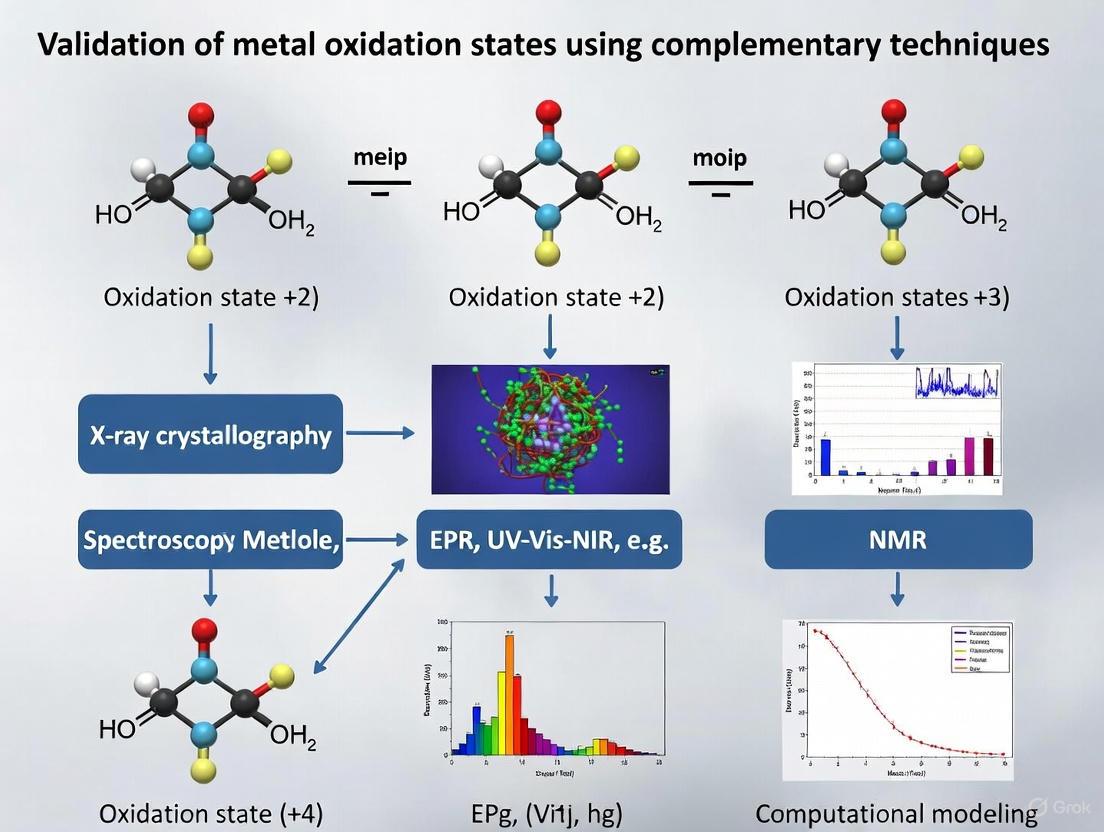
Accurate determination of metal oxidation states is critical for understanding material properties, catalytic activity, and the biological interactions of metal-containing compounds in drug development.
Validating Metal Oxidation States: A Multi-Technique Framework for Materials and Drug Development
Abstract
Accurate determination of metal oxidation states is critical for understanding material properties, catalytic activity, and the biological interactions of metal-containing compounds in drug development. This article provides a comprehensive framework for validating oxidation states using a suite of complementary techniques. It covers the fundamental principles of oxidation state assignment, details both established and emerging computational and experimental methodologies, and offers strategies for troubleshooting discrepancies. By synthesizing insights from computational chemistry, machine learning, crystallography, and spectroscopy (including XPS), this guide empowers researchers to confidently characterize complex and dynamic systems, from battery materials to metal-organic frameworks and metallodrugs.
The Critical Role of Oxidation States in Material and Biological Function
The oxidation state (OS) is a fundamental concept in chemistry that represents the hypothetical charge of an atom if all its bonds were purely ionic. This formalism describes the degree of oxidation—or electron loss—of an atom within a chemical compound. Despite its conceptual nature, OS serves as an indispensable tool for understanding redox reactions, predicting chemical behavior, and systematizing inorganic nomenclature [1]. The concept originated with Antoine Lavoisier, who initially defined oxidation as reactions involving oxygen, though the definition later expanded to include any reaction involving electron loss regardless of oxygen participation [2].
A significant challenge arises from the fact that oxidation states represent a chemical formalism rather than a direct physical observable. As explicitly stated in chemical literature, "It is a serious mistake to think that our oxidation state system provides a quantitative description of actual electron densities" [3]. This distinction between chemical intuition and physical reality creates a crucial bridge that must be spanned through complementary validation techniques, particularly for complex systems such as transition metals in biological cofactors or battery materials where accurate OS assignment is critical for understanding function [4] [5].
Theoretical Foundations and Assignment Rules
Conventional Rule-Based Assignment
The traditional approach to determining oxidation states relies on a set of hierarchically applied rules derived from periodic trends and electronegativity considerations [6] [3] [1]:
- The oxidation state of an uncombined element is always zero [6] [1].
- For monatomic ions, the oxidation state equals the ionic charge [1].
- Alkali metals consistently exhibit a +1 oxidation state, while alkaline earth metals display a +2 state [6] [3].
- Fluorine always maintains a -1 oxidation state, while other halogens typically do as well, except when bonded to oxygen or lighter halogens [3] [1].
- Hydrogen is typically assigned +1, except in metal hydrides where it takes a -1 state [6] [3].
- Oxygen generally assumes a -2 state, except in peroxides (-1) or when bonded to fluorine [6] [3].
- The sum of oxidation states must equal the overall charge of the molecule or ion [6] [3] [1].
For transition metals, which frequently exhibit multiple oxidation states, these rules require careful application. Elements like vanadium can display multiple states (+2, +3, +4, +5), with each step involving the loss of an additional electron [6]. The d-block electronic configuration influences these variable states, as partially filled d-orbitals can accommodate electron loss from both s and d orbitals [7].
Quantum Mechanical Challenges
From a quantum mechanical perspective, oxidation states present a significant challenge because electron density is global rather than atomically partitioned [8]. As noted by Yin and Xiao, "The oxidation state (OS) is an essential chemical concept that embodies chemical intuition but cannot be computed with well-defined physical laws" [8]. This fundamental limitation means that quantum mechanical calculations require additional approximations and corrections to align with chemical intuition.
Standard density functional theory (DFT) calculations suffer from self-interaction errors that cause unphysical electron delocalization, particularly problematic for systems with strongly localized d or f electrons [5]. Advanced approaches like DFT+U+V (incorporating both on-site U and inter-site V Hubbard corrections) have shown improved capability to describe redox processes and provide more accurate oxidation state assignments in materials such as transition-metal oxides and battery cathode materials [5].
Experimental Determination Techniques
X-ray Photoelectron Spectroscopy (XPS)
XPS serves as a powerful technique for oxidation state analysis on solid surfaces by measuring the binding energies of core electrons, which shift depending on the atomic charge state [9].
Table 1: XPS Analysis of Molybdenum Sulfide Powder
| Element | Binding State | Oxidation State | Atomic % | Remarks |
|---|---|---|---|---|
| Mo | MoS₂ | +4 | 13.9 | Major phase |
| Mo | MoO₃ | +6 | 1.2 | ~7.9% of total Mo |
| S | S²⁻ (in MoS₂) | -2 | 26.3 | Sulfidic form |
| O | - | - | 3.7 | Surface contamination |
| C | - | - | 54.9 | Surface contamination |
In the representative study of molybdenum sulfide lubricant powder, XPS quantification revealed that approximately 7.9% of molybdenum existed as Mo(VI) in MoO₃ alongside the primary Mo(IV)S₂ phase, demonstrating the method's capability to identify and quantify mixed oxidation states in complex materials [9].
Spatially Resolved Anomalous Dispersion (SpReAD) Refinement
For metalloproteins, SpReAD refinement provides a sophisticated approach to determine oxidation states of individual metal centers within crystal structures by exploiting the energy dependence of anomalous scattering [4]. This method reconstructs element-specific absorption spectra for individual metal sites by collecting diffraction data at multiple energies across an absorption edge, typically in 2eV steps [4].
The experimental workflow for SpReAD analysis requires careful attention to radiation damage, as high X-ray doses can cause photoreduction and alter oxidation states during data collection [4]. In a study of sulerythrin, a ruberythrin-like protein containing a binuclear metal center, SpReAD analysis revealed different oxidation states between the two iron ions in crystals treated with H₂O₂, demonstrating the method's unique capability to discriminate oxidation states at individual metal sites within multinuclear centers [4].
X-ray Absorption Spectroscopy (XAS)
While not explicitly detailed in the search results, X-ray Absorption Near Edge Structure (XANES) and Extended X-ray Absorption Fine Structure (EXAFS) are mentioned as complementary methods for oxidation state analysis, particularly useful for determining the average oxidation state of specific elements in complex systems [4].
Computational Approaches and Data-Driven Methods
The TOSS Framework
The Tsinghua Oxidation States in Solids (TOSS) framework represents a novel data-driven paradigm for determining oxidation states in crystal structures [8]. This approach employs Bayesian maximum a posteriori probability estimation to abstract distance thresholds and coordination environments from large datasets of crystal structures, effectively "learning" chemical intuition from structural data [8].
Table 2: Performance Comparison of OS Determination Methods
| Method | Principle | Application Scope | Accuracy | Limitations |
|---|---|---|---|---|
| TOSS | Data-driven Bayesian MAP | Inorganic crystals | 96.09% | Limited to structures in training domain |
| GCN Model | Graph convolutional networks | Inorganic crystals | 97.24% | Black-box prediction |
| BVM | Bond valence parameters | Crystals with parameters | Variable | Parameter availability |
| SpReAD | Anomalous dispersion | Metalloprotein crystals | Site-specific | Radiation damage concerns |
| XPS | Core electron binding | Solid surfaces | Surface-sensitive | Limited to surfaces |
When applied to over 250,000 high-confidence crystal structures, TOSS achieved 96.09% accuracy against human-curated reference data, while a graph convolutional network (GCN) model trained on TOSS results reached 97.24% accuracy [8]. This demonstrates the powerful synergy between data-driven methods and machine learning in oxidation state assignment.
First-Principles Approaches
Sit et al. developed a novel theoretical approach for unambiguous oxidation state determination from quantum-mechanical calculations that separates metal-ligand orbital mixing from actual d-orbital occupation [10]. This method, applied to transition-metal complexes and materials using DFT+U, provides a more rigorous foundation for oxidation state assignment from first principles [10].
Recent advances combine these approaches with machine learning potentials, treating atoms with different oxidation states as distinct species during training [5]. This "redox-aware" machine learning strategy has shown promise for modeling complex electrochemical processes in battery materials where accurate description of oxidation state evolution is crucial [5].
Experimental Protocols
SpReAD Refinement Protocol for Metalloproteins
The SpReAD methodology requires meticulous experimental design and execution [4]:
Sample Preparation: Metalloprotein crystals must be grown and cryocooled under controlled conditions matching the physiological or relevant experimental environment. For the sulerythrin study, crystals were grown under anoxic conditions using vapor diffusion in sitting drops [4].
Data Collection: X-ray diffraction data must be collected at multiple energies (typically 10-20 points) across the absorption edge of the element of interest, with careful dose control to minimize radiation damage. The reported sulerythrin experiment used 2eV steps across the iron K-edge [4].
Structure Refinement: Conventional refinement is performed against data collected at each energy to obtain Δf″ values for individual metal atoms.
Spectra Reconstruction: The refined Δf″ values are used to reconstruct absorption spectra for each metal site.
Oxidation State Assignment: The relative positions of inflection points in these site-specific spectra indicate oxidation states, calibrated against reference compounds with known oxidation states.
Critical considerations include rigorous radiation dose management and the use of controlled environments to preserve biological relevance during data collection [4].
XPS Analysis Protocol for Solid Materials
XPS analysis for oxidation state determination follows a standardized workflow [9]:
Sample Preparation: Powder or solid samples are typically mounted on adhesive tapes or holders without chemical treatment that might alter oxidation states.
Data Acquisition:
- First, an overview spectrum (0-1100 eV binding energy) identifies all elements present.
- High-resolution spectra are then collected for elements of interest using appropriate X-ray sources and pass energies.
Spectral Analysis:
- Peaks are fitted with appropriate background subtraction and line shapes.
- Chemical shifts are referenced to adventitious carbon (C 1s at 284.8 eV).
- Oxidation states are assigned based on established binding energy databases.
Quantification: The relative areas of peaks corresponding to different oxidation states are used to calculate their proportions, as demonstrated in the molybdenum sulfide study [9].
Integrated Workflow for Oxidation State Validation
The complex nature of oxidation states in real systems often requires a complementary approach combining multiple techniques. The following workflow diagram illustrates the relationship between different determination methods:
Research Reagent Solutions
Table 3: Essential Research Reagents and Materials for Oxidation State Studies
| Reagent/Material | Function | Application Examples |
|---|---|---|
| Strep-Tactin resin | Affinity chromatography | Protein purification for metalloprotein crystallography [4] |
| Anoxic chamber | Controlled atmosphere | Sample preparation for oxygen-sensitive compounds [4] |
| Crystallization screens | Crystal growth | Metalloprotein crystallization for SpReAD [4] |
| Reference compounds | Calibration standards | XPS and XANES quantification [4] [9] |
| X-ray sources | Electron excitation | XPS analysis of surface oxidation states [9] |
| Synchrotron beamtime | Tunable X-ray source | SpReAD and XAS experiments [4] |
The determination of oxidation states represents an interface between chemical intuition and physical measurement, requiring complementary approaches for robust validation. While conventional rules provide initial assignments, advanced techniques like SpReAD refinement, XPS, and data-driven methods like TOSS offer increasingly sophisticated approaches for ambiguous cases. The integration of first-principles calculations with machine learning, as demonstrated by redox-aware potentials, points toward a future where oxidation state evolution can be tracked dynamically in complex operating environments like battery electrodes or catalytic cycles. For researchers, the selection of appropriate methods depends on the specific system—with SpReAD offering site-specific resolution in proteins, XPS providing surface-sensitive analysis of materials, and computational approaches enabling high-throughput screening of hypothetical compounds. As these techniques continue to mature, they strengthen the critical bridge between the formal concept of oxidation state and its manifestation in real chemical systems.
Accurately determining the oxidation states of metals is a fundamental challenge in materials science and chemistry. The oxidation state of an element dictates its chemical behavior, influencing everything from the efficiency of an electrocatalyst to the stability of a battery electrode and the mechanism of a pharmaceutical drug. Relying on a single analytical technique, however, can lead to an incomplete or misleading picture. This guide compares the performance of various validation techniques, underscoring through experimental data how a multi-faceted approach is critical for research reliability and technological advancement.
The Critical Role of Oxidation State Validation
The oxidation state of a metal atom refers to its charge after the ionic approximation of its heteronuclear bonds [5]. While a simple concept, its accurate determination from first principles is challenging. Standard computational methods like Density Functional Theory (DFT) are often plagued by self-interaction errors, which cause unphysical delocalization of electrons and misrepresent the true oxidation states in materials with strongly localized electrons, such as transition-metal oxides [5]. This is not merely an academic concern; an incorrect assignment can lead to flawed interpretations of a material's properties or a drug's biochemical pathway.
Validation through complementary techniques provides a corrective lens. For instance, DFT+U+V, an advanced computational method, can provide a more reliable description of redox reactions, but its predictions still require experimental verification [5]. The following sections demonstrate how this principle of cross-validation is applied across different fields to achieve robust, reliable results.
Comparative Analysis of Validation Techniques
The table below summarizes the performance and application of various techniques used for validating metal oxidation states and their functional implications.
Table 1: Comparison of Oxidation State Validation and Application Techniques
| Field/Technique | Key Performance Metrics | Advantages | Limitations / Challenges |
|---|---|---|---|
| Computational Materials (DFT+U+V) [5] | Accurately tracks adiabatic evolution of OS; enables development of redox-aware machine-learning potentials. | Mitigates self-interaction errors; provides atomic-level insight; good for predictive modeling. | Computationally expensive; requires careful parameterization; results need experimental validation. |
| Electrocatalysis (In Situ/Operando Characterization) [11] | Identifies true active phases; monitors dynamic atomic rearrangement (e.g., Ni to NiOOH); links structural change to activity. | Probes catalysts under working conditions; captures transient intermediates and reversible changes. | Requires sophisticated, often synchrotron-based equipment; data interpretation can be complex. |
| Battery Diagnostics (Physics-Informed Neural Networks - PINNs) [12] | Predicts internal health parameters ~1000x faster than traditional physics models; quantifies physical degradation mechanisms. | Enables rapid, non-destructive diagnostics; integrates physical laws for scientific rigor. | Transition from simulation to real-world data validation is ongoing; model refinement for diverse systems is needed. |
| Drug Analysis (Electrochemical Sensors) [13] | High sensitivity (µM to fM); rapid response (seconds to minutes); can probe redox mechanisms of drugs. | Simple, cost-effective; compatible with complex biological matrices; can be deployed as wearable devices. | Susceptible to matrix interference; limited shelf life; signal drift requires frequent calibration. |
| Chemical Analysis (Formaldehyde Clock System) [14] | Identifies Fe(VI), Fe(III), Fe(II) based on their differential effect on a reaction's induction period. | Simple operation, fast analysis, and low cost; useful for qualitative distinction. | Limited quantitative application; concentration range limited (2.0×10⁻⁴ − 1.2×10⁻³ mol L⁻¹). |
| Structural Validation (NMR Crystallography) [15] | Validates crystal structures by comparing experimental vs. calculated NMR chemical shifts (using Machine Learning like ShiftML). | Provides atomic-level resolution for powdered solids; high sensitivity to local atomic environment. | Requires expertise in solid-state NMR; machine learning models depend on the quality of training data. |
Detailed Experimental Protocols and Workflows
Protocol for Electrocatalyst Reconstruction Validation
Understanding the dynamic surface changes of electrocatalysts requires a rigorous workflow combining in situ characterization and electrochemical analysis.
Core Workflow:
Key Experimental Steps:
- Pre-catalyst Synthesis and Baseline Characterization: Synthesize the pristine catalyst (e.g., Ni(OH)₂, Co₃O₄, or metal sulfides). Characterize its initial state using ex situ techniques like Powder X-Ray Diffraction (PXRD) for crystal structure, Scanning Electron Microscopy (SEM) for morphology, and X-ray Photoelectron Spectroscopy (XPS) for initial surface composition and oxidation state [11].
- In Situ/Operando Characterization: Subject the catalyst to relevant electrochemical conditions (e.g., Oxygen Evolution Reaction (OER) at 1.0-1.5 V vs. RHE) while simultaneously collecting data. Key techniques include:
- X-ray Absorption Spectroscopy (XAS): Probes local electronic structure and coordination environment of metal atoms, directly tracking oxidation state changes (e.g., Ni²⁺ to Ni³⁺/⁴⁺) [11].
- In Situ Raman Spectroscopy: Identifies the formation of new chemical species and phases on the catalyst surface in real-time (e.g., detection of NiOOH) [11].
- Post-mortem Analysis: After testing, the catalyst is removed and re-analyzed with techniques like TEM and XPS to identify permanent, irreversible changes to the structure and composition.
- Data Correlation: The data from all stages is correlated with electrochemical performance metrics (activity, stability) to unequivocally link the reconstructed surface phase (the "true catalyst") to its function [11].
Protocol for Battery Electrode Activation and Diagnostics
Validating the effectiveness of electrode treatments and diagnosing health states are key for battery development.
Core Workflow:
Key Experimental Steps:
- Electrode Activation and Physical Validation: As demonstrated in vanadium redox flow batteries, graphite felt electrodes can be thermally activated. A systematic study involves testing different temperatures (300-500°C) and durations (3-24 hours). The optimal condition (e.g., 400°C for 7 hours) is validated by measuring an increase in oxygen-containing functional groups on the surface (using XPS) which enhances electrode activity [16].
- Electrochemical Performance Testing: Assembled batteries are cycled through charge/discharge tests. Key metrics include energy efficiency, voltage efficiency, capacity retention, and internal resistance. The improved performance of activated electrodes is quantitatively measured (e.g., energy efficiency increased by 3.67-5.94%) [16].
- AI-Driven Diagnostic Validation: A Physics-Informed Neural Network (PINN) can be employed as a surrogate for complex physical battery models. The PINN is trained on voltage/current data and uses underlying physical laws to rapidly predict internal state-of-health parameters, such as lithium inventory and electrode kinetics, offering a non-destructive method for diagnosing degradation and validating the effectiveness of the electrode activation [12].
Protocol for Drug Redox Mechanism and Analysis
Probing the redox behavior of metal-containing drugs or pharmaceutical pollutants is essential for understanding their mechanism and environmental impact.
Core Workflow:
Key Experimental Steps:
- Electrochemical Detection: Techniques like cyclic voltammetry (CV) or differential pulse voltammetry (DPV) are used to study the drug's redox behavior. The drug is dissolved in a suitable electrolyte (often mimicking physiological conditions) and its oxidation/reduction peaks are measured. This provides information on the redox potential and the nature of electron transfer processes [13].
- Linking Redox Behavior to Adverse Effects: The redox characteristics of Non-Steroidal Anti-Inflammatory Drugs (NSAIDs) can be linked to their propensity to generate Reactive Oxygen Species (ROS), which cause oxidative stress. Electrochemical data can help predict the nature and severity of side effects, such as gastrointestinal or cardiovascular complications, by revealing how easily the drug undergoes redox cycling [13].
- Validation with Complementary Techniques: The identity of drug molecules and their metabolites is confirmed using techniques like LC-MS (Liquid Chromatography-Mass Spectrometry). Furthermore, for solid drugs, NMR Crystallography—which combines solid-state NMR with computational methods like machine learning (ShiftML) and X-ray diffraction data—is used to definitively validate the crystal structure, including the atomic environment around metal centers if present [15].
The Scientist's Toolkit: Essential Research Reagents & Materials
Table 2: Key Reagents and Materials for Featured Experiments
| Item | Function / Application | Field |
|---|---|---|
| Graphite Felt Electrodes | High-surface-area electrode for redox reactions; requires activation (e.g., thermal) to improve performance. | Battery Science [16] |
| Transition Metal Oxide/Sulfide Precursors | (e.g., Ni(OH)₂, Co₃O₄, MoS₂). Starting materials for pre-catalysts that reconstruct under operational conditions. | Electrocatalysis [11] |
| Screen-Printed Electrodes (SPEs) | Disposable, miniaturized platforms for electrochemical detection; ideal for rapid, on-site drug analysis. | Pharmaceutical Analysis [17] |
| Formaldehyde Clock System Reagents | (HCHO, NaHSO₃, Na₂SO₃). A chemical system used to qualitatively distinguish between different oxidation states of metals like iron based on reaction kinetics. | Analytical Chemistry [14] |
| Magic Angle Spinning (MAS) NMR Probe | Essential hardware for solid-state NMR; ultra-fast MAS (>100 kHz) enables high-resolution ¹H-detected NMR for crystal structure validation. | NMR Crystallography [15] |
The consistent theme across electrocatalysis, battery science, and pharmaceutical research is that reliance on a single method is insufficient for definitive conclusions about metal oxidation states. Validation through a complementary suite of techniques—whether combining computation with operando spectroscopy, electrochemistry with AI, or voltammetry with crystallography—is what transforms a preliminary finding into a robust scientific result. This rigorous, multi-technique approach is foundational to developing more efficient catalysts, longer-lasting batteries, and safer pharmaceuticals.
Common Pitfalls and the Need for a Multi-Technique Approach
Accurately determining metal oxidation states is fundamental to research in catalysis, energy storage, and materials science. Relying on a single analytical technique, however, often leads to misinterpretation and incomplete characterization. This guide outlines common experimental pitfalls and demonstrates how a multi-technique approach provides robust validation, using comparative experimental data to illustrate key principles.
Common Pitfalls in Single-Technique Analysis
Using a single analytical method to determine metal oxidation states introduces significant risks. The following table summarizes frequent challenges and their consequences.
| Pitfall | Consequence | Supporting Evidence |
|---|---|---|
| Improper Calibration and Energy Offsets | Incorrect alignment between experimental data and reference spectra, leading to misidentification of oxidation states. [18] | In XAS and EELS, fluctuations in temperature or stray magnetic fields can cause energy shifts, requiring reference standards measured in the same session for reliable calibration. [18] |
| Overlooking Sample/Thickness Effects | Spectral fine structures can change with sample thickness, altering key intensity ratios and leading to false conclusions. [18] | In EELS analysis of Mn, the L2/L3 intensity ratio increases with sample thickness, rendering reference-free ratio methods unreliable. [18] |
| Inadequate Forcefield Selection in Modeling | Computational models may predict unrealistic or energetically unfavorable structures, contradicting experimental findings. [19] | MD/MC simulations using the ReaxFF forcefield for Pt nanoparticles predicted detached Pt6O8 clusters; however, these species were deemed implausible after comparison with higher-fidelity MACE-MP-0 and DFT calculations. [19] |
| Ignoring Measurement Error and Statistical Power | Underpowered studies or those ignoring error can produce false positive/negative results or overestimate effect sizes. [20] | A "too-small-for-purpose" sample size causes overfitting and a lack of statistical power, while disregarding measurement error can lead to the "noisy data fallacy." [20] |
The Multi-Technique Solution: An Integrated Workflow
A synergistic approach that combines computational, electrochemical, and spectroscopic methods mitigates the limitations of any single technique. The following workflow for characterizing oxidation states in metal nanoparticles integrates these complementary strategies.
Comparative Experimental Data from Multi-Technique Studies
Case Study 1: Platinum Nanoparticle Oxidation
A 2025 study combined computational and experimental techniques to investigate the oxidation of a realistic 353-atom Pt nanoparticle. The table below summarizes the purpose and findings of each technique, highlighting their complementary nature. [19]
| Technique | Purpose in the Study | Key Outcome / Finding |
|---|---|---|
| ReaxFF/MD-MC Simulations | To simulate the oxidation process and predict oxide structures at high oxygen partial pressure. | Predicted significant oxidation with oxygen penetrating the nanoparticle core and forming Pt6O8 clusters. |
| MACE-MP-0 & DFT | To provide higher-accuracy validation of the energetics and structures predicted by ReaxFF. | Revealed poor agreement in binding energies with ReaxFF, casting doubt on the plausibility of the predicted Pt6O8 species. |
| X-ray Diffraction (XRD) | To measure coordination numbers and bond distances for comparison with simulated structures. | Showed partial agreement with simulations in terms of coordination numbers and bond distances. |
| Extended X-ray Absorption Fine Structure (EXAFS) | To analyze local coordination environment and bond lengths. | Provided experimental data on coordination numbers and bond distances that partially aligned with simulations. |
| Transmission Electron Microscopy (TEM) | To provide structural information on particle size and morphology. | Used for 3D experimental reconstruction of the initial Pt nanoparticle structure used in simulations. |
Case Study 2: Manganese Oxidation State Decomposition
A 2023 study developed a deep learning model, MnEdgeNet, to decompose mixed Mn oxidation states from XAS and EELS L2,3 edge data, directly addressing pitfalls of traditional linear combination analysis. [18]
| Technique | Challenge / Pitfall | Multi-Technique / Model Solution |
|---|---|---|
| XAS & EELS L2,3 Edge Analysis | Traditional linear combination analysis requires reference spectra from the same instrument/session to avoid errors from energy calibration offsets and instrumental broadening. [18] | A deep learning model was trained on a synthetic library of 1.2 million spectra, incorporating physics-informed variations like energy offset and plural scattering, making it calibration- and reference-free. [18] |
| EELS Specificity | Spectral fine structures change with sample thickness due to plural scattering (the "thickness effect"), altering the L2/L3 ratio and leading to inaccurate decomposition. [18] | The training library explicitly included a forward model for plural scattering, making the final model robust against thickness effects (up to t/λ = 1). [18] |
| Validation | -- | The model was quantitatively validated on experimental Mn3O4 (Mn2+, Mn3+) data not used in training, achieving high accuracy and demonstrating real-world applicability. [18] |
Detailed Experimental Protocols
To ensure reproducibility, here are detailed methodologies for key techniques discussed.
This protocol describes the integrated computational workflow for simulating platinum nanoparticle oxidation.
1. System Preparation:
- Begin with an experimentally reconstructed nanoparticle structure (e.g., a 353-atom Pt nanoparticle from STEM data [19]).
- Grand-Canonical Monte Carlo/Molecular Dynamics (MC-MD): Perform hybrid MC-MD simulations using a forcefield (e.g., ReaxFF) in the LAMMPS software. Set the oxygen chemical potential based on the desired partial pressure (e.g., from 10-25 to 1.0 atm at 350 K). Continue until acceptance rates for addition/deletion moves stabilize.
2. Configuration Sampling and Relaxation:
- Extract multiple geometries (e.g., 32 configurations) from the high-pressure simulation at evenly spaced oxygen coverages.
- Subject each geometry to a further NVT-MD simulation (e.g., 100 ns at 350 K) without MC moves to allow structural relaxation and amplify features like oxide clusters.
- Select the most stable configuration from the final segment of each trajectory (e.g., the last 1 ns) for optimization.
3. High-Fidelity Optimization and Electronic Structure Analysis:
- Optimize the selected relaxed geometries using both the original forcefield (e.g., ReaxFF) and a higher-accuracy universal model (e.g., MACE-MP-0).
- Perform Density Functional Theory (DFT) calculations on the optimized structures using linear-scaling DFT software (e.g., ONETEP) with a PBE functional. This step provides the final electronic structure and validates the energetics predicted by the forcefields.
This protocol outlines a multi-technique electrochemical approach to evaluate corrosion inhibitors for mild steel.
1. Sample and Solution Preparation:
- Working Electrode: Use mild steel specimens (e.g., composition: 2.00 wt.% Mg, 0.50 wt.% Fe, 0.50 wt.% Mn...). Embed in epoxy resin to expose a defined surface area (e.g., 1.0 cm2).
- Surface Preparation: Polish the exposed surface successively with emery papers (e.g., grades 100 to 2000), degrease with ethanol, and dry with compressed air.
- Electrolyte: Prepare a 1.0 M HCl solution by diluting concentrated acid with deionized water.
- Inhibitors: Dissolve the compounds under investigation (e.g., a benzimidazole-thiophene ligand and its Zn/Cu complexes) in the electrolyte at the desired concentration (e.g., 1 × 10⁻³ M).
2. Electrochemical Measurement Sequence:
- Employ a standard three-electrode cell: mild steel as the working electrode, a platinum counter electrode, and an Ag/AgCl reference electrode.
- Stabilization: Immerse the working electrode in the test solution at open circuit potential (OCP) for 60 minutes at 298 K to reach a steady state.
- Electrochemical Impedance Spectroscopy (EIS): Record spectra in a frequency range from 100 kHz to 100 mHz with a 10 mV amplitude.
- Potentiodynamic Polarization (PDP): Obtain curves with a sweep rate of 1 mV/s in a potential range from -250 mV to +250 mV vs. Ecorr.
- Linear Polarization Resistance (LPR): Record data at a scan rate of 1 mV/s from -25 mV to +25 mV around Ecorr.
3. Surface Analysis:
- After electrochemical testing, analyze the electrode surface using Scanning Electron Microscopy (SEM) and Energy-Dispersive X-ray Spectroscopy (EDS) to observe morphology and elemental composition.
- Use X-ray Photoelectron Spectroscopy (XPS) with an Al Kα source to characterize the chemical states of elements within the protective film formed by the inhibitor.
The Scientist's Toolkit: Essential Research Reagents and Materials
| Item | Function / Role in Research |
|---|---|
| Reference Materials (e.g., MnO, Mn2O3, MnO2) | Essential for calibrating XAS and EELS measurements to establish a baseline for specific oxidation states (Mn2+, Mn3+, Mn4+). [18] |
| Experimentally Reconstructed Nanoparticles | Provides a realistic, non-idealized starting structure for computational studies, leading to more accurate simulations of properties like oxidation behavior. [19] |
| High-Accuracy Forcefields (e.g., MACE-MP-0) | Machine learning-potentials offering higher fidelity predictions of energetics and structures compared to traditional forcefields like ReaxFF, crucial for validating computational findings. [19] |
| Heterocyclic Organic Ligands (e.g., with N, S atoms) | Serve as effective corrosion inhibitors or complexing agents; their high electron density facilitates strong adsorption onto metal surfaces. [21] |
| Organometallic Complexes (e.g., Zn/Cu with organic ligands) | Can exhibit synergistic corrosion inhibition, where the metal center and organic ligand work together to enhance protective film formation and performance. [21] |
The path to reliable oxidation state characterization is fraught with pitfalls, from instrumental miscalibration and sample effects to inadequate statistical power and flawed computational models. As the comparative data and protocols in this guide demonstrate, no single technique is infallible. A thoughtfully designed, multi-technique workflow that cross-validates findings between computational simulation, electrochemical analysis, and multiple spectroscopic methods is not merely beneficial—it is essential for producing robust, reproducible, and conclusive scientific results.
A Toolkit for Oxidation State Analysis: From Computation to Experiment
In both inorganic chemistry and materials science, the formal oxidation state (OS) of a metal is a fundamental concept that provides critical insight into chemical reactivity, catalytic behavior, and material properties. Despite its conceptual importance, the oxidation state lacks a rigorous quantum mechanical definition, as electron density in compounds is global and cannot be precisely partitioned using first principles alone [8]. This theoretical ambiguity necessitates robust methods for OS assignment that combine computational predictions with experimental validation. The accurate determination of oxidation states is particularly crucial for transition metals, which commonly exhibit multiple oxidation states that directly influence their chemical functionality [7]. Within this context, complementary validation approaches have emerged as essential for verifying computational predictions, forming a foundational thesis that integrated methodologies provide the most reliable OS assignments in complex solid-state systems and molecular structures.
Model Comparison: Methodologies and Performance
The landscape of computational OS prediction is diverse, encompassing approaches from first-principles calculations to purely data-driven algorithms. The table below provides a systematic comparison of three distinct modeling approaches.
Table 1: Comparative Analysis of Oxidation State Prediction Models
| Model | Computational Approach | Primary Input Data | Key Advantages | Reported Accuracy | Limitations |
|---|---|---|---|---|---|
| TOSS | Data-driven paradigm using Bayesian maximum a posteriori probability (MAP) and distance distributions [8] | Crystal structures | High interpretability through emergent distance thresholds; 96.09% accuracy on curated ICSD dataset [8] | 96.09% (TOSS), 97.24% (TOSS-GCN) on benchmark ICSD dataset [8] | Requires large datasets for optimal performance |
| BERTOS | Composition-based machine learning model [8] | Chemical composition only | Rapid prediction without need for structural data [8] | Information not available in search results | Lacks structural sensitivity for complex bonding environments |
| DFT+U | Ab initio DFT with Hubbard correction for strongly correlated electrons [22] | First-principles electronic structure calculation | Directly models electronic properties; captures localized electrons [22] | Dependent on U parameter choice and method to avoid metastable states [22] | Computationally intensive; susceptible to metastable states [22] |
As evidenced in Table 1, each modeling approach offers distinct advantages that suit different application scenarios. TOSS excels in providing chemically intuitive OS assignments derived from structural data, while BERTOS offers speed for high-throughput screening, and DFT+U provides fundamental electronic insights despite its computational demands.
Experimental Protocols for Method Validation
TOSS Workflow and Implementation
The TOSS methodology employs a sophisticated two-loop structure to determine oxidation states from crystal structures:
Dataset Preparation and Preprocessing: The initial stage involves curating a large dataset of crystal structures. In the referenced implementation, structures from the Materials Project and Open Quantum Materials Database were combined and preprocessed using the "Get Structures" and "Pre-Set Features" modules [8].
Distance Threshold Abstraction: In the first looping structure, TOSS abstracts distance thresholds—defined as the longest bond length counted as coordination between element pairs—by "learning" over all atomic structures in the dataset repeatedly until convergence. These thresholds are initialized at 1.5 times the sum of Pyykkö's single-bond covalent radii but evolve to dataset-emergent values independent of initial guesses [8].
Oxidation State Determination: The second looping structure implements a "practicing" phase over all atomic structures to determine OSs by minimizing a loss function for each structure based on Bayesian maximum a posteriori probability (MAP) and distance distributions across the entire dataset [8].
Local Coordination Analysis: For each atomic site, a sphere is defined using the distance to its nearest neighbor multiplied by a tolerance parameter (t values from 1.1 to 1.25 in steps of 0.01). Within this sphere, the coordination environment is determined using the abstracted thresholds [8].
Model Validation: The TOSS implementation was benchmarked against a curated ICSD dataset with human-assigned OS labels, achieving 96.09% accuracy, while its GCN-based derivative reached 97.24% accuracy [8].
Complementary Experimental Validation Techniques
Computational OS predictions require experimental validation to confirm their accuracy, with several techniques serving as reference standards:
X-ray Photoelectron Spectroscopy (XPS): This surface-sensitive technique quantitatively determines oxidation states by measuring the kinetic energy of emitted electrons to obtain element-specific binding energies. Different oxidation states produce characteristic binding energy shifts, enabling discrimination between species like MoS₂ and MoO₃ [9]. One significant limitation is that the X-ray irradiation may reduce high oxidation states, potentially compromising accuracy [14].
Bond Valence Sum (BVS) Method: This approach calculates oxidation states from experimentally determined bond lengths in crystal structures. The method uses both chemical connectivity and bond-length data via ligand donor group templates and bond-valence sums, successfully validating +1, +2, and +3 oxidation states in copper complexes with approximately 99% reliability in compatible structures [23].
Chemical Clock Reactions: An innovative approach uses formaldehyde clock systems (HCHO-NaHSO₃-Na₂SO₃) to distinguish oxidation states based on their differential effects on induction periods. For iron species, K₂FeO₄ decreases the induction period, FeCl₃ increases it, while FeCl₂ has no effect on induction but reduces the pH jump slope, enabling discrimination in the concentration range of 2.0×10⁻⁴−1.2×10⁻³ mol L⁻¹ [14].
Integrated Workflow for Oxidation State Determination
The complementary relationship between computational prediction and experimental validation can be visualized through the following workflow:
Computational and Experimental Oxidation State Workflow
This diagram illustrates the integrated approach where computational models generate initial predictions that are subsequently verified through multiple experimental techniques to achieve validated oxidation state assignments.
Research Reagent Solutions for Oxidation State Analysis
Table 2: Essential Research Reagents and Materials for Oxidation State Determination
| Reagent/Material | Primary Function | Application Context |
|---|---|---|
| Formaldehyde Clock System (HCHO-NaHSO₃-Na₂SO₃) | pH-based discrimination of oxidation states via induction period modulation [14] | Qualitative identification of Fe(VI), Fe(III), and Fe(II) species |
| X-ray Photoelectron Spectrometer | Quantitative determination of elemental oxidation states via binding energy measurements [9] | Surface analysis of oxidation states in solid materials |
| Reference Crystalline Structures | Provides benchmark data with human-validated oxidation states [8] | Validation of computational prediction algorithms |
| Bond Valence Parameters | Empirical relationships between bond lengths and oxidation states [8] | Oxidation state assignment from crystallographic data |
The comparative analysis of DFT+U+V, BERTOS, and TOSS models reveals a sophisticated landscape of computational approaches for oxidation state prediction, each with distinct strengths and limitations. TOSS demonstrates exceptional accuracy in structural OS assignment through its innovative data-driven paradigm, while BERTOS offers rapid composition-based screening, and DFT+U provides fundamental electronic structure insights. The broader thesis of oxidation state validation is fundamentally strengthened by complementary techniques, where computational predictions and experimental measurements converge to provide reliable OS assignments. This integrated approach enables researchers to navigate the complex electronic landscapes of transition metal compounds with greater confidence, ultimately accelerating materials discovery and catalyst development through more accurate structural-property relationships.
Validating metal oxidation states is a fundamental challenge in inorganic chemistry and materials science, crucial for understanding the properties of catalysts, battery materials, and pharmaceuticals. Among the most widely used computational approaches for this task are the Bond Valence Method (BVM) and Local Coordination Environment (LCE) analysis. While BVM leverages the empirical relationship between bond lengths and bond valence to estimate oxidation states, LCE analysis determines oxidation states by statistically comparing a site's local environment to large crystallographic databases. This guide provides an objective comparison of these complementary techniques, supporting researchers in selecting the appropriate method for validating metal oxidation states in solid-state materials.
Theoretical Foundations
Bond Valence Method (BVM)
The Bond Valence Method is based on the principle that the sum of the bond valences around an atom equals its atomic valence, which is equivalent to its oxidation state [24]. The most common form of the relationship between bond valence and bond length was established by Brown & Altermatt [24]:
[ s{ij} = \exp\left(\frac{R0 - R_{ij}}{B}\right) ]
Where:
- ( s_{ij} ) is the bond valence between atoms i and j (in valence units, v.u.)
- ( R_{ij} ) is the observed bond length (in Ångströms)
- ( R_0 ) is a fitted parameter representing the bond length corresponding to a unit valence
- ( B ) is a universal "softness" parameter, often fixed at 0.37 Å [24]
The bond valence sum (BVS) for a cation is then calculated as:
[ Vi = \sumj s_{ij} ]
This sum should equal the formal oxidation state of the cation according to the valence-sum rule [24].
Local Coordination Environment Analysis
Local Coordination Environment analysis determines oxidation states through data-driven paradigms that examine the complete local surroundings of a metal center. Unlike BVM, which relies primarily on bond lengths, LCE analysis considers multiple geometric and chemical factors, including:
- Bond length distributions to all neighboring atoms
- Coordination numbers and polyhedron geometry
- Chemical identity of coordinating atoms
- Statistical patterns learned from large crystallographic databases [8]
Advanced implementations like the Tsinghua Oxidation States in Solids (TOSS) algorithm employ Bayesian maximum a posteriori probability to determine the most probable oxidation state by minimizing a loss function based on distance distributions across an entire dataset [8].
Methodological Comparison
Experimental Protocols
Bond Valence Method Protocol
Required Input Data:
- Crystallographic coordinates (CIF format preferred)
- Bond valence parameters (( R_0 ) and ( B )) for relevant atom pairs
Procedure:
- Identify Coordination Environment: Determine all bonds between the central metal atom and surrounding ligands within the first coordination shell [25].
- Measure Bond Lengths: Calculate all metal-ligand distances from the crystal structure.
- Calculate Bond Valences: Apply the Brown & Altermatt equation to compute individual bond valences.
- Sum Bond Valences: Add all bond valences to obtain the Bond Valence Sum.
- Compare to Oxidation State: Check agreement between BVS and expected oxidation state.
Validation: A successful application typically shows a deviation of <0.1-0.2 valence units from the expected oxidation state [24].
Local Coordination Environment Analysis Protocol
Required Input Data:
- Crystallographic coordinates
- Access to a large database of known structures (e.g., ICSD, Materials Project)
- Pre-trained models for coordination environment classification
Procedure (TOSS Algorithm Example):
- Structure Preprocessing: Standardize crystal structure representation and identify unique atomic sites [8].
- Local Environment Analysis: For each atomic site, define a sphere using the distance to its nearest neighbor multiplied by a tolerance parameter (typically 1.1 to 1.25) [8].
- Threshold Determination: Abstract distance thresholds for each element pair by "learning" over all atomic structures in the dataset [8].
- Constituent Identification: Within the sphere, determine the coordination environment based on converged thresholds.
- Oxidation State Assignment: Determine oxidation states by "practicing" over all atomic structures to minimize a loss function for each structure based on Bayesian maximum a posteriori probability and distance distributions [8].
Performance Metrics and Comparative Data
Table 1: Quantitative Comparison of BVM and LCE Analysis Techniques
| Parameter | Bond Valence Method | Local Coordination Environment Analysis |
|---|---|---|
| Theoretical Basis | Empirical bond length-bond valence relationship | Statistical analysis of coordination patterns in large datasets |
| Primary Input | Bond lengths, bond valence parameters | Complete crystal structure, reference database |
| Accuracy | RMSD: 0.128-0.174 v.u. for best parameters [24] | 96.09-97.24% accuracy vs. human-assigned labels [8] |
| Key Limitations | Limited by available bond valence parameters; transferability issues for unusual oxidation states [8] | Requires large reference datasets; performance depends on database quality |
| Computational Demand | Low; simple calculations | High; requires significant processing for large datasets |
| Best Applications | Single-structure analysis; materials with established parameters | High-throughput screening; novel materials with unusual coordination |
Table 2: Performance of BVM Parameter Derivation Methods
| Method | Weighted RMSD (v.u.) | Error per Unit Charge | Key Characteristics |
|---|---|---|---|
| Fixed B (B=0.37 Å) | 0.139 | 6.7% | Simple, widely implemented [24] |
| Graphical Method | 0.161 | 8.0% | Visual fitting, less precise [24] |
| GRG Method | 0.128 | 6.1% | Optimized generalized reduced gradient; most accurate [24] |
Applications in Materials Research
Structural Validation and Plausibility Testing
Both BVM and LCE analysis serve as powerful tools for validating crystal structures and identifying potentially erroneous determinations. The Bond Valence Method is particularly effective for rapid plausibility checks of proposed structures, especially when using bond-softness sensitive parameters that account for the polarizability of ions [25]. Recent advances in bond valence parameters, such as the softNC1 parameter set, significantly improve performance for bonds involving soft anions by systematically adapting parameters to bond softness [25].
Oxidation State Determination in Complex Systems
Local Coordination Environment analysis excels in determining oxidation states in complex systems where traditional BVM may struggle, including:
- Mixed-valence compounds: Where metal centers exist in multiple oxidation states
- Novel materials: With unusual coordination environments or oxidation states
- High-throughput screening: Rapid classification of oxidation states across large materials databases [8]
The TOSS algorithm demonstrates how data-driven approaches can achieve high accuracy (96.09%) by leveraging emergent patterns across thousands of structures, effectively capturing chemical intuition in a computational framework [8].
Specialized Applications
Table 3: Research Reagent Solutions for Oxidation State Analysis
| Reagent/Resource | Function | Application Context |
|---|---|---|
| softNC1 Parameters | Bond-softness sensitive parameters for BVM | Improved plausibility checks for crystal structures [25] |
| TOSS Algorithm | Data-driven oxidation state assignment | High-throughput oxidation state determination [8] |
| ICSD Database | Curated crystal structure repository | Reference data for both BVM and LCE analysis [24] [8] |
| Graph Convolutional Network (GCN) | Machine learning model for OS prediction | Alternative to TOSS with 97.24% accuracy [8] |
Integrated Workflow and Decision Framework
When to Use Each Method
Choose Bond Valence Method when:
- Analyzing materials with established bond valence parameters
- Performing rapid, single-structure plausibility checks
- Working with systems where coordination environments are well-defined
- Seeking computationally lightweight approaches [24]
Choose Local Coordination Environment Analysis when:
- Validating oxidation states in novel materials with unusual coordination
- Processing large datasets for high-throughput screening
- Analyzing mixed-valence compounds
- Dealing with systems where bond valence parameters are unavailable or unreliable [8]
Synergistic Applications
For the most robust oxidation state validation, particularly in research contexts requiring high confidence, researchers should employ both techniques synergistically:
- Primary Screening: Use LCE analysis for initial oxidation state assignment, particularly for novel materials
- Detailed Validation: Apply BVM with optimized parameters (e.g., GRG-derived or softNC1) for specific metal sites
- Cross-Validation: Compare results from both methods to identify discrepancies that may indicate structural issues or unusual bonding
This combined approach leverages the statistical power of data-driven LCE analysis with the chemical intuition embedded in the Bond Valence Method, providing comprehensive oxidation state validation for diverse research applications.
X-ray Photoelectron Spectroscopy (XPS) stands as a cornerstone technique for surface chemical analysis, particularly for determining elemental composition and chemical oxidation states. The technique operates on the principle of irradiating a solid surface in a vacuum with X-rays, causing the emission of photoelectrons whose kinetic energy is measured and converted to binding energy—a characteristic value for each element and its chemical environment [26]. The surface sensitivity of XPS, typically probing the outermost 1-10 nm of a material, makes it indispensable for studying surface reactions, corrosion, catalysis, and lubrication where surface oxidation states dictate material behavior [26]. This guide provides a comparative assessment of XPS against complementary techniques for validating metal oxidation states, with particular focus on experimental methodologies, limitations, and data interpretation challenges encountered in practical research settings.
The fundamental premise for oxidation state analysis rests on "chemical shifts"—changes in core electron binding energies that occur with variations in ionic and covalent bonding environments [26]. For transition metals specifically, these shifts manifest as distinct peaks in high-resolution spectra, enabling researchers to distinguish between different oxidation states through careful peak fitting and reference to standard materials [26]. However, recent research has revealed significant limitations to this established approach, particularly when analyzing nanomaterials where quantum confinement effects and reduced dimensionality alter the expected correlation between binding energy and oxidation state [27].
Comparative Performance Analysis: XPS vs. Complementary Techniques
Technical Comparison of Analytical Methods
Table 1: Comparison of Techniques for Metal Oxidation State Analysis
| Technique | Analytical Depth | Oxidation State Sensitivity | Quantification Capability | Key Limitations |
|---|---|---|---|---|
| XPS | 1-10 nm [26] | High for most elements [26] | Semi-quantitative (atomic %); Linear fitting possible with standards [26] | Vacuum required; Surface damage possible; Complex peak fitting for transition metals [26] |
| qNMR | Bulk technique [28] | Limited to specific functional groups [28] | Highly accurate and traceable for surface groups [28] | Requires extraction/dissolution; Not surface-specific [28] |
| TGA | Bulk technique [28] | Indirect through mass changes | Quantitative for surface groups [28] | Destructive; Requires complementary techniques for structural info [28] |
| ICP-MS | Bulk technique [28] | Elemental composition only | Highly accurate for elemental composition [28] | Destructive; Not surface-specific [28] |
Quantitative Performance Data for Iron Oxidation States
Table 2: XPS Analysis of Mixed Iron Oxidation State Sample [26]
| Oxidation State | Relative Percentage | Experimental Error |
|---|---|---|
| Fe(0) | 28% | ±2% |
| Fe(II) | 41% | ±5% |
| Fe(III) | 32% | ±6% |
The data in Table 2 demonstrates XPS capability for quantifying mixed oxidation states in iron samples, with varying precision across different states. The analysis was performed using reference spectra from standards as basis functions for linear peak fitting, avoiding the need for complex analytical functions to describe peak shapes [26]. This approach highlights both the quantitative potential of XPS and the importance of appropriate reference materials for accurate speciation.
Experimental Protocols for Oxidation State Validation
Standard Preparation Methodology
Preparation of reliable standards forms the foundation of accurate XPS oxidation state analysis. For iron oxidation state analysis, researchers have employed the following standardized approaches [26]:
- Fe(0) Standard: Iron foil cleaned by argon ion sputtering to remove surface oxides
- Fe(II) Standard: Iron oxide film heated under vacuum to achieve specific stoichiometry
- Fe(III) Standard: High-purity Fe₂O₃ powder (99.9995+%)
These standards produce distinct spectral features including chemical shifts, asymmetric peaks, spin-orbit coupling, multiplet splitting, and shake-up satellites that serve as fingerprints for each oxidation state [26]. When analyzing unknown samples, linear combinations of these reference spectra enable quantification of mixed oxidation states as demonstrated in Table 2.
XPS Data Collection and Analysis Protocol
Comprehensive XPS analysis follows a systematic workflow to ensure reliable data collection and interpretation [28] [29]:
- Sample Preparation: Minimal preparation required beyond mounting; compatible with powder or solid forms [28]
- Data Acquisition: Collect both survey scans (for elemental composition) and high-resolution regional scans (for chemical state analysis) [28]
- Background Subtraction: Remove inelastic backgrounds using established methods (e.g., Tougaard method) [26]
- Peak Fitting: Use reference spectra from standards as basis functions rather than purely analytical approaches to avoid highly correlated parameters [26]
- Quantification: Calculate relative atomic percentages from peak areas with sensitivity factors
Recent research proposes a "constant signal, variable time" (CSVT) approach as an alternative to traditional "variable signal, constant time" spectral collection, potentially offering better visual comparisons and more rigorous statistical analysis through paired t-tests [30]. Though currently a theoretical concept, this innovation highlights the ongoing evolution of XPS methodology.
In Situ Experimental Design
For oxidation state studies requiring environmental control, in situ XPS methodologies provide crucial insights. For example, tracking oxidation state changes during heating can reveal reduction/oxidation mechanisms [26]:
- An Fe(110) single crystal oxidized with ~4,000 L of pure oxygen in a vacuum chamber
- Subsequent heating to 800°C while collecting sequential XPS spectra
- Analysis of peak position and structure changes throughout the thermal treatment
- Quantification of relative oxidation state proportions versus temperature
This approach demonstrated near-complete reduction to iron metal at elevated temperatures, highlighting the dynamic nature of surface oxidation states under different conditions [26].
Figure 1: XPS Oxidation State Analysis Workflow. This diagram outlines the standardized protocol for validating metal oxidation states using XPS, highlighting key steps from sample preparation through multi-technique validation.
Critical Limitations and Methodological Considerations
Sub-Nanoscale Breakdown of Traditional Interpretation
A significant limitation of conventional XPS interpretation emerges at the sub-nanoscale, where the established correlation between binding energy and oxidation state can break down completely. Research on size-selected Ag₇ and Ag₁₁ clusters supported on graphene revealed anomalous Ag 3d₅/₂ core level shifts upon increasing oxygen coverage [27]. Unlike bulk materials, ultra-thin films, and surface oxides where binding energy typically increases with oxidation state, these nanoclusters exhibited a negative core level shift trend that reverted only at the highest Ag(III) oxidation state [27].
This phenomenon is attributed to quantum size effects and the unique electronic structure of zero-dimensional materials, where reduced coordination and quantum confinement significantly alter initial and final state effects [27]. The practical implication is profound: researchers analyzing nanomaterials cannot automatically extrapolate from bulk material reference data and must develop cluster-specific standards for accurate oxidation state assignment.
Common Analytical Errors and Quality Control
Despite established protocols, numerous errors persist in XPS data collection, analysis, and reporting [29]. Common issues include:
- Improper Background Handling: Incorrect background subtraction can significantly alter peak shapes and ratios
- Peak Fitting Problems: Overfitting, use of inappropriate line shapes, and failure to respect chemical constraints
- Insufficient Reporting: Missing critical instrument parameters that prevent experimental reproducibility
- Surface Damage: X-ray induced sample damage that alters oxidation states during measurement
Quality control measures should include validation with reference materials when available, consistency checks between survey and high-resolution scans, and correlation with complementary techniques when possible [29].
The Scientist's Toolkit: Essential Research Reagents and Materials
Table 3: Essential Research Materials for XPS Oxidation State Analysis
| Material/Reagent | Function | Application Notes |
|---|---|---|
| High-Purity Metal Foils (e.g., Iron foil) | Primary standards for zero-valent state [26] | Must be cleaned by argon ion sputtering before use [26] |
| Metal Oxide Powders (e.g., Fe₂O₃, 99.9995+%) | Reference standards for specific oxidation states [26] | Purity critical; surface contamination can affect results [26] |
| Aminopropyl Triethoxy Silane (APTES) | Surface functionalization for nanoparticle studies [28] | Introduces nitrogen marker for XPS quantification of surface groups [28] |
| Polyvinylpyrrolidone (PVP) | Polymer coating for nanoparticle stabilization [28] | Contains unique elements (N, O) for XPS tracking of surface coverage [28] |
| Stearic Acid | Surface coating for functionalized nanoparticles [28] | Provides distinct carbon signature in XPS for coating quantification [28] |
| Argon Gas Supply | Surface cleaning via ion sputtering | Essential for preparing standard surfaces and depth profiling |
Integrated Validation Strategy: Correlative Microscopy Approach
Given the limitations of individual techniques, a correlative approach combining XPS with complementary methods provides the most robust validation of metal oxidation states. The integrated workflow should include:
- XPS Primary Analysis: Initial surface composition and oxidation state assessment
- qNMR Cross-Validation: Quantitative functional group analysis for organic coatings [28]
- TEM Size Characterization: Critical for nanoparticle studies where size affects electronic structure [27] [28]
- Bulk Composition Verification: ICP-MS for total elemental composition [28]
This multi-technique approach is particularly crucial for commercial nanomaterials where supplier specifications are often incomplete or unreliable, and surface composition may differ significantly from bulk properties [28]. Studies have revealed substantial impurities and oxidation state variations in commercially available metal oxide nanoparticles, highlighting the importance of comprehensive characterization for both applications development and environmental health studies [28].
Figure 2: Multi-Technique Validation Strategy. This diagram illustrates the correlative approach essential for robust oxidation state validation, combining surface-sensitive (XPS), bulk (ICP-MS, TGA), and structural (TEM) techniques with quantitative NMR.
X-ray Photoelectron Spectroscopy remains an indispensable tool for surface-specific oxidation state analysis, but its effective application requires careful attention to methodological details, recognition of its limitations particularly at the nanoscale, and correlation with complementary analytical techniques. The comparative data and experimental protocols presented here provide a framework for researchers to design rigorous oxidation state validation studies, while the identified limitations highlight areas where conventional interpretation methods may require revision. As nanomaterials continue to gain importance across scientific and technological fields, the nuanced application of XPS in conjunction with other techniques will be essential for accurate materials characterization.
Leveraging Machine Learning Potentials for Redox-Aware Property Prediction
The accurate prediction and validation of metal oxidation states represents a cornerstone in the development of advanced materials, particularly for energy storage, catalysis, and drug development. Oxidation states (OS) are defined as the charges on atoms due to electrons gained or lost upon applying an ionic approximation to their bonds, serving as fundamental attributes that explain redox reactions, chemical bonding, and material properties [31]. The evolution of oxidation states follows redox reactions, electrolysis, and other crucial electrochemical processes that underpin contemporary technologies [5] [32]. Despite their importance, accurately describing redox reactions remains challenging for first-principles calculations due to self-interaction errors that cause unphysical electron delocalization, particularly in systems with strongly localized d or f electrons [5]. This comprehensive analysis compares emerging machine learning approaches for redox-aware property prediction, providing researchers with validated methodologies for oxidation state validation in complex material systems.
Comparative Analysis of Machine Learning Approaches for Redox Property Prediction
Table 1: Comparison of Machine Learning Approaches for Redox-Aware Property Prediction
| Methodology | Key Features | Accuracy Performance | Computational Efficiency | Best Use Cases |
|---|---|---|---|---|
| ML-Augmented First-Principles Calculations [33] [34] | Combines ML force fields with thermodynamic integration; uses Δ-machine learning for free energy refinement | Predicts Fe³⁺/Fe²⁺: 0.92 V (expt: 0.77 V); Cu²⁺/Cu⁺: 0.26 V (expt: 0.15 V); Ag²⁺/Ag⁺: 1.99 V (expt: 1.98 V) [33] [34] | High computational cost for hybrid functionals; ML force fields improve sampling efficiency | High-accuracy redox potential prediction for metal ions in solution; battery and electrocatalyst design |
| Redox-Aware Machine Learning Potentials [5] [32] | Treats atoms with different oxidation states as distinct species; utilizes equivariant neural networks (NequIP, MACE) | Accurately reproduces adiabatic ground state and oxidation state patterns from DFT+U+V [5] | First-principles accuracy at classical force field cost; minimal training data requirements | Transition metal oxides; battery cathode materials (e.g., LixMnPO4); finite-temperature MD simulations |
| Composition-Based Deep Learning (BERTOS) [31] | Transformer language model for OS prediction from chemical composition alone | 96.82% accuracy for all-element prediction; 97.61% accuracy for oxide materials [31] | Rapid screening without structural information; enables high-throughput composition design | Large-scale screening of hypothetical materials; charge-neutrality verification; generative material discovery |
| Redox Potential Prediction (OxPot) [35] | Combines DFT-calculated EHOMO with experimental correlation; various ML algorithms | R² = 0.977 for EHOMO vs. experimental Eox correlation; RMSE = 0.064 [35] | High-throughput capability for large chemical libraries; fast predictions at fraction of DFT cost | Organic molecule screening for redox flow batteries; electrolyte design; photovoltaics |
Table 2: Experimental Validation Performance of Formaldehyde Clock System for Iron Oxidation State Identification [14]
| Analyte | Effect on Induction Period | Effect on pH Jump Slope | Linear Concentration Range (mol L⁻¹) | Identification Mechanism |
|---|---|---|---|---|
| K₂FeO₄ (Fe(VI)) | Decrease | Not specified | 2.0 × 10⁻⁴ to 1.2 × 10⁻³ | Redox reaction with NaHSO₃/Na₂SO₃ |
| FeCl₃ (Fe(III)) | Increase | Not specified | 2.0 × 10⁻⁴ to 1.2 × 10⁻³ | Interaction with clock system components |
| FeCl₂ (Fe(II)) | No effect | Reduction | 2.0 × 10⁻⁴ to 1.2 × 10⁻³ | Indirect effect on system kinetics |
Experimental Protocols for Oxidation State Validation
Formaldehyde Clock System for Iron Oxidation State Identification
The formaldehyde clock system provides a straightforward experimental method for distinguishing between different iron oxidation states through their distinctive effects on reaction kinetics [14]. The detailed methodology encompasses the following steps:
Reagent Preparation: Prepare 0.12 mol L⁻¹ sodium bisulfite (NaHSO₃) and 0.012 mol L⁻¹ sodium sulfite (Na₂SO₃) mixed solution in distilled water. Separately, prepare 0.18 mol L⁻¹ formaldehyde (HCHO) solution using distilled water as the solvent.
System Assembly: Combine 10 mL distilled water, 18 mL of the NaHSO₃/Na₂SO₃ mixed solution, and 12 mL of 0.18 mol L⁻¹ HCHO solution sequentially in a 50 mL batch reactor. The final concentrations in the system will be [HCHO] = 0.054 mol L⁻¹ and [NaHSO₃/Na₂SO₃] = 0.054/0.0054 mol L⁻¹.
Kinetic Monitoring: Immerse a pH electrode (type E-201-C) into the reaction mixture with continuous homogenization using a magnetic stirrer at 530 rpm. Connect the electrode to a potential/temperature/pH comprehensive tester (type ZHFX-595) and record pH versus time data using an eight-channel chemical signal acquisition system.
Analyte Introduction: Introduce iron species (K₂FeO₄, FeCl₃, or FeCl₂) at concentrations ranging from 2.0 × 10⁻⁴ to 1.2 × 10⁻³ mol L⁻¹ into the clock system. Monitor changes in the induction period and pH jump characteristics.
Data Interpretation: Identify iron oxidation states based on their characteristic effects: decreased induction period for Fe(VI), increased induction period for Fe(III), and no effect on induction period but reduced pH jump slope for Fe(II) [14].
Experimental Workflow for Iron Oxidation State Identification Using Formaldehyde Clock System
Machine Learning-Aided First-Principles Calculation of Redox Potentials
The integration of machine learning with first-principles calculations enables high-accuracy prediction of redox potentials through a multi-step refinement process [33] [34]:
System Setup: Construct simulation cells containing the redox-active species (e.g., Fe³⁺, Fe²⁺) solvated in water molecules. For transition metal cations, use approximately 64 water molecules to ensure proper solvation.
Free Energy Calculation: Employ thermodynamic integration (TI) to compute the free energy difference between oxidized and reduced states using the formula: ΔA = ∫₀¹ ⟨∂H/∂λ⟩λ dλ, where λ couples the oxidized (λ=0) and reduced (λ=1) states.
Machine Learning Force Fields: Utilize ML force fields for efficient statistical sampling over broad phase space during thermodynamic integration, significantly reducing computational cost compared to direct hybrid functional calculations.
Multi-Step Refinement: Apply Δ-machine learning to refine free energy calculations from ML force fields to semi-local functionals, and subsequently from semi-local to hybrid functionals (e.g., PBE0 with 25% exact exchange).
Reference Potential Alignment: Use the O 1s level of water as an internal reference point instead of the vacuum level to establish an absolute potential scale, correcting for finite-size errors in periodic boundary condition calculations.
Validation: Compare predicted redox potentials against experimental values for benchmark systems (Fe³⁺/Fe²⁺, Cu²⁺/Cu⁺, Ag²⁺/Ag⁺) to validate methodology before application to unknown systems.
Research Reagent Solutions for Redox Property Analysis
Table 3: Essential Research Reagents and Computational Tools for Redox Property Prediction
| Reagent/Software Tool | Function/Purpose | Application Context | Key Features/Benefits |
|---|---|---|---|
| Formaldehyde Clock System [14] | Identification of iron oxidation states (Fe(VI), Fe(III), Fe(II)) | Experimental validation of oxidation states in aqueous systems | Simple operation, low cost, fast analysis (minutes), distinguishes multiple oxidation states |
| DFT+U+V Methodology [5] [32] | First-principles calculation with extended Hubbard functionals | Accurate description of redox reactions in transition metal oxides | Mitigates self-interaction errors, provides sharp "digital" changes in oxidation states, material-specific parameters |
| BERTOS Model [31] | Composition-based oxidation state prediction | High-throughput screening of hypothetical material compositions | 96.82% prediction accuracy, requires only chemical composition, no structural information needed |
| OxPot Dataset [35] | Redox potential prediction for organic molecules | Screening organic electrolytes for energy storage applications | Contains 15,238 organic molecules, strong EHOMO to Eox correlation (R²=0.977), aqueous phase focus |
| RedCat Workflow [36] | Automated discovery of redox-active organic electrolytes | Screening large molecular databases for battery applications | Integrates similarity filtering, property prediction, and commercial availability assessment |
The validation of metal oxidation states requires a complementary approach combining computational predictions with experimental verification. Machine learning potentials for redox-aware property prediction have demonstrated remarkable accuracy, with composition-based models achieving 96.82% accuracy for oxidation state assignment [31] and ML-augmented first-principles calculations predicting redox potentials within 0.11 V RMSE of experimental values [33] [34]. For researchers pursuing drug development or materials design, the strategic integration of multiple validation techniques—from the simple formaldehyde clock system for initial screening to sophisticated ML-potentials for detailed mechanism studies—provides a robust framework for redox property characterization. The experimental protocols and comparative performance data presented herein offer a foundation for selecting appropriate methodologies based on specific research requirements, balancing accuracy, computational cost, and experimental complexity.
Resolving Discrepancies and Optimizing Analysis in Complex Systems
Addressing Self-Interaction Errors in DFT for Accurate Redox Description
The accurate computational description of redox processes is fundamental to advancements in energy storage, catalysis, and drug development. Density Functional Theory (DFT) is a cornerstone method for modeling electronic structures; however, its standard approximations suffer from self-interaction errors (SIEs), which lead to an unphysical delocalization of electrons [37] [5]. This flaw severely compromises the accurate prediction of key redox properties, including oxidation states (OS) and redox potentials, particularly in systems with strongly localized d or f electrons, such as transition metal complexes and oxides prevalent in battery materials and metallodrugs [37] [5] [38]. For researchers validating metal oxidation states, recognizing and mitigating SIEs is not merely an academic exercise but a critical step in ensuring computational models yield reliable, experimentally verifiable data. This guide provides a comparative analysis of leading strategies to overcome SIEs, equipping scientists with the knowledge to select the optimal approach for their specific redox-related challenges.
Self-Interaction Errors and Their Impact on Redox Properties
The SIE arises because the electron in a standard DFT calculation incorrectly interacts with itself. This error is particularly pronounced in local and semi-local exchange-correlation functionals (e.g., LDA and GGA). In redox-active systems, the consequences are manifold:
- Unphysical Electron Delocalization: SIEs prevent the correct localization of electrons on transition metal centers, blurring the distinct electronic configurations associated with different oxidation states [37] [5]. For instance, in Li-ion cathode materials like Li(x)MnPO(4), standard DFT may fail to produce the sharp, "digital" changes in the Mn oxidation state that occur during (de)intercalation [37] [5].
- Inaccurate Redox Potentials: The spurious electron delocalization stabilizes charged states (oxidized or reduced forms) more than their neutral counterparts, leading to systematic errors in calculated redox potentials [38].
- Compromised Validation: When computational results from SIE-plagued DFT are compared with experimental techniques like X-ray Absorption Spectroscopy (XAS) or cyclic voltammetry, the discrepancies can be significant, hindering the validation process [39].
Table 1: Common Experimental Techniques for Validating Oxidation States and Redox Properties.
| Experimental Technique | Measurable Property | Utility in Validating Computational Results |
|---|---|---|
| X-ray Absorption Spectroscopy (XAS) [39] | Element-specific local electronic structure and coordination geometry. | Directly probes unoccupied states; core-level shifts are sensitive to oxidation state. |
| Cyclic Voltammetry (CV) [40] [38] | Formal redox potential of a complex in solution. | Provides a benchmark for computed adiabatic ionization energies and redox potentials. |
| X-ray Photoelectron Spectroscopy (XPS) [41] | Core-electron binding energies. | Core-level shifts provide direct, quantitative information on atomic oxidation states. |
Comparative Analysis of Strategies to Mitigate Self-Interaction Errors
Several advanced computational strategies have been developed to mitigate SIEs. The choice among them involves a trade-off between computational cost, accuracy, and system size.
Hubbard-Corrected DFT (DFT+U+V)
The DFT+U+V approach extends the simpler DFT+U method by adding an inter-site Hubbard V term to account for hybridization between localized orbitals on different atoms (e.g., between transition metal d and oxygen p orbitals) [37] [5].
- Mechanism: It applies a penalty functional to correct the energy of localized manifolds (like 3d or 4f orbitals), encouraging proper electron localization.
- Performance: For battery cathode materials like Mn and Fe phospho-olivines, DFT+U+V provides sharp, accurate changes in oxidation states as lithium concentration varies, closely mirroring experimental expectations [37] [5]. It is notably more accurate than standard DFT and often more computationally efficient and material-specific than hybrid functionals for transition-metal oxides [5].
- Protocol: The atomic occupation matrix is first projected onto specific electronic manifolds. The oxidation state can then be determined from the eigenvalues of this matrix, providing a reliable metric beyond simplistic charge analysis [37] [5].
Hybrid Density Functionals
Hybrid functionals, such as PBE0 and HSE06, mix a portion of exact Hartree-Fock (HF) exchange with DFT exchange.
- Mechanism: The non-local HF exchange partially cancels out the SIE, improving the description of localized states.
- Performance: Hybrid functionals, particularly with a high percentage of HF exchange (e.g., 60%), have proven highly effective for calculating X-ray absorption spectra, reducing energy shifts relative to experiment [39]. They are a gold standard for accuracy but come with a significantly higher computational cost, often 10-100 times greater than GGA calculations, limiting their application to large systems or molecular dynamics [37] [5].
- Protocol: In linear damped response time-dependent DFT (DR-TDDFT), a hybrid functional like BHLYP is selected, and the response of the molecular system to external X-ray radiation is calculated directly in the frequency domain to simulate spectra [39].
Range-Separated and Advanced Functional Schemes
For specific properties like redox potentials, more sophisticated functional schemes can be employed.
- Mechanism: Range-separated functionals (e.g., LC-BOP) use 100% HF exchange at long range, effectively eliminating the long-range part of the SIE, which is crucial for describing charge-transfer processes [38].
- Performance: The LC-BOP12 functional, combined with a pseudo counter ion solvation (PCIS) scheme to correct solvation energies, has achieved a remarkably low mean absolute error of 0.16 V for the redox potentials of transition metal complexes [38].
- Protocol: The PCIS scheme involves geometry optimization of both oxidized and reduced states in a solvation model, calculating the adiabatic ionization potential, and then applying a correction term that accounts for the over-stabilization of charged states by the continuum model [38].
Redox-Aware Machine Learning Potentials
To bridge the gap between accuracy and computational cost for molecular dynamics, machine learning interatomic potentials (MLIPs) are a revolutionary development.
- Mechanism: This approach trains equivariant graph neural networks (e.g., NequIP or MACE) on data generated by DFT+U+V. Crucially, atoms of the same element with different oxidation states (accurately identified by DFT+U+V) are treated as distinct species during training [37] [5].
- Performance: These "redox-aware" potentials can reproduce the adiabatic evolution of oxidation states observed in full DFT+U+V molecular dynamics simulations at a fraction of the computational cost. They can even identify the correct ground-state pattern of oxidation states through a combinatorial search for the lowest-energy configuration [37] [5].
- Protocol: High-quality training data is generated via DFT+U+V FPMD. The MLIP is then trained, with atomic species tags informed by the DFT+U+V-derived oxidation states. The trained potential can be used for extended simulations or configurational searches [37] [5].
Table 2: Comparison of Computational Methods for Mitigating Self-Interaction Errors in Redox Systems.
| Method | Key Mechanism | Advantages | Limitations | Ideal for Redox Use Cases |
|---|---|---|---|---|
| DFT+U+V [37] [5] | On-site (+U) and inter-site (+V) Hubbard corrections. | Excellent for localized d/f electrons; more affordable than hybrids; material-specific parameters. | Parameter (U, V) dependency; requires careful validation. | Li-ion battery cathodes; transition metal oxides; finite-temperature MD. |
| Hybrid Functionals [5] [39] | Mixes a fraction of exact HF exchange. | High accuracy for energies and spectra; broadly applicable. | Very high computational cost (~10-100x GGA). | Benchmarking; small system spectra; accurate thermochemistry. |
| Range-Separated + PCIS [38] | Long-range HF exchange; corrected solvation model. | Excellent for redox potentials in solution; minimizes charge errors. | Protocol complexity; system-specific parameterization. | Predicting redox potentials of metalloproteins & TMCs in solution. |
| ML Potentials [37] [5] | ML trained on DFT+U+V data with OS labels. | Near-DFT accuracy at MD speed; encodes complex redox behavior. | Dependent on quality/scope of training data. | Long-timescale redox processes; configurational searches in materials. |
The Scientist's Toolkit: Essential Research Reagents and Computational Solutions
Table 3: Key Research Reagent Solutions for Computational Redox Studies.
| Research Reagent / Software Solution | Function in Redox Studies |
|---|---|
| DFT+U+V Implementation (e.g., in codes like Quantum ESPRESSO) [37] | Provides the foundational high-fidelity data for redox properties of materials with localized electrons. |
| Equivariant Graph Neural Networks (e.g., NequIP, MACE) [37] [5] | Serve as the architecture for building fast and accurate redox-aware machine-learned interatomic potentials. |
| Linear Response TDDFT with Hybrid Functionals [39] | Enables the calculation of core-level spectra (XAS) for direct comparison with experiment and oxidation state validation. |
| Polarizable Continuum Model (PCM) Software [38] | Models solvation effects, which are critical for calculating solution-phase redox potentials. |
| Bader Charge Analysis Tools [41] | Offers one method for estimating atomic charges from DFT electron density, though it requires calibration for OS assignment. |
Workflow and Pathway for Accurate Redox Property Validation
Achieving a validated description of redox properties requires a synergistic workflow that combines advanced computational methods with experimental data. The following diagram illustrates this integrated pathway, from initial system selection to final validation.
Diagram 1: Integrated Computational-Experimental Workflow for Redox Property Validation. This pathway outlines the iterative process of selecting appropriate computational methods, calculating properties, and validating against experimental data to achieve a reliable description of redox processes.
The accurate computational description of redox processes is no longer hindered by the fundamental limitations of self-interaction errors in DFT. As this guide has detailed, a robust toolkit of advanced methods—from the material-specific accuracy of DFT+U+V and the high fidelity of hybrid functionals to the revolutionary speed of redox-aware machine learning potentials—is available to researchers. The critical step is the informed selection of an appropriate method based on the system size, property of interest, and available computational resources. By adhering to an integrated workflow that rigorously validates computational predictions against experimental benchmarks like XAS and cyclic voltammetry, scientists and drug development professionals can achieve reliable, predictive models of redox chemistry. This capability is paramount for accelerating the rational design of next-generation materials, from high-performance battery cathodes to novel metallodrugs with tailored therapeutic properties.
Handling Mixed Valence, Dynamic Processes, and Surface vs. Bulk Differences
Accurately characterizing material properties such as mixed valence, dynamic electron transfer processes, and differences between surface and bulk composition is fundamental to advancing fields ranging from catalysis and energy storage to drug development. These phenomena are often interdependent; for instance, the oxidation states of metal centers in a nanoparticle (mixed valence) can differ significantly between its surface and bulk regions, and these states may undergo dynamic changes during operation. Relying on a single analytical technique can yield misleading results, as each method probes different aspects of a system with varying depths and sensitivities. This guide compares the capabilities of key experimental techniques for validating metal oxidation states and electronic structures, providing researchers with a framework for selecting and applying complementary methodologies. By objectively comparing performance metrics and providing detailed experimental protocols, this review aims to equip scientists with the practical knowledge needed to navigate the complexities of material characterization, thereby enhancing the reliability and reproducibility of their research.
Comparative Performance of Analytical Techniques
The following tables summarize the core capabilities, performance metrics, and optimal use cases for key techniques in addressing mixed valence, dynamic processes, and surface-bulk differences.
Table 1: Core Capabilities and Technical Requirements
| Technique | Primary Physical Basis | Primary Information Obtained | Sample Environment | Key Technical Requirements |
|---|---|---|---|---|
| XPS (X-ray Photoelectron Spectroscopy) [42] | Photoelectric effect | Elemental composition, chemical/oxidation state, electronic structure | Ultra-high vacuum (UHV) | Monochromated Al Kα X-rays, high-energy resolution analyzer |
| DNP-NMR (Dynamic Nuclear Polarization NMR) [43] | Enhancement of nuclear polarization via electron spin | Atomic-level structure, dynamics, and local environment | Low temperature (for DNP), solid state | High-field NMR, microwave source (e.g., gyrotron), cryogenic probe, polarizing agents |
| DFT Calculations (Density Functional Theory) [44] | Quantum mechanical modeling | Predicted electronic structure (e.g., DOS), energies, geometries | In silico | High-performance computing, validated functionals, suitable model systems |
Table 2: Performance Metrics and Comparative Strengths
| Technique | Spatial Resolution/ Probe Depth | Oxidation State Sensitivity | Time Resolution for Dynamics | Key Strength | Principal Limitation |
|---|---|---|---|---|---|
| XPS [42] | ~5 nm (near-surface) | High (chemical shifts) | Seconds (static) | Direct quantification of oxidation states and surface composition | UHV required; limited probing depth |
| DNP-NMR [43] | Atomic (local environment) | Indirect (via chemical shift) | ms-s (dynamic processes) | Atomic-level insight into structure and dynamics in complex systems | Indirect detection; often requires isotope labeling |
| DFT Calculations [44] | Atomic | High (from projected DOS) | N/A (ground state) | High-throughput screening; property prediction without synthesis | Dependent on model accuracy and computational cost |
Table 3: Application to Core Phenomena
| Technique | Mixed Valence | Surface vs. Bulk | Dynamic Processes |
|---|---|---|---|
| XPS | Excellent (via deconvolution of multiple peaks) [42] | Excellent (direct surface probe) [42] | Poor (typically static measurement) |
| DNP-NMR | Good (can distinguish local environments) [43] | Moderate (surface-enhanced spectra possible) | Excellent (can track processes like electron transfer) [43] |
| DFT Calculations | Excellent (can model localized vs. delocalized states) [45] | Excellent (can model slab vs. bulk geometries) [44] | Good (can model transition states and pathways) |
Experimental Protocols for Key Techniques
X-ray Photoelectron Spectroscopy (XPS) for Surface Analysis
Objective: To determine the elemental composition, chemical state, and oxidation state of the near-surface region (typically the top 5 nm) of a material [42].
Materials & Reagents:
- Sample: Powdered nanoparticles (e.g., metal oxides like CeO₂, NiO, Fe₂O₃) or a solid film [42].
- Substrate: Conductive double-sided adhesive tape or a metal sample stub.
- Reference: Adventitious carbon (C 1s peak at 284.8 eV) for charge correction.
Procedure:
- Sample Preparation: For nanoparticles, evenly disperse a small amount of powder onto the conductive tape mounted on a sample stub. Use a gentle gas stream (e.g., argon or nitrogen) to remove any loosely adhered particles.
- Instrument Loading: Transfer the sample into the ultra-high vacuum (UHV) introduction chamber of the XPS spectrometer. Once the base pressure is reached, move the sample to the analysis chamber.
- Data Acquisition:
- Survey Scan: Acquire a wide energy range survey scan (e.g., 0-1200 eV binding energy) to identify all elements present. Use pass energy of 160 eV and step size of 1 eV.
- High-Resolution Scans: For each element of interest (e.g., metal, oxygen, any dopants or functional groups), acquire high-resolution spectra. Use pass energy of 20-40 eV and a step size of 0.1 eV for better energy resolution.
- Data Analysis:
- Perform a Shirley or Tougaard background subtraction.
- Fit the high-resolution spectra using a combination of Gaussian-Lorentzian line shapes.
- Identify oxidation states based on the binding energy and spin-orbit splitting of the photoelectron peaks. For example, the difference between Fe²⁺ and Fe³⁺ in Fe 2p spectra, or the presence of satellite peaks in NiO, can be used for identification [42].
- Quantify atomic percentages using the peak areas and relative sensitivity factors (RSFs) provided by the instrument manufacturer.
Predicting Surface DOS from Bulk Calculations (DFT-based Framework)
Objective: To predict the surface Density of States (DOS) directly from bulk electronic structure calculations, bypassing computationally expensive slab-based DFT simulations [44].
Materials & Software:
- Computational Resources: High-performance computing cluster.
- Software: DFT calculation package (e.g., VASP, Quantum ESPRESSO).
- Data: Bulk crystal structure files for the materials of interest.
Procedure:
- Bulk DOS Calculation: Perform standard DFT calculations to obtain the bulk electronic structure and total DOS for all materials in the design space (both training and target compositions).
- Surface DOS Calculation (for training set): For a small number of compositions (e.g., CuNbS, CuTaS, CuVS), construct surface slab models and perform the more expensive surface DFT calculations to obtain the actual surface DOS [44].
- Dimensionality Reduction: Apply Principal Component Analysis (PCA) to both the bulk and surface DOS data from the training set. This step compresses the spectral data into a low-dimensional set of latent features (PCA scores) [44].
- Transformation Matrix Training: Determine a linear transformation matrix that maps the bulk PCA scores to the surface PCA scores using the training set data [44].
- Prediction: For a new, unseen composition (e.g., CuCrS, CuMoS), calculate its bulk DOS, project it into the bulk PCA space, and then use the trained linear transformation matrix to predict its surface DOS features in the surface PCA space [44].
Solid-State DNP-NMR for Probing Electron Transfer
Objective: To achieve significant signal enhancement in solid-state NMR for studying low-abundance species or dynamic processes, such as those involving mixed-valence compounds [43].
Materials & Reagents:
- Sample: The material of interest (e.g., an insulating solid containing the target nuclei).
- Polarizing Agent: A mixed-valence radical (e.g., BDPA, 1-4-amine, or 1-3-amine) at a typical concentration of 5-20 mM [43].
- Matrix: A suitable glass-forming solvent (e.g., glycerol/water) for the polarizing agent to ensure homogeneous distribution.
Procedure:
- Sample Preparation: The polarizing agent is uniformly mixed with the solid sample. This can be achieved by co-precipitation, wet impregnation, or grinding, depending on the sample's nature.
- Microwave Irradiation: The sample is cooled to low temperatures (typically ~100 K) and irradiated with high-power microwaves at or near the electron paramagnetic resonance (EPR) frequency of the polarizing agent (e.g., 527 GHz at 18.8 T) [43].
- Polarization Transfer: The microwave irradiation saturates the EPR transitions of the radical. Through mechanisms like the Overhauser effect or cross-effect, the high polarization of the electron spins is transferred to the surrounding nuclear spins (e.g., ¹H, ¹³C, ¹⁵N) [43].
- NMR Detection: After a sufficient period of microwave irradiation (the "polarization time"), a standard solid-state NMR pulse sequence (e.g., cross-polarization with magic-angle spinning, CP-MAS) is applied to detect the enhanced NMR signal [43].
Visualizing Workflows and Electron Transfer
Technique Selection Pathway
The following diagram outlines a logical decision-making process for selecting characterization techniques based on research goals.
Bulk-to-Surface DOS Prediction Workflow
This diagram illustrates the computational framework for predicting surface density of states from bulk calculations [44].
Multiscale Electron Transfer in Materials
This diagram conceptualizes different scales of electron transfer processes relevant to mixed valence and surface dynamics [46].
Essential Research Reagent Solutions
Table 4: Key Reagents and Materials for Featured Experiments
| Reagent/Material | Function/Role | Example Application |
|---|---|---|
| Mixed-Valence Radicals (e.g., BDPA, 1-4-amine) [43] | Polarizing agent for DNP-NMR; enables signal enhancement via Overhauser effect. | Studying electron transfer dynamics and local structure in insulating solids. |
| Metal Oxide Nanoparticles (e.g., CeO₂, NiO, Fe₂O₃) [42] | Model systems for studying surface vs. bulk composition and oxidation states. | XPS analysis of surface chemistry and its impact on catalytic or biological activity. |
| Aminosilane Coupling Agents (e.g., APTES) [42] | Imparts amine functional groups (-NH₂) to nanoparticle surfaces for improved compatibility. | Modifying surface chemistry to control interaction with biological systems or polymers. |
| Polyvinylpyrrolidone (PVP) [42] | Polymer coating to stabilize nanoparticles and prevent aggregation. | Providing colloidal stability in applications ranging from biomedicine to catalysis. |
| Conductive Adhesive Tape [42] | Substrate for mounting powdered samples for XPS analysis. | Ensuring electrical grounding of non-conductive samples to prevent charging during XPS. |
| Plane-Wave DFT Code (e.g., VASP) [44] | Software for performing first-principles quantum mechanical calculations. | Predicting electronic properties (e.g., DOS) of bulk and surface models of materials. |
Strategies for Analyzing Air-Sensitive, Nanoparticle, and Operando Samples
The accurate characterization of advanced materials, particularly nanoparticles and air-sensitive compounds, under realistic working conditions is a cornerstone of modern chemical research and drug development. A particular challenge lies in the validation of metal oxidation states, which are often dynamic and central to catalytic activity and material properties. This guide objectively compares contemporary analytical strategies, focusing on their ability to provide reliable data under non-ambient or reactive environments. The shift from ex situ to operando analysis is critical, as it bridges the gap between model systems and complex, applied catalysts, allowing researchers to observe the true "living character" of a material during operation [47] [48] [49]. This article compares the performance of various techniques for analyzing these challenging samples, providing structured experimental data and detailed protocols to guide method selection.
Comparative Analysis of Techniques
The following table summarizes the core techniques used for the analysis of air-sensitive, nanoparticle, and operando samples, highlighting their specific applications and limitations.
Table 1: Comparison of Analytical Techniques for Challenging Samples
| Technique | Best For | Oxidation State Probe | Key Advantage | Primary Limitation |
|---|---|---|---|---|
| Operando HVEM-QMS [47] | Real-time observation of nanoparticle surface dynamics during reaction. | Kinetic data corroborates structural changes (e.g., Rh metal to RhO₂ transition). | Direct, atomic-scale correlation of structure and gas-phase activity. | Complex, non-standard instrumentation. |
| L-edge XAS [50] | Quantitative determination of local charge and spin densities of metal centers. | Direct probe of metal 3d orbitals via 2p–3d transitions; shifts with oxidation state. | High spectral sensitivity and direct relation to electronic structure. | Requires synchrotron; technically challenging sample environment. |
| Operando UV-vis [49] | Real-time monitoring of nanoparticle size and aggregation in reaction conditions. | Indirect, via structural correlation (e.g., Surface Plasmon Resonance). | Simple setup for monitoring nanoparticle morphology dynamics. | Indirect method; requires calibration. |
| iASAP Mass Spectrometry [51] | Analyzing air-sensitive organometallics and catalysts. | Molecular ion information for organometallic species. | Enables direct MS analysis from inert atmosphere. | Limited to compounds volatile enough for MS analysis. |
| Complementary Operando (XAS, XRD, Raman) [48] | Resolving complex phase transformations in multicomponent catalysts. | XAS provides direct oxidation state information. | Reveals new structure-activity correlations in complex systems. | Requires integration and synchronization of multiple techniques. |
Experimental Protocols for Key Techniques
Operando HVEM-QMS for Surface Dynamics
This protocol is adapted from studies investigating the reduction of NO on Rh nanoparticles [47].
- 1. Objective: To conduct an atomic-scale, operando analysis of dynamic surface structural changes on nanoparticles while simultaneously monitoring reacting gases.
- 2. Materials:
- Reaction science high-voltage electron microscope (RSHVEM) equipped with a quadrupole mass spectrometer (QMS).
- Catalyst sample (e.g., Rh nanoparticles supported on ZrO₂).
- Reactive gases (e.g., NO).
- Inert gas (e.g., Ar).
- 3. Method:
- Sample Loading: The catalyst is loaded into the specialized environmental holder of the HVEM.
- Atmosphere Control: The system is purged and filled with the desired reactive gas atmosphere at a controlled pressure.
- Operando Measurement:
- The sample is heated to the target temperature (e.g., from 200–700 °C).
- Simultaneous Data Acquisition:
- HVEM: Acquire high-resolution TEM images or video in real-time to observe atomic-scale structural dynamics, such as the formation and disappearance of surface oxide layers.
- QMS: Continuously monitor the mass-to-charge ratios (e.g., for N₂ and NO) to track gas consumption and production.
- Data Correlation: The kinetic profile from the QMS is directly correlated with the structural transitions observed in the HVEM to propose reaction mechanisms.
- 4. Supporting Data: This methodology confirmed a pseudo-cyclic transition state between Rh metal and RhO₂ at 500 °C, challenging the consensus that NO reduction occurs solely on Rh metal sites at low temperatures [47].
L-edge XAS for Metal Oxidation State Validation
This protocol is based on methods used to probe the oxidation states of Mn complexes [50].
- 1. Objective: To quantify the oxidation state and local electronic structure (charge and spin densities) of a transition metal center in a complex.
- 2. Materials:
- Synchrotron beamline capable of soft X-ray spectroscopy.
- Liquid jet sample delivery system or a compatible sealed cell for air-sensitive samples.
- High-purity metal complexes (e.g., MnII(acac)₂ and MnIII(acac)₃).
- Appropriate solvent.
- 3. Method:
- Sample Preparation: For air-sensitive samples, preparation and loading must be conducted in an inert atmosphere glovebox. Solutions are typically used with the liquid jet to mitigate radiation damage.
- Data Collection:
- Operate in partial-fluorescence yield (PFY) detection mode to obtain bulk-sensitive spectra.
- Scan the incident X-ray energy across the L-edge of the metal of interest (e.g., Mn L-edge, ~640 eV).
- Use a spectrometer to spatially separate the metal Lα,β fluorescence from other emission lines (e.g., O Kα).
- Data Analysis:
- Compare the experimental spectrum with ab initio calculations (e.g., Restricted Active Space (RAS) simulations).
- Analyze the energy shift of the L-edge and changes in spectral shape. A blue shift indicates an increase in the metal's formal oxidation state.
- Quantify charge and spin density changes from the calculations.
- 4. Supporting Data: The study demonstrated a distinct blue shift of ~2 eV in the Mn L-edge absorption energy between MnII(acac)₂ and MnIII(acac)₃, quantifying the increased electron affinity of MnIII in the core-excited states [50].
Operando UV-vis for Nanoparticle Sizing
This protocol outlines the use of UV-vis spectroscopy for monitoring nanoparticles in a reaction stream, as demonstrated for Au nanoparticles during the reverse water gas shift reaction [49].
- 1. Objective: To monitor the size and agglomeration state of metal nanoparticles in real-time under reaction conditions.
- 2. Materials:
- UV-vis spectrometer with diffuse reflectance probe.
- High-temperature, fixed-bed flow quartz reactor.
- Catalyst powder (e.g., Au supported on α-Al₂O₃).
- Gas flow system with mass flow controllers.
- On-line gas chromatograph.
- 3. Method:
- Reactor Setup: The catalyst is pelletized, sieved (e.g., 75–106 μm), and loaded into the operando reactor.
- Reference Measurement: A reference spectrum is taken using a white standard (e.g., barium sulfate) in the same reactor at room temperature.
- Operando Measurement:
- The reactor is heated under a reactive gas flow (e.g., CO₂/H₂ mix for rWGS).
- UV-vis spectra (200–1000 nm) are continuously collected in diffuse reflectance mode (%R).
- The position of the Surface Plasmon Resonance (SPR) peak is monitored in real-time.
- The product stream is simultaneously analyzed by gas chromatography.
- Data Correlation: Changes in the SPR peak position and shape are correlated with catalytic conversion to link structural dynamics (size/agglomeration) with activity.
- 5. Supporting Data: This approach successfully monitored the reduction of Au³⁺ to Au⁰ and tracked the stability of Au nanoparticles during the rWGS reaction, with SPR shifts indicating changes in nanoparticle dimensions and agglomeration state [49].
Workflow Visualization
The following diagram illustrates a generalized operando workflow for characterizing catalysts, integrating multiple techniques discussed in this guide.
The Scientist's Toolkit: Essential Research Reagent Solutions
Table 2: Key Materials and Equipment for Air-Sensitive and Operando Analysis
| Item | Function | Application Context |
|---|---|---|
| Schlenk Line [52] | Provides an inert atmosphere of argon or nitrogen for preparing and handling air-sensitive compounds. | Synthesis, purification, and sample preparation for organometallics and metal catalysts. |
| Inert ASAP Probe (iASAP) [51] | Allows for sampling and transportation of air-sensitive solids to a mass spectrometer in an inert environment. | Direct mass spectral analysis of compounds that would decompose upon air exposure. |
| Environmental HVEM [47] | Enables real-time, atomic-resolution imaging of nanoparticles in a controlled gas atmosphere. | Direct observation of catalyst structural dynamics during reaction (operando). |
| Cold Trap [52] | Placed between a vacuum pump and the experiment to condense volatile vapors, protecting the pump. | Safe removal of solvent from air-sensitive products under vacuum on a Schlenk line. |
| Sintered Glass Filter Stick [52] | Used for filtering solids from a solution under an inert atmosphere. | Isolation of air-sensitive solid products or removal of solid by-products. |
| Liquid Jet Sample Delivery [50] | Rapidly replenishes the sample in the X-ray beam, preventing radiation damage for sensitive samples. | L-edge XAS analysis of radiation-sensitive molecular complexes in solution. |
| High-Pressure Syringe [53] | Allows for the injection of liquids into closed systems against high pressure. | Charging air-sensitive or toxic liquid reagents into high-pressure reaction calorimeters (e.g., VSP2). |
The strategic selection of analytical techniques is paramount for validating metal oxidation states and understanding material behavior in realistic environments. As the data and protocols in this guide demonstrate, no single method provides a complete picture; rather, the synergy of complementary operando techniques is the most powerful approach. For researchers in drug development and materials science, the choice hinges on the specific scientific question: L-edge XAS offers unparalleled quantification of electronic structure, operando HVEM-QMS directly visualizes surface dynamics, and UV-vis SPR provides a simple and effective means to monitor nanoparticle stability. The continued development and integration of these methods, coupled with robust handling protocols for air-sensitive materials, will be crucial for driving innovation in catalyst design and beyond.
Cross-Validation Protocols for Unusual or Novel Oxidation States
The accurate determination of oxidation states (OS) is fundamental to understanding the properties and reactivity of metal-containing compounds, especially in fields like materials science and drug development. While common OS can often be assigned with simple rules, confirming unusual or novel OS—such as atypical valencies in transition metals, mixed-valence systems, or metal-organic frameworks (MOFs) under operational conditions—presents a significant analytical challenge. No single technique provides a definitive answer; each has specific strengths, limitations, and potential pitfalls. Consequently, a cross-validation protocol using complementary techniques is not just beneficial but essential for generating reliable, publishable data. This guide objectively compares the performance of prevalent methods and provides detailed experimental protocols for validating unusual OS, framing them within a holistic verification strategy.
Comparative Analysis of Oxidation State Determination Techniques
The following table summarizes the core principles, key performance metrics, and ideal use cases for the primary techniques used in OS validation.
Table 1: Comparison of Oxidation State Determination Techniques
| Technique | Fundamental Principle | Key Performance Metrics | Suitability for Unusual OS | Major Limitations |
|---|---|---|---|---|
| X-ray Photoelectron Spectroscopy (XPS) | Measures binding energy of core-level electrons [42]. | Detection Limit: ~0.1-1 at% (surface); Accuracy: ±0.1-0.2 eV for BE [42] [54]. | High (Direct chemical state info) [42] [54]. | Surface-sensitive (~5-10 nm); Requires UHV; Complex data analysis [42] [54]. |
| Data-Driven Computational Models (e.g., TOSS) | Bayesian MAP estimation on crystal structure datasets [8]. | Benchmark Accuracy: ~96-98% vs. curated data [8]. | High for crystalline solids [8]. | Requires high-quality crystallographic data; Less interpretable. |
| Machine Learning Potentials (e.g., DFT+U+V informed) | Treats atoms with different OS as distinct species [5]. | Accuracy: Near-DFT+U+V accuracy for energies [5]. | High for dynamic redox processes [5]. | Requires high-quality training data; Computationally intensive to train. |
| First-Principles Calculations (DFT+U+V) | Corrects self-interaction error for localized d/f electrons [5]. | Accuracy: Predicts sharp OS changes; matches experimental voltages [5]. | Excellent for modeling and interpretation [5]. | Computationally expensive; Choice of U/V parameters is critical [5]. |
| Chemical Probe Methods (e.g., Formaldehyde Clock) | Measures effect of analyte on induction period of an autocatalytic reaction [14]. | Detection Limit: ~2.0×10⁻⁴ to 1.2×10⁻³ mol L⁻¹ [14]. | Moderate (Indirect, inference-based) [14]. | Limited to specific elements/reactions; Susceptible to interference. |
Detailed Experimental Protocols for Cross-Validation
To ensure robust validation, researchers should combine techniques that probe different aspects of the material, such as its electronic structure, local coordination environment, and chemical reactivity. The following are detailed protocols for key experiments.
Protocol 1: X-ray Photoelectron Spectroscopy (XPS) Depth Profiling
XPS is a cornerstone technique for direct surface chemical analysis. This protocol for a native oxide on a metal telluride (e.g., SnTe) highlights a rigorous approach to depth profiling oxidation states [54].
- Workflow Overview:
Figure 1: XPS depth profiling workflow for oxidation state analysis.
Key Reagents & Materials:
- Material of Interest: Thin film or solid sample.
- Conductive Substrate: e.g., Indium foil or a freshly cleaned silicon wafer, to mitigate charging.
- In-Situ Fracture/Cleaving Stage: (Optional) For analyzing pristine, uncontaminated bulk interfaces.
Step-by-Step Procedure:
- Sample Preparation: For powder samples, gently press them onto a clean indium foil mounted on a standard XPS sample stub. Avoid any surface treatments like sputtering that may alter the oxidation state [42].
- Data Acquisition:
- Perform a wide survey scan (e.g., 0-1200 eV binding energy) to identify all elements present.
- Acquire high-resolution spectra for the target element's core levels (e.g., Sn 3d, Te 3d for SnTe) at multiple emission angles (e.g., 0°, 30°, 60° relative to the surface normal). This Angular-Resolved XPS (ARXPS) provides depth-dependent information [54].
- Crucially, acquire all satellite and X-ray-induced Auger peaks for the target element, not just the main photoelectron peak.
- Data Analysis (Self-Consistent Fitting):
- Use specialized software (e.g., CasaXPS, Avantage) for peak fitting.
- For each chemical state (e.g., Sn(II) in SnTe, Sn(IV) in SnO₂), define a component with a specific binding energy, peak area, and full width at half maximum (FWHM).
- Fit all emission peaks (main and satellites) and all angles simultaneously with a single, self-consistent chemical state model. The ratios of the different chemical states must be consistent across all peaks and angles, which drastically reduces fitting ambiguity [54].
- Depth Profile Construction: Use the angle-dependent intensity variations of the different chemical state components to reconstruct a non-destructive depth profile of the oxidation states, typically over the top ~5-10 nm [54].
Protocol 2: Data-Driven Oxidation State Assignment with TOSS
The Tsinghua Oxidation States in Solids (TOSS) model provides a purely data-driven approach to assign OS in crystalline materials, ideal for high-throughput screening [8].
- Workflow Overview:
Figure 2: TOSS model workflow for data-driven oxidation state assignment.
Key Reagents & Materials:
- Crystallographic Information File (CIF): A high-quality, refined crystal structure file for the material of interest.
- Computational Environment: Python environment with the TOSS package installed (available at https://github.com/yueyin19960520/TOSS) [8].
Step-by-Step Procedure:
- Data Input: Provide the CIF file of the structure to be analyzed.
- Pre-Set Features: The algorithm initializes distance thresholds for defining coordination environments, typically based on covalent radii [8].
- Digesting Structures: The model analyzes the local coordination environment of each atomic site in the structure over a range of tolerance parameters [8].
- Library Convergence: In a looping process, the model refines its internal library of distance distributions and coordination environments by learning from a large dataset of crystal structures [8].
- OS Assignment: The oxidation states are determined by minimizing a loss function for the structure based on Bayesian maximum a posteriori probability (MAP) and the emergent distance distributions from the entire dataset [8].
- Validation: Cross-reference the TOSS assignment with results from the Bond Valence Method (BVM) or other techniques for high-confidence validation [8].
Protocol 3: Chemical Identification via a Formaldehyde Clock Reaction
This solution-based method provides a low-cost, rapid technique for distinguishing between different oxidation states of the same metal based on their kinetic effects on an autocatalytic reaction [14].
- Workflow Overview:
Figure 3: Formaldehyde clock reaction workflow for iron oxidation state identification.
Key Reagents & Materials:
- Formaldehyde Clock System: 0.054 M HCHO, 0.054 M NaHSO₃, and 0.0054 M Na₂SO₃ in deionized water [14].
- Analytes: Metal salt solutions of known (for calibration) and unknown oxidation states (e.g., K₂FeO₄, FeCl₃, FeCl₂), prepared in the concentration range of 2.0×10⁻⁴ to 1.2×10⁻³ mol L⁻¹ [14].
- Instrumentation: pH meter connected to a data acquisition system, magnetic stirrer, and batch reactor [14].
Step-by-Step Procedure:
- System Setup: In a 50 mL batch reactor, add 10 mL of distilled water. Then, add 18 mL of the NaHSO₃/Na₂SO₃ mixed solution, followed by 12 mL of the HCHO solution under constant stirring (530 rpm) [14].
- Baseline Measurement: Immerse the pH electrode and record the pH versus time to establish the baseline induction period (typically ~230 s until a sharp pH jump) [14].
- Analyte Introduction: Repeat step 1, but introduce a known volume of the analyte solution immediately after adding the HCHO.
- Data Recording: Precisely record the new induction period and observe any changes in the slope of the pH transition.
- Identification: Compare the effect of the unknown analyte to the reference signatures:
The Scientist's Toolkit: Essential Research Reagents and Materials
Table 2: Key Reagent Solutions for Oxidation State Validation
| Reagent/Material | Function | Example Application |
|---|---|---|
| Conductive Substrates (Indium Foil) | Provides electrical grounding for non-conductive samples to prevent charging artifacts. | XPS analysis of powder oxide samples [42]. |
| Formaldehyde Clock Reaction Mixture | A chemical probe system whose induction period is sensitive to the oxidation state of added metal ions. | Distinguishing Fe(VI), Fe(III), and Fe(II) in solution [14]. |
| High-Purity Metal Salts (Reference Materials) | Serves as calibration standards with known, well-characterized oxidation states. | Referencing XPS binding energies or clock reaction behavior [42] [14]. |
| Crystallographic Information File (CIF) | Digital file containing the atomic coordinates and lattice parameters of a crystal structure. | Input for data-driven OS assignment using the TOSS model [8]. |
| Hubbard U/V Parameters | Empirical correction parameters in DFT to improve the description of strongly correlated electrons. | Accurately computing OS in transition metal oxides with DFT+U+V [5]. |
Validating unusual oxidation states is a complex endeavor that requires a multifaceted strategy. As summarized in this guide, techniques like XPS, data-driven models, advanced computations, and chemical probes each provide a unique and valuable perspective. The most robust validation protocol integrates these methods, leveraging their complementary strengths. For instance, a hypothetical Ni(IV) species could be initially identified by a data-driven model like TOSS from its crystal structure, with its electronic structure then confirmed by DFT+U+V calculations and the Ni⁴⁺ binding energy verified by high-resolution XPS. By adhering to the detailed protocols and comparative framework outlined here, researchers can build a compelling, cross-validated case for the assignment of novel oxidation states, thereby advancing the discovery and reliable characterization of new materials and catalytic species.
Building Confidence Through Correlative and Comparative Frameworks
Benchmarking Computational Predictions Against Curated Experimental Datasets
In the field of computational chemistry, particularly in the study of complex systems involving transition metals and metal-organic frameworks, the predictive power of any theoretical method must be rigorously validated against carefully curated experimental data. This benchmarking process is especially critical for properties such as oxidation states, reduction potentials, and electron affinities, where electronic structure complexities present significant challenges for computational models. The emergence of large-scale datasets and machine learning potentials has accelerated the need for standardized validation protocols that can assess whether these increasingly sophisticated models capture underlying physical reality or merely excel at interpolating within their training data. This review systematically compares the performance of contemporary computational methods against experimental benchmarks, with a specific focus on metal oxidation states and redox properties, providing researchers with a framework for selecting appropriate methods based on their specific accuracy requirements and computational constraints.
Computational Methods for Predicting Oxidation States and Redox Properties
Data-Driven Oxidation State Assignment
Traditional methods for assigning oxidation states in solid-state materials have relied on bond valence analysis, which derives parameters from existing crystal structure data but faces transferability limitations for compounds with unusual oxidation states. Recent advances have introduced fully data-driven approaches that leverage large materials databases to determine oxidation states with chemical intuition. The Tsinghua Oxidation States in Solids (TOSS) method implements a Bayesian maximum a posteriori probability approach that "learns" from over one million crystal structures to determine oxidation states based on local coordination environments. This method achieves 96.09% accuracy when benchmarked against a curated Inorganic Crystal Structure Database (ICSD) dataset with human-assigned oxidation states. A graph convolutional network (GCN) model trained on TOSS-derived local coordination environments achieves even higher 97.24% accuracy, demonstrating how machine learning can capture chemical intuition for oxidation state assignment [8].
Neural Network Potentials from Large-Scale DFT Datasets
The Open Molecules 2025 (OMol25) dataset represents a significant advancement in computational resources, providing over 100 million density functional theory (DFT) calculations at the ωB97M-V/def2-TZVPD level of theory across 83 million molecular systems. This dataset encompasses unprecedented chemical diversity, including main-group elements, transition metals, lanthanides, and actinides, with specific sampling of different charge and spin states critical for redox property prediction. Neural network potentials (NNPs) trained on this dataset, such as the eSEN (equivariant Smooth Energy Network) and UMA (Universal Model for Atoms) architectures, have demonstrated remarkable capabilities for predicting energies and forces across diverse chemical spaces [55]. These models form the basis for next-generation property prediction, though their performance on charge-related properties requires careful validation against experimental benchmarks.
Density Functional Theory and Semiempirical Methods
Traditional computational approaches remain important benchmarks for emerging NNPs. Density functional theory (DFT) with carefully selected functionals provides a physics-based approach to electronic structure calculation, while semiempirical quantum mechanical (SQM) methods such as GFN2-xTB offer dramatically reduced computational cost. The B97-3c functional has shown particular promise for calculating redox properties, though its performance varies significantly between main-group and organometallic systems [56]. These methods explicitly incorporate charge- and spin-based physics in their calculations, providing a contrasting approach to the pattern recognition capabilities of NNPs.
Experimental Benchmarking Methodologies
Reduction Potential and Electron Affinity Measurements
Experimental validation of computational predictions for redox properties requires carefully designed methodologies. For reduction potential benchmarking, researchers have compiled experimental data for 193 main-group species (OROP set) and 120 organometallic species (OMROP set) from electrochemical measurements in various solvents. The experimental protocol involves:
- Geometry Optimization: Initial structures of both reduced and non-reduced species are optimized using computational methods (e.g., GFN2-xTB) [56].
- Solvent Correction: Electronic energies are corrected for solvent effects using continuum solvation models such as the Extended Conductor-like Polarizable Continuum Solvation Model (CPCM-X) [56].
- Energy Difference Calculation: The reduction potential is calculated as the difference in electronic energy between the reduced and non-reduced structures, converted to volts.
- Statistical Comparison: Mean absolute error (MAE), root mean squared error (RMSE), and coefficient of determination (R²) values are calculated to quantify agreement between computational predictions and experimental values.
For gas-phase electron affinity validation, experimental data for 37 simple main-group organic and inorganic species provide benchmark values, with computational predictions derived from energy differences without solvent corrections [56].
Oxidation State Identification Using Chemical Clock Systems
Innovative experimental approaches have been developed to distinguish between different metal oxidation states. The formaldehyde clock system (HCHO-NaHSO₃-Na₂SO₃) provides a sensitive method for identifying iron oxidation states based on their differential effects on the system's induction period:
- Fe(VI) (as K₂FeO₄) decreases the induction period
- Fe(III) (as FeCl₃) increases the induction period
- Fe(II) (as FeCl₂) has no effect on the induction period but reduces the slope of the subsequent pH jump [14]
This method enables qualitative identification and quantitative detection in the concentration range of 2.0×10⁻⁴ to 1.2×10⁻³ mol L⁻¹, providing a complementary approach to instrumental techniques like UV-Vis spectroscopy, XPS, and ICP-MS for oxidation state validation [14].
Structural Validation Through Combined Computational and Synchrotron Studies
For complex systems such as polyoxometalates (POMs), researchers have developed integrated approaches that combine computational modeling with advanced experimental techniques. The POMSimulator computational tool models POM behavior in solution under various conditions, while synchrotron-based X-ray total scattering experiments at facilities like MAX IV provide direct structural validation under hydrothermal conditions. This combined approach enables precise determination of metal oxidation states and coordination environments in dynamic systems [57].
Table 1: Experimental Benchmarking Methods for Oxidation States and Redox Properties
| Method | Property Measured | Systems Applicable | Key Metrics | Limitations |
|---|---|---|---|---|
| Electrochemical Reduction Potential | Reduction potential | Main-group, organometallics in solution | Voltage (V) relative to reference electrode | Requires solubility, sensitive to impurities |
| Gas-Phase Electron Affinity | Electron attachment energy | Gas-phase stable species | Energy (eV) | Limited to volatile or gas-phase compatible species |
| Formaldehyde Clock System | Oxidation state identification | Fe(VI), Fe(III), Fe(II) in aqueous solution | Induction period modulation | Specific to iron, limited concentration range |
| X-ray Total Scattering | Local structure and oxidation state | Polyoxometalates, metal oxides | Pair distribution functions | Requires synchrotron source, complex analysis |
| X-ray Photoelectron Spectroscopy | Oxidation state | Solid surfaces | Binding energy shifts | Surface-sensitive, may cause reduction |
Performance Comparison: Computational Methods vs. Experimental Benchmarks
Reduction Potential Predictions
Recent benchmarking studies reveal significant variations in computational method performance for predicting reduction potentials. The following table summarizes key accuracy metrics for main-group and organometallic systems:
Table 2: Performance of Computational Methods for Predicting Experimental Reduction Potentials [56]
| Method | System Type | MAE (V) | RMSE (V) | R² |
|---|---|---|---|---|
| B97-3c | Main-group (OROP) | 0.260 (0.018) | 0.366 (0.026) | 0.943 (0.009) |
| B97-3c | Organometallic (OMROP) | 0.414 (0.029) | 0.520 (0.033) | 0.800 (0.033) |
| GFN2-xTB | Main-group (OROP) | 0.303 (0.019) | 0.407 (0.030) | 0.940 (0.007) |
| GFN2-xTB | Organometallic (OMROP) | 0.733 (0.054) | 0.938 (0.061) | 0.528 (0.057) |
| eSEN-S (OMol25) | Main-group (OROP) | 0.505 (0.100) | 1.488 (0.271) | 0.477 (0.117) |
| eSEN-S (OMol25) | Organometallic (OMROP) | 0.312 (0.029) | 0.446 (0.049) | 0.845 (0.040) |
| UMA-S (OMol25) | Main-group (OROP) | 0.261 (0.039) | 0.596 (0.203) | 0.878 (0.071) |
| UMA-S (OMol25) | Organometallic (OMROP) | 0.262 (0.024) | 0.375 (0.048) | 0.896 (0.031) |
| UMA-M (OMol25) | Main-group (OROP) | 0.407 (0.082) | 1.216 (0.271) | 0.596 (0.124) |
| UMA-M (OMol25) | Organometallic (OMROP) | 0.365 (0.038) | 0.560 (0.064) | 0.775 (0.053) |
Standard errors shown in parentheses
Notably, OMol25-trained NNPs show reversed performance trends compared to traditional computational methods. While DFT and SQM methods typically perform better on main-group systems than organometallics, certain NNPs (particularly eSEN-S and UMA-S) demonstrate equal or superior accuracy for organometallic species despite not explicitly incorporating charge-based physics in their architectures. The UMA-S model achieves particularly impressive performance with MAE values of 0.261V for main-group systems and 0.262V for organometallic systems, rivaling the accuracy of the B97-3c functional for main-group molecules while significantly outperforming it for organometallics [56].
Electron Affinity Predictions
For gas-phase electron affinity calculations, methods show varying performance across different chemical systems:
- For main-group organic and inorganic species (37 molecules), the ωB97X-3c and r2SCAN-3c density functionals typically provide the most accurate predictions, with NNPs showing competitive but slightly reduced accuracy [56].
- For organometallic coordination complexes (11 complexes), NNPs demonstrate particularly strong performance, potentially due to better representation of transition metal electronic complexity in their training data [56].
The performance differences highlight the importance of domain-specific benchmarking, as method accuracy varies significantly across chemical space.
Oxidation State Assignment Accuracy
For oxidation state assignment in solid-state materials, data-driven methods show exceptional accuracy:
- TOSS method: 96.09% accuracy on curated ICSD test set [8]
- GCN model (trained on TOSS data): 97.24% accuracy on the same benchmark [8]
These results demonstrate that data-driven approaches can match and potentially exceed human expert-level consistency in oxidation state assignment, providing reliable automated analysis for high-throughput materials discovery.
Experimental Workflow for Method Validation
The validation of computational predictions requires carefully designed experimental workflows that integrate multiple techniques to ensure comprehensive assessment. The following diagram illustrates a robust workflow for benchmarking computational predictions of metal oxidation states and redox properties:
Diagram Title: Workflow for Validating Computational Predictions
This integrated workflow emphasizes the importance of multiple experimental techniques to provide complementary validation of computational predictions, culminating in the creation of curated reference databases that enable ongoing method development and benchmarking.
The Scientist's Toolkit: Essential Research Reagents and Materials
Table 3: Essential Research Reagents and Materials for Oxidation State and Redox Property Studies
| Reagent/Material | Function | Application Examples | Key Considerations |
|---|---|---|---|
| Formaldehyde Clock System (HCHO-NaHSO₃-Na₂SO₃) | Oxidation state identification via induction period modulation | Distinguishing Fe(VI), Fe(III), Fe(II) in aqueous solutions | Concentration-dependent response, pH-sensitive [14] |
| Potassium Ferrate (K₂FeO₄) | High-valent iron standard | Fe(VI) reference for clock reactions and electrochemical studies | Strong oxidizer, decomposes in aqueous solution [14] |
| Metal-Organic Frameworks (MOFs) | Tunable platforms for studying metal oxidation states | Electrocatalysis, gas adsorption, sensor development | Stability varies with metal-ligand combinations and pH [58] |
| ZnO Nanoparticles | Representative metal oxide surface | Studying molecular adsorption mechanisms | Surface defects influence reactivity [59] |
| Perovskite Oxides (AA'BB'O₃) | Redox-active materials for thermochemical processes | Solar thermochemical hydrogen production | B-site composition critically influences redox properties [60] |
| Electrolyte Solutions (e.g., 1M KOH) | Electrochemical reaction medium | Electrocatalysis, battery studies | pH strongly affects MOF stability and metal leaching [58] |
| Synchrotron Radiation | High-energy photons for structural analysis | X-ray total scattering, XAS, XPS | Provides element-specific oxidation state information [57] |
The systematic benchmarking of computational predictions against curated experimental datasets reveals both significant progress and important limitations in current methodologies. Neural network potentials trained on large-scale DFT datasets show remarkable promise, particularly for organometallic systems where traditional DFT and semiempirical methods struggle. However, their performance varies substantially across chemical space, emphasizing the continued need for comprehensive experimental validation.
Data-driven approaches to oxidation state assignment achieve impressive accuracy, potentially exceeding human consistency in some domains. Nevertheless, these methods remain dependent on the quality and diversity of their training data, with performance likely degrading for truly novel oxidation states not represented in existing databases.
Future advancements will require closer integration of computational and experimental approaches, with real-time validation using operando techniques providing dynamic assessment of computational predictions under realistic conditions. As machine learning potentials continue to evolve, their integration with physics-based constraints may further enhance their transferability, potentially yielding the next generation of computational tools that combine the pattern recognition capabilities of machine learning with the rigorous physical foundation of quantum mechanics.
The curated experimental datasets and standardized benchmarking protocols emerging from these studies provide essential resources for method development, enabling the systematic improvement of computational tools that will ultimately accelerate the discovery and optimization of functional materials for energy, catalysis, and beyond.
The accurate determination of oxidation states represents a fundamental challenge in materials chemistry with profound implications for application performance. This validation is particularly crucial for two important classes of materials: metal oxide nanoparticles (MONPs) used in biomedical and environmental applications, and metal-organic frameworks (MOFs) employed in gas separation and storage technologies. The oxidation state of metal centers directly controls catalytic activity, electronic properties, thermodynamic stability, and biological interactions in these systems. Despite its fundamental importance, oxidation state assignment faces a persistent challenge: it embodies essential chemical intuition but lacks rigorous definition at the quantum mechanical level, requiring sophisticated validation approaches that combine multiple complementary techniques [8].
Recent investigations have revealed alarming error rates in widely used materials databases, with one analysis finding that over 40% of structures in most MOF databases contain significant errors, and 52% of top-performing candidates identified in eight recent high-throughput computational screening studies were based on chemically invalid structures [61]. Similarly, studies of commercial metal oxide nanoparticles have identified significant discrepancies between expected and measured oxidation states, alongside substantial surface impurities that dramatically impact material performance and toxicity profiles [42]. This case study examines current methodologies for oxidation state validation across these material classes, providing researchers with a framework for reliable characterization using complementary analytical and computational approaches.
Metal Oxide Nanoparticles: Surface Chemistry and Oxidation State Analysis
Metal oxide nanoparticles exhibit unique surface properties that differ substantially from their bulk counterparts due to their high surface-to-volume ratio and complex surface termination. These surface characteristics control their interactions with biological systems and environmental media, making accurate characterization essential for both applications and safety assessments.
Experimental Approaches for MONP Characterization
X-ray photoelectron spectroscopy (XPS) has emerged as a powerful technique for probing the surface chemistry of MONPs, providing information on chemical composition, oxidation states, and functional group content in the near-surface region (typically 5 nm depth) [42]. This surface sensitivity is particularly valuable for nanoparticles where the surface chemistry dominates the material's behavior. The technique requires minimal sample preparation and is compatible with most material compositions, making it suitable for analyzing diverse MONP families including CeO₂, NiO, Fe₂O₃, and Mn₂O₃ with varying surface functionalizations (unfunctionalized, amine, stearic acid, and PVP-coated) [42].
Complementary techniques provide additional validation power. Quantitative nuclear magnetic resonance (qNMR) offers accurate measurements of surface functional groups when those groups contain unique elements not otherwise present on the nanoparticles, while thermogravimetric analysis (TGA) combined with Fourier-transform infrared spectroscopy (FT-IR) or mass spectrometry of evolved gases provides structural information on surface modifications [42]. Inductively coupled plasma mass spectrometry (ICP-MS) of dissolved materials delivers precise bulk composition data but lacks surface specificity.
Table 1: Key Techniques for Metal Oxide Nanoparticle Characterization
| Technique | Information Obtained | Depth Resolution | Key Applications in MONPs |
|---|---|---|---|
| XPS (X-ray Photoelectron Spectroscopy) | Elemental composition, oxidation states, functional groups | ~5 nm (near-surface) | Surface stoichiometry, impurity identification, oxidation state validation |
| qNMR (quantitative Nuclear Magnetic Resonance) | Surface functional group quantification | Bulk measurement | Correlation with XPS for functional groups containing unique elements |
| TGA-FTIR (Thermogravimetric Analysis with FTIR) | Mass loss, functional group identity | Bulk measurement | Surface coating quantification, decomposition behavior |
| ICP-MS (Inductively Coupled Plasma Mass Spectrometry) | Elemental composition, stoichiometry | Bulk measurement | Precise metal content, impurity detection |
| TEM (Transmission Electron Microscopy) | Particle size, morphology, crystallinity | Single particle level | Size distribution, structural defects |
Case Study: Multi-technique Validation of Commercial MONPs
A comprehensive study of 35 commercially available MONPs from different suppliers revealed significant discrepancies between supplier specifications and measured properties. Transmission electron microscopy (TEM) analysis showed that actual particle sizes often differed substantially from nominal values, with NiO particles measuring 10-20 nm instead of the advertised 20-90 nm range [42]. More critically, XPS analysis identified significant variations from expected oxidation states in several cases, alongside substantial surface impurities introduced during synthesis or handling [42].
The power of complementary techniques was demonstrated in the correlation between XPS and qNMR data for aminated samples, which showed similar trends in functional group content quantification [42]. This validation approach is particularly important for applications where surface chemistry controls biological interactions, such as in nanomedicine or environmental transport studies. The study further highlighted that supplier-provided data is not always complete or reliable, emphasizing the need for independent validation of critical parameters like oxidation states and surface composition [42].
MOF Database Validation: Overcoming Structural Errors for Reliable Screening
The rise of high-throughput computational screening for MOF applications has exposed critical challenges in database quality and structure validation. These errors directly impact oxidation state assignment and consequently the prediction of material performance for target applications.
The Scale of the Problem in MOF Databases
Recent systematic assessments of MOF databases reveal alarming error rates. The MOSAEC algorithm, which detects chemically invalid structures based on metal oxidation states, was validated against 14,796 MOF structures from the popular CoRE database and demonstrated 96% accuracy in flagging erroneous structures [61]. When applied to 14 leading experimental and hypothetical MOF databases containing over 1.9 million structures, analysis revealed structural error rates exceeding 40% in most cases [61]. This problem extends to practical applications, with 52% of top-performing candidates identified in 8 recent high-throughput screening studies being chemically invalid [61].
Common error sources in MOF databases include inaccurately determined hydrogen positions, atomic overlaps, missing structural components, disordered solvent molecules, and incorrect assignment of charge-balancing counterions [62]. These issues frequently arise during the process of creating "computation-ready" structures from experimental crystallographic data, particularly during solvent removal procedures that can accidentally delete essential structural components or create unbalanced charges [62].
Validation Tools and Correction Workflows
Next-generation validation tools have emerged to address these challenges. MOFChecker provides a comprehensive suite for duplicate detection, geometric and charge error checking, and structure correction [62]. The package performs multiple critical validation tasks including atomic overlap detection, coordination number analysis, porosity assessment, and charge balance verification [62]. Similarly, the updated CoRE MOF 2025 database implements a rigorous classification system that distinguishes between computation-ready (CR) and not-computation-ready (NCR) structures, with recent releases containing 17,202 CR and 23,635 NCR MOFs out of over 40,000 total structures [63].
Table 2: Common Structural Errors in MOF Databases and Validation Approaches
| Error Type | Impact on Oxidation States | Detection Method | Correction Approach |
|---|---|---|---|
| Atomic Overlaps | Incorrect coordination environments | Distance analysis (< covalent radius) | Remove partial occupancies, resolve disorder |
| Missing Hydrogen Atoms | Incorrect charge balance, coordination | Hydrogen presence check | Add missing H atoms based on bonding rules |
| Missing Counterions | Unbalanced framework charges | Charge analysis, missing components check | Identify and add missing counterions |
| Over-coordinated Atoms | Invalid bonding environments | Coordination number analysis | Adjust bonding, resolve disorder |
| Under-coordinated Atoms | Invalid bonding environments | Valence bond theory analysis | Add missing bonds or atoms |
| Incorrect Solvent Removal | Altered metal coordination, charge | Structural integrity check | Re-evaluate solvent removal approach |
The validation workflow typically incorporates both geometric structure checks and charge error analysis. Geometric checks assess atomic overlaps, coordination environments, porosity, and structural connectivity, while charge validation ensures metal oxidation states are consistent with the overall framework charge and ligand binding modes [62]. These automated checks can typically repair approximately 50% of problematic structures, providing a substantial improvement in database quality [62].
Diagram Title: MOF Structure Validation Workflow
Advanced and Emerging Methodologies for Oxidation State Determination
Beyond conventional validation approaches, several advanced methodologies offer enhanced capabilities for oxidation state determination in complex materials systems.
Data-Driven Paradigms for Oxidation State Assignment
The Tsinghua Oxidation States in Solids (TOSS) method represents a innovative data-driven approach that explicitly computes oxidation states in crystal structures as emergent properties from large datasets based on Bayesian maximum a posteriori probability [8]. This method employs two looping structures over large crystal structure datasets to obtain an emergent library of distance distributions as the foundation for chemically intuitive understanding, then determines oxidation states by minimizing a loss function for each structure [8].
When applied to over one million crystal structures and benchmarked against a curated International Crystal Structure Database (ICSD) dataset with human-assigned oxidation states, TOSS achieved 96.09% accuracy, while a graph convolutional network (GCN) model trained on TOSS results reached 97.24% accuracy [8]. This data-driven approach is particularly valuable for handling novel compounds with unusual oxidation states where traditional bond valence parameters may be unavailable or insufficient.
Machine Learning Potentials for Redox-Aware Modeling
Machine learning interatomic potentials represent another frontier in oxidation state modeling, particularly for dynamic processes involving redox reactions. By treating atoms with different oxidation states as distinct species during training, these models can accurately describe the evolution of oxidation states during electrochemical processes [5]. This approach is particularly valuable for modeling battery cathode materials like LiMnPO₄, where DFT+U+V molecular dynamics can track adiabatic evolution of oxidation states over time, enabling the development of redox-aware machine learning potentials [5].
These advanced potentials overcome limitations of conventional force fields that often lack control over atomic oxidation states, which is critical as ions with different oxidation states behave fundamentally differently in their coordination preferences and geometric distortions [5].
Research Reagent Solutions: Essential Materials and Tools
Table 3: Key Research Reagents and Computational Tools for Oxidation State Validation
| Tool/Reagent | Function/Purpose | Application Context |
|---|---|---|
| Kratos Axis Ultra DLD Spectrometer | XPS analysis of nanoparticle surfaces | Experimental determination of surface composition and oxidation states in MONPs [42] |
| MOFChecker Package | Geometric and charge error checking in MOF structures | Automated validation of MOF database structures [62] |
| TOSS (Tsinghua Oxidation States in Solids) | Data-driven oxidation state assignment in crystals | High-throughput oxidation state determination in large materials datasets [8] |
| NequIP/MACE Graph Neural Networks | Machine learning interatomic potentials with redox awareness | Molecular dynamics simulations with accurate oxidation state evolution [5] |
| MOSAEC Algorithm | Detection of chemically invalid MOF structures | Quality control for MOF databases based on oxidation state consistency [61] |
| Pymatgen Library | Python materials analysis toolkit | Foundation for structural analysis and oxidation state assignment [62] [8] |
This case study demonstrates that reliable oxidation state validation in both metal oxide nanoparticles and metal-organic frameworks requires complementary approaches that combine multiple experimental and computational techniques. For MONPs, correlation between XPS, qNMR, and TGA-FTIR provides robust validation of surface chemistry and oxidation states, revealing significant discrepancies in commercial materials that impact application performance and safety profiles [42]. For MOFs, automated validation tools like MOFChecker and MOSAEC are essential for identifying and correcting structural errors that plague existing databases, with error rates exceeding 40% in many popular collections [62] [61].
Emerging data-driven methods like TOSS and redox-aware machine learning potentials offer promising avenues for more accurate oxidation state assignment, particularly for novel materials and dynamic processes [8] [5]. However, these computational approaches must be grounded in and validated against reliable experimental data. As materials research increasingly relies on high-throughput computational screening and machine learning, the development and adoption of robust multi-technique validation protocols becomes not merely beneficial but essential for advancing reliable materials discovery and development.
Diagram Title: Complementary Oxidation State Validation Strategy
The accurate determination of metal oxidation states is a cornerstone of research in catalyst design, battery development, and molecular electronics. These oxidation states dictate chemical reactivity, magnetic properties, and electrical conductivity, making their validation critical for understanding material behavior. However, no single analytical technique can provide a complete picture, as each method has inherent limitations in sensitivity, spatial resolution, and physical basis for oxidation state assignment. This comparison guide examines the capabilities of complementary spectroscopic techniques—X-ray Photoelectron Spectroscopy (XPS), Raman spectroscopy, and X-ray Absorption Spectroscopy (XAS)—for oxidation state validation, providing researchers with a framework for developing robust correlative workflows. By integrating composition, structure, and spectroscopy, scientists can overcome the limitations of individual techniques and achieve unprecedented accuracy in oxidation state determination.
Comparative Analysis of Key Techniques
Table 1: Comparison of Key Techniques for Metal Oxidation State Validation
| Technique | Probed Information | Spatial Resolution | Detection Limit | Key Oxidation State Indicators |
|---|---|---|---|---|
| XPS | Elemental composition, chemical state, electronic structure | ~10 μm (lab); <1 μm (synchrotron) | 0.1-1 at% | Chemical shifts in core-level binding energies [64] [65] |
| Raman | Molecular vibrations, bonding, crystal structure | ~1 μm | ~1% | Fingerprint regions, specific metal-ligand vibrations [66] [65] |
| XAS | Local electronic structure, coordination geometry | ~1 μm (synchrotron) | 100s ppm | Absorption edge position (XANES), bond distances/coordination (EXAFS) [65] |
| XRD | Long-range crystal structure, phase identification | ~10 μm | ~1-5% | Lattice parameter changes, phase identification [65] |
Table 2: Advantages and Limitations for Oxidation State Analysis
| Technique | Key Advantages | Major Limitations |
|---|---|---|
| XPS | Quantitative, sensitive to chemical state, surface-specific | Ultra-high vacuum required, limited probing depth (~5-10 nm), possible beam damage [64] [65] |
| Raman | Non-destructive, ambient conditions, aqueous compatible | Fluorescence interference, weak signals, possible laser-induced damage [65] |
| XAS | Element-specific, bulk-sensitive, applicable to amorphous materials | Synchrotron requirement, complex data analysis, limited spatial resolution [65] |
| XRD | Definitive phase identification, quantitative phase analysis | Requires long-range order, insensitive to amorphous components, weak for light elements [65] |
Experimental Protocols for Oxidation State Validation
XPS Protocol for Oxidation State Determination
XPS provides quantitative information about elemental composition and chemical states by measuring the kinetic energy of electrons ejected from a sample upon X-ray irradiation. The following protocol outlines a standardized approach for oxidation state analysis:
Sample Preparation: For powder samples, prepare a thin layer on a conductive substrate such as indium foil or a gold-coated sample holder. For thin films, ensure clean surfaces free from contamination. Avoid polymers or organic adhesives that may contaminate the analysis area [64].
Instrument Calibration: Use a monochromatic Al Kα X-ray source (1486.6 eV) operating at 200-250W. Calibrate the instrument using the C 1s peak from adventitious carbon at 284.8 eV as an internal reference [64] [65].
Data Acquisition: Collect wide scans (0-1100 eV binding energy) to identify all elements present. Acquire high-resolution spectra for regions of interest (e.g., transition metal peaks, O 1s, C 1s) with pass energy of 20-50 eV for optimal resolution. Use a flood gun for charge compensation of non-conductive samples [64].
Peak Fitting and Analysis: Process data using Shirley or Tougaard background subtraction. Fit peaks with Voigt line shapes, maintaining consistent full-width-at-half-maximum (FWHM) for peaks from the same element. Identify oxidation states through characteristic binding energy shifts—for example, the Cu 2p₃/₂ peak appears at approximately 933.5 eV for Cu²⁺ in CuO with pronounced shake-up satellites between 940-945 eV [64].
Complementary Raman Spectroscopy Protocol
Raman spectroscopy probes molecular vibrations that are sensitive to local bonding environments, providing complementary information to XPS:
Sample Preparation: Minimal preparation required. Powders can be analyzed directly, while liquids and films may require specific cells. Avoid fluorescent substrates or containers [66].
Instrument Setup: Select appropriate laser wavelength (typically 532 nm or 785 nm) to minimize fluorescence while maintaining sufficient signal. Calibrate the instrument using a silicon standard (520.7 cm⁻¹ peak) [66].
Data Acquisition: Acquire spectra with appropriate integration time (typically 1-10 seconds) and multiple accumulations to improve signal-to-noise ratio. Use low laser power initially to prevent sample damage, especially for sensitive materials [66].
Spectral Interpretation: Identify characteristic metal-ligand vibrations. For example, in pyridinium hydrogen squarate, characteristic bands at approximately 1600 cm⁻¹ (C=O stretching) and 1500 cm⁻¹ (C=N stretching) provide information about coordination environments [66].
XAS Protocol for Oxidation State and Local Structure
XAS, particularly X-ray Absorption Near Edge Structure (XANES), provides element-specific oxidation state information and local coordination environment:
Sample Preparation: Prepare homogeneous samples with appropriate thickness (μx ≈ 1, where μ is absorption coefficient). For transmission measurements, grind powders and mix with boron nitride to achieve optimal absorption [65].
Beline Alignment: Align the beamline for optimal flux at the desired energy range. Calibrate energy using metal foils (e.g., Cu foil for 8979 eV) [65].
Data Collection: Collect data in transmission or fluorescence mode depending on concentration. Measure simultaneously with a reference foil for energy calibration. Multiple scans (typically 3-5) are averaged to improve signal-to-noise ratio [65].
Data Analysis: Normalize pre-edge and post-edge regions. Identify oxidation state from the absorption edge position—higher oxidation states shift the edge to higher energies. Use linear combination fitting with reference compounds for quantitative analysis of mixed oxidation states [65].
Correlative Workflow Integration
Unified Workflow Diagram
Diagram 1: Correlative workflow for oxidation state validation integrating multiple experimental techniques with computational methods.
Case Study: Validation of Cr-doped CuO Thin Films
A recent study on Cr-doped CuO thin films demonstrates the power of this correlative approach. XPS analysis confirmed the presence of metallic gold (Au⁰) and Au-S bonds in hybrid materials, while also detecting partial oxidation of thiol groups to sulfonic acid [67]. Complementary DFT calculations showed that Cr doping narrows the energy band gap and may induce metallic character at sufficient doping levels [64]. This electronic structure modification was verified experimentally through resistance-temperature measurements, which revealed a band gap of 0.82 eV [64]. The combination of surface-sensitive XPS, bulk-sensitive electrical measurements, and theoretical modeling provided a comprehensive understanding of how dopants influence both local chemistry and macroscopic electronic properties.
Case Study: Redox-Aware Machine Learning for Battery Materials
In battery cathode materials like LixMnPO₄, oxidation state evolution during charge/discharge cycles is critical for performance. Extended Hubbard functionals (DFT+U+V) have enabled accurate modeling of redox processes in systems with strongly localized electrons [5]. These first-principles calculations can generate training data for redox-aware machine learning potentials that treat atoms with different oxidation states as distinct species [5]. This approach successfully identifies ground-state configurations and oxidation state patterns, bridging the gap between quantum-mechanical accuracy and molecular dynamics timescales for battery optimization [5].
Essential Research Reagent Solutions
Table 3: Essential Research Reagents and Materials for Oxidation State Analysis
| Category | Specific Examples | Function in Oxidation State Analysis |
|---|---|---|
| Reference Compounds | CuO, Cu₂O, Cr₂O₃, MnO, MnO₂ | Provide standard spectra with known oxidation states for calibration [64] [65] |
| Conductive Substrates | Indium foil, gold-coated substrates, HOPG | Enable XPS analysis of non-conductive powder samples [64] |
| Calibration Standards | Silicon wafer (520.7 cm⁻¹), Au foil (84.0 eV), Cu foil (8979 eV) | Ensure accurate energy calibration across techniques [66] [64] [65] |
| Dopant Sources | CrO₃, HAuCl₄, metal acetylacetonates | Introduce specific oxidation states for functional material design [64] [67] |
| Structure Directing Agents | Thiolated hyaluronic acid, pyridinium hydrogen squarate | Control material morphology and stabilize specific coordination environments [66] [67] |
The integration of composition, structure, and spectroscopy through correlative workflows represents a paradigm shift in oxidation state validation. While XPS provides quantitative chemical state information, Raman spectroscopy offers molecular vibration fingerprints, and XAS reveals local electronic structure and coordination geometry. The synergistic combination of these techniques, complemented by computational approaches like DFT and machine learning, enables researchers to overcome the limitations of any single method. As demonstrated in case studies from thin film semiconductors and battery materials, this multifaceted approach provides unprecedented insights into oxidation state behavior under operational conditions. Future developments in multi-technique in situ cells, data fusion algorithms, and high-throughput experimentation will further enhance our ability to precisely characterize and manipulate oxidation states for advanced materials design.
Table of Contents
- Introduction
- Methodological Approaches
- Performance Comparison
- Research Reagent Solutions
- Conclusion
The accurate determination of oxidation states (OS) in solid-state materials is a cornerstone of inorganic chemistry and materials science, with profound implications for predicting material properties, understanding reaction mechanisms, and guiding the discovery of new compounds. However, assigning oxidation states from first principles is challenging due to the lack of a rigorous quantum mechanical definition. In recent years, data-driven paradigms have emerged as powerful tools to tackle this complex problem. This guide provides an objective comparison of three prominent computational approaches: the Tsinghua Oxidation States in Solids (TOSS) framework, a Graph Convolutional Network (GCN) model, and the BERTOS transformer model. We quantify their success rates using benchmarked experimental data and detail their underlying methodologies to aid researchers in selecting the appropriate tool for their work [68] [8] [69].
Methodological Approaches
The models compared here employ distinct strategies, ranging from structure-based analysis to composition-only deep learning.
Tsinghua Oxidation States in Solids (TOSS)
TOSS is a structure-based, data-driven algorithm that does not rely on machine learning for its core operation. It uses a Bayesian maximum a posteriori probability (MAP) estimation to determine oxidation states by analyzing the local coordination environment of atoms within a crystal structure [68] [8].
- Workflow: The process involves two key looping structures [68] [70]:
- Digesting Structures: The algorithm analyzes a large dataset of crystal structures. For each atomic site, it defines a local sphere and identifies its coordinating neighbors based on dynamically updated distance thresholds.
- Determining Oxidation States: It calculates the most probable oxidation states by minimizing a loss function based on the MAP and the emergent distributions of bond lengths across the entire dataset.
- Key Feature: Its structure-based approach closely mimics chemical intuition, making it highly interpretable. It is particularly suited for high-throughput applications where crystal structures are available [8].
Graph Convolutional Network (GCN) Model
The GCN model is a machine learning alternative developed alongside TOSS. It leverages graph neural networks to learn from and predict oxidation states [68] [8].
- Workflow:
- Input: A crystal structure is represented as a graph, where atoms are nodes and bonds are edges.
- Feature Learning: The GCN performs convolutional operations on this graph, aggregating information from neighboring atoms to learn features that encode the local chemical environment.
- Prediction: The learned features are used to predict the oxidation state of each atom.
- Key Feature: This model benefits from being trained on a high-confidence dataset generated by TOSS, allowing it to achieve high accuracy with faster inference times than the full TOSS algorithm [68].
BERTOS Transformer Model
BERTOS (BERT for Oxidation States) adopts a fundamentally different approach, predicting oxidation states from chemical composition alone, without requiring structural information [71] [69].
- Workflow:
- Input Representation: A chemical formula is treated as a sequence of characters, analogous to a sentence in natural language.
- Language Model: A transformer-based model, originally developed for natural language processing (e.g., BERT), is trained to understand the context of elements within a formula and predict their oxidation states.
- Key Feature: Its composition-based nature makes it uniquely powerful for the early stages of materials discovery, where chemical compositions are known but atomic structures are not yet available [69].
The logical relationship and data requirements of these three methodologies are summarized in the workflow below.
Model Input Requirements Diagram: This chart illustrates the different types of input data required by the TOSS, GCN, and BERTOS models.
Performance Comparison
The accuracy of these models has been rigorously benchmarked against curated datasets, primarily from the Inorganic Crystal Structure Database (ICSD), where oxidation states have been assigned by human experts.
Table 1: Model Performance Benchmarking on ICSD Data
| Model | Input Data Type | Benchmark Accuracy | Key Advantage |
|---|---|---|---|
| TOSS | Crystal Structure | 96.09% [68] [8] | High interpretability; based on chemical intuition (local coordination) [68] |
| GCN Model | Crystal Structure | 97.24% [68] [8] | High speed and accuracy; suitable for rapid screening of known structures [68] |
| BERTOS | Chemical Formula | 96.82% (All materials) [69] | Predicts OS for hypothetical materials where structure is unknown [69] |
| 97.61% (Oxide materials) [69] |
Table 2: Comparative Analysis of Model Characteristics
| Characteristic | TOSS | GCN Model | BERTOS |
|---|---|---|---|
| Methodology | Data-driven Bayesian MAP [68] | Graph Convolutional Networks [68] | Transformer Language Model [69] |
| Requires Crystal Structure | Yes [8] | Yes [68] | No [69] |
| Computational Speed | Slower (iterative process) | Fast (once trained) [68] | Very Fast (direct prediction) [69] |
| Interpretability | High (explicit coordination rules) [68] | Medium (black-box model) | Low (black-box model) |
| Ideal Use Case | Validating OS with structural insight | High-throughput screening of known structures | Virtual screening of novel compositions [69] |
Research Reagent Solutions
The following table details key software tools and data resources essential for researchers working in the field of computational oxidation state assignment.
Table 3: Essential Research Reagents for Oxidation State Prediction
| Research Reagent | Function | Availability |
|---|---|---|
| TOSS Program | Implements the Bayesian data-driven paradigm to determine oxidation states from crystal structures [68] [8]. | https://github.com/yueyin19960520/TOSS [68] [8] |
| TOSS Science Library | Provides a foundational library of distance distributions and OS results for over a million crystal structures [68]. | https://www.toss.science [68] |
| BERTOS Model | A pre-trained transformer model for predicting oxidation states from chemical composition alone [71] [69]. | https://github.com/usccolumbia/BERTOS [71] |
| Curated ICSD Dataset | A benchmark dataset with human-validated oxidation states, used for training and validating OS prediction models [68] [69]. | Often used as a standard in the field; access may require an ICSD subscription. |
The TOSS, GCN, and BERTOS models represent the cutting edge in data-driven oxidation state prediction, each with distinct strengths. TOSS offers the highest interpretability by emulating chemical intuition through local structure analysis, achieving 96.09% accuracy. The GCN model provides a slightly higher accuracy of 97.24% and faster performance for screening databases of existing crystal structures. In contrast, BERTOS achieves high accuracy (96.82%) using only chemical composition, making it uniquely valuable for discovering new materials where structure is unknown. The choice of model is not a matter of which is universally best, but which is most appropriate for the research context—validating known structures or pioneering unknown chemical spaces.
Conclusion
The reliable validation of metal oxidation states is no longer reliant on a single gold-standard technique but is best achieved through a carefully designed, correlative framework. As demonstrated, integrating foundational chemical principles with advanced computational models like DFT+U+V and BERTOS, structural analysis via TOSS, and direct experimental measurement with XPS creates a powerful, synergistic workflow. This multi-pronged approach is essential for tackling complex, real-world scenarios such as structural evolution in metal-organic frameworks under operating conditions or characterizing commercial nanoparticle batches. Future directions point toward the increased use of operando analysis, the development of more robust and explainable machine-learning models, and the application of these validated protocols to accelerate the discovery of next-generation materials and therapeutic agents, ultimately providing greater certainty in linking molecular structure to function in biomedical and clinical research.
References
- 1. Oxidation state [https://en.wikipedia.org/wiki/Oxidation_state]
- 2. Oxidation state | Research Starters [https://www.ebsco.com/research-starters/chemistry/oxidation-state]
- 3. 17.3: Defining Oxidation States [https://chem.libretexts.org/Bookshelves/Physical_and_Theoretical_Chemistry_Textbook_Maps/Thermodynamics_and_Chemical_Equilibrium_(Ellgen)/17%3A_Electrochemistry/17.03%3A_Defining_Oxidation_States]
- 4. Determining the oxidation state of elements by X-ray ... [https://pmc.ncbi.nlm.nih.gov/articles/PMC8805299/]
- 5. Teaching oxidation states to neural networks [https://www.nature.com/articles/s41524-025-01709-z]
- 6. Oxidation States (Oxidation Numbers) [https://chem.libretexts.org/Bookshelves/Analytical_Chemistry/Supplemental_Modules_(Analytical_Chemistry)/Electrochemistry/Redox_Chemistry/Oxidation_States_(Oxidation_Numbers)]
- 7. Oxidation States of Transition Metals [https://chem.libretexts.org/Bookshelves/Inorganic_Chemistry/Supplemental_Modules_and_Websites_(Inorganic_Chemistry)/Descriptive_Chemistry/Elements_Organized_by_Block/3_d-Block_Elements/1b_Properties_of_Transition_Metals/Oxidation_States_of_Transition_Metals]
- 8. Oxidation states in solids from data-driven paradigms [https://pubs.rsc.org/en/content/articlehtml/2025/sc/d5sc05694b]
- 9. Analysis of the oxidation state [https://www.tasconusa.com/Analysis-of-the-oxidation-states.html]
- 10. Simple, unambiguous theoretical approach to oxidation ... [https://pubmed.ncbi.nlm.nih.gov/21923086/]
- 11. Reconstruction chemistry of electrocatalysts under working ... [https://pubs.rsc.org/en/content/articlehtml/2025/sc/d5sc06605k]
- 12. Artificial Intelligence Models Improve Efficiency of Battery ... [https://www.nrel.gov/news/detail/program/2025/artificial-intelligence-models-improve-efficiency-of-battery-diagnostics]
- 13. Comprehensive review of the electrochemical detection ... [https://link.springer.com/article/10.1007/s43621-025-01384-6]
- 14. Identification of the different oxidation states of iron by ... [https://www.sciencedirect.com/science/article/abs/pii/S0026265X22010852]
- 15. Crystal structure validation of verinurad via proton-detected ... [https://pubs.rsc.org/en/content/articlehtml/2025/fd/d4fd00076e]
- 16. Experimental verification of electrode activation for ... [https://www.sciencedirect.com/science/article/pii/S2949720525000426]
- 17. Modern designs of electrochemical sensor for accurate ... [https://www.sciencedirect.com/science/article/abs/pii/S0254058425002342]
- 18. MnEdgeNet for accurate decomposition of mixed oxidation ... [https://www.nature.com/articles/s41598-023-40616-5]
- 19. Multi-scale modeling and experimental investigation of ... [https://pubs.rsc.org/en/content/articlehtml/2025/cp/d5cp00134j]
- 20. A Very Short List of Common Pitfalls in Research Design, ... [https://journals.stfm.org/primer/2022/van-smeden-2022-0059/]
- 21. Synergistic Corrosion Inhibition of Mild Steel in Acidic ... [https://www.mdpi.com/1996-1944/18/19/4545]
- 22. DFT+U calculations of the ground state and metastable ... [https://ui.adsabs.harvard.edu/abs/2009PhRvB..79w5125D/abstract]
- 23. The Assignment and Validation of Metal Oxidation States in ... [https://pubmed.ncbi.nlm.nih.gov/10877354/]
- 24. Comprehensive derivation of bond-valence parameters for ion ... [https://pmc.ncbi.nlm.nih.gov/articles/PMC4591556/]
- 25. Bond softness sensitive bond-valence parameters for crystal ... [https://journals.iucr.org/paper?yc5011]
- 26. Application Note: Analysis of Iron Oxidation States by XPS [https://www.mccrone.com/mm/application-note-analysis-of-iron-oxidation-states-by-xps/]
- 27. Breakdown of the correlation between oxidation states and ... [https://www.sciencedirect.com/science/article/pii/S0169433223004312]
- 28. X-ray photoelectron spectroscopy of metal oxide ... [https://pmc.ncbi.nlm.nih.gov/articles/PMC11780326/]
- 29. Avoiding common errors in X-ray photoelectron ... [https://www.sciencedirect.com/science/article/pii/S266652392300168X]
- 30. New method for collecting XPS and other spectra [https://www.sciencedirect.com/science/article/pii/S2773207X24000186]
- 31. Composition Based Oxidation State Prediction of Materials ... [https://pmc.ncbi.nlm.nih.gov/articles/PMC10558692/]
- 32. Teaching oxidation states to neural networks [https://arxiv.org/html/2412.01652v1]
- 33. Machine learning-aided first-principles calculations of ... [https://www.nature.com/articles/s41524-024-01295-6]
- 34. Machine Learning-Aided First-Principles Calculations of ... [https://arxiv.org/html/2309.13217v2]
- 35. Predicting Oxidation Potentials with DFT-Driven Machine ... [https://pmc.ncbi.nlm.nih.gov/articles/PMC12225624/]
- 36. RedCat, an automated discovery workflow for aqueous ... [https://pubs.rsc.org/en/content/articlehtml/2025/dd/d5dd00111k]
- 37. Teaching oxidation states to neural networks [https://arxiv.org/html/2412.01652]
- 38. A Density Functional Theory-Based Scheme to Compute ... [https://www.mdpi.com/1420-3049/24/4/819]
- 39. Accurate X-ray Absorption Spectra near L- and M-Edges from ... [https://pmc.ncbi.nlm.nih.gov/articles/PMC8767545/]
- 40. Structure Elucidation, Cyclic Voltammetry, Fluorescence ... [https://www.sciencedirect.com/science/article/abs/pii/S0022286025020940]
- 41. Oxidation states of binary oxides from data analytics of the ... [https://www.sciencedirect.com/science/article/abs/pii/S0927025619300424]
- 42. X-ray photoelectron spectroscopy of metal oxide nanoparticles [https://pubs.rsc.org/en/content/articlehtml/2025/na/d4na00943f]
- 43. Mixed‐Valence Compounds as Polarizing Agents for ... [https://pmc.ncbi.nlm.nih.gov/articles/PMC8361920/]
- 44. A High-Throughput Framework for Predicting Surface ... [https://www.sciencedirect.com/science/article/abs/pii/S0921452625011160]
- 45. Quantum-chemical insights into mixed-valence systems [https://pubs.rsc.org/en/content/articlehtml/2014/cs/c3cs60481k]
- 46. Different scales of electron transfer processes in the ... [https://www.maxapress.com/article/id/68c37530fa6c583233e8fa3f]
- 47. Operando analysis of dynamic structural changes on Rh ... [https://www.sciencedirect.com/science/article/pii/S1748013225000799]
- 48. Complementary operando insights into the activation of ... [https://www.sciencedirect.com/science/article/pii/S0021951721004383]
- 49. Operando UV-vis spectroscopy for real-time monitoring of ... [https://pubs.rsc.org/en/content/articlehtml/2024/cy/d3cy01392h]
- 50. Probing the oxidation state of transition metal complexes [https://pmc.ncbi.nlm.nih.gov/articles/PMC6115617/]
- 51. Analysis of Air-Sensitive Compounds via Inert Sampling ... [https://www.advion.com/rsc-application-note/analysis-of-air-sensitive-compounds-via-inert-sampling-techniques/]
- 52. Tips and Tricks for the Lab: Air-Sensitive Techniques (4) [https://www.chemistryviews.org/details/education/4519261/Tips_and_Tricks_for_the_Lab_Air-Sensitive_Techniques_4/]
- 53. Hints for Handling Air-Sensitive Materials [https://www.fauske.com/blog/helpful-hints-for-handling-air-sensitive-materials]
- 54. Oxidation state depth profiling by self-consistent fitting of all ... [https://www.sciencedirect.com/science/article/abs/pii/S0169433225020720]
- 55. OMol25: High-Precision Molecular DFT Dataset [https://www.emergentmind.com/topics/omol25-dataset]
- 56. Benchmarking OMol25-Trained Models on Experimental ... [https://rowansci.com/publications/omol25-redox]
- 57. Combining computation and experiment helps predict the ... [https://iciq.org/new/combining-computation-and-experiment-helps-predict-the-chemistry-involved-in-metal-oxide-formation/]
- 58. Harnessing the structural evolution of metal–organic ... [https://www.nature.com/articles/s42004-025-01747-0]
- 59. Lone pair versus aromatic interactions on metal oxide surfaces [https://pubs.rsc.org/en/content/articlehtml/2025/dt/d5dt02125a]
- 60. Discovery of materials for solar thermochemical hydrogen ... [https://www.nature.com/articles/s41524-025-01726-y]
- 61. High Structural Error Rates in "Computation-Ready" MOF ... [https://pubmed.ncbi.nlm.nih.gov/40375712/]
- 62. MOFChecker: a package for validating and correcting metal ... [https://pubs.rsc.org/en/content/articlehtml/2025/dd/d5dd00109a]
- 63. CoRE MOF DB: A curated experimental metal-organic ... [https://www.sciencedirect.com/science/article/abs/pii/S2590238525001833]
- 64. XPS study and electronic structure of non-doped and Cr+ ... [https://www.nature.com/articles/s41598-025-08421-4]
- 65. 电池研发离不开哪些表征技术?XRD、XPS、同步辐射XAS等 ... [https://www.huasuankeji.com/news/?p=378536]
- 66. Spectroscopic (FT–IR, Raman, UV–Vis, XPS) features for ... [https://www.sciencedirect.com/science/article/abs/pii/S0022286025031114]
- 67. Au Nanoparticle Synthesis in the Presence of Thiolated ... [https://pubmed.ncbi.nlm.nih.gov/41226567/]
- 68. Oxidation states in solids from data-driven paradigms - PMC [https://pmc.ncbi.nlm.nih.gov/articles/PMC12477631/]
- 69. Composition based oxidation state prediction of materials ... [https://arxiv.org/abs/2211.15895]
- 70. Oxidation States in Solids from Data-Driven Paradigms [https://arxiv.org/html/2503.19425v1]
- 71. BERTOS: transformer for oxidation state prediction [https://github.com/usccolumbia/BERTOS]