Unraveling Charge Transfer Mechanisms in Inorganic-Organic Hybrid Photocatalysts: From Fundamentals to Advanced Applications
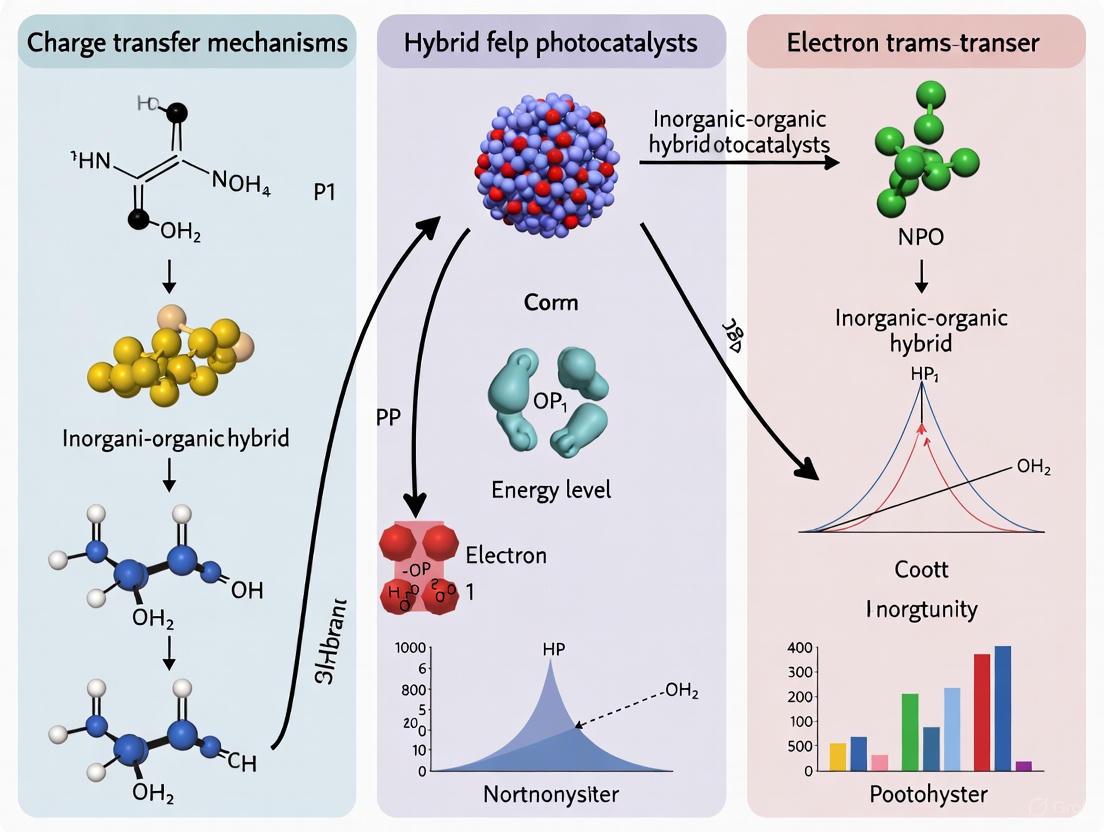
This comprehensive review delves into the fundamental principles, operational mechanisms, and advanced characterization of charge transfer processes in inorganic-organic hybrid photocatalysts.
Unraveling Charge Transfer Mechanisms in Inorganic-Organic Hybrid Photocatalysts: From Fundamentals to Advanced Applications
Abstract
This comprehensive review delves into the fundamental principles, operational mechanisms, and advanced characterization of charge transfer processes in inorganic-organic hybrid photocatalysts. Tailored for researchers and scientists, the article systematically explores the synergistic interactions at hybrid interfaces that enhance light absorption, charge separation, and carrier migration—key factors overcoming the limitations of individual components. It details cutting-edge synthesis and heterojunction design strategies, including emerging S-scheme systems, for applications in hydrogen evolution, CO2 reduction, and H2O2 production. The content further addresses critical challenges in charge carrier dynamics, provides robust validation methodologies, and discusses future trajectories for designing next-generation photocatalytic systems with improved efficiency and stability for biomedical and environmental applications.
Fundamental Principles and Synergistic Interactions in Hybrid Photocatalysts
Inorganic-organic hybrid photocatalysts represent a sophisticated class of materials engineered by combining inorganic semiconductors with organic components at the molecular or nanoscale level. These are not simple physical mixtures, but rather integrated systems where organic and inorganic phases interact through chemical bonds or sophisticated interfacial engineering to create novel functionalities unattainable by either component alone [1]. The fundamental premise behind these hybrids lies in synergistically marrying the advantageous properties of both material classes: typically, the efficient charge transport and stability of inorganic semiconductors with the structural tunability and enhanced light absorption capabilities of organic materials [2] [3].
The development of these hybrids is driven by the pursuit of overcoming persistent limitations in photocatalytic technology. While inorganic semiconductors like metal oxides, oxynitrides, and oxysulfides have demonstrated reasonable activity and robustness, their widespread application is hindered by intrinsic limitations in light harvesting and charge separation [2]. Conversely, organic semiconductors offer compelling advantages including tunable electronic structures, visible-light absorption, and synthetic versatility, but their application remains constrained by short exciton diffusion lengths, low carrier mobility, and poor performance in multi-electron processes [2] [3]. The integration of both material systems has emerged as a powerful strategy to overcome these bottlenecks, creating a transformative platform for advanced photocatalytic applications [2].
Fundamental Principles and Charge Transfer Mechanisms
The photocatalytic process in hybrid materials follows a fundamental sequence of events initiated by light absorption. When a photon with energy equal to or greater than the material's bandgap is absorbed, it promotes an electron from the valence band (VB) to the conduction band (CB), generating an electron-hole pair [4]. These photogenerated charge carriers then undergo several competitive processes: they can recombine (radiatively or non-radiatively), migrate to the catalyst surface, or participate in redox reactions with adsorbed species [3] [4]. The efficiency of this process depends critically on optimizing each step while minimizing recombination losses.
In the context of overall water splitting—often described as the "holy grail" of solar energy research—the process involves two coupled half-reactions: water oxidation and proton reduction, necessitating the concerted action of photoexcited holes and electrons, respectively [3]. This is particularly challenging as it involves multi-electron transfers and the formation of oxygen-oxygen bonds, imposing stringent requirements on charge carrier dynamics and reaction intermediates [3]. The theoretical thermodynamic minimum for water splitting is 1.23 eV, but practical systems typically require over 1.7 eV due to overpotentials [3].
Charge Transfer Mechanisms in Hybrid Systems
The interface between organic and inorganic components in hybrid photocatalysts creates unique pathways for charge transfer that are fundamental to their enhanced performance. Several distinct mechanisms have been identified, each with characteristic dynamics and efficiency.
The following diagram illustrates the primary charge transfer pathways and their typical timescales in inorganic-organic hybrid photocatalysts:
These charge transfer pathways operate across different timescales, with light absorption occurring on the femtosecond (fs) scale, charge separation on picosecond (ps) scales, carrier migration on picosecond-nanosecond (ps-ns) scales, and surface reactions on nanosecond-microsecond (ns-μs) scales [3]. The synergistic combination of these pathways enables hybrid systems to outperform their individual components by maximizing light utilization, facilitating exciton dissociation, and suppressing charge recombination [2].
Key Advantages of Hybrid Photocatalysts
Complementary Property Enhancement
The strategic combination of organic and inorganic components creates systems with complementary properties that address the fundamental limitations of single-component photocatalysts. The distinct advantages of each material class and their synergistic combination in hybrids are summarized in the table below.
Table 1: Comparative Advantages of Photocatalyst Material Classes
| Property | Inorganic Photocatalysts | Organic Photocatalysts | Inorganic-Organic Hybrids |
|---|---|---|---|
| Light Absorption | Often limited to UV region; wide bandgaps [1] | Strong visible-light absorption; tunable bandgaps [2] [1] | Broadened absorption range; enhanced visible light utilization [2] [1] |
| Charge Transport | High carrier mobility; efficient charge transport [2] [1] | Short exciton diffusion lengths; low carrier mobility [2] | Improved charge separation; suppressed recombination [2] [1] |
| Structural Properties | Crystalline frameworks; good stability [1] | Structural flexibility; tunable molecular structures [2] [1] | Large specific surface area; abundant active sites [1] |
| Synthetic Tunability | Limited structural tunability; high-temperature processing [1] | High synthetic versatility; molecular-level design [2] | Tailored interfaces; optimized energy level alignment [2] [1] |
| Stability | Excellent chemical and thermal stability [1] | Limited stability under operational conditions [1] | Enhanced stability compared to pure organics [1] |
Enhanced Charge Separation Dynamics
One of the most significant advantages of hybrid photocatalysts is their remarkable ability to facilitate charge separation and suppress recombination. The formation of heterojunctions at the organic-inorganic interface creates built-in electric fields that drive the spatial separation of electrons and holes [1]. For instance, in systems like polyaniline-ZnO hybrids, directional charge transfer across the interface significantly improves both photocatalytic activity and stability [3]. The organic component can act as an effective hole transporter, while the inorganic framework facilitates electron transport, creating parallel pathways for charge carriers that minimize recombination losses [2].
These enhanced charge separation dynamics are particularly crucial for complex multi-electron processes such as overall water splitting, where the accumulation of multiple charge carriers at catalytic sites is necessary [3]. The hybrid interface serves as an effective charge transfer channel, enabling longer carrier lifetimes and improved utilization of photogenerated charges for redox reactions [2] [1].
Extended Light Harvesting Capabilities
The combination of materials with complementary optical properties enables hybrid photocatalysts to harvest a broader spectrum of solar radiation. Organic components often exhibit strong visible light absorption due to their tunable electronic structures, while many inorganic semiconductors have wider bandgaps that limit them to UV absorption [1]. By carefully selecting organic chromophores with appropriate energy levels, hybrids can be engineered to harness visible light more effectively while maintaining the robust charge transport characteristics of inorganic frameworks [2].
This extended light harvesting is achieved through various mechanisms, including energy transfer from organic to inorganic components, co-sensitization where both components contribute to light absorption, and the creation of new electronic states at the interface that modify the overall optical properties of the hybrid system [1]. The structural versatility of organic components allows for molecular-level engineering to optimize light absorption characteristics for specific applications [2].
Synthesis Methodologies and Experimental Protocols
Synthesis Strategies for Hybrid Photocatalysts
The fabrication of inorganic-organic hybrid photocatalysts employs both bottom-up and top-down approaches, each offering distinct advantages for creating controlled interfaces.
Table 2: Synthesis Methods for Inorganic-Organic Hybrid Photocatalysts
| Synthesis Approach | Method | Key Features | Applicable Material Systems |
|---|---|---|---|
| Bottom-Up | Solvothermal/Hydrothermal | High crystallinity; controlled morphology; uses high temperature/pressure [1] | Metal oxide-organic frameworks; hybrid perovskites [1] |
| Sol-Gel Process | Mild conditions; good homogeneity; versatile organic incorporation [1] | Metal oxide-polymer hybrids; functionalized nanoparticles [1] | |
| Template-Assisted Synthesis | Controlled porosity; ordered structures; sacrificial templates [1] | Porous hybrids; replicated structures [1] | |
| Layer-by-Layer (LBL) Assembly | Precise thickness control; molecular-level precision [1] | Thin film hybrids; multilayer structures [1] | |
| Top-Down | Mechanical Grinding | Simple; solvent-free; limited interface control [1] | Bulk hybrid materials; composite powders [1] |
| Chemical Intercalation | Creates expanded structures; 2D material hybrids [1] | Layered material hybrids; graphite-based systems [1] | |
| Epitaxial Growth | Controlled crystalline interfaces; requires lattice matching [1] | Single-crystalline hybrids; well-defined heterostructures [1] |
Detailed Experimental Protocol: Synthesis of Floatable Hybrid-TiO₂
A representative example of an advanced hybrid photocatalyst synthesis is the floatable hydrophobic organic-inorganic hybrid-TiO₂ recently reported for plastic photoreforming [5]. This protocol demonstrates the precise control achievable in creating functional hybrid interfaces.
Materials:
- Titanium(IV) butoxide (Ti(OBu)₄, ≥97%) as titanium precursor
- Oleylamine (technical grade, 70%) as organic surface modifier and coordination ligand
- Ethylene diamine tetraacetic acid (EDTA, ≥99%) as chelating agent and carbon/nitrogen source
- Anhydrous ethanol (≥99.5%) as solvent and washing agent
Synthesis Procedure:
- Precursor Preparation: Dissolve 10 mmol Titanium(IV) butoxide in 30 mL anhydrous ethanol under vigorous stirring.
- Ligand Addition: Add 5 mmol oleylamine and 2 mmol EDTA to the solution sequentially.
- Solvothermal Reaction: Transfer the mixture to a 50 mL Teflon-lined stainless steel autoclave. Heat at 180°C for 24 hours under autogenous pressure.
- Product Recovery: After natural cooling to room temperature, collect the precipitate by centrifugation at 8000 rpm for 10 minutes.
- Purification: Wash the product three times with anhydrous ethanol to remove unreacted precursors.
- Drying: Dry the final product under vacuum at 60°C for 12 hours to obtain the floatable hybrid-TiO₂.
Key Characterization Techniques:
- Structural Analysis: XRD confirms anatase TiO₂ crystal structure with (001) facet orientation [5]
- Morphological Analysis: TEM and AFM reveal sheet-like morphology with approximately 1.4 nm thickness [5]
- Surface Properties: Contact angle measurements demonstrate hydrophobicity (125° contact angle) [5]
- Chemical Environment: XPS and XAFS analysis confirm Ti coordination with organic groups and modified electronic structure [5]
- Optical Properties: UV-Vis spectroscopy shows extended visible light absorption compared to pristine TiO₂ [5]
The Scientist's Toolkit: Essential Research Reagents and Materials
Table 3: Essential Research Reagents for Hybrid Photocatalyst Development
| Category | Representative Materials | Function in Hybrid Systems |
|---|---|---|
| Inorganic Precursors | Ti(OBu)₄, Zn(NO₃)₂, SrTiO₃ [3] [5] | Framework formation; charge transport pathways; crystalline domains |
| Organic Components | Polyaniline, covalent organic frameworks (COFs), oleylamine [3] [5] | Light harvesting; structural templating; surface modification |
| Co-catalysts | Rh/Cr₂O₃, CoOOH, Pt nanoparticles [3] | Reaction active sites; overpotential reduction; selectivity enhancement |
| Structure-Directing Agents | Oleylamine, EDTA, Pluronic surfactants [5] | Morphology control; pore structure formation; interface engineering |
| Solvents & Reaction Media | Water, ethanol, acetonitrile, DMF [1] [5] | Synthesis medium; polarity control; precursor dissolution |
Applications and Performance Metrics
Hybrid photocatalysts have demonstrated remarkable performance across various energy and environmental applications, leveraging their synergistic advantages.
Table 4: Performance Metrics of Hybrid Photocatalysts in Various Applications
| Application | Photocatalyst System | Performance Metrics | Key Advantages Demonstrated |
|---|---|---|---|
| Overall Water Splitting | SrTiO₃:Al with cocatalysts [3] | Solar-to-hydrogen (STH) efficiency: 0.76%; EQE: 96% at 350-360 nm [3] | Anisotropic charge transport; suppressed recombination [3] |
| Plastic Photoreforming | Floatable hybrid-TiO₂ [5] | PE conversion: 36.1 μmol g⁻¹h⁻¹; PP: 54.0 μmol g⁻¹h⁻¹; PVC: 22.6 μmol g⁻¹h⁻¹ [5] | Four-phase interface; superoxide radical generation; neutral pH operation [5] |
| Hydrogen Peroxide Production | Organic-inorganic hybrid systems [6] | Enhanced H₂O₂ yield compared to single-component systems [6] | Improved charge separation; optimized energy levels [6] |
| Biomass Photoreforming | Various OIH photocatalysts [7] | Efficient H₂ production from biomass derivatives [7] | Lower energy requirement compared to water splitting; waste valorization [7] |
The application spectrum of these hybrid materials continues to expand, with emerging research in CO₂ reduction, nitrogen fixation, and environmental remediation [1] [8] [9]. The floatable hybrid-TiO₂ system exemplifies how strategic material design can overcome fundamental limitations, in this case creating a four-phase interface (photocatalyst, plastic substrate, water, and air) that enhances mass and energy transfer for efficient plastic photoreforming under neutral conditions [5].
Inorganic-organic hybrid photocatalysts represent a paradigm shift in photocatalyst design, offering a versatile platform to overcome the intrinsic limitations of single-component systems. Their key advantages—enhanced charge separation, broadened light absorption, structural tunability, and novel interfacial properties—position them as transformative materials for sustainable energy technologies. The rational design of hybrid interfaces enables precise control over charge transfer pathways, addressing fundamental challenges in multi-electron processes such as overall water splitting.
Future development in this field will likely focus on deepening our understanding of interfacial charge transfer dynamics at the molecular level, developing standardized synthesis protocols for reproducible hybrid structures, and engineering scalable fabrication processes for practical applications. The continued innovation in hybrid photocatalyst design holds significant promise for achieving the benchmark efficiencies required for economically viable solar fuel production and advancing toward a sustainable, carbon-neutral society.
Photocatalysis is a process that utilizes light energy to accelerate chemical reactions via a semiconductor material, known as a photocatalyst. This technology has garnered significant attention for its potential to address global energy shortages and environmental pollution by converting abundant solar energy into chemical energy, most notably through hydrogen production from water splitting or the remediation of pollutants [10] [3]. The fundamental process begins when a photocatalyst absorbs a photon with energy greater than its bandgap energy, leading to the excitation of an electron from the valence band (VB) to the conduction band (CB), thereby generating an electron-hole pair. These photogenerated charge carriers then migrate to the catalyst's surface, where they drive reduction and oxidation reactions [3].
The efficiency of this process is governed by three consecutive steps: (i) light absorption and exciton generation, (ii) charge separation and migration, and (iii) surface redox reactions. The performance of a photocatalytic system is highly dependent on the photocatalyst's properties, including its light absorption range, the efficiency of charge separation and transport, and the availability of active surface sites for reactions [10]. While traditional inorganic semiconductors like TiO₂ and CdS have been widely studied, they often suffer from limitations such as rapid charge carrier recombination and a limited capacity for molecular-level structural tuning [10]. This has driven research towards inorganic-organic hybrid photocatalysts, which synergistically combine the robust charge transport of inorganic materials with the structural tunability and wide light absorption of organic semiconductors, offering a powerful strategy to overcome these bottlenecks [3].
Fundamental Principles of the Photocatalytic Process
Light Absorption and Electron-Hole Pair Generation
The initial step in photocatalysis is the absorption of photons. When a semiconductor is illuminated by light with energy (Ehv) equal to or greater than its bandgap (Eg), electrons (e⁻) are promoted from the filled valence band (VB) to the empty conduction band (CB), creating positively charged holes (h⁺) in the VB. This results in the formation of an electron-hole pair, also known as an exciton [3]. The bandgap energy is a critical parameter, as it determines the portion of the solar spectrum a photocatalyst can utilize. For instance, CdS, with a bandgap of ~2.4 eV, can absorb visible light, which accounts for roughly 40–45% of solar irradiance [10].
The photogeneration of charge carriers occurs on an ultrafast femtosecond (10⁻¹⁵ s) timescale. The thermodynamic minimum bandgap required to drive the overall water splitting reaction is 1.23 eV; however, due to kinetic overpotentials, practical systems typically require a bandgap of over 1.7 eV [3].
Charge Separation and Migration
Following their generation, the photogenerated electrons and holes must separate and migrate to the surface of the photocatalyst to participate in chemical reactions. This step is in direct competition with the recombination of the electron-hole pairs, a wasteful process that dissipates energy as heat or light and is a major factor limiting photocatalytic efficiency [3].
Recombination processes occur on picosecond-to-nanosecond (10⁻¹² to 10⁻⁹ s) timescales. In organic semiconductors, strong Coulombic interactions (binding energies of 0.3–1.0 eV) and small Frenkel exciton radii (~5 Å) further hinder the dissociation of excitons into free charge carriers [10]. Successful charge separation can be facilitated by built-in electric fields or through engineering the photocatalyst's structure. For example, in hybrid systems, the formation of an interface between inorganic and organic components can create a directed pathway for charge transfer, effectively separating electrons and holes and suppressing their recombination [10] [3].
Surface Redox Reactions
Once the charge carriers reach the surface, they initiate various redox reactions with adsorbed species. The potential energy of the electrons in the CB and holes in the VB determines the thermodynamic feasibility of these reactions.
- Reduction Reactions: Electrons in the CB can reduce species. For example, in water splitting, they reduce protons (H⁺) to hydrogen gas (H₂). In oxygen-rich environments, they can reduce oxygen (O₂) to hydrogen peroxide (H₂O₂) via a two-electron pathway [6] [11].
- Oxidation Reactions: Holes in the VB can oxidize species. The primary oxidation reaction in water splitting is the oxidation of water (H₂O) to oxygen gas (O₂). Holes can also oxidize organic pollutants into harmless compounds like CO₂ and H₂O, or directly oxidize water to form H₂O₂ [6] [11].
These interfacial charge transfer and reaction processes typically occur on the nanosecond-to-microsecond (10⁻⁹ to 10⁻⁶ s) timescales [3].
Table 1: Key Steps and Timescales in the Photocatalytic Process.
| Process Step | Key Event | Typical Timescale |
|---|---|---|
| Light Absorption | Excitation of e⁻ from VB to CB; formation of e⁻/h⁺ pair | Femtoseconds (10⁻¹⁵ s) |
| Charge Separation & Migration | Separation of e⁻/h⁺ pair and their transport to the surface | Picoseconds to Nanoseconds (10⁻¹² to 10⁻⁹ s) |
| Surface Redox Reactions | Charge transfer to adsorbed species to drive chemical reactions | Nanoseconds to Microseconds (10⁻⁹ to 10⁻⁶ s) |
| Recombination | Wasted reconnection of e⁻ and h⁺ before they can react | Competing process, picoseconds to nanoseconds |
Charge Transfer Mechanisms in Inorganic-Organic Hybrid Photocatalysts
The interface in inorganic-organic hybrid photocatalysts is a critical region where sophisticated charge transfer mechanisms operate, often defining the system's overall efficiency. These mechanisms facilitate the spatial separation of electrons and holes, suppressing recombination.
S-Scheme Heterojunction
The S-scheme heterojunction is an advanced charge transfer mechanism designed to achieve efficient spatial charge separation while maximizing the redox ability of the photocatalytic system [10]. This heterojunction is constructed by interfacing a reduction photocatalyst (with a higher work function and more negative CB) with an oxidation photocatalyst (with a lower work function and more positive VB).
Under illumination, the internal electric field at the interface drives the recombination of less useful electrons and holes—specifically, the electron from the oxidation photocatalyst and the hole from the reduction photocatalyst. This selective recombination leaves the most energetic electrons in the CB of the reduction photocatalyst and the most powerful holes in the VB of the oxidation photocatalyst. The CdS/YBTPy hybrid is a prime example, where this mechanism led to a hydrogen evolution rate of 5.01 mmol h⁻¹ g⁻¹, a 4.2-fold enhancement compared to pristine CdS [10].
Ligand-to-Metal and Oxygen-to-Metal Charge Transfer
In metal-organic frameworks (MOFs) and other coordination polymers, two primary charge transfer mechanisms are operative:
- Ligand-to-Metal Charge Transfer (LMCT): This occurs upon the excitation of electrons from the organic ligand's orbitals to the inorganic metal cluster's orbitals. In the Ti-based MOF MIL-125(Ti), irradiation with higher-energy UV light preferentially excites aromatic carbon atoms in the terephthalate (BDC) ligand, leading to an LMCT mechanism [12].
- Oxygen-to-Metal Charge Transfer (OMCT) or Metal-to-Ligand Charge Transfer (MLCT): When irradiated with lower-energy light, the excitation of oxygen atoms in the inorganic node (Ti–O in MIL-125) can lead to an OMCT mechanism. This demonstrates that multiple, distinctive CT mechanisms can coexist in a single hybrid photocatalyst, and the dominant pathway can be selected by tuning the excitation wavelength, which in turn influences the system's reactivity and selectivity [12].
Quantitative Performance of Hybrid Photocatalysts
The performance of inorganic-organic hybrid photocatalysts is quantitatively evaluated using metrics such as hydrogen (H₂) or hydrogen peroxide (H₂O₂) evolution rates and quantum efficiency. The following table summarizes the performance of selected hybrid systems as reported in recent literature.
Table 2: Performance Metrics of Selected Inorganic-Organic Hybrid Photocatalysts.
| Photocatalyst System | Photocatalytic Reaction | Performance Metric | Reported Value | Reference |
|---|---|---|---|---|
| CdS/YBTPy S-scheme heterojunction | Hydrogen Evolution | H₂ Evolution Rate | 5.01 mmol h⁻¹ g⁻¹ | [10] |
| CdS/YBTPy S-scheme heterojunction | Hydrogen Evolution | Enhancement over pristine CdS | 4.2-fold | [10] |
| CN-306 COF (g-C₃N4-based) | H₂O₂ Production | H₂O₂ Production Rate | 5352 μmol g⁻¹ h⁻¹ | [13] |
| CN-306 COF (g-C₃N4-based) | H₂O₂ Production | Surface Quantum Efficiency (λ = 420 nm) | 7.27% | [13] |
| Bi4W₀.₅Ti₀.₅O₈Cl | H₂O₂ Production (Piezophotocatalytic) | H₂O₂ Evolution Rate | 530.4 μmol h⁻¹ g⁻¹ | [14] |
Experimental Protocols for Key Hybrid Photocatalyst Analyses
Synthesis of an S-scheme CdS/YBTPy Heterojunction
This protocol outlines the construction of an inorganic-organic S-scheme heterojunction as described for the CdS/YBTPy system [10].
Primary Materials:
- YBTPy polymer: Synthesized via Yamamoto polymerization using 1,3,6,8-tetrabromopyrene and 2,1,3-benzothiadiazole precursors.
- Cadmium acetate dihydrate (Cd(CH₃COO)₂·2H₂O): Source of Cd²⁺ ions.
- Thiourea (CH₄N₂S): Source of S²⁻ ions.
- N,N-Dimethylformamide (DMF): Solvent for the solvothermal reaction.
Procedure:
- Electrostatic Adsorption: Disperse the negatively charged YBTPy polymer in a DMF solution containing dissolved cadmium acetate. Stir to allow for the electrostatic adsorption of Cd²⁺ ions onto the polymer surface.
- In-situ Solvothermal Growth: Add thiourea to the mixture and transfer it to a Teflon-lined autoclave. Conduct the reaction at 140–160 °C for 8–12 hours. During this step, S²⁻ ions released from the decomposition of thiourea react with the adsorbed Cd²⁺ ions, leading to the nucleation and growth of CdS nanoparticles directly on the YBTPy surface.
- Isolation and Purification: After the reaction, allow the autoclave to cool naturally to room temperature. Collect the resulting composite precipitate by centrifugation, and wash thoroughly with ethanol and deionized water to remove any unreacted precursors or impurities.
- Drying: Dry the final CdS/YBTPy composite in a vacuum oven at 60 °C for 12 hours.
In Situ Irradiated X-ray Photoelectron Spectroscopy (ISIXPS)
ISIXPS is a powerful technique used to directly visualize and confirm interfacial charge transfer in heterojunctions under light illumination [10].
- Objective: To probe light-induced changes in the chemical states of elements, providing direct evidence for S-scheme electron flow.
- Setup: A standard XPS system equipped with an in-situ light source (e.g., a simulated solar lamp) integrated into the ultra-high vacuum (UHV) analysis chamber.
- Measurement Procedure:
- Dark Measurement: Mount the powder sample and acquire high-resolution XPS spectra of relevant core levels (e.g., Cd 3d, S 2p, or N 1s from the organic polymer) in the dark.
- In-situ Irradiation: Expose the exact same sample area to focused light while maintaining UHV conditions.
- Light Measurement: Acquire XPS spectra for the same core levels under continuous illumination.
- Data Analysis: Compare the binding energies of the elements in the dark and under light. A measurable shift indicates charge redistribution. For example, in a confirmed S-scheme heterojunction, the binding energy of an element in the reduction photocatalyst (e.g., Cd in CdS) may decrease due to electron accumulation, while that of an element in the oxidation photocatalyst (e.g., N in YBTPy) may increase due to hole accumulation.
Femtosecond Transient Absorption Spectroscopy (fs-TAS)
fs-TAS is used to unravel the ultrafast dynamics of photogenerated carriers, providing insights into charge separation and recombination processes [10].
- Objective: To track the generation, relaxation, and recombination of electron-hole pairs on femtosecond to nanosecond timescales.
- Laser System: A femtosecond laser system, typically an amplified Ti:Sapphire laser that produces pump and probe pulses.
- Measurement Procedure:
- Pump-Probe Setup: The sample is excited by an intense "pump" laser pulse at a specific wavelength. A weaker, broadband "probe" pulse is delayed in time and passed through the excited region of the sample.
- Data Collection: The transient absorption (ΔA) of the probe pulse is measured as a function of wavelength and the time delay between the pump and probe pulses.
- Kinetic Analysis: The resulting ΔA spectra and decay kinetics are analyzed. A longer-lived transient signal for a hybrid heterojunction compared to its individual components directly indicates suppressed charge recombination and more efficient charge separation at the interface.
The Scientist's Toolkit: Essential Reagents and Materials
The following table details key reagents and materials commonly employed in the synthesis and study of inorganic-organic hybrid photocatalysts.
Table 3: Essential Research Reagents and Materials for Hybrid Photocatalyst Development.
| Reagent/Material | Typical Function/Application | Key Characteristics & Purpose |
|---|---|---|
| Cadmium Acetate (Cd(CH₃COO)₂) | Inorganic precursor | Source of Cd²⁺ ions for the synthesis of CdS nanoparticles. |
| Thiourea (CH₄N₂S) | Sulfur source & reducing agent | Decomposes under heat to release S²⁻ ions for metal sulfide formation. |
| 1,3,6,8-Tetrabromopyrene | Monomer for organic polymer | Aromatic building block for constructing conjugated polymers (e.g., YBTPy). |
| Terephthalaldehyde (BDC-based linkers) | Monomer/linker for MOFs/COFs | Rigid organic ligand for constructing porous frameworks like MIL-125. |
| Bis(1,5-cyclooctadiene)nickel(0) (Ni(cod)₂) | Catalyst for polymerization | Catalyst used in Yamamoto-type coupling reactions for C-C bond formation. |
| N,N-Dimethylformamide (DMF) | Solvent | High-boiling-point polar aprotic solvent for solvothermal synthesis. |
| Methanol/Ethanol | Scavenger/Solvent | Acts as a sacrificial hole scavenger in H₂ evolution tests; also used for washing. |
| Chloroform (HPLC Grade) | Solvent | Used for dissolving and processing organic conjugated polymers. |
Advanced Characterization and Visualization of Charge Carriers
A deep understanding of photocatalysis requires advanced techniques that can directly probe charge carrier dynamics with high spatial and temporal resolution.
- Surface Photovoltage Microscopy (SPVM) and Time-Resolved Photoemission Electron Microscopy (TR-PEEM): These techniques enable the direct visualization of charge separation and transport. In a landmark study on Cu₂O, SPVM was used to quantitatively assess localized charge separation at crystal surfaces, while TR-PEEM elucidated the nature of ultrafast inter-facet electron transfer on femtosecond to nanosecond timescales. This combination revealed a quasi-ballistic electron transfer mechanism, which is more efficient than the classical drift-diffusion model [15].
- Light-Assisted Kelvin Probe Force Microscopy (KPFM): This technique measures the contact potential difference and can map the surface potential of a photocatalyst under illumination. It is used to observe the spatial distribution of photogenerated charges and confirm the formation of built-in electric fields in heterojunctions, as demonstrated in the CdS/YBTPy system [10].
- Transient Surface Photovoltage (SPV) Spectroscopy: This method tracks the surface photovoltage decay after a pulsed light excitation, providing information about the charge-carrier trapping process and recombination dynamics on the nanosecond-to-microsecond scale [15].
The integration of these spatially and temporally resolved characterization techniques provides a holistic picture of charge-transfer processes, moving beyond conceptual models to direct experimental observation. This is crucial for the rational design of next-generation high-performance hybrid photocatalytic devices [15].
The pursuit of efficient solar-to-chemical energy conversion has positioned inorganic-organic hybrid photocatalysts at the forefront of sustainable energy research. The interface formed between inorganic and organic components is not merely a physical boundary but a dynamic region where critical processes—including light absorption, charge generation, separation, and transport—are governed by specific bonding types and interactions. A molecular-level understanding of this hybrid interface is fundamental to advancing photocatalyst design for applications such as water splitting and hydrogen peroxide production. This technical guide examines the core bonding types, characterizes key interfacial interactions, and provides detailed methodologies for probing these critical regions, framing the discussion within the broader context of charge transfer mechanisms.
Fundamental Bonding Types at the Hybrid Interface
The formation of a stable and functionally active hybrid interface relies on a combination of physical and chemical interactions that anchor the organic component to the inorganic substrate. These bonds are crucial for ensuring efficient charge communication across the interface.
Electrostatic Interactions: This common physical adsorption mechanism involves the attraction between oppositely charged surfaces. For instance, the negatively charged surface of a conjugated polymer (e.g., pyrene-benzothiadiazole, YBTPy, with a zeta potential of -16.5 mV at pH 7) can facilitate strong electrostatic adsorption of positively charged metal ions (e.g., Cd²⁺), which is a critical first step in the in-situ formation of anchored inorganic nanocrystals like CdS [10]. This interaction is particularly relevant in aqueous environments and for materials with inherent surface charges.
Coordination Bonds: These are a primary form of chemical bonding at hybrid interfaces, where lone electron pairs from atoms on the organic component (such as nitrogen or sulfur in heterocyclic molecules) are donated to vacant metal orbitals on the inorganic surface. This forms stable, directional complexes. The organic molecule acts as a ligand, and the metal atom (e.g., Cd in CdS or Ti in TiO₂) acts as a Lewis acid. This type of bonding strongly influences the electronic structure at the interface and can create preferential pathways for charge transfer [10].
Van der Waals Forces: While weaker than chemical bonds, these forces are significant in systems where planar organic structures, such as those in covalent organic frameworks (COFs) or conjugated polymers, interact with the flat surfaces of inorganic materials. The stacking of π-conjugated systems onto two-dimensional inorganic sheets is often stabilized by these cumulative dispersion forces. Although individually weak, their collective strength can provide sufficient adhesion for interfacial integrity and can influence exciton coupling [3].
Hydrogen Bonding: This interaction occurs when a hydrogen atom bonded to an electronegative atom (like O or N) in the organic component interacts with an electronegative atom (like O in metal oxides) on the inorganic surface. For example, functional groups like -OH or -COOH on organic molecules can form hydrogen bonds with surface hydroxyl groups on metal oxides like TiO₂. This bonding can enhance stability and influence the orientation of the organic moiety at the interface.
Nucleation and Growth ("Induced Bonding"): A specific strategy reported for cementitious systems highlights a mechanistic approach to bonding. Here, the inorganic component (e.g., CaO) is hybridized with TiO₂. When applied to a cement substrate, CaO acts as a nucleation site, inducing the growth of hydrated products (like C-S-H gel) from the cement pore solution directly onto the catalytic material. This process establishes a robust "chemical bridge" between the hybrid coating and the substrate, dramatically enhancing interfacial bonding and durability [16].
Table 1: Summary of Fundamental Bonding Types in Hybrid Photocatalysts
| Bonding Type | Interaction Nature | Strength | Key Function | Example System |
|---|---|---|---|---|
| Electrostatic | Physical, ionic | Moderate | Initial adsorption, surface loading | Cd²⁺ adsorption on negatively charged YBTPy polymer [10] |
| Coordination Bond | Chemical, covalent | Strong | Electronic coupling, directed charge transfer | N/S atoms in organics coordinating to metal sites (Cd, Ti) [10] |
| Van der Waals | Physical, dispersion | Weak | Stabilization of planar structures, exciton coupling | π-conjugated systems on 2D inorganic sheets [3] |
| Hydrogen Bonding | Physical, dipole | Moderate | Enhancing stability, molecular orientation | -OH groups on organics with surface -OH on TiO₂ [16] |
| Nucleation/Growth | Chemical, in-situ | Very Strong | Creating robust, integrated interfaces | CaO-TiO₂ inducing C-S-H growth on cement [16] |
Charge Transfer Mechanisms and Interfacial Energetics
The primary function of the hybrid interface is to facilitate the directed flow of photogenerated charge carriers. The specific bonding and electronic structure at the interface dictate the mechanism of charge transfer, which directly determines photocatalytic efficiency.
Band Alignment and S-Scheme Heterojunctions
A key advancement in hybrid photocatalyst design is the S-scheme heterojunction. This mechanism involves coupling a reduction photocatalyst (typically the organic component) with an oxidation photocatalyst (typically the inorganic component). The difference in their Fermi levels causes electron transfer from the organic to the inorganic material upon contact, until their Fermi levels align. This results in band bending and the formation of an internal electric field at the interface. Under illumination, this field promotes the recombination of less useful electrons and holes, leaving the most potent charge carriers (electrons in the more negative conduction band of the organic semiconductor and holes in the more positive valence band of the inorganic semiconductor) to participate in redox reactions. This mechanism simultaneously achieves efficient charge separation and maximizes the redox potential of the system [10]. For example, in a CdS/YBTPy hybrid, the S-scheme mechanism was confirmed to suppress electron-hole recombination while enhancing hydrogen evolution activity by 4.2-fold compared to pristine CdS [10].
Schottky Junctions
When a metal (e.g., Pt, Au) is used as a co-catalyst on a semiconductor, a Schottky junction forms at the interface due to the difference in work functions. For an n-type semiconductor, electrons flow from the semiconductor to the metal until Fermi level equilibrium is reached, creating a depletion region and upward band bending. This generates an internal electric field that drives photogenerated electrons toward the metal and holes toward the semiconductor bulk, effectively separating charge carriers and suppressing recombination. The Schottky barrier also prevents electrons from flowing back into the semiconductor, enhancing the availability of electrons for surface reduction reactions [17].
Hole Transfer Agents
Beyond solid-solid interfaces, molecular interactions are also critical. The efficiency of proton reduction relies on both electron transfer to the catalytic site and the simultaneous removal of holes. Molecular hole transfer agents (HTAs), such as phenothiazine (PTZ), can be adsorbed onto the photocatalyst surface. The highest occupied molecular orbital (HOMO) of PTZ is positioned at 0.9 V vs. NHE, making it thermodynamically favorable to accept holes from the valence band of graphitic carbon nitride (1.47 V vs. NHE). This effective hole extraction minimizes charge recombination, leading to a 4.84-fold increase in hydrogen production rates in Pt-loaded carbon nitride systems [18].
Table 2: Dominant Charge Transfer Mechanisms in Hybrid Photocatalysts
| Mechanism | Interface Components | Driving Force | Key Outcome | Performance Impact |
|---|---|---|---|---|
| S-Scheme Heterojunction | Organic & Inorganic SC | Internal Electric Field | High charge separation + Maximized redox potential | 4.2x higher H₂ evolution vs. CdS [10] |
| Schottky Junction | Metal & Semiconductor (n-type) | Schottky Barrier & Band Bending | Electron extraction, suppressed recombination | Enhanced quantum efficiency [17] |
| Hole Transfer Agent | Molecular HTA & Photocatalyst | HOMO-VB Energy Offset | Efficient hole scavenging, reduced recombination | 4.84x increase in H₂ production [18] |
| Ligand-to-Metal Charge Transfer (LMCT) | Organic Ligand & Metal Ion | UV Photon Absorption | Electron injection from ligand to metal | Can enable or hinder reactions [19] [6] |
Experimental Protocols for Probing the Hybrid Interface
A multi-faceted experimental approach is required to fully characterize the structure, bonding, and dynamics of hybrid interfaces. The following protocols detail key methodologies cited in recent literature.
Synthesis of CdS/YBTPy S-Scheme Heterojunction
This protocol describes the construction of an inorganic-organic hybrid via in-situ solvothermal growth [10].
- Objective: To fabricate a well-defined interface between CdS nanoparticles and a pyrene-benzothiadiazole-based conjugated polymer (YBTPy) for enhanced photocatalytic hydrogen evolution.
- Materials:
- Monomers: 1,3,6,8-tetrabromopyrene, 2,1,3-benzothiadiazole-4,7-bis(boronic acid pinacol ester).
- Catalyst: Bis(1,5-cyclooctadiene)nickel(0) [Ni(cod)₂].
- Ligands: 2,2'-Bipyridyl, 1,5-cyclooctadiene.
- Cadmium Source: Cadmium chloride hemihydrate (CdCl₂·2.5H₂O).
- Sulfur Source: Thiourea (CH₄N₂S).
- Solvents: N,N-Dimethylformamide (DMF), tetrahydrofuran (THF), chloroform, methanol.
- Procedure:
- YBTPy Polymer Synthesis: Synthesize the linear conjugated polymer YBTPy via Yamamoto polymerization using the tetrabromopyrene and benzothiadiazole monomers with Ni(cod)₂ as the catalyst and 2,2'-bipyridyl as the ligand in a mixture of DMF and THF. Purify the resulting polymer via Soxhlet extraction.
- Electrostatic Adsorption: Disperse the YBTPy polymer in deionized water. The negatively charged surface of YBTPy (zeta potential ~ -16.5 mV) will electrostatically adsorb Cd²⁺ ions when CdCl₂ is added to the suspension under stirring.
- In-situ CdS Growth: Transfer the mixture with adsorbed Cd²⁺ into a Teflon-lined autoclave. Add thiourea as the sulfur source. Conduct solvothermal reaction at 160–180 °C for 12–24 hours. During this process, S²⁻ ions released from thiourea decomposition react with the adsorbed Cd²⁺ to form CdS nanocrystals nucleated directly on the YBTPy surface.
- Isolation: After cooling, collect the composite solid by centrifugation, wash thoroughly with deionized water and ethanol, and dry under vacuum.
- Key Characterization: Use zeta potential measurement to confirm the negative surface charge of YBTPy. Transmission electron microscopy (TEM) is critical for visualizing the dispersion and size of CdS nanoparticles on the polymer surface.
In Situ Irradiated X-ray Photoelectron Spectroscopy (ISIXPS)
This technique provides direct evidence of light-induced charge transfer by tracking binding energy shifts of core-level electrons [10].
- Objective: To verify the direction of electron flow and the formation of an S-scheme heterojunction under operational (light) conditions.
- Materials: Powdered hybrid photocatalyst pressed into a pellet.
- Procedure:
- Mount the sample pellet in an XPS system equipped with an in-situ light source (e.g., a laser or LED matching the absorption wavelength of the photocatalyst).
- Acquire high-resolution XPS spectra of key elemental cores (e.g., Cd 3d, S 2p for CdS; C 1s, N 1s for YBTPy) in the dark to establish baseline binding energies.
- Turn on the light source to illuminate the sample directly within the XPS chamber. Acquire the same core-level spectra under continuous illumination.
- Turn off the light and acquire spectra again to check for reversibility.
- Data Interpretation: In a confirmed S-scheme heterojunction, the binding energy of core levels in the reduction photocatalyst (e.g., YBTPy) will increase under illumination due to electron loss, while the binding energy in the oxidation photocatalyst (e.g., CdS) will decrease due to electron accumulation. This provides direct, element-specific evidence of interfacial charge transfer.
Femtosecond Transient Absorption Spectroscopy (fs-TAS)
This protocol investigates the ultrafast dynamics of photogenerated charge carriers, critical for understanding recombination and transfer pathways [10].
- Objective: To probe the kinetics of charge carrier generation, separation, recombination, and trapping on timescales from femtoseconds to nanoseconds.
- Materials: Solid film of the hybrid photocatalyst or a well-dispersed colloidal suspension in a cuvette.
- Procedure:
- A femtosecond pump laser pulse (wavelength tuned to the material's absorption band) excites the sample, generating electron-hole pairs.
- A broadband white-light continuum probe pulse, delayed in time relative to the pump pulse, interrogates the sample's photoinduced absorption changes (ΔA).
- The ΔA spectra are recorded at various pump-probe delay times, creating a 2D dataset (wavelength vs. time).
- Data Interpretation: The decay dynamics of the transient absorption signals are fitted to multi-exponential models. A longer-lived transient signal in the hybrid compared to its individual components directly indicates suppressed charge recombination due to efficient interfacial transfer. This provides quantitative data on charge carrier lifetimes.
Table 3: Core Characterization Techniques for Hybrid Interfaces
| Technique | Information Obtained | Application Example | Key Outcome |
|---|---|---|---|
| In Situ XPS (ISIXPS) | Binding energy shifts under light | CdS/YBTPy heterojunction [10] | Confirmed S-scheme electron flow from YBTPy to CdS |
| Fs-TAS | Charge carrier lifetime, recombination kinetics | CdS/YBTPy heterojunction [10] | Revealed suppressed carrier recombination in the hybrid |
| Light-Assisted KPFM | Surface potential changes under light | CdS/YBTPy heterojunction [10] | Visualized surface photovoltage and charge separation |
| Zeta Potential | Surface charge in solution | YBTPy polymer [10] | Confirmed negative surface for Cd²⁺ adsorption (-16.5 mV) |
| XRD, TEM, SEM | Crystallinity, morphology, particle size/distribution | CaO-TiO₂ hybrids [16] | Revealed particle agglomeration and crystal structure |
The Scientist's Toolkit: Essential Research Reagents and Materials
The study and development of hybrid photocatalysts require a specific set of chemical reagents and functional materials. The following table details key items used in the featured experiments and their roles in constructing and analyzing the hybrid interface.
Table 4: Key Research Reagent Solutions for Hybrid Photocatalyst Studies
| Reagent/Material | Function/Application | Example Use Case | Critical Parameters |
|---|---|---|---|
| Conjugated Polymer YBTPy | Organic semiconductor component; provides structural tunability and visible-light absorption. | S-scheme heterojunction with CdS for H₂ evolution [10]. | HOMO/LUMO levels, zeta potential, π-conjugation length. |
| CdCl₂·2.5H₂O & Thiourea | Precursors for in-situ growth of CdS nanocrystals. | Formation of CdS nanoparticles on YBTPy polymer [10]. | Purity, concentration, decomposition temperature (thiourea). |
| Noble Metal Salts (e.g., H₂PtCl₆) | Precursors for depositing metal co-catalysts (e.g., Pt) via photodeposition or impregnation. | Cocatalyst for proton reduction on g-CN or TiO₂ [18]. | Redox potential, loading amount (wt%). |
| Phenothiazine (PTZ) | Molecular hole-transfer agent (HTA). | Extracting holes from VB of Pt-g-CN, enhancing H₂ production [18]. | HOMO level (0.9 V vs. NHE), radical cation stability. |
| CaO | Hybrid material for composite catalysts and interface bonding. | Forms CaO-TiO₂ hybrid for enhanced bonding to cement substrates [16]. | Reactivity, ability to induce C-S-H gel nucleation. |
| Ni(cod)₂ / 2,2'-Bipyridyl | Catalyst/Ligand system for Yamamoto polymerization. | Synthesis of conjugated polymers (e.g., YBTPy) [10]. | Air-free handling, stoichiometric ratio. |
| Ascorbic Acid | Sacrificial electron donor; hole scavenger. | Used in conjunction with PTZ in Pt-g-CN H₂ evolution tests [18]. | Redox potential, concentration, pH. |
The performance of inorganic-organic hybrid photocatalysts is intrinsically governed by the atomic- and molecular-level interactions at their interface. A deliberate combination of bonding strategies—from electrostatic and coordination bonding for initial attachment and electronic communication to innovative concepts like induced nucleation for mechanical stability—creates the foundation for advanced materials. The charge transfer mechanisms, particularly the S-scheme heterojunction, leverage these interfacial designs to achieve unparalleled performance by simultaneously optimizing spatial charge separation and preserving high redox potentials. The future of this field hinges on the continued development and application of sophisticated in-situ and time-resolved characterization techniques, as detailed in this guide, which will unlock deeper insights into interfacial dynamics and accelerate the rational design of next-generation photocatalytic systems for a sustainable energy future.
Band Structure Engineering and Fermi Level Alignment in Hybrid Systems
In the pursuit of sustainable energy solutions, photocatalytic water splitting has emerged as a transformative technology for converting solar energy into chemical fuels. Within this field, inorganic-organic hybrid photocatalysts represent a particularly promising avenue, as they synergistically combine the robust charge transport of inorganic semiconductors with the tunable optoelectronic properties of organic materials [3]. The efficiency of these hybrid systems fundamentally depends on their ability to generate, separate, and transport photogenerated charge carriers to reactive sites—processes governed by the precise alignment of energy bands and Fermi levels at the heterojunction interface.
Band structure engineering and Fermi level alignment are therefore not merely peripheral considerations but the very foundation upon which efficient charge transfer mechanisms are built. By deliberately manipulating the electronic structure of these hybrid systems, researchers can control the direction and efficiency of charge flow across interfaces, thereby overcoming the persistent challenges of carrier recombination and limited redox power that plague single-component photocatalysts [3] [20]. This technical guide examines the fundamental principles, characterization methodologies, and computational frameworks essential for mastering band and Fermi level control in hybrid photocatalytic systems for solar energy conversion.
Fundamental Principles of Hybrid System Electronics
Band Structure and Fermi Level Fundamentals
In semiconductor physics, the band gap (Eg) represents the energy difference between the valence band (VB), populated by electrons, and the conduction band (CB), which accepts excited electrons. The Fermi level (Ef) denotes the electrochemical potential of electrons—the energy at which the probability of electron occupation is 50%. When two distinct semiconductors form an interface, their Fermi levels equilibrate through charge transfer, establishing thermal equilibrium and creating built-in electric fields that drive charge separation [20] [21].
In hybrid inorganic-organic systems, this Fermi level alignment induces band bending at the interface—a curvature of energy bands that creates a space charge region. The magnitude and direction of this bending determine whether the junction facilitates or hinders charge separation. For instance, in a p-n heterojunction between p-type Cu₂O and n-type Ag₃PO₄, the disparity in work functions drives electron migration from Cu₂O to Ag₃PO₄ and hole migration in the opposite direction, resulting in upward band bending in Cu₂O and downward bending in Ag₃PO₄ [21]. This built-in electric field efficiently separates photogenerated electron-hole pairs, reducing recombination and enhancing photocatalytic activity.
Charge Transfer Mechanisms in Heterojunctions
Different heterojunction architectures facilitate distinct charge transfer pathways, each with implications for photocatalytic efficiency:
Type-II Heterojunctions: Electrons and holes migrate to different semiconductors, achieving spatial charge separation. However, this often occurs at the expense of redox potential, as the conduction band minimum and valence band maximum are compromised [20].
Z-Scheme Heterojunctions: Mimic natural photosynthesis by recombining less energetic carriers while retaining the most energetic electrons and holes for redox reactions. Traditional Z-schemes often require redox mediators [21].
S-Scheme Heterojunctions: A modern evolution where an internal electric field, band bending, and Coulomb attraction collaboratively separate powerful charge carriers while recombining useless ones. This scheme simultaneously achieves high spatial charge separation and maintains strong redox ability [20] [22].
Table 1: Comparison of Charge Transfer Mechanisms in Heterojunction Photocatalysts
| Mechanism | Charge Transfer Pathway | Redox Power | Charge Separation | Example Systems |
|---|---|---|---|---|
| Type-II | e⁻ migrates to higher CB, h⁺ migrates to lower VB | Weakened | Moderate | WO₃/BiVO₄ |
| Z-Scheme | Mediator-assisted recombination of less energetic carriers | Strong | Moderate | CdS/Au/TiO₂ |
| S-Scheme | Internal electric field directs recombination of useless carriers | Strong | High | FS-COF/WO₃, Ag₃PO₄/Cu₂O |
Diagram 1: Band alignment and charge transfer in inorganic-organic hybrid systems showing Fermi level equilibration and carrier migration.
Methodologies for Band Structure Engineering
Doping and Defect Engineering
Introducing dopant atoms into semiconductor lattices represents a powerful strategy for modifying electronic properties. In Nb₃O₇(OH), for instance, Ta and Sb doping substantially reduces the band gap from 1.7 eV (pristine) to 1.266 eV (Ta-doped) and 1.203 eV (Sb-doped), respectively [23] [24]. This band gap narrowing shifts the optical absorption threshold into the visible region, dramatically improving solar energy harvesting capacity. Beyond band gap tuning, doping also enhances charge carrier mobility and electrical conductivity, facilitating more efficient extraction of photogenerated carriers to reaction sites [23].
The efficacy of doping depends critically on the selection of dopant elements and their integration into the host lattice. As demonstrated in Nb₃O₇(OH), Ta atoms successfully incorporate into Nb sites due to their similar ionic radii, while Sb doping introduces different electronic configurations that modify both the valence and conduction band edges [24]. Computational modeling using density functional theory (DFT) with advanced exchange-correlation functionals like the Trans-Blaha modified Becke-Johnson approximation (TB-mBJ) provides invaluable guidance for predicting dopant effects prior to synthesis [23].
Heterojunction Design and Interface Engineering
Constructing heterojunctions between materials with appropriate band alignments represents the most direct approach to controlling charge flow. The recently developed S-scheme heterojunction concept has shown particular promise for photocatalytic applications [20]. In these systems, an oxidation photocatalyst (OP) with higher work function and lower Fermi level couples with a reduction photocatalyst (RP) with lower work function and higher Fermi level. When contacted, electrons spontaneously transfer from RP to OP until Fermi level equilibration, creating an internal electric field (IEF) directed from RP to OP [20].
This IEF, combined with band bending at the interface, drives the recombination of less useful charge carriers while preserving those with strongest redox power. For example, in an FS-COF/WO₃ S-scheme heterojunction, organic FS-COF serves as the RP component with strong reduction ability, while inorganic WO₃ acts as the OP with excellent oxidation ability [22]. The resulting hybrid exhibits dramatically enhanced photocatalytic hydrogen evolution (24.7 mmol h⁻¹ g⁻¹) compared to individual components, demonstrating the efficacy of proper band alignment [22].
Table 2: Band Structure Engineering Techniques and Their Effects on Photocatalytic Properties
| Engineering Method | Key Parameters | Effects on Electronic Structure | Impact on Photocatalysis |
|---|---|---|---|
| Elemental Doping | Dopant type, concentration, lattice position | Band gap reduction, Fermi level shift, introduction of defect states | Extended visible light absorption, enhanced carrier concentration |
| S-Scheme Heterojunction | Work function difference, band edge positions, interface quality | Internal electric field, band bending, Fermi level alignment | High charge separation with strong redox power |
| Organic Functionalization | Functional groups, coordination bonds, surface coverage | Band edge modulation, defect passivation, interfacial dipole formation | Improved stability, selective catalysis, reduced recombination |
Experimental Protocols for Fabrication and Characterization
Synthesis of Hybrid Photocatalysts
Solvothermal Synthesis of Floatable Hybrid-TiO₂
This protocol produces a hydrophobic organic-inorganic hybrid TiO₂ photocatalyst with enhanced O₂ adsorption for superoxide radical generation [5]:
Precursor Preparation: Combine titanium(IV) butoxide (10 mmol), oleylamine (5 mmol), and ethylene diamine tetraacetic acid (EDTA, 2 mmol) in a mixed solvent of ethanol (40 mL) and deionized water (10 mL).
Solvothermal Reaction: Transfer the solution to a 100 mL Teflon-lined autoclave and maintain at 180°C for 24 hours.
Product Recovery: Centrifuge the resulting precipitate at 8000 rpm for 10 minutes and wash sequentially with ethanol and hexane.
Drying: Dry the hybrid-TiO₂ at 60°C under vacuum for 12 hours.
The resulting material features 2D TiO₂ skeletons (1.9 Å interplanar spacing corresponding to anatase (001) facets) sandwiched between amorphous organic layers, creating a sheet-like morphology with 1.4 nm thickness [5]. The organic layer confers strong hydrophobicity (contact angle 125°) and enhanced O₂ adsorbability, crucial for superoxide-mediated photoreforming of plastics.
In-Situ Growth of FS-COF/WO₃ S-Scheme Heterojunction
This method constructs an organic/inorganic hybrid S-scheme heterojunction for enhanced hydrogen evolution [22]:
WO₃ Nanoparticle Synthesis: Prepare WO₃ nanoparticles via two-step pyrolysis in a muffle furnace (specific temperature program not provided in source).
Heterojunction Assembly: Combine WO₃ nanoparticles (5 mg), 2,4,6-triformylphloroglucinol (Tp, 10.5 mg), and 3,9-diamino-Benzo[1,2-b:4,5-b']bis[1]benzothiophene-5,5,11,11-tetraoxide (FSA, 28.8 mg) in a Pyrex tube.
Solvent Addition: Add mesitylene (1.5 mL) and 1,4-dioxane (1.5 mL) sequentially, followed by 8 M acetic acid (0.3 mL) as a catalyst.
Solvothermal Reaction: Sonicate the mixture, freeze-pump-thaw degas (3 cycles), seal the tube, and heat at 120°C for 3 days.
Product Isolation: Collect the precipitate by centrifugation, wash with anhydrous DMF and THF, and dry under vacuum at 120°C for 12 hours.
The resulting FS-COF/WO₃-20% heterojunction exhibits intimate interfacial contact and efficient S-scheme charge transfer, achieving hydrogen evolution rates of 24.7 mmol h⁻¹ g⁻¹ [22].
Characterization Techniques for Band Alignment and Charge Transfer
Validating band alignment and charge transfer mechanisms requires multiple complementary characterization techniques:
In-Situ Irradiated X-Ray Photoelectron Spectroscopy (ISI-XPS)
ISI-XPS detects internal electric field direction and band bending by monitoring core-level shifts under light illumination [20]:
Sample Preparation: Deposit photocatalyst powder on conductive carbon tape mounted on a standard XPS holder.
Dark Measurement: Acquire high-resolution spectra of relevant core levels (e.g., Ti 2p, W 4f, C 1s, N 1s) in the dark.
In-Situ Irradiation: Measure the same core levels under simulated solar illumination (AM 1.5G, 100 mW cm⁻²) without changing position.
Data Analysis: Calculate binding energy shifts between dark and light conditions. A decrease indicates upward band bending, while an increase suggests downward band bending.
For WO₃-based S-scheme heterojunctions, ISI-XPS typically shows increased binding energy for W 4f under illumination, confirming electron transfer from WO₃ to the reduction photocatalyst [20].
Electron Spin Resonance (ESR) Spectroscopy
ESR identifies reactive oxygen species and confirms charge separation mechanisms [5]:
Spin Trapping: Prepare photocatalyst dispersion (1 g L⁻¹) in aqueous solution containing 100 mM spin trap agent (5,5-dimethyl-1-pyrroline N-oxide, DMPO for •O₂⁻ and •OH; or 2,2,6,6-tetramethylpiperidine, TEMP for ¹O₂).
In-Situ Illumination: Transfer 200 μL aliquot to a quartz ESR flat cell and irradiate directly in the ESR cavity using a focused light source (λ > 420 nm).
Spectrum Acquisition: Record ESR spectra at room temperature with the following parameters: microwave power 20 mW, modulation frequency 100 kHz, modulation amplitude 1 G.
Species Identification: Compare signal patterns with standards: DMPO-•O₂⁻ shows distinctive four-line pattern (1:1:1:1), DMPO-•OH shows 1:2:2:1 quartet.
For floatable hybrid-TiO₂, ESR confirms •O₂⁻ as the dominant reactive species, explaining its efficient plastic photoreforming in neutral solutions [5].
Femtosecond Transient Absorption Spectroscopy (fs-TAS)
fs-TAS tracks ultrafast charge carrier dynamics and recombination processes [3]:
Sample Preparation: Prepare homogeneous photocatalyst dispersion in appropriate solvent (typically water or acetonitrile) with optical density ~0.5 at excitation wavelength.
Pump-Probe Setup: Use a femtosecond laser system with optical parametric amplifier to generate pump pulses (typically 400-500 nm for visible-light photocatalysts) and white light continuum probe pulses.
Data Collection: Measure differential absorption (ΔA) spectra at delay times from 100 fs to 5 ns following photoexcitation.
Kinetic Analysis: Global fitting of time-resolved ΔA spectra to extract species-associated difference spectra and decay-associated difference spectra, revealing charge separation and recombination time constants.
In hybrid systems, fs-TAS typically shows accelerated decay components compared to individual components, indicating efficient interfacial charge transfer [3].
Diagram 2: Integrated workflow for developing hybrid photocatalysts, combining computational design, synthesis, and characterization phases.
Computational Modeling and Machine Learning Approaches
Density Functional Theory (DFT) for Band Structure Prediction
DFT calculations provide critical insights into electronic structure and band alignment before experimental synthesis. For modeling hybrid photocatalytic systems:
Software Selection: Employ specialized DFT codes like VASP, Quantum ESPRESSO, or CASTEP with periodic boundary conditions [25].
Exchange-Correlation Functional: Use the Trans-Blaha modified Becke-Johnson (TB-mBJ) approximation for accurate band gap prediction, as it significantly outperforms standard GGA functionals [23] [24].
Structure Optimization: Begin with full geometry relaxation of all atomic positions and lattice parameters using GGA-PBE until forces converge below 0.01 eV/Å.
Electronic Structure Calculation: Compute band structure, density of states (DOS), and partial DOS using TB-mBJ with spin-orbit coupling for heavy elements.
Band Alignment Determination: Calculate work functions and band edge positions with respect to the vacuum level by incorporating dipole corrections in slab models.
For Nb₃O₇(OH) systems, this approach successfully predicts the band gap reduction from 1.7 eV to 1.266 eV (Ta-doped) and 1.203 eV (Sb-doped), along with the associated red-shift in optical absorption [23] [24].
Machine Learning for Material Screening and Optimization
Machine learning (ML) accelerates the discovery of optimal hybrid materials by establishing structure-property relationships:
Dataset Curation: Compile experimental and computational data for relevant material systems (~200 data points minimum) with features including dipole moment, exact mass, molecular descriptors, and synthetic conditions [26].
Feature Selection: Apply Pearson correlation analysis and SHapley Additive exPlanations (SHAP) to identify the most critical descriptors influencing photocatalytic performance [26].
Model Training: Implement multiple ML algorithms including Random Forest (RF), Support Vector Regression (SVR), and Gradient Boosting (GB) Regressor using k-fold cross-validation [26].
Performance Prediction: Deploy trained models to screen candidate materials, prioritizing those with predicted performance metrics exceeding established thresholds.
In perovskite interface engineering, ML models successfully predict the impact of small molecule passivators on power conversion efficiency, guiding the selection of optimal passivation strategies [26].
Table 3: Computational Tools for Modeling Hybrid Photocatalytic Systems
| Computational Method | Primary Application | Strengths | Limitations |
|---|---|---|---|
| DFT (TB-mBJ) | Band structure, DOS, band alignment | Accurate band gaps, no empirical parameters | Computationally expensive for large systems |
| DFT (GGA-PBE) | Structure optimization, binding energies | Computational efficiency, good geometries | Underestimates band gaps |
| Random Forest ML | Property prediction, material screening | Handles small datasets, feature importance | Limited extrapolation beyond training data |
| Ab Initio MD | Interface dynamics, reaction pathways | Models thermal effects and time evolution | Extremely computationally demanding |
The Scientist's Toolkit: Essential Research Reagents and Materials
Table 4: Key Research Reagents and Materials for Hybrid Photocatalyst Development
| Material/Reagent | Function in Research | Application Example | Key Properties |
|---|---|---|---|
| Titanium(IV) Butoxide | Inorganic precursor | Hybrid-TiO₂ synthesis [5] | Hydrolyzable, forms TiO₂ networks |
| Oleylamine | Organic ligand, structure director | Hydrophobic hybrid-TiO₂ [5] | Long alkyl chain confers hydrophobicity |
| 2,4,6-Triformylphloroglucinol (Tp) | COF building block | FS-COF/WO₃ heterojunction [22] | Trifunctional aldehyde for Schiff base formation |
| FSA Monomer | COF comonomer | FS-COF with fused-sulfone groups [22] | Electron-withdrawing sulfone groups |
| DMPO Spin Trap | Radical detection | ESR spectroscopy [5] | Forms adducts with •O₂⁻ and •OH radicals |
| Ta/Sb precursors | Dopant sources | Band gap engineering of Nb₃O₇(OH) [23] | Modifies band structure and carrier concentration |
| Pyridine analogs | Passivation molecules | Perovskite interface engineering [26] | Lewis bases coordinate with undercoordinated Pb²⁺ |
Band structure engineering and Fermi level alignment represent foundational principles for designing advanced inorganic-organic hybrid photocatalysts. Through deliberate manipulation of electronic properties via doping, heterojunction formation, and interface engineering, researchers can direct charge flow along predetermined pathways, maximizing the utilization of photogenerated carriers for catalytic reactions. The continued refinement of S-scheme heterojunctions, coupled with advanced characterization techniques and computational guidance, promises to unlock new frontiers in photocatalytic efficiency.
As this field advances, the integration of machine learning with high-throughput computational screening will accelerate the discovery of optimal material combinations, while operando characterization techniques will provide unprecedented insights into charge dynamics under realistic working conditions. These developments, grounded in the fundamental principles of semiconductor physics and interfacial science, will ultimately enable the rational design of hybrid photocatalytic systems that meet the demanding efficiency and stability requirements for practical solar energy conversion applications.
The pursuit of advanced photocatalytic systems for solar energy conversion and environmental remediation has long been hampered by the intrinsic limitations of individual material classes. Inorganic semiconductors, such as metal oxides (e.g., TiO₂, BiVO₄, ZnO) and metal sulfides, typically offer excellent charge carrier mobility and robust chemical stability but suffer from narrow light absorption ranges (often restricted to UV light) and rapid recombination of photogenerated electron-hole pairs [3]. Conversely, organic semiconductors, including covalent organic frameworks (COFs), carbon nitrides, and conjugated polymers, provide compelling advantages such as synthetically tunable molecular structures, strong visible-light absorption, and high surface areas [3]. However, their application is constrained by short exciton diffusion lengths, low intrinsic carrier mobility, and poor stability during multi-electron transfer reactions [3]. The integration of organic and inorganic components into a single hybrid material presents a powerful strategy to overcome these bottlenecks by creating synergistic effects that are not possible in either constituent alone [3] [27].
This synergy primarily manifests at the hybrid interface, where efficient charge transfer phenomena can significantly enhance the overall photocatalytic performance. The rational design of these interfaces allows for the creation of tailored energy level alignment, which facilitates the separation of photogenerated charges and extends their lifetime, thereby increasing the probability of their participation in surface redox reactions [3] [28]. Such hybrid systems are revolutionizing applications from solar-driven hydrogen production and overall water splitting to the sustainable synthesis of hydrogen peroxide (H₂O₂) [3] [6]. This whitepaper delves into the fundamental charge transfer mechanisms underpinning these hybrid photocatalysts, provides a detailed examination of their design principles, and outlines standardized experimental protocols for their characterization, serving as a technical guide for researchers and scientists in the field.
Fundamental Charge Transfer Mechanisms at the Hybrid Interface
The enhanced performance of organic-inorganic hybrid photocatalysts is fundamentally governed by charge and energy transfer processes that occur at their interface. Understanding these mechanisms is crucial for the rational design of next-generation materials.
Band Alignment and Interface Engineering
The electronic structure at the hybrid interface dictates the direction and efficiency of photoinduced charge transfer. The primary requirement for effective charge separation is a favorable alignment between the valence and conduction bands of the inorganic semiconductor and the highest occupied molecular orbital (HOMO) and lowest unoccupied molecular orbital (LUMO) of the organic component [28]. For instance, an efficient flow of photogenerated electrons from the organic sensitizer to the inorganic semiconductor occurs when the LUMO level of the organic dye is positioned at a higher energy level than the conduction band minimum (CBM) of the inorganic semiconductor [28]. The organic dye harvests a broader spectrum of solar radiation, and the injected electrons are then able to participate in reduction reactions, such as proton reduction to H₂ or oxygen reduction to H₂O₂, on the inorganic surface [28].
Table 1: Key Charge Transfer Mechanisms in Organic-Inorganic Hybrid Photocatalysts
| Mechanism | Driving Force | Process Description | Key Characteristic |
|---|---|---|---|
| Type-I (Straddling) Heterojunction | Energy level offset | Electrons and holes transfer to the same component (e.g., both to the inorganic part). | Concentrates charge carriers but limits redox capability. |
| Type-II (Staggered) Heterojunction | Band energy difference | Electrons transfer to one component (e.g., CB of inorganic), holes to the other (e.g., HOMO of organic). | Enables spatial charge separation, enhances carrier lifetime. |
| S-Scheme Heterojunction | Internal electric field | Useless carriers recombine at the interface; powerful electrons and holes are preserved in different components. | Retains strongest redox potentials, superior for demanding reactions. |
| Charge Transfer Complex (CTC) | Electron Donor-Acceptor Interaction | A new complex forms via hydrogen bonds or charge transfer, creating distinct electronic properties. | Exhibits unique optical/electronic behavior beyond parent materials. |
S-Scheme and Z-Scheme Heterojunctions
Beyond conventional Type-I and Type-II heterojunctions, more sophisticated charge transfer pathways have been developed. The S-scheme heterojunction is a particularly advanced and effective mechanism [29]. In an S-scheme system, two semiconductors—typically an oxidation-type semiconductor and a reduction-type semiconductor—are coupled. An internal electric field is formed at their interface due to band bending and Fermi level alignment. Upon illumination, photogenerated electrons in the less reductive semiconductor (with a higher Fermi level) recombine with holes in the less oxidative semiconductor (with a lower Fermi level) at the interface. This selective recombination effectively removes weaker charge carriers, leaving the most powerful electrons and holes to participate in redox reactions, thereby achieving both efficient charge separation and maximized redox potential [29].
Classification of Hybrid Material Interfaces
The nature of the bond between organic and inorganic components is a critical factor in determining the stability and efficiency of charge transfer. The International Union of Pure and Applied Chemistry (IUPAC) recommends categorizing these materials based on the nature of their interface [27]:
- Class I Hybrid Materials: The organic and inorganic components interact through weak forces such as van der Waals interactions, hydrogen bonding, or electrostatic forces. These materials are often simpler to synthesize but may suffer from component separation during operation.
- Class II Hybrid Materials: The organic and inorganic components are linked by strong chemical bonds, specifically covalent or ionic-covalent bonds. This class offers superior stability, minimized phase separation, and a more defined interface, which often leads to more efficient and reliable charge transfer [27].
The following diagram illustrates the logical decision process for selecting a hybrid system based on the desired charge transfer mechanism and interface properties.
Quantitative Performance Data and Comparative Analysis
The synergistic effects in organic-inorganic hybrids translate directly into superior performance metrics across various photocatalytic applications. The following table summarizes key quantitative data from recent research, highlighting the performance gains achievable through hybridization.
Table 2: Quantitative Performance of Selected Organic-Inorganic Hybrid Photocatalysts
| Hybrid Photocatalyst | Application | Performance Metric | Control Material (Performance) | Reference / Key Finding |
|---|---|---|---|---|
| CDs-Chitosan (CMCD) | H₂O₂ Production | 1356.7 μmol·g⁻¹·h⁻¹ | Chitosan-derived carbon (~40% lower) | ML-optimized synthesis; enhanced charge transfer [30] |
| Polyaniline/ZnO | Water Splitting | Improved activity & stability | ZnO alone | Directional charge transfer across interface [3] |
| D149 Dye/BiVO₄ | Model Charge Transfer | Efficient electron injection | LIGAND/BiVO₄, COMPLEX/BiVO₄ | Optimal HOMO-LUMO alignment for charge transfer [28] |
| SrTiO₃:Al | Overall Water Splitting | 0.76% STH efficiency, 96% EQE (UV) | N/A | Demonstrates scalability (100 m² system) [3] |
Experimental Protocols: Probing Charge Transfer Dynamics
Validating the existence and quantifying the efficiency of charge transfer requires a suite of advanced experimental techniques. Below are detailed protocols for key characterization methods.
In Situ Transient Photoelectrochemical Measurements
This set of techniques is crucial for probing the dynamics of charge carriers at the nanoscale under operational conditions [30].
- 4.1.1 Transient Photocurrent (TPC) Measurement:
- Objective: To investigate the half-reaction pathways and measure the instantaneous current generated by a short pulse of light.
- Procedure: A pulsed laser (e.g., a nanosecond or femtosecond laser) is focused on the photocatalyst film deposited on a conductive substrate (e.g., FTO) serving as the working electrode in an electrochemical cell. The resulting photocurrent transient is recorded using a potentiostat with a fast data acquisition system. The rise and decay kinetics of the current provide insights into charge generation, separation, and recombination rates.
- 4.1.2 Transient Photovoltage (TPV) Measurement:
- Objective: To measure the interfacial charge transfer rates and recombination dynamics by monitoring the open-circuit voltage decay.
- Procedure: The photocatalyst is similarly excited by a laser pulse under open-circuit conditions. The resulting transient change in the surface potential (photovoltage) is measured, typically using a high-impedance voltmeter or an oscilloscope. The decay lifetime of the photovoltage is directly related to the lifetime of the photoinduced charge carriers.
- 4.1.3 Transient Photostationary State (TPS) Measurement:
- Objective: To analyze the interfacial charge distribution kinetics and adsorption/desorption processes of reactants (e.g., O₂).
- Procedure: This technique involves monitoring the steady-state photocurrent or photovoltage while modulating the light intensity or the chemical environment. It helps in understanding how charge accumulation at the interface influences the reaction kinetics.
Kelvin Force Microscopy (KFM)
- Objective: To directly map the surface potential and photoinduced charge transfer at the hybrid interface with high spatial resolution [28].
- Materials: Atomic Force Microscope (AFM) with KFM capability, conductive AFM probe (e.g., Pt/Ir coated), hybrid photocatalyst thin film sample.
- Procedure:
- The AFM tip is brought into proximity with the sample surface without physical contact.
- A DC bias (VDC) and an AC bias (VAC) are applied to the tip to nullify the electrostatic force between the tip and the sample. The V_DC required to nullify the force corresponds to the contact potential difference (CPD), which is a measure of the local surface potential.
- Measurements are performed in the dark and under illumination. A change in the CPD under illumination indicates photoinduced charge transfer and accumulation. By comparing the CPD maps of the hybrid material with its individual components, one can visualize and quantify charge transfer at the organic-inorganic interface [28].
Computational Modeling of Charge Transfer
- Objective: To predict and rationalize charge transfer behavior using quantum chemical calculations [28].
- Protocol (Cluster Model for Hybrid Systems):
- Structure Optimization: Build a cluster model of the inorganic component (e.g., (BiVO₄)₁₈). Optimize the geometry of the organic dye molecule and the inorganic cluster separately using density functional theory (DFT) or parameterized semi-empirical methods (e.g., PM6).
- Hybrid System Construction: Anchor the organic molecule onto the surface of the inorganic cluster, typically via a linking atom (e.g., a Vanadium atom for BiVO₄). The anchoring group and a few neighboring atoms are allowed to relax during a subsequent geometry optimization of the entire hybrid structure.
- Electronic Property Calculation: Perform single-point energy calculations on the optimized hybrid structure to determine the frontier molecular orbitals (HOMO, LUMO) and their spatial distribution. An efficient charge transfer is indicated by the delocalization of the electron density from the organic molecule to the inorganic cluster upon photoexcitation [28].
- Software: Gaussian, GAMESS, VASP.
The Scientist's Toolkit: Essential Research Reagents and Materials
The following table catalogues critical materials and their functions for synthesizing and studying charge transfer in hybrid photocatalysts.
Table 3: Essential Research Reagents and Materials for Hybrid Photocatalyst Development
| Material / Reagent | Function / Role in Research | Example Application |
|---|---|---|
| Bismuth Vanadate (BiVO₄) Nanostructures | Visible-light driven inorganic photocatalyst; provides a platform for dye anchoring. | Model system for studying dye-semiconductor charge transfer [28]. |
| Covalent Organic Frameworks (COFs) | Tunable organic semiconductor with high surface area and defined porosity. | Component in hybrids for enhanced light harvesting and charge separation [3]. |
| D149 Dye | Prototypical organic sensitizer (donor-π-acceptor) with carboxyl anchoring group. | Model charge transfer donor to inorganic semiconductors like BiVO₄ and ZnO [28]. |
| Chitosan-derived Carbon | Sustainable, N-doped carbon matrix from biomass; precursor for metal-free catalysts. | Base material composited with Carbon Dots (CDs) for H₂O₂ production [30]. |
| Carbon Dots (CDs) | Nanoscale carbon co-modifier; enhances light absorption and facilitates charge separation. | Integrated into chitosan matrix to create synergistic effects in photocatalysis [30]. |
| Trialkoxysilane Reagents | Coupling agents for creating Class II hybrid materials via sol-gel chemistry. | Grafting organic functionalities to silica networks for stable hybrids [27]. |
The strategic integration of organic and inorganic components into hybrid materials effectively overcomes the individual limitations of each, primarily through engineered charge transfer mechanisms at their interface. The synergy derived from the inorganic component's efficient charge transport and the organic component's structural and electronic tunability leads to enhanced light harvesting, superior charge separation, and suppressed recombination. As research progresses, the combination of data-driven approaches like machine learning with advanced operando characterization techniques and sophisticated computational models will further accelerate the rational design of these complex materials. A deep understanding of the charge transfer principles outlined in this guide—from S-scheme heterojunctions to the stability of Class II interfaces—will empower researchers to develop next-generation hybrid photocatalysts with unprecedented efficiencies for solar energy conversion and sustainable chemical production.
Synthesis Strategies, Heterojunction Design, and Catalytic Applications
Bottom-Up and Top-Down Synthesis Approaches for Hybrid Materials
The pursuit of advanced functional materials has positioned inorganic-organic hybrid systems at the forefront of materials science, particularly for photocatalytic applications such as water splitting and solar fuel generation. These hybrids synergistically combine the robust charge transport properties of inorganic semiconductors with the structural tunability and visible-light absorption capabilities of organic components [3]. The synthesis of these hybrid materials primarily follows two distinct philosophical approaches: bottom-up and top-down methods. Bottom-up fabrication involves constructing materials from molecular precursors or nanoscale building blocks, enabling precise control over interfacial properties and molecular architecture [31]. In contrast, top-down approaches begin with bulk materials that are subsequently exfoliated, etched, or dimensionally reduced to achieve nanoscale features [32]. The selection between these synthetic pathways profoundly influences the structural integrity, interfacial contact, and ultimately, the charge transfer efficiency in the resulting hybrid photocatalyst. This technical guide examines both methodologies within the context of optimizing charge transfer mechanisms for enhanced photocatalytic performance.
Fundamental Synthesis Approaches
Bottom-Up Synthesis
Bottom-up synthesis constructs hybrid materials from molecular or atomic precursors, allowing for precise control over composition, structure, and interface properties at the nanoscale. This approach is particularly valuable for creating well-defined heterojunctions that facilitate efficient charge separation.
A prominent example is the on-surface construction of covalent organic framework (COF) nanoshells on inorganic cores. In one documented protocol, cadmium sulfide (CdS) nanospheres (80-120 nm diameter) serve as the inorganic core [33]. The synthesis proceeds through several critical stages:
- Surface Functionalization: A monomer solution (e.g., p-phenylenediamine, PA) is adsorbed onto the CdS surface via electrostatic interactions to create growth initiation sites.
- Interfacial Polymerization: A second monomer solution (1,3,5-triformylphloroglucinol, TP) is slowly injected to react with surface-anchored PA molecules via Schiff-base reaction.
- Crystallization: The amorphous polymer shell undergoes solvothermal treatment (typically at 120°C for 72 hours) to facilitate structural transformation into a crystalline COF through dynamic covalent chemistry.
- Thickness Control: The COF nanoshell thickness can be precisely tuned from 5±1 nm to 11±1 nm by varying monomer concentrations and reaction conditions [33].
This bottom-up strategy creates an intimate heterojunction between the CdS core and TPPA shell, which exhibits lower exciton binding energy compared to pristine TPPA, thereby enhancing interfacial charge separation. The resulting core-shell structure achieved a remarkable hydrogen evolution rate of 24.3 mmol g⁻¹ h⁻¹ under visible light irradiation [33].
Similar bottom-up principles apply to the synthesis of graphitic carbon nitride (g-C₃N₄) through thermal polymerization of nitrogen-rich precursors like cyanamide, dicyanamide, urea, or melamine [34]. The pre-processing method (bottom-up) optimizes reaction parameters including temperature, solvent environment, and intramolecular forces to control the polymerization pathway, resulting in tailored morphologies and electronic structures that enhance photocatalytic performance.
Top-Down Synthesis
Top-down synthesis begins with bulk materials that are dimensionally reduced through physical or chemical processes to create nanoscale features. While generally less precise than bottom-up methods, top-down approaches can be more readily scaled for industrial applications.
In nanomaterials synthesis, top-down methods typically involve the exfoliation or cleavage of bulk materials [32]. For hybrid material fabrication, this may include:
- Chemical exfoliation: Using intercalants and solvents to separate layered materials into thinner sheets
- Mechanical milling: High-energy processes to reduce particle size and create composite structures
- Etching techniques: Selective removal of material to create porous structures or specific morphologies
A specific top-down application in photocatalyst development involves the post-synthesis modification of bulk g-C₃N₄. Protocols include thermal exfoliation to produce single or few-layer g-C₃N₄ sheets, though this method often suffers from lengthy processing times and low yields [34]. Chemical exfoliation processes using strong acids or oxidative treatments can also be employed to delaminate bulk materials, though these may introduce structural defects or functional groups that affect electronic properties.
For carbon-based hybrid materials, top-down approaches often involve processing pre-existing carbonaceous materials like graphite, carbon nanotubes, or graphene. Statistical Process Control (SPC) and Statistical Quality Control (SQC) techniques can be implemented to improve the quality and reproducibility of these nanomaterials when produced at industrial scales [31].
Comparative Analysis of Synthesis Approaches
Table 1: Comparison of Bottom-Up and Top-Down Synthesis Approaches for Hybrid Photocatalytic Materials
| Parameter | Bottom-Up Approach | Top-Down Approach |
|---|---|---|
| Fundamental Principle | Assembly from molecular precursors or nanobuilding blocks [32] [31] | Dimensional reduction of bulk materials [32] |
| Interface Control | Precise, with potential for atomic-level engineering [33] | Limited, dependent on starting material properties |
| Structural Precision | High, enables designed architectures (core-shell, gyroid, etc.) [31] [33] | Moderate, often results in irregular morphologies |
| Defect Introduction | Potentially minimal with optimized protocols | Often introduces surface defects and imperfections |
| Scalability | Challenging for some complex architectures | Generally more straightforward for industrial production [31] |
| Material Compatibility | Broad, through various functionalization strategies [31] | Limited by starting material properties |
| Charge Transfer Efficiency | Potentially superior due to designed interfaces [33] | Variable, often limited by interfacial defects |
Table 2: Quantitative Performance Metrics of Hybrid Photocatalysts Fabricated via Different Methods
| Photocatalyst System | Synthesis Method | Architecture | Performance Metric | Value | Reference |
|---|---|---|---|---|---|
| CdS@TPPA | Bottom-up | Core-shell nanospheres | H₂ evolution rate | 194.1 μmol h⁻¹ (24.3 mmol g⁻¹ h⁻¹) | [33] |
| Electrospun hybrid fibers | Bottom-up | Mesoporous fibers | Comparative activity vs. nanoparticles | Higher than nanoparticles | [31] |
| Ta₂O₅ gyroids with nanocarbons | Bottom-up | 3D gyroid with nanocarbon | H₂ production (with Pt co-catalyst) | 2.2 mmol h⁻¹ | [31] |
| Ta₂O₅ gyroids with nanocarbons | Bottom-up | 3D gyroid with nanocarbon | H₂ production (without Pt) | 1.1 mmol h⁻¹ | [31] |
| Thermally exfoliated g-C₃N₄ | Top-down | 2D sheets | Production yield | Surprisingly low | [34] |
Charge Transfer Mechanisms in Hybrid Photocatalysts
The fundamental motivation for developing hybrid photocatalysts lies in creating synergistic systems where charge transfer mechanisms are enhanced beyond what either component could achieve independently. In inorganic-organic hybrids, the interface between components facilitates critical processes for photocatalytic efficiency.
Charge Transfer Fundamentals
In photocatalytic systems, charge transfer occurs through a sequence of photophysical processes:
- Photon Absorption: A semiconductor absorbs a photon with energy equal to or greater than its bandgap, promoting an electron from the valence band (VB) to the conduction band (CB), creating an electron-hole pair [4].
- Charge Separation: Photogenerated electrons and holes separate and migrate toward the catalyst surface.
- Interfacial Transfer: At the hybrid interface, charges transfer between components—electrons typically move to components with more positive conduction bands, while holes transfer to components with more negative valence bands [3].
- Surface Reactions: Transferred charges drive reduction and oxidation reactions at active sites.
In inorganic-organic hybrids, the organic component often functions as a sensitizer, expanding visible light absorption, while the inorganic component provides a robust framework for efficient charge transport [3]. The built-in potential at the heterojunction interface drives charge separation, reducing recombination losses.
Advanced Characterization Techniques
Direct measurement of charge transfer in heterogeneous catalysts has historically been challenging, particularly for three-dimensional nanoparticle systems. Recent advances in characterization methodologies have enabled more precise analysis:
Four-Dimensional Scanning Transmission Electron Microscopy (4D-STEM): This technique simultaneously visualizes atomic-scale structure and sub-nanometer-scale charge distribution in heterogeneous catalysts. In a model Au-catalyst/SrTiO₃-support system, researchers demonstrated direct evidence of charge transfer from the support to Au nanoparticles, with a positively charged region extending ~2 nm into the support around negatively charged particles [35]. This method can resolve charge redistribution effects in particles as small as ~1 nm in radius.
Ultraviolet Photoelectron Spectroscopy (UPS) and Raman Spectroscopy: These techniques confirm the formation of electronic heterojunctions between nanocarbon and semiconducting metal oxide phases in hybrid systems [31].
Pump-Probe Spectroscopy: Advanced transient absorption measurements can study interfacial charge transfer mechanisms and photocarrier lifetimes in hybrid systems, providing insights into charge separation efficiency [31].
Table 3: Characterization Techniques for Analyzing Charge Transfer in Hybrid Photocatalysts
| Technique | Primary Function | Spatial Resolution | Key Measurable Parameters |
|---|---|---|---|
| 4D-STEM | Maps electric fields and charge density | Atomic-scale (sub-nm for charge distribution) | Projected charge density, electric field distribution [35] |
| UPS | Determines electronic structure | Surface-sensitive (few nm) | Work function, valence band maximum, band alignment [31] |
| Raman Spectroscopy | Proves chemical bonding and interactions | Diffraction-limited (μm scale) | Formation of heterojunctions, chemical interactions [31] |
| Pump-Probe Spectroscopy | Measures carrier dynamics | Temporal (fs-ns resolution) | Charge carrier lifetimes, interfacial transfer rates [31] |
| Kelvin Probe | Measures work function | ~100 nm | Surface potential, charge transfer direction [31] |
The following diagram illustrates the experimental workflow for synthesizing and characterizing hybrid photocatalysts, with particular emphasis on charge transfer analysis:
Experimental Workflow for Hybrid Photocatalyst Development
The Scientist's Toolkit: Research Reagent Solutions
Table 4: Essential Research Reagents for Hybrid Photocatalyst Synthesis and Characterization
| Reagent/Material | Function | Application Example | Key Considerations |
|---|---|---|---|
| Semiconductor Nanocrystals (CdS, TiO₂) | Light-absorbing core material | CdS nanospheres for core-shell structures [33] | Bandgap engineering, surface chemistry |
| Carbon Nanotubes (SWNT, MWNT) | Electron acceptor/charge transporter | Nanocarbon additives in metal oxide hybrids [31] | Purity, functionalization, dispersion stability |
| Covalent Organic Framework Monomers | Porous shell construction | TP and PA for TPPA COF shells [33] | Reactivity, linkage chemistry, stability |
| Metal Oxide Precursors | Inorganic matrix formation | Nb₂O₅, TiO₂, Ta₂O₅, ZnO, SnO₂ sol-gel precursors [31] | Hydrolysis rates, thermal stability |
| Functionalization Agents | Surface modification | Diazonium salts, coupling agents [31] | Specificity, reaction conditions |
| Sacrificial Agents | Electron donors | Methanol, triethanolamine in H₂ production tests [31] | Redox potential, transparency |
| Co-catalysts | Reaction site enhancement | Pt, CoOOH, Rh/Cr₂O₃ nanoparticles [3] | Dispersion, loading optimization |
The strategic selection between bottom-up and top-down synthesis approaches fundamentally determines the architectural control, interfacial quality, and resultant charge transfer efficiency in inorganic-organic hybrid photocatalysts. Bottom-up methods offer superior precision in engineering interfaces with optimized electronic interactions, as demonstrated by the exceptional photocatalytic hydrogen evolution rates of core-shell CdS@COF systems. Top-down approaches, while generally less precise, provide more readily scalable pathways for industrial implementation. The continued advancement of characterization techniques, particularly 4D-STEM and advanced spectroscopic methods, enables unprecedented insights into charge transfer phenomena at the nanoscale. Future developments in hybrid photocatalyst design will likely focus on combining the strengths of both synthetic philosophies—employing bottom-up precision for critical interfacial regions while utilizing top-down processing for macroscopic structuring—to achieve systems that maximize both fundamental charge transfer efficiency and practical scalability for solar energy conversion applications.
The pursuit of efficient solar-to-chemical energy conversion has positioned heterojunction photocatalysts at the forefront of materials science research. Among various architectures, S-scheme and donor-acceptor (D-A) heterostructures have emerged as particularly promising designs for overcoming fundamental limitations in photocatalytic efficiency. These systems uniquely address the critical challenge of achieving spatial charge separation while preserving strong redox capabilities. Within the specific context of inorganic-organic hybrid materials, these heterojunctions combine the structural stability and charge mobility of inorganic components with the tunable electronic properties of organic semiconductors, creating synergistic effects that significantly enhance photocatalytic performance across energy conversion and environmental remediation applications.
This technical guide examines the fundamental mechanisms, synthesis, characterization, and performance metrics of these advanced heterojunction architectures, providing researchers with a comprehensive framework for understanding and developing next-generation photocatalytic systems.
Fundamental Charge Transfer Mechanisms
S-Scheme Heterojunction Architecture
The S-scheme heterojunction represents a strategic advancement beyond traditional Type-II heterojunctions, deliberately engineered to retain potent redox potentials while enabling efficient charge separation. This architecture comprises a reduction photocatalyst (RP) and an oxidation photocatalyst (OP) with staggered band structures.
Internal Electric Field Formation: When RP and OP semiconductors contact intimately, electrons spontaneously transfer from the high-Fermi-level RP to the low-Fermi-level OP until Fermi level equilibration occurs at the interface. This electron transfer creates positive surface charges on the RP and negative surface charges on the OP, generating an internal electric field (IEF) directed from RP to OP [20].
Band Bending and Interface Recombination: The IEF induces upward band bending in the RP and downward band bending in the OP. Under illumination, photogenerated electrons and holes migrate toward the interface. The IEF and band bending then drive the recombination of less useful carriers—specifically, electrons in the OP's conduction band and holes in the RP's valence band—through electrostatic attraction [20].
S-Scheme Electron Transfer: After interface recombination, the remaining electrons accumulate in the RP's conduction band (possessing high reduction potential), while holes accumulate in the OP's valence band (possessing high oxidation potential). This charge redistribution preserves the system's strongest redox capabilities, enabling demanding photocatalytic reactions like overall water splitting and H₂O₂ production [20].
Donor-Acceptor Heterostructure Mechanism
Donor-acceptor hybrid heterostructures integrate organic and inorganic semiconductive components at the molecular level to create efficient photoinduced charge separation pathways. These systems leverage the complementary properties of both material classes:
Charge Separation at D-A Interface: In a typical D-A system for photon up-conversion, the energy donor (organic component) absorbs photons to generate singlet excitons. These excitons separate into free charges at the interface between the donor and acceptor components. For instance, holes may transfer from the acceptor to an annihilator molecule, forming charge transfer excitons [36].
Reduced Non-Radiative Recombination: The bulk-heterojunction structure with interpenetrating networks provides a large interfacial area for charge separation, significantly reducing non-radiative triplet recombination common in traditional systems. This architecture circumvents the limited exciton diffusion distances that plague bilayer structures [36].
Triplet-Triplet Annihilation: Following charge separation and energy transfer, triplet excitons on annihilator molecules undergo triplet-triplet annihilation, generating singlet excitons that emit up-converted photons. This process enables efficient solid-state infrared-to-visible photon up-conversion with recorded efficiencies up to 2.20% at low excitation thresholds (10 mW cm⁻²) [36].
Table 1: Comparative Analysis of Heterojunction Charge Transfer Mechanisms
| Feature | S-Scheme Heterojunction | Donor-Acceptor Heterostructure |
|---|---|---|
| Primary Driving Force | Internal electric field, Band bending | Energy level offset, Molecular affinity |
| Charge Separation Location | Interface between RP and OP | Bulk-heterojunction with interpenetrating networks |
| Redox Capability Preservation | Selective carrier recombination | Energy transfer followed by charge separation |
| Key Advantage | Strong redox power retention | Large interfacial area for exciton separation |
| Common Material Combinations | TiO₂/g-C₃N₄, Mn₀.₅Cd₀.₅S/MnWO₄ [37] | PYIT1:PBQx-TCl:rubrene [36], Polymer-TiO₂-X [38] |
Quantitative Performance Metrics
Recent advancements in heterojunction design have yielded substantial improvements in photocatalytic performance across various applications. The quantitative metrics below highlight the efficiency gains achievable through optimized S-scheme and donor-acceptor architectures.
Table 2: Performance Metrics of Advanced Heterojunction Photocatalysts
| Photocatalyst System | Application | Performance Metric | Reference System/Comparison |
|---|---|---|---|
| SL-MCS/MnWO₄ NRs(S-scheme with superlattice) | H₂ Evolution | 54.4 mmol·g⁻¹·h⁻¹AQE: 63.1% at 420 nm | ~5x enhancement over controls [37] |
| PYIT1:PBQx-TCl:rubrene(D-A bulk-heterojunction) | NIR-to-Visible UC | ϕUC: 2.20%Threshold: 10 mW cm⁻² | Superior to bilayer systems (ϕUC < 2.0%) [36] |
| Glycolated Polymer-TiO₂-X(Organic-inorganic hybrid) | H₂ Evolution | HER: 35.7 mmol h⁻¹ g⁻¹AQY: 53.3% at 365 nm | Enhanced charge separation [38] |
| Organic-inorganic hybrids | H₂O₂ Production | Higher yield than single-component systems | Maximized production yield [6] |
Experimental Protocols and Methodologies
Synthesis of S-Scheme Heterojunctions
In Situ Precipitation-Solvothermal Method (for SL-MCS/MnWO₄)
This protocol creates superlattice interfaces within nanorods combined with S-scheme heterojunctions for ultrafast charge separation [37].
Precursor Preparation: Dissolve manganese (II) acetate tetrahydrate (Mn(CH₃COO)₂·4H₂O) and cadmium (II) acetate dihydrate (Cd(CH₃COO)₂·2H₂O) in ethylenediamine (EDA) with OH⁻ as a Lewis base to create coprecipitation nucleation sites.
Solvothermal Synthesis:
- Transfer the solution to a Teflon-lined autoclave.
- Heat at lower temperature (typically 120-150°C) to form zinc blende (ZB) phase Mn₀.₅Cd₀.₅S crystal nuclei growing along [111]ZB direction.
- Increase temperature and pressure (typically 180-200°C) to induce phase transition from ZB to wurtzite (WZ) via lattice distortion centers.
- Maintain conditions for 12-24 hours to form ZB/WZ superlattice interfaces along the axial direction, creating SL-MCS nanorods.
Heterojunction Construction:
- Collect and wash the SL-MCS nanorods.
- Redisperse in aqueous sodium tungstate (Na₂WO₄) solution.
- Hydrothermally treat at 120-140°C for 6-12 hours.
- Mn²⁺ from SL-MCS surface diffuses into [WO₆] octahedral interspaces, forming MnWO₄ nanoparticles in situ on nanorod surfaces.
- Collect SL-MCS/MnWO₄ heterojunction photocatalyst by centrifugation, wash, and dry.
Glycolated Polymer-TiO₂-X Hybrid Synthesis
This method produces organic-inorganic hybrid heterojunctions with enhanced interfacial contact for efficient hydrogen evolution [38].
TiO₂-X Mesoporous Sphere Preparation:
- Synthesize TiO₂ mesoporous spheres via sol-gel method using titanium alkoxide precursors and structure-directing agents.
- Create oxygen vacancies (TiO₂-X) by thermal treatment under reducing atmosphere (H₂/Ar mixture) at 300-400°C for 2-4 hours.
Glycolated Conjugated Polymer Synthesis:
- Perform polymerization reaction using functionalized monomers with hydrophilic oligo(ethylene glycol) side chains via Stille or Suzuki coupling.
- Purify polymer via Soxhlet extraction with methanol, acetone, and hexane.
Hybrid Heterojunction Formation:
- Dissolve glycolated conjugated polymer in appropriate organic solvent (e.g., chloroform, toluene).
- Disperse TiO₂-X mesoporous spheres in the polymer solution via sonication for 30-60 minutes.
- Stir vigorously for 12-24 hours to facilitate polymer infiltration into mesopores.
- Recover hybrid photocatalyst by centrifugation or filtration, wash, and vacuum dry.
Fabrication of Donor-Acceptor Bulk-Heterojunction Sensitizers
This protocol describes a one-step solution method for creating efficient solid-state up-conversion devices [36].
Solution Preparation:
- Prepare blend solution of PYIT1 (energy donor), PBQx-TCl (energy acceptor), and rubrene (annihilator) in appropriate solvent (e.g., chlorobenzene).
- Use optimized weight ratio (e.g., PYIT1:PBQx-TCl:rubrene = 1:1:5).
- Add small amount of DBP as co-annihilator if required.
- Stir solution at 40-50°C for 6-12 hours to ensure complete dissolution and homogeneity.
Film Deposition:
- Filter solution through 0.45 μm PTFE syringe filter.
- Deposit thin films via one-step solution method:
- Spin-coating: Deposit on substrate, spin at 1000-3000 rpm for 30-60 seconds.
- Blade-coating: For large-area flexible substrates, use doctor blade with controlled gap setting.
- Thermal anneal at 70-90°C for 10-30 minutes to optimize morphology.
Device Integration:
- For complete devices, optionally transfer film to appropriate substrate.
- Encapsulate device to prevent oxidation during operation.
Characterization Techniques for Charge Transfer Verification
Validating the charge transfer mechanism in heterojunction photocatalysts requires multiple complementary characterization approaches:
In Situ Irradiation X-ray Photoelectron Spectroscopy (XPS)
This technique detects electron transfer under actual working conditions by monitoring binding energy shifts [20].
Methodology: Collect XPS spectra both in dark conditions and under simulated solar irradiation. Focus on core-level electrons of key elements (e.g., Cd 3d, Mn 2p, W 4f in SL-MCS/MnWO₄ system).
S-Scheme Interpretation: Under illumination, if the binding energy of RP elements increases while that of OP elements decreases, this indicates electron transfer from RP to OP, confirming S-scheme mechanism.
Experimental Parameters: Use monochromatic Al Kα source (1486.6 eV), spot size 400 μm, pass energy 20-50 eV, with in situ light source (e.g., 300 W Xe lamp).
Kelvin Probe Force Microscopy (KPFM)
KPFM measures surface potential changes under illumination, providing evidence for internal electric field formation [20].
Methodology: Measure contact potential difference between tip and sample surface in dark and under illumination using a conductive AFM tip.
S-Scheme Interpretation: In S-scheme heterojunctions, the surface potential of RP shows greater change than OP under illumination, confirming the direction of electron transfer and IEF formation.
Parameters: Use Pt/Ir-coated silicon tips, measure in lift mode (50-100 nm lift height), with illumination source integrated with AFM system.
Femtosecond Transient Absorption Spectroscopy (fs-TAS)
This technique tracks ultrafast charge carrier dynamics on picosecond timescales [38] [37].
Methodology: Use pump-probe setup with femtosecond laser system. Pump pulse excites sample, while delayed probe pulse monitors absorption changes.
Charge Transfer Verification:
- For S-scheme systems: Observe rapid decay of carrier absorption in individual components with simultaneous rise of separated state.
- For D-A systems: Track triplet exciton formation and annihilation dynamics.
- In polymer-TiO₂-X systems: Monitor electron injection from polymer to TiO₂-X (typically <1 ps).
Parameters: Pump wavelength tailored to material absorption, probe white light continuum, time delays from 0.1 ps to several nanoseconds.
In Situ Irradiation Fourier Transform Infrared (FTIR) Spectroscopy
This method identifies intermediate species and reaction pathways during photocatalysis [20].
Methodology: Collect FTIR spectra under in situ illumination in a specially designed reaction cell with IR-transparent windows.
Application: Detect adsorbed species and reaction intermediates on catalyst surface, providing mechanistic insights into photocatalytic reactions.
The Scientist's Toolkit: Essential Research Reagents and Materials
Table 3: Key Research Reagent Solutions for Heterojunction Photocatalysis
| Material/Reagent | Function in Heterojunction Systems | Representative Examples |
|---|---|---|
| Metal Chalcogenide Solid Solutions | Light-absorbing component with tunable band structures | Mn₀.₅Cd₀.₅S nanorods [37], CdS, ZnS |
| Organic Semiconductor Polymers | Donor components with tunable electronic properties | PYIT1 (NIR absorber) [36], Glycolated conjugated polymers [38] |
| Acceptor Molecules | Electron acceptors for charge separation | PBQx-TCl [36], Fullerene derivatives |
| Annihilators | Triplet acceptors for up-conversion | Rubrene [36], DBP |
| Metal Oxide Semiconductors | Stable inorganic components with good charge mobility | TiO₂-X [38], MnWO₄ [37], WO₃ |
| Framework Materials | Porous substrates with high surface area | Metal-organic frameworks (MOFs), Covalent organic frameworks (COFs) [20] |
| Precision Dopants | Band structure modification and defect engineering | Transition metal ions, Anion dopants |
S-scheme and donor-acceptor heterojunction architectures represent sophisticated material designs that effectively address fundamental challenges in photocatalysis. Through deliberate interface engineering, these systems achieve optimal balance between charge separation efficiency and redox capability preservation. The continued refinement of synthesis methods, advanced characterization techniques, and theoretical understanding promises further enhancements in photocatalytic performance across energy conversion and environmental applications. As research progresses, these advanced heterojunction architectures will play an increasingly vital role in developing efficient solar-driven technologies for a sustainable energy future.
Enhancing Solar-Driven Hydrogen Production via Photoreforming and Water Splitting
The transition to a sustainable energy infrastructure has intensified the search for carbon-free fuels, with green hydrogen emerging as a leading candidate due to its high energy density (~122 kJ g⁻¹) and zero-carbon emissions upon utilization [7]. Solar-driven photocatalytic processes, namely overall water splitting and photoreforming, represent two pivotal pathways for hydrogen production. While water splitting directly dissociates pure water into H₂ and O₂, photoreforming offers an alternative route by simultaneously generating hydrogen from water and organic waste substrates, such as plastics and biomass [7] [39]. Both strategies, however, face significant challenges in efficiency and practicality, primarily due to limitations in light absorption, charge carrier recombination, and the stability of photocatalytic materials [3] [1].
The integration of inorganic and organic components into hybrid photocatalysts has recently emerged as a powerful strategy to overcome these bottlenecks [3] [40] [1]. These hybrids synergistically combine the robust charge transport properties of inorganic semiconductors with the tunable optoelectronic characteristics and large surface areas of organic materials [1]. This review examines the fundamental charge transfer mechanisms underpinning these hybrid systems, detailing their application in both water splitting and photoreforming, and provides a quantitative analysis of their performance to guide future research.
Fundamental Principles and Charge Transfer Mechanisms
Photocatalytic Water Splitting
Overall water splitting is a thermodynamically uphill reaction, requiring a minimum Gibbs free energy of +237 kJ mol⁻¹ (corresponding to a photon energy of 1.23 eV) [41]. The process involves three critical steps on a semiconductor photocatalyst:
- Photon Absorption and Exciton Generation: Absorption of a photon with energy equal to or greater than the semiconductor's bandgap (E ≥ E_g) promotes an electron from the valence band (VB) to the conduction band (CB), creating an electron-hole pair (exciton) [41].
- Charge Separation and Migration: The photogenerated electrons and holes separate and migrate to the catalyst surface.
- Surface Redox Reactions: The electrons reduce protons to hydrogen (Hydrogen Evolution Reaction, HER: 2H⁺ + 2e⁻ → H₂), while the holes oxidize water to oxygen (Oxygen Evolution Reaction, OER: 2H₂O + 4h⁺ → O₂ + 4H⁺) [41].
The OER is a kinetic bottleneck, involving a complex four-electron transfer process that often leads to significant recombination losses [3].
Photoreforming
Photoreforming (PR) is an alternative, often more kinetically favorable, process for hydrogen production. It couples the proton reduction half-reaction with the oxidation of an organic substrate (e.g., biomass, plastics) instead of water [7] [39]. The use of a sacrificial hole scavenger suppresses charge recombination and avoids the challenging OER, typically leading to higher hydrogen evolution rates. Furthermore, PR adds value by facilitating the simultaneous valorization of waste materials [39].
The Role of Inorganic-Organic Hybrids
Individually, inorganic and organic semiconductors possess complementary strengths and weaknesses. Inorganic photocatalysts (e.g., SrTiO₃, TiO₂) offer efficient charge transport and good stability but often suffer from wide bandgaps, limiting visible light absorption [1]. Organic semiconductors (e.g., covalent organic frameworks - COFs, conjugated polymers) boast synthetically tunable electronic structures for visible-light harvesting and high surface areas, but are plagued by short exciton diffusion lengths and low carrier mobility [3].
Inorganic-organic hybrid photocatalysts are designed to create a synergistic interface that enhances the entire photocatalytic process [3] [1]. The primary mechanisms include:
- Extended Light Absorption: The organic component can act as a photosensitizer, harvesting a broader range of the solar spectrum and transferring energy to the inorganic component [1].
- Improved Charge Separation: The formation of a heterojunction at the hybrid interface creates a built-in electric field that drives the spatial separation of electrons and holes, significantly reducing recombination [40] [1]. For instance, electrons may accumulate in the inorganic phase while holes transfer to the organic phase, or vice-versa, depending on the band alignment.
- Enhanced Surface Area and Active Sites: Organic components, such as COFs, often provide a high surface area, offering numerous active sites for catalytic reactions and substrate adsorption [3].
The following diagram illustrates the charge transfer pathways in a typical inorganic-organic hybrid photocatalyst system.
Quantitative Performance Analysis of Hybrid Photocatalysts
The performance of hybrid photocatalysts is evaluated through metrics such as Hydrogen Production Rate (HPR) and Solar-to-Hydrogen (STH) efficiency. The table below summarizes the performance of various hybrid systems in different reactions.
Table 1: Performance Metrics of Selected Inorganic-Organic Hybrid Photocatalysts
| Photocatalyst System | Reaction Type | Sacrificial Agent / Conditions | H₂ Production Rate | STH Efficiency | Key Feature | Ref. |
|---|---|---|---|---|---|---|
| RhCrOₓ–Al:SrTiO₃ / Carbon SVG | Overall Water Splitting | Seawater (vapour-fed) | ~0.13% | Floating device, water purification | [42] | |
| Ag@C/SrTiO₃ | Water Splitting | Simulated sunlight | 457.5 μmol g⁻¹ h⁻¹ | Graphite-coated Ag NPs | [43] | |
| ZnS/ZnO-0.5h composite | Water Splitting | Visible light (λ > 400 nm) | 7.0x higher than ZnS | Composite heterojunction | [43] | |
| CdS/g-C₃N₄ heterojunction | Water Splitting | Type-II charge carrier path | [41] | |||
| CN-CNTs-NiMo | Plastic Photoreforming | Poly(ethylene terephthalate) | In-situ derived hybrid | [39] | ||
| Cu/TiO₂ | Biomass Photoreforming | Glycerol | 1240 μmol L⁻¹ | Abundant metal cocatalyst | [7] |
Table 2: Advantages and Limitations of Photocatalytic Hydrogen Production Pathways
| Pathway | Advantages | Disadvantages | Role of Hybrid Catalysts |
|---|---|---|---|
| Overall Water Splitting | • Pure H₂ and O₂ output• Theoretical simplicity | • High thermodynamic barrier (ΔG = +237 kJ/mol)• Slow OER kinetics• Severe charge recombination | • Enhanced charge separation via heterojunctions• Improved light harvesting |
| Photoreforming | • Lower energy requirement• Valorization of waste (plastics, biomass)• Higher H₂ rates due to easier oxidation | • Consumes sacrificial agent• H₂ is mixed with CO₂ | • Provides high surface area for adsorption• Tunable active sites for selective oxidation |
Experimental Protocols for Hybrid Photocatalyst Synthesis and Evaluation
Synthesis of a Floating Hybrid Photothermal-Photocatalyst Sheet
This protocol details the creation of a device for simultaneous hydrogen production and water purification, as exemplified by the RhCrOₓ–Al:SrTiO₃/Carbon SVG system [42].
Synthesis of Inorganic Photocatalyst (RhCrOₓ–Al:SrTiO₃):
- Material: Al-doped SrTiO₃ (Al:SrTiO₃) is synthesized via a flux method.
- Co-catalyst Deposition: The RhCrOₓ hydrogen evolution co-catalyst is loaded onto Al:SrTiO₃ via an impregnation method. The Cr component is critical for suppressing the backward reaction of H₂ and O₂.
- Validation: The successful deposition and elemental distribution are confirmed using Transmission Electron Microscopy with Energy-Dispersive X-ray spectroscopy (TEM-EDX) and Inductively Coupled Plasma Optical Emission Spectrometry (ICP-OES).
Assembly of the Hybrid Sheet:
- Substrate Preparation: A porous, bilayer carbon-based gas diffusion layer is used as the Solar Vapour Generator (SVG). The substrate is treated with a silanizing agent to impart hydrophobicity.
- Catalyst Immobilization: The RhCrOₓ–Al:SrTiO₃ powder is dispersed in isopropanol and drop-casted onto the silanized SVG substrate.
- Adhesion and Stability: A Nafion ionomer solution is drop-casted on top to adhere the photocatalyst particles firmly to the SVG and to improve interaction with water vapour.
- Drying: The assembled sheet is dried overnight at 338 K to remove all solvents. The final sheet has a typical catalyst loading of 2.0 mg cm⁻² and an overall density of ~0.67 g cm⁻³, allowing it to float intrinsically.
Protocol for Photocatalytic Performance Evaluation
The experimental workflow for evaluating a powdered hybrid photocatalyst in a suspension reactor is outlined below.
Reaction Setup:
- The photocatalyst (typically 10-100 mg) is dispersed in an aqueous solution (e.g., water or a sacrificial agent solution like methanol or sodium sulfide) contained in a sealed, gas-tight reaction vessel.
- The suspension is sonicated to ensure homogeneity and then purged with an inert gas (e.g., Argon or Nitrogen) for 20-30 minutes to remove dissolved oxygen, which can act as an electron scavenger.
Irradiation and Analysis:
- The reactor is irradiated using a solar simulator (e.g., 300 W Xe lamp with an AM 1.5G filter) to simulate standard sunlight conditions (100 mW cm⁻²). The reactor is typically stirred magnetically to keep the catalyst in suspension.
- The evolved gases (H₂, O₂, and possibly CO₂ from photoreforming) are sampled at regular intervals using an automated gas-tight syringe.
- Gas Quantification: The gas composition is analyzed by Gas Chromatography (GC) equipped with a Thermal Conductivity Detector (TCD) and a molecular sieve column. A fluorescence oxygen sensor probe can be used as a supplementary method for O₂ detection [42].
Control Experiments:
- Experiments are conducted in the dark to confirm the reaction is photo-driven.
- Reactions without a catalyst or without a sacrificial agent (for photoreforming) are run to establish baseline activity.
The Scientist's Toolkit: Essential Research Reagents and Materials
Table 3: Key Reagents and Materials for Hybrid Photocatalyst Research
| Category | Item | Typical Function / Application | Key Characteristics |
|---|---|---|---|
| Inorganic Components | SrTiO₃, TiO₂, ZnO, CdS | Primary light absorber; provides charge transport pathway | Wide bandgap (UV-active); high crystallinity |
| Organic Components | Covalent Organic Frameworks (COFs), Graphitic Carbon Nitride (g-C₃N₄), Conjugated Polymers | Extends light absorption; provides high surface area; tunable energy levels | Visible-light absorption; synthetic versatility |
| Co-catalysts | Pt, RhCrOₓ, CoOOH, MoS₂ | Enhances surface reaction kinetics; active site for H₂ or O₂ evolution | Low overpotential; prevents back-reaction |
| Sacrificial Agents | Methanol, Triethanolamine, Na₂S/Na₂SO₃ | Hole scavenger to promote charge separation; used in photoreforming | Favorable redox potential |
| Substrates for Photoreforming | Glycerol, Polystyrene, Polyethylene Terephthalate (PET) | Organic feedstock for hydrogen production via reforming | Model biomass or plastic waste compounds |
| Assembly & Support | Nafion Ionomer, Porous Carbon SVG, SiO₂ | Binder and proton conductor; substrate for floating devices | Chemical stability; good adhesion properties |
Inorganic-organic hybrid photocatalysts represent a transformative platform for advancing solar-driven hydrogen production through both water splitting and photoreforming. By engineering interfaces to optimize charge transfer and separation, these materials simultaneously address the critical limitations of their individual components. While significant progress has been made—evidenced by innovative device architectures like floating photothermal sheets and heterojunctions with remarkable charge separation efficiency—challenges remain.
Future research should focus on deepening the fundamental understanding of interfacial carrier dynamics at the atomic level, scaling up successful laboratory prototypes into practical reactors, and further enhancing stability under operational conditions. The continued exploration of hybrid systems is not merely a materials science pursuit but a critical step towards establishing a closed-loop, sustainable energy economy based on green hydrogen.
Applications in CO2 Reduction to Value-Added Fuels and Chemicals
The photocatalytic conversion of carbon dioxide (CO₂) into value-added chemicals and fuels represents a promising strategy for addressing both the global climate crisis and the growing demand for sustainable energy. This process directly utilizes solar energy to drive the reduction of CO₂, a stable and inert molecule, into useful products such as carbon monoxide (CO), methane (CH₄), methanol (CH₃OH), and other hydrocarbons [44]. The core of this technology lies in the photocatalyst, a material that absorbs light and facilitates the necessary chemical transformations. Among the various catalysts explored, inorganic-organic hybrid (IOH) photocatalysts have emerged as a particularly advanced platform. They are engineered to overcome the limitations of traditional single-component semiconductors by synergistically combining the favorable properties of both inorganic and organic materials [3] [7].
The significance of this field is framed within a broader research thesis on charge transfer mechanisms. The efficiency of any photocatalytic process is critically dependent on the lifecycle of photogenerated charge carriers—electrons and holes. The ideal catalyst must excel at three fundamental processes: broad light absorption, efficient separation and migration of these charges to the catalyst surface, and their subsequent utilization in surface redox reactions [44]. Inorganic semiconductors often possess robust charge transport properties but typically suffer from narrow light absorption ranges and rapid charge recombination [3]. Organic semiconductors, such as covalent organic frameworks (COFs) and conjugated polymers, offer tunable molecular structures for tailored light absorption and energy levels but are often hampered by short exciton diffusion lengths and low carrier mobility [3] [7]. IOH photocatalysts are designed to create synergistic interfaces that enhance the entire charge transfer sequence, thereby achieving higher photocatalytic activity and product selectivity for CO₂ reduction [3].
Fundamental Principles and Key Material Classes
Thermodynamic and Kinetic Considerations
The photocatalytic reduction of CO₂ is a complex multi-electron process. The thermodynamic minimum required to convert CO₂ and H₂O into various products is +1.33 eV per electron for the H₂O/CO₂ system [45]. However, in practice, significant overpotentials are required to drive the reaction, raising the actual energy requirement. The table below summarizes the reduction potentials for key CO₂ reduction half-reactions versus the Normal Hydrogen Electrode (NHE).
| Reduction Reaction | E⁰ (V vs. NHE) |
|---|---|
| CO₂ + 2H⁺ + 2e⁻ → CO + H₂O | -0.53 |
| CO₂ + 2H⁺ + 2e⁻ → HCOOH | -0.61 |
| CO₂ + 4H⁺ + 4e⁻ → HCHO + H₂O | -0.48 |
| CO₂ + 6H⁺ + 6e⁻ → CH₃OH + H₂O | -0.38 |
| CO₂ + 8H⁺ + 8e⁻ → CH₄ + 2H₂O | -0.24 |
A primary kinetic challenge is the competition from the hydrogen evolution reaction (HER), which is often thermodynamically more favorable than CO₂ reduction. Therefore, a key objective in designing IOH photocatalysts is to engineer surfaces that selectively stabilize the key intermediates of CO₂ reduction (e.g., COOH, *CO) over adsorbed hydrogen (H), thereby improving selectivity for carbon-based products [46] [47].
Promising Classes of Inorganic-Organic Hybrid Photocatalysts
Several classes of IOH materials have shown exceptional promise for CO₂ photoreduction, each offering unique advantages in terms of charge separation and surface reactivity.
- Metal-Organic Frameworks (MOFs) and Covalent Organic Frameworks (COFs): These crystalline porous materials are constructed from organic linkers connected by metal-oxo clusters (MOFs) or strong covalent bonds (COFs). Their high surface areas and periodic structures allow for precise control over active sites and pore environments, facilitating CO₂ adsorption and mass transport. The organic components enable strong visible-light absorption, while the inorganic clusters can act as charge transfer mediators or catalytic sites [44].
- Metal Halide Perovskites (MHPs): MHPs, with the general formula ABX₃ (where A is an organic cation like CH₃NH₃⁺, B is a metal like Pb²⁺, and X is a halide), have garnered attention for their exceptional optoelectronic properties. They feature strong visible-light absorption coefficients, long charge carrier diffusion lengths, and easily tunable bandgaps via composition engineering. Their hybrid organic-inorganic nature is intrinsic to their performance, though stability and lead toxicity remain significant challenges [44].
- Polymer-Inorganic Nanocomposites: This class involves the combination of organic conjugated polymers (e.g., graphitic carbon nitride - g-C₃N₄, polyaniline) with inorganic nanostructures (e.g., TiO₂, ZnO, Au nanoparticles). The hybridization creates heterojunctions that can significantly enhance the separation of photogenerated electrons and holes. For instance, the hybridization of polyaniline with ZnO promotes directional charge transfer, boosting both activity and stability [3] [7].
Charge Transfer Mechanisms in Hybrid Systems
The enhanced performance of IOH photocatalysts is fundamentally rooted in superior charge dynamics at their interfaces. The following diagram illustrates three primary charge transfer pathways.
Z-Scheme Mechanism: This system mimics natural photosynthesis. It consists of two different photocatalysts: one for oxidation and another for reduction. A solid-state electron mediator (like graphene or Ag) facilitates the recombination of the less useful electrons from the reduction photocatalyst with the holes from the oxidation photocatalyst. This leaves the most powerful electrons and holes in separate components to drive the CO₂ reduction and water oxidation reactions, respectively. This mechanism achieves efficient spatial charge separation while simultaneously preserving high redox potentials [44] [47].
Type-II Heterojunction: In this configuration, the band structures of the inorganic and organic components are staggered. Upon light absorption, photogenerated electrons tend to migrate to the component with the more positive conduction band, while holes transfer to the component with the more negative valence band. This directional movement is driven by the built-in potential at the interface, which effectively separates charge carriers and suppresses their recombination, thereby increasing the number of available electrons for CO₂ reduction [3] [7].
Frustrated Lewis Pairs (FLPs): FLPs represent a sophisticated surface engineering strategy. They consist of sterically hindered Lewis acid and Lewis base sites that cannot form a classical adduct. In a photocatalytic system, these pairs work synergistically to polarize and activate the CO₂ molecule: the Lewis acid site interacts with the oxygen atom of CO₂, while the Lewis base site interacts with the carbon atom. This synergistic activation significantly lowers the energy barrier for CO₂ conversion. Furthermore, the Lewis base site can often act as an electron donor, directly participating in the charge transfer process to the activated CO₂ molecule [47].
Performance Metrics of Representative Hybrid Photocatalysts
The following table summarizes the reported performance of selected IOH photocatalysts, providing a benchmark for current capabilities in the field. The products listed are the primary reduction products, with CO being a very common output.
| Photocatalyst | Light Source | Reaction Medium | Primary Product | Production Rate | Selectivity/Quantum Efficiency | Key Mechanism |
|---|---|---|---|---|---|---|
| Quantum-sized Au NPs [46] | 420 nm LED | Gas-solid, H₂O vapor | CO | 4.73 mmol g⁻¹ h⁻¹ | ~100% selectivity | Interband transitions, Au-O surface species |
| MAPbI₃ Perovskite [44] | Visible Light | Not Specified | CO | Not Specified | Not Specified | High absorption coefficient, tunable bandgap |
| g-C₃N₄ / Inorganic [47] | Visible Light | Not Specified | CH₄ / CO | Not Specified | Not Specified | FLP-enhanced activation & charge separation |
| Alkyl-linked TiO₂@COF [47] | Visible Light | Not Specified | CO | Not Specified | Not Specified | Targeted electron transport via molecular linker |
| Au/TiO₂ etc. [46] | Visible Light | Liquid with scavengers | Hydrocarbons | Varies | Varies | Plasmonic LSPR effect (with H₂) |
Experimental Protocols: A Case Study on Quantum-Sized Gold Photocatalysts
To provide a concrete example of experimental methodology in this field, this section details the protocol for synthesizing and testing quantum-sized gold nanoparticles (NPs) for CO₂ reduction with H₂O, as presented in the search results [46].
Synthesis of ~4 nm Gold Nanoparticles
Objective: To prepare surfactant-free, quasispherical gold nanoparticles with a dominant interband transition character. Materials:
- Precursor: Hydrogen tetrachloroaurate(III) hydrate (HAuCl₄·xH₂O)
- Reducing Agent: Sodium borohydride (NaBH₄)
- Solvent: Deionized water
Procedure:
- Dissolve HAuCl₄·xH₂O in deionized water at room temperature under constant stirring.
- Quickly add a freshly prepared, ice-cold aqueous solution of NaBH₄ to the gold precursor.
- Vigorously stir the reaction mixture for a predetermined period (e.g., 30 minutes). The immediate color change indicates the formation of gold nanoparticles.
- The resulting nanoparticles can be collected via centrifugation and washed, or used directly as a colloidal solution.
Characterization:
- Transmission Electron Microscopy (TEM): Confirm nanoparticle morphology and size distribution (~4.0 ± 0.5 nm).
- High-Resolution TEM (HRTEM): Verify the lattice spacing of metallic Au (111) planes (~0.235 nm).
- UV-Vis Absorption Spectroscopy: Identify the absorption profile, showing a dominant interband transition band and a smaller LSPR peak around 520 nm.
- X-ray Photoelectron Spectroscopy (XPS): Confirm the metallic state of Au (binding energies at 83.6 eV and 87.2 eV).
Photocatalytic CO₂ Reduction Testing
Objective: To evaluate the performance of the synthesized Au NPs in reducing CO₂ with H₂O vapor to CO. Reactor Setup: A stainless-steel batch reactor with a quartz window for illumination and a temperature-controlled heating element.
Experimental Procedure:
- Catalyst Loading: Disperse the Au NP colloidal solution onto a substrate (e.g., a glass fiber filter) to form a thin film, or place the powder catalyst directly in the reactor.
- Reaction Environment: Purge the reactor to remove air, then introduce a mixture of CO₂ gas and H₂O vapor. H₂O serves as the electron donor (sacrificial agent).
- Illumination: Irradiate the reactor using a monochromatic LED light source (e.g., 420 nm) of known intensity.
- Product Analysis: After a set reaction time (e.g., 4 hours), analyze the gas phase in the reactor.
- Gas Chromatography (GC): Quantify the amount of CO and O₂ produced using a gas chromatograph equipped with a thermal conductivity detector (TCD) and/or a flame ionization detector (FID).
- Calculation of Performance Metrics:
- Production Rate: Calculate the CO production rate (e.g., in mmol g⁻¹ h⁻¹) based on the moles of CO detected, the catalyst mass, and the reaction time.
- Apparent Quantum Efficiency (AQE): Determine the AQE at different wavelengths using the equation: AQE (%) = (2 × number of evolved CO molecules × 100) / (number of incident photons). The factor of 2 accounts for the 2 electrons required to reduce CO₂ to CO.
The Scientist's Toolkit: Essential Research Reagents and Materials
The table below lists key materials and reagents used in the synthesis and testing of advanced photocatalysts for CO₂ reduction, as inferred from the cited research.
| Item | Function/Application | Example from Context |
|---|---|---|
| Metal Precursors | Source of inorganic metal cations (B-site) in perovskite or NP synthesis. | HAuCl₄·xH₂O [46], Lead halides (e.g., PbI₂) [44] |
| Organic Cations & Linkers | A-site in perovskites or building blocks for MOFs/COFs; tune electronic structure. | Methylammonium (MA⁺) [44], Formamidinium (FA⁺) [44], Bidentate organic ligands |
| Halide Sources | X-site in perovskites; critical for bandgap tuning. | Methylammonium bromide/iodide [44], CsPbX₃ [44] |
| Reducing Agents | Facilitate the formation of metallic nanoparticles from ionic precursors. | Sodium borohydride (NaBH₄) [46] |
| Sacrificial Agents / Electron Donors | Consume photogenerated holes, preventing recombination and enhancing reduction. | H₂O (most desirable) [46], Triethanolamine (TEOA), Isopropyl Alcohol |
| CO₂ Source (High Purity) | The primary reactant for the reduction process. | Pressurized CO₂ gas cylinders (99.99%) |
| Co-catalysts | Nanoparticles deposited on the photocatalyst to provide specific active sites for the reaction. | Pt, Au, CoOₓ for reduction; IrO₂, RuO₂ for oxidation [3] |
The development of inorganic-organic hybrid photocatalysts has created a powerful and versatile materials platform for the solar-driven conversion of CO₂ into value-added fuels and chemicals. By strategically combining inorganic and organic components, researchers can design systems that overcome fundamental limitations in light absorption, charge separation, and molecular activation. Advanced charge transfer mechanisms, such as Z-scheme heterojunctions and Frustrated Lewis Pairs, are pivotal to this progress, enabling more efficient use of photogenerated electrons.
Despite significant advances, challenges remain. The long-term stability of many hybrid systems, particularly metal halide perovskites in aqueous environments, requires further improvement [44]. The scalability of synthesis methods and the economic viability of these often-complex materials need to be addressed for real-world application [7] [45]. Furthermore, product selectivity is still difficult to control perfectly, and the reliance on sacrificial electron donors other than H₂O is still common. Future research will likely focus on developing lead-free and more stable perovskite analogues, employing computational high-throughput screening to discover new hybrid materials [45], and designing integrated photoreactor systems that optimize mass transport and light distribution. Through continued innovation in charge transfer engineering at the hybrid interface, photocatalytic CO₂ reduction has the potential to become a cornerstone of a sustainable carbon-neutral energy cycle.
Solar-Driven H2O2 Production and Environmental Remediation Applications
The pursuit of sustainable chemical production and environmental remediation has positioned semiconductor photocatalysis as a cornerstone technology. Within this field, solar-driven hydrogen peroxide (H₂O₂) production has emerged as a particularly promising alternative to the traditional, energy-intensive anthraquinone oxidation (AO) process [6]. The AO process, while dominant industrially, faces significant drawbacks including potential explosion risks from H₂ and O₂ use, low H₂O₂ selectivity, generation of organic wastewater, and overall low carbon efficiency [6]. Photocatalytic H₂O₂ generation, in contrast, utilizes water, molecular oxygen, and solar energy, offering a greener and safer pathway [6].
The efficacy of photocatalytic systems fundamentally hinges on charge transfer dynamics at the molecular and material levels. This whitepaper examines solar-driven H₂O₂ production through the specific lens of charge transfer mechanisms in inorganic-organic hybrid photocatalysts, detailing material design, experimental methodologies, and environmental applications relevant to researchers and scientists developing advanced catalytic systems.
Fundamental Principles and Catalyst Design
Photocatalytic Mechanism for H₂O₂ Production
The photocatalytic formation of H₂O₂ proceeds through two primary pathways under light irradiation (Ehᵥ > Eg):
- O₂ Reduction: Molecular oxygen is reduced by photo-generated electrons (e⁻) via a two-electron pathway (O₂ + 2H⁺ + 2e⁻ → H₂O₂) or two sequential single-electron transfers forming superoxide intermediate (O₂•⁻) [6].
- Water Oxidation: Water is oxidized by photo-generated holes (h⁺), potentially leading to H₂O₂ formation, though this pathway is often less efficient [6].
A critical challenge is the recombination of photogenerated electrons and holes, which competes with these desired redox reactions and limits overall quantum efficiency [6] [48].
The Case for Organic-Inorganic Hybrid Photocatalysts
Single-component photocatalysts, whether inorganic (e.g., TiO₂, WO₃) or organic (e.g., carbon nitride), often struggle to simultaneously achieve broad light absorption, efficient charge separation, and strong redox capability [6] [49]. Organic-inorganic hybrid photocatalysts are engineered to synergistically combine the advantages of both components.
- Inorganic Components often provide structural stability, high charge carrier mobility, and well-defined band structures [6].
- Organic Components can offer tunable electronic properties, high surface areas, and superior light-harvesting capabilities [6].
Their hybridization creates novel interfacial charge transfer pathways, such as Z-scheme mechanisms, which maximize the reduction and oxidation potential of the coupled system while effectively separating charge carriers [49] [48].
Advanced Charge Transfer Mechanisms
Overcoming the limitations of conventional Type-II heterojunctions, advanced charge transfer schemes have been developed:
- Z-Scheme Heterojunctions: This system mimics natural photosynthesis. In a direct Z-scheme, electrons in the conduction band (CB) of the reduction photocatalyst (e.g., CdS) recombine with holes in the valence band (VB) of the oxidation photocatalyst (e.g., CoWO₄) through a direct interface or mediator [49]. This preserves the most energetic electrons and holes for redox reactions, enabling stronger reduction and oxidation capabilities compared to Type-II systems [49].
- Interfacial Charge Transfer Dynamics: The efficiency of these pathways is governed by the internal electric field at the hybrid interface. Spectroscopic techniques like Vibrational Sum-Frequency Generation (VSFG) have proven invaluable for probing the structure-dynamics-function relationship at these buried interfaces, providing insights into charge transfer kinetics and structural rearrangements on an ultrafast timescale [50].
Quantitative Performance of Photocatalytic Systems
The performance of various photocatalytic materials for H₂O₂ production and pollutant degradation varies significantly. The table below summarizes key metrics reported in the literature for different catalyst classes.
Table 1: Performance Metrics of Selected Photocatalysts
| Photocatalyst System | Application | Performance Metric | Reported Value | Reference |
|---|---|---|---|---|
| ZnO Colloid | H₂O₂ Production | Concentration after 12h (λ=320-350 nm) | 130 μmol/L | [6] |
| TiO₂ | H₂O₂ Production | Concentration after 12h (λ=320-350 nm) | 1 μmol/L | [6] |
| CdS@CoWO₄ (Z-scheme) | Organic Pollutant Degradation | Efficiency vs. single-component CdS | ~4x improvement | [49] |
| CdS@CoWO₄ (Z-scheme) | Organic Pollutant Degradation | Efficiency vs. single-component CoWO₄ | ~58x improvement | [49] |
| MIL-68(Al)/GO/TiO₂ | Methyl Orange Degradation | Removal Efficiency (20 min) | 99.7% | [51] |
| P25 TiO₂-Fe₃O₄ Composite | Paracetamol Degradation | Removal Efficiency (1st cycle) | 99% | [51] |
| P25 TiO₂-Fe₃O₄ Composite | Paracetamol Degradation | Removal Efficiency (after 4 cycles) | 96% | [51] |
Experimental Protocols and Methodologies
Synthesis of Hybrid Photocatalysts
Protocol 1: Two-Step Hydrothermal Synthesis of Z-Scheme CdS@CoWO₄ Spherical Heterojunctions [49]
This method is cited for constructing well-defined heterojunctions with high photocatalytic activity.
Synthesis of CoWO₄ Nanoparticles:
- Reagents: Dissolve equal molar amounts of sodium tungstate dihydrate (Na₂WO₄·2H₂O) and cobalt nitrate hexahydrate (Co(NO₃)₂·6H₂O) in distilled water under vigorous stirring.
- Reaction: Transfer the mixed solution into a Teflon-lined autoclave and conduct hydrothermal treatment at 160°C for 12 hours.
- Post-processing: After natural cooling, collect the resulting precipitate via centrifugation, wash repeatedly with ethanol and distilled water, and dry in a vacuum oven at 60°C for 12 hours.
Construction of CdS@CoWO₄ Heterojunction:
- Reagents: Dispense a specific mass of the as-prepared CoWO₄ powder into a solution containing cadmium nitrate tetrahydrate (Cd(NO₃)₂·4H₂O) and thioacetamide (CH₃CSNH₂). The mass ratio of CdS to CoWO₄ should be controlled (e.g., 1:2 for optimal performance in this system).
- Reaction: Subject the mixture to a second hydrothermal process at 180°C for 24 hours.
- Post-processing: Collect the final product by centrifugation, wash with ethanol and distilled water, and dry at 60°C.
Protocol 2: Synthesis of NH₂-MIL-88B(Fe) Based Photocatalysts [52]
Amino-functionalized Fe-MOFs are promising visible-light-driven photocatalysts.
- Reagents: Typically involves iron salt (e.g., FeCl₃) and the organic linker 2-aminoterephthalic acid in a suitable solvent like DMF.
- Reaction: Solvothermal synthesis is carried out in an autoclave at a controlled temperature (e.g., 100°C) for several hours.
- Modification: To enhance performance, strategies like ligand functionalization, doping with metal ions, or creating heterojunctions with other semiconductors (e.g., TiO₂, ZnO) are employed post-synthesis.
- Post-processing: The resulting crystals are activated via solvent exchange (e.g., with methanol) and heating to remove solvent molecules from the pores.
Photocatalytic Performance Evaluation
Standard Protocol for H₂O₂ Production or Pollutant Degradation [6] [49] [51]
- Reaction Setup: A typical photocatalytic experiment is performed in a batch-type photoreactor. The reactor should be equipped with a cooling water jacket to maintain constant temperature and a quartz window for light irradiation. A defined intensity light source (e.g., Xe lamp with AM 1.5G filter for solar simulation) is used.
- Reaction Mixture: A specific volume (e.g., 50 mL) of the reactant solution is added to the reactor. For H₂O₂ production, this is typically pure water saturated with O₂ by bubbling. For degradation, it is an aqueous solution of the target pollutant (e.g., 10 mg/L Rhodamine B, 20 mg/L Paracetamol). A precise mass of the photocatalyst (e.g., 10 mg) is dispersed into the solution.
- Adsorption-Desorption Equilibrium: Prior to illumination, the suspension is stirred in the dark for 30-60 minutes to establish an adsorption-desorption equilibrium.
- Illumination: The light source is turned on to initiate the photocatalytic reaction. Aliquots (e.g., 1 mL) of the reaction mixture are periodically extracted.
- Analysis:
- H₂O₂ Quantification: The concentration of H₂O₂ in the extracted samples can be determined spectrophotometrically using the potassium titanium(IV) oxalate method or via enzymatic test kits.
- Pollutant Degradation: The concentration of organic pollutants is typically analyzed using High-Performance Liquid Chromatography (HPLC) or by monitoring the decrease in characteristic absorption peaks with UV-Vis spectroscopy.
- Control Experiments: Reactions should be conducted without a catalyst and without light to establish baseline performance.
Characterization of Charge Transfer Dynamics
Light-Induced Electron Spin Resonance (LESR) [53]
- Purpose: To directly detect and identify photo-generated charge carriers (electrons and holes) and study their recombination kinetics in donor/acceptor blends.
- Methodology: The photocatalyst sample is placed in the resonant cavity of an ESR spectrometer and irradiated in-situ with light matching its absorption band. The resulting photo-induced paramagnetic species (radicals) are detected as LESR signals. The g-factors and line shapes of these signals are characteristic of specific charge carriers (e.g., positive polarons on P3HT, negative polarons on PCBM). Monitoring the decay of these signals after the light is turned off provides insights into charge carrier recombination lifetimes.
Radical Trapping Experiments [49]
- Purpose: To identify the primary reactive oxygen species (ROS) involved in the photocatalytic mechanism, which indirectly confirms the charge transfer pathway.
- Methodology: A series of photocatalytic reactions are performed identically to the standard protocol, but with the addition of specific radical scavengers before illumination.
- Use isopropyl alcohol (IPA) or benzoquinone (BQ) to scavenge hydroxyl radicals (•OH).
- Use p-benzoquinone (BQ) or ethylenediaminetetraacetic acid (EDTA) to scavenge superoxide radicals (O₂•⁻).
- Use ammonium oxalate (AO) or triethanolamine (TEOA) to scavenge holes (h⁺). A significant decrease in photocatalytic efficiency upon the addition of a particular scavenger indicates that the corresponding radical species plays a crucial role in the reaction, helping to distinguish between Type-II and Z-scheme mechanisms.
The Scientist's Toolkit: Essential Research Reagents
Table 2: Key Reagents for Photocatalyst Synthesis and Evaluation
| Reagent/Chemical | Function in Research | Example Application |
|---|---|---|
| Cadmium Nitrate (Cd(NO₃)₂·4H₂O) | Precursor for cadmium source in metal sulfide nanocrystals. | Synthesis of CdS quantum dots or nanostructures for hybrid photocatalysts [49] [53]. |
| Thioacetamide (CH₃CSNH₂) | Sulfur source in colloidal synthesis. | Forms CdS in situ with cadmium salts during hydrothermal synthesis [49]. |
| 2-Aminoterephthalic Acid | Organic linker for MOF synthesis; amino group enhances visible light absorption. | Construction of NH₂-MIL-88B(Fe) and other amino-functionalized MOFs [52]. |
| Oleylamine (OLAM) | Solvent, surfactant, and reducing agent in nanocrystal synthesis. | Synthesis of CuInS₂ and other semiconductor nanocrystals; controls growth and stabilizes particles [53]. |
| Phenyl-C61-butyric acid methyl ester (PCBM) | Electron acceptor material in organic photovoltaics and hybrid composites. | Used in bulk-heterojunction blends with inorganic nanocrystals (e.g., CuInS₂) to study charge transfer [53]. |
| Poly(3-hexylthiophene) (P3HT) | Electron donor material and hole transporter. | A common organic semiconductor paired with nanocrystals (e.g., CdS, CuInS₂) in hybrid solar cell and photocatalyst research [53]. |
| Resazurin (Rz) Ink | Redox-sensitive dye for rapid photocatalytic activity testing. | Used in an ink test to evaluate the air purification performance of TiO₂ films colorimetrically, correlating with traditional gas degradation tests [51]. |
| Hexanethiol | Ligand for surface passivation of nanocrystals. | Post-synthetic treatment of CuInS₂ nanocrystals to modify the organic ligand shell, potentially passivating surface traps and improving performance [53]. |
Visualization of Mechanisms and Workflows
Z-Scheme Charge Transfer Mechanism
The following diagram illustrates the direct Z-scheme charge transfer pathway, which is critical for achieving high redox power in hybrid systems.
Experimental Workflow for Photocatalyst Evaluation
This flowchart outlines a standard experimental procedure for synthesizing and evaluating a hybrid photocatalyst.
The strategic design of organic-inorganic hybrid photocatalysts, particularly those leveraging Z-scheme charge transfer mechanisms, presents a powerful pathway for efficient solar-driven H₂O₂ production and environmental remediation. The enhanced performance stems from the synergistic combination of components that achieve superior light harvesting, minimized charge recombination, and preserved strong redox potentials.
Future research should focus on several key challenges to transition these materials from laboratory breakthroughs to practical applications:
- Scalability and Cost: Developing synthesis methods that are reproducible, low-cost, and suitable for large-scale production is paramount [48]. Reliance on scarce or toxic elements must be minimized.
- Long-Term Stability and Anti-Deactivation: Photocorrosion, surface fouling, and catalyst leaching are significant barriers. Research into robust protective layers and self-healing structures is crucial [54].
- Deepened Mechanistic Understanding: Advanced in-situ and operando characterization techniques, such as time-resolved VSFG spectroscopy, will be vital for unraveling complex, real-time interfacial dynamics and refining structure-property relationships [50].
- System Integration and Standardization: Efforts are needed to integrate these advanced photocatalysts into continuous-flow reactors and pilot-scale systems. Furthermore, standardized testing protocols across different labs will allow for more reliable comparison of performance data [48] [51].
By addressing these challenges through interdisciplinary collaboration, the potential of hybrid photocatalysts to contribute to a sustainable cycle of chemical production and environmental purification can be fully realized.
Addressing Charge Recombination, Stability, and Performance Optimization
Identifying and Overcoming Charge Carrier Recombination Pathways
In the pursuit of efficient solar-driven chemical reactions, such as water splitting, charge carrier recombination represents the most significant bottleneck limiting performance. Within inorganic-organic hybrid photocatalysts, the interplay between different materials creates a complex landscape where photogenerated electrons and holes can be lost through multiple pathways. The fundamental photocatalytic process occurs on an ultrafast timescale: photon absorption and exciton generation take place on the femtosecond scale, while charge carrier migration to surface active sites occurs over tens to hundreds of picoseconds. Critically, bulk and interfacial recombination processes proceed on picosecond-nanosecond timescales, frequently competing with—and often exceeding—the rates of productive interfacial charge transfer [3]. This review systematically examines the dominant recombination pathways in inorganic-organic hybrid photocatalyst systems, presents advanced characterization techniques for their identification, and outlines strategic design principles to suppress recombination, thereby enhancing photocatalytic efficiency for solar fuel production.
Fundamental Recombination Pathways in Hybrid Systems
The performance of hybrid photocatalysts is governed by the fate of photogenerated charge carriers. The following table summarizes the primary recombination pathways, their locations, and defining characteristics.
Table 1: Primary Charge Carrier Recombination Pathways in Inorganic-Organic Hybrid Photocatalysts
| Pathway | Location | Characteristics | Impact on Performance |
|---|---|---|---|
| Bimolecular (Band-to-Band) Recombination | Bulk of semiconductor materials | Recombination of free electrons and holes; rate depends on carrier concentration and mobility [55]. | Limits maximum achievable photocurrent; efficiency loss increases with carrier density. |
| Trap-Assisted Recombination (Shockley-Read-Hall) | Defect sites within the bulk or at interfaces | Recombination via intermediate trap states within the band gap [55]. | Reduces carrier lifetime; particularly detrimental in amorphous or disordered materials. |
| Surface Recombination | Catalyst surface | Recombination at unsaturated surface bonds or dangling bonds acting as trap states. | Prevents surface redox reactions; critical for reactions like water splitting. |
| Interfacial Recombination | Heterojunction between inorganic and organic components | Inefficient charge transfer across the hybrid interface due to energy level misalignment or poor contact. | Nullifies the benefits of hybridization; prevents synergistic charge separation. |
In amorphous organic semiconductors, bimolecular recombination exhibits unique behaviors. The spatial correlation of the random energy landscape in which hopping transport occurs causes a violation of the classical Langevin relation between charge carrier mobilities and the recombination rate constant. Depending on the source of energetic disorder, the true recombination rate constant can be either less than or greater than the corresponding Langevin value, directly impacting device design—systems with low recombination constants are promising for solar cells, while those with enhanced recombination are beneficial for light-emitting diodes [55].
Advanced Characterization of Recombination Dynamics
Identifying the dominant recombination mechanism is prerequisite to developing effective suppression strategies. The following experimental protocols provide direct insight into charge carrier behavior.
Femtosecond Transient Absorption (fs-TA) Spectroscopy
Purpose: To directly track the ultrafast dynamics of photogenerated charge carriers, including their separation, trapping, and recombination lifetimes on picosecond to nanosecond timescales [56].
Key Measurables:
- Charge Separation Time: The rise time of the signal corresponding to separated charges.
- Charge Lifetime/Recombination Time: The decay dynamics of the charge-associated signal.
- Presence of Long-Lived Charges: A slow decay component indicates successful charge separation and suppression of recombination.
Experimental Workflow:
- Sample Preparation: Deposit the photocatalyst powder as a thin, uniform film on a substrate (e.g., quartz) or use a colloidal suspension.
- Pump-Probe Setup: A femtosecond laser pulse ("pump") excites the sample, generating charge carriers. A delayed, broad-spectrum white light pulse ("probe") monitors the resulting changes in absorption (ΔA).
- Data Collection: Measure ΔA as a function of probe wavelength and pump-probe time delay.
- Kinetic Analysis: Global fitting of the ΔA(λ, t) dataset to extract species-associated differential spectra and their respective lifetimes.
In Situ Irradiation X-Ray Photoelectron Spectroscopy (ISI-XPS)
Purpose: To experimentally verify the direction of interfacial charge transfer and the establishment of internal electric fields in heterojunctions under operational conditions (i.e., during illumination) [56].
Key Measurables:
- Binding Energy Shifts: Changes in the core-level peaks (e.g., Cd 3d, S 2p, Ni 2p) upon illumination.
- Charge Transfer Direction: A decrease in binding energy indicates electron accumulation, while an increase indicates hole accumulation.
Experimental Workflow:
- Sample Loading: Mount the powder photocatalyst on a conductive sample holder inside the XPS chamber.
- Dark Measurement: Acquire high-resolution XPS spectra of relevant elements in the dark.
- In Situ Irradiation: Illuminate the sample with a simulated solar light source (e.g., LED) directly inside the XPS chamber.
- Light Measurement: Acquire XPS spectra under continuous illumination without breaking vacuum.
- Data Interpretation: Compare the binding energies under dark and light conditions. For example, in a Ni-MOF/CdS hybrid, a negative shift in the Cd 3d peaks under light indicates electron transfer from Ni-MOF to CdS, confirming the S-scheme charge transfer mechanism [56].
Electrochemical and Photoelectrochemical Analysis
Purpose: To evaluate the collective performance of charge separation, transport, and recombination in a functional device or electrode.
Key Techniques:
- Mott-Schottky Analysis: Determines the flat-band potential and semiconductor type (n or p-type) from capacitance-voltage measurements.
- Intensity-Modulated Photocurrent/Photovoltage Spectroscopy (IMPS/IMVS): IMPS probes electron transport time, while IMVS characterizes electron recombination time.
- Open-Circuit Voltage Decay (OCVD): Measures the recombination rate of photogenerated charges by monitoring the voltage decay after turning off the light.
Table 2: Summary of Key Characterization Techniques for Recombination Analysis
| Technique | Principal Information | Timescale Resolution | Key Measurable Parameters |
|---|---|---|---|
| Femtosecond Transient Absorption (fs-TA) | Ultrafast charge carrier dynamics | Femtosecond to Nanosecond | Charge separation time, recombination lifetime, presence of long-lived charges. |
| In Situ Irradiation XPS (ISI-XPS) | Direction of interfacial charge transfer | N/A (Steady-State) | Binding energy shifts under illumination, charge accumulation sites. |
| Intensity-Modulated Photovoltage Spectroscopy (IMVS) | Average electron lifetime | Millisecond to Second | Electron recombination time constant (τ_rec). |
| Photoluminescence (PL) Spectroscopy | Radiative recombination | Nanosecond | PL quenching efficiency, indicative of non-radiative energy/charge transfer. |
| Electron Paramagnetic Resonance (EPR) | Identification of radical species and defects | N/A (Steady-State) | Presence of paramagnetic centers (e.g., trapping sites, reactive oxygen species). |
Strategic Design to Overcome Recombination
Constructing S-Scheme Heterojunctions
The S-scheme heterojunction is a sophisticated design that effectively spatially separates the most powerful reductive and oxidative charge carriers. It is composed of a reduction photocatalyst (RP) and an oxidation photocatalyst (OP) with staggered band structures and different Fermi levels. Upon contact, internal electron transfer from the RP to the OP creates a built-in electric field at the interface. This field, along with band bending, drives the recombination of less useful electrons (from the OP's CB) and holes (from the RP's VB), thereby isolating the high-energy electrons in the RP's CB and holes in the OP's VB [56].
Diagram: S-Scheme Heterojunction Charge Transfer Mechanism
Leveraging Ligand-to-Metal Charge Transfer (LMCT)
In metal-organic frameworks (MOFs), the Ligand-to-Metal Charge Transfer (LMCT) process can be harnessed to generate long-lived charge-separated states. In a typical LMCT process, the organic ligand acts as a light absorber and electron donor, transferring photoexcited electrons to the metal node. When integrated into a hybrid system like Ni-MOF/CdS, this LMCT process can synergize with the heterojunction. The electrons transferred to the metal nodes of the MOF can subsequently be injected into the conduction band of the inorganic semiconductor (e.g., CdS), facilitated by the built-in electric field. This multi-step charge transfer pathway effectively prolongs the lifetime of charge carriers and enhances photocatalytic activity for simultaneous reactions like H₂ evolution and organic oxidation [56].
Optimizing Interface Engineering and Morphology Control
The physical and electronic structure of the inorganic-organic interface critically determines recombination rates.
- Enhancing Interfacial Contact: In-situ growth techniques, where one component is nucleated and grown directly on the other, create intimate contact. For instance, growing ultrathin CdS nanosheets in-situ on a 2D Ni-MOF surface forms a 2D/2D interface with a large contact area, minimizing interfacial resistance and recombination centers [56].
- Reducing Defect Density: Synthetic optimization (e.g., controlling solvent ratios, temperature, and precursor concentration) is crucial to minimize bulk and surface traps that act as recombination centers. In organic semiconductors, controlling the degree of crystallinity and the correlation of the energy landscape can directly govern bimolecular recombination rates [55].
Experimental Protocol: Constructing an S-Scheme Heterojunction with LMCT
Aim: To synthesize a 2D/2D Ni-MOF/CdS S-scheme heterojunction and evaluate its charge carrier dynamics and photocatalytic performance [56].
Materials Functionality Table
Table 3: Key Research Reagents for Ni-MOF/CdS Heterojunction Synthesis
| Reagent/Material | Function/Role in the Experiment |
|---|---|
| Cadmium Sulfide Nanosheets (CdS NS) | Acts as the reduction photocatalyst (RP) in the S-scheme; provides a 2D substrate for growth and contributes to visible-light absorption. |
| Nickel Nitrate Hexahydrate | Metal ion precursor for the construction of the Ni-based Metal-Organic Framework (Ni-MOF). |
| 4,4'-Oxybis(benzoic acid) (OBA) | Organic linker ligand for Ni-MOF; absorbs light and participates in the Ligand-to-Metal Charge Transfer (LMCT) process. |
| N,N-Dimethylformamide (DMF) | Solvent for the synthesis of the Ni-MOF, controlling the formation of the 2D structure. |
| Sodium Hydroxide | Base used to deprotonate the organic acid linker, facilitating coordination with the metal ions. |
Synthesis Procedure:
- Preparation of CdS Nanosheets: Synthesize ultrathin CdS NS according to established literature methods.
- Dispersion: Disperse a pre-determined mass of the synthesized CdS NS in a mixed solvent of DMF and deionized water. The H₂O/DMF ratio is critical for controlling the 2D morphology of the MOF.
- In-situ Growth of Ni-MOF: Add nickel nitrate hexahydrate and sodium hydroxide to the CdS NS dispersion. Stir the reaction mixture at 80°C for 72 hours.
- Isolation and Activation: Collect the resulting solid product by centrifugation, wash thoroughly with DMF, and dry. Activate the composite by heating under vacuum to remove solvent molecules from the pores.
Characterization and Evaluation:
- Structural and Optical: Characterize the composite using XRD, SEM, FT-IR, and UV-Vis DRS to confirm hybrid formation, morphology, and enhanced light absorption.
- Charge Dynamics: Perform ISI-XPS and fs-TA spectroscopy as described in Section 3 to validate the S-scheme mechanism and observe prolonged charge carrier lifetime.
- Photocatalytic Testing: Evaluate the bifunctional performance of the optimal composite (e.g., NC80) by measuring the simultaneous production rates of H₂ and the oxidative coupling product of benzylamine (N-benzylidenebenzylamine) under visible light irradiation.
Overcoming charge carrier recombination is paramount for advancing inorganic-organic hybrid photocatalysts. A multi-faceted approach is required, combining rational design principles like S-scheme heterojunctions and LMCT exploitation with intimate interface engineering. The efficacy of these strategies must be validated using advanced, time-resolved characterization techniques that can probe recombination dynamics directly. By systematically identifying and suppressing specific recombination pathways, the development of highly efficient and commercially viable photocatalytic systems for solar fuel production and beyond becomes an achievable goal.
Strategies for Enhancing Charge Separation and Migration Efficiency
In the field of photocatalytic materials science, inorganic-organic hybrid photocatalysts represent a transformative platform for solar energy conversion. The core challenge limiting their efficiency is the rapid recombination of photogenerated electron-hole pairs, which dissipates photon energy as heat before useful redox reactions can occur. This technical guide examines the fundamental charge transfer mechanisms in these hybrid systems and details advanced strategies to enhance charge separation and migration. Effective management of these photophysical processes is critical for applications ranging from solar fuel generation, such as overall water splitting and hydrogen evolution, to environmental remediation [3] [1].
The inherent limitations of single-component photocatalysts drive the pursuit of hybrid structures. Inorganic semiconductors (e.g., TiO₂, WO₃, SrTiO₃) typically offer excellent charge carrier mobility and stability but often suffer from limited visible-light absorption due to wide bandgaps. Conversely, organic semiconductors (e.g., covalent organic frameworks (COFs), carbon nitride) feature tunable molecular structures, strong visible-light absorption, and high surface areas but are often plagued by short exciton diffusion lengths and low intrinsic charge carrier mobility [3] [1]. By rationally combining these components, hybrid photocatalysts can synergize their respective advantages, creating interfaces that profoundly enhance light harvesting, direct exciton dissociation, and suppress charge recombination through novel physical mechanisms [3] [57].
Fundamental Charge Transfer Mechanisms in Hybrid Systems
In a typical photocatalytic process, charge separation and migration unfold across ultrafast timescales. Following photon absorption (on the order of femtoseconds), electrons are excited from the valence to the conduction band, generating electron-hole pairs. These charge carriers then thermalize and migrate toward surface active sites over picoseconds to nanoseconds. The critical competitive process is recombination, which occurs on similar timescales and often outweighs productive interfacial charge transfer [3]. In hybrid systems, the interface between organic and inorganic components introduces unique thermodynamic and kinetic driving forces that can tip this balance in favor of charge separation.
Several key mechanisms govern charge transfer at hybrid interfaces, each with distinct implications for separation efficiency:
Type-II Heterojunction: The band structures of the two components are staggered, causing electrons to drift into the conduction band of one material and holes into the valence band of the other. This spatial separation reduces recombination probability but can marginally sacrifice redox potential [1] [57].
S-Scheme Heterojunction: A more advanced mechanism involving an oxidation photocatalyst (OP) with a higher work function and a reduction photocatalyst (RP) with a lower work function. Upon contact, internal electron transfer from RP to OP creates a built-in electric field (IEF) at the interface. Under illumination, useless electrons and holes recombine at the interface, while powerful electrons remain in the RP's conduction band and robust holes remain in the OP's valence band. This mechanism simultaneously achieves efficient charge separation and preserves the strongest possible redox ability [57] [22] [20].
Direct Z-Scheme: Mimics natural photosynthesis, where photoexcited electrons in the conduction band of one component combine with holes from the valence band of another. This vectorial charge transfer retains electrons and holes with the highest reduction and oxidation power, respectively, in different locations [57].
The following diagram illustrates the charge transfer process in an S-scheme heterojunction, which is one of the most effective mechanisms.
Diagram Title: S-Scheme Heterojunction Charge Transfer
Advanced Material Strategies for Enhanced Charge Dynamics
Interface Engineering and Hybrid Structure Design
Precise engineering of the inorganic-organic interface is paramount for facilitating charge separation and migration. The bonding nature between components—ranging from weak van der Waals forces to strong covalent/ionic bonds—significantly influences electron coupling and transfer kinetics. Systems with strong chemical bonds typically demonstrate superior charge transport and stability by creating well-defined electronic pathways [1]. For instance, in a floatable hydrophobic organic-inorganic hybrid-TiO₂, the 2D TiO₂ skeleton is coordinated with an outer amorphous organic layer, which not only induces hydrophobicity but also modifies the Ti coordination environment, enhancing O₂ adsorption and subsequent superoxide radical generation for efficient charge utilization [5].
Morphological control at the nanoscale is equally critical. Nanostructured photocatalysts outperform bulk materials due to their higher specific surface areas, shorter carrier transport distances, and highly adjustable electronic structures [1]. Constructing hybrid materials with controlled architectures, such as core-shell structures, layered assemblies, or porous networks, maximizes the interfacial contact area and provides directed pathways for charge migration, thereby reducing bulk recombination probabilities.
S-Scheme Heterojunction Construction
The S-scheme heterojunction represents one of the most promising recent developments for achieving simultaneous high charge separation and strong redox power. Its construction requires careful selection of two semiconductors with matched band structures and Fermi level differences: an Oxidation Photocatalyst (OP) and a Reduction Photocatalyst (RP) [57] [20].
A prominent example is the FS-COF/WO₃ S-scheme heterojunction, where the organic FS-COF (RP) and inorganic WO₃ (OP) are integrated via an in-situ solvothermal method. The formation of the heterojunction was confirmed by high-resolution TEM and XPS analysis, which revealed shifts in binding energy indicating strong electronic interaction [22]. In this system, the internal electric field drives the recombination of less useful electrons in the WO₃ conduction band with holes in the FS-COF valence band. Consequently, powerful electrons accumulate in the FS-COF conduction band for reduction reactions (e.g., H⁺ to H₂), while robust holes remain in the WO₃ valence band for oxidation reactions. This system achieved an outstanding photocatalytic hydrogen evolution rate of 24.7 mmol h⁻¹ g⁻¹, underscoring the efficacy of the S-scheme strategy [22].
Table 1: Performance of Selected Inorganic-Organic Hybrid Photocatalysts
| Hybrid Photocatalyst | Structure Type | Application | Performance Metric | Key Enhancement Mechanism |
|---|---|---|---|---|
| FS-COF/WO₃ [22] | S-Scheme Heterojunction | H₂ Evolution | 24.7 mmol g⁻¹ h⁻¹ H₂ | Efficient S-scheme charge separation; in-situ interfacial growth |
| SrTiO₃:Al with cocatalysts [3] | Hybrid System | Overall Water Splitting | 96% EQE (350–360 nm); 0.76% STH | Anisotropic charge transport; cocatalyst loading |
| Hybrid-TiO₂ (Floatable) [5] | Organic-Inorganic Hybrid | Plastic Photoreforming | 36.1-54.0 μmol g⁻¹h⁻¹ for polyolefins | Enhanced O₂ adsorption; superoxide radical pathway |
| Polyaniline/ZnO [3] | Hybrid Heterojunction | Photocatalysis | Improved activity & stability | Directional charge transfer across interface |
Experimental Protocols for Synthesis and Characterization
Objective: To construct an organic/inorganic S-scheme heterojunction with efficient charge separation for enhanced photocatalytic hydrogen evolution.
Materials:
- WO₃ nanoparticles: Pre-synthesized via a two-step pyrolysis method in a muffle furnace.
- FS-COF precursors: 2,4,6-Triformylphloroglucinol (Tp) and 3,9-diamino-Benzo[1,2-b:4,5-b']bis[1]benzothiophene-5,5,11,11-tetraoxide (FSA).
- Solvents: Mesitylene, 1,4-dioxane, and aqueous acetic acid (AcOH).
Procedure:
- Weighing: Precisely weigh 10.5 mg Tp, 28.8 mg FSA, and 5 mg of as-prepared WO₃ nanoparticles.
- Dispersion: Introduce all solids into a Pyrex tube and add 1.5 mL mesitylene and 1.5 mL 1,4-dioxane sequentially.
- Sonication: Sonicate the mixture to obtain a homogeneously dispersed suspension.
- Degassing: Add 0.3 mL of 8 M aqueous AcOH to the mixture and subject the tube to three freeze-pump-thaw cycles for degassing.
- Sealing and Reaction: Seal the tube under vacuum and heat at 120°C for 3 days to facilitate the in-situ growth of FS-COF in the presence of WO₃ nanoparticles.
- Collection: After cooling to room temperature, collect the resulting solid precipitate via centrifugation.
- Purification: Wash thoroughly with anhydrous tetrahydrofuran (THF) and acetone to remove unreacted precursors.
- Drying: Dry the final product under vacuum at 120°C overnight to obtain the FS-COF/WO₃-20% heterojunction.
Key Consideration: The in-situ growth method ensures intimate contact between the FS-COF and WO₃ phases, which is crucial for forming a high-quality heterojunction interface with efficient charge transfer pathways.
Objective: To create a hydrophobic organic-inorganic hybrid photocatalyst that enhances mass and energy transfer for photoreforming in neutral solutions.
Materials:
- Precursors: Titanium(IV) butoxide, oleylamine, and ethylene diamine tetraacetic acid (EDTA, C₁₀H₁₆N₂O₈).
- Solvent: Appropriate solvothermal solvent.
Procedure:
- Mixing: Combine Titanium(IV) butoxide, oleylamine, and EDTA in a specified molar ratio in the solvent.
- Solvothermal Reaction: Transfer the mixture to an autoclave and conduct a one-step solvothermal synthesis at a controlled temperature and duration.
- Collection and Washing: After the reaction, collect the sheet-like product via centrifugation and wash thoroughly.
- Drying: Dry the final hybrid-TiO₂ under suitable conditions.
Key Outcome: The synthesized hybrid-TiO₂ features a unique structure with 2D TiO₂ skeletons sandwiched by amorphous organic layers, conferring strong hydrophobicity (contact angle of 125°) and enhanced O₂ adsorbability, which are critical for unlocking superoxide radical pathways.
Essential Characterization Techniques for Charge Dynamics
Verifying charge separation efficiency and mechanism requires a multifaceted characterization approach:
- In-situ Irradiated X-ray Photoelectron Spectroscopy (XPS): Proves the direction of interfacial charge transfer by detecting potential changes on the material surface under light illumination [57] [20].
- Electron Spin Resonance (ESR): Identifies radical species generated during photocatalysis (e.g., ·O₂⁻, ·OH), providing direct evidence for charge utilization pathways [57] [22].
- Transient Absorption Spectroscopy (TAS): Tracks the real-time dynamics of photogenerated charge carriers, quantifying their lifetimes and recombination rates [3].
- Surface Photovoltage (SPV) and Kelvin Probe Force Microscopy (KPFM): Measure light-induced surface potential changes and work function variations, directly visualizing charge separation at interfaces [57] [20].
- Photoelectrochemical Measurements: Techniques including transient photocurrent response and electrochemical impedance spectroscopy (EIS) provide quantitative assessment of charge separation and transfer efficiency in operational conditions [22].
Table 2: The Scientist's Toolkit: Key Reagents and Materials for Hybrid Photocatalyst Research
| Reagent/Material | Function in Research | Example Application |
|---|---|---|
| Covalent Organic Framework (COF) Monomers | Forms tunable, porous organic semiconductor with extended conjugation | FS-COF in FS-COF/WO₃ heterojunction for H₂ evolution [22] |
| Metal Oxide Nanoparticles | Provides inorganic component with high carrier mobility and stability | WO₃ nanoparticles as OP in S-scheme heterojunction [22] |
| Oleylamine | Serves as surfactant and structure-directing agent in synthesis | Imparts hydrophobicity in floatable hybrid-TiO₂ [5] |
| Titanium(IV) Butoxide | Common Ti precursor for sol-gel and solvothermal synthesis | Forms TiO₂ skeleton in hybrid-TiO₂ photocatalyst [5] |
| Sacrificial Agents | Consumes photogenerated holes, allowing isolation of reduction half-reaction | Methanol, triethanolamine in H₂ evolution studies [3] [7] |
The strategic enhancement of charge separation and migration efficiency in inorganic-organic hybrid photocatalysts hinges on a fundamental understanding of interfacial charge transfer mechanisms and their precise engineering. The development of S-scheme heterojunctions, in particular, represents a significant advancement by enabling simultaneous optimization of both charge separation efficiency and redox power. Future research directions should focus on the atomic-level precision design of interfaces, exploration of novel hybrid combinations such as amorphous conjugated polymers with crystalline inorganic materials, and the development of in-situ/operando characterization techniques to unravel ultrafast charge dynamics under actual working conditions. As these strategies mature, they pave the way for hybrid photocatalysts that can meet the stringent efficiency benchmarks required for scalable solar fuel production and environmental applications.
Mitigating Photocorrosion and Improving Long-Term Structural Stability
In the pursuit of sustainable energy solutions, photocatalysis has emerged as a pivotal technology for converting solar energy into chemical fuels. Central to this field are inorganic-organic hybrid photocatalysts, which synergistically combine the robust charge transport of inorganic semiconductors with the tunable optoelectronic properties of organic materials [3]. However, the practical deployment of these systems is often hampered by photocorrosion, a light-induced degradation process that compromises structural integrity and catalytic performance over time [20]. Within the broader thesis context of charge transfer mechanisms, this review delineates how strategic interface engineering in hybrid materials can redirect photogenerated carrier flow to suppress corrosive pathways, thereby enhancing operational longevity. The inherent challenge lies in the same photogenerated holes and electrons that drive catalytic reactions; when these carriers accumulate or recombine inefficiently, they can oxidize or reduce the photocatalyst itself, leading to its decomposition [20]. This technical guide examines the fundamental mechanisms of photocorrosion in hybrid systems and presents actionable design strategies, experimental protocols, and characterization techniques to bolster long-term structural stability.
Fundamental Mechanisms of Photocorrosion
Photocorrosion is an electrochemical degradation process where a photocatalytic material undergoes irreversible oxidation or reduction by its own photogenerated charge carriers.
- Anodic Photocorrosion: This occurs when photogenerated holes directly oxidize the semiconductor lattice. In metal sulfides, for instance, holes can oxidize sulfide ions (S²⁻) to elemental sulfur (S⁰), fundamentally altering the material's composition and electronic structure: ( S^{2-} + 2h^+ \rightarrow S ) [20].
- Cathodic Photocorrosion: This process involves the reduction of metal cations in the lattice by photogenerated electrons. In oxygen-vacant metal oxides, electrons can reduce metal ions (e.g., Ti⁴⁺ in TiO₂ to Ti³⁺), creating defect sites that act as charge recombination centers [20].
The recombination of photogenerated carriers plays an acceleratory role. When electrons and holes recombine within the material, the released thermal energy increases atomic motion, making the lattice more susceptible to attack by reactive oxygen species [20]. In hybrid systems, the organic component can be particularly vulnerable to oxidation by highly reactive holes or hydroxyl radicals (·OH), leading to polymer chain scission or loss of functional groups.
Stability Advantages of Inorganic-Organic Hybrid Architectures
Rational design of inorganic-organic hybrids creates charge transfer pathways that inherently mitigate corrosion.
Table 1: Charge Transfer Mechanisms and Their Impact on Stability in Hybrid Photocatalysts
| Charge Transfer Mechanism | Fundamental Principle | Effect on Photocorrosion | Example System |
|---|---|---|---|
| S-Scheme Heterojunction | Internal electric field directs recombination of less reactive carriers, leaving others for catalysis [20] | Suppresses charge recombination; retains strong redox potential while protecting the lattice [20] | TiO₂/COF or TiO₂/g-C₃N4 hybrids [20] |
| Directional Electron Channeling | Electrons from organic donor are injected into inorganic CB [58] | Prevents electron accumulation and cathodic corrosion on inorganic component [58] | Fluorescein-CuNi-TiO₂ composite [58] |
| Superoxide Radical Pathway | Hydrophobic organic layer enhances O₂ adsorption; electrons reduce O₂ to long-lived ·O₂⁻ [5] | Replaces short-lived, highly destructive ·OH with a less corrosive oxidant; enables neutral pH operation [5] | Floatable hydrophobic hybrid-TiO₂ [5] |
The strategic combination of materials in an S-scheme heterojunction is particularly effective. This configuration forms an internal electric field (IEF) at the interface between an oxidation photocatalyst (OP) and a reduction photocatalyst (RP). The IEF drives the recombination of the less useful electrons (from the OP) and holes (from the RP), thereby preserving the most potent charge carriers for the target reaction and simultaneously reducing the population of carriers that could attack the photocatalyst's own lattice [20].
Material Design Strategies for Enhanced Stability
Interface Engineering and Heterojunction Construction
Precise control over the inorganic-organic interface is critical for facilitating desired charge flow and preventing degradation.
- S-Scheme Heterojunctions: The formation of an S-scheme heterojunction requires a meticulous selection of an oxidation photocatalyst (OP) and a reduction photocatalyst (RP). The OP should possess a higher Fermi level and a smaller work function, while the OP has a lower Fermi level [20]. When in contact, electron transfer from the RP to the OP creates an internal electric field (IEF) from RP to OP. Band bending at the interface then promotes the recombination of the RP's valence band holes with the OP's conduction band electrons, leaving the strongest redox potentials available for reactions [20]. This mechanism was successfully implemented in a system where a photosensitive organic semiconductor, Fluorescein (FL), formed a type-II heterojunction with TiO₂. The optimized FL-Cu1Ni2.5-TiO₂ composite demonstrated exceptional stability due to this synergistic charge separation [58].
- Hydrophobic Interface Engineering: A paradigm-shifting approach involves designing hybrid photocatalysts with a hydrophobic organic outer layer. This was exemplified by a floatable hybrid-TiO₂ where a 2D TiO₂ skeleton was sandwiched by amorphous organic layers, rendering the surface hydrophobic (contact angle of 125°) [5]. This architecture creates a four-phase interface (photocatalyst, plastic substrate, water, air) that drastically enhances mass transfer. Crucially, it allows preferential access to atmospheric O₂, unlocking the superoxide radical (·O₂⁻) pathway. With a lifetime ~10⁵ times longer than ·OH, ·O₂⁻ is a potent yet less corrosive oxidant, enabling efficient plastic photoreforming in neutral solutions without unsustainable chemical pre-treatments [5].
Structural Integration and Morphology Control
The nature of the bond between organic and inorganic phases dictates charge transfer efficiency and mechanical resilience.
- Covalent vs. Non-Covalent Bonding: Hybrid materials can be classified based on interfacial forces. Systems integrated through weak interactions (van der Waals, hydrogen bonding) are often easier to synthesize but may lack stability under harsh photocatalytic conditions. In contrast, materials connected via strong ionic or covalent bonds exhibit superior stability and more efficient charge transport across the interface, which is vital for long-term operation [1].
- Nanostructuring and Core-Shell Designs: Employing nanostructured components increases the specific surface area, providing more active sites and shortening the migration path for charge carriers to reach the surface, thus reducing bulk recombination [1]. Core-shell morphologies, where one component is coated by the other, can physically protect the core from direct exposure to the electrolyte, thereby inhibiting corrosion.
Experimental Protocols and Characterization
Synthesis of a Stable Fluorescein(FL)-TiO₂ Hybrid Photocatalyst
This protocol details the creation of a robust inorganic-organic hybrid via electrostatic self-assembly, leveraging a unique photosensitive organic semiconductor [58].
Materials:
- TiO₂ (e.g., P25, 99.8% Aladdin)
- Fluorescein (FL) (≥90%, Macklin)
- Cu(NO₃)₂ and Ni(NO₃)₂ (AR grade)
- Triethanolamine (TEOA) as a sacrificial agent
- Deionized water
Procedure:
- Co-catalyst Deposition (CuNi-TiO₂): Disperse TiO₂ powder in deionized water. Using the equi-volume impregnation method at 353 K, sequentially add 0.01 mol·L⁻¹ solutions of Cu(NO₃)₂ and Ni(NO₃)₂ to achieve the desired metal loading (e.g., 1 mL Cu²⁺ and 2.5 mL Ni²⁺ solution). Add a specific amount of TEOA solution and stir. Subsequently, irradiate the suspension with a 300 W Xe lamp for 1 hour to photodeposit the CuNi bimetallic co-catalyst, forming Cu1Ni2.5-TiO₂.
- Electrostatic Self-Assembly (FL-Cu1Ni2.5-TiO₂): Mix the as-prepared Cu1Ni2.5-TiO₂ with an appropriate amount of FL solution. Stir the mixture vigorously in an ice-water bath for several hours to facilitate the adsorption and self-assembly of FL onto the inorganic surface, exploiting the material's surface electronegativity.
Critical Parameters for Stability:
- The ice-water bath during self-assembly is crucial for forming a stable and intimate interface between FL and TiO₂.
- The surface charge of the materials must be optimized to ensure strong electrostatic interaction.
Photocatalytic Stability Test Protocol
A standard method to evaluate long-term performance and corrosion resistance [58].
- Setup: Use a gas-closed circulation system with a top-irradiation reaction vessel. A 300 W Xe lamp with a UV-cutoff filter (λ ≥ 420 nm) is typically used as the visible light source.
- Reaction Procedure: Disperse the photocatalyst (e.g., 50 mg) in an aqueous solution containing a sacrificial agent (e.g., 10 vol% TEOA). Evacuate the system to remove air and ensure anaerobic conditions. Maintain the reaction temperature at ~5°C using a cooling water circulator.
- Stability Assessment: Perform consecutive photocatalytic cycles (e.g., 4 cycles of 4 hours each). After each cycle, centrifuge to recover the catalyst, wash with water, and reuse it in a fresh reactant solution without replenishing the catalyst.
- Analysis: Quantify the evolved hydrogen gas using gas chromatography (e.g., GC-2014C with TCD detector). The consistent production of H₂ across multiple cycles, with minimal loss in activity, is a direct indicator of the catalyst's robust stability and corrosion resistance.
Advanced Characterization Techniques
Correlating performance with structural integrity requires multifaceted characterization.
Table 2: Key Techniques for Probing Stability and Charge Dynamics
| Characterization Technique | Information Gathered | Interpretation of Stability |
|---|---|---|
| Transient Fluorescence Spectroscopy | Lifetime and migration behavior of photo-excited charges [58] | A longer average fluorescence lifetime indicates more efficient charge separation and reduced recombination, lowering photocorrosion risk [58]. |
| X-ray Photoelectron Spectroscopy (XPS) | Surface elemental composition, chemical states, and interfacial charge transfer [5] [58] | Shifts in binding energy pre/post-reaction confirm strong interfacial coupling. Lack of new peaks (e.g., metal sulfides to S⁰) confirms resistance to anodic corrosion [20]. |
| Photoluminescence (PL) Spectroscopy | Extent of photogenerated carrier recombination [58] | A lower PL intensity signifies suppressed recombination, correlating with higher photocatalytic efficiency and stability. |
| X-ray Absorption Fine Structure (XAFS) | Local coordination environment of metal atoms (e.g., Ti–O bond length, coordination number) [5] | Changes in bond length/coordination after reaction can reveal lattice instability. A stable local structure indicates corrosion resistance [5]. |
| O₂ Temperature-Programmed Desorption (O₂-TPD) | Strength and quantity of oxygen adsorption sites [5] | Higher desorption temperature indicates stronger O₂ adsorption, which is crucial for systems leveraging the ·O₂⁻ pathway for benign operation [5]. |
Visualizing Stability Mechanisms
The following diagrams illustrate key charge transfer pathways that enhance stability in inorganic-organic hybrid photocatalysts.
S-Scheme Charge Transfer Mechanism
S-Scheme Charge Transfer This diagram illustrates the S-scheme heterojunction mechanism. The internal electric field (IEF) and band bending drive the recombination of less reactive electrons in the OP's conduction band (CB) with less reactive holes in the RP's valence band (VB). This process preserves the most energetic electrons in the RP's CB and holes in the OP's VB for potent redox reactions, while simultaneously removing charge carriers that could lead to photocorrosion [20].
Superoxide Radical Pathway in Hydrophobic Hybrids
Superoxide Radical Pathway This workflow depicts the mechanism in a floatable hydrophobic hybrid photocatalyst. The hydrophobic organic layer repels water, ensures close contact with the plastic substrate, and facilitates enhanced adsorption of gaseous O₂. Photogenerated electrons (e⁻) from the inorganic skeleton transfer to the organic layer, where they efficiently reduce adsorbed O₂ to form superoxide radicals (·O₂⁻). These long-lived radicals diffuse to oxidize the plastic substrate, avoiding the generation of corrosive hydroxyl radicals (·OH) and enabling stable operation in neutral solutions [5].
The Scientist's Toolkit: Essential Research Reagents
Table 3: Key Reagents and Materials for Developing Stable Hybrid Photocatalysts
| Reagent/Material | Function/Application | Key Stability Benefit |
|---|---|---|
| Titanium (IV) Butoxide | Precursor for synthesizing nanostructured TiO₂ inorganic skeletons [5]. | Forms a stable, crystalline base for hybrid construction. |
| Oleylamine & EDTA | Organic precursors for creating a hydrophobic, coordinating organic layer [5]. | Imparts hydrophobicity and strongly coordinates with metal atoms, stabilizing the interface. |
| Fluorescein (FL) | Acts as both a photosensitizer and an organic semiconductor [58]. | Enables visible-light activity and forms a stable heterojunction with TiO₂ via electrostatic self-assembly. |
| Cu/Ni Nitrate Salts | Source of non-precious metal co-catalysts (Cu, Ni) [58]. | Efficiently extracts charges, reducing reliance on expensive metals like Pt and enhancing H₂ evolution kinetics. |
| Covalent Organic Frameworks (COFs) | Highly porous, crystalline organic semiconductors for hybridization [3] [20]. | Their tunable electronic structure and high stability make them ideal partners for forming durable S-scheme heterojunctions. |
The strategic design of inorganic-organic hybrid photocatalysts represents a cornerstone advancement in the fight against photocorrosion. By engineering interfaces—through S-scheme heterojunctions, hydrophobic layers, and strong covalent integration—it is possible to direct charge transfer along pathways that simultaneously enhance catalytic efficiency and safeguard structural integrity. The experimental protocols and characterization tools outlined provide a robust framework for developing next-generation stable photocatalysts. Future research should focus on deepening our understanding of interfacial dynamics at the atomic level, scaling up the synthesis of these advanced hybrids, and exploring novel organic moieties with enhanced stability and light-harvesting capabilities. Integrating these stable hybrid systems into large-scale solar fuel production units will be the ultimate test of their viability, paving the way for a sustainable energy future.
Cocatalyst Loading and Surface Engineering for Improved Activity
In the pursuit of efficient solar-to-chemical energy conversion, photocatalytic technology has emerged as a promising avenue for reactions such as water splitting and hydrogen peroxide production. The performance of a photocatalyst is fundamentally governed by the dynamics of photogenerated charge carriers—their generation, separation, migration, and surface consumption. Within this framework, inorganic-organic hybrid photocatalysts have garnered significant attention for their ability to synergistically combine the advantageous properties of both material classes. These hybrids often integrate the efficient charge transport and stability of inorganic semiconductors with the tunable optoelectronic properties and high surface areas of organic materials [1] [3]. However, their practical application is frequently constrained by inherent limitations, including rapid charge carrier recombination and sluggish surface reaction kinetics.
This whitepaper posits that the strategic integration of cocatalyst loading with precise surface engineering is a critical pathway for overcoming these bottlenecks. By deliberately modifying the surface properties of the photocatalyst and constructing optimized interfaces with cocatalysts, it is possible to profoundly enhance interfacial charge transfer mechanisms—the core of photocatalytic efficiency. Surface engineering tailors the substrate to better interact with incident light, adsorb reactants, and facilitate charge separation, while cocatalysts provide highly active sites that lower activation energies for target reactions and efficiently extract these charges [11] [59]. This document provides an in-depth technical examination of these strategies, focusing on their fundamental principles, practical implementation, and collective impact on charge transfer dynamics within inorganic-organic hybrid photocatalytic systems.
Theoretical Foundations: Charge Transfer Mechanisms at Engineered Interfaces
The efficacy of any photocatalytic system hinges on the efficient management of photogenerated charge carriers. Upon light absorption, electrons are excited from the valence band (VB) to the conduction band (CB), creating electron-hole pairs. The subsequent fate of these carriers—whether they recombine or migrate to the surface to drive reactions—determines the overall quantum efficiency. Cocatalysts and surface engineering function in concert to direct this fate towards productive reactions.
Band Alignment and Interfacial Charge Transfer
The driving force for charge transfer across the interface between a semiconductor and a cocatalyst is governed by their relative band structures and work functions. The primary mechanisms can be categorized as follows:
Schottky Junction (Electron Extraction): When a metal cocatalyst with a larger work function than the electron affinity of an n-type semiconductor forms an interface, electrons flow from the semiconductor to the metal until their Fermi levels equilibrate. This creates a space-charge region and a built-in electric field (E𝐵) that bends the semiconductor's energy bands upward at the interface. This Schottky barrier efficiently extracts photogenerated electrons from the semiconductor, traps them in the metal cocatalyst, and inhibits their backflow, thereby achieving highly efficient charge separation [59]. This mechanism is pivotal for enhancing hydrogen evolution reaction (HER).
Ohmic Junction (Hole Extraction): Conversely, an Ohmic junction for holes forms when the interface presents a negligible barrier for hole transfer from the semiconductor to the cocatalyst. This is crucial for facilitating the oxygen evolution reaction (OER). In some semiconductor-cocatalyst systems, the junction may be Schottky for one type of carrier and Ohmic for the other, allowing for selective extraction and spatial separation of electrons and holes [59].
Type-II and Z-Scheme Heterojunctions in Hybrid Systems: Inorganic-organic hybrids can form semiconductor-semiconductor interfaces. In a Type-II heterojunction, the band alignment is staggered, causing electrons to accumulate in one component and holes in the other, promoting spatial charge separation. More advanced Z-scheme systems mimic natural photosynthesis, where electrons from the CB of one semiconductor recombine with holes from the VB of another, leaving the most energetic charges for redox reactions. The organic component in hybrids can act as a solid-state electron mediator in such systems, enhancing charge separation while preserving strong redox potentials [3] [60].
The following diagram illustrates the primary charge transfer pathways in a cocatalyst-loaded, surface-engineered inorganic-organic hybrid photocatalyst.
Diagram 1: Charge transfer pathways in a hybrid photocatalyst system. Surface engineering enhances charge separation, while HECO and OECO provide specific reaction sites.
The Role of Surface Engineering in Charge Dynamics
Surface properties directly influence the initial steps of charge carrier dynamics after separation. Key strategies include:
Crystal Facet Engineering: Different crystalline facets of a material possess distinct atomic arrangements and surface energies, leading to varied electronic structures and chemical potentials. This intrinsic anisotropy can be harnessed to drive the spatial separation of electrons and holes to different facets, where they can be consumed by facet-specific cocatalysts [11] [61]. For instance, a decahedral Cu₂WS₄ photocatalyst has been shown to naturally separate reduction and oxidation reactions onto its {001} and {101} facets, respectively [61].
Surface Vacancy Engineering: Introducing vacancies (e.g., oxygen vacancies) creates localized electronic states within the bandgap. These states can act as traps for charge carriers, potentially prolonging their lifetime and altering their migration path to the surface. Furthermore, vacancies often serve as active sites for the adsorption and activation of reactant molecules, such as O₂ in the oxygen reduction reaction for H₂O₂ production [11].
Surface Functionalization and Crystallinity: For organic photocatalysts like Covalent Organic Frameworks (COFs), surface crystallinity is paramount. A highly ordered crystalline surface establishes a stronger built-in electric field, which accelerates charge transport to the surface and reduces the energy barrier for electron transfer to deposited metal cocatalysts via π-metal coupling. Enhancing surface crystallinity has been directly linked to significantly improved photocatalytic hydrogen evolution rates [62].
Surface Engineering Strategies for Enhanced Photocatalytic Performance
Surface engineering involves the deliberate modification of a photocatalyst's surface structure and composition to optimize its physical, chemical, and electronic properties for improved photocatalytic activity.
Surface Modification Techniques
Table 1: Key Surface Modification Strategies and Their Impacts
| Strategy | Technical Approach | Impact on Photocatalyst Properties | Representative Materials |
|---|---|---|---|
| Crystal Facet Engineering [11] [61] | Controlled synthesis via capping agents, tuning precursor ratios, and kinetic control. | Directs anisotropic charge separation; creates specific active sites for redox reactions; optimizes surface energy. | Facet-controlled Cu₂WS₄, TiO₂ |
| Surface Vacancy Engineering [11] | Post-synthetic treatments (e.g., calcination in reducing atmospheres), plasma irradiation, chemical reduction. | Introduces mid-gap states for enhanced light absorption; acts as charge carrier traps; promotes reactant adsorption/activation. | Metal oxides with O-vacancies (TiO₂, ZnO) |
| Surface Functional Group Regulation [11] | Grafting molecular complexes, chemical oxidation, or direct synthesis with functionalized monomers. | Alters surface hydrophilicity/hydrophobicity; modifies band edge positions; provides specific binding sites for cocatalysts. | Functionalized C₃N₄, COFs |
| Surface Crystallinity Enhancement [62] | Regulator-induced amorphous-to-crystalline transformation; post-synthetic annealing. | Strengthens built-in electric field; reduces charge transfer resistance; minimizes surface recombination centers. | Crystalline COF microspheres |
Surface Compositing with Functional Materials
This strategy involves coupling the primary photocatalyst with a secondary material to create a composite interface that enhances functionality.
- Combination with Metals and Semiconductors: Depositing noble metal nanoparticles (e.g., Pt, Au) or narrow-bandgap semiconductors onto the host photocatalyst forms heterojunctions that facilitate vectorial electron or hole transfer, thereby improving charge separation [11] [59].
- Integration with Carbon Nanomaterials: Materials like graphene oxide can act as excellent electron acceptors and conductors, shuttling electrons away from the photocatalyst to suppress recombination and provide additional reaction sites [11].
- Hybridization with Organic Compounds: The formation of inorganic-organic hybrids is a particularly powerful approach. The organic component (e.g., a conjugated polymer or COF) often enhances visible light absorption and provides a high surface area, while the inorganic component offers robust charge transport pathways. The synergy at their interface can generate new electronic properties and significantly boost photocatalytic performance [1] [3] [7].
Cocatalyst Loading: Methods, Mechanisms, and Optimization
Cocatalysts are substances, typically loaded in small quantities, that enhance the activity, selectivity, and stability of a photocatalyst without being consumed. They primarily function as active sites for surface redox reactions and as charge extraction centers.
Classification and Functions of Cocatalysts
Cocatalysts are categorized based on their target reaction:
Hydrogen Evolution Reaction Cocatalysts (HECOs): These provide reduction sites for proton reduction. Ideal HECOs possess suitable hydrogen adsorption free energy (ΔG_H*) and low overpotential for H₂ evolution. Examples include:
Oxygen Evolution Reaction Cocatalysts (OECOs): The OER is a kinetically challenging 4-electron process. OECOs lower the reaction barrier and accelerate O₂ desorption. Examples include:
Dual-Function and Core-Shell Cocatalysts: Some systems employ both HECOs and OECOs to separately manage the two half-reactions, preventing the undesirable backward reaction of H₂ and O₂ to form water [63]. Advanced structures like Rh/Cr₂O₃ core-shell cocatalysts on SrTiO₃:Al allow H₂ production while the Cr₂O₃ shell inhibits O₂ reduction, thereby suppressing recombination [3].
Cocatalyst Loading Methodologies
The method of cocatalyst deposition critically influences its size, distribution, and interfacial contact, which in turn dictate photocatalytic performance.
Table 2: Comparison of Common Cocatalyst Loading Methods
| Loading Method | Principle & Procedure | Advantages | Limitations | Key Control Parameters |
|---|---|---|---|---|
| Photodeposition [61] [63] | Photogenerated electrons/reduce metal ions in solution onto the photocatalyst surface. | High site selectivity (deposits on reduction sites); strong interfacial contact. | Limited to light-accessible surfaces; may not uniformly cover all active facets. | Light intensity, precursor concentration, solvent. |
| Impregnation-Calcination [63] | Photocatalyst is immersed in precursor solution, dried, and calcined to form cocatalyst nanoparticles. | Simple, versatile, and scalable; tight interface from high-temperature treatment. | Risk of nanoparticle aggregation during calcination. | Precursor concentration, calcination temperature/atmosphere. |
| Chemical Reduction [61] | Use of chemical reducing agents (e.g., ascorbic acid, NaBH₄) to reduce metal ions in the presence of the photocatalyst. | No light required; enables uniform deposition across all crystal facets. | Less control over nucleation; may require stabilizing agents. | Reducing agent strength, injection rate, temperature. |
| In-Situ Growth [63] | Cocatalyst is synthesized directly from precursors in the presence of the photocatalyst (e.g., via hydrothermal methods). | Creates intimate interfacial contact and strong chemical bonds. | Synthesis conditions must be compatible with photocatalyst stability. | Reaction time, temperature, pressure. |
The choice of loading method can determine which facets are activated. For example, Pt photodeposited on Cu₂WS₄ decahedra selectively loads on the reductive {001} facets, whereas chemical reduction using a syringe pump allows for uniform deposition of size-tuned Pt nanoparticles on both {101} and {001} facets, leading to a nine-fold increase in H₂ evolution activity by activating the entire crystal surface [61].
The following workflow outlines the key decision points and steps in the chemical reduction method for controlled cocatalyst loading.
Diagram 2: Experimental workflow for cocatalyst loading via chemical reduction, highlighting the critical choice between controlled and standard deposition.
Experimental Protocols and Performance Evaluation
This section provides detailed methodologies for key experiments cited in this whitepaper, enabling researchers to replicate and build upon these advanced strategies.
Detailed Protocol: Kinetic-Controlled Chemical Deposition of Pt Cocatalyst
This protocol, adapted from a study on Cu₂WS₄ decahedra, describes how to achieve uniform, size-tuned Pt nanoparticle deposition without the facet selectivity of photodeposition [61].
Objective: To load Pt nanoparticles with controlled size onto all facets of a faceted photocatalyst to maximize the availability of active reduction sites.
Materials (The Scientist's Toolkit): Table 3: Essential Reagents and Equipment
| Item | Specification/Function |
|---|---|
| Photocatalyst | Faceted Cu₂WS₄ decahedra (or other shaped photocatalyst) |
| Cocatalyst Precursor | Ammonium chloroplatinate ((NH₄)₂PtCl₆) |
| Chemical Reductant | Ascorbic Acid (AA) - reduces Pt⁴⁺ to Pt⁰ |
| Sacrificial Hole Scavenger | Mixture of Na₂S and Na₂SO₃ - consumes holes to prevent photocorrosion |
| Syringe Pump | For precise control of precursor addition rate |
| Solvent | Deionized Water |
Step-by-Step Procedure:
- Dispersion: Disperse 100 mg of the faceted photocatalyst (e.g., CWS-S) in 100 mL of deionized water in a round-bottom flask.
- Scavenger Addition: Add sacrificial agents (e.g., 0.1 M Na₂S and 0.1 M Na₂SO₃) to the suspension to scavenge photogenerated holes.
- Reductant Addition: Add a molar excess of ascorbic acid (e.g., 10 mM final concentration) to the vigorously stirred suspension.
- Precursor Injection:
- For Small Pt Nanoparticles (~16 nm): Use a one-shot injection of the (NH₄)₂PtCl₆ solution (e.g., 2 mL of 10 mM). This creates a high instantaneous monomer concentration, leading to a high nucleation density.
- For Large Pt Nanoparticles (~58 nm): Use a syringe pump to slowly inject the (NH₄)₂PtCl₆ solution (e.g., 2 mL of 10 mM at 0.1 mL/min). This maintains a low monomer concentration, favoring growth of existing nuclei over new nucleation.
- Reaction: Continue stirring the reaction mixture at room temperature for 4-6 hours to ensure complete reduction.
- Workup: Collect the resulting Pt-loaded photocatalyst by centrifugation, wash thoroughly with deionized water and ethanol, and dry in a vacuum oven at 60°C overnight.
Key Insight: The injection rate of the metal precursor is the critical kinetic parameter controlling particle size. Slow injection favors growth, yielding larger particles, while fast injection favors nucleation, yielding smaller, more numerous particles [61].
Detailed Protocol: Regulator-Induced Surface Crystallization of COFs
This protocol is based on a 2025 study demonstrating that enhancing the surface crystallinity of Covalent Organic Frameworks (COFs) dramatically improves their photocatalytic performance [62].
Objective: To transform the surface of amorphous COF precursors into highly crystalline domains, thereby improving the built-in electric field and charge transfer to cocatalysts.
Materials: Table 4: Reagents for Surface Crystallization
| Item | Specification/Function |
|---|---|
| COF Monomers | e.g., p-phenylenediamine (Pa) and 2,4,6-triformylphloroglucinol (Tp) |
| Regulator | A monofunctional molecule (e.g., 4-aminobenzoic acid) that attaches to the COF surface and enhances reversibility. |
| Solvents | Anhydrous 1,4-dioxane and mesitylene for solvothermal synthesis. |
| Catalyst | Acetic acid (e.g., 6 M aqueous solution) to catalyze the Schiff-base reaction. |
Step-by-Step Procedure:
- Amorphous Precursor Synthesis (Reflux-Precipitation Polymerization):
- Dissolve the diamine (e.g., Pa) and the trialdehyde (e.g., Tp) monomers in a mixture of 1,4-dioxane and mesitylene.
- Add a predetermined amount of the monofunctional regulator to the solution.
- Reflux the mixture for a set time (e.g., 2 hours) to form a spherical amorphous precursor with surface-immobilized regulators.
- Crystallization (Solvothermal Treatment):
- Transfer the amorphous precursor suspension into a Teflon-lined autoclave.
- Add a catalytic amount of acetic acid (e.g., 0.5 mL of 6 M aqueous solution).
- Heat the autoclave at 120°C for 72 hours to facilitate the regulator-induced solid-to-solid amorphous-to-crystalline transformation.
- Workup: After cooling to room temperature, collect the resulting crystalline COF microspheres by centrifugation. Wash sequentially with anhydrous acetone, tetrahydrofuran (THF), and finally, activate by supercritical CO₂ drying to maintain porosity.
Key Insight: The regulator, confined to the liquid-solid interface, intensifies the crystallization kinetics specifically at the surface, leading to a material with a highly crystalline surface and improved electronic properties for photocatalysis [62].
Quantitative Performance Data
The effectiveness of surface engineering and cocatalyst loading is quantitatively demonstrated by the performance metrics in recent literature.
Table 5: Quantitative Performance Enhancement from Cited Strategies
| Photocatalyst System | Strategy Employed | Reaction | Performance Metric | Reference |
|---|---|---|---|---|
| Pt/Cu₂WS₄ Decahedra | Chemical reduction (vs. photodeposition) for full facet activation | H₂ Evolution | 9x higher activity | [61] |
| Surface-Crystalline COF | Regulator-induced surface crystallization | H₂ Evolution | 126 mmol g⁻¹ h⁻¹ | [62] |
| SiO₂@Surface-Crystalline COF | Surface crystallization + Pt cocatalyst | H₂ Evolution | 350 mmol gCOF⁻¹ h⁻¹ (with minimal Pt) | [62] |
| RhCrOₓ/(Ga₁₋ₓZnₓ)(N₁₋ₓOₓ) | Impregnation of mixed oxide cocatalyst | Overall Water Splitting | AQY = 2.5% (420-440 nm) | [63] |
The integration of cocatalyst loading with advanced surface engineering represents a paradigm shift in the design of high-performance inorganic-organic hybrid photocatalysts. As detailed in this whitepaper, these strategies are not merely additive but synergistic. Surface engineering—through facet control, vacancy creation, or crystallinity enhancement—creates a tailored substrate that optimizes light absorption, charge generation, and bulk charge separation. The subsequent loading of HECOs and OECOs onto this engineered surface provides highly efficient sinks for these charges, drastically lowering the activation energy for surface redox reactions and mitigating recombination.
The charge transfer mechanisms at these designed interfaces, governed by Schottky and Ohmic junctions as well as sophisticated heterojunctions, are the cornerstone of this enhanced activity. The provided experimental protocols for kinetic-controlled cocatalyst deposition and surface crystallization of COFs offer a tangible roadmap for researchers to implement these concepts. The resulting performance gains, as quantified by order-of-magnitude increases in H₂ evolution and appreciable quantum efficiencies, underscore the transformative potential of this combined approach. Future research must continue to refine our understanding of interfacial dynamics at the atomic level and develop even more precise, scalable synthesis techniques to fully unlock the potential of photocatalysis for a sustainable energy future.
Optimizing Light Harvesting and Managing Spectral Limitations
The pursuit of efficient solar energy conversion technologies has positioned inorganic-organic hybrid photocatalysts as a transformative platform for applications ranging from hydrogen production to environmental remediation. The core challenge in photocatalysis lies in the efficient management of light energy and the mitigation of inherent spectral limitations. Single-component photocatalysts, whether inorganic or organic, often face a fundamental trade-off: inorganic semiconductors typically offer excellent charge transport but limited visible-light absorption, while organic semiconductors provide broad spectral tunability but suffer from rapid charge recombination [3] [1]. This technical guide examines how rationally designed hybrid materials can overcome these bottlenecks through synergistic effects that enhance light harvesting while optimizing charge transfer dynamics.
Inorganic-organic hybrid photocatalysts represent a class of materials where organic and inorganic components interact at the molecular or nanoscale level to create systems with properties exceeding the sum of their parts [1]. The integration paradigm leverages the complementary strengths of both material classes: the structural stability, efficient charge transport, and high carrier mobility of inorganic semiconductors, combined with the synthetic versatility, tunable optoelectronic properties, and strong visible-light absorption of organic semiconductors [3] [6]. This guide explores the fundamental principles, advanced characterization techniques, and design strategies essential for optimizing light harvesting and managing spectral limitations within the broader context of charge transfer mechanisms in hybrid photocatalyst systems.
Fundamental Principles of Light Harvesting and Spectral Limitations
Photocatalytic Processes and Key Challenges
Photocatalytic reactions proceed through three fundamental steps: (1) photon absorption and exciton generation, (2) charge separation and migration, and (3) surface redox reactions [1] [64]. The overall efficiency is determined by the performance at each stage, with spectral limitations and charge recombination representing the primary bottlenecks.
The thermodynamic requirement for water splitting is a bandgap of at least 1.23 eV, corresponding to a wavelength of approximately 1008 nm [7]. However, practical systems require additional overpotential, typically making a bandgap of 1.7-2.0 eV ideal for balancing photon absorption and redox power [3]. A critical spectral limitation arises from the mismatch between the solar spectrum and semiconductor absorption profiles. Inorganic semiconductors often absorb predominantly in the UV region, which constitutes only 3-5% of the solar spectrum, while organic semiconductors can be tuned to absorb visible light (44% of solar radiation) but face challenges with charge transport [7].
Charge Transfer Dynamics in Hybrid Systems
In hybrid systems, charge transfer across the inorganic-organic interface follows complex dynamics spanning femtoseconds to seconds [65]. The initial photoexcitation creates excitons within approximately 10-15 seconds, followed by thermalization and migration of charge carriers to surface active sites over tens to hundreds of picoseconds. Interfacial charge transfer and reactions with adsorbed species then proceed on nanosecond to microsecond timescales, competing with radiative and nonradiative recombination pathways [3].
The timescales of competing processes create critical windows for intervention. Bulk and interfacial recombination processes occur on picosecond-nanosecond timescales, often competing with or exceeding productive interfacial charge transfer rates [3]. This temporal challenge necessitates strategic interface engineering to create directed charge transfer pathways that outcompete recombination.
Advanced Characterization of Charge Transfer Dynamics
Understanding charge transfer mechanisms requires sophisticated characterization techniques capable of probing processes across multiple timescales. The following section details experimental protocols for analyzing these dynamics, with particular emphasis on ultrafast spectroscopy.
Femtosecond Transient Absorption Spectroscopy
Principle and Methodology: Femtosecond transient absorption (fs-TA) spectroscopy is a powerful "pump-probe" technique for tracking electron transfer paths in photogenerated carrier dynamics with ultrahigh temporal resolution [65]. The fundamental principle involves using two synchronized ultrafast laser pulses: a pump pulse that excites the sample and a probe pulse that monitors absorption changes at varying time delays.
The experimental protocol involves:
- Sample Preparation: Disperse photocatalyst powders in appropriate solvents to form homogeneous suspensions or prepare thin films on transparent substrates.
- Pulse Generation: Generate femtosecond laser pulses (typically from a Ti:sapphire amplifier system) and split them into pump and probe beams.
- Pump Excitation: Direct the pump pulse (typically at a wavelength corresponding to the material's absorption maximum) to photoexcite the sample.
- Probe Detection: Pass the probe pulse (often a broadband continuum) through the excited region with precisely controlled time delays from femtoseconds to nanoseconds.
- Signal Detection: Measure the differential absorption (ΔA) as the difference between excited and ground-state absorption using a spectrometer and array detector.
- Data Analysis: Extract kinetic traces at specific wavelengths and model them using exponential functions to determine time constants for various processes [65].
Data Interpretation: Fs-TA spectra typically exhibit three characteristic signals: Ground State Bleaching (GSB, negative ΔA) indicates depletion of the ground state; Stimulated Emission (SE, positive ΔA) represents radiative recombination; and Excited State Absorption (ESA, positive ΔA) corresponds to transitions between excited states [65]. In hybrid systems, fs-TA can directly track electron injection from organic to inorganic components by monitoring the decay of organic excitons concurrently with the rise of inorganic excited states or charge-separated states.
Application Example: In a recent study on cobalt-doped carbon nitrides, fs-TA revealed that picosecond reduction of accumulated oxidized cobalt competes with nanosecond photoelectron transfer to sacrificial agents, rationalizing why optimal photocatalytic activity occurs at specific cobalt loadings that balance catalytic site density against recombination losses [66].
In Situ Photodeposition and Spatial Mapping
Protocol for Photodeposition: The spatial distribution of charge carriers can be visualized through photodeposition of metal co-catalysts:
- Prepare a suspension of the photocatalyst in an aqueous solution containing metal precursor salts (e.g., AgNO₃ for electron mapping, Co(NO₃)₂ for hole mapping).
- Irradiate the suspension under controlled atmospheric conditions (typically inert for reduction, oxygenated for oxidation).
- Control pH to modulate redox potentials and internal electric field strengths [64].
- Collect particles by centrifugation and analyze using electron microscopy with elemental mapping.
Case Study: In BiOBr platelets, this method revealed that photo-generated electrons exhibit Gaussian distribution profiles on reduction facets, centering approximately 55.7 nm from the edges. An analytical model based on these distributions enabled measurement of electron diffusion length and drift distance, providing quantitative parameters for optimizing particle dimensions relative to charge transport characteristics [64].
The following workflow illustrates the integration of these characterization methods in analyzing hybrid photocatalysts:
Material Design Strategies for Enhanced Light Harvesting
Bandgap Engineering and Interface Design
Strategic manipulation of electronic structures is fundamental to optimizing light harvesting in hybrid photocatalysts. Key approaches include:
Band Alignment Control: Creating type-II heterojunctions or S-scheme configurations where the conduction and valence bands of the inorganic and organic components are staggered, promoting spontaneous electron and hole separation across the interface [1] [10]. In S-scheme heterojunctions, the system preserves electrons with the highest reduction power and holes with the highest oxidation potential, maximizing redox capabilities while achieving efficient charge separation [10].
Dimensional Control: Combining 2D materials with quantum dots or molecular organics to create extensive interfaces with shortened charge migration distances. For instance, 2D conjugated covalent organic frameworks (COFs) with sp² carbon linkages facilitate long-range exciton transport within their conjugated planes, enhancing light harvesting when combined with inorganic nanoparticles [3].
Molecular Functionalization: Introducing specific functional groups to modify the π-electron system of organic components. For example, N,N′-diimino-benzene modification of g-C₃N₄ enhances π-conjugation and creates electron shuttle effects, leading to a 4.8-fold improvement in photocatalytic degradation efficiency compared to pristine carbon nitride [67].
Internal Electric Field Engineering
The creation of built-in electric fields represents a powerful strategy for directing charge transport. In anisotropic crystals like BiOBr, intrinsic facet-dependent carrier separation occurs through spatially distinct internal electric fields [64]. Engineering these fields through crystal facet control, polarization engineering, or heterojunction design creates directional forces that steer electrons and holes toward different crystal faces, effectively mimicking natural photosynthetic systems.
In the CdS/YBTPy hybrid system, the formation of an S-scheme heterojunction creates internal electric fields that simultaneously suppress electron-hole recombination while maximizing redox capacity, resulting in a 4.2-fold enhancement in hydrogen evolution compared to pristine CdS [10]. The hydrogen evolution rate reached 5.01 mmol h⁻¹ g⁻¹, demonstrating the practical efficacy of this approach.
Table 1: Performance Comparison of Selected Hybrid Photocatalyst Systems
| Hybrid System | Configuration | Application | Performance Metric | Enhancement vs. Single Component | Reference |
|---|---|---|---|---|---|
| CdS/YBTPy | S-scheme heterojunction | H₂ evolution | 5.01 mmol h⁻¹ g⁻¹ | 4.2× improvement over CdS | [10] |
| XCN-1/g-C₃N₄ | Molecular functionalization | Pollutant degradation | Degradation rate constant | 4.8× improvement over pristine g-C₃N₄ | [67] |
| Polyaniline/ZnO | Hybrid interface | Water splitting | Charge separation efficiency | Enhanced activity and stability | [3] |
| Co-KPHI | Metal doping | Oxygen evolution | 31.2 μmol h⁻¹ | Optimal at 0.67 wt.% Co loading | [66] |
Experimental Protocols for Hybrid Photocatalyst Fabrication
Solvothermal Synthesis of CdS/Organic Polymer Hybrids
The following protocol details the synthesis of CdS/YBTPy hybrid photocatalysts, which demonstrated exceptional hydrogen evolution performance [10]:
Materials:
- 1,3,6,8-tetrabromopyrene (organic monomer)
- 2,2′-bipyridyl (ligand)
- Bis(1,5-cyclooctadiene)nickel(0) (catalyst)
- Cadmium acetate (Cd(CH₃COO)₂)
- Thiourea (CS(NH₂)₂)
- N,N-dimethylformamide (DMF, anhydrous)
Procedure:
- YBTPy Polymer Synthesis: Conduct Yamamoto polymerization by combining 1,3,6,8-tetrabromopyrene (0.5 mmol), 2,2′-bipyridyl (1.2 mmol), and bis(1,5-cyclooctadiene)nickel(0) (2.4 mmol) in DMF (20 mL). Stir the mixture at 80°C for 24 hours under nitrogen atmosphere. Recover the product by filtration and purify by Soxhlet extraction with methanol and chloroform.
- Hybrid Composite Formation: Disperse YBTPy (10 mg) in DMF (15 mL) and sonicate for 30 minutes. Add cadmium acetate (0.5 mmol) and continue sonication for another 30 minutes. Transfer the mixture to a Teflon-lined autoclave (25 mL capacity) and heat at 160°C for 12 hours.
- Product Recovery: Centrifuge the resulting precipitate, wash sequentially with deionized water and ethanol, and dry under vacuum at 60°C overnight.
- Optimization Note: The optimal mass ratio for the CdS/YBTPy hybrid was determined to be 5:1 (denoted CP5), achieving the highest hydrogen evolution rate [10].
Surface Molecular Engineering of Carbon Nitride
This protocol describes the dual-modification strategy for enhancing charge transfer in g-C₃N₄ [67]:
Materials:
- Urea (precursor for g-C₃N₄)
- Benzaldehyde
- Primary amines of varying chain lengths (e.g., ethylenediamine, butylamine)
- Ethanol (anhydrous)
Procedure:
- Pristine g-C₃N₄ (BCN) Synthesis: Heat urea in a muffle furnace at 570°C for 3 hours with a ramp rate of 10°C/min. Collect the resulting yellow product, wash with deionized water and ethanol, and dry at 80°C.
- Benzaldehyde Modification: React BCN (500 mg) with benzaldehyde (5 mL) in ethanol (50 mL) at 80°C for 6 hours under reflux. Recover the intermediate product (BCN-CHO) by filtration and dry under vacuum.
- Amine Functionalization: React BCN-CHO (200 mg) with selected amine (e.g., ethylenediamine, 2 mmol) in ethanol (30 mL) at 70°C for 4 hours via Schiff base condensation. Recover the final product (XCN-x series) by filtration, wash thoroughly with ethanol, and dry at 60°C.
- Characterization: Confirm successful modification through XRD peak shifts ((002) peak upshifts from 27.7° to 28.1°), FTIR spectroscopy (appearance of C=N stretches at 1620 cm⁻¹), and DFT calculations verifying bandgap narrowing [67].
The following diagram illustrates the charge transfer pathways in optimized hybrid systems:
The Scientist's Toolkit: Essential Research Reagents and Materials
Table 2: Key Research Reagents for Hybrid Photocatalyst Development
| Category | Specific Examples | Function in Research | Technical Notes |
|---|---|---|---|
| Inorganic Components | CdS, TiO₂, ZnO, BiOBr, SrTiO₃:Al | Provide efficient charge transport pathways, structural stability | CdS offers ideal 2.4 eV bandgap for visible light absorption [10] |
| Organic Semiconductors | g-C₃N₄, covalent organic frameworks (COFs), conjugated polymers (e.g., YBTPy) | Enhance visible light absorption, offer molecular tunability | YBTPy synthesized via Yamamoto polymerization [10] |
| Molecular Modifiers | Benzaldehyde, primary amines, functional group precursors | Engineer interfacial properties, enhance π-conjugation | Schiff base formation creates electron shuttle effects [67] |
| Metal Co-catalysts | CoOx, MnOx, Ag, Pt, Au nanoparticles | Probe charge distribution, enhance surface reactions | Spatial distribution follows Gaussian profile on faceted crystals [64] |
| Characterization Tools | Femtosecond laser systems, electron microscopy with EDS, XRD | Analyze charge dynamics, spatial element distribution, structural properties | fs-TA tracks processes from femtoseconds to seconds [65] |
| Sacrificial Agents | Triethanolamine, methanol, AgNO₃ | Scavenge holes to study reduction half-reactions | Essential for probing hydrogen evolution potential [66] [7] |
The strategic integration of inorganic and organic components in hybrid photocatalysts presents a multifaceted approach to overcoming fundamental limitations in solar energy conversion. Through rational design of interfaces, precise control of charge transfer pathways, and optimization of light harvesting properties, these materials achieve synergistic performance that surpasses their individual components. The continued development of advanced characterization techniques, particularly ultrafast spectroscopy and spatial mapping methods, provides unprecedented insights into the complex charge transfer dynamics governing photocatalytic efficiency.
Future research directions should focus on elucidating the atomic-level interactions at hybrid interfaces, developing standardized protocols for scalability and stability assessment, and exploring machine learning approaches to optimize material combinations and architectures. As understanding of charge transfer mechanisms deepens and material design strategies become more sophisticated, inorganic-organic hybrid photocatalysts are poised to play a transformative role in achieving sustainable solar-to-chemical energy conversion.
Advanced Characterization, Performance Validation, and System Comparisons
Femtosecond Transient Absorption Spectroscopy for Ultrafast Dynamics
Femtosecond Transient Absorption (fs-TA) Spectroscopy is an advanced pump-probe technique that utilizes ultrafast laser pulses to track photophysical and photochemical processes as they occur, from femtoseconds to nanoseconds. This method has become indispensable in photocatalytic research, particularly for elucidating charge transfer mechanisms in inorganic-organic hybrid photocatalysts. These hybrid systems combine the robust charge transport properties of inorganic components with the tunable light absorption and structural flexibility of organic materials. However, their photocatalytic efficiency is fundamentally governed by the dynamics of photogenerated charge carriers—electrons and holes—which can recombine, migrate to surfaces, or become trapped at defect sites on ultrafast timescales. By providing direct, time-resolved observation of these competing pathways, fs-TA spectroscopy offers unparalleled insights into the interfacial charge transfer processes that dictate the performance of next-generation photocatalytic systems for applications such as water splitting and CO₂ reduction [65] [3].
The core value of fs-TA lies in its ability to probe the entire lifecycle of photogenerated carriers. A photocatalytic reaction is a multi-step process that begins with photon absorption and the subsequent generation of electron-hole pairs on a femtosecond timescale. These carriers then thermalize, migrate, and potentially recombine within picoseconds to nanoseconds. Finally, the surviving charges travel to the catalyst surface to drive redox reactions on nanosecond to microsecond timescales. Because bulk and interfacial recombination often occurs on the picosecond-nanosecond scale, it directly competes with productive charge separation and transfer. Conventional steady-state characterization techniques can only provide averaged, post-reaction information, but fs-TA spectroscopy allows researchers to observe these critical transient states and kinetic competitions directly, enabling the rational design of more efficient hybrid photocatalysts [68] [65].
Fundamental Principles of Fs-TA Spectroscopy
The Pump-Probe Mechanism
The fs-TA technique is fundamentally based on a pump-probe mechanism that measures transient changes in a sample's absorption spectrum following photoexcitation. The process begins with an ultrafast laser system that generates a primary pulse, which is then split into two separate beams: the pump beam and the probe beam.
- Pump Pulse: This powerful, tunable pulse is used to excite the sample, promoting electrons from the valence band to the conduction band and generating a non-equilibrium population of electron-hole pairs.
- Probe Pulse: This weaker, broad-spectrum pulse is delayed relative to the pump pulse by a precisely controlled optical path and is used to interrogate the sample's absorption at various time points after excitation.
The transient absorption signal (ΔA) is calculated as the difference in the probe light intensity with and without the pump pulse excitation: ΔA = -log(Ipump-on / Ipump-off), where Ipump-on and Ipump-off are the transmitted probe intensities with and without pump excitation, respectively. By varying the time delay between the pump and probe pulses and measuring ΔA across different wavelengths, a detailed map of the sample's excited-state dynamics is constructed [65].
Interpreting Spectral Features and Kinetics
The raw data from an fs-TA experiment is a series of differential absorption spectra (ΔA vs. wavelength) at successive time delays. These spectra contain distinct features that provide specific information about the electronic states of the system:
- Ground State Bleach (GSB): A negative ΔA signal indicates that the pump pulse has depleted the ground state, reducing its ability to absorb the probe light at characteristic wavelengths.
- Stimulated Emission (SE): A positive ΔA signal resulting from the probe pulse stimulating excited electrons to return to the ground state, emitting a photon in phase with the probe.
- Excited State Absorption (ESA): A positive ΔA signal occurs when electrons in an excited state absorb probe photons to reach an even higher excited state [65].
The kinetic traces extracted at specific wavelengths are typically fitted with multi-exponential models to extract lifetime components (τ₁, τ₂, etc.). These lifetimes are associated with distinct physical processes, such as:
- Ultrafast Electron Injection (hundreds of femtoseconds to picoseconds)
- Charge Trapping (picoseconds)
- Charge Recombination (picoseconds to nanoseconds) [65] [68]
Table 1: Key Ultrafast Dynamic Processes in Photocatalysts Observed by Fs-TA
| Process | Typical Timescale | Physical Meaning | Manifestation in Fs-TA |
|---|---|---|---|
| Vibrational Relaxation/Internal Conversion | Femtoseconds to Picoseconds | Energy loss as "hot" carriers cool to band edges | Rapid decay of high-energy ESA features |
| Exciton Dissociation/Charge Separation | <100 Femtoseconds to Picoseconds | Bound electron-hole pair separates into free carriers | Rise of polaron or free-carrier signals |
| Charge Trapping | Picoseconds | Electrons/holes captured by defect or surface states | Decay of CB electron signal; rise of trap-state signal |
| Band-to-Band Recombination | Picoseconds to Nanoseconds | Direct recombination of free electrons and holes | Decay of GSB and ESA signals |
| Interfacial Charge Transfer | Picoseconds to Nanoseconds | Electrons transfer across a heterojunction interface | Appearance of additional lifetime component; spectral evolution |
Diagram 1: Simplified workflow of a femtosecond transient absorption (fs-TA) spectrometer, showing the separation of the initial pulse into pump and probe paths and the time-resolved detection.
Experimental Protocol for Fs-TA in Hybrid Photocatalysis
Core Instrumentation and Setup
A typical fs-TA spectrometer, such as the Helios IR system, is built around a Ti:Sapphire amplified laser system. This laser serves as the primary source, generating femtosecond pulses at a center wavelength of 800 nm, with a pulse duration of approximately 40-100 fs and a repetition rate of 1-5 kHz. The fundamental output is then directed into optical parametric amplifiers (e.g., TOPAS Prime) to generate the tunable pump pulses (e.g., 405 nm, 530 nm) needed for specific photoexcitation conditions. A portion of the fundamental beam is also focused into a non-linear crystal (e.g., Sapphire, CaF₂) to generate a broad, white-light continuum used as the probe beam. For probing in the mid-infrared region (e.g., 4000-6000 nm), a different optical setup is required [69] [70].
Sample preparation is critical for reliable data. Powdered inorganic-organic hybrid photocatalysts are often compacted between two CaF₂ windows, which are transparent across a wide spectral range from UV to mid-IR. For studies aiming to mimic operational photocatalytic conditions, samples can be prepared with controlled humidity or in the presence of reactant vapors. The pump beam, which is depolarized to avoid orientation effects, is overlapped with the probe beam at the sample position, and the transmitted probe light is dispersed and detected by a sensitive array detector [69] [70].
Key Measurement Considerations
- Pump Fluence: The power of the pump beam must be carefully adjusted to ensure a linear response, avoiding multi-exciton generation or sample damage.
- Probe Wavelength Range: The choice of probe spectrum is determined by the specific dynamic process of interest. Visible probes are sensitive to band-edge electronic transitions and excitons, while mid-IR probes directly monitor free carrier absorption in the conduction band without interference from vibrational modes [70] [65].
- Data Collection: The differential transmission of the probe pulse (ΔT/T) is measured across a range of time delays, which is then converted to the change in absorption (ΔA). Each kinetic trace is an average of thousands of laser shots to achieve an acceptable signal-to-noise ratio [65].
Table 2: Essential Research Reagent Solutions and Materials
| Item Name | Function/Description | Application in Protocol |
|---|---|---|
| Ti:Sapphire Amplifier Laser | Primary laser source (e.g., 800 nm, 40 fs, 3 kHz) | Generates the fundamental femtosecond pump and probe pulses. |
| Optical Parametric Amplifier (OPA) | Wavelength conversion unit (e.g., TOPAS Prime) | Generates tunable-wavelength pump pulses for selective photoexcitation. |
| White-Light Generation Crystal | Non-linear medium (e.g., Sapphire, CaF₂) | Creates a broad-spectrum continuum used as the probe pulse. |
| CaF₂ Windows | Optical material with broad transparency | Used to hold powdered sample; transparent from UV to Mid-IR. |
| Mid-IR Detector | Specialized spectrometer for infrared | Essential for probing free carrier dynamics in the conduction band (2500-1666 cm⁻¹). |
| Optical Delay Stage | Mechanically controlled translation stage | Introduces a precise time delay (fs to ns) between pump and probe pulses. |
Probing Charge Transfer in Inorganic-Organic Hybrid Photocatalysts
The integration of fs-TA spectroscopy has been pivotal in verifying and understanding the charge transfer mechanisms within inorganic-organic hybrid photocatalysts, moving beyond indirect evidence to direct, time-resolved observation.
Validating the S-Scheme Heterojunction Mechanism
The S-scheme heterojunction is a revolutionary concept designed to achieve superior charge separation while preserving the strongest redox potentials. In an S-scheme system, a reduction photocatalyst (RP) and an oxidation photocatalyst (OP) are coupled. Upon contact, internal electric fields drive the transfer of electrons from the OP to the RP until their Fermi levels align. During operation, useless photogenerated electrons in the RP recombine with useless holes in the OP across the interface, leaving the most useful charges—electrons in the RP and holes in the OP—to participate in reactions.
Fs-TA spectroscopy provides direct kinetic evidence for this mechanism. For instance, in a study on a ZnO/CdIn₂S₄ heterojunction, the fs-TA data confirmed an ultrafast S-scheme electron transfer from the conduction band of ZnO to the valence band of CdIn₂S₄. This was observed as a rapid quenching of the signal from the ZnO electrons and CdIn₂S₄ holes, confirming their mutual recombination and leading to enhanced photocatalytic H₂O₂ production [71]. Similarly, in a Cu-MOF/g-C₃N₄ S-scheme heterojunction, the fs-TA results revealed an additional ultrashort lifetime component not present in the individual materials. This new component was directly assigned to the interfacial electron transfer from Cu-MOF to g-C₃N₄, following the S-scheme pathway. The efficient charge separation was evidenced by a prolonged average lifetime in the heterojunction compared to the pristine components, which correlated with its superior CO₂ reduction performance [72].
Differentiating Recombination and Trapping in Perovskites
Hybrid perovskite materials, while promising, are often plagued by charge trapping at defects, which reduces their efficiency. Fs-TA, particularly in the mid-infrared (mid-IR) region, has emerged as a sensitive tool to distinguish the dynamics of free electrons from trapping events. In the mid-IR (e.g., 4000-6000 nm), the absorption is dominated by the intra-band transitions of free electrons in the conduction band, without complicating contributions from vibrational modes.
A comparative study of MAPbI₃ and MAPbBr₃ films using mid-IR fs-TA revealed that the iodide-based perovskite (MAPbI₃) exhibited a much stronger and earlier appearance of a negative transient absorption signal compared to the bromide-based one. This negative feature was interpreted as mid-IR emission released during the electron trapping process. The study further showed that this trapping process in MAPbI₃ was reversible and intensified with prolonged irradiation, directly linking it to halide-defect formation. This ability to qualitatively and quantitatively track trapping dynamics provides critical insights for improving the stability and performance of perovskite-based photocatalysts [70].
Diagram 2: The S-scheme heterojunction mechanism and its characteristic signatures in femtosecond transient absorption spectroscopy.
Complementary Transient Techniques
While fs-TA in the visible range is powerful, combining it with other transient spectroscopies provides a more holistic view of charge carrier dynamics.
- Time-Resolved Photoluminescence (TRPL): TRPL measures the radiative recombination of photogenerated charges. It is highly sensitive to surface states and trap-mediated recombination but cannot detect non-radiative processes, which are often dominant in photocatalysts [68].
- Transient Infrared (TRIR) Spectroscopy: TRIR probes vibrational fingerprints of molecules, offering direct insight into the interaction between the photocatalyst surface and adsorbed reactants or intermediates. For example, it can detect the formation of surface-bound reaction species during catalytic turnover, linking ultrafast electron transfer to the resulting chemical transformation [68].
The synergistic use of TAS, TRPL, and TRIR is highly recommended to deconvolute the complex interplay of charge generation, trapping, recombination, and interfacial transfer in inorganic-organic hybrid photocatalysts [68].
Femtosecond Transient Absorption Spectroscopy has established itself as a cornerstone technique in the mechanistic study of inorganic-organic hybrid photocatalysts. By providing direct, time-resolved observation of charge carrier dynamics—from ultrafast electron transfer in S-scheme heterojunctions to the subtle competition between charge trapping and recombination—it transforms the understanding of structure-property relationships. The quantitative kinetic parameters extracted from fs-TA experiments, such as charge separation and recombination lifetimes, offer critical benchmarks for evaluating and rationally designing more efficient photocatalytic materials. As this field advances, the continued development and combined application of ultrafast spectroscopic methods will be paramount in driving the discovery of robust, high-performance hybrid systems for solar fuel generation and environmental remediation.
In-situ and Operando Characterization Techniques for Charge Transfer Analysis
The efficiency of inorganic-organic hybrid photocatalysts for applications such as hydrogen evolution and hydrogen peroxide production is fundamentally governed by the dynamics of photogenerated charge carriers [73] [1] [6]. A critical bottleneck in the solar-to-fuel conversion efficiency is the kinetic disparity between the ultrafast charge generation and the slower interfacial transfer processes [74]. While bulk charge separation occurs on timescales of femtoseconds to microseconds, the subsequent surface redox reactions proceed over milliseconds to seconds, establishing the surface-reaching charges as the universal kinetic bottleneck [74]. Understanding and quantifying these processes requires characterization under operational conditions. In-situ and operando techniques have thus emerged as powerful tools, enabling researchers to probe the structure, composition, and electronic state of photocatalysts during light irradiation, thereby providing direct insights into charge transfer mechanisms [75].
This technical guide synthesizes current best practices, methodologies, and applications of in-situ and operando characterization, with a specific focus on elucidating charge transfer pathways in inorganic-organic hybrid photocatalytic systems.
Fundamental Principles and Challenges
Defining In-Situ and Operando Characterization
Within heterogeneous photocatalysis, a clear distinction is often made between in-situ and operando techniques [75]:
- In-situ techniques are performed on a catalytic system under simulated reaction conditions (e.g., under light illumination, immersed in solvent, or at elevated temperature).
- Operando techniques probe the catalyst under the same conditions while simultaneously measuring its catalytic activity. This requires co-designing characterization cells that incorporate features for online product analysis and precise control of mass transport [75].
The primary goal of these techniques is to establish concrete links between a catalyst's physical/electronic structure and its macroscopic activity, thereby guiding the rational design of next-generation systems [75].
The Critical Role of Surface-Reaching Charges
The overall efficiency of a photocatalytic process is not solely dependent on the initial yield of photogenerated electrons and holes. A more critical factor is the population of surface-reaching charges that successfully migrate to the catalyst-solution interface and are available to drive redox reactions [74]. As illustrated in Figure 1B of the search results, a twelve-order-of-magnitude temporal gap exists between charge generation (10⁻¹⁵–10⁻⁶ s) and surface catalytic cycles (10⁻³–10⁰ s) [74]. Under steady-state illumination, the system reaches a dynamic equilibrium where the photocatalytic turnover frequency is governed by the concentration and lifetime of these surface-accumulated charges, rather than the initial photogeneration yield [74]. Consequently, quantifying surface-reaching charges is a scientific imperative for accurate structure-activity relationships.
Core Characterization Techniques and Methodologies
This section details prominent in-situ and operando techniques, their underlying principles, and specific experimental protocols for studying charge transfer.
Vibrational Spectroscopy: IR and Raman
Function: Probes molecular vibrations to identify reaction intermediates, surface species, and structural changes under illumination.
Experimental Protocol:
- Cell Design: A key challenge is reactor design. Cells must incorporate optical windows transparent to the relevant IR or laser light (e.g., CaF₂ for IR), a working electrode on which the photocatalyst is deposited, and provisions for electrolyte flow and reference/counter electrodes [75].
- Control Experiments: Measurements should always begin with a control experiment in the dark to establish a baseline spectrum. The system is then illuminated, and difference spectra (light-minus-dark) are calculated to highlight light-induced changes.
- Isotope Labeling: To strengthen the assignment of spectral features to specific intermediates, experiments with isotopically labeled reactants (e.g., H₂¹⁸O, ¹³CO₂) are essential. A peak shift corresponding to the change in mass provides definitive identification [75].
- Complementary Activity Measurement: For a true operando measurement, the cell should be coupled with a gas chromatograph or mass spectrometer to quantitatively correlate the appearance of spectral features with reaction rates and product formation [75].
Application Example: Inorganic-organic hybrid materials often involve complex interfaces where organic molecules coordinate with metal sites. In-situ IR can verify the binding mode and track how the electronic structure of the organic component changes under illumination, providing indirect evidence of charge transfer.
X-ray Absorption Spectroscopy (XAS)
Function: Elucidates the local geometric and electronic structure of elements, including oxidation state, coordination number, and bond distances.
Experimental Protocol:
- Cell Design: Operando XAS cells require X-ray transparent windows (e.g., Kapton film) and must accommodate a three-electrode configuration. A major challenge is designing cells that minimize X-ray path length through the electrolyte to reduce signal attenuation while maintaining relevant electrochemical conditions [75].
- Data Collection: XAS spectra (XANES and EXAFS regions) are collected both in the dark and under controlled illumination. The energy range is tuned to the absorption edge of the element of interest (e.g., Ti K-edge for TiO₂-based hybrids).
- Beamline Considerations: Synchrotron radiation sources are typically required due to the need for high photon flux and tunable X-ray energy.
- Simultaneous Performance Monitoring: Current and/or product evolution must be measured concurrently with spectral acquisition to directly link structural changes to catalytic activity [75].
Application Example: XAS can determine if the metal center in an inorganic component (e.g., a MOF like UiO-66-NH₂) undergoes a change in oxidation state during photocatalysis, indicating its role as an electron trap or catalytic active site [76].
Electrochemical Mass Spectrometry (ECMS)
Function: Directly identifies and quantifies volatile products and intermediates in real-time with high sensitivity.
Experimental Protocol:
- Cell Design: A common setup is Differential Electrochemical Mass Spectrometry (DEMS). The key design feature is a porous, conductive working electrode (e.g., a membrane) coated with the photocatalyst, placed in close proximity to the mass spectrometer's inlet [75]. This minimizes the transport delay and residence time of species, enabling the detection of short-lived intermediates [75].
- Methodology: The catalyst is polarized under illumination, and the electrolyte is sprayed directly onto the catalyst-coated membrane. Volatile species generated at the catalyst surface pervaporate through the membrane and are detected almost instantaneously by the mass spectrometer.
- Isotope Labeling: Using labeled reactants (e.g., D₂O or ¹⁸O₂) is crucial for confirming the origin of detected products and ruling out contamination [75].
- Quantification: The system must be calibrated with standard solutions to convert mass spectrometer ion currents into quantitative production rates.
Application Example: ECMS is ideal for monitoring H₂ evolution from water splitting or the reforming of biomass derivatives, allowing researchers to correlate applied potential or light intensity with the onset and rate of product formation [7].
Surface Elementary Reaction Kinetic Analysis
Function: A quantitative method to measure the concentration of surface-reaching photoholes (or electrons) by using a probe molecule whose oxidation kinetics are well-defined.
Experimental Protocol (using Methanol as a probe):
- Principle: This method, developed from the work of Yates' group, uses the kinetics of methanol photo-oxidation to quantify surface hole concentration [74]. The method relies on the pre-adsorption of methanol onto the photocatalyst surface (e.g., TiO₂) at specific active sites.
- Reaction Setup: The photocatalyst is dispersed in an aqueous solution containing methanol and oxygen. Oxygen acts as an electron scavenger to maintain charge separation.
- Kinetic Analysis: Under steady-state illumination, the rate of formaldehyde (HCHO) production is measured. The surface-reaching hole concentration ([h⁺ₛ]) is proportional to the rate constant of the surface reaction and the surface coverage of the active methoxy species (CH₃O(a)) [74].
- Application to Hybrids: This methodology can be adapted to hybrid systems to investigate how the organic component influences the accumulation of holes at the inorganic surface, thereby quantifying the enhancement in charge separation efficiency.
The following diagram illustrates the experimental workflow for this kinetic analysis method.
Best Practices and Common Pitfalls
Reactor Design and Mass Transport
A significant challenge in operando studies is the mismatch between characterization and real-world conditions [75].
- Pitfall: Most operando reactors are batch-type systems with planar electrodes, which suffer from poor mass transport of reactants and the development of pH gradients. This can lead to a distorted catalyst microenvironment and convoluted kinetics [75].
- Best Practice: Whenever possible, co-design reactors to bridge this gap. This includes modifying zero-gap reactors with beam-transparent windows or depositing catalysts directly onto pervaporation membranes in DEMS to minimize response times and better simulate conditions in high-performance devices [75].
Correlation with Catalytic Activity
- Pitfall: Reporting in-situ structural data without simultaneously measuring catalytic activity. This limits the analysis to observational correlations rather than establishing functional links [75].
- Best Practice: Implement true operando methodology. Always couple the characterization tool (e.g., XAS, Raman) with a simultaneous and quantitative measure of performance, such as photocurrent density or the rate of product formation (e.g., H₂ or H₂O₂) measured by online GC or MS [75] [6].
The Use of Controls and Complementary Techniques
- Pitfall: Drawing mechanistic conclusions from a single technique, which can lead to over-interpretation or false positives.
- Best Practice:
- Perform control experiments without the catalyst or without the reactant to identify signals originating from the cell or electrolyte [75].
- Use multi-modal analysis and isotope labeling to cross-validate findings. For instance, a proposed intermediate identified by IR should be corroborated by its expected mass fragment in ECMS [75].
- Correlate operando findings with ex-situ characterization and theoretical modelling to build a comprehensive and plausible reaction mechanism [75].
Essential Research Reagents and Materials
The table below lists key reagents and materials used in the featured experiments and their specific functions in characterizing charge transfer.
Table 1: Key Research Reagents and Materials for Charge Transfer Analysis
| Reagent/Material | Function in Characterization |
|---|---|
| Methanol (CH₃OH) | Acts as a sacrificial agent and probe molecule in surface kinetic analysis; its oxidation kinetics quantify surface-reaching hole concentration [74] [76]. |
| Isotopically Labeled Reactants (e.g., H₂¹⁸O, ¹³CO₂) | Used in spectroscopy and MS to confirm the molecular origin of products/intermediates and validate reaction pathways [75]. |
| Triethanolamine (TEOA) | A common organic sacrificial electron donor; scavenges holes to study electron-driven processes like H₂ evolution in isolation [76]. |
| Oxygen (O₂) | Serves as an electron scavenger in surface kinetic studies; promotes charge separation by consuming photogenerated electrons [74]. |
| Porous Conductive Membranes (e.g., in DEMS) | Enable rapid transport of volatile products from the catalyst surface to the mass spectrometer, allowing real-time detection of intermediates [75]. |
| X-ray Transparent Windows (e.g., Kapton film) | Critical cell component for operando XAS, allowing X-rays to probe the catalyst while under reaction conditions [75]. |
In-situ and operando characterization techniques are indispensable for moving beyond a "black box" understanding of photocatalytic charge transfer in inorganic-organic hybrids. The successful application of these methods hinges on careful experimental design, particularly in reactor engineering, and the rigorous combination of multiple techniques to build a self-consistent mechanistic picture. By quantifying critical parameters like the concentration of surface-reaching charges and directly observing transient intermediates, these methods bridge the gap between nanoscale material structure and macroscopic catalytic performance, paving the way for the rational design of highly efficient solar energy conversion systems. Future advancements will rely on closing the gap between idealized characterization environments and real-world operating conditions, as well as on the integration of multi-modal data streams with machine learning to uncover deeper structure-function relationships.
Validating S-Scheme Electron Transfer and Internal Electric Fields
In the pursuit of efficient solar-driven chemical reactions, such as water splitting and hydrogen peroxide production, inorganic-organic hybrid photocatalysts have emerged as a transformative platform [3] [6]. These hybrids synergistically combine the robust charge transport of inorganic semiconductors with the structural tunability and optoelectronic properties of organic materials [3]. However, a significant challenge persists in mitigating the rapid recombination of photogenerated electron-hole pairs, which severely limits photocatalytic efficiency [3] [77].
The S-scheme heterojunction concept has recently been developed as an advanced charge transfer mechanism to overcome this limitation. In an S-scheme system, a reduction semiconductor (typically an organic component) interfaces with an oxidation semiconductor (typically an inorganic component), creating a built-in internal electric field (IEF) at their interface [10]. This configuration selectively preserves the most reductive electrons and most oxidative holes while recombining less useful carriers, thereby simultaneously achieving efficient charge separation and maintaining strong redox potential [10].
This technical guide provides a comprehensive framework for experimentally validating S-scheme electron transfer and characterizing the internal electric fields that drive this process, with specific application to inorganic-organic hybrid photocatalytic systems.
Fundamental Principles
S-Scheme Electron Transfer Mechanism
In a typical S-scheme heterojunction formed between an organic polymer and an inorganic semiconductor, the interfacial charge transfer follows a specific pathway dictated by band alignment and internal electric fields:
- Band Bending and IEF Formation: When an organic semiconductor (with higher Fermi level) contacts an inorganic semiconductor (with lower Fermi level), electrons flow from the organic to the inorganic component until Fermi level equilibrium is reached [10]. This electron transfer creates a built-in internal electric field directed from the organic to the inorganic semiconductor.
- Charge Transfer Under Illumination: Under light irradiation, photogenerated electrons in the inorganic semiconductor and holes in the organic semiconductor recombine at the interface through the IEF pathway [10]. Consequently, the useless electrons and holes are eliminated, while the powerful electrons accumulate in the organic semiconductor and robust holes accumulate in the inorganic semiconductor.
Role of Internal Electric Fields
The IEF serves as a critical driving force for charge separation in photocatalytic systems [78] [77]. In bulk photocatalysts, IEF can:
- Provide a powerful driving force for mediating bulk photogenerated charge transfer and spatial separation [77]
- Accelerate charge separation and transport rates, significantly suppressing bulk recombination [77]
- Be enhanced through various strategies including heteroatom doping, vacancy engineering, and crystal facet engineering [77]
Table 1: Key Characteristics of S-Scheme Heterojunctions versus Type-II Heterojunctions
| Characteristic | S-Scheme Heterojunction | Type-II Heterojunction |
|---|---|---|
| Charge Transfer | Selective recombination of less useful carriers | Complete separation of all carriers |
| Redox Potential | Preserves strongest redox ability | Compromised redox potential |
| Internal Electric Field | Essential driving force | Not necessarily present |
| Interface Requirements | Precisely controlled band alignment | General band offset sufficient |
Experimental Validation Methodologies
In Situ Irradiated X-Ray Photoelectron Spectroscopy (ISIXPS)
Purpose: To directly observe electron transfer under illumination and validate the S-scheme mechanism.
Experimental Protocol:
- Sample Preparation: Deposit photocatalyst powder on conductive tape in an ultra-high vacuum (UHV) chamber.
- Baseline Measurement: Acquire high-resolution XPS spectra of key elements (e.g., Cd 3d, S 2p, C 1s, N 1s) in the dark.
- In Situ Illumination: Irradiate the sample with a simulated solar source (e.g., 300 W Xe lamp, AM 1.5G filter) directly in the UHV chamber.
- Spectra Acquisition: Collect XPS spectra under continuous illumination with appropriate signal averaging.
- Data Analysis: Monitor binding energy shifts between dark and illuminated conditions.
Interpretation: In a confirmed S-scheme system (e.g., CdS/YBTPy), under illumination:
- The binding energy of elements in the reduction semiconductor (e.g., Cd in CdS) increases due to electron loss [10]
- The binding energy of elements in the oxidation semiconductor (e.g., N in YBTPy) decreases due to electron gain [10]
- These shifts provide direct evidence of interfacial electron transfer from the inorganic to the organic component
Light-Assisted Kelvin Probe Force Microscopy (KPFM)
Purpose: To quantitatively measure surface potential changes under illumination and characterize the internal electric field.
Experimental Protocol:
- Sample Preparation: Deposit a uniform thin film of the hybrid photocatalyst on a conductive substrate.
- Dark Measurement: Approach a conductive AFM tip to the surface and measure the contact potential difference (CPD) between tip and sample in darkness using a two-pass technique.
- Light Measurement: Illuminate the sample with a specific wavelength (e.g., 450 nm laser) during the second pass and record the CPD changes.
- Mapping: Perform spatial mapping of surface potential under dark and illuminated conditions across multiple regions.
- Data Processing: Calculate the surface potential difference (ΔCPD) between light and dark conditions.
Interpretation: A lower CPD under illumination indicates the accumulation of electrons, while a higher CPD suggests hole accumulation [10]. The direction and magnitude of CPD changes at different components of the hybrid provide evidence of the IEF direction and charge transfer pathway.
Femtosecond Transient Absorption Spectroscopy (fs-TAS)
Purpose: To probe ultrafast charge carrier dynamics and recombination behavior in S-scheme heterojunctions.
Experimental Protocol:
- Laser System: Employ a femtosecond laser system (e.g., Ti:Sapphire amplifier) with pump and probe beams.
- Sample Preparation: Prepare homogeneous dispersions of the hybrid photocatalyst and individual components in appropriate solvents.
- Pump-Probe Delay: Vary the time delay between pump (excitation) and probe (detection) beams from femtoseconds to nanoseconds.
- Spectral Acquisition: Collect transient absorption spectra at multiple delay times.
- Global Analysis: Fit the decay-associated spectra to extract lifetime components.
Interpretation: In confirmed S-scheme systems, the hybrid exhibits significantly prolonged charge separation compared to individual components [10]. The decay kinetics show slower recombination, directly evidencing the successful suppression of charge recombination via the S-scheme mechanism.
Density Functional Theory (DFT) Calculations
Purpose: To computationally model interface properties, charge redistribution, and IEF in hybrid systems.
Experimental Protocol:
- Model Construction: Build atomic models of the hybrid interface based on experimental characterization.
- Electronic Structure Calculation: Perform DFT computations with appropriate functionals (e.g., PBE, HSE06) and van der Waals corrections.
- Charge Density Difference: Calculate the charge density difference at the interface to visualize electron redistribution.
- Work Function Analysis: Determine the work function and band alignment between components.
- Projected Density of States: Compute PDOS to identify orbital contributions to band edges.
Interpretation: DFT calculations reveal charge redistribution at the hybrid interface, showing electron accumulation and depletion regions that confirm the formation of IEF [10] [79]. The calculated band alignment provides theoretical validation of the S-scheme mechanism.
Advanced Characterization Techniques
Time-Resolved and Space-Resolved Charge Characterization
Advanced characterization techniques provide direct insight into charge dynamics driven by internal electric fields:
- Surface Photovoltage Spectroscopy: Measures light-induced changes in surface potential, directly probing IEF strength and charge separation efficiency [77]
- Time-Resolved Microwave Conductivity: Detects photogenerated charge carriers without electrical contacts, providing quantitative information on charge separation kinetics [77]
- Electron Spin Resonance: Identifies radical species generated during photocatalytic processes, confirming the preservation of strong redox potential in S-scheme systems [10]
Table 2: Summary of Key Validation Techniques for S-Scheme Heterojunctions
| Technique | Information Obtained | S-Scheme Evidence | Limitations |
|---|---|---|---|
| ISIXPS | Binding energy shifts under illumination | Directional electron transfer between components | Requires UHV conditions; surface-sensitive |
| KPFM | Surface potential changes | IEF direction and strength | Limited spatial resolution; complex interpretation |
| fs-TAS | Charge carrier dynamics | Prolonged charge separation lifetime | Complex data analysis; expensive instrumentation |
| DFT | Electronic structure and charge redistribution | Theoretical validation of band alignment and IEF | Computational cost; model dependence |
Case Study: CdS/YBTPy S-Scheme Heterojunction
A representative example of a validated inorganic-organic S-scheme system is the CdS/YBTPy hybrid photocatalyst [10].
System Fabrication
The conjugated polymer YBTPy was synthesized via Yamamoto polymerization, followed by in situ growth of CdS nanoparticles on YBTPy surface using a one-pot solvothermal method [10]. The negatively charged YBTPy surface facilitated strong electrostatic adsorption of Cd²⁺ ions, enabling intimate contact between the components.
Performance Enhancement
The optimal CdS/YBTPy hybrid (CP5) demonstrated a hydrogen evolution rate of 5.01 mmol h⁻¹ g⁻¹, representing a 4.2-fold enhancement compared to pristine CdS (1.20 mmol h⁻¹ g⁻¹) [10]. This significant improvement was attributed to the S-scheme charge transfer mechanism.
Mechanism Validation
Multiple techniques confirmed the S-scheme mechanism in CdS/YBTPy:
- ISIXPS: Under illumination, Cd 3d binding energy increased while N 1s binding energy decreased, confirming electron transfer from CdS to YBTPy [10]
- KPFM: Surface potential of YBTPy decreased under illumination, indicating electron accumulation, while CdS showed hole accumulation [10]
- fs-TAS: The hybrid exhibited significantly prolonged charge separation (τ = 4.72 ns) compared to individual components [10]
- DFT: Calculations revealed obvious electron redistribution at the CdS/YBTPy interface, confirming IEF formation [10]
Research Reagent Solutions
Table 3: Essential Research Reagents for S-Scheme Heterojunction Characterization
| Reagent/Equipment | Function | Application Example |
|---|---|---|
| In Situ Irradiated XPS System | Measures binding energy shifts under illumination | Validating electron transfer direction in CdS/YBTPy [10] |
| Kelvin Probe Force Microscope | Maps surface potential changes under light | Probing IEF direction in hybrid systems [10] |
| Femtosecond Transient Absorption Spectrometer | Tracks ultrafast charge carrier dynamics | Measuring prolonged charge separation in S-scheme heterojunctions [10] |
| Density Functional Theory Software | Computes electronic structure and charge redistribution | Modeling interface properties and IEF formation [79] |
| Conjugated Polymers (e.g., YBTPy) | Organic semiconductor component with tunable properties | Constructing hybrid S-scheme photocatalysts [10] |
| Metal Sulfides (e.g., CdS) | Inorganic semiconductor with visible light response | Serving as inorganic component in S-scheme heterojunctions [10] |
The validation of S-scheme electron transfer and internal electric fields requires a multidisciplinary approach combining advanced spectroscopic techniques, computational modeling, and precise materials design. The methodologies outlined in this guide provide a comprehensive framework for researchers to conclusively demonstrate S-scheme charge transfer mechanisms in inorganic-organic hybrid photocatalysts. As these validation protocols become more standardized, they will accelerate the development of efficient photocatalytic systems for solar energy conversion, ultimately contributing to a sustainable energy future.
S-Scheme Validation Workflow Diagram
S-Scheme Charge Transfer Mechanism Diagram
Comparative Performance Analysis of Hybrid vs. Single-Component Systems
The integration of organic and inorganic components into hybrid photocatalytic systems represents a paradigm shift in materials design for solar energy conversion. This technical analysis provides a comprehensive comparison between emerging organic-inorganic hybrid photocatalysts and traditional single-component systems, with particular focus on charge transfer mechanisms, photocatalytic efficiency, and experimental methodologies. Framed within broader research on charge transfer dynamics, this review synthesizes recent advances in hybrid system design, performance metrics, and characterization techniques that elucidate the fundamental processes governing enhanced photocatalytic activity. The findings demonstrate that rational design of hybrid interfaces can overcome intrinsic limitations of single-component systems, enabling unprecedented control over charge separation, transport, and utilization in photocatalytic applications including hydrogen production, H₂O₂ synthesis, and CO₂ reduction.
Photocatalytic energy conversion technologies have garnered significant attention as sustainable solutions to global energy and environmental challenges. Traditional photocatalytic systems based on single-component semiconductors—whether inorganic or organic—face fundamental limitations in their efficiency and practical applicability. Inorganic semiconductors such as TiO₂, ZnO, and WO₃ offer stability and efficient charge transport but typically exhibit wide bandgaps that restrict visible light absorption [6] [1]. Organic semiconductors, including carbon nitride and covalent organic frameworks (COFs), provide tunable electronic structures and enhanced visible-light absorption but suffer from low charge carrier mobility and short exciton diffusion lengths [3].
The emergence of organic-inorganic hybrid photocatalysts represents a strategic approach to overcome these limitations by combining the complementary advantages of both components. These hybrid systems create synergistic interfaces that enhance light harvesting, charge separation, and catalytic activity while mitigating the individual drawbacks of each component [6] [3] [1]. This review systematically analyzes the comparative performance of hybrid versus single-component systems, with particular emphasis on charge transfer mechanisms—a critical determinant of overall photocatalytic efficiency. By examining recent scientific advances, experimental methodologies, and performance metrics, this analysis aims to establish design principles for next-generation photocatalytic systems with enhanced solar-to-chemical conversion efficiencies.
Fundamental Advantages of Hybrid Systems
Complementary Properties and Synergistic Effects
The enhanced performance of hybrid photocatalytic systems originates from the complementary properties of organic and inorganic components, which create synergistic effects not achievable with single-component materials:
Extended Light Absorption: Organic components with narrow bandgaps can sensitize wide-bandgap inorganic semiconductors to visible light, significantly expanding the usable solar spectrum [1]. For instance, organic dyes and polymers can act as molecular antennas, harvesting visible photons and transferring energy to inorganic components.
Enhanced Charge Separation: The formation of heterojunctions at organic-inorganic interfaces facilitates directional charge transfer, effectively separating photogenerated electrons and holes and reducing recombination rates [3] [1]. This is particularly evident in systems like polyaniline/ZnO hybrids, where interfacial electric fields promote charge separation.
Structural and Electronic Tunability: Organic components offer molecular-level control over electronic properties through synthetic modification, allowing precise tuning of energy levels, bandgaps, and surface properties to optimize photocatalytic activity [3] [80].
Increased Active Sites: The high surface area of organic components such as COFs and MOFs provides numerous active sites for catalytic reactions, while the inorganic components facilitate efficient charge transport to these sites [1] [81].
Charge Transfer Mechanisms in Hybrid Systems
Understanding charge transfer dynamics is essential for optimizing hybrid photocatalytic systems. Several key mechanisms operate at organic-inorganic interfaces:
Type-II Band Alignment: In this configuration, the conduction and valence bands of the organic and inorganic components are staggered, promoting electron transfer to one component and hole transfer to the other, thereby achieving spatial charge separation [1].
Z-Scheme Charge Transfer: Mimicking natural photosynthesis, this mechanism enables recombination of less energetic charge carriers between components while retaining the most energetic electrons and holes for redox reactions, thereby maintaining strong reduction and oxidation potentials [82].
Direct Electron Injection: Molecular organic sensitizers can inject electrons into the conduction band of inorganic semiconductors upon photoexcitation, a mechanism extensively studied in dye-sensitized systems [50].
Interface-Mediated Charge Separation: Covalent or ionic bonding between organic and inorganic components can create hybrid interfaces with novel electronic properties that promote charge separation [1] [83].
The following diagram illustrates the primary charge transfer pathways in organic-inorganic hybrid photocatalysts:
Performance Comparison Across Applications
Photocatalytic Hydrogen Evolution
Solar-driven hydrogen production through water splitting represents one of the most extensively studied applications of hybrid photocatalysts. The comparative performance data reveals significant advantages of hybrid systems over their single-component counterparts.
Table 1: Performance Comparison in Photocatalytic Hydrogen Evolution
| Photocatalyst System | Type | H₂ Evolution Rate | Light Source | Sacrificial Agent | Reference |
|---|---|---|---|---|---|
| SrTiO₃:Al (inorganic) | Single-component | Scalable production demonstrated | UV-rich sunlight | None | [82] |
| CdS (inorganic) | Single-component | Limited by charge recombination | Visible light | Lactic acid | [7] |
| ZnO quantum dots/COF | Hybrid | 1240 μmol L⁻¹ | Visible light | Glycerol | [7] |
| NiS-CdₓZn₁₋ₓS | Hybrid | 10,400 μmol m⁻² h⁻¹ | Visible light | Na₂SO₃ | [7] |
| Cu/TiO₂-organic | Hybrid | Significant improvement over TiO₂ alone | Visible light | Glycerol | [7] |
The performance enhancements in hybrid systems are primarily attributed to improved charge separation efficiencies. For instance, the integration of ZnO quantum dots with COFs creates a type-II heterojunction that facilitates electron transfer from the COF to ZnO while holes migrate in the opposite direction, reducing recombination losses and increasing the availability of electrons for proton reduction [7]. Furthermore, the large surface area of COFs provides numerous accessible catalytic sites, while the inorganic component ensures efficient charge transport to these sites.
H₂O₂ Production Performance
Photocatalytic hydrogen peroxide production has emerged as a sustainable alternative to the traditional anthraquinone process, with hybrid systems demonstrating remarkable advantages.
Table 2: Performance Comparison in H₂O₂ Production
| Photocatalyst System | Type | H₂O₂ Production Performance | Key Advantages | Limitations |
|---|---|---|---|---|
| TiO₂ | Single-component | 1 μmol/L after 12 h (λ = 320-350 nm) | High stability, nontoxic | Poor visible light absorption |
| ZnO | Single-component | 130 μmol/L after 12 h (λ = 320-350 nm) | High electron mobility | Photocorrosion, rapid recombination |
| Desert sand | Single-component | 0.2 μmol/L after 12 h (λ = 320-350 nm) | Abundant, low cost | Very low activity |
| Organic-inorganic hybrids | Hybrid | Significantly higher than single-component systems | Enhanced light absorption, optimized band structures, suppressed recombination | Complex synthesis, potential interface defects |
The superior performance of hybrid photocatalysts in H₂O₂ production stems from their ability to simultaneously drive both the oxygen reduction reaction (ORR) and water oxidation reaction (WOR) pathways [6]. In hybrid systems, the organic component typically facilitates O₂ reduction to H₂O₂ via a two-electron pathway, while the inorganic component promotes water oxidation, effectively separating these processes and minimizing competing side reactions. Additionally, the tunable electronic properties of organic components enable optimization of the band structure for specific redox potentials required for selective H₂O₂ production [6].
CO₂ Reduction and Other Applications
In photocatalytic CO₂ reduction, hybrid systems incorporating molecular catalysts within covalent organic frameworks (COFs) have demonstrated remarkable performance enhancements. These systems combine the high selectivity and activity of molecular catalysts with the stability and recyclability of heterogeneous COF supports [80]. The porous structure of COFs facilitates CO₂ adsorption and concentration near active sites, while their tunable electronic properties enable optimization of light absorption and charge transfer to anchored molecular catalysts.
Similar performance advantages have been observed in other photocatalytic applications, including organic pollutant degradation, heavy metal reduction, and nitrogen fixation [1]. Across these applications, the consistent trend is that properly designed hybrid systems outperform their single-component counterparts due to enhanced charge separation, expanded light absorption, and synergistic catalytic effects.
Experimental Protocols for Charge Transfer Analysis
Synthesis of Hybrid Photocatalysts
The performance of hybrid photocatalytic systems is critically dependent on synthesis methods that control interface quality, morphology, and interaction between components. Two primary approaches dominate the field:
Bottom-Up Synthesis Methods:
- Hydrothermal/Solvothermal Synthesis: This method involves reactions in aqueous or non-aqueous solutions at elevated temperatures and pressures, enabling the crystallization of both organic and inorganic components with controlled interfaces [1].
- Sol-Gel Method: The inorganic component is formed through hydrolysis and condensation of metal alkoxides in the presence of organic molecules, creating homogeneous hybrid networks at the molecular level [1].
- Layer-by-Layer (LBL) Self-Assembly: This technique allows precise control over hybrid structure by alternately depositing oppositely charged organic and inorganic components, creating well-defined interfaces with controlled thickness at the nanometer scale [1].
Top-Down Synthesis Methods:
- Mechanical Grinding: Simple solid-state mixing of pre-formed organic and inorganic components through ball milling or grinding, suitable for large-scale production but offering limited interface control [1].
- Epitaxial Growth: Controlled growth of one component on the crystalline surface of another, creating well-defined heterointerfaces with optimal contact for charge transfer [1].
- Chemical Intercalation: Insertion of organic molecules into layered inorganic compounds, creating hybrid materials with alternating organic-inorganic layers that facilitate charge transport across the 2D interface [1].
The following diagram illustrates the key synthesis pathways and their characteristics:
Characterization of Charge Transfer Dynamics
Understanding charge transfer mechanisms requires sophisticated characterization techniques that probe processes across multiple timescales:
Femtosecond Transient Absorption (fs-TA) Spectroscopy:
- Experimental Setup: fs-TA employs pump-probe methodology where an ultrafast pump pulse (typically femtosecond duration) excites the sample, followed by a delayed probe pulse that monitors spectral changes [65]. The time delay between pulses is systematically varied to track excited-state dynamics.
- Data Interpretation: Ground-state bleaching (GSB) appears as negative ΔA signals, stimulated emission (SE) produces positive signals, and excited-state absorption (ESA) reveals transitions between excited states [65]. Kinetic fitting of these signals provides charge transfer rates and pathways.
- Application: This technique has been instrumental in revealing ultrafast electron injection from organic sensitizers to inorganic semiconductors (often occurring on <100 fs timescales) and subsequent charge recombination processes [65].
Vibrational Sum-Frequency Generation (VSFG) Spectroscopy:
- Methodology: VSFG is an interface-specific technique that probes molecular vibrations exclusively at interfaces where centrosymmetry is broken, making it ideal for studying hybrid material interfaces [50].
- Implementation: When integrated in pump-probe schemes, VSFG can track interfacial charge transfer dynamics with molecular specificity by monitoring vibrational frequency shifts of interface species in response to photoexcitation [50].
- Applications: VSFG has provided insights into structural rearrangements at hybrid interfaces during charge transfer and how interface engineering affects these dynamics.
Photoluminescence (PL) Spectroscopy:
- Steady-State PL: Quenching of photoluminescence intensity in hybrid systems compared to individual components indicates efficient charge transfer across interfaces [81].
- Time-Resolved PL: Measurements of excited-state lifetime provide quantitative information about charge transfer rates, with shorter lifetimes typically indicating more efficient charge separation [81].
Electrochemical Techniques:
- Photoelectrochemical Measurements: Photocurrent response under controlled potentials provides information about charge separation efficiency and carrier mobility in hybrid films [1].
- Impedance Spectroscopy: Electrochemical impedance spectroscopy (EIS) reveals interface resistance and charge transfer kinetics at electrode-electrolyte interfaces in operational conditions [1].
The Scientist's Toolkit: Essential Research Reagents and Materials
The development and characterization of high-performance hybrid photocatalysts requires specialized materials and analytical tools. The following table summarizes essential components of the research toolkit for this field:
Table 3: Essential Research Reagents and Materials for Hybrid Photocatalyst Development
| Category | Specific Examples | Function/Application | Key Characteristics |
|---|---|---|---|
| Inorganic Components | TiO₂, ZnO, WO₃, CdS, SrTiO₃ | Electron transport, structural stability, catalytic sites | Wide bandgap semiconductors with good charge transport properties |
| Organic Components | Carbon nitride (g-C₃N₄), Covalent Organic Frameworks (COFs), Polyaniline, Conjugated polymers | Light absorption, hole transport, structural tunability | Narrow bandgaps for visible light absorption, synthetically tunable electronic properties |
| Characterization Tools | Femtosecond Transient Absorption Spectroscopy, VSFG Spectroscopy, Time-Resolved PL, EIS | Charge transfer dynamics analysis, interface characterization | Ultrafast time resolution, interface sensitivity, operando capability |
| Synthesis Equipment | Hydrothermal/solvothermal reactors, Ball mills, CVD systems, Electrospray apparatus | Hybrid material fabrication | Controlled environment, precision mixing, interface engineering capability |
| Charge Mediators | Redox couples (Fe³⁺/Fe²⁺, IO₃⁻/I⁻), Solid-state electron mediators (Au, graphene) | Z-scheme photocatalysis, electron shuttle | Appropriate redox potentials, stability under illumination |
| Catalytic Co-catalysts | Pt, CoOₓ, Ni, MoS₂ | Enhancement of specific redox reactions (HER, OER, CO₂ reduction) | High catalytic activity, stability, appropriate work function alignment |
The comprehensive performance analysis presented in this review unequivocally demonstrates the superior capabilities of organic-inorganic hybrid photocatalytic systems compared to their single-component counterparts. Across diverse applications including hydrogen evolution, H₂O₂ production, and CO₂ reduction, hybrid systems consistently achieve enhanced quantum efficiencies and production rates due to improved charge separation, expanded light absorption, and synergistic catalytic effects.
The performance advantages of hybrid systems are fundamentally rooted in their ability to overcome intrinsic limitations of single-component photocatalysts through rational interface design. By creating controlled heterojunctions between organic and inorganic components, these systems achieve directional charge transfer that minimizes recombination losses while maintaining strong redox potentials. The tunability of organic components enables precise optimization of electronic properties for specific photocatalytic applications, while inorganic components provide structural stability and efficient charge transport pathways.
Despite significant progress, challenges remain in the large-scale implementation of hybrid photocatalysts. Interface engineering at the molecular level, long-term stability under operational conditions, and scalable fabrication methods represent critical areas for future research. Advanced characterization techniques, particularly ultrafast spectroscopy and interface-sensitive methods, will continue to play pivotal roles in elucidating charge transfer mechanisms and guiding material design.
As research in this field advances, the integration of machine learning approaches for material discovery, the development of multifunctional hybrid systems, and the implementation of hybrid photocatalysts in practical solar fuel production systems represent promising directions. The continued synergy between fundamental charge transfer studies and applied materials engineering will undoubtedly accelerate the development of efficient, scalable, and economically viable hybrid photocatalytic technologies for sustainable energy conversion.
Benchmarking Photocatalytic Efficiency and Quantum Yield Metrics
The development of inorganic-organic hybrid photocatalysts represents a transformative strategy to overcome the intrinsic limitations of individual material components, creating synergistic systems superior to the sum of their parts. For researchers exploring charge transfer mechanisms in these complex materials, reliable benchmarking of photocatalytic efficiency and quantum yield is not merely a supplementary characterization step but a fundamental requirement for rational design and performance optimization [3]. These quantitative metrics serve as the critical link between observed photocatalytic activity and the underlying photophysical processes, enabling direct comparison between material systems and providing insights into structure-property relationships [1].
The inherent complexity of hybrid photocatalysts, where interfacial charge transfer dictates overall performance, introduces unique challenges for accurate efficiency measurements. Unlike homogeneous systems, the multiphase nature of these materials creates multiple potential recombination pathways that can mask true quantum efficiencies if not properly accounted for in experimental design [3] [7]. This technical guide establishes a standardized framework for quantifying the performance of inorganic-organic hybrid photocatalysts, with particular emphasis on methodologies sensitive to the charge transfer dynamics that underpin their function in applications ranging from solar fuel generation to environmental remediation [1] [7].
Fundamental Principles of Photocatalytic Efficiency Metrics
Defining Core Performance Parameters
Photocatalytic efficiency metrics quantitatively describe a material's ability to convert incident light into chemical reactions. For inorganic-organic hybrid systems, where charge separation and transfer across interfaces are rate-limiting, these parameters must be carefully defined and measured.
Apparent Quantum Yield (AQY) represents the number of reacted electrons relative to the number of absorbed photons at a specific wavelength, calculated as: AQY = (2 × number of evolved H₂ molecules × Nₐ) / (number of incident photons) × 100% [3]. The factor of 2 accounts for the two electrons required for hydrogen evolution. For accurate AQY determination, monochromatic light sources are essential to eliminate wavelength-dependent effects.
Solar-to-Hydrogen Efficiency (STH) measures the energy conversion efficiency under simulated solar illumination without external bias: STH = (energy of evolved H₂) / (energy of incident solar light) × 100% [3]. This practical metric reflects real-world performance but depends heavily on illumination conditions, requiring standardized AM 1.5G solar spectrum simulation.
Photocatalytic Efficiency (PE) quantifies pollutant degradation rates in environmental applications, often measured through dye decomposition like Rhodamine B [84]. PE = (C₀ - C) / C₀ × 100%, where C₀ and C represent initial and final concentrations.
The Photocatalytic Process in Hybrid Systems
The photocatalytic mechanism in inorganic-organic hybrids involves precisely timed processes across multiple timescales, with efficient charge transfer being the critical determinant of overall performance [3]:
Figure 1. Charge transfer dynamics in hybrid photocatalysts showing competitive pathways between productive reactions and loss mechanisms. The interfacial charge transfer step is particularly critical in hybrid systems.
Photocatalytic overall water splitting comprises two coupled half-reactions: water oxidation and proton reduction, necessitating the concerted action of photoexcited holes and electrons, respectively [3]. The thermodynamic minimum for water splitting is 1.23 eV, but practical systems typically require over 1.7 eV due to overpotentials [3]. In hybrid systems, the organic component often enhances visible light absorption while the inorganic component facilitates charge transport, with their interfacial interaction dictating recombination rates [3] [1].
Methodologies for Quantifying Photocatalytic Efficiency
Experimental Approaches for Efficiency Determination
Accurate quantification of photocatalytic activity requires specialized experimental setups that control illumination conditions, monitor reaction products, and exclude confounding factors. The following table summarizes the primary measurement techniques:
Table 1: Comparison of Photocatalytic Efficiency Measurement Techniques
| Method | Principle | Applications | Key Advantages | Key Limitations |
|---|---|---|---|---|
| Gas Chromatography (GC) | Separation and detection of gaseous products (H₂, O₂, CO₂) | Water splitting, CO₂ reduction, air purification | Quantitative, sensitive, identifies multiple products | Requires sampling, may miss transient species |
| UV-Vis Spectrophotometry | Measures absorbance changes of pollutants (RhB, MB) following Beer-Lambert law | Pollutant degradation, self-cleaning surfaces | High precision, quantitative, well-established protocols | Interference from scattering in particulate systems |
| Spectrophotometric Colorimetry (SPC) | Tracks visible color changes in pollutant degradation | Self-cleaning cementitious materials, surface coatings | Practical, efficient, reliable for surface measurements | Limited to colored pollutants, substrate interference |
| Digital Image Processing (DIP) | Analyzes color coordinate changes from digital images under standard conditions | Photocatalytic coatings, large surface areas | Accessible, cost-effective, suitable for opaque substrates | Requires standardized imaging conditions |
| Scanning Photoelectrochemical Microscopy (SPECM) | Maps local reactivity with ~200 nm resolution using ultramicroelectrode detection | Spatially resolved quantum efficiency, active site identification | High spatial resolution, operando capability, chemical specificity | Complex instrumentation, specialized expertise needed |
Standardized Experimental Protocols
Rhodamine B Degradation for Photocatalytic Efficiency (PE)
Purpose: To quantify the self-cleaning capability and oxidative power of hybrid photocatalysts through dye degradation [84].
Materials:
- Rhodamine B (RhB) solution (10⁻⁵ M)
- Photocatalyst-coated substrate (e.g., cementitious materials)
- UV-Vis light source (typically 300-400 nm, 1-10 mW/cm²)
- Spectrophotometer, colorimeter, or standardized digital camera
- Dark enclosure to exclude ambient light
Procedure:
- Substrate Preparation: Functionalize substrate with TiO₂-based hybrid photocatalyst using spray-coating or dip-coating methods. For cementitious materials, curing age and surface properties significantly impact results [84].
- Pollutant Application: Apply 100 µL of RhB solution uniformly onto the photocatalytic surface and allow to dry completely.
- Baseline Measurement: Record initial color coordinates (Lab* system) using spectrophotometric colorimetry or digital image analysis before illumination.
- Irradiation: Expose samples to UV-Vis light under controlled intensity (measure with radiometer). Maintain constant temperature and humidity.
- Kinetic Monitoring: Measure color coordinates at regular intervals (e.g., every 30 minutes) over 4-6 hours.
- Data Analysis: Calculate photocatalytic efficiency as PE = (C₀ - C)/C₀ × 100%, where C represents concentration determined from calibration curves.
Critical Considerations:
- For cementitious substrates, account for adsorption in dark controls [84]
- Ensure uniform illumination across entire sample surface
- For digital image processing, maintain consistent lighting, camera position, and background
- White substrates generally show higher PE than darker ones due to enhanced light reflection [84]
Purpose: To measure the apparent quantum yield (AQY) and solar-to-hydrogen (STH) efficiency for photocatalytic water splitting [3].
Materials:
- Photocatalyst powder or film (typically 10-100 mg)
- Reaction cell with quartz window for illumination
- Gas-closed circulation system
- Light source with monochromator or solar simulator (AM 1.5G)
- Gas chromatography system with thermal conductivity detector
- Vacuum system for removing dissolved air
- Ultra-pure water (18.2 MΩ·cm)
Procedure:
- System Setup: Load photocatalyst into reaction cell connected to gas-closed system. For powder systems, employ floating method or mechanical stirring.
- Degassing: Evacuate system and fill with ultra-pure water, repeating 3-5 times to remove dissolved air.
- Illumination: Irradiate with calibrated monochromatic light (for AQY) or full spectrum (for STH). Measure light intensity with calibrated Si photodiode or power meter.
- Product Analysis: Sample gas headspace at regular intervals (30-60 minutes) using gas-tight syringe. Analyze H₂ and O₂ content via GC-TCD.
- Quantification: Use calibration curves with standard gases for absolute quantification. Confirm stoichiometric H₂:O₂ ratio of 2:1 for pure water splitting.
Calculation:
- AQY (%) = (2 × number of evolved H₂ molecules × Nₐ) / (number of incident photons) × 100
- STH (%) = (rH₂ × ΔG°) / (P × S) × 100, where rH₂ is H₂ evolution rate (mol s⁻¹), ΔG° is Gibbs free energy (237 kJ mol⁻¹), P is incident light intensity (W m⁻²), and S is irradiated area (m²)
Critical Considerations:
- Use cutoff filters to eliminate UV light for visible-light-only measurements
- Account for light scattering in powder suspensions via integrating sphere measurements
- For hybrid systems, verify photocatalyst stability under operation through recycling tests
- Distinguish between real water splitting and sacrificial agent-assisted reactions [7]
Advanced Characterization Techniques for Charge Transfer Mechanisms
Spatially Resolved Quantum Efficiency Mapping
Understanding the spatial distribution of photocatalytic active sites is essential for optimizing hybrid material design. Scanning photoelectrochemical microscopy (SPECM) enables mapping of local quantum efficiency with ~200 nm resolution, revealing heterogeneity in reactivity [85].
SPECM Protocol for Active Site Identification:
- Setup Configuration: Operate in substrate generation-tip collection mode (SG-TC) with ultramicroelectrode (UME) probe positioned near photocatalyst surface [85].
- Mediator Selection: Use ferrocene dimethanol (FcDM) for oxidation mapping or detect H₂ directly for reduction sites.
- Localized Excitation: Focus laser spot (typically 1-10 μm) on specific regions of interest (basal plane, edges, defects).
- Product Detection: Bias UME at potential selective for oxidized or reduced species. Measure current difference between illuminated and dark conditions (ΔI = IT,Light - IT,Dark) [85].
- Spatial Mapping: Raster sample while maintaining constant probe-sample distance to construct quantum efficiency maps.
Key Insights from SPECM:
- In MoS₂ monolayers, photo-oxidation activity localizes at edges and corners while photoreduction occurs across basal planes [85]
- Photogenerated holes and electrons exhibit distinct spatial behaviors, with electrons traveling up to 80 microns in 2D semiconductors [85]
- Internal quantum efficiency of strongly-bound A-excitons outperforms weakly-bound C-excitons [85]
Time-Resolved Spectroscopic Techniques
Charge carrier dynamics in hybrid photocatalysts occur across femtosecond to second timescales, requiring multiple complementary techniques:
Table 2: Time-Resolved Techniques for Charge Transfer Analysis
| Technique | Timescale | Information Obtained | Application to Hybrid Systems |
|---|---|---|---|
| Transient Absorption Spectroscopy | Femtosecond to nanosecond | Charge separation, recombination rates, excited state dynamics | Quantify interfacial electron transfer between organic and inorganic components |
| Time-Resolved Photoluminescence | Picosecond to microsecond | Exciton lifetime, trapping processes, energy transfer | Probe exciton dissociation efficiency at heterointerfaces |
| Microwave Conductivity | Nanosecond to second | Charge carrier mobility, lifetime | Measure overall charge separation efficiency in powder samples |
| Electrochemical Impedance Spectroscopy | Millisecond to hour | Charge transfer resistance, interfacial capacitance | Characterize semiconductor-liquid junction properties |
The Scientist's Toolkit: Essential Research Reagents and Materials
Table 3: Key Research Reagent Solutions for Photocatalytic Efficiency Measurements
| Reagent/Material | Function | Application Notes | Key References |
|---|---|---|---|
| Rhodamine B | Model organic pollutant for oxidation efficiency | Sensitive to dye sensitization effects; use with appropriate controls | [84] |
| TiO₂-based Hybrid Photocatalysts | Benchmark photocatalyst material | Functionalization with organic components enhances visible light absorption | [3] [84] |
| Monolayer MoS₂ Flakes | 2D semiconductor platform | Enables spatial mapping of active sites; high surface-to-volume ratio | [85] |
| Ferrocene Dimethanol (FcDM) | Redox mediator for SPECM | Single-electron outer-sphere mechanism; enables oxidation activity mapping | [85] |
| Quantum Dot-Organic Ligand Systems | Tunable hybrid nanomaterials | Size-dependent absorption; exciton dynamics studies | [86] |
| SrTiO₃:Al with Cocatalysts | High-efficiency water splitting | Achieves 96% EQE in UV range; model for charge transport studies | [3] |
| Covalent Organic Frameworks (COFs) | Porous organic semiconductors | sp² carbon-conjugated structures enable long-range exciton transport | [3] |
Interpreting Efficiency Metrics in the Context of Charge Transfer Mechanisms
The relationship between measured efficiency metrics and underlying charge transfer processes in hybrid photocatalysts can be visualized through the following conceptual framework:
Figure 2. Interrelationship between material properties, charge dynamics, and measured efficiency metrics, highlighting the influence of experimental conditions.
Key Interpretation Guidelines:
- Discrepancies between AQY and STH often indicate limited spectral response rather than poor charge utilization [3]
- Supra-linear intensity dependence suggests dominant monomolecular recombination (defect-mediated) [85]
- Sub-linear intensity dependence implies bimolecular recombination as the limiting factor [3]
- Spatial heterogeneity in efficiency maps reveals the relative contribution of different active sites (edges, basal planes, defects) [85]
For inorganic-organic hybrids, the interfacial bond type (covalent vs. non-covalent) significantly influences charge transfer rates but may not directly appear in efficiency metrics without complementary spectroscopic analysis [1] [86]. Similarly, the excitonic nature of the organic component (singlet vs. triplet states) can dramatically impact quantum efficiency measurements through energy transfer pathways [86].
Accurate benchmarking of photocatalytic efficiency and quantum yield remains challenging yet essential for advancing hybrid photocatalyst development. The methodologies outlined in this guide provide a framework for obtaining comparable, reproducible metrics that illuminate the fundamental charge transfer mechanisms governing material performance. As the field progresses towards the benchmark STH efficiency of ≥5% required for economically viable solar hydrogen production [3], standardized protocols that account for the unique characteristics of hybrid materials will become increasingly important for valid performance comparisons and rational design of next-generation photocatalytic systems.
Future methodological developments should prioritize operando techniques that simultaneously monitor efficiency metrics and structural evolution, standardized reference materials for interlaboratory comparisons, and multimodal approaches that correlate spatial efficiency mapping with local structure and composition. Through the adoption of rigorous, standardized benchmarking practices, the research community can accelerate the development of efficient hybrid photocatalysts that fully leverage synergistic effects between organic and inorganic components.
Conclusion
The exploration of charge transfer mechanisms in inorganic-organic hybrid photocatalysts reveals a transformative pathway for enhancing solar energy conversion. The synergistic combination of inorganic and organic components creates interfaces with superior charge separation properties, extended light absorption, and tailored redox capabilities. Advanced heterojunction designs, particularly S-scheme systems, demonstrate remarkable efficiency in directing electron-hole pairs for powerful redox reactions. While significant progress has been made in understanding fundamental principles and developing characterization methods, challenges remain in achieving optimal charge carrier dynamics and long-term stability under operational conditions. Future research should focus on precise interfacial engineering, development of novel hybrid frameworks with covalent-organic and metal-organic components, and translation of these materials into practical biomedical and environmental applications. The insights gained from charge transfer studies in these hybrid systems promise to accelerate the development of next-generation photocatalytic platforms for sustainable energy and therapeutic innovations.
References
- 1. Review Inorganic-organic hybrid photocatalysts: Syntheses ... [https://www.sciencedirect.com/science/article/abs/pii/S1872206722640968]
- 2. Emerging inorganic–organic hybrid photocatalysts for solar ... [https://pubs.rsc.org/en/content/articlelanding/2025/cs/d5cs00378d]
- 3. Emerging inorganic–organic hybrid photocatalysts for solar ... [https://pubs.rsc.org/en/content/articlehtml/2025/cs/d5cs00378d]
- 4. Principles of Photocatalysts and Their Different Applications [https://pmc.ncbi.nlm.nih.gov/articles/PMC10618379/]
- 5. Floatable organic-inorganic hybrid-TiO 2 unlocks ... [https://www.nature.com/articles/s41467-025-59467-x]
- 6. Organic–Inorganic Hybrid Photocatalysts for Solar-Driven ... [https://link.springer.com/article/10.1007/s12209-025-00442-4]
- 7. Recent development of organic–inorganic hybrid ... [https://pmc.ncbi.nlm.nih.gov/articles/PMC9417503/]
- 8. Recent advancements in all-inorganic and organic ... [https://ui.adsabs.harvard.edu/abs/2025FrEne..19..450C/abstract]
- 9. solar-driven activation of small molecules for energy ... [https://pubs.rsc.org/en/content/articlelanding/2025/cc/d5cc01494h]
- 10. Inorganic-organic CdS/YBTPy S-scheme photocatalyst for ... [https://www.sciencedirect.com/science/article/abs/pii/S1000681825001146]
- 11. Surface engineering strategies for particulate photocatalysts ... [https://pubs.rsc.org/en/content/articlehtml/2025/mh/d5mh00697j]
- 12. Elucidating charge-transfer mechanisms and their effect on ... [https://www.sciencedirect.com/science/article/abs/pii/S0926337324000031]
- 13. Enhancing photocatalytic efficiency through surface ... [https://www.nature.com/articles/s41545-025-00480-4]
- 14. Tuning of Photocatalytic and Piezophotocatalytic Activity of ... [https://pmc.ncbi.nlm.nih.gov/articles/PMC12566980/]
- 15. Visualization of charge carriers in photocatalysts - PMC [https://pmc.ncbi.nlm.nih.gov/articles/PMC10627106/]
- 16. Enhancing photocatalytic efficiency and interfacial bonding ... [https://www.sciencedirect.com/science/article/abs/pii/S0958946525000265]
- 17. The need for robust model systems in the study of hybrid ... [https://pubs.rsc.org/en/content/articlehtml/2025/cp/d4cp02967d]
- 18. Promoting Photocatalytic Hydrogen Evolution Activity of ... [https://pmc.ncbi.nlm.nih.gov/articles/PMC7839742/]
- 19. Charge transfer transitions in glasses - Attempt of a ... [https://www.sciencedirect.com/science/article/pii/S259014782100022X]
- 20. Organic-inorganic hybrid-based S-scheme heterostructure ... [https://www.sciencedirect.com/science/article/abs/pii/S1005030225002269]
- 21. Fermi level induced band edge alignment and ... [https://www.sciencedirect.com/science/article/abs/pii/S0254058423007009]
- 22. Revealing the dynamics of charge carriers in organic ... [https://www.sciencedirect.com/science/article/abs/pii/S187220672564664X]
- 23. Band structure engineering, optical, transport, and ... [https://pmc.ncbi.nlm.nih.gov/articles/PMC11758504/]
- 24. Band structure engineering, optical, transport, and ... [https://pubs.rsc.org/en/content/articlelanding/2025/ra/d4ra08019j]
- 25. DFT and hybrid classical–quantum machine learning ... [https://www.degruyterbrill.com/document/doi/10.1515/revce-2025-0022/html?srsltid=AfmBOoqaUi78UuPvkDxrmMKxZ2IekJBxLYieRH5i8nKXYNSmO-jAkx2j]
- 26. Machine learning prediction of small molecule passivators ... [https://www.oaepublish.com/articles/energymater.2024.185]
- 27. Current and Future Insights in Organic–Inorganic Hybrid ... [https://pmc.ncbi.nlm.nih.gov/articles/PMC11548524/]
- 28. Investigations of the charge transfer phenomenon at ... [https://pmc.ncbi.nlm.nih.gov/articles/PMC9072168/]
- 29. Organic–inorganic S-scheme heterojunction photocatalysts [https://www.sciencedirect.com/science/article/pii/S2667141724001538]
- 30. Unveiling Charge Transfer Mechanisms in Machine ... [https://www.sciencedirect.com/science/article/abs/pii/S0025540825005847]
- 31. Bottom-up fabrication of nano carbon-inorganic hybrid ... [https://cordis.europa.eu/project/id/310184/reporting]
- 32. Sustainable Approaches Towards Nanomaterial Synthesis [https://scifiniti.com/3079-1421/1/2025.0011]
- 33. On-Surface Bottom-Up Construction of COF Nanoshells ... [https://pmc.ncbi.nlm.nih.gov/articles/PMC8356126/]
- 34. Bottom-to-Up synthesis of functional carbon nitride polymer [https://www.sciencedirect.com/science/article/abs/pii/S0014305722007388]
- 35. Measuring and directing charge transfer in heterogenous ... [https://www.nature.com/articles/s41467-022-30923-2]
- 36. Donor-acceptor bulk-heterojunction sensitizer for efficient ... [https://www.nature.com/articles/s41467-024-50177-4]
- 37. A superlattice interface and S-scheme heterojunction for ... [https://www.nature.com/articles/s41467-024-53951-6]
- 38. Facile Synthesis of Organic-Inorganic Hybrid ... [https://pubmed.ncbi.nlm.nih.gov/38949403/]
- 39. Recent advances in hydrogen production by solar ... [https://www.sciencedirect.com/science/article/abs/pii/S0360319925027764]
- 40. Recent advances in hybrid photocatalysts for efficient solar ... [https://www.sciencedirect.com/science/article/abs/pii/S0360319924051176]
- 41. Photocatalytic Water Splitting - an overview [https://www.sciencedirect.com/topics/engineering/photocatalytic-water-splitting]
- 42. Hybrid photothermal–photocatalyst sheets for solar-driven ... [https://www.nature.com/articles/s44221-023-00139-9]
- 43. Kinetics modeling of suspended photocatalytic water ... [https://www.sciencedirect.com/science/article/abs/pii/S0360319925008791]
- 44. A Comprehensive Review on CO2 Conversion into Value- ... [https://www.sciencedirect.com/science/article/abs/pii/S092583882506606X]
- 45. Robust and synthesizable photocatalysts for CO2 reduction [https://www.nature.com/articles/s41467-019-08356-1]
- 46. Molecular-level insight into photocatalytic CO2 reduction ... [https://pmc.ncbi.nlm.nih.gov/articles/PMC9259601/]
- 47. A Review on Synergistic Activation and Charge Separation [https://www.sciencedirect.com/science/article/abs/pii/S0254586125002181]
- 48. Emerging photocatalytic systems for environmental and ... [https://www.sciencedirect.com/science/article/abs/pii/S0925838825024958]
- 49. Unraveling charge transfer pathways and mechanisms in ... [https://www.sciencedirect.com/science/article/pii/S1383586622022213]
- 50. Charge Transfer Dynamics in Organic-Inorganic Hybrid ... [https://pubmed.ncbi.nlm.nih.gov/38471070/]
- 51. TiO 2 Photocatalysts: Design, Optimization and Application [https://www.mdpi.com/journal/catalysts/special_issues/349RH60VV9]
- 52. MIL-88B(Fe)-Based Photocatalysts for Environmental ... [https://pubmed.ncbi.nlm.nih.gov/40985525/]
- 53. Charge transfer and recombination in organic/inorganic ... [https://www.sciencedirect.com/science/article/abs/pii/S0927024814000853]
- 54. Status and challenges of photocatalysis in environmental ... [https://www.sciopen.com/article/10.26599/NR.2025.94907750]
- 55. Charge carrier recombination in amorphous organic ... [https://rjsvd.com/0424-8570/article/view/682802]
- 56. Prolonging charge carrier lifetime in S-scheme ... [https://www.sciencedirect.com/science/article/abs/pii/S1005030225001938]
- 57. Review on inorganic–organic S-scheme photocatalysts [https://www.sciencedirect.com/science/article/abs/pii/S100503022300484X]
- 58. Dual-channeled organic-inorganic hybrid architecture [https://www.sciencedirect.com/science/article/pii/S0926337325000086?dgcid=rss_sd_all]
- 59. Cocatalysts for photocatalysis: Comprehensive insight into ... [https://www.sciencedirect.com/science/article/abs/pii/S001085452500222X]
- 60. Unravelling the Role of Hydrogen Evolution Reaction Co ... [https://www.sciepublish.com/article/pii/443]
- 61. When Metal Cocatalyst Determines the Nature of the Facets [https://pmc.ncbi.nlm.nih.gov/articles/PMC5115336/]
- 62. Controlling crystallization in covalent organic frameworks to ... [https://pmc.ncbi.nlm.nih.gov/articles/PMC11850636/]
- 63. Cocatalysts for Photocatalytic Overall Water Splitting [https://www.mdpi.com/2073-4344/13/2/355]
- 64. Unveiling the charge transfer dynamics steered by built-in ... [https://www.nature.com/articles/s41467-022-29825-0]
- 65. Exploring the Dynamics of Charge Transfer in Photocatalysis [https://pmc.ncbi.nlm.nih.gov/articles/PMC11396338/]
- 66. Non-selective charge transfer to metal co-catalysts limits ... [https://chemrxiv.org/engage/chemrxiv/article-details/689e8507a94eede154d59ddc]
- 67. Surface molecular engineering of g-C3N4 for enhanced ... [https://www.sciencedirect.com/science/article/abs/pii/S2213343725023620]
- 68. Recent progress in transient spectroscopy studies of solid ... [https://www.sciencedirect.com/science/article/abs/pii/S2452223623000172]
- 69. Transient infrared absorption spectroscopy [https://bio-protocol.org/exchange/minidetail?id=725820&type=30]
- 70. Ultrafast transient infrared spectroscopy for probing ... [https://www.nature.com/articles/s42004-022-00683-7]
- 71. Article Femtosecond transient absorption spectroscopy ... [https://www.sciencedirect.com/science/article/abs/pii/S1000681825000207]
- 72. Femtosecond transient absorption spectroscopy ... [https://www.sciencedirect.com/science/article/abs/pii/S2213343725041119]
- 73. Semiconductor photocatalysts for hydrogen evolution [https://pubs.rsc.org/en/content/articlehtml/2025/cc/d5cc04459f?page=search]
- 74. Quantifying the surface-reaching charges in photocatalyst ... [https://link.springer.com/article/10.1007/s44251-025-00080-x]
- 75. Best practices for in-situ and operando techniques within ... [https://www.nature.com/articles/s41467-025-57563-6]
- 76. Experimental investigation of reaction conditions using UiO ... [https://www.sciencedirect.com/science/article/abs/pii/S0360319925031532]
- 77. Bulk internal electric field in Photocatalyst:From recognition ... [https://www.sciencedirect.com/science/article/abs/pii/S0010854524004612]
- 78. Engineering internal electric fields in photoelectrochemical ... [https://pubs.rsc.org/en/content/articlehtml/2025/im/d5im00112a]
- 79. Micro-mechanism study of charge transfer at heterojunction ... [https://www.sciencedirect.com/science/article/abs/pii/S0009261424005815]
- 80. Molecular Hybrid Photocatalysts for CO2 Photoreduction by Hybridization of Molecular Catalysts and Photoactive Covalent Organic Frameworks - A Review - PubMed [https://pubmed.ncbi.nlm.nih.gov/40246688/]
- 81. Charge transfer in hybrid quantum dot / metal-organic ... [https://www.sciencedirect.com/science/article/abs/pii/S0010854525004114]
- 82. Frontiers | Photocatalytic water splitting for large-scale solar-to-chemical energy conversion and storage [https://www.frontiersin.org/journals/science/articles/10.3389/fsci.2024.1411644/full]
- 83. Charge transfer at hybrid inorganic-organic interfaces [https://arxiv.org/abs/1610.06247]
- 84. Comparative Evaluation of Photocatalytic Efficiency ... [https://www.mdpi.com/2073-4344/15/3/201]
- 85. Spatially resolved photocatalytic active sites and quantum ... [https://www.nature.com/articles/s41467-025-62284-x]
- 86. The Rise and Future of Discrete Organic–Inorganic Hybrid ... [https://pmc.ncbi.nlm.nih.gov/articles/PMC9955269/]