Troubleshooting Imaginary Phonon Modes in VASP: A Comprehensive Guide from Causes to Solutions
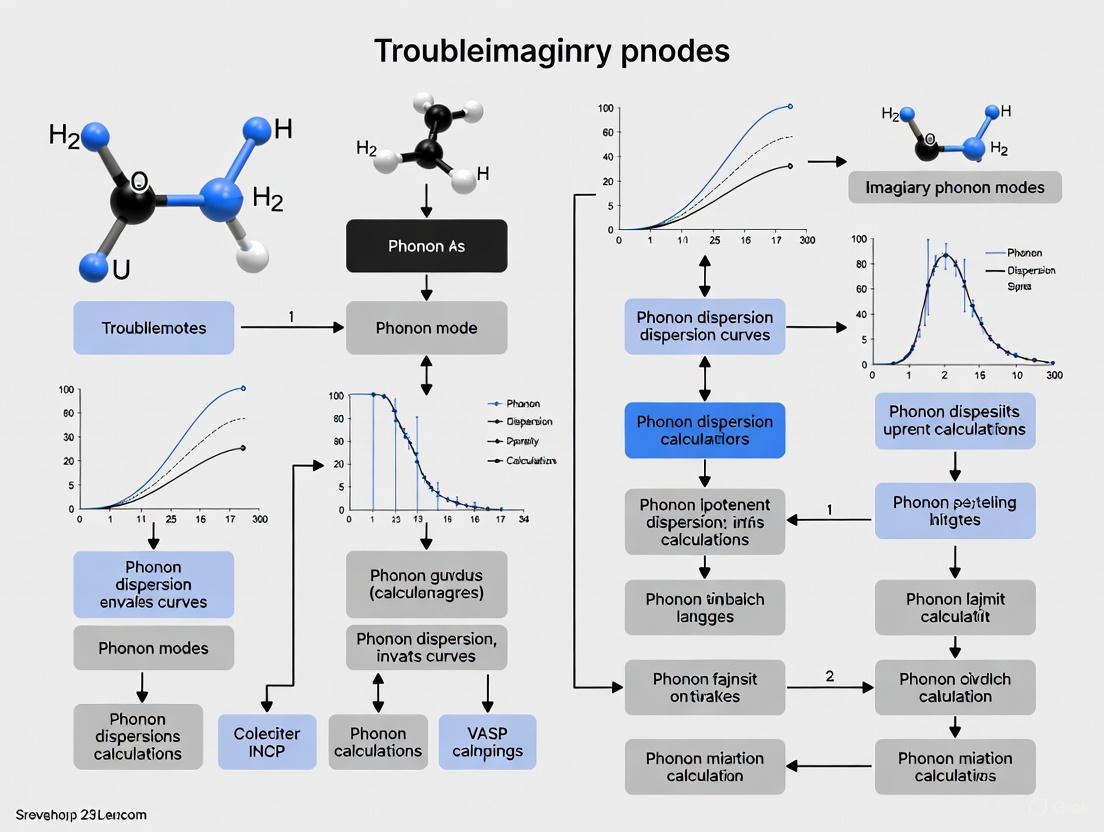
This article provides a comprehensive guide for researchers and scientists on identifying, understanding, and resolving the common yet challenging issue of imaginary phonon frequencies in VASP calculations.
Troubleshooting Imaginary Phonon Modes in VASP: A Comprehensive Guide from Causes to Solutions
Abstract
This article provides a comprehensive guide for researchers and scientists on identifying, understanding, and resolving the common yet challenging issue of imaginary phonon frequencies in VASP calculations. Covering both foundational theory and practical methodology, it details systematic troubleshooting procedures for insufficient structural optimization, parameter convergence, and supercell size. The guide also explores advanced validation techniques, including the use of symmetry analysis and emerging machine learning interatomic potentials, to ensure the reliability and accuracy of computational results for predicting material stability and properties.
Understanding Imaginary Phonons: From Theory to Physical Meaning
What Are Phonons and the Harmonic Approximation?
Frequently Asked Questions
What is a phonon? A phonon is a quantized mode of vibration occurring in the rigid crystal lattice of atoms or molecules. Think of it as the fundamental particle of sound or heat in a solid. Phonons are quasiparticles, meaning they are emergent phenomena from the collective behavior of atoms in a lattice. They play a major role in many physical properties of condensed matter, such as thermal conductivity and electrical conductivity [1].
What is the harmonic approximation? The harmonic approximation is the foundational assumption that the forces acting on atoms displaced from their equilibrium positions are proportional to the displacement, much like a spring obeying Hooke's law [1]. In this model, the potential energy of the lattice is treated with a Taylor expansion around the equilibrium position, keeping only the quadratic (second-order) terms and ignoring higher-order terms. This simplification allows vibrations to be treated as a system of decoupled harmonic oscillators [1].
Why does the harmonic approximation sometimes fail? The harmonic approximation assumes atoms are always close to their equilibrium positions and that the potential energy landscape is perfectly parabolic. In real materials, anharmonic effects (from neglected higher-order terms in the potential energy) become significant at higher temperatures or for certain atomic configurations, leading to phenomena like thermal expansion, which the pure harmonic model cannot explain [2].
What does an "imaginary frequency" mean in my calculation? In the context of phonon calculations, an imaginary frequency (often reported as a negative value in computational outputs) mathematically means a negative force constant in the harmonic oscillator solution. Physically, it suggests that the atomic structure is not at a true energy minimum and that the system would gain energy by moving along the corresponding vibrational mode. This can indicate a structural instability, a phase transition, or simply that your calculation setup needs improvement [3] [4].
Troubleshooting Imaginary Phonon Modes
Imaginary frequencies are a common challenge. The following table outlines frequent causes and their solutions.
| Problem | Description | Solution |
|---|---|---|
| Incomplete Geometry Optimization | The most common cause. The phonon calculation starts from a structure where atomic forces are not fully minimized [3]. | Re-optimize the geometry using tighter force convergence criteria (e.g., EDIFFG = -0.01 or -0.001 in VASP) before the phonon run [3] [5]. |
| Insufficient K-point Sampling | Using too few k-points can lead to an inaccurate electronic structure, which affects force and, consequently, phonon calculations [3]. | Conduct a k-point convergence test. Increase k-point density systematically and re-optimize the geometry at each new k-point set [3]. |
| Numerical Precision Issues | Small imaginary frequencies (e.g., a few cm⁻¹) can result from numerical noise from integration grids, SCF convergence, or finite-displacement step size [4] [6]. | Use finer numerical settings: tighter SCF convergence (EDIFF = 1e-7 or 1e-8), better integration grids, and smaller displacement steps (POTIM = 0.002 in finite-difference methods) [4] [6]. |
| True Structural Instability | The material may be mechanically unstable at the calculated conditions, or you may be calculating a transition state (which should have exactly one imaginary mode) [6]. | Verify the nature of the structure. For a true ground state, try different initial atomic configurations or magnetic moments to find a stable minimum [7]. |
Troubleshooting Workflow for Imaginary Frequencies
When you encounter imaginary frequencies, a systematic approach is key to diagnosing and resolving the issue. The following flowchart outlines this logical process.
The Scientist's Toolkit: Essential Inputs for Stable Phonon Calculations
Proper calculation setup is crucial for avoiding spurious imaginary frequencies. Here are key parameters and their roles, primarily for VASP users.
| Item/Parameter | Function & Rationale |
|---|---|
EDIFFG & EDIFF |
EDIFFG controls force convergence during geometry optimization. A tighter value (e.g., -0.001) ensures a true minimum. EDIFF controls electronic step convergence; 1e-7 or 1e-8 is recommended for accurate forces [6] [5]. |
IBRION |
In VASP, this tag chooses the ion dynamics algorithm. IBRION = 1 (RMM-DIIS) or 3 (damped molecular dynamics) can be used for geometry optimization. IBRION = 8 is for Density Functional Perturbation Theory (DFPT) phonons [3]. |
ISIF |
Determines what is relaxed: ions only (ISIF=2), or ions, cell shape, and volume (ISIF=3). Ensure your initial bulk structure is fully relaxed [5]. |
KPOINTS |
The k-point mesh for Brillouin zone sampling. Always re-optimize your geometry if you change the k-point mesh, as the optimal structure can change with sampling [3]. |
POTIM |
The step size for finite differences in phonon calculations. If too large (e.g., 0.03), it can lead to anharmonic effects and spurious imaginary frequencies. A smaller value (e.g., 0.002) is often better [6]. |
SYMPREC & ISYM |
Control symmetry recognition. Sometimes, symmetry issues can cause calculation failures. Setting ISYM = 0 (turning off symmetry) or increasing SYMPREC can help [8]. |
LREAL & PREC |
LREAL = .FALSE. ensures exact projection operators in force calculations. PREC = Accurate is generally recommended for high-precision results [3]. |
FAQ: Understanding the Basics
What does an imaginary frequency mean physically?
An imaginary frequency indicates that the system is not at a true local energy minimum but at a saddle point on the potential energy surface. A negative value for the squared frequency (ω²) means the energy decreases along that vibrational mode, signaling dynamical instability. In contrast, all frequencies should be positive (semi-definite) for a stable equilibrium structure [3].
My calculation converged, so why do I have imaginary frequencies?
Geometry optimization and electronic convergence are separate processes. Your structure may have converged to a saddle point rather than a minimum. This can happen if [3] [4]:
- The system is mechanically unstable.
- The geometry was not fully optimized for the current computational settings (e.g., k-point grid, cut-off energy).
- Numerical inaccuracies (integration grids, SCF convergence) introduce noise into the Hessian matrix.
Are very small imaginary frequencies acceptable?
This is a topic of ongoing debate. Small imaginary frequencies (e.g., below 20-30 cm⁻¹) are often considered numerical artifacts, especially for large molecules where finding the exact minimum is difficult [4]. However, caution is advised:
- For general properties: If calculating electronic properties like polarizabilities or TD-DFT excitation energies, a small error in geometry may be tolerable [4].
- For thermochemistry: Never ignore them. The Gibbs free energy is highly sensitive to low frequencies. Even an infinitesimal imaginary frequency introduces a finite, non-negligible error because the contribution to entropy and free energy is discontinuous between real and imaginary frequencies [4].
Troubleshooting Guide: Diagnosing and Fixing Imaginary Frequencies
Follow the diagnostic workflow below to systematically address imaginary frequencies in your calculations.
Step 1: Verify Calculation Quality and Convergence
Often, imaginary frequencies arise from insufficient numerical accuracy.
- Tighten SCF and Geometry Convergence: Looser convergence criteria can lead to inaccurate forces and Hessians [6] [9].
- Improve Integration Grids: Low-quality quadrature grids can cause numerical noise in derivatives [11] [10].
- In VASP, ensure
PREC = Accurate. - In ORCA, use
DEFGRID3for a finer grid [10].
- In VASP, ensure
- Check Finite-Difference Parameters: If using finite-difference phonon calculations, a large displacement step can lead to anharmonic effects and spurious imaginary frequencies [6].
- Use a small displacement, e.g.,
POTIM = 0.002Å in VASP [6].
- Use a small displacement, e.g.,
Step 2: Re-optimize Your Geometry
This is the most common solution. The structure must be re-minimized for your specific computational setup [3].
- Parameter Changes Require Re-optimization: Increasing the k-point density, changing the functional, or adjusting the plane-wave cut-off energy alters the potential energy surface. A geometry that was a minimum with one set of parameters may not be with another [3].
- Start from a Better Guess: If an optimization converges to a saddle point, displace the atoms along the imaginary mode and restart the optimization. Using a computed Hessian (e.g.,
GEOM_OPT_HESSIAN = READin Q-Chem) can guide the optimization more effectively [11] [9].
Step 3: Address System-Specific Issues
- Constrained Optimizations: Fixing atoms during an optimization (common in enzyme modeling) will always introduce imaginary frequencies corresponding to motions of the fixed atoms [9]. These are artifacts of the constraint. If your software allows, project out these modes before frequency analysis. Otherwise, they must be carefully identified and ignored, though this requires caution [9].
- Transition State Searches: A valid transition state should have exactly one imaginary frequency. If you find multiple, your calculation may not have converged to the correct saddle point, or the finite-difference step size might be too large [6] [10].
Experimental Protocols: Key Computational Parameters
The following table summarizes critical parameters to check and adjust to resolve imaginary frequency issues.
| Parameter | Recommended Setting for Stable Frequencies | Function |
|---|---|---|
SCF Convergence (EDIFF in VASP) |
1E-7 to 1E-8 [6] |
Ensures forces are highly accurate. |
Force Convergence (EDIFFG in VASP) |
-0.001 (eV/Å) or tighter |
Ensures the geometry is at a stationary point. |
| K-Point Grid | Converged for your system | Inadequate sampling can create instabilities [3]. |
Finite-Difference Step (POTIM in VASP) |
0.002 Å [6] |
Keeps displacements within the harmonic region. |
| Integration Grid | DEFGRID3 in ORCA, PREC=Accurate in VASP |
Reduces noise in the Hessian calculation [10]. |
Research Reagent Solutions
Essential computational "reagents" for stable phonon calculations.
| Item | Explanation & Function |
|---|---|
| High-Quality Pseudopotentials | Projector augmented-wave (PAW) potentials in VASP. Using inaccurate potentials can lead to incorrect forces and instabilities. |
| Adequate Basis Set | A balanced basis set (e.g., def2-TZVP, def2-SVP) is crucial. Overly diffuse functions can cause linear dependence, while small bases lack the flexibility to describe curvature correctly [9]. |
| Stable XC Functional | While B3LYP is common, some functionals (e.g., pure GGAs like PBE) can be numerically more stable for optimization, though accuracy may vary [9]. |
Electron-Phonon Ignore Flag (ELPH_IGNORE_IMAG_PHONONS in VASP) |
Use with extreme caution. This flag allows VASP to skip q-points with imaginary frequencies during electron-phonon calculations, but it does not fix the underlying problem [12]. |
Distinguishing Between Physical Soft Modes and Computational Artifacts
FAQs: Understanding Imaginary Phonon Modes
FAQ 1: What does an imaginary frequency in my VASP phonon calculation mean?
An imaginary frequency (reported as f/i in the OUTCAR file) indicates a vibrational mode with a negative force constant. This can represent a genuine physical soft mode, signaling a structural instability where the crystal would prefer to distort into a new, lower-energy configuration. Alternatively, it can be a computational artifact resulting from an insufficiently optimized geometry, inadequate convergence parameters, or other numerical inaccuracies in the calculation [13].
FAQ 2: How can I tell if an imaginary mode is physical or an artifact?
A systematic diagnostic approach is required. Genuine soft modes are typically localized to specific wavevectors in the Brillouin zone and persist even after rigorous convergence testing. Computational artifacts, on the other hand, often manifest as sporadic imaginary modes at the Gamma point (q=0) and tend to disappear or diminish when key computational parameters, such as the plane-wave cutoff (ENCUT) or k-point sampling density, are improved [13] [14] [15].
FAQ 3: My geometry is optimized, but I still get imaginary modes. What should I check? Even with a pre-optimized geometry, imaginary modes can persist. The most common culprits are:
- Insufficient force convergence: Ensure that the forces on all atoms in the equilibrium structure are converged to a very tight tolerance (e.g., less than 1 meV/Å).
- Inadequate electronic convergence: The phonon force constants require highly accurate forces. Use
PREC = Accurateand ensure the electronic self-consistent field (SCF) loop is fully converged [13]. - Supercell size: The phonon frequencies must be converged with respect to the size of the supercell used for the force-constant calculation. A larger supercell may be necessary [14].
FAQ 4: When are imaginary modes at the Gamma point physically meaningful? Imaginary modes at the Brillouin zone center (Gamma point) can indicate a ferroelectric instability or a transition to a lower-symmetry phase. In such cases, the atomic displacements associated with the soft mode point towards the distorted, stable structure. The physical nature of the mode can be confirmed by distorting the crystal along the eigenvector of the soft mode and re-optimizing the geometry; a genuine soft mode will lead to a new, stable structure with a lower total energy [13].
Troubleshooting Guide: Resolving Imaginary Frequencies
Follow this systematic workflow to diagnose and resolve spurious imaginary phonon modes.
Diagnostic and Resolution Workflow
```dot
The Critical Link Between Potential Energy Surface and Phonon Frequencies
The Potential Energy Surface (PES) is a fundamental concept in computational materials science, representing the total energy of a system as a function of its nuclear coordinates. For a bulk system containing N atoms, the PES is a high-dimensional (3N-dimensional) function that dictates the system's stability and dynamical behavior [16]. Phonon frequencies, which correspond to the collective vibrational modes of atoms in a crystal lattice, are directly determined by the local curvature of this PES around an equilibrium structure. Specifically, phonons are calculated from the second derivatives of the total energy with respect to atomic displacements, forming the Hessian matrix or the force-constants matrix [17].
When this curvature is positive in all directions, all phonon frequencies are real (positive), indicating the structure resides at a local minimum on the PES—a stable or metastable configuration. The appearance of imaginary frequencies (mathematically, negative values of ω²) signals that the energy decreases along certain vibrational modes, meaning the structure is not at a true minimum. This can indicate either a mechanically unstable structure or, more commonly in computational practice, that the structure was not sufficiently optimized for the given computational parameters before the phonon calculation was performed [3].
Frequently Asked Questions (FAQs)
Q1: I increased my k-point sampling to get more accurate results, but now my phonon calculation shows imaginary frequencies. Why did this happen?
This is a common and seemingly counterintuitive problem. The root cause is that the "equilibrium" geometry changes with the improved k-point sampling. When you increase k-points without re-optimizing the atomic positions, the forces on the atoms are no longer zero for the new, more accurate electronic potential. Consequently, the structure is slightly displaced from the true minimum for that level of theory, resulting in imaginary frequencies in the phonon spectrum [3].
- Solution: Always re-optimize the geometry (perform an ionic relaxation) using the same high-quality k-point grid and other parameters before starting a phonon calculation.
Q2: My imaginary frequencies are very small. Should I be concerned?
Small imaginary frequencies, often referred to as "soft modes," are a common occurrence in DFT calculations. While they can sometimes indicate a genuine physical instability (e.g., a phase transition), they are more often a numerical artifact. The key is to systematically troubleshoot.
- Solution: First, ensure your structure is fully converged with respect to all computational parameters (ENCUT, k-points, EDIFF, etc.). If small imaginaries persist after rigorous convergence and re-optimization, they might be due to numerical noise or the limitations of the harmonic approximation. In such cases, they are often ignored, but this decision should be made with caution and an understanding of the material system.
Q3: What is the difference between a local minimum and a transition state on the PES, and how do phonons reflect this?
A local minimum is a stable configuration where any small displacement of atoms increases the energy. The phonon frequencies at a true local minimum are all real. A transition state is a first-order saddle point on the PES—a point that is a minimum in all directions except one, along which it is a maximum. A phonon calculation at a transition state will yield exactly one imaginary frequency, which corresponds to the vibrational mode leading towards the product and reactant states [16].
Troubleshooting Guide: Resolving Imaginary Phonon Modes
Imaginary frequencies are a symptom of an underlying issue. The following workflow provides a systematic approach to diagnosing and resolving them.
Diagram: Systematic troubleshooting workflow for imaginary phonon frequencies.
Step 1: Verify Structural Optimization
The most common cause of imaginary frequencies is an inadequately optimized structure. Before a phonon calculation, you must ensure that the geometry is at a true energy minimum (forces are zero within a tight tolerance).
- Protocol:
- Perform a full ionic relaxation (
IBRION = 2or1in VASP) using the same high-accuracy settings you plan to use for the phonon calculation (especiallyENCUTandKPOINTS). - Use tight convergence criteria for the electronic (
EDIFF = 1E-8) and ionic (EDIFFG = -0.001or tighter) steps [3]. - Confirm from the
OUTCARthat the forces on all atoms are negligible (e.g., below 1 meV/Å) at the end of the relaxation.
- Perform a full ionic relaxation (
Step 2: Converge Key Computational Parameters
The calculated equilibrium geometry and, consequently, the phonon frequencies depend on the convergence of key DFT parameters. The table below summarizes the critical parameters and their convergence criteria.
Table: Key Computational Parameters and Convergence Guidelines
| Parameter | Description | Convergence Check | Typical Value for Solids |
|---|---|---|---|
ENCUT |
Plane-wave kinetic energy cutoff. | Increase in steps of 50-100 eV until the total energy change is < 1 meV/atom. | 1.3 × the maximum ENMAX in POTCAR. |
KPOINTS |
Sampling of the Brillouin zone. | Use a Gamma-centered grid. Increase grid density until energy/frequency change is negligible [18]. | System-dependent; use KSPACING ~ 0.04 Å⁻¹ or less. |
EDIFF |
Electronic SCF convergence. | Set to a tight value to ensure accurate forces. | 1E-8 (default is often too loose) [3]. |
ISMEAR |
Brillouin-zone integration smearing. | Use ISMEAR = -5 (tetrahedron) or 0 (Gaussian) with a small SIGMA for semiconductors/insulators [3]. |
-5 for precise DOS; 0 for metals. |
Step 3: Investigate Symmetry and Numerical Issues
- Symmetry Breaking: Computational rounding errors can sometimes cause a high-symmetry structure to be slightly distorted, breaking symmetry and leading to imaginary frequencies. Try re-optimizing the structure with symmetry turned off (
ISYM = -1). - Long-Range Interactions: For semiconductors and insulators, the correct treatment of long-range electrostatic interactions is crucial for accurate phonon dispersions, especially near the Γ-point. Ensure that the
LEPSILON = .TRUE.tag is set to calculate and apply the correct non-analytical correction (LO-TO splitting) [17].
The Scientist's Toolkit: Essential VASP Tags for Stable Phonon Calculations
A robust computational setup is the first defense against unphysical results. The following table details critical INCAR tags for reliable structural optimization and phonon calculations.
Table: Essential VASP Tags for Phonon Calculations
| INCAR Tag | Function | Recommended Value | Rationale |
|---|---|---|---|
PREC |
Controls accuracy of computation. | Accurate |
Ensures FFT grids are sufficient to avoid wrap-around errors [3]. |
LREAL |
Evaluates projectors in real-space. | .FALSE. |
Guarantees high accuracy for force calculations [3]. |
LASPH |
Includes non-spherical contributions. | .TRUE. |
Important for correct treatment of potentials in non-spherical systems [3]. |
ADDGRID |
Uses additional grid for accuracy. | .TRUE. |
Improves the precision of calculated forces [3]. |
IBRION |
Determines ionic relaxation algorithm. | 5 (DFPT) or 2 (CG) |
IBRION=5 is for direct DFPT phonons; 2 is for structural relaxation [17]. |
ISIF |
Defines what is relaxed during optimization. | 2 (ions only) or 3 (ions+cell) |
Use ISIF=3 for bulk cell optimization unless the cell is known to be correct. |
LEPSILON |
Calculates dielectric tensor and Born charges. | .TRUE. |
Essential for calculating the LO-TO splitting in polar materials [17]. |
Advanced Protocols
Protocol 1: DFPT Phonon Calculation with VASP
Density Functional Perturbation Theory (DFPT) is an efficient method for calculating phonon dispersion and density of states.
- Fully Optimize Structure: As outlined in the troubleshooting guide, perform a meticulous ionic relaxation.
- Set INCAR Parameters for DFPT:
- Run the Calculation: A single VASP calculation with
IBRION = 8will compute the force constants and phonon frequencies at the q-points specified in theQPOINTSfile (or the Γ-point by default).
Protocol 2: Finite-Displacement Method (Supercell Approach)
This method involves creating supercells and calculating force constants by displacing atoms.
- Create a Supercell: Use a tool like
phonopyto generate a supercell of sufficient size (e.g., 2x2x2 or 4x4x4, depending on the system). - Generate Displaced Structures: The tool will create a set of
POSCARfiles, each with a single atom displaced in one Cartesian direction. - Calculate Forces: Run a standard VASP single-point energy calculation (
NSW = 0) for each displaced structure to compute the forces. TheOUTCARorvasprun.xmlfiles from these calculations contain the necessary force information. - Post-Process: Use
phonopyto post-process the force files, construct the dynamical matrix, and calculate the full phonon band structure.
Diagram: The logical relationship between the PES, structural minima, and the resulting phonon frequencies.
Choosing Your Computational Approach: Finite Differences vs. DFPT in VASP
A common challenge in VASP phonon calculations is the appearance of imaginary frequencies (reported as f/i in the OUTCAR). In the context of the finite displacement method (IBRION=5 or 6), these indicate that the dynamical matrix has negative eigenvalues, often corresponding to a structure that is not in a true ground state or local minimum [19] [3]. This guide provides a structured approach to diagnosing and resolving the root causes of this issue.
Core Setup and Parameters
A correct initial setup is the first line of defense against unphysical results.
1. INCAR Parameters
The following parameters are crucial for finite-displacement phonon calculations [19] [20] [21].
| Tag | Recommended Setting | Purpose and Explanation |
|---|---|---|
IBRION |
5 or 6 | Triggers finite-difference phonon calculation. 6 uses symmetry to reduce displacements [19] [22]. |
NFREE |
2 | Uses central differences (displacements of ±POTIM), which is more accurate than NFREE=1 [19] [21]. |
POTIM |
0.015 (default) | Step size for displacements (in Å). Too large a value causes errors; the default is often a good start [19] [21]. |
EDIFF |
1E-7 to 1E-8 | Stopping criterion for the electronic SCf loop. Accurate forces require a tight convergence [3] [21]. |
PREC |
Accurate | Ensures high precision in the evaluation of the projectors and the forces [19] [20]. |
ISIF |
2 | Relax ions only, keeping the cell volume and shape fixed. Used during the initial geometry relaxation [23]. |
NSW |
1 | A single ionic step is sufficient as the finite-displacement method is a one-shot force calculation [19]. |
LEPSILON |
.TRUE. | Calculates the dielectric tensor, Born effective charges, and is needed for the correct treatment of LO-TO splitting [19]. |
2. Workflow: From Relaxation to Phonons
A robust workflow is essential. The finite-displacement method is highly sensitive to the quality of the input structure. The following chart outlines the critical steps.
Troubleshooting Imaginary Frequencies
If imaginary frequencies persist, systematically check the following areas.
FAQ 1: Why do I get imaginary frequencies even after a basic relaxation?
Cause: The most common cause is that the structure used for the phonon calculation is not fully relaxed with respect to the computational parameters (especially ENCUT and KPOINTS) used in the phonon run itself [3].
Solution:
- Re-relax with consistent parameters: Always perform the final geometry relaxation using the same
ENCUTandKPOINTSmesh that you will use for the phonon calculation. Do not simply reuse a structure relaxed with different, often lower-quality, parameters [3]. - Enforce symmetry: After relaxation, check the
CONTCARfile. Small numerical errors might break the crystal symmetry. Manually round off minuscule values (e.g.,-0.00001249to0.00000000) in lattice vectors and atomic positions. Then, perform a final relaxation withISIF=2(fixed cell) andISYM=2(symmetry enforced) to obtain a perfectly symmetric structure [23].
FAQ 2: My structure is fully relaxed, but a few small imaginary modes remain. What now?
Cause: Small residual imaginary modes can result from numerical inaccuracies in the force constant calculation, often linked to insufficient SCF convergence, a suboptimal displacement step, or an under-converged plane-wave cutoff [19] [21].
Solution:
- Tighten electronic convergence: Set
EDIFF = 1E-7or even1E-8in yourINCARfile for the phonon calculation. The default of1E-4is far too crude for accurate forces [21]. - Optimize the displacement step: Test different
POTIMvalues. While0.015 Åis a reasonable default, try a smaller value (e.g.,0.005 Å) to see if the imaginary modes disappear [21]. - Converge the plane-wave cutoff (
ENCUT): The stress tensor and forces require a well-convergedENCUT. It is recommended to increase the default cutoff by about 30% and test for convergence. Systematically increaseENCUTin steps of 15% and monitor the Γ-point optical phonon frequencies until they stabilize [19].
FAQ 3: How do I choose between IBRION=5 and IBRION=6?
This choice involves a trade-off between computational cost and reliability.
| Feature | IBRION=5 | IBRION=6 |
|---|---|---|
| Symmetry | Displaces all atoms in all Cartesian directions, ignoring symmetry [19]. | Uses crystal symmetry to only generate displacements for symmetry-inequivalent atoms, reducing the number of calculations [19] [22]. |
| Computational Cost | High for large systems (3N calculations) [19]. | Lower for high-symmetry systems. |
| Recommended Use | Systems with low symmetry; when using NCORE/NPAR for parallelization; for monolayers where symmetry might be incorrectly applied to vacuum directions [23]. |
High-symmetry bulk systems where the symmetry reduction is significant and safe. |
FAQ 4: My supercell is large, and the calculation is slow. Any tips?
Cause: The finite-displacement method requires many individual force calculations, which is computationally demanding for large supercells.
Solution:
- K-point mesh scaling: When you build a supercell, reduce the k-point density proportionally. For example, if your primitive cell uses a
12x12x12mesh, a2x2x2supercell can use a6x6x6mesh to yield a similar k-point sampling density [19]. - Use
IBRION=6if possible: For symmetric systems,IBRION=6can drastically reduce the number of required calculations [19]. - Leverage
LREAL: For large supercells, settingLREAL = .TRUE.orLREAL = .AUTO.can significantly speed up the calculation with negligible accuracy loss [20].
The Scientist's Toolkit: Essential "Reagents"
The table below lists key files and computational "reagents" needed for a successful finite-displacement phonon calculation.
| Item | Function / Purpose |
|---|---|
Fully Relaxed CONTCAR |
The most critical input. Serves as the POSCAR for the phonon run. Must be relaxed with the final ENCUT and KPOINTS [3]. |
High-precision INCAR |
Contains the specific parameters for finite-difference phonons (IBRION=5/6, NFREE=2, EDIFF=1E-7 or tighter, PREC=Accurate) [19] [21]. |
Appropriate KPOINTS |
A k-point mesh that is converged for the supercell size. Coarser than the primitive cell mesh but still sufficient for accuracy [19]. |
POTIM (Displacement Step) |
The "perturbation reagent." A small, optimized step size (default 0.015 Å) to probe the energy landscape and calculate force constants [19] [21]. |
| Phonopy Post-Processing Code | A powerful external tool to post-process the results from finite-displacement calculations. It can generate phonon band structures, density of states, and thermal properties [19] [23]. |
Frequently Asked Questions
Q1: What is the fundamental difference between IBRION=7 and IBRION=8? Both tags invoke Density Functional Perturbation Theory (DFPT) for phonon calculations, but they differ in how they handle crystal symmetry [24].
- IBRION=7: Displaces all atoms in all three Cartesian directions, performing 3𝑁atom displacements. It does not use symmetry to reduce the number of calculations [23].
- IBRION=8: Uses symmetry operations to identify equivalent atoms and directions, significantly reducing the number of required displacements and computation time [24] [23].
Q2: Does DFPT in VASP calculate phonons at wavevectors other than Gamma (q=0)? No. A key limitation of the DFPT implementation in VASP is that it only calculates zone-center (Γ-point) phonon frequencies [24]. To obtain the full phonon dispersion, you must compute the force constants in real space using a sufficiently large supercell, then use a post-processing tool like Phonopy to Fourier interpolate the dynamical matrices across the Brillouin Zone [24] [25].
Q3: When should I prefer IBRION=7 over IBRION=8?
Choose IBRION=7 in the following situations [23]:
- You are running calculations on a large supercell where the benefit of
NCORE/NPARk-point parallelization outweighs the cost of extra displacements. - You are studying a monolayer or 2D material.
IBRION=8may incorrectly apply symmetries that include the vacuum space when determining displacement directions. - Your structure has low symmetry or broken symmetry, making the symmetry analysis in
IBRION=8less effective.
Q4: My DFPT calculation produces imaginary frequencies. What should I do? Imaginary frequencies (negative values in the output) suggest dynamic instability. Follow this systematic approach:
- Verify Geometric Convergence: Ensure your structure is fully relaxed with tight convergence criteria for electronic (EDIFF ≈ 1e-8) and ionic steps (forces ≤ 1e-4 eV/Å) [23] [26].
- Check Supercell Size: A supercell that is too small can lead to artificial instabilities. Systematically increase the supercell size (e.g., from 3x3x1 to 5x5x1) and check for convergence of the phonon spectrum [27].
- Enforce Symmetry: Small numerical errors during relaxation can break the crystal symmetry. Manually edit the
CONTCARfrom the relaxation to enforce the expected symmetry and then re-relax the atomic positions with fixed lattice constants (ISIF=2) and symmetry turned on (ISYM=2) [23].
Key Parameters and Experimental Protocols
Essential INCAR Tags for DFPT Calculations The following table summarizes the critical parameters for a typical DFPT calculation [28] [25] [23].
| INCAR Tag | Recommended Setting | Purpose and Explanation |
|---|---|---|
IBRION |
7 or 8 | Invokes the DFPT method for phonon calculations [24]. |
NSW |
1 | A single step is sufficient for DFPT [23]. |
PREC |
Accurate | Ensures high precision in the calculation [25] [23]. |
EDIFF |
1.0e-8 | Tight convergence criterion for the electronic cycle [23]. |
ENCUT |
At least 1.3x the maximum ENMAX in POTCAR | Defines the plane-wave kinetic energy cutoff [27]. |
LREAL |
.FALSE. | Evaluates the projection operators in reciprocal space [25] [23]. |
ADDGRID |
.TRUE. | Uses additional grid for more accurate force evaluations [23]. |
ISMEAR |
0 | Gaussian smearing for semiconductors/insulators [25] [23]. |
SIGMA |
0.05 | Small width for smearing [23]. |
LEPSILON |
.TRUE. | Calculates Born effective charges and dielectric tensor [23]. |
NWRITE |
3 | Highest verbosity; required for proper post-processing with Phonopy [23]. |
Workflow for a Robust DFPT Phonon Calculation Adhering to a structured workflow is crucial for obtaining physically meaningful results, especially when troubleshooting imaginary modes. The following diagram outlines the key steps.
The Scientist's Toolkit: Research Reagent Solutions
| Tool / Reagent | Function / Purpose |
|---|---|
| VASP | The primary first-principles simulation engine that performs the DFPT calculation [24]. |
| Phonopy | A post-processing software package used to extract force constants from vasprun.xml, plot phonon band structures, and compute phonon density of states [25] [23]. |
| VESTA | A visualization program used to visualize crystal structures and, with helper scripts, the eigenvectors of phonon modes [29]. |
FORCE_CONSTANTS File |
The data file generated by Phonopy (phonopy --fc vasprun.xml) containing the second-order force constants, which is essential for all subsequent phonon property calculations [25] [23]. |
band.conf File |
A configuration file for Phonopy that specifies the high-symmetry path in the Brillouin zone for plotting the phonon dispersion [28] [23]. |
A technical guide for resolving unstable vibrational modes in computational materials science
Frequently Asked Questions
Q: Why do I get imaginary phonon frequencies even after a geometry relaxation? A: The appearance of imaginary (negative) frequencies often indicates that your structure was not sufficiently optimized for your specific calculation settings. When you change parameters like the k-point mesh, the optimal atomic configuration can shift slightly. Even small residual forces can lead to imaginary modes in the subsequent phonon calculation. Always re-optimize your ionic positions after changing ENCUT or the k-point grid [3].
Q: What is the most critical step to avoid imaginary frequencies? A: Achieving a properly converged geometry relaxation is paramount. Phonon calculations assume the crystal is in its equilibrium state with minimized energy and near-zero forces on all atoms. Calculations starting from a structure with residual forces or stresses are the most common source of imaginary frequencies [5].
Q: Can a higher k-point sampling cause imaginary frequencies? A: Yes. If you increase the k-point density without re-optimizing the atomic positions, the forces can increase for the fixed geometry, leading to the appearance of small imaginary frequencies. The solution is to perform a new ionic relaxation (NSW, IBRION) using the new, denser k-point grid before the phonon calculation [3].
Q: Should I use IBRION=5,6,7, or 8 for phonons? A: IBRION=5 and 6 use the finite-displacements method, which is often used with supercell approaches (e.g., with Phonopy). IBRION=7 and 8 use Density Functional Perturbation Theory (DFPT). IBRION=8 applies symmetry to reduce the number of needed calculations but is incompatible with NCORE/NPAR parallelization, while IBRION=7 does not use this symmetry [28].
Troubleshooting Guide: Resolving Imaginary Phonon Modes
Imaginary frequencies represent an unstable mode in the structure. Follow this systematic procedure to identify and solve the problem.
Step 1: Verify and Improve the Initial Geometry Relaxation
A successful phonon calculation is built upon a perfectly relaxed structure.
- Check Force Convergence: Ensure your relaxation converged with forces below a strict threshold. A typical value is
EDIFFG = -0.001(all forces < 0.001 eV/Å) [5]. - Re-relax with Fixed Cutoff: Volume changes during relaxation can introduce Pulay stresses. It is good practice to perform multiple relaxation cycles with a fixed, high ENCUT value [5].
- Static Calculation: After forces are converged, run a single static calculation (NSW = 0,
ISIF = 2) to generate a high-qualityCHGCARfile. This file can be used as a starting point for subsequent phonon calculations to speed them up [5].
Step 2: Ensure Self-Consistent Electronic Convergence
The forces used in phonon calculations must be accurate, which requires well-converged electrons.
- Set a Strict Criterion: Use
EDIFF = 1E-8to ensure high accuracy in the energy and forces [28] [30]. - Use Accurate Precision Mode: Set
PREC = Accurateto improve the accuracy of calculations, particularly for forces and stresses [31] [32].
Step 3: Converge Key Parameters Before the Phonon Run
Do not use the same ENCUT and k-points for your phonon calculation that you used for a quick initial relaxation.
- Converge the Lattice Parameter: Perform a series of volume relaxations with different k-point meshes to find the value at which the lattice parameter stabilizes. Using an unconverged lattice parameter is a major source of instability [31].
- Use a High Energy Cutoff: Ensure ENCUT is set to a sufficiently high value, typically the maximum
ENMAXfound in yourPOTCARfiles. You can explicitly set it in the INCAR file (e.g.,ENCUT = 500) [31] [32].
The following workflow summarizes the critical steps for a stable phonon calculation:
The table below summarizes the recommended settings for the key parameters in phonon calculations.
| Parameter | Recommended Setting for Phonons | Function & Rationale |
|---|---|---|
| PREC | Accurate |
Improves the accuracy of forces and stresses, which is critical for stable phonon results [28] [31]. |
| ENCUT | 500 (or max ENMAX from POTCAR) |
The plane-wave kinetic energy cutoff. Must be high enough for converged forces [31] [30]. |
| EDIFF | 1E-8 |
Stopping criterion for electronic loops. A strict value ensures accurate force calculations [28] [30]. |
| EDIFFG | -0.001 |
Stopping criterion for ionic relaxation. Forces must be below this value to be considered minimized [5]. |
| NSW | 100 (Relaxation), 1 (DFPT), 0 (Static) |
Maximum number of ionic steps. Set to 0 for a static calculation after relaxation [28] [5]. |
| IBRION | 2 (Relax), 5/6 (Finite-diff.), 7/8 (DFPT) |
Algorithm for ionic relaxation (2) and phonon method (5,6,7,8) [28] [32]. |
| ISMEAR | 0 (Semiconductors/Insulators) |
Smearing method. Gaussian smearing is typically safe; use -5 for metals with tetrahedron method [32]. |
| ISIF | 3 (Volume+shape), 2 (Ions only) |
Determines what is relaxed during the initial optimization [32]. |
| LREAL | .FALSE. |
Evaluates projection operators in reciprocal space. Setting to False is more accurate for forces [28] [30]. |
The Scientist's Toolkit: Research Reagent Solutions
In computational science, our "reagents" are the software tools and input parameters that drive our virtual experiments.
| Tool / Parameter | Function in the "Experiment" |
|---|---|
| VASP | The core simulation engine that solves the electronic structure problem and calculates energies and forces [5]. |
| Phonopy | Post-processing tool that takes the force constants from VASP and constructs the dynamical matrix to compute phonon bands and DOS [28] [30]. |
| PREC | Controls the numerical accuracy of the calculation, acting as the "quality setting" for the entire simulation [32]. |
| ENCUT | Defines the size of the plane-wave basis set, analogous to the "resolution" of the calculation [32]. |
| EDIFF/EDIFFG | Act as the "stopping criteria" or quality control checks for the electronic and ionic relaxation processes, respectively [32] [33]. |
Frequently Asked Questions
What is LO-TO splitting and why does it occur in my phonon calculations? LO-TO (Longitudinal Optical - Transverse Optical) splitting is a physical phenomenon in polar materials where the longitudinal optical (LO) and transverse optical (TO) phonon modes exhibit different frequencies at the Brillouin zone center (Γ point). This occurs due to incomplete electronic screening in semiconductors or insulators, which leads to long-range dipole-dipole interactions. These interactions create a non-analytical contribution to the dynamical matrix that must be handled specially, as they would otherwise require infinitely large supercell calculations to compute explicitly [17] [34].
Why am I getting imaginary phonon frequencies for my polar material? Imaginary frequencies (often shown as negative frequencies in calculations) typically indicate dynamical instabilities in your structure. For polar materials, this can often be traced to an improper handling of the long-range interatomic force constants. The standard small displacement method may fail to accurately account for the vibration-induced dipole-dipole interactions between periodic supercells, which is crucial for obtaining physically correct phonon spectra in polar materials [34].
How do I know if my material requires special treatment for LO-TO splitting? Your material requires special treatment if it exhibits polar characteristics - typically materials with ionic bonding and a lack of inversion symmetry. This includes many semiconductors, oxides, and ionic crystals. If your calculated dielectric tensor shows significant off-diagonal components or large Born effective charges, or if your phonon dispersion shows unphysical behavior near the Γ point, you likely need to implement LO-TO splitting corrections [17] [34].
Can I use the same functional for dielectric function calculations as I used for structural relaxation? For the ionic contribution to the dielectric function, you should use the same functional that was used for structural relaxation to maintain consistency, as the force constants matrix and phonon eigenvalues depend on having zero forces on the equilibrium structure. However, for the electronic dielectric function, it is more common to use higher-level theories (like hybrids) on PBE-relaxed structures, though this practice should be validated for your specific system [35].
Troubleshooting Guides
Problem: Imaginary Frequencies in Polar Materials
Symptoms: Phonon calculations yield imaginary (negative) frequencies, particularly near the Γ point, or the phonon dispersion shows unphysical dips or gaps.
Solution: Implement the mixed-space approach [34]
- Use specialized packages: Implement tools like YPHON that use the mixed-space approach
- Account for dipole-dipole interactions: Ensure your calculation explicitly includes vibration-induced dipole-dipole interactions between periodic supercells
- Verify convergence: Check that your supercell is large enough to capture the long-range interactions
Implementation Workflow:
Problem: Incorrect Dielectric Properties
Symptoms: The calculated static dielectric constant doesn't match experimental values, or the ionic contribution seems unphysically large or small.
Solution: Proper convergence and methodology for dielectric calculations [36] [37]
- Converge parameters carefully: The ionic dielectric constant (εₚ) requires higher ENCUT and k-point density than ground-state energy calculations
- Use appropriate INCAR settings: For DFPT calculations, use:
IBRION = 8andLEPSILON = .TRUE.for DFPT methodLPEAD = .TRUE.for accurate derivative calculations
- Check for warnings: Look for "PSMAXN too small for non-local potential" warnings which indicate ENCUT is too high for your pseudopotentials
Dielectric Calculation Methodology:
| Calculation Type | Key INCAR Tags | Convergence Critical Parameters | Special Considerations |
|---|---|---|---|
| Ionic Contribution (DFPT) | IBRION=8, LEPSILON=.TRUE., LPEAD=.TRUE. |
ENCUT, k-points (higher than energy convergence) | Requires zero forces on equilibrium structure [37] |
| Electronic Contribution (Static) | LEPSILON=.TRUE. or LCALCEPS=.TRUE. |
ENCUT, k-points | LRPA controls local field effects [36] [38] |
| Optical Dielectric Function | LOPTICS=.TRUE., ALGO=CHI/TDHF/TIMEEV/BSE |
NBANDS (many unoccupied states needed) | Hybrid functionals often used for accuracy [36] [37] |
Problem: Calculation Instabilities and Non-Convergence
Symptoms: Calculations crashing with errors like EDWAV, EDDDAV, or ZPOTRF, or failing to converge within reasonable ionic steps.
Solution: Stability improvements for difficult systems [7]
- Adjust parallelization settings: Reduce
NCOREand/orKPARto avoid EDWAV errors - Change relaxation algorithms: Switch
IBRIONto 1 (RMM-DIIS) or 3 (damped molecular dynamics) - Modify step parameters: Reduce
POTIMto 0.02 for better convergence - Tighten electronic convergence: Set
EDIFF = 1e-7or lower - For magnetic/polaronic systems: Use appropriate
NUPDOWNvalues and test different AFM orderings
Experimental Protocols
Purpose: Calculate the ionic contribution to the static dielectric constant using Density Functional Perturbation Theory.
Steps:
- Fully relax your structure to ensure near-zero forces on all atoms (
EDIFFG = -0.001typically sufficient) - Perform static calculation on relaxed structure to obtain accurate charge density
- DFPT calculation with these key INCAR parameters:
- Convergence testing: Systematically test convergence with respect to ENCUT and k-point density
- Extract results: Find the ionic dielectric tensor in OUTCAR after "MACROSCOPIC STATIC DIELECTRIC TENSOR IONIC CONTRIBUTION"
Validation: Compare eigenvalues of the dynamical matrix to ensure no imaginary frequencies at Γ point.
Purpose: Obtain accurate phonon spectra for polar materials including proper LO-TO splitting.
Steps:
- Relax primitive unit cell with high accuracy (
ISIF = 3,IBRION = 2) - Static calculation and save as
Static.CON - Build supercell using appropriate tools (YCELL in YPHON package)
- Calculate dielectric properties including Born effective charges and high-frequency dielectric tensor
- Compute force constants using finite displacements in supercell
- Apply mixed-space approach: Combine real-space force constants with reciprocal-space treatment of dipole-dipole interactions
- Calculate phonons using specialized packages (YPHON) that implement the non-analytical correction
Key Advantage: This approach makes accurate phonon calculation possible with the direct method for polar materials without requiring linear response theory.
The Scientist's Toolkit
Table: Essential VASP Tags for Polar Material Calculations
| VASP Tag | Function | Recommended Setting for Polar Materials |
|---|---|---|
IBRION |
Determines ionic relaxation method | 5 (finite differences) or 8 (DFPT) [39] |
LEPSILON |
Calculate dielectric tensor | .TRUE. for static response [36] |
LPEAD |
Calculate electronic polarization | .TRUE. for accurate derivatives [38] |
LRPA |
Include local field effects | .FALSE. (includes exchange-correlation) [38] |
PHON_G_CUTOFF |
Controls long-range force constants | Should be tested for convergence [17] |
NFREE |
Number of displacements for phonons | 2 (central differences) [39] |
POTIM |
Displacement width for finite differences | 0.01 or 0.02 [39] |
Table: Research Reagent Solutions for Polar Materials
| Tool/Package | Function | Application Note |
|---|---|---|
| YPHON Package | Mixed-space approach for polar materials phonons | Resolves long-range dipole-dipole interaction problem in direct method [34] |
| vaspup2.0 | Automated convergence testing | Specifically includes dielectric constant convergence protocols [37] |
| Phonopy | Phonon analysis from force constants | General phonon analysis, may require LO-TO corrections for polar materials |
| ShakeNBreak | Structure distortion testing | Useful for identifying groundstate structures in complex PES [7] |
Generating Phonon Dispersions and DOS from Force Constants
Frequently Asked Questions
Q1: Why does my calculation produce imaginary frequencies (negative values) in the phonon dispersion? Imaginary frequencies indicate a dynamic instability in the structure. This is often not a code error but a result of several calculation parameters:
- Insufficient k-point sampling: Coarse k-point meshes can lead to inaccurate forces, causing imaginary modes. Converge your results with respect to k-point density [40].
- Incomplete force constant information: The error "Input forces are not enough to calculate force constants" can occur if symmetry is treated incorrectly. Try lowering the symmetry tolerance in Phonopy (e.g.,
--tolerance=1e-4) [41]. - Insufficient supercell size: The force constants must vanish at large distances. If the supercell is too small, the force constants may not decay fully, leading to incorrect phonon frequencies. Always converge the phonon frequencies with respect to supercell size [42].
Q2: How do I handle LO-TO splitting in polar materials like MgO or AlN? For polar materials, the long-range dipole-dipole interaction must be corrected via the Ewald sum. To do this, you must:
- Perform a DFPT calculation in the primitive unit cell with
LEPSILON = .TRUE.to obtain the Born effective charges and the dielectric tensor [42]. - Create a
BORNfile. For VASP, you can use thephonopy-vasp-bornauxiliary tool [30]. - In your phonopy calculation, provide the
BORNfile. In a VASP direct calculation, setLPHON_POLAR = Trueand supplyPHON_BORN_CHARGESandPHON_DIELECTRICin theINCARfile [42].
Q3: What is the difference between using the finite displacement method and DFPT? Both methods are valid but have different strengths.
- Finite Displacement: This is the method used by Phonopy with
IBRION = 5,6in VASP. It involves creating supercells with atomic displacements and calculating the forces. It is straightforward but requires multiple calculations (one for each displacement) [42] [30]. - Density Functional Perturbation Theory (DFPT): Uses
IBRION = 7,8in VASP. It computes force constants by solving the linear response of the electron density to atomic displacements. It is often more efficient for larger unit cells as it works in the primitive cell, but it is more complex to set up [42].
Troubleshooting Guides
Issue 1: "Input forces are not enough to calculate force constants" in Phonopy
This error occurs during the post-processing phase when Phonopy cannot map the calculated forces onto the symmetry-adapted force constants [41].
Diagnosis and Resolution Steps:
Check Symmetry Tolerance: The crystal symmetry determined by Phonopy might be too strict for your numerical forces.
- Solution: Re-run the force constants and post-process steps with a lower symmetry tolerance.
Verify Calculation Workflow: Ensure your VASP calculations for the displaced supercells (
POSCAR-001,POSCAR-002, etc.) did not include ionic relaxation (IBRION = -1). The atoms should not move from their displaced positions [30].Confirm File Integrity: Make sure that all the
vasprun.xmlfiles from your displacement calculations are readable and contain no fatal errors.
Issue 2: Imaginary Frequencies at Specific Q-points
Imaginary frequencies that persist after thorough convergence checks may point to a structural instability.
Diagnosis and Resolution Steps:
Convergence Check: Systematically test the convergence with two key parameters [40] [42].
- K-point Grid: Use a denser k-point mesh in your force calculations.
- Supercell Size: Use a larger supercell to calculate the force constants.
Table: Convergence Parameters to Check
Parameter Typical Starting Point Symptom of Poor Convergence K-point Mesh 2x2x2 for a 2x2x2 supercell Imaginary frequencies at high-symmetry points Supercell Size 2x2x2 for a simple unit cell Imaginary frequencies throughout the dispersion ENCUT 1.3x the maximum ENMAX in POTCAR Imaginary frequencies that change with cutoff Algorithm Selection: In VASP, the electronic minimization algorithm (
ALGO) can sometimes lead to "pathological instabilities" in the phonon calculation for certain systems. If you suspect this, try using a different algorithm, such asALGO = Normalinstead ofALGO = VeryFast[40].Physical Meaning: If convergence does not remove the imaginary modes, they may be physically real, indicating that the initial structure is not the ground state. You may need to explore a different crystal structure or consider anharmonic effects [43].
Experimental Protocols & Workflows
Standard Protocol: Phonon Calculation with VASP and Phonopy
This protocol outlines the finite displacement method, which is the most common approach used with Phonopy [30].
Step 1: Pre-process - Generate Displacements
- Start with a fully relaxed
POSCARfile of your unit cell. - Use Phonopy to generate a supercell with displacements.
This creates
SPOSCAR(the perfect supercell),phonopy_disp.yaml, and a set ofPOSCAR-001,POSCAR-002, ... files with atomic displacements.
Step 2: Force Calculations
- For each
POSCAR-XXXfile, run a single-point VASP force calculation. The critical settings in yourINCARfile should be: - Ensure the k-point mesh (
KPOINTSfile) is appropriate for the supercell size.
Step 3: Post-process - Build Force Constants and Plot
- Collect all the force calculations and have Phonopy generate the
FORCE_SETSfile. - Calculate and plot the phonon density of states (DOS).
- Calculate and plot the phonon band structure. You will need a
band.conffile that specifies a high-symmetry path in the Brillouin zone.
Workflow Diagram
Protocol for Polar Materials: Non-Analytical Term Correction
This is a critical add-on to the standard protocol for materials like oxides or nitrides [42] [30].
Obtain Dielectric Properties: Perform a DFPT calculation in the primitive unit cell with the following
INCARsettings:Use a dense k-point mesh for this step.
Generate the BORN File: After the calculation, run the
phonopy-vasp-borntool in the directory containing thevasprun.xmlorOUTCAR.This prints the Born effective charges and dielectric tensor to the screen. Redirect this output to a file named
BORN.Incorporate Correction: Place the
BORNfile in your working directory. Phonopy will automatically use it to apply the non-analytical term correction, which fixes the splitting of the LO and TO modes at the Γ-point.
The Scientist's Toolkit: Research Reagent Solutions
Table: Essential Computational Tools and Files
| Item | Function/Brief Explanation |
|---|---|
| VASP [44] | The primary software for performing first-principles DFT force calculations. |
| Phonopy [30] | The main post-processing tool used to calculate phonon dispersions and DOS from force constants. |
POSCAR File |
The VASP structure input file. Must be a fully geometry-optimized structure. |
INCAR File |
The VASP input file controlling calculation parameters. Critical tags: PREC, IBRION, ISIF, NSW, ENCUT. |
FORCE_SETS File [30] |
The Phonopy file containing the mapping between atomic displacements and the calculated forces. Generated in the post-process step. |
BORN File [42] [30] |
Required for polar materials. Contains Born effective charges and the static dielectric tensor to handle LO-TO splitting. |
QPOINTS File [42] |
In native VASP phonon calculations, this file defines the q-point path for the dispersion relation. |
A Systematic Troubleshooting Guide for Eliminating Imaginary Frequencies
Why does insufficient structural optimization cause imaginary phonon modes?
Imaginary phonon modes (frequencies reported as f/i in the OUTCAR file) indicate dynamical instability in your crystal structure [13]. A primary cause is that the calculation was performed on a structure that is not at a local energy minimum, meaning the interatomic forces are not sufficiently close to zero [23]. The phonon frequencies are calculated by diagonalizing the dynamical matrix, which is built from the force constants (the second derivative of the total energy with respect to atomic displacements) [17]. If the initial forces on the atoms are significant, the harmonic approximation breaks down, leading to unphysical imaginary frequencies in the phonon spectrum.
Optimization and Convergence Checklist
Before starting a phonon calculation, ensure your structural optimization meets these criteria:
| Parameter | Recommended Value / Setting | Purpose & Rationale |
|---|---|---|
| EDIFFG | -0.03 eV/Å or lower (force-based) [45] | Convergence threshold for ionic relaxation; negative value uses forces as criterion. |
| IBRION | 2 (Conjugate Gradient) [46] [45] | A robust, force-based optimization algorithm less sensitive to POTIM. |
| ISIF | 2 (ions only) or 3 (ions+cell) [23] [28] | Specifies whether to relax only atomic positions or also the cell shape/volume. |
| ISYM | 0 or 2 [23] [45] | ISYM=0 allows symmetry breaking; ISYM=2 preserves the starting symmetry. |
| PREC | Accurate [13] [45] | Ensures higher accuracy in the evaluation of projectors and grids. |
| Final Max Force | < 0.03 eV/Å [45] | A practical target to ensure the structure is sufficiently close to a minimum. |
Step-by-Step Protocol for Robust Structural Optimization
Follow this two-stage relaxation protocol to achieve a well-converged structure for phonon calculations.
Stage 1: Initial Coarse Relaxation
This stage efficiently brings the structure closer to a minimum.
INCAR Settings:
Execution and Verification:
- Run VASP and allow it to complete. Use the final structure (
CONTCAR) for the next stage.
- Run VASP and allow it to complete. Use the final structure (
Stage 2: Fine Relaxation with Fixed Cell
This stage finalizes the atomic positions with high accuracy.
Structure Preparation:
- Copy the
CONTCARfrom Stage 1 toPOSCARfor Stage 2. - If the target symmetry is known, manually edit the lattice parameters in the new
POSCARto enforce it (e.g., round off negligible values like-0.00001to0.00000) [23].
- Copy the
INCAR Settings:
Verification:
- Confirm the calculation converges with the final maximum force below your target (e.g., 0.03 eV/Å).
- Use the final
CONTCARas the inputPOSCARfor your phonon calculation.
The following workflow outlines the two-stage structural optimization process for phonon calculations:
The Scientist's Toolkit: Essential Computational Parameters
This table details key parameters in VASP that are crucial for successful structural optimization and subsequent phonon calculations.
| Item (INCAR Tag) | Function & Purpose |
|---|---|
| Conjugate Gradient Algorithm (IBRION=2) | A robust ionic minimizer that uses forces to find the nearest local energy minimum. It is less sensitive to the choice of POTIM compared to other algorithms [46] [45]. |
| Force Convergence Criterion (EDIFFG) | Defines the stopping criterion for geometry optimization. A negative value (e.g., -0.03) tells VASP to use the maximum force on any atom as the convergence criterion [45]. |
| System Relaxation (ISIF) | Controls which degrees of freedom are relaxed: ISIF=2 for atoms only, ISIF=3 for atoms, cell shape, and volume [23]. |
| Symmetry Handling (ISYM) | Controls whether symmetry constraints are applied during relaxation. ISYM=0 turns them off, which can help the structure find its true minimum [45]. |
| Accuracy Setting (PREC) | Controls various numerical cutoffs. PREC=Accurate is recommended for final production calculations to ensure reliable forces and energies [13] [45]. |
Advanced Troubleshooting: Addressing Persistent Imaginary Modes
If imaginary modes persist after a thorough structural optimization, consider these advanced steps:
- Converge Electronic Parameters: Phonon frequencies can be sensitive to the plane-wave energy cutoff (
ENCUT) and k-point sampling. Systematically increaseENCUTby 30% above the default and use a denser k-point mesh to check for convergence [13]. For supercell calculations, reduce the k-point density proportionally to maintain a consistent sampling of the Brillouin zone [13]. - Verify Symmetry Post-Relaxation: After relaxation, check if the final structure (
CONTCAR) maintains the expected crystallographic symmetry. Small numerical inaccuracies can break symmetry. Manually edit theCONTCARto enforce the correct symmetry and run a final relaxation withISIF=2andISYM=2[23]. - Consider DFPT as an Alternative: If using the finite-difference method (
IBRION=5or6), try Density Functional Perturbation Theory (DFPT) withIBRION=7or8for the phonon calculation itself, as it can sometimes be more robust [23] [28].
A guide to systematically eliminating imaginary phonon modes in your VASP calculations.
Imaginary phonon frequencies in VASP calculations often signal that your results are not properly converged. This guide provides targeted procedures to test and converge the three critical parameters: ENCUT, KPOINTS, and Supercell Size.
Why Do Imaginary Frequencies Appear When I Increase KPOINTS?
It seems counterintuitive, but increasing k-point sampling can sometimes introduce small imaginary frequencies. This is usually not a sign of a mechanical instability but rather an indication that the atomic geometry was not re-optimized for the new, more accurate k-point grid [3].
The potential energy surface changes slightly with improved k-point sampling. If you change any parameter that affects the system's geometry (like KPOINTS, ENCUT, or even pseudopotentials), you must re-optimize the ionic positions to find the new energy minimum before performing phonon calculations. Failure to do so means the forces on the atoms are not zero, and the system is not in equilibrium, leading to unphysical imaginary modes in the phonon spectrum [3].
Solution: Always perform a new geometrical relaxation (using IBRION=2) with your final, high-accuracy KPOINTS and ENCUT settings before starting a phonon calculation [3].
Methodologies for Key Convergence Tests
Converging the Plane-Wave Cutoff Energy (ENCUT)
The ENCUT tag defines the plane-wave kinetic energy cutoff. Its convergence ensures that the basis set used to describe the electron wavefunctions is sufficient.
Experimental Protocol:
- Start from a fully relaxed structure.
- Choose a Range: Start from the maximum ENCUT value found in your POTCAR files (use
grep ENMAX POTCAR) and test values up to 1.3 - 1.5 times this value [19]. - Run Single-Point Calculations: Perform a series of static calculations (
NSW=0,IBRION=-1) at different ENCUT values. - Monitor Properties: Plot the total energy of the system versus ENCUT. The value at which the energy difference between consecutive steps falls below a threshold (e.g., 1-2 meV/atom) is considered converged.
- For Phonons: It is recommended to use
PREC=Accuratefor force calculations, and you may need to increase ENCUT by 30% compared to bulk relaxation calculations to properly converge the stress tensor and, consequently, the phonon frequencies [19].
Converging the K-points Grid (KPOINTS)
The KPOINTS file defines the sampling of the Brillouin Zone. Its convergence is crucial for accurately describing the electronic structure and the forces on atoms.
Experimental Protocol:
- Start from a fully relaxed structure.
- Systematic Grids: Test a series of increasingly dense Γ-centered k-point meshes (e.g., 2x2x2, 4x4x4, 6x6x6, 8x8x8). For 2D materials, a mesh of 12x12x1 is often a good starting point [47].
- Monitor Properties: Plot the total energy versus the number of k-points. The grid is converged when the energy change is negligible (e.g., < 1 meV/atom).
- Supercell Consideration: When you increase the supercell size for a phonon calculation, the k-point mesh should be correspondingly reduced to maintain a consistent sampling density. For example, if you use a 4x4x4 supercell, the k-point mesh can be reduced to one-fourth of the original density in each direction (e.g., from 12x12x12 for the primitive cell to 3x3x3 for the 4x4x4 supercell) [19].
Converging the Supercell Size for Phonons
Phonon calculations require a supercell large enough to capture the long-range interactions between atomic displacements. The force constants must decay to zero within half the supercell dimensions [48] [49].
Experimental Protocol:
- Initial Size: A common rule of thumb is to ensure the shortest supercell lattice vector is at least 7.5 - 15 Å long [49]. For a 2D material like graphene, a 3x3x1 or 4x4x1 supercell is a typical starting point [28] [47].
- Systematic Test: Calculate phonons using progressively larger supercells (e.g., 2x2x2, 3x3x3, 4x4x4).
- Monitor Properties: The phonon frequencies, particularly the optical modes at the Γ-point, should be monitored. The supercell is converged when these frequencies change by less than a target value (e.g., 1 cm⁻¹ or 0.1 THz) between successive sizes.
- Advanced Technique: To save computational cost, consider using nondiagonal supercells. For a desired q-point grid of size N₁xN₂xN₃, a nondiagonal supercell can be built with a number of atoms equal to the lowest common multiple of (N₁, N₂, N₃), which is often much smaller than the N₁xN₂xN₃ atoms required by a conventional diagonal supercell [49].
The following table summarizes key parameters and recommended values for stable and accurate phonon calculations.
| Parameter | Key Tags | Convergence Criterion | Practical Starting Point |
|---|---|---|---|
| ENCUT | PREC=Accurate, ENCUT |
Total energy change < 1-2 meV/atom | Max ENMAX in POTCAR or 1.3x ENMAX [19] |
| KPOINTS | KPOINTS file | Total energy change < 1 meV/atom | 12x12x12 for primitive cell of Si [19] |
| Supercell Size | DIM (in Phonopy), Supercell matrix |
Γ-point phonon frequency change < 1 cm⁻¹ | Shortest lattice vector > 7.5-15 Å [49] |
| Ionic Relaxation | IBRION=2, EDIFFG, ISIF |
Forces < 0.01 eV/Å | EDIFFG=-0.01, ISMEAR=0, SIGMA=0.05 [28] |
| Force Accuracy | PREC=Accurate, EDIFF, ADDGRID |
- | EDIFF=1e-8, LREAL=.FALSE., ADDGRID=.TRUE. [28] [3] |
The Scientist's Toolkit: Essential VASP and Phonopy Reagents
This table lists the key "research reagents" – the computational tools and input parameters – essential for performing converged phonon calculations.
| Item | Function / Purpose |
|---|---|
| Phonopy | A robust software package for post-processing force calculations to obtain phonon band structures and density of states [30]. |
| VASP | The first-principles electronic structure code used to perform the underlying Density Functional Theory (DFT) force calculations [44]. |
IBRION=5,6,7,8 |
INCAR tags to select the phonon calculation method (finite differences or DFPT) [19] [42]. |
LEPSILON=.TRUE. |
Calculates the Born effective charges and dielectric tensor, essential for correcting LO-TO splitting in polar materials [42]. |
LPHON_DISPERSION=.TRUE. |
Instructs VASP to compute the phonon dispersion along a path provided in the QPOINTS file [42]. |
phonopy -f command |
Phonopy command to collect force information from multiple vasprun.xml files and generate the FORCE_SETS file [30]. |
| BORN File | An input file for Phonopy containing Born effective charges and the dielectric tensor for non-analytical term correction [30]. |
Workflow for Phonon Convergence Testing
The following diagram illustrates the logical sequence of steps needed to systematically converge your phonon calculations and eliminate spurious imaginary frequencies.
Diagram Title: Systematic Workflow for Converged Phonons
This workflow emphasizes the critical step of performing a final geometry relaxation after determining your converged ENCUT and KPOINTS parameters, which directly addresses a common cause of imaginary modes [3].
Frequently Asked Questions
What are imaginary phonon modes, and why are they a problem? Imaginary phonon modes (negative frequencies in your calculation output) indicate that the atomic structure is not in a true energy minimum but rather at a saddle point on the potential energy surface. In the context of your research, they can make your results non-physical and undermine the stability predictions for your material or molecular system [28].
My calculation has a few small imaginary modes at the Gamma point. What should I do first?
Small imaginary modes at the Gamma point (q = 0) can sometimes be a consequence of numerical inaccuracies or residual forces. Your first step should be to ensure your structure is fully relaxed by tightening the force convergence criterion (EDIFFG) to at least -0.03 eV/Å or lower, and verifying that the final forces on all atoms are negligible [45].
I have large imaginary frequencies throughout the Brillouin zone. What does this signify? This strongly suggests that the initial structural model you are using is unstable. The system you have computed is likely not the ground-state structure. This requires a more fundamental re-assessment of your input geometry [28].
Troubleshooting Guide: A Systematic Workflow
Follow this structured approach to diagnose and resolve the issue of imaginary phonon modes.
Step 1: Verify the Initial Structure Relaxation
The most common source of imaginary phonons is an inadequately relaxed starting structure.
- Action: Re-relax your atomic positions and cell volume with high accuracy.
- Protocol:
- Perform a two-stage relaxation for robustness [45].
- First, relax only the atomic positions (
ISIF = 2). - Then, using the output from the first stage, perform a full relaxation of both positions and cell shape/volume (
ISIF = 3).
- Key Parameters: Tighten the force convergence criterion in your
INCARfile withEDIFFG = -0.03(or a more negative value for higher accuracy). A value lower than -0.05 eV/Å is often insufficient for flexible materials [45].
Step 2: Ensure Electronic and Numerical Convergence
Inaccurate forces due to poor convergence settings can artificially induce instabilities.
- Action: Perform a convergence study for key parameters.
- Protocol: Systematically increase the following parameters in separate, consecutive calculations and monitor the phonon frequencies until they stabilize [50] [28]:
- Plane-Wave Energy Cutoff (
ENCUT): EnsureENCUTis significantly higher than the maximumENMAXfound in yourPOTCARfiles, especially for cell relaxations. A rule of thumb isENCUT > 1.3 * ENMAXto prevent Pulay stresses [45]. - k-Point Grid: Use a dense enough k-point mesh for the initial relaxation and the subsequent phonon calculation. Inaccurate lattice parameters from poor k-sampling are a common source of error [28].
- Plane-Wave Energy Cutoff (
Table 1: Key Convergence Criteria and Recommended Values
| Parameter | INCAR Tag | Recommended Value for Accurate Phonons | Function |
|---|---|---|---|
| Force Convergence | EDIFFG |
-0.03 eV/Å or lower | Stopping criterion for ionic relaxation; maximum force on atoms [45]. |
| Energy Convergence | EDIFF |
1.0E-7 or 1.0E-8 |
Stopping criterion for electronic self-consistent cycle [28]. |
| k-Point Sampling | KPOINTS |
System-dependent (see protocol) | Density of sampling in reciprocal space [28]. |
| Plane-Wave Cutoff | ENCUT |
> 1.3 * ENMAX [45] |
Determines the basis set size and calculation accuracy. |
Step 3: Check Computational Parameters in the Phonon Calculation Itself
Incorrect settings for the phonon calculation can introduce errors.
- Action: Verify critical tags in your
INCARfile for the DFPT phonon run (IBRION = 7or8). - Protocol:
- Set
PREC = Accurateto improve the accuracy of integration grids [45]. - Set
LREAL = .FALSE.to use reciprocal-space projectors, as real-space projectors (LREAL = Auto) can sometimes impact the accuracy of forces and energies, even for large systems [45]. - Set
ADDGRID = .TRUE.to improve the accuracy of forces [28]. - For semiconductors and insulators, using
ALGO = Allcan improve SCF convergence [45].
- Set
Step 4: Analyze Symmetry and Mode Assignment
Understanding the nature of the imaginary mode can guide your response.
- Action: Determine the irreducible representation (symmetry) of the unstable phonon mode.
- Protocol:
- Use Phonopy with your
vasprun.xmlfile to obtain the symmetry labels of the phonon modes [51]. - The output
irreps.yamlwill contain labels (e.g., A1g, Eu) for each mode. - Cross-reference these labels with selection rules for your crystal's space group on the Bilbao Crystallographic Server ("Raman and Hyper-Raman scattering" tool) [51].
- Use Phonopy with your
- Interpretation: This helps distinguish a true structural instability from a possible acoustic sum-rule violation or a low-frequency optical mode.
Step 5: Advanced Re-optimization and Treatment of LO-TO Splitting
For persistent issues, more advanced strategies are required.
Scenario: Large Imaginary Modes Indicating a Structural Instability
- Action: Manually distort your initial structure along the eigenvector of the largest imaginary mode and re-relax.
- Protocol: The phonon calculation output provides the displacement pattern of the unstable mode. Use this pattern to create a new
POSCARfile and begin a fresh relaxation. If this new structure converges to a lower energy, you have found a more stable phase.
Scenario: LO-TO Splitting in Polar Materials
- Action: For semiconductors and insulators, long-range electrostatic interactions require a special treatment to avoid unphysical imaginary modes, particularly at the Gamma point [17].
- Protocol: This is handled by defining the dielectric tensor and Born effective charges. In VASP, this involves setting
LEPSILON = .TRUE.in a preliminary calculation to compute these properties, which are then used to correct the dynamical matrix [17].
The Scientist's Toolkit: Essential Research Reagents
Table 2: Key Computational Tools and Their Functions
| Tool / "Reagent" | Primary Function | Example Use in Troubleshooting |
|---|---|---|
| Phonopy | Post-processes VASP output to calculate phonon band structures and density of states. | Extracting phonon frequencies and, crucially, the symmetry labels (irreps.yaml) of unstable modes [51] [28]. |
| Bilbao Crystallographic Server | Online database of crystal symmetry and its applications. | Consulting the "Spectral Active Modes" tool to get the Raman/IR selection rules for a space group, helping interpret phonon mode symmetries [51]. |
VASP INCAR Parameters |
Controls the physical model and numerical algorithms in the simulation. | EDIFFG: Tightening force convergence [45]. LEPSILON: Activating DFPT for dielectric properties [17] [28]. IBRION=7/8: Selecting DFPT for phonons [28]. |
Conjugate Gradient Algorithm (IBRION=2) |
A robust algorithm for ionic relaxation. | Recommended for initial structural relaxations, especially when far from a minimum, as it is less sensitive to the POTIM step size [46] [45]. |
DFPT (IBRION=7/8) |
Density Functional Perturbation Theory method for calculating phonons. | The primary method for computing second-order force constants directly, as an alternative to the finite-displacement method [28]. |
Troubleshooting FAQ: Imaginary Phonon Modes in VASP
This FAQ addresses the common and frustrating issue of imaginary (or "negative") phonon frequencies in VASP calculations. These frequencies indicate dynamical instability and often stem from incorrect computational parameters rather than a true physical instability.
Q1: I see small imaginary frequencies in my phonon spectrum. My structure is supposed to be stable. What is the most likely cause? The most common cause is that the atomic positions and lattice vectors are not fully optimized for the specific set of computational parameters you are using (like
ENCUTandKPOINTS) [3]. Even if a structure is relaxed, changing the k-point mesh or plane-wave cutoff can introduce small residual forces. Phonon frequencies are second derivatives of the energy, making them highly sensitive to these forces. Always re-optimize the ionic positions and cell volume using the sameENCUT,KPOINTS, andPRECsettings you plan to use for the phonon calculation itself [3] [5].Q2: Which precision and convergence settings are critical for accurate force constants? Accurate forces are non-negotiable for phonon calculations. Key settings in your
INCARfile include:PREC = Accurate: This setting increases the FFT grid density, reducing egg-box effects and wrap-around errors, which is crucial for accurate forces and stress tensors [52].EDIFF = 1E-8: A tight energy convergence criterion ensures that the forces are well-converged.ENCUT: The energy cutoff should be manually set and tested for convergence. It is recommended to use a cutoff about 30% higher than the defaultENMAXfor reliable stress tensor convergence, which is linked to force accuracy [19].ADDGRID = .TRUE.: This can sometimes improve the accuracy of forces, but it should be tested as user reports are mixed [19] [52].
Q3: What is a good value for
POTIMin a finite-displacement phonon calculation, and why? For finite-difference phonon calculations (IBRION = 5or6),POTIMcontrols the displacement step size. Starting from VASP.5.1, the default and generally recommended value is 0.015 Å [19] [53]. This value is a reasonable compromise within the harmonic approximation. Using an unreasonably large value will cause VASP to resetPOTIMto this default.Q4: How do I check if my phonon calculation is converged with respect to k-points and cell size? Convergence should be systematically tested:
- k-points: Monitor the Γ-point optical phonon frequencies while increasing the density of the k-point mesh. Once the frequencies change by less than your desired tolerance, the mesh is sufficient [19].
- Supercell size: Phonon calculations require a sufficiently large supercell to make the force constants between distant atoms approach zero [5]. A practical method is to compute the phonon dispersion using force constants from increasingly large supercells (e.g., 2x2x2, 3x3x3). When the dispersion curves no longer change significantly, the supercell is converged [31].
Key INCAR Parameters for Phonon Calculations
The following table summarizes the critical INCAR tags for obtaining accurate forces and phonons.
| INCAR Tag | Recommended Setting | Purpose and Rationale |
|---|---|---|
PREC |
Accurate |
Increases FFT grid density to reduce errors in forces and stresses, which is essential for phonon property accuracy [52]. |
EDIFF |
1E-8 |
Sets a tight energy convergence criterion to ensure forces are well-converged before phonon evaluation [31]. |
ENCUT |
Manually set, ~30% > ENMAX |
The plane-wave kinetic energy cutoff. Must be converged; a higher value is often needed for accurate stress tensors [19]. |
POTIM |
0.015 (Default for IBRION=5/6) |
The atomic displacement step size for finite-difference force constant calculations [19] [53]. |
IBRION |
5, 6 (Finite differences) or 7, 8 (DFPT) |
Triggers the phonon calculation. IBRION=6/8 use symmetry to reduce calculations; IBRION=5/7 do not [19] [23]. |
NSW |
1 |
For IBRION=5-8, this should typically be 1, as the code performs displacements in a single ionic step [19]. |
ISIF |
2 (Ions only) or 3 (Ions+Cell) |
Determines what is relaxed before the phonon run. Use ISIF=3 to compute elastic constants and internal strain tensors [19]. |
LEPSILON |
.TRUE. |
Calculates Born effective charges and the dielectric tensor, needed for LO-TO splitting correction [19] [23]. |
Experimental Protocol: A Robust Workflow for Stable Phonons
Adhering to a rigorous pre-phonon relaxation protocol is the most effective strategy to eliminate spurious imaginary frequencies.
Step-by-Step Methodology:
Initial Full Relaxation:
Symmetry Enforcement:
- Task: The resulting
CONTCARmay have broken symmetries due to numerical noise. Inspect the lattice vectors and atomic coordinates. Round minuscule values (e.g.,-0.00001249) to zero to restore the expected crystal symmetry [23].
- Task: The resulting
Final Ionic Relaxation:
- Task: Perform a final relaxation with fixed, symmetric lattice constants.
- INCAR Settings: Use
ISIF = 2(relax ions only) andISYM = 2(enforce symmetry during relaxation). This ensures atoms are in their symmetric equilibrium positions for the perfected lattice [23].
Phonon Calculation:
The Scientist's Toolkit: Essential "Reagents" for Phonon Calculations
This table lists the key software and computational components required for a successful phonon investigation.
| Tool / Component | Function in Phonon Research |
|---|---|
| VASP | The primary first-principles engine for performing energy, force, and stress calculations required to build the force constants [19]. |
| Phonopy | A post-processing software package that uses the force constants from VASP to generate phonon dispersion curves, density of states, and thermodynamic properties [19] [30]. |
| Converged k-point Mesh | Ensures accurate sampling of the Brillouin zone during the initial relaxation. A mesh that is too sparse can lead to unconverged forces and spurious imaginary frequencies [31] [3]. |
High-ENCUT POTCAR |
The pseudopotential files define the ENMAX value. A high energy cutoff (ENCUT) is necessary to achieve well-converged forces [19] [52]. |
| pymatgen/convasp | Utilities for manipulating crystal structures, such as creating supercells for finite-difference calculations or converting between cell formats, which are essential steps in the workflow [31] [5]. |
Understanding Imaginary Frequencies and Soft Modes
In phonon calculations, an imaginary frequency (often indicated in output files as f/i instead of f) signifies a vibrational mode that is not stable—this is a soft mode [13]. It indicates that the current atomic structure is not at its true ground state and that the crystal could lower its energy by distorting along the direction of this soft mode eigenvector. Displacing atoms along these eigenvectors is a critical strategy for guiding the structure towards a more stable configuration [13].
This guide provides a direct methodology for identifying these modes and performing the necessary displacements within the VASP framework.
Frequently Asked Questions
Q1: What does an imaginary frequency (f/i) in my OUTCAR file mean?
It means the calculation has found a soft phonon mode. The current structure is unstable with respect to the atomic displacement pattern described by the corresponding eigenvector. This often points to a phase transition or an incorrect initial structure [13].
Q2: My phonon calculation shows imaginary frequencies. Is my result completely wrong? Not necessarily. It is a common issue, often resolved by improving the calculation's numerical accuracy or by physically distorting the structure. However, it can also be a physically meaningful discovery of a structural instability [54].
Q3: Why do I get imaginary frequencies with a 2x2x2 supercell but not with a 4x4x4 supercell? This is typically due to insufficient k-point sampling in the smaller supercell. When you increase the supercell size, you automatically use a denser k-point mesh if the KPOINTS grid is kept constant, leading to more accurate forces. For accurate phonons, you must converge results with respect to both supercell size and k-point density [54].
Q4: Which VASP tag should I use for finite-difference phonon calculations, IBRION=5 or 6?
- IBRION=5: Displaces every atom in every Cartesian direction. This is computationally expensive but reliable, and is the only option that supports selective dynamics in the POSCAR file [13].
- IBRION=6: Uses crystal symmetry to only displace symmetry-inequivalent atoms, significantly reducing the computational cost. This is the recommended setting for high-symmetry systems [13].
Step-by-Step Troubleshooting Guide
Problem: Imaginary Phonon Modes in VASP Calculation
This procedure guides you from initial diagnosis to the advanced strategy of displacing atoms along the soft mode.
Step 1: Verify Numerical Convergence
Before attributing imaginary modes to a physical instability, rule out numerical inaccuracies. The forces used to compute phonons must be highly converged.
Protocol:
- ENCUT (Plane-wave cutoff): Systematically increase
ENCUTby 30% above the default ENMAX values found in the POTCAR file. Run single-point calculations and monitor the total energy and forces until they change by less than 1 meV/atom [13]. - KPOINTS (Brillouin Zone Sampling): Use a Gamma-centered k-point mesh. Converge until the phonon frequencies change by less than 1 cm⁻¹. A practical rule: when you double the supercell size, halve the k-point mesh density to maintain a similar sampling resolution [13].
- PRECISION: Set
PREC = Accuratein the INCAR file to improve the accuracy of forces [13].
Table: Key INCAR Tags for Force Convergence
| INCAR Tag | Recommended Value | Purpose |
|---|---|---|
PREC |
Accurate |
Increases accuracy of forces and stresses. |
ENCUT |
1.3 * ENMAX (at least) |
Controls plane-wave kinetic energy cutoff. |
ADDGRID |
Test carefully | Can improve force accuracy, but use with caution [13]. |
Step 2: Identify the Soft Mode Eigenvector
Once your numerical parameters are converged, locate the soft mode and its pattern of atomic displacements.
Protocol:
- Run a phonon calculation with
IBRION = 6andNFREE = 2(central differences) in a sufficiently large supercell [13]. - In the
OUTCARfile, search for the section following "Eigenvectors and eigenvalues of the dynamical matrix". - Find the mode labeled with
f/i. The eigenvectors are listed under the columnsdx,dy,dzfor each atom, corresponding to the directional displacement pattern of the soft mode [13].
Step 3: Displace the Structure Along the Soft Mode
Create a new structure file (POSCAR) based on the soft mode eigenvector to guide the system to a more stable minimum.
Protocol:
- In the
OUTCAR, the eigenvectors for a given mode are normalized. Copy the entire set of (dx,dy,dz) vectors for all atoms. - Create a new POSCAR file. The basis atomic coordinates will be the original coordinates from your calculation, plus a small fraction (e.g., 0.1 to 0.3 Å) of the eigenvector components.
- New coordinate = Original coordinate +
scale_factor * (dx, dy, dz)
- New coordinate = Original coordinate +
- Use this new POSCAR to start a full geometry relaxation (
IBRION = 2) in VASP. The system should now relax into the adjacent, more stable energy minimum.
The Scientist's Toolkit
Table: Essential "Research Reagents" for VASP Phonon Calculations
| Item | Function | Technical Note |
|---|---|---|
| Supercell | A larger repeated cell of the crystal structure. | Must be large enough to capture all relevant atomic interactions. Size must be converged [55]. |
Finite Difference Method (IBRION=5/6) |
Calculates second-order force constants by displacing atoms and measuring force responses. The core method for computing phonons in this approach [13]. | |
| Force Constants | The matrix of second derivatives of energy with respect to atomic displacements. The fundamental quantity from which phonons are derived [55]. | A 3Nx3N matrix for N atoms in the supercell. |
| Dynamical Matrix | A Fourier transform of the force constants. Diagonalizing this matrix yields phonon frequencies and eigenvectors [55]. | Constructed for a specific wave vector q. |
| Phonopy | A popular post-processing software package. Can be used to handle force sets from VASP finite-difference calculations and generate phonon band structures [13]. | Essential for obtaining the full phonon dispersion. |
Validating Results and Exploring Advanced Methods
Identifying Raman- and IR-Active Modes with Phonopy and Symmetry Analysis
Frequently Asked Questions
Q1: What does an "imaginary frequency" mean in my phonon calculation, and should I be concerned? An imaginary frequency (often reported as a negative value) indicates that the structure is not at a true energy minimum. A single, large imaginary frequency at a transition state is expected, but imaginary frequencies at a ground-state structure suggest it is mechanically unstable or not fully optimized [3]. Very small imaginary frequencies (e.g., 1-6 cm⁻¹) can sometimes be neglected as numerical noise, particularly for property calculations like polarizability or TD-DFT that are relatively insensitive to tiny geometry changes [4]. However, for accurate thermochemistry (e.g., Gibbs free energy), even small imaginary frequencies can introduce significant errors and should be eliminated [4].
Q2: Why do I get more imaginary frequencies when I increase my k-point sampling? This typically occurs because the atomic configuration that was optimal for a coarse k-point mesh is no longer optimal for a finer one [3]. The forces on the atoms change with the k-point set, so the structure must be re-optimized using the new, finer k-point grid before performing the phonon calculation [3].
Q3: My phonon calculation has multiple imaginary frequencies. Is the structure unstable?
Not necessarily. While it can indicate instability, first rule out technical issues [6]. Ensure your geometry optimization is fully converged using precise forces (EDIFFG = -0.001 or tighter) and an appropriate functional [28] [3]. For finite-difference calculations, use a small displacement (POTIM = 0.015 or 0.002 Å) and highly accurate forces (EDIFF = 1e-7 or 1e-8) to avoid spurious imaginary frequencies from anharmonic effects or poor force convergence [6].
Q4: How can I determine if a calculated phonon mode is Raman-active? A mode is Raman-active if it transforms like one of the components of the polarizability tensor [56]. To determine this:
- Use Phonopy to compute the irreducible representation (irrep) of your phonon mode at the Gamma point [51].
- Consult the selection rules for your crystal's space group. The Bilbao Crystallographic Server's "SAM" tool (Spectral Active Modes) provides Raman and IR activity for all irreps in any space group [51].
- Compare the irrep label from Phonopy (e.g., A1g, B2u) with the active irreps listed on Bilbao [51].
Troubleshooting Guides
Issue 1: Imaginary Frequencies in an Otherwise Stable Crystal
This is a common problem when calculating phonons for a structure that should be stable.
- Primary Cause: Incomplete geometry optimization [3].
- Solution:
- Re-optimize the geometry using strict convergence criteria. For VASP, use
IBRION=2,ISIF=2(for fixed cell volume) orISIF=3(to relax cell volume), and setEDIFFG = -0.001(or-0.0001for very tight convergence) [28]. - Preserve symmetry during optimization by setting
ISYM=2to prevent the breaking of crystal symmetries, which can complicate the phonon spectrum [28]. - Re-optimize whenever you change a key parameter like
KPOINTSorENCUT[3].
- Re-optimize the geometry using strict convergence criteria. For VASP, use
Issue 2: Phonopy Reports "None" for Irreducible Representations
When running symmetry analysis, Phonopy may fail to assign an irrep label.
- Primary Cause: The symmetry analysis tolerance is too strict or too loose, or the structure has deviated from its ideal symmetry [51].
- Solution:
Issue 3: Incorrect or Missing Raman-Active Modes
The calculated Raman spectrum does not match experimental data or group theory predictions.
- Primary Cause: The analysis did not correctly account for the crystal's symmetry and selection rules [56].
- Solution:
- Verify Wyckoff positions: Phonopy can output the Wyckoff positions for atoms in your structure. Use this information when consulting the Bilbao Crystallographic Server, as the Raman activity can depend on the specific occupied sites [51].
- Understand supercell folding: If you use a supercell for your calculation, the phonon modes at the Gamma point will include modes folded from other points in the Brillouin zone. Only the modes that were originally at Gamma in the primitive cell are Raman-active [56]. Using DFPT in the primitive cell can avoid this complexity [28].
Experimental Protocols
Detailed Methodology: Identifying Active Modes with VASP, Phonopy, and Bilbao Server
This protocol allows you to systematically determine which of your calculated vibrational modes are Raman- and IR-active.
1. Prerequisite: Accurate Structural Relaxation
- Objective: Obtain a fully optimized structure with near-zero forces.
- VASP INCAR Settings:
- Procedure: Run the relaxation until the forces on all atoms are below
EDIFFG. Use the finalCONTCARas your newPOSCARfor the DFPT run [28].
2. Density Functional Perturbation Theory (DFPT) Calculation
- Objective: Calculate the force constants and phonon modes at Gamma.
- VASP INCAR Settings:
- Note:
IBRION=8uses symmetry to reduce computations but is incompatible withNCORE/NPARparallelization [28].
3. Post-Processing with Phonopy
- Objective: Obtain the force constants and phonon mode symmetries.
- Procedure:
- Generate the
FORCE_CONSTANTSfile from the VASP output: - Create a
symm.conffile to perform symmetry analysis: - Run Phonopy to get the irreducible representations:
This creates a
irreps.yamlfile containing the frequency and irrep label (e.g., "A1g", "B2u") for each mode [51].
- Generate the
4. Consulting Selection Rules on Bilbao Crystallographic Server
- Objective: Find the list of Raman-active irreducible representations for your space group.
- Procedure:
- Go to the Bilbao Crystallographic Server.
- Navigate to the "Applications" section and select "Spectral Active Modes (SAM)" under "Raman and Hyper-Raman scattering" [51].
- Enter your crystal's space group number (e.g., from Materials Project or Phonopy output).
- If prompted, select the Wyckoff positions of the atoms in your structure (also available from Phonopy output) [51].
- The website will generate a table showing which irreps are Raman-active (and IR-active). The table cells with numbers (instead of dots) indicate active modes [51].
5. Final Analysis
- Objective: Assign activity to your calculated modes.
- Procedure: Compare the
ir_labelfor each mode in yourirreps.yamlfile against the list of active irreps from the Bilbao Server. Modes with matching labels are active [51].
The Scientist's Toolkit
Key Research Reagent Solutions
| Item | Function in Analysis |
|---|---|
| VASP | Performs first-principles DFT and DFPT calculations to obtain forces, from which the dynamical matrix and phonon frequencies are derived [28]. |
| Phonopy | A post-processing tool that uses the force constants from VASP to calculate phonon band structures, density of states, and crucially, the symmetry (irreducible representations) of each phonon mode [28] [51]. |
| Bilbao Crystallographic Server | An online resource providing the selection rules (Raman and IR activity) for all crystallographic space groups based on group theory, which is essential for interpreting Phonopy's output [51] [56]. |
| VASPKIT | An auxiliary tool that can help automate certain tasks, such as generating high-symmetry paths for band structure plots [28]. |
| spglib | A software library for crystal symmetry detection. It is used internally by tools like Phonopy and pymatgen to determine the space group and symmetry operations of a crystal structure [57]. |
Workflow Visualization
The diagram below outlines the logical workflow for identifying Raman- and IR-active phonon modes, from calculation to analysis.
Workflow for Identifying Active Modes
Quantitative Data Reference
Common Issues and Solutions for Imaginary Frequencies
| Problem Observed | Possible Cause | Recommended Solution |
|---|---|---|
| Small imaginary frequencies (< 10 cm⁻¹) | Numerical noise from integration grid or insufficient SCF convergence [4]. | Use a finer FFT grid (ADDGRID = .TRUE.), tighter SCF (EDIFF=1e-8), and smaller displacement for finite differences (POTIM=0.002) [4] [6]. |
Imaginary frequencies appear when increasing KPOINTS |
Structure not re-optimized for the new k-point grid [3]. | Re-optimize the geometry (ionic and cell) using the new, finer k-point mesh before the phonon calculation [3]. |
| Multiple large imaginary frequencies in a ground-state calculation | Structure is not in a local minimum or optimization is incomplete [3] [6]. | Tighten force convergence (EDIFFG = -0.0001), ensure the correct ISIF tag is used, and consider using an exact Hessian calculation during optimization [4] [3]. |
| "None" for irrep labels in Phonopy | Incorrect symmetry tolerance or structure has broken symmetry [51]. | Adjust the tolerance in symm.conf (e.g., IRREPS = 0 0 0 1e-4) and re-optimize the initial structure with symmetry preservation (ISYM=2) [28] [51]. |
Benchmarking Against Alternative Methods and Functionals
Frequently Asked Questions
What are imaginary phonon modes, and why are they a problem? Imaginary frequencies (often shown as negative values in phonon dispersion plots) indicate that the atomic structure is not at a true energy minimum. While they can signal a structural instability (like a phase transition), they often result from an incomplete or inaccurate calculation, making it crucial to distinguish between physical and numerical causes [28].
My calculation has imaginary modes at the Gamma point. What should I do first? First, ensure your structure is fully relaxed. The theory of phonons assumes the crystal is in equilibrium, with energy minimized and no forces on atoms or stresses in the unit cell [5]. Re-relax your structure using tight force convergence criteria (
EDIFFG = -1E-2) and verify that the final forces on all atoms are negligible.How does the choice of exchange-correlation functional affect phonon frequencies? Different functionals approximate electron exchange and correlation differently, leading to variations in calculated lattice constants and atomic forces. For example, a study on LaNbO₄ found that the LDA functional provided Raman frequencies in closer agreement with experiment for the monoclinic phase compared to GGA-PBE and GGA-PBEsol [58]. Benchmarking against known experimental data is essential.
When should I use DFPT versus the finite displacement method? Density Functional Perturbation Theory (DFPT) calculates force constants by solving the perturbative equations for atomic displacements. It is efficient for obtaining the full phonon spectrum from a single calculation on a primitive cell, but currently in VASP, it is typically limited to the gamma point ((q = 0)), requiring a supercell for a full dispersion [28] [14]. The Finite Displacement method explicitly displaces atoms in a supercell and calculates the force responses. It is often computationally cheaper for large supercells and can be more straightforward, but it requires many individual calculations and careful supercell convergence [5].
I am using DFPT in VASP. Should I use
IBRION = 7orIBRION = 8?IBRION = 8applies symmetry to reduce the number of displacements, which is efficient for high-symmetry systems. However, it does not allow forNCORE/NPARparallelization and may incorrectly handle symmetries for systems with vacuum, like monolayers [23].IBRION = 7performs all 3N displacements but allows for efficientNCORE/NPARandKPARparallelization, often making it faster for larger cells and more robust for low-symmetry systems [23].
My phonon calculation fails with a symmetry-related error. How can I fix it? Symmetry errors can often be resolved by adjusting the symmetry tolerance
SYMPRECor switching off symmetry withISYM = 0[8]. For DFPT calculations, a lack of symmetry can lead to problems in assigning irreducible representations to phonon modes. Ensure your relaxed structure (CONTCAR) maintains the correct symmetry by manually rounding small deviations in lattice parameters and atomic positions to zero and re-relaxing with fixed lattice constants (ISIF = 2) and symmetry enforced (ISYM = 2) [23] [28].
Troubleshooting Guide: Resolving Imaginary Phonon Modes
Follow this systematic workflow to diagnose and fix the origin of unphysical imaginary modes in your calculations.
Step 1: Verify Structural Relaxation
The most common cause of imaginary modes is an improperly relaxed structure.
- Action: Perform a rigorous geometry relaxation. Converge the forces on atoms to a very tight tolerance, for example,
EDIFFG = -1E-2or-1E-3[5]. - Protocol: It is good practice to run multiple relaxation cycles and finish with a static calculation (
NSW = 0,ISIF = 2) to generate a accurate charge density file (CHGCAR), which can speed up subsequent phonon calculations [5]. - Check: Always inspect the
OUTCARfile to confirm that the forces on all atoms are close to zero.
Step 2: Converge Key Computational Parameters
Imaginary modes can appear if key parameters are under-converged.
- k-Point Sampling:
- Action: Systematically increase the density of the k-point mesh until the phonon frequencies no longer change significantly [28].
- Protocol: Use the same k-point density for your phonon calculation as was used for the final electronic relaxation.
- Plane-Wave Energy Cutoff (
ENCUT):- Action: Test different values of
ENCUTto ensure the total energy is converged. Using a value that is too low can lead to inaccurate forces. - Protocol: Use
PREC = Accurateto avoid problems with the FFT grid [23].
- Action: Test different values of
Step 3: Benchmark the Exchange-Correlation Functional
Different functionals yield different lattice constants and bond strengths, directly impacting phonon frequencies.
- Action: Compare results from various functionals. If your system is known to be stable, try a functional like PBEsol, which is often better for lattice dynamics, or compare LDA and GGA-PBE results [58].
- Protocol: For a known material, always benchmark your calculated phonon frequencies against available experimental Raman or infrared data [58].
Step 4: Validate Calculation Method and Settings
- DFPT vs. Finite Displacement: If you are using the finite displacement method, you must ensure your supercell is large enough so that force constants vanish at large distances [5] [14]. For DFPT, be aware of its gamma-point limitation in VASP and the implications for supercell size [28].
- Handling Polar Materials: For polar materials, a failure to account for long-range dipole-dipole interactions will cause unphysical results and imaginary modes for the longitudinal optical (LO) modes.
- Action: Set
LPHON_POLAR = Trueand provide the static dielectric tensor (PHON_DIELECTRIC) and Born effective charges (PHON_BORN_CHARGES) obtained from a prior linear response calculation (LEPSILON = .TRUE.) [14].
- Action: Set
Comparison of Methods and Functionals
The table below summarizes key aspects of different computational approaches for phonon calculations.
| Feature | DFPT (IBRION = 7, 8) |
Finite Displacement (IBRION = 5, 6) |
|---|---|---|
| Basic Principle | Computes force constants using density functional perturbation theory [23]. | Displaces atoms and calculates force constants from finite differences [5]. |
| Cell Size | Can be done on a primitive cell, but a supercell is needed for full dispersion in VASP [28] [14]. | Requires a sufficiently large supercell for accurate results [5] [14]. |
| Computational Cost | Single calculation to get all modes at gamma; can be heavy for large cells [23]. | Many individual calculations; cost scales with number of atoms and displacements [5]. |
| Key VASP Tags | IBRION=7/8, LEPSILON=.TRUE., NWRITE=3 [23]. |
IBRION=5/6, uses FORCE_SETS file for Phonopy [14]. |
| Pros | Efficient for full spectrum at gamma; gives Born charges and dielectric tensor [23] [14]. | Conceptually simple; easily parallelized as many independent jobs. |
| Cons | In VASP, primarily for gamma point; can be memory and time-intensive for large cells [23] [28]. | Requires careful supercell convergence; many calculations to manage. |
This table provides a general comparison of common functionals based on their application in phonon calculations.
| Functional | Typical Performance for Lattice Dynamics | Considerations |
|---|---|---|
| LDA | Often provides good phonon frequencies and lattice constants, sometimes in better agreement with experiment than GGA-PBE for some materials [58]. | Tends to overbind, leading to underestimated lattice constants. |
| GGA-PBE | Widely used; generally provides good geometries. May overestimate lattice constants and soften phonon modes compared to LDA [58]. | A good standard choice, but benchmarking is recommended. |
| GGA-PBEsol | Designed for solids and surfaces; often improves lattice constants and phonon frequencies over PBE [58]. | Recommended for property calculations of solids. |
The Scientist's Toolkit: Essential Research Reagents
The following software and computational tools are essential for conducting and analyzing VASP phonon calculations.
| Tool / Resource | Function | Reference |
|---|---|---|
| VASP | Performs the core ab-initio quantum mechanical calculations, including structural relaxation, electronic structure, and phonon modes via DFPT or finite displacements. | [23] [5] [14] |
| Phonopy | A post-processing tool that works with VASP output to calculate phonon dispersion, density of states, and thermodynamic properties. It can also analyze mode symmetries. | [23] [28] |
| VESTA | A 3D visualization program used to visualize crystal structures, charge densities, and phonon vibration modes. | [23] [59] |
| POTCAR Files | Pseudopotential files required by VASP to describe the core electrons of each atom. Their quality and consistency are critical for accurate forces. | [5] |
| AFLOW or vaspkit | Tools for automatically generating high-symmetry paths in the Brillouin zone, which are needed for plotting phonon dispersion curves. | [23] [28] |
The Role of Machine Learning Interatomic Potentials (MLIPs) for Phonons
FAQs on Imaginary Phonon Modes & MLIPs
This section addresses common challenges researchers face when dealing with imaginary phonon modes in VASP calculations and how Machine Learning Interatomic Potentials (MLIPs) are reshaping this landscape.
What does the appearance of an imaginary frequency in my phonon calculation mean?
An imaginary frequency (reported as a negative value or f/i in the OUTCAR file) indicates a vibrational mode with a negative force constant. Physically, this means the energy of the system decreases for that particular atomic displacement, suggesting the structure is not in a true local energy minimum [3] [19]. In practice, small imaginary frequencies often point to an under-converged calculation or an insufficiently optimized geometry, while large ones can signify a mechanically unstable structure [3].
I increased my k-point sampling, and now imaginary frequencies appear. Why?
This counter-intuitive behavior is often a convergence issue. Increasing the k-point density changes the numerical accuracy of your calculation. If you do not re-optimize the atomic positions (relax the structure) with this new, more accurate k-point set, the forces might not be fully minimized for this new configuration [3]. The structure that was optimal for a lower k-point density is no longer optimal, revealing small forces that lead to imaginary modes. The solution is to always re-optimize your geometry after changing any parameter that affects the accuracy of the energy and force calculations, such as KPOINTS, ENCUT, or the pseudopotential [3].
Can MLIPs accurately predict phonon properties? Universal MLIPs (uMLIPs) have shown significant promise in predicting harmonic phonon properties, with some models achieving high accuracy [60]. However, their performance is not uniform. A recent large-scale benchmark of seven uMLIPs revealed that while some excel, others exhibit substantial inaccuracies, even if they perform well in predicting energies and forces for equilibrium structures [60]. This highlights that low average errors on energy and forces do not automatically guarantee accurate second-derivative properties like phonons.
What are the specific challenges for MLIPs in predicting phonons? The primary challenge is that most universal MLIPs are trained on datasets containing mainly equilibrium or near-equilibrium geometries [60] [61]. Phonons, however, depend on the curvature (second derivative) of the potential energy surface around the minimum. If an MLIP has not been trained on a sufficient number of off-equilibrium structures, it may not correctly capture this curvature, leading to errors in phonon frequencies and eigenvectors [60] [61]. This is particularly critical for defect systems, where local bonding environments differ significantly from the perfect crystal [62].
How can I improve MLIP accuracy for my specific system, like a defect? For high-stakes calculations, such as phonon properties of a specific defect, a "one defect, one potential" strategy is highly effective [62]. Instead of relying on a universal model, you train a specialized MLIP on a limited set of DFT data generated specifically for your defect-containing supercell. This involves creating training data by randomly displacing atoms in the supercell and calculating the energies and forces with DFT. Because the model focuses on a single chemical environment, it can achieve DFT-level accuracy with a relatively small training set, making it ideal for large supercells [62].
Troubleshooting Guide: Imaginary Frequencies in VASP
Follow this structured approach to diagnose and resolve the issue of spurious imaginary phonon frequencies.
Step 1: Verify Structural Optimization
This is the most common fix. Ensure your structure is fully relaxed to a tight force tolerance using the same computational parameters (ENCUT, KPOINTS, PREC, etc.) you plan to use for the phonon calculation [3].
- Action: Re-optimize your geometry with a tight force convergence criterion (e.g.,
EDIFFG = -0.001or lower) and check that all forces are nearly zero in the final OUTCAR. - INCAR tags for Optimization:
Step 2: Converge Key Computational Parameters Phonon frequencies, as second derivatives, require highly converged energies and forces.
- Plane-Wave Cutoff (
ENCUT): Systematically increaseENCUTby 20-30% above the default PAW potential recommendation and monitor the change in the Γ-point optical modes. Convergence is achieved when frequency changes are below a threshold (e.g., 1 cm⁻¹) [19]. - k-Point Sampling (
KPOINTS): Use a Γ-centered k-mesh that provides a well-converged total energy. When using finite displacements in a supercell, reduce the k-point density inversely proportional to the supercell size to maintain a consistent sampling resolution [19]. - INCAR Tags for Accurate Forces:
Step 3: Check Finite-Displacement Settings
If using the finite-difference method (IBRION = 5/6), ensure proper setup.
- Displacement Step (
POTIM): The default value of 0.015 Å is generally a good compromise. Test sensitivity by slightly varyingPOTIM(e.g., 0.01 to 0.02 Å). - Symmetry Use: Prefer
IBRION = 6, which uses symmetry to reduce the number of required calculations [19].
Step 4: Evaluate the Use of MLIPs If DFT calculations remain intractable, consider using an MLIP.
- For a Quick Estimate: Try a pre-trained universal model like M3GNet, CHGNet, or MACE-MP-0, but be aware of potential inaccuracies [60].
- For Publication-Quality Results: Employ the "one defect, one potential" strategy. Generate ~40-50 DFT calculations of randomly displaced structures from your relaxed geometry to train a system-specific MLIP, which can then compute forces for phonons almost instantly [62].
Performance of Universal MLIPs for Phonons
The table below summarizes the findings from a benchmark study of universal MLIPs on a dataset of ~10,000 non-magnetic semiconductors, evaluating their performance on phonon properties and geometry relaxations [60].
| Model | Performance on Phonon Properties | Geometry Relaxation Failure Rate | Key Characteristics |
|---|---|---|---|
| CHGNet | Moderate to High Accuracy | 0.09% (Most Reliable) | One of the smallest architectures (~400k parameters). |
| MatterSim-v1 | Moderate to High Accuracy | 0.10% | Based on M3GNet; enhanced via active learning. |
| MACE-MP-0 | Variable Performance | ~0.2% (Similar to M3GNet) | Uses atomic cluster expansion; data-efficient. |
| M3GNet | Variable Performance | ~0.2% | A pioneering universal MLIP model. |
| eqV2-M | Variable Performance | 0.85% (Least Reliable) | Uses equivariant transformers; predicts forces separately from energy. |
| ORB | Variable Performance | Higher than M3GNet | Combines SOAP with graph network; predicts forces separately. |
Experimental Protocol: The "One Defect, One Potential" Strategy
This methodology provides a pathway to obtain DFT-accurate phonons for a specific defect system at a fraction of the computational cost [62].
1. Generate the Training Dataset
- Start with your DFT-relaxed defect supercell.
- For each training structure, generate random atomic displacements. A practical method is to displace every atom in the supercell within a sphere of radius
r_max = 0.04 Åcentered on its equilibrium position [62]. - Use DFT to compute the total energy and atomic forces for each of these perturbed structures. For a robust model, 40-50 such calculations often suffice, even for large supercells [62].
2. Train the MLIP
- Use a data-efficient, equivariant model like NequIP or Allegro [62].
- Split the data, using ~85% for training and 15% for validation.
- Train the model to reproduce the DFT-calculated energies and forces. The training involves minimizing the loss function (e.g., a weighted sum of energy and force errors) over the dataset.
3. Perform Phonon Calculations
- Use the trained MLIP as a force engine in a phonon calculation package like Phonopy.
- The MLIP will rapidly predict the forces for the many displaced supercells required by the finite-difference method, bypassing the need for expensive DFT calculations.
The following workflow diagram illustrates this "one defect, one potential" strategy, from data generation to the final phonon analysis.
The Scientist's Toolkit: Essential "Reagents" for MLIP-Assisted Phonon Studies
This table lists key software and computational "reagents" essential for conducting research in this field.
| Item | Function/Brief Explanation |
|---|---|
| VASP | Industry-standard DFT code used to generate reference data (energies/forces) for training and validation [62]. |
| Phonopy | A widely used package for performing phonon calculations using the finite-displacement method; works with both DFT and MLIPs as the force calculator [62] [63]. |
| Allegro / NequIP | E(3)-equivariant graph neural network frameworks for building MLIPs. Known for high data efficiency, making them ideal for the "one defect, one potential" approach [62]. |
| CHGNet / M3GNet | Pre-trained universal machine learning interatomic potentials. Useful for quick initial assessments or property screening across many materials [60]. |
| Phonon Website (Henrique Miranda) | An online tool for visualizing phonon dispersions and animating the vibrational modes of crystal structures [63] [64]. |
| Materials Cloud | A platform providing, among other resources, an interactive phonon visualizer to explore dispersions and normal modes [64]. |
A technical guide for resolving imaginary phonon modes in VASP calculations
Comparing Finite Difference and DFPT: Accuracy and Computational Cost
When investigating lattice dynamics in VASP, two primary methods are available: the finite displacement (or "frozen phonon") method and Density Functional Perturbation Theory (DFPT). Understanding their differences in accuracy, computational cost, and appropriate applications is crucial for obtaining reliable phonon spectra and troubleshooting common issues like imaginary frequencies.
FAQ: Finite Displacement vs. DFPT Methods
1. What are the fundamental differences between the finite displacement and DFPT approaches?
The core difference lies in how each method calculates the second-order force constants (the Hessian of the potential energy surface).
- Finite Displacement Method (
IBRION=5, 6): This approach directly calculates forces after physically displacing atoms from their equilibrium positions. It uses finite difference formulas to compute the force constants from the changes in forces [65] [19]. It is a supercell-based method. - DFPT (
IBRION=7, 8): This method uses quantum-mechanical perturbation theory to compute the linear response of the electron density to atomic displacements. It solves the Sternheimer equation to determine how orbitals change, from which force constants are derived without large supercells [65] [24].
2. Which method is more accurate for phonon calculations?
Modern implementations of both methods can achieve comparable accuracies when properly converged [65]. The table below summarizes key aspects:
| Feature | Finite Displacement Method | DFPT Method |
|---|---|---|
| Theoretical Accuracy | Comparable modern implementations [65] | Comparable modern implementations [65] |
| Functional Compatibility | Semilocal DFT, hybrid DFT, beyond-DFT methods [65] [19] | Restricted to LDA and GGA functionals [65] [24] |
| Key Practical Check | Convergence with supercell size [42] | - |
3. How do the computational costs and capabilities compare?
The choice between methods often involves a trade-off between computational cost, functional flexibility, and system characteristics.
| Aspect | Finite Displacement Method | DFPT Method |
|---|---|---|
| Computational Cost | Higher for large supercells; cost increases with number of atoms [23] | No need for large supercells; can be cheaper [65] |
| Key Advantage | Works with any functional or method that can calculate forces [65] [19] | Computationally cheaper when available [65] |
| Key Disadvantage | Requires supercells for long-wavelength phonons [65] | Limited to LDA/GGA; no strain perturbation [24] |
| Parallelization | Compatible with NCORE/NPAR [23] |
IBRION=8 is not compatible with NCORE/NPAR [23] |
| 2D Materials | Suitable [23] | IBRION=8 may be problematic; IBRION=7 is safer [23] |
4. Why do imaginary phonon frequencies appear, and how can they be fixed?
Imaginary frequencies (negative ω²) indicate dynamical instability, meaning the structure is not at a local energy minimum on the potential energy surface [66]. The following flowchart outlines a systematic troubleshooting approach:
Key Troubleshooting Steps:
- Ensure Proper Geometry Optimization: This is the most critical step. Phonon calculations in the harmonic approximation assume atoms are at their mechanical equilibrium positions. You must first perform a geometry relaxation (using
IBRION=2) with high convergence tolerances (e.g.,EDIFF=1E-8,EDIFFG=-1E-2) to minimize forces to nearly zero [3] [67]. If you change parameters like the k-point mesh orENCUT, you must re-optimize the geometry with the new settings, as the ground-state structure can change [3]. - Converge Computational Parameters: Phonon frequencies must be converged with respect to k-point sampling and plane-wave cutoff (
ENCUT) [19]. Systematically increase these parameters to ensure results are stable. Notably, increasing k-points without re-optimizing the geometry can introduce imaginary frequencies [3]. - Check Supercell Size (Finite Displacement): For the finite displacement method, the force constants must be converged with respect to the supercell size [42]. If the supercell is too small, the periodic images of displaced atoms will interact, leading to inaccurate force constants and potential instabilities.
- Recognize True Instability: In some cases, imaginary modes may indicate a genuine dynamical instability of the high-symmetry structure, pointing to a metastable phase or a phase that wants to distort at lower temperatures [66]. In such scenarios, following the eigenvector of the imaginary mode can lead to a more stable, lower-symmetry structure.
5. What are the key VASP tags for each method?
The table below lists essential INCAR tags for setting up phonon calculations:
| Tag | Finite Displacement Method | DFPT Method | Purpose & Notes |
|---|---|---|---|
IBRION |
5 (all displacements) or 6 (symmetry-reduced) [19] |
7 (all displacements) or 8 (symmetry-reduced) [24] |
Triggers the phonon calculation. |
PREC |
Accurate [19] |
Accurate |
Ensures high accuracy in force calculations. |
NSW |
1 |
1 |
Number of ionic steps; 1 is sufficient. |
POTIM |
Step size (default ~0.015 Å) [19] | Not needed | Determines displacement magnitude. |
NFREE |
2 (central differences) [19] |
Not applicable | Number of displacements per ion/direction. |
LEPSILON |
True (optional) [19] |
True (optional) [23] |
Calculates dielectric properties/Born charges. |
The Scientist's Toolkit: Essential Workflow and Reagents
A robust workflow is essential for successful and interpretable phonon calculations. The following diagram illustrates the critical steps, emphasizing stages that prevent imaginary frequencies.
Key Research Reagent Solutions
| Item | Function in Phonon Calculations |
|---|---|
Phonopy |
A powerful post-processing tool that can extract phonon densities of states and dispersion relations from both finite displacement and DFPT calculations performed with VASP [28] [23] [42]. |
| High k-point Mesh | A sufficiently dense k-point mesh (KPOINTS) is critical for converging the electronic structure, forces, and ultimately the phonon frequencies. It must be tested for convergence [3]. |
| Accurate POTIM | In the finite displacement method, the displacement step POTIM must be chosen carefully. The default value of 0.015 Å is often a good starting point [19]. |
| Born Effective Charges & Dielectric Tensor | For polar materials, these properties are essential for correctly handling the long-range dipole-dipole interactions and LO-TO splitting. They are calculated with LEPSILON=.TRUE. [42]. |
Symmetrized Structure (CONTCAR) |
A perfectly symmetrized structure after relaxation is crucial for correct mode assignment and often prevents spurious imaginary frequencies caused by numerical noise [23]. |
Good Practices for Reproducible and Reliable Phonon Calculations
Frequently Asked Questions
What are the first steps to address imaginary frequencies in my phonon spectrum?
First, ensure your crystal structure is fully relaxed with respect to both atomic positions and lattice constants, using a tight force convergence criterion (EDIFFG ~ -1E-2 to -1E-3) [5]. Then, confirm that your supercell size is sufficient; phonon frequencies must be converged with respect to supercell size to avoid spurious imaginary modes arising from insufficiently captured force constants [42] [47].
My calculation has a single imaginary frequency at Γ. Is my structure unstable? Not necessarily. A single, small imaginary frequency can sometimes be a numerical artifact. You should first try to enhance the calculation accuracy by increasing the k-point mesh density and ensuring a high energy cutoff (ENCUT) [68]. If the imaginary mode persists after rigorous convergence tests, it may indicate a genuine structural instability [68].
Why are my phonon bands not smooth, and how can I fix it?
Non-smooth or oscillating phonon bands often result from force constants that do not decay to zero within your supercell, indicating the supercell is too small [42]. The solution is to increase the supercell size and reconverge the force constants. For polar materials like MgO or AlN, a lack of smoothness can also be due to unaccounted LO-TO splitting; you must set LPHON_POLAR = True and provide the dielectric tensor and Born effective charges [42].
How do I handle polar materials correctly to get accurate optical modes?
For polar materials, you must include the long-range dipole-dipole interactions via Ewald summation. Set LPHON_POLAR = True in the INCAR file and supply the static dielectric tensor (PHON_DIELECTRIC) and Born effective charge tensors (PHON_BORN_CHARGES) obtained from a prior DFPT calculation (LEPSILON = True or LCALCEPS = True) [42]. Failure to do this will result in incorrect optical phonon frequencies, particularly near the Γ-point [42].
Should I use IBRION = 7 or IBRION = 8 for DFPT calculations?
IBRION = 8 uses symmetry to reduce the number of displacements, which is computationally cheaper for high-symmetry systems. However, IBRION = 7 does not use symmetry and displaces every atom in every direction, which may be more reliable if symmetry detection is problematic, such as for monolayers or low-symmetry structures. Additionally, IBRION=8 is incompatible with NCORE/NPAR parallelization, so IBRION=7 can be faster when using massive parallelization [23].
Troubleshooting Guides
Issue 1: Imaginary Frequencies in an Otherwise Stable Material
Problem: Your phonon calculation reveals imaginary frequencies (negative values in the phonon spectrum), but you expect the material to be stable.
Diagnosis and Solution: Follow this systematic workflow to identify and resolve the root cause.
```dot
Conclusion
Successfully resolving imaginary phonon modes in VASP requires a methodical approach that combines a deep understanding of the underlying theory with rigorous computational practices. The key takeaways are that imaginary frequencies most often signal an inadequately optimized structure rather than a genuine material instability, and that all computational parameters must be consistently converged. By systematically applying the troubleshooting and validation strategies outlined—particularly ensuring structural re-optimization after any parameter change—researchers can achieve reliable phonon spectra. Looking forward, the integration of machine learning interatomic potentials presents a promising avenue for accelerating these demanding calculations while maintaining high accuracy, potentially enabling more complex and high-throughput investigations into material stability and vibrational properties.
References
- 1. Phonon [https://en.wikipedia.org/wiki/Phonon]
- 2. Quasi-harmonic approximation [https://en.wikipedia.org/wiki/Quasi-harmonic_approximation]
- 3. vasp - The Appearance of Imaginary Frequencies in Lattice ... [https://mattermodeling.stackexchange.com/questions/11991/the-appearance-of-imaginary-frequencies-in-lattice-vibration-calculations-with-i]
- 4. Is it right to neglect very small imaginary frequencies? [https://mattermodeling.stackexchange.com/questions/3942/is-it-right-to-neglect-very-small-imaginary-frequencies]
- 5. A Practical Guide to Frozen Phonon Calculations [https://sites.google.com/site/wolvertonresearchgroup/resources/a-practical-guide-to-frozen-phonon-calculations]
- 6. Two imaginary frequencies in the TS obtained from dimer [https://theory.cm.utexas.edu/forum/viewtopic.php?t=12239]
- 7. Miscellaneous Tips & Tricks - ShakeNBreak [https://shakenbreak.readthedocs.io/en/latest/Tips.html]
- 8. VASP errors – The Delocalized Physicist - Danny Vanpoucke [https://dannyvanpoucke.be/vasp-errors-en/]
- 9. What to do with (large) imaginary frequencies for ... [https://chemistry.stackexchange.com/questions/95850/what-to-do-with-large-imaginary-frequencies-for-constrained-minimum-structures]
- 10. Vibrational frequencies - ORCA 6.0 TUTORIALS [https://www.faccts.de/docs/orca/6.0/tutorials/prop/freq.html]
- 11. Imaginary frequency - Questions - Q-Chem Talk [https://talk.q-chem.com/t/imaginary-frequency/255]
- 12. ELPH_IGNORE_IMAG_PHONO... [https://vasp.at/wiki/ELPH_IGNORE_IMAG_PHONONS]
- 13. Phonons from finite differences - VASP Wiki [https://www.vasp.at/wiki/index.php/Phonons_from_finite_differences]
- 14. Computing the phonon dispersion and DOS - VASP Wiki [https://www.vasp.at/wiki/index.php/Computing_the_phonon_dispersion_and_DOS]
- 15. Troubleshooting — BAND 2025.1 documentation - SCM [https://www.scm.com/doc/BAND/Troubleshooting/Trouble_Shooting.html]
- 16. How can I scan the whole PES of a bulk structure? [https://mattermodeling.stackexchange.com/questions/1433/how-can-i-scan-the-whole-pes-of-a-bulk-structure]
- 17. Phonons: Theory - VASP Wiki [https://www.vasp.at/wiki/Phonons:_Theory]
- 18. FAQ - VASP Wiki [https://www.vasp.at/wiki/index.php/FAQ]
- 19. Phonons from finite differences [https://vasp.at/wiki/Phonons_from_finite_differences]
- 20. bzkarimi/VASP: Practical guide on how to use VASP [https://github.com/bzkarimi/VASP]
- 21. Frequency calculation with DYNMAT and IBRION=5 [https://theory.cm.utexas.edu/forum/viewtopic.php?t=825]
- 22. IBRION - VASP Wiki [https://www.vasp.at/wiki/IBRION]
- 23. Phonon Calculations via VASP - Danny Rehn by rehnd [https://rehnd.github.io/tutorials/vasp/phonons]
- 24. Phonons from density-functional-perturbation theory [https://vasp.at/wiki/Phonons_from_density-functional-perturbation_theory]
- 25. VASP-DFPT & phonopy calculation [https://phonopy.github.io/phonopy/vasp-dfpt.html]
- 26. Selecting among compound polymorphs for subsequent ... [https://matsci.org/t/selecting-among-compound-polymorphs-for-subsequent-calculation/182]
- 27. Impact of strain, spin–orbit coupling, and supercell size [https://www.sciencedirect.com/science/article/abs/pii/S0167577X25003337]
- 28. vasp - Phonon calculations using DFPT [https://mattermodeling.stackexchange.com/questions/12494/phonon-calculations-using-dfpt]
- 29. rehnd/VASP-plot-modes [https://github.com/rehnd/VASP-plot-modes]
- 30. VASP & phonopy calculation — Phonopy v.2.44.0 [https://phonopy.github.io/phonopy/vasp.html]
- 31. Part 2: MgO [https://www.vasp.at/tutorials/latest/phonon/part2/]
- 32. INCAR parameter of VASP - Dong Fan's Blog [https://agrh.github.io/2019/07/25/incar/]
- 33. INCAR - VASP Wiki [https://www.vasp.at/wiki/INCAR]
- 34. A package for calculating phonons of polar materials [https://www.sciencedirect.com/science/article/abs/pii/S0010465514002288]
- 35. vasp - Do I have to use the same functional for dielectric ... [https://mattermodeling.stackexchange.com/questions/10230/do-i-have-to-use-the-same-functional-for-dielectric-function-calculations-as-th]
- 36. Category:Dielectric properties - VASP Wiki [https://www.vasp.at/wiki/Category:Dielectric_properties]
- 37. kavanase/vaspup2.0: VASP Convergence Testing ... [https://github.com/kavanase/vaspup2.0]
- 38. How to calculate the dielectric constant in VASP [http://www.artemis-materials.co.uk/HRG/index.php?title=How_to_calculate_the_dielectric_constant_in_VASP]
- 39. Part 2: Static approaches [https://www.vasp.at/tutorials/latest/transition_states/part2/]
- 40. vasp - Inconsistencies in Phonon Dispersion Results Using ... [https://mattermodeling.stackexchange.com/a/12601]
- 41. "Input forces are not enough to calculate force constants ... [https://mattermodeling.stackexchange.com/questions/1922/input-forces-are-not-enough-to-calculate-force-constants-phonopy-error]
- 42. Computing the phonon dispersion and DOS [https://www.vasp.at/wiki/Computing_the_phonon_dispersion_and_DOS]
- 43. Low-frequency vibrational anomalies induced by ... [https://www.sciencedirect.com/science/article/abs/pii/S235249282500491X]
- 44. VASP — ASE documentation [https://wiki.fysik.dtu.dk/ase/ase/calculators/vasp.html]
- 45. Vasp [https://storion.ru/software/vasp]
- 46. Structure optimization - VASP Wiki [https://www.vasp.at/wiki/index.php/Structure_optimization]
- 47. Part 1: Graphene [https://www.vasp.at/tutorials/latest/phonon/part1/]
- 48. Electron-phonon potential from supercells [https://vasp.at/wiki/Electron-phonon_potential_from_supercells]
- 49. How big should a supercell be in phonon calculations? [https://mattermodeling.stackexchange.com/questions/1480/how-big-should-a-supercell-be-in-phonon-calculations]
- 50. Setting up an electronic minimization [https://vasp.at/wiki/Setting_up_an_electronic_minimization]
- 51. How to Identify Raman/IR-Active Phonon Modes Using VASP [https://thauwa.me/2023/04/01/how-to-identify-raman-ir-active-phonon-modes-using-vasp/]
- 52. PREC - VASP Wiki [https://www.vasp.at/wiki/PREC]
- 53. POTIM - VASP Wiki [https://www.vasp.at/wiki/POTIM]
- 54. - Inconsistencies in vasp Dispersion Results Using Phonopy... Phonon [https://mattermodeling.stackexchange.com/questions/12585/inconsistencies-in-phonon-dispersion-results-using-phonopy-dfpt-with-different-s]
- 55. Phonon — Atomistic Simulation Tutorial [https://docs.matlantis.com/atomistic-simulation-tutorial/en/4_2_phonon.html]
- 56. How to determine if a calculated Raman mode in a crystal ... [https://physics.stackexchange.com/questions/430538/how-to-determine-if-a-calculated-raman-mode-in-a-crystal-is-active-or-not]
- 57. A database of computed Raman spectra of inorganic ... [https://pmc.ncbi.nlm.nih.gov/articles/PMC10803741/]
- 58. First-principles study of the phonon properties, Born ... [https://www.sciencedirect.com/science/article/abs/pii/S0927025625003507]
- 59. Resources [https://www.vasp.at/info/resource/]
- 60. Universal machine learning interatomic potentials are ... [https://www.nature.com/articles/s41524-025-01650-1]
- 61. Discrepancies and error evaluation metrics for machine ... [https://www.nature.com/articles/s41524-023-01123-3]
- 62. “One defect, one potential” strategy for accurate machine ... [https://arxiv.org/html/2509.00498v1]
- 63. Phonon website - Henrique Miranda [https://henriquemiranda.github.io/phononwebsite/]
- 64. quantum espresso - Tools to Visualize Phonons [https://mattermodeling.stackexchange.com/questions/8451/tools-to-visualize-phonons]
- 65. Are there differences in accuracy and reliability between ... [https://mattermodeling.stackexchange.com/questions/89/are-there-differences-in-accuracy-and-reliability-between-the-frozen-phonon-meth]
- 66. Imaginary phonon modes and phonon-mediated ... [https://arxiv.org/html/2308.00201v3]
- 67. Should one perform geometry optimisation before ... [https://mattermodeling.stackexchange.com/questions/9924/should-one-perform-geometry-optimisation-before-calculating-electronic-phonon-ba]
- 68. How to enhance the accuracy of the Phonon calculations? [https://matsci.org/t/how-to-enhance-the-accuracy-of-the-phonon-calculations/64476]