Top-Down vs. Bottom-Up Synthesis of Photocatalytic Materials: A Comprehensive Guide for Advanced Applications
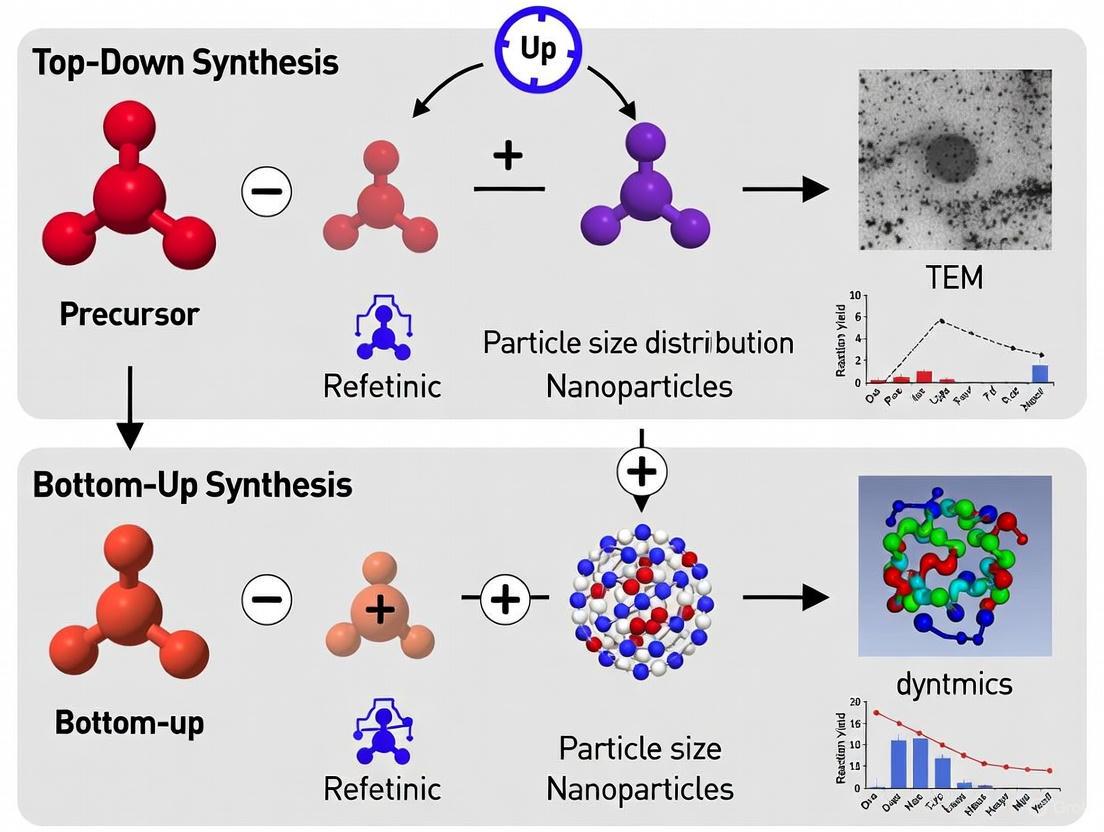
This article provides a systematic comparison of top-down and bottom-up synthesis approaches for developing advanced photocatalytic materials.
Top-Down vs. Bottom-Up Synthesis of Photocatalytic Materials: A Comprehensive Guide for Advanced Applications
Abstract
This article provides a systematic comparison of top-down and bottom-up synthesis approaches for developing advanced photocatalytic materials. It explores the fundamental principles, mechanistic insights, and practical methodologies for both strategies, addressing key challenges in scalability, defect control, and performance optimization. By examining current applications in energy conversion, environmental remediation, and organic synthesis, alongside rigorous validation techniques, this review serves as an essential resource for researchers and scientists seeking to select and optimize synthesis routes for specific photocatalytic applications, including those relevant to pharmaceutical development.
Understanding Synthesis Pathways: Core Principles of Top-Down and Bottom-Up Approaches
In the pursuit of advanced materials for critical applications like photocatalysis, the pathway chosen to create these materials fundamentally dictates their final properties and performance. The synthesis of nanoscale materials is primarily governed by two contrasting philosophies: the top-down approach, which involves scaling down bulk materials into nanostructures, and the bottom-up approach, which constructs nanomaterials from atomic or molecular precursors [1]. These methodologies differ profoundly in their principles, techniques, and the characteristics of the resulting products. For researchers and development professionals in fields ranging from energy to medicine, understanding this dichotomy is essential for designing materials with tailored properties. This guide provides a detailed, objective comparison of these two synthesis paradigms, focusing on their application in developing photocatalytic materials for solar fuel production, environmental remediation, and other energy applications, supported by experimental data and protocols.
Conceptual Foundations and Synthesis Mechanisms
The core distinction between these approaches lies in their starting point and direction of assembly. Top-down synthesis is a subtractive process where bulk materials are physically or chemically broken down into nanoscale structures. Common techniques include ball milling, a mechanical method that uses impact and shear forces to reduce particle size [2] [3], and etching or lithography [1]. Conversely, bottom-up synthesis is an additive process, building nanomaterials atom-by-atom or molecule-by-molecule. This method often leverages chemical reactions and self-assembly phenomena, where pre-existing components organize into more complex, ordered structures driven by intermolecular forces [1]. Key techniques include sol-gel processes, chemical vapor deposition (CVD), and precipitation methods [4] [3].
The following diagram illustrates the fundamental workflows and key techniques associated with each synthesis paradigm:
Comparative Analysis: Principles, Advantages, and Limitations
The choice between top-down and bottom-up methods significantly impacts the structural characteristics, defect chemistry, and functional performance of the synthesized materials.
Top-down approaches are often valued for their relative simplicity and scalability. However, a major limitation is the potential introduction of surface defects and crystallographic damage during the size-reduction process. These imperfections can sometimes be detrimental but have also been shown to enhance photocatalytic activity by creating active sites for reactions [2]. For instance, ball milling of the lead-free perovskite Cs₄CuSb₂Cl₁₂ not only reduced particle size but also generated a high concentration of surface defects, which improved light absorption and provided active sites for photocatalytic CO₂ reduction [2].
In contrast, bottom-up approaches excel in producing materials with precise control over size, shape, and composition. This allows for the engineering of complex architectures like core-shell nanoparticles and metal-organic frameworks (MOFs) [5] [6]. This precision often results in more uniform crystals and fewer defects, although defects can be intentionally incorporated through "defect engineering" [4]. A key advantage for catalysis is the inherently high specific surface area of bottom-up nanoparticles, which provides a greater density of reactive sites. For example, bottom-up synthesis is ideal for creating two-dimensional porous photocatalysts, which offer shortened charge transport distances, facilitated mass transport, and abundant surface active centers [7].
Table 1: Fundamental Comparison of Top-Down and Bottom-Up Synthesis Approaches
| Aspect | Top-Down Approach | Bottom-Up Approach |
|---|---|---|
| Fundamental Principle | Subtractive: breaking down bulk material [1] | Additive: building from atoms/molecules [1] |
| Process Direction | Macro-to-nano [3] | Nano-to-macro [3] |
| Common Techniques | Ball milling, etching, laser ablation [2] [8] | Sol-gel, precipitation, chemical vapor deposition, self-assembly [4] [3] |
| Control over Size/Shape | Limited precision, broader size distribution [1] | High precision, uniform size and morphology [1] [7] |
| Typical Surface Quality | Potential for surface defects and contamination [2] | Atomically smoother surfaces, controlled defect engineering [4] |
| Scalability & Cost | Often scalable and cost-effective for mass production [1] | Can be complex and costly; may involve expensive precursors [1] |
| Key Advantage | Simplicity, high production batch capacity [3] | Excellent control over nanostructure and composition [7] |
| Primary Limitation | Introduction of internal stress and surface imperfections [2] | Often requires complex purification and is more time-consuming [1] |
Experimental Performance Data in Photocatalysis
Direct comparative studies and individual performance data highlight how the synthesis method influences photocatalytic efficacy.
Top-Down Performance Data
A prime example of a top-down approach is the synthesis of Cs₄CuSb₂Cl₁₂ double-layer perovskite via ball milling [2]. The mechanical treatment served multiple functions: it reduced crystal size, increased the specific surface area by nearly tenfold (from 0.57 m²/g to 5.23 m²/g), and generated beneficial surface defects.
Table 2: Photocatalytic Performance of Top-Down Synthesized Materials
| Material | Synthesis Method | Application | Key Performance Metric | Result | Reference |
|---|---|---|---|---|---|
Cs₄CuSb₂Cl₁₂ Perovskite |
Ball Milling (Top-Down) | CO₂ to CO Reduction | CO Yield (4h, full spectrum) | 72.17 μmol/g (1.6x increase vs. untreated) | [2] |
Cs₄CuSb₂Cl₁₂ Perovskite |
Ball Milling (Top-Down) | CO₂ to CO Reduction | CO Yield (4h, NIR light) | 5.37 μmol/g (vs. 2.31 μmol/g untreated) | [2] |
| Pt/C Electrocatalyst | Electrochemical Dispersion (Top-Down) | Ethanol Electrooxidation | Stability | Best stability with largest nanoparticle sizes | [8] |
Bottom-Up Performance Data
Bottom-up synthesis allows for meticulous control, as seen in the creation of amorphous and crystalline lead(II) coordination polymers using sonochemical and hydrothermal methods [5]. These materials were effective in photocatalytic dye degradation. Furthermore, the bottom-up precipitation method is highly effective for producing uniform nanoparticles like barium sulphate (BaSO₄), with size and morphology controlled by adjusting parameters such as capping agents, concentration ratios, and pH [3].
Table 3: Photocatalytic Performance of Bottom-Up Synthesized Materials
| Material | Synthesis Method | Application | Key Performance Metric | Result | Reference |
|---|---|---|---|---|---|
| Lead(II) Coordination Polymer | Sonochemical (Bottom-Up) | Methylene Blue Degradation | Degradation Efficiency & Reusability | 88.2% (1st cycle), 81.7% (5th cycle) | [5] |
| TiO₂-Based Hybrid Gels | Sol-Gel with Organic Ligands (Bottom-Up) | Superoxide Radical Production | Stabilization of Reactive Oxygen Species | Enhanced activity via interfacial charge transfer | [4] |
| 2D Porous Photocatalysts | Bottom-Up Self-Assembly | H₂ Evolution, H₂O₂ Production | Charge Carrier Migration & Mass Diffusion | Superior to bulk counterparts due to structure | [7] |
Detailed Experimental Protocols
To provide a practical toolkit for researchers, this section outlines standardized protocols for key synthesis methods cited in this guide.
This protocol describes the post-synthetic treatment of pre-formed perovskite to enhance its photocatalytic properties.
- Step 1: Precursor Synthesis. First, synthesize the
Cs₄CuSb₂Cl₁₂raw material using a co-precipitation method to ensure high crystallinity and avoid surface organic contaminants. - Step 2: Mechanical Treatment. Place the raw material into a ball milling chamber. Use milling balls made of a hard material (e.g., zirconia) as the grinding media.
- Step 3: Process Execution. Process the material at a controlled speed of 300 revolutions per minute (rpm). The treatment duration can be varied (e.g., 1, 2, or 3 hours) to study its effect on particle size and defect density.
- Step 4: Product Collection. After milling, collect the resulting nanoparticles. The final product will have a smaller particle size, a larger specific surface area, and a higher concentration of surface defects.
This protocol utilizes ultrasound to create nanoscale coordination polymers in the amorphous phase.
- Step 1: Solution Preparation. Dissolve the metal salt (e.g., lead(II) nitrate) and the organic linker (e.g., benzene-1,3-dicarboxylic acid, H₂L) in a suitable solvent.
- Step 2: Reaction Setup. Transfer the mixture to an ultrasonic reactor. Either an ultrasonic bath or a more powerful probe homogenizer can be used.
- Step 3: Process Execution. Subject the mixture to ultrasonic irradiation. Key parameters to control include ultrasonic power, temperature, reaction time, and the presence or absence of surfactants to influence the size and morphology of the final product.
- Step 4: Product Isolation. After the reaction is complete, isolate the solid product by filtration or centrifugation. Wash the product thoroughly with solvent and dry it to obtain the final nanocoordination polymer powder.
The Scientist's Toolkit: Essential Research Reagent Solutions
The following table lists key reagents and their functions in the synthesis protocols discussed above.
Table 4: Essential Reagents for Top-Down and Bottom-Up Synthesis
| Reagent/Material | Function in Synthesis | Example Protocol |
|---|---|---|
| Zirconia Milling Balls | Grinding media for mechanical size reduction and introduction of defects. | Top-Down Ball Milling [2] |
| Cs₄CuSb₂Cl₁₂` Precursor | High-crystallinity raw material for top-down post-treatment. | Top-Down Ball Milling [2] |
| Metal Salts (e.g., Pb²⁺) | Cation source for constructing the inorganic nodes or metal centers in coordination polymers. | Bottom-Up Sonochemical [5] |
| Organic Linkers (e.g., H₂L) | Molecular bridges that connect metal centers to form coordination polymer frameworks. | Bottom-Up Sonochemical [5] |
| Capping Agents (e.g., surfactants, polymers) | Control nanoparticle growth, prevent agglomeration, and dictate final morphology. | Bottom-Up Precipitation [3] |
| Ti(OR)₄ Alkoxide Precursor | Molecular precursor for the sol-gel synthesis of TiO₂-based hybrid materials. | Bottom-Up Sol-Gel [4] |
| Organic Ligands (e.g., carboxylates, diketones) | Modulate surface properties, electronic structure, and defectivity of hybrid photocatalysts. | Bottom-Up Sol-Gel [4] |
The choice between top-down and bottom-up synthesis is not a matter of declaring one superior to the other, but rather of selecting the right tool for the specific application. Top-down methods like ball milling offer a robust, scalable route to enhance the surface area and create active defects in pre-existing materials, as demonstrated by the Cs₄CuSb₂Cl₁₂ perovskite. In contrast, bottom-up methods provide unparalleled precision for constructing nanomaterials from the ground up, enabling the design of complex architectures such as 2D porous structures and hybrid gels with tailored interfacial properties for superior charge separation and light harvesting.
The future of photocatalytic material design lies in the intelligent integration of both paradigms. A potential hybrid strategy could involve using a top-down method to create a high-surface-area support, followed by a bottom-up technique to decorate it with highly active, well-defined co-catalysts. As the field advances, the continued refinement of these synthesis approaches will be pivotal in developing next-generation photocatalysts for solving pressing global challenges in clean energy and environmental sustainability.
The pursuit of advanced photocatalytic materials for applications ranging from hydrogen production and CO2 reduction to water purification has brought nanomaterial synthesis to the forefront of materials science research. The two fundamental approaches for creating these functional nanomaterials—top-down and bottom-up synthesis—offer distinct pathways with characteristic advantages and limitations. Top-down synthesis involves the physical fragmentation of bulk precursor materials into nanoscale structures through mechanical or chemical means, exemplified by techniques such as ball milling. In contrast, bottom-up synthesis relies on molecular assembly processes, building nanomaterials atom-by-atom or molecule-by-molecule using chemical reactions and self-assembly principles, with methods including sol-gel processing, hydrothermal synthesis, and sonochemical approaches.
Understanding the mechanistic insights behind these divergent pathways is crucial for rational design of photocatalytic materials with tailored properties. This comparison guide objectively examines both synthesis strategies, focusing on their fundamental principles, experimental implementations, resultant material properties, and photocatalytic performance. By analyzing specific case studies and experimental data, this review provides researchers with a comprehensive framework for selecting and optimizing synthesis methods based on targeted photocatalytic applications, whether for energy conversion, environmental remediation, or chemical synthesis.
Fundamental Mechanisms and Principles
Top-Down Approach: Physical Fragmentation
The top-down synthesis approach operates on the principle of size reduction from bulk materials to nanoscale dimensions through physical fragmentation processes. This methodology typically employs mechanical forces, such as impact, shear, or compression, to break down larger particles into nanostructured materials. The fundamental mechanism involves introducing sufficient energy to overcome the material's cohesive forces, resulting in fracture along crystal planes or defect sites. In photocatalytic material synthesis, top-down methods are particularly valuable for exfoliating layered materials, creating high-surface-area nanostructures, and introducing controlled defects that can enhance catalytic activity.
Ball milling represents one of the most widely implemented top-down techniques, utilizing mechanical impact and friction to achieve particle size reduction. This process not only decreases particle size but also induces structural modifications including crystal disorder, phase transformations, and the creation of surface defects. These modifications profoundly impact the electronic structure of photocatalytic materials by introducing strain, altering band gap energies, and creating active sites for surface reactions. The mechanistic pathway involves repeated deformation, fracture, and cold welding of particles, resulting in a complex interplay between size reduction and defect engineering that collectively influences photocatalytic performance [2].
Bottom-Up Approach: Molecular Assembly
Bottom-up synthesis operates on fundamentally different principles, constructing nanomaterials through controlled molecular assembly processes that build up structures from atomic or molecular precursors. This approach leverages chemical reactions, self-assembly, and nucleation-growth mechanisms to create nanostructures with precise control over composition, morphology, and crystal structure. The fundamental mechanisms include molecular precursor organization, chemical transformation, and directed assembly through thermodynamic and kinetic control. In photocatalytic applications, bottom-up methods enable atomic-level engineering of active sites, controlled heterojunction formation, and precise doping for band gap manipulation.
Key bottom-up techniques include sol-gel processing, hydrothermal/solvothermal synthesis, sonochemical methods, and chemical precipitation. The sol-gel process, for instance, involves the transformation of molecular precursors into a colloidal solution (sol) that evolves toward a gel-like network, offering excellent control over composition and porosity. Hydrothermal methods utilize heated aqueous solutions at high pressure to crystallize materials from solution, enabling the synthesis of highly crystalline nanostructures with controlled morphologies. Sonochemical synthesis employs ultrasonic radiation to generate transient localized hot spots with extreme conditions, driving chemical reactions and nucleation events that yield unique nanostructures. Molecular self-assembly strategies, including DNA-mediated assembly, provide even more precise control over hierarchical structure formation through programmable interactions between building blocks [5] [4] [9].
Experimental Protocols and Methodologies
Top-Down Synthesis: Ball Milling Protocol
The top-down synthesis of photocatalytic materials via ball milling follows a systematic protocol designed to achieve controlled size reduction and defect engineering. For the synthesis of lead-free double perovskite Cs₄CuSb₂Cl₁₂ photocatalysts, researchers implemented the following optimized procedure [2]:
Precursor Preparation: Begin with high-purity raw materials including cesium chloride (CsCl, 99.9%), copper(II) chloride (CuCl₂, 99%), and antimony(III) chloride (SbCl₃, 99%). Prepare the initial Cs₄CuSb₂Cl₁₂ perovskite using a co-precipitation method by dissolving stoichiometric ratios of precursors in anhydrous N,N-dimethylformamide (DMF) under inert atmosphere. Recover the precipitate by centrifugation at 8,000 rpm for 10 minutes and dry at 80°C for 12 hours under vacuum.
Ball Milling Process: Load the co-precipitated perovskite powder (2.0 g) into a zirconia milling jar (250 mL capacity) with zirconia grinding balls (5 mm diameter, ball-to-powder mass ratio of 30:1). Seal the jar under argon atmosphere to prevent oxidation. Process the material using a high-energy planetary ball mill at 300 rpm for varying durations (1-3 hours) with rotation direction reversal every 15 minutes to ensure homogeneous milling. Maintain temperature control at 25°C using a cooling system to prevent thermal degradation.
Post-Treatment: Following milling, collect the nanostructured powder and sieve through a 400-mesh screen to obtain uniformly sized particles. Characterize the resulting material using powder X-ray diffraction (PXRD), scanning electron microscopy (SEM), and nitrogen adsorption-desorption measurements to confirm phase purity, morphology, and surface area.
Critical Parameters: Key factors influencing the final material properties include milling duration, rotational speed, ball-to-powder ratio, and milling atmosphere. Optimization of these parameters enables control over particle size, specific surface area, and defect concentration, which directly impact photocatalytic performance.
Bottom-Up Synthesis: Sonochemical Protocol
The bottom-up synthesis of lead(II) coordination polymers for photocatalytic applications employs sonochemical methods that utilize ultrasonic energy to drive molecular assembly. The following protocol details the synthesis of nano [Pb₄(O)(L)₃(H₂O)]ₙ in amorphous phases [5]:
Reagent Preparation: Prepare a 50 mM solution of lead(II) acetate trihydrate (Pb(CH₃COO)₂·3H₂O, 99%) in deionized water. Separately, prepare a 37.5 mM solution of benzene-1,3-dicarboxylic acid (isophthalic acid, H₂L, 98%) in ethanol. Adjust the pH of the lead solution to 6.5 using dilute ammonium hydroxide solution to prevent premature precipitation.
Sonochemical Synthesis: Combine the precursor solutions in a 1:1 molar ratio of Pb:H₂L in a 250 mL double-walled reaction vessel equipped with a temperature controller. For ultrasonic bath processing, immerse the reaction vessel in an ultrasonic cleaner (40 kHz frequency, 300 W power) and maintain the temperature at 60°C for 90 minutes with continuous stirring. Alternatively, for probe homogenizer processing, immerse a titanium ultrasonic horn (20 kHz frequency) directly into the reaction mixture and irradiate at 60% amplitude (180 W/cm²) for 30 minutes with pulsed operation (5 s on, 2 s off) to control heating.
Surfactant Modification: To control morphology, add cetyltrimethylammonium bromide (CTAB, 0.1 mM) as a surfactant before sonication. The surfactant molecules direct the assembly process by modifying surface energy and growth kinetics.
Product Recovery: After sonication, allow the mixture to cool to room temperature and recover the precipitate by centrifugation at 10,000 rpm for 15 minutes. Wash the product sequentially with ethanol and deionized water (three times each) to remove unreacted precursors and surfactant. Dry the final nanostructured coordination polymer at 70°C for 12 hours under vacuum.
Critical Parameters: The size, morphology, and crystallinity of the resulting nanomaterials are influenced by ultrasonic power, reaction temperature, duration, initial reagent concentration, and surfactant presence. Systematic optimization of these parameters enables precise control over the structural properties that govern photocatalytic activity.
Comparative Performance Analysis
Structural and Photocatalytic Properties
Table 1: Comparative Analysis of Top-Down and Bottom-Up Synthesized Photocatalytic Materials
| Parameter | Top-Down (Cs₄CuSb₂Cl₁₂ Perovskite) [2] | Bottom-Up (Pb(II) Coordination Polymer) [5] | Bottom-Up (TiO₂-Diketone Hybrid) [4] |
|---|---|---|---|
| Synthesis Method | Ball milling (3 hours) | Sonochemical (probe homogenizer) | Sol-gel with organic ligands |
| Crystallinity | High crystallinity with milling-induced defects | Amorphous phase | Amorphous gel structure with oxygen vacancies |
| Specific Surface Area | 5.23 m²/g (from 0.57 m²/g pre-milling) | Not specified | Not specified |
| Band Gap Energy | 1.02 eV (direct bandgap) | Determined via Tauc plot from DRS | Reduced from 3.2 eV (pristine TiO₂) |
| Photocatalytic Performance | CO yield: 72.17 μmol/g (1.6× enhancement) | MB degradation: 88.2% (first cycle) | Enhanced ROS generation and stabilization |
| Key Advantages | 10× surface area increase, rich active sites, enhanced light absorption | High degradation efficiency, reusable for multiple cycles | Visible light activation, superoxide radical stabilization |
| Limitations | Possible contamination from milling media, broad size distribution | Lower thermal stability compared to crystalline phases | Complex synthesis optimization required |
Quantitative Performance Metrics
Table 2: Photocatalytic Performance Metrics Under Standardized Conditions
| Photocatalyst | Synthesis Approach | Application | Performance Metric | Reference Material | Enhancement Factor |
|---|---|---|---|---|---|
| Cs₄CuSb₂Cl₁₂ [2] | Top-down (ball milling) | CO₂ reduction to CO | 72.17 μmol/g in 4 h | 45.01 μmol/g (pre-milling) | 1.60× |
| Nano [Pb₄(O)(L)₃(H₂O)]ₙ [5] | Bottom-up (sonochemical) | Methylene blue degradation | 88.2% efficiency (C₀=0.6 mg/L, pH=7, 60 min) | Crystalline phase: 73.5% | 1.20× |
| Co₃O₄ Nanospheres [10] | Bottom-up (various methods) | Organic pollutant degradation | Complete MB degradation (50 mg/L, 3 h) | Varies with synthesis method | Dependent on morphology |
| TiO₂-Ligand Hybrids [4] | Bottom-up (sol-gel) | Reactive oxygen species generation | Enhanced •OH and O₂•− production | Pristine TiO₂ | Significant visible light activity |
The Scientist's Toolkit: Essential Research Reagents and Materials
Table 3: Key Research Reagents and Materials for Nanomaterial Synthesis
| Reagent/Material | Function in Synthesis | Representative Examples | Critical Considerations |
|---|---|---|---|
| Zirconia Grinding Media | Mechanical energy transfer in ball milling | 5 mm diameter balls for perovskite processing [2] | Ball-to-powder ratio (30:1), potential contamination |
| Metal Alkoxide Precursors | Molecular building blocks for sol-gel synthesis | Ti(OR)₄ for TiO₂ hybrid materials [4] | Moisture sensitivity, hydrolysis rates |
| Organic Ligands | Structure-directing agents, complexation | Acetylacetone, carboxylic acids, diketones [4] | Denticity, coordination strength, thermal stability |
| Sonochemical Probes | Ultrasonic energy delivery for nucleation | Titanium horn (20 kHz) for coordination polymers [5] | Amplitude control, pulsed operation, temperature management |
| Structure-Directing Agents | Morphology control, pore formation | CTAB for nanocoordination polymers [5] | Concentration optimization, removal strategies |
| Solvents and Reaction Media | Dissolution, reaction environment | DMF for perovskite precursors, ethanol for coordination polymers [5] [2] | Polarity, boiling point, coordination ability |
| Defect Engineering Agents | Controlled vacancy creation | Reducing agents in sol-gel processes [4] | Concentration effects on electronic properties |
The comparative analysis of top-down and bottom-up synthesis approaches reveals distinct advantages and limitations for each strategy in photocatalytic material development. Top-down methods, particularly ball milling, excel at creating high-surface-area materials with rich defect concentrations that enhance light absorption and provide abundant active sites. The significant enhancement in CO₂ reduction performance demonstrated by ball-milled Cs₄CuSb₂Cl₁₂ perovskite (1.60× increase in CO yield) highlights the efficacy of this approach for optimizing existing materials [2]. Conversely, bottom-up methods offer superior control over molecular-level structure, enabling precise engineering of coordination environments, band gap energies, and surface functionalities. The enhanced photocatalytic degradation efficiency of sonochemically synthesized coordination polymers (88.2% for methylene blue) underscores the potential of molecular assembly for creating highly active catalysts [5].
Future research directions should focus on hybrid approaches that combine the advantages of both methodologies. The integration of bottom-up precision in molecular design with top-down introduction of controlled defects could enable unprecedented control over photocatalytic properties. Additionally, advances in computational prediction of material properties, as demonstrated for TiO₂ hybrid systems [4], will accelerate the rational design of novel photocatalysts. Green synthesis approaches utilizing waste-derived precursors [10] and sustainable processes will also be essential for the large-scale implementation of photocatalytic technologies. As the field progresses, the complementary application of both synthesis paradigms, guided by mechanistic understanding and computational prediction, will drive the development of next-generation photocatalytic materials for addressing critical energy and environmental challenges.
The pursuit of advanced photocatalytic materials for energy and environmental applications relies heavily on the synthesis methods used to create nanostructures with precise architectural control. The fundamental dichotomy in nanomaterial fabrication lies between top-down and bottom-up approaches, each offering distinct advantages for manipulating material properties critical to photocatalytic performance [11]. Top-down methods involve the physical or chemical breakdown of bulk materials into nanostructures, while bottom-up approaches assemble atoms and molecules into nanoscale architectures through controlled chemical reactions and self-assembly processes [12].
The selection between these synthesis pathways profoundly influences key material characteristics including surface area, crystallinity, defect concentration, and surface chemistry—all determining factors in photocatalytic efficiency [13] [11]. This guide provides a systematic comparison of synthesis methodologies across three pivotal material systems: metal nanoparticles, carbon nitrides, and quantum dots, with particular emphasis on their photocatalytic applications and performance metrics.
Synthesis Methodologies: Top-Down vs. Bottom-Up Approaches
Fundamental Principles and Techniques
Top-down synthesis encompasses strategies that deconstruct bulk materials into nanostructures through physical or chemical fragmentation. Common techniques include laser ablation, ball milling, electrochemical dispersion, and arc discharge methods [11] [8]. These approaches typically employ external forces to reduce material dimensions to the nanoscale. For instance, in the synthesis of Pt/C electrocatalysts, electrochemical dispersion of platinum foil under pulsed alternating current represents a top-down method where bulk platinum is fragmented into nanoparticles supported on carbon [8].
Bottom-up synthesis utilizes chemical or physical processes to assemble atoms, molecules, and clusters into nanostructures. Predominant methods include sol-gel processing, hydrothermal/solvothermal synthesis, chemical vapor deposition, and polyol reduction [11]. These approaches exploit molecular self-assembly, chemical reactions, and nucleation/growth kinetics to build nanomaterials with controlled dimensions. The polyol process for Pt/C catalyst preparation, where platinum ions are chemically reduced in the presence of a carbon support, exemplifies a bottom-up approach [8].
Comparative Analysis of Advantages and Limitations
Table 1: Comparison of Top-Down and Bottom-Up Synthesis Approaches
| Parameter | Top-Down Approaches | Bottom-Up Approaches |
|---|---|---|
| Principle | Physical/chemical fragmentation of bulk materials | Atom/molecular assembly into nanostructures |
| Common Techniques | Laser ablation, ball milling, electrochemical dispersion, arc discharge | Sol-gel, hydrothermal/solvothermal, chemical vapor deposition, polyol reduction |
| Advantages | Simpler scaling, no molecular-level control required | Superior control over size, shape, and composition; higher crystallinity |
| Disadvantages | Surface defects, irregular shapes, size polydispersity | Complex purification, potential solvent contamination, slower processes |
| Typical Defects | Surface imperfections, stress-induced defects | Point defects, vacancy complexes |
| Cost Considerations | High energy consumption for fragmentation | Expense of precursor materials and reaction systems |
| Material Examples | Silicon nanowires, electrochemically dispersed Pt/C | Carbon quantum dots, sol-gel ZnO, polyol-synthesized Pt/C |
The synthesis approach significantly influences critical photocatalytic parameters. Bottom-up methods typically yield materials with higher crystallinity and fewer defects due to controlled growth conditions, while top-down approaches often introduce surface imperfections that may act as recombination centers for photogenerated charge carriers [11]. However, hybrid strategies such as BUTTONS (Bottom-Up Then Top-Down Synthesis) have emerged, where materials created via bottom-up methods are subsequently etched or modified using top-down approaches to achieve unique architectures not accessible through either method alone [14].
Metal Nanoparticle Systems
Synthesis and Performance in Photocatalytic Applications
Metal nanoparticles, particularly platinum, serve as critical components in photocatalytic systems, often functioning as cocatalysts that enhance charge separation and provide active sites for reduction reactions. The synthesis approach profoundly influences their morphological characteristics and functional performance.
Table 2: Comparison of Pt/C Catalysts Synthesized via Different Approaches
| Synthesis Method | Approach Category | Average Pt Size (nm) | Electrochemically Active Surface Area (m²/g) | Mass Activity for Ethanol Oxidation (A/g) | Stability (Cycles) |
|---|---|---|---|---|---|
| Electrochemical Dispersion (ED) | Top-down | 3.5 | 52.5 | 105 | >5000 |
| Polyol Process (CH) | Bottom-up | 2.1 | 73.2 | 135 | ~3000 |
| Commercial Pt/C | Not specified | 2.8 | 63.1 | 122 | ~4000 |
Comparative studies of Pt/C electrocatalysts reveal distinct performance patterns linked to synthesis methodology. The bottom-up polyol process produces smaller nanoparticles (2.1 nm) with higher electrochemical surface area (73.2 m²/g), translating to superior initial mass activity for ethanol oxidation (135 A/g) [8]. Conversely, top-down electrochemical dispersion yields larger particles (3.5 nm) with reduced surface area (52.5 m²/g) but demonstrates exceptional stability, maintaining performance beyond 5000 cycles [8]. This stability advantage highlights how top-down synthesized materials may offer superior durability despite potentially lower initial activity.
Experimental Protocols for Metal Nanoparticle Synthesis
Top-Down Protocol: Electrochemical Dispersion of Platinum [8]
- Prepare electrolyte solution of 2M NaOH with Vulcan XC-72 carbon support (2 g/L concentration)
- Suspend carbon support in electrolyte with constant stirring (200 rpm) and cool to 45-50°C
- Install platinum foil electrodes (6 cm² surface area) in the electrolyzer
- Apply pulsed alternating current (1 A/cm² density, 50 Hz frequency) to disperse platinum
- Control metal loading through synthesis time duration
- Filter suspension and rinse with distilled water to neutral pH
- Dry electrocatalyst powder at 75°C until constant weight achieved
Bottom-Up Protocol: Polyol Process for Pt/C Synthesis [8]
- Add carbon support (0.2 g) and H₂[PtCl₆]·6H₂O to ethylene glycol/water mixture (75 mL/30 mL)
- Homogenize carbon suspension in NaOH solution via ultrasonication for 30 minutes
- Adjust solution to pH 11 using aqueous ammonium solution with continuous stirring
- Introduce freshly prepared 0.5M NaBH₄ solution (15 mL) under constant stirring (200 rpm)
- Continue stirring for 50 minutes to complete reduction process
- Filter suspension and wash repeatedly with acetone and distilled water to neutral pH
- Dry catalyst at 75°C until constant weight is obtained
Carbon Nitride and Quantum Dot Systems
Synthesis Strategies and Photocatalytic Performance
Carbon-based nanomaterials, particularly carbon nitrides and carbon quantum dots (CQDs), have emerged as promising photocatalysts and catalytic enhancers due to their tunable electronic properties, visible light responsiveness, and potential for sustainable synthesis from biomass precursors.
Graphitic carbon nitride (g-C₃N₄) represents a metal-free polymeric semiconductor with a bandgap of approximately 2.7 eV, responsive to visible light up to 460 nm [15]. Its synthesis typically employs bottom-up approaches through thermal condensation of nitrogen-rich precursors like urea or melamine. Modification strategies include nanostructuring, elemental doping, and heterojunction formation to enhance photocatalytic performance [16].
Carbon quantum dots (CQDs) constitute a class of quasi-spherical, monodisperse carbon nanoparticles below 10 nm in diameter, exhibiting unique optical properties including excellent sunlight harvesting, tunable photoluminescence, and up-conversion photoluminescence (UCPL) that enables utilization of the full solar spectrum [17]. Their synthesis often employs sustainable bottom-up approaches using biomass precursors such as licorice powder, ginkgo biloba leaves, or mulberry branch powder through hydrothermal treatment [16].
Table 3: Photocatalytic Performance of Carbon Nitride and Quantum Dot Systems
| Material System | Synthesis Method | Application | Performance Metrics | Reference |
|---|---|---|---|---|
| CQDs/g-C₃N₄ heterojunction | Bottom-up (hydrothermal) | CO₂ reduction | CO evolution: 28.9 μmol·g⁻¹ (3× improvement vs. pure PCN) | [16] |
| CQDs/g-C₃N₄ heterojunction | Bottom-up (hydrothermal) | Cr(VI) reduction | Removal efficiency: 2.48× improvement vs. pure PCN | [16] |
| CNQDs/TiO₂ heterojunction | Bottom-up (mechanical mixing) | Bisphenol A degradation | Rate constant: 0.30 (0.17 for pure TiO₂) | [15] |
| CNQDs/TiO₂ heterojunction | Bottom-up (mechanical mixing) | H₂ production | 30 μmol·g⁻¹·h⁻¹ higher than pure TiO₂ | [15] |
| Biomass-derived CQDs | Bottom-up (hydrothermal) | Various photocatalytic applications | Enhanced light absorption and charge separation | [16] [17] |
Experimental Protocols for Carbon-Based Materials
Bottom-Up Protocol: CQDs/g-C₃N₄ Heterojunction from Licorice Powder [16]
- Synthesize polymer carbon nitride (PCN) via thermal condensation of urea at 550°C for 4 hours
- Prepare suspension A: disperse 1g PCN and 0.1g SDBS in 40mL deionized water, ultrasonicate 2 hours
- Prepare suspension B: hydrothermally treat licorice powder in water at 180°C for 12 hours, filter through 0.22μm membrane
- Mix suspensions A and B in varying mass ratios (licorice powder to PCN from 0.01:1 to 0.10:1)
- Transfer mixture to Teflon-lined autoclave, maintain at 180°C for 12 hours
- Centrifuge product, wash with ethanol/water mixture, dry at 60°C overnight
Bottom-Up Protocol: CNQDs/TiO₂ Heterojunction [15]
- Pre-treat commercial TiO₂ nanoparticles (P25) with alkali hydrothermal method: disperse 1g TiO₂ in 50mL NaOH solution (10 mol/L), stir 30 minutes, hydrothermally treat at 120°C for 3 hours
- Prepare CNQDs suspension by dispersing in deionized water
- Mix CNQDs suspension with treated TiO₂ in varying mass ratios with continuous mechanical stirring for 12 hours
- Centrifuge composite material, wash with deionized water, dry at 60°C
Metal Oxide Semiconductor Systems
Zinc Oxide Synthesis and Performance
Zinc oxide (ZnO) represents a widely studied photocatalytic semiconductor with a bandgap of approximately 3.2 eV, analogous to TiO₂ but with superior absorption efficiency across a broader solar spectrum [18]. Synthesis methodology significantly influences its morphological characteristics and photocatalytic performance.
Table 4: Sol-Gel Synthesized ZnO with Different Solvents
| Solvent Used | Crystallite Size (nm) | Band Gap (eV) | MB Degradation Efficiency | Degradation Time |
|---|---|---|---|---|
| Ethanol | 25.3 | 3.18 | 98% | 30 minutes |
| 1-Propanol | 28.7 | 3.21 | 92% | 40 minutes |
| 1,4-Butanediol | 32.1 | 3.24 | 85% | 50 minutes |
Bottom-Up Protocol: Sol-Gel ZnO Synthesis [18]
- Dissolve zinc acetate dihydrate in 50mL selected solvent (ethanol, 1-propanol, or 1,4-butanediol) with magnetic stirring for 30 minutes at 50°C (Pot 1)
- Dissolve oxalic acid in 25mL of the same solvent at room temperature (Pot 2)
- Slowly add Pot 2 contents to Pot 1 with continuous stirring until viscous white solution forms
- Continue stirring at 70°C until gel formation occurs
- Dry resulting gel at 80°C overnight in oven
- Calcine dried gel at 600°C for 240 minutes in muffle furnace
- Grind resulting powder using mortar and pestle for characterization
Interrelationships: Synthesis Approaches and Material Properties
The following diagram illustrates the conceptual relationships between synthesis approaches, material systems, and their resulting properties in photocatalytic applications:
Synthesis-Property-Application Relationships
The Scientist's Toolkit: Essential Research Reagents and Materials
Table 5: Key Research Reagents for Nanomaterial Synthesis
| Reagent/Material | Function/Application | Example Uses |
|---|---|---|
| Hexachloroplatinic acid (H₂[PtCl₆]·6H₂O) | Platinum precursor for bottom-up synthesis | Polyol synthesis of Pt/C catalysts [8] |
| Zinc acetate dihydrate | Zinc precursor for metal oxide synthesis | Sol-gel preparation of ZnO nanoparticles [18] |
| Urea | Nitrogen-rich precursor for carbon nitride | Thermal condensation to g-C₃N₄ [16] |
| Licorice powder | Biomass source for carbon quantum dots | Sustainable CQDs synthesis via hydrothermal treatment [16] |
| Sodium borohydride (NaBH₄) | Reducing agent for metal precursors | Chemical reduction of platinum ions [8] |
| Ethylene glycol | Solvent and reducing agent in polyol process | Pt nanoparticle synthesis [8] |
| Titanium dioxide (P25) | Benchmark photocatalyst support | Composite formation with CNQDs [15] |
| CTAB (Hexadecyltrimethylammonium bromide) | Surfactant template for nanostructuring | Morphology control in nanomaterial synthesis [14] |
| Sodium hydroxide | pH control and hydrolysis agent | Alkaline treatment of TiO₂ nanoparticles [15] |
The comparative analysis of top-down and bottom-up synthesis approaches reveals a complex trade-off between photocatalytic activity, stability, and synthetic control. Bottom-up methods generally enable superior control over nanoscale architecture, yielding materials with optimized crystallinity and surface properties for enhanced initial photocatalytic performance [11]. Conversely, top-down approaches often produce materials with exceptional stability and durability, albeit with potentially lower initial activity [8].
The emerging paradigm of hybrid strategies (BUTTONS) that sequentially employ bottom-up and top-down methods represents a promising direction for fabricating nanostructures with customized properties not accessible through either approach alone [14]. Furthermore, the integration of sustainable biomass precursors in bottom-up synthesis aligns with green chemistry principles while maintaining competitive photocatalytic performance [16] [6].
Selection of synthesis methodology must consider the specific application requirements: bottom-up approaches for maximum efficiency in controlled environments, top-down methods for applications demanding long-term stability, and hybrid approaches for specialized architectural requirements. This strategic alignment of material synthesis with application needs will continue to drive innovation in photocatalytic nanomaterial development.
The pursuit of efficient photocatalytic materials for applications ranging from environmental remediation to sustainable chemical synthesis hinges on the precise control of synthesis parameters. The choice between top-down and bottom-up nanomaterial synthesis strategies fundamentally influences the structural properties and subsequent performance of the resulting photocatalysts [6] [8]. Bottom-up approaches construct materials from atomic or molecular precursors, enabling precise control over composition and morphology, while top-down methods break down bulk materials into nanostructures, often favoring high throughput [8]. Within this overarching framework, temperature, precursor selection, and reaction media emerge as critical variables that dictate crystallinity, surface area, light absorption, and ultimately photocatalytic efficiency. This guide objectively compares the performance of photocatalysts synthesized under varying conditions, providing supporting experimental data to inform research and development efforts.
Temperature: A Pivotal Parameter in Synthesis and Reaction
Temperature exerts a profound influence during both the synthesis of photocatalysts and their subsequent application in chemical reactions. Its effects are multifaceted, impacting crystallinity, particle size, and the formation of critical active sites.
Temperature During Photocatalyst Synthesis
The synthesis temperature is a powerful tool for tuning the fundamental properties of photocatalytic nanomaterials. Research on peroxo-titanate nanotubes (PTNTs) reveals that higher hydrothermal synthesis temperatures (from 120 °C to 200 °C) significantly enhance material crystallinity and specific surface area [19]. For instance, the specific surface area increased from 117 m²/g for PTNTs synthesized at 100 °C to 268 m²/g for those synthesized at 200 °C [19]. This improvement in structural properties directly translated to superior photocatalytic performance, with the PTNT200 sample achieving a 98.2% Rhodamine B degradation rate under visible light [19]. However, a critical trade-off exists: while crystallinity improves, the formation of peroxo-bondings—which are crucial for visible light responsiveness—decreases at higher temperatures, though it remains achievable even at 200 °C [19].
A similar principle applies to the synthesis of graphitic carbon nitride (g-C(3)N(4)). The precursor and synthesis temperature jointly determine the material's final properties. In one study, g-C(3)N(4) synthesized from urea at 500 °C demonstrated the highest photocatalytic degradation rate of procaine under visible light, outperforming samples derived from melamine or mixtures of melamine and cyanuric acid at other temperatures [20]. This highlights the existence of an optimal synthesis temperature that maximizes photocatalytic activity for a given material system.
Table 1: Effect of Synthesis Temperature on Photocatalyst Properties and Performance
| Photocatalyst | Synthesis Temperature | Key Property Changes | Photocatalytic Performance | Ref. |
|---|---|---|---|---|
| PTNT | 100°C → 200°C | ↑ Crystallinity; ↑ Surface Area (117 → 268 m²/g); ↓ Peroxo-bonding | Rhodamine B degradation: 98.2% (PTNT200, Vis light) | [19] |
| g-C(3)N(4) (Urea) | 450°C, 500°C, 550°C | Optimal structural properties at 500°C | Highest procaine degradation rate under visible light | [20] |
Temperature During the Photocatalytic Reaction
The temperature at which the photocatalytic reaction itself occurs is equally critical. Studies on the photocatalytic destruction of methylene blue using TiO(2) and Pd/TiO(2) show that reaction rates generally increase with temperature from 0 °C to 50 °C [21]. This is attributed to enhanced mobility of photogenerated electron-hole pairs and faster interfacial charge transfer. However, an upper limit exists; when the temperature reaches 70 °C, the reaction rate drops as the recombination of charge carriers increases and adsorption—an often essential exothermic first step—becomes less favorable [21]. In contrast, Cu/TiO(_2) was found to be more active at room temperature than at higher temperatures, underscoring that the optimal reaction temperature is also cocatalyst-dependent [21].
Furthermore, in a model photocatalytic system for ethylene glycol synthesis from methyl tert-butyl ether (MTBE) using Pt/TiO(_2), the reaction temperature was optimized to 55 °C. Deviations to either 25 °C or 90 °C resulted in decreased activity [22]. This demonstrates that for complex organic syntheses, a specific temperature window is necessary to balance reaction kinetics, charge carrier dynamics, and adsorption-desorption equilibrium.
Diagram 1: Temperature Impact on Photocatalytic Activity. This workflow illustrates the competing effects of reaction temperature, showing an optimal range for peak performance.
Precursor Selection: Governing Morphology and Activity
The choice of precursor is a fundamental determinant in bottom-up synthesis, directly influencing the morphology, chemical composition, and electronic structure of the final photocatalyst.
In the synthesis of g-C(3)N(4), different precursors lead to materials with distinct properties. Urea, melamine, and mixtures of melamine and cyanuric acid undergo thermal polymerization to form g-C(3)N(4), but the resulting materials differ in their surface area, crystallinity, and band gap [20]. The g-C(3)N(4) sample derived from urea at 500 °C exhibited the highest degradation rate for the pharmaceutical pollutant procaine under visible light, highlighting how precursor selection can be optimized for a specific application [20]. The underlying mechanism is that the precursor affects the degree of polymerization and the density of defects in the g-C(3)N(4) framework, which in turn modulates its light-absorption and charge-separation capabilities.
For titanium-based nanomaterials, the precursor's chemical properties dictate the synthesis pathway. The conventional synthesis of titanate nanotubes (TNTs) requires a high concentration of NaOH (≥10 mol/L) and a precursor like TiO(2) (P25) with strong Ti–O bonds [19]. In contrast, a more recent bottom-up approach uses TiH(2) as a precursor, which has weaker Ti–H bonds. This allows for synthesis in a low-concentration alkaline solution (1.5 mol/L) and leads to the incorporation of peroxo-bondings into the structure, resulting in peroxo-titanate nanotubes (PTNTs) with visible light activity [19]. This represents a significant advancement in designing environmentally friendlier synthesis routes while simultaneously improving functional properties.
Table 2: Impact of Precursor Selection on Photocatalyst Synthesis and Performance
| Target Material | Precursor(s) | Synthesis Conditions | Key Outcome | Ref. |
|---|---|---|---|---|
| g-C(3)N(4) | Urea, Melamine, Melamine + Cyanuric Acid | Thermal polymerization (450-550 °C) | Urea-derived g-C(3)N(4) (at 500°C) showed highest activity for procaine degradation under visible light. | [20] |
| Peroxo-Titanate Nanotube (PTNT) | TiH(_2) | 1.5 mol/L NaOH, Hydrothermal (100-200 °C) | Enabled visible-light activity via peroxo-bonding; greener synthesis with low-concentration NaOH. | [19] |
| Titanate Nanotube (TNT) | TiO(_2) (P25) | 10 mol/L NaOH, Reflux at 115 °C | Conventional method requiring high-concentration NaOH; typically UV-active. | [19] |
Reaction Media: Solvent and Cocatalyst Effects
The environment in which a photocatalytic reaction occurs, defined by the solvent and the presence of cocatalysts, plays a decisive role in determining reaction pathways and efficiency.
The Role of Solvents and Cocatalysts
The solvent is not merely a passive medium but an active component. In the photocatalytic synthesis of ethylene glycol from MTBE using a Pt/TiO(2) catalyst, the presence of water was found to be essential [22]. When the reaction was attempted in the absence of water, no H(2) production or dimer formation was observed, underscoring water's critical role in the reaction mechanism, likely as a proton source and participant in the catalytic cycle [22]. Furthermore, a specific ratio of MTBE to water was necessary for optimal performance, indicating that the solvent system must be carefully optimized for the specific target reaction [22].
Cocatalysts, often noble metals or transition metals, are indispensable for enhancing photocatalytic performance by facilitating charge separation and providing active sites. In the MTBE coupling reaction, Pt was uniquely effective as a cocatalyst on TiO(2); other tested metals like Pd, Ir, Rh, Au, and Ag showed no or negligible activity [22]. This high specificity highlights the need for matching the cocatalyst to the desired redox chemistry. Similarly, in the degradation of methylene blue, Pd was a more effective cocatalyst than Cu for TiO(2), and the optimal reaction temperature was itself dependent on the identity of the cocatalyst [21]. This interplay shows that parameters cannot be viewed in isolation.
Diagram 2: Cocatalyst and Solvent Roles in Charge Separation. This diagram shows how cocatalysts and solvents extract electrons and holes to drive desired reactions and suppress recombination.
Synthesis Approach: Top-Down vs. Bottom-Up
The choice between a top-down and a bottom-up synthesis method is a strategic decision that influences the nature of the reaction media and the properties of the final catalyst. A comparison of Pt/C electrocatalysts synthesized via a bottom-up polyol process (chemical reduction) and a top-down electrochemical dispersion method revealed distinct differences [8]. The catalyst produced by the top-down method featured larger platinum nanoparticle sizes and, consequently, demonstrated superior stability during long-term cycling tests [8]. This illustrates a common trade-off: bottom-up methods often allow for finer control over nanoparticle size and distribution, while top-down methods can produce more robust and stable structures.
The Scientist's Toolkit: Essential Reagents and Materials
The following table details key reagents and materials used in the synthesis and testing of photocatalysts, as featured in the cited research.
Table 3: Essential Research Reagents and Materials for Photocatalysis
| Reagent/Material | Function/Application | Example Use Case |
|---|---|---|
| TiO(_2) (P25) | Benchmark photocatalyst; versatile precursor for top-down synthesis. | Starting material for conventional titanate nanotube (TNT) synthesis [19]; support for Pt/Pd/Cu cocatalysts [21] [22]. |
| TiH(_2) | Precursor for bottom-up synthesis. | Used to synthesize peroxo-titanate nanotubes (PTNTs) via a peroxo-titanium complex (PTC) ion solution [19]. |
| Urea / Melamine | Nitrogen-rich precursors for g-C(3)N(4). | Used in thermal polymerization to create graphitic carbon nitride (g-C(3)N(4)) photocatalysts [20]. |
| H(2)PtCl(6)·6H(_2)O | Common platinum precursor for cocatalyst deposition. | Source of Pt for impregnation onto TiO(2) P25 to create Pt/TiO(2) for C-C coupling reactions [22] [8]. |
| Sodium Borohydride (NaBH(_4)) | Reducing agent. | Used in the polyol process for the chemical reduction of metal precursors to form nanoparticles (bottom-up) [8]. |
| NaOH Solution | Alkaline reaction medium. | Essential for hydrothermal synthesis of nanotube structures (e.g., TNTs, PTNTs) [19]. |
| Methylene Blue / Rhodamine B | Model organic pollutant dyes. | Used as target compounds to benchmark and compare photocatalytic degradation performance [21] [19]. |
Detailed Experimental Protocols
To ensure reproducibility and provide a clear basis for comparison, detailed methodologies for key experiments cited in this guide are outlined below.
- Catalyst Preparation: Pd/TiO(2) and Cu/TiO(2) catalysts (0.5 wt.% metal loading) are prepared via incipient-wetness impregnation of commercial TiO(_2) with aqueous solutions of Pd and Cu precursors, followed by drying and reduction.
- Reaction Setup: A specified amount of catalyst (e.g., 10-50 mg) is dispersed in an aqueous solution of methylene blue (e.g., 50 mL, 10 ppm concentration). The suspension is stirred in the dark for 30-60 minutes to establish adsorption-desorption equilibrium.
- Photocatalytic Testing: The suspension is irradiated under UV light (e.g., a mercury lamp). The reaction temperature is controlled using a water bath or heating mantle, with tests conducted at various temperatures (e.g., 0°C, 25°C, 50°C, 70°C).
- Analysis: At regular time intervals, aliquots are withdrawn, centrifuged to remove catalyst particles, and analyzed by UV-Vis spectrophotometry to measure the residual concentration of methylene blue at its characteristic absorption wavelength (≈664 nm). The degradation efficiency is calculated as (C(0) - C)/C(0) × 100%, where C(_0) and C are the initial and time 't' concentrations, respectively.
- Precursor Solution Preparation: 1.87 g of TiH(2) powder is added to a mixed solution of 62.5 mL H(2)O(_2) (30%) and 15.29 mL of 10 M NaOH, resulting in a 1.5 mol/L NaOH solution. The mixture is stirred for 2 hours to form a peroxo-titanium complex (PTC) ion solution.
- Hydrothermal Reaction: Approximately 80 mL of the PTC ion solution is transferred into a 100 mL Teflon-lined autoclave. The autoclave is sealed and heated at the target temperature (e.g., 120°C, 150°C, 200°C) for 24 hours.
- Post-Synthesis Processing: After cooling naturally to room temperature, the resulting precipitate is collected and washed repeatedly with ultrapure water via vacuum filtration until the conductivity of the filtrate is low (≈5 μS/cm). The final product is dried using a freeze dryer.
- Catalyst Preparation: Pt/TiO(2) catalyst is prepared by depositing Pt nanoparticles onto a TiO(2) support (e.g., P25 or TiO(B)) via impregnation or photodeposition, followed by calcination at a specific temperature (e.g., 650°C for Pt/C-TiO(B)-650).
- Reaction Setup: In a photoreactor, 10 mg of catalyst is dispersed in a 1:1 (v/v) mixture of MTBE and water (total volume 10 mL). The reactor is sealed and purged with an inert gas (e.g., Ar) to remove air.
- Photocatalytic Reaction: The suspension is stirred and irradiated with a focused LED or Xe lamp (e.g., 320-500 nm wavelength range) at a controlled temperature of 55°C.
- Product Analysis: The gaseous products (H(_2)) are quantified using gas chromatography (GC) with a thermal conductivity detector (TCD). The liquid organic products are analyzed by GC-MS or GC with a flame ionization detector (FID) to identify and quantify the dimer coupling products (1,2-di-tert-butoxyethane, etc.).
Historical Evolution and Technological Drivers in Photocatalyst Fabrication
The fabrication of photocatalytic materials is fundamentally governed by two distinct philosophical approaches: top-down and bottom-up synthesis. Top-down methods involve the physical or mechanical breakdown of bulk precursor materials into nanostructures, utilizing techniques such as ball milling and laser ablation to reduce material dimensions to the nanoscale [11]. In contrast, bottom-up approaches construct nanomaterials atom-by-atom or molecule-by-molecule from smaller building blocks, employing chemical reactions and molecular self-assembly to build up complex nanostructures with precise control over their architecture [11]. The selection between these pathways profoundly influences the resulting material's physicochemical properties, including surface area, crystallinity, defect concentration, and ultimately, photocatalytic efficiency.
The historical evolution of photocatalyst fabrication has been driven by the continuous pursuit of materials with enhanced light absorption, charge separation, and surface reactivity. The field gained significant momentum following the pioneering 1972 work of Fujishima and Honda, who demonstrated photocatalytic water splitting using titanium dioxide (TiO₂) [23] [24]. This breakthrough established TiO₂ as a photocatalytic "workhorse" and triggered extensive research into semiconductor-based photocatalysts [24]. Over subsequent decades, research efforts have expanded to address key limitations, particularly the narrow light absorption range of early photocatalysts and the rapid recombination of photogenerated electron-hole pairs [25]. Recent technological drivers have focused on developing green synthesis methods, incorporating waste-derived materials, implementing computational design approaches, and creating multi-functional nanocomposites with enhanced visible-light activity [23] [10].
Fundamental Synthesis Mechanisms and Methodologies
Top-Down Fabrication Approaches
Top-down synthesis methods operate on the principle of size reduction from bulk materials through physical forces or energy input. Ball milling represents a widely-employed mechanical approach where impact and shear forces between grinding media progressively fracture bulk materials into nanometer-sized particles [11]. This method offers scalability and simplicity but may introduce crystallographic defects and surface contamination. Laser ablation utilizes high-energy laser pulses directed at a target material immersed in a liquid or gas medium, vaporizing and ejecting clusters that form nanoparticles upon cooling [11]. This technique produces high-purity nanoparticles without chemical precursors but requires specialized equipment and precise parameter control. Sputtering techniques involve the bombardment of a target material with energetic ions, dislodging atoms that subsequently deposit as thin films on substrates [11]. Sputtering enables precise thickness control and uniform coatings but typically operates under vacuum conditions, adding complexity and cost.
The top-down approach generally offers advantages in processing throughput and direct patterning capabilities but faces inherent limitations regarding structural precision at atomic scales. As material dimensions approach the nanometer range, surface defects induced by mechanical or thermal stress can detrimentally impact photocatalytic performance by creating recombination centers for charge carriers [11]. Consequently, post-synthesis annealing treatments are often required to improve crystallinity, potentially complicating manufacturing processes and increasing energy consumption.
Bottom-Up Fabrication Approaches
Bottom-up synthesis constructs nanomaterials through atomistic or molecular assembly, enabling precise control over composition, structure, and morphology. Sol-gel processing involves the transition of a solution (sol) into a solid gel phase through hydrolysis and condensation reactions of molecular precursors, typically metal alkoxides [25]. This method facilitates excellent compositional control and homogeneous mixing at molecular levels, producing materials with high surface area and porosity ideal for photocatalytic applications. Hydrothermal and solvothermal methods utilize heated solvent systems at elevated pressures in sealed vessels to facilitate chemical reactions and crystal growth [25] [10]. These approaches enable the synthesis of highly crystalline nanomaterials with controlled morphologies without requiring post-synthesis calcination. Chemical precipitation involves the controlled initiation of supersaturation conditions in solution to trigger the nucleation and growth of solid particles from dissolved precursors [26]. While relatively simple and scalable, precipitation methods may require capping agents to control particle size, which can potentially block active sites on photocatalyst surfaces.
A significant advancement in bottom-up synthesis is the emergence of green synthesis approaches utilizing biological organisms or plant extracts as reducing and stabilizing agents [23] [26]. These environmentally benign methods operate under mild conditions without requiring toxic chemicals, and evidence suggests they can produce photocatalysts with enhanced performance due to inherent functionalization with biomolecules [23]. For instance, biosynthesis using bacteria, fungi, or plant extracts has yielded metal and metal oxide nanoparticles with improved catalytic activity and stability compared to conventionally synthesized counterparts [26].
Table 1: Comparison of Primary Photocatalyst Synthesis Methods
| Synthesis Method | Approach | Key Advantages | Key Limitations | Common Photocatalysts |
|---|---|---|---|---|
| Ball Milling | Top-down | Simple, scalable, cost-effective | Surface defects, contamination, broad size distribution | Metal oxides, composite materials |
| Laser Ablation | Top-down | High purity, no chemical precursors | Specialized equipment, energy intensive | Noble metals, metal oxides |
| Sputtering | Top-down | Uniform films, precise thickness control | Vacuum requirements, limited to substrates | TiO₂, WO₃, ZnO thin films |
| Sol-Gel | Bottom-up | High homogeneity, controlled porosity | Shrinkage, long processing times | TiO₂, ZnO, SiO₂ composites |
| Hydrothermal/Solvothermal | Bottom-up | High crystallinity, morphology control | Pressure/temperature safety concerns | Nanorods, nanowires, hierarchical structures |
| Green Synthesis | Bottom-up | Environmentally friendly, biocompatible | Standardization challenges, variable yields | Ag, Au, NiO, ZnO nanoparticles |
Performance Comparison of Synthesis Approaches
Structural and Photocatalytic Properties
The selection between top-down and bottom-up approaches significantly influences critical structural characteristics that govern photocatalytic performance. Bottom-up synthesis typically yields materials with superior control over crystal structure, fewer structural defects, more uniform particle size distribution, and higher specific surface area [11]. These characteristics translate directly to enhanced photocatalytic activity, as demonstrated in comparative studies of nickel oxide nanoparticles (NiO-NPs) where biologically synthesized (bottom-up) specimens exhibited significantly better performance than their chemically synthesized counterparts [26]. The biosynthesized NiO-NPs achieved 90% decolorization of methylene blue within just 1 minute, while chemically synthesized nanoparticles required 5 minutes for comparable degradation [26]. Similarly, for 4-nitrophenol degradation, the biosynthesized NiO-NPs reached 65% decolorization in 25 minutes, outperforming chemically synthesized variants [26].
Green bottom-up methods particularly excel in producing photocatalysts with enhanced surface properties and functionalization. The involvement of biological molecules during synthesis can result in nanoparticles with inherent organic functional groups that potentially improve interaction with pollutant molecules and facilitate charge transfer processes [23] [26]. This advantage manifests clearly in wastewater treatment applications, where biogenically synthesized NiO-NPs demonstrated significantly greater efficacy in real wastewater samples, decolorizing 84.8% of Reactive Black-5 compared to 67.2% by chemically synthesized NPs, and removing 62.4% of chemical oxygen demand (COD) versus 57.1% for conventional materials [26].
Environmental and Economic Considerations
Beyond immediate photocatalytic performance, synthesis approaches differ substantially in their environmental footprint and economic viability. Bottom-up green synthesis methods offer notable advantages in sustainability by utilizing biological resources instead of hazardous chemicals, operating under milder temperature and pressure conditions, and generating fewer harmful byproducts [23] [26]. The inherent environmental benefits of these approaches align with the principles of green chemistry and sustainable nanotechnology. Recent advancements have further improved sustainability through the utilization of waste-derived sources for photocatalyst synthesis, such as the fabrication of Co₃O₄ nanoparticles from discarded batteries [10].
Life cycle assessment (LCA) studies provide quantitative insights into the environmental impacts of different synthesis pathways. Research on TiO₂-carbon dots nanocomposites revealed that composites with superior photocatalytic performance typically associated with optimized bottom-up synthesis routes also demonstrated lower environmental impacts across multiple categories [27]. Notably, the TiO₂ source constituted the most critical parameter determining environmental impact, highlighting the importance of precursor selection in sustainable photocatalyst design [27].
Table 2: Experimental Performance Comparison of Photocatalysts Synthesized via Different Approaches
| Photocatalyst | Synthesis Method | Approach | Target Pollutant/Reaction | Performance Metrics | Reference |
|---|---|---|---|---|---|
| NiO-NPs | Biological (Pseudochrobactrum sp.) | Bottom-up | Methylene blue degradation | 90% decolorization in 1 min | [26] |
| NiO-NPs | Chemical precipitation | Bottom-up | Methylene blue degradation | 90% decolorization in 5 min | [26] |
| NiO-NPs-B | Biological | Bottom-up | Reactive Black-5 (wastewater) | 84.8% decolorization, 62.4% COD removal | [26] |
| NiO-NPs-C | Chemical | Bottom-up | Reactive Black-5 (wastewater) | 67.2% decolorization, 57.1% COD removal | [26] |
| Co₃O₄ | Waste-derived (batteries) | Bottom-up | Methylene blue degradation | Complete degradation in 3 h (solar light) | [10] |
| Pt/C | Polyol process | Bottom-up | Ethanol electrooxidation | Specific activity: 0.85 mA/cm² | [8] |
| Pt/C | Electrochemical dispersion | Top-down | Ethanol electrooxidation | Specific activity: 0.82 mA/cm² | [8] |
Experimental Protocols and Methodologies
Representative Bottom-Up Synthesis: Biological Fabrication of NiO Nanoparticles
The biological synthesis of nickel oxide nanoparticles using Pseudochrobactrum sp. C5 exemplifies a bottom-up approach leveraging microbial capabilities [26]. The experimental protocol initiates with inoculating 50 mL of nutrient broth medium with the bacterial strain and incubating overnight at 28°C with 150 rpm shaking in darkness. Following this growth phase, 2 mL of 0.003 M nickel chloride solution is introduced to the culture, with subsequent shaking at 150 rpm for 2 hours at 28°C. Nanoparticle formation is visually indicated by a color transition from light green to intense green over 72 hours. The resulting nanoparticles are then collected via centrifugation at 13,000 rpm for 20 minutes, followed by three washing cycles with double-distilled water and ethanol. The purified precipitate is oven-dried at 85°C before calcination in a muffle furnace at 700°C for 7 hours, ultimately yielding powdered NiO nanoparticles [26].
Representative Top-Down Synthesis: Electrochemical Dispersion for Pt/C Catalysts
The electrochemical dispersion pulse alternating current (EDPAC) method demonstrates a top-down approach for fabricating Pt/C electrocatalysts [8]. This procedure begins with suspending Vulcan XC-72 carbon support in 2M NaOH aqueous solution at a concentration of 2 g/L. Two platinum foil electrodes (6 cm² surface area each) are immersed in the vigorously stirred suspension, which is maintained at 45-50°C throughout the synthesis. A pulsed alternating current with density 1 A/cm² at 50 Hz frequency is applied, facilitating electrochemical dispersion of platinum from the electrodes into nanoparticles that deposit onto the carbon support. The metal loading within the catalyst is precisely controlled by adjusting the synthesis duration. Upon completion, the suspension undergoes filtration and rinsing with distilled water until neutral pH is achieved. The resulting electrocatalyst powder is dried at 75°C until constant mass is attained [8].
Computational and Theoretical Modeling Approaches
Computational methods have emerged as powerful tools for understanding photocatalytic mechanisms and guiding material design. Density Functional Theory (DFT) calculations have proven particularly valuable for elucidating electronic structures, identifying active sites, and predicting band gap energies of photocatalytic materials [28] [24]. For instance, DFT simulations have confirmed higher electrostatic potential in the presence of hydroxyl radicals, explaining the enhanced degradation efficiency observed with certain photocatalysts [28]. Multiscale modeling approaches that combine different computational techniques hierarchically represent the future direction for modeling complex nano-photocatalysts, enabling accurate predictions while managing computational resources efficiently [24].
The integration of artificial intelligence and machine learning into photocatalyst design represents a cutting-edge development in the field [23]. These computational approaches enable rapid screening of potential photocatalytic materials based on structure-activity relationships, prediction of synthesis parameters for desired properties, and optimization of photocatalytic systems for specific applications. Machine learning algorithms can identify non-intuitive correlations between synthesis conditions, material characteristics, and photocatalytic performance that might escape conventional experimental approaches, potentially accelerating the development of next-generation photocatalysts [23].
Diagram 1: Decision pathway for selecting photocatalyst synthesis methods based on application requirements and desired material properties.
The Scientist's Toolkit: Essential Research Reagents and Materials
Table 3: Essential Research Reagents for Photocatalyst Synthesis and Evaluation
| Reagent/Material | Function/Application | Representative Examples | Considerations |
|---|---|---|---|
| Titanium Dioxide (TiO₂) Precursors | Wide-bandgap semiconductor photocatalyst | Titanium isopropoxide, Titanium butoxide, TiO₂ nanoparticles | Crystalline phase (anatase/rutile) affects activity; often requires doping for visible light response [25] |
| Zinc Oxide (ZnO) Precursors | Alternative to TiO₂ with similar bandgap | Zinc acetate, Zinc nitrate, ZnO nanoparticles | Prone to photocorrosion; surface modification enhances stability [25] |
| Nickel Salts | Precursors for NiO nanoparticle synthesis | Nickel chloride, Nickel nitrate | NiO bandgap (3.2-4.0 eV) suitable for photocatalysis; biological synthesis enhances activity [26] |
| Cobalt Salts | Precursors for Co₃O₄ synthesis | Cobalt nitrate, Cobalt chloride | Co₃O₄ narrow bandgap (1.5-2.4 eV) enables visible light absorption [10] |
| Carbon Supports | Enhancing electron transfer and stability | Vulcan XC-72R, Graphene oxide, Carbon dots | Improve charge separation; carbon dots enhance visible light absorption in composites [27] [8] |
| Biological Agents | Green synthesis facilitators | Plant extracts, Bacteria (e.g., Pseudochrobactrum sp.), Fungi | Provide reducing and capping agents; eliminate need for harsh chemicals [23] [26] |
| Structure-Directing Agents | Controlling morphology and porosity | CTAB, P123, F127 | Template-assisted synthesis for hierarchical structures with high surface area [25] |
| Dopants | Modifying band structure and extending absorption | Noble metals (Pt, Ag), Transition metals (Fe, Cu), Non-metals (N, S) | Reduce charge recombination; create intermediate energy levels [25] [10] |
The comparative analysis of top-down and bottom-up synthesis approaches for photocatalytic materials reveals a complex landscape where each methodology offers distinct advantages depending on application requirements. Bottom-up approaches generally provide superior control over material architecture at the nanoscale, resulting in photocatalysts with optimized properties for enhanced performance, particularly in environmental remediation applications [26] [25]. The emergence of green synthesis methods within this category further strengthens the sustainability profile of photocatalyst fabrication while demonstrating competitive or even superior performance compared to conventional chemical routes [23] [26]. Conversely, top-down methods maintain relevance for specific applications requiring scalability, direct patterning, or integration with existing device architectures [11] [8].
Future developments in photocatalyst fabrication will likely focus on hybrid approaches that combine the strengths of both methodologies, such as using top-down techniques to create substrate structures followed by bottom-up deposition of active components. The increasing integration of computational guidance, through both first-principles calculations and machine learning approaches, promises to accelerate the discovery and optimization of novel photocatalytic materials [23] [24]. Additionally, the growing emphasis on circular economy principles is driving innovation in waste-derived photocatalyst precursors and scalable green synthesis routes that minimize environmental impact while maintaining high performance [10]. As these trends converge, the next generation of photocatalytic materials will likely exhibit enhanced complexity through multi-component architectures precisely engineered across multiple length scales to maximize solar energy conversion efficiency.
Synthesis Techniques and Functional Applications in Energy and Biomedicine
The strategic design of photocatalytic materials is pivotal for enhancing the efficiency of solar-driven processes, from environmental remediation to renewable energy generation. Within this context, the synthesis paradigm is broadly divided into top-down and bottom-up approaches. Top-down methods involve the physical or chemical breakdown of bulk materials into nanostructures, often facing limitations in achieving precise atomic-level control and uniformity [8] [1]. In contrast, bottom-up synthesis constructs nanomaterials atom-by-atom or molecule-by-molecule, allowing for unparalleled command over size, shape, composition, and surface properties [1]. This precision is critical for tailoring the electronic structure, charge carrier dynamics, and surface reactivity of photocatalysts. This guide provides a comparative analysis of three pivotal bottom-up methodologies: the polyol process, hot-injection, and self-templating synthesis. We objectively evaluate their performance in producing advanced photocatalytic materials, supported by experimental data and detailed protocols, to inform researchers and development professionals in the field.
The three bottom-up methods—polyol, hot-injection, and self-templating—operate on distinct physicochemical principles for nanomaterial construction. The following diagram delineates their fundamental operational workflows, highlighting key differences in precursor introduction, reaction control, and final material formation.
Comparative Performance Analysis of Photocatalytic Materials
The choice of synthesis methodology profoundly impacts the structural, optical, and electronic properties of the resulting photocatalytic material, which in turn dictates its performance in applications such as dye degradation, CO₂ reduction, and hydrogen evolution. The following table summarizes key performance metrics and characteristics of nanomaterials synthesized via these three bottom-up routes, drawing from experimental findings in the literature.
| Synthesis Method | Typical Photocatalytic Material | Key Structural Features | Performance Metrics (Experimental) | Bandgap Tuning Range | Primary Advantages for Photocatalysis |
|---|---|---|---|---|---|
| Polyol Process | CoO NPs [29], Plasmonic Au@Ag [30] | Aggregate spheres (20-150 nm) from primary crystals (8-35 nm); Core-shell structures. | Néel temp (TN) tuning over ~80 K [29]; Enhanced SERS signals [30]. | Indirect via size/morphology (e.g., crystallite size) [29]. | Excellent crystallinity; Scalable; Diverse metal/oxide compositions. |
| Hot-Injection | Graphene Quantum Dots (GQDs) [31], Metal Chalcogenides (e.g., CdS) [31] | Monodisperse QDs; "Dot-on-particle" heterostructures; Size control within 1 nm. | CdS/GQDs H₂ evolution: >10x rate vs. pure CdS [31]; Tunable PL emission. | Precise via quantum confinement (e.g., GQDs). | Superior size & shape uniformity; High crystallinity; Excellent optical properties. |
| Self-Templating Synthesis | Carbon Quantum Dots (CQDs) from cellulose [32], Hollow/Complex structures | Quasi-spherical morphology; Intrinsic porous structures; Complex architectures. | Cellulose CQDs: 84.8% degradation of Acid Dye 5R.113 [32]; High surface area. | Modifiable via precursor and synthesis conditions. | High surface area; Sustainable precursors; Inherent porosity. |
Detailed Experimental Protocols
To ensure reproducibility and provide a practical guide for researchers, this section outlines standardized experimental protocols for each synthesis method, detailing critical parameters such as precursor selection, temperature, and reaction duration.
Protocol: Polyol Synthesis of CoO Nanoparticles
- Objective: To synthesize aggregated CoO nanoparticles with tunable crystallite and aggregate sizes for magnetic and catalytic studies [29].
- Materials:
- Metal Precursor: Cobalt acetate tetrahydrate (Co(ac)₂·4H₂O).
- Polyol Solvent: Diethylene glycol (DEG), Triethylene glycol (TEG), or Polyethylene glycol (PEG 400).
- Reaction Medium: Deionized water (to control hydrolysis ratio,
h = [H₂O]/[Co²⁺]). - Washing Agent: Ethanol.
- Procedure:
- Dissolve cobalt acetate tetrahydrate in the chosen polyol solvent within a three-necked flask.
- Add deionized water to achieve the desired hydrolysis ratio (e.g.,
h = 7or46). - Stir the mixture at 450 rpm using a mechanical stirrer for 20-30 minutes.
- Attach a waterless air condenser and heat the solution to the target temperature (e.g., 180°C, 205°C, or 235°C) at a controlled rate of 6°C/min.
- Maintain the reaction at the target temperature for 18 hours.
- Cool the product to room temperature naturally.
- Wash the product three times with ethanol via centrifugation (15 minutes at 10,000 rpm) to remove residual polyol and by-products.
- Key Parameters: Polyol chain length, hydrolysis ratio (
h), and reaction temperature are critical for controlling primary crystallite size (8-35 nm) and aggregate morphology (20-150 nm) [29].
Protocol: Hot-Injection Synthesis of CdS/GQD Nanohybrids
- Objective: To fabricate a "dot-on-particle" heterostructure where GQDs act as electron acceptors to enhance the photocatalytic hydrogen evolution rate of CdS [31].
- Materials:
- Cadmium Precursor: Cadmium oxide (CdO) or cadmium acetate.
- Sulfur Source: Elemental sulfur (S) dissolved in octadecene.
- Stabilizers: Oleic acid (OA), Hexadecylamine (HDA).
- Solvent: 1-Octadecene (ODE).
- Co-catalyst: Pre-synthesized Graphene Quantum Dots (GQDs).
- Procedure:
- Cd Precursor Solution: Heat a mixture of CdO, ODE, and OA to 150-200°C under argon to form a clear solution.
- S Precursor Solution: Dissolve sulfur powder in ODE separately.
- Hot Injection: Rapidly inject the S precursor solution into the vigorously stirred Cd precursor solution, which is maintained at a high temperature (e.g., 240-300°C).
- Growth and Decoration: After CdS nucleation, introduce the GQD solution to the reaction mixture. The GQDs decorate the surface of the CdS nanoparticles in situ.
- Annealing and Quenching: Allow the reaction to proceed for several minutes for crystal growth, then cool the flask rapidly by removing the heat source.
- Purification: Precipitate the nanohybrids with ethanol or acetone, and isolate via centrifugation.
- Key Parameters: Injection temperature, growth time, and Cd/S/GQD molar ratios are crucial for controlling CdS size and achieving effective heterojunction formation with GQDs.
Protocol: Self-Templating Hydrothermal Synthesis of Cellulose-Derived CQDs
- Objective: To convert the biopolymer cellulose into carbon quantum dots (CQDs) with abundant surface functional groups for dye photodegradation [32].
- Materials:
- Carbon Source/Precursor: Cellulose powder.
- Solvent: Deionized water.
- Purification Agents: Ethanol, syringe filter (0.25 µm).
- Procedure:
- Dissolve 3 g of cellulose in 10 mL of deionized water.
- Transfer the solution into a Teflon-lined stainless-steel autoclave.
- Seal the autoclave and heat it in an oven at 200°C for 6 hours. The high temperature and pressure promote the carbonization and passivation of cellulose into CQDs.
- After cooling, recover the brownish crude product.
- Purify by sequential washing with ethanol and filtration.
- Pass the supernatant through a 0.25 µm pore syringe filter for further refinement.
- Dry the clear filtrate in an oven at 80°C for one week to obtain a solid CQD powder.
- Key Parameters: Hydrothermal temperature and duration directly influence the particle size, carbonization degree, and surface chemistry of the resulting CQDs, which average ~7 nm in diameter [32].
The Scientist's Toolkit: Essential Research Reagents
The successful implementation of bottom-up synthesis strategies relies on a suite of specialized reagents, each playing a defined role in directing nanomaterial formation.
| Reagent Category | Specific Examples | Function in Synthesis |
|---|---|---|
| Metal Precursors | Cobalt acetate (Co(ac)₂·4H₂O) [29], Cadmium oxide (CdO) [31], Chloroplatinic acid (H₂[PtCl₆]) [8] | Source of metallic elements; anion (e.g., acetate) can influence crystal growth. |
| Solvents & Media | Diethylene Glycol (DEG) [29], 1-Octadecene (ODE) [31], Deionized Water [32] | Reaction medium; DEG also acts as a reducing and capping agent [29]. |
| Surfactants & Capping Agents | Oleic Acid (OA) [31], Hexadecylamine (HDA) [30] [31], Hyperbranched Polyols [33] | Control nucleation, stabilize nanoparticles, prevent agglomeration, and direct morphology. |
| Reducing Agents | Sodium Borohydride (NaBH₄) [8], Polyol solvent itself (e.g., DEG, TEG) [29] [33], Ascorbic Acid [30] | Chemically reduce metal cations to their zero-valent or lower oxidation states. |
| Natural Polymer Precursors | Cellulose [32], Chitosan, Starch | Sustainable carbon sources for CQDs; structure-directing agents in self-templating synthesis. |
The comparative analysis of polyol, hot-injection, and self-templating synthesis methods reveals a clear trade-off between control, complexity, and functionality. The polyol process offers a robust and versatile route for producing a wide range of crystalline metal and metal oxide nanoparticles with good control over hierarchical structures, making it suitable for scalable catalyst production. The hot-injection technique excels in precision, yielding monodisperse nanocrystals and quantum dots with optimal optoelectronic properties, which is paramount for fundamental charge transfer studies and high-efficiency photoconversion. Self-templating synthesis provides a powerful pathway to complex, high-surface-area architectures from sustainable precursors, offering immense potential for enhancing mass transport and active site density in photocatalytic reactions.
Future research directions will likely focus on hybrid approaches that combine the strengths of these methodologies. For instance, using pre-formed nanocrystals from hot-injection as building blocks for polyol-mediated assembly, or employing biological templates to guide the polyol reduction of metals. Furthermore, the integration of machine learning in the design and selection of photocatalysts, as noted in broader reviews [34], will accelerate the optimization of synthesis parameters and the discovery of novel multi-component photocatalytic systems. Ultimately, the strategic selection and continued refinement of these bottom-up methodologies are foundational to advancing the field of photocatalysis, enabling the rational design of next-generation materials to address pressing energy and environmental challenges.
The synthesis of functional nanomaterials is a cornerstone of modern materials science, particularly for applications in photocatalysis. The strategic choice between top-down and bottom-up synthesis approaches fundamentally influences the structural, electronic, and surface properties of the resulting materials, thereby dictating their performance. Top-down methods involve the fragmentation of bulk precursor materials into nanostructures and are characterized by their scalability and relative simplicity. This guide provides a comparative analysis of three prominent top-down techniques—electrochemical dispersion, ball-milling, and exfoliation—situating them within the broader context of nanomaterial synthesis for photocatalytic research. It offers an objective comparison of their performance against alternative bottom-up methods, supported by experimental data and detailed protocols.
Comparative Analysis of Synthesis Approaches
Table 1: Overview of Top-Down and Bottom-Up Nanomaterial Synthesis Approaches
| Synthesis Approach | Description | Common Techniques | Key Characteristics |
|---|---|---|---|
| Top-Down | Fragmentation of bulk materials into nanostructures. [6] | Electrochemical Dispersion, Ball-Milling, Exfoliation (Etching) [35] [8] | Scalable, can introduce defects, uses bulk precursors. [6] [8] |
| Bottom-Up | Construction of nanomaterials from atomic or molecular precursors. [6] | Polyol Process, Sol-Gel, Hydrothermal/Solvothermal, Chemical Vapor Deposition [36] [8] [37] | High purity, good control over size and composition, often more complex. [6] |
Table 2: Comparison of Featured Top-Down Techniques for Photocatalysis
| Technique | Mechanism | Typical Photocatalytic Materials Synthesized | Key Advantages | Key Limitations |
|---|---|---|---|---|
| Electrochemical Dispersion (EDPAC) | Electrochemical fragmentation of bulk metal (e.g., Pt foil) using pulsed alternating current. [8] | Pt/C electrocatalysts. [8] | Produces catalysts with high stability. [8] | Limited to conductive, electroactive materials. |
| Ball-Milling | Mechanical exfoliation and fragmentation using grinding balls. [38] | g-C3N4/graphene oxide heterojunctions, doped g-C3N4. [38] | Low-cost, scalable, environmentally friendly, enables heterojunction construction. [38] | Potential for contamination, limited control over fine morphology. |
| Exfoliation (Etching) | Chemical removal of layers from a parent material (e.g., MAX phase) to produce 2D sheets. [35] | MXenes (e.g., Ti3C2Tₓ), other 2D materials. [35] | Produces unique 2D structures with rich surface chemistry and high conductivity. [35] | Often requires hazardous etchants (e.g., HF), can introduce surface terminations (-O, -OH, -F) that affect properties. [35] |
Experimental Protocols and Performance Data
Electrochemical Dispersion (EDPAC)
- Detailed Protocol for Pt/C Synthesis [8]:
- Setup: Two Pt foil electrodes (6 cm² surface area) are placed in an electrolyzer containing a suspension of Vulcan XC-72 carbon support in a 2M NaOH aqueous solution (carbon concentration: 2 g L⁻¹).
- Process: A pulsed alternating current with a density of 1 A/cm² and a frequency of 50 Hz is applied to the electrodes. The suspension is stirred (200 rpm) and cooled to 45–50 °C during synthesis.
- Recovery: The resulting suspension is filtered, rinsed with distilled water to neutral pH, and dried at 75 °C.
- Performance Comparison: A study directly compared a Pt/C catalyst synthesized via EDPAC (sample "ED") with one synthesized via the bottom-up polyol process (sample "CH") and a commercial catalyst. [8] The EDPAC-synthesized Pt/C (ED) featured larger platinum nanoparticle sizes and demonstrated superior stability during long-term cycling tests, attributed to its more robust structure. [8] However, the mass and specific activities of the catalysts for ethanol electrooxidation were primarily determined by their electrochemically active surface area (ECSA), a parameter often more favorably tuned by bottom-up methods. [8]
Ball-Milling
- Detailed Protocol for g-C3N4/GO Heterojunction [38]:
- Preparation: Graphitic carbon nitride (g-C3N4) is prepared via copolymerization of melamine. Graphene oxide (GO) is synthesized via the modified Hummers method.
- Milling: g-C3N4 and GO are mixed with a glucose solution (e.g., 0.75 g glucose) and subjected to ball milling. The grinding balls break the interplanar van der Waals bonds, exfoliating the materials and facilitating their integration.
- Outcome: The process creates a 2D/2D heterojunction with intimate contact through interlayer O-bonding.
- Performance Data: The optimal g-C3N4/GO composite synthesized via this one-pot sugar-assisted ball milling method achieved a hydrogen evolution rate of 89.2 μmol h⁻¹ g⁻¹ under visible light. This performance outperformed pure g-C3N4 by a factor of 13.5 and was twice as high as Pt-loaded g-C3N4, while also maintaining good stability over 24 hours. [38] The enhanced activity is attributed to improved charge separation and increased surface area.
Exfoliation (MXene Synthesis)
- Detailed Protocol for MXene (Ti₃C₂Tₓ) [35]:
- Etching: The parent MAX phase (e.g., Ti₃AlC₂) is immersed in an etching solution, typically hydrofluoric acid (HF) or mixtures that generate HF in situ, to selectively remove the aluminum layers.
- Delamination: The resulting multi-layer MXene is then subjected to intercalation and mechanical agitation (e.g., sonication) to exfoliate it into single- or few-layer nanosheets.
- Performance in Photocatalysis: MXenes are rarely used alone as photocatalysts but are excellent co-catalysts or supports. Their high metallic conductivity and surface functional groups (-O, -OH) enable rapid transfer of photogenerated electrons from semiconductors, effectively preventing electron-hole recombination and enhancing the overall photocatalytic activity in reactions like hydrogen evolution and CO₂ reduction. [35] For example, a Ti₃C₂ MXene co-catalyst assembled with mesoporous TiO₂ significantly boosted the photocatalytic degradation of methyl orange and hydrogen production. [35]
Workflow and Material Pathways
The following diagram illustrates the operational workflows for the three primary top-down synthesis techniques discussed in this guide.
The Scientist's Toolkit: Key Reagents and Materials
Table 3: Essential Research Reagents for Top-Down Synthesis
| Reagent/Material | Function in Synthesis | Example Use Case |
|---|---|---|
| Platinum Foil | Bulk metal precursor for electrochemical nanoparticle dispersion. [8] | Source of Pt nanoparticles for Pt/C electrocatalysts. [8] |
| Carbon Support (e.g., Vulcan XC-72R) | High-surface-area support to anchor and stabilize generated nanoparticles. [8] | Conductive support for Pt nanoparticles in fuel cell catalysts. [8] |
| Graphitic Carbon Nitride (g-C3N4) | Layered semiconductor bulk material for exfoliation and composite formation. [38] | Base photocatalyst for constructing 2D heterojunctions via ball-milling. [38] |
| Graphene Oxide (GO) | 2D material component for forming heterostructures. [38] | Coupled with g-C3N4 to enhance charge separation in photocatalysts. [38] |
| MAX Phase (e.g., Ti₃AlC₂) | Layered ternary carbide/nitride precursor for 2D materials. [35] | Parent material for synthesizing MXenes (e.g., Ti₃C₂Tₓ) via etching. [35] |
| Hydrofluoric Acid (HF) | Etchant for selective removal of atomic layers from precursor materials. [35] | Removes 'A' layer (e.g., Al) from MAX phase to produce MXene. [35] |
| D-(+)-Glucose | Additive in ball-milling to assist exfoliation and modulate material properties. [38] | Sugar-assisted ball milling for synthesizing g-C3N4/GO heterojunctions. [38] |
Electrochemical dispersion, ball-milling, and exfoliation are versatile top-down approaches for synthesizing functional nanomaterials. The choice of technique hinges on the target material and the desired application. Electrochemical dispersion is effective for creating stable metal nanoparticle catalysts, ball-milling offers a simple and scalable route for constructing composite photocatalysts, and exfoliation provides access to unique 2D materials like MXenes. When selecting a synthesis method, researchers must weigh the scalability and practical advantages of top-down approaches against the precise control often afforded by bottom-up methods, making an informed decision based on the specific requirements of their photocatalytic system.
The strategic choice between top-down and bottom-up synthesis represents a critical fork in the road for materials scientists designing photocatalysts for energy applications. These two foundational approaches dictate the fundamental architecture of photocatalytic materials, thereby influencing their performance in key reactions such as hydrogen evolution and CO2 reduction. A top-down synthesis involves the fragmentation of bulk materials into nanostructures through physical or chemical processes, often yielding robust materials with defined crystallinity. In contrast, bottom-up synthesis constructs nanomaterials atom-by-atom or molecule-by-molecule via chemical reactions, enabling exquisite control over composition, size, and morphology at the nanoscale [8] [1].
This guide objectively compares the performance of photocatalysts derived from these contrasting synthesis philosophies. The ensuing analysis, supported by experimental data, will demonstrate that the optimal pathway is not merely a matter of preference but is intrinsically linked to the specific requirements of the target photocatalytic reaction, balancing factors such as active site density, charge carrier dynamics, and structural stability.
Performance Comparison for Hydrogen Evolution Reaction (HER)
The Hydrogen Evolution Reaction (HER) is a half-reaction in water splitting, central to producing green hydrogen fuel. It requires photocatalysts with superior charge separation efficiency and high surface area for proton reduction.
Table 1: Comparison of Top-Down vs. Bottom-Up Synthesized Photocatalysts for HER
| Photocatalyst Material | Synthesis Method (Approach) | Key Performance Metric | Experimental Conditions | Reference/Notes |
|---|---|---|---|---|
| Pt/C | Electrochemical Dispersion (Top-Down) | Best operational stability; Larger Pt nanoparticle size | Stability testing via long-term cycling | [8] |
| Pt/C | Polyol Process (Bottom-Up) | Higher initial electrocatalytic activity | Ethanol electrooxidation in 0.5M H₂SO₄ | [8] |
| TiO₂-C-C₃N₄ (Z-Scheme) | Hydrothermal & Modification (Bottom-Up) | Preserved strong redox power; Enhanced charge separation | Simulated sunlight irradiation | [39] |
| TiO₂-C₃N₄ (Type-II) | Hydrothermal (Bottom-Up) | Higher photocatalytic performance than Z-scheme | Simulated sunlight irradiation | [39] |
| g-C₃N₄ modified by CQDs | Thermal Polymerization & Hydrothermal (Bottom-Up) | Acts as electron conduction bridge; improves electron-hole separation | Water-splitting reaction | [40] |
Experimental Protocols for HER Catalyst Evaluation
A standard experimental protocol for evaluating HER catalysts involves the following steps, as derived from the cited research:
- Catalyst Coating: The catalyst powder is coated onto a conductive substrate (e.g., fluorine-doped tin oxide glass) to create a working electrode.
- Electrochemical Cell Setup: A three-electrode cell is used with the catalyst-coated electrode as the working electrode, a platinum wire as the counter electrode, and a reference electrode (e.g., Ag/AgCl).
- Electrochemically Active Surface Area (ECSA) Determination: The ECSA is often evaluated using CO-stripping voltammetry. CO is adsorbed on the catalyst surface at a fixed potential, and then the charge required to oxidize the CO monolayer is measured. The ECSA is calculated assuming a standard charge of 420 μC cm⁻² for polycrystalline Pt [8].
- Activity and Stability Testing:
- Cycling Voltammetry: The electrocatalytic activity is determined by cycling the potential in an electrolyte containing a fuel like ethanol. The current is normalized to the ECSA to determine specific activity [8].
- Long-Term Cycling: The catalyst's stability is evaluated by subjecting it to thousands of potential cycles (e.g., 5,000 cycles between 0.6 and 1.0 V) and monitoring the degradation of its performance characteristics [8].
- Photocatalytic Water Splitting Test: For purely photocatalytic experiments (non-electrochemical), the catalyst is dispersed in a water-containing reactor, often with a sacrificial agent. The system is sealed, degassed, and illuminated with a solar simulator. The evolved H₂ gas is quantified over time using gas chromatography [24].
Figure 1: Experimental Workflow for HER Catalyst Evaluation
Performance Comparison for CO2 Reduction Reaction (CO2RR)
Photocatalytic CO2 reduction aims to convert a greenhouse gas into valuable hydrocarbons (e.g., CO, CH₄, CH₃OH) using solar energy. This process demands catalysts with a high CO₂ adsorption capacity, efficient light absorption across the solar spectrum, and catalytic sites that steer the reaction toward the desired products.
Table 2: Comparison of Top-Down vs. Bottom-Up Synthesized Photocatalysts for CO2RR
| Photocatalyst Material | Synthesis Method (Approach) | Performance Output | Experimental Conditions | Reference/Notes |
|---|---|---|---|---|
| Metal Nanoclusters (e.g., on g-C₃N₄) | Bottom-Up (Colloidal, etc.) | High activity & selectivity; Tunable properties | Photocatalytic CO₂ reduction under light | [41] |
| CQDs/g-C₃N₄ | Bottom-Up (Thermal Polymerization) | 120 μmol·g⁻¹ CO, 100 μmol·g⁻¹ CH₄ in 5 h | Photocatalytic CO₂ reduction for 5 h | [40] |
| Pure g-C₃N₄ | Bottom-Up (Thermal Polymerization) | 20 μmol·g⁻¹ CO, 0 μmol·g⁻¹ CH₄ in 5 h | Photocatalytic CO₂ reduction for 5 h | Baseline for comparison [40] |
| LDH/CN heterojunction with CQDs | Bottom-Up | 5.2 μmol·g⁻¹·h⁻¹ CO | Photocatalytic CO₂ reduction | CQDs act as electron bridges [40] |
The Critical Role of Bottom-Up Synthesis in CO2RR
The data indicates a strong prevalence of bottom-up approaches in developing high-performance CO2RR photocatalysts. The ability to engineer materials at the atomic and molecular level is particularly advantageous for this complex reaction.
- Precise Active Site Engineering: Bottom-up methods, such as the synthesis of metal nanoclusters with ultra-small sizes (<2 nm), create a high density of active metal sites. These sites are crucial for activating the stable CO₂ molecule and guiding the multi-electron reduction pathway toward specific products [41].
- Tailored Composites for Charge Management: The integration of carbon quantum dots (CQDs) into g-C₃N₄ via bottom-up hydrothermal methods exemplifies this advantage. The CQDs function as electron reservoirs and transporters, effectively extracting electrons from g-C₃N₄ and suppressing the recombination of electron-hole pairs. This leads to a greater availability of electrons for the CO₂ reduction reaction, significantly boosting the yield of CO and CH₄ compared to pure g-C₃N₄ [40].
- Enhanced Light Harvesting: CQDs also exhibit up-conversion luminescence, meaning they can convert lower-energy (longer-wavelength) photons into higher-energy photons. This extends the usable range of the solar spectrum, activating wide-bandgap semiconductors with light they would not normally absorb, thereby increasing the overall efficiency of the photocatalytic process [40].
The Scientist's Toolkit: Essential Reagents and Materials
The following table details key reagents and materials essential for the synthesis and evaluation of photocatalysts, as evidenced in the surveyed literature.
Table 3: Research Reagent Solutions for Photocatalyst Development
| Reagent/Material | Function in Research | Application Context |
|---|---|---|
| Titanium Dioxide (TiO₂) | Benchmark photocatalyst; wide bandgap semiconductor used for constructing heterojunctions. | Hydrogen evolution, pollutant degradation [39] [34]. |
| Graphitic Carbon Nitride (g-C₃N₄) | Metal-free, visible-light-responsive polymer semiconductor; serves as a platform for modification. | Hydrogen evolution, CO₂ reduction [39] [40]. |
| Carbon Quantum Dots (CQDs) | Electron acceptor/mediator; up-conversion material to enhance light harvesting. | Modifying g-C₃N₄ and other semiconductors for improved charge separation in CO₂RR and HER [40]. |
| Platinum (Pt) Precursors (e.g., H₂PtCl₆) | Source for depositing Pt nanoparticles or forming Pt-based electrodes as co-catalysts. | Electrocatalytic and photocatalytic HER [8]. |
| Sodium Borohydride (NaBH₄) | Common reducing agent in bottom-up chemical synthesis for metal nanoparticle formation. | Polyol process for Pt/C catalyst synthesis [8]. |
| Ethylene Glycol | Solvent and reducing agent in the polyol process for nanoparticle synthesis. | Bottom-up synthesis of metal nanoparticles [8]. |
| Vulcan XC-72R Carbon | High-surface-area conductive carbon support for dispersing metal nanoparticles. | Support for Pt catalysts in HER [8]. |
Figure 2: Core Photocatalytic Process in Energy Applications
The comparative analysis of top-down and bottom-up synthesis routes for photocatalytic energy applications reveals a nuanced landscape. Top-down methods, as demonstrated in the synthesis of Pt/C electrocatalysts, can produce materials with exceptional structural stability, a critical factor for long-term operational durability in devices. Conversely, bottom-up synthesis offers unparalleled flexibility for precise engineering at the nanoscale. This approach is paramount for CO₂ reduction, where creating specific active sites and complex heterostructures (e.g., CQD-modified g-C₃N₄, Z-scheme systems) is essential to manage charge dynamics and enhance catalytic selectivity. For the demanding multi-electron process of CO₂RR and for maximizing the efficiency of hydrogen evolution through optimal charge separation, the bottom-up paradigm currently holds a decisive edge. The future of photocatalytic material design likely lies in the intelligent hybridization of both approaches, leveraging the robustness of top-down structures with the functional precision of bottom-up nano-engineering.
The efficacy of photocatalytic materials in environmental remediation is fundamentally governed by their synthesis route. The choice between top-down and bottom-up approaches directly influences critical material properties such as surface area, crystallinity, defect concentration, and morphological control, which subsequently dictate photocatalytic performance in applications such as antibiotic degradation [13] [11]. Top-down synthesis involves the physical or mechanical breakdown of bulk materials into nanostructures, while bottom-up strategies construct nanomaterials from atomic or molecular precursors through controlled nucleation and growth [42] [11]. This guide provides a comparative analysis of photocatalytic materials synthesized via these distinct pathways, focusing on their performance in pollutant and antibiotic removal, supported by experimental data and protocols.
Comparative Analysis of Synthesis Methods
The selection of a nanomaterial synthesis method presents a trade-off between scalability, cost, and precise control over material properties. The table below summarizes the core characteristics, advantages, and disadvantages of top-down and bottom-up approaches.
Table 1: Comparison of Top-Down and Bottom-Up Nanomaterial Synthesis Approaches
| Feature | Top-Down Approach | Bottom-Up Approach |
|---|---|---|
| Concept | Physical/mechanical breakdown of bulk materials into nanostructures [11]. | Construction from atoms, ions, or molecules via nucleation and growth [42]. |
| Common Techniques | Ball milling, laser ablation, thermal evaporation, sputtering, lithography [42] [11]. | Sol-gel, hydrothermal/solvothermal synthesis, chemical vapor deposition, atomic layer deposition, green synthesis (plant-mediated) [13] [42]. |
| Key Advantages | Simplicity for some methods, potential for large-scale production (e.g., ball milling) [11]. | Superior control over size, shape, and composition; higher surface area; ability to create complex nanostructures [13] [11]. |
| Key Disadvantages | High energy consumption, potential introduction of surface defects and imperfections, broad size distribution [42] [11]. | Often requires precise control of reaction parameters (temperature, pressure, pH), potential use of hazardous chemicals [11]. |
| Typical Photocatalyst Morphology | Often irregular shapes with broader size distributions. | Well-defined nanostructures (e.g., spheres, rods), core-shell composites, and heterojunctions [13] [43]. |
Performance Comparison in Pollutant Degradation
The synthesis method directly impacts the physicochemical properties of a photocatalyst, which in turn controls its efficiency in degrading organic pollutants and antibiotics. The following table compares the performance of selected nanomaterials, categorized by their synthesis approach, in the removal of various contaminants.
Table 2: Photocatalytic Performance of Top-Down vs. Bottom-Up Synthesized Materials
| Photocatalytic Material | Synthesis Approach | Target Pollutant | Experimental Conditions | Performance Efficiency | Key Findings |
|---|---|---|---|---|---|
| g-C(3)N(4)/CeO(2)/Fe(3)O(_4) [43] | Bottom-up (Method not specified) | Ciprofloxacin | Simulated sunlight; 0.05-0.025 g·L(^{-1}) catalyst; 180 min. | 97.5% degradation | Ternary composite showed enhanced charge separation and light absorption vs. individual components. Excellent reusability over 5 cycles. |
| CeO(_2)/ZnO heterostructures [44] | Bottom-up (Sol-gel/Hydrothermal) | Chlortetracycline, Ceftriaxone | UV light; 0.05 g·L(^{-1}) catalyst. | High degradation efficiency | Heterojunctions significantly outperformed individual ZnO or CeO(_2) by preventing electron-hole recombination. |
| Plant-mediated ZnO, TiO(_2) [42] | Bottom-up (Green Synthesis) | Organic Dyes | Visible/UV light; variable dosage. | Variable, based on plant extract and synthesis conditions. | Eco-friendly, cost-effective. Photocatalytic activity depends on plant extract used, influencing morphology and bandgap. |
| Ball-milled nanomaterials [11] | Top-down | Various pollutants | Method-dependent. | Generally lower than bottom-up counterparts. | Potential for scale-up but often suffers from lower surface area and higher defect density, limiting catalytic sites. |
Experimental Protocols for Key Photocatalytic Materials
This bottom-up protocol is detailed for creating a heterojunction photocatalyst with improved charge separation.
- Reagents: Zn(CH(3)COO)(2)·2H(2)O, Ce(NO(3))(3)·6H(2)O, NH(_4)OH (25%), Polyvinyl Alcohol (PVA, Mw 89,000–98,000).
- Synthesis Procedure:
- Precursor Mixing: Mix Zinc acetate and Cerium nitrate precursors with an ammonia solution in specific molar ratios (e.g., 2ZnO:CeO(2) for sample S2; ZnO:2CeO(2) for sample S3).
- Hydrothermal Treatment: Transfer the mixture to a Teflon autoclave and maintain at 120 °C for 8 hours.
- Washing: Centrifuge the resulting precipitate (cerium and zinc hydroxides) and wash repeatedly with bidistilled water to remove by-products like NH(4)OH, NH(4)NO(3), and CH(3)COOH.
- Dispersant Treatment: Immerse the precipitates in a 0.001 mol·L(^{-1}) PVA solution for 30 minutes to prevent particle agglomeration.
- Calcination: Filter the PVA-treated precipitate and calcine at 400 °C (heating rate of 5 °C·min(^{-1})) to obtain the final crystalline CeO(_2)/ZnO heterostructure. PVA is eliminated during this step.
- Characterization: The materials were analyzed by X-ray Diffraction (XRD), Scanning Electron Microscopy (SEM), Energy-Dispersive X-ray Spectroscopy (EDAX), Fourier-Transform Infrared Spectroscopy (FTIR), and UV-Vis Spectroscopy.
A standard procedure for evaluating the performance of synthesized catalysts.
- Reagents: Photocatalyst powder (e.g., CeO(_2)/ZnO), antibiotic solution (e.g., Chlortetracycline or Ceftriaxone).
- Experimental Setup:
- Reaction Mixture: Add a specific concentration of the catalyst (e.g., 0.05 g·L(^{-1})) to an aqueous solution of the antibiotic.
- Adsorption-Desorption Equilibrium: Stir the mixture in the dark for a set period (typically 30-60 minutes) to establish equilibrium adsorption of the antibiotic on the catalyst surface.
- Irradiation: Expose the mixture to a light source (UV or simulated sunlight) under constant magnetic stirring to initiate the photocatalytic reaction.
- Sampling: Withdraw aliquots at regular time intervals and centrifuge or filter them to remove the catalyst particles.
- Analysis: Monitor the concentration of the remaining antibiotic in the supernatant using a UV-Vis spectrophotometer at the pollutant's characteristic absorption wavelength. The degradation efficiency is calculated as (C(0) - C)/C(0) × 100%, where C(_0) and C are the initial and remaining concentrations, respectively.
Mechanisms and Workflows in Photocatalysis
The following diagrams illustrate the fundamental mechanism of photocatalysis and a generalized workflow for developing and testing photocatalytic materials, highlighting the role of synthesis.
Photocatalytic Degradation Mechanism
Photocatalyst Development Workflow
The Scientist's Toolkit: Essential Research Reagents and Materials
This table lists key reagents and materials used in the synthesis and testing of photocatalytic nanomaterials for environmental remediation.
Table 3: Essential Research Reagents for Photocatalyst Development and Testing
| Reagent/Material | Function in Research | Example Application |
|---|---|---|
| Metal Salt Precursors (e.g., Zn(CH(3)COO)(2), Ce(NO(3))(3)) [44] | Source of metal cations for the formation of metal oxide frameworks in bottom-up synthesis. | Formation of ZnO and CeO(2) in CeO(2)/ZnO heterostructures [44]. |
| Plant Extracts (e.g., leaves, fruits) [42] | Act as reducing and capping agents in the green, biogenic synthesis of nanoparticles. | Synthesis of plant-mediated ZnO, TiO(2), CuO, and Fe(2)O(_3) nanoparticles [42]. |
| Structure-Directing Agents (e.g., PVA) [44] | Control particle growth and prevent agglomeration during synthesis to achieve desired morphology and dispersion. | Used as a dispersant in the synthesis of CeO(_2)/ZnO to manage heterostructure formation [44]. |
| Semiconductor Catalysts (e.g., g-C(3)N(4), TiO(_2), ZnO) [45] [43] | The active photocatalytic material; its composition and structure are primary determinants of activity. | Used as base materials or components in composites like g-C(3)N(4)/CeO(2)/Fe(3)O(_4) [43]. |
| Target Pollutants (e.g., Ciprofloxacin, Chlortetracycline) [45] [43] | Model compounds used to quantitatively evaluate and compare the degradation performance of photocatalysts. | Testing the efficiency of various advanced materials in antibiotic removal from wastewater [45] [44] [43]. |
Nitrogen-containing heterocycles represent a cornerstone of modern medicinal chemistry, forming the structural backbone of a vast majority of small-molecule therapeutics. Analysis of U.S. FDA-approved drugs reveals that over 75% of unique small-molecule drugs contain at least one nitrogen heterocyclic moiety, a statistic that underscores their profound importance in drug design and development [46]. Their prominence stems from versatile molecular architecture that enables mimicry of natural metabolites, favorable pharmacokinetic properties, and the nitrogen atom's unique ability to engage in multiple binding interactions with biological targets, including hydrogen bonding, dipole-dipole interactions, and π-stacking [46] [47]. These interactions significantly enhance binding affinity and selectivity toward enzymes and receptors, making nitrogen heterocycles indispensable in pharmaceutical applications.
The structural diversity of these compounds spans simple aromatic rings like pyridine and pyrimidine to complex fused polycyclic systems. From 2013 to 2023, 82% of all approved drugs featured at least one nitrogen-containing heterocycle, with pyridine, piperidine, pyrrolidine, piperazine, and pyrimidine ranking as the most frequently encountered scaffolds [48]. These structures are prevalent across virtually all therapeutic domains, including oncology, infectious diseases, neuroscience, and metabolic disorders, demonstrating their unparalleled utility in addressing diverse physiological targets [49] [48]. This review explores the synthesis of these critical pharmaceutical building blocks, focusing on a comparative analysis of top-down and bottom-up fabrication approaches within the broader context of sustainable materials research.
Top-Down vs. Bottom-Up Synthesis: Fundamental Principles
The synthesis of nitrogen-containing heterocycles, like other advanced nanomaterials, primarily follows two divergent philosophical approaches: top-down and bottom-up fabrication. Understanding their fundamental principles is crucial for selecting appropriate methodologies for pharmaceutical production.
Top-down synthesis involves the fragmentation of bulk starting materials into nanostructured or molecularly defined units through physical, chemical, or electrochemical means. This approach typically begins with larger, often complex precursor molecules and breaks them down into desired heterocyclic structures. In nanotechnology applications, this includes methods like ball-milling, etching, and lithography, while in molecular synthesis, it often involves chemical degradation or disassembly of complex natural products or polymers [1] [6]. A key advantage of top-down approaches is their ability to utilize readily available bulk materials, potentially reducing initial feedstock costs. However, challenges include potential structural defects in the final products, less precise control over molecular architecture, and the need for subsequent purification steps to remove byproducts generated during the fragmentation process [1].
In contrast, bottom-up synthesis constructs nitrogen heterocycles atom-by-atom or fragment-by-fragment from simpler molecular precursors, mirroring nature's approach to building complex molecules. This methodology employs chemical reactions such as cyclization, condensation, and ring-assembly to build the desired cyclic structures through controlled chemical transformations [1]. Bottom-up approaches predominate in pharmaceutical synthesis because they offer superior control over molecular structure, stereochemistry, and substitution patterns—critical parameters for optimizing drug efficacy and safety profiles [46] [49]. While potentially more complex in execution, bottom-up methods provide the precision required for constructing the intricate nitrogen heterocycles that constitute modern therapeutics, enabling rational drug design and structure-activity relationship (SAR) optimization.
Table 1: Comparative Analysis of Synthesis Approaches for Nitrogen Heterocycles
| Feature | Top-Down Approach | Bottom-Up Approach |
|---|---|---|
| Fundamental Principle | Breaking down bulk materials or complex precursors into desired molecular structures | Building molecular structures from atoms or simpler molecular precursors |
| Common Techniques | Chemical degradation, electrochemical dispersion, ball-milling | Cyclization, condensation, ring-closing metathesis, multicomponent reactions |
| Structural Control | Moderate; limited precision in stereochemistry and substitution patterns | High; precise control over molecular architecture and stereochemistry |
| Common in Pharmaceutical Synthesis | Less common for final active pharmaceutical ingredients (APIs) | Predominant method for API synthesis |
| Key Advantages | Potential for using inexpensive bulk materials | Structural precision, versatility, rational design capability |
| Key Limitations | Potential structural defects, byproduct generation, purification challenges | Synthetic complexity, sometimes requiring multiple steps and protection strategies |
Comparative Analysis of Synthesis Methods for Drug Development
The choice between top-down and bottom-up synthetic strategies significantly impacts critical quality attributes of active pharmaceutical ingredients (APIs), including purity, yield, scalability, and economic viability. A direct comparison of these approaches reveals distinct advantages and limitations within pharmaceutical development contexts.
Bottom-Up Synthesis in Pharmaceutical Applications
Bottom-up synthetic strategies dominate the fabrication of nitrogen-containing heterocycles for pharmaceuticals, as evidenced by the synthetic routes to recently FDA-approved drugs. This approach provides medicinal chemists with exquisite control over molecular structure, enabling precise optimization of drug-target interactions and pharmacokinetic properties. The synthesis of Pirtobrutinib (Jayprica), a novel Bruton's tyrosine kinase inhibitor approved in 2023, exemplifies sophisticated bottom-up construction. The synthetic pathway involves sequential assembly of its complex pyrrolopyrimidine core through carefully orchestrated cyclization and coupling reactions, establishing specific stereochemical relationships critical for target selectivity and therapeutic efficacy [49]. Similarly, Sparsentan (Filspari), a dual endothelin-angiotensin receptor antagonist, features a strategically positioned isoxazole sulfonamide moiety that is assembled via bottom-up methodology to optimize receptor binding interactions [49].
The preeminence of bottom-up approaches in pharmaceutical synthesis stems from their unparalleled capacity for structural precision and rational design. By building molecular architectures from simpler precursors, chemists can systematically introduce specific functional groups, control stereochemistry, and optimize metabolic stability through strategic molecular modifications. This approach enables comprehensive structure-activity relationship studies essential for drug optimization [46] [49]. Furthermore, bottom-up synthesis allows for the incorporation of structural motifs that enhance drug-like properties, such as the tetrahydropyridine[4,3-d]pyrimidine (THPP) core in Leniolisib (Joenja), which was specifically designed to reduce lipophilicity compared to earlier quinazoline-based leads, thereby improving the compound's physicochemical and pharmacokinetic profile [49].
Top-Down Synthesis Applications and Limitations
While less prevalent in final API synthesis, top-down methodologies find valuable applications in specific pharmaceutical contexts, particularly in nanotechnology-enabled drug delivery systems and extraction of natural products containing nitrogen heterocycles. For instance, quantum dots (QDs) synthesized through top-down approaches like lithography or electrochemical dispersion show promise as theranostic agents due to their unique optical properties [50] [8]. A comparative study of Pt/C electrocatalysts revealed that catalysts prepared via electrochemical dispersion of platinum under pulse alternating current (a top-down method) exhibited superior stability despite having larger nanoparticle sizes compared to those synthesized through bottom-up polyol processes [8].
However, for molecular nitrogen heterocycles intended as direct-acting pharmaceuticals, top-down approaches face significant limitations. The reduced structural precision and potential for structural defects or impurities present substantial challenges in meeting rigorous pharmaceutical quality standards. Additionally, the frequent need for extensive purification to remove byproducts generated during the fragmentation process can compromise overall yield and economic viability at commercial scales [1] [8]. Consequently, while top-down methods may offer advantages for specific nanotechnology applications or material science contexts, bottom-up synthesis remains the unequivocal methodology of choice for constructing the complex nitrogen-containing heterocycles that constitute the vast majority of modern pharmaceutical APIs.
Table 2: Performance Comparison of Synthesis Methods for Pharmaceutical Applications
| Performance Metric | Top-Down Approach | Bottom-Up Approach | Implications for Drug Development |
|---|---|---|---|
| Structural Precision | Moderate to Low | High | Bottom-up enables precise SAR optimization and stereochemical control |
| Process Scalability | Potentially scalable but with purity challenges | Highly scalable with established protocols | Bottom-up offers more predictable scale-up for manufacturing |
| Byproduct Generation | Typically high, requiring extensive purification | Controllable through reaction optimization | Bottom-up generally offers cleaner reaction profiles |
| Material Utilization | Can utilize bulk precursors but with yield losses | Efficient atom economy in optimized routes | Bottom-up often provides superior overall yields |
| Example Pharmaceutical | Limited in final API synthesis | Pirtobrutinib, Sparsentan, Zavegepant [49] | Bottom-up is the established standard for API manufacturing |
| Regulatory Considerations | Challenging due to impurity profiles | Well-established quality control paradigms | Bottom-up aligns with current regulatory expectations |
Experimental Protocols and Methodologies
Representative Bottom-Up Synthesis: Piperazine-Based Drugs
The synthesis of nitrogen heterocycles containing piperazine motifs exemplifies bottom-up pharmaceutical manufacturing. Piperazine ranks as the fourth most common nitrogen heterocycle in FDA-approved drugs, appearing in 36 novel small-molecule drugs approved between 2013-2023, with most featuring 1,4-disubstitution patterns [48]. A representative protocol for constructing a disubstituted piperazine scaffold begins with Boc-protection of piperazine using di-tert-butyl dicarbonate in anhydrous tetrahydrofuran (THF) with triethylamine as base, typically achieving yields of 85-95% after purification. The second step involves N-alkylation of the mono-Boc-protected piperazine with an appropriate electrophile (e.g., chloroalkane or activated heteroaryl chloride) using sodium carbonate in acetonitrile at 60-80°C, requiring 6-12 hours for completion. Following column chromatography purification (70-90% yield), the third step entails Boc deprotection using trifluoroacetic acid in dichloromethane at room temperature for 2-4 hours, yielding the secondary amine intermediate. The final step involves coupling with a second carboxylic acid derivative using HATU as coupling agent and N,N-diisopropylethylamine as base in dimethylformamide, typically requiring 12-16 hours at room temperature and yielding 75-85% of the final disubstituted piperazine product after purification [49] [48]. This modular approach allows for systematic variation of substituents to optimize pharmacological properties while maintaining the critical hydrogen-bonding capacity of the piperazine nitrogen atoms, which often contributes significantly to target engagement.
Representative Top-Down Electrochemical Synthesis
While less common in pharmaceutical synthesis, top-down methods find application in specialized contexts such as nanomaterial synthesis for drug delivery systems. The electrochemical dispersion under pulsed alternating current (EDPAC) represents a sophisticated top-down approach for creating metal nanoparticles supported on carbon substrates. In a typical experiment, two platinum foil electrodes (surface area 6 cm² each) are immersed in an electrolyzer containing Vulcan XC-72 carbon support suspended in 2M NaOH aqueous solution (2 g L⁻¹ concentration) with constant stirring and cooling to maintain 45-50°C [8]. A pulsed alternating current with density of 1 A/cm² at 50 Hz frequency is applied to disperse platinum from the electrodes into nanoparticles deposited on the carbon support. The metal loading is precisely controlled by adjusting synthesis time, typically ranging from 30 minutes to 2 hours. Upon completion, the suspension is filtered and rinsed with distilled water to neutral pH, followed by drying at 75°C until constant weight is achieved [8]. Characterization of the resulting Pt/C materials by transmission electron microscopy reveals nanoparticle sizes of 2.5-3.5 nm with relatively broad size distribution compared to bottom-up synthesized counterparts. Despite the larger average particle size, these materials demonstrate exceptional stability under electrochemical stress testing, a critical attribute for biomedical applications requiring prolonged functional integrity [8].
The Scientist's Toolkit: Essential Research Reagents
The synthesis of nitrogen-containing heterocycles for pharmaceutical applications requires specialized reagents and building blocks that enable precise molecular construction. The following table details essential research reagent solutions commonly employed in these synthetic campaigns.
Table 3: Essential Research Reagents for Nitrogen Heterocycle Synthesis
| Reagent/Catalyst | Chemical Class | Primary Function in Synthesis | Example Application |
|---|---|---|---|
| HATU | Coupling reagent | Amide bond formation; activates carboxylic acids for nucleophilic attack | Final coupling step in piperazine-based drug synthesis [49] |
| Di-tert-butyl dicarbonate | Protecting reagent | Protection of amine functionalities; prevents unwanted side reactions | Boc-protection of piperazine nitrogen [49] [48] |
| Palladium on carbon | Heterogeneous catalyst | Catalytic hydrogenation for reduction reactions; reductive amination | Reduction of nitro groups; saturation of heterocyclic rings |
| Sodium borohydride | Reducing agent | Selective reduction of carbonyl groups to alcohols | Polyol process for nanoparticle synthesis [8] |
| Trifluoroacetic acid | Acidic deprotection reagent | Removal of Boc-protecting groups; reveals free amine functionality | Boc deprotection in piperazine synthesis [49] |
| N,N-Diisopropylethylamine | Non-nucleophilic base | Base for non-aqueous reactions; minimizes elimination side reactions | Amine base in coupling reactions [49] |
| Hexachloroplatinic acid | Metal precursor | Platinum source for bottom-up nanoparticle synthesis | Polyol process for Pt/C catalyst preparation [8] |
Synthesis Pathways and Structure-Property Relationships
The strategic selection of synthetic methodology profoundly influences the structural features and pharmacological properties of nitrogen-containing heterocycles. The following diagram illustrates the fundamental decision pathway and consequential structure-property relationships in pharmaceutical development.
Synthesis Decision Pathway for Pharmaceutical Development
The critical importance of synthetic methodology extends to establishing definitive structure-activity relationships (SAR), which guide rational drug design. The strategic construction of Leniolisib (Joenja) exemplifies this principle, where replacement of a quinazoline core with a tetrahydropyridine[4,3-d]pyrimidine (THPP) scaffold significantly reduced lipophilicity (HT-logP decreased from 2.7 to 0.7), thereby improving aqueous solubility and overall drug-like properties [49]. Similarly, systematic SAR studies during the development of Ritlecitinib (Litfulo) established that specific stereochemical configurations at two tertiary carbon centers were essential for maximizing JAK3 kinase selectivity and minimizing off-target effects [49]. These examples underscore how bottom-up synthesis enables precise structural modulation to optimize target engagement, selectivity, and pharmacokinetic profiles—fundamental requirements for successful pharmaceutical development.
The comparative analysis of top-down versus bottom-up synthesis for nitrogen-containing heterocycles in pharmaceutical applications reveals a clear predominance of bottom-up approaches in active pharmaceutical ingredient development. The precise structural control, stereochemical definition, and synthetic versatility afforded by bottom-up methodologies align with the rigorous quality and efficacy demands of pharmaceutical development. While top-down approaches offer advantages in specific contexts such as nanomaterial synthesis for drug delivery systems, their limitations in molecular precision restrict their utility for direct API fabrication.
Future directions in nitrogen heterocycle synthesis will likely focus on advancing sustainable methodologies that reduce environmental impact while maintaining synthetic efficiency. The integration of photocatalytic strategies and continuous flow technologies promises to enhance the sustainability profile of pharmaceutical manufacturing while enabling novel reaction pathways [50]. Additionally, the growing emphasis on green chemistry principles is driving innovation in solvent selection, catalyst design, and energy-efficient reaction conditions. As synthetic methodologies continue to evolve, the fundamental advantage of bottom-up approaches in delivering structurally precise, therapeutically optimized nitrogen heterocycles will ensure their continued dominance in pharmaceutical development, supported by emerging technologies that address challenges in scalability, sustainability, and synthetic efficiency.
Addressing Synthesis Challenges and Performance Enhancement Strategies
The synthesis of photocatalytic nanomaterials predominantly follows two distinct pathways: the top-down approach, which involves breaking down bulk materials into nanostructures, and the bottom-up approach, which builds nanomaterials from atomic or molecular precursors [13] [6]. The choice between these methods profoundly influences critical material characteristics, including the introduction of contaminants, the nature and density of structural defects, and the uniformity of nanoparticle sizes. These characteristics are not merely incidental; they directly dictate the photocatalytic performance by affecting light absorption, charge carrier generation, separation, migration, and surface reactions [50] [34]. This article provides a comparative analysis of the common pitfalls associated with each synthesis strategy, supported by experimental data and protocols, to guide researchers in selecting and optimizing fabrication methods for energy and environmental applications.
Comparative Analysis of Synthesis Pitfalls
The following table summarizes the primary challenges associated with top-down and bottom-up synthesis approaches.
Table 1: Common Pitfalls in Top-Down vs. Bottom-Up Nanomaterial Synthesis
| Pitfall Category | Top-Down Approach | Bottom-Up Approach |
|---|---|---|
| Contamination | High risk from grinding media (e.g., ceramic balls) and reactive atmospheres during milling [50] [8]. | Primarily from metal precursors (e.g., H₂PtCl₆) and organic solvents (e.g., ethylene glycol) used in reactions [8]. |
| Structural Defects | Induced Defects: High mechanical energy introduces uncontrollable crystallographic defects, dislocations, and surface disorders that can act as recombination centers [50]. | Engineered Defects: Defects like oxygen vacancies (e.g., in CuO/CeO₂) can be intentionally created to enhance charge separation and catalytic activity [51] [52]. |
| Size Uniformity | Generally poor; processes like ball-milling struggle with controllability, leading to broad size distributions and polydisperse products [50] [53]. | Generally excellent; methods like hot-injection allow precise nucleation/growth control, yielding monodisperse QDs with high crystallinity [50]. |
Experimental Protocols for Pitfall Analysis
Protocol: Assessing Contamination in Pt/C Catalysts
A comparative study synthesized 40 wt% Pt/C electrocatalysts using both bottom-up (polyol process) and top-down (electrochemical dispersion) methods to evaluate metallic contamination and performance [8].
- Bottom-Up Synthesis (Polyol Process): A carbon support was dispersed in an ethylene glycol/water mixture. A precursor solution of H₂[PtCl₆]·6H₂O was added, followed by pH adjustment to 11 using ammonium hydroxide. The reduction was initiated with a 0.5 M NaBH₄ solution, stirred for 50 minutes, then filtered, washed, and dried [8].
- Top-Down Synthesis (Electrochemical Dispersion): Two Pt foil electrodes were immersed in a stirred suspension of carbon support in 2 M NaOH. A pulsed alternating current (1 A/cm², 50 Hz) was applied to disperse platinum from the electrodes directly onto the carbon support. The product was filtered, rinsed, and dried [8].
- Characterization & Results: Thermogravimetric analysis (TGA) confirmed platinum loading. Transmission electron microscopy (TEM) and X-ray diffraction (XRD) revealed that the top-down (ED) catalyst had larger, more stable Pt nanoparticles, while the bottom-up (CH) catalyst had smaller, more uniform particles. Long-term cycling tests showed the ED catalyst, with its larger particle size, exhibited superior stability, linking synthesis method to structural integrity and lifetime [8].
Protocol: Engineering Beneficial Defects in CuO/CeO₂
A solvothermal method was used to create a defect-enriched CuO/CeO₂ nanocomposite, demonstrating how bottom-up synthesis can strategically introduce performance-enhancing structural defects [51].
- Synthesis: Cerium nitrate hexahydrate and copper nitrate (to achieve a 1:10 wt. ratio of CuO to CeO₂) were used as precursors. The materials were processed solvothermally, followed by calcination to form the final nanocomposite [51].
- Defect Characterization: X-ray photoelectron spectroscopy (XPS) and Raman spectroscopy quantitatively confirmed an increase in surface oxygen vacancies and Ce³+ content (31.2%) due to CuO incorporation. Photoluminescence (PL) studies showed a quenched emission signal, validating suppressed electron-hole recombination due to these defects [51].
- Performance Testing: The photocatalytic performance was evaluated by degrading the herbicide isoproturon (IPU) under UV light. The CuO/CeO₂ catalyst achieved 95% degradation of a 10 μg L⁻¹ IPU solution within 120 minutes, significantly outperforming pristine CeO₂. Trapping experiments identified •OH and •O₂⁻ as the primary reactive species, whose generation was facilitated by the engineered oxygen vacancies [51].
Essential Research Reagent Solutions
The table below lists key reagents and their functions in the synthesis and modification of photocatalytic nanomaterials.
Table 2: Key Research Reagents and Their Functions in Photocatalyst Development
| Reagent/Material | Function in Synthesis/Modification | Application Context |
|---|---|---|
| Sodium Borohydride (NaBH₄) | Strong reducing agent for metal precursor salts [8]. | Bottom-up synthesis of metal nanoparticles (e.g., Pt). |
| Ethylene Glycol | Solvent and reducing agent (polyol process) [8]. | Bottom-up synthesis of uniform metal and metal oxide NPs. |
| H₂[PtCl₆]·6H₂O | Common molecular precursor for platinum nanoparticles [8]. | Bottom-up impregnation and polyol synthesis methods. |
| Carbon Support (e.g., Vulcan XC-72R) | High-surface-area conductive support to anchor and disperse catalyst nanoparticles [8]. | Preparing supported electrocatalysts for fuel cells. |
| Cerium Nitrate (Ce(NO₃)₃·6H₂O) | Metal precursor for generating ceria (CeO₂) nanostructures [51]. | Solvothermal synthesis of metal oxide photocatalysts. |
| p-Benzoquinone (pBQ) | Scavenger for superoxide radicals (•O₂⁻) in trapping experiments [51]. | Mechanistic studies to identify active species in photocatalysis. |
| Tert-Butyl Alcohol (t-BuOH) | Scavenger for hydroxyl radicals (•OH) in trapping experiments [51]. | Mechanistic studies to identify active species in photocatalysis. |
Synthesis Workflow and Defect Characterization
The following diagram illustrates the logical relationship between synthesis choices, the resulting material properties, and their ultimate impact on photocatalytic performance, integrating the key pitfalls and characterization methods.
Diagram 1: From Synthesis to Performance Impact
Optimization Strategies for Enhanced Charge Separation and Light Absorption
The efficiency of photocatalytic materials, pivotal for applications ranging from water splitting to environmental remediation, is fundamentally governed by two critical processes: light absorption and charge separation. Light absorption, the process where a material captures photon energy, initiates photocatalysis by exciting electrons from the valence band to the conduction band, creating electron-hole pairs [23] [54]. The subsequent separation and migration of these photogenerated charges to the material's surface without recombination is what drives the desired redox reactions [55] [24]. The synthesis pathway of a nanomaterial profoundly influences its structural, optical, and electronic properties. This guide provides a comparative analysis of top-down and bottom-up synthesis approaches, evaluating their impact on the critical performance parameters of charge separation and light absorption to inform material selection and design in photocatalytic research.
Fundamental Principles: Light Absorption and Charge Separation
The Mechanism of Light Absorption
Light absorption in semiconductors begins when an incident photon possesses energy equal to or greater than the material's bandgap energy (Eg). This energy promotes an electron (e-) from the valence band (VB) to the conduction band (CB), leaving behind a positively charged hole (h+) [23]. This results in the formation of an exciton, an electron-hole pair bound by Coulomb forces [24]. The specific energy (and thus wavelength) of light absorbed is determined by the electronic structure of the material. For instance, the green color of plant leaves arises because chlorophyll pigments absorb blue and red light while reflecting green, demonstrating selective light absorption based on molecular structure [56] [54].
The Critical Role of Charge Separation
Following light absorption, the key to an efficient photocatalytic process is to prevent the rapid recombination of the photogenerated electron-hole pairs. Charge separation involves the spatial migration of these charges to the catalyst surface. An internal electric field can significantly drive this process. In ferroelectric materials like PbTiO₃, a strong intrinsic depolarization field on the order of 105 kV/cm facilitates the separation of electrons and holes in opposite directions, making them highly promising for photocatalysis [57]. Effective charge separation increases the lifetime of the charges, enabling them to participate in surface reactions such as water reduction (to produce H₂) or the oxidation of organic pollutants [55] [57].
The following diagram illustrates the sequential stages of the photocatalytic process, from initial light absorption to the final surface reaction.
Diagram 1: The core photocatalytic process and its key efficiency challenge.
Synthesis Approaches: Top-Down vs. Bottom-Up
The methodology used to create photocatalytic nanomaterials is broadly classified into two categories, each with distinct principles and outcomes.
Bottom-Up Synthesis involves constructing nanomaterials from atomic or molecular precursors, which are built up into larger structures through chemical reactions. This approach offers precise control over size, shape, and composition at the atomic level. A common example is the polyol process, where a chemical reducing agent in a glycol solvent is used to reduce metal salts to form metal nanoparticles on a support [8]. Green synthesis using plant extracts or microorganisms is another bottom-up approach, valued for being environmentally benign and cost-effective [23].
Top-Down Synthesis involves breaking down bulk material into nanostructures through physical or chemical means. Methods like ball-milling, laser ablation, and electrochemical dispersion fall into this category. For instance, the Electrochemical Dispersion by Pulsed Alternating Current (EDPAC) method uses alternating current to fragment bulk platinum foil into nanoparticles dispersed on a carbon support [8]. While typically less precise in controlling nano-architecture, top-down methods can be robust and scalable.
Table 1: Comparison of Synthesis Approaches for Photocatalytic Materials
| Feature | Bottom-Up Approach | Top-Down Approach |
|---|---|---|
| Fundamental Principle | Assembly from atoms/molecules (Constructive) | Fragmentation of bulk material (Destructive) |
| Representative Methods | Polyol process, Green synthesis, Solvothermal | Electrochemical Dispersion (EDPAC), Ball-milling |
| Control over Size & Shape | High precision, tunable morphology | Broader size distribution, less shape control |
| Typical Defect Profile | Can minimize defects for high crystallinity | May introduce crystal defects and strain |
| Scalability & Cost | Can require expensive precursors/reagents | Often more scalable and cost-effective for some materials |
| Example Application | Synthesis of Pt/C (CH sample) [8] | Synthesis of Pt/C (ED sample) [8] |
Comparative Performance Analysis
Experimental data reveals how the choice of synthesis method directly influences the structural and functional properties of the resulting photocatalyst.
Structural and Morphological Characteristics
Comparative studies on Pt/C catalysts show a clear structural impact. A Pt/C catalyst synthesized via the top-down EDPAC method exhibited a larger average Pt nanoparticle size compared to one made by the bottom-up polyol process [8]. This difference originates from the fundamental mechanisms: bottom-up synthesis allows for controlled nucleation and growth from molecular precursors, enabling finer size control, whereas top-down methods involve the physical tearing of bulk metal, which is harder to regulate with atomic-level precision.
Charge Separation Efficiency
The efficiency of charge separation is highly dependent on the material's microstructure, which is shaped during synthesis.
- Heterojunction Construction: A highly effective strategy, often achieved via bottom-up solvothermal methods, is the construction of heterojunctions. For example, a Bi/BiOBr-Bi₄O₅I₂ heterojunction was shown to significantly enhance the separation and migration efficiency of photogenerated carriers by creating an internal electric field at the interface [55].
- Defect Engineering: Top-down methods can introduce crystal defects that act as recombination centers for electron-hole pairs, reducing photocatalytic efficiency. Conversely, advanced bottom-up synthesis can be used to strategically passivate harmful defects. In ferroelectric PbTiO₃, a bottom-up approach was used to grow SrTiO₃ nanolayers on the surface, which mitigated charge-trapping Ti defects and extended the electron lifetime from 50 microseconds to the millisecond scale, dramatically improving water-splitting activity [57].
Light Absorption Capabilities
Synthesis methods also determine a material's ability to harvest light.
- Elemental Deposition (Bottom-Up): The bottom-up deposition of Bismuth (Bi) metal nanoparticles onto a bismuth oxyhalide semiconductor induces a Localized Surface Plasmon Resonance (LSPR) effect. This effect effectively broadens the range of light absorption, allowing the material to capture more solar energy [55].
- Doping and Functionalization (Bottom-Up): Alkali metal ion intercalation into a carbon nitride (g-C₃N₄) framework, a bottom-up modification, was shown to achieve a redshift in π–π* electronic transitions. This enhances visible light absorption and introduces cyano groups that improve surface reaction kinetics [58].
Table 2: Impact of Synthesis Strategy on Photocatalytic Performance Metrics
| Performance Metric | Exemplary Synthesis Strategy | Experimental Result & Mechanism | Reported Enhancement |
|---|---|---|---|
| Charge Separation | Bottom-up construction of Bi/BiOBr-Bi₄O₅I₂ heterojunction [55] | Type-II heterojunction reduces interfacial transfer resistance and enhances e-/h+ separation. | 100% degradation of BPA in 25 min under solar light [55]. |
| Light Absorption | Bottom-up deposition of Bi particles on BiOBr [55] | LSPR effect of Bi metal broadens the light absorption range. | Improved utilization of the solar spectrum [55]. |
| Surface Reaction Kinetics | Bottom-up K+ intercalation in g-C₃N₄ [58] | Introduces cyano groups, reducing interfacial charge-transfer resistance for O₂ reduction. | H₂O₂ production rate of 2720 μM h⁻¹ (64x increase) [58]. |
| Electron Lifetime | Bottom-up growth of SrTiO₃ on PbTiO₃ to passivate defects [57] | Mitigates surface Ti defects that trap electrons, creating an efficient electron transfer pathway. | Extended from 50 μs to the millisecond scale; 400x higher AQE for water splitting [57]. |
| Catalyst Stability | Top-down EDPAC synthesis of Pt/C [8] | Produces larger Pt nanoparticles that are more resistant to degradation during cycling. | Best stability characteristics under long-term cycling tests [8]. |
Detailed Experimental Protocols
To ensure reproducibility, this section outlines key methodologies cited in the performance analysis.
Protocol 1: Solvothermal Synthesis of a Bi/BiOBr-Bi₄O₅I₂ Heterojunction
This bottom-up protocol creates a heterostructure with enhanced charge separation and light absorption [55].
- Synthesis of Bi/BiOBr: Dissolve 5 mmol of Bi(NO₃)₃·5H₂O in 30 mL of ethylene glycol with continuous stirring for 30 minutes.
- Add 2 mL of KBr solution (2.5 mol/L) to the mixture and stir for 10 minutes.
- Transfer the suspension into a 50 mL Teflon-lined autoclave and react at 160 °C for 6 hours.
- Collect the product by centrifugation and wash with deionized water and anhydrous ethanol, then dry at 60 °C.
- Construction of Heterojunction: Combine the as-synthesized Bi/BiOBr with a precursor for Bi₄O₅I₂ (e.g., a source of Bi and I) in a solvothermal system to grow the second phase directly onto the Bi/BiOBr, forming the intimate heterojunction.
Protocol 2: Electrochemical Dispersion (EDPAC) for Pt/C Catalyst
This top-down protocol produces a supported metal catalyst [8].
- Suspend a carbon support (e.g., Vulcan XC-72) in a 2M NaOH aqueous solution at a concentration of 2 g L⁻¹.
- Place two electrodes made of Pt foil into the electrolyzer containing the stirred and cooled (45–50 °C) suspension.
- Apply a pulsed alternating current with a density of 1 A/cm² (frequency 50 Hz) to the platinum electrodes.
- Maintain constant stirring (200 rpm) during the synthesis, with the metal loading controlled by the synthesis time.
- Upon completion, filter the suspension, rinse with distilled water to neutral pH, and dry the electrocatalyst powder at 75 °C until a constant weight is achieved.
The Scientist's Toolkit: Essential Research Reagents
This table lists key materials used in the synthesis and evaluation of photocatalytic materials as per the cited research.
Table 3: Key Reagents and Materials for Photocatalyst Research
| Reagent/Material | Typical Function in Research | Application Example |
|---|---|---|
| Bismuth Nitrate Pentahydrate (Bi(NO₃)₃·5H₂O) | Metal cation precursor for bismuth-based oxides and oxyhalides. | Solvothermal synthesis of BiOBr and Bi₄O₅I₂ [55]. |
| Ethylene Glycol | Solvent and reducing agent (polyol process). | Solvent for Bi/BiOBr synthesis; reducing medium in Pt/C polyol process [55] [8]. |
| Potassium Bromide (KBr) | Halogen source for forming bismuth oxyhalide crystals. | Precursor for BiOBr in heterojunction construction [55]. |
| Platinum Foil / H₂PtCl₆·6H₂O | Metal source for platinum nanoparticle catalysts (top-down vs. bottom-up). | EDPAC (top-down) vs. Polyol process (bottom-up) for Pt/C [8]. |
| Carbon Support (e.g., Vulcan XC-72R) | High-surface-area support to disperse and stabilize catalyst nanoparticles. | Support for Pt nanoparticles in electrocatalysts [8]. |
| Sodium Borohydride (NaBH₄) | Strong chemical reducing agent. | Reduction of platinum salts in the bottom-up polyol process [8]. |
The selection between top-down and bottom-up synthesis is a fundamental decision that dictates the performance characteristics of a photocatalytic material. The evidence indicates that bottom-up approaches offer superior versatility for performance optimization, enabling precise engineering of heterojunctions for charge separation, deposition of plasmonic nanoparticles for light absorption, and strategic defect passivation to prolong charge lifetime. These methods provide unparalleled control over atomic-scale structure. Top-down synthesis, while potentially advantageous for stability and scalability in certain systems, generally provides less fine-tuning of the properties critical for high photocatalytic efficiency. The optimal path forward lies in the continued refinement of bottom-up techniques and the potential hybridation of both approaches to design next-generation photocatalysts that maximize both charge separation and light absorption for a sustainable energy future.
Defect Engineering and Morphological Control for Improved Activity
The pursuit of enhanced photocatalytic activity for applications ranging from environmental remediation to energy production has driven the development of advanced material design strategies. Among these, defect engineering and morphological control have emerged as powerful approaches to optimize light absorption, charge carrier dynamics, and surface reactivity. These strategies are fundamentally implemented through either top-down or bottom-up synthesis paradigms, each offering distinct advantages for creating functional photocatalytic materials. Top-down approaches typically involve exfoliating or breaking down bulk materials into nanostructures, often preserving the crystalline structure of the parent material while creating edge sites and surface defects. In contrast, bottom-up methods construct materials atom-by-atom or molecule-by-molecule, enabling precise control over composition, crystal structure, and defect distribution at the nanoscale. This comparison guide objectively evaluates representative materials synthesized through both approaches, focusing on their structural characteristics, photocatalytic performance, and applicability for research and development.
Experimental Protocols and Methodologies
Bottom-Up Synthesis Methods
Sonochemical Synthesis of Lead Coordination Polymers [5] [59] Crystalline and amorphous phases of lead(II) coordination polymers [Pb4(O)(L)3(H2O)]n (where H2L = benzene-1,3-dicarboxylic acid) were prepared using controlled sonochemical methods. For crystalline phases, hydrothermal and branch tube methods were employed for self-assembly. For amorphous nano-coordination polymers, an ultrasonic bath or probe homogenizer was utilized with systematic variation of initial reagent concentration (0.01-0.1 M), ultrasonic power (50-500 W), temperature (25-80°C), reaction time (30-120 min), and surfactant presence (CTAB, SDS, or PVP). The resulting materials were characterized by PXRD, FT-IR, SEM, TGA-DTA, and CHNS elemental analysis.
Interface-Defect Engineering of Ag/ZnO Photocatalysts [60] ZnO was first fabricated through a hydrothermal method where an ethanolic ZnCl2 solution (0.2 M) was progressively added to a vigorously stirred NaOH solution (0.5 M) until white colloidal precipitation formed. The mixture was treated in a 100 mL Teflon autoclave at 180°C for 24 hours. The interface-defect photocatalyst (Ag10%/ZnOOv) was created by introducing Ag nanoparticles into the defective ZnO facet through wet impregnation and reduction methods. Characterization included XRD, TEM, EPR, XPS, and DFT calculations to confirm the interface-defect synergistic effect.
Mechanochemical Synthesis of Carbon Nitride/Carbon Dot Composites [61] Metal-free graphitic carbon nitride (CN) was prepared by pyrolysis of melamine (5.0 g) at 550°C under nitrogen atmosphere for 3 hours. Carbon dots (CDs) were synthesized via pyrolysis of citric acid (10.0 g) and urea (5.0 g) at 220°C for 48 hours. CN/CDs composites were prepared using two distinct bottom-up approaches: (1) Mechanochemical extrusion: CN (1.0 g), CDs (0.1 g), and Milli-Q water (1 mL) were extruded in a twin-screw extruder at 120°C and 50 rpm for 1 hour residence time; (2) Hydrothermal method: CDs were ultrasonicated in water, mixed with CN, and treated in a PTFE-lined autoclave at 120°C for 4 hours.
Bottom-Up Construction of Frustrated Lewis Pairs [62] An FeOOH-modified In2O3−x photocatalyst was constructed via a bottom-up synthetic strategy where surface-anchored FeOOH species facilitated the formation of surface frustrated Lewis pairs (FLPs) on the In2O3−x matrix. The specific methodology involved solution-phase precursor mixing and controlled thermal treatment to create the specific interface structure.
Top-Down Synthesis Methods
MXene Synthesis via Top-Down Etching [35] MXenes were produced primarily through top-down approaches involving exfoliation of large crystals to produce single-layer MXene nanosheets. The primary methods included: (1) HF etching: direct use of hydrofluoric acid to remove A-layer elements from the MAX phase; (2) In-situ formation HF etching: using fluoride salts combined with HCl to generate HF in situ; (3) Fluorine-free etching: utilizing electrochemical methods or alkaline solutions for A-layer removal. The resulting MXenes were composited with other materials (metal oxides, nanoparticles) through mechanical mixing, electrostatic self-assembly, or in-situ growth methods.
Synergetic Defect Engineering of ZnIn2S4 Nanosheets [63] A combination top-down/bottom-up approach was employed where simultaneous Cu substitution and exfoliation of ZnIn2S4 introduced substantial S vacancies and regulated local structural distortion. The process involved: (1) Bottom-up elemental substitution via solution-phase reaction introducing Cu atoms into the ZnIn2S4 structure; (2) Top-down exfoliation of the bulk material into nanosheets through sonication or chemical intercalation, creating additional surface defects and exposed active sites.
Performance Comparison and Experimental Data
Table 1: Photocatalytic Performance of Bottom-Up Synthesized Materials
| Material | Synthesis Method | Application | Performance Metrics | Key Defect Features |
|---|---|---|---|---|
| Lead(II) Coordination Polymers [5] [59] | Sonochemical (Ultrasonic bath/probe) | Methylene blue degradation | 73.5% efficiency (1a, cycle 1), 70.6% (cycle 5); 88.2% efficiency (2b_2, cycle 1), 81.7% (cycle 5) under optimal conditions (C0 = 0.6 mg L⁻¹, pH = 7, 60 min) | Amorphous phase showed superior recyclability; Controlled oxygen vacancies |
| Ag10%/ZnOOv [60] | Interface-defect engineering | Multi-pollutant degradation | >99% degradation within 30 min for most pollutants; Enhanced charge carrier separation and migration | Ag-ZnO interface synergy with oxygen vacancies; Surface catalytic sites |
| CN/CDs Composites [61] | Mechanochemical extrusion | Benzyl alcohol oxidation | Superior performance vs hydrothermal composites; Enhanced charge separation and light absorption | Carbon dots as electron acceptors; Surface functional groups |
| FeOOH/In2O3−x [62] | Bottom-up construction | CO₂ to CH₄ conversion | Excellent CH₄ production under sunlight; Promoted carrier generation and migration | Surface frustrated Lewis pairs; Oxygen deficiency sites |
Table 2: Performance of Top-Down and Hybrid Synthesized Materials
| Material | Synthesis Method | Application | Performance Metrics | Key Defect Features |
|---|---|---|---|---|
| MXene-based Composites [35] | Top-down etching + composite formation | H₂ evolution, CO₂ reduction, pollutant degradation | Enhanced photocatalytic performance; Efficient charge transport; Reduced electron-hole recombination | Surface terminations (-O, -OH, -F); Transition metal oxidation states |
| Cu-substituted ZnIn2S4 Nanosheets [63] | Combined substitution/exfoliation | H₂O₂ production | Significantly enhanced activity vs pristine ZnIn2S4; Improved O₂ adsorption; Prevented charge recombination | S vacancies; Tetragonal distortion around Cu; Regulated electronic structure |
Table 3: Advantages and Limitations of Synthesis Approaches
| Aspect | Bottom-Up Synthesis | Top-Down Synthesis |
|---|---|---|
| Defect Control | Precise atomic-level control; Targeted defect creation | Limited control; Random defect generation |
| Morphological Control | High control over crystal structure and size | Dependent on starting material; Limited shape control |
| Scalability | Often complex and cost-intensive for large scale | More readily scalable for industrial applications |
| Material Diversity | Broad range of compositions and structures | Limited to materials that can be exfoliated/etched |
| Interfacial Quality | Atomically sharp interfaces possible | Interfaces may contain more defects |
| Representative Materials | Metal-organic frameworks, coordinated polymers, precision composites | MXenes, exfoliated nanosheets, etched nanostructures |
The Scientist's Toolkit: Essential Research Reagent Solutions
Table 4: Key Reagents and Materials for Defect-Engineered Photocatalyst Synthesis
| Reagent/Material | Function in Synthesis | Application Examples |
|---|---|---|
| Lead(II) Salts | Metal node precursor for coordination polymers | Pb(II) isophthalate N-CPs [5] [59] |
| Benzene-1,3-dicarboxylic Acid | Organic linker for MOF synthesis | Lead coordination polymer formation [5] [59] |
| Silver Nanoparticles | Plasmonic component for interface engineering | Ag/ZnO interface-defect systems [60] |
| Urea and Citric Acid | Precursors for carbon dot synthesis | N-doped CDs for CN composites [61] |
| Melamine | Precursor for graphitic carbon nitride | CN synthesis [61] |
| HF or Fluoride Salts | Etching agents for MXene synthesis | A-layer removal from MAX phases [35] |
| MAX Phase Precursors | Starting materials for MXene synthesis | Ti₃AlC₂, V₂AlC, etc. for MXene production [35] |
| Zinc Chloride | ZnO precursor | Hydrothermal ZnO synthesis [60] |
| Copper Salts | Dopant for defect engineering | Cu substitution in ZnIn₂S₄ [63] |
| Surfactants (CTAB, PVP, SDS) | Morphology and size control | Nanocrystal growth control in sonochemical synthesis [5] [59] |
Synthesis Pathways and Defect Engineering Mechanisms
The comparative analysis of defect engineering and morphological control strategies reveals that both top-down and bottom-up synthesis approaches offer distinct advantages for photocatalytic material design. Bottom-up methods provide superior control over atomic-level defects and interfacial structures, enabling precise creation of oxygen vacancies, frustrated Lewis pairs, and tailored composite interfaces as demonstrated in the Ag/ZnOOv (73.5-88.2% degradation efficiency) and FeOOH/In2O3−x systems [5] [60] [62]. These methods facilitate targeted defect engineering that enhances charge separation and creates abundant active sites. Conversely, top-down approaches such as MXene synthesis through etching techniques offer scalability and efficient production of 2D structures with inherent edge defects and surface terminations that promote electron transfer and reduce recombination [35]. The emerging trend of hybrid approaches that combine elemental substitution (bottom-up) with exfoliation (top-down), as seen in Cu-substituted ZnIn2S4 nanosheets, represents a promising direction that leverages the advantages of both paradigms [63]. Material selection should consider the specific application requirements: bottom-up synthesis for precision-engineered defects and interfaces in research-scale applications, and top-down methods for scalable production of composite photocatalysts where specific defect control may be less critical. Future developments will likely focus on combining these approaches to create hierarchical structures with optimized defect distributions across multiple length scales.
The synthesis of advanced photocatalytic materials, such as those used for water splitting, environmental remediation, and organic transformation, primarily follows two distinct philosophical approaches: top-down and bottom-up. Top-down methods involve the fragmentation of bulk precursor materials into nanostructured units, while bottom-up strategies assemble atoms or molecules into nanoscale structures through controlled chemical processes [13] [6]. While both approaches have demonstrated remarkable success in laboratory settings for producing catalysts with high surface area, tunable band gaps, and excellent charge separation properties, their translation to industrial-scale manufacturing presents significant and distinct challenges. These challenges encompass cost-effectiveness, process control, energy consumption, and the consistent reproduction of desired physicochemical properties at scale. This review systematically compares these synthesis pathways, focusing on their scalability limitations and presents a comparative analysis of the resulting photocatalytic performance to guide future research and development efforts toward industrially viable photocatalytic materials.
Fundamental Synthesis Approaches and inherent Scalability Hurdles
Top-Down Synthesis: Mechanical Forces and Energy Input
Top-down synthesis operates on the principle of size reduction. Common techniques include ball milling, laser ablation, and electrochemical exfoliation, which physically or chemically break down bulk materials into nanoscale particles [6] [64]. A prominent example in photocatalysis is the production of TiO₂ mesocrystals via topotactic conversion, where precursors like ammonium oxofluorotitanates are thermally transformed into anatase TiO₂ superstructures while retaining the overall morphology of the precursor [64]. This method can directly yield materials with specific exposed facets beneficial for charge separation.
The primary scalability challenges for top-down approaches include:
- Energy Intensity: Mechanical milling and ablation processes are inherently energy-consuming, making large-scale production costly [6].
- Defect Introduction: The violent fracturing of materials can introduce crystallographic defects and impurities that may act as recombination centers for photogenerated charge carriers, detrimentally impacting photocatalytic efficiency [6].
- Poor Size Uniformity: Achieving a narrow, consistent size distribution is difficult, leading to batch-to-batch variations that can affect performance reproducibility [13] [6].
- Surface Chemistry Limitations: Top-down processes often offer less precise control over surface functionalization compared to bottom-up methods, which is critical for catalytic activity and stability [9].
Bottom-Up Synthesis: Controlled Assembly and its Complexities
In contrast, bottom-up synthesis builds nanomaterials atom-by-atom or molecule-by-molecule. This category includes a wide range of techniques such as hydrothermal/solvothermal synthesis, chemical vapor deposition (CVD), and programmable self-assembly using biomolecules like DNA [13] [9] [6]. A relevant example is the hydrothermal synthesis of cellulose-derived carbon quantum dots (CQDs), where cellulose is converted into nanoscale carbon structures in an autoclave at elevated temperature and pressure [32]. Bottom-up methods are also pivotal for creating sophisticated structures like single-atom catalysts (SACs), where metal atoms are dispersed on a support to maximize atomic efficiency [65], and heterojunctions, which combine multiple semiconductors to enhance charge separation [66] [67].
Despite their superior control over size, morphology, and composition, bottom-up methods face their own set of scalability obstacles:
- High Production Cost: Many precursors, especially for sol-gel or CVD processes, are expensive. The use of templates or directing agents (e.g., DNA, specific polymers) further increases cost [9] [64].
- Process Complexity and Safety: Hydrothermal/solvothermal reactions require high-pressure equipment, posing engineering and safety challenges for large-volume reactors [32]. CVD demands stringent control over gas flows and temperatures.
- Low Yield and Throughput: These methods are often batch-based rather than continuous, limiting production throughput and leading to scalability bottlenecks [13].
- Aggregation and Sintering: Maintaining the stability of nanoscale building blocks, such as preventing the aggregation of single atoms in SACs during synthesis and operation, is a major hurdle for industrial application [65].
The following diagram illustrates the fundamental workflows and critical scalability bottlenecks for both synthesis pathways.
Comparative Performance Analysis of Photocatalytic Materials
The choice of synthesis method directly influences key material properties such as crystallinity, surface area, band gap, and ultimately, photocatalytic efficiency. The following tables summarize experimental data from the literature for materials synthesized via different routes, highlighting the performance implications of the synthesis pathway.
Table 1: Performance comparison of selected photocatalysts synthesized via different methods.
| Material | Synthesis Method | Key Experimental Findings | Performance Metric | Reference |
|---|---|---|---|---|
| Cellulose-derived CQDs | Bottom-up (Hydrothermal) | Band gap: 4.0 eV; Quasi-spherical, ~7 nm diameter; Achieved 84.8% degradation of Acid Dye 5R.113 under UV in 120 min. | Degradation efficiency: 84.81% (Acid Dye 5R.113) | [32] |
| TiO₂ Mesocrystals | Top-down (Topotactic Conversion) | Anatase phase with exposed {001} and {101} facets; Enhanced charge separation due to facet engineering. | (Superior charge separation vs. random facets) | [64] |
| MNb₂O₆ (e.g., CuNb₂O₆) | Primarily Bottom-up (Hydrothermal, Solvothermal) | Tunable bandgap (~2.0-3.0 eV); Visible-light activity; Composite with g-C₃N₄ achieved H₂ production up to 146 mmol h⁻¹ g⁻¹. | H₂ Production Rate: Up to 146 mmol h⁻¹ g⁻¹ (Composite) | [67] |
| Ni-N-C Single-Atom Catalyst | Bottom-up (Wet-chemical/ Pyrolysis) | Atomically dispersed Ni sites; Optimized for CO₂ reduction; Enhanced selectivity to specific products (e.g., CO). | (High atomic efficiency & selectivity) | [65] |
Table 2: Scalability and industrial viability comparison of synthesis methods.
| Parameter | Top-Down Approach | Bottom-Up Approach |
|---|---|---|
| Initial Equipment Cost | Moderate to High | Moderate to High (varies by technique) |
| Operational Cost & Energy Use | High (energy-intensive processes) | Moderate (precursor costs can be high) |
| Process Control & Reproducibility | Lower (size distribution, defects) | Higher (precise control over size/morphology) |
| Surface Quality & Defects | Higher defect density | Superior surface quality and crystallinity |
| Typical Production Throughput | High (continuous operation possible) | Low to Moderate (often batch-based) |
| Ease of Surface Functionalization | Difficult | Easier (in-situ functionalization possible) |
| Key Industrial Hurdle | Managing defects and energy consumption | Throughput, cost control, and aggregation |
Detailed Experimental Protocols for Key Photocatalytic Materials
Protocol 1: Hydrothermal Synthesis of Cellulose-Derived Carbon Quantum Dots (Bottom-Up)
This protocol is adapted from the synthesis of CQDs for dye degradation [32].
- Objective: To synthesize photoluminescent carbon quantum dots from a sustainable cellulose precursor for application in photocatalytic degradation of organic dyes.
- Materials:
- Cellulose powder (3 g)
- Deionized water (10 mL)
- Ethanol (for purification)
- Teflon-lined stainless steel autoclave reactor
- Procedure:
- Dissolve 3 g of cellulose in 10 mL of deionized water.
- Transfer the mixture into a Teflon-lined autoclave reactor.
- Seal the autoclave and heat it in an oven at 200 °C for 6 hours.
- After the reaction, allow the autoclave to cool to room temperature naturally.
- Collect the resulting brown solution and purify it by sequential washing with ethanol and filtration.
- For further purification, pass the supernatant through a 0.25 μm pore syringe filter.
- Recover the final CQD product by drying the filtered solution in an oven at 80 °C for one week to obtain a concentrated powder.
- Photocatalytic Testing:
- Prepare a 25 mL aqueous solution of the target dye (e.g., 20 mg/L of Acid Dye 5R.113).
- Add 0.05 g of the synthesized CQD powder as the photocatalyst.
- Stir the solution in the dark for 30 minutes to establish adsorption-desorption equilibrium.
- Irradiate the solution under a 400 W mercury lamp (UV light).
- Monitor the degradation progress by measuring dye concentration at regular intervals using UV-Vis spectrophotometry.
Protocol 2: Topotactic Synthesis of TiO₂ Mesocrystals (Top-Down)
This protocol outlines the formation of TiO₂ mesocrystals from fluorotitanate precursors [64].
- Objective: To synthesize anatase TiO₂ mesocrystals with preferentially exposed facets via a topotactic transformation for enhanced photocatalytic activity.
- Materials:
- Ammonium hexafluorotitanate ((NH₄)₂TiF₆)
- Boric acid (H₃BO₃)
- Non-ionic polymer (e.g., Poly(ethylene glycol) PEG-6000)
- Procedure:
- Prepare an aqueous solution containing (NH₄)₂TiF₆ and H₃BO₃.
- Introduce a non-ionic polymer like PEG-6000 to control crystal growth and stabilize specific crystal faces.
- Allow the reaction to proceed, forming NH₄TiOF₃ mesocrystalline precursors.
- Recover the solid precursor via filtration or centrifugation.
- Subject the precursor to thermal annealing in air (e.g., 500 °C). The duration of annealing is critical; extended times (e.g., 8 hours) may lead to the formation of secondary phases (e.g., potassium titanate) if impurities are present.
- The heat treatment facilitates a solid-to-solid transformation into anatase TiO₂ mesocrystals, which retain the overall morphology of the precursor and consist of nanocrystals with exposed {001} and {101} facets.
The Scientist's Toolkit: Essential Research Reagents and Materials
The synthesis and evaluation of photocatalytic materials rely on a suite of specialized reagents and equipment. The following table details key items and their functions in the research process.
Table 3: Essential research reagents and materials for photocatalytic nanomaterial development.
| Reagent/Material | Function in Research | Example Use Case |
|---|---|---|
| Ammonium Oxofluorotitanates | Precursor for topotactic synthesis of TiO₂ mesocrystals. | Serves as the initial template for creating anatase TiO₂ with defined facets [64]. |
| Poly(ethylene glycol) (PEG) | Non-ionic surfactant and structure-directing agent. | Controls hydrolysis and crystal growth to stabilize specific crystal faces during mesocrystal formation [64]. |
| Cellulose | Sustainable biopolymer precursor for carbon nanomaterials. | Used in hydrothermal synthesis of metal-free Carbon Quantum Dots (CQDs) [32]. |
| Transition Metal Salts (Co, Ni, Cu) | Metal precursors for Single-Atom Catalysts (SACs) and niobates. | Source of metal cations for creating atomically dispersed active sites in SACs or in MNb₂O₆ compounds [65] [67]. |
| Niobium Precursors (e.g., Nb₂O₅) | Key component for visible-light photocatalysts. | Reacted with transition metal salts to form MNb₂O₆ materials with tunable band gaps [67]. |
| Graphitic Carbon Nitride (g-C₃N₄) | Metal-free polymeric semiconductor and support. | Used to form heterojunction composites with other semiconductors (e.g., TiO₂, MNb₂O₆) to enhance visible-light absorption and charge separation [67]. |
| DNA Oligomers | Biomolecular scaffold for programmable self-assembly. | Enables precise, hierarchical assembly of nanomaterials into complex 2D and 3D structures in bottom-up synthesis [9]. |
| Hydrothermal/Solvothermal Reactor | High-pressure, high-temperature reaction vessel. | Essential equipment for bottom-up synthesis methods, including CQDs and many metal oxide photocatalysts [32]. |
The journey from laboratory synthesis to the industrial production of photocatalytic materials is fraught with distinct challenges depending on the chosen path. Top-down methods, while often simpler in concept and potentially scalable in throughput, grapple with energy consumption and defect management. Bottom-up approaches offer unparalleled precision and material quality but face significant hurdles in cost, yield, and the complexity of large-scale process control.
Future research must focus on developing hybrid approaches that leverage the strengths of both philosophies. This could involve using mildly top-down methods to create optimized precursors for subsequent bottom-up assembly. Furthermore, the integration of machine learning and AI for the rapid screening of synthesis parameters and the prediction of scalable conditions, as seen in the development of single-atom catalysts [65], represents a paradigm shift. The ultimate goal is to design synthesis protocols that are not only capable of producing high-performance photocatalysts but are also inherently scalable, economically viable, and environmentally sustainable, thereby accelerating the adoption of photocatalysis in addressing global energy and environmental challenges.
Stability Enhancement and Photocorrosion Mitigation Techniques
The pursuit of efficient and stable photocatalysts is a cornerstone of advancing photocatalytic technology for applications in environmental remediation and renewable energy generation [23] [68]. A significant challenge impeding the widespread application of many promising semiconductor materials is photocorrosion, a photochemically-induced degradation process that compromises the structural integrity and catalytic activity of the material over time [69] [70]. The susceptibility to photocorrosion is intrinsically linked to the synthesis method employed to create the photocatalytic material. This guide provides a comparative analysis of photocatalysts synthesized via top-down and bottom-up approaches, focusing on their inherent stability and resistance to photocorrosion, supported by experimental data and protocols.
Top-Down vs. Bottom-Up Synthesis: A Fundamental Comparison
The foundational philosophy behind the synthesis of nanomaterials, including photocatalysts, falls into two distinct categories: top-down and bottom-up. The choice of method profoundly influences critical material properties such as surface morphology, defect density, and crystallinity, which are key determinants of photocatalytic stability [11] [3].
- Top-Down Approach: This method involves the mechanical or physical breakdown of bulk materials into nanostructures. Common techniques include ball milling, laser ablation, and electrochemical dispersion [11] [8]. While these methods are often scalable and can utilize bulk starting materials, they may introduce surface defects and imperfections during the size-reduction process. These defects can act as recombination centers for photogenerated charge carriers, reducing efficiency and potentially initiating degradation pathways that exacerbate photocorrosion [11] [1].
- Bottom-Up Approach: This strategy constructs nanomaterials from atomic or molecular precursors via chemical reactions. Techniques such as precipitation, sol-gel processes, chemical vapor deposition, and polyol methods fall under this category [8] [3]. Bottom-up synthesis typically allows for superior control over particle size, shape, and crystallinity [1]. It enables precise doping and the creation of core-shell structures, which are effective strategies for enhancing stability and mitigating photocorrosion by facilitating better charge separation and protecting the core material from the reactive environment [3] [69].
The following workflow diagram illustrates the logical progression from synthesis selection to the resulting material properties and their impact on the final photocatalytic stability.
Table 1: Core Characteristics of Synthesis Approaches
| Feature | Top-Down Synthesis | Bottom-Up Synthesis |
|---|---|---|
| Fundamental Principle | Breaking down bulk material [11] | Building up from atoms/molecules [11] [3] |
| Common Techniques | Ball milling, Laser ablation, Electrochemical dispersion [11] [8] | Precipitation, Polyol process, Sol-gel [8] [3] |
| Control over Size/Shape | Limited, less precise [11] | High level of precision [3] [1] |
| Typical Defect Density | Higher, due to mechanical stress [11] | Lower, can achieve high crystallinity [1] |
| Inherent Suitability for Stability | Lower, due to surface defects [11] | Higher, allows for engineered protection [3] [69] |
Experimental Protocols for Stability Assessment
A standardized experimental protocol is essential for the objective comparison of photocatalytic stability across different materials and synthesis methods. The following methodology outlines a robust procedure for evaluating photocorrosion resistance.
Photocatalytic Degradation and Stability Testing Protocol
Objective: To assess the photocatalytic activity and concurrent stability of a material by monitoring the degradation of a model pollutant over multiple operational cycles [71] [69].
Materials and Reagents:
- Photocatalyst: The material under investigation (e.g., TiO₂-based composite, MOF/polymer composite) [71] [69].
- Model Pollutant: A standardized organic compound such as the herbicide Imazapyr or a dye like Acid Black, prepared at a known concentration (e.g., 10-20 mg/L) [71] [69].
- Light Source: A calibrated UV or visible light source (e.g., Xenon lamp with appropriate filters) to simulate solar irradiation. Light intensity should be measured with a radiometer [69].
- Reaction Vessel: A cylindrical or rectangular photoreactor with constant stirring capability to ensure uniform mixing and irradiation [71].
- Analytical Instrumentation: High-Performance Liquid Chromatography (HPLC) or UV-Vis Spectrophotometer for quantifying pollutant concentration [69].
Procedure:
- Suspension Preparation: Disperse a specific mass of the photocatalyst (e.g., 0.5 g/L) into the aqueous solution of the model pollutant.
- Adsorption-Desorption Equilibrium: Stir the suspension in the dark for a predetermined period (e.g., 30-60 minutes) to establish equilibrium before illumination.
- Illumination and Sampling: Initiate illumination while maintaining constant stirring. Withdraw aliquots (e.g., 3-5 mL) from the reaction mixture at regular time intervals.
- Analysis: Centrifuge the samples to remove catalyst particles and analyze the supernatant using HPLC or UV-Vis to determine the residual pollutant concentration.
- Reusability Testing: After one cycle, recover the photocatalyst (e.g., via filtration or centrifugation), wash gently with water, and dry. The same catalyst is then reused in a fresh pollutant solution under identical conditions. This cycle is repeated multiple times (e.g., 5-10 cycles) to assess long-term stability [71].
Data Analysis:
- The apparent first-order rate constant ((k{app})) is calculated for each cycle from the slope of the plot of (ln(C0/C)) versus time [71].
- The degradation efficiency is calculated as ((C0 - Ct)/C0 \times 100\%), where (C0) and (C_t) are the initial concentration and concentration at time (t), respectively.
- Stability is quantified by the retention of photocatalytic activity (i.e., the (k_{app}) or degradation percentage) over successive cycles [71].
Comparative Performance Data of Synthesized Photocatalysts
The synthesis approach directly impacts the operational stability of photocatalysts, as evidenced by experimental data from the literature. Bottom-up synthesized materials often demonstrate superior performance due to better-engineered structures.
Table 2: Experimental Stability Performance of Different Photocatalysts
| Photocatalyst Material | Synthesis Approach | Key Stability Feature | Experimental Performance | Ref. |
|---|---|---|---|---|
| MIL-100(Fe)/Polymer Composite | Bottom-up (Immobilization via photopolymerization) | Excellent mechanical & thermal stability; reusable design. | Retained high degradation efficiency over 10 successive cycles with only a slight decrease from the 8th cycle. | [71] |
| Pt/C Electrocatalyst | Top-down (Electrochemical Dispersion, ED) | Larger, more stable Pt nanoparticles. | ED-synthesized catalyst showed the best stability in long-term cycling tests due to larger nanoparticle size. | [8] |
| Pt/C Electrocatalyst | Bottom-up (Polyol process, CH) | Smaller, more active but less stable nanoparticles. | CH-synthesized catalyst had higher initial activity but poorer stability compared to the ED catalyst. | [8] |
| TiO₂/CuO Composite | Bottom-up (Precipitation/modified sol-gel) | Enhanced charge separation via heterojunction. | Exhibited the highest photonic efficiency among TiO₂ composites, indicating reduced charge-carrier recombination. | [69] |
The Scientist's Toolkit: Essential Research Reagents & Materials
The experimental protocols for developing and testing stable photocatalysts rely on a set of core materials and reagents.
Table 3: Key Reagent Solutions for Photocatalyst Synthesis and Testing
| Reagent/Material | Function in Research | Example Application |
|---|---|---|
| Trimethylolpropane Triacrylate (TMPTA) | A monomer used to create robust polymer matrices for immobilizing powdered photocatalysts, enhancing their reusability and handling [71]. | Shaping photocatalysts like MOFs and perovskites into stable, malleable composites for water treatment [71]. |
| H₂[PtCl₆]·6H₂O (Chloroplatinic Acid) | A common platinum precursor for the bottom-up synthesis of Pt nanoparticles supported on carbon (Pt/C) for catalytic and photocatalytic applications [8]. | Synthesis of Pt/C electrocatalysts via the polyol reduction method [8]. |
| NaBH₄ (Sodium Borohydride) | A strong reducing agent used in bottom-up synthesis to reduce metal ions to their zero-valent metallic state, forming nanoparticles [8]. | Chemical reduction of H₂[PtCl₆] to form Pt nanoparticles in the polyol process [8]. |
| Capping Agents (Polymers, Surfactants) | Organic molecules that adsorb to the surface of growing nanoparticles during bottom-up synthesis to control their final size, shape, and prevent agglomeration [3]. | Production of barium sulphate nanoparticles with specific morphologies via precipitation [3]. |
| Ethylene Glycol | Serves as both a solvent and a reducing agent (polyol) in bottom-up synthesis methods for metal and metal oxide nanoparticles [8]. | Used as the medium in the polyol synthesis of Pt/C catalysts [8]. |
The synthesis pathway is a critical determinant of a photocatalyst's resilience against photocorrosion. Bottom-up synthesis methods offer a distinct advantage for engineering stable materials by providing the fine control necessary to create high-crystallinity structures, effective heterojunctions, and protective configurations like core-shell particles. While top-down methods are valuable for certain applications, their tendency to introduce surface defects often renders the resulting materials more susceptible to degradation. Future research will continue to leverage the precision of bottom-up chemistry, alongside advanced characterization techniques, to design next-generation photocatalysts with industrial-grade longevity, ultimately enabling their large-scale application in sustainable technologies.
Performance Benchmarking and Selection Criteria for Targeted Applications
The pursuit of high-performance photocatalytic materials for applications in renewable energy and environmental remediation has brought significant attention to their synthesis pathways. The fundamental division in nanomaterial fabrication lies between top-down methods, which size-reduce bulk materials into nanostructures, and bottom-up approaches, which assemble atoms and molecules into nanoscale structures [11]. This review provides a direct comparative analysis of these competing synthesis paradigms, focusing on quantitative performance metrics in photocatalytic applications including hydrogen evolution, CO2 reduction, and pollutant degradation. By examining experimental data across multiple material systems, we aim to establish structure-property relationships tied to synthesis routes and provide researchers with actionable insights for photocatalyst design.
Fundamental Synthesis Mechanisms and Characteristics
The core distinction between synthesis approaches lies in their fundamental operating principles and the resulting material characteristics they produce.
Top-Down Synthesis Approaches
Top-down methods begin with bulk precursor materials and utilize various physical and chemical means to reduce them to nanoscale dimensions. Common techniques include:
- Ball Milling: Mechanical energy reduces particle size through high-energy collisions, though it may introduce contaminants and structural defects [11].
- Laser Ablation: Pulses of laser energy vaporize target materials that subsequently condense as nanoparticles, producing high-purity materials with minimal chemical contamination [11].
- Electrochemical Dispersion: Uses electrical energy to disperse bulk metals into nanoparticles, as demonstrated in Pt/C catalyst synthesis [8].
- Chemical Etching: Utilizes chemical solutions (e.g., HF-based or fluoride-free alternatives) to selectively remove layers from bulk crystals, particularly effective for producing 2D materials like MXenes [35].
A key limitation of top-down approaches is their inherent difficulty in precisely controlling atomic-level arrangements, often resulting in surface defects that may either enhance or impede photocatalytic performance depending on their nature and density.
Bottom-Up Synthesis Approaches
Bottom-up methods construct nanomaterials from molecular or atomic precursors through controlled nucleation and growth processes. Prominent techniques include:
- Hydrothermal/Solvothermal Synthesis: Utilizes high-temperature and high-pressure conditions in sealed vessels to facilitate chemical reactions and crystal growth, as employed in the synthesis of cellulose-derived carbon quantum dots [32].
- Polyol Process: Chemical reduction of metal precursors in polyol solvents to produce metal nanoparticles on support materials [8].
- Atomic Layer Deposition: Enables precise, atomic-scale control over material composition and structure through sequential, self-limiting surface reactions [13].
- Green Synthesis: Employs biological extracts or natural precursors as reducing and stabilizing agents, offering an environmentally benign alternative [23].
Bottom-up methods generally provide superior control over crystal structure, morphology, and compositional homogeneity, though they may involve more complex synthesis protocols and potentially lower yields compared to top-down approaches.
Experimental Performance Comparison
Direct comparative studies between synthesis routes reveal significant differences in photocatalytic performance metrics. The table below summarizes key findings from experimental investigations:
Table 1: Direct Performance Comparison of Top-Down vs. Bottom-Up Synthesized Photocatalysts
| Material System | Synthesis Methods | Key Performance Metrics | Experimental Conditions | Reference |
|---|---|---|---|---|
| Pt/C Electrocatalysts | Top-down: Electrochemical Dispersion (ED) | • Pt nanoparticle size: 3.5 nm• Mass activity: 450 A/gₚₜ• Specific activity: 0.40 mA/cm²• Superior stability: 18% activity loss after 500 cycles | CO stripping, ethanol electrooxidation, cycling in 0.5M H₂SO₄ | [8] |
| Pt/C Electrocatalysts | Bottom-up: Polyol Process (CH) | • Pt nanoparticle size: 2.3 nm• Mass activity: 350 A/gₚₜ• Specific activity: 0.45 mA/cm²• Lower stability: 40% activity loss after 500 cycles | CO stripping, ethanol electrooxidation, cycling in 0.5M H₂SO₄ | [8] |
| Cellulose-derived CQDs | Bottom-up: Hydrothermal | • Particle size: ~7 nm• Band gap: 4.0 eV• Degradation efficiency: 84.8% (Acid Dye 5R.113)• Degradation efficiency: 55.4% (Reactive Dye TB133) | 0.05 g catalyst, 20 mg/L dye, pH 4, UV irradiation (120 min) | [32] |
| MXene-based Composites | Top-down: HF etching | • Enhanced charge separation• Improved ROS generation• Broad application: H₂ evolution, CO₂ reduction, N₂ fixation, pollutant degradation | Various photocatalytic reaction systems | [35] |
Detailed Experimental Protocols
To enable replication and standardization across research efforts, we provide detailed methodologies from key comparative studies:
Pt/C Electrocatalyst Synthesis and Testing
Top-Down Electrochemical Dispersion (ED) Protocol:
- Electrolyte preparation: Vulcan XC-72 carbon support suspended in 2M NaOH aqueous solution (2 g/L concentration)
- Electrode configuration: Two Pt foil electrodes (6 cm² surface area) immersed in stirred suspension
- Dispersion parameters: Pulsed alternating current (1 A/cm² density, 50 Hz frequency) at 45-50°C
- Product recovery: Filtration, rinsing to neutral pH, and drying at 75°C to constant weight [8]
Bottom-Up Polyol Process (CH) Protocol:
- Precursor solution: Carbon support (0.2 g) and H₂[PtCl₆]·6H₂O in ethylene glycol/water mixture (75mL/30mL)
- pH adjustment: Ammonium solution added to achieve pH 11
- Reduction: Addition of 15mL 0.5M NaBH₄ solution with constant stirring (200 rpm) for 50 minutes
- Purification: Filtration and repeated washing with acetone and distilled water to neutral pH
- Drying: 75°C until constant weight achieved [8]
Performance Evaluation Methodology:
- Electrochemically Active Surface Area (ECSA): Determined via CO stripping with charge calculation based on 420 μC/cm² for monolayer CO oxidation
- Electrocatalytic Activity: Cyclic voltammetry in 0.5M H₂SO₄ + 0.5M ethanol
- Stability Testing: Multiple cycling in 0.5M H₂SO₄ according to accelerated stress testing protocols [8]
Cellulose-Derived Carbon Quantum Dots Synthesis
Hydrothermal Synthesis Protocol:
- Precursor preparation: 3g cellulose dissolved in 10mL deionized water
- Reaction conditions: Teflon-lined autoclave heated at 200°C for 6 hours
- Purification: Sequential treatment with ethanol, filtration through 0.25μm syringe filter
- Product isolation: Oven drying at 80°C for one week to obtain CQD powder [32]
Photocatalytic Testing Protocol:
- Reaction mixture: 25mL aqueous solution containing 20mg/L dye + 0.05g CQDs
- Preliminary equilibration: 30 minutes stirring before illumination
- Light source: 400W mercury lamp positioned 15cm from sample
- Analysis: UV-Vis spectrophotometry for dye concentration quantification [32]
Performance Analysis and Structure-Property Relationships
The experimental data reveals consistent trends in how synthesis pathways influence material properties and photocatalytic performance:
Nanoparticle Size and Morphology Control
Bottom-up approaches consistently demonstrate superior control over nanoparticle dimensions, evidenced by the smaller, more uniform Pt nanoparticles (2.3nm) produced via the polyol method compared to electrochemical dispersion (3.5nm) [8]. This size control directly influences surface-area-to-volume ratios, a critical parameter in photocatalysis where surface reactions dominate performance.
Crystallinity and Defect Engineering
Top-down methods often introduce crystalline defects during mechanical or chemical processing. While traditionally viewed as detrimental, controlled defect engineering—particularly oxygen vacancy formation in metal oxides like WO₃₋ₓ—can significantly enhance photocatalytic performance by improving charge separation and introducing intermediate band states [36]. Bottom-up synthesis enables more precise defect incorporation through reaction condition manipulation.
Stability and Durability Considerations
The superior stability observed in top-down synthesized Pt/C catalysts (18% vs. 40% activity loss) highlights a critical trade-off in synthesis selection [8]. The larger nanoparticles produced by electrochemical dispersion, while offering lower initial activity, maintain performance over extended operation—a crucial consideration for commercial applications.
Charge Transfer Dynamics
MXene-based composites exemplify how synthesis route selection influences charge separation efficiency. The high electrical conductivity of MXenes produced via top-down etching enables efficient photogenerated electron transfer when combined with photocatalytic semiconductors, significantly reducing charge recombination rates [35].
Synthesis Workflow and Decision Framework
The following diagram illustrates the key decision points and processes in selecting and implementing appropriate synthesis routes for photocatalytic materials:
Essential Research Reagents and Materials
The table below catalogues critical reagents and materials employed in the synthesis protocols discussed, along with their specific functions in photocatalyst development:
Table 2: Essential Research Reagents for Photocatalyst Synthesis
| Reagent/Material | Function in Synthesis | Application Examples | Key Considerations |
|---|---|---|---|
| Carbon Support (Vulcan XC-72R) | Provides high-surface-area substrate for nanoparticle deposition | Pt/C electrocatalysts [8] | Surface chemistry affects nanoparticle adhesion and distribution |
| Hexachloroplatinic Acid (H₂[PtCl₆]·6H₂O) | Platinum precursor for bottom-up synthesis | Pt/C catalysts via polyol process [8] | Purity influences nanoparticle size and size distribution |
| Sodium Borohydride (NaBH₄) | Reducing agent for metal salt precursors | Polyol synthesis of metal nanoparticles [8] | Concentration and addition rate control reduction kinetics |
| Ethylene Glycol | Solvent and reducing agent in polyol process | Pt/C catalyst synthesis [8] | Enables nanoparticle formation without additional reductants |
| Hydrofluoric Acid (HF) | Etching agent for MAX phase precursors | MXene synthesis [35] | Safety protocols essential; fluoride-free alternatives emerging |
| Cellulose | Renewable carbon source for quantum dots | CQD synthesis via hydrothermal carbonization [32] | Biocompatible, sustainable precursor for metal-free photocatalysts |
| Transition Metal Salts | Precursors for metal oxide semiconductors | WO₃₋ₓ, TiO₂, ZnO synthesis [36] | Choice of anion (chloride, nitrate, sulfate) affects crystallization |
| Ammonium Solution (NH₄OH) | pH modifier for controlled nucleation | Bottom-up nanoparticle synthesis [8] | Critical for controlling reaction kinetics and particle size |
This comparative analysis demonstrates that the selection between top-down and bottom-up synthesis routes involves fundamental trade-offs between scalability, precision, and performance optimization. Top-down methods generally offer advantages in stability and scalability, while bottom-up approaches provide superior control over morphological and compositional parameters at the nanoscale.
Future research directions should focus on hybrid approaches that leverage the strengths of both paradigms, such as combining top-down substrate preparation with bottom-up active material deposition. Additionally, the development of standardized testing protocols across multiple laboratories would enable more rigorous comparison of photocatalytic materials. The emerging emphasis on green chemistry principles and sustainable feedstock utilization—exemplified by cellulose-derived quantum dots—represents another promising trajectory for environmentally conscious photocatalyst development [23] [32].
As characterization techniques continue to advance, providing increasingly precise insights into structure-property relationships, synthesis protocols will inevitably evolve toward greater precision and control. This progression will enable the rational design of next-generation photocatalytic materials with optimized performance for addressing critical energy and environmental challenges.
In the field of photocatalytic materials research, the synthesis method—whether top-down or bottom-up—profoundly influences critical material properties such as crystallinity, surface area, and morphology. Top-down approaches involve breaking down bulk materials into nanostructures through physical methods like ball milling or laser ablation, while bottom-up methods construct materials atom-by-atom using chemical processes such as sol-gel or chemical vapor deposition [11]. The performance of the resulting nanomaterials in applications like CO₂ reduction, hydrogen production, and pollutant degradation is fundamentally governed by these properties. Therefore, rigorous characterization using X-ray diffraction (XRD), transmission electron microscopy (TEM), and Brunauer-Emmett-Teller (BET) surface area analysis is indispensable for correlating synthesis routes with photocatalytic efficacy, enabling researchers to rationally design superior materials.
XRD, TEM, and BET are cornerstone characterization techniques that provide complementary insights into nanomaterial properties. XRD reveals structural and crystallographic information, TEM offers direct visualization of morphology and architecture, and BET quantifies surface area and porosity—all critical parameters influencing photocatalytic behavior.
Table 1: Core Characterization Techniques for Photocatalytic Materials
| Technique | Primary Information Obtained | Key Parameters Measured | Applicable Material States |
|---|---|---|---|
| XRD (X-Ray Diffraction) | Crystalline phase, crystal structure, crystallite size, lattice parameters [72] | Phase identification, crystallite size (Scherrer equation), crystal structure [72] | Powders, thin films, bulk solids |
| TEM (Transmission Electron Microscopy) | Particle size, shape, morphology, crystal structure (HR-TEM), elemental composition (EDS) [72] [73] | Direct size/morphology imaging, lattice fringes, selected area electron diffraction (SAED) [73] | Solid samples (requires high vacuum) |
| BET (Surface Area Analysis) | Specific surface area, pore volume, pore size distribution [72] [74] | Specific surface area (m²/g), pore size distribution (micro-, meso-, macro-pores) [74] | Powders, porous solids |
Table 2: Comparative Performance of Techniques on Different Nanomaterials
| Material System | XRD Findings | TEM Findings | BET Surface Area | Performance Correlation |
|---|---|---|---|---|
| Silica (SiO₂) Nanoparticles [72] | N/A | Spherical, amorphous structure; size: ~5-60 nm | N/A | Good agreement on particle size between TEM and SAXS [72] |
| Zirconia (ZrO₂) Nanoparticles [72] | Crystalline (Baddeleyite, monoclinic) [72] | Irregular, facet-shaped crystals [72] | N/A | Considerable differences in size values between different measurement methods [72] |
| Sodium Niobate (NaNbO₃) [75] | Orthorhombic perovskite structure, high crystallinity | Nanoparticles developed by citrate route | 35 m²/g | High surface area contributed to 86% photocatalytic dye degradation and electrocatalytic activity [75] |
| Pinus Bark-derived Carbon [73] | Confirmed amorphous carbon structure [73] | HR-TEM revealed graphitic "nano-onion" domains and hybrid architecture [73] | 377 m²/g (from 151 m²/g) [73] | High surface area critical for CO₂ adsorption capacity of ~37 mg/g [73] |
| Electrospun Perovskite (Sr₀.₂La₀.₈FeO₃) [76] | N/A | Revealed formation of perovskite nanorods [76] | ~30 m²/g (vs. 3-5 m²/g for conventional) [76] | Higher surface area directly correlated with increased CO₂ sorption capacity (0.68 wt%) [76] |
Detailed Experimental Protocols
X-Ray Diffraction (XRD) Analysis
XRD operates on the principle of Bragg's Law (nλ = 2d sinθ), where constructive interference of X-rays scattered by crystal planes produces a diffraction pattern used to identify phases and quantify structural parameters [72].
Typical Experimental Workflow:
- Sample Preparation: The powder sample is finely ground and mounted on a silicon wafer or a glass slide to ensure a flat surface for analysis [72].
- Data Collection: Using a diffractometer with Cu Kα radiation, intensities are recorded across a 2θ range (e.g., 10° to 80°) at a specified speed (e.g., 6°/min) [72].
- Crystallite Size Calculation: The crystallite size (D) is determined from peak broadening using the Scherrer equation: D = 0.9λ / (β cosθ), where λ is the X-ray wavelength, β is the full width at half maximum (FWHM) of the diffraction peak in radians, and θ is the Bragg angle [72].
Transmission Electron Microscopy (TEM) Analysis
TEM provides high-resolution imaging by transmitting a beam of electrons through an ultrathin specimen. Interactions between electrons and the specimen generate contrast and information about morphology, structure, and composition.
Typical Experimental Workflow:
- Sample Preparation: A small amount of powder is dispersed in a solvent (e.g., ethanol) via ultrasonication. A drop of the suspension is deposited onto a TEM grid (e.g., Formvar-coated copper grid) and the solvent is allowed to evaporate [72].
- Imaging and Analysis: The grid is loaded into the microscope. Images are acquired at various magnifications. For crystalline materials, High-Resolution TEM (HR-TEM) can resolve lattice fringes, and Selected Area Electron Diffraction (SAED) can confirm crystallinity [73]. Particle size distribution is obtained by measuring numerous particles from the images manually or using software like ImageJ [72].
BET Surface Area and Porosity Analysis
The BET method quantifies specific surface area by measuring the physical adsorption of gas molecules (typically N₂ at 77 K) on a solid surface, determining the monolayer capacity.
Typical Experimental Workflow:
- Sample Pretreatment: The sample is degassed under vacuum at an elevated temperature (e.g., 60°C) for several hours (e.g., at least 8 hours) to remove moisture and contaminants from the surface [72] [74].
- Adsorption Isotherm Measurement: The degassed sample is cooled to 77 K (liquid N₂ temperature), and the volume of N₂ gas adsorbed is measured at a series of relative pressures (P/P₀) [74].
- Data Analysis: The BET equation is applied to the adsorption data in the relative pressure range (usually 0.05-0.30 P/P₀) to calculate the monolayer capacity and thus the specific surface area. pore size distribution is derived from the analysis of the desorption branch of the isotherm [74].
Essential Research Reagent Solutions
The following table lists key reagents and materials commonly used in the synthesis and characterization of photocatalytic nanomaterials.
Table 3: Essential Research Reagents and Materials
| Reagent/Material | Function/Application | Example Context |
|---|---|---|
| Tetraethyl Orthosilicate (TEOS) [72] | Precursor for silica nanoparticle synthesis via sol-gel (bottom-up) | Model system for amorphous spherical nanoparticles [72] |
| Metal Nitrates (e.g., La(NO₃)₃, Sr(NO₃)₂, Fe(NO₃)₃) [76] | Metal ion precursors for solution-based synthesis of oxides | Synthesis of perovskite oxides (e.g., SrₓLa₁₋ₓFeO₃) via electrospinning [76] |
| Polyvinylpyrrolidone (PVP) [76] | Polymer binder used in electrospinning to form nanofibers | Formation of high-surface-area perovskite nanofibers [76] |
| Citric Acid [75] | Chelating agent in polymeric citrate precursor (PCP) route | Low-temperature synthesis of high-surface-area sodium niobate nanoparticles [75] |
| Potassium Hydroxide (KOH) [73] | Common chemical activation agent for creating porous carbon | Traditional method to enhance carbon material porosity (contrasted with chemical-free methods) [73] |
The synergistic application of XRD, TEM, and BET analysis provides an indispensable toolkit for advancing photocatalytic materials research. These techniques collectively enable a comprehensive understanding of the intrinsic properties—crystallinity, morphology, and surface area—dictating material performance. As research increasingly focuses on tailoring nanomaterials through either top-down or bottom-up synthesis, robust characterization remains the cornerstone for establishing critical structure-property-performance relationships. This comparative guide underscores the necessity of employing a multi-faceted analytical approach to rationally design and optimize next-generation photocatalytic materials for energy and environmental applications.
The synthesis methodology employed in creating catalytic materials is a critical determinant of their performance, stability, and ultimately, their commercial viability in energy and environmental applications. This guide provides a systematic comparison of catalysts synthesized via top-down and bottom-up approaches, focusing on their electrochemical activity and stability validation. The fundamental distinction between these paradigms lies in their construction philosophy: top-down methods initiate from bulk material fragmentation to nanoscale dimensions, whereas bottom-up approaches assemble nanomaterials from molecular or atomic precursors [11]. Within photocatalysis research, this comparison provides critical insights for designing materials with optimized light absorption, charge separation, and interfacial reactions for processes such as water splitting and pollutant degradation [50] [23].
Understanding the strengths and limitations of each synthesis route enables researchers to select appropriate strategies for specific catalytic applications, balancing performance metrics against practical constraints like scalability, cost, and durability. This guide objectively compares representative catalysts from both approaches using standardized electrochemical validation protocols, presenting quantitative data, experimental methodologies, and analytical tools essential for informed catalyst selection and development.
Synthesis Approaches: Fundamental Principles and Characteristics
The conceptual and practical differences between top-down and bottom-up synthesis methods lead to distinct material properties that profoundly influence catalytic behavior.
Top-Down Approaches typically involve physical or electrochemical fragmentation of bulk precursors. Examples include laser ablation, ball milling, and electrochemical dispersion under pulsed alternating current (EDPAC) [11] [8]. These methods often produce catalysts with broader particle size distributions and can introduce crystalline defects or surface contamination during processing. However, they can be more straightforward to scale and often require fewer chemical reagents.
Bottom-Up Approaches construct nanomaterials atom-by-atom or molecule-by-molecule using chemical reactions. Common techniques include polyol processes, sol-gel synthesis, hot-injection methods, and chemical reduction [11] [8]. These methods typically enable superior control over particle size, morphology, and crystallinity, but may involve complex synthesis parameters and potentially toxic precursors.
Table 1: Comparative Analysis of Synthesis Approaches for Catalytic Materials
| Feature | Top-Down Approach | Bottom-Up Approach |
|---|---|---|
| Fundamental Principle | Fragmentation of bulk materials to nanoscale [11] | Assembly of atoms/molecules into nanostructures [11] |
| Common Techniques | Ball milling, Laser ablation, Electrochemical dispersion (EDPAC) [11] [8] | Polyol process, Sol-gel, Hot-injection, Chemical reduction [11] [8] |
| Typical Particle Size Control | Broader distribution, less precise [11] | Narrow distribution, highly precise [50] |
| Common Defects/Impurities | Possible surface contamination, crystal defects from fragmentation [11] | Potential residual precursors or capping agents [11] |
| Scalability | Often more straightforward for large-scale production [11] | Can be complex due to precise parameter control needs [50] |
| Representative Catalysts | Pt/C from EDPAC, exfoliated 2D materials [8] [77] | Pt/C from polyol, Quantum Dots, MNb2O6 nanomaterials [8] [67] |
Comparative Performance Analysis of Representative Catalysts
Pt/C Electrocatalysts: A Direct Comparison
Direct experimental comparison of Pt/C catalysts synthesized via polyol (bottom-up) and EDPAC (top-down) methods reveals distinct performance trade-offs [8]. The electrochemical active surface area (ECSA), a critical metric for catalyst activity, was found to be higher for the polyol-synthesized catalyst (72 m²/g) compared to the EDPAC-synthesized material (65 m²/g), indicating a greater availability of active sites typical of bottom-up synthesis [8].
However, stability testing through long-term potential cycling in acidic electrolyte demonstrated superior durability for the EDPAC-derived catalyst. After 3000 cycles, the EDPAC catalyst retained a significantly larger percentage of its initial ECSA, which correlates with its larger initial platinum nanoparticle size (4.5 nm vs. 2.5 nm for the polyol catalyst) [8]. This inverse relationship between initial activity and long-term stability highlights a critical trade-off in catalyst design.
Table 2: Electrochemical Performance of Pt/C Catalysts from Different Synthesis Routes
| Performance Parameter | Bottom-Up (Polyol Process) | Top-Down (EDPAC Process) | Measurement Protocol |
|---|---|---|---|
| Initial Pt Nanoparticle Size | 2.5 nm [8] | 4.5 nm [8] | TEM, XRD [8] |
| Electrochemical Active Surface Area (ECSA) | 72 m²/g [8] | 65 m²/g [8] | CO-stripping voltammetry [8] |
| Stability (ECSA Retention) | Lower retention after 3000 cycles [8] | Higher retention after 3000 cycles [8] | Long-term cycling in 0.5 M H₂SO₄ [8] |
| Key Advantage | Higher initial active surface area | Superior long-term operational stability |
Performance in Energy and Environmental Applications
Beyond fuel cell catalysts, the synthesis approach significantly impacts materials for photocatalytic applications such as hydrogen evolution, CO₂ reduction, and pollutant degradation.
Quantum dots (QDs) synthesized via advanced bottom-up methods (e.g., hot-injection with solvothermal modification) exhibit excellent size uniformity, crystallinity, and tunable optoelectronic properties, making them highly active for visible-light-driven hydrogen evolution [50]. However, challenges remain regarding their long-term photostability and potential toxicity from heavy metal leaching [50].
MNb₂O₆-based photocatalysts for water splitting are typically synthesized via bottom-up hydrothermal or solvothermal methods, allowing precise control over crystallinity and composition to achieve visible-light activity [67]. These materials can achieve hydrogen production rates up to 146 mmol h⁻¹ g⁻¹ when engineered into composite structures, though their efficiency and long-term stability under operational conditions require further improvement [67].
Experimental Protocols for Activity and Stability Assessment
Electrochemical Activity and Stability Protocols
Electrochemical Surface Area (ECSA) Determination via CO-stripping:
- Electrode Preparation: Catalyst ink is prepared by dispersing catalyst powder in a solvent mixture (e.g., water/isopropanol) with ionomer (e.g., Nafion), then deposited on a glassy carbon electrode [78] [8].
- Electrolyte and Conditions: Measurements are conducted in 0.5 M H₂SO₄ solution, saturated with CO gas [8].
- Procedure: CO is adsorbed at a fixed potential (e.g., 0.3 V vs. RHE), followed by purging with inert gas. The adsorbed CO monolayer is then oxidized through linear sweep voltammetry [8].
- Calculation: ECSA is calculated from the charge integral of the CO oxidation peak, using the conversion factor of 420 μC cm⁻² for a monolayer of CO on Pt [8].
Accelerated Stress Testing (AST) for Stability:
- Protocol: Typically involves repeated potential cycling (e.g., 1000-3000 cycles) between specified potential limits relevant to operating conditions (e.g., 0.6-1.0 V vs. RHE for PEMFC catalysts) [78] [8].
- Degradation Metrics: Stability is quantified by the percentage loss of initial ECSA or the decrease in specific activity for target reactions (e.g., oxygen reduction reaction) after AST [78] [8].
- Advanced Coupling: The channel flow cell (CFC) platform enables AST under controlled mass transport and can be coupled with inductively coupled plasma mass spectrometry (ICP-MS) for operando monitoring of metal dissolution (e.g., Pt, Fe) during degradation [78] [79].
Photocatalytic Activity Evaluation
Hydrogen Evolution Reaction (HER) Testing:
- Reactor Setup: Experiments are conducted in a photocatalytic reactor system with a visible light source (e.g., Xe lamp with appropriate cut-off filters) [67].
- Reaction Mixture: Catalyst is dispersed in an aqueous solution containing sacrificial electron donors (e.g., methanol, triethanolamine) [23] [67].
- Analysis: Evolved gases are quantified using gas chromatography, and the hydrogen evolution rate is calculated per mass of catalyst (e.g., mmol h⁻¹ g⁻¹) [67].
Photocatalytic Degradation of Pollutants:
- Procedure: Catalyst is added to a contaminant solution (e.g., dyes, pharmaceuticals) and stirred in the dark first to establish adsorption-desorption equilibrium [23].
- Illumination: The solution is then exposed to visible or UV light with constant stirring [50] [23].
- Quantification: Samples are taken at regular intervals, and pollutant concentration is analyzed via UV-Vis spectroscopy or HPLC to determine degradation efficiency and kinetics [50].
Diagram 1: Electrochemical validation workflow for catalyst assessment.
The Scientist's Toolkit: Essential Research Reagents and Materials
Table 3: Essential Reagents and Materials for Catalytic Material Synthesis and Evaluation
| Reagent/Material | Function/Application | Representative Examples |
|---|---|---|
| Carbon Support | Provides high surface area for catalyst dispersion, enhances electrical conductivity | Vulcan XC-72R carbon black [8] |
| Metal Precursors | Source of catalytic metal centers in bottom-up synthesis | Hexachloroplatinic acid (H₂PtCl₆) [8] |
| Reducing Agents | Convert metal ions to zero-valent nanoparticles in bottom-up synthesis | Sodium borohydride (NaBH₄), Ethylene glycol (polyol process) [8] |
| Stabilizers/Capping Agents | Control nanoparticle growth and prevent agglomeration | Nafion ionomer, various surfactants [78] [8] |
| Electrolytes | Medium for electrochemical reactions and ion transport | Sulfuric acid (H₂SO₄), Potassium hydroxide (KOH) [8] |
| Sacrificial Agents | Electron donors in photocatalytic hydrogen evolution reactions | Methanol, Triethanolamine [23] [67] |
The choice between top-down and bottom-up synthesis approaches presents a fundamental trade-off between initial electrochemical activity and long-term operational stability. Bottom-up synthesized catalysts, exemplified by the polyol-derived Pt/C, typically offer higher initial surface area and activity due to finer size control. In contrast, top-down synthesized materials, such as those produced via EDPAC, demonstrate superior durability, making them more suitable for applications requiring extended operational lifetimes.
The optimal synthesis strategy depends heavily on the specific application requirements, operating environment, and performance priorities. Advanced electrochemical validation platforms, particularly those combining activity assessment with operando stability monitoring like CFC-ICP-MS, provide critical insights for guiding this selection and fostering the development of next-generation catalytic materials for energy and environmental technologies.
The pursuit of advanced photocatalytic materials for environmental remediation and energy conversion has intensified the focus on nanomaterial synthesis. The choice between top-down and bottom-up synthesis strategies is pivotal, directly influencing critical material properties such as specific surface area, defect concentration, crystallinity, and ultimately, photocatalytic performance [80]. Top-down approaches involve the fragmentation of bulk precursor materials into nanostructures, often generating rich surface defects and enabling large-scale production [2] [81]. Conversely, bottom-up methods build nanomaterials atom-by-atom or molecule-by-molecule from smaller precursors, typically yielding products with enhanced crystallographic control, uniform size distribution, and tunable morphology [5] [4]. This guide provides a structured comparison of these parallel methodologies, supported by experimental data and protocols, to inform researchers' selection process based on specific photocatalytic application requirements.
Comparative Analysis of Synthesis Methodologies
Fundamental Principles and Material Characteristics
The distinct mechanisms underlying top-down and bottom-up approaches impart characteristic advantages and limitations to the resulting nanomaterials, which must be carefully balanced against application-specific needs.
Top-Down Synthesis employs physical or chemical means to exfoliate and reduce bulk materials to nanoscale dimensions. Common techniques include ball milling, laser ablation, and electrochemical cutting [2] [81]. These methods are particularly valued for introducing beneficial surface defects that can serve as active sites for photocatalytic reactions. For instance, ball milling creates mechanical impacts that generate vacancy defects, enhancing light absorption capacity and amplifying photoinduced electron concentration and mobility [2]. However, this process often yields irregular particle sizes and shapes, and may introduce uncontrollable defects that could act as charge recombination centers [80].
Bottom-Up Synthesis constructs nanomaterials from molecular or atomic precursors through controlled nucleation and growth processes. Prevalent techniques include sol-gel processing, hydrothermal/solvothermal synthesis, chemical vapor deposition, and sonochemical methods [5] [4]. These approaches provide exceptional control over crystal structure, morphology, and composition at the atomic level. The sol-gel process, for instance, allows organic ligands to act as "defectivity controllers" during material growth, precisely modulating oxygen vacancy formation and surface charge stabilization for enhanced catalytic activity [4]. The primary challenges include often complex synthesis protocols, potential impurity incorporation, and limitations in scalable production [80].
Table 1: Characteristics of Top-Down vs. Bottom-Up Synthesis Approaches
| Characteristic | Top-Down Approach | Bottom-Up Approach |
|---|---|---|
| Primary Principle | Fragmentation of bulk materials | Assembly from atomic/molecular precursors |
| Particle Size Control | Moderate (broad distribution) | High (narrow distribution) |
| Defect Engineering | High (rich surface defects) | Controlled (targeted defects) |
| Crystallinity | Variable (may be reduced) | High (excellent control) |
| Scalability | High (suitable for mass production) | Moderate (can be limited) |
| Cost Effectiveness | Generally cost-effective | Can be expensive |
| Morphology Control | Limited | Excellent |
| Common Techniques | Ball milling, electrochemical cutting, laser ablation | Sol-gel, hydrothermal, sonochemical, chemical vapor deposition |
Quantitative Performance Comparison in Photocatalytic Applications
Experimental data from recent studies demonstrates how synthesis method selection directly impacts photocatalytic performance metrics across various material systems and applications.
Table 2: Photocatalytic Performance of Materials Synthesized via Different Methods
| Material | Synthesis Method | Application | Key Performance Metrics | Reference |
|---|---|---|---|---|
| Cs₄CuSb₂Cl₁₂ Perovskite | Top-down (Ball milling) | CO₂ Reduction | CO yield: 72.17 μmol/g (1.6× increase vs. untreated); Specific surface area: 5.23 m²/g (10× increase) | [2] |
| Lead(II) Coordination Polymer | Bottom-up (Sonochemical) | Dye Degradation | MB degradation: 88.2% (1st cycle), 81.7% (5th cycle); Excellent recyclability | [5] |
| TiO₂ Hybrid Materials | Bottom-up (Sol-gel) | ROS Generation | Spontaneous O₂ activation producing superoxide radicals; Enhanced charge separation | [4] |
| Graphene Quantum Dots | Bottom-up (Hydrothermal) | Water Splitting/CO₂ Reduction | Bandgap 2.2-3.1 eV; Size-dependent fluorescence; Excellent dispersibility | [81] |
The data reveals consistent patterns: top-down methods frequently enhance performance through dramatic increases in surface area and defect generation, while bottom-up approaches provide superior control over electronic properties and structural stability for recyclability.
Experimental Protocols for Synthesis and Evaluation
Detailed Methodologies for Top-Down Synthesis
Ball Milling Protocol for Cs₄CuSb₂Cl₁₂ Perovskite [2]
- Precursor Preparation: Synthesize Cs₄CuSb₂Cl₁₂ raw material using co-precipitation method to ensure high crystallinity and avoid organic surface contaminants.
- Mechanical Treatment: Subject the precursor to ball milling at 300 rpm for varying durations (1-3 hours) using appropriate grinding media.
- Process Optimization: Conduct time-dependent studies (1h, 2h, 3h) to optimize between defect generation and crystallinity preservation.
- Material Characterization:
- PXRD: Confirm structural integrity and phase purity post-treatment.
- BET Analysis: Quantify specific surface area increase (from 0.57 m²/g to 5.23 m²/g after 3h treatment).
- Spectroscopic Analysis: Validate defect formation and enhanced light absorption capabilities.
- Photocatalytic Testing: Evaluate CO₂ reduction performance under full-spectrum and NIR illumination (4h duration), measuring CO yield quantitation.
Electrochemical Cutting for Graphene Quantum Dots [81]
- Electrode Setup: Utilize two graphite rods as electrodes in an electrochemical cell.
- Electrolyte Composition: Employ citric acid and sodium hydroxide in aqueous solution as electrolyte.
- Exfoliation Parameters: Apply controlled electric potential to drive ions into graphitic layers.
- Product Recovery: Separate GQDs (2-3 nm average size) from electrolyte via purification.
- Functionalization: Exploit method's inherent capability for simultaneous doping and functionalization.
Detailed Methodologies for Bottom-Up Synthesis
Sonochemical Synthesis for Lead(II) Coordination Polymers [5]
- Reagent Preparation: Dissolve lead precursor and organic linker (benzene-1,3-dicarboxylic acid) in suitable solvent.
- Ultrasonic Treatment: Employ either ultrasonic bath or probe homogenizer with controlled power parameters.
- Parameter Optimization: Systematically vary initial reagent concentration, ultrasonic power, temperature, reaction time, and surfactant presence to control size and morphology.
- Product Isolation: Recover amorphous nanocoordination polymers via centrifugation and washing.
- Characterization Suite:
- SEM: Analyze morphology and particle size distribution.
- PXRD: Confirm amorphous nature and compare with crystalline analogs.
- FT-IR Spectroscopy: Verify chemical functionality and ligand coordination.
- TGA-DTA: Assess thermal stability relative to crystalline structures.
Sol-Gel Synthesis for TiO₂ Hybrid Materials [4]
- Precursor Solution: Combine Ti(IV) alkoxide precursor (e.g., Ti(OR)₄) with organic ligand (diketones, carboxylic acids, catechol, resin acids) in alcoholic solvent.
- Complex Formation: Allow formation of partially substituted Ti(OR)₃L complexes through ligand exchange.
- Controlled Hydrolysis: Initiate controlled hydrolysis and condensation reactions to grow oxide network while preserving Ti-L coordination bonds.
- Gelation and Aging: Promote gel formation under conditions that allow ligands to direct surface defect formation.
- Materials Characterization:
- DRUV-vis: Determine band gap modifications and interfacial charge transfer characteristics.
- EPR Spectroscopy: Identify and quantify oxygen vacancies and Ti(III) sites.
- FT-IR and NMR: Confirm ligand coordination and surface complex stability.
Visualization of Synthesis Workflows and Selection Criteria
Top-Down Synthesis Workflow
Bottom-Up Synthesis Workflow
Method Selection Decision Framework
The Scientist's Toolkit: Essential Research Reagents and Materials
Table 3: Key Reagents and Materials for Photocatalytic Nanomaterial Synthesis
| Reagent/Material | Function in Synthesis | Application Relevance | Representative Examples |
|---|---|---|---|
| Metal Alkoxides (e.g., Ti(OR)₄) | Molecular precursors for metal oxide frameworks via sol-gel processes | Form tunable semiconductor matrices with controllable porosity | TiO₂ hybrid gels [4] |
| Organic Ligands (e.g., carboxylic acids, diketones) | Structure-directing agents; defect controllers; surface modifiers | Enhance charge separation; enable visible light absorption; create active sites | Acetylacetone, catechol, resin acids [4] |
| Graphitic Precursors (e.g., graphite rods, CNTs) | Bulk starting materials for top-down exfoliation | Produce quantum-confined carbon nanomaterials with tunable bandgaps | Graphene Quantum Dots [81] |
| Metal Salt Precursors (e.g., Pb²⁺ salts) | Ionic building blocks for coordination polymers | Create structured porous materials with catalytic active sites | Lead(II) isophthalate MOFs [5] |
| Ball Milling Media (e.g., zirconia, tungsten carbide balls) | Mechanical energy transfer agents for particle size reduction | Generate high-surface-area materials with beneficial defects | Cs₄CuSb₂Cl₁₂ perovskites [2] |
| Ultrasonic Homogenizers | Energy source for sonochemical synthesis and exfoliation | Produce amorphous phases with enhanced surface reactivity | Nanocoordination polymers [5] |
The selection between top-down and bottom-up synthesis approaches represents a critical decision point in photocatalytic material development, with significant implications for final material properties and application performance. Top-down methods, particularly ball milling and electrochemical exfoliation, offer compelling advantages for applications requiring high surface area, rich defect concentrations, and scalable production, as demonstrated by the 10-fold specific surface area increase and 1.6× enhanced CO yield in Cs₄CuSb₂Cl₁₂ perovskites [2]. Conversely, bottom-up approaches including sol-gel, hydrothermal, and sonochemical synthesis provide superior control over atomic-scale structure, defect engineering, and morphological precision, enabling the development of highly efficient and stable photocatalysts with excellent recyclability, such as the lead coordination polymers maintaining >80% degradation efficiency after five cycles [5].
Future developments will likely focus on hybrid approaches that combine the scalability of top-down methods with the precision of bottom-up techniques, alongside advances in AI-assisted synthesis prediction and defect engineering [82]. The optimal synthesis strategy remains application-specific, requiring researchers to carefully balance performance requirements, scalability needs, and economic constraints when designing photocatalytic materials for targeted environmental and energy applications.
The synthesis of photocatalytic nanomaterials primarily follows two distinct philosophies: top-down and bottom-up approaches. Top-down methods involve the physical or mechanical fragmentation of bulk precursor materials into nanostructures, with techniques such as high-energy ball milling and electrochemical dispersion being prominent examples [83] [8]. Conversely, bottom-up methods construct nanomaterials atom-by-atom or molecule-by-molecule through chemical processes, with common techniques including precipitation, sol-gel synthesis, hydrothermal/solvothermal methods, and polyol processes [83] [84] [8]. The selection between these paradigms profoundly impacts the scalability, efficiency, and economic viability of the resulting photocatalytic materials, which are critical parameters for their application in environmental remediation, renewable energy, and pharmaceutical development [85] [84].
This guide provides an objective comparison of these synthesis routes, focusing on their performance in producing widely used photocatalytic materials such as tin oxide (SnO₂), titanium dioxide (TiO₂), and graphitic carbon nitride (g-C₃N₄). By integrating experimental data and cost analysis, we aim to deliver a actionable framework for researchers and development professionals to select optimal synthesis strategies.
Comparative Analysis of Synthesis Approaches
The following table summarizes the core characteristics, advantages, and limitations of top-down and bottom-up synthesis methods.
Table 1: Core Characteristics of Top-Down vs. Bottom-Up Synthesis Methods
| Feature | Top-Down Approach | Bottom-Up Approach |
|---|---|---|
| Fundamental Principle | Fragmentation of bulk materials into nanostructures [8]. | Construction of nanomaterials from atomic or molecular precursors [84] [8]. |
| Common Techniques | High-energy ball milling, electrochemical dispersion (EDPAC) [83] [8]. | Precipitation, sol-gel, hydrothermal/solvothermal, polyol process [83] [84]. |
| Control over Size & Shape | Limited control, broader size distributions [84]. | High precision in size, shape, and composition [84]. |
| Particle Morphology | Often irregular shapes; potential for structural defects [84]. | Enables well-defined crystals, spheres, and complex core-shell structures [84]. |
| Scalability for Production | Generally easier to scale for some materials (e.g., metals, oxides) [83] [84]. | Scalable with methods like precipitation; hydrothermal/solvothermal can be more complex [83] [84]. |
| Relative Cost (Equipment) | High-energy milling has high startup costs [84]. | Varies; standard precipitation is lower cost, while hydrothermal requires expensive reactors [84]. |
| Key Advantages | Simplicity, potential for high volume in specific cases [84]. | Superior customization, monodispersity, and surface functionalization [84]. |
| Major Limitations | Limited customization, contamination from milling media, high energy consumption [84]. | Often requires purification (washing/filtering), solvent use, and can involve costly precursors [84]. |
Experimental Protocols for Key Methods
Top-Down Synthesis: High-Energy Ball Milling of SnO₂ Nanoparticles
This protocol is adapted from methods described for synthesizing metal oxide nanoparticles [83] [84].
- Objective: To synthesize SnO₂ nanoparticles from bulk tin oxide powder.
- Materials:
- Precursor: Bulk SnO₂ powder (≥99% purity).
- Milling Media: Zirconia or tungsten carbide milling balls.
- Equipment: High-energy ball mill.
- Procedure:
- Load the bulk SnO₂ powder and milling balls into the milling chamber in a predetermined ball-to-powder weight ratio (e.g., 10:1).
- Seal the chamber to ensure an inert atmosphere (e.g., under argon gas) if required to prevent oxidation.
- Set the mill to operate at high frequency for a defined period (e.g., several hours). The operating conditions, including power, time, and temperature, are critical and must be carefully controlled [84].
- After milling, allow the system to cool to room temperature.
- Collect the resulting nanoscale powder, which may require separation from the milling media via sieving.
- Key Parameters: Ball-to-powder ratio, milling time, milling frequency, and atmosphere control are crucial for determining the final particle size and crystallinity [84].
Bottom-Up Synthesis: Precipitation and Hydrothermal Method for TiO₂
This detailed protocol is based on a cited synthesis route for TiO₂ nanoparticles, with green metrics evaluated [85].
- Objective: To synthesize TiO₂ nanoparticles with high control over size and crystallinity.
- Materials:
- Precursor: Titanium butoxide (Ti(OBu)₄, ≥99%).
- Solvent: Anhydrous alcohol.
- Reagent: Deionized water.
- Catalyst: Acid (e.g., HNO₃) for pH adjustment.
- Equipment: Ultrasonic bath, magnetic stirrer, autoclave (for hydrothermal step), furnace for calcination.
- Procedure - Precipitation Stage:
- Mix a 1:1 volume ratio of titanium butoxide and anhydrous alcohol.
- Ultrasonically disperse the mixture to form a homogeneous solution.
- Under constant stirring, add deionized water dropwise to the solution. Maintain the pH at approximately 3.0 using acid.
- Continue stirring for 2 hours to allow for hydrolysis and the formation of a precipitate.
- Age the resulting solution for 24 hours at room temperature.
- Filter the precipitate and wash sequentially with deionized water and alcohol to remove byproducts [85].
- Dry the product at 100°C for 12 hours.
- Procedure - Hydrothermal Crystallization (Optional):
- Transfer the precipitated product into a Teflon-lined stainless-steel autoclave.
- Fill the autoclave with a solvent (e.g., water for hydrothermal, another solvent for solvothermal) to about 80% of its capacity.
- Heat the autoclave to an elevated temperature (e.g., 150-200°C) and maintain it for several hours to promote crystal growth.
- Allow the autoclave to cool naturally to room temperature.
- Collect the resulting powder by filtration, washing, and drying.
- Calcination:
- Calcine the dried powder at a defined temperature (e.g., 500°C or 650°C) for 2 hours in air to obtain the final crystalline TiO₂ nanoparticles [85].
- Experimental Data: This specific TiO₂ synthesis route achieved a percentage yield of 97% and an atom economy of 19.37%, indicating efficient use of reactants despite moderate atom economy, which is common in material synthesis [85].
Bottom-Up Synthesis: Polyol Process for Pt/C Electrocatalyst
This protocol details a classic bottom-up method for creating supported metal catalysts, relevant for photocatalysis [8].
- Objective: To deposit uniform platinum nanoparticles on a carbon support.
- Materials:
- Precursor: Hexachloroplatinic acid hexahydrate (H₂[PtCl₆]·6H₂O).
- Support: Carbon black (e.g., Vulcan XC 72R).
- Solvent/Reducing Agent: Ethylene glycol.
- Reducing Agent: Sodium borohydride (NaBH₄).
- pH Modifier: Sodium hydroxide (NaOH) and ammonium hydroxide (NH₄OH).
- Procedure:
- Disperse 0.2 g of carbon support in a 75 mL ethylene glycol/30 mL deionized water mixture.
- Add the required amount of H₂[PtCl₆]·6H₂O to achieve the target metal loading (e.g., 40 wt%).
- Homogenize the suspension via ultrasonication for 30 minutes.
- Adjust the solution pH to 11 by dropwise addition of aqueous ammonium solution.
- Stir the mixture for 30 minutes on a magnetic stirrer.
- Introduce 15 mL of a freshly prepared 0.5 M NaBH₄ solution under constant stirring (200 rpm) to reduce the platinum ions.
- Continue stirring for 50 minutes to allow for nanoparticle growth.
- Filter the product and wash thoroughly with acetone and distilled water until neutral pH is achieved.
- Dry the powdered electrocatalyst at 75°C until a constant weight is reached [8].
Economic and Environmental Impact Analysis
Cost and Sustainability Metrics for Metal Oxide Synthesis
A comparative assessment of synthesis routes for common metal oxides reveals significant differences in their economic and environmental profiles. Quantitative green metrics, as shown in Table 2, provide a standardized way to evaluate the efficiency and waste production of these processes [85].
Table 2: Comparative Green Metrics for Bottom-Up Synthesis of Metal Oxides [85]
| Material | Synthesis Method | Percentage Yield (%) | Atom Economy (%) | Stoichiometric Factor | Kernel's Reaction Mass Efficiency (%) |
|---|---|---|---|---|---|
| TiO₂ | Precipitation + Calcination | 97 | 19.37 | 8.51 | 18.79 |
| Al₂O₃ | Sol-Gel | 95 | 19.40 | 25.77 | 18.43 |
- Interpretation: While TiO₂ and Al₂O₃ show comparable atom economy and yield, the Stoichiometric Factor (a measure of the total mass of reagents used per mass of product, with lower being better) is significantly lower for TiO₂. This indicates a more efficient use of reactants and less chemical waste generation for the TiO₂ synthesis route described [85]. An integrated cost analysis of these metal oxides found that the synthesis process for TiO₂ resulted in the lowest total synthesis cost, closely linking low cost with high process efficiency and reduced waste [85].
Scalability and Commercial Viability
The transition from laboratory synthesis to industrial-scale production is a critical hurdle.
Bottom-Up Methods: Precipitation is often highlighted as suitable for large-scale production due to its simplicity, high yield, and the ability to be performed with standard industrial equipment [83] [84]. In contrast, hydrothermal/solvothermal methods offer superior control over crystal morphology but require complex, high-pressure reactors, making scale-up more challenging and costly [83] [84]. Flame pyrolysis is a gas-phase bottom-up method considered one of the least expensive by volume of material produced but offers very limited flexibility for customizing nanoparticle properties [84].
Top-Down Methods: High-energy ball milling can be scaled and is a good fit for producing certain metals and oxides in manufacturing volumes. However, it is not a replacement for bottom-up methods when tight design precision is required [84].
The Scientist's Toolkit: Essential Research Reagents and Materials
Table 3: Key Reagents and Materials for Photocatalyst Synthesis
| Item Name | Function/Application | Example from Protocols |
|---|---|---|
| Titanium Butoxide | Metal alkoxide precursor for TiO₂ nanoparticle synthesis via sol-gel/precipitation routes [85]. | Section 3.2 |
| Hexachloroplatinic Acid | Platinum salt precursor for synthesizing Pt nanoparticles supported on carbon [8]. | Section 3.3 |
| Urea | Low-cost, nitrogen-rich precursor for the thermal polymerization synthesis of g-C₃N₄ [40] [86]. | - |
| Carbon Black (Vulcan XC 72R) | High-surface-area conductive carbon support for anchoring metal nanoparticles in electrocatalysts [8]. | Section 3.3 |
| Sodium Borohydride | Strong reducing agent for the chemical reduction of metal ions to form metallic nanoparticles [8]. | Section 3.3 |
| Ethylene Glycol | Solvent and reducing agent (polyol process) for the synthesis of metal nanoparticles [8]. | Section 3.3 |
| Structure-Directing Template | Surfactant (e.g., P123, CTAB) used to create mesopores in metal oxides during synthesis [85]. | - |
| Zirconia Milling Balls | Dense, hard milling media used in high-energy ball milling to fragment bulk materials into nanoparticles [84]. | Section 3.1 |
Synthesis Workflow and Economic Factor Relationships
The following diagrams illustrate the general workflows for both synthesis approaches and how key factors interrelate to determine the final cost and viability of the synthesized material.
Diagram 1: Synthesis Workflow Comparison
Diagram 2: Economic Viability Factor Relationships
The choice between top-down and bottom-up synthesis is a strategic trade-off. Top-down methods offer a straightforward path to nanomaterial production, with potential scalability for specific, less complex materials. However, they often lack the precision for advanced photocatalytic applications. Bottom-up methods, despite sometimes involving more complex chemistry and purification steps, provide unparalleled control over the critical parameters—size, composition, morphology, and surface properties—that define photocatalytic performance [84].
Economic evidence confirms that low cost and high process efficiency are closely linked [85]. Therefore, the selection of a synthesis method must be guided by the specific performance requirements of the final photocatalyst, balanced against economic constraints and sustainability goals. For high-performance, tailored applications in research and advanced technology, bottom-up methods generally offer a superior, albeit sometimes more costly, route. For large-volume production where extreme precision is less critical, specific top-down or high-volume bottom-up methods like flame pyrolysis may be viable.
Conclusion
The choice between top-down and bottom-up synthesis strategies presents a critical trade-off between precision and practicality for photocatalytic material development. Bottom-up approaches offer superior control over morphology, composition, and optical properties, enabling tailored design for specific applications including pharmaceutical precursor synthesis. Top-down methods provide advantages in scalability and simpler processing. Future research should focus on hybrid approaches that leverage the strengths of both paradigms, develop more environmentally benign synthesis routes, and address the recovery and reusability challenges of nanoscale photocatalysts. For biomedical research, advancing the photocatalytic synthesis of complex organic molecules and drug intermediates under mild conditions represents a particularly promising direction, potentially enabling more sustainable pharmaceutical manufacturing processes.
References
- 1. Understanding Bottom-Up and Top-Down Synthesis Methods [https://www.ai-futureschool.com/en/chemistry/bottom-up-and-top-down-synthesis-explained.php]
- 2. Top-down synthesis of high-performance lead-free double ... [https://www.sciencedirect.com/science/article/abs/pii/S0925838823045863]
- 3. Advancement of bottom-up precipitation synthesis and ... [https://pubs.rsc.org/en/content/articlehtml/2025/ra/d5ra02597d]
- 4. Prediction of photocatalytic performance of TiO 2 hybrid ... [https://pubs.rsc.org/en/content/articlehtml/2025/ma/d5ma00049a]
- 5. Controlled bottom-up synthesis and characterization of ... [https://www.sciencedirect.com/science/article/pii/S1350417725000434]
- 6. Sustainable Approaches Towards Nanomaterial Synthesis [https://scifiniti.com/3079-1421/1/2025.0011]
- 7. Design of two-dimensional porous photocatalysts and their ... [https://www.sciencedirect.com/science/article/abs/pii/S2213343724016130]
- 8. A Comparison of “Bottom-Up” and “Top-Down” Approaches ... [https://www.mdpi.com/2227-9717/8/8/947]
- 9. Programmable bottom-up self-assembly of nanomaterials ... [https://www.sciopen.com/article/10.26599/NR.2025.94907174]
- 10. Advances in Co 3 O 4 nanomaterial-based photocatalysts for ... [https://pubs.rsc.org/en/content/articlehtml/2025/ra/d5ra02705e?page=search]
- 11. Synthesis of nanomaterials using various top-down and ... [https://www.sciencedirect.com/science/article/pii/S0001868621002384]
- 12. Bottom-up and top-down approaches [https://en.wikipedia.org/wiki/Bottom-up_and_top-down_approaches]
- 13. Progress in nanomaterials: Synthesis, characterization, ... [https://www.sciencedirect.com/science/article/pii/S2949829525001329]
- 14. Bottom-Up Then Top-Down Synthesis of Gold ... [https://pmc.ncbi.nlm.nih.gov/articles/PMC10652254/]
- 15. Carbon nitride quantum dots (CNQDs)/TiO 2 nanoparticle ... [https://www.sciencedirect.com/science/article/abs/pii/S0360319920322333]
- 16. Efficient photocatalytic CO2 and Cr(VI) reduction on carbon ... [https://www.sciencedirect.com/science/article/abs/pii/S0016236124024347]
- 17. Recent Progress on Carbon Quantum Dots Based ... [https://pmc.ncbi.nlm.nih.gov/articles/PMC9081694/]
- 18. Enhanced photocatalytic efficiency of eco-friendly synthesized ... [https://pubs.rsc.org/en/content/articlehtml/2025/ma/d5ma00026b]
- 19. Effect of synthesis temperature on the properties and ... [https://link.springer.com/article/10.1007/s43939-024-00127-0]
- 20. Influence of Different Precursors on Properties and ... [https://www.mdpi.com/1996-1944/18/11/2522]
- 21. Effects of Reaction Temperature on the Photocatalytic ... [https://www.mdpi.com/2073-4344/11/8/966]
- 22. Photocatalytic synthesis of ethylene glycol and hydrogen ... [https://www.nature.com/articles/s41467-025-59125-2]
- 23. Principles of Photocatalysts and Their Different Applications [https://pmc.ncbi.nlm.nih.gov/articles/PMC10618379/]
- 24. Challenges of modeling nanostructured materials for ... [https://pubs.rsc.org/en/content/articlehtml/2022/cs/d1cs00648g]
- 25. A Review of Synthesis Methods, Modifications, and ... [https://pmc.ncbi.nlm.nih.gov/articles/PMC11191136/]
- 26. Comparative efficacy of biologically and chemically ... [https://www.nature.com/articles/s41598-025-92845-5]
- 27. Comparative life cycle assessment of the fabrication ... [https://www.sciencedirect.com/science/article/pii/S2452074825000163]
- 28. Performance comparison of photocatalysts for degradation ... [https://www.sciencedirect.com/science/article/pii/S1566736722001959]
- 29. Advancements in polyol synthesis: expanding chemical ... [https://www.nature.com/articles/s41598-024-54892-2]
- 30. Recent progress on synthesis and application of plasmonic ... [https://www.oaepublish.com/articles/microstructures.2024.117]
- 31. Advances in graphene quantum dots-based photocatalysts ... [https://www.sciencedirect.com/science/article/abs/pii/S1001841725000440]
- 32. Synthesis, optical, and photocatalytic properties of ... [https://www.nature.com/articles/s41598-025-04453-y]
- 33. A Hyperbranched Polyol Process for Designing and ... [https://www.mdpi.com/2073-4360/15/15/3248]
- 34. Principles of Photocatalysts and Their Different Applications [https://link.springer.com/article/10.1007/s41061-023-00444-7]
- 35. Research Progress on the Synthesis of MXene-based ... [https://www.sciencedirect.com/science/article/abs/pii/S0925838825059134]
- 36. Recent advances in synthesis, performance, and ... [https://link.springer.com/article/10.1007/s42864-025-00349-6]
- 37. Nanomaterial ZnO Synthesis and Its Photocatalytic Applications [https://pmc.ncbi.nlm.nih.gov/articles/PMC12073315/]
- 38. Interfacial engineering of two-dimensional g-C3N4 ... [https://www.sciencedirect.com/science/article/abs/pii/S0169433225008669]
- 39. Experimental method to explore the adaptation degree of ... [https://www.sciencedirect.com/science/article/abs/pii/S1872206719634959]
- 40. A review on photocatalytic CO2 reduction of g-C3N4 and g ... [https://www.sciencedirect.com/science/article/abs/pii/S2213343725000430]
- 41. Research progress in photocatalytic reduction of CO 2 based ... [https://pubs.rsc.org/en/content/articlehtml/2024/ta/d4ta06207h]
- 42. Green Photocatalysis: A Comprehensive Review of Plant ... [https://www.mdpi.com/2624-781X/6/4/55]
- 43. Highly efficient photocatalytic degradation of ciprofloxacin ... [https://www.sciencedirect.com/science/article/pii/S0147651325005111]
- 44. Photocatalytic Removal of Antibiotics from Wastewater ... [https://pmc.ncbi.nlm.nih.gov/articles/PMC9866605/]
- 45. Advanced materials for photocatalytic removal of antibiotics ... [https://www.sciencedirect.com/science/article/abs/pii/S0925838824045146]
- 46. A Review on Recent Advances in Nitrogen-Containing ... [https://pmc.ncbi.nlm.nih.gov/articles/PMC7221918/]
- 47. Nitrogen-Containing Heterocycles and Their Biological ... [https://www.mdpi.com/journal/ijms/special_issues/5360957L66]
- 48. Top Nitrogen Heterocycles in Modern Drugs [https://www.bocsci.com/blog/the-35-most-common-nitrogen-containing-heterocycles-in-drugs/?srsltid=AfmBOorpvlR97kpxG_VUjUIiyuAvbjs92zyzoejzWg5Yjd8QVMKKEE8-]
- 49. Nitrogen-containing heterocyclic drug products approved ... [https://www.sciencedirect.com/science/article/abs/pii/S0223523424007190]
- 50. Recent advances in the development of quantum dots ... [https://www.sciencedirect.com/science/article/abs/pii/S2214714425017374]
- 51. Defect-enriched CuO/CeO 2 nanostructure: in-depth structural ... [https://pubs.rsc.org/en/content/articlehtml/2025/ra/d5ra00640f]
- 52. Recent progress in intrinsic defect modulation of g-C 3 N 4 ... [https://www.sciopen.com/article/10.26599/NR.2025.94907125]
- 53. Nanocomposites for Water Treatment, Photocatalysis, and ... [https://pmc.ncbi.nlm.nih.gov/articles/PMC12519431/]
- 54. What is Light Absorption? [https://www.3doptix.com/blog/what-is-light-absorption/]
- 55. Enhancement of light absorption and charge separation ... [https://www.sciencedirect.com/science/article/abs/pii/S136980012500280X]
- 56. What Happens When Light is Absorbed | Light Absorption [https://andor.oxinst.com/learning/view/article/absorption-of-light]
- 57. Unveiling charge utilization mechanisms in ferroelectric for ... [https://www.nature.com/articles/s41467-025-56359-y]
- 58. Efficient photochemical production of H 2 O 2 on carbon ... [https://pubs.rsc.org/en/content/articlelanding/2025/nr/d5nr01427a]
- 59. Controlled bottom-up synthesis and characterization of ... [https://pubmed.ncbi.nlm.nih.gov/39933308/]
- 60. Enhanced photocatalytic activity through interface-defect ... [https://www.sciencedirect.com/science/article/abs/pii/S0926337325006502]
- 61. Metal-free graphitic carbon nitride/carbon-dots composites [https://pubs.rsc.org/en/content/articlehtml/2025/se/d5se00220f]
- 62. Bottom-up construction of surface frustrated Lewis pairs on ... [https://pubs.rsc.org/en/content/articlehtml/2025/cc/d5cc05307b?page=search]
- 63. Synergetic defect and local structure engineering to boost ... [https://pubs.rsc.org/en/content/articlelanding/2025/ta/d5ta06161j]
- 64. TiO2 mesocrystals: recent progress in synthesis, structure ... [https://link.springer.com/article/10.1007/s42114-025-01324-y]
- 65. Machine learning-driven design of single-atom catalysts for ... [https://pubs.rsc.org/en/content/articlehtml/2025/gc/d5gc00739a]
- 66. Heterojunction photocatalysts: where are they headed? [https://pubs.rsc.org/en/content/articlehtml/2025/lf/d5lf00037h]
- 67. Recent Progress and Future Perspectives of MNb2O6 ... [https://pmc.ncbi.nlm.nih.gov/articles/PMC12347838/]
- 68. Advanced photocatalytic materials based degradation ... [https://pmc.ncbi.nlm.nih.gov/articles/PMC11064126/]
- 69. A comparative study for optimizing photocatalytic activity of ... [https://www.nature.com/articles/s41598-024-77752-5]
- 70. Nanomaterials as Photocatalysts—Synthesis and Their ... [https://pmc.ncbi.nlm.nih.gov/articles/PMC9822232/]
- 71. A comparison study of the photocatalytic efficiency ... [https://www.sciencedirect.com/science/article/abs/pii/S0014305722006644]
- 72. A comparison of SAXS, DLS, BET, XRD and TEM [https://pmc.ncbi.nlm.nih.gov/articles/PMC3280720/]
- 73. A novel chemical-free method for enhancing specific ... [https://www.sciencedirect.com/science/article/abs/pii/S096195342500385X]
- 74. Surface area and porosity, X-ray diffraction and chemical ... [https://www.sciencedirect.com/science/article/abs/pii/S092058619900293X]
- 75. Electrocatalytic and Enhanced Photocatalytic Applications ... [https://www.nature.com/articles/s41598-019-40745-w]
- 76. Perovskite oxides as a new family of tunable CO 2 sorbents [https://pubs.rsc.org/en/content/articlehtml/2025/ta/d4ta08481k]
- 77. Recent progress on the solid-state materials for ... [https://arxiv.org/html/2412.07110v1]
- 78. Activity and Stability Assessment of Pt/C and FeNC ... [https://www.sciencedirect.com/science/article/abs/pii/S0013468625021243]
- 79. Activity and Stability Assessment of Pt/C and FeNC ... [https://chemrxiv.org/engage/chemrxiv/article-details/68bd20daa94eede154294ab7]
- 80. of nanomaterials using various Synthesis - top and down - bottom ... up [https://pubmed.ncbi.nlm.nih.gov/34979471/]
- 81. How to Synthesize Graphene Quantum Dots [https://www.azonano.com/article.aspx?ArticleID=6261]
- 82. Metal cluster-mediated photocatalysis: synthesis ... [https://pubs.rsc.org/en/content/articlehtml/2025/nr/d5nr00506j]
- 83. A comprehensive review on synthesis methods ... [https://www.sciencedirect.com/science/article/abs/pii/S0022231325005241]
- 84. Nanomaterial Synthesis Methods: Pros, Cons and Economics [https://cerionnano.com/2021/07/nanomaterial-synthesis-methods-pros-cons-and-economics/]
- 85. Cost Evidence Yields the Viability of Metal Oxides Synthesis ... [https://pmc.ncbi.nlm.nih.gov/articles/PMC12541911/]
- 86. Enhancing photocatalytic efficiency through surface ... [https://www.nature.com/articles/s41545-025-00480-4]