The Invisible Assembly Line
How Self-Assembling Hybrid Nanostructures are Revolutionizing Medicine
In the silent, microscopic world, a new kind of manufacturing is taking place—one where materials build themselves into intricate machines capable of navigating the human body to diagnose and treat disease.
Imagine a factory smaller than a human cell, where microscopic components automatically assemble into complex machines, ready to deliver drugs directly to cancerous tumors or repair damaged tissue from within. This is not science fiction; it is the cutting-edge reality of self-assembling hybrid nanostructures. By combining the unique properties of inorganic, organic, and biological materials, scientists are learning to program these components to organize themselves, creating a new generation of smart biomedical technologies that operate with unprecedented precision. The secret to this technology lies in mimicking the very principles of life itself, where complex structures like cells and tissues form through spontaneous, localized interactions without external direction 9 .
The Big Idea: What is Self-Assembly?
At its core, self-assembly is a process where a disordered system of pre-existing components forms an organized structure or pattern due to specific, local interactions among the components themselves, without any external direction 9 . Think of it like a jigsaw puzzle that puts itself together.
In the realm of nanotechnology, scientists design the "pieces" of the puzzle—be they inorganic nanoparticles, organic polymers, or biological molecules like DNA and proteins—with specific shapes and chemical properties. When mixed under the right conditions, these pieces recognize and bind to each other, spontaneously forming the desired "picture": a functional nanostructure.
Design Components
Scientists design nanoparticles, polymers, and biological molecules with specific properties.
Mix Under Conditions
Components are mixed in solution under controlled temperature and pH conditions.
Spontaneous Assembly
Components recognize and bind to each other through various molecular forces.
Functional Structure
A stable, functional nanostructure emerges ready for medical applications.
The Toolkit for a Microscopic Revolution
The power of hybrid nanostructures comes from combining the strengths of different materials:
Such as biocompatible polymers and dendrimers. These often form a protective shell that improves stability, helps the nanostructure evade the immune system, and can be engineered to release their drug cargo in response to specific triggers like pH changes 3 .
Building Blocks of Hybrid Nanostructures
| Material Type | Examples | Key Properties & Functions |
|---|---|---|
| Inorganic | Gold nanoparticles, Quantum dots (CdSe, InP), Magnetic nanoparticles (Fe₃O₄), Upconversion nanoparticles (UCNPs) | Imaging contrast, fluorescence, magnetism for targeting & hyperthermia, photothermal conversion 1 7 |
| Organic | Biocompatible polymers (e.g., PLGA), Dendrimers, Organic molecules | Structural scaffolding, controlled drug release, improved stability and biocompatibility 3 |
| Biological | DNA, Peptides, Proteins (e.g., antibodies) | Programmable structural control, specific biological targeting, rich chemical functionality 2 5 |
Material Usage in Hybrid Nanostructures
The Forces Behind the Magic: How Self-Assembly Works
The spontaneous organization of these components is driven by a variety of chemical and physical forces. Scientists cleverly manipulate these forces to achieve the desired architectural outcome.
Electrostatic Interactions
This is the attraction between positively and negatively charged surfaces. For example, a positively charged UCNP can be coated with negatively charged copper sulfide nanoparticles, creating a core-satellite structure perfect for photothermal therapy 7 .
Covalent Bonding
Strong, direct chemical bonds can be used to permanently link components, such as covalently grafting fullerene C60 onto black phosphorus nanosheets to enhance photodynamic therapy efficacy 3 .
Biological Recognition
The specific binding of DNA base-pairing or the interaction between an antibody and its antigen provides the highest level of programmability and targeting specificity 2 .
Key Forces Driving Self-Assembly
| Interaction Type | Description | Role in Self-Assembly |
|---|---|---|
| Electrostatic | Attraction between opposite electrical charges | Drives the formation of core-shell and layered structures under mild conditions 7 |
| Hydrophobic Effect | Tendency of non-polar substances to aggregate in water | Facilitates encapsulation of drugs and formation of micellar structures 7 9 |
| Covalent Bonding | Sharing of electron pairs between atoms | Creates strong, permanent links between different components of the nanostructure 3 |
| Biological Recognition | Highly specific binding (e.g., DNA hybridization, antibody-antigen) | Provides programmable, precise assembly and biological targeting 2 |
A Closer Look: The Peptide-DNA Conjugate Experiment
A groundbreaking study published in ChemBioChem perfectly illustrates the elegant synergy of hybrid self-assembly. Researchers set out to create a monodisperse, three-dimensional nanostructure using both DNA and peptide self-assembly motifs—a significant challenge in the field 5 8 .
Methodology: A Step-by-Step Blueprint
- Designing the Hybrid Building Block: The team synthesized a specific peptide, called CCtri, known to form a stable homotrimer (a three-unit structure) based on a coiled-coil motif. As a control, they also created a scrambled version of the peptide, CCscram, that could not assemble.
- Adding the DNA "Handles": They chemically attached a short strand of DNA (21 nucleotides long) to the C-terminus of each peptide, creating a peptide-DNA conjugate.
- Annealing the Structure: The conjugates were mixed with other DNA strands designed to form a "double-crossover tile" (a small, rigid DNA structure). The mixture was heated and then slowly cooled, a process that allows the peptides to form their trimer and the DNA strands to hybridize in the correct configuration.
- Validation: The assembled structures were analyzed using techniques like native polyacrylamide gel electrophoresis (PAGE) and atomic force microscopy (AFM) to confirm their size, shape, and integrity.
Results and Analysis: A Microscopic Success
The results were clear and compelling. The gel electrophoresis showed that the functional ADNA-CCtri conjugate successfully formed a stable trimer that could link together three DNA tiles into a Y-shaped nanostructure. In contrast, the control conjugate with the scrambled peptide showed no such organization 8 .
Atomic force microscopy provided visual confirmation, revealing the majority of structures were the desired Y-shapes with three arms. This experiment demonstrated for the first time that a well-defined peptide motif can serve as a monodisperse, three-way junction for DNA nanostructures, opening the door to integrating the rich functionality of peptides into the precisely programmable world of DNA nanotechnology 8 .

Visualization of DNA nanostructures using atomic force microscopy
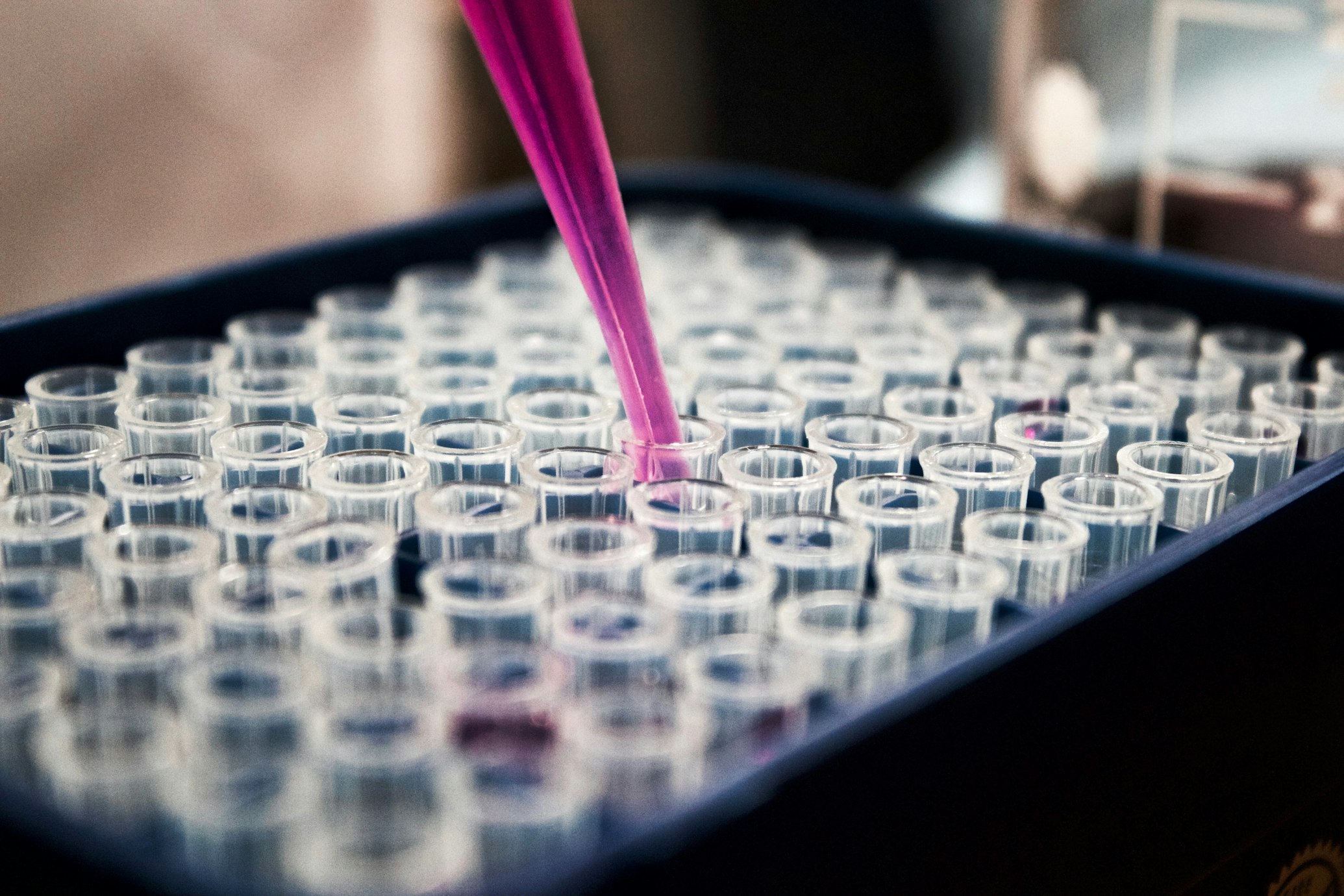
Laboratory setup for synthesizing and analyzing hybrid nanostructures
Research Reagent Solutions for Hybrid Self-Assembly
| Reagent/Material | Function in Self-Assembly | Example from Research |
|---|---|---|
| Lanthanide-doped Upconversion Nanoparticles (UCNPs) | Converts near-infrared light to visible or UV light; used for deep-tissue imaging and light-activated therapy 7 | Core component in nanocomposites for bioimaging and photodynamic therapy 7 |
| Poly(lactic-co-glycolic acid) (PLGA) | A biodegradable polymer that forms nanoparticles for drug delivery; degradation rate can be tuned for controlled release 7 | Used to create pH-sensitive nanocapsules with UCNPs for smart drug delivery in tumor environments 7 |
| Peptide-DNA Conjugates | Combines the programmability of DNA with the diverse functionality of peptides; acts as a smart linker or structural element 5 8 | Served as a homotrimeric three-way junction to link DNA tiles into a stable, Y-shaped nanostructure 8 |
| Cation Solutions (Mg²⁺, Ca²⁺, Na⁺, etc.) | Ions that screen negative charges on DNA backbones, reducing repulsion and enabling DNA hybridization and nanostructure folding | Essential for assembling DNA nanostructures; different cations (e.g., Na⁺) can be used to tune biostability |
| Polydopamine (PDA) | A versatile polymer that forms adhesive coatings on surfaces; improves biocompatibility and can be used for further functionalization 3 | Used to create multifunctional therapeutic nanostructures for combined photothermal and chemo-therapy 3 |
The Future of Medicine, Built from the Bottom Up
The potential applications of self-assembling hybrid nanostructures in medicine are vast and transformative. They are already being developed for:
Tissue Engineering
Self-assembling peptides and DNA can form scaffolds that mimic the natural extracellular matrix, guiding and stimulating cells to regenerate damaged tissues 1 .
While challenges remain—particularly concerning long-term safety, biocompatibility, and large-scale manufacturing—the trajectory is clear. The ability to design and construct materials from the bottom up, using the same principles that nature has perfected over billions of years, is ushering in a new era of medicine. It is an era where treatments are not just applied, but are intelligently deployed by microscopic machines, assembled and ready for work at the smallest of scales.
Projected Impact of Self-Assembling Nanostructures in Medicine
Drug Delivery Efficiency
Reduced Side Effects
Diagnostic Accuracy
Tissue Regeneration