The Diffuse Function Dilemma: Why They Cause Linear Dependence and How to Solve It
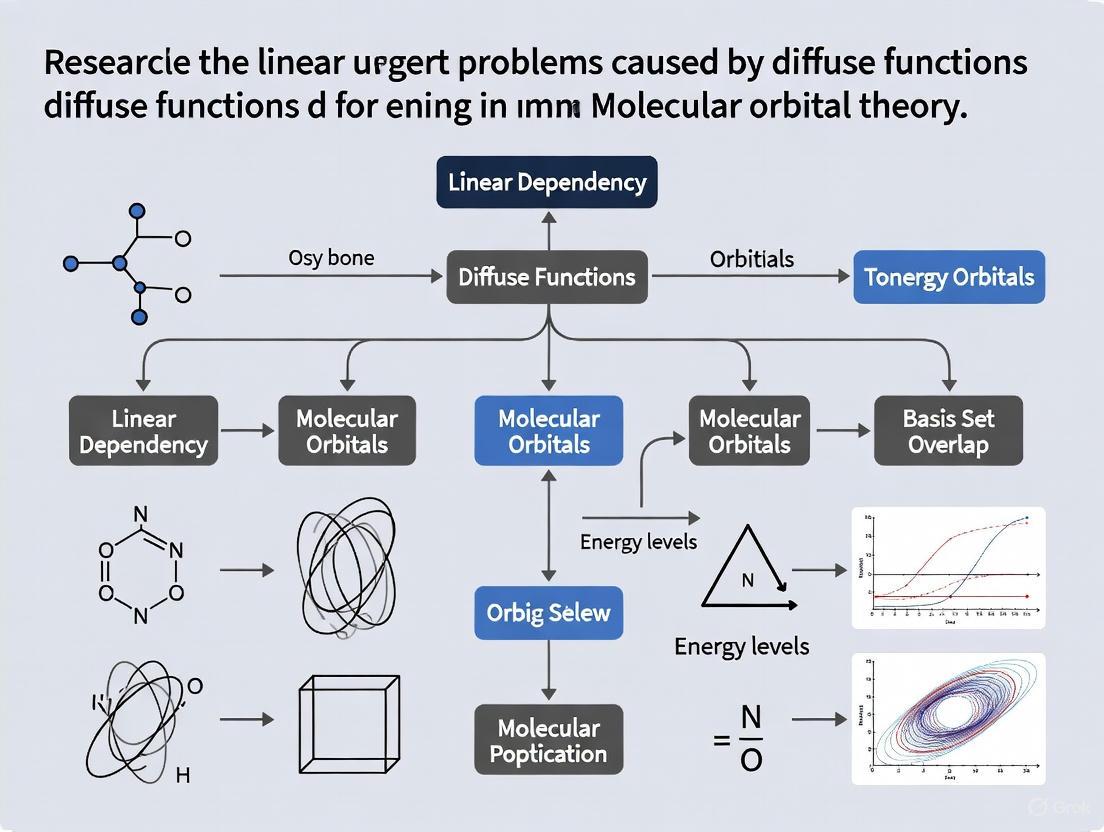
This article provides a comprehensive analysis of why diffuse basis functions, while essential for accuracy in calculating non-covalent interactions, excited states, and anionic systems, frequently introduce linear dependence problems in...
The Diffuse Function Dilemma: Why They Cause Linear Dependence and How to Solve It
Abstract
This article provides a comprehensive analysis of why diffuse basis functions, while essential for accuracy in calculating non-covalent interactions, excited states, and anionic systems, frequently introduce linear dependence problems in quantum chemistry computations. It explores the foundational mathematical principles behind this issue, details its practical impact on computational efficiency and sparsity, and offers actionable methodological protocols and troubleshooting strategies for researchers in drug development and biomedical fields. The content synthesizes current research and software-specific guidance to empower scientists to navigate the critical trade-off between accuracy and numerical stability, enabling more reliable and efficient computational workflows.
The Fundamental Trade-Off: How Diffuse Functions Create Accuracy and Instability
Defining Diffuse Functions and Their Critical Role in Quantum Chemistry
Diffuse atomic orbital basis sets, characterized by their spatially extended electron densities with small exponent values, represent a fundamental yet double-edged component in modern quantum chemical calculations. This technical guide examines their indispensable role in achieving chemical accuracy, particularly for non-covalent interactions and excited states, while simultaneously addressing the central research problem of why these same functions induce severe linear dependency issues in computational workflows. Through quantitative analysis of benchmark data and mathematical modeling of basis set overlap, we demonstrate that the very properties that make diffuse functions essential for accuracy—their spatial extensiveness and low exponent values—directly contribute to numerical instabilities through linear dependence in the basis set. We further explore methodological advances and practical protocols for mitigating these challenges while preserving computational accuracy, providing drug development researchers with a comprehensive framework for basis set selection in complex biomolecular systems.
Diffuse basis functions in quantum chemistry are atomic orbitals with very small Gaussian exponents, resulting in spatially extended electron densities that decay slowly from the atomic nucleus. Unlike standard valence functions that describe electrons close to the atomic core, diffuse functions capture electron density far from the nucleus, making them essential for modeling weakly bound electrons in anions, excited states, and non-covalent interactions. The fundamental challenge arises because the mathematical representation that makes these functions physically relevant—their broad spatial distribution—also creates significant numerical complications that manifest as linear dependencies in quantum chemical computations.
The central thesis of this research examines the paradoxical nature of diffuse functions: while they are rigorously necessary for predictive accuracy across multiple chemical domains, their incorporation inevitably introduces numerical instabilities that complicate computational workflows, increase resource demands, and potentially compromise results. This conundrum frames a critical research direction in method development for quantum chemistry, particularly as applications expand toward larger, more complex systems relevant to pharmaceutical design and biomolecular simulation.
The Blessing: Essential Role in Chemical Accuracy
Quantitative Impact on Non-Covalent Interactions
Non-covalent interactions (NCIs)—including hydrogen bonding, van der Waals forces, and π-π stacking—govern molecular recognition, protein folding, and drug-receptor binding. These weak interactions (typically 1-5 kcal/mol) require precise quantum mechanical description, where diffuse functions prove indispensable. Benchmark studies using the ASCDB database demonstrate that basis sets without diffuse functions fail to achieve chemical accuracy (<1 kcal/mol error) for NCIs, regardless of their size in terms of primitive Gaussian functions [1].
Table 1: Basis Set Accuracy for Non-Covalent Interactions (ωB97X-V/ASCDB)
| Basis Set | NCI RMSD (M+B) [kJ/mol] | Diffuse Functions? |
|---|---|---|
| def2-SVP | 31.51 | No |
| def2-TZVP | 8.20 | No |
| cc-pVTZ | 12.73 | No |
| def2-SVPD | 7.53 | Yes |
| def2-TZVPPD | 2.45 | Yes |
| aug-cc-pVTZ | 2.50 | Yes |
| aug-cc-pV5Z | 2.39 | Yes |
The data reveals a critical threshold: only basis sets incorporating diffuse functions (def2-TZVPPD, aug-cc-pVTZ, and larger) achieve the target accuracy of approximately 2.5 kJ/mol (∼0.6 kcal/mol) needed for predictive modeling of biomolecular interactions. Even extensive basis sets without diffuse augmentation (cc-pV6Z) fail to reach this accuracy target, confirming that sheer number of basis functions cannot compensate for the absence of specifically diffuse components [1].
Applications in Anions and Excited States
Beyond non-covalent interactions, diffuse functions critically impact other specialized chemical domains:
Anion Calculations: The extra electron in anions occupies a much larger spatial volume than electrons in neutral molecules, requiring diffuse functions for physically meaningful representation. Without them, electron affinity calculations exhibit significant errors, and anion stability may be incorrectly predicted.
Excited States: Electron promotion often leads to more diffuse electronic distributions, particularly for Rydberg states where the electron occupies an orbital with principal quantum number higher than the valence shell. Multiple sets of diffuse functions may be required to properly characterize excited state potential energy surfaces [2].
Spectroscopic Properties: Polarizabilities and other response properties that depend on electron correlation effects at long range show significantly improved convergence with diffuse-augmented basis sets.
The Curse: Linear Dependence and Numerical Instabilities
The Mathematical Origin of Linear Dependencies
Linear dependence in quantum chemical calculations arises when basis functions become mathematically redundant, meaning one basis function can be expressed as a linear combination of others in the set. This problem manifests computationally through the overlap matrix S, whose elements ( S{\mu\nu} = \langle \phi\mu \mid \phi\nu \rangle ) represent the spatial overlap between basis functions φμ and φ_ν [2].
The overlap matrix must be positive definite for quantum chemical equations to be solvable. When eigenvalues of S approach zero, the matrix becomes numerically singular, indicating linear dependence. The condition is quantified through the relation:
[ \text{If } \lambda_{\min}(\mathbf{S}) < \epsilon \Rightarrow \text{Linear dependence} ]
where ( \lambda_{\min} ) is the smallest eigenvalue of S and ε is a numerical threshold (typically 10⁻⁶ to 10⁻⁸) [2].
Diffuse functions exacerbate this problem because their spatial extension creates significant overlap between functions on distant atoms, contrary to the nearsightedness principle of electronic matter. In extended systems, diffuse functions on separated atoms develop non-negligible overlaps, creating a network of linear dependencies throughout the entire molecular system [1].
Manifestations in Practical Calculations
The practical consequences of linear dependencies in quantum chemical calculations include:
SCF Convergence Failure: The self-consistent field procedure may oscillate, diverge, or converge to unphysical solutions due to numerical instabilities in the orthogonalization process [2].
Energy Discontinuities: Potential energy surfaces may exhibit unphysical jumps or discontinuities as molecular geometry changes, particularly problematic for dynamics simulations.
Loss of Predictive Power: Results become sensitive to numerical thresholds rather than physical principles, compromising the reliability of computational predictions.
Increased Computational Demand: Even when calculations complete successfully, the handling of near-linear dependencies through projection techniques or specialized algorithms adds overhead to computational workflows [2].
Figure 1: Mechanism of linear dependence caused by diffuse functions
Quantitative Analysis: The Sparsity-Accuracy Tradeoff
Impact on Density Matrix Sparsity
The detrimental impact of diffuse functions extends beyond linear dependence to dramatically affect computational complexity through reduced sparsity in the one-particle density matrix (1-PDM). For large systems, the 1-PDM of insulators is expected to exhibit exponential decay of matrix elements with increasing distance from the diagonal, enabling linear-scaling algorithms. Diffuse functions strongly violate this principle [1].
Table 2: Comparative Analysis of Basis Set Performance Characteristics
| Basis Set | DNA Fragment (260 atoms) SCF Time [s] | Expected NCI Accuracy | Sparsity of 1-PDM |
|---|---|---|---|
| def2-SVP | 151 | Poor (>30 kJ/mol) | High |
| def2-TZVP | 481 | Moderate (~8 kJ/mol) | Moderate |
| def2-TZVPPD | 1440 | Good (~2.5 kJ/mol) | Low |
| aug-cc-pVTZ | 2706 | Good (~2.5 kJ/mol) | Very Low |
Research demonstrates that while small basis sets (especially minimal sets like STO-3G) exhibit significant sparsity in the 1-PDM, medium-sized diffuse basis sets like def2-TZVPPD essentially eliminate all usable sparsity. This "curse of sparsity" means nearly all off-diagonal elements of the 1-PDM remain significant, preventing truncation and forcing computational methods to scale cubically or worse with system size [1].
System Size Dependence
The linear dependence problem exhibits non-linear scaling with system size. In small molecules, even heavily augmented basis sets may remain linearly independent. As system size increases, the probability of linear dependence grows substantially due to:
Cumulative Overlap Effects: While individual pairwise overlaps between distant diffuse functions may be small, their cumulative effect across the entire system creates numerical rank deficiency in the overlap matrix.
Basis Set Incompleteness in Large Systems: Counterintuitively, the local incompleteness of basis sets in large systems exacerbates the linear dependence problem, as the electronic structure theory compensates through non-local coupling [1].
Experimental Protocols and Methodologies
Diagnosing Linear Dependencies
A standardized protocol for identifying and characterizing linear dependencies should be implemented before undertaking production quantum chemical calculations:
Overlap Matrix Construction: Compute the full overlap matrix S for the molecular system with the selected basis set.
Diagonalization: Perform full diagonalization of S to obtain all eigenvalues λ_i.
Threshold Application: Apply the threshold condition ( \lambda_i < 10^{-6} ) (default in Q-Chem) to identify linearly dependent components [2].
Basis Function Analysis: For each eigenvalue below threshold, examine the corresponding eigenvector to identify which basis functions contribute most strongly to the linear dependence.
Systematic Monitoring: Implement this diagnostic procedure as a standard checkpoint in computational workflows, particularly when using diffuse-augmented basis sets or studying large systems.
A Priori Detection Protocol
Based on analysis of successful interventions, the following protocol enables prediction of linear dependencies before expensive integral calculations:
Exponent Comparison: Identify pairs of basis functions with exponents that are similar percentage-wise (within 5-15%).
Spatial Proximity Assessment: For identified similar exponents, evaluate the spatial proximity of the parent atoms.
Overlap Matrix Screening: Compute a reduced overlap matrix containing only the suspect functions and their nearest neighbors.
Preemptive Removal: Remove one function from each problematic pair, prioritizing the removal of functions with the highest degree of similarity to multiple other functions [3].
This protocol successfully resolved linear dependence issues in challenging cases such as the aug-cc-pV9Z basis set supplemented with "tight" functions from cc-pCV7Z for water molecule calculations, where removing two specific s-type functions with similar exponents (94.8087090 and 92.4574853342) eliminated the linear dependencies [3].
Solutions and Mitigation Strategies
Computational Approaches
Several computational strategies have been developed to address the linear dependence problem while preserving the accuracy benefits of diffuse functions:
Pivoted Cholesky Decomposition: This advanced mathematical approach identifies and removes linearly dependent basis functions by decomposing the overlap matrix. The method works by selecting the most numerically significant basis functions first, effectively constructing a optimal subset that spans the same space without linear dependencies. Implementations are available in ERKALE, Psi4, and PySCF [3].
Automatic Projection Methods: Standard quantum chemistry packages like Q-Chem automatically detect near-linear dependencies through eigenvalue analysis of the overlap matrix and project out the problematic components. The threshold for this projection can be controlled via the BASISLINDEP_THRESH parameter, though aggressive thresholds may affect accuracy [2].
CABS Singlets Correction: Research indicates that combining compact, low angular momentum quantum number basis sets with the complementary auxiliary basis set (CABS) singles correction can potentially provide accuracy comparable to diffuse-augmented basis sets while avoiding linear dependence issues [1].
Basis Set Selection Framework
For researchers in drug development, the following practical framework balances accuracy requirements with computational stability:
Initial Screening: Use unaugmented triple-zeta basis sets (def2-TZVP, cc-pVTZ) for preliminary geometry optimizations and conformational sampling.
Refined Single-Point Calculations: Employ diffuse-augmented basis sets (def2-TZVPPD, aug-cc-pVTZ) for final energy evaluations on pre-optimized structures, particularly when non-covalent interactions dominate binding energetics.
Linear Dependence Monitoring: Always implement overlap matrix analysis when using diffuse-augmented basis sets for systems exceeding 200 atoms.
Alternative Approaches: For very large systems where linear dependence prevents conventional diffuse-augmented calculations, consider the CABS singles correction with compact basis sets as an alternative [1].
Figure 2: Solution pathways for linear dependence problems
The Scientist's Toolkit: Research Reagent Solutions
Table 3: Essential Computational Tools for Managing Diffuse Function Challenges
| Tool/Reagent | Function/Purpose | Implementation Examples |
|---|---|---|
| Overlap Matrix Analyzer | Diagnoses linear dependencies by eigenvalue spectrum analysis | Q-Chem (automatic), Psi4, PySCF |
| Pivoted Cholesky Decomposer | Identifies optimal basis subset removing linear dependencies | ERKALE, Psi4, PySCF |
| BASISLINDEP_THRESH | Controls sensitivity for linear dependence detection (default: 10⁻⁶) | Q-Chem rem variable |
| Basis Set Pruning Algorithms | Automatically removes redundant basis functions | Custom implementations |
| CABS Singles Correction | Alternative approach using compact basis sets with auxiliary correction | Specific electronic structure codes |
| Exponent Similarity Analyzer | Identifies basis functions with nearly identical exponents | Custom analysis scripts |
Diffuse functions remain essential for achieving chemical accuracy in quantum chemical simulations of non-covalent interactions, excited states, and anionic systems—precisely the domains most relevant to pharmaceutical research and biomolecular design. However, their implementation introduces significant numerical challenges through linear dependence problems that escalate with system size and basis set completeness.
The research community has developed multiple strategies to navigate this accuracy-stability tradeoff, from mathematical approaches like pivoted Cholesky decomposition to chemical solutions like the CABS singles correction. For drug development researchers, a pragmatic approach that strategically deploys diffuse-augmented basis sets for critical energy evaluations while relying on more stable basis sets for structural optimization provides an effective balance between computational feasibility and physical accuracy.
Future methodological developments will likely focus on improving the numerical stability of diffuse function implementations while developing alternative approaches that capture the essential physics of weakly-bound electrons without introducing linear dependencies. This direction represents a critical research frontier in quantum chemistry method development, with significant implications for computational drug discovery and biomolecular simulation.
In computational chemistry and electronic structure theory, the choice of basis set is paramount for achieving accurate results. A persistent challenge arises with the use of diffuse functions—basis functions with small exponents that describe electrons far from the nucleus. While essential for modeling non-covalent interactions, atomic anions, and Rydberg states accurately, their incorporation often leads to numerical instabilities known as linear dependence problems [1]. This whitepaper explores the mathematical underpinnings of this phenomenon, framing it within the context of over-completeness and its manifestation in the properties of the overlap matrix. We will demonstrate how the addition of diffuse functions transforms a well-conditioned, linearly independent basis into a nearly linearly dependent or overcomplete one, creating significant challenges for electronic structure computations while being indispensable for accuracy.
Mathematical Foundations: Overcompleteness and the Overlap Matrix
The Concept of an Overcomplete Set
In linear algebra, a set of vectors is considered complete for a vector space if its linear span is dense in that space. A set is a basis if it is both complete and linearly independent. An overcomplete set, or frame, is a set of vectors that is complete but contains more vectors than necessary, resulting in linear dependence [4]. Formally, for a Hilbert space H, a set of non-zero vectors {φ_i}_{i∈J} is a frame if there exist constants A and B, with 0 < A ≤ B < ∞, such that for all f ∈ H:
A‖f‖² ≤ Σ|⟨f, φ_i⟩|² ≤ B‖f‖² [4]
When A = B, the frame is said to be tight. A frame that is not a Riesz basis is described as overcomplete or redundant [4]. In such cases, any given vector in the space can be represented in multiple ways as a linear combination of the frame vectors, leading to non-uniqueness in representation.
The Overlap Matrix in Quantum Chemistry
In quantum chemistry, basis functions are used to construct molecular orbitals. The overlap matrix S is a central mathematical object, whose elements are defined by:
S_μν = ⟨χ_μ | χ_ν⟩ = ∫ χ_μ*(r) χ_ν(r) dr
where χ_μ and χ_ν are basis functions. This matrix is a concrete representation of the inner products between all basis functions, quantifying their mutual non-orthogonality.
A fundamental property of the overlap matrix is that it is positive definite for a linearly independent basis set [5]. This means all its eigenvalues are real and positive. The determinant of S is positive, and the matrix is invertible. The positive definiteness guarantees the uniqueness of the solution when solving the generalized eigenvalue problem for the Fock matrix.
Linking Overcompleteness to the Overlap Matrix
When diffuse functions are added to a basis set, they are spatially extended and exhibit significant overlap with many other basis functions in the molecule, including those on distant atoms. This increased non-orthogonality has direct consequences:
- Decreased Eigenvalues: The eigenvalues of the overlap matrix
Sprovide a measure of the linear independence of the basis. As the basis becomes more overcomplete, the matrixSbecomes ill-conditioned, meaning its smallest eigenvalues approach zero [1]. - The
S⁻¹Problem: Many computational algorithms, particularly those involved in orthogonalization (e.g.,S⁻¹/₂), require handling the inverse of the overlap matrix. As the smallest eigenvalues ofSapproach zero, its condition number grows, and the matrixS⁻¹becomes numerically unstable and significantly less sparse, propagating non-locality [1]. - Linear Dependence: When one or more eigenvalues of
Sbecome numerically zero (or fall below a practical threshold), the basis set is effectively linearly dependent. The overlap matrix becomes singular (non-invertible), causing the collapse of standard computational procedures.
Table 1: Relationship Between Basis Set Properties and the Overlap Matrix
| Basis Set Characteristic | Impact on Overlap Matrix (S) | Numerical Consequence |
|---|---|---|
| Linear Independence | Positive definite; all eigenvalues > 0 | S is well-conditioned and invertible |
| Near-Linear Dependence | Ill-conditioned; smallest eigenvalues ≈ 0 | S⁻¹ is numerically unstable |
| Overcompleteness | Singular; one or more eigenvalues = 0 | S is non-invertible |
The Diffuse Functions Problem: A Conundrum of Accuracy vs. Stability
The Blessing of Accuracy
Diffuse basis functions, characterized by their small exponents and spatially extended nature, are crucial for achieving high accuracy in quantum chemical calculations. Their primary utility lies in describing regions of space far from atomic nuclei, which is essential for modeling:
- Non-covalent interactions (e.g., van der Waals forces, hydrogen bonding, π-π stacking)
- Excited states and Rydberg states
- Atomic anions
- Property calculations such as polarizabilities
Table 2: Accuracy of ωB97X-V Functional with Different Basis Sets for Non-Covalent Interactions (NCI) [1]
| Basis Set | NCI RMSD (M+B) [kJ/mol] |
|---|---|
| def2-SVP | 31.51 |
| def2-TZVP | 8.20 |
| def2-TZVPPD | 2.45 |
| aug-cc-pVTZ | 2.50 |
| cc-pV6Z | 2.47 |
As shown in Table 2, basis sets augmented with diffuse functions (denoted by "D" in def2-TZVPPD and "aug-" in aug-cc-pVTZ) are necessary to achieve errors below ~3 kJ/mol for non-covalent interactions, a level of accuracy unattainable with unaugmented basis sets of similar size [1].
The Curse of Sparsity and Linear Dependence
Despite their utility, diffuse functions create significant computational challenges. As illustrated in Figure 1, while small basis sets like STO-3G yield a sparse one-particle density matrix (1-PDM) for a DNA fragment, the addition of diffuse functions in def2-TZVPPD essentially eliminates all usable sparsity [1]. This "curse of sparsity" manifests as a late onset of the linear-scaling regime in electronic structure theories and larger cutoff errors.
The root of this problem lies in the properties of the overlap matrix. Diffuse functions lead to non-zero overlap between basis functions on atoms that are spatially distant. This reduces the locality of the contravariant basis functions, quantified by S⁻¹, which becomes significantly less sparse than its covariant dual [1]. In mathematical terms, the decay rate of the elements of S⁻¹ is proportional to the diffuseness and local incompleteness of the basis set, meaning small, diffuse basis sets are affected most severely.
Quantitative Analysis of Basis Set Effects
The relationship between basis set diffuseness and linear dependence can be quantified through specific metrics derived from the overlap matrix. The following table summarizes key indicators that signal the onset of problems.
Table 3: Quantitative Metrics for Assessing Linear Dependence [5] [1]
| Metric | Formula/Description | Interpretation |
|---|---|---|
| Smallest Eigenvalue of S | λ_min(S) |
Approaches zero as linear dependence increases |
| Condition Number | κ(S) = λ_max(S) / λ_min(S) |
Large values (>10⁷-10⁸) indicate ill-conditioning |
| Sparsity of S⁻¹ | Percentage of near-zero elements in S⁻¹ |
Decreases with added diffuseness, increasing computational cost |
| Decay Rate of S⁻¹ | Exponential decay constant of [S⁻¹]_ij with distance |
Smaller decay constants indicate more severe non-locality |
Computational Methodologies and Protocols
Diagonalization of the Overlap Matrix
A critical step in many quantum chemistry algorithms is the orthogonalization of the basis set, which requires diagonalization of the overlap matrix. The standard procedure, known as Löwdin orthogonalization, proceeds as follows [5]:
Diagonalize the Overlap Matrix: Solve the eigenvalue problem:
S U = U swheresis a diagonal matrix containing the eigenvalues ofS, andUis the unitary matrix of its eigenvectors.Form the Orthogonalization Matrix: Construct the transformation matrix:
X = U s⁻¹/² U^†Here,s⁻¹/²is a diagonal matrix with elements(s_i)⁻¹/², the inverse square root of the eigenvalues.Transform the Fock Matrix: The Fock matrix
Fis then transformed to the orthogonal basis:F' = X^† F X
This orthogonalized Fock matrix F' is then diagonalized to obtain molecular orbitals and energies.
Protocol for Diagnosing Linear Dependence
The following experimental protocol should be employed to diagnose and manage linear dependence issues arising from diffuse basis sets:
- Compute the Overlap Matrix: Calculate the matrix elements
S_μνfor the molecular system. - Diagonalize S: Determine all eigenvalues
{λ_i}of the overlap matrix. - Analyze Eigenvalue Spectrum: Identify the smallest eigenvalue
λ_minand compute the condition numberκ(S). - Assess Numerical Stability: If
λ_minis below a chosen threshold (e.g., 10⁻⁷) orlog₁₀(κ(S))approaches the precision of the arithmetic (e.g., ~7-8 for double precision), the basis set is numerically linearly dependent. - Mitigation Strategies:
- Eigenvalue Shifting: Add a small constant to the diagonal of
Sbefore inversion. - Basis Set Pruning: Remove specific diffuse functions that contribute most to the linear dependence.
- Use of Auxiliary Basis Sets: Employ methods like the Complementary Auxiliary Basis Set (CABS) correction, which can improve accuracy without exacerbating linear dependence [1].
- Eigenvalue Shifting: Add a small constant to the diagonal of
The Scientist's Toolkit: Essential Research Reagents
Table 4: Key Computational Tools for Managing Linear Dependence
| Tool/Technique | Function/Purpose | Application Context |
|---|---|---|
| Overlap Matrix Analysis | Diagnosing linear dependence via eigenvalue spectrum | Preliminary basis set assessment |
| Löwdin Orthogonalization | Basis transformation via S⁻¹/² |
Standard electronic structure methods (HF, DFT) |
| Condition Number Thresholds | Numerical stability criteria (e.g., κ(S) < 10⁸) | Determining acceptable linear dependence |
| Complementary Auxiliary Basis Set (CABS) | Accuracy correction using compact basis sets | Mitigating diffuse function problems [1] |
| Eigenvalue Shifting | Numerical stabilization of S⁻¹ |
Handling near-singular overlap matrices |
| Basis Set Exchange | Repository of standardized basis sets | Ensuring consistency and comparability [1] |
In the pursuit of accuracy in electronic structure calculations, quantum chemists often turn to diffuse basis sets—Gaussian-type functions with small exponents that allow electrons to be described far from the nucleus. These basis sets have proven essential for achieving quantitative accuracy, particularly for properties such as non-covalent interactions, reaction barriers, and excited states where an accurate description of the electron density tail is critical [1]. The blessing of accuracy, however, comes with a computational curse: the severe degradation of sparsity in the one-particle density matrix (1-PDM). This sparsity crisis manifests as a late onset of the linear-scaling regime in electronic structure methods, larger cutoff errors, and sometimes erratic behavior in sparse treatment approaches [1]. Understanding this phenomenon is not merely an academic exercise but a practical necessity for enabling large-scale electronic structure calculations on biologically and materially relevant systems.
The core of this conundrum lies in the tension between two fundamental principles. On one hand, Kohn's "nearsightedness" principle suggests that electronic structure should be local for insulating systems, with the density matrix elements expected to decay exponentially with increasing distance from the diagonal [1]. This principle underpins most linear-scaling electronic structure methods. On the other hand, the introduction of diffuse functions appears to violate this locality in a representational sense, creating a computational challenge that this article will explore in depth, with particular attention to implications for drug discovery and materials design.
Quantitative Evidence: Documenting the Sparsity Crisis
The Detrimental Impact on Real-World Systems
The disruptive impact of diffuse basis functions on density matrix sparsity is readily observable in practical calculations. Research has demonstrated this effect using a DNA fragment comprising 16 base pairs (1052 atoms)—a prototypical example expected to exhibit strong nearsightedness [1]. With minimal basis sets (STO-3G), the 1-PDM shows significant sparsity, making it amenable to linear-scaling algorithms. However, when medium-sized diffuse basis sets (def2-TZVPPD) are employed, nearly all usable sparsity vanishes—most off-diagonal elements become too significant to discard [1]. This effect is more pronounced with diffuse augmentation than with increasing basis set size alone, pointing to a specific pathology introduced by the diffuse functions.
Table 1: Impact of Basis Set Diffuseness on Density Matrix Sparsity and Accuracy
| Basis Set Type | Sparsity of 1-PDM | NCI RMSD (kJ/mol) | Computational Time (s) |
|---|---|---|---|
| def2-SVP (minimal) | High | 31.51 | 151 |
| def2-TZVP (medium) | Moderate | 8.20 | 481 |
| def2-TZVPPD (diffuse) | Very Low | 2.45 | 1,440 |
| aug-cc-pVTZ (diffuse) | Very Low | 2.50 | 2,706 |
| cc-pV6Z (large, no diffuse) | Moderate | 2.47 | 15,265 |
The Inevitable Need for Diffuse Functions
The computational penalty of diffuse functions would be merely academic if they were not essential for accuracy. Benchmark studies using the ASCDB database, which contains statistically relevant cross-sections of relative energies across diverse chemical problems, confirm their necessity [1]. For non-covalent interactions (NCIs)—crucial in drug design for protein-ligand binding—diffuse functions are indispensable for achieving chemical accuracy. Without augmentation, only the very large cc-pV6Z basis achieves satisfactory accuracy (2.47 kJ/mol NCI RMSD), whereas diffuse-augmented medium-sized basis sets like def2-TZVPPD and aug-cc-pVTZ achieve comparable accuracy (2.45 and 2.50 kJ/mol respectively) at substantially lower computational cost [1]. This creates the fundamental conundrum: diffuse functions are simultaneously essential for accuracy and detrimental to computational efficiency through their destruction of sparsity.
Theoretical Framework: Root Causes of the Sparsity Crisis
The Inverse Overlap Matrix as the Culprit
The primary mechanism behind the sparsity crisis lies in the mathematical structure of the basis set representation, specifically the properties of the inverse overlap matrix (S⁻¹). In non-orthogonal atomic orbital basis sets, the density matrix must satisfy the idempotency condition P = PSP, which inherently couples locality in the density matrix with the locality of S⁻¹ [1]. While the overlap matrix S itself is relatively sparse for localized basis functions—with significant elements only between spatially close atoms—its inverse S⁻¹ is significantly less sparse, exhibiting non-zero elements between distant atoms.
This phenomenon can be understood through the concept of contra-variant and co-variant representations. The co-variant basis functions (the original atomic orbitals) maintain spatial locality, but their contra-variant duals, represented by the rows/columns of S⁻¹, are highly non-local. When the basis set includes diffuse functions, this effect is dramatically amplified because the diffuse functions have substantial overlap with many other basis functions throughout the system, further reducing the sparsity of S⁻¹ and consequently destroying the sparsity of the density matrix.
Analysis via Model System: Infinite Helium Chain
To quantitatively analyze this phenomenon, researchers have employed a model system of an infinite non-interacting chain of helium atoms [1]. This simplified model allows precise mathematical analysis of the decay properties of the density matrix. The results demonstrate that the exponential decay rate of the density matrix elements is proportional to both the diffuseness and local incompleteness of the basis set. Counterintuitively, small and diffuse basis sets are affected most severely—precisely the combination often used in preliminary calculations on large systems.
The model reveals that the spatial extent of the basis functions alone cannot explain the severe sparsity reduction. Instead, the key factor is the low locality of the contra-variant basis functions as quantified by S⁻¹. Even in systems with highly local electronic structures and basis sets with only nearest-neighbor overlap, the mathematical structure of the problem introduces non-locality that manifests as density matrix delocalization.
Methodologies: Experimental Protocols for Studying Sparsity
Sparsity Quantification Protocol
- System Selection: Choose test systems across a range of sizes and dimensionalities (molecules, chains, 2D sheets, 3D clusters). The DNA fragment (16 base pairs, 1052 atoms) serves as a representative complex system [1].
- Basis Set Variation: Perform calculations with systematically increasing basis sets: minimal (STO-3G), medium (def2-SVP, def2-TZVP), large (def2-QZVP), and their diffuse-augmented counterparts (def2-SVPD, def2-TZVPPD, def2-QZVPPD) [1].
- Density Matrix Analysis: After SCF convergence, analyze the 1-PDM by computing the percentage of elements below a significance threshold (e.g., 10⁻⁵) or plotting the decay of matrix elements with respect to the interatomic distance.
- Sparsity Metrics: Calculate sparsity as the fraction of negligible elements or the distance at which matrix elements fall below the threshold.
Locality Analysis Protocol
- Real-Space Projection: Project the 1-PDM onto a real-space grid to distinguish genuine physical delocalization from basis set artifacts [1].
- Overlap Matrix Analysis: Compute the decay properties of both the overlap matrix S and its inverse S⁻¹ to quantify the relationship between basis set locality and density matrix sparsity.
- Decay Rate Measurement: For model systems like the helium chain, fit exponential decays to the density matrix elements as a function of distance and correlate with basis set parameters.
Diagram 1: Experimental workflow for studying sparsity
Visualization: Mathematical Relationships and Mechanisms
Diagram 2: Effect of basis set choice on computational efficiency
Research Reagent Solutions: Computational Tools
Table 2: Essential Computational Tools for Sparsity Research
| Tool Name | Type | Primary Function | Application in Sparsity Research |
|---|---|---|---|
| Basis Set Exchange | Database | Basis set provision | Access standardized basis sets for systematic comparison [1] |
| Complementary Auxiliary Basis Sets (CABS) | Method | Basis set correction | Improve accuracy with compact basis sets, mitigating need for diffuse functions [1] |
| Chunks and Tasks Library | Programming Model | Sparse matrix operations | Implement locality-aware parallel block-sparse matrix multiplication [6] |
| SparQ Tool | Analysis Software | Quantum state analysis | Compute quantum information observables on sparse wavefunctions [7] |
| Quadtree Representation | Data Structure | Matrix representation | Exploit a priori unknown matrix sparsity structure hierarchically [6] |
Resolution Pathways: Overcoming the Sparsity Crisis
The CABS Singles Correction Approach
One promising solution to the sparsity crisis involves the use of complementary auxiliary basis sets (CABS) in conjunction with compact, low quantum-number basis sets [1]. This approach aims to recover the accuracy typically provided by diffuse functions without explicitly including them in the primary basis. The CABS singles correction works by augmenting the wavefunction through perturbation theory, effectively providing additional flexibility to describe electron correlation effects that would normally require diffuse functions. Early results show promising accuracy for non-covalent interactions while maintaining better sparsity in the density matrix compared to explicitly diffuse-augmented basis sets [1].
Advanced Sparse Linear Algebra Techniques
Specialized sparse matrix algorithms and data structures can help mitigate the computational costs even when dealing with partially degraded sparsity. The Chunks and Tasks programming model with its quadtree matrix representation provides a framework for locality-aware parallel block-sparse matrix-matrix multiplication [6]. This approach can automatically exploit a priori unknown matrix sparsity structure and is particularly effective for the block-sparse patterns that occur in electronic structure calculations. By using hierarchical matrix representations and dynamic load balancing, these methods can maintain computational efficiency even with moderately diffuse basis sets.
Localized Virtual Orbital Transformations
For post-Hartree-Fock methods, the choice of virtual orbital representation significantly impacts the sparsity of key intermediates like the electron repulsion integral (ERI) tensor. Research indicates that using localized virtual orbitals can enhance sparsity in methods like MP2 [8]. Among various localization schemes, the orthogonal valence virtual-hard virtual (VV-HV) approach yields the sparsest ERI tensor compared to other alternatives like projected atomic orbitals (PAOs) or Boys-localized virtuals [8]. This transformation allows for more aggressive truncation of small elements while maintaining accuracy, effectively restoring some of the sparsity lost by including diffuse functions in the original basis.
Implications for Drug Discovery and Beyond
The sparsity crisis has particularly significant implications for structure-based drug design, where accurate modeling of non-covalent interactions is essential for predicting binding affinities. The computational cost of simulating drug-sized molecules with sufficient accuracy becomes prohibitive without addressing the sparsity problem [9]. Recent advances in diffusion generative models for molecular docking, such as DiffDock, offer promising alternatives but still rely on accurate physical models for refinement and scoring [10] [11].
In the broader context, understanding the relationship between basis set choice, density matrix sparsity, and accuracy enables more informed trade-offs in computational chemistry workflows. For high-throughput virtual screening, compact basis sets with corrections may provide the optimal balance, while for final lead optimization, more expensive diffuse-augmented calculations may be justified. The ongoing development of linear-scaling algorithms that can better handle the challenges posed by diffuse functions remains an active and critical area of research at the intersection of quantum chemistry, scientific computing, and applied mathematics.
The accurate computational description of physical systems involving anions, excited states, and non-covalent interactions represents a significant challenge in modern quantum chemistry. These systems share a common theoretical requirement: the necessity for atomic orbital basis sets that include diffuse functions. Diffuse functions, characterized by their small exponents and spatially extended nature, are essential for properly describing electrons that are far from the nucleus, such as those in anionic species, electronically excited states, and weak intermolecular complexes [2] [1]. However, this "blessing for accuracy" comes with a substantial computational "curse" – the introduction of severe linear dependency problems that can render calculations numerically unstable and computationally intractable [1].
The fundamental conundrum is straightforward: while diffuse functions are absolutely indispensable for achieving chemical accuracy in the treatment of non-covalent interactions and anionic systems, their inclusion dramatically reduces the sparsity of the one-particle density matrix (1-PDM) and creates near-linear dependencies in the basis set [1]. This problem manifests as an over-complete description of the space spanned by the basis functions, leading to a loss of uniqueness in molecular orbital coefficients and causing the self-consistent field (SCF) procedure to converge slowly or behave erratically [2]. Understanding this trade-off between accuracy and stability is crucial for researchers investigating molecular interactions in drug development, materials science, and catalysis.
This technical guide examines the theoretical foundations of this problem, provides benchmark data illustrating its practical impact, and outlines methodological approaches that balance accuracy with computational feasibility. By framing the discussion within the context of contemporary research challenges, we aim to provide scientists with the tools necessary to navigate these complexities in their computational workflows.
The Theoretical Foundation: Why Diffuse Functions Cause Linear Dependence
The Mathematical Basis of Linear Dependence
Linear dependence in quantum chemical calculations arises when basis functions become so similar that they no longer provide independent information about the molecular wavefunction. In mathematical terms, this occurs when the overlap matrix S develops very small eigenvalues, indicating that the basis set is nearly over-complete [2]. Q-Chem's documentation explicitly notes that "when using very large basis sets, especially those that include many diffuse functions, or if the system being studied is very large, linear dependence in the basis set may arise" [2].
The inclusion of diffuse functions exacerbates this problem because these functions have significant amplitude over large spatial regions. As a result, diffuse functions on different atoms exhibit substantial overlap, even when the atoms themselves are spatially distant. This effect is quantified by the inverse overlap matrix S⁻¹, which becomes significantly less sparse when diffuse functions are added [1]. In a study of a DNA fragment comprising 16 base pairs (1052 atoms), researchers observed that "while there is significant sparsity for small basis sets (especially STO-3G), even the medium sized diffuse basis set def2-TZVPPD removes essentially all usable sparsity" [1].
The Physical Rationale for Diffuse Functions in Targeted Systems
The essential nature of diffuse functions for certain physical systems stems from the electronic structure characteristics of these systems:
Anions: Negative ions possess an extra electron that experiences weaker nuclear attraction, resulting in a more diffuse electron cloud. Standard basis sets without diffuse functions cannot properly describe this expanded spatial distribution [2].
Excited States: Electronic excitation typically promotes an electron to a higher-energy orbital with more diffuse character. Time-dependent density functional theory (TD-DFT) calculations for excited states often require multiple sets of diffuse functions for accurate results [12] [2].
Non-covalent Interactions: Weak intermolecular forces such as dispersion, dipole-dipole interactions, and charge-transfer effects depend critically on an accurate description of the electron density in the region between molecules. As noted in recent research, "diffuse atomic orbital basis sets have proven to be essential to obtain accurate interaction energies, especially in regard to non-covalent interactions" [1].
Table 1: Basis Set Performance for Non-Covalent Interactions with ωB97X-V Functional
| Basis Set | NCI RMSD (M+B) (kJ/mol) | Relative Computational Time |
|---|---|---|
| def2-SVP | 31.51 | 1.0x |
| def2-TZVP | 8.20 | 3.2x |
| def2-QZVP | 2.98 | 12.8x |
| def2-SVPD | 7.53 | 3.5x |
| def2-TZVPPD | 2.45 | 9.5x |
| def2-QZVPPD | 2.40 | 22.6x |
| aug-cc-pVDZ | 4.83 | 6.5x |
| aug-cc-pVTZ | 2.50 | 17.9x |
| aug-cc-pVQZ | 2.40 | 48.3x |
Computational Methodologies for Managing Linear Dependence
Detection and Numerical Thresholds
Quantum chemistry packages implement specific thresholds to detect and manage linear dependence. In Q-Chem, the BASIS_LIN_DEP_THRESH variable controls the sensitivity for identifying linear dependence, with a default value of 6 corresponding to a threshold of 10⁻⁶ for the eigenvalues of the overlap matrix [2]. When eigenvalues fall below this threshold, the corresponding vectors are projected out, resulting in slightly fewer molecular orbitals than basis functions.
For problematic systems, practitioners may need to adjust this threshold. Q-Chem recommends: "Set to 5 or smaller if you have a poorly behaved SCF and you suspect linear dependence in your basis set. Lower values (larger thresholds) may affect the accuracy of the calculation" [2].
Specialized Methods for Problematic Systems
Wavefunction Theory Approaches
Recent advances in wavefunction theory offer solutions to the challenges posed by diffuse basis sets. The complementary auxiliary basis set (CABS) singles correction, used in combination with compact, low angular momentum quantum number basis sets, shows promise for maintaining accuracy while reducing linear dependence issues [1].
For non-covalent interactions of large molecules, the conventional "gold standard" CCSD(T) method has shown concerning discrepancies with diffusion quantum Monte Carlo (DMC) results, particularly for systems with large polarizabilities [13]. These discrepancies arise because the (T) approximation truncates the triple particle-hole excitation operator, neglecting the screening term $[[\hat{V},{\hat{T}}{2}],{\hat{T}}{2}]$ that becomes crucial for highly polarizable systems [13]. The recently developed CCSD(cT) method includes this screening term and demonstrates significantly improved agreement with DMC for noncovalent interaction energies of large molecules, achieving chemical accuracy (1 kcal/mol) for the coronene dimer [13].
Density Functional Theory Approaches
For TD-DFT calculations of excited-state non-covalent interactions, the choice of functional and dispersion corrections is critical. A comprehensive benchmark study recommends double hybrids B2GP-PLYP-D3(BJ) and B2PLYP-D3(BJ) for exciplexes with localized excitations, while their range-separated versions ωB2(GP-)PLYP-D3(BJ) or the spin-opposite scaled SOS-ωB88PP86 are preferable when charge transfer plays a role [12]. The study emphasizes that "the D3(BJ) dispersion correction is essential for good accuracy in most cases" for excited-state interactions [12].
Diagram 1: Relationship between diffuse functions, their benefits for target systems, the resulting linear dependence problems, and computational solutions. The diagram highlights the fundamental conundrum in computational chemistry.
Experimental Protocols and Benchmark Studies
Protocol for Benchmarking Non-covalent Interactions
Accurate assessment of non-covalent interaction energies requires careful methodology. The following protocol, adapted from recent benchmark studies, provides a framework for reliable results:
System Preparation: Select molecular complexes with diverse interaction types (π-π stacking, hydrogen bonding, dispersion-dominated). The ASCDB benchmark provides a statistically relevant cross-section of relative energies across chemical problems [1].
Reference Method Selection: Employ high-level wavefunction methods as references. For systems up to 100 atoms, CCSD(T) in the complete basis set limit remains the gold standard, though CCSD(cT) may be preferable for highly polarizable systems [13]. For larger systems, DMC provides an alternative reference [13].
Basis Set Selection: Include both augmented and non-augmented basis sets for comparison. The def2-TZVPPD and aug-cc-pVTZ basis sets typically provide the best balance of accuracy and computational cost for non-covalent interactions [1].
Dispersion Corrections: Apply appropriate dispersion corrections (D3(BJ) or VV10) for DFT calculations. For excited states, note that "the VV10-type non-local kernel yields relatively low errors but its impact is solely on ground-state energies and not on excitation energies" [12].
Counterpoise Corrections: Implement Boys-Bernardi counterpoise corrections to account for basis set superposition error in interaction energy calculations.
Convergence Testing: Monitor SCF convergence and adjust
BASIS_LIN_DEP_THRESHif necessary. For problematic cases, consider reducing the threshold to 5 or lower [2].
Case Study: Coronene Dimer Interactions
A recent investigation of the parallel displaced coronene dimer (C₂C₂PD) illustrates the critical importance of method selection for large, polarizable systems. The study revealed significant discrepancies between CCSD(T) and DMC interaction energies, with CCSD(T) overbinding by almost 2 kcal/mol [13]. The CCSD(cT) method, which includes higher-order screening terms, restored agreement with DMC, achieving chemical accuracy [13].
Table 2: Interaction Energies for Parallel Displaced Coronene Dimer (kcal/mol)
| Method | Interaction Energy | Deviation from DMC |
|---|---|---|
| MP2 | -18.20 | -4.50 |
| CCSD(T) | -15.85 | -2.15 |
| CCSD(cT) | -14.05 | -0.35 |
| DMC | -13.70 | 0.00 |
This case study highlights that the commonly used (T) approximation in CCSD(T) can lead to overcorrelation for systems with large polarizabilities, producing "too strong interaction energies" comparable to the known issues with MP2 [13]. For such systems, the infrared catastrophe of CCSD(T) becomes relevant, and resummation methods like CCSD(cT) or random-phase approximation offer more reliable alternatives.
Table 3: Research Reagent Solutions for Anions, Excited States, and Non-covalent Interactions
| Reagent/Resource | Function | Application Context |
|---|---|---|
| Augmented Basis Sets (aug-cc-pVXZ, def2-XVPPD) | Provide diffuse functions for accurate description of extended electron densities | Essential for anions, excited states, and non-covalent interactions [1] |
| D3(BJ) Dispersion Correction | Accounts for London dispersion forces in DFT calculations | Critical for non-covalent interactions, especially in excited states [12] |
| CCSD(cT) Method | Includes screening terms missing in conventional CCSD(T) | Recommended for large, polarizable systems where CCSD(T) overbinds [13] |
| CABS Singles Correction | Improves accuracy with compact basis sets | Reduces linear dependence while maintaining accuracy [1] |
| BASISLINDEP_THRESH | Controls sensitivity for detecting linear dependence | Troubleshooting SCF convergence issues with diffuse functions [2] |
| VV10 Non-local Kernel | Provides non-local correlation correction | Alternative to D3(BJ) for ground-state energies [12] |
Diagram 2: Computational workflow for managing linear dependence in systems requiring diffuse functions. The decision points highlight critical choices in basis set and method selection.
The challenge of linear dependence caused by diffuse basis functions represents a significant but manageable obstacle in computational chemistry. The essential nature of these functions for anions, excited states, and non-covalent interactions demands sophisticated approaches that balance accuracy with numerical stability. Recent methodological advances, including the CABS singles correction for compact basis sets and the CCSD(cT) method for large polarizable systems, provide promising pathways forward.
For researchers in drug development and materials science, where non-covalent interactions often determine functional properties, the careful implementation of these protocols is essential. The benchmark data presented here offers guidance for selecting appropriate computational strategies, while the experimental protocols provide reproducible methodologies for reliable results. As computational chemistry continues to address increasingly complex systems, the development of methods that circumvent the traditional accuracy-stability tradeoff will remain an active and critical area of research.
The "curse of sparsity" imposed by diffuse functions may never be fully eliminated, but through intelligent method selection and systematic benchmarking, researchers can confidently navigate these challenges to obtain chemically accurate results for the most challenging physical systems.
DNA strand breaks are a critical form of cellular damage that can lead to loss of genetic integrity, cell death, or disease states when unrepaired. Accurately detecting and quantifying these breaks is fundamental to research in genetics, toxicology, and drug development. This technical guide examines the in situ nick translation (ISNT) assay, a highly sensitive method for detecting DNA strand breaks, with a specific focus on the practical and theoretical challenges that arise during experimental implementation. The protocol is framed within broader research on how methodological "diffuse functions" – the variable and overlapping signals inherent in biological detection systems – can introduce analytical dependencies that complicate data interpretation. Understanding these dependencies is crucial for developing more robust and reproducible genomic analyses.
Core Principles and Methodological Framework
Theoretical Basis of DNA Strand Break Detection
The in situ nick translation assay detects DNA strand breaks by exploiting the template-dependent synthesis activity of DNA polymerase I. This enzyme recognizes the 3'-hydroxyl ends at DNA break sites and incorporates labeled nucleotides into the newly synthesizing DNA strand. The detection of this incorporated label confirms the presence and location of DNA strand breaks [14]. This technique is sufficiently sensitive to detect both apoptotic DNA cleavage and non-apoptotic DNA damage, making it valuable for studying cellular stress responses during development and disease [14].
The Linear Dependency Problem in Fragment Analysis
In analytical chemistry, "linear dependency" occurs when basis functions or measurement signals become so similar that the system can no longer distinguish them, leading to an over-complete description and unreliable results. Similarly, in DNA fragment analysis, challenges arise from:
- Signal Overlap: Fluorescent peaks from different DNA fragments migrating to similar positions during capillary electrophoresis.
- Multiplexing Limitations: Spectral overlap between different fluorescent dyes used to label multiple PCR fragments.
- Background Interference: Non-specific signals that obscure true positive results, analogous to the "near-degeneracies" described in computational chemistry [2].
These issues parallel the linear dependency problems encountered when using large, diffuse basis sets in computational chemistry, where an over-complete basis leads to numerical instability and erroneous results unless problematic elements are identified and removed [2] [3].
Experimental Protocol: In Situ Nick Translation for DNA Strand Break Detection
Sample Preparation and Fixation
Table 1: Stock Solutions for ISNT Assay
| Solution/Reagent | Final Concentration/Details | Storage Conditions |
|---|---|---|
| 1× Phosphate Buffered Saline (PBS) | 137 mM NaCl, 2.7 mM KCl, 4.3 mM Na₂HPO₄, 1.5 mM KH₂PO₄, pH 7.4 | 4°C for up to one month [14] |
| 4% Paraformaldehyde (PFA) Fixative | Diluted from 16% stock in 1× PBS | Prepare fresh; store at 4°C in amber vials for up to one week [14] |
| PBST (Permeabilization Solution) | 1× PBS with 0.3% Triton X-100 | 4°C for up to one month [14] |
| PBS with Magnesium Chloride | 1× PBS with 0.5 mM MgCl₂ | Prepare fresh; stable for one month at 4°C [14] |
| DAPI Stock Solution | 1 mg/mL in appropriate solvent | - |
Procedure:
- Dissect Drosophila larval tissues (e.g., lymph gland or eye imaginal discs) in cold 1× PBS using fine-point paintbrushes and tweezers.
- Immediately transfer tissues to freshly prepared 4% PFA fixative for 20-30 minutes at room temperature.
- Wash tissues twice with 1× PBS for 5 minutes each to remove residual fixative.
- Permeabilize tissues with PBST for 15-20 minutes at room temperature to facilitate reagent penetration [14].
Nick Translation Reaction and Labeling
Table 2: Nick Translation Reaction Mixture
| Component | Final Concentration | Volume/Amount | Function |
|---|---|---|---|
| dATP | 50 μM | 1.25 μL of 1 mM stock | DNA synthesis building block |
| dGTP | 50 μM | 1.25 μL of 1 mM stock | DNA synthesis building block |
| dCTP | 50 μM | 1.25 μL of 1 mM stock | DNA synthesis building block |
| dTTP | 35 μM | 0.875 μL of 1 mM stock | DNA synthesis building block |
| Digoxigenin-11-dUTP | Labeling nucleotide | 1.25 μL | Labels newly synthesized DNA |
| DNA Polymerase I | Enzyme catalyst | 0.5-1.0 μL | Catalyzes template-dependent DNA synthesis |
| 1× PBS with MgCl₂ | Reaction buffer | To final volume | Provides optimal enzyme conditions |
Procedure:
- Prepare the nick translation mixture with components listed in Table 2, adjusting volumes to achieve the desired final concentration in a total volume of 50 μL.
- Add the reaction mixture to fixed and permeabilized tissues and incubate at 37°C for 60-90 minutes in a humidified chamber.
- Stop the reaction by washing tissues twice with 1× PBS for 5 minutes each.
- Block non-specific binding sites by incubating tissues in blocking solution (e.g., 1-3% BSA in PBST) for 30 minutes at room temperature [14].
Detection and Visualization
- Incubate tissues with rhodamine-conjugated anti-digoxigenin antibody (diluted 1:100 in blocking solution) for 2 hours at room temperature or overnight at 4°C.
- Wash tissues three times with PBST for 10-15 minutes each to remove unbound antibody.
- Counterstain nuclei with DAPI (0.5-1.0 μg/mL in PBS) for 5-10 minutes.
- Mount samples on glass slides using DABCO-based antifade mounting medium to preserve fluorescence.
- Image using confocal microscopy with appropriate laser lines and filter sets for DAPI (nuclear stain) and rhodamine (DNA breaks) [14].
Diagram 1: ISNT experimental workflow.
The Researcher's Toolkit: Essential Reagents and Materials
Table 3: Key Research Reagent Solutions
| Category/Item | Specific Example | Function in Protocol |
|---|---|---|
| Antibodies | Anti-Digoxigenin-Rhodamine, Fab fragments | Detection of incorporated DIG-labeled nucleotides via fluorescence [14] |
| Nucleotides | Digoxigenin-11-dUTP | Labeled nucleotide incorporated at DNA break sites [14] |
| Enzymes | DNA Polymerase I | Catalyzes template-dependent DNA synthesis at break sites [14] |
| Detection Reagents | DAPI (4′,6-diamidino-2-phenylindole) | Nuclear counterstain for reference architecture [14] |
| Mounting Medium | DABCO (1,4-diazabicyclo[2.2.2]octane) | Antifade agent preserves fluorescence during microscopy [14] |
| Critical Equipment | Confocal Microscope (e.g., Zeiss LSM-900) | High-resolution imaging of fluorescent signals [14] |
| Analysis Software | ImageJ, Zen Software | Quantification and analysis of DNA break signals [14] |
Data Analysis and Computational Approaches
Fragment Analysis Using Fragman Package
For capillary electrophoresis data, the Fragman R package provides a platform-independent solution for determining DNA fragment lengths. The workflow involves five key steps [15]:
- Data Input and Smoothing: Using the
storing.indsfunction to load FSA files and apply Fourier frequency transformation (FFT) to smooth data and enhance signals. - Size Standard Calibration: Implementing
ladder.info.attachto match detected peaks with expected ladder fragment sizes using linear modeling. - Panel Generation: Creating allele bins using
overview2function to define expected fragment sizes. - Peak Scoring: Employing
score.easyto identify zero-slope peaks corresponding to DNA fragments. - Data Export: Converting results to formats compatible with genetic analysis software (JoinMap, OneMap, GenAlEx) [15].
Diagram 2: Computational fragment analysis workflow.
Addressing Linear Dependencies in Data Analysis
Linear dependencies in fragment analysis manifest as difficulties in distinguishing closely migrating DNA fragments or spectral overlap in fluorescent detection. The Fragman package implements solutions similar to those used in computational chemistry [2]:
- Pull-up correction: Reduces channel-to-channel noise in fluorescent detection by identifying the primary channel for each peak and subtracting interference in other channels [15].
- Threshold-based peak filtering: Eliminates peaks below minimum fluorescence thresholds (e.g., 150 RFU) to avoid false positives [15].
- Iterative model fitting: Selects the combination of size standard peaks with the highest correlation to expected fragment sizes, achieving average correlations of 0.99951 in validation studies [15].
Troubleshooting and Method Optimization
Common Technical Challenges
- Low Fluorescence Signals: Ensure DIG-11-dUTP is fresh and properly incorporated; increase reaction time or enzyme concentration.
- High Background: Optimize antibody concentration; increase wash stringency and duration; verify blocking efficiency.
- Weak or No Signal: Confirm DNA polymerase activity; check reagent integrity; verify tissue permeability.
- Linear Dependency Artifacts: Manually review automated peak calls; adjust panel bins to separate closely migrating fragments; utilize ladder correction functions for noisy samples [14] [15].
Validation and Quality Control
- Positive Controls: Use tissues with known DNA damage patterns (e.g., apoptotic imaginal discs) to validate assay sensitivity.
- Negative Controls: Process samples without DNA polymerase to confirm signal specificity.
- Technical Replicates: Process multiple samples from the same experimental group to assess reproducibility.
- Cross-Platform Validation: Compare fragment sizing results with commercial software (e.g., GeneMarker) to verify accuracy [15].
The DNA fragment case study illustrates how methodological "diffuse functions" in biological detection systems can create analytical challenges analogous to those in computational chemistry. The in situ nick translation protocol, when properly optimized with appropriate controls and computational validation, provides a robust framework for detecting DNA strand breaks while managing the linear dependency problems inherent in complex biological measurements. This approach enables researchers to generate reliable, reproducible data for investigating DNA damage mechanisms and their implications for health and disease.
Navigating the Pitfalls: Protocols for Using Diffuse Functions Effectively
When Are Diffuse Functions Necessary? A Decision Guide for Key Properties
Diffuse basis functions, characterized by their spatially extended nature with small exponent values, are indispensable in quantum chemical calculations for achieving chemical accuracy in specific electronic properties. However, their inclusion often introduces significant computational challenges, most notably linear dependency problems that can jeopardize calculation stability and reliability. This technical guide provides a comprehensive framework for researchers navigating the critical decision of when to employ diffuse functions, balancing accuracy requirements against computational feasibility. Within the broader thesis investigating why diffuse functions cause linear dependency problems, we present a detailed analysis of the electronic properties requiring diffuse functions, quantitative benchmarks, methodological protocols for mitigating associated issues, and visualization of the underlying computational relationships. By synthesizing current research and empirical data, this guide aims to equip computational chemists and drug development scientists with practical strategies for optimal basis set selection in property-driven research.
Diffuse functions are basis functions with small exponent values in quantum chemical calculations, resulting in spatially extended electron orbitals that decay slowly from the nucleus. Unlike standard valence functions which describe electrons closely associated with atoms, diffuse functions provide a more flexible description of electron density distribution in regions far from atomic nuclei. This capability is crucial for modeling specific electronic phenomena where electron density extends significantly into molecular space.
The fundamental challenge arises from the interplay between accuracy and computational stability. As basis sets are augmented with diffuse functions, the overlap between basis functions on different atoms increases, potentially leading to linear dependencies within the basis set. This conundrum presents a fundamental trade-off: diffuse functions are essential for accuracy in key chemical properties (the "blessing of accuracy") yet dramatically reduce sparsity in the one-particle density matrix and can cause computational instability (the "curse of sparsity") [1]. Understanding this balance is paramount for researchers conducting electronic structure calculations across chemical and pharmaceutical domains.
Key Electronic Properties Requiring Diffuse Functions
Systematic Analysis of Property Dependencies
The necessity of diffuse functions is strongly property-dependent, with certain electronic characteristics exhibiting exceptional sensitivity to their inclusion. Through systematic benchmarking studies, several critical properties have been identified that demonstrate significant improvement with diffuse function augmentation.
Table 1: Property-Specific Requirements for Diffuse Functions
| Property Category | Specific Properties | Impact of Diffuse Functions | Minimum Recommended Basis |
|---|---|---|---|
| Non-covalent Interactions | Hydrogen bonding, van der Waals complexes, π-π stacking | Dramatic improvement in interaction energies; RMSD reduction from ~30 kJ/mol to <2.5 kJ/mol [1] | def2-TZVPPD or aug-cc-pVTZ |
| Anionic Systems | Electron affinities, anion stability, negatively charged molecules | Essential for proper description; standard basis sets often insufficient even at QZ4P level [16] | AUG or ET/QZ3P-nDIFFUSE |
| Excited States | Rydberg excitations, high-lying excitation energies | Critical for accuracy; lowest excitations may not require [16] | aug-cc-pVDZ or larger |
| Response Properties | Polarizabilities, hyperpolarizabilities | Significant improvement in accuracy [16] | aug-cc-pVDZ or larger |
| Atomic Properties | Electron densities far from nucleus | Improved description of tail regions [1] | Basis sets with augmentation |
For non-covalent interactions, the inclusion of diffuse functions reduces errors in interaction energies by an order of magnitude. Studies on the ASCDB benchmark show that unaugmented basis sets like def2-TZVP yield RMSD errors of approximately 7.75 kJ/mol for non-covalent interactions, while diffuse-augmented counterparts like def2-TZVPPD reduce errors to 0.73 kJ/mol [1]. Similarly, for anionic systems such as F⁻ or OH⁻, standard basis sets—even large ones like ZORA/QZ4P—often prove inadequate for accurate calculation, specifically requiring basis sets with extra diffuse functions available in directories like AUG or ET/QZ3P-nDIFFUSE [16].
Molecular Characteristics Influencing Requirements
The requirement for diffuse functions is further modulated by specific molecular characteristics:
- System Size: In large molecules (≥100 atoms), the effect of basis set sharing reduces the necessity for very large basis sets with diffuse functions, as each atom profits from basis functions on its many neighbors [16].
- Element Composition: For heavier elements (beyond Kr), ZORA basis sets with relativistic corrections are recommended, though for lighter elements, all-electron basis sets from ET or AUG directories can be used [16].
- Charge State: Negatively charged systems exhibit particularly strong requirements for diffuse functions to properly accommodate the more extended electron density [16].
The Linear Dependency Problem: Mechanisms and Manifestations
Fundamental Mathematical Principles
Linear dependence in basis sets arises when one basis function can be expressed as a linear combination of other functions in the set. Formally, for a set of basis functions {φ₁, φ₂, ..., φₙ}, linear dependence exists if there exist coefficients c₁, c₂, ..., cₙ, not all zero, such that:
[ \sum{i=1}^{n} ci \phi_i = 0 ]
The Wronskian determinant serves as an indicator of linear dependence for functions, though it cannot universally imply linear dependence [17]. In quantum chemistry, the overlap matrix S with elements Sᵢⱼ = ⟨φᵢ|φⱼ⟩ becomes nearly singular when linear dependencies exist, making its inversion numerically unstable.
The inclusion of diffuse functions exacerbates this problem because their spatially extended nature increases the overlap between basis functions centered on different atoms. This effect is particularly pronounced in molecular systems with many atoms in close proximity, where diffuse functions on adjacent atoms become increasingly similar [1].
Physical and Mathematical Origins
Table 2: Factors Contributing to Linear Dependency with Diffuse Functions
| Factor | Mathematical Description | Impact on Linear Dependency |
|---|---|---|
| Basis Set Overcompleteness | Sₘₐₓ(overlap) > threshold | Primary cause; leads to singularity in overlap matrix |
| Basis Set Diffuseness | Small exponent values in basis functions | Increases interatomic overlap, reducing sparsity |
| Molecular Size/Density | Number of atoms per volume | Higher density increases probability of linear dependencies |
| Basis Set Contamination | Inverse overlap matrix S⁻¹ less sparse | Causes non-locality even in systems with local electronic structure [1] |
Recent research reveals that the "curse of sparsity" associated with diffuse functions manifests as a dramatic reduction in the sparsity of the one-particle density matrix (1-PDM). This effect is more severe than the spatial extent of basis functions alone would suggest and persists even after projecting the 1-PDM onto a real-space grid, indicating it is a fundamental basis set artifact [1].
The conundrum deepens with the observation that this sparsity reduction worsens for larger basis sets, seemingly contradicting the notion of a well-defined basis set limit. This paradox is explained by the low locality of the contra-variant basis functions, quantified by the inverse overlap matrix S⁻¹ being significantly less sparse than its co-variant dual [1].
Computational Protocols for Managing Linear Dependencies
Detection and Diagnostic Methodologies
Implementing robust diagnostic protocols is essential when working with diffuse functions. The following workflow provides a systematic approach to detecting and managing linear dependencies:
Linear Dependency Detection Workflow
The critical diagnostic parameter is the smallest eigenvalue of the overlap matrix. A practical threshold for identifying problematic linear dependencies is when eigenvalues fall below 1×10⁻⁶ to 1×10⁻⁸, though this can be system-dependent. Most quantum chemistry packages provide built-in diagnostics for this purpose, with some implementing automatic detection and removal of linear dependencies.
Remediation Strategies and Techniques
When linear dependencies are detected, several proven strategies can be employed:
Basis Set Pruning: Remove the most diffuse functions from specific elements where they contribute disproportionately to linear dependencies while retaining them for critical atoms.
Numerical Thresholding: Implement the DEPENDENCY keyword in ADF with settings like
DEPENDENCY bas=1d-4to automatically remove linear dependencies [16]. Similar options exist in other quantum chemistry packages.Alternative Representations: For large systems, consider using complementary auxiliary basis set (CABS) corrections with compact, low l-quantum-number basis sets as a potential solution to the conundrum [1].
Hierarchical Approach: Conduct initial calculations with smaller basis sets and gradually increase basis set size while monitoring for linear dependencies.
The effectiveness of these strategies was demonstrated in studies of DNA fragments comprising 16 base pairs (1052 atoms), where small basis sets (STO-3G) showed significant sparsity, while medium-sized diffuse basis sets (def2-TZVPPD) removed essentially all usable sparsity [1].
Table 3: Research Reagent Solutions for Diffuse Function Calculations
| Tool/Category | Specific Examples | Function/Purpose |
|---|---|---|
| Standard Basis Sets | def2-SVP, def2-TZVP, cc-pVDZ | Baseline references without diffuse functions |
| Diffuse-Augmented Basis Sets | def2-SVPD, def2-TZVPPD, aug-cc-pVXZ | Include necessary diffuse functions for specific properties |
| Specialized Basis Sets | AUG, ET/QZ3P-nDIFFUSE | Designed for anions and high-accuracy requirements |
| Relativistic Basis Sets | ZORA basis sets | Essential for heavy elements with relativistic effects |
| Diagnostic Tools | Overlap matrix analysis, eigenvalue computation | Detect and quantify linear dependencies |
| Remediation Tools | DEPENDENCY keyword, basis set pruning algorithms | Mitigate linear dependency problems |
| Benchmark Databases | ASCDB, non-covalent interaction databases | Validate performance of diffuse-augmented basis sets |
The selection of appropriate basis sets follows a hierarchical organization: SZ < DZ < DZP < TZP < TZ2P < TZ2P+ < ET/ET-pVQZ < ZORA/QZ4P, with the largest and most accurate basis on the right [16]. Not all basis sets are available for all elements, necessitating careful selection based on both the system composition and target properties.
Decision Framework and Best Practices
Integrated Decision Protocol
The following decision diagram integrates property requirements with system characteristics to guide researchers in determining when diffuse functions are necessary and how to manage associated linear dependency risks:
Diffuse Function Decision Protocol
Property-Specific Recommendations
Based on the synthesized research, specific recommendations emerge for different computational scenarios:
For Non-covalent Interactions: Always use at least triple-zeta augmented basis sets (aug-cc-pVTZ or def2-TZVPPD) as smaller basis sets introduce errors exceeding 7 kJ/mol in interaction energies [1].
For Anionic Systems: Require specialized diffuse basis sets (AUG or ET/QZ3P-nDIFFUSE) as even large standard basis sets prove inadequate [16].
For Large Molecular Systems (>100 atoms): Consider smaller basis sets (DZ or DZP) as basis set sharing effects reduce the necessity for diffuse functions, and linear dependency risks increase with system size [16].
For Response Properties: Implement dependency thresholds (
DEPENDENCY bas=1d-4) proactively when using diffuse functions for polarizabilities or hyperpolarizabilities [16].
The hierarchical approach to basis set selection remains paramount—begin with smaller basis sets for preliminary calculations and systematically increase basis set quality while monitoring for both property convergence and emergence of linear dependencies. This methodology ensures computational stability while achieving the desired accuracy for the target properties.
Diffuse functions represent an essential component of accurate quantum chemical calculations for specific electronic properties, particularly non-covalent interactions, anionic systems, excited states, and response properties. However, their implementation necessitates careful consideration of the associated linear dependency problems that can compromise computational stability. This guide provides a comprehensive framework for navigating this critical trade-off, offering property-specific recommendations, diagnostic protocols, and remediation strategies backed by current computational research.
The "conundrum of diffuse functions"—their simultaneous necessity for accuracy and tendency to induce linear dependencies—continues to drive research into improved basis set formulations and computational approaches. By adhering to the decision protocols and best practices outlined herein, researchers can make informed choices about basis set selection, maximizing accuracy while maintaining computational robustness in their investigations of molecular systems and properties.
In quantum chemical calculations, atomic orbital basis sets are mathematical functions used to represent the electronic wavefunction. The choice of basis set is a critical determinant of both the accuracy and computational cost of a calculation. Diffuse functions are basis functions with small exponents, meaning they are spatially extended and describe the electron density far from the atomic nucleus. They are often added to standard basis sets to create "augmented" or "diffuse" sets, typically denoted by a prefix such as "aug-" (e.g., aug-cc-pVTZ) or a suffix like "-D" or "-PD" (e.g., def2-SVPD).
While essential for accuracy in many chemical scenarios, their use introduces significant technical challenges, most notably the problem of linear dependence. This guide provides an in-depth examination of the role of augmented and diffuse basis sets, the nature of the linear dependence problem, and evidence-based strategies for their effective application, particularly within research fields like drug discovery.
The Critical Need for Diffuse Functions: A Blessing for Accuracy
Diffuse functions are not always necessary, but they become indispensable for achieving chemical accuracy in several key applications.
Primary Applications of Diffuse Functions
- Anions and Negatively Charged Systems: The electron density in anions is more loosely bound and spatially dispersed. Standard basis sets lack the necessary flexibility to describe this outer density, leading to dramatic inaccuracies. Basis sets with extra diffuse functions are often required for even qualitatively correct results for species like F⁻ or OH⁻ [16].
- Non-Covalent Interactions (NCIs): Weak interactions—such as hydrogen bonding, π-π stacking, and van der Waals forces—are governed by subtle changes in electron distribution in the regions between molecules. Diffuse functions are crucial for modeling the long-range electron overlap that dictates the strength of these interactions [18] [1].
- Properties Involving the Electronic Tail: Calculations of molecular properties such as polarizabilities, hyperpolarizabilities, and high-lying (Rydberg) excitation energies rely on an accurate description of the outer reaches of the electron cloud, which only diffuse functions can provide [16].
- Reaction Barrier Heights: The accurate computation of transition states and activation energies often requires diffuse functions to correctly describe the partial bonds and diffused electron density at the transition state [18].
Quantitative Impact on Accuracy
The table below summarizes the profound effect of diffuse augmentation on the accuracy of non-covalent interaction (NCI) energies, demonstrating the "blessing for accuracy" [1].
Table 1: Basis Set Error for Non-Covalent Interactions (NCI RMSD in kJ/mol)
| Basis Set | NCI RMSD (Basis Error Only) |
|---|---|
| cc-pVDZ | 30.17 |
| cc-pVTZ | 12.46 |
| cc-pVQZ | 5.69 |
| cc-pV5Z | 1.40 |
| aug-cc-pVDZ | 4.32 |
| aug-cc-pVTZ | 1.23 |
| aug-cc-pVQZ | 0.61 |
The data shows that an augmented double-zeta basis set (aug-cc-pVDZ) can outperform an unaugmented triple-zeta set (cc-pVTZ). More strikingly, aug-cc-pVTZ achieves accuracy comparable to the much larger and more expensive cc-pV5Z basis, highlighting the dramatic efficiency boost provided by targeted diffuse augmentation.
The Linear Dependence Problem: A Curse for Computation
What is Linear Dependence?
In a basis set, the functions (atomic orbitals) are supposed to be linearly independent. This means that no function in the set can be represented as a linear combination of the other functions. Linear dependence occurs when, due to the spatial overlap and similarity of the basis functions on nearby atoms, one function can be approximately constructed from others.
Mathematically, this problem manifests when diagonalizing the overlap matrix (S), which describes how much basis functions overlap with each other. A linearly dependent basis set leads to an overlap matrix with one or more eigenvalues that are very close to zero, making the matrix numerically singular and non-invertible, which halts the self-consistent field (SCF) procedure [19].
Why Diffuse Functions Cause Linear Dependence
The root of the problem lies in the nature of diffuse functions themselves:
- Large Spatial Extent: Diffuse functions decay slowly from the nucleus. In molecular systems, especially those with dense atomic packing (e.g., crystals, large biomolecules), the diffuse functions on one atom have significant overlap with the standard and diffuse functions on many neighboring atoms [19].
- Basis Set Overcompleteness: This extensive overlap makes the functions on different atoms nearly redundant. The basis set becomes "overcomplete" for describing the electronic space of the molecule, violating the requirement for linear independence [20] [16].
- Detrimental Impact on Sparsity: The widespread overlap introduced by diffuse functions devastates the sparsity (the number of near-zero elements) of the one-particle density matrix (1-PDM). Even in large, insulating systems like DNA fragments where the electronic structure is theoretically "nearsighted," diffuse basis sets like def2-TZVPPD can eliminate almost all usable sparsity. This "curse of sparsity" increases computational cost and complicates convergence [1].
Diagram: The Mechanism of Basis Set Linear Dependence
Practical Guide to Basis Set Selection and Use
Navigating the trade-off between accuracy and stability requires a strategic approach to basis set selection.
When to Use Diffuse Functions
As a rule of thumb, prioritize diffuse functions in the following scenarios:
- Systems with negative charges (anions, radical anions, molecules with high electron affinity).
- Studying weak non-covalent interactions.
- Calculating electronic excitation energies, polarizabilities, or electron affinities.
- Investigating reaction barrier heights [18] [16].
For neutral, closed-shell molecules without significant long-range interactions, standard basis sets without diffuse functions are often sufficient and more stable.
Recommended Basis Set Strategies
A one-size-fits-all approach is ineffective. The optimal strategy depends on the system size, computational resources, and desired property.
Table 2: Basis Set Selection Guide for Different Scenarios
| Scenario | Recommended Strategy | Rationale | Example Basis Sets |
|---|---|---|---|
| Small Molecules & High Accuracy | Full Augmentation | Maximizes accuracy for properties like NCIs; linear dependence less likely in small systems. | aug-cc-pVXZ, def2-TZVPPD [1] |
| Large Molecules & Biomolecules | Minimal/Targeted Augmentation | Balances accuracy and cost. Reduces risk of linear dependence in dense systems. | "jun-" basis sets, ma-TZVP, def2-SV(P)D [18] |
| General Purpose / Unknowns | Use on All Heavy Atoms | The safest and simplest choice. Modern algorithms can often handle mild linear dependence. | aug-cc-pVDZ, etc. [20] |
| Cost-Effective Production | Efficient Double-Zeta | Specialized double-zeta sets can approach triple-zeta accuracy at lower cost, with built-in stability. | vDZP [21] |
Advanced Strategies:
- Minimally Augmented (minix) Basis Sets: Proposed by Truhlar and coworkers, these sets (e.g., "jun-cc-pVTZ") include diffuse s and p functions on heavy atoms but omit diffuse higher angular momentum functions (e.g., diffuse f functions) and diffuse functions on hydrogen. This offers most of the accuracy gain for NCIs while significantly reducing the basis set size and the risk of linear dependence [18].
- The vDZP Basis Set: A recently developed double-zeta polarized basis set that uses effective core potentials and deeply contracted valence functions to minimize basis set superposition error (BSSE). It has been shown to provide accuracy comparable to composite methods with a variety of density functionals without reparameterization, making it a robust and efficient choice [21].
Mitigating Linear Dependence: Protocols and Solutions
When you encounter linear dependence, several strategies can be employed to overcome it.
Technical Mitigations in Software
Most quantum chemistry packages include features to handle near-linear dependence.
- The
DEPENDENCYKeyword (ADF): This keyword instructs the code to diagonalize the overlap matrix and remove basis functions corresponding to eigenvalues below a specified threshold (e.g.,DEPENDENCY bas=1d-4). This automatically projects out the redundant functions [16]. - The
LDREMOKeyword (CRYSTAL): For periodic calculations, this keyword performs a similar function, removing basis functions with overlap eigenvalues below<integer> * 10^-5. A starting value of 4 is often recommended [19]. - Increasing the Integration Grid Cutoff: In plane-wave/DFT codes like CP2K, using large, diffuse Gaussian basis sets requires a sufficiently high plane-wave cutoff to accurately describe the hardest (most steep) basis functions. An insufficient cutoff can lead to SCF convergence failures and erroneous energies. The cutoff should be at least the largest exponent in the basis set multiplied by the code's relative cutoff parameter [22].
Strategic and System-Based Mitigations
- Manual Pruning of Diffuse Functions: For experts, one can manually remove the most diffuse basis functions (e.g., those with exponents below 0.1) from the basis set file, as these are the primary culprits for linear dependence [19].
- Re-evaluate Functional/Basis Set Suitability: Some composite methods with built-in basis sets (e.g., B97-3c/mTZVP) are designed for molecular systems and can fail for bulk materials. In such cases, switching to a method and basis set designed for extended systems is the correct solution [19].
- Use Specialized, Numerically Stable Basis Sets: For condensed-phase systems, using basis sets like the MOLOPT family in CP2K is recommended. These are optimized with the overlap matrix condition number as a constraint, making them more numerically stable than general-purpose Gaussian basis sets [22].
Table 3: Research Reagent Solutions for Basis Set Applications
| Tool / Resource | Function / Purpose | Example Use Case |
|---|---|---|
| Basis Set Exchange (BSE) | Online repository to browse, download, and cite standard basis sets. | Acquiring the def2-TZVPPD basis set for a calculation on a host-guest complex [1]. |
| "jun-", "minix" Basis Sets | Pre-defined minimally augmented basis sets. | Running accurate NCI calculations on a medium-sized drug molecule with improved stability. |
| vDZP Basis Set | Efficient, robust double-zeta basis set. | High-throughput screening of molecular geometries or properties with near-triple-zeta accuracy. |
DEPENDENCY / LDREMO |
Software keywords to auto-remove linear dependencies. | Resolving "BASIS SET LINEARLY DEPENDENT" errors during an SCF procedure. |
| MOLOPT Basis Sets | Numerically stable basis sets for condensed phases. | Performing DFT-MD simulations of a molecule in explicit solvent. |
Diffuse basis functions present a powerful conundrum: they are a blessing for accuracy,
essential for describing anions, non-covalent interactions, and other electronically delicate phenomena, yet they are a curse for computation, introducing numerical instability through linear dependence and destroying sparsity. The key to managing this trade-off lies in a strategic, context-dependent selection process. For large systems, minimally augmented or specialized basis sets like vDZP offer an excellent balance. When linear dependence occurs, technical solutions like the DEPENDENCY keyword provide a direct remedy, but the ultimate solution may require selecting a basis set and method appropriate for the system's size and physical nature. As quantum chemical methods continue to play an expanding role in fields like drug discovery, a deep understanding of these fundamental tools remains indispensable.
The pursuit of high accuracy in quantum chemistry calculations, particularly for properties such as non-covalent interactions, excitation energies, and hyperpolarizabilities, necessitates the use of diffuse basis functions. These functions decay slowly with distance from the nucleus, providing a better description of the electron density in molecular regions far from atomic centers. However, this very feature constitutes a significant computational challenge: the introduction of linear dependencies in the basis set [23] [24].
When atoms are close together, as they are in most molecular systems, the diffuse functions on different atoms can become non-orthogonal to such a degree that the basis set overlap matrix develops very small eigenvalues. This near-linear dependency makes the matrix numerically ill-conditioned, leading to serious convergence issues in the Self-Consistent Field (SCF) procedure and potentially catastrophic numerical errors in post-Hartree-Fock calculations [23] [25]. This technical guide provides a detailed, software-specific examination of how modern quantum chemistry packages—Q-Chem, ADF, and GAMESS—implement controls to manage this ubiquitous problem, enabling researchers to balance accuracy and numerical stability effectively.
Theoretical Foundation: Why Diffuse Functions Cause Problems
The Physical Origin of Linear Dependence
Diffuse basis functions possess small exponents in their radial component, giving them a large spatial extent relative to standard valence functions. In a multi-atom system, the tails of these diffuse functions on adjacent atoms exhibit significant overlap. From a mathematical perspective, this physical phenomenon manifests as the rows (or columns) of the basis set overlap matrix becoming nearly linearly dependent [1] [25]. The consequence is an overlap matrix with an eigenvalue spectrum that extends to very small, near-zero values, rendering its inversion—a fundamental operation in most quantum chemistry algorithms—unstable.
The Sparsity Conundrum
Recent research highlights a related "curse of sparsity" concomitant with the accuracy "blessing" of diffuse functions. While essential for achieving accurate interaction energies (e.g., reducing errors for non-covalent interactions from over 30 kJ/mol to under 2.5 kJ/mol), diffuse basis sets drastically reduce the sparsity of the one-particle density matrix (1-PDM) [1]. This occurs because the inverse overlap matrix, which is central to the contravariant representation of the 1-PDM, becomes significantly less local and less sparse than its covariant dual. Counterintuitively, this sparsity problem worsens with larger, more diffuse basis sets, creating a fundamental tension between accuracy and computational tractability for large systems [1].
Software-Specific Implementations and Keywords
Comparative Analysis of Control Keywords
Table 1: Software-Specific Keywords for Managing Linear Dependence
| Software | Primary Keyword/Block | Key Parameters | Default Values | Function & Effect |
|---|---|---|---|---|
| Q-Chem | BASIS_LIN_DEP_THRESH |
Threshold for eigenvalue removal | 1.0E-06 |
Removes AOs corresponding to overlap eigenvalues below threshold [25] |
| ADF | DEPENDENCY |
tolbas, BigEig, tolfit |
1.0E-04, 1.0E+08, 1.0E-10 |
Eliminates small eigenvalues in unoccupied SFO overlap matrix [23] |
| GAMESS | Not in results | Assumed similar | Not in results | Information from search results is incomplete |
Q-Chem Implementation
Q-Chem addresses linear dependence through the BASIS_LIN_DEP_THRESH $rem variable. This parameter sets a threshold for the smallest allowable eigenvalue of the basis set overlap matrix. During the initial setup, the program performs a canonical orthogonalization, discarding any molecular orbitals that correspond to overlap matrix eigenvalues smaller than this threshold [25]. The output explicitly indicates when this process occurs:
In the example above, one basis function was removed from an original set of 495 due to linear dependence [25]. For calculations with diffuse functions, tightening this threshold (e.g., to 1.0E-07 or 1.0E-08) may be necessary, though values beyond ~1.0E-16 are meaningless in double-precision arithmetic. Users are advised to compare results with different thresholds to ensure stability, particularly for post-HF methods [25].
ADF Implementation
ADF employs the DEPENDENCY input block to control linear dependence. This feature is particularly crucial for ADF's Slater-type orbitals (STOs) when large, diffuse basis sets are employed [23] [24]. The key parameters are:
tolbas: Criteria applied to the overlap matrix of unoccupied normalized Spin-Orbitals (SFOs). Eigenvectors corresponding to eigenvalues smaller thantolbasare eliminated from the valence space (Default:1.0E-4) [23].BigEig: A technical parameter where rejected basis functions have their diagonal Fock matrix elements set toBigEig(Default:1.0E8) to facilitate stable SCF convergence [23].tolfit: Similar totolbasbut applied to the fit functions for the Coulomb potential (Default:1.0E-10). Adjustment oftolfitis generally not recommended due to significant increases in computational cost [23].
The ADF documentation emphasizes that dependency problems are most acute with "very diffuse functions" and advises users to test different tolbas values as system sensitivity can vary [23].
GAMESS Implementation
The search results do not contain specific technical details regarding linear dependency control in GAMESS. This information would typically be found in the GAMESS documentation relating to basis set handling and SCF convergence control.
Experimental Protocols and Practical Methodologies
Protocol: Diagnosing and Resolving Linear Dependence in Q-Chem
- Initial Diagnosis: Run calculation with default settings (
BASIS_LIN_DEP_THRESH = 6). Check output for "Linear dependence detected" message and note the number of removed functions [25]. - Threshold Testing: If linear dependence is detected and SCF convergence is problematic, or if results differ from other codes, systematically test tighter thresholds (e.g.,
BASIS_LIN_DEP_THRESH = 8or10) [25]. - Energy Comparison: Compare total energies across thresholds. A significant change indicates high sensitivity, warranting caution in threshold selection.
- Result Validation: For publication-quality calculations, verify that essential chemical properties (e.g., relative energies, spectroscopic constants) are stable with respect to small changes in the dependency threshold.
Protocol: ADF Dependency Check Procedure for TDDFT Calculations
- Activation: Explicitly activate the
DEPENDENCYblock in the input file, as it is not enabled by default for compatibility reasons [23]. - Parameter Setting: Start with default
tolbasvalue of1.0E-4. For properties sensitive to the virtual space (e.g., excitation energies), test a stricter value of1.0E-5or1.0E-6[23] [24]. - Output Monitoring: Check the SCF section of the output (cycle 1) for the printed number of effectively deleted functions [23].
- Systematic Testing: As dependency sensitivity can be system-dependent, ADF recommends testing and comparing results obtained with different
tolbasvalues, as no unambiguous pattern for ideal settings has yet been established [23].
Cross-Software Validation Protocol
- Basis Function Count: Confirm all software report the same number of basis functions after any removal due to linear dependence.
- Threshold Harmonization: Align numerical thresholds across codes (e.g., use
1.0E-6in both Q-Chem and ORCA, rather than their different defaults) for comparable results [25]. - Wavefunction Transfer: To eliminate SCF convergence variability, use utilities (e.g., MOKIT) to convert converged orbitals from one code format to another for single-point energy comparison [25].
The Scientist's Toolkit: Essential Computational Reagents
Table 2: Key Research Reagents and Computational Tools
| Item | Function/Purpose | Example Instances |
|---|---|---|
| Diffuse Basis Sets | Accurately model electron density tails, Rydberg states, and non-covalent interactions [1] [24] | aug-cc-pVXZ (Dunning), def2-SVPD, def2-TZVPPD (Karlsruhe) [1] [26] |
| Linear Dependency Threshold | Numerical parameter controlling basis set pruning to ensure stability [23] [25] | BASIS_LIN_DEP_THRESH (Q-Chem), tolbas in DEPENDENCY block (ADF) |
| Auxiliary Basis Sets | Enable density fitting (RI) for computational speedup in correlated methods [1] | Specified via basis2 in Q-Chem [25] |
| Asymptotically Correct Potentials | Improve accuracy for response properties and excited states with diffuse functions [24] | SAOP, LB94, GRAC model potentials [24] |
Workflow and Conceptual Diagrams
Diagnostic and Resolution Workflow
The following diagram outlines the logical decision process for identifying and addressing linear dependency issues in a quantum chemistry calculation.
Theoretical Relationship: Diffuse Functions and Numerical Instability
This conceptual diagram illustrates the causal pathway from the inclusion of diffuse functions to the ultimate numerical problems encountered in the calculation.
Managing linear dependencies introduced by diffuse basis functions remains a critical, software-specific task in quantum chemistry. Q-Chem's BASIS_LIN_DEP_THRESH and ADF's DEPENDENCY block provide essential control mechanisms, but their use requires careful benchmarking. The fundamental trade-off between accuracy and numerical stability necessitates that researchers not only understand their software's specific controls but also adopt systematic validation protocols. As method development continues, particularly in linear-scaling algorithms and robust SCF procedures [27], the effective mitigation of these basis set artifacts will remain crucial for pushing the boundaries of simulable chemical systems.
In computational chemistry, the accurate description of molecular systems, particularly non-covalent interactions (NCIs) crucial to drug design and supramolecular chemistry, heavily relies on the use of diffuse basis functions. These functions, characterized by small Gaussian exponents, extend far from the atomic nuclei, allowing for a better description of electron density in regions critical for interactions such as hydrogen bonding, van der Waals forces, and anion capture [1] [28]. This capability is the "blessing for accuracy" that makes them indispensable for research-quality publications.
However, this blessing comes with a significant computational curse: devastating impact on sparsity. As illustrated in Figure 1 for a DNA fragment, while small basis sets like STO-3G exhibit significant sparsity in the one-particle density matrix (1-PDM), medium-sized diffuse basis sets like def2-TZVPPD can eliminate nearly all usable sparsity [1]. This phenomenon is more severe than what the spatial extent of the orbitals alone would suggest and is intrinsically linked to the linear dependency problems encountered in practical computations. Diffuse functions create a set of basis functions that are too similar or numerically linearly dependent, leading to ill-conditioned overlap matrices and challenging self-consistent field (SCF) convergence [1] [29]. This conundrum forms the core thesis of why diffuse functions, while essential, present severe methodological challenges that require sophisticated solutions like the Complementary Auxiliary Basis Set (CABS) correction.
The Complementary Auxiliary Basis Set (CABS) Approach
Theoretical Foundation in Explicitly Correlated Methods
The CABS approach is theoretically grounded in explicitly correlated (F12) methods. Traditional quantum chemical methods suffer from slow convergence to the complete basis set (CBS) limit because the wavefunction fails to describe the cusp in the electron-electron correlation hole. Explicitly correlated methods introduce a correlation factor, typically of the form ( (1 - \exp(-\gamma r{12}))/\gamma ), that depends explicitly on the interelectronic distance ( r{12} ), dramatically accelerating basis set convergence from ( L^{-3} ) to ( L^{-7} ), where ( L ) is the largest angular momentum in the basis set [30].
In practical F12 implementations, the evaluation of many-electron integrals is avoided through the resolution of the identity (RI) approximation [31]. The original RI-based R12 methods used the orbital basis set for this approximation, which was computationally expensive. A key advancement came with the use of a separate, specially designed auxiliary basis set specifically for the RI approximation [31]. The CABS method further refines this by providing a complete basis to represent the orthogonal complement to the orbital basis, ensuring robust and accurate integral approximations while managing computational cost [30] [31].
Table 1: Types of Auxiliary Basis Sets in Explicitly Correlated Calculations
| Basis Set Type | Primary Function | Methodological Context |
|---|---|---|
| RI-J/RI-JK ABS | Approximation of Coulomb and exchange integrals | Density-Fitting SCF calculations |
| RI-MP2 ABS | Approximation of two-electron integrals in MP2 | Orbital-only RI-MP2 calculations |
| CABS | Specific to R12/F12 calculations; represents the orthogonal complement | Explicitly correlated F12 theory |
The CABS Singles Correction Mechanism
The CABS singles correction is a key component in modern F12 theory that addresses the locality problem exacerbated by diffuse functions. The core issue lies in the low locality of the contravariant basis functions, quantified by the inverse overlap matrix ( \mathbf{S}^{-1} ), which is significantly less sparse than its covariant dual [1]. When diffuse functions are added, this non-locality intensifies, destroying sparsity in the 1-PDM.
The CABS framework mitigates this by providing a mathematically rigorous way to handle the additional degrees of freedom introduced by diffuse basis functions without explicitly including them in the primary orbital basis. By projecting the wavefunction onto a more complete, but carefully designed, auxiliary space, the method effectively decouples the accuracy benefits of diffuse functions from their detrimental effects on sparsity and linear dependence. This allows for a more compact representation of the electronic structure while maintaining high accuracy for non-covalent interactions [1].
Quantitative Performance and Accuracy
Accuracy for Non-Covalent Interactions
The critical importance of diffuse functions, and by extension effective methods like CABS to handle them, is demonstrated by benchmark results on comprehensive datasets such as ASCDB. Table 2 shows that for non-covalent interactions, basis sets with diffuse functions (e.g., def2-TZVPPD and aug-cc-pVTZ) achieve dramatically higher accuracy than their non-diffuse counterparts [1].
Table 2: Basis Set Errors for Non-Covalent Interactions (NCI) with ωB97X-V Functional [1]
| Basis Set | NCI RMSD (M+B) [kJ/mol] | Relative to aug-cc-pV6Z |
|---|---|---|
| def2-SVP | 31.51 | ~13x larger error |
| def2-TZVP | 8.20 | ~3.3x larger error |
| def2-TZVPPD | 2.45 | Comparable |
| aug-cc-pVTZ | 2.50 | Comparable |
| aug-cc-pV6Z | 2.41 | Reference |
These results confirm that diffuse augmentation is essential for chemical accuracy in NCIs. Without it, even very large basis sets like cc-pV6Z struggle to achieve satisfactory accuracy, whereas property augmented triple-zeta basis sets with diffuse functions can deliver results comparable to the complete basis set limit [1].
The autoCABS Generation Algorithm
For practical applications, especially with less common chemical elements or non-standard orbital basis sets, the unavailability of optimized CABS can be an obstacle. The autoCABS algorithm provides an automated solution by generating CABS from an arbitrary orbital basis set through a deterministic procedure [30]:
- Input Processing: The orbital basis set is supplied, and its exponents are grouped by angular momentum and contraction status.
- Exponent Generation: Geometric means of consecutive pairs of uncontracted exponents generate the initial CABS0 basis.
- Function Augmentation: A single tight function (by multiplying the highest exponent) and a single diffuse function (by dividing the lowest exponent) are added to each subshell.
- Angular Momentum Extension: Additional layers of exponents with higher angular momentum are added by taking geometric means of generated exponents.
- Special Handling: For small basis sets (e.g., double-zeta), additional tight p-functions are added for p-block elements.
This reproducible, hierarchy-based approach generates CABS basis sets comparable in quality to purpose-optimized variants, with differences becoming negligible for larger basis sets [30].
Figure 1: The autoCABS Automatic Generation Workflow
Experimental Protocols and Implementation
Computational Methodology for CABS Assessment
To evaluate the performance of CABS approaches in mitigating diffuse function problems, researchers typically employ the following protocol:
System Selection: Choose benchmark systems with significant non-covalent interactions, such as DNA fragments, supramolecular complexes, or standard thermochemical sets like W4-08 [1] [30].
Basis Set Hierarchy: Employ a series of basis sets with and without diffuse augmentation, such as the def2-XVP and cc-pVnZ families, and their augmented counterparts [1].
Reference Calculations: Perform computations at the target level of theory (e.g., MP2-F12 or CCSD-F12) with very large, brute-force reference CABS to establish benchmark values [30].
CABS Evaluation: Compare the performance of optimized CABS (e.g., OptRI) and automatically generated CABS against the reference for both accuracy and computational efficiency [30].
Sparsity Analysis: Quantify the sparsity of the one-particle density matrix by monitoring the number of significant off-diagonal elements or the exponential decay rate of matrix elements with distance [1].
Table 3: Research Reagent Solutions for CABS Implementation
| Component | Function | Implementation Examples |
|---|---|---|
| Orbital Basis Set | Primary expansion of molecular orbitals | cc-pVnZ-F12, def2-XVP, aug-cc-pVnZ |
| CABS | Complementary basis for RI in F12 theory | OptRI, autoCABS, purpose-optimized sets |
| RI-MP2 ABS | Auxiliary basis for MP2 correlation energy | Standard RI-MP2 fitting sets |
| RI-JK ABS | Auxiliary basis for Coulomb and exchange integrals | Density-fitting basis for SCF |
| Electronic Structure Code | Software implementation of F12/CABS | ORCA, MOLPRO, TURBOMOLE |
Practical Implementation in Quantum Chemistry Codes
In production codes like ORCA, the CABS is specified in the basis set block alongside other auxiliary basis sets [32]:
For systems where pre-optimized CABS are unavailable, the autoCABS algorithm can be employed, with implementations available in Python scripts that accept orbital basis sets in formats compatible with major quantum chemistry packages [30].
Discussion: Resolving the Conundrum
The CABS approach represents a sophisticated solution to the fundamental tension between accuracy and computational tractability in electronic structure theory. By acknowledging and explicitly addressing the mathematical incompleteness of practical orbital basis sets, particularly when augmented with diffuse functions, it transforms a fundamental weakness into a controllable approximation.
The mechanism through which CABS mitigates the problems caused by diffuse functions is multifaceted. First, it restores effective sparsity by providing a mathematically sound framework to handle the non-local components of the wavefunction that diffuse functions introduce. Second, it reduces linear dependence issues by systematically organizing the additional degrees of freedom rather than allowing them to create numerical problems in the primary orbital basis. Third, it maintains accuracy for non-covalent interactions by ensuring that the critical long-range electron correlation effects are properly captured through the explicitly correlated formalism [1] [30].
Figure 2: CABS Resolution of the Diffuse Functions Conundrum
For researchers in drug development and molecular sciences, where non-covalent interactions determine binding affinities, specificities, and ultimately biological activity, the CABS-enabled methods provide a pathway to predictive accuracy without prohibitive computational cost. The ability to automatically generate appropriate CABS for any orbital basis set further democratizes access to these high-accuracy methods across the chemical space, including systems with less common elements where purpose-optimized auxiliary basis sets might be unavailable [30].
The role of auxiliary basis sets, particularly the Complementary Auxiliary Basis Set, in mitigating the effects of diffuse functions represents a significant advancement in computational quantum chemistry. By resolving the fundamental conundrum where diffuse functions are simultaneously essential for accuracy yet detrimental to computational performance, CABS correction enables robust, accurate, and efficient calculations of molecular systems where non-covalent interactions are critical.
The development of automated generation algorithms like autoCABS ensures that these benefits can be extended across the periodic table, making high-accuracy explicitly correlated methods more accessible to researchers studying complex molecular systems in drug design and materials science. As computational methods continue to play an increasingly central role in molecular discovery and design, such methodological advances that bridge the gap between theoretical accuracy and practical computability will remain indispensable tools for the scientific community.
Diffuse basis sets, characterized by basis functions with very small exponents that describe electrons far from the atomic nucleus, have become essential tools in computational chemistry and biomolecular modeling. These functions dramatically improve the description of non-covalent interactions, anion properties, excited states, and polarizabilities [2] [16] [1]. However, their incorporation introduces a significant computational challenge: increased susceptibility to linear dependence in the basis set. This problem manifests when the basis set becomes over-complete, describing the molecular space with redundant functions that are no longer linearly independent, potentially causing computational failures, erratic self-consistent field (SCF) convergence, or meaningless results [2] [33] [3].
The fundamental conundrum is that while diffuse functions are a blessing for accuracy, they are often a curse for sparsity and numerical stability [1]. This guide establishes a practical workflow for incorporating diffuse functions into biomolecular modeling while diagnosing, mitigating, and resolving the linear dependence problems they can introduce, providing researchers with strategies to navigate this critical trade-off.
Theoretical Foundation: Why Diffuse Functions Cause Linear Dependence
The Mathematical Basis of Linear Dependence
In electronic structure theory, the overlap matrix S, with elements ( S{\mu\nu} = \langle \chi\mu | \chi_\nu \rangle ), must be inverted during the solution of the Roothaan-Hall equations. Linear dependence occurs when at least one basis function can be expressed as a linear combination of others, making S singular or nearly singular. This is detected via the eigenvalue spectrum of S; very small eigenvalues indicate near-linear dependence [2] [3].
Diffuse functions, with their extended spatial distributions, exhibit significant overlap with many other basis functions in the system. In large biomolecular systems, this effect is amplified through basis set sharing, where each atom benefits from basis functions on its neighbors [16]. In extensive basis sets with many diffuse functions, the significant inter-function overlap creates a near-redundant description of the electronic space.
The Sparsity Conundrum in Biomolecular Systems
Counterintuitively, the inclusion of diffuse functions severely impacts the sparsity of the one-particle density matrix (1-PDM), a property crucial for linear-scaling computational methods. Research demonstrates that this "curse of sparsity" worsens with larger, more diffuse basis sets, as quantified in studies of DNA fragments [1]. The root cause lies in the low locality of the contra-variant basis functions, represented by the inverse overlap matrix ( \mathbf{S}^{-1} ), which becomes significantly less sparse than its co-variant dual when diffuse functions are added [1].
Table 1: The Accuracy-Sparsity Trade-Off of Diffuse Basis Sets
| Basis Set | NCI RMSD (M+B) (kJ/mol) | Sparsity of 1-PDM | Computational Time (s) |
|---|---|---|---|
| def2-SVP | 31.51 | High | 151 |
| def2-TZVP | 8.20 | Moderate | 481 |
| def2-TZVPPD | 2.45 | Very Low | 1440 |
| aug-cc-pVTZ | 2.50 | Very Low | 2706 |
| aug-cc-pV5Z | 2.39 | Lowest | 24489 |
Data adapted from quantitative analysis of DNA fragment calculations [1].
Practical Workflow for Incorporating Diffuse Functions
The following diagram illustrates the comprehensive workflow for incorporating diffuse functions while managing linear dependence:
Workflow Stage 1: System Assessment and Basis Set Selection
When to Use Diffuse Functions: Diffuse functions are particularly important for specific electronic structure scenarios in biomolecular systems:
- Anions and negatively charged species: Extra diffuse functions are crucial for accurately describing the more extended electron distributions [2] [16]
- Non-covalent interactions: Essential for obtaining accurate interaction energies in systems like protein-ligand complexes [1]
- Excited states and response properties: Multiple sets of diffuse functions may be required for studying excited states [2]
- Polarizabilities and hyperpolarizabilities: Necessary for accurate calculation of response properties [16]
Basis Set Selection Strategy: For biomolecular systems, particularly in QM/MM schemes, careful basis set selection is critical:
- Polarization functions represent a minimum requirement (at least a valence double-zeta basis set) [34]
- Diffuse functions should be employed selectively, particularly on atoms in the central area of the QM region, far from the QM/MM boundary, to avoid artifacts from interactions with partial charges in the MM region [34]
- For large biomolecules, leverage basis set sharing effects where each atom benefits from basis functions on neighboring atoms, potentially reducing the need for extensive diffuse functions on all atoms [16]
Table 2: Basis Set Selection Guide for Biomolecular Modeling
| System Type | Recommended Basis Set | Diffuse Functions | Polarization Functions |
|---|---|---|---|
| Small molecules (<50 atoms) | aug-cc-pVXZ or def2-XVPPD | Full set | Multiple (d, f) |
| Medium biomolecules (50-200 atoms) | def2-TZVPPD or aug-cc-pVTZ | Selective on key atoms | Double (d) |
| Large biomolecules/QM region in QM/MM | def2-SVPD or DZP | Minimal, central atoms only | Single (p/d) |
| Anions/Excited States | aug-cc-pVXZ with multiple diffuse | Extended set with scaling | Multiple |
Workflow Stage 2: Diagnosis of Linear Dependence
Detection Methods: Most electronic structure packages automatically check for linear dependence by examining the eigenvalues of the overlap matrix [2]. The threshold for determining linear dependence is typically controlled by parameters like:
- BASISLINDEP_THRESH in Q-Chem (default: 6, corresponding to ( 10^{-6} )) [2]
- DEPENDENCY in ADF (recommended: bas=1d-4) [16]
- Manual inspection of overlap matrix eigenvalues [3]
Symptoms of Linear Dependence:
- Slow or erratic SCF convergence [2]
- Higher-than-expected Hartree-Fock energies [3]
- Warning messages about near-linear dependencies in output files [33] [3]
- Slightly fewer molecular orbitals than basis functions after automatic projection [2]
Workflow Stage 3: Mitigation Strategies for Linear Dependence
When linear dependence is detected, employ these systematic mitigation approaches:
Strategy 1: Manual Basis Set Pruning Identify and remove redundant basis functions by analyzing exponent similarity:
- Identify basis function exponents that are most similar percentage-wise [3]
- Remove the most similar functions, particularly those with closely matching exponents [3]
- For example, in a water molecule calculation with oxygen using aug-cc-pV9Z supplemented with "tight" functions, the exponent pairs (94.8087090, 92.4574853342) and (45.4553660, 52.8049100131) showed high similarity and were prime candidates for removal [3]
Strategy 2: Adjust Linear Dependence Threshold Modify the linear dependence tolerance to automatically project out near-degeneracies:
- In Q-Chem: Increase BASISLINDEP_THRESH to 5 or smaller (larger threshold) [2]
- Balance accuracy needs with improved SCF convergence [2]
- Note that lower threshold values (larger numerical thresholds) may affect calculation accuracy [2]
Strategy 3: Advanced Mathematical Approaches Implement sophisticated algorithms for handling linear dependence:
- Pivoted Cholesky decomposition: A general solution that cures basis set overcompleteness by identifying and removing redundant functions [3]
- This method requires only the overlap matrix and can be implemented to generate customized basis sets by completely removing shells that don't contribute meaningfully [3]
Strategy 4: System-Specific Basis Set Optimization For QM/MM calculations, optimize basis set placement:
- Place diffuse functions only on atoms in the central QM region, away from the QM/MM boundary [34]
- This reduces artifacts from interactions between diffuse functions and MM partial charges while maintaining accuracy where needed [34]
The following diagram illustrates the decision process for addressing linear dependence issues:
Special Considerations for Biomolecular Systems
QM/MM Implementation Specifics
In quantum mechanics/molecular mechanics (QM/MM) simulations of biomolecular systems, additional considerations apply:
- Electrostatic embedding is generally preferred over mechanical embedding for modeling reactions in biochemical macromolecules, as it provides a more realistic treatment of QM-MM electrostatic interactions [34]
- The additive QM/MM scheme is gaining popularity in biological applications as it avoids the need for MM parameters for QM atoms [34]
- Dispersion corrections often improve both structure and energy predictions from "pure" DFT approaches in biomolecular systems [34]
Validation and Best Practices
Convergence Testing: Always validate basis set choice through convergence tests on relevant physical quantities:
- Test total energy convergence with respect to basis set size [34]
- For enzymatic reactions, compare reaction energetics between gas phase, water solvation, and complete enzyme environment to verify adequate level of theory [34]
Experimental Validation: Where possible, compare computational results with experimental data:
- For activation energies in enzymes, expected ranges are typically between 5-25 kcal/mol, with most between 14-20 kcal/mol [34]
- Results outside these intervals should prompt reevaluation of computational methods [34]
Table 3: Research Reagent Solutions for Diffuse Function Implementation
| Tool/Resource | Function/Purpose | Implementation Notes |
|---|---|---|
| Q-Chem BASISLINDEP_THRESH | Controls threshold for linear dependence detection | Default: 6 (10⁻⁶); Increase to 5 for problematic systems [2] |
| ADF DEPENDENCY keyword | Manages linear dependency in diffuse basis sets | Recommended: DEPENDENCY bas=1d-4 [16] |
| Pivoted Cholesky Decomposition | Cures basis set overcompleteness | Available in ERKALE, Psi4, PySCF [3] |
| GOODVIBES | Models lattice disorder in protein crystals | Accounts for correlated protein motions in crystals [35] |
| DISCOBALL | Validates lattice disorder models | Estimates rigid-body displacement covariances [35] |
| Complementary Auxiliary Basis Sets (CABS) | Addresses sparsity issues with diffuse functions | Used with compact, low l-quantum-number basis sets [1] |
The incorporation of diffuse functions in biomolecular modeling represents a necessary compromise between accuracy and computational stability. While these functions are essential for describing key electronic phenomena relevant to drug design and biomolecular mechanism elucidation, they introduce significant challenges through linear dependence and reduced sparsity. The workflow presented here provides a structured approach to navigating these challenges, enabling researchers to make informed decisions about when and how to incorporate diffuse functions while maintaining computational robustness.
By understanding the theoretical underpinnings of linear dependence, implementing systematic diagnostic protocols, and applying appropriate mitigation strategies, computational researchers can leverage the full power of diffuse basis sets while avoiding their potential pitfalls. This balanced approach ultimately enhances the reliability and predictive power of biomolecular simulations in pharmaceutical and biochemical research.
Diagnosing and Solving Linear Dependence in Your Calculations
The pursuit of high accuracy in quantum chemical calculations, particularly for properties such as electron affinities, excited states, and non-covalent interactions, often necessitates the use of basis sets augmented with diffuse functions. These functions, characterized by their small exponents and spatially extended nature, provide a more complete description of the electron density in regions far from atomic nuclei. However, this increased completeness comes at a cost: the introduction of numerical instabilities that manifest as erratic Self-Consistent Field (SCF) convergence and significantly slowed computational performance. Within the context of research on why diffuse functions cause linear dependency problems, understanding these symptoms is paramount. This whitepaper provides an in-depth technical analysis for computational researchers and drug development professionals, linking observable SCF behavior to underlying physical and mathematical causes, and presenting structured diagnostic and solution frameworks.
Linking Symptoms to Root Causes: A Mechanistic Analysis
The problematic behavior observed when using diffuse basis sets is not random but stems from specific, identifiable issues within the SCF procedure.
The Core Problem: Linear Dependence in the Basis Set
The fundamental issue with diffuse functions is their tendency to create a near-linearly dependent basis. As detailed in the Q-Chem documentation, this results in an "over-complete description of the space spanned by the basis functions," which can cause a loss of uniqueness in the molecular orbital coefficients [2]. Mathematically, this is diagnosed by examining the eigenvalues of the overlap matrix. Very small eigenvalues indicate that the basis set is close to being linearly dependent [2]. The threshold for determining linear dependence is governed by a parameter often called BASIS_LIN_DEP_THRESH, which by default in Q-Chem is set to (10^{-6}) [2]. When eigenvalues fall below this threshold, the corresponding eigenvectors are typically projected out, leading to slightly fewer molecular orbitals than basis functions.
Table 1: Primary Physical and Numerical Causes of SCF Non-Convergence with Diffuse Functions
| Root Cause | Physical/Numerical Origin | Observed SCF Symptom |
|---|---|---|
| Small HOMO-LUMO Gap | Low-energy virtual orbitals from diffuse functions allow excessive mixing with occupied orbitals. | Oscillating energy & occupation numbers; amplitude ~(10^{-4}) to 1 Hartree [36]. |
| Basis Set Linear Dependence | Diffuse functions on multiple atoms become spatially similar, creating an over-complete basis. | Erratic convergence; noisy results; loss of uniqueness in MO coefficients [2]. |
| Charge Sloshing | High system polarizability (from small gap) causes large density fluctuations from small potential errors. | Oscillating SCF energy with smaller magnitude; qualitatively correct occupation pattern [36]. |
| Numerical Noise | Inaccurate integral evaluation on finite grids, exacerbated by diffuse function extent. | Small-magnitude energy oscillations (<(10^{-4}) Hartree); correct occupation pattern [36]. |
The HOMO-LUMO Gap and Charge Sloshing
Diffuse functions significantly reduce the energy of the lowest unoccupied molecular orbital (LUMO), thereby narrowing the HOMO-LUMO gap. A small HOMO-LUMO gap is a primary physical reason for SCF convergence difficulties [36]. In such scenarios, the SCF procedure can oscillate between two different orbital occupation patterns. For instance, an electron may occupy one orbital in iteration N, only to vacate it for a nearly degenerate orbital in iteration N+1, causing large, disruptive changes in the density and Fock matrices [36]. This oscillation is a hallmark symptom.
Closely related is the phenomenon of "charge sloshing," which refers to long-wavelength oscillations of the electron density during SCF iterations [36]. This occurs because the polarizability of a system is inversely proportional to its HOMO-LUMO gap. When the gap is small, a minor error in the Kohn-Sham potential can lead to a substantial distortion of the electron density. If this distorted density produces an even more erroneous potential, the process diverges [36].
Diagnostic Workflow: From Symptoms to Root Cause Identification
A systematic approach to diagnosing SCF issues is critical for efficient problem-solving. The following workflow and decision tree guide researchers from initial observation to likely cause.
Figure 1: Diagnostic decision tree for identifying the root causes of SCF non-convergence.
The diagnostic process should involve a careful review of the SCF output:
- SCF Energy Profile: Plot the SCF energy at each iteration. Large, systematic oscillations suggest a small HOMO-LUMO gap or linear dependence, while smaller, noisy oscillations may point to numerical grid issues [36].
- Orbital Occupation Analysis: Check the final orbital occupations. An obviously wrong pattern (e.g., an incorrect number of electrons in the frontier orbitals) strongly indicates oscillations due to a small HOMO-LUMO gap [36].
- Overlap Matrix Eigenvalue Check: Most quantum chemistry software will report or can be instructed to report the eigenvalues of the basis set overlap matrix. The presence of very small eigenvalues (near or below the default (10^{-6}) threshold) confirms linear dependence [2].
Experimental Protocols and Solution Methodologies
Protocol 1: Addressing Basis Set Linear Dependence
Aim: To identify and remove redundant basis functions a priori or during the calculation. Methodology:
- A Priori Basis Set Trimming: As demonstrated in a case with a large water basis set, manually inspect exponents. Pairs of exponents with very similar values (e.g., 94.8087090 and 92.4574853342) are prime candidates for causing linear dependence. Removing one function from each such pair can eliminate the problem [3].
- Pivoted Cholesky Decomposition: A more robust and general method involves using a pivoted Cholesky decomposition of the overlap matrix to identify and remove linearly dependent basis functions. This method can also handle linear dependencies arising from unphysically close nuclei and is implemented in codes like ERKALE, Psi4, and PySCF [3].
- Adjusting the Linear Dependence Threshold: In software like Q-Chem, the
BASIS_LIN_DEP_THRESHvariable controls the tolerance. For a poorly behaved SCF, increasing this threshold (e.g., from (10^{-6}) to (10^{-5})) can help the program automatically project out more near-linear dependencies, though this may slightly affect accuracy [2].
Protocol 2: Stabilizing the SCF Procedure
Aim: To use algorithmic tools to converge problematic systems with small HOMO-LUMO gaps or charge sloshing. Methodology:
- Level Shifting: This technique artificially increases the energy of the virtual orbitals, widening the HOMO-LUMO gap and reducing excessive mixing. In ORCA, this is controlled via the
Shiftkeyword [37], while in Gaussian,SCF=vshift=300applies a 300 mEh shift [38]. - Damping: Mixing a portion of the density or Fock matrix from the previous iteration with the new one (e.g.,
damp = 0.5in PySCF [39]) can quench oscillations, particularly in the early stages of the SCF. Keywords likeSlowConvin ORCA automatically adjust damping parameters [37]. - Advanced SCF Solvers: Switching from the default DIIS algorithm to a second-order SCF (SOSCF) solver, such as the Newton method in PySCF (
mf = scf.RHF(mol).newton()) [39] or the Trust Radius Augmented Hessian (TRAH) in ORCA [37], can achieve more robust, quadratic convergence, though at a higher computational cost per iteration. - Improved Initial Guess: A poor initial guess can exacerbate convergence problems. Strategies include:
- Using a superposition of atomic potentials (
vsapin PySCF) [39]. - Converging a calculation with a smaller basis set or a different charge/spin state (e.g., a closed-shell cation) and reading those orbitals as the guess for the target system (
guess=readin Gaussian [38],init_guess = 'chkfile'in PySCF [39]).
- Using a superposition of atomic potentials (
Table 2: SCF Solution Matrix for Systems with Diffuse Functions
| Solution Category | Specific Method / Keyword | Primary Use Case & Function | Software Examples |
|---|---|---|---|
| Basis Set Management | A priori exponent analysis [3] | Prevents linear dependence by removing functions with nearly identical exponents. | Manual inspection |
| Pivoted Cholesky Decomposition [3] | Automatically detects & removes linearly dependent basis functions. | Psi4, PySCF, ERKALE | |
BASIS_LIN_DEP_THRESH [2] |
Increases threshold for automatic removal of linear dependencies during calculation. | Q-Chem | |
| SCF Algorithm Tuning | Level Shifting [37] [38] | Widens HOMO-LUMO gap to prevent orbital flipping; stabilizes convergence. | ORCA (Shift), Gaussian (SCF=vshift), PySCF (level_shift) |
| Damping [37] [39] | Reduces large oscillations in early SCF iterations by mixing old and new Fock/Density matrices. | ORCA (SlowConv), PySCF (damp) |
|
| Second-Order Solvers (SOSCF/TRAH) [37] [39] | Provides robust, quadratic convergence for pathological cases; more expensive per iteration. | ORCA (TRAH), PySCF (.newton()) |
|
| Numerical Precision | Finer Integration Grids [38] | Reduces numerical noise in DFT calculations, crucial for diffuse functions. | Gaussian (int=ultrafine) |
SCF=NoVarAcc [38] |
Disables grid acceleration in Gaussian that can hinder convergence with diffuse functions. | Gaussian | |
directresetfreq 1 [37] |
Rebuilds Fock matrix every iteration to eliminate numerical noise (expensive). | ORCA |
The Scientist's Toolkit: Essential Research Reagents and Computational Solutions
This section catalogs key software, methods, and parameters that form the essential toolkit for researchers tackling SCF convergence problems.
Table 3: Key Research Reagent Solutions for SCF Convergence
| Tool / Reagent | Type | Function & Application |
|---|---|---|
| Overlap Matrix Analysis | Diagnostic Tool | Identifies linear dependence via small eigenvalues; the first step in diagnosis [2] [3]. |
| Pivoted Cholesky Decomposition | Software Method | General, automatic solution for curing basis set overcompleteness [3]. |
| Level Shift | SCF Parameter | Artificial HOMO-LUMO gap widening to prevent oscillation [37] [38]. |
| Damping Factor | SCF Parameter | Stabilizes early SCF iterations by limiting the step size [37] [39]. |
| Second-Order SCF (SOSCF) | Algorithm | Robust, quadratically convergent solver for difficult cases [37] [39]. |
| Ultrafine Integration Grid | Numerical Setting | Reduces noise in DFT integrals; critical for accuracy with diffuse functions [38]. |
| Chkpoint File | Data File | Stores converged orbitals for use as a high-quality initial guess in subsequent calculations [38] [39]. |
Erratic SCF convergence and slow performance when using diffuse functions are not mere computational nuisances but are direct symptoms of deeper physical and mathematical issues, primarily linear dependence in the basis set and a reduced HOMO-LUMO gap. Successfully navigating these challenges requires a systematic approach: first, diagnosing the specific nature of the instability via SCF energy profiles and overlap matrix analysis; and second, applying targeted solutions, such as basis set pruning, algorithmic stabilization via level shifting and damping, or employing more robust second-order convergence engines. By integrating the diagnostic workflows, experimental protocols, and toolkit items detailed in this guide, researchers can effectively overcome these obstacles, thereby unlocking the full accuracy potential of diffuse basis sets in drug discovery and advanced materials modeling.
Linear dependence in a basis set arises when the set of basis functions used to construct molecular orbitals becomes over-complete. This means that at least one function can be expressed as a linear combination of the others, resulting in a loss of uniqueness in the molecular orbital coefficients. Within the context of quantum chemistry calculations, this mathematical issue manifests practically as a poorly behaved Self-Consistent Field (SCF calculation that may be slow to converge, behave erratically, or fail entirely [40] [2]. This problem is particularly prevalent when using very large basis sets, especially those containing diffuse functions, or when studying large molecular systems where the number of basis functions is substantial [41].
The core of the issue lies in the overlap matrix. Quantum chemistry codes like Q-Chem perform an automatic check for linear dependence by analyzing the eigenvalues of this matrix. The presence of very small eigenvalues indicates that the basis set is nearly linearly dependent. The BASIS_LIN_DEP_THRESH variable is the key parameter that controls how the software handles this situation [40] [41].
The Critical Role of Diffuse Functions
What Are Diffuse Functions and Why Use Them?
Diffuse functions are Gaussian-type orbitals with very small exponents, meaning they are spatially spread out and describe the electron density far from the atomic nucleus. They are not essential for describing the core electronic structure or typical covalent bonds but are crucial for accurately modeling phenomena that involve electrons at larger distances.
Key applications include:
- Anions and Negative Charges: The extra electron(s) in an anion are less tightly bound and occupy a more diffuse region of space.
- Excited States: These often involve electronic transitions to more diffuse orbitals.
- Weak Intermolecular Interactions: Such as van der Waals forces and hydrogen bonding, where electron density in the regions between molecules is important.
- Properties like Electron Affinity and Ionization Potentials.
Why Diffuse Functions Cause Linear Dependency
The inclusion of diffuse functions is a primary culprit for inducing linear dependence in basis sets for two main reasons:
- Basis Function Overlap in Large Molecules: In large, extended molecular systems, the diffuse functions on atoms that are spatially close to one another can have significant overlap. Because these functions are already very similar in their spatial extent, this leads to a high degree of redundancy in the basis set description [40].
- Numerical Over-completeness: As the number of atoms (and therefore basis functions) grows, the probability that the combined set of standard and diffuse functions will form an over-complete set increases. The diffuse functions, with their extended "tails," exacerbate this problem by ensuring that basis functions on atoms far from each other can still have non-negligible overlap, pushing the system toward linear dependence.
The following diagram illustrates the logical relationship between diffuse functions and the emergence of linear dependence problems.
Tuning the BASISLINDEP_THRESH Parameter
Theoretical Foundation
Q-Chem automatically checks for linear dependence by examining the eigenvalues of the basis function overlap matrix. A perfectly linearly independent basis set has all eigenvalues greater than zero. As the basis becomes linearly dependent, one or more of these eigenvalues approach zero. The BASIS_LIN_DEP_THRESH parameter sets the threshold for identifying these "too small" eigenvalues [40] [41].
The variable is an integer, n, which sets the threshold to 10-n. When the code identifies eigenvalues smaller than this threshold, it projects out the corresponding components to remedy the near-degeneracies. This results in slightly fewer molecular orbitals than basis functions [2].
Table 1: BASIS_LIN_DEP_THRESH Parameter Configuration
| Threshold Value (n) | Numerical Threshold | Action Taken by Q-Chem | Typical Use Case |
|---|---|---|---|
| 6 (Default) | 10-6 |
Projects out eigenvalues < 10-6 |
Standard, well-behaved systems [40] |
| 5 or smaller | 10-5 or larger |
Projects out more components; more aggressive linear dependence removal | Poorly behaved SCF, suspected linear dependence [40] |
Practical Protocol for Diagnosis and Tuning
When faced with SCF convergence failure, follow this experimental protocol to diagnose and resolve linear dependency issues.
Step 1: Initial Diagnosis and Output Analysis
- Suspect Linear Dependence: If your calculation involves a large molecule, a basis set with diffuse functions (e.g.,
aug-cc-pVXZ), or an anion, and the SCF is unstable, linear dependence is a likely cause [40] [41]. - Check the Output: Examine the Q-Chem output file for the smallest eigenvalue of the overlap matrix. A value below
10-5often leads to numerical issues and SCF problems [41]. - Heed Warnings: Q-Chem may print a warning message if the smallest eigenvalue is less than the square root of the integral threshold, suggesting you tighten the integral threshold [41].
Step 2: Primary Remediation - Tighten Integral Threshold
- Before adjusting
BASIS_LIN_DEP_THRESH, first try tightening the integral threshold by settingTHRESH = 14in the$remsection. This can sometimes resolve the numerical issues and reduce SCF cycles, despite a modest increase in cost per cycle [41].
Step 3: Secondary Remediation - Adjust BASISLINDEP_THRESH
- If problems persist, lower the value of
BASIS_LIN_DEP_THRESH(e.g., from6to5). This instructs the program to use a larger threshold and remove more components from the basis, combating the linear dependence more aggressively [40]. - Recommendation: Be aware that setting this threshold too high (i.e., using a lower value for
n) may affect the accuracy of your calculation by removing too many basis set components [40].
Step 4: Advanced Troubleshooting
- For systems where high accuracy is critical and linear dependence is severe, consider using a different, smaller basis set for an initial geometry optimization, or manually removing the most diffuse basis functions from the problematic atoms.
Table 2: Research Reagent Solutions for Linear Dependence
| Reagent / Tool | Function / Purpose | Role in Addressing Linear Dependence |
|---|---|---|
| PRINTGENERALBASIS | A Q-Chem $rem variable that controls the printing of built-in basis sets in input format [40]. | Enables user modification of standard basis sets, e.g., for manual removal of specific diffuse functions suspected of causing issues [2]. |
| THRESH | A Q-Chem $rem variable that sets the integral threshold for quantum calculations [41]. | Tightening this threshold (e.g., to 14) is a primary, often non-intuitive, step to resolve numerical instability from linear dependence [41]. |
| Overlap Matrix Eigenvalue Analysis | The numerical diagnostic output by Q-Chem during the basis set processing stage. | The smallest eigenvalue is a direct metric for diagnosing the severity of linear dependence; values below 10-5 signal potential trouble [41]. |
| Basis Sets with Diffuse Functions (e.g., aug-cc-pVXZ) | Specialized basis sets including spatially extended orbitals for accurate modeling of anions, excited states, etc. | The primary source of linear dependence problems in large systems; understanding their properties is key to problem avoidance [40]. |
The DEPENDENCY Threshold in Biomedical Research
Context and Definition
In a different scientific context, specifically computational biology and gene function analysis in projects like DepMap, the term "dependency threshold" holds a distinct meaning. It defines a statistical cutoff used to classify whether a specific cell line is dependent on a particular gene for survival [42].
The "probability of dependency" is a metric calculated for each gene in a cell line. It represents the probability that the observed gene effect score (a measure of how much gene disruption impacts cell growth) comes from the distribution of scores of known essential genes rather than non-essential genes. This probability ranges from 0 to 1 [42].
Threshold Value and Interpretation
The dependency threshold for the probability of dependency is set at 0.5 [42].
- Mathematical Justification: A cell line is classified as dependent on a gene if the probability of dependency is > 0.5. This is interpreted as there being a greater than 50% chance that the gene's effect score belongs to the essential gene distribution.
- Gene Effect Score Anchor: The "gene effect" score is a related, but distinct, metric. A lower score indicates a gene is more likely to be essential. For reference, a score of 0 corresponds to a non-essential gene, while a score of -1 is set to the median of all common essential genes. This scaling helps compare gene effects across different genes and cell lines [42].
Understanding and correctly tuning the BASIS_LIN_DEP_THRESH parameter is critical for robust quantum chemistry calculations, especially when leveraging diffuse functions to model challenging electronic structures. The default value of 6 is robust for standard applications, but researchers must be prepared to diagnose linear dependence through output analysis and systematically apply remediation protocols, starting with tightening the integral threshold and then cautiously adjusting BASIS_LIN_DEP_THRESH. This technical guide provides the foundational theory, a clear diagnostic workflow, and a detailed experimental protocol to empower researchers to effectively navigate and resolve these convergence challenges.
Within computational research, particularly in fields relying on linear algebra and numerical modeling, the problem of linear dependencies is a fundamental challenge. This guide provides an in-depth examination of two principal approaches for identifying and resolving linear combinations in datasets and mathematical systems: manual pre-screening and automated algorithmic removal. The presence of linearly dependent variables or basis functions can severely destabilize calculations, leading to numerical inaccuracies, failed simulations, and unreliable scientific conclusions. In quantum chemistry, for instance, this problem is acutely manifested when using diffuse functions in basis sets, which, despite being essential for accurate descriptions of electron density, often introduce near-linear dependencies that compromise computational integrity [3]. This guide is structured to offer researchers, scientists, and drug development professionals a clear, actionable framework for diagnosing and curing these issues, complete with detailed protocols, data presentation standards, and visualization tools to enhance methodological rigor.
Understanding Linear Dependencies and Core Concepts
What Constitutes a Linear Dependency?
A linear dependency occurs when one variable in a system can be expressed as a linear combination of other variables. Formally, in a system of equations or a dataset, a set of vectors {v₁, v₂, ..., vₙ} is considered linearly dependent if there exist scalars c₁, c₂, ..., cₙ, not all zero, such that c₁v₁ + c₂v₂ + ... + cₙvₙ = 0. In practical terms, this means some variables are redundant, providing no new information. In statistical modeling, this manifests as perfect multicollinearity, where one predictor variable is an exact linear function of others, making it impossible for ordinary least squares regression to estimate unique coefficients [43]. Similarly, in quantum chemistry calculations, using an over-complete basis set—where basis functions are too similar—creates the same mathematical problem, often detected when eigenvalues of the overlap matrix fall below a defined tolerance threshold [3].
Why Do Diffuse Functions Cause Linear Dependency Problems?
Diffuse functions in quantum chemistry basis sets are designed to capture electron behavior far from the nucleus. However, they are a primary source of linear dependence issues for two key reasons. First, their broad spatial extent leads to significant overlap with many other basis functions in the set. Second, and more critically, when researchers enhance standard basis sets by adding supplementary "tight" functions for greater accuracy, the exponents of these new functions can be very close—percentage-wise—to exponents already present in the original diffuse set [3]. This creates near-identical functions, causing the overlap matrix to become nearly singular. The consequence is numerical instability, which can result in a higher-than-expected Hartree-Fock energy, rendering the calculation invalid and scientifically unusable [3]. This problem is not merely theoretical; it frequently necessitates a curative procedure to remove the redundant functions and restore the validity of the computational model.
Manual Removal of Linear Combinations
Pre-Screening and Diagnostic Protocols
The manual approach requires a proactive analysis of the system's components before initiating resource-intensive computations. For basis sets in electronic structure calculations, this involves a meticulous examination of the exponent values of the basis functions.
Protocol for Identifying Near-Identical Exponents: The methodology involves listing all exponents for a given angular momentum type and calculating the percentage similarity between adjacent values when sorted in descending order. The pairs with the smallest percentage difference are the primary candidates for inducing linear dependence. Research has demonstrated that manually removing one function from each of the N most similar pairs can successfully cure N overly low eigenvalues in the overlap matrix [3]. For example, in a water molecule calculation using an augmented basis set, the exponent pairs (94.8087090, 92.4574853342) and (45.4553660, 52.8049100131) were identified as the most similar. Removing one exponent from each pair eliminated the near-linear dependencies without compromising the basis set's completeness [3].
Visual Inspection and Similarity Metrics: While percentage-wise comparison is effective, it can be supplemented by plotting the basis functions to visually inspect their spatial overlap. Functions with nearly identical shapes and spatial distributions are likely to be linearly dependent. This graphical assessment, while more tedious, provides an intuitive check against purely numerical diagnostics.
Step-by-Step Manual Removal Procedure
- Compile a Complete Inventory: List all basis functions and their associated exponents for the system under investigation.
- Sort and Rank Exponents: Group exponents by type and sort them in descending order. Calculate the relative percentage difference between consecutive exponents.
- Identify Critical Pairs: Flag the N pairs of exponents with the smallest percentage differences for removal.
- Create a Modified Set: Systematically remove one function from each flagged pair. The choice of which to remove can be arbitrary or based on other criteria, such as keeping the function from the original, standard basis set.
- Validate the Modified Set: Perform a test calculation of the overlap matrix for a small, representative test case to confirm the removal of near-linear dependencies before running the full, computationally expensive calculation.
Table 1: Manual Identification of Troubling Exponents in a Basis Set
| Original Exponent Pair | Percentage Similarity | Action Taken | Result on Overlap Matrix |
|---|---|---|---|
| 94.8087090 & 92.4574853342 | Very High | Remove one | One low eigenvalue cured |
| 45.4553660 & 52.8049100131 | Very High | Remove one | Second low eigenvalue cured |
| 0.90164000 & 0.04456 | Low | None | No issue |
Diagram 1: Manual Pre-Screening Workflow for Linear Dependencies
Automated Removal of Linear Combinations
Algorithmic Foundations and Methods
Automated methods integrate the identification and removal of linear dependencies directly into the computational algorithm, eliminating the need for manual pre-screening. The most robust and general solution is achieved through a pivoted Cholesky decomposition of the system's overlap matrix. This method systematically identifies the set of functions that form a well-conditioned, linearly independent basis [3].
Gauss-Jordan Elimination: This classic algorithm solves systems of linear equations through sequential variable elimination. It works by transforming the system's augmented matrix into reduced row echelon form using elementary row operations: swapping rows, multiplying a row by a non-zero scalar, and adding a multiple of one row to another [44]. The algorithm proceeds column by column. For each column, it finds a "pivot" element (a non-zero entry, ideally with large absolute value), swaps rows to move it to the diagonal, and uses it to eliminate all other entries in that column. The process reveals the system's rank: variables corresponding to columns without a pivot are independent and can take arbitrary values, indicating either no solution or infinitely many solutions [44].
Pivoted Cholesky Decomposition: This method is particularly powerful for curing basis set overcompleteness. It operates on the symmetric positive definite overlap matrix, S. The algorithm constructs a decomposition S ≈ L Lᵀ, where L is a lower triangular matrix. The "pivoting" involves selecting the largest remaining diagonal element of S at each step, which corresponds to the most linearly independent basis function not yet selected. Functions that would contribute below a numerical tolerance threshold are automatically skipped, effectively removing them from the active basis [3]. This approach is versatile and can also handle scenarios with unphysically close nuclei, producing accurate, repulsive interatomic potentials.
Step-by-Step Automated Removal Procedure
- Compute the Overlap Matrix: Construct the overlap matrix S for the entire, potentially over-complete, basis set.
- Perform Pivoted Cholesky: Apply the pivoted Cholesky decomposition to S with a predefined numerical tolerance.
- Identify the Linearly Independent Set: The decomposition automatically selects a subset of basis functions corresponding to the pivots chosen during the procedure. Functions not selected by the pivoting algorithm are considered linearly dependent and are removed from the active working set.
- Proceed with Calculation: Perform the primary computation using only the selected, linearly independent subset of functions. This ensures numerical stability and the physical validity of the result.
Table 2: Comparison of Automated Removal Algorithms
| Algorithm | Core Principle | Key Advantage | Computational Complexity |
|---|---|---|---|
| Gauss-Jordan Elimination | Transforms matrix to reduced row echelon form to identify pivot and free variables. | General-purpose; works on any linear system. | O(n³) for a square n × n matrix. |
| Pivoted Cholesky Decomposition | Factorizes the overlap matrix to select the most linearly independent basis functions. | Highly stable and efficient for symmetric matrices; provides a direct cure for overcompleteness. | Generally more efficient than Gauss-Jordan for this specific problem. |
Diagram 2: Automated Removal via Pivoted Cholesky Decomposition
Comparative Analysis: Manual vs. Automated Removal
Choosing between manual and automated strategies depends on the research context, computational resources, and desired level of robustness. The following analysis outlines the strengths and limitations of each approach.
Table 3: Manual vs. Automated Removal - A Comparative Analysis
| Criterion | Manual Removal | Automated Removal |
|---|---|---|
| Required Expertise | High (deep understanding of basis set construction) | Low (algorithm is a black box) |
| Computational Overhead | Very Low (pre-processing step) | Low to Moderate (requires overlap matrix and decomposition) |
| Risk of Error | Higher (potential for misidentification) | Very Low (systematic and mathematical) |
| Best-Suited Scenario | Small systems; designing new, robust basis sets | Large, complex systems; general-purpose applications |
| Handling of Complex Dependencies | Poor (struggles with multi-function dependencies) | Excellent (detects all linear dependencies) |
| Integration into Workflow | External, pre-calculation step | Integrated into the core calculation code |
The Scientist's Toolkit: Essential Research Reagents and Solutions
Successfully managing linear dependencies requires both conceptual knowledge and practical tools. The following table lists key "research reagents" – computational tools and concepts – essential for experiments in this field.
Table 4: Essential Computational Reagents for Managing Linear Dependencies
| Reagent / Tool | Function / Purpose |
|---|---|
| Overlap Matrix | The fundamental diagnostic tool; a matrix of inner products between basis functions whose eigenvalues reveal linear dependencies [3]. |
| Pivoted Cholesky Decomposition | The core algorithm for automated, stable selection of a linearly independent basis from an over-complete set [3]. |
| Exponent Percentage-Wise Comparison | A simple manual pre-screening technique to identify pairs of basis functions that are too similar and likely to cause problems [3]. |
| Gauss-Jordan Elimination | A general-purpose algorithm for solving linear systems and identifying dependent equations through matrix reduction [44]. |
| Variance Inflation Factor (VIF) | A statistical diagnostic used in regression analysis to quantify multicollinearity; a VIF > 10 indicates high correlation between predictors [43]. |
| F-Protected Least Significant Difference (LSD) | A statistical mean comparison procedure used after ANOVA to make planned comparisons, highlighting the importance of controlling for multiple decision errors [45]. |
The removal of linear combinations is a critical step in ensuring the robustness and validity of scientific computations. While manual pre-screening offers control and is valuable for understanding the fundamental sources of dependency, automated algorithmic removal via methods like pivoted Cholesky decomposition provides a more robust, general, and less error-prone solution. The recurring issue of linear dependencies caused by diffuse functions in quantum chemistry underscores the importance of these procedures. Best practices recommend using manual methods for basis set design and preliminary checks, while relying on integrated automated algorithms for production-level calculations on large and complex systems. This two-pronged approach maximizes both understanding and computational efficiency, paving the way for more reliable and reproducible scientific results.
This technical guide explores the synergistic application of mathematical series and multi-level computational frameworks in modern scientific research, with a specific focus on addressing linear dependency problems in quantum chemistry and their implications for drug discovery. Geometric series provide the foundational mathematics for understanding basis set construction in quantum mechanics, where improper geometric progressions of exponents can lead to problematic linear dependencies. Meanwhile, multi-level computational approaches enable researchers to navigate these complexities by integrating different scales of computation—from quantum mechanics to machine learning—to maintain accuracy while managing computational costs. This whitepaper examines how these advanced strategies are transforming computational drug discovery, with particular emphasis on overcoming the challenges posed by diffuse functions in quantum chemical calculations through integrated methodological frameworks.
The intersection of advanced mathematical principles with cutting-edge computational methodologies has created new paradigms for scientific investigation, particularly in computational chemistry and drug discovery. Geometric series, sequences of numbers where each term after the first is found by multiplying the previous one by a fixed, non-zero number called the common ratio [46], provide the mathematical underpinnings for understanding key challenges in quantum chemistry. Simultaneously, multi-level approaches that integrate different computational scales have emerged as powerful frameworks for addressing these challenges systematically.
In the context of quantum chemistry and basis set development, the geometric progression of exponent parameters in basis functions follows the form: α, αr, αr², αr³,... where α represents the initial exponent and r represents the common ratio [46]. The convergence behavior of this series is critical—when |r| < 1, the series converges to a finite value, but improper selection of r can lead to either overly rapid convergence (incomplete basis) or overly slow convergence (numerical instability) [46] [47]. Diffuse functions, characterized by small exponents that extend far from the atomic nucleus, are particularly prone to creating linear dependency problems when their geometric progression is poorly designed, as they become numerically indistinguishable from each other or from the basis functions of nearby atoms.
Multi-level computational methods address these challenges by applying hierarchical modeling approaches, simultaneously reducing both the size of the computational space and the unit of analysis [48]. This "drill-down" methodology, demonstrated successfully in large-scale digital library research, offers a template for navigating complex computational chemical spaces while maintaining scientific rigor [48] [49]. In drug discovery, these approaches enable researchers to integrate quantum mechanical accuracy with molecular mechanics efficiency, creating multi-scale models that balance computational cost with predictive power [50] [51].
Geometric Series: Mathematical Foundations and Chemical Applications
Fundamental Principles and Convergence Criteria
A geometric series is a mathematical construct of profound importance in computational sciences, defined as the sum of terms in a geometric progression. The general form of a geometric series is given by:
[ S = a + ar + ar^2 + ar^3 + ar^4 + \cdots = \sum_{n=0}^{\infty} ar^n ]
where (a) represents the initial term and (r) represents the common ratio between successive terms [46]. The convergence behavior of this series is determined exclusively by the value of (r):
- When (|r| < 1), the series converges to the finite value (S = \frac{a}{1-r}) [46] [47]
- When (|r| \geq 1), the series diverges [46]
The partial sum of the first (n+1) terms is given by:
[ S_n = a(1 + r + r^2 + \cdots + r^n) = \frac{a(1 - r^{n+1})}{1 - r} \quad \text{for } r \neq 1 ]
This convergence behavior has direct implications for basis set design in computational chemistry, where the geometric progression of exponents must be carefully calibrated to ensure complete coverage of the relevant function space without introducing numerical instability [52].
Geometric Series in Basis Set Design and Linear Dependency
In quantum chemistry calculations, basis sets comprise mathematical functions used to represent molecular orbitals. The exponents of these functions often follow geometric progressions to efficiently span the necessary range of spatial distributions. A typical basis set might employ primitive Gaussian functions with exponents forming a geometric series:
[ \alphak = \alpha0 \cdot \beta^k \quad \text{for } k = 0, 1, 2, \ldots, N ]
where (\alpha_0) is the smallest exponent, (\beta) is the common ratio between successive exponents, and (N+1) is the total number of functions [46].
Table 1: Geometric Series Parameters and Their Effects on Basis Sets
| Parameter | Role in Basis Set | Consequences of Improper Selection |
|---|---|---|
| Initial Exponent (α₀) | Determines most diffuse function | Too small: excessive range, numerical instability; Too large: insufficient coverage of long-range interactions |
| Common Ratio (β) | Controls density of exponents | Too close to 1: near-linear dependencies; Too large: gaps in representation |
| Number of Terms (N) | Defines basis set size | Too small: inadequate description; Too large: computational expense |
Diffuse functions specifically employ small exponents to describe the electron density far from atomic nuclei, which is essential for accurately modeling non-covalent interactions, excited states, and anions. However, when the geometric progression of these diffuse functions is poorly designed—typically when the common ratio is too close to 1—the functions become numerically similar, leading to linear dependency problems in the overlap matrix [46]. This linear dependency manifests as near-singular matrices that are difficult to invert accurately, causing convergence failures in self-consistent field (SCF) calculations and reducing the overall reliability of computational results.
The mathematical foundation for this problem lies in the linear dependence between basis functions. As the exponents in a geometric series become too similar (r approaches 1), the corresponding basis functions become increasingly similar, violating the requirement for linear independence in basis set representations [46] [47].
Multi-Level Computational Approaches: Framework and Implementation
The Drill-Down Methodology for Multi-Scale Problems
Multi-level computational methods provide a systematic framework for addressing complex scientific problems by operating at multiple scales of resolution. These approaches, sometimes called "drill-down" methodologies, involve simultaneously reducing both the size of the corpus and the unit of analysis to focus computational resources where they are most needed [48]. Originally developed for analyzing large digital libraries, this approach has profound implications for computational chemistry and drug discovery.
The fundamental principle involves hierarchical modeling, where an initial broad survey identifies promising regions of the computational landscape, which are then subjected to progressively more detailed analysis. In the context of the HathiTrust Digital Library research, this involved "reducing a large collection of full-text volumes to a much smaller set of pages within six focal volumes containing arguments of interest" [48]. Similarly, in computational chemistry, researchers might begin with molecular mechanics surveys of large chemical spaces, then apply semi-empirical methods to promising subsets, followed by density functional theory calculations on the most viable candidates, and finally high-level coupled cluster calculations on the best prospects [50] [51].
Table 2: Multi-Level Approaches in Computational Drug Discovery
| Level | Computational Method | Application | Advantages | Limitations |
|---|---|---|---|---|
| Macro | Molecular Mechanics/Docking | Virtual screening of ultra-large libraries (>1B compounds) [51] | High throughput, low computational cost | Limited accuracy, neglects electronic effects |
| Meso | Semi-empirical QM/MM | Binding affinity prediction, protein-ligand interactions [50] | Balanced speed/accuracy, handles large systems | Parameter dependency, transferability issues |
| Micro | Density Functional Theory | Electronic properties, reaction mechanisms [50] | Chemical accuracy, describes bond formation/breaking | High computational cost, limited to small systems |
| Nano | Coupled Cluster/MP2 | Benchmark calculations, training set generation [50] | High accuracy, reliable predictions | Prohibitive cost for drug-sized molecules |
Integrated Multi-Level Workflows in Practice
Successful implementation of multi-level approaches requires careful workflow design that maintains scientific rigor while optimizing computational efficiency. Recent advances in computational drug discovery demonstrate the power of these integrated approaches. For example, researchers might employ geometric deep learning to rapidly screen billions of compounds, followed by molecular mechanics docking for millions of hits, then QM/MM calculations for thousands of promising candidates, and finally full DFT optimization for dozens of top candidates [53] [51].
This hierarchical filtering approach dramatically accelerates the drug discovery process. As reported in Nature, one study achieved "the discovery of a lead candidate in just 21 days, using generative AI, synthesis, and in vitro and in vivo testing of the compounds" [51]. Another group performed "a computational screen of 8.2 billion compounds and the selection of a clinical candidate after 10 months and only 78 molecules synthesized" [51].
The multi-level methodology is particularly valuable for addressing challenges like the linear dependency problems caused by diffuse functions. Researchers can employ lower-level methods to identify regions of chemical space where diffuse functions are critical for accuracy, then apply higher-level methods with carefully constructed basis sets only where necessary, thus maximizing the information gained per unit of computational effort [50].
Diagram 1: Multi-level computational workflow for drug discovery demonstrating the progressive filtering from billions of compounds to a few lead candidates through increasingly sophisticated computational methods.
Experimental Protocols: Methodologies and Implementation
Protocol for Basis Set Optimization with Controlled Geometric Progressions
Objective: To develop and validate a Gaussian-type orbital basis set with optimized geometric progression of exponents to minimize linear dependency while maintaining accuracy.
Materials and Computational Resources:
- Quantum chemistry software (e.g., Gaussian, ORCA, or Psi4)
- High-performance computing cluster with parallel processing capabilities
- Reference dataset of molecular properties (geometries, energies, properties)
Procedure:
Initial Basis Set Construction:
- Select initial exponent (α₀) for each atom based on even-tempered criterion: α₀ = α_min / β^(N/2)
- Define common ratio β within recommended range (typically 2.0-3.0 for valence functions, 1.5-2.5 for diffuse functions)
- Determine optimal number of functions N through convergence testing
Linear Dependency Assessment:
- Compute overlap matrix S for the basis set: Sᵢⱼ = ⟨φᵢ|φⱼ⟩
- Calculate condition number κ(S) = λmax/λmin, where λ are eigenvalues of S
- Identify problematic function pairs with overlap > 0.95
Basis Set Optimization:
- Implement automated optimization of β using gradient-based methods
- Constrain β to prevent values too close to 1.0 (typical lower bound: 1.3)
- Objective function: minimize condition number while maintaining target accuracy
Validation:
- Test optimized basis set on benchmark molecular set
- Compare computed properties (energies, gradients, properties) to reference values
- Verify elimination of SCF convergence problems
This protocol directly addresses linear dependency problems by systematically optimizing the geometric progression parameters to balance completeness and numerical stability [46] [47].
Protocol for Multi-Level Virtual Screening with Embedded QM Regions
Objective: To efficiently screen ultra-large chemical libraries while maintaining accuracy for key interactions through embedded multi-level computations.
Materials and Computational Resources:
- Molecular docking software with QM/MM capability (e.g., AutoDock, Schrödinger)
- Density functional theory software (e.g., Gaussian, ORCA)
- Pre-compiled virtual library (e.g., ZINC20, Enamine REAL)
Procedure:
Initial Structure Preparation:
- Obtain protein structure from PDB or homology modeling
- Prepare ligand libraries using molecular standardization pipelines
- Define active site and QM region (typically 5-10 Å around binding site)
Multi-Stage Screening Workflow:
Stage 1: Geometric deep learning pre-screening of entire library
- Apply 3D-equivariant neural networks for rapid property prediction [53]
- Filter based on predicted binding affinity and drug-likeness
Stage 2: Molecular mechanics docking with implicit solvation
- Use fast docking algorithms (e.g., Vina, FRED)
- Apply consensus scoring to reduce false positives
Stage 3: QM/MM refinement of top candidates
- Employ mechanical embedding for electrostatic interactions
- Use DFT (e.g., B3LYP/6-31G*) for QM region
- Perform limited geometry optimization
Stage 4: Full QM calculation with careful basis set selection
- Apply DFT with optimized basis sets to avoid linear dependency
- Calculate binding energies with counterpoise correction
- Perform vibrational analysis to verify minima
Validation and Selection:
- Compare results across computational levels
- Apply structure-activity relationship analysis
- Select compounds for experimental testing
This protocol exemplifies the multi-level approach by efficiently leveraging different computational methods at appropriate stages of the screening process [53] [51].
Table 3: Research Reagent Solutions for Geometric Series and Multi-Level Research
| Resource | Type | Function | Application Context |
|---|---|---|---|
| Basis Set Exchange | Database | Repository of optimized basis sets with controlled geometric progressions | Provides pre-optimized basis sets with documented exponent progressions to minimize linear dependency issues |
| ZINC20 Library | Chemical Database | Ultralarge collection of commercially available compounds (>230 million compounds) [51] | Source compounds for virtual screening campaigns using multi-level approaches |
| AlphaFold2 | AI Structure Prediction | Deep-learning based protein structure prediction [54] | Generates accurate protein models for targets without experimental structures |
| OpenFold | Software | GPU-efficient reproduction of AlphaFold2 enabling retraining [54] | Customizable protein structure prediction for specialized applications |
| DiffDock | Computational Tool | Diffusion-based molecular docking using geometric deep learning [53] | Rapid, accurate pose prediction for large-scale virtual screening |
| Quantum Chemistry Software | Software Suite | Programs like ORCA, Gaussian, Psi4 for electronic structure calculation | Perform DFT and other QM calculations with control over basis set parameters |
| Structure-Activity Relationship (SAR) | Analytical Framework | Correlates molecular structure with biological activity | Guides hit-to-lead optimization in multi-level drug discovery pipelines |
| Exchange-Correlation Functionals | Mathematical Functions | Approximate the quantum mechanical exchange-correlation energy in DFT [50] | Determine accuracy of DFT calculations for different chemical systems |
Integration and Synergy: Connecting Geometric Series Understanding to Multi-Level Applications
The integration of geometric series principles with multi-level computational approaches creates a powerful framework for addressing complex challenges in computational chemistry and drug discovery. Understanding the mathematical properties of geometric series informs the intelligent design of basis sets, while multi-level methods provide the computational infrastructure to apply this understanding efficiently across different scales of investigation.
In practical terms, this integration enables researchers to:
- Identify where diffuse functions are essential for accuracy (through multi-level assessment)
- Design optimal geometric progressions for these functions to prevent linear dependency
- Apply the appropriate level of theory to different aspects of the research problem
- Maintain computational feasibility while achieving scientific rigor
This synergistic approach is particularly valuable in structure-based drug discovery for complex targets like GPCRs, where AI-generated structures [54] combined with multi-level screening approaches [51] and carefully constructed QM calculations [50] accelerate the identification of novel therapeutic candidates.
Diagram 2: Integration framework showing how geometric series theory informs basis set design and multi-level computational approaches to address linear dependency challenges in drug discovery applications.
The strategic integration of geometric series mathematics with multi-level computational approaches represents a significant advancement in computational science, with particular relevance to addressing persistent challenges like the linear dependency problems caused by diffuse functions in quantum chemistry calculations. By understanding the convergence behavior of geometric series and their role in basis set construction, researchers can design more stable and accurate computational protocols. Meanwhile, multi-level methods provide the framework for applying this understanding efficiently across different scales of investigation, from ultra-large library screening to precise quantum mechanical calculations.
As computational drug discovery continues to evolve, embracing these advanced strategies will be essential for tackling increasingly complex therapeutic targets and accelerating the development of novel treatments. The synergy between mathematical rigor and computational efficiency embodied in these approaches promises to overcome longstanding limitations in the field, particularly the challenges posed by linear dependency in quantum chemical calculations, while opening new frontiers in rational drug design.
Benchmarking Performance: Accuracy Gains vs. Computational Costs
Non-covalent interactions (NCIs) are fundamental forces that govern the formation, stability, and function of a vast array of chemical and biological systems. These relatively weak interactions—including hydrogen bonding, electrostatic, π-π stacking, and van der Waals forces—play a vital role in supramolecular chemistry, molecular recognition, and material science [55]. They are particularly crucial in drug development, where they dictate ligand-protein binding affinities and specificities. However, reliably identifying and quantifying the entire range of noncovalent interactions in complex systems remains a significant scientific challenge [55].
The accurate computational description of NCIs presents a particular conundrum in electronic structure theory. While diffuse atomic orbital basis sets are essential for achieving quantitative accuracy in interaction energies, they severely impact the sparsity of the one-particle density matrix, creating substantial computational bottlenecks [1]. This article frames this "blessing of accuracy" versus "curse of sparsity" dilemma within the broader thesis of why diffuse functions cause linear dependency problems, providing researchers with benchmarking data, methodologies, and tools to navigate these challenges in drug development and materials science.
The Conundrum of Diffuse Basis Sets
The Blessing of Accuracy for Non-Covalent Interactions
Diffuse basis functions, often called augmentation functions, are mathematically essential for achieving accurate interaction energies in quantum chemical calculations of non-covalent complexes. Their necessity stems from the requirement to properly describe the subtle electron density overlaps and long-range interactions that characterize NCIs [1]. Without these functions, computational methods systematically underestimate interaction energies and misrepresent potential energy surfaces.
Table 1: Basis Set Accuracy for Non-Covalent Interactions (RMSD in kJ/mol)
| Basis Set | NCI RMSD (Method+Basis) | NCI RMSD (Basis Only) | Computational Time (s) |
|---|---|---|---|
| def2-SVP | 31.51 | 31.33 | 151 |
| def2-TZVP | 8.20 | 7.75 | 481 |
| def2-TZVPPD | 2.45 | 0.73 | 1440 |
| aug-cc-pVDZ | 4.83 | 4.32 | 975 |
| aug-cc-pVTZ | 2.50 | 1.23 | 2706 |
| aug-cc-pV6Z | 2.41 | - | 57954 |
Note: Data obtained with ωB97X-V functional on ASCDB benchmark; 260-atom DNA fragment timings [1]
As demonstrated in Table 1, basis sets without diffuse functions (def2-SVP, def2-TZVP) show unacceptably high errors for NCI descriptions, with root mean-square deviations (RMSD) exceeding 7 kJ/mol. The addition of diffuse functions (def2-TZVPPD, aug-cc-pVTZ) reduces errors to approximately 2.5 kJ/mol, which represents sufficient convergence for most practical applications. The unaugmented cc-pV6Z basis achieves similar accuracy but at dramatically higher computational cost (15,265 seconds versus 2,706 seconds for aug-cc-pVTZ) [1].
The Curse of Sparsity and Linear Dependencies
The exceptional accuracy provided by diffuse basis functions comes with a significant computational drawback. As shown in Figure 1, while small basis sets (STO-3G) exhibit significant sparsity in the one-particle density matrix (1-PDM)—a property essential for linear-scaling algorithms—the addition of diffuse functions (def2-TZVPPD) essentially eliminates all usable sparsity [1]. This "curse of sparsity" manifests as delayed onset of linear-scaling regimes, larger cutoff errors, and erratic behavior in sparse matrix treatments.
The fundamental origin of this problem lies in the mathematical structure of diffuse basis sets. Diffuse functions have large radial extents with slow exponential decays, leading to significant overlap between basis functions on distant atoms. This creates near-linear dependencies in the basis set, which ill-conditions the overlap matrix (S) and causes its inverse (S⁻¹) to become significantly less sparse than its covariant dual [1]. In practical terms, this means that the electronic structure becomes effectively delocalized across the system, violating the "nearsightedness" principle that underpins most efficient electronic structure algorithms.
Experimental Protocols for Benchmarking NCIs
Computational Benchmarking Methodology
The quantitative data presented in Table 1 was generated through a rigorous computational benchmarking protocol:
System Selection: The ASCDB benchmark database was employed, containing a statistically relevant cross-section of relative energies across diverse chemical problems, with particular focus on non-covalent interaction subsets [1].
Electronic Structure Method: The range-separated hybrid density functional ωB97X-V was used for all calculations, providing an accurate treatment of dispersion forces essential for NCIs [1].
Basis Set Hierarchy: Multiple basis sets from different families were tested: Karlsruhe (def2-SVP, def2-TZVP, def2-QZVP) and Dunning's correlation-consistent (cc-pVXZ) series, both with and without diffuse augmentation functions [1].
Error Quantification: Root mean-square deviations were calculated relative to the aug-cc-pV6Z reference, with separate tracking of pure basis set errors versus combined method and basis set errors [1].
Performance Assessment: Computational timings were measured for a standardized system—a (AT)₄-DNA fragment containing 260 atoms—to assess the practical impact of basis set choice on computational efficiency [1].
Structural Determination Protocol for Experimental Validation
While computational benchmarking provides essential accuracy metrics, experimental validation through precise structural determination remains crucial. The following protocol enables atomic-level resolution of non-covalent interactions:
Sample Preparation: SCM-34 hybrid material was synthesized using 1-(3-aminopropyl)imidazole (API) as the structure-directing agent under hydrothermal conditions, producing plate-like crystals with average dimensions of 3.0 × 1.5 × 0.2 μm³ [55].
Data Collection: Continuous rotation electron diffraction (cRED) data was collected at room temperature from multiple nanocrystals using a JEOL JEM2100 transmission electron microscope, with data collection managed through the Instamatic software platform [55].
Data Processing: Raw data was processed using XDS software, with multiple datasets merged to achieve high completeness (98.8% up to 0.75 Å resolution) [55].
Structure Solution: Ab initio structure solution was performed using direct methods in SHELXT, followed by refinement in SHELXL with location of hydrogen atoms from difference Fourier maps [55].
Interaction Analysis: Non-covalent interactions were identified and characterized based on refined atomic positions, with specific attention to donor-acceptor distances, protonation states, and bond length variations induced by non-covalent forces [55].
The Scientist's Toolkit: Essential Research Reagents and Materials
Table 2: Research Reagent Solutions for NCI Characterization
| Reagent/Material | Function | Application Context |
|---|---|---|
| aug-cc-pVXZ Basis Sets | Provides diffuse functions for accurate NCI energetics | Computational benchmarking of interaction energies |
| def2-TZVPPD Basis Set | Balanced accuracy/efficiency for NCIs | Production calculations on medium-sized systems |
| ωB97X-V Functional | Range-separated hybrid with dispersion correction | Accurate DFT calculations for diverse NCIs |
| SCM-34 Hybrid Material | Nanocrystalline model system with diverse NCIs | Experimental validation of computational methods |
| Three-Dimensional Electron Diffraction (3D ED) | Atomic-resolution structure determination | Resolving hydrogen positions and weak interactions in nanocrystals |
| Complementary Auxiliary Basis Sets (CABS) | Improves accuracy with compact basis sets | Mitigating linear dependency while maintaining accuracy |
Pathways Toward Resolution
The fundamental tension between accuracy and computational feasibility in the description of non-covalent interactions drives ongoing methodological development. One promising approach involves the use of complementary auxiliary basis set (CABS) singles corrections in combination with compact, low quantum-number basis sets [1]. This approach aims to recover the accuracy provided by diffuse functions while avoiding the severe linear dependency and sparsity problems they introduce.
For the drug development professional, these advances translate to more reliable prediction of ligand-receptor binding affinities, more accurate description of solvation effects, and improved virtual screening protocols—all with manageable computational cost. The continued benchmarking of these methods against experimental reference data, particularly from techniques like 3D ED that provide atomic-level resolution of interaction geometries, remains essential for validating and guiding further methodological development [55].
The curse of sparsity describes the fundamental challenge of representing quantum states in high-dimensional spaces, where data becomes exponentially sparse as the number of dimensions increases. This phenomenon is critically important in electronic structure theory, particularly in understanding why diffuse functions cause linear dependency problems in quantum chemistry calculations. As quantum systems scale, the exponential growth of Hilbert space volume combined with the polynomial scaling of computational resources creates an immense representational challenge. The core of this problem lies in the exponential decay of the density matrix for insulating systems and systems at finite temperature, which provides a theoretical foundation for developing linear-scaling algorithms that can overcome these dimensionality challenges [56].
The density matrix, denoted as ρ, is a fundamental mathematical object in quantum mechanics that generalizes the concept of a wavefunction to mixed ensembles of states and is essential for describing systems entangled with their environments [57]. For a system with pure states |ψⱼ⟩ occurring with probabilities pⱼ, the density operator is defined as ρ = Σⱼ pⱼ |ψⱼ⟩⟨ψⱼ|. This formulation enables the calculation of measurement outcome probabilities through the trace operation: p(m) = tr[Πₘρ], where Πₘ represents measurement operators [57]. In the context of high-dimensional quantum systems, the properties of the density matrix become crucial for managing sparsity.
Table 1: Key Properties of Density Matrices in Quantum Mechanics
| Property | Mathematical Representation | Significance in Sparsity Analysis |
|---|---|---|
| Representation of Mixed States | ρ = Σⱼ pⱼ |ψⱼ⟩⟨ψⱼ| | Enables statistical description of complex quantum systems |
| Hermiticity | ρ = ρ⁺ | Ensures real eigenvalues corresponding to physical probabilities |
| Trace Condition | tr(ρ) = 1 | Preserves total probability conservation |
| Positive Semidefiniteness | ⟨φ|ρ|φ⟩ ≥ 0 for all |φ⟩ | Guarantees non-negative probabilities |
| Exponential Decay | |ρᵢⱼ| ~ e^(-c|rᵢ - rⱼ|) | Enables localization approximations and linear-scaling algorithms [56] |
The Curse of Dimensionality in Quantum Systems
The curse of dimensionality manifests in quantum systems through several distinct phenomena that fundamentally impact computational feasibility. When analyzing data in high-dimensional spaces, the volume expansion occurs so rapidly that available data becomes exponentially sparse [58]. In practical terms, this means that 100 evenly-spaced sample points suffice to sample a unit interval (a 1-dimensional "cube") with no more than 0.01 distance between points, but an equivalent sampling of a 10-dimensional unit hypercube with the same spacing would require 10²⁰ sample points—an computationally infeasible quantity [58].
This exponential sparsity directly impacts quantum chemistry calculations, particularly those employing diffuse basis functions. Diffuse functions, which have slow spatial decay, exacerbate linear dependency problems because they create near-duplicate representations in high-dimensional Hilbert space. As dimensionality increases, the distance concentration phenomenon occurs, where the contrast between nearest and farthest neighbors diminishes, making meaningful differentiation between quantum states increasingly difficult [59]. This effect is mathematically evident in the behavior of uniformly distributed points in high-dimensional spaces, where the average pairwise distance increases steadily with dimension, and points migrate toward the outer shell of the distribution [59].
Table 2: Manifestations of the Curse of Dimensionality in Quantum Systems
| Phenomenon | Mathematical Description | Impact on Quantum Calculations |
|---|---|---|
| Volume Expansion | V ∝ rᵈ for d-dimensional hypercube | Exponential growth of Hilbert space size |
| Distance Concentration | limᵈ→∞[dₘₐₓ - dₘᵢₙ]/dₘᵢₙ → 0 | Reduced discrimination between quantum states |
| Data Sparsity | Data density ∝ 1/Nᵈ | Diffuse functions create linear dependencies |
| Outer Shell Concentration | Pr(min(x₁...xₙ) ≤ ε) → 1 as d→∞ | Quantum state representations become peripheral |
The parameter space for density matrices grows quadratically with system size. For a d-dimensional Hilbert space, the number of independent real parameters needed to specify a density matrix is d² - 1 [60]. For example, in a 2×2 system (qubit), the density matrix can be parameterized as ρ = (I₂ + xσₓ + yσᵧ + zσ₂)/2, where σ are Pauli matrices and (x,y,z) ∈ ℝ³ with \|x\| ≤ 1 defining the Bloch sphere [60]. This parameterization grows rapidly with system size, creating significant challenges for computational methods dealing with large quantum systems.
Figure 1: The cascading relationship between high dimensionality, diffuse functions, and the need for localized density matrix approximations.
Density Matrix Localization and Sparsity Optimization
Theoretical Framework for Localized Density Matrix Minimization
The exponential decay property of density matrices for insulating systems provides the mathematical foundation for addressing the curse of sparsity. This decay enables sparsity exploitation through localization techniques that restrict computational effort to relevant regions of the quantum system. The localized density matrix (LDM) minimization approach introduces a convex variational formulation that remains computationally tractable even after spatial truncation [56].
The fundamental energy functional for LDM minimization at finite temperature is given by: Eᵦ,ᵩ = tr(Hρ) + (1/β)tr[ρlnρ + (1-ρ)ln(1-ρ)] + (1/ᵩ)⦀ρ⦀₁ where H is the Hamiltonian, ρ is the density matrix, β is the inverse temperature, ᵩ is the regularization parameter, and ⦀·⦀₁ denotes the entrywise ℓ₁ norm [56]. The critical innovation is the addition of the ℓ₁ penalty term, which promotes sparsity while maintaining the convexity of the optimization problem—unlike previous approaches that lost convexity through purification or other approximation techniques [56].
Quantitative Analysis of Sparsity and Locality
The behavior of data in high-dimensional spaces directly impacts the effectiveness of density matrix localization techniques. As dimensionality increases, several quantitative effects emerge that can be precisely characterized:
Table 3: Quantitative Measures of High-Dimensional Sparsity
| Dimension | Average Pairwise Distance | Probability on Boundary | Required Samples for Density Estimation |
|---|---|---|---|
| 2 | 0.53 | 0.004 | 100 |
| 10 | 2.15 | 0.04 | 10¹⁰ |
| 100 | 6.87 | 0.33 | 10¹⁰⁰ |
| 1000 | 21.5 | 0.95 | 10¹⁰⁰⁰ |
Data derived from empirical studies shows that as the number of dimensions increases from 2 to 1000, the average distance between points increases by approximately 40 times, while the probability of points lying on the boundary of the distribution approaches 1 [59]. This extreme sparsity fundamentally changes the behavior of quantum systems represented in high-dimensional spaces and necessitates the localization approaches central to combating the curse of dimensionality.
The impact of this sparsity on quantum chemistry calculations is profound. In clustering analysis, which is analogous to identifying distinct molecular orbitals, the addition of just 99 noise variables to a system with two well-separated clusters in one dimension completely eliminates the discernible cluster separation [59]. This directly mirrors the challenges faced when using diffuse basis functions, where the additional dimensions provided by diffuse functions can obscure the fundamental electronic structure relationships.
Computational Methodologies and Experimental Protocols
Linear-Scaling Algorithms for Density Matrix Minimization
The development of linear-scaling algorithms represents the most promising approach to addressing the curse of sparsity in large quantum systems. These algorithms exploit the exponential decay of the density matrix away from the diagonal for insulating systems, enabling computation that scales linearly with system size rather than the conventional cubic scaling [56]. The key insight is that density matrices for physically realistic systems can be accurately approximated as banded matrices where elements beyond a certain cutoff distance from the diagonal are negligible.
The Bregman iteration algorithm has emerged as a powerful technique for solving the LDM minimization problem [56]. This approach, based on the concept of "adding back the noise" from image processing, efficiently handles the ℓ₁ regularization term that induces sparsity in the density matrix. The algorithm proceeds through iterative steps that progressively refine the density matrix estimate while maintaining the physical constraints of the system.
For zero-temperature systems, the minimization problem simplifies while retaining the convexity property that guarantees convergence to the global minimum [56]. This is particularly valuable for ground-state calculations in quantum chemistry, where the absence of local minima in the optimization landscape ensures robust performance even for systems with complex electronic structures.
Banded Matrix Approximation and Truncation Protocols
The practical implementation of linear-scaling algorithms relies on restricting the density matrix to a set of banded matrices with a predetermined bandwidth w: B𝓌 = {ρ = (ρᵢⱼ) ∈ ℝⁿˣⁿ \| ρ = ρᵀ, ρᵢⱼ = 0, ∀j ∉ Nᵢʷ} where Nᵢʷ denotes a w-neighborhood of index i [56]. This truncation dramatically reduces the computational complexity from O(n³) to O(n) while introducing controllable error that depends on the decay properties of the specific system.
The approximation error of this banded matrix approach has been rigorously quantified. Theoretical analysis shows that the proposed localized density matrix approximates the true density matrix with an error linear in the regularization parameter 1/ᵩ [56]. This mathematical guarantee ensures the reliability of calculations performed with the truncated representation.
Figure 2: Workflow for localized density matrix minimization using banded matrix approximation and Bregman iteration.
The Scientist's Toolkit: Research Reagent Solutions
Table 4: Essential Computational Tools for Density Matrix Locality Research
| Tool/Algorithm | Function | Application Context |
|---|---|---|
| Bregman Iteration | Solves ℓ₁-regularized minimization | Core optimization for sparse density matrices [56] |
| Exponential Decay Validator | Verifies off-diagonal decay properties | Determining appropriate truncation radius [56] |
| Banded Matrix Library | Implements sparse matrix operations | Efficient storage and manipulation of localized matrices [56] |
| Linear Dependency Analyzer | Quantifies basis set redundancy | Identifying problems from diffuse functions [59] |
| Quantum Chemistry Integrals | Computes Hamiltonian matrix elements | Building discrete Hamiltonian for LDM minimization [56] |
Implications for Electronic Structure Theory
Resolution of Linear Dependency Problems from Diffuse Functions
The integration of localized density matrix methods directly addresses the fundamental thesis question of why diffuse functions cause linear dependency problems in quantum chemistry calculations. Diffuse functions, characterized by their slow spatial decay, create significant challenges in high-dimensional Hilbert spaces by introducing near-linear dependencies between basis functions. These dependencies manifest as numerical instabilities in conventional quantum chemistry algorithms and necessitate careful management of the basis set.
The curse of sparity explains the mathematical underpinnings of this phenomenon: as the dimensionality of the Hilbert space increases with the addition of diffuse functions, the effective volume of the space expands exponentially while the information density decreases correspondingly [58]. This creates a scenario where basis functions become increasingly similar in their representation of the quantum state, leading to the linear dependency problems that plague calculations with diffuse basis sets.
Localized density matrix methods circumvent this issue by exploiting the physical reality that electronic structure in molecular systems is inherently local for insulating systems. By restricting attention to sparse representations that capture the essential physics while discarding numerically problematic components, these methods achieve both computational efficiency and enhanced numerical stability. The ℓ₁ regularization term in the LDM functional actively suppresses the contributions from problematic diffuse components that would otherwise dominate the representation.
Future Directions and Quantum Computing Synergies
The emerging frontier of quantum computing offers promising synergies with localized density matrix methods for addressing the curse of sparsity. Recent advances in quantum algorithms, particularly the Decoded Quantum Interferometry (DQI) approach, demonstrate how quantum computers could solve certain optimization problems that are intractable for classical computers [61]. This algorithm uses the wavelike nature of quantum mechanics to create interference patterns that converge on near-optimal solutions, potentially offering exponential speedups for specific classes of optimization problems relevant to electronic structure [61].
The rapid progress in quantum hardware, including Google's Willow quantum chip with 105 superconducting qubits and IBM's roadmap toward the Quantum Starillion system with 200 logical qubits, suggests that quantum-enhanced solutions to the curse of sparsity may become practical within the next decade [62]. These developments are particularly relevant for addressing the combinatorial explosion associated with high-dimensional quantum systems, where the number of possible configurations grows exponentially with system size [58].
Table 5: Comparative Analysis of Classical and Quantum Approaches to Sparsity
| Approach | Computational Scaling | Key Innovation | Limitations |
|---|---|---|---|
| Localized Density Matrix (Classical) | O(N) | ℓ₁ regularization with convex optimization | Accuracy depends on decay properties |
| Density Matrix Minimization (Traditional) | O(N³) | Direct energy minimization | Intractable for large systems |
| Decoded Quantum Interferometry (Quantum) | Potential exponential speedup | Quantum interference for optimization | Requires fault-tolerant quantum computers [61] |
| Quantum Error-Corrected Algorithms | To be determined | Topological qubits with inherent stability | Still in experimental development [62] |
The convergence of classical localization techniques with emerging quantum algorithms represents the most promising pathway for overcoming the fundamental limitations imposed by the curse of sparsity in high-dimensional quantum systems. As both fields advance, the integration of classical linear-scaling methods with quantum-enhanced optimization may ultimately provide the comprehensive solution needed for accurate electronic structure calculation of large molecular systems with diffuse basis functions.
Atomic orbital basis sets are a fundamental approximation in quantum chemistry, introducing a controllable source of error—the basis set error. The selection of an appropriate basis set represents a critical compromise between computational cost and accuracy, particularly for properties sensitive to the electron distribution description. This technical guide provides a comprehensive analysis of two prominent basis set families: the Karlsruhe def2 series and Dunning's correlation-consistent cc-pVXZ series, with particular focus on their augmented variants containing diffuse functions.
The critical importance of diffuse functions for accurately modeling specific chemical properties, particularly non-covalent interactions (NCIs), electron affinities, and anion properties, is well-established [1] [29]. However, their incorporation introduces significant computational challenges, most notably the problem of linear dependence within the basis set. This analysis frames the comparison within the context of ongoing research into why diffuse functions precipitate these numerical instabilities, exploring both the theoretical underpinnings and practical consequences for computational protocols.
Basis Set Fundamentals and Design Philosophies
The Dunning Correlation-Consistent Family (cc-pVXZ)
The correlation-consistent polarized valence X-zeta (cc-pVXZ, where X = D, T, Q, 5, 6...) basis set family was specifically designed for high-accuracy post-Hartree-Fock wavefunction methods, such as MP2 and Coupled-Cluster theory [63] [29]. Their systematic construction ensures consistent energy convergence toward the complete basis set (CBS) limit, making them particularly suitable for basis set extrapolation techniques [64]. The "correlation-consistent" designation indicates that the basis functions are optimized to recover correlation energy systematically.
For post-Hartree-Fock calculations, the augmented correlation-consistent basis set family (aug-cc-pVXZ) is highly recommended [29]. The standard augmentation scheme adds a single diffuse function of each angular momentum present in the valence part, which is crucial for accurately describing the more extended electron density in anions and excited states, as well as the weak electron overlaps in NCIs.
The Karlsruhe def2 Family
The Ahlrichs def2 basis set family was developed for broad applicability across the periodic table, with consistent quality for both Hartree-Fock/Density Functional Theory (DFT) and post-Hartree-Fock methods [63] [29]. This family includes def2-SVP (split-valance polarized), def2-TZVP (triple-zeta valence polarized), and def2-QZVP (quadruple-zeta valence polarized). A key advantage is their comprehensive coverage of most elements in the periodic table, unlike older basis set families like the Pople-style ones which are limited mainly to the first three periods [63].
For DFT calculations, the def2 family is generally considered more reliable than the older Ahlrichs family or the split-valence Pople basis sets [29]. The def2 series is also supported by well-tested auxiliary basis sets for use with the Resolution-of-Identity (RI) approximation, which can significantly accelerate computations [29]. The augmented versions, such as def2-TZVPPD, add diffuse functions to the standard def2 basis sets.
Table 1: Fundamental Characteristics of the Two Primary Basis Set Families
| Feature | def2 Family | cc-pVXZ Family |
|---|---|---|
| Primary Design Target | Balanced performance for DFT and post-HF methods [29] | High-accuracy post-Hartree-Fock calculations [63] [29] |
| Periodic Table Coverage | Extensive, including most main-group and transition metals [63] | More limited, primarily main-group elements (H-Kr) [63] |
| Systematic Improvement | Yes (SVP < TZVP < QZVP) | Yes (DZ < TZ < QZ < 5Z < 6Z) with CBS extrapolation possible [29] |
| Augmentation Naming | Suffix "-D" or "PD" (e.g., def2-SVPD, def2-TZVPPD) | Prefix "aug-" (e.g., aug-cc-pVDZ) [29] |
| RI Auxiliary Basis Sets | Well-tested and readily available [29] | Available, but care must be taken with diffuse functions [29] |
| Recommended Usage | General-purpose DFT calculations, especially with RI approximations [29] | High-accuracy benchmark post-HF calculations and NCIs [1] [29] |
The Critical Role and Challenge of Diffuse Functions
The Blessing of Accuracy
Diffuse functions, characterized by very small Gaussian exponents that extend far from the atomic nucleus, are essential for an accurate description of molecular properties that involve weakly bound or extended electron densities. Their necessity is most pronounced for non-covalent interactions, electron affinities, and dipole moments [1] [29].
Quantitative evidence demonstrates that augmentation with diffuse functions is absolutely essential for accurately describing non-covalent interactions [1]. Benchmark studies show that for the non-covalent interaction subset of the ASCDB database, the root-mean-square deviation (RMSD) for ωB97X-V/def2-TZVPPD is 0.73 kJ/mol (method + basis set error), which is well-converged compared to the aug-cc-pV6Z reference. In contrast, the unaugmented def2-TZVP yields a much larger RMSD of 7.75 kJ/mol [1]. Similarly, for electron affinities, the lack of explicit diffuse functions can result in enormous basis set errors [29].
The Curse of Linear Dependence
The primary challenge introduced by diffuse functions is the emergence of near-linear dependencies within the basis set. This occurs when two or more basis functions become numerically similar, leading to an ill-conditioned (near-singular) overlap matrix [3] [25] [65]. The smallest eigenvalues of the overlap matrix drop below a critical threshold, indicating that the basis set is overcomplete.
The fundamental mechanism underlying this linear dependence involves the significant spatial extension of diffuse functions. On spatially close atomic centers, the diffuse functions from different atoms can become nearly identical, losing numerical linear independence [3] [1]. This problem is exacerbated in larger molecules and with higher-zeta basis sets, which include more primitives with similar exponents [3]. Research has shown that the low locality of the contravariant basis functions, as quantified by the inverse overlap matrix (S⁻¹), is significantly less sparse than its covariant dual, creating a "curse of sparsity" that paradoxically worsens with larger, more diffuse basis sets [1].
Table 2: Manifestations and Consequences of Linear Dependence in Augmented Basis Sets
| Aspect | Consequences and Manifestations |
|---|---|
| SCF Convergence | Severe difficulties or failure in achieving self-consistent field convergence; noisy or erratic behavior [66]. |
| Numerical Instability | Ill-conditioned overlap matrix with very small eigenvalues (<10⁻⁶); unreliable Hartree-Fock energies [25] [65]. |
| Energy Discrepancies | Different quantum chemistry packages may yield different energies due to varying default handling of linear dependencies [25] [65]. |
| Geometry Predictions | Spurious predictions, such as non-planar minima for benzene at MP2/aug-cc-pVTZ level [67]. |
| Vibrational Frequencies | Inaccurate or imaginary frequencies for out-of-plane vibrations, even with seemingly reasonable geometries [67]. |
Quantitative Performance Comparison
Accuracy for Non-Covalent Interactions and General Properties
Benchmark studies provide clear quantitative comparisons of the performance of these basis sets. As shown in Table 3, augmented basis sets are essential for chemical accuracy in NCIs, with def2-TZVPPD and aug-cc-pVTZ performing comparably well [1].
Table 3: Basis Set Errors for ωB97X-V Functional on ASCDB Benchmark (RMSD in kJ/mol) [1]
| Basis Set | NCI RMSD (Method + Basis) | Full ASCDB RMSD (Basis Only) | Relative Computational Cost (DNA Fragment) |
|---|---|---|---|
| def2-SVP | 31.51 | 30.84 | 1x (151 s) |
| def2-TZVP | 8.20 | 5.50 | ~3x |
| def2-QZVP | 2.98 | 1.93 | ~13x |
| def2-SVPD | 7.53 | 23.45 | ~3.5x |
| def2-TZVPPD | 2.45 | 1.82 | ~9.5x |
| aug-cc-pVDZ | 4.83 | 15.94 | ~6.5x |
| aug-cc-pVTZ | 2.50 | 3.90 | ~18x |
| aug-cc-pVQZ | 2.40 | 1.78 | ~48x |
The data demonstrates that while def2-TZVP provides reasonable general accuracy, its NCI performance is inadequate without diffuse functions. The augmented def2-TZVPPD achieves accuracy comparable to aug-cc-pVTZ for NCIs at approximately half the computational cost for the tested DNA fragment [1].
Systematic Errors and Pathological Behaviors
The use of augmented basis sets can sometimes lead to unexpected pathological behaviors. A notable example occurs with benzene at the MP2/aug-cc-pVTZ level, where an imaginary frequency for a b2g out-of-plane vibration incorrectly predicts a non-planar equilibrium geometry [67]. This spurious prediction stems from near-linear dependency in the basis set rather than a genuine physical effect [67].
The problem is particularly insidious because it depends on the specific basis set and method combination. For benzene, the MP2/aug-cc-pVDZ level (with larger expected BSSE) correctly predicts a planar geometry, while MP2/aug-cc-pVTZ does not [67]. This highlights that the linear dependence problem is not monotonically related to basis set quality but depends on the specific exponent composition.
Protocols for Diagnosing and Mitigating Linear Dependence
Diagnostic Procedures
The first step in addressing linear dependence is proper diagnosis. Most quantum chemistry packages provide warnings when linear dependencies are detected [25] [65]. Key diagnostic procedures include:
- Overlap Matrix Eigenvalue Analysis: The primary diagnostic is diagonalization of the orbital overlap matrix. Most electronic structure programs report the number of eigenvalues below a threshold and the corresponding number of removed eigenvectors [3] [25] [65].
- Basis Set Function Monitoring: Compare the number of initial atomic orbitals (AOs) with the final number of orthogonalized AOs after removal of linearly dependent functions [25].
- Threshold Settings: Default linear dependence thresholds vary between codes: NWChem (10⁻⁵), Gaussian (10⁻⁶), Turbomole (10⁻⁷), Molpro (10⁻⁸) [67] [65]. Calculations producing different results across software may stem from different default thresholds [25] [65].
Mitigation Strategies
Several strategies exist to prevent or resolve linear dependence issues while retaining the benefits of diffuse functions:
- Manual Basis Set Pruning: Identify and remove basis functions with nearly identical exponents. A successful approach involves identifying the N pairs of exponents most similar percentage-wise and removing one function from each pair [3].
- Linear Dependence Threshold Adjustment: Modify the linear dependence threshold (e.g.,
set lindep:tol 1.e-6in NWChem [65] orBASIS_LIN_DEP_THRESH = 20in Q-Chem [25]). This is often the simplest solution but should be applied cautiously. - Pivoted Cholesky Decomposition: A robust mathematical approach that automatically handles near-linear dependencies by constructing the molecular orbital basis from the most linearly independent AOs [3].
- Alternative Diffuse Basis Sets: Use minimally-augmented basis sets (e.g., ma-def2-TZVP) where diffuse exponents are carefully chosen to minimize linear dependence while maintaining accuracy for anions and NCIs [29].
- Decontraction: In specific cases, decontracting the basis set might help resolve linear dependencies, though this increases computational cost and may require more accurate numerical integration grids [29].
Figure 1: A workflow for diagnosing and mitigating basis set linear dependence problems, incorporating multiple resolution strategies.
Recommended Calculation Protocols
Based on the documented evidence, the following protocols are recommended for working with diffuse basis sets:
For General DFT Calculations with Diffuse Functions:
- Start with def2-SVPD for initial scans due to its balance of cost and adequacy for NCIs [1] [29].
- Progress to def2-TZVPPD for final single-point energies and property calculations [1] [63].
- Use the RI approximation with appropriate auxiliary basis sets to reduce computational cost [29].
- For metal-containing systems, consider placing diffuse functions only on non-metal atoms to reduce linear dependence [29].
For High-Accuracy Post-HF Benchmark Calculations:
- Begin with aug-cc-pVDZ to check for linear dependence issues [67].
- Use aug-cc-pVTZ or larger for final calculations, applying linear dependence thresholds of 10⁻⁶ to 10⁻⁷ [67] [25] [65].
- For very large systems, consider DLPNO-CCSD(T) with TightPNO settings (TCutPairs=10⁻⁵, TCutPNO=10⁻⁷) to maintain accuracy while controlling cost [64].
- Employ CPS(6/7) extrapolation to approach the complete PNO space limit and reduce system-size dependence of the local approximation error [64].
The Scientist's Toolkit: Essential Research Reagents
Table 4: Key Computational Tools for Managing Basis Set Linear Dependence
| Tool / Reagent | Function / Purpose | Example Usage / Notes |
|---|---|---|
| Overlap Matrix Analysis | Diagnose linear dependence via smallest eigenvalues | Monitor output for "Number of orthogonalized AOs" vs. initial AOs [25]. |
| Linear Dependence Threshold | Control sensitivity for detecting/removing linearly dependent functions | set lindep:tol 1.e-6 (NWChem) [65]; BASIS_LIN_DEP_THRESH (Q-Chem) [25]. |
| Pivoted Cholesky Decomposition | Robust numerical method to handle near-linear dependencies automatically [3] | Available in ERKALE, Psi4, and PySCF [3]. |
| Minimally-Augmented Basis Sets | Reduce linear dependence risk while keeping benefits for anions/NCIs [29] | ma-def2-TZVP: adds only most critical diffuse functions. |
| AutoAux / Automated Auxiliary Basis | Generate appropriate auxiliary basis sets for RI approximations, minimizing RI error [29] | Can occasionally cause linear dependence; use with caution [29]. |
| CPS(X/Y) Extrapolation | Approach complete PNO space limit in local correlation methods, reducing system-size dependent error [64] | Use CPS(6/7) for benchmark-quality relative energies [64]. |
The comparative analysis of def2 and cc-pVXZ basis sets reveals distinct strengths and optimal application domains. The def2 family offers excellent performance for general-purpose DFT calculations, with extensive periodic table coverage and well-validated auxiliary basis sets for efficient RI calculations. The cc-pVXZ family remains the gold-standard for high-accuracy post-Hartree-Fock benchmark studies, particularly when employing basis set extrapolation techniques.
The critical challenge of linear dependence in augmented basis sets stems from fundamental mathematical limitations when representing nearly linearly dependent vectors in finite-precision arithmetic. Recent methodological advances, including pivoted Cholesky decomposition and CPS extrapolation, provide powerful tools to mitigate these issues while preserving the accuracy essential for modeling non-covalent interactions, excited states, and anionic systems.
Future research directions should focus on developing systematically improvable diffuse basis sets that minimize linear dependence while maintaining accuracy, improved algorithms for handling near-linear dependencies in large systems, and better integration of these considerations into mainstream electronic structure packages. The optimal selection of basis set and handling of linear dependencies remains both a science and an art, requiring careful consideration of the specific chemical system, target properties, and available computational resources.
In computational sciences, from electronic structure theory to drug design and project management, practitioners are perpetually confronted with a fundamental challenge: the trade-off between the accuracy of results and the computational resources required to achieve them. This in-depth technical guide explores this critical balance, framing it within a specific and pervasive problem in computational chemistry: why diffuse functions cause linear dependency problems.
The inclusion of diffuse functions in atomic orbital basis sets is a prime example of this trade-off. These functions are essential for achieving chemically accurate results, particularly for phenomena like non-covalent interactions, where they can reduce errors by an order of magnitude [1]. However, this "blessing for accuracy" comes with a severe "curse of sparsity," drastically increasing computational cost and introducing numerical instabilities such as linear dependency [1]. This guide will dissect this conundrum using quantitative data, detail the underlying mechanisms, and present methodologies for navigating these trade-offs effectively.
Quantitative Analysis of the Accuracy-Sparsity Conundrum
The core of the cost-benefit analysis in basis set selection can be quantified by examining key metrics such as sparsity, accuracy, and computational timings.
Table 1: Impact of Basis Set Diffusiveness on 1-PDM Sparsity and Computational Time A study on a 260-atom DNA fragment ((AT)₄) illustrates the trade-offs. The one-particle density matrix (1-PDM) sparsity is a key indicator of computational tractability [1].
| Basis Set | Diffuse Functions? | Approx. 1-PDM Sparsity | Relative SCF Time (seconds) | NCI RMSD (kJ/mol) |
|---|---|---|---|---|
| STO-3G | No | High | - | - |
| def2-SVP | No | - | 151 | 31.51 |
| def2-TZVP | No | Medium | 481 | 8.20 |
| def2-TZVPPD | Yes | Very Low | 1,440 | 2.45 |
| aug-cc-pVTZ | Yes | Very Low | 2,706 | 2.50 |
| aug-cc-pV5Z | Yes | Very Low | 24,489 | 2.39 |
Data adapted from [1].
Table 1 demonstrates the severe cost of pursuing accuracy. While small, non-diffuse basis sets like def2-SVP are fast, they yield unacceptably high errors for non-covalent interactions (NCI). Conversely, basis sets augmented with diffuse functions (e.g., def2-TZVPPD, aug-cc-pVTZ) achieve the required chemical accuracy (NCI RMSD ~2.5 kJ/mol) but at a great computational expense. The timing increases by nearly a factor of 10 between def2-TZVP and aug-cc-pVTZ. This performance penalty is directly linked to the loss of sparsity in the one-particle density matrix (1-PDM), which is critical for linear-scaling algorithms [1].
Similar trade-offs exist in other computational domains. In statistical computations, performing calculations in log-space to prevent underflow incurs a high cost in performance, resource utilization, and even numerical accuracy [68]. Likewise, in construction project management, metaheuristic optimization algorithms like Particle Swarm Optimization (PSO) can achieve significant reductions in project duration and cost, but require sophisticated computational frameworks to execute [69].
The Root of the Problem: Mathematical and Computational Mechanisms
The linear dependency problem caused by diffuse functions arises from fundamental mathematical properties of the basis set.
Loss of Locality and the Inverse Overlap Matrix
In electronic structure theory, the promise of linear-scaling methods relies on the "nearsightedness" of electronic matter, which manifests as a sparse 1-PDM. Diffuse basis functions, with their extended spatial profiles, violate this principle. They have significant overlap with many other basis functions in the system, leading to a dense overlap matrix (( \mathbf{S} )) [1].
The problem is exacerbated by the properties of the inverse of this matrix (( \mathbf{S}^{-1} )). While the covariant overlap matrix ( \mathbf{S} ) itself might retain some locality, its inverse, ( \mathbf{S}^{-1} ), which defines the contravariant basis, becomes significantly less sparse. This low locality of the contravariant basis functions is a primary driver of the observed loss of sparsity in the 1-PDM, creating a "curse of sparsity" that is worse than what the spatial extent of the functions alone would suggest [1].
A Model System Analysis
Analysis of an infinite, non-interacting chain of helium atoms reveals that the exponential decay rate of the 1-PDM's off-diagonal elements is proportional to the diffuseness and local incompleteness of the basis set [1]. This means that small and diffuse basis sets are affected the most, as they are simultaneously insufficient for a complete description and prone to large overlaps, creating an ill-conditioned system that leads to linear dependence.
Experimental Protocols for Evaluating Trade-Offs
To systematically evaluate the cost-benefit trade-off of computational methods, researchers can adopt the following detailed methodologies.
Protocol for Benchmarking Basis Set Performance
This protocol is designed to quantify the trade-off between accuracy and computational cost for different atomic orbital basis sets.
- System Selection: Choose a set of benchmark systems representative of the chemistry under investigation. For drug development, this could include:
- Computational Setup:
- Methodology: Select a consistent electronic structure method (e.g., the range-separated hybrid functional ( \omega )B97X-V) [1].
- Basis Sets: Test a series of basis sets with and without diffuse augmentation (e.g., def2-SVP, def2-TZVP, def2-TZVPPD, aug-cc-pVXZ).
- Software: Use a standard quantum chemistry package (e.g., CFOUR, Gaussian, ORCA).
- Data Collection:
- Accuracy: For each calculation, compute the root-mean-square deviation (RMSD) of the property of interest (e.g., interaction energy) relative to a reference method with a very large basis set (e.g., aug-cc-pV6Z) [1].
- Sparsity: For a large system, compute the 1-PDM and analyze the number of elements whose absolute value is above a predefined truncation threshold [1].
- Timing: Record the wall time for the self-consistent field (SCF) convergence and any subsequent correlation energy calculations.
- Analysis: Create plots and tables correlating RMSD (accuracy) with computational time and 1-PDM sparsity (cost) to identify the Pareto frontier of optimal basis sets.
Protocol for Assessing Statistical Computation Methods
This protocol evaluates trade-offs in numerical methods for handling extremely small probabilities, common in statistical genetics and bioinformatics.
- Application Selection: Choose a core statistical operation, such as calculating the likelihood of a sequence model or a forward-backward algorithm in a hidden Markov model.
- Methodology Comparison:
- Standard Floating-Point: Perform computations directly in double-precision (binary64).
- Log-Space Transformation: Perform computations in log-space to prevent underflow.
- Posit Arithmetic: Use the posit numerical format, which has a tapered accuracy profile that can better handle a dynamic range of numbers [68].
- Data Collection:
- Accuracy: Measure the deviation of the result from a known, high-precision benchmark value.
- Resource Utilization: For hardware implementations, measure the Field-Programmable Gate Array (FPGA) resource utilization (LUTs, DSPs) and maximum clock frequency [68].
- Execution Time: Measure the time or number of cycles to complete the computation.
- Analysis: Compare the accuracy, resource footprint, and speed of the three approaches. Posit-based accelerators have been shown to achieve higher accuracy with lower resource utilization and speedup compared to log-space methods [68].
Visualization of Trade-Offs and Workflows
The relationships and workflows described in this guide can be visualized through the following diagrams.
The Diffuse Basis Set Conundrum
Protocol for Basis Set Benchmarking
The Scientist's Toolkit: Research Reagent Solutions
Navigating computational trade-offs requires a set of key software and methodological "reagents."
Table 2: Essential Computational Tools for Trade-Off Analysis
| Item Name | Function & Application | Rationale for Use |
|---|---|---|
| Basis Set Exchange [1] | Repository for accessing and managing standardized atomic orbital basis sets. | Ensures consistency and reproducibility in electronic structure benchmarks across research groups. |
| Complementary Auxiliary Basis Set (CABS) Singles Correction [1] | A computational correction that can be applied with compact, low l-quantum-number basis sets. | Proposed as a potential solution to achieve high accuracy for NCIs without the severe sparsity penalty of diffuse functions. |
| Posit Arithmetic Units [68] | A hardware-level number format for statistical and machine learning accelerators. | Provides an alternative to log-space transformation, offering better accuracy and lower resource utilization on FPGAs for problems with extreme dynamic range. |
| Physics-Informed Neural Networks (PINNs) [70] | Neural networks that embed physical laws (PDEs) into their loss function. | Used as surrogate models to accelerate computationally expensive simulations (e.g., in fluid dynamics) while maintaining physical consistency. |
| Genetic Algorithm (GA) & Particle Swarm Optimization (PSO) [69] | Metaheuristic optimization algorithms for complex, multi-parameter spaces. | Enables efficient trade-off analysis in project management and design, finding optimal solutions between competing objectives like time and cost. |
The trade-off between computational cost and accuracy is a fundamental constraint that shapes research and development across scientific and engineering disciplines. The problem of linear dependency induced by diffuse basis functions is a canonical example of this trade-off, where the pursuit of chemical accuracy directly undermines computational tractability.
This guide has outlined a systematic approach to navigating these trade-offs, emphasizing quantitative benchmarking, understanding root causes, and leveraging modern computational tools. By adopting the structured protocols and utilizing the toolkit described, researchers and developers can make informed decisions, balancing numerical precision, resource constraints, and project timelines to achieve optimal outcomes. The ongoing development of new numerical formats like posits [68] and innovative algorithms like CABS corrections [1] continues to push the Pareto frontier, offering new pathways to mitigate these enduring challenges.
The selection of a robust combination of exchange-correlation functional and atomic basis set is a foundational step in planning reliable density functional theory (DFT) calculations. The choice involves a delicate balance between computational cost and accuracy, influenced by the specific chemical system and properties of interest. A particularly common challenge encountered when striving for high accuracy, especially for properties such as non-covalent interactions, excited states, or anion energies, is the introduction of diffuse functions. These functions, characterized by their slowly decaying spatial extent, are essential for accurately describing the electronic wavefunction in regions far from the nucleus. However, their addition can lead to numerical instabilities, primarily linear dependence within the basis set.
This guide provides in-depth, practical recommendations for navigating these choices, framed within the context of ongoing research into why diffuse functions precipitate linear dependency problems. We synthesize recent benchmarking studies and technical documentation to offer a clear protocol for selecting effective functional and basis set combinations while diagnosing and mitigating associated numerical issues.
Theoretical Framework: Understanding Linear Dependence in Basis Sets
The Mathematical Basis of Linear Dependence
In quantum chemistry, a basis set is a set of functions used to represent the molecular orbitals of a system. A basis set becomes linearly dependent when one or more of its functions can be expressed as a linear combination of the other functions. This over-completeness poses a significant numerical problem because it renders the overlap matrix—a central quantity in quantum chemical computations—singular or nearly singular [2] [71].
The overlap matrix S has elements defined as ( S{\mu\nu} = \langle \chi\mu | \chi_\nu \rangle ), where ( \chi ) represents a basis function. Linear dependence is detected by diagonalizing this matrix; the presence of very small eigenvalues indicates that the corresponding eigenvectors (linear combinations of the original basis functions) are redundant [2]. Quantum chemistry programs like Q-Chem automatically check for this and project out these near-degeneracies to stabilize the self-consistent field (SCF) procedure [2].
Why Diffuse Functions Exacerbate the Problem
Diffuse functions, with their small exponents and extended radial distributions, are crucial for capturing subtle electronic effects [1]. However, they are the primary culprits behind linear dependence issues for two key reasons:
- Increased Overlap: On adjacent atomic centers, diffuse functions exhibit significant overlap with each other and with the more contracted functions on other atoms. This high degree of interatomic overlap increases the risk of linear dependencies [23] [2].
- Basis Set Size: Adding diffuse functions increases the total number of basis functions per atom. In large molecules, this can lead to an overabundance of basis functions in a given spatial region, making the set of functions nearly linearly dependent [2] [1].
The problem is particularly acute in large molecules and when using very large, diffuse-rich basis sets, as the cumulative number of basis functions becomes prohibitive [23].
Recommended Functional and Basis Set Combinations
Based on extensive benchmarking, including studies on non-covalent interactions and general molecular properties, the following combinations offer a balance of accuracy and computational efficiency. The recommendations below consider the specific application and computational constraints.
For General Purpose and Hydrogen-Bonded Systems
A comprehensive study evaluating the water dimer recommended several functional/basis set combinations for hydrogen-bonded systems, listed in order of increasing cost [72].
Table 1: Recommended Combinations for H-Bonded Systems (e.g., Water Dimer)
| Rank | Functional | Basis Set | Key Rationale |
|---|---|---|---|
| 1 | B3LYP, B97D, M06, MPWB1K | D95(d,p) | Economical with error cancellation |
| 2 | B3LYP | 6-311G(d,p) | Improved balance for interaction energy |
| 3 | B3LYP, B97D, MPWB1K | D95++(d,p) | Diffuse functions for accuracy, CP-OPT advised |
| 4 | B3LYP, B97D | 6-311++G(d,p) | Standard polarized/diffuse set |
| 5 | M05-2X, M06-2X, X3LYP | aug-cc-pVDZ | High accuracy for interaction energies |
For general purpose calculations on medium-sized systems, triple-zeta basis sets without diffuse functions often provide an excellent compromise. The def2-TZVP basis set is widely used and well-optimized for DFT. When higher accuracy is required for properties like non-covalent interactions, the def2-TZVPP or ma-TZVPP (minimally augmented) basis sets are recommended, as they include diffuse functions but are designed to mitigate the associated BSSE and linear dependence issues [73].
For Weak Intermolecular Interactions
For weak intermolecular interactions, such as van der Waals complexes, the requirement for diffuse functions is heightened, but so is the risk of BSSE and linear dependence.
Table 2: Strategies for Weak Interaction Energy Calculations
| Strategy | Functional | Basis Set | Protocol |
|---|---|---|---|
| Standard CP-Corrected | B3LYP-D3(BJ) | ma-TZVPP | Perform full CP correction during geometry optimization or single-point energy calculation [73]. |
| Extrapolation Approach | B3LYP-D3(BJ) | def2-SVP & def2-TZVPP | Perform single-point calculations with both basis sets and extrapolate to the CBS limit using ( E{CBS} = E{X} - A \cdot e^{-\alpha X} ) with ( \alpha = 5.674 ) [73]. |
Recent research demonstrates that the basis set extrapolation scheme using B3LYP-D3(BJ)/def2-SVP/TZVPP with an optimized exponent can achieve accuracy comparable to CP-corrected ma-TZVPP calculations, offering a robust alternative that can alleviate SCF convergence problems linked to large, diffuse basis sets [73].
Mitigating Linear Dependence: A Practical Protocol
When calculations with diffuse basis sets encounter SCF convergence failures or erratic behavior, linear dependence should be suspected. The following workflow provides a systematic protocol for diagnosis and mitigation.
Workflow for Diagnosing and Resolving Basis Set Linear Dependence
Diagnostic Steps
- Inspect Output Files: Scrutinize the output log for explicit warnings about linear dependence. Most software will report small eigenvalues of the overlap matrix and the number of functions removed [23] [2].
- Monitor Core Energies: A strong indicator of numerical problems is a significant shift in core orbital energies compared to calculations with standard basis sets [23].
Mitigation Strategies
- Adjust Internal Thresholds: Most quantum chemistry packages allow control over the linear dependence threshold.
- In Q-Chem and Gaussian, the
BASIS_LIN_DEP_THRESH(or equivalent)$remvariable controls the tolerance. The integer valuensets the threshold to ( 10^{-n} ). If the SCF is poorly behaved, increasingn(e.g., from the default of 6 to 5 or 4) projects out more linear dependencies [2]. Note: Lower values (larger thresholds) may affect accuracy [2]. - In ADF, the
DEPENDENCYblock must be activated. Thetolbasparameter (default: ( 1 \times 10^{-4} )) is applied to the overlap matrix of unoccupied orbitals. A coarser value (e.g., ( 5 \times 10^{-3} ), which is used automatically in GW calculations) removes more degrees of freedom to counter numerical issues [23].
- In Q-Chem and Gaussian, the
- Manual Basis Set Pruning: Some programs, like PC GAMESS, list the most linearly dependent basis functions, allowing for their manual removal from the input [33]. This provides maximum control but requires expertise.
- Use a Less Diffuse Basis: If instability persists, switch to a basis set with fewer or less diffuse functions. Minimally augmented basis sets (e.g., ma-TZVP) are designed specifically for this purpose, providing much of the accuracy of fully augmented sets with improved numerical stability [73].
- Apply Counterpoise (CP) Correction: For interaction energy calculations, optimizing geometries on a CP-corrected potential energy surface (CP-OPT) can improve performance with smaller basis sets and reduce problems associated with BSSE, which often co-occurs with linear dependence in diffuse sets [72].
The Scientist's Toolkit: Essential Computational Reagents
Table 3: Key Software Parameters and Basis Sets for Managing Linear Dependence
| Tool | Function | Example/Default Value |
|---|---|---|
| BASISLINDEP_THRESH (Q-Chem/Gaussian) | Sets threshold for removing linear dependencies via overlap matrix eigenvalue analysis [2]. | Default: 6 (Threshold = ( 10^{-6} )) |
| DEPENDENCY block (ADF) | Activates internal checks and countermeasures for linear dependence in basis (tolbas) and fit (tolfit) sets [23]. |
tolbas default: ( 1 \times 10^{-4} ) |
| Counterpoise (CP) Correction | Corrects for Basis Set Superposition Error (BSSE); CP-OPT can improve behavior with medium basis sets [72]. | - |
| ma-TZVP / ma-TZVPP | "Minimally augmented" basis sets; include a single set of diffuse functions to improve accuracy for weak interactions while reducing linear dependence risk [73]. | - |
| def2-SVP / def2-TZVPP | Standard Karlsruhe basis sets; often used in pairs for basis set extrapolation protocols to approach the Complete Basis Set (CBS) limit [73]. | - |
Selecting a robust functional and basis set combination is critical for the success of DFT calculations. While diffuse functions are often indispensable for accuracy, particularly for non-covalent interactions and excited states, they introduce a significant risk of linear dependence. By understanding the origin of this problem—the excessive overlap between diffuse functions on multiple atoms—researchers can make informed choices.
The recommended combinations of modern DFT functionals (like B3LYP-D3, M06-2X, and ωB97X-V) with robust basis sets (such as def2-TZVPP, ma-TZVPP, or aug-cc-pVDZ) provide a strong starting point. When linear dependence issues arise, the practical protocol of adjusting internal thresholds, employing CP corrections, or switching to minimally augmented basis sets offers a clear path to stable and reliable results. As computational chemistry continues to tackle larger and more complex systems, the mindful application of these best practices will be essential for producing high-quality, reproducible research.
Conclusion
The use of diffuse basis functions presents a fundamental conundrum in computational chemistry: they are indispensable for achieving chemical accuracy, particularly for non-covalent interactions prevalent in drug binding and biomolecular systems, yet they introduce significant numerical challenges through linear dependence and loss of sparsity. Successfully navigating this trade-off requires a nuanced strategy that includes understanding the mathematical origins of the problem, applying robust methodological protocols, and diligently employing troubleshooting techniques to maintain numerical stability. Future directions point towards the development of smarter algorithms and compact basis sets, like those used in the CABS singles correction, which aim to deliver the accuracy of diffuse functions without their crippling computational overhead. For biomedical research, mastering these concepts is crucial for performing reliable in silico drug design, accurately modeling protein-ligand interactions, and ultimately accelerating the development of new therapeutics.
References
- 1. The Conundrum of Diffuse Basis Sets: A Blessing ... [https://arxiv.org/html/2502.04631v1]
- 2. 8.3.1 Customization‣ 8.3 Basis Set Symbolic ... [https://manual.q-chem.com/5.3/Ch8.S3.SS1.html]
- 3. Predicting linear dependencies in a basis set in advance of ... [https://mattermodeling.stackexchange.com/questions/1106/predicting-linear-dependencies-in-a-basis-set-in-advance-of-calculating-any-inte]
- 4. Overcompleteness [https://en.wikipedia.org/wiki/Overcompleteness]
- 5. When diagonalising the overlap matrix, what happens if ... [https://chemistry.stackexchange.com/questions/118761/when-diagonalising-the-overlap-matrix-what-happens-if-the-square-root-of-the-di]
- 6. Locality-aware parallel block-sparse matrix ... [https://www.sciencedirect.com/science/article/abs/pii/S0167819116300606]
- 7. Quantum information theory on sparse wavefunctions and ... [https://arxiv.org/abs/2408.02631]
- 8. Sparsity of the Electron Repulsion Integral Tensor Using ... [https://chemrxiv.org/engage/chemrxiv/article-details/6381650ec567530f0696d04c]
- 9. A Review on Applications of Computational Methods in Drug ... [https://pmc.ncbi.nlm.nih.gov/articles/PMC7144386/]
- 10. Speeding up drug discovery with diffusion generative models [https://news.mit.edu/2023/speeding-drug-discovery-with-diffusion-generative-models-diffdock-0331]
- 11. Structure-based drug design with equivariant diffusion ... [https://www.nature.com/articles/s43588-024-00737-x]
- 12. Exploring non-covalent interactions in excited states [https://pubs.rsc.org/en/content/articlelanding/2024/cp/d4cp03214d]
- 13. Understanding discrepancies in noncovalent interaction ... [https://www.nature.com/articles/s41467-025-64104-8]
- 14. Protocol to study DNA strand breaks during development and ... [https://pmc.ncbi.nlm.nih.gov/articles/PMC7617862/]
- 15. Fragman: an R package for fragment analysis [https://bmcgenomdata.biomedcentral.com/articles/10.1186/s12863-016-0365-6]
- 16. What basis set should I use in ADF? — ADF 2025.1 documentation [https://www.scm.com/doc/ADF/Rec_problems_questions/What_basis_set_should_I_use.html]
- 17. analysis - What is the necessary and sufficient condition of linear ... [https://math.stackexchange.com/questions/891682/what-is-the-necessary-and-sufficient-condition-of-linear-dependence-of-n-funct]
- 18. Diffuse basis sets - Computational Organic Chemistry [https://comporgchem.com/blog/archives/1943]
- 19. ERROR **** CHOLSK **** BASIS SET LINEARLY DEPENDENT [https://forum.crystalsolutions.eu/topic/33/error-cholsk-basis-set-linearly-dependent]
- 20. Which basis set should be used for a system that contains ... [https://mattermodeling.stackexchange.com/questions/3530/which-basis-set-should-be-used-for-a-system-that-contains-both-anions-and-cation]
- 21. The vDZP Basis Set Is Effective For Many Density Functionals [https://www.rowansci.com/publications/vdzp]
- 22. SCF convergence problem with large basis sets [https://groups.google.com/g/cp2k/c/6JDb5uy5r0M]
- 23. Dependency (basis set, fit set) — ADF 2025.1 documentation [https://www.scm.com/doc/ADF/Input/Dependency.html]
- 24. Time-dependent DFT — ADF 2025.1 documentation - SCM [https://www.scm.com/doc/ADF/Input/Time-dependent_DFT.html]
- 25. Different (larger) SCF energy compared to other software ... [https://talk.q-chem.com/t/different-larger-scf-energy-compared-to-other-software-orca-c4-when-using-an-augmented-aug-cc-pvdz-basis-set/2905]
- 26. 8.2.1 Overview‣ 8.2 Built-In Basis Sets ... [https://manual.q-chem.com/6.3/Ch8.S2.SS1.html]
- 27. Release Log for Q-Chem 6.3 [https://www.q-chem.com/support/releaselog63/]
- 28. Basis set (chemistry) [https://en.wikipedia.org/wiki/Basis_set_(chemistry)]
- 29. Basis sets - ORCA Input Library [https://sites.google.com/site/orcainputlibrary/basis-sets]
- 30. Automatic generation of complementary auxiliary basis sets ... [https://pmc.ncbi.nlm.nih.gov/articles/PMC9544771/]
- 31. Improving on the resolution of the identity in linear R12 ab ... [https://www.sciencedirect.com/science/article/abs/pii/S000926140401108X]
- 32. 7.5. Choice of Basis Set - ORCA 6.0 Manual [https://www.faccts.de/docs/orca/6.0/manual/contents/detailed/basisset.html]
- 33. Increasing linear dependence threshold when using diffuse ... [http://classic.chem.msu.su/cgi-bin/ceilidh.exe/gran/gamess/forum/?C34df668afbHW-6765-862+00.htm]
- 34. Overview and summary — Best Practices in QM/MM ... [https://docs.bioexcel.eu/qmmm_simulation_bpg/en/main/summary.html]
- 35. Robust total X-ray scattering workflow to study correlated ... [https://www.nature.com/articles/s41467-023-36734-3]
- 36. What are the physical reasons if the SCF doesn't converge? [https://mattermodeling.stackexchange.com/questions/8635/what-are-the-physical-reasons-if-the-scf-doesnt-converge]
- 37. SCF Convergence Issues - ORCA Input Library [https://sites.google.com/site/orcainputlibrary/scf-convergence-issues]
- 38. Methods to Solve the SCF not Converged | Zhe WANG, Ph.D. [https://wongzit.github.io/method-to-solve-the-scf-not-converged/]
- 39. Self-consistent field ( SCF ) methods — PySCF [https://pyscf.org/user/scf.html]
- 40. 7.3 Basis Set Symbolic Representation [https://manual.q-chem.com/4.4/sect0021.html]
- 41. 8.3.2 Customization [https://manual.q-chem.com/6.0/sec_Basis_Customization.html]
- 42. Dependency Threshold - Q&A [https://forum.depmap.org/t/dependency-threshold/498]
- 43. Working with Quantitative Data: Multiple Regression ... [https://libguides.law.ucla.edu/c.php?g=1382972&p=10523462]
- 44. Gauss method for solving system of linear equations [https://cp-algorithms.com/linear_algebra/linear-system-gauss.html]
- 45. Chapter 10: Mean Comparisons – Quantitative Methods for ... [https://iastate.pressbooks.pub/quantitativeplantbreeding/chapter/mean-comparisons/]
- 46. Geometric series [https://en.wikipedia.org/wiki/Geometric_series]
- 47. Calculus II - Special Series [https://tutorial.math.lamar.edu/classes/calcii/series_special.aspx]
- 48. Multi-level computational methods for interdisciplinary ... [https://journals.plos.org/plosone/article?id=10.1371/journal.pone.0184188]
- 49. Multi-level computational methods for interdisciplinary ... [https://pubmed.ncbi.nlm.nih.gov/28922416/]
- 50. Applications of density functional theory in COVID-19 drug ... [https://pmc.ncbi.nlm.nih.gov/articles/PMC8695517/]
- 51. Computational approaches streamlining drug discovery [https://www.nature.com/articles/s41586-023-05905-z]
- 52. 9.3: Geometric Sequences and Series [https://math.libretexts.org/Bookshelves/Algebra/Advanced_Algebra/09%3A_Sequences_Series_and_the_Binomial_Theorem/9.03%3A_Geometric_Sequences_and_Series]
- 53. Geometric deep learning for drug discovery [https://www.sciencedirect.com/science/article/abs/pii/S0957417423030002]
- 54. AI meets physics in computational structure-based drug ... [https://www.nature.com/articles/s44386-025-00019-0]
- 55. Visualizing the Entire Range of Noncovalent Interactions in ... [https://pmc.ncbi.nlm.nih.gov/articles/PMC9490833/]
- 56. Localized density matrix minimization and linear-scaling ... [https://www.sciencedirect.com/science/article/abs/pii/S0021999116300146]
- 57. Density matrix [https://en.wikipedia.org/wiki/Density_matrix]
- 58. Curse of dimensionality [https://en.wikipedia.org/wiki/Curse_of_dimensionality]
- 59. Curse of dimensionality: Challenges & impact in high ... [https://domino.ai/blog/the-curse-of-dimensionality]
- 60. What is the maximum number of linearly independent ... [https://physics.stackexchange.com/questions/319415/what-is-the-maximum-number-of-linearly-independent-density-matrices-in-a-2d-spac]
- 61. A new quantum toolkit for optimization [https://research.google/blog/a-new-quantum-toolkit-for-optimization/]
- 62. Quantum Computing Industry Trends 2025: A Year of ... [https://www.spinquanta.com/news-detail/quantum-computing-industry-trends-2025-breakthrough-milestones-commercial-transition]
- 63. Choosing between 6-311++G(3df,3pd) and def2-TZVPPD ... [https://mattermodeling.stackexchange.com/a/9679]
- 64. Addressing the System-Size Dependence of the Local ... [https://pmc.ncbi.nlm.nih.gov/articles/PMC8607505/]
- 65. Apparent bug in Hartree-Fock energies for selected cases with ... [https://nwchemgit.github.io/Special_AWCforum/st/id2541/Apparent_bug_in_Hartree-Fock_ene....html]
- 66. SCF convergence issue with diffuse functions on basis set [https://talk.q-chem.com/t/scf-convergence-issue-with-diffuse-functions-on-basis-set/2925]
- 67. Comment on a spurious prediction of a non-planar ... [https://www.sciencedirect.com/science/article/abs/pii/S0009261416310053]
- 68. Design and accuracy trade-offs in Computational Statistics [https://arxiv.org/abs/2509.10934]
- 69. Integrated decision support system for optimizing time and ... [https://www.nature.com/articles/s41598-025-02837-8]
- 70. Applications of Computational Mechanics Methods ... [https://www.mdpi.com/2076-3417/15/19/10816]
- 71. Linear Algebra for Quantum Mechanics [https://galileo.phys.virginia.edu/classes/751.mf1i.fall02/751LinearAlgebra.htm]
- 72. A Comparison of the Behavior of Functional/Basis Set ... [https://pmc.ncbi.nlm.nih.gov/articles/PMC3073166/]
- 73. Optimizing the basis set extrapolation parameter for weak ... [https://www.sciencedirect.com/science/article/abs/pii/S2210271X25004311]