Quantitative vs Qualitative Environmental Analysis: A Strategic Guide for Biomedical Research
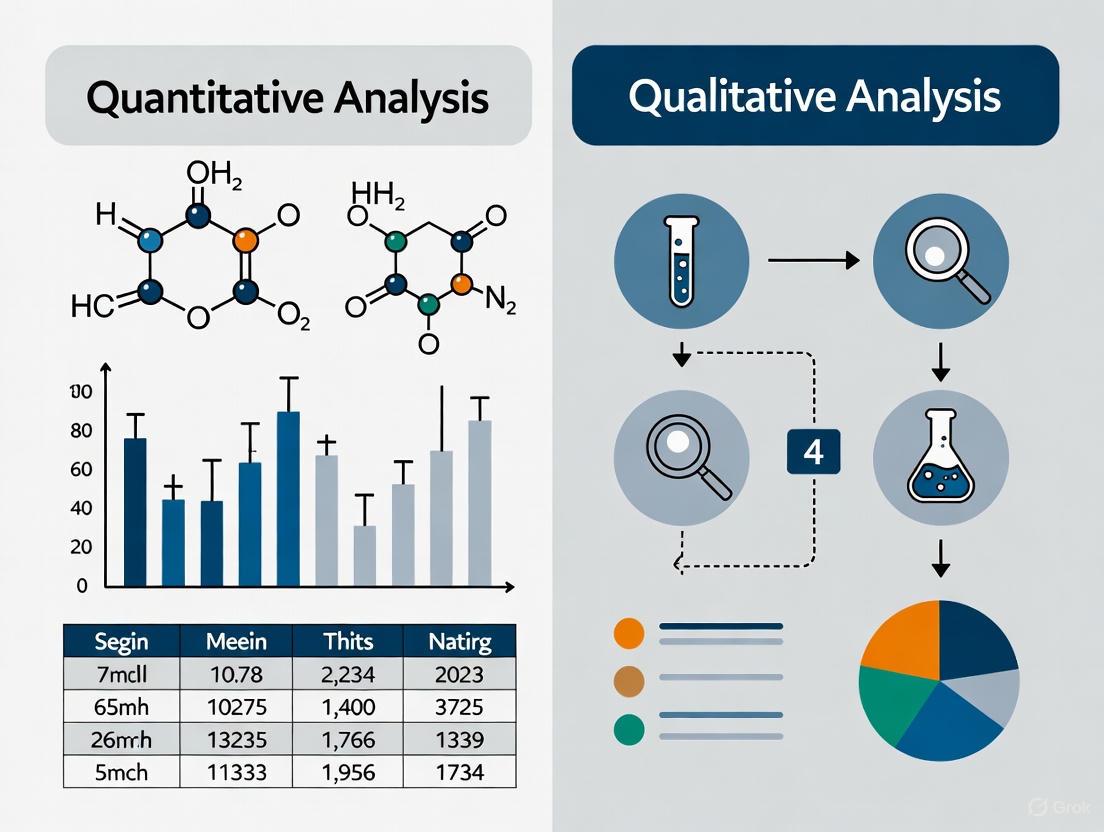
This article provides a comprehensive guide for researchers, scientists, and drug development professionals on the strategic application of quantitative and qualitative environmental analysis.
Quantitative vs Qualitative Environmental Analysis: A Strategic Guide for Biomedical Research
Abstract
This article provides a comprehensive guide for researchers, scientists, and drug development professionals on the strategic application of quantitative and qualitative environmental analysis. It explores the foundational principles of both methodologies, detailing their specific applications in areas like exposure assessment and analytical chemistry. The content further addresses troubleshooting common challenges, optimizing data quality, and validating methods using modern frameworks like White Analytical Chemistry (WAC). By comparing the strengths and limitations of each approach, this guide empowers professionals to design more robust, sustainable, and impactful research studies in biomedical and clinical contexts.
Core Principles: When to Use Qualitative vs Quantitative Analysis in Environmental Science
In environmental science, the pursuit of knowledge is guided by two distinct yet complementary paradigms: objective measurement and subjective understanding. The positivist approach of objective measurement seeks to quantify environmental realities through observable, consistent facts independent of human cognition [1]. In contrast, the interpretivist approach of subjective understanding explores how people perceive, experience, and ascribe meaning to their environmental surroundings, recognizing that reality is filtered through human interpretation [1].
This guide provides a structured comparison of these paradigms, detailing their methodological applications, experimental protocols, and appropriate contexts within environmental and public health research. We present synthesized quantitative data, standardized workflows, and essential research tools to equip scientists and drug development professionals with a comprehensive framework for selecting and implementing these approaches in their investigative work.
Core Definitions and Characteristics
Objective Measurement
Objective assessment uses clearly defined, standardized criteria to measure knowledge, skills, or performance through methods that yield a single correct answer or fixed scoring system [2]. This approach ensures consistency, fairness, and minimal bias across all participants or data points [3] [2].
Key Characteristics:
- Quantitative Focus: Deals with numerical data that is easily evaluated and measured [4].
- Fact-Based: Relies on information obtained through established facts or resources [4].
- Consistency: Results remain stable and predictable across different contexts and researchers [2].
- Verifiability: Data can be consistently verified through transparent methodologies and replication [4].
Subjective Understanding
Subjective assessment relies on open-ended responses and evaluator judgment to interpret reasoning, creativity, and complex thought processes [2]. It explores qualitative aspects of human experience that cannot be reduced to single answers [3].
Key Characteristics:
- Qualitative Focus: Concerned with interpretation-based data that explains why or how phenomena occur [4].
- Experience-Based: Derived from feelings, opinions, experiences, and personal thoughts [4].
- Context-Dependent: Findings may vary based on individual perspectives and situational factors [3].
- Interpretive Nature: Requires researcher interpretation to make sense of multifaceted responses [2].
Comparative Analysis: Applications and Limitations
Table 1: Comparative Analysis of Objective and Subjective Approaches
| Aspect | Objective Measurement | Subjective Understanding |
|---|---|---|
| Primary Data Type | Quantitative [4] | Qualitative [4] |
| Data Collection Methods | Multiple-choice questions, true/false, fill-in-the-blank, matching, GIS/GPS data, accelerometry [3] [2] [5] | Interviews (one-on-one, group), essays, observations, document analysis, focus groups [3] [2] [1] |
| Analysis Approach | Statistical analysis, standardized scoring, algorithmic processing [2] [5] | Thematic analysis, interpretation, pattern identification, narrative description [1] |
| Key Strengths | High reliability, consistency, scalability, efficient for large datasets, minimizes bias through standardization [3] [2] | Captures complex reasoning, explores underlying motivations, contextual richness, adapts to emerging themes [3] [2] |
| Principal Limitations | May overlook deeper conceptual understanding, restricts personal expression, limited capacity to capture creative thinking [2] | Time-intensive analysis, potential scoring inconsistency, vulnerable to various biases, challenging with large samples [3] [2] |
| Ideal Application Contexts | Testing factual knowledge, measuring specific physical parameters, large-scale studies, standardized assessments [3] [6] | Exploring perceptions, understanding complex behaviors, investigating social dimensions of environmental issues [7] [1] |
Table 2: Environmental Research Applications and Findings
| Research Domain | Objective Approach | Subjective Approach | Key Findings |
|---|---|---|---|
| Built Environment & Physical Activity | GIS-derived neighborhood measures, accelerometry [6] [5] | Self-reported perceptions of environment, interview responses [6] | Objective measures showed stronger associations with walking behaviors than subjective perceptions in comparative studies [6] |
| Environmental Health Exposures | Physical/chemical exposure monitoring, biological sampling [1] | Lay perception studies, community narratives, focus groups [1] | Qualitative data improve understanding of complex exposure pathways, including social factor influences [1] |
| Sustainability Behaviors | Resource consumption metrics, ecological footprint calculations | Surveys on environmental attitudes, values, and behavioral intentions [7] | Integrating well-being and behavior research helps anticipate behavioral responses to environmental policies [7] |
| Environmental Governance | Satellite imagery, regulatory compliance data | Q-methodology to identify stakeholder perspectives [8] | Mixed-methods reveal diverse social perspectives on resource management while highlighting methodological reporting gaps [8] |
Experimental Protocols and Methodological Standards
Objective Measurement Protocol: Built Environment and Physical Activity
Overview: This protocol details the objective assessment of relationships between built environment features and physical activity levels using Geographic Information Systems (GIS) and accelerometry [5].
Step-by-Step Workflow:
Participant Recruitment and Sampling:
- Recruit adult participants (≥18 years) without disabilities or long-term health conditions that significantly limit physical activity [5].
- Collect demographic information including age, gender, socioeconomic status, and ethnicity, ensuring diverse representation [5].
- Obtain informed consent and ethical approval following institutional guidelines.
Geocoding Participant Locations:
Built Environment Data Collection:
- Source objective built environment data from standardized databases, including:
- Land use mix (diversity of residential, commercial, institutional uses)
- Street connectivity (intersection density, street network design)
- Access to destinations (parks, recreational facilities, retail)
- Neighborhood walkability (composite indices) [5]
- Process data using consistent, reproducible GIS methodologies.
- Source objective built environment data from standardized databases, including:
Physical Activity Measurement:
- Utilize accelerometers (e.g., ActiGraph, Axivity) to objectively measure physical activity intensity and duration [5].
- Instruct participants to wear devices during waking hours for a minimum of 4-7 days, including weekdays and weekends [5].
- Apply standardized data processing protocols to categorize activity into intensity levels (sedentary, light, moderate, vigorous) [5].
Data Integration and Statistical Analysis:
- Merge built environment metrics with physical activity data using unique participant identifiers.
- Employ multivariate regression models adjusting for demographic covariates.
- Calculate association strengths using odds ratios, p-values, and model fit statistics [6].
Subjective Understanding Protocol: Qualitative Environmental Health Research
Overview: This protocol employs qualitative methods to understand how people perceive, interpret, and experience environmental health issues, providing depth and context to quantitative findings [1].
Step-by-Step Workflow:
Research Design and Question Formulation:
- Develop open-ended research questions focused on understanding perceptions, experiences, and beliefs about environmental exposures [1].
- Select appropriate qualitative methodologies (e.g., ethnography, phenomenology, grounded theory) based on research aims.
- Practice reflexivity by explicitly considering and documenting researchers' theoretical perspectives and potential biases [1].
Participant Selection and Recruitment:
- Use purposive sampling to identify information-rich participants who have experienced the environmental phenomenon under study [1].
- Consider theoretical sampling to develop emerging categories in iterative research designs.
- Continue recruitment until reaching theoretical saturation (no new themes emerge from additional data).
Data Collection Procedures:
- Conduct one-on-one interviews using open-ended questions that allow participants to express their perspectives without predetermined response categories [1].
- Consider supplementary methods such as focus groups, participant observation, or document analysis to triangulate findings.
- Audio-record and professionally transcribe interviews verbatim to preserve data integrity.
Qualitative Data Analysis:
- Immerse in data through repeated reading of transcripts to gain familiarity with content.
- Apply systematic coding procedures to identify key concepts, themes, and patterns.
- Use constant comparative analysis to refine categories and explore relationships between themes.
- Support interpretations with direct participant quotes and narrative descriptions in research outputs [1].
Theoretical Development and Validation:
- Develop theoretical explanations that connect findings to broader constructs in environmental health.
- Implement member checking by returning preliminary findings to participants for verification.
- Document analytical decisions and methodological transparency to establish trustworthiness.
The Scientist's Toolkit: Essential Research Reagents and Materials
Table 3: Essential Tools for Environmental Data Collection and Analysis
| Tool/Reagent | Primary Function | Research Application |
|---|---|---|
| Accelerometers (ActiGraph, Axivity) | Objective measurement of physical activity intensity, duration, and frequency through motion sensors [5] | Quantifying moderate-to-vigorous physical activity levels in built environment studies; validating self-reported activity data [5] |
| Geographic Information Systems (GIS) | Spatial analysis and mapping of environmental features; calculation of built environment metrics around specific locations [5] | Measuring walkability indices, land use mix, green space access, and destination density in neighborhood studies [6] [5] |
| Global Positioning System (GPS) Devices | Precise location tracking to document environmental exposures and activity spaces in real-time [5] | Linking specific geographical locations with physical activity patterns; identifying frequently visited destinations [5] |
| Qualitative Interview Guides | Structured protocols with open-ended questions to explore participant experiences and perceptions [1] | Investigating lay understandings of environmental health risks; exploring community concerns about local contamination [1] |
| Q-Methodology Sets | Structured sorting of statements to identify shared perspectives and subjective viewpoints [8] | Measuring social perspectives on sustainability issues, environmental governance, and resource management conflicts [8] |
| Audio Recording Equipment | High-fidelity capture of interview and focus group discussions for accurate transcription and analysis [1] | Preserving nuanced participant responses, emotional tones, and contextual details in qualitative data collection [1] |
Integration and Complementary Applications
The most robust environmental research often integrates both objective measurement and subjective understanding through mixed-methods designs [1]. This triangulation approach leverages the strengths of each paradigm while mitigating their respective limitations.
Successful Integration Strategies:
Sequential Explanatory Design: Objective measures identify patterns or relationships, followed by qualitative methods to explain the underlying mechanisms and contextual factors [1].
Convergent Parallel Design: Independent collection and analysis of quantitative and qualitative data, with integration during interpretation to develop comprehensive understanding [1].
Embedded Design: One paradigm provides supportive, contextualizing data within a study primarily based on the other paradigm [1].
Environmental health research exemplifies this integration, where qualitative data "improve understanding of complex exposure pathways, including the influence of social factors on environmental health, and health outcomes" [1]. Similarly, sustainability research benefits from integrating well-being and behavior studies to anticipate how people respond to environmental policies and changes [7].
The choice between objective measurement and subjective understanding depends primarily on the research question, purpose, and context. Objective approaches are optimal for standardized assessment of factual knowledge, physical parameters, and large-scale comparative studies [3] [2]. Subjective approaches are indispensable for exploring complex perceptions, motivations, and the human dimensions of environmental issues [3] [1].
Rather than positioning these paradigms as opposites, forward-looking environmental research recognizes their complementary value. The most impactful studies strategically employ both approaches to develop nuanced, comprehensive understandings of environmental challenges and solutions. By applying the appropriate methodological standards, experimental protocols, and analytical frameworks outlined in this guide, researchers can effectively leverage both paradigms to advance environmental science and policy.
In environmental analysis research, the choice between numerical data and descriptive information fundamentally shapes the research design, methodology, and interpretation of findings. Numerical data, often termed quantitative data, consists of information that can be counted or measured and expressed numerically. This type of data is used to quantify attitudes, opinions, behaviors, and other defined variables to formulate facts and uncover patterns in research [9]. Conversely, descriptive information, typically referred to as qualitative data, encompasses descriptive and conceptual findings collected through language, words, and narratives. It focuses on verbal accounts and offers detailed narratives of personal experiences, providing a richly textured grasp of social occurrences by providing insights into their complexity [9]. Within the context of environmental analysis, these two data forms serve complementary yet distinct roles in helping researchers, scientists, and drug development professionals understand complex ecological systems, environmental impacts, and sustainability challenges.
The distinction between these data types extends beyond mere format differences to encompass fundamentally different approaches to understanding reality. Quantitative research emphasizes objective measurements and the statistical, mathematical, or numerical analysis of data collected through polls, questionnaires, and surveys, or by manipulating pre-existing statistical data using computational techniques [10]. Qualitative research, in contrast, seeks to explore and understand the meaning individuals or groups ascribe to a social or human problem, with researchers building a complex, holistic picture, analyzing words, reporting detailed views of informants, and conducting the study in a natural setting [11]. This article provides a comprehensive comparison of these approaches, specifically framed within environmental analysis research, to guide professionals in selecting appropriate methodologies for their investigative needs.
Core Characteristics and Philosophical Underpinnings
Nature and Form of Data
The fundamental distinction between numerical and descriptive data lies in their basic form and characteristics. Numerical data is structured and statistical in nature, represented through numbers, values, and quantities that can be mathematically processed and analyzed. This data type is typically collected in controlled environments using standardized instruments designed to minimize bias and maximize reliability. The numerical nature of this data allows for precise measurement and comparison across different studies, time periods, or environmental contexts. For example, in environmental drug development, quantitative approaches might measure precise concentrations of pharmaceutical compounds in water systems, pollution levels in various ecosystems, or statistically significant changes in biodiversity metrics [10].
Descriptive information, by contrast, is unstructured and conceptual, taking the form of words, descriptions, narratives, and visual representations rather than numerical values. This data type is inherently subjective and contextual, capturing nuances, complexities, and underlying meanings that numbers alone cannot convey. In qualitative environmental research, this might include detailed field observations of ecological systems, in-depth interviews with community members affected by environmental changes, or case studies analyzing the implementation of environmental policies [12]. The richness of descriptive information lies in its ability to capture the complexity of environmental phenomena in their natural settings, providing insights into the human dimensions of environmental issues that quantitative approaches might overlook.
Philosophical Foundations
The divergence between numerical and descriptive data extends to their underlying philosophical assumptions about knowledge and reality. Quantitative research typically aligns with a positivist paradigm, which operates on the assumption that reality is objective, singular, and separate from the researcher. This perspective maintains that environmental phenomena can be understood through observation and measurement, with the goal of developing generalizable truths that apply across different contexts. The researcher remains independent from what is being researched, aiming for objectivity and distance to prevent personal biases from influencing the results [10].
Qualitative research, conversely, generally embraces constructivist or interpretive frameworks, which posit that reality is socially constructed, multiple, and intertwined with the researcher. From this viewpoint, environmental understanding emerges through the interpretation of contextualized experiences, with researchers actively engaging with participants to co-construct meaning. Rather than seeking a single objective truth, qualitative approaches acknowledge multiple realities and perspectives, particularly valuable in environmental research when understanding diverse stakeholder viewpoints, cultural relationships with nature, or community-based environmental knowledge systems [11] [12].
Methodological Approaches and Research Designs
Quantitative Research Designs and Methods
Quantitative research employs several distinct designs tailored to different research questions in environmental analysis. Experimental designs utilize the scientific approach, establishing procedures that allow researchers to test hypotheses and systematically study causal relationships among environmental variables. True experiments involve randomly assigning subjects to different groups, implementing different interventions or conditions, and measuring outcomes to determine cause-effect relationships. For instance, researchers might employ experimental designs to test the efficacy of new environmental remediation techniques or to establish causal relationships between specific pollutants and biological effects [10] [12].
Quasi-experimental designs attempt to establish cause-effect relationships but lack random assignment of subjects to groups. Instead, participants are assigned to groups based on non-random criteria or pre-existing attributes. In environmental research, this might involve comparing ecosystems exposed to different levels of pollutants where random assignment is impossible, yet researchers still seek to draw inferences about potential causal mechanisms [10].
Descriptive quantitative designs focus on measuring variables and establishing associations without manipulating them. This observational approach includes methods like cross-sectional studies (analyzing variables at a single point in time), prospective or longitudinal studies (tracking variables and outcomes over extended periods), and case-control studies (comparing cases with certain attributes to controls without them). Environmental scientists might use these designs to document pollution patterns, track climate change indicators, or correlate environmental factors with public health outcomes without intervening in natural systems [10] [13].
Correlational designs examine relationships between variables without attributing causation. These studies measure two or more variables and determine how closely they are related, enabling predictions but not definitive causal conclusions. In environmental science, correlational research might explore relationships between industrial activity and air quality, between deforestation rates and rainfall patterns, or between agricultural practices and soil health indicators [10] [12].
Qualitative Research Approaches and Strategies
Qualitative research employs distinct methodological approaches tailored to understanding complex environmental phenomena in depth. Case studies provide intensive, detailed examination of a single instance or phenomenon, such as a specific environmental policy implementation, a particular ecosystem response to stress, or a community's adaptation to environmental change. This approach allows researchers to retain the holistic and meaningful characteristics of real-life events while providing rich, contextual insights that might be lost in broader quantitative studies [12] [13].
Observational research involves systematically watching and recording behavior, interactions, or processes in their natural settings without intervention. In environmental research, this might include ethnographic studies of human-environment interactions, direct observation of ecological systems, or participatory observation where researchers engage in environmental management activities alongside community members. The key strength of observational methods lies in their ability to capture authentic behaviors and processes as they naturally occur, free from the artificiality of controlled experimental settings [12].
Interview and focus group strategies utilize direct personal interaction to gather rich, detailed perspectives on environmental issues. Interviews may be structured, semi-structured, or unstructured, allowing for varying degrees of flexibility in exploring emergent topics. Focus groups facilitate group discussions that can reveal collective understandings, cultural values, or shared concerns about environmental challenges. These approaches are particularly valuable for understanding the human dimensions of environmental issues, including perceptions of risk, values associated with nature, and community responses to environmental policies or changes [11] [12].
Table 1: Comparative Analysis of Research Methods in Environmental Studies
| Method | Primary Function | Environmental Application Examples | Key Strengths | Principal Limitations |
|---|---|---|---|---|
| Experimental Design | Establish cause-effect relationships through variable manipulation | Testing efficacy of remediation techniques; determining pollutant toxicity | High internal validity; clear causal inference | Artificial conditions may not reflect real-world complexity; ethical constraints |
| Quasi-experimental Design | Approximate cause-effect relationships without random assignment | Comparing impacted vs. non-impacted ecosystems; evaluating policy implementations | Practical when randomization impossible; higher real-world relevance | Potential confounding variables; weaker causal claims |
| Descriptive Quantitative Design | Document and describe characteristics, frequencies, patterns | Environmental monitoring; biodiversity inventories; pollution mapping | Identifies patterns and trends; provides baseline data | Cannot establish causation; may miss contextual factors |
| Correlational Design | Identify relationships and predictive patterns between variables | Linking climate variables to ecosystem responses; connecting land use to water quality | Identifies interrelated factors; enables prediction | Correlation does not imply causation; third variable problems |
| Case Study | In-depth investigation of a single instance in its real-world context | Analyzing specific environmental disasters; studying successful conservation programs | Rich, contextual details; holistic perspective | Limited generalizability; potential researcher bias |
| Observational Research | Document natural behaviors and processes without intervention | Studying human-wildlife interactions; observing ecosystem recovery processes | Captures authentic behavior in natural context | Time-consuming; potential observer effect; interpretation challenges |
| Interviews/Focus Groups | Explore perspectives, experiences, and meanings in depth | Understanding stakeholder values; exploring community responses to environmental changes | Rich, detailed data; explores complexity of human perspectives | Small samples; potential social desirability bias; analysis complexity |
Data Collection Techniques and Instruments
Quantitative Data Collection Methods
Quantitative research in environmental science employs structured, standardized instruments designed to generate numerical data amenable to statistical analysis. Surveys and questionnaires represent one of the most common quantitative tools, utilizing closed-ended questions with predetermined response options that can be easily quantified and analyzed. Environmental researchers might deploy surveys to measure public attitudes toward conservation policies, assess community awareness of environmental issues, or gather standardized data on environmental behaviors across large populations. The strength of surveys lies in their ability to efficiently collect comparable data from large samples, though they may miss contextual nuances and depth of understanding [10] [13].
Systematic environmental measurements involve standardized protocols for collecting physical, chemical, or biological data using specialized instruments and precise methodologies. This might include air or water quality monitoring, biodiversity assessments using standardized sampling techniques, satellite imagery analysis for land use classification, or laboratory analysis of environmental samples. These methods prioritize accuracy, precision, and reproducibility, generating the robust numerical data required for environmental modeling, regulatory compliance determination, and trend analysis. The objectivity and comparability of systematic measurements make them indispensable for environmental monitoring and impact assessment [10].
Structured observations employ predefined categories and recording protocols to convert observable phenomena into quantifiable data. Unlike qualitative observations that seek rich description, structured observations use coding schemes, checklists, or rating scales to systematically record specific behaviors, events, or conditions. Environmental researchers might use structured observations to document wildlife behaviors according to established ethograms, classify land use patterns according to standardized categorization systems, or record human activities in natural areas using predetermined activity codes. This approach combines the real-world relevance of observation with the standardization required for quantitative analysis [12].
Qualitative Data Collection Approaches
Qualitative data collection methods prioritize depth, context, and richness of understanding through more flexible, emergent approaches. In-depth interviews utilize open-ended questions and conversational formats to explore participants' perspectives, experiences, and meanings in rich detail. In environmental research, interviews might explore how indigenous communities perceive environmental changes, how farmers make decisions about sustainable practices, or how policymakers balance economic and environmental considerations. The flexible nature of qualitative interviews allows researchers to pursue unexpected insights and adapt questioning to emergent themes, providing nuanced understanding of complex environmental issues [11] [12].
Focus groups facilitate group discussions that generate insights through participant interaction, revealing collective understandings, shared concerns, or divergent viewpoints on environmental topics. Well-suited for exploring complex issues where group dynamics mirror real-world decision-making contexts, focus groups might examine community responses to proposed environmental regulations, explore differing stakeholder perspectives on resource management conflicts, or identify shared values regarding landscape conservation. The group setting can stimulate participants to articulate, refine, or reconsider their views through interaction with others, generating data that reflects social processes rather than merely individual opinions [11].
Participant observation involves researchers immersing themselves in the setting or community being studied, participating in activities while systematically observing and recording details about the environment, interactions, and processes. Environmental anthropologists might use this approach to understand community-based resource management systems, while conservation biologists might employ it to study the implementation of conservation programs in specific cultural contexts. The extended engagement characteristic of participant observation allows researchers to develop trust, understand contextual factors, and observe processes over time, providing insights that would be inaccessible through more detached methods [12].
Document analysis systematically examines existing texts, records, and visual materials as sources of qualitative data. Environmental historians might analyze archival documents to understand historical landscape changes, while policy researchers might examine meeting minutes, reports, and media coverage to trace the development of environmental policies. This approach leverages existing materials as data sources, providing historical depth and contextual understanding without requiring new data collection, though researchers must critically consider the original purposes and potential biases within the documents [12].
Data Analysis and Interpretation Frameworks
Quantitative Analysis Techniques
Quantitative data analysis employs statistical methods to identify patterns, test hypotheses, and draw inferences from numerical data. Descriptive statistics provide summary measures that characterize the central tendency (mean, median, mode), variability (range, standard deviation), and distribution of datasets. Environmental scientists use descriptive statistics to summarize monitoring data, describe environmental conditions, and communicate basic patterns in accessible formats. These techniques transform raw numerical data into meaningful summaries that support initial interpretation and decision-making [10] [9].
Inferential statistics enable researchers to draw conclusions about populations based on sample data, testing hypotheses and determining the probability that observed patterns occurred by chance. Common inferential techniques include t-tests (comparing two groups), ANOVA (comparing multiple groups), correlation analysis (examining relationships between variables), and regression analysis (modeling and predicting relationships). Environmental researchers might use these methods to determine whether pollution levels differ significantly between sites, identify factors that predict ecosystem health, or model the relationship between climate variables and species distributions. These powerful techniques support generalizations beyond immediate data but require meeting specific statistical assumptions [10] [9].
Multivariate analysis techniques examine complex relationships among multiple variables simultaneously, addressing the multidimensional nature of environmental systems. Methods such as factor analysis, cluster analysis, multidimensional scaling, and structural equation modeling help identify underlying patterns, group similar cases, or test complex theoretical models. Environmental scientists might apply these approaches to identify suites of correlated environmental stressors, classify ecosystems into functional types, or model the direct and indirect pathways through which human activities affect ecological outcomes. These sophisticated techniques can reveal patterns invisible to simpler analyses but require larger sample sizes and specialized expertise [9].
Qualitative Analysis Approaches
Qualitative analysis involves systematic approaches to identify patterns, themes, and meanings within non-numerical data. Thematic analysis provides a foundational approach for identifying, analyzing, and reporting patterns (themes) within qualitative data. It involves familiarization with data, generating initial codes, searching for themes, reviewing themes, defining and naming themes, and producing the analysis. Environmental researchers might use thematic analysis to identify recurring concerns in community responses to environmental projects, dominant frames in media coverage of conservation issues, or shared values expressed in interviews about landscape change. The flexibility of thematic analysis makes it widely applicable across various qualitative traditions [11] [9].
Content analysis systematically categorizes and counts the frequency of specific words, phrases, concepts, or themes within texts, bridging qualitative and quantitative approaches. While often producing numerical outputs (frequencies), it maintains qualitative attention to meaning and context. Environmental communication researchers might content analyze media coverage of climate change, policy documents addressing sustainability, or public comments on environmental impact statements. The structured nature of content analysis enhances transparency and reproducibility while maintaining connection to qualitative meaning [9].
Narrative analysis examines the stories, accounts, and narratives people use to describe and make sense of environmental experiences and phenomena. This approach focuses on how people structure their experiences temporally, select and emphasize certain events, and position themselves within their stories. Environmental researchers might use narrative analysis to understand how communities remember and recount environmental disasters, how scientists describe their relationship with studied ecosystems, or how different stakeholders story the history of environmental conflicts. This approach reveals how meaning is constructed through storytelling and how narratives shape environmental understanding and action [11].
Discourse analysis examines how language constructs and reflects social realities, power relationships, and knowledge claims about the environment. Going beyond what people say to analyze how they say it, discourse analysis explores linguistic features, rhetorical strategies, and conversation structures. Environmental researchers might analyze how scientific certainty/uncertainty is discursively constructed in climate debates, how different stakeholders frame environmental problems and solutions, or how power relationships are enacted in environmental decision-making processes. This approach reveals how language shapes environmental understanding, identities, and social actions [11].
Table 2: Data Analysis Techniques Comparison
| Analysis Method | Primary Function | Typical Outputs | Software Tools | Environmental Application Examples |
|---|---|---|---|---|
| Descriptive Statistics | Summarize and describe basic features of datasets | Measures of central tendency, variability, frequency distributions | SPSS, R, Excel | Summarizing monitoring data; describing baseline environmental conditions |
| Inferential Statistics | Draw conclusions about populations from samples; test hypotheses | Significance tests, confidence intervals, effect sizes | SPSS, R, SAS | Comparing impacted and control sites; testing intervention effectiveness |
| Multivariate Analysis | Examine complex relationships among multiple variables | Classification systems, dimension reduction, causal models | R, SPSS, SAS | Identifying environmental gradients; modeling ecosystem responses to multiple stressors |
| Thematic Analysis | Identify, analyze, and report patterns/themes across qualitative datasets | Identified themes with supporting evidence and interpretations | NVivo, Dedoose, Atlas.ti | Analyzing stakeholder perspectives; identifying emergent concerns in community responses |
| Content Analysis | Systematically categorize and quantify content of texts | Frequencies of codes/categories; conceptual maps | NVivo, MAXQDA, CATMA | Tracking media framing of environmental issues; analyzing policy documents |
| Narrative Analysis | Examine story structure, content, and function in accounts | Narrative typologies; plot analyses; positioning analyses | NVivo, Dedoose | Understanding community environmental memories; analyzing scientist fieldwork stories |
| Discourse Analysis | Examine how language constructs social realities | Identified discursive patterns; rhetorical strategies; framing analyses | NVivo, Atlas.ti | Analyzing environmental debates; examining how scientific knowledge is communicated |
Visualization Methods for Different Data Types
Quantitative Data Visualization
Effective visualization of numerical data enables environmental researchers to communicate patterns, trends, and relationships clearly and efficiently. Bar and column charts represent categorical data with rectangular bars whose lengths/heights are proportional to the values they represent. These charts excel at comparing values across different categories, such as pollution levels across different sites, species counts across habitat types, or resource allocations across different conservation programs. For environmental data with long category labels, bar charts (horizontal bars) typically provide better readability than column charts (vertical bars) [14] [15].
Line charts display data points connected by straight lines, effectively showing trends over time. Environmental scientists frequently use line charts to visualize changes in climate variables, pollutant concentrations, population sizes, or ecosystem indicators across temporal scales. The connected points emphasize continuity and directionality, making line charts ideal for showing patterns, progressions, and forecasting future environmental conditions based on historical trends [15].
Scatter plots represent the relationship between two continuous variables by displaying data points on a horizontal and vertical axis. These visualizations help identify correlations, clusters, and outliers in environmental data, such as relationships between temperature and species richness, between pollutant concentration and distance from source, or between multiple environmental stressors. The distribution of points reveals the strength and direction of relationships, informing statistical analysis and model development [15].
Histograms approximate the distribution of a continuous numerical dataset by dividing the data into bins (intervals) and counting frequency within each bin. Unlike bar charts that display categorical data, histograms visualize the underlying frequency distribution of continuous variables, helping environmental researchers assess normality, identify skewness, and detect outliers in measurements like pollutant concentrations, organism sizes, or environmental gradient responses [15].
Qualitative Data Visualization
Visualization of qualitative data helps represent patterns, relationships, and conceptual structures emerging from descriptive information. Concept maps diagram proposed relationships between concepts, ideas, or themes, typically represented as boxes or circles connected by labeled arrows in a hierarchical structure. Environmental researchers might use concept maps to visualize stakeholder mental models of ecosystem functioning, theoretical frameworks guiding conservation programs, or interconnected factors affecting environmental decision-making. These visualizations help synthesize complex qualitative findings into coherent conceptual frameworks [11].
Flow charts and process diagrams illustrate sequences, procedures, or causal pathways identified in qualitative analysis. These visualizations might map environmental management decision processes, community adaptation strategies to environmental change, or implementation pathways for conservation interventions. By making processes explicit, these diagrams facilitate understanding of complex sequences and identify potential leverage points or bottlenecks in environmental systems [11].
Network diagrams display relationships and connections between actors, organizations, or concepts, represented as nodes (points) and edges (connecting lines). Environmental governance researchers might use network diagrams to visualize collaboration patterns among conservation organizations, information flows in environmental management systems, or influence relationships among stakeholders in environmental conflicts. These visualizations reveal structural patterns that might be difficult to discern from textual data alone [11].
The following diagram illustrates the decision-making process for selecting appropriate research methodologies based on study goals in environmental research:
Experimental Protocols and Methodological Rigor
Ensuring Quantitative Research Validity
Quantitative research employs specific protocols to ensure validity, reliability, and generalizability in environmental studies. Experimental controls involve managing variables to isolate cause-effect relationships, including control groups (not receiving experimental treatment), random assignment (distributing confounding variables equally across groups), and blinding (preventing bias in treatment administration or outcome assessment). In environmental experimental research, this might involve control sites matching experimental sites in all characteristics except the intervention, randomized placement of sampling units, or blinded assessment of environmental outcomes to prevent measurement bias. These controls strengthen causal inferences but present challenges in complex environmental systems where complete control is often impossible [10] [12].
Measurement reliability addresses the consistency and stability of data collection instruments and procedures. Environmental researchers establish reliability through methods like test-retest reliability (consistent results over time), inter-rater reliability (agreement between different observers or instruments), and internal consistency (coherence between multiple measurement items targeting the same construct). In environmental monitoring, this might involve calibrating instruments regularly, training multiple observers to consistent standards, or using multiple indicators to measure complex environmental concepts. High reliability ensures that measurements reflect actual phenomena rather than random error [10].
Sampling approaches in quantitative research prioritize statistical representativeness to support generalizations to broader populations. Probability sampling methods (simple random, systematic, stratified, cluster) ensure that each element of the population has a known, non-zero probability of selection. Environmental researchers might use stratified random sampling to ensure representation across different habitat types, systematic sampling along environmental gradients, or cluster sampling when complete population lists are unavailable. Appropriate sampling designs balance practical constraints with statistical requirements to support valid population inferences [10].
Ensuring Qualitative Research Trustworthiness
Qualitative research establishes methodological rigor through different frameworks emphasizing credibility, transferability, and confirmability rather than traditional validity and reliability. Triangulation uses multiple data sources, methods, investigators, or theories to cross-verify findings and overcome the limitations of single approaches. Environmental qualitative researchers might triangulate interview data with documentary evidence, combine observations with participatory mapping, or bring multiple disciplinary perspectives to interpret complex environmental phenomena. Convergence across different approaches strengthens confidence in findings, while discrepancies provide opportunities for deeper understanding [11] [12].
Reflexivity involves critical self-reflection by researchers about their assumptions, values, biases, and how these might shape the research process and interpretations. Environmental researchers practice reflexivity through maintaining research journals documenting decision processes, examining how their positionality (disciplinary background, institutional affiliation, personal values) might influence what they notice and how they interpret it, and openly addressing potential conflicts of interest in environmental controversies. Rather than attempting value-neutrality (as in quantitative approaches), reflexivity acknowledges and manages researcher subjectivity as an inherent part of qualitative inquiry [11].
Member checking involves returning preliminary findings to participants to verify accuracy, interpretation, and resonance with their experiences. In environmental research, this might involve sharing interview summaries with participants for correction, presenting preliminary community case study findings for community feedback, or collaborating with stakeholders in developing interpretations of shared environmental experiences. This process enhances factual accuracy, interpretive validity, and ethical respect for participants' meanings, though it requires balancing participant perspectives with researcher analytical insights [12].
Thick description provides detailed, contextualized accounts of research settings, participants, and phenomena that enable readers to assess transferability to other contexts. Unlike the standardized procedural descriptions in quantitative research, thick description in environmental studies might detail the physical setting, historical context, social dynamics, and researcher experiences in sufficient richness that readers can judge which elements might apply to other environmental contexts. This approach supports transferability through contextual understanding rather than statistical representativeness [12].
The Scientist's Toolkit: Essential Research Reagents and Materials
Quantitative Research Instruments
Table 3: Essential Tools for Quantitative Environmental Research
| Tool/Instrument | Primary Function | Application Examples | Technical Considerations |
|---|---|---|---|
| Environmental Sensor Networks | Automated collection of continuous physical, chemical, biological data | Air/water quality monitoring; climate data collection; ecosystem metabolism measurements | Calibration protocols; data management systems; sensor precision and detection limits |
| Laboratory Analytical Equipment | Precise quantification of environmental samples | Spectrophotometers; chromatographs; mass spectrometers; atomic absorption instruments | Standard operating procedures; quality assurance/control; sample preservation methods |
| Statistical Software Packages | Data management, statistical analysis, visualization | R, SPSS, SAS, Python libraries (pandas, scikit-learn) | Algorithm selection; assumption testing; reproducible coding practices |
| Geographic Information Systems (GIS) | Spatial data analysis, mapping, spatial statistics | Habitat mapping; land use change analysis; environmental impact assessment | Coordinate systems; spatial resolution; remote sensing data integration |
| Structured Survey Platforms | Standardized data collection from human participants | Online surveys; interview schedules; structured observation protocols | Sampling frames; question validation; response rate management |
Qualitative Research Instruments
Table 4: Essential Tools for Qualitative Environmental Research
| Tool/Instrument | Primary Function | Application Examples | Technical Considerations |
|---|---|---|---|
| Digital Recording Equipment | High-quality audio/video recording of interviews, focus groups, observations | Recording community meetings; documenting traditional ecological knowledge; capturing environmental practices | File management; transcription protocols; participant consent documentation |
| Qualitative Data Analysis Software | Organization, coding, analysis of textual, audio, visual data | NVivo, MAXQDA, Atlas.ti, Dedoose | Coding schema development; inter-coder reliability; data security and confidentiality |
| Field Note Systems | Systematic documentation of observations, reflections, contextual details | Ecological field journals; participant observation records; ethnographic field notes | Structured templates; reflective components; integration with other data sources |
| Participatory Research Tools | Collaborative knowledge production with stakeholders | Participatory mapping; community workshops; photovoice; future scenario exercises | Facilitation skills; power dynamics management; co-analysis processes |
| Interview/Focus Group Protocols | Flexible guides for qualitative data collection | Semi-structured interview guides; focus group question routes; participant recruitment materials | Question phrasing; sequencing; pilot testing; ethical considerations |
Integrated Mixed-Methods Approaches in Environmental Research
The most robust environmental research often integrates quantitative and qualitative approaches to leverage their complementary strengths. Sequential designs collect and analyze one type of data first, then use those findings to inform subsequent collection of the other data type. This might involve initial qualitative interviews to identify important variables later measured quantitatively, or initial quantitative surveys to identify outliers or patterns later explored qualitatively. Environmental researchers might begin with community interviews to understand local environmental concerns, then design quantitative surveys to measure the prevalence of these concerns across broader populations [11] [9].
Concurrent designs collect both quantitative and qualitative data simultaneously, then integrate findings during interpretation. This approach might combine quantitative ecological measurements with qualitative observations of management practices, or statistical analysis of environmental trends with discourse analysis of policy debates. The parallel data streams provide both statistical patterns and contextual understanding, offering a more comprehensive picture of complex environmental issues than either approach alone [11] [9].
Embedded designs use a primary method (quantitative or qualitative) supplemented by secondary method data to address different research questions. A primarily quantitative experimental study might embed qualitative interviews to understand implementation challenges, while a primarily qualitative case study might incorporate quantitative documentation to contextualize findings. Environmental researchers might embed qualitative process evaluation within quantitative impact assessments, or include quantitative background data to contextualize in-depth qualitative findings [11].
The integration of quantitative and qualitative approaches requires careful planning but offers significant benefits for environmental research. As noted in organizational research, "The integration of both quantitative and qualitative data enhances research validity, allowing for a comprehensive understanding of subjects through a mixed methods approach" [11]. This integration helps researchers balance breadth and depth, generalize while respecting context, and measure outcomes while understanding processes—all crucial for addressing complex environmental challenges.
The choice between numerical data and descriptive information in environmental research design should be guided by the specific research questions, purposes, and contexts of investigation. Quantitative approaches excel when research requires generalizable findings, precise measurement, hypothesis testing, or statistical modeling of environmental phenomena. Qualitative approaches prove indispensable when seeking to understand complex social-ecological systems, explore understudied phenomena, give voice to diverse perspectives, or develop contextualized understandings of environmental processes.
Rather than viewing these approaches as competing alternatives, environmental researchers increasingly recognize their complementary value within mixed-methods frameworks. As one analysis notes, "By integrating both methodologies, researchers can achieve a holistic perspective that captures the complexity of organizational climates," a principle equally applicable to environmental systems [11]. The most insightful environmental research often emerges from strategically combining numerical precision with descriptive richness to address the multifaceted nature of contemporary environmental challenges.
For drug development professionals and environmental researchers, methodological selection should align with specific investigation phases: quantitative methods for establishing prevalence, testing interventions, and modeling systems; qualitative methods for exploring complex phenomena, understanding stakeholder perspectives, and contextualizing findings; and integrated approaches for comprehensive environmental assessment and decision support. This strategic alignment ensures that research designs effectively address environmental questions while generating actionable knowledge for science, policy, and practice.
In environmental analysis research, the journey from initial observation to validated conclusion is structured around two distinct but complementary pillars: exploratory and confirmatory research. This dichotomy frames a fundamental cycle of scientific discovery, where exploratory research aims to generate new hypotheses and uncover patterns, while confirmatory research rigorously tests these pre-specified hypotheses [16] [17]. Within the context of comparing quantitative and qualitative environmental analysis, understanding this distinction is not merely academic; it is essential for designing robust studies, selecting appropriate methodologies, and drawing valid, reproducible conclusions that can inform drug development and environmental policy.
The synergy between these approaches forms the backbone of the scientific method. Exploratory research, often leaning on qualitative methods, delves into the depth and context of human experiences and complex environmental systems, asking "how" and "why" [18] [19]. In contrast, confirmatory research typically employs quantitative methods to measure variables, test causal relationships, and make generalizations, asking "how many" or "how much" [18] [19]. For researchers and scientists, clearly delineating between these modes of investigation is critical to maintaining scientific integrity, as confusing the two can lead to false positives and non-reproducible results, a practice known as HARKing (Hypothesizing After the Results are Known) [16] [20].
Core Concepts and Definitions
What is Exploratory Research?
Exploratory research is an initial, open-ended investigation into a subject where little prior empirical research exists. Its primary aim is to explore an idea, gather preliminary insights, and generate a broader understanding of a phenomenon, often leading to the development of testable hypotheses for future study [16]. This approach is particularly valuable when investigating complex, poorly understood environmental interactions or patient experiences where the relevant variables are not yet fully identified.
The defining characteristics of exploratory research include:
- Flexibility in Design: The research process is adaptive and can evolve as new findings emerge, allowing researchers to pursue interesting leads [19] [17].
- Generation of Theories and Hypotheses: Insights and theories are developed from the patterns found in the collected data, rather than from testing pre-existing theories [19].
- Focus on Sensitivity: The goal is to detect all possible strategies, theories, or connections that might be useful, casting a wide net to avoid missing promising avenues [17].
In environmental science, an exploratory study might use open-ended interviews with communities living near a potential pollutant source to understand their health concerns and experiences, thereby identifying key variables for later quantitative measurement.
What is Confirmatory Research?
Confirmatory research, also known as hypothesis-testing research, follows a structured, pre-specified approach to test specific ideas about the relationships between variables [16] [20]. It is conducted when substantial background knowledge exists, often built upon the findings of prior exploratory studies. The goal is to find compelling evidence for or against a pre-defined hypothesis, thereby drawing firm inferences about a population or phenomenon [16].
The defining characteristics of confirmatory research include:
- Rigid, Pre-specified Design: The study's structure, methods, and primary hypothesis are clearly defined before data collection begins, making the results replicable and comparable [19] [17].
- Testing of Existing Hypotheses: The research sets out to test a specific theory or hypothesis, with the results either supporting or rejecting it [21] [19].
- Focus on Specificity: The aim is to exclude all strategies or explanations that will prove useless, thereby minimizing false positives and justifying the economic and moral costs of further development, such as in clinical trials [17].
A confirmatory study in drug development, for instance, would be a tightly controlled, randomized clinical trial to test the efficacy and safety of a new compound identified in earlier exploratory preclinical investigations.
A Comparative Analysis: Objectives, Methods, and Outputs
The differences between exploratory and confirmatory research extend across the entire research lifecycle, from initial aims to final interpretations. The table below provides a structured, point-by-point comparison of these two research approaches.
Table 1: A Comprehensive Comparison of Exploratory and Confirmatory Research
| Aspect | Exploratory Research | Confirmatory Research |
|---|---|---|
| Primary Aim | To explore, discover, and generate new hypotheses and theories [16] [22]. | To test, confirm, and validate pre-existing hypotheses [16] [21]. |
| Research Question | "Why?" "How?" Focuses on depth and detailed understanding [19]. | "How many?" "How much?" "What is the relationship?" [19]. |
| Typical Data Type | Qualitative (words, images, narratives) or unquantified observations [18] [19]. | Quantitative (numerical, statistical) [18] [19]. |
| Common Methods | In-depth interviews, focus groups, observations, case studies, ethnography [18] [19]. | Controlled experiments, surveys with closed questions, structured observations [18] [19]. |
| Study Design | Flexible, adaptive, and often unstructured to accommodate new insights [16] [19]. | Rigid, pre-specified, and highly structured to minimize bias [16] [19]. |
| Sample Strategy | Smaller, often non-randomized samples (e.g., convenience samples) for in-depth understanding [18] [19]. | Larger, often randomized samples intended to be representative of a population [18] [19]. |
| Role of Researcher | Active participant in the process; subjectivity is acknowledged [19]. | Objective and detached to minimize bias and achieve consistency [19]. |
| Outputs | Detailed descriptions, rich insights, new concepts, and hypotheses for future testing [16] [19]. | Objective, empirical data, statistical conclusions, and generalizable findings [18] [19]. |
| Validity Emphasis | Conceptual validity through corroboration across different lines of experimentation [17]. | Internal and construct validity through controlled conditions and pre-specified designs [17]. |
Visualizing the Research Workflow
The following diagram illustrates the cyclical, complementary relationship between exploratory and confirmatory research within the scientific process.
Experimental Protocols and Data Analysis
Methodologies for Exploratory Research
Exploratory research relies on flexible, iterative protocols designed to capture depth and richness of data. A common methodology is the exploratory sequential design, often used in environmental health to understand complex phenomena.
Table 2: Key Research Reagent Solutions for Qualitative Exploration
| Reagent / Tool | Primary Function in Exploration |
|---|---|
| Semi-Structured Interview Guides | Provides a flexible framework of open-ended questions to explore participant experiences and views without constraining responses [19]. |
| Focus Group Protocols | Facilitates group discussion to explore shared views, social norms, and interactions on a specific topic [19]. |
| CAQDAS (Computer-Assisted Qualitative Data Analysis Software) | Organizes and manages non-numerical data, assisting researchers in coding and identifying emerging themes [18]. |
| Thematic Analysis Framework | A systematic method for identifying, analyzing, and reporting patterns (themes) within qualitative data [19]. |
Detailed Workflow:
- Data Collection: Researchers gather data through methods like in-depth interviews or focus groups. In a study on community response to an environmental change, researchers would conduct interviews in participants' homes or community centers to capture context [19].
- Data Organization: Data is transcribed and organized using CAQDAS [18].
- Coding and Theme Development: Researchers immerse themselves in the data, coding interesting features and systematically collating codes into potential themes. This is an iterative process of going back and forth between the dataset and the emerging themes [19].
- Hypothesis Generation: The final themes and patterns are used to construct a coherent narrative about the data and, crucially, to generate specific, testable hypotheses for future confirmatory research [16] [22].
Methodologies for Confirmatory Research
Confirmatory research requires strict, pre-registered protocols to ensure objectivity and reproducibility. A prime example is the randomized controlled trial (RCT), the gold standard in clinical drug development and increasingly used in environmental toxicology.
Table 3: Essential Reagent Solutions for Confirmatory Analysis
| Reagent / Tool | Primary Function in Confirmation |
|---|---|
| Pre-Registration Protocol | A detailed, time-stamped plan filed before experimentation, specifying the hypothesis, primary outcome, sample size, and analysis plan to prevent HARKing and p-hacking [20] [17]. |
| Standardized Assays & Kits | Validated, reproducible measurement tools (e.g., ELISA kits for biomarker quantification) that ensure consistency and accuracy across samples and studies. |
| Statistical Analysis Software (e.g., R, SPSS) | Used to apply pre-specified statistical models, calculate significance (p-values), and produce estimates with a specified level of confidence (confidence intervals) [23]. |
| Blinding & Randomization Tools | Methods to eliminate bias, such as random number generators for assigning subjects to groups and blinding protocols for researchers and participants [24]. |
Detailed Workflow:
- Pre-registration: The research hypothesis, primary and secondary outcome measures, sample size calculation, and statistical analysis plan are documented in a public repository before the study begins [17].
- Controlled Experimentation: The study is conducted under controlled conditions. For example, in a preclinical efficacy study, animals are randomly assigned to treatment or control groups, and researchers administering the treatment are often blinded to the group assignments [17].
- Confirmatory Data Analysis: Data is analyzed according to the pre-registered plan. This involves testing hypotheses using traditional statistical tools like significance testing (e.g., t-tests, ANOVA) and producing estimates with confidence intervals [23]. Deviation from the plan is considered a breach of confirmatory principles.
- Inference: Based on the statistical evidence, the pre-specified null hypothesis is either rejected or not rejected, providing rigorous evidence for or against the intervention's effect [21].
The following diagram contrasts the high-level workflows of these two research approaches.
The Critical Importance of Distinguishing Between the Two Aims
The failure to clearly separate exploratory and confirmatory research poses a significant threat to the credibility and reproducibility of scientific findings, particularly in fields like drug development and environmental science where the stakes are high.
The most salient risk is HARKing (Hypothesizing After the Results are Known) [16]. This occurs when a researcher formulates a hypothesis after seeing the results of an exploratory analysis and then presents it as if it were the original, a priori hypothesis. This practice leads to false positives because the hypothesis is tailored to fit the specific, often noisy, dataset rather than being independently tested [16] [20]. A finding that appears definitive in one study may fail to generalize or be replicated in subsequent research.
To mitigate these risks and improve translational success, particularly in preclinical research, the following reforms are urged [17]:
- Explicit Demarcation: All research protocols and publications should pre-specify whether they are exploratory or confirmatory.
- Tailored Standards: Journal editors and funding agencies should hold confirmatory studies to higher standards of internal and construct validity, similar to clinical trials, requiring pre-registration, large sample sizes, and fastidious design.
- Promotion of Confirmatory Studies: The research ecosystem should incentivize and fund a greater volume of confirmatory investigation to rigorously test the most promising leads generated by exploratory research.
Exploratory and confirmatory research are not in competition; they are essential, complementary partners in the scientific enterprise. Exploratory research generates the novel hypotheses and theories that drive innovation, while confirmatory research rigorously validates these insights, ensuring they are robust and reproducible [16] [22]. For researchers, scientists, and drug development professionals, the strategic integration of both modes is key to advancing knowledge.
The most powerful approach is often a mixed-methods design, which leverages the strengths of both to provide a more comprehensive understanding [18] [22]. For example, qualitative exploratory interviews can be used to discover the most relevant terms and concepts for a subsequent quantitative survey, the results of which can then be explained through further qualitative follow-up [22]. This triangulation enhances the overall validity and impact of the research.
Therefore, the path forward requires a conscious and disciplined application of both approaches. By clearly framing research aims, choosing methodologies aligned with those aims, and upholding the distinct principles of exploration and confirmation, the scientific community can produce findings that are both deeply insightful and reliably true, ultimately accelerating progress in environmental health and therapeutic development.
In environmental and pharmaceutical research, the choice between quantitative and qualitative methodologies is foundational, shaping the trajectory of an investigation from its core questions to its ultimate conclusions. Quantitative research focuses on numerical data to measure environmental phenomena, asking "how much" or "how many" to identify patterns and test hypotheses. In contrast, qualitative research deals with non-numerical information to understand underlying motivations, perceptions, and experiences, exploring the "why" and "how" [9]. For researchers and drug development professionals, selecting the appropriate approach is not merely an academic exercise; it is a critical strategic decision that determines the validity, applicability, and impact of their work in addressing complex environmental problems.
Core Concept Comparison: Quantitative vs. Qualitative Analysis
The table below summarizes the fundamental distinctions between these two research paradigms.
Table 1: Fundamental Differences Between Quantitative and Qualitative Research Approaches
| Aspect | Quantitative Research | Qualitative Research |
|---|---|---|
| Nature of Data | Numerical, countable, measurable [9] | Descriptive, textual, experiential [9] |
| Core Objective | To measure, predict, and generalize findings from a sample to a population [9] | To gain in-depth understanding, explore complexities, and interpret social phenomena [9] |
| Approach | Deductive (testing a hypothesis) [9] | Inductive (exploring ideas and forming theories) [9] |
| Data Collection Methods | Surveys, polls, experiments, controlled studies [9] | Interviews, focus groups, observations [9] |
| Analysis Techniques | Statistical analysis (e.g., descriptive and inferential statistics) [9] | Thematic analysis, coding, and interpretation [9] |
Application in Environmental and Pharmaceutical Research
The Quantitative Lens: Measuring the Measurable
Quantitative analysis excels at providing objective, comparable data that is essential for benchmarking and statistical modeling.
In environmental studies, this approach is used to track changes in climate metrics, pollution levels, and resource consumption. For instance, a systematic review of climate knowledge research found that the vast majority of studies employ quantitative methods to measure factual, objective knowledge about climate change through standardized instruments [25]. In pharmaceutical development, quantitative data is the bedrock of sustainability metrics. Companies measure solvent volumes, plastic waste, energy consumption, and carbon emissions to quantify their environmental footprint and track progress toward reduction goals [26]. The push for open data in environmental research, where journals now mandate the public sharing of data and code, further underscores the field's reliance on verifiable, quantitative evidence [27].
The Qualitative Lens: Understanding Context and Complexity
Qualitative analysis provides the crucial context behind the numbers, uncovering the human and systemic factors that drive environmental outcomes.
In impact assessment (IA), a shift toward "next-generation IA" requires incorporating social, cultural, and health equity implications. This necessitates robust qualitative methods to meaningfully include diverse knowledges and values, giving decision-makers confidence in the evidence base beyond pure numbers [28]. In the pharmaceutical industry, qualitative insights drive strategic sustainability initiatives. Understanding stakeholder motivations, corporate cultures, and the barriers to adopting green practices (like the pervasive use of virgin plastics) relies on methods like interviews and focus groups [26]. This deep exploration is vital for designing effective change management and policies.
The Power of Integration: Mixed-Methods Approach
The most robust research often integrates both methodologies, a practice known as a mixed-methods approach [9]. This combination allows the strengths of one method to compensate for the weaknesses of the other, leading to a more comprehensive understanding.
For example, a researcher might use a quantitative survey to identify a trend in a community's recycling behavior and then conduct qualitative focus groups to understand the underlying reasons for that trend. This integration enhances validity and reliability through triangulation—verifying a finding with multiple data sources [9].
Experimental Protocols and Workflows
Protocol 1: Quantitative Assessment of Environmental Knowledge
This protocol is adapted from methodologies used in systematic reviews of climate knowledge measurement [25].
- 1. Research Question & Hypothesis Formulation: Define a specific, measurable question (e.g., "What is the level of objective climate knowledge among university students in this region?"). Formulate a testable hypothesis.
- 2. Instrument Design: Develop a structured questionnaire with closed-ended questions. Types of questions include:
- True/False or Multiple-Choice: To assess knowledge of factual statements (e.g., "The primary greenhouse gas is...").
- Likert Scales: To gauge agreement with specific statements (e.g., "I believe human activity is a major cause of climate change" from Strongly Disagree to Strongly Agree).
- 3. Sampling & Data Collection: Use a random or stratified sampling method to recruit a statistically significant number of participants. Administer the survey under standardized conditions.
- 4. Data Analysis: Employ statistical software (e.g., R, Stata). Conduct:
- Descriptive Statistics: Calculate means, frequencies, and standard deviations to summarize the data.
- Inferential Statistics: Use t-tests or ANOVA to compare knowledge scores across different demographic groups.
- 5. Reporting & Data Deposition: Report findings with clear statistical results. As per emerging journal policies, deposit raw data, analysis code, and documentation in a public repository like Harvard Dataverse or Zenodo [27].
Protocol 2: Qualitative Analysis of Sustainability in Drug Development
This protocol is informed by practices discussed at industry conferences like ELRIG 2025 [26] and principles of qualitative impact assessment [28].
- 1. Problem Scoping: Identify a complex problem area (e.g., "Barriers to adopting green chemistry principles in early-stage drug discovery").
- 2. Study Design & Participant Recruitment: Choose a purposive sampling strategy to recruit key informants with relevant expertise (e.g., lab managers, medicinal chemists, procurement officers). Design a semi-structured interview guide or focus group protocol with open-ended questions.
- 3. Data Collection: Conduct in-depth interviews or focus groups. Record and transcribe the sessions verbatim. Maintain detailed field notes to capture non-verbal cues and contextual information.
- 4. Data Analysis: Perform a thematic analysis.
- Familiarization: Immerse in the data by reading transcripts multiple times.
- Coding: Generate initial codes that identify meaningful data segments.
- Theme Development: Collate codes into potential themes, refining them to accurately represent the dataset.
- Reflexivity: Continuously document the researcher's own biases and perspectives to ensure analytical rigor [9] [28].
- 5. Reporting: Present the findings as a rich, narrative account supported by direct quotations that illustrate the identified themes.
The following workflow diagram visualizes the decision process for selecting a research methodology based on the nature of the environmental problem.
The Scientist's Toolkit: Key Reagents and Solutions
Whether in a wet lab or a data lab, research requires specific "reagents" to generate evidence. The following table details essential solutions for conducting environmental and pharmaceutical sustainability research.
Table 2: Key Research Reagent Solutions for Environmental Analysis
| Research Reagent / Solution | Function / Application | Field of Use |
|---|---|---|
| Biodegradable Solvents [29] | Replace traditional, hazardous solvents in drug synthesis and manufacturing to reduce environmental toxicity and waste. | Eco-friendly Drug Manufacturing |
| Green Catalysts [29] | Increase the efficiency of chemical reactions, reducing energy consumption and unwanted byproducts. | Eco-friendly Drug Manufacturing |
| Structured Surveys & Questionnaires [9] [25] | Systematically collect standardized, quantifiable data from a large population for statistical analysis. | Environmental Knowledge, Attitudes and Practices (KAP) Studies |
| Semi-Structured Interview Guides [9] [28] | Provide a flexible framework for in-depth conversations to explore complex experiences, values, and perceptions. | Sustainability Impact Assessment, Barriers to Green Adoption |
| FAIR Data Management Tools [30] | Software and infrastructure to make research data Findable, Accessible, Interoperable, and Reusable, ensuring long-term value. | Research Data Management in Environmental Studies |
| Open Data Repositories (e.g., Zenodo, Harvard Dataverse) [27] | Publicly archive and share research data, code, and output to ensure transparency, replicability, and reuse. | Environmental and Resource Economics, Climatology |
The choice between quantitative and qualitative analysis is not about which is superior, but which is most appropriate for your specific research question within environmental and pharmaceutical science. Quantitative methods are unparalleled for measurement, generalization, and establishing objective facts. Qualitative methods are indispensable for exploring complexity, understanding context, and interpreting human dimensions. The emerging trend, however, points toward their integration. By strategically combining these approaches, researchers and drug development professionals can achieve a more complete and actionable understanding, ultimately driving smarter innovation and more effective, sustainable solutions to our planet's most pressing environmental problems.
Tools and Techniques: Applying Qualitative and Quantitative Methods in Practice
This guide provides an objective comparison of core quantitative methodologies, detailing the performance of various instrumental analysis and statistical modeling techniques used in environmental and pharmaceutical research.
Instrumental Analysis Techniques: Performance and Applications
Advanced instrumental techniques form the backbone of quantitative environmental and pharmaceutical analysis. The table below compares the characteristics and applications of major technologies.
Table 1: Comparison of Major Instrumental Analysis Techniques [31] [32] [33]
| Technique | Key Principles | Typical Applications | Performance Characteristics | Key Market Players |
|---|---|---|---|---|
| Chromatography (HPLC, GC) | Separates mixture components based on differential partitioning between mobile and stationary phases. | Drug purity testing, environmental pollutant detection, metabolomics [33]. | High separation power and resolution; multidimensional chromatography increases sensitivity and selectivity [33]. | Agilent Technologies, Thermo Fisher Scientific, Waters, Shimadzu [31]. |
| Mass Spectrometry (MS) | Measures mass-to-charge ratio of ionized molecules to identify and quantify substances. | Pharmaceutical applications, 'omics' studies (proteomics, metabolomics), single-cell multimodal studies [33]. | High sensitivity and specificity; tandem MS (MS/MS) is critical for complex sample analysis [33]. | Thermo Fisher Scientific, Agilent Technologies, Bruker, Sciex [31]. |
| Spectroscopy (NMR, UV-Vis, FTIR) | Studies the interaction between matter and electromagnetic radiation. | Material characterization, chemical analysis, quality control [31]. | Provides detailed chemical and structural information; non-destructive for many techniques. | Thermo Fisher Scientific, Bruker, HORIBA, PerkinElmer [31]. |
Market Context: The global analytical instrumentation market, a key indicator of adoption and technological advancement, is projected to grow from $55.29 billion in 2025 to $77.04 billion by 2030, at a Compound Annual Growth Rate (CAGR) of 6.86% [33]. This growth is driven by rising R&D in pharmaceuticals and increasingly stringent regulatory requirements for environmental monitoring and food safety [32] [33].
Statistical and Machine Learning Models: A Performance Comparison
Selecting the appropriate statistical model is crucial for accurate data interpretation and prediction. The following section compares the performance of various models across different environmental applications.
Predictive Modeling for Environmental Mixtures and Sustainability
Table 2: Comparison of Statistical Models for Analyzing Environmental Mixture Effects on Survival Outcomes [34]
| Model | Key Characteristics | Performance / Applicability in Survival Analysis |
|---|---|---|
| Cox Proportional Hazards (with/without penalized splines) | A standard, semi-parametric model for survival data. | Log-linear models achieved low coverage for individual exposure and mixture effects, especially with high exposure correlations and proportional hazards violations [34]. |
| Cox Elastic Net | Combines the Cox model with a penalized (L1 + L2) regression to handle high-dimensional data. | --- |
| Bayesian Additive Regression Trees (BART) | A non-parametric, flexible model that can capture complex nonlinear relationships and interactions. | More flexible models exhibited higher variability but improved coverage in effect estimation compared to constrained models [34]. |
| Multivariate Adaptive Regression Splines (MARS) | A non-parametric regression technique that automatically models nonlinearities and interactions. | Flexible models were better at estimating mixture effects but still introduced bias and often had high variability [34]. |
| General Finding | --- | Given real-world constraints like limited sample sizes, findings should be evaluated for consistency across multiple methods [34]. |
Table 3: Comparison of Models for Predicting Greenhouse Gas (GHG) Emissions, Energy, and Nitrogen Intensity [35]
| Model | GHG Emissions Prediction (RMSE, R²) | Energy Intensity Prediction (RMSE, R²) | Nitrogen Intensity Prediction (RMSE, R²) |
|---|---|---|---|
| Multiple Linear Regression (MLR) | RMSE=0.68, R²=0.74 [35] | --- | RMSE=0.36, R²=0.89 [35] |
| Artificial Neural Network (ANN) | RMSE=0.50, R²=0.86 [35] | RMSE=0.55, R²=0.71 [35] | RMSE=0.41, R²=0.86 [35] |
| Support Vector Machine (SVM) | --- | RMSE=0.68, R²=0.73 [35] | --- |
| Gradient Boosting Machine (GBM) | --- | RMSE=0.55, R²=0.71 [35] | --- |
| Lasso Regression | --- | --- | RMSE=0.36, R²=0.88 [35] |
| General Finding | Machine learning provided some benefits in predicting GHG emissions over simpler MLR, but this benefit was limited for N and E intensity [35]. |
A critical consideration when choosing between classical and machine learning models is overfitting. A study comparing species distribution models found that while more complex ML models can capture intricate relationships, they are often more prone to overfitting—meaning they describe not only the signal in the data but also the noise [36]. This can lead to learning ecologically implausible relationships and can severely impede the interpretability of response shapes. The minor predictive gains from complex models are often outweighed by the risks of overfitting, especially when the goal is to inform environmental management [36].
Experimental Protocol: Method Comparison for Instrument Validation
A cornerstone of establishing reliable quantitative data is ensuring the validity of the methods used. The "Comparison of Methods" experiment is a standard protocol for this purpose [37].
- Purpose: To estimate the inaccuracy or systematic error of a new test method by comparing it to a established comparative method [37].
- Experimental Design:
- Specimens: A minimum of 40 different patient specimens is recommended. They should cover the entire working range of the method and represent the expected spectrum of diseases. The quality and range of specimens are more critical than the total number [37].
- Measurements: Analyze each specimen by both the test and comparative methods. While single measurements are common, performing duplicates on different samples or in different analytical runs is ideal to identify errors [37].
- Time Period: The experiment should be conducted over a minimum of 5 days, and ideally up to 20 days, to capture long-term sources of systematic error. Only 2-5 specimens need to be run per day in this case [37].
- Specimen Stability: Specimens should be analyzed by both methods within two hours of each other to prevent handling-related differences from being misinterpreted as analytical error [37].
- Data Analysis:
- Graphical Inspection: Initially, plot the data. A difference plot (test result minus comparative result vs. comparative result) is used when methods are expected to agree 1:1. A comparison plot (test result vs. comparative result) is used otherwise. This helps identify outliers and the general relationship [37].
- Statistical Calculations: For data covering a wide analytical range, use linear regression to calculate the slope (b), y-intercept (a), and standard deviation about the regression line (s~y/x~). The systematic error (SE) at a critical medical decision concentration (X~c~) is calculated as: SE = Y~c~ - X~c~, where Y~c~ = a + bX~c~ [37]. The correlation coefficient (r) is useful for assessing if the data range is wide enough; an r ≥ 0.99 suggests reliable regression estimates [37].
Experimental Protocol: Correcting Long-Term Instrumental Data Drift
Maintaining data integrity over long-term studies is a key challenge. The following workflow and protocol detail a robust method for correcting signal drift in Gas Chromatography-Mass Spectrometry (GC-MS) data [38].
GC-MS Data Correction Workflow
- Purpose: To correct for long-term signal drift in GC-MS data caused by factors like instrument maintenance, power cycling, and column aging, ensuring reliable quantitative comparison over extended periods [38].
- Experimental Design:
- Quality Control (QC) Samples: A pooled QC sample, containing aliquots from all samples to be analyzed, is prepared. This QC is analyzed repeatedly (e.g., 20 times over 155 days) alongside the actual test samples [38].
- Batch Definition: A "batch" is defined by the instrument's on-off cycle. Each sample measurement is assigned a batch number (p) and an injection order number (t) within that batch [38].
- Data Correction Theory:
- For each chemical component (k) in the QC, calculate its "true value" (X~T,k~) as the median peak area across all n QC runs.
- For each i-th measurement of the QC, compute a correction factor: y~i,k~ = X~i,k~ / X~T,k~.
- Model the correction factor as a function of batch and injection order: y~k~ = f~k~(p, t). This function is found using the QC data set [38].
- Correction Algorithms and Performance: Three algorithms were compared for building the correction function f~k~ [38]:
- Spline Interpolation (SC): Showed the least stability.
- Support Vector Regression (SVR): Tended to over-fit and over-correct highly variable data.
- Random Forest (RF): Provided the most stable and reliable correction model for long-term, highly variable data, as confirmed by Principal Component Analysis (PCA) and standard deviation analysis [38].
- Categorization of Sample Components:
- Category 1: Components present in both the sample and the QC. Correction uses the direct model prediction [38].
- Category 2: Components in the sample not matched in the QC by mass spectrum, but with a retention time (RT) matching a QC peak. Correction uses the adjacent chromatographic peak [38].
- Category 3: Components in the sample not matched in the QC by mass spectrum or retention time. Correction uses the average correction coefficient from all QC data [38].
Essential Research Reagent Solutions
Table 4: Key Reagents and Materials for Quantitative Environmental and Pharmaceutical Analysis
| Item | Function / Application |
|---|---|
| Pooled Quality Control (QC) Samples | A composite of all study samples used to monitor and correct for instrumental signal drift over long-term analytical sequences [38]. |
| Internal Standards (IS) | Chemically similar analogs to the analytes of interest, added to samples to correct for variability in sample preparation and instrument response [38]. |
| Ionic Liquids | Used as environmentally friendly solvents in green analytical chemistry to reduce the environmental footprint of analytical procedures [33]. |
| Supercritical Fluids (e.g., for SFC) | Used as mobile phases in techniques like Supercritical Fluid Chromatography (SFC) to reduce solvent consumption and enhance separation efficiency [33]. |
| Reference Materials & Certified Standards | Substances with one or more sufficiently homogeneous and well-established property values, used to calibrate measurement systems or validate methods [37]. |
Integrated Workflow for Quantitative Environmental Analysis
The following diagram synthesizes the key methodologies discussed in this guide into a cohesive workflow for a quantitative environmental analysis project, from sampling to final interpretation.
Quantitative Environmental Analysis Workflow
In the field of environmental analysis research, the debate between quantitative and qualitative methodologies is central to selecting appropriate risk assessment frameworks. While quantitative research measures variables and tests theories using numerical data, qualitative research focuses on understanding concepts and experiences through non-numerical data such as expert judgment, interviews, and case studies [18]. This distinction is particularly significant in environmental risk assessment, where many critical factors—including social impacts, cultural values, and expert estimations of probability—resist easy quantification and require the nuanced understanding that qualitative methods provide [28].
Qualitative risk assessment serves as a systematic approach for identifying, evaluating, and prioritizing potential risks based on their probability and impact using descriptive, subjective measures [39] [40]. These methodologies are especially valuable when data is limited, unavailable, or difficult to quantify, or when dealing with complex, subjective risks that require contextual understanding [41] [40]. As environmental research increasingly shifts toward sustainability-oriented impact assessment that accounts for social, cultural, health, well-being, and equity implications, the role of qualitative methods becomes ever more critical for incorporating values, subjectivity, and diverse knowledge systems [28].
Core Qualitative Approaches in Detail
Expert Judgment
The Delphi Method represents a structured expert judgment technique that was developed by the RAND Corporation in the 1950s [40]. This formal approach involves assembling panels of subject-matter experts to anonymously evaluate risks, then re-evaluate them based on a review of group answers through several iterative rounds [40]. The primary goal is to gradually arrive at an expert consensus about risk severity while minimizing the potential for dominant personalities to influence the group's judgment [39] [40].
In environmental research, expert judgment is particularly valuable when:
- Dealing with novel or emerging risks where historical data is scarce or non-existent
- Assessing complex systems with multiple interacting variables that challenge quantitative modeling
- Interpreting incomplete or ambiguous scientific data requiring professional interpretation
- Establishing initial risk parameters before committing resources to extensive quantitative analysis [42] [41]
Expert judgment enables researchers to translate specialized knowledge into actionable risk assessments, providing a crucial foundation for decision-making in data-poor environments common to cutting-edge environmental research [42].
Interviews
In-depth interviews represent a fundamental qualitative method for exploring individual experiences, perspectives, and stories in detail [43]. In environmental risk assessment, interviews provide a flexible and exploratory approach to understanding complex phenomena through direct engagement with stakeholders who possess relevant knowledge or experience [43] [18].
The implementation of interview methodologies typically involves:
- One-on-one conversations that typically last 60-90 minutes, allowing for deep exploration of topics [43]
- Semi-structured formats with open-ended questions that permit follow-up probing based on participant responses
- Stakeholder identification including community members, industry representatives, regulatory officials, and scientific experts
- Careful transcription and systematic analysis of conversations to identify patterns and themes [18]
In practice, a researcher might conduct 90-minute interviews with multiple stakeholders affected by a proposed environmental policy to understand perceived risks and benefits from diverse perspectives [43]. The strength of interviews lies in their ability to reveal underlying motivations, concerns, and contextual factors that might be missed in standardized surveys or quantitative approaches [9].
Case Studies
Case study methodology involves an in-depth examination of a specific instance, situation, or small group to explore complex phenomena in their real-world context [43]. In environmental risk assessment, case studies provide a mechanism for investigating the implementation of policies, the impact of interventions, or the manifestation of risks in particular settings.
Well-constructed case studies typically feature:
- Detailed contextual analysis of a bounded system or instance over time
- Multiple data sources including documents, artifacts, interviews, and observations
- Holistic interpretation of complex processes and relationships [43]
For example, a researcher might document the implementation process of a new environmental regulation at a specific industrial facility, examining challenges and adaptations over 18 months [43]. Case studies are particularly valuable for exploring complex processes, unique situations, or novel phenomena where variables cannot be easily separated from their context [43]. The rich, detailed understanding generated by case studies can inform policy development, identify unexpected risk pathways, and provide practical insights for implementing environmental protections.
Methodological Comparison and Data Presentation
Comparative Analysis of Qualitative and Quantitative Approaches
Table 1: Fundamental differences between qualitative and quantitative risk assessment approaches
| Characteristic | Qualitative Risk Assessment | Quantitative Risk Assessment |
|---|---|---|
| Data Type | Subjective, descriptive information [40] [18] | Objective numerical data and statistics [42] [9] |
| Analysis Approach | Expert judgment, thematic analysis [39] [9] | Statistical analysis, mathematical models [42] [9] |
| Output Format | Descriptive scales (high/medium/low) [39] [40] | Numerical values (probabilities, monetary values) [42] [40] |
| Sample Size | Smaller, focused samples [43] [18] | Larger samples for statistical validity [43] [9] |
| Implementation Time | Relatively quick, inexpensive [42] [40] | Time-consuming, resource-intensive [42] [41] |
| Ideal Application | Early project stages, "soft" risks, limited data [41] [40] | Financial analysis, go/no-go decisions, available historical data [42] [41] |
Experimental Protocols for Qualitative Methods
Protocol 1: Expert Judgment Using Delphi Method
- Expert Panel Selection: Identify and recruit 10-15 subject matter experts with diverse relevant backgrounds [40]
- Initial Questionnaire: Distribute open-ended questions about specific risks and their potential impacts
- Anonymous Response Analysis: Collect and synthesize responses without attributing them to individuals
- Iterative Rounds: Redistribute synthesized responses for reevaluation until consensus emerges
- Final Consensus Development: Document agreed-upon risk assessments with supporting rationales [39] [40]
Protocol 2: In-Depth Interview Methodology
- Participant Sampling: Purposefully select stakeholders representing key perspectives
- Protocol Development: Create semi-structured interview guide with open-ended questions
- Ethical Review: Obtain institutional approval and informed consent from participants
- Data Collection: Conduct 60-90 minute interviews, audio recording with permission
- Transcription and Coding: Transcribe interviews verbatim and apply thematic coding
- Analysis: Identify patterns, relationships, and emergent themes across interviews [43] [18]
Protocol 3: Case Study Research
- Case Selection: Choose bounded system that exemplifies the phenomenon of interest
- Data Collection Planning: Identify multiple data sources (interviews, documents, observations)
- Fieldwork: Gather comprehensive data within the natural context
- Triangulation: Cross-validate findings using different data sources
- Report Compilation: Create detailed narrative describing context, processes, and outcomes [43]
Table 2: Qualitative risk assessment tools and techniques
| Tool/Technique | Description | Application in Environmental Research |
|---|---|---|
| Probability & Impact Matrix | Graphical representation of risks ranked by likelihood and consequence [39] [40] | Prioritizing environmental risks for further analysis or action |
| SWOT Analysis | Examination of Strengths, Weaknesses, Opportunities, Threats [39] | Assessing organizational capacity for environmental compliance |
| Bow-Tie Analysis | Visual representation of risk pathways connecting causes and consequences [39] [40] | Mapping environmental hazard prevention and mitigation measures |
| Decision Trees | Diagrammatic approach mapping possible outcomes and associated risks [44] | Evaluating alternative environmental management strategies |
Visualization of Methodological Relationships
The Researcher's Toolkit: Essential Materials for Qualitative Risk Assessment
Table 3: Essential research reagents and tools for qualitative risk assessment
| Tool/Reagent | Function | Application Context |
|---|---|---|
| Semi-Structured Interview Protocol | Guide for consistent yet flexible data collection | Ensuring comprehensive coverage while allowing emergent themes in stakeholder interviews |
| Digital Audio Recorder | Capture verbatim participant responses | Preserving accurate data for transcription and analysis during interviews |
| CAQDAS Software (Computer-Assisted Qualitative Data Analysis) | Facilitate coding and thematic analysis | Managing, organizing, and analyzing large volumes of textual data [18] |
| Risk Register Template | Systematic documentation of identified risks | Tracking risk elements, assessments, and response plans throughout project lifecycle [40] |
| Consent Documentation | Ensure ethical compliance and participant protection | Meeting institutional review board requirements and ethical standards [18] |
| Expert Panel Recruitment Framework | Identify and engage appropriate subject matter experts | Assembling qualified participants for Delphi method and other expert judgment approaches |
Within environmental research, qualitative approaches provide indispensable tools for addressing complex risk assessment challenges that involve social dimensions, uncertain data, and diverse stakeholder perspectives. While quantitative methods offer precision for measurable, well-defined parameters, qualitative methodologies excel in capturing the contextual nuances, subjective interpretations, and complex systems thinking required for comprehensive environmental analysis [28].
The increasing emphasis on sustainability-oriented impact assessment underscores the growing importance of qualitative methods. As noted in recent research, "Making predictions now needs innovative, and rigorous applications of qualitative methods that enable meaningful inclusion of diverse knowledges, values, and information sources, whilst at the same time giving confidence to decision makers and other stakeholders about the evidence base" [28]. This perspective highlights the evolving role of qualitative approaches in next-generation environmental risk assessment.
Rather than positioning qualitative and quantitative methods as opposing choices, sophisticated environmental research increasingly recognizes the value of integrated approaches that leverage the strengths of both methodologies [43] [9]. Through appropriate application of expert judgment, interviews, and case studies—complemented by quantitative analysis where suitable—researchers can develop more nuanced, comprehensive, and actionable environmental risk assessments that address both the measurable and contextual dimensions of complex environmental challenges.
Exposure science, a discipline fundamental to environmental health and epidemiology, relies on a multifaceted approach to assess human contact with environmental stressors. The field is characterized by two complementary paradigms: a quantitative approach that seeks to precisely measure the magnitude of exposure, and a qualitative approach that aims to understand the context, meaning, and lived experiences surrounding exposure. Quantitative methods dominate in establishing dose-response relationships and generating numerical risk estimates, employing statistical models to connect exposure levels to health outcomes [45]. In contrast, qualitative methods provide critical insights into the social, behavioral, and contextual factors that influence exposure patterns, capturing dimensions that numbers alone cannot convey [28]. This guide objectively compares the application of these approaches, using recent air pollution and environmental exposure studies as illustrative cases to examine their respective performances, strengths, and limitations.
The integration of these approaches is increasingly vital as the field confronts complex challenges such as environmental justice, equitable model development, and the need for policies that are both scientifically sound and socially relevant [46]. This analysis will compare experimental data from quantitative modeling studies with the contextual understandings gained through qualitative frameworks, providing researchers with a clear comparison of these methodological pathways.
Quantitative Analysis: Measuring Exposure Magnitude
Quantitative methods in exposure science prioritize the collection of numerical data to objectively measure and model the magnitude of environmental stressors. The core strength of this approach lies in its ability to generate replicable, statistical evidence that can be generalized across populations and used for hypothesis testing.
Experimental Protocols in Quantitative Exposure Assessment
Recent large-scale studies have established rigorous protocols for quantitative exposure assessment. The following workflow outlines the standard methodology for developing and validating quantitative air pollution exposure models, as demonstrated in recent cohort studies [45] [47]:
Figure 1: Workflow for quantitative exposure assessment and health effect estimation.
Performance Comparison of Quantitative Exposure Models
A comprehensive Dutch study applied eight different exposure assessment methods to a national cohort of 10.7 million adults, followed from 2013 to 2019 [45]. The models, which included dispersion models and land-use regression models based on both mobile and fixed-site monitoring, were used to assess annual exposures to black carbon (BC), nitrogen dioxide (NO₂), ultrafine particles (UFP), and fine particulate matter (PM₂.₅). The study's quantitative findings are summarized in the table below.
Table 1: Comparison of Health Effect Estimates for Different Air Pollution Exposure Assessment Methods in a Dutch National Cohort (10.7 million adults) [45] [47]
| Pollutant | Increment | Health Outcome | Range of Hazard Ratios (HR) | Key Modeling Insight |
|---|---|---|---|---|
| Black Carbon (BC) | 1 μg/m³ | Natural Mortality | HR 1.01 to 1.09 | Effect estimates varied substantially in magnitude despite consistent positive direction. |
| Nitrogen Dioxide (NO₂) | 10 μg/m³ | Natural Mortality | HR 1.026 to 1.030 (2010 vs. 2019 models) | Highly correlated multi-year predictions (>0.9) yielded stable HRs; small differences were tied to exposure contrast. |
| Fine Particulate Matter (PM₂.₅) | Not Specified | Natural Mortality | Lower inter-model correlation (R < 0.4) | Mobile monitoring models performed poorly; all models predicted small concentration contrasts poorly. |
| Multiple Pollutants | IQR | Natural and Cause-Specific Mortality | Positive associations consistently found | No consistent differences were found between deterministic and empirical models, or between mobile and fixed-site monitoring. |
The data demonstrates that while different quantitative models consistently showed positive associations between air pollution and mortality, the magnitude of effect estimates differed substantially—by a ratio of up to 1.27—depending on the exposure assessment method used [45]. This heterogeneity underscores how methodological choices in quantitative exposure assessment can influence the resulting health effect estimates, even when the overall conclusions about the presence of an association remain stable.
Research Reagent Solutions for Quantitative Exposure Science
Table 2: Key Research Reagents and Tools for Quantitative Exposure Assessment
| Tool/Reagent | Function in Quantitative Assessment |
|---|---|
| Land Use Regression (LUR) Models | Empirical models that use geographic predictor variables (e.g., traffic, land use) to predict spatial variation in pollutant concentrations. |
| Dispersion Models | Deterministic models that simulate the physical and chemical processes of pollutant transport from sources to receptors. |
| Mobile Monitoring | Vehicle-based monitoring campaigns that collect high-spatial-resolution data for model development and validation. |
| Fixed-Site Monitors | Regulatory-grade or research-grade stationary monitors that provide long-term, high-temporal-resolution data for model calibration. |
| Machine Learning Algorithms | Non-linear algorithms (e.g., Random Forest, LASSO) used to model complex interactions and improve prediction accuracy [47]. |
| Geographic Information Systems (GIS) | Software platforms for managing, analyzing, and visualizing spatial data on pollution sources, land use, and population distribution. |
Qualitative Analysis: Understanding Exposure Context
Qualitative methods in exposure science are not used to measure the physical or chemical magnitude of exposure, but to understand the context, meaning, and experiences surrounding environmental exposures. These approaches are inherently subjective, focusing on the "why" and "how" of exposure scenarios, which are often inaccessible to quantitative methods alone [28] [9].
The Role of Subjectivity and Values in Exposure Assessment
The integration of qualitative approaches marks a shift toward sustainability-oriented impact assessment that explicitly incorporates values and subjectivity [28]. Where quantitative methods seek to eliminate bias, qualitative methods systematically account for it through reflexivity—the practice of researchers critically evaluating their own influence on the research process. This is particularly important when assessing exposures across diverse communities, where lived experience may not align with model-based estimates.
Qualitative data consists of descriptive, non-numerical information gathered through methods such as interviews, focus groups, and observations [9]. In the context of wildfire smoke exposure, for example, qualitative investigations could explore why vulnerable populations might not adhere to public health advisories, how outdoor workers perceive their risk, or how community knowledge can inform the siting of air quality monitors [46]. These insights are critical for designing equitable interventions and ensuring that quantitative models reflect on-the-ground realities.
A Conceptual Framework for Equitable Modeling
A recent study on modeling PM₂.₅ and O₃ exposures during the 2023 Canadian wildfires proposed a qualitative framework to guide equitable exposure modeling, structured around three domains [46]:
Figure 2: Conceptual framework for equitable exposure modeling, integrating qualitative principles.
This framework demonstrates how qualitative principles—such as intentionality, inclusivity, and equity—can directly shape technical modeling endeavors. The study found that without such a guiding framework, model predictions could vary significantly even with identical input data, and large but skewed datasets could compromise both accuracy and equality in modeled errors [46].
Integrated Analysis: Comparing Methodological Performance
The most powerful applications in exposure science emerge from the integration of quantitative and qualitative approaches. This mixed-methods paradigm leverages the strengths of each to overcome their respective limitations, providing a more comprehensive understanding of exposure scenarios.
Performance Comparison Across Methodologies
Table 3: Comparative Analysis of Quantitative and Qualitative Approaches in Exposure Science
| Characteristic | Quantitative Approach | Qualitative Approach |
|---|---|---|
| Primary Objective | Measure magnitude of exposure; test hypotheses; establish causality [45]. | Understand context, meaning, and experience of exposure; generate nuanced insights [28]. |
| Data Format | Numerical, statistical [9]. | Descriptive, textual, visual [9]. |
| Collection Methods | Ambient monitoring, biomonitoring, dispersion models, land-use regression, surveys with closed-ended questions [45] [47]. | In-depth interviews, focus groups, participatory mapping, observations, photovoice [28]. |
| Analysis Techniques | Statistical analysis (e.g., Cox models, regression); seeks objectivity and generalizability [45]. | Thematic analysis, content analysis; acknowledges and accounts for subjectivity via reflexivity [28]. |
| Key Strength | Provides objective, replicable measurements for risk assessment and policy standards [45]. | Uncovers why exposures occur and how they are experienced, informing equitable interventions [46] [28]. |
| Key Limitation | May overlook social and behavioral contexts; model choices can create heterogeneity in effect estimates [45]. | Findings are not statistically generalizable; data collection is often time-intensive [9]. |
| Role in Addressing Uncertainty | Quantifies uncertainty through confidence intervals and p-values. | Characterizes the nature and sources of uncertainty through narrative and context. |
Case Study: Integrated Methods in Wildfire Smoke Exposure Assessment
A study on modeling PM₂.₅ exposures during the 2023 Canadian wildfire season in Illinois exemplifies this integration [46]. Quantitatively, the researchers used machine learning with publicly available data to achieve high predictive accuracy (R² ≈ 90% for PM₂.₅). Qualitatively, they guided this modeling with the principles of 'Data Diversity,' 'Equitable Accuracy,' and 'Sustainable Modeling.' This integration meant that the model was not only statistically sound but also intentionally used diverse data sources to represent underserved areas, ensured prediction errors were equally distributed across sociodemographic strata, and reduced computational demands to promote accessibility [46]. The outcome was a model that was both quantitatively accurate and qualitatively equitable—a result unlikely to be achieved by either approach alone.
The comparison reveals that the choice between quantitative and qualitative approaches in exposure science is not a matter of superiority, but of purpose. Quantitative methods excel at assessing the magnitude of exposure and providing the numerical evidence required for regulatory standards and dose-response estimation [45] [47]. Qualitative methods are indispensable for understanding the context of exposure, including the social, behavioral, and systemic factors that determine why exposures occur and how they are experienced [28].
The most robust and impactful exposure science leverages both paradigms. As demonstrated in the air pollution studies, quantitative models can identify health risks, while qualitative frameworks ensure these models are equitable and their findings are actionable for all communities [46]. For researchers and drug development professionals, this integrated path forward offers the greatest promise: the statistical power of quantitative analysis guided by the contextual intelligence of qualitative inquiry, leading to public health interventions that are both scientifically valid and socially just.
The adoption of Green Analytical Chemistry (GAC) is a transformative movement aimed at mitigating the environmental impact of analytical laboratories. GAC principles guide the development of methods that minimize the use of toxic reagents, reduce energy consumption, and prevent the generation of hazardous waste [48]. To translate these principles into practice, numerous greenness assessment tools have been developed. These tools enable researchers, scientists, and drug development professionals to evaluate, compare, and refine their analytical methods against sustainability benchmarks [49] [50].
A significant evolution in this field is the emergence of White Analytical Chemistry (WAC), which expands the focus beyond purely environmental concerns. WAC introduces a balanced framework that integrates analytical performance (the "red" component), environmental sustainability (the "green" component), and practical economic feasibility (the "blue" component) [51]. This holistic approach ensures that methods are not only environmentally sound but also analytically robust and cost-effective, avoiding the trade-offs that can sometimes occur when focusing solely on greenness.
This guide provides a objective comparison of the key quantitative and qualitative metrics available today, offering a structured framework for selecting the right tool for sustainable method development.
Comprehensive Comparison of GAC Metrics
The following tables provide a detailed overview of the most prominent GAC metrics, categorizing them by their assessment approach for easy comparison.
Qualitative and Semi-Quantitative Metrics
These tools provide a visual or score-based assessment of a method's greenness, often using pictograms or penalty points.
| Metric Name | Basis of Assessment | Output Format | Key Advantages | Key Limitations |
|---|---|---|---|---|
| National Environmental Methods Index (NEMI) [52] | Four criteria: PBT chemicals, hazardous waste, corrosivity (pH 2-12), waste >50g [52]. | Pictogram (circle with four quadrants); green if criterion met. | Simple, immediate visual summary [52]. | Qualitative only; general information; time-consuming search process [52]. |
| Green Analytical Procedure Index (GAPI) [49] [52] | Evaluates multiple stages of an analytical process, from sample collection to waste treatment [52]. | Pictogram with five pentagrams, each colored to represent environmental impact. | More comprehensive than NEMI; covers entire method lifecycle. | Lacks quantitative output; can be complex to interpret. |
| Analytical Eco-Scale [52] | Penalty points subtracted from ideal score of 100 for hazards, energy, and waste [52]. | Numerical score (higher is greener). A score >75 is excellent, >50 is acceptable. | Semi-quantitative; easy to calculate and interpret; encourages optimization [52]. | Does not cover all aspects of green chemistry; penalty assignment can be subjective. |
| Advanced NEMI [52] | Expands on NEMI with more detailed criteria and a color scale. | Pictogram using green, yellow, and red colors to indicate performance. | Provides more quantitative capability and perspective than original NEMI [52]. | Less widely adopted and documented than other major metrics. |
Quantitative Metrics
These tools employ complex algorithms and multiple criteria to generate a numerical score, offering a more precise and comparable measure of greenness.
| Metric Name | Basis of Assessment | Output Format | Key Advantages | Key Limitations |
|---|---|---|---|---|
| Analytical GREEnness (AGREE) Calculator [49] [50] | Evaluates all 12 principles of GAC, weighting them according to their significance. | Score from 0 to 1; circular pictogram with colored segments. | Comprehensive; aligns directly with all 12 GAC principles; user-friendly software available. | Requires detailed method information for accurate assessment. |
| AGREEprep [50] [53] | Specifically designed for sample preparation steps, based on 10 principles of Green Sample Preparation (GSP). | Score from 0 to 1; hexagonal pictogram with colored segments. | Focuses on often the most polluting step of analysis; provides specialized assessment. | Limited to sample preparation, not the entire analytical method. |
| HEXAGON [50] [52] | Combines the assessment of AGREE (for the entire method) and AGREEprep (for sample prep) into a single tool. | Integrated hexagonal pictogram and overall score. | Offers a unified view of the method's greenness, including the sample prep. | A relatively new tool, so its adoption and validation are still growing. |
| Blue Applicability Grade Index (BAGI) [52] | Assesses the practical applicability and practicality of an analytical method. | Numerical score; pictogram with colored sections. | Complements greenness metrics by evaluating practical feasibility (the "blue" in WAC) [51]. | Does not measure environmental impact; should be used alongside a greenness tool. |
Experimental Protocols for Metric Application
To ensure consistent and objective comparisons, follow this detailed workflow for applying GAC metrics to an analytical method. The specific example of assessing an HPLC-UV method for pharmaceutical analysis is used for illustration.
Step-by-Step Workflow
Step 1: Method Data Collection Gather all quantitative and qualitative data related to the analytical method.
- Reagents and Solvents: Record types, volumes, and concentrations used per analysis. Note toxicity, biodegradability, and hazard classifications.
- Energy Consumption: Measure or calculate the total energy consumed by instruments (e.g., HPLC oven temperature, detector runtime) in kWh per sample.
- Waste Generation: Quantify all waste streams (e.g., organic solvents, aqueous solutions, solid waste) in grams or milliliters per sample.
- Instrumentation: Document the type of equipment used and any special requirements.
Example: For an HPLC-UV method, you would record the mobile phase composition (e.g., 60% Acetonitrile, 40% Water with 0.1% Formic acid), flow rate (e.g., 1.0 mL/min), runtime (e.g., 10 minutes), column temperature (e.g., 40°C), and injection volume (e.g., 10 µL).
Step 2: Tool Selection and Input Choose the most appropriate metrics based on your assessment goals.
- For a quick, visual assessment, use NEMI or GAPI.
- For a semi-quantitative score to track improvements, use the Analytical Eco-Scale.
- For a comprehensive, quantitative evaluation against all GAC principles, use AGREE.
- For a focus on sample preparation, use AGREEprep.
Input the collected data into the chosen metric's framework. For calculator-based tools like AGREE, use the available software.
Step 3: Calculation and Output Generation Execute the metric's procedure to generate the output.
- For pictogram-based tools (NEMI, GAPI), consult the scoring guide to color the segments based on compliance.
- For score-based tools (Eco-Scale, AGREE), perform the calculation or allow the software to compute the final score and generate the pictogram.
Example: Using the Analytical Eco-Scale for the HPLC method, you would subtract penalty points for acetonitrile (a hazardous solvent), the energy consumed by the HPLC pump and oven, and the waste volume generated over the runtime. The remaining points from 100 constitute the final score.
Step 4: Interpretation and Comparison Interpret the results to make an informed decision.
- Compare scores and pictograms for different methodological variations (e.g., switching to a greener solvent like ethanol, or reducing runtime).
- A higher Eco-Scale score or a score closer to 1 in AGREE indicates a greener method.
- Use the White Analytical Chemistry (WAC) perspective to balance the greenness score (from AGREE) with the method's analytical performance (e.g., accuracy, sensitivity) and practical/economic aspects (e.g., cost, time) [51].
Metric Application Workflow
The following diagram visualizes the logical sequence for applying these metrics, from data collection to decision-making.
The Scientist's Toolkit: Essential Reagents and Solutions for Green Analysis
Transitioning to greener analytical methods often involves replacing traditional reagents with more sustainable alternatives. The following table details key solutions and their functions in the context of GAC.
| Reagent/Solution | Function in Analysis | GAC Consideration & Rationale |
|---|---|---|
| Water | Solvent for extraction, mobile phase in chromatography, dissolution medium. | The greenest solvent; non-toxic, non-flammable, and readily available. Replaces hazardous organic solvents where possible [48]. |
| Bio-Based Solvents (e.g., Ethanol, Limonene) | Solvent for extraction and chromatography. | Derived from renewable feedstocks (e.g., corn, citrus peel), reducing reliance on petrochemical sources and often exhibiting lower toxicity [48]. |
| Ionic Liquids | Solvents for extraction, additives in mobile phases. | Low volatility reduces atmospheric emissions and inhalation hazards. Tunable properties allow for design of safer, more efficient separations [48]. |
| Supercritical CO₂ | Extraction fluid and mobile phase (in Supercritical Fluid Chromatography, SFC). | Non-toxic, non-flammable, and easily removed post-processing, eliminating solvent waste. SFC is recognized as a greener alternative to normal-phase HPLC [48]. |
| Solid-Phase Microextraction (SPME) Fibers | Solventless sample preparation and extraction. | Eliminates solvent use entirely in sample prep, dramatically reducing waste and toxicity. Aligns with the principle of waste prevention [48]. |
The landscape of GAC metrics offers a range of tools, from simple qualitative pictograms to sophisticated quantitative calculators. The choice of tool depends on the specific need: NEMI or GAPI for a rapid initial screening, the Analytical Eco-Scale for a straightforward semi-quantitative score, and AGREE or AGREEprep for a comprehensive, principle-based evaluation against the full spectrum of GAC ideals.
For a truly balanced assessment in drug development and other high-stakes research, the White Analytical Chemistry (WAC) framework is the most advanced approach. It mandates that methods are evaluated not just on their greenness (e.g., via AGREE) but also on their analytical performance (Red) and practical/economic feasibility (Blue, partially assessed by tools like BAGI) [51]. By systematically applying these metrics and leveraging greener reagents, scientists can objectively compare methods, drive meaningful innovation, and make informed decisions that significantly advance the sustainability of analytical practices.
In the complex field of environmental analysis, researchers routinely grapple with diverse datasets encompassing both quantitative measurements (e.g., pollutant concentrations, species population counts, temperature readings) and qualitative observations (e.g., habitat descriptions, community interview responses, visual environmental assessments) [54]. The effective communication of scientific findings to diverse audiences—from fellow scientists to policy makers and the public—hinges on the ability to translate this data into clear, accurate, and insightful visual representations. Data visualization serves as the indispensable bridge between raw data and human understanding, transforming abstract numbers and descriptive text into visual formats that our brains can process 60,000 times faster than text [55].
Mastering data visualization is not merely about creating aesthetically pleasing charts; it is a scientific communication discipline in its own right. A well-designed visualization can instantly reveal patterns, trends, and relationships that remain hidden in spreadsheets, thereby accelerating discovery and decision-making [56]. For environmental researchers, the strategic application of visualization techniques is paramount for synthesizing mixed-methods data, validating hypotheses, and compellingly communicating the evidence required to drive conservation efforts, environmental policy, and drug development from natural compounds. This guide provides a comprehensive framework for selecting, designing, and deploying visualizations that effectively communicate both quantitative and qualitative data within environmental research contexts.
Understanding Qualitative and Quantitative Data
At its core, all research data can be classified as either quantitative or qualitative, each with distinct characteristics, applications, and analysis methods. Understanding these differences is the foundational step in choosing the right visualization strategy.
Quantitative data is numerical and measurable. It answers questions like "how many," "how much," or "how often" [57] [58]. In environmental research, this includes data such as:
- Standardized toxin levels in water samples [54]
- Species population counts and biodiversity indices
- Temperature, precipitation, and other climate measurements
- Statistical results from controlled experiments
Qualitative data is descriptive and conceptual. It answers "why" and "how" questions, providing context, reasoning, and deeper insight into underlying phenomena [57] [58]. Environmental examples include:
- Interview transcripts from community members about environmental changes [54]
- Field notes from ecological observations
- Open-ended survey responses regarding environmental attitudes
- Case study narratives of environmental management
Table 1: Core Differences Between Qualitative and Quantitative Data
| Characteristic | Quantitative Data | Qualitative Data |
|---|---|---|
| Format | Numerical, statistical [58] | Descriptive, textual, visual [58] |
| Questions Answered | What? How many? How much? [57] | Why? How? [57] |
| Collection Methods | Surveys, sensors, experiments, analytics [57] [58] | Interviews, focus groups, observations, open-ended surveys [57] [58] |
| Analysis Approach | Statistical, mathematical [57] | Thematic, narrative, content analysis [57] [58] |
| Objectivity | High; replicable and scalable [58] | Subjective; context-rich, flexible [58] |
| Sample Size | Large (for statistical significance) [57] | Small (depth over breadth) [57] |
| Common Visualizations | Bar charts, line graphs, scatter plots | Word clouds, thematic maps, concept diagrams |
The most powerful environmental research often employs a mixed-methods approach, strategically combining both data types to form a complete picture [57] [58]. For instance, quantitative data might reveal a statistically significant increase in a specific pollutant, while qualitative data from community interviews explains the human health impacts and identifies potential sources from local industry practices. Visualization techniques must therefore be capable of representing both types of data individually and, where possible, in an integrated manner.
Visualization Techniques for Quantitative Data
Quantitative data visualization relies on representing numerical values and their relationships through precise visual encodings like position, length, and color intensity [59]. The key is to match the chart type to the specific analytical goal.
Foundational Chart Types
- Bar Charts: Ideal for comparing quantities across different categories (e.g., comparing pollutant levels across different sampling sites or average toxin concentrations across multiple species) [60] [56]. Use horizontal bars for longer category labels.
- Line Graphs: The best choice for displaying trends over a continuous period (e.g., showing changes in global temperature over decades, or tracking the recovery of a species population after a conservation intervention) [60] [56]. The continuous line emphasizes the flow and direction of the trend.
- Scatter Plots: Used to explore the relationship or correlation between two continuous variables (e.g., plotting the relationship between industrial activity and air quality indices, or examining the correlation between drug dosage and effect in environmental toxicology studies) [60] [56]. Each point represents a single observation, making outliers and clusters visible.
- Histograms: Visualize the distribution of a single continuous variable (e.g., the frequency distribution of particle sizes in an air sample, or the distribution of a particular trait across a population) [56]. They group data into "bins" to show its underlying frequency distribution.
Advanced and Multi-Dimensional Techniques
For more complex data, advanced techniques are required.
- Heat Maps: Use color intensity to represent values in a matrix. They are highly effective for visualizing correlation matrices between multiple environmental variables or for showing geographic patterns of phenomena like deforestation or species density [56].
- Waterfall Charts: Illustrate how an initial value is affected by a series of positive and negative changes (e.g., a nutrient budget showing initial levels, additions from various sources, and losses through different pathways) [56].
- Small Multiples: A series of miniaturized, identical charts that allow for easy comparison across different categories or conditions (e.g., showing the temperature trend for every decade side-by-side, or comparing water quality parameters across multiple watersheds) [56]. This technique maintains context while avoiding the clutter of a single, overlaid chart.
Diagram 1: A workflow for selecting appropriate quantitative visualizations based on analytical goal.
Visualization Techniques for Qualitative Data
Qualitative data visualization aims to structure and present themes, patterns, and narratives derived from non-numerical information. The goal is to make complex, rich data accessible and understandable.
Foundational Techniques
- Word Clouds: Simple graphical representations that display the frequency of words within a text corpus (e.g., interview transcripts or open-ended survey responses). More frequently used words appear larger. While useful for a quick, high-level overview, they lack nuance and should be used cautiously [61].
- Thematic Analysis Maps: Visual diagrams that illustrate the key themes, sub-themes, and their relationships identified through qualitative coding. These are often created manually or with software assistance and provide a structured overview of the qualitative findings.
- Concept Maps or Mind Maps: Show the relationships between different concepts, ideas, or actors as described by research participants. They are useful for visualizing complex systems, such as stakeholder networks in environmental management or the perceived causes and effects of an environmental issue.
- Quotes and Annotated Excerpts: One of the most straightforward and powerful methods is to present key quotes from participants directly within reports or presentations, often alongside quantitative data to provide human context and voice to the numbers [61].
Structured Workflows and Integrated Reporting
Qualitative analysis often follows a structured workflow to ensure rigor. The visualization of this process itself can be informative.
Diagram 2: The qualitative analysis workflow and its corresponding visualization outputs.
Furthermore, qualitative findings are often summarized in structured tables to provide clarity alongside narrative descriptions.
Table 2: Example Structure for Reporting Coded Qualitative Themes
| Theme | Description | Representative Quote | Prevalence |
|---|---|---|---|
| Perceived Water Quality Decline | Community members describe visible changes in the local river. | "The water used to be clear; now it's often brown after heavy rain." | 85% of interviewees |
| Attributed Causes | Community hypotheses for environmental change. | "It started when the upstream farming expanded." | 70% of interviewees |
| Health Concerns | Specific worries about the impact on family health. | "We don't let the children swim in it anymore." | 60% of interviewees |
Best Practices for Effective and Accessible Visualizations
Adhering to established design principles ensures that visualizations are not only effective but also ethically sound and accessible to all audience members, including those with color vision deficiencies.
Strategic Design Principles
- Maximize the Data-Ink Ratio: A principle popularized by Edward Tufte, this involves maximizing the proportion of ink (or pixels) dedicated to the actual data itself. Remove any "chartjunk"—-decorative elements that do not convey information, such as heavy gridlines, unnecessary 3D effects, or distracting backgrounds [60] [59]. This reduces cognitive load and focuses attention on the data.
- Provide Clear Context and Labels: A chart should be self-explanatory. Always include clear titles, axis labels, legends, and units of measurement. Annotate important events, outliers, or specific data points to guide interpretation [60]. For example, mark the date of a policy change on a trend line to provide context for a subsequent change.
- Know Your Audience and Message: Before creating a visualization, define the single key message it should convey and tailor the complexity and format to the audience [59]. An executive dashboard will be far more high-level than a visualization intended for fellow researchers.
Accessible Color and Contrast
Color is a preattentive attribute—our brain processes it rapidly—making it a powerful tool for encoding information [59]. However, its misuse is a common source of inaccessibility.
- Use Color with Purpose: Select color palettes based on the nature of your data.
- Qualitative/Categorical Palettes: Use distinct, contrasting hues for categorical data that has no inherent order (e.g., different land use types) [59].
- Sequential Palettes: Use a single hue varying in intensity (light to dark) for numeric data that has a natural order (e.g., low to high concentration) [59].
- Diverging Palettes: Use two contrasting hues that diverge from a central neutral color to highlight deviation from a median value (e.g., below/above average temperature) [59].
- Ensure Sufficient Color Contrast: To make visualizations accessible to individuals with color vision deficiencies, adhere to contrast guidelines. The Web Content Accessibility Guidelines (WCAG) recommend a contrast ratio of at least 4.5:1 for standard text and 3:1 for large text or graphical elements [62] [63]. Use online tools to check your color combinations.
- Don't Rely on Color Alone: Always pair color with another visual channel, such as patterns, shapes, or direct labels, to ensure the information is distinguishable even if color is not perceived [62]. In a line chart, use both color and line style (solid, dashed) to distinguish between series.
Table 3: Essential Research Reagent Solutions for Data Visualization
| Tool / Reagent | Primary Function | Application Context |
|---|---|---|
| R (with ggplot2) | Open-source statistical computing and graphics [54] | Creating highly customizable, publication-quality plots for quantitative data analysis. |
| Python (with Matplotlib, Seaborn) | Programming for data analysis and visualization [56] | Scripting automated visualization pipelines and creating complex, multi-panel figures. |
| Tableau | Interactive business intelligence and dashboarding [56] | Rapidly building interactive dashboards for data exploration and stakeholder reporting. |
| Power BI | Business analytics and interactive visualization [56] | Connecting to live data sources and creating shareable, enterprise-level dashboards. |
| NVivo / ATLAS.ti | Qualitative data analysis software [54] | Organizing, coding, and analyzing textual, audio, and video data; generating thematic reports. |
| ColorBrewer 2.0 | Online tool for selecting accessible color palettes [59] | Choosing color-safe schemes for maps and charts that are perceptually uniform and colorblind-safe. |
In environmental research, the dichotomy between quantitative and qualitative data is a false one; both are essential for constructing a robust and nuanced understanding of complex ecological and social systems. The strategic integration of these data types through mixed-methods research is powerfully enabled by thoughtful data visualization. By mastering the techniques outlined—selecting the right chart for the analytical task, applying rigorous design principles, and ensuring accessibility—researchers can transcend mere data presentation. They can create visual narratives that are not only scientifically accurate but also compelling and actionable, thereby amplifying the impact of their work in the critical fields of environmental protection, conservation, and drug discovery. The ultimate goal is to ensure that vital environmental insights are communicated with clarity, precision, and the power to drive informed decision-making.
Overcoming Challenges: A Guide to Robust and Reliable Environmental Analysis
In the realm of environmental analysis research, the choice between quantitative and qualitative methodologies is foundational. Quantitative research provides objective, numerical data essential for measuring variables and establishing statistical patterns [18] [64]. Conversely, qualitative research explores the underlying "why" and "how," offering rich, contextual insights into human experiences and perceptions [65] [66]. While quantitative data is indispensable for its precision and generalizability [9], an overreliance on it can lead to critical oversights. This guide examines two major pitfalls—oversimplification and lack of context—and illustrates how integrating qualitative perspectives creates a more robust analytical framework for researchers and drug development professionals.
The Pitfall of Oversimplification
Quantitative data's power to simplify complex phenomena into measurable units is also its primary weakness. The drive for numerical precision can strip away the nuanced, multi-faceted nature of environmental or clinical realities.
How Oversimplification Manifests
- Loss of Subtlety: Quantitative data may reduce complex, interconnected variables into oversimplified metrics, ignoring the richness and complexity of the subject [65] [67]. For example, quantifying ecosystem health solely through a single chemical marker ignores species interactions and environmental pressures.
- Neglect of Subjective Nuances: This approach tends to disregard in-depth experiences and subjective interpretations in situations involving test-takers [65]. In patient studies, this might mean tracking dosage and frequency while missing qualitative aspects of patient experience and treatment burden [18].
- Overgeneralization: There is a tendency to simplify complex phenomena, leading to sweeping conclusions that may not apply to specific subpopulations or unique environmental contexts [65] [64].
Consequences for Research
Oversimplified data can produce misleading conclusions if emotions or complex human factors are involved, as they are difficult to quantify accurately [65]. This can be particularly dangerous in drug development, where a compound might show statistically significant efficacy in a narrow, controlled parameter while causing unanticipated qualitative effects in patient quality of life.
The Pitfall of Lack of Context
Without a surrounding narrative, numbers can be misinterpreted, leading to flawed strategic decisions. Context is the framework that gives meaning to quantitative results.
How Lack of Context Manifests
- Ignoring Environmental Variabilities: Data collected in artificial or controlled settings may not reflect real-world behaviors and reactions, as participants may act differently outside their natural environments [65]. A chemical's performance in a controlled lab setting may not predict its behavior in a dynamic, variable natural ecosystem.
- Missing the "Why": Quantitative data can reveal what is happening—a decline in a biomarker, a change in soil pH—but fails to explain why it is happening [9] [66]. Understanding causality requires qualitative investigation into processes, motivations, and underlying mechanisms.
- Vulnerability to Misinterpretation: Without the surrounding story, numerical data is prone to deception or misinterpretation if not thoroughly studied [65]. A spike in sales data might be misinterpreted as growing brand loyalty when it was actually caused by a one-time promotional event [67].
Consequences for Research
Decisions based on decontextualized data can lead to wasted resources and failed interventions. In environmental science, a model based solely on historical quantitative data might fail to predict a system's collapse because it ignored qualitative expert knowledge about emerging threats.
Integrating Qualitative Methods to Overcome Pitfalls
Qualitative research provides the depth and context needed to mitigate the inherent limitations of purely quantitative data.
Strengths of Qualitative Data
- Rich Contextual Understanding: It provides detailed, descriptive accounts of human experiences, motivations, and the context in which behaviors or phenomena occur [66].
- Exploration of Complexity: It is designed to explore complex phenomena, capturing changing attitudes and evolving ideas within a target group [65] [64].
- Flexibility: The research process can evolve and change as the study progresses, allowing for the discovery of unexpected insights [65] [64].
The Complementary Relationship
The following diagram illustrates how qualitative and quantitative methods can be integrated to form a more complete research picture.
Experimental Protocols for Integrated Analysis
To effectively combine qualitative and quantitative approaches, researchers should employ structured methodological frameworks. The following workflow outlines a sequential explanatory design, a common mixed-methods approach.
Detailed Methodological Components
Phase 1: Quantitative Data Collection & Analysis
- Objective: To measure variables and identify patterns across a large sample [43] [64].
- Protocol:
- Structured Surveys: Deploy close-ended questionnaires with predefined response options to gather standardized data from a large, representative sample [66].
- Experimental Measurements: Collect numerical data through controlled experiments, sensors, or existing databases (e.g., pollutant levels, biochemical assays) [68].
- Statistical Analysis: Employ descriptive statistics (means, standard deviations) and inferential tests (t-tests, ANOVA, regression) to identify significant relationships, patterns, or outliers [69] [68].
Phase 2: Qualitative Data Collection & Analysis
- Objective: To explain the quantitative findings by exploring underlying reasons, motivations, and contextual factors [43] [18].
- Protocol:
- Purposive Sampling: Select participants who can provide rich information about the patterns identified in the quantitative phase [64].
- In-Depth Interviews/Focus Groups: Conduct semi-structured conversations using open-ended questions to explore participants' experiences, perspectives, and the context behind the quantitative data [9] [66].
- Thematic Analysis: Systematically code and categorize responses to identify recurring themes, patterns, and narratives that explain the quantitative results [69] [66].
Comparative Data: Quantitative vs. Qualitative Approaches
The table below summarizes the core distinctions between these two research paradigms, highlighting how their strengths address different aspects of a research question.
| Feature | Quantitative Research | Qualitative Research |
|---|---|---|
| Nature of Data | Numerical, statistical [66] [64] | Textual, visual, descriptive [66] [64] |
| Primary Focus | Measuring "what" and "how many"; testing hypotheses [9] [18] | Understanding "why" and "how"; exploring concepts [9] [18] |
| Analysis Methods | Statistical analysis (e.g., means, p-values, regression) [69] [68] | Interpretive analysis (e.g., coding, thematic analysis) [69] [66] |
| Key Strength | Objectivity, generalizability, statistical precision [65] [9] | Rich context, depth, and exploration of complexity [65] [9] |
| Inherent Risk | Oversimplification, lack of context, decontextualized results [65] [67] | Subjectivity, limited generalizability, time-intensive [65] [18] |
| Sample Question | "What is the correlation between Drug X dosage and reduced tumor size?" | "How do patients experience the side effects of Drug X?" |
Essential Research Reagent Solutions
The following table details key methodological "reagents"—tools and approaches—essential for conducting robust, integrated research.
| Research 'Reagent' | Function in Analysis |
|---|---|
| Structured Surveys | Collect standardized, quantifiable data from large samples for statistical analysis and hypothesis testing [43] [66]. |
| Semi-Structured Interview Guides | Provide a flexible framework for qualitative data collection, ensuring key topics are covered while allowing exploration of emergent themes [9] [64]. |
| Statistical Software (e.g., R, SPSS) | Perform rigorous quantitative analysis, including descriptive statistics, hypothesis testing, and regression modeling [69] [68]. |
| CAQDAS (e.g., NVivo) | Facilitate the organization, coding, and thematic analysis of unstructured qualitative data like interview transcripts and field notes [18]. |
| Mixed Methods Research Design | Provides an overarching framework for integrating quantitative and qualitative components to comprehensively address a research question [43] [18]. |
In environmental analysis and drug development, the pitfalls of quantitative analysis—oversimplification and lack of context—are significant but not inevitable. By recognizing the inherent limitations of numerical data and proactively integrating qualitative methodologies, researchers can transform superficial findings into profound, actionable knowledge. A mixed-methods approach does not dilute scientific rigor; rather, it enhances it by ensuring that the numbers we rely on are consistently interpreted within the rich, complex, and contextual reality of the phenomena we seek to understand. The most robust research strategies strategically use both approaches, allowing each method's strengths to compensate for the other's limitations [69].
Qualitative research serves as a critical methodology for exploring complex phenomena, experiences, and social contexts that numbers alone cannot capture. Unlike quantitative research that deals with numbers and statistics to test hypotheses, qualitative research deals with words and meanings to understand concepts, thoughts, and experiences [70]. Within environmental sciences and drug development, this methodology provides indispensable insights into human behaviors, perceptions, and decision-making processes that underlie environmental practices and therapeutic adherence. However, the very strengths of qualitative research—its depth, contextuality, and flexibility—also give rise to significant methodological challenges that can compromise research validity if not properly addressed.
The core pillars of qualitative inquiry—subjectivity, rich contextual data, and emergent design—simultaneously represent its greatest vulnerabilities. Researcher subjectivity can introduce bias during data collection and interpretation; the rich, specific contexts that yield depth often limit generalizability; and the flexible nature of qualitative methods can create challenges for verification and replication [71]. These interconnected pitfalls form a critical challenge space that qualitative researchers must navigate, particularly in fields like environmental analysis and pharmaceutical research where findings may inform policy and clinical decisions. This article examines these fundamental pitfalls through the lens of comparative research methodology, providing structured approaches for recognizing, mitigating, and transparently reporting these limitations to enhance research rigor across scientific disciplines.
Comparative Framework: Qualitative vs. Quantitative Research Approaches
Understanding the pitfalls in qualitative analysis requires first situating it within the broader research landscape, particularly in contrast to quantitative approaches. Each methodology serves distinct but complementary purposes, with differing philosophical underpinnings, data forms, and analytical procedures that inherently shape their respective vulnerability profiles.
Table 1: Fundamental Differences Between Qualitative and Quantitative Research Approaches
| Aspect | Qualitative Research | Quantitative Research |
|---|---|---|
| Focus | Understanding meanings, exploring ideas, behaviors, and contexts [66] | Quantifying variables, testing hypotheses using statistical methods [66] |
| Nature of Data | Non-numeric, textual, and visual narrative [66] | Numerical data expressed in graphs or values [66] |
| Data Collection | Interviews, focus groups, observations, ethnography [70] [66] | Surveys, experiments, structured observations [70] [66] |
| Analysis Approach | Inductive, thematic, and narrative [66] | Deductive, statistical, and numerical [66] |
| Research Perspective | Subjective [66] | Objective [66] |
| Sample Size | Limited, typically not representative [66] | Large, aiming to represent the population [66] |
| Findings | Descriptive and contextual [66] | Quantifiable and generalizable [66] |
| Application | Exploring complex phenomena, generating hypotheses [70] [72] | Establishing cause-and-effect, testing theories [70] |
The distinction between these approaches is not merely technical but philosophical. Quantitative research seeks to measure and analyze causal relationships between variables, while qualitative research aims to provide complex, textual descriptions of how people experience a given research issue [70]. These foundational differences give rise to distinct methodological challenges. Where quantitative research contends with issues of measurement validity and statistical power, qualitative research grapples with subjectivity management, interpretive rigor, and contextual boundaries. Recognizing these inherent tensions allows researchers to select appropriate methodologies and implement relevant safeguards based on their research questions and epistemological frameworks.
Core Pitfalls in Qualitative Research
Researcher Subjectivity and Bias
Researcher subjectivity represents both a fundamental tool and a significant vulnerability in qualitative research. Unlike quantitative approaches where objectivity is prioritized, qualitative methodologies acknowledge that each researcher brings their unique background, beliefs, and experiences into the study [71]. This subjectivity becomes problematic when it unconsciously shapes data collection, analysis, and interpretation. For instance, during interviews, a researcher's nonverbal cues might inadvertently influence participant responses, while during analysis, pre-existing theories or personal assumptions might cause researchers to prioritize data that confirms their expectations while overlooking contradictory evidence [71].
The influence of researcher subjectivity manifests throughout the research process. During data collection, respondents may provide different responses based on their perceptions of the researcher's identity, beliefs, or institutional affiliations [71]. During analysis, personal perspectives can significantly color the interpretation of data, leading to biases wherein researchers may consciously or unconsciously prioritize certain themes over others based on their perspectives [71]. This introduces what is termed "interpretation bias," where the significance of emerging themes becomes influenced by the researcher's preconceived notions rather than emerging organically from the data itself [71].
Limited Generalizability
The rich, context-specific insights that constitute the strength of qualitative research simultaneously create its most frequently cited limitation: limited generalizability. Qualitative research typically involves smaller, purposively selected sample sizes rather than large, random samples, making it challenging to apply results broadly to larger populations [71]. This limitation, often termed "limited transferability," means that findings are deeply embedded in the specific context, culture, and conditions in which the research was conducted [66].
The constrained generalizability of qualitative research stems from several methodological characteristics. Sample sizes in qualitative studies are necessarily limited—often between 15-25 participants for in-depth interviews—to enable deep engagement with each participant's perspective [66]. Participants are typically selected through purposive rather than probabilistic sampling, meaning they are chosen for their specific experiences or characteristics relevant to the research question rather than to statistically represent a broader population [71]. Furthermore, the specific environmental, social, and temporal contexts of the research create unique circumstances that cannot be replicated elsewhere. While these limitations prevent statistical generalization, they enable the development of rich, contextual understandings that can inform theoretical propositions and identify variables important for subsequent quantitative verification.
Additional Methodological Challenges
Beyond subjectivity and generalizability, qualitative researchers face additional interconnected pitfalls that can compromise research rigor:
Participant bias occurs when participants provide answers they believe are expected or desired rather than their authentic perspectives [71]. This social desirability bias can significantly skew data and lead to misinterpretations, potentially creating "an illusion of consensus among respondents when, in reality, individual variations exist" [71].
Data collection limitations emerge from the subjectivity inherent in interpreting open-ended responses [71]. Researchers may misunderstand or misinterpret participant statements, particularly when working across cultural or linguistic divides. Additionally, logistical constraints like time limitations and recruitment difficulties can restrict the depth and diversity of data collection [71].
Analytical complexity presents challenges during the synthesis phase. Unlike quantitative data with clear analytical procedures, qualitative data's nuanced and rich detail requires researchers to make difficult decisions about which themes to prioritize, potentially overlooking critical insights [71]. The process of crafting a cohesive narrative while remaining true to the data's essence represents a persistent challenge in qualitative research [71].
Mitigation Strategies and Methodological Rigor
Protocols for Enhancing Qualitative Rigor
Implementing systematic approaches to qualitative analysis provides essential safeguards against inherent methodological pitfalls. The following workflow outlines a structured protocol for conducting rigorous qualitative research:
Diagram 1: Qualitative analysis workflow for enhancing methodological rigor
This systematic approach to analysis must be complemented by specific techniques addressing each major pitfall:
Managing subjectivity requires practiced reflexivity, where researchers continuously and actively examine how their experiences, beliefs, and decisions shape the research process and findings [72]. Maintaining reflexive notes throughout the research journey allows readers to evaluate the impact of the researcher's perspectives and assumptions on the findings [72]. This transparency doesn't eliminate subjectivity but makes it visible and accountable.
Addressing participant bias involves designing data collection strategies that minimize social desirability pressures. Techniques include establishing rapport before formal data collection, ensuring confidentiality protocols, using neutral questioning techniques, and triangulating data sources through observations or document analysis to verify interview responses.
Enhancing analytical robustness employs analyst triangulation, where multiple researchers independently code the same data and then compare their applications [72]. This process increases coding consistency and helps identify where personal biases might be influencing interpretation [72]. Additionally, maintaining a detailed audit trail—a transparent record of all research decisions and procedures—improves the confirmability and trustworthiness of the findings [72].
Experimental Protocols for Qualitative Analysis
Implementing rigorous qualitative research requires adherence to structured protocols across three critical phases: study design, data collection and processing, and analysis with verification. The procedures outlined below provide a replicable framework for maintaining methodological integrity.
Table 2: Detailed Experimental Protocol for Rigorous Qualitative Research
| Phase | Procedure | Purpose | Documentation |
|---|---|---|---|
| Study Design | - Develop explicit research questions- Establish pre-defined codebook (deductive) or open coding framework (inductive)- Plan for analyst triangulation | Creates methodological structure before data collection | Protocol document with rationale for methodological choices |
| Data Collection & Processing | - Consistent interview/focus group guides- Secure audio recording- Verbatim transcription with accuracy verification- Anonymization of transcripts | Ensures comprehensive and ethical data handling | Interview guides; cleaned, anonymized transcripts; transcription log |
| Analysis & Verification | - Systematic coding using agreed framework- Regular coder calibration sessions- Independent coding with comparison- Iterative theme development- Reflexive journaling | Maintains consistency, identifies divergences, and enhances interpretive rigor | Coded transcripts; meeting notes; codebook revisions; theme evolution documentation |
The implementation of these protocols varies based on analytical approach. For inductive analysis, researchers generate codes directly from the data without pre-existing categories, which is particularly valuable when exploring new phenomena with limited prior research [72]. For deductive analysis, researchers apply pre-determined codes based on existing theories or concepts relevant to the research objectives [72]. A hybrid approach combines both methods, allowing for both theory testing and discovery of emergent themes [72]. The choice between these approaches should align with the research question—exploratory questions often benefit from inductive methods, while questions seeking to verify or apply existing theories may employ deductive approaches [72].
Successful qualitative research employs both methodological strategies and technological tools to enhance rigor. The resources below represent essential components for conducting credible qualitative analysis in environmental and pharmaceutical research contexts.
Table 3: Essential Qualitative Research Resources and Tools
| Tool Category | Specific Tools | Function and Application | Considerations |
|---|---|---|---|
| Software Tools | NVivo, MAXQDA, ATLAS.ti, Dedoose, QDA Miner Lite [73] | Organizes data, facilitates coding, enables searching/querying, supports visualization | Varying learning curves; some require paid licenses; match software choice to project complexity [73] |
| Coding Approaches | Inductive, Deductive, Hybrid coding [72] | Inductive: builds theories from dataDeductive: applies pre-existing frameworksHybrid: combines both approaches | Choice depends on research question and theoretical framework [72] |
| Transcription Tools | Microsoft Word, Zoom, Otter.ai [72] | Converts audio to text for analysis; automated tools save time but require verification | Always verify automated transcription accuracy; ensure ethical approval for tool use [72] |
| Rigor Strategies | Analyst triangulation, Audit trails, Reflexive notes [72] | Enhances consistency, confirmability, and transparency of research process | Multiple coders should independently code then compare; document all research decisions [72] |
Technological tools should be selected based on research goals, analytical approach, and the length and complexity of the data [73]. For brief text bounded by specific themes, simple word processing programs may suffice, while lengthy interviews or complex multi-method studies benefit from specialized qualitative analysis software [73]. Computer-assisted qualitative data analysis software (CAQDAS) such as NVivo, ATLAS.ti, and MAXQDA offer advantages for organizing, searching, and coding complex datasets but require time investment to master [73]. These programs allow researchers to easily create simultaneous codes (multiple codes applied to the same text) and subcodes (codes within sections of text that have already been coded), significantly enhancing analytical efficiency [73].
The pitfalls of subjectivity, bias, and limited generalizability present significant but manageable challenges in qualitative research. Rather than representing fatal flaws, these limitations highlight the distinctive nature of qualitative inquiry and its value in exploring complex human experiences and social phenomena. By implementing systematic mitigation strategies—including reflexivity practices, methodological triangulation, audit trails, and transparent reporting—researchers can enhance the rigor and credibility of their qualitative investigations.
The future of qualitative research in environmental and pharmaceutical sciences lies not in attempting to mimic quantitative approaches, but in fully embracing and rigorously implementing qualitative methodologies' unique strengths. Through acknowledging limitations and employing robust safeguards, qualitative researchers can provide indispensable insights into the human dimensions of environmental behaviors and therapeutic practices. This disciplined approach ensures that qualitative research continues to make vital contributions to our understanding of complex scientific and social phenomena, complementing quantitative findings to provide a more complete picture of the research landscape.
In environmental health and sustainability research, the choice between quantitative and qualitative analytical approaches fundamentally shapes the trajectory and impact of a study. Quantitative analysis focuses on numerical data and statistical methods to measure environmental exposures, concentrations, and impacts with objective precision [9] [74]. Conversely, qualitative analysis employs descriptive, non-numerical data to understand the context, perceptions, and complex social dimensions of environmental phenomena [1] [75]. While these methodologies differ profoundly in their execution and epistemological foundations, they serve complementary roles in constructing a comprehensive understanding of environmental challenges—from chemical exposure assessment to organizational sustainability climates [11] [76].
The overarching thesis of this comparison guide posits that research quality hinges not on selecting one approach over the other, but on optimizing the implementation of each method according to its distinctive strengths, while recognizing their potential for integration. For environmental researchers and drug development professionals, this translates to making methodologically sound choices that ensure both measurement accuracy in quantitative work and interpretive credibility in qualitative inquiry, ultimately generating reliable evidence for policy and practice [77] [74].
Core Methodological Comparisons: Principles, Applications, and Experimental Protocols
Fundamental Distinctions Between Approaches
The quantitative-qualitative divergence manifests across multiple dimensions of research design, from underlying philosophies to analytical techniques and outcome measures.
Table 1: Core Characteristics of Quantitative and Qualitative Environmental Research Approaches
| Characteristic | Quantitative Research | Qualitative Research |
|---|---|---|
| Primary Focus | Numerical measurement; Objective facts; Cause-effect relationships [9] | Lived experiences; Socially constructed meanings; Contextual understanding [1] [75] |
| Data Format | Numbers, metrics, statistics [9] | Words, narratives, images, observations [1] [75] |
| Research Question | Tests hypotheses; Measures prevalence, frequency, magnitude [9] [74] | Explores meanings, experiences; Understands "why" and "how" [9] [1] |
| Sampling Approach | Large sample sizes; Random sampling; Representative [9] | Small, purposive samples; Information-rich cases [1] |
| Data Collection | Structured surveys; Sensors; Chemical measurements; Calibration curves [78] [74] | In-depth interviews; Focus groups; Participant observation; Document analysis [1] [75] |
| Analysis Methods | Statistical analysis; Mathematical modeling; Trend identification [9] [78] | Thematic analysis; Content analysis; Discourse analysis; Grounded theory [77] [75] |
| Outputs | Precise estimates; Statistical significance; Predictive models [76] [74] | Detailed insights; Theoretical frameworks; Narrative explanations [1] [75] |
| Quality Criteria | Validity; Reliability; Replicability; Objectivity [9] [79] | Credibility; Transferability; Dependability; Confirmability [1] [77] |
Experimental Protocols for Quantitative Environmental Analysis
Quantitative approaches demand rigorous standardization and calibration protocols to ensure measurement accuracy, particularly when assessing environmental contaminants.
Protocol 1: Targeted Quantitative Analysis with Internal Standard Calibration
This protocol, adapted from methodologies used in PFAS (per- and polyfluoroalkyl substances) analysis, represents the gold standard for quantifying known environmental contaminants [78]:
- Sample Preparation: Prepare samples from mixed stock solutions in appropriate solvents (e.g., 70:30 H₂O:MeOH for PFAS analysis). For complex matrices, solid-phase extraction may be required to isolate analytes [78].
- Internal Standard Application: Add stable isotope-labeled internal standards matched to target analytes where available. This corrects for experimental variance during sample processing and analysis [78].
- Calibration Curve Construction: Prepare a series of calibration standards at known concentrations covering the expected analytical range. Analyze these using the same instrument method as experimental samples [78].
- Instrumental Analysis: Utilize liquid chromatography-mass spectrometry (LC-MS) or similar platforms. The relationship between analyte concentration and instrument response (ion abundance) is quantified as a "response factor" [78].
- Inverse Estimation: Apply the calibration curve to estimate concentrations in unknown samples based on their measured ion abundance. Statistical methods determine inverse confidence limits for these estimates [78].
Protocol 2: Quantitative Non-Targeted Analysis (qNTA)
For situations where analytical standards are unavailable for all compounds of interest, qNTA provides a provisional quantification approach [78]:
- Surrogate Selection: Identify known compounds ("surrogates") with expected similarity to unknown analytes based on chemical structure, class, or chromatographic behavior [78].
- Response Factor Application: Apply response factors from selected surrogates to estimate concentrations of unknown analytes detected in samples [78].
- Uncertainty Modeling: Use bootstrap simulation techniques to estimate population response factor percentile values, quantifying prediction uncertainty inherent in the surrogate approach [78].
Performance comparisons between these protocols reveal expected trade-offs: targeted approaches with matched internal standards provide superior accuracy, while qNTA using global surrogates shows decreased accuracy by approximately 4× and increased uncertainty by 1000×, though remains valuable for screening unknown environmental contaminants [78].
Analytical Frameworks for Qualitative Environmental Research
Qualitative methodologies employ systematic approaches to gather and interpret non-numerical data about human experiences with environmental issues.
Protocol 3: Thematic Analysis for Environmental Health Perceptions
Thematic analysis provides a flexible yet rigorous method for identifying patterns across qualitative datasets on environmental health perceptions [77] [75]:
- Data Collection: Conduct in-depth interviews or focus groups using open-ended questions that allow participants to share experiences without predetermined response categories. Audio-record and transcribe interactions verbatim [1] [75].
- Familiarization: Repeatedly read transcripts to gain deep familiarity with the content while noting initial observations [75].
- Initial Coding: Systematically tag relevant features across the entire dataset using concise labels that summarize key concepts [75].
- Theme Development: Collate codes into potential themes, gathering all data relevant to each candidate theme [75].
- Theme Review: Check themes against coded extracts and entire dataset to ensure accurate representation and develop a coherent thematic map [75].
- Analysis and Reporting: Define and name final themes, selecting vivid, compelling extract examples that demonstrate the essence of each theme [75].
Protocol 4: Mixed-Methods Integration
The most comprehensive environmental studies strategically combine quantitative and qualitative approaches [11] [1]:
- Parallel Data Collection: Implement quantitative measurements (e.g., environmental contaminant levels) alongside qualitative methods (e.g., interviews about exposure experiences) within the same study population [1].
- Sequential Explanation: Use qualitative findings to explain statistical relationships discovered through quantitative analysis, or employ qualitative insights to develop hypotheses for subsequent quantitative testing [1] [77].
- Triangulation: Compare and integrate findings from both methodological traditions to develop a more comprehensive understanding than either approach could achieve independently [11] [1].
Table 2: Performance Comparison of Environmental Analysis Methods Across Applications
| Application Context | Quantitative Strength | Qualitative Strength | Integrated Insights |
|---|---|---|---|
| Organizational Sustainability Assessment | Identifies broad trends through standardizable metrics (e.g., energy consumption, GHG emissions) [11] [80] | Reveals underlying cultural issues and implementation barriers through employee narratives [11] | Combines performance metrics with understanding of organizational drivers [11] |
| Community Exposure Assessment | Provides precise exposure estimates through environmental sampling and biomonitoring [1] [74] | Uncovers exposure pathways and protective behaviors through community interviews [1] | Links exposure levels with lived experiences and contextual factors [1] |
| Supply Chain Sustainability | Enables objective comparison across suppliers using quantitative indicators (e.g., water consumption, waste generation) [80] | Explores working conditions and labor practices through site visits and worker interviews [80] | Creates comprehensive sustainability profiles combining metrics and social context [80] |
| Policy Implementation Research | Measures policy outcomes through pre/post-intervention metrics [77] | Identifies implementation challenges and stakeholder perceptions through document analysis and interviews [77] | Explains variation in policy effectiveness across contexts [77] |
Visualization of Research Approaches: Pathways and Workflows
Quantitative and Qualitative Research Pathways
High-Throughput Phenotyping Workflow
The Scientist's Toolkit: Essential Research Reagent Solutions
Table 3: Essential Reagents and Materials for Environmental Analysis Protocols
| Research Solution | Primary Function | Application Context |
|---|---|---|
| Stable Isotope-Labeled Internal Standards | Corrects for matrix effects and instrument variance during quantitative analysis through normalized response ratios [78] | Targeted quantification of known environmental contaminants (e.g., PFAS, pharmaceuticals) [78] |
| LC-MS/MS Systems with ESI Source | Provides sensitive, specific detection and quantification of chemical analytes through mass-to-charge ratio separation and detection [78] | Both targeted and non-targeted analysis of environmental samples; requires calibration with reference standards [78] |
| Multi-Spectral Imaging Systems | Enables high-throughput phenotyping through automated capture of plant growth parameters using various wavelength bands [79] | Quantitative assessment of plant performance and stress responses in controlled environments [79] |
| Wireless Sensor Networks (WSN) | Monitors microclimatic conditions (light, CO₂, temperature, humidity) to account for environmental variability [79] | Controlled environment phenotyping; field studies; requires proper calibration and placement [79] |
| Structured Interview Protocols | Facilitates consistent, open-ended data collection while allowing exploration of emergent themes in qualitative research [1] [75] | Studies of environmental health perceptions, exposure experiences, and intervention acceptability [1] |
| Qualitative Data Analysis Software | Supports systematic coding, categorization, and thematic analysis of textual and visual qualitative data [75] | Management and analysis of interview transcripts, focus group data, and observational notes [75] |
| Global Reporting Initiative (GRI) Indicators | Provides standardized, quantitative metrics for assessing environmental and social sustainability performance [80] | Corporate sustainability reporting; supply chain sustainability assessment [80] |
Optimizing data quality in environmental research requires strategic methodological choices aligned with specific research questions and contexts. Quantitative approaches deliver precise, generalizable measurements essential for establishing exposure levels, quantifying sustainability metrics, and detecting statistical patterns [76] [80] [74]. Qualitative methods provide the contextual understanding, explanatory power, and nuanced insight needed to interpret complex environmental phenomena and implementation challenges [1] [77] [75].
The most robust environmental research increasingly employs mixed-method designs that leverage the complementary strengths of both approaches [11] [1] [77]. Through careful attention to methodological rigor—whether in quantitative calibration protocols or qualitative analytical frameworks—researchers can ensure both accuracy in measurement and credibility in interpretation, ultimately advancing environmental science with findings that are both statistically sound and contextually meaningful.
The analysis of complex environmental data presents a fundamental challenge: balancing the quantitative precision of numerical measurements with the qualitative context of underlying processes. Quantitative data focuses on numerical analysis to identify patterns and trends, employing structured methods for objective measurements [9]. In environmental science, this translates to metrics like pollutant concentrations, species population counts, or precise temperature measurements [74]. Conversely, qualitative data offers in-depth insights into experiences and motivations, utilizing unstructured methods to explore complex social phenomena [9]. In environmental contexts, this includes community observations of ecosystem changes, expert judgments on habitat quality, or case studies of environmental management approaches [74] [18].
This guide explores specialized data management systems designed to handle the unique challenges of spatio-temporal environmental data while respecting both quantitative and qualitative analytical traditions. We focus specifically on evaluating PostMan, a productive system for spatio-temporal data management, against other distributed analysis systems, with experimental data illuminating their respective performance characteristics for research applications.
Understanding Spatio-Temporal Data in Environmental Research
Spatio-temporal data extends spatial data by incorporating timestamps, capturing dynamic spatial changes over time [81]. This data category is fundamental to environmental research, encompassing everything from climate modeling and species migration to pollution dispersion and land-use change.
Data Types and Analytical Requirements
Spatial data is categorized into two primary types, each serving distinct research purposes [81]:
- Vector Data: Represented using geometric primitives such as points (e.g., sensor locations), lines (e.g., river networks), and polygons (e.g., watershed boundaries). This data type describes the location and shape of discrete geographic objects.
- Raster Data: Comprises a grid of pixels, each associated with a specific geographic location, representing either discrete (e.g., land cover types) or continuous (e.g., temperature, elevation) phenomena.
Environmental researchers employ various spatio-temporal analytical operations to extract meaningful insights [81]:
- Range queries to identify objects within specified spatio-temporal boundaries
- Buffer generation to delineate an object's influence scope
- Regional statistics to summarize raster data characteristics within given areas
- Join queries for cross-dataset analysis across vector and raster data
- kNN (k-Nearest Neighbors) targets finding the k objects closest to a given object
- Overlay analysis to examine relationships between datasets at the same location
Table: Examples of Spatio-Temporal Analysis in Environmental Research
| Analysis Type | Quantitative Application | Qualitative Application |
|---|---|---|
| Range Query | Identifying sensors recording pollution levels exceeding thresholds | Locating areas described in community reports as environmentally degraded |
| Buffer Generation | Calculating zone of hydrological impact around a mining site | Delineating traditional land use areas described in ethnographic interviews |
| Regional Statistics | Computing average deforestation rates within protected areas | Summarizing landscape characteristics from expert evaluations |
| Join Query | Correlating satellite imagery with ground sensor measurements | Combining survey responses with participatory mapping data |
Comparative Analysis of Spatio-Temporal Data Management Systems
Distributed spatio-temporal big data analysis systems are typically implemented by adding functional layers or extending core modules on top of existing distributed frameworks [81]. These systems can be categorized into three types based on their underlying architectures: Apache Hadoop-based systems, NoSQL-based systems, and Apache Spark-based systems.
For this comparison, we evaluate PostMan against other prominent systems based on critical criteria for environmental research:
- Multi-functional capability: Support for diverse spatio-temporal data types, queries, and analysis methods
- Flexible features: Scalability and ease of integration with existing workflows
- Computational efficiency: Performance in indexing, querying, and analysis operations
- Load balancing: Effective distribution of computational workloads across nodes
Experimental Setup and Performance Metrics
Experimental Protocol
To quantitatively evaluate system performance, we established a benchmarking protocol using real-world environmental datasets:
Dataset Composition: The evaluation utilized vector data (points, lines, polygons) representing ecological monitoring stations, river networks, and protected area boundaries, alongside raster data (temperature, precipitation, elevation) from public environmental data repositories.
Query Workload: A standardized set of spatio-temporal queries was executed across all systems, including:
- Spatial range queries with temporal constraints
- kNN queries for sensor correlation analysis
- Vector-raster join queries for environmental variable extraction
- Regional statistical computations on raster data
Infrastructure Configuration: All systems were deployed on an identical cluster configuration (8 nodes, 32 cores each, 256GB RAM, 100TB storage) to ensure comparable performance measurements.
Performance Measurement: Each query was executed 10 times, with mean response times recorded and outliers excluded. Memory utilization and CPU load were monitored throughout the testing process.
Comparative Performance Results
Table: System Performance Comparison for Environmental Data Operations (Lower values are better)
| System | Range Query (ms) | kNN Query (ms) | Vector-Raster Join (ms) | Regional Statistics (ms) | Load Balance Efficiency |
|---|---|---|---|---|---|
| PostMan | 1,240 | 2,150 | 3,890 | 4,560 | 89% |
| Sedona | 1,580 | 2,740 | 4,820 | 5,310 | 72% |
| Simba | 1,710 | 2,910 | 5,140 | 5,780 | 68% |
| Geomesa | 2,250 | 3,620 | 6,250 | 7,190 | 75% |
| ST-Hadoop | 3,890 | 5,470 | 9,830 | 10,450 | 61% |
The experimental results demonstrate PostMan's notable efficiency and scalability advantages, showing 13%-36% improvement over baseline systems [81]. This performance advantage stems from PostMan's innovative two-phase static partitioning method and unified partition management, which maintains load balance before and after partition filtering during the query process.
Diagram: PostMan System Architecture with Two-Phase Partitioning
PostMan: Architectural Innovations for Environmental Data
Core Technical Innovations
PostMan introduces several architectural innovations that address limitations in existing spatio-temporal data management systems [81]:
STDataset Abstraction: Built on Apache Spark, PostMan introduces STDataset, a novel abstraction that extends Spark RDDs using the mixin design pattern and seamlessly integrates with existing Spark workflows. This approach maintains greater functional extensibility and flexibility compared to systems like Simba (which modifies Spark's source code) or Sedona (which introduces a new SpatialRDD class).
Unified Partition Management: PostMan introduces a unified framework for partition management, enabling advanced functionalities such as partition metadata, persistent storage/reloading, and incremental updates. This contrasts with systems that must rebuild indexes for each computation, which is not cost-effective.
Hybrid Index Optimization: PostMan implements a hybrid index that minimizes redundant data scans by pushing query predicates to the storage layer rather than relying solely on in-memory processing. This approach addresses the storage redundancy issues in NoSQL-based systems and memory resource challenges in Spark-based systems.
Two-Phase Static Partitioning (TPSP): This novel method maintains load balance before and after partition filtering. The first phase generates partitions using an enhanced R*-Tree algorithm, while the second phase allocates partitions by modeling the task as an optimization problem solved through greedy algorithms.
GPU Acceleration for Computational Intensity
For demanding environmental modeling applications, PostMan provides procedures and program interfaces for GPU-accelerated spatio-temporal computations in Spark [81]. This capability is particularly valuable for quantitative researchers running complex environmental simulations that require massive parallel processing of raster data or sophisticated spatial statistical models.
Research Reagent Solutions: The Environmental Data Scientist's Toolkit
Table: Essential Tools for Spatio-Temporal Environmental Data Analysis
| Tool/Category | Function | Quantitative/Qualitative Application |
|---|---|---|
| Apache Spark-Based Systems (PostMan, Sedona) | Distributed processing of large spatio-temporal datasets | Quantitative analysis of sensor networks, satellite imagery, and climate model outputs |
| NoSQL Databases (Geomesa) | Efficient storage and retrieval of spatio-temporal objects using spatial encoding curves | Managing qualitative data with location components (e.g., ethnographic studies with geographic context) |
| Self-Service BI Platforms (Tableau, Power BI) | Visualization and exploration of spatial data patterns | Communicating both quantitative metrics and qualitative insights to diverse stakeholders |
| Python with Pandas, GeoPandas | Data manipulation and analysis for environmental datasets | Supporting mixed-methods research with both statistical analysis and qualitative data processing |
| R with Tidyverse, sf | Statistical computing and visualization for environmental research | Quantitative spatial statistics and qualitative data visualization for exploratory analysis |
| Apache Superset | Data exploration and visualization platform | Creating interactive dashboards for both numeric indicators and qualitative context |
| KNIME Analytics Platform | Visual workflow for data science and machine learning | Building reproducible analytical pipelines for standardized environmental assessments |
Integrating Quantitative and Qualitative Approaches in Environmental Analysis
The most robust environmental research integrates both quantitative measurements and qualitative insights through mixed-methods approaches [9] [18]. Spatio-temporal data management systems like PostMan can facilitate this integration by:
Supporting Diverse Data Types: Modern systems must handle both quantitative raster data (e.g., satellite imagery, climate models) and qualitative vector data (e.g., community-reported observations, expert-drawn boundaries).
Enabling Contextual Analysis: By efficiently processing both data types, researchers can correlate quantitative measurements with qualitative observations, enriching statistical findings with contextual understanding.
Facilitating Reproducible Research: Systems that support persistent storage and reloading of partitioned data enable more reproducible analytical workflows, essential for both quantitative validation and qualitative audit trails.
Diagram: Integrated Quantitative-Qualitative Analysis Workflow
The choice of spatio-temporal data management systems depends heavily on the specific balance of quantitative and qualitative approaches in a research program. PostMan demonstrates superior performance for quantitative-intensive applications requiring high-performance processing of large environmental datasets, showing 13%-36% improvement over alternatives [81]. However, researchers focused primarily on qualitative analysis may find simpler systems adequate for their needs.
For comprehensive environmental research programs employing mixed methods, systems with extensive functionality across both vector and raster data types—coupled with efficient processing capabilities—provide the most value. The integration of both quantitative and qualitative data enhances research validity, allowing for a comprehensive understanding of environmental phenomena [9].
As environmental challenges grow increasingly complex, the strategic management of spatio-temporal data through systems like PostMan will play a crucial role in bridging the quantitative-qualitative divide, ultimately supporting more nuanced and effective environmental science and policy decisions.
In the complex field of environmental science, researchers increasingly recognize that single-method approaches provide incomplete insights. Quantitative research, often underpinned by positivist philosophies, operates on the assumption that a single measurable reality exists—it excels at answering "what" or "how much" questions, such as determining the proportion of a population affected by a specific environmental contaminant [82]. Conversely, qualitative research, typically based on interpretivist frameworks, acknowledges that individuals experience the world differently—it specializes in exploring "how" or "why" questions, such as understanding how communities experience environmental changes or what conservation practices mean to different stakeholders [82].
Mixed-methods research has emerged as what scholars term the "third research paradigm" or "pragmatism," strategically combining these philosophical approaches to provide a more holistic understanding of environmental phenomena [82]. This approach intentionally integrates quantitative and qualitative methods within a single research project to answer the same overarching research question, moving beyond merely using both methods in isolation to creating a coordinated framework where each method informs and enhances the other [83]. For environmental researchers and drug development professionals dealing with multifaceted challenges—from assessing mixed chemical exposures to understanding stakeholder perspectives on environmental policies—this integrated approach offers a powerful toolkit for generating more actionable and contextually rich evidence.
Comparative Analysis: Quantitative, Qualitative, and Mixed-Methods Approaches
The table below summarizes the key characteristics of the three main research approaches, highlighting how mixed-methods combines strengths while mitigating individual limitations.
Table 1: Comparison of Quantitative, Qualitative, and Mixed-Methods Research Approaches
| Characteristic | Quantitative Approach | Qualitative Approach | Mixed-Methods Approach |
|---|---|---|---|
| Philosophical Foundation | Positivism (single measurable reality) [82] | Interpretivism (multiple constructed realities) [82] | Pragmatism (third path) [82] |
| Primary Focus | Measuring prevalence, establishing patterns, testing hypotheses [82] | Understanding meanings, contexts, and lived experiences [82] | Providing holistic understanding by connecting prevalence with meaning [82] |
| Data Type | Numerical data, structured measurements [82] | Text, images, narratives from interviews, observations [82] | Integrated numerical and textual data [83] |
| Analytical Techniques | Statistical analysis, meta-analysis [84] | Thematic analysis, content analysis [82] | Integrated analysis connecting statistical and thematic findings [83] |
| Strengths | Identifies generalizable patterns, establishes causal relationships, provides measurable outcomes [83] | Reveals contextual factors, explores complex phenomena, captures unexpected insights [28] | Provides both breadth and depth, explains patterns, captures holistic picture [82] [83] |
| Limitations | May miss contextual factors, limited explanation for "why" behind patterns [83] | Limited generalizability, potential researcher subjectivity, small samples [83] | Requires more resources, time, and expertise in multiple methods [82] [83] |
Mixed-Methods Research Designs: Experimental Frameworks and Protocols
Mixed-methods research can be implemented through specific experimental designs that systematically combine approaches. The choice of design depends on the research questions, resources, and sequencing of qualitative and quantitative components.
Explanatory Sequential Design (Quantitative → Qualitative)
This two-phase design begins with quantitative data collection and analysis, followed by qualitative exploration to explain or elaborate on the initial quantitative findings [83].
Experimental Protocol:
- Phase 1 (Quantitative): Collect and analyze numerical data from a relatively large sample. For example, conduct a quantitative survey to measure task success rates and completion times for specific environmental data management tasks, or use meta-analysis to quantify the overall effect of an environmental intervention across multiple studies [83] [84].
- Intermediate Step: Analyze quantitative results to identify specific patterns, outliers, or unexpected findings that require deeper explanation. For instance, determine which environmental management tasks showed particularly low success rates or which study characteristics in a meta-analysis contributed most to heterogeneity [83].
- Phase 2 (Qualitative): Develop a qualitative data collection protocol (e.g., interviews, focus groups) specifically designed to explore the selected findings from Phase 1. In environmental research, this might involve interviewing researchers about their challenges with specific data management tasks to understand the reasons behind the quantitative performance metrics [83].
Exploratory Sequential Design (Qualitative → Quantitative)
This design reverses the sequence, beginning with qualitative exploration to inform the subsequent quantitative phase [83].
Experimental Protocol:
- Phase 1 (Qualitative): Conduct exploratory qualitative research with a small sample. In environmental studies, this might involve contextual inquiries or interviews with stakeholders to understand their perspectives, behaviors, and needs regarding a new sustainability policy [83].
- Intermediate Step: Analyze qualitative findings to identify key themes, hypotheses, or specific concepts. Use these insights to develop instruments or hypotheses for the quantitative phase. For example, qualitative themes might inform the development of a large-scale survey to quantify attitudes and preferences identified in the interviews [83].
- Phase 2 (Quantitative): Administer the survey or conduct the quantitative study with a larger sample to test generalizability of findings from the initial qualitative phase [83].
Convergent Parallel Design (Quantitative + Qualitative Simultaneously)
In this design, both quantitative and qualitative data are collected concurrently during the same phase of the research project, analyzed separately, and then integrated to provide a comprehensive understanding [83] [85].
Experimental Protocol:
- Parallel Data Collection: Simultaneously collect both quantitative and qualitative data addressing the same research question. For example, in a study of a new environmental sampling kit (like the True Dose kit for blood sampling in drug monitoring), researchers might quantitatively measure success rates, sampling duration, and usability scores while qualitatively interviewing participants about their experiences, challenges, and suggestions [85].
- Parallel Data Analysis: Analyze quantitative data using statistical methods and qualitative data using thematic analysis independently.
- Data Integration: Compare or merge the results from the two strands to identify areas of convergence (where both methods support the same conclusion), divergence (where findings conflict), or complementarity (where each method provides different pieces of the puzzle) [85].
The following workflow diagram illustrates the decision-making path and structure of these three core mixed-methods designs:
Implementing robust mixed-methods research requires specific methodological tools and frameworks. The table below details key "research reagent solutions" – essential methodological components and their functions in the mixed-methods experimental process.
Table 2: Key Methodological Components for Mixed-Methods Research
| Methodological Component | Function in Research Process | Application Example |
|---|---|---|
| Q-Methodology | Systematically measures social perspectives, blending qualitative and quantitative approaches to study subjectivity [8]. | Identifying shared viewpoints among stakeholders on environmental governance issues [8]. |
| Multilevel Meta-Analysis Models | Statistically synthesizes quantitative evidence from multiple studies while accounting for non-independence of effect sizes from the same studies [84]. | Quantifying the overall effect of an environmental intervention (e.g., a pollutant) across a body of literature, acknowledging data structure [84]. |
| System Usability Scale (SUS) | Provides a standardized, quantitative tool for assessing the perceived usability of a system or product [85]. | Scoring the usability of a new environmental data management platform or a self-sampling medical device [85]. |
| Thematic Analysis | Identifies, analyzes, and reports patterns (themes) within qualitative data, providing a rich, detailed account [82]. | Analyzing interview transcripts from environmental professionals to understand barriers to data sharing. |
| EN 62366 Usability Engineering | A standardized framework for applying usability engineering to medical devices, ensuring safety and effectiveness [85]. | Guiding the usability testing protocol for a new environmental or biomedical sampling device within a mixed-methods study [85]. |
| PRISMA-EcoEvo Reporting Guidelines | Provides a checklist and framework for reporting systematic reviews and meta-analyses in ecology and evolutionary biology [84]. | Ensuring transparent and complete reporting of the quantitative synthesis component of a mixed-methods review. |
Application in Environmental and Health Sciences: Experimental Evidence
The value of mixed-methods is demonstrated through concrete applications in environmental and health research, where it provides insights beyond what a single method could achieve.
In environmental sustainability research, Q-methodology serves as a prime example of a structured mixed-methods approach. It is used to measure social perspectives on environmental governance and sustainability issues in a systematic, replicable manner. Researchers have employed it to identify distinct viewpoints among stakeholders regarding natural resource management, though studies show considerable heterogeneity in application and reporting practices that need addressing [8].
In a study on capillary blood self-sampling for therapeutic drug monitoring ( highly relevant to drug development professionals), researchers used a convergent parallel design [85]. They quantitatively measured key performance metrics: 92% of participants successfully collected sufficient blood volume, with a median self-sampling duration of 10.42 minutes, and an overall high System Usability Scale (SUS) score of 82.70 [85]. Concurrently, qualitative data from interviews revealed challenges with instruction complexity and stress related to blood flow management [85]. The integration of these datasets provided a complete picture: the device was quantitatively effective but qualitatively needed refinement in its instructional design and user support to reduce stress and improve the user experience—insights neither method alone would have fully delivered [85].
For analyzing complex environmental mixtures in epidemiology, a structured statistical workflow is critical. Facing analytical challenges due to correlated and co-occurring chemical exposures, researchers can utilize a workflow to identify appropriate statistical methods based on study design, data type, and scientific focus. This ensures the application of robust quantitative methods, such as those that can disentangle main effects and interactions within mixtures, which can then be paired with qualitative inquiry into exposure sources or risk perceptions [86].
The mixed-methods approach represents a fundamental shift in research strategy, moving from isolated quantitative or qualitative investigations to integrated designs that leverage the strengths of both paradigms. For environmental researchers and drug development professionals, this means being able to not only quantify the prevalence and magnitude of an environmental effect or a drug's efficacy but also to understand the underlying mechanisms, stakeholder experiences, and contextual factors that explain these measurements.
Successful implementation requires careful planning and alignment of methods to research goals from the outset, ensuring that both qualitative and quantitative components are intentionally coordinated to answer different facets of the same core research question [83]. Researchers must be mindful of the increased resources, time, and expertise needed, and commit to thorough reporting that explicitly describes the research paradigm, design, data integration process, and how divergent findings were addressed [82] [8]. When rigorously applied, mixed-methods research provides a powerful framework for generating evidence that is both broadly generalizable and deeply contextual, ultimately leading to more effective environmental policies, health interventions, and technological solutions.
Ensuring Excellence: Validating Methods and Comparing Model Performance
White Analytical Chemistry (WAC) represents a significant evolution in sustainable analytical practices, emerging as a holistic framework that strengthens traditional Green Analytical Chemistry (GAC). While GAC has primarily concentrated on reducing environmental impact, WAC expands this perspective by integrating analytical performance and practical usability into a unified assessment model [51]. This integrated approach follows a color-coded framework analogous to the Red-Green-Blue (RGB) model, where the green component incorporates traditional GAC metrics, the red component adds analytical performance validation, and the blue component considers economic and practical aspects [51] [87].
The fundamental premise of WAC is that a truly sustainable method must demonstrate not only environmental responsibility but also analytical robustness and practical feasibility. This triad forms the foundation for comparing analytical methods beyond singular dimensions, addressing the critical need for balanced assessment in pharmaceutical development and environmental analysis [88]. The paradigm shift toward whiteness represents a more comprehensive and clear-cut approach than general sustainability concepts, as it embraces all functional aspects of analytical procedures while maintaining environmental consciousness [88].
The RGB Model: Core Framework of WAC
Fundamental Components
The RGB model serves as the structural backbone of White Analytical Chemistry, providing a systematic approach to method evaluation. Each color represents a distinct dimension of assessment:
Red Component (Analytical Performance): This dimension focuses on the fundamental figures of merit that determine a method's reliability and effectiveness. Key parameters include accuracy, precision, sensitivity, selectivity, and reproducibility [87] [88]. In pharmaceutical contexts, this extends to validation parameters such as linearity, range, robustness, and limits of detection and quantification, ensuring methods meet rigorous regulatory standards for drug development.
Green Component (Environmental Impact): Building on the 12 principles of Green Analytical Chemistry, this dimension assesses the environmental footprint of analytical methods [87]. Critical metrics include reagent toxicity, energy consumption, waste generation, and use of hazardous substances [51] [88]. The green component encourages minimizing ecological impact through reduced solvent usage, safer chemicals, and more energy-efficient instrumentation.
Blue Component (Practicality & Economic Factors): This dimension evaluates the practical implementation aspects, including cost-effectiveness, analysis time, ease of use, equipment requirements, and throughput [51] [87]. For drug development professionals, blue criteria encompass considerations such as method transferability, operator safety, and compatibility with quality control environments.
Quantitative Assessment Using the RGB Model
The RGB model enables systematic quantification of method performance across all three dimensions. Assessment tools have been developed to generate numerical scores and visual representations for straightforward comparison. The Analytical Greenness (AGREE) metric and its sample preparation-focused counterpart AGREEprep quantify green components [87], while the Red Analytical Performance Index (RAPI) systematically evaluates red attributes like selectivity, sensitivity, and precision [87]. The Blue Applicability Grade Index (BAGI) focuses on practical aspects, creating a balanced triadic assessment [87].
Table 1: Core Components of the RGB Model in White Analytical Chemistry
| Component | Key Parameters | Assessment Tools | Application in Pharmaceutical Analysis |
|---|---|---|---|
| Red (Analytical Performance) | Accuracy, precision, sensitivity, selectivity, reproducibility, linearity, LOD/LOQ | RAPI (Red Analytical Performance Index) | Method validation for API quantification, impurity profiling, dissolution testing |
| Green (Environmental Impact) | Reagent toxicity, waste generation, energy consumption, solvent usage | AGREE, AGREEprep, ChlorTox Scale | Evaluating greenness of HPLC methods, sample preparation techniques |
| Blue (Practicality & Economics) | Cost per analysis, time efficiency, operational complexity, throughput | BAGI (Blue Applicability Grade Index) | Assessing feasibility for quality control laboratories, method transfer between sites |
Comparative Evaluation: WAC vs. Traditional Approaches
Limitations of Single-Dimension Assessment
Traditional method evaluation approaches often prioritize analytical performance while neglecting environmental and practical considerations. Green Analytical Chemistry addressed this imbalance by introducing environmental metrics but sometimes at the expense of functionality [51]. WAC resolves this tension by integrating all three dimensions, recognizing that a method with excellent green credentials is impractical if it lacks sufficient sensitivity for its intended application, just as a highly precise method is unsustainable if it generates substantial hazardous waste [88].
The limitations of single-dimension assessment become particularly evident in pharmaceutical quality control, where regulatory requirements demand robust analytical performance, business constraints necessitate practical implementation, and corporate social responsibility mandates environmental consciousness. WAC provides the framework to balance these competing demands through its holistic evaluation approach [51].
Quantitative Comparisons of Analytical Methods
Empirical studies demonstrate the practical utility of WAC in method comparison and selection. The following table illustrates a quantitative comparison between different analytical approaches for pharmaceutical compounds, evaluated using the WAC framework:
Table 2: Quantitative Comparison of Analytical Methods Using WAC Criteria
| Method Application | Red Score (Performance) | Green Score (Environment) | Blue Score (Practicality) | Overall WAC Score | Key Findings |
|---|---|---|---|---|---|
| Stability-indicating HPTLC for thiocolchicoside and aceclofenac [51] | 85/100 | 78/100 | 82/100 | 81.7/100 | Robust stability-indicating method with good greenness and practical implementation |
| Green RP-HPLC for azilsartan, medoxomil, chlorthalidone, and cilnidipine in human plasma [51] | 92/100 | 88/100 | 85/100 | 88.3/100 | Excellent WAC score demonstrating high performance with sustainable approach |
| Mechanochemical synthesis methods [88] | 86/100 | 95/100 | 89/100 | 90/100 | Superior greenness and overall whiteness compared to solution-based methods |
| Solution-based synthesis methods [88] | 84/100 | 65/100 | 80/100 | 76.3/100 | Lower environmental performance reduces overall whiteness despite adequate functionality |
Advanced WAC Assessment Tools and Protocols
Emerging Evaluation Metrics
The WAC framework continues to evolve with new specialized assessment tools that address specific evaluation needs:
Violet Innovation Grade Index (VIGI): This survey-based visual tool introduces innovation as an additional dimension to method assessment [87]. VIGI integrates 10 distinct criteria including sample preparation, instrumentation, data processing, automation, and interdisciplinarity, generating a pictogram shaped like a 10-pointed star with varying violet intensities for rapid interpretation [87].
GLANCE (Graphical Layout for Analytical Chemistry Evaluation): This canvas-based visualization template promotes clarity in communicating analytical methods by condensing complex descriptions into 12 standardized blocks [87]. The template includes sections for target analytes, sample preparation, reagents, instrumentation, validation parameters, and identified limitations, enhancing both reproducibility and communication efficiency [87].
RGBsynt Model: Adapted from the RGBfast model for analytical chemistry, RGBsynt applies WAC principles to chemical synthesis evaluation [88]. This model assesses six key criteria: yield (R1), product purity (R2), E-factor (G1/B1), ChlorTox (G2), time-efficiency (B2), and energy demand (G3/B3), providing a comprehensive whiteness assessment for synthetic methodologies [88].
Experimental Protocol for WAC Assessment
Implementing WAC evaluation requires a systematic approach to method characterization and assessment. The following workflow outlines a standardized protocol for comprehensive method evaluation:
Step-by-Step Implementation:
Method Characterization: Quantify all relevant parameters for each RGB dimension. For the red component, this includes determination of accuracy (through recovery studies), precision (inter-day and intra-day), sensitivity (LOD/LOQ), and selectivity [89]. For the green component, document solvent volumes, energy consumption, waste generation, and reagent hazards. For the blue component, calculate cost per analysis, throughput, operator time requirements, and equipment needs [51] [87].
Metric Application: Apply specialized assessment tools to each dimension. Utilize RAPI for red component evaluation, AGREE or AGREEprep for green component assessment, and BAGI for blue component analysis [87]. For synthetic methods, apply the RGBsynt model to evaluate yield, purity, E-factor, ChlorTox, time-efficiency, and energy demand [88].
Score Integration: Combine individual dimension scores into an overall WAC assessment. This can be achieved through weighted averaging based on application priorities or through visualization tools like radar charts that display the balance between dimensions [51] [88].
Comparative Decision-Making: Use the comprehensive WAC profile to compare alternative methods, identifying optimal approaches that balance analytical performance, environmental impact, and practical implementation based on specific application requirements [51].
Essential Research Reagents and Materials for WAC Implementation
Successful application of WAC principles requires specific reagents, materials, and instrumentation that enable both analytical functionality and environmental responsibility.
Table 3: Essential Research Reagents and Materials for WAC Implementation
| Category | Specific Items | Function in WAC Framework | Green Alternatives |
|---|---|---|---|
| Solvents | Methanol, Acetonitrile, Water, Ethanol | Mobile phase components for chromatographic separations | Superheated water, ethanol, bio-based solvents, solvent-free approaches |
| Sample Preparation Materials | Solid-phase extraction cartridges, QuEChERS kits, Molecularly imprinted polymers | Sample clean-up and analyte concentration | Minimal solvent designs, reusable sorbents, direct analysis techniques |
| Analytical Standards | Certified reference materials, Internal standards | Method validation and quantification (Red component) | In-house prepared standards from pure materials to reduce shipping |
| Green Metrics Calculators | AGREE software, ChlorTox calculators, RGBsynt spreadsheet | Quantitative assessment of greenness and whiteness | Open-access tools reducing software costs (Blue component) |
| Instrumentation | UHPLC, HPTLC, GC-MS, HPLC-MS, Automated sample preparators | Analytical measurement and separation | Energy-efficient models, miniaturized systems, shared instrument facilities |
White Analytical Chemistry represents a paradigm shift in method evaluation, moving beyond single-dimension assessment to a holistic framework that balances analytical performance, environmental impact, and practical implementation. The RGB model provides a structured approach for quantitative comparison, enabling researchers and drug development professionals to make informed decisions that address technical requirements while advancing sustainability goals [51] [88].
The expanding toolkit of WAC assessment metrics, including AGREE, RAPI, BAGI, VIGI, and GLANCE, provides increasingly sophisticated means to quantify and compare method whiteness [87]. As these tools evolve toward integrated digital platforms and AI-supported scoring algorithms, WAC promises to become an even more powerful framework for driving innovation in analytical chemistry toward more sustainable, practical, and functionally effective solutions [87].
For researchers navigating the complex landscape of method selection and development, adopting WAC principles ensures that analytical procedures meet the multifaceted demands of modern pharmaceutical development, where excellence in science must be balanced with environmental responsibility and practical feasibility.
Occupational Health Risk Assessment (OHRA) is a systematic process for identifying and analyzing potential hazards in the workplace to determine appropriate control measures, protecting workers from occupational illnesses and injuries [90] [91]. As industries evolve with increasingly complex processes and hazardous substance exposures, selecting appropriate OHRA methodologies becomes crucial for accurate risk prioritization and effective resource allocation. The methodological landscape spans from purely qualitative to fully quantitative approaches, each with distinct strengths, limitations, and applicability contexts.
This comparative case study examines multiple OHRA models applied across different industrial settings, focusing on their operational mechanisms, output consistency, and practical implementation requirements. By framing this analysis within the broader context of quantitative versus qualitative environmental research paradigms, this guide provides researchers, safety professionals, and decision-makers with evidence-based insights for methodological selection in diverse occupational environments.
Methodological Foundations: Qualitative vs. Quantitative Approaches in OHRA
Occupational health risk assessment methodologies exist on a spectrum from purely qualitative to fully quantitative approaches, each employing different data collection and analysis techniques [18].
Qualitative research is exploratory in nature, seeking to understand concepts, experiences, and phenomena through non-numerical data. In OHRA, qualitative methods typically involve professional judgment, observational techniques, and descriptive risk categorization. These approaches are particularly valuable when numerical data is scarce, for initial screening assessments, or when understanding contextual factors like organizational safety culture [28] [18].
Quantitative research, in contrast, measures variables and tests hypotheses using numerical data and statistical analysis. Quantitative OHRA methods rely on measurable exposure concentrations, calculated risk indices, and mathematical models to generate numerical risk estimates. These approaches provide precise, comparable data that supports objective decision-making but may require more extensive data collection and analytical resources [18].
Most modern OHRA frameworks employ mixed-method approaches that integrate both qualitative and quantitative elements, leveraging the contextual understanding of qualitative methods with the precision of quantitative measurements [28] [18]. This integration helps address the inherent complexity of occupational environments where both measurable exposures and subjective factors influence overall risk.
Comparative Case Studies: OHRA Model Application
Case Study 1: Silica Dust Exposure in Ferrous Metal Foundries
A comprehensive study compared five OHRA methodologies across 25 ferrous metal casting industries in China where silica dust concentrations exceeded occupational exposure limits (OELs) [90].
Experimental Protocol
- Study Setting: 25 ferrous metal casting enterprises (1 large, 1 medium, 8 small, 15 micro-enterprises)
- Assessment Focus: Workplaces generating silica dust with concentrations exceeding the OEL of 0.3 mg/m³
- Data Collection: On-site occupational health investigations following a structured questionnaire covering enterprise fundamentals, worker exposure conditions, engineering protections, and occupational health management
- Exposure Monitoring: Short-term exposure concentrations (C-STEL) and time-weighted average concentrations (C-TWA) of silica dust measured according to Chinese national standards (GBZ159-2004, GBZ 2.1-2019)
- Assessment Methods Applied: Risk Index Method, Hazard Grading Method, International Council on Mining and Metals (ICMM) model, Synthesis Index Method, and Exposure Ratio Method
Results and Comparative Analysis
The five OHRA methods produced varying risk classifications for the 67 identified jobs involving silica dust exposure, as summarized in Table 1.
Table 1: Comparison of OHRA Method Results for Silica Dust Exposure in Ferrous Metal Foundries
| OHRA Method | No Hazard | Mild Hazard | Moderate Hazard | High Hazard | Extreme Hazard |
|---|---|---|---|---|---|
| Risk Index Method | 0 | 1 job | 7 jobs | 15 jobs | 44 jobs |
| Hazard Grading Method | 0 | 2 jobs | 6 jobs | 59 jobs | 0 |
| ICMM Qualitative Method | 0 | 0 | 15 jobs | 52 jobs | 0 |
| Synthesis Index Method | 0 | 0 | 9 jobs | 58 jobs | 0 |
| Exposure Ratio Method | 0 | 0 | 0 | 10 jobs | 57 jobs |
Despite variations in absolute risk classification, statistical analysis revealed significant correlations (r: 0.541–0.798, P < 0.05) and consistency (kappa: 0.521–0.561, P < 0.05) between most method pairs, with the Synthesis Index Method showing relatively lower risk levels overall [90]. This demonstrates that while different OHRA methods may produce divergent absolute rankings, they generally identify similar high-priority exposure scenarios.
Case Study 2: Mercury Exposure in Thermometer Manufacturing
A separate study evaluated the impact of engineering renovations on mercury exposure risks in a thermometer manufacturing facility, comparing four OHRA methods before and after implementation of control measures [92].
Experimental Protocol
- Study Setting: Thermometer manufacturing enterprise in Jiangsu, China
- Assessment Focus: Mercury exposure across production processes (mercury purification, degassing, injection, trimming, calibration)
- Data Collection: Airborne mercury concentration monitoring and urinary mercury biomarker analysis
- Timeline: Assessments conducted before (December 2019) and after (September 2020) engineering renovations
- Engineering Controls Implemented: Equipment isolation optimization, improved ventilation systems, enhanced floor and wall surfaces, additional exhaust gas treatment units
- Assessment Methods Compared: U.S. Environmental Protection Agency (EPA) model, Ministry of Manpower (MOM) Singapore model, International Council on Mining and Metals (ICMM) model, and GBZ/T 229.2 Chinese national standard
Results and Comparative Analysis
All assessment methods detected significant risk reduction following engineering renovations, with mercury concentrations decreasing to below occupational exposure limits (0.02 mg/m³) in most work areas [92]. To enable cross-method comparison, researchers calculated a standardized Risk Ratio (RR) for each approach, with results summarized in Table 2.
Table 2: OHRA Model Comparison for Mercury Exposure Assessment in Thermometer Manufacturing
| OHRA Method | Method Type | Key Input Parameters | Risk Scale | Pre-Renovation RR | Post-Renovation RR | Sensitivity to Improvement |
|---|---|---|---|---|---|---|
| EPA Model | Quantitative | Exposure concentration, duration, frequency | 5 levels (HQ-based) | Highest | Moderate | High |
| MOM Model | Semi-Quantitative | Hazard rating, exposure ratio | 5 levels | Moderate | Low | High |
| ICMM Model | Qualitative/Quantitative | Consequences, exposure probability, exposure time | 4/5 levels | Moderate-High | Low | High |
| GBZ/T 229.2 | Semi-Quantitative | Chemical hazard, exposure ratio, physical workload | 4 levels | Lowest | Lowest | Moderate |
The risk ratio analysis revealed the order of stringency as: RREPA > RRICMM > RRMOM > RRGBZ/T 229.2 (P < 0.05), indicating the EPA model produced the most conservative risk estimates while the Chinese national standard (GBZ/T 229.2) was least conservative [92]. Despite differential stringency, all methods consistently identified the same high-risk processes (mercury purification and degassing) for prioritization.
OHRA Model Workflows and Methodological Characteristics
The application of OHRA models follows systematic workflows that differ between qualitative and quantitative approaches, though increasingly integrated in practice.
The integrated workflow demonstrates how contemporary OHRA practice combines methodological approaches, with commonly applied models including:
- Risk Index Method: Calculates risk index based on health effect level, exposure ratio, and operational conditions [90]
- ICMM Model: Qualitative or quantitative approach evaluating consequences, exposure probability, and exposure time [90] [92]
- EPA Model: Quantitative approach calculating hazard quotient (HQ) from exposure concentration and reference values [92]
- MOM Singapore Model: Semi-quantitative method combining hazard rating and exposure ratio [92]
- GBZ/T 229.2: Chinese standard integrating chemical hazard, exposure ratio, and physical workload [92]
- Set Pair Analysis (SPA): Novel approach handling uncertainties in complex OHRA systems [91]
- Weighted Composite Score: Integrates multiple factors including severity, probability, exposure frequency, and organizational response capacity [93]
Table 3: Essential Research Reagents and Tools for Occupational Health Risk Assessment
| Tool/Resource | Type | Primary Function | Application Context |
|---|---|---|---|
| Air Sampling Equipment | Physical Device | Collect airborne contaminant samples | Quantitative exposure assessment for dust, chemicals, vapors |
| Direct-Reading Instruments | Electronic Device | Real-time exposure monitoring | Screening assessments, peak exposure identification |
| Biomarker Analysis Kits | Laboratory Reagent | Internal exposure quantification | Biological monitoring (e.g., urinary mercury, DMF metabolites) |
| OHRA Software Platforms | Digital Tool | Risk calculation & data management | Automated risk assessment using various models |
| Structured Interview Protocols | Methodological Tool | Qualitative data collection | Gathering worker experiences, safety perceptions |
| Exposure Databases | Reference Data | Exposure level benchmarking | Contextualizing measurement results |
| Toxicological Reference Values | Reference Data | Risk characterization | HQ calculation (e.g., EPA RfC values) |
Discussion and Synthesis
The comparative analysis reveals several critical patterns in OHRA methodology application:
Methodological Consistency and Divergence
While different OHRA methods produce varying absolute risk levels, they generally demonstrate reasonable consistency in identifying high-priority exposure scenarios [90] [92]. This methodological triangulation enhances confidence in assessment outcomes when multiple approaches converge on similar risk priorities. The observed correlations between method outcomes (r: 0.541–0.798) despite different underlying algorithms suggest that model selection may be less critical for initial risk screening than for precise risk quantification [90].
Qualitative-Quantitative Integration
The most effective OHRA practices integrate both qualitative and quantitative elements, leveraging the contextual sensitivity of qualitative approaches with the precision of quantitative methods [28] [18]. For example, the ICMM model offers both qualitative and quantitative implementation options, while the Weighted Composite Score approach systematically combines multiple qualitative and quantitative factors [93]. This integration aligns with the recognition that occupational health risks emerge from complex interactions between measurable exposures and contextual factors like work organization, safety culture, and individual behaviors [28].
Practical Implementation Considerations
Method selection involves balancing scientific rigor with practical feasibility. Comprehensive quantitative methods like the EPA model provide precise risk estimates but require extensive exposure data and technical capacity [92]. Semi-quantitative approaches like the MOM model offer more accessible alternatives while maintaining structured assessment frameworks. Qualitative methods like the ICMM risk rating provide rapid risk screening with minimal data requirements but offer less precision for control prioritization [90] [92].
Emerging approaches address these tradeoffs through novel mathematical frameworks like Set Pair Analysis, which systematically handles uncertainties in complex OHRA systems [91], and weighted composite algorithms that integrate broader risk factors beyond traditional severity and probability measures [93].
This comparative analysis demonstrates that no single OHRA method universally outperforms others across all contexts. Instead, optimal method selection depends on assessment objectives, data availability, technical capacity, and decision context. Quantitative methods excel when precise risk estimation is needed for cost-benefit analysis of interventions, while qualitative approaches provide efficient risk screening and contextual understanding.
The evolving practice of OHRA reflects movement toward integrated methodologies that combine the objectivity of quantitative measurement with the contextual intelligence of qualitative assessment. Future methodological development should focus on enhancing transparency, standardizing core parameters while maintaining flexibility for context-specific adaptation, and improving accessibility for small and medium enterprises who face disproportionate occupational health burdens.
For researchers and practitioners, these findings support using multiple complementary methods where feasible, with method selection guided by specific assessment needs rather than presumed superiority of any single approach. This pragmatic, context-sensitive framework for OHRA methodology selection ultimately enhances occupational health protection across diverse workplace environments.
The adoption of Green Analytical Chemistry (GAC) represents a significant paradigm shift in chemical analysis, focusing on minimizing the environmental impact of analytical procedures while maintaining analytical performance [49]. The proliferation of green chemistry principles across diverse chemical research fields has stimulated the development of various metric tools designed to quantify and evaluate the environmental sustainability of analytical methods [94]. These assessment tools have evolved from basic binary indicators to sophisticated multi-criteria models that provide comprehensive evaluations of the entire analytical workflow [95]. The growing importance of these tools is underscored by their ability to guide researchers, scientists, and drug development professionals in selecting methods that align with both analytical requirements and environmental responsibility [96].
The evaluation of method greenness has become particularly crucial in contexts such as pharmaceutical analysis and environmental monitoring, where analytical procedures are routinely performed in high volumes, potentially amplifying their environmental footprint [97]. Within the broader framework of White Analytical Chemistry (WAC), greenness represents one of three essential attributes—alongside red (analytical performance) and blue (practicality and economic feasibility)—that collectively determine the overall quality and sustainability of an analytical method [97]. This comparative guide examines the most prominent greenness assessment tools, focusing on their structural frameworks, application methodologies, and comparative strengths and limitations within the context of quantitative and qualitative environmental analysis research.
Evolution and Classification of Greenness Metrics
Historical Development
The landscape of greenness assessment has undergone substantial transformation since the inception of dedicated metric tools. Figure 1 illustrates the chronological development and key milestones in the evolution of these assessment systems:
Figure 1: Evolution of Greenness Assessment Metrics from Basic to Comprehensive Tools
This evolution demonstrates a clear trajectory from simple, binary assessments toward increasingly nuanced, multi-criteria evaluation systems that provide both quantitative scores and qualitative visual representations [95] [94]. The development cycle shows continuous refinement addressing limitations of previous tools, with recent expansions incorporating specialized assessments for sample preparation and complementary metrics for analytical performance and practicality [97].
Classification Framework
Greenness assessment tools can be systematically classified according to several orthogonal criteria, as visualized in Figure 2:
Figure 2: Classification Framework for Greenness Assessment Metrics
This classification system highlights the diverse approaches taken by different metrics, from general-purpose tools that evaluate entire analytical workflows to specialized metrics focusing on specific stages like sample preparation [95]. The emergence of tools addressing all three dimensions of White Analytical Chemistry (green, red, and blue) enables a more holistic method evaluation that balances environmental concerns with analytical performance and practical implementation [97].
Comprehensive Metric Analysis
Quantitative Comparison of Major Assessment Tools
The following tables provide detailed comparative analyses of the most widely used greenness assessment metrics, highlighting their structural characteristics, evaluation criteria, and output formats.
Table 1: Structural Comparison of Major Greenness Assessment Metrics
| Metric Tool | Year Introduced | Assessment Basis | Number of Criteria | Output Format | Scoring System |
|---|---|---|---|---|---|
| NEMI | ~2001 | 4 basic environmental criteria | 4 | Pictogram (4 quadrants) | Binary (green/blank) |
| Analytical Eco-Scale | 2006 | Penalty points for non-green aspects | 6+ | Numerical score (0-100) | Quantitative (higher=greener) |
| GAPI | 2018 | 5 stages of analytical process | 15 | 5 pentagrams (color-coded) | Semi-quantitative (3-level) |
| AGREE | 2020 | 12 principles of GAC | 12 | Circular pictogram + numerical | Continuous (0-1) |
| AGREEprep | 2022 | 10 principles of green sample preparation | 10 | Circular pictogram + numerical | Continuous (0-1) |
| MoGAPI | 2024 | Enhanced GAPI criteria | 15 | 5 pentagrams + overall score | Semi-quantitative + quantitative |
| RAPI | 2025 | Analytical performance parameters | 10 | Star pictogram + numerical | Quantitative (0-100) |
| BAGI | 2023 | Practicality and economic factors | 10 | Star pictogram + numerical | Quantitative (25-100) |
Table 2: Evaluation Criteria Coverage Across Major Metrics
| Assessment Criterion | NEMI | Eco-Scale | GAPI | AGREE | AGREEprep | RAPI | BAGI |
|---|---|---|---|---|---|---|---|
| Reagent Toxicity | ✓ | ✓ | ✓ | ✓ | ✓ | - | - |
| Waste Generation | ✓ | ✓ | ✓ | ✓ | ✓ | - | - |
| Energy Consumption | - | ✓ | ✓ | ✓ | ✓ | - | - |
| Operator Safety | ✓ | ✓ | ✓ | ✓ | ✓ | - | - |
| Sample Preparation | - | ✓ | ✓ | ✓ | ✓ | - | ✓ |
| Instrumentation | - | ✓ | ✓ | ✓ | - | - | ✓ |
| Analytical Performance | - | - | - | - | - | ✓ | - |
| Method Practicality | - | - | - | - | - | - | ✓ |
| Throughput | - | - | - | ✓ | - | ✓ | ✓ |
| Chemical Consumption | - | ✓ | ✓ | ✓ | ✓ | - | ✓ |
The comparison reveals significant evolution in assessment comprehensiveness, from NEMI's basic four criteria to modern tools evaluating 10-15 different parameters [95]. Contemporary metrics like AGREE and MoGAPI provide more nuanced evaluations through continuous or multi-level scoring systems compared to the binary approach of early tools [98]. The specialization of metrics is also evident, with tools like AGREEprep focusing specifically on sample preparation—often the most environmentally impactful stage of analysis—while RAPI and BAGI address the other dimensions of the White Analytical Chemistry concept [97].
Detailed Metric Profiles
AGREE (Analytical GREEnness Metric)
AGREE represents one of the most comprehensive greenness assessment tools, directly incorporating all 12 principles of Green Analytical Chemistry into its evaluation framework [94]. The tool employs a weighted scoring system across the twelve criteria, with default weights that can be adjusted based on specific assessment priorities [95]. Its output combines a visual circular pictogram divided into twelve sections—each representing one GAC principle—with a quantitative score ranging from 0 to 1, where higher values indicate superior greenness [94]. This dual output format facilitates both quick visual assessment and precise quantitative comparison between methods. The principal advantage of AGREE lies in its comprehensive coverage of GAC principles and user-friendly software implementation [94]. However, its assessment does not fully account for pre-analytical processes such as reagent synthesis or probe preparation, and involves some subjectivity in weighting criteria [94].
GAPI (Green Analytical Procedure Index)
GAPI employs a distinctive visual system of five color-coded pentagrams that collectively represent the environmental impact across the entire analytical workflow [98] [96]. Each pentagram corresponds to a specific analytical stage: (1) sample collection, preservation, transportation, and storage; (2) sample preparation and extraction; (3) reagents and solvents used; (4) instrumentation and analysis method; and (5) type of method and resultant waste [96]. The tool utilizes a three-level color scale (green, yellow, red) to indicate the environmental friendliness of each sub-step, providing immediate visual identification of areas with the greatest environmental impact [98]. The primary strength of GAPI is its comprehensive visual representation that facilitates identification of environmentally problematic stages within complex analytical procedures [96]. Its main limitation is the absence of an overall numerical score, making direct comparison between methods challenging [98]. This limitation has been addressed in the recently developed MoGAPI (Modified GAPI), which adds a quantitative scoring system while retaining GAPI's visual advantages [98].
Complementary Metrics in the WAC Framework
The White Analytical Chemistry framework has stimulated development of complementary metrics that address the other two dimensions of method assessment:
RAPI (Red Analytical Performance Index): This recently introduced tool evaluates analytical performance across ten validation parameters, including repeatability, intermediate precision, specificity, linearity, accuracy, range, robustness, detection limit, quantification limit, and system suitability [97]. Similar to AGREE, it provides both a visual star-shaped pictogram and a quantitative score (0-100), enabling comprehensive assessment of a method's analytical reliability [97].
BAGI (Blue Applicability Grade Index): This tool focuses on practicality and economic factors, assessing criteria such as cost, time of analysis, operational complexity, portability, sustainability, and safety [97]. Its output format mirrors RAPI, facilitating integrated assessment of all three WAC dimensions [97].
The integration of greenness metrics (AGREE, GAPI) with these complementary tools enables a more balanced method selection process that considers environmental impact alongside analytical performance and practical implementation requirements [97].
Experimental Protocols and Case Studies
Standardized Assessment Methodology
To ensure consistent and comparable greenness evaluations, researchers should follow a standardized protocol when applying assessment metrics:
Method Deconstruction: Break down the analytical method into discrete steps corresponding to the metric's evaluation categories (sample collection, preparation, analysis, etc.) [96].
Data Collection: Compile quantitative and qualitative data for each parameter considered by the assessment tool, including:
- Reagent types, volumes, and hazard classifications
- Energy consumption per sample (kWh)
- Waste generation volumes and treatment methods
- Instrumentation specifications and analysis time
- Safety requirements and occupational hazards [98]
Metric Application: Apply the selected assessment tool(s) according to published guidelines, using standardized software when available [98] [97].
Result Interpretation: Evaluate the output (pictogram, score, or both) in the context of the method's application requirements and potential alternatives [96].
Comparative Analysis: When comparing multiple methods, ensure consistent application of assessment criteria and consider using multiple complementary metrics for a more comprehensive evaluation [94].
Case Study: Evaluation of SULLME Method for Antiviral Compound Analysis
A recent case study evaluating a sugaring-out liquid-liquid microextraction (SULLME) method for determining antiviral compounds demonstrates the application of multiple complementary assessment tools [94]. The method was evaluated using MoGAPI, AGREE, AGSA (Analytical Green Star Analysis), and CaFRI (Carbon Footprint Reduction Index), providing a multidimensional perspective on its environmental profile [94].
Table 3: Comparative Greenness Assessment of SULLME Method Using Multiple Metrics
| Assessment Tool | Score | Key Strengths | Key Limitations |
|---|---|---|---|
| MoGAPI | 60/100 | Green solvents and reagents; Microextraction (<10 mL solvent); No additional treatment required | Specific storage conditions; Moderately toxic substances; Vapor emissions; >10 mL waste/sample |
| AGREE | 56/100 | Miniaturization; Semiautomation; No derivatization; Small sample volume (1 mL) | Toxic and flammable solvents; Low throughput (2 samples/hour); Moderate waste generation |
| AGSA | 58.33/100 | Semi-miniaturization; Avoidance of derivatization | Manual sample handling; Multiple hazard pictograms; No waste management |
| CaFRI | 60/100 | Low energy consumption (0.1-1.5 kWh/sample); No energy-intensive equipment | No renewable energy; No CO₂ tracking; Long-distance transportation; >10 mL organic solvents/sample |
The case study demonstrates how different metrics highlight various aspects of a method's environmental impact, with all tools converging to identify waste management, reagent safety, and energy sourcing as primary limitations [94]. The consistent scoring across metrics (56-60 on respective scales) provides validation of the assessment results while each tool offers unique insights into specific environmental aspects [94].
Essential Research Reagent Solutions
Table 4: Key Reagents and Materials for Green Analytical Chemistry Applications
| Reagent/Material | Function in Analytical Process | Green Alternatives | Application Context |
|---|---|---|---|
| Organic Solvents | Extraction, separation, mobile phase | Bio-based solvents, water, ionic liquids | Sample preparation, chromatography |
| Sorbents | Selective extraction, clean-up | Biobased sorbents, molecularly imprinted polymers | Solid-phase extraction, microextraction |
| Derivatizing Agents | Analyte functionalization for detection | Microwave-assisted derivatization, minimal volume approaches | GC, HPLC analysis of non-chromophoric compounds |
| Catalysts | Reaction acceleration, signal enhancement | Biocatalysts, nanocatalysts | Spectrophotometry, chemiluminescence |
| Preservatives | Sample stabilization | Natural antioxidants, mild temperature control | Sample storage and transportation |
Quantitative vs Qualitative Approaches in Greenness Assessment
The diverse landscape of greenness assessment tools exemplifies the broader interplay between quantitative and qualitative research approaches in environmental analysis. Quantitative metrics like the Analytical Eco-Scale and AGREE provide numerical scores that enable precise comparisons and statistical analysis of method greenness [94]. These tools facilitate objective evaluation, hypothesis testing, and trend identification through structured, predefined criteria and standardized scoring systems [18]. Conversely, qualitative assessment approaches embodied by tools like NEMI and GAPI offer rich, contextual understanding through visual representations that highlight relationships and patterns across different stages of analytical procedures [96]. These approaches are particularly valuable for exploratory research, method development, and educational contexts where visual identification of environmental hotspots is more important than precise numerical comparison [98].
The most comprehensive greenness evaluations increasingly employ mixed-method approaches that integrate both quantitative and qualitative elements [28]. Tools like AGREE and MoGAPI exemplify this trend by combining quantitative scoring with visual, qualitative representations [98] [94]. This integration enhances research validity by providing both measurable outcomes and contextual understanding, addressing the limitations inherent in either approach used independently [28] [9]. For critical applications such as pharmaceutical analysis and regulatory method development, this comprehensive evaluation strategy ensures that environmental assessments consider both measurable impacts and procedural context [96].
The expanding repertoire of greenness assessment tools provides researchers with diverse approaches for evaluating the environmental sustainability of analytical methods. Simple binary tools like NEMI offer accessible entry-level assessment, while comprehensive metrics like AGREE and GAPI deliver detailed multi-criteria evaluations suitable for method development and optimization [94] [96]. The recent development of specialized tools addressing specific analytical stages (AGREEprep) and complementary metrics covering analytical performance (RAPI) and practicality (BAGI) enables truly holistic method evaluation within the White Analytical Chemistry framework [97].
The choice of assessment tool should be guided by specific application requirements, with complex method development benefiting from comprehensive metrics like AGREE, while routine analysis may suffice with simpler tools like the Analytical Eco-Scale [94]. For publications and comparative studies, using multiple complementary metrics provides the most rigorous and defensible greenness assessment [94]. As green chemistry continues to evolve, further refinement of assessment tools is expected, potentially incorporating lifecycle analysis, artificial intelligence-driven optimization, and standardized weighting systems to reduce subjectivity [95] [97]. By providing both quantitative and qualitative assessment capabilities, these tools empower researchers to make informed decisions that balance analytical performance with environmental responsibility, advancing the ultimate goal of sustainable science.
The evaluation of artificial intelligence (AI) models sits at the intersection of quantitative and qualitative research paradigms. In the broader context of environmental analysis research, quantitative research is objective and tests pre-defined hypotheses using numerical data and statistical methods, answering questions of "how many" or "how much" [18] [19]. In contrast, qualitative research is exploratory and subjective, seeking to understand underlying reasons, opinions, and motivations through non-numerical data like words and experiences, answering "why" or "how" questions [18] [70]. This guide adopts a mixed-methods approach [18] [19], leveraging quantitative metrics for statistical comparison and qualitative insights to interpret the real-world significance and limitations of those metrics. This dual perspective is essential for researchers, scientists, and drug development professionals who require not just performance numbers, but a comprehensive understanding of a model's capabilities and reliability in critical applications.
The Benchmarking Landscape: A Taxonomy of AI Evaluation
A comprehensive benchmarking strategy must account for the diverse capabilities of modern AI models. Benchmarks have evolved from simple accuracy measurements to complex evaluations simulating real-world tasks. The following diagram illustrates the logical relationships between major benchmarking categories and the specific capabilities they assess.
Figure 1: A taxonomy of modern AI model benchmarks, categorized by capability domain.
Benchmark Categories and Definitions
- Reasoning & General Intelligence: Benchmarks like MMLU (Massive Multitask Language Understanding) and GPQA (Graduate-Level Google-Proof Q&A) test a model's broad knowledge and problem-solving abilities across diverse domains, from humanities to STEM [99]. These are quantitative in nature, providing a numerical score that reflects a model's general capability.
- Coding & Software Development: Evaluations such as HumanEval and SWE-Bench measure a model's ability to generate functional code, fix bugs, and solve complex software engineering tasks [100] [99]. The performance is measured quantitatively (e.g., pass rates), but qualitative analysis of the generated code is essential for understanding failure modes.
- Web & Agent Capabilities: Benchmarks like WebArena and AgentBench assess a model's capacity for autonomous action, testing its ability to use tools, browse the web, and complete multi-step tasks in interactive environments [99]. These require a mixed-methods approach, combining success rates (quantitative) with analysis of the agent's decision-making process (qualitative).
- Safety & Alignment: This category includes benchmarks like TruthfulQA and AdvBench that quantitatively measure a model's propensity for generating misinformation or responding to malicious prompts, which is critically important in regulated fields like drug development [99].
Quantitative Performance Analysis
To objectively compare model performance, researchers rely on standardized quantitative metrics across established benchmarks. The following table summarizes key results from major evaluations as of 2025, highlighting the competitive landscape.
Table 1: Quantitative Performance of Leading AI Models on Key Benchmarks (2025)
| Model | MMLU (5-shot) | GPQA (0-shot) | HumanEval | MATH | SWE-Bench | MMMU |
|---|---|---|---|---|---|---|
| GPT-4.5 | 92.5% | 74.8% | 96.2% | 89.7% | 71.7% | 81.3% |
| Gemini 2.5 | 91.8% | 76.1% | 94.5% | 88.9% | 68.4% | 79.6% |
| Claude 3.5 Sonnet | 90.2% | 72.3% | 92.7% | 86.5% | 65.1% | 76.8% |
| Leading Open-weight Model | 89.7% | 70.5% | 90.1% | 84.2% | 60.3% | 72.4% |
Source: Adapted from AI Index Report and industry benchmarks [100] [99] [101]
Analysis of Quantitative Results
The quantitative data reveals several key trends in model performance as of 2025. First, the performance gap between closed-weight and leading open-weight models has nearly disappeared, narrowing to just 1.70% on the Chatbot Arena Leaderboard from 8.04% at the start of 2024 [100]. Second, reasoning capabilities have seen remarkable improvements, with gains of 18.8 and 48.9 percentage points on the MMMU and GPQA benchmarks respectively compared to 2023 performance [100]. Third, in specialized domains like coding, models have made extraordinary leaps, solving 71.7% of problems in SWE-bench in 2024 compared to just 4.4% in 2023 [100]. These quantitative measures provide essential, objective data for comparing model capabilities at a specific point in time, fulfilling the core objective of quantitative research to produce empirical, generalizable data [18].
Qualitative Assessment: Consistency and Real-World Performance
While quantitative metrics provide essential comparative data, qualitative assessment is required to understand a model's real-world reliability, failure modes, and practical utility. This aligns with the qualitative research aim of exploring concepts and experiences in detail [19].
The Qualitative Dimensions of Model Performance
- Reasoning Consistency: Even high-performing models can show significant inconsistency in logical reasoning. For problems with provably correct solutions, such as complex arithmetic and planning, models often cannot reliably solve instances larger than those seen in training [100]. This inconsistency represents a major trustworthiness issue for high-risk applications like drug development.
- Contextual Understanding: Qualitative analysis of model outputs reveals how well they understand nuance and context. For example, in biomedical research, a model might quantitatively achieve high scores on a QA benchmark but qualitatively fail to recognize the uncertainty in preliminary research findings, presenting speculative conclusions as fact.
- Real-World Utility Gap: A significant finding from qualitative analysis is the disconnect between benchmark performance and real-world application. While models achieve high quantitative scores, analysis of over four million real-world prompts reveals that core user needs center on collaborative tasks like writing assistance, document review, and workflow optimization—areas not fully captured by traditional benchmarks [101].
Experimental Protocols for Comprehensive Benchmarking
A rigorous benchmarking methodology requires standardized protocols to ensure results are consistent, reproducible, and comparable across different models and studies.
Protocol for Inference Speed and Throughput Measurement
Objective: To quantitatively measure the latency and computational efficiency of model inference.
Methodology:
- Setup: Implement a standardized testing environment using a consistent hardware configuration (e.g., NVIDIA A100 GPU, 8GB memory minimum) [102].
- Implementation: Create a performance harness that executes a fixed set of prompts (typically 100 iterations) through the model API while measuring timing metrics [102].
- Key Metrics: Record total processing time, average time per inference, and tokens processed per second.
- Analysis: Calculate mean and standard deviation for latency metrics across all iterations to account for performance variability.
This quantitative approach produces objective, statistical data on model efficiency, allowing for direct comparison between different systems [102].
Protocol for Tool and Function Calling Accuracy
Objective: To evaluate how accurately models can identify and execute appropriate tools or functions in response to user queries.
Methodology:
- Test Suite Development: Create a structured set of test cases covering various tool-calling scenarios (e.g., "What's the weather in Paris?", "Calculate 15% of 200") with expected tool mappings [102].
- Tool Registry: Implement a standardized set of tools (WeatherTool, CalculatorTool, DatabaseQueryTool) available to all models under test [102].
- Execution and Analysis: For each test query, analyze the model's response to identify which tools were invoked and with what parameters. Qualitatively assess whether the tool selection was appropriate and whether parameters were correctly formatted.
- Scoring: Calculate accuracy rates as the percentage of test cases where the correct tool was invoked with proper parameters.
This mixed-methods approach combines quantitative accuracy scoring with qualitative analysis of failure modes, providing insights into how models approach tool-use scenarios [102].
Protocol for Agentic Task Performance Evaluation
Objective: To assess a model's capability to autonomously complete multi-step tasks in interactive environments.
Methodology:
- Environment Setup: Deploy standardized agent testing environments such as WebArena (simulating web browsing) or AgentBench (covering multiple domains including operating systems and knowledge graphs) [99].
- Task Definition: Implement a set of 812 distinct web-based tasks [99] with clear success criteria focusing on functional correctness rather than specific step sequences.
- Evaluation Metrics: Measure both quantitative success rates and qualitative aspects of task execution, including efficiency of action sequences, recovery from errors, and adherence to constraints.
- Analysis: Examine trajectories of successful versus failed tasks to identify common failure patterns and strategic limitations.
This protocol emphasizes the qualitative assessment of how agents accomplish tasks, not just whether they succeed, providing insights into planning and reasoning capabilities [99].
Table 2: Experimental Workflow Reagents and Resources
| Reagent/Resource | Type | Function in Experiment |
|---|---|---|
| Benchmark Datasets (MMLU, HumanEval, etc.) | Data Resource | Standardized test sets for quantitative performance measurement across capabilities [99] |
| WebArena Environment | Testing Platform | Realistic web environment for evaluating autonomous agent capabilities [99] |
| Tool Registry (Weather, Calculator, DB Query) | Software Component | Standardized tools for evaluating function-calling accuracy and reliability [102] |
| Performance Harness Code | Software Framework | Custom code for consistent measurement of inference speed and throughput [102] |
| Hardware Standardization | Infrastructure | Consistent computational environment (GPU, memory) ensuring comparable results [102] |
Correlation and Consistency Analysis
A critical aspect of model evaluation involves analyzing the correlation between different performance metrics and the consistency of model performance across domains.
Quantitative-Qualitative Correlation
The relationship between quantitative benchmark scores and qualitative real-world performance is not always straightforward. The following diagram visualizes the workflow for assessing this correlation, which is essential for validating benchmark utility.
Figure 2: Workflow for analyzing correlation between quantitative benchmarks and qualitative performance.
Research indicates that while strong performance on established benchmarks generally predicts better real-world performance, significant exceptions exist. For specialized tasks in domains like drug development, domain-specific benchmarks often show stronger correlation with practical utility than general-purpose benchmarks [101]. For example, a model might achieve high scores on general reasoning benchmarks but perform poorly on tasks requiring precise biochemical knowledge or understanding of clinical trial protocols.
Performance Consistency Across Domains
Model performance is not uniform across different capability domains. The following table illustrates the performance profile of a hypothetical state-of-the-art model across different categories, demonstrating the variability that necessitates comprehensive evaluation.
Table 3: Performance Consistency Analysis Across Domains for a Leading Model
| Capability Domain | Benchmark Score | Real-World Utility | Consistency Rating |
|---|---|---|---|
| General Knowledge | 95.2% | High | High |
| Mathematical Reasoning | 89.7% | Medium-High | Medium |
| Scientific Reasoning | 85.3% | High (for drug development) | Medium |
| Code Generation | 92.8% | High | High |
| Tool Use & Agency | 76.4% | Emerging | Low-Medium |
| Safety & Alignment | 88.9% | Critical | Medium-High |
Source: Synthesized from multiple benchmark results [100] [99] [101]
This variability highlights the importance of selecting evaluation metrics that align with specific use cases, particularly for drug development professionals who may prioritize scientific reasoning and safety over general knowledge.
Comprehensive Advantage Assessment
Determining a model's comprehensive advantage requires integrating both quantitative metrics and qualitative assessments across multiple dimensions relevant to the target application.
The Researcher's Toolkit for Model Evaluation
For researchers, scientists, and drug development professionals, evaluating models requires both standardized tools and domain-specific assessments.
Table 4: Essential Research Reagent Solutions for Model Evaluation
| Tool/Category | Primary Function | Application in Model Assessment |
|---|---|---|
| Holistic Benchmarks (HELM, MMLU-Pro) | Comprehensive capability assessment | Provides baseline quantitative performance across diverse knowledge domains [99] |
| Domain-Specific Evaluations | Specialized task performance | Assesses model capabilities in specialized areas (e.g., biomedical reasoning, chemical analysis) |
| Safety & Alignment Suites (TruthfulQA, AdvBench) | Risk and safety evaluation | Measures model robustness against misinformation and malicious prompts [99] |
| Efficiency Metrics (Inference Speed, Cost) | Practical deployment assessment | Evaluates computational requirements and operational costs [102] |
| Real-World Task Simulations | Practical utility measurement | Assesses performance on tasks mimicking actual research workflows |
Integrated Assessment Framework
A comprehensive model evaluation should weight different capabilities based on the specific research context:
- For general research applications: Prioritize reasoning capabilities (MMLU, GPQA), knowledge accuracy, and scientific reasoning, with moderate weighting on coding and safety.
- For computational drug discovery: Emphasize scientific reasoning, coding capability (for simulation scripts), and safety/alignment, with reduced emphasis on general knowledge.
- For research automation: Focus on tool use and agent capabilities, coding proficiency, and consistency, with general knowledge as secondary.
This weighted approach ensures the evaluation framework aligns with the practical requirements of the research context, moving beyond generic rankings to provide actionable insights for model selection and deployment.
Benchmarking AI model performance requires a sophisticated approach that integrates both quantitative metrics and qualitative assessment. The rapidly evolving landscape of AI capabilities necessitates continuous evaluation using diverse methodologies that measure not just what models can do in controlled settings, but how reliably and effectively they perform in real-world research environments. For researchers, scientists, and drug development professionals, this comprehensive approach to model evaluation is essential for selecting appropriate tools, understanding their limitations, and deploying them effectively in critical scientific workflows. The correlation between benchmark performance and real-world utility continues to strengthen, but the consistent application of both quantitative and qualitative assessment methods remains fundamental to accurate model evaluation.
In environmental and pharmaceutical research, the choice between quantitative and qualitative methodologies represents a fundamental strategic decision that significantly influences research outcomes, resource allocation, and ultimate conclusions. Quantitative research emphasizes numerical data, statistical analysis, and objective measurements to identify patterns, test hypotheses, and generalize findings across populations [9]. Conversely, qualitative research focuses on understanding underlying motivations, experiences, and contextual nuances through descriptive, non-numerical data such as interviews, observations, and narrative accounts [11] [9]. Within environmental sciences specifically, this methodological selection becomes increasingly critical as the field evolves toward sustainability-oriented impact assessments that must incorporate diverse knowledge systems, values, and complex socio-ecological interactions [28].
The paradigm is shifting from viewing these approaches as mutually exclusive toward recognizing their complementary strengths. As next-generation impact assessment emerges, researchers and practitioners face pressing questions about how to effectively integrate different methodological frameworks to address increasingly complex environmental challenges [28]. This guide provides a systematic, evidence-based framework for making informed decisions about method selection, grounded in comparative performance data, detailed experimental protocols, and practical implementation guidelines tailored to environmental analysis contexts.
Comparative Performance: Quantitative versus Qualitative Approaches
Key Characteristics and Applications
Table 1: Fundamental Differences Between Quantitative and Qualitative Approaches
| Characteristic | Quantitative Research | Qualitative Research |
|---|---|---|
| Data Format | Numerical, statistical [9] | Descriptive, language-based [9] |
| Primary Focus | Measuring quantity, frequency, patterns [9] | Exploring meanings, motivations, experiences [11] |
| Methodology | Structured, controlled [9] | Unstructured, flexible [9] |
| Analysis Approach | Statistical analysis, hypothesis testing [9] | Thematic analysis, interpretation [9] |
| Sample Size | Larger samples [9] | Smaller, focused samples [9] |
| Researcher Role | Objective observer [9] | Subjective interpreter [9] |
| Output | Generalizable findings [9] | Contextual understanding [11] |
Empirical Performance Comparison in Analytical Chemistry
Experimental data from chemical analysis research provides compelling evidence of the performance trade-offs between targeted (quantitative) and non-targeted (qualitative-to-quantitative) approaches. A proof-of-concept study examining per- and polyfluoroalkyl substances (PFAS) analysis compared five different methodological approaches spanning traditional targeted designs to generalized quantitative non-targeted analysis (qNTA) using bootstrap-sampled calibration values from "global" chemical surrogates [78].
Table 2: Performance Metrics for Targeted versus Non-Targeted Analytical Approaches for PFAS Analysis [78]
| Methodological Approach | Relative Accuracy | Uncertainty (95% CIs) | Reliability (% containing true values) |
|---|---|---|---|
| Targeted (with internal standards) | Benchmark (1×) | Benchmark (1×) | ~5% higher than qNTA |
| Targeted (without internal standards) | Reduced | Increased | Reduced |
| Non-targeted (expert-selected surrogates) | ~1.5× worse than benchmark | ~70× higher than benchmark | ~5% lower than targeted |
| Non-targeted (global surrogates) | ~4× worse than benchmark | ~1000× higher than benchmark | ~5% lower than targeted |
This systematic comparison reveals several critical insights for method selection. Targeted approaches with properly matched calibration curves and internal standard correction demonstrated superior performance across all metrics, establishing the benchmark for quantitative precision [78]. However, qNTA approaches provided definite quantitative capability where targeted methods were impractical, albeit with significantly increased uncertainty. The research also highlighted strategic trade-offs in surrogate selection within qNTA methods, where expert-selected surrogates improved accuracy and uncertainty but at the cost of slightly reduced reliability compared to global surrogate approaches [78].
Experimental Protocols and Methodological Implementation
Quantitative Environmental Sustainability Assessment Framework
Research on supply chain sustainability assessment has yielded a comprehensive framework comprising 91 robust performance indicators (36 environmental, 55 social) that enable quantitative evaluation of sustainability performance across multiple sectors [80]. The development of this framework followed a rigorous methodological protocol:
- Systematic Literature Review: Comprehensive analysis of existing sustainability assessment literature, standards, and reporting frameworks, particularly the Global Reporting Initiative (GRI) [80].
- Indicator Identification and Categorization: Extraction and classification of quantitative and semi-quantitative indicators into environmental categories (natural resources, pollution and waste management, environmental management systems) and social categories (labor practices, human rights, society, product responsibility) [80].
- Validation and Refinement: Cross-referencing identified indicators against industry practices and existing standards to ensure practical applicability and comprehensiveness [80].
- Integration Capacity Design: Structuring the framework to seamlessly interface with Industry 4.0 technologies for dynamic assessment and monitoring [80].
The environmental indicators encompass critical metrics such as energy consumption, renewable energy usage, water consumption, recycled/reused materials, air pollution emissions, greenhouse gas emissions, hazardous waste management, solid waste, wastewater, environmental management system implementation, product recyclability, and green packaging [80]. This protocol generates directly comparable, numerically-based sustainability performance data across organizations and supply chains.
Qualitative Methodology Implementation for Organizational Climate
Qualitative approaches in organizational climate research employ distinct protocols to uncover nuanced insights that quantitative methods might overlook. A healthcare institution study demonstrated this approach through the following methodological sequence [11]:
- Participant Selection: Purposeful sampling of employees across departments, roles, and tenure to ensure diverse perspectives [11].
- Data Collection: In-depth, semi-structured interviews and focus groups conducted in neutral settings to encourage open communication [11].
- Data Recording: Audio recording with verbatim transcription supplemented by researcher field notes capturing non-verbal cues and contextual observations [11].
- Thematic Analysis: Systematic coding of transcriptions to identify recurring themes, patterns, and divergent perspectives using constant comparative methods [11].
- Member Checking: Returning preliminary findings to participants to verify accuracy and interpretation [11].
- Triangulation: Corroborating findings across different data sources (interviews, focus groups, observations) to enhance validity [11].
In this healthcare study, the qualitative protocol uncovered employee feelings of being overworked and undervalued that traditional quantitative surveys had missed, despite a 25% increase in staff departures within a year [11]. These insights directly informed organizational changes (flexible scheduling, improved recognition programs) that reduced turnover by 15% the following year [11].
High-Throughput Plant Phenotyping Protocol
Quantitative evaluation of crop plant performance exemplifies sophisticated methodological integration in environmental research. The optimization of high-throughput (HT) phenotyping systems involves this multi-stage protocol [79]:
System Optimization Phase:
- Testing and optimizing HT-compatible methods for growth substrate, soil coverage, and watering regimes
- Validating that cultivation conditions elicit plant performance characteristics corresponding to natural environments
- Establishing that plant movement during automated processes does not affect physiological status (verified via metabolite profiling) [79]
Experimental Design Phase:
- Implementing rigorous randomization and replication schemes to account for environmental inhomogeneities
- Deploying wireless sensor networks to monitor microclimatic fluctuations (light intensity/spectrum, CO₂, humidity, temperature, soil parameters)
- Controlling for parental generation history and seed quality/size effects through standardized propagation protocols [79]
Data Acquisition and Analysis Phase:
- Automated image capture across multiple wavelength bands (visible, fluorescence, infrared)
- Feature extraction using specialized software applications (IAP, PhenoPhyte, Rosette Tracker, HTPheno)
- Statistical modeling that incorporates environmental sensor data to account for microclimatic variations [79]
This comprehensive protocol enables precise quantification of phenotypic variation while controlling for confounding environmental factors, bridging the "phenotyping gap" between genomic data and observable plant characteristics [79].
Method Selection Framework and Integration Strategies
Decision Pathway for Methodological Selection
The choice between quantitative and qualitative approaches depends on multiple factors, including research questions, context, resources, and intended applications. The following diagram illustrates an evidence-based decision pathway for method selection in environmental and pharmaceutical research contexts:
Mixed Methods Integration in Practice
The integration of quantitative and qualitative approaches—known as mixed methods research—creates synergistic benefits that address limitations inherent in either approach alone [11] [9]. Successful integration follows several evidence-based models:
Sequential Explanatory Design: A major healthcare provider first administered quantitative patient satisfaction surveys (revealing 70% satisfaction scores), then conducted qualitative focus groups to understand the underlying reasons for dissatisfaction [11]. The combined approach revealed patients' desire for more staff empathy—a factor missed in the surveys alone—leading to targeted interventions that increased satisfaction scores by 20% within six months [11].
Convergent Parallel Design: Retail organizations like Target have simultaneously collected quantitative sales data and qualitative customer insights through reviews and interviews [11]. This simultaneous approach identified that while customers appreciated seamless digital experiences, they craved personalized interactions, leading to marketing strategies that increased online sales by 15% [11].
Embedded Experimental Design: Environmental metatranscriptomics research has developed optimized pipelines (MT-Enviro) that combine quantitative taxonomic profiling with qualitative functional insights through benchmarked computational methods [103]. This integration addresses challenges of low annotation rates and high heterogeneity in extreme environment microbiota.
Essential Research Reagents and Materials
Table 3: Key Research Reagent Solutions for Environmental Analysis
| Reagent/Material | Function/Purpose | Application Context |
|---|---|---|
| High-Resolution Mass Spectrometry (HRMS) | Enables identification and quantification of unknown chemical analytes [78] | Non-targeted analysis of environmental contaminants |
| Stable Isotope-Labeled Internal Standards | Corrects for experimental variance in quantitative analysis [78] | Targeted quantification of known analytes (e.g., PFAS) |
| Electronic Lab Notebooks (ELN) | Digital documentation and collaboration platform for experimental data [104] | Research data management across environmental and pharmaceutical contexts |
| Laboratory Information Management System (LIMS) | Centralizes data management, ensures regulatory compliance [104] | Managing complex experimental data in regulated environments |
| Wireless Sensor Networks (WSN) | Monitors microclimatic fluctuations in real-time [79] | High-throughput phenotyping and environmental monitoring |
| Global Reporting Initiative (GRI) Indicators | Standardized metrics for sustainability performance assessment [80] | Quantitative evaluation of environmental and social impacts |
| CRISPR/Cas9 Systems | Precise genome editing for functional validation [104] | Investigating genetic contributions to environmental adaptations |
| Reference Standards | Enables calibration curve generation for quantitative accuracy [78] | Targeted analytical methods for known contaminants |
The evidence comprehensively demonstrates that both quantitative and qualitative approaches offer distinct yet complementary strengths for environmental and pharmaceutical research. Quantitative methods provide objective, generalizable data essential for measuring predefined variables, establishing patterns, and making predictions with statistical confidence [78] [9] [80]. Qualitative approaches deliver nuanced, contextual understanding of complex phenomena, uncovering underlying motivations and experiences that numerical data alone cannot capture [11] [28].
Informed method selection requires careful consideration of research questions, resources, and intended applications. Quantitative approaches excel when precise measurement, statistical generalization, and objective comparison are priorities [9]. Qualitative methods are indispensable for exploratory research, understanding complex social dynamics, and investigating phenomena where contextual factors are paramount [11] [28]. For most contemporary environmental and pharmaceutical challenges, mixed methods approaches offer the most comprehensive solution, integrating numerical trends with deep contextual insights to form a complete understanding of complex systems [11] [9].
As research challenges grow increasingly complex, the strategic integration of methodological approaches—guided by evidence-based performance data and systematic implementation protocols—will be essential for generating actionable insights that address pressing environmental and health challenges.
Conclusion
The dichotomy between quantitative and qualitative environmental analysis is often a false choice; the most powerful research strategies intelligently integrate both. Quantitative methods provide the essential, statistically robust measurements required for objective risk characterization and regulatory decisions. Simultaneously, qualitative approaches deliver the crucial contextual understanding of exposure scenarios, human behavior, and complex systems that numbers alone cannot capture. For biomedical and clinical research, the future lies in adopting mixed-methods frameworks and validated tools like White Analytical Chemistry (WAC) to ensure that analytical methods are not only scientifically sound but also sustainable and ethically responsible. Embracing this integrated approach will be key to tackling emerging challenges, from assessing the environmental impact of pharmaceutical products to understanding complex exposure pathways in vulnerable populations, ultimately leading to more effective and comprehensive public health outcomes.
References
- 1. Qualitative Environmental Health Research: An Analysis of the ... [https://pmc.ncbi.nlm.nih.gov/articles/PMC2920087/]
- 2. What's the difference? Objective vs. subjective assessment [https://www.testinvite.com/dy/en/pages/blog/objective-vs-subjective-assessment]
- 3. Subjective vs. objective assessments: Key differences [https://www.turnitin.com/blog/subjective-objective-assessments-differences]
- 4. Differences Between Objective and Subjective Data [https://dovetail.com/research/objective-vs-subjective-data/]
- 5. Objectively measuring the association between the built ... [https://pmc.ncbi.nlm.nih.gov/articles/PMC9476279/]
- 6. Objective versus subjective measures of the built ... [https://www.sciencedirect.com/science/article/abs/pii/S1353829209001324]
- 7. Environmental behaviours within ecological and social limits [https://www.sciencedirect.com/science/article/pii/S1877343522000537]
- 8. Using Q-methodology in environmental sustainability ... [https://www.sciencedirect.com/science/article/pii/S0921800920309654]
- 9. Quantitative vs Qualitative: Understanding Key Differences in ... [https://www.wearetg.com/blog/quantitative-vs-qualitative/]
- 10. Types of Quantitative Research Methods and Designs [https://www.gcu.edu/blog/doctoral-journey/types-quantitative-research-methods-designs]
- 11. Comparing Qualitative vs. Quantitative Approaches in ... [https://blogs.psico-smart.com/blog-comparing-qualitative-vs-quantitative-approaches-in-organizational-climate-research-165256]
- 12. Different Research Methods: Strengths and Weaknesses [https://www.learningscientists.org/blog/2018/3/8-1]
- 13. Descriptive Research | Definition, Types, Methods & ... [https://www.scribbr.com/methodology/descriptive-research/]
- 14. 80 types of charts & graphs for data visualization (with ... [https://www.datylon.com/blog/types-of-charts-graphs-examples-data-visualization]
- 15. 24 Types of Charts And Graphs For Data Visualization [https://www.thoughtspot.com/data-trends/data-visualization/types-of-charts-graphs]
- 16. Exploratory vs. confirmatory research [https://www.prolific.com/resources/exploratory-vs-confirmatory-research-which-is-right-for-your-study]
- 17. Distinguishing between Exploratory and Confirmatory ... [https://pmc.ncbi.nlm.nih.gov/articles/PMC4028181/]
- 18. What Is Qualitative vs. Quantitative Study? - National University [https://www.nu.edu/blog/qualitative-vs-quantitative-study/]
- 19. Qualitative vs Quantitative Research: What's the Difference? [https://www.simplypsychology.org/qualitative-quantitative.html]
- 20. Confirmatory versus Exploratory Research [https://www.irvinginstitute.columbia.edu/confirmatory-versus-exploratory-research]
- 21. Experiments and Hypothesis Testing [https://sustainabilitymethods.org/index.php/Experiments_and_Hypothesis_Testing]
- 22. Integrating quantitative and qualitative research [https://pmc.ncbi.nlm.nih.gov/articles/PMC3327344/]
- 23. Exploratory vs. Confirmatory Analysis: Key Differences [https://www.sisense.com/blog/exploratory-vs-confirmatory-analysis-differences/]
- 24. When are hypotheses useful in ecology and evolution? - PMC [https://pmc.ncbi.nlm.nih.gov/articles/PMC8207363/]
- 25. Measuring climate knowledge: A systematic review of ... [https://www.sciencedirect.com/science/article/pii/S2589004225001488]
- 26. ELRIG 2025: Integrating Sustainability in Drug Development [https://www.news-medical.net/life-sciences/Shaping-a-Greener-Sustainable-Future-in-Drug-Development-Insights-From-ELRIG-2025.aspx]
- 27. A New Era of Data Availability for Environmental and ... [https://link.springer.com/article/10.1007/s10640-025-01008-7]
- 28. Understanding the role qualitative methods can play in ... [https://www.sciencedirect.com/science/article/pii/S0195925524003676]
- 29. Eco-Friendly Drug Manufacturing Market Size, Growth ... [https://www.htfmarketintelligence.com/report/global-eco-friendly-drug-manufacturing-market]
- 30. Research Data Management in Environmental Studies [https://datascience.codata.org/articles/10.5334/dsj-2025-020]
- 31. Experimental Analysis Instrument Charting Growth ... [https://www.archivemarketresearch.com/reports/experimental-analysis-instrument-768207]
- 32. Experimental Analysis Instrument 2025 Market Trends and ... [https://www.datainsightsmarket.com/reports/experimental-analysis-instrument-208714]
- 33. Analytical Chemistry Trends 2025: Market Insights and ... [https://www.azolifesciences.com/article/Analytical-Chemistry-Trends-2025-Market-Insights-and-Future-Forecasts.aspx]
- 34. Comparison of Methods for Analyzing Environmental Mixtures ... [https://pubmed.ncbi.nlm.nih.gov/41174267/]
- 35. Comparing different statistical models for predicting ... [https://www.sciencedirect.com/science/article/pii/S0168169925003151]
- 36. A comparison of machine learning and statistical species ... [https://www.sciencedirect.com/science/article/pii/S0304380023000819]
- 37. The Comparison of Methods Experiment [https://www.westgard.com/lessons/basic-method-validation/lesson23.html]
- 38. Correction of gas chromatography–mass spectrometry long ... [https://www.nature.com/articles/s41598-025-24794-y]
- 39. Why Qualitative Risk Analysis Matters in Six Sigma [https://www.6sigma.us/six-sigma-in-focus/qualitative-risk-analysis/]
- 40. Your guide to qualitative risk analysis for decision-making [https://lumivero.com/resources/blog/qualitative-risk-analysis-guide/]
- 41. Quantitative Risk Management vs. Qualitative Risk Analysis [https://riskonnect.com/operational-resilience/quantitative-risk-management-vs-qualitative-risk-analysis/]
- 42. 2021 Volume 2 Risk Assessment and Analysis Methods [https://www.isaca.org/resources/isaca-journal/issues/2021/volume-2/risk-assessment-and-analysis-methods]
- 43. Types of Research Methods: Quantitative & Qualitative ... [https://paperguide.ai/blog/types-of-research-methods/]
- 44. Qualitative Risk Analysis & Other Assessment Methodologies [https://www.alertmedia.com/blog/qualitative-risk-analysis/]
- 45. Comparison of air pollution mortality effect estimates using ... [https://www.sciencedirect.com/science/article/pii/S0013935125010837]
- 46. an example of air pollution exposure modeling amidst ... [https://www.sciencedirect.com/science/article/abs/pii/S0013935125021334]
- 47. Comparison of Long-Term Air Pollution Exposure from Mobile ... [https://pmc.ncbi.nlm.nih.gov/articles/PMC12099207/]
- 48. Green Analytical Chemistry—Recent Innovations [https://www.mdpi.com/2673-4532/6/1/10]
- 49. Green metrics and green analytical applications [https://www.sciencedirect.com/science/article/pii/S2772577424000685]
- 50. Analytical chemistry in the era of sustainability: evaluating ... [https://www.sciencedirect.com/science/article/pii/S2214158825000182]
- 51. Green and white analytical chemistry: Advances ... [https://www.sciencedirect.com/science/article/abs/pii/S0022354925004599]
- 52. Green analytical chemistry metrics for evaluating the ... [https://pmc.ncbi.nlm.nih.gov/articles/PMC11697060/]
- 53. HPLC 2025 Preview: The Road To Sustainable Analytical ... [https://www.chromatographyonline.com/view/hplc-2025-preview-the-road-to-sustainable-analytical-chemistry]
- 54. Qualitative vs. quantitative data analysis: How do they differ? [https://learningsciences.smu.edu/blog/qualitative-vs-quantitative-data-analysis]
- 55. Types of Data Visualization in 2025: Complete Guide [https://medium.com/@seo.xbyteanalytics/types-of-data-visualization-in-2025-complete-guide-ba8d4c9cb4e0]
- 56. Data Visualization Techniques Guide: Charts That Drive ... [https://sranalytics.io/blog/data-visualization-techniques/]
- 57. Qualitative vs. Quantitative Data & Why Data Matters to ... [https://www.swydo.com/blog/qualitative-vs-quantitative-data/]
- 58. Qualitative vs Quantitative Data | Research Guide 2025 [https://www.statswork.com/data-collection-mining/qualitative-vs-quantitative-data/]
- 59. Designing Effective Data Visualizations [https://guides.library.jhu.edu/datavisualization/design]
- 60. 10 Essential Data Visualization Best Practices for 2025 [https://www.timetackle.com/data-visualization-best-practices/]
- 61. The Difference: Qualitative vs Quantitative Data [https://productschool.com/blog/analytics/the-difference-qualitative-vs-quantitative-data]
- 62. Color contrast accessibility requirements explained [https://blog.pope.tech/2022/11/08/color-contrast-accessibility-requirements-explained/]
- 63. Colour contrast [https://data.europa.eu/apps/data-visualisation-guide/colour-contrast]
- 64. Unlocking Insights: Qualitative vs Quantitative Research (2025 ... [https://pivotalresearch.in/qualitative-vs-quantitative-research/]
- 65. Qualitative vs. Quantitative Data: Understanding Key Differences [https://www.datamation.com/big-data/qualitative-vs-quantitative-data/]
- 66. Qualitative vs Quantitative Research - Differences, ... [https://researcher.life/blog/article/qualitative-vs-quantitative-research/]
- 67. Unveiling the Flaws of Data-Based Decision-Making in 2025 [https://techyknow.com/data-based-decision-making-pitfalls-2025/]
- 68. Quantitative Data Analysis. A Complete Guide [2025] [https://www.6sigma.us/six-sigma-in-focus/quantitative-data-analysis/]
- 69. A Practical Guide to Quantitative Data Analysis Methods ... [https://www.looppanel.com/blog/quantitative-data-analysis-methods]
- 70. . Qualitative Research | Differences, Examples... vs Quantitative [https://www.scribbr.com/methodology/qualitative-quantitative-research/]
- 71. Study Limitations in Qualitative Research Examples [https://insight7.io/study-limitations-in-qualitative-research-examples/]
- 72. A beginner's guide to qualitative analysis in pharmacy ... [https://adpha.au/publications-resources/grit/research-toolkit/a-beginner-s-guide-to-qualitative-analysis-in-pharmacy-practice-research]
- 73. Part 3—Using software for qualitative analysis - PubMed Central [https://pmc.ncbi.nlm.nih.gov/articles/PMC8457694/]
- 74. What is the difference between qualitative and quantitative ... [https://sbnsoftware.com/blog/what-is-the-difference-between-qualitative-and-quantitative-exposure-assessments/]
- 75. The Primary Methods of Qualitative Data Analysis [https://getthematic.com/insights/methods-of-qualitative-data-analysis]
- 76. A Quantitative Approach for Assessing Sustainability ... [https://www.sciencedirect.com/science/article/abs/pii/S0921800917301519]
- 77. Systematic reviews of qualitative evidence for environmental ... [https://environmentalevidencejournal.biomedcentral.com/articles/10.1186/s13750-019-0168-0]
- 78. Establishing performance metrics for quantitative non-targeted ... [https://pmc.ncbi.nlm.nih.gov/articles/PMC10850229/]
- 79. Optimizing experimental procedures for quantitative ... [https://www.frontiersin.org/journals/plant-science/articles/10.3389/fpls.2014.00770/full]
- 80. Quantitative indicators for environmental and social ... [https://link.springer.com/article/10.1007/s10668-024-05210-3]
- 81. PostMan: A Productive System for Spatio-temporal Data ... [https://link.springer.com/article/10.1007/s41019-025-00302-0]
- 82. The Growing Importance of Mixed-Methods Research in ... [https://pmc.ncbi.nlm.nih.gov/articles/PMC9057171/]
- 83. Mixed-Methods Research: Combining Qualitative and ... [https://www.nngroup.com/articles/mixed-methods-research/]
- 84. Quantitative evidence synthesis: a practical guide on meta ... [https://environmentalevidencejournal.biomedcentral.com/articles/10.1186/s13750-023-00301-6]
- 85. A Mixed-Methods Usability Study of the True Dose® Kit [https://pubmed.ncbi.nlm.nih.gov/40678388/]
- 86. Workflow for Statistical Analysis of Environmental Mixtures [https://pubmed.ncbi.nlm.nih.gov/40526489/]
- 87. Emerging Tools for Holistic Evaluation of Analytical Methods [https://www.chromatographyonline.com/view/emerging-tools-for-holistic-evaluation-of-analytical-methods]
- 88. Comparison of greenness and whiteness of selected ... [https://pubs.rsc.org/en/content/articlehtml/2025/gc/d4gc05097e]
- 89. A step by step guide to quantitative comparisons in ... [https://finbiosoft.com/a-step-by-step-guide-to-quantitative-comparisons-in-validation-manager/]
- 90. Application and comparison of five risk assessment ... [https://www.frontiersin.org/journals/public-health/articles/10.3389/fpubh.2025.1465284/full]
- 91. A novel approach for occupational health risk assessment ... [https://www.sciencedirect.com/science/article/abs/pii/S0959652622041622]
- 92. Impact of engineering renovation on dynamic health risk ... [https://pmc.ncbi.nlm.nih.gov/articles/PMC9704025/]
- 93. A Risk Management Approach in Occupational Health and ... [https://www.mdpi.com/2313-576X/11/4/103]
- 94. Assessing the Environmental Impact of Analytical Methods [https://www.chromatographyonline.com/view/the-green-component-assessing-the-environmental-impact-of-analytical-methods]
- 95. A Perspective on Current and Future Metric Tools - PMC [https://pmc.ncbi.nlm.nih.gov/articles/PMC12590457/]
- 96. Greenness evaluation of sample preparation methods by ... [https://www.sciencedirect.com/science/article/abs/pii/S2214158823000120]
- 97. Red analytical performance index (RAPI) and software [https://pubs.rsc.org/en/content/articlehtml/2025/gc/d4gc05298f]
- 98. Modified GAPI (MoGAPI) Tool and Software for the ... [https://www.mdpi.com/2673-4532/5/3/30]
- 99. Top 50 AI Model Benchmarks & Evaluation Metrics (2025 Guide) [https://o-mega.ai/articles/top-50-ai-model-evals-full-list-of-benchmarks-october-2025]
- 100. Technical Performance | The 2025 AI Index Report [https://hai.stanford.edu/ai-index/2025-ai-index-report/technical-performance]
- 101. AI Benchmarks 2025: Performance Metrics Show Record ... [https://www.sentisight.ai/ai-benchmarks-performance-soars-in-2025/]
- 102. 5 Key Performance Benchmarks for AI Development in 2025 [https://dev.to/lofcz/5-key-performance-benchmarks-for-ai-development-in-2025-2mco]
- 103. Benchmarking and optimizing qualitative and quantitative ... [https://pubmed.ncbi.nlm.nih.gov/40584555/]
- 104. The Future of Biopharmaceutical Research: Trends to ... [https://www.genemod.net/blog/the-future-of-biopharmaceutical-research-trends-to-watch-in-2025]