Phonons in Ordered and Disordered Solids: From Fundamental Theory to Biomedical Applications
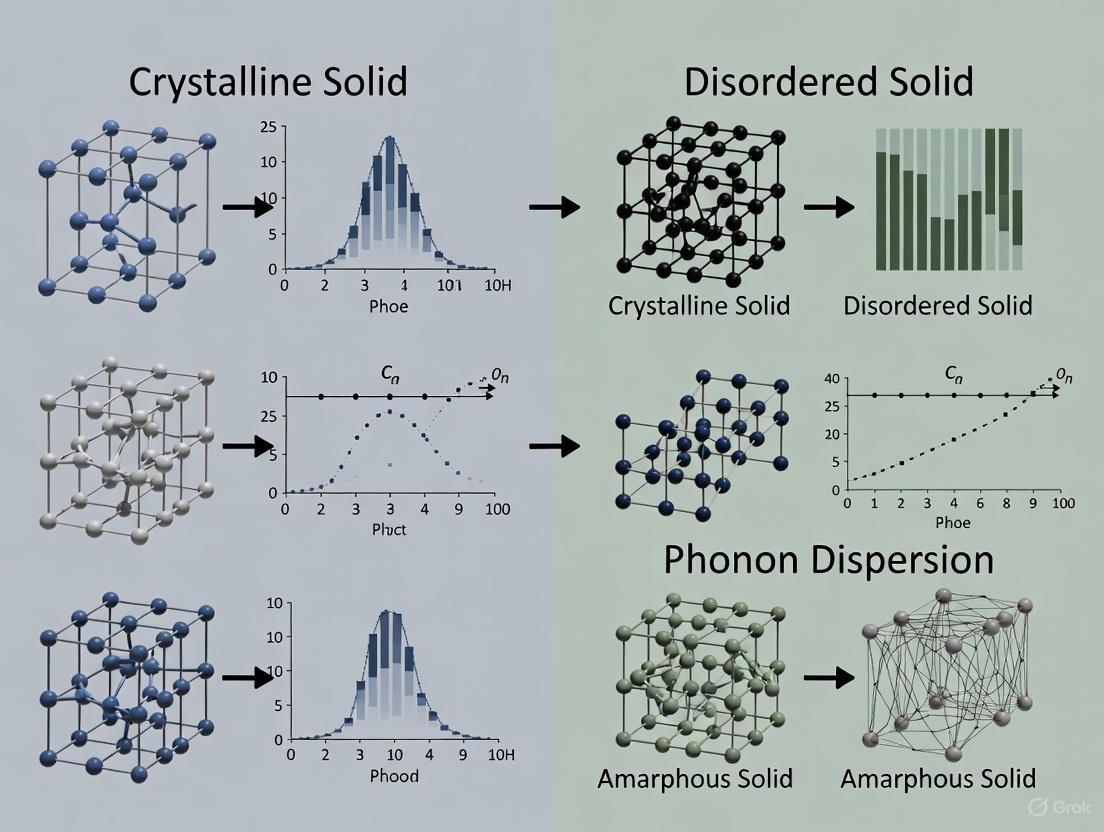
This article provides a comprehensive comparison of phonon properties in perfectly crystalline versus disordered solid materials, a critical distinction for controlling thermal and functional behavior in advanced materials.
Phonons in Ordered and Disordered Solids: From Fundamental Theory to Biomedical Applications
Abstract
This article provides a comprehensive comparison of phonon properties in perfectly crystalline versus disordered solid materials, a critical distinction for controlling thermal and functional behavior in advanced materials. We explore the fundamental revision of phonon theory required to describe disordered systems, where plane-wave quasiparticles give way to localized and diffusive vibrations. We detail modern computational and experimental methodologies, including AI-accelerated simulations and advanced spectroscopy, for accurately characterizing these systems. A significant focus is placed on troubleshooting the failures of conventional models and validating new approaches against experimental data. Finally, we highlight the direct implications for drug development professionals, particularly in understanding the stability, solubility, and bioavailability of disordered pharmaceutical crystals.
Rethinking Phonons: How Disorder Transforms Atomic Vibrations
The concept of phonons as quantized plane waves of atomic lattice vibrations represents a cornerstone of solid-state physics. This theoretical ideal provides an elegant framework for understanding thermal, acoustic, and electronic properties in crystalline materials, where the assumption of a perfectly periodic atomic arrangement allows for straightforward mathematical treatment. In perfect crystals, phonons behave as well-defined quasiparticles with characteristic dispersion relations and long lifetimes, enabling precise prediction of thermal conductivity, specific heat, and vibrational spectra. However, this idealized picture becomes increasingly complicated when confronted with the reality of material imperfections, dynamic disorder, and structural complexities present in real-world systems. This comparison guide examines the fundamental contrast between phonon behavior in perfect crystalline environments versus disordered materials, providing researchers with experimental data and methodological frameworks for evaluating phonon properties across this spectrum.
The plane wave ideal assumes atoms oscillate harmonically around fixed equilibrium positions in an infinite periodic lattice—a simplification that enables computational tractability but fails to capture the rich phenomenology observed in systems with substantial anharmonicity or disorder. Recent advances in computational modeling and experimental characterization have revealed how deviations from crystalline perfection dramatically alter phonon transport, scattering mechanisms, and thermodynamic properties. Understanding these distinctions is particularly crucial for materials scientists and drug development professionals working with organic semiconductors, pharmaceutical crystals, and functional materials where controlled disorder can either enhance or degrade performance characteristics.
Comparative Analysis: Phonon Properties in Crystalline Versus Disordered Materials
Theoretical Foundations and Practical Manifestations
Table 1: Fundamental Characteristics of Phonons in Perfect Crystals Versus Disordered Systems
| Property | Perfect Crystals (Theoretical Ideal) | Disordered/Anharmonic Materials (Experimental Reality) |
|---|---|---|
| Spatial Coherence | Long-range periodicity; well-defined Brillouin zone | Broken periodicity; diffuse scattering [1] |
| Phonon Dispersion | Sharp, well-defined branches throughout Brillouin zone | Damped acoustic modes, particularly ZA branch [1] |
| Phonon Lifetime | Long lifetimes limited by intrinsic phonon-phonon scattering | Significantly reduced lifetimes due to disorder scattering |
| Thermal Transport | High thermal conductivity with clear crystalline directions | Suppressed thermal conductivity; glass-like behavior [2] |
| Temperature Dependence | Predictable anharmonic effects at elevated temperatures | Strong anomalous damping even at low temperatures [1] |
| Symmetry Properties | Crystallographic space group symmetries apply | Averaged or broken symmetries; emergent phenomena [3] |
| Computational Treatment | Straightforward DFT with harmonic approximation | Requires specialized methods (AIMD, ML potentials) [4] [1] |
Table 2: Experimental Signatures of Dynamic Disorder in Molecular Crystals
| Experimental Technique | Perfect Crystal Signature | Dynamic Disorder Manifestation | Representative Materials |
|---|---|---|---|
| Inelastic Neutron Scattering | Sharp phonon density of states | Strongly damped acoustic modes, particularly ZA branch [1] | InSe van der Waals crystals [1] |
| Thermal Hall Effect | Substantial thermal Hall angle (up to 0.3% at 9T) [2] | Virtually absent signal in disordered samples [2] | SrTiO₃ crystals [2] |
| Heat Capacity Measurements | Follows Debye model at low temperatures | Deviation from Debye behavior due to strong phonon-phonon interactions [1] | Plastically deformable InSe [1] |
| X-ray Diffraction | Sharp Bragg peaks | Diffuse scattering signals along specific crystallographic directions [1] | β-InSe with interlayer slip [1] |
| Sublimation Pressure | Predictable from harmonic oscillator model | Enhanced volatility due to anharmonic contributions [3] | Caged hydrocarbons (adamantane, diamantane) [3] |
Impact on Functional Properties Across Material Classes
The distinction between perfect crystalline phonons and those in disordered systems extends beyond academic interest, with profound implications for technological applications across multiple domains:
Organic Semiconductors: In organic molecular semiconductors, dynamic disorder creates localized states that limit charge carrier mobility by promoting scattering. The interplay between electron transport and lattice vibrations becomes increasingly complex when molecular segments exhibit large-amplitude motions, directly impacting device performance and efficiency [3].
Pharmaceutical Materials: For active pharmaceutical ingredients (APIs), dynamic disorder of molecular segments can trigger polymorphism and alter stability, solubility, and bioavailability. Computational chemistry approaches now enable modeling of these dynamic contributions to thermodynamic properties, providing crucial insights for rational drug design [3].
Barocaloric Materials: Caged molecules like adamantane and diamantane exhibit rotational disorder that generates substantial anharmonic entropy contributions. This dynamic disorder enables large barocaloric effects for heat management applications, representing a case where controlled deviation from the perfect crystal ideal enhances functional performance [3].
Quantum Materials: In superconducting qubits, phonon-mediated quasiparticle poisoning events demonstrate how non-ionizing phonon bursts from structural relaxation processes can generate correlated errors, highlighting the material-level challenges in quantum computing implementation [5].
Experimental Methodologies for Phonon Characterization
Computational Approaches for Phonon Property Prediction
Table 3: Computational Methods for Phonon Analysis in Ordered and Disordered Systems
| Method | Underlying Principle | Ideal For | Limitations |
|---|---|---|---|
| Density Functional Theory (DFT) | Quantum-mechanical treatment of electron interactions | Perfect crystals with harmonic or quasi-harmonic approximations | Struggles with strongly anharmonic systems and large supercells |
| Ab Initio Molecular Dynamics (AIMD) | Finite-temperature sampling of nuclear motion | Anharmonic systems, phase transitions, disordered materials | Computationally expensive; limited timescales [1] |
| Machine Learning Potentials (uMLPs) | Learned force fields from DFT data | High-throughput screening across diverse chemical spaces | Training data dependency; transferability concerns [4] [6] |
| Hindered Rotor Model | Explicit treatment of anharmonic rotational degrees of freedom | Molecular crystals with rotational disorder [3] | System-specific parameterization required |
| Generalized Stacking Fault Energy (GSFE) | Maps energy landscapes for slip paths | Identifying preferred slip directions in layered materials [1] | Limited to pre-defined slip pathways |
Benchmarking Universal Machine Learning Potentials
Recent comprehensive assessment of six universal machine learning potentials (uMLPs) on 2,429 crystalline materials from the Open Quantum Materials Database provides critical insights for method selection [4] [6]:
Table 4: Performance Benchmark of Machine Learning Potentials for Phonon Properties [4] [6]
| Model | Force Prediction Accuracy | IFC Fidelity | LTC Prediction | Best Use Cases |
|---|---|---|---|---|
| EquiformerV2 | Highest accuracy | Superior for 2nd and 3rd order IFCs | Most reliable predictions | High-throughput screening of diverse materials |
| MACE | Comparable to EquiformerV2 | Notable discrepancies in IFC fitting | Poor LTC predictions despite force accuracy | Force field generation where thermal properties are secondary |
| CHGNet | Comparable to EquiformerV2 | Notable discrepancies in IFC fitting | Poor LTC predictions despite force accuracy | Structural relaxation and molecular dynamics |
| MatterSim | Lower force accuracy | Intermediate IFC predictions | Moderate LTC capability | Systems with limited training data |
The benchmark study revealed that EquiformerV2, particularly in its fine-tuned form, consistently outperformed other models in predicting second-order interatomic force constants (IFCs), lattice thermal conductivity (LTC), and other phonon properties, establishing it as the current state-of-the-art approach for computational phononics [6]. Interestingly, the complex relationship between force accuracy and phonon predictions was highlighted by MatterSim, which achieved intermediate IFC predictions despite lower force accuracy, suggesting error cancellation effects in phonon property derivation [4].
Essential Research Reagents and Computational Tools
Table 5: Research Reagent Solutions for Phonon Studies
| Reagent/Tool | Function | Application Context |
|---|---|---|
| EquiformerV2 | Universal machine learning potential | Accurate prediction of phonon properties across diverse materials [4] [6] |
| Optomechanical Crystal (OMC) Cavities | Confinement and enhancement of phonon modes | Hybrid spin-phonon architectures for quantum applications [7] |
| SrTiO₃ Single Crystals | Model system for phonon THE studies | Investigating intrinsic phonon Hall effect in insulators [2] |
| InSe van der Waals Crystals | Platform for plastic deformability studies | Correlating interlayer slip with lattice dynamics [1] |
| Caged Hydrocarbon Crystals | Systems with rotational disorder | Studying anharmonic contributions to thermodynamics [3] |
| Ab Initio Molecular Dynamics (AIMD) | Finite-temperature modeling beyond harmonic approximation | Capturing temperature-dependent anharmonic effects [1] |
Visualization of Methodologies and Relationships
Workflow for Computational Phonon Analysis
Computational Phonon Analysis Workflow
Disorder Impact on Phonon Transport
Disorder Impact on Phonon Transport
The comparative analysis between the plane wave ideal of perfect crystals and the complex reality of disordered systems reveals fundamental insights for materials design and characterization. For researchers pursuing materials with targeted thermal properties, the computational benchmarking indicates that EquiformerV2 currently provides the most reliable predictions for phonon properties across diverse chemical spaces [4] [6]. Experimental studies on SrTiO₃ demonstrate that crystal quality profoundly influences observable phenomena like the thermal Hall effect, with high-quality samples exhibiting substantial signals (up to 0.3% at 9T) that are virtually absent in disordered counterparts [2].
For pharmaceutical and organic electronic applications, embracing rather than avoiding dynamic disorder may yield functional advantages. The large-amplitude motions in molecular crystals with flat potential energy basins contribute significantly to entropy and can enhance properties like volatility or solubility [3]. Similarly, the exceptional plastic deformability of materials like InSe crystals emerges directly from their peculiar phonon spectra, where soft optical shear modes with very low energies facilitate interlayer slip and create unique mechano-thermo coupling [1].
Moving beyond the perfect crystal approximation requires both sophisticated computational approaches that capture anharmonicity and experimental techniques sensitive to local structure and dynamics. The researcher's toolkit must now encompass machine learning potentials for high-throughput screening, specialized models like the hindered rotor for molecular crystals with rotational freedom, and experimental probes that correlate macroscopic properties with microscopic dynamics. By understanding both the limitations of the plane wave ideal and the emergent phenomena in disordered systems, materials scientists can better navigate the complex relationship between atomic-scale structure and macroscopic functional properties.
The Phonon Gas Model (PGM) and the Virtual Crystal Approximation (VCA) have served as foundational pillars for understanding lattice vibrations and thermal transport in solids for decades. The PGM treats phonons as wave-like quasiparticles that propagate and scatter like particles in a gas, carrying heat through a crystalline lattice. This model inherently assumes that all vibrational modes are delocalized plane waves with well-defined velocities and mean free paths [8]. Similarly, the VCA approaches disordered systems, such as alloys, by modeling them as an effective crystal with averaged properties of the constituent elements, superimposing impurity scattering on the phonon gas to account for disorder [8]. For perfectly ordered, harmonic crystals, these frameworks have provided significant insights. However, the landscape of materials science has expanded to include highly disordered, anharmonic, and structurally complex systems—such as metal-organic frameworks, random alloys, and amorphous materials—where these classical theories often break down, both quantitatively and qualitatively [9] [8].
This guide objectively compares the performance of these established classical theories against modern computational and theoretical approaches. By synthesizing current research, we delineate the specific limitations of the PGM and VCA and present the experimental and simulation-based evidence that is driving the development of more robust models for phonon properties in disordered materials.
Critical Limitations of Classical Models
The table below summarizes the core conceptual weaknesses of the Phonon Gas Model and the Virtual Crystal Approximation that lead to their failure in disordered systems.
Table 1: Fundamental Limitations of the PGM and VCA
| Model | Core Assumption | Fundamental Flaw with Disorder | Resulting Failure Mode |
|---|---|---|---|
| Phonon Gas Model (PGM) | Phonons are plane-wave quasiparticles with well-defined group velocities ((v_g)) and mean free paths ((\ell)) [8]. | Loss of periodicity prevents rigorous definition of wave vectors, velocities, and mean free paths [8] [10]. | Inapplicable to amorphous materials; predicts imaginary phonon velocities to match experimental data [10]. |
| Virtual Crystal Approximation (VCA) | A disordered alloy can be treated as an effective crystal with averaged atomic properties, with disorder modeled as a scattering perturbation [8]. | Invalidates the plane-wave premise; vibrational eigenmodes change character from propagons to diffusons and locons, which do not transport energy like particles [8]. | Qualitative and quantitative failures in predicting thermal conductivity ((k)) vs. temperature in alloys [8]. |
Experimental and Computational Evidence of Model Breakdown
Failure of the PGM in Amorphous Solids
The application of the PGM to amorphous materials like amorphous silicon (a-Si) and amorphous silica (a-SiO₂) leads to internal contradictions. In a study testing the PGM's validity, researchers combined experimental thermal conductivity ((k)) data with atomistically calculated mode heat capacities ((c)) and relaxation times ((\tau)) to back-calculate the phonon group velocities ((v_g)) that would be required for the PGM to hold [10].
Key Experimental Workflow:
- Input Acquisition: Experimental (k(T)) data for a-Si and a-SiO₂ was gathered. Mode-specific heat capacities (c(T,n)) and relaxation times (\tau(T,n)) were computed using lattice dynamics and molecular dynamics (MD) simulations [10].
- PGM Inversion: The PGM framework, expressed as (k = \frac{1}{3} \sum c(T,n) \cdot vg(n)^2 \cdot \tau(T,n)), was inverted to solve for the mode-wise squared velocity (vg(n)^2) [10].
- Validation Check: The reasonableness of the back-calculated (v_g(n)) values was assessed against physical constraints (e.g., comparison to sound velocity) [10].
Result: The analysis revealed that for a significant number of mid- and high-frequency modes, (v_g(n)^2) was negative. This implies that to force the PGM to agree with experimental data, these modes would need to have imaginary group velocities, a physical impossibility that starkly reveals the model's fundamental inapplicability to amorphous materials [10].
Failure of the VCA in Crystalline Alloys
The VCA fails when the disorder disrupts the plane-wave nature of vibrations. Research on random alloys like In₁₋ₓGaₓAs demonstrates that even low impurity concentrations (a few percent) dramatically alter the character of vibrational modes [8].
Key Experimental Workflow:
- Eigenmode Analysis: Atomic-level simulations (e.g., molecular dynamics or lattice dynamics) are performed on a disordered alloy supercell.
- Mode Classification: The vibrational eigenmodes are analyzed using metrics like the eigenvector periodicity (EP) and the participation ratio (PR). The PR, defined as ( PRn = \frac{\left( \sumi \vec e{i,n}^{\,2} \right)^2}{N \sumi \vec e_{i,n}^{\,4} } ), distinguishes localized modes (locons, low PR) from delocalized ones [8].
- Character Identification: Delocalized modes are further classified as:
- Propagons: Plane-wave-like modes with well-defined wavelength and velocity.
- Diffusons: Delocalized but non-propagating modes with random velocity fields [8].
- Thermal Conductivity Calculation: The contributions of propagons, diffusons, and locons to heat conduction are evaluated using methods not reliant on the PGM, such as the Green-Kubo method in MD or a correlation-based approach [8].
Result: The study found that beyond a few percent of impurity concentration, the majority of vibrational modes are not propagons but diffusons and locons [8]. Diffusons, being non-propagating, contribute to heat conduction in a fundamentally different way that is not captured by the particle-scattering paradigm of the VCA. This leads to qualitative failures, such as an inability to predict the correct temperature dependence of thermal conductivity in certain alloys [8].
Diagram 1: Workflow for analyzing vibrational modes in disordered alloys, revealing the limitations of the VCA.
Modern Alternatives and Advanced Research Tools
To overcome the limitations of classical models, the field is shifting towards methods that do not rely on the plane-wave and particle-scattering assumptions.
Beyond the PGM: Molecular Dynamics and Spectral Analysis
Large-scale molecular dynamics (MD) simulations directly model atomic trajectories in time and space, allowing for the calculation of thermal transport without presupposing the nature of the heat carriers. This approach has been successfully applied to complex materials like metal halide perovskites (MHPs) and covalent organic frameworks (COFs), revealing unique mechanisms such as thermal transport governed by two-dimensional octahedral tilt correlations in MHPs [9]. Spectral analysis techniques can further decompose the heat current from MD simulations into different vibrational frequencies, providing insights similar to phonon spectra without assuming particle-like phonons [9].
Beyond the VCA: Eigenvector-Based Analysis
As discussed in Section 3.2, directly analyzing the eigenvectors of vibrational modes using the eigenvector periodicity (EP) and participation ratio (PR) provides a more physically accurate picture. This framework, which classifies modes into propagons, diffusons, and locons, forms the basis for modern theories of thermal transport in disordered materials [8].
The Role of Machine Learning and High-Throughput Screening
Machine learning (ML) is dramatically accelerating the discovery and understanding of materials with complex phonon behavior.
Table 2: Machine Learning Approaches in Modern Phonon Research
| Research Area | ML Application | Function and Advantage |
|---|---|---|
| Universal Machine Learning Potentials (uMLPs) | Models like EquiformerV2, MACE, and CHGNet are trained on diverse datasets to predict atomic forces and energies [4] [11]. | Accelerates phonon calculations by replacing expensive density functional theory (DFT) calculations, enabling high-throughput screening of thermal properties like lattice thermal conductivity (LTC) [4] [11]. |
| Crystal Structure Prediction (CSP) | ML models predict formation energies of candidate crystal structures [12]. | Solves the CSP problem with less computational intensity than conventional methods (e.g., ShotgunCSP), crucial for identifying stable/disordered structures [12]. |
| Direct Phonon Property Prediction | Graph neural networks (e.g., ALIGNN, VGNN) are trained to predict phonon density of states or dispersion directly from crystal structure [11]. | Bypasses interatomic force constants entirely, allowing for instantaneous phonon spectrum estimations for large materials databases [11]. |
Diagram 2: Machine learning pathways for predicting phonon properties, bypassing limitations of classical models.
The Scientist's Toolkit: Essential Research Reagents and Solutions
Table 3: Key Computational Tools and Databases for Modern Phonon Research
| Tool Name | Type | Primary Function in Research |
|---|---|---|
| Molecular Dynamics (MD) | Simulation Method | Models atomic motion in real-time, enabling thermal transport calculation without PGM assumptions [9] [10]. |
| Density Functional Theory (DFT) | First-Principles Calculation | Provides high-accuracy force and energy data for training ML models and validating phonon properties [12] [11]. |
| Materials Project Database | Computational Database | Source of crystal structures and properties for training machine learning models and generating template structures [12]. |
| MDR Phonon Database | Specialized Phonon Database | Contains pre-calculated phonon dispersions and properties for ~10,000 compounds, used for benchmarking and training [11]. |
| Universal ML Potentials (e.g., MACE) | Software/Model | Machine-learning interatomic potentials that enable fast, accurate phonon calculations across a wide chemical space [4] [11]. |
In crystalline solids, heat is primarily carried by phonons—wave-like quasiparticles of atomic vibration that propagate ballistically through the ordered lattice. However, this conventional understanding requires fundamental revision when applied to disordered solids, such as amorphous materials, alloys, and glasses. The introduction of compositional or structural disorder breaks the translational symmetry that gives rise to purely wave-like vibrational modes. Consequently, the traditional phonon gas model (PGM), which assumes all vibrational modes are plane waves with well-defined velocities and mean free paths, fails to adequately describe thermal transport in disordered systems [8].
To address this complexity, a revised framework categorizes vibrational excitations in disordered solids into three distinct types: propagons, diffusons, and locons. This classification, pioneered by Allen and Feldman, fundamentally rethinks the nature of atomic vibrations in disordered materials and provides a more accurate physical picture of thermal transport [13]. Propagons are phonon-like delocalized modes that exhibit wave-like characteristics primarily at low frequencies. Diffusons are also delocalized but conduct heat through a diffusive, random-walk mechanism without well-defined wavevectors. Locons are spatially localized modes that typically do not contribute significantly to heat transport but may influence it through coupling with other vibrations [14] [15]. Understanding the character and interplay of these vibrational modes is crucial for designing materials with tailored thermal properties for applications ranging from thermal barrier coatings to microelectronic devices and thermoelectric energy conversion [14] [16].
Theoretical Framework: Classifying Vibrational Modes
Fundamental Characteristics of Propagons, Diffusons, and Locons
The three categories of vibrational modes in disordered solids exhibit distinct characteristics that dictate their roles in thermal transport:
Propagons occupy the lowest frequency spectrum (typically below 4% of modes in amorphous silicon) and exhibit plane wave-like behavior with relatively well-defined group velocities and wavevectors. These modes are responsible for the ballistic thermal transport observed in amorphous materials over sufficiently long distances and can have mean free paths extending up to 1 micrometer in some materials. Propagons dominate thermal transport at low temperatures and in systems where their propagation is not disrupted by extensive scattering [15] [13].
Diffusons constitute the majority of vibrational modes in disordered solids (approximately 93% in amorphous silicon) and are characterized by their non-plane-wave nature. Unlike propagons, diffusons lack well-defined wavevectors and group velocities. Instead, they transport energy through a diffusive mechanism described by a random-walk process between different atomic sites. The thermal conductivity contribution from diffusons is properly captured by the Allen-Feldman theory using the concept of mode "diffusivity" rather than group velocity [8] [13].
Locons represent the highest frequency modes (approximately 3% in amorphous silicon) and are distinguished by their spatial localization. These modes are strongly confined to specific regions of the material, often centered on atoms with significantly different local coordination environments than the average structure. Due to their localized nature, locons do not directly contribute to long-range heat conduction, though recent research suggests they may indirectly influence thermal transport through coupling with other vibrational modes [14] [13].
Table 1: Comparative Characteristics of Vibrational Modes in Disordered Solids
| Characteristic | Propagons | Diffusons | Locons |
|---|---|---|---|
| Frequency Range | Lowest 4% of modes | Intermediate ~93% of modes | Highest ~3% of modes |
| Spatial Nature | Delocalized | Delocalized | Localized |
| Transport Mechanism | Wave-like propagation | Diffusive random walk | No direct contribution |
| Wavevector Definition | Well-defined | Not well-defined | Not applicable |
| Group Velocity | Well-defined | Not defined | Not defined |
| Participation Ratio | High (>0.15) | High (>0.15) | Low (<0.15) |
| Contribution to κ | Up to 40-50% | 50-60% | Negligible direct contribution |
Quantitative Classification Parameters
Researchers employ several quantitative metrics to distinguish between these vibrational modes in practical applications:
Participation Ratio (PR): This parameter quantifies the degree of localization of a vibrational mode and is defined as PRₙ = (∑ᵢ ēᵢ,ₙ²)²/(N∑ᵢ ēᵢ,ₙ⁴), where ēᵢ,ₙ is the eigenvector for atom i in mode n, and N is the number of atoms in the system [8]. Extended modes (propagons and diffusons) exhibit high PR values (typically >0.15), while localized modes (locons) have small PR values that can reach a minimum of 1/N for a mode completely localized on a single atom.
Eigenvector Periodicity (EP): This method, developed by Seyf and Henry, classifies modes based on their individual character by analyzing the periodicity of their eigenvectors, providing a more rigorous distinction between propagons and diffusons than frequency-based criteria alone [8].
Dynamical Structure Factor: This experimental measure helps identify propagating characteristics in vibrational modes, with propagons exhibiting much stronger dynamical structure factor intensity compared to diffusons [14] [15].
The following diagram illustrates the conceptual framework for classifying and characterizing vibrational modes in disordered solids:
Experimental and Computational Methodologies
Lattice Dynamics and Molecular Dynamics Simulations
Computational approaches play a crucial role in characterizing vibrational modes in disordered solids, with two primary methods dominating the field:
Lattice Dynamics (LD) Method: This approach calculates the dynamical matrix derived from interatomic forces to obtain the vibrational eigenvalues and eigenvectors of the system. LD analysis enables direct characterization of vibrational modes through calculations of participation ratio, mode diffusivity, and dynamical structure factor. For example, in studies of nanoporous amorphous silica, LD methods have revealed how pore morphology affects the behavior of propagons, diffusons, and locons by analyzing changes in their vibrational characteristics [14].
Molecular Dynamics (MD) Simulations: MD tracks the temporal evolution of atomic trajectories by numerically integrating equations of motion, allowing researchers to extract thermal conductivity and analyze atomic vibrations through velocity autocorrelation functions and power spectra. Classical MD simulations have been successfully employed to investigate temperature-dependent structural transformations and thermal conductivities in amorphous alumina across a temperature range of 500-2000 K [17]. More advanced approaches combine ab initio MD with machine-learned neural networks to model interatomic potentials and dipole moments, enabling quantum-mechanically accurate simulations of field-driven nuclear dynamics in complex systems [18].
Table 2: Experimental Techniques for Probing Vibrational Modes in Disordered Solids
| Technique | Principle | Applications in Disordered Solids | Limitations |
|---|---|---|---|
| Neutron Scattering | Measures energy and momentum transfer from neutrons to sample | Direct probing of phonon properties and anharmonicity in thermoelectric materials [16] | Requires large samples; limited spatial resolution |
| Time-Domain Thermoreflectance (TDTR) | Measures thermal conductivity via laser-induced temperature transients | Characterization of thermal conductivity in nanoporous a-Si₃N₄ thin films [15] | Limited to surfaces coated with reflective layers |
| Micro-Raman Spectroscopy | Analyzes inelastic scattering of light by vibrational modes | Thermal property measurement in amorphous alumina thin films [17] | Challenging for highly disordered systems with broad peaks |
| 3ω Method | Measures thermal conductivity using frequency-dependent temperature oscillations | Thermal conductivity characterization of nanoporous silica films [14] | Primarily for thin film structures |
Advanced Machine Learning Approaches
Recent advances incorporate machine learning to enhance the accuracy and efficiency of vibrational mode analysis:
Machine-Learned Forcefields: Equivariant message-passing neural networks, such as the SO3KRATES model, enable large-scale molecular dynamics simulations for disordered solids by efficiently sampling the vast configurational space. For garnet electrolyte Li₇La₃Zr₂O₁₂, this approach quantified the significant vibrational contributions to configurational free energy (on the order of 1 eV per atom at 1500 K) that stabilize the cubic phase over its tetragonal counterpart [19].
Multi-Valued Dipole Models: For simulating electric-field-driven nuclear dynamics, modified neural network architectures account for the multi-valued nature of dipoles in periodic systems. This approach has been successfully applied to model dielectric responses in liquid water and ferroelectric phase transitions in LiNbO₃ [18].
The following workflow diagram illustrates a typical computational approach for characterizing vibrational modes:
Comparative Analysis: Crystalline vs. Disordered Solids
Fundamental Differences in Vibrational Characteristics
The nature of atomic vibrations differs fundamentally between crystalline and disordered solids, leading to distinct thermal transport properties:
Vibrational Mode Character: Crystalline solids with perfect periodicity exhibit exclusively plane wave-like vibrational modes (phonons) with well-defined wavevectors and group velocities across the entire frequency spectrum. In contrast, disordered solids contain a mixture of vibrational characters, with only a small fraction (propagons) resembling crystalline phonons, while the majority (diffusons and locons) exhibit non-wave-like behavior [8].
Thermal Transport Mechanism: In crystalline materials, heat is carried primarily via ballistic propagation of phonons, described by the phonon gas model where thermal conductivity κ depends on specific heat, group velocity, and phonon mean free path. Disordered solids employ multiple transport mechanisms simultaneously: propagons contribute through wave-like propagation, diffusons through random-walk diffusion, and locons minimally through mode coupling [14] [8].
Response to Disorder: Introducing even small amounts of disorder (a few percent impurity concentration) dramatically changes the character of vibrational modes, with most modes transitioning from wave-like to diffusive character. This explains why conventional theories like the Virtual Crystal Approximation (VCA) often fail quantitatively and qualitatively for disordered systems, particularly in predicting temperature-dependent thermal conductivity [8].
Thermal Conductivity and Size Effects
The different vibrational characteristics directly impact thermal transport properties and their dependence on material dimensions:
Mean Free Path Distribution: Propagons in disordered solids can have surprisingly long mean free paths extending up to 1 micrometer in materials like amorphous silicon, while diffusons typically have much shorter mean free paths. This explains why the thermal conductivity of amorphous materials exhibits size effects even at relatively large dimensions, contrary to traditional understanding [15].
Nanostructuring Effects: Ultrafine nanostructuring (feature sizes below 20 nm) can fully suppress the contribution of propagons in amorphous silicon nitride, leaving only diffusons to contribute to thermal transport. This results in additional reduction of thermal conductivity beyond what would be expected from porosity considerations alone [15].
Quantitative Comparisons: Experimental studies show that propagons contribute approximately 40-50% of the total thermal conductivity in amorphous silicon at room temperature, with the remainder primarily from diffusons. This stands in stark contrast to crystalline materials where a single type of carrier (phonons) dominates across all frequencies [15].
Table 3: Thermal Transport Properties in Different Material Classes
| Property | Crystalline Solids | Disordered Solids | Nanostructured Disordered Solids |
|---|---|---|---|
| Primary Heat Carriers | Phonons (100%) | Propagons (4%), Diffusons (93%), Locons (3%) [13] | Primarily Diffusons (with suppressed Propagons) |
| Thermal Conductivity at 300K (W/mK) | ~150 (Si), ~400 (diamond) | ~1-2 (a-SiO₂), ~3 (a-Si) [14] | <1 (nanoporous a-Si₃N₄) [15] |
| Size Dependence | Strong up to ~100nm-1μm | Moderate up to ~1-10μm | Strong below 20nm |
| Temperature Dependence | κ ~ 1/T at high T | Nearly constant or weakly increasing with T | Varies with feature size |
| Theoretical Framework | Phonon Gas Model, BTE | Allen-Feldman Theory, MD simulations | Modified AF theory with boundary scattering |
Case Studies and Applications
Thermal Transport in Nanoporous Amorphous Silica
Nanoporous amorphous silica serves as an important material system for understanding vibrational mode behavior under nanoscale confinement:
Pore Morphology Effects: Studies combining lattice dynamics and molecular dynamics simulations reveal that pore morphology significantly influences the behavior of different vibrational modes. Specifically, the shape, distribution, and orientation of nanoscale channels in silica affect the transport of propagons and diffusons differently, offering potential pathways for tailoring thermal properties through structural design [14].
Thermal Conductivity Modulation: The thermal conductivity of nanoporous silica exhibits strong dependence on porosity, pore size, and pore distribution. Systems with higher numbers of pores demonstrate better thermal insulation performance at the same porosity, with thermal conductivity reduction explained through extremely strong diffusive boundary scattering of both propagons and diffusons [14] [15].
Vibrational Mode Transformations: As porosity increases in nanoporous silicon, propagons gradually transform into diffusons, and the localization of vibrational modes becomes stronger. This transformation explains the non-linear reduction in thermal conductivity with increasing porosity that cannot be captured by classical effective medium theory [14].
Phase Stability in Garnet Electrolytes
The interplay between configurational and vibrational entropy plays a critical role in stabilizing disordered phases of functional materials:
Stabilizing Cubic LLZO: For the garnet electrolyte Li₇La₃Zr₂O₁₂ (LLZO), machine-learned forcefield simulations demonstrate that vibrational contributions to the configurational free energy at 1500 K are significant (on the order of 1 eV per atom) in correctly ordering the stability of the cubic phase over its tetragonal counterpart. This understanding enables rational manipulation of dopants and defects to stabilize the high-ion-mobility cubic phase at room temperature for practical applications in solid-state batteries [19].
Configurational Entropy Considerations: Accurate determination of phase stability in site-disordered solids like LLZO requires accounting for both configurational and vibrational entropic contributions, presenting computational challenges due to the vast configurational space that must be sampled. The development of efficient machine-learned forcefields based on equivariant neural network architectures enables such deterministic studies despite the enormous number of possible configurations (~7×10³⁴ total) [19].
Researchers investigating vibrational modes in disordered solids rely on a suite of specialized computational and experimental tools:
Molecular Dynamics Software: LAMMPS (Large-scale Atomic/Molecular Massively Parallel Simulator) is widely used for classical MD simulations of amorphous materials, employing integration algorithms like velocity Verlet with typical timesteps of 1.0 fs for structural equilibration and thermal conductivity calculations [17].
Ab Initio Modeling Packages: Density Functional Theory (DFT) codes such as VASP and Quantum ESPRESSO provide first-principles inputs for machine-learned forcefields and lattice dynamics calculations, enabling quantum-mechanically accurate modeling of interatomic forces and dipole moments for electric-field-driven dynamics [18].
Experimental Characterization Facilities: Time-domain thermoreflectance (TDTR) systems with pump-probe laser configurations enable thermal conductivity measurements of thin films, while neutron scattering facilities at national laboratories provide direct probes of vibrational densities of states and anharmonicity in disordered materials [16] [15].
Classification and Analysis Tools
Specific methodologies and analytical approaches have been developed specifically for characterizing vibrational modes:
Eigenvector Periodicity Method: This approach, developed by Seyf and Henry, provides a rigorous basis for distinguishing between propagons and diffusons by analyzing the periodicity of vibrational eigenvectors, overcoming limitations of frequency-based classification criteria [8].
Participation Ratio Calculations: Standard analysis tool for quantifying the degree of localization of vibrational modes, with values below 0.15 typically indicating localized modes (locons) [8].
Dynamical Structure Factor Analysis: Computational technique for identifying propagating characteristics in vibrational modes through analysis of spatial correlations in atomic displacements [14].
The classification of vibrational modes in disordered solids into propagons, diffusons, and locons represents a fundamental shift from the traditional phonon paradigm of crystalline materials. This framework successfully explains the unique thermal transport properties of disordered systems that conventional phonon gas models fail to capture. Through advanced computational techniques including machine-learned forcefields and multi-scale simulations, coupled with sophisticated experimental methods such as neutron scattering and time-domain thermoreflectance, researchers can now quantitatively characterize these distinct vibrational excitations and their contributions to thermal transport.
Understanding the nature and interplay of propagons, diffusons, and locons enables rational design of materials with tailored thermal properties for specific applications. From thermal barrier coatings and microelectronic devices to thermoelectric energy conversion and solid-state electrolytes, manipulating the relative contributions and behavior of these vibrational modes offers powerful strategies for controlling heat flow at the nanoscale. As research in this field continues to advance, particularly through the integration of machine learning approaches with quantum-mechanical accuracy, our ability to predict and engineer thermal properties of disordered materials will continue to improve, opening new possibilities for thermal management in advanced technologies.
The classical view of a perfect crystal, with atoms residing at precise, high-symmetry lattice points, is a foundational concept in materials science. However, this view is increasingly being challenged by the ubiquitous phenomenon of local structural disorder, also known as positional polymorphism. This refers to spatially correlated deviations of atoms from their average high-symmetry positions, which, on average, still preserve the long-range crystallographic symmetry of the structure [20]. Historically viewed as a source of performance degradation, recent theoretical and experimental advances reveal that local disorder is a central factor in shaping the electronic, vibrational, optical, and transport properties of materials [21] [20].
This guide provides a comparative analysis of how positional polymorphism influences key material properties, particularly phonon dynamics, and contrasts these effects with the behavior of idealized monomorphous structures and fully amorphous materials. Framed within a broader thesis on phonon properties in solids, we objectively compare performance through experimental and computational data, detailing the methodologies that enable these insights.
Theoretical Framework: From a Monomorphous to a Polymorphous View
The monomorphous model assumes a single, high-symmetry configuration for a crystal structure. In reality, for many soft, anharmonic materials at room temperature, the high-symmetry configuration often corresponds to a local maximum on the potential energy surface (PES). The system settles into locally disordered configurations that represent energetically favorable minima, a state described by the polymorphous framework [20].
This local disorder is not random; it is characterized by specific atomic displacement patterns. For instance, in cubic halide perovskites of the ABX3 type, iodine atoms in a polymorphous model are distributed around the original high-symmetry site, lying on a plane perpendicular to the B-B axis, rather than occupying a single point [20]. The degree of disorder can be quantified by metrics such as the deviation of the B-X-B bond angle from its ideal value (e.g., 180°), which can be as large as 26.7° in CsPbI3 [20].
The following diagram illustrates the conceptual shift from a monomorphous to a polymorphous crystal structure and its connection to material properties.
Comparative Property Analysis: The Impact of Positional Polymorphism
The adoption of a polymorphous model has profound and measurable consequences on predicted material properties. The data below compare key properties calculated using monomorphous versus polymorphous structural models.
Table 1: Comparative Electronic and Structural Properties of Selected Crystalline Materials
| Material | Structural Model | Band Gap (eV) | VBM/CBM Orbital Character | XRD/PDF Match with Experiment | Key Experimental Validation |
|---|---|---|---|---|---|
| CsSnI3 | Monomorphous (Pm$\bar{3}$m) | Metallic (spurious) | VBM: Metal p; CBM: Halogen p | Poor (PDF) | Pair Distribution Function (PDF) [20] |
| CsSnI3 | Polymorphous | 0.56 (opening) | VBM: Halogen p; CBM: Metal s | Excellent (PDF) | Pair Distribution Function (PDF) [20] |
| CsPbI3 | Monomorphous (Pm$\bar{3}$m) | Metallic (spurious) | VBM: Metal p; CBM: Halogen p | Poor (PDF) | Pair Distribution Function (PDF) [20] |
| CsPbI3 | Polymorphous | 0.56 (opening) | VBM: Halogen p; CBM: Metal s | Excellent (PDF) | Pair Distribution Function (PDF) [20] |
| SrTiO3 | Monomorphous | N/A | N/A | Excellent (XRD) | X-ray Diffraction (XRD) [20] |
| SrTiO3 | Polymorphous | N/A | N/A | Excellent (XRD) | X-ray Diffraction (XRD) [20] |
Table 2: Phonon Anomalies and Thermal Transport in Solid Materials
| Material / System | Phonon Anomaly | Theoretical Origin | Impact on Thermal Conductivity | Key Experimental/Computational Method |
|---|---|---|---|---|
| Crystals | Van Hove Singularity (VHS) | Analytic singularity in VDOS from periodicity [22] | Modifies specific heat, thermal conductivity [22] | Inelastic neutron scattering [22] |
| Glasses | Boson Peak (BP) | Resonant damping & phonon softening [22] [23] | Reduces thermal conductivity [22] | Low-temperature heat capacity [22] |
| Strain Glasses, Jammed Glasses | Coexistence of VHS & BP | Resonance-induced extra acoustic softening [22] | Complex effects on transport [22] | Specific heat data across 143 solids [22] |
| Thermal Barrier Coatings | Breakdown of phonon quasiparticle picture | Multi-phonon scattering & anharmonicity [24] | Ultra-low lattice thermal conductivity [24] | Machine Learning Potentials & molecular dynamics [24] |
Electronic Structure and Spectroscopy
As shown in Table 1, using a monomorphous model for materials like cubic CsSnI3 and CsPbI3 can lead to a catastrophic failure in predicting the electronic structure, resulting in an unphysical metallic state and spurious orbital character at the band edges [20]. The polymorphous model rectifies this, recovering the correct semiconducting behavior with a band gap opening of 0.56 eV and the expected orbital character. This is not a failure of density functional theory (DFT) per se, but a direct consequence of using an physically unrealistic structural model [20].
Spectroscopically, while X-ray diffraction (XRD) patterns of monomorphous and polymorphous structures can be nearly identical—as seen in SrTiO3—techniques sensitive to short-range order, like the Pair Distribution Function (PDF), show a dramatic improvement when local disorder is accounted for. The polymorphous model of MAPbI3 excellently reproduces experimental PDF data, whereas the monomorphous model fails in both peak positions and broadening features [20].
Phonon Dynamics and Vibrational Anomalies
Local structural disorder profoundly impacts the vibrational landscape of a material. It is a key factor in the breakdown of the phonon quasiparticle picture, leading to strongly overdamped vibrational modes and significantly influencing electron-phonon and phonon-phonon interactions [21] [20].
A unified theoretical perspective, supported by data from 143 crystalline and glassy substances, suggests that two classic phonon anomalies—the sharp Van Hove singularity (VHS) in crystals and the broader boson peak (BP) in glasses—may be two variants of the same fundamental entity [22] [23]. The competition between phonon propagation and damping, coupled with vibrational softening, dictates which anomaly emerges. In some cases, such as strain glasses, both VHS and BP can coexist [22].
Thermal and Charge Transport
The damping and scattering of phonons induced by local disorder have a direct and significant effect on thermal transport. In thermal barrier coating materials like La₂Zr₂O₇, strong multi-phonon scattering processes drive the lattice thermal conductivity to very low values (1–3 W·m⁻¹·K⁻¹), with phonon mean free paths approaching the Ioffe-Regel limit even at moderate temperatures [24]. Charge transport in organic molecular semiconductors is equally sensitive. The dynamic disorder from large-amplitude motions of molecules or molecular segments creates a distribution of energetic sites, which can localize charge carriers and limit charge-carrier mobility, a critical parameter for device performance [3].
Experimental and Computational Protocols
Accurately capturing the effects of positional polymorphism requires specific methodological approaches, moving beyond standard protocols.
Generating Polymorphous Structures
Protocol Title: First-Principles Modeling of Positional Polymorphism. Objective: To generate a realistic, locally disordered structural model for electronic and vibrational calculations. Materials: High-symmetry crystal structure, Density Functional Theory (DFT) code, supercell. Procedure [20]:
- Supercell Construction: Start from a high-symmetry prototype structure (e.g., cubic Pm$\bar{3}$m) and build a suitably large supercell (e.g., 4x4x4).
- Introduction of Displacements: Introduce atomic displacements via random nudges or, more rigorously, using "special displacements" along phonon modes to sample the potential energy surface.
- Constrained Relaxation: Relax the atomic positions within the fixed supercell lattice, allowing the system to find a lower-energy, symmetry-broken configuration. The energy lowering (ΔU) quantifies the stability gain from disorder. Note: The resulting structure is a static snapshot representing the time- or space-averaged local configurations.
Measuring Phonon Dispersion in Nanoscale Systems
Protocol Title: Picosecond Acoustics for Phonon Dispersion. Objective: To measure the full phonon dispersion relation, particularly in nanoscale materials where traditional scattering methods fail. Materials: van der Waals heterostructure (e.g., hBN/BP/hBN), ultrafast laser system (femtosecond pulses), time-resolved detection setup [25]. Procedure [25]:
- Pump-Pulse Excitation: An optical pump pulse (e.g., 760 nm) photoexcites carriers in a thin layer (e.g., Black Phosphorus), generating a broadband coherent acoustic phonon (strain) pulse.
- Strain Propagation: The strain pulse propagates into adjacent layers (e.g., hexagonal Boron Nitride).
- Echo Detection: The strain pulse reflects at interfaces (e.g., hBN/air) and creates echoes that return to the generating layer. An optical probe pulse, delayed in time, detects these echoes in the BP layer by measuring transient transmission changes (ΔT/T).
- Data Analysis: Perform a Sliding Window Fourier Transform (SWFT) on the time-domain signal to resolve the frequency-dependent time-of-flight of the strain echoes. This gives the group velocity dispersion, from which the phonon dispersion relation can be constructed.
The following workflow chart outlines a modern computational approach for studying phonon transport in complex, disordered materials.
The Scientist's Toolkit: Essential Research Reagents and Materials
Table 3: Key Reagents and Computational Tools for Disorder Research
| Item / Tool | Function / Role | Specific Example |
|---|---|---|
| Caged Molecules | Model systems for studying rotational dynamic disorder due to high symmetry and nearly isotropic interaction fields. | Adamantane, Cubane, Diamantane [3] |
| Halide Perovskites (CsPbI3) | Prototypical soft, anharmonic materials for studying positional polymorphism and its effect on optoelectronic properties [20]. | Cubic CsPbI3, MAPbI3, FASnI3 [20] |
| Thermal Barrier Coatings | Prototypes for studying the effect of strong phonon scattering and anharmonicity on thermal transport. | La₂Zr₂O₇ (pyrochlore), La₂Sr₂AlO₇ (perovskite), LaPO₄ (monazite) [24] |
| van der Waals Heterostructures | Nanoscale platform for measuring phonon dispersion via picosecond acoustics. | hBN/BP/hBN heterostructure [25] |
| Machine Learning Potentials (MTP) | Enables large-scale molecular dynamics simulations with first-principles accuracy to capture complex anharmonicity and disorder. | Moment Tensor Potential (MTP) [24] |
The evidence is clear: ignoring local structural disorder leads to qualitatively and quantitatively incorrect predictions of material properties, from electronic structure to thermal conductivity. The polymorphous framework is not merely a refinement but a necessary paradigm for accurately modeling a wide class of functional materials, including halide perovskites, organic semiconductors, and thermal barrier coatings. The unified understanding of phonon anomalies bridges the historical divide between crystalline and glassy solids, revealing a continuum of behavior governed by the interplay of phonon damping and softening. As computational methods like machine learning potentials continue to evolve, they will further empower researchers to integrate these insights, accelerating the rational design of next-generation energy and electronic materials.
In the realm of solid-state materials science, the traditional classification of solids as either purely crystalline or amorphous represents an oversimplification of a far more complex structural landscape. A significant proportion of molecular crystals exhibit dynamic disorder, a phenomenon where molecules or molecular segments undergo large-amplitude motions within a crystal lattice that maintains long-range periodicity [26]. This unique behavior creates materials that appear rigid macroscopically yet contain substantial internal dynamics at the atomic level [3]. Around 20% of known molecular crystals are currently estimated to possess some form of disorder, with dynamic disorder being particularly prevalent in high-temperature phases below the melting point [3].
Dynamic disorder arises from the existence of flat potential energy basins related to dynamic degrees of freedom in molecular crystals, which enable substantial movements of molecular segments or entire molecules while maintaining the overall crystal framework [26]. These motions occur when energy barriers between different molecular configurations are relatively low (typically comparable to the thermal energy RT), allowing transitions between configurations to occur readily [3]. The resulting atomic displacements contribute significantly to macroscopic material properties including entropy, volatility, solubility, plasticity, and charge transport characteristics [26]. This review examines how dynamic disorder manifests across different material systems and contrasts its effects with those observed in perfectly ordered crystalline and fully amorphous solids.
Fundamental Concepts: Dynamic vs. Static Disorder
Classification of Disorder in Solid Materials
In disordered molecular crystals, the nature of the disorder can be categorized based on the energy barriers between different molecular configurations:
Dynamic Disorder: Characterized by low energy barriers (typically ≤ 2.5 kJ/mol) that enable facile transitions between configurations at relevant temperatures [3]. The characteristic time scales are so short that spectroscopic methods cannot typically distinguish individual configurations but provide an averaged image over configuration space [3].
Static Disorder: Occurs when configurations are separated by large energy barriers (significantly exceeding RT), effectively freezing the disorder into the crystalline sample [3]. This requires modeling multiple configurations of the perfect crystal structure to capture the material's properties accurately.
Orientational Disorder: A specific subtype where disorder governs the orientation of molecules and their functional groups or conformational degrees of freedom [3]. This is particularly common in plastic crystals, which exhibit mechanical softness and even flow properties due to extensive orientational flexibility [3].
Comparative Structural Characteristics
Table 1: Fundamental Characteristics of Different Solid-State Materials
| Property | Perfect Crystals | Dynamically Disordered Crystals | Amorphous Solids |
|---|---|---|---|
| Atomic Structure | Long-range periodic order | Long-range order with local dynamic irregularities | Random, irregular network |
| Symmetry | Anisotropic (direction-dependent properties) | Can be isotropic due to dynamic averaging | Isotropic (same in all directions) |
| Melting Behavior | Sharp, definite melting point | Phase transitions before melting | Gradual softening over temperature range |
| Thermal Response | Defined phonon spectrum | Strongly anharmonic dynamics | Mixed propagons/diffusons/locons |
| Entropy Contribution | Primarily vibrational | Significant configurational components from dynamics | High configurational entropy |
Manifestations Across Material Systems
Barocaloric Caged Molecules
Caged molecules with three-dimensional enclosed carbon skeletons represent an ideal platform for dynamic disorder due to their high molecular symmetry and nearly spherical shapes. Derivatives of adamantane, cubane, diamantane, and fullerene typically crystallize in highly symmetric space groups where molecules experience relatively uniform interaction fields from neighbors [3]. This molecular symmetry creates unique potential energy surfaces characterized by wide, flat basins separated by low energy barriers [3].
In crystalline diamantane (space group Fd3̄m), rotational energy barriers for molecular libration range from 4 to 8 kJ/mol – comparable to thermal energy at ambient conditions (≈2.5 kJ/mol) [3]. This minimal barrier enables practically free rotation, with computational models demonstrating that treating these motions as anharmonic hindered rotations rather than harmonic oscillators significantly impacts thermodynamic property predictions [3]. The additional entropy contributions from dynamic disorder in these systems make them promising for barocaloric heat management applications, where pressure-induced phase transitions can produce substantial thermal effects [3].
Pharmaceutical Compounds
Dynamic disorder in active pharmaceutical ingredients (APIs) profoundly impacts stability, solubility, and bioavailability. The segmental dynamics of flexible molecular moieties can trigger polymorphism and create metastable disordered phases with enhanced dissolution rates [3]. Computational modeling reveals that dynamically disordered pharmaceutical crystals exhibit flat potential energy surfaces for specific molecular degrees of freedom, enabling access to multiple conformational states at room temperature [3].
This behavior creates significant challenges for crystal structure prediction (CSP), as structures corresponding to distinct local minima at 0 K may represent the same dynamically disordered structure at finite temperatures – the so-called "overprediction problem" [27]. Accurately modeling these systems requires going beyond static lattice energy evaluations to incorporate finite-temperature dynamics and configurational averaging [27].
Organic Semiconductors
In organic molecular semiconductors (OSCs), dynamic disorder presents a double-edged sword for charge transport properties. The large-amplitude motions of molecules or molecular segments create dynamic perturbations to the electronic coupling between neighboring molecules, directly impacting charge-carrier mobility [3]. This dynamic disorder scattering mechanism can suppress charge transport by introducing temporal fluctuations in transfer integrals between molecules [3].
The interplay between dynamic disorder and charge transport in OSCs represents an active research frontier, with computational approaches providing insights into how specific molecular motions affect performance metrics in organic electronic devices [26].
Methodological Approaches for Investigation
Computational Modeling Strategies
Computational chemistry offers powerful approaches for sampling potential energy surfaces associated with dynamic disorder and modeling the resulting atomic displacements:
Potential Energy Surface Sampling: Computational methods enable mapping of flat potential energy basins related to dynamic degrees of freedom [26]. These approaches can model atomic displacements related to disorder and quantify contributions to macroscopic material properties [26].
Hindered Rotor Models: For caged molecules with rotational freedom, one-dimensional hindered rotor models incorporated into quasi-harmonic frameworks provide more accurate predictions of thermodynamic properties than conventional harmonic oscillator approaches [3].
Machine Learning Force Fields: Recent advances combine molecular dynamics with machine learning potentials to bridge the gap between theoretical predictions and experimental measurements, particularly for systems with strong anharmonicity [28]. These approaches enable accurate modeling of dynamic disorder effects on thermal transport while maintaining computational feasibility [29].
Table 2: Experimental and Computational Techniques for Studying Dynamic Disorder
| Technique | Application | Key Information | Limitations |
|---|---|---|---|
| X-ray Diffraction | Structure determination | Time-averaged atomic positions; reveals high symmetry from disorder | Cannot resolve individual configurations |
| Molecular Dynamics (MD) | Sampling configurations | Models temporal evolution of atomic positions | Force field accuracy limitations |
| Machine Learning Potentials | Accurate property prediction | Bridges accuracy-cost gap for complex systems | Training data requirements |
| Green-Kubo Modal Analysis | Thermal transport | Mode-level contributions to thermal conductivity | Computational intensity |
| SCLD Calculations | Vibrational analysis | Harmonic frequencies and eigenvectors | Limited for strong anharmonicity |
The Scientist's Toolkit: Essential Research Reagents and Materials
Table 3: Key Research Reagents and Computational Tools for Dynamic Disorder Studies
| Item | Function/Application | Relevance to Dynamic Disorder |
|---|---|---|
| Genarris 3.0 Software | Crystal structure prediction | Generates random molecular crystal structures; implements "Rigid Press" algorithm for close-packed structures [27] |
| Machine Learning Interatomic Potentials (MLIPs) | Force field development | Enables accurate molecular dynamics simulations of disordered systems at feasible computational cost [27] [29] |
| MACE-OFF23(L) Models | Geometry optimization | Machine-learned potentials for accelerated exploration of potential energy landscapes [27] |
| Caged Molecular Systems | Model barocaloric compounds | Adamantane, diamantane, and cubane derivatives exhibit pronounced rotational disorder [3] |
| Hybrid DFT (HSE+SOC) | Electronic structure calculation | High-level theory for accurate defect processes in dynamically disordered systems [29] |
Impact on Material Properties and Performance
Thermal Transport Properties
Dynamic disorder significantly impacts thermal transport through strong phonon scattering mechanisms. In Cu₄TiSe₄, Cu atomic hopping between adjacent sites induces dynamic disorder scattering that suppresses both long-wavelength acoustic phonons and short-wavelength phonons near the Brillouin zone boundary [28]. This scattering mechanism results in ultralow thermal conductivity that shows weak temperature dependence – a signature of dominant disorder scattering [28].
The phase quotient (PQ) analysis reveals that disordered solids exhibit substantially different thermal transport characteristics compared to perfect crystals. While crystalline materials show minimal contributions from optical-like (negative PQ) modes to thermal conductivity, disordered systems demonstrate significant contributions from these modes [30]. This fundamental difference underscores how dynamic disorder alters the basic phonon transport mechanisms in solid materials.
Thermodynamic Properties
The anharmonic nature of dynamic disorder creates substantial contributions to entropy and heat capacity beyond those predicted by harmonic models. For diamantane, modeling the primary libration mode as an anharmonic hindered rotor rather than a harmonic oscillator reveals significantly different predictions for entropy and heat capacity, particularly at elevated temperatures [3]. These differences directly impact calculated sublimation pressures, with anharmonic models predicting values orders of magnitude higher than harmonic approximations for certain caged hydrocarbons [3].
Electronic and Optoelectronic Properties
In lead halide perovskites like CsPbCl₃, dynamic disorder manifests through large thermal fluctuations of electronic levels associated with halide vacancies [29]. These vacancies exhibit strong oscillations in optical transition levels (exceeding 1 eV at 300 K) due to the soft potential energy surface and anharmonic lattice dynamics [29]. However, despite these strong dynamic effects, the thermodynamic charge transition levels governing non-radiative carrier capture remain relatively unaffected, demonstrating that conventional static defect theory retains validity for predicting thermodynamic behavior even in highly dynamic systems [29].
Experimental and Computational Workflows
The investigation of dynamic disorder requires integrated methodologies combining computational prediction with experimental validation. The following workflow diagram illustrates the key steps in characterizing dynamic disorder in molecular crystals:
Research Workflow for Dynamic Disorder Characterization
Comparative Performance Data
Quantitative Impact on Material Properties
Table 4: Property Modifications Induced by Dynamic Disorder Across Material Classes
| Material System | Property Affected | Ordered Reference | Dynamically Disordered | Change Magnitude |
|---|---|---|---|---|
| Diamantane | Rotational energy barrier | N/A | 4-8 kJ/mol | Basis for dynamics |
| Caged Hydrocarbons | Sublimation pressure ratio (pAHR/pHO) | 1 (harmonic reference) | 10-1000 | 10-1000x increase |
| Cu₄TiSe₄ | Lattice thermal conductivity | Conventional crystals | Ultralow (0.5 W/mK) | 5-10x reduction |
| CsPbCl₃ | Optical transition level fluctuation | Static framework | >1 eV at 300K | Significant broadening |
| OSC Materials | Charge carrier mobility | Static crystal reference | Reduced by dynamic scattering | Material-dependent |
Dynamic disorder represents a crucial intermediate state between perfect crystalline order and complete amorphous disorder, with profound implications for material properties and performance across technological domains. The large-amplitude molecular motions characteristic of this phenomenon directly impact thermal transport through enhanced phonon scattering, thermodynamic properties through additional entropy contributions, and charge transport through dynamic electronic coupling modifications [26] [3] [28].
Future research directions will likely focus on the rational design of dynamic disorder to optimize material performance for specific applications – enhancing dynamic disorder in thermal barrier coatings while minimizing it in charge transport layers for organic electronics. The continued development of computational methods, particularly machine learning potentials and advanced sampling techniques, will enable more accurate predictions of dynamic disorder effects across wider temperature and pressure ranges [27] [29]. As characterization techniques with improved temporal resolution emerge, our understanding of the atomic-scale dynamics underlying these phenomena will continue to refine, offering new opportunities for controlling material properties through engineered disorder.
Advanced Computational and Experimental Methods for Phonon Analysis
Ab Initio and Polymorphous Models for Realistic Disordered Structures
The study of solid-state materials has traditionally been dominated by crystalline systems, where perfect periodicity enables accurate predictions of physical properties. However, real materials invariably contain disorder—whether compositional, structural, or topological—that profoundly influences their behavior and functionality. The computational materials science community has developed two powerful approaches to address this complexity: ab initio (first-principles) methods that predict properties from fundamental quantum mechanics without empirical parameters, and polymorphous models that explicitly incorporate disorder effects into material representations. These approaches are particularly crucial for understanding phonon properties, where the traditional conception of phonons as plane wave quasiparticles breaks down in disordered systems [8].
Disorder in materials is not merely a deviation from ideal crystals but a fundamental characteristic that can determine material performance across pharmaceuticals, organic semiconductors, and quantum computing devices. For instance, in pharmaceutical compounds, different polymorphs of the same active ingredient exhibit distinct stability, solubility, and bioavailability properties, with enormous implications for drug efficacy and patent protection [31]. Similarly, in superconducting quantum devices, unwanted oxides at interfaces host two-level systems that degrade quantum coherence times, necessitating defect engineering strategies [32]. This comparison guide objectively evaluates the performance of contemporary computational frameworks for predicting properties of disordered materials, with particular emphasis on phonon behavior across the order-disorder spectrum.
Comparative Analysis of Computational Methodologies
First-Principles Methods for Polymorph Prediction
Table 1: Comparison of Ab Initio Methods for Molecular Crystals
| Method | Accuracy Range | System Size Limit | Computational Cost | Key Applications |
|---|---|---|---|---|
| Full DFT (PBE-D3) | ~1-4 kJ/mol for lattice energy [31] | <20 non-hydrogen atoms [31] | Very High | Lattice energy, structural properties [31] |
| Composite DFT/DFTB | Sub-kJ/mol accuracy for free energies [31] | 15-20+ non-hydrogen atoms [31] | Moderate | Finite-temperature polymorph ranking [31] |
| Fragment-Based (HMBI) | ~0.5 kJ/mol for phase diagrams [33] | Medium-sized molecules | High | Complete phase diagrams [33] |
| CCSD(T)/CBS + Periodic HF | Sublimation enthalpy within 1 kJ/mol [33] | Small molecules (e.g., methanol) | Very High | Benchmark quality energetics [33] |
The landscape of ab initio methods spans a wide spectrum of accuracy and computational cost. Traditional density functional theory (DFT) with dispersion corrections has become the workhorse for molecular crystals, achieving chemical accuracy (≈4 kJ mol⁻¹) for enthalpic data, which is sufficient for many applications but often inadequate for reliable polymorph ranking where free energy differences can be smaller than 1 kJ mol⁻¹ [31]. For such challenging cases, more sophisticated approaches are required. The composite method combining DFT with density-functional tight-binding (DFTB) represents a significant advancement by retaining DFT-level accuracy while dramatically reducing computational costs. This hybrid approach uses inexpensive DFTB to scan how crystal properties vary with volume, corrected by higher-level DFT calculations at a single reference volume [31].
For the most demanding applications where sub-kJ/mol accuracy is essential, fragment-based methods combined with high-level electron correlation techniques like CCSD(T) have demonstrated remarkable precision. In one notable achievement, researchers successfully predicted the complete phase diagram for methanol polymorphs with an accuracy of ~0.5 kJ mol⁻¹ across temperature and pressure ranges of 0-400 K and 0-6 GPa, correctly mapping the thermodynamic stability regions for three polymorphs [33]. Such precision enables predictive computational guidance for experimental polymorph screening, potentially reducing the need for extensive trial-and-error experimentation.
Methodologies for Disordered Systems
Table 2: Computational Approaches for Disordered Materials
| Method | Disorder Type | Phonon Treatment | Strengths | Limitations |
|---|---|---|---|---|
| Virtual Crystal Approximation (VCA) | Compositional | Plane waves with impurity scattering [8] | Simple, works for weak disorder | Fails qualitatively for moderate-strong disorder [8] |
| Eigenvector Periodicity (EP) Analysis | Structural & Compositional | Classifies modes as propagons, diffusons, locons [8] | Physically realistic mode characterization | Computationally intensive |
| Hyperuniform Disordered Models | Topological | Depends on hyperuniformity class [34] | Captures exotic disordered states | Limited experimental validation |
| Machine Learning Potentials | All types | Varies with training data | Speed for large systems | Training data requirements |
Traditional approaches to disorder, particularly the Virtual Crystal Approximation (VCA), have shown both quantitative and qualitative failures in predicting thermal transport properties. The fundamental issue lies in the assumption that phonons maintain their plane-wave character in disordered systems, which breaks down even at relatively low impurity concentrations [8]. Current research reveals that conventional theory requires revision because the critical assumption that all phonons resemble plane waves with well-defined velocities becomes invalid when disorder is introduced. Surprisingly, phonon character changes dramatically within the first few percent of impurity concentration, beyond which phonons more closely resemble the modes found in amorphous materials [8].
A more physically realistic perspective classifies vibrational modes in disordered systems into three categories: propagons (delocalized modes with sinusoidally modulated velocity fields), diffusons (delocalized modes without periodicity), and locons (localized vibrations centered on structural defects) [8]. The eigenvector periodicity approach provides a rigorous framework for distinguishing these modes based on their individual character rather than collective frequency-based arguments. This revised understanding explains why the thermal conductivity of alloys typically decreases by approximately 10 times as impurity concentration reaches 10-25%, then remains relatively constant until 75-90% composition [8].
Recent investigations into hyperuniform disordered solids have revealed exotic states that exhibit crystal-like stability despite their disordered nature. These systems are characterized by unusually suppressed density fluctuations at low wavenumbers, classified into three categories based on the power-law scaling of their density spectrum [34]. Hyperuniform over-jammed packings demonstrate exceptional stability across vibrational, kinetic, thermodynamic, and mechanical properties—similar to crystals—suggesting they represent a distinct, stable disordered solid state that may be more stable than hypothetical ideal glasses [34].
Experimental Protocols and Validation
Composite Quasi-Harmonic Protocol for Pharmaceutical Polymorphs
Experimental Protocol 1: Composite DFT/DFTB Method for Finite-Temperature Polymorph Ranking
System Preparation: Initial crystal structures are obtained from the Cambridge Structural Database (CSD). For pharmaceutical compounds like ibuprofen, flufenamic acid, and sulfathiazole, multiple polymorphs are selected to represent varying molecular arrangements and hydrogen bonding patterns [31].
Electronic Structure Calculations:
- Periodic DFT calculations employ the PBE functional with D3(BJ) dispersion correction, using a plane-wave kinetic energy cutoff of 1000 eV and hard projector-augmented wave potentials. Brillouin zone sampling uses a Γ-centered Monkhorst-Pack grid with approximately 25/a₁ k-points along each reciprocal lattice vector [31].
- DFTB calculations utilize the third-order DFTB3 method with 3ob parameterization and D4 dispersion model, including a Hubbard U-parameter augmentation of the self-consistent charge Hamiltonian [31].
Quasi-Harmonic Processing: The protocol combines the computational efficiency of DFTB with the accuracy of DFT by using DFTB to perform costly volume scans of static and dynamic crystal properties, which are subsequently corrected to agree with higher-level DFT calculations at a single reference volume [31].
Validation: Predictions are validated against experimental crystal densities and new calorimetric determinations of thermodynamic properties. The method successfully provides consistent results for structural and thermodynamic properties of real-life molecular crystals and their polymorph ranking [31].
Phase Diagram Prediction for Molecular Crystals
Experimental Protocol 2: Fragment-Based Approach for Complete Phase Diagrams
Energy vs. Volume Curves: Electronic energy versus volume curves are mapped for known polymorphs starting from experimental geometries. Structures are optimized at the second-order Møller-Plesset perturbation theory (MP2) level combined with the AMOEBA polarizable force field [33].
High-Level Refinement: Energies along these curves are refined at the complete basis set coupled cluster singles, doubles and perturbative triples (CCSD(T)/CBS) level combined with periodic Hartree-Fock treatment [33].
Quasi-Harmonic Treatment: Gibbs free energy profiles are constructed by combining electronic energy curves with Helmholtz vibrational free energies from harmonic Γ-point phonon frequencies. The quasi-harmonic approximation accounts for how phonons and thermal expansion impact Gibbs free energy across temperatures and pressures [33].
Phase Boundary Determination: The phase diagram is constructed by computing G(T,p) for each phase over a range of temperatures and pressures and interpolating to find phase equilibrium conditions. Sensitivity analysis confirms that small changes in free energy (~0.5 kJ mol⁻¹) can significantly shift phase boundaries [33].
Disorder Characterization in Thermal Transport
Experimental Protocol 3: Thermal Hall Effect Measurements in Disordered Crystals
Sample Selection: Multiple single crystals of SrTiO₃ from different commercial sources are characterized to establish variation in intrinsic disorder levels. Disorder level is probed directly via longitudinal thermal conductivity, κₓₓ(T), which shows significant divergence at low temperatures despite convergence at room temperature [2].
Annealing Procedures: Selected disordered samples are annealed in air atmosphere at 1000°C for varying durations (100 minutes to 24 hours). This treatment aims to reduce internal strain without introducing oxygen vacancies that could complicate interpretation [2].
Contact Configuration: Simultaneous thermal Hall measurements are performed using both metallic (silver paste) and insulating (thermally conductive grease) contacts to rule out parasitic signals. Temperature-dependent longitudinal thermal conductivity and field-dependent thermal Hall angle (∇Ty/∇Tx) are measured across a temperature range of 10-100 K [2].
Data Interpretation: The thermal Hall conductivity (κ_xy) is calculated from measured parameters. Comparison between pristine and disordered samples reveals that disorder strongly suppresses the phonon thermal Hall effect, while annealing can partially restore the signal without concomitant recovery of longitudinal thermal conductivity [2].
Visualization of Methodologies and Phonon Behavior
Composite Method Workflow for Polymorph Prediction
Phonon Mode Transformation with Disorder
Table 3: Research Reagent Solutions for Disordered Materials Study
| Resource | Function | Application Examples |
|---|---|---|
| VASP Software | Periodic DFT calculations with advanced functionals and dispersion corrections | Lattice energy calculations, phonon spectra for molecular crystals [31] |
| DFTB+ Code | Efficient semiempirical electronic structure with third-order DFTB3 | High-throughput volume scans for quasi-harmonic approximation [31] |
| ParetoCSP2 Algorithm | Multi-objective genetic algorithm for crystal structure prediction | Polymorph prediction with adaptive space group diversity control [35] |
| Hyperuniform Packing Algorithms | Generation of disordered solids with suppressed density fluctuations | Creating stable disordered materials with crystal-like properties [34] |
| JDFTx Code | First-principles defect energetics calculations | Oxygen vacancy and interstitial energy calculations for interface engineering [32] |
| Eigenvector Periodicity Analysis | Classification of vibrational modes in disordered systems | Distinguishing propagons, diffusons, and locons in alloy thermal transport [8] |
Performance Comparison and Discussion
Accuracy in Thermodynamic Property Prediction
The critical test for any computational method lies in its predictive accuracy for experimentally measurable properties. For polymorph ranking, the essential challenge is predicting free energy differences that are often smaller than 1 kJ mol⁻¹—well below the traditional threshold of "chemical accuracy" (4 kJ mol⁻¹) [31] [33]. The composite DFT/DFTB method achieves sub-kJ/mol accuracy for finite-temperature free energies, enabling reliable polymorph stability ranking for pharmaceutical compounds with 15-20 non-hydrogen atoms [31]. Fragment-based approaches with CCSD(T) refinement demonstrate even higher precision, predicting sublimation enthalpies within 0.3 kJ mol⁻¹ of experimental values and phase transition temperatures within 40 K of experimental observations [33].
For disordered systems, accuracy assessment becomes more complex due to the inherent variability in real materials. The phonon thermal Hall effect in SrTiO₃ illustrates this challenge dramatically: high-quality crystals exhibit substantial thermal Hall angles (up to 0.3% at 9 T), while disordered samples of the same material show virtually no effect [2]. This extreme sensitivity to disorder highlights the importance of integrating sample quality assessment with computational predictions, particularly for phenomena that depend on quantum-mechanical phonon properties.
Computational Efficiency and Applicability
Practical considerations of computational cost often determine which methods see widespread adoption. Traditional DFT approaches remain limited to crystals of small model molecules containing less than 10-15 non-hydrogen atoms per molecule [31], while the composite DFT/DFTB method extends this range to 15-20+ non-hydrogen atoms, encompassing many real pharmaceutical compounds [31]. For high-throughput polymorph screening, machine-learning assisted algorithms like ParetoCSP2 offer significant advantages by incorporating adaptive space group diversity control to prevent over-representation of any single space group during structure search [35].
The computational burden increases substantially for disordered systems, where larger supercells are needed to capture representative configurations. Methods that explicitly account for mode character transformation—such as the eigenvector periodicity analysis—provide more physically realistic predictions but require significant computational resources [8]. This trade-off between physical fidelity and computational cost remains a central challenge in the field, particularly for industry applications where both accuracy and throughput are essential.
The comparative analysis presented in this guide demonstrates significant advances in ab initio and polymorphous models for disordered structures, while also revealing critical limitations. For crystalline systems with moderate disorder, composite methods that strategically combine different levels of theory provide the best balance of accuracy and computational feasibility. These approaches have moved beyond qualitative trends to quantitative predictions of thermodynamic properties with sub-kJ/mol accuracy, enabling genuine predictive guidance for experimental materials design.
For strongly disordered systems, traditional phonon gas models face fundamental conceptual challenges that require revised physical understanding rather than merely improved computational techniques. The recognition that vibrational modes in disordered materials transition from wave-like propagons to diffusive and localized character represents a paradigm shift with profound implications for thermal transport predictions [8]. Emerging concepts like hyperuniform disordered solids suggest entirely new categories of materials that combine liquid-like isotropy with crystal-like stability [34].
Future progress will likely involve tighter integration between computational prediction and experimental characterization, particularly through active-learning frameworks that iteratively refine models based on experimental outcomes [32]. As methods continue to evolve, the distinction between "ordered" and "disordered" materials may increasingly give way to a more nuanced understanding of structural organization across multiple length scales, enabling more sophisticated design of materials with tailored phonon properties for specific applications across pharmaceuticals, energy materials, and quantum technologies.
Lattice dynamics, the study of atomic vibrations in materials, serves as a foundational pillar for understanding a wide spectrum of material properties, from thermal conductivity and mechanical stability to electronic behavior. In crystalline solids, these vibrations are quantized as phonons—collective, wave-like excitations with well-defined energies and momenta. The harmonic approximation often provides a reasonable starting point for their description, leading to concepts like phonon band structures and density of states [36]. In contrast, the landscape of atomic vibrations in disordered solids—such as amorphous materials, glasses, and nanoglasses—is fundamentally different. The absence of long-range periodicity breaks translational symmetry, smearing out the sharp phonon dispersions into broad, diffusive modes and localized vibrations, which are profoundly influenced by the local atomic environment and topological disorder [37].
The theoretical calculation of these dynamics, typically using ab initio methods like Density Functional Theory (DFT), is computationally intensive and often prohibitive for large or complex systems. Recent years have witnessed the emergence of Machine Learning Potentials (MLPs) as a powerful surrogate, offering near-ab initio accuracy at a fraction of the computational cost. This guide provides a comparative analysis of leading MLP methodologies, evaluating their performance and applicability for lattice dynamics research across both crystalline and disordered material classes. By framing this comparison within the broader thesis of contrasting phonon properties in ordered and disordered systems, we aim to equip researchers with the data and protocols needed to select and implement the most appropriate MLP for their specific investigations.
Comparative Analysis of Machine Learning Potential Methodologies
Machine Learning Potentials have evolved into several distinct architectural paradigms, each with unique strengths and limitations for modeling atomic interactions and resultant lattice dynamics. The table below summarizes a performance comparison of dominant MLP approaches based on key metrics relevant to materials research.
Table 1: Performance Comparison of Key Machine Learning Potential Methodologies
| Methodology | Key Principle | Accuracy on Lattice Dynamics | Scalability & Speed | Handling of Disordered Systems | Representative Models |
|---|---|---|---|---|---|
| Graph Neural Networks (GNNs) | Learns node/edge representations in atomic graphs [38]. | High; excels with phonon-informed training data [39]. | Good; efficient message passing. | Moderate; depends on local environment capture. | MACE-MP-0, M3GNet |
| Universal Interatomic Potentials (UIPs) | Trained on massive, diverse datasets across many elements [40]. | High; robust for thermodynamic stability prediction [40]. | Excellent; designed for broad deployment. | Good; generalizability from diverse training. | MatterSim, GNoME |
| Generative Models (e.g., GFlowNets) | Learns probability distribution to generate stable structures [41]. | High for inverse design of stable crystals [41]. | Varies; can be computationally intensive. | Emerging; limited by data for amorphous systems. | Crystal-GFN |
| Neural Network Potentials (NNPs) | Uses atomic descriptors to map local environment to energy [36]. | High for specific systems; can lack transferability. | Moderate; good for medium-sized systems. | Good; effective with sufficient local data. | Behler-Parrinello-type NNs |
The benchmarking effort Matbench Discovery highlights that Universal Interatomic Potentials (UIPs) like MatterSim have advanced sufficiently to effectively pre-screen thermodynamically stable materials, outperforming other methodologies in accuracy and robustness for this discovery task [40]. Furthermore, a critical finding is that the quality of training data is as important as the model architecture. For instance, GNNs trained on phonon-informed datasets—configurations generated by sampling atomic displacements along phonon mode eigenvectors—consistently outperform models trained on larger sets of randomly generated configurations. These models achieve higher accuracy in predicting electronic and mechanical properties at finite temperatures and demonstrate better physical interpretability by assigning greater importance to chemically meaningful bonds [39].
Experimental Protocols for MLP Evaluation in Lattice Dynamics
To ensure fair and reproducible comparisons between different MLPs, a standardized evaluation protocol is essential. The following workflow, formalized by benchmarks like Matbench Discovery, outlines the key steps for a rigorous assessment focused on predicting properties derived from lattice dynamics.
Detailed Methodology
Dataset Curation and Preparation: The foundation of a robust benchmark is a diverse dataset. For lattice dynamics, this should include:
- Crystalline Materials: A variety of crystal systems and chemistries, with structures either derived from experimental databases or high-throughput DFT calculations [40].
- Disordered Materials: Atomic configurations of amorphous systems, nanoglasses, or defected crystals, which can be generated using molecular dynamics with classical potentials or ab initio molecular dynamics [37] [42]. A key innovation is using phonon-informed sampling, where training datasets are constructed by displacing atoms along phonon mode eigenvectors, ensuring efficient coverage of the low-energy vibrational subspace [39].
- Reference Data: High-fidelity DFT calculations serve as the ground truth. Essential properties for lattice dynamics include:
- Total Energy: For calculating forces and stresses.
- Atomic Forces: The first derivative of the energy, critical for training and evaluating MLPs.
- Phonon Frequencies/Density of States: Obtained from DFT by diagonalizing the dynamical matrix [36].
- Energy Above Hull (Eₕ): A key metric for thermodynamic stability, representing the energy per atom above the convex hull of stable phases at a given composition [40].
Model Training and Validation:
- Data Splitting: Use a clustered split based on material composition or structure type to prevent data leakage and test model generalizability, rather than a simple random split [40].
- Input Representation: Structures are converted into model-specific inputs. For GNNs and UIPs, this typically involves creating a graph where nodes are atoms and edges represent interatomic interactions within a cutoff radius [39] [38].
- Training: Models are trained to minimize the loss between their predictions and the DFT-calculated energies and forces.
Prospective Testing: To simulate a real discovery campaign, models are evaluated on a large, prospectively generated test set of hypothetical materials not seen during training. This creates a realistic covariate shift and provides a better indicator of deployment performance [40].
Performance Metrics Calculation: Models should be evaluated using a dual set of metrics:
- Regression Metrics: Mean Absolute Error (MAE) and Root Mean Squared Error (RMSE) for energy and force predictions.
- Classification Metrics: Since the ultimate goal is often to identify stable materials, metrics like precision, recall, and F1-score for classifying whether a material is stable (e.g., Eₕ < 50 meV/atom) are more task-relevant. Accurate regressors can still have high false-positive rates if predictions cluster near the stability boundary, making classification metrics crucial [40].
Successful implementation of MLPs requires a suite of computational tools and data resources. The following table acts as a checklist for researchers embarking on MLP-driven lattice dynamics studies.
Table 2: Essential Research Reagents and Tools for MLP-Driven Lattice Dynamics
| Category | Item | Function & Relevance | Examples / Formats |
|---|---|---|---|
| Data Resources | Materials Databases | Source of initial structures and reference properties for training and validation. | Materials Project [40], AFLOW [40], OQMD [40] |
| Phonon Databases | Provide pre-calculated phonon dispersions and densities of states for validation. | Phonon website, MASTER | |
| Software & Tools | MLP Packages | Open-source codebases for training and deploying various MLP architectures. | Open MatSci ML Toolkit [38], FORGE [38] |
| Ab-initio Codes | Generate high-fidelity training data and calculate reference phonon properties. | VASP, Quantum ESPRESSO, ABINIT | |
| Molecular Dynamics Engines | Perform large-scale simulations of dynamics and properties using trained MLPs. | LAMMPS, ASE | |
| Representations | Structural Descriptors | Translate atomic coordinates into a numerical format digestible by ML models. | Atom-centered symmetry functions [36], SOAP [36], graph representations [39] [38] |
| Disorder Parameters | Quantify key features of amorphous structures for analysis and generation. | Radial Distribution Function (RDF) [37], Ring Statistics [37] |
For disordered materials, structural characterization is paramount. Key "reagents" in this context are the structural descriptors that quantify amorphousness:
- Radial Distribution Function (RDF): Reveals short- and medium-range order by describing how atomic density varies with distance from a reference atom. A broader RDF peak indicates higher disorder [37].
- Ring Statistics: Analyzes the distribution of ring structures (e.g., pentagons, hexagons, heptagons) in the network. A higher proportion of non-hexagonal rings signifies greater topological disorder, which strongly correlates with changes in electronic properties [37].
The advent of Machine Learning Potentials has fundamentally accelerated the study of lattice dynamics, enabling high-throughput screening and high-fidelity simulation of both crystalline and disordered materials. This comparison guide underscores that while Universal Interatomic Potentials currently lead in broad-based stability prediction, the optimal choice of MLP is deeply contextual. For research focused on the nuanced lattice dynamics of disordered systems, models like GNNs, when trained on physically informed datasets, show exceptional promise. The critical importance of using task-relevant classification metrics and prospective benchmarking cannot be overstated, as they provide a truer measure of a model's utility in a real-world discovery pipeline. As the field progresses, the integration of these powerful AI tools with experimental validation will undoubtedly continue to blur the lines between computational prediction and material reality, driving innovation across energy, electronics, and beyond.
Phonon-Optimized Empirical Potentials (POPs) for Molecular Dynamics
Molecular dynamics (MD) simulations have become an indispensable tool for investigating thermal transport properties in materials science, offering atomic-level insights that are often challenging to obtain experimentally. However, a significant barrier has persisted in realizing the full potential of this technology: the lack of accurate empirical interatomic potentials (EIPs) that can properly describe atomic-level dynamics and phonon transport for specific systems. This issue has become a major obstacle to making direct comparisons between simulation data and experimental measurements, ultimately stifling the ability of theorists to explain and predict anomalous behaviors observed in experiments [43].
The fundamental challenge stems from a methodological gap. While ab initio methods like density functional theory (DFT) provide high accuracy, they are computationally prohibitive for the system sizes and time scales required for studying phonon transport. Conversely, classical MD with traditional EIPs can access the necessary scales (10⁻² to 10³ nm and 10⁻⁶ to 10² ns) but often lacks the fidelity to reproduce key phonon properties [43]. Phonon-Optimized Potentials (POPs) emerge as a sophisticated solution to this dilemma, offering a systematic approach to developing potentials specifically tailored for investigating phonon-related phenomena in both crystalline and disordered solid materials.
Theoretical Foundation: The POPs Methodology
Core Principles and Optimization Strategy
The POPs methodology is built upon several foundational tenets that distinguish it from traditional potential parameterization approaches. First, it recognizes that many general-purpose EIP functional forms are overdesigned for studying phonons, as they incorporate flexibility to describe regions of phase space far from equilibrium that are irrelevant for thermal vibration studies. When atoms vibrate around their equilibrium sites, the atomic coordination remains fixed, suggesting that numerous parameter sets might satisfactorily describe phonon properties while potentially failing for other phenomena [43].
The most crucial principle underpinning POPs is that accurate reproduction of the potential energy derivatives with respect to atomic displacements is essential for proper description of phonon transport. According to fluctuation-dissipation theory, correct phonon properties—including thermal conductivity and interface conductance—emerge when forces and atomic velocities are accurately captured [43]. Formally, while an infinite series of derivatives would be required for exactness, in practice, the energy and its first three or four derivatives provide sufficient accuracy for most systems and temperatures [43].
The optimization process employs a genetic algorithm (GA) to directly fit EIP parameters to key properties that determine whether atomic-level dynamics and phonon transport are properly described [44] [43]. This approach targets a reduced portion of the phase space relevant to thermal vibrations, focusing on accurately reproducing energies, forces, and higher-order derivatives from ab initio calculations rather than experimental data alone. This strategy ensures that the resulting potentials possess predictive power grounded in first principles [43].
Workflow for Potential Development
Figure 1: The POPs development workflow employs a genetic algorithm to systematically optimize empirical potential parameters against ab initio reference data.
Comparative Performance Analysis
Methodological Comparison with Alternative Approaches
Table 1: Comparison of atomistic potential methodologies for phonon property prediction
| Methodology | Accuracy for Phonons | Computational Cost | Transferability | Key Strengths | Primary Limitations |
|---|---|---|---|---|---|
| POPs | High (optimized specifically for phonons) | Moderate-High (requires optimization but efficient thereafter) | System-specific | Excellent for thermal properties; naturally includes anharmonicity | Limited transferability to far-from-equilibrium structures |
| Traditional EIPs | Variable (often poor) | Low | Broad (when properly parameterized) | Fast computation; wide availability | Often inaccurate for phonon transport; not system-specific |
| Ab Initio MD | High | Very High | Inherent in method | High accuracy without parameterization | Limited to small systems and short timescales |
| Machine-Learned Potentials | High (when properly trained) | Moderate (training is expensive) | System-specific | Near-DFT accuracy with MD speed | Requires careful training; can be unstable |
Quantitative Performance Metrics
Table 2: Reported performance of POPs and alternative methods for phonon-related properties
| Material System | Method | Thermal Conductivity Accuracy | Phonon Dispersion Match | Anharmonic Effects | Reference |
|---|---|---|---|---|---|
| Example Polyethylene | POPs | Within ~10% of target | Excellent | Full inclusion | [43] |
| Crystalline Polymers | Machine-Learned MTPs | Good agreement with DFT | Excellent reproduction | Captured | [45] |
| Cu₄TiSe₄ | MLP-MD | Resolves theory-experiment discrepancy | N/A | Dynamic disorder captured | [28] |
| Standard EIPs | Variable | Often >20% error | Frequently inaccurate | Limited | [43] |
The performance advantage of POPs becomes particularly evident when examining specific case studies. In the development of potentials for model systems, the POPs approach has demonstrated the ability to reproduce thermal conductivity within approximately 10% of the target values [43]. This represents a significant improvement over traditional EIPs, which often exhibit errors exceeding 20% for phonon transport properties. The key differentiator lies in the direct optimization toward phonon-related properties rather than relying on generic parameterization schemes.
For complex phenomena such as dynamic disorder scattering in materials like Cu₄TiSe₄, specialized potentials (including machine learning potentials) have successfully resolved discrepancies between previous theoretical predictions and experimental measurements of thermal transport properties [28]. These approaches capture the hopping behavior of copper atoms between adjacent sites, which induces strong phonon scattering while contributing negligibly to convective heat flux—a nuanced mechanism that standard EIPs typically fail to reproduce accurately.
Experimental Protocols and Validation Frameworks
POPs Development and Validation Workflow
Figure 2: The complete validation protocol for POPs involves multiple stages of verification against both ab initio predictions and experimental measurements.
Key Computational Protocols
Reference Data Generation Protocol:
- Perform ab initio (typically DFT) calculations on representative supercells
- Calculate forces for various atomic configurations, including displaced structures
- Compute phonon frequencies and dispersion relations
- Determine elastic constants and relevant thermodynamic properties
Genetic Algorithm Optimization Protocol:
- Initialize a population of parameter sets for the chosen EIP functional form
- For each parameter set, compute the objective function comprising:
- Relative errors in energies and forces compared to ab initio data
- Errors in phonon frequencies at high-symmetry points
- Differences in elastic constants or other relevant properties
- Apply selection, crossover, and mutation operations to create new generations
- Iterate until convergence criteria are met (minimal improvement in objective function)
Validation Methodology:
- Compare phonon dispersion curves with ab initio results and experimental neutron scattering data
- Calculate thermal conductivity using Green-Kubo or direct methods
- Evaluate performance for properties not included in the optimization process
- Test transferability to related structures or defective systems [46] [43]
Applications in Crystalline and Disordered Materials Research
Case Studies in Crystalline Materials
For crystalline systems with well-defined lattice periodicity, POPs demonstrate remarkable accuracy in predicting thermal transport properties. In ordered semiconductors and insulators, the precise reproduction of phonon dispersion relations and three-phonon scattering processes enables quantitative prediction of thermal conductivity without empirical adjustments [43]. The optimized potentials correctly capture the harmonic and anharmonic force constants that govern heat conduction in crystalline materials.
In complex crystalline polymers like polyethylene, accurately parameterized potentials are essential for predicting highly anisotropic thermal transport properties. The strong covalent bonds along polymer chains and weak van der Waals interactions between chains create a challenging environment for traditional EIPs. Specialized potentials, including machine-learned moment tensor potentials (MTPs), have shown excellent agreement with DFT calculations for phonon band structures and elastic constants in these systems [45].
Investigating Disordered and Dynamic Systems
Disordered materials present unique challenges for atomistic simulations due to the breakdown of the phonon gas picture and the importance of off-diagonal disorder in thermal transport. POPs have proven valuable in studying dynamic disorder phenomena, such as the atomic hopping behavior observed in Cu₄TiSe₄ [28]. In this material, copper atoms undergo thermally activated hopping between adjacent sites, inducing strong phonon scattering while contributing negligibly to convective heat flux. This dynamic disorder mechanism suppresses both long-wavelength acoustic phonons and short-wavelength phonons near the Brillouin zone boundary, resulting in exceptionally low thermal conductivity.
In molecular crystals exhibiting dynamic disorder, such as plastic crystals and caged molecules, computational approaches incorporating anharmonic models have revealed significant entropy contributions from large-amplitude molecular motions [3]. These materials, including derivatives of adamantane, cubane, and diamantane, feature nearly spherical molecular shapes that facilitate rotational disorder, with energy barriers as low as 4-8 kJ mol⁻¹—comparable to thermal energy at ambient conditions. The accurate simulation of such systems requires going beyond the harmonic approximation, which POPs can achieve through their optimized anharmonic contributions.
Table 3: Essential computational tools for developing and utilizing POPs
| Tool Category | Specific Software/Resource | Primary Function | Key Features |
|---|---|---|---|
| Ab Initio Calculation | DFT codes (VASP, Quantum ESPRESSO) | Generate reference data | Force, energy, and phonon property calculations |
| MD Engines | LAMMPS, GROMACS, MLIP | Molecular dynamics simulations | Efficient force evaluation and trajectory propagation |
| Potential Optimization | Custom GA codes, POTFIT | Parameter optimization | Genetic algorithm implementation for EIP fitting |
| Phonon Analysis | PHONOPY, ALAMODE | Lattice dynamics calculations | Phonon dispersion, thermal conductivity analysis |
| Structure Visualization | VMD, OVITO | Model building and result analysis | Molecular graphics and trajectory visualization |
The development and application of POPs require specialized computational resources. High-performance computing clusters are essential for the intensive ab initio calculations and genetic algorithm optimization processes. For systems with complex bonding or strong anharmonicity, advanced electronic structure methods that accurately describe van der Waals interactions (such as DFT-D3 or MBD corrections) are necessary to generate reliable reference data [45].
For the analysis of thermal transport properties, both equilibrium (Green-Kubo) and non-equilibrium (direct method) approaches are employed within MD simulations [46]. The Green-Kubo method leverages the fluctuation-dissipation theorem to compute thermal conductivity from heat current autocorrelation functions in equilibrium simulations, while the direct method imposes a temperature gradient and measures the resulting heat flux. Each approach has advantages and limitations, with the Green-Kubo method particularly suited for complex geometries and the direct method offering more physical intuitiveness.
Phonon-Optimized Potentials represent a significant advancement in the atomistic modeling toolkit, bridging the critical gap between computational efficiency and accuracy for phonon transport simulations. By specifically targeting the properties most relevant to lattice dynamics through systematic optimization against ab initio reference data, POPs enable reliable predictions of thermal conductivity and other phonon-related properties in both crystalline and disordered materials.
The comparative analysis presented in this guide demonstrates that while traditional empirical potentials offer broad transferability and computational efficiency, they frequently lack the accuracy required for quantitative phonon transport predictions. Conversely, machine-learned potentials show excellent accuracy but require careful training and validation. POPs occupy an important middle ground, providing system-specific accuracy with reasonable computational cost once developed.
As computational materials science continues to evolve, the integration of machine learning approaches with the physical insights embedded in traditional EIPs promises further improvements in potential development methodologies. The growing interest in complex materials with strong anharmonicity, dynamic disorder, and nanoscale structural features underscores the need for specialized potentials like POPs that can accurately capture the fundamental physics of phonon transport across the rich landscape of modern materials research.
Vibrational spectroscopy is a cornerstone of materials characterization, providing unparalleled insights into atomic-scale structure and dynamics. For researchers investigating phonon properties—the collective vibrations of atoms in solids—the choice of experimental technique is critical. This guide offers a objective comparison of three principal methods: Infrared (IR) and Raman spectroscopy, which probe optical phonons at the Brillouin zone center, and Inelastic Neutron Scattering (INS), which accesses the full phonon spectrum. Understanding the complementary strengths and limitations of these techniques is essential for advancing research on the distinct vibrational behaviors of crystalline versus disordered solid materials.
Technique Comparison at a Glance
The table below summarizes the core attributes, capabilities, and typical applications of IR, Raman, and INS spectroscopy.
| Feature | Infrared (IR) Spectroscopy | Raman Spectroscopy | Inelastic Neutron Scattering (INS) |
|---|---|---|---|
| Probing Particle | Photon | Photon | Neutron |
| Primary Selection Rule | Change in dipole moment [36] | Change in polarizability [36] | No selection rules; all modes are active [47] [36] |
| Probewavevector | ( q \approx 0 ) (Γ-point) [36] | ( q \approx 0 ) (Γ-point) [36] | Full Brillouin zone [47] [36] |
| Phonon Dispersion | No | No | Yes [47] [48] |
| Sensitivity to Hydrogen | Strong | Moderate | Very strong [47] |
| Typical Sample Size | µg-mg | µg-mg | grams [47] |
| Key Strength | Probing polar bonds | Probing symmetric bonds/crystal structure | Complete vibrational density of states; collective modes |
| Main Limitation | Inactive for non-polar modes | Fluorescence interference; low signal | Requires neutron source; large sample |
Experimental Protocols and Data Interpretation
Infrared (IR) Spectroscopy
- Methodology: IR spectroscopy measures the absorption of infrared light by a material. When the photon energy matches the energy of a vibrational transition, it is absorbed, provided the vibration induces a change in the molecular dipole moment [36].
- Spectral Interpretation: The recorded spectrum is a plot of absorbance (or transmittance) versus wavenumber (cm⁻¹). Peak positions correspond to vibrational frequencies, while intensities are proportional to the change in dipole moment. In crystalline materials, long-range electrostatic fields can cause LO-TO splitting, lifting the degeneracy of longitudinal and transverse optical modes at the zone center [49].
- Application Example: IR is ideal for studying ionic crystals, polar organic molecules, and adsorbates on surfaces where charge redistribution occurs.
Raman Spectroscopy
- Methodology: Raman spectroscopy relies on the inelastic scattering of monochromatic light, typically from a laser. Most photons are elastically scattered (Rayleigh scatter), but a tiny fraction gains or loses energy by interacting with molecular vibrations [50].
- Spectral Interpretation: The Raman spectrum plots scattered light intensity versus the Raman shift (cm⁻¹). A vibration is Raman-active if it causes a change in the electronic polarizability of the molecule [36]. The intensity of a Raman band is derived from the derivative of the polarizability tensor with respect to the normal mode coordinate [36].
- Application Example: Raman is powerful for characterizing carbon allotropes (e.g., distinguishing sp² and sp³ hybridization), studying symmetric ring breathing modes, and probing structural disorder through peak broadening and the appearance of disorder-induced bands [50].
Inelastic Neutron Scattering (INS)
- Methodology: INS measures the energy and momentum transfer when a beam of neutrons interacts with a sample. Because neutrons have mass and can exchange momentum, they can probe all vibrational modes across the entire Brillouin zone, not just at the center [47] [36].
- Spectral Interpretation: The INS intensity is not governed by electromagnetic selection rules. Instead, it is proportional to the neutron scattering cross-section of the atoms involved and their mean square displacement during the vibration [47]. This makes INS exceptionally sensitive to hydrogen due to its large incoherent scattering cross-section. INS directly measures the phonon density of states (DOS) and can be used to map full phonon dispersion curves [48] [49].
- Application Example: INS is uniquely suited for studying hydrogen-containing materials (e.g., metal-organic frameworks, polymers), investigating magnetic excitations, and validating theoretical models of lattice dynamics in complex crystals [47] [48].
Visualizing Technique Selection and Workflow
The following diagram illustrates the decision pathway for selecting the appropriate spectroscopic technique based on research goals and sample properties.
Research Reagent Solutions and Essential Materials
The table below details key materials and computational tools essential for conducting and interpreting vibrational spectroscopy experiments.
| Item | Function & Application |
|---|---|
| Deuterated Compounds | Replaces hydrogen (H) with deuterium (D) in samples for INS; drastically alters scattering cross-section to help isolate specific atomic motions and reduce background [47]. |
| Cryogenic Systems | Liquid helium or nitrogen cryostats cool samples to low temperatures (e.g., 4-77 K); sharpens spectral peaks by reducing thermal broadening and anharmonic effects for high-resolution studies [50] [51]. |
| Polarizers | Optical components used in Raman spectroscopy to control the polarization of incident and scattered light; enables determination of phonon symmetry and crystal orientation in anisotropic materials [51]. |
| Density Functional Theory (DFT) Codes | Software (e.g., CASTEP, ABINIT) for simulating vibrational spectra from first principles; crucial for assigning complex spectral features, validating models, and interpreting INS data [47] [52] [53]. |
| Neutron Scattering Cross-Section Table | A reference for the inherent ability of different atomic isotopes to scatter neutrons; vital for predicting and quantifying INS intensities, with hydrogen having a particularly high cross-section [47]. |
Application in Crystalline vs. Disordered Materials
The distinct nature of phonons in ordered crystalline lattices versus disordered solids necessitates different spectroscopic approaches.
Crystalline Materials: In perfectly ordered crystals, vibrations are described as propagating plane waves (phonons) with well-defined wavevectors, ( q ) [50]. IR and Raman are highly effective for probing zone-center (( q \approx 0 )) optical phonons, with spectral peaks that are typically sharp and well-resolved. INS provides the complete picture, measuring phonon dispersion ( \omega(q) ) throughout the Brillouin zone, which is essential for understanding properties like thermal conductivity [48] [49].
Disordered Solids: In glasses, amorphous materials, or crystals with extensive defects, the breakdown of translational symmetry relaxes the ( q \approx 0 ) selection rule [50] [54]. This leads to broadened and asymmetric Raman and IR peaks, as seen in ultrananocrystalline diamond films where phonon confinement effects cause broadening and shifts of the characteristic diamond peak [50]. In such systems, INS becomes exceptionally valuable as it directly measures the vibrational density of states without being constrained by optical selection rules, revealing the true underlying vibrational landscape of the disordered structure [47].
IR, Raman, and INS spectroscopy form a powerful, complementary toolkit for probing phonons in materials. IR and Raman are accessible, high-resolution techniques for zone-center optical phonons, governed by different selection rules. In contrast, INS is a versatile probe that provides a complete picture of the vibrational spectrum, including acoustic phonons and the full dispersion, making it indispensable for studying hydrogenous materials, disorder, and lattice dynamics. The choice of technique depends critically on the specific research question, the nature of the sample, and the vibrational information required, with combined studies often yielding the most comprehensive understanding.
Spectra are the idiom of atoms and molecules. As we express ourselves in words and phrases, molecules announce their presence by a series of frequencies in the electromagnetic spectrum [47]. This analogy perfectly captures the fundamental role of spectroscopy in materials science—it provides the dictionary for interpreting the vibrational language of matter. In the specific context of comparing phonon properties in crystalline versus disordered solid materials, vibrational spectroscopy emerges as an indispensable toolkit. Phonons, the quantized lattice vibrations in solids, directly govern critical thermal, mechanical, and electronic properties [36]. However, their behavior manifests distinctly in ordered crystalline frameworks compared to disordered systems, where phenomena like localized modes, phonon anharmonicity, and broken selection rules come to the forefront [20] [50]. Understanding these differences is not merely academic; it drives innovations in thermal management, energy materials, and pharmaceutical development [3].
This guide objectively compares the capabilities of major spectroscopic techniques—Raman, Infrared (IR), and Inelastic Neutron Scattering (INS)—in elucidating phonon characteristics across the order-disorder spectrum. We distill their complementary roles, grounded in their underlying selection rules, and provide structured experimental data and protocols to inform research in material science and drug development.
Fundamental Selection Rules and Probing Mechanisms
The ability of a spectroscopic technique to detect a specific phonon mode is governed by selection rules, which are fundamentally different for each method. These rules dictate whether a vibrational mode is "active" or observable in a spectrum.
Selection Rules and Intensity Mechanisms
Raman Spectroscopy: The selection rule depends on a change in polarizability during the vibration. The Raman activity of a mode is derived from the derivative of the electric polarizability tensor with respect to the vibrational normal coordinate [36]. In practice, this often means that phonons with even symmetry are Raman-active. The intensity is proportional to the square of this change in polarizability.
Infrared (IR) Spectroscopy: The selection rule requires a change in the dipole moment during the vibration. The IR intensity is calculated from the derivative of the molecular dipole moment with respect to the vibrational normal mode [36]. This typically selects for phonons with odd symmetry. The measured intensity is directly related to the IR linear absorption cross-section.
Inelastic Neutron Scattering (INS): A powerful aspect of INS is that it is devoid of selection rules based on electrical properties. All vibrational modes are active because the mechanism relies on the neutron scattering directly from atomic nuclei [47]. The intensity of a band is proportional to the neutron scattering cross-section of the involved atoms and the amplitude of their motion [47]. This makes INS particularly sensitive to hydrogenous materials due to the large neutron scattering cross-section of hydrogen [47].
The following diagram illustrates the fundamental decision process for determining which spectroscopic technique is appropriate based on the material's properties and the research goal.
Phonon Quasiparticle Picture and Its Breakdown
In a perfect harmonic crystal, phonons are well-defined quasiparticles with infinite lifetime. However, in real materials, especially disordered ones, anharmonicity and local disorder lead to phonon-phonon scattering, finite phonon lifetimes, and a breakdown of this simple picture [36] [20]. The lattice thermal conductivity is directly governed by this anharmonic scattering, as described by the formula [36]: $$ \kappa\alpha = \sum\omega C{v,\omega} v{\alpha,\omega}^2 \tau\omega $$ where ( C{v,\omega} ) is the volumetric specific heat, ( v{\alpha,\omega} ) is the group velocity, and ( \tau\omega ) is the phonon lifetime of mode ( \omega ). Spectroscopic techniques, particularly INS, can probe these lifetime effects through the linewidth of the phonon peaks, which is inversely related to ( \tau_\omega ) [36].
Comparative Analysis of Spectroscopic Techniques
Table 1: Direct Comparison of Key Vibrational Spectroscopies for Phonon Research
| Feature | Raman Spectroscopy | Infrared (IR) Spectroscopy | Inelastic Neutron Scattering (INS) |
|---|---|---|---|
| Probing Mechanism | Inelastic scattering of photons; change in polarizability [36] | Absorption of photons; change in dipole moment [36] | Inelastic scattering of neutrons from atomic nuclei [47] |
| Selection Rules | Modes must change polarizability (even symmetry) [36] | Modes must change dipole moment (odd symmetry) [36] | No optical selection rules; all modes are active [47] |
| Momentum Resolution | Probes only Brillouin zone center (q ≈ 0) [36] | Probes only Brillouin zone center (q ≈ 0) [36] | Full phonon dispersion across the Brillouin zone [47] [36] |
| Sensitivity to Hydrogen | Low | Moderate | Very High (large neutron cross-section) [47] |
| Sample Requirements | Small amounts, solids/liquids, minimal prep | Small amounts, can require KBr pellets | May require larger quantities (grams); can be powder or single crystal |
| Key Strength | Rapid, lab-based identification of symmetric bonds & phases | Excellent for identifying polar functional groups | Most comprehensive vibrational density of states; direct phonon lifetimes |
| Key Limitation | Fluorescence interference; no acoustic phonons at q=0 | Strong absorption by water; surface sensitivity | Requires neutron source (large facility); lower signal-to-noise |
Table 2: Application-Oriented Comparison for Different Material Classes
| Material Class | Recommended Primary Technique | Complementary Technique | Key Probeable Phonon Phenomenon |
|---|---|---|---|
| Ordered Crystalline Materials (e.g., Si, Diamond) | Raman Spectroscopy | INS | Zone-center optical phonons; phonon confinement in nanocrystallites [50] |
| Disordered/Amorphous Materials (e.g., glasses, UNCD films) | INS & Raman Spectroscopy | IR Spectroscopy | Boson peak (INS); vibrational density of states; localized modes [22] [50] |
| Molecular Crystals (e.g., APIs, organic semiconductors) | INS | IR & Raman Spectroscopy | Large-amplitude motions, dynamic disorder, low-energy phonons [3] |
| Polyiodides & Charge-Transfer Salts | Raman Spectroscopy | X-ray Diffraction | Identification of iodine moieties (I₂, I₃⁻) and bond nature [55] |
| 2D & Layered Materials (e.g., Graphene, TBG) | Raman Spectroscopy | INS (for EPC) | Layer thickness, strain, doping; electron-phonon coupling strength [56] |
Experimental Protocols for Key Measurements
Protocol: Validating Computational Models with Experimental Spectroscopy
This iterative protocol, emphasized in computational spectroscopy studies, integrates computation and experiment for robust phonon analysis [47].
- Initial Computational Modeling: Perform periodic Density Functional Theory (DFT) calculations (e.g., using CASTEP software with PBE functional) on a proposed crystal structure to predict its vibrational frequencies and spectral intensities (IR/Raman/INS) [47].
- Experimental Data Collection: Acquire the corresponding experimental spectra (e.g., INS for a comprehensive benchmark) for the material.
- Comparison and Assignment: Compare calculated and experimental spectra. Use the computed model to assist in the assignment of vibrational bands in the experimental data.
- Model Refinement: If discrepancies exist, the experimental data guide the refinement of the computational model (e.g., adjusting the crystal structure or considering dynamic disorder).
- Property Prediction: Once the computational model is validated against experiment, it can be used with higher confidence to derive other macroscopic properties, such as heat capacity or elastic modulus [47].
Protocol: Measuring Phonon Dispersion and Electron-Phonon Coupling (EPC)
Advanced techniques like cryogenic Quantum Twisting Microscopy (QTM) can directly map phonon dispersion and EPC in 2D materials [56].
- Device Fabrication: Create a twisted van der Waals heterostructure, for instance, by bringing a monolayer graphene on a tip into contact with another monolayer graphene on a substrate inside the QTM [56].
- Cryogenic Measurement: Cool the device to cryogenic temperatures (e.g., a few Kelvin) to suppress thermal noise and enable the observation of phonon emission processes [56].
- Momentum-Resolved Tunneling Spectroscopy: Measure the tunneling conductance ((G = dI/dVb)) as a function of the twist angle (which controls momentum transfer, (q)) and bias voltage ((Vb)) [56].
- Inelastic Signal Extraction: Identify steps in the conductance or peaks in its second derivative ((d^2I/dV_b^2)). The bias voltage at which these features occur corresponds directly to the phonon energy, (ħω(q)) [56].
- EPC Strength Quantification: The height of the conductance step (area under the (d^2I/dV_b^2) peak) is directly proportional to the strength of the EPC for that specific phonon mode and momentum [56].
Essential Research Reagent Solutions
Table 3: Key Computational and Experimental "Reagents" for Phonon Studies
| Item / Solution | Function / Description | Application Context |
|---|---|---|
| CASTEP Software | A leading software package for performing periodic DFT calculations, including the computation of vibrational properties and phonons in crystalline materials [47]. | Predicting IR/Raman/INS spectra from first principles; optimizing crystal structures [47]. |
| PBE Functional | A specific approximation (Generalized Gradient Approximation) to the exchange-correlation functional in DFT. Offers a good balance of accuracy and efficiency for periodic systems [47]. | Standard functional for calculating structural and vibrational properties of a broad range of crystalline materials [47]. |
| Tkatchenko-Scheffler (TS) Method | An empirical dispersion correction scheme that improves the description of weak van der Waals (dispersive) interactions in molecular crystals [47]. | Essential for modeling molecular crystals and other materials where dispersive forces are key to cohesion [47]. |
| Machine Learning Interatomic Potentials (MLIPs) | AI-driven models trained on DFT data that can predict potential energy surfaces and interatomic forces with near-DFT accuracy but at a fraction of the computational cost [36]. | Enabling large-scale molecular dynamics simulations and anharmonic phonon calculations in complex/disordered systems [36]. |
| Deuterated Solvents/Analogues | Compounds where hydrogen (¹H) is replaced by deuterium (²D), which has a much lower neutron scattering cross-section [47]. | Used in INS experiments to selectively "mask" hydrogen vibrations, allowing clearer observation of vibrations from other atoms. |
Raman, IR, and INS spectroscopy form a powerful, complementary triad for dissecting phonon properties in solids. Their distinct selection rules—governed by changes in polarizability, dipole moment, or the fundamental neutron-nucleus interaction—dictate their specific applications and limitations. As this guide has demonstrated through structured comparisons and experimental protocols, the choice of technique is not one of superiority but of strategic alignment with the research goal. For the definitive characterization of zone-center optical phonons in ordered crystals, Raman and IR are unparalleled. For probing the full vibrational density of states, including acoustic branches and low-energy modes in disordered systems, or for directly measuring phonon dispersion and electron-phonon coupling, INS is the gold standard, albeit with the requirement for a major facility.
The future of this field lies in the deeper integration of these experimental methods with advanced computational models, including anharmonic treatments and AI-accelerated simulations [36] [20]. This synergistic approach, leveraging the complementary strengths of each spectroscopic technique, is key to unlocking a fundamental understanding of the structure-dynamics-property relationships across the entire spectrum of crystalline and disordered materials.
Overcoming Challenges in Modeling and Material Design
Identifying Failures of the Virtual Crystal Approximation (VCA)
The Virtual Crystal Approximation (VCA) is a computationally efficient mean-field method widely used to investigate the electronic structures and properties of solid solutions and alloys. As technically the simplest approach in mean-field methods on alloys, VCA treats substitutional disorder by creating a virtual atom whose properties represent the average of the constituent elements. This method has been successfully applied to various material systems, including semiconductors, ferromagnetic materials, ferroelectric perovskite solid solutions, and refractory alloys, often providing acceptable accuracy at a computational cost comparable to calculations for ordered primitive structures [57].
Within the context of phonon properties and disorder in solid materials research, VCA offers a foundational approach for modeling idealized crystalline systems. However, its limitations become critically important when studying the nuanced interplay between crystalline order and disorder, particularly for phenomena such as local structural disorder and phonon anomalies that deviate from classical Debye model predictions. These deviations include Van Hove singularities in crystals and boson peaks in glasses, which represent significant challenges for simplified computational models [22] [20].
Key Failure Modes of the Virtual Crystal Approximation
Systematic Underestimation of Lattice Parameters and Elastic Properties
Comprehensive studies on solid-solution refractory metal carbides have quantitatively demonstrated VCA's tendency to underestimate fundamental material properties. When applied to systems like (Ti₀.₅Zr₀.₅)C, (Ti₀.₅Nb₀.₅)C, and other binary carbide combinations, VCA consistently produces deviations from experimental values that exceed those obtained through more sophisticated supercell methods [57].
Table 1: Quantitative Comparison of VCA Predictions vs. Supercell Methods for Refractory Metal Carbides
| Material System | Property | VCA Prediction | Supercell Method | Experimental Reference |
|---|---|---|---|---|
| (Ti₀.₅Zr₀.₅)C | Lattice Parameter (Å) | Underestimated | Closer to experimental values | Slightly bigger than experiments [57] |
| (Ti₀.₅Nb₀.₅)C | Elastic Constants | Underestimated | More accurate | Available experimental data [57] |
| (V₀.₅Zr₀.₅)C | Anisotropy | Underestimated | Better agreement | Available experimental data [57] |
| Carbon vacancy-containing systems | Elastic properties | Significant deviation | More reliable | Affected by vacancy concentration [57] |
The failure becomes particularly pronounced in systems with carbon vacancies, where VCA's simplified averaging cannot adequately capture the complex local environments created by missing atoms. This deficiency highlights a fundamental limitation of the mean-field approach when addressing point defects and vacancy-driven property modifications [57].
Inaccurate Treatment of Local Structural Disorder
VCA fundamentally fails to capture local positional disorder present in many soft, anharmonic materials. This type of disorder involves spatially correlated deviations of atoms from their high-symmetry positions while preserving the average crystallographic symmetry. Research has demonstrated that using a monomorphous model (including VCA) leads to unphysical results in systems like cubic CsSnI₃ and CsPbI₃, including spurious exchanges in orbital character at the valence band maximum and conduction band minimum [20].
For halide perovskites and similar materials, local disorder quantified through B-X-B angle deviations (e.g., ΔθB-X-B = 26.7° in CsPbI₃) profoundly influences electronic structure, vibrational dynamics, and electron-phonon interactions. VCA cannot represent these local symmetry-breaking configurations that are crucial for accurate property prediction [20]. This limitation extends to the incorrect prediction of metallic behavior in known semiconductors and negative electron effective masses, issues that are resolved only when using more advanced polymorphous models that explicitly account for local disorder [20].
Misrepresentation of Emergent Magnetic Phenomena
In the study of Cr-doped RuO₂, VCA incorrectly predicted the emergence of altermagnetism – a recently proposed third type of collinear magnetism. While VCA calculations suggested that Cr doping above 17% would induce an altermagnetic state in otherwise non-magnetic RuO₂, more sophisticated supercell calculations revealed that holes remained bound to Cr impurities and did not dope the Ru bands as assumed in the itinerant magnetism ansatz [58].
Table 2: VCA Failures in Predicting Magnetic Properties of Cr-doped RuO₂
| Calculation Method | Predicted Magnetic State | Moment Localization | Agreement with Experiment |
|---|---|---|---|
| VCA | Altermagnetic above 17% Cr | Itinerant (delocalized) | Poor - incorrect physical picture |
| Supercell (52 configurations) | Ferromagnetic clusters | Localized on Cr atoms | Good - explains observed AHE |
| Experimental Results | Ferromagnetic clusters | Localized moments | True ground state |
This critical failure emerged because VCA treats doping as a uniform modification of the electronic structure, while reality involves localized moment formation around Cr atoms. The observed anomalous Hall effect (AHE) was entirely due to magnetic Cr ions rather than the altermagnetic state predicted by VCA, highlighting how the approximation can lead to fundamentally incorrect interpretations of experimental observations [58].
Experimental Protocols for VCA Validation
Supercell Methodology with Similar Atomic Environment
The Similar Atomic Environment (SAE) supercell method serves as a robust reference for validating VCA predictions. This approach explicitly models the actual atomic arrangements in solid solutions rather than relying on virtual averaging [57].
Protocol Steps:
- Supercell Construction: Create a 3×3×2 supercell or larger expansion of the primitive NaCl-type structure (a = b = c, α = β = γ = 60°)
- Atomic Configuration: Randomly distribute constituent atoms according to the desired stoichiometry while maintaining periodic boundary conditions
- Vacancy Introduction: For carbon vacancy studies, systematically remove carbon atoms from specific lattice sites
- Structure Optimization: Employ density functional theory (DFT) with ultrasoft pseudopotentials to relax the atomic coordinates while fixing lattice constants
- Property Calculation: Compute elastic constants, lattice parameters, and other properties of interest using the relaxed structures
- Statistical Analysis: Repeat with multiple configurations to assess variability and obtain representative averages
This methodology successfully captures the local environmental effects that VCA misses, particularly for systems with significant atomic size mismatches or vacancy concentrations [57].
Polymorphous Network Model for Local Disorder
For materials exhibiting significant local structural disorder, the polymorphous network model provides a more accurate alternative to VCA:
Protocol Steps:
- Initial Structure Generation: Begin with a high-symmetry supercell structure
- Introduction of Disorder: Apply random atomic displacements via special displacements along phonon modes or random nudges
- Structure Relaxation: Optimize the atomic positions with fixed lattice constants using DFT, allowing the system to explore symmetry-breaking domains
- Configuration Sampling: Generate multiple polymorphous configurations to represent the structural landscape
- Property Calculation: Compute electronic structure, vibrational spectra, and other properties for each configuration
- Statistical Averaging: Combine results across configurations to obtain representative material properties
This approach has been successfully applied to halide perovskites, oxide perovskites, and other materials with local disorder, demonstrating superior agreement with experimental pair distribution function measurements compared to monomorphous models [20].
Visualization of Methodological Approaches
Table 3: Essential Computational Tools for Studying Phonon Properties in Disordered Solids
| Research Tool | Function | Application Context |
|---|---|---|
| Virtual Crystal Approximation (VCA) | Rapid screening of solid solution properties | Initial property estimation for well-behaved systems |
| Similar Atomic Environment (SAE) Supercell | Explicit modeling of local atomic environments | Validating VCA predictions, studying vacancy effects |
| Polymorphous Network Model | Capturing local symmetry-breaking distortions | Materials with significant positional disorder |
| Density Functional Theory (DFT) | First-principles electronic structure calculation | Fundamental property calculations for all methods |
| Ultrasoft Pseudopotentials | Efficient representation of core electrons | DFT calculations for complex solid solutions |
| Pair Distribution Function (PDF) Analysis | Probing short-range order in materials | Experimental validation of local structure models |
| UV Raman Spectroscopy | Investigating phonon confinement effects | Experimental characterization of nanoscale materials |
The Virtual Crystal Approximation remains a valuable tool for initial screening of solid solution properties due to its computational efficiency. However, researchers must recognize its systematic limitations in predicting lattice parameters, elastic constants, electronic structure, and emergent properties in systems with significant local disorder, vacancies, or potential for localized moment formation.
For critical applications, particularly in the context of phonon properties in crystalline versus disordered materials, VCA results should be validated against more sophisticated methods. The Similar Atomic Environment supercell approach provides a robust alternative for solid solutions, while the polymorphous network model offers superior performance for materials with local positional disorder. These methodologies, though computationally more demanding, prevent the fundamental misinterpretations that can arise from VCA's oversimplified averaging approach and provide physically accurate insights into the complex interplay between crystalline order and disorder in real materials.
Addressing Computational Instability with Anharmonic Potentials
Computational modeling of material properties is a cornerstone of modern materials science and drug development. However, a significant challenge arises when simulating non-ideal solids exhibiting anharmonicity—where atomic vibrations deviate from simple harmonic motion—and local structural disorder, where atoms dynamically displace from their average crystallographic positions. Traditional harmonic models, which assume atoms vibrate symmetrically around fixed equilibrium positions, often fail catastrophically in these systems, leading to computational instabilities and unphysical predictions. These failures manifest as imaginary phonon frequencies, a breakdown of the quasiparticle picture, and an inability to reproduce key experimental observables. This guide objectively compares modern computational frameworks designed to address these instabilities by explicitly incorporating anharmonic potentials and disorder, providing researchers with a clear basis for selecting appropriate methodologies for their specific material systems.
Comparative Analysis of Computational Frameworks
The following table summarizes the core approaches, their applications, and how they mitigate the limitations of traditional harmonic models.
| Computational Framework | Core Approach to Handle Anharmonicity/Disorder | Representative Applications | Key Performance Advantages |
|---|---|---|---|
| Polymorphous Models [20] | Generates and relaxes supercells with symmetry-breaking atomic displacements to sample the potential energy surface. | Halide perovskites (e.g., CsPbI3), oxide perovskites (e.g., SrTiO3) [20]. | Corrects unphysical electronic structure (e.g., spurious band gaps, negative effective masses); reproduces experimental pair distribution functions (PDF) [20]. |
| Anharmonic Hindered Rotation Models [3] | Explicitly models large-amplitude rotational motions as hindered rotors rather than harmonic oscillators. | Caged molecular crystals (e.g., diamantane, adamantane) for barocalorics [3]. | Accurately captures excess entropy and thermodynamic properties (e.g., heat capacity, sublimation pressure) from dynamic disorder [3]. |
| Machine Learning Potentials (MLPs) with MD [28] | Uses ML-trained force fields to perform long-time molecular dynamics (MD) simulations capturing rare anharmonic events. | Superionic conductors (e.g., Cu(4)TiSe(4)) with atomic hopping [28]. | Bridges cost/accuracy gap; captures dynamic disorder and its strong suppression of phonon transport; explains ultralow thermal conductivity [28]. |
| Unified VDOS Green's Function Model [22] | Models vibrational density of states (VDOS) using a Green's function that includes phonon damping (\Gamma(q)) and resonance with local modes. | Classifying Van Hove singularities and boson peaks in crystals and glasses [22]. | Provides a unified theoretical picture of non-Debye anomalies across ordered and disordered materials; accounts for phonon softening [22]. |
Detailed Experimental Protocols and Data
This section provides the methodologies and data behind the performance claims in the comparison table.
Protocol: Polymorphous Structure Generation for Electronic Structure Correction
- Objective: To obtain a physically realistic electronic structure for a material exhibiting local positional disorder (e.g., cubic halide perovskites) [20].
- Procedure:
- Supercell Construction: Begin with a high-symmetry monomorphous unit cell (e.g., cubic Pm(\bar{3})m) and construct a 4x4x4 supercell.
- Introduction of Displacements: Break the local symmetry by introducing random atomic nudges or special displacements along phonon modes.
- Constrained Relaxation: Relax the atomic positions within the fixed supercell lattice to find a local minimum on the potential energy surface.
- Averaging: Fold the atomic positions from the relaxed supercell back into a single unit cell and symmetrize them to represent the average polymorphous structure.
- Property Calculation: Perform DFT (and beyond, e.g., GW) calculations on this averaged structure to obtain the electronic band structure and density of states [20].
- Supporting Data: In cubic CsSnI3, the standard harmonic/monomorphous model predicts an unphysical metallic state with negative electron effective masses at the R-point. Applying the polymorphous protocol opens a band gap of 0.56 eV and restores the correct semiconducting behavior and orbital character at the band edges [20].
Protocol: Quantifying Dynamic Disorder with Hindered Rotor Thermodynamics
- Objective: To accurately model the thermodynamic properties of molecular crystals with rotating molecular units [3].
- Procedure:
- Potential Energy Profile Scanning: Using quantum chemistry methods (e.g., periodic DFT, MP2), rotate a target molecule incrementally around its libration axis within the frozen crystal lattice to compute the energy barrier, (E{rot}).
- Model Selection: If the energy barrier is low (e.g., 4–8 kJ mol(^{-1}) for diamantane, comparable to thermal energy at ambient conditions, (RT \approx 2.5) kJ mol(^{-1})), replace the harmonic oscillator model for that mode with a 1D hindered rotor model.
- Partition Function Calculation: Compute the partition function for the anharmonic hindered rotor mode, numerically integrating over the potential energy landscape.
- Thermodynamic Integration: Calculate contributions to entropy ((S)) and heat capacity ((Cp)) from the anharmonic mode using standard statistical mechanical relations.
- Supporting Data: For crystalline diamantane, modeling a key libration mode as a hindered rotor instead of a harmonic oscillator leads to a dramatic improvement. The calculated sublimation pressure ratio ((p{AHR}^{sub}/p{HO}^{sub})) deviates from 1 by over 100% at low temperatures, showing the harmonic model's profound failure to capture volatility, a critical property in pharmaceutical development [3].
Protocol: Capturing Dynamic Disorder Scattering with MLP-MD
- Objective: To simulate the impact of atomic hopping on phonon transport in materials with anharmonic lattices [28].
- Procedure:
- Machine Learning Potential Training: Train an MLP (e.g., using neural networks or Gaussian process regression) on a dataset of atomic configurations and their energies/forces generated from ab initio DFT calculations.
- Equilibration MD: Run a long molecular dynamics simulation using the MLP to equilibrate the system at the target temperature, allowing for rare atomic hopping events to occur.
- Property Analysis:
- Thermal Conductivity ((\kappa_L)): Calculate using the Green-Kubo formalism from the heat current autocorrelation function extracted from the MD trajectory.
- Atomic Dynamics: Analyze the mean-squared displacement (MSD) of mobile atoms (e.g., Cu in Cu(4)TiSe(4)) to determine diffusion coefficients and identify hopping between sites.
- Phonon Spectral Energy Density: Analyze the MD trajectory to project phonon lifetimes and identify which modes are most suppressed by dynamic disorder [28].
- Supporting Data: In Cu(4)TiSe(4), MLP-MD simulations revealed that Cu2 atoms hop between adjacent sites with a low diffusion coefficient. This hopping induces strong scattering, suppressing both long-wavelength and short-wavelength phonons, leading to an ultralow (\kappa_L) of <0.5 W m(^{-1}) K(^{-1}) at room temperature, reconciling prior discrepancies between theory and experiment [28].
Visualizing Computational Workflow Selection
The following diagram illustrates the logical decision process for selecting an appropriate computational framework based on the primary nature of the anharmonicity or disorder in the system.
The Scientist's Toolkit: Essential Research Reagents and Materials
This table details key computational and material resources central to this field.
| Item Name | Function/Brief Explanation | Example Use Case |
|---|---|---|
| Polymorphous Supercell | A computational structure model that breaks global symmetry to capture local atomic displacements, serving as the input for property calculation [20]. | Correcting spurious electronic structure in halide and oxide perovskites [20]. |
| Hindered Rotor Potential Profile | A quantum-chemically computed energy map ((E_{rot})) for rotating a molecule in its crystal environment, used for anharmonic thermodynamic modeling [3]. | Calculating accurate sublimation pressures and entropy in plastic crystals and APIs [3]. |
| Machine Learning Potential (MLP) | A computationally efficient force field trained on DFT data, enabling large-scale MD simulations of anharmonic dynamics [28]. | Simulating atomic hopping and dynamic disorder scattering in superionic conductors [28]. |
| Damped Phonon Green's Function | ( G(q,\omega) = \frac{1}{\Omega^2(q) - \omega^2 + i\omega\Gamma(q)} ); A core analytical function that incorporates phonon damping (\Gamma(q)) to model VDOS beyond the harmonic approximation [22]. | Unifying the description of Boson peaks in glasses and Van Hove singularities in crystals [22]. |
| High-Entropy Alloy (HEA) Sample | A model material system with a simple average crystal structure but strong chemical disorder, ideal for studying force-constant fluctuations [59]. | Experimentally probing the interplay between chemical disorder and phonon propagation [59]. |
Strategies for Modeling Dynamic Disorder and Anharmonicity
In the classical view of solid-state materials science, the perfect crystal lattice, with atoms vibrating harmonically around fixed equilibrium positions, provides a foundational model. However, this paradigm is insufficient for a vast range of functional materials where dynamic disorder and anharmonicity govern key physical properties. Dynamic disorder refers to the large-amplitude motions of atoms, molecules, or molecular segments within a crystal structure, often over flat potential energy surfaces [3]. Anharmonicity describes the deviation from simple harmonic motion, where the restoring force is no longer proportional to displacement. These phenomena are ubiquitous, influencing material properties in areas as diverse as thermoelectrics, pharmaceuticals, organic semiconductors, and superconductors [3] [60].
The computational modeling of these effects presents a significant challenge. Traditional density functional theory (DFT) often relies on the harmonic approximation, which breaks down when atomic vibrations become large or correlated. This guide provides a comparative analysis of modern computational strategies designed to overcome these limitations, offering researchers a framework for selecting the appropriate tool for their specific material system.
Comparative Analysis of Computational Frameworks
The following table summarizes the core methodologies, their applications, and key performance aspects as evidenced by recent research.
Table 1: Comparison of Computational Frameworks for Dynamic Disorder and Anharmonicity
| Methodology | Core Approach | Representative Applications | Key Advantages | Considerations / Challenges |
|---|---|---|---|---|
| Polymorphous Framework [61] [60] | Uses locally disordered supercells generated via special displacements to create a quasi-static model of disorder. | Hybrid halide perovskites [61], superionic Cu(_2)Se [60] | Efficiently captures the effects of local disorder on electronic structure and phonons without long MD simulations; excellent agreement with experimental PDOS [60]. | A handful of configurations required; separates disorder from thermal vibrations. |
| Machine Learning Potentials (MLP) with SSCHA [62] | Combines MLPs (e.g., MTPs) with the Stochastic Self-Consistent Harmonic Approximation (SSCHA) in an active learning cycle. | PdCuH(_2) superconductor [62] | Drastically reduces computational cost (~96%) [62]; enables treatment of large supercells; includes quantum nuclear effects. | Requires careful active learning and training set selection to ensure potential reliability. |
| Hindered Rotation Model [3] | Treats specific soft modes (e.g., molecular librations) as one-dimensional hindered rotors instead of harmonic oscillators. | Caged barocaloric materials (e.g., diamantane) [3] | Provides accurate thermodynamic properties (entropy, vapor pressure) for materials with rotational degrees of freedom [3]. | Targeted at specific dynamic disorders (orientational); less general for complex, multi-mode anharmonicity. |
| Self-Consistent Phonon (SCP) Theory [60] | Computes temperature-dependent phonons by including phonon self-energy corrections within a quasiparticle picture. | Cu(_2)Se (for comparison) [60] | Improves stability over harmonic models for anharmonic systems. | Can fail to reproduce experimental PDOS in strongly disordered systems where the quasiparticle picture breaks down [60]. |
Detailed Methodological Protocols
The Polymorphous Framework for Local Disorder
This approach is designed to efficiently capture the impact of positional polymorphism—correlated local disorder that reflects a high-symmetry structure on average.
- Workflow Objective: To generate a representative, locally disordered structure that serves as a more accurate reference for electronic structure and phonon calculations than the high-symmetry "monomorphous" structure.
- Protocol for Halide Perovskites [61]:
- Initialization: Begin with the high-symmetry monomorphous unit cell (e.g., cubic perovskite structure with inorganic atoms at ideal positions and a single, fixed molecular orientation).
- Supercell Construction: Build a supercell of the primitive structure (e.g., 2x2x2 or 3x3x3).
- Structure Generation:
- Reference Structure: Relax the atomic positions of the organic cations starting from random orientations while keeping the inorganic network fixed at high-symmetry positions.
- Polymorphous Structure: Further relax the entire supercell (both inorganic network and organic cations) starting from the reference structure. This breaks the local symmetry.
- Configuration Averaging: Generate multiple (e.g., 10) distinct polymorphous structures by varying the initial molecular orientations and take averages of the computed properties (e.g., band gap) to account for variability.
- Electronic & Vibrational Analysis: Perform DFT calculations on the polymorphous structures to obtain electronic properties and phonons, often using anharmonic methods like the ASDM for the latter.
This method has yielded unprecedented agreement with experimental temperature-dependent band gaps in hybrid halide perovskites like MAPbI(3) and FAPbI(3) [61].
Machine Learning-Accelerated Quantum Nuclear Motion
This protocol uses machine learning to make the computationally expensive SSCHA method tractable for complex systems.
- Workflow Objective: To accurately compute anharmonic vibrational properties and phase stability, including quantum nuclear effects, with near-DFT accuracy but at a fraction of the cost.
- Protocol for PdCuH(2) [62]:
- Initial Harmonic Guess: Compute the harmonic dynamical matrix for a relatively small supercell using DFT.
- Active Learning SSCHA Cycle: a. Population Generation: The SSCHA generates a population of displaced atomic configurations. b. Extrapolation Grading: Calculate the extrapolation grade, ( \gamma ), for each configuration using the current MLIP (e.g., an MTP) and a generalized D-optimality criterion. c. DFT Calculation: Perform DFT calculations only for configurations with ( \gamma > \gamma{\text{select}} ) (a conservative threshold, e.g., 2). d. MLIP Retraining: Retrain the MLIP with the new DFT data. e. EFS Completion: Use the retrained MLIP to predict energies, forces, and stresses for the remaining configurations in the population. f. SSCHA Optimization: Feed all EFS data to the SSCHA to optimize the force constants and centroid positions.
- Iteration and Upscaling: Repeat steps a-f until the SSCHA converges for the current supercell size. Then, upscale to a larger supercell, using the final MLIP from the previous cell and a tight-binding model to extrapolate the initial dynamical matrix guess. The active learning cycle continues for the larger cell.
This protocol reduced the computational expense of SSCHA calculations for P4/mmm PdCuH(_2) by approximately 96%, enabling the discovery that this phase is dynamically stabilized only by quantum fluctuations [62].
The following diagram visualizes the integrated MLP-SSCHA workflow:
Diagram 1: MLP-SSCHA active learning and upscaling workflow.
The Scientist's Toolkit: Essential Research Reagents
In computational materials science, "research reagents" refer to the software, functionals, and computational approaches that form the basis of in-silico experiments.
Table 2: Key Computational Reagents for Modeling Disorder and Anharmonicity
| Reagent / Tool | Category | Function in Research |
|---|---|---|
| Polymorphous Structure [61] [60] | Computational Model | Serves as the quasistatic input configuration that inherently contains local disorder, replacing the idealized high-symmetry structure for more accurate property calculations. |
| Special Displacement Method (SDM/ASDM) [61] [60] | Computational Algorithm | Generates special atomic configurations that capture the effect of phonon vibrations on electronic properties (e.g., band gap renormalization) in a non-perturbative way. |
| Stochastic Self-Consistent Harmonic Approximation (SSCHA) [62] | Computational Algorithm | Provides a non-perturbative approach for determining anharmonic vibrational properties and free energies, including quantum nuclear effects, by minimizing the free energy of a trial density matrix. |
| Machine-Learned Interatomic Potential (MLIP/MTP) [62] | Computational Tool | A fast, surrogate potential trained on DFT data that allows for the evaluation of energies and forces at a drastically reduced computational cost, enabling large-scale or statistical calculations. |
| Hybrid Exchange-Correlation Functional (HSE06, PBE0) [61] [60] | DFT Functional | Provides a more accurate description of electronic band structures, critical for correctly predicting band gaps in materials like perovskites and superionics where semilocal functionals fail. |
The choice of a computational strategy for modeling dynamic disorder and anharmonicity is highly dependent on the specific material system and the properties of interest. The polymorphous framework is exceptionally powerful for materials with intrinsic local positional disorder, such as hybrid perovskites and superionics, directly addressing the breakdown of the quasipicture in these systems. For problems dominated by strong quantum nuclear effects and anharmonicity, particularly in hydrogen-rich materials, the MLP-SSCHA approach offers a path to accurate results with manageable computational cost. Finally, for molecular crystals with specific rotational degrees of freedom, simpler hindered rotor models can provide significant improvements for thermodynamic property prediction. As these methodologies continue to mature and integrate, they will unlock a deeper, more predictive understanding of complex functional materials.
Balancing Crystal Field and Phonon Optimization in Functional Materials
The performance of functional materials in applications ranging from photovoltaics and thermoelectrics to pharmaceuticals and organic electronics is governed by two fundamental, often competing, factors: the crystal field and the phonon spectrum. The crystal field, which describes the local electronic environment of atoms or molecules within a crystal structure, determines key electronic properties such as band gaps, charge carrier effective masses, and optical absorption. Simultaneously, the phonon spectrum, representing the collective vibrational modes of the crystal lattice, governs thermodynamic stability, charge transport, and thermal properties. In perfect, ordered crystals, these properties can be routinely computed and optimized. However, the growing recognition that local structural disorder is a common, intrinsic feature of many advanced materials—from halide perovskites to molecular organic semiconductors and pharmaceutical crystals—has complicated this paradigm [20]. Such disorder, often termed positional polymorphism, involves spatially correlated deviations of atoms from their high-symmetry positions while preserving the average crystallographic structure observed in diffraction experiments [61] [20]. This comparative guide examines how this dynamic disorder simultaneously affects both the crystal field and phonon properties, creating a complex optimization landscape that requires sophisticated computational and experimental approaches to navigate.
Theoretical Framework: Ordered versus Disordered Materials
The Monomorphous (Ordered) Model
Traditional computational materials science has largely relied on the monomorphous model, which assumes a perfectly periodic, high-symmetry crystal structure where all atoms reside at their ideal lattice positions. This simplification has enabled the development of powerful quantum-chemical approaches for predicting structural, electronic, and thermodynamic properties [3]. Within this framework, the crystal field is well-defined and uniform, and lattice vibrations are typically treated within the harmonic phonon gas model, where phonons are considered as independent, weakly interacting quasiparticles [22] [9]. While this model succeeds for many simple, rigid crystals, it fails dramatically for soft, anharmonic materials where local disorder and strong phonon-phonon interactions become significant.
The Polymorphous (Disordered) Model
The polymorphous framework explicitly accounts for local structural disorder by considering distributions of correlated, locally disordered unit cells that collectively reflect the high-symmetry structure observed on average in diffraction experiments [61] [20]. In this model, the high-symmetry configuration often corresponds to a local maximum on the potential energy surface, while locally disordered configurations represent energetically favorable minima, as illustrated in Figure 1 [20]. This local symmetry breaking profoundly affects both the electronic structure—by modifying the crystal field and band edges—and the lattice dynamics—by introducing strong anharmonicity and damping of phonon modes [61] [20]. The polymorphous model thus provides a more physically realistic foundation for understanding and optimizing functional materials where dynamic disorder is intrinsic.
Table 1: Fundamental Comparison Between Monomorphous and Polymorphous Material Models
| Aspect | Monomorphous (Ordered) Model | Polymorphous (Disordered) Model |
|---|---|---|
| Structural Basis | Perfect periodicity; all atoms at high-symmetry positions [3] | Correlated local disorder; symmetry-breaking domains [61] [20] |
| Electronic Structure | Spurious band gaps and orbital character [20] | Corrected band edges and orbital character [20] |
| Phonon Treatment | Harmonic approximation; weakly interacting phonons [22] | Anharmonicity; strongly interacting and damped phonons [61] [20] |
| Computational Cost | Lower | Significantly higher due to supercell requirements [63] |
| Experimental Validation | Fails for pair distribution function analysis [20] | Excellent agreement with local structural probes [20] |
Theoretical Framework for Material Models: This diagram contrasts the idealized monomorphous model with the realistic polymorphous approach for describing materials with intrinsic disorder, showing how they diverge in predicting electronic and vibrational properties.
Comparative Analysis Across Material Classes
Halide Perovskites for Optoelectronics
Halide perovskites (ABX₃, where A=MA, FA, Cs; B=Pb, Sn; X=I, Br, Cl) represent a paradigmatic case where local structural disorder governs optoelectronic performance. Traditional monomorphous models fail to predict their electronic structure accurately, often yielding unphysical metallic behavior for known semiconductors [20]. For instance, in cubic CsSnI₃, the monomorphous model incorrectly predicts a valence band maximum formed by metal p-orbitals and a conduction band minimum with halogen p-character, resulting in negative electron effective masses—a physical impossibility for a semiconductor [20]. The polymorphous model rectifies this by accounting for local octahedral tilting, recovering the correct band edge character and opening a fundamental band gap of 0.56 eV [20].
Table 2: Crystal Field and Phonon Properties in Halide Perovskites
| Material | Degree of Local Disorder (ΔθB-X-B) | Band Gap Renormalization (eV) | Phonon Anharmonicity | Primary Optimization Challenge |
|---|---|---|---|---|
| CsPbI₃ | 26.7° [20] | 0.56 (correction) [20] | Strong [61] | Phase stability vs. optoelectronic performance |
| CsSnI₃ | 23.2° [20] | Significant [20] | Strong [61] | Band gap tuning vs. charge carrier localization |
| MAPbI₃ | 14-19° [20] | Temperature-dependent [61] | Extreme [20] | Managing thermal band gap renormalization |
| FAPbI₃ | 9-12° [20] | Temperature-dependent [61] | Moderate [20] | Balancing disorder with phase purity |
The local structural disorder in halide perovskites also dramatically affects their lattice dynamics. Polymorphous calculations reveal strongly overdamped vibrational modes that cannot be captured by harmonic approximations [20]. This anharmonicity is crucial for understanding the temperature-dependent band gap renormalization—a key factor in photovoltaic performance. Recent methodologies that combine polymorphous structures with anharmonic phonon calculations using the special displacement method have achieved unprecedented agreement with experimental measurements of band gaps across the temperature range for a broad family of halide perovskites, including MAPbBr₃, MAPbI₃, FAPbBr₃, FAPbI₃, FASnI₃, and MASnI₃ [61].
Molecular Crystals for Pharmaceuticals and Organic Electronics
Molecular crystals, including active pharmaceutical ingredients (APIs) and organic semiconductors (OSCs), frequently exhibit dynamic disorder where molecular segments or entire molecules undergo large-amplitude motions within the crystal lattice [3]. Approximately 20% of known molecular crystals are estimated to be disordered, with significant implications for their functional properties [3].
In organic semiconductors, dynamic disorder creates transient potential fluctuations that localize charge carriers, severely reducing charge carrier mobility [3] [63]. The thermal lattice motion in these soft materials generates energetic disorder comparable to the electronic bandwidth, causing carriers to localize over distances comparable to the lattice spacing [63]. For pharmaceutical crystals, dynamic disorder can trigger polymorphism—the ability to crystallize in multiple structures—with direct consequences for solubility, bioavailability, and stability [3]. Caged molecules like adamantane, diamantane, and cubane derivatives exhibit particularly pronounced rotational disorder, leading to unique thermodynamic properties including large entropy contributions and enhanced sublimation pressures [3].
Table 3: Dynamic Disorder in Molecular Crystals and Functional Implications
| Material Class | Type of Dynamic Disorder | Key Functional Impact | Optimization Strategy |
|---|---|---|---|
| Caged Molecules | Hindered molecular rotations [3] | Barocaloric effects, enhanced volatility [3] | Tuning rotational energy barriers (4-8 kJ/mol) [3] |
| Organic Semiconductors | Large-amplitude molecular motions [63] | Charge carrier localization, reduced mobility [63] | Computational identification of "mobility killer" modes [63] |
| Pharmaceuticals | Segmental dynamics, conformational disorder [3] | Polymorphism, solubility modulation [3] | Controlling energy landscapes between polymorphs |
| Plastic Crystals | Orientational disorder [3] | Mechanical softness, solid-solid transitions [3] | Engineering molecular symmetry and interaction isotropy |
Computational approaches for molecular crystals must navigate the complex interplay between weak intermolecular interactions and large-amplitude motions. Recent methodological advances include the minimal molecular displacement (MMD) approximation, which uses a natural basis of molecular coordinates (rigid-body displacements and intramolecular vibrations) to reduce computational cost by up to a factor of 10 while maintaining accuracy, particularly for the critical low-frequency region that governs thermodynamic and charge transport properties [63].
Thermal Barrier Coatings and Thermal Management Materials
Thermal barrier coatings (TBCs) like La₂Zr₂O₇, La₂Sr₂AlO₇, and LaPO₄ represent a third material class where the crystal field/phonon optimization balance is crucial, though here the emphasis shifts primarily to phonon transport properties [24]. These materials exhibit exceptionally low lattice thermal conductivity (1-3 W·m⁻¹·K⁻¹) arising from strong multi-phonon scattering processes that approach the Ioffe-Regel limit even at moderate temperatures (~1000 K), indicating mean free paths comparable to the interatomic spacing [24].
The optimization challenge in TBCs involves maximizing phonon scattering while maintaining structural stability at high temperatures. Recent research has revealed that four-phonon scattering processes play a crucial role in these materials, beyond the conventional three-phonon interactions included in most models [24]. Machine learning potentials trained on first-principles calculations enable the investigation of these complex scattering processes, revealing that molecular dynamics simulations including all orders of phonon interactions provide more accurate predictions of thermal conductivity than perturbative approaches considering only three- and four-phonon processes [24].
Experimental and Computational Methodologies
Key Experimental Probes
Different experimental techniques provide complementary insights into the crystal field and phonon properties of disordered materials:
- X-ray Diffraction (XRD): Probes long-range order but is relatively insensitive to local disorder, as both monomorphous and polymorphous structures yield nearly identical patterns [20].
- Pair Distribution Function (PDF): Analyzed through wide-angle X-ray or neutron scattering, this technique is sensitive to short-range order and local distortions, providing a critical experimental validation for polymorphous models [20].
- Terahertz (THz) Spectroscopy: Sensitive to low-frequency lattice vibrations (below 200 cm⁻¹/6 THz) that are highly responsive to crystal packing and dynamic disorder, making it a reliable fingerprint for identifying crystal polymorphs [63].
- Temperature-Dependent Band Gap Measurements: Provide crucial data on electron-phonon coupling and thermal renormalization effects, serving as benchmarks for computational models [61].
Computational Approaches
Advanced computational methods have been developed to address the challenges posed by disordered materials:
- Polymorphous Structure Generation: Creating supercells with local symmetry breaking through random atomic displacements or special displacements along phonon modes, followed by relaxation with fixed lattice constants [20].
- Anharmonic Phonon Calculations: Using self-consistent phonon theory or the anharmonic special displacement method (ASDM) to account for temperature-dependent phonon renormalization beyond the harmonic approximation [61].
- Machine Learning Potentials: Training interatomic potentials on first-principles data to enable large-scale molecular dynamics simulations capturing complex anharmonic effects while maintaining ab initio accuracy [24].
- Minimal Molecular Displacement (MMD) Method: Reducing computational cost for molecular crystals by using molecular coordinates rather than atomic displacements, achieving 4-10x speedup while preserving accuracy [63].
Computational Workflow for Disordered Materials: This diagram outlines the iterative computational framework for predicting properties of disordered materials, highlighting the integration of polymorphous structure generation with anharmonic lattice dynamics.
The Scientist's Toolkit: Essential Research Reagents and Materials
Table 4: Key Computational and Experimental Resources for Crystal Field and Phonon Research
| Tool/Resource | Type | Primary Function | Application Examples |
|---|---|---|---|
| Quantum ESPRESSO [61] | Software Package | First-principles DFT and phonon calculations | Electronic structure of perovskites [61] |
| Polymorphous Supercells [20] | Computational Model | Capturing local structural disorder | Correcting band gaps in CsPbI₃, CsSnI₃ [20] |
| Special Displacement Method (SDM) [61] | Computational Method | Anharmonic phonon calculations | Temperature-dependent band gaps [61] |
| Machine Learning Potentials (MTPs) [24] | Computational Tool | Large-scale MD simulations with DFT accuracy | Multi-phonon scattering in TBCs [24] |
| THz Spectrometer [63] | Experimental Instrument | Probing low-frequency lattice vibrations | Polymorph identification in molecular crystals [63] |
| Neutron Scattering Source [20] | Experimental Facility | Measuring pair distribution functions | Validating local disorder models [20] |
The optimization of functional materials requires a balanced consideration of both crystal field and phonon properties, particularly in systems exhibiting intrinsic local disorder. The traditional monomorphous model provides an incomplete picture for many advanced materials, including halide perovskites, molecular crystals, and thermal barrier coatings. The emerging polymorphous framework demonstrates that local structural disorder is not merely a defect but an inherent feature that can be harnessed to tailor material properties.
Key findings from this comparison indicate that:
- Local disorder corrects fundamental electronic structure properties, including band gaps and orbital character, that are incorrectly predicted by monomorphous models [20].
- Anharmonicity and phonon damping arising from disorder critically influence thermal and charge transport properties [61] [20].
- Advanced computational methods incorporating polymorphous structures and anharmonic lattice dynamics achieve unprecedented agreement with experimental observations across multiple material classes [61] [63] [24].
Future research directions will likely focus on integrating machine learning approaches more deeply into the computational workflow, from structure generation to property prediction [24]. High-throughput screening using these advanced models could accelerate the discovery of materials with optimized crystal field and phonon properties for specific applications. Additionally, the development of multi-scale models that bridge from quantum-mechanical calculations to device-level performance will be crucial for translating fundamental insights into practical technologies. As these methodologies mature, the deliberate engineering of disorder may emerge as a powerful strategy for designing next-generation functional materials.
Mitigating the Impact of Low-Energy Phonons on Material Performance
Low-energy phonons, the quanta of atomic vibrations with minimal energy, play a paradoxical role in advanced materials. While they are fundamental carriers of thermal energy, their interactions with electrons and other phonons can significantly degrade key performance metrics in applications ranging from thermoelectrics to photovoltaics and pharmaceuticals. In crystalline materials, the periodic arrangement of atoms creates a well-defined phonon spectrum, whereas in disordered solids, the breakdown of long-range order dramatically alters vibrational characteristics. This comparison guide examines how low-energy phonons manifest differently in crystalline versus disordered solid materials and evaluates strategic approaches to mitigate their detrimental impacts while harnessing their beneficial properties. Understanding these differences is crucial for rational material design, as dynamic disorder in molecular crystals can impart large-amplitude molecular motions that substantially influence entropy, solubility, and charge transport [3].
The energy landscape of disordered materials contains relatively flat potential energy basins that enable large-amplite molecular motions, fundamentally changing their thermal and electronic transport properties compared to perfectly ordered crystals [3]. This distinction becomes particularly important in functional materials where phonon-mediated processes often dictate performance limits. For instance, in organic semiconductors, dynamic disorder directly compromises charge-carrier mobility, while in pharmaceutical compounds, it can trigger polymorphic transitions that affect drug stability and bioavailability [3]. This guide systematically compares the manifestation of low-energy phonons across material classes, presents experimental and computational protocols for their characterization, and provides performance data to inform material selection and design strategies.
Comparative Analysis: Low-Energy Phonons in Crystalline vs. Disordered Materials
Fundamental Characteristics and Experimental Signatures
Table 1: Comparative Characteristics of Low-Energy Phonons in Crystalline vs. Disordered Materials
| Property | Crystalline Materials | Disordered Materials |
|---|---|---|
| Phonon Spectrum | Well-defined dispersion relations, sharp Brillouin zone boundaries | Diffuse scattering, broadened vibrational density of states |
| Phonon Lifetime | Longer lifetimes due to reduced scattering | Significantly shortened lifetimes from disorder scattering |
| Thermal Conductivity | Higher κl (e.g., 2.83 W m⁻¹ K⁻¹ in MoSe₂/WSe₂ HS [64]) | Ultra-low κl (e.g., 0.5 W m⁻¹ K⁻¹ in MoSeTe/WSeTe HS [64]) |
| Anharmonicity | Generally weaker anharmonic interactions | Strong anharmonicity due to asymmetric potentials |
| Temperature Response | Predictable thermal expansion and conductivity trends | Anomalous temperature dependence, boson peak phenomena |
| Representative Materials | High-quality inorganic semiconductors (Si, GaAs) | Hybrid halide perovskites, molecular crystals, amorphous alloys |
The distinct behaviors outlined in Table 1 originate from fundamental differences in how atomic vibrations propagate through ordered versus disordered structures. In crystalline systems, the periodic arrangement of atoms creates well-defined phonon modes with specific energy-momentum relationships, enabling efficient thermal transport. In contrast, disordered materials lack this long-range order, resulting in vibrational modes that are spatially localized rather than propagating waves. This localization dramatically reduces thermal conductivity while increasing anharmonic scattering [64].
In molecular crystals, dynamic disorder creates unique vibrational characteristics where entire molecules or molecular segments undergo large-amplite motions within relatively flat potential energy basins [3]. These motions, often involving rotational degrees of freedom in caged molecules like adamantane or diamantane, contribute significantly to thermodynamic properties including entropy and heat capacity. The computational modeling of these systems requires going beyond the standard harmonic approximation to account for the anharmonic nature of these low-energy vibrations [3].
Impact on Functional Properties
Table 2: Performance Implications of Low-Energy Phonons in Different Material Classes
| Material Class | Beneficial Effects | Detrimental Effects | Mitigation Strategies |
|---|---|---|---|
| Thermoelectrics | Ultra-low thermal conductivity enhances ZT [64] | Potential electron-phonon scattering reduces mobility | Chiral phonon engineering, heterostructure design [64] |
| Photovoltaics | --- | Band gap renormalization, carrier localization [61] | Polymorphous network engineering [61] |
| Pharmaceutical Solids | Enhanced solubility of metastable phases [3] | Polymorphic instability, altered bioavailability [3] | Controlled dynamic disorder, crystal engineering |
| Organic Semiconductors | --- | Dynamic disorder limits charge carrier mobility [3] | Molecular design to suppress large-amplite motions |
The performance implications summarized in Table 2 demonstrate the material-specific considerations needed for effective phonon management. In thermoelectric applications, the inherently low thermal conductivity of disordered systems is highly advantageous for maintaining thermal gradients while permitting electrical conduction. For example, chiral phonons in hexagonal heterostructures can reduce lattice thermal conductivity to ultralow values of approximately 0.5 W m⁻¹ K⁻¹ while preserving electronic transport properties [64].
Conversely, in optoelectronic materials like hybrid halide perovskites, low-energy phonons associated with positional polymorphism cause problematic temperature-dependent band gap renormalization that conventional computational methods fail to predict accurately [61]. The standard theory of electron-phonon interactions cannot adequately describe these effects in polymorphous materials, requiring advanced computational approaches that account for correlated local disorder in the metal-halide network [61].
Experimental and Computational Methodologies
Advanced Characterization Techniques
Vibrational Spectroscopy Workflow for Phonon Characterization
The experimental workflow for characterizing low-energy phonons employs complementary spectroscopic techniques, each with distinct capabilities and limitations. Infrared (IR) spectroscopy probes phonon modes associated with changes in dipole moment, while Raman spectroscopy detects modes involving polarizability changes, following strict selection rules that make certain vibrations unobservable with each technique [36]. Inelastic Neutron Scattering (INS) stands as the most comprehensive method, capable of measuring the full phonon dispersion and density of states without selection rules, as neutrons directly exchange energy and momentum with atomic vibrations [36].
The interpretation of spectroscopic data requires sophisticated modeling, particularly for disordered materials where conventional harmonic approximations break down. For dynamic disorder in molecular crystals, computational approaches must incorporate explicitly anharmonic models such as the one-dimensional hindered rotor model to accurately describe thermodynamic properties at finite temperatures [3]. In plastic crystals of caged molecules, these computational methods have revealed energy barriers for molecular rotation of only 4-8 kJ mol⁻¹—comparable to thermal energy at ambient conditions—validating the need for anharmonic treatment [3].
Computational Frameworks for Disordered Systems
Computational Workflow for Phonon Analysis in Disordered Materials
The accurate computation of phonon-related properties in disordered materials requires specialized approaches that go beyond standard methods developed for perfect crystals. The polymorphous framework represents a significant advancement for materials like hybrid halide perovskites, where it accounts for correlated local disorder that profoundly affects both vibrational and electronic properties [61]. This approach generates multiple configurations with locally disordered unit cells that reflect the high-symmetry structure observed in diffraction experiments on average, enabling more accurate prediction of temperature-dependent band gaps [61].
For strongly anharmonic systems, the self-consistent phonon theory implemented through the anharmonic special displacement method (ASDM) provides a nonperturbative approach to computing electron-phonon couplings [61]. This methodology iteratively computes interatomic force constants of thermally displaced reference structures until convergence in phonons and system free energy is achieved, effectively capturing anharmonic effects that dominate the behavior of disordered materials [61]. Recent advances combining these approaches with machine learning interatomic potentials have dramatically improved computational efficiency while maintaining accuracy, enabling the study of complex disordered systems that were previously computationally intractable [36].
Research Reagent Solutions and Computational Tools
Table 3: Essential Research Tools for Investigating Low-Energy Phonons
| Tool Category | Specific Examples | Function | Applicable Material Systems |
|---|---|---|---|
| Computational Software | Quantum ESPRESSO [61] | First-principles electronic structure calculations | Periodic solids, disordered materials |
| Phonon Computation Codes | Special Displacement Method implementations [61] | Anharmonic phonon calculations and electron-phonon coupling | Polymorphous networks, anharmonic solids |
| Spectroscopic Equipment | Terahertz spectrometers, INS instruments [65] [36] | Direct measurement of low-energy vibrational modes | Molecular crystals, hybrid perovskites |
| Material Platforms | Caged hydrocarbons (adamantane, diamantane) [3] | Model systems for studying rotational disorder | Barocaloric materials, plastic crystals |
| Nanofabrication Tools | Focused ion beam, nano-patterning systems [65] | Creation of nanoscale resonators for phonon engineering | Perovskite thin films, 2D heterostructures |
The research tools summarized in Table 3 enable comprehensive investigation of low-energy phonons across different material classes. Computational resources like Quantum ESPRESSO provide the foundation for first-principles modeling, while specialized methods like the special displacement method extend these capabilities to strongly anharmonic systems [61]. Experimentally, advanced spectroscopic facilities offering terahertz spectroscopy and inelastic neutron scattering are indispensable for direct measurement of low-energy vibrational modes, particularly in disordered systems where conventional Raman and IR spectroscopy face limitations due to selection rules [36].
Recent innovations in nanofabrication have opened new avenues for phonon engineering, as demonstrated by researchers who fabricated nanoscale slots in gold layers to confine terahertz light and achieve ultrastrong coupling with phonons in lead halide perovskite thin films [65]. This approach enabled the creation of hybrid quantum states known as phonon-polaritons at room temperature, offering a powerful new mechanism for controlling energy flow in optoelectronic devices [65]. Such experimental advances complement computational methods in providing multiple strategies for mitigating detrimental phonon effects while harnessing beneficial ones.
The systematic comparison of low-energy phonons in crystalline versus disordered materials reveals distinct manifestations and contrasting impacts on functional properties. While crystalline materials offer predictable phonon-mediated behavior, disordered systems present both challenges and opportunities arising from their inherently anharmonic vibrational characteristics. The mitigation strategies discussed—including polymorphous network engineering, chiral phonon protection, nanoscale confinement, and computational material design—provide a toolkit for controlling phonon effects across applications.
Future advances in this field will likely be driven by the convergence of computational modeling with experimental validation. The integration of machine learning potentials with traditional density functional theory already enables efficient exploration of complex energy landscapes in disordered materials [36]. Meanwhile, emerging quantum annealing approaches show promise for sampling low-energy configurations of disordered systems, potentially overcoming limitations of classical optimization methods [66]. As these methodologies mature, they will accelerate the rational design of materials with tailored phonon properties for specific applications, ultimately enabling precise control over the dynamic disorder that governs so many aspects of material performance.
The paradoxical nature of low-energy phonons—as both detrimental and beneficial depending on context—underscores the importance of application-specific mitigation strategies. By understanding the fundamental differences between crystalline and disordered materials, researchers can better select appropriate characterization techniques, computational approaches, and design principles to optimize material performance through strategic phonon engineering.
Validating Theory with Experiment and Comparing Material Properties
Understanding the atomic-scale structure of materials is fundamental to explaining their physical properties, including phonon behavior. This is particularly critical when comparing ordered crystalline materials to disordered solids, where traditional structural models often prove inadequate. For over a century, X-ray diffraction (XRD) has served as the definitive method for determining the three-dimensional architecture of crystalline materials [67]. However, its reliance on long-range periodicity limits its effectiveness for studying disordered systems where this periodicity is broken. In contrast, Pair Distribution Function (PDF) analysis, derived from total scattering data that includes both Bragg and diffuse scattering, has emerged as a powerful technique for characterizing local atomic structure regardless of long-range order [68]. This guide provides an objective comparison of these complementary techniques, focusing on their applications in studying phonon properties across different material states, with specific benchmarking against experimental data.
Theoretical Background: Phonons in Ordered and Disordered Systems
The conceptual understanding of phonons—quasi-particles of atomic vibration—has traditionally been built upon the assumption of plane wave propagation. This phonon gas model (PGM) treats vibrational energy as carried by particle-like entities that travel and scatter, forming the basis for most theoretical expressions of phonon transport [8]. This perspective works well in ideally pure, homogeneous crystals where periodicity ensures all vibrational modes exhibit wave-like character.
However, introducing any level of compositional or structural disorder fundamentally alters the character of vibrational modes in solids. Current research demonstrates that when disorder is present, whether in alloys or amorphous materials, the critical assumption that all phonons resemble plane waves with well-defined velocities becomes invalid [8]. Beyond just a few percent of impurity concentration, phonon character changes dramatically, more closely resembling the modes found in fully amorphous materials. These can be categorized as:
- Propagons: Delocalized modes with sinusoidally modulated velocity fields and identifiable wavelengths, dominant at low frequencies.
- Diffusons: Delocalized modes extending through the entire system but lacking periodicity, exhibiting random vibrations mirroring the disordered structure.
- Locons: Localized vibrations centered on atoms with significantly different local coordination, identified by low participation ratios [8].
This revised understanding is crucial for interpreting spectroscopic data and thermal transport measurements in disordered systems, where traditional XRD alone provides insufficient structural insight.
Technical Comparison: XRD versus PDF Analysis
Fundamental Principles and Applications
Table 1: Core Characteristics of XRD and PDF Techniques
| Feature | X-ray Diffraction (XRD) | Pair Distribution Function (PDF) |
|---|---|---|
| Primary Information | Long-range, average crystal structure | Local atomic structure (short and medium range) |
| Theoretical Basis | Bragg's law of diffraction from periodic lattice | Fourier transform of total scattering (Bragg + diffuse) |
| Data Output | Sharp Bragg peaks | Atomic pair correlation probability function |
| Q-range Requirement | Moderate (typically up to 10-15 Å⁻¹) | High (ideally >20-25 Å⁻¹) for good real-space resolution |
| Key Applications | - Crystallographic phase identification- Lattice parameter determination- Crystallite size analysis- Preferred orientation | - Nanocrystalline materials- Amorphous solids & glasses- Local disorder in crystals- Liquid structure- Defect analysis |
XRD excels at characterizing materials with long-range periodicity, where its ability to identify crystallographic phases and determine unit cell parameters remains unmatched. The technique relies on Bragg's law, where constructive interference of X-rays scattered from periodic atomic planes produces sharp diffraction peaks. The positions and intensities of these peaks provide information about the average crystal structure [67].
PDF analysis, in contrast, utilizes the entire scattering pattern—including the diffuse scattering between Bragg peaks—to obtain information about local atomic arrangements. The PDF, G(r), represents a weighted probability of finding atom pairs at specific distances, with peak positions indicating bond lengths, peak areas corresponding to coordination numbers, and peak widths reflecting static and/or dynamic atomic disorder [68]. This makes PDF particularly valuable for studying the disordered systems where traditional phonon models break down.
Performance Benchmarking and Data Requirements
Table 2: Performance Metrics and Data Requirements
| Parameter | X-ray Diffraction (XRD) | Pair Distribution Function (PDF) |
|---|---|---|
| Sample Requirements | Well-crystallized material preferred | Crystalline, nanocrystalline, or amorphous |
| Data Collection Time | Minutes to hours (conventional sources) | Seconds to minutes (synchrotrons); Femtoseconds (XFELs) [68] |
| Q-range Achievable | ~25 Å⁻¹ (synchrotrons) | ~25 Å⁻¹ (synchrotrons); ~16.6 Å⁻¹ (XFELs) [68] |
| Real-space Resolution | Limited for local structure | ~0.1-0.2 Å (dependent on Qmax) |
| Temporal Resolution | Limited by source brilliance | Down to femtoseconds (XFELs) [68] |
| Radiation Sources | Laboratory X-rays, Synchrotrons | Primarily synchrotrons, XFELs, neutrons |
The quality of PDF data directly depends on the maximum momentum transfer (Qmax) achieved during measurement, as this determines the real-space resolution. Recent advances at X-ray free-electron lasers (XFELs) have demonstrated the ability to collect high-quality total scattering data with Qmax values up to 16.6 Å⁻¹ from a single ~30 fs pulse, enabling the study of ultrafast structural changes [68]. Such temporal resolution is impossible with conventional XRD and allows capturing atomic motions during transformative phenomena like photoinduced phase transitions and non-thermal melting.
Experimental Protocols and Methodologies
XRD Protocol for Crystalline Materials
For standard laboratory XRD characterization of crystalline solids:
Sample Preparation: Grind powder samples to fine consistency (typically <10 µm) to minimize preferred orientation. For thin films, ensure uniform deposition and flat surface.
Data Collection:
- Use Cu Kα radiation (λ = 1.5418 Å) for laboratory sources or higher-energy monochromatic beams at synchrotrons
- Set appropriate angular range (typically 5-90° 2θ for laboratory systems)
- Use slow scan speed (0.5-2°/min) for better counting statistics
- Employ spinning sample stage to reduce orientation effects
Data Analysis:
- Perform background subtraction and peak search
- Conduct phase identification using reference databases (ICSD, COD)
- For quantitative analysis, employ Rietveld refinement with appropriate structural models
The recent XDXD framework demonstrates how deep learning can determine complete atomic models directly from low-resolution single-crystal XRD data, achieving a 70.4% match rate for structures with data limited to 2.0 Å resolution [67].
Total Scattering and PDF Protocol
For PDF analysis of disordered systems:
Sample Considerations:
- Prepare amorphous powders, nanocrystalline materials, or liquids
- Optimize sample thickness for transmission geometry (μt ~1, where μ is linear absorption coefficient)
- Use capillary containers for powders and liquids to minimize background scattering
Data Collection:
- Use high-energy X-rays (typically >60 keV, λ < 0.2 Å) at synchrotron or XFEL sources [68]
- Collect data to high Qmax (ideally >20 Å⁻¹) using area detectors
- Measure empty container and background scatterers for proper subtraction
- Collect multiple exposures for better statistics, especially for weakly scattering samples
Data Reduction:
- Integrate 2D detector images to 1D intensity vs. 2θ
- Correct for background, absorption, multiple scattering, and Compton scattering
- Normalize by incident flux and sample composition to obtain structure function S(Q)
- Fourier transform to obtain G(r) using relationship: [G(r) = 4\pi r[\rho(r) - \rho0] = \frac{2}{\pi}\int{Q{min}}^{Q{max}}Q[S(Q) - 1]\sin(Qr)dQ] where ρ(r) is the local atomic density, ρ₀ is the average atomic density, and Q is the magnitude of the scattering vector [68]
PDF Analysis:
- Direct interpretation of peak positions, widths, and areas
- Employ structural modeling through "small-box" or "big-box" approaches
- Use reverse Monte Carlo or molecular dynamics simulations for complex disorder
Advanced Implementation: Ultra-fast Studies at XFELs
For studying phonon-related phenomena and atomic motions at ultrafast timescales:
Source Requirements: Utilize XFEL facilities (European XFEL, LCLS) providing femtosecond-pulsed X-ray beams with energies up to ~24 keV [68]
Experimental Setup:
- Implement pump-probe arrangements for time-resolved studies
- Use liquid jet samples or fixed targets for solution and solid studies
- Employ high-repetition rate detectors capable of handling intense, pulsed beams
Data Processing:
- Apply sophisticated normalization procedures for single-pulse data
- Utilize angular cross-correlation techniques for heterogeneous samples
- Implement advanced structural refinement methods (Rietveld, PDF refinement, Debye scattering analysis)
This approach has enabled the capture of structural changes occurring at femtosecond to picosecond timescales, matching the timescales of atomic motion during phenomena such as photoinduced phase transitions and non-thermal melting [68].
The Scientist's Toolkit: Essential Research Reagents and Materials
Table 3: Essential Research Reagents and Materials
| Reagent/Material | Function/Application | Technical Specifications |
|---|---|---|
| High-Purity Powder Samples | XRD and PDF analysis of crystalline materials | Particle size <10 µm to minimize preferred orientation effects |
| Borosilicate Glass Capillaries | Sample containment for powder diffraction | 1.0-2.0 mm diameter for optimal scattering geometry |
| Polyester (PE)/Polymer Hosts | Radiation shielding composites; Polymer studies | Low atomic number matrix for composite studies [69] |
| High-Z Metal Oxides (PbO, Bi₂O₃) | Additives for radiation shielding studies; Heavy atom derivatives | High atomic number elements for enhanced X-ray attenuation [69] |
| Reference Standards (Si, Al₂O₃) | Instrument calibration and resolution function characterization | NIST-traceable certified reference materials |
| Liquid Jets/Flow Cells | Sample delivery for XFEL studies of solutions | Precise diameter control for stable flow at XFEL beamlines [68] |
Comparative Case Studies
Disordered Alloys: In₁₋ₓGaₓAs System
In the In₁₋ₓGaₓAs random alloy system, PDF analysis reveals how local compositional disorder dramatically affects phonon transport. Traditional virtual crystal approximation (VCA) methods, which treat the alloy as an effective crystal with compositionally averaged properties and add impurity scattering terms, often fail to predict thermal conductivity accurately—both quantitatively and qualitatively [8].
PDF studies show that even at low impurity concentrations (~few %), the character of vibrational modes shifts from propagons (wave-like) to diffusons (non-propagating, diffusive). This explains why VCA-based predictions frequently disagree with experimental thermal conductivity measurements, particularly regarding temperature dependence. The PDF technique directly probes the local structural disorder responsible for this change in phonon character, providing insights that conventional XRD cannot offer.
Polymeric Composites: PE/PbO Shielding Materials
In radiation shielding composites like polyester/PbO polymers, XRD provides identification of crystalline phases and confirmation of successful synthesis through characteristic peaks at specific angles (e.g., ~28°, 32°, 36° for PbO-doped samples) [69]. However, PDF analysis offers complementary information about the local structure and distribution of heavy metal oxides within the polymer matrix, which directly influences the material's gamma-ray attenuation properties.
Studies show that parameters like linear attenuation coefficient (LAC), half-value layer (HVL), and mean free path (MFP) can be accurately predicted using Monte Carlo simulations (GEANT4, MCNP) and theoretical codes (Phy-X/PSD) when the local structure is properly accounted for [69]. The combination of XRD and PDF provides a complete structural picture that correlates with the material's shielding performance.
XRD and PDF analysis represent complementary rather than competing approaches for structural characterization across different states of matter. For well-crystallized materials where long-range periodicity dominates physical properties, XRD remains the gold standard for structure determination. However, for disordered systems—including alloys, glasses, nanocrystalline materials, and liquids—where local structure governs phonon behavior and thermal transport, PDF analysis provides indispensable insights that XRD cannot offer.
The choice between these techniques should be guided by the specific research question: XRD for average crystal structure determination and phase identification, PDF for local structural analysis in disordered systems. For comprehensive understanding of structure-property relationships across multiple length scales, particularly in the context of phonon behavior in crystalline versus disordered materials, the integration of both approaches provides the most complete picture of atomic-scale structure and its connection to material functionality.
Recent advances at XFEL facilities now enable PDF analysis with femtosecond temporal resolution, opening new possibilities for studying atomic motions during ultrafast processes [68]. Concurrently, developments in deep learning approaches like the XDXD framework are pushing the boundaries of what structural information can be extracted from lower-resolution XRD data [67]. Together, these advancements continue to expand the toolkit available for correlating atomic structure with phonon properties across the spectrum from highly ordered to fully disordered materials.
Thermal conductivity stands as a critical parameter in materials science, governing heat management across technological applications. This guide provides a quantitative comparison between crystalline and disordered alloys, focusing on how compositional and structural disorder dramatically alters phonon-mediated heat transport. While highly ordered crystalline materials achieve superior thermal conductivity through extended phonon propagation, strategic disorder introduces scattering mechanisms that can reduce thermal conductivity by orders of magnitude. Recent research reveals that beyond a critical impurity concentration, the fundamental character of vibrational modes transitions from wave-like propagons to diffusive and localized modes, fundamentally restructuring thermal transport paradigms. This analysis synthesizes experimental data, measurement methodologies, and theoretical frameworks to equip researchers with comprehensive understanding of thermal management in alloy systems.
Quantitative Thermal Conductivity Data
The thermal transport properties of materials vary dramatically across the order-disorder spectrum. The following tables compile experimental data highlighting these differences.
Table 1: Thermal Conductivity of Highly Ordered Crystalline Materials at Room Temperature
| Material | Crystal Structure | Thermal Conductivity (W/m·K) | Measurement Method |
|---|---|---|---|
| Diamond [70] [71] | Cubic | 895-1350 | Not specified |
| Boron Arsenide (BAs) [71] | Cubic | >2100 | Not specified |
| Copper [70] | Face-centered cubic | 384 | Not specified |
| Silver [72] | Face-centered cubic | ~420 (commercial purity) | Not specified |
| Aluminium [70] | Face-centered cubic | 237 | Not specified |
Table 2: Thermal Conductivity of Disordered Alloys and Structures
| Material System | Disorder Type | Thermal Conductivity (W/m·K) | Measurement Conditions |
|---|---|---|---|
| MoSeTe/WSeTe Heterostructure [64] | Structural/Chiral phonons | 0.5 | First-principles calculation |
| MoSe₂/WSe₂ Heterostructure [64] | Structural/Chiral phonons | 2.83 | First-principles calculation |
| Cu-Zn-Al Alloy [73] | Microstructural changes | "Rubber-type behavior" reported | Differential scanning calorimetry |
| Typical Crystalline Alloys [8] | Compositional (10-25% impurity) | ~10x decrease from pure crystal | Various experimental |
Theoretical Framework: Phonon Behavior in Ordered vs. Disordered Systems
Phonon Transport in Ordered Crystals
In perfectly ordered crystalline materials, atomic vibrations form collective plane-wave excitations known as phonons that propagate efficiently through the lattice [8]. The periodic atomic arrangement gives rise to:
- Extended propagons: Delocalized vibrational modes with sinusoidally modulated velocity fields and well-defined wavelengths [8]
- Long mean free path: Phonons travel significant distances before scattering, enabling efficient heat conduction [72]
- Predictable dispersion: Well-defined relationship between frequency and wavevector throughout the Brillouin zone [8]
This highly ordered environment enables thermal conductivity values exceeding 2000 W/m·K in exceptional cases like boron arsenide and diamond [71].
Phonon Transformation in Disordered Alloys
Introducing disorder through alloying elements fundamentally alters vibrational character. Research demonstrates that beyond approximately 2-3% impurity concentration, phonons undergo dramatic transformation [8]:
- Propagons to diffusons transition: Wave-like modes give way to delocalized but non-propagating vibrations without periodic velocity fields [8]
- Emergence of locons: Localized vibrations centered on atoms with deviant coordination environments [8]
Reduced participation ratio: Quantified by the participation ratio formula:
[ PRn = \frac{\left( \sumi \vec{e}{i,n}^{\,2} \right)^2}{N\sumi \vec{e}_{i,n}^{\,4}} ]
where ( \vec{e}_{i,n} ) is the eigenvector, N is atom count, n is mode index, and i runs over all atoms [8]
The conventional Phonon Gas Model (PGM) and Virtual Crystal Approximation (VCA) often fail to accurately describe thermal transport in disordered systems because they assume plane-wave phonons that simply scatter more frequently, rather than undergoing fundamental character changes [8].
Vibrational Mode Transition from Order to Disorder
Experimental Protocols and Methodologies
Thermal Conductivity Measurement Techniques
Researchers employ both steady-state and transient methods to characterize thermal conductivity:
- Steady-state techniques: Measure thermal transport after establishing stable temperature gradients; require carefully engineered setups but provide constant signals for analysis [70]
- Transient techniques: Operate on instantaneous system state during approach to steady state; enable rapid measurement but require sophisticated signal analysis [70]
- Differential Scanning Calorimetry (DSC): As used in Cu-Zn-Al alloy studies with Netzsch STA 449 F1 Jupiter calorimeter for high-sensitivity thermal analysis [73]
Structural Characterization Methods
- X-ray Diffraction (XRD): Determines crystal structure, phase identification, and structural disorder [73]
- Scanning Electron Microscopy (SEM): Reveals microstructural features, phase distribution, and defect structures [73]
- Eigenvector Periodicity (EP) Analysis: Classifies vibrational modes based on atomic positions and eigenvectors to distinguish propagons, diffusons, and locons [8]
Experimental Workflow for Thermal Conductivity Analysis
The Scientist's Toolkit: Essential Research Materials and Methods
Table 3: Key Experimental and Computational Tools for Thermal Conductivity Research
| Tool Category | Specific Technology/Method | Function in Research |
|---|---|---|
| Measurement Instruments | DSC Netzsch STA 449 F1 Jupiter [73] | High-sensitivity differential thermal analysis |
| X-ray Diffractometer [73] | Crystal structure determination and phase identification | |
| Scanning Electron Microscope [73] | Microstructural characterization and defect analysis | |
| Computational Methods | First-principles Calculations [64] | Fundamental property prediction from quantum mechanics |
| Boltzmann Transport Equation [64] | Modeling phonon transport and scattering processes | |
| Eigenvector Periodicity (EP) Approach [8] | Classifying vibrational modes in disordered systems | |
| Theoretical Frameworks | Multifractal Theory of Motion [73] | Describing scale-dependent thermal transport |
| Phonon Gas Model (PGM) [8] | Traditional phonon transport theory (limited for disorders) | |
| Virtual Crystal Approximation (VCA) [8] | Modeling alloys as effective crystals (often inadequate) |
Emerging Materials and Future Directions
Novel High-Conductivity Crystalline Materials
Recent breakthroughs challenge theoretical limits of thermal conduction:
- Boron arsenide (BAs): Achieves thermal conductivity exceeding 2,100 W/m·K at room temperature, potentially surpassing diamond [71]
- Synthesis advancements: Using purified raw materials and improved techniques to create cleaner crystals with fewer defects [71]
- Theory revision: Experimental results suggesting need to adjust four-phonon scattering models that previously limited predicted BAs performance [71]
Engineered Low-Conductivity Disordered Systems
Strategic disorder implementation enables unprecedented thermal control:
- Chiral phonon-protected heterostructures: Utilize three-fold rotational symmetry-driven circularly polarized phonons to restrict scattering processes [64]
- Hybridization effects: Combine acoustic and low-lying optical phonons with phonon branching/bunching to suppress thermal transport [64]
- Ultra-low thermal conductivity: MoSeTe/WSeTe heterostructures achieve remarkably low κl of 0.5 W/m·K through symmetry breaking and enhanced anharmonic scattering [64]
The quantitative comparison between crystalline and disordered alloys reveals profound differences in thermal transport mechanisms driven by fundamental changes in phonon behavior. Highly ordered crystalline systems achieve exceptional thermal conductivity through extended propagons with minimal scattering, while disordered alloys exhibit dramatically reduced thermal transport due to the emergence of diffusons and locons. This understanding enables strategic material design: crystalline materials for efficient heat dissipation applications versus disordered systems for thermal management and thermoelectric conversion. Future research directions include refining theoretical models to better describe disordered systems, exploring novel materials like boron arsenide that challenge conventional limits, and engineering heterostructures with chiral phonon properties for targeted thermal applications.
Phonon Lifetimes and Scattering Rates in Ordered vs. Disordered Systems
The control of heat flow in solid-state materials is a cornerstone of modern technology, impacting fields ranging from nanoelectronics to sustainable energy harvesting. At the heart of thermal transport lie phonons—the quantized lattice vibrations responsible for heat conduction in non-metallic solids. Their lifetimes and scattering rates fundamentally determine a material's thermal conductivity, making them critical parameters for both fundamental physics and applied materials engineering.
This guide provides a systematic comparison of phonon behavior in ordered crystalline systems versus disordered materials. In ordered systems, the long-range periodicity gives rise to phonons that behave as wave-like quasiparticles with well-defined momenta. The introduction of disorder—whether compositional, structural, or dynamic—disrupts this periodicity, dramatically altering the nature of vibrational modes and their propagation. Recent research has challenged conventional theoretical frameworks, revealing that even modest disorder can transform phonon character from extended plane waves to more localized, diffusive vibrations [8].
Fundamental Concepts: Phonon Paradigms in Ordered and Disordered Systems
The Traditional Phonon Gas Model in Ordered Crystals
In perfectly ordered crystalline materials, the phonon gas model (PGM) has served as the dominant theoretical framework for understanding thermal transport. This model treats phonons as wave-like quasiparticles that propagate through the crystal lattice, carrying thermal energy. Their behavior is characterized by well-defined dispersion relations and group velocities [8]. Within this paradigm, thermal conductivity emerges from the collective drift of this phonon gas, with scattering events—from other phonons, defects, or boundaries—impeding the flow of heat.
The virtual crystal approximation (VCA) represents the state-of-the-art application of this framework to disordered alloys. It treats an alloy as an effective crystal with averaged phonon properties, superimposing additional scattering mechanisms to account for compositional disorder [8]. This approach has demonstrated reasonable success in certain alloy systems but reveals fundamental limitations in many others.
A Revised Perspective: Rethinking Phonons in Disordered Systems
The conventional phonon gas model faces profound challenges in disordered systems. When disorder is introduced, the perfect periodicity that justifies the plane-wave solutions is broken, and the conceptual foundation of the PGM becomes questionable [8]. Research now indicates that the character of phonons changes dramatically within the first few percent of impurity concentration, beyond which they more closely resemble the vibrational modes found in fully amorphous materials [8].
A more appropriate framework classifies vibrational modes in disordered systems into three categories established by Allen and Feldman:
- Propagons: Delocalized modes with sinusoidally modulated velocity fields that exhibit identifiable wavelengths, corresponding to low-frequency vibrations that behave like traditional phonons.
- Diffusons: Delocalized modes that extend through the entire system but lack periodicity or sinusoidal modulation, exhibiting random vibrations that mirror the disordered structure itself.
- Locons: Localized vibrations centered on atoms with significant deviations in local coordination, identifiable through low participation ratios [8].
This revised understanding necessitates different theoretical and experimental approaches for characterizing thermal transport in disordered systems, moving beyond scattering-based models to correlation-based perspectives [8].
Comparative Analysis: Phonon Properties Across Ordered and Disordered Systems
Table 1: Fundamental Characteristics of Phonons in Ordered vs. Disordered Systems
| Property | Ordered Crystalline Systems | Disordered Systems |
|---|---|---|
| Vibrational Mode Character | Primarily propagons (plane-wave like) | Mixed propagons, diffusons, and locons |
| Theoretical Framework | Phonon Gas Model (PGM), Virtual Crystal Approximation (VCA) | Allen-Feldman classification, Correlation-based models |
| Spatial Coherence | Extended, coherent waves | Diffuse, incoherent vibrations |
| Primary Thermal Transport Mechanism | Wave-like propagation with particle-like scattering | Diffusive energy transfer, hopping |
| Impact of Disorder Level | Minimal at low concentrations; progressive disruption with increasing disorder | Dramatic change beyond first few percent of impurity concentration [8] |
| Typical Temperature Dependence of Thermal Conductivity | Pronounced peak at low temperatures; decreases at high temperatures due to Umklapp scattering | "Glass-like" plateau; weakly temperature-dependent [74] |
Table 2: Experimental Measurements of Phonon Lifetimes and Mean Free Paths
| Material System | Phonon Type | Lifetime Range | Mean Free Path | Measurement Technique |
|---|---|---|---|---|
| Clathrate Ba-Ge-Au (Disordered) | Acoustic phonons | ~220 μs (mechanical resonator) [75] | 10-100 nm [74] | Neutron Resonant Spin-Echo (NRSE), Inelastic Neutron Scattering |
| Simple Semiconductors (Ordered, e.g., Bi₂Te₃) | Heat-carrying phonons | ~ps range at room temperature | 7-70 nm [74] | Inelastic Neutron Scattering |
| Alloys (e.g., Si₀.₅Ge₀.₅) | -- | -- | 0.1-5 μm [74] | Computational Prediction |
| Pb, Nb (Ordered metals) | -- | 25-90 ps [74] | -- | Neutron Resonant Spin-Echo |
Table 3: Dominant Scattering Mechanisms in Different Regimes
| Scattering Mechanism | Ordered Systems | Disordered Systems | Impact on Thermal Conductivity |
|---|---|---|---|
| Umklapp Scattering | Dominant at high temperatures | Suppressed or altered | Strongly resistive; causes 1/T dependence at high T [76] |
| Boundary Scattering | Important in nanomaterials; dominant at low temperatures | Significant across temperature ranges | Reduces conductivity, especially in confined geometries [76] |
| Mass Disorder/Defect Scattering | Perturbative effect at low concentrations | Primary scattering mechanism | Can reduce thermal conductivity by ~10x at 10-25% impurity [8] |
| Resonant Scattering | Generally absent | Important in guest-host systems (clathrates, skutterudites) | Creates low-frequency localization; suppresses thermal transport [74] |
Experimental and Computational Methodologies
Key Experimental Techniques
Neutron Scattering Techniques
Inelastic neutron scattering (INS) provides direct access to phonon spectra and lifetimes by measuring energy and momentum transfers during phonon creation or annihilation processes. For the clathrate Ba₇.₈₁Ge₄₀.₆₇Au₅.₃₃, INS revealed acoustic phonon propagation despite significant structural disorder [74].
The neutron resonant spin-echo (NRSE) technique enables unprecedented resolution for measuring long phonon lifetimes that exceed conventional instrument capabilities. NRSE has measured lifetimes up to 220 μs in mechanical resonators and 25-90 ps in elemental systems, corresponding to energy resolutions as fine as 5-15 μeV [74] [75]. This technique was crucial for demonstrating that surprisingly long-lived acoustic phonons dominate thermal transport in certain complex crystals with glass-like thermal conductivity [74].
Thermoreflectance Methods
Frequency-domain thermoreflectance (FDTR) has emerged as a powerful technique for characterizing thermal properties of nanomaterials. This optical method enables non-contact measurement of thermal conductivity by monitoring the temperature-dependent reflectivity response to periodic heating, providing exceptional sensitivity to nanoscale thermal transport phenomena [77].
Computational Approaches
Lattice Dynamics and Boltzmann Transport Equation
For ordered and weakly disordered systems, the Boltzmann transport equation (BTE) within the relaxation time approximation remains a workhorse computational approach. This method computes thermal conductivity from first principles by calculating phonon dispersion relationships, group velocities, and scattering rates due to various mechanisms [77]. The BTE approach successfully predicts trends in many low-dimensional materials when combined with ab initio calculations.
Non-Equilibrium Green's Function (NEGF) Formalism
The NEGF method provides a powerful framework for modeling quantum phonon transport in nanostructures, particularly in the ballistic regime where wave effects dominate. This approach has been implemented in tools like the PHONON module of the Density-Functional Tight-Binding platform, enabling atomistic simulation of thermal transport in complex nanostructures [77]. NEGF is especially valuable for systems where the phonon gas model breaks down, including strongly disordered materials and molecular junctions.
Molecular Dynamics Simulations
Both equilibrium (EMD) and non-equilibrium (NEMD) molecular dynamics simulations offer complementary approaches for studying thermal transport across length scales. EMD utilizes the Green-Kubo formula to compute thermal conductivity from heat current autocorrelation functions, while NEMD directly implements temperature gradients to probe non-equilibrium transport [77]. These methods naturally include anharmonic effects and have been widely applied to disordered systems and nanostructured materials.
Case Studies and Experimental Evidence
Clathrates: Long Lifetimes Despite Structural Disorder
The type-I clathrate Ba₇.₈₁Ge₄₀.₆₇Au₅.₃₃ presents a fascinating case study where structural complexity and disorder coexist with surprisingly long phonon lifetimes. This system features a complex crystal structure with approximately 54 atoms per unit cell and significant positional disorder of Ba and Au atoms, creating characteristic inter-defect distances of 1.5-4 nm [74].
Despite this substantial disorder and a low thermal conductivity of 1.1 W m⁻¹ K⁻¹ at 300 K, NRSE measurements revealed that thermal transport is dominated by acoustic phonons with unexpectedly long lifetimes. These phonons travel over distances of 10 to 100 nm as their wave-vector decreases from 0.3 to 0.1 Å⁻¹ [74]. This finding challenges the conventional picture that attributes low thermal conductivity in clathrates solely to strongly reduced phonon lifetimes, instead highlighting the importance of low group velocities in these complex systems.
Alloy Semiconductors: Composition-Dependent Transitions
In random alloys like In₁₋ₓGaₓAs, the evolution of phonon character with composition provides crucial insights into the disorder-induced transition from wave-like to diffusive transport. Research demonstrates that the conventional phonon picture requires revision beyond the first few percent of impurity concentration, with phonons transitioning to modes resembling those in amorphous materials [8].
The thermal conductivity of alloys typically exhibits a characteristic U-shaped curve versus composition, decreasing by approximately 10 times as impurity concentration reaches 10-25%, remaining relatively constant across intermediate compositions, then increasing again as the system approaches the other pure crystal [8]. This behavior cannot be fully captured by the virtual crystal approximation, which fails both quantitatively and qualitatively in certain cases, particularly in describing temperature dependence [8].
Molecular Crystals: Dynamic Disorder and Anharmonicity
Molecular crystals represent another important class of materials where dynamic disorder significantly impacts phonon-mediated thermal transport. In systems like crystalline diamantane, molecules exhibit rotational freedom with energy barriers of only 4-8 kJ mol⁻¹—comparable to thermal energy at ambient conditions [3]. This dynamic disorder creates strongly anharmonic potentials that cannot be adequately described by the harmonic approximation, necessitating treatment as hindered rotors rather than harmonic oscillators [3].
The computational modeling of these systems reveals that properly accounting for anharmonicity associated with dynamic disorder is essential for predicting thermodynamic properties, including entropy contributions and sublimation pressures [3]. This has important implications for material design in applications ranging from barocaloric heat management to pharmaceutical formulation.
Table 4: Key Computational and Experimental Resources for Phonon Research
| Tool/Technique | Primary Application | Key Capabilities | Representative Implementation |
|---|---|---|---|
| Neutron Resonant Spin-Echo (NRSE) | High-resolution phonon lifetime measurements | Resolution of lifetimes up to ~100 ps (5-15 μeV); direct measurement of linewidths | Used for clathrates, elemental systems [74] |
| Inelastic Neutron/X-ray Scattering | Phonon spectrum mapping | Measurement of phonon dispersion and density of states; access to momentum-resolved dynamics | Applied to study acoustic phonons in PbTe, clathrates [74] |
| Non-Equilibrium Green's Function (NEGF) | Quantum phonon transport in nanostructures | Ballistic transport modeling; atomistic simulation of interfaces and molecular junctions | PHONON tool in DFTB platform [77] |
| Density-Functional Theory (DFT) | First-principles phonon calculations | Ab initio determination of force constants; phonon dispersion and scattering rates | DFPT implementations in VASP, Quantum ESPRESSO |
| Molecular Dynamics (MD) | Finite-temperature anharmonic effects | Natural inclusion of temperature; treatment of disordered systems | LAMMPS, GROMACS with appropriate potentials |
| Frequency-Domain Thermoreflectance (FDTR) | Thin-film thermal conductivity | Non-contact measurement; high sensitivity to nanoscale thermal properties | Standard tool for semiconductor thermal characterization [77] |
The comparative analysis of phonon lifetimes and scattering rates in ordered versus disordered systems reveals a complex landscape where traditional theoretical frameworks require fundamental revision. In ordered crystalline materials, the phonon gas model and associated scattering pictures provide reasonable descriptions of thermal transport, though even these systems show limitations at nanoscales. In disordered systems, however, the very character of vibrational excitations changes qualitatively, transitioning from extended propagons to diffusive and localized modes that demand different theoretical and experimental approaches.
These insights have profound implications for thermal management in electronic devices, thermoelectric energy harvesting, and the design of functional materials with tailored thermal properties. Future research directions will likely focus on developing unified theories that seamlessly connect ordered and disordered regimes, advancing experimental techniques with improved spatial and temporal resolution, and creating multiscale modeling approaches that bridge quantum effects with macroscopic thermal transport. The continued rethinking of phonons in disordered systems promises to unlock new paradigms for controlling heat flow at the atomic scale.
The study of phonons—the quantized lattice vibrations in solids—is fundamental to understanding and engineering material properties. In the context of materials research, a central thesis revolves around how phonon dynamics differ between crystalline solids with long-range atomic order and disordered solids that lack this periodic arrangement. Crystalline materials exhibit well-defined, propagating phonon modes, whereas disordered materials are characterized by a mix of propagating and non-propagating vibrations, leading to profoundly different thermal and electronic properties [78] [30]. This comparison is not merely academic; it directly impacts the design of materials for advanced technologies, including photovoltaics, thermoelectrics, and pharmaceuticals.
This case study objectively compares phonon properties in two distinct but technologically critical material classes: halide perovskites, known for their complex dynamic disorder, and molecular crystals, which can exhibit both ordered and plastic crystalline phases. By examining experimental and computational data, we highlight how their inherent structural order—or lack thereof—dictates their phonon dynamics and resultant macroscopic properties.
Comparative Analysis of Phonon Properties
Table 1: Key Phonon Properties and Their Impact in Different Solid States
| Property | Crystalline Solids | Disordered/Polymorphous Solids | Impact on Material Behavior |
|---|---|---|---|
| Structural Order | Long-range periodic atomic arrangement [78] | Short-range order, long-range disorder; correlated local disorder (polymorphism) [61] | Determines the fundamental nature of vibrational modes [30] |
| Phonon Classification | Distinct acoustic (PQ>0) and optical (PQ<0) phonons [30] | Continuum of modes; mix of propagons, diffusons, locons; blurred acoustic/optical distinction [30] | Governs thermal conductivity and carrier scattering mechanisms |
| Thermal Conductivity | Generally higher; dominated by propagating acoustic phonons [78] [30] | Significantly lower; negative Phase Quotient (PQ) "optical-like" modes contribute substantially [30] | Critical for thermoelectrics and heat management in devices |
| Carrier Cooling | Rapid hot carrier thermalization via carrier-phonon scattering [79] | Slowed hot carrier cooling; potential for phonon bottlenecks [79] | Directly affects efficiency of solar cells and light-emitting devices |
| Computational Modeling | Standard harmonic phonon models often sufficient [3] | Requires anharmonic models and polymorphous approaches for accuracy [3] [61] | Essential for predicting electronic properties like band gaps |
Table 2: Experimental Phonon-Derived Properties in Select Materials
| Material | System Type | Key Experimental Finding | Implication for Phonon Dynamics |
|---|---|---|---|
| Triple Halide Perovskite (FA0.8Cs0.2PbI2.4Br0.6Cl0.02) | Dynamically disordered semiconductor [79] | Slowed hot carrier cooling under high illumination; carrier cooling time extends to tens of picoseconds [79] | Suggests a phonon bottleneck effect, beneficial for hot-carrier solar cells |
| Caged Molecular Crystals (e.g., Diamantane) | Plastic crystal with dynamic orientational disorder [3] | Low rotational energy barriers (4–8 kJ/mol); large-amplitude molecular librations [3] | Anharmonic, hindered rotations dominate low-frequency phonon spectrum and entropy |
| Amorphous Silicon Dioxide (a-SiO₂) | Fully disordered network [30] | Negative Phase Quotient (PQ) "optical-like" modes contribute significantly to heat conduction [30] | Challenges the phonon gas model; non-propagating modes are key thermal carriers |
| Crystalline Silicon | Perfect crystalline semiconductor [30] | Optical phonon contribution to thermal conductivity is ~5% at room temperature [30] | Confirms standard model where acoustic phonons dominate thermal transport |
Phonon Dynamics in Halide Perovskites
Dynamic Disorder and Its Consequences
Halide perovskites, such as MAPbI₃ (Methylammonium Lead Iodide) and FAPbI₃ (Formamidinium Lead Iodide), are not perfectly crystalline. They exhibit positional polymorphism, a type of correlated local disorder where the average structure appears symmetric, but individual unit cells are locally distorted [61]. This disorder primarily manifests in the inorganic network of metal-halide octahedra and the orientation of organic molecules.
This dynamic disorder has profound effects on phonon dynamics and electronic properties:
- Phonon Anharmonicity: The potential energy surfaces for atomic motions are shallow and anharmonic, leading to large-amplitude vibrations that cannot be described by standard harmonic approximations [61].
- Band Gap Renormalization: The temperature-dependent change in band gap (dE_g/dT) is significantly influenced by electron-phonon coupling (EPC). Accurate calculation of this effect requires a polymorphous approach that accounts for local disorder, yielding unprecedented agreement with experimental data [61].
- Hot Carrier Cooling: Under high illumination, these materials show slowed cooling of "hot" charge carriers. The relaxation time can extend to tens of picoseconds, suggesting a phonon bottleneck where the rate of energy transfer from carriers to the lattice is reduced. This is a critical mechanism for minimizing thermalization losses in solar cells [79].
Experimental and Computational Methodologies
- In Operando Transient Absorption (TA) Spectroscopy: This technique is used to study hot carrier dynamics in functioning solar cell devices. A high-power pump laser excites the perovskite film, creating hot carriers. A delayed probe pulse then monitors the absorption spectrum as these carriers cool. By varying the electrical bias (e.g., from open-circuit to maximum power point), researchers can deconvolve the effects of carrier extraction on thermalization pathways [79].
- Polymorphous DFT Framework: This computational approach moves beyond the ideal, high-symmetry crystal structure.
- Supercell Generation: A large supercell is constructed where atoms in the inorganic network are displaced from their high-symmetry positions, and organic molecules are set in random orientations.
- Structure Relaxation: The atomic positions in this supercell are relaxed using Density Functional Theory (DFT) to find a low-energy, locally disordered configuration.
- Property Calculation: Phonons and electron-phonon couplings are computed from this realistic, polymorphous structure, often using anharmonic methods like the Self-Consistent Phonon theory [61].
The following diagram illustrates the workflow for the polymorphous approach to phonon calculation, which is critical for accurately modeling disordered materials like halide perovskites.
Phonon Dynamics in Molecular Crystals
From Perfect Crystals to Plastic Phases
Molecular crystals encompass a wide spectrum of order. On one end are perfectly ordered crystals, and on the other are plastic crystals and materials with dynamic disorder, where about 20% of known molecular crystals exhibit some form of disorder [3].
- Ordered Molecular Crystals: These have a well-defined, periodic lattice. Their phonon spectra can be efficiently calculated using harmonic lattice dynamics. A recently developed method using Minimal Molecular Displacements treats molecules as rigid bodies with internal vibrations, reducing computational cost by up to a factor of 10 while maintaining accuracy, especially for the critical low-frequency region [80].
- Dynamically Disordered Molecular Crystals: In these materials, molecules or molecular segments undergo large-amplitude motions, such as rotations or conformational changes, with relatively low energy barriers. A prime example is crystalline diamantane, a caged hydrocarbon. Calculations show that rotating a diamantane molecule within its crystal lattice incurs a small energy penalty of only 4–8 kJ/mol, which is comparable to thermal energy at ambient conditions (≈2.5 kJ/mol) [3]. This leads to hindered rotations that are highly anharmonic.
Impact on Material Properties and Methodology
The dynamic disorder in molecular crystals is not just a structural curiosity; it directly controls functional properties:
- Thermodynamics: Modeling the large-amplitude libration modes in diamantane as anharmonic hindered rotors, rather than harmonic oscillators, results in significantly higher calculated contributions to entropy (S) and heat capacity (Cₚ). This leads to more accurate predictions of sublimation pressures, which can be off by an order of magnitude if the anharmonicity is ignored [3].
- Charge Transport: In organic semiconductors, dynamic disorder causes fluctuations in the transfer integrals between molecules, which can limit charge-carrier mobility [3].
- Pharmaceutical Performance: For Active Pharmaceutical Ingredients (APIs), segmental dynamics can trigger polymorphism and affect properties like solubility and stability [3].
The computational methodology for these materials involves sampling the potential energy surface of the dynamic degrees of freedom. For a caged molecule like diamantane, this means calculating the energy profile associated with the rotation of a single molecule within the fixed crystal environment of its neighbors. Thermodynamic properties are then modeled by applying statistical mechanics to this anharmonic potential, moving beyond the quasi-harmonic approximation [3].
The Scientist's Toolkit: Essential Research Reagents & Materials
Table 3: Key Materials and Computational Tools for Phonon Research
| Reagent / Material / Method | Function in Research | Example Application |
|---|---|---|
| Triple Halide Perovskite Precursor (FA0.8Cs0.2PbI2.4Br0.6Cl0.02) | Light-absorbing layer in solar cells; model system for studying hot carrier dynamics under high illumination and temperature [79]. | Investigating phonon bottlenecks and hot carrier cooling in operando [79]. |
| Caged Hydrocarbons (e.g., Adamantane, Diamantane) | Model systems for studying rotational dynamic disorder, anharmonicity, and plastic crystal behavior [3]. | Probing the thermodynamic contributions of hindered molecular rotations [3]. |
| Poly-TPD & PFN-Br | Common hole-transport and wetting layers in perovskite solar cell architecture [79]. | Fabricating stable devices for in-operando spectroscopic studies [79]. |
| Polymorphous DFT Framework | A computational approach that accounts for correlated local disorder in solids, moving beyond the perfect crystal approximation [61]. | Accurately calculating phonon anharmonicity and temperature-dependent band gaps in halide perovskites [61]. |
| Anharmonic Special Displacement Method (ASDM) | A computational technique to include phonon anharmonicity non-perturbatively in electron-phonon coupling calculations [61]. | Predicting thermal band gap renormalization in perovskites with high accuracy [61]. |
| Transient Absorption (TA) Spectroscopy | An ultrafast laser technique to track the relaxation dynamics of photoexcited charge carriers on picosecond timescales [79]. | Measuring hot carrier cooling times and identifying phonon bottleneck effects [79]. |
This comparative analysis demonstrates that the classical view of phonons, based on the behavior in perfectly crystalline solids, is insufficient for a growing class of advanced functional materials. The inherent dynamic disorder in halide perovskites and certain molecular crystals leads to anharmonic phonon dynamics that fundamentally alter their thermal and electronic properties.
The key distinction lies in phonon behavior: Crystalline systems are dominated by propagating acoustic phonons, whereas disordered systems exhibit a complex mix of vibrations where optical-like modes can play a significant role in heat conduction [30]. This has direct technological consequences. The disordered nature of halide perovskites contributes to slow hot carrier cooling, a potential pathway for high-efficiency solar cells that circumvent thermalization losses [79]. In molecular crystals, dynamic disorder governs thermodynamic stability and charge transport [3].
Advancing the field requires a synergistic approach, combining sophisticated experimental techniques like in-operando transient absorption spectroscopy with computational methods like the polymorphous DFT framework and anharmonic lattice dynamics. These tools allow researchers to move beyond the perfect crystal approximation and finally reconcile computational models with experimental observations, paving the way for the rational design of next-generation materials for energy, electronics, and pharmaceuticals.
In the field of materials research, the comparison between perfectly ordered crystals and disordered solid materials provides critical insights for designing substances with tailored properties. A fundamental aspect governing these properties is the behavior of phonons—the quantized lattice vibrations in solids. This guide objectively compares how phonon properties in crystalline versus disordered materials directly impact three key macroscopic properties: thermal conductivity, entropy, and phase stability. Understanding these relationships is essential for applications ranging from thermal barrier coatings and thermoelectrics to pharmaceutical development, where controlling heat flow, stability, and energy dissipation is paramount.
The subsequent sections will present experimental data and methodologies that quantify these effects across different material classes, including high-entropy oxides, molecular crystals, and engineered ceramics. By integrating recent research findings, this guide serves as a reference for researchers and scientists making informed decisions for material selection and development.
Comparative Data Analysis
The following tables synthesize experimental and computational data from recent studies, facilitating a direct comparison of key properties between ordered and disordered materials.
Table 1: Impact of Configurational Entropy on Phase Stability and Thermal Conductivity in Rock-Salt Oxides [81]
| Composition Type | Configurational Entropy (ΔS_conf) | Phase Stability Outcome | Thermal Conductivity (κ) |
|---|---|---|---|
| Binary (e.g., (Ni0.8Cu0.2)O) | Low | Multiphasic | Higher |
| Multi-Cation (e.g., (Ni0.2Cu0.2Zn0.2Co0.2Mg0.2)O) | ~0.95R | Single-phase, entropy-stabilized | Sharp decrease |
| Entropy-Stabilized (e.g., (Mg0.2Co0.2Ni0.2Cu0.2Zn0.2)O) | ≥1.61R | Single-phase, entropy-stabilized | Low (decomposed samples show higher κ) |
| Li-doped HEO (e.g., (NiCuZnCoMg)0.9Li0.1O) | High | Single-phase, entropy-stabilized | Low, with zT ~0.15 at 1173K |
Table 2: Dynamic Disorder in Molecular Crystals and its Macroscopic Impacts [3]
| Material Class | Nature of Disorder | Key Macroscopic Impact | Underlying Mechanism |
|---|---|---|---|
| Caged Hydrocarbons (e.g., Adamantane, Diamantane) | Hindered molecular rotations (Dynamic) | Enhanced entropy, volatility, and sublimation pressure | Flattening of potential energy surface; anharmonic librations |
| Active Pharmaceutical Ingredients (APIs) | Segmental dynamics and conformational disorder | Altered solubility, stability, and propensity for polymorphism | Altered free energy landscape and intermolecular bonding |
| Organic Semiconductors (OSCs) | Large-amplitude motions of molecules or segments | Modulated charge-carrier mobility | Dynamic disorder scattering charge carriers |
Table 3: Thermal Properties of Multi-component A2B2O7-type Oxides for Thermal Barrier Coatings [82]
| Sample No. | Number of Components | Thermal Conductivity at 1000°C (W·m⁻¹·K⁻¹) | Corrected Thermal Conductivity (Porosity) |
|---|---|---|---|
| 1 | Single | ~1.9 | Higher |
| 3 | Three | ~1.75 | Medium |
| 5 | Three | 1.35 (Lowest) | Lowest |
| 9 | Five | ~1.7 | Low |
Experimental Protocols and Methodologies
To ensure the reproducibility of the data presented, this section outlines the key experimental and computational protocols used in the cited research.
The rock-salt structured oxides with varying configurational entropy were synthesized via solid-state reaction.
- Mixing: Stoichiometric amounts of precursor oxides (e.g., MgO, Co₃O₄, CuO, NiO, ZnO) and carbonates (e.g., Li₂CO₃) were mixed using planetary ball milling.
- Sintering: The mixture was compressed into a rectangular bar and sintered at 1223 K for 18 hours, followed by quenching in air.
- Consolidation: The sintered bar was ground and ball-milled into a homogeneous powder, which was then consolidated using Spark Plasma Sintering (SPS) at 1173 K for 5 minutes under 100 MPa pressure.
- Annealing: The obtained pellets were annealed in air at 1223 K for 15 hours to remove potential carbon contamination and then quenched.
The thermodynamic properties of molecular crystals with dynamic disorder were calculated using an anharmonic hindered-rotation model.
- Potential Energy Surface (PES) Sampling: Quantum chemical methods (e.g., periodic DFT and MP2C-F12) were used to scan the potential energy profile associated with the libration (hindered rotation) of a molecule within its crystal lattice.
- Model Application: The calculated energy barrier was used to model the specific degree of freedom not as a harmonic oscillator but as a one-dimensional hindered rotor.
- Property Calculation: This anharmonic model was then incorporated into quasi-harmonic modeling to calculate finite-temperature thermodynamic properties like entropy (S) and heat capacity (Cp).
The phonon properties in a high-entropy alloy (FeCoCrMnNi) were investigated experimentally.
- Sample Preparation: Both polycrystalline and single-crystal samples were prepared and characterized to ensure a single-phase FCC structure.
- Neutron & X-ray Scattering: Inelastic Neutron Scattering (INS) and Inelastic X-ray Scattering (IXS) were performed around intense Bragg peaks (e.g., (002) and (220)).
- Data Collection: Phonon dispersions and lifetimes were extracted by measuring spectra for different phonon polarizations (Longitudinal Acoustic - LA, and Transverse Acoustic - TA) along high-symmetry directions in the Brillouin zone.
- Density of States: The Generalized Vibrational Density of States (GVDOS) was measured, with care taken to minimize contamination from magnetic scattering signals at low energies.
The resistance of thermal barrier coating materials to calcium-magnesium-alumino-silicate (CMAS) corrosion was evaluated.
- Exposure: Bulk ceramic samples of A₂B₂O₇-type oxides were exposed to molten CMAS at different temperatures (1300°C, 1400°C, and 1500°C) for 10 minutes.
- Cross-section Analysis: The samples were then cross-sectioned and their morphology was examined using microscopy.
- Characterization: The thickness and composition of the reaction product layer (e.g., apatite) were analyzed using techniques like Energy Dispersive X-ray Spectroscopy (EDS) to determine the effectiveness of the barrier against CMAS penetration.
Visualizing Concepts and Workflows
The following diagrams illustrate the core concepts and experimental workflows discussed in this guide.
Phonon Scattering and Disorder Relationship
Diagram Title: From Atomic Structure to Macroscopic Properties.
Workflow for Entropy-Stabilized Material Synthesis
Diagram Title: Synthesis of Entropy-Stabilized Oxides.
The Scientist's Toolkit: Essential Research Reagents and Materials
This section details key materials and computational methods essential for research in this field.
Table 4: Key Reagents and Materials for Disordered Materials Research
| Item Name | Function / Role in Research | Example Use Case |
|---|---|---|
| Precursor Oxides & Carbonates (e.g., MgO, NiO, Co₃O₄, Li₂CO₃) | High-purity starting materials for the solid-state synthesis of oxide ceramics. | Synthesis of rock-salt high-entropy oxides [81] and A₂B₂O₇-type thermal barrier coatings [82]. |
| Caged Hydrocarbon Crystals (e.g., Adamantane, Diamantane) | Model systems for studying rotational dynamic disorder due to their high symmetry and nearly spherical shape. | Investigating anharmonic librations and their contribution to entropy and sublimation pressure [3]. |
| CMAS Melt (Calcium-Magnesium-Alumino-Silicate) | A corrosive molten salt environment used to simulate the extreme conditions experienced by aero-engine components. | Testing the resistance and corrosion mechanisms of thermal barrier coating materials [82]. |
| Density Functional Perturbation Theory (DFPT) | A computational method for systematically calculating phonon properties, Born effective charges, and dielectric tensors from first principles. | Determining phonon spectra and IR-active modes in complex crystals like LaNbO₄ [52]. |
| Polymorphous / Anharmonic Framework | An advanced computational approach that goes beyond the perfect crystal model by sampling locally disordered configurations. | Accurately predicting electronic structure and phonon dynamics in soft, anharmonic materials like halide perovskites [20]. |
Conclusion
The fundamental understanding of phonons must evolve beyond the idealized crystal model to account for the complex reality of disorder, which dramatically alters vibrational character and material properties. The key takeaway is that disorder is not merely a source of scattering but a transformative factor that redefines the nature of vibrational modes themselves. The integration of polymorphous models, AI-driven methods, and advanced spectroscopy is crucial for accurate prediction and interpretation. For biomedical and clinical research, these insights are directly applicable to the development of active pharmaceutical ingredients (APIs), where dynamic disorder influences polymorphism, stability, solubility, and ultimately drug efficacy and shelf-life. Future research should focus on integrating these advanced phonon analyses into the rational design of biomaterials and pharmaceutical formulations to predict and control their thermodynamic and mechanical behavior.
References
- 1. Uncovering the phonon spectra and lattice dynamics of ... [https://www.nature.com/articles/s41467-024-50249-5]
- 2. Phonon Thermal Hall Effect: The Roles of Disorder ... [https://arxiv.org/html/2511.08932v1]
- 3. Computational insights on dynamic disorder in molecular ... [https://pubs.rsc.org/en/content/articlehtml/2025/ce/d5ce00209e]
- 4. A Comprehensive Assessment and Benchmark Study of ... [https://arxiv.org/abs/2509.03401]
- 5. Correlated quasiparticle poisoning from phonon-only ... [https://arxiv.org/html/2503.09554v1]
- 6. Researchers Accurately Predict Phonon Properties In ... [https://quantumzeitgeist.com/429-ml-accurately-predict-phonon-properties-materials-universal-potentials/]
- 7. Hybrid spin-phonon architecture for scalable solid-state ... [https://www.nature.com/articles/s41534-025-01138-2]
- 8. Rethinking phonons: The issue of disorder [https://www.nature.com/articles/s41524-017-0052-9]
- 9. beyond the phonon gas model (pgm): unraveling ... [https://digitalcommons.uri.edu/oa_diss/4486/]
- 10. Examining the Validity of the Phonon Gas Model in ... [https://www.nature.com/articles/srep37675]
- 11. Accelerating high-throughput phonon calculations via ... [https://www.sciencedirect.com/science/article/abs/pii/S2542529325000446]
- 12. Shotgun crystal structure prediction using machine-learned ... [https://www.nature.com/articles/s41524-024-01471-8]
- 13. Diffusons, locons and propagons: character of atomic ... [http://ui.adsabs.harvard.edu/abs/1999PMagB..79.1715B/abstract]
- 14. Insights from propagons, diffusons and locons [https://www.sciencedirect.com/science/article/abs/pii/S0017931024014649]
- 15. Ultimate suppression of thermal transport in amorphous ... [https://pmc.ncbi.nlm.nih.gov/articles/PMC7518865/]
- 16. Revealing the phonon properties for thermoelectric materials ... [https://www.the-innovation.org/article/doi/10.59717/j.xinn-energy.2024.100049]
- 17. Microstructures, vibrational characteristics and thermal ... [https://www.sciencedirect.com/science/article/abs/pii/S0927025625006780]
- 18. Electric-field driven nuclear dynamics of liquids and solids ... [https://www.nature.com/articles/s41524-025-01751-x]
- 19. a case study of garnet electrolyte Li7La3Zr2O12 [https://pubs.rsc.org/en/content/articlelanding/2025/cp/d5cp00138b]
- 20. Local structural disorder in crystalline materials [https://arxiv.org/html/2509.04171v1]
- 21. [2509.04171] Local structural disorder in crystalline materials [https://arxiv.org/abs/2509.04171]
- 22. Unified theory of phonon in solids with phase diagram ... [https://www.nature.com/articles/s41567-025-03057-7]
- 23. A unified picture of phonon anomalies in crystals and glasses [https://arxiv.org/html/2510.19891v1]
- 24. Unraveling the effects of multi-phonon scattering ... [https://www.sciencedirect.com/science/article/abs/pii/S0927025625002976]
- 25. Full phonon dispersion along the stacking direction in ... [https://www.nature.com/articles/s41699-024-00475-8]
- 26. Computational insights on dynamic disorder in molecular ... [https://pubs.rsc.org/en/content/articlelanding/2025/ce/d5ce00209e]
- 27. Genarris 3.0: Generating Close-Packed Molecular Crystal ... [https://pmc.ncbi.nlm.nih.gov/articles/PMC12613321/]
- 28. Article Atomic hopping induced dynamic disorder phonon ... [https://www.sciencedirect.com/science/article/pii/S2950636025000829]
- 29. Dynamic Vacancy Levels in \ceCsPbCl3 Obey Equilibrium ... [https://arxiv.org/html/2508.14513v1]
- 30. The Importance of Phonons with Negative Phase Quotient ... [https://www.nature.com/articles/s41598-018-20704-7]
- 31. First-Principles Models of Polymorphism of Pharmaceuticals [https://pmc.ncbi.nlm.nih.gov/articles/PMC11008097/]
- 32. Active-Learning Inspired Ab Initio Theory-Experiment Loop ... [https://arxiv.org/html/2510.02544v1]
- 33. Ab initio prediction of the polymorph phase diagram for ... [https://pmc.ncbi.nlm.nih.gov/articles/PMC5969506/]
- 34. Hyperuniform disordered solids with crystal-like stability [https://www.nature.com/articles/s41467-025-56283-1]
- 35. Polymorphism Crystal Structure Prediction with Adaptive ... [https://arxiv.org/html/2506.11332v1]
- 36. AI-powered exploration of molecular vibrations, phonons, and ... [https://pubs.rsc.org/en/content/articlehtml/2025/dd/d4dd00353e]
- 37. The emergence of amorphous materials approaching the ... [https://pubs.rsc.org/en/content/articlehtml/2025/sc/d5sc02419f]
- 38. Foundation Models, LLM Agents, Datasets, and Tools [https://arxiv.org/html/2506.20743v1]
- 39. Why Physics Still Matters: Improving Machine Learning ... [https://arxiv.org/html/2511.15222v1]
- 40. A framework to evaluate machine learning crystal stability ... [https://www.nature.com/articles/s42256-025-01055-1]
- 41. Artificial Intelligence and Generative Models for Materials ... [https://arxiv.org/html/2508.03278v1]
- 42. A comprehensive Ai-driven framework for predictive design ... [https://www.sciencedirect.com/science/article/abs/pii/S1359645425005798]
- 43. Empirical interatomic potentials optimized for phonon ... [https://www.nature.com/articles/s41524-017-0026-y]
- 44. [1610.02353] Phonon Optimized Potentials [https://arxiv.org/abs/1610.02353]
- 45. Designing Accurate Moment Tensor Potentials for Phonon ... [https://pmc.ncbi.nlm.nih.gov/articles/PMC11357232/]
- 46. Phonon Transport in Molecular Dynamics Simulations [https://www.sciencedirect.com/science/article/abs/pii/S0065271706390028]
- 47. Computational spectroscopy for crystalline materials [https://pubs.rsc.org/en/content/articlehtml/2025/ce/d5ce00342c]
- 48. Uncovering the phonon spectra and lattice dynamics of ... [https://pmc.ncbi.nlm.nih.gov/articles/PMC11269642/]
- 49. Phonon dispersion and phonon DOS [https://mattermodeling.stackexchange.com/questions/2393/phonon-dispersion-and-phonon-dos]
- 50. Study of localized phonon in ultrananocrystalline diamond ... [https://www.sciencedirect.com/science/article/abs/pii/S0925963525009987]
- 51. Phonon Driven Ferroelectricity and Raman Active Modes in ... [https://pmc.ncbi.nlm.nih.gov/articles/PMC12369693/]
- 52. First-principles study of the phonon properties, Born ... [https://www.sciencedirect.com/science/article/abs/pii/S0927025625003507]
- 53. Phonon, Infrared and Raman Spectra of LiGa 5 O 8 from ... [https://arxiv.org/html/2505.15933v1]
- 54. Phonons in disordered solids [https://www.sciencedirect.com/science/article/abs/pii/0375960186903932]
- 55. Coordination Chemistry Reviews [https://www.sciencedirect.com/science/article/abs/pii/S0010854598002380]
- 56. Quantum twisting microscopy of phonons in twisted bilayer ... [https://www.nature.com/articles/s41586-025-08881-8]
- 57. Elastic properties of solid-solution refractory metal carbides ... [https://www.sciencedirect.com/science/article/abs/pii/S2352214322000739]
- 58. Origin of Anomalous Hall effect in Cr-doped \ceRuO2 [https://arxiv.org/html/2411.02507v2]
- 59. Phonon behavior in a random solid solution: a lattice ... [https://pmc.ncbi.nlm.nih.gov/articles/PMC9726824/]
- 60. Efficient First-Principles Framework for Overdamped ... [https://arxiv.org/html/2502.07217v3]
- 61. Electron-phonon couplings in locally disordered materials [https://arxiv.org/html/2506.09673v1]
- 62. Efficient modelling of anharmonicity and quantum effects in ... [https://www.nature.com/articles/s41524-025-01553-1]
- 63. Accurate and Efficient Phonon Calculations in Molecular ... [https://arxiv.org/html/2503.18231v1]
- 64. Ultra-low lattice thermal conductivity and high ... [https://pubs.rsc.org/en/content/articlelanding/2025/cp/d5cp02035b]
- 65. Scientists uncover room-temperature route to improved ... [https://news.rice.edu/news/2025/scientists-uncover-room-temperature-route-improved-light-harvesting-and-emission-devices]
- 66. Exploring the thermodynamics of disordered materials with ... [https://pmc.ncbi.nlm.nih.gov/articles/PMC12143349/]
- 67. XDXD: End-to-end crystal structure determination with low ... [https://arxiv.org/html/2510.17936v1]
- 68. High-quality ultra-fast total scattering and pair distribution ... [https://journals.iucr.org/m/issues/2025/05/00/it5039/]
- 69. Experimental, simulation, and theoretical measurements of ... [https://www.sciencedirect.com/science/article/abs/pii/S0969804325002994]
- 70. Thermal conductivity and resistivity [https://en.wikipedia.org/wiki/Thermal_conductivity_and_resistivity]
- 71. UH Researchers Help Break Thermal Conductivity Barrier ... [https://www.uh.edu/news-events/stories/2025/october/10212025-boron-arsenide-thermal-conductivity.php]
- 72. Introduction to thermal and electrical conductivity (all content) [https://www.doitpoms.ac.uk/tlplib/thermal_electrical/printall.php]
- 73. Order- Disorder -Type Transitions Through a Multifractal Procedure in... [https://pubmed.ncbi.nlm.nih.gov/40566174/]
- 74. Direct measurement of individual phonon lifetimes in the ... [https://pmc.ncbi.nlm.nih.gov/articles/PMC5591192/]
- 75. Silicon Electromechanical Interface for Phonons [https://www.quantum-machines.co/blog/bridging-quantum-realms-a-silicon-based-electromechanical-interface-for-extended-phonon-lifetimes/]
- 76. Phonon Scattering Mechanisms → Term [https://energy.sustainability-directory.com/term/phonon-scattering-mechanisms/]
- 77. Quantum Phonon Transport in Nanomaterials - PubMed Central [https://pmc.ncbi.nlm.nih.gov/articles/PMC7515264/]
- 78. Amorphous vs Crystalline Solids - Know the Differences [https://waferpro.com/amorphous-vs-crystalline-solids-know-the-differences/?srsltid=AfmBOorwWHFNwr8Zl-N9JUpEtWpd_O5_Y0n9cvL_-T8OInKgOviP58XX]
- 79. Hot carrier dynamics in operational metal halide perovskite ... [https://pubs.rsc.org/en/content/articlehtml/2025/el/d5el00063g]
- 80. Accurate and Efficient Phonon Calculations in Molecular ... [https://arxiv.org/abs/2503.18231]
- 81. Configurational Entropy–Driven Phase Stability and ... [https://arxiv.org/html/2510.09342v1]
- 82. Research on the thermal properties and anti-CMAS ... [https://www.nature.com/articles/s44334-025-00050-z]