Ion Chromatography in Pharmaceutical Analysis: A Comprehensive Guide to Inorganic Salt Testing
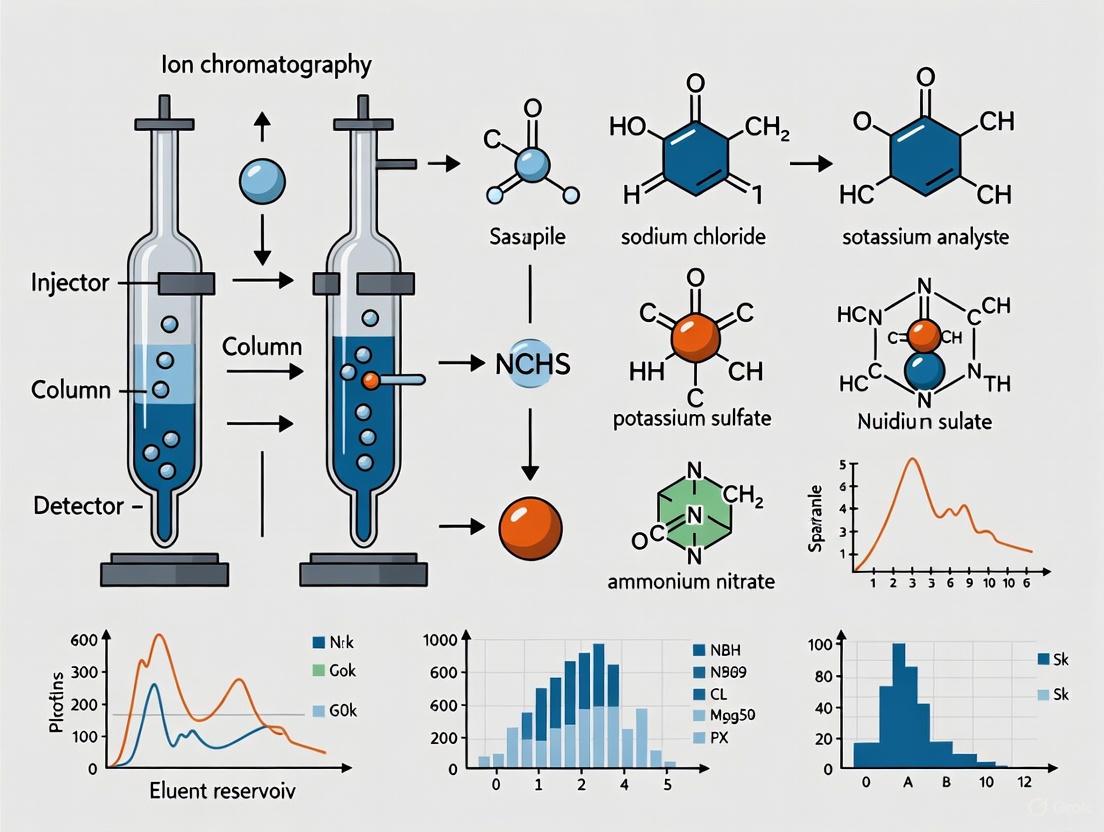
This article provides a comprehensive overview of ion chromatography (IC) for inorganic salt analysis in pharmaceutical development and quality control.
Ion Chromatography in Pharmaceutical Analysis: A Comprehensive Guide to Inorganic Salt Testing
Abstract
This article provides a comprehensive overview of ion chromatography (IC) for inorganic salt analysis in pharmaceutical development and quality control. Tailored for researchers, scientists, and drug development professionals, it covers foundational principles, methodological applications for APIs and excipients, advanced troubleshooting strategies, and rigorous validation approaches aligned with ICH and USP guidelines. The content addresses critical challenges such as nitrosamine precursor control and emphasizes IC's vital role in ensuring drug safety and efficacy from discovery to manufacturing.
The Essential Role of Ion Chromatography in Modern Pharmaceutical Labs
Core Principles of Ion-Exchange Separation and Conductivity Detection
Ion chromatography (IC) represents a powerful analytical technique within liquid chromatography, specifically designed for the separation and quantification of ions in aqueous solutions. Within the broader context of research on inorganic salt analysis, IC stands as a cornerstone method due to its ability to resolve complex mixtures of anions and cations with high precision and sensitivity. The core analytical power of modern IC stems from the synergistic combination of two fundamental components: ion-exchange separation, which resolves ionic mixtures, and conductivity detection, which provides universal and sensitive detection for the separated ions. This combination is particularly vital for analyzing common inorganic anions such as fluoride, chloride, nitrite, bromide, nitrate, phosphate, and sulfate, which are often the subject of environmental and pharmaceutical research [1]. The following sections detail the principles, methodologies, and applications that make this technique indispensable for researchers and drug development professionals.
Core Principles of Ion-Exchange Separation
Ion-exchange chromatography functions by leveraging electrostatic interactions between charged analytes in a sample and oppositely charged functional groups covalently bound to a stationary phase. Separation is achieved as different ions possess varying affinities for the stationary phase.
Stationary Phase and Mechanism: The stationary phase consists of an inert organic or polymeric matrix chemically derivatized with ionizable functional groups. In anion-exchange chromatography, the stationary phase is positively charged, typically featuring ammonium or alkylammonium groups, which attract and retain negatively charged anions. Conversely, cation-exchange chromatography employs a negatively charged stationary phase, often with sulfonate or carboxylate groups, to separate positively charged cations [2] [3]. For electroneutrality, these charged sites on the resin are associated with exchangeable counter-ions (e.g., Na+ for cation exchangers, Cl- for anion exchangers). When a sample containing ions is introduced, these analyte ions compete with the counter-ions to bind to the stationary phase, leading to selective retention [3].
Controlling Separation and Retention: The retention time and resolution of ionic species can be precisely controlled by manipulating the composition of the mobile phase.
- Eluent Concentration: Increasing the concentration of ions in the mobile phase (e.g., using a stronger salt solution or a higher molarity carbonate/bicarbonate buffer) will shorten the retention time of analytes by outcompeting them for binding sites. While this can speed up analysis, it may reduce the resolution between closely eluting peaks [2].
- pH Adjustment: The pH of the mobile phase directly affects the ionization degree of both the analytes and the stationary phase. In anion-exchange chromatography, an increase in pH (lower acidity) leads to a decline in the exchange capacity of the stationary phase, thereby affecting the retention of analytes [2].
- Temperature: Although to a lesser degree than pH and ionic strength, operating temperature can also influence retention by affecting the ionization equilibria and the kinetics of the ion-exchange process [2].
The ion-exchange capacity, defined as the number of positive or negative charges available for binding per gram of resin, is a critical parameter determining the loading capacity of a column [2].
Experimental Workflow for Ion-Exchange Separation
The following diagram illustrates the generalized workflow for conducting an ion-exchange separation, from column preparation to the final detection of analytes.
Fundamentals of Conductivity Detection
Conductivity detection is the most universal and widely used detection method in ion chromatography. Its principle is based on measuring the ability of ions in a solution to conduct an electrical current, which is directly proportional to their concentration in the sample range of interest [4].
Detection Principle and Cell Design
When a voltage is applied across a pair of electrodes immersed in the effluent stream, the resulting current is measured. This current is proportional to the total conductance of the solution, which is a function of the type and concentration of ions present between the electrodes [1]. Each ion has a characteristic equivalent conductivity constant that indicates how easily it conducts current, allowing for differentiation [1]. A typical flow-through conductivity cell uses two disk- or ring-shaped electrodes (e.g., stainless steel, 1-1.5 mm in diameter) spaced ~1 mm apart. To account for the temperature dependence of conductivity (typically an increase of ~1.7% per °C), the cell block incorporates a thermistor for temperature measurement and compensation [4].
To prevent electrochemical processes at the electrodes, an alternating voltage (1–20 kHz) is typically applied. Advanced instruments often use a bipolar pulse conductance measurement technique, where two successive voltage pulses of opposite polarity are applied, and the current is measured at the end of the second pulse. This approach minimizes errors caused by capacitance at the electrode-solution interface [4].
Suppressed vs. Non-Suppressed Conductivity Detection
A pivotal challenge in early IC was that the high ionic strength and conductivity of the eluent used to separate ions would overwhelm the signal from analyte ions. Two primary methodologies were developed to overcome this.
Non-Suppressed Conductivity (Single-Electrode Detection): This is the simpler form, where the detector is placed immediately after the column. The mobile phase is typically a weak organic acid with low conductivity. While this method is usable, its sensitivity for anions is limited because it directly measures the analyte ions against the background of the eluent. It is, however, approved for higher concentration analyses, such as in wastewater (e.g., Standard Methods 4110C) [1].
Suppressed Conductivity Detection: This method, used in most EPA-approved methods like 300.0A, greatly enhances sensitivity [1]. A suppressor device is placed between the column outlet and the detector. This device, originally a solid-phase postcolumn reactor but now typically an electrodialytically regenerated membrane, chemically transforms the eluent into a low-conductivity form while simultaneously enhancing the conductance of the analyte ions [4] [1]. For example, when using a carbonate/bicarbonate eluent and NaOH for anion analysis, the suppressor exchanges all cations for hydrogen ions. This converts the conductive sodium carbonate eluent into weakly conductive carbonic acid, while converting a sodium nitrate analyte into highly conductive nitric acid [1]. This dual action—reducing background noise and increasing analyte response—lowers detection limits significantly for anions [1].
Schematic of Conductivity Detection Configurations
The diagram below contrasts the fundamental setups for suppressed and non-suppressed conductivity detection.
Application Note: Determination of Inorganic Anions in Water
This protocol is based on the collaborative study that validated U.S. EPA Method 300.0A and ASTM Method D4327 for the determination of inorganic anions in various water matrices [5].
Experimental Protocol
- Sample Preparation: Filter the water sample (reagent water, drinking water, or wastewater) through a 0.45 µm membrane filter. For concentrates, dilute 10 mL to a final volume of 100 mL with reagent water [5].
- Chromatographic System:
- Columns: Use a guard column and an anion-exchange separator column.
- Suppressor: A chemical micromembrane suppression device is required [5].
- Eluent: Prepare a mixture of 1.7 mM sodium bicarbonate (NaHCO₃) and 1.8 mM sodium carbonate (Na₂CO₃). Degas before use.
- Injection Volume: Inject a measured volume between 20–200 µL into the ion chromatograph [5].
- Detection: Use a conductivity detector. The separated anions are measured as they pass through the detector cell.
- Data Analysis: Identify anions based on retention time comparisons with known standards. Quantify concentrations by measuring peak areas or heights and comparing them to a calibration curve.
Performance Data for Anion Analysis
The following table summarizes the performance characteristics of the method as established in the collaborative study [5].
Table 1: Quantitative Performance Data for Inorganic Anions by IC (EPA 300.0A/ASTM D4327)
| Anion | Concentration Range (mg/L) | Mean Recovery (%) | Single-Analyst Relative Standard Deviation (RSD) | Overall RSD |
|---|---|---|---|---|
| Bromide | 0.3 - 25 | 95 - 104 | < 6% (above 2-6 mg/L) | < 10% |
| Chloride | 0.3 - 25 | 95 - 104 | Slightly higher than other anions | Slightly higher than other anions |
| Fluoride | 0.3 - 25 | 95 - 104 | < 6% (above 2-6 mg/L) | < 10% |
| Nitrate | 0.3 - 25 | 95 - 104 | < 6% (above 2-6 mg/L) | < 10% |
| Nitrite | 0.3 - 25 | 95 - 104 | < 6% (above 2-6 mg/L) | < 10% |
| Orthophosphate | 0.3 - 25 | 95 - 104 | < 6% (above 2-6 mg/L) | < 10% |
| Sulfate | 2.9 - 95 | 95 - 104 | < 6% (above 24 mg/L) | < 10% |
Precision becomes more variable at the lower end of the concentration range. A statistically significant matrix effect was noted for chloride, nitrite, and nitrate in drinking water, attributed to the spiking process rather than the water itself [5].
The Scientist's Toolkit: Essential Reagents and Materials
A successful ion chromatography analysis requires specific reagents and materials. The following table details the key components for setting up an IC system and performing analyses.
Table 2: Key Research Reagent Solutions and Materials for Ion Chromatography
| Item | Function / Description | Example / Specification |
|---|---|---|
| Anion Exchange Column | Positively charged stationary phase for separating anions. | Columns such as the AS11HC are used with hydroxide eluents [4]. |
| Cation Exchange Column | Negatively charged stationary phase for separating cations. | |
| Guard Column | Protects the analytical column from particulates and irreversibly adsorbed contaminants. | Packed with the same material as the analytical column [5]. |
| Chemical Suppressor | Reduces background conductivity of the eluent and enhances analyte signal. | Micromembrane suppression device [5] or electrodialytically regenerated membrane [4]. |
| Eluent (Mobile Phase) | Aqueous solution used to carry the sample and elute ions from the column. | Carbonate/Bicarbonate (e.g., 1.7mM NaHCO₃/1.8mM Na₂CO₃) [5] or Potassium Hydroxide (KOH) [4]. |
| Conductivity Detector | Universal detector that measures the conductivity of eluting ions. | Flow-through cell with temperature compensation [4]. |
| High-Pressure Pump | Delivers a constant, pulse-free flow of the mobile phase through the system. | |
| Inorganic Anion Standards | High-purity solutions for calibration and identification of analyte peaks. | Standard solutions of fluoride, chloride, bromide, nitrate, etc. |
Advanced Detection Concepts and Future Directions
While suppressed conductivity is the gold standard for many applications, several advanced and complementary detection techniques are enhancing the capabilities of IC.
Capacitively Coupled Contactless Conductivity Detection (C4D): This is an elegant detection method where the electrodes are not in galvanic contact with the solution. Instead, ring-shaped electrodes are placed on the outside of the separation capillary. An excitation voltage (often several hundred kHz) is applied to one electrode and is capacitively coupled through the capillary wall to the solution and then to the pickup electrode [4]. C4D is particularly advantageous for capillary-scale systems because it avoids the dispersion associated with connecting tubing in a separate cell. Although not yet widespread in conventional IC, its virtues suggest it will see greater use in the future [4].
Charge Detection: The charge detector is a more recently introduced adjunct to conductivity detection. Its basic configuration resembles an electrodialytic suppressor but uses both cation- and anion-exchange membranes with an applied DC voltage. The resulting current is the analytical signal. Because its detection principles differ from conductivity, it provides complementary information that can help in peak identification [4].
Two-Dimensional Detection: A powerful approach to overcome the reduced response of suppressed conductivity for weak acids involves using two detectors in series. After the conventional suppressed conductivity detector, a small amount of hydroxide is introduced, and the stream is passed through a second detector. The ratio of the peak responses in the two detectors is indicative of the pKa of the acid, serving as an independent identifier [4].
The integration of high-efficiency ion-exchange separation with highly sensitive conductivity detection forms the bedrock of modern ion chromatography. The principles and detailed protocols outlined herein provide a framework for the reliable analysis of inorganic anions and cations, which is fundamental to research in environmental monitoring, pharmaceutical development, and material sciences. The continued evolution of detection technologies, including C4D and charge-based detection, promises to further expand the application boundaries of IC, offering researchers ever more powerful tools for inorganic salt analysis.
Why IC is Indispensable for Ionic and Polar Analyte Analysis
Ion Chromatography (IC) has established itself as a cornerstone technique in modern analytical laboratories, particularly for the analysis of ionic and polar substances. Its indispensability stems from a unique combination of selectivity, sensitivity, and versatility, enabling the resolution and quantification of complex mixtures that often challenge other analytical methods. This is especially critical in highly regulated fields like pharmaceutical development, where the accurate determination of ionic species—from active ingredients to trace-level impurities—is paramount for ensuring product safety and efficacy [6]. This article details the principles and practical protocols that make IC an irreplaceable tool for researchers and scientists.
Analytical Principle: The Mechanism of Ion Separation
Ion Chromatography is a form of liquid chromatography that separates ions and polar molecules based on their affinity for an ion exchanger [7]. The process relies on reversible ionic interactions between analyte ions in the mobile phase and charged functional groups fixed to a stationary phase (the chromatography column) [8].
- Ion-Exchange Mechanism: The stationary phase contains immobile charged sites. A cationic stationary phase with negatively charged groups (e.g., sulfonate) is used to separate anions, while an anionic stationary phase with positively charged groups (e.g., quaternary ammonium) is used to separate cations [7]. These immobilized charges are balanced by exchangeable counter-ions (e.g., Na+ for cation exchange; Cl- for anion exchange) in the eluent.
- Retention and Elution: When a sample containing analyte ions (e.g., Na+ and K+) is introduced, these ions compete with the eluent's counter-ions for the charged sites on the stationary phase. Separation occurs because different ions have different strengths of interaction with the stationary phase. By adjusting the ionic strength or pH of the eluent, the bound analytes are progressively displaced and eluted. Increasing ionic strength introduces more competing ions, while pH changes can alter the charge state of the analytes and the stationary phase [8] [7].
- Detection: After separation, the analytes pass through a detector. Conductivity detection is most common due to the inherent conductivity of ionic species, but IC systems also readily couple with spectroscopic (UV/VIS), amperometric, or mass spectrometric detectors for enhanced sensitivity and selectivity for specific analytes [6] [9].
The following workflow illustrates the fundamental process of an Ion Chromatography analysis:
Key Applications in Pharmaceutical Analysis
The application of IC in the pharmaceutical industry is vast, driven by the need for precise and reliable quantification of ionic analytes in complex matrices. Its capability for simultaneous multi-analyte determination and trace-level impurity detection makes it ideal for quality control and regulatory compliance [6].
Trace-Level Nitrite Determination to Prevent Carcinogen Formation
The detection of nitrosamine impurities in pharmaceuticals is a critical safety concern, as these compounds are potent carcinogens. Nitrosamines can form when nitrite impurities react with amines under acidic conditions. IC provides a robust method for monitoring trace nitrite to mitigate this risk [6].
- Application Overview: Unlike other techniques like photometry, IC is unaffected by high chloride concentrations, eliminating extensive sample preparation. Using a high-capacity separation column and UV/VIS detection, IC can achieve highly sensitive and specific nitrite analysis [6].
- Automated Inline Pre-concentration: Sensitivity and robustness are enhanced through automated inline sample preparation. The sample (e.g., 2000 µL) is loaded onto a pre-concentration column (PCC), where the analyte is retained while the sample matrix is washed away with ultrapure water (e.g., 3000 µL). The pre-concentrated nitrite is then injected onto the analytical column for separation and detection, enabling precise quantification at trace levels [6].
Comprehensive Quality Control of Dialysis Concentrates
Dialysis fluids and concentrates require stringent quality control to ensure patient safety, as mandated by various pharmacopeias. These solutions contain high concentrations of electrolytes (e.g., sodium, potassium, chloride) and buffers (e.g., acetate) [6].
- Simultaneous Anion and Cation Analysis: A two-channel IC system can simultaneously determine all key anionic and cationic components in a single, automated run. This includes major components like acetate and chloride, as well as cationic impurities like ammonium and calcium [6].
- Handling High-Salt Matrices: The use of high-capacity columns is essential to prevent column overload from the high saline content, which can cause peak broadening and retention time shifts. This allows for accurate quantification of acetate directly adjacent to the massive chloride peak without additional sample preparation [6].
Table 1: Key Performance Characteristics of Ion Chromatography
| Parameter | Specification | Application Example |
|---|---|---|
| Analytes | Inorganic anions/cations, polar molecules, proteins, carbohydrates [7] [9] | Phosphate in fertilizers; Chloride in water [10] [11] |
| Detection Limits | ~1 µg/L for liquids; ~5 mg/kg for solids [11] | Trace nitrite in pharmaceuticals [6] |
| Sample Volume | Typically µL to mL scale [8] | 2000 µL for nitrite analysis with pre-concentration [6] |
| Analytical Range | Wide dynamic range (low µg/L to g/L) [11] | Major components and impurities in dialysis fluid [6] |
| Key Advantage | Simultaneous multi-analyte determination; High matrix tolerance [7] [6] | Quality control of complex samples like dialysis concentrates [6] |
Experimental Protocols
This section provides detailed methodologies for two fundamental applications: the purification of a protein using IC and the analysis of common inorganic ions in a water sample.
Protocol 1: Ion-Exchange Chromatography for Protein Purification
This protocol describes the purification of a protein from a crude extract using anion-exchange chromatography on a DEAE-Sepharose column [8].
Materials and Reagents
Table 2: Research Reagent Solutions for Protein Purification
| Reagent/Equipment | Function / Description |
|---|---|
| DEAE-Sepharose Column | Stationary phase for anion-exchange; binds negatively charged proteins [8]. |
| Equilibration Buffer (e.g., Tris-HCl) | Prepares the column to a defined pH and ionic strength for sample binding [8]. |
| Elution Buffer (with NaCl gradient) | Displaces bound proteins from the column by increasing ionic strength [8]. |
| Centrifuge | Clarifies sample by removing particulate matter and precipitated contaminants [12]. |
| Dialysis Tubing/Desalting Column | Removes salts and small molecules from the protein sample post-purification [12]. |
| Ammonium Sulfate | Precipitates proteins from a crude extract for initial purification and concentration [12]. |
Step-by-Step Procedure
Sample Preparation (Ammonium Sulfate Precipitation):
- To a clarified tissue homogenate (e.g., 40 mL), add solid ammonium sulfate with constant stirring to achieve 45% (w/v) saturation. Maintain pH at 7.4.
- Centrifuge at 36,000 × g for 45 minutes at 4°C. Retain the supernatant (S4).
- Add more ammonium sulfate to the supernatant to achieve 75% saturation. Centrifuge again and retain the pellet (P5).
- Dissolve the pellet in a minimal volume of equilibration buffer (e.g., 50 mM Tris-HCl, pH 8.0). Dialyze this "post-ammonium sulfate extract" against the same buffer for 12 hours to remove residual salts [8].
Column Equilibration:
- Clamp the chromatography column upright.
- Wash the column with several bed volumes of equilibration buffer (e.g., 100 mL of Tris-HCl buffer) until the effluent pH and conductivity match that of the applied buffer [8].
Sample Loading and Wash:
- Load the dialyzed protein sample onto the equilibrated column.
- Wash the column with 5-10 column volumes of equilibration buffer to remove unbound and weakly bound contaminants. Collect the flow-through and wash fractions [8].
Elution:
- Elute the bound target protein using a linear gradient of increasing ionic strength. This is typically achieved with a gradient from 0 to 100 mM (or higher) NaCl prepared in the equilibration buffer.
- Collect the eluate as small, sequential fractions (e.g., 1-2 mL) [8].
Analysis and Regeneration:
- Analyze the fractions for total protein content (e.g., by UV absorbance at 280 nm or a specific assay like RED660 reagent) and for the desired biological activity.
- Regenerate the column by washing with a high-salt buffer (e.g., 350 mM NaCl), followed by re-equilibration with the starting buffer for storage or future use [8] [12].
Protocol 2: Analysis of Common Inorganic Anions in Water
This protocol is suited for the determination of anions like fluoride, chloride, nitrite, bromide, nitrate, phosphate, and sulfate in drinking or environmental water [11] [9].
Materials and Reagents
- IC System: Equipped with a pump, anion-exchange column (e.g., high-capacity polystyrene-divinylbenzene based), and conductivity detector. A chemical suppressor is used to lower background conductivity.
- Eluent: A carbonate/bicarbonate buffer (e.g., 1.7 mM NaHCO₃ / 1.8 mM Na₂CO₃) or a potassium hydroxide (KOH) eluent generator is standard for isocratic or gradient anion analysis.
- Standard Solutions: Certified reference materials for each target anion for instrument calibration.
Step-by-Step Procedure
Sample Preparation:
- Filter the water sample through a 0.45 µm or 0.2 µm membrane filter (e.g., cellulose acetate or PVDF) to remove particulate matter. This is critical to protect the chromatography column [12].
- For trace analysis, an automated inline pre-concentration step can be employed as described in Section 2.1.
System Equilibration:
- Set the eluent flow rate as specified for the column (typically 0.5 - 1.5 mL/min).
- Allow the system to run until a stable baseline is achieved on the conductivity detector, indicating the column is properly equilibrated.
Calibration:
- Inject a series of standard solutions with known concentrations of the target anions.
- Construct a calibration curve by plotting the peak area (or height) against the concentration for each anion.
Sample Analysis and Quantification:
- Inject a precise volume (typically 10 - 50 µL) of the prepared sample onto the column.
- The data system will record a chromatogram showing peaks for each anion at their characteristic retention times.
- Identify anions by comparing retention times with the standards. Quantify their concentrations by interpolating the peak areas from the calibration curve.
Table 3: Advantages and Considerations of IC in Practice
| Aspect | Advantages of IC | Practical Considerations |
|---|---|---|
| Selectivity | High selectivity for ionic/polar compounds; Resolves multiple analytes in one run [9]. | Column must be matched to analyte charge (anion vs. cation). |
| Sensitivity | Low detection limits (ppb level); Ideal for trace impurity analysis [6] [11]. | Sample preparation (e.g., pre-concentration) may be needed for ultra-trace levels. |
| Efficiency | High-throughput and fully automatable; Minimal manual intervention [6]. | High salt samples may require dilution or special high-capacity columns. |
| Versatility | Broad applicability from small ions to large biomolecules [7] [9]. | Method development required to optimize eluent and column for new analytes. |
Ion Chromatography has proven its indispensable role in the analytical toolkit. Its foundational principle of ion-exchange facilitates the precise separation and quantification of a vast array of ionic and polar species, from inorganic anions in water to complex biomolecules. As demonstrated through its critical pharmaceutical applications—from safeguarding against carcinogenic nitrosamines by monitoring nitrite to ensuring the precise formulation of life-saving dialysis concentrates—IC provides the accuracy, sensitivity, and robustness that modern research and quality control demand. The continuous evolution of columns, elution systems, and detectors, coupled with its ability to be hyphenated with techniques like mass spectrometry, ensures that IC will remain a vital technique for addressing current and future analytical challenges in inorganic salt analysis and beyond.
Ion Chromatography (IC) has become a cornerstone technique for the analysis of inorganic ions, offering distinct advantages that address limitations inherent to traditional methods like Inductively Coupled Plasma Mass Spectrometry (ICP-MS) and Atomic Absorption Spectroscopy (AAS). For researchers in drug development and pharmaceutical sciences, the precision and reliability of inorganic salt analysis are paramount, influencing processes from excipient characterization to final product quality control. This application note details two of IC's most significant technical advantages: its superior multi-analyte capability and its metal-free flow path. These features minimize sample pre-treatment, reduce interference, and prevent metal contamination—a critical concern in catalytic processes and biopharmaceutical formulations. We provide validated protocols and comparative data to empower scientists in leveraging these advantages for robust analytical outcomes.
Multi-analyte Capability in Ion Chromatography
The ability to simultaneously separate and quantify multiple ionic species in a single analytical run is a defining strength of Ion Chromatography. This multi-analyte capability stands in sharp contrast to many traditional single-element techniques, significantly enhancing laboratory efficiency and providing a comprehensive ionic profile of a sample.
Comparative Analysis with Traditional Techniques
Traditional methods for elemental analysis, such as Atomic Absorption Spectroscopy (AAS), are fundamentally limited to measuring one element at a time [13]. While techniques like ICP-MS offer multi-element detection, they can struggle with analyzing complex samples containing mixtures of elements at varying concentrations and often require extensive sample preparation [13]. IC, particularly in its high-performance ion exchange chromatography (HPIC) mode, is inherently designed for the simultaneous separation of multiple ions.
Table 1: Comparison of Multi-analyte Performance for Inorganic Ions
| Analytical Feature | Ion Chromatography (HPIC) | Inductively Coupled Plasma Mass Spectrometry (ICP-MS) | Atomic Absorption Spectroscopy (AAS) |
|---|---|---|---|
| Simultaneous Analysis | Excellent (Designed for simultaneous anion or cation separation) | Excellent (True multi-element) | Poor (Typically single-element) |
| Sample Throughput | High (Multiple analytes per run) | High | Low (Sequential analysis required) |
| Analysis of Complex Matrices | Robust (With appropriate sample prep) | Can be complex (Matrix effects) [14] | Can be complex (Requires specific lamps) |
| Key Advantage | Comprehensive ionic profile in a single injection | Very low detection limits for trace metals | Well-established, specific methodology |
The data in Table 1 underscores that IC provides a balanced and efficient approach for laboratories where the primary focus is on common inorganic anions and cations, rather than ultra-trace metal analysis. For instance, in the context of inorganic salt analysis, a single IC method can quantify sodium, potassium, calcium, and magnesium cations concurrently [15], or a suite of anions like chloride, nitrate, and sulfate from a drug substance.
Experimental Protocol: Simultaneous Determination of Common Inorganic Cations
This protocol describes the simultaneous determination of alkali and alkaline earth metals (e.g., Lithium, Sodium, Ammonium, Potassium, Magnesium, Calcium) using a cation-exchange system. The presence of ammonium is a key example where IC's multi-analyte capability is superior, as it is difficult to measure with many other techniques.
Materials and Reagents:
- Research Reagent Solutions: See Section 5 for a detailed list.
- Eluent: Methanesulfonic acid (MSA), 20-30 mM, suitable for IC.
- Ultrapure Water: Type 1 water (18.2 MΩ·cm) to prevent contamination.
- Standard Solutions: Certified reference materials for each target cation.
Instrumentation:
- IC system equipped with a high-pressure pump, conductivity detector, and suppressor.
- Cation-exchange column (e.g., Thermo Scientific IonPac CS12A or equivalent).
- Guard column compatible with the analytical column.
Procedure:
- Eluent Preparation: Accurately prepare the methanesulfonic acid eluent (e.g., 25 mM) using ultrapure water. Degas the solution by sonication or sparging with an inert gas (e.g., helium) to prevent air bubble formation in the system.
- Standard and Sample Preparation: Prepare calibration standards by diluting stock reference solutions with ultrapure water. Filter all standards and samples through a 0.2 μm or 0.45 μm nylon or PVDF membrane filter.
- Chromatographic Conditions:
- Eluent: 25 mM Methanesulfonic Acid (MSA)
- Flow Rate: 1.0 mL/min
- Column Temperature: 30 °C
- Injection Volume: 25 μL
- Detection: Suppressed Conductivity
- System Equilibration and Analysis: Equilibrate the column with the eluent until a stable baseline is achieved. Inject the standards to establish a calibration curve, followed by the processed samples.
- Data Analysis: Identify cations based on their retention times and quantify them using the external standard method based on peak area.
Diagram 1: Cation Analysis Workflow. This flowchart outlines the key steps for the simultaneous determination of multiple cations.
The Metal-Free Flow Path
A pivotal innovation in modern Ion Chromatography is the implementation of a metal-free flow path, also known as a "biocompatible" flow path. Traditional HPLC and ICP systems often contain metal components (e.g., stainless steel) in the pump, injector, and tubing. These components are susceptible to corrosion from acidic or alkaline eluents and can leach metal ions—such as iron, chromium, and nickel—into the mobile phase, causing high background noise, analyte adsorption, and false positives.
Advantages of a Metal-Free System
The metal-free flow path, constructed from polymers like PEEK (polyetheretherketone), fluoropolymers, and ceramics, provides several critical benefits for inorganic salt analysis:
- Reduced Contamination: Eliminates background contamination from leached metal ions, which is crucial for achieving low detection limits and accurate quantification of trace-level cations like sodium, ammonium, and potassium [16] [17].
- Chemical Inertness: Withstands highly acidic (e.g., methanesulfonic acid) and alkaline (e.g., potassium hydroxide) eluents without risk of corrosion. This is essential for exploiting the full range of separation chemistries, particularly the use of high-pH hydroxide eluents for anion analysis [16] [17].
- Improved Analyte Recovery: Prevents the adsorption of analyte ions onto active metal surfaces within the flow path, leading to more accurate and reproducible results, especially for species like phosphate and amines.
The development of hydroxide-selective anion-exchange phases was a major breakthrough that leveraged the metal-free flow path. These phases enable the use of potassium hydroxide eluents, which can be automatically generated at high purity, resulting in lower background conductivity, superior baseline stability, and enhanced sensitivity compared to traditional carbonate/bicarbonate eluents [17].
Experimental Protocol: Determination of Trace Anions in a Pharmaceutical Excipient Using a Metal-Free System
This protocol is designed to highlight the sensitivity gains from a metal-free flow path when analyzing trace anions, such as chloride and sulfate, in a complex matrix like lactose.
Materials and Reagents:
- Research Reagent Solutions: See Section 5.
- Eluent: Potassium Hydroxide (KOH), using an optional Eluent Generator (RFIC-EG) for high-purity, consistent eluent production.
- Ultrapure Water: Type 1 water.
- Standard Solutions: Certified reference materials for chloride, nitrate, and sulfate.
Instrumentation:
- IC system with a fully metal-free (PEEK) flow path.
- Anion-exchange column (e.g., Thermo Scientific IonPac AS18 or equivalent).
- Guard column and electrolytic suppressor.
- Optional: Eluent Generator for potassium hydroxide.
Procedure:
- Sample Preparation: Accurately weigh approximately 1.0 g of lactose excipient. Dissolve in 20 mL of ultrapure water. Subject the solution to vigorous mixing (e.g., vortex) for 10 minutes. Centrifuge if necessary to pellet insoluble material, and carefully filter the supernatant through a 0.2 μm syringe filter.
- Eluent Generation (Recommended): Use an eluent generator cartridge to produce a high-purity KOH gradient. A typical method for the AS18 column might be: 10 mM KOH from 0-10 min, ramp to 45 mM from 10-20 min, hold until 25 min, then re-equilibrate.
- Chromatographic Conditions:
- Eluent: KOH Gradient (e.g., 10-45 mM)
- Flow Rate: 1.0 mL/min
- Column Temperature: 30 °C
- Injection Volume: 25 μL
- Detection: Suppressed Conductivity
- System Preparation: Flush the system with ultrapure water and equilibrate with the starting eluent condition until a stable, low-background conductivity signal is achieved (<1 μS). This low baseline is a direct result of the metal-free flow path and high-purity eluent.
- Analysis: Inject calibration standards followed by the prepared sample solution.
Table 2: Impact of Flow Path on Trace Anion Detection (Exemplar Data)
| Analytical Parameter | Metal-Free Flow Path (PEEK) | System with Stainless Steel Components |
|---|---|---|
| Background Conductivity (Baseline Noise) | Low (< 1 μS) | High and Unstable |
| Detection Limit for Chloride | < 1 μg/L (ppb) | > 10 μg/L (ppb) |
| Peak Tailing for Sulfate | Minimal (Symmetrical peak) | Significant (Due to adsorption) |
| Column Lifetime | Extended | Potentially reduced by metal contamination |
Integrated Workflow and Advanced Applications
The combination of multi-analyte capability and a metal-free flow path enables powerful, robust applications. A prime example is the analysis of biogenic amines and organic acids, which are indicators of food spoilage and drug product stability [15]. These analytes lack strong chromophores, making UV detection difficult. However, they can be seamlessly analyzed using IC with integrated pulsed amperometric detection (IPAD) on a single, metal-free instrument platform.
Diagram 2: IC Separation Fundamentals. The interdependent relationship between analytes, stationary phase, and eluent dictates separation efficiency [16].
The Scientist's Toolkit: Essential Research Reagent Solutions
Table 3: Key Consumables and Reagents for IC Analysis
| Item | Function | Critical Specification |
|---|---|---|
| IC-Grade Eluent Chemicals (e.g., KOH pellets, MSA) | Mobile phase for transporting and separating analytes. | High purity to minimize background conductivity and contamination. |
| IC Separation Column (e.g., anion or cation-exchange) | Heart of the system; separates ions based on affinity. | Selectivity, capacity, and pH stability must match application. |
| Suppressor Device | Chemically reduces eluent conductivity post-column. | Enables highly sensitive conductivity detection. |
| Ultrapure Water System | Diluent for eluents, standards, and samples. | Type 1 water (18.2 MΩ·cm) is non-negotiable. |
| Syringe Filters (0.2 μm, PEEK or Nylon) | Removes particulates from samples to protect the column. | Must be low-extractable and non-adsorptive. |
| Certified Reference Material (CRM) Standards | For accurate instrument calibration and quantification. | Traceability to a national metrology institute (NMI). |
| PEEK Tubing and Fittings | Maintains a metal-free flow path throughout the system. | Prevents corrosion and metal ion leaching. |
The United States Pharmacopeia (USP) provides public standards for medicines, dietary supplements, and food ingredients to ensure identity, strength, quality, and purity. Among these standards, General Chapters establish validated procedures and requirements for analytical techniques. For researchers analyzing inorganic salts by ion chromatography (IC), two chapters are particularly critical: <1065> Ion Chromatography and <621> Chromatography [18].
USP General Chapters below 1000 are mandatory requirements, whereas those between 1000-1999 provide informational guidance [19]. <621> is a mandatory chapter covering fundamental principles and system suitability for all chromatographic methods, while <1065> offers detailed guidance specific to IC technology and applications [20] [21] [22]. Understanding their hierarchy and interaction is essential for developing compliant analytical methods in pharmaceutical research and development.
USP <1065> Ion Chromatography: Scope and Applications
Definition and Principles
USP <1065> defines Ion Chromatography as a high-performance liquid chromatography technique utilized in identification tests, assays, and determinations of impurities including limit tests and quantitative tests [20]. IC measures inorganic anions and cations, organic acids, carbohydrates, sugar alcohols, aminoglycosides, amino acids, proteins, and glycoproteins derived from organic or inorganic molecules [20] [22].
IC separations are based on three primary mechanisms [22]:
- Ion exchange: Competitive ionic binding to chromatographic support
- Ion exclusion: Repulsion between similarly charged analyte ions and support functional groups
- Ion-pair: Utilizing ion-pair agents with reversed-phase stationary phases
Instrumentation and Detection Methods
A typical IC system comprises an autosampler, high-pressure pump, injection valve, guard column, analytical column, optional suppressor, detector, and data system [22]. Compatibility with mobile phases is critical, with components typically constructed from inert materials like polyetheretherketone (PEEK) [22].
Table 1: IC Detection Methods and Their Applications [22]
| Detection Method | Principle | Typical Applications |
|---|---|---|
| Suppressed Conductivity | Reduces background conductance and enhances analyte signal | Trace ions in high-purity waters; common anions and cations |
| Nonsuppressed Conductivity | Direct measurement without chemical suppression | Ions of weak acids (cyanide, sulfide); pharmaceutical analyses at mg/L levels |
| Pulsed Amperometric (PAD) | Oxidative desorption at electrode surface with cleaning potentials | Carbohydrates, sugar alcohols, amino acids, organic sulfur species |
| Direct UV Detection | Absorption of UV light by chromophores | Organic acids, bromide, iodide, nitrate, nitrite, thiosulfate |
| Indirect Photometric | Inverse detection analogous to nonsuppressed conductivity | Various ions without native UV chromophores |
USP <621> Chromatography: System Suitability and Parameters
Regulatory Context and Updates
USP <621> is one of the most accessed general chapters, with nearly 4,000 references across USP-NF [19]. The chapter underwent significant harmonization through the Pharmacopeial Discussion Group (PDG), with a revised version becoming official on December 1, 2022 [21]. Further updates to system suitability requirements will become effective on May 1, 2025 [19].
The hierarchy of USP standards dictates that monographs and general notices take precedence over general chapters. The statement "unless specified in the monograph" frequently appears in <621>, indicating that monograph-specific requirements override general chapter guidance [19].
Key System Suitability Parameters
System suitability tests demonstrate that the chromatographic system performs adequately before sample analysis. Key parameters defined in <621> include [23]:
- Theoretical plates (N): Measure of column efficiency
- Tailing factor (AS): Measure of peak asymmetry
- Resolution (RS): Describes separation quality between adjacent peaks
- Relative standard deviation: Measure of system repeatability
The upcoming May 2025 implementation adds requirements for system sensitivity (signal-to-noise ratio) and formalizes acceptance criteria for peak symmetry (0.8-1.8) [19]. Signal-to-noise ratio is specifically required for impurity methods where quantitation near limits of quantification occurs [19].
Table 2: Allowable Adjustments to Chromatographic Systems per USP <621> [21] [19]
| Adjustment Type | Allowed Modifications | Constraints |
|---|---|---|
| Mobile Phase | Composition, pH, concentration of salts in buffers | Must meet system suitability requirements |
| Injection Volume | Changes via specified calculation | Limited to ±25% unless otherwise specified |
| Gradient Elution | Particle size, injection volume | Maintains equivalent linear velocity and resolution |
| Column Dimensions | Length, internal diameter, particle size | Adjusted to maintain same ratio of L/dp² and L/df |
Experimental Protocols for IC Analysis of Inorganic Salts
Method Development Workflow
The following diagram illustrates the systematic approach to developing and validating IC methods for inorganic salt analysis under USP guidelines:
Method Development Workflow for IC Analysis
Protocol: Halide Analysis in Pharmaceutical Salts
This protocol follows USP monographs for halide determination, such as the adenosine monograph which specifies chloride limits of not more than 0.007% [24].
Materials and Equipment [23] [22]:
- IC system with conductivity detector and chemical suppressor
- Anion-exchange column (L46 or equivalent packing)
- Guard column of same packing material
- Mobile phase: 3.5 mM sodium carbonate/1.0 mM sodium bicarbonate
- Standards: Sodium chloride, potassium bromide, sodium fluoride (USP grade)
Sample Preparation:
- Accurately weigh approximately 100 mg of sample into 100 mL volumetric flask
- Dissolve in and dilute to volume with deionized water
- Filter through 0.45 μm membrane filter before injection
Chromatographic Conditions [24]:
- Column temperature: 30°C
- Flow rate: 1.0 mL/min
- Injection volume: 25 μL
- Detection: Suppressed conductivity
- Run time: 15 minutes
System Suitability Requirements [23]:
- Resolution (Rs) between chloride and bromide peaks: ≥1.5
- Tailing factor for chloride peak: ≤1.8
- RSD for six replicate injections of standard: ≤2.0%
Calculation: Calculate halide concentration in sample using external standardization:
Where: Asample = peak area of halide in sample; Astd = peak area of halide in standard; Cstd = concentration of standard solution (μg/mL); V = final dilution volume (mL); W = sample weight (mg)
Protocol: Column Equivalency Testing
When substituting columns within the same L-group classification, perform equivalency testing without full method validation [23].
Procedure:
- Select candidate column from same L-group as specified in monograph
- Prepare system suitability solution per monograph requirements
- Perform six replicate injections using original method conditions
- Compare performance parameters against acceptance criteria
- Analyze quality control sample to verify quantitation accuracy
Acceptance Criteria [23]:
- All system suitability parameters meet monograph requirements
- Resolution for critical pairs within ±20% of original column
- Retention times within ±15% of original column
- Quantitation of control sample within ±3% of reference value
Table 3: Research Reagent Solutions for IC Analysis
| Reagent/ Material | Function/Principle | Application Example |
|---|---|---|
| L-group Classified Columns | Stationary phases with standardized properties | Method reproducibility across instruments and laboratories |
| Chemical Suppressors | Reduces mobile phase background conductivity | Enhances signal-to-noise in trace anion analysis |
| Pulsed Amperometric Detector | Prevents electrode fouling via potential sequences | Detection of non-chromophoric analytes like carbohydrates |
| Anion/Cation Trap Columns | Removes contaminant ions from mobile phases | Improves baseline stability for trace analysis |
| Eluent Generator Cartridges | Produces high-purity hydroxide eluents online | Enhanced sensitivity and reproducible retention times |
Practical Implementation in Pharmaceutical Analysis
Case Study: Voriconazole Analysis
A column equivalency study validated the Metrosep A Supp 1 column (L46 packing) for Voriconazole Related Compound F analysis per USP monograph [23]. The method employed:
- Mobile phase: Methanol, water, and sodium hydroxide solution (500:1500:0.175)
- Column temperature: 40°C
- Flow rate: 1.0 mL/min
- Detection: Suppressed conductivity
- System suitability: Resolution between voriconazole and chloride peaks ≥2.0
The study demonstrated that alternative columns within the same L-group classification could be successfully qualified while maintaining compliance with USP requirements [23].
Regulatory Considerations
The modernization of USP monographs has significantly increased IC applications. While USP25-NF20 contained only 12 monographs with IC methods, this number grew to approximately 110 in USP32-NF27 [18]. This expansion reflects regulatory acceptance of IC as a robust technique for pharmaceutical analysis.
When implementing IC methods, laboratories must maintain complete documentation of:
- Column specifications and L-group classification
- System suitability results for each analysis session
- Adjustments made to chromatographic conditions with justification
- Validation data for any method modifications
USP General Chapters <1065> and <621> provide a comprehensive framework for implementing ion chromatography in pharmaceutical analysis of inorganic salts. <1065> establishes IC as a versatile technique with multiple separation mechanisms and detection strategies, while <621> ensures chromatographic methods remain controlled through system suitability testing and allowable adjustments.
The ongoing harmonization of <621> and its updates through 2025 reflect the dynamic nature of pharmacopeial standards. For researchers analyzing inorganic salts, understanding these chapters enables development of robust, compliant methods that ensure product quality while maintaining flexibility through mechanisms like column equivalency. As IC technology continues to evolve, these foundational chapters provide the necessary guidance to implement modern techniques while maintaining regulatory compliance.
Ion chromatography (IC) has established itself as a critical analytical technique within the pharmaceutical industry, particularly for the analysis of inorganic salts, drug counterions, and ionic impurities. The evolution of IC from a specialized research tool to a mainstream technique in quality control (QC) laboratories marks a significant advancement in pharmaceutical analysis [25]. This journey, characterized by initial technological and regulatory challenges, has culminated in widespread acceptance, with IC now qualified for United States Pharmacopeia (USP) standards and cited in numerous monographs and general chapters (e.g., <345>, <1065>, and <591>) [6] [25]. The technique's unparalleled ability to resolve multiple ionic species and polar analytes simultaneously, coupled with high sensitivity and a high degree of automation, makes it an ideal tool for ensuring drug quality and patient safety from development through to manufacturing [6]. This application note details the role of IC within the context of inorganic salt analysis, providing detailed protocols and current data to support researchers and drug development professionals.
Historical Context and Regulatory Adoption
The adoption of IC in the pharmaceutical industry was a gradual process. Invented by Hamish Small in 1975 and commercialized by Dionex, IC was initially developed for environmental and water analysis [25]. Its migration to the highly regulated pharmaceutical sector was initially slow, hampered by factors including a reliance on established wet-chemistry methods, lack of compendial guidance, and concerns about the robustness of early systems, which required regular regeneration of the suppression column [25].
A pivotal point in IC's history was the emergence of two distinct system architectures: suppressed and non-suppressed IC. Suppressed systems, pioneered by Dionex, use chemical or electrolytic suppression to reduce background conductivity, offering superior sensitivity for detecting low-level ions [25]. In contrast, non-suppressed systems, as implemented by companies like Metrohm, utilize specific eluents and columns to eliminate the need for suppression, making the instrumentation more comparable to HPLC [25]. This technological divergence initially posed challenges for method harmonization but ultimately provided laboratories with flexible solutions for diverse application needs [25].
Regulatory acceptance began to solidify in the 2000s, driven by pressures to improve impurity profiling per ICH guidelines [25]. The USP, European Pharmacopoeia (EP), and Japanese Pharmacopoeia (JP) incorporated IC into general chapters, with a strategic focus on defining performance-based criteria rather than prescribing specific instrument types [6] [25]. This flexible, inclusive approach ensured that labs using either suppressed or non-suppressed IC could comply with monograph requirements, solidifying IC's role in modern pharmaceutical QA/QC [25].
Current Applications in Pharmaceutical Analysis
IC's scope in the pharmaceutical industry is broad, solving various analytical challenges related to ionic and polar substances [6]. Key application areas include:
- Trace Impurity Analysis: Monitoring potentially genotoxic impurities like nitrite to prevent the formation of carcinogenic N-nitrosamines [6]. IC provides a precise method unaffected by chloride, unlike photometric techniques, and can be automated for pre-concentration and matrix elimination to achieve trace-level detection [6].
- Counterion Analysis: Determining inorganic counterions such as sodium or potassium in active pharmaceutical ingredient (API) salts, which is vital for confirming stoichiometry and ensuring batch-to-batch consistency [26].
- Comprehensive Quality Control: Simultaneous quantification of multiple ionic components in complex formulations, such as hemodialysis concentrates and parenteral nutrition solutions [6]. IC can accurately measure major electrolytes (e.g., sodium, potassium, calcium, chloride) and potential impurities (e.g., nitrite, bromide) in a single run [6].
- Cleaning Validation: Detecting residual ions like chlorides or sulfates on manufacturing equipment to confirm cleaning efficacy [25].
- Analysis of Carbohydrates and Antibiotics: Using pulsed amperometric detection (PAD) for the sensitive analysis of sugars, sugar alcohols, and aminoglycoside antibiotics like gentamicin [26].
Table 1: Key IC Applications in Pharmaceutical Analysis
| Application Area | Target Analytes | Key Benefit | Relevant Guideline/Monograph |
|---|---|---|---|
| Trace Impurity Analysis | Nitrite, Nitrosamine precursors | High sensitivity, matrix elimination | USP <1469> [6] |
| Counterion Analysis | Na+, K+, Cl-, Citrate, Acetate | Confirms API salt stoichiometry | Various API monographs [26] [25] |
| Dialysis Concentrate QC | Acetate, Cl-, Na+, K+, Ca2+, Mg2+ | Simultaneous multi-analyte determination | ISO 13958, European Pharmacopoeia [6] |
| Cleaning Validation | Chloride, Sulfate, Phosphate | High sensitivity for residual ions | Internal validation protocols [25] |
| Antibiotic/Sugar Analysis | Gentamicin, Sucrose, Glucose | Specific detection with PAD | Pharmacopoeia monographs [26] |
Detailed Experimental Protocols
Protocol 1: Trace Level Nitrite Determination to Prevent Nitrosamine Formation
1. Principle: This automated method uses ion chromatography with pre-concentration and matrix elimination to detect trace levels of nitrite in pharmaceutical samples. The goal is to control a key precursor in the formation of carcinogenic N-nitrosamines [6].
2. Scope: Applicable to active pharmaceutical ingredients (APIs), excipients, and finished dosage forms where nitrite contamination is a potential risk.
3. Equipment and Reagents:
- IC System: Ion chromatograph with a high-pressure pump, autosampler, and sequential suppression system (chemical suppression followed by CO2 removal) [6].
- Detection: UV/VIS detector [6].
- Columns: High-capacity anion-exchange separation column and a pre-concentration column (PCC) [6].
- Eluent: As per optimized method for nitrite separation (e.g., hydroxide-based eluent) [6].
- Solvents: Ultrapure water (Type 1) for sample preparation and matrix elimination [6].
4. Procedure:
- Sample Preparation: Prepare a homogenous solution of the pharmaceutical sample in ultrapure water. Filter through a 0.2 µm or 0.45 µm syringe filter.
- System Setup: Equip the IC system with the pre-concentration and analytical columns. Configure the sequential suppressor and set the UV/VIS detector to the appropriate wavelength for nitrite (e.g., 520 nm after post-column derivatization or as validated).
- Automated Analysis:
- Load 2000 µL of the prepared sample onto the pre-concentration column instead of a standard loop [6].
- Wash the column with 3000 µL of ultrapure water to eliminate the sample matrix [6].
- The pre-concentrated analytes are then automatically injected onto the separation column.
- Separate the analytes using an isocratic or gradient elution program.
- Detect the eluted nitrite after sequential suppression using UV/VIS detection [6].
- Data Analysis: Quantify nitrite by comparing the peak area or height against a calibrated standard curve.
The workflow for this protocol is illustrated below:
Protocol 2: Quality Control of Hemodialysis Concentrates
1. Principle: This method uses a dual-channel IC system to simultaneously and accurately quantify major cationic and anionic components, as well as ionic impurities, in highly saline hemodialysis concentrates. High-capacity columns prevent matrix overload and ensure excellent peak separation without additional sample preparation [6].
2. Scope: Applicable to acid (A-) and bicarbonate (B-) concentrates used in hemodialysis, as specified in pharmacopoeial standards (e.g., European Pharmacopoeia, ISO 13958) [6].
3. Equipment and Reagents:
- IC System: Two-channel ion chromatograph equipped with two high-pressure pumps, a refrigerated autosampler, and channels for suppressed and non-suppressed conductivity detection [6].
- Detection: Suppressed conductivity detection for anions; non-suppressed or suppressed conductivity detection for cations [6].
- Columns: High-capacity anion-exchange column and high-capacity cation-exchange column [6].
- Eluents: Anion analysis: hydroxide or carbonate/bicarbonate-based eluent. Cation analysis: methanesulfonic acid (MSA) or nitric acid-based eluent [6] [16].
4. Procedure:
- Sample Preparation: Manually dilute the dialysis concentrate sample by a factor of 750 using ultrapure water. Use a refrigerated autosampler to maintain sample stability [6].
- Anion Analysis (Channel 1):
- Inject the diluted sample onto the high-capacity anion-exchange column.
- Use a hydroxide gradient elution at a high flow rate to speed up the run time.
- Detect anions (e.g., acetate, chloride, nitrite, nitrate, bromide) using sequentially suppressed conductivity detection. For higher sensitivity of impurities like nitrite, UV/VIS detection can be used in series [6].
- Cation Analysis (Channel 2):
- Simultaneously inject the diluted sample onto the high-capacity cation-exchange column.
- Use an isocratic MSA elution.
- Detect cations (e.g., sodium, potassium, calcium, magnesium) using non-suppressed conductivity detection. Cation suppression can be applied to improve sensitivity for impurities like ammonium [6].
- Data Analysis: Quantify all analytes by comparing against external standard curves. The entire analysis for both anions and cations is completed within approximately 25 minutes [6].
Table 2: Representative Data for Dialysis Concentrate Analysis by IC (n=3)
| Analyte | Final Conc. in Concentrate | Measured Conc. in Diluted Sample (mg/L) | Retention Time (min) |
|---|---|---|---|
| Acetate | ≈ 6.5 g/L | 8.63 ± 0.05 | Method Dependent |
| Chloride | ≈ 137 g/L | 182.2 ± 3.1 | Method Dependent |
| Sodium | Calculated | 112.9 ± 1.5 | Method Dependent |
| Potassium | Calculated | 3.45 ± 0.04 | Method Dependent |
| Calcium | Calculated | 2.68 ± <0.01 | Method Dependent |
| Magnesium | Calculated | 0.54 ± 0.04 | Method Dependent |
| Nitrite (Impurity) | Trace | 0.47 ± 0.07 | Method Dependent |
| Nitrate (Impurity) | Trace | 0.32 ± 0.02 | Method Dependent |
| Bromide (Impurity) | Trace | < 0.04 | Method Dependent |
Data adapted from [6]
The Scientist's Toolkit: Essential IC Components
Successful implementation of IC methods relies on a suite of specialized reagents and consumables. The following table details key solutions and their functions.
Table 3: Essential Research Reagent Solutions for IC Analysis
| Item | Function/Description | Critical Parameters & Notes |
|---|---|---|
| Ultrapure Water (Type 1) | Solvent for eluent preparation, standard and sample dilution. | Resistivity ≥ 18.2 MΩ·cm; essential to minimize background contamination and baseline noise [6] [16]. |
| High-Purity Eluent Chemicals | Acids (e.g., MSA), bases (e.g., KOH), or salts (e.g., Na2CO3) used to prepare the mobile phase. | Highest quality available; contamination from other ions directly affects separation and quantification [16]. |
| Certified Ion Standards | Single-element or multi-element standard solutions for instrument calibration. | Used to create external calibration curves for accurate quantification of target analytes. |
| In-line Eluent Generator (RFIC) | Reagent-Free IC (RFIC) electrolytically generates consistent, high-purity eluents (e.g., KOH, MSA) from deionized water. | Revolutionizes ease-of-use, reduces variability, and enables highly reproducible gradients [27] [28]. |
| Chemical Suppressor | Device that reduces the background conductivity of the eluent by converting salts to weakly dissociated acids (anion analysis) or water (cation analysis). | Dramatically improves signal-to-noise ratio for conductivity detection [25] [27]. |
| Guard Column | A small, short column placed before the analytical column with the same stationary phase. | Protects the analytical column by trapping particulate matter and contaminants, extending its lifetime [27]. |
Technological Advancements and Future Perspectives
The evolution of IC over its 50-year history has been driven by continuous innovation. Key technological advancements include:
- Suppressor Technology: The evolution of suppressors from early columns requiring regular regeneration to modern, high-capacity, continuously regenerating electrolytic suppressors has been a cornerstone of IC advancement, enabling high-sensitivity detection with minimal maintenance [27].
- Reagent-Free Ion Chromatography (RFIC): The introduction of RFIC systems, which electrolytically generate high-purity eluents on-demand from deionized water, has been revolutionary. This technology minimizes user intervention, reduces errors associated with manual eluent preparation, and ensures exceptional reproducibility for both isocratic and gradient methods [27] [28].
- Column Chemistry: Advances in stationary phase chemistry, including the development of high-capacity and hydroxide-selective phases, have greatly improved resolution, selectivity, and speed of analysis [6] [27]. The availability of columns with smaller particle sizes supports more efficient separations [28].
- Hyphenation with Mass Spectrometry (IC-MS): Coupling IC with mass spectrometry combines excellent separation power with the high sensitivity and specificity of MS detection. This is particularly valuable for identifying unknown impurities and confirming the identity of target analytes in complex matrices [6] [27].
- System Automation and Pressure Capabilities: Modern IC systems feature a high degree of automation, including automated sample preparation and injection. Operation at higher pressures (e.g., up to 5,000 psi) allows for the use of smaller particle columns, facilitating faster and higher-resolution separations [28].
Looking forward, the integration of Artificial Intelligence (AI) and Machine Learning (ML) is poised to further advance IC. Potential applications include automated method development and optimization, enhanced data analysis and interpretation, intelligent system diagnostics, and improved quality control protocols [28]. As these technologies mature, they are expected to significantly change and advance chromatographic workflows, making IC an even more powerful and accessible tool for pharmaceutical analysis.
Practical IC Methods for Drug Substance, Excipient, and Impurity Analysis
Simultaneous Multi-analyte Determination in Complex Matrices
Ion chromatography (IC) has become an indispensable technique in modern analytical laboratories, particularly for the analysis of ionic species in complex sample matrices. In the pharmaceutical sector, the ability to resolve multiple ionic species and polar analytes simultaneously makes IC a vital tool for ensuring product quality and patient safety [6]. This application note details a validated IC method for the simultaneous quantification of nine inorganic anions, including toxic pollutants and essential nutrients, in various aqueous matrices. The methodology aligns with the broader research objectives of advancing inorganic salt analysis by providing a robust, efficient alternative to analyte-specific techniques.
Experimental Protocols
Instrumentation and Conditions
All analyses were performed using a Metrohm AG 930 compact IC flex system equipped with a chemical suppressor (Metrohm suppressor module, MSM) and a conductivity detector [29]. The key instrumental parameters are summarized below:
- Separation Column: Metrosep A Supp 7 analytical column (250 × 4 mm) with a Metrosep A Supp 5 Guard column.
- Mobile Phase: Isocratic eluent consisting of 10.8 mM sodium carbonate and 35% (v/v) gradient grade acetonitrile in deionized water (pH 11.9).
- Flow Rate: 0.8 mL/min.
- Column Temperature: 55°C.
- Injection Volume: 1000 μL.
- Detection: Suppressed conductivity detection.
Sample Preparation
The method was validated for tap water, surface water, groundwater, and wastewater samples [29]. For trace-level analysis in complex matrices, such as pharmaceuticals, an automated inline sample preparation technique can be employed. This involves using an intelligent pre-concentration column (PCC) where the sample (e.g., 2000 μL) is loaded and the matrix is washed away (e.g., with 3000 μL ultrapure water) before the pre-concentrated analytes are transferred to the separation column [6]. This procedure enhances sensitivity and robustness by eliminating interfering matrices.
Calibration and Validation
Calibration standards were prepared for all target analytes in reagent water. The method was validated for linearity, accuracy, precision, and sensitivity [29]. The determination coefficient (R²) for every analyte was greater than 0.99. Accuracy was assessed through recovery experiments in various environmental water samples, with most analytes showing acceptable recoveries between 80% and 120%.
Results and Data
Analytical Performance Metrics
The method demonstrates high sensitivity and is suitable for monitoring anions at low microgram per liter concentrations. The table below summarizes the key performance data for selected analytes.
Table 1: Method Performance Data for Key Anions
| Analyte | Determination Coefficient (R²) | Limit of Detection (LOD) (μg/L) | Limit of Quantification (LOQ) (μg/L) | Recovery in Aqueous Samples (%) |
|---|---|---|---|---|
| Cr (VI) | >0.99 | 0.1–0.6 | 0.5–2.1 | 97.2–102.8 |
| As (V) | >0.99 | 0.1–0.6 | 0.5–2.1 | 80–120 (most) |
| Se (VI) | >0.99 | 0.1–0.6 | 0.5–2.1 | 80–120 (most) |
| ClO₄⁻ | >0.99 | 0.1–0.6 | 0.5–2.1 | 80–120 (most) |
Application in Pharmaceutical Analysis
The versatility of IC is highlighted by its application in specific pharmaceutical quality control scenarios:
- Trace Nitrite Determination: Monitoring trace nitrite impurities is critical for preventing the formation of carcinogenic N-nitrosamines in pharmaceutical products [6]. The described IC method, especially when coupled with UV/VIS detection after sequential suppression, offers a sensitive and selective approach for this analysis, unaffected by chloride interference.
- Quality Control of Dialysis Concentrates: IC serves as an efficient alternative to traditional methods like AAS for the quality control of dialysis fluids [6]. Using high-capacity columns, it can simultaneously quantify major electrolytes (e.g., sodium, potassium, calcium, magnesium, chloride, acetate) and trace impurities (e.g., nitrite, bromide, nitrate) in a single run of under 25 minutes, even in highly saline matrices.
Visualizations
IC System Workflow
The following diagram illustrates the primary flow path and key components of the IC system used for simultaneous multi-analyte determination, incorporating inline sample preparation options.
Nitrite Analysis Pathway
This diagram outlines the specific signaling pathway and rationale for monitoring trace nitrite in pharmaceuticals to mitigate nitrosamine formation risk.
The Scientist's Toolkit
Table 2: Essential Research Reagent Solutions for IC Analysis
| Item | Function / Application |
|---|---|
| Metrosep A Supp 7 Column | High-capacity anion exchange column for the separation of a wide range of inorganic anions, including Cr(VI), As(V), and Se(VI) [29]. |
| Sodium Carbonate Eluent | Mobile phase used with suppressed conductivity detection to provide the carbonate/bicarbonate buffer system necessary for elution [29]. |
| Acetonitrile (Gradient Grade) | Organic modifier added to the mobile phase to improve peak shape and separation efficiency [29]. |
| Sulfuric Acid Suppressor Solution | Regenerant solution for the chemical suppressor, which lowers background conductivity and enhances signal-to-noise ratio [29]. |
| Pre-concentration Column (PCC) | Used for automated inline sample preparation to pre-concentrate trace analytes and eliminate matrix interference, crucial for complex samples [6]. |
| Certified Anion Standards | High-purity reference materials for accurate calibration and quantification of target analytes [29]. |
Nitrite ion (NO₂⁻) is a critical precursor in the formation of N-nitrosamines, a class of compounds described as potent carcinogens strongly linked to cancers of the liver, stomach, esophagus, pancreas, and bladder [30]. In pharmaceutical manufacturing, nitrosamine impurities can form through a nitrosating reaction between amines (secondary, tertiary, or quaternary) and nitrous acid, which derives from nitrite salts under acidic conditions [31]. These impurities pose significant challenges to the pharmaceutical industry, requiring control to the lowest feasible levels to ensure patient safety [30].
Regulatory agencies worldwide, including the U.S. Food and Drug Administration (FDA), have conducted comprehensive investigations into nitrosamine contamination in bulk drug substances and formulated products [30]. This application note details robust analytical methodologies for trace nitrite analysis, a crucial parameter in preventing nitrosamine formation, positioned within the broader context of inorganic salt analysis using ion chromatography.
Nitrosamine Formation Mechanisms and Regulatory Landscape
Formation Pathways
N-nitrosamines form when nitrosating agents (often derived from nitrite) react with amine precursors. In pharmaceutical processing, this can occur at multiple stages: from starting materials, during intermediate preparation or final API synthesis, and from solvents, catalysts, or reagents [30]. These impurities are categorized into two classes:
- Small-molecule nitrosamine impurities: Do not share structural similarity to the Active Pharmaceutical Ingredient (API) and are found in many different drug products [31].
- Nitrosamine Drug Substance-Related Impurities (NDSRIs): Share structural similarity to the API and are generally unique to each API [31].
Regulatory Limits
The FDA has established stringent Acceptable Intake (AI) limits for nitrosamine impurities based on a Carcinogenic Potency Categorization Approach (CPCA), with limits as low as 26.5 ng/day for high-potency compounds like N-nitroso-benzathine [31]. The European Commission has also set specific limits for nitrate and nitrite in food products, with an established Acceptable Daily Intake for nitrate of 3.7 mg kg⁻¹ body weight [32].
Table 1: Selected FDA Recommended Acceptable Intake (AI) Limits for Nitrosamine Impurities
| Nitrosamine Name | Source API/Product | Potency Category | Recommended AI Limit (ng/day) |
|---|---|---|---|
| N-nitroso-benzathine | Penicillin G Benzathine | 1 | 26.5 |
| N-nitroso-norquetiapine | Quetiapine | 3 | 400 |
| N-nitroso-ribociclib-1 | Ribociclib | 3 | 400 |
| N-nitroso-meglumine | Multiple APIs | 2 | 100 |
| N-nitroso-acebutolol | Acebutolol | 4 | 1500 |
| N-nitroso-abacavir | Abacavir | 5 | 1500 |
Analytical Methodologies for Trace Nitrite Analysis
Derivatization-Based HPLC with UV Detection
A novel high-performance liquid chromatography method enables nitrite quantification through direct derivatization, converting nitrite ions into a chromophoric derivative for sensitive detection [30].
Principle
Nitrite ions are derivatized with naphthalene-2,3-diamine under acidic conditions to form 2,3-naphthotriazole, which exhibits strong UV response [30]. The reaction is prompt and reliable, allowing for straightforward quantification using reverse-phase liquid chromatography.
Reagents and Solution Preparation
- Naphthalene-2,3-diamine solution: 5 mg/mL in 0.1N HCl (prepared fresh daily)
- Hydrochloric acid solution (1N): 8.5 mL of 37% HCl diluted to 100 mL with HPLC-grade water
- Mobile phase: Acetonitrile and 20 mM potassium dihydrogen orthophosphate buffer in a 20:80 v/v ratio, adjusted to pH 7.0 with triethylamine
- Nitrite standard stock solution (1000 ppm): Prepared using anhydrous sodium nitrite dried at 105°C for 1 hour [30]
Derivatization Procedure
- Transfer 1 mL of standard or sample solution into a 10 mL volumetric flask
- Add 1 mL of naphthalene-2,3-diamine solution (5 mg/mL in 0.1N HCl)
- Heat the mixture at 60°C for 15 minutes in a water bath
- Cool to room temperature and dilute to volume with HPLC-grade water
- Inject 10 µL of the derivatized solution into the HPLC system [30]
Chromatographic Conditions
- Column: C18 column (250 mm × 4.6 mm, 5 µm)
- Mobile phase: Acetonitrile:20 mM potassium dihydrogen orthophosphate buffer, pH 7.0 (20:80 v/v)
- Flow rate: 1.0 mL/min
- Detection: UV at 254 nm
- Injection volume: 10 µL
- Run time: 10 minutes [30]
Ion Chromatography with Conductivity Detection
Ion Chromatography coupled with Conductivity Detection offers high sensitivity and selectivity for direct nitrite and nitrate determination without derivatization [32].
Instrumental Parameters
- System: Ion chromatography system with suppressed conductivity detector
- Column: Metrosep A SUPP 5 (250 × 4.0 mm) or equivalent anion-exchange column
- Mobile phase: 1.0 mM Na₂CO₃/1.6 mM NaHCO₃ isocratic elution
- Flow rate: 1.0 mL/min
- Injection volume: 20 µL
- Suppressor solution: 4.91 g/L H₂SO₄ [32]
Sample Preparation for Meat-Based Matrices
- Accurately weigh 6 g of homogenized meat sample into a volumetric flask
- Add boiling ultrapure water to obtain a final volume of 100 mL
- Sonicate for 70 minutes at 50°C
- Cool to room temperature and filter through 0.22 µm nylon membrane filters
- Inject 20 µL of the filtered extract [32]
Post-Column Photohydrolysis with Colorimetric Detection
This specialized technique enables N-nitrosamine detection through post-column derivatization, providing enhanced specificity in complex matrices [33].
Method Principle
N-Nitrosamines eluted from reversed-phase HPLC are quantitatively photohydrolyzed in a UV photoreactor to yield nitrite ion, which is subsequently detected colorimetrically using Griess reagent [33].
Operational Parameters
- Photohydrolysis conditions: UV irradiation in aqueous solution, with yield dependent on pH and exposure time
- Detection: Colorimetric detection with Griess reagent after post-column reaction
- Linear range: 0-200 ng for N-dialkyl nitrosamines
- Limit of detection: 8 pmoles injected for N-dialkyl nitrosamines [33]
Method Validation and Performance Characteristics
Both HPLC derivatization and IC methods have been rigorously validated according to ICH guidelines and Eurachem protocols, respectively [30] [32].
Table 2: Comparison of Analytical Methods for Nitrite Determination
| Parameter | HPLC-Derivatization Method [30] | Ion Chromatography Method [32] |
|---|---|---|
| Detection Principle | UV detection of 2,3-naphthotriazole at 254 nm | Conductivity detection |
| Linearity | R² > 0.999 | R² > 0.999 |
| LOD (Nitrite) | Not specified | 0.13 mg/L |
| LOQ (Nitrite) | Not specified | Not specified |
| Precision | RSD <1.5% for standard preparation | RSD <1.5% for standard preparation |
| Recovery | 98-102% | ≥84±6% |
| Analysis Time | <10 minutes | <20 minutes |
| Key Advantage | High sensitivity, complete derivatization | Direct determination, no derivatization needed |
The Scientist's Toolkit: Essential Research Reagents and Materials
Table 3: Key Research Reagent Solutions for Nitrite Analysis
| Reagent/Material | Function/Application | Specifications/Notes |
|---|---|---|
| Naphthalene-2,3-diamine | Derivatizing agent for nitrite in HPLC method | Purity ≥96%, prepare fresh solution in 0.1N HCl [30] |
| Sodium nitrite standard | Primary standard for calibration | Anhydrous, dried at 105°C for 1 hour before use [30] |
| Potassium dihydrogen orthophosphate | Mobile phase buffer component | HPLC grade, 20 mM concentration, pH adjusted to 7.0 [30] |
| Sodium carbonate/bicarbonate | Mobile phase for ion chromatography | HPLC grade, 1.0 mM Na₂CO₃/1.6 mM NaHCO₃ [32] |
| Sulfuric acid suppressor solution | Conductivity suppression in IC | 4.91 g/L concentration for chemical suppression [32] |
| Acetonitrile | HPLC mobile phase component | HPLC grade (99.9% purity) [30] |
| Hydrochloric acid | Acidification for derivatization | 37% purity, diluted to 1N with HPLC-grade water [30] |
Analytical Workflows and Nitrosation Pathway
Nitrosamine Formation and Analysis Pathway
HPLC Derivatization Workflow
Accurate trace nitrite analysis represents a critical control point in pharmaceutical quality assurance, directly supporting the prevention of carcinogenic nitrosamine formation. The analytical methodologies presented—particularly the HPLC derivatization and ion chromatography approaches—provide robust, sensitive, and validated means to monitor nitrite levels at trace concentrations. Implementation of these methods enables pharmaceutical manufacturers to meet stringent regulatory requirements for nitrosamine impurities, ultimately ensuring patient safety while maintaining product quality. As regulatory guidance continues to evolve, these analytical approaches will remain essential tools in quality control laboratories for risk assessment and mitigation strategies.
Analysis of Active Pharmaceutical Ingredients (APIs) and Counterions
The analysis of active pharmaceutical ingredients (APIs) and their counterions is a critical component of pharmaceutical development and quality control. Salt formation is a fundamental strategy in drug development, employed in over 50% of pharmaceutical products to optimize crucial physicochemical properties including solubility, stability, and dissolution rates, thereby ensuring adequate bioavailability [34]. The quantitative determination of associated counterions is mandatory for release testing and quality control of all pharmaceutical salts, confirming both the identity of the salt form and the mass balance of the API [35].
This application note details established and emerging methodologies for counterion analysis, with particular emphasis on ion chromatography (IC) within the broader context of inorganic salt analysis research. We provide detailed protocols, performance data comparisons, and practical guidance to support researchers and scientists in selecting and implementing appropriate analytical techniques for their specific pharmaceutical applications.
Analytical Techniques for Counterion Analysis
Ion Chromatography with Suppressed Conductivity Detection
Ion Chromatography (IC) with suppressed conductivity detection represents the reference technique for inorganic counterion analysis, prized for its sensitivity, selectivity, and robustness [34] [35]. The suppression technology reduces background conductivity from the eluent, thereby enhancing analyte response and reducing interference. This technique is particularly well-suited for high-throughput environments where anions or cations need to be measured independently [34]. IC forms the basis for many United States Pharmacopeia (USP) monographs and is increasingly employed to modernize older titration-based methods [34].
Key Advantages:
- Excellent sensitivity and selectivity for both cations and anions [35]
- High specificity with conductivity detection [35]
- Low limit of quantification (LOQ < 100 ng/mL for chloride) [35]
- Direct compatibility with regulatory monographs [34]
Ultra-High Performance Liquid Chromatography with Charged Aerosol Detection
Ultra-High Performance Liquid Chromatography (UHPLC) coupled with Charged Aerosol Detection (CAD) has emerged as a powerful complementary technique for counterion analysis. CAD is a universal detector that does not require chromophores, making it ideal for detecting non-UV-absorbing ions [34] [36]. The detector operates by nebulizing the column effluent, evaporating the mobile phase to produce analyte particles, charging them with a corona wire, and measuring the transferred charge [36]. A significant advantage of UHPLC-CAD is its ability to analyze both cationic and anionic species within a single run, in addition to the API and potential impurities [34].
Key Advantages:
- Universal detection for non-volatile and semi-volatile analytes [34]
- Simultaneous analysis of cations, anions, and APIs [34]
- Consistent inter-analyte response independent of chemical structure [36]
- Wide dynamic range exceeding four orders of magnitude [36]
Hydrophilic Interaction Liquid Chromatography (HILIC) with CAD
Hydrophilic Interaction Liquid Chromatography (HILIC) combined with CAD represents an innovative approach for simultaneous analysis of multiple ions. This method uses zwitterionic stationary phases that operate in HILIC mode, enabling the separation of diverse pharmaceutical counterions through a combination of partitioning and electrostatic interactions [36]. The technique is particularly valuable for analyzing trace amounts of anions such as acetate, formate, chloride, and trifluoroacetate in pharmaceutical products [37].
Comparative Method Performance
The following table summarizes the performance characteristics of different analytical techniques for counterion analysis, based on comparative studies using lidocaine HCl as a test sample:
Table 1: Comparative Performance of Analytical Techniques for Counterion Analysis
| Technique | Accuracy (% Recovery) | Precision (% RSD) | Linearity (R²) | LOQ for Chloride | Specificity |
|---|---|---|---|---|---|
| IC with Suppressed Conductivity | Excellent correlation with theoretical | <1% | >0.999 (10-100 µg/mL) | <100 ng/mL | Very High |
| IEC-UV with Indirect Detection | Reasonably accurate | <1% | >0.999 (10-100 µg/mL) | 5 µg/mL | Limited peak capacity |
| MMC-CAD | Very comparable | <1% | Nonlinear in 10-100 µg/mL | 2 µg/mL | Reasonably good |
| Microtitration with Potentiometry | Very comparable | <1% | Excellent (2-30 mg) | ~2 mg | Only for Cl⁻ and Br⁻ |
Experimental Protocols
Protocol 1: Ion Chromatography for Anion Analysis
This protocol details the determination of common inorganic and organic counterions using ion chromatography with suppressed conductivity detection.
Materials and Equipment:
- IC system with suppressed conductivity detection (e.g., Thermo Scientific Dionex ICS-2000)
- Analytical column: Dionex AS18 anion exchange column (250 mm × 4.6 mm, 10-µm)
- Guard column: Appropriate guard cartridge for AS18 column
- Mobile phase: 20 mM potassium hydroxide (KOH)
- Flow rate: 1.0 mL/min
- Column temperature: 30°C
- Injection volume: 10 µL
- Sample concentration: 0.5 mg/mL in appropriate solvent
Procedure:
- Prepare mobile phase by appropriate dilution of KOH eluent concentrate with deionized water.
- Equilibrate the column with mobile phase until a stable baseline is achieved (typically 30-60 minutes).
- Prepare standard solutions of target anions at concentrations spanning the expected range (typically 10-100 µg/mL).
- Prepare sample solutions by dissolving API in suitable solvent (typically water or water-miscible organic solvents).
- Inject standards and samples following established IC practices.
- Quantify anions by comparing retention times and peak areas with those of standards.
Method Notes:
- For benzenesulfonate analysis, rapid separation can be achieved with appropriate mobile phase optimization [34].
- System equilibration times can be reduced by scaling from standard bore columns to capillary scale [34].
Protocol 2: Simultaneous Analysis of Cations and Anions Using HILIC-CAD
This protocol describes a method for simultaneous determination of multiple cations and anions in a single run using HILIC with charged aerosol detection.
Materials and Equipment:
- UHPLC system with quaternary pump and autosampler
- Charged Aerosol Detector (e.g., Thermo Scientific Dionex Corona CAD)
- Analytical column: Zwitterionic stationary phase (e.g., 50 mm × 3.0 mm, 2.7-µm)
- Mobile Phase A: 200 mM ammonium formate, pH 4.0
- Mobile Phase B: Distilled water
- Mobile Phase C: Acetonitrile
- Flow rate: 2.0 mL/min
- Column temperature: 30°C
- Injection volume: 10 µL
Gradient Program: Table 2: HPLC Gradient Program for Simultaneous Ion Analysis
| Time (min) | A (%) | B (%) | C (%) |
|---|---|---|---|
| 0.0 | 2 | 38 | 60 |
| 3.5 | 5 | 35 | 60 |
| 7.0 | 90 | 5 | 5 |
| 10.0 | 90 | 5 | 5 |
| 10.1 | 2 | 38 | 60 |
| 15.0 | 2 | 38 | 60 |
Procedure:
- Prepare mobile phases and filter through 0.2-µm membrane.
- Equilibrate column with initial mobile phase composition until stable baseline is achieved.
- Prepare mixed cation/anion standard solutions at appropriate concentrations.
- Dissolve API samples in suitable solvent (typically high organic content for HILIC compatibility).
- Inject standards and samples according to established HPLC practices.
- Quantify ions based on peak areas relative to calibration standards.
Validation Data: HILIC-CAD methods demonstrate excellent precision with injection repeatability of 1.15% RSD for 6 replicates, and correlation coefficients for linearity >0.998 for common ions [36].
Protocol 3: Microtitration for Chloride and Bromide Determination
For laboratories analyzing primarily chloride or bromide salts, microtitration offers a straightforward, cost-effective alternative.
Materials and Equipment:
- Automated microtitration system with potentiometric detection (e.g., Metrohm Titrando 857)
- Appropriate electrode (Silver Titrode for chloride determination)
- Burette: 2-mL capacity
- Titrant: 0.1006 ± 0.0008 M silver nitrate solution
- Software for data acquisition and endpoint detection
Procedure:
- Accurately weigh approximately 10 mg of sample into a titration beaker.
- Add 50 mL of deionized water or 1:1 methanol-water mixture for poorly soluble compounds.
- Place beaker on titration stand and immerse electrode appropriately.
- Begin titration with continuous stirring.
- Record titration curve and identify endpoint potentiometrically.
- Calculate chloride content based on titrant consumption and sample weight.
Method Notes:
- Optimal sample size: 5-30 mg for acceptable precision (<2% RSD) [35]
- For sample sizes below 2 mg, precision may exceed 10% RSD [35]
- Method is applicable to bromide salts with appropriate validation
Research Reagent Solutions
Table 3: Essential Materials for Counterion Analysis
| Reagent/Consumable | Function/Application | Examples/Specifications |
|---|---|---|
| Anion Exchange Columns | Separation of anionic counterions | Dionex AS18 (250 mm × 4.6 mm, 10-µm) |
| Cation Exchange Columns | Separation of cationic counterions | Appropriate cation exchange columns |
| Mixed-Mode Columns | Simultaneous separation of cations and anions | Thermo Trinity P1 (50 mm × 3.0 mm, 2.7-µm) |
| Zwitterionic HILIC Columns | HILIC separation of ions | Zwitterionic stationary phases |
| Potassium Hydroxide Eluent | Mobile phase for IC anion analysis | 20 mM KOH for suppressed conductivity |
| Ammonium Formate Buffer | Mobile phase for HILIC applications | 200 mM, pH 4.0 |
| Suppressor Regenerants | Required for suppressed conductivity detection | Appropriate chemical regenerants for IC systems |
| Silver Nitrate Titrant | Titrant for chloride determination | 0.1006 M for microtitration |
Applications in Pharmaceutical Analysis
Counterion Analysis in Drug Development
Counterion analysis plays a vital role throughout the drug development lifecycle. During early development, it facilitates selection of the optimal salt form to ensure desirable physicochemical properties [34]. In quality control settings, it confirms the identity of the salt form and mass balance of the API [35]. Specific applications include analysis of chloride counterions in type 2 diabetes medications, determination of counter cations in cholesterol-controlling drugs, and benzenesulfonate analysis in amlodipine besylate for treating hypertension and angina [34].
Excipient Analysis
The HILIC-CAD methodology has been successfully applied to excipient analysis, including the determination of stearate in magnesium stearate standard solutions and tablets. Method precision for this application demonstrates %RSD values of 2.30% for 1% magnesium stearate ground powder mixture and 2.30% for 1% magnesium stearate tablets [36].
Trace Analysis and Impurity Detection
IC provides the sensitivity required for trace analysis of organic counterions, many of which demonstrate poor UV characteristics [34]. The technique is equally valuable for determining inorganic anion impurities in water-insoluble pharmaceuticals and monitoring critical impurities such as methanesulfonic acid in busulfan formulations [34].
Method Selection Guidelines
The choice of analytical technique for counterion analysis depends on several factors, including the specific ions to be analyzed, required sensitivity, sample throughput, and available instrumentation.
Ion Chromatography is recommended when:
- High sensitivity and specificity are required [35]
- Regulatory compliance with pharmacopeial methods is necessary [34]
- Analysis of only anions or only cations is sufficient [34]
- Sample throughput justifies dedicated IC instrumentation [34]
UHPLC-CAD is recommended when:
- Simultaneous analysis of cations and anions is desired [34] [36]
- Universal detection without chromophores is needed [34]
- Additional information about the API or impurities is required in the same analysis [34]
- Laboratory already has UHPLC infrastructure [35]
Microtitration is recommended when:
- Only chloride or bromide counterions need analysis [35]
- Sample amounts are sufficient (>2 mg) [35]
- Cost-effectiveness and simplicity are priorities [35]
Workflow Visualization
Diagram 1: Method Selection and Analytical Workflow for Counterion Analysis
The analysis of APIs and their counterions remains an essential activity in pharmaceutical development and quality control. Ion chromatography continues to be the reference technique for many applications, particularly when high sensitivity and regulatory compliance are required. However, emerging methodologies including UHPLC with charged aerosol detection and HILIC approaches offer compelling alternatives, especially when simultaneous analysis of multiple ion species is desired. The selection of an appropriate analytical technique should be guided by the specific analytical requirements, available instrumentation, and throughput considerations. By implementing the detailed protocols and guidelines provided in this application note, researchers and scientists can ensure accurate, reliable quantification of pharmaceutical counterions throughout the drug development lifecycle.
Ion chromatography (IC) and related techniques have emerged as powerful analytical tools for the quality control (QC) of carbohydrates and sugar alcohols in pharmaceutical excipients and raw materials. Within the broader context of inorganic salt analysis by ion chromatography, these methods excel at separating and quantifying polar, non-UV-absorbing analytes that are challenging for conventional reversed-phase high-performance liquid chromatography (HPLC) [38]. Carbohydrates and sugar alcohols, often lacking chromophores, are ideal candidates for IC and hydrophilic interaction liquid chromatography (HILIC) coupled with specialized detectors. Their determination is critical in pharmaceutical development, as residual sugars from fermentation processes or excipient variability can impact final product safety, stability, and efficacy [39]. This document outlines established protocols and application notes to support researchers and drug development professionals in implementing these robust QC methods.
Core Analytical Techniques in Carbohydrate Analysis
The analysis of carbohydrates and sugar alcohols relies on separation mechanisms that exploit their polar, hydrophilic nature and, in some cases, their weak acidity under specific conditions.
2.1 High-Performance Anion-Exchange Chromatography with Pulsed Amperometric Detection (HPAEC-PAD) HPAEC-PAD is a highly sensitive and selective technique particularly suited for separating neutral and acidic mono- and oligosaccharides. In alkaline eluents, carbohydrates undergo electrolytic dissociation, forming anionic species that can be separated on anion-exchange columns [40]. Aqueous solutions of sodium or potassium hydroxide are the most common eluents. Hydroxide ions act as the eluting ions, and their concentration significantly affects analyte retention; increasing pH increases dissociation and retention, while increasing the eluent ion concentration shortens retention times [40]. For analytes with high affinity to the stationary phase, such as oligosaccharides, the addition of sodium acetate (NaOAc) to the eluent accelerates elution and provides better control over selectivity [40]. Pulsed Amperometric Detection (PAD) is then used for quantification. PAD applies a cyclic potential to the working electrode, which first oxidizes the analyte (measurement stage), then applies higher potentials to clean and recondition the electrode, preventing fouling from carbohydrate oxidation products [38]. This makes it ideal for direct analysis of complex matrices like milk, where only simple dilution or automated dialysis is required before injection [38].
2.2 Hydrophilic Interaction Liquid Chromatography (HILIC) with Universal Detection HILIC serves as a complementary technique to HPAEC, using bare silica or silica derivatized with polar functional groups (e.g., amino, amide) to retain polar compounds [39]. It is often coupled with universal detectors like the Charged Aerosol Detector (CAD), Evaporative Light Scattering Detector (ELSD), or Refractive Index Detector (RID).
- Charged Aerosol Detector (CAD): CAD demonstrates significant potential for detecting non-volatile compounds lacking chromophores. It nebulizes the column effluent, evaporates the mobile phase, and charges the remaining analyte particles, producing a signal with high sensitivity and a broad linear range [39].
- Evaporative Light Scattering Detector (ELSD): ELSD is a quasi-universal detector that nebulizes the effluent and passes the aerosol through a drift tube to evaporate the mobile phase. The remaining analyte particles scatter light from a laser beam, generating a signal. Its response is affected by analyte properties like melting point and volatility, and it may not provide a linear response [41].
- Refractive Index Detector (RID): RID measures the change in refractive index between the pure mobile phase and the analyte in the mobile phase. While widely used, it requires long equilibration times, has low sensitivity, is susceptible to baseline drift with gradient elution, and requires careful temperature control [41] [39].
A comparison of these detection techniques for analyzing carbohydrate residues is shown in Table 1.
Table 1: Comparison of HILIC Methods with Different Detectors for Carbohydrate Residue Analysis
| Analytical Parameter | HILIC-CAD | HILIC-ELSD | HILIC-RID | HILIC-MS |
|---|---|---|---|---|
| Detection Principle | Particle charging and measurement | Light scattering by particles | Change in refractive index | Mass-to-charge ratio |
| Sensitivity | High (approx. 3.3 ppm for fructose/sucrose) [39] | Moderate (LOD: 2.5–12.5 mg/L) [41] | Low [39] | Very High [39] |
| Linear Range | Broad [39] | Narrow [39] | Broad | Broad |
| Gradient Elution | Excellent compatibility | Excellent compatibility | Poor compatibility (baseline drift) | Excellent compatibility |
| Major Advantage | High sensitivity and wide dynamic range | Universal detection for non-volatiles | Low cost and wide applicability | Unmatched sensitivity and selectivity |
| Major Limitation | Requires volatile mobile phases | Non-linear response, moderate precision | Low sensitivity, no gradient elution | High cost, operational complexity |
Detailed Application Notes and Protocols
Protocol 1: Determination of Residual Sugars in a Dextran 40 API using HILIC-CAD
This protocol is designed for the sensitive quantification of residual fructose and sucrose in Dextran 40, a carbohydrate drug produced by fermentation [39].
1. Scope: Quantification of fructose and sucrose residues in Dextran 40 active pharmaceutical ingredient (API). 2. Principle: Analytes are separated on a HILIC column and detected by a charged aerosol detector. 3. Materials and Reagents:
- Analytical Standards: Sucrose and fructose of known high purity (e.g., ≥99.8%).
- Mobile Phase: Acetonitrile (HPLC grade) and deionized water (e.g., from a Millipore Milli-Q system).
- Samples: Dextran 40 API.
- Equipment: Alliance HPLC system (Waters) or equivalent, equipped with a Corona Veo CAD detector, an auto-sampler, and a column oven.
- Analytical Column: Agilent InfinityLab Poroshell 120 HILIC (4.6 mm × 150 mm, 2.7 μm) or equivalent.
4. Chromatographic Conditions:
- Mobile Phase: Acetonitrile–water (90:10, v/v)
- Flow Rate: 0.5 mL/min
- Column Temperature: 40 °C
- Injection Volume: 5 μL
- CAD Parameters: Nebulizer temperature: 50 °C; Power function value: 1.0; Data collection rate: 10 Hz.
5. Sample Preparation: Accurately weigh an appropriate amount of Dextran 40 sample and dissolve it in a mixture of acetonitrile and water (e.g., 90:10). The sample concentration should place the expected analyte concentrations within the linear range of the calibration curve. Filter the solution through a 0.22 μm syringe filter before injection.
6. Validation Data (Exemplary): The method should be validated per ICH guidelines. Representative data from a study on Dextran 40 [39] includes:
- Linearity: Demonstrated for both fructose and sucrose with a correlation coefficient (R²) > 0.999.
- Repeatability: Relative Standard Deviation (RSD) < 2% for peak areas.
- Recovery: Rates between 86% and 119%, confirming method robustness and minimal matrix interference [41].
- Limit of Quantification (LOQ): Approximately 3.3 ppm for the target carbohydrates.
Protocol 2: Analysis of Fermentable Sugars in Brewing Matrices using HPLC-ELSD
This protocol, adaptable for quality control of sugar-based excipients or fermentation broths, details the analysis of common fermentable sugars [41].
1. Scope: Analysis of glucose, fructose, sucrose, maltose, and maltotriose in wort, beer, and fermentation samples. 2. Principle: Separation is performed on an amino (NH2) column under normal-phase conditions, with detection by ELSD. 3. Materials and Reagents:
- Analytical Standards: Maltose monohydrate, glucose, maltotriose, sucrose, fructose.
- Mobile Phase: Acetonitrile (HPLC grade) and ultrapure water.
- Equipment: Agilent 1260 Infinity HPLC system or equivalent, equipped with a quaternary pump, auto-sampler, column compartment, and an ELSD detector.
- Analytical Column: Spherisorb NH2 (250 mm × 4.6 mm, 5 μm) or equivalent.
4. Chromatographic Conditions:
- Mobile Phase: Acetonitrile and water (isocratic or gradient, specific ratio to be optimized, e.g., 75:25).
- Flow Rate: 1.0 mL/min
- Column Temperature: 30 °C
- Injection Volume: 10 μL
- ELSD Parameters: Evaporator temperature: 85 °C; Nebulizer temperature: 60 °C; Nitrogen gas flow: 1.1 Standard Liters per Minute (SLM).
5. Sample Preparation: Filter beer, wort, or fermentation samples through a 0.22 μm PVDF filter. Decarbonize beer samples by agitation or sonication if necessary. Dilute samples appropriately with ultrapure water to fit the midpoint of the calibration curve (e.g., 100x for wort, 5x for finished beer) [41].
6. Validation Data (Exemplary):
- Linearity: A quadratic calibration model achieved R² = 0.9998 for all sugars [41].
- Precision: RSD for repeatability was below 2%, and for intermediate precision below 6% [41].
- LOD/LOQ: Limits of detection were 2.5–12.5 mg/L, and limits of quantification were 12.0–30.0 mg/L [41].
Table 2: Quantitative Data from Analysis of Brewing Samples Using HPLC-ELSD (Adapted from [41])
| Sugar / Sample Type | Wort (g/L) | Finished Beer (g/L) |
|---|---|---|
| Sucrose | 3.5 - 22.0 | Not specified |
| Maltose | Not specified | 0.80 - 1.50 |
| Maltotriose | Not specified | 1.10 - 2.50 |
| Method Precision (RSD) | < 2% (repeatability), < 6% (intermediate precision) | < 2% (repeatability), < 6% (intermediate precision) |
The Scientist's Toolkit: Research Reagent Solutions
The following table lists key materials and reagents essential for implementing the described IC and HILIC methods for carbohydrate analysis.
Table 3: Essential Reagents and Materials for Carbohydrate Analysis by IC/HILIC
| Item | Function / Application | Exemplary Specifications / Notes |
|---|---|---|
| Carbohydrate Certified Reference Materials (CRMs) | Calibration standards for qualitative and quantitative analysis | High-purity sucrose, fructose, glucose, lactose, maltose, etc.; purity certified for use in IC [38]. |
| Sodium Hydroxide (Eluent) | Mobile phase for HPAEC-PAD | 50% (w/w) solution, semiconductor or eluent generator grade; minimizes carbonate contamination [40]. |
| Sodium Acetate (Eluent) | Mobile phase additive for HPAEC-PAD | Enhances elution strength for oligosaccharides; used with hydroxide eluents [40] [38]. |
| Acetonitrile (HPLC Grade) | Mobile phase for HILIC methods | Low UV cutoff, low water content, and minimal ionic impurities for consistent baseline with CAD/ELSD. |
| Ammonium Acetate / Ammonia | Mobile phase additives for HILIC-MS | Volatile salts for mass spectrometry compatibility; LC-MS grade recommended [39]. |
| PEEK Tubing and Fittings | IC system fluidics | Provides chemical inertness and resistance to corrosive alkaline eluents [40] [42]. |
| Anion-Exchange Column | Stationary phase for HPAEC | High-capacity column (e.g., Metrosep Carb 2) for separating structurally similar sugars [40] [38]. |
| HILIC Column | Stationary phase | Bare silica or chemically modified silica (e.g., with amide or amino groups) for polar compound retention [39]. |
| In-Line Dialysis Unit | Automated sample preparation | Removes proteins and other macromolecules from complex matrices like milk prior to IC analysis [38]. |
| Syringe Filters | Sample cleaning | Hydrophilic PVDF or nylon, 0.22 μm pore size, for filtering samples and standards before injection. |
Workflow and Signaling Visualizations
The following diagram illustrates the logical workflow for selecting an appropriate analytical method based on the analytical requirements for carbohydrate and sugar alcohol quality control.
Figure 1: Method Selection Workflow for Carbohydrate Analysis
The schematic below details the operational workflow for a reagent-free ion chromatography (RFIC) system, which is particularly advantageous for robust and reproducible HPAEC-PAD analysis.
Figure 2: Reagent-Free IC (RFIC) System Schematic
The analysis of inorganic salts represents a critical frontier in ensuring the safety and quality of pharmaceutical products. Within this context, the monitoring of highly toxic impurities—namely cyanide, hydrazine, and transition metals—has emerged as a paramount concern for regulatory agencies and drug manufacturers worldwide. These impurities, which can originate from raw materials, manufacturing processes, or degradation pathways, pose significant risks to patient safety even at trace concentrations. Their control requires sophisticated analytical approaches capable of achieving the sensitivity, selectivity, and robustness necessary for regulatory compliance.
Ion chromatography (IC) has established itself as a powerful analytical technique for addressing these challenges, offering simultaneous determination of multiple ionic and polar analytes across complex matrices. Unlike traditional techniques that often require derivatization or extensive sample preparation, IC provides a direct and highly efficient separation mechanism for target impurities. This application note details validated IC methodologies for the precise quantification of cyanide, hydrazine, and transition metals, framed within the rigorous context of pharmaceutical analysis of inorganic salts. The protocols herein are designed to meet the exacting standards of modern pharmacopeias and regulatory guidelines, providing researchers and drug development professionals with practical tools for impurity control strategies.
Regulatory Context and Toxicological Significance
Cyanide Regulations and Toxicity
Cyanide represents one of the most acute toxic impurities of concern in pharmaceutical products. Its toxicity stems from a high binding affinity to the iron center of cytochrome c oxidase, inhibiting mitochondrial electron transport and cellular respiration, which can lead to hypoxia, loss of consciousness, convulsions, and eventually death [43]. Regulatory agencies worldwide have established strict limits for cyanide in drinking and pharmaceutical waters: the U.S. EPA specifies a Maximum Contaminant Level (MCL) of 200 μg/L for free cyanide in drinking and surface water, with even stricter limits for wastewater discharges (5.2μg/L continuous, 1μg/L into salt water) [44]. The World Health Organization (WHO) sets a permissible limit of 0.07 mg/L in drinking water, while the FDA mandates 0.2 mg/L for bottled water [44]. These stringent thresholds necessitate highly sensitive analytical methods capable of reliable quantification at parts-per-billion levels.
Hydrazine and Nitrosamine Risk
Hydrazine and its derivatives pose significant genotoxic and carcinogenic risks, with particular concern regarding their role as potential nitrosamine precursors. The formation of nitrosamine drug substance-related impurities (NDSRIs) has become a critical focus for regulatory agencies, leading to the FDA's August 2025 deadline for manufacturers to complete confirmatory testing and ensure NDSRIs adhere to established Acceptable Intake (AI) limits [45]. These impurities can form through reactions between secondary or tertiary amines and nitrosating agents like nitrite under acidic conditions [46]. The regulatory landscape continues to evolve, with the FDA's September 2024 update to "Control of Nitrosamine Impurities in Human Drugs" introducing revised AI limits based on carcinogenic potential and emphasizing enhanced risk assessment protocols [46].
Transition Metals as Catalytic Impurities
Transition metals, even at trace concentrations, can act as potent catalysts for degradation reactions in pharmaceutical formulations, potentially leading to the formation of reactive oxygen species or facilitating oxidative degradation of active pharmaceutical ingredients (APIs). Their control is essential for ensuring product stability and shelf-life. While specific regulatory limits vary by metal and product application, stringent controls are typically enforced for metals such as copper, nickel, iron, and chromium in pharmaceutical salts and excipients.
Table 1: Regulatory Limits for Key Toxic Impurities
| Impurity | Regulatory Body | Limit | Matrix |
|---|---|---|---|
| Cyanide | U.S. EPA | 200 μg/L | Drinking Water |
| Cyanide | WHO | 0.07 mg/L | Drinking Water |
| Cyanide | FDA | 0.2 mg/L | Bottled Water |
| Nitrosamines | FDA | AI limits (compound-specific) | Pharmaceutical Products |
| Nitrite (as nitrosamine precursor) | - | Trace level monitoring recommended | Pharmaceutical Ingredients |
Analytical Protocols
Cyanide Determination by IC-Pulsed Amperometric Detection
Principle and Scope
This protocol describes the determination of cyanide ions in challenging matrices using ion chromatography with pulsed amperometric detection (IC-PAD). The method is validated for biological fluids (urine, saliva, sweat) but is readily adaptable to pharmaceutical salt solutions with appropriate validation [47]. The approach offers significant advantages over traditional spectrophotometric methods, which often suffer from interferences and require distillation steps [44].
Materials and Equipment
- IC System: Dionex ICS 3000 or equivalent, equipped with gradient pump, autosampler, column oven, and pulsed amperometric detector with silver working electrode and Ag/AgCl reference electrode [47]
- Analytical Column: Dionex IonPac AS15 anion-exchange column (4 × 250 mm) with Dionex IonPac AG15 guard column (4 × 50 mm) [47]
- Eluent: 63 mM sodium hydroxide, prepared from high-purity 50% NaOH solution and degassed deionized water (resistivity: 18.2 MΩ·cm at 25°C) [47]
- Sample Preparation Cartridges: Dionex OnGuard II H (1 cc) for removal of cationic interferences [47]
- Chemicals: High-purity sodium cyanide standard, sodium hydroxide, deionized water
Chromatographic Conditions
- Eluent: 63 mM sodium hydroxide (isocratic)
- Flow Rate: 1.0 mL/min
- Injection Volume: 40 μL
- Column Temperature: 30°C
- Detection: Pulsed amperometry with multi-step waveform: (0 s, -0.1 V), (0.2 s, -1 V), (0.9 s, -0.1 V), (0.91 s, -1 V), (0.93 s, -0.3 V), (1 s, -0.3 V) [47]
- Backpressure: Approximately 1100 psi (7.58 MPa)
Sample Preparation
To prevent cyanide degradation and volatilization, add 0.5 mL of 100 mM NaOH solution to adjust sample pH >12. For complex matrices, pass samples through Dionex OnGuard II H cartridges to remove interfering metal ions. Filter through a 0.45 μm syringe filter prior to injection. Store samples in polypropylene tubes at -15°C protected from light if not analyzed immediately [47].
Method Validation
The method demonstrates excellent performance characteristics as detailed in Table 2.
Table 2: Validation Parameters for Cyanide Determination by IC-PAD [47]
| Matrix | Linear Range (μg/L) | Correlation Coefficient (R) | LOD (μg/L) | Recovery (%) | Precision (CV %) |
|---|---|---|---|---|---|
| Urine | 1-100 | >0.992 | 1.8 | 80 | <3 |
| Saliva | 5-100 | >0.994 | 5.1 | 113 | <3 |
| Sweat | 3-100 | >0.993 | 5.8 | 88 | <3 |
Hydrazine and Nitrosamine Precursor Monitoring
Trace Nitrite Determination by IC-UV/VIS
Monitoring nitrite as a hydrazine derivative and nitrosamine precursor is crucial in pharmaceutical quality control. This protocol describes trace-level nitrite determination using IC with UV/VIS detection, incorporating automated matrix elimination for enhanced sensitivity [6].
Materials and Equipment:
- IC System: Metrohm or equivalent system with chemical and CO2 suppressors, UV/VIS detector
- Sample Preparation: Pre-concentration column (PCC) for automated matrix elimination
- Eluent: Carbonate/bicarbonate-based system
Procedure:
- Sample Loading: Load 2000 μL sample onto pre-concentration column
- Matrix Elimination: Wash with 3000 μL ultrapure water to remove interfering matrix components
- Analysis: Inject pre-concentrated sample onto high-capacity separation column
- Detection: Detect at 220 nm using UV/VIS detector after sequential suppression
- Quantification: Compare peak areas to calibrated nitrite standards
This automated inline procedure enables detection of trace nitrite amounts while minimizing matrix influences, providing a robust and sensitive analysis with minimal manual intervention [6].
Schiff Base Probes for Cyanide Detection
While not a chromatographic method, colorimetric sensing provides a rapid screening approach for cyanide detection. Hydrazine-appended Schiff base probes can achieve highly selective cyanide recognition through nucleophilic addition or deprotonation mechanisms, enabling naked-eye detection with color changes from yellow to brown [43]. These sensors are particularly valuable for initial screening of cyanogenic glycosides in natural products and tobacco samples.
Transition Metal Analysis
Cation Exchange Chromatography
The simultaneous determination of multiple transition metals in pharmaceutical salts can be achieved using high-capacity cation exchange columns with non-suppressed or suppressed conductivity detection. This approach is particularly valuable for quality control of dialysis concentrates and parenteral nutrition solutions where metal catalysis represents a significant degradation risk [6].
Typical Conditions:
- Column: High-capacity cation exchange column (e.g., Metrosep C6)
- Eluent: Pyridine-2,6-dicarboxylic acid (PDCA) based eluent for simultaneous separation of alkali/alkaline earth and transition metals
- Detection: Post-column reaction with 4-(2-pyridylazo)resorcinol (PAR) and visible detection at 520-530 nm
- Sample Preparation: Dilution with ultrapure water (typically 1:100 to 1:1000 depending on matrix)
This approach enables quantification of transition metals including iron, copper, nickel, and zinc at parts-per-billion levels, even in high-saline matrices such as dialysis concentrates [6].
The Scientist's Toolkit
Table 3: Essential Research Reagent Solutions for Toxic Impurity Analysis
| Reagent/Equipment | Function/Application | Key Specifications |
|---|---|---|
| Dionex OnGuard II H Cartridges | Removal of cationic interferences (alkali/alkaline earth metals, transition metals) | 1 cc capacity; compatible with aqueous samples [47] |
| High-Purity Sodium Hydroxide (50%) | Preparation of carbonate-free eluents for anion analysis | Low carbonate grade; semiconductor grade recommended [47] |
| Dionex IonPac AS15 Column | High-resolution separation of cyanide from other anions | 4 × 250 mm; hydrophilic anion-exchange functionality [47] |
| Pre-concentration Column (PCC) | Trace analysis of nitrite with automated matrix elimination | Allows large volume injection with matrix removal [6] |
| Silver Working Electrode | Pulsed amperometric detection of cyanide | Specific to IC-PAD systems; requires specific waveform [47] |
| High-Capacity Cation Column | Simultaneous separation of alkali/alkaline earth and transition metals | Polymeric substrate; chemically resistant [6] |
| Certified Ion Standards | Calibration and method validation | Traceable to NIST; multiple concentration levels |
Experimental Workflows and Signaling Pathways
Cyanide Metabolism and Signaling Pathways
Cyanide toxicity primarily manifests through inhibition of cytochrome c oxidase, but its metabolism involves multiple pathways as illustrated below:
Cyanide Metabolic Pathways and Toxicity Mechanism
Nitrosamine Formation Mechanism
The formation of N-nitrosamines from hydrazine derivatives and secondary amines follows a well-defined chemical pathway:
Nitrosamine Formation from Amines and Nitrosating Agents
IC Workflow for Toxic Impurity Analysis
A comprehensive ion chromatography workflow for simultaneous monitoring of multiple toxic impurities:
Comprehensive IC Workflow for Toxic Impurity Analysis
The monitoring of cyanide, hydrazine derivatives, and transition metals represents a critical component of quality control in pharmaceutical salt analysis. Ion chromatography offers a versatile, sensitive, and regulatory-compliant platform for addressing these analytical challenges, often surpassing traditional techniques in specificity and efficiency. The methodologies detailed in this application note—particularly IC-PAD for cyanide and IC-UV/VIS for nitrite—provide robust solutions for quantifying these impurities at regulatory thresholds.
As pharmaceutical formulations grow more complex and regulatory standards continue to evolve, the role of advanced IC methodologies will only expand. The August 2025 NDSRI deadline underscores the urgency for robust impurity control strategies, where IC-based approaches for nitrosamine precursors will play an indispensable role. By implementing these protocols and maintaining vigilance toward emerging regulatory requirements, pharmaceutical researchers and quality control professionals can ensure patient safety while navigating the complex landscape of toxic impurity control.
In the field of inorganic salt analysis by ion chromatography (IC), the detection system is pivotal in determining the sensitivity, selectivity, and overall analytical capability of the method. While suppressed conductivity detection remains a fundamental technique in IC, advanced detection methods including ultraviolet-visible (UV/VIS) spectroscopy, amperometry, and mass spectrometry (MS) hyphenation have significantly expanded the application scope and analytical power of modern IC systems. These techniques enable researchers and drug development professionals to address complex analytical challenges involving trace-level quantification, structural confirmation, and analysis in complex matrices.
The integration of hybrid detection capabilities has become a prominent trend in the IC market. Market research indicates that over 44% of new IC systems installed in 2024 featured dual detection functionality, particularly benefiting pharmaceutical and research laboratories [48]. These advanced systems reduce analysis time by approximately 38% and improve compound identification accuracy by 27% compared to single-detection configurations [48]. The growing adoption of these sophisticated detection techniques underscores their critical role in advancing inorganic salt analysis for research and regulatory applications.
Fundamental Principles and Applications
UV/VIS Detection operates on the Beer-Lambert law, measuring the absorption of light by analytes in the ultraviolet or visible wavelength range. In IC, this technique is particularly valuable for detecting ions with inherent UV absorption characteristics or those that can form UV-absorbing complexes through post-column derivatization. Common applications include the analysis of transition metals, nitrite, nitrate, and other inorganic species that exhibit suitable chromophoric properties. The specificity of UV/VIS detection reduces potential matrix interferences, making it advantageous for complex samples such as pharmaceutical formulations and environmental extracts.
Amperometric Detection measures the electrical current generated by the oxidation or reduction of electroactive species at a working electrode maintained at a specific potential. This technique offers exceptional sensitivity for specific classes of ions, particularly halides, cyanide, sulfide, and carbohydrates. The detection mechanism involves applying a controlled potential to induce electrochemical reactions, with the resulting current being directly proportional to analyte concentration. Amperometric detection excels in applications requiring ultra-trace detection limits and is frequently employed in pharmaceutical quality control for monitoring potentially toxic ions in drug substances and products.
Mass Spectrometric Hyphenation (IC-MS) represents the most sophisticated detection approach, coupling the separation power of IC with the structural elucidation capabilities of mass spectrometry. This technique provides unmatched selectivity and sensitivity by separating ions based on their mass-to-charge ratio (m/z) following chromatographic separation. IC-MS has become indispensable for confirmatory analysis, unknown identification, and trace-level quantification in complex matrices. The IC-MS segment is projected to grow at a compound annual growth rate (CAGR) of 11.2%, driven by increasing regulatory demands for definitive analyte identification, particularly for compounds like per- and polyfluoroalkyl substances (PFAS) and pharmaceutical degradation products [49].
Comparative Technical Specifications
Table 1: Performance Comparison of Advanced Detection Techniques in Ion Chromatography
| Parameter | UV/VIS Detection | Amperometric Detection | MS Hyphenation |
|---|---|---|---|
| Detection Limit Range | ppm to ppb | ppb to ppt | ppt to sub-ppt |
| Selectivity Basis | Absorption characteristics | Electroactive behavior | Mass-to-charge ratio |
| Linear Dynamic Range | 3-4 orders of magnitude | 4-5 orders of magnitude | 5-6 orders of magnitude |
| Compatible Analytes | UV-absorbing ions, derivatized species | Electroactive species | Virtually all ionizable analytes |
| Structural Information | Limited | None | Comprehensive fragmentation data |
| Analysis Speed | Fast (real-time) | Fast (real-time) | Moderate (scanning required) |
| Operational Complexity | Low | Moderate | High |
| Maintenance Requirements | Low (flow cell cleaning) | Moderate (electrode maintenance) | High (source cleaning, calibration) |
| Approximate Cost Factor | 1x | 1.5-2x | 5-10x |
Table 2: Application Suitability Across Sample Matrices
| Sample Matrix | UV/VIS Suitability | Amperometric Suitability | MS Hyphenation Suitability |
|---|---|---|---|
| Pharmaceutical Formulations | High (excipient compatibility) | Medium (selective applications) | High (impurity profiling) |
| Environmental Waters | Medium (matrix interference) | High (trace-level analysis) | High (regulatory compliance) |
| Biological Fluids | Low (background absorption) | Medium (targeted analysis) | High (selectivity in complex matrices) |
| Food Products | Medium (extract complexity) | High (carbohydrate analysis) | High (multi-residue methods) |
| Industrial Chemicals | Medium (targeted analytes) | Medium (electroactive species) | High (unknown identification) |
Experimental Protocols
Protocol 1: Determination of Inorganic Anions Using UV/VIS Detection with Post-Column Derivation
Principle: This method utilizes post-column reaction with a chromogenic reagent to form UV-absorbing complexes with specific inorganic anions, enhancing detection sensitivity and selectivity.
Materials and Equipment:
- Ion Chromatography System with quaternary pump
- UV/VIS Detector with adjustable wavelength (e.g., 520 nm for this method)
- Post-column reaction system with mixing tee and reaction coil
- Anion-exchange column (e.g., Dionex IonPac AS14A, 4 × 250 mm)
- Guard column compatible with analytical column
- Data acquisition and processing software
Reagents:
- Eluent: 8.0 mM Na₂CO₃/1.0 mM NaHCO₃ in deionized water
- Post-column reagent: 0.5 g/L 4,4'-Diaminostilbene-2,2'-disulfonic acid in 10% acetic acid
- Standard solutions: Prepare 1000 mg/L stock solutions of target anions (NO₂⁻, PO₄³⁻, SO₄²⁻) in deionized water
- Deionized water (18.2 MΩ·cm resistivity)
Procedure:
- Mobile Phase Preparation: Prepare the carbonate/bicarbonate eluent by dissolving 0.848 g Na₂CO₃ and 0.084 g NaHCO₃ in 1 L of deionized water. Filter through a 0.45 μm membrane filter and degas by sonication for 15 minutes.
- Post-column Reagent Preparation: Dissolve 0.05 g of 4,4'-Diaminostilbene-2,2'-disulfonic acid in 100 mL of 10% acetic acid solution. Filter through 0.45 μm membrane and protect from light.
- System Setup: Install the guard and analytical columns in the thermostatted compartment (maintained at 30°C). Connect the post-column reaction system according to manufacturer instructions, setting the reagent flow rate at 0.3 mL/min. Set detector wavelength to 520 nm.
- Calibration Standards: Prepare calibration standards in the range of 0.1-10 mg/L by appropriate dilution of stock solutions with deionized water.
- Chromatographic Conditions:
- Flow rate: 1.2 mL/min
- Injection volume: 25 μL
- Column temperature: 30°C
- Detection wavelength: 520 nm
- Post-column reagent flow: 0.3 mL/min
- Reaction coil: 1.5 m knitted, maintained at 45°C
- System Equilibration: Condition the system with mobile phase for at least 30 minutes until a stable baseline is achieved.
- Sample Analysis: Inject standards and samples using the same chromatographic conditions. For unknown samples, perform appropriate dilution with deionized water to fit the calibration range.
Validation Parameters:
- Linearity: R² ≥ 0.995 over the calibration range
- Precision: %RSD ≤ 5% for retention time and peak area
- Limit of Detection: Established at signal-to-noise ratio of 3:1
- Accuracy: 85-115% recovery for fortified samples
Protocol 2: Trace Analysis of Cyanide and Sulfide Using Pulsed Amperometric Detection
Principle: This method employs a triple-pulse waveform for the detection of cyanide and sulfide, which adsorb to the gold working electrode surface and are detected through oxidation reactions.
Materials and Equipment:
- Ion Chromatography System with electrochemical detector
- Gold working electrode, pH-reference electrode, and titanium counter electrode
- Anion-exchange column (e.g., Dionex IonPac AS7, 2 × 250 mm)
- Guard column compatible with analytical column
- Degassing module for eluent
Reagents:
- Eluent: 0.1 M Sodium hydroxide (prepared from 50% w/w NaOH solution in deionized water)
- Cyanide standard: 1000 mg/L KCN in 0.1 M NaOH (prepare fresh weekly)
- Sulfide standard: 1000 mg/L Na₂S in deionized water (prepare fresh daily)
- Deionized water (18.2 MΩ·cm resistivity, purged with nitrogen)
Procedure:
- Mobile Phase Preparation: Prepare 0.1 M NaOH by appropriate dilution of 50% w/w NaOH solution in deionized water. Sparge with helium for 20 minutes to remove dissolved carbon dioxide and oxygen.
- Standard Preparation: Prepare working standards in the range of 1-100 μg/L by serial dilution of stock solutions with 0.1 M NaOH. Prepare standards fresh for each analysis.
- Electrode Preparation: Polish the gold working electrode with alumina slurry (0.3 μm) according to manufacturer instructions. Rinse thoroughly with deionized water.
- Waveform Parameters:
- E1: +0.20 V (t1 = 300 ms) - Detection potential
- E2: +0.90 V (t2 = 120 ms) - Oxidation cleaning
- E3: -0.30 V (t3 = 300 ms) - Reduction conditioning
- Integration: From 200-300 ms at E1
- Chromatographic Conditions:
- Flow rate: 0.3 mL/min
- Injection volume: 10 μL
- Column temperature: 30°C
- Detection: Pulsed amperometry with above waveform
- System Equilibration: Condition the system until a stable baseline is achieved (approximately 45-60 minutes).
- Sample Analysis: Inject standards followed by samples. For complex matrices, implement a sample pretreatment step (e.g., ultrafiltration for wastewater samples).
Validation Parameters:
- Linearity: R² ≥ 0.990 over 1-100 μg/L range
- Precision: %RSD ≤ 8% for retention time and peak area
- Limit of Quantitation: Established at signal-to-noise ratio of 10:1
- Specificity: Resolution ≥ 1.5 between adjacent peaks
Protocol 3: Structural Confirmation of Inorganic Salts Using IC-MS Hyphenation
Principle: This method couples ion chromatographic separation with mass spectrometric detection to provide definitive identification and quantification of inorganic anions based on mass-to-charge ratio.
Materials and Equipment:
- Ion Chromatography System with MS-compatible components
- Mass Spectrometer with electrospray ionization (ESI) source
- Anion-exchange column (e.g., Thermo Scientific IonPac AS11-HC, 2 × 250 mm)
- Suppressor device (electrolytically regenerated)
- Data acquisition and processing software
Reagents:
- Eluent: 5-50 mM potassium hydroxide gradient (prepared using eluent generator cartridge)
- Tuning and calibration solutions for mass spectrometer
- Standard solutions: 1000 mg/L stock solutions of target anions in deionized water
- Deionized water (18.2 MΩ·cm resistivity, LC-MS grade)
- Methanol (LC-MS grade)
Procedure:
- Mobile Phase Preparation: Use an eluent generator cartridge to produce high-purity KOH gradient. For isocratic methods, prepare manual eluent with LC-MS grade water and degas thoroughly.
- Mass Spectrometer Conditions:
- Ionization mode: Electrospray ionization (negative)
- Probe voltage: -3.0 kV
- Nebulizing gas: 1.5 L/min nitrogen
- Drying gas: 15 L/min nitrogen
- Heated probe temperature: 400°C
- Scan range: m/z 50-200
- Selected Ion Monitoring (SIM): m/z corresponding to target anions
- Interface Conditions:
- Suppressor current: 25 mA
- Suppressor mode: Recycle mode for MS compatibility
- Chromatographic Conditions:
- Flow rate: 0.25 mL/min
- Injection volume: 5 μL
- Column temperature: 30°C
- Gradient program: 5 mM KOH (0-5 min), 5-50 mM (5-15 min), hold 50 mM (15-20 min), re-equilibrate (20-25 min)
- System Calibration: Tune and calibrate mass spectrometer according to manufacturer specifications. Establish mass accuracy within 5 ppm.
- Identification Parameters:
- Retention time matching (± 2%)
- Mass accuracy (± 5 ppm)
- Isotope pattern matching (for elements with characteristic isotopes)
- Sample Analysis: Inject standards for retention time confirmation followed by samples. Use internal standards when available for improved quantification accuracy.
Validation Parameters:
- Linearity: R² ≥ 0.990 over the calibration range
- Mass accuracy: ≤ 5 ppm deviation from theoretical mass
- Limit of Detection: Established at signal-to-noise ratio of 3:1
- Selectivity: No interference at same retention time and mass
Workflow Visualization
Figure 1: IC Advanced Detection Workflow
Research Reagent Solutions
Table 3: Essential Research Reagents and Materials for Advanced IC Detection
| Reagent/Material | Function/Purpose | Technical Specifications | Application Notes |
|---|---|---|---|
| High-Purity Eluent Chemicals | Mobile phase preparation | ≥99.99% purity, low UV absorbance | Critical for low background in UV/VIS and MS detection |
| Post-column Derivatization Reagents | Form UV-absorbing complexes | Chromogenic specificity for target ions | Stability and compatibility with IC conditions required |
| Electrode Polishing Kits | Electrode surface maintenance | 0.3-1.0 μm alumina slurry | Essential for reproducible amperometric response |
| Electrochemical Standards | System calibration and verification | Certified reference materials | Required for quantitative accuracy in amperometry |
| Mass Calibration Solutions | MS mass accuracy calibration | Pre-mixed ion solutions | Daily verification of mass accuracy critical for identification |
| IC-MS Interface Suppressor | Eluent conversion for MS compatibility | Chemical or electrolytic suppression | Redces eluent conductivity prior to MS introduction |
| Column Guard Cartridges | Analytical column protection | Same stationary phase as analytical column | Extends column lifetime, especially with complex matrices |
| High-Purity Gases | Degassing and MS operation | Helium (99.999%), Nitrogen (99.999%) | Prevents bubble formation and supports ESI ionization |
Analytical Performance and Validation
The implementation of advanced detection techniques in ion chromatography necessitates rigorous validation to ensure data reliability for research and regulatory purposes. Each detection method presents unique performance characteristics that must be thoroughly evaluated during method development and validation.
For UV/VIS detection, validation should establish linearity across the anticipated concentration range, with typical correlation coefficients (R²) exceeding 0.995. The method should demonstrate precision with relative standard deviation (RSD) values below 5% for both retention time and peak area measurements. Specificity must be confirmed through resolution of target analytes from potential interferences, with resolution factors ≥1.5 considered acceptable. Limits of detection (LOD) and quantification (LOQ) should be established based on signal-to-noise ratios of 3:1 and 10:1, respectively.
Amperometric detection validation requires special attention to electrode stability and reproducibility. In addition to standard validation parameters, the electrode surface history should be documented as it significantly impacts detection sensitivity. The validation should include multiple electrode polishing cycles to establish performance consistency. For pulsed amperometric detection, the waveform parameters must be optimized and maintained consistently throughout the validation process. Stability of electrochemical response should be monitored through system suitability tests before each analytical batch.
IC-MS hyphenation demands comprehensive validation including mass accuracy verification (typically ≤5 ppm deviation), isotopic abundance matching, and confirmation of detector linearity across the working range. MS detection should demonstrate specificity through the absence of signal in blank injections at the same retention time and mass as target analytes. Matrix effects should be evaluated through standard addition or post-column infusion experiments, with signal suppression/enhancement not exceeding ±25%. The stability of the interface between the IC and MS systems must be established through extended operation.
The integration of multiple detection technologies in modern IC systems addresses diverse analytical requirements. According to market data, 66% of new IC systems launched since 2023 feature automated eluent generation and integrated suppressor technology [48]. This technological advancement enhances detection sensitivity and reproducibility while reducing operator intervention by 45% and reagent consumption by 31% [48]. Such improvements significantly impact the effectiveness of advanced detection techniques in research environments where method robustness and reproducibility are paramount.
Advanced detection techniques including UV/VIS, amperometric, and MS hyphenation have substantially expanded the analytical capabilities of ion chromatography for inorganic salt analysis. Each technique offers unique advantages that address specific analytical challenges in pharmaceutical research, environmental monitoring, and material characterization. The selection of an appropriate detection method depends on multiple factors including required detection limits, sample complexity, regulatory requirements, and available resources.
The continuing evolution of hybrid detection systems represents the future direction of IC technology, with nearly one-third of modern IC systems now supporting cloud-based monitoring and real-time data upload capabilities [48]. This digital transformation, combined with ongoing technical improvements in detection sensitivity and specificity, ensures that ion chromatography remains an indispensable tool for researchers and drug development professionals engaged in inorganic salt analysis. As regulatory requirements continue to evolve toward lower detection limits and definitive analyte identification, the strategic implementation of these advanced detection techniques will become increasingly critical for analytical laboratories worldwide.
Automated Inline Sample Preparation for Enhanced Efficiency
Within inorganic salt analysis by ion chromatography (IC), sample preparation remains a critical bottleneck, traditionally accounting for 60–80% of laboratory effort and operating costs [50]. Manual preparation methods for complex matrices are prone to human error, contamination, and inconsistencies that compromise analytical precision [51]. Automated inline sample preparation addresses these challenges by integrating dilution, filtration, and matrix elimination directly into the IC workflow, significantly enhancing reproducibility, protecting instrumentation, and improving overall analytical efficiency [52] [53]. This document details application notes and protocols for implementing automated inline preparation, specifically framed within research on inorganic anion and cation analysis.
Key Techniques and Quantitative Performance
Automated inline preparation encompasses several techniques, each designed to address specific sample matrix challenges. The performance metrics for these techniques are summarized in the table below.
Table 1: Performance Metrics of Automated Inline Sample Preparation Techniques
| Technique | Key Function | Reported Performance/Parameters | Primary Application in Inorganic Salt Analysis |
|---|---|---|---|
| Inline Dilution [52] | Adjusts sample concentration into calibrated range | Dilution factor up to 1:2000; Recovery rates: 98–102% [52] | High-concentration brine samples, concentrated acid/base neutralization |
| Inline Filtration [51] | Removes particulates to protect system components | 20 µm filter size; Prevents column clogging and pressure spikes [51] | Soil extracts, food/beverage homogenates, wastewater samples |
| Inline Matrix Elimination [51] | Removes interfering ions or compounds | Uses InGuard cartridges (e.g., Ag for halides, H for cations); Online sample purification [51] | Trace anion analysis in concentrated acids; chloride removal |
| Inline Preconcentration [51] | Concentrates dilute analytes to improve detection limits | Uses concentrator columns; Enables analysis at ng/L (ppt) levels [51] | Ultrapure water verification, trace nitrate/nitrite in drinking water |
| AutoNeutralization [51] | Neutralizes strong acids/bases prior to injection | Uses high-capacity electrolytic suppressors; Enables direct analysis of harsh samples [51] | Direct analysis of industrial process streams, chemical reaction mixtures |
Detailed Experimental Protocols
Protocol: Automated Inline Dilution and Calibration
This protocol utilizes the Metrohm Inline Dilution Technique (MIDT) for automated calibration and sample dilution, ensuring results consistently fall within the optimal calibration range [52].
3.1.1 Research Reagent Solutions
Table 2: Essential Materials and Reagents
| Item | Function/Description |
|---|---|
| Ion Chromatography System | e.g., Metrohm IC system with 858 Professional Sample Processor or Thermo Scientific Dionex ICS-6000 [52] [51]. |
| Dosino or Automated Dispenser | A precise dosing device for accurate liquid handling [52]. |
| Liquid Handling Station (LHS) | Autosampler-mounted station with dilution vessel, stirrer, and rinsing unit [52]. |
| MagIC Net or Chromeleon CDS | Software to control all liquid handling, dosing tasks, and data processing [52] [51]. |
| Multi-Ion Stock Standard | A single, concentrated multi-ion standard for automated multi-point calibration [52]. |
| Ultrapure Water (18.2 MΩ·cm) | Serves as the diluent to minimize background contamination [52] [51]. |
3.1.2 Workflow Diagram
3.1.3 Step-by-Step Procedure
- System Setup: Configure the IC system with an autosampler, a Liquid Handling Station (LHS) equipped with a dilution vessel and stirrer, and a precise dosing device (e.g., Metrohm 800 Dosino) [52].
- Sample and Standard Preparation: Manually place all samples and a single, concentrated multi-ion stock standard into the autosampler rack. This standard will be used by the system to generate all calibration levels [52].
- Software Configuration: In the IC software (e.g., MagIC Net), create a sample table. For each sample requiring dilution, enter the desired dilution factor. For "Logical Inline Dilution," define the calibrated range, and the system will automatically determine and apply the optimal factor [52].
- Automated Calibration: Initiate the sequence. The system will first perform an automated multi-point calibration by diluting the concentrated stock standard to different concentrations, injecting them, and constructing the calibration curve. High correlation coefficients (e.g., R² ≥ 0.9999) confirm calibration quality [52].
- Automated Sample Analysis and Dilution:
- The autosampler injects the undiluted sample for analysis.
- The software evaluates the chromatogram. If target analytes are outside the calibrated range, it automatically triggers the inline dilution process.
- The Dosino transfers a precise sample aliquot into a buffer loop. The LHS then adds a calculated volume of ultrapure water to the dilution vessel.
- The mixture is stirred thoroughly to ensure homogeneity.
- The diluted sample is injected into the chromatograph for analysis.
- Rinsing and Carryover Prevention: Parallel to the analysis, the autosampler needle and dilution vessel are automatically rinsed with ultrapure water to minimize carryover between samples [52].
- Data Analysis: The software automatically calculates the original sample concentration based on the dilution factor and reports the result. Every step is fully traceable within the software [52].
Protocol: Automated Inline Matrix Elimination and Preconcentration for Trace Analysis
This protocol is designed for analyzing trace levels of inorganic anions (e.g., nitrite, bromide) in complex matrices containing high levels of interfering ions or for very dilute samples [51] [50].
3.2.1 Workflow Diagram
3.2.2 Step-by-Step Procedure
- System Configuration: Configure an IC system (e.g., Thermo Scientific Dionex ICS-6000) with an automation manager that supports additional electrolytic power supplies and auxiliary valves. Install the appropriate inline devices (e.g., InGuard cartridges, concentrator column) in the valve pathways [51].
- Neutralization (for acidic/basic samples): The sample is first passed through an automated neutralization system, such as a high-capacity electrolytic suppressor (e.g., Dionex ADRS), which neutralizes concentrated acids or bases without manually altering the sample [51].
- Matrix Elimination: The neutralized sample is then directed through an inline cartridge (e.g., InGuard HRP for hydrophobic organic species like humic acids, or InGuard Ag for chloride removal) that selectively retains the interfering matrix components while allowing the target inorganic anions to pass through to the next stage [51].
- Trace Analyte Preconcentration: The cleaned sample stream is loaded onto a high-capacity concentrator column. A large volume of sample (e.g., 10-50 mL) is pumped through this column, which retains and focuses the trace analytes. The aqueous matrix is sent to waste [51].
- Elution and Separation: Using a switching valve, the flow path is changed. The analytical eluent is then directed through the concentrator column, eluting the focused band of analytes and transferring them to the high-capacity analytical separation column (e.g., Metrosep A Supp 19) for resolution [51] [50].
- Detection and Analysis: The separated anions are directed to the detector (conductivity or amperometric). This method is particularly effective for achieving detection limits in the ng/L (ppt) range for challenging samples like potable water or complex food/beverage matrices [51] [50].
Application in Inorganic Salt Research
The application of these automated protocols is demonstrated in the analysis of inorganic anions in complex samples.
- Drinking Water with High Carbonate: Manual analysis of water with high bicarbonate content can cause peak broadening and splitting for anions like chloride and nitrite due to column overloading. Using a protocol with a high-capacity analytical column (e.g., 3.5 µeq/column capacity) prevents overloading, ensuring sharp, symmetric peaks and accurate quantification even with varying bicarbonate levels [50].
- Sulfite in Beer: Determining sulfite in complex matrices like beer can be achieved efficiently using IC with conductivity detection. Following an automated sample preparation protocol that includes appropriate dilution (e.g., 1:20) and stabilization (e.g., with 2% isopropanol), sulfite is well-separated from other components using a high-capacity column, allowing for accurate determination down to 10 mg/L [50].
Automated inline sample preparation represents a significant advancement for efficiency and precision in inorganic salt analysis by IC. The integration of dilution, filtration, matrix elimination, and preconcentration into a single, software-controlled workflow minimizes manual intervention, reduces human error, and enhances reproducibility. The detailed protocols provided herein for automated dilution, calibration, and trace analysis offer researchers and drug development professionals a clear pathway to implement these techniques, thereby accelerating analytical workflows and improving data quality.
Solving Common IC Challenges: Interferences, Sensitivity, and Maintenance
Addressing Non-linear Calibration in Suppressed Conductivity Detection
In the analysis of inorganic salts by ion chromatography (IC), suppressed conductivity detection is prized for its sensitivity towards ions that lack chromophores. However, a significant challenge in employing this detection method is the frequent observation of non-linear calibration curves, particularly over broad concentration ranges. This non-linearity can introduce substantial quantitative errors, sometimes exceeding 100% at lower concentrations if a linear fit is incorrectly assumed [54] [55]. For researchers in drug development, where the accurate quantification of inorganic impurities and counterions is critical for regulatory filing, understanding and mitigating this phenomenon is essential. Non-linearity arises from fundamental physicochemical processes in the chromatographic system and is not merely an instrumental artifact [56] [55]. This application note details the mechanisms behind non-linear calibration and provides validated, practical protocols for managing this issue to ensure data integrity in pharmaceutical analysis.
Mechanisms of Non-linearity
The non-linear relationship between analyte concentration and conductivity signal in suppressed IC stems from the complex chemistry occurring within the suppression device and the detector cell.
- Influence of the Suppressed Eluent: In anion analysis with carbonate/bicarbonate eluents, the suppressor converts the eluent into weakly dissociated carbonic acid. When an analyte anion (e.g., chloride) passes through, it is converted into its corresponding strong acid (e.g., hydrochloric acid). This extra strong acid disturbs the dissociation equilibrium of the carbonic acid, suppressing its contribution to background conductivity. This suppression is not proportional to the analyte concentration, leading to a curved calibration function [56]. The extent of curvature is influenced by the acid dissociation constant (Ka) of the suppressed eluent acid [55].
- The Role of Hydroxide Eluents and Water Dissociation: While hydroxide eluents (which suppress to water) were historically expected to yield linear curves, non-linearity persists. At low analyte concentrations (up to ~1 µmol/L), the response is influenced by the autoprotolysis equilibrium of water (H2O ⇌ H+ + OH–). At higher concentrations, incomplete dissociation of weak acid analytes further contributes to non-linearity, resulting in a "left-curved" (negative quadratic coefficient) calibration plot [56].
- Fundamental Limitations of Conductivity: Conductivity is directly proportional to concentration only under ideal conditions at near-infinite dilution. As concentration increases, several inter-ionic and ion-solvent interactions come into play, including ion-pair formation, changes in solvation states, and altered dielectric constant of the solvent, all of which deviate from ideal behavior and contribute to non-linearity [55].
Established Mitigation Strategies
Several practical strategies have been developed to manage and correct for non-linear calibration, allowing for accurate quantification.
Table 1: Strategies for Addressing Non-linear Calibration
| Strategy | Description | Best Use Cases |
|---|---|---|
| Quadratic Curve Fitting | Fitting the calibration data to a second-order equation (e.g., y = a₀ + a₁x + a₂x²). | Routine work where a wide concentration range is unavoidable; provides a good empirical fit [56] [55]. |
| Segmental Linear Calibration | Treating the calibration curve as two or more connected linear segments ("point-to-point"). | When non-linearity is systematic and the target analyte concentration is known to fall within a specific narrow range [55]. |
| Eluent Selection & Purity | Using a strongly basic hydroxide eluent instead of carbonate, and ensuring it is free from carbonate contamination. | Method development; reduces the primary source of non-linearity for anion analysis [56] [54]. |
| Narrowed Calibration Range | Defining the calibration range narrowly around the target analyte concentration, based on a risk-based approach. | Regulated pharmaceutical analysis where method validity around the specification limit is paramount [55]. |
| Mathematical Linearization | Calculating instantaneous concentration using physical constants (conductivities, Ka) and integrating. | High-accuracy requirements; can be computationally complex and less feasible for routine labs [55]. |
A risk-based approach to method validation is highly recommended for regulated environments [55]. This involves:
- Defining the target analyte concentration (e.g., a specification limit).
- Establishing a narrow validated range around this target to ensure accuracy and linearity.
- Using a simple linear model within this narrow range to facilitate easy method transfer and use, while acknowledging that the relationship may be non-linear across a wider range.
Experimental Protocol for Non-linear Calibration
This protocol provides a detailed methodology for developing and validating an IC method for anion analysis, incorporating strategies to address calibration non-linearity.
Materials and Reagents
- IC System: Thermo Scientific Dionex ICS series (e.g., ICS 6000) or equivalent, equipped with a pump, autosampler, column oven, and suppressed conductivity detector [57] [55].
- Column Set: Dionex IonPac AS11-HC (4 × 250 mm) analytical column with corresponding AG11-HC guard column [55].
- Eluent: 50 mM Potassium Hydroxide (KOH), prepared using an eluent generator cartridge to ensure high purity and minimize carbonate contamination [56] [57]. Online degassing is recommended.
- Standards: High-purity, NIST-traceable single-element or multi-ion anion standards (e.g., chloride, nitrate, sulfate). Prepare stock solutions gravimetrically for better precision [56] [58].
- Water: Ultrapure deionized water (18.2 MΩ·cm resistivity).
Instrumental Configuration
Table 2: Key Instrumental Parameters for Anion Analysis
| Parameter | Setting |
|---|---|
| Flow Rate | 1.0 mL/min [55] |
| Injection Volume | 10 µL [55] |
| Column Temperature | 30 °C [55] |
| Detection | Suppressed Conductivity |
| Detector Temperature | 35 °C [55] |
| Suppressor Current | 50 mA (for AERS 500) [55] |
| Run Time | ~9 minutes (or as required for separation) [55] |
Diagram 1: IC Workflow with Data Analysis Paths
Detailed Procedure
System Preparation and Equilibration:
- Install the guard and analytical columns in the thermostatted compartment.
- Prime the system with the KOH eluent and start the flow at 1.0 mL/min.
- Activate the suppressor and allow the system to stabilize until a stable, low background conductivity is achieved (~30 minutes).
Standard and Sample Preparation:
- Prepare a series of calibration standards by gravimetric dilution of stock solutions to span the expected concentration range (e.g., from 0.1 to 50 mg/L). Include concentrations above and below the target range [56].
- Prepare samples in the same matrix as the calibration standards (typically ultrapure water). Filter through a 0.45 µm or 0.2 µm syringe filter to remove particulates.
Chromatographic Analysis:
- Inject each calibration standard and sample in triplicate according to the instrumental parameters in Table 2.
- Ensure baseline resolution of the target analytes from each other and from any system peaks (e.g., the carbonate peak, typically around 5.6 minutes) [55].
Calibration and Data Analysis:
- Plot the mean peak area versus the concentration for each analyte.
- Initially, perform a second-order quadratic regression (y = a₀ + a₁x + a₂x²).
- Evaluate the goodness of fit. For regulated methods where a linear model is preferred, identify a narrower concentration range (e.g., 80-120% of the target specification) where a linear regression also provides acceptable accuracy and precision [55].
- For the chosen model, the correlation coefficient alone is insufficient; accuracy must be demonstrated by the recovery of standards across the range.
The Scientist's Toolkit: Essential Reagents and Materials
Table 3: Key Research Reagent Solutions for IC with Suppressed Conductivity
| Item | Function / Description | Critical Consideration |
|---|---|---|
| Eluent Generator Cartridge | Electrolytically generates high-purity KOH eluent from deionized water [57]. | Minimizes carbonate contamination, which is a major source of non-linearity and high background [56]. |
| High-Purity Anion/Cation Standards | Certified reference materials for calibration [58]. | NIST-traceability ensures accuracy. Gravimetric preparation improves precision over volumetric [56]. |
| Suppressor Device | Chemically suppresses eluent conductivity (e.g., converts KOH to H₂O) and enhances analyte signal [57]. | Proper current setting and maintenance are required for optimal performance and low noise. |
| Carbonate-Removing Eluent Additive | A deliberate additive like p-toluenesulfonate to improve linearity [55]. | An advanced strategy to further linearize calibration when purity alone is insufficient. |
Non-linear calibration in suppressed conductivity detection is an inherent property of the technique, not a sign of method failure. By understanding its chemical origins—ranging from eluent equilibrium effects to the autoprotolysis of water—analysts can proactively select the most appropriate mitigation strategy. For the inorganic salt analyst in drug development, employing a risk-based approach that combines high-purity hydroxide eluents with either a carefully validated narrow linear range or a robust quadratic fit provides a scientifically sound path to reliable and accurate quantification, ensuring data meets the rigorous standards of the pharmaceutical industry.
Mitigating Matrix Interferences and Co-elution in High Ionic Strength Samples
The analysis of inorganic salts by ion chromatography (IC) is a cornerstone of analytical chemistry, with critical applications spanning pharmaceutical development, environmental monitoring, and food safety. However, the accurate quantification of target ions in samples with high ionic strength remains a formidable challenge. Such matrices, including brines, industrial wastes, and certain pharmaceutical formulations, introduce significant analytical interference through matrix effects that manifest as peak co-elution, retention time shifts, and altered detection responses [59]. These effects stem from the sample's inherent ionic composition overwhelming the chromatographic system's capacity, leading to on-column phenomena such as sample-induced micro-gradient elution [59]. Within the context of drug development, where regulatory requirements demand precise stoichiometry determination for active pharmaceutical ingredients (APIs) [60], overcoming these challenges is not merely optional but essential for establishing drug authenticity and correct molecular mass. This application note details proven methodologies and innovative protocols to mitigate these interferences, ensuring data reliability in high ionic strength sample analysis.
The Fundamental Challenge: Matrix Effects in IC
In ion chromatography, the separation process is governed by the interdependent relationship between the analyte, the stationary phase, and the eluent—often described as the "triangle of dependency" [16]. High ionic strength matrices disrupt this balance. The primary mechanisms of interference include:
- Self-elution: High concentrations of matrix ions can act as a localized eluent, causing premature elution of analytes and shortened retention times [59].
- On-column change of the eluent: The sample matrix can temporarily and locally alter the eluent's composition or pH on the column, affecting the separation mechanism for subsequent analytes [59].
- Peak Tailing and Fronting: In overloaded conditions, such as the chloride peak in seawater analysis, the relative retention strength of the eluent ion can cause severe peak tailing (with stronger eluents) or peak fronting (with weaker eluents) [16].
- Signal Suppression: In detection systems, particularly mass spectrometry, co-eluting matrix constituents can suppress or enhance the analyte signal, compromising quantification [61].
These effects are particularly pronounced when quantifying trace analytes in the presence of a high-concentration matrix ion, such as measuring ammonium in high sodium backgrounds or calcium in brine solutions [59].
Table 1: Common Matrix Effects and Their Impact on IC Analysis
| Matrix Effect | Manifestation in Chromatogram | Impact on Quantification |
|---|---|---|
| Self-Elution | Shortened, inconsistent retention times | Incorrect peak identification |
| Column Overload | Peak fronting or tailing; broadening | Reduced resolution, inaccurate integration |
| Signal Suppression | Reduced peak area for analytes | Lower reported concentrations |
| Co-elution | Overlapping peaks | Inability to quantify individual species |
Methodological Strategies for Mitigation
Sample Preparation and Pre-Treatment
Effective analysis begins with strategic sample preparation to reduce the matrix burden before injection.
- Dilution: The simplest approach, effective if the target analytes remain above the method detection limit. For "dirty" urban runoff samples (e.g., after dry periods), a 50-fold dilution may be necessary to keep signal suppression below 50% [61].
- Solid-Phase Extraction (SPE): Using specialized sorbents to pre-concentrate target analytes while excluding matrix ions. Multilayer SPE (ML-SPE) with combinations of sorbents like ENVI-Carb, Oasis HLB, and Isolute ENV+ has been successfully employed for complex matrices like urban runoff [61].
- Matrix Elimination: For cation analysis in high-sodium matrices, an on-line procedure using a metal-chelating resin can concentrate target divalent cations like magnesium and calcium while rinsing away excess sodium [59].
- Ultrafiltration: Using molecular weight cut-off filters to remove high molecular weight ionic interferents.
Chromatographic System Optimization
The core of mitigating co-elution lies in optimizing the chromatographic conditions to enhance resolution.
- Eluent Selection and Adjustment: The eluent is the most easily adjusted parameter. For anion analysis, carbonate/bicarbonate buffers or hydroxide eluents (e.g., KOH) are common [16] [60]. Increasing eluent concentration generally shortens retention times but increases background conductivity. A systematic approach to optimizing eluent concentration, sometimes requiring a gradient, is crucial for resolving complex mixtures [62].
- Use of Complexing Agents: For cation analysis, adding complexing agents to the eluent can selectively modify retention times. 18-Crown-6-ether significantly increases potassium retention by forming a large complex, thereby improving its separation from ammonium—a classic challenge in cation analysis [16]. Dicarboxylic acids like dipicolinic acid can complex with divalent cations, reducing their retention and resolving them from other ions [16].
- Column Selection: High-efficiency columns with smaller particles (e.g., 5 µm) provide superior resolution [60]. Columns with specialized stationary phases, such as those with mixed carboxylic and phosphonate groups or permanently attached crown ether groups, have been developed specifically for challenging separations like high sodium-to-ammonium ratios [59].
- Suppressor Technology: Modern suppressors are essential for conductivity detection. They reduce the background conductivity of the eluent and enhance the analyte signal, thereby improving the signal-to-noise ratio. Electrolytic membrane suppressors are now practically maintenance-free and highly efficient [63] [28].
Calibration and Data Processing Strategies
Accurate quantification requires compensating for residual matrix effects.
- Matrix-Matched Calibration: Preparing calibration standards in a solution that mimics the sample's ionic background can correct for recovery losses [59].
- Standard Addition: Spiking the sample with known quantities of the analyte corrects for recovery and signal suppression effects, though it is more labor-intensive [60].
- Advanced Internal Standardization: For non-target screening or complex, variable matrices, the Individual Sample-Matched Internal Standard (IS-MIS) strategy has shown superior performance. Instead of using a pooled sample for internal standard matching, IS-MIS analyzes each sample at multiple dilutions to match features and internal standards specifically for that sample, accounting for its unique matrix composition [61].
Experimental Protocol: IC Analysis of Organic Counterions in APIs
The following is a detailed protocol, adapted from a validated IC method for quantifying organic counterions in active pharmaceutical ingredients (APIs) [60], which is directly applicable to high ionic strength samples.
Materials and Equipment
Table 2: Research Reagent Solutions and Essential Materials
| Item | Specification/Function |
|---|---|
| IC System | Equipped with pump, autosampler, column oven, and suppressed conductivity detector. |
| Analytical Column | Metrosep A Supp 1 (250 × 4.0 mm, 5.0 µm) or equivalent anion-exchange column. |
| Guard Column | Metrosep A Supp 4/5 or equivalent, to protect the analytical column. |
| Eluent | 7.5 mM Sodium Carbonate / 2.0 mM Sodium Bicarbonate in Milli-Q water, mixed with Acetonitrile (90:10 v/v). |
| Suppressor Regenerator | 50 mM Sulphuric Acid in Milli-Q water (for chemical suppression). |
| Chemical Standards | High-purity Fumaric, Oxalic, Succinic, and Tartaric acids for calibration. |
| Water | Milli-Q water or equivalent (Type 1, >18.2 MΩ/cm). |
| Syringe Filters | 0.2 µm, nylon or PES, for filtering samples and eluents. |
Step-by-Step Procedure
- Eluent Preparation: Weigh the specified amounts of sodium carbonate and sodium bicarbonate. Dissolve them in approximately 900 mL of Milli-Q water. Add 100 mL of HPLC-grade acetonitrile. Adjust the final volume to 1 L with water and mix thoroughly. Degas the eluent by sonication under vacuum or using an inline degasser.
- System Equilibration: Install the guard and analytical columns in the thermostatted compartment (set to 25-30°C). Prime the system with the eluent at the operational flow rate of 1.0 mL/min for at least 30 minutes until a stable baseline is achieved on the conductivity detector.
- Suppressor Conditioning: If using a chemical suppressor, continuously regenerate it with 50 mM sulfuric acid at a recommended flow rate (e.g., 3-5 mL/min).
- Standard Solution Preparation: Precisely prepare stock solutions (e.g., 1000 µg/mL) of each target anion (fumarate, oxalate, succinate, tartrate) in a diluent of Milli-Q water and acetonitrile (80:20). Serially dilute to create a calibration curve spanning the expected concentration range (e.g., 25-200 µg/mL).
- Sample Preparation: Accurately weigh the API sample (e.g., ~134 µg of quetiapine fumarate) and dissolve in the water:acetonitrile (80:20) diluent to achieve the theoretical anion concentration. Filter through a 0.2 µm syringe filter into an IC vial.
- Chromatographic Analysis:
- Injection volume: 20 µL.
- Flow rate: 1.0 mL/min.
- Isocratic elution with the prepared eluent.
- Total run time: 25 minutes.
- System Suitability Test: Before sample analysis, inject a middle-range standard solution in six replicates to ensure system precision. The relative standard deviation (RSD%) of the peak areas for the target anions should be ≤ 2.0%.
- Data Analysis: Integrate the peaks and use the retention times for qualitative identification by comparison with standards. For quantification, plot a calibration curve of peak area versus concentration for each anion and calculate the concentration in the unknown samples from the linear regression equation.
Method Validation
For regulated environments, the method should be validated per ICH guidelines to demonstrate [60]:
- Specificity: No interference from other common anions (e.g., chloride, nitrate, sulfate) or the API matrix at the retention times of the analytes.
- Linearity: A correlation coefficient (R²) of ≥ 0.999 over the specified range.
- Precision: RSD ≤ 2.0% for method precision (six sample preparations) and intermediate precision (different analyst/day/instrument).
- Accuracy: Recovery of 98-102% for the target anions at 50%, 100%, and 150% of the target concentration.
Workflow and Signaling Pathways
The following workflow diagram summarizes the logical and procedural relationship between the challenges and the mitigation strategies discussed in this note.
The reliable ion chromatographic analysis of high ionic strength samples is achievable through a systematic, multi-faceted approach. As detailed in this application note, success hinges on understanding the source of matrix interference and implementing a combination of strategic sample preparation, meticulous chromatographic optimization—including the use of complexing agents and specialized columns—and robust calibration techniques like individual sample-matched internal standardization. The continued evolution of IC technology, such as Reagent-Free IC (RFIC) and electrolytic suppression, further minimizes manual errors and enhances reproducibility [28]. By adhering to these detailed protocols and principles, researchers and drug development professionals can confidently overcome the challenges of co-elution and matrix effects, thereby generating the high-quality, reliable data essential for inorganic salt analysis and regulatory submission.
Within the field of inorganic salt analysis by ion chromatography (IC), two methodological pillars stand out for enabling accurate and sensitive determinations: preconcentration and matrix elimination [64]. The analysis of complex samples, whether in environmental, pharmaceutical, or materials science contexts, is often plagued by two interconnected challenges: the presence of analyte ions at concentrations near or below the instrument's detection limit, and interference from a high-concentration matrix that can obscure target analytes and damage the chromatographic system [64] [62].
Preconcentration techniques address the first challenge by effectively increasing the number of analyte molecules introduced into the instrument, thereby improving the signal-to-noise ratio and lowering practical detection limits [65]. Matrix elimination techniques tackle the second challenge by selectively removing interfering ions from the sample prior to analysis, which protects the analytical column and allows for the clear separation and quantification of target species [66] [67]. The strategic application of these methods is not merely an optional refinement but is often a critical necessity for achieving reliable data in advanced research, particularly within drug development where regulatory demands for impurity profiling are stringent [68] [69]. This application note details established and emerging protocols for these vital sample preparation strategies.
Preconcentration Techniques
Preconcentration is a sample preparation process designed to increase the concentration of target analytes relative to the sample solvent. This is particularly crucial for the trace-level analysis required in modern environmental monitoring and pharmaceutical impurity testing [65].
Solid-Phase Extraction (SPE) and Its Advanced Forms
Solid-Phase Extraction is a workhorse preconcentration technique. It involves passing the sample through a cartridge or a disk containing a sorbent that selectively retains the analytes of interest. After a washing step to remove interferents, the analytes are eluted with a small volume of a strong solvent, resulting in a concentrated sample [65]. The core principle is the transfer of analytes from a large volume of aqueous sample to a much smaller volume of eluent.
Advanced forms of SPE have been developed to enhance selectivity, reduce solvent consumption, and facilitate automation:
- Pipette-tip Micro Solid-Phase Extraction (PT-μSPE): This is a miniaturized, solvent-efficient version of SPE ideal for small sample volumes [70]. A tiny amount of sorbent is packed within a micropipette tip, and the sample is aspirated and dispensed through it over multiple cycles to maximize analyte adsorption. A notable innovation is Salt-Saturated PT-μSPE, where the sample is saturated with a mixture of inorganic salts (e.g., NaCl, Mg(NO~3~)~2~·6H~2~O, KNO~3~) prior to extraction [70]. This "salting-out" effect reduces the solubility of the target analyte in the aqueous sample, promoting its interaction with the sorbent and boosting extraction efficiency—reported increases can be as high as 27.5% [70].
- Molecularly Imprinted Polymer (MIP) Sorbents: These sorbents offer exceptional selectivity. MIPs are synthetic polymers containing cavities tailored to the size, shape, and functional groups of a specific target molecule [70]. During the analysis of complex matrices like environmental waters, MIPs selectively capture the target analyte (e.g., Mitoxantrone), providing both high preconcentration factors and excellent cleanup from the sample matrix [70].
On-Line Preconcentration and Other Methods
For higher throughput and reduced risk of contamination, on-line preconcentration techniques are highly desirable. These methods integrate the preconcentration step directly into the IC instrument's flow path.
- On-Line Ion Exchange Preconcentration: This method uses a small, separate cartridge (a concentrator column) placed in the injector valve of the IC system [65]. A large volume of sample is loaded onto this cartridge, which retains the ionic analytes. By switching the valve, the retained analytes are then flushed in a narrow band onto the analytical column for separation. This technique is highly effective for concentrating analytes from relatively clean samples like high-purity water [65].
- Electrodialysis: This technique uses an electrical potential to drive ions from the sample through ion-exchange membranes into a receiving solution, where they become concentrated [64]. It is particularly useful for preconcentrating ions from complex or high-ionic-strength samples where other methods might suffer from matrix effects.
- Coprecipitation: A traditional but effective method, especially in conjunction with atomic spectrometric methods, though its application in IC is more niche. It involves the co-precipitation of trace analytes with a carrier precipitate, which is then re-dissolved in a small volume for analysis [65].
Table 1: Comparison of Key Preconcentration Techniques for Ion Chromatography
| Technique | Mechanism | Optimal Use Case | Reported Enrichment Factor / Improvement | Key Considerations |
|---|---|---|---|---|
| Salt-Saturated PT-μSPE [70] | Salting-out effect & sorbent adsorption | Trace organics/inorganics in complex aqueous matrices | Enrichment Factor of 49; 27.5% efficiency increase | Enhances selectivity; requires optimization of salt mixture. |
| On-Line Ion Exchange [65] | Ion-exchange on a concentrator column | Trace anions/cations in clean water samples | Allows handling of >50 µL sample volumes | Fully automatable; high risk of column overloading with dirty samples. |
| Electrodialysis [64] | Electrical potential & ion-selective membranes | High ionic-strength or complex matrices | N/A | Effective matrix elimination; requires specialized equipment. |
| Coprecipitation [65] | Co-precipitation with a carrier | Radium isotopes from large water volumes (up to 1000 L) | High enrichment from large volumes | Can be tedious; risk of contamination. |
Preconcentration Workflow
The following diagram illustrates the general decision-making workflow for selecting and applying a preconcentration method, leading into the specific protocol for Salt-Saturated PT-μSPE.
Experimental Protocol: Salt-Saturated Pipette-Tip μSPE
This protocol is adapted from a recent study for the determination of mitoxantrone in environmental waters, illustrating the application of a modern preconcentration technique [70].
Objective: To pre-concentrate a target analyte from an aqueous sample using a salt-saturated methodology to enhance detection sensitivity.
Materials and Reagents:
- Sorbent: Molecularly Imprinted Polymer (MIP) packed in a micropipette tip (e.g., 200 µL tip).
- Salting-out mixture: NaCl, Mg(NO~3~)~2~·6H~2~O, and KNO~3~.
- Eluent: Acetone and acetic acid (1:1 v/v mixture).
- Sample: Aqueous sample (e.g., environmental water, pharmaceutical process stream).
- Micropipette capable of handling the packed tip.
Procedure:
- Conditioning: Pre-wash the MIP-packed pipette tip with 100 µL of the eluent (acetone:acetic acid, 1:1), followed by 100 µL of deionized water.
- Sample Saturation: Saturate the sample solution with the mixture of salts (NaCl, Mg(NO~3~)~2~·6H~2~O, KNO~3~) and vortex until fully dissolved.
- Extraction:
- Aspirate the salt-saturated sample solution into the conditioned pipette tip.
- Dispense the solution back into the sample vial. This constitutes one aspiration/dispensing cycle.
- Repeat this cycle for a predetermined number of times (e.g., 10-15 cycles) to achieve adsorption equilibrium. Optimization Note: The number of cycles should be determined to ensure complete adsorption without causing analyte desorption [70].
- Washing: Pass 50 µL of a washing solution (e.g., deionized water or a mild buffer) through the tip to remove weakly adsorbed matrix components.
- Elution: Pass 50-100 µL of the eluent (acetone:acetic acid, 1:1) through the tip to desorb the concentrated analyte into a clean vial. Perform this step 2-3 times, collecting all eluate.
- Analysis: The concentrated eluate is now ready for injection into the ion chromatograph.
Validation Notes:
- This method has demonstrated a low detection limit (0.2 μg L^-1^) and a wide linear range (1–1000 μg L^-1^) for its model analyte [70].
- Recovery values for target analytes are typically in the range of 96–104%, with a relative standard deviation (RSD) of <4.4% [70].
Matrix Elimination Techniques
Matrix elimination focuses on the selective removal of high-concentration interfering ions from a sample to permit the accurate quantification of trace-level target analytes. This is critical when the matrix ion can co-elute with, obscure, or overwhelm the analytical column's capacity [66] [67].
Solid-Phase Scavenging Cartridges
The most common matrix elimination strategy in IC involves using solid-phase cartridges containing functionalized resins that selectively bind interfering ions.
- Silver Cartridges (OnGuard Ag / InGuard Ag): These contain a strong acid cation exchange resin in the silver (Ag^+^) form. When a sample containing halides (Cl^-, Br^-, I^-) is passed through the cartridge, the halides precipitate as highly insoluble silver halides (e.g., AgCl) and are retained within the cartridge [66] [67]. This is exceptionally useful for determining trace anions like nitrate, phosphate, and sulfate in samples with a high chloride background (e.g., seawater, biological fluids, cesium iodide crystals) [66].
- Sodium Cartridges (OnGuard Na / InGuard Na): Following a silver cartridge, a sodium-form cartridge is often used as a "trapping" column to remove residual dissolved silver ions (Ag^+) that could themselves precipitate and damage the IC system's tubing or column [67]. They can also be used to exchange other metal cations for sodium to simplify the cation profile.
These cartridges can be used in two primary modes:
- Off-line (Manual): Using disposable OnGuard II cartridges, where the sample is manually passed through the cartridge before injection [66] [67].
- On-line (Automated): Using InGuard cartridges plumbed directly into the IC system's automated flow path. A defined sample volume is passed through the cartridge(s) automatically before being transferred to the concentrator or analytical column [67]. This approach enhances reproducibility, reduces labor, and allows a single cartridge to be used for numerous injections.
Table 2: Comparison of Matrix Elimination Techniques for Ion Chromatography
| Technique | Mechanism | Target Interference | Key Application Example | Considerations |
|---|---|---|---|---|
| Ag Cartridge (Off-line) [66] | Precipitation as AgHalide | Chloride, Bromide, Iodide | Analysis of F-, PO₄³⁻, SO₄²⁻ in high-purity CsI crystals | Simple; disposable; manual processing. |
| Ag/Na Cartridges (On-line) [67] | Precipitation & Cation Trapping | Chloride and residual Ag⁺ | Nitrite/Nitrate analysis in 1.6% NaCl brine | Fully automated; high reproducibility; cost-effective per sample. |
| Electrodialysis [64] | Electrical potential & ion-selective membranes | Broad-spectrum ion removal | Pre-treatment of complex samples | Removes both anions and cations; requires specialized setup. |
Matrix Elimination Workflow
The decision tree below guides the selection of an appropriate matrix elimination strategy, particularly when dealing with high-chloride samples.
Experimental Protocol: Matrix Elimination for Trace Anion Analysis in a High-Chloride Matrix
This protocol details the use of Ag-cartridges, both off-line and on-line, for the determination of trace anions in a sample dominated by sodium chloride, such as a brine or a purified inorganic salt like cesium iodide [66] [67].
Objective: To selectively remove chloride ions from a sample to enable the quantification of trace anionic impurities such as fluoride, phosphate, and sulfate.
Protocol A: Off-line Manual Pretreatment
Materials and Reagents:
- OnGuard II Ag Cartridge (capacity ~2.0–2.5 meq).
- OnGuard II Na Cartridge (optional, for Ag^+^ removal).
- Sample: e.g., 1% (w/v) cesium iodide solution in deionized water [66].
- Syringe (5-10 mL) or vacuum manifold.
Procedure:
- Cartridge Preparation: Condition the OnGuard-Ag cartridge by flushing with 10 mL of deionized water to remove preservatives [66].
- Sample Loading:
- Load approximately 5 mL of the sample solution onto the cartridge.
- Allow it to flow through by gravity or gentle pressure at a controlled rate (e.g., 2 mL/min) [66].
- Discard the first 3 mL of eluate to avoid any potential dilution effects from the cartridge void volume.
- Collect the subsequent 2 mL of eluate directly into a clean vial [66].
- (Optional) Silver Trapping: If the sample requires subsequent analysis for cations or to protect the IC system, pass the collected eluate through an OnGuard-Na cartridge to remove any leached Ag^+^ ions [67].
- Analysis: Inject the treated sample directly into the ion chromatograph.
Protocol B: On-line Automated Pretreatment
Materials and Reagents:
- IC System equipped with an automation manager capable of holding additional high-pressure valves (e.g., Dionex ICS-3000) [67].
- InGuard Ag Cartridge and InGuard Na Cartridge.
- Concentrator Column (e.g., TAC-ULP1).
Instrument Setup:
- Plumb the system such that a secondary pump can load the sample from the injection loop, pass it sequentially through the InGuard-Ag and InGuard-Na cartridges, and then onto a concentrator column.
- The concentrator column traps and focuses the analytes before the valve switches to inject them onto the analytical column [67].
Procedure:
- Method Programming: In the IC software, configure the timed events to:
- Meter the sample with the autosampler into a 100 µL sample loop.
- Use a secondary pump to transfer the sample from the loop through the series of InGuard cartridges and onto the concentrator column.
- Switch the valve to place the concentrator column in-line with the eluent flow, thereby injecting the focused analytes onto the analytical column.
- Analysis: Execute the method. The system automatically performs the matrix elimination and injection.
Validation and Performance:
- The off-line method has been validated for the analysis of CsI, showing excellent recovery (96-104%) for spiked anions (F^-, PO~4~^3-^, SO~4~^2-^) and a relative standard deviation of 4-6% for the overall method [66].
- The on-line method can handle approximately 100 injections of a 100 µL sample of 1.6% sodium chloride before the InGuard-Ag cartridge is exhausted [67].
The Scientist's Toolkit: Essential Research Reagents and Materials
The effective implementation of the protocols above relies on a set of key consumables and materials.
Table 3: Essential Research Reagents and Materials for Preconcentration and Matrix Elimination
| Item | Function/Description | Exemplary Use Case |
|---|---|---|
| OnGuard II Ag Cartridges [66] [67] | Disposable solid-phase extractant for off-line removal of halides via precipitation. | Manual pretreatment of samples with high chloride content (e.g., brine, biological fluids). |
| InGuard Ag/Na Cartridges [67] | Reusable cartridges for automated, in-line matrix elimination within the IC instrument flow path. | High-throughput analysis of trace anions in saline samples; protects the analytical column. |
| Molecularly Imprinted Polymer (MIP) [70] | A sorbent with high-affinity recognition sites for a specific target molecule, offering superior selectivity. | Preconcentration and cleanup of a specific analyte (e.g., a drug, pesticide) from a complex matrix. |
| Concentrator Column [65] [67] | A short, high-capacity ion-exchange column used for on-line preconcentration and focusing of analytes. | Trapping and concentrating trace ions from large sample volumes (on-line), or after in-line matrix elimination. |
| Salt Mixture (NaCl, Mg(NO₃)₂, KNO₃) [70] | Creates a saturated salt solution to induce a "salting-out" effect, improving extraction efficiency in SPE. | Enhancing the recovery of target analytes in Pipette-tip μSPE and other solid-phase extraction methods. |
Preconcentration and matrix elimination are not merely supplementary techniques but are foundational to pushing the boundaries of sensitivity and specificity in ion chromatography. As research demands in pharmaceutical and environmental sectors continue to evolve towards lower detection limits and more complex sample matrices, the strategic implementation of these methods becomes indispensable [68] [69]. The protocols detailed herein, ranging from the novel Salt-Saturated PT-μSPE to automated in-line matrix elimination, provide a robust toolkit for researchers. Mastery of these techniques ensures the generation of high-quality, reliable analytical data that is critical for rigorous scientific research, regulatory compliance, and the advancement of knowledge in the analysis of inorganic salts.
Managing High Backpressure and Baseline Noise through Proper Maintenance
In the analysis of inorganic salts by ion chromatography (IC), the accuracy and reproducibility of results are paramount. High backpressure and elevated baseline noise are two frequently encountered challenges that directly compromise data quality, leading to increased detection limits, poor peak integration, and potentially costly instrument downtime [62] [71]. These issues are particularly prevalent when analyzing complex sample matrices or operating under high-salt conditions common in inorganic analysis [72]. This application note details a systematic, evidence-based approach for diagnosing, resolving, and preventing these problems through targeted maintenance protocols, ensuring robust and reliable IC performance for research and drug development.
Understanding the Challenges
The Impact of Backpressure and Noise
High backpressure is often a symptom of an obstruction within the fluidic path, which can restrict mobile phase flow and alter retention times [71]. Excessive baseline noise, measured as the signal-to-noise (S/N) ratio, increases the limit of detection and can mask trace-level anions and cations critical for inorganic salt characterization [62] [73]. A S/N ratio of 10:1 is typically required for reliable quantitation [73].
Common Causes
The root causes of backpressure and noise are often interlinked. Backpressure spikes are most commonly caused by blockages, which can occur at the inlet frit, guard column, in-line filter, or from particulate buildup in tubing or the column itself [71]. The presence of high salt concentrations in mobile phases increases the potential for particulates [72].
Baseline noise originates from a wider variety of sources, which can be categorized as follows:
- Detector-Related: Electronic noise, an aging UV lamp, dirty flow-cell windows, or improper detector acquisition settings (slit width, data rate) [73].
- Eluent-Related: Improperly degassed mobile phases leading to bubbles in the detector cell, microbial growth in aqueous eluents, or poor mixing of mobile phases, especially in gradient systems [73] [72].
- Pump-Related: Pump pulsation caused by contaminated or faulty inlet/outlet check valves or failing gradient proportioning valves [73] [74].
- Contamination: Trace contamination from samples or the laboratory environment introduced during sample handling [62].
Maintenance Protocols and Schedules
A proactive maintenance schedule is the most effective strategy for preventing backpressure and noise issues. The protocols below are designed for IC systems used in inorganic salt analysis.
Routine Preventive Maintenance Schedule
Table 1: Routine Maintenance Schedule for IC Systems
| Component | Maintenance Task | Frequency | Key Reagents & Tools |
|---|---|---|---|
| Solvent Delivery System | Replace eluent inlet filter [74]; Inspect for microbial growth [72] | Every 3 months or if discolored [74]; Daily (visual) [72] | New aspiration filter, 70% Isopropanol [74] |
| Pump | Clean/replace pump seal [62]; Clean/replace inlet and outlet check valves [74] | Every 6-12 months or as needed [62]; When baseline pulsation occurs [74] | Seal replacement kit, 1:1 Nitric Acid for ultrasonic cleaning [75], Size 4 hexagon key [74] |
| Injection System | Clean injection valve rotor and stator [74] | Every 3-6 months or if carryover is suspected | 20% Methanol, Ultrasonic bath [74] |
| In-Line Filter | Replace the in-line filter [74] | Every 3 months [74] | New in-line filter and coupling [74] |
| Column | Use and replace guard column; Flush column according to manufacturer's instructions [72] | With each new analytical column; When performance degrades | Guard column, Storage solution (e.g., 10-20% methanol) [72] |
| Detector | Clean flow cell windows [73] | As needed for high noise | Flow cell cleaning kit, as per manufacturer |
Detailed Experimental Protocols
Protocol: Pump Seal Replacement and Check Valve Cleaning
Function: To eliminate baseline pulsation and prevent fluid leaks that can affect flow rate stability and retention time reproducibility [74].
Materials: Seal replacement kit, size 4 hexagon key [74], isopropanol (70%), nitrile gloves, lint-free wipes.
Methodology:
- System Shutdown: Power off the IC instrument and disconnect all tubing and capillaries from the pump head. Seal the eluent tube with a stopper [74].
- Dismantling: Use the hexagon key to remove the pump head. Carefully extract the old seal using a specialized tool, noting that removal will damage the seal [74].
- Preparation of New Seal: Soak the new seal in 70% isopropanol to improve its initial run-in behavior [74].
- Reassembly: Carefully insert the new seal using the tool. Re-assemble the pump head and re-install it into the system [74].
- Check Valve Maintenance: If pulsation persists, inspect the inlet and outlet check valves. Test valve function by spraying water through both sides; liquid should only pass through in the flow direction. Clean valves ultrasonically in 1:1 nitric acid for 5-10 minutes or replace them if necessary [74] [75].
Protocol: System Deaeration and Pressure Baseline Establishment
Function: To remove air bubbles from the pump and fluidic path, a common cause of erratic baselines and pressure fluctuations [74] [75].
Materials: Freshly prepared and degassed eluent, syringe.
Methodology:
- Purge Valve Opening: Ensure the system is off and pressure has dropped to 0 MPa. Open the purge valve one-half turn [74].
- Pump Deaeration: Start the high-pressure pump in manual mode. Observe the eluent stream in the inlet tubing until no air bubbles are present [74].
- System Pressurization: Close the purge valve. Without a column connected, set the flow rate to 1 mL/min and record the system pressure. This establishes a baseline backpressure for your specific setup (e.g., < 1.5 MPa with chemical suppression) [74].
- Column Reconnection: With the pump stopped, reconnect the guard and analytical columns. Restart the system and allow the baseline to stabilize before analysis [74].
Diagnostic and Troubleshooting Workflow
A systematic approach is key to efficiently resolving issues. The following diagnostic chart outlines a logical pathway for troubleshooting based on observed symptoms.
Diagram 1: Diagnostic pathway for high backpressure and baseline noise.
Troubleshooting Guide Based on Diagnosis
Table 2: Troubleshooting Common Problems in IC
| Symptom | Probable Cause | Corrective Action | Preventive Measure |
|---|---|---|---|
| Sudden pressure spike [71] | Blockage at inlet frit or guard column; Particulate in system. | Disconnect column to isolate. Reverse-flush column if permitted. Replace guard column/in-line filter. [71] | Filter all samples and eluents through 0.22 µm or smaller membranes. Use guard columns. [72] |
| Pressure fluctuations / pulsation [74] [75] | Air bubbles in pump; Contaminated or faulty check valve. | Deaerate the pump. Ultrasonically clean check valves in 1:1 nitric acid or replace them. [74] [75] | Degas eluents thoroughly. Replace eluent inlet filters regularly. [73] |
| High random baseline noise [73] | Aging UV/deuterium lamp; Dirty flow cell; Mobile phase not degassed. | Replace lamp. Clean flow cell windows. Degas mobile phase thoroughly. | Follow manufacturer's lamp lifetime guidelines. Implement strict eluent preparation protocols. |
| Regular baseline pulsation [74] | Failing pump seals or check valves. | Replace pump seals. Clean or replace inlet/outlet check valves. [74] | Adhere to scheduled preventive maintenance for the pump. |
| Ghost peaks in blank [71] | Contaminants in eluent or sample vial; Carryover from previous injections; Column bleed. | Run blank injections to identify. Clean autosampler needle and loop. Use fresh, high-purity mobile phase. Replace column if degraded. [71] | Use high-purity solvents and clean labware. Implement rigorous autosampler wash protocols. |
The Scientist's Toolkit: Essential Research Reagents & Materials
The following materials are critical for maintaining optimal IC performance in a research environment focused on inorganic salt analysis.
Table 3: Essential Research Reagent Solutions and Materials
| Item | Function / Purpose | Application Notes |
|---|---|---|
| High Purity Water (>18.2 MΩ·cm) [72] | Base for all eluents and rinsing solutions; minimizes background conductivity and contamination. | Use freshly opened bottles or water from a certified purification system. Replace 100% water bottles daily. [72] |
| In-line Filter (0.22 µm or smaller) [72] [74] | Protects the column and suppressor from particulates originating from eluents or the system. | Replace every three months or as needed. [74] |
| Guard Column | A sacrificial stationary phase that traps contaminants and particulates, extending the life of the analytical column. | Should be matched to the analytical column. Replace when resolution deteriorates or backpressure increases. [72] |
| Nitric Acid (1:1 dilution) [75] | Powerful cleaning agent for removing inorganic deposits from check valves, frits, and the conductivity cell. | Use with caution for ultrasonic cleaning. Always rinse thoroughly with high-purity water after use. [75] |
| Isopropanol (70%) [72] [74] | Used for general cleaning and sanitization of system components (e.g., eluent filters) to prevent microbial growth. | Effective for flushing systems before storage to inhibit bacterial growth. [74] |
| Seal Wash Solution (e.g., 90/10 Water/Methanol) [72] | Flushes the pump seal to prevent crystallization of buffer salts, which can scratch the piston and cause leaks. | Recommended seal wash cycle time is 0.10 minutes (6 seconds). [72] |
Effective management of high backpressure and baseline noise is not merely a reactive task but a fundamental component of rigorous scientific practice in ion chromatography. For researchers characterizing inorganic salts, the implementation of the detailed maintenance schedules, diagnostic workflows, and experimental protocols outlined herein will significantly enhance data reliability, instrument uptime, and operational efficiency. By adopting this proactive and systematic approach, scientists can ensure their IC systems deliver the performance required for high-quality research and drug development.
Ion chromatography (IC) is a powerful high-performance liquid chromatography technique specifically designed for the separation and quantification of ionic species. For researchers in drug development and inorganic salt analysis, mastering the optimization of the stationary phase (column) and the mobile phase (eluent) is fundamental to achieving precise and reliable results. The separation process hinges on a delicate, interdependent relationship between the analytes, the stationary phase, and the eluent, often referred to as the "triangle of dependency" [16]. Disruption of the balance between these three components can negatively affect peak resolution, analyte retention, and overall method performance [16]. This application note provides detailed protocols and structured data to guide the optimization of column selection and eluent concentration for robust IC method development.
Core Principles: The Stationary and Mobile Phase Interrelationship
The fundamental mechanism of separation in IC is primarily ion exchange, where analytes are separated based on their relative affinities for the charged stationary phase of the column and the ions in the mobile phase (eluent) [42]. The eluent—typically consisting of acids, bases, or salts—transports the sample through the system and competes with the analytes for the ion-exchange sites on the column [16].
The "triangle of dependency" illustrates that the column and eluent must work in harmony [16]. The choice of column dictates the available selectivity and capacity, while the eluent is the most easily adjusted parameter to fine-tune the separation. For anion analysis, eluents are commonly based on sodium carbonate/sodium bicarbonate, sodium hydroxide, or potassium hydroxide. For cation analysis, dilute nitric acid, sulfuric acid, or methanesulfonic acid are typically used [16]. A key technological innovation that expanded the versatility of IC, particularly for gradient elution, was the development of high-capacity continuous suppression technology, which effectively reduces the background conductivity of the eluent, enhancing analyte signal [76].
Column Selection Guide
The selection of an appropriate column is the first critical step in method development. The optimal column is chosen based on the target analytes, sample matrix, and required separation selectivity.
Table 1: Ion Chromatography Column Selection Guide
| Column Type | Functional Groups/Separation Mechanism | Ideal Application Examples | Key Attributes |
|---|---|---|---|
| Anion Exchange Hydroxide-Selective | Quaternary ammonium groups on polymer base [42] | Gradient separation of mono- and multivalent anions [76]; analysis of trace bromate in drinking water [77] | Compatible with hydroxide eluents; produces low-conductivity water upon suppression [76] [42] |
| Anion Exchange Carbonate-Selective | Quaternary ammonium groups on polymer base [42] | Isocratic separation of common inorganic anions (e.g., F⁻, Cl⁻, NO₃⁻, SO₄²⁻) [42] | Uses carbonate/bicarbonate eluent; suitable for single-run analyses of anions with varying charges [77] |
| Weak Acid Cation Exchange | Carboxylate, phosphonate, or sulfonate groups [76] [42] | Simultaneous separation of alkali metals (Li⁺, Na⁺, NH₄⁺, K⁺) and alkaline earth metals (Mg²⁺, Ca²⁺) in a single run [76] | Provides unique selectivity for cations; allows separation of mono- and divalent cations on one column [76] |
Experimental Protocol: Column Scouting for Anion Analysis
1. Objective: To identify the most suitable column for separating a mixture of common inorganic anions (fluoride, chloride, nitrite, bromide, nitrate, phosphate, sulfate) in a groundwater sample.
2. Materials and Reagents:
- IC system equipped with a conductivity detector and suppressor.
- Candidate columns: e.g., hydroxide-selective anion exchange column and carbonate-selective anion exchange column.
- Eluent A: 1-10 mM Sodium Carbonate/Sodium Bicarbonate.
- Eluent B: High-purity Potassium Hydroxide or Sodium Hydroxide (for generator or manual preparation).
- Ultrapure water (Type I, 18.2 MΩ·cm).
- Anion standard mix containing all target analytes at appropriate concentrations.
3. Procedure:
- Step 1: Install the first candidate column (e.g., carbonate-selective) according to the instrument manufacturer's instructions. Equilibrate with an isocratic flow of Eluent A (e.g., 3.2 mM Na₂CO₃ / 1.0 mM NaHCO₃) at 1.0 mL/min for 15-20 minutes until a stable baseline is achieved.
- Step 2: Inject the anion standard mix. Record the chromatogram, noting the retention times, resolution between critical pairs (e.g., chloride/nitrite), and overall run time.
- Step 3: Switch to the second candidate column (e.g., hydroxide-selective). Flush the system thoroughly with ultrapure water before installing the new column to prevent precipitation.
- Step 4: Equilibrate the hydroxide-selective column. If using an electrolytic eluent generator (RFIC), set it to generate a hydroxide gradient (e.g., 1-60 mM over 15 minutes). If preparing manually, use a pre-mixed low-concentration hydroxide eluent for initial isocratic testing.
- Step 5: Inject the same anion standard mix and record the chromatogram.
- Step 6: Compare the two chromatograms. Evaluate based on peak symmetry, resolution (target >1.5), and total analysis time. The hydroxide gradient is often necessary for well-resolved peaks of both early-eluting monovalent and later-eluting multivalent anions [76].
4. Data Analysis: The column that provides baseline resolution for all analytes of interest, particularly the critical pair, should be selected for further method development.
Diagram 1: Column scouting workflow for anion analysis.
Eluent Concentration Optimization
The concentration and composition of the eluent are the primary tools for manipulating analyte retention and resolution. A fundamental principle is that an increase in eluent concentration leads to shorter retention times for all analytes, but the extent of this change depends on the analyte's charge [16] [76].
Table 2: Effect of Eluent Modifications on Analyte Retention
| Eluent Parameter | Effect on Retention | Considerations and Best Practices |
|---|---|---|
| Increasing Concentration | Decreases retention time. Effect is more pronounced for multivalent ions (e.g., doubling eluent concentration can reduce divalent anion retention by a factor of four) [76]. | Can lead to higher background conductivity. Used to shorten run times and elute strongly retained ions [16]. |
| Adjusting pH | Shifts the dissociation equilibrium of weak acids/bases, altering their charge and thus retention [16]. | Critical for analytes with pKa near the eluent pH. Must be kept within column's stable pH range (typically pH 2-12 for polymer columns) [16] [78]. |
| Adding Organic Modifier | Little effect on hydrophilic ions (e.g., F⁻, Cl⁻). Can reduce retention of polarizable ions (e.g., I⁻, SCN⁻) [16]. | Used to modify selectivity for hydrophobic ions or to enhance ionization in IC-MS coupling [16]. |
| Adding Complexing Agents | Can significantly alter cation retention by forming complexes with reduced charge (e.g., dicarboxylic acids) or larger size (e.g., 18-crown-6-ether for K⁺) [16]. | Provides unique selectivity for challenging separations, such as resolving NH₄⁺ in a high K⁺ matrix [16]. |
Experimental Protocol: Eluent Concentration Gradient Scouting
1. Objective: To develop a hydroxide gradient program for the separation of a complex mixture of inorganic and organic anions using a hydroxide-selective column.
2. Materials and Reagents:
- IC system with electrolytic eluent generator (RFIC) or capability for high-precision low-pressure gradient mixing.
- Selected hydroxide-selective column.
- Ultrapure water (for RFIC) or manually prepared potassium/sodium hydroxide solutions.
- Anion standard mix.
3. Procedure:
- Step 1: Equilibrate the column with a low concentration of hydroxide (e.g., 1 mM) for at least 10 minutes.
- Step 2: Inject the standard and run a shallow gradient, for example, from 1 mM to 15 mM over 20 minutes. Observe the elution profile.
- Step 3: If analytes are still eluting after 20 minutes, the gradient needs to be extended or the final concentration increased. A typical maximum concentration for a hydroxide gradient is 60-100 mM [76].
- Step 4: Based on the initial run, design a steeper or higher-slope gradient. For example: 0-5 min: 1 mM (isocratic), 5-25 min: 1 mM to 40 mM, 25-30 min: 40 mM (isocratic to flush strongly retained species).
- Step 5: Inject the standard with the new gradient program. Fine-tune the gradient steps and times to optimize resolution, particularly for closely eluting peaks. The use of an eluent generator is highly recommended for reproducible, high-purity hydroxide gradients without carbonate contamination [76] [42].
4. Data Analysis: The optimal gradient is one that achieves baseline separation for all analyte pairs within the shortest possible runtime. Use chromatography data system software to model and predict resolutions based on the acquired data.
Diagram 2: Eluent concentration gradient scouting process.
The Scientist's Toolkit: Essential Research Reagent Solutions
Table 3: Key Reagents and Materials for IC Analysis
| Item | Function / Purpose | Critical Notes |
|---|---|---|
| High-Purity Eluent Chemicals | To prepare the mobile phase with precise and consistent ionic strength. | Contamination from other ions directly affects separation and quantification. Use highest quality reagents to avoid peak interference and elevated baseline [16] [62]. |
| Ultrapure Water (Type I) | Diluent for eluent preparation, standard preparation, and sample dilution. | Essential for maintaining low background conductivity and preventing contamination. Resistivity should be ≥18.2 MΩ·cm [16]. |
| Carbon Dioxide Absorber | To prevent contamination of alkaline eluents (especially NaOH/KOH) by atmospheric CO₂. | Carbonate contamination causes baseline drift, increased noise, and altered retention times in hydroxide eluent systems [16] [76]. |
| Eluent Degasser | To remove dissolved air from the eluent reservoir. | Prevents air bubbles from entering the system, which cause pressure fluctuations and detector noise [16]. |
| In-line & Syringe Filters | To remove particulate matter from samples and eluents. | Protects the column from blockage and frit damage. Use 0.2 µm or 0.45 µm pore size, compatible with the sample matrix [16] [62]. |
| Complexing Agent (e.g., 18-crown-6-ether) | To modify selectivity for specific challenging separations. | Added to the eluent to improve resolution between K⁺ and NH₄⁺ by forming a selective complex with K⁺, increasing its retention time [16]. |
Concluding Remarks
Successful ion chromatography analysis in inorganic salt research and drug development is a systematic process that relies on the informed selection of the column and the strategic optimization of the eluent. The protocols and data tables provided herein serve as a foundational guide for developing robust and reproducible IC methods. The dynamic nature of this technique, driven by continuous innovations in column chemistries and eluent preparation technologies such as reagent-free IC, ensures its critical role in the accurate quantification of ionic species across diverse and complex sample matrices [76]. By adhering to these detailed application notes, scientists can effectively navigate the "triangle of dependency" to achieve optimal separations.
Preventing Column Overload in Highly Saline Pharmaceutical Solutions
Ion chromatography (IC) has become a well-established technique for pharmaceutical analysis, cited in numerous United States Pharmacopeia (USP) monographs and general chapters such as <1065> [6] [79]. It is extensively used for quality control of raw materials, drug substances, and formulated products, including the analysis of ionic impurities, counterions, and excipients [79]. A significant challenge in these applications is the analysis of samples with high ionic strength, such as dialysis concentrates, certain drug formulations, and process intermediates. In these highly saline matrices, the presence of high concentrations of ions like sodium and chloride can lead to column overload, resulting in peak broadening, substantial retention time shifts, and co-elution, which ultimately impairs accurate quantification [6]. This application note details protocols to prevent column overload, ensuring robust and reliable IC analyses for highly saline pharmaceutical samples, within the broader research context of inorganic salt analysis.
Mechanisms and Consequences of Column Overload
Column overload occurs when the ion-exchange capacity of the chromatographic stationary phase is exceeded by the mass of ionic analytes in the injected sample. In saline matrices, this is often triggered by the massive presence of a single ion, such as chloride or sodium.
The primary consequences are [6]:
- Peak Broadening: Overloaded peaks exhibit fronting or tailing, compromising integration accuracy.
- Retention Time Shifts: As the column's capacity is overwhelmed, the retention of analytes becomes less stable and predictable.
- Impaired Resolution: The broadened matrix ion peaks can overlap with nearby analyte peaks of interest (e.g., acetate, nitrite, or ammonium), making their quantification impossible.
Core Strategies for Preventing Overload
Strategic Sample Preparation
Effective sample preparation is the first line of defense against column overload.
- Optimized Dilution: A simple yet critical step is the dilution of the sample with high-purity water to bring the total ionic concentration within the operating range of the column. For example, in the analysis of hemodialysis concentrates with chloride levels around 137 g/L, a manual dilution factor of 750 was successfully employed to achieve accurate results [6].
- Automated Inline Sample Preparation: Techniques such as inline ultrafiltration can remove particulate matter that might contribute to pressure buildup and column contamination [80]. Furthermore, intelligent pre-concentration with matrix elimination can be used for trace analysis. In this approach, the sample is loaded onto a pre-concentration column (PCC), where the target analytes are retained while a significant portion of the interfering matrix is washed away with ultrapure water before the analytes are transferred to the analytical column [6].
- Desalting and Buffer Exchange: For laboratory-scale samples, using desalting columns packed with media like Sephadex G-25 provides a fast, single-step method to remove salts and other small molecules while transferring the sample into the desired buffer. This is particularly useful before the IC step and can achieve greater than 95% recovery for most proteins and large molecules [81].
Instrumental and Column Selection
The selection of appropriate hardware and consumables is paramount.
- High-Capacity Columns: Utilizing columns packed with high-capacity stationary phases is essential. These columns have a higher density of ion-exchange functional groups, allowing them to tolerate a greater mass of ions without becoming overloaded. The use of such columns prevents matrix overload and guarantees outstanding peak separation, even for major components like acetate and chloride present in high concentrations [6].
- Guard Columns: Always using a guard column of the same chemistry as the analytical column is recommended for extra protection. The guard column traps particulate matter and contaminants that would otherwise bind irreversibly to the analytical column, preserving its capacity and lifetime [80].
- Sample Loop Size: Injecting a smaller volume of sample reduces the absolute amount of ions introduced onto the column, directly mitigating overload risk [80].
Table 1: Summary of Prevention Strategies and Their Functions
| Strategy | Specific Action | Primary Function |
|---|---|---|
| Sample Preparation | Optimized Dilution | Reduces total ionic strength of the injected sample. |
| Inline Ultrafiltration | Removes particulate matter to prevent system clogging. | |
| Inline Matrix Elimination | Selectively concentrates analytes while flushing out matrix. | |
| Desalting Columns | Physically separates macromolecules from low MW salts. | |
| Instrumental/Column | High-Capacity Column | Increases available ion-exchange sites to handle higher loads. |
| Guard Column | Protects the analytical column from contamination. | |
| Reduced Injection Volume | Decreases the absolute mass of ions loaded onto the column. |
Column Performance Monitoring and Maintenance
Regularly monitoring column performance indicators allows for early detection of capacity loss or contamination.
- Key Performance Indicators:
- Backpressure: A sustained increase (>1 MPa from baseline) suggests particle accumulation. Corrective actions include replacing the guard column or rinsing the separation column in reverse flow direction [80].
- Retention Time: Shortened retention times can indicate a loss of column capacity or the presence of carbonate in the eluent [80].
- Peak Asymmetry (Tailing or Fronting) and Resolution: A decline in these parameters often signals column contamination or the presence of dead volume in the system [80].
- Column Regeneration: Following performance decline, regenerating the column according to the manufacturer's instructions is necessary to remove strongly bound organic or inorganic contaminants and restore performance [80].
Detailed Experimental Protocol for Saline Solution Analysis
This protocol outlines the analysis of a highly saline pharmaceutical solution, such as a hemodialysis concentrate, for its major ionic components (e.g., acetate, chloride, sodium, potassium, calcium, magnesium) and anionic impurities (e.g., nitrite, nitrate).
Materials and Reagents
- IC System: A dual-channel (or dual-system) IC equipped with suppressed conductivity detection and optional UV/VIS detection. An autosampler is recommended.
- Columns:
- Anions: High-capacity anion-exchange column (e.g., Metrohm Metrosep A Supp or Thermo Scientific Dionex IonPac AS18).
- Cations: High-capacity cation-exchange column (e.g., Metrohm Metrosep C or Thermo Scientific Dionex IonPac CS16).
- Corresponding guard columns for both systems.
- Eluents: Prepared with ultrapure water (18.2 MΩ·cm).
- Anion Eluent: Potassium hydroxide (KOH) or sodium carbonate/sodium bicarbonate, generated electrolytically or prepared manually.
- Cation Eluent: Methanesulfonic acid (MSA), generated electrolytically or prepared manually.
- Standards: Certified reference standards for all target analytes.
Sample Preparation Protocol
- Initial Dilution: Pipette 100 µL of the saline sample into a 100 mL volumetric flask. Dilute to the mark with ultrapure water and mix thoroughly (this is a 1000-fold dilution). Note: The optimal dilution factor must be determined empirically for each sample type to bring analyte concentrations into the linear range of the calibration curve while avoiding column overload. The example from the literature used a 750-fold dilution for a dialysis concentrate [6].
- Clarification: Pass the diluted sample through a 0.45 µm or 0.2 µm syringe filter (cellulose acetate or PVDF membrane recommended for low protein binding) into a clean IC vial [81].
- (Optional) Desalting for Macromolecules: If the sample contains proteins or other macromolecules alongside salts, perform buffer exchange and desalting using a packed column (e.g., with Sephadex G-25 media) according to the manufacturer's instructions [81].
IC Analysis Conditions
Table 2: Example Instrumental Methods for Anion and Cation Analysis
| Parameter | Anion Analysis Method | Cation Analysis Method |
|---|---|---|
| Column | High-capacity anion-exchange column + guard | High-capacity cation-exchange column + guard |
| Eluent | 30 mM KOH (electrolytically generated) | 30 mM MSA (electrolytically generated) |
| Flow Rate | 1.0 mL/min | 1.0 mL/min |
| Injection Volume | 10 µL | 10 µL |
| Temperature | 30 °C | 30 °C |
| Detection | Suppressed Conductivity | Suppressed Conductivity |
| Run Time | ~25 minutes | ~15 minutes |
Note for Impurity Analysis: For the sensitive detection of trace anionic impurities like nitrite and nitrate in the presence of a high chloride matrix, sequential suppression followed by UV/VIS detection is the preferred method, as it offers a lower baseline and superior sensitivity [6].
System Suitability and Quality Control
- System Suitability Test (SST): Perform before sample analysis as per USP
<621>and<1225>. A check standard containing all target analytes at mid-range concentrations should meet pre-defined criteria for retention time stability, peak area precision, resolution between critical pairs (R > 1.5), and peak asymmetry (AS close to 1) [79] [80]. - Blank: Analyze a sample of the ultrapure water used for dilution to confirm the absence of contamination.
- Quality Control (QC) Sample: Analyze a independently prepared QC standard with known concentration to verify analytical accuracy.
Data Analysis and Regulatory Compliance
Accurate integration of chromatographic peaks is critical. Ensure baseline resolution for all quantitated peaks. The method should be validated according to ICH and USP guidelines, demonstrating specificity, linearity, accuracy, precision, LOD, and LOQ to meet regulatory requirements for pharmaceutical analysis [79] [82]. The high degree of automation in modern IC systems supports compliance with data integrity requirements.
The Scientist's Toolkit
Table 3: Essential Research Reagent Solutions and Materials
| Item | Function/Benefit |
|---|---|
| High-Capacity IC Columns | The core component for handling high ionic loads; prevents overload and maintains peak shape. |
| Guard Columns | Protects the expensive analytical column from contamination, extending its lifetime. |
| PEEK Tubing & Fittings | Provides an inert flow path, preventing metal contamination and adsorption. |
| Electrolytically Generated Eluents | Ensures high-purity, consistent eluent production for low baseline noise and enhanced reproducibility. |
| Inline Ultrafiltration | Automated removal of particulate matter from samples, preventing system clogging. |
| Inline Matrix Elimination (PCC) | Automates sample prep for trace analysis in complex matrices by removing interfering salts. |
| Desalting Columns (G-25) | Rapidly removes salts from protein/macromolecule samples via group separation. |
| Certified Ion Standards | Essential for accurate instrument calibration and quantification. |
Workflow Visualization
The following diagram illustrates the logical decision-making and experimental workflow for preventing and troubleshooting column overload in highly saline pharmaceutical analysis.
Preventing column overload in the ion chromatographic analysis of highly saline pharmaceutical solutions is achievable through a systematic approach. This involves strategic sample preparation, including optimized dilution and automated inline techniques, the selection of appropriate high-capacity columns, and careful method development. Coupled with rigorous column performance monitoring and a disciplined maintenance regimen, these strategies ensure robust, reliable, and regulatory-compliant results, thereby supporting the critical quality control of pharmaceutical products.
Ensuring Data Integrity: IC Method Validation and Comparative Analysis
Risk-Based Validation Approaches for Regulated Environments
Within the broader context of inorganic salt analysis by ion chromatography (IC) research, the adoption of risk-based validation approaches has become critical for ensuring robust analytical methods in pharmaceutical development. Traditional validation paradigms, while well-established, often fail to address the unique challenges posed by specific analytical techniques, particularly ion chromatography with suppressed conductivity detection [55]. A risk-based methodology applies statistical techniques and principles of quality risk management to focus validation activities on parameters most critical to ensuring the validity of analytical results, thereby providing a structured framework for demonstrating method reliability in regulated environments [55].
This application note details the implementation of risk-based validation approaches specifically for IC methods analyzing inorganic salts in pharmaceutical applications. We provide detailed protocols and data presentation formats that enable researchers, scientists, and drug development professionals to establish validated IC methods that meet rigorous regulatory standards while maintaining practical utility across multiple laboratories.
Theoretical Foundations
The Need for Risk-Based Approaches in IC Validation
Ion chromatography with suppressed conductivity detection presents particular validation challenges that necessitate risk-based approaches. Unlike spectroscopic detection methods, IC with suppressed conductivity exhibits a non-linear response between analyte concentration and conductivity signal, especially across broad concentration ranges typically evaluated in pharmaceutical analysis [55]. This fundamental characteristic means that traditional validation approaches focusing on linearity across wide ranges may fail to demonstrate required accuracy, as the electrical conductivity response of ions in suppressed IC is highly variable and influenced by multiple factors including eluent composition and carbonate levels [55].
The theoretical basis for this non-linearity stems from deviations from ideal conditions where conductivity is directly proportional to concentration. Under ideal conditions, electrolytes are fully dissociated with minimal interionic interactions. As analyte concentration increases, factors including ion pair formation, ion-molecule interactions, altered solvation states, and changes in solvent dielectric constant introduce non-linearity [55]. This creates a fundamental quandary for analysts: reducing analyte concentration to minimize interactions may compromise the ability to identify and quantitate ions in the presence of potential interferents [55].
Core Principles of Risk-Based Validation
Risk-based validation embodies principles set forth in quality standards including ISO/IEC 17025:2017, which recommends applying statistical techniques to ensure the validity of results [55]. This approach structures method development and validation activities around three fundamental questions:
- What is the target value that must be valid for an assay to meet analyte specifications?
- What is the concentration range around the target value that must be valid for an assay to meet analyte specifications?
- What is the wider concentration range around the target value that will unequivocally verify that a determination is valid but falls outside specification ranges? [55]
This focused approach contrasts with traditional method validation that often emphasizes performance across unnecessarily broad ranges, which is particularly problematic for IC methods with inherent non-linearity [55].
Risk Assessment Framework
Structured Risk Assessment for IC Methods
Implementation of risk-based validation begins with a structured assessment of potential failure modes and their impact on analytical results. For IC analysis of inorganic salts, this requires a systematic evaluation of how instrument parameters and sample characteristics might influence method performance. The risk assessment process should engage experts from multiple disciplines to determine what can go wrong, the likelihood of failure, and the severity of consequences [83].
Table 1: Risk Assessment Matrix for IC Method Validation
| Process Step | Potential Failure Mode | Risk Level | Control Strategy |
|---|---|---|---|
| Sample Preparation | Incomplete dissolution of inorganic salts | High | Standardized dissolution protocols with verification |
| Chromatographic Separation | Co-elution of interfering ions | Medium | Computer-assisted separation modeling [84] |
| Detection | Non-linear conductivity response | High | Targeted calibration around specification ranges [55] |
| Data Analysis | Inappropriate regression model | Medium | Model selection based on concentration range |
Application of Risk Assessment to IC Validation
The risk assessment should specifically address parameters known to impact IC performance. For IC with suppressed conductivity detection, non-linear response represents a high-risk area requiring targeted control strategies [55]. Other risk factors include sample preparation consistency, eluent purity, carbonate contamination, and column performance [55] [58]. Each identified risk should be mitigated through appropriate controls, such as using high-purity eluents, implementing system suitability criteria, and establishing narrow calibration ranges centered around the target specification value [55] [58].
For complex pharmaceutical applications, a holistic evaluation using orthogonal analytical techniques may be necessary to address limitations of individual risk assessments. Fourier transform ion cyclotron resonance mass spectrometry (FT-ICR MS) has been successfully employed as an orthogonal technique to confirm method validity for complex analytes [85].
Experimental Protocols
Risk-Based Protocol for IC Method Validation
This protocol provides a step-by-step approach for validating IC methods using risk-based principles, specifically designed for inorganic salt analysis in pharmaceutical applications.
Materials and Equipment
- IC system with suppressed conductivity detection (e.g., ThermoFisher Scientific Dionex ICS-6000)
- Appropriate guard and analytical columns (e.g., Dionex IonPac AS11-HC for anions)
- High-purity water (18 MΩ·cm)
- Certified reference materials for target ions (NIST-traceable) [58]
- Eluent concentrates (e.g., potassium hydroxide for anion analysis)
- Appropriate standards for system suitability
Define Target Concentration and Ranges
- Establish the target concentration of the inorganic salt in the drug substance or product
- Define the specification range around the target that must be validated
- Determine the wider verification range that will confirm method validity outside specifications [55]
Method Development with Computer-Assisted Modeling
- Perform column screening to identify optimal stationary phase
- Utilize computer-assisted separation modeling to predict retention behavior and optimize chromatographic conditions [84]
- Establish initial chromatographic conditions:
- Fluent composition and concentration (e.g., 20 mM sodium hydroxide)
- Flow rate (e.g., 1.0 mL/min)
- Column temperature (e.g., 30°C)
- Injection volume (e.g., 10 μL) [55]
Specificity and Selectivity
- Demonstrate separation of target ions from potentially interfering species
- Verify resolution from carbonate peak (typically ~5.6 minutes) and other system peaks [55]
- Assess interference from placebo or matrix components
Linearity and Range
- Prepare standards at a minimum of five concentrations centered around the target value
- Concentrations should cover the specification range and wider verification range
- Analyze in triplicate and evaluate using appropriate regression models
- For suppressed conductivity detection, consider segmented linear or quadratic models if non-linearity is observed [55]
Accuracy and Precision
- Prepare quality control samples at target, upper, and lower specification levels
- Analyze a minimum of six replicates at each level
- For intermediate precision, perform analysis on different days, with different analysts, or different instruments [86]
Robustness
- Deliberately vary critical parameters (eluent concentration, temperature, flow rate) within predetermined ranges
- Use statistical design of experiments (DoE) to efficiently evaluate multiple parameters [83]
- Establish system suitability criteria to ensure ongoing method performance
Workflow Visualization
Data Presentation and Acceptance Criteria
Validation Parameters and Acceptance Criteria
Table 2: Validation Parameters and Acceptance Criteria for IC Methods
| Validation Parameter | Protocol | Acceptance Criteria |
|---|---|---|
| Specificity | Resolve analyte from interfering peaks | Resolution ≥ 2.0 between critical pairs |
| Linearity | Minimum of 5 concentrations across range | Correlation coefficient r ≥ 0.99 (or appropriate model fit) |
| Accuracy | Spike recovery at 3 levels | Mean recovery 98-102% for active compounds |
| Precision | Repeatability (n=6) at target concentration | RSD ≤ 2.0% |
| Intermediate Precision | Different day/analyst (n=6) | RSD ≤ 3.0% |
| Range | Established around target concentration | Encompasses specification limits with acceptable accuracy and precision |
| Robustness | Deliberate parameter variations | System suitability criteria maintained |
Quantitative Data Presentation
For IC methods with suppressed conductivity detection, calibration data should be presented to demonstrate appropriate model fit across the validated range. When non-linearity is observed, alternative calibration approaches should be implemented, including:
- Segmented linear calibration using multiple linear ranges
- Quadratic or higher-order fitting functions
- Point-to-point calibration models [55]
Each calibration model should be accompanied by appropriate statistical measures of fit and residual analysis to demonstrate adequacy across the specified range.
Research Reagent Solutions
Essential Materials for IC Validation
Table 3: Essential Research Reagents for IC Method Validation
| Reagent Category | Specific Examples | Function in Validation |
|---|---|---|
| Certified Reference Materials | NIST-traceable anion/cation standards [58] | Establish measurement traceability and accuracy |
| Eluent Concentrates | Potassium hydroxide, methanesulfonic acid, sodium carbonate/bicarbonate [58] | Mobile phase preparation with consistent purity |
| Column Chemistry | Dionex IonPac AS11-HC (analytical), AG11-HC (guard) [55] | Stationary phase for ion separation |
| System Suitability Standards | Multi-ion blends at target concentrations [58] | Verify system performance before validation experiments |
| Quality Control Materials | Stabilized single-element or multi-ion standards [58] | Accuracy and precision assessment |
Case Study: Succinate Analysis by IC
Application of Risk-Based Validation
A practical application of risk-based validation approaches was demonstrated in the development of an IC assay for succinate in calcium succinate monohydrate and its encapsulated formulations [55]. The method employed a Dionex IonPac AS11-HC column with suppressed conductivity detection and 20 mM sodium hydroxide eluent delivered isocratically [55].
The validation focused on the target succinate concentration and employed a narrowed calibration range to ensure linearity and accuracy where most critical for specification testing. This approach successfully addressed the inherent non-linearity of conductivity detection while maintaining method suitability for its intended use in multiple laboratories [55].
System suitability was established with specific criteria including resolution from the carbonate peak (typically at 5.6 minutes) and the succinate peak (at 5.2 minutes), demonstrating the importance of specificity in the validation protocol [55].
Risk-based validation approaches for ion chromatography methods in regulated environments provide a scientifically sound framework for addressing technical challenges while maintaining regulatory compliance. By focusing validation activities on the target analyte concentration and its immediate specification range, rather than attempting to demonstrate linearity across unnecessarily broad ranges, analysts can develop robust, fit-for-purpose methods that generate reliable results for inorganic salt analysis in pharmaceutical applications.
The integration of computer-assisted modeling, quality risk management principles, and structured experimental protocols enables efficient method development and validation while mitigating the risks associated with IC analysis using suppressed conductivity detection. These approaches facilitate method transfer across multiple laboratories and ensure ongoing method performance throughout the analytical lifecycle.
For researchers characterizing inorganic salts, demonstrating that analytical methods are reliable is paramount. Method validation provides the documented evidence that an analytical procedure is fit for its intended purpose, ensuring the integrity of data used in critical quality decisions [87]. In the specific context of inorganic salt analysis by ion chromatography (IC), this process confirms that the method can accurately and reliably quantify target ions, such as iodide (I⁻) or iodate (IO₃⁻), amidst a complex salt matrix [88].
The harmonized guidelines of ICH Q2(R1) and the compendial standards of USP <1225> form the cornerstone of analytical validation in regulated environments [89]. ICH Q2(R1) provides the internationally recognized framework for key validation parameters, while USP <1225> categorizes analytical procedures and specifies which tests are required for each category [87]. For quantitative analyses of active ingredients or impurities in inorganic salts, the validation must rigorously address the core parameters of linearity, accuracy, and precision to meet the standards for a Category I (Assay) or Category II (Impurity) procedure [87] [90]. A modern, risk-based approach aligns with the principles of ICH Q14, urging that method development and validation be driven by the intended use of the method and a thorough understanding of its capabilities and limitations [91] [87].
Core Validation Parameters: Definitions and Acceptance Criteria
The successful validation of an IC method for inorganic salt analysis hinges on clearly defining and demonstrating each core parameter. The following sections detail the methodologies and acceptance criteria for linearity, accuracy, and precision.
Linearity
Definition: Linearity is the ability of an analytical procedure to obtain test results that are directly proportional to the concentration of the analyte in a defined range [90].
Challenge in IC: A significant challenge in IC with suppressed conductivity detection is the inherent non-linear relationship between ion concentration and conductivity signal, especially over broad concentration ranges. This non-linearity arises because the conductivity response is influenced by the acid dissociation constant (Ka) of the eluent and interionic interactions that become significant at higher concentrations [55].
Experimental Protocol:
- Preparation: Prepare a minimum of five standard solutions of the target analyte (e.g., I⁻ or IO₃⁻) across a specified range (e.g., 80-120% of the target assay concentration or from the Limit of Quantitation (LOQ) to 120% of the specification limit for impurities) [90].
- Analysis: Inject each standard solution in triplicate using the developed IC method.
- Data Analysis: Plot the mean peak response (area or height) against the analyte concentration. Perform a linear regression analysis to calculate the correlation coefficient (r), y-intercept, slope, and residual sum of squares.
Acceptance Criteria:
- Correlation Coefficient (r): Typically, r ≥ 0.999 is required for assay methods [90].
- Visual Inspection of Residuals: A plot of the residuals (the difference between the calculated and observed y-values) should be random and show no systematic pattern, which would indicate a non-linear relationship [92].
- % y-Intercept: The y-intercept should not significantly deviate from zero, often assessed by requiring that the absolute value of the y-intercept be ≤ 2.0% of the response for the target concentration (e.g., 100% standard) [90].
Table 1: Summary of Linearity Acceptance Criteria
| Parameter | Recommended Criteria | Comment |
|---|---|---|
| Correlation Coefficient (r) | ≥ 0.999 | For assay methods [90] |
| Residuals Plot | Random scatter, no pattern | Indicates true linear relationship [92] |
| % y-Intercept | ≤ 2.0% of target response | Ensures proportionality [90] |
Accuracy
Definition: Accuracy expresses the closeness of agreement between the value found and the value accepted as a true or reference value. It is typically reported as percent recovery of the known, spiked amount of analyte [90].
Experimental Protocol (for a Drug Product/Salt Matrix):
- Sample Preparation: Prepare a placebo or blank sample that mimics the inorganic salt matrix without the analyte of interest. For complex salts, this may involve using a similar salt known to be free of the target ion.
- Spiking: Spike the placebo with known quantities of the analyte at a minimum of three concentration levels (e.g., 80%, 100%, 120% of the target concentration), with a minimum of three replicates per level (total of nine determinations) [90].
- Analysis and Calculation: Analyze the spiked samples and an unspiked placebo. Calculate the percentage recovery for each sample using the formula: Recovery (%) = (Measured Concentration / Spiked Concentration) × 100
Acceptance Criteria: Accuracy acceptance criteria should be risk-based and consider the product specification tolerance [92]. A general recommendation for analytical methods is that bias should be ≤ 10% of the tolerance [92]. For pharmaceutical assays, a sliding scale is often used, as shown in Table 2.
Table 2: Typical Acceptance Criteria for Accuracy (Recovery)
| Analytical Procedure Type | Concentration Level | Recommended Acceptance Criteria |
|---|---|---|
| Assay (Category I) | 100% | Mean recovery 98.0 - 102.0% [90] |
| Impurity (Category II) | LOQ | Recovery 80 - 120% may be acceptable [90] |
| At specification | Recovery 90 - 110% is typical [90] |
Precision
Definition: Precision is the degree of agreement among individual test results when the procedure is applied repeatedly to multiple samplings of a homogeneous sample. It is subdivided into repeatability, intermediate precision, and reproducibility [90].
Experimental Protocol:
- Repeatability (Intra-assay Precision):
- Prepare six independent sample preparations at 100% of the test concentration by one analyst using the same instrument on the same day.
- Analyze all six preparations.
- Calculate the % Relative Standard Deviation (%RSD) of the reportable results (e.g., the mean of duplicate injections for each preparation).
- Intermediate Precision: Demonstrate the reliability of the method under normal operational variations within the same laboratory.
- A second analyst should repeat the repeatability study on a different day, using a different instrument and HPLC pump, and with freshly prepared mobile phase and standards.
- The combined data from both analysts is used to calculate the overall %RSD.
Acceptance Criteria: Precision should be evaluated as a percentage of the product specification tolerance to understand its impact on out-of-specification (OOS) rates [92]. A general recommendation is that repeatability should consume ≤ 25% of the tolerance [92]. For pharmaceutical assays, typical criteria are:
Table 3: Typical Acceptance Criteria for Precision
| Precision Type | Analytical Procedure | Recommended Acceptance Criteria (%RSD) |
|---|---|---|
| Repeatability | Assay (Category I) | NMT 2.0% for the reportable result [90] |
| Intermediate Precision | Assay (Category I) | NMT 2.0% for the combined data set [90] |
Experimental Protocol: A Consolidated Workflow for IC Method Validation
This protocol provides a detailed workflow for validating the key parameters of an Ion Chromatography method used for the assay of an inorganic anion (e.g., Iodide, I⁻) in a salt sample.
Diagram: Consolidated Workflow for IC Method Validation
Materials and Reagent Solutions
Table 4: Research Reagent Solutions for IC Validation
| Reagent / Material | Function / Purpose | Example Specification |
|---|---|---|
| High-Purity Deionized Water (>18 MΩ·cm) | Preparation of all mobile phases, standards, and samples; minimizes background conductivity. | Resistivity ≥ 18.2 MΩ·cm at 25°C |
| Sodium Hydroxide (NaOH) Eluent | Mobile phase for anion separation; provides the driving force for elution in suppressed IC. | 20 mM, prepared from 50% w/w solution, carbonate-free [55] |
| Analyte Reference Standard | Certified material used to prepare calibration standards for linearity and accuracy studies. | Certified purity (e.g., ≥99.0%) with Certificate of Analysis (CoA) |
| Placebo / Blank Matrix | Mimics the sample matrix without the analyte; crucial for specificity and accuracy (recovery) assessment. | Matches the salt composition of test samples (e.g., NaCl base for iodized salt) [88] |
| Suppressor Regenerant | Required for suppressed conductivity detection to continuously regenerate the suppressor membrane. | Depending on suppressor type (e.g., sulfuric acid for anion systems) |
Step-by-Step Procedure
System Preparation and Suitability:
- Equilibrate the IC system with the specified mobile phase (e.g., 20 mM NaOH) until a stable baseline is achieved [55].
- Inject a system suitability standard (a mixture containing the target analyte at the target concentration) in six replicates.
- Acceptance: The %RSD for the peak area of the analyte from the six replicates must be NMT 2.0%. The number of theoretical plates and tailing factor should meet pre-defined criteria [90].
Specificity:
- Separately inject the following solutions:
- Acceptance: The chromatogram of the blank and placebo shows no interference (peak area < LOQ) at the retention time of the analyte. The analyte in the standard and cocktail is resolved from any other peaks with a resolution factor (Rs) ≥ 2.0 [90].
Linearity and Range:
- Prepare standard solutions at five concentration levels (e.g., 80%, 90%, 100%, 110%, 120% of the target concentration).
- Inject each solution in triplicate in a randomized sequence to minimize drift effects.
- Plot the mean peak area versus concentration and perform linear regression.
- Acceptance: The correlation coefficient (r) is ≥ 0.999, the residuals plot shows random scatter, and the % y-intercept is ≤ 2.0% [92] [90].
Accuracy (Recovery):
- Weigh out appropriate amounts of the placebo matrix into nine separate vessels.
- Spike the placebo with the analyte reference standard to achieve three concentration levels (80%, 100%, 120%) with three preparations at each level.
- Process and analyze all nine samples according to the analytical procedure.
- Calculate the percent recovery for each preparation and the mean recovery at each level.
- Acceptance: The mean recovery at each level is within 98.0-102.0% [90].
Precision:
- Repeatability: Prepare six independent sample preparations of the test sample (or a spiked placebo) at 100% of the test concentration. Analyze all six and calculate the %RSD of the reportable results.
- Intermediate Precision: A second analyst repeats the repeatability study on a different day using a different IC instrument and freshly prepared reagents and mobile phase.
- Acceptance: The %RSD for both the repeatability and the combined intermediate precision data set is NMT 2.0% [90].
Adherence to the structured protocols for linearity, accuracy, and precision outlined in this application note ensures that Ion Chromatography methods for inorganic salt analysis are rigorously validated in compliance with ICH Q2(R1) and USP <1225>. Embracing a lifecycle approach, as encouraged by ICH Q14 and the modern interpretation of USP <1225>, means viewing this validation not as a one-time event, but as the foundation for ongoing method performance verification [91]. For IC methods, a thorough understanding of technique-specific challenges—particularly the potential for non-linear response in conductivity detection—is essential for developing robust, reliable, and defensible analytical methods that ensure the quality and safety of pharmaceutical salts and related products [55].
This application note provides a detailed comparative analysis of Ion Chromatography (IC) against three other established analytical techniques: Atomic Absorption Spectroscopy (AAS), Titration, and traditional High-Performance Liquid Chromatography (HPLC). Framed within the context of inorganic salt analysis, this document outlines specific experimental protocols, provides structured quantitative comparisons, and discusses the optimal application of each technique to support researchers and scientists in drug development and related fields. The analysis concludes that these techniques are largely complementary, with selection being driven by specific analytical requirements such as the need for metal versus ion analysis, required sensitivity, sample throughput, and cost considerations.
The quantitative analysis of inorganic salts is a cornerstone of research in pharmaceuticals, environmental science, and material chemistry. Selecting the appropriate analytical technique is paramount for obtaining accurate, reproducible, and meaningful results. This section introduces the core principles of the four techniques covered in this comparative analysis.
Ion Chromatography (IC) is an analytical technique used to separate and quantify ions in a sample based on their interaction with a resin or stationary phase. The process involves passing a liquid sample through a column packed with a material that selectively retains ions according to their charge and affinity [93]. Its primary strengths lie in the simultaneous analysis of multiple ionic species, excellent sensitivity for anions and cations, and the ability to handle complex matrices [94].
Atomic Absorption Spectroscopy (AAS) is a technique for elemental analysis that involves measuring the absorption of light by ground-state, vaporized atoms. The sample is atomized in a flame or graphite furnace, and a hollow cathode lamp emits light specific to the element of interest. The concentration is quantified based on the extent of light absorption [95] [96]. It is a robust and cost-effective method for quantifying specific metals.
Titration, specifically in the context of inorganic salt analysis via ion-exchange, is a classical method. It involves converting a salt into its corresponding acid or base by passing it through an ion-exchange resin. The resulting solution is then titrated with a standardized base or acid to determine the original salt's concentration and equivalent weight [97]. It remains a valuable technique for its simplicity and low equipment cost.
High-Performance Liquid Chromatography (HPLC), particularly in its reversed-phase mode, separates compounds based on hydrophobic interactions with a stationary phase. It is the dominant technique for separating non-ionic, often organic, molecules [94]. However, its utility for direct analysis of small inorganic ions is limited without significant modification.
Comparative Data Analysis
The choice between IC, AAS, Titration, and HPLC is best informed by a direct comparison of their analytical capabilities, cost, and operational characteristics. The following tables summarize these key parameters to guide method selection.
Table 1: Comparison of Analytical Performance and Scope
| Parameter | Ion Chromatography (IC) | Atomic Absorption Spectroscopy (AAS) | Titration (Ion-Exchange) | Traditional HPLC (Reversed-Phase) |
|---|---|---|---|---|
| Primary Analytes | Ionic & polar molecules (anions, cations, organic acids) [94] | Metals (specific single elements) [96] | Inorganic salts (via conversion to acid/base) [97] | Polar and non-polar organic molecules [94] |
| Analysis Type | Multi-element/ion | Typically single-element | Single-component | Multi-component |
| Detection Limits | Sub-µg/L to µg/L (e.g., for trace anions) [98] | ppm to ppb range [96] | Dependent on titration scale; generally % level | Varies; ng to µg common with UV detection |
| Key Detectors | Conductivity (with suppression), Electrochemical [94] | Photomultiplier Tube | Visual/ pH indicator | Ultraviolet-Visible (UV-Vis) [94] |
| Sample Throughput | High (simultaneous ion analysis) | Moderate to Low (sequential element analysis) [95] [99] | Low (manual process) | High |
Table 2: Comparison of Operational and Economic Factors
| Parameter | Ion Chromatography (IC) | Atomic Absorption Spectroscopy (AAS) | Titration (Ion-Exchange) | Traditional HPLC (Reversed-Phase) |
|---|---|---|---|---|
| Sample State | Aqueous solution [94] | Solution (often aqueous) [95] | Solution (aqueous) [97] | Solution (often organic solvent) [94] |
| Typical Eluent/Mobile Phase | Aqueous buffers, salts, acids [94] | Not applicable | Titrants (e.g., NaOH) [97] | Organic solvents (e.g., methanol, acetonitrile) [94] |
| Instrument Cost | High [100] | Low (Flame AAS) to Moderate (Graphite Furnace AAS) [95] | Very Low | High |
| Operational Complexity | Moderate to High | Low to Moderate [96] | Low | Moderate to High |
| Green Chemistry Consideration | High (aqueous eluents) [94] | Moderate (often uses flammable gases) | High (minimal waste) | Low (hazardous organic solvent waste) [94] |
Application Notes & Experimental Protocols
Application Note 1: Overcoming HPLC Limitations with IC for Anionic Impurities in Pharmaceuticals
Objective: To determine trace anionic impurities (e.g., bromide, chloride) in an active pharmaceutical ingredient (API) like Levetiracetam, where traditional HPLC with UV detection fails [94].
Background: HPLC struggles with analytes that do not absorb UV light, such as chloride and fluoride. Furthermore, ionic analytes often show poor retention on standard reversed-phase columns. IC, with its ion-exchange mechanism and conductivity detection, is ideally suited for this task [94].
Experimental Protocol:
- Sample Preparation: Weigh and dissolve the API sample in ultrapure water. Sonicate for 5 minutes to ensure complete dissolution. Filter the solution through a 0.2 µm membrane syringe filter prior to injection [94]. For automated systems, inline dilution and filtration can be implemented using a Dosino and an ultrafiltration cell.
- IC Instrument Conditions:
- System: IC system with chemically inert PEEK flow path.
- Column: Anion exchange column (e.g., Metrohm Metrosep A Supp series).
- Eluent: Aqueous carbonate/bicarbonate buffer or isocratic NaOH gradient.
- Flow Rate: 0.5 - 1.0 mL/min.
- Detection: Suppressed conductivity detection (e.g., using a Metrohm Suppressor Module, MSM).
- Injection Volume: Variable, up to 1000 µL (can be adjusted automatically via MiPT for wide concentration ranges) [94].
- Data Analysis: Quantify bromide and chloride by comparing peak areas and retention times against a calibration curve constructed from standard solutions.
Application Note 2: Metal Analysis via AAS vs. Multi-Element Capacity of ICP-MS
Objective: To analyze specific metal cations (e.g., Na, K, Ca, Mg) in a saline sample and discuss the context of broader elemental screening.
Background: While AAS is a robust and cost-effective technique for quantifying specific metals, its sequential nature makes it inefficient for analyzing more than a few elements. For comprehensive multi-element analysis, ICP-MS or ICP-OES are more suitable, albeit at a higher cost and complexity [95] [96] [99].
Experimental Protocol for Flame AAS:
- Sample Preparation: Dilute the saline sample with a matrix modifier (e.g., 0.1% CsCl to suppress ionization interference) to fall within the linear calibration range. Aqueous standards should be matrix-matched.
- AAS Instrument Conditions:
- Atomization: Flame (Air-Acetylene or Nitrous Oxide-Acetylene).
- Lamp: Install the appropriate hollow cathode lamp for the target element.
- Wavelength: Set to the element-specific absorption line.
- Nebulization: Introduce the sample as an aerosol into the flame.
- Data Analysis: Measure the absorbance and calculate the concentration from a calibration curve of standard solutions. The instrument must be re-calibrated for each subsequent element.
Context on ICP Techniques: For a task requiring the analysis of more than 10 elements per sample, a technique like ICP-OES becomes more feasible and productive. ICP-OES uses a high-temperature plasma to atomize and excite elements, allowing for simultaneous detection of their characteristic emission spectra [95] [99].
Application Note 3: Determination of Salt Content via Ion-Exchange Titration
Objective: To determine the molecular weight and identity of an unknown inorganic salt (e.g., KCl, LiCl, NaCl) using ion-exchange chromatography followed by titration [97].
Background: This two-step method first converts the salt into its corresponding acid by passing it over a cation-exchange resin in the H+ form. The generated acid is then quantified by titration with a standardized base.
Experimental Protocol:
- Column Preparation:
- Ion-Exchange Process:
- Load the sample solution onto the top of the resin bed.
- Elute the sample slowly (~1 drop/2-3 seconds) with deionized water, collecting the eluent in a clean flask.
- Wash the column with multiple 2 mL portions of deionized water, adding all washings to the collection flask.
- Continue elution until ~30 mL of eluent is collected. Check the pH of the eluent; if still acidic, continue collecting in 10 mL increments until the eluent is nearly neutral [97].
- Titration:
- Add 2-4 drops of phenolphthalein indicator to the collected eluent (which now contains the acid form of the unknown salt).
- Titrate with a standardized solution of sodium hydroxide (e.g., 0.1000 M NaOH) until a faint pink endpoint persists.
- Record the volume of NaOH used [97].
- Calculations:
- Moles of NaOH = (L of NaOH) × (M of NaOH)
- Moles of NaOH = Moles of H+ = Moles of unknown salt
- Molecular Weight of salt = (grams of unknown salt) / (moles of salt) [97]
Workflow and Logical Relationship Diagrams
The following diagrams illustrate the logical decision-making process for technique selection and the general workflows for the key methods discussed.
Diagram 1: A logical flowchart to guide the selection of an analytical technique for inorganic salt analysis based on the nature of the analyte and project requirements.
Diagram 2: Comparative workflows for Ion Chromatography (IC) and Ion-Exchange Titration, highlighting the key steps in each analytical process.
The Scientist's Toolkit: Key Research Reagent Solutions
This section details essential materials and reagents required for conducting the experiments described in this application note.
Table 3: Essential Research Reagents and Materials
| Item Name | Function/Description | Example Application |
|---|---|---|
| Ion-Exchange Resin | A polymeric resin functionalized with acidic (for cation exchange) or basic (for anion exchange) groups to selectively retain ions [97]. | Conversion of inorganic salts to their corresponding acid for titration (e.g., Amberlite IR-120) [97]. |
| IC Eluent (Carbonate/Bicarbonate) | An aqueous buffer solution used as the mobile phase in anion exchange chromatography to separate anions based on their affinity for the stationary phase. | Isocratic or gradient elution of anions like chloride, bromide, and sulfate in water and pharmaceutical samples [94]. |
| Suppressor Module | A device placed between the separation column and detector in IC. It reduces the background conductivity of the eluent, dramatically enhancing signal-to-noise ratio and sensitivity [94]. | Essential for sensitive conductivity detection of trace anions and cations. |
| Hollow Cathode Lamp | A light source that emits element-specific wavelengths. It is a core component of an AAS instrument [96]. | Quantification of specific metal elements like sodium, potassium, calcium, and iron. |
| Matrix Modifier | A chemical additive introduced to the sample in AAS (particularly Graphite Furnace AAS) to stabilize the analyte or modify the matrix to reduce interference during atomization. | Preventing volatility losses of analytes during the asking stage; e.g., Pd or Mg modifiers. |
| Standardized NaOH Solution | A sodium hydroxide solution of precisely known concentration, used as a titrant in acid-base titrations. | Titration of the acid generated after ion-exchange of a salt to determine its equivalent weight [97]. |
Uncertainty Estimation and Method Transfer to Manufacturing
Ion chromatography (IC) is a critical analytical technique for inorganic salt analysis in the pharmaceutical industry, playing an essential role in ensuring drug safety and efficacy by quantifying counter ions in active pharmaceutical ingredients (APIs) [34]. The technique separates ions according to their interactions with a chromatographic resin (the stationary phase) and an eluent (the mobile phase) [58]. With over 50% of pharmaceuticals on the market utilizing counter ions, their analysis constitutes an essential part of drug development, quality control (QC), and lot release processes [34].
Method transfer from research and development to manufacturing represents a critical juncture in the drug development pipeline, where understanding and quantifying uncertainty becomes paramount. This process involves demonstrating that analytical methods remain robust, precise, and accurate when transferred between laboratories, instruments, or analysts [101]. Uncertainty estimation provides a quantitative measure of confidence in analytical results, allowing manufacturers to set appropriate specification limits and ensure patient safety [101].
This application note details structured approaches for uncertainty estimation during ion chromatography method transfer to manufacturing environments, providing practical protocols and data analysis frameworks to enhance method robustness in pharmaceutical quality systems.
Theoretical Foundations of Uncertainty in Chromatography
In analytical chemistry, particularly in chromatographic methods, uncertainty arises from multiple sources throughout the analytical procedure. Proper classification and quantification of these uncertainty types are essential for effective method transfer and validation.
Aleatory vs. Epistemic Uncertainty
Uncertainty in chromatographic analysis can be categorized into two primary types:
Aleatory uncertainty stems from the inherent biological and process variations that are naturally present in the system. These include variations in input process parameters, intrinsic biological process variations, and environmental fluctuations [101]. This type of uncertainty is irreducible and must be characterized through repeated experimentation.
Epistemic uncertainty arises from limited knowledge or data about the system, including measurement errors, model inaccuracies, and incomplete understanding of process interactions [101]. Unlike aleatory uncertainty, epistemic uncertainty can potentially be reduced through additional experiments, improved models, or enhanced measurement techniques.
Uncertainty Quantification (UQ) Objectives
The primary objectives for uncertainty quantification in chromatography method transfer include [101]:
- Determining whether uncertainty originates from the stochastic modeling process or inherent biological variations
- Providing real-time uncertainty estimates to support manufacturing decision-making
- Establishing prediction intervals that adapt to changes in process input parameters
- Identifying opportunities to reduce epistemic uncertainty through additional mechanistic knowledge
Materials and Methods
Research Reagent Solutions
Table 1: Essential Materials for Ion Chromatography Analysis of Inorganic Salts
| Reagent/Material | Function | Specification Considerations |
|---|---|---|
| NIST-Traceable Anion Standards [58] | Calibration and quantification of anion counter ions | Certified reference materials with documented stability; high-purity starting materials |
| NIST-Traceable Cation Standards [58] | Calibration and quantification of cation counter ions | Certified reference materials with documented stability; available as single-element or multi-ion blends |
| IC Eluent Concentrates [58] | Mobile phase for ion separation | High-purity reagents (e.g., sodium carbonate, sodium bicarbonate, potassium hydroxide, methanesulfonic acid); purity is critical for low detection limits |
| Suppressed Conductivity Detector [34] | Detection of separated ions | Reduces mobile phase interference while increasing analyte response |
| Anion/Cation Exchange Columns [58] | Stationary phase for ion separation | Resin with appropriate selectivity for target ions; column dimensions impact resolution and sensitivity |
| Chromatography Data System | Data acquisition and processing | Software capable of uncertainty calculation and trend analysis |
Uncertainty Quantification Protocol
Table 2: Protocol for Uncertainty Estimation in IC Method Transfer
| Step | Procedure | Critical Parameters |
|---|---|---|
| 1. Method Definition | Document all chromatographic conditions: column type, eluent composition, flow rate, temperature, injection volume, and detection parameters | Stationary phase lot number, eluent pH and concentration, system suitability criteria |
| 2. Source Identification | Systematically identify potential uncertainty sources using cause-and-effect diagrams | Sample preparation, instrument parameters, environmental conditions, data processing |
| 3. Uncertainty Estimation | Apply appropriate UQ methods: Gaussian Process Regressors, Conformalized Quantile Regression (CQR), or Conformal Regressors [101] | Coverage probability, prediction interval width, adaptation to input parameters |
| 4. Data Collection | Perform replicated analyses across different conditions (different days, analysts, instruments) | Number of replicates, coverage of expected operating range, measurement under routine conditions |
| 5. Data Analysis | Calculate standard uncertainty components, combine using appropriate models, and calculate expanded uncertainty | Confidence level (typically 95%), distribution assumptions, correlation between inputs |
| 6. Documentation | Record all uncertainty estimates with corresponding confidence levels and methodological details | Traceability to reference standards, complete methodological description, all assumptions documented |
Experimental Workflow for Method Transfer
The following diagram illustrates the comprehensive workflow for IC method transfer with integrated uncertainty estimation:
Diagram 1: IC Method Transfer Workflow with Uncertainty Estimation
Advanced Uncertainty Modeling Approaches
The following diagram illustrates the decision process for selecting appropriate uncertainty quantification methods in chromatography modeling:
Diagram 2: Uncertainty Quantification Method Selection
Results and Data Analysis
Performance Comparison of UQ Methods
Table 3: Comparison of Uncertainty Quantification Methods for Chromatography Modeling [101]
| UQ Method | Best Application Context | Coverage Accuracy | Interval Width Adaptability | Implementation Complexity |
|---|---|---|---|---|
| Conformalized Quantile Regression (CQR) | Black-box scenarios with limited process knowledge; challenging target variable distributions | High accuracy in estimating complex distributions | Excellent adaptation to input-dependent uncertainty | Moderate |
| Locally Adaptive Conformal Predictor with Normalized Residual (LACP-NR) | Black-box scenarios requiring local uncertainty adaptation | High with proper normalization | Superior local adaptation to varying uncertainty levels | High |
| Gaussian Process Regression (GPR) | Grey-box scenarios with available mechanistic knowledge | Moderate to high depending on kernel selection | Good adaptation when enhanced with mechanistic features | Moderate |
| Conformal Regressors | General black-box scenarios with limited data | Good with sufficient calibration data | Moderate adaptation capabilities | Low to Moderate |
Uncertainty Budget for Typical IC Analysis
Table 4: Example Uncertainty Budget for Chloride Counter Ion Analysis by IC
| Uncertainty Source | Standard Uncertainty (%) | Distribution | Sensitivity Coefficient | Contribution to Combined Uncertainty |
|---|---|---|---|---|
| Sample Preparation | 0.8 | Normal | 1.0 | 0.64 |
| Calibration Standards | 0.5 | Normal | 1.0 | 0.25 |
| Instrument Precision | 0.6 | Normal | 1.0 | 0.36 |
| Matrix Effects | 1.2 | Rectangular | 1.0 | 1.44 |
| Temperature Variation | 0.3 | Rectangular | 0.8 | 0.072 |
| Combined Standard Uncertainty | - | - | - | 1.66 |
| Expanded Uncertainty (k=2) | - | - | - | 3.32 |
Discussion
Implementation Considerations for Manufacturing
The transfer of ion chromatography methods to manufacturing environments requires careful consideration of uncertainty estimation to ensure robust performance. Recent studies demonstrate that conformal methods – specifically conformalized quantile regression (CQR) and locally adaptive conformal predictors with normalized residual nonconformity scores – outperform commonly used Gaussian Process Regression in uncertainty quantification of machine learning surrogate models for chromatography modeling [101]. The CQR method excels in black-box scenarios using only input and output data, effectively estimating challenging target variable distributions such as bi-modal outputs frequently encountered in pharmaceutical analysis [101].
For inorganic salt analysis, ion chromatography with suppressed conductivity detection provides high sensitivity and selectivity for counter ion determination [34]. The technique forms the basis for many United States Pharmacopeia (USP) monographs and is positioned to modernize numerous monographs commonly based on tedious titration-based assays [34]. When implementing IC methods for manufacturing, the use of NIST-traceable standards is essential for ensuring measurement traceability and controlling uncertainty [58].
Regulatory and Quality Considerations
Uncertainty estimation plays a crucial role in meeting regulatory requirements for pharmaceutical manufacturing. Setting appropriate specification limits must account for measurement uncertainty to ensure patient safety and drug efficacy [34]. As highlighted in recent studies, the ability of uncertainty quantification methods to provide prediction intervals that adapt to changes in process input parameters enhances understanding of the methods' capabilities to represent intrinsic aleatoric uncertainties in the black-box models [101].
The pharmaceutical industry's growing adoption of machine learning approaches for process modeling underscores the importance of proper uncertainty quantification. While these "black box" surrogate models serve as approximations of the underlying bioprocess systems and deliver predictions much faster than full mechanistic simulations while maintaining high accuracy, they require robust uncertainty estimation to be truly valuable in regulated manufacturing environments [101].
Effective estimation of uncertainty during ion chromatography method transfer to manufacturing is essential for ensuring robust analytical methods in pharmaceutical quality control. This application note demonstrates that modern uncertainty quantification methods, particularly conformalized approaches, provide effective tools for quantifying and managing uncertainty in IC analysis of inorganic salts. By implementing structured protocols for uncertainty estimation, manufacturers can enhance method robustness, establish scientifically justified specification limits, and ensure the safety and efficacy of pharmaceutical products. The integration of uncertainty estimation throughout the method transfer process provides a framework for continuous improvement and risk-based quality management in pharmaceutical manufacturing.
In the pharmaceutical industry, the quality of purified water is a critical parameter, as it is used extensively throughout the manufacturing process. Compromised water quality, indicated by failures in key parameters like anion contamination, poses a significant risk to product safety and efficacy [102]. This application note details a structured case study on the validation of an ion chromatography (IC) method for the analysis of anions in pharmaceutical waters. The work is situated within a broader research context focusing on advancing inorganic salt analysis via IC to meet rigorous regulatory standards. The objective is to provide a validated, robust analytical protocol that ensures water quality complies with pharmacopoeial specifications, thereby mitigating the risk of production delays and quality concerns stemming from water system failures [102].
Theoretical Background and Regulatory Context
Ion chromatography, a technique pioneered in the 1970s, has become an established tool for the sensitive separation and quantification of ionic species in pharmaceutical quality control [25]. The technique operates on the principle of electrostatic interactions between analyte ions and the charged resins within the chromatography column. A key innovation that enhanced IC's sensitivity was the development of suppressor technology, which chemically reduces the background conductivity of the eluent, allowing for highly sensitive conductivity detection of trace analytes [25] [57].
The validation of analytical methods is not merely a best practice but a regulatory mandate. The United States Pharmacopeia (USP) General Chapter <1225>, "Validation of Compendial Methods," outlines the required performance characteristics for method validation, which include accuracy, precision, specificity, linearity, and range [103]. Regulatory authorities such as the FDA expect pharmaceutical manufacturers to demonstrate that their analytical methods are fit for purpose, ensuring the safety, efficacy, and consistency of pharmaceutical products [103]. This case study is structured around fulfilling these requirements, providing a model for compliance within a quality control framework.
Case Study: Method Validation for Anion Analysis
Problem Statement
A pharmaceutical facility encountered an out-of-specification (OOS) result during routine monitoring of its purified water system. The conductivity and Total Organic Carbon (TOC) levels were elevated, prompting an investigation that suspected ionic contamination [102]. Initial, non-specific tests were insufficient to identify the exact anionic species responsible. There was a critical need for a specific, validated method to identify and quantify individual anions—such as chloride, nitrate, and sulfate—to pinpoint the contamination source and implement corrective actions.
Experimental Design and Instrumentation
The core of the experimental design involved the use of a Dionex ICS-6000 ion chromatography system [57]. This instrument features electrolytic eluent generation, which produces high-purity hydroxide eluents on-demand by applying an electrical current to a cartridge, ensuring consistent baseline and enhanced sensitivity [57].
- Stationary Phase: A high-capacity anion-exchange column (e.g., Dionex IonPac AS18).
- Mobile Phase: Potassium hydroxide (KOH) gradient, generated electrolytically.
- Detection: Suppressed conductivity detection. The suppressor module uses ion-exchange membranes and electrolysis to replace the high-conductivity KOH eluent with low-conductivity water, dramatically improving the signal-to-noise ratio for the analyte ions [57].
- Sample Preparation: Direct injection of filtered water samples with no dilution, leveraging the high sensitivity of the IC system.
The logical workflow for the validation and analysis process is outlined below:
The Scientist's Toolkit: Essential Research Reagents and Materials
Table 1: Key reagents and materials for IC analysis of anions.
| Item | Function and Importance |
|---|---|
| High-Purity Deionized Water | Serves as the matrix for mobile phase preparation, calibration standards, and blank injections. Must be free of ionic contaminants. |
| Anion Standard Solutions | Certified reference materials of target anions (e.g., chloride, nitrate, sulfate) used for instrument calibration and validation studies. |
| Electrolytic Eluent Generator Cartridge (KOH) | Generates high-purity, metal-free hydroxide eluent on-demand, ensuring reproducible chromatography and a stable baseline [57]. |
| Anion Suppressor | Chemically reduces background conductivity of the eluent, dramatically enhancing the sensitivity of conductivity detection [57]. |
| Anion Exchange Column | The core of the separation; contains functionalized resin that selectively retains and separates anions based on their charge and size. |
Detailed Ion Chromatography Protocol
Step 1: System Preparation and Startup Rinse all pumps, valves, and fluidic lines with high-purity water. Install the anion-exchange column and initiate the eluent flow. For the Dionex ICS-6000, power the electrolytic eluent generator cartridge and set the method to generate the required KOH concentration. Allow the system to equilibrate until a stable conductivity baseline is achieved (typically 20-30 minutes) [57].
Step 2: System Suitability Test Prior to sample analysis, perform a system suitability test to verify that the entire IC system is performing adequately. Inject a standard mixture containing the target anions at a known concentration. The resulting chromatogram must meet pre-defined criteria, including:
- Resolution (Rs): Baseline separation (Rs > 1.5) between all analyte peaks.
- Tailing Factor (T): ≤ 2.0 for each peak, indicating good column health.
- Repeatability: %RSD of peak areas for replicate injections should be ≤ 2.0%.
Step 3: Sample Analysis
- Sample Preparation: Filter water samples through a 0.45 µm or 0.2 µm nylon membrane filter to remove particulates.
- Injection: Using an autosampler, inject a precise volume (typically 25 µL) of the filtered sample.
- Chromatographic Run: Execute the method with a KOH gradient (e.g., 1-50 mM over 15 minutes) to elute the anions. The separated ions then pass through the suppressor and are detected by the conductivity cell.
Step 4: Post-Run Column Maintenance After the analytical run, flush the column with a high-concentration buffer solution (e.g., 100 mM KOH for 10-15 minutes) to remove strongly retained contaminants. Finally, store the column in the recommended storage solution as per the manufacturer's instructions [57].
The instrumental flow path and key principles are detailed in the following schematic:
Validation Results and Data
The method was rigorously validated according to USP <1225> guidelines [103]. The following tables summarize the quantitative results for key validation parameters.
Table 2: Summary of method validation parameters for target anions.
| Anion | Accuracy (% Recovery) | Precision (%RSD) | Linearity (R²) | Range (ppb) | LOQ (ppb) |
|---|---|---|---|---|---|
| Chloride | 98.5% - 101.2% | 0.8% | 0.9998 | 10 - 500 | 5 |
| Nitrate | 99.0% - 102.1% | 1.2% | 0.9995 | 10 - 500 | 5 |
| Sulfate | 97.8% - 100.5% | 1.5% | 0.9999 | 20 - 500 | 10 |
Table 3: System suitability test results for the validated method.
| Parameter | Acceptance Criteria | Chloride | Nitrate | Sulfate |
|---|---|---|---|---|
| Theoretical Plates | > 5000 | 12,500 | 11,800 | 10,900 |
| Tailing Factor | ≤ 2.0 | 1.1 | 1.2 | 1.3 |
| Resolution (Rs) | > 1.5 | - | 5.2 | 8.5 |
The data presented in the validation tables confirms that the IC method is accurate, precise, linear, and sensitive for the quantification of trace anions in pharmaceutical water. The % recovery for all analytes fell well within the acceptable range of 90-110%, demonstrating high accuracy [103]. The low %RSD values for precision indicate excellent repeatability of the measurements. A linearity of R² > 0.999 across the specified range confirms a robust quantitative response.
In the context of the investigated water system failure, application of this validated method successfully identified a specific anion profile that traced the contamination source to a compromised Reverse Osmosis (RO) membrane, a known failure point as noted in prior case studies [102]. This enabled targeted corrective action—replacement of the RO membrane and enhancement of the pretreatment process—which restored water quality to within specification.
In conclusion, this case study provides a comprehensive framework for the validation and application of IC in monitoring pharmaceutical waters. The detailed protocol and supporting validation data underscore the technique's critical role in modern pharmaceutical quality control, aligning with the industry's shift towards specific, trace-level analytical methods as replacements for non-specific tests [25]. This work contributes a validated, practical tool to the broader research field of inorganic salt analysis, ensuring the integrity of a fundamental component in drug manufacturing.
Demonstrating Specificity, LOD, LOQ, and Robustness for Compendial Methods
Within pharmaceutical development, the analysis of inorganic salts in drug substances and products is critical for ensuring identity, strength, quality, and purity. Ion chromatography (IC) has matured from a technique primarily used for environmental and water analysis into a powerful tool for pharmaceutical quality control, capable of separating and quantifying ionic species with high sensitivity and selectivity [25]. This application note provides detailed protocols and a structured framework for validating compendial IC methods for inorganic salt analysis, focusing on the core validation parameters of specificity, limit of detection (LOD), limit of quantitation (LOQ), and robustness. The guidance is framed within a research context emphasizing inorganic salt analysis, aligning with regulatory standards from the International Council for Harmonisation (ICH), the United States Pharmacopeia (USP), and the European Pharmacopoeia (EP) [87].
Regulatory and Theoretical Foundation
The Role of Ion Chromatography in Pharmaceutical Analysis
Ion chromatography, since its invention in the 1970s, has seen gradual but steadfast adoption by the pharmaceutical industry. Its applications now span water and excipient analysis, cleaning validation, counterion analysis in drug salts, and inorganic impurity profiling per ICH Q3D [25]. Two primary IC system architectures exist: suppressed IC (e.g., Dionex/Thermo Fisher) and non-suppressed IC (e.g., Metrohm). Suppressed systems offer superior sensitivity for low-level ions, while non-suppressed systems can be more comparable to HPLC in workflow [25]. Modern pharmacopoeias (USP, EP) generally avoid prescribing system-specific setups, instead providing performance-based criteria, allowing laboratories to choose the technology that best fits their application needs, provided system suitability criteria are met [25].
Key Validation Parameters for Compendial Methods
For any analytical procedure, validation provides documented evidence that the method is fit for its intended purpose. The table below summarizes the core parameters discussed in this note, their definitions, and general acceptance criteria based on ICH Q2(R1) and USP <1225> [87].
Table 1: Key Validation Parameters for Compendial IC Methods
| Parameter | Definition | Typical Acceptance Criteria for IC Assays |
|---|---|---|
| Specificity | The ability to assess the analyte unequivocally in the presence of other components. | Baseline resolution (Rs ≥ 1.5) from closest eluting potential interferent (e.g., placebo, degradant). |
| Limit of Detection (LOD) | The lowest concentration of an analyte that can be detected, but not necessarily quantified. | Signal-to-noise ratio (S/N) ≥ 3:1 or visual evaluation. |
| Limit of Quantitation (LOQ) | The lowest concentration of an analyte that can be quantified with acceptable accuracy and precision. | S/N ≥ 10:1, Accuracy 80-120%, Precision (%RSD) ≤ 15-20%. |
| Robustness | A measure of the method's capacity to remain unaffected by small, deliberate variations in method parameters. | The method meets system suitability criteria despite intentional parameter changes. |
It is important to note that IC methods using suppressed conductivity detection can present unique challenges, particularly concerning the linearity of the calibration curve. The response between ion concentration and conductivity is not linear over broad ranges, which can impact LOD, LOQ, and accuracy determinations if not properly managed [55]. A risk-based approach to method development, which focuses on ensuring method performance at and around the target specification level, is highly recommended [55].
Experimental Protocols for Validation
Demonstrating Specificity
Specificity demonstrates that the method can distinguish the analyte of interest from other components in the sample.
Materials and Reagents:
- Analytical Standard: High-purity reference standard of the target inorganic salt (e.g., calcium chloride).
- Placebo/Matrix: The drug product formulation excluding the active pharmaceutical ingredient (API), or a representative synthetic mixture.
- Mobile Phase/Eluent: As specified in the compendial method (e.g., 20 mM sodium hydroxide for anion analysis, methanesulfonic acid for cation analysis) [55] [104].
- System Suitability Standard: A solution containing the target analyte at a known concentration to verify system performance.
Methodology:
- Chromatographic Conditions: Utilize the IC system and conditions described in the monograph (column, eluent, flow rate, temperature, detection mode).
- Injections:
- Blank: The solvent used to prepare the samples (e.g., purified water).
- Placebo: Prepare and inject the placebo formulation dissolved in the appropriate solvent.
- Standard: Inject the analytical standard of the target ion.
- Sample: Inject the test sample containing the analyte in the full formulation matrix.
- Analysis: Overlay the resulting chromatograms. The method is specific if:
- The analyte peak is resolved from any placebo or impurity peaks (resolution factor, Rs ≥ 1.5).
- There is no significant interference from the blank or placebo at the retention time of the analyte peak.
Diagram 1: Specificity Assessment Workflow
Determining LOD and LOQ
The LOD and LOQ can be determined via several approaches. The following protocol outlines the method based on the standard deviation of the response and the slope of the calibration curve, as per ICH Q2(R1) [105].
Materials and Reagents:
- Analyte Stock Solution: A high-purity standard solution of the target ion.
- Dilution Solvent: Appropriate solvent, typically the mobile phase or purified water.
Methodology:
- Calibration Curve: Prepare a calibration curve consisting of a minimum of 5-6 concentrations in the expected low-range of the method. The concentrations should be spaced appropriately to model the response near the limits.
- Linear Regression Analysis: Perform linear regression on the curve data (concentration vs. response, e.g., peak area). From the regression output, obtain:
- The slope (S) of the calibration curve.
- The standard error of the regression (σ) or the standard deviation of the y-intercept.
- Calculation:
- LOD = 3.3 × σ / S
- LOQ = 10 × σ / S [105]
- Verification: Prepare and analyze a minimum of 6 independent samples at the calculated LOD and LOQ concentrations.
Table 2: Example LOD and LOQ Calculation for Calcium Ion
| Parameter | Value | Source |
|---|---|---|
| Calibration Curve Slope (S) | 1.9303 (Area*mL/ng) | Regression Output |
| Standard Error (σ) | 0.4328 | Regression Output |
| Calculated LOD | 0.74 ng/mL | 3.3 × σ / S |
| Calculated LOQ | 2.24 ng/mL | 10 × σ / S |
| Verified LOQ Precision | %RSD ≤ 15% | From 6 replicate injections |
Establishing Robustness
Robustness testing evaluates the method's reliability when subjected to small, deliberate changes in operational parameters.
Materials and Reagents:
- System Suitability Solution: A solution containing the target analyte at a concentration that will provide well-defined peaks for measuring critical resolution, tailing factor, and theoretical plates.
Methodology: A multivariate screening design, such as a Plackett-Burman or fractional factorial design, is highly efficient for robustness testing [107].
- Select Factors: Identify critical method parameters to vary. For an IC method, this may include:
- Eluent concentration (± 10%)
- Column temperature (± 5°C)
- Flow rate (± 10%)
- Injection volume (within a reasonable, small range)
- Define Ranges: Set the high (+) and low (-) levels for each factor based on expected operational variations.
- Experimental Design: Execute the experimental runs as dictated by the design. Each run involves injecting the system suitability solution.
- Response Monitoring: For each run, record key chromatographic responses, such as:
- Retention time (tᵣ) of the analyte
- Peak area
- Resolution (Rs) from a closest eluting peak
- Tailing factor (T)
- Data Analysis: Use statistical analysis (e.g., ANOVA, effect plots) to identify which parameters have a significant effect on the responses. The method is considered robust if all system suitability criteria are met across all experimental runs, and no single parameter shows a statistically significant and practically relevant negative effect.
Diagram 2: Robustness Testing Using Experimental Design
The Scientist's Toolkit: Essential Research Reagents and Materials
The following table lists key materials and reagents required for the development and validation of IC methods for inorganic salt analysis.
Table 3: Essential Research Reagents and Materials for IC Analysis
| Item | Function / Purpose | Example for Cation Analysis |
|---|---|---|
| Ion Chromatograph | Instrumentation for separation and detection. | System with pump, injector, column oven, and suppressed conductivity detector [104]. |
| Analytical Column | Stationary phase for ion separation. | Dionex IonPac CS12A or similar cation-exchange column [104]. |
| Guard Column | Protects the analytical column from particulates and contaminants. | Dionex IonPac CG12A guard column [104]. |
| Suppressor Device | Reduces background conductivity for enhanced sensitivity (in suppressed IC). | Anion MicroMembrane Suppressor (AMMS) or Cation Self-Regenerating Suppressor (CSRS) [25]. |
| High-Purity Standards | Used for calibration, identification, and quantification. | Certified reference material of target ions (e.g., CaCl₂·2H₂O) [104]. |
| Eluent / Mobile Phase | The liquid phase that carries the sample through the column. | Methanesulfonic acid (MSA) solution at specified molarity [104]. |
| High-Purity Water | Solvent for preparing standards, samples, and eluents. | Purified water meeting pharmacopoeial standards (e.g., Ph. Eur.) [104]. |
The rigorous validation of ion chromatography methods for inorganic salt analysis is fundamental to ensuring the quality and safety of pharmaceutical products. By following the structured protocols outlined in this application note for specificity, LOD, LOQ, and robustness, researchers and drug development professionals can generate defensible data that complies with compendial and ICH requirements. A thorough understanding of the technique's nuances, such as the potential for non-linear response in conductivity detection, empowers scientists to adopt a science- and risk-based approach, ultimately leading to more reliable and transferable analytical methods.
Conclusion
Ion chromatography has evolved into a cornerstone analytical technique for inorganic salt analysis throughout the pharmaceutical development lifecycle. Its ability to simultaneously separate and quantify multiple ionic species with high sensitivity and specificity makes it indispensable for ensuring drug quality and patient safety. As regulatory scrutiny intensifies, particularly regarding impurities like nitrosamines, robust and validated IC methods become increasingly critical. Future directions will likely see greater adoption of IC-MS hyphenation for enhanced selectivity, increased automation for manufacturing environments, and expanded applications in biopharmaceutical characterization. The continued alignment of IC methodology with global pharmacopeial standards will further solidify its role as a vital tool for advancing pharmaceutical analysis and clinical research.
References
- 1. Ion Chromatography - Environmental Solutions - Industries [https://www.ssi.shimadzu.com/industries/environment/ion-chromatography/index.html]
- 2. Ion Exchange Chromatography and Mechanism [https://www.azom.com/article.aspx?ArticleID=24669]
- 3. Ion-exchange Chromatography Protocol - Conduct ... [https://conductscience.com/ion-exchange-chromatography-protocol/?srsltid=AfmBOorByetu9BjdkuGYZevZoQf4eehXbJI_pjIupU8U5YeCR4ZGRbSk]
- 4. Ion Chromatography Yesterday and Today: Detection [https://www.chromatographyonline.com/view/ion-chromatography-yesterday-and-today-detection-0]
- 5. Determination of inorganic anions in water by ion ... [https://pubmed.ncbi.nlm.nih.gov/7950425/]
- 6. Advancing Pharmaceutical Analysis with Ion ... [https://www.chromatographyonline.com/view/advancing-pharmaceutical-analysis-with-ion-chromatography]
- 7. Ion chromatography [https://en.wikipedia.org/wiki/Ion_chromatography]
- 8. Ion-exchange Chromatography Protocol - Conduct ... [https://conductscience.com/ion-exchange-chromatography-protocol/?srsltid=AfmBOoqohWK0DFVhv-h4Ja7zGB4aNw3pM7dMiFPCpEk2U9Qx2m6ddl_K]
- 9. 2.2. Ion Chromatography [https://bio-protocol.org/exchange/minidetail?id=18624744&type=30]
- 10. Market | Global Market Inorganic Report - 2035 Salts Analysis [https://www.futuremarketinsights.com/reports/inorganic-salts-market]
- 11. Ion Chromatography Analysis - IC - Analytical Technique [https://www.lucideon.com/testing-characterisation/techniques/ion-chromatography-ic]
- 12. Sample Preparation in Ion Exchange Chromatography [https://www.sigmaaldrich.com/US/en/technical-documents/protocol/protein-biology/protein-purification/appendix1?srsltid=AfmBOorvPgzpPvtGK2U4mYccRZG0rjlY75SzukLJxnyJ9HYrQDKjJ3RJ]
- 13. versión On-line ISSN 0717-9707 [https://www.scielo.cl/scielo.php?pid=S0717-97072025000106246&script=sci_arttext&tlng=es]
- 14. Comparative Evaluation of Inductively Coupled Plasma Mass ... [https://pmc.ncbi.nlm.nih.gov/articles/PMC12030935/]
- 15. Multitasking Food Analysis Using Ion Chromatography (IC) [https://www.thermofisher.com/blog/analyteguru/multitasking-food-analysis-using-ion-chromatography/]
- 16. Understanding the role of eluent in ion chromatography [https://www.metrohm.com/en/discover/blog/2025/eluent-in-ion-chromatography.html]
- 17. The 2025 Lifetime Achievement and Emerging Leader in ... [https://www.chromatographyonline.com/view/the-2025-lifetime-achievement-and-emerging-leader-in-chromatography-awards]
- 18. Ion Chromatography in USP-NF [https://www.americanpharmaceuticalreview.com/Featured-Articles/37181-Ion-Chromatography-in-USP-NF/]
- 19. Are You Sure You Understand USP <621>? [https://www.chromatographyonline.com/view/are-you-sure-you-understand-usp-621-]
- 20. 〈1065〉 Ion Chromatography [https://doi.usp.org/USPNF/USPNF_M897_01_01.html]
- 21. <621> Chromatography [https://www.usp.org/harmonization-standards/pdg/excipients/chromatography]
- 22. <1065> ION CHROMATOGRAPHY [http://www.uspbpep.com/usp31/v31261/usp31nf26s1_c1065.asp]
- 23. Applying USP validated methods for separation column ... [https://www.metrohm.com/en/discover/blog/2023/usp-column-equivalency.html]
- 24. Analyzing Halides by Ion Chromatography [https://www.thermofisher.com/us/en/home/industrial/chromatography/chromatography-learning-center/ion-chromatography-information/ion-chromatography-analysis-analyte/analyzing-halides-ion-chromatography.html]
- 25. The long road to acceptance: The slow adoption of ion ... [https://www.pharmaceutical-technology.com/sponsored/ion-chromatography-and-pharmaceuticals/]
- 26. Ion chromatography testing for pharmaceuticals and ... [https://manufacturingchemist.com/ion-chromatography-testing-for-pharmaceuticals-and-materials]
- 27. IC's Golden Jubilee: Deeper and More Sensitive Analysis [https://www.labcompare.com/10-Featured-Articles/621058-IC-s-Golden-Jubilee-Deeper-and-More-Sensitive-Analysis/]
- 28. Ion Chromatography Through the Ages with Alexandra ... [https://www.bioanalysis-zone.com/ion-chromatography-through-the-ages-with-alexandra-zatirakha/]
- 29. An Ion Chromatography Method for Simultaneous ... [https://pmc.ncbi.nlm.nih.gov/articles/PMC8312025/]
- 30. A generic novel HPLC method for the determination of ... [https://www.sciencedirect.com/science/article/abs/pii/S0026265X24021866]
- 31. CDER Nitrosamine Impurity Acceptable Intake Limits [https://www.fda.gov/regulatory-information/search-fda-guidance-documents/cder-nitrosamine-impurity-acceptable-intake-limits]
- 32. Validation of an Analytical Method for Nitrite and Nitrate ... [https://pmc.ncbi.nlm.nih.gov/articles/PMC7555295/]
- 33. Analysis of N-nitrosamines by high-performance liquid ... [https://pubmed.ncbi.nlm.nih.gov/8900963/]
- 34. Counter Ion Analysis for Pharmaceuticals [https://www.thermofisher.com/global/en/home/industrial/pharma-biopharma/pharma-biopharma-learning-center/pharmaceutical-qa-qc-information/counter-ion-analysis-information.html.html]
- 35. Quality Control Methodologies for Pharmaceutical ... [https://www.chromatographyonline.com/view/quality-control-methodologies-pharmaceutical-counterions]
- 36. Technology in Action: Separating Salt [https://www.drugdiscoverytrends.com/technology-in-action-separating-salt/]
- 37. Determination of Counterions (Anions) by Ion ... [https://www.shimadzu.com/an/industries/small-molecule-pharmaceutical/preclinical-test/anions/index.html]
- 38. Ion Chromatography for Sugar Testing in Food and ... [https://www.sigmaaldrich.com/US/en/technical-documents/technical-article/food-and-beverage-testing-and-manufacturing/ion-chromatography-for-sugar-testing?srsltid=AfmBOor6ZL0y0gvuybbGc7Ybpm7sAch1CsdiMzC0dd3xFyL4kgRPAJsK]
- 39. Quantitative analysis of carbohydrate residues in dextran 40 ... [https://pubs.rsc.org/en/content/articlehtml/2025/ay/d4ay02242d]
- 40. Ion Chromatography and Related Techniques in ... [https://www.mdpi.com/1420-3049/29/14/3413]
- 41. Development and Validation of a Reliable HPLC-ELSD ... [https://www.mdpi.com/2076-3417/15/12/6412]
- 42. Ion Chromatography: An Overview and Recent ... [https://www.chromatographyonline.com/view/ion-chromatography-overview-and-recent-developments]
- 43. A highly selective colorimetric sensing of CN– ion by a ... [https://www.sciencedirect.com/science/article/abs/pii/S138770032200702X]
- 44. Analyzing Cyanide by Ion Chromatography [https://www.thermofisher.com/us/en/home/industrial/chromatography/chromatography-learning-center/ion-chromatography-information/ion-chromatography-analysis-analyte/analyzing-cyanide-ion-chromatography.html]
- 45. 2025 and Beyond: Another Look at Upcoming NDSRI ... [https://www.skpharmteco.com/news-insights/blog/2025-and-beyond-another-look-at-upcoming-ndsri-regulations/]
- 46. An update on latest regulatory guidelines and analytical ... [https://pmc.ncbi.nlm.nih.gov/articles/PMC12124699/]
- 47. Development of an Analytical Protocol for Determination of ... [https://pmc.ncbi.nlm.nih.gov/articles/PMC5733758/]
- 48. 离子色谱系统市场规模,份额|成长研究-2033 [https://www.marketgrowthreports.com/zh/market-reports/ion-chromatography-systems-market-115139]
- 49. 离子色谱法市场- 规模、分析与份额2030 [https://www.mordorintelligence.com/zh-CN/industry-reports/ion-chromatography-market]
- 50. Efficient Sample Preparation and High-Capacity Columns ... [https://www.chromatographyonline.com/view/efficient-sample-preparation-and-high-capacity-columns-for-successful-food-and-beverage-analysis]
- 51. Automate Your IC Sample Prep to Optimize Quality, ... [https://www.thermofisher.com/blog/analyteguru/automate-your-ic-sample-prep-to-optimize-quality-efficiency-and-cost-savings/]
- 52. Advancing precision and efficiency in ion chromatography ... [https://www.metrohm.com/en/discover/blog/2024/ic-automated-inline-dilution.html]
- 53. Chromatography 2025: Sample Preparation Goes Automated [https://www.sepscience.com/chromatography-2025-sample-preparation-goes-automated-11259]
- 54. Non-linearity of calibration in the determination of anions ... [https://pubmed.ncbi.nlm.nih.gov/18964903/]
- 55. A risk-based approach to validation of ion chromatography ... [https://aapsopen.springeropen.com/articles/10.1186/s41120-021-00044-z]
- 56. Non-linear calibration functions in ion chromatography with ... [https://www.sciencedirect.com/science/article/pii/S0021967302003084]
- 57. ExperimentIonChromatography Documentation [https://www.emeraldcloudlab.com/helpfiles/experimentionchromatography]
- 58. Ion Chromatography Standards | NIST-traceable [https://www.inorganicventures.com/blog/ion-chromatography-ic-standards]
- 59. Interference of some matrix ions in cation-exchange ... [https://www.sciencedirect.com/science/article/abs/pii/S0021967303009762]
- 60. Development of an Ion Chromatography Method for ... [https://pmc.ncbi.nlm.nih.gov/articles/PMC4727764/]
- 61. Overcoming Matrix Effects in Non-Target Screening [https://pmc.ncbi.nlm.nih.gov/articles/PMC12224152/]
- 62. Overcoming Common Challenges in Ion Chromatography ... [https://www.inorganicventures.com/blog/news/overcoming-common-challenges-ion-chromatography-analysis]
- 63. Developments in suppressor technology for inorganic ion ... [https://www.sciencedirect.com/science/article/abs/pii/S0021967302019994]
- 64. Pretreatment methods in ion chromatography: A review [https://www.sciencedirect.com/science/article/abs/pii/S0021967324005363]
- 65. Preconcentration - an overview | ScienceDirect Topics [https://www.sciencedirect.com/topics/chemistry/preconcentration]
- 66. Matrix Elimination Ion Chromatography Method for the ... [https://pmc.ncbi.nlm.nih.gov/articles/PMC3252117/]
- 67. Matrix Elimination — In-line Removal of Chloride using ... [https://www.chromatographyonline.com/view/matrix-elimination-line-removal-chloride-using-inguard-ag-and-na-cartridges]
- 68. Ion Chromatography Market Size & Strategic Opportunities ... [https://www.congruencemarketinsights.com/report/ion-chromatography-market]
- 69. Ion Chromatography Instrument 2025-2033 Overview [https://www.datainsightsmarket.com/reports/ion-chromatography-instrument-1555753]
- 70. Determination of mitoxantrone in environmental waters [https://pmc.ncbi.nlm.nih.gov/articles/PMC12253970/]
- 71. LC Troubleshooting Essentials: A Guide to Common ... [https://www.chromatographyonline.com/view/lc-troubleshooting-essentials-a-guide-to-common-problems-and-solutions-for-peak-tailing-ghost-peaks-and-pressure-spikes]
- 72. Guidelines for Routine Use and Maintenance of Ultra- ... [https://www.waters.com/nextgen/us/en/library/application-notes/2012/routine-use-maintenance-ultra-performance-size-exclusion-ion-exchange-chromatography.html?srsltid=AfmBOoqOQSJV1SXImj_z5KWc_zMw-yA6vdNkimPJ3BxTGfS_hMoXggdM]
- 73. The LCGC Blog: HPLC Diagnostic Skills–Noisy Baselines [https://www.chromatographyonline.com/view/lcgc-blog-hplc-diagnostic-skills-noisy-baselines]
- 74. Ion chromatography: Maintenance [https://www.metrohm.com/en/service/product-help-center/ion-chromatography/ion-chromatography-guide.html]
- 75. Ion Chromatograph Common problems [https://en.sheng-han.com/problem]
- 76. 50 Years of Ion Chromatography: An Interview with Chris ... [https://www.chromatographyonline.com/view/50-years-of-ion-chromatography-an-interview-with-chris-pohl]
- 77. Ion Chromatography Column Selection Guide [https://www.sepscience.com/ion-chromatography-column-selection-guide-6670]
- 78. Ion Chromatography | IC | Analysis of Ions [https://www.eag.com/techniques/chromatography/ion-chromatography-ic/]
- 79. Ion chromatography for the pharmaceutical industry [https://www.metrohm.com/en/discover/blog/2024/ic-pharma-industry.html]
- 80. Tips and Tricks for IC Columns [https://www.metrohm.com/en/discover/blog/20-21/tips-and-tricks-for-ic-columns.html]
- 81. Sample Preparation in Ion Exchange Chromatography [https://www.sigmaaldrich.com/US/en/technical-documents/protocol/protein-biology/protein-purification/appendix1?srsltid=AfmBOoomwVA6US7yPp-dTX8Uu7ev3Q-W1mjwr6Y05CRVxEoweWCjkKaH]
- 82. Analyzing Pharmaceuticals by Ion Chromatography [https://www.thermofisher.com/us/en/home/industrial/chromatography/chromatography-learning-center/ion-chromatography-information/ion-chromatography-analysis-analyte/analyzing-pharmaceuticals-ion-chromatography.html]
- 83. Advances in the Validation of Chromatographic Processes [https://www.biopharminternational.com/view/validation-advances-validation-chromatographic-processes]
- 84. Universal ion chromatography method for anions in active ... [https://www.sciencedirect.com/science/article/abs/pii/S0731708523006921]
- 85. Applying a risk assessment guided evaluation for verifying ... [https://pubmed.ncbi.nlm.nih.gov/38123752/]
- 86. Application of a Risk‑Based Approach to the Migration ... [https://www.chromatographyonline.com/view/application-of-a-risk-based-approach-to-the-migration-of-validated-test-methods]
- 87. Analytical Method Development and Validation in ... [https://resolvemass.ca/analytical-method-development-and-validation-in-pharmaceuticals/]
- 88. Selective detection and speciation analysis of inorganic ... [https://www.sciencedirect.com/science/article/abs/pii/S0039914025015516]
- 89. 3 Key Regulatory Guidelines for Method Validation [https://altabrisagroup.com/regulatory-guidelines-for-method-validation/]
- 90. Validation of Stability-Indicating HPLC Methods for ... [https://www.chromatographyonline.com/view/validation-of-stability-indicating-hplc-methods-for-pharmaceuticals-overview-methodologies-and-case-studies]
- 91. USP <1225> Revised: Aligning Compendial Validation with ... [https://investigationsquality.com/2025/11/13/usp-1225-revised-aligning-compendial-validation-with-ich-q2r2-and-q14s-lifecycle-vision/]
- 92. Establishing Acceptance Criteria for Analytical Methods [https://www.biopharminternational.com/view/establishing-acceptance-criteria-analytical-methods]
- 93. Ion Chromatography Global Market Report 2025 – Trends [https://www.thebusinessresearchcompany.com/report/ion-chromatography-global-market-report]
- 94. IC for Food, Water and Pharma Analysis When HPLC Fails [https://www.news-medical.net/whitepaper/20190912/Ion-Chromatography-for-Food-Water-and-Pharma-Analysis-When-HPLC-Fails.aspx]
- 95. Comparison Between ICP and Atomic Absorption as ... [https://prime.erpnext.com/blog/application-knowledge/comparison-between-icp-and-atomic-absorption-as-analytical-techniques]
- 96. ICP-MS vs. AAS - Which Technique to Choose [https://www.drawellanalytical.com/icp-ms-vs-aas-which-technique-to-choose/]
- 97. Exchange Ion Chromatography [https://www.vanderbilt.edu/AnS/Chemistry/courses/chem104/ionexchange.htm]
- 98. (PDF) Partition/ Ion -Exclusion Chromatographic Stacking for the... Ion [https://www.academia.edu/80975812/Partition_Ion_Exclusion_Chromatographic_Ion_Stacking_for_the_Analysis_of_Trace_Anions_in_Water_and_Salt_Samples_by_Ion_Chromatography]
- 99. Atomic Absorption Spectrometry vs. ICP-OES [https://conquerscientific.com/atomic-absorption-spectrometry-vs-icp-oes-weighing-the-disadvantages/]
- 100. Unlocking the Future of Ion Chromatography Systems [https://www.datainsightsmarket.com/reports/ion-chromatography-systems-1560390]
- 101. Capturing uncertainty in black-box chromatography ... [https://www.sciencedirect.com/science/article/abs/pii/S0098135425001401]
- 102. Case Studies: Troubleshooting Purified Water System ... [https://www.pharmaguideline.com/2024/02/troubleshooting-purified-water-system-failures.html]
- 103. Validation of ion chromatographic (IC) methods according ... [https://www.metrohm.com/en/applications/whitepaper/wp-096.html]
- 104. Use of ion chromatography as an alternative method for the ... [https://www.sciencedirect.com/science/article/abs/pii/S0021967397012478]
- 105. Determining LOD and LOQ Based on the Calibration Curve [https://www.sepscience.com/hplc-solutions-126-chromatographic-measurements-part-5-determining-lod-and-loq-based-on-the-calibration-curve-6959]
- 106. What is the difference between Limit of Detection (LOD) ... [https://lab-training.com/difference-limit-detection-lod-limit-quantification-loq/]
- 107. Method Validation and Robustness [https://www.chromatographyonline.com/view/method-validation-and-robustness]