Ion Chromatography for Anion and Cation Quantification: Principles, Applications, and Troubleshooting for Biomedical Research
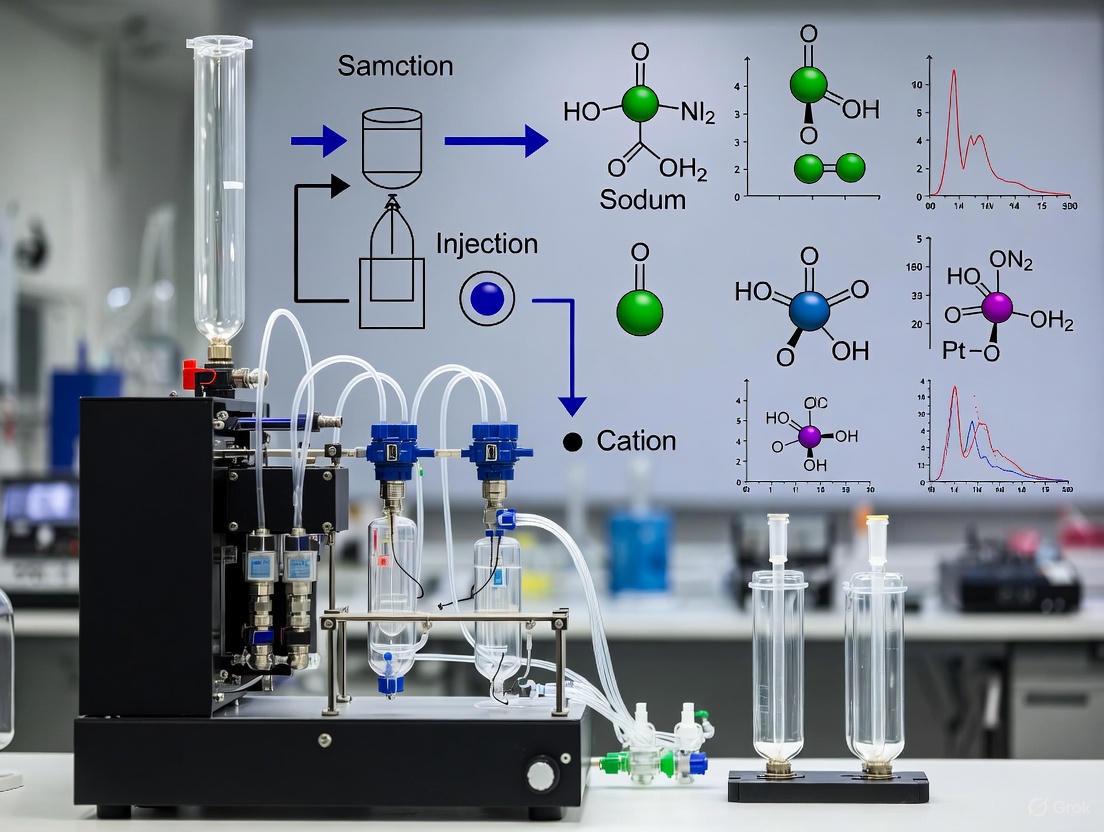
This article provides a comprehensive resource for researchers and drug development professionals on the application of Ion Chromatography (IC) for precise anion and cation quantification.
Ion Chromatography for Anion and Cation Quantification: Principles, Applications, and Troubleshooting for Biomedical Research
Abstract
This article provides a comprehensive resource for researchers and drug development professionals on the application of Ion Chromatography (IC) for precise anion and cation quantification. It covers foundational principles from ion exchange mechanisms to the transformative impact of Reagent-Free IC (RFIC). The scope extends to advanced methodologies for complex sample matrices, including solid-phase extraction, automated neutralization, and combustion IC. A dedicated troubleshooting guide addresses common challenges like interferences and column performance degradation, while a section on validation outlines strategies for ensuring method reliability, specificity, and green analytical compliance in pharmaceutical and clinical settings.
The Fundamentals of Ion Chromatography: From Basic Principles to Modern RFIC Systems
Core Principles of Ion Exchange Separation and Conductivity Detection
Ion Chromatography (IC) has established itself as a cornerstone analytical technique for the precise quantification of anions and cations, playing a critical role in research and drug development [1]. This method is indispensable for evaluating ionic impurities in pharmaceuticals, medical devices, and various biological samples, thereby supporting chemical characterization, toxicological risk assessments, and compliance with regulatory standards [2]. The technique's core relies on two fundamental principles: ion exchange separation, which resolves ionic species, and conductivity detection, which enables their sensitive quantification. These principles allow researchers to detect trace levels of ions down to the parts-per-billion (ppb) range, providing the data necessary to ensure product safety and efficacy [3] [4]. These application notes detail the underlying theories, standard protocols, and essential tools for implementing this powerful analytical method.
Theoretical Foundations
Principle of Ion Exchange Separation
Ion exchange chromatography is a powerful technique for separating ions and polar molecules based on their charge. The separation mechanism hinges on the reversible interaction between charged analyte ions in the mobile phase and oppositely charged functional groups covalently bound to the stationary phase [5].
Two primary types of ion exchange separation are employed:
- Anion Exchange Chromatography: The stationary phase is positively charged, typically featuring quaternary ammonium groups, which attract and separate negatively charged anions [2] [5].
- Cation Exchange Chromatography: The stationary phase is negatively charged, often containing carboxylate or sulfonate groups, which attract and separate positively charged cations [2] [5].
The separation occurs because different ions have varying affinities for the stationary phase. Key factors influencing this affinity and, consequently, the retention time of an analyte include:
- Charge: Ions with higher charge (e.g., SO₄²⁻) generally have stronger attraction to the stationary phase and longer retention times compared to ions with lower charge (e.g., Cl⁻) [5].
- Size and Hydration Radius: Smaller ions, or those with a smaller hydration radius, can often approach the stationary phase more closely, resulting in stronger electrostatic interaction.
- Mobile Phase Composition: The pH and ionic strength of the eluent are critical. A pH gradient or an increasing salt concentration (e.g., a gradient of potassium chloride or sodium carbonate/bicarbonate) is used to competitively displace ions from the stationary phase, eluting them at characteristic times [5] [4].
Principle of Conductivity Detection
Conductivity detection is the most common detection method in Ion Chromatography due to its universal response to ionic species [6]. It operates on the principle of measuring the ability of a solution to conduct an electrical current, which increases proportionally with the concentration of ions present [6].
The detector consists of a flow cell containing two (or sometimes four) electrodes. An alternating current potential is applied between these electrodes. When the sample ions pass through the cell, they increase the electrolytic conductivity of the solution, leading to a measurable change in current. This change is directly proportional to the concentration of the ions, enabling accurate quantification [6].
To achieve high sensitivity, especially in complex matrices, suppressed conductivity detection is often used. This technique employs a device (a suppressor) that chemically reduces the background conductivity of the eluent after the separation column but before the detector. For example, in anion analysis, a suppressor converts the conductive sodium carbonate/bicarbonate eluent into weakly conductive carbonic acid, while simultaneously enhancing the signal of the sample anions. This process significantly improves the signal-to-noise ratio, allowing for the detection of ions at trace (µg/L or ppb) levels [1] [6].
Experimental Protocols
Standard Operating Procedure for Anion Analysis in Aqueous Samples
This protocol outlines the determination of common inorganic anions (e.g., fluoride, chloride, nitrite, bromide, nitrate, phosphate, sulfate) in aqueous samples, such as drinking water or device extracts, using suppressed anion exchange chromatography with conductivity detection [6] [4].
1. Sample Preparation:
- Collect liquid samples using a sterile syringe or bottle, rinsing it three times with the sample water first [4].
- Filter the sample through a 0.45 µm (or smaller) membrane filter to remove sediment, particulate matter, and to limit microbial activity [4].
- Rinse the collection vial three times with the filtrate before filling it brim-full with the sample. Store samples at 4°C until analysis to prevent degradation [4].
2. Instrumentation and Conditions: A representative method setup is summarized in the table below.
Table 1: Example Instrumental Conditions for Anion Analysis
| Parameter | Specification | Purpose/Note |
|---|---|---|
| System | Ion Chromatograph with Suppressed Conductivity Detection | e.g., Thermo Scientific Dionex Series [3] |
| Column | Anion Exchange Column | e.g., Thermo Scientific Dionex AS14A [3] |
| Eluent | Sodium Carbonate/Sodium Bicarbonate (Na₂CO₃/NaHCO₃) | Exact concentration is method-dependent. |
| Eluent Generation | Reagent-Free IC (RFIC) with electrolytic generation | Optional but recommended for consistency [1]. |
| Flow Rate | 1.0 - 2.0 mL/min | Depends on column dimensions. |
| Injection Volume | 25 µL | A common standard volume. |
| Detection | Suppressed Conductivity | Signal enhancement and noise reduction [1]. |
3. Execution:
- Equilibration: Pump the eluent through the system until a stable baseline is achieved.
- Calibration: Inject a series of certified anion standard solutions at known concentrations to establish a calibration curve [4].
- Sample Analysis: Inject the prepared sample filtrate.
- Data Analysis: Identify anions based on their characteristic retention times and quantify them by comparing the peak area (or height) to the calibration curve. Most IC instruments include software that automates these calculations [4].
Workflow for Method Implementation
The following diagram illustrates the logical workflow for developing and executing an IC analysis, from sample to result.
The Scientist's Toolkit: Research Reagent Solutions
Successful ion chromatography analysis depends on the selection of appropriate materials and consumables. The following table details key components essential for IC experiments.
Table 2: Essential Research Reagents and Materials for Ion Chromatography
| Item | Function | Example & Notes |
|---|---|---|
| Ion Exchange Columns | Separates ions based on charge. The heart of the system. | Anion: e.g., Thermo Scientific Dionex AS14A [3]. Cation: Columns with carboxyl functional groups [2]. Selection depends on target analytes and matrix. |
| Eluent Chemicals | Mobile phase that carries the sample and controls elution. | High-purity Sodium Carbonate/Bicarbonate for anions [3]. Reagent-Free IC (RFIC) systems generate eluent electrolytically from water, minimizing error and variability [1]. |
| Certified Reference Materials | Used for instrument calibration and method validation. | Traceable to national standards (e.g., TraceCERT [2]). Critical for achieving accurate and reliable quantitative results. |
| Suppressor Device | Reduces background conductivity of the eluent and enhances analyte signal. | e.g., Chemically regenerated membrane suppressor [6]. Integral to achieving low detection limits in suppressed conductivity detection. |
| Syringe Filters | Removes particulates from samples to protect the column. | 0.45 µm or 0.2 µm pore size, compatible with aqueous solutions [4]. |
| Trap Column (CR-CTC III) | Removes interfering cations from the sample when analyzing anions in a high-lithium or high-ammonia matrix [3]. | Protects the analytical column and improves method robustness for complex samples like power plant water. |
Visualization of the Ion Chromatography Process
The fundamental process of ion separation and detection can be visualized as follows, illustrating the journey of ions through the key components of the IC system.
Quantitative Data and Ion Characteristics
Understanding the ionic characteristics and expected retention behavior is crucial for method development and peak identification. The table below summarizes key properties of common analytes.
Table 3: Characteristics of Common Inorganic Ions in IC Analysis
| Ion | Charge | Relative Retention | Typical Applications & Notes |
|---|---|---|---|
| Fluoride (F⁻) | -1 | Short | Drinking water analysis [6] [4]. Early eluting. |
| Chloride (Cl⁻) | -1 | Short | Seawater ingress indicator; monitored in power plant water at µg/L levels [3] [4]. |
| Nitrate (NO₃⁻) | -1 | Medium | Environmental pollutant; found in water and soil [4]. |
| Sulfate (SO₄²⁻) | -2 | Long | Higher charge leads to stronger retention on anion exchangers [5] [4]. |
| Ammonium (NH₄⁺) | +1 | Short | Cation analysis; important in environmental and biological samples [4]. |
| Sodium (Na⁺) | +1 | Short | Major cation in various samples, including device extracts [2] [4]. |
| Calcium (Ca²⁺) | +2 | Long | Divalent cation with stronger retention on cation exchangers [5] [4]. |
| Lithium (Li⁺) | +1 | Short | Added to primary coolant in nuclear power plants; requires special sample preparation [3] [4]. |
Ion chromatography (IC) has undergone a revolutionary transformation since its inception, evolving from laborious wet chemical techniques to the modern, automated Reagent-Free Ion Chromatography (RFIC) systems of today. This evolution has fundamentally enhanced our capability to perform precise anion and cation quantification across pharmaceutical, environmental, and industrial applications.
The introduction of IC in 1975 revolutionized ion analysis by enabling the simultaneous determination of inorganic anions like fluoride, chloride, nitrate, and sulfate, replacing tedious and often inaccurate wet chemical methods such as photometry, titration, and ion-selective electrodes [7] [8]. The most transformative milestone in this journey was the introduction of Reagent-Free IC (RFIC) at the end of the 1990s, which utilized membrane technologies to generate, purify, and suppress eluents through continuous electrolysis [8]. For drug development professionals, this transition signifies enhanced reliability, reproducibility, and efficiency in analytical methods critical for quality control and regulatory compliance.
The Evolution of Ion Chromatography: A Quantitative Comparison
The progression from wet chemical methods to modern IC technologies has brought dramatic improvements in analysis time, sensitivity, and operational efficiency. The following table summarizes this evolution, highlighting key performance metrics and characteristics of each analytical stage.
Table 1: Quantitative Comparison of Ion Analysis Techniques Across Technological Eras
| Analytical Era | Key Techniques | Typical Analysis Time | Sensitivity | Key Limitations | Primary Industries Served |
|---|---|---|---|---|---|
| Pre-IC Wet Chemistry | Photometry, Titration, Ion-Selective Electrodes, Gravimetry | Hours to days | Variable, often ppm levels | Laborious, prone to interferences, low throughput | Environmental, Chemical Manufacturing |
| Traditional IC | Suppressed/Non-suppressed IC with manual eluent preparation | 20-30 minutes per sample | Low ppb to ppm | Manual eluent preparation errors, carbonate contamination, baseline shift | Environmental, Power, Semiconductor |
| Modern RFIC Systems | RFIC with Eluent Generation (RFIC-EG) and Eluent Regeneration (RFIC-ER) | 10-20 minutes per sample | Sub-ppb to ppt levels | Higher initial instrument cost | Pharmaceutical, Environmental, Food & Beverage, Biopharma |
The global market data reflects the adoption of these advanced technologies. The ion chromatography market is projected to grow from $2.59 billion in 2025 to $3.58 billion by 2029, demonstrating a compound annual growth rate (CAGR) of 8.4% [9]. As of 2024, over 78,000 ion chromatography systems were in use worldwide, with 43% deployed for water quality monitoring and 56% of pharmaceutical QC labs utilizing IC systems for purity and contaminant detection [10]. The technological shift is further evidenced by the trend that 66% of newly launched systems now feature automated eluent generation and integrated suppressors [10].
Experimental Protocols for Anion Analysis in Pharmaceutical Samples
Protocol 1: Determination of Anions in Drug Substances using RFIC-EG
1. Principle: This method utilizes a Reagent-Free Ion Chromatography system with Eluent Generation (RFIC-EG) to separate and quantify common inorganic anions (e.g., chloride, nitrate, sulfate, phosphate) and organic acids in active pharmaceutical ingredients (APIs) and excipients. Electrolytic generation of a high-purity potassium hydroxide (KOH) eluent enables a highly reproducible gradient separation [11].
2. Apparatus:
- RFIC-EG System (e.g., Thermo Scientific Dionex ICS-6000, Integrion, or Inuvion)
- Electrolytic Eluent Generator Cartridge (e.g., Dionex EGC III KOH)
- Continuously Regenerated Trap Column (CR-TC)
- Electrolytic Suppressor (e.g., Dionex ADRS 600)
- Conductivity Detector
- Anion-Exchange Column (e.g., 2 mm x 250 mm, high-efficiency)
- Chromatography Data System (CDS) (e.g., Chromeleon)
3. Reagents and Standards:
- Deionized Water (18.2 MΩ·cm resistivity)
- Single-Anion Standard Solutions (e.g., fluoride, chloride, nitrite, bromide, nitrate, phosphate, sulfate)
- Drug Substance (API)
4. Procedure:
- 4.1. System Setup: Plumb the RFIC-EG system with a high-purity deionized water source. Install the EGC KOH cartridge, CR-TC, anion-exchange column, and suppressor. The system will electrolytically generate the KOH eluent on-demand [11].
- 4.2. Mobile Phase Preparation: No manual preparation is required. Using the CDS, set the eluent generator to produce a KOH gradient as follows:
- 0-10 min: 10 mM KOH
- 10-20 min: Ramp to 45 mM KOH
- 20-25 min: Hold at 45 mM KOH
- 25-25.1 min: Ramp down to 10 mM KOH
- 25.1-30 min: Re-equilibrate at 10 mM KOH
- 4.3. Sample Preparation: Accurately weigh about 100 mg of the drug substance into a 10 mL volumetric flask. Dissolve and dilute to volume with deionized water. Filter through a 0.22 µm nylon or PVDF syringe filter prior to injection.
- 4.4. Chromatography:
- Flow Rate: 0.25 mL/min (for 2 mm column)
- Injection Volume: 5 µL
- Column Temperature: 30 °C
- Detection: Suppressed Conductivity
- 4.5. System Suitability: A standard mixture containing chloride, nitrate, and sulfate at a concentration of 1 mg/L should be analyzed. The relative standard deviation (RSD) of peak areas for five replicate injections should be ≤ 2.0%.
5. Data Analysis: Identify anions by comparing retention times with those of standard solutions. Quantify using an external standard calibration curve constructed from at least five concentration levels.
Protocol 2: High-Throughput Analysis of Cations in Drinking Water using RFIC-ER
1. Principle: This protocol leverages an RFIC system with Eluent Regeneration (RFIC-ER) for the routine, high-throughput isocratic separation of common cations (e.g., sodium, ammonium, potassium, magnesium, calcium) in water samples. The system recirculates and purifies the eluent, allowing continuous operation for up to four weeks with a single preparation, drastically reducing waste and labor [12] [13].
2. Apparatus:
- RFIC-ER System
- Cation-Exchange Column (e.g., IonPac CS12A, 4 mm)
- Electrolytic Suppressor operated in eluent regeneration mode
- Catalytic Gas Elimination Column and Analyte Trap Column
- Conductivity Detector
3. Reagents and Standards:
- Methanesulfonic Acid (MSA) Eluent, 20 mM (initial preparation)
- Single-Cation Standard Solutions
4. Procedure:
- 4.1. System Setup: Initialize the RFIC-ER system with 2 L of 20 mM MSA eluent. The closed-loop system will continuously regenerate this eluent [12].
- 4.2. Mobile Phase: Isocratic 20 mM MSA, regenerated and purified online.
- 4.3. Sample Preparation: Filter water samples through a 0.22 µm filter. For samples exceeding the calibrated range, perform an automated dilution using the autosampler's conductivity-monitoring feature [8].
- 4.4. Chromatography:
- Flow Rate: 1.0 mL/min
- Injection Volume: 25 µL
- Detection: Suppressed Conductivity
- 4.5. System Performance: The system can perform over 2000 injections over 33-52 days with high reproducibility (e.g., retention time change for sulfate < 3.1%) [12].
5. Data Analysis: Quantify cations using a single monthly calibration curve due to the exceptional long-term stability of the RFIC-ER system [13].
Workflow Visualization: RFIC-EG System Operation
The following diagram illustrates the operational workflow and component relationships in a modern Reagent-Free Ion Chromatography system with Eluent Generation (RFIC-EG), which is foundational to understanding the technology's simplicity and efficiency.
Diagram 1: RFIC-EG System Workflow and Data Flow. The diagram shows how deionized water is transformed into high-purity eluent, used for separation, and then suppressed before detection, all under the control of a CDS [11].
The Scientist's Toolkit: Essential RFIC Research Reagent Solutions
Implementing and maintaining a robust IC method requires specific materials and consumables. The following table details the key components of an RFIC system and their critical functions in the analytical process.
Table 2: Essential Research Reagent Solutions and Materials for RFIC
| Item | Function/Description | Example Products |
|---|---|---|
| Eluent Generator Cartridge (EGC) | Electrolytically generates high-purity acid (e.g., MSA) or base (e.g., KOH, NaOH) eluents from deionized water. | Dionex EGC 500 KOH, Dionex EGC 500 MSA, Dionex EGC III KOH [11] |
| Continuously Regenerated Trap Column (CR-TC) | Placed online after the EGC to remove ionic contaminants from the generated eluent, ensuring a pure mobile phase. | Dionex CR-ATC (Anion Trap), Dionex CR-CTC (Cation Trap) [11] |
| Electrolytic Suppressor | Chemically reduces the background conductance of the eluent after the analytical column while enhancing the signal of analyte ions. | Dionex ADRS 600 Anion Suppressor, Dionex CDRS 600 Cation Suppressor [11] [8] |
| Analytical Column | The stationary phase where ion-exchange separation occurs. Selection is based on the target analytes and matrix. | IonPac AS22 (for anions), IonPac CS12A (for cations) [12] [13] |
| High-Purity Deionized Water | The sole carrier liquid required for RFIC-EG systems; used to generate eluents and prepare samples. | 18.2 MΩ·cm resistivity, carbon-filtered [11] |
| Inline Filter / SPE Cartridges | For automated sample preparation to remove particulate matter or eliminate interfering matrix components. | 0.22 µm membrane filters, OnGuard II sample preparation cartridges [8] |
The evolution from manual wet chemical methods to fully automated Reagent-Free IC represents a paradigm shift in ion analysis. RFIC technologies have addressed critical challenges in reproducibility, sensitivity, and operational efficiency by eliminating manual eluent preparation and introducing closed-loop systems. For the pharmaceutical industry and research sectors, this translates to unparalleled consistency in anion and cation quantification, robust compliance with stringent pharmacopoeia regulations, and enhanced productivity. As IC continues to evolve with trends toward miniaturization, hybridization with mass spectrometry, and increased automation, its role as an indispensable tool for precise quantitative analysis is firmly cemented.
Ion chromatography (IC) is a pivotal analytical technique for the simultaneous separation and quantification of ionic and polar analytes, playing an increasingly critical role in pharmaceutical analysis to ensure drug quality, safety, and efficacy [14] [15]. Its ability to resolve multiple ionic species in a single run makes it indispensable for analyzing active pharmaceutical ingredients (APIs), excipients, counterions, and impurities, aligning with stringent global pharmacopeial standards [16] [14]. The core of a modern, high-performance IC system rests on three sophisticated technological components: the eluent generator for delivering high-purity mobile phases, the separation column where the actual chromatographic separation occurs, and the suppressor which enhances detection sensitivity [16] [17]. This article details the principles, protocols, and applications of these components within the context of pharmaceutical anion and cation quantification.
Core Components of a Modern IC System
The evolution of IC into a highly reproducible and sensitive technique is largely due to the development of integrated, automated modules that replace manual, error-prone processes. The synergy between eluent generators, separation columns, and suppressors forms the foundation of Reagent-Free Ion Chromatography (RFIC) systems, which enhance method reproducibility between laboratories [16] [17].
Electrolytic Eluent Generators
Principle of Operation: Electrolytic eluent generators (EGCs) produce high-purity acid, base, or salt eluents on-demand through the electrolysis of water and controlled electromigration of ions across ion-exchange resins and membranes [17]. This process eliminates the need for manual, off-line preparation of eluents, which is often tedious and prone to contamination (e.g., carbonate contamination in NaOH eluents) [17]. For example, in the generation of a potassium hydroxide (KOH) eluent, water is introduced into a cartridge containing a potassium electrolyte reservoir. The application of an electrical current drives potassium ions (K⁺) across a cation-exchange membrane into a water stream, where they combine with hydroxide ions (OH⁻) generated at a platinum electrode to form a high-purity KOH eluent at a precisely controlled concentration [17].
Key Advantages:
- High Purity: Generates contaminant-free eluents, leading to lower baselines and reduced noise [17].
- Excellent Reproducibility: Eluent concentration is precisely controlled by electrical current and flow rate, ensuring exceptional retention time stability [18] [17].
- Operational Convenience: Enables seamless and highly accurate gradient elution from a single eluent source, simplifying method setup and transfer [17].
Table 1: Common Electrolytic Eluent Generator Cartridges and Their Specifications
| Eluent Type | Max Concentration (at 1.0 mL/min) | Compatible IC Systems | Key Application |
|---|---|---|---|
| KOH | 100 mM | RFIC-EG | Anion separation [17] |
| NaOH | 100 mM | RFIC-EG | Anion separation [17] |
| LiOH | 80 mM | RFIC-EG | Alternative for anion separation |
| Methanesulfonic Acid (MSA) | 100 mM | RFIC-EG | Cation separation [17] |
| K₂CO₃/KHCO₃ | Various concentrations | RFIC-EG | Anion separation with carbonate/bicarbonate eluents [17] |
Diagram 1: Principle of Electrolytic KOH Eluent Generation
Suppressors
Principle of Operation: A suppressor is a critical post-column device that chemically or electrolytically reduces the background conductivity of the eluent, thereby enhancing the signal-to-noise ratio of the target analytes [14]. In chemical suppression for anion analysis with a NaOH eluent, the suppressor exchanges sodium ions (Na⁺) from the eluent with hydronium ions (H₃O⁺) from the suppressor. This converts the high-conductivity NaOH eluent into low-conductivity water (H₂O), while the analyte anions (e.g., Cl⁻) are converted into their highly conductive acids (e.g., HCl) [14]. Modern electrolytic suppressors automate this process continuously, using water as the sole reagent and making the operation maintenance-free [17].
Key Advantages:
- Lower Detection Limits: Significantly reduces background conductivity, enabling the detection of trace-level ions [16] [14].
- Enhanced Signal-to-Noise Ratio: Improves the conductivity signal of the analytes, leading to more reliable quantification [14].
- Compatibility with Gradient Elution: Electrolytic suppressors effectively handle concentration gradients, which is essential for complex separations [17].
Diagram 2: Principle of Suppressed Conductivity Detection
Separation Columns
Principle of Operation: The separation column is the heart of the IC system, where the differential partitioning of ions between the mobile phase (eluent) and the stationary phase (resin) occurs [19] [15]. Separation is primarily based on ion-exchange mechanisms, where analytes compete with the eluent's competing ions for sites on the charged stationary phase [19]. The separation depends on factors such as the analyte's charge, size, and affinity for the stationary phase, as well as the ionic strength and pH of the eluent [19].
Column Chemistry and Selection:
- Anion Exchange Columns: Typically use a positively charged stationary phase with functional groups like quaternary ammonium (strong) or diethylaminoethyl (DEAE, weak) [19]. Common base materials include polystyrene-divinylbenzene (PS-DVB) or polyvinyl alcohol (PVA) [15].
- Cation Exchange Columns: Employ a negatively charged stationary phase with functional groups such as sulfonic acid (strong) or carboxylic acid (weak) [19].
Table 2: Common IC Column Types and Their Pharmaceutical Applications
| Column Name | Type | Functional Group | Typical Eluent | Common Pharmaceutical Application |
|---|---|---|---|---|
| IonPac AS11 | Anion | Quaternary Ammonium | KOH | Determination of nitrite and other anions [15] |
| IonPac AS18 | Anion | Quaternary Ammonium | KOH | Sulfate counterion and anionic impurities [16] |
| IonPac CS12A | Cation | Sulfonic Acid | Methanesulfonic Acid (MSA) | Quantification of sodium and other cations [19] |
| IonPac CS16 | Cation | Sulfonic Acid | Methanesulfonic Acid (MSA) | Assay of lithium, sodium, and calcium [16] |
| ZIC-pHILIC | Zwitterionic | Sulfoalkylbetaine | Acetonitrile gradient | Simultaneous measurement of anions and cations [20] |
Application Notes & Experimental Protocols
The following section provides detailed protocols for key pharmaceutical applications, demonstrating the practical integration of eluent generators, suppressors, and separation columns.
Protocol 1: Quantification of Residual Sodium and Chloride in an API
Objective: To quantify residual sodium (Na⁺) and chloride (Cl⁻) ions in a sodium salt API post-synthesis to ensure compliance with specification limits (e.g., < 50 ppm for Na⁺ and < 25 ppm for Cl⁻) [19].
Background: Traces of Na⁺ and Cl⁻ can remain in the final drug substance from neutralization and crystallization processes. Accurate determination is critical for establishing the correct molecular mass and stoichiometry of the drug substance [16] [19].
Materials and Instrumentation:
- IC System: Reagent-Free IC (RFIC) system equipped with an electrolytic eluent generator (for KOH and MSA), an electrolytic suppressor, and a conductivity detector [16] [19].
- Columns:
- Eluents:
- Standards: Certified reference standards of sodium and chloride.
- Samples: API sample.
Method:
- Sample Preparation: Accurately weigh and dissolve the API sample in deionized water. Filter the solution through a 0.22 µm or 0.45 µm membrane filter before injection [19].
- System Setup and Eluent Generation:
- Configure the RFIC system for dual-channel or sequential analysis.
- For cation analysis, set the EGC to generate 20 mM MSA.
- For anion analysis, set the EGC to generate a suitable KOH gradient or use an isocratic carbonate/bicarbonate eluent.
- Chromatographic Conditions:
- Flow Rate: 1.0 mL/min (typical).
- Injection Volume: 25 µL.
- Detection: Suppressed conductivity.
- Suppressor: Activate the appropriate electrolytic suppressor for the analysis mode (anion or cation).
- Calibration: Prepare and inject a series of standard solutions with known concentrations of Na⁺ and Cl⁻ to construct a calibration curve.
- Analysis: Inject the prepared sample solution.
Results and Quantification:
- Quantify Na⁺ and Cl⁻ concentrations by comparing the peak areas of the sample with the calibration curve.
- A typical result showed Sodium at 45 ppm and Chloride at 18 ppm, well within specification limits, with a recovery of 98–102% and RSD < 2% [19].
Protocol 2: Trace Level Nitrite Determination to Prevent Nitrosamine Formation
Objective: To determine trace levels of nitrite (NO₂⁻) in pharmaceuticals using IC with UV/VIS detection as part of a control strategy to prevent the formation of carcinogenic nitrosamines [15].
Background: Nitrite can react with amines under acidic conditions to form nitrosamines. Monitoring trace nitrite impurities is crucial for risk assessment and control, as mandated by ICH M7(R2) and USP <1469> [15].
Materials and Instrumentation:
- IC System: RFIC system with EGC (KOH), electrolytic suppressor, and sequential CO₂ suppressor, coupled with a UV/VIS detector.
- Column: High-capacity anion-exchange column (e.g., Dionex IonPac AS19 or equivalent) [15].
- Eluent: Potassium Hydroxide (KOH), electrolytically generated using a gradient.
- Detection: UV/VIS detection at 215 nm [15].
Method:
- Automated Sample Pre-concentration and Matrix Elimination:
- Use a Pre-concentration Column (PCC) instead of a standard sample loop.
- Load a large sample volume (e.g., 2000 µL) onto the PCC.
- Wash the PCC with a matrix elimination solution (e.g., 3000 µL ultrapure water) to remove interfering salts and matrix components.
- The pre-concentrated nitrite is then automatically transferred to the analytical column [15].
- Chromatographic Conditions:
- Utilize a KOH gradient for separation.
- Employ sequential suppression (chemical suppression followed by CO₂ removal) to achieve a low baseline for high-sensitivity analysis [15].
- Calibration and Analysis: Prepare nitrite standards at low µg/L or ng/L levels. The pre-concentration step allows for excellent sensitivity and robust analysis even in complex matrices.
Results and Quantification:
- This automated method enables robust, trace-level detection of nitrite without interference from high chloride concentrations, providing the sensitivity needed for impurity control in pharmaceuticals [15].
Protocol 3: Simultaneous Determination of Anions and Cations in Dialysis Concentrate
Objective: To simultaneously quantify major components (acetate, chloride, sodium, potassium, calcium, magnesium) and impurities (nitrite, nitrate, bromide) in hemodialysis concentrates for quality control [15].
Background: Dialysis fluids require strict quality control per pharmacopeial standards (e.g., European Pharmacopeia, ISO). IC offers a multi-analyte alternative to traditional methods like AAS [15].
Materials and Instrumentation:
- IC System: A two-channel IC system equipped for simultaneous anion and cation analysis, with suppressed conductivity detection and optional UV/VIS detection.
- Columns:
- Anions: High-capacity anion-exchange column (e.g., IonPac AS18 or AS23).
- Cations: High-capacity cation-exchange column (e.g., IonPac CS16).
- Eluents:
- Anions: Electrolytically generated KOH.
- Cations: Electrolytically generated MSA.
- Detection:
- Anions/Cations: Suppressed conductivity.
- Impurities (Nitrite, etc.): UV/VIS detection.
Method:
- Sample Preparation: Manually dilute the dialysis concentrate sample by a factor of 750 with deionized water to bring analyte concentrations within the linear range of the detector and prevent column overload [15].
- System Setup: Configure the two-channel system to run anion and cation analyses in parallel.
- Chromatographic Conditions:
- Use high-capacity columns to handle the high ionic strength matrix.
- Apply appropriate eluent gradients for both channels to achieve optimal separation of all target analytes within 25 minutes [15].
- Analysis: Inject the diluted sample.
Results and Quantification:
- This method allows for the accurate determination of acetate (≈ 6.5 g/L) beside high chloride content (≈ 137 g/L), as well as cations and trace impurities in a single, high-throughput run, demonstrating its efficiency for routine quality control [15].
Table 3: Summary of Key IC Applications and Method Parameters
| Application / Analyte | Sample Matrix | IC Column | Eluent (Electrolytically Generated) | Detection | LOD/LOQ |
|---|---|---|---|---|---|
| Residual Ions (Na⁺, Cl⁻) | API (Sodium Salt) | CS12A (Cation), AS14A (Anion) | MSA (20 mM), KOH/Carbonate | Suppressed Conductivity | ~0.1 ppm [19] |
| Lithium Assay | Lithium Salt API | Cation Exchange (e.g., CS16) | Dilute HCl (4 mM) | Conductivity | LOQ: 0.05 ppm [19] |
| Trace Nitrite | Pharmaceutical Product | High-Capacity Anion (e.g., AS19) | KOH Gradient | UV/VIS (215 nm) with Sequential Suppression | Not specified |
| Dialysis Concentrate | Hemodialysis Fluid | High-Capacity Anion & Cation | KOH Gradient, MSA | Suppressed Conductivity, UV/VIS | Not specified |
| Sulfate & Phosphate Impurities | Peptide API | Anion Exchange (e.g., AS22) | Na₂CO₃/NaHCO₃ (4.5/1.4 mM) | Suppressed Conductivity | LOD: <0.2 ppm [19] |
The Scientist's Toolkit: Essential Research Reagents and Materials
Table 4: Key Research Reagent Solutions and Materials for IC in Pharmaceutical Analysis
| Item | Function / Description | Example Use Case |
|---|---|---|
| Electrolytic Eluent Generator Cartridge (KOH) | On-demand generation of high-purity potassium hydroxide eluent for anion separations. | Isocratic and gradient separation of inorganic anions and organic acids [17]. |
| Electrolytic Eluent Generator Cartridge (MSA) | On-demand generation of high-purity methanesulfonic acid eluent for cation separations. | Separation of alkali metals, alkaline earth metals, and ammonium [17]. |
| Electrolytic Suppressor | Post-column device that reduces eluent background conductivity, enhancing analyte signal. | Essential for trace-level cation or anion analysis with conductivity detection [16] [17]. |
| High-Capacity Anion-Exchange Column | Stationary phase with high ion-exchange capacity for resolving complex matrices and high-ionic-strength samples. | Analysis of anions in dialysis concentrates or other challenging matrices without overload [15]. |
| Pre-concentration Column (PCC) | Allows loading of large sample volumes to pre-concentrate trace analytes while eliminating matrix. | Automated trace analysis of nitrite in pharmaceuticals [15]. |
| Inline Carbonate Removal Device (CO2 Suppressor) | Removes CO₂ from the suppressed eluent stream after chemical suppression. | Reduces baseline noise and drift in anion analysis, improving sensitivity for trace analysis [15]. |
| Certified Anion & Cation Standards | High-purity reference materials for instrument calibration and quantification. | Used in all protocols to create calibration curves for accurate analyte quantification [19]. |
The integration of electrolytic eluent generators, high-efficiency suppressors, and advanced separation columns has transformed ion chromatography into a robust, reproducible, and highly sensitive platform essential for modern pharmaceutical analysis. The detailed application notes and protocols provided herein for quantifying counterions, monitoring genotoxic impurities, and performing quality control on complex formulations underscore the technique's versatility and capability to meet stringent regulatory requirements. As the technique continues to be embraced by global pharmacopeias, its role in ensuring the safety, efficacy, and quality of pharmaceuticals from development to manufacturing is set to expand further.
Ion chromatography (IC) has evolved into a premier technique for the separation and quantification of ionic species in complex matrices. Within this field, three principal separation modes—High-Performance Ion Exchange Chromatography (HPIC), Ion Exclusion Chromatography (IEC), and Ion Pair Chromatography (IPC)—provide complementary mechanisms that address a wide spectrum of analytical challenges. These techniques are indispensable for pharmaceutical researchers and scientists engaged in drug development, where precise anion and cation quantification is critical for drug substance characterization, impurity profiling, and ensuring product quality and safety.
The selection of an appropriate separation mode depends on the physicochemical properties of the target analytes and the sample matrix. HPIC separates ions based on their relative affinities for oppositely charged stationary phases. IEC separates ionized from non-ionized species, particularly effective for weak organic acids and bases. IPC enables the separation of ionic compounds on reversed-phase columns through the formation of neutral ion pairs. This article delineates the fundamental principles, provides detailed application protocols, and presents optimized conditions for each mode, framed within the context of advanced anion and cation quantification research.
The three separation modes operate on distinct physicochemical principles, making them suitable for different classes of analytes.
High-Performance Ion Exchange Chromatography (HPIC) relies on competitive ionic interactions between analyte ions, mobile phase ions, and charged functional groups covalently bound to an inert stationary phase [21] [22]. In anion exchange, surface functional groups like quaternary ammonium salts attract analyte anions, while in cation exchange, sulfonate or carboxylate groups interact with cations [23] [22]. Separation occurs due to differences in the strength of these electrostatic interactions, with elution typically achieved by increasing the ionic strength or modifying the pH of the mobile phase [23].
Ion Exclusion Chromatography (IEC) separates ions based on a combination of Donnan exclusion, steric effects, and adsorption [21]. Fully dissociated ions are repelled by the like-charged functional groups of the stationary phase (e.g., sulfonated resins for acid separation) and elute quickly, excluded from the pore volume. In contrast, partially dissociated molecules (e.g., weak organic acids) and neutral species can enter the pore network and are retained longer, allowing for their separation from strong acids and from each other [21].
Ion Pair Chromatography (IPC), also referred to as Mobile Phase Ion Chromatography (MPIC), combines ion-exchange principles with reversed-phase chromatography [21]. A lipophilic ion-pairing reagent (e.g., tetrabutylammonium for anions or hexanesulfonate for cations) is added to the hydro-organic mobile phase. This reagent forms neutral, hydrophobic ion pairs with the target analytes, which are then partitioned and separated on a reversed-phase column [21] [24]. The retention of analytes can be controlled by varying the concentration and type of the ion-pairing reagent, as well as the organic modifier content.
Table 1: Comparative Analysis of Key IC Separation Modes
| Feature | HPIC | IEC | IPC |
|---|---|---|---|
| Primary Separation Mechanism | Ion exchange | Donnan exclusion, adsorption | Ion-pair formation & reversed-phase partitioning |
| Typical Stationary Phase | Functionalized polymer or silica (e.g., quaternary ammonium, sulfonate) [23] [25] | High-capacity ion-exchange resin (e.g., fully sulfonated divinylbenzene) [21] | Reversed-phase (e.g., C18) [21] |
| Ideal Analytes | Inorganic anions/cations, strong acids/bases [21] | Weak organic acids/bases, amino acids, alcohols from strong acids [21] | Surfactants, metal complexes, large organic ions [21] [24] |
| Key Advantages | High selectivity for ionic species, well-established methods | Effective for complex matrices, separates ionic from non-ionic species | Flexibility in tuning retention, compatible with MS [21] |
Detailed Experimental Protocols
Protocol 1: HPIC for Inorganic Anion Analysis in Drug Substance
This protocol is designed for the simultaneous quantification of common inorganic anion impurities (e.g., chloride, nitrate, sulfate) in an active pharmaceutical ingredient (API) [21] [26].
I. Sample Preparation
- Accurately weigh 100 mg of the API into a 50 mL volumetric flask.
- Dissolve and dilute to volume with high-purity deionized water (18.2 MΩ·cm).
- Sonicate for 10 minutes to ensure complete dissolution.
- Filter the solution through a 0.2 μm nylon or PVDF syringe filter into a clean IC vial to remove particulate matter and prevent column blockage [27].
- If the sample is too concentrated, a dilution step is required to prevent column overloading, which can cause peak tailing [27].
II. Instrumental Conditions
- System: Ion Chromatograph with suppressed conductivity detection.
- Column: High-capacity anion-exchange column (e.g., Dionex IonPac AS25, Shodex IC SI-52 4E, or equivalent) [25].
- Guard Column: Appropriate guard column matching the analytical column.
- Eluent: 37 mM potassium hydroxide (KOH). Use an eluent generator or prepare isocratically from high-purity concentrates [28] [25].
- Flow Rate: 1.0 mL/min.
- Injection Volume: 25 μL.
- Column Temperature: 30 °C.
- Detection: Suppressed conductivity, with a suppressor operating in appropriate mode (e.g., auto-recycle).
III. Analysis and Quantification
- Equilibrate the system with the mobile phase until a stable baseline is achieved.
- Inject a standard mixture containing the target anions at known concentrations to establish retention times and calibration curves.
- Inject the prepared sample solution.
- Identify anions by comparing retention times with standards.
- Quantify using the external standard method based on peak area.
Table 2: Typical Retention Times and LOQs for Inorganic Anions under HPIC Conditions
| Analyte | Approximate Retention Time (min) | Estimated LOQ (μg/L) |
|---|---|---|
| Fluoride (F⁻) | 2.5 | 10 |
| Chloride (Cl⁻) | 4.0 | 10 |
| Nitrite (NO₂⁻) | 5.5 | 15 |
| Bromide (Br⁻) | 8.0 | 20 |
| Nitrate (NO₃⁻) | 9.5 | 20 |
| Sulfate (SO₄²⁻) | 15.0 | 25 |
| Phosphate (PO₄³⁻) | 22.0 | 30 |
Protocol 2: IEC for Organic Acid Profiling in Herbal Extract
This method is optimized for the separation of weak organic acids in complex botanical matrices like herbal extracts, where they are common active constituents [21].
I. Sample Preparation
- Accurately weigh 500 mg of the homogenized herbal powder.
- Add 20 mL of deionized water and sonicate in an ultrasonic bath for 30 minutes.
- Centrifuge the extract at 10,000 rpm for 10 minutes.
- Carefully collect the supernatant and filter it through a 0.2 μm membrane filter.
- For complex matrices, further purification using solid-phase extraction (SPE) with a C18 cartridge may be necessary to remove interfering fats, proteins, and surfactants [27].
II. Instrumental Conditions
- System: Ion Chromatograph with conductivity and/or UV detection.
- Column: Ion exclusion column (e.g., TSKgel OApak-A or equivalent) [23].
- Eluent: 5 mM sulfuric acid (H₂SO₄).
- Flow Rate: 0.8 mL/min.
- Injection Volume: 20 μL.
- Column Temperature: 45 °C (to improve efficiency and reduce backpressure).
- Detection: Non-suppressed conductivity or UV at 210 nm.
III. Analysis and Quantification
- Separate strong acids (e.g., HCl, H₃PO₄), which elute first in the exclusion volume, from weak organic acids (e.g., citric, malic, acetic), which are retained on the column.
- Use standard solutions of target organic acids for identification and calibration.
Protocol 3: IPC for the Determination of Aliphatic Amines
IPC is highly effective for separating complex mixtures of aliphatic amines, which are challenging to analyze by other IC modes [21] [26].
I. Sample Preparation
- Prepare aqueous standard solutions or sample extracts.
- Filter through a 0.2 μm filter to remove particles.
II. Instrumental Conditions
- System: IC or HPLC system with suppressed conductivity detection.
- Column: Reversed-phase column (e.g., C18).
- Eluent: Methanol/Water mixture containing 5 mM octanesulfonic acid as the ion-pairing reagent.
- Flow Rate: 1.0 mL/min.
- Injection Volume: 25 μL.
- Detection: Suppressed conductivity (with a cation suppressor) or MS.
III. Analysis and Quantification
- The ion-pairing reagent coats the stationary phase, creating a dynamic ion-exchange surface.
- Amines are separated based on their hydrophobicity and interaction strength with the ion-pairing reagent.
- Retention can be finely tuned by adjusting the concentration of the ion-pairing reagent and the percentage of organic solvent.
The Scientist's Toolkit: Essential Research Reagents and Materials
Successful implementation of IC methods requires careful selection of consumables and reagents to ensure reproducibility, accuracy, and instrument longevity.
Table 3: Essential Materials for Ion Chromatography Research
| Item | Function/Description | Application Notes |
|---|---|---|
| High-Purity Deionized Water (≥18 MΩ·cm) | Solvent for mobile phases, standards, and samples. | Minimizes background conductivity and contaminant introduction [27]. |
| IC-Grade Eluent Chemicals (e.g., KOH, Methanesulfonic acid) | Mobile phase components. | Low UV absorbance and minimal ionic impurities for stable baselines [28]. |
| PEEK Tubing and Fittings | Fluidics path connections. | Inert material prevents corrosion and metal contamination, crucial for trace analysis [28]. |
| Syringe Filters (0.2 μm, Nylon or PVDF) | Sample clarification. | Removes particulates to protect columns and check valves [27]. |
| On-Guard Cartridges | Sample pre-treatment. | Removes specific matrix interferents (e.g., Ba/Ag/H cartridges for halides, metals) [27] [24]. |
| Ion-Pairing Reagents (e.g., tetrabutylammonium, hexanesulfonate) | Forms neutral pairs with analytes in IPC. | Purity is critical for low noise and good peak shape [21]. |
Advanced Applications and Recent Developments
The continuous innovation in IC separation modes has significantly expanded their utility in pharmaceutical and bio-analytical research.
Novel Stationary Phases: Recent progress involves the development of new stationary phase architectures to enhance performance. These include electrostatic-agglomerated films on ultrawide-pore substrates for high capacity, polymer-grafted films for high water content phases, and step-growth polymers on polymeric substrates for exceptional hydrophilicity and pH stability [25]. Furthermore, advanced materials like polyamide-amine (PAMAM) dendrimers are being investigated as functional coatings for stationary phases. The protonated or quaternized amino terminal groups of integer-generation PAMAM provide a high density of positive charges, offering superior electrostatic interactions for the separation and enrichment of anions [29].
Analysis of Carbohydrates and Sugar Alcohols: HPIC with pulsed amperometric detection (PAD) is a powerful and standard method for determining underivatized carbohydrates [21] [28]. In a basic mobile phase (e.g., NaOH), sugars become oxyanions and are retained on an anion-exchange column (e.g., Dionex CarboPac series). This technique is extensively used for profiling monosaccharides in polysaccharide-based drugs and for analyzing sugar biomarkers in environmental and biological samples [21] [28].
Two-Dimensional Ion Chromatography (2D-IC): For extremely complex samples, 2D-IC offers a powerful solution. This technique uses a switching valve to transfer an unresolved fraction from a first dimension column (e.g., for general anion screening) to a second dimension column with a different selectivity (e.g., for haloacetic acids) [25]. This setup resolves co-elutions and manages large concentration differences between analytes, providing unparalleled separation power for challenging matrices.
Advanced Methods and Applications: Handling Complex Samples in Biomedical Research
In the quantification of anions and cations in Active Pharmaceutical Ingredients (APIs) using ion chromatography (IC), sample preparation is a critical prerequisite for obtaining accurate, reproducible, and reliable results. Proper sample preparation mitigates matrix effects, removes potential interferents, and ensures the protection of the analytical column, thereby enhancing method sensitivity and specificity. Solid-Phase Extraction (SPE), dilution, and filtration are cornerstone techniques that, when applied correctly, facilitate the precise analysis mandated by regulatory guidelines such as ICH Q3D and USP ⟨1225⟩ [19]. This document outlines detailed application notes and protocols for these techniques, framed within the context of ion chromatography research for pharmaceutical development.
Core Sample Preparation Techniques
Dilution
Dilution is often the primary step in sample preparation, serving to reduce matrix complexity, adjust the sample to a compatible solvent strength for the chromatographic system, and bring the analyte concentration within the instrument's linear dynamic range.
Protocol: Standard Sample Dilution for IC Analysis
- Solvent Selection: Use high-purity deionized water (≥18 MΩ-cm resistivity) or a dilute buffer as the diluent to minimize introducing ionic contaminants [19].
- Dilution Factor: Determine the appropriate dilution factor empirically to ensure the final analyte concentration falls within the calibrated range. Common dilution factors for APIs range from 1:2 to 1:100, depending on the initial ion concentration [30] [19].
- Procedure:
- Precisely weigh or pipette a known amount of the API sample into a clean volumetric flask.
- Fill the flask to about half-volume with the diluent and mix thoroughly to ensure complete dissolution.
- Dilute to the mark with the diluent and mix again by inverting the flask several times.
- For complex matrices like serum or plasma, a 1:1 dilution with water or a suitable buffer is a common starting point [30].
Filtration
Filtration is essential for removing particulate matter that could clog the guard column, analytical column, or tubing within the IC system, preventing high backpressure and potential hardware damage.
Protocol: Sample Filtration Prior to IC Injection
- Filter Selection: Use a syringe filter with a pore size of 0.45 µm or, for samples with very fine particulates or for UHPLC-IC systems, 0.22 µm.
- Membrane Compatibility: Select a membrane material compatible with aqueous solutions. Nylon or polyethersulfone (PES) are common choices. Cellulose acetate membranes are recommended for proteinaceous samples to minimize binding [19].
- Procedure:
- Attach a disposable syringe to the chosen syringe filter.
- Draw the diluted sample into the syringe.
- Gently expel the solution through the filter into a clean, IC-compatible vial.
- Discard the first few drops (~0.5 mL) to avoid potential contamination from the filter membrane.
Solid-Phase Extraction (SPE)
SPE is employed for selective cleanup, interference removal, and analyte preconcentration. It is particularly valuable when analyzing APIs with complex matrices that contain co-eluting or damaging compounds [30].
Principles and Phases: SPE functions by exploiting interactions between the analyte, the sample matrix, and a solid sorbent. The selection of the sorbent phase is critical and depends on the properties of the target ions and the matrix [30].
Table 1: Guide to SPE Sorbent Selection for Ionic Analytes
| Sorbent Type | Mechanism | Target Analytes | Example Applications in IC |
|---|---|---|---|
| Reversed-Phase | Hydrophobic interaction | Non-polar interferences | Removing organic impurities from an aqueous sample [30]. |
| Ion Exchange | Electrostatic attraction | Cations or Anions | Selective retention of anions (e.g., Cl⁻, SO₄²⁻) using a quaternary ammonium sorbent or cations (e.g., Na⁺, NH₄⁺) using a sulfonic acid sorbent [19]. |
| Mixed-Mode | Hydrophobic + Ionic | Ionic analytes in complex matrices | Simultaneous removal of organic and ionic interferences [30]. |
Protocol: Standard SPE Procedure for Sample Cleanup
The following workflow details the general steps for performing SPE, which can be adapted for cartridge or 96-well plate formats [30].
Detailed Steps:
- Sample Pre-treatment: Optimize the sample for effective analyte retention. This may involve dilution with water or buffer, pH adjustment to ensure the analytes are charged, and removal of particulates via pre-filtration or centrifugation [30]. Refer to Table 2 for specific pre-treatment approaches.
- Column Conditioning: Prepare the sorbent by passing 2-3 column volumes of a solvent that activates the stationary phase (e.g., methanol for reversed-phase). This solvates the functional groups and creates a consistent environment for retention.
- Equilibration: Pass 2-3 column volumes of a solvent that matches the sample's matrix (e.g., water or starting buffer). This prepares the sorbent for optimal analyte binding. Do not allow the sorbent to dry out between conditioning and sample application [30].
- Sample Application: Load the pre-treated sample onto the column at a controlled, slow flow rate (e.g., 1-2 mL/min for cartridges) to maximize analyte retention [30].
- Wash: Pass 2-3 column volumes of a weak solvent or buffer (e.g., 5% methanol in water) through the column. This step removes undesired matrix components that are bound less strongly than the analytes of interest.
- Elution: Pass 2-3 column volumes of a strong solvent that disrupts the analyte-sorbent interaction to collect the purified analytes. For ion exchange, this is typically a buffer with high ionic strength or a specific pH. Using two small aliquots of eluent is more efficient than one large volume [30]. The eluate is collected for analysis.
Application in Ion Chromatography Research
Integrated Workflow for Anion and Cation Quantification
The sample preparation techniques are integrated into a complete analytical workflow for IC, from sample receipt to data analysis, ensuring data integrity and compliance with regulatory standards.
Case Studies and Data Presentation
The following case studies, summarized from recent applications, demonstrate the critical role of sample preparation in the successful quantification of ions in APIs using IC. The associated quantitative data highlights the performance of these methods.
Table 2: Case Studies: Quantification of Ions in APIs using IC [19]
| Case Study Objective | Analytes | Sample Preparation & IC Method | Results & Validation |
|---|---|---|---|
| Quantification of Residual Sodium and Chloride | Na⁺, Cl⁻ | Sample Prep: API dissolved in deionized water and filtered.IC: Suppressed conductivity; Cation (CS12A) & Anion (AS14A) columns; MSA & carbonate/bicarbonate eluents. | Na⁺: 45 ppm (<50 ppm spec). Cl⁻: 18 ppm (<25 ppm spec). Recovery: 98-102%, RSD: <2%. |
| Determination of Lithium Content | Li⁺ | Sample Prep: API dissolved in ultrapure water, filtered.IC: Cation exchange with sulfonated resin; conductivity detection; 4 mM HCl eluent. | Li content: 96.8% of theoretical. Recovery: 101%. Linearity: r² = 0.9995. LOQ: 0.05 ppm. |
| Impurity Profiling: Sulfate and Phosphate | SO₄²⁻, PO₄³⁻ | Sample Prep: Lyophilized peptide API dissolved in water, filtered.IC: Anion exchange (AS22); suppressed conductivity; carbonate/bicarbonate eluent. | SO₄²⁻: 2.5 ppm (<5 ppm). PO₄³⁻: Not Detected (<0.2 ppm). RSD: <1.5%. |
| Quantification of Process Residuals | NH₄⁺, NO₃⁻ | Sample Prep: API dissolved in deionized water, filtered.IC: Dual-mode; Cation (CS17) & Anion (AS19) columns; MSA & KOH gradient; suppressed conductivity. | NH₄⁺: 0.8 ppm (<1 ppm). NO₃⁻: 0.3 ppm (<1 ppm). ICH Q2(R1) validated. |
The Scientist's Toolkit: Research Reagent Solutions
The following table details essential materials and reagents required for implementing the sample preparation and IC analysis protocols described in this document.
Table 3: Essential Research Reagents and Materials for IC Sample Prep
| Item | Function / Application | Specific Examples / Notes |
|---|---|---|
| Solid-Phase Extraction Sorbents | Selective retention and cleanup of target ions or removal of interferences [30]. | HyperSep (C18, Mixed-Mode), SOLA (for biosamples), Ion Exchange cartridges (e.g., SAX for anions, SCX for cations) [30] [19]. |
| Ion Chromatography Columns | High-efficiency separation of ionic species based on electrostatic interactions [19] [20]. | Dionex IonPac CS12A (cations), AS14A (anions), AS22 (anions), Sequant ZIC-pHILIC (simultaneous anions/cations) [19] [20]. |
| High-Purity Eluent Chemicals | Mobile phase for IC; composition and pH control selectivity and efficiency of separation [19]. | Methanesulfonic Acid (MSA) for cations; Sodium Carbonate/Sodium Bicarbonate or KOH for anions. Use high-purity grades suitable for IC. |
| Suppressed Conductivity Detector | Universal and sensitive detection of ions after separation; reduces background conductivity [19] [20]. | Standard in modern IC systems (e.g., Dionex suppressors). An alternative for simultaneous detection is Corona Charged Aerosol Detection with HILIC [20]. |
| Sample Preparation Consumables | Ensure sample integrity and prevent contamination or column damage [30] [19]. | Syringe Filters (0.22 µm or 0.45 µm, Nylon/PES), IC-compatible vials, volumetric flasks, and high-purity water (≥18 MΩ-cm). |
The rigorous application of dilution, filtration, and solid-phase extraction is fundamental to the success of ion chromatography methods for quantifying anions and cations in APIs. The protocols and application notes provided herein offer a structured framework for researchers to develop robust, validated analytical procedures. By carefully selecting and executing these sample preparation techniques, scientists can ensure the generation of high-quality data that meets the stringent requirements of pharmaceutical development and regulatory compliance.
The accurate quantification of anions and cations in complex matrices represents a significant challenge in pharmaceutical and biopharmaceutical research. Samples such as biological fluids, concentrated acids, bases, or protein-rich solutions can severely interfere with ion chromatography (IC) analysis, leading to column damage, suppressed detector response, and inaccurate results. Traditional sample preparation methods, including manual dilution, solid-phase extraction (SPE), and off-line filtration, are not only labor-intensive and time-consuming but also introduce potential sources of error and contamination. The evolution of IC has been fundamentally transformed by the introduction of reagent-free ion chromatography (RFIC) and sophisticated inline sample preparation technologies that enable fully automated analysis of even the most challenging samples [8].
Modern IC systems now integrate inline sample preparation techniques that automate critical cleanup steps directly within the analytical workflow. Two of the most powerful techniques for handling complex matrices are inline dialysis and AutoNeutralization. Inline dialysis efficiently separates low-molecular-weight ionic analytes from high-molecular-weight interferents like proteins, cells, and colloids, making it ideal for direct analysis of biological samples. AutoNeutralization automatically adjusts the pH of strongly acidic or alkaline samples, protecting the chromatographic system and enabling direct analysis of concentrated acids and bases without manual dilution. These automated techniques enhance data quality by improving reproducibility, minimizing manual intervention, and increasing sample throughput, which is crucial for drug development timelines and regulatory submissions [31] [8].
Technical Principles and Comparative Analysis of Inline Pretreatment Techniques
Fundamental Principles of Inline Dialysis
Inline dialysis operates on the principle of passive diffusion across a semipermeable membrane, driven by a concentration gradient. The sample (donor stream) and an acceptor solution flow on opposite sides of the membrane. The membrane's pore size, typically around 0.2 µm, allows small ionic analytes (e.g., chloride, nitrate, sulfate) to pass through while retaining larger macromolecules such as proteins, oil drops, and colloids [31] [32]. The process is typically performed in a counter-current flow configuration to maximize the efficiency of analyte transfer. The transfer continues until the concentration equilibrium of the diffusible ions is reached between the donor and acceptor phases [8].
The recovery rate and speed of dialysis are influenced by several experimental parameters. Key factors include the acceptor phase flow rate, temperature, the hydrophobicity and protein-binding affinity of the analytes, and the pH, ionic strength, and viscosity of the sample matrix [32]. For instance, modifying the pH or ionic strength can help reduce the degree of drug-protein binding, thereby improving the recovery of target analytes [32]. This technique is exceptionally valuable for the fully automated sample preparation of complex fluids such as dairy products, body fluids, and engine coolants, virtually eliminating manual steps and keeping maintenance costs to a minimum [31].
Fundamental Principles of AutoNeutralization
AutoNeutralization is an automated technique designed to handle samples with extreme pH levels, such as concentrated sodium hydroxide or strong acids. It utilizes a special membrane suppressor functioning as a neutralization device. The sample is transported using deionized water through a collection loop into this neutralization unit. The suppressor membrane selectively removes or exchanges excess hydronium (H⁺) or hydroxide (OH⁻) ions, bringing the sample pH into a suitable range (typically pH 5–7) for direct injection onto the IC system [31] [8].
This technology replaces cumbersome manual dilution and neutralization procedures, which are prone to error, contamination, and dilution of target analytes to levels below detection limits. The entire process is controlled by the chromatography data system (CDS) via a time-event program, allowing for complete automation. In setups for analyzing concentrated sodium hydroxide, the sample can be passed through the neutralizer a second time if required, ensuring complete neutralization [8]. This process effectively mitigates the risk of precipitation, deposits, and irreversible damage to the suppressor and analytical column, thereby prolonging their operational lifetime [31].
Comparative Analysis of Techniques
Table 1: Comparison of Key Inline Sample Preparation Techniques for Ion Chromatography
| Technique | Primary Function | Optimal Sample Matrices | Key Advantages |
|---|---|---|---|
| Inline Dialysis | Separates ionic analytes from macromolecules and particles [31]. | Biological fluids (plasma, serum), dairy products, body fluids, viscous samples, wastewater [31] [8]. | Fully automated; removes proteins and colloids; minimal manual steps and low maintenance [31]. |
| AutoNeutralization | Adjusts pH of strongly acidic/alkaline samples [31] [8]. | Concentrated acids (e.g., H₂SO₄, HCl) and bases (e.g., NaOH, NH₄OH) [8]. | Eliminates manual dilution/neutralization; no SPE cartridges needed; reduces column/suppressor damage [31]. |
| Inline Ultrafiltration | Combines sample introduction with immediate filtration (0.2 µm) [31]. | Samples with suspended particles; high-throughput routine analysis [31]. | Fast, fully automated filtration; saves time and costs, especially for high-throughput analysis [31]. |
| Inline Matrix Elimination | Separates ionic analytes from uncharged or oppositely charged matrix [31]. | Samples with high ionic strength or smallest matrix molecules (e.g., IPA) [31]. | No SPE cartridges required, minimizing waste; eliminates small molecules not removable by dialysis [31]. |
Application Notes
Inline Dialysis for Biomolecular and Industrial Samples
Inline dialysis has proven indispensable in biomedical and food analysis. A key application is the determination of benzodiazepines (diazepam, nitrazepam, oxazepam) in human plasma. The dialysis step efficiently removes plasma proteins to which these drugs tend to bind, enabling accurate quantification of the free drug concentration using only 100 µL of sample [32]. This approach provides excellent repeatability, linearity, and detectability for pharmacokinetic studies. Beyond pharmaceuticals, inline dialysis is successfully applied to determine inorganic anions in processed milk, infant formula, engine coolants, and untreated wastewater, showcasing its versatility across diverse complex matrices [8].
AutoNeutralization in Industrial Quality Control and Semiconductor Manufacturing
AutoNeutralization is critical for industrial quality control and the production of high-purity materials. A prime application is the purity control of anions in concentrated sodium hydroxide produced during chlor-alkali electrolysis [8]. Without AutoNeutralization, this analysis would require extensive and error-prone manual dilution. Similarly, in the semiconductor industry, it is used for the purity control of amines and the determination of alkali and alkaline-earth metals in high-purity acids [8]. This ensures that corrosive ionic impurities are kept at trace levels, which is essential for manufacturing integrity and product yield.
Experimental Protocols
Protocol for the Determination of Anions in Protein-Rich Samples Using Inline Dialysis
1. Scope and Application: This protocol describes the procedure for the fully automated determination of inorganic anions (e.g., fluoride, chloride, sulfate) in protein-rich samples such as biological fluids (plasma) or dairy products using inline dialysis coupled with ion chromatography [31] [32] [8].
2. Experimental Workflow:
3. Materials and Equipment:
- IC System: Configured with a pump, autosampler, and a conductivity detector [33].
- Dialysis Module: Inline dialysis cell equipped with a cellulose acetate membrane (pore size 0.2 µm) [8].
- Chromatographic Column: Appropriate anion-exchange column (e.g., Metrohm or Dionex series) [3].
- Suppressor Device: Electrolytically regenerated membrane suppressor [8] [33].
- Eluent: Potassium hydroxide (KOH) or carbonate/bicarbonate mixture, generated isocratically or via gradient [8].
- Acceptor Solution: High-purity deionized water or a compatible eluent.
- Standards: Certified anion standard solutions for calibration.
4. Detailed Procedure: 1. Sample Preparation: Thaw frozen plasma or dairy samples at room temperature. Vortex mix for 30 seconds to ensure homogeneity. For plasma, a preliminary centrifugation (e.g., 10,000 rpm for 5 minutes) may be used to remove any gross particulates. Crucially, do not filter the samples manually [8]. 2. Instrument Setup: - Install the dialysis cell and connect it between the autosampler and the injection valve. - Set the donor (sample) stream and acceptor stream to flow in a counter-current configuration through the dialysis cell [8]. - Prime the entire system with the eluent and acceptor solution according to the manufacturer's instructions. 3. CDS Programming: Program the chromatography data system with a time-event method that controls: - The drawing of the sample (e.g., 100 µL) [32]. - The dialysis process time to allow for equilibrium. - The transfer of the dialyzed analytes from the acceptor stream onto the injection loop. - The injection onto the analytical column. - The chromatographic separation and detection method. 4. Chromatographic Conditions: - Eluent: RFIC-generated KOH gradient, e.g., from 1 mM to 60 mM over 15 minutes [8]. - Flow Rate: 0.8 - 1.0 mL/min. - Column Temperature: 30 °C. - Detection: Suppressed conductivity. 5. Analysis: Place the prepared sample vials in the autosampler tray and start the sequence. The process is fully automated from dialysis to data reporting.
5. Data Interpretation: Identify anions by comparing retention times with those of certified standards. Quantify concentrations using external calibration curves generated from standard solutions analyzed under identical conditions.
Protocol for Anion Analysis in Concent Sodium Hydroxide Using AutoNeutralization
1. Scope and Application: This protocol provides a method for the direct determination of trace ionic impurities (e.g., chloride, sulfate) in concentrated sodium hydroxide (e.g., 50% w/w) using automated inline neutralization (AutoNeutralization) [8].
2. Experimental Workflow:
3. Materials and Equipment:
- IC System: As in Protocol 4.1.
- Neutralization Unit: Special membrane suppressor configured for sample neutralization (e.g., Metrohm AutoNeutralization system) [8].
- Additional Valves: Required for routing the sample through the neutralizer, potentially multiple times [8].
- Chromatographic Column & Eluent: As in Protocol 4.1.
- Carrier Solution: High-purity deionized water (18.2 MΩ·cm).
4. Detailed Procedure: 1. Sample Preparation: Pre-dilute the concentrated sodium hydroxide sample with deionized water. For example, a 1:100 or 1:1000 dilution may be necessary to bring the sample into a concentration range that can be effectively handled by the neutralizer. This is a critical step to prevent overloading the neutralization capacity. 2. Instrument Setup: - Configure the IC system with the additional valves and tubing required for AutoNeutralization as per the manufacturer's manual. - Install the neutralization unit (membrane suppressor) in the designated valve position. - Ensure the carrier line is immersed in deionized water. 3. CDS Programming: Program the CDS with a time-event method that: - Draws the diluted NaOH sample with the carrier (deionized water). - Routes the sample through the neutralization unit one or more times to achieve the target pH [8]. - Transfers the neutralized sample onto a concentrator column or the injection loop. - Injects the sample onto the analytical column for separation. 4. Chromatographic Conditions: Similar to those described in Protocol 4.1. 5. Analysis: Place the diluted sample vials in the autosampler and initiate the automated sequence.
5. Data Interpretation: Analyze chromatograms as described in Protocol 4.1. The use of AutoNeutralization will result in clean chromatograms free from the massive solvent peak associated with the hydroxide matrix, allowing for clear identification and accurate quantification of trace anions.
The Scientist's Toolkit: Essential Reagents and Materials
Table 2: Key Research Reagent Solutions and Materials for Inline Pretreatment
| Item | Function/Purpose |
|---|---|
| Cellulose Acetate Membrane (0.2 µm) | The semipermeable membrane in inline dialysis; allows selective passage of ions while blocking proteins and colloids [8]. |
| Membrane Suppressor (Neutralizer) | The core component for AutoNeutralization; electrolytically adjusts sample pH to a safe range (5-7) [8]. |
| Inline Dialysis Cell | The hardware that holds the dialysis membrane and facilitates counter-current flow of sample and acceptor streams [8]. |
| Reagent-Free IC (RFIC) System | Generates high-purity eluents (e.g., KOH, MSA) online from deionized water, ensuring baseline stability and reproducible gradients [8]. |
| Anion/Cation Exchange Columns | The stationary phase for chromatographic separation of target ions; selection depends on the analytes and matrix [33]. |
| Certified Anion/Cation Standards | Used for instrument calibration and quantification; traceable to reference materials for data integrity [2]. |
| High-Purity Deionized Water (>18 MΩ·cm) | Serves as the carrier for AutoNeutralization, the acceptor stream in dialysis, and for preparing eluents and standards; critical for low background noise [8]. |
| PEEK Tubing and Fittings | Provides an inert flow path, preventing adsorption of analytes and contamination from leached metal ions, which is crucial for trace analysis [33]. |
Within the broader context of ion chromatography (IC) research for anion and cation quantification, a significant challenge arises when samples are not readily injectable into an IC system, namely solid, semi-solid, or gaseous matrices. Combustion Ion Chromatography (CIC) has emerged as a powerful technique to address this limitation. CIC transforms these challenging samples through pyrohydrolytic oxidization, liberating ionic content for subsequent chromatographic separation and quantification [34]. This application note details the fundamental principles, standardized workflows, and specific protocols for employing CIC, with a particular focus on its critical role in the analysis of per- and polyfluoroalkyl substances (PFAS) as a complement to targeted methods.
Principles of Combustion Ion Chromatography
The core principle of CIC is the combustion of samples at approximately 1000 °C in a stream of humidified oxygen [34]. This process, known as pyrohydrolytic oxidization, breaks down solid, semi-solid, and gaseous matrices and converts their halogen and sulfur content into corresponding hydrogen halides and sulfur oxides. The liberated gasses are then transported to an absorption solution where they dissolve, forming anions such as fluoride, chloride, bromide, and sulfate. This resulting liquid absorbate is directly compatible with injection into an ion chromatography system, thereby unlocking ionic content that would otherwise be inaccessible [34]. CIC effectively separates the sample preparation (combustion) from the analytical separation (IC), providing a robust method for total element determination.
CIC Workflow and System Configuration
The typical CIC workflow involves a series of integrated steps, from sample preparation to final quantification. The logical flow of this process is outlined in the diagram below.
The Scientist's Toolkit: Essential CIC Components
The following table details the key apparatus and reagents required to establish a CIC workflow.
Table 1: Key Research Reagent Solutions and Essential Materials for CIC
| Item | Function/Description | Application Example |
|---|---|---|
| Combustion Unit | Heats samples to ~1000 °C in a controlled, humidified oxygen atmosphere for pyrohydrolytic oxidization [34]. | Transformation of solid PFAS-containing materials into absorbable gases. |
| Absorption Solution | Aqueous solution used to quantitatively capture combustion gases (e.g., HF, HCl) for subsequent IC analysis [34]. | Collection of hydrogen fluoride from combusted PFAS. |
| IC System with Suppressor | Standard Ion Chromatography system equipped with a suppressor for high-sensitivity conductivity detection. | Separation and quantification of fluoride, chloride, and other anions. |
| Anion Exchange Column | The separation column within the IC; selection depends on the target analytes. | Use of a high-capacity anion-exchange column for separating halides. |
| Activated Carbon | Used for adsorbable organofluorine (AOF) methods to pre-concentrate organofluorine compounds from water samples [34]. | PFAS screening in wastewater via AOF measurement. |
Application Protocol: Determination of Adsorbable Organofluorine (AOF) in Wastewater
This protocol is adapted from the U.S. EPA-developed standardized screening method for wastewaters, which uses CIC to determine total adsorbable organofluorine (AOF) as a surrogate for PFAS contamination [34].
Experimental Workflow
The specific workflow for the AOF method involves pre-concentration of the sample onto activated carbon prior to combustion, as illustrated below.
Materials and Reagents
- Samples: Surface water, industrial wastewater, or other environmental waters.
- Adsorption Media: Granular activated carbon cartridges.
- Combustion IC System: Integrated system including combustion unit, gas absorption module, and IC (e.g., Thermo Scientific CIC systems).
- IC Eluent: Depending on the IC method, e.g., potassium hydroxide (KOH) or carbonate/bicarbonate-based eluents generated isocratically or with gradient.
- Standards: Fluoride standard solution for calibration.
Step-by-Step Procedure
- Sample Pre-concentration: Pass a known volume of the water sample (e.g., 100 mL to 1 L, depending on expected contamination level) through an activated carbon cartridge. Organofluorine compounds, including a wide range of PFAS, will adsorb onto the carbon.
- Cartridge Preparation: Remove the loaded carbon from the cartridge and transfer it to a suitable sample boat for combustion. A blank cartridge should be processed identically as a control.
- Combustion: Introduce the sample boat into the combustion chamber. Combust the sample at approximately 1000 °C in a stream of humidified oxygen. This process converts organofluorine into hydrogen fluoride (HF) gas.
- Gas Absorption: The combusted gases are swept into the absorption unit, where the HF is quantitatively dissolved in a precise volume of absorption solution (typically deionized water or a mild alkaline solution).
- IC Analysis: Inject an aliquot of the absorption solution into the ion chromatography system.
- Analytical Column: Use a high-capacity anion-exchange column (e.g., Thermo Scientific IonPac AS24 or similar).
- Detection: Suppressed conductivity detection.
- Quantification: Quantify the fluoride peak by comparing its peak area to a calibration curve generated from fluoride standards.
Data Interpretation
- The measured fluoride concentration is used to calculate the Adsorbable Organofluorine (AOF) concentration in the original sample, typically reported as micrograms of fluorine per liter (µg F⁻/L).
- Elevated AOF levels indicate the presence of organofluorine compounds, suggesting potential PFAS contamination. This non-targeted screening result can justify the need for more detailed, targeted PFAS analysis using techniques like LC-MS/MS [34].
Advanced IC Techniques: Two-Dimensional IC (2D-IC)
For complex liquid samples where matrix interference is the primary challenge, Two-Dimensional Ion Chromatography (2D-IC) is a powerful complementary technique. It is particularly useful when trace analytes are overlapped by major peaks or when analytes have very similar properties [35].
Principles and Configuration of 2D-IC
2D-IC uses two independent separation columns connected via a switching valve. The heart-cutting technique is most common, where interfering matrix components are sent to waste while the heart-cut containing the target analytes is transferred to a second column for complete separation [35]. A simplified instrumental setup is shown below.
Key Applications and Quantitative Data
2D-IC and a simplified version known as One-Pump Column-Switching IC (OPCS IC) are widely applied to environmental samples. The choice of columns in the first and second dimensions is critical and depends on the properties of the target analytes and the interfering matrix [35].
Table 2: Performance Summary of 2D-IC and OPCS IC Methods for Environmental Analysis
| Coupling of Columns | Target Analytes | Sample Matrix | Key Advantage | Method Detection Limit (MDL) |
|---|---|---|---|---|
| Anion Exchange + Anion Exchange [35] | Trace anions (e.g., Br⁻, I⁻) | High-level salts (e.g., seawater) | Removes high-concentration chloride to enable trace analysis. | Low µg/L to ng/L range |
| Anion Exchange + Capillary Column [35] | Organic acids, anions | Complex biological/pharmaceutical | Uses lower eluent flow rates, reducing reagent consumption. | Improved sensitivity |
| Ion Exclusion + Anion Exchange [35] | Weak organic acids | Complex samples (e.g., wine, urine) | Separates weak acids from strong acids and neutral species in the first dimension. | Varies by analyte |
Combustion IC and Two-Dimensional IC represent two powerful approaches within the ion chromatography field for solving distinct analytical challenges. CIC is the definitive technique for quantifying total halogens and sulfur in solid, semi-solid, and gaseous samples, with a rapidly growing importance in PFAS analysis through AOF screening. Meanwhile, 2D-IC provides an elegant solution for analyzing trace ions in complex liquid matrices where interferents would otherwise overwhelm a 1D-IC system. By integrating these advanced techniques, researchers and drug development professionals can significantly expand their analytical capabilities for comprehensive ionic quantification across a vast range of challenging sample types.
Application Note 1: Quantification of Inositol Phosphates in Soybeans
Background and Significance
Inositol phosphates (InsP) are a major group of organic phosphorus compounds in plants, with phytic acid (myo-inositol hexakisphosphate, IP6) serving as the primary storage form of phosphorus in seeds, constituting 60% to 90% of total seed phosphate [36]. In soybeans (Glycine max), phytic acid is synthesized during seed development, with the first step catalyzed by d-myo-inositol-3-phosphate synthase (MIPS, EC 5.5.1.4) [37]. While crucial for plant development and signaling, phytic acid acts as an anti-nutritional factor in monogastric animals and humans by chelating essential minerals like iron, zinc, and calcium, reducing their bioavailability [36]. This has driven research toward breeding and genetic strategies to develop low-phytate soybeans, creating a need for precise analytical methods to quantify individual inositol phosphate isomers throughout the phytate biosynthesis and degradation pathways [36].
Experimental Protocol: HPIC Analysis of Inositol Phosphates in Soybeans
Materials and Reagents
- Soybean samples: Wild-type and genetically modified seeds (e.g., phytic acid-reduced soybean developed using CRISPR/Cas9 targeting GmIPK1) [36]
- Chemical standards: High-purity (≥98%) sodium salts of:
- D-myo-inositol-1,5,6-triphosphate (IP3)
- D-myo-inositol-1,4,5,6-tetraphosphate (IP4)
- D-myo-inositol-1,3,4,5,6-pentaphosphate (IP5)
- D-myo-inositol-1,2,3,4,5,6-hexakisphosphate (IP6)
- Extraction solvent: 0.5 M hydrochloric acid (HCl)
- Mobile phase: Appropriate eluent for ion chromatography (specific composition optimized for column)
- Purification cartridges: OnGuard II RP and OnGuard II Ag/H cartridges
Sample Preparation
- Sample Pre-processing: Freeze-dry soybean seeds and grind to a fine powder using a blender. Pass through a mesh sieve for uniform particle size. Store at -20°C until analysis [36].
- Acid Extraction: Weigh 50 mg of ground sample into a 50 mL centrifuge tube. Add 10 mL of 0.5 M HCl [36].
- Extraction Procedure: Vortex the mixture thoroughly, then sonicate for 15 minutes. Centrifuge at 9,000 × g for 25 minutes at 4°C [36].
- Sample Cleanup: Filter the supernatant through a 0.2 µm syringe filter. Pass the filtrate through activated OnGuard II RP and Ag/H cartridges in sequence to remove organic and silver-reactive interferents, respectively [36].
High-Performance Ion Chromatography (HPIC) Conditions
- Column: Appropriate high-performance ion chromatography column (e.g., Dionex IonPac AS series for anions)
- Detection: Suppressed conductivity detection
- Mobile Phase: Gradient elution with optimized conditions for separation of inositol phosphate isomers
- Flow Rate: 0.5-1.0 mL/min (depending on column specifications)
- Injection Volume: 10-50 µL
- Temperature: Column compartment maintained at 30°C [20]
Method Validation Parameters
- Specificity: Resolution of individual inositol phosphate isomers (IP3, IP4, IP5, IP6)
- Linearity: Calibration curves with r² ≥ 0.9999 for all analytes [36]
- Precision: Intra-day precision: 0.22-2.80% RSD; Inter-day precision: 1.02-8.57% RSD [36]
- Accuracy: Recovery rates of 97.04-99.05% using standard addition method [36]
- Limit of Detection (LOD) and Quantification (LOQ): Established for each inositol phosphate species
Results and Data Analysis
Table 1: Validation Parameters for HPIC Analysis of Inositol Phosphates in Soybeans
| Analyte | Linear Range (µg/mL) | Calibration Curve r² | Intra-day Precision (% RSD) | Inter-day Precision (% RSD) | Recovery (%) |
|---|---|---|---|---|---|
| IP3 | 0.1-50 | ≥0.9999 | 0.22-1.50 | 1.02-4.15 | 97.04-98.15 |
| IP4 | 0.1-50 | ≥0.9999 | 0.35-1.80 | 1.85-5.20 | 97.50-98.75 |
| IP5 | 0.1-50 | ≥0.9999 | 0.45-2.10 | 2.15-6.85 | 97.85-98.90 |
| IP6 | 0.1-50 | ≥0.9999 | 0.65-2.80 | 3.25-8.57 | 98.25-99.05 |
Table 2: Inositol Phosphate Profile in Wild-Type vs. Phytic Acid-Reduced Soybeans (µg/mg dry weight)
| Soybean Type | IP3 Content | IP4 Content | IP5 Content | IP6 Content | Total Inositol Phosphates |
|---|---|---|---|---|---|
| Wild-type | 0.15 ± 0.02 | 0.35 ± 0.05 | 0.85 ± 0.08 | 25.5 ± 1.2 | 26.85 ± 1.35 |
| Phytic Acid-Reduced | 0.22 ± 0.03 | 0.52 ± 0.06 | 5.45 ± 0.35 | 8.4 ± 0.75 | 14.59 ± 1.19 |
Pathway Diagram: Inositol Phosphate Metabolism in Soybeans
Application Note 2: Analysis of Inorganic Nutrients in Soil
Background and Significance
The analysis of inorganic polyphosphates (polyPs) and their interaction with inositol phosphates in soil environments represents a critical application of ion chromatography in environmental science [38]. PolyPs are linear polymers of orthophosphate residues linked by high-energy phosphoanhydride bonds, functioning as phosphorus storage compounds in many organisms [38]. In soil systems, inositol phosphates, particularly phytic acid (IP6), constitute the dominant class of organic phosphorus compounds [39]. Understanding the mineralization dynamics of these compounds is essential for assessing phosphorus bioavailability, plant nutrition, and environmental impacts, including eutrophication risks from phosphorus runoff [38] [39]. Recent research has demonstrated direct evidence for phytate mineralization in soil using phosphatase enzymes and organic anions [40].
Experimental Protocol: Analysis of Soil Phosphorus Forms
Soil Sample Collection and Preparation
- Soil Sampling: Collect soil samples from appropriate depths (typically 0-15 cm for agricultural soils) using clean tools to avoid contamination
- Sample Processing: Air-dry soil at room temperature, gently crush to break aggregates, and sieve through a 2-mm mesh
- Storage: Store processed samples in sealed containers at 4°C until analysis
Sequential Phosphorus Extraction Protocol
- Labile Inorganic P (Pi) Extraction: Extract 1 g soil with 0.5 M NaHCO₃ (pH 8.5) for 30 minutes
- Enzyme-Labile Organic P (Po): Treat soil residues with phytase enzyme (500 U/kg) in presence of organic anions (e.g., citrate) to assess phytate mineralization potential [40]
- Polyphosphate Extraction: Use 0.1 M NaOH for extraction of intermediate-stability polyphosphates
- Stable Inorganic P: Extract with 1 M HCl for more stable inorganic phosphorus forms
Ion Chromatography Analysis Conditions
- System: High-performance ion chromatography system with conductivity detection
- Columns:
- Eluents:
- Detection: Suppressed conductivity detection for enhanced sensitivity
- Sample Preparation: Filter all extracts through 0.2 µm membranes before IC analysis
Results and Data Analysis
Table 3: Soil Phosphorus Fractionation Using Sequential Extraction and IC Analysis
| Phosphorus Fraction | Extractant | Extraction Time | Typical Concentration Range (mg P/kg soil) | Bioavailability |
|---|---|---|---|---|
| Labile Inorganic P | 0.5 M NaHCO₃ | 30 minutes | 5-25 | High |
| Enzyme-Labile Organic P | Phytase + Citrate | 2-24 hours | 10-50 | Moderate to High |
| Polyphosphate Pool | 0.1 M NaOH | 16 hours | 15-60 | Moderate |
| Stable Inorganic P | 1 M HCl | 16 hours | 50-200 | Low |
Table 4: IC Analysis of Anions and Cations in Soil Extracts with Validation Data
| Analyte | Retention Time (min) | Linearity (r²) | LOD (µg/L) | LOQ (µg/L) | Precision (% RSD) |
|---|---|---|---|---|---|
| Phosphate (PO₄³⁻) | 8.5 | 0.9995 | 2.5 | 8.5 | 1.8 |
| Sulfate (SO₄²⁻) | 10.2 | 0.9992 | 3.0 | 10.0 | 2.2 |
| Nitrate (NO₃⁻) | 7.8 | 0.9997 | 2.0 | 6.5 | 1.5 |
| Calcium (Ca²⁺) | 6.5 | 0.9990 | 5.0 | 16.5 | 2.5 |
| Magnesium (Mg²⁺) | 7.2 | 0.9991 | 4.5 | 15.0 | 2.8 |
| Potassium (K⁺) | 5.8 | 0.9993 | 3.5 | 11.5 | 2.0 |
Workflow Diagram: Soil Phosphorus Analysis Protocol
The Scientist's Toolkit: Essential Research Reagents and Materials
Table 5: Key Research Reagent Solutions for Ion Chromatography Applications
| Reagent/Material | Specifications | Primary Function | Application Examples |
|---|---|---|---|
| Ion Chromatography Columns | Dionex IonPac series (AS for anions, CS for cations) | Separation of ionic species based on charge and size | Analysis of inorganic anions/cations in soil extracts [19] |
| High-Purity Standards | Certified reference materials (IP3, IP4, IP5, IP6, inorganic ions) | Calibration and quantification | Method validation for inositol phosphates in soybeans [36] |
| Sample Preparation Cartridges | OnGuard II series (RP, Ag, H) | Removal of interferents (organics, chloride, cations) | Sample cleanup for complex matrices [36] |
| Enzyme Reagents | Phytase enzymes (>500 U/mg) | Hydrolysis of organic phosphorus compounds | Mineralization studies of inositol phosphates in soil [40] |
| Mobile Phase Components | Methanesulfonic acid (MSA), carbonate/bicarbonate buffers | Elution and separation of analytes | Gradient elution for anion/cation separation [19] |
Analytical Method Considerations
Method Validation and Quality Control
For both application areas, comprehensive method validation is essential. For inositol phosphate analysis in soybeans, recent studies have demonstrated excellent linearity (r² ≥ 0.9999) across the calibration range, with recovery rates of 97.04-99.05% for different inositol phosphate species [36]. Precision data shows intra-day variation of 0.22-2.80% RSD and inter-day variation of 1.02-8.57% RSD [36], indicating robust method performance for analyzing genetically modified soybean varieties with altered inositol phosphate profiles.
Advanced Detection Techniques
While conductivity detection remains the workhorse for ion chromatography applications, the analysis of complex biological samples like soybean extracts or soil matrices may benefit from complementary techniques. The use of ³¹P NMR spectroscopy provides additional structural information about inositol phosphate isomers and their interaction with metal ions [39]. For pharmaceutical applications involving aminopolyphosphonates, HPLC with charged aerosol detection offers an alternative approach for simultaneous measurement of anions and cations using standard HPLC equipment [20].
Implications for Drug Development and Nutrition
The precise quantification of inositol phosphates has significant implications beyond agricultural science. Recent research has revealed important roles for inositols and inositol phosphates in mammalian energy metabolism, with potential applications in metabolic disorders [41]. These compounds influence insulin sensitivity, cellular energetics, and may enhance the browning of white adipocytes [41]. Furthermore, the degradation products of phytic acid, particularly myo-inositol, has been shown to increase in plasma following phytase supplementation in animal feeds [42], highlighting the interconnectedness of plant biochemistry and mammalian physiology.
Troubleshooting and Optimization: Solving Common IC Performance Issues
Identifying and Mitigating Interferences and Co-elution Problems
Ion chromatography (IC) is a powerful technique for the simultaneous quantification of anions and cations in complex matrices, a capability central to pharmaceutical research and drug development. However, the accuracy of these analyses is frequently compromised by interferences and co-elution problems, where matrix components or multiple analytes occlude the chromatographic peaks of interest. These challenges are particularly prevalent in the analysis of environmental waters, pharmaceutical ingredients, and biological fluids, where complex sample matrices are common. This application note details the systematic identification of common interference sources and provides validated protocols for their mitigation, supporting the generation of reliable data for regulatory submission and scientific publication.
Understanding Common Interference Challenges
Interferences in IC can arise from various sources, fundamentally impacting the quality of separation, detection, and quantification. The primary challenges can be categorized as follows:
- Matrix-Induced Interferences: High concentrations of specific ions in the sample matrix can cause column overload, leading to peak broadening and retention time shifts. For instance, a high chloride concentration can obscure nearby peaks like nitrite or acetate [15]. Similarly, the presence of organic species or proteins can foul the column or detector [43].
- Co-elution: This occurs when two or more analytes possess similar affinities for the stationary phase under the given elution conditions, resulting in unresolved or poorly resolved peaks. A common example is the separation of chromium (VI) from high concentrations of sulfate, which requires specific methodological adjustments [44].
- Non-Linear Detector Response: When using suppressed conductivity detection, the relationship between analyte concentration and detector response can become non-linear, especially over broad concentration ranges. This non-linearity introduces significant error in quantification if not properly addressed during method validation [45].
Experimental Protocols for Identification and Mitigation
Protocol 1: Method Development for Simultaneous Anion Analysis
This protocol is adapted from a study that successfully separated toxic oxyanions, including Cr (VI), As (V), and Se (VI), alongside common inorganic anions [44].
- Instrumentation: Metrohm AG 930 compact IC flex system or equivalent, equipped with a suppressed conductivity detector and an autosampler.
- Separation Column: Metrosep A Supp 7 analytical column (250 × 4 mm) with a Metrosep A Supp 5 Guard column [44].
- Eluent: 10.8 mM Sodium Carbonate (Na₂CO₃) with 35% (v/v) gradient grade acetonitrile. The pH should be approximately 11.9 [44].
- Chromatographic Conditions:
- Flow Rate: 0.8 mL/min
- Column Temperature: 55 °C
- Injection Volume: 1000 µL
- Suppressor: Chemical suppressor (e.g., Metrohm Suppressor Module) with 500 mM H₂SO₄ as regenerant.
- Sample Preparation: Filter all aqueous samples (tap water, wastewater, etc.) through a 0.45 µm or 0.2 µm syringe filter to remove particulate matter.
- Mitigation Strategy: The use of a high-capacity anion-exchange column combined with an eluent containing acetonitrile is critical for resolving multiple anions with varying chemistries. The elevated column temperature enhances peak efficiency and reduces backpressure.
Table 1: Performance Data for Simultaneous Anion Analysis [44]
| Analyte | Linear Range (µg/L) | Coefficient of Determination (R²) | Limit of Detection (LOD, µg/L) | Limit of Quantification (LOQ, µg/L) | Recovery in Environmental Samples (%) |
|---|---|---|---|---|---|
| Cr (VI) | 0.5–100 | >0.99 | 0.1–0.6 | 0.5–2.1 | 97.2–102.8 |
| As (V) | 0.5–100 | >0.99 | 0.1–0.6 | 0.5–2.1 | 80–120 (Most analytes) |
| Se (VI) | 0.5–100 | >0.99 | 0.1–0.6 | 0.5–2.1 | 80–120 (Most analytes) |
| ClO₄⁻ | 0.5–100 | >0.99 | 0.1–0.6 | 0.5–2.1 | 80–120 (Most analytes) |
Protocol 2: Solid-Phase Extraction for Matrix Elimination
For samples with high ionic strength, off-line or in-line solid-phase extraction (SPE) is a highly effective sample preparation technique to remove interfering matrix components [43].
- Principle: Selective retention of matrix species on a cartridge containing a functionalized resin, allowing the target analytes to pass through unretained.
- Procedure for Chloride Removal:
- Cartridge Selection: Use a silver-form (Ag) cartridge (e.g., OnGuard II Ag) to precipitate chloride, followed by a sodium-form (Na) cartridge to trap any leached silver ions [43].
- Capacity Calculation: Determine the cartridge's capacity to avoid breakthrough. For example, a 1-cc Ag cartridge with ~2.5 mEq capacity can theoretically treat ~14 mL of a 1% NaCl solution. For optimal results, use 20% less than the maximum calculated volume [43].
- Sample Processing: Pass the sample through the cartridges connected in series using a syringe or vacuum manifold. Discard the initial waste.
- Analysis: Collect the eluent and analyze it using the appropriate IC method. The resulting chromatogram will show a significant reduction in the chloride peak, revealing previously obscured analytes like nitrite.
Table 2: Common Sample Preparation Cartridges and Applications [43]
| Cartridge Type | Functional Group | Target Interference | Application Example |
|---|---|---|---|
| Ag | Silver | Chloride, Bromide, Iodide | Nitrite analysis in brine [43] |
| H | Hydrogen | Cations (e.g., Na⁺, K⁺) | Sample acidification, cation removal |
| RP | Reversed-Phase | Neutral organic molecules | Analysis of inorganic ions in organic-rich samples (e.g., plant extracts) [43] |
| Ba | Barium | Sulfate (SO₄²⁻) | Determining anions in high-sulfate matrices |
| Na | Sodium | Silver ions (Ag⁺) | Used after Ag cartridge to trap leached Ag⁺ |
Protocol 3: A Risk-Based Approach to Calibration for Suppressed Conductivity Detection
To address the inherent non-linearity in suppressed conductivity detection, a risk-based calibration strategy is recommended over traditional linear regression for wide concentration ranges [45].
- Step 1: Define the Target Working Range: Instead of validating the entire theoretical range of the assay, focus the method validation on a narrow range around the target analyte specification and the expected impurity levels [45].
- Step 2: Assess Linearity: Inject a calibration standard series across the defined target range. Even with a high correlation coefficient (r > 0.99), accuracy (percent recovery) may fail at the range extremes due to non-linearity [45].
- Step 3: Implement a Segmented or Non-Linear Model: If a single linear regression model fails the accuracy requirement, employ one of two strategies:
- Point-to-Point (Segmented) Calibration: Treat the calibration curve as a series of linear segments between adjacent standards.
- Quadratic Regression: Fit the calibration data to a second-order polynomial equation.
- Validation: Ensure that the chosen model meets accuracy criteria (typically 98-102% recovery for assays) across the entire target working range.
The Scientist's Toolkit: Essential Research Reagents and Materials
Table 3: Key Research Reagent Solutions for IC Method Development
| Item | Function/Description | Example Use Case |
|---|---|---|
| High-Capacity Anion Exchange Column | Polymeric (e.g., PSDVB) column with high ion-exchange capacity. | Resolving multiple anions in complex matrices; prevents overload from high-concentration ions [44] [15]. |
| Eluent Generator (RFIC System) | Electrolytically generates high-purity KOH or NaOH eluents on-demand. | Enhances reproducibility, reduces baseline noise, and simplifies method transfer between laboratories [16]. |
| Matrix Elimination Cartridges | Solid-phase extraction cartridges with selective chemistries (Ag, H, RP, etc.). | Off-line removal of specific matrix interferences like chloride or organics prior to IC injection [43]. |
| Chemical Suppressor | Device that reduces the background conductivity of the eluent post-separation. | Lowers baseline noise and increases the signal-to-noise ratio for target analytes, improving sensitivity [44] [14]. |
| Certified Anion Standards | High-purity, certified reference materials traceable to NIST SRMs. | Essential for accurate calibration and method validation under ISO 17025/17034 guidelines [46]. |
Workflow for Systematic Problem-Solving
The following workflow provides a logical sequence for diagnosing and resolving interference and co-elution issues in IC analyses.
Systematic Troubleshooting Workflow
Effective management of interferences and co-elution is fundamental to achieving reliable and reproducible results in ion chromatography. By integrating strategic method development—including the selection of high-capacity columns and optimal eluents—with targeted sample preparation techniques such as matrix elimination cartridges, analysts can successfully resolve complex separations. Furthermore, adopting a risk-based approach to calibration that accounts for the non-linear response of suppressed conductivity detection ensures quantitative accuracy. The protocols and workflows detailed in this application note provide a structured framework for researchers to overcome these common analytical challenges, thereby enhancing data quality in pharmaceutical development and other regulated research environments.
Within the framework of research on anion and cation quantification, maintaining the integrity of the ion chromatography (IC) column is paramount for obtaining reliable data. The performance of the analytical column is the cornerstone of any robust IC method, directly influencing sensitivity, reproducibility, and accuracy. For researchers and drug development professionals, a systematic approach to diagnosing column-related issues is not merely a maintenance task but a critical component of quality control. This application note provides detailed protocols for monitoring three key diagnostic parameters—system backpressure, analyte retention time, and chromatographic resolution—to enable the rapid identification and resolution of common column problems in IC systems. By establishing a baseline of normal operation and implementing regular monitoring, scientists can proactively address issues such as column fouling, stationary phase degradation, and physical voids, thereby ensuring the longevity of valuable columns and the validity of experimental results.
Monitoring System Backpressure
Protocol for Establishing a Backpressure Baseline
- Condition the System: Equilibrate the IC system with the intended mobile phase under standard method conditions (specified flow rate, temperature, and eluent composition) for at least 30 minutes, or until a stable baseline is achieved.
- Measure and Record: Once the pressure stabilizes, record the pressure reading from the instrument's software or display. Measure and record this value at the same time each day for five consecutive analytical runs to establish a statistical range.
- Document Operating Conditions: Note the specific conditions under which the baseline was recorded, including:
- Flow rate (mL/min)
- Column temperature (°C)
- Eluent type and concentration (e.g., 30 mM KOH)
- Column identity (type, lot number, and age)
This documented baseline pressure and its acceptable range should be incorporated into the system suitability tests for your method.
Troubleshooting Abnormal Backpressure
Deviations from the established backpressure baseline are a primary indicator of column or system issues. The table below outlines common symptoms, their likely causes, and recommended corrective actions.
Table 1: Troubleshooting Guide for IC System Backpressure
| Symptom | Possible Cause | Diagnostic Experiment | Recommended Solution |
|---|---|---|---|
| Sudden Pressure Spike | Blockage in column inlet frit, guard column, or tubing [47]. | 1. Disconnect the column from the system.2. Measure the system pressure without the column.3. If pressure is normal, the column is the culprit [47]. | Reverse-flush the column if permitted by the manufacturer [47]. Replace the guard column or in-line filter. |
| Gradual Pressure Increase | Particulate buildup on the column frit or microbial growth in aqueous mobile phases [48]. | Inspect the eluent bottle for a film or cloudiness, which indicates microbial growth [48]. | Filter samples through a 0.22 µm or smaller membrane filter. Use high-purity water (18.2 MΩ·cm) and replace eluents regularly [48]. |
| Unstable or Fluctuating Pressure | Pump insufficiently primed, air bubbles, or worn pump components [49]. | Observe for a cyclic pattern in pressure, which often indicates a worn pump seal or check valve [49]. | Prime the pump thoroughly to remove air. Replace worn pump seals or check valves [49]. |
| Sudden Pressure Drop | Leak in tubing or fittings, or a void formed inside the column [47]. | Check all fittings for signs of leakage. | Tighten or replace leaking fittings. If the column has formed a void, it may need to be replaced [47]. |
Figure 1: Diagnostic workflow for investigating unstable or abnormal system backpressure in an IC system [47] [49].
Tracking Retention Time Shifts
Protocol for Monitoring Retention Time Stability
- System Suitability Test: As part of daily system qualification, inject a standard mixture containing all target analytes at a known concentration.
- Data Collection: Record the retention time for each analyte in the standard. Most data systems can automatically track this over sequential injections.
- Analysis: Calculate the percentage deviation from the established mean or reference retention time. A shift of more than ±2% often indicates a significant change in system or column conditions and warrants investigation.
Diagnosing the Cause of Retention Time Shifts
Retention time shifts can be uniform (affecting all peaks equally) or selective (affecting only certain analytes), which helps isolate the root cause.
Table 2: Troubleshooting Guide for Retention Time Shifts in IC
| Shift Type | Possible Cause | Diagnostic Experiment | Recommended Solution |
|---|---|---|---|
| Uniform Shift for All Peaks | - Change in flow rate [47]- Change in mobile phase composition or pH [47]- Pump mixing problems [47] | Collect mobile phase for one minute and measure the volume to verify the true flow rate [47]. | Verify mobile-phase preparation. Check for pump malfunctions or system leaks. |
| Selective Shift for Specific Peaks | - Column aging or stationary phase degradation [47]- Change of column lot [47]- Unstable column temperature [49] | Compare current chromatograms with historical controls. Check the column temperature setpoint and stability [49]. | If the column is old, it may need replacement. For a new column, note the lot-to-lot variability. Ensure the column oven is functioning correctly. |
| Drift Over Time | - Gradual column degradation (ligand loss, silica dissolution) [47] | Monitor column efficiency (theoretical plates) and asymmetry factor over time. | Follow manufacturer's guidelines for column storage and pH/temperature limits [47] [48]. |
Assessing Chromatographic Resolution
Protocol for Measuring Resolution and Peak Shape
- Inject Resolution Standard: Use a standard containing a critical pair of analytes that are known to be difficult to separate.
- Calculate Resolution (Rs): Use the data system's integration software to calculate the resolution between the critical pair. The formula is Rs = 2(tR2 - tR1) / (w1 + w2), where tR is retention time and w is peak width at baseline.
- Evaluate Peak Asymmetry (Tailing Factor): Calculate the tailing factor (Tf) for each peak to quantify peak shape. Tf = w0.05 / 2f, where w0.05 is the peak width at 5% height and f is the distance from the peak front to the peak maximum at 5% height.
Troubleshooting Loss of Resolution and Poor Peak Shape
A loss of resolution can be due to broader peaks, tailing, or a change in relative retention. The following table addresses common peak shape issues.
Table 3: Troubleshooting Guide for Resolution and Peak Shape Issues in IC
| Symptom | Possible Cause | Diagnostic Experiment | Recommended Solution |
|---|---|---|---|
| Peak Tailing | - Secondary interactions with active sites on the stationary phase [47]- Column overload (too much analyte mass) [47]- Voids in the column bed [47] | Reduce the injection volume or dilute the sample. If tailing is reduced, mass overload was the cause. | Use a column with a more inert stationary phase. Reduce sample load. If all peaks tail, the column may have a void and need replacement [47]. |
| Peak Fronting | - Column overload (injection volume or concentration too high) [47]- Injection solvent mismatch (sample in a stronger solvent than the mobile phase) [47] | Ensure the sample solvent strength is compatible with the initial mobile phase composition. | Dilute the sample or reduce the injection volume. Adjust the sample solvent to be weaker than the mobile phase. |
| Ghost Peaks | - Carryover from a previous injection [47]- Contaminants in the mobile phase or sample vial [47] | Run a blank injection (solvent only). If ghost peaks appear, the source is the system or the eluent. | Clean the autosampler, including the injection needle and loop. Use fresh, high-purity mobile phases [47]. |
| General Loss of Resolution | - Column degradation [47]- Bacterial contamination in the system or column [48] | Check column efficiency (theoretical plates) against its original certificate of analysis. | Flush and store the column per manufacturer's instructions, often in 10–20% methanol with a bacteriostat like 0.02% sodium azide [48]. |
Figure 2: Diagnostic workflow for resolving problems related to chromatographic resolution and peak shape [47].
The Scientist's Toolkit: Essential Reagents and Materials
The following table lists key reagents and materials essential for the routine maintenance and troubleshooting of IC systems, as detailed in the protocols above.
Table 4: Essential Research Reagent Solutions for IC Maintenance and Troubleshooting
| Item | Function/Benefit | Example Use Case |
|---|---|---|
| High-Purity Water (18.2 MΩ·cm) | Prevents introduction of ionic contaminants and particulates that can foul columns and alter retention times [48]. | Mobile phase preparation, sample dilution, and system flushing. |
| On-Guard II Ag Cartridge | Off-line removal of chloride matrix from samples via precipitation, preventing peak interference [43]. | Sample prep for nitrite analysis in brine solutions [43]. |
| On-Guard II RP Cartridge | Removes hydrophobic contaminants and neutral species from samples, protecting the analytical column [43]. | Cleaning up samples with fats or organic interferences, as in DDGS analysis [43]. |
| 0.22 µm Membrane Filter | Removes particulates from samples and mobile phases to prevent system and column blockages [48]. | Filtering all aqueous mobile phases and samples prior to injection. |
| Bacteriostat (e.g., Sodium Azide) | Prevents microbial growth in aqueous mobile phases and storage solutions, which can cause pressure spikes and column contamination [48]. | Adding to water lines and storage solvents for systems idle for >24 hours. |
| In-Line Filter & Guard Column | Protects the expensive analytical column by trapping particulates and absorbing matrix contaminants [47]. | Used on all analytical runs as a first line of defense for the column. |
Within the framework of research on ion chromatography (IC) for anion and cation quantification, maintaining optimal column performance is paramount for data reliability and reproducibility. A high-performance separation column is a foundational requirement for ensuring accurate and consistent analytical results [50]. This application note details evidence-based strategies for diagnosing performance issues and provides structured protocols for two primary restorative approaches: column regeneration and guard column replacement. These procedures are critical for researchers and drug development professionals aiming to extend column lifetime and uphold the integrity of their ion analysis in applications ranging from environmental testing to pharmaceutical quality control.
Monitoring Column Performance: Key Indicators
A systematic approach to restoring column performance begins with regular monitoring of key chromatographic parameters. Early detection of performance decline allows for timely intervention. The critical indicators to monitor, their implications, and common causes are summarized below [50].
Table 1: Key Performance Indicators for Ion Chromatography Columns
| Performance Indicator | Sign of Performance Decline | Common Causes |
|---|---|---|
| Backpressure | A sustained increase >1 MPa from the initial value [50]. | Particulate accumulation on the guard or separation column frit [50] [51]. |
| Retention Time | Shortening or instability of retention times [50] [51]. | Loss of column capacity; carbonate in eluent; air bubbles [50]. |
| Resolution (R) | R value falls below 1.5 for critical pairs [50]. | Old or incorrect eluent; contamination on guard/sep column [50]. |
| Theoretical Plates (N) | A decrease of more than 20% from the initial value [50]. | Guard column contamination; column overload; dead volume in system [50]. |
| Peak Asymmetry (As) | Tailing (As > 2) or fronting (As < 0.5) [50]. | Dead volume; contaminated guard or separation column [50]. |
Strategy 1: Guard Column Replacement
A guard column is a small, disposable cartridge packed with the same stationary phase as the analytical column and placed directly between the injector and the analytical column [52]. Its primary function is sacrificial—to trap particulate matter and strongly adsorbed contaminants from samples, thereby protecting the more expensive and critical analytical column [52].
Protocol for Guard Column Use and Replacement
- Selection: Always use a guard column that is compatible with your analytical column (e.g., Metrosep A Supp 4/5 guard for Metrosep A Supp 1 analytical column) [53].
- Installation: Install the guard column between the sample injector and the analytical column. If an inline filter is used, place the guard column between the filter and the analytical column [52].
- Monitoring and Replacement: Monitor system backpressure and chromatographic resolution. A contaminated guard column is a frequent cause of increasing backpressure, loss of resolution, and peak asymmetry [50].
- Diagnosis: If performance issues are suspected, replace the guard column with a new one. If the issue is resolved, the original guard column was the cause. If not, the problem likely lies with the separation column itself [50].
Strategy 2: Column Regeneration
Regeneration is the process of cleaning the separation column to remove accumulated inorganic and organic contaminants that degrade performance. The specific protocol depends on the nature of the contamination.
Protocol for Regenerating a Cation Exchange Column
The following protocol, adapted from a patented method for regenerating cation exchange columns used in protein purification, provides a general framework [54].
- Objective: To restore the ion-exchange capacity of a cation exchange chromatography column by removing strongly bound contaminants.
- Materials:
- Regenerated cation exchange chromatography column
- Sodium hydroxide (NaOH) solution
- Sodium chloride (NaCl) solution
- Phosphoric acid solution
- Sodium phosphate buffer
- High-purity water (e.g., Milli-Q water)
- Procedure:
- Flushing: Flush the column with 3–5 column volumes of purified water [54].
- Acid Wash: Flush with 3–5 column volumes of a phosphoric acid solution [54].
- Aluminum Phosphate Removal: Flush with 3–5 column volumes of a 1.0 M sodium hydroxide (NaOH) solution to remove precipitated aluminum phosphate [54].
- Salt Wash: Flush with 3–5 column volumes of a high-concentration sodium chloride (NaCl) solution (e.g., 2.0 M) to displace strongly bound ions [54].
- Equilibration: Re-equilibrate the column with at least 3–5 column volumes of the initial mobile phase or storage buffer (e.g., sodium phosphate buffer) until the pH and conductivity stabilize [54].
General Regeneration and Cleaning Procedures
For less specific contamination, a more general cleaning-in-place procedure is recommended.
- Objective: To remove a broad spectrum of organic and inorganic contaminants from the IC column.
- Materials:
- Procedure:
- Flushing: Flush the column with 10-20 column volumes of high-purity water [50] [51].
- Reverse-Flow Flushing (For Particulates): If particulate clogging is suspected, remove the column from the system, turn it around, and reinstall it. Rinse for approximately one hour in this reversed flow direction to dislodge particles from the inlet frit [50]. Use this method with caution as it may disrupt the packed bed. [51]
- Chemical Regeneration:
- Re-equilibration: Flush extensively with water (10-20 column volumes) to remove the cleaning agent, then re-equilibrate with the analytical mobile phase (10-20 column volumes) until a stable baseline is achieved [51].
The following workflow provides a logical pathway for diagnosing and addressing common column performance issues.
The Scientist's Toolkit: Essential Research Reagent Solutions
The following table details key materials and reagents essential for the maintenance and restoration of IC column performance.
Table 2: Essential Reagents and Materials for IC Column Maintenance
| Item | Function / Purpose | Example / Typical Specification |
|---|---|---|
| Guard Column | Protects analytical column by trapping particles and contaminants; first-line sacrificial component [52]. | Metrosep A Supp 4/5 guard for Metrohm columns; must match analytical column chemistry [53]. |
| Sodium Hydroxide (NaOH) | Regeneration solution for anion-exchange resins and removal of organic contaminants [55] [50]. | 1-4% (w/w) aqueous solution for regeneration [55]. |
| Hydrochloric Acid (HCl) | Regeneration solution for cation-exchange resins and removal of inorganic deposits [55] [50]. | 1-4% (w/w) aqueous solution for regeneration [55]. |
| High-Purity Sodium Salts | Component of eluents and high-concentration salt washes for displacing bound ions during regeneration [54] [53]. | Sodium carbonate/bicarbonate for eluent [53]; Sodium chloride (2.0 M) for regeneration [54]. |
| High-Purity Water | Preparation of all eluents, standards, and regeneration solutions; final flushing step [53]. | Milli-Q water or equivalent (18.2 MΩ·cm resistivity) [53]. |
| Strong Organic Solvent | Removal of stubborn organic contaminants from reversed-phase and mixed-mode phases [51]. | 100% Acetonitrile or Methanol [51]. |
| Inline Filter | Traps particulate matter from the mobile phase or injector, preventing frit blockage [52]. | 0.2 - 2.0 μm porosity, installed between injector and guard column [52]. |
| Syringe Filter | Removes insoluble particles from samples prior to injection, a crucial preventative measure [51]. | 0.2 μm membrane, compatible with sample solvent [51]. |
In the quantification of anions and cations, achieving superior sensitivity is paramount for accurate trace-level analysis in applications ranging from environmental monitoring to pharmaceutical development. Two of the most significant hurdles in this pursuit are the presence of analytes at concentrations near or below the method detection limit and the obscuring effect of baseline noise. This application note details proven, practical strategies to overcome these challenges through targeted preconcentration techniques and systematic baseline noise reduction, providing researchers with robust protocols to enhance the reliability of their ion chromatography (IC) analyses. By implementing the methodologies outlined herein, scientists can significantly boost signal-to-noise ratios, thereby lowering detection limits and improving overall data quality within the framework of advanced ion quantification research.
Preconcentration Techniques for Enhanced Detection
Preconcentration serves as a powerful initial step to bolster analyte signal by increasing the amount of target ions introduced into the chromatographic system. The following protocols are specifically designed for trace analysis in complex matrices.
On-Line Solid-Phase Extraction (SPE) Preconcentration
Principle: On-line SPE preconcentration involves the automated loading of a sample onto a dedicated cartridge or precolumn that selectively retains target ions. After the loading and washing phase, the analytes are eluted from the preconcentration column onto the analytical column for separation. This technique minimizes manual handling, improves reproducibility, and is ideal for large sample batches [56].
Experimental Protocol:
- Column Selection: Install a suitable guard or preconcentration column (e.g., IonPac NG1 or TAC-1 for anions) prior to the injector and the analytical column.
- System Configuration: Configure the IC system's switching valve to direct the flow path. In the "load" position, the pump delivers the sample to the preconcentration column while waste is diverted away from the analytical column. In the "inject" position, the flow is reversed, eluting the concentrated analytes onto the analytical column.
- Sample Loading: Using the autosampler, load a defined sample volume (typically 1–10 mL, depending on the desired enrichment factor and column capacity) through the preconcentration column at a flow rate of 1–2 mL/min. A high-purity water wash step (e.g., 0.5 mL) can be incorporated to remove weakly retained matrix components.
- Elution and Separation: Switch the valve to the "inject" position. The analytical eluent then back-flushes the preconcentration column, transferring the concentrated analytes to the analytical column for standard separation and detection.
- System Re-equilibration: Return the valve to the "load" position and re-equilibrate the preconcentration column with the sample solvent or a weak eluent for the next analysis.
Off-Line Evaporation and Reconstitution
Principle: This technique involves the partial or complete evaporation of the sample solvent under a gentle stream of nitrogen or using centrifugal evaporation, followed by reconstitution of the residue in a smaller volume of a solvent compatible with the IC mobile phase. This simple method provides a direct and significant concentration factor [56].
Experimental Protocol:
- Sample Preparation: Begin with a purified sample extract, for instance, after solid-phase extraction or liquid-liquid extraction.
- Evaporation: Transfer the sample to a suitable tube or vial. Place it in a nitrogen blowdown evaporator maintained at a temperature of 30–40 °C. Evaporate the solvent to complete dryness under a steady, gentle stream of high-purity nitrogen gas.
- Reconstitution: Precisely reconstitute the dried residue in a smaller volume (e.g., 100 µL) of the initial IC mobile phase or high-purity water. Vortex thoroughly for 1–2 minutes to ensure complete dissolution.
- Analysis: Inject an aliquot of the reconstituted sample into the IC system. The concentration factor is calculated as the ratio of the initial sample volume to the final reconstitution volume.
Table 1: Comparison of Preconcentration Techniques
| Technique | Principle | Best For | Key Advantages | Estimated Sensitivity Gain |
|---|---|---|---|---|
| On-Line SPE | Automated trapping on a cartridge | High-throughput aqueous samples | Full automation, excellent reproducibility, reduced contamination | 10 to 100-fold, depending on sample volume [56] |
| Evaporation/ Reconstitution | Solvent removal and volume reduction | Samples in volatile solvents | Simplicity, high concentration factors, no specialized IC hardware required | Directly proportional to volume reduction ratio (e.g., 10x to 50x) [56] |
The following workflow diagram illustrates the decision-making process for selecting and implementing the appropriate preconcentration strategy.
Strategies for Baseline Noise Reduction
A stable, low-noise baseline is critical for achieving low detection limits. Excessive noise can obscure small analyte peaks and compromise quantification accuracy. The strategies below address both instrumental and methodological sources of noise.
Instrumental Optimization for Noise Suppression
Principle: System components and configuration have a direct impact on baseline stability. Utilizing pulse-dampened pumps, precise temperature control, and high-purity eluents can significantly reduce random and periodic noise [57] [58].
Experimental Protocol for System Optimization:
- Pump Selection and Maintenance: Employ a dual-piston, reciprocating pump equipped with an efficient pulse dampener. This configuration significantly reduces baseline noise caused by pump pulsations compared to single-piston pumps [57]. Regularly inspect and replace pump seals and check valves according to the manufacturer's schedule.
- Temperature Control: Maintain strict temperature control for the analytical column and the conductivity detector cell using a thermostatted compartment. Consistent temperature minimizes baseline drift and noise caused by fluctuating reaction kinetics in the suppressor and detector [57]. A temperature of 30–35 °C is a typical starting point.
- Eluent Generation and Purity: Utilize an electrolytically generated eluent (e.g., RFIC systems) to ensure consistent composition and high purity, which directly lowers chemical noise. Manually prepared eluents should use ultra-pure water (18.2 MΩ·cm) and high-purity reagents to minimize contaminant-related noise [59].
- Noise Diagnostics: Acquire a baseline recording for several minutes with the pump running but no injection. Analyze the power spectrum of this baseline. Anomalous patterns in the power spectrum can indicate specific malfunctions, such as a failing suppressor or solvent contamination, allowing for targeted troubleshooting [58].
Methodological and Maintenance Approaches
Principle: Contaminants introduced via samples or accumulated within the system are a primary source of noise and elevated backpressure. A rigorous and proactive maintenance regimen is essential.
Experimental Protocol for System Cleanliness:
- Sample Cleanup: For complex matrices (e.g., wastewater, biological fluids), employ offline sample preparation such as Solid-Phase Extraction (SPE) using C18 cartridges to remove hydrophobic organics, or specific trap columns to remove metal cations that can precipitate and cause noise [46] [59].
- In-Line Filtration: Use in-line guard columns and disposable cartridge filters (0.2 µm or 0.45 µm) before the injector and the analytical column to capture particulate matter.
- Suppressor Maintenance: For electrolytic suppressors, ensure proper operation by monitoring pressure and performance. Follow manufacturer guidelines for cleaning and storage to prevent failure, which can manifest as a significant increase in baseline noise [58] [59].
- System Flushing: Implement a regular flushing protocol with strong solvents or solutions recommended by the column manufacturer to remove accumulated contaminants from the guard and analytical columns.
Table 2: Troubleshooting Guide for Baseline Noise
| Source of Noise | Symptoms | Corrective Action | Expected Outcome |
|---|---|---|---|
| Pump Pulsation | High-frequency, regular noise pattern | Install or service pulse dampener; use dual-piston pump [57] | Significant reduction in high-frequency noise |
| Column/Detector Temperature Fluctuation | Baseline drift and low-frequency noise | Enclose system and use temperature control for column and detector [57] | Stable baseline with reduced drift |
| Contaminated Eluent/Reagents | Elevated baseline, random spikes | Use LC-MS grade water and reagents; employ eluent generation [46] [59] | Lower and more stable background conductivity |
| Failing Suppressor | High, unstable background; anomalous noise power spectrum [58] | Service, regenerate, or replace the suppressor unit | Restoration of stable, low-background conductivity |
| Sample Matrix Interference | Noise increases post-injection; broad ghost peaks | Implement sample cleanup (e.g., SPE, filtration, dilution) [46] | Cleaner chromatograms, reduced baseline disturbance |
The logical relationship between noise sources and the corresponding corrective strategies is mapped in the following diagram.
The Scientist's Toolkit: Essential Research Reagent Solutions
Successful implementation of the protocols described above relies on the use of specific, high-quality materials and reagents. The following table details key solutions for advanced ion chromatography research.
Table 3: Essential Research Reagent Solutions for Sensitivity Enhancement
| Item | Function/Purpose | Application Notes |
|---|---|---|
| High-Capacity Guard Columns | Preconcentration of analytes; removal of particulate matter and matrix interferences. | Select capacity and selectivity matched to the analytical column. Essential for on-line SPE preconcentration and sample cleanup [59]. |
| Electrolytic Eluent Generator (RFIC) | On-demand generation of high-purity hydroxide or carbonate eluents. | Eliminates variability and carbonate contamination from manual eluent preparation, drastically reducing baseline noise and drift [59]. |
| Electrolytic Suppressor | Chemically reduces the conductivity of the eluent while enhancing the signal of analyte ions. | A "plug-and-play" device that requires no regenerants. Critical for achieving low background conductivity and low detection limits in suppressed conductivity detection [57] [59]. |
| Solid-Phase Extraction (SPE) Cartridges | Off-line sample cleanup and pre-concentration. Removes interfering matrix components. | C18 cartridges remove organics; specific chelating cartridges remove metal cations. Improves sensitivity and protects the IC system [56] [59]. |
| Certified Anion/Cation Standards | For accurate instrument calibration and method validation. | Certified reference materials produced under ISO 17025 ensure traceability and accuracy of quantitative results, which is crucial for sensitive measurements [46]. |
| In-Line Degasser & Pulse Dampener | Removes dissolved gases from eluents and minimizes pump-induced pressure fluctuations. | Reduces baseline noise and drift caused by micro-bubbles and pump pulsation, contributing to a more stable signal [57]. |
Method Validation and Comparative Analysis: Ensuring Reliability and Green Compliance
Within pharmaceutical development, the validation of analytical methods is a critical prerequisite for ensuring drug quality, safety, and efficacy. For techniques like Ion Chromatography (IC), which is increasingly used for quantifying inorganic anions and cations, counterions, and polar impurities, a structured validation process is mandated by regulatory bodies such as the ICH and FDA [16] [60]. This application note delineates the experimental protocols and acceptance criteria for the five key validation parameters—Specificity, Linearity, LOD/LOQ, Precision, and Accuracy—framed within a risk-based approach to IC method development [45]. The procedures are contextualized using the analysis of sulfate and sulfamate ions in topiramate, a documented case study [61].
Experimental Protocols and Workflows
Core IC System Configuration
The foundational setup for validated IC methods in pharmaceutical analysis typically involves a modular system with specific capabilities.
Table 1: Typical IC Instrumentation and Reagents for Pharmaceutical Analysis
| Component | Recommended Specification | Function/Purpose |
|---|---|---|
| Pump | High-pressure, pulsation-free | Delivers a constant flow of eluent. |
| Injector | Automated with variable loops (e.g., 10-100 µL) | Provides precise and reproducible sample introduction [61]. |
| Guard Column | e.g., Dionex IonPac AG11-HC | Protects the analytical column from particulates and irreversibly adsorbed matrix components [45]. |
| Analytical Column | High-capacity anion exchanger (e.g., Dionex IonPac AS11-HC) [45] | Separates ionic analytes based on their affinity for the stationary phase. |
| Suppressor | e.g., Anion Electrolytically Regenerated Suppressor (AERS) | Reduces background conductivity of the eluent, enhancing signal-to-noise ratio [45] [14]. |
| Detector | Suppressed Conductivity Detector | Primary detection mode for most ions; measures the electrical conductivity of eluting analytes [45] [14]. |
| Eluent | e.g., 20-50 mM Sodium Hydroxide (electrolytically generated is preferred) | Mobile phase that carries the sample through the column; concentration and pH control retention [45] [61]. |
| Data System | Chromatography Data System (CDS) | For data acquisition, peak integration, and calculation. |
The following workflow maps the logical sequence of a risk-based method development and validation process for IC, from defining the objective to final validation.
Detailed Experimental Protocols for Key Parameters
Specificity
Objective: To demonstrate that the method can unequivocally quantify the analyte of interest in the presence of other components such as excipients, degradation products, and process-related impurities.
Protocol:
- Preparation of Solutions:
- Standard Solution: Prepare a solution of the target analyte(s) at the target concentration (e.g., 0.5 mol% for sulfate and sulfamate) in an appropriate solvent [61].
- Placebo/Blank Solution: Prepare a solution containing all excipients and matrix components of the sample but without the active analyte.
- Forced Degradation Samples: Stress the drug substance (e.g., with heat and humidity) to generate degradation products [61].
- System Suitability Solution: A mixture containing all analytes to verify resolution and peak performance.
- Chromatographic Conditions:
- Column: Dionex IonPac AS11-HC (4 x 250 mm) [45].
- Guard Column: Dionex IonPac AG11-HC (4 x 50 mm) [45].
- Eluent: Sodium hydroxide gradient, e.g., from 2 mM to 50 mM over 9-30 minutes [45] [61].
- Flow Rate: 1.0 mL/min [45].
- Detection: Suppressed conductivity, suppressor current 50 mA [45].
- Injection Volume: 10 µL [45].
- Analysis and Acceptance Criteria:
Linearity
Objective: To evaluate whether the analytical procedure produces results that are directly proportional to the concentration of the analyte.
Protocol:
- Preparation of Standards: Prepare a minimum of five standard solutions of the analyte at different concentration levels, spanning the expected range (e.g., from 80% to 120% of the target concentration, or as defined by the risk assessment) [45].
- Analysis: Inject each standard solution in triplicate under the defined chromatographic conditions.
- Data Analysis and Acceptance Criteria:
- Plot the mean peak area (or height) versus the concentration of the analyte.
- Perform a linear regression analysis to calculate the correlation coefficient (r), slope, and y-intercept.
- Acceptance Criterion: A correlation coefficient (r) > 0.999 is typically required [62]. The y-intercept should not be significantly different from zero.
Critical Consideration for IC: In suppressed conductivity detection, the response can be non-linear over wide concentration ranges due to eluent displacement and other physico-chemical effects, even while yielding r > 0.99 [45] [63]. A risk-based approach is recommended: define a narrow, relevant range around the target concentration instead of an excessively wide one to ensure linearity and accuracy where it matters most [45]. If non-linearity is observed, a second-order quadratic fit may be used and is accepted by some regulatory bodies [63].
Limit of Detection (LOD) and Limit of Quantitation (LOQ)
Objective: To determine the lowest amount of analyte that can be detected (LOD) and quantified (LOQ) with acceptable accuracy and precision.
Protocol:
- Preparation: Prepare a series of diluted standard solutions near the expected detection limit.
- Analysis: Inject each low-concentration standard and measure the signal-to-noise ratio (S/N).
- Calculation:
- LOD: The concentration at which the S/N ratio is approximately 3:1.
- LOQ: The concentration at which the S/N ratio is approximately 10:1.
- Alternatively, LOD and LOQ can be calculated based on the standard deviation of the response (σ) and the slope (S) of the calibration curve: LOD = 3.3σ/S and LOQ = 10σ/S [62].
- Verification and Acceptance Criteria:
- Prepare an independent standard at the calculated LOQ and inject it six times.
- The precision (Relative Standard Deviation, RSD) at LOQ should be ≤ 10%, and the accuracy should be within 80-120% [62].
Precision
Precision is validated at two levels: repeatability (intra-day) and intermediate precision (inter-day, inter-analyst, inter-instrument).
Protocol for Repeatability:
- Preparation: Prepare six independent sample preparations from a homogeneous lot at 100% of the test concentration.
- Analysis: Analyze all six samples in a single sequence by the same analyst using the same instrument.
- Data Analysis: Calculate the %RSD of the measured concentrations.
Protocol for Intermediate Precision:
- Preparation: Repeat the repeatability experiment on a different day, with a different analyst, and/or on a different IC instrument.
- Analysis: Analyze the same homogeneous sample set.
- Data Analysis: Calculate the %RSD for the second set and the overall %RSD for the pooled data from both sets.
Acceptance Criteria:
- For an assay of a drug substance, the RSD for repeatability should be ≤ 1.0%, and for intermediate precision, it should be ≤ 2.0% [61]. For impurity methods, higher RSDs are acceptable, commensurate with the impurity level.
Accuracy
Objective: To establish that the method yields results that are close to the true value, typically demonstrated through recovery experiments.
Protocol (Recovery Study):
- Preparation of Samples:
- Placebo (0%): The sample matrix without the analyte.
- Low (e.g., 50% or 80%): Placebo spiked with the analyte at the lower end of the range.
- Medium (100%): Placebo spiked with the analyte at the target concentration.
- High (e.g., 120% or 150%): Placebo spiked with the analyte at the upper end of the range.
- Prepare a minimum of three replicates at each level.
- Analysis: Inject each spiked sample according to the validated method.
- Calculation and Acceptance Criteria:
- Calculate the percentage recovery for each spike level:
(Measured Concentration / Spiked Concentration) * 100. - The mean recovery at each level should be within 98.0% to 102.0% for a drug substance assay [61]. For trace analysis, a wider range such as 85-115% may be acceptable, depending on the level [62].
- Calculate the percentage recovery for each spike level:
Data Presentation and Analysis
The following table summarizes typical validation results for an IC method, as demonstrated in published applications.
Table 2: Summary of Typical Validation Data for an IC Method
| Validation Parameter | Analyte Example | Experimental Results | Acceptance Criteria |
|---|---|---|---|
| Specificity | Sulfate & Sulfamate | Baseline resolution (Rs > 2.0) from each other and from placebo/excipient peaks [61]. | No interference from placebo; Rs > 1.5 between analytes. |
| Linearity | Inorganic Anions (F⁻, Cl⁻, etc.) | Correlation coefficient, r > 0.999 over specified range [62]. | r > 0.999 |
| LOD | Inorganic Anions | 0.002 - 0.05 mg/L [62]. | Signal-to-Noise ≥ 3 |
| LOQ | Inorganic Anions | 0.01 - 0.1 mg/L [62]. | Signal-to-Noise ≥ 10; Precision RSD ≤ 10% |
| Precision (Repeatability) | Sulfate in drug product | RSD ≤ 1.0% for six sample preparations [61]. | RSD ≤ 1.0% (assay) |
| Accuracy (Recovery) | Chloride in food/seaweed | Mean recovery 97-113% [62]. | Varies by level: 98-102% for assay; 85-115% for impurities/trace. |
The Scientist's Toolkit: Essential Reagents and Materials
Table 3: Key Research Reagent Solutions for IC Method Validation
| Item | Function in Validation | Example & Notes |
|---|---|---|
| High-Purity Water | Solvent for eluent, standards, and samples. | 18 MΩ·cm resistivity or better to minimize background contamination and noise [61]. |
| Certified Anion/Cation Standards | For preparing calibration curves and spiking for accuracy/recovery studies. | Traceable to national standards (e.g., NIST) to ensure data integrity. |
| Pharmaceutical Placebo | To assess specificity and as a base for accuracy (recovery) studies. | Must be identical to the product formulation but without the active ingredient. |
| Characterized Column | The core separation component; critical for specificity and robustness. | e.g., Dionex IonPac AS11-HC for anions; polymer-based for pH stability [45]. |
| Eluent Generator Cartridge | For consistent, high-purity eluent generation (e.g., KOH or NaOH). | Reagent-Free IC (RFIC) systems enhance inter-laboratory reproducibility [16]. |
| Suppressor Regenerant | For chemical suppressors, or part of the electrolytic process in modern suppressors. | Essential for reducing background conductivity and improving sensitivity (LOD/LOQ) [14]. |
Ion chromatography (IC) has emerged as a powerful analytical technique for the quantification of inorganic and organic ions, increasingly supplanting traditional methods like spectrophotometry in modern laboratories. This comparative analysis examines the technical capabilities, performance characteristics, and practical applications of IC against conventional approaches within the context of pharmaceutical research and development. The transition from traditional wet chemistry methods to automated chromatographic techniques represents a significant evolution in analytical science, driven by demands for higher sensitivity, multi-analyte capability, and regulatory compliance [14].
The fundamental distinction between these methodologies lies in their operational principles: while traditional methods typically rely on single-analyte detection through chemical reactions, IC utilizes separation science to resolve multiple analytes simultaneously within a single sample injection [59]. This core difference manifests in significant variations in throughput, sensitivity, and applicability across different sample matrices relevant to drug development.
Technical Comparison of Methodologies
Fundamental Principles and Mechanisms
Ion Chromatography operates on the principles of high-performance liquid chromatography, utilizing ion-exchange resins to separate ionic species based on their affinity for the stationary phase [64]. The separated ions are then quantified, typically using conductivity detection. Modern IC systems often employ suppressor technology that chemically reduces the background conductivity of the eluent, thereby enhancing the signal-to-noise ratio and improving detection limits for target analytes [65]. This suppression process involves converting the eluent ions to less conductive forms while simultaneously increasing the conductivity of analyte ions through acid-base reactions, resulting in significantly improved sensitivity [65].
IC can be conducted using either suppressor or non-suppressor methods. In the suppressor method for anion analysis, the eluent composition is changed to a lower conductivity form just before detection, simultaneously reducing background levels and increasing peak response [65]. The non-suppressor method connects the conductivity detector directly to the column outlet but requires eluents with inherently low conductivity [65].
Traditional Spectrophotometry and other conventional methods rely on selective chemical reactions that produce measurable signals, typically color changes, which are quantified using Beer-Lambert law relationships. For anion analysis, these colorimetric methods use specific reagents that form colored complexes with target ions [59]. However, these approaches typically analyze one anion at a time and require different specific reagents and procedures for each ionic species [59]. These methods remain widely used due to their ease of use and cost effectiveness but present significant limitations for multi-analyte determination [59].
Comparative Performance Metrics
Table 1: Direct Comparison of IC versus Traditional Methods for Ion Analysis
| Parameter | Ion Chromatography | Spectrophotometry/Traditional Methods |
|---|---|---|
| Multi-analyte capability | Simultaneous determination of multiple anions/cations in single run [59] | Typically single analyte per analysis [59] |
| Detection limits | ppt to ppb levels possible; sub-ppb for many anions [59] | Generally higher detection limits |
| Sample volume | Minimal (as low as 10 μL diluted) [66] | Often requires larger volumes |
| Analysis time | 10-30 minutes for multiple ions [59] | Varies per analyte; cumulative time for multiple ions |
| Matrix tolerance | High with proper sample preparation; automated matrix elimination available [59] [15] | Often susceptible to interference; may require extensive cleanup |
| Selectivity | High through chromatographic separation | Dependent on reagent specificity; prone to interference |
| Regulatory acceptance | Widely accepted; recognized in USP chapters [14] [15] | Established but being phased out for some applications |
The performance advantages of IC are particularly evident in complex matrices. For trace analysis, IC with sequential suppression enables low baselines for more sensitive analysis, supporting trace-level detection of ions like nitrite at 215 nm using UV/VIS detection [15]. Furthermore, IC systems can be equipped with automated inline sample preparation techniques such as intelligent pre-concentration with matrix elimination, which improves both sensitivity and robustness without manual intervention [15].
Experimental Protocols
IC Protocol for Simultaneous Anion and Cation Analysis in Biological Samples
This protocol adapts the methodology validated by Xu et al. for measuring cations (Na+, K+, Ca2+, Mg2+) and anions (Cl-, acetate) from various physiological samples including serum, urine, cerebrospinal fluid, and tissues [66].
Materials and Reagents:
- Dionex ICS-2100 (anions) and ICS-1100 (cations) systems or equivalent
- CS12A 4 mm analytical column with CG12A 4 mm guard column (cations)
- Appropriate anion exchange column (e.g., AS11-HC, AS18)
- Methanesulfonic acid (MSA) for cation eluent
- Potassium hydroxide or carbonate/bicarbonate for anion eluent
- High-purity water (>18 MΩ cm resistivity)
- Standard solutions for calibration
Sample Preparation:
- Liquid samples (serum, urine, CSF): Dilute 10 μL sample with 9.990 mL high-purity water (1:1000 dilution) [66].
- Tissue samples: Weigh tissue, add 100 μL high-purity water, and sonicate until homogenized (20-60 seconds at 20 kHz) [66].
- Centrifuge tissue homogenate at 13,000 rcf for 10 minutes and collect supernatant [66].
- Dilute tissue supernatant 1:1000 with high-purity water as in step 1 [66].
- Filter all diluted samples through pre-flushed (3x with water) 0.2 μm PTFE syringe filters [66].
Instrumental Analysis:
- Configure IC system with autosampler and splitter valve to direct flow to both anion and cation systems [66].
- Cation conditions: Use CS12A column with 20 mmol/L MSA eluent at 1.0 mL/min flow rate [66].
- Anion conditions: Use appropriate anion column with potassium hydroxide gradient (e.g., 1-60 mmol/L over 15 minutes) or isocratic carbonate/bicarbonate eluent.
- Inject 1 mL sample, split to 0.5 mL for each channel [66].
- Use suppressed conductivity detection for both systems.
Calculation: Quantify ions by comparing peak areas to external calibration standards. For tissue samples, normalize concentrations to tissue weight [66].
Figure 1: IC Workflow for Simultaneous Anion/Cation Analysis
Traditional Spectrophotometry Protocol for Nitrite Analysis
This protocol represents traditional methodology for single-ion analysis, which can be compared to the IC approach for nitrite determination in pharmaceutical products [15].
Materials and Reagents:
- UV-Vis spectrophotometer
- Griess reagent (sulfanilamide and N-(1-naphthyl)ethylenediamine dihydrochloride)
- Phosphoric acid (2%)
- Sodium nitrite standard solutions
- Class A volumetric glassware
Procedure:
- Prepare standard solutions of sodium nitrite in concentration range of 0.1-2.0 mg/L.
- Add 1.0 mL of sample or standard to separate test tubes.
- Add 1.0 mL of sulfanilamide solution (in 2% phosphoric acid) to each tube, mix, and incubate for 5 minutes.
- Add 1.0 mL of NED solution to each tube, mix, and incubate for 10 minutes.
- Measure absorbance at 540 nm against reagent blank.
- Construct calibration curve and determine sample concentration.
Limitations: This method is susceptible to interference from chloride and other ions, requiring additional sample cleanup for complex matrices [15].
Applications in Pharmaceutical Research
Drug Characterization and Quality Control
IC has become indispensable in pharmaceutical analysis for drug characterization, impurity testing, and quality control. A key application is the determination of counterions such as chloride and sulfate, which are common in drug salts that promote solubility, stability, and bioavailability [16]. Accurate determination of these counterions is essential for establishing the correct molecular mass of the drug and the stoichiometric relationship between the drug and counterion [16].
The technique is particularly valuable for compliance with regulatory guidelines such as the ICH (International Conference on Harmonization), which proposes qualification thresholds of 0.1% for impurities when the maximum daily dose is ≤2g/day [16]. IC's ability to simultaneously determine multiple cations or anions in a single injection makes it ideal for verifying compliance with these stringent requirements [16].
Table 2: Pharmaceutical Applications of IC vs. Traditional Methods
| Application | IC Approach | Traditional Methods | Advantages of IC |
|---|---|---|---|
| Counterion analysis | Simultaneous determination of multiple cations/anions [16] | Multiple separate tests | Established stoichiometry, completeness of salt formation [16] |
| Nitrite impurity testing | Direct analysis with UV detection at 215 nm; LOD < 0.1 mg/L [15] | Griess method (spectrophotometry) | Not affected by chloride; minimal sample prep [15] |
| Dialysis concentrate QC | Simultaneous determination of acetate beside high chloride [15] | AAS for cations, separate methods for anions | Single method for all ions; high accuracy for major and trace components [15] |
| Water analysis | Multiple anions in one run (EPA 300.1) [59] | Separate colorimetric methods for each anion | Time efficiency; comprehensive profile |
| Biological fluids | Simultaneous cation/anion measurement from 10 μL sample [66] | Flame photometry, ion-selective electrodes | Multi-ion analysis from limited samples; includes organic ions [66] |
Case Study: Nitrosamine Impurity Prevention
The application of IC for trace-level nitrite determination exemplifies its advantages over traditional methods in addressing critical pharmaceutical safety concerns. Nitrite can react with amines under acidic conditions to form nitrosamines, which are potent carcinogens [15]. Recent findings of nitrosodimethylamine (NDMA) in pharmaceuticals have heightened regulatory scrutiny [15].
IC analysis of nitrite in pharmaceuticals employs high-capacity separation columns with UV/VIS detection at 215 nm [15]. Sequential suppression technology enables low baselines for enhanced sensitivity, supporting trace-level detection crucial for preventing nitrosamine formation [15]. Furthermore, IC offers automated inline procedures including intelligent pre-concentration with matrix elimination, which improves sensitivity and robustness while eliminating manual errors [15].
In contrast, traditional spectrophotometric methods for nitrite (e.g., Griess method) suffer from chloride interference, necessitating extensive sample preparation that IC avoids [15]. This case demonstrates how IC directly addresses modern pharmaceutical challenges more effectively than traditional approaches.
Research Reagent Solutions
The following table details essential materials and reagents required for implementing the IC protocols described in this analysis.
Table 3: Essential Research Reagents and Materials for IC Analysis
| Item | Function/Application | Specification Notes |
|---|---|---|
| Ion Chromatography System | Separation and quantification of ions | Dual-channel for simultaneous anion/cation analysis; PEEK flow path preferred to prevent metal contamination [59] |
| Anion Exchange Column | Separation of anions | High-capacity (e.g., AS11-HC, AS18) for complex matrices; 4 μm particles for better efficiency [59] |
| Cation Exchange Column | Separation of cations | CS12A or CS16 for divalent cations; compatible with acidic eluents [66] |
| Potassium Hydroxide Eluent | Mobile phase for anion separation | Electrolytically generated for consistency (Reagent-Free IC) [59] |
| Methanesulfonic Acid (MSA) | Mobile phase for cation separation | 20-30 mmol/L for biological samples; high purity grade [66] |
| Suppressor Device | Reduces background conductivity | Electrolytic suppressor for continuous regeneration [65] |
| Autosampler | Automated sample introduction | Temperature-controlled for sample stability [15] |
| Certified Reference Materials | Quality control and accuracy verification | NIST-traceable for method validation [67] |
| High-Purity Water | Sample preparation, dilution, eluent preparation | >18 MΩ·cm resistivity to minimize contamination [66] |
Figure 2: Method Selection Decision Tree
This comparative analysis demonstrates the significant advantages of ion chromatography over traditional spectrophotometric methods for ionic quantification in pharmaceutical research. IC's multi-analyte capability, superior sensitivity, minimal sample requirements, and robust performance in complex matrices make it particularly suited to modern drug development challenges. The technique's compliance with regulatory standards and pharmacopeial methodologies further solidifies its position as the preferred approach for pharmaceutical analysis.
While traditional methods retain utility for specific single-analyte applications, IC provides comprehensive ionic characterization that aligns with the increasing demands of quality by design in pharmaceutical development. The experimental protocols presented herein offer researchers practical guidance for implementing IC methodologies that enhance analytical efficiency, data quality, and ultimately, drug safety and efficacy.
Phytic acid (myo-inositol hexakisphosphate or IP6) serves as the primary storage form of phosphorus in plant seeds, playing essential roles in plant development and signaling processes [36]. However, in its fully phosphorylated IP6 form, it acts as an anti-nutritional factor by chelating essential minerals such as iron, zinc, and calcium, thereby reducing their bioavailability in non-ruminant animals and humans [36]. This mineral chelation occurs because the highly anionic phosphate groups of IP6 and IP5 have strong affinity for divalent metal cations, forming insoluble complexes that are poorly absorbed in the gastrointestinal tract [36].
Traditional spectrophotometric methods for phytic acid quantification, such as the Wade method and GBHA-Ca²⁺ method, present significant limitations. These colorimetric assays rely on the metal chelation capacity of inositol phosphates but cannot distinguish between different phosphorylation levels (IP3-IP6), potentially leading to overestimation of phytic acid content [36]. This case study details the development and validation of a specific high-performance ion chromatography (HPIC) method to accurately quantify individual inositol phosphate species in wild-type and gene-edited soybeans, supporting broader research on anion quantification using ion chromatography.
Materials and Methods
Research Reagent Solutions
Table 1: Essential research reagents for inositol phosphate analysis
| Reagent/Equipment | Specification/Purpose | Source |
|---|---|---|
| Inositol Phosphate Standards | IP3, IP4, IP5, IP6 (≥98% purity, sodium salts); calibration standards | Cayman Chemical [36] |
| Extraction Acid | 0.5 M HCl; extraction of inositol phosphates from soybean matrix | Dae Jung [36] |
| Chromatography Cartridges | OnGuard II RP & Ag/H cartridges; sample clean-up prior to HPIC analysis | Thermo Fisher Scientific [36] |
| Ion Chromatography System | High-Pressure Ion Chromatography (HPIC) with conductivity detection | Not specified in search results |
| Sample Preparation | Freeze-drying, grinding, and sieving of soybean seeds | Not specified in search results |
Sample Preparation and Extraction
Soybean seeds were freeze-dried, ground using a blender, and sieved through a mesh for homogenization. The processed samples were stored at -20°C until analysis [36].
The extraction protocol followed these steps:
- Precisely weigh 50 mg of ground soybean sample into a 50 mL centrifuge tube.
- Add 10 mL of 0.5 M HCl extraction solvent.
- Vortex the mixture thoroughly to ensure complete suspension.
- Sonicate for 15 minutes to enhance extraction efficiency.
- Centrifuge at 9,000 × g for 25 minutes at 4°C to precipitate solids.
- Filter the supernatant through a 0.2 µm syringe filter.
- Pass the filtered extract through activated OnGuard II RP and Ag/H cartridges for clean-up [36].
High-Performance Ion Chromatography (HPIC) Analysis
The analysis utilized high-pressure ion chromatography for separation. While the specific instrument parameters were not fully detailed in the available literature, the method separated four target analytes: D-myo-inositol-1,5,6-triphosphate (IP3), D-myo-inositol-1,4,5,6-tetraphosphate (IP4), D-myo-inositol-1,3,4,5,6-pentaphosphate (IP5), and D-myo-inositol-1,2,3,4,5,6-hexakisphosphate (IP6) [36]. This chromatographic approach effectively resolves individual inositol phosphates based on their different levels of phosphorylation.
Method Validation Parameters
The analytical method was rigorously validated according to standard protocols assessing:
- Specificity: Ability to distinguish and resolve IP3, IP4, IP5, and IP6.
- Linearity: Calibration curves across a defined concentration range.
- Limit of Detection (LOD) and Quantification (LOQ): Lowest detectable and quantifiable amounts.
- Precision: Intra-day and inter-day repeatability expressed as relative standard deviation (RSD).
- Accuracy: Determined via standard addition method and reported as percent recovery [36].
Results and Discussion
Biosynthesis and Genetic Modification Target
Phytic acid biosynthesis in plants occurs via lipid-dependent and lipid-independent pathways, both converging to produce IP6 through sequential phosphorylation steps. The critical final step—conversion of IP5 to IP6—is catalyzed by the enzyme inositol polyphosphate 2-kinase (IPK1) [36]. In this study, soybean lines were genetically modified using CRISPR/Cas9 technology to target the GmIPK1 gene, thereby disrupting the final biosynthetic step and potentially reducing the accumulation of fully phosphorylated IP6 in seeds [36].
Method Validation and Performance
The developed HPIC method demonstrated excellent performance characteristics across all validation parameters.
Table 2: Summary of method validation results for inositol phosphate quantification
| Validation Parameter | Result/Value | Interpretation |
|---|---|---|
| Linearity (R²) | ≥ 0.9999 for all inositol phosphates [36] | Excellent linear response across calibration range |
| Intra-day Precision (RSD) | 0.22% to 2.80% [36] | High repeatability within the same day |
| Inter-day Precision (RSD) | 1.02% to 8.57% [36] | Acceptable reproducibility across different days |
| Accuracy (% Recovery) | 97.04% to 99.05% in soybean matrix [36] | High accuracy with minimal matrix interference |
| Specificity | Baseline resolution of IP3, IP4, IP5, IP6 [36] | Able to distinguish individual inositol phosphate species |
The high linearity (R² ≥ 0.9999) indicates a robust relationship between concentration and detector response, essential for accurate quantification. Precision values, particularly intra-day RSD below 3%, demonstrate excellent method repeatability. The recovery rates approaching 100% confirm that the extraction and clean-up procedures effectively isolate inositol phosphates from the soybean matrix with minimal loss or interference [36].
Quantification in Gene-Edited Soybeans
The validated method was successfully applied to quantify inositol phosphates in wild-type and gene-edited soybeans cultivated in different locations. The experimental workflow below illustrates the complete analytical process from sample preparation to data analysis.
Results confirmed that gene-edited soybeans targeting the GmIPK1 gene exhibited a significant reduction in IP6 content compared to wild-type controls. This successful quantification demonstrates the method's practical application in breeding programs aimed at developing nutritionally enhanced soybean varieties with reduced anti-nutritional factors [36].
The validated HPIC method provides a specific, accurate, and precise approach for quantifying individual inositol phosphates in soybean matrices. Unlike non-specific colorimetric methods, this chromatographic technique successfully distinguishes between different phosphorylation states, enabling precise monitoring of phytic acid reduction in genetically modified crops. The method's high linearity, recovery rates, and precision make it suitable for quality control in agricultural research and nutritional studies.
This application note demonstrates that ion chromatography serves as a powerful tool for anion quantification in complex biological samples, contributing to the advancement of nutritional science and crop development. The ability to accurately measure individual inositol phosphate species supports the development of staple crops with enhanced nutritional profiles, potentially addressing mineral deficiency concerns in human and animal diets.
Conclusion
Ion chromatography stands as a powerful, versatile, and indispensable technique for anion and cation analysis in biomedical and clinical research. Its evolution towards reagent-free systems and automated sample preparation has significantly enhanced reproducibility and ease of use. By mastering foundational principles, applying rigorous sample pretreatment, implementing proactive troubleshooting, and adhering to strict validation protocols, researchers can unlock the full potential of IC. Future directions point toward greater miniaturization and portability for on-site analysis, increased integration with mass spectrometry, and a continued emphasis on green chemistry principles to develop more sustainable and efficient analytical methods for drug development and clinical diagnostics.
References
- 1. Ion Chromatography Through the Ages with Alexandra ... [https://www.bioanalysis-zone.com/ion-chromatography-through-the-ages-with-alexandra-zatirakha/]
- 2. Anion and Cation Analysis by Ion Chromatography [https://namsa.com/services/testing/tests/anion-and-cation-analysis-by-ion-chromatography/]
- 3. Using Ion Chromatography to Determine Anion Cation Levels [https://www.thermofisher.com/blog/analyteguru/using-ion-chromatography-to-determine-anion-cation-levels-in/]
- 4. Ion Chromatography [https://serc.carleton.edu/microbelife/research_methods/biogeochemical/ic.html]
- 5. How Does Ion Exchange Chromatography Work? [https://www.news-medical.net/life-sciences/How-Does-Ion-Exchange-Chromatography-Work.aspx]
- 6. Topic: conductivity detection - Diduco [https://diduco.com/topics/conductivity-detection/]
- 7. Ion Chromatography: An Overview and Recent ... [https://www.chromatographyonline.com/view/ion-chromatography-overview-and-recent-developments]
- 8. Fifty Years of Ion Chromatography (IC): An Interview with ... [https://www.chromatographyonline.com/view/fifty-years-of-ion-chromatography-ic-an-interview-with-ic-pioneer-joachim-weiss-part-1-]
- 9. Ion Chromatography Global Market Report 2025 – Trends [https://www.thebusinessresearchcompany.com/report/ion-chromatography-global-market-report]
- 10. Ion Chromatography Systems Market Size, Share [https://www.marketgrowthreports.com/market-reports/ion-chromatography-systems-market-115139]
- 11. Reagent-Free Ion Chromatography with Eluent Generation ... [https://www.thermofisher.com/us/en/home/industrial/chromatography/chromatography-learning-center/ion-chromatography-information/ion-chromatography-innovations/reagent-free-ion-chromatography-eluent-generation-rfic-eg.html]
- 12. Reagent-Free Ion Chromatography Systems With Eluent ... [https://www.americanlaboratory.com/914-Application-Notes/1327-Reagent-Free-Ion-Chromatography-Systems-With-Eluent-Regeneration-RFIC-ER-Systems/]
- 13. New Ion Chromatography Solutions for Routine Water ... [https://www.americanlaboratory.com/914-Application-Notes/34688-New-Ion-Chromatography-Solutions-for-Routine-Water-Analysis/]
- 14. Ion chromatography for the pharmaceutical industry [https://www.metrohm.com/en/discover/blog/2024/ic-pharma-industry.html]
- 15. Advancing Pharmaceutical Analysis with Ion ... [https://www.chromatographyonline.com/view/advancing-pharmaceutical-analysis-with-ion-chromatography]
- 16. Analyzing Pharmaceuticals by Ion Chromatography [https://www.thermofisher.com/us/en/home/industrial/chromatography/chromatography-learning-center/ion-chromatography-information/ion-chromatography-analysis-analyte/analyzing-pharmaceuticals-ion-chromatography.html]
- 17. Electrolytic eluent generators and their applications in ion ... [https://www.sciencedirect.com/science/article/abs/pii/B978012813075900008X]
- 18. Tools for Simulation and Optimization of Separations in Ion ... [https://www.chromatographyonline.com/view/tools-simulation-and-optimization-separations-ion-chromatography]
- 19. Quantification of Cations and Anions in APIs With 3+ FAQs [https://pharmaguru.co/ion-exchange-chromatography-iec/]
- 20. Simultaneous Measurement of Anions and Cations [https://www.chromatographyonline.com/view/simultaneous-measurement-anions-and-cations-method-validation]
- 21. Applications of ion chromatography for the analysis of ... [https://pmc.ncbi.nlm.nih.gov/articles/PMC10988573/]
- 22. 离子交换层析(Ion Exchange Chromatography ,IEC) [https://www.biomart.cn/lab-web/news/article/31m7592go5l9h.html]
- 23. 离子交换色谱法 [https://www.separations.asia.tosohbioscience.com/product-cn/colhplc/iec-cn]
- 24. 离子色谱IC 的基本内容与应用 [https://www.huasuankeji.com/news/?p=372364]
- 25. Recent Developments in Ion-Exchange Columns for ... [https://www.chromatographyonline.com/view/recent-developments-ion-exchange-columns-ion-chromatography-0]
- 26. 离子色谱系统 [https://www.metrohm.com/zh_cn/products/ion-chromatography.html]
- 27. Pretreatment methods in ion chromatography: A review [https://www.sciencedirect.com/science/article/abs/pii/S0021967324005363]
- 28. Ion Chromatography and Related Techniques in ... [https://pmc.ncbi.nlm.nih.gov/articles/PMC11279986/]
- 29. 聚酰胺-胺树状大分子功能化离子型分离介质研究进展 [https://pmc.ncbi.nlm.nih.gov/articles/PMC12231487/]
- 30. Solid Phase Extraction Guide [https://www.thermofisher.com/us/en/home/industrial/chromatography/chromatography-sample-preparation/sample-preparation-consumables/solid-phase-extraction-consumables/spe-guide.html]
- 31. Metrohm Inline Sample Preparation [https://www.metrohm.com/en/products/ion-chromatography/metrohm-inline-sample-preparation.html]
- 32. Dialysis as an on-line sample-pretreatment technique for ... [https://pubmed.ncbi.nlm.nih.gov/1356447/]
- 33. Ion Chromatography in Practice [https://www.chromatographyonline.com/view/ion-chromatography-practice]
- 34. PFAS with Combustion Ion Chromatography - Turning Up ... [https://www.thermofisher.com/blog/analyteguru/turning-up-the-heat-on-pfas-with-combustion-ion-chromatography/]
- 35. Applications of two-dimensional ion chromatography for ... [https://www.sciencedirect.com/science/article/abs/pii/S0021967323001358]
- 36. Validation of Modified High-Performance Ion ... [https://pmc.ncbi.nlm.nih.gov/articles/PMC12567971/]
- 37. Expression of d-myo-Inositol-3-Phosphate Synthase in ... [https://pmc.ncbi.nlm.nih.gov/articles/PMC88849/]
- 38. Identity and functions of inorganic and inositol polyphosphates ... [https://pmc.ncbi.nlm.nih.gov/articles/PMC6973038/]
- 39. Inositol phosphates in the environment - PMC [https://pmc.ncbi.nlm.nih.gov/articles/PMC1692967/]
- 40. Direct evidence for the mineralization of inositol ... [https://www.sciencedirect.com/science/article/pii/S0016706125000254]
- 41. Role of Inositols and Inositol Phosphates in Energy ... [https://www.mdpi.com/1420-3049/25/21/5079]
- 42. Effect of different doses of phytase and protein content ... [https://www.sciencedirect.com/science/article/pii/S0032579120309688]
- 43. Practical and Popular Sample Preparation Techniques for ... [https://www.chromatographyonline.com/view/practical-and-popular-sample-preparation-techniques-ion-chromatography]
- 44. An Ion Chromatography Method for Simultaneous ... [https://pmc.ncbi.nlm.nih.gov/articles/PMC8312025/]
- 45. A risk-based approach to validation of ion chromatography ... [https://aapsopen.springeropen.com/articles/10.1186/s41120-021-00044-z]
- 46. Overcoming Common Challenges in Ion Chromatography ... [https://www.inorganicventures.com/blog/news/overcoming-common-challenges-ion-chromatography-analysis]
- 47. LC Troubleshooting Essentials: A Guide to Common ... [https://www.chromatographyonline.com/view/lc-troubleshooting-essentials-a-guide-to-common-problems-and-solutions-for-peak-tailing-ghost-peaks-and-pressure-spikes]
- 48. Guidelines for Routine Use and Maintenance of Ultra ... [https://www.chromatographyonline.com/view/guidelines-routine-use-and-maintenance-ultra-performance-size-exclusion-and-ion-exchange-chromatogra]
- 49. Unstable system backpressure - Thermo Fisher Scientific [https://knowledge1.thermofisher.com/Chromatography/Ion_Chromatography/Ion_Chromatography_Knowledge/Unstable_system_backpressure]
- 50. Tips and Tricks for IC Columns [https://www.metrohm.com/en/discover/blog/20-21/tips-and-tricks-for-ic-columns.html]
- 51. HPLC Column Troubleshooting: Restore Performance & ... [https://www.labx.com/resources/hplc-column-troubleshooting-restore-performance-optimize-your-chromatography/26]
- 52. Evolution of LC Troubleshooting: Protective Devices and ... [https://www.chromatographyonline.com/view/evolution-lc-troubleshooting-protective-devices-column-repair]
- 53. Development of an Ion Chromatography Method for ... [https://pmc.ncbi.nlm.nih.gov/articles/PMC4727764/]
- 54. CA2692726C - Method for the regeneration of cation exchange chromatography column - Google Patents [https://patents.google.com/patent/CA2692726C/en]
- 55. Ion-exchange resin - Wikipedia [https://en.wikipedia.org/wiki/Ion-exchange_resin]
- 56. Advanced Strategies to Improve Detection Limits in ... [https://www.organomation.com/advanced-strategies-to-improve-detection-limits-in-chromatography-mass-spectrometry]
- 57. Studies on system performance and sensitivity in ion ... [https://www.sciencedirect.com/science/article/abs/pii/0021967395001316]
- 58. Routine check of baseline noise in ion chromatography [https://www.sciencedirect.com/science/article/abs/pii/S0021967398009716]
- 59. Anion Analysis | Thermo Fisher Scientific - US [https://www.thermofisher.com/us/en/home/industrial/environmental/environmental-learning-center/contaminant-analysis-information/anion-analysis.html]
- 60. Validation of ion chromatographic (IC) methods according ... [https://www.metrohm.com/en/applications/whitepaper/wp-096.html]
- 61. Ion chromatography method and validation for the ... [https://www.sciencedirect.com/science/article/pii/S0378434798000486]
- 62. A simple ion chromatography method for inorganic anion ... [https://pubmed.ncbi.nlm.nih.gov/20801334/]
- 63. Non-linearity of calibration in the determination of anions ... [https://www.sciencedirect.com/science/article/abs/pii/0039914089800621]
- 64. Ion Chromatography (IC Analysis) [https://www.innovatechlabs.com/materials-analysis-ic/]
- 65. Inorganic Anion Detection [https://www.shimadzu.com/an/service-support/technical-support/analysis-basics/liquid-chromatography/ion/64intro/index.html]
- 66. Measurement of cations, anions, and acetate in serum, urine ... [https://pmc.ncbi.nlm.nih.gov/articles/PMC5899179/]
- 67. An interlaboratory comparison of aerosol inorganic ion ... - AMT [https://amt.copernicus.org/articles/13/6325/2020/]