Electron Configuration and Chemical Periodicity: Foundational Principles and Advanced Applications for Drug Development
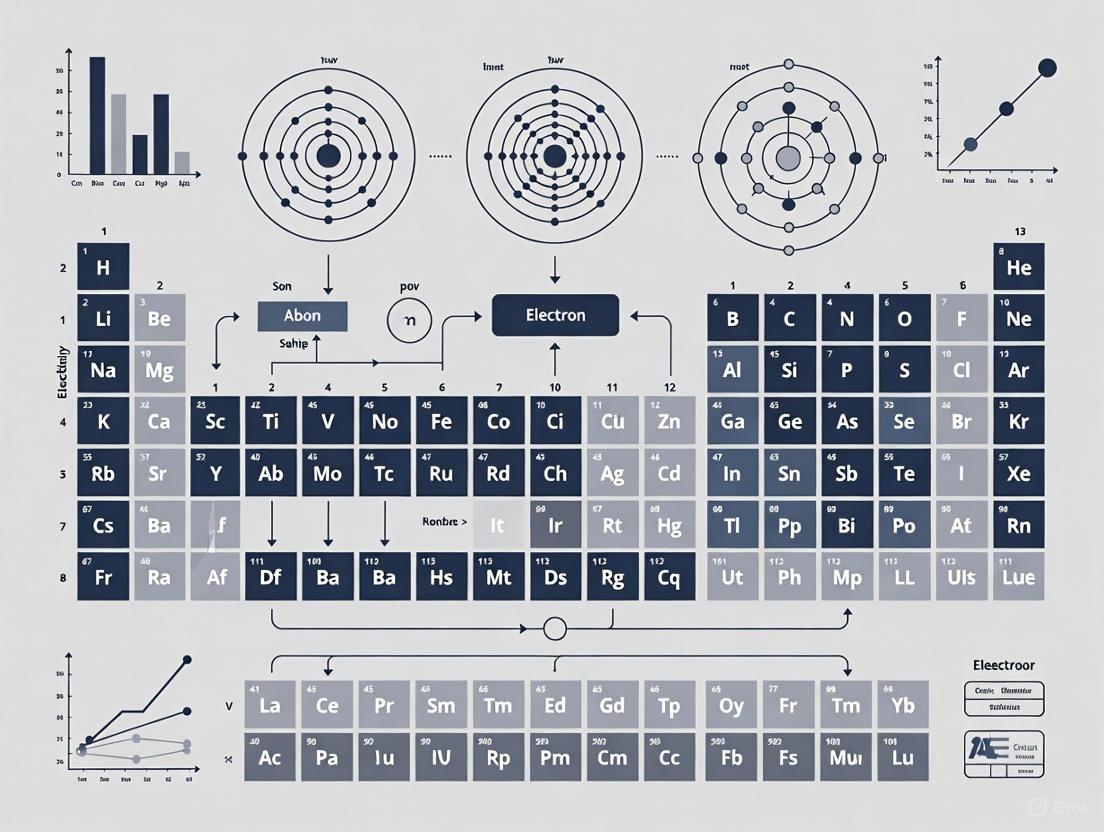
This article provides a comprehensive exploration of electron configuration principles and chemical periodicity, tailored for researchers and drug development professionals.
Electron Configuration and Chemical Periodicity: Foundational Principles and Advanced Applications for Drug Development
Abstract
This article provides a comprehensive exploration of electron configuration principles and chemical periodicity, tailored for researchers and drug development professionals. It bridges foundational quantum mechanical theories with cutting-edge methodological applications, addressing both standard practices and troubleshooting for complex elements. The content synthesizes traditional rules with emerging experimental techniques, such as novel heavy-element chemistry, and validates these concepts through comparative analysis and computational modeling. A special focus is given to the implications of these principles in designing therapeutic molecules and radioisotopes, offering a roadmap for leveraging periodicity in biomedical innovation.
Quantum Foundations: Understanding the Core Principles of Electron Configuration
The quantum mechanical model provides the fundamental framework for understanding the behavior of electrons in atoms, which directly governs the chemical and physical properties of the elements. This model represents a revolutionary departure from earlier Bohr models by describing electrons not as particles in fixed orbits but as wavefunctions with probabilistic distributions in three-dimensional space. These wavefunctions, known as atomic orbitals, provide a statistical map of where an electron is most likely to be found around the nucleus. The precise mathematical description of these orbitals, derived from the Schrödinger equation, enables accurate prediction of chemical bonding, reactivity, and the periodic trends that form the foundation of chemical periodicity [1].
Central to this framework is the concept of electron configuration—the distribution of electrons in atomic orbitals following the Aufbau principle, Pauli exclusion principle, and Hund's rule. The arrangement of electrons into successive electron shells (principal energy levels) and subshells (s, p, d, f) directly explains the structure of the periodic table and the observed periodicity of elemental properties. As one moves across a period, electrons fill the same shell with increasing nuclear charge, leading to predictable trends in atomic radius, ionization energy, and electronegativity. Conversely, moving down a group adds new electron shells, resulting in larger atomic radii and modified chemical behavior [1] [2]. This quantum-based understanding of electron organization enables researchers to systematically predict and rationalize chemical behavior across the periodic table.
Core Principles: Orbitals and Electron Organization
Quantum Numbers and Atomic Orbitals
The quantum mechanical model describes each electron in an atom using four quantum numbers that define its energy and spatial distribution:
- Principal quantum number (n): Defines the main energy level or shell (n = 1, 2, 3...), determining the electron's average distance from the nucleus and its overall energy. As n increases, the electron resides further from the nucleus and possesses higher energy.
- Azimuthal quantum number (l): Specifies the subshell shape (l = 0 to n-1, corresponding to s, p, d, f orbitals) and contributes to the electron's angular momentum. The s orbitals (l=0) are spherical, p orbitals (l=1) are dumbbell-shaped, and d and f orbitals exhibit more complex geometries.
- Magnetic quantum number (mₗ): Defines the orbital orientation in space (mₗ = -l to +l), with each value representing a distinct orbital within a subshell.
- Spin quantum number (mₛ): Specifies the electron's intrinsic spin direction (+½ or -½), following the Pauli exclusion principle that no two electrons in an atom can share the same set of all four quantum numbers.
Table 1: Orbital Types and Their Characteristics
| Orbital Type | Angular Momentum Quantum Number (l) | Number of Orientations | Maximum Electron Capacity |
|---|---|---|---|
| s | 0 | 1 | 2 |
| p | 1 | 3 | 6 |
| d | 2 | 5 | 10 |
| f | 3 | 7 | 14 |
Electron Shells and Subshells
Electron shells are organized hierarchically, with each shell (defined by n) containing n subshells (defined by l), and each subshell containing 2l+1 orbitals. The filling order follows the Aufbau principle, where electrons occupy the lowest energy orbitals available, typically following the Madelung rule (n+l ordering). This systematic organization explains the structure of the periodic table: s-block elements comprise groups 1-2, p-block encompasses groups 13-18, d-block contains transition metals (groups 3-12), and f-block includes the lanthanides and actinides [2].
The periodic recurrence of similar properties at regular intervals—chemical periodicity—stems directly from this quantum mechanical organization. Elements within the same group share similar valence electron configurations, leading to comparable chemical behavior. For instance, all alkali metals (Group 1) possess a single electron in their outermost s orbital, explaining their high reactivity and tendency to form +1 cations. This periodicity enables researchers to predict properties of elements and their compounds, guiding materials design and discovery efforts [1].
Quantitative Data and Periodicity Trends
The quantum mechanical model enables precise prediction and systematization of elemental properties across the periodic table. These quantifiable trends provide critical insights for materials design and compound selection in research applications.
Table 2: Periodic Trends in Atomic Properties
| Property | Trend Across Period (Left to Right) | Trend Down Group | Quantum Mechanical Explanation |
|---|---|---|---|
| Atomic Radius | Decreases | Increases | Increasing nuclear charge vs. electron shielding effects |
| Ionization Energy | Increases | Decreases | Increasing nuclear charge makes electron removal more difficult across periods; increased distance and shielding make it easier down groups |
| Electron Affinity | Generally increases (becomes more negative) | Generally decreases | Increased effective nuclear charge favors electron addition across periods; larger atomic size reduces this effect down groups |
| Electronegativity | Increases | Decreases | Combination of ionization energy and electron affinity trends |
These systematic variations stem directly from quantum principles: across periods, increasing nuclear charge without additional electron shielding draws electrons closer to the nucleus, while down groups, the addition of new electron shells outweighs increasing nuclear charge, resulting in larger atoms with more shielded valence electrons [1] [2].
Research Applications in Drug Development and Materials Science
ELECTRUM Fingerprint for Transition Metal Complexes
Transition metal complexes present significant challenges for computational modeling due to their diverse coordination geometries, oxidation states, and electronic structures. The recently developed ELECTRUM fingerprint addresses this gap by creating an electron configuration-based universal descriptor specifically for transition metal compounds [3]. This 598-bit fingerprint incorporates both ligand structural information and the electron configuration of the central metal atom, enabling efficient machine learning applications for predicting coordination numbers and oxidation states.
The ELECTRUM encoding methodology involves:
- Ligand fingerprint generation: Circular substructures are extracted from each ligand SMILES string up to a radius of 2 bonds, hashed, and folded into a 512-bit vector
- Ligand combination: Folded fingerprints for all ligands are combined through bitwise summation, preserving information about repeated ligands
- Metal encoding: An 86-bit binary representation of the metal's electron configuration is appended
- Machine learning integration: The resulting fingerprint trains multilayer perceptron neural networks for property prediction
This approach demonstrates remarkable efficiency, processing approximately 1.2 milliseconds per complex—significantly faster than geometry-based descriptors requiring molecular coordinates and quantum mechanical calculations [3].
Diagram: ELECTRUM Fingerprint Generation Workflow
Quantum Computing in Molecular Simulations
Quantum computing represents a paradigm shift for molecular modeling, particularly for simulating quantum systems that challenge classical computational methods. Quantum processors leverage qubits that exploit superposition and entanglement to perform calculations intractable for classical computers [4]. In pharmaceutical research, this capability enables:
- Protein folding prediction: Precise modeling of protein tertiary structure formation using D-Wave quantum annealers
- Drug-target interactions: Accurate simulation of molecular docking through direct quantum system simulation
- Electronic structure calculation: Determination of ground-state energies for complex molecules with unprecedented accuracy
Industry leaders including Pfizer, Bayer, and Cleveland Clinic have established quantum computing collaborations, with Pfizer and Gero applying hybrid quantum-classical architectures for therapeutic target discovery in fibrotic diseases [4]. Though still emerging, these quantum approaches show potential to significantly accelerate drug discovery timelines and improve success rates in clinical trials.
Experimental Protocols and Methodologies
Coordination Number Prediction Using ELECTRUM
Objective: Predict coordination numbers of transition metal complexes from ligand structures and metal identity using machine learning.
Materials and Computational Tools:
- Dataset of transition metal complexes from Cambridge Structural Database (CSD)
- SMILES representations of metal centers and ligands
- ELECTRUM fingerprint generation algorithm
- Multilayer Perceptron (MLP) neural network architecture
- Python implementation with scikit-learn library
Methodology:
- Data Preparation:
- Curate dataset of 217,517 transition metal complexes from CSD
- Represent each complex as concatenated SMILES strings (metal.ligand1.ligand2...)
- Annotate each complex with experimentally determined coordination number
Fingerprint Generation:
- Generate ELECTRUM fingerprints for all complexes using radius 2 and 512-bit ligand fingerprint size
- Include 86-bit metal electron configuration encoding
- Validate fingerprint quality through nearest-neighbor analysis in ELECTRUM space
Model Training:
- Configure MLP with 5 hidden layers (512-256-128-64-32 neurons)
- Implement 5-fold cross-validation with scrambled label controls
- Train models to predict coordination numbers from ELECTRUM encodings
Performance Validation:
- Compare ELECTRUM against control fingerprints (ligands-only and atomic identifier)
- Assess model accuracy on holdout test sets
- Evaluate clustering behavior in two-dimensional representations [3]
Quantum Computing for Molecular Energy Calculations
Objective: Calculate ground-state energy of complex molecules using quantum processors.
Materials and Quantum Resources:
- IBM quantum processor or equivalent quantum processing unit (QPU)
- Classical computing infrastructure for hybrid algorithm implementation
- Molecular structure files for target compounds
- Quantum chemistry software packages (Qiskit, OpenFermion)
Methodology:
- Problem Formulation:
- Map molecular electronic structure to qubit representation using Jordan-Wigner or Bravyi-Kitaev transformation
- Prepare initial reference state based on Hartree-Fock calculation
Algorithm Implementation:
- Employ Variational Quantum Eigensolver (VQE) hybrid algorithm
- Design quantum circuit ansatz to prepare trial wavefunctions
- Implement quantum phase estimation for energy measurement
Execution and Optimization:
- Run iterative optimization of circuit parameters on QPU
- Utilize classical computer for parameter update using gradient descent
- Converge to ground-state energy estimate through successive iterations
Validation:
- Compare results with classical computational methods (CCSD(T), DMRG)
- Assess accuracy improvement over classical approximations
- Benchmark computational resource requirements [4]
Table 3: Research Reagent Solutions for Computational Chemistry
| Tool/Resource | Type | Primary Function | Application Example |
|---|---|---|---|
| ELECTRUM Fingerprint | Computational Descriptor | Encodes transition metal complex structure | Predicting coordination numbers from SMILES strings [3] |
| Quantum Processing Unit (QPU) | Hardware | Performs quantum computations | Molecular ground-state energy calculations [4] |
| Cambridge Structural Database (CSD) | Data Resource | Provides crystallographic data | Training set for metal complex property prediction [3] |
| Variational Quantum Eigensolver (VQE) | Algorithm | Hybrid quantum-classical computing | Finding molecular electronic ground states [4] |
| Multilayer Perceptron (MLP) | Neural Network Architecture | Property prediction from fingerprints | Classification of metal complex properties [3] |
Future Directions and Research Applications
The integration of quantum mechanical principles with advanced computational methods continues to expand research capabilities across chemistry and drug development. Several emerging trends demonstrate particular promise:
AI-Enhanced Quantum Chemistry: Machine learning approaches increasingly complement quantum mechanical calculations, with algorithms trained on high-quality quantum chemistry data providing accurate predictions at reduced computational cost. The I-Con framework—a "periodic table" of machine learning algorithms—systematically organizes over 20 classical algorithms into a unified mathematical structure, enabling more efficient development of hybrid approaches [5].
Model-Informed Drug Development (MIDD): Quantitative structure-activity relationship (QSAR) models, physiologically based pharmacokinetic (PBPK) modeling, and quantitative systems pharmacology (QSP) integrate quantum-derived molecular properties to predict drug behavior across development stages. These "fit-for-purpose" modeling approaches align computational tools with specific research questions from discovery through post-market monitoring [6].
Quantum Machine Learning: The convergence of quantum computing and machine learning creates opportunities for enhanced molecular property prediction, with quantum neural networks potentially offering advantages for specific chemical applications. As quantum hardware advances, these approaches may address currently intractable problems in molecular design and optimization [4].
Diagram: Research Applications of Quantum Principles
The continued refinement of these computational approaches, grounded in the fundamental principles of the quantum mechanical model, promises to accelerate discovery across pharmaceutical development, materials science, and chemical research. By bridging theoretical quantum mechanics with practical application, researchers can more effectively navigate chemical space and design compounds with tailored properties for specific applications.
The electronic structure of an atom is fundamental to its chemical identity, dictating its bonding behavior, reactivity, and physical properties. For researchers and drug development professionals, predicting molecular behavior and interactions hinges on a precise understanding of these electronic foundations. The ground-state electron configuration of an atom is not arbitrary but is governed by a set of fundamental quantum mechanical rules: the Aufbau Principle, Hund's Rule, and the Pauli Exclusion Principle [7]. Together, these rules provide a systematic framework for determining how electrons occupy atomic orbitals, forming the bedrock of our understanding of chemical periodicity and the structure of the periodic table itself. This guide provides an in-depth technical exploration of these core principles, framing them within ongoing research into chemical periodicity and their practical implications for material science and pharmaceutical development.
The Aufbau Principle: The "Building-Up" Process
Core Concept and Theoretical Basis
The term "Aufbau" originates from the German word "Aufbauprinzip," meaning "building-up principle" [8]. This principle states that in the ground state of an atom or ion, electrons populate atomic orbitals in a sequential order of increasing orbital energy [9]. The fundamental tenet is that electrons will always occupy the lowest energy orbitals available before filling higher energy ones [10]. This process resembles the construction of a building from the foundation upward, ensuring the most stable, lowest-energy electron configuration is achieved for the atom [7] [10].
The Madelung Energy Ordering Rule
The order of orbital filling is empirically described by the Madelung energy ordering rule (also known as the n + ℓ rule) [9]. This rule provides a reliable method for predicting the sequence of orbital occupation:
- Rule 1: Electrons are assigned to subshells in order of increasing value of the sum n + ℓ, where n is the principal quantum number and ℓ is the azimuthal quantum number.
- Rule 2: For subshells with an identical n + ℓ value, the subshell with the lower n value is filled first [9].
Table: Madelung Orbital Filling Sequence
| Orbital Subshell | n value | ℓ value | n + ℓ value | Filling Order |
|---|---|---|---|---|
| 1s | 1 | 0 | 1 | 1 |
| 2s | 2 | 0 | 2 | 2 |
| 2p | 2 | 1 | 3 | 3 |
| 3s | 3 | 0 | 3 | 4 |
| 3p | 3 | 1 | 4 | 5 |
| 4s | 4 | 0 | 4 | 6 |
| 3d | 3 | 2 | 5 | 7 |
| 4p | 4 | 1 | 5 | 8 |
| 5s | 5 | 0 | 5 | 9 |
| 4d | 4 | 2 | 6 | 10 |
| 5p | 5 | 1 | 6 | 11 |
| 6s | 6 | 0 | 6 | 12 |
| 4f | 4 | 3 | 7 | 13 |
| 5d | 5 | 2 | 7 | 14 |
| 6p | 6 | 1 | 7 | 15 |
| 7s | 7 | 0 | 7 | 16 |
| 5f | 5 | 3 | 8 | 17 |
| 6d | 6 | 2 | 8 | 18 |
This ordering explains the structure of the periodic table, particularly the placement of the lanthanide and actinide series (f-block elements) [9]. The following diagram visualizes the sequence in which orbitals are filled according to the Aufbau principle and the Madelung rule.
Notable Exceptions to the Aufbau Principle
While the Madelung rule provides a robust general guide, several notable exceptions exist, primarily within the d-block and f-block elements. These exceptions occur when the energy difference between subshells is minimal, and the stability gained from half-filled or fully filled subshells compensates for the energy required to "promote" an electron [7] [9].
Table: Common Exceptions to the Aufbau Principle in the d-Block
| Atom | Atomic Number (Z) | Madelung-Predicted Configuration | Experimental Ground-State Configuration | Reason for Exception |
|---|---|---|---|---|
| Chromium | 24 | [Ar] 3d⁴ 4s² | [Ar] 3d⁵ 4s¹ | Energy stabilization of half-filled d⁵ |
| Copper | 29 | [Ar] 3d⁹ 4s² | [Ar] 3d¹⁰ 4s¹ | Energy stabilization of fully filled d¹⁰ |
| Niobium | 41 | [Kr] 4d³ 5s² | [Kr] 4d⁴ 5s¹ | Proximity of 4d and 5s energy levels |
| Molybdenum | 42 | [Kr] 4d⁴ 5s² | [Kr] 4d⁵ 5s¹ | Energy stabilization of half-filled d⁵ |
| Silver | 47 | [Kr] 4d⁹ 5s² | [Kr] 4d¹⁰ 5s¹ | Energy stabilization of fully filled d¹⁰ |
| Gold | 79 | [Xe] 4f¹⁴ 5d⁹ 6s² | [Xe] 4f¹⁴ 5d¹⁰ 6s¹ | Energy stabilization of fully filled d¹⁰ |
These exceptions are critical for researchers to recognize, as the altered electron configurations can significantly influence the oxidation states and catalytic properties of transition metals used in synthetic chemistry and drug design.
Hund's Rule: Maximizing Multiplicity
Rule Definition and Formulation
Hund's Rule addresses the filling of degenerate orbitals—orbitals that possess the same energy, such as the three p orbitals, five d orbitals, or seven f orbitals within a given subshell [11]. The rule consists of two main parts [12] [13]:
- For a given electron configuration, the state with the maximum multiplicity lies lowest in energy. Multiplicity is given by 2S+1, where S is the total spin quantum number. In practical terms, this means every orbital in a subshell is singly occupied with one electron before any one orbital is doubly occupied.
- For states with the same multiplicity, the state with the largest total orbital angular momentum quantum number (L) has the lowest energy. This aspect is more relevant for determining term symbols in atomic spectroscopy.
A third rule deals with spin-orbit coupling to determine the fine structure of atomic spectra, but the first rule is the most critical for understanding basic electron configurations in chemistry [12].
Physical Rationale and Implications
The physical basis for Hund's first rule is the minimization of electron-electron repulsion. When electrons occupy different orbitals, they are, on average, farther apart than if they were paired in the same orbital, thereby reducing Coulombic repulsion [11]. Furthermore, quantum-mechanical calculations indicate that electrons in singly occupied orbitals are less effectively screened from the nucleus, causing these orbitals to contract and increasing the electron-nucleus attraction energy [12]. The rule also mandates that all electrons in singly occupied orbitals possess the same spin (parallel spins), which is a consequence of the quantum mechanical requirement for an antisymmetric total wavefunction [11].
The application of Hund's rule is visualized below for the carbon atom, which has two electrons in its 2p subshell.
Experimental Validation via Spectroscopy
Methodology: The most direct experimental validation of Hund's rule comes from atomic emission and absorption spectroscopy. By analyzing the spectral lines of atoms, scientists can determine the energy differences between various electronic states and identify the ground state.
Protocol:
- Sample Preparation: A pure sample of the element (e.g., nitrogen or oxygen in gaseous form) is placed in a discharge tube or a suitable cell for spectroscopic analysis.
- Energy Input: Energy is supplied to the sample via an electric discharge (for gases) or heat, promoting electrons to excited states.
- Spectral Acquisition: As electrons return to lower energy states, they emit photons of specific wavelengths. The emitted light is passed through a diffraction grating or prism to separate it into its constituent wavelengths, creating an emission spectrum.
- Data Analysis: The resulting spectrum is analyzed. The intensity and spacing of the spectral lines correspond to transitions between different electronic energy levels. For atoms like nitrogen, the spectral data confirms that the ground state is a triplet state with three unpaired electrons, each residing in a separate 2p orbital with parallel spins, consistent with Hund's rule [11]. Deviations from the predicted ground state would manifest as unexpected spectral lines or intensities.
The Pauli Exclusion Principle: The Quantum Identity Card
Fundamental Statement
Formulated by Wolfgang Pauli in 1925, the Pauli Exclusion Principle is a fundamental quantum mechanical law stating that no two electrons in an atom can have the same set of four quantum numbers (n, ℓ, mℓ, m𝑠) [14] [15]. Since the first three quantum numbers (n, ℓ, mℓ) define a specific atomic orbital, the principle directly implies that an atomic orbital can hold a maximum of two electrons, and these two electrons must have opposite spins (m𝑠 = +1/2 and m𝑠 = -1/2) [7] [14].
A more rigorous, generalized statement for multi-electron systems is that the total wavefunction of a system of identical fermions (particles with half-integer spin, like electrons) must be antisymmetric with respect to the exchange of any two particles [15]. This means if the coordinates (both spatial and spin) of two electrons are swapped, the total wavefunction changes sign.
Consequences for Atomic Structure and Chemistry
The Pauli Exclusion Principle has profound implications:
- It defines electron shell capacity. The maximum number of electrons in a shell is 2n² and in a subshell is 2(2ℓ + 1) [9].
- It explains the large-scale stability of matter. Without this principle, all electrons in an atom would collapse into the 1s orbital, leading to a complete loss of chemical diversity as all atoms would have similar, compact configurations [15].
- It underpins the periodic table's structure. The sequential filling of orbitals, constrained by the Pauli principle, gives rise to the periods and groups of the periodic table [15].
Table: Quantum Number Combinations and Orbital Capacities
| Subshell | ℓ value | mℓ values | Number of Orbitals | Max Electrons (2 per orbital) |
|---|---|---|---|---|
| s | 0 | 0 | 1 | 2 |
| p | 1 | -1, 0, +1 | 3 | 6 |
| d | 2 | -2, -1, 0, +1, +2 | 5 | 10 |
| f | 3 | -3, -2, -1, 0, +1, +2, +3 | 7 | 14 |
The following diagram illustrates the application of all three rules for the electron configuration of a carbon atom.
Integrated Workflow for Determining Electron Configurations
Determining the ground-state electron configuration for any element requires the simultaneous application of all three rules. The following workflow provides a robust methodology for researchers.
Step-by-Step Protocol:
- Determine Total Electrons: Identify the number of electrons (Z) from the atomic number of the neutral element.
- Apply Aufbau Order: Refer to the Madelung (n + ℓ) rule sequence to add electrons to orbitals in the correct energy order (1s → 2s → 2p → 3s → 3p → 4s → 3d...).
- Apply Hund's Rule: When filling a degenerate subshell (p, d, f), place one electron in each available orbital with parallel spins before pairing any electrons.
- Apply Pauli Exclusion Principle: Ensure that no orbital contains more than two electrons, and that any paired electrons are represented with opposite spins.
- Check for Known Exceptions: For transition metals like Cr, Cu, Ag, and others, consult tables of known exceptions where half-filled or fully filled subshells provide extra stability.
Example: Oxygen (Z = 8)
- Step 1: 8 electrons total.
- Step 2 (Aufbau): 2 electrons fill 1s. 2 electrons fill 2s. The remaining 4 electrons go to the 2p subshell.
- Step 3 (Hund's): Three of the four 2p electrons singly occupy each of the three 2p orbitals with parallel spins.
- Step 4 (Pauli): The fourth 2p electron pairs up with one of the existing electrons in a 2p orbital, with opposite spin.
- Final Configuration: 1s² 2s² 2p⁴. The orbital diagram shows two singly occupied 2p orbitals (with parallel spins) and one doubly occupied 2p orbital [11].
Table: Key Reagents, Materials, and Computational Tools
| Tool / Resource | Category | Primary Function in Research | Example Use-Case |
|---|---|---|---|
| High-Purity Elements | Material | Serve as the fundamental subject for experimental spectroscopic analysis. | Gas-phase studies of atomic spectra for rule validation. |
| Atomic Emission Spectrometer | Instrumentation | Precisely measures the wavelengths of light emitted by excited atoms to determine energy-level differences. | Experimentally confirming the ground-state term symbol predicted by Hund's rules. |
| Computational Chemistry Software | Software | Performs quantum mechanical calculations to predict electronic structure, energies, and properties from first principles. | Modeling electron densities, calculating total energies of different electron configurations to verify stability. |
| X-ray Photoelectron Spectrometer (XPS) | Instrumentation | Probes the core energy levels of atoms in molecules or materials, providing direct evidence of electron configuration and oxidation states. | Determining the oxidation state of a transition metal catalyst in a drug synthesis intermediate. |
| High-Resolution Laser Systems | Instrumentation | Allows for precision spectroscopy to resolve fine and hyperfine structure in atomic spectra. | Investigating spin-orbit coupling effects detailed by Hund's third rule. |
The Aufbau Principle, Hund's Rule, and the Pauli Exclusion Principle are not merely academic rules but are indispensable tools for predicting and rationalizing the electronic behavior of atoms. For professionals in drug development and materials science, these principles provide the foundational logic for understanding the behavior of metal catalysts in synthetic pathways, the redox chemistry of biological systems, and the design of novel materials with tailored electronic properties. While the rules provide an excellent predictive model, awareness of their exceptions is equally critical, as these often reveal elements with unique and useful reactivities. Continued research into the nuances of electron configuration remains vital for advancing our understanding of chemical periodicity and its applications across the scientific spectrum.
This technical guide provides researchers and scientists with a comprehensive framework for understanding and applying the principles of orbital notation and energy level ordering within the broader context of chemical periodicity and electron configuration research. The precise arrangement of electrons in atomic orbitals fundamentally dictates the chemical behavior, bonding characteristics, and physical properties of elements, making this knowledge essential for advanced research applications including rational drug design and materials development. We present detailed methodologies, quantitative data frameworks, and visualization tools to enable accurate prediction and interpretation of electronic configurations across the periodic table, with particular emphasis on transition metals and their coordination complexes which prove particularly relevant to pharmaceutical applications.
The modern understanding of electron configuration derives from quantum mechanics, where atomic orbitals are defined as mathematical functions describing the location and wave-like behavior of electrons in atoms [16]. These orbitals represent three-dimensional regions where electrons have the highest probability of being found, with their shapes and energies determined by quantum numbers [17]. The principal quantum number (n = 1, 2, 3, ...) determines the overall energy level and size of the orbital, while the orbital angular momentum quantum number (ℓ) defines the subshell shape (s, p, d, f), and the magnetic quantum number (mℓ) specifies the orbital orientation in space [17]. Each orbital can accommodate a maximum of two electrons with opposing spins, in accordance with the Pauli exclusion principle [16].
The arrangement of electrons within these orbitals follows specific principles based on energy minimization, which systematically dictates the building up of elements in the periodic table. This quantum mechanical framework provides the foundation for understanding chemical periodicity, as elements with similar electron configurations in their outermost shells display comparable chemical properties. For drug development professionals, this understanding enables prediction of molecular reactivity, binding interactions, and coordination chemistry essential to pharmaceutical design.
Fundamental Principles of Energy Level Ordering
The Aufbau Principle
The Aufbau principle (from the German "Aufbau" meaning "building up") provides the foundational rule for determining the order in which atomic orbitals are filled with electrons [18]. This principle states that electrons occupy the lowest energy orbitals available first, before filling higher energy levels. The conventional ordering of orbital energies follows the pattern:
1s < 2s < 2p < 3s < 3p < 4s < 3d < 4p < 5s < 4d < 5p < 6s < 4f < 5d < 6p < 7s < 5f < 6d < 7p
This sequence can be visualized and applied using the diagonal rule or mnemonic devices, but most effectively utilized through direct periodic table inspection [18]. The periodic table's structure directly reflects this orbital filling order, with each block (s, p, d, f) corresponding to the subshell being filled.
Hund's Rule and Pauli Exclusion Principle
Two additional quantum mechanical rules complete the framework for determining electron configurations:
- Hund's Rule: For orbitals of equal energy (degenerate orbitals), electrons occupy available orbitals singly before pairing up. This maximum multiplicity rule minimizes electron-electron repulsions [18].
- Pauli Exclusion Principle: No two electrons in an atom can have the same set of four quantum numbers. Consequently, any single orbital can hold a maximum of two electrons, and these must have opposite spins [17] [16].
These principles collectively explain why, for example, the three 2p orbitals of nitrogen (1s²2s²2p³) contain one electron each, all with parallel spins, rather than having paired electrons in fewer orbitals.
Orbital Capacities and Quantum Numbers
Table 1: Orbital Types, Quantum Numbers, and Electron Capacities
| Orbital Type | Angular Momentum Quantum Number (ℓ) | Magnetic Quantum Numbers (mℓ) | Number of Orbitals | Maximum Electrons |
|---|---|---|---|---|
| s | 0 | 0 | 1 | 2 |
| p | 1 | -1, 0, +1 | 3 | 6 |
| d | 2 | -2, -1, 0, +1, +2 | 5 | 10 |
| f | 3 | -3, -2, -1, 0, +1, +2, +3 | 7 | 14 |
The subshell electron capacities derive directly from the quantum numbers: each subshell can hold up to 2(2ℓ + 1) electrons [17]. These fundamental capacities establish the structure of the periodic table, with s-block encompassing 2 elements, p-block 6 elements, d-block 10 elements, and f-block 14 elements.
Methodologies for Determining Electron Configurations
Standard Notation Protocol
The following step-by-step methodology provides a reliable approach for writing electron configurations for any neutral atom:
- Determine Atomic Number: Identify the number of electrons from the element's atomic number (Z).
- Follow Orbital Energy Order: Fill orbitals sequentially according to the established energy ordering principle, respecting orbital capacities.
- Apply Hund's Rule: When placing electrons in degenerate orbitals (p, d, f), fill each orbital singly with parallel spins before pairing.
- Verify Total Electrons: Confirm that the sum of superscripts in the configuration equals the atomic number.
Example: Oxygen (Z = 8)
- Application: 1s² 2s² 2p⁴ (with the 2p subshell containing two singly-occupied orbitals and one paired orbital)
Noble Gas Core Abbreviation
For elements with higher atomic numbers, configurations can be abbreviated by referencing the previous noble gas configuration in brackets, followed by the remaining valence electrons [18]. This notation emphasizes the valence electron structure most relevant to chemical bonding.
Examples:
- Sodium (Z = 11): [Ne] 3s¹
- Iron (Z = 26): [Ar] 4s² 3d⁶
Exceptional Configurations
Several transition metals exhibit deviations from predicted configurations due to the extra stability associated with half-filled and completely filled d subshells [18]. These exceptions highlight the subtle energy balances between closely-spaced orbitals.
Table 2: Exceptional Electron Configurations in Transition Metals
| Element | Predicted Configuration | Actual Configuration | Stabilization Factor |
|---|---|---|---|
| Chromium (Z=24) | [Ar] 4s² 3d⁴ | [Ar] 4s¹ 3d⁵ | Half-filled d subshell |
| Copper (Z=29) | [Ar] 4s² 3d⁹ | [Ar] 4s¹ 3d¹⁰ | Fully filled d subshell |
| Silver (Z=47) | [Kr] 5s² 4d⁹ | [Kr] 5s¹ 4d¹⁰ | Fully filled d subshell |
| Gold (Z=79) | [Xe] 6s² 4f¹⁴ 5d⁹ | [Xe] 6s¹ 4f¹⁴ 5d¹⁰ | Fully filled d subshell |
These exceptions demonstrate that energy differences between ns and (n-1)d orbitals are small enough that the stability gains from half-filled or fully filled subshells can alter the expected filling order.
Experimental Determination Methodologies
Spectroscopic Techniques
Experimental verification of electron configurations primarily relies on spectroscopic methods that probe electronic energy levels:
Ultraviolet-Visible (UV-Vis) Spectroscopy: Measures electronic transitions between orbitals, providing direct evidence of energy separations [19] [20]. The absorption spectra of coordination complexes, for example, reveal d-orbital splitting patterns that confirm the electronic structure.
Photoelectron Spectroscopy: Directly measures the ionization energies of electrons from specific orbitals, providing experimental evidence for orbital energy ordering and occupation.
Magnetic Susceptibility Measurements
The number of unpaired electrons in a species can be determined through magnetic susceptibility measurements, providing experimental confirmation of predictions based on Hund's rule [18]. Paramagnetic species with unpaired electrons are attracted to magnetic fields, while diamagnetic species with all electrons paired are weakly repelled.
Computational Approaches
Modern computational chemistry employs density functional theory (DFT) and other quantum mechanical methods to calculate electron distributions and orbital energies [21]. These approaches can predict electric anisotropies and polarizabilities that derive from specific electron configurations, providing theoretical confirmation of experimental observations.
Diagram 1: Electron configuration determination workflow (27 words)
Advanced Concepts: Coordination Complexes and d-Orbital Splitting
In coordination chemistry, which is particularly relevant to metallodrugs and catalytic systems, the presence of ligands alters the energy ordering of d-orbitals in transition metals through crystal field effects [19]. This splitting has profound implications for the optical and magnetic properties of coordination compounds.
Crystal Field Theory
When ligands approach a transition metal center, they create an electrostatic field that splits the degeneracy of the d-orbitals [19]. In octahedral complexes, this results in two distinct energy levels: the higher energy eg orbitals (dx²-y² and dz²) and the lower energy t2g orbitals (dxy, dxz, dyz). The energy separation between these sets is designated as Δo (the crystal field splitting parameter).
Spectrochemical Series
The magnitude of d-orbital splitting depends on the ligand type, with the spectrochemical series organizing ligands from weak field (small Δo) to strong field (large Δo):
I⁻ < Br⁻ < Cl⁻ < F⁻ < OH⁻ < H₂O < NH₃ < CN⁻ < CO
Weak field ligands typically produce high-spin complexes (maximum unpaired electrons), while strong field ligands favor low-spin complexes (minimum unpaired electrons) [19]. This distinction is crucial for predicting magnetic properties and coloration in coordination compounds relevant to pharmaceutical applications.
Color Origin in Coordination Complexes
The colors observed in transition metal complexes result from d-d transitions, where electrons absorb photons of visible light to jump from lower-energy to higher-energy d-orbitals [20]. The specific wavelengths absorbed depend on Δo, with complementary colors transmitted to produce the observed coloration.
Diagram 2: Color origin in coordination complexes (26 words)
Table 3: Relationship Between Absorbed Wavelength and Observed Color in Complexes
| Complex | Absorbed Wavelength (nm) | Absorbed Color | Observed Color | Δo (kJ/mol) |
|---|---|---|---|---|
| [Ti(H₂O)₆]³⁺ | 450-600 (max 499) | Orange-Red | Purple | 239 |
| [Cu(NH₃)₄]²⁺ | 600-650 | Red | Blue | 184-200 |
| [Cu(H₂O)₆]²⁺ | 500-600 | Orange-Green | Blue | 200-240 |
The relationship between the crystal field splitting energy and the absorbed wavelength is given by Δo = hc/λ, where h is Planck's constant, c is the speed of light, and λ is the wavelength of the absorbed photon [20]. This quantitative relationship allows researchers to calculate orbital energy separations from experimental absorption spectra.
The Scientist's Toolkit: Essential Research Reagents and Materials
Table 4: Key Reagent Solutions for Electron Configuration Research
| Reagent/Material | Function | Application Example |
|---|---|---|
| UV-Vis Spectrophotometer | Measures absorption spectra of solutions | Determining d-d transition energies in coordination complexes [19] [20] |
| Ligand Series (Halides to CN⁻) | Creates crystal field of varying strength | Investigating spectrochemical series effects on Δo [19] |
| Magnetic Susceptibility Balance | Detects unpaired electrons | Confirming high-spin vs. low-spin configurations [19] |
| Computational Software (DFT) | Calculates electron distributions | Predicting orbital energies and charge anisotropies [21] |
| High-Purity Transition Metal Salts | Source of metal centers | Preparing coordination complexes with defined geometry |
| Inert Atmosphere Equipment | Prevents oxidation during synthesis | Handling air-sensitive organometallic compounds |
Implications for Chemical Periodicity and Pharmaceutical Research
The systematic understanding of orbital notation and energy level ordering provides the fundamental basis for explaining chemical periodicity. Elements within the same group share similar valence electron configurations, which directly dictates their chemical behavior and reactivity patterns [18].
In pharmaceutical research, this framework enables rational design of metallodrugs and diagnostic agents by predicting:
- Metal-ligand coordination preferences based on electron configuration and crystal field stabilization energies
- Redox behavior of transition metal centers in biological systems
- Spectroscopic properties for imaging and detection applications
- Structure-activity relationships in metal-containing pharmaceuticals
The deformation of electron charge distributions around atomic nuclei, as revealed through polarizability anisotropy studies [21], further refines our understanding of how electron configurations influence intermolecular interactions and binding affinities - crucial considerations in drug-receptor interactions.
Orbital notation and energy level ordering represent fundamental organizing principles in chemistry that directly derive from quantum mechanical descriptions of atomic structure. The methodologies and experimental approaches outlined in this guide provide researchers with robust tools for determining, verifying, and applying electron configurations across the periodic table. For drug development professionals, this knowledge enables predictive understanding of molecular properties, reactivity patterns, and spectroscopic behaviors essential to rational design of pharmaceutical compounds. The continued refinement of these principles through advanced spectroscopic and computational methods continues to enhance their utility in cutting-edge chemical research.
The electron configuration of an element describes the distribution of its electrons within the atomic orbitals surrounding the nucleus [18] [22]. This arrangement is governed by the principles of quantum mechanics and provides the foundational framework for understanding the periodic table's structure. The organization of elements into distinct blocks—s, p, d, and f—directly reflects the specific atomic orbitals that are being filled with electrons as the atomic number increases [23]. This systematic filling order, formalized by the Aufbau principle, alongside the Pauli exclusion principle and Hund's rule, dictates the chemical behavior and properties of elements [24]. For researchers in drug discovery and materials science, a deep understanding of these electronic structures is not merely academic; it is crucial for rational design, enabling the prediction of bonding behavior, reactivity, and the physical properties of compounds [25] [26]. The periodic table, therefore, serves as a powerful predictive map, where an element's position immediately reveals its valence electron configuration and thus its potential chemical character.
Characteristics of the s, p, d, and f Blocks
The periodic table is partitioned into blocks based on the type of atomic orbital that accepts the valence electron. This classification system offers immediate insight into the electronic structure and, consequently, the chemical properties of the elements.
Table 1: Characteristics of the Periodic Table Blocks
| Block | Orbital Filled | Group(s) | Valence Electron Configuration | General Chemical Character |
|---|---|---|---|---|
| s-block | s orbital | 1, 2 (and He) | ns¹⁻² | Highly reactive metals (except H, He); form +1 or +2 cations [27]. |
| p-block | p orbital | 13-18 | ns² np¹⁻⁶ | Contains all non-metals, metalloids, and some metals; diverse chemistry [27]. |
| d-block | d orbital | 3-12 | (n-1)d¹⁻¹⁰ ns⁰⁻² | Transition metals; form colored complexes, multiple oxidation states [23]. |
| f-block | f orbital | Lanthanides & Actinides | (n-2)f¹⁻¹⁴ (n-1)d⁰⁻¹ ns² | Inner transition metals; typically +3 oxidation state; lanthanides are chemically very similar [23]. |
The s-Block Elements
The s-block encompasses Group 1 (alkali metals) and Group 2 (alkaline earth metals), along with hydrogen and helium. These elements are characterized by their valence electrons occupying the s orbital. Alkali metals have a configuration ending in ns¹, and alkaline earth metals end in ns² [27]. A key trait of s-block elements is their tendency to lose their valence s-electrons to form stable cations, achieving the electron configuration of the preceding noble gas. This results in common +1 and +2 oxidation states, respectively [18]. This strong electropositive character makes them highly reactive, particularly with water and oxygen.
The p-Block Elements
Spanning Groups 13 to 18, the p-block is incredibly diverse, containing non-metals, metalloids, and post-transition metals. The valence shell configuration ranges from ns² np¹ to ns² np⁶ (the latter being the noble gases) [27]. The octet rule is a dominant concept in p-block chemistry, with elements often gaining, losing, or sharing electrons to achieve a full shell of eight electrons [27]. This block exhibits the most varied range of bonding types, from covalent network solids (e.g., silicon) to diatomic gases (e.g., oxygen) and noble gases. Halogens (Group 17), with their ns² np⁵ configuration, are highly reactive non-metals seeking one electron to complete their octet.
The d-Block Elements
The d-block, or transition metals, occupies the central portion of the periodic table (Groups 3-12). Their electron configuration involves the filling of the inner (n-1)d orbitals, typically denoted as (n-1)d¹⁻¹⁰ ns¹⁻² [23]. A hallmark of these elements is the occurrence of exceptions to the Aufbau principle, notably in chromium ([Ar] 4s¹ 3d⁵) and copper ([Ar] 4s¹ 3d¹⁰), where a half-filled or fully filled d subshell provides extra stability [18] [28]. Transition metals are renowned for their ability to form multiple oxidation states, paramagnetic compounds, and brightly colored complexes, properties driven by the involvement of d-orbitals in bonding.
The f-Block Elements
The f-block consists of the lanthanide and actinide series, where the 4f and 5f orbitals are progressively filled. Their general electron configuration is (n-2)f¹⁻¹⁴ (n-1)d⁰⁻¹ ns² [23]. The lanthanides are particularly known for their striking chemical similarity to one another, as the addition of f-electrons, which are deeply buried and shielded, has minimal impact on their chemical properties. They almost exclusively exhibit a +3 oxidation state. The actinides, especially the heavier members, are radioactive and often display more complex and varied chemistry.
Quantitative Data: Electron Configurations Across the Periodic Table
The following table provides the ground-state electron configurations for the first 36 elements, demonstrating the systematic application of the Aufbau principle and the structure of the s, p, and d blocks [28].
Table 2: Electron Configurations of Elements (Atomic Numbers 1-36)
| Atomic Number | Element | Block | Full Electron Configuration | Noble Gas (Shorthand) Configuration |
|---|---|---|---|---|
| 1 | Hydrogen | s | 1s¹ | 1s¹ |
| 2 | Helium | s | 1s² | 1s² |
| 3 | Lithium | s | 1s² 2s¹ | [He] 2s¹ |
| 4 | Beryllium | s | 1s² 2s² | [He] 2s² |
| 5 | Boron | p | 1s² 2s² 2p¹ | [He] 2s² 2p¹ |
| 6 | Carbon | p | 1s² 2s² 2p² | [He] 2s² 2p² |
| 7 | Nitrogen | p | 1s² 2s² 2p³ | [He] 2s² 2p³ |
| 8 | Oxygen | p | 1s² 2s² 2p⁴ | [He] 2s² 2p⁴ |
| 9 | Fluorine | p | 1s² 2s² 2p⁵ | [He] 2s² 2p⁵ |
| 10 | Neon | p | 1s² 2s² 2p⁶ | [He] 2s² 2p⁶ |
| 11 | Sodium | s | 1s² 2s² 2p⁶ 3s¹ | [Ne] 3s¹ |
| 12 | Magnesium | s | 1s² 2s² 2p⁶ 3s² | [Ne] 3s² |
| 13 | Aluminum | p | 1s² 2s² 2p⁶ 3s² 3p¹ | [Ne] 3s² 3p¹ |
| 14 | Silicon | p | 1s² 2s² 2p⁶ 3s² 3p² | [Ne] 3s² 3p² |
| 15 | Phosphorus | p | 1s² 2s² 2p⁶ 3s² 3p³ | [Ne] 3s² 3p³ |
| 16 | Sulfur | p | 1s² 2s² 2p⁶ 3s² 3p⁴ | [Ne] 3s² 3p⁴ |
| 17 | Chlorine | p | 1s² 2s² 2p⁶ 3s² 3p⁵ | [Ne] 3s² 3p⁵ |
| 18 | Argon | p | 1s² 2s² 2p⁶ 3s² 3p⁶ | [Ne] 3s² 3p⁶ |
| 19 | Potassium | s | 1s² 2s² 2p⁶ 3s² 3p⁶ 4s¹ | [Ar] 4s¹ |
| 20 | Calcium | s | 1s² 2s² 2p⁶ 3s² 3p⁶ 4s² | [Ar] 4s² |
| 21 | Scandium | d | 1s² 2s² 2p⁶ 3s² 3p⁶ 3d¹ 4s² | [Ar] 3d¹ 4s² |
| 22 | Titanium | d | 1s² 2s² 2p⁶ 3s² 3p⁶ 3d² 4s² | [Ar] 3d² 4s² |
| 23 | Vanadium | d | 1s² 2s² 2p⁶ 3s² 3p⁶ 3d³ 4s² | [Ar] 3d³ 4s² |
| 24 | Chromium* | d | 1s² 2s² 2p⁶ 3s² 3p⁶ 3d⁵ 4s¹ | [Ar] 3d⁵ 4s¹ |
| 25 | Manganese | d | 1s² 2s² 2p⁶ 3s² 3p⁶ 3d⁵ 4s² | [Ar] 3d⁵ 4s² |
| 26 | Iron | d | 1s² 2s² 2p⁶ 3s² 3p⁶ 3d⁶ 4s² | [Ar] 3d⁶ 4s² |
| 27 | Cobalt | d | 1s² 2s² 2p⁶ 3s² 3p⁶ 3d⁷ 4s² | [Ar] 3d⁷ 4s² |
| 28 | Nickel | d | 1s² 2s² 2p⁶ 3s² 3p⁶ 3d⁸ 4s² | [Ar] 3d⁸ 4s² |
| 29 | Copper* | d | 1s² 2s² 2p⁶ 3s² 3p⁶ 3d¹⁰ 4s¹ | [Ar] 3d¹⁰ 4s¹ |
| 30 | Zinc | d | 1s² 2s² 2p⁶ 3s² 3p⁶ 3d¹⁰ 4s² | [Ar] 3d¹⁰ 4s² |
| 31 | Gallium | p | 1s² 2s² 2p⁶ 3s² 3p⁶ 3d¹⁰ 4s² 4p¹ | [Ar] 3d¹⁰ 4s² 4p¹ |
| 32 | Germanium | p | 1s² 2s² 2p⁶ 3s² 3p⁶ 3d¹⁰ 4s² 4p² | [Ar] 3d¹⁰ 4s² 4p² |
| 33 | Arsenic | p | 1s² 2s² 2p⁶ 3s² 3p⁶ 3d¹⁰ 4s² 4p³ | [Ar] 3d¹⁰ 4s² 4p³ |
| 34 | Selenium | p | 1s² 2s² 2p⁶ 3s² 3p⁶ 3d¹⁰ 4s² 4p⁴ | [Ar] 3d¹⁰ 4s² 4p⁴ |
| 35 | Bromine | p | 1s² 2s² 2p⁶ 3s² 3p⁶ 3d¹⁰ 4s² 4p⁵ | [Ar] 3d¹⁰ 4s² 4p⁵ |
| 36 | Krypton | p | 1s² 2s² 2p⁶ 3s² 3p⁶ 3d¹⁰ 4s² 4p⁶ | [Ar] 3d¹⁰ 4s² 4p⁶ |
*Indicates an exception to the typical filling order, demonstrating the stability of half-filled (Cr) and fully-filled (Cu) d subshells.
Advanced Research Methodologies and Protocols
Experimental Protocol: Determining Electron Configuration via Atomic Spectroscopy
Theoretical predictions of electron configuration, such as those derived from the Aufbau principle, require experimental validation. Atomic emission and absorption spectroscopy serve as primary methods for this purpose.
- Sample Preparation: A pure sample of the element is vaporized and atomized within a high-temperature source, such as an arc, spark, or inductively coupled plasma (ICP) torch. For gaseous elements, the sample is simply introduced into a discharge tube.
- Excitation: The atoms are energized (excited) by the thermal energy of the source or by an electrical discharge. This promotes electrons from their ground-state orbitals to higher-energy, excited-state orbitals.
- Emission/Absorption:
- In emission spectroscopy, the excited electrons spontaneously relax back to lower energy levels, emitting photons of specific wavelengths. The emitted light is collected.
- In absorption spectroscopy, a broadband light source is passed through the vaporized sample. Atoms absorb specific wavelengths of light, promoting electrons to higher energy levels. The transmitted light is analyzed for missing wavelengths.
- Dispersion and Detection: The collected light is passed through a monochromator (e.g., a diffraction grating) to separate it into its constituent wavelengths, creating a spectrum.
- Data Analysis: The resulting spectrum consists of discrete lines. The wavelengths of these lines are used to calculate the energy differences between atomic orbitals using the Rydberg formula and the relation ( E = hc/\lambda ). By analyzing the complete set of possible transitions, the energy levels of the atom can be mapped, thereby confirming its ground-state electron configuration.
Computational Protocol: Employing Semi-Empirical Methods for Drug Discovery Applications
Modern computational chemistry uses sophisticated methods to model electron configurations in complex molecules, which is vital for drug discovery [29]. These methods provide a "universal force field" capable of modeling drug-like molecules, including their tautomers and protonation states.
- System Setup: The molecular system of interest (e.g., a ligand or a ligand-protein complex) is constructed, and its initial 3D geometry is defined.
- Method Selection: A semi-empirical quantum mechanical (QM) method is chosen. Common choices include:
- NDDO-based methods: PM6, PM7, ODM2. These methods neglect certain diatomic differential overlaps to drastically reduce computational cost while parameterizing remaining integrals to experimental data [29].
- Density-Functional Tight-Binding (DFTB): DFTB3, which is a further approximation of Density Functional Theory (DFT), offers a good balance of speed and accuracy [29].
- Hybrid QM/Machine Learning (QM/Δ-MLP): State-of-the-art methods like AIQM1 and QDπ use a semi-empirical QM model as a base and apply a machine-learned correction to achieve accuracy near high-level ab initio methods, crucial for predicting binding free energies [29].
- Geometry Optimization: The initial structure is computationally relaxed to find its minimum energy configuration, where the electron distribution and nuclear positions are in equilibrium.
- Property Calculation: The optimized structure and its electron configuration are used to calculate key properties for drug discovery:
- Partial atomic charges and molecular electrostatic potential.
- Orbital energies (HOMO-LUMO gap), indicative of reactivity.
- Conformational energies and intermolecular interaction energies (e.g., with a protein target).
- Energetics of different tautomers and protonation states.
- Validation: Computational results are validated against experimental data (e.g., from X-ray crystallography or cryo-Electron Microscopy) or higher-level, but more computationally expensive, ab initio calculations.
Visualization of Electron Configuration and Periodicity
The following diagram illustrates the logical relationship between the Aufbau principle, the resulting electron configuration, and the structure of the periodic table, highlighting how this foundational knowledge connects to modern technological applications.
Diagram Title: From Aufbau Principle to Technological Application
The Scientist's Toolkit: Essential Reagents and Materials
Table 3: Key Research Reagents and Computational Tools for Electronic Structure Analysis
| Tool/Reagent | Function/Description | Application Context |
|---|---|---|
| Inductively Coupled Plasma (ICP) Source | A high-temperature plasma (~6000-10000 K) used to efficiently vaporize, atomize, and excite electrons in a wide range of elemental samples. | Experimental determination of elemental composition and electron energy levels via ICP-Atomic Emission Spectroscopy (ICP-AES). |
| Styrene Maleic Acid (SMA) Copolymer | A polymer used to extract membrane proteins directly from the lipid bilayer, forming "SMALPs" that preserve the protein's native lipid environment [26]. | Enables more native-like structural studies of membrane proteins (~60% of drug targets) via Cryo-EM and other techniques. |
| Cryo-Electron Microscopy (Cryo-EM) | A structural biology technique where protein samples are flash-frozen and imaged with electrons to determine high-resolution 3D structures [26]. | Visualizing protein-ligand complexes and conformational states critical for structure-based drug design, informed by electronic properties. |
| Semi-Empirical QM Software (e.g., MOPAC) | Software implementing methods like PM6 and PM7 for rapid quantum mechanical calculations on large molecular systems [29]. | Initial geometry optimizations, conformational searching, and property prediction for drug-like molecules. |
| Hybrid QM/ML Potentials (e.g., QDπ, AIQM1) | Advanced computational models that correct fast semi-empirical QM methods with machine learning to achieve high accuracy [29]. | Highly accurate calculation of binding energies, tautomerization, and protonation state energetics in drug discovery. |
| Density Functional Theory (DFT) Codes | Ab initio computational methods for solving the electronic structure of atoms, molecules, and solids using functionals of the electron density. | Providing benchmark reference data for training ML potentials and detailed electronic structure analysis (e.g., orbital interactions). |
The intrinsic link between electron configuration and the periodic table's s, p, d, and f blocks provides the fundamental language of chemistry. This framework allows scientists to predict and rationalize the behavior of elements, from the violent reactivity of an s-block metal to the catalytic versatility of a d-block transition metal. For professionals in drug development and materials science, this knowledge moves beyond theory into practical application. The ability to understand and compute electronic structures enables the rational design of novel semiconductors like gallium nitride (GaN) for power electronics [25], and is increasingly critical in drug discovery for accurately modeling the behavior of small molecules in complex biological environments [29]. Future progress in this field will be driven by the integration of advanced computational methods, particularly hybrid QM/machine learning potentials, which promise to deliver both the speed required for high-throughput screening and the accuracy needed to reliably predict molecular interactions [29]. Furthermore, experimental techniques like cryo-EM are providing unprecedented views of biological macromolecules, revealing how their function is dictated by the electronic properties of their constituent atoms [26]. The continued synergy between the foundational principles of electron configuration and cutting-edge computational and experimental technologies will undoubtedly unlock new frontiers in scientific research and innovation.
The principles of chemical periodicity are fundamentally rooted in the electronic structure of atoms. The character of an element, dictating its reactivity, bonding, and physical properties, is predominantly governed by the configuration and energy of its electrons. These electrons are categorized into two distinct classes: core electrons and valence electrons [30] [31]. Core electrons are those occupying the innermost electron shells, tightly bound to the nucleus and forming the atomic core [31]. In contrast, valence electrons reside in the highest occupied principal energy level and are the primary participants in chemical bonding and reactions [30] [32]. This dichotomy is the cornerstone of understanding an element's "chemical personality," as the number and arrangement of valence electrons determine how an atom interacts with others, while core electrons play a crucial, albeit indirect, screening role [33] [31]. Research in electron configuration consistently demonstrates that it is the valence electrons that are involved in the making and breaking of bonds, whereas core electrons remain largely inert chemically [33].
Theoretical Framework and Definitions
Core Electrons
Core electrons are defined as electrons that are not valence electrons and are found in complete, inner electron shells [31] [32]. They are tightly bound to the nucleus, with their energies significantly lower than those of valence electrons [31]. The primary chemical role of core electrons is not direct participation in bonding, but rather the screening of the positive charge of the atomic nucleus from the valence electrons [31]. This shielding effect influences the effective nuclear charge experienced by the valence electrons, thereby indirectly modulating an atom's chemical reactivity [33] [34]. For example, in a sulfur atom (Z=16), the 10 electrons in the configurations of the first and second shells (1s²2s²2p⁶) are considered core electrons [35].
Valence Electrons
Valence electrons are the electrons in the highest occupied principal energy level of an atom [30]. For main-group elements, these are the electrons residing in the electronic shell of the highest principal quantum number n [32]. It is these electrons that participate in bond formation, whether by being shared in covalent bonds or transferred in ionic bonds [30] [32]. The number of valence electrons is the primary determinant of an element's chemical properties and its valence [32]. An atom with a closed shell of valence electrons, mimicking a noble gas configuration, tends to be chemically inert. Atoms that are one or two electrons away from a closed shell are highly reactive, as they tend to gain, lose, or share electrons to achieve stability [33] [32].
Orbital Theory and Quantum Mechanical Descriptions
A more nuanced understanding requires atomic orbital theory. In many-electron atoms, the energy of an electron depends on both the principal quantum number (n) and the azimuthal (angular momentum) quantum number (l) [36] [35]. The increase in energy for subshells of increasing angular momentum is due to electron-electron interactions, particularly the ability of low-l electrons (like s-electrons) to penetrate more effectively toward the nucleus, experiencing less screening [31]. For transition metals, the definition of a valence electron expands. It is an electron that resides outside a noble-gas core, which can include electrons in the (n-1)d orbitals that are very close in energy to the ns electrons [32]. For instance, manganese ([Ar] 4s² 3d⁵) effectively has seven valence electrons, consistent with its +7 oxidation state in permanganate (MnO₄⁻) [32].
Diagram 1: Electron classification and influence.
Quantitative Analysis and Periodic Trends
The number of valence electrons for an element can be determined from its position in the periodic table, providing a powerful predictive tool for researchers [32].
Table 1: Valence Electron Count by Periodic Table Group
| Group(s) | Valence Electrons | Element Examples |
|---|---|---|
| 1 (IA) & 11 (IB) | 1 | H, Li, Na, K, Cu |
| 2 (IIA) & 12 (IIB) | 2 | Be, Mg, Ca, Zn |
| 13 (IIIA) | 3 | B, Al, Ga |
| 14 (IVA) | 4 | C, Si, Ge |
| 15 (VA) | 5 | N, P, As |
| 16 (VIA) | 6 | O, S, Se |
| 17 (VIIA) | 7 | F, Cl, Br |
| 18 (VIIIA) | 8 | Ne, Ar, Kr (He has 2) |
For transition metals (Groups 3-12), the situation is more complex. The number of valence electrons can range from 3 to 12 as it includes electrons in the ns and (n-1)d orbitals [31] [32]. For example, scandium ([Ar] 4s² 3d¹) has three valence electrons, while zinc ([Ar] 4s² 3d¹⁰) has two, as its full 3d subshell does not typically participate in bonding [32].
The concept of core charge is quantitatively described by the equation for effective nuclear charge (Zₑₕₕ): Zₑₕₕ = Z - S where Z is the atomic number (number of protons) and S is the shielding constant, approximately the number of core electrons that shield the valence electrons from the nucleus [34]. This core charge is the effective positive charge experienced by an outer-shell electron and is a key parameter in explaining periodic trends [31].
Table 2: Core Charge Calculation for Selected Elements
| Element | Atomic Number (Z) | Core Electrons | Core Charge (Zₑₕₕ) |
|---|---|---|---|
| Lithium (Li) | 3 | 2 (1s²) | +1 |
| Carbon (C) | 6 | 2 (1s²) | +4 |
| Sodium (Na) | 11 | 10 ([Ne]) | +1 |
| Chlorine (Cl) | 17 | 10 (1s²2s²2p⁶) | +7 |
These core charge values rationalize several fundamental periodic trends [31] [34] [37]:
- Atomic Radius: Decreases across a period due to increasing core charge pulling the valence electrons closer. Increases down a group due to the addition of electron shells.
- Ionization Energy: The energy required to remove an electron increases across a period as the core charge increases, holding electrons more tightly. It decreases down a group as the outer electrons are farther from the nucleus.
- Electronegativity: The ability to attract bonding electrons increases across a period with increasing core charge and decreases down a group.
Methodologies for Experimental Determination and Analysis
Establishing Electron Configuration
The foundational step in distinguishing core and valence electrons is determining the atom's ground-state electron configuration. This is achieved by applying three key rules to an orbital energy diagram [35]:
- The Aufbau Principle: Electrons are added to the lowest energy orbitals first [18] [35].
- Pauli Exclusion Principle: No two electrons in an atom can have the same set of four quantum numbers; an orbital can hold a maximum of two electrons with opposite spins [35].
- Hund's Rule: For degenerate orbitals, electrons fill each orbital singly before any pairing occurs [35].
Workflow Example: Electron Configuration of Sulfur (Z=16)
- Fill 1s orbital: 1s² (2 electrons, core).
- Fill 2s and 2p orbitals: 2s²2p⁶ (8 electrons, core). The core is now equivalent to [Ne].
- Fill 3s orbital: 3s² (2 electrons, valence).
- Fill 3p orbitals following Hund's Rule: 3p⁴ (4 electrons, valence).
- Result: The full configuration is 1s²2s²2p⁶3s²3p⁴, or [Ne]3s²3p⁴. This atom has 10 core electrons and 6 valence electrons [35].
Probing Core and Valence Electrons with X-ray Spectroscopy
A key experimental protocol for directly studying core electrons is X-ray Photoelectron Spectroscopy (XPS). This technique relies on the photoelectric effect to probe electronic structure [31].
Experimental Protocol:
- Sample Preparation: The solid material to be analyzed is placed in an ultra-high vacuum (UHV) chamber to prevent surface contamination.
- Irradiation: The sample is irradiated with a monochromatic beam of X-rays (e.g., Al Kα or Mg Kα).
- Photoemission: Core electrons absorb X-ray photons and are ejected as photoelectrons if the photon energy exceeds their binding energy.
- Energy Analysis: The kinetic energy (KE) of the emitted photoelectrons is measured by a high-resolution electron energy analyzer.
- Data Interpretation: The binding energy (BE) of the core electrons is calculated using the equation: BE = hν - KE, where hν is the known X-ray photon energy. The resulting spectrum shows peaks at characteristic binding energies, identifying the elements present and their chemical states. A core-hole created by the emission decays within 10⁻¹⁵ seconds, either by emitting a characteristic X-ray (X-ray fluorescence) or by ejecting another electron (Auger electron) [31].
Diagram 2: XPS experimental workflow.
The Scientist's Toolkit: Key Reagent Solutions for Electronic Structure Research
Table 3: Essential Materials and Tools for Electronic Structure Analysis
| Research Reagent / Tool | Function in Analysis |
|---|---|
| Monochromatic X-ray Source (Al Kα, Mg Kα) | Provides a precise and known energy of irradiation to eject core electrons in techniques like XPS. |
| Ultra-High Vacuum (UHV) Chamber | Maintains an atomically clean sample surface by eliminating atmospheric contamination during surface-sensitive analyses. |
| Hemispherical Electron Energy Analyzer | Precisely measures the kinetic energy of electrons emitted from a sample, enabling the determination of their original binding energy. |
| Reference Elements (e.g., Au, Ag, Cu) | Used for energy scale calibration of spectrometers to ensure accurate and reproducible binding energy measurements. |
| Computational Chemistry Software | Models atomic and molecular orbitals, calculates electron densities, and predicts properties like ionization energy and electronegativity from first principles. |
Applications in Scientific Research and Drug Development
The principles governing valence and core electrons are not merely academic; they have profound implications in applied research, particularly in drug development and materials science.
Rational Drug Design and Molecular Interactions: The reactivity of organic molecules and pharmaceutical compounds is dictated by the valence electrons of their constituent atoms. Electronegativity, a direct consequence of core charge and atomic radius, determines the polarity of bonds in drug molecules [34]. This polarity influences key interactions such as hydrogen bonding, van der Waals forces, and dipole-dipole interactions with biological targets like enzymes or receptors [38] [34]. For example, the high electronegativity of oxygen and nitrogen in a drug molecule allows it to form strong hydrogen bonds with a protein's active site, which is critical for binding affinity and specificity [34].
Catalysis and Transition Metal Complexes: In catalysis, many processes rely on transition metals whose d-electrons (valence electrons) can readily change oxidation states and form coordination complexes [33] [32]. The ability to predict the number and behavior of these valence electrons is essential for designing catalysts that facilitate chemical reactions in industrial processes and synthetic chemistry for drug manufacturing [32].
Materials Science and Semiconductor Design: The classification of elements as metals, nonmetals, and metalloids based on their valence electron count guides the design of novel materials [34]. In semiconductor technology, doping silicon (Group 14, 4 valence electrons) with elements from Group 13 (3 valence electrons) or Group 15 (5 valence electrons) creates p-type or n-type semiconductors, respectively, by introducing holes or extra electrons into the valence band [32]. This principle is fundamental to modern electronics and sensor technology.
From Theory to Practice: Writing Configurations and Applying Periodicity in Research
The electron configuration of an element describes the distribution of its electrons within the available atomic orbitals [22]. This distribution is the fundamental determinant of an element's chemical properties and its position in the periodic table [18] [39]. The modern periodic table is structured so that elements with similar electron configurations, and hence similar chemical behaviors, are aligned into the same groups [18] [39]. This periodicity—the repeating patterns in elemental properties—stems directly from the recurring patterns in the valence electron shells [40]. For researchers in drug development, understanding electron configurations enables the prediction of molecular bonding behavior, reactivity, and the interactions between potential pharmaceutical compounds and biological targets. This guide provides a detailed methodology for accurately determining both the complete and abbreviated electron configurations of atoms and ions, a foundational skill in rational molecular design.
Foundational Principles
Writing correct electron configurations relies on three fundamental quantum mechanical rules.
The Aufbau Principle
The Aufbau principle (from the German "Aufbau" for "building up") states that electrons occupy the lowest energy orbitals available first [18] [41]. The order of fill is determined by calculations of orbital energies and follows a specific sequence, which can be remembered using the periodic table or a standard Aufbau diagram [18] [27].
The Pauli Exclusion Principle
The Pauli exclusion principle stipulates that no two electrons in an atom can have the same set of four quantum numbers [22] [24]. A direct consequence is that an atomic orbital can hold a maximum of two electrons, and they must have opposite spins [41].
Hund's Rule
Hund's rule states that when electrons occupy degenerate orbitals (orbitals of the same energy, such as the three p orbitals), they must occupy them singly with parallel spins before any pairing occurs [18] [41]. This "half-fill before you full-fill" approach minimizes electron-electron repulsion and results in the lowest energy configuration [18].
Table 1: Orbital Capacities and Properties
| Orbital Type | Azimuthal Quantum Number (l) | Number of Orbitals | Maximum Electrons |
|---|---|---|---|
| s | 0 | 1 | 2 |
| p | 1 | 3 | 6 |
| d | 2 | 5 | 10 |
| f | 3 | 7 | 14 |
Methodology for Neutral Atoms
Step-by-Step Protocol for Complete Electron Configurations
The following protocol provides a reproducible method for determining the ground-state electron configuration for any neutral atom.
- Identify the Atomic Number (Z): Determine the number of electrons in the neutral atom from its atomic number. For example, iron (Fe) has an atomic number of 26, and thus 26 electrons [18].
- Fill Orbitals in Order of Increasing Energy: Add electrons to the orbitals sequentially, following the established order of fill: 1s, 2s, 2p, 3s, 3p, 4s, 3d, 4p, 5s, 4d, 5p, 6s, 4f, 5d, 6p, 7s, 5f, 6d, ... [18] [27]. Adhere to the maximum capacity for each orbital type as defined in Table 1.
- Apply Hund's Rule: When filling a subshell containing multiple orbitals (p, d, f), place one electron in each orbital with parallel spins before adding a second electron to any orbital [41].
- Write the Configuration: Notate the configuration by listing the occupied subshells in order of fill, with a superscript indicating the number of electrons in that subshell [22].
Table 2: Order of Orbital Filling and Examples
| Element | Atomic Number | Complete Electron Configuration |
|---|---|---|
| Oxygen (O) | 8 | 1s² 2s² 2p⁴ [18] |
| Chlorine (Cl) | 17 | 1s² 2s² 2p⁶ 3s² 3p⁵ [27] |
| Iron (Fe) | 26 | 1s² 2s² 2p⁶ 3s² 3p⁶ 4s² 3d⁶ [18] |
| Iodine (I) | 53 | 1s² 2s² 2p⁶ 3s² 3p⁶ 4s² 3d¹⁰ 4p⁶ 5s² 4d¹⁰ 5p⁵ [24] |
Step-by-Step Protocol for Abbreviated Electron Configurations
For elements with high atomic numbers, the complete configuration can be lengthy. The abbreviated notation offers a concise alternative.
- Locate the Element on the Periodic Table: Identify the element and find the noble gas that immediately precedes it in the table [22] [24].
- Write the Noble Gas Symbol in Brackets: This represents the element's core electrons, which have a configuration identical to that noble gas [22].
- Write the Valence Electrons: Continue the electron configuration from the point where the noble gas left off, writing the configuration for the remaining valence electrons [18] [24].
Table 3: Comparison of Complete and Abbreviated Notations
| Element | Complete Configuration | Abbreviated Configuration |
|---|---|---|
| Phosphorus (P) | 1s² 2s² 2p⁶ 3s² 3p³ | [Ne] 3s² 3p³ [22] |
| Titanium (Ti) | 1s² 2s² 2p⁶ 3s² 3p⁶ 4s² 3d² | [Ar] 4s² 3d² [22] |
| Iodine (I) | 1s² 2s² 2p⁶ 3s² 3p⁶ 4s² 3d¹⁰ 4p⁶ 5s² 4d¹⁰ 5p⁵ | [Kr] 5s² 4d¹⁰ 5p⁵ [24] |
Common Exceptions in the d-Block
Stability is enhanced by half-filled or fully filled d subshells. This leads to notable exceptions in the electron configurations of chromium (Cr) and copper (Cu) and their respective group members [18] [41].
- Chromium (Z=24): Expected: [Ar] 4s² 3d⁴. Actual: [Ar] 4s¹ 3d⁵. The half-filled 3d subshell provides greater stability [41].
- Copper (Z=29): Expected: [Ar] 4s² 3d⁹. Actual: [Ar] 4s¹ 3d¹⁰. The fully filled 3d subshell provides greater stability [41].
Advanced Configurations: Ions
Protocol for Anions
Anions form when atoms gain extra electrons. To write the configuration for an anion:
- Determine the total number of electrons (atomic number plus the magnitude of the negative charge).
- Add the additional electrons to the next available orbitals in the order of fill, following the Aufbau principle and Hund's rule [18].
- Example: The oxide ion (O²⁻) has 10 electrons. Its configuration is 1s² 2s² 2p⁶, which is identical to neon [18].
Protocol for Cations
Cations form when atoms lose electrons. For transition metal (d-block) cations, electrons are removed from the highest principal quantum number shell first, which is often the ns orbital before the (n-1)d orbitals [18].
- Write the electron configuration for the neutral atom.
- Remove the required number of electrons from the highest n value orbitals first [18].
- Example: Iron (Fe) is [Ar] 4s² 3d⁶. The Fe³⁺ ion is formed by removing two 4s electrons and one 3d electron, resulting in [Ar] 3d⁵ [18].
Visualization of Electron Configuration Logic
The following diagram outlines the logical decision process for writing electron configurations for atoms and ions, integrating the rules and protocols detailed in this guide.
Table 4: Key Research Reagents and Computational Tools for Electronic Structure Analysis
| Tool / Resource | Category | Primary Function in Research |
|---|---|---|
| PyMOL [42] | Molecular Visualization Software | Open-source system for generating publication-quality imagery and animations of molecular structures, including orbital visualization. |
| ChimeraX [42] | Molecular Visualization Software | Next-generation interactive system for analyzing molecular structures and related data, with high-performance graphics and an extensible plugin repository. |
| VMD [42] [43] | Molecular Visualization & Modeling | A complete program for visualizing, modeling, and analyzing molecular dynamics trajectories, particularly suited for biological systems. |
| Gaussian (Output Compatible) [43] | Computational Chemistry Software | A computational chemistry program used for calculating molecular orbitals, electron densities, and other quantum mechanical properties; outputs can be visualized in tools like Molden. |
| Molden [43] | Visualization Software | A versatile tool for displaying the results of quantum chemical calculations, including molecular orbitals, electron densities, and vibrational modes. |
Connecting Configuration to Periodicity and Reactivity
Electron configuration is the underlying reason for the periodic trends observed in the elements. The valence electron configuration directly dictates properties such as:
- Atomic Radius: Decreases across a period due to increasing effective nuclear charge pulling the valence electrons closer. Increases down a group as new electron shells are added [18] [44].
- Ionization Energy: The energy required to remove an electron. Increases across a period as the effective nuclear charge increases, making electrons harder to remove. Decreases down a group as valence electrons are farther from the nucleus [18] [40].
- Electronegativity: An atom's ability to attract bonding electrons. Follows the same trend as ionization energy, increasing across a period and decreasing down a group [18].
For drug development professionals, these trends are crucial. Understanding periodicity allows for the prediction of how a metal cofactor in an enzyme might behave, or how the electronegativity of atoms influences hydrogen bonding and the binding affinity of a small molecule drug to its protein target. The systematic study of electron configurations thus provides a powerful framework for predicting and rationalizing chemical behavior in complex biological systems.
Electron configuration represents a foundational concept in quantum chemistry, describing the arrangement of electrons within an atom. Orbital box diagrams serve as a critical visual tool for representing this configuration, translating abstract quantum mechanical principles into an intuitive pictorial format [45] [46]. These diagrams are indispensable for researchers and drug development professionals who require a predictive understanding of atomic properties, including valency, magnetic behavior, and chemical reactivity [47]. The ability to accurately map electrons is fundamental to research in chemical periodicity, as it directly elucidates the periodic trends that govern elemental behavior and is essential for hypothesizing molecular interactions in pharmaceutical development.
This guide details the methodology for constructing orbital box diagrams, grounded in the core principles of quantum mechanics, and establishes their critical role in experimental research.
Theoretical Foundations
The construction of orbital box diagrams is governed by three non-negotiable quantum mechanical rules that ensure the correct electron assignment.
- Aufbau Principle: Electrons sequentially occupy the lowest energy atomic orbitals available before filling higher energy levels [47] [48] [45]. This "build-up" process follows a specific order determined by the n+l rule, which can be derived from the periodic table itself [48].
- Pauli Exclusion Principle: A single atomic orbital can host a maximum of two electrons, and these two electrons must have opposite spins [48] [45]. In orbital box diagrams, this is represented by one arrow pointing up and the other pointing down within the same box [48].
- Hund's Rule: For orbitals of equivalent energy (degenerate orbitals, such as the three p orbitals), electrons will occupy each orbital singly, with parallel spins, before any pairing occurs [48] [49]. This minimizes electron-electron repulsion and results in the lowest energy, most stable configuration.
Table 1: Fundamental Principles of Electron Assignment
| Principle | Quantum Mechanical Basis | Representation in Orbital Box Diagrams |
|---|---|---|
| Aufbau Principle | Electrons fill the lowest energy orbitals first to achieve the ground state [47] [50]. | Electrons are placed in boxes from left to right according to the established orbital energy sequence [47]. |
| Pauli Exclusion Principle | No two electrons in an atom can share the same set of four quantum numbers [50] [45]. | A single orbital (box) holds a maximum of two arrows, pointing in opposite directions [48] [49]. |
| Hund's Rule | Maximizing unpaired electrons in degenerate orbitals minimizes electron-electron repulsion and stabilizes the atom [50]. | In a subshell, one electron is added to each orbital with the same spin before any is paired [49]. |
Methodology: Constructing Orbital Box Diagrams
Constructing an accurate orbital box diagram is a systematic process that integrates the foundational principles. The following protocol provides a detailed, repeatable methodology.
Required Research Reagents and Materials
Table 2: Essential Research Toolkit for Electron Configuration Studies
| Tool/Concept | Function/Description | Application in Protocol |
|---|---|---|
| Periodic Table (s, p, d, f-block) | Map of elemental properties and electron filling order [48]. | Used to determine the total electron count and the sequence of orbital filling without memorization. |
| Orbital Energy Sequence | Established order of orbital energies: 1s, 2s, 2p, 3s, 3p, 4s, 3d, 4p, 5s... [47] [48]. | Provides the template for the order in which orbital boxes are drawn and filled. |
| Quantum Numbers (n, l, mₗ, mₛ) | Set of four numbers defining the energy, shape, orientation, and spin of an electron [50]. | Used to verify the validity of a proposed configuration and assign quantum numbers to specific electrons. |
Step-by-Step Experimental Protocol
The following workflow visualizes the procedural logic for constructing an orbital box diagram. The diagram is generated using the specified color palette, ensuring high contrast between nodes, text, and connectors.
Protocol Steps:
- Determine Electron Count: For a neutral atom, the number of electrons equals the atomic number (Z) [47]. For ions, adjust the electron count based on the charge (add electrons for negative charges, remove for positive) [47].
- Identify Filling Order: Use the established orbital energy sequence (1s → 2s → 2p → 3s → 3p → 4s → 3d → 4p → ...) to determine the order in which orbitals will be occupied [47] [48]. This order is visually apparent when reading the periodic table from left to right [48].
- Draw the Diagrammatic Framework: For each subshell in the sequence, draw the appropriate number of boxes (orbitals). An s-subshell has 1 box, a p-subshell has 3 boxes, a d-subshell has 5 boxes, and an f-subshell has 7 boxes. Arrange boxes for the same subshell horizontally.
- Populate with Electrons: Add electrons to the boxes as arrows (↑↓), following the three rules:
- Verification: Confirm that the total number of arrows in the diagram matches the required electron count for the atom or ion.
Data Presentation and Analysis
Case Studies: First-Row Elements
The application of this protocol is best demonstrated through specific examples. The following diagram illustrates the orbital box diagrams for elements with atomic numbers 1 through 10, highlighting the adherence to Hund's Rule in the 2p subshell.
Quantitative Data from Case Studies
Table 3: Experimental Data Derived from Orbital Box Diagrams
| Element (Atomic #) | Complete Electron Configuration | Abbreviated Configuration | Number of Unpaired Electrons | Predicted Magnetic Property |
|---|---|---|---|---|
| Carbon (6) | 1s² 2s² 2p² [50] | [He] 2s² 2p² | 2 | Paramagnetic [51] |
| Nitrogen (7) | 1s² 2s² 2p³ [50] | [He] 2s² 2p³ | 3 | Paramagnetic [51] |
| Oxygen (8) | 1s² 2s² 2p⁴ [50] | [He] 2s² 2p⁴ | 2 | Paramagnetic [51] |
| Neon (10) | 1s² 2s² 2p⁶ [50] | [He] 2s² 2p⁶ | 0 | Diamagnetic [51] |
Advanced Experimental Applications
Investigating Magnetic Properties
Orbital box diagrams provide direct experimental predictions of magnetic behavior. This is a critical property in materials science and drug development, where magnetic resonance techniques are routinely used.
- Paramagnetism: Substances with one or more unpaired electrons, as visually identified in an orbital box diagram, are attracted to an external magnetic field [51] [45]. The degree of paramagnetism is proportional to the number of unpaired electrons. For example, the orbital diagram for oxygen (O₂) correctly predicts two unpaired electrons, explaining its paramagnetism, which Lewis structures fail to do [51].
- Diamagnetism: Substances in which all electrons are paired weakly repel a magnetic field [51]. The noble gas neon is a classic example, with a fully paired configuration leading to diamagnetism.
Anomalous Electron Configurations
Experimental data reveals exceptions to the Aufbau principle, particularly in transition metals, where half-filled or fully filled d subshells confer extra stability.
- Chromium (Cr, Z=24): The predicted configuration is [Ar] 4s² 3d⁴. However, the experimental configuration is [Ar] 4s¹ 3d⁵ [48]. The orbital box diagram for this shows six unpaired electrons, resulting from the stability of a half-filled d subshell.
- Copper (Cu, Z=29): The predicted configuration is [Ar] 4s² 3d⁹. The experimental configuration is [Ar] 4s¹ 3d¹⁰ [48], which yields a fully filled d subshell, a configuration of lower energy.
These anomalies must be verified experimentally and are a key consideration for researchers modeling the electronic properties of metal-containing compounds in pharmaceuticals.
Orbital box diagrams are more than a simple pedagogical tool; they are an essential component of the researcher's toolkit for hypothesizing and explaining atomic behavior. By providing a direct visual link to the quantum mechanical rules governing electron assignment, they enable accurate prediction of chemical periodicity, valency, and magnetic properties. Their utility in rationalizing experimental anomalies, such as the paramagnetism of oxygen or the exceptional stability of certain transition metal configurations, makes them indispensable for advanced research in chemistry and drug development. Mastery of this visual tool empowers scientists to build a deeper, more intuitive understanding of electron configuration research and its application to material design and molecular interaction studies.
The prediction of ionic charge and stability is a cornerstone of modern chemical research, enabling the rational design of novel materials and pharmaceuticals. This capability is rooted in the principles of chemical periodicity, which dictate how an atom's position in the periodic table influences its tendency to gain or lose electrons, thereby achieving a stable electron configuration [52] [53]. For neutral atoms, the Madelung-Janet rule guides the sequential filling of atomic orbitals based on the n + l energy ordering, creating the periodicity observed in the conventional periodic table [54]. However, when atoms transform into ions—particularly in extreme states such as highly charged ions (HCIs) or within complex solid-state compounds—this conventional picture can break down, necessitating more sophisticated models [54].
The stability of an ion, whether a simple monatomic species or a complex multi-atomic active pharmaceutical ingredient (API), is not merely a function of its electron count. It is a multifaceted property determined by the interplay of electronic structure, thermodynamic favorability, and the chemical environment. In materials science, stability is often quantified by the decomposition energy (ΔHd), which places a compound relative to a convex hull of competing phases in a phase diagram [55] [56]. In pharmaceutical science, stability encompasses the maintenance of structural integrity and bioactivity in a delivery system [57] [58]. This guide synthesizes the core principles, predictive methodologies, and practical applications of ion stability, providing researchers with a framework to navigate this complex landscape. By integrating foundational periodic trends with cutting-edge computational and experimental protocols, we can systematically explore vast compositional spaces to identify new stable ionic compounds for technological and therapeutic applications.
Fundamental Electronic Principles Governing Ionic Charge
Core Periodic Trends and the Octet Rule
The formation of ions is primarily driven by the pursuit of a stable electron configuration, most commonly a full valence shell, or octet. Several key, quantifiable properties, which exhibit predictable trends across the periodic table, govern this process [52] [53].
- Ionization Energy: This is the energy required to remove an electron from a neutral gaseous atom. It decreases down a group due to increasing electron shielding and atomic radius, which outweigh the increasing nuclear charge. It generally increases across a period as the increasing nuclear charge exerts a stronger pull on the valence electrons, making them harder to remove [52].
- Electron Shielding: The blocking of valence shell electron attraction by the nucleus, due to the presence of inner-shell electrons. Shielding increases down a group as the number of inner electron shells increases [52].
- Effective Nuclear Charge (Zeff): The net positive charge experienced by a valence electron, calculated as the total nuclear charge minus the shielding effect. Zeff increases across a period, leading to a stronger attraction between the nucleus and valence electrons [52].
- Atomic and Ionic Radii: Atomic radius increases down a group but decreases across a period due to the increasing Zeff. Cations are smaller than their parent atoms due to reduced electron-electron repulsion and the loss of an electron shell in some cases. Anions are larger than their parent atoms due to increased electron-electron repulsion [52].
Table 1: Fundamental Periodic Trends Governing Ion Formation
| Trend | Description | Change Across a Period (L to R) | Change Down a Group |
|---|---|---|---|
| Effective Nuclear Charge | Net positive charge felt by valence electrons | Increases | Increases slightly |
| Atomic Radius | Size of a neutral atom | Decreases | Increases |
| First Ionization Energy | Energy to remove the first electron | Increases (with exceptions) | Decreases |
| Electron Shielding | Blocking of nuclear attraction by inner electrons | Constant | Increases |
| Ionic Radius (Cations) | Size of a positively charged ion | N/A | Increases |
| Ionic Radius (Anions) | Size of a negatively charged ion | N/A | Increases |
Stability in Highly Charged and Complex Ions
Beyond simple ions, the prediction of stability requires advanced models. For Highly Charged Ions (HCIs), where many electrons are stripped away, the conventional n + l filling order (Madelung-Janet rule) is supplanted by the Coulomb filling rule. In this strong-field regime, an electron will completely fill all orbitals in the n-th shell before beginning to occupy the (n+1)-th shell [54]. Furthermore, jj-coupling dominates over LS-coupling, meaning electrons first fill the relativistic orbital with lower total angular momentum (j = l - 1/2) before occupying its j = l + 1/2 counterpart. This leads to a reconstructed periodic table for HCIs, organized by isoelectronic sequences and relativistic valence-electron configurations, which dramatically simplifies the identification of ground states in complex d and f block ions [54].
In pharmaceutical and materials chemistry, complex ions like Active Pharmaceutical Ingredient-Ionic Liquids (API-ILs) are engineered for stability. API-ILs are formed by pairing an ionic API with a biocompatible counterion, which can suppress crystallization and enhance thermal stability and bioavailability. The stability here is achieved through strong, tailored ion-ion interactions that prevent the nucleation and crystal growth of the precursor molecules [58].
Computational Methodologies for Prediction
Machine Learning and Ensemble Frameworks
The computational discovery of stable inorganic compounds has been revolutionized by machine learning (ML), which offers a rapid and cost-effective alternative to exhaustive experimental synthesis or expensive density functional theory (DFT) calculations [55] [56].
A powerful approach involves ensemble frameworks based on stacked generalization (SG). This method combines multiple models, each founded on distinct domains of knowledge, to create a "super learner" that mitigates the inductive bias inherent in any single model [55]. For instance, the Electron Configuration models with Stacked Generalization (ECSG) framework integrates three base models:
- ECCNN (Electron Configuration Convolutional Neural Network): Uses the electron configuration of constituent elements as an intrinsic, less biased input feature.
- Magpie: Employs statistical features (mean, range, mode, etc.) of various elemental properties (e.g., atomic number, radius).
- Roost: Models the chemical formula as a graph, using message-passing neural networks to learn interatomic interactions [55].
This ensemble leverages complementary information from atomic, interatomic, and electronic scales, achieving an Area Under the Curve (AUC) score of 0.988 for stability prediction on the JARVIS database and demonstrating remarkable sample efficiency, requiring only one-seventh of the data used by existing models to achieve comparable performance [55].
Table 2: Comparison of Computational Recommendation Engines for Stable Compound Prediction
| Method | Core Principle | Best Suited For | Key Performance Metric |
|---|---|---|---|
| iCGCNN (Improved Crystal Graph Convolutional Neural Network) | Predicts formation enthalpy using graph representations of crystal structures | General inorganic compounds, Heusler phases | MAE of 46.5 meV/atom on OQMD data; superior for Heusler compounds [56] |
| ESP (Element Substitution Predictor) | Recommends structures based on substitutability of elements in known prototypes | Broad inorganic chemistry | Performance greatly enhanced by an iterative feedback loop [56] |
| ISP (Ion Substitution Predictor) | Exploits substitutability of ions in ionic compounds with the same prototype | Ionic compounds, perovskites | Strong performance for ionic compounds like orthorhombic ABO₃ perovskites [56] |
| ECSG (Ensemble with Stacked Generalization) | Combines models based on electron configuration, elemental properties, and interatomic interactions | General inorganic compounds | AUC = 0.988; high sample efficiency [55] |
Low-Cost Electronic Structure Calculations
For predicting the local electronic structure of ionic liquids and similar systems, low-cost computational methods are essential for high-throughput screening. The lone-ion-SMD (Solvation Model based on Density) DFT method has been validated as an efficient and accurate technique [59].
This method calculates the core-level binding energy, E_B(core), a key descriptor of local electronic structure that correlates with the electrostatic potential at a nucleus. Unlike more expensive approaches like ab initio molecular dynamics (AIMD), the lone-ion-SMD method performs DFT calculations on a single ion (a "lone-ion") in a generalized solvation environment, making it computationally inexpensive and technically accessible. It has been comprehensively validated against experimental X-ray photoelectron spectroscopy (XPS) data for 44 ionic liquids, encompassing 14 cations and 30 anions, and has proven effective for challenging tasks such as determining the speciation of halometallate anions in ILs [59].
Experimental Protocols and Validation
Experimental Validation of Computational Predictions
Computational predictions of stability must be rigorously validated. For inorganic compounds, this is definitively achieved through experimental synthesis or density functional theory (DFT) calculations to determine the compound's decomposition energy, ΔH_d [55] [56]. A compound is considered stable at zero temperature and pressure if it lies on the convex hull—a geometric construction using the formation energies of all competing phases in a given chemical space. The process of building a convex hull involves:
- Data Acquisition: Gathering formation energies for all known and predicted compounds in a specific phase diagram from databases like the Materials Project (MP) or Open Quantum Materials Database (OQMD).
- Hull Construction: Using computational geometry algorithms to create the convex hull from the formation energy data.
- Stability Assessment: Calculating the
ΔH_dfor a predicted compound. IfΔH_d = 0, the compound is stable; ifΔH_d > 0, it is metastable or unstable [55].
This validation method has been successfully employed to confirm tens of thousands of new stable compounds predicted by recommendation engines, now available in the OQMD [56].
Protocol for Battery State-of-Charge Estimation
In applied electrochemistry, estimating the state of charge (SOC) of lithium-ion batteries is critical. A combined method using Improved Grey Wolf Optimization-Adaptive Square Root Cubature Kalman Filter (IGWO-ASRCKF) and Extreme Learning Machine (ELM) provides a robust experimental protocol [60].
- Step 1: Parameter Identification: Establish a second-order RC equivalent circuit model of the battery. Use the Improved GWO (IGWO) algorithm, which enhances population initialization and uses nonlinear parameter control, to identify the model's parameters from voltage and current data [60].
- Step 2: Filter Optimization and Initial SOC Estimation: The same IGWO algorithm is used to optimize the initial parameters (
Q0,R0,P0, covariance windowL) of the ASRCKF algorithm. The optimized IGWO-ASRCKF then performs a preliminary estimation of the SOC [60]. - Step 3: Dynamic Correction with Machine Learning: To prevent filter divergence due to battery aging, an ELM network is employed. The ELM dynamically corrects the SOC estimate from the IGWO-ASRCKF, resulting in a final, more accurate, and robust SOC value. This method maintains mean absolute error (MAE) and root mean square error (RMSE) below 0.77% and 0.92%, respectively, under various aging conditions [60].
Applications in Pharmaceutical and Materials Science
Ionic Liquids in Transdermal Drug Delivery
Ionic liquids (ILs) have emerged as a transformative platform for enhancing the stability and delivery of biopharmaceuticals. Their role is particularly impactful in transdermal drug delivery systems (TDDS), where they help overcome the formidable barrier of the stratum corneum [57] [58].
- Multifunctional Role: ILs act simultaneously as solvents and permeation enhancers. They can significantly improve the solubility and stability of labile biomolecules (e.g., proteins, siRNA, mRNA) and facilitate their transport across the skin [57].
- Stabilization Mechanism: Biocompatible ILs, such as those based on cholinium, can elevate the melting point of biologics like insulin by approximately 13°C and the monoclonal antibody trastuzumab by >20°C, thereby markedly delaying unfolding and aggregation. They can form protective nano-layers that shield labile bonds from enzymatic degradation [57].
- Formulation Integration: ILs are integrated into advanced nanocarrier systems, including:
- Ethosomes (ETs) and Transethosomes (TETs): Lipid-based vesicles that achieve high encapsulation efficiency (e.g., ~99% for insulin) and enhance skin flux.
- IL-in-oil Micro-/Nano-emulsions: Colloidal systems that improve drug loading and controlled release. These formulations enable the needle-free, transdermal delivery of macromolecular therapeutics, demonstrating prolonged glycemic control in diabetic models and potent anti-tumor responses in nucleic-acid immunotherapy [57].
Discovery of Novel Stable Inorganic Compounds
The integration of machine learning recommendation engines with high-throughput DFT has led to an explosion in the discovery of new stable inorganic compounds. This strategy has been applied to diverse chemical spaces, including:
- Heusler Compounds: Metallic compounds with potential applications in spintronics and thermoelectrics.
- Orthorhombic ABO₃ Perovskites: Ionic-covalent compounds with wide-ranging electronic and catalytic properties.
- Mixed Anion Compounds: A particularly elusive and promising class of materials for applications like thermoelectric energy conversion and solar thermochemical hydrogen (STCH) fuel production [56].
This data-driven approach has identified tens of thousands of new compounds that are stable at zero temperature and pressure, dramatically expanding the known materials space available for technological innovation [56].
The Scientist's Toolkit: Key Reagents and Materials
Table 3: Essential Research Reagents and Materials for Ion Stability and Formulation Research
| Reagent/Material | Function/Description | Application Context |
|---|---|---|
| Cholinium-based Ionic Liquids | Biocompatible (third-generation) ILs with low toxicity and good biodegradability. | Stabilization and transdermal delivery of biopharmaceuticals (e.g., insulin, antibodies) [57] [58]. |
| API-Ionic Liquids (API-ILs) | Salts where the ion pair includes an Active Pharmaceutical Ingredient. Enhances solubility, thermal stability, and bioavailability; addresses polymorphism. | Oral and transdermal drug delivery of poorly soluble drugs [58]. |
| Surface Active ILs (SAILs) | ILs with long alkyl chains that exhibit surfactant-like behavior and form micelles. | Creation of colloidal drug delivery systems (e.g., emulsions) for improved solubilization [58]. |
| Lithium-Ion Battery Test System (e.g., NEWARE T-4008) | Equipment for applying controlled charge/discharge profiles and collecting voltage, current, and temperature data. | Parameter identification and model validation for battery SOC and state of health (SOH) estimation [60]. |
| Open Quantum Materials Database (OQMD) | A large database containing DFT-calculated energies for over a million compounds, both known and hypothetical. | Training machine learning models and validating the thermodynamic stability of newly predicted compounds [55] [56]. |
| JARVIS Database | A repository of computed material properties used for benchmarking and training AI models. | Validating the performance of machine learning models for property prediction [55]. |
Periodic Trends in Atomic Radius, Ionization Energy, and Electronegativity
The periodic table is organized to reflect specific, predictable patterns in the properties of elements, known as periodic trends [61]. These trends exist because of the similar atomic structure of the elements within their respective group families or periods and the periodic nature of the elements [61]. The fundamental principle underlying these trends is the electron configuration of an atom—the distribution of electrons within atomic orbitals [24]. Understanding these configurations provides a foundational model for explaining chemical bonding, reactivity, and the physical properties of elements, which is crucial for fields like drug development where molecular interactions are paramount [27].
The modern periodic law states that the properties of elements are periodic functions of their atomic numbers. This periodicity arises from the repeating pattern of electron configurations in the outermost shells, known as the valence shell [27]. For main-group elements, the valence shell electron configuration determines how an element will behave in chemical reactions, with most atoms following the octet rule, striving to achieve a complete valence shell of eight electrons [61] [27].
Fundamental Concepts: Electron Configuration
The electron configuration of an atomic species describes the "address" of its electrons, defined by a set of four quantum numbers that arise from quantum mechanical solutions for the atom [24]. These configurations are assigned following three key rules: the Aufbau principle (electrons occupy the lowest energy orbitals first), the Pauli exclusion principle (no two electrons can have the same set of four quantum numbers), and Hund's rule (for degenerate orbitals, electrons fill each orbital singly before pairing up) [24].
Quantum Numbers and Orbital Notation
The location and energy of an electron are described by four quantum numbers:
- Principal Quantum Number (n): Indicates the main energy level or shell (n = 1, 2, 3, ...). Larger values of n correspond to higher energy and a greater average distance from the nucleus [24].
- Orbital Angular Momentum Quantum Number (l): Defines the subshell or shape of the orbital within a shell. Values range from 0 to n-1, corresponding to s (l=0), p (l=1), d (l=2), and f (l=3) subshells [24].
- Magnetic Quantum Number (mₗ): Specifies the orientation of the orbital in space. For a given subshell l, mₗ can take values from -l to +l [24].
- Spin Magnetic Quantum Number (mₛ): Describes the intrinsic spin of the electron, with possible values of +½ or -½ [24].
The standard notation for electron configuration, such as for Iodine (1s²2s²2p⁶3s²3p⁶4s²3d¹⁰4p⁶5s²4d¹⁰5p⁵), lists the occupied subshells in order of increasing energy with the number of electrons in each indicated by a superscript [24]. The periodic table is divided into blocks (s, p, d, f) that directly correspond to the outermost subshell being filled.
Analyzing the Core Periodic Trends
The systematic variation in electron configuration across the periodic table gives rise to several key periodic trends. This section provides a detailed, quantitative analysis of atomic radius, ionization energy, and electronegativity.
Atomic Radius
Atomic radius is defined as half the distance between the nuclei of two identical atoms when they are covalently bonded. The trend in atomic radius is crucial for understanding steric effects in molecular design, such as in pharmaceutical compounds where bulk can influence binding to active sites.
Trend Description:
- Across a Period (Left to Right): Atomic radius decreases. Increasing effective nuclear charge (Z_eff) due to the addition of protons to the nucleus, while electrons are added to the same principal shell, results in a stronger pull on the electron cloud [61] [62].
- Down a Group (Top to Bottom): Atomic radius increases. The addition of a new, higher principal energy level (increased n) places the valence electrons further from the nucleus, outweighing the increase in nuclear charge [61] [62].
Ionization Energy
Ionization energy (IE) is the minimum energy required to remove the most loosely bound electron from a neutral atom in its gaseous phase [61]. This property is a direct measure of an element's hold on its electrons and its tendency to form cations.
Trend Description:
- Across a Period (Left to Right): Ionization energy increases. Increasing Z_eff and decreasing atomic radius make it more difficult to remove an electron, as the electron is closer to the nucleus and experiences a stronger attractive force [61].
- Down a Group (Top to Bottom): Ionization energy decreases. The outermost electrons are increasingly farther from the nucleus (larger atomic radius) and are more effectively shielded from the nuclear charge by inner-shell electrons, making them easier to remove [61].
Electronegativity
Electronegativity is a chemical property describing an atom's ability to attract and bind with electrons in a chemical bond, typically quantified on the Pauling scale [61]. This concept is fundamental to predicting bond polarity and reactivity, which directly influences drug-receptor interactions and metabolic pathways.
Trend Description:
- Across a Period (Left to Right): Electronegativity increases. Atoms on the right side of the periodic table (e.g., halogens) have a nearly full valence shell and a high Z_eff, making them highly energetically favorable to gain electrons to achieve an octet [61].
- Down a Group (Top to Bottom): Electronegativity decreases. The increase in atomic radius and electron shielding means the nucleus has a weaker pull on bonding electrons in atoms further down a group [61].
Table 1: Summary of Key Periodic Trends
| Trend | Across a Period (Left → Right) | Down a Group (Top → Bottom) | Primary Physical Reason |
|---|---|---|---|
| Atomic Radius | Decreases [61] [62] | Increases [61] [62] | Increasing effective nuclear charge; Addition of principal energy levels & increased shielding |
| Ionization Energy | Increases [61] | Decreases [61] | Increasing effective nuclear charge & decreasing radius; Increasing radius & increased shielding [61] |
| Electronegativity | Increases [61] | Decreases [61] | Increasing tendency to gain electrons; Decreasing effective nuclear pull on bonding electrons |
Table 2: Representative Quantitative Data for Period 2 and Group 17 Elements
| Element | Atomic Radius (pm) | 1st Ionization Energy (kJ/mol) | Electronegativity (Pauling) | Electron Configuration |
|---|---|---|---|---|
| Lithium (Li) | 152 | 520 | 0.98 | [He] 2s¹ |
| Carbon (C) | 77 | 1086 | 2.55 | [He] 2s² 2p² |
| Nitrogen (N) | 75 | 1402 | 3.04 | [He] 2s² 2p³ |
| Fluorine (F) | 71 | 1681 | 3.98 | [He] 2s² 2p⁵ |
| Chlorine (Cl) | 99 | 1251 | 3.16 | [Ne] 3s² 3p⁵ |
| Bromine (Br) | 114 | 1140 | 2.96 | [Ar] 4s² 3d¹⁰ 4p⁵ |
Experimental Protocols for Investigating Periodic Trends
Validating the theoretical principles of periodicity requires precise experimental measurement. The following protocols outline established methodologies for quantifying atomic radius, ionization energy, and electronegativity.
Protocol for Ionization Energy Measurement via Photoelectron Spectroscopy (PES)
Principle: This method bombards gaseous atoms with a beam of monochromatic X-rays or UV light, ejecting electrons. The kinetic energy of the ejected photoelectrons is measured, allowing for the direct determination of ionization energies [61] [62].
Materials and Procedure:
- Sample Introduction System: Vaporizes a solid sample and produces a beam of gaseous atoms.
- Photon Source: Provides high-energy, monochromatic photons (e.g., He I UV light at 21.22 eV or Mg Kα X-rays at 1253.6 eV).
- Interaction Chamber: Where photons collide with gaseous atoms, ejecting electrons via the photoelectric effect.
- Electron Energy Analyzer: A hemispherical deflector analyzer that measures the kinetic energy (KE) of ejected electrons with high resolution.
- Electron Detector: A channeltron or multi-channel plate that counts the ejected electrons.
Data Analysis: The ionization energy (IE) for a particular electron is calculated using the equation: IE = hν - KE where hν is the energy of the incident photon and KE is the measured kinetic energy of the electron. The resulting PES spectrum plots electron count versus IE, showing distinct peaks corresponding to electrons in different subshells (e.g., 1s, 2s, 2p). The first ionization energy is the energy of the peak corresponding to the removal of the least tightly bound valence electron.
Protocol for Atomic and Ionic Radius Determination via X-Ray Crystallography
Principle: This technique diffracts X-rays from a crystalline sample to determine the precise three-dimensional arrangement of atoms within the crystal lattice. Interatomic distances can be measured directly.
Materials and Procedure:
- Single Crystal Sample: A high-quality, single crystal of the element or compound is mounted on a goniometer head.
- X-Ray Source: Generates a collimated, monochromatic beam of X-rays (e.g., Cu Kα radiation).
- Goniometer and Detector: The crystal is rotated, and a diffractometer records the angles and intensities of the diffracted X-rays.
- Computational Suite: Software processes the diffraction data to solve and refine the crystal structure.
Data Analysis:
- For atomic radius in metallic elements, the distance between the nuclei of two adjacent atoms in the crystal lattice is measured, and the atomic radius is taken as half of this internuclear distance.
- For covalent radius, the internuclear distance in a homonuclear diatomic molecule (e.g., Cl₂) is measured via gas electron diffraction, and the covalent radius is half of this bond length.
- For ionic radius, the distance between cation and anion nuclei is measured in an ionic crystal. This distance is then partitioned into individual ionic radii using a standard reference ion (e.g., O²⁻ is often assigned a radius of 140 pm).
Table 3: The Scientist's Toolkit - Key Reagents and Materials for Periodicity Research
| Reagent/Material | Function/Application | Technical Specification & Handling |
|---|---|---|
| High-Purity Element Samples | Serves as the analyte for measuring properties like ionization energy and atomic radius. | ≥99.99% purity; stored under inert atmosphere or in vacuum to prevent oxide layer formation. |
| Monochromatic Photon Source | Ejects electrons from atoms for Ionization Energy measurement in PES. | He I discharge lamp (21.22 eV) for UV-PES; Synchrotron for tunable X-ray PES. |
| Single Crystal Specimens | Essential for X-ray crystallography to determine atomic and ionic radii. | Crystal size ~0.1-0.5 mm; mounted on a glass fiber with epoxy. |
| Hemispherical Electron Analyzer | Measures the kinetic energy of photoelectrons with high resolution. | Energy resolution <0.1 eV; requires ultra-high vacuum (UHV < 10⁻⁹ mbar) to operate. |
| Computational Chemistry Software | Calculates theoretical electron configurations, atomic properties, and models trends. | Packages like Gaussian, ORCA; used for DFT calculations of atomic charges and energies. |
The periodic trends of atomic radius, ionization energy, and electronegativity are not isolated phenomena but are intrinsically linked through the fundamental principle of electron configuration [61] [24]. The predictable, periodic recurrence of properties, governed by the arrangement of electrons in successive energy levels, provides a powerful framework for understanding and predicting chemical behavior. For researchers in drug development and materials science, this framework is indispensable. It allows for the rational selection of elements with desired properties—such as using highly electronegative atoms to form strong hydrogen bonds in active drug compounds or understanding the charge distribution in complex molecules [27]. The experimental protocols for measuring these properties form the bedrock of quantitative chemical analysis, bridging the gap between theoretical electron configurations and observable chemical reality.
The principles of chemical periodicity and electron configuration provide a fundamental framework for advancing modern drug discovery. The predictable, periodic variations in atomic properties such as electronegativity, atomic radius, and bonding preferences directly inform the design of synthetic peptides and catalytic materials critical to pharmaceutical development. These properties dictate the reactivity of elements involved in peptide coupling reactions, the stability of catalysts used in synthetic transformations, and the overall efficacy of therapeutic candidates. This whitepaper explores how systematic application of periodic trends guides researchers in selecting protecting groups, designing catalysts, and optimizing reaction conditions for more efficient drug development pipelines. By understanding these relationships, scientists can make informed decisions that enhance synthetic efficiency, improve catalyst performance, and ultimately accelerate the creation of novel therapeutics.
The electron configuration of an element, which varies periodically across the table, determines its preferred oxidation states, coordination geometry, and reactivity—all crucial factors in designing coordination complexes for catalysis and understanding the structural basis of peptide bonds. Recent advances in computational chemistry have enabled more precise determination of atomic properties across the periodic table, including static and dynamic polarizabilities, which influence molecular interactions and binding affinities [21]. Furthermore, the application of density functional theory (DFT) methods now allows researchers to predict these properties with high accuracy, providing valuable insights for rational design in both peptide synthesis and catalyst development [21].
Periodic Principles in Peptide Synthesis
Foundational Concepts and Protecting Group Strategies
Peptide synthesis requires precise control over chemical reactivity to form specific amide bonds between amino acids without side reactions. This control is achieved through protecting groups—chemical moieties that temporarily block reactive functional groups—whose selection is guided by periodic trends in atomic properties.
The two dominant protecting group schemes in peptide synthesis are Fmoc/tBu and Boc/Bzl, whose complementary properties stem from their constituent atoms' positions in the periodic table [63] [64] [65]. The Fmoc group incorporates fluorine atoms from Group 17, whose high electronegativity contributes to the group's base lability, while the tBu group derives its acid lability from the tertiary carbon skeleton and oxygen-containing functional groups [64]. Similarly, the Boc group's behavior is influenced by the oxygen and carbon framework that makes it labile to acid, while Bzl groups contain aromatic systems that remain stable under acidic conditions [64].
Table 1: Protecting Group Strategies Guided by Periodic Properties
| Protecting Group Scheme | N-terminal Protection | Side-chain Protection | Cleavage Conditions | Periodic Principle Applied |
|---|---|---|---|---|
| Fmoc/tBu | 9-Fluorenylmethyloxycarbonyl (Fmoc) | tert-Butyl (tBu), Trt, Pbf | Mild base (piperidine) for Fmoc; Strong acid (TFA) for side chains | Base-lability from electron-withdrawing fluorine in Fmoc; Acid-lability from oxygen-rich tBu groups |
| Boc/Bzl | tert-Butyloxycarbonyl (Boc) | Benzyl (Bzl) | Strong acid (TFA) for Boc; Strong acid (HF) for Bzl | Acid-lability from tertiary carbon structure in Boc; Stability of aromatic systems in Bzl |
| Z/tBu | Carbobenzoxy (Z) | tert-Butyl (tBu) | Catalytic hydrogenation for Z; Acid for tBu | Reductive cleavage of benzyl groups; Complementary stability profiles |
The strategic application of these protecting groups enables the synthesis of increasingly complex peptides. For example, in Solid-Phase Peptide Synthesis (SPPS), the most common method for peptide synthesis today, the growing peptide chain is anchored at its C-terminus to an insoluble polymer support, allowing sequential addition of protected amino acids [63] [65]. The selection of appropriate protecting groups based on their chemical properties enables coupling efficiencies exceeding 95% per step, making possible the synthesis of peptides up to 80-100 amino acids in length [65].
Synthesis Methodologies and Workflows
Different synthesis methodologies offer complementary advantages for pharmaceutical applications. Solid-Phase Peptide Synthesis (SPPS) enables rapid, automated synthesis of peptides through iterative deprotection and coupling cycles while the growing chain remains anchored to an insoluble polymer support [63] [65]. The stepwise nature of SPPS makes it ideal for automation, with fully automated synthesizers capable of efficiently manufacturing small to medium quantities of peptides [65]. However, SPPS typically requires large excesses of reagents for each step, leading to inefficiencies and increased solvent consumption from a green chemistry perspective [65].
Liquid-Phase Peptide Synthesis (LPPS), the classical method performed in solution, allows for intermediate purification of partial sequences, which reduces impurity levels compared to SPPS where purification occurs only at the end [65]. However, LPPS is generally slower and more labor-intensive than SPPS [64].
For longer peptides and small proteins, Native Chemical Ligation (NCL) and Chemo-Enzymatic Peptide Synthesis (CEPS) provide powerful alternatives [65]. NCL involves the chemoselective coupling of unprotected peptide fragments, while CEPS uses enzymes to ligate peptide fragments, enabling the generation of peptides longer than 60 amino acids [65]. Recent advances have demonstrated the effectiveness of thioether-cyclized peptides synthesized through combinatorial approaches, with metabolic stability half-lives ranging from 11 to 133 minutes in liver microsomes, making them promising candidates for oral administration [66].
Periodicity-Informed Catalyst Design
Advanced Reactor Engineering and 3D Printing
The design of catalytic reactors for pharmaceutical applications increasingly leverages periodic principles through engineered structures that optimize transport phenomena and reaction efficiency. Periodic open-cell structures (POCS) represent an advanced approach to reactor design, where repeating unit cells with interconnected pores enable superior heat and mass transfer compared to conventional packed-bed reactors [67]. These structures are fabricated via high-resolution 3D printing, allowing precise control over topological parameters that influence catalytic performance.
The Reac-Discovery platform exemplifies this approach, integrating catalytic reactor design, fabrication, and optimization based on mathematical models of periodic structures [67]. This digital platform uses parametric design to generate advanced structures with controlled size, level threshold, and resolution parameters that determine the reactor's geometric properties [67]. The platform includes a predefined library of surface equations, including triply periodic minimal surfaces (TPMS) such as Gyroid, Schwarz, and Schoen-G structures, known for their optimal properties in catalytic applications [67].
Table 2: Geometric Parameters in Periodic Open-Cell Structure Design
| Parameter | Definition | Impact on Reactor Performance | Typical Range |
|---|---|---|---|
| Size (S) | Spatial boundary of scalar field along each axis | Determines bounding box dimensions and number of periodic units | Variable (mm scale) |
| Level Threshold (L) | Isosurface cutoff defining solid/void regions | Controls porosity and wall thickness | Structure-dependent |
| Resolution (R) | Number of sample points along each axis | Affects mesh fidelity and smoothness of geometry | 50-200 points/axis |
| Hydraulic Diameter | Flow area divided by wetted perimeter | Influences pressure drop and flow distribution | 0.1-2 mm |
| Tortuosity | Ratio of actual flow path length to straight path | Impacts residence time distribution and mixing | 1.2-2.5 |
| Specific Surface Area | Surface area per unit volume | Determines catalytic surface available for reaction | 500-5000 m²/m³ |
For multiphase systems common in pharmaceutical synthesis, such as hydrogenation of acetophenone and CO₂ cycloaddition reactions, these geometric parameters critically influence performance through their effect on hydrodynamics, interfacial area, and mixing regimes [67]. The Reac-Discovery platform has demonstrated exceptional results, achieving the highest reported space-time yield for a triphasic CO₂ cycloaddition using immobilized catalysts [67].
AI-Driven Optimization and Multi-Fidelity Approaches
Artificial intelligence approaches now leverage periodic principles to accelerate catalyst optimization and discovery. Multi-fidelity Bayesian optimization (MF-BO) combines the cost-efficiency of low-fidelity experiments with the accuracy of high-fidelity measurements to rapidly identify optimal catalytic systems [68]. This approach mirrors the periodic table's organization by establishing relationships between different levels of experimental data, from computational docking scores to single-point inhibition measurements and dose-response IC₅₀ values [68].
In practice, MF-BO integrates data from experiments of differing costs and fidelities, with typical relative costs of 0.01 for docking simulations, 0.2 for single-point assays, and 1.0 for dose-response assays [68]. The algorithm allocates resources based on both the expected information gain and cost, preferentially selecting low-cost experiments where their variance justifies additional measurement [68]. This approach has demonstrated superior performance in rediscovering top-performing molecules compared to traditional experimental funnels or single-fidelity Bayesian optimization [68].
The application of these AI-driven approaches to histone deacetylase inhibitor (HDACI) discovery demonstrates their practical utility. In a prospective search for new HDAC inhibitors, an MF-BO integrated platform docked more than 3,500 molecules, automatically synthesized and screened more than 120 molecules for percent inhibition, and selected molecules for manual evaluation at the highest fidelity [68]. This approach successfully identified several new histone deacetylase inhibitors with submicromolar inhibition, free of problematic hydroxamate moieties that constrain the use of current inhibitors [68].
Experimental Protocols and Methodologies
Solid-Phase Peptide Synthesis Protocol
The following detailed protocol for Fmoc-based Solid-Phase Peptide Synthesis incorporates optimal conditions informed by periodic principles:
Resin Preparation and Swelling
- Select appropriate resin (e.g., Wang resin for C-terminal acids, 2-Chlorotrityl resin for acid-sensitive peptides)
- Swell resin in DMF or NMP for 30-60 minutes to facilitate reagent penetration [65]
- Use polystyrene cross-linked with 1% divinylbenzene (200-400 mesh) for optimal swelling and reaction efficiency [65]
Fmoc Deprotection Cycle
Amino Acid Coupling
- Activate Fmoc-protected amino acid (3-4 equivalents) with coupling reagent (e.g., DIC, HBTU) in DMF [64] [69]
- Use additives such as HOBt (1-hydroxybenzotriazole) to reduce racemization [64]
- Couple for 30-60 minutes with mixing to ensure complete reaction [65]
- Monitor coupling completion with qualitative Kaiser test; repeat if necessary [65]
Iterative Chain Elongation
Global Deprotection and Cleavage
Thioether-Cyclized Peptide Library Synthesis
For generating orally bioavailable cyclic peptides, the following protocol enables high-throughput synthesis and screening:
Linear Peptide Synthesis on Cystamine Resin
Cyclization via Bis-electrophilic Linkers
- React peptides (1 mM concentration) with two equivalents of bis-electrophilic linker reagents (L1-L4) in large volumes (1 ml) to favor intramolecular reactions [66]
- Achieve high cyclization efficiencies (average 85% desired product) across diverse sequences and linkers [66]
- Quench unreacted linker with β-mercaptoethanol and lyophilize to remove excess quencher [66]
Peripheral Acylation
Screening for Activity and Permeability
The Scientist's Toolkit: Essential Research Reagents and Materials
Table 3: Key Research Reagents for Peptide Synthesis and Catalyst Design
| Reagent/Material | Function | Application Notes | Periodic Principle |
|---|---|---|---|
| Fmoc-Protected Amino Acids | Building blocks for peptide synthesis | Base-labile protection compatible with TFA cleavage; preferred for SPPS [64] [65] | Fluorine electronegativity enhances base lability |
| Boc-Protected Amino Acids | Alternative protecting group scheme | Acid-labile protection requiring strong acids like HF for cleavage; preferred for complex peptides [64] | Tertiary carbon structure facilitates acidolysis |
| Dicyclohexylcarbodiimide (DCC) | Coupling reagent activates carboxyl groups | Forms highly reactive O-acylisourea intermediate; often used with HOBt to reduce racemization [63] [69] | Carbodiimide structure enables efficient amide bond formation |
| HOBt/HOAt | Additives to prevent racemization | Form less-reactive intermediates that minimize side reactions during coupling [64] | Nitrogen-rich heterocycles facilitate proton transfer |
| Polystyrene Resin | Solid support for SPPS | Cross-linked with 1% divinylbenzene; swells in DMF/NMP enabling reaction within matrix [65] | Aromatic backbone provides chemical stability |
| Triply Periodic Minimal Surfaces (TPMS) | Advanced reactor geometries | Gyroid, Schwarz, and Schoen structures optimize transport phenomena in catalytic reactors [67] | Mathematical periodicity enhances mass transfer |
| Bayesian Optimization Algorithms | Multi-fidelity experiment selection | Balances cost and information gain across docking, single-point, and dose-response assays [68] | Information theory principles guide resource allocation |
The strategic application of periodic principles continues to drive innovation in peptide synthesis and catalyst design for pharmaceutical applications. The fundamental relationships between atomic structure, chemical properties, and reactivity provide a powerful framework for rational design that enhances efficiency, yield, and functionality. As synthetic methodologies advance, the integration of periodic considerations with emerging technologies such as AI-driven optimization, 3D-printed reactor architectures, and high-throughput automation promises to further accelerate drug discovery.
Future developments will likely focus on expanding the application of periodic open-cell structures to a wider range of catalytic transformations, refining multi-fidelity optimization algorithms for increased efficiency, and developing novel protecting group strategies that enable more complex peptide architectures. Additionally, the growing emphasis on green chemistry principles is driving innovation in solvent systems, reagent efficiency, and waste reduction—all areas where periodic reasoning can inform sustainable solutions. By continuing to leverage these fundamental chemical principles, researchers can address the ongoing challenges of drug discovery with increasing sophistication and success.
Navigating Complexities: Exceptions, Heavy Elements, and Relativistic Effects
The Aufbau principle, a cornerstone of the quantum mechanical model of the atom, dictates that electrons populate atomic orbitals in a sequential order of increasing energy, beginning with the lowest energy orbitals available [70]. This principle, in conjunction with Hund's Rule and the Pauli Exclusion Principle, provides a robust framework for predicting the electron configurations of most elements and forms the theoretical bedrock for understanding chemical periodicity [70] [71]. However, the elements chromium (Cr, Z=24) and copper (Cu, Z=29) are prominent exceptions to this rule. Their experimentally observed ground-state configurations deviate from the predicted patterns, presenting a critical area of study within electron configuration research. For professionals in drug development and materials science, where precise electronic structure dictates reactivity and properties, understanding these exceptions is not merely academic but essential for predicting the behavior of transition metal complexes and catalysts. This guide delves into the quantum mechanical rationale behind these anomalies, providing detailed methodologies for their verification and contextualizing their significance within the broader principles of chemical periodicity.
Theoretical Background: Orbital Energies and Stability
The Close Proximity of the 4s and 3d Orbital Energies
A fundamental concept for rationalizing the chromium and copper exceptions is the relative energy ordering of the 3d and 4s orbitals. While the Aufbau principle is often taught with a simplified energy ladder showing the 4s orbital significantly lower than the 3d, the reality is more nuanced. The 4s and 3d orbitals exist in very close energetic proximity, with the 4s orbital being only slightly lower in energy than the 3d for the neutral atoms in question [70] [72]. This small energy difference is the enabling condition that allows other stabilizing factors to dominate the final electron configuration.
The Stability of Half-Filled and Fully-Filled Subshells
The primary driver for the exceptional configurations is the extra stability associated with half-filled and fully-filled subshells [73] [74] [75]. A subshell is considered half-filled when each of its orbitals contains one electron (parallel spins), and fully-filled when each orbital contains two electrons (paired spins).
- Half-Filled Stability (
d^5,s^1,p^3): A half-filled d-subshell (d^5) possesses a symmetrical electron distribution and benefits from maximized exchange energy, a quantum mechanical stabilizing effect arising from the favorable interactions between electrons with parallel spins [75]. - Fully-Filled Stability (
d^10,s^2,p^6): A fully-filled d-subshell (d^10) also confers significant stability due to its spherical symmetry and completed electron count [73].
This enhanced stability is sufficient to overcome the small energy cost of "promoting" an electron from the 4s orbital to the 3d orbital.
Quantitative Analysis of the Exceptions
The following table summarizes the predicted versus observed electron configurations for chromium and copper, highlighting the stabilized final state.
Table 1: Predicted vs. Observed Electron Configurations for Chromium and Copper
| Element | Atomic Number | Predicted Configuration (by Aufbau) | Observed Ground-State Configuration | Resulting Subshell Stability |
|---|---|---|---|---|
| Chromium (Cr) | 24 | [Ar] 4s² 3d⁴ [70] [74] |
[Ar] 4s¹ 3d⁵ [70] [74] [71] |
Half-filled 3d subshell (d⁵) [73] |
| Copper (Cu) | 29 | [Ar] 4s² 3d⁹ [70] [73] |
[Ar] 4s¹ 3d¹⁰ [70] [73] [71] |
Fully-filled 3d subshell (d¹⁰) [73] |
This stability principle extends to other elements in the same families. For instance, molybdenum (Mo, Z=42), lying below chromium in the periodic table, has a configuration of [Kr] 5s¹ 4d⁵, and silver (Ag, Z=47), below copper, has a configuration of [Kr] 5s¹ 4d¹⁰ [70] [74].
Electron Configurations of Ions
A critical and often counterintuitive consequence of the energy relationship between orbitals is the order of electron removal during ion formation. For transition metal atoms, the 4s electrons are the first to be removed, even though they were the last added and are often lower in energy in the neutral atom [70] [76] [71]. This occurs because the energy levels of orbitals shift upon ionization; once the 4s orbital is occupied, it can become slightly higher in energy than the 3d orbital, making its electrons more susceptible to removal.
Table 2: Electron Configurations of Selected Transition Metal Ions
| Ion | Electron Configuration of Neutral Atom | Electron Configuration of Ion |
|---|---|---|
| Cr³⁺ | [Ar] 4s¹ 3d⁵ |
[Ar] 3d³ [70] |
| Cu⁺ | [Ar] 4s¹ 3d¹⁰ |
[Ar] 3d¹⁰ [77] |
| Fe²⁺ | [Ar] 4s² 3d⁶ |
[Ar] 3d⁶ [71] |
| Mn²⁺ | [Ar] 4s² 3d⁵ |
[Ar] 3d⁵ [71] |
Experimental Protocols for Verification
The exceptional ground-state configurations of chromium and copper are not theoretical conjectures but are established through experimental evidence. The following protocols outline the core methodologies used for their verification.
Atomic Emission Spectroscopy
Objective: To determine the ground and low-lying excited states of an atom by analyzing the wavelengths of light it emits when excited.
Methodology:
- Sample Preparation: A pure sample of the element (e.g., chromium or copper) is vaporized and energized in an excitation source, such as an electric arc, spark, or inductively coupled plasma [78].
- Excitation and Emission: The applied energy promotes electrons to higher energy orbitals. These excited electrons subsequently relax back to lower energy levels, emitting photons of specific energies.
- Spectral Analysis: The emitted light is passed through a spectrometer to separate it into its constituent wavelengths, creating an emission spectrum.
- Data Interpretation: The observed spectral lines are correlated to specific electronic transitions. The lowest energy transitions confirm the energy ordering of the orbitals and the population of electrons in the ground state. For chromium, the absence of certain spectral lines that would be present for a
4s² 3d⁴configuration and the presence of others consistent with a4s¹ 3d⁵configuration provides definitive evidence for the exceptional state [78].
Photoelectron Spectroscopy (PES)
Objective: To directly measure the ionization energies of electrons in different subshells, thereby mapping the electronic structure of an atom.
Methodology:
- Irradiation: A gaseous sample of atoms is irradiated with high-energy, monochromatic X-rays or UV light.
- Energy Measurement: The kinetic energies of the ejected electrons (photoelectrons) are measured.
- Data Interpretation: The ionization energy for each electron is calculated using the equation:
IE = hν - KE. The resulting spectrum shows distinct peaks corresponding to electrons in different subshells (e.g., 4s vs. 3d). The relative intensities and positions of these peaks provide a direct "fingerprint" of the electron configuration. A PES spectrum for copper would show a clear signal for the 3d electrons, confirming its3d¹⁰fully-filled status.
Visualization of the Electron Promotion Process
The diagram below illustrates the quantum mechanical process that leads to the stable, exceptional configurations of chromium and copper, highlighting the close energy proximity between the 4s and 3d orbitals.
Figure 1: Electron Promotion for Enhanced Stability. This workflow shows how an electron moves from the 4s orbital to achieve a more stable, half-filled or fully-filled 3d subshell.
The Scientist's Toolkit: Research Reagent Solutions
Research into electronic configurations and the properties of transition metals relies on specific, high-purity materials. The following table details essential reagents and their functions.
Table 3: Key Research Reagents for Electronic Structure Analysis
| Reagent / Material | Function in Research | Application Example |
|---|---|---|
| High-Purity Metal Samples (e.g., Cr, Cu) | Serves as the fundamental analyte for spectroscopic studies. | The vaporized metal is the source of free atoms in atomic emission or absorption spectroscopy [78]. |
| Inert Gas Atmosphere (Argon) | Provides an inert environment to prevent oxidation of reactive metal vapors during high-temperature excitation. | Used in arc-spark emission spectroscopy to ensure clean spectral lines free from oxide impurities [78]. |
| Calibration Standard Lamps | Provides known emission or absorption lines for wavelength calibration of spectrometers. | A mercury vapor lamp is used to calibrate the instrument, ensuring accurate measurement of atomic spectral lines [78]. |
| Monochromator / Spectrometer | Disperses emitted or absorbed light into its component wavelengths for precise measurement. | Core instrument in atomic emission, absorption, and photoelectron spectroscopy for resolving spectral features [78]. |
The exceptional electron configurations of chromium and copper are not mere outliers but profound illustrations of the quantum mechanical principles that underpin chemical periodicity. They demonstrate that the Aufbau principle is a guiding model, not an immutable law, and that the final electron configuration is a consequence of the total energy minimization of the atom, which includes factors like exchange energy and subshell symmetry. For researchers in drug development and materials science, this has direct implications. The electronic structure of a transition metal dictates its oxidation states, coordination geometry, magnetic properties, and catalytic activity. Understanding why chromium favors a +3 or +6 oxidation state, or why copper(I) complexes are often colorless and diamagnetic, is rooted in its 3d¹⁰ configuration. These fundamental concepts are essential for the rational design of metalloenzyme inhibitors, MRI contrast agents, and heterogeneous catalysts, where precise control over electronic properties is synonymous with function. Thus, the study of these exceptions enriches our understanding of the periodic table and provides the foundational knowledge required for innovation in applied scientific fields.
The periodic table, one of science's most iconic frameworks, faces its ultimate test at the furthest reaches where superheavy elements (SHEs)—those with atomic numbers (Z) of 104 and greater—reside [79]. Unlike their lighter counterparts, SHEs do not exist naturally in appreciable quantities and must be artificially synthesized in laboratory settings [80]. These elements are characterized by their extreme instability, with most isotopes decaying within milliseconds or microseconds due to the overpowering electrostatic repulsion between the large number of protons crammed into their nuclei [81] [82]. This fragility presents fundamental challenges to their synthesis, detection, and chemical characterization, pushing experimental physics to its absolute limits.
However, theoretical nuclear physics predicts an intriguing possibility: the "island of stability" [81] [83] [82]. This hypothesized region suggests that certain combinations of protons and neutrons, forming "magic numbers" that complete nuclear shells, could confer unusual stability on superheavy nuclei, potentially extending their half-lives from fractions of a second to minutes, days, or even years [82]. The quest to reach this island and understand the properties of these extreme elements forms the cutting edge of modern nuclear chemistry and physics, testing our understanding of the forces that bind matter together.
The Fundamental Challenges of Superheavy Elements
Nuclear Instability and Short Lifetimes
The primary challenge in superheavy element research stems from the inherent instability of these massive atomic nuclei. As the number of protons increases, the cumulative Coulomb repulsion—the electrostatic force pushing similarly-charged protons apart—can overcome the strong nuclear force that binds the nucleus together [82]. This leads to extremely short half-lives, often measured in milliseconds or less, as the nuclei rapidly decay through fission or radioactive decay processes [81] [82].
The instability is not uniform across all superheavy isotopes. According to the nuclear shell model, nuclei with specific "magic numbers" of protons and neutrons, which complete nuclear shells, exhibit enhanced stability [82]. This prediction forms the basis for the theoretical "island of stability," thought to be centered around proton number 114-126 and neutron number 184 [82]. Evidence for this stabilization effect has already been observed experimentally; for instance, the half-life of copernicium-285 (with 173 neutrons) is approximately 50,000 times longer than that of copernicium-277 (with 165 neutrons) [82].
Production Difficulties and Diminishing Yields
Synthesizing superheavy elements is an exercise in patience and precision. The primary method involves accelerator-based fusion, where a beam of lighter ions is accelerated and directed at a target of heavier atoms [80]. However, the probability of a successful fusion event that results in a superheavy nucleus is vanishingly small.
Table: Production Challenges in Superheavy Element Synthesis
| Challenge | Description | Impact |
|---|---|---|
| Low Fusion Probability | The chance of two nuclei fusing upon collision is exceptionally low. | Researchers must bombard targets for days or weeks to produce just a few atoms [81] [84]. |
| Beam and Target Limitations | Heavier targets like californium-249 are required for new elements, but are scarce and expensive. | Limits the elements that can be practically targeted for synthesis [80] [84]. |
| Rapid Decay | Newly formed superheavy nuclei decay almost instantaneously. | Detection and characterization must occur in extremely short timeframes [82]. |
For example, the synthesis of livermorium (element 116) using a titanium-50 beam required 22 days of continuous bombardment to produce just two detectable atoms [83] [84]. As researchers aim for heavier elements, the production rates decrease further, with element 120 expected to be 10-20 times more difficult to produce than livermorium [83].
Experimental Detection and Characterization Barriers
The single-atom-at-a-time nature of superheavy element research presents unique detection challenges [80] [85]. Unlike conventional chemistry where macroscopic quantities are available, SHE experiments typically produce atoms at a rate of one per day, week, or even month [80]. These fleeting atoms must be isolated from billions of other reaction products and characterized before they decay.
Chemical characterization is particularly demanding. Before the 1970s, new elements were often discovered through chemical means, but the last element discovered primarily by chemical methods was dubnium (Z=105) in 1968 [80]. Today, the short half-lives and low production rates have made physical separation and detection of radioactive decay chains the primary discovery method [80]. However, innovative techniques are now enabling a return to chemical studies, allowing researchers to probe whether these massive elements follow the periodic trends predicted by their positions on the periodic table [85].
Theoretical Framework: Relativistic Effects and Electron Configuration
Impact of Relativity on Atomic Structure
The electronic structure of superheavy elements deviates significantly from what would be expected by simple extrapolation from their lighter homologs, primarily due to relativistic effects [79] [85]. In these massive atoms, the inner electrons are accelerated to velocities approaching the speed of light to avoid collapsing into the highly charged nucleus [85]. This relativistic motion increases the electron mass and contracts the s and p orbitals, providing better shielding for the nucleus [85].
Consequently, the outer d and f orbitals become more diffuse and energetically destabilized [79]. These relativistic effects can alter the relative ordering of electron energy levels, change expected oxidation states, and modify chemical bonding behavior [79]. For instance, the color of gold and the liquid state of mercury at room temperature are both attributed to relativistic effects in these heavier elements [85]. In superheavy elements, these effects are magnified, potentially leading to chemical properties that do not align with their group in the periodic table.
Electron Configuration Challenges
Accurately determining the electron configuration of superheavy elements requires sophisticated theoretical frameworks that incorporate both high-order relativistic effects and electron correlation [79]. The Dirac-Coulomb-Breit (DCB) Hamiltonian serves as the fundamental starting point, incorporating relativistic effects up to second order in the fine-structure constant [79]. Electron correlation is then treated using advanced methods such as Fock-space coupled cluster (FSCC) or multiconfiguration self-consistent-field (MCSCF) approaches [79].
Table: Predicted Electron Configurations of Recent Superheavy Elements
| Element | Atomic Number | Predicted Ground State Configuration | Relativistic Effects |
|---|---|---|---|
| Oganesson (Og) | 118 | [Rn] 5f¹⁴ 6d¹⁰ 7s² 7p⁶ | Strong spin-orbit coupling splits 7p orbitals significantly [79]. |
| Element 120 | 120 | [Og] 8s² (predicted) | Expected to have a new electron shell (8s) and potentially access to g-orbitals [81]. |
As elements become heavier, the traditional periodic table structure based on well-separated s, p, d, and f blocks may require revision. For elements beyond 122, the quasi-degenerate 7d, 6f, and 5g orbitals are predicted to form configurations that energetically mix with those including 9s, 9p₁/₂, and 8p₃/₂ electrons, blurring the clear distinction between different blocks [79].
Recent Experimental Breakthroughs and Methodologies
Novel Synthesis Techniques
A significant recent advancement in superheavy element research came from Lawrence Berkeley National Laboratory, where scientists successfully produced livermorium (element 116) using a titanium-50 beam [81] [83] [84]. This breakthrough is pivotal because it demonstrates a viable path beyond the previous limitation of calcium-48 beams, which could only reach element 118 when combined with the heaviest practical targets [81] [84].
The titanium-50 beam (22 protons) can be combined with californium-249 (98 protons) to attempt the creation of element 120, as 22 + 98 = 120 protons [84]. Unlike the "doubly magic" calcium-48, titanium-50 is non-magic and less stable, making fusion more challenging [81]. However, the successful production of livermorium with this method validates its potential for creating even heavier elements and opens a new pathway toward the island of stability [84].
Advanced Chemical Characterization Methods
A groundbreaking development in superheavy element chemistry came in 2025 with a new technique that enables direct measurement of molecules containing heavy elements [85]. Researchers at Berkeley Lab used their state-of-the-art FIONA (mass spectrometer) to identify molecules containing nobelium (element 102)—the first direct measurement of a molecule containing an element with more than 99 protons [85].
This method involves creating heavy elements in a cyclotron, separating them using the Berkeley Gas Separator, and then introducing them into a gas catcher where they form molecules with reactive gases [85]. These molecules are then accelerated into FIONA, which measures their masses with sufficient precision to identify the exact molecular species [85]. This represents a significant advancement over previous techniques that could only detect decay products and had to infer the original chemical species [85].
Unexpectedly, researchers discovered that unintentional molecule formation occurs with even minute amounts of water or nitrogen present in the system, which has implications for interpreting previous experiments, particularly those studying the noble gas-like properties of flerovium (element 114) [85].
Essential Research Tools and Reagents
Table: Key Research Reagents and Equipment in Superheavy Element Research
| Tool/Reagent | Function | Experimental Role |
|---|---|---|
| Titanium-50 (⁵⁰Ti) | Rare isotope (5% of natural Ti) used as beam material | Provides 22 protons for fusion reactions; enables access to elements beyond Z=118 [81] [84]. |
| Californium-249 (²⁴⁹Cf) | Target material for synthesis experiments | With 98 protons, enables creation of element 120 when combined with Ti-50 beam [84]. |
| VENUS Ion Source | Superconducting electron cyclotron resonance ion source | Generates high-intensity beams of titanium ions by creating plasma and stripping electrons [84]. |
| 88-Inch Cyclotron | Particle accelerator | Accelerates titanium ions to appropriate energies for nuclear fusion reactions [81] [84]. |
| Berkeley Gas-filled Separator (BGS) | Electromagnetic separation system | Isles superheavy atoms from unwanted reaction byproducts [84]. |
| FIONA Mass Spectrometer | High-precision mass measurement device | Identifies molecular species containing superheavy elements by mass analysis [85]. |
Future Directions and Research Frontiers
The primary immediate goal in superheavy element research is the synthesis of element 120, which would be the heaviest element ever created and would initiate the eighth row of the periodic table [81] [84]. Researchers at Berkeley Lab are preparing for this attempt, which could begin as early as 2025 and is expected to take several years, given the predicted low production rates [84]. Success would provide a crucial beachhead on the shores of the island of stability [81].
Future research will also focus on improving target technology to withstand increasingly intense ion beams, developing faster chemical separation techniques to study elements with half-lives below one second, and advancing detector sensitivity to identify single atoms with greater efficiency [80]. The exploration of g-orbitals in the superheavy region may reveal entirely new chemical behavior beyond the current periodic table structure [81].
Beyond fundamental knowledge, research into heavy elements has practical applications, particularly in advancing our understanding of radioisotopes used in medicine [85]. For instance, the chemistry of actinium-225, a promising isotope for targeted cancer therapy, is not fully understood [85]. Better understanding of heavy element chemistry could improve production and targeting of such medical isotopes.
The study of superheavy elements represents one of the most challenging frontiers in modern science, pushing against the limits of nuclear stability while testing the predictive power of the periodic table. Despite tremendous obstacles—vanishingly small production rates, fleeting half-lives, and formidable detection challenges—recent breakthroughs in synthesis methods and characterization techniques have opened new pathways toward ever-heavier elements. The successful use of titanium-50 beams and the development of direct molecular detection methods exemplify the innovative approaches driving this field forward.
As researchers continue their quest for the island of stability and probe the chemical behavior of these extreme elements, they not only expand the periodic table but also deepen our understanding of fundamental atomic structure and the relativistic effects that govern the behavior of matter at its limits. The knowledge gained may one day translate to practical applications, from novel materials to advanced medical treatments, demonstrating that even the most fundamental scientific exploration can yield unexpected benefits.
In the realm of quantum chemistry, the accurate description of electron behavior in atoms and molecules containing heavy elements requires a departure from non-relativistic quantum mechanics. For elements with high atomic numbers (Z), the velocity of inner-shell electrons approaches a significant fraction of the speed of light, leading to relativistic effects that profoundly influence their behavior and chemical properties. These effects, stemming from Einstein's theory of relativity, are not mere perturbations but fundamental corrections that dictate the unique chemistry of heavy elements, making relativistic quantum chemistry an essential framework for understanding elements from the fifth period downward and especially crucial for the d- and f-block elements [86] [87].
The foundation of relativistic quantum chemistry is the Dirac equation, which incorporates relativity into quantum mechanics through a four-component wave function describing both electrons and positrons [88]. Dirac himself initially believed relativistic effects would be inconsequential for chemical systems, but this view has been decisively overturned [86] [87]. Computational advances since the 1970s have revealed that relativistic effects account for distinctive material properties, including the color of gold, the liquidity of mercury at room temperature, and the voltage of lead-acid batteries [86] [87].
This technical guide examines the core mechanisms through which massive nuclei distort electron behavior, the computational methods for modeling these effects, and their profound implications for chemical periodicity and material properties, providing researchers with both theoretical foundations and practical methodologies for investigating relativistic quantum systems.
Fundamental Mechanisms of Relativistic Effects
Direct Relativistic Contraction
The most significant relativistic effect for heavy elements is the contraction of s- and p-orbitals, particularly those with spherical symmetry (s orbitals) and to a lesser extent p₁/₂ orbitals [87]. This direct relativistic effect originates from the increased relativistic mass of electrons traveling at velocities approaching the speed of light near high-Z nuclei. As the electron mass increases according to the relation (m{\text{rel}} = me / \sqrt{1 - (v_e/c)^2}), the Bohr radius decreases correspondingly [86]:
[ a{\text{rel}} = \frac{\hbar \sqrt{1 - (ve/c)^2}}{me c \alpha} = a0 \sqrt{1 - (v_e/c)^2} ]
where (a0) is the standard Bohr radius, (ve) is electron velocity, and (c) is the speed of light [86]. This contraction is particularly pronounced for inner s-orbitals but significantly affects valence s-orbitals in heavy elements, with the contraction magnitude increasing approximately as Z² [87].
Table 1: Degree of Relativistic Orbital Contraction for Selected Elements
| Element | Atomic Number (Z) | Orbital | Contraction Percentage | Primary Chemical Manifestation |
|---|---|---|---|---|
| Cs | 55 | 6s | Moderate | Highest reactivity in group, not Fr |
| Au | 79 | 6s | ~20% | Gold color, noble character |
| Hg | 80 | 6s | ~20-25% | Liquid at room temperature |
| Pb | 82 | 6s | Significant | Inert pair effect, battery voltage |
Indirect Relativistic Expansion and Spin-Orbit Coupling
While s- and p-orbitals experience contraction, d- and f-orbitals undergo relativistic expansion due to the increased screening of the nuclear charge by the contracted s- and p-orbitals [87]. This indirect relativistic effect reduces the effective nuclear charge experienced by d- and f-electrons, making these orbitals more diffuse and higher in energy.
The third major relativistic effect is spin-orbit (SO) coupling, which splits orbitals with non-zero angular momentum into subshells with different total angular momentum quantum numbers j = l ± 1/2 [87]. For p-orbitals, this creates p₁/₂ and p₃/₂ subshells; for d-orbitals, d₃/₂ and d₅/₂; and for f-orbitals, f₅/₂ and f₇/₂. The energy splitting increases approximately as Z⁴ for hydrogen-like atoms and roughly as Z² for many-electron systems [87].
Table 2: Comparative Relativistic Effects on Different Orbital Types
| Orbital Type | Relativistic Effect | Physical Origin | Chemical Consequence |
|---|---|---|---|
| s, p₁/₂ orbitals | Strong contraction | High velocity near nucleus → increased mass | Enhanced stabilization, stronger bonding |
| d, f orbitals | Moderate expansion | Better screening by contracted s/p orbitals | Higher energy, altered bonding capabilities |
| p₃/₂, d, f | Spin-orbit splitting | Interaction between electron spin and orbital motion | Complex electronic spectra, altered reactivity |
Computational Methodologies for Relativistic Effects
Fundamental Theoretical Framework
The complete theoretical description of interacting relativistic electrons occurs within quantum electrodynamics (QED), where the electron-positron field operator acts in Fock space [89]. The Hamiltonian in this framework is:
[ \hat{H}A = \int d^3r \left( \hat{\mathcal{H}} - e\hat{j}\mu A^\mu \right) ]
where (\hat{j}\mu = c :\bar{\hat{\psi}}\gamma\mu\hat{\psi}:) is the four-current density operator, and (\hat{\mathcal{H}}) contains the Dirac field operators and the photon field contributions [89]. This formidable computational problem requires sophisticated approximations for practical application to chemical systems.
Diagram 1: Relativistic computation methods
Practical Implementation in Electronic Structure Codes
Modern computational chemistry packages implement several approximate relativistic methods that can be applied at various levels of theory:
Douglas-Kroll-Hess (DKH) Method: This approach decouples positive and negative energy states through a Foldy-Wouthuysen transformation, typically implemented to second order (DKH2) or third order (DKH3) in the external potential [88]. The method can be applied with different integral treatment options (DKH, DKFULL, DK3, DK3FULL), with the FULL variants including cross-product integral terms often neglected in standard implementations [88].
Zeroth Order Regular Approximation (ZORA): ZORA provides an efficient treatment particularly useful for density functional theory calculations [88]. It can be implemented in both spin-free and spin-orbit versions and includes model potential approaches for enhanced accuracy in heavy-element systems [88].
Dyall's Modified Dirac Hamiltonian: This method represents an exact transformation on the atomic basis set level through normalized elimination of the small component (NESC), effectively reducing the wave function components from 4 to 2 [88]. It can be implemented with one-electron (NESC1E) or two-electron (NESC2E) corrections, with the latter offering higher accuracy through inclusion of (LL|SS) and (SS|SS) integrals [88].
Table 3: Computational Methods for Relativistic Quantum Chemistry
| Method | Theoretical Basis | Implementation Level | Key Advantages | Limitations |
|---|---|---|---|---|
| Douglas-Kroll-Hess | Foldy-Wouthuysen transformation | 2nd (DKH2) or 3rd (DKH3) order | Well-established, analytic gradients | Basis set dependence |
| ZORA | Regular approximation to Dirac equation | DFT, SO-DFT | Efficient, good for molecular properties | Gauge dependence issues |
| Dyall Modified Dirac | Exact FW transformation per atom | Hartree-Fock, NESC1E/NESC2E | High accuracy, includes 2e corrections | Computational cost |
| X2C | Exact two-component transformation | Various levels | Balance of accuracy and efficiency | Implementation availability |
Chemical Manifestations and Experimental Evidence
Anomalous Properties of Gold and Mercury
The distinctive properties of gold and mercury represent textbook examples of relativistic effects. Gold's yellow color, unlike the silver-white appearance of other metals, results from relativistic effects that decrease the 5d-6s energy gap, causing absorption in the blue-violet region of the visible spectrum [86] [87]. Without relativistic effects, gold would appear silvery, as non-relativistic calculations predict the 5d-6s transition would occur in the ultraviolet region [86].
Mercury's liquidity at room temperature stems from the relativistic contraction and stabilization of its 6s orbitals, which weakens metallic bonding by reducing 6s-6s orbital overlap [86] [87]. The relativistic effects make the Hg–Hg bond weaker than in neighboring elements cadmium (solid, mp: 321°C) and gold (solid, mp: 1064°C) [86]. Mercury gas is predominantly monatomic, with Hg₂ dimers forming only rarely with low dissociation energy, analogous to noble gas behavior [86].
Inert Pair Effect and Oxidation State Stability
The inert pair effect, prominent in Tl(I), Pb(II), and Bi(III) complexes where a 6s² electron pair resists participation in bonding, directly results from relativistic stabilization of s-orbitals [86] [87]. This effect explains the preference for lower oxidation states in heavier p-block elements, contrary to typical periodic trends where higher oxidation states become more stable down a group.
For lead, this relativistic stabilization contributes approximately 10V of the 12V produced by a 6-cell lead-acid battery, explaining why tin (Z=50) acid batteries do not function effectively despite tin's chemical similarity to non-relativistic lead [86].
Lanthanide vs. Actinide Chemistry
The different chemical behavior between lanthanides and actinides arises primarily from relativistic effects on their f-orbitals [87]. The 5f-orbitals of actinides experience greater relativistic expansion compared to the 4f-orbitals of lanthanides, resulting in better radial extension and enhanced bonding capabilities for actinides [87]. This difference explains why actinides display more varied oxidation states and form stronger covalent bonds compared to lanthanides.
Research Tools and Experimental Protocols
Essential Computational Research Reagents
Table 4: Research Reagent Solutions for Relativistic Calculations
| Reagent/Tool | Function/Purpose | Implementation Considerations |
|---|---|---|
| Relativistic Basis Sets | Contracted basis sets optimized for relativistic Hamiltonians | Must use DK/ZORA-optimized sets; non-relativistic sets produce erroneous results for Z>50 [88] |
| Douglas-Kroll Fitting Basis | Auxiliary basis for integral evaluation in DK methods | Automatically generated from AO basis; can be explicitly specified as "D-K basis" [88] |
| ZORA Cutoff Parameter | Numerical threshold for ZORA integral evaluation | Typical value: 1d-30; affects accuracy/stability balance [88] |
| Model Potentials (ZORA) | Approximate treatment for computational efficiency | Options for 4-component or 2-component density construction [88] |
| CLIGHT Parameter | Speed of light in atomic units | Default: 137.0359895; affects all relativistic corrections [88] |
Protocol for Relativistic Electronic Structure Calculation
The following protocol outlines a standardized approach for incorporating relativistic effects in quantum chemical calculations, based on implementation in the NWChem package [88]:
System Assessment and Method Selection:
- For systems with Z < 50, non-relativistic methods are typically sufficient
- For Z = 50-80, Douglas-Kroll-Hess or ZORA methods provide adequate accuracy
- For Z > 80 or high-accuracy requirements, Dyall's modified Dirac or higher-order DKH is recommended
Basis Set Selection:
- Select appropriately contracted basis sets optimized for the specific relativistic Hamiltonian
- Use spherical rather than Cartesian basis functions to avoid numerical instabilities
- Ensure consistent treatment across all atoms, with relativistic basis sets for heavy atoms
Input Configuration for Douglas-Kroll-Hess Calculation:
Input Configuration for ZORA Calculation:
Input Configuration for Dyall's Modified Dirac:
Result Validation:
- Compare with experimental spectroscopic data where available
- Verify convergence with respect to basis set size and method order
- Check for expected relativistic manifestations (bond lengths, orbital energies)
Diagram 2: Relativistic calculation workflow
Implications for Chemical Periodicity and Research Applications
The profound influence of relativistic effects on electron behavior necessitates a revision of traditional periodic trends based solely on non-relativistic quantum mechanics. The unique properties of 6th-period elements (Cs-Rn) compared to their 5th-period counterparts (Rb-Xe) arise substantially from relativistic effects rather than merely from lanthanide contraction [87]. This has crucial implications for predicting and understanding the chemistry of superheavy elements (transactinides, Z=104-118), whose properties are dominated by relativistic effects [87].
For pharmaceutical researchers, relativistic effects are particularly relevant in metallodrug design, heavy-element contrast agents, and catalysts containing precious metals. The altered bonding capabilities, oxidation state preferences, and molecular geometries resulting from relativistic effects directly impact drug-receptor interactions, metabolic stability, and catalytic efficiency [87].
The continued development of efficient computational methods, particularly linear-scaling relativistic algorithms that exploit the localized nature of small-component densities, promises to extend rigorous relativistic treatment to larger biologically relevant systems [89]. This advancement will enable more accurate prediction of heavy-element behavior in complex chemical environments, bridging the gap between fundamental quantum mechanics and applied drug development research.
Understanding relativistic effects as fundamental distortions of electron behavior by massive nuclei provides essential insights for researchers working with heavy elements across chemical, materials, and pharmaceutical sciences, enabling more rational design of compounds and materials with tailored properties.
The emerging paradigm of atom-at-a-time chemistry represents a transformative approach in molecular design and synthesis, enabling unprecedented precision in the construction and manipulation of chemical structures. This methodology aligns with fundamental principles of chemical periodicity and electron configuration, which dictate elements' reactive behaviors and bonding preferences across the periodic table. The ability to engineer molecules atom-by-atom has profound implications for drug discovery, materials science, and biomolecular engineering, allowing researchers to explore chemical spaces with enhanced efficiency and target specificity. Recent advances in generative artificial intelligence and computational modeling have accelerated this approach, providing tools to navigate the complex relationship between atomic-level composition and macroscopic chemical properties [90]. This technical guide examines current methodologies, benchmarking data, and experimental frameworks that leverage atom-level control to optimize research outcomes across chemical disciplines.
The foundation of atom-at-a-time chemistry rests upon understanding how valence electron configurations of bonded atoms in chemical compounds—rather than ground states of free atoms—determine reactive behaviors under ambient conditions. This perspective reveals both periodic trends and unexpected non-periodic phenomena that must be considered when designing molecular structures [91]. By integrating these principles with advanced computational tools, researchers can now generate novel proteins, antibody-drug conjugates, and small molecules with specific structural and functional characteristics through atom-level sequence generation [92].
Theoretical Foundations: Periodicity and Electron Configuration in Atom-Level Design
Chemical periodicity provides the fundamental organizational framework for predicting and rationalizing element behavior in atom-at-a-time approaches. A comprehensive understanding of chemical periodicity requires consideration of three essential properties: valence number, atomic size, and energy of valence shells, along with their joint variation across elements showing principal and secondary periodicity [91]. These factors collectively influence bonding preferences, stereochemistry, and reactivity patterns that inform atom-by-atom construction strategies.
The concept of electron configuration extends beyond free atoms to encompass the typical valence electron configurations of bonded atoms in chemical compounds. This distinction is crucial for practical chemistry, as elements behave according to their bonded states rather than their free atomic ground states. Under ambient chemical conditions, elements achieve particular stability when their (sp)8, (d)10, and (f)14 valence shells become closed and inert, establishing the "fix-points" of chemical periodicity that guide molecular design strategies [91]. These quantum mechanical principles directly inform the graphical representation standards for chemical structure diagrams, which must unambiguously convey stereochemical configuration, bonding arrangements, and three-dimensional spatial dispositions to effectively communicate atom-level designs [93].
Molecular shape and geometry emerge as critical determinants of chemical and biological function. As evidenced by the profound importance of water's angular structure rather than a hypothetical linear arrangement, three-dimensional atomic positioning dictates intermolecular interactions and functional capabilities [94]. This geometric influence scales from simple diatomic molecules to complex proteins containing thousands of atoms, where precise spatial arrangement enables specific biochemical functions. Atom-at-a-time approaches must therefore incorporate both topological connections between atoms and their three-dimensional geometric relationships to successfully generate functional molecular systems [94].
Computational Methodologies for Atom-Level Molecular Generation
Chemical Language Models for Biomolecular Design
Chemical language models represent a breakthrough in atom-level biomolecular design, utilizing deep neural networks trained on atom-level linear sequences parsed from molecular graphs. These models employ either masking or next-token prediction objectives to learn complex molecular distributions, including the largest molecules in PubChem [92]. The sequences completely represent molecular features including all atoms, bonds, rings, aromaticity, branching, and stereochemistry, typically using robust representations such as SELFIES strings or SMILES strings [92].
Recent research demonstrates that chemical language models can scale to biomolecule-level complexity, generating entire proteins atom-by-atom while learning multiple hierarchical layers of molecular information from primary sequence to tertiary structure. When trained on proteins from the Protein Data Bank (typically between 50-150 residues), these models can generate novel protein sequences with approximately 68.2% validity based on backbone structure and natural amino acid formation criteria [92]. The generated proteins demonstrate meaningful secondary and tertiary structure with pLDDT confidence scores ranging between 70-90 as evaluated by AlphaFold2, indicating well-defined structures rather than disordered arrangements [92].
Table 1: Performance Metrics for Atom-Level Biomolecule Generation
| Model Type | Biomolecule Class | Validity Rate | Structure Confidence (pLDDT) | Key Applications |
|---|---|---|---|---|
| Chemical Language Model | Standard Proteins | 68.2% | 70-90 | Novel protein generation |
| Chemical Language Model | Single-Domain Antibodies | 90.8% | 70-90 | Antibody engineering |
| Chemical Language Model | Antibody-Drug Conjugates | High (specific rate not provided) | 70-90 | Targeted therapeutics |
Benchmarking Neural Network Potentials for Charge-Related Properties
The accuracy of computational methods for predicting charge-related properties is essential for atom-level design, particularly for applications in redox chemistry and electron transfer processes. Recent benchmarking studies evaluate neural network potentials (NNPs) trained on Meta's Open Molecules 2025 (OMol25) dataset for predicting experimental reduction potential and electron affinity values, comparing their performance against traditional density functional theory (DFT) and semiempirical quantum mechanical (SQM) methods [95].
Surprisingly, despite not explicitly incorporating charge-based physics, tested OMol25-trained NNPs demonstrate comparable or superior accuracy to low-cost DFT and SQM methods for predicting these charge-sensitive properties. The Universal Model for Atoms Small (UMA-S) variant achieved particular success, with mean absolute errors of 0.261V for main-group reduction potentials and 0.262V for organometallic reduction potentials, outperforming other NNPs and matching traditional computational methods [95].
Table 2: Performance Benchmarking of Computational Methods for Reduction Potential Prediction
| Method | Chemical System | Mean Absolute Error (V) | Root Mean Squared Error (V) | R² Value |
|---|---|---|---|---|
| B97-3c | Main-Group (OROP) | 0.260 | 0.366 | 0.943 |
| B97-3c | Organometallic (OMROP) | 0.414 | 0.520 | 0.800 |
| GFN2-xTB | Main-Group (OROP) | 0.303 | 0.407 | 0.940 |
| GFN2-xTB | Organometallic (OMROP) | 0.733 | 0.938 | 0.528 |
| eSEN-S | Main-Group (OROP) | 0.505 | 1.488 | 0.477 |
| eSEN-S | Organometallic (OMROP) | 0.312 | 0.446 | 0.845 |
| UMA-S | Main-Group (OROP) | 0.261 | 0.596 | 0.878 |
| UMA-S | Organometallic (OMROP) | 0.262 | 0.375 | 0.896 |
| UMA-M | Main-Group (OROP) | 0.407 | 1.216 | 0.596 |
| UMA-M | Organometallic (OMROP) | 0.365 | 0.560 | 0.775 |
Notably, OMol25-trained NNPs exhibited a reverse trend compared to traditional methods, predicting charge-related properties of organometallic species more accurately than those of main-group species. This contrasts with DFT and SQM methods, which typically show better performance for main-group systems [95]. The findings suggest that comprehensive training datasets can enable models to capture complex electronic behaviors without explicit physical modeling of charge interactions.
Experimental Protocols and Workflows
Atom-Level Protein Generation Protocol
The generation of novel proteins through atom-level chemical language models follows a structured experimental workflow:
Data Preparation and Representation:
- Source protein structures from the Protein Data Bank (selecting proteins between 50-150 residues)
- Convert 3D structural data to atom-level graph representations preserving side-chain modifications
- Parse molecular graphs to linear string representations (SELFIES or SMILES) using established algorithms
- Apply random data augmentation to expand effective training dataset size
Model Training and Validation:
- Implement deep neural network architecture with masking or next-token prediction objectives
- Train on sequence representations of proteins until validation loss converges
- Validate model performance through structure prediction using AlphaFold2
- Assess generated structures for backbone continuity and side-chain integrity
Generation and Evaluation:
- Sample novel sequences from the trained language model
- Parse generated atom-level sequences to determine primary amino acid sequences
- Validate protein integrity through structural analysis with AlphaFold2
- Calculate pLDDT confidence scores for generated structures
- Compare amino acid distributions between generated and training sequences
This protocol has demonstrated success in generating proteins with diverse secondary structures including alpha helices, beta sheets, and omega loops that combine into unique tertiary domains [92].
Antibody-Drug Conjugate Generation Methodology
The generation of novel antibody-drug conjugates (ADCs) extends the protein generation approach to include small molecule attachments:
Dataset Construction:
- Obtain single-domain antibodies (sdAbs) from structural antibody databases
- Select drug-like molecules from the ZINC database for conjugation
- Choose appropriate linkers for cysteine or lysine attachments based on established ADC designs
- Randomly attach linkers to small molecules and specific residues using computational docking
- Employ data augmentation to expand dataset size (e.g., 250k augmented proteins)
Multi-Component Generation:
- Train chemical language models on the composite ADC structures
- Generate novel sequences that simultaneously explore protein space and chemical space
- Validate both antibody structure (using AlphaFold2) and small molecule integrity
- Assess novelty through sequence comparison with training examples
This methodology enables the exploration of both protein space (single-domain antibodies) and chemical space (ZINC molecules) simultaneously, generating valid antibody-drug conjugates with novel protein sequences attached to novel drug-like warheads [92].
Reduction Potential Calculation Protocol
Accurate prediction of reduction potentials is essential for designing molecules with specific redox properties:
Structure Preparation:
- Obtain molecular structures of non-reduced and reduced species
- Optimize geometries using appropriate computational methods (NNPs, DFT, or SQM)
- For NNPs: use geomeTRIC 1.0.2 for geometry optimization
- Validate structural integrity post-optimization
Energy Calculation:
- Calculate electronic energy of optimized structures using selected computational method
- Apply solvent correction using Extended Conductor-like Polarizable Continuum Solvation Model (CPCM-X)
- Compute energy difference between non-reduced and reduced structures (in eV)
- Convert energy difference to reduction potential (in volts)
Validation and Benchmarking:
- Compare predicted reduction potentials against experimental values
- Calculate statistical metrics (MAE, RMSE, R²) to assess method accuracy
- Perform separate analysis for main-group and organometallic species
This protocol enables systematic evaluation of computational methods for predicting charge-sensitive properties relevant to electron configuration and periodicity principles [95].
Visualization of Workflows and Molecular Relationships
Workflow for Atom Level Molecular Design
Foundations of Atom at a Time Chemistry
Research Reagent Solutions for Atom-Level Experiments
Table 3: Essential Research Reagents and Computational Tools
| Resource | Type | Primary Function | Application Context |
|---|---|---|---|
| Protein Data Bank | Database | Source of protein structural data | Training data for biomolecular generation |
| ZINC Database | Database | Source of drug-like small molecules | Warhead selection for antibody-drug conjugates |
| SELFIES/SMILES | Representation | Linear string molecular representation | Input for chemical language models |
| AlphaFold2 | Software Tool | Protein structure prediction | Validation of generated protein structures |
| Neural Network Potentials (NNPs) | Computational Model | Molecular energy and property prediction | Reduction potential and electron affinity calculation |
| Bayesian Optimization | Algorithm | Efficient parameter space exploration | Molecular optimization with expensive calculations |
| Reinforcement Learning | Framework | Sequential decision making in molecular design | Property-guided molecular generation |
| geomeTRIC | Software Tool | Geometry optimization | Molecular structure preparation for property calculation |
| CPCM-X | Solvation Model | Implicit solvent correction | Accurate solution-phase property prediction |
The atom-at-a-time approach to molecular design represents a paradigm shift in chemical research, enabled by advances in computational modeling, machine learning, and our fundamental understanding of chemical periodicity and electron behavior. By leveraging these methodologies, researchers can navigate chemical space with unprecedented precision, generating novel molecular structures with specific functional properties for pharmaceutical, materials, and biotechnology applications. As generative models continue to evolve and integrate more sophisticated physical principles, the capacity for atom-level design will expand, enabling more complex molecular architectures and more efficient exploration of chemical space. The integration of these computational approaches with experimental validation creates a powerful feedback loop for accelerating discovery across chemical disciplines.
The study of superheavy elements (SHEs), those with atomic numbers of 104 and greater, represents a fundamental test of our understanding of chemical periodicity and atomic theory. Elements like flerovium (Fl, atomic number 114) and nobelium (No, atomic number 102) reside in a region of the periodic table where relativistic effects—changes in the behavior of electrons due to speeds approaching the speed of light—profoundly influence chemical and physical properties. These effects can cause significant deviations from trends established by lighter elements, leading to conflicting data and challenging the predictive power of the periodic table. This guide synthesizes current research on Fl and No, framing their unique behaviors within the broader principles of electron configuration and periodic trends. It provides a technical resource for researchers navigating the complexities of superheavy element chemistry, where traditional models often fall short and experimental data is scarce and difficult to obtain.
Fundamental Properties and Theoretical Predictions
Flerovium and nobelium occupy intriguing positions in the periodic table, belonging to different series and groups, which dictates their distinct predicted chemical character.
Elemental Classification and Position:
- Flerovium (Fl): A p-block transactinide and a member of group 14 (the carbon group), placing it below lead (Pb) [96] [97]. Its position suggests it should be a solid post-transition metal.
- Nobelium (No): An actinide and the tenth transuranium element [98] [99]. It is part of the f-block and is the second transfermium element.
Predicted Electron Configuration: The electron configuration is the foundational property from which chemical behavior is derived.
- Flerovium: The predicted ground-state electron configuration is
[Rn] 5f¹⁴ 6d¹⁰ 7s² 7p²[96] [97]. This suggests four valence electrons (7s² 7p²), analogous to its congeners carbon, silicon, germanium, tin, and lead. - Nobelium: The electron configuration is
[Rn] 5f¹⁴ 7s²[98] [100] [101]. This filled5fsubshell and two7selectrons are key to understanding its unique oxidation chemistry.
Table 1: Core Properties of Flerovium and Nobelium
| Property | Flerovium (Fl) | Nobelium (No) |
|---|---|---|
| Atomic Number | 114 [96] [102] | 102 [98] [99] |
| Periodic Table Group | 14 (Carbon Group) [96] [102] | f-block groups (no number) [98] |
| Block | p-block [96] [102] | f-block [98] |
| Series | Transactinide [97] | Actinide [98] [99] |
| Predicted Electron Configuration | [Rn] 5f¹⁴ 6d¹⁰ 7s² 7p² [96] [97] |
[Rn] 5f¹⁴ 7s² [98] [100] [101] |
| Atomic Weight (u) | ~289 [96] [102] | ~259 [98] [99] |
Experimental Data and Observed Chemical Behavior
Direct chemical studies of flerovium and nobelium are extraordinarily difficult due to their low production rates and short half-lives. Experiments are conducted one atom at a time, often using gas-phase chromatography techniques to probe volatility and reactivity.
Flerovium: A Volatile Metal Defying Group Trends
Initial chemical studies in 2007–2008 indicated that flerovium was unexpectedly volatile [96]. Subsequent research has shown its interaction with gold surfaces is similar to that of the noble element copernicium (Cn, element 112), indicating high volatility and suggesting it could even be gaseous at standard temperature and pressure [96]. This behavior starkly contrasts with its congeners in group 14, where elements trend from non-metallic (carbon) to metallic and less volatile down the group (lead is a solid metal). Flerovium's observed volatility implies that it may have noble gas-like properties or form weak metallic bonds, a phenomenon attributed to strong relativistic effects that stabilize the 7p electrons, making them less available for bonding [96]. Despite this, some experiments suggest it may still exhibit weak metallic character [96].
Nobelium: Stable Divalent Aqueous Chemistry
Chemical studies of nobelium are mostly confined to aqueous solutions [98]. Experiments have confirmed that nobelium exhibits both +2 and +3 oxidation states, but its chemical behavior is dominated by the stability of the +2 state [98] [99]. This is unusual among the actinides, which typically favor the +3 state. The exceptional stability of the No²⁺ ion is directly linked to its electron configuration [Rn]5f¹⁴, which represents a filled, stable f-shell, making the atom resemble the divalent alkaline earth metals [99]. It is difficult to maintain nobelium in the +3 state in aqueous solution, as it readily reduces to No²⁺ [98].
Table 2: Experimental Chemical Properties and Synthesis Data
| Property | Flerovium (Fl) | Nobelium (No) |
|---|---|---|
| Oxidation States | 0, +1, +2, +4, +6 (predicted) [102] | +2, +3; +2 is more stable in aqueous solution [98] [99] |
| Volatility | Highly volatile; reaction with gold similar to copernicium [96] | Not typically characterized for volatility (studied in solution) |
| Physical State at STP | Liquid or gaseous (predicted) [96] | Solid (predicted) [98] |
| Key Isotopes & Half-Lives | Fl-289: ~1.9 s; Fl-290 (unconfirmed): ~19 s [96] | No-259: 58 min; No-255: 3.5 min [98] |
| Typical Production Reaction | ²⁴⁴Pu + ⁴⁸Ca → ²⁸⁹Fl + 3n [96] |
²⁴⁶Cm + ¹³C → ²⁵⁹No + 4n [99] |
The Source of Conflict: Relativistic Effects and the Island of Stability
The conflicting data and deviations from expected periodic trends are primarily explained by two interconnected concepts: relativistic quantum chemistry and the nuclear shell model.
Relativistic Effects on Electron Orbitals
As the atomic number increases, the inner electrons are drawn closer to the nucleus at velocities significant enough to cause a relativistic increase in their mass. This contraction of the s and p orbitals indirectly causes a expansion and destabilization of the outer d and f orbitals. For flerovium, the 7s and 7p₁/₂ orbitals are stabilized, making the 7p electrons less available for bonding and leading to lower reactivity and higher volatility than expected [96]. For nobelium, relativistic stabilization contributes to the filled 5f¹⁴ shell, explaining the unusual stability of the No²⁺ ion [99].
The Island of Stability and Nuclear Properties
Superheavy nuclei are stabilized by nuclear shell effects, where protons and neutrons arrange into full quantum shells, creating "magic numbers" [82]. Flerovium, with 114 protons, is predicted to be near the center of a theorized "island of stability," where isotopes may have significantly longer half-lives [96] [82]. The isotope Fl-298, with 184 neutrons (a magic number), is expected to be particularly stable [82]. The increasing half-lives of heavier Fl isotopes, such as the unconfirmed Fl-290 (~19 s), provide experimental support for approaching this island [96]. Nobelium isotopes, while relatively long-lived for superheavy elements (e.g., No-259 has a 58-minute half-life), are not as centrally located within this zone of extreme stability [98]. The relationship between nuclear stability and the opportunity for chemical study is a critical aspect of this field.
Diagram 1: Relativistic Effects on SHE Chemistry
Methodologies for Superheavy Element Research
Research into the chemical properties of flerovium and nobelium relies on highly specialized, automated, and rapid techniques.
Synthesis and Detection
Superheavy elements are synthesized in particle accelerators via "hot fusion" reactions, where a heavy actinide target (e.g., Pu-244, Cm-246) is bombarded with a beam of lighter, neutron-rich ions (e.g., Ca-48, C-13) [96] [99] [82]. The resulting compound nucleus is in a highly excited state and cools by evaporating neutrons, forming a superheavy isotope [96] [98]. The newly formed atoms are separated from unreacted beam and other products in electromagnetic separators and are transported to a detector array [96] [98]. Their identity is confirmed by measuring the characteristic alpha decay chains or spontaneous fission events, linking the decay back to a known daughter nucleus [96] [98].
Diagram 2: SHE Synthesis and Detection Workflow
Chemical Experimentation
- Gas-Phase Chromatography (for Fl): This is the primary method for studying volatile elements like flerovium [96]. Atoms are transported in a gas stream through a temperature-gradient tube. Their interaction with the tube's surface is measured by their deposition temperature. Flerovium's high volatility and weak adsorption were determined this way, showing it is less reactive than its homolog lead [96].
- Aqueous Phase Chemistry (for No): Nobelium's chemistry is studied in solution using techniques like solvent extraction or coprecipitation. These experiments rely on rapidly mixing aqueous solutions with the atomized element and separating phases to determine distribution coefficients, which reveal the stability of different oxidation states and complex ions [98] [99].
The Scientist's Toolkit: Essential Research Reagents and Materials
Table 3: Key Materials and Equipment for SHE Research
| Item / Reagent | Function in Research |
|---|---|
| Calcium-48 (⁴⁸Ca) Beam | A neutron-rich, stable isotope used as the projectile for synthesizing many SHEs, including Fl, via fusion with actinide targets [96] [82]. |
| Actinide Targets (Pu, Cm) | Highly purified, radioactive sheets of elements like Plutonium-244 or Curium-246 that serve as the target in fusion reactions [96] [99]. |
| Gold (Au) Surfaces | Used in gas chromatography detectors and as a standard surface to probe the adsorption behavior and volatility of newly produced atoms [96]. |
| Recoil Chamber / Separator | A vacuum chamber where the newly synthesized atoms are physically separated from the intense beam of primary ions and other reaction products [96] [98]. |
| Surface-Barrier Detector | A semiconductor device that stops the transported atoms and precisely measures the location, energy, and time of their subsequent radioactive decay [96] [98]. |
The chemistry of flerovium and nobelium demonstrates that the periodic table is not a static, perfectly predictive chart but a dynamic framework that is stress-tested at its heaviest extremes. The apparent conflicts in data—such as flerovium's volatility versus lead's metallic solidity, or nobelium's preference for the +2 state versus the actinide norm of +3—are not errors but discoveries. They are resolved by advancing from simple periodic trend extrapolation to models that incorporate relativistic quantum chemistry and nuclear shell theory. These cases underscore that chemical periodicity remains a powerful guiding principle, but its full application to the superheavy regime requires a deep understanding of the underlying relativistic and nuclear physics. Future research, aimed at synthesizing even heavier elements and longer-lived isotopes near the island of stability, will further refine these models and continue to reveal the intricate, and at times unexpected, architecture of the atom.
Validation and Emerging Frontiers: Techniques and Trends in Modern Chemistry
The exploration of superheavy elements (SHEs), typically defined as those with atomic numbers of 104 and beyond, represents the ultimate frontier in testing the boundaries of chemical periodicity and the predictive power of the periodic table [103]. These elements do not exist in nature in appreciable quantities and must be synthesized artificially in nuclear reactors or particle accelerators, typically one atom at a time [103] [80]. This extreme scarcity, coupled with their rapidly declining half-lives—often minutes or less—poses unprecedented challenges for their chemical and physical characterization [103] [80]. Consequently, the discovery of new elements has evolved, about 50 years ago, from a discipline of chemistry to one dominated by physics [80].
Direct measurement techniques have therefore become indispensable for validating the fundamental chemical properties of these exotic nuclei. These methods provide unambiguous data to test theoretical predictions, which suggest that relativistic effects—where electrons move at speeds significant enough to cause an increase in their relativistic mass and a contraction of their orbitals—profoundly alter the chemical behavior of the heaviest elements [80]. This technical guide examines the sophisticated experimental methodologies enabling researchers to probe the chemistry of superheavy elements, thereby validating and challenging the principles of chemical periodicity and electron configuration in the most extreme regimes of the periodic table.
Foundational Principles: Periodicity and Relativistic Effects
The periodic table is organized according to the periodic law, which states that the properties of the elements are periodic functions of their atomic numbers. This arrangement reflects the repeating patterns of electron configurations in the outermost energy levels of atoms [78]. Key periodic trends, such as atomic radius, ionization energy, and electronegativity, are governed by the interplay between the effective nuclear charge ((Z_{eff})) and the principal quantum number (n) [76].
- Effective Nuclear Charge ((Z{eff})): This is the net positive charge experienced by a valence electron, accounting for shielding by inner-shell electrons. It is calculated as (Z{eff} = Z - \sigma), where (Z) is the nuclear charge and (\sigma) is the shielding constant [76]. (Z_{eff}) generally increases across a period, leading to a stronger pull on the valence electrons and a decrease in atomic radius [76].
- Trends in Properties: As a result of changing (Z_{eff}) and the addition of electron shells:
- Atomic radius decreases across a period and increases down a group.
- Ionization energy (the energy required to remove an electron) increases across a period and decreases down a group.
- Electronegativity (the ability of an atom to attract bonding electrons) follows the same trend as ionization energy [61] [76].
For superheavy elements, these classic trends are complicated by relativistic effects. Due to the extremely high nuclear charge, inner-shell electrons are accelerated to velocities approaching the speed of light. This increases their relativistic mass and causes a contraction of their s and p orbitals. This contraction, in turn, provides better shielding for the nucleus, leading to an expansion of the outer d and f orbitals [80]. These effects can cause significant deviations from the properties predicted by simple extrapolation of periodic trends, making direct experimental measurement the only way to confirm the chemical character of SHEs.
Synthesis of Superheavy Elements
The journey to chemical characterization begins with the synthesis of the superheavy nuclei. The primary method for producing SHEs is through complete fusion-evaporation reactions [80].
Nuclear Fusion Process
In this process, a beam of lighter, neutron-rich projectile ions (e.g., (^{48})Ca, (^{50})Ti, (^{54})Cr) is accelerated to energies of up to 10% of the speed of light and directed onto a thin, rotating target of a heavier actinide element (e.g., Cf, Bk, Cm) [103] [80]. The kinetic energy of the beam must be sufficient to overcome the enormous electrostatic repulsion (Coulomb barrier) between the positively charged nuclei. When the two nuclei come into close enough contact, the strong nuclear force can fuse them into a single, highly excited compound nucleus [103]. This intermediate state is extremely unstable and reaches a more stable state almost immediately (within (10^{-16}) seconds) by ejecting (or "evaporating") several neutrons, forming a superheavy nucleus [103]. The IUPAC/IUPAP Joint Working Party defines that a chemical element can only be recognized as discovered if a nucleus of it exists for at least (10^{-14}) seconds, the time estimated for an atom to form an electron cloud and thus display chemical properties [103].
Table 1: Common Projectile-Target Combinations for SHE Synthesis
| Projectile Isotope | Target Actinide | Resulting SHE | Atomic Number (Z) |
|---|---|---|---|
| (^{48})Ca | (^{249})Bk, (^{249})Cf | Moscovium (Mc), Tennessine (Ts) | 115, 117 |
| (^{50})Ti | (^{249})Bk, (^{249})Cf | Nihonium (Nh) | 113 |
| (^{54})Cr | (^{243})Am | Nihonium (Nh) | 113 |
| (^{51})V | (^{243})Am | Z=120 (under investigation) | 120 |
Critical Challenges in Synthesis
- Extremely Low Yields: The probability of a successful fusion is minuscule, with cross-sections on the order of picobarns [80]. This results in production rates of sometimes only a single atom per day, week, or even month [80].
- Target Technology: The intense ion beams rapidly degrade target materials through local heating, sputtering, and enhanced diffusion. Advanced targets, such as intermetallic compounds or large rotating wheels, are required to withstand these conditions [80].
- Scarcity of Target Materials: The heaviest actinide targets, like einsteinium (Z=99), are produced in minute quantities (micrograms) in high-flux nuclear reactors and require complex radiochemical processing, severely limiting their availability for experiments [80].
Direct Measurement and Chemical Characterization Techniques
Once synthesized, SHEs must be rapidly separated from the beam particles and other nuclear reaction by-products and transported to a detection setup for chemical investigation. This requires highly specialized and fast-acting instrumentation.
Physical Separation and Detection
- Electromagnetic Separators: Devices like the TASCA (TransActinide Separator and Chemistry Apparatus) or the GSI's gas-filled separator use a combination of magnetic and electric fields to separate the desired superheavy nuclei based on their momentum and charge state from the much more abundant beam particles [80] [104]. The separated ions are then implanted into a silicon detector, where their unique radioactive decay (alpha decay or spontaneous fission) is recorded for identification [103] [80].
- Penning Trap Mass Spectrometry (PTMS): This is a premier technique for direct, high-precision mass measurements. The ion is trapped in a strong, uniform magnetic field and a weak electric quadrupole field. The mass of the ion ((m)) is determined by measuring its cyclotron frequency ((\nu_c = qB/2\pi m)), where (q) is the ion's charge and (B) is the magnetic field strength [104]. PTMS provides atomic masses with unparalleled accuracy, which serve as direct anchor points for decay chains and are sensitive probes of nuclear shell effects that stabilize these heavy elements [104]. This technique was used for the first direct mass measurements of nobelium and lawrencium isotopes [104].
Chemical Probing Techniques
Chemical experiments are inserted between the separator and the final detector. The key challenge is the interface, which must be ultra-thin to allow the SHEs to pass through without getting stuck, and must often withstand large pressure differences [80].
- Gas Adsorption Chromatography: This is the predominant method for chemical characterization of volatile SHEs. It involves passing the atom, carried by a gas stream, through a long column whose interior is coated with a material (e.g., gold or silicon dioxide) [80]. The temperature gradient along the column determines how far the atom travels before adsorbing to the surface. Its deposition temperature is compared with those of its lighter homologs to determine its relative volatility and deduce chemical properties [80]. This method was used to study copernicium (Cn, Z=112) and flerovium (Fl, Z=114).
- Liquid-Phase Chemistry: For less volatile, lighter SHEs like rutherfordium (Rf, Z=104), dubnium (Db, Z=105), and seaborgium (Sg, Z=106), aqueous chemistry experiments have been conducted to study the formation and behavior of (oxo)halide complexes [80]. These methods are generally slower than gas-phase chromatography.
- Vacuum Adsorption Chromatography and Gas Stopping Cells: For SHEs with half-lives below one second, new methods are under development. Vacuum chromatography allows for undirected propagation at high speeds, while gas stopping cells can thermalize and extract ions into a chemical apparatus within tens of milliseconds [80].
The following diagram illustrates the typical workflow for the synthesis and chemical characterization of a superheavy element.
Diagram 1: The workflow for synthesizing a superheavy element and routing it to a chemical or physical analysis apparatus, illustrating the path from ion acceleration to final detection.
The Scientist's Toolkit: Key Research Reagents and Materials
The experimental work in this field relies on a suite of highly specialized materials and reagents, each critical to the success of these low-yield experiments.
Table 2: Essential Research Reagents and Materials for SHE Experiments
| Reagent / Material | Function and Importance | Example Use Case |
|---|---|---|
| Enriched Isotope Beams | Projectiles for fusion reactions; doubly-magic, neutron-rich isotopes like (^{48})Ca are preferred for forming more stable compound nuclei. | Primary beam for synthesizing elements Z=114-118 [80]. |
| Actinide Targets (Bk, Cf, Cm) | Heavier fusion partner in the nuclear reaction; availability and stability under beam irradiation are major limiting factors. | (^{249})Cf target used in the synthesis of Tennessine (Z=117) [80]. |
| Intermetallic Targets | Advanced target material (e.g., An-Mg, An-Al) offering improved stability, thermal conductivity, and resistance to beam damage. | Potential replacement for traditional molecular electroplated targets to enable use of higher beam intensities [80]. |
| Organometallic Precursors | Chemically suitable form for introducing a projectile material into an ion source (e.g., Penning sputter source). | Cp*Ti(CH(3))(3) (a titanium complex) for providing a steady (^{50})Ti ion beam [80]. |
| Gas Chromatography Materials | Surface coatings (e.g., Au, SiO(_2)) in adsorption columns that interact with volatile SHEs to determine their chemical properties. | Gold surfaces used to study the adsorption behavior of copernicium and flerovium atoms [80]. |
| Silicon Detector Arrays | High-resolution radiation detectors for identifying SHEs via their characteristic alpha-decay chains or spontaneous fission. | Implantation detector in the separator used to pinpoint the location and energy of decay events [103] [80]. |
| Diamond/SiC Detectors | Emerging detector technology capable of withstanding high temperatures, essential for studying less volatile SHEs. | Enables efficient alpha detection in high-temperature gas chromatography experiments [80]. |
Experimental Protocols: Representative Methodologies
Protocol: Gas-Phase Adsorption Chromatography of Flerovium (Fl, Z=114)
Objective: To determine the volatility and adsorption enthalpy of Fl by comparing its deposition temperature in a chromatographic column with those of its homologs (Pb, Hg, Cn) [80].
- Synthesis and Separation: Produce Fl atoms via the (^{48})Ca + (^{244})Pu fusion reaction. Separate the fusion products in a gas-filled recoil separator (e.g., TASCA at GSI).
- Transport and Thermalization: The separated Fl atoms are stopped in a gas volume (e.g., He/Ar) and transported by the gas flow into the chromatography apparatus.
- Chromatography: The atoms are carried through a long, temperature-gradient tube (e.g., from -160 °C to +400 °C) coated with a Au or SiO(_2) surface.
- Detection: The position (and thus temperature) at which the Fl atom adsorbs to the surface is detected by an array of silicon detectors that register its subsequent alpha decays. This is repeated for many atoms to build a statistical adsorption profile.
- Data Analysis: The observed adsorption temperature is compared with model calculations and data from lighter homologs to derive the adsorption enthalpy, a direct indicator of the element's volatility and the strength of its interaction with the surface.
Protocol: Direct Mass Measurement of Nobelium (No, Z=102) via PTMS
Objective: To determine the atomic mass of (^{255})No with high precision, providing a direct anchor point for nuclear mass models and decay spectroscopy [104].
- Synthesis and Separation: Produce (^{255})No in a fusion-evaporation reaction (e.g., (^{209})Bi((^{48})Ca,2n)). Separate the nobelium ions electromagnetically.
- Ion Stopping and Extraction: Slow down the high-energy ions in a buffer gas cell (e.g., filled with helium). Extract the thermalized ions electrostatically.
- Ion Preparation: The ions may be transferred to a purification trap for cooling and selection.
- Frequency Measurement: Transfer a single (^{255})No(^+) ion to the precision Penning trap. Excite the ion's cyclotron motion with a radiofrequency (RF) electric field. Measure the resonance frequency ((\nu_c)) at which the ion absorbs energy from the RF field.
- Mass Determination: Calibrate the magnetic field (B) using a well-known reference ion (e.g., (^{85})Rb(^+)). Calculate the atomic mass of (^{255})No using the relation (m = qB/(2\pi\nu_c)).
- Validation: The measured mass allows for the calculation of the nuclear binding energy and provides a direct, unambiguous link in alpha-decay chains of heavier elements.
Data Presentation: Key Findings from SHE Research
The application of these direct techniques has yielded critical quantitative data on the properties of superheavy elements, often revealing surprises driven by relativistic effects.
Table 3: Selected Experimental Data on Superheavy Elements
| Element (Z) | Isotope Mass Measurement (u) | Production Reaction (Cross-Section) | Primary Decay Mode (Half-Life) | Key Chemical Finding |
|---|---|---|---|---|
| Nihonium (113) | Mass number confirmed as 284 [105] | (^{48})Ca + (^{243})Am | Alpha decay | Presumably less volatile and more reactive than Fl [80]. |
| Moscovium (115) | Mass number confirmed as 288 [105] | (^{48})Ca + (^{243})Am | Alpha decay | Presumably less volatile and more reactive than Fl [80]. |
| Flerovium (114) | - | (^{48})Ca + (^{244})Pu (~5 pb) [80] | Alpha decay / Spontaneous Fission | Higher than expected volatility; potentially more inert (noble gas-like) [80]. |
| Copernicium (112) | - | (^{48})Ca + (^{238})U | Alpha decay | Volatile metal, adsorption behavior suggests a noble gas-like character [80]. |
| Nobelium (102) | 255.09328(13) u [104] | (^{209})Bi((^{48})Ca,2n) | Alpha decay (~3 min) | Direct mass measurement via PTMS; validates nuclear models [104]. |
Direct measurement techniques are the cornerstone of modern superheavy element research, providing the only means to validate theoretical predictions of their chemical behavior in the face of significant relativistic effects. While methods like gas-phase chromatography and Penning-trap mass spectrometry have proven powerful, the path forward is fraught with challenges. The ongoing hunt for elements 119 and 120 will require heavier projectiles like (^{50})Ti, (^{51})V, and (^{54})Cr, as the (^{48})Ca + actinide approach has reached its limits due to the scarcity of suitable target materials like einsteinium [80].
Future progress hinges on technological advances. These include the development of faster chemical processing in the millisecond regime, improved high-temperature detector arrays based on diamond or silicon carbide, and the implementation of gas stopping cells for rapid ion extraction [80]. Furthermore, chemical characterization must be extended to elements like meitnerium (Z=109), darmstadtium (Z=110), and roentgenium (Z=111), which have so far eluded chemical study [80]. As these techniques evolve, they will continue to test the limits of chemical periodicity and refine our understanding of the electron configuration of the heaviest elements, ensuring that the periodic table remains a vibrant and dynamic tool for scientific discovery.
The actinide series, encompassing elements with atomic numbers from 89 to 103, represents a unique frontier for testing and expanding the principles of chemical periodicity [106]. These elements are characterized by the progressive filling of the 5f electron shells, a process that is not uniform and leads to significant divergence in chemical behavior between the early and late members of the series [107] [106]. This division is central to understanding the chemistry of these elements. The early actinides (Thorium to Plutonium) often exhibit a broader range of accessible oxidation states and bonding characteristics that can resemble transition metals, while the late actinides (Americium onwards) typically display a more restricted chemistry dominated by the +3 oxidation state, mirroring the lanthanides [106]. This analysis synthesizes recent experimental and computational advances to provide a comparative framework of their chemical behavior, firmly rooted in the underlying electron configuration trends.
Electronic Structure and Bonding Trends
The fundamental differences in chemical behavior between early and late actinides are dictated by their electronic structures, particularly the energy and spatial distribution of the 5f orbitals relative to the 6d and 7s orbitals.
Orbital Energy and Accessibility
In the early actinides (Th–Np), the 5f, 6d, and 7s orbitals are close in energy, facilitating hybridization and allowing the 5f electrons to participate directly in bonding [106]. This results in more covalent bond character and a wider variety of molecular complexes. In contrast, for the later actinides (Am–Lr), the 5f orbitals become more contracted and lower in energy, becoming core-like and less accessible for bonding [107]. This leads to chemistry that is predominantly ionic and largely defined by the +3 oxidation state.
Covalency in Organometallic Complexes
Recent studies on isostructural metallocenes, An(COTbig)₂ (An = Th, U, Np, Pu), provide direct evidence of evolving covalency [107]. These complexes feature a bent, "clam-shell" structure that lacks inversion symmetry, enhancing the mixing of metal 5f orbitals with ligand π-orbitals.
- Computational and Spectroscopic Analysis: Combined experimental and computational studies reveal that covalent mixing between donor 5f metal orbitals and ligand-π orbitals is particularly strong for Pu(COTbig)₂ at the end of the early actinide segment [107].
- Trend in Bonding: While 6d electron contribution to bonding remains relatively constant from Th to Pu, the changes in covalency are primarily due to increasing 5f electron involvement across the early part of the series [107].
The Role of Relativistic Effects
In heavy elements, relativistic effects become significant. The high positive charge of the massive nuclei accelerates inner-shell electrons to speeds approaching the speed of light, increasing their mass and pulling them closer to the nucleus. This relativistic contraction of s and p orbitals better shields the nucleus, leading to an indirect relativistic expansion of the 5f, 6d, and 7s orbitals [85]. This effect is more pronounced in later actinides and is critical for understanding their unexpected chemical behavior, potentially challenging their placement in the periodic table [85].
Oxidation States and Chemical Reactivity
The accessibility of different oxidation states is a primary differentiator between early and late actinides, directly influencing their chemical reactivity and the types of compounds they form.
Table 1: Common Oxidation States of Selected Actinides
| Element | Atomic Number | Common Oxidation States | Most Stable State(s) |
|---|---|---|---|
| Thorium (Th) | 90 | +4 | +4 |
| Protactinium (Pa) | 91 | +4, +5 | +5 |
| Uranium (U) | 92 | +3, +4, +5, +6 | +4, +6 |
| Neptunium (Np) | 93 | +4, +5, +6 | +5 |
| Plutonium (Pu) | 94 | +3, +4, +5, +6, +7 | +4 |
| Americium (Am) | 95 | +3, +4, +5, +6 | +3 |
| Curium (Cm) | 96 | +3 | +3 |
Trends in Early Actinides
The early actinides (Th to Pu) are characterized by their ability to support high oxidation states, up to +7 for Pu [108]. This is attributed to the relatively low ionization energies and the participation of 5f, 6d, and 7s orbitals in bonding. For example:
- Uranium commonly forms stable compounds in the +4 and +6 states, with the linear uranyl ion (UO₂²⁺) being a quintessential motif in uranium chemistry [109].
- Plutonium exhibits particular complexity, as it can exist in multiple oxidation states simultaneously in solution, a phenomenon that complicates its chemical processing [109].
Trends in Late Actinides
From Americium onward, the +3 oxidation state becomes increasingly dominant and is the most stable in aqueous solution for all subsequent actinides [108] [106]. This trend reflects the increasing stability of the 5f configuration and the higher ionization energies required to remove additional electrons from the more contracted 5f orbitals. Higher oxidation states in these elements become increasingly difficult to achieve and are often strongly oxidizing [106].
Experimental Methodologies and Protocols
Advanced techniques are required to study actinides, especially the later, highly radioactive members of the series. The following protocols highlight modern approaches for probing their chemistry.
Gas-Phase Molecular Identification via Mass Spectrometry
A groundbreaking technique for studying heavy elements one atom at a time was recently developed at Berkeley Lab's 88-Inch Cyclotron [85].
Table 2: Research Reagent Solutions for Gas-Phase Actinide Chemistry
| Reagent / Material | Function in Experiment |
|---|---|
| Calcium Isotope Beam | Accelerated ions to induce nuclear reactions and produce actinide atoms. |
| Thulium and Lead Target | Target material that produces a spray of particles including actinides when bombarded. |
| Berkeley Gas Separator | Device to filter out unwanted particles, sending only actinides of interest forward. |
| Reactive Gas Jet (e.g., N₂, H₂O) | Introduced to interact with actinide atoms to form specific molecular adducts. |
| FIONA Spectrometer | A state-of-the-art mass spectrometer that directly measures the mass of formed molecules for identification. |
Experimental Workflow:
- Actinide Production: A beam of calcium isotopes is accelerated by the cyclotron and directed into a target of thulium and lead, inducing nuclear reactions that produce atoms of interest, such as actinium and nobelium [85].
- Separation and Transport: The resulting particle mixture is passed through the Berkeley Gas Separator, which selectively transmits the desired actinide atoms into a gas catcher [85].
- Molecule Formation: The atoms exit the gas catcher at supersonic speeds and interact with a jet of reactive gas (e.g., nitrogen or water vapor), forming molecular adducts like NoO or NoOH [85].
- Detection and Identification: The molecules are accelerated into the FIONA mass spectrometer. By precisely measuring their mass, FIONA can unambiguously identify the molecular species, such as distinguishing between NoO (Mass ~259 u) and NoOH (Mass ~260 u) [85].
Synthesis and Characterization of Transuranic Metallocenes
The synthesis of isostructural organometallic complexes allows for a direct comparison of electronic structures across the series.
Protocol: Synthesis of An(COTbig)₂ (An = Th, U, Np, Pu) [107]
- Reaction Setup: In an inert atmosphere glovebox, the actinide tetrachloride (AnCl₄) is combined with the potassium salt of the bulky ligand, K₂COTbig, in tetrahydrofuran (THF) solvent.
- Salt Metathesis: The reaction proceeds via salt-elimination:
AnCl₄ + 2 K₂COTbig → An(COTbig)₂ + 4 KCl. - Crystallization: The product is crystallized via vapor diffusion of hexanes into a concentrated toluene or benzene solution of the complex.
- Characterization:
- Single-Crystal X-ray Diffraction (SCXRD): Determines the molecular geometry and metrics, such as the An-COTcent distance, which decreases across the series due to the actinide contraction.
- UV-Vis-NIR Spectroscopy: Probes f-f transitions, which have increased molar absorptivity in the bent An(COTbig)₂ structure due to the removal of the inversion center.
- Computational Studies (DFT): Used to interpret spectroscopic data and quantify trends in orbital contributions and covalency.
Implications and Applications
The divergent chemistries of early and late actinides have profound implications across multiple scientific and industrial fields.
Predictive Power of the Periodic Table
Studying the chemical behavior across the actinide series tests the predictive power of the periodic table at its extremes. Recent direct comparisons of nobelium (element 102) with its lighter congeners challenge whether the superheavy elements are correctly positioned, as relativistic effects can fundamentally alter their chemistry [85].
Nuclear Fuel Cycle and Waste Management
Understanding actinide chemistry is crucial for the separation (reprocessing) and long-term storage of nuclear materials [107] [110]. The tendency of early actinides like uranium and plutonium to form stable complexes with various ligands is exploited in separation protocols, such as the PUREX process. The dominance of the +3 state in late actinides like americium and curium necessitates different separation strategies, which can be informed by studies of their complexation behavior [110].
Medical Applications in Targeted Alpha Therapy
The radioactive decay properties of certain actinide isotopes make them valuable for cancer treatment. Actinium-225 is a promising isotope for targeted alpha therapy [85] [110]. However, its efficient and stable incorporation into targeting biomolecules requires a deep understanding of its coordination chemistry, which resembles that of the late actinides and lanthanides [85] [110]. Improving the fundamental chemistry of these elements can directly impact the production and efficacy of these next-generation radiopharmaceuticals.
The comparative analysis of early and late actinides reveals a clear transition in chemical behavior, driven by the evolving nature of the 5f electrons. The early actinides display a versatile, transition-metal-like chemistry with multiple oxidation states and significant covalent bonding character. In contrast, the late actinides exhibit a more restricted, lanthanide-like chemistry dominated by the +3 oxidation state and primarily ionic interactions. This divergence is a direct consequence of electron configuration trends, specifically the contraction and stabilization of the 5f orbitals across the series, amplified by relativistic effects. Mastery of these principles is not only fundamental to the field of inorganic chemistry but also critical for advancing technologies in nuclear energy and precision medicine.
Computational chemistry, positioned at the intersection of experimental chemistry and theoretical physics, provides atom-level insights critical for advancements in drug design, materials science, and catalysis [111]. This field employs theoretical frameworks and computer simulations to investigate the structural, electronic, and reactive properties of molecules and materials. The foundational goal of predictive modeling—accurately forecasting molecular behavior and properties—is being transformed by the integration of advanced quantum chemical methods, artificial intelligence (AI), and the emerging potential of quantum computing. These technologies are synergistically bridging the gap between computational results and laboratory findings, enhancing the precision and scalability of simulations. This review examines these computational approaches within the fundamental context of chemical periodicity and electron configuration, which govern the behavior of elements and their compounds. By exploring core methodologies, recent breakthroughs, and practical applications, this analysis aims to demonstrate how modern computational tools are empowering researchers to solve complex chemical problems with unprecedented accuracy.
Foundational Quantum Chemical Methods
Quantum chemistry serves as the theoretical bedrock of computational chemistry, providing a rigorous framework for understanding molecular structure, reactivity, and properties at the atomic level by solving the electronic Schrödinger equation [111]. These methods enable the precise prediction of electron densities and energies, which are foundational to chemical periodicity and bonding.
Core Methodologies and Theoretical Advances
Table 1: Key Quantum Chemical Methods for Electronic Structure Calculation
| Method | Theoretical Basis | Key Advances | Limitations | Ideal Use Cases |
|---|---|---|---|---|
| Hartree-Fock (HF) | Approximates electrons as independent particles in an averaged field [111]. | Serves as a reference for more sophisticated techniques [111]. | Does not account for electron correlation, limiting accuracy [111]. | Initial geometry optimization; reference calculations. |
| Density Functional Theory (DFT) | Uses electron density instead of wavefunctions to incorporate electron correlation [111]. | Range-separated/double-hybrid functionals; empirical dispersion corrections (DFN2-xTB) [111]. | Reliability depends on functional; struggles with strong correlation & dispersion [111]. | Ground-state properties of medium-large molecules; materials science [111]. |
| Post-Hartree-Fock Methods (MP2, CI, CCSD(T)) | Address electron correlation directly via wavefunction-based approaches [111]. | CCSD(T) is the "gold standard" for accuracy [111]. | Computational cost scales steeply with system size [111]. | High-accuracy benchmarks for small/medium molecules [111]. |
| Semiempirical Methods | Approximates quantum mechanical equations with empirical parameters [111]. | Integration with ML for hybrid models that leverage data-driven corrections [111]. | Accuracy is parameter-dependent and generally lower than ab initio methods [111]. | Large-scale screening and initial geometry optimization [111]. |
The accuracy of these quantum methods is intrinsically linked to a correct description of electron configuration. For example, modern density functional development often focuses on improving the treatment of exchange and correlation, which is vital for accurately modeling elements with complex electron configurations, such as transition metals and lanthanides. These elements, central to catalysis and materials science, exhibit properties governed by their d and f orbitals, presenting a significant challenge for computational models [111].
The Rise of AI and Machine Learning
Machine learning (ML) has emerged as a transformative force, augmenting traditional computational methods by learning patterns from vast datasets to make accurate predictions at a fraction of the computational cost.
Generative AI and Machine-Learned Interatomic Potentials
Generative AI models, including autoencoders, generative adversarial networks, and language models, are making significant progress in sampling molecular structures, developing force fields, and speeding up simulations [112]. A particularly impactful application is the development of Machine-Learned Interatomic Potentials (MLIPs). These models are trained on high-quality quantum mechanical data, such as Density Functional Theory (DFT) calculations, and can then provide predictions of comparable accuracy but up to 10,000 times faster [113] [114]. This unlocks the ability to simulate large atomic systems that were previously computationally prohibitive.
Unprecedented Datasets for Training
The recent release of the Open Molecules 2025 (OMol25) dataset marks a milestone for the field. This open-source dataset contains over 100 million 3D molecular snapshots with properties calculated using DFT, making it the most chemically diverse molecular dataset ever built for training MLIPs [113] [114]. Unlike past datasets limited to small molecules (~20-30 atoms), OMol25 includes configurations an order of magnitude larger (up to 350 atoms) and spans most of the periodic table, including challenging heavy elements and metals [113]. The creation of this resource required an exceptional six billion CPU hours of computational effort, underscoring the scale of data needed to power next-generation AI models [113].
The following diagram illustrates the typical workflow for developing and applying these machine-learned potentials in computational research.
Quantum Computing for Chemical Simulation
Quantum computing represents a frontier in computational chemistry, with the potential to solve electron structure problems that are intractable for classical computers.
Principles and Potential
Quantum computers harness the principles of quantum mechanics—superposition and entanglement—using qubits. Unlike classical bits, a qubit can exist in a combination of 1 and 0 states, allowing a quantum computer to explore a vast number of possibilities simultaneously [115]. Since molecules are inherently quantum systems, quantum computers are, in theory, naturally suited to simulate their behavior without the approximations required by classical methods [115]. This could enable the exact determination of the quantum state of all electrons in a molecule, providing unparalleled accuracy in predicting molecular structures, reaction mechanisms, and catalytic processes [115] [111].
Current Algorithms and Demonstrations
Several quantum algorithms are being actively developed for chemical simulations. A prominent example is the Variational Quantum Eigensolver (VQE), used to estimate a molecule's ground-state energy [115] [111]. Researchers have used VQE to model small molecules like a helium hydride ion, hydrogen, and lithium hydride [115]. Companies are also demonstrating progress on more complex problems. For instance, IonQ has implemented a hybrid quantum-classical algorithm to accurately compute the forces between atoms, a critical capability for modeling chemical reactivity and designing carbon capture materials [116]. Other advances include quantum simulations of chemical dynamics and protein folding [115].
Table 2: Status of Quantum Computing in Chemistry (2025)
| Metric | Current Status | Future Requirement |
|---|---|---|
| Algorithm Focus | Variational Quantum Eigensolver (VQE), Quantum Phase Estimation (QPE) [111]. | More robust and diverse algorithms for dynamics and property prediction [115]. |
| Typical Molecules Modeled | HeH⁺, H₂, LiH, BeH₂, small iron-sulfur clusters [115] [111]. | Cytochrome P450 enzymes, FeMoco cofactor for nitrogen fixation [115]. |
| Qubit Count (Demonstrated) | ~100+ qubits on current hardware [115]. | ~2.7 million (raw) qubits estimated for FeMoco simulation [115]. |
| Key Challenge | Qubit instability, hardware noise, error correction [111]. | Achieving "quantum advantage" for industrially relevant problems [115]. |
Integrated Workflows and Experimental Protocols
The true power of modern computational chemistry lies in the integration of quantum, AI, and classical methods into cohesive workflows. Below is a detailed protocol for a typical integrated study, for example, aimed at screening for a novel catalyst or pharmaceutical lead compound.
Detailed Protocol: High-Throughput Screening with AI and QC
Objective: To identify and validate candidate molecules with desired properties (e.g., high binding affinity, catalytic activity) from a large chemical space.
Step 1: Initial Generation and Filtering
- Action: Use a generative AI model (e.g., a chemical language model or variational autoencoder) to produce a large and diverse virtual library of candidate molecular structures [112].
- Reagents/Tools: Generative AI software platform (e.g., frameworks from Meta's FAIR lab or other open-source models) [113].
- Purpose: Rapidly explore a vast chemical space beyond human intuition or existing patents.
Step 2: Fast Pre-screening with MLIPs
- Action: Subject the generated library to rapid property prediction using a Machine-Learned Interatomic Potential (MLIP). The MLIP, pre-trained on a massive dataset like OMol25, can calculate energies and preliminary properties thousands of times faster than DFT [113] [114].
- Reagents/Tools: Universal MLIP model trained on OMol25 or similar dataset; standard computing cluster [113] [114].
- Purpose: Filter millions of candidates down to a few hundred or thousand of the most promising leads with near-DFT accuracy but at drastically reduced cost.
Step 3: High-Accuracy Quantum Optimization
- Action: Perform high-fidelity geometry optimization and electronic structure analysis on the top candidates from Step 2 using Density Functional Theory (DFT) with an appropriate functional (e.g., including dispersion corrections for non-covalent interactions) [111].
- Reagents/Tools: DFT software (e.g., CP2K, Gaussian, VASP); high-performance computing (HPC) resources.
- Purpose: Obtain precise electronic properties, reaction barriers, and binding energies to validate the MLIP predictions and select the final shortlist.
Step 4: Dynamics and Stability Simulation
- Action: For the final shortlist of candidates, run classical or MLIP-driven Molecular Dynamics (MD) simulations to assess stability, solvation effects, and behavior at finite temperature [111].
- Reagents/Tools: MD simulation package (e.g., GROMACS, LAMMPS); MLIP for accelerated dynamics [111].
- Purpose: Ensure the candidate is stable under realistic conditions and does not undergo unfavorable conformational changes.
Step 5 (Emerging): Quantum Computing Verification
- Action: For a single, highly complex candidate where classical methods are uncertain (e.g., a molecule with strong electron correlation), use a quantum computer running the VQE algorithm to compute the ground-state energy as a final verification [115] [111].
- Reagents/Tools: Quantum computing cloud service (e.g., from IonQ, IBM); quantum algorithm expertise [116] [115].
- Purpose: Provide a benchmark-quality energy calculation for the most critical and challenging candidates.
This workflow highlights how the strengths of each computational approach are leveraged to create a pipeline that is both highly efficient and accurate.
Table 3: Key Computational Tools and Resources for Predictive Modeling
| Tool/Resource | Type | Function | Example/Provider |
|---|---|---|---|
| Open Molecules 2025 (OMol25) | Dataset | Massive training dataset for MLIPs, enabling accurate & fast molecular simulations [113] [114]. | Meta & Berkeley Lab Collaboration [113]. |
| Density Functional Theory (DFT) Codes | Software | Workhorse for quantum mechanical calculations of molecular & material properties [111]. | CP2K, Gaussian, VASP [111]. |
| Machine-Learned Interatomic Potentials (MLIPs) | Model/Solver | Provides DFT-level accuracy for forces & energies at a fraction of the computational cost [113]. | Universal model from FAIR lab [113]. |
| Quantum Processing Units (QPUs) | Hardware | Harnesses quantum mechanics to simulate molecular systems, especially strong electron correlation [115]. | IonQ, IBM Quantum [116] [115]. |
| Generative AI Models | Software | Designs novel molecular structures and optimizes for target properties [112]. | Autoencoders, Generative Adversarial Networks [112]. |
The field of computational chemistry is undergoing a profound transformation driven by the convergence of first-principles quantum methods, data-driven machine learning, and the nascent power of quantum computing. This integrated approach is dramatically advancing the predictive modeling of molecular behavior, firmly rooted in the fundamental principles of electron configuration and chemical periodicity. As these tools continue to mature and become more accessible—through open datasets like OMol25, robust MLIPs, and increasingly powerful quantum hardware—they promise to accelerate breakthroughs across scientific disciplines. From the rational design of life-saving drugs and high-performance materials to the development of sustainable energy solutions, the power of computational chemistry is poised to redefine the limits of scientific discovery and technological innovation.
The emergence of aluminium as a premier material for sustainable electrocatalysts is fundamentally grounded in its position in the periodic table and its resultant electron configuration. As a Group 13 element with the electron configuration [Ne] 3s²3p¹ [27], aluminium possesses three valence electrons, enabling it to form characteristic +3 oxidation states. This electron configuration underpins its chemical behavior, including its tendency to act as a Lewis acid by accepting electron pairs, a property crucial for its catalytic function [91] [117]. Unlike transition metals with unfilled d-orbitals, aluminium's status as an abundant, low-toxicity main group metal aligns with green chemistry principles, offering a sustainable alternative without sacrificing catalytic performance [118]. This paper explores how modern electrochemical technologies are leveraging these inherent periodic properties to develop advanced aluminium-based catalysts for sustainable synthesis.
Aluminium in Sustainable Electrocatalysis: Mechanisms and Applications
Electrochemical Friedel-Crafts Reactions
Traditional Friedel-Crafts reactions typically employ stoichiometric, moisture-sensitive Lewis acids like AlCl₃, generating substantial hazardous waste. A sustainable alternative utilizes an aluminum-modified graphene oxide nanocomposite (AlNPs/GO-Gu) as a catalyst in an electrochemical setup [119]. The graphene oxide support provides a high-surface-area conductive matrix, while the dispersed aluminium nanoparticles serve as the active catalytic sites. This system facilitates the synthesis of benzophenone derivatives from benzoyl chloride and benzene derivatives, achieving impressive yields of 89–94% [119].
Key Advantages:
- Reusable Catalyst: The solid nanocomposite can be recovered and reused, minimizing waste.
- Safe Oxidant: Electricity serves as the terminal oxidant, replacing hazardous chemical oxidants.
- High Selectivity: The electrochemical environment and catalyst design promote high product selectivity.
Reaction Pathway: The electrochemical system enables the generation of stabilized carbocations or radical intermediates at the anode surface. The AlNPs/GO-Gu catalyst facilitates the coupling between the electrophilic benzoyl moiety and the electron-rich arene, proceeding through a mechanism analogous to classical Friedel-Crafts acylation but under vastly milder and greener conditions [119].
Electrochemical CO₂ Reduction Reaction (CO2RR)
Single-atom aluminium catalysts (SACs) represent a cutting-edge application for converting CO₂ into valuable fuels and chemicals. These catalysts feature isolated aluminium atoms anchored on defect-rich graphene substrates, such as Al-3C-graphene (Al bound to three carbon atoms) and Al-3N-graphene (Al bound to three nitrogen atoms in N-doped graphene) [118].
- Mechanistic Insights and Hydration Effects:
DFT calculations reveal the CO2RR mechanism proceeds predominantly via the HCOO intermediate on these catalysts, with potential products including HCOOH and CH₃OH [118]. The potential-determining step (PDS) and limiting potential (UL) are influenced by the support and the presence of water:
- On Al-3C-gra, the PDS is HCOOH to CH₂OOH* conversion (UL = -0.33 V).
- On Al-3N-gra, the PDS shifts to HCOO* to H₂COO* conversion (UL = -0.22 V).
Hydration effects are significant; in aqueous environments, the Al active site can be occupied by water molecules, forming complexes like
(H₂O*)₃-Al-3C-graor(OH*)(H₂O*)₂-Al-3N-gra. This hydration can modulate the catalytic activity, making the PDS less energy-intensive on Al-3C-gra (UL = -0.26 V) [118].
Table 1: Performance of Single-Atom Aluminium Catalysts in CO2RR
| Catalyst Model | Key Intermediate | Potential Product | Limiting Potential (UL) | Influence of Hydration |
|---|---|---|---|---|
| Al-3C-graphene | HCOO* | HCOOH, CH₃OH, CH₄ | -0.33 V | Reduces UL to -0.26 V |
| Al-3N-graphene | HCOO* | HCOOH, CH₃OH | -0.22 V | Increases UL to -0.72 V |
Sustainable Merits and Supply Considerations
The drive towards aluminium-based catalysts is reinforced by sustainability assessments of common electrocatalytic materials. Supply risk and environmental impact analyses reveal that catalysts based on abundant metals like aluminium offer a distinct advantage. For instance, while Sn-based catalysts show lower supply risk than Bi-based ones, aluminium's status as the most abundant metal in the Earth's crust positions it as a highly sustainable and low-risk choice for large-scale electrochemical applications, such as CO₂ conversion [120].
Experimental Protocols and Methodologies
Synthesis of Aluminium Nanocomposites and Nanoparticles
Protocol 1: Synthesis of AlNPs/GO-Gu Nanocomposite This protocol describes the preparation of the aluminum-enhanced graphene oxide catalyst [119].
- Functionalization: Guanidine is used to functionalize graphene oxide (GO) nanosheets.
- Metallation: Aluminium nanoparticles are integrated onto the functionalized GO support using an ultrasonic homogenizer (e.g., Bandelin Sonoplus HD 3100).
- Characterization: The resulting AlNPs/GO-Gu nanocomposite is characterized using:
- SEM (Scanning Electron Microscopy): For surface morphology and Al content.
- TEM (Transmission Electron Microscopy): For nanoscale structure.
- FT-IR (Fourier-Transform Infrared Spectroscopy): For functional group identification.
- TGA (Thermogravimetric Analysis): For thermal stability.
- BET (Brunauer-Emmett-Teller): For surface area analysis.
Protocol 2: Electrolytic Synthesis of Metallic Aluminium Nanoparticles in Aqueous Solution This method produces high-purity metallic Al particles with low environmental impact [121].
- Setup: A two-electrode system is used with metallic Al plates as both the anode and cathode.
- Electrolyte: A 0.1 M Al(NO₃)₃ aqueous solution, deoxygenated by N₂ bubbling.
- Electrolysis: Conducted at a constant current (e.g., 1.0 A) for 60 minutes at temperatures between 25–45°C.
- Key Step: The cathode is simultaneously irradiated with ultrasonic waves (e.g., 28 kHz) to disperse the deposited Al nanoparticles into the solution, preventing bulk film formation and yielding a colloidal solution.
- Isolation: The colloidal solution is washed via centrifugation and decantation to obtain the metallic Al powder. XRD confirms the formation of crystalline, cubic Al nanoparticles at higher temperatures (35-45°C) [121].
Protocol 3: Electrolytic Synthesis of Aqueous Al₁₃ Nanoclusters This advanced protocol allows for precise, reagent-free synthesis of specific Al clusters [122].
- Cell Setup: A two-compartment electrochemical cell separated by a porous glass frit to prevent convective mixing.
- pH Control: The pH of the cathode compartment (containing 1.0 M Al(NO₃)₃) is smoothly increased by reducing protons to H₂ gas at the cathode, avoiding steep pH gradients caused by base addition.
- Synthesis Monitoring: The formation of the flat
[Al₁₃(μ₃-OH)₆(μ₂-OH)₁₈(H₂O)₂₄]¹⁵⁺cluster is monitored in real-time using advanced techniques like femtosecond stimulated Raman (FSR) spectroscopy. - Outcome: This method provides atom- and step-economical synthesis of well-defined Al₁₃ clusters, which are valuable precursors for materials science [122].
Experimental Workflow for Electrocatalytic Testing
The following diagram illustrates a generalized workflow for evaluating an aluminium-based electrocatalyst in a reaction such as CO2RR or Friedel-Crafts acylation.
Diagram Title: Electrocatalyst Evaluation Workflow
The Scientist’s Toolkit: Essential Research Reagents and Materials
Table 2: Key Research Reagents and Materials for Aluminium-Based Electrocatalysis
| Material/Reagent | Function in Research | Example Application / Note |
|---|---|---|
| Graphene Oxide (GO) | High-surface-area conductive support for anchoring metal atoms. | Functionalized with guanidine or other agents to stabilize Al NPs [119]. |
| Aluminium Salts (e.g., Al(NO₃)₃·9H₂O) | Precursor for electrolytic synthesis of Al nanoparticles and clusters. | Provides Al³⁺ ions in aqueous solution [121] [122]. |
| Aluminium Plates (High Purity) | Serve as both electrodes and Al source in electrolytic synthesis. | Used as sacrificial anode and cathode [121]. |
| N-Doped Graphene Support | Alters electron density of single Al atoms, enhancing catalytic activity. | Improves charge transfer for reactions like CO2RR [118]. |
| Ultrasonic Homogenizer | Disperses nanoparticles and prevents aggregation during synthesis. | Critical for creating stable nanocomposites [119]. |
| Anion Exchange Membrane | Separates electrode compartments in MEA cells for eCO2R. | Creates alkaline cathode environment favorable for CO2RR [120]. |
The integration of aluminium's fundamental periodic properties—its electron configuration and Lewis acidity—with advanced material engineering is paving the way for a new generation of sustainable electrocatalysts. From nanocomposites that revolutionize classic organic transformations like Friedel-Crafts acylation to single-atom catalysts that convert CO₂ into valuable resources, aluminium-based electrocatalysis demonstrates that high efficiency and environmental responsibility can coexist. Future research will likely focus on further refining the coordination environment of single Al sites, understanding complex reaction mechanisms with advanced in-situ techniques, and scaling these promising laboratory technologies for industrial application, ultimately contributing to a more sustainable chemical industry.
The modern periodic table is not merely a static classification system; it is a dynamic predictive engine grounded in the principles of electron configuration. Its value in scientific research, particularly in drug discovery, hinges on the validated relationship between an element's position and its resulting physicochemical properties. This whitepaper details the core periodic trends that form the basis of this predictive power and outlines the experimental and computational methodologies used for their continuous validation. By framing these concepts within chemical periodicity and electron configuration research, we provide a technical guide for scientists leveraging the periodic table for rational design in applied fields.
The predictive capability of the modern periodic table is a direct consequence of the periodic law, which states that the properties of elements are periodic functions of their atomic numbers [123]. This periodicity arises from the repeating, systematic patterns in electron configuration as protons are added to the nucleus [18]. The arrangement of elements into periods (horizontal rows) and groups (vertical columns) creates a framework where elements within the same group share the same number of valence electrons, leading to similar chemical behaviors [76].
For researchers in drug development, this systematic arrangement is an indispensable tool. It allows for the prediction of atomic and ionic behavior, which in turn informs the design of molecules with desired absorption, distribution, metabolism, excretion, and toxicity (ADMET) properties [124]. The validation of element placement is, therefore, not a historical exercise but a continuous process of confirming that the observed properties of elements align with those predicted by their position, ensuring the table's utility in tackling modern scientific challenges.
Core Periodic Trends: The Predictive Variables
The predictive power of the periodic table is encapsulated in several key trends. These trends are interdependent, all stemming from the interplay between the effective nuclear charge ((Z_{eff})) and the principal quantum number of the outermost electrons [76].
Fundamental Trends and Their Driving Forces
The following table summarizes the primary periodic trends and their underlying causes.
Table 1: Summary of Fundamental Periodic Trends and Their Driving Principles
| Trend | Description | Trend Across a Period (left to right) | Trend Down a Group (top to bottom) | Primary Physical Basis |
|---|---|---|---|---|
| Atomic Radius | Distance from nucleus to valence shell [123] | Decreases [61] [76] [123] | Increases [61] [76] [123] | Increasing (Z_{eff}) (across); increasing principal quantum number, (n) (down) [76] |
| Ionization Energy (IE) | Energy required to remove an electron from a gaseous atom [61] [76] | Increases [61] [76] [123] | Decreases [61] [76] [123] | Increasing (Z_{eff}) makes electron removal more difficult (across); increased shielding and distance make removal easier (down) [125] [76] |
| Electron Affinity (EA) | Energy change when an electron is added to a gaseous atom [18] [126] | Generally becomes more negative (energy released) [126] | Generally becomes less negative [126] | Higher (Z_{eff}) leads to a stronger attraction for the added electron (across) [123] |
| Electronegativity (EN) | Ability of an atom to attract electrons in a chemical bond [61] [18] | Increases [61] [18] [123] | Decreases [61] [18] [123] | High (Z_{eff}) and small atomic radius favor electron attraction [61] |
These trends are powerful predictors. For instance, knowledge of ionization energy and electronegativity allows a scientist to predict whether an element is likely to form a cation or an anion, and the relative strength of the ionic or covalent bonds it will form [127].
The Central Role of Effective Nuclear Charge ((Z_{eff}))
The concept of effective nuclear charge ((Z{eff})) is the linchpin connecting electron configuration to periodic trends. It is defined as the net positive charge experienced by a valence electron, accounting for the shielding effect of inner-shell core electrons [76]. It is calculated as: [ Z{eff} = Z - \sigma ] where (Z) is the actual nuclear charge (number of protons) and (\sigma) is the shielding constant, predominantly due to core electrons [76].
- Across a period, the number of core electrons remains constant while protons are added, resulting in a steady increase in (Z_{eff}). This stronger pull from the nucleus draws the electron cloud closer (decreasing atomic radius) and makes it harder to remove an electron (increasing ionization energy) [76].
- Down a group, although the nuclear charge increases, the addition of new electron shells increases shielding ((\sigma)) and the distance between the nucleus and valence electrons. This results in a decrease in (Z_{eff}), leading to larger atomic radii and lower ionization energies [76].
Experimental Validation Protocols
The theoretical trends outlined in Section 2 are validated and quantified through rigorous experimental methodologies.
Measuring Ionization Energy
Objective: To determine the first and successive ionization energies of an element experimentally. Methodology: Techniques such as photoelectron spectroscopy (PES) and mass spectrometry are employed [125].
- Vaporization & Ionization: A sample of the element is vaporized into a gaseous state and subjected to a beam of high-energy photons (in PES) or electrons.
- Energy Analysis: The kinetic energy of the ejected electrons is measured precisely. The first ionization energy is calculated as the minimum energy required to remove the least tightly bound electron from the neutral atom [125].
- Successive Ionization: The process is repeated to remove subsequent electrons, allowing for the measurement of second, third, and higher ionization energies. A sharp jump in ionization energy provides experimental evidence for the completion of a stable electron shell (e.g., the jump from removing a valence electron to removing a core electron) [76].
Determining Electron Affinity
Objective: To measure the energy change when an electron is added to a neutral atom. Methodology: Laser photodetachment experiments are a common approach [126].
- Anion Formation: A beam of negative ions (e.g., Cl⁻) is generated.
- Photodetachment: A tunable laser is used to irradiate the anion beam with photons of known energy.
- Threshold Measurement: The photon energy is adjusted until it is just sufficient to detach the electron, creating a neutral atom. This threshold energy is directly related to the electron affinity of the neutral atom. A more negative electron affinity corresponds to a higher photon energy required for detachment, confirming the stability of the anion formed by elements like chlorine [126].
Validating Atomic and Ionic Radii
Objective: To determine the size of atoms and ions. Methodology: X-ray crystallography is the primary technique.
- Crystal Structure Analysis: The element or its simple compound is crystallized, and X-ray diffraction is used to map the electron density within the crystal.
- Distance Measurement: For atomic radii, the distance between the nuclei of two adjacent, non-bonded atoms in a crystal is measured and divided by two. For covalent radii, it is half the distance between two bonded nuclei.
- Trend Confirmation: Systematic measurements across periods and down groups confirm the predicted trends of decreasing radius across a period and increasing radius down a group [123]. This also allows for the validation of ionic radius trends, such as cations being smaller and anions larger than their parent atoms [76].
Applications in Drug Discovery and Development
The validated predictive power of the periodic table is crucial in drug discovery, where it informs computational models and guides molecular design.
Informing Predictive ADMET Models
Quantitative Structure-Activity Relationship (QSAR) models rely heavily on physicochemical properties derived from periodic trends [124]. Key parameters include:
- Electronegativity: Used to predict molecular polarity, solubility, and hydrogen bonding capability, which influence absorption and distribution [124].
- Atomic Radius & Ionization Energy: Influence the lipophilicity and metabolic stability of drug candidates. For example, the replacement of a carbon atom with a larger, more polarizable atom like sulfur can be predicted to alter the molecule's electronic distribution and metabolic pathway [124].
The "Rule of Five," a seminal guideline for predicting oral bioavailability, is built upon simple physicochemical properties (molecular weight, lipophilicity) that are ultimately determined by the atomic properties of the constituent elements [124].
Guiding Metal-Containing Drug Design
For transition metal-based therapeutics, the periodic table is essential for predicting coordination geometry and redox behavior.
- Variable Oxidation States: The ability of transition metals (e.g., Fe, Pt) to adopt multiple oxidation states is a key periodic property exploited in drugs like cisplatin (Pt) and in metalloenzyme catalysis (Fe, Cu, Zn) [127].
- Predicting Reactivity: The relatively consistent ionization energies and electronegativities across the transition metal series, due to similar valence electron shells, allow for more predictable tuning of a metal complex's stability and reactivity [127].
Advanced Computational Validation
Modern computational chemistry provides a powerful suite of tools for the in silico validation and application of periodic trends.
Quantum Mechanical Calculations
Ab initio and Density Functional Theory (DFT) calculations can compute fundamental properties directly from first principles.
- Methodology: These methods solve the Schrödinger equation for an atom or molecule to derive electron configurations, orbital energies, and overall energy.
- Outputs: They can accurately predict ionization energies, electron affinities, and electrostatic potential maps that reflect electronegativity. The excellent agreement between calculated values and experimental data for these properties serves as a robust validation of the quantum mechanical basis of the periodic table [125].
Generative AI and Multi-Parameter Optimization
In cutting-edge drug discovery, generative AI models are used to design novel molecules. These models are steered by objective functions that incorporate periodic properties [128].
- Process: The AI generates molecular structures, which are then scored based on predictive models for target binding, synthesizability, and ADMET properties.
- Role of Periodic Trends: The accuracy of the property prediction models (e.g., for solubility, metabolic lability) is fundamentally dependent on a correct understanding of the atomic properties of the elements involved. Reinforcement Learning with Human Feedback (RLHF) is then used to align the AI's output with a medicinal chemist's intuition of a "beautiful molecule"—one that balances synthetic practicality, target potency, and desirable ADMET profiles, all rooted in periodic principles [128].
The following diagram illustrates this integrated computational workflow.
The Scientist's Toolkit: Research Reagent Solutions
This section details key computational and experimental resources used in the validation and application of periodic trends.
Table 2: Essential Tools for Research in Chemical Periodicity and Property Prediction
| Tool / Resource | Type | Primary Function in Research |
|---|---|---|
| Photoelectron Spectrometer [125] | Experimental Instrument | Precisely measures ionization energies to validate electron configuration and shell structure. |
| X-ray Diffractometer [123] | Experimental Instrument | Determines atomic and ionic radii in crystalline structures to validate size trends. |
| Density Functional Theory (DFT) Software | Computational Suite | Calculates fundamental atomic/molecular properties (e.g., (Z_{eff}), EA, IE) from first principles for validation and prediction. |
| Quantitative Structure-Activity Relationship (QSAR) Platform [124] | Computational Software | Builds predictive models for biological activity and ADMET properties using descriptors derived from atomic properties. |
| Generative AI Framework [128] | Computational Platform | Designs novel molecular structures optimized for desired properties informed by periodic trends. |
| Laser Photodetachment Apparatus [126] | Experimental Instrument | Measures electron affinities by detaching electrons from atomic anions with tuned laser energy. |
The periodic table's status as a foundational tool in chemical science is maintained through continuous validation of its predictive power. This validation, achieved via sophisticated experimental and computational protocols, confirms that element placement, governed by atomic number and electron configuration, is intrinsically linked to a set of reliable and quantifiable trends. For professionals in drug development and materials science, a deep understanding of these principles is not merely academic. It enables the rational design of new compounds and the intelligent navigation of chemical space, ensuring that this iconic framework continues to drive innovation across scientific disciplines.
Conclusion
The principles of electron configuration and chemical periodicity remain foundational to modern chemical science, yet they are dynamically evolving with new experimental and computational techniques. The direct measurement of superheavy element chemistry validates and challenges our models, while emerging technologies like sustainable electrochemical synthesis demonstrate the practical application of these principles in drug development. For researchers, a deep understanding of these concepts, including exceptions and relativistic effects, is crucial for innovating in areas such as radioisotope production for cancer therapy and the design of novel catalysts. The future lies in further integrating advanced computational methods like AI and quantum modeling with experimental validation to precisely design molecules and materials, ultimately accelerating biomedical discoveries and therapeutic applications.
References
- 1. Chemical Periodicity and the Periodic Table [https://www.sciencedirect.com/science/article/abs/pii/B9780750633659500080]
- 2. 2025 Periodic Table Of Elements [Symbols, Atomic ... [https://commodity.com/precious-metals/resources/periodic-table/]
- 3. an electron configuration-based universal metal fingerprint for ... [https://pubs.rsc.org/en/content/articlehtml/2025/dd/d5dd00145e]
- 4. How quantum computing is revolutionising drug development [https://www.ddw-online.com/how-quantum-computing-is-revolutionising-drug-development-34423-202504/]
- 5. MIT Researchers Develop a "Periodic Table ... [https://www.linkedin.com/pulse/mit-researchers-develop-periodic-table-revolutionize-machine-jaggi-fwiec]
- 6. Advancing drug development with “Fit-for-Purpose” modeling ... [https://pmc.ncbi.nlm.nih.gov/articles/PMC12436579/]
- 7. Aufbau's Principle, Hund's Rule, and Pauli's Exclusion ... [https://general.chemistrysteps.com/aufbau-principle-hunds-rule-paulis-principle/]
- 8. Aufbau principle [https://byjus.com/chemistry/aufbau-principle/]
- 9. Aufbau principle [https://en.wikipedia.org/wiki/Aufbau_principle]
- 10. 5.15: Aufbau Principle [https://chem.libretexts.org/Bookshelves/Introductory_Chemistry/Introductory_Chemistry_(CK-12)/05%3A_Electrons_in_Atoms/5.15%3A_Aufbau_Principle]
- 11. Hund's Rules [https://chem.libretexts.org/Bookshelves/Physical_and_Theoretical_Chemistry_Textbook_Maps/Supplemental_Modules_(Physical_and_Theoretical_Chemistry)/Electronic_Structure_of_Atoms_and_Molecules/Electronic_Configurations/Hund's_Rules]
- 12. Hund's rules [https://en.wikipedia.org/wiki/Hund%27s_rules]
- 13. Hund's Rule [https://www.chem.purdue.edu/jmol/gloss/hundsrule.html]
- 14. Pauli Exclusion Principle [https://chem.libretexts.org/Bookshelves/Physical_and_Theoretical_Chemistry_Textbook_Maps/Supplemental_Modules_(Physical_and_Theoretical_Chemistry)/Electronic_Structure_of_Atoms_and_Molecules/Electronic_Configurations/Pauli_Exclusion_Principle]
- 15. Pauli exclusion principle [https://en.wikipedia.org/wiki/Pauli_exclusion_principle]
- 16. Atomic orbital [https://en.wikipedia.org/wiki/Atomic_orbital]
- 17. 12.9: Orbital Shapes and Energies [https://chem.libretexts.org/Bookshelves/General_Chemistry/Map%3A_Chemistry_(Zumdahl_and_Decoste)/07%3A_Atomic_Structure_and_Periodicity/12.09%3A_Orbital_Shapes_and_Energies]
- 18. Electron Configurations [https://www.chem.fsu.edu/chemlab/chm1045/e_config.html]
- 19. Colors of Coordination Complexes [https://chem.libretexts.org/Bookshelves/Inorganic_Chemistry/Supplemental_Modules_and_Websites_(Inorganic_Chemistry)/Crystal_Field_Theory/Colors_of_Coordination_Complexes]
- 20. 24.7: Color and the Colors of Complexes [https://chem.libretexts.org/Bookshelves/General_Chemistry/Map%3A_General_Chemistry_(Petrucci_et_al.)/24%3A_Complex_Ions_and_Coordination_Compounds/24.07%3A_Color_and_the_Colors_of_Complexes]
- 21. Theoretical determination of linear and nonlinear optical ... [https://pubs.rsc.org/en/content/articlelanding/2025/cp/d5cp01756d]
- 22. Electron configuration [https://en.wikipedia.org/wiki/Electron_configuration]
- 23. 2.4 Electron Configurations [https://chem.libretexts.org/Courses/Valley_City_State_University/Chem_115/Chapter_2%3A_Atomic_Structure/2.4_Electron_Configurations]
- 24. Electron Configuration - Chemistry LibreTexts [https://chem.libretexts.org/Bookshelves/Physical_and_Theoretical_Chemistry_Textbook_Maps/Supplemental_Modules_(Physical_and_Theoretical_Chemistry)/Quantum_Mechanics/10%3A_Multi-electron_Atoms/Electron_Configuration]
- 25. Electronic Configuration Trends: 2025 Insights ... [https://www.accio.com/business/electronic_configuration_trend]
- 26. Using Electron Microscopy (EM) in drug discovery [https://md.catapult.org.uk/blogs/using-electron-microscopy-em-in-drug-discovery/]
- 27. Electron Configurations & The Periodic Table [https://www2.chemistry.msu.edu/faculty/reusch/virttxtjml/intro2.htm]
- 28. Electron configurations of the elements (data page) [https://en.wikipedia.org/wiki/Electron_configurations_of_the_elements_(data_page)]
- 29. Modern semiempirical electronic structure methods and ... [https://pmc.ncbi.nlm.nih.gov/articles/PMC10052497/]
- 30. 3.4: Core and Valence Electrons [https://chem.libretexts.org/Courses/Fresno_City_College/Introductory_Chemistry_Atoms_First_for_FCC/03%3A_Light_Electrons_and_the_Periodic_Table/3.4%3A_Core_and_Valence_Electrons]
- 31. Core electron [https://en.wikipedia.org/wiki/Core_electron]
- 32. Valence electron [https://en.wikipedia.org/wiki/Valence_electron]
- 33. 1.9B: Valence and Core Electrons [https://chem.libretexts.org/Bookshelves/Inorganic_Chemistry/Map%3A_Inorganic_Chemistry_(Housecroft)/01%3A_Basic_Concepts-_Atoms/1.09%3A_The_Aufbau_Principle/1.9B%3A_Valence_and_Core_Electrons]
- 34. Revision Notes - Periodic trends: Atomic radius, ionization ... [https://www.sparkl.me/learn/ib/chemistry-hl/periodic-trends-atomic-radius-ionization-energy-electronegativity/revision-notes/1690]
- 35. Lecture 6. Periodicity and electron configurations [http://guweb2.gonzaga.edu/faculty/cronk/CHEM101pub/L06.html]
- 36. Quantum Numbers for Atoms [https://chem.libretexts.org/Bookshelves/Physical_and_Theoretical_Chemistry_Textbook_Maps/Supplemental_Modules_(Physical_and_Theoretical_Chemistry)/Quantum_Mechanics/10%3A_Multi-electron_Atoms/Quantum_Numbers_for_Atoms]
- 37. Atomic Size, Ionization Energy, and Metallic Character [https://chem.libretexts.org/Courses/College_of_Marin/CHEM_114%3A_Introductory_Chemistry/09%3A_Electrons_in_Atoms_and_the_Periodic_Table/9.09%3A_Periodic_Trends-_Atomic_Size_Ionization_Energy_and_Metallic_Character]
- 38. All You Need to Know: MCAT Atoms and Periodic Trends [https://jackwestin.com/resources/blog/all-you-need-to-know-mcat-atoms-and-periodic-trends]
- 39. Periodic table [https://en.wikipedia.org/wiki/Periodic_table]
- 40. Periodicity - (Principles of Physics IV) [https://fiveable.me/key-terms/principles-of-physics-iv/periodicity]
- 41. Atomic Structure: 3 Rules of Writing Electronic Configurations ... [https://www.alevelh2chemistry.com/writing-electronic-configurations-atoms/]
- 42. Molecular Graphics Software [https://www.rcsb.org/docs/additional-resources/molecular-graphics-software]
- 43. Chemistry Visualization [https://docs.hpc.taltech.ee/chemistry/visualization.html]
- 44. Periodic Properties of the Elements [https://chem.libretexts.org/Bookshelves/Inorganic_Chemistry/Supplemental_Modules_and_Websites_(Inorganic_Chemistry)/Descriptive_Chemistry/Periodic_Trends_of_Elemental_Properties/Periodic_Properties_of_the_Elements]
- 45. Orbital Diagram | PDF | Electron Configuration [https://www.scribd.com/document/941744919/Orbital-Diagram]
- 46. Orbital Diagrams — Overview & Examples [https://www.expii.com/t/orbital-diagrams-overview-examples-11066]
- 47. How to Write Electron Configurations: Orbitals, Notation, ... [https://www.physicsclassroom.com/Chemistry-Tutorial/Modern-Atomic-Model/Electron-Configurations]
- 48. Electron Configurations and Orbital Box Diagrams [https://pathwaystochemistry.com/study-guide-general-chemistry-1/electronic-structure-of-atoms/electron-configurations-and-orbital-box-diagrams/]
- 49. 5.17: Hund's Rule and Orbital Filling Diagrams [https://chem.libretexts.org/Bookshelves/Introductory_Chemistry/Introductory_Chemistry_(CK-12)/05%3A_Electrons_in_Atoms/5.17%3A_Hund's_Rule_and_Orbital_Filling_Diagrams]
- 50. 40. Electron Configurations, Orbital Box Notation (M7Q7) [https://wisc.pb.unizin.org/minimisgenchem/chapter/electron-configurations-orbital-box-notation-m7q7/]
- 51. 11.6: Molecular Orbital Theory [https://chem.libretexts.org/Courses/College_of_the_Canyons/Chem_201%3A_General_Chemistry_I_OER/11%3A_Theories_of_Chemical_Bonding/12.06%3A_Molecular_Orbital_Theory]
- 52. IAL Chemistry - 2026 | QuizRise Periodic Trends 2025 [https://www.quizrise.com/material/Understanding-Electron-Shielding-and-Periodic-Trends_1753801622263]
- 53. and Electron - Carolina Knowledge... Configuration Periodic Trends [https://knowledge.carolina.com/carolina-essentials/electron-configuration-and-periodic-trends/]
- 54. Periodic table for highly charged ions [https://arxiv.org/html/2504.11237v1]
- 55. Predicting thermodynamic stability of inorganic compounds ... [https://www.nature.com/articles/s41467-024-55525-y]
- 56. Wide-ranging predictions of new stable compounds ... [https://pmc.ncbi.nlm.nih.gov/articles/PMC11698120/]
- 57. Ionic liquid-based transdermal drug delivery systems for ... [https://pubs.rsc.org/en/content/articlehtml/2025/cc/d5cc03935e]
- 58. An Overview on the Role of Ionic Liquids and Deep ... [https://pmc.ncbi.nlm.nih.gov/articles/PMC11946670/]
- 59. Efficient prediction of the local electronic structure of ionic ... [https://pubs.rsc.org/en/content/articlehtml/2025/cp/d5cp00892a]
- 60. A combined method for state-of-charge estimation ... [https://www.sciencedirect.com/science/article/abs/pii/S2352152X25015567]
- 61. Periodic Trends - Chemistry LibreTexts [https://chem.libretexts.org/Bookshelves/Inorganic_Chemistry/Supplemental_Modules_and_Websites_(Inorganic_Chemistry)/Descriptive_Chemistry/Periodic_Trends_of_Elemental_Properties/Periodic_Trends]
- 62. Periodic Trends: Ionization Energy, Atomic Radius & Ionic ... [https://teachchemistry.org/classroom-resources/periodic-trends-simulation]
- 63. Introduction to Peptide Synthesis [https://www.masterorganicchemistry.com/2019/02/15/introduction-to-peptide-synthesis/]
- 64. Peptide Design: Principles & Methods [https://www.thermofisher.com/us/en/home/life-science/protein-biology/protein-biology-learning-center/protein-biology-resource-library/pierce-protein-methods/peptide-synthesis.html]
- 65. Introduction to Peptide Synthesis Methods [https://www.bachem.com/knowledge-center/peptide-guide/introduction-to-peptide-synthesis-methods/]
- 66. De novo development of small cyclic peptides that are orally bioavailable | Nature Chemical Biology [https://www.nature.com/articles/s41589-023-01496-y]
- 67. Reac-Discovery: an artificial intelligence–driven platform ... [https://www.nature.com/articles/s41467-025-64127-1]
- 68. Bayesian Optimization over Multiple Experimental Fidelities ... [https://pmc.ncbi.nlm.nih.gov/articles/PMC11869128/]
- 69. 26.8: Peptide Synthesis - Chemistry LibreTexts [https://chem.libretexts.org/Bookshelves/Organic_Chemistry/Organic_Chemistry_(Morsch_et_al.)/26%3A_Biomolecules-_Amino_Acids_Peptides_and_Proteins/26.08%3A_Peptide_Synthesis]
- 70. Exceptions to Electron Configuration Rules [https://www.physicsclassroom.com/Chemistry-Tutorial/Modern-Atomic-Model/Exceptions-to-the-Rule]
- 71. Atomic orbitals - Electron configurations [https://www.ibchem.com/IB25/s1.35.php]
- 72. 1.9: Electron Configurations for Transition Metal Elements [https://chem.libretexts.org/Courses/Northern_Michigan_University/CH_215%3A_Chemistry_of_the_Elements_Fall_2023/01%3A_Atoms_and_Electronic_Structure/1.09%3A_Electron_Configurations_for_Transition_Metal_Elements]
- 73. Explain the reason for exceptional of... electronic configuration [https://www.vedantu.com/question-answer/explain-the-reason-for-exceptional-electronic-class-11-chemistry-cbse-5fbca0980736f77891dcfdbd]
- 74. Identify the correct ground state electron configuration ... [https://www.vedantu.com/question-answer/identify-the-correct-ground-state-electron-class-11-chemistry-cbse-5f512928bb9e930be10b5bc2]
- 75. Why are the electronic of configurations and Chromium... Copper [https://www.physicsforums.com/threads/why-are-the-electronic-configurations-of-copper-and-chromium-exceptional.764416/]
- 76. Atomic Structure and Periodic Trends [https://chemistry.coach/general-chemistry-1/periodic-trends-of-the-elements]
- 77. Electron Configurations, Oxidation Numbers, Periodic Trends [https://chemistrynotes.com/blogs/chemistry-help/electron-configurations-and-periodic-trends]
- 78. Electron Configuration and Periodic Trends [https://knowledge.carolina.com/discipline/physical-science/chemistry/electron-configuration-and-periodic-trends/]
- 79. Electronic structure theory of the superheavy elements [https://www.sciencedirect.com/science/article/pii/S0375947415001463]
- 80. Open questions on chemistry in the synthesis and characterization of superheavy elements | Communications Chemistry [https://www.nature.com/articles/s42004-021-00529-8]
- 81. New Way of Making Superheavy Elements May Bring ‘Island of Stability’ within Reach | Scientific American [https://www.scientificamerican.com/article/new-way-of-making-superheavy-elements-may-bring-island-of-stability-within/]
- 82. The Quest for Superheavy Elements and the Island of Stability | Scientific American [https://www.scientificamerican.com/article/the-quest-for-superheavy-elements-and-the-island-of-stability/]
- 83. New Progress Toward the Discovery of New Elements [https://www.energy.gov/science/np/articles/new-progress-toward-discovery-new-elements]
- 84. A New Way to Make Element 116 Opens the Door to Heavier ... [https://newscenter.lbl.gov/2024/07/23/a-new-way-to-make-element-116-opens-the-door-to-heavier-atoms/]
- 85. New Technique Sheds Light on Chemistry at the Bottom of the ... [https://newscenter.lbl.gov/2025/08/04/new-technique-sheds-light-on-chemistry-at-the-bottom-of-the-periodic-table/]
- 86. Relativistic quantum chemistry [https://en.wikipedia.org/wiki/Relativistic_quantum_chemistry]
- 87. Relativistic effects on the chemical bonding properties of ... [https://www.sciencedirect.com/science/article/abs/pii/S0010854522005951]
- 88. Relativistic all-electron approximations - NWChem [https://nwchemgit.github.io/Relativistic-All-electron-Approximations.html]
- 89. Relativistic Electron - an overview [https://www.sciencedirect.com/topics/computer-science/relativistic-electron]
- 90. Generative artificial intelligence based models optimization ... [https://jcheminf.biomedcentral.com/articles/10.1186/s13321-025-01059-4]
- 91. Understanding Periodic and Non-periodic Chemistry in ... [https://pmc.ncbi.nlm.nih.gov/articles/PMC7818537/]
- 92. Chemical language models can generate biomolecules atom ... [https://pubs.rsc.org/en/content/articlehtml/2025/dd/d5dd00107b]
- 93. Graphical Representation of Stereochemical Configuration [https://iupac.qmul.ac.uk/drawing/drawing.html]
- 94. Chemical bonding - Visualization, Atoms, Molecules [https://www.britannica.com/science/chemical-bonding/Visual-images-of-atoms]
- 95. Benchmarking OMol25-Trained Models on Experimental ... [https://rowansci.com/publications/omol25-redox]
- 96. Flerovium [https://en.wikipedia.org/wiki/Flerovium]
- 97. Flerovium - Properties and Data [https://www.chemlin.org/chemical-elements/flerovium.php]
- 98. Nobelium [https://en.wikipedia.org/wiki/Nobelium]
- 99. Nobelium: Element Properties and Uses [https://www.samaterials.com/blog/nobelium-element-properties-and-uses.html]
- 100. Electron Configuration of the elements [https://periodictable.com/Properties/A/ElectronConfigurationString.an.html]
- 101. Nobelium | XPS Periodic Table [https://www.thermofisher.com/us/en/home/materials-science/learning-center/periodic-table/actinide-rare-earth/nobelium.html]
- 102. Flerovium (Fl) [https://www.periodictable.one/element/114]
- 103. Superheavy element [https://en.wikipedia.org/wiki/Superheavy_element]
- 104. Direct mass measurements of the heaviest elements with ... [https://www.sciencedirect.com/science/article/pii/S0375947415002080]
- 105. How to measure a superheavy atom [https://www.nature.com/articles/d41586-018-07626-0]
- 106. Actinide [https://en.wikipedia.org/wiki/Actinide]
- 107. Trends in actinide electronic structure revealed from ... [https://www.nature.com/articles/s42004-025-01646-4]
- 108. General Properties and Reactions of The Actinides [https://chem.libretexts.org/Bookshelves/Inorganic_Chemistry/Supplemental_Modules_and_Websites_(Inorganic_Chemistry)/Descriptive_Chemistry/Elements_Organized_by_Block/4_f-Block_Elements/The_Actinides/1General_Properties_and_Reactions_of_The_Actinides]
- 109. Actinides: Definition, Properties, Uses, and Types [https://www.xometry.com/resources/materials/actinides/]
- 110. Understanding the biological behavior of lanthanides and ... [https://www.sciencedirect.com/science/article/pii/S0165993623003382?dgcid=rss_sd_all]
- 111. Advancing predictive modeling in computational chemistry ... [https://link.springer.com/article/10.1007/s44371-025-00363-0]
- 112. Generative AI for computational chemistry - PubMed - NIH [https://pubmed.ncbi.nlm.nih.gov/41052337/]
- 113. A Record-Breaking Dataset to Train AI Models has Launched [https://newscenter.lbl.gov/2025/05/14/computational-chemistry-unlocked-a-record-breaking-dataset-to-train-ai-models-has-launched/]
- 114. A Record-Breaking Dataset to Train AI Models has Launched [https://eta.lbl.gov/news/computational-chemistry-unlocked-record-breaking-dataset-train-ai-models-has-launched]
- 115. Will quantum computing be chemistry's next AI? - C&EN [https://cen.acs.org/business/quantum-computing-chemistrys-next-AI/103/web/2025/11]
- 116. IonQ Quantum Computing Achieves Greater Accuracy ... [https://investors.ionq.com/news/news-details/2025/IonQ-Quantum-Computing-Achieves-Greater-Accuracy-Simulating-Complex-Chemical-Systems-to-Potentially-Slow-Climate-Change/default.aspx]
- 117. Chemical Periodicity and the Periodic Table [https://www.sciencedirect.com/science/article/pii/B9780750633659500080]
- 118. Electrochemical CO2 reduction on Single-Atom aluminum ... [https://www.sciencedirect.com/science/article/abs/pii/S0169433224022384]
- 119. An Eco-friendly and sustainable catalyst for ... [https://www.sciencedirect.com/science/article/abs/pii/S0022286024018891]
- 120. Catalysts for electrochemical CO2 conversion: material ... [https://www.nature.com/articles/s44296-025-00065-9]
- 121. Synthesis of metallic aluminum particles by electrolysis in ... [https://mnsl-journal.springeropen.com/articles/10.1186/s40486-021-00141-4]
- 122. Electrolytic synthesis of aqueous aluminum nanoclusters and ... [https://pmc.ncbi.nlm.nih.gov/articles/PMC3831965/]
- 123. - GeeksforGeeks Periodic Table Trends [https://www.geeksforgeeks.org/chemistry/periodic-table-trends/]
- 124. Chemical predictive modelling to improve compound quality [https://www.nature.com/articles/nrd4128]
- 125. Unlocking the Secrets of the Periodic Table [https://www.numberanalytics.com/blog/unlocking-periodic-table-secrets]
- 126. 4.5: Electron - Chemistry LibreTexts Affinity [https://chem.libretexts.org/Courses/University_of_Toronto/UTSC%3A_First-Year_Chemistry_Textbook_(Fall_2025)/04%3A_The_Periodic_Table_and_Some_Atomic_Properties/4.05%3A_Electron_Affinity]
- 127. MCAT Periodic & Table | What You Need to Know Trends [https://www.inspiraadvantage.com/blog/mcat-periodic-table-trends]
- 128. In Search of Beautiful Molecules: A Perspective on Generative ... [https://pmc.ncbi.nlm.nih.gov/articles/PMC12458704/]