Electron Affinity Across the Periodic Table: Trends, Measurements, and Applications in Drug Discovery
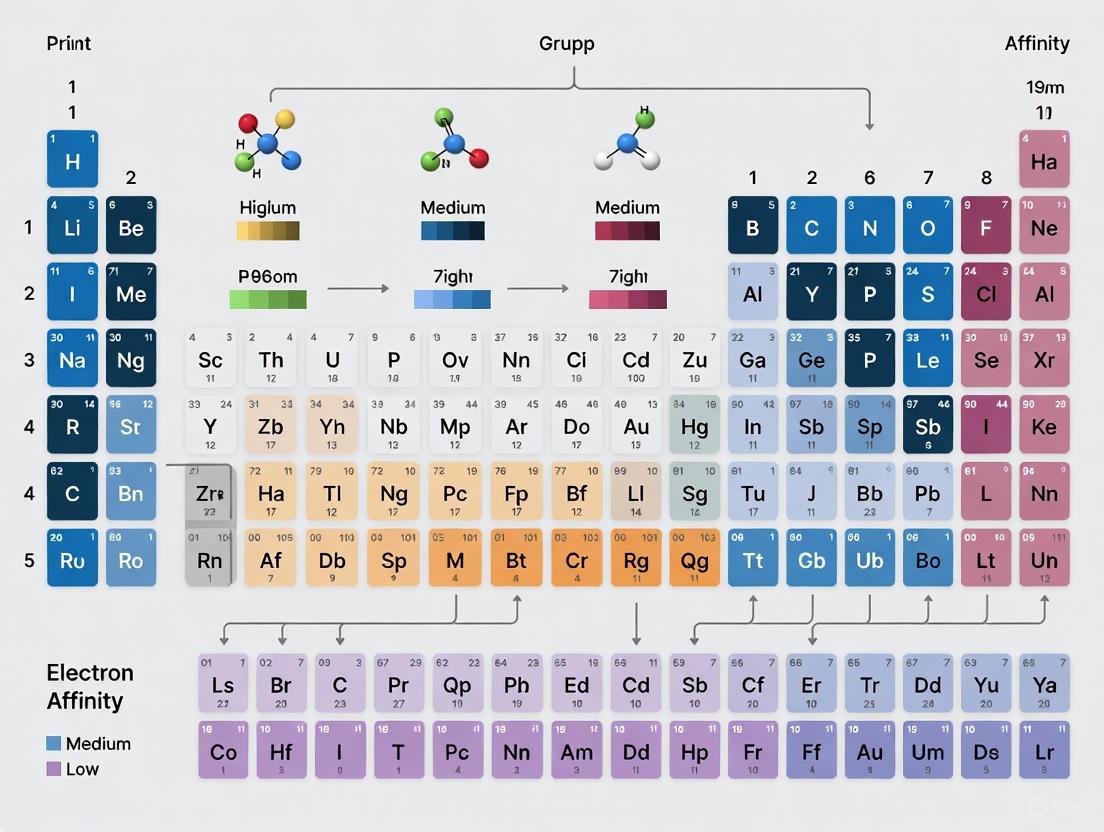
This article provides a comprehensive analysis of electron affinity trends across periodic groups, tailored for researchers and drug development professionals.
Electron Affinity Across the Periodic Table: Trends, Measurements, and Applications in Drug Discovery
Abstract
This article provides a comprehensive analysis of electron affinity trends across periodic groups, tailored for researchers and drug development professionals. It covers foundational concepts, explores cutting-edge measurement techniques like MIRACLS for superheavy elements, and discusses computational approaches for prediction. The content addresses common challenges in data acquisition and interpretation, validates trends against experimental and theoretical data, and highlights critical applications in quantitative structure-activity relationship (QSAR) modeling and material design for biomedical advancements.
Understanding Electron Affinity: Fundamental Concepts and Periodic Trends
Electron affinity (E.A.) is a fundamental atomic property defined as the energy change that occurs when a neutral atom in the gaseous state gains an electron to form a negative ion (an anion) [1] [2]. This process is represented by the general chemical equation: X(g) + e⁻ → X⁻(g) [3]. The sign convention for electron affinity can be a source of confusion; however, according to IUPAC, the electron affinity is positive when energy is released during electron capture [3]. Consequently, a more positive (or less negative) electron affinity value indicates a greater tendency for an atom to attract and bind an additional electron [4].
This property provides critical insights into the thermodynamic favorability of anion formation. For most nonmetals, the first electron affinity is exothermic (energy is released), meaning the resulting anion is more stable than the separated neutral atom and electron [1] [2]. Electron affinity, alongside ionization energy and electronegativity, is a key parameter for understanding chemical reactivity, bonding, and redox behavior, particularly in the context of charge-transfer reactions [5] [3].
Periodic Trends and Comparative Analysis of Electron Affinity
General Trends Across the Periodic Table
Systematic analysis of electron affinity values reveals predictable trends across periods and down groups in the periodic table, though with notable exceptions.
- Trend Across a Period (Left to Right): Electron affinity generally increases (becomes more positive) moving from left to right across a period [1] [2] [6]. This trend is driven by the increasing effective nuclear charge and decreasing atomic radius [2]. As the atomic size decreases, the distance between the incoming electron and the nucleus is reduced, strengthening the attractive force and resulting in a greater energy release upon electron gain [5].
- Trend Down a Group (Top to Bottom): Electron affinity generally decreases (becomes less positive) moving down a group in the periodic table [1] [2] [6]. This occurs primarily because the atomic size increases with the addition of new electron shells [5]. The incoming electron is added further from the nucleus, and increased electron-electron repulsions often diminish the energy released [4].
Table 1: General Periodic Trends in Electron Affinity
| Direction on Periodic Table | Trend in Electron Affinity | Primary Physical Reason |
|---|---|---|
| Left to Right (Across a Period) | Increases | Increasing effective nuclear charge; decreasing atomic radius [2] [6] |
| Top to Bottom (Down a Group) | Decreases | Increasing atomic radius; increased electron-electron repulsions [5] [4] |
Notable Exceptions and Anomalies
While the general trends provide a useful framework, several important exceptions highlight the role of electronic stability.
- The Case of Nitrogen: The electron affinity of nitrogen is lower than that of both carbon and oxygen. This anomaly is attributed to nitrogen's half-filled 2p subshell (electron configuration: 1s²2s²2p³), which confers extra stability. Adding an electron disrupts this stable configuration, resulting in less energy being released [4].
- The Halogen Group (Group 17): Within the halogen group, chlorine has a higher electron affinity than fluorine [4] [6]. Although fluorine is the most electronegative element, its small atomic size leads to significant electron-electron repulsions in the compact 2p orbital. These repulsions reduce the energy released when adding an electron compared to chlorine, which has a more diffuse 3p orbital [4].
Table 2: Comparative Electron Affinities of Group 17 Elements Values are in kJ/mol. A more positive value indicates a greater energy release and a stronger tendency to form an anion [4] [3].
| Element | Electron Affinity (kJ/mol) |
|---|---|
| Fluorine (F) | -327.8 |
| Chlorine (Cl) | -348.7 |
| Bromine (Br) | -324.5 |
| Iodine (I) | -295.2 |
Electron Affinity Values of Selected Elements
The following table provides a broader comparison of electron affinity values for main-group elements, illustrating the general trends and allowing for cross-group comparison.
Table 3: Electron Affinities of Selected Main-Group Elements (in kJ/mol) [3]
| Group 1 | E.A. | Group 2 | E.A. | Group 13 | E.A. | Group 14 | E.A. | Group 15 | E.A. | Group 16 | E.A. | Group 17 | E.A. |
|---|---|---|---|---|---|---|---|---|---|---|---|---|---|
| H | 73 | B | 27 | C | 122 | N | -7 | O | 141 | F | 328 | ||
| Li | 60 | Be | -50 | Al | 42 | Si | 134 | P | 72 | S | 200 | Cl | 349 |
| Na | 53 | Mg | -40 | Ga | 29 | Ge | 119 | As | 78 | Se | 195 | Br | 325 |
| K | 48 | Ca | 2 | In | 37 | Sn | 107 | Sb | 101 | Te | 190 | I | 295 |
Experimental and Computational Protocols
Accurately determining electron affinity is challenging, and several experimental and computational methods have been developed for its measurement and prediction.
Experimental Measurement Approaches
Direct experimental measurement of electron affinity is typically performed on atoms or molecules in the gaseous state to avoid the complicating effects of intermolecular interactions found in solids or liquids [3].
- Laser Photoelectron Spectroscopy: This is a common technique for measuring electron affinities. In one application, a beam of negative ions (e.g., C₆H⁻) is crossed with a fixed-frequency laser. The kinetic energy of the photoelectrons ejected is measured, and the electron affinity is deduced from the threshold of the photoelectron spectrum [7].
- Femtosecond Pump-Probe Spectroscopy: For condensed phases, direct measurement is difficult. However, the electron affinity of an amorphous ice surface was determined using this method. The technique revealed a short-lived spectral feature at -0.8 eV below the vacuum level, which was assigned to an electron at the bottom of the conduction band [8].
Computational Methodologies
Computational chemistry provides a powerful tool for predicting electron affinities, especially for systems where experimental measurement is impractical.
High-Level Quantum Chemistry Methods:
- Configuration Interaction (CI) Calculations: Procedures involving multireference singles and doubles configuration-interaction (MRSD-CI) calculations with correlation-consistent basis sets have proven reliable. For example, such calculations yielded electron affinities for first-row atoms like carbon (1.245 eV) and oxygen (1.384 eV) that are in close agreement with experimental values (1.263 eV and 1.461 eV, respectively) [9].
- Coupled Cluster Theory: The coupled cluster with single, double, and perturbative triple excitations [CCSD(T)] method is considered a "gold standard" for high-accuracy calculations. It is often used to benchmark the performance of other computational methods [8].
Density Functional Theory (DFT) and Beyond:
- DFT Functionals: Common functionals like B3LYP and PW91PW91 are used with polarized basis sets to calculate geometries and energies of neutral molecules and their anions, from which adiabatic electron affinities can be derived [7].
- Many-Body Perturbation Theory (GW Approximation): For complex systems like liquid water, advanced methods are required. One protocol combines path-integral molecular dynamics with G₀W₀ calculations, which are a type of many-body perturbation theory, to predict electron affinities where direct measurement is not feasible. This approach predicted the electron affinity of bulk liquid water to be between 0.1 and 0.3 eV [8].
Emerging Neural Network Potentials (NNPs):
- Recent benchmarks have evaluated NNPs trained on large datasets (e.g., Meta's OMol25) for predicting charge-related properties like electron affinity. Surprisingly, some of these NNPs can achieve accuracy comparable to or even surpassing low-cost DFT methods for certain species, despite not explicitly incorporating charge-based physics in their architecture [10].
Research Toolkit: Essential Reagents and Computational Solutions
Table 4: Key Research Reagent Solutions for Electron Affinity Studies
| Item Name | Function/Description | Application Context |
|---|---|---|
| Gaussian 09 | A software package for electronic structure modeling, enabling calculations using DFT (e.g., B3LYP) and other methods to determine molecular properties and energies [7]. | Quantum chemical calculation of structures and adiabatic electron affinities of molecular isomers [7]. |
| Psi4 | An open-source quantum chemistry software package used for high-accuracy computations, including DFT and wavefunction-based methods [10]. | Benchmarking density functionals (e.g., r2SCAN-3c) against experimental electron-affinity data [10]. |
| def2-TZVPD Basis Set | A high-quality, triple-zeta valence basis set augmented with diffuse functions, crucial for accurately describing the more diffuse character of atomic anions [9] [10]. | High-level calculation of atomic electron affinities [9]. |
| Born-Haber Cycle | An indirect thermodynamic method that utilizes a closed loop of steps to determine an unknown energy value, such as electron affinity, which may be difficult to measure directly [2]. | Indirect determination of lattice energy and related ionic properties. |
| CPCM-X Solvation Model | (Extended Conductor-like Polarizable Continuum Model) A computational model used to correct electronic energies for solvent effects, important for calculating reduction potentials in solution [10]. | Modeling the effect of solvent on energy calculations for reduction potential benchmarks. |
Visualization of Trends and Experimental Workflows
Diagram: Periodic Trend Visualization of Electron Affinity
Diagram: Computational Workflow for Electron Affinity Prediction
Electron affinity (EA) is a fundamental periodic property defined as the energy change that occurs when a neutral gaseous atom gains an electron to form a negative ion (anion) [11]. This process is represented by the equation: X(g) + e⁻ → X⁻(g). In most cases, energy is released when an atom attracts and binds an additional electron, making the process exothermic and resulting in a negative EA value [1] [11]. A more negative electron affinity value indicates a stronger attraction for the incoming electron and a greater tendency to form stable anions [4].
This property provides crucial insights into an element's chemical behavior, particularly its reactivity and how it forms chemical bonds through electron sharing [12]. Unlike other periodic trends, electron affinity exhibits unique patterns and notable exceptions due to the complex interplay of factors including atomic size, nuclear charge, electron configuration stability, and inter-electronic repulsions [11].
Fundamental Trends in Electron Affinity
Variation Across a Period
Moving from left to right across a period in the periodic table, electron affinity values generally become more negative, indicating a greater energy release when an electron is added [1] [11]. This trend is primarily driven by two key factors:
- Decreasing Atomic Size: As the atomic radius decreases across a period, the distance between the nucleus and the valence shell becomes shorter, strengthening the nuclear attraction for incoming electrons [11].
- Increasing Nuclear Charge: The increasing number of protons in the nucleus across a period enhances its electrostatic pull on electrons, facilitating greater energy release when an additional electron is added [11].
Variation Down a Group
Descending a group in the periodic table, electron affinity values generally become less negative (show smaller energy release) [1] [11] [4]. This trend is primarily attributed to:
- Increasing Atomic Size: With each successive period, the valence electrons occupy larger orbitals farther from the nucleus, reducing the nuclear attraction experienced by an incoming electron [11] [4].
- Increasing Electron Shielding: Inner electron shells provide greater shielding effect, further reducing the effective nuclear charge felt by valence electrons [11].
Table: General Periodic Trends in Electron Affinity
| Direction | Trend in Electron Affinity | Primary Physical Reason |
|---|---|---|
| Across a Period (left to right) | Becomes more negative (increases) | Decreasing atomic radius and increasing nuclear charge |
| Down a Group (top to bottom) | Becomes less negative (decreases) | Increasing atomic size and electron shielding |
Notable Exceptions and Anomalies
Despite the general trends, electron affinity exhibits several significant exceptions that reflect the complex interplay of multiple atomic factors.
Group 2 Elements (Alkaline Earth Metals)
Elements in Group 2 (Be, Mg, Ca, Sr, Ba, Ra) exhibit less negative or near-zero electron affinities compared to their neighboring elements [13] [14]. This anomaly occurs because these elements possess a filled s-subshell (ns² configuration). Adding an electron would require placing it in a higher-energy p-orbital, resulting in minimal energy release [11].
Group 15 Elements (Nitrogen Family)
The Group 15 elements (N, P, As, Sb, Bi) demonstrate less negative electron affinities than their Group 14 and Group 16 neighbors [11]. This pattern stems from their half-filled p-subshell (ns²np³ configuration), which provides exceptional stability. The addition of an electron would disrupt this stable half-filled configuration, resulting in reduced energy release [11].
The Fluorine-Chlorine Anomaly
A particularly notable exception occurs in Group 17, where fluorine has a less negative electron affinity (-328 kJ/mol) than chlorine (-349 kJ/mol) [4]. This counterintuitive observation, despite fluorine's higher electronegativity, is attributed to the extremely small atomic size of fluorine. In its compact 2p orbital, the incoming electron experiences significant repulsion from fluorine's existing electrons, reducing the net energy released during electron addition [11] [4].
Table: Electron Affinity Values of Group 17 Elements
| Element | Electron Affinity (kJ/mol) | Atomic Radius | Explanation |
|---|---|---|---|
| Fluorine (F) | -328.0 [14] | Smallest in group | High electron-electron repulsion in compact 2p orbital |
| Chlorine (Cl) | -348.6 [14] | Larger than fluorine | Optimal balance of nuclear attraction and reduced repulsion |
| Bromine (Br) | -324.5 [14] | Larger than chlorine | Increasing atomic size reduces nuclear attraction |
| Iodine (I) | -295.2 [14] | Largest in group | Greatest distance between nucleus and valence electrons |
Noble Gases
Noble gases (Group 18) consistently exhibit positive electron affinity values, indicating that energy must be added to force these atoms to accept an extra electron [13] [14]. This occurs because their completely filled electron shells represent exceptionally stable configurations, and adding an electron would necessarily place it in a significantly higher energy level [11].
Advanced Measurement Techniques
Laser Photodetachment Threshold (LPT) Spectroscopy
LPT spectroscopy has emerged as a precision technique for determining electron affinities, particularly valuable for rare and radioactive elements [12]. The fundamental principle involves exposing negatively-charged ions to laser photons and precisely measuring the energy required to detach the extra electron [12].
The process follows the photodetachment reaction: A⁻ + photon (E) → A + e⁻, where the kinetic energy of the detached electron (Ee) is related to the photon energy (E) and electron affinity (EA) through the equation: EA = E - Ee [12]. The detection of neutralized atoms as a function of photon energy reveals the threshold at which photodetachment initiates, directly indicating the electron affinity value [12].
Collinear Beam Geometry with Multi-Reflection Time-of-Flight
Recent methodological advances have significantly enhanced the sensitivity and precision of electron affinity measurements. The GANDALPH collaboration and subsequent research efforts have implemented collinear laser-anion beam overlap combined with Multi-Reflection Time-of-Flight (MR-ToF) devices [12]. This approach provides:
- Extended Interaction Time: Anions are confined between electrostatic mirrors, allowing repeated laser probing and increasing detection probability [12].
- Reduced Doppler Broadening: Collinear geometry compresses the velocity spread of anions, enhancing spectroscopic resolution [12].
- Enhanced Sensitivity: This technique has demonstrated the capability to achieve state-of-the-art precision while employing five orders of magnitude fewer anions than conventional approaches [12].
These methodological innovations have enabled the first direct measurements of electron affinities for artificially produced and radioactive elements, including astatine (At) and iodine-128 (¹²⁸I), opening new possibilities for characterizing superheavy elements [12].
Experimental Workflow for Precision Electron Affinity Measurements
Comparative Data Analysis Across the Periodic Table
Representative Elements (Periods 1-3)
The electron affinity values for Periods 1-3 elements demonstrate the characteristic periodic trend of increasing (more negative) values from left to right, interrupted by the expected exceptions at Group 2 and Group 15 elements [14].
Table: Electron Affinity Values of Periods 1-3 Elements
| Group | 1 | 2 | 13 | 14 | 15 | 16 | 17 | 18 |
|---|---|---|---|---|---|---|---|---|
| Period 1 | H: -72.8 kJ/mol | He: +48 kJ/mol* | ||||||
| Period 2 | Li: -59.6 kJ/mol | Be: +48 kJ/mol* | B: -27.0 kJ/mol | C: -121.8 kJ/mol | N: +6.8 kJ/mol | O: -141.0 kJ/mol | F: -328.2 kJ/mol | Ne: +116 kJ/mol* |
| Period 3 | Na: -52.9 kJ/mol | Mg: +40 kJ/mol* | Al: -41.8 kJ/mol | Si: -134.1 kJ/mol | P: -72.0 kJ/mol | S: -200.4 kJ/mol | Cl: -348.6 kJ/mol | Ar: +96 kJ/mol* |
Note: Values denoted with * are estimates [14].
Group 17 Comparative Analysis (Halogens)
The halogen group provides the most negative electron affinities in the periodic table, reflecting their strong tendency to gain a single electron to achieve stable noble gas configurations [1] [11]. The anomalous relationship between fluorine and chlorine is clearly evident in the quantitative data [14].
Table: Detailed Halogen Electron Affinity Comparison
| Element | Atomic Number | Electron Affinity (kJ/mol) | Electron Affinity (eV) | Trend Anomaly |
|---|---|---|---|---|
| Fluorine (F) | 9 | -328.1649 [14] | -3.4011898 [14] | Less negative than chlorine |
| Chlorine (Cl) | 17 | -348.575 [14] | -3.612725 [14] | Most negative EA in periodic table |
| Bromine (Br) | 35 | -324.5369 [14] | -3.363588 [14] | Less negative than chlorine |
| Iodine (I) | 53 | -295.1531 [14] | -3.0590465 [14] | Least negative halogen EA |
| Astatine (At) | 85 | -270.1 [13] | -2.8 (approx.) | Estimated value |
Transition Metals and Heavier Elements
Electron affinity trends become less regular in the d-block and f-block elements due to complex electron-electron interactions and relativistic effects that become significant in heavier elements [12] [14]. Recent research has enabled measurements of increasingly rare elements, with current efforts focused on characterizing actinides and superheavy elements to test the predictive power of fully-relativistic many-body quantum models [12].
Essential Research Reagents and Materials
Table: Research Reagent Solutions for Electron Affinity Measurements
| Reagent/Equipment | Function in Experimental Protocol | Specific Application Example |
|---|---|---|
| Negative Ion Source | Produces stable beam of anions for investigation | Surface ionization source for halogen anions [12] |
| Paul Trap | Captures, accumulates, and cools anion samples | Pre-concentration of rare isotopes before MR-ToF injection [12] |
| Multi-Reflection Time-of-Flight (MR-ToF) | Confines ions between electrostatic mirrors for extended laser interaction | Enhances measurement sensitivity for low-yield radioactive species [12] |
| Narrow-Band Continuous Wave Lasers | Provides precise photon energy for photodetachment threshold measurements | Enables high-resolution spectroscopy with reduced Doppler broadening [12] |
| High-Voltage Switching Elements | Selects specific isotopes through time-of-flight separation | Isotopic purification (e.g., ³⁵Cl⁻ from ³⁷Cl⁻) [12] |
| Buffer Gas (Helium) | Cools ions through collisions in trapping devices | Thermalizes ion energy in Paul trap for improved beam emittance [12] |
Implications for Chemical Behavior and Reactivity
Electron affinity values provide critical insights into elemental reactivity and bonding behavior, with particular significance for pharmaceutical development and materials science.
Anion Stability and Pharmaceutical Applications
Elements with highly negative electron affinities form particularly stable anions, which can significantly influence the biological activity and pharmacokinetic properties of pharmaceutical compounds [12]. The strong electron-accepting capability of halogen atoms makes them valuable bioisosteric replacements in drug design, often enhancing metabolic stability and binding affinity to biological targets [12].
Predictive Power for Compound Formation
The electron affinity trend directly correlates with the tendency to form ionic compounds, particularly in combinations of high-electron-affinity elements (like halogens) with low-ionization-energy elements (like alkali metals) [11]. This predictive capability enables researchers to anticipate compound stability and reactivity patterns in drug synthesis and materials development.
Beyond the Main Group Elements
Current research is extending electron affinity measurements to radioactive elements and isotopes, with potential applications in radiopharmaceuticals research [12]. Understanding how electron affinity evolves across isotopic chains provides benchmarks for theoretical methods in atomic many-body calculations, with implications spanning atomic physics, nuclear physics, and quantum chemistry [12].
Electron affinity (EA), defined as the energy released when a neutral atom in the gaseous state accepts an electron to form a negative ion, is a fundamental atomic property that dictates chemical reactivity and bonding behavior [4] [1]. For researchers in fields ranging from drug development to materials science, understanding EA is crucial for predicting how elements will interact. The values and trends of electron affinity across the periodic table are not arbitrary but are systematically governed by three core atomic structure factors: nuclear charge, atomic radius, and electron shielding. These factors collectively influence the effective nuclear charge experienced by valence electrons, thereby determining an atom's propensity to attract an additional electron [15] [16] [6]. This guide provides a comparative analysis of how these factors modulate EA, supported by contemporary experimental data and methodologies.
Theoretical Foundations of Atomic Structure Factors
The attractive force between an electron and the nucleus can be quantitatively described by a modified form of Coulomb's Law, ( F{eff} = k \dfrac{ Z{eff} e^2}{r^2} ), where ( Z_{eff} ) is the effective nuclear charge, ( e ) is the electron charge, and ( r ) is the atomic radius [15]. The interplay of these variables forms the basis for understanding periodic trends.
- Nuclear Charge (( Z )): This is the total number of protons in the nucleus. A greater positive charge creates a stronger attractive force on external electrons. As nuclear charge increases across a period, the attraction for an additional electron generally increases, leading to a more negative (more favorable) electron affinity [6].
- Atomic Radius (( r )): This is the distance from the nucleus to the outermost electron orbital. A smaller radius means the nucleus can exert a stronger pull on an incoming electron. Consequently, atomic radius is inversely related to electron affinity [16] [6].
- Electron Shielding: Inner-shell electrons partially shield valence electrons from the full positive charge of the nucleus. This shielding effect reduces the effective nuclear charge (( Z_{eff} )) experienced by the outer electrons. The extent of shielding depends on the orbital types; s orbitals are more effective shielders than p, d, or f orbitals [15] [17].
Table 1: Fundamental Atomic Structure Factors and Their Influence
| Factor | Definition | Impact on Electron Affinity |
|---|---|---|
| Nuclear Charge (( Z )) | Total number of protons in the nucleus. | Increases (more negative EA) with higher ( Z ) due to stronger electrostatic attraction [6]. |
| Atomic Radius (( r )) | Distance from nucleus to valence electrons. | Decreases (more negative EA) with smaller ( r ) as the electron is added closer to the nucleus [16]. |
| Electron Shielding | Blocking of nuclear attraction by inner electrons. | Decreases (less negative EA) with greater shielding, as it reduces the effective nuclear charge [17]. |
The net effect of these factors is encapsulated in the Effective Nuclear Charge (( Z{eff} )), which is the net positive charge experienced by an electron after accounting for shielding [16]. As ( Z{eff} ) increases, the force pulling an electron towards the nucleus strengthens. This results in a smaller atomic radius, a higher ionization energy, and a greater electron affinity [15].
Contemporary Research and Experimental Protocols
Conventional techniques for measuring electron affinity, such as Laser Photodetachment Threshold (LPT) spectroscopy, often lack the sensitivity for elements produced in minute quantities [12]. A groundbreaking methodology developed in 2025 has overcome this barrier, enabling high-precision measurements with unprecedented sensitivity.
MIRACLS Experimental Workflow
The following diagram illustrates the workflow of the Multi-Ion Reflection Apparatus for Collinear Laser Spectroscopy (MIRACLS) technique, a novel approach for measuring electron affinities of rare elements.
Diagram Title: MIRACLS Experimental Workflow for Electron Affinity Measurement
This protocol can be broken down into the following key stages [12] [18]:
- Anion Production and Preparation: A continuous beam of anions (e.g., Cl⁻) is produced using a negative surface ion source. The anions are captured, accumulated, and cooled in a Paul trap via collisions with helium buffer gas.
- Isotope Selection: The cooled anion bunches are ejected and passed through a high-voltage deflector, which isolates a specific isotope based on its time-of-flight, ensuring a pure sample for measurement.
- Ion Trapping and Laser Probing: The selected anions are injected into a Multi-Reflection Time-of-Flight (MR-ToF) device, where they are confined between electrostatic mirrors. During approximately 60,000 reflections, the anions are repeatedly probed by a collinear, narrow-bandwidth spectroscopy laser.
- Detection and Analysis: When the laser photon energy exceeds the electron affinity threshold, the extra electron is detached, creating a neutral atom. These neutral atoms maintain their trajectory and are guided to an external detector. The electron affinity is determined by identifying the laser energy at which the neutral atom signal appears.
This method dramatically increases the laser-anion interaction time compared to single-pass techniques, achieving high precision with a sample size five orders of magnitude smaller than conventional approaches [12].
Comparative Analysis of Electron Affinity Data
Experimental data reveals both general trends and significant exceptions governed by the atomic structure factors.
Trends Across a Period and Down a Group
- Across a Period (Left to Right): Electron affinity generally becomes more negative from left to right across a period. This is driven by a sequential increase in nuclear charge with a relatively constant shielding effect, resulting in a higher ( Z_{eff} ) and a decreasing atomic radius, which together enhance the attraction for an additional electron [6] [1].
- Down a Group (Top to Bottom): Electron affinity generally becomes less negative down a group. Although nuclear charge increases, the primary effect is the increase in atomic radius and the enhanced shielding from a greater number of inner electron shells. These factors outweigh the increased nuclear charge, leading to a weaker attraction for an incoming electron [6] [1].
Table 2: Comparative Electron Affinity Trends in the Halogen Group
| Element | Atomic Number | Electron Affinity (kJ/mol) | Rationale Based on Atomic Structure |
|---|---|---|---|
| Fluorine (F) | 9 | -327.8 [4] | Small atomic radius leads to significant electron-electron repulsion in the compact 2p orbital, reducing its EA below chlorine's. |
| Chlorine (Cl) | 17 | -348.7 [4] / -349 [1] | Optimal balance of high ( Z_{eff} ) and sufficiently large 3p orbital to accommodate an electron without excessive repulsion. |
| Bromine (Br) | 35 | -324.5 [4] | Larger atomic radius and more inner shells than chlorine, increasing shielding and reducing ( Z_{eff} ) for the valence electron. |
| Iodine (I) | 53 | -295.2 [4] | Largest atomic radius and greatest shielding in the group, resulting in the weakest attraction for an additional electron. |
The Role of Electron Configuration and Shielding
Deviations from general trends often arise from specific electron configurations and the poor shielding ability of certain orbitals [17] [4].
- Half-Filled and Filled Subshell Stability: Nitrogen (Group 15), with a stable half-filled
p³configuration, has a lower affinity for an electron than carbon (Group 14). Similarly, the noble gases have full valence shells and very low electron affinities [5] [4]. - The Lanthanide Contraction: In the f-block, the poor shielding effect of 4f electrons causes atomic radii to decrease more rapidly than expected across the series. This results in higher ( Z_{eff} ) and smaller atomic radii for subsequent d-block elements, affecting their electron affinities [15].
Table 3: Comparison of Experimental Techniques for Electron Affinity Measurement
| Technique | Methodology Principle | Typical Sample Requirement | Key Advantages | Key Limitations |
|---|---|---|---|---|
| Conventional LPT Spectroscopy [12] | Collinear laser and anion beams in a single pass. | High (Substantial anion quantities) | Established protocol, good spectroscopic resolution. | Low sensitivity; unsuitable for very rare or radioactive elements. |
| MIRACLS (2025 Technique) [12] [18] | LPT performed within an electrostatic ion beam trap (MR-ToF). | Extremely Low (Uses ~100,000x fewer anions) | Unprecedented sensitivity; enables EA studies of superheavy elements and rare isotopes. | Requires complex trap apparatus and beam handling. |
The Scientist's Toolkit: Key Research Reagents and Solutions
The following table details essential components used in state-of-the-art electron affinity experiments, particularly the MIRACLS setup [12].
Table 4: Essential Materials for Advanced Electron Affinity Research
| Item / Solution | Function in Experiment |
|---|---|
| Negative Surface Ion Source | Generates the initial beam of negative ions (anions) for investigation. |
| Helium Buffer Gas | Used within the Paul trap to cool and thermalize anion bunches, reducing their kinetic energy and emittance. |
| Electrostatic MR-ToF Device | The core trapping apparatus; uses two electrostatic mirrors to reflect ions back and forth, vastly increasing laser interaction time. |
| Narrow-Bandwidth Continuous Wave (CW) Laser | The spectroscopy laser source; its precise photon energy is scanned to find the photodetachment threshold. |
| High-Efficiency Neutral Particle Detector | Detects the neutral atoms generated upon successful photodetachment, with low background noise for high sensitivity. |
The comparative analysis of electron affinity values unequivocally demonstrates that nuclear charge, atomic radius, and electron shielding are the foundational factors dictating this property. General periodic trends show EA increasing across a period and decreasing down a group, a direct consequence of the interplay between these factors and the resulting effective nuclear charge. The recent advent of the MIRACLS technique marks a pivotal advancement, providing the experimental sensitivity needed to map the electron affinities of previously inaccessible elements like the actinides and superheavy elements. These future measurements will critically test the limits of periodic trends and the predictive power of atomic models, particularly where relativistic effects become dominant. For researchers, this expanded capability opens new avenues for exploring chemical behavior at the extremes of the periodic table.
Electron affinity, the energy change when a gaseous atom gains an electron, is a fundamental property for predicting chemical behavior. While general trends exist across the periodic table, notable exceptions provide profound insights into atomic stability and reactivity. This guide examines the key exceptions related to noble gas configurations and subshell stability, offering a structured comparison for research applications.
Understanding Electron Affinity
Electron affinity (EA) is defined as the energy change that occurs when an electron is added to a neutral gaseous atom to form a negative ion. The process is represented as: X(g) + e⁻ → X⁻(g) [19] [20]
A more negative electron affinity value indicates a greater tendency for an atom to accept an electron and a more stable resulting anion. Most first electron affinities are exothermic (energy-releasing), hence negative by convention [21] [19].
Comparative Data on Electron Affinity Exceptions
The following tables summarize the key exceptional cases and their underlying causes, providing a quick reference for researchers.
Table 1: Electron Affinity Values of Key Exceptional Elements
| Element | Electron Affinity (kJ/mol) | Classification | Rationale for Exception |
|---|---|---|---|
| Chlorine (Cl) | -348.7 [19] [4] | Halogen Anomaly | Larger atomic size reduces electron-electron repulsion in the 3p orbital. |
| Fluorine (F) | -327.8 [4] | Halogen Anomaly | Extreme electron density in small 2p orbital leads to greater repulsion. |
| Neon (Ne) | ~0 [21] [22] [23] | Noble Gas | Added electron must occupy a higher-energy, unoccupied shell. |
| Argon (Ar) | ~0 [21] | Noble Gas | Added electron must occupy a higher-energy, unoccupied shell. |
| Nitrogen (N) | ≈0 [19] | Half-Filled Subshell | Added electron must pair in a half-filled p-orbital, increasing repulsion. |
Table 2: Overview of Major Exception Categories in Electron Affinity
| Exception Category | Affected Groups | Primary Physical Cause | Impact on Reactivity |
|---|---|---|---|
| Stable Noble Gas Configuration | Group 18 (Noble Gases) [21] [24] | Added electron occupies a new, higher-energy electron shell. | Extremely low chemical reactivity; EA is effectively zero or positive. |
| Half-Filled Subshell Stability | Group 15 (N, P, As, etc.) [22] [19] | Added electron must pair with an existing electron in an orbital, increasing repulsion. | Lower EA than adjacent elements; less favorable anion formation. |
| Filled s-Subshell | Group 2 (Be, Mg, Ca, etc.) [22] [20] | Added electron must enter a higher-energy p-orbital. | Less negative EA than Group 1 and Group 13 neighbors. |
| Small Atomic Size Anomaly | Fluorine (Group 17) [19] [4] | High electron density in a small volume creates significant repulsion for an incoming electron. | Lower EA than the next element down in the group (Chlorine). |
Detailed Analysis of Key Exceptions
The Noble Gas Exception
Noble gases possess a complete valence electron shell, a highly stable configuration [24]. Adding an electron is energetically unfavorable because it cannot enter the already-filled shell and must instead occupy a higher-energy orbital in the next shell. This process is endothermic, requiring energy input [21] [19]. Consequently, noble gases have electron affinities that are effectively zero or positive, making them the most chemically inert group on the periodic table [21] [23].
Subshell Stability Exceptions
Certain electron configurations are exceptionally stable, and disrupting them by adding an electron requires energy.
- Group 15 (Nitrogen Family): These elements have a half-filled
np³subshell [22] [19]. Adding an electron forces electron pairing in one of the p-orbitals, resulting in significant electron-electron repulsion. This makes the process less favorable, leading to electron affinities that are less negative than those of their neighbors [19] [20]. - Group 2 (Alkaline Earth Metals): These elements have a filled
ns²configuration [22] [20]. An added electron must enter the next available, higher-energy p-orbital. The energy cost associated with this transition results in less negative electron affinities compared to the alkali metals (Group 1) that precede them [19].
The Fluorine-Chlorine Anomaly
Although general group trends suggest electron affinity becomes less negative down a group, chlorine has a higher (more negative) electron affinity (-348.7 kJ/mol) than fluorine (-327.8 kJ/mol) [19] [4]. This anomaly occurs because of fluorine's extremely small atomic size [19] [23]. The incoming electron is added to the compact 2p orbital, where it experiences strong repulsion from fluorine's existing electrons. In the larger chlorine atom (3p orbital), the electron density is more spread out, reducing this repulsion and making electron addition more energetically favorable [20] [4].
Experimental Protocols and Methodologies
Accurate measurement of electron affinity is crucial for validating these exceptions. The following are key experimental and computational approaches.
Laser Photoelectron Spectroscopy
This is a primary technique for direct measurement.
- Procedure: A beam of negative ions (X⁻) is generated. A precise laser photon of known energy (hν) is used to detach the extra electron. The kinetic energy (KE) of the ejected photoelectron is measured.
- Data Analysis: The electron affinity is calculated using the relationship: EA = hν - KE [23]. This method provides high-precision data for elements and small molecules.
Born-Haber Cycle Calculations
This method uses thermodynamic cycles to determine electron affinity indirectly.
- Procedure: For an ionic compound like NaCl, the cycle connects the standard enthalpy of formation to other measurable quantities, including ionization energy, lattice energy, and enthalpy of sublimation.
- Data Analysis: Electron affinity is the final unknown variable solved for in the cycle, based on Hess's Law: ΔH⁰f = ΔHsub + IE + ½ΔHdiss + EA + ΔHlattice [23].
Computational Chemistry Methods
Theoretical calculations provide valuable data, especially for unstable species.
- Procedure: High-level quantum mechanical methods, such as coupled-cluster or density functional theory (DFT), are used.
- Data Analysis: The total energy of the neutral atom (EX) and its anion (EX⁻) are computed. The electron affinity is derived from: EA = EX - EX⁻ [23].
The Scientist's Toolkit: Essential Research Reagents & Materials
Table 3: Key Reagents and Materials for Electron Affinity Research
| Reagent/Material | Function in Research | Example Application |
|---|---|---|
| Alkali Metal Vapors (e.g., Cs) | Low ionization energy source for generating thermal electrons. | Used in electron transmission experiments to study electron capture cross-sections. |
| High-Purity Halogen Gases (e.g., Cl₂, F₂) | Model compounds for high electron affinity studies. | Direct measurement of EA via photoelectron spectroscopy; studies of the F/Cl anomaly. |
| Noble Gases (e.g., Ar, Xe) | Inert substrates and controls for reactivity studies. | Investigating the stability of full valence shells and probing positive electron affinities. |
| Laser Systems (Tunable Dye/Diode) | Precision energy source for photodetachment. | Core component of laser photoelectron spectroscopy for direct EA measurement. |
| Time-of-Flight (TOF) Mass Spectrometer | Separates and identifies ions by mass-to-charge ratio. | Used to isolate and analyze specific anion species in a beam before photodetachment. |
Research Implications and Applications
Understanding these exceptions is critical for advanced research and development.
- Materials Science: Predicting dopant behavior in semiconductors relies on accurate electron affinity data to control n-type or p-type character [23].
- Drug Development and Catalysis: Electron affinity influences charge-transfer interactions in biological systems and the effectiveness of oxidizing agents in synthetic chemistry [21] [23].
- Advanced Spectroscopy: These exceptions serve as benchmarks for calibrating and improving high-precision spectroscopic and computational methods [23].
In the context of a broader thesis on comparing electron affinity values across periodic groups, a clear understanding of three fundamental atomic properties—electron affinity, electronegativity, and ionization energy—is essential. While these properties are interrelated and all pertain to an atom's interaction with electrons, they describe distinct phenomena and follow different periodic trends. This comparative analysis provides researchers, scientists, and drug development professionals with a structured overview of these properties, supported by quantitative data, experimental protocols, and key methodological tools. Understanding their differences is crucial for predicting chemical behavior, especially in fields like materials science and pharmaceutical development where electron transfer processes are key.
Electron Affinity (EA) is defined as the energy change that occurs when a neutral atom in the gaseous phase gains an electron to form a negative ion [25]. It is typically reported in kilojoules per mole (kJ/mol) or electronvolts (eV). By convention, a negative EA value indicates energy is released (an exothermic process), while a positive value indicates energy must be supplied (an endothermic process) [25]. For most nonmetals, the first electron affinity is negative, meaning energy is released. Electronegativity, on the other hand, is not a directly measurable energy value but a dimensionless number on a qualitative scale (most commonly the Pauling scale) that describes an atom's ability to attract and bind electrons within a chemical bond [5]. Ionization Energy (or Ionization Potential) is the minimum energy required to remove an electron from a neutral gaseous atom, forming a positive ion [5] [26]. Conceptually, ionization energy can be thought of as the opposite of electron affinity.
Comparative Property Tables
Table 1: Fundamental Definitions and Characteristics
| Feature | Electron Affinity (EA) | Electronegativity | Ionization Energy |
|---|---|---|---|
| Core Definition | Energy change when an electron is added to a neutral atom [25] | Ability of an atom to attract electrons in a chemical bond [5] | Energy required to remove an electron from a neutral atom [5] |
| Physical Units | kJ/mol, eV | Dimensionless (Pauling scale) | kJ/mol, eV |
| Nature of Property | Measurable energy change | Qualitative, relative scale | Measurable energy requirement |
| Sign Convention | Negative for energy release (exothermic) for most nonmetals [25] | Always positive | Always positive |
| Typical Process | ( X(g) + e^- \rightarrow X^-(g) ) | Not applicable to a specific process | ( X(g) \rightarrow X^+(g) + e^- ) |
Table 2: Periodic Trends and Representative Values
| Feature | Electron Affinity (EA) | Electronegativity | Ionization Energy |
|---|---|---|---|
| Trend Across Period (Left to Right) | Generally increases (becomes more negative) [27] | Increases [5] [26] | Increases [5] [26] |
| Trend Down Group (Top to Bottom) | Generally decreases (becomes less negative) [27] | Decreases [5] [26] | Decreases [5] |
| Highest Value Element | Chlorine (Cl): 3.612725 eV [14] / -349 kJ/mol [25] | Fluorine (F): 3.98 Pauling units [5] | Helium (He) [5] |
| Example Value 1 | Fluorine (F): 3.4011898 eV [14] | Chlorine (Cl): ~3.0 [26] | Sodium (Na): 496 kJ/mol [26] |
| Example Value 2 | Sodium (Na): 0.547926 eV [14] | Sodium (Na): 0.9 [26] | Neon (Ne): 2081 kJ/mol [26] |
Experimental and Computational Methodologies
Key Experimental Protocols
Measuring these fundamental properties requires sophisticated and sensitive techniques, especially for rare or radioactive elements.
Laser Photodetachment Threshold (LPT) Spectroscopy for Electron Affinity: This method determines the electron affinity by measuring the precise photon energy required to remove an extra electron from a negative ion. Conventional LPT spectroscopy involves collinearly overlapping an anion beam with a laser beam, which allows for a longer interaction time and reduces Doppler broadening [12]. The number of resulting neutral atoms is monitored as a function of the laser photon energy. The threshold energy at which neutralization begins corresponds directly to the electron affinity [12]. A groundbreaking advancement in this field is the MIRACLS (Multi-Ion Reflection Apparatus for Collinear Laser Spectroscopy) technique. This method traps anions in an electrostatic ion beam trap, where they are reflected back and forth between two electrostatic mirrors. This "recycling" of ions allows a single anion to pass through the laser beam tens of thousands of times, increasing the interaction probability by orders of magnitude [18] [12]. This enhanced sensitivity enables precise EA measurements with yields as low as a few anions per second, paving the way for measurements in superheavy elements and rare isotopes [18] [12].
Photoelectron Spectroscopy for Ionization Energy: While not described in detail in the search results, photoelectron spectroscopy is a fundamental technique for measuring ionization energies. It involves irradiating a substance with high-energy photons (like X-rays or UV light) and measuring the kinetic energy of the ejected electrons. The ionization energy is then calculated from the difference between the photon energy and the measured kinetic energy of the electron.
LPT Workflow with MIRACLS
Computational Benchmarking
Computational chemistry offers alternative methods for predicting electron affinities, which are particularly valuable for elements or molecules where experimental measurement is impractical. A 2025 benchmarking study evaluated the performance of neural network potentials (NNPs) from Meta's Open Molecules 2025 (OMol25) dataset against traditional methods like density-functional theory (DFT) for predicting electron affinities [10]. The general computational workflow involves calculating the electronic energy of a neutral molecule and its corresponding anion. The electron affinity is then derived from the difference in these energies ( \text{EA} = E{\text{neutral}} - E{\text{anion}} ) [10]. The study found that OMol25-trained NNPs could achieve accuracy comparable to or even surpassing some low-cost DFT and semiempirical methods in predicting electron affinities for certain organometallic species, despite not explicitly modeling charge-based physics [10]. This highlights machine learning as a powerful and rapidly evolving tool for property prediction.
Computational EA Prediction
The Scientist's Toolkit: Essential Research Reagents and Materials
Table 3: Key Reagents and Materials for Electron Affinity Experiments
| Item | Function/Description | Relevance to Experiment |
|---|---|---|
| Negative Ion Source | A device (e.g., surface ion source) that produces a beam of negative ions (anions) for study [12]. | Generates the primary subject of investigation—the anionic species—for electron affinity measurements. |
| Ion Trap (Paul Trap, MR-ToF) | A device that uses electromagnetic fields to capture, store, and cool ions [12]. | Crucial for accumulating and preparing low-emittance ion bunches; the MR-ToF is the core of the MIRACLS technique, enabling ion recycling [18] [12]. |
| Narrow-Band Continuous Wave (CW) Laser | A laser that emits a continuous, single-frequency beam of light. | Used in LPT spectroscopy to provide the precise photon energy needed to detach electrons, minimizing uncertainty from laser bandwidth [12]. |
| Electrostatic Mirrors | Components within an MR-ToF device that use static electric fields to reflect ions. | Create the trapping potential that allows ions to be reflected back and forth thousands of times, dramatically increasing laser interaction time [18]. |
| High-Efficiency Neutral Particle Detector | A detector designed to identify and count neutral atoms formed when an electron is detached from an anion. | Measures the signal of interest in LPT spectroscopy (the neutralization rate), with high efficiency being critical for detecting scarce samples [12]. |
| Buffer Gas (e.g., Helium) | An inert gas used within ion traps. | Facilitates the cooling of ion bunches through collisions, reducing their kinetic energy and spatial spread (emittance) for better experimental resolution [12]. |
Measuring and Applying Electron Affinity: From Superheavy Elements to Drug Design
The electron affinity (EA) of an element, defined as the energy released when an electron is added to a neutral atom in the gas phase, represents one of the most fundamental atomic properties influencing chemical behavior. It serves as a crucial benchmark for electronegativity and plays a vital role in understanding how atoms form chemical bonds. Experimental determination of electron affinities, particularly for rare, radioactive, or superheavy elements, has presented significant challenges due to sensitivity limitations of conventional measurement techniques. These elements often exist only in trace amounts or must be produced artificially in minute quantities, making traditional spectroscopic methods impractical.
Laser Photodetachment Threshold Spectroscopy (LPTS) has emerged as a powerful technique for overcoming these challenges, enabling precise EA measurements even for scarce samples. This technique operates on the principle of photodetachment, where negatively-charged ions are exposed to laser photons, resulting in the detachment of the extra electron and subsequent neutral atom formation. By monitoring the neutral atom yield as a function of photon energy, researchers can identify the precise threshold energy where photodetachment begins, corresponding directly to the electron affinity of the element.
The evolution of LPTS methodology has progressed through several technological generations, from early crossed-beam experiments to sophisticated ion storage systems, each offering distinct advantages in precision, sensitivity, and applicability to rare samples. This guide provides a comprehensive comparison of these advanced LPTS techniques, their experimental protocols, and their performance characteristics to assist researchers in selecting the most appropriate methodology for specific experimental needs.
Comparative Analysis of LPTS Techniques
Technical Approaches and Performance Metrics
Table 1: Comparison of Advanced LPTS Techniques and Their Performance Characteristics
| Technique | Key Innovation | Best Achieved Precision | Anion Consumption Rate | Best Suited Applications |
|---|---|---|---|---|
| Conventional Single-Pass LPTS | Collinear laser-anion overlap | ~20 μeV (for astatine) [28] | ~10⁶ particles/second [29] | Radioisotopes with moderate production yields |
| Cryogenic Storage Ring (DESIREE) | Long-term ion storage with radiative cooling | 87 peV (for oxygen) [30] | Not specified for rare elements | High-precision measurements of stable isotopes |
| MR-ToF LPTS (MIRACLS) | Multi-reflection electrostatic trapping | 44 μeV (for chlorine) [29] | 5 orders of magnitude fewer than conventional methods [29] | Rarest species (actinides, superheavy elements) |
Table 2: Electron Affinity Values Determined by LPTS Techniques
| Element | Electron Affinity (eV) | Measurement Technique | Significance |
|---|---|---|---|
| Chlorine (³⁵Cl) | 3.612720(44) [29] | MR-ToF LPTS | Highest precision with minimal sample consumption |
| Astatine (²¹¹At) | 2.41578(7) [28] | Conventional LPTS | First EA measurement of a radioactive element |
| Oxygen (¹⁶O) | 1.461112972(87) [30] | Cryogenic Storage Ring | Highest precision EA measurement to date |
| Europium (Eu) | 0.116(13) [31] | Photoelectron Imaging | Resolved longstanding theoretical discrepancy |
| Sulfur (³²S) | 2.0771042(6) [30] | Photodetachment Microscopy | Previous precision benchmark (0.6 μeV) |
Technological Evolution and Capability Expansion
The development of LPTS techniques represents a continuous effort to address two primary challenges: improving precision while simultaneously reducing sample requirements. Early photodetachment experiments required substantial anion beams, limiting applications to abundant, stable isotopes. The introduction of collinear laser-anion overlap in conventional LPTS extended capabilities to radioisotopes like astatine, achieving measurements with ion currents as low as 600 fA (3.75×10⁶ particles per second) [29] [28].
The cryogenic storage ring approach, exemplified by DESIREE, leverages extended storage times at 13 K to achieve extraordinary precision through radiative cooling of ions and reduced black-body radiation effects. This enables the production of ion beams with >90% ground-state population, dramatically reducing background signals from excited-state photodetachment [30]. However, the large physical footprint and operational complexity of storage rings limit their widespread deployment.
Most recently, the Multi-Reflection Time-of-Fight (MR-ToF) approach combines the sensitivity advantages of trapping techniques with the practical benefits of compact instrumentation. By confining ions between electrostatic mirrors, the MR-ToF device increases laser-anion interaction time while maintaining the collinear geometry essential for high resolution. This innovation enables EA determinations with five orders of magnitude fewer anions than conventional techniques, paving the way for measurements of superheavy elements where production rates may be as low as a few atoms per second [29].
Experimental Protocols and Methodologies
MR-ToF LPTS Protocol
The MR-ToF LPTS methodology represents the current state-of-the-art for rare species measurements and employs a sophisticated multi-step protocol:
Anion Production: Negative ions are produced using specialized sources. For stable elements, negative surface ionization sources provide continuous beams [29]. For radioactive elements, facilities like ISOLDE at CERN employ nuclear reactions combined with negative surface ionization [28].
Ion Accumulation and Cooling: Ions are captured in a Paul trap where they accumulate and undergo cooling through collisions with room-temperature helium buffer gas, reducing phase space volume and improving beam quality [29].
Injection into MR-ToF Device: Cooled ion bunches with low emittance are transferred to the Multi-Reflection Time-of-Flight device, where they are confined between a pair of electrostatic mirrors separated by a field-free drift region [29].
Laser Probing: A narrow-bandwidth continuous-wave laser beam is collinearly overlapped with the stored ion bunch in the drift region. The laser frequency is systematically scanned across the anticipated photodetachment threshold while the ions undergo multiple passes through the interaction region [29].
Neutral Atom Detection: Neutral atoms created through photodetachment maintain their forward momentum and exit the storage system along a predictable trajectory toward a high-efficiency particle detector. The geometrical detection efficiency is significantly higher than in radiofrequency or Penning traps [29].
Threshold Determination: The neutral count rate is recorded as a function of laser photon energy. The data is fitted using the Wigner threshold law, which describes the photodetachment cross section just above threshold: σ ∝ (E - EEA)^(l+1/2), where E is the photon energy, EEA is the electron affinity, and l is the angular momentum quantum number of the outgoing electron [28] [30].
Radioactive Element LPTS Protocol
For radioactive elements like astatine, the experimental protocol requires modifications to address additional challenges:
Radioisotope Production: At the ISOLDE facility, astatine isotopes are produced through spallation reactions by bombarding thorium targets with high-energy protons [28].
Negative Ion Formation: The produced atoms are surface-ionized to form At⁻ ions, which are mass-separated to select specific isotopes (e.g., ²¹¹At) [28].
Beam Superposition: The radioactive anion beam is superimposed with a laser beam in a collinear geometry within the GANDALPH spectrometer [28].
Hyperfine Structure Consideration: For elements with nuclear spin like ²¹¹At (I=9/2), the photodetachment cross section must account for hyperfine splitting of the neutral atom's ground state. The cross section follows: σ(Ephoton) = a + bΣ(2F+1)√[Ephoton - (EA + Ehfs,F)]·Θ[Ephoton - (EA + E_hfs,F)], where F is the total angular momentum and Θ is the Heaviside function [28].
Doppler Shift Compensation: Measurements are performed with both co- and counter-propagating laser beams to enable precise correction of Doppler shifts [28].
Systematic Error Control: Reference measurements on stable isotopes (e.g., ¹²⁷I) are conducted before and after the radioactive measurements to identify and correct for systematic errors in photon energy determination and beam instabilities [28].
High-Precision Cryogenic Storage Protocol
The DESIREE facility employs a specialized protocol optimized for ultimate precision:
Ion Storage and Thermalization: O⁻ ions are stored for extended periods (165 s) in a cryogenic ring maintained at 13 K, allowing radiative cooling and equilibration with the environment [30].
Excited-State Depletion: During the initial storage phase (35 s), a high-power laser (2.5 W) selectively photodetaches ions in the excited metastable state (²P₁/₂), leaving a purified ground-state beam [30].
Low-Power Threshold Scanning: The laser power is reduced, and the photon energy is scanned across the electron affinity threshold four times during a single storage cycle while monitoring neutral atom production [30].
Beam Direction Alternation: Measurement cycles alternate between co- and counter-propagating laser beam configurations to compensate for systematic effects [30].
Data Fitting: The recorded neutral counts are fitted using a convolution of the Wigner threshold law (with l=0 for s-wave emission) and a Gaussian distribution representing the ion beam's energy spread [30].
The Scientist's Toolkit: Essential Research Reagents and Equipment
Table 3: Essential Research Equipment for LPTS Experiments
| Equipment Category | Specific Examples | Function | Technical Considerations |
|---|---|---|---|
| Ion Sources | Negative Surface Ion Source [29] [28] | Produces negative ions for investigation | Critical for rare element studies |
| Ion Traps/Storage | Paul Trap [29], MR-ToF Device [29], DESIREE Facility [30] | Confines and manipulates ions | Storage capacity and cooling efficiency vary |
| Laser Systems | Narrow-bandwidth CW Lasers [29] | Induces photodetachment | Bandwidth directly impacts measurement precision |
| Detection Systems | High-Efficiency Neutral Particle Detectors [29] [28] | Detects neutral atoms from photodetachment | Geometrical efficiency crucial for sensitivity |
| Vacuum Systems | Cryogenic Vacuum Chambers [30] | Maintains ultra-high vacuum | Reduces background signals |
| Mass Separators | Radioactive Ion Beam Separators [28] | Isotopically purifies samples | Essential for radioactive element studies |
Critical Methodological Considerations
Each LPTS technique faces distinct precision limitations and potential error sources that researchers must consider when designing experiments:
Laser Bandwidth: The fundamental limit to spectral resolution in LPTS is typically the laser bandwidth. Conventional LPTS systems employ lasers with bandwidths of ~12 GHz (50 μeV) [28], while the highest-precision measurements use narrower linewidth lasers to achieve uncertainties at the peV level [30].
Doppler Broadening: The ion beam's velocity spread introduces Doppler broadening of the photodetachment threshold. Collinear geometry compresses this effect compared to perpendicular laser-ion arrangements [29]. Active Doppler shift compensation through alternating co- and counter-propagating measurements further reduces this limitation [28].
Metastable State Populations: The presence of excited metastable states in the anion beam can create background signals below the true photodetachment threshold. The cryogenic storage approach effectively addresses this through extended storage times that allow radiative decay or selective depletion of excited states [30].
Beam Energy Instabilities: Fluctuations in the ion beam energy directly impact the observed photodetachment threshold. Reference measurements on well-characterized elements like iodine or chlorine provide critical calibration to identify and correct for these instabilities [29] [28].
Selection Guidelines for Experimental Scenarios
The optimal choice of LPTS technique depends on specific experimental requirements and constraints:
For Maximum Precision with Stable Isotopes: The cryogenic storage ring approach (DESIREE) offers unparalleled precision, achieving sub-μeV uncertainties, making it ideal for benchmarking theoretical calculations and studying subtle electron correlation effects [30].
For Radioactive Elements with Moderate Yields: Conventional single-pass LPTS systems like GANDALPH provide the necessary sensitivity for radioisotopes available at rates of 10⁶ particles per second, as demonstrated by the groundbreaking astatine measurement [28].
For Ultra-Rare Species and Future Superheavy Elements: The MR-ToF LPTS approach represents the most promising technology for elements with production rates below 100 particles per second, potentially enabling the first EA measurements of actinides and superheavy elements like oganesson [29].
Future Directions and Emerging Applications
The ongoing development of LPTS techniques continues to expand the frontiers of atomic physics and chemistry, with several promising directions emerging:
Superheavy Element Studies: The exceptional sensitivity of MR-ToF LPTS makes it a prime candidate for the first EA measurements of superheavy elements, particularly oganesson (Z=118), which theoretical predictions suggest may be the first noble gas with a positive electron affinity [29]. These measurements would provide critical tests of relativistic quantum models and the limits of periodic table periodicity.
Radiopharmaceutical Development: The precise EA determination of astatine has direct implications for targeted alpha therapy cancer treatments using ²¹¹At, as the astatide anion (At⁻) plays a crucial role in current labeling protocols and in vivo stability of radiopharmaceuticals [28]. Similar applications may emerge for other radioelements used in medical applications.
Interstellar Chemistry: Molecular anion studies using enhanced LPTS techniques could illuminate the role of negative ions in interstellar chemical processes, where they influence molecular formation and act as important charge carriers in interstellar clouds [30].
Quantum Electrodynamics Tests: The extreme precision achievable with cryogenic storage ring measurements provides opportunities to test quantum electrodynamics predictions through detailed studies of isotope shifts in electron affinities, particularly for light elements where theoretical calculations are most precise [30].
As these techniques continue to evolve, the complementary strengths of different LPTS approaches will enable researchers to address increasingly challenging scientific questions across atomic physics, nuclear chemistry, and materials science, ultimately completing our understanding of electron affinity trends across the entire periodic table.
Electron affinity (EA), the energy released when a neutral atom gains an electron, is a fundamental atomic property that governs chemical reactivity and bonding behavior [12] [27]. For researchers investigating superheavy elements or rare isotopes, conventional EA measurement techniques lack the sensitivity for scarcely produced samples, leaving the electron affinities of the heaviest elements entirely uncharted [12].
This guide examines the Multi Ion Reflection Apparatus for Collinear Laser Spectroscopy (MIRACLS) technique, a groundbreaking approach that enhances experimental sensitivity by three orders of magnitude [12]. By comparing its performance against conventional methods and detailing its experimental protocol, we provide researchers with a comprehensive analysis of how this technology enables EA measurements in previously inaccessible elemental domains.
Understanding Electron Affinity and the Measurement Challenge
Electron affinity represents a crucial benchmark for testing advanced atomic models based on many-body quantum methods [12]. The property follows general periodic trends—typically increasing across periods and decreasing down groups—though with notable exceptions due to electron configuration stability [1] [20]. Chlorine possesses the highest electron affinity, while noble gases may have slightly negative or zero values, indicating no spontaneous anion formation [32].
The Sensitivity Problem in Conventional Techniques
- Sample Intensity Requirements: Traditional methods require large anion ensembles (≥10⁶ particles per second), making them unsuitable for rare species [12].
- Limited Interaction Time: In single-pass approaches, each anion is exposed to laser photons for only microseconds before being discarded [12].
- Laser Power Limitations: Conventional techniques often employ pulsed high-power lasers whose broadband characteristics limit measurement precision [33].
The MIRACLS Methodology: A Technical Examination
The MIRACLS approach revolutionizes EA measurement through ion trapping technology combined with collinear laser spectroscopy. The core innovation involves confining ions within an electrostatic trap to dramatically increase laser interaction time.
Experimental Workflow and Protocol
The following diagram illustrates the simplified MIRACLS experimental workflow:
Step 1: Anion Production and Preparation
- Ion Source: Negative surface ion source produces continuous beam of anions (e.g., Cl⁻) [12].
- Cooling and Accumulation: Paul trap captures, accumulates, and cools anions via collisions with room-temperature helium buffer gas [12].
- Isotope Selection: Pulsed drift tube adjusts kinetic energy; deflector isolates specific isotopes through time-of-flight selection [12].
Step 2: Multi-Reflection Time-of-Flight (MR-ToF) Trapping
- Electrostatic Confinement: Anion bunches are injected between two electrostatic mirrors, creating oscillating trajectories [12] [34].
- Path Length Extension: Folding "many kilometers of flight path into mere tens of centimeters" dramatically increases laser interaction time [34].
- Trapping Duration: Ions complete approximately 60,000 passes compared to single passage in conventional techniques [34].
Step 3: Collinear Laser Photodetachment
- Laser Configuration: Narrow-band continuous-wave laser propagates collinearly with trapped ion beam [12] [33].
- Photon Energy Scanning: Laser wavelength scanned around detachment threshold to identify minimum energy required for electron removal [33].
- Detection Principle: Neutral atoms formed through photodetachment maintain momentum and exit trap toward high-efficiency detector [12].
Research Reagent Solutions Toolkit
| Essential Component | Function in MIRACLS Experiment |
|---|---|
| Negative Surface Ion Source | Produces continuous beam of anions for measurement [12] |
| Paul Trap | Captures, accumulates, and cools anions using helium buffer gas [12] |
| Electrostatic MR-ToF Device | Traps ions between mirrors, enabling repeated laser probing [12] [34] |
| Narrow-Band Continuous-Wave Laser | Provides precise photon energy for high-resolution photodetachment [12] [33] |
| High-Voltage Switching Elements | Adjust anion kinetic energy and select specific isotopes [12] |
| Neutral Particle Detectors | Detects neutralized atoms with high efficiency and low background [12] |
Performance Comparison: MIRACLS vs. Conventional Techniques
Quantitative Comparison of EA Measurement Methods
| Technique | Sensitivity (Ions Required) | Key Limitation | Precision Achieved | Sample Interaction Time |
|---|---|---|---|---|
| MIRACLS/MR-ToF | ~280,000× fewer ions than conventional LPT [34] [33] | Requires specialized trapping infrastructure | 3.612720(44) eV for ³⁵Cl (state-of-the-art) [12] | ~60,000 passes (minutes of storage) [34] |
| Conventional LPT Spectroscopy | ~600 fA beam (3.75×10⁶ ions/s) for astatine measurement [12] | Limited by single-pass laser interaction | Comparable to MIRACLS but requires 5 orders more anions [12] | Microseconds (single pass) [12] |
| Photodetachment Microscopy | Large ensembles required [12] | Limited to elements available in substantial quantities | High precision possible | Single interaction |
| Velocity Map Imaging (VMI) | Large ensembles required [12] | Complex electron detection apparatus | Moderate to high precision | Single interaction |
Key Performance Advantages of MIRACLS
Unprecedented Sensitivity
- Ion Economy: Demonstrated accurate EA determination for ³⁵Cl using "five orders of magnitude fewer anions" than conventional techniques [12].
- Rare Isotope Compatibility: Successfully measured EA of radioactive astatine with beam intensity of only ~600 fA (3.75×10⁶ particles per second) [12].
Enhanced Precision
- Doppler Suppression: Collinear geometry compresses anion velocity spread, reducing Doppler broadening [12].
- Laser Superiority: Extended interaction enables low-power, narrow-band continuous-wave lasers that minimize bandwidth broadening effects [12].
Research Applications and Future Directions
Enabling Novel Research Domains
The MIRACLS technique creates unprecedented opportunities in multiple research domains:
Superheavy Element Characterization
- Relativistic Effects: Probe how Einstein's relativity scrambles atomic structure in elements with high proton numbers [34].
- Periodic Table Boundaries: Test whether traditional group boundaries fade for superheavy elements by measuring their EAs [34].
Isotope-Resolved Measurements
- Isotope Shifts: Systematically measure EA variations across isotopic chains [12].
- Hyperfine Splittings: Resolve hyperfine structure in electron affinities with high precision [12].
Applied Research Implications
- Medical Isotopes: Support development of medical isotopes like actinium for radiopharmaceuticals [34].
- Exotic Molecules: Enable EA measurements of radioactive molecules relevant for physics beyond Standard Model [12].
Implementation Considerations
Technical Requirements
- Footprint: MR-ToF devices offer smaller footprint and reduced operational requirements compared to storage rings [12].
- Facility Compatibility: Widespread use of MR-ToF devices at radioactive ion beam facilities enables relatively straightforward implementation [12].
Methodological Limitations
- Anion Stability: Requires sufficiently long-lived anions for trapping and multiple laser interactions.
- Beam Preparation: Still depends on efficient anion source and preparation systems.
The MIRACLS approach represents a paradigm shift in electron affinity measurement, overcoming the critical sensitivity limitations that have prevented EA characterization of rare and superheavy elements. By integrating collinear laser spectroscopy with multi-reflection ion trapping, this technique achieves a three-order-of-magnitude sensitivity improvement while maintaining state-of-the-art precision.
For researchers investigating exotic isotopic species, superheavy elements, or rare radioactive materials, MIRACLS provides the first practical pathway to determine fundamental electron affinity values. As this technology deploys to facilities like Lawrence Berkeley National Laboratory, it promises to illuminate the electron correlation effects and relativistic influences that define chemical behavior at the extremes of the periodic table.
The periodic table serves as a fundamental framework for understanding chemical behavior, with electron affinity representing a crucial property that measures the energy change when an atom gains an electron. For heavier elements, particularly those in the sixth and seventh periods, predictable periodic trends begin to break down due to significant relativistic effects. These effects arise from the high velocities of inner-shell electrons in high-atomic number atoms, approaching speeds where relativistic mechanics substantially alter atomic properties. This guide examines how these effects influence electron affinity and other chemical properties, providing researchers with essential insights for working with heavy elements in fields ranging from materials science to drug development.
Electron Affinity Trends Across the Periodic Table
Electron affinity (EA) measures the energy change when a neutral gaseous atom acquires an electron to form a negative ion, expressed as X(g) + e⁻ → X⁻(g). While general trends show EA values becoming more negative (greater energy release) from left to right across periods and less negative down groups, significant deviations occur for heavy elements due to relativistic contractions and expansions of key orbitals [2] [19].
The table below presents electron affinity values for selected elements, highlighting deviations from expected trends in heavier elements:
Table 1: Electron Affinity Values of Selected Elements
| Element | Atomic Number | Electron Affinity (kJ/mol) | Period | Deviation from Trend |
|---|---|---|---|---|
| Fluorine | 9 | -328.2 [14] | 2 | Baseline |
| Chlorine | 17 | -349.0 [14] | 3 | Expected trend |
| Bromine | 35 | -324.5 [14] | 4 | Expected trend |
| Iodine | 53 | -295.2 [14] | 5 | Expected trend |
| Astatine | 85 | -270.1 [35] | 6 | Relativistic effects |
| Oxygen | 8 | -141.0 [19] | 2 | Baseline |
| Sulfur | 16 | -200.4 [14] | 3 | Expected trend |
| Selenium | 34 | -195.0 [36] | 4 | Expected trend |
| Tellurium | 52 | -190.2 [14] | 5 | Expected trend |
| Polonium | 84 | -183.3 [35] | 6 | Relativistic effects |
| Gold | 79 | -222.8 [35] | 6 | Anomalously high |
For the heaviest elements, particularly those with atomic numbers above 70, several anomalous patterns emerge. Gold exhibits an unexpectedly high electron affinity (-222.8 kJ/mol) compared to its lighter congeners silver (-125.9 kJ/mol) and copper (-119.2 kJ/mol) [14] [35]. This anomaly directly results from relativistic stabilization of the 6s orbital, which enhances gold's ability to attract additional electrons [37] [38].
The following diagram illustrates how relativistic effects modify orbital energies in heavy elements like gold compared to non-relativistic predictions:
Relativistic Effects on Heavy Element Properties
Fundamental Relativistic Mechanisms
Relativistic effects in heavy elements manifest through three primary mechanisms that significantly impact electron affinity and other chemical properties:
Direct Relativistic Effect: Inner s and p electrons (particularly 1s, 2s, 2p, but extending to 6s in gold) travel at velocities approaching the speed of light, resulting in mass increase and subsequent orbital contraction [37] [38]. This 6s contraction in sixth-period elements strengthens their ability to attract additional electrons.
Indirect Relativistic Effect: The contraction of s and p orbitals provides better shielding for d and f orbitals, which consequently expand and experience destabilization [38]. This d-orbital expansion influences bonding characteristics and oxidation states.
Spin-Orbit Coupling: This relativistic effect causes significant splitting of p, d, and f orbitals into j = l ± 1/2 sub-shells with different energies [38]. For sixth-period p-block elements, this splitting can exceed 3 eV, substantially affecting their bonding capabilities and electron affinities.
Case Studies of Heavy Element Anomalies
Gold's Relativistic Properties: The electron affinity of gold (-222.8 kJ/mol) dramatically exceeds that of its lighter congeners copper (-119.2 kJ/mol) and silver (-125.9 kJ/mol) [14] [35]. This results from relativistic contraction of the 6s orbital, which increases its effective nuclear charge and enhances its electron-accepting capability [37] [38]. The same effect explains gold's distinctive yellow color, as relativistic stabilization lowers the energy required for 5d to 6s electronic transitions into the blue region of the visible spectrum [37].
Mercury's Unique Behavior: Mercury exhibits exceptionally low electron affinity (approximately 0 kJ/mol) due to strong relativistic stabilization of its 6s² electron pair [35] [38]. This effect is so pronounced that mercury behaves similarly to a noble gas, forming weak bonds and existing as a liquid at room temperature, unlike its solid neighbors cadmium and gold [37].
Bismuth and the Inert-Pair Effect: In bismuth (Z=83), the relativistic contraction of the 6s orbital creates a stable inert pair of electrons, with an electron affinity of 91.2 kJ/mol [39]. This stabilization energy makes the 6s² electrons less available for bonding and influences bismuth's preferred oxidation states.
Experimental Methodologies for Electron Affinity Measurement
Laser Photoelectron Spectroscopy
This technique represents the gold standard for precise electron affinity measurements of heavy elements:
Principle: A laser detaches electrons from a mass-selected negative ion beam, and the kinetic energies of the ejected photoelectrons are measured with high resolution [14].
Heavy Element Application: For unstable heavy elements, this method requires ion trap integration to extend measurement times. The photoelectron spectrum directly reveals the electron binding energy, which corresponds to the electron affinity.
Relativistic Considerations: Measurements must account for spin-orbit splitting in heavy elements, which produces multiple peaks in the photoelectron spectrum corresponding to different fine structure states [38].
Photodetachment Microscopy
This method provides high-precision measurements for elements with low electron affinities:
Experimental Setup: A collimated beam of negative ions intersects a tunable laser in a strong electric field. Detached electrons travel to a position-sensitive detector, creating interference patterns.
Data Analysis: The interference pattern depends on the electron's kinetic energy, which relates directly to the photon energy and electron affinity. This method achieves accuracies up to 0.1 meV for suitable elements.
Heavy Element Challenges: For elements with complex electronic structures, spectral interpretation requires relativistic theoretical models that include both scalar relativistic effects and spin-orbit coupling [38].
Computational Approaches with Relativistic Corrections
Theoretical methods provide essential electron affinity data for superheavy elements where experimental measurements remain extremely challenging:
Relativistic Density Functional Theory (DFT): Incorporates relativistic effects through the zeroth-order regular approximation (ZORA) or Douglas-Kroll-Hess transformation [38]. These methods successfully predict gold's high electron affinity and mercury's low reactivity.
Four-Component Dirac Methods: Fully relativistic approaches that solve the Dirac equation for all electrons, providing the most accurate treatment of relativistic effects for superheavy elements [38].
Coupling Constants Analysis: NMR studies provide indirect evidence of relativistic effects, showing heavy atom effects on chemical shifts (HAHLA) that correlate with electron affinity anomalies [38].
The experimental workflow for measuring and interpreting electron affinity in heavy elements involves both experimental and computational components:
The Scientist's Toolkit: Essential Research Reagents and Materials
Table 2: Essential Research Materials for Heavy Element Studies
| Material/Reagent | Function | Application Notes |
|---|---|---|
| Mass-Selected Ion Beams | Provides pure samples of specific heavy element isotopes | Essential for photoelectron spectroscopy of radioactive elements |
| Tunable Laser Systems | Precise energy source for photodetachment experiments | Required for resolving spin-orbit split states in heavy elements |
| Cryogenic Ion Traps | Extends measurement time for unstable heavy elements | Critical for studying elements with half-lives under one minute |
| Relativistic Quantum Chemistry Software (e.g., DIRAC, BERTHA) | Models electron behavior in heavy atoms | Incorporates full Dirac equation solutions for accurate predictions |
| High-Purity Calibration Standards | Reference materials for instrument calibration | Required for cross-laboratory data validation |
| Advanced Detector Arrays (Position-Sensitive) | Maps electron distribution in photodetachment microscopy | Provides sub-meV resolution for electron affinity measurements |
The investigation of electron affinity in heavy elements reveals profound deviations from simple periodic trends, driven by substantial relativistic effects that alter fundamental atomic properties. For researchers working with heavy elements in materials science, catalysis, or pharmaceutical development, these relativistic considerations are not minor corrections but essential factors that determine chemical behavior. The specialized methodologies outlined—particularly laser photoelectron spectroscopy and relativistic computational chemistry—provide the necessary tools for accurate characterization of these elements. As research extends further into the seventh period and beyond to superheavy elements, accounting for these relativistic effects becomes increasingly critical for predicting and understanding chemical properties that defy simple periodic table extrapolations.
In the context of comparative research on electron affinity across periodic groups, a fundamental atomic property is directly leveraged in modern drug discovery. Electron affinity (EA), defined as the energy released when a neutral atom in the gaseous state accepts an electron to form a negative ion, is a crucial determinant of a molecule's chemical reactivity and its ability to form bonds [1] [2]. Elements with high (more negative) electron affinity, such as halogens (Group 17), readily gain electrons, a characteristic exploited in drug design to influence molecular interaction with biological targets [2]. Quantitative Structure-Activity Relationship (QSAR) modeling, a cornerstone of computer-aided drug design, increasingly utilizes atomic properties like electronegativity and electron affinity to create pseudo-molecular field (PMF) descriptors. These descriptors help predict the biological activities of potential drug candidates by correlating these fundamental electronic properties with observed biological effects [40].
The challenge of efficiently identifying true bioactive compounds from thousands of candidates in High-Throughput Screening (HTS) campaigns has prompted the adoption of advanced machine learning (ML) techniques. This guide objectively compares the performance of contemporary ML approaches for HTS hit prioritization, detailing their experimental protocols, and situating their relevance within the broader research on electron affinity values.
Comparative Analysis of Machine Learning Approaches for HTS
Several machine learning methodologies have been developed to address the critical issue of false positive readouts in HTS. The table below compares the performance of a novel approach, Minimum Variance Sampling Analysis (MVS-A), against established baselines across a benchmark of 17 HTS datasets [41].
Table 1: Performance Comparison of MVS-A Against Other HTS Hit-Prioritization Methods
| Method Name | Method Type | Key Mechanism / Basis | Average Precision | Key Advantages | Key Limitations |
|---|---|---|---|---|---|
| MVS-A (2024) [41] | Data-Driven (Gradient Boosting) | Analyzes sample influence during model training on a single HTS dataset. | 0.81 (True Positive Identification) | High computational speed; No prior interference mechanism assumptions; Applicable to any assay technology. | Requires a sufficient number of hits in the initial HTS for effective model training. |
| PAINS Filters [41] | Expert Rule-Based | Filters compounds containing substructures historically associated with assay interference. | 0.49 (True Positive Identification) | Easy to implement and interpret. | Prone to out-of-domain issues; Limited to known interference mechanisms. |
| Other ML Baselines (e.g., Lasso, RF, SVM) [41] | Data-Driven (Various) | Trained on historical HTS data to identify interferents. | 0.52 - 0.69 (True Positive Identification) | Can learn complex patterns from data. | Performance is tied to the applicability domain of the training data. |
Another influential approach in the field is 3D-QSAR, which uses machine learning models featurized with 3D molecular descriptors, including shape and electrostatics, to predict binding affinity. This method has been shown to perform on par with or even surpass other published methods for affinity prediction [42].
Experimental Protocols for Key ML Methods
Protocol for MVS-A in HTS Hit Prioritization
MVS-A is designed to distinguish true bioactive compounds from assay interferents by analyzing the learning dynamics of a Gradient Boosting Machine (GBM) [41].
- Data Preparation: A single HTS dataset is split into training and test sets. The data typically includes chemical structures and their primary screen activity labels (active/inactive).
- Model Training: A GBM classifier is trained on the HTS data to distinguish hits from inactive compounds.
- Influence Calculation: The MVS-A algorithm computes a sample influence score for each compound labeled as a 'hit' in the training set. This score quantifies how "unusual" the active label of a compound is relative to the patterns learned by the GBM.
- Hit Prioritization:
- Compounds with low MVS-A scores are easily identified as active by the model and are prioritized as likely true positives.
- Compounds with high MVS-A scores contradict the model's learned patterns and are flagged as likely false positives.
- Validation: The prioritized list is validated against confirmatory screen data (not used during training) to assess the accuracy of true positive and false positive identification.
Diagram: MVS-A Workflow for HTS Hit Prioritization
Protocol for 3D-QSAR in Binding Affinity Prediction
The 3D-QSAR methodology leverages the full 3D similarity of molecules to build predictive models, directly incorporating electronic properties critical to binding [42].
- Featurization: For each molecule in the dataset, 3D descriptors are calculated. These typically include:
- Shape: Generated from molecular superimposition using tools like ROCS.
- Electrostatics: Calculated using tools like EON.
- Model Building: A machine learning model (e.g., partial least squares analysis) is trained using the 3D descriptors to predict experimental binding affinity values.
- Prediction and Error Estimation: The model predicts the binding affinity of new molecules and provides an associated error estimate for each prediction, helping users gauge confidence.
- Model Interpretation: The model identifies favorable regions in the binding site for specific interactions (e.g., H-bond donors/acceptors), which guides the design of novel molecules for hit optimization.
Diagram: 3D-QSAR Model Development and Application
The Scientist's Toolkit: Essential Research Reagents and Solutions
The following table details key computational tools and resources essential for implementing the ML-driven HTS approaches discussed [42] [41].
Table 2: Key Research Reagent Solutions for ML in HTS
| Tool / Resource | Type | Primary Function in HTS/ML |
|---|---|---|
| Gradient Boosting Machines (GBM) | Algorithm | Core classifier for MVS-A; robust for imbalanced HTS data. |
| 3D-QSAR Software (e.g., Orion) | Software Suite | Performs 3D featurization (ROCS for shape, EON for electrostatics) and model building for affinity prediction. |
| HTS Data Repositories | Database | Source of publicly available HTS data for training and benchmarking models (e.g., PubChem). |
| Rule-Based Filters (e.g., PAINS) | Software/Filter | Provides a baseline for identifying known assay interferents based on chemical substructures. |
| Free Energy Calculations (e.g., FE-NES) | Physics-Based Method | Used for rigorous binding affinity calculation, often guided by ML model confidence scores. |
Machine learning methods like MVS-A and 3D-QSAR represent a significant evolution in the analysis of High-Throughput Screening data. By moving beyond rigid, rule-based filters, these data-driven approaches offer a more nuanced, efficient, and broadly applicable means of prioritizing true bioactive compounds. Their development and success are intrinsically linked to a fundamental understanding of atomic-level properties, such as electron affinity, which serve as the building blocks for the molecular descriptors that power predictive models. As these ML techniques continue to mature, they will undoubtedly accelerate the early stages of drug discovery by ensuring that valuable resources are focused on the most promising candidates.
Quantitative Structure-Activity Relationship (QSAR) modeling stands as a cornerstone in modern computational drug discovery, enabling researchers to predict the biological activity of compounds based on their chemical structures [43]. The predictive power of a QSAR model is intrinsically linked to the molecular descriptors used to quantify chemical information. Among these, electron affinity descriptors play a critical role, especially when modeling the activity of compounds involved in redox processes or those that target proteins with electron-rich binding sites. Electron affinity (EA), defined as the energy released when an electron is added to a neutral atom to form a negative ion, is a fundamental atomic property that influences molecular behavior, including how a drug candidate might interact with its biological target [18]. This guide provides a comparative analysis of electron affinity descriptors against other common descriptor classes within QSAR workflows, supported by experimental data and protocols from recent studies, contextualized within broader research on periodic trends of electron affinity.
Electron Affinity in the Context of the Periodic Table
The electron affinity of an element is not an isolated property; it exhibits periodic trends that can be rationalized by atomic structure. Generally, electron affinity becomes more exothermic (higher affinity) from left to right across a period and decreases down a group in the periodic table, though exceptions exist, particularly with half-filled or fully filled subshells [44]. For instance, the electron affinity of arsenic (As), a group 15 element, has been precisely measured at 0.804485(6) eV [44]. Understanding these trends allows medicinal chemists to make informed hypotheses about the electronic character of a molecule based on its constituent atoms.
Recent methodological advances are pushing the boundaries of electron affinity measurement, particularly for exotic elements. A novel technique using a multi-ion reflection apparatus (MIRACLS) has been developed, which traps anions and reflects them through a laser beam thousands of times. This "recycling" of ions allows for precise electron affinity measurements using a hundred thousand times fewer atoms than conventional methods, opening the door to characterizing superheavy elements whose properties may deviate from expected periodic trends due to relativistic effects [18].
Comparative Analysis of Molecular Descriptors in QSAR
Molecular descriptors can be broadly categorized. The following table compares electron affinity and electronic descriptors against other major descriptor classes used in QSAR modeling.
Table 1: Comparison of Major Molecular Descriptor Classes in QSAR Modeling
| Descriptor Category | Description & Examples | Typical QSAR Application | Comparative Advantages | Limitations |
|---|---|---|---|---|
| Electronic Descriptors | Describe the electron distribution and electrostatic potential of a molecule. Examples: Electron Affinity, ionization potential, HOMO/LUMO energies, dipole moment, atomic partial charges. | Predicting interactions with biological targets, redox activity, and radical scavenging [45] [46]. | Directly relevant for modeling specific drug-target interactions; crucial for predicting antioxidant activity [45]. | Can be computationally expensive to calculate accurately; may require quantum chemical methods. |
| Hydrophobic Descriptors | Quantify a molecule's affinity for lipophilic versus aqueous environments. Examples: LogP (octanol-water partition coefficient). | Modeling absorption, distribution, and passive transport across biomembranes [43]. | Intuitive and widely used; strong historical success in predicting pharmacokinetic properties. | May oversimplify complex biological partitioning; not always directly related to pharmacodynamic activity. |
| Steric/Geometric Descriptors | Capture the size, shape, and volume of a molecule. Examples: molecular weight, van der Waals volume, solvent-accessible surface area. | Accounting for steric hindrance in binding pockets and shape complementarity with the target [46] [47]. | Easily calculated from molecular structure; critical for defining the spatial fit of a ligand. | Do not capture electronic or polar interactions that are key to binding affinity. |
| Constitutional Descriptors | Simple counts of molecular features. Examples: number of hydrogen bond donors/acceptors, rotatable bonds, heavy atoms. | Rapid filtering and initial profiling of compound libraries (e.g., Lipinski's Rule of Five) [43]. | Very fast to compute; useful for high-throughput virtual screening and drug-likeness checks. | Provide only a superficial representation of molecular structure. |
The choice of descriptor category is highly dependent on the biological endpoint being modeled. For example, in a QSAR study predicting the antioxidant potential of compounds via their DPPH radical scavenging activity, electronic descriptors are paramount, as the activity involves an electron transfer process [45]. Conversely, a model predicting passive cellular permeability might rely more heavily on hydrophobic descriptors.
Case Study: The Dominance of Electronic and Hydrophobic Descriptors in Anticancer QSAR
A comparative study on acylshikonin derivatives for antitumor activity provides a clear example of descriptor performance. The best-performing QSAR model (Principal Component Regression, R² = 0.912) identified that electronic and hydrophobic descriptors were the key determinants of cytotoxic activity [46]. This finding underscores that for many drug-target interactions, a combination of electronic (governing the strength and type of interactions) and hydrophobic (driving the desolvation and binding) features provides the most robust predictive model, outperforming models based on a single descriptor category.
Experimental Protocols for QSAR Modeling with Electronic Descriptors
The development of a robust QSAR model involves a meticulous, multi-step workflow. The following diagram outlines the general protocol, with a focus on the calculation and use of electronic descriptors.
Diagram 1: General Workflow for Developing a QSAR Model.
Detailed Methodology from an Antioxidant QSAR Study
A recent study to predict the antioxidant potential of chemicals provides a detailed protocol for a specific application [45]:
- Data Collection and Curation: A dataset of 1,911 antioxidant substances was retrieved from the AODB database. The data was filtered for a specific, consistent assay—the DPPH (1,1-diphenyl-2-picrylhydrazyl) radical scavenging activity assay with a 30-minute time frame. The experimental value was the half-maximal inhibitory concentration (IC₅₀), standardized to molar (M) units. This careful curation ensures data consistency, which is critical for model reliability [45].
- Chemical Structure Preprocessing: Salts were neutralized, counterions were removed, and stereochemistry was eliminated. Simplified Molecular Input Line Entry System (SMILES) notations were canonized, and duplicates were removed based on both InChI and canonical SMILES.
- Descriptor Calculation and Model Training: The Mordred Python package was used to calculate a comprehensive set of molecular descriptors for the entire dataset [45]. Various machine learning algorithms (e.g., Extra Trees, Gradient Boosting) were applied to build regression models correlating the descriptors to the negative logarithm of IC₅₀ (pIC₅₀).
- Model Validation: The goodness-of-fit of each model was assessed using statistical parameters like R-squared (R²), Root-Mean-Squared Error (RMSE), and Mean Absolute Error (MAE) on both internal (cross-validation) and external test sets. The best model (Extra Trees) achieved an R² of 0.77 on the test set [45].
Performance Benchmarking of Computational Methods for Electronic Properties
The accuracy of QSAR models relying on electronic descriptors is contingent on the quality of the underlying quantum chemical calculations. The following table benchmarks different computational methods for predicting electron affinity, a key electronic property.
Table 2: Benchmarking of Computational Methods for Predicting Electron Affinity (EA) and Reduction Potential
| Computational Method | Category | Mean Absolute Error (MAE) | Remarks |
|---|---|---|---|
| UMA-S (OMol25) | Neural Network Potential (NNP) | Organometallic EA/Redox: 0.262 V [10] | Pretrained on a massive dataset; accurate for organometallics without explicit Coulombic physics. |
| r2SCAN-3c | Density Functional Theory (DFT) | Electron Affinity: ~0.1-0.3 eV (typical for mid-tier DFT) | A robust, low-cost DFT method suitable for large-scale screening. |
| ωB97X-3c | Density Functional Theory (DFT) | Electron Affinity: ~0.1-0.3 eV (typical for mid-tier DFT) | Another low-cost DFT method with good accuracy for main-group chemistry. |
| B97-3c | Density Functional Theory (DFT) | Main-Group Redox: 0.260 V [10] | Shows good performance for main-group reduction potentials. |
| GFN2-xTB | Semiempirical QM | Organometallic Redox: 0.733 V [10] | Very fast but less accurate, especially for organometallic systems; requires empirical correction. |
A key finding from recent benchmarking is that neural network potentials (NNPs) like UMA-S, trained on large datasets such as OMol25, can predict the reduction potentials of organometallic species with an accuracy (MAE = 0.262 V) that surpasses traditional semiempirical methods and is competitive with low-cost DFT, despite not explicitly modeling Coulombic interactions [10]. This demonstrates a paradigm shift where data-driven models can achieve high accuracy for electronic properties.
The Scientist's Toolkit: Essential Reagents and Computational Solutions
Table 3: Key Research Reagents and Tools for QSAR and Electronic Property Studies
| Tool / Reagent | Function / Description | Application in QSAR / Drug Discovery |
|---|---|---|
| DPPH Assay | A colorimetric assay to measure radical scavenging activity by a change in absorbance. | Provides experimental IC₅₀ data for building QSAR models of antioxidant compounds [45]. |
| Mordred Descriptor Package | An open-source Python library for calculating a vast array (1,600+) of molecular descriptors. | Generates constitutional, topological, geometric, and electronic descriptors from chemical structures [45]. |
| FHI-aims | An all-electron, full-potential electronic structure code for DFT calculations. | Performs high-accuracy hybrid-DFT (e.g., HSE06) calculations for generating reference data on formation energies and band gaps [48]. |
| OMol25 NNPs (e.g., UMA-S) | Neural network potentials pre-trained on a massive dataset of quantum chemistry calculations. | Provides fast and accurate prediction of molecular energies in different charge states for properties like electron affinity and reduction potential [10]. |
| MIRACLS Apparatus | An ion trap that uses electrostatic mirrors to repeatedly reflect ions through a laser beam. | Enables precise measurement of electron affinities for rare and superheavy elements using minimal sample amounts [18]. |
This comparison guide demonstrates that electron affinity and related electronic descriptors are indispensable for developing predictive QSAR models, particularly for biological endpoints with a strong redox or electronic component. The performance of these descriptors is enhanced when used in conjunction with hydrophobic and steric descriptors, providing a holistic view of the molecule's structure-activity relationship. The ongoing advancement in computational methods, especially the rise of accurate NNPs and high-throughput hybrid-DFT databases, is providing researchers with an ever more powerful toolkit to calculate these critical electronic properties efficiently and at scale. As experimental techniques like MIRACLS continue to refine our fundamental understanding of electron affinity across the periodic table, the feedback loop between experiment and computation will undoubtedly lead to more robust and predictive models in drug discovery.
Challenges and Solutions in Electron Affinity Determination and Prediction
Electron affinity (EA), defined as the energy released when an electron is added to a neutral atom, is a fundamental atomic property that governs an element's chemical reactivity and bonding behavior [12] [49]. Despite its importance, conventional techniques for EA determination lack the experimental sensitivity required to probe very scarce samples, leaving the electron affinities of the heaviest elements entirely uncharted [12]. This measurement challenge is particularly acute for radioactive isotopes, superheavy elements, and rare earth elements, which may only be available in minute quantities—sometimes at rates of a few atoms per second or less [12] [18].
Traditional laser photodetachment threshold (LPT) spectroscopy techniques, whether using crossed-beam or collinear geometry, typically expose anions to laser photons for only a few microseconds before discarding them, resulting in negligible photodetachment fractions [12]. While the GANDALPH collaboration achieved a milestone by measuring the EA of radioactive astatine using a conventional LPT approach with an anion beam of approximately 3.75 million particles per second, even this sensitivity remains insufficient for studying the rarest species [12]. The development of trap-based methods represents a paradigm shift in experimental sensitivity, enabling precise EA measurements with orders of magnitude fewer ions than previously required.
Comparative Analysis of Trap-Based Techniques
Performance Comparison of EA Measurement Methods
The table below summarizes the key performance characteristics of different approaches to electron affinity measurement, highlighting the revolutionary sensitivity improvements offered by modern trap-based techniques.
Table 1: Performance Comparison of Electron Affinity Measurement Methods
| Method | Traditional LPT | Storage Ring (DESIREE) | MR-ToF Trap (MIRACLS) |
|---|---|---|---|
| Anion Exposure Time | Few microseconds | Extended storage | 60,000 passes |
| Anion Consumption | ~10¹¹ anions | Several orders higher than available for exotic species | 100,000× fewer than traditional LPT |
| Laser Type | Pulsed or continuous-wave | Low-power narrow-bandwidth cw lasers | Low-power narrow-bandwidth cw lasers |
| Precision | High | Highest precision to date | State-of-the-art precision (3.612720(44) eV for ³⁵Cl) |
| Doppler Broadening | Reduced via velocity compression | Controlled | Minimal due to collinear geometry |
| Detection Efficiency | Moderate | High | High due to inertial guiding |
| Suitability for Rare Isotopes | Limited | Limited | Excellent |
Operational Principles and Methodologies
Conventional Laser Photodetachment Threshold Spectroscopy
Traditional LPT spectroscopy employs a scheme where laser and anion beams are collinearly overlapped [12]. This configuration enables longer anion-laser interaction time compared to crossed-beam methods while simultaneously compressing the anions' velocity spread to reduce Doppler broadening [12]. The fundamental principle involves observing the number of neutralized atoms as a function of photon energy around the element's EA, identifying the energy threshold above which the anion is neutralized [12]. However, as this threshold is approached, the photodetachment cross-section diminishes significantly, creating an inherent sensitivity limitation even with collinear geometry [12]. In practice, this method requires substantial sample sizes that are often unavailable for rare or radioactive elements.
Multi-Reflection Time-of-Flight Trap Approach
The MIRACLS (Multi-Ion Reflection Apparatus for Collinear Laser Spectroscopy) technique represents a revolutionary advancement in EA measurement sensitivity [12] [18]. This method traps anions in an electrostatic ion beam trap where they are reflected back and forth between two electrostatic mirrors, similar to a "ping-pong ball," allowing the laser beam to probe the anions during each passage [18]. The experimental workflow involves several key stages:
Table 2: Experimental Workflow for MR-ToF EA Measurements
| Step | Process | Apparatus/Technique |
|---|---|---|
| 1. Ion Production | Generate continuous beam of anions | Negative surface ion source |
| 2. Accumulation & Cooling | Capture, accumulate, and cool anions | Paul trap with helium buffer gas |
| 3. Beam Preparation | Release low-emittance bunches and adjust kinetic energy | Pulsed drift tube |
| 4. Mass Selection | Isolate specific isotope | Time-of-flight selection via deflector |
| 5. Trapping & Spectroscopy | Confine ions and perform photodetachment | MR-ToF device with collinear laser overlap |
| 6. Detection | Register neutralized atoms | High-efficiency neutral particle detectors |
In the MIRACLS apparatus, once the mass-selected anions arrive at the center of the MR-ToF device, they are confined between two electrostatic mirrors separated by a field-free drift region where they travel at constant velocity while being collinearly illuminated by a spectroscopy laser [12]. The confined motion provides approximately 60,000 passes through the laser interaction region, increasing the photodetachment probability by several orders of magnitude compared to single-pass techniques [18]. A critical advantage of this approach is the efficient inertial guiding of neutralized atoms to an externally positioned detector, maintaining high geometrical detection efficiency compared to other trap-based LPT methods [12].
Diagram 1: MR-ToF Experimental Workflow for EA Measurements
Research Reagent Solutions for Trap-Based EA Measurements
Table 3: Essential Research Reagents and Equipment for Trap-Based EA Studies
| Reagent/Equipment | Function | Specific Application in EA Measurements |
|---|---|---|
| Negative Surface Ion Source | Produces continuous beam of anions | Generates Cl⁻ beams for method validation [12] |
| Paul Trap with Buffer Gas | Cools and accumulates ions | Prepares low-emittance ion bunches for injection into MR-ToF [12] |
| Electrostatic MR-ToF Device | Traps ions between electrostatic mirrors | Enables multiple laser passes (≈60,000×) for enhanced sensitivity [12] [18] |
| Narrow-Bandwidth Continuous Wave Lasers | Induces photodetachment | Provides precise photon energy control with minimal broadening effects [12] |
| High-Voltage Switching Elements | Adjusts ion kinetic energy | Compensates acceleration voltage for collinear laser interaction [12] |
| Time-of-Flight Mass Selector | Isolates specific isotopes | Ensures measurements pertain to single isotope (e.g., ³⁵Cl⁻) [12] |
| High-Efficiency Neutral Detectors | Registers neutralized atoms | Detects photodetachment products with minimal background [12] |
Experimental Data and Validation
Benchmark Performance with Chlorine
The MIRACLS approach was validated by measuring the electron affinity of ³⁵Cl, achieving a state-of-the-art precision of 3.612720(44) eV while employing five orders of magnitude fewer anions than conventional techniques [12]. Chlorine serves as an ideal benchmark system because Cl⁻ is the most tightly bound atomic anion in the periodic table, similar to helium's unique position among neutral atoms [12]. This strong binding allows Cl⁻ to be easily produced in specialized sources with the added simplicity of not exhibiting any excited states in its anion configuration [12]. The demonstrated precision matches or exceeds previous measurements while consuming approximately 100,000 times fewer ions, establishing an unprecedented sensitivity benchmark for EA determinations [18].
Quantitative Sensitivity Analysis
The sensitivity improvement of the MR-ToF approach can be quantified through several key metrics. In the chlorine validation experiment, the system achieved high-precision EA determination with an anion beam intensity representing just 600 fA (3.75 × 10⁶ particles per second) [12]. The enhancement factor stems primarily from the 60,000-fold increase in laser-anion interaction opportunities compared to single-pass techniques [18]. This translates to a three-order-of-magnitude improvement in experimental signal sensitivity while simultaneously reducing uncertainties associated with laser bandwidth broadening effects [12]. Such performance enables EA measurements with potential one-atom-at-a-time sensitivity, crucial for superheavy element studies where production rates may be only a few atoms per second [12].
Implications for Periodic Trends Research
Probing Relativistic Effects in Heavy Elements
As atomic numbers increase, relativistic effects significantly scramble atomic structure, potentially blurring the boundaries between element groups in the periodic table [18]. The chemistry of superheavy elements may deviate from "normal" periodic trends, with electron affinity being one of the properties most affected by these effects [18]. For instance, oganesson (Z = 118) is predicted to be the first noble gas with a positive EA, capable of forming a stable anion—a dramatic departure from the behavior of lighter noble gases [12]. The MIRACLS approach enables experimental tests of these predictions by providing the sensitivity required to measure EAs of superheavy elements produced at rates of just a few atoms per second [12].
Applications Across the Periodic Table
Beyond superheavy elements, the trap-based methodology enables systematic EA measurements across isotopic chains, including studies of isotope shifts and hyperfine splittings that provide stringent benchmarks for atomic many-body calculations [12]. This capability has implications across multiple domains:
- Radiopharmaceutical Research: EA measurements of rare elements like actinium, which shows promise for creating cancer treatment compounds [18]
- Fundamental Symmetry Tests: Studies of radioactive molecules as probes of fundamental physics beyond the Standard Model [12]
- Astrophysics: Determinations of photodetachment cross-sections in molecular anions relevant to the interstellar medium [12]
- Atomic Theory: Validation of fully-relativistic many-body quantum models for heavy elements [12]
The compact footprint of MR-ToF devices, coupled with their reduced operational and maintenance requirements compared to storage rings, makes this approach particularly compelling for rare-isotope research at facilities worldwide [12]. As these instruments become more widespread, systematic studies of electron affinities across the periodic table will provide unprecedented insights into atomic structure and chemical periodicity at the extremes of nuclear stability.
Electron affinity (EA), defined as the energy released when an electron is added to an isolated gaseous atom, represents one of the most fundamental atomic properties governing chemical reactivity and bond formation [14]. For researchers and drug development professionals, accurate prediction of electron affinity is essential for understanding redox processes, molecular stability, and reaction pathways in both materials science and pharmaceutical development. The computational prediction of this property, however, faces significant challenges rooted in the delicate balance between electron correlation effects, basis set quality, and computational cost.
The selection of appropriate physical models and basis sets directly impacts the accuracy and reliability of computed electron affinities, particularly for elements where electron correlation and relativistic effects become significant. This guide provides an objective comparison of mainstream computational approaches, evaluating their performance against experimental benchmarks and providing detailed methodologies for researchers seeking to implement these methods in their workflow.
Theoretical Framework: Physical Models for Electron Affinity Prediction
Fundamental Concepts and Computational Challenges
Electron affinity can be conceptually defined in two equivalent ways: as the energy released when adding an electron to an isolated gaseous atom, or as the energy required to remove an electron from a singly charged gaseous negative ion [14]. Accurate computation of this property requires methods that can reliably describe the subtle energy differences between neutral atoms and their anions, which often involves challenging electron correlation effects and diffuse electron distributions.
The computational prediction of electron affinity faces several specific challenges:
- Anion stability: Negative ions often exhibit diffuse electron clouds that require basis sets with sufficient flexibility in the outer regions
- Electron correlation: The added electron in anions experiences different correlation effects compared to the neutral atom
- Relativistic effects: For heavier elements, relativistic effects significantly impact electron binding energies
- Balance between cost and accuracy: Computational resources must be allocated efficiently across method and basis set selection
Comparison of Computational Methods
Different computational approaches offer varying balances of accuracy and computational cost for EA prediction:
Table 1: Comparison of Computational Methods for Electron Affinity Prediction
| Method | Theoretical Basis | Strengths | Limitations | Representative Accuracy (eV) |
|---|---|---|---|---|
| GFN2-xTB | Semiempirical tight-binding | High speed, good for large systems | Limited accuracy, parametric | Varies widely (e.g., 1.629 for pentacene) [50] |
| DFT (ωB97M-V) | Density Functional Theory | Good cost-accuracy balance | Sensitive to functional choice | ~1.346 for pentacene [50] |
| CCSD(T) | Coupled Cluster | High accuracy, gold standard | Extremely computationally expensive | Near-experimental for small systems [51] |
| Neural Network Potentials (OMol25) | Machine Learning | High speed once trained | Transferability concerns | Good agreement with experiment [50] |
Basis Set Selection Strategies for Electron Affinity Calculations
Basis Set Requirements for Anion Calculations
The accurate computation of electron affinities places specific demands on basis set selection. Unlike neutral atoms, anions possess diffuse electron distributions that require basis sets with sufficient flexibility in the outer regions. The electron affinity is particularly sensitive to the basis set's ability to describe both the valence and core-valence regions accurately [51].
For third-row elements and beyond, the inclusion of core-valence functions becomes critical for obtaining converged results. Research has demonstrated that standard polarized-valence basis sets (e.g., aug-cc-pVXZ) can produce irregular convergence patterns for NMR shieldings of third-row elements, suggesting similar challenges for electron affinity calculations [51]. The use of core-valence basis sets (e.g., aug-cc-pCVXZ) or specialized property-optimized basis sets (e.g., Jensen's aug-pcSseg-n) effectively reduces this scatter and leads to exponential-like convergence to the complete basis set (CBS) limit.
Comparative Performance of Basis Set Families
Table 2: Basis Set Performance for Electron Affinity and Related Properties
| Basis Set Family | Design Philosophy | Convergence Behavior | Recommended Use Cases | Key Considerations |
|---|---|---|---|---|
| Dunning aug-cc-pVXZ | Correlation-consistent with diffuse functions | Irregular for 3rd+ row elements [51] | Main group elements (rows 1-2) | Requires high X for convergence |
| Dunning aug-cc-pCVXZ | Core-valence correlation | Regular, exponential convergence [51] | All elements, especially 3rd+ row | Higher computational cost |
| Jensen aug-pcSseg-n | Property-optimized for shieldings | Regular convergence to CBS [51] | NMR properties, electron affinities | Efficient for target properties |
| Karlsruhe x2c-Def2 | Compact with relativistic corrections | Good for heavy elements [51] | Systems with relativistic effects | Balanced cost-accuracy |
Experimental Protocols and Benchmarking Methodologies
High-Accuracy Experimental Reference Data
Computational methods require validation against reliable experimental data. Several sophisticated techniques have been developed for precise electron affinity measurements:
Slow Electron Velocity Imaging (SEVI): This method achieves super energy resolution for slow electrons (1.2 cm⁻¹ for E_k = 5.2 cm⁻¹ has been reported) [52]. The technique involves photodetachment of anions using tunable lasers, with precise measurement of photoelectron kinetic energies. For iron, this method yielded an EA value of 153.236(34) meV, improving accuracy by a factor of 80 compared to previous measurements [52].
MIRACLS Technique: The Multi-Ion Reflection Apparatus for Collinear Laser Spectroscopy traps anions between electrostatic mirrors, allowing laser probing during approximately 60,000 passages [18]. This "recycling" approach enables precise measurements with 100,000 times fewer anions than conventional techniques, opening possibilities for rare and superheavy elements.
Laser Photodetachment Threshold (LPT): This method measures photodetachment cross-sections versus photon energy around the threshold using narrow-linewidth tunable lasers [52]. While powerful, it requires intense anion beams and struggles with congested photodetachment channels for some elements.
Diagram 1: Computational Workflow for Electron Affinity Prediction
Protocol for Computational Electron Affinity Determination
Based on published methodologies [50], the following protocol provides a robust approach for computational EA determination:
- Geometry Optimization: Optimize structures of both neutral and anionic species using a cost-effective method (GFN2-xTB is suitable for initial optimization)
- Method Selection: Choose an appropriate computational method based on system size and accuracy requirements (see Table 1)
- Basis Set Selection: Select a basis set capable of describing diffuse electrons (see Table 2)
- Single-Point Calculations: Perform high-level single-point energy calculations on optimized geometries
- Energy Difference Calculation: Compute EA as E(neutral) - E(anion), with proper attention to spin states
- Validation: Compare with experimental values where available
For the specific case of linear acenes [50], the protocol can be implemented as follows:
Performance Comparison Across Elemental Groups
Main Group Elements
For main group elements, high-level coupled cluster methods with core-valence basis sets typically provide the most accurate results, but cost-effective alternatives exist:
Table 3: Experimental Electron Affinity Values for Selected Main Group Elements
| Element | Electron Affinity (eV) | Electron Affinity (kJ/mol) | Reference |
|---|---|---|---|
| Hydrogen (H) | 0.754195(19) | 72.769(2) | [14] |
| Carbon (12C) | 1.2621226(11) | 121.7763(1) | [14] |
| Nitrogen (N) | -0.07 | -6.8 | [14] |
| Oxygen (16O) | 1.46111297(9) | 140.975970(9) | [14] |
| Fluorine (F) | 3.4011898(24) | 328.1649(3) | [14] |
| Phosphorus (P) | 0.746609(11) | 72.037(1) | [14] |
| Chlorine (Cl) | 3.612725(28) | 348.575(3) | [14] |
Transition Metals and Heavy Elements
Transition metals present particular challenges due to their complex electronic structures with close-lying energy levels. For iron, the experimental EA is 153.236(34) meV (1235.93(28) cm⁻¹) [52]. The fine structure of Fe⁻ was successfully resolved with the 4F₇/₂, 4F₅/₂, and 4F₃/₂ states positioned 520.9(11) cm⁻¹, 901.0(14) cm⁻¹, and 1160.8(15) cm⁻¹ above the ground state 4F₉/₂, respectively [52].
For superheavy elements, novel techniques like MIRACLS show promise for future measurements, as they can operate with dramatically reduced sample sizes [18]. Relativistic effects become significant for these elements, scrambling atomic structure predictions and potentially blurring traditional periodic table boundaries.
Diagram 2: Validation Workflow for Computational Methods
Research Reagent Solutions: Computational Tools for Electron Affinity Studies
Table 4: Essential Computational Tools for Electron Affinity Research
| Tool Category | Specific Solutions | Function | Application Context |
|---|---|---|---|
| Quantum Chemistry Packages | Psi4, ORCA, Gaussian | Provide implementations of electronic structure methods | Energy calculations for neutral/anionic species |
| Basis Set Libraries | Basis Set Exchange, EMSL | Centralized repository for basis sets | Selection and retrieval of appropriate basis sets |
| Neural Network Potentials | OMol25-trained NNPs | Machine learning force fields | High-throughput screening of molecular properties [50] |
| Visualization Software | VMD, GaussView, ChemCraft | Molecular structure and property visualization | Analysis of electron density distributions |
| Specialized Equipment | SEVI apparatus, MIRACLS trap | High-precision experimental measurement | Benchmark data for computational methods [18] [52] |
The accurate prediction of electron affinity requires careful consideration of both the physical model and basis set selection. Traditional quantum chemistry methods like CCSD(T) with core-valence basis sets remain the gold standard for accuracy, while machine learning approaches offer promising alternatives for high-throughput applications. As computational resources grow and algorithms improve, the balance between cost and accuracy continues to evolve.
For researchers and drug development professionals, the selection strategy should be guided by the specific application: high-accuracy studies of small systems benefit from coupled cluster methods with core-valence basis sets, while screening of larger systems may employ density functional theory or neural network potentials with appropriate validation. Future developments in fragment-based methods, improved density functionals, and more efficient neural network architectures will further enhance our ability to predict this fundamental property across the periodic table.
The investigation of anions in the gas phase is a cornerstone of physical chemistry, providing fundamental insights into chemical bonding, reactivity, and thermodynamic stability. Electron affinity (EА), defined as the energy released when an electron attaches to a neutral atom or molecule in the gaseous state to form an anion, serves as a crucial quantitative descriptor of an element's tendency to form stable anions [3]. This property is intrinsically linked to anion stability—atoms with more positive (or less negative) electron affinities release greater energy upon electron acquisition, forming more stable anions. However, the experimental determination of these values presents significant challenges, particularly for species that form unstable or metastable anions, where electron attachment is endothermic or results in fragile electronic configurations.
The stability of anions is governed by complex interplay between several factors. The effective nuclear charge, electron-electron repulsions within the confined atomic space, and the achievement of stable electronic configurations all critically influence whether an anion will persist long enough for reliable measurement [3] [4]. For some elements, adding an electron disrupts a stable half-filled or completely filled subshell, resulting in negligible or even negative electron affinities where the anion is less stable than the neutral atom [4]. This fundamental instability poses substantial methodological challenges for researchers seeking to obtain accurate, reproducible gas-phase thermochemical data.
Fundamental Principles and Periodic Trends
A firm grasp of electron affinity trends across the periodic table is essential for predicting anion stability and designing appropriate experimental approaches. Electron affinity exhibits two primary periodic trends: it generally increases (becomes more negative) moving from left to right across a period and decreases (becomes less negative) moving from top to bottom down a group [1]. The former trend occurs because atoms on the right side of the periodic table have nearly-filled valence shells, allowing them to achieve stable noble gas configurations through electron acquisition, thereby releasing substantial energy [5] [1]. Conversely, atoms on the left side possess less than half-filled valence shells and require more energy to gain electrons than to lose them, resulting in less stable anions [5].
The group trend decrease occurs due to increasing atomic radius with principal quantum number. As electrons are added to larger orbitals further from the nucleus, the electrostatic attraction to the positive nucleus diminishes, reducing the energy released upon electron attachment [5] [1]. Notably, important exceptions to these general patterns exist, particularly for elements with half-filled subshells. Nitrogen, for instance, possesses a slightly negative electron affinity (-7 kJ/mol) because its half-filled 2p subshell is particularly stable, and adding an electron introduces significant electron-electron repulsion without achieving a more stable configuration [3] [4].
Table 1: Electron Affinity Values (kJ/mol) for Selected Elements Demonstrating Periodic Trends [3]
| Element | Period | Group | Electron Affinity (kJ/mol) |
|---|---|---|---|
| F | 2 | 17 | -328 |
| Cl | 3 | 17 | -349 |
| Br | 4 | 17 | -325 |
| I | 5 | 17 | -295 |
| O | 2 | 16 | -141 |
| S | 3 | 16 | -200 |
| N | 2 | 15 | -7 (slightly negative) |
| P | 3 | 15 | -72 |
| C | 2 | 14 | -122 |
| Si | 3 | 14 | -134 |
The halogens (Group 17) demonstrate the most favorable electron affinities, as they require only one electron to achieve stable noble gas configurations [1] [4]. However, the trend down the group is not perfectly regular; chlorine has a greater electron affinity than fluorine, which contradicts the typical group trend. This anomaly occurs because of significant electron-electron repulsions in fluorine's small 2p orbital compared to chlorine's more diffuse 3p orbital [4]. Such exceptions highlight the complex interplay of factors governing anion stability and underscore why experimental measurement, rather than theoretical prediction alone, remains essential.
Experimental Methodologies for Gas-Phase Studies
Accurate determination of electron affinities and investigation of unstable anions require sophisticated instrumentation capable of manipulating and analyzing gaseous ions free from solvent interactions. Several established techniques enable these measurements, each with distinct advantages and limitations for characterizing anion stability.
Ion-Molecule Reaction Mass Spectrometry
Mass spectrometry-based approaches, particularly ion-molecule reaction studies, provide powerful tools for investigating gas-phase anion behavior. In these experiments, anions are generated through decarboxylation of carboxylate precursors or other synthetic routes in the ion source of a mass spectrometer [53]. The selected anions are then introduced into a collision cell where they react with neutral molecules, such as C-H acids. The reaction products are subsequently mass-analyzed using triple quadrupole or similar instrumentation to determine structures and reaction pathways [53].
A key parameter measured in these studies is proton affinity (PA) difference (ΔPA) between the anion and the conjugate base of the C-H acid. This value helps predict reaction dominance: proton transfer dominates when ΔPA < 0 kcal mol⁻¹, σ-adduct formation occurs with moderate ΔPA values, and no ionic products form when ΔPA > 16 kcal mol⁻¹ [53]. This methodology has proven particularly valuable for studying σ-adduct formations in heteroaromatic systems like nitrothiophenes and nitrofurans, where anion stability is heavily influenced by ring aromaticity and the electron-withdrawing capacity of substituents [53].
Table 2: Common Experimental Techniques for Gas-Phase Anion Studies
| Technique | Measured Parameters | Applications | Key References |
|---|---|---|---|
| Ion-Molecule Reaction MS | Reaction products, proton affinity differences | σ-adduct formation, substitution mechanisms | [53] |
| Photoelectron Spectroscopy | Electron kinetic energies, binding energies | Electronic structure of anions | [54] |
| Threshold Electron Detection | Electron attachment energies | Electron affinities, resonance states | [54] |
| Ion Cyclotron Resonance | Reaction rates, equilibrium constants | Gas-phase acidity, anion thermochemistry | [54] |
| Computational Methods (DFT) | Reaction energies, transition states | Predicting stability windows, reaction pathways | [55] |
Laser Spectroscopy and Threshold Techniques
Laser spectroscopy methods, including threshold photoelectron spectroscopy and related techniques, offer high-resolution data on electron attachment processes. These approaches precisely determine the energy required for electron attachment or detachment, providing direct measurements of electron affinities [54]. For unstable anions, these methods can characterize metastable states and determine the energy barriers to electron autodetachment or fragmentation.
The NIST database of Gas-Phase Ion Thermochemistry incorporates data from multiple threshold techniques, including photoionization mass spectrometry, photoelectron spectroscopy, and laser optogalvanic spectroscopy [54]. Each method contributes to a comprehensive understanding of anion stability, with different techniques often providing complementary information for challenging systems where anions exist only transiently before dissociation or electron loss.
Practical Workflow for Anion Stability Assessment
Navigating anion instability requires a systematic approach to experimental design, from initial computational prediction to final empirical validation. The following workflow outlines a robust methodology for assessing anion stability in gas-phase studies.
Diagram 1: Experimental workflow for gas-phase anion stability assessment, showing the iterative process from computational pre-screening to experimental validation.
Computational Pre-screening and Method Selection
Before embarking on resource-intensive experimental work, computational chemistry methods provide valuable insights into predicted anion stability. Density Functional Theory (DFT) calculations, particularly with functionals like B3LYP, and higher-level methods like MP2, can estimate electron affinities, predict optimal geometries for anions, and identify potential decomposition pathways [55]. These calculations help researchers prioritize which anions are stable enough for experimental investigation and which may require specialized approaches.
For example, studies on ionic liquids have demonstrated that computational approaches can predict electrochemical stability windows by calculating oxidation and reduction potentials through both vertical transitions (where the final state preserves the structure of the initial state) and adiabatic transitions (where the final state relaxes to its minimum energy configuration) [55]. The MP2 functional in vacuum with vertical transitions has shown particularly good agreement with experimental data for predicting electrochemical stability [55].
Anion Generation and Stability Evaluation
The generation of sufficiently stable anions is the critical first step in experimental investigation. In electrospray ionization (ESI) mass spectrometry, heteroaromatic anions can be formed in the ion source via decarboxylation of appropriately substituted carboxylate anions [53]. The ion source parameters must be carefully optimized to maximize anion abundance while minimizing unintended fragmentation. For instance, in studies of nitrothiophene anions, researchers successfully generated stable anions from precursor carboxylates, while 2-nitrofuran anions proved less stable, dissociating by losing NO⁻, HNO₂, and NO₂⁻ even at low collision energies [53].
Once generated, anion stability is evaluated through collision-induced dissociation (CID) experiments and ion-molecule reactions. CID spectra recorded at low collision energies (e.g., 5 eV) reveal the intrinsic stability of the anions, with unstable species showing significant fragmentation even under mild conditions [53]. The nominal cell voltage is typically set to a low value (-5 eV) to suppress CID during ion-molecule reaction studies, allowing the investigation of anion reactivity without interference from dissociation artifacts [53].
Essential Research Reagents and Materials
Successful investigation of gas-phase anion stability requires specialized instrumentation and carefully characterized chemical standards. The following table outlines essential resources for researchers in this field.
Table 3: Essential Research Reagent Solutions for Gas-Phase Anion Studies
| Reagent/Instrument | Specifications | Function/Application | Example Uses |
|---|---|---|---|
| Triple Quadrupole Mass Spectrometer | API 365 with ESI source | Mass selection, reaction studies | Ion-molecule reactions, CID [53] |
| Spartan Software | MP2, DFT (B3LYP) with 6-31G basis set | Computational modeling | Conformer search, transition states [55] |
| Nitroheteroaromatic Carboxylates | Custom synthesized >95% purity | Anion precursors via decarboxylation | Generating nitrothiophene/furan anions [53] |
| C-H Acids | Varying proton affinities | Reaction partners for stability assessment | ΔPA determination, σ-adduct formation [53] |
| Gaussian Software | B3LYP/6-311+G(3df,2p) | Proton affinity calculations | Thermodynamic parameter computation [53] |
| NIST Database | WebBook Gas-Phase Ion Thermochemistry | Reference data validation | Electron affinity benchmarks [54] |
Data Interpretation and Validation Frameworks
Interpreting experimental data from unstable anion studies requires careful consideration of multiple factors that can influence measured parameters. The proton affinity difference (ΔPA) between reacting species serves as a key predictor of reaction pathways, guiding researchers in distinguishing between proton transfer, σ-adduct formation, and other reaction mechanisms [53]. For heteroaromatic systems, the position of the negative charge must be well-defined, as isomerization can occur during the ionization process, complicating data interpretation [53].
Validation of experimental results against established databases is essential for confirming methodological accuracy. The NIST WebBook on Gas-Phase Ion Thermochemistry provides comprehensively evaluated reference data, including electron affinities, proton affinities, and gas-phase acidities [54]. This resource incorporates data from multiple experimental techniques, providing reliability assessments and guidance on selecting "best" values when discrepancies exist in the literature [54]. Researchers should prioritize consistency with these benchmark values while acknowledging that truly novel systems may lack direct reference data.
For electrochemical stability investigations, grand canonical density functional theory (GC-DFT) combined with thermodynamic cycles has emerged as a rigorous framework for predicting anion behavior [56]. This approach avoids systematic DFT errors for anion aqueous-phase free energies by establishing equilibria between aqueous anions and neutral gas-phase species through protonation or redox pathways [56]. Such sophisticated computational frameworks enable more accurate predictions of anion stability under experimental conditions.
The experimental investigation of anion instability in the gas phase remains a challenging yet fruitful domain of chemical research. While periodic trends provide general guidance for predicting electron affinities and anion stability, numerous exceptions necessitate empirical validation through carefully designed experiments. Mass spectrometry approaches, particularly ion-molecule reaction studies, offer powerful tools for probing anion stability and reactivity, especially when guided by computational pre-screening and validated against reference thermochemical data. As methodological advancements continue to improve our ability to characterize even the most unstable anionic species, researchers are better equipped to navigate the complexities of anion behavior, with implications spanning from fundamental physical chemistry to applied materials science and drug development.
Electron affinity (EA), defined as the energy released when a neutral atom gains an electron to form a negative ion, represents one of the most fundamental atomic properties governing chemical reactivity and bonding behavior across the periodic table [12] [27]. Despite its critical importance in fields ranging from battery technology to pharmaceutical development, reliable EA data remains scarce for numerous elements and molecular systems, particularly for rare, radioactive, and superheavy elements where experimental measurements present extraordinary challenges [12] [18]. This data scarcity creates significant bottlenecks in computational chemistry, materials science, and drug development, where accurate EA values are essential for predicting chemical behavior, stability, and reactivity.
The core challenge stems from fundamental limitations in both experimental and computational approaches. Conventional experimental techniques for EA determination, such as photodetachment microscopy and laser photodetachment threshold spectroscopy, typically require substantial sample sizes that are simply unavailable for artificially produced elements with yields of just a few atoms per second [12]. Meanwhile, computational methods face their own challenges in accurately modeling electron-electron correlations, especially for heavy elements where relativistic effects significantly influence electronic structure [57]. This guide provides a comprehensive comparison of current methodologies for EA determination, evaluating their respective capabilities, limitations, and potential for bridging the persistent gap between computational predictions and experimental measurements for large, complex, or scarce systems.
Experimental Approaches to Electron Affinity Determination
Conventional Techniques and Their Limitations
Traditional experimental methods for EA determination share a common principle of exposing negatively-charged ions to laser photons, resulting in detachment of the extra electron from the subsequently neutral atom. The predominant techniques include Photodetachment Microscopy, Velocity Map Imaging (VMI), and Laser Photodetachment Threshold (LPT) spectroscopy [12]. In crossed-beams configurations used in photodetachment microscopy and VMI, an anion beam intersects with a perpendicularly propagating laser beam, and the outgoing electron is detected. The EA is then determined either through quantum interference patterns (photodetachment microscopy) or by mapping the electron's velocity to determine its kinetic energy (VMI) [12].
While these methods have provided valuable EA data for numerous elements, they suffer from inherent sensitivity limitations. Even the more advanced LPT spectroscopy, which employs a collinear laser-anion overlap scheme to extend interaction time and reduce Doppler broadening, still requires access to substantial sample sizes [12]. The fundamental limitation of these single-pass approaches is that each anion is exposed to the laser for only a few microseconds before being discarded, resulting in a negligible fraction of anions undergoing photodetachment. This inefficiency makes conventional techniques unsuitable for investigating scarce samples where production yields are extremely low.
Table 1: Comparison of Conventional Experimental Techniques for Electron Affinity Determination
| Technique | Measurement Principle | Sensitivity | Precision | Key Limitations |
|---|---|---|---|---|
| Photodetachment Microscopy | Quantum interference patterns of detached electrons | Moderate | High | Requires sophisticated electron detection; limited to elements with suitable cross-sections |
| Velocity Map Imaging (VMI) | Electron kinetic energy measurement | Moderate | High | Complex apparatus; requires position-sensitive detectors |
| Laser Photodetachment Threshold (LPT) Spectroscopy | Neutral atom detection vs. photon energy | Good | High | Still requires substantial sample sizes (>10⁶ ions) |
Breakthrough Approaches for Rare and Radioactive Elements
Recent methodological innovations have dramatically improved the sensitivity of experimental EA measurements, particularly targeting rare and radioactive elements. The most promising development comes from the GANDALPH collaboration and researchers at ISOLDE/CERN, who have pioneered a novel approach combining LPT spectroscopy with electrostatic ion beam trapping [12] [18]. This technique, implemented using a Multi-Reflection Time-of-Flight (MR-ToF) device, confines anions between a pair of electrostatic mirrors, enabling repeated laser probing during each passage through a field-free drift region [12].
The revolutionary advantage of this approach lies in its dramatically enhanced sensitivity. In a recent proof-of-concept measurement on chlorine, the research team demonstrated state-of-the-art precision while employing five orders of magnitude fewer anions than conventional techniques [12]. Specifically, they achieved a precision of 0.000044 eV for the EA of ³⁵Cl (3.612720 eV) while using approximately 100,000 times fewer chlorine anions than previous methods [18]. This extraordinary sensitivity boost, achieved through approximately 60,000 laser-anion interactions per trapped anion compared to single-pass approaches, fundamentally transforms the feasibility landscape for EA measurements of superheavy elements and other scarce species [18].
Table 2: Performance Comparison of Experimental EA Determination Techniques
| Method | Minimum Sample Requirement | Typical Precision | Element Applicability | Key Innovation |
|---|---|---|---|---|
| Conventional LPT | ~10⁸-10¹⁰ ions | ~0.001 eV | Stable, abundant elements | Collinear geometry reduces Doppler broadening |
| Storage Ring (DESIREE) | ~10⁷ ions | ~0.0001 eV | Stable elements in sufficient quantities | Repeated laser probing during revolution |
| MR-ToF LPT (MIRACLS) | ~10³ ions | ~0.000044 eV | Rare, radioactive, superheavy elements | Electrostatic trapping enables 60,000 interactions |
Computational Methods for Electron Affinity Prediction
Quantum Chemical Approaches
Computational methods provide a crucial alternative to experimental measurements, particularly for systems where experimental approaches remain infeasible. Density Functional Theory (DFT) has emerged as the predominant computational workhorse in transition metal chemistry and heavy element research due to its favorable balance between accuracy and computational cost [57]. Among various functionals, the hybrid B3LYP method has demonstrated the best overall performance in predicting both EA and ionization potential for 4d and 5d transition metal atoms, particularly when paired with the SDD basis set [57].
Higher-level ab initio methods offer potentially greater accuracy but at significantly increased computational cost. Coupled cluster methods with perturbative triples [CCSD(T)] provide excellent benchmark-quality results, while composite methods such as G3B3 and CBS-QB3 have shown remarkable accuracy for molecular systems, as demonstrated in studies of monosubstituted benzaldehyde derivatives [58]. The performance hierarchy of computational methods generally follows their theoretical rigor and computational demands, with composite methods and CCSD(T) typically outperforming DFT for systems where electron correlation effects are particularly important.
Table 3: Performance Comparison of Computational Methods for EA Prediction
| Computational Method | Theoretical Rigor | Computational Cost | Typical EA Error | Best Applications |
|---|---|---|---|---|
| SVWN (LDA) | Low | Low | Overestimation (~0.5-1 eV) | Preliminary screening |
| B3LYP/SDD (Hybrid DFT) | Medium | Medium | ~0.1-0.3 eV | Transition metals, main group elements |
| CCSD(T) | High | High | ~0.05-0.1 eV | Benchmark calculations |
| G3B3/CBS-QB3 (Composite) | Very High | Very High | ~0.01-0.05 eV | Organic molecules, accurate benchmarks |
Machine Learning and Emerging Computational Approaches
Recent advances in machine learning (ML) have opened new avenues for addressing data scarcity in EA prediction. ML models trained on comprehensive molecular datasets can achieve remarkable predictive accuracy while bypassing the computational intensity of traditional quantum chemical calculations [59]. In a recent landmark study, researchers employed ensemble methods including CatBoost, XGBoost, and random forest regression to predict EA values for electrolyte molecules, with the CatBoost model achieving a root mean squared error of just 0.427 eV and an R² value of 0.879 [59].
The key advantage of ML approaches lies in their ability to identify complex, nonlinear relationships between molecular descriptors and EA values after training on extensive datasets. Feature engineering and selection techniques, such as the maximum relevance minimum redundancy (mRMR) algorithm, enable identification of the most influential molecular characteristics governing EA trends [59]. SHapley Additive exPlanations (SHAP) value analysis further enhances interpretability by quantifying the contribution of each feature to model predictions, providing valuable physical insights alongside numerical predictions [59].
Integrated Workflow: Bridging the Computational-Experimental Gap
The most promising strategy for addressing data scarcity in large systems involves tight integration of computational and experimental approaches within a cyclic workflow. Computational predictions can guide experimental targeting by identifying elements and systems where measurements would provide maximum scientific impact, while carefully validated experimental results serve as benchmarks for refining computational methods. This iterative approach is particularly valuable for investigating periodic trends across isotopic chains, where systematic variations in EA values provide critical tests of theoretical models [12].
For superheavy elements, where experimental data remains entirely uncharted, this integrated approach becomes essential. Relativistic effects that scramble atomic structure become increasingly pronounced in heavy elements, potentially blurring the traditional boundaries between element groups in the periodic table [18]. Computational predictions suggest that oganesson (Z = 118) may be the first noble gas with a positive EA, capable of forming a stable anion—a dramatic deviation from the behavior of its lighter congeners [12]. The emerging experimental techniques described in Section 2.2 now make direct verification of such predictions feasible for the first time.
Table 4: Research Reagent Solutions for Electron Affinity Determination
| Tool/Resource | Function | Experimental Context |
|---|---|---|
| Electrostatic Ion Beam Trap (MR-ToF) | Confines ions for repeated laser interactions | Enables 60,000 laser-anion interactions vs. single-pass in conventional methods |
| Continuous-Wave Narrow-Band Lasers | Provides precise photon energy for photodetachment | Reduced uncertainties from laser bandwidth; enabled by extended interaction time in traps |
| Surface Ion Source | Produces negative ion beams | Generates stable anion beams for initial method validation |
| Paul Trap with Buffer Gas Cooling | Captures, accumulates, and cools anion bunches | Provides low-emittance ion beams for injection into MR-ToF device |
| B3LYP/SDD Computational Method | Predicts EA for transition metals | Balanced accuracy/efficiency for systems where experiments are challenging |
| CatBoost ML Algorithm | Predicts EA from molecular descriptors | Achieves RMSE of 0.427 eV for diverse electrolyte molecules |
| G3B3/CBS-QB3 Composite Methods | High-accuracy EA benchmarks | Provides reference values for method validation when experimental data exists |
| SHAP Value Analysis | Interprets ML model predictions | Identifies key molecular features influencing EA for design guidance |
The field of electron affinity research stands at a transformative juncture, with recent methodological breakthroughs finally enabling systematic investigation of elements and systems previously beyond reach. The dramatic sensitivity enhancement achieved through ion trapping techniques represents a paradigm shift, potentially reducing sample requirements by up to 100,000-fold while maintaining state-of-the-art precision [12] [18]. Concurrent advances in computational prediction, particularly through machine learning approaches, offer complementary tools for extrapolating beyond existing experimental data and guiding future investigations [59].
For researchers facing data scarcity challenges with large systems, the integrated workflow combining targeted experimental measurements with computational predictions provides a robust framework for advancing beyond current limitations. This approach is particularly valuable for pharmaceutical and materials science applications, where EA values influence crucial properties like reactivity, stability, and charge transfer behavior [27] [59]. As these methodologies continue to mature and converge, we anticipate accelerated mapping of electron affinities across the periodic table, finally illuminating the mysterious behavior of superheavy elements and enabling more rational design of functional materials across chemical space.
Electron affinity (EA), defined as the energy released when a neutral atom in the gaseous phase binds an additional electron, is a fundamental atomic property that profoundly influences chemical reactivity and bonding behavior [29] [25]. Accurate prediction of electron affinities, especially for atoms with negative EAs where the anion is unstable, presents significant challenges for computational chemistry methods [60]. This guide examines the critical role of diffuse basis functions in overcoming these challenges, with a specific focus on performance comparisons between density functional theory (DFT) and traditional ab initio molecular orbital theory for predicting electron affinities across different periodic groups.
The accurate computation of electron affinity for unbound (temporary anion) states is notoriously difficult because the calculated molecular states are bound only by the finiteness of the basis set used, preventing proper inclusion of continuum state effects [60]. Diffuse functions, with their spatially extended character, are essential basis set components that provide a more accurate description of the additional electron's distribution in anions, where the electron density is more dispersed compared to the neutral atom.
Theoretical Foundation: The Diffuse Function Advantage
Electronic Structure of Anions
When an atom accepts an additional electron to form an anion, the electron density expands spatially due to increased electron-electron repulsion. Standard basis sets, optimized for neutral atoms, often lack the necessary flexibility to describe this more diffuse electron distribution accurately. Diffuse functions are basis functions with small exponents that decay slowly with distance from the nucleus, allowing for a more realistic representation of the anion's electronic wavefunction [60].
The necessity of diffuse functions becomes particularly pronounced for:
- Atoms with weakly bound electrons: Systems where the electron affinity is small or negative
- Temporary anion states: Resonant states where the added electron occupies an unfilled orbital
- Elements with low electron affinity: Particularly groups 1, 2, and 18 where electron capture may be endothermic
Basis Set Requirements for Anionic Systems
Density functional theory methods have demonstrated remarkable success in predicting moderately negative electron affinities (≥ -2.2 eV) when appropriate diffuse functions are included in the basis set [60]. The improvement over traditional methods is attributed to DFT's better estimation of the stabilizing contribution of electron correlation in unbound anions. However, this capability is heavily dependent on including sufficiently diffuse functions to describe the additional electron's orbital.
For π* temporary anion states in molecules like naphthalene (EA = -0.19 eV) and nitrogen (EA = -2.2 eV), as well as σ* states in saturated molecules, the performance of DFT calculations degrades significantly when diffuse functions are omitted from the basis set [60].
Comparative Methodologies: DFT vs. Traditional Approaches
Density Functional Theory Methods
Two primary DFT methodologies have been evaluated for anion calculations:
- B-LYP Functional: Combines Becke (B) exchange functional with Lee, Yang, Parr (LYP) correlation functional [60]
- B3-LYP Functional: Uses a linear combination of Hartree-Fock exchange, local exchange functional, gradient-corrected exchange functional, and the LYP correlation functional [60]
The critical finding is that both DFT methods successfully compute moderately negative electron affinities only when appropriate diffuse functions are included in the basis set. The success appears to stem from DFT's superior handling of electron correlation effects in unbound anions.
TraditionalAb InitioMethods
Traditional approaches face significant limitations for temporary anion states:
- Koopmans' Theorem (KT): Seriously underestimates electron affinities, though a linear relationship often exists between experimental and computed KT values [60]
- Energy Difference Methods (ΔHF and ΔMP2): Provide poor agreement with experimental values for unbound states [60]
- Stabilized Koopmans' Theorem: Couples KT with a stabilization procedure using a positively charged sphere to shift temporary anion states into bound states, showing improved performance [60]
- Outer-Valence Green's Function Techniques: Perform well for bound anions but poorly for unbound states [60]
Table 1: Performance Comparison of Computational Methods for Temporary Anions
| Method | Basis Set Requirement | Accuracy for Negative EAs | Key Limitations |
|---|---|---|---|
| DFT (B-LYP/B3-LYP) | Diffuse functions essential | Good (≥ -2.2 eV) | Performance degrades for highly negative EAs |
| Koopmans' Theorem | Standard basis sets | Poor (serious underestimation) | Linear scaling possible but inaccurate |
| ΔHF/ΔMP2 | Standard basis sets | Poor agreement | Fails for unbound states |
| Stabilized KT | 6-31+G(d) with stabilization | Good (~0.3 eV error) | Complex implementation |
| Green's Function | Standard basis sets | Poor for unbound states | Only suitable for bound anions |
Experimental Benchmarking and Validation
Advanced Measurement Techniques
Experimental validation of computational predictions requires sophisticated approaches, particularly for rare or radioactive elements:
- Laser Photodetachment Threshold (LPT) Spectroscopy: Exposes negatively-charged ions to laser photons, detecting neutralized atoms as a function of photon energy to identify the detachment threshold [29]
- Electrostatic Ion Beam Traps: Multi-Reflection Time-of-Flight (MR-ToF) devices confine anions between electrostatic mirrors, enabling repeated laser probing and significantly enhancing sensitivity [29]
- Collinear Beam Overlap: Extends anion-laser interaction time while compressing velocity spread to reduce Doppler broadening [29]
These advanced techniques have enabled high-precision EA measurements, such as the determination of chlorine's EA as 3.612720(44) eV with state-of-the-art precision while employing five orders of magnitude fewer anions than conventional methods [29].
Periodic Trends in Electron Affinity
Experimental data reveals clear periodic trends in electron affinity that computational methods must reproduce:
- Across a period: Electron affinity generally increases left to right [4] [61]
- Down a group: Electron affinity generally decreases top to bottom [4] [61]
- Halogen series: Shows particularly high electron affinities due to one-electron deficiency from noble gas configuration [25] [4]
Table 2: Experimental Electron Affinity Values Across Periodic Groups (kJ/mol) [25] [4] [14]
| Group | Element | Electron Affinity (kJ/mol) | Element | Electron Affinity (kJ/mol) |
|---|---|---|---|---|
| 1 | Li | -59.6 | Cs | -45.5 |
| 2 | Be | ~+48 | Mg | ~+40 |
| 13 | B | -27.0 | Al | -41.8 |
| 14 | C | -121.8 | Si | -134.1 |
| 15 | N | ~+6.8 | P | -72.0 |
| 16 | O | -141.0 | S | -200.4 |
| 17 | F | -328.2 | Cl | -348.6 |
The unusual case of fluorine having a lower electron affinity than chlorine (-327.8 kJ/mol vs. -348.7 kJ/mol) exemplifies the complex interplay of factors, with higher electron-electron repulsions in fluorine's smaller 2p orbital outweighing the expected periodic trend [4].
Performance Analysis: Quantitative Comparison
Accuracy Across Elemental Groups
DFT methods with diffuse functions show variable performance across different periodic groups and types of resonant states:
- π* States (Organic Molecules): Excellent agreement with experimental EAs ranging from -2.2 eV to -0.19 eV [60]
- σ* States (Saturated Molecules): Good performance for low-energy σ* states with EAs down to approximately -2 eV [60]
- Alkali Metals: Moderately accurate for small EAs (e.g., Li: -0.618 eV, Na: -0.548 eV) [14] [62]
- Halogens: Excellent agreement for high-EA elements (F: -3.401 eV, Cl: -3.613 eV) [14]
The performance advantage of DFT over traditional methods is most pronounced for π* systems and low-energy σ* states, where electron correlation effects significantly influence anion stability.
Basis Set Dependence
The accuracy of DFT predictions exhibits strong dependence on basis set composition:
- Minimal Basis Sets: Completely inadequate for anion calculations
- Standard Pople-style Basis Sets: (e.g., 6-31G) insufficient for temporary anions
- Diffuse-function Augmented Sets: (e.g., 6-31+G(d)) essential for reasonable accuracy
- Multiple Diffuse Functions: Necessary for highly accurate EA predictions
The critical finding is that the success of DFT methods for negative electron affinities disappears when diffuse functions are omitted from the basis set, regardless of the functional employed [60].
Research Reagent Solutions: Computational Toolkit
Table 3: Essential Research Reagents and Computational Tools for Anion Calculations
| Tool/Reagent | Function/Application | Specification Considerations |
|---|---|---|
| Diffuse-augmented Basis Sets | Describes spatially extended electron density in anions | 6-31+G(d) for light elements; aug-cc-pVDZ for higher accuracy |
| DFT Functionals (B3-LYP) | Electron structure calculation with exchange-correlation | Hybrid functional with 20% HF exchange often optimal |
| Ab Initio Packages | Traditional molecular orbital calculations | For benchmarking against DFT results |
| Anion Stabilization Tools | Computational stabilization of temporary anions | Positively charged sphere methods for resonant states |
| Electron Transmission Spectroscopy Data | Experimental validation | Gas-phase ETS for temporary anion characterization |
Workflow Visualization: Computational Protocol
Diagram 1: Computational Workflow for Electron Affinity Prediction
The comprehensive comparison demonstrates that density functional theory with appropriately selected diffuse basis functions provides superior performance for predicting electron affinities across most periodic groups. The key advantages include:
- Accuracy: Reasonable prediction of moderately negative EAs (≥ -2.2 eV) when diffuse functions are included
- Methodology: Significant improvement over traditional ab initio molecular orbital theory
- Versatility: Applicable to both π* and σ* temporary anion states
- Experimental Correlation: Good agreement with advanced measurement techniques
The critical requirement for accurate predictions across all methodologies remains the inclusion of diffuse functions in the basis set, without which even advanced DFT methods fail to reproduce experimental electron affinities. This guide provides researchers with validated protocols for selecting computational methods that balance accuracy and computational efficiency for anion calculations across diverse chemical systems.
Validating Trends and Models: Experimental Data vs. Computational Predictions
For researchers exploring molecular properties like electron affinity, the choice of computational method is crucial. This guide provides a performance comparison between modern machine learning interatomic potentials (MLIPs) and established density functional theory (DFT) methods, offering experimental data to inform your selection for large-scale virtual screening and materials design.
Predicting electronic properties such as electron affinity—the energy change when an atom or molecule gains an electron—is fundamental to research in catalysis, energy materials, and drug development [1]. While DFT has been the computational workhorse, its computational cost becomes prohibitive for molecular scaling across vast chemical spaces. The recent emergence of MLIPs trained on massive datasets offers a promising alternative, but requires rigorous benchmarking to assess reliability for charge-transfer properties like electron affinity and reduction potential [10] [63].
Experimental Benchmarking & Performance Data
Reduction Potential Prediction Accuracy
The following table summarizes the performance of various OMol25-trained MLIPs and traditional computational methods in predicting experimental reduction potentials for main-group and organometallic species, measured by Mean Absolute Error (MAE) in volts [10].
| Method | Type | Set | MAE (V) | RMSE (V) | R² |
|---|---|---|---|---|---|
| B97-3c | DFT | Main-Group (OROP) | 0.260 | 0.366 | 0.943 |
| B97-3c | DFT | Organometallic (OMROP) | 0.414 | 0.520 | 0.800 |
| GFN2-xTB | SQM | Main-Group (OROP) | 0.303 | 0.407 | 0.940 |
| GFN2-xTB | SQM | Organometallic (OMROP) | 0.733 | 0.938 | 0.528 |
| UMA-S | MLIP (OMol25) | Main-Group (OROP) | 0.261 | 0.596 | 0.878 |
| UMA-S | MLIP (OMol25) | Organometallic (OMROP) | 0.262 | 0.375 | 0.896 |
| eSEN-S | MLIP (OMol25) | Main-Group (OROP) | 0.505 | 1.488 | 0.477 |
| eSEN-S | MLIP (OMol25) | Organometallic (OMROP) | 0.312 | 0.446 | 0.845 |
Key Findings: The best MLIP (UMA-S) demonstrated remarkable consistency, matching the accuracy of low-cost DFT (B97-3c) on main-group molecules and outperforming it on organometallic species [10]. This contrasts with semi-empirical quantum mechanical (SQM) methods, which showed high error and poor correlation for organometallics.
Electron Affinity Prediction Accuracy
Benchmarking against experimental gas-phase electron affinities reveals the performance of higher-level methods.
| Method | Type | Test System | Accuracy |
|---|---|---|---|
| ωB97X-3c | DFT (Hybrid) | Simple Main-Group Species [10] | Benchmarking Data Available |
| r2SCAN-3c | DFT (Meta-GGA) | Simple Main-Group Species [10] | Benchmarking Data Available |
| OMol25 NNPs | MLIP | Simple Main-Group Species [10] | Performance Comparable to DFT |
| HSE06 | DFT (Hybrid) | Oxide Materials [48] | MAE: 0.62 eV (Band Gaps) |
Key Findings: For electron affinity, hybrid functionals like HSE06 provide superior accuracy for solid-state materials, improving band gap prediction MAE by over 50% compared to standard GGA functionals [48]. MLIPs can achieve performance comparable to low-cost DFT methods for molecular systems [10].
Detailed Experimental Protocols
Benchmarking Workflow for Charge-Related Properties
The benchmarking process for predicting reduction potentials and electron affinities involves a structured workflow to ensure consistent and comparable results across different computational methods [10].
Methodology Details
1. Structure Preparation and Optimization
- Source Data: Experimental reduction potential benchmarks use curated datasets from literature, containing 192 main-group and 120 organometallic species with charges and geometries for both reduced and non-reduced structures [10].
- Geometry Optimization: All structures are optimized using each method (NNP, DFT, or SQM) with the
geomeTRICoptimizer (v1.0.2) to ensure consistent convergence criteria [10].
2. Energy Calculation and Solvent Effects
- Electronic Energy: Single-point energy calculations are performed on optimized structures.
- Solvent Correction: For reduction potentials, solvation energies are calculated using the Extended Conductor-like Polarizable Continuum Model (CPCM-X) to match experimental solvent conditions [10].
- Energy Difference: The reduction potential is calculated as the difference in electronic energy (in eV) between the non-reduced and reduced structures.
3. Validation Against Experimental Data
- Experimental References: Reduction potentials are validated against the compiled dataset from Neugebauer et al.; gas-phase electron affinities use data from Chen and Wentworth (main-group) and Rudshteyn et al. (organometallics) [10].
- Error Metrics: Performance is quantified using Mean Absolute Error (MAE), Root Mean Square Error (RMSE), and coefficient of determination (R²) to assess both accuracy and correlation [10].
The Scientist's Toolkit: Essential Research Reagents & Computational Solutions
This table details key computational tools and datasets essential for conducting your own benchmarking studies or applying these methods in research.
| Tool / Database | Type | Primary Function | Relevance to Molecular Scaling |
|---|---|---|---|
| OMol25 Dataset [10] | Training Data | 100M+ quantum calculations at ωB97M-V/def2-TZVPD level | Provides foundational data for training transferable MLIPs |
| OMol25 NNPs (eSEN, UMA) [10] | Machine Learning Potentials | Predict energy of unseen molecules in various charge states | Enables high-throughput screening of molecular properties |
| FHI-aims [48] | DFT Software | All-electron DFT with hybrid functionals (HSE06) | Generates high-accuracy reference data for materials |
| CatBench [63] | Benchmarking Framework | Systematically evaluates MLIP performance for adsorption energy | Provides standardized testing for catalytic properties |
| MoleculeNet [64] | ML Benchmark | Curated benchmark for molecular machine learning | Standardizes evaluation of ML models on multiple property datasets |
| Psi4 [10] | Quantum Chemistry | DFT and wavefunction calculations | Primary engine for traditional quantum chemistry benchmarks |
| geomeTRIC [10] | Optimization Library | Geometry optimization for molecular structures | Ensures consistent, comparable optimized structures across methods |
Discussion & Practical Guidance
Performance Trends Across Chemical Space
The benchmarking data reveals that method performance is highly dependent on the chemical domain. For organometallic species, the UMA-S MLIP achieved an MAE of 0.262V for reduction potential, outperforming both DFT (0.414V) and SQM (0.733V) methods [10]. This suggests MLIPs can effectively capture the complex electronic environments of transition metal complexes.
For main-group molecules, well-established DFT methods like B97-3c currently hold a slight accuracy advantage (MAE: 0.260V) over MLIPs [10]. This indicates that MLIPs may require more targeted training data for these systems or that explicit physics considerations in DFT provide an edge for simpler molecular systems.
Addressing Fundamental Methodological Limitations
DFT approximations face fundamental challenges in accurately predicting electron affinity values due to self-interaction error and delocalization error, which affect the description of anions and charge transfer processes [65]. MLIPs trained on high-level reference data can potentially learn to correct these systematic errors, though they may struggle with transferability to far-out-of-domain molecules [65].
MLIPs do not explicitly consider charge-based Coulombic interactions in their architecture, raising theoretical concerns about modeling charge-transfer properties [10]. However, the empirical success of OMol25 NNPs suggests these models effectively learn implicit representations of charge physics from their training data.
For researchers requiring high-throughput screening across thousands of molecules, MLIPs like UMA-S offer the best trade-off between computational efficiency and accuracy, particularly for organometallic systems. For smaller-scale studies where maximum accuracy is paramount, especially for main-group molecules, hybrid DFT methods remain the gold standard.
The field is rapidly evolving toward ML-corrected DFT approaches, where machine learning is used to improve the accuracy of computationally efficient DFT methods, potentially pushing their predictive power toward chemical accuracy for specific properties [65]. As benchmark datasets grow and model architectures incorporate more physical constraints, the synergy between first-principles physics and data-driven modeling will likely define the next generation of computational tools for molecular scaling.
Electron affinity (EA) is a fundamental atomic property defined as the energy released when a neutral atom in the gaseous phase gains an electron to form a negative ion [66] [25]. This property is quantitatively reported in kilojoules per mole (kJ/mol) or electronvolts (eV) and provides crucial insights into an element's chemical reactivity, particularly its ability to form negative ions and ionic compounds [27]. For most elements, the first electron affinity is exothermic, carrying a negative sign by convention to indicate energy release [25]. However, adding an electron to an already negative ion (second electron affinity) requires energy input, resulting in positive values [25].
This case study objectively compares electron affinity trends across two distinct chemical systems: halogen elements from Group 17 of the periodic table and linear acene molecules. The analysis examines both experimental determinations and computational predictions, providing researchers with a comprehensive comparison of electron affinity behavior in atomic versus molecular systems. Understanding these trends is essential for fields ranging from materials science to drug development, where electron transfer processes fundamentally influence chemical behavior and properties.
Electron Affinity Trends in Halogens
Fundamental Trends and Anomalies
The halogens (fluorine, chlorine, bromine, iodine, and astatine) represent Group 17 elements characterized by seven valence electrons, needing only one additional electron to achieve a stable noble gas configuration [67]. This electron deficiency makes them particularly reactive and likely to form anions. As such, halogens generally exhibit high electron affinities compared to other element groups [66].
When examining the trend down the halogen group, electron affinity values generally decrease (become less negative) from chlorine to iodine, with fluorine representing a notable exception to the expected trend [68] [69]. The table below summarizes the experimental electron affinity values for the halogens:
Table: Experimental Electron Affinity Values of Halogens
| Element | Atomic Number | Electron Affinity (kJ/mol) | Electron Affinity (eV) |
|---|---|---|---|
| Fluorine (F) | 9 | -328 kJ/mol | -3.40 eV |
| Chlorine (Cl) | 17 | -349 kJ/mol | -3.62 eV |
| Bromine (Br) | 35 | -324 kJ/mol | -3.36 eV |
| Iodine (I) | 53 | -295 kJ/mol | -3.06 eV |
| Astatine (At) | 85 | ~ -270 kJ/mol (estimated) | ~ -2.80 eV (estimated) |
Chlorine exhibits the highest electron affinity among halogens despite its larger atomic size compared to fluorine. This apparent anomaly arises from fluorine's exceptionally small atomic radius [68] [69]. In fluorine, the incoming electron enters a region of space already characterized by high electron density, creating significant electron-electron repulsion that offsets some of the attraction from the nucleus [69]. This repulsion effect diminishes the energy released during electron addition, resulting in lower electron affinity than chlorine [68].
Experimental Measurement Protocols for Halogens
Traditional experimental methods for determining atomic electron affinities include:
Photodetachment Spectroscopy: This method uses light as an energy source to remove the added electron from a gaseous negative ion [27]. The electron affinity equals the energy of the longest-wavelength light that successfully removes the electron, according to the relationship EA = hc/λ, where h is Planck's constant, c is the speed of light, and λ is the photon wavelength [27].
Photoelectron Spectroscopy: In this approach, electrons are removed from negative ions using light of known energy, and the kinetic energy of the ejected electrons is measured [27]. The electron affinity is calculated as the difference between the photon energy and the electron's kinetic energy: EA = hν - Eₖᵢₙₑₜᵢc [27].
Laser Photodetachment Threshold (LPT) Spectroscopy: This collinear method overlaps laser and anion beams, increasing interaction time while reducing Doppler broadening for improved spectroscopic resolution [12]. The number of neutralized atoms is measured as a function of photon energy to identify the detachment threshold [12].
Recent advances have significantly improved measurement sensitivity. The GANDALPH collaboration successfully measured the electron affinity of astatine (a radioactive element) using an anion beam intensity of approximately 600 fA (3.75×10⁶ particles per second) [12]. Furthermore, a novel technique employing Laser Photodetachment Threshold Spectroscopy within an electrostatic ion beam trap (Multi-Reflection Time-of-Flight device) has enhanced experimental signal sensitivity by three orders of magnitude while using five orders of magnitude fewer anions than conventional approaches [12]. This method recently determined the electron affinity of ³⁵Cl to be 3.612720(44) eV with exceptional precision [12].
Diagram: High-Sensitivity Electron Affinity Measurement Workflow for Halogens
Electron Affinity Trends in Linear Acenes
Scaling Relationship in Polycyclic Aromatic Hydrocarbons
Linear acenes represent a class of polycyclic aromatic hydrocarbons consisting of linearly fused benzene rings. Unlike atomic systems, these molecules exhibit electron affinities that increase systematically with molecular size, demonstrating a clear scaling relationship [50]. This property makes them particularly interesting for organic electronic applications, including transistors, solar cells, and light-emitting diodes.
Experimental measurements confirm that larger acenes possess higher electron affinities due to enhanced electron delocalization across the extended π-system [50]. The following table presents experimental and computational electron affinity values for linear acenes:
Table: Electron Affinity Values of Linear Acenes (in eV)
| Acene | Number of Rings | Experimental EA | GFN2-xTB | g-xTB | UMA-S | UMA-M | ωB97M-V/def2-TZVPP |
|---|---|---|---|---|---|---|---|
| Naphthalene | 2 | -0.19 | -0.195 | -0.617 | -0.428 | -0.387 | -0.457 |
| Anthracene | 3 | 0.532 | 0.671 | 0.229 | 0.366 | 0.382 | 0.358 |
| Tetracene | 4 | 1.04 | 1.233 | 0.794 | 0.890 | 0.925 | 0.930 |
| Pentacene | 5 | 1.43 | 1.629 | 1.189 | 1.269 | 1.311 | 1.346 |
| 6-acene | 6 | - | 1.923 | 1.475 | 1.617 | 1.594 | 1.657 |
| 7-acene | 7 | - | 2.149 | 1.687 | 1.950 | 1.839 | 1.842 |
| 11-acene | 11 | - | 2.703 | 2.142 | 3.011 | 2.443 | 2.630 |
The data reveals that electron affinity transitions from negative for naphthalene (indicating an endothermic electron attachment process) to increasingly positive values for larger acenes [50]. This systematic increase demonstrates that extended π-conjugation enhances molecular stability toward anion formation, a crucial consideration for designing organic electronic materials.
Computational Benchmarking Protocols
Computational prediction of molecular electron affinities employs several methodological approaches:
Neural Network Potentials (NNPs): Recent models trained on the Open Molecules 2025 (OMol25) dataset predict electron affinities without explicit charge-based physics, using "charge" only as an input feature [70] [50]. These methods demonstrate surprising accuracy despite this theoretical simplification.
Density Functional Theory (DFT) Calculations: Conventional physics-based methods include ωB97M-V/def2-TZVPP and related functionals. For accurate electron affinity prediction, these methods often require diffuse basis functions to properly describe gaseous anions [50].
Semiempirical Quantum Mechanical (SQM) Methods: Approaches like GFN2-xTB provide reasonable estimates with significantly reduced computational cost compared to full DFT calculations [50].
The standard computational workflow involves:
- Geometry optimization of neutral and anionic species
- Single-point energy calculations at the optimized geometries
- Electron affinity calculation as EA = Eneutral - Eanionic (converted to eV)
- Benchmarking against experimental values where available
Diagram: Computational Prediction Workflow for Acene Electron Affinity
Comparative Analysis: Halogens vs. Linear Acenes
Trend Direction and Underlying Mechanisms
The fundamental difference in electron affinity behavior between halogen atoms and linear acenes stems from their distinct structural characteristics and the underlying physical mechanisms governing electron attachment:
Table: Comparative Analysis of Electron Affinity Trends
| Factor | Halogens | Linear Acenes |
|---|---|---|
| Primary Trend | Generally decreases down group (F > Cl > Br > I) | Increases with molecular size (more benzene rings) |
| Governing Factors | Atomic radius, nuclear charge, electron-electron repulsion | π-conjugation length, electron delocalization, molecular orbital energies |
| Anomalies | Fluorine has lower EA than chlorine due to high electron density | Naphthalene has negative EA, transitions to positive with size increase |
| Measurement Approach | Gas-phase atomic spectroscopy | Combined experimental and computational methods |
| Theoretical Description | Atomic orbitals, effective nuclear charge | Molecular orbitals, π-conjugation, HOMO-LUMO gaps |
For halogen atoms, the primary factors influencing electron affinity are atomic radius and the balance between nuclear attraction and electron-electron repulsion [68] [69]. As atomic size increases down the group, the incoming electron is farther from the nucleus and experiences greater shielding by inner electrons, reducing the effective nuclear attraction [71]. The fluorine anomaly demonstrates how extreme atomic compactness can increase electron density to the point where repulsive forces partially counteract nuclear attraction [68].
In contrast, linear acenes exhibit increasing electron affinity with molecular size due to enhanced π-electron delocalization across the extended conjugated system [50]. This delocalization stabilizes the additional electron in larger acenes, making the anion formation process increasingly favorable. The transition from negative to positive electron affinity values between naphthalene and anthracene reflects this stabilization effect crossing a threshold where electron attachment becomes exothermic [50].
Experimental and Computational Considerations
Measurement approaches for these two systems differ significantly due to their distinct physical properties:
Halogen Electron Affinity Measurement:
- Requires high-precision gas-phase techniques
- Benefits from collinear laser-anion beam geometry to reduce Doppler broadening [12]
- Achieves highest precision through electrostatic ion beam traps that increase laser interaction time [12]
- Must account for isotopic effects in precision measurements [12]
Acene Electron Affinity Determination:
- Often employs combined experimental-computational approaches
- Computational methods must address challenges of describing diffuse anionic orbitals
- Benchmarking against available experimental data is essential for validation
- NNPs show promising accuracy despite lacking explicit charge-based physics [50]
The Scientist's Toolkit: Essential Research Reagents and Materials
Table: Essential Research Materials for Electron Affinity Studies
| Reagent/Instrument | Function | Specific Applications |
|---|---|---|
| Electrostatic Ion Beam Trap | Confines ions for extended laser interaction | High-sensitivity EA measurements of rare elements [12] |
| Continuous-Wave Narrow-Band Lasers | Provides precise photon energy for photodetachment | Threshold measurements with reduced bandwidth broadening [12] |
| Negative Surface Ion Source | Produces anion beams from solid samples | Halogen EA measurements [12] |
| Paul Trap with Buffer Gas | Cools and accumulates ions | Reduces emittance before EA measurements [12] |
| Neural Network Potentials (OMol25-trained) | Predicts molecular energetics | High-throughput EA screening for organic molecules [70] [50] |
| Density Functional Theory (ωB97M-V) | Computes accurate molecular energies | Benchmark EA calculations with appropriate basis sets [50] |
| Photodetachment Microscopy Setup | Visualizes electron interference patterns | High-precision EA measurements [12] |
| Velocity Map Imaging (VMI) | Maps electron kinetic energy distributions | EA determination via electron kinetic energy [12] |
This comparative analysis demonstrates that electron affinity trends in halogen atoms and linear acenes follow fundamentally different patterns governed by distinct physical mechanisms. Halogens exhibit a generally decreasing electron affinity down the group (with the notable fluorine anomaly), primarily determined by atomic size and electron density considerations. In contrast, linear acenes show increasing electron affinity with molecular size due to enhanced π-electron delocalization across expanding conjugated systems.
From a methodological perspective, halogen electron affinity measurements rely on sophisticated gas-phase spectroscopy techniques with increasing sensitivity toward rare and radioactive elements. Acene electron affinity characterization typically employs integrated experimental and computational approaches, with emerging neural network methods showing particular promise for high-throughput screening.
These comparative insights provide valuable guidance for researchers selecting appropriate experimental and computational methods for electron affinity determination across different chemical systems. The continued refinement of measurement sensitivity and computational accuracy will further enhance our understanding of this fundamental property, enabling advances in fields ranging from fundamental chemical physics to applied materials design and drug development.
The quest to understand the chemical properties of superheavy elements (SHEs) represents one of the most challenging frontiers in modern physical chemistry. These elements, with atomic numbers of 104 and above, exist only fleetingly in laboratory settings, produced one atom at a time in particle accelerators. For decades, their study has been severely constrained by their extreme scarcity and short lifetimes, making conventional chemical analysis nearly impossible. However, recent methodological breakthroughs are now enabling researchers to probe a fundamental atomic property—electron affinity (EA)—that serves as a critical benchmark for testing the influence of relativistic effects on chemical periodicity.
The electron affinity, defined as the energy released when a neutral atom gains an electron to form a negative ion, is a fundamental property governing chemical bonding behavior. For superheavy elements, relativistic effects—changes in electron behavior due to velocities approaching the speed of light in high-atomic-number atoms—significantly alter their electronic structures. These effects cause unexpected phenomena, including the contraction and stabilization of s and p orbitals, expansion of d and f orbitals, and significant spin-orbit splitting. The validation of predicted relativistic effects through EA measurements thus provides the ultimate test for theoretical models and challenges our understanding of periodic trends at the fundamental level.
Theoretical Framework: Relativistic Effects on Superheavy Elements
Fundamental Relativistic Phenomena
The electronic structures of superheavy elements deviate markedly from what would be predicted by non-relativistic quantum mechanics alone. These deviations arise from three primary relativistic effects that become increasingly significant as atomic number increases:
- Direct Relativistic Effect: This causes the contraction and stabilization of ns and np orbitals (particularly s and p₁/₂ orbitals) due to the increased mass of electrons traveling at velocities approaching the speed of light. This effect grows approximately with Z², where Z is the atomic number.
- Indirect Relativistic Effect: This results in the expansion and destabilization of (n-1)d and (n-2)f orbitals, occurring as a secondary consequence of the direct relativistic contraction of s and p orbitals, which better screen the nuclear charge.
- Spin-Orbit (SO) Coupling: This causes significant splitting of p-, d-, and f-orbitals into j = l ± 1/2 sublevels, effectively removing orbital degeneracies. The magnitude of SO coupling increases roughly with Z⁴, making it particularly dramatic for heavy elements [38].
Consequences for Chemical Properties
These relativistic effects produce unexpected chemical behavior that deviates from periodic trends established for lighter elements:
- Orbital Stability: The relativistically contracted 6s and 7s orbitals become more inert, explaining the so-called "inert pair effect" observed in elements like thallium, lead, and bismuth.
- Metallic Character: Gold's distinctive yellow color (as opposed to silver-white) and mercury's liquid state at room temperature are direct consequences of relativistic effects.
- Bond Length Contraction: Relativistic effects cause significant contraction of bond lengths in heavy-element compounds, particularly those involving gold and mercury.
- Oxidation State Stability: Higher oxidation states become more stable for heavier congeners in the d-block due to relativistic effects, contrary to non-relativistic predictions [38] [37].
Table 1: Manifestations of Relativistic Effects in Heavy Elements
| Element | Observed Property | Non-Relativistic Prediction | Relativistic Explanation |
|---|---|---|---|
| Gold (Au) | Yellow color | Silver-white | Relativistic contraction of 6s orbital and expansion of 5d orbitals alters light absorption |
| Mercury (Hg) | Liquid at room temperature | Solid | Weaker Hg-Hg bonding due to contracted 6s orbitals and increased inertness |
| Lead (Pb) | ~10V of lead-acid battery voltage | Behaves like tin (Sn) | Relativistic effects contribute significantly to electrochemical potential |
| Caesium (Cs) | Golden hue | Silver-white | Lower plasmon frequency due to relativistic effects on valence electrons |
Experimental Breakthrough: The MIRACLS Technique
Limitations of Conventional Methods
Traditional approaches to electron affinity measurement face insurmountable challenges when applied to superheavy elements:
- Single-Pass Techniques: Conventional Laser Photodetachment Threshold (LPT) spectroscopy, photodetachment microscopy, and Velocity Map Imaging (VMI) typically require anions to pass through a laser beam only once, resulting in minimal interaction time.
- Sample Intensity Requirements: These methods demand substantial sample sizes (typically millions of ions), making them unsuitable for superheavy elements produced at rates of just a few atoms per second or less.
- Resolution Limitations: Doppler broadening effects and laser bandwidth constraints limit precision, especially for rare species with complex electronic structures [12].
The MIRACLS Innovation
The Multi-Ion Reflection Apparatus for Collinear Laser Spectroscopy (MIRACLS) represents a paradigm shift in experimental sensitivity. Developed at CERN's ISOLDE facility, this technique overcomes previous limitations through a sophisticated ion-trapping approach:
- Ion Recycling: The method traps negatively charged ions between two electrostatic mirrors, reflecting them back and forth up to 60,000 times.
- Extended Interaction Time: This "recycling" creates an effective beam path of several kilometers within a compact device, dramatically increasing laser-ion interaction time.
- Enhanced Sensitivity: The approach achieves a three orders of magnitude improvement in signal sensitivity, enabling precision measurements with 100,000 times fewer ions than conventional techniques [72] [12].
The following diagram illustrates the experimental workflow of the MIRACLS technique:
Experimental Validation with Chlorine
In a landmark demonstration, the MIRACLS team measured the electron affinity of chlorine using only 3×10⁵ anions—five orders of magnitude fewer than required by conventional methods. Despite this dramatically reduced sample size, they achieved a state-of-the-art precision of 3.612720(44) eV, matching the best conventional measurements [12]. This successful validation on a stable element established the technique's readiness for application to scarce radioactive species and superheavy elements.
Comparative Analysis: Experimental Techniques for Electron Affinity Determination
The table below provides a systematic comparison of the principal methods available for electron affinity determination, highlighting their respective capabilities and limitations for studying superheavy elements.
Table 2: Comparison of Electron Affinity Measurement Techniques
| Method | Working Principle | Sensitivity (Ions Required) | Precision | Suitable for SHEs |
|---|---|---|---|---|
| Photodetachment Microscopy | Quantum interference patterns of detached electrons | >10¹⁰ ions | Very High | No |
| Velocity Map Imaging (VMI) | Mapping electron kinetic energy onto position-sensitive detector | >10⁹ ions | High | No |
| Conventional LPT Spectroscopy | Collinear laser-anion beams, single pass | >10⁸ ions | High | No |
| GANDALPH Technique | Enhanced LPT with high-efficiency neutral detectors | ~10⁶ ions (e.g., 3.75×10⁶/s for At) | Moderate | For some actinides |
| MIRACLS/MR-ToF Approach | Ion trapping with multi-reflection & laser probing | ~10⁵ ions (100,000× improvement) | Very High | Yes |
Research Toolkit: Essential Experimental Components
The successful implementation of the MIRACLS technique relies on a sophisticated integration of several specialized components, each serving a critical function in the measurement process.
Table 3: Essential Research Reagents and Instrumentation for MIRACLS Experiments
| Component | Type/Model | Primary Function |
|---|---|---|
| Negative Surface Ion Source | CERN ISOLDE-type ion source | Produces continuous beam of negative ions for experimentation |
| Paul Trap | RF quadrupole trap with buffer gas | Accumulates, cools, and releases low-emittance ion bunches |
| Electrostatic MR-ToF Device | Multi-reflection time-of-flight apparatus | Traps ions between electrostatic mirrors for extended laser interaction |
| Spectroscopy Laser System | Narrow-band continuous wave laser | Provides precise photon energy for photodetachment threshold studies |
| Neutral Particle Detector | Channel electron multiplier | Detects neutral atoms resulting from successful photodetachment |
| High-Vacuum System | Ultra-high vacuum chambers | Maintains necessary environment for ion beam propagation and trapping |
Data Synthesis: Predicted Electron Affinities of Superheavy Elements
The application of relativistic quantum chemistry methods has yielded specific predictions for electron affinities of superheavy elements, which now await experimental validation through techniques like MIRACLS.
Table 4: Theoretical Predictions for Electron Affinities of Selected Heavy and Superheavy Elements
| Element | Atomic Number (Z) | Predicted EA (eV) | Relativistic Effects | Periodic Group Expectation |
|---|---|---|---|---|
| Chlorine (Cl) | 17 | 3.612720 (experimental) | Minimal | Reference element |
| Astatine (At) | 85 | ~2.415 (experimental) [12] | Moderate | Group 17 (Halogen) |
| Oganesson (Og) | 118 | Positive (predicted) [12] | Very Strong | First noble gas with positive EA |
| Element 119 | 119 | 0.6750 (predicted) [73] | Very Strong | Alkali metal character |
The case of oganesson (Z=118) is particularly noteworthy, as it is predicted to be the first noble gas with a positive electron affinity, directly contradicting the expected chemical inertness of group 18 elements. This remarkable prediction highlights how relativistic effects may fundamentally alter our understanding of chemical periodicity at the extreme end of the periodic table [12].
The development of the MIRACLS technique represents a transformative advancement in our ability to validate theoretical predictions of relativistic effects in superheavy elements. By enabling precise electron affinity measurements with unprecedented sensitivity, this methodology provides the essential experimental bridge to the domain of superheavy element chemistry. The forthcoming application of this technique at facilities like Lawrence Berkeley National Laboratory promises to deliver the first direct measurements of electron affinities for elements at the farthest reaches of the periodic table.
These experimental endeavors will ultimately resolve fundamental questions about the architecture of the periodic table itself: Do the recognized group trends persist among the superheavy elements, or do relativistic effects create entirely new chemical behavior that transcends traditional periodic law? The answer to this question not only tests the limits of current theoretical frameworks but may ultimately redefine our understanding of matter at the extremes of existence.
Electron affinity (EA), the energy released when a neutral atom binds an additional electron, is a fundamental atomic property that governs chemical reactivity and bonding behavior across the periodic table. For researchers investigating the evolution of elemental properties—particularly in rare isotopes and superheavy elements—precise EA determination remains technically challenging. Two powerful experimental techniques have emerged at the forefront of this endeavor: photodetachment microscopy and ion trapping methods, including the innovative Multi-Reflection Apparatus for Collinear Laser Spectroscopy (MIRACLS).
This guide provides a systematic comparison of these methodologies, detailing their experimental protocols, performance characteristics, and suitability for different research applications within a broader thesis on electron affinity values across periodic groups.
Experimental Protocols & Methodologies
Photodetachment Microscopy
Photodetachment microscopy investigates electron affinities by analyzing quantum interference patterns in the electron flux ejected from negative ions. The experimental workflow involves several precise stages [74] [75].
Core Principle: When a laser photon detaches an electron from a negative ion in a uniform electric field, the ejected electron follows multiple classical trajectories to a detector. These paths interfere, creating a spatial pattern of concentric rings on a detector. The analysis of this interferogram, specifically by counting the fringes, provides a direct and sensitive measurement of the electron's initial kinetic energy (ε), from which the electron affinity is derived with high precision [75].
Experimental Setup: A beam of negative ions (e.g., SH⁻ or OH⁻) is accelerated to keV energies and collimated. In the interaction zone, a continuous-wave (CW), single-mode dye laser (often polarized in the z-direction) intersects the ion beam perpendicularly. A uniform, static electric field (typically a few hundred V/m) is applied parallel to the laser polarization, accelerating the detached electrons towards a position-sensitive detector [75]. Some implementations use a double-pass scheme, where the laser beam is reflected back through the interaction region, producing pairs of interference patterns that enhance the reliability of the 2D fitting process [75].
Data Analysis: The recorded interferogram is analyzed by fitting the observed fringe pattern to a quantum mechanical model for electron flux in a uniform electric field. The free-electron approximation is typically used, where the detached electron is assumed to experience no perturbation from the residual neutral core. This fitting yields the electron's kinetic energy with exceptional precision, allowing EA determinations with relative precision on the order of 10⁻⁷ [75].
Ion Trapping (MIRACLS Technique)
Ion trapping methods, particularly the advanced MIRACLS approach, enhance sensitivity by drastically increasing the laser-ion interaction time [12] [72].
Core Principle: Instead of a single pass through a laser beam, anions are trapped and made to oscillate between two electrostatic mirrors, effectively "recycling" the ions through the laser beam thousands of times. This multi-reflection scheme increases the path length from meters to many kilometers within a compact device, maximizing the probability of photodetachment for each rare ion [12] [34].
Experimental Workflow:
- Ion Production and Preparation: A beam of negative ions (e.g., Cl⁻) is produced in a specialized source (e.g., a negative surface ion source). The ions are captured, accumulated, and cooled in a Paul trap using helium buffer gas. Subsequently, they are ejected in low-emittance bunches [12].
- Beam Preparation: The ion bunches pass through a pulsed drift tube to adjust their kinetic energy and a deflector for mass selection, ensuring that only the isotope of interest enters the trap [12].
- Trapping and Laser Interaction: The selected ions are injected into a Multi-Reflection Time-of-Flight (MR-ToF) device, where they oscillate between two electrostatic mirrors. A collinear, narrow-bandwidth CW laser probe beam overlaps with the ions in the field-free drift region. With each passage, laser photons can detach the extra electron if the photon energy exceeds the electron affinity [12] [34].
- Detection: The resulting neutral atoms, created from photodetachment, maintain their forward momentum and exit the trap on a predictable trajectory towards a particle detector. The number of neutrals is recorded as a function of laser wavelength to identify the detachment threshold [12].
Performance Comparison
The two techniques offer complementary strengths, with photodetachment microscopy providing unparalleled precision and ion trapping enabling unmatched sensitivity for rare species.
Table 1: Quantitative Comparison of Photodetachment Microscopy and Ion Trapping
| Feature | Photodetachment Microscopy | Ion Trapping (MIRACLS) |
|---|---|---|
| Key Performance Metric | Ultra-high precision | Ultra-high sensitivity |
| Typical Precision | ~10⁻⁷ (relative) [75] | State-of-the-art (matches conventional precision with far fewer ions) [12] |
| Demonstrated EA Measurement | SH⁻: 2.3147282(17) eV [75] | Cl: 3.612720(44) eV [12] |
| Sample Consumption | Standard ion beam currents | 100,000 times fewer anions than conventional techniques [72] [34] |
| Laser Interaction | Single-pass, perpendicular to ion beam | Multi-pass (~60,000 passages), collinear with ion beam [72] [34] |
| Key Advantage | Benchmark-level precision for theory | Enables measurements on superheavy and rare radioactive elements |
| Primary Limitation | Requires higher particle flux | Potentially lower ultimate precision than microscopy |
Table 2: Suitability for Different Research Applications
| Research Goal | Recommended Technique | Rationale |
|---|---|---|
| Benchmarking theoretical calculations | Photodetachment Microscopy | Provides the ultra-high precision values needed to test advanced many-body quantum models [75]. |
| Studying rare/radioactive isotopes | Ion Trapping (MIRACLS) | Unmatched sensitivity allows work with samples of a few atoms per second [12] [72]. |
| Investigation of superheavy elements | Ion Trapping (MIRACLS) | The only feasible method for elements produced in minute quantities [72] [34]. |
| Molecular anion studies | Ion Trapping | Streamlined trap-based methods can measure absolute photodetachment cross-sections of complex molecules like deprotonated indole [76]. |
| Accessing rovibrational thresholds | Photodetachment Microscopy | High spectral resolution can resolve intricate molecular thresholds [75]. |
Essential Research Reagent Solutions
Successful implementation of these techniques relies on specialized instruments and reagents.
Table 3: Key Research Reagents and Equipment
| Item | Function | Technique |
|---|---|---|
| Single-Mode Dye Laser | Provides the high-quality, monochromatic light needed to induce photodetachment and create clear interference patterns. | Photodetachment Microscopy [75] |
| Position-Sensitive Electron Detector | Records the spatial interference pattern of detached electrons, which is the primary data source for analysis. | Photodetachment Microscopy [74] |
| Uniform Electric Field Plates | Creates a constant acceleration field for detached electrons, enabling the interferometer-like conditions. | Photodetachment Microscopy [74] |
| Multi-Reflection Time-of-Flight (MR-ToF) Device | The core trap; its electrostatic mirrors confine ions, enabling thousands of laser interactions. | Ion Trapping [12] [34] |
| Paul Trap (for pre-cooling) | Accumulates and cools ion bunches using buffer gas collisions, reducing emittance before injection into the MR-ToF. | Ion Trapping [12] |
| Helium Buffer Gas | Cools ions via collisions in the Paul trap, thermalizing them and improving beam quality. | Ion Trapping [12] |
| Negative Ion Source | Produces the anions under investigation (e.g., surface ionization source or hot-cathode discharge source). | Both |
Workflow Visualization
The following diagrams illustrate the core experimental workflows for both techniques, highlighting their fundamental operational differences.
Diagram 1: Photodetachment Microscopy Workflow. The process relies on creating and analyzing a quantum interference pattern from electrons detached in a uniform electric field [74] [75].
Diagram 2: Ion Trapping (MIRACLS) Workflow. This technique maximizes laser-ion interaction by trapping ions, making it uniquely suited for rare samples [12] [34].
Photodetachment microscopy and ion trapping represent two powerful, complementary pillars in the experimental determination of electron affinities. Photodetachment microscopy is the undisputed champion of precision, capable of producing benchmark-grade values crucial for testing advanced atomic theories. In contrast, modern ion trapping methods, exemplified by MIRACLS, are redefining the frontiers of sensitivity, making it possible to probe the electron affinities of rare radioactive isotopes and superheavy elements for the first time.
The choice between these methods is not a matter of superiority but of strategic alignment with research objectives. For establishing reference-quality data on sufficiently abundant species, photodetachment microscopy is ideal. For pioneering investigations at the extremes of nuclear existence, where atoms are scarce and lifetimes short, ion trapping provides the only viable path forward. Together, these techniques are essential for completing our understanding of electron affinity trends across the entire periodic table.
The electron affinity (EA) of an element, defined as the energy change that occurs when a neutral atom in the gaseous state gains an electron to form a negative ion, represents a fundamental atomic property with profound implications for chemical reactivity and bonding behavior [1] [32]. For most of periodic table history, the noble gases in Group 18 were characterized by their chemical inertness and inability to form stable negative ions, exhibiting electron affinities less than or equal to zero [2] [77]. However, theoretical investigations of the superheavy element oganesson (Og, element 118) have dramatically challenged this paradigm, predicting it to be the first noble gas with a positive electron affinity [12] [78]. This remarkable deviation from expected periodic trends stems from powerful relativistic effects that significantly alter its electronic structure, making Og capable of forming a stable anion and potentially exhibiting metallic or semiconducting behavior in its solid form [79] [78]. This analysis examines the predicted electron affinity of oganesson within the broader context of periodic trends, comparing it with other elements across groups and periods to illuminate how relativistic effects redefine the boundaries of chemical periodicity for superheavy elements.
Theoretical Foundation: Electron Affinity Trends and Relativistic Effects
Fundamental Periodic Trends in Electron Affinity
Electron affinity measures the energy released when an electron is added to a neutral gaseous atom (X + e⁻ → X⁻ + energy) [1] [2]. This property generally exhibits predictable trends across the periodic table: increasing across a period from left to right due to increasing effective nuclear charge and decreasing atomic radius, and decreasing down a group due to increasing atomic size and electron shielding [1] [2] [77]. Notably, nonmetals typically have more positive (exothermic) electron affinities than metals, with halogens (Group 17) showing the highest propensity to gain electrons [32]. Noble gases have traditionally been exceptions to these trends, possessing complete valence shells that make them exceptionally stable and resistant to additional electron acquisition, resulting in electron affinities of approximately zero [2] [77].
Table 1: Representative Electron Affinity Values Across the Periodic Table (kJ/mol)
| Element | Atomic Number | Group | Electron Affinity (kJ/mol) |
|---|---|---|---|
| Fluorine (F) | 9 | 17 | -328 [35] |
| Chlorine (Cl) | 17 | 17 | -349 [35] |
| Oxygen (O) | 8 | 16 | -141 [35] |
| Nitrogen (N) | 7 | 15 | -7 [35] |
| Argon (Ar) | 18 | 18 | 0 [35] |
| Krypton (Kr) | 36 | 18 | 0 [35] |
| Xenon (Xe) | 54 | 18 | 0 [35] |
| Radon (Rn) | 86 | 18 | 0 [35] |
| Oganesson (Og) | 118 | 18 | Predicted Positive [78] |
Relativistic Effects in Superheavy Elements
In superheavy elements, relativistic effects become profoundly important due to the extremely high positive charge of the nucleus, which accelerates inner-shell electrons to velocities approaching the speed of light [79] [78]. This leads to three primary consequences: (1) relativistic contraction of s and p₁/₂ orbitals, increasing their stability and lowering their energy; (2) spin-orbit coupling effects that cause significant splitting of p, d, and f orbitals into subshells with different energies; and (3) radial expansion of d and f orbitals [79] [78]. For oganesson, these effects manifest dramatically through a massive spin-orbit separation between the 7p₁/₂ and 7p₃/₂ orbitals (approximately 10.1 eV), and a significant contraction of the vacant 8s orbital [79]. The relativistic contraction of the 7p₁/₂ orbital is particularly crucial, as it creates an electron cloud that is both stabilized and spatially compact, potentially enabling the atom to bind an additional electron despite its formally closed-shell configuration [78].
Comparative Analysis: Oganesson Versus Other Noble Gases
Electronic Structure and Physical Properties
The conventional noble gases (He through Rn) share characteristic properties including gaseous states at standard temperature and pressure, closed-shell electron configurations, chemical inertness, and large energy gaps between filled and unfilled orbitals [80] [2]. Oganesson breaks with all these traditions due to relativistic effects. Theoretical studies predict Og would be a solid at room temperature with a calculated melting point of 325 ± 15 K and boiling point of 450 ± 10 K [80]. Furthermore, its electronic structure shows a complete absence of the distinct shell structure characteristic of lighter noble gases, instead resembling an electron gas [79]. Most remarkably, while all other noble gases have electron affinities of approximately zero, Og is predicted to have a positive electron affinity of approximately 0.076-0.080 eV, making it capable of forming a stable negative ion [78].
Table 2: Properties of Group 18 Elements (Noble Gases)
| Property | Neon (Ne) | Argon (Ar) | Krypton (Kr) | Xenon (Xe) | Radon (Rn) | Oganesson (Og) |
|---|---|---|---|---|---|---|
| Atomic Number | 10 | 18 | 36 | 54 | 86 | 118 |
| Electron Configuration | [He]2s²2p⁶ | [Ne]3s²3p⁶ | [Ar]4s²3d¹⁰4p⁶ | [Kr]5s²4d¹⁰5p⁶ | [Xe]6s²4f¹⁴5d¹⁰6p⁶ | [Rn]5f¹⁴6d¹⁰7s²7p⁶ [80] |
| Phase at STP | Gas | Gas | Gas | Gas | Gas | Solid (predicted) [80] |
| Electron Affinity | ~0 kJ/mol [35] | ~0 kJ/mol [35] | ~0 kJ/mol [35] | ~0 kJ/mol [35] | ~0 kJ/mol [35] | ~+7.3 kJ/mol (0.076 eV) [78] |
| Band Gap (Solid) | 21.51 eV [79] | 14.2 eV [79] | 11.0 eV [79] | 9.32 eV [79] | 7.1 eV (predicted) [79] | 1.5 eV (predicted) [79] |
| Cohesive Energy | Very low | Low | Moderate | Moderate | 0.23 eV [79] | 0.45 eV (predicted) [79] |
Chemical Reactivity and Bonding Behavior
The predicted positive electron affinity of oganesson suggests significant implications for its chemical behavior. While lighter noble gases typically exhibit minimal chemical reactivity and require extreme conditions to form compounds, Og is expected to be more reactive due to the relativistic destabilization of its closed-shell configuration [80] [78]. The small energy separation between its occupied and unoccupied orbitals, combined with its positive electron affinity, indicates that Og might form compounds more readily than other noble gases, potentially including stable anions [78]. Furthermore, the significantly reduced band gap predicted for solid Og (1.5 eV compared to 7.1 eV for Rn) places it in the semiconductor range rather than the insulator characteristic of all other noble gas solids [79]. This represents a fundamental break with periodicity, as Og would not share the insulating properties that define the physical behavior of other Group 18 elements.
Methodological Approaches: Computational and Experimental Techniques
Computational Framework for Predicting Electron Affinity
Determining the properties of superheavy elements like oganesson requires sophisticated computational methods due to the inability to perform direct experimental measurements with currently available atoms (only five atoms of Og-294 have been successfully produced as of 2025) [80] [12]. State-of-the-art computational approaches incorporate relativistic quantum mechanics through methods such as the Dirac-Coulomb Hamiltonian, which properly accounts for relativistic effects [78]. High-level electron correlation methods including Fock-Space Coupled Cluster (FSCC) with single, double, and triple excitations (FSCCSDT) and configuration interaction with perturbation theory (CIPT) have been employed to calculate Og's electron affinity [78]. These methods also incorporate quantum electrodynamics (QED) corrections, which become non-negligible for elements with such high atomic numbers [78]. The convergence of different computational approaches predicting positive electron affinities in the range of 0.076-0.080 eV with uncertainties of approximately ±0.004-0.006 eV provides compelling theoretical evidence for this unusual property [78].
Emerging Experimental Techniques
While direct measurement of oganesson's electron affinity remains currently impossible due to its extreme rarity and short half-life (0.7 ms for Og-294) [80], novel experimental approaches are being developed that could eventually enable such measurements for superheavy elements. Laser Photodetachment Threshold (LPT) spectroscopy represents the most promising methodology, particularly when enhanced with Multi-Reflection Time-of-Flight (MR-ToF) devices that dramatically improve sensitivity [12]. This approach confines anions in an electrostatic trap, repeatedly probing them with laser photons to induce photodetachment, and detecting the resulting neutral atoms with high efficiency [12]. The recent demonstration of this technique using chlorine anions achieved state-of-the-art precision while employing five orders of magnitude fewer anions than conventional methods, paving the way for potential future measurements of superheavy elements if sufficient production rates can be achieved [12].
Research Reagent Solutions for Electron Affinity Studies
Table 3: Essential Methodologies and Computational Approaches for Superheavy Element Research
| Method/Technique | Function | Application in Og Research |
|---|---|---|
| Relativistic DFT | Models electron behavior incorporating relativistic effects | Predicts electronic structure and solid-state properties [79] |
| FSCCSDT Method | High-precision electron correlation treatment | Calculates electron affinity with inclusion of triple excitations [78] |
| GW Approximation | Many-body perturbation theory for electronic excitations | Determines band gaps and quasi-particle energies [79] |
| LPT Spectroscopy | Experimental measurement of electron attachment energies | Potential future application for Og if production increases [12] |
| MR-ToF Devices | Ion trapping for enhanced spectroscopic sensitivity | Enables measurements with extremely low particle counts [12] |
| DCB Hamiltonian | Dirac-Coulomb-Breit relativistic quantum mechanical framework | Provides foundation for accurate atomic calculations [78] |
Implications and Future Research Directions
The predicted positive electron affinity of oganesson represents more than a scientific curiosity—it challenges fundamental assumptions about chemical periodicity and group trends. As the heaviest element ever synthesized, Og serves as a critical test case for understanding how relativistic effects reshape atomic properties at the extreme end of the periodic table [79] [78]. The deviation from noble gas norms demonstrated by Og suggests that simple extrapolation of group trends becomes unreliable for superheavy elements, necessitating a reinterpretation of periodic table organization for the heaviest elements [78]. Future research directions include refining computational methods to reduce uncertainties in EA predictions, developing more sensitive experimental techniques capable of working with single atoms, and exploring the chemical behavior of Og through theoretical compound predictions [12] [78]. Furthermore, investigating whether similar periodicity breaks occur for other superheavy elements will help establish whether Og represents a unique case or exemplifies a broader phenomenon of relativistic chemistry dominating group trends at the end of the periodic table.
Oganesson stands as a remarkable anomaly in the periodic table, defying the characteristic electron affinity trends of its Group 18 counterparts. Theoretical investigations consistently predict a positive electron affinity of approximately 0.076-0.080 eV, making it the only noble gas capable of forming a stable negative ion [78]. This extraordinary property, along with its predicted semiconducting behavior in the solid state [79], stems from massive relativistic effects that fundamentally alter its electronic structure. The case of oganesson demonstrates that at the boundaries of the periodic table, traditional periodicity must yield to relativistic quantum effects that can invert expected chemical trends and create entirely new modes of atomic behavior. As methodological advances continue to enhance both computational accuracy and experimental sensitivity, the study of superheavy elements like oganesson will continue to challenge and refine our understanding of chemical periodicity at the fundamental level.
Conclusion
The systematic study of electron affinity reveals a complex interplay of atomic structure, relativistic effects, and measurement technology. General periodic trends provide a foundational framework, but significant exceptions and the unique behavior of superheavy elements challenge simplistic models. The advent of highly sensitive techniques like MIRACLS and sophisticated machine learning models is revolutionizing our ability to probe these properties in even the rarest elements. For biomedical research, the reliable prediction of electron affinity through QSAR modeling and high-throughput screening is accelerating drug discovery by enabling more accurate forecasts of molecular activity and interactions. Future directions will likely focus on expanding the experimental database for actinides and superheavy elements, further integrating AI into predictive workflows, and leveraging these insights to design novel therapeutic compounds and materials with tailored electronic properties.
References
- 1. 6.19: Periodic Trends - Electron Affinity [https://chem.libretexts.org/Bookshelves/Introductory_Chemistry/Introductory_Chemistry_(CK-12)/06%3A_The_Periodic_Table/6.19%3A_Periodic_Trends_-_Electron_Affinity]
- 2. Periodic Trends in Electron Affinity [https://byjus.com/chemistry/electron-affinity/]
- 3. Electron affinity [https://en.wikipedia.org/wiki/Electron_affinity]
- 4. Electron Affinity Trends [https://www.grandinetti.org/electron-affinity-trends]
- 5. Periodic Trends - Chemistry LibreTexts [https://chem.libretexts.org/Bookshelves/Inorganic_Chemistry/Supplemental_Modules_and_Websites_(Inorganic_Chemistry)/Descriptive_Chemistry/Periodic_Trends_of_Elemental_Properties/Periodic_Trends]
- 6. Periodic trends [https://en.wikipedia.org/wiki/Periodic_trends]
- 7. Structure, stability, electron affinity, and electronic spectra ... [https://www.sciencedirect.com/science/article/abs/pii/S2210271X10006407]
- 8. Electron affinity of liquid water [https://www.nature.com/articles/s41467-017-02673-z]
- 9. Electron affinities of the first-row atoms revisited. ... [http://ui.adsabs.harvard.edu/abs/1992JChPh..96.6796K/abstract]
- 10. Benchmarking OMol25-Trained Models on Experimental ... [https://rowansci.com/publications/omol25-redox]
- 11. Periodic Trends In Electron Affinity - Chemtopper [https://www.chemtopper.com/myblog/periodic-trends-in-electron-affinity/]
- 12. Enhanced sensitivity for electron affinity measurements of ... [https://www.nature.com/articles/s41467-025-64581-x]
- 13. Electron Affinity of the elements [https://periodictable.com/Properties/A/ElectronAffinity.v.log.html]
- 14. Electron affinity (data page) [https://en.wikipedia.org/wiki/Electron_affinity_(data_page)]
- 15. 1.18: The Effects of Shielding on Periodic Properties [https://chem.libretexts.org/Courses/Northern_Michigan_University/CH_215%3A_Chemistry_of_the_Elements_Fall_2023/01%3A_Atoms_and_Electronic_Structure/1.18%3A_The_Effects_of_Shielding_on_Periodic_Properties]
- 16. Periodic Properties of Elements - Free Sketchy MCAT Lesson [https://www.sketchy.com/mcat-lessons/periodic-properties-of-elements]
- 17. 6.18: Electron Shielding [https://chem.libretexts.org/Bookshelves/Introductory_Chemistry/Introductory_Chemistry_(CK-12)/06:_The_Periodic_Table/6.18:_Electron_Shielding]
- 18. Electron affinity measurements in superheavy elements [https://mappingignorance.org/2025/11/04/electron-affinity-measurements-in-superheavy-elements/]
- 19. 7.5: Electron Affinities [https://chem.libretexts.org/Bookshelves/General_Chemistry/Map%3A_Chemistry_-_The_Central_Science_(Brown_et_al.)/07%3A_Periodic_Properties_of_the_Elements/7.05%3A_Electron_Affinities]
- 20. Variation in Electron Affinities - UCalgary Chemistry Textbook [https://chem-textbook.ucalgary.ca/version2/chapter-6-main/periodic-properties/variation-in-electron-affinities/]
- 21. - GeeksforGeeks Electron Affinity [https://www.geeksforgeeks.org/chemistry/electron-affinity/]
- 22. 3.4: Trends in Electron Affinity and Metallic Character [https://chem.libretexts.org/Courses/Oregon_Institute_of_Technology/OIT%3A_CHE_202_-_General_Chemistry_II/Unit_3%3A_Periodic_Patterns/3.4%3A_Trends_in_Electron_Affinity_and_Metallic_Character]
- 23. : Definition, Electron , Chart & Applications in Chemistry Affinity Trends [https://www.vedantu.com/chemistry/electron-affinity]
- 24. Why Are Noble Gases Unreactive? [https://westairgases.com/blog/why-are-noble-gases-unreactive/]
- 25. Electron Affinity - Chemistry LibreTexts [https://chem.libretexts.org/Bookshelves/Physical_and_Theoretical_Chemistry_Textbook_Maps/Supplemental_Modules_(Physical_and_Theoretical_Chemistry)/Physical_Properties_of_Matter/Atomic_and_Molecular_Properties/Electron_Affinity]
- 26. Ionization Energy and Electron Affinity [http://hyperphysics.phy-astr.gsu.edu/hbase/Chemical/bondd.html]
- 27. Electron Affinity | Research Starters [https://www.ebsco.com/research-starters/science/electron-affinity]
- 28. The electron affinity of astatine [https://www.nature.com/articles/s41467-020-17599-2]
- 29. Enhanced sensitivity for electron affinity measurements of rare ... [https://pmc.ncbi.nlm.nih.gov/articles/PMC12583465/]
- 30. High-precision electron affinity of oxygen - PMC [https://pmc.ncbi.nlm.nih.gov/articles/PMC9546871/]
- 31. Direct experimental observation of weakly-bound character ... [https://www.nature.com/articles/srep12414]
- 32. Electron Affinity - The Periodic Table Variations Of ... [https://jackwestin.com/resources/mcat-content/the-periodic-table-variations-of-chemical-properties-with-group-and-row/electron-affinity]
- 33. Highly-sensitive photodetachment spectroscopy in an MR ... [https://indico.cern.ch/event/1316940/contributions/5639400/]
- 34. MIRACLS in Nature Communications highlights Canada ... [https://triumf.ca/2025/11/03/miracls-in-nature-communications-highlights-canada-cern-connection/]
- 35. Electron Affinity of the elements [https://periodictable.com/Properties/A/ElectronAffinity.v.html]
- 36. Compare Argon vs Selenium - Periodic Table [https://www.schoolmykids.com/learn/periodic-table/compare-argon-selenium]
- 37. Relativistic quantum chemistry [https://en.wikipedia.org/wiki/Relativistic_quantum_chemistry]
- 38. Relativistic effects on the chemical bonding properties of ... [https://www.sciencedirect.com/science/article/abs/pii/S0010854522005951]
- 39. Bismuth » properties of free atoms - Mark Winter [https://winter.group.shef.ac.uk/webelements/bismuth/atoms.html]
- 40. On the use of electronegativity and electron affinity based ... [https://pubmed.ncbi.nlm.nih.gov/34013630/]
- 41. Machine Learning Assisted Hit Prioritization for High ... [https://pmc.ncbi.nlm.nih.gov/articles/PMC11046457/]
- 42. Science Brief: 3D-QSAR Machine Learning for Binding ... [https://www.eyesopen.com/science-briefs/3d-qsar-machine-learning]
- 43. A (Comprehensive) Review of the Application ... [https://www.mdpi.com/2076-3417/15/3/1206]
- 44. Electron Affinities in the Periodic Table and an Example for ... [https://cjcp.ustc.edu.cn/hxwlxb/en/article/doi/10.1063/1674-0068/cjcp2307071]
- 45. QSAR Models for Predicting the Antioxidant Potential of ... [https://pmc.ncbi.nlm.nih.gov/articles/PMC12194667/]
- 46. Design, Quantitative Structure–Activity Relationships and ... [https://www.sciencedirect.com/science/article/pii/S2667022425001458]
- 47. QSAR modeling, DFT, molecular docking, molecular dynamic ... [https://bjbas.springeropen.com/articles/10.1186/s43088-025-00669-z]
- 48. Materials Database from All-electron Hybrid Functional ... [https://www.nature.com/articles/s41597-025-05867-z]
- 49. 4.6: Electron Affinity [https://chem.libretexts.org/Courses/University_of_Toronto/UTSC%3A_First-Year_Chemistry_Textbook_(Fall_2025)/04%3A_The_Periodic_Table_and_Some_Atomic_Properties/4.06%3A_Electron_Affinity]
- 50. Studying Scaling in Electron-Affinity Predictions | Rowan [https://rowansci.com/blog/redox-scaling-study]
- 51. Electron Correlation or Basis Set Quality: How to Obtain ... [https://www.mdpi.com/1420-3049/27/23/8230]
- 52. Accurate Electron Affinity of Iron and Fine Structures ... [https://www.nature.com/articles/srep24996]
- 53. Gas-Phase Anionic σ-Adduct (Trans)formations in ... [https://pmc.ncbi.nlm.nih.gov/articles/PMC4475249/]
- 54. Gas-Phase Ion Thermochemistry - the NIST WebBook [https://webbook.nist.gov/chemistry/ion/]
- 55. Comparison of the Performances of Different Computational ... [https://pmc.ncbi.nlm.nih.gov/articles/PMC8230478/]
- 56. Predicting competitive anion electrosorption on late transition ... [https://pubs.rsc.org/en/content/articlehtml/2025/sc/d5sc03757c]
- 57. Electron affinities and ionization potentials of 4d and 5d ... [https://www.sciencedirect.com/science/article/abs/pii/S000926140600399X#!]
- 58. Theoretical calculation of the adiabatic electron affinities ... [https://www.sciencedirect.com/science/article/pii/S1018364723001817]
- 59. Enhancing prediction of electron affinity and ionization ... [https://www.sciencedirect.com/science/article/abs/pii/S037877532401944X]
- 60. Calculation of temporary anion states using density ... [https://www.sciencedirect.com/science/article/abs/pii/S0301010499001202]
- 61. Ionization Energy, Electronegativity & Atomic Radius [https://kingofthecurve.org/blog/dat-periodic-trends-guide]
- 62. Why do alkali metals have an exothermic electron affinity? [https://chemistry.stackexchange.com/questions/51400/why-do-alkali-metals-have-an-exothermic-electron-affinity]
- 63. CatBench framework for benchmarking machine learning ... [https://www.sciencedirect.com/science/article/pii/S2666386425005673]
- 64. MoleculeNet: a benchmark for molecular machine learning [https://pmc.ncbi.nlm.nih.gov/articles/PMC5868307/]
- 65. Machine learning for accuracy in density functional ... [https://arxiv.org/html/2311.00196v2]
- 66. 6.19: Periodic Trends - Electron Affinity - Chemistry LibreTexts [https://chem.libretexts.org/Bookshelves/Introductory_Chemistry/Introductory_Chemistry_(CK-12)/06:_The_Periodic_Table/6.19:_Periodic_Trends_-_Electron_Affinity]
- 67. Group 17: General Properties of Halogens [https://chem.libretexts.org/Bookshelves/Inorganic_Chemistry/Supplemental_Modules_and_Websites_(Inorganic_Chemistry)/Descriptive_Chemistry/Elements_Organized_by_Block/2_p-Block_Elements/Group_17%3A_The_Halogens/0Group_17%3A_Physical_Properties_of_the_Halogens/Group_17%3A_General_Properties_of_Halogens]
- 68. Atomic and Physical Properties of the Group 7 Elements ... [https://www.chemguide.co.uk/inorganic/group7/properties.html]
- 69. Atomic and Physical Properties of Halogens [https://chem.libretexts.org/Bookshelves/Inorganic_Chemistry/Supplemental_Modules_and_Websites_(Inorganic_Chemistry)/Descriptive_Chemistry/Elements_Organized_by_Block/2_p-Block_Elements/Group_17%3A_The_Halogens/0Group_17%3A_Physical_Properties_of_the_Halogens/Atomic_and_Physical_Properties_of_Halogens]
- 70. Benchmarking OMol25-Trained Models on Experimental ... [https://chemrxiv.org/engage/chemrxiv/article-details/68b75742728bf9025ede9923]
- 71. How does electron affinity vary in halogens? - Chemistry - Vaia [https://www.vaia.com/en-us/textbooks/chemistry/chemistry-6-edition/chapter-4/problem-39-how-does-electron-affinity-vary-in-halogens/]
- 72. Ion recycling to illuminate the heaviest elements [https://home.cern/news/news/physics/ion-recycling-illuminate-heaviest-elements]
- 73. [2509.05509] Ionization potential and electron affinity of ... [https://arxiv.org/abs/2509.05509]
- 74. Photodetachment microscopy with double pulse in time- ... [https://www.sciencedirect.com/science/article/abs/pii/S0368204821000943]
- 75. High precision measurement of the 32 SH electron affinity ... [https://www.sciencedirect.com/science/article/abs/pii/S0022285206001664]
- 76. A fast and streamlined method for the measurement ... [https://arxiv.org/html/2502.04893v2]
- 77. Periodic Trend: Electron Affinity (Simplified) Explained - Pearson [https://www.pearson.com/channels/intro-to-chemistry/learn/jules/9-electrons-in-atoms-and-the-periodic-table/periodic-trend-electron-affinity-simplified]
- 78. Oganessonm - an overview | ScienceDirect Topics [https://www.sciencedirect.com/topics/chemistry/oganessonm]
- 79. Oganesson Is a Semiconductor: On the Relativistic Band ... [https://pmc.ncbi.nlm.nih.gov/articles/PMC6790653/]
- 80. Oganesson [https://en.wikipedia.org/wiki/Oganesson]