Comparative Kinetic Studies of Transmetalation Reactions: Mechanisms, Methods, and Biomedical Applications
This article provides a comprehensive analysis of transmetalation reaction kinetics, a pivotal yet complex step in metal-catalyzed cross-couplings essential for pharmaceutical and materials synthesis.
Comparative Kinetic Studies of Transmetalation Reactions: Mechanisms, Methods, and Biomedical Applications
Abstract
This article provides a comprehensive analysis of transmetalation reaction kinetics, a pivotal yet complex step in metal-catalyzed cross-couplings essential for pharmaceutical and materials synthesis. It explores foundational mechanisms like oxidative insertion and halogen-metal exchange, contrasting them with modern methodologies in continuous flow and biphasic systems. The review details advanced experimental and computational tools for kinetic profiling and troubleshooting common challenges such as halide inhibition and ligand effects. By comparing pathways across diverse catalytic systems—including Pd, Rh, and Au—this work establishes a framework for optimizing reaction rates and selectivity, offering critical insights for researchers developing efficient synthetic routes in drug discovery and development.
Unraveling Core Mechanisms: The Fundamental Pathways of Transmetalation
Transmetalation, also known as transmetallation, represents a fundamental elemental step in numerous catalytic cycles, serving as the critical transfer event where two metal centers exchange organic ligands. This process forms the cornerstone of modern cross-coupling chemistry, enabling the precise construction of carbon-carbon (C–C) and carbon-heteroatom (C–X) bonds that are essential to pharmaceutical development, materials science, and industrial chemistry. Within catalytic cycles, transmetalation typically occurs after oxidative addition and before reductive elimination, functioning as the key step that assembles the two coupling partners on the metal center. The efficiency and selectivity of transmetalation often govern the overall success of the catalytic transformation, influencing reaction rates, functional group tolerance, and product distribution. This guide provides a comparative analysis of transmetalation roles across diverse catalytic systems, highlighting mechanistic insights, kinetic influences, and experimental protocols crucial for research and development.
Mechanistic Foundations and Comparative Pathways
Transmetalation mechanisms exhibit significant diversity across catalytic systems, influenced by the nature of the metal catalyst, transferring reagent, ligand environment, and reaction conditions. Comparative studies reveal both common principles and system-specific peculiarities.
Classical Two-Electron Transmetalation in Pd-Catalyzed Systems
In conventional palladium-catalyzed cross-couplings such as Suzuki-Miyaura reactions, transmetalation typically proceeds through a coordinated four-center transition state, facilitating the transfer of an organic group from boron to palladium. This process involves coordination of the boronate complex to the palladium center followed by ligand exchange. Computational studies using density functional theory (DFT) have quantified the energy landscapes of these pathways, revealing how electron-rich phosphine ligands lower activation barriers by stabilizing the electron-deficient transition state [1]. The kinetics are generally first-order in both the palladium complex and the organometallic reagent, with rates highly sensitive to the coordination sphere around palladium.
Revolutionary Pd-to-Pd Transmetalation in Reductive Coupling
Recent research has uncovered a novel dimeric palladium mechanism in formate-mediated reductive cross-couplings. This system operates through a unique pathway where the active catalytic species is a dianionic Pd(I) dimer, [Pd₂I₄][NBu₄]₂ [2]. In this mechanism, Pd-to-Pd transmetalation enables rapid exchange of aryl groups between two palladium centers within iodide-bridged dimers. Experimental and computational studies confirm that hetero-diarylpalladium dimers (containing two different aryl groups) are more stable than homodimers and exhibit lower barriers to reductive elimination, thereby promoting cross-selectivity over homocoupling [2]. This represents a paradigm shift from classical transmetalation models.
Ligand-Gated Transmetalation in Copper-Catalyzed C–N Coupling
In Chan-Lam coupling of sulfenamides, transmetalation selectivity is governed by ligand control rather than inherent thermodynamic preferences. A tridentate pybox ligand overrides the competitive C–S bond formation by preventing the S,N-bis-chelation of sulfenamides to the copper center, thereby favoring N-binding and subsequent C–N bond formation [3]. Kinetic studies and EPR spectroscopy with ¹⁵N-labeled sulfenamides confirm that the interaction between the pybox ligand and the sulfenamide substrate controls the energy landscape of the transmetalation event, making N-arylation both kinetically and thermodynamically favorable [3].
Synchronized Transmetalation in Electrochemical Systems
Alternating current (AC) electrolysis introduces a temporal dimension to transmetalation control in nickel-catalyzed cross-couplings. Research demonstrates that AC frequency synchronizes with key steps in the Ni-catalyzed cycle to control product selectivity between C–N and C–C coupling [4]. Optimal C–N selectivity arises from minimizing the exposure of a key Ni(II) intermediate to reducing conditions that would otherwise promote off-cycle Ni(I) species and undesired C–C homocoupling. The timing of intermediate formation is highly dependent on the electrophilic coupling partner, enabling frequency-based control over the transmetalation step [4].
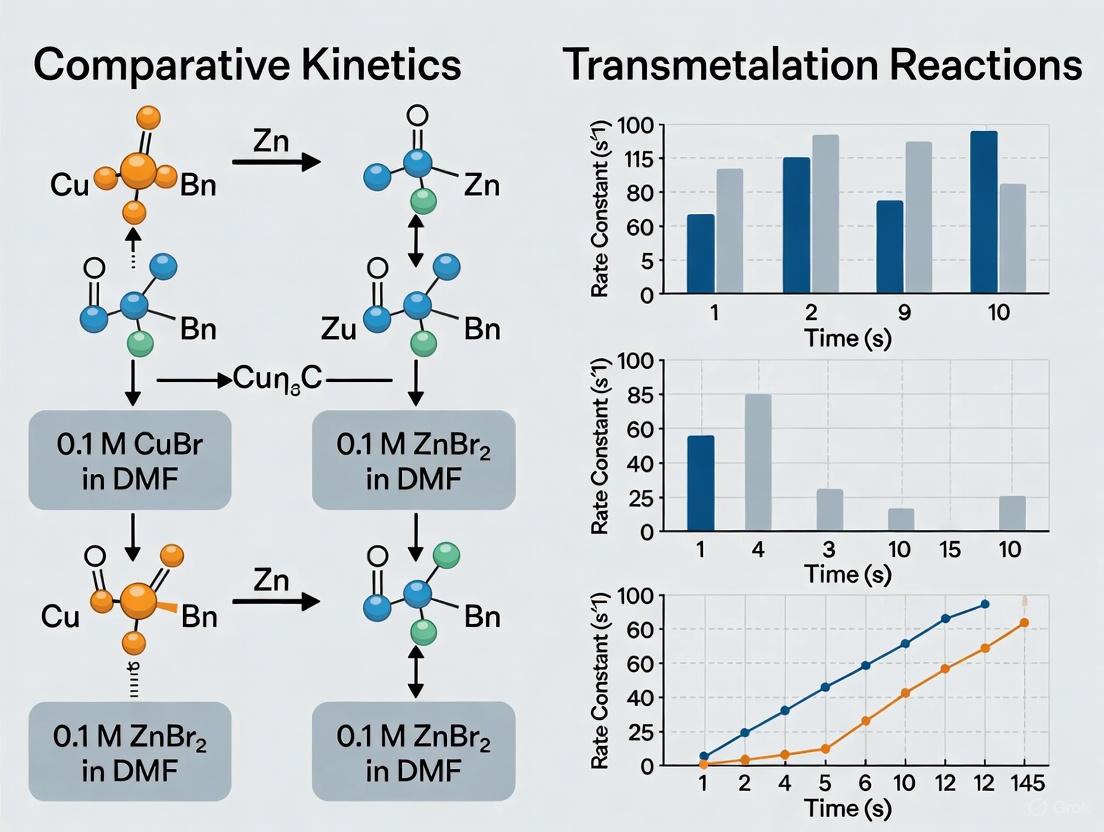
The diagram below illustrates the core positioning of transmetalation within a generic catalytic cycle and contrasts classical and contemporary mechanisms:
Comparative Kinetic Data and Experimental Metrics
The kinetics of transmetalation processes vary considerably across different catalytic systems, influenced by metal identity, ligand architecture, and transferring reagents. The following table summarizes key quantitative parameters from recent studies:
Table 1: Comparative Kinetic Parameters for Transmetalation Processes
| Catalytic System | Rate-Determining Step | Activation Energy Barrier (kcal/mol) | Turnover Frequency (h⁻¹) | Key Influencing Factors |
|---|---|---|---|---|
| Pd/Phosphine (Suzuki) [1] | Transmetalation | 18-25 | Varies | Ligand electron density, Oxidative addition rate |
| Pd/Pybox (Chan-Lam) [3] | Transmetalation | Not specified | Not specified | Tridentate ligand blockade, N-binding vs. S,N-bis-chelation |
| Ni/Bipyridine (AC Electrolysis) [4] | Oxidative addition → Transmetalation timing | Not specified | Not specified | AC frequency (0.2 Hz optimal), Minimized Ni(II) exposure |
| Ni-Metalated COF [5] | Not specified | Reduced via modulation | 442 (flow protocol) | Electron transfer distance, Metal center electron density |
| Pd(I) Dimeric System [2] | Reductive elimination | Not specified | Not specified | Hetero-diarylpalladium dimer stability |
Table 2: Transmetalation Selectivity Control Strategies
| Control Strategy | Mechanistic Basis | System Impact | Experimental Evidence |
|---|---|---|---|
| Ligand Design [3] | Prevents undesired coordination modes | Switches selectivity from C-S to C-N bond formation | EPR isotope studies, Computational mechanistic analysis |
| AC Frequency Modulation [4] | Synchronizes reducing power with intermediate formation | Suppresses C-C homocoupling in favor of C-N coupling | CV analysis, Frequency-dependent yield mapping (0.2 Hz optimal) |
| Dimeric Intermediate Control [2] | Favors hetero-diarylpalladium dimers over homodimers | Enhances cross-selectivity over homo-coupling | ESI-HRMS detection of [Pd₂I₄][NBu₄]₂, DFT calculations |
| Metal Center Electron Density Tuning [5] | Optimizes electron acceptance capability | Lowers activation barrier for transmetalation | Life cycle assessment, Computational calculations |
Essential Experimental Protocols
This protocol demonstrates how ligand selection can direct transmetalation selectivity toward C–N bond formation.
- Reaction Setup: In a microwave vial, combine sulfenamide (1.0 equiv), arylboronic acid (2.0 equiv), Cu(TFA)₂•H₂O (10 mol %), pybox ligand L3 (20 mol %), and Cy₂NMe (1.5 equiv) in MeCN (0.3 M).
- Reaction Conditions: Stir the reaction mixture at room temperature for 24 hours under an O₂ atmosphere.
- Key Observations: The tridentate pybox ligand governs chemoselectivity by preventing S,N-bis-chelation of sulfenamides to the copper center, favoring N-binding instead.
- Analysis: Reaction monitoring by UV-Vis spectra and EPR technique confirms the Cu(II)-derived resting state of the catalyst. EPR isotope response using ¹⁵N-labeled sulfenamide verifies the key intermediate.
- Scale: Reaction performed on 0.1-0.5 mmol scale with isolated yields typically ranging from 54-87%.
This protocol illustrates the novel Pd-to-Pd transmetalation mechanism in a reductive coupling system.
- Catalyst System: Use [Pd(I)(PtBu₃)]₂ (2.5 mol%) as precatalyst with Bu₄NI (20 mol%) in dioxane:H₂O (9:1, 0.2 M) at 100°C.
- Reductant: Employ formate as the non-metallic reductant.
- Key Observations: The neutral dimeric Pd(I) precatalyst is converted to the active dianionic species [Pd₂I₄][NBu₄]₂, from which aryl halide oxidative addition is more facile.
- Mechanistic Verification: ESI-HRMS detection of [Pd₂I₄][NBu₄]₂ confirms the active species. Rapid, reversible Pd-to-Pd transmetalation delivers iodide-bridged diarylpalladium dimers, with hetero-dimers being more stable and having lower barriers to reductive elimination.
- Functional Group Tolerance: The system displays orthogonality with Suzuki and Buchwald-Hartwig couplings, tolerating pinacol boronates and anilines.
This protocol demonstrates how electrochemical parameters can control transmetalation timing and selectivity.
- Electrochemical System: Employ Ni(II)(di-Mebpy)Br₂ as catalyst in LiNTf₂ electrolyte (redox-inert) with AC electrolysis.
- Optimized Parameters: Apply AC frequency of 0.2 Hz with amplitude of 3.0 V for optimal C–N selectivity.
- Key Observations: Optimal C–N selectivity arises from minimizing the exposure of the key intermediate Ni(II)(Ar)Br to reducing conditions that promote off-cycle Ni(I) species and undesired C–C homocoupling.
- Analysis Method: Use cyclic voltammetry (CV) to predict optimal AC frequency across diverse aryl bromides, eliminating trial-and-error optimization. The formation rate of the key intermediate is governed by oxidative addition but largely independent of the amine coupling partner.
The Scientist's Toolkit: Essential Research Reagents
Table 3: Key Research Reagents for Transmetalation Studies
| Reagent Category | Specific Examples | Function in Transmetalation | Application Context |
|---|---|---|---|
| Ligands | Tridentate pybox (L3) [3] | Blocks undesired coordination modes, directs selectivity | Chan-Lam coupling, C–N bond formation |
| Precatalysts | [Pd(I)(PtBu₃)]₂ [2] | Forms active dianionic Pd(I) dimer species | Reductive cross-coupling, Pd-to-Pd transmetalation |
| Additives | Bu₄NI [2] | Stabilizes Pd(I) dimers, facilitates oxidative addition | Formate-mediated coupling |
| Electrocatalysis Components | Ni(II)(di-Mebpy)Br₂, LiNTf₂ [4] | Enables AC frequency control over intermediate timing | Electrochemical C–N coupling |
| Analytical Tools | EPR with ¹⁵N-labeling [3] | Verifies key intermediates and bonding modes | Mechanistic studies |
| Computational Methods | DFT/MM calculations [1] | Maps potential energy surfaces, identifies transition states | Mechanistic rationalization |
Transmetalation has evolved from a simple ligand transfer step to a sophisticated process that can be strategically manipulated through ligand design, catalyst architecture, and even external modulation such as electrochemical synchronization. The comparative data presented herein reveals that contemporary transmetalation strategies increasingly focus on controlling the coordination environment and timing of the transfer event rather than simply optimizing traditional parameters. The emergence of innovative mechanisms such as Pd-to-Pd transmetalation and frequency-synchronized transfer highlights the ongoing expansion of fundamental cross-coupling paradigms. For researchers designing catalytic systems for pharmaceutical development or complex molecule synthesis, these advances offer powerful strategies for overcoming traditional selectivity challenges and accessing novel chemical space. Future directions will likely include further integration of electrochemical control, development of heterogeneous systems with molecular precision, and increased use of computational prediction to guide transmetalation optimization.
Transmetalation is a fundamental elemental step in metal-catalyzed cross-coupling reactions, serving as the critical transfer event where an organic group is exchanged between two metal centers. This process directly impacts the efficiency and applicability of synthetic methodologies used extensively in pharmaceutical development and materials science. Within this landscape, two principal mechanistic pathways—oxidative insertion and bridged intermediate formation—govern the transmetalation event across different catalytic systems. Framed within a broader thesis on comparative kinetic studies of transmetalation reactions, this guide provides an objective performance analysis of these pathways, supported by quantitative kinetic data and detailed experimental protocols. Understanding the distinct operational frameworks, kinetic parameters, and experimental support for each pathway is essential for researchers and drug development professionals to select and optimize catalytic systems for complex synthetic challenges.
The oxidative insertion and bridged intermediate pathways represent distinct mechanistic paradigms for transmetalation, differentiated by the oxidation state changes of the metal center and the structure of the key transition state.
Oxidative Insertion Pathway: This pathway is characterized by a formal increase in the oxidation state of the metal center during the transfer of the organic group. The mechanism typically involves a nucleophilic attack by an organometallic reagent on a transition metal complex, leading to an intermediate with a higher oxidation state before reductive elimination yields the final product. This pathway is often discussed in the context of reactions involving Cu(I) complexes [6].
Bridged Intermediate Pathway: This mechanism proceeds through the formation of a ternary complex featuring a bridging atom (often oxygen) that connects the main group metal (e.g., boron) and the transition metal (e.g., palladium). Key intermediates in the Suzuki-Miyaura reaction, for instance, contain a definitive Pd–O–B linkage, the "missing link" confirmed through low-temperature NMR spectroscopy [7]. Transmetalation in this pathway occurs within this coordinated structure without a formal oxidative insertion step.
The table below summarizes the core characteristics of each pathway.
Table 1: Fundamental Characteristics of Transmetalation Pathways
| Feature | Oxidative Insertion Pathway | Bridged Intermediate Pathway |
|---|---|---|
| Key Mechanistic Step | Nucleophilic attack & oxidation state change [6] | Formation of a bridging atom-linked complex (e.g., Pd–O–B) [7] |
| Representative System | Copper-catalyzed cross-coupling [6] | Palladium-catalyzed Suzuki-Miyaura coupling [7] |
| Key Intermediate | High-valent metal species (e.g., Cu(III)) [6] | Tri- or tetra-coordinate bridged species (e.g., 6-B-3, 8-B-4) [7] |
| Oxidation State Change | Formal increase during the process [6] | Not a defining feature of the mechanism [7] |
Quantitative Kinetic Comparison
Kinetic analysis provides critical insights into the efficiency and rate-determining nature of these transmetalation pathways. The following table compiles quantitative kinetic data from experimental studies.
Table 2: Comparative Kinetic Data for Transmetalation Pathways
| Catalytic System | Transmetalation Step | Rate Constant (k) | Activation Enthalpy (ΔH‡) | Experimental Conditions |
|---|---|---|---|---|
| Nickel / Arylzinc Reagents [8] | Transmetalation of ArZnCl with Ar'Ni(II)R | 0.04 - 0.31 M⁻¹ s⁻¹ | 14.6 kcal/mol (for PhZnCl) | Not specified |
| Copper / Bipyridyl Complex [6] | Oxidative Addition of Rf-I to [Cu(bipy)(C₆F₅)] | - | 21.3 kcal/mol (calc.) | THF, DFT calculations (B3LYP-D3) |
The data highlights that transmetalation can be the rate-limiting step in a catalytic cycle, as definitively shown in nickel-catalyzed couplings [8]. The measured rate constants for different arylzinc reagents provide a quantitative basis for evaluating substituent effects on reactivity. In the copper system, the barrier for the oxidative addition step, which is part of the oxidative insertion pathway, was computationally determined to be 21.3 kcal/mol [6].
Experimental Protocols and Methodologies
Protocol A: Studying Bridged Intermediates via RI-NMR
This methodology details the generation and observation of elusive Pd–O–B bridged intermediates [7].
- Objective: To generate, observe, and characterize pre-transmetalation intermediates containing Pd–O–B linkages in the Suzuki-Miyaura reaction.
- Key Techniques: Rapid Injection NMR Spectroscopy (RI-NMR) at low temperatures; Kinetic analysis via reaction monitoring; Computational analysis (DFT calculations).
- Procedure:
- Precursor Preparation: Synthesize and isolate the oxidative addition complex, e.g., (Ph₃P)₂Pd(Ph)Br.
- Intermediate Generation: Rapidly mix the palladium complex with the organoboron reagent (e.g., a boronic acid or a pre-formed boronate salt) at low temperatures (-80 to -60 °C) in a suitable anhydrous solvent like THF.
- Rapid Injection NMR: Use a specialized RI-NMR probe to inject the cold reaction mixture into an NMR tube pre-cooled in the NMR spectrometer. Acquire NMR spectra immediately and at timed intervals.
- Species Identification: Identify the intermediates (e.g., the tri-coordinate 6-B-3 boronic acid complex and the tetra-coordinate 8-B-4 boronate complex) by characteristic chemical shifts in the ¹¹B and ³¹P NMR spectra.
- Kinetic Competence: Demonstrate that the observed intermediates proceed to form the cross-coupling product at a rate consistent with the catalytic reaction.
- Critical Notes: The success of this protocol hinges on the speed of mixing and transfer to minimize decomposition of the highly reactive intermediates. The use of low temperatures is essential to stabilize the intermediates for observation.
Protocol B: Kinetic Analysis of an Oxidative Insertion Pathway
This protocol outlines a combined experimental and computational approach to probe a copper-based system where oxidative insertion is operative [6].
- Objective: To determine the kinetic parameters and mechanism of homocoupling product formation in a copper-catalyzed system, revealing a transmetalation step involving Cu(I) and Cu(III) species.
- Key Techniques: Kinetic monitoring via NMR or other spectroscopic methods; Hammett analysis; Density Functional Theory (DFT) calculations.
- Procedure:
- Reaction Monitoring: Conduct the reaction between [Cu(bipy)(C₆F₅)] and a specialized aryl iodide (e.g., 3,5-dichloro-2,4,6-trifluorophenyl iodide) in THF.
- Product Quantification: Use NMR spectroscopy to track the formation of both cross-coupling (Rf–Pf) and homocoupling (Pf–Pf and Rf–Rf) products over time.
- Concentration Dependence: Perform a series of reactions with varying initial concentrations of the Cu(I) complex to assess its order in the rate law.
- Data Fitting: Fit the concentration-time data for all products to different kinetic models (e.g., Model I: double oxidative addition vs. Model II: transmetalation from a Cu(III) intermediate).
- Computational Validation: Use DFT calculations (e.g., B3LYP-D3 functional with an SMD/THF solvation model) to map the Gibbs energy profile, locate transition states, and calculate energy barriers for oxidative addition, reductive elimination, and the proposed transmetalation step between Cu(I) and Cu(III).
- Critical Notes: The choice of the fluorinated aryl iodide is crucial, as it stabilizes the Cu–C bond and allows the transient Cu(III) intermediate to be intercepted. The observation that homocoupling product formation is dependent on the concentration of the Cu(I) complex is key evidence for the bimolecular transmetalation event.
Research Toolkit: Essential Reagents and Materials
The following table details key reagents and their functions for studying transmetalation mechanisms.
Table 3: Research Reagent Solutions for Transmetalation Studies
| Reagent/Material | Function in Investigation |
|---|---|
| Palladium Phosphine Complexes (e.g., (Ph₃P)₂Pd(Ph)Br) [7] | Pre-formed oxidative addition complex to study subsequent transmetalation steps. |
| Organoboron Reagents (Boronic acids & boronate salts) [7] | React with Pd complexes to form Pd–O–B bridged intermediates. |
| Copper(I) Complexes (e.g., [Cu(bipy)(C₆F₅)]) [6] | Catalyst and nucleophile in oxidative insertion pathways. |
| Specialized Aryl Iodides (e.g., Rf–I) [6] | Substrates designed to stabilize high-valent metal intermediates for mechanistic study. |
| Deuterated Solvents (THF-d₈, Acetone-d₆) | Medium for NMR-based kinetic studies and intermediate observation. |
| Phosphine Ligands (e.g., Trialkylphosphines, Triarylphosphines) | Modify steric and electronic properties of metal centers to influence mechanism and rates [7]. |
The comparative analysis of transmetalation pathways reveals a clear mechanistic dichotomy. The bridged intermediate pathway, exemplified by the Pd-catalyzed Suzuki-Miyaura reaction, is characterized by well-defined, observable complexes whose stability and reactivity are highly dependent on ligand environment. In contrast, the oxidative insertion pathway, observed in certain copper systems, involves high-energy intermediates and bimolecular interactions that can divert selectivity toward homocoupling products. Kinetic data unequivocally establishes that transmetalation can be the rate-limiting step in these catalytic cycles, with measured activation parameters providing a quantitative framework for reaction optimization. For researchers in drug development, this comparative insight is invaluable: the bridged pathway offers greater control for predictable cross-coupling, while the oxidative insertion pathway requires careful management of catalyst loading and concentration to suppress homocoupling side reactions. The choice between these inherent pathways, governed by the metal and ligands selected, is therefore fundamental to the design of efficient and scalable synthetic processes.
The study of halogen-metal exchange kinetics represents a critical frontier in modern organometallic chemistry, particularly for the synthesis of complex pharmaceutical intermediates and functionalized molecules. This transformation, wherein a halogen atom on an organic molecule is replaced by a metal, generates highly reactive organometallic species that serve as pivotal intermediates in constructing carbon-carbon bonds. Traditional batch processing of these reactions is often hampered by poor heat transfer and difficulties in controlling the exothermic exchange process, leading to decomposition and side-product formation. The integration of these reactions into continuous flow systems has unveiled a new realm of kinetic possibilities, enabling the generation, study, and utilization of millisecond-lived intermediates that were previously inaccessible.
This guide provides a comparative analysis of halogen-metal exchange methodologies, focusing specifically on the kinetic advantages afforded by continuous flow technology. By examining direct experimental data and protocols, we aim to equip researchers with the practical knowledge to select and implement optimal exchange strategies for their specific synthetic challenges, particularly within the broader context of comparative transmetalation kinetics.
Comparative Kinetic Platforms: Batch vs. Flow Chemistry
The fundamental difference between batch and flow reactors for halogen-metal exchange lies in the unprecedented control over reaction parameters offered by flow systems. Table 1 summarizes the key kinetic and operational advantages of flow chemistry that enable the study and utilization of millisecond intermediates.
Table 1: Kinetic Comparison of Halogen-Metal Exchange in Batch vs. Flow Reactors
| Parameter | Batch Reactor | Continuous Flow Reactor |
|---|---|---|
| Heat Transfer | Limited, leading to hot spots and decomposition | Superior due to high surface-to-volume ratio [9] |
| Mixing Efficiency | Slow, diffusion-dependent | Highly efficient, reduces local concentration gradients [9] [10] |
| Reaction Time Control | Seconds to hours (limited by mixing) | Milliseconds to seconds (precise via residence time) [9] |
| Intermediate Stability | Decomposition common for unstable species | Cryogen-free generation and immediate trapping of sensitive intermediates [9] |
| Reaction Scalability | Nonlinear, requires re-optimization | Linear, via numbering-up or prolonged operation [9] [11] |
| Kinetic Data Quality | Lower resolution for fast reactions | High-resolution, enables study of ultrafast kinetics [9] |
A critical insight from recent studies is that achieving optimal results in flow is not merely about maximizing mixing efficiency. The flow regime—determined by the mixer design and flow rate—is paramount. Variation in these parameters can alter product distribution and stereoselectivity, as molecules assemble into transient supramolecular structures (supramers) whose reactivity depends on how reagents are presented to one another [10]. Therefore, the goal is not always the fastest possible mixing, but rather the correct mixing for the desired reaction pathway.
Experimental Protocols for Kinetic Studies in Flow
Protocol 1: Ultrafast Halogen-Lithium Exchange and Trapping
This protocol, pioneered by Yoshida, demonstrates the generation and trapping of organolithium intermediates on a millisecond timescale, a feat impractical in batch reactors [9].
- Objective: To perform a Br/Li exchange on an aryl bromide and trap the resulting aryllithium intermediate with an electrophile.
- Key Reagent Solutions:
- Substrate Solution: 0.1-0.3 M solution of the aryl bromide in a suitable solvent (e.g., THF).
- Exchange Reagent: n-Butyllithium (n-BuLi, 1.1-1.5 equiv) in hexanes.
- Electrophile Solution: Aldehyde, ketone, or other electrophile (1.2-2.0 equiv) in the same solvent.
- Flow Setup and Procedure:
- Reactors: A two-stage continuous flow system is assembled using micromixers (e.g., T-shaped or more advanced designs) connected to micro-tubular reactors.
- Stage 1 - Exchange: The substrate and n-BuLi solutions are pumped into the first mixer. The residence time in the subsequent tube reactor is controlled to be 10-100 milliseconds by adjusting the flow rate and reactor volume. This short, precise time is sufficient for the exchange but minimizes decomposition of the new organolithium species.
- Stage 2 - Trapping: The outflow from the first reactor is immediately mixed with the electrophile solution in a second mixer. The combined stream then passes through a second tubular reactor with a residence time of 1-30 seconds to complete the trapping reaction.
- Quenching: The reaction mixture is collected into a quenching solution (e.g., water or a pH buffer).
- Kinetic Insight: The superior heat and mass transfer of the microreactor allows this highly exothermic exchange to be performed at higher temperatures than in batch, while the exact control over residence time prevents the decomposition of the sensitive aryllithium intermediate, enabling high-yield reactions [9].
Protocol 2: Bromine-Sodium Exchange in Continuous Flow
This protocol addresses the historical challenge of using organosodium reagents, which are often insoluble and difficult to handle, by employing a continuous flow setup [12].
- Objective: To achieve a Br/Na exchange on an (hetero)aryl bromide using a hexane-soluble sodium reagent.
- Key Reagent Solutions:
- Substrate Solution: 0.1 M solution of the aryl bromide in toluene.
- Exchange Reagent: 2-Ethylhexylsodium (approx. 1.2 equiv) in hexanes. This novel reagent overcomes the solubility issues of traditional sodium organometallics.
- Electrophile Solution: Trimethylchlorosilane (TMSCI, 2.0 equiv) or other electrophile in toluene.
- Flow Setup and Procedure:
- The substrate and 2-ethylhexylsodium solutions are pumped through a commercially available flow reactor (e.g., a chip-based mixer or a tubular reactor).
- The residence time for the exchange is set to a few seconds.
- The resulting aryl sodium species is subsequently mixed with the electrophile solution in a second mixing unit.
- The final mixture is quenched in-line or collected for workup.
- Kinetic Insight: The use of toluene as a solvent and the continuous flow environment facilitate this exchange with enhanced efficiency and broader functional group tolerance compared to some traditional lithium-based exchanges, providing a complementary tool for synthesis [12].
The following diagram illustrates the logical workflow and reactor configuration for a generic two-step halogen-metal exchange and trapping sequence in a continuous flow system.
The Scientist's Toolkit: Essential Reagents and Materials
Successful execution of kinetic studies in halogen-metal exchange relies on a set of specialized reagents and equipment. Table 2 details the key components of the research toolkit.
Table 2: Research Reagent Solutions for Halogen-Metal Exchange Kinetics
| Tool/Reagent | Function & Specific Role | Key Characteristic |
|---|---|---|
| n-Butyllithium (n-BuLi) | Classic Br/Li and I/Li exchange reagent. | High reactivity; requires precise stoichiometric control and cryogenic conditions in batch [9]. |
| 2-Ethylhexylsodium | Novel reagent for Br/Na exchange. | Hexane-soluble, overcoming a major limitation of organosodium chemistry [12]. |
| iPrMgBr·LiCl | Turbo-Grignard reagent for halogen-magnesium exchange. | Fast exchange in toluene; excellent functional group tolerance [12]. |
| T-Shaped Micromixer | Fundamental device for initial reagent mixing. | Efficiency highly dependent on flow rate; can exhibit engulfment regime at higher flows for better mixing [10]. |
| Micro-Tubular Reactor | Provides controlled residence time. | Enables precise reaction times from milliseconds to minutes [9]. |
| Syringe Pumps | Delivers reagents at precise, constant flow rates. | Critical for maintaining stable residence times and reproducible kinetics. |
| In-line Spectrometer | Real-time reaction monitoring (PAT). | Enables kinetic data acquisition and immediate feedback on intermediate formation [11]. |
The migration of halogen-metal exchange reactions into continuous flow systems has fundamentally transformed our ability to study and harness their kinetics. The protocols and data presented herein confirm that flow chemistry is not merely an alternative to batch processing, but a superior platform for investigating and executing these sensitive transformations. The precise control over temperature, mixing, and residence time allows for the reproducible generation of millisecond-lived intermediates, providing cleaner reaction profiles, higher yields, and enhanced safety.
The future of this field lies in the deeper integration of process analytical technology (PAT), automation, and advanced reactor designs [11]. Real-time monitoring with in-line IR and NMR spectrometers will generate richer kinetic data, enabling closed-loop optimization of reaction conditions. Furthermore, the combination of halogen-metal exchange with other catalytic modalities, such as photoredox or electrocatalysis in telescoped flow sequences, promises to unlock novel reaction pathways and streamline the synthesis of complex molecules [11]. As these technologies mature, the kinetic principles governing halogen-metal exchange will continue to serve as a critical foundation for the broader field of comparative transmetalation research.
Directed metalation has emerged as a powerful strategy for achieving precise regiocontrol in C–H functionalization, a cornerstone of modern synthetic chemistry. This approach utilizes coordinating functional groups, known as directed metalation groups (DMGs), to guide metal catalysts to specific C–H bonds, enabling their selective activation and subsequent functionalization [13]. For researchers in drug development, this methodology offers a streamlined pathway to complex molecules, reducing the need for pre-functionalized starting materials and minimizing synthetic steps.
A significant historical limitation of these reactions, particularly those employing highly reactive organolithium bases, has been the requirement for cryogenic conditions (e.g., -78 °C) to maintain the stability of reactive intermediates and suppress unwanted side reactions [14]. However, recent technological and methodological advances are systematically overcoming this barrier. The integration of continuous flow chemistry and the development of novel main group metal bases now enable numerous metalation reactions to proceed at ambient temperatures, enhancing both the safety and scalability of these transformations [9] [15]. This guide provides a comparative analysis of these strategies, focusing on their performance in achieving regioselectivity and operating under practical temperature conditions.
Comparative Analysis of Directed Metalation Approaches
The field of directed metalation encompasses a variety of approaches, which can be evaluated based on their inherent regioselectivity, operational temperature range, and compatibility with other reagents. The table below summarizes the key characteristics of prominent strategies.
Table 1: Performance Comparison of Key Directed Metalation Strategies
| Metalation Strategy | Typical Bases/Reagents | Inherent Regioselectivity (DMG Power) | Typical Operational Temperature | Key Advantages | Primary Limitations |
|---|---|---|---|---|---|
| Aryl O-Carbamate (ArOAm) DoM [14] | Alkyllithiums (e.g., n-BuLi) | Very High (especially Ar-OCONEt₂) | Traditionally -78 °C (Cryogenic) | Strongest of the O-based DMGs; effective in AoF rearrangement and iterative sequences [14]. | Hydrolysis resistance; traditionally requires cryogenics [14]. |
| Continuous Flow Metalation [9] | RLi, LiNR₂, TMPZnCl·LiCl | Enhanced by control & kinetics | 0 °C to 25 °C (Ambient/Cryogen-free) | Superior heat/mass transfer; safe handling of pyrophoric reagents; scalable [9]. | Requires specialized flow reactor equipment. |
| s-Block & Main Group Metal Bases [15] | TMPMgCl·LiCl, TMP₂Zn·2MgCl₂·2LiCl | High, guided by substrate & base design | 25 °C (Ambient) | Excellent functional group tolerance; generates robust intermediates; room temperature operation [15]. | Constitution of active intermediates can be complex and uncertain [15]. |
| 8-Aminoquinoline DG Halogenation [16] | Fe catalysts, Cu mediators, Electrochemistry | High, via bidentate chelation | 25 °C to 100 °C (Ambient/Mild Heating) | Enables remote C–H functionalization; compatible with "green" solvents (e.g., water) and oxidants (e.g., air) [16]. | Requires installation and potential removal of the directing group. |
Experimental Protocols and Workflows
To translate these comparative profiles into practical action, this section outlines general experimental workflows for the two most transformative strategies: traditional batch DoM and modern continuous flow metalation.
Traditional Workflow: DirectedorthoMetalation (DoM) in Batch
The classical DoM process, as exemplified by the use of the ArOAm DMG, follows a well-established protocol [14].
- Step 1 – Substrate Preparation: The substrate molecule is functionalized with a powerful DMG, such as the diethylcarbamate group (Ar-OCONEt₂).
- Step 2 – Cryogenic Metalation: The substrate is dissolved in an anhydrous aprotic solvent (e.g., THF). The solution is cooled to -78 °C under an inert atmosphere, and a strong base (e.g., n-BuLi) is added dropwise. The mixture is stirred at this cryogenic temperature for a specified time to generate the aryllithium intermediate.
- Step 3 – Electrophilic Quench: An electrophile (E⁺) is introduced to the reaction vessel. The mixture is typically allowed to warm slowly to room temperature to ensure complete reaction.
- Step 4 – Work-up and DMG Manipulation: The reaction is quenched, and the product is isolated. The robust ArOAm DMG can then be hydrolyzed to a phenol or engaged in cross-coupling reactions [14].
Advanced Workflow: Continuous Flow Metalation
The continuous flow protocol leverages reactor engineering to overcome the limitations of the batch process [9].
- Step 1 – Reagent Preparation: Solutions of the substrate and the organometallic base are prepared in suitable solvents.
- Step 2 – Inline Mixing and Reaction: The substrate and base streams are pumped into a continuous flow microreactor. The high surface-to-volume ratio allows for instantaneous mixing and highly efficient heat exchange, controlling the exothermic metalation step even at higher temperatures.
- Step 3 – Inline Quenching: The resulting stream containing the metalated intermediate is immediately mixed with a third stream containing the electrophile in a second reactor module. The extremely short residence times (milliseconds to seconds) prevent the decomposition of unstable intermediates.
- Step 4 – Product Collection: The reacted mixture exits the flow reactor and is collected for standard work-up and purification. This telescoped process avoids the isolation of sensitive organometallic species [9].
The following diagram illustrates the logical relationship between the challenges of traditional metalation and the solutions provided by modern approaches, highlighting the critical shift away from cryogenic dependency.
Essential Research Reagent Solutions
Successful implementation of advanced metalation strategies requires a toolkit of specialized reagents. The following table details key compounds and their specific functions in enabling high-regioselectivity reactions under mild conditions.
Table 2: Key Reagent Solutions for Modern Metalation Protocols
| Reagent / Base | Primary Function | Key Feature / Rationale | Exemplary Use Case |
|---|---|---|---|
| TMPZnCl·LiCl (Turbo-Hauser Base) [15] | Chemoselective C–H zincation of arenes and heteroarenes. | Moderate reactivity allows for room temperature metalation with high functional group tolerance (e.g., nitro, ester, nitrile groups) [15]. | Direct zincation of 2,4-difluoronitrobenzene at 25 °C, followed by Negishi cross-coupling [15]. |
| TMPMgCl·LiCl (Knochel's Base) [15] | Regioselective C–H magnesiation of fluoroarenes. | Operates in toluene at room temperature; generates bis-aryl magnesium intermediates compatible with various electrophiles [15]. | Metalation of fluoropyridines and perfluoroarenes at 25 °C [15]. |
| 8-Aminoquinoline [16] | Bidentate directing group for remote C–H functionalization. | Forms stable 5-membered palladacycles or other metallacycles, enabling high regiocontrol for C–X (X = Halogen) bond formation [16]. | Iron-catalyzed C5-bromination of quinolines in water at room temperature [16]. |
| Diethylcarbamoyl Group (Ar-OCONEt₂) [14] | Powerful O-based DMG for Directed ortho Metalation (DoM). | Ranked as one of the strongest O-DMGs; provides excellent ortho-directing ability in anisole derivatives [14]. | Serendipitous discovery of ArOAm-directed ortho-lithiation and anionic ortho-Fries (AoF) rearrangement [14]. |
| Flow Reactor Systems [9] | Enabling technology for safe and controlled exothermic reactions. | Provides precise control over residence time and temperature, allowing the use of RLi bases at significantly higher temperatures than in batch [9]. | Lithiation–electrophile trapping sequences for pharmaceutical intermediates (e.g., fenofibrate, montelukast) without cryogenics [9]. |
The strategic evolution of directed metalation is marked by a clear transition from cryogenic-dependent batch processes to more practical, sustainable, and scalable methodologies. The objective data confirms that while traditional DMGs like the aryl O-carbamate offer unmatched regioselectivity, their full potential is now being unlocked by modern engineering and reagent design.
The comparative analysis underscores that continuous flow chemistry and advanced main group metal bases are not merely incremental improvements but are paradigm-shifting solutions. They directly address the core challenges of thermal control and intermediate stability, thereby circumventing the need for cryogenics. For researchers engaged in kinetic studies of transmetalation or the development of active pharmaceutical ingredients, the adoption of these tools translates to enhanced safety, reduced operational complexity, and more viable paths from discovery to large-scale synthesis. The future of directed metalation lies in the continued integration of these strategies, further expanding the accessible chemical space for drug development.
Organometallic reagents, characterized by carbon-metal bonds, constitute a cornerstone of modern synthetic organic chemistry, enabling the efficient construction of complex molecular architectures. Among them, organolithium, organomagnesium (Grignard reagents), and organozinc compounds are fundamental tools for practicing chemists. The unique reactivity of each reagent class stems from the nature of the carbon-metal bond, which exhibits varying degrees of ionic character that directly influence nucleophilicity, basicity, and functional group compatibility. Recent advances have not only refined our understanding of their traditional applications but have also unlocked new reactivity paradigms through continuous flow technologies, transmetalation strategies, and the development of stabilized reagents. This guide provides a comparative analysis of these essential organometallic reagents, focusing on their performance characteristics, kinetic behavior in transmetalation processes, and practical applications in complex synthesis, particularly within pharmaceutical and materials science research. The integration of these reagents into modern continuous flow systems has further revolutionized their utility by enhancing safety, scalability, and reaction control for traditionally challenging transformations [9].
Comparative Analysis of Key Organometallic Reagents
The table below provides a detailed comparison of the three key organometallic reagent classes, highlighting their distinct properties, reactivity, and suitability for different synthetic applications.
Table 1: Comparative Analysis of Organolithium, Organomagnesium (Grignard), and Organozinc Reagents
| Characteristic | Organolithium Reagents | Organomagnesium Reagents (Grignard) | Organozinc Reagents |
|---|---|---|---|
| C-M Bond Ionic Character | High (∼30%) [17] | Moderate (∼20%) [17] | Low (Covalent) [18] [17] |
| General Reactivity | Very high (strong base/nucleophile) | High (good nucleophile) | Moderate (mild nucleophile) |
| Functional Group Tolerance | Low; incompatible with many protic, electrophilic groups | Moderate; tolerates some functions better than Li, but still reactive | High; tolerates esters, ketones, nitriles, nitro groups [18] |
| Key Preparation Methods | Direct halogen-lithium exchange, direct metalation [19] [17] | Direct oxidative insertion of Mg(0) (Grignard formation), Br/Mg-exchange ("turbo-Grignard") [19] [20] | Direct Zn(0) insertion (aided by LiCl), transmetalation from Mg or Li, direct zincation [19] [18] |
| Typical Stability & Handling | Air- and moisture-sensitive; often pyrophoric; requires cryogenic temperatures and inert atmosphere | Air- and moisture-sensitive; requires inert atmosphere; generally less pyrophoric than RLi | Less pyrophoric than RLi or RMgX; can be stored using standard Schlenk techniques [18] |
| Primary Synthetic Uses | Directed metalation, nucleophilic addition, halogen-lithium exchange | Broadly useful nucleophile for additions to carbonyls, cross-couplings | Excellent for Negishi cross-coupling, transmetalation agent, Reformatsky-type reactions [19] [18] |
Experimental Insights and Kinetic Behavior in Transmetalation
Transmetalation, the transfer of an organic group from one metal to another, is a critical elementary step in numerous catalytic cycles and synthetic sequences. The kinetic and thermodynamic parameters of these reactions are highly dependent on the specific metal pairing and the reaction environment.
Experimental Protocols for Studying Transmetalation
Detailed mechanistic studies of transmetalation processes often employ a combination of techniques:
- In-situ Spectroscopy: Low-temperature NMR spectroscopy can be used to monitor the formation and consumption of organometallic species during transmetalation.
- Stoichiometric Studies: Combining pre-formed organometallic reagents with transition metal salts (e.g., Pd, Cu, Fe, Co) in a controlled, stepwise manner allows for the isolation and characterization of key intermediates [21].
- Kinetic Profiling: Monitoring reaction rates under different concentrations and temperatures provides activation parameters and reveals the order of the transmetalation step.
- Fluorescence Microscopy: For heterogeneous reactions, such as the formation of organozinc reagents on zinc metal surfaces, fluorescence microscopy has been used to visualize and quantify the formation and solubilization of surface intermediates, revealing that activators like LiCl operate by accelerating solubilization rather than the oxidative addition step itself [22].
Key Findings in Transmetalation Kinetics and Selectivity
- Zinc Transmetalation: Organozinc reagents are premier partners in transmetalation. The carbon-zinc bond's covalent nature and low polarity make it relatively stable yet able to readily transfer organic groups to transition metals like palladium (in Negishi coupling) or copper. The kinetics of this transfer are favorable, often occurring rapidly at or below room temperature. A notable protocol involves the in-situ trapping of organolithium intermediates with ZnCl₂ or other zinc salts in a continuous flow reactor, minimizing side reactions and enabling the preparation of polyfunctional organozincs [9] [19].
- Magnesium to Zinc Transmetalation: This is a common method for preparing functionalized organozinc reagents. For instance, a "turbo-Grignard" reagent (iPrMgCl·LiCl) can undergo a fast halogen-magnesium exchange with an organic halide. The resulting aryl magnesium species is then transmetalated to zinc by the addition of ZnCl₂, providing an organozinc reagent suitable for cross-coupling [19].
- Iron-Catalyzed Coupling with Organosodium Reagents: Recent groundbreaking work has demonstrated the use of highly ionic organosodium compounds in iron-catalyzed homocoupling and cross-coupling. A key finding is that bidentate additives are crucial for controlling reactivity, likely by coordinating to both the sodium and iron centers, thus taming the inherently high and unselective reactivity of the C-Na bond [21]. This highlights how additive control can override innate kinetic reactivity patterns.
Advanced Applications and Workflows in Modern Synthesis
The Power of Continuous Flow Reactors
The integration of organometallic chemistry into continuous flow systems represents a major advancement, particularly for handling highly exothermic reactions and unstable intermediates [9]. The following diagram illustrates a generalized workflow for conducting organometallic reactions in a continuous flow setup.
Diagram 1: Continuous Flow Organometallic Workflow
This setup provides several key advantages for handling organometallic reagents:
- Superior Thermal Control: The high surface-to-volume ratio of microreactors allows for efficient heat dissipation, making highly exothermic reactions like halogen-lithium exchange safer and more controllable [9].
- Precise Residence Time: Reactions can be quenched after very short, precisely defined times (milliseconds to seconds), enabling the generation and immediate trapping of highly reactive organolithium and organomagnesium intermediates that would decompose under standard batch conditions [9].
- Telescoped Multistep Synthesis: Unstable organometallic intermediates generated in one reactor can be directly pumped into a second reactor containing an electrophile or a transmetalation agent, enabling complex, multistep sequences without isolation [9]. For example, continuous flow lithiation-electrophile trapping protocols have been scaled for the synthesis of pharmaceutical intermediates like fenofibrate and montelukast [9].
Directed Ortho-Metalation (DoM) as a Powerful Tool
Directed ortho-metalation (DoM) using organolithium reagents is a premier strategy for the regioselective functionalization of aromatic rings. A directing metalation group (DMG) on the arene coordinates to the lithium atom, steering the deprotonation to the adjacent ortho position. This overcomes the limitations of traditional electrophilic substitution, allowing for the predictable synthesis of polysubstituted aromatics [17]. The resulting aryl lithium species can then be trapped with a wide range of electrophiles (e.g., alkyl halides, carbonyl compounds, halogens) or transmetalated to other metals like zinc or boron for further cross-coupling.
The Scientist's Toolkit: Essential Research Reagent Solutions
The table below catalogues key reagents and materials commonly used in modern organometallic research and synthesis, highlighting their specific functions.
Table 2: Key Research Reagent Solutions in Modern Organometallic Synthesis
| Reagent/Material | Function & Application |
|---|---|
| iPrMgCl·LiCl ("Turbo-Grignard") | Highly soluble Grignard reagent for efficient halogen-magnesium exchange under mild conditions, enabling preparation of functionalized aryl magnesium reagents [19] [20]. |
| TMPMgCl·LiCl / TMPZnCl·LiCl | Powerful yet non-nucleophilic bases for regioselective directed metalation of sensitive heterocycles and arenes, tolerating a wide range of functional groups [19] [20]. |
| LiCl Additive | Critical additive for activating zinc metal and facilitating the solubilization of organozinc intermediates from the metal surface during oxidative addition, enabling milder reaction conditions [22]. |
| Iron Catalysts (e.g., Fe(acac)₃) | Abundant, non-toxic, and sustainable catalysts for coupling reactions, recently shown to be effective with traditionally challenging organosodium reagents for homocoupling and cross-coupling [21]. |
| Bidentate Donor Additives (e.g., DMI, DMPU) | Used to control aggregation and reactivity of highly ionic organometallic species (e.g., organosodium); crucial for achieving selectivity in iron-catalyzed couplings [21]. |
| Continuous Flow Microreactor | Engineered system for safe and efficient execution of fast, exothermic organometallic reactions, providing superior mixing, thermal control, and handling of unstable intermediates [9]. |
Organolithium, organomagnesium, and organozinc reagents each occupy a vital and distinct niche in the synthetic chemist's arsenal. The choice between them is dictated by a balance of reactivity, functional group tolerance, and the specific transformation required. The ongoing evolution of this field is being shaped by several clear trends: the push towards more sustainable and abundant metals, as seen in the renaissance of iron catalysis and the exploration of organosodium chemistry [21]; the integration of continuous flow technology to enhance safety and access novel reactivity [9]; and the development of ever-more sophisticated reagent systems like "turbo-Grignards" and TMP-bases that expand the scope of possible transformations [19] [20]. A deep understanding of the comparative kinetics and mechanisms of transmetalation processes involving these reagents remains fundamental to driving innovation in catalytic cross-coupling and complex molecule synthesis.
Advanced Kinetic Methodologies and Synthetic Applications
Within synthetic chemistry, particularly in the development of active pharmaceutical ingredients (APIs) and complex organic molecules, the choice of reactor system profoundly impacts the efficiency, safety, and scalability of a process. While batch chemistry has long been the traditional mainstay, continuous flow chemistry has emerged as a transformative platform that directly addresses numerous limitations inherent to batch processing [23]. This guide provides an objective comparison of these two methodologies, focusing on their performance in mixing, thermal control, and scalability. The analysis is framed within a critical research context: the kinetic study of transmetalation reactions, a class of highly sensitive and rapid organometallic transformations pivotal to modern synthetic chemistry [9]. The superior characteristics of continuous flow systems enable not only safer and more efficient execution of these reactions but also facilitate more precise kinetic studies, thereby accelerating process development and optimization for researchers and drug development professionals.
Comparative Analysis: Batch vs. Continuous Flow Chemistry
The fundamental difference between the two methodologies lies in their operation: batch chemistry involves combining all reactants in a single vessel where the reaction proceeds over a set time, whereas continuous flow chemistry involves pumping reactants through a tubular reactor where the reaction occurs during transit [23]. This core operational distinction gives rise to significant differences in performance, as detailed in the table below.
Table 1: Comprehensive comparison of batch and continuous flow chemistry characteristics.
| Feature | Batch Chemistry | Continuous Flow Chemistry |
|---|---|---|
| Process Control | Flexible mid-reaction adjustments; suitable for exploratory synthesis [23]. | Superior precision over residence time, temperature, and mixing; ideal for optimized processes [23]. |
| Mixing Efficiency | Limited by stirring efficiency; can be inhomogeneous, leading to side reactions [23]. | Excellent mixing due to small internal diameters; enhanced mass transfer improves selectivity [9]. |
| Heat Transfer & Thermal Control | Limited surface-to-volume ratio; risk of localized hot spots and runaway reactions [24]. | High surface-to-volume ratio enables excellent heat management and isothermal operation [25] [9]. |
| Scalability | Scale-up is complex and nonlinear; requires re-optimization at larger vessel sizes [23]. | Seamless scale-up via "numbering-up" or increased flow rates; minimal re-optimization needed [11] [23]. |
| Safety | Higher risk for hazardous reactions due to large volumes of reagents [23]. | Inherently safer; small reagent volumes at any given time mitigate risks [23] [9]. |
| Reaction Time | Typically hours to days [26]. | Drastically reduced; often minutes to hours [26]. |
| Suitability for Sensitive Intermediates | Challenging; intermediates accumulate and can degrade [9]. | Ideal; unstable intermediates are generated and consumed immediately [9]. |
Application in Transmetalation Reaction Kinetics
The study of reaction kinetics, especially for fast and exothermic reactions like transmetalation, is a area where continuous flow systems offer distinct advantages over traditional batch methods.
The Kinetic Analysis Challenge in Batch
In batch reactors, obtaining reliable kinetic data for transmetalation reactions is challenging. These reactions are often highly exothermic and sensitive to mixing efficiency, which can lead to localized hot spots and concentration gradients [9]. This results in side reactions and byproduct formation, corrupting the kinetic data. Furthermore, the rapid consumption of reagents and potential degradation of sensitive organometallic intermediates make it difficult to collect consistent, time-point samples that accurately represent the reaction profile [27].
The Continuous Flow Advantage
Continuous flow reactors enable a more reliable approach to kinetic analysis. A key methodology is the acquisition of kinetic data at steady state [27]. By maintaining constant flow rates, temperature, and pressure, the system reaches a steady state where the product composition remains constant over time. Researchers can then systematically vary one parameter, such as residence time (adjusted via flow rate) or temperature, to determine its effect on conversion and yield. This approach, combined with in-line analytical tools, provides a rich and highly accurate dataset for kinetic modeling [27] [28].
Diagram: Workflow for kinetic analysis of transmetalation reactions in continuous flow.
Experimental Protocols and Data
Case Study: Barbier-Type Transmetalation in Flow
A robust transmetalation protocol was reported by the Knochel group, showcasing the capabilities of continuous flow systems [9].
- Objective: To perform a transmetalation of an organolithium intermediate to an organozinc species, followed by trapping with an electrophile.
- Challenge: Organolithium compounds are highly reactive and prone to decomposition, making their controlled generation and use in batch difficult.
- Flow Setup and Procedure:
- Feedstreams: Two precursor solutions are prepared: an aryl halide in a solvent and a base such as lithium diisopropylamide (LDA).
- Lithiation: The streams are pumped into a temperature-controlled microreactor (e.g., at -20 °C to -78 °C) with a precise residence time to generate the aryllithium intermediate.
- Transmetalation: The resulting stream is immediately mixed with a solution of a zinc salt (e.g., ZnCl₂) in a second reactor. The efficient mixing ensures rapid and complete transmetalation to form the arylzinc species.
- Quenching: The organozinc stream is then mixed with an electrophile (e.g., an acid chloride or allylic bromide) in a final reactor coil to yield the desired coupled product.
- Key Outcome: The process benefits from rapid mixing and short, precisely controlled residence times, which significantly reduce side reactions associated with the sensitive organolithium and organozinc intermediates, leading to higher yields and purities [9].
Table 2: Quantitative performance data for chemical synthesis in different reactor systems.
| Process / Metric | Batch Reactor Performance | Continuous Flow Reactor Performance |
|---|---|---|
| General Scalability | Non-linear scale-up; requires re-optimization [23]. | Linear scale-up via numbering-up; 60 g/h demonstrated for MOFs [26]. |
| Particle Size Control | Broad distribution [26]. | Precise control (e.g., 100 nm to 1 μm for MOFs) [26]. |
| Heat Transfer Coefficient (U) | Lower, due to limitations of stirred tank design [24]. | Significantly higher, enabling more efficient cooling/heating [24]. |
| Space-Time Yield (STY) | Lower; limited by heat/mass transfer [26]. | Exceptional; e.g., 4533 Kg·m⁻³·day⁻¹ for HKUST-1 MOF [26]. |
The Scientist's Toolkit: Research Reagent Solutions
Table 3: Essential materials and equipment for continuous flow transmetalation experiments.
| Item | Function in the Experiment |
|---|---|
| Syringe or HPLC Pumps | To deliver reagent solutions at a constant and precise flow rate [26]. |
| Temperature-Controlled Microreactors | Typically PFA or stainless-steel coils; provide a controlled environment for reaction steps [9]. |
| T-Mixers or Static Mixers | To ensure rapid and efficient mixing of different reagent streams [9]. |
| Organolithium Bases (e.g., LDA) | To perform directed lithiation or halogen-lithium exchange on substrate [9]. |
| Zinc Salts (e.g., ZnCl₂) | To transmetalate the organolithium intermediate to a more stable organozinc species [9]. |
| Back-Pressure Regulator (BPR) | To maintain a constant pressure within the system, preventing solvent degassing [26]. |
| In-line Analytic (e.g., FTIR) | For real-time monitoring of reaction conversion and intermediate formation [28]. |
The objective evidence comparing batch and continuous flow chemistry consistently highlights the latter's superior performance in mixing, thermal control, and scalable synthesis. For the specific case of kinetic studies in transmetalation reactions, the continuous flow paradigm is not merely an incremental improvement but a fundamental enabler. It permits the safe handling of sensitive organometallic species, provides the precise control necessary for high-quality kinetic data acquisition, and offers a direct and predictable path from laboratory discovery to industrial production. As the demands for efficiency, safety, and sustainability in chemical synthesis continue to grow, continuous flow systems are poised to become an indispensable tool in the arsenal of researchers and process chemists.
Phase-transfer catalysis (PTC) has emerged as an indispensable methodology for conducting reactions between reagents residing in immiscible liquid phases, typically aqueous and organic solvents. This technique enables the transfer of ionic reagents from the aqueous or solid phase into the organic phase where reaction with organic substrates occurs, overcoming inherent solubility limitations that would otherwise impede reactive contact. The fundamental principle involves a catalyst, often a quaternary ammonium or phosphonium salt, that shuttles between phases, facilitating the transport of anionic species as lipophilic ion pairs. This process dramatically enhances reaction rates, improves yields, and permits milder reaction conditions compared to conventional single-phase systems.
The economic and environmental significance of PTC systems extends across multiple industrial domains, including pharmaceutical synthesis, agrochemical production, polymer chemistry, and specialty chemical manufacturing. The technology aligns with green chemistry principles by potentially avoiding hazardous organic solvents, reducing energy consumption through lower temperature requirements, and minimizing waste generation. From an engineering perspective, biphasic PTC systems offer the distinct advantage of facile catalyst separation and recycling, bridging the gap between homogeneous catalysis's high efficiency and heterogeneous catalysis's easy separation. The following sections provide a comprehensive comparison of various PTC systems, their kinetic behaviors, solvent effects, and applications in synthetic chemistry, with particular emphasis on transmetalation reactions central to cross-coupling methodologies.
Comparative Analysis of Phase-Transfer Catalyst Systems
Catalyst Types and Structural Features
Phase-transfer catalysts exhibit considerable structural diversity, each with distinct advantages for specific applications. Traditional single-site PTCs, such as tetraalkylammonium salts, contain one catalytic center per molecule and have been widely employed since the technology's inception. More recently, multi-site phase-transfer catalysts (MPTCs) have been developed, featuring multiple catalytic centers within a single molecule. These MPTCs demonstrate enhanced economic and efficiency benefits due to their ability to transport multiple anions simultaneously during each catalytic cycle. For instance, 1,4-bis-(propylmethyleneammounium chloride)benzene (BPMACB) represents a bis-quaternary ammonium compound that significantly accelerates polymerization reactions compared to conventional single-site catalysts [29].
The structural evolution of PTCs has expanded their application scope. In aqueous biphasic hydroformylation, polymer latices created through microemulsion polymerization and nonionic surfactant micelles have been employed as effective phase mediators. These systems enable the conversion of higher alkenes (≥C6) that exhibit insufficient water solubility for direct application of aqueous biphasic protocols. Polymer latices maintain a biphasic system with excess alkene phase, where hydrophobic cores encapsulate substrate molecules, enabling reaction at the aqueous phase interface through electrostatic interactions with water-soluble catalysts. Conversely, nonionic surfactants can form water-in-oil microemulsions under reaction conditions, creating inverse micelles that encapsulate the catalyst within a continuous organic phase, thereby enhancing interfacial contact areas [30].
Table 1: Comparative Features of Phase-Transfer Catalyst Types
| Catalyst Type | Structural Features | Key Advantages | Representative Examples |
|---|---|---|---|
| Single-site PTC | Single quaternary ammonium/phosphonium center | Wide commercial availability, established applications | Tetrabutylammonium bromide, Benzyltriethylammonium chloride |
| Multi-site PTC (MPTC) | Multiple catalytic centers per molecule | Higher efficiency per molecule, cost reduction | 1,4-bis(propylmethyleneammonium chloride)benzene (BPMACB) |
| Polymer-supported PTC | Catalytic sites bound to polymer matrix | Facile recovery and reuse, continuous operation potential | Polymer latices with embedded catalytic sites |
| Surfactant-based PTC | Amphiphilic structure with hydrophilic-lipophilic balance | Forms microemulsions, greatly increased interfacial area | Marlophen NP 9, Marlipal 24/70 |
Performance Metrics in Model Reactions
The efficacy of different PTC systems can be quantitatively assessed through their performance in representative transformations. In the aqueous biphasic hydroformylation of higher alkenes using a rhodium-SulfoXantPhos catalyst system, both polymer latices and nonionic surfactant micelles demonstrate concentration-dependent activity enhancements. Higher PTC concentrations generally correlate with improved reaction progress, with surfactant systems exhibiting particularly low rhodium losses—a critical consideration for technical implementation and catalyst recycling [30].
In Suzuki-Miyaura cross-coupling reactions under biphasic conditions, the incorporation of phase-transfer catalysts generates remarkable 12-fold rate enhancements. This dramatic acceleration stems from a fundamental shift in the transmetalation mechanism from an oxo-palladium pathway to a boronate-based pathway. The PTC facilitates this mechanistic switch by enabling direct transmetalation between the arylpalladium(II) halide complex and the tetracoordinate (8-B-4) arylboronate species, bypassing the requirement for hydroxide-mediated preactivation [31]. This pathway alteration underscores the profound influence that PTCs can exert on fundamental reaction mechanisms beyond simple mass transfer improvements.
Table 2: Performance Comparison of PTC Systems in Various Reactions
| Reaction System | Catalyst Type | Key Performance Metrics | Reference |
|---|---|---|---|
| Hydroformylation of 1-dodecene | Nonionic surfactant (Marlophen NP 9) | High conversion, low Rh losses (<1%), effective catalyst recycling | [30] |
| Suzuki-Miyaura coupling | Tetraalkylammonium salts | 12-fold rate enhancement, shift in transmetalation pathway | [31] |
| Polymerization of MABE | Multi-site PTC (BPMACB) | Rate enhancement up to 70× vs. batch, high molecular weight polymers | [29] |
| Benzoin condensation | Quaternary ammonium salts | Modeled yield >90% with optimal solvent/PTC combination | [32] |
Solvent Effects and Reaction Engineering
Thermodynamic Considerations and Modeling
The design and optimization of PTC systems necessitate comprehensive understanding of the thermodynamic principles governing solute partitioning between phases. A systematic modeling framework has been developed to predict physical and chemical equilibria in PTC systems with minimal experimental data requirements. This framework incorporates thermodynamic models such as NRTL, eNRTL, SAC, and e-KT-UNIFAC to estimate partition coefficients of species between aqueous and organic phases—a critical parameter influencing reaction rates and selectivity [32].
The partition behavior of PTCs themselves significantly impacts system performance. For quaternary ammonium salts, the equilibrium between ionic forms in the aqueous phase (Q+X⁻) and neutral ion pairs in the organic phase (QY) governs catalytic efficiency. Model-based analyses reveal that solvent selection dramatically affects this equilibrium, with factors such as dielectric constant, hydrogen bonding capacity, and hydrophobicity determining the extent of ion-pair extraction. For instance, in benzoin condensation and chlorination of organobromines, predictive models successfully identify optimal solvent-PTC combinations that maximize product yield while minimizing impurities [32].
Interfacial Phenomena and Mass Transfer
In biphasic systems, reaction rates often depend on interfacial area and mass transfer efficiency rather than intrinsic kinetics. The presence of PTCs alters interfacial tension, potentially increasing the available contact area between phases. Additionally, certain PTC systems, particularly surfactant-based approaches, can generate microemulsions with interfacial areas several orders of magnitude greater than conventional stirred systems. These microemulsions exist as thermodynamically stable, optically isotropic dispersions characterized by extremely low droplet sizes (typically 10-100 nm), which dramatically enhance mass transfer rates [30].
Engineering parameters such as stirring rate, temperature, and phase ratio significantly influence reaction performance through their effects on mass transfer. In aqueous biphasic hydroformylation, the transition from micelles in the aqueous phase to inverse micelles in the organic phase under reaction conditions substantially improves substrate-catalyst contact. This microstructural evolution, reversible upon cooling for product separation, represents a key advantage of thermoregulated surfactant-based PTC systems [30].
Experimental Protocols for PTC Evaluation
Hydroformylation of Higher Alkenes with Surfactant PTCs
Objective: To evaluate the efficiency of nonionic surfactants as phase-transfer agents in the aqueous biphasic hydroformylation of 1-dodecene using a water-soluble rhodium-SulfoXantPhos catalyst.
Reagents and Materials:
- Rh(acac)(CO)₂ precursor (0.025 mmol)
- SulfoXantPhos ligand (0.1 mmol, metal/ligand ratio = 1/4)
- 1-Dodecene (50 mmol)
- Nonionic surfactant (e.g., Marlophen NP 9, 5-10 wt%)
- Water (25 mL) and organic phase (typically 2:1 organic-to-water volume ratio)
Procedure:
- Prepare the catalyst complex by preforming with Rh precursor and ligand in water.
- Charge aqueous catalyst solution, surfactant, and 1-dodecene to a pressurized reactor.
- Purge the system with syngas (CO:H₂ = 1:1) and pressurize to 10-20 bar.
- Heat with stirring to reaction temperature (80-120°C) and monitor pressure drop.
- Maintain constant pressure by syngas replenishment during reaction.
- After reaction completion, cool to room temperature for phase separation.
- Analyze organic phase by GC for conversion and aldehyde selectivity.
- Determine rhodium leaching to organic phase by ICP-MS.
Key Observations: Systems forming three-phase regions (oil, microemulsion, water) at reaction temperature typically exhibit superior conversion rates. Surfactants with lower ethoxylation degrees (e.g., Marlipal 24/70 with n=7) facilitate three-phase system formation at lower temperatures, enabling efficient hydroformylation under milder conditions [30].
Suzuki-Miyaura Coupling with PTC Acceleration
Objective: To investigate the rate enhancement effect of phase-transfer catalysts in the biphasic Suzuki-Miyaura coupling of benzyl bromide with 4-methoxyphenylboronic acid pinacol ester.
Reagents and Materials:
- XPhos Pd G2 catalyst (0.5-2 mol%)
- Benzyl bromide (1.0 mmol)
- 4-Methoxyphenylboronic acid pinacol ester (1.2 mmol)
- Phase-transfer catalyst (e.g., tetrabutylammonium bromide, 10 mol%)
- Potassium phosphate tribasic (2.0 mmol)
- 2-Methyltetrahydrofuran (MeTHF) and water (typically 1:1 v/v)
Procedure:
- Charge organic substrates and Pd catalyst to reaction vessel.
- Add aqueous solution containing base and PTC.
- Stir vigorously at room temperature with automated sampling.
- Analyze reaction progress by HPLC with UV detection.
- Monitor boronate speciation to distinguish transmetalation pathways.
- Compare initial rates and full conversion time profiles with and without PTC.
- Determine kinetic orders by variable time normalization analysis (VTNA).
Key Observations: PTC incorporation typically generates substantial rate enhancements (up to 12-fold) accompanied by a mechanistic shift from oxo-palladium to boronate transmetalation pathway. Reactions exhibit approximately first-order dependence on catalyst and 1.8-order dependence on base, consistent with rate-determining transmetalation with base-mediated pre-equilibrium [31].
Kinetic Studies of Transmetalation Reactions
Mechanistic Pathways in Transmetalation
Transmetalation, the transfer of an organic group from a main group element to a transition metal, represents a fundamental step in cross-coupling reactions. In Suzuki-Miyaura couplings, two competing pathways have been identified: the boronate pathway (Path A) involving direct reaction between LnPd(aryl)(X) and a tetracoordinate (8-B-4) arylboronate, and the oxo-palladium pathway (Path B) proceeding through a LnPd(aryl)(OH) intermediate generated by halide-hydroxide exchange. Under conventional biphasic conditions, Path B typically dominates; however, introduction of PTCs shifts the preference toward Path A, resulting in significant rate enhancements [31] [7].
The existence of Pd-O-B-containing intermediates, long postulated as the "missing link" in Suzuki-Miyaura transmetalation, has been confirmed through low-temperature rapid injection NMR spectroscopy. These studies have identified and characterized two distinct intermediates: a tricoordinate (6-B-3) boronic acid complex and a tetracoordinate (8-B-4) boronate complex, both of which undergo transmetalation to yield cross-coupling products. The relative contribution of each pathway depends critically on reaction conditions, including ligand concentration, solvent system, and the presence of phase-transfer agents [7].
Kinetic Analysis Techniques
Elucidating transmetalation mechanisms requires specialized kinetic analysis techniques adapted for biphasic systems. Variable time normalization analysis (VTNA) has emerged as a powerful method for determining reagent orders in complex reaction networks. This approach involves conducting parallel reactions with different initial reagent concentrations and analyzing the time-dependent concentration profiles to extract reaction orders. For PTC-enhanced Suzuki-Miyaura couplings, VTNA has established approximately first-order dependence on palladium catalyst, 0.75-order dependence on boronic ester, and 1.8-order dependence on base [31].
Automated sampling platforms coupled with online HPLC analysis address the reproducibility challenges inherent in biphasic kinetic studies. These systems enable highly reproducible sampling and analysis while avoiding artifacts associated with sample aging. Additionally, rapid injection NMR techniques permit direct observation of transient intermediates with half-lives as short as several seconds, providing unprecedented insight into the transmetalation process [31] [7].
Figure 1: Transmetalation pathway shift induced by phase-transfer catalysts in Suzuki-Miyaura coupling
Advanced Reactor Technologies for Biphasic Catalysis
High-Performance Liquid/Liquid Counter Current Chromatography
High-performance liquid/liquid counter current chromatography (HPCCC) represents a revolutionary approach to biphasic reaction engineering that dramatically accelerates reaction rates through intensified mixing. This technology utilizes a polytetrafluoroethylene (PTFE) tube coiled onto a rotating drum that simultaneously revolves around its central axis while rotating around its own axis, creating wave-mixing effects equivalent to more than two million partitioning events per hour. The enormous interfacial area generated enables remarkable rate enhancements—up to 70-fold compared to traditional batch reactors and 10-fold compared to segmented flow systems [33].
HPCCC has demonstrated exceptional utility in stereoselective phase-transfer catalyzed reactions and biocatalytic processes. In the stereoselective alkylation of N-(diphenylmethylene)glycine tert-butyl ester, HPCCC achieved 73% yield with 87% enantiomeric excess in just 10.7 minutes residence time, substantially outperforming both batch and segmented flow systems. Similarly, lipase-catalyzed transesterification of octanol with vinyl acetate proceeded quantitatively in 6 minutes under HPCCC conditions, compared to 40% yield after 4.5 hours in conventional batch reactors [33].
Ultrasound-Assisted Phase-Transfer Catalysis
The synergistic combination of ultrasound irradiation with phase-transfer catalysis (US-PTC) represents another innovative approach to process intensification. Ultrasound induces cavitation phenomena that generate extreme local temperatures and pressures while producing intense micro-mixing at phase boundaries. In the polymerization of methacrylic acid butyl ester (MABE) using a multi-site PTC, ultrasound assistance significantly increased reaction rates compared to silent (non-ultrasonic) conditions [29].
The efficiency of ultrasound-assisted PTC systems depends critically on operational parameters including frequency, power intensity, and reactor geometry. Optimal ultrasonic frequency selection balances physical effects (improved mass transfer through turbulence) against chemical effects (radical formation through cavitation). For polymerization reactions, US-PTC not only accelerates reaction rates but also influences polymer properties, yielding materials with higher molecular weights and more uniform molecular weight distributions compared to conventional initiation methods [29].
Research Reagent Solutions for Biphasic Catalysis
Table 3: Essential Research Reagents for Biphasic Catalysis Studies
| Reagent Category | Specific Examples | Function/Purpose | Application Notes |
|---|---|---|---|
| Phase-Transfer Catalysts | Tetrabutylammonium bromide, Aliquat 336, 1,4-bis(propylmethyleneammonium chloride)benzene (BPMACB) | Facilitate interphase transfer of anionic species | Multi-site PTCs offer efficiency advantages; structural diversity enables optimization for specific systems |
| Transition Metal Catalysts | Rh(acac)(CO)₂, XPhos Pd G2, (Ph₃P)₄Pd | Provide catalytic centers for bond formation | Water-soluble variants (e.g., with sulfonated ligands) enable aqueous biphasic operation |
| Ligands | SulfoXantPhos, TPPTS, XPhos, BINAP derivatives | Modulate metal catalyst activity, selectivity, and stability | Bidentate ligands often provide superior selectivity vs. monodentate analogues |
| Solvents | 2-Methyltetrahydrofuran (MeTHF), toluene, dichloromethane, ethyl acetate | Create immiscible phases for reaction and separation | MeTHF offers renewable feedstock origin and favorable environmental profile |
| Surfactants | Marlophen NP 9, Marlipal 24/70, Brij series | Form microemulsions to increase interfacial area | Lower ethoxylation degrees facilitate three-phase system formation at milder temperatures |
| Boronic Acid Derivatives | Arylboronic acids, arylboronic esters, alkylboronates | Serve as nucleophilic coupling partners | Boronate esters offer enhanced stability vs. boronic acids; hydrolysis rates vary substantially |
Phase-transfer catalysis continues to evolve as a versatile methodology for conducting synthetic transformations under biphasic conditions. The comparative analysis presented herein demonstrates that catalyst structure, solvent system, and reactor design collectively determine system performance. Key advances include the development of multi-site PTCs with enhanced efficiency, surfactant-based systems that form functional microemulsions, and specialized reactors that dramatically intensify mass transfer.
Future research directions will likely focus on several critical areas. First, the design of increasingly sophisticated PTC structures tailored for specific reaction classes and substrate types offers substantial potential for performance optimization. Second, the integration of PTC technology with continuous flow platforms and advanced reactor designs (e.g., HPCCC, ultrasound-assisted systems) will address scale-up challenges and improve process economics. Third, mechanistic studies employing specialized techniques such as rapid injection NMR and automated kinetic analysis will provide deeper understanding of transmetalation processes and related fundamental steps. Finally, the ongoing incorporation of PTC methodologies into industrial processes will benefit from predictive modeling approaches that reduce experimental optimization efforts while enhancing sustainability profiles.
The convergence of these developments positions biphasic reaction engineering as an increasingly powerful approach for sustainable chemical synthesis, particularly in pharmaceutical applications where control over reaction selectivity and efficient catalyst utilization remain paramount concerns. As mechanistic understanding deepens and reactor technologies advance, phase-transfer catalysis will continue to bridge the historical divide between homogeneous catalysis's efficiency and heterogeneous catalysis's practicality.
Biphasic reactions are indispensable in industrial chemical syntheses, offering simplified product separation and avoiding energy-intensive processes like distillation [34]. Despite their widespread use—comprising approximately 50% of Suzuki-Miyaura cross-couplings—the catalytic dynamics and phase behavior in these systems have largely remained a "black box" due to significant monitoring challenges [35] [31]. Conventional analytical techniques struggle to provide real-time, phase-separated data without perturbing the active catalytic process, creating critical gaps in kinetic and mechanistic understanding.
Advanced analytical platforms now enable researchers to directly observe and quantify reaction components in each discrete liquid phase in real time. This comparison guide examines automated High-Performance Liquid Chromatography (HPLC) and Nuclear Magnetic Resonance (NMR) systems for in-situ kinetic profiling, with a specific focus on their application in transmetalation reaction studies. We objectively evaluate their performance against alternative methods and provide supporting experimental data to guide researchers in selecting appropriate monitoring strategies for their biphasic reaction optimization.
Technology Comparison: Analytical Platforms for Biphasic Reaction Monitoring
Core Monitoring Technologies
Table 1: Core Analytical Technologies for Biphasic Reaction Monitoring
| Technology | Key Measurements | Phase Selectivity | Temporal Resolution | Key Applications |
|---|---|---|---|---|
| Automated HPLC | Quantitative concentration profiles, speciation analysis, byproduct identification | Excellent (with phase-selective sampling) | Minutes | Reaction progress monitoring, hydrolysis kinetics, degradation product identification [35] [31] |
| Flow NMR | Structural elucidation, real-time reaction interrogation, intermediate detection | Excellent (with phase-selective sampling) | Minutes to tens of minutes | Boronic acid speciation, confirmation of reaction pathways, structural validation [35] |
| Inline Raman Spectroscopy | Chemical fingerprinting, bond vibration monitoring | Moderate (requires spectral discrimination) | Seconds to minutes | Oxidation monitoring, functional group tracking [34] |
| Image-Based Methods (IBM) | Colorimetric change tracking, concentration via grayscale values | Limited for biphasic systems | Milliseconds to seconds | Fast diazo coupling reactions, degradation kinetics [36] |
Performance Metrics in Transmetalation Studies
Table 2: Quantitative Performance Comparison for Biphasic Suzuki-Miyaura Coupling Monitoring
| Parameter | Automated HPLC | Flow NMR | Inline Raman | Image-Based Methods |
|---|---|---|---|---|
| Detection Sensitivity | nM-pM range | mM-μM range | %-level concentration | Varies with color intensity |
| Sampling Frequency | 1-5 minutes | 5-30 minutes | 30-60 seconds | <100 milliseconds |
| Phase Discrimination Capability | Excellent | Excellent | Moderate | Poor |
| Structural Information | Limited | Comprehensive | Moderate | None |
| Implementation Complexity | High | High | Medium | Low |
| Equipment Cost | High | Very High | Medium | Low |
Experimental Protocols: Methodologies for Biphasic Reaction Analysis
Automated HPLC with Phase-Selective Sampling
Protocol for Biphasic Suzuki-Miyaura Cross-Coupling Monitoring [35] [31]
Reactor Setup: Conduct reactions in a standard stirred flask reactor equipped with the automated sampling platform. Maintain constant temperature control (±0.5°C).
Sampling System Configuration:
- Implement a phase-selective sampling probe designed to isolate individual phases from the biphasic mixture
- Use PTFE tubing chemically resistant to organic solvents
- Employ a circulation system that returns sampled material to the reactor with minimum delay
Chromatographic Parameters:
- Column: C18 reverse phase (e.g., 4.6 × 150 mm, 3.5 μm)
- Mobile Phase: Acetonitrile/water gradient (5–95% over 15 minutes)
- Flow Rate: 1.0 mL/min
- Detection: DAD UV-Vis (210–400 nm)
- Injection Volume: 10–20 μL
Data Analysis:
- Quantify reaction components against calibrated standard curves
- Monitor boronic acid speciation under basic conditions
- Track byproduct formation and hydrolysis rates
This methodology enabled researchers to achieve exceptional reproducibility in biphasic systems and revealed that the background hydrolysis rate of 4-methoxyphenylboronic acid pinacol ester was significantly slower than the product formation rate, suggesting direct transmetalation with the ester rather than the parent boronic acid [31].
Multinuclear Flow NMR Spectroscopy
Protocol for Real-Time Reaction Interrogation [35]
Flow System Configuration:
- Interface the biphasic reactor with the NMR spectrometer using a closed-loop flow system
- Maintain reaction conditions during transfer using temperature-controlled lines
- Implement phase-selective sampling to analyze individual phases
NMR Acquisition Parameters:
- Field Strength: 400–600 MHz
- Nuclei: ( ^1H ), ( ^13C ), ( ^11B ), ( ^31P ) (as relevant to reaction)
- Pulse Sequence: Standard 1D pulses with water suppression for aqueous phases
- Scans: 4–16 per time point (balancing signal-to-noise with temporal resolution)
- Relaxation Delay: 1–3 seconds
Data Processing:
- Apply Fourier transformation with appropriate line broadening
- Reference chemical shifts to internal standards (e.g., TMS)
- Integrate characteristic peaks for quantitative analysis
- Employ line shape analysis for intermediate identification
This approach has been particularly valuable for identifying and characterizing highly elusive Pd–O–B intermediates—the "missing link" in Suzuki-Miyaura transmetalation—through rapid injection NMR techniques [7].
Comparative Workflow Visualization
Figure 1: Automated Biphasic Reaction Monitoring Workflow. The integrated platform circulates a single phase for parallel HPLC and NMR analysis, enabling comprehensive kinetic and mechanistic studies without perturbing the active catalytic process.
The Scientist's Toolkit: Essential Research Reagents and Materials
Table 3: Key Research Reagents for Biphasic Transmetalation Studies
| Reagent/Material | Function | Example Application |
|---|---|---|
| Phase Transfer Catalysts (PTCs) | Facilitate reactant movement between phases, shift transmetalation pathway | Tetraalkylammonium salts enabling 12-fold rate enhancement in biphasic SMC [31] |
| Dialkylbiaryl Phosphines | Ligand class for palladium catalysis, impact transmetalation rate | XPhos, SPhos; steric parameters twice as important as electronic in transmetalation [31] [7] |
| Aqueous Base Solutions | Activate boron reagents, influence speciation | Carbonates, phosphates; order of 1.8 in VTNA suggests base-mediated pre-equilibrium [31] |
| Deuterated Solvents | NMR analysis, reaction mechanism elucidation | D₂O, CDCl₃; enable multinuclear flow NMR for intermediate characterization [35] [7] |
| Boronate Esters vs. Boronic Acids | Nucleophile precursors with different speciation | 4-methoxyphenylboronic acid pinacol ester hydrolyzes slower than reaction rate [31] |
Transmetalation Pathway Analysis: Decoding Mechanistic Insights
Advanced monitoring techniques have revealed how experimental conditions dictate the dominant transmetalation pathway in biphasic Suzuki-Miyaura couplings. Phase transfer catalysts create a remarkable shift from the traditional oxo-palladium pathway to the more efficient boronate pathway [31].
Figure 2: Transmetalation Pathways in Biphasic Suzuki-Miyaura Coupling. Phase transfer catalysts shift the dominant pathway from B (oxo-palladium) to A (boronate), enabling significant rate enhancements. Automated monitoring techniques provide direct evidence for these mechanistic shifts.
Automated HPLC and NMR platforms provide unparalleled capability for deciphering biphasic reaction mechanisms, particularly for complex processes like transmetalation in Suzuki-Miyaura couplings. While HPLC excels at quantitative concentration profiling with excellent sensitivity, flow NMR offers unique structural elucidation capabilities that can identify elusive intermediates. The integration of these techniques within phase-selective sampling platforms represents the current gold standard for biphasic reaction monitoring, enabling researchers to move beyond "black box" experimentation toward rationally designed reaction optimization.
These technologies have already yielded critical insights, including the profound impact of phase transfer catalysts on transmetalation pathways and the unexpected acceleration of reaction rates with reduced aqueous phase proportions—counter to conventional practice. For research teams investing in reaction optimization and mechanism elucidation, these automated platforms offer compelling return on investment through accelerated kinetic profiling and enhanced fundamental understanding of biphasic reaction dynamics.
Microkinetic modeling represents a powerful computational framework that bridges atomic-scale phenomena with macroscopic observables, providing a quantitative understanding of catalytic processes. This approach integrates density functional theory (DFT) calculations with experimental kinetics to construct comprehensive models of complex reaction networks. Within the context of comparative kinetic studies of transmetalation reactions, microkinetic modeling has emerged as an indispensable tool for elucidating mechanistic pathways, identifying rate-determining steps, and rationalizing catalyst performance across different metal systems and reaction conditions. The fundamental principle underlying microkinetic analysis is the simultaneous solution of rate equations for all elementary steps in a catalytic cycle, enabling researchers to move beyond simplistic kinetic approximations and capture the intricate coupling between surface intermediates and reaction rates [37] [38].
The evolution of microkinetic modeling has transformed catalyst design from a trial-and-error approach to a more rational, knowledge-driven endeavor. By combining first-principles calculations with kinetic modeling, researchers can now predict how modifications to catalyst structure and reaction conditions will impact overall activity and selectivity. This is particularly valuable in transmetalation reaction studies, where multiple competing pathways often coexist, and subtle changes in ligand architecture or metal center can dramatically alter the mechanistic profile [39] [40]. Recent advances have further enhanced the utility of microkinetic models through integration with machine learning approaches, enabling the simulation of industrially relevant systems with unprecedented accuracy and efficiency [41].
Fundamental Principles and Methodologies
Theoretical Foundations
Microkinetic modeling builds upon several fundamental theoretical frameworks that connect molecular-level interactions to macroscopic kinetics. The Brønsted-Evans-Polanyi (BEP) relationship establishes a linear correlation between activation energy (Ea) and reaction energy (Er) through the equation Ea = αEr + β, providing a means to estimate kinetic barriers from thermodynamic calculations [38]. This relationship, combined with transition state theory, forms the basis for calculating rate constants of elementary steps from DFT-derived energies. For electrochemical reactions involving one electron transfer, the electrochemical kinetic rate per unit surface area follows the equation:
[r = kθAaB = \frac{kBT}{h} \exp\left(-\frac{ΔG}{RT}\right)θAa_B]
where ΔG = ΔG₀ ± βηF, θA represents fractional coverages of adsorbed species, aB is the activity of species near the electrode surface, ΔG₀ is the standard Gibbs free energy difference, β is the symmetry factor, and η is the overpotential [38].
The Sabatier principle further guides microkinetic analysis by emphasizing that optimal catalysts bind intermediates with moderate strength—neither too weak to prevent adsorption nor too strong to inhibit desorption. Microkinetic models quantify this principle through "volcano" plots that correlate catalytic activity with adsorption energies, providing a visual representation of the Sabatier maximum [38]. These theoretical foundations enable researchers to move beyond descriptive mechanistic proposals to quantitative predictions of reaction rates and selectivities.
Computational Workflow and Experimental Integration
The typical workflow for developing microkinetic models begins with DFT calculations to determine thermodynamic and kinetic parameters for all proposed elementary steps. These parameters include adsorption energies, reaction energies, and activation barriers for each intermediate and transition state in the reaction network. Subsequently, rate equations are formulated for each elementary step, considering the appropriate statistical mechanical expressions for surface processes [37] [40].
The integration of experimental data serves multiple critical functions in microkinetic modeling: (1) validation of computational parameters through comparison with measured rates and selectivities, (2) determination of uncertain parameters through regression analysis, and (3) assessment of model predictive capability under conditions beyond those used for parameter estimation. This iterative cycle of computation and experiment enhances the reliability of the resulting models and provides mechanistic insights that would be inaccessible through either approach alone [39] [40].
Table 1: Key Components of Microkinetic Modeling Workflow
| Component | Description | Methodology | Output |
|---|---|---|---|
| Reaction Network Definition | Identification of all elementary steps | Literature review, mechanistic hypotheses, DFT exploration | Comprehensive reaction mechanism |
| DFT Calculations | Determination of thermodynamic and kinetic parameters | Quantum chemical computations using periodic or cluster models | Adsorption energies, reaction energies, activation barriers |
| Rate Constant Calculation | Conversion of DFT energies to rate constants | Transition state theory, collision theory | Pre-exponential factors, activation energies |
| Model Integration | Solution of coupled differential equations | Numerical integration, steady-state approximation | Species concentrations vs. time, turnover frequencies |
| Experimental Validation | Comparison with measured kinetics | Regression analysis, sensitivity tests | Refined parameters, validated mechanism |
Comparative Analysis of Transmetalation Systems
Rhodium/Gold Transmetalation Pathways
Recent investigations into bimetallic transmetalation processes have revealed remarkable mechanistic complexity. A comparative microkinetic analysis of Rf/Pf exchange versus Rf/Cl exchange in RhI/AuI systems demonstrated how subtle changes in ligand environment can trigger dramatic mechanistic switches. The Rf/Pf exchange between [Au(Pf)L] and trans-[Rh(Rf)(CO)L2] (where Pf = C6F5; Rf = C6F3Cl2-3,5; L = AsPh3) exhibits deceleration with added L, while the Rf/Cl exchange between [AuClL] and trans-[Rh(Rf)(CO)L2] is accelerated by L addition [39].
Microkinetic modeling combined with DFT calculations revealed that these opposite kinetic effects stem from two cooperative exchange mechanisms with divergent responses to ligand concentration. The negative effect in Rf/Pf exchange arises from opposition to L dissociation in an octahedral rhodium intermediate, while the positive effect in Rf/Cl exchange results from an L-catalyzed alternative pathway via tricoordinate gold intermediates. This "Janus effect" of AsPh3 illustrates how microkinetic modeling can capture nuanced ligand effects that would be difficult to anticipate through qualitative analysis alone [39].
Table 2: Comparative Microkinetic Analysis of RhI/AuI Transmetalation Systems
| System | Rate Law Dependence | Effect of Added L | Mechanistic Pathway | Rate-Determining Step |
|---|---|---|---|---|
| Rf/Pf Exchange | First order in reactants, inverse dependence on [L] | Decelerating | Oxidative addition with Rh(I) oxidation by Au(I) | Ligand dissociation from octahedral Rh intermediate |
| Rf/Cl Exchange | Mixed order with positive dependence on [L] at high concentrations | Accelerating | Alternative L-catalyzed pathway with Au(I) oxidation by Rh(I) | Formation of tricoordinate Au intermediate |
Nickel-Catalyzed C-Chalcogen Coupling
Microkinetic modeling of nickel-catalyzed cross-coupling between benzonitrile and propanethiol has provided quantitative insights into C-S bond formation mechanisms. The catalytic cycle follows a classical oxidative addition/transmetalation/reductive elimination sequence, but with an unusual oxidative addition of a Ph-CN bond onto the active nickel species. DFT calculations identified the transition state for C-CN bond activation with a barrier of 17.3 kcal/mol, while microkinetic modeling confirmed the viability of this pathway and showed excellent agreement with experimental rates [40].
Extension of the microkinetic model to predict the feasibility of analogous C-Se and C-Te couplings revealed that while these reactions should be operative with the same catalytic platform, their rates are significantly slower. This comparative analysis demonstrates how microkinetic modeling can guide reaction scope expansion and prioritize experimental efforts by predicting the kinetic viability of proposed transformations before laboratory investigation [40].
Advanced Applications and Implementation Tools
Visualization and Analysis Software
The complexity of reaction networks in transmetalation studies necessitates specialized visualization tools. rNets has emerged as a standalone package specifically designed for visualizing reaction networks with thermodynamic and kinetic properties [42]. This tool addresses the limitations of traditional reaction path plots, which struggle to represent the intricate, branched networks characteristic of metal-mediated catalysis. rNets employs a graph-based representation where nodes correspond to intermediates and edges represent elementary reactions, enabling clear visualization of complex connectivity patterns [42].
The software interfaces with common computational chemistry packages through simple CSV input files, requiring only Graphviz as an external dependency. This minimalist design philosophy enhances accessibility for non-programmers while maintaining flexibility for advanced users. The visualization capabilities of rNets include encoding energy values through node positioning and color gradients, as well as representing kinetic information via edge styling [42].
Diagram 1: Transmetalation Reaction Network. This diagram visualizes a catalytic cycle for metal-catalyzed cross-coupling, highlighting transition states and energy barriers.
Machine Learning Accelerated Microkinetics
Recent advances have integrated artificial neural networks (NNs) as surrogate models for microkinetic rate evaluations, dramatically accelerating computational simulations while retaining mechanistic detail. In one implementation, NN surrogates achieved a 63-fold acceleration in chemistry calculations, reducing the total simulation time of a methane steam reforming reactor from 114 hours to just 6 hours while maintaining >99% accuracy [41].
This approach enables first-principles microkinetic modeling of industrially relevant systems that were previously computationally prohibitive. The neural networks are trained on DFT-derived microkinetic models and embedded with physical constraints to ensure thermodynamic consistency, then deployed in computational fluid dynamics (CFD) simulations of packed-bed reactors [41]. This methodology represents a significant step toward predictive catalyst design across multiple length and time scales.
Experimental Protocols and Research Reagents
Computational Methodology for Transmetalation Studies
Standard protocols for microkinetic modeling of transmetalation reactions incorporate both theoretical and experimental components:
DFT Calculation Parameters:
- Geometry optimizations and frequency calculations typically employ hybrid functionals (B3LYP, M06-L) with dispersion corrections
- Basis sets include Def2-TZVP for metal centers and Def2-SVP for other atoms
- Solvation effects are incorporated using continuum solvation models (SMD, COSMO)
- Transition states are verified through intrinsic reaction coordinate (IRC) calculations [39] [40]
Microkinetic Model Implementation:
- Rate constants for elementary steps are calculated from DFT energies using transition state theory
- Adsorption equilibria are described using Langmuir isotherms
- Coupled differential equations are solved numerically using ordinary differential equation (ODE) solvers
- Sensitivity analysis identifies rate- and selectivity-determining transitions [37] [40]
Experimental Validation:
- Kinetic measurements across varied temperature, pressure, and concentration ranges
- Isotopic labeling studies to track atom transfer pathways
- In situ spectroscopy (IR, NMR) to monitor intermediate formation
- Comparison of predicted and measured turnover frequencies and product distributions [39] [40]
Essential Research Reagent Solutions
Table 3: Key Research Reagents for Transmetalation and Microkinetic Studies
| Reagent/Catalyst | Function | Application Context |
|---|---|---|
| [Ni(COD)(dcype)] | Pre-catalyst for C-Ch bond formation | Nickel-catalyzed cross-coupling of benzonitriles with chalcogenols [40] |
| Potassium tert-butoxide (tBuOK) | Base for substrate deprotonation | Generation of chalcogenolate nucleophiles in nickel catalysis [40] |
| AsPh3 Ligand | Modulator of transmetalation pathway | RhI/AuI bimetallic transmetalation studies [39] |
| Dicyclohexylphosphinoethane (dcype) | Bidentate phosphine ligand | Stabilization of nickel centers in C-CN bond activation [40] |
| UBI-QEP Formalism | Thermodynamic parametrization | Microkinetic modeling of surface reactions [41] |
| rNets Software | Reaction network visualization | Graphical representation of complex catalytic mechanisms [42] |
Diagram 2: Microkinetic Modeling Workflow. This diagram outlines the iterative process of combining computational and experimental approaches for mechanism development.
Microkinetic modeling has transformed from a specialized analytical technique to an essential component of catalytic reaction engineering, particularly in the nuanced field of transmetalation studies. The integration of DFT calculations with experimental kinetics provides a powerful framework for deciphering complex mechanistic pathways and predicting catalyst performance. As demonstrated in the comparative analysis of RhI/AuI and nickel-catalyzed systems, this approach reveals subtle ligand effects and mechanistic switches that would remain obscure through conventional kinetic analysis alone.
The future development of microkinetic modeling will likely focus on several key areas: (1) enhanced integration with machine learning for accelerated screening of catalyst materials, (2) improved treatment of dynamic catalyst evolution under operating conditions, (3) extension to multi-phase and electrochemical systems, and (4) more sophisticated uncertainty quantification in model predictions [41] [38]. These advances will further solidify the role of microkinetic modeling as an indispensable tool for rational catalyst design in both academic and industrial contexts, ultimately accelerating the development of more efficient and selective catalytic processes for synthetic applications.
The Suzuki-Miyaura cross-coupling reaction, a Nobel Prize-winning achievement, stands as a cornerstone methodology for constructing carbon-carbon bonds in pharmaceutical synthesis, materials science, and chemical research [43] [44]. Despite its widespread adoption, a fundamental aspect of its mechanism—the precise pathway by which the organic group is transferred from boron to palladium (transmetalation)—has been the subject of prolonged investigation and debate [7]. The reaction proceeds via a catalytic cycle involving three critical steps: oxidative addition, transmetalation, and reductive elimination [44] [45]. It is within the transmetalation step that the two principal, competing pathways diverge: the Boronate Pathway (Path A) and the Oxo-Palladium Pathway (Path B) [7] [31].
Historically, the dominant pathway was considered to be condition-dependent, but a consensus had formed favoring the oxo-palladium pathway under many common conditions [31]. However, recent advanced mechanistic studies have revealed that specific reagents and additives can definitively shift the mechanism toward one pathway over the other [31] [46]. This guide provides a comparative analysis of these two pathways, synthesizing key kinetic data, experimental protocols, and recent findings to equip researchers with the knowledge to intelligently design reaction conditions that steer the transmetalation down a desired route.
Mechanistic Pathways and Key Differentiators
The Two Transmetalation Pathways
The critical distinction between the two pathways lies in the sequence of activation prior to the transmetalation event.
The Boronate Pathway (Path A): This mechanism initiates with the activation of the organoboron species. A base (hydroxide) first reacts with the boronic acid (1) to form a trihydroxyboronate salt (2). This anionic, tetra-coordinate boronate then displaces the halide (X) on the palladium oxidative addition complex (3), forming a highly elusive but critical intermediate (4) containing a Pd-O-B linkage [7] [31]. This intermediate subsequently rearranges to transfer the organic group from boron to palladium.
The Oxo-Palladium Pathway (Path B): This pathway begins with the activation of the palladium complex. Here, the base (hydroxide) first displaces the halide on the oxidative addition complex (3) to generate a palladium hydroxide species (5), often termed an "oxo-palladium" complex. This complex then interacts with the Lewis acidic, tri-coordinate boronic acid (1), forging the same pre-transmetalation intermediate (4) containing the Pd-O-B linkage [7] [31].
The following diagram illustrates the competing pathways within the broader catalytic cycle:
Comparative Analysis of Pathway Characteristics
The following table summarizes the key characteristics, experimental support, and conditions that favor each transmetalation pathway.
Table 1: Comparative Analysis of Boronate vs. Oxo-Palladium Pathways
| Feature | Boronate Pathway (Path A) | Oxo-Palladium Pathway (Path B) |
|---|---|---|
| Activation Sequence | Base activates the organoboron reagent first [7]. | Base activates the palladium complex first [7]. |
| Key Intermediate | 8-electron, 4-coordinate (8-B-4) boronate salt [7] [31]. | Palladium-hydroxide complex (LnPd(Ar)OH) [7] [31]. |
| Historically Proposed Conditions | Early work suggested this was operative, especially with alkoxide bases [7]. | Seminal kinetic studies under stoichiometric conditions established this as a dominant pathway [31]. |
| Recent Supporting Evidence | Promoted by Phase Transfer Catalysts (PTCs) and potassium trimethylsilanolate (TMSOK) in anhydrous media [31] [46]. | Dominant in traditional biphasic aqueous-organic solvent systems without PTCs [31]. |
| Impact of Halide | Less susceptible to halide inhibition, especially with PTCs [31]. | Highly susceptible to inhibition by soluble halide salts, which compete with hydroxide for the Pd center [47] [31]. |
| Key Experimental Methods for Detection | Characterization via Rapid Injection NMR (RI-NMR) and isolation of Pd-O-B intermediates [7] [46]. | Kinetic analysis via Variable Time Normalization Analysis (VTNA) and stoichiometric studies [31]. |
Experimental Protocols and Key Data
Case Study 1: Phase Transfer Catalysts Shift the Pathway
A seminal 2024 study in Nature Communications provided direct evidence that additives can definitively shift the dominant transmetalation pathway [31].
- Objective: To determine the mechanism behind the significant rate enhancement (12-fold) observed when Phase Transfer Catalysts (PTCs) are used in biphasic Suzuki-Miyaura couplings of benzylic electrophiles.
- Reaction System: Coupling of benzyl bromide with 4-methoxyphenylboronic acid pinacol ester, catalyzed by XPhos Pd G2 in a mixture of 2-MeTHF and water, with potassium phosphate base [31].
- Key Experimental Workflow:
Methodology Details:
- Automated Sampling with Online HPLC: Enabled highly reproducible kinetic profiling of the biphasic reaction mixture, overcoming traditional challenges of sampling heterogeneity and sample aging [31].
- VTNA: Established orders of reaction: [Catalyst] = 1.0, [Base] = 1.8, [Nucleophile] = 0.75, [Electrophile] = 0. This kinetic profile is consistent with a rate-determining transmetalation preceded by a base-mediated pre-equilibrium [31].
- Speciation Studies: Monitored the hydrolysis of the boronic ester and the state of the palladium catalyst. The slow background hydrolysis of the pinacol ester indicated that transmetalation occurred directly with the boronic ester, not the boronic acid [31].
Key Finding: The incorporation of PTCs, such as tetraalkylammonium salts, actively shifts the mechanism from the oxo-palladium pathway (Path B) to the boronate pathway (Path A). The PTC facilitates the transport of the anionic boronate species into the organic phase, making it the dominant reactive partner for the palladium complex, thereby bypassing the halide-inhibited oxo-palladium formation step [31]. This shift is the root cause of the observed dramatic rate enhancement.
Case Study 2: Potassium Trimethylsilanolate (TMSOK) Promotes the Boronate Pathway
A 2022 study provided unambiguous evidence for the boronate pathway under specific anhydrous conditions [46].
- Objective: To elucidate the transmetalation mechanism in Suzuki-Miyaura reactions promoted by potassium trimethylsilanolate (TMSOK) in the absence of water.
- System: Reactions employing isolated palladium intermediates and model organoboron compounds.
- Key Experimental & Characterization Methods:
- Rapid Injection NMR (RI-NMR): Used to generate and observe highly reactive, putative Pd–O–B intermediates at low temperatures [7] [46].
- Kinetic Analysis: Compared rates of transmetalation from isolated intermediates.
- Computational Analysis (DFT): Supported structural assignments and proposed transition states.
- Critical Discovery: The study successfully characterized a pre-transmetalation intermediate containing the crucial Pd–O–B subunit. Kinetic competence was established, demonstrating that the reaction between an arylpalladium halide complex and an aryl boronate (the boronate pathway) is rapid and productive in the TMSOK system [46]. This contrasts with earlier studies that found this pathway to be prohibitively slow.
- Additional Finding: The study also characterized an unprecedented binuclear palladium(I) complex with a μ-phenyl bridging ligand, which kinetic data implicated in the catalytic cycle, revealing new complexities in palladium catalysis [46].
Table 2: Summary of Kinetic and Mechanistic Data from Key Studies
| Study & Condition | Proposed Dominant Pathway | Key Kinetic/Experimental Evidence | Impact on Rate/Catalyst Loading |
|---|---|---|---|
| Traditional Biphasic (No PTC) [31] | Oxo-Palladium (Path B) | VTNA shows high order in base [1.8]; strong halide inhibition observed. | Standard rate; requires higher catalyst loading to overcome inhibition. |
| Biphasic with PTC [31] | Boronate (Path A) | PTC shuttles boronate; pathway shift eliminates halide inhibition. | 12-fold rate increase; 10-fold reduction in Pd loading achieved. |
| Anhydrous with TMSOK [46] | Boronate (Path A) | Direct observation of Pd-O-B intermediate; kinetics favor boronate. | Enables efficient coupling under anhydrous conditions. |
The Scientist's Toolkit: Essential Reagents for Pathway Elucidation
The following reagents and instruments are critical for conducting mechanistic studies and implementing pathway-specific conditions.
Table 3: Key Research Reagent Solutions and Experimental Tools
| Reagent / Tool | Function in Mechanistic Studies |
|---|---|
| Phase Transfer Catalysts (PTCs) | Shifts mechanism to boronate pathway (Path A) by transporting anionic boronates into the organic phase, leading to significant rate enhancements [31]. |
| Potassium Trimethylsilanolate (TMSOK) | A strong, non-aqueous base that promotes the boronate pathway under anhydrous conditions [47] [46]. |
| Rapid Injection NMR (RI-NMR) | A specialized technique for generating and characterizing highly reactive, transient intermediates (e.g., Pd–O–B species) at low temperatures [7]. |
| Automated Sampling with Online HPLC | Provides highly reproducible kinetic data from heterogeneous (biphasic) reaction mixtures, crucial for accurate VTNA [31]. |
| Variable Time Normalization Analysis (VTNA) | A powerful kinetic analysis method for determining reaction orders and identifying the turnover-limiting step in complex catalytic cycles [31]. |
| Isolated Oxidative Addition Complexes | Well-defined Pd(II) complexes used in stoichiometric experiments to probe individual steps of the catalytic cycle, bypassing oxidative addition [7] [46]. |
Implications for Research and Drug Development
The ability to select for a specific transmetalation pathway has direct practical consequences in industrial and research settings.
- Overcoming Halide Inhibition: The oxo-palladium pathway is highly susceptible to inhibition by the halide byproduct (I > Br > Cl), which poisons the Pd center. Shifting to the boronate pathway via PTCs or solvent choice (e.g., switching from THF to toluene) mitigates this issue, leading to more efficient and robust reactions [47] [31].
- Enabling Broader Substrate Scope: The application of PTCs and the understanding of pathway control have enabled the successful coupling of traditionally challenging substrate classes, such as benzylic electrophiles, with a significantly broadened scope and reduced catalyst loadings [31].
- Informing Ligand and Base Selection: Mechanistic understanding guides condition optimization. For instance, electron-deficient monodentate phosphine ligands can accelerate the transmetalation step, which is often rate-determining [47]. The choice between aqueous base (favoring Path B) and anhydrous bases like TMSOK (favoring Path A) can be made strategically.
The long-standing question of boronate versus oxo-palladium pathway selection in the Suzuki-Miyaura reaction has evolved from a theoretical debate to a tractable parameter for reaction optimization. Contemporary mechanistic studies demonstrate that the dominant pathway is not fixed but can be controlled deliberately through rational choice of reagents and additives. The use of Phase Transfer Catalysts and anhydrous bases like TMSOK provides a clear and effective strategy to steer the mechanism toward the boronate pathway, resulting in dramatic rate enhancements, reduced catalyst loadings, and success with challenging electrophiles. This refined understanding empowers scientists in drug development and materials science to move beyond empirical screening and design more efficient, predictable, and sustainable synthetic routes.
Addressing Kinetic Challenges: Inhibition, Selectivity, and Decomposition
Identifying and Overcoming Halide Inhibition in Transmetalation
Transmetalation, a fundamental step in numerous metal-catalyzed reactions, involves the transfer of an organic group from one metal to another and is critical in cross-coupling chemistry for forming carbon-carbon bonds. The efficiency of this process can be severely compromised by halide inhibition, a phenomenon where halide ions negatively impact reaction kinetics and catalyst activity. Understanding the mechanistic origins of this inhibition and developing strategies to overcome it is therefore essential for optimizing synthetic methodologies in pharmaceutical development and complex molecule synthesis. This guide objectively compares the performance of different strategies to mitigate halide inhibition across various metal-catalyzed systems, providing researchers with data-driven insights for reaction optimization.
Understanding Halide Inhibition: A Comparative Kinetic Perspective
Manifestations Across Metal Catalysts
Halide inhibition exhibits distinct patterns across different metal-catalyzed systems, influenced by the metal identity, its oxidation state, and reaction conditions. Comparative studies reveal that halide ions can impede transmetalation through multiple mechanisms, including competitive active site binding, alteration of catalyst speciation, and formation of less reactive intermediates.
In palladium-catalyzed Suzuki-Miyaura couplings, significant halide inhibition has been documented, with the order of inhibition severity following I⁻ > Br⁻ > Cl⁻. Recent mechanistic studies under biphasic conditions demonstrated that added halide salts, particularly iodides, can cause a dramatic 25-fold reduction in initial reaction rate [31]. This inhibition arises from halides competing with the transmetalation process, likely through a pre-equilibrium where halides and bases have antagonistic effects on the formation of reactive palladium species prior to transmetalation [31].
Interestingly, copper-catalyzed systems exhibit different inhibition characteristics. Kinetic studies of copper-catalyzed cross-coupling reactions reveal that halide effects are intertwined with unique mechanistic pathways involving Cu(I)-Cu(III) electron transfer processes [6]. In these systems, the interaction between Cu(III) intermediates formed during oxidative addition and the starting Cu(I) complex can involve electron transfer concerted with iodine bridge formation, with subsequent transmetalation occurring between two Cu(II) units in a triplet state [6].
Beyond synthetic catalysis, the universality of halide inhibition is evident in enzymatic systems. Studies on type-3 copper proteins like tyrosinase reveal pH-dependent halide inhibition with distinct affinity orders: for oxidized enzyme, F⁻ > Cl⁻ > Br⁻ >> I⁻, while the reduced form shows I⁻ > Br⁻ > Cl⁻ >> F⁻ affinity [48]. This suggests halides directly interact with the copper active site, likely bridging both copper ions [48].
Table 1: Comparative Halide Inhibition Profiles Across Different Systems
| System Type | Inhibition Order | Key Characteristics | pH Dependence |
|---|---|---|---|
| Palladium-catalyzed Suzuki-Miyaura | I⁻ > Br⁻ > Cl⁻ | Up to 25-fold rate reduction; Linked to transmetalation step | Less pronounced |
| Copper-catalyzed Cross-Coupling | System-dependent | Involves Cu(I)-Cu(III) electron transfer; Radical pathways possible | Variable |
| Frog Epidermis Tyrosinase | I⁻ > Br⁻ > Cl⁻ >> F⁻ | Activation energy: 6.86 kcal/mol | Increases at lower pH |
| Mushroom Tyrosinase | F⁻ > I⁻ > Cl⁻ > Br⁻ | Activation energy: 17.01 kcal/mol | Increases at lower pH |
| Mouse Melanoma Tyrosinase | F⁻ > Cl⁻ >> Br⁻ > I⁻ | Activation energy: 20.25 kcal/mol | Increases at lower pH |
Mechanistic Insights and Structural Basis
The structural basis of halide inhibition provides insights for developing mitigation strategies. In type-3 copper proteins, paramagnetic ¹H NMR studies demonstrate that halides directly interact with the type-3 site while maintaining (Cu-His₃)₂ coordination in all halide-bound species, suggesting halides bridge both copper ions in the active site [48]. The inhibition shows strong pH dependence for fluoride and chloride, which bind only to the low pH form of oxidized tyrosinase [48].
In palladium systems, the inhibition mechanism differs substantially. The order in palladium catalyst is approximately 1.0, while base order is 1.8, consistent with rate-determining transmetalation coupled with a base-mediated pre-equilibrium [31]. Halide inhibition appears most pronounced when halide salts have significant solubility in the organic phase, pointing to phase-dependent effects in biphasic systems [31] [47].
Table 2: Thermodynamic and Kinetic Parameters of Halide Inhibition
| System | Key Kinetic Parameters | Impact on Activation Energy | Proposed Inhibition Mechanism |
|---|---|---|---|
| Palladium-catalyzed Suzuki-Miyaura | Base order: 1.8; Catalyst order: 1.0 | Not quantified | Competitive binding with transmetalation site; Phase-dependent solubility |
| Copper-catalyzed Cross-Coupling | ΔG‡ = 24 kcal mol⁻¹ for Ph-I at 50°C | Not quantified | Interference with Cu(I)-Cu(III) electron transfer; Alters reaction pathway |
| Tyrosinase (General) | Varies with source | Increases activation energy | Direct bridging of copper active site; pH-dependent binding affinity |
Experimental Approaches for Studying Halide Inhibition
Kinetic Profiling and Order Determination
Establishing robust kinetic profiles is essential for quantifying halide inhibition and identifying the rate-determining step. Variable Time Normalization Analysis (VTNA) has emerged as a powerful tool for determining reagent orders in complex catalytic systems [31]. The experimental workflow involves:
For the Suzuki-Miyaura reaction of benzyl bromide with 4-methoxyphenylboronic acid pinacol ester, VTNA revealed orders of 0.75 for the boronic ester, 1.0 for palladium catalyst, and 1.8 for base, while the electrophile exhibited zero-order kinetics [31]. This specific kinetic signature helps researchers distinguish halide inhibition from other deactivation pathways.
Speciation Studies and Pathway Identification
Determining the dominant transmetalation pathway is crucial for understanding halide effects. Two major pathways have been identified in Suzuki-Miyaura couplings: the boronate pathway (Path A), where LnPd(aryl)(X) reacts directly with an 8-electron, 4-coordinate arylboronate; and the oxo-palladium pathway (Path B), involving reaction of LnPd(aryl)(OH) with 6-electron, 3-coordinate boronic acids [31].
Phase Transfer Catalysts (PTCs) can shift the dominant pathway, as evidenced by a remarkable 12-fold rate enhancement in targeted biphasic systems [31]. This shift from oxo-palladium to boronate-based transmetalation fundamentally changes how halides impact the reaction, providing a strategic approach to mitigate inhibition.
Strategic Approaches to Overcome Halide Inhibition
Phase Transfer Catalysts and Solvent Engineering
The application of Phase Transfer Catalysts (PTCs) represents one of the most effective strategies to combat halide inhibition in biphasic systems. Recent studies demonstrate that PTCs not only enhance reaction rates but can fundamentally alter the transmetalation pathway, thereby reducing halide sensitivity [31]. The remarkable 12-fold rate enhancement observed with PTCs stems from this pathway shift, which minimizes the inhibitory effects of halide ions.
Solvent engineering provides another powerful approach. Research indicates that halide salt solubility in the organic phase directly correlates with inhibition strength [31] [47]. Switching from THF to toluene, which has lower polarity and reduced halide solubility, can eliminate inhibition and restore full conversion [47]. Similarly, using 2-methyl-THF (less miscible with water) limits halide salt dissolution and improves outcomes compared to conventional THF [31].
Table 3: Performance Comparison of Halide Inhibition Mitigation Strategies
| Strategy | Effect on Rate | Halide Tolerance | Implementation Complexity | Substrate Scope Impact |
|---|---|---|---|---|
| Phase Transfer Catalysts | Up to 12-fold enhancement | Significant improvement | Low | Broad compatibility |
| Solvent Engineering (Toluene) | Full conversion restoration | Complete elimination in some cases | Low | May limit polar substrates |
| Reduced Aqueous Phase | Rate increase | Improvement | Medium | Requires optimization |
| Lewis Acid Additives | Rate enhancement | Moderate improvement | Medium | Substrate-dependent |
| Alternative Boron Sources | Variable | Mild improvement | Low to Medium | Specific to boron type |
Reaction Parameter Optimization
Beyond solvent and catalyst choices, strategic optimization of standard reaction parameters can significantly alleviate halide inhibition:
Water Content Reduction: Contrary to conventional wisdom, reducing the proportion of the aqueous phase in biphasic systems increases reaction rate, thereby diminishing halide impact [31]. This challenges the prevailing focus on organoboron species as the primary optimization handle.
Base Selection: The use of alternative bases like potassium trimethylsilanolate (TMSOK) in anhydrous conditions improves reaction rates by enhancing the solubility of less polar boronates in the organic phase [47]. However, the nucleophilicity of TMSOK may limit solvent choices.
Lewis Acid Additives: Trimethyl borate as a Lewis acid additive can enhance rate and selectivity in some systems, providing an additional tool to combat halide inhibition [47].
Research Reagent Solutions
Table 4: Essential Research Reagents for Studying Halide Inhibition
| Reagent Category | Specific Examples | Function in Halide Inhibition Studies |
|---|---|---|
| Palladium Catalysts | XPhos Pd G2 | Representative catalyst for studying halide effects in Suzuki-Miyaura reactions |
| Phase Transfer Catalysts | Tetraalkylammonium salts | Shift transmetalation pathway and reduce halide inhibition |
| Solvents | 2-Methyl-THF, Toluene | Reduce halide solubility in organic phase to minimize inhibition |
| Alternative Boron Sources | Neopentyl glycol boronic ester | Optimal balance of stability and reactivity; less sensitive to halides |
| Base Alternatives | TMSOK, KOtBu | Enhance reaction rates and reduce halide impacts in specific systems |
| Lewis Acid Additives | Trimethyl borate | Improve rate and selectivity; mitigate halide inhibition |
Halide inhibition in transmetalation reactions presents a significant challenge in metal-catalyzed cross-couplings, but comparative kinetic studies reveal consistent patterns and mitigation strategies across different systems. The most effective approaches include using Phase Transfer Catalysts to shift transmetalation pathways, solvent engineering to limit halide solubility in the organic phase, and strategic optimization of water content and base selection. The experimental data and comparative performance tables provided in this guide offer researchers a framework for selecting appropriate strategies based on their specific catalytic system and synthetic goals. As mechanistic understanding advances, particularly regarding the interplay between halide effects and transmetalation pathways, further innovative solutions to halide inhibition will continue to emerge, enabling more efficient synthetic methodologies for pharmaceutical and complex molecule synthesis.
In synthetic chemistry and drug development, ligands and other additives are far from being passive spectators; they function as precise molecular regulators capable of dictating the fate of chemical transformations. This guide explores their Janus role—the capacity to either accelerate desired pathways or decelerate competing reactions, effectively acting as molecular traffic controllers within complex reaction networks. This dual function is particularly critical in transmetalation reactions, which are fundamental steps in cross-coupling methodologies widely used in pharmaceutical synthesis. The selectivity and efficiency of these reactions are often governed by subtle kinetic control, where ligands modulate the energy landscape of reaction intermediates. Understanding these ligand-specific interactions provides a rational basis for designing more efficient catalytic systems, optimizing reaction conditions, and developing novel therapeutic agents through targeted kinetic modulation. This comparative analysis examines specific ligand systems and their mechanistic roles, providing researchers with quantitative data and experimental frameworks to inform future catalyst design and reaction optimization.
Comparative Analysis of Ligand-Controlled Pathways
The following case studies demonstrate how specific ligands direct reactions along divergent pathways, controlling critical outcomes including regioselectivity, reaction rate, and ultimate product structure.
Case Study 1: Ligand-Controlled Regiodivergence in Pd-Catalyzed Semireduction
A compelling example of ligand-directed selectivity is found in the palladium-catalyzed semireduction of allenamides. As demonstrated by Cui et al. and further investigated with DFT calculations, the choice between a monodentate (XPhos) and a bidentate (BINAP) ligand completely switches the regioselectivity of the reaction, leading to distinct structural motifs valuable in synthetic chemistry [49].
- Mechanistic Insight: The divergence originates after the formation of a Pd-hydride intermediate. With the monodentate XPhos ligand, hydride insertion leads to an η³-allyl palladium intermediate, which proceeds directly to yield the 1,2-semireduction product (allylic amides) via β-hydride and reductive eliminations. In contrast, the bidentate BINAP ligand facilitates the conversion of the η³-allyl intermediate into a more stable η¹-allyl palladium intermediate. This subtle difference in intermediate stability steers the pathway toward 2,3-semireduction, furnishing (E)-enamide derivatives [49].
- Energetic and Non-Covalent Influences: Independent gradient model based on Hirshfeld partition (IGMH) and atoms-in-molecules (AIM) analyses reveal that the regioselectivity is influenced by differential noncovalent interactions, such as CH···π and π···π stacking, within the ligand systems [49].
Table 1: Quantitative Comparison of Ligand Effects in Pd-Catalyzed Semireduction
| Ligand | Ligand Type | Major Product | Key Intermediate | Primary Selectivity Control |
|---|---|---|---|---|
| XPhos | Monodentate | 1,2-Semireduction (Allylic Amides) | η³-Allyl Palladium | Kinetic control preventing η³ to η¹ conversion |
| BINAP | Bidentate | 2,3-Semireduction ((E)-Enamides) | η¹-Allyl Palladium | Thermodynamic stabilization of η¹-allyl intermediate |
Case Study 2: Kinetic Modulation in JAK3 Inhibition by Tofacitinib
The Janus role of ligands extends to biochemical systems, where they can selectively decelerate pathogenic pathways. A kinetic study of Janus kinase 3 (JAK3) inhibition by the anti-rheumatoid arthritis drug tofacitinib provides a quantitative picture of time-dependent kinetic modulation [50].
- Inhibition Mechanism: Tofacitinib exhibits time-dependent inhibition of JAK3, characterized by a slow onset of action. Detailed kinetic analysis determined the association and dissociation rates, with an on-rate constant (kₒₙ) of 1.4 ± 0.1 μM⁻¹s⁻¹ and an off-rate constant (kₒffₚ) of 0.0016 ± 0.0005 s⁻¹ [50].
- Energetic Landscape and Rate-Limiting Steps: Solvent viscosometric experiments and quench-flow kinetics indicated that the phosphoryl transfer step in JAK3 catalysis is not rate-limiting. Instead, a rapid burst of product formation was observed, suggesting that conformational changes or product release may be more critical for the overall catalytic cycle [50]. The inhibition by tofacitinib likely targets a specific step within this complex kinetic mechanism, effectively decelerating the hyperactive signaling pathway implicated in rheumatoid arthritis.
Table 2: Kinetic Parameters for JAK3 Inhibition by Tofacitinib
| Kinetic Parameter | Value | Interpretation |
|---|---|---|
| On-rate (kₒₙ) | 1.4 ± 0.1 μM⁻¹s⁻¹ | Measures the speed of inhibitor binding to the enzyme. |
| Off-rate (kₒffₚ) | 0.0016 ± 0.0005 s⁻¹ | Measures the stability of the enzyme-inhibitor complex (slow dissociation). |
| Inhibition Type | Time-Dependent | Suggests a slow, induced-fit mechanism or covalent adduct formation. |
The Janus Role of Ammonia in Dimethyl Ether Ignition Kinetics
In non-biological systems, small molecules can also exhibit Janus characteristics by simultaneously engaging in multiple kinetic roles. In the combustion chemistry of dimethyl ether (DME), ammonia (NH₃) acts as a reactive additive that fundamentally alters the ignition pathway [51].
- Pathway Diversion: In a DME-air atmosphere, ammonia oxidation generates nitrogen-containing species (e.g., NO₂, NO, NH₂). These species participate in C-N interactions that reduce the reaction flux through the keto-hydroperoxides (KET) formation pathway, a key low-temperature ignition channel for DME [51].
- Competition and Mechanism Switching: The ammonia oxidation pathway competes for OH radicals, a key chain carrier, thereby disfavoring DME ignition. Furthermore, it alters the HO₂ distribution, which diminishes the reaction flux in the H → HO₂ → H₂O₂ mechanism during the thermal ignition stage. This effectively shifts the system's controlling mechanism from the KET pathway to the hydrogen peroxide (H₂O₂)-loop mechanism [51].
Experimental Protocols for Kinetic Studies
To reliably obtain the quantitative data and mechanistic insights discussed above, robust experimental protocols are essential. The following section outlines key methodologies used in the cited studies.
Protocol for DFT Analysis of Ligand-Controlled Mechanisms
This protocol is adapted from the study on Pd-catalyzed semireduction of allenamides [49].
- System Preparation:
- Construct molecular models of the catalyst precursors, ligands (e.g., XPhos, BINAP), substrates (allenamides), and potential intermediates.
- Define the initial coordination geometry around the palladium center.
- Computational Methodology:
- Employ Density Functional Theory (DFT) methods. The M06-L functional is recommended for organometallic systems.
- Use the LANL2DZ basis set with effective core potentials for the Pd atom, adding polarization functions (ζf=1.472).
- Apply the 6-31G(d) basis set for all other atoms (H, C, N, O, P).
- Geometry Optimization and Frequency Analysis:
- Fully optimize the geometry of all reactants, transition states, and products.
- Perform vibrational frequency calculations at the same level of theory to confirm the nature of stationary points (minima with no imaginary frequencies, transition states with one imaginary frequency) and to provide thermodynamic corrections.
- Intrinsic Reaction Coordinate (IRC) Calculations:
- For all located transition states, perform IRC calculations to verify they correctly connect the intended reactants and products.
- Energy Calculation:
- Calculate single-point energies with a larger basis set (e.g., 6-311+G(d,p) for non-metals) to improve accuracy.
- Compute relative Gibbs free energies at the desired temperature (e.g., 298.15 K).
- Non-Covalent Interaction (NCI) Analysis:
- Perform Independent Gradient Model based on Hirshfeld partition (IGMH) or Atoms-in-Molecules (AIM) analysis to quantify and visualize noncovalent interactions critical to selectivity.
Protocol for Kinetic Analysis of Time-Dependent Enzyme Inhibition
This protocol is based on the kinetic study of JAK3 inhibition by tofacitinib [50].
- Enzyme Assay:
- Use a recombinant kinase domain of the target enzyme (e.g., JAK3).
- Establish a continuous or discontinuous coupled assay to monitor product formation, typically using spectrophotometry or fluorimetry.
- Initial Velocity Measurements:
- Vary the concentration of the substrate (e.g., ATP) at several fixed concentrations of the inhibitor (tofacitinib).
- Measure initial velocities to determine the mode of inhibition (competitive, non-competitive, uncompetitive) from Lineweaver-Burk or Michaelis-Menten plots.
- Pre-Incubation Experiments:
- Pre-incubate the enzyme with the inhibitor for varying time periods before initiating the reaction with substrate.
- Plot residual activity versus pre-incubation time. An exponential decrease in activity indicates time-dependent inhibition.
- Determination of Inhibition Constants (kₒₙ and kₒffₚ):
- The progress curves of the reaction in the presence of inhibitor are fitted to the equation for slow-binding inhibition to obtain the observed rate constant (kₒbₛ) at each inhibitor concentration.
- Plot kₒbₛ against [I]. The slope provides kₒₙ, and the y-intercept provides kₒffₚ.
- Solvent Viscosometry:
- Measure enzyme activity in buffers containing increasing amounts of viscogens (e.g., sucrose, glycerol).
- Plot kcₐt versus relative viscosity. A linear relationship passing through the origin suggests a diffusion-controlled process, while a non-linear relationship suggests a chemical step is rate-limiting.
Visualization of Key Pathways and Workflows
The following diagrams, generated using Graphviz DOT language, illustrate the core mechanistic pathways and experimental workflows discussed in this guide.
Janus Ligand Control in Pd-Catalyzed Semireduction
Workflow for Kinetic Analysis of Enzyme Inhibition
The Scientist's Toolkit: Essential Research Reagents and Materials
The following table catalogues key reagents and their specific functions in studying ligand effects and kinetic pathways, as derived from the cited experimental studies.
Table 3: Research Reagent Solutions for Kinetic and Mechanistic Studies
| Reagent / Material | Function / Application | Specific Example from Literature |
|---|---|---|
| Density Functional Theory (DFT) Codes (e.g., Gaussian 09) | Quantum mechanical calculation of reaction pathways, transition states, and energetics. | Used to map the energy profiles for Pd-catalyzed semireduction with XPhos and BINAP ligands [49]. |
| Specialized Ligands (XPhos, BINAP) | Control regioselectivity and mechanism in transition metal catalysis by modulating the metal's electronic and steric environment. | XPhos gave 1,2-semireduction; BINAP gave 2,3-semireduction of allenamides [49]. |
| Time-Dependent Inhibitors (e.g., Tofacitinib) | Probe complex enzyme kinetic mechanisms and achieve prolonged target engagement through slow off-rates. | Used to characterize time-dependent inhibition of JAK3 with k_off = 0.0016 s⁻¹ [50]. |
| Recombinant Kinase Domains | Provide a pure, well-characterized enzyme source for detailed kinetic and inhibition studies. | Heterogeneously phosphorylated JAK3 kinase domain was used for kinetic analysis [50]. |
| Acyclic Organometallic Complexes (e.g., Cp*Ir(III)(CO)Cl) | Serve as stable, well-defined platforms to stoichiometrically study fundamental organometallic steps like transmetalation. | Synthesized from aryl aldehydes and used to probe transmetalation with 8 classes of nucleophiles [52]. |
| Viscogens (e.g., Sucrose, Glycerol) | Alter solvent microviscosity to identify if a catalytic step is diffusion-controlled or chemically controlled. | Used in solvent viscosometric experiments to show JAK3 phosphoryl transfer is not rate-limiting [50]. |
The management of highly reactive intermediates represents a fundamental challenge in modern synthetic chemistry, particularly in the pharmaceutical industry where complex molecules often require the use of unstable, transient species. Continuous flow chemistry has emerged as a transformative platform that enables precise control over these reactive intermediates, offering unparalleled advantages in safety, scalability, and reaction control compared to traditional batch processes [9]. The integration of organometallic transformations into continuous flow systems has advanced significantly, allowing more efficient access to highly reactive intermediates and expanding the scope of synthetic methodologies [9]. This technological approach is particularly valuable for transmetalation reactions, where short-lived organometallic species can be generated and consumed under carefully controlled conditions that are challenging or impossible to maintain in batch reactors.
The superior performance of flow reactors in this context stems from their engineering characteristics. Microreactors feature small internal diameters that provide enhanced mixing efficiency, leading to improved reaction conversion and selectivity [9]. The high surface-to-volume ratio enables exceptional thermal control, which is critical for highly exothermic reactions, reducing the risk of localized overheating and ensuring safer operation [9]. Furthermore, continuous flow setups minimize reagent handling and exposure, offering notable safety improvements when working with pyrophoric or sensitive reagents [53]. These systems are also well-suited for operations under elevated pressures and temperatures, facilitating a broader reaction scope and more intensive process conditions [9].
Fundamental Advantages of Flow Reactors Over Batch Systems
Precision Control of Reaction Parameters
Flow reactors provide unprecedented control over critical reaction parameters that dictate the stability and reactivity of transient species. The precise manipulation of residence time—the duration a reaction mixture remains in the reactor—enables chemists to maintain reactive intermediates within their stability window, allowing selective transformation before decomposition occurs [9]. This precise temporal control is coupled with exceptional thermal management; the high surface-to-volume ratio of microreactors facilitates efficient heat dissipation, crucial for managing highly exothermic reactions such as halogen-metal exchanges and directed metalations [9]. This combination of precise residence time control and superior thermal regulation creates an environment where reactive intermediates can be generated and consumed under optimized conditions that are unattainable in traditional batch reactors.
The enhanced mixing capabilities in continuous flow systems further contribute to parameter control. Laminar flow conditions in microchannels enable highly reproducible mass transfer, ensuring consistent reagent concentrations throughout the reaction medium [53]. This uniform mixing is particularly valuable for transmetalation reactions, where the rapid and homogeneous combination of reagents can prevent side reactions and improve product selectivity. Additionally, flow systems facilitate precise control over reagent stoichiometry through accurate pumping systems, allowing for the optimized use of expensive or hazardous reagents [9]. The cumulative effect of these control advantages is a significant expansion of the accessible reaction space, enabling transformations that are impractical or prohibitively dangerous in batch mode.
Enhanced Safety Profiles
The handling of highly reactive intermediates inevitably involves significant safety considerations, particularly when these species are pyrophoric, toxic, or thermally unstable. Continuous flow reactors intrinsically enhance safety through reactor miniaturization, which confines only minute quantities of hazardous material within the reaction zone at any given time [53]. This approach fundamentally differs from batch reactors, where large volumes of potentially dangerous intermediates accumulate throughout the reaction. The small inventory of reactive substances in flow reactors dramatically reduces the consequences of thermal runaway or decomposition events, protecting both personnel and equipment.
The safety advantages extend to the management of specific hazardous intermediates. For instance, the generation and immediate consumption of organolithium compounds can be safely accomplished in flow systems, whereas traditional batch processes require cryogenic conditions and careful dosing to control the highly exothermic reactions [9]. Similarly, reactive gaseous intermediates such as carbon monoxide can be safely handled in pressurized tube-in-tube flow reactor systems, enabling photochemical carbonylation reactions that would be challenging to perform safely in batch [54]. The capacity to telescope multiple steps involving unstable intermediates further enhances safety by eliminating the need to isolate or handle these hazardous species [9]. This integrated approach to process safety makes flow reactors particularly valuable for pharmaceutical development, where the exploration of novel synthetic routes often involves incompletely characterized reactive intermediates.
Table 1: Comparative Performance of Flow vs Batch Reactors for Handling Reactive Intermediates
| Performance Metric | Flow Reactors | Batch Reactors |
|---|---|---|
| Heat Transfer Efficiency | Excellent (high surface-to-volume ratio) | Limited (especially on scale-up) |
| Mixing Efficiency | Superior (micromixing in small channels) | Variable (dependent on impeller design) |
| Residence Time Control | Precise (seconds to hours) | Limited (by reaction kinetics) |
| Temperature Control | Excellent (isothermal conditions) | Challenging (thermal gradients) |
| Safety Profile | High (small reagent inventory) | Moderate (large volumes) |
| Scale-up Potential | Straightforward (numbering up) | Challenging (non-linear effects) |
| Handling of Pyrophoric Reagents | Excellent (in situ generation/consumption) | Limited (specialized equipment needed) |
Application to Transmetalation Reactions: Kinetic Perspectives
Comparative Kinetic Stability in Transmetalation Processes
Transmetalation reactions represent a particularly valuable application for flow reactors, as these processes often involve reactive organometallic intermediates with limited stability. The kinetic stability of various metal complexes in transmetalation processes has been quantitatively evaluated, revealing significant differences that inform reactor selection and design. In a comparative study of magnetic resonance imaging contrast agents, the kinetic stability of gadolinium complexes followed the order: Gd-HP-DO3A > Gd-DTPA > Gd-DTPA-BIGA > Gd-DTPA-BMA when subjected to transmetalation with zinc citrate [55]. This hierarchy of stability, determined through high-performance liquid chromatography monitoring, underscores the profound influence of ligand structure on complex lability and highlights the importance of precise reaction control—a strength of continuous flow systems.
The relationship between thermodynamic stability and kinetic behavior in transmetalation processes further complicates reaction management. Notably, equilibrium thermodynamic constants do not fully explain the relative kinetic stability and metal selectivity of contrast agents in the presence of competing metal ions and ligands [55]. This distinction between thermodynamic and kinetic control has profound implications for process development, suggesting that optimal outcomes may require reaction conditions that maximize kinetic selectivity rather than thermodynamic favorability. Flow reactors excel in this context by enabling precise control over residence times at specific temperatures, allowing researchers to target kinetically favored products while minimizing thermodynamically driven side reactions. This capability is particularly valuable for pharmaceutical synthesis, where specific stereoisomers or metallated products may be kinetically favored but thermodynamically unstable.
Case Study: CCC–NHC Pincer Complex Synthesis
The synthesis of CCC–NHC pincer cobalt complexes illustrates the practical advantages of flow reactors for challenging transmetalation reactions. Investigation of metallation/transmetallation reactions to synthesize a series of CCC–NHC Co pincer complexes demonstrated that product selectivity is highly dependent on reaction conditions and cobalt sources [56]. When employing an isolated CCC–NHC Zr complex as a transmetalation agent, reaction with CoCl₂ or Co(acac)₃ yielded distinct CCC–NHC Co complexes, including monomeric, dimeric, and bis-ligated species [56]. The ability to precisely control reaction parameters in flow reactors would enable superior selectivity in such systems by maintaining optimal concentrations and temperatures throughout the transformation.
The transmetalation methodology utilizing an isolated CCC–NHC Zr complex represents a valuable strategy for accessing first-row transition metal pincer complexes, which are of growing interest due to their low cost and natural abundance compared to precious metal alternatives [56]. The application of continuous flow technology to such transformations could further enhance their utility by enabling reproducible preparation of these catalytically active species. The crystal structures of the resulting cobalt complexes provide insight into their molecular geometry and potential reaction pathways, information that could guide future optimization of flow-based synthesis protocols [56]. As interest in sustainable catalysis grows, the combination of earth-abundant transition metals and efficient flow-based synthesis represents a promising direction for pharmaceutical process chemistry.
Table 2: Experimental Data for Transmetalation Reactions Under Different Conditions
| Reaction System | Temperature Range | Pressure Conditions | Residence Time | Key Outcome |
|---|---|---|---|---|
| Gd Complex Transmetalation with Zn citrate [55] | Ambient | Atmospheric | N/A | Kinetic stability: Gd-HP-DO3A > Gd-DTPA > Gd-DTPA-BIGA > Gd-DTPA-BMA |
| CCC–NHC Co Pincer Formation [56] | Varied | Atmospheric | N/A | Product selectivity dependent on cobalt source and conditions |
| CO–NH₃ Co-oxidation [57] | 850-1040 K | 0.3-15.7 atm | N/A | H₂O promotes co-oxidation and suppresses NO formation |
| Suzuki-Miyaura Coupling with PTC [31] | Varied | Atmospheric | N/A | 12-fold rate enhancement with pathway shift |
Experimental Protocols and Methodologies
Protocol for Halogen-Metal Exchange in Flow
The implementation of halogen-lithium exchange reactions in continuous flow systems demonstrates the practical advantages of this technology for managing highly reactive organometallic intermediates. Pioneering work by Yoshida established that organolithium intermediates could be generated on the millisecond timescale and immediately quenched with electrophiles, leveraging the superior mixing efficiency and precisely controlled short residence times achievable in flow reactors [9]. This protocol begins with the preparation of separate reagent streams—typically an aryl or alkyl halide in an appropriate solvent and an organolithium reagent such as n-butyllithium. These streams are combined in a micromixer at controlled temperatures, often between -78°C to 0°C, with the resulting organolithium intermediate flowing directly into a second mixing zone where electrophiles are introduced.
The critical innovation in this methodology is the temporal separation of organolithium formation and consumption, with residence times carefully controlled to prevent decomposition of the reactive intermediate. This approach has been successfully applied to the scalable synthesis of pharmaceutical intermediates such as fenofibrate and montelukast, where continuous flow lithiation–electrophile trapping protocols offer significant advantages over batch processes [9]. The methodology typically employs reactor systems constructed from chemically resistant materials such as PFA or stainless steel, with internal diameters ranging from hundreds of micrometers to several millimeters. Temperature control is maintained using integrated cooling systems, and back-pressure regulators ensure that the reaction mixture remains liquid even at elevated temperatures. This protocol exemplifies the general principle that fast, exothermic reactions benefit tremendously from the enhanced heat and mass transfer characteristics of flow reactors.
Automated Self-Optimization Platform for Reaction Discovery
Recent advances in laboratory automation have enabled the development of self-optimizing flow reactor systems that autonomously explore reaction conditions to maximize performance. One notable platform integrates a Spinsolve Ultra benchtop NMR spectrometer with LabManager and LabVision automation tools and an Ehrfeld Micro Reaction System [58]. This system continuously monitors and adjusts reaction conditions to identify optimal parameters with minimal human intervention. In a demonstration using Knoevenagel condensation as a model reaction, the platform employed Bayesian optimization to vary flow rates (effectively changing both reagent stoichiometry and residence time) while monitoring conversion and yield in real-time via NMR spectroscopy [58].
The experimental workflow begins with the preparation of reagent solutions—typically substrates dissolved in appropriate solvents—which are pumped through the system via syringe pumps at algorithm-determined flow rates. The reaction mixture passes through a temperature-controlled capillary reactor, after which it is diluted with a miscible solvent to prevent precipitation and ensure homogeneous analysis. The diluted stream then flows through an NMR flow cell, where quantitative NMR measurements are automatically acquired and analyzed. The yield data are fed back to the optimization algorithm, which calculates new reaction parameters for subsequent experiments. This closed-loop approach enables efficient exploration of the reaction space, balancing "exploration" of new conditions with "exploitation" of promising regions [58]. The methodology exemplifies the powerful synergy between continuous flow processing and real-time analytics, providing a robust platform for reaction discovery and optimization, particularly for transformations involving reactive intermediates.
Figure 1: Automated Self-Optimization Workflow for Flow Reactors
Advanced Applications and Reaction Discovery
Novel Reactivity Patterns Enabled by Flow Technology
The unique capabilities of continuous flow reactors have enabled the discovery and development of novel reactivity patterns that are challenging or impossible to achieve in batch systems. Photochemical transformations represent a particularly fertile area for reaction discovery in flow, as the uniform irradiation and short optical path lengths in microreactors overcome the light penetration limitations of batch photochemistry [54]. For instance, Jamison and colleagues developed a new amino acid synthesis through single-electron activation of CO₂ using p-terphenyl as a photocatalyst, a transformation that leverages superior gas-liquid mixing and irradiation efficiency in flow [54]. Similarly, the same group reported a β-selective hydrocarboxylation of styrenes that proceeds with unusual anti-Markovnikov selectivity, a reactivity pattern that proved difficult to reproduce in batch mode due to inferior gas handling capabilities [54].
The handling of gaseous reagents under intensified conditions has unlocked additional novel reactivities. Noël and coworkers achieved the remarkable photochemical activation of light alkanes by pressurizing gaseous reagents to favor their photochemical reaction in the liquid phase [54]. This approach enabled the functionalization of methane, ethane, propane, and isobutane using decatungstate-catalyzed C(sp³)–H activation under conditions that would be hazardous in batch reactors. The same group subsequently developed a photocatalytic carbonylation of diverse alkanes via similar C(sp³)–H activation, utilizing flow technology to safely handle toxic carbon monoxide gas at elevated pressures [54]. These examples illustrate how the engineering advantages of flow reactors—particularly in gas-liquid mixing and pressure management—enable the exploration of fundamentally new reaction pathways that expand the synthetic chemist's toolbox.
Pathway Control in Suzuki-Miyaura Coupling
The ability of flow reactors to control reactive intermediates extends to influencing fundamental mechanistic pathways in well-established transformations. Recent investigations into the Suzuki-Miyaura coupling under biphasic conditions revealed that phase transfer catalysts (PTCs) induce a remarkable 12-fold rate enhancement by shifting the dominant transmetalation pathway [31]. Detailed mechanistic analysis demonstrated that the incorporation of PTCs changes the transmetalation from an oxo-palladium-based pathway to a boronate-based pathway, fundamentally altering the reaction kinetics and selectivity [31]. This pathway shift exemplifies how flow conditions can influence not just reaction efficiency but the underlying mechanism itself.
The study employed an automated sampling platform with online HPLC analysis to achieve highly reproducible reaction monitoring in the biphasic system [31]. Variable time normalization analysis (VTNA) determined the reaction orders for each component, revealing a complex dependence on base concentration (order of 1.8) and boronic ester (order of 0.75), with significant halide inhibition observed [31]. These kinetic insights informed the development of improved conditions that minimized halide inhibition by optimizing the aqueous-to-organic phase ratio—a parameter that is precisely controllable in flow systems. The resulting methodology enabled an exceptionally broad substrate scope with benzylic electrophiles using a 10-fold reduction in catalyst loading compared to literature precedents [31]. This case study demonstrates how the combination of flow technology and rigorous mechanistic analysis can lead to both practical improvements and fundamental understanding of complex catalytic processes.
The Scientist's Toolkit: Essential Research Reagents and Equipment
Table 3: Research Reagent Solutions for Flow Chemistry with Reactive Intermediates
| Reagent/Equipment | Function/Application | Key Characteristics |
|---|---|---|
| Organolithium Reagents (n-BuLi, t-BuLi) [9] | Halogen-lithium exchange, directed metalation | Highly reactive, pyrophoric; require precise stoichiometric control |
| Palladium Catalysts (XPhos Pd G2) [31] | Cross-coupling reactions, transmetalation | Air-stable precatalysts for Suzuki-Miyaura and related couplings |
| Phase Transfer Catalysts [31] | Biphasic reaction facilitation | Enable pathway switching in Suzuki-Miyaura coupling (12-fold rate enhancement) |
| Photocatalysts (p-terphenyl, decatungstate) [54] | Photochemical activation, C-H functionalization | Enable novel reactivity with CO₂ and light alkanes under flow conditions |
| Microreactor Systems (Ehrfeld MMRS) [58] | Continuous flow processing | Modular systems with integrated mixing, temperature control, and residence time modules |
| Benchtop NMR (Spinsolve Ultra) [58] | Real-time reaction monitoring | Enables automated optimization via inline analysis; no deuterated solvent required |
| Automation Controllers (LabManager, LabVision) [58] | Process control and optimization | Enables closed-loop optimization with Bayesian algorithms for parameter selection |
| Zirconium Transmetalation Agents [56] | Synthesis of pincer complexes | Isolated CCC-NHC Zr complexes for transmetalation to first-row transition metals |
The integration of continuous flow technology with the management of highly reactive intermediates represents a paradigm shift in synthetic methodology, particularly for pharmaceutical development and complex molecule synthesis. The demonstrated advantages in safety, precision control, and reaction discovery position flow reactors as essential tools for modern chemical research. Future developments will likely focus on increasing system integration, with combined photochemical, electrochemical, and thermal activation modes operating in tandem to access increasingly complex molecular architectures [54]. The growing synergy between flow chemistry and automation technologies suggests a trajectory toward fully autonomous discovery platforms that can efficiently navigate complex reaction spaces with minimal human intervention [58].
The integration of real-time analytics—including NMR, IR, and MS—with intelligent control algorithms will further enhance the capabilities of flow systems for managing reactive intermediates [58]. These advanced analytical techniques provide unprecedented insight into reaction progression and intermediate stability, enabling adaptive control strategies that respond to changing reaction conditions. As these technologies mature, we can anticipate broader adoption in both academic and industrial settings, potentially transforming how chemical processes are developed and optimized. The ongoing convergence of flow chemistry, automation, and artificial intelligence represents perhaps the most promising direction for the field, offering the potential to accelerate reaction discovery while improving reproducibility and efficiency [53] [54]. For researchers working with highly reactive intermediates and transmetalation processes, flow reactor technology provides not just incremental improvements but fundamental new capabilities that expand the horizons of synthetic chemistry.
Optimizing Base and Stoichiometry for Efficient Boron-Based Transmetalation
Transmetalation, the key step where an organic group is transferred from a main-group organometallic compound to a transition metal catalyst, represents a fundamental process in modern synthetic chemistry. Within this domain, boron-based transmetalation stands as a cornerstone of the Nobel Prize-winning Suzuki-Miyaura cross-coupling reaction, enabling transformative C-C bond formations that have revolutionized pharmaceutical development, materials science, and chemical biology. The efficiency of this process is exquisitely sensitive to two critical parameters: base selection and reaction stoichiometry.
This guide provides a comparative analysis of recent advances in optimizing these parameters across different boron-based transmetalation systems. By examining mechanistic insights, kinetic studies, and experimental protocols, we aim to equip researchers with practical strategies for enhancing reaction efficiency, selectivity, and substrate scope in their synthetic endeavors.
Mechanistic Pathways in Boron Transmetalation
The transfer of organic groups from boron to transition metals proceeds through distinct pathways, each with specific requirements for base and stoichiometry.
The Two Major Transmetalation Pathways
- Path A: Boronate Pathway - This mechanism involves base-assisted formation of a tetracoordinate boronate species (8-B-4), which then transmetalates with the palladium complex. The base plays a stoichiometric role in activating the boronic acid or ester toward transmetalation [7].
- Path B: Oxo-Palladium Pathway - This alternative mechanism proceeds through a base-mediated pre-equilibrium that generates a palladium hydroxide complex, which subsequently reacts with the boronic acid (6-B-3) [7].
Table 1: Comparative Analysis of Transmetalation Pathways
| Feature | Path A (Boronate) | Path B (Oxo-Palladium) |
|---|---|---|
| Borane Species | Tetracoordinate (8-B-4) boronate | Tricoordinate (6-B-3) boronic acid |
| Palladium Species | LnPd(aryl)(X) | LnPd(aryl)(OH) |
| Base Role | Activates boron reagent | Activates palladium center |
| Key Intermediate | Pd-O-B linkage | Pd-O-B linkage |
| Experimental Support | RI-NMR spectroscopy, computational studies [7] | Stoichiometric studies, kinetic analysis [7] |
Pathway Interconversion and Dominance Factors
The dominant transmetalation pathway is not fixed but depends on reaction conditions. Recent studies have demonstrated that phase transfer catalysts (PTCs) can shift the dominant pathway from Path B to Path A in biphasic systems, resulting in a remarkable 12-fold rate enhancement [31]. This shift underscores the critical relationship between base delivery, boronate speciation, and ultimate reaction efficiency.
Comparative Experimental Data and Optimization Strategies
Base Optimization in Suzuki-Miyaura Coupling
The choice of base significantly impacts reaction rate and pathway dominance in Suzuki-Miyaura couplings. Comparative kinetic studies reveal substantial differences in performance across base classes.
Table 2: Base Optimization in Suzuki-Miyaura Cross-Coupling
| Base Class | Representative Examples | Optimal Stoichiometry | Impact on Rate | Pathway Preference | Key Considerations |
|---|---|---|---|---|---|
| Carbonate Bases | K2CO3, Cs2CO3 | 1.5-3.0 equiv | Moderate enhancement | Path A with PTC [31] | Solubility limitations in organic solvents |
| Hydroxide Bases | NaOH, KOH | 1.5-2.5 equiv | Significant enhancement | Path B [7] | Biphasic systems required |
| Alkoxide Bases | NaOEt, NaOt-Bu | 1.5-2.0 equiv | Variable | Path A [7] | Strongly basic, moisture-sensitive |
| Phosphate Bases | K3PO4 | 2.0-3.0 equiv | Mild enhancement | Balanced A/B [31] | Limited solubility, mild basicity |
Stoichiometry Optimization in Specialized Boron Transmetalation
Recent methodologies have expanded the scope of boron transmetalation beyond traditional Suzuki-Miyaura coupling, requiring tailored stoichiometric approaches.
Table 3: Stoichiometry Optimization in Specialized Transmetalation Systems
| Transmetalation System | Optimal Boron Stoichiometry | Base Stoichiometry | Key Additives | Application Scope |
|---|---|---|---|---|
| Rh(III)-catalyzed Annulation | 1.2-1.5 equiv | AgSbF6 (20 mol%)HOPiv (1.0 equiv) | Chiral carboxylic acids | Boron-stereogenic heterocyclesC-B atropoisomers [59] |
| Negishi-type Homoallylation | 1.5 equiv | t-BuLi (1.5 equiv) | Zn(OAc)2 (1.5 equiv) | Homoallylic arenes, ketones, 1,5-dienes [60] |
| Biphasic SMC with PTC | 1.1-1.3 equiv | 1.8 equiv (K2CO3) | Tetraalkylammonium salts | Broad substrate scope with benzylic electrophiles [31] |
| Water-Free SMC | 1.2-1.5 equiv | 2.0 equiv (K3PO4) | None | Direct 8-B-4 transmetalation [7] |
Experimental Protocols for Pathway Optimization
Protocol 1: Phase Transfer Catalyst-Mediated Transmetalation
This protocol demonstrates how PTCs shift transmetalation to the boronate pathway (Path A) for enhanced efficiency [31].
Reagents and Materials:
- Arylboronic acid pinacol ester (1.2 equiv)
- Benzyl bromide (1.0 equiv)
- XPhos Pd G2 (1-2 mol%)
- K2CO3 (1.8 equiv)
- Tetrabutylammonium bromide (5 mol%)
- 2-Methyltetrahydrofuran (MeTHF)
- Deionized H2O
Procedure:
- Charge reaction vessel with benzyl bromide (1.0 equiv), XPhos Pd G2 (1 mol%), and tetrabutylammonium bromide (5 mol%)
- Add MeTHF and H2O in a 4:1 ratio (v/v) to achieve a 0.2 M concentration relative to electrophile
- Add K2CO3 (1.8 equiv) and arylboronic acid pinacol ester (1.2 equiv) sequentially
- Stir reaction mixture vigorously at room temperature for 12-24 hours
- Monitor reaction progress by HPLC or TLC until completion
Key Observations:
- PTC addition provides 12-fold rate enhancement
- Shift from Path B to Path A confirmed by speciation studies
- Reduced aqueous phase proportion increases reaction rate
- Exceptional functional group tolerance achieved
Protocol 2: Boron-to-Zinc Transmetalation for Homoallylation
This specialized protocol enables stereospecific transmetalation from boron to zinc with unique stoichiometric requirements [60].
Reagents and Materials:
- Cyclopropylmethyl boronate (1.5 equiv)
- t-BuLi (1.5 equiv, 1.7 M in pentane)
- Zn(OAc)2 or ZnCl2 (1.5 equiv)
- Pd(OAc)2 (2 mol%)
- SPhos (4 mol%)
- Aryl bromide, acyl chloride, or vinyl halide (1.0 equiv)
- Anhydrous THF/toluene mixture
Procedure:
- Preform boron-ate complex by adding t-BuLi (1.5 equiv) dropwise to a -78°C solution of cyclopropylmethyl boronate (1.5 equiv) in THF
- Warm solution to 0°C and stir for 30 minutes to ensure complete ate complex formation
- Add Zn(OAc)2 (1.5 equiv) and warm reaction mixture to 60°C for 10 minutes to complete transmetalation
- Confirm transmetalation by 11B NMR: disappearance of sp3-hybridized boron signal at 8.8 ppm, appearance of t-BuBpin signal at 35.0 ppm
- Add Pd(OAc)2 (2 mol%), SPhos (4 mol%), and electrophile (1.0 equiv)
- Stir at 60°C until reaction completion (typically 6-12 hours)
Key Observations:
- Preformation of alkyl-Zn species is essential for efficient ring-opening
- Complete regioselectivity toward ring-opened product (>98:2)
- Preservation of stereochemical integrity throughout transmetalation/ring-opening sequence
- Broad applicability to arenes, ketones, and 1,5-dienes
The Scientist's Toolkit: Essential Research Reagent Solutions
Table 4: Key Research Reagents for Boron Transmetalation Studies
| Reagent Category | Specific Examples | Function | Optimization Tips |
|---|---|---|---|
| Boron Sources | Arylboronic acids, arylboronic esters, alkyl boronates | Transmetalation precursor | Pinacol esters enhance stability; stoichiometry typically 1.2-1.5 equiv [60] |
| Base Activators | K2CO3, Cs2CO3, K3PO4, NaOH | Boronate formation or Pd-OH generation | Carbonates with PTCs favor Path A; hydroxides favor Path B [31] |
| Phase Transfer Catalysts | Tetrabutylammonium bromide, Aliquat 336 | Shifts pathway to boronate mechanism | 5-10 mol% sufficient for significant rate enhancement [31] |
| Transmetalation Additives | Zn(OAc)2, ZnCl2, t-BuLi | Enables alternative transmetalation pathways | Critical for boron-to-zinc transmetalation in Negishi-type reactions [60] |
| Halide Scavengers | AgSbF6, AgBF4, AgOTf | Abstracts halides from Pd center | Reduces halide inhibition; 20-50 mol% typically required [59] |
The optimization of base and stoichiometry for efficient boron-based transmetalation remains a dynamic research area with significant implications for synthetic methodology. The experimental data and protocols presented in this guide demonstrate that pathway control—whether through PTCs, specialized additives, or stoichiometric precision—enables remarkable enhancements in reaction efficiency and selectivity.
Future developments will likely focus on expanding the scope of boron-stereogenic compounds and C-B axially chiral molecules, which represent emerging areas in chiral synthesis [59]. Additionally, the integration of continuous flow systems with optimized transmetalation protocols may address challenges in scalability and reproducibility, particularly for biphasic reactions. As mechanistic understanding deepens through techniques like RI-NMR spectroscopy and computational analysis, further rational optimization of these critical parameters will undoubtedly emerge, expanding the synthetic toolbox available to researchers across chemical disciplines.
Preventing Catalyst Deactivation and Unproductive Side Reactions
Within the broader context of comparative kinetic studies of transmetalation reactions, preventing catalyst deactivation and unproductive side reactions represents a fundamental challenge in advancing catalytic processes for pharmaceutical development and industrial applications. Catalyst deactivation—the chemical or mechanical process that limits or prevents desired reactions—severely impacts process efficiency and economic viability, particularly in sectors requiring catalysts to remain stable for months or even years of operation [61]. Understanding the kinetic stability of catalytic systems, rather than relying solely on thermodynamic parameters, provides the most meaningful framework for comparing catalyst performance and developing effective mitigation strategies [55]. This guide objectively compares the performance of various catalytic systems and their susceptibility to deactivation mechanisms, supported by experimental data from kinetic studies, to equip researchers with practical methodologies for designing more resilient catalytic processes.
Comparative Kinetic Stability of Catalytic Systems
Quantitative Comparison of Catalyst Deactivation Mechanisms
The relative stability of catalysts varies significantly across different systems and operating conditions. The table below summarizes key deactivation mechanisms and their impact on different catalytic systems, along with proven mitigation strategies.
Table 1: Comparative Analysis of Catalyst Deactivation Mechanisms and Mitigation Strategies
| Deactivation Mechanism | Affected Catalytic Systems | Impact on Catalytic Performance | Verified Mitigation Strategies |
|---|---|---|---|
| Chemical Poisoning | Iron-based NH₃-SCR catalysts [62], Pt/TiO₂ [61] | SO₂, alkali/alkaline earth metals (K, Na, Ca, Mg) poison active sites, reducing denitrification efficiency by >50% in some cases [62] | Water washing for reversible poisoning [61]; guard beds (e.g., ZnO for sulfur poisoning) [63] |
| Sintering | Various supported metal catalysts [63] | Reduced catalytic surface area (up to 70% loss reported); phase changes to non-catalytic phases [63] | Avoid alkali metals; use Ba, Ca, or Sr oxides to decrease sintering rate; control operating temperature [63] |
| Coking/Fouling | HZSM-5 catalysts, various industrial catalysts [63] | Pore blockage (up to 20% of deactivation cases); prevented reactant diffusion [63] | Carbon deposit removal via gasification with H₂O vapor or H₂ (reversible process) [63] |
| Transmetalation-Induced Deactivation | Gadolinium-based MRI contrast agents [55], Copper-catalyzed cross-coupling [6] | Metal ion release in MRI contrast agents; formation of homocoupling byproducts in cross-coupling [55] [6] | Optimize ligand structure; control concentration of catalytic species [6] |
| Structural Damage by Water | Iron-based NH₃-SCR catalysts, biomass conversion catalysts [62] [61] | Accelerated sintering; support structure degradation [62] | Process control to minimize water exposure; catalyst formulation improvements [61] |
Kinetic Stability Rankings in Transmetalation Reactions
Comparative kinetic studies provide quantitative rankings of catalytic stability under specific conditions. In magnetic resonance imaging (MRI) contrast media, transmetalation assays with zinc citrate at pH 7.4 revealed a clear hierarchy of kinetic stability:
Table 2: Relative Kinetic Stability of MRI Contrast Media in Transmetalation Assays
| Contrast Agent | Relative Kinetic Stability (Rank) | Experimental Conditions | Key Finding |
|---|---|---|---|
| Gd-HP-DO3A | 1 (Most stable) | Equimolar Zn citrate, pH 7.4, HPLC monitoring [55] | Highest resistance to transmetalation |
| Gd-DTPA | 2 | Equimolar Zn citrate, pH 7.4, HPLC monitoring [55] | Intermediate stability |
| Gd-DTPA-BIGA | 3 | Equimolar Zn citrate, pH 7.4, HPLC monitoring [55] | Lower stability |
| Gd-DTPA-BMA | 4 (Least stable) | Equimolar Zn citrate, pH 7.4, HPLC monitoring [55] | Most susceptible to transmetalation |
This hierarchy demonstrates that thermodynamic stability constants alone cannot predict kinetic behavior in operating environments containing competing metal ions [55]. The study employed high-performance liquid chromatography (HPLC) with fluorescence detection to monitor transmetalation progress, providing a methodology applicable to other catalytic systems where metal transfer may cause deactivation.
Experimental Methodologies for Kinetic Analysis
Advanced Techniques for Monitoring Catalyst Deactivation
Understanding deactivation mechanisms requires sophisticated analytical approaches to monitor reactions in real-time, particularly for rapid processes. The following experimental protocols have proven effective in kinetic studies of catalytic systems:
Table 3: Methodologies for Kinetic Analysis of Catalytic Reactions and Deactivation
| Methodology | Key Applications | Temporal Resolution | Experimental Requirements |
|---|---|---|---|
| Stopped-Flow Analysis | Protein folding [64], enzyme inhibition [64], DNA-protein binding [64] | 1-2 milliseconds dead time [64] | Rapid mixing device; absorbance, fluorescence, or CD detection [64] |
| Online HPLC Monitoring | Suzuki-Miyaura coupling [31], biphasic transmetalation reactions [31] | Seconds to minutes (depends on automation) | Automated sampling platform; HPLC with appropriate detection [31] |
| Variable Time Normalization Analysis (VTNA) | Suzuki-Miyaura coupling kinetics [31] | Reaction-dependent | Concentration series for each reagent; robust fitting algorithms [31] |
| Transmetalation Assay with HPLC Detection | MRI contrast agent stability [55] | Minutes to hours | Fluorescence detector; controlled pH conditions [55] |
Detailed Experimental Protocol: Stopped-Flow Analysis for Kinetic Studies
Stopped-flow analysis represents one of the most powerful techniques for studying rapid catalytic processes and their deactivation. The methodology proceeds through these critical steps:
Reagent Preparation: Small volumes of each reagent (proteins, DNA, drugs, hormones, metal ions) are loaded into syringes [64].
Rapid Mixing and Initiation: Syringes rapidly apply reagents through a mixer to initiate reaction (1-2 ms mixing time) [64].
Observation and Data Acquisition: The mixture moves into an observation chamber where flow stops; signal acquisition begins immediately [64].
Signal Detection: Appropriate detection method (absorbance, fluorescence, circular dichroism) monitors reaction progress [64].
Data Fitting: Response data are fit to reaction models to obtain rate constants [64].
For bimolecular reactions, pseudo-first-order conditions are established using at least a ten-fold higher concentration of one reagent. The observed rate constant (kobs) is determined by fitting data to the equation: S(t) = Seq - (Seq - S₀)e^(-kobs×t), where S(t) is the signal at time t, S₀ is the initial signal, and Seq is the equilibrium signal [64]. Plotting kobs against the concentration of the excess reagent yields the second-order association rate constant (slope) and first-order dissociation rate constant (y-intercept) [64].
Diagram 1: Stopped-Flow Analysis Workflow
Case Study: Phase Transfer Catalysts Alter Transmetalation Pathways
Recent mechanistic studies of Suzuki-Miyaura couplings under biphasic conditions demonstrate how additives can fundamentally shift transmetalation pathways to minimize unproductive side reactions. Incorporating phase transfer catalysts (PTCs) resulted in a remarkable 12-fold rate enhancement and enabled a 10-fold reduction in catalyst loading [31].
The key finding was that PTCs shift the dominant transmetalation pathway from the oxo-palladium pathway (Path B) to a boronate-based pathway (Path A). This pathway switch reduces susceptibility to halide inhibition, which can cause up to a 25-fold reduction in reaction rate when iodide salts are present [31]. The study employed automated online HPLC monitoring to achieve reproducible sampling in the biphasic system, overcoming significant technical challenges associated with traditional analysis of heterogeneous mixtures [31].
Variable Time Normalization Analysis of the system revealed orders of 1.0 for palladium catalyst, 0.75 for the arylboron nucleophile, and 1.8 for base, consistent with a rate-determining transmetalation coupled with a base-mediated pre-equilibrium [31].
The Scientist's Toolkit: Essential Research Reagent Solutions
Successful investigation and prevention of catalyst deactivation requires specific reagents and materials tailored to the catalytic system and deactivation mechanism of interest.
Table 4: Essential Research Reagents for Studying and Preventing Catalyst Deactivation
| Reagent/Material | Primary Function | Application Examples | Considerations |
|---|---|---|---|
| ZnO Guard Beds | Poison scavenger for sulfur compounds [63] | Protection of nickel catalysts from H₂S poisoning [63] | Effective for reversible poisoning; requires periodic replacement |
| Phase Transfer Catalysts (PTCs) | Facilitate reactant transfer in biphasic systems [31] | Suzuki-Miyaura coupling in biphasic solvent systems [31] | Can shift transmetalation pathway; reduce halide inhibition |
| DIC/OxymaPure Coupling System | Amide bond formation with minimized side reactions [65] | Solid-Phase Peptide Synthesis (SPPS) [65] | Sequence of addition critical to prevent HCN formation |
| Organozinc Reagents | Transmetalation agents in cross-coupling [66] | Negishi cross-coupling reactions [66] | Speciation complex; affected by halides and solvent coordination |
| Stopped-Flow Accessories | Rapid mixing for kinetic studies [64] | Protein folding, enzyme kinetics [64] | Requires specialized detection (fluorescence, CD, absorbance) |
Visualization of Transmetalation Pathways and Deactivation Mechanisms
Understanding the competing pathways in catalytic cycles is essential for preventing unproductive side reactions. The following diagram illustrates key transmetalation pathways in Suzuki-Miyaura coupling and how additives can influence these mechanisms:
Diagram 2: Transmetalation Pathways in Suzuki-Miyaura Coupling
Preventing catalyst deactivation and unproductive side reactions requires a multifaceted approach grounded in comparative kinetic studies. The experimental data presented demonstrates that strategies must be tailored to specific deactivation mechanisms, whether through the use of appropriate guard beds for chemical poisoning, process control to prevent sintering, or pathway-modifying additives like phase transfer catalysts that fundamentally alter transmetalation mechanisms.
Future research directions should prioritize understanding deactivation mechanisms during early catalyst development rather than as a post-discovery consideration [61]. Extended-duration experiments under industrially relevant conditions, accelerated aging protocols, and advanced in situ characterization techniques will be crucial for developing more resilient catalytic systems. As the field advances, the integration of kinetic stability assessments into initial catalyst design represents the most promising path toward achieving the activity, selectivity, and stability required for commercial viability in pharmaceutical development and industrial applications.
Validation Techniques and Cross-Coupling Kinetic Comparisons
The regio- and site-selectivity of organic reactions represent a fundamental consideration in synthesis planning, particularly in the development of pharmaceutical compounds where specific isomer formation is critical. Within this domain, transmetalation reactions—elementary steps in cross-coupling catalysis—exhibit distinct selectivity profiles that can dictate the overall efficiency and outcome of synthetic sequences. Computational chemistry provides a versatile toolbox for predicting these selectivity patterns, primarily through two complementary approaches: Density Functional Theory (DFT) calculations, which model electronic structures and reaction energies, and Machine Learning (ML) methods, which extract patterns from experimental or computational data [67] [68]. For researchers engaged in comparative kinetic studies of transmetalation reactions, understanding the capabilities, limitations, and appropriate application contexts of these computational tools is essential for both mechanistic elucidation and reaction outcome prediction.
This guide provides a comparative analysis of contemporary computational tools, evaluating their performance in predicting site-selectivity across various reaction classes relevant to organometallic catalysis and synthetic chemistry.
Comparative Performance of Computational Tools
The table below summarizes key computational tools, their methodologies, and applicability for site-selectivity prediction, with particular relevance to studies in catalytic cycles involving transmetalation steps.
Table 1: Computational Tools for Site- and Regioselectivity Prediction
| Tool Name | Model Type | Primary Reaction Class | Key Features | Access |
|---|---|---|---|---|
| Molecular Transformer [67] | Transformer (Deep Learning) | General Reaction Prediction | Predicts reaction products and selectivity from SMILES representations; trained on extensive reaction databases. | GitHub Repository; Web Application |
| RegioSQM [67] | Semi-empirical Quantum Mechanics (SQM) | Electrophilic Aromatic Substitution (SEAr) | Rapidly predicts protonation and site-selectivity; useful for screening. | Web Server; GitHub Repository |
| RegioML [67] | Light Gradient Boosting Machine (LightGBM) | Electrophilic Aromatic Substitution (SEAr) | ML model trained on SQM data; offers fast and accurate selectivity predictions. | GitHub Repository |
| ml-QM-GNN [67] | Graph Neural Network (GNN) | Primarily Aromatic Substitution | Hybrid ML-quantum mechanics model for reactivity predictions. | GitHub Repository |
| GNN for Metal-Ligand Coordination [69] | Graph Neural Network (GNN) | Transition Metal Complex Coordination | Predicts denticity and coordinating atoms from ligand SMILES; integrated with molSimplify. | Models available via publication |
| pKalculator [67] | SQM & LightGBM | C–H Deprotonation | Predicts pKa and deprotonation sites. | GitHub Repository; Web Server |
Methodological Foundations: DFT and Machine Learning
Density Functional Theory (DFT)
Principles and Workflow: DFT is a quantum mechanical method that uses functionals of the electron density to determine the electronic structure of atoms and molecules [70]. Its application in predicting site-selectivity typically involves calculating the relative activation energies ((\Delta G^\ddagger)) for competing reaction pathways at different molecular sites. The pathway with the lowest activation barrier is predicted to be the most favorable.
Key Protocols for Selectivity Studies:
- Geometry Optimization: All reactants, potential transition states, and products are optimized to their minimum energy structures using a functional like PBE or B3LYP and a basis set such as 6-31G(d).
- Transition State Location: Transition states for the selectivity-determining step (e.g., migratory insertion, reductive elimination) at each competing site are located and verified via frequency calculations (one imaginary frequency) and intrinsic reaction coordinate (IRC) calculations.
- Energy Calculation: Single-point energy calculations on optimized structures using a higher-level theory (e.g., hybrid functionals like HSE06 [70] or a larger basis set) to improve accuracy.
- Solvation Model: Incorporation of solvation effects using an implicit solvation model (e.g., SMD, COSMO) to better mimic experimental conditions.
- Energy Decomposition: Analysis of energy contributions (e.g., steric, electronic) to rationalize the predicted selectivity.
Performance and Limitations in Transmetalation Context: DFT is a first-principles method that provides deep mechanistic insight, making it invaluable for elucidating the fundamental factors controlling selectivity in transmetalation, such as steric crowding around the metal center or electronic effects of the ligands [71]. However, its accuracy is highly dependent on the chosen exchange-correlation functional. Standard functionals like PBE can systematically overestimate lattice parameters [70] or underestimate reaction barriers. Hybrid functionals (e.g., HSE06) or adding an on-site Coulomb interaction (DFT+U) can improve accuracy for systems with strong electron correlation, which is common in 3d transition metal complexes used in catalysis [70] [71]. The primary limitation is computational cost, which becomes prohibitive for large systems or high-throughput screening.
Machine Learning (ML)
Principles and Workflow: ML models learn the relationship between molecular structure and site-selectivity from curated datasets, bypassing explicit quantum mechanical calculations. The process involves:
- Data Curation: Assembling a dataset of reactions with known outcomes (e.g., from the Cambridge Structural Database [69] or high-throughput experimentation).
- Featurization: Representing molecules in a computer-readable format, such as molecular fingerprints, SMILES strings, or graph representations (for GNNs) [67] [69].
- Model Training: Using an algorithm (e.g., LightGBM, Random Forest, or GNN) to learn the pattern between molecular features and the selective site.
- Prediction: Applying the trained model to predict the site-selectivity of new, unseen molecules.
Performance and Limitations: ML models, particularly GNNs, demonstrate high accuracy and speed, enabling virtual screening of vast chemical spaces in seconds [67] [69]. They excel where large, high-quality datasets exist. However, their performance degrades when applied to regions of chemical space not represented in the training data ("out-of-distribution" problem). They are also often perceived as "black boxes," providing less direct chemical insight compared to DFT, though interpretation methods like SHAP analysis are improving transparency [72].
Integrated Workflows and Research Reagent Solutions
Modern computational research often employs hybrid workflows that leverage the strengths of both ML and DFT. The following diagram illustrates a typical integrated protocol for predicting and validating site-selectivity.
Integrated Computational Workflow for Selectivity Prediction
Table 2: Essential Research Reagent Solutions for Computational Studies
| Category | Tool / Software | Function in Research |
|---|---|---|
| Quantum Chemistry | Quantum ESPRESSO [70], VASP [73], Gaussian, ORCA | Performs core DFT calculations for geometry optimization, transition state search, and electronic property analysis. |
| Machine Learning | Molecular Transformer [67], molSimplify [69], RDKit [69] | Provides pre-trained models for reaction prediction or enables featurization, model training, and structure generation for TMCs. |
| Data Sources | Cambridge Structural Database (CSD) [69], RXN Database | Provides curated datasets of experimental crystal structures and reaction outcomes for model training and validation. |
| Analysis & Visualization | SHAP [72], IboView, VMD, Jmol | Interprets ML models and visualizes molecular orbitals, reaction pathways, and computational results. |
The selection between ML and DFT for predicting site-selectivity is not a binary choice but a strategic decision based on the research objective. For rapid, high-throughput prediction within a well-defined chemical space, ML models offer unparalleled speed and are increasingly accurate [67] [69]. For probing novel mechanisms, especially in complex systems like transmetalation reactions involving 3d metals where electronic structure effects are non-trivial, DFT remains the gold standard for providing interpretable, quantum-mechanical insight [71]. The most powerful modern approach integrates both: using ML to rapidly identify promising candidates and guide exploration, followed by targeted DFT calculations to validate results, elucidate the underlying physics, and generate reliable data for future ML model refinement. This synergistic cycle promises to significantly accelerate comparative kinetic studies and the rational design of highly selective catalytic systems.
Transition metal-catalyzed cross-coupling reactions represent a cornerstone methodology in modern organic synthesis for the construction of carbon-carbon bonds. Within the catalytic cycle, the transmetalation step—the transfer of an organic group from the organometallic nucleophile to the metal catalyst—is often critical in determining the overall reaction kinetics and efficiency. This guide provides a comparative kinetic analysis of the transmetalation steps in three fundamental coupling methodologies: Suzuki, Stille, and Negishi reactions. Understanding the distinct kinetic profiles and mechanistic nuances of each transmetalation process enables researchers to make informed decisions when selecting synthetic methodologies for complex molecule assembly, particularly in pharmaceutical development where reaction predictability and efficiency are paramount.
The transmetalation step exhibits significant variation across different coupling protocols, influenced by the nature of the organometallic reagent, catalyst system, and reaction conditions. This article synthesizes findings from kinetic studies to objectively compare these processes, providing structured experimental data and methodologies to inform laboratory practice.
Comparative Kinetic Data
Table 1: Comparative Kinetic Parameters for Transmetalation in Cross-Coupling Reactions
| Reaction Type | Organometallic Reagent | Electronic Demand (ρ value) | Key Kinetic Factors | Reported Rate Constants (kobs, s⁻¹) |
|---|---|---|---|---|
| Suzuki | Arylboronic acids/esters | Electron-donating groups on nucleophile accelerate transfer (ρ = -1.5 for Si, analogous) [74] | Base identity and concentration; Water content; Phase transfer catalysts | Varies with conditions; PTC provides 12-fold rate enhancement [75] |
| Stille | Organostannanes | Conflicting data: Electron-rich (ρ = -1.5) or electron-deficient (ρ = 1.4) arenas may transfer faster [74] | Additives (CuI, LiCl); Ligand design; Solvent system | Highly dependent on substrate and catalyst system [76] [77] |
| Negishi | Organozinc reagents | Limited direct Hammett data; generally slower transmetalation with sp³-hybridized centers [78] | Solvent Lewis basicity; Zinc salt composition; Ligand structure | Not quantitatively reported in available studies [78] |
Table 2: Experimental Conditions and Methodologies for Kinetic Studies
| Study Focus | Catalyst System | Key Analytical Methods | Reaction Conditions | Notable Observations |
|---|---|---|---|---|
| Suzuki Transmetalation Pathways [75] | XPhos Pd G2 | Automated sampling with HPLC; VTNA | Biphasic MeTHF/H₂O; K₃PO₄ base | Order in base = 1.8; significant halide inhibition observed |
| Stille C-N Bond Cleavage [76] | Ni(cod)₂/imidazole ligand | X-ray crystallography; stoichiometric experiments | Dioxane; CsF base; 80°C | Isolation of trans-Ni(ICy)₂ArF intermediate; C-N cleavage rate-determining |
| Electronic Effects on Silanolate Transmetalation [74] | (t-Bu₃P)₂Pd-derived complexes | Stoichiometric kinetic analysis | Toluene; 25°C | Electron-withdrawing groups on electrophile accelerate transmetalation |
Suzuki Coupling Transmetalation
Mechanism and Kinetic Profile
The Suzuki-Miyaura coupling operates through a well-established catalytic cycle where transmetalation represents a critical, often rate-influencing step. Two competing pathways have been identified for this process:
Path A (Boronate Pathway): Involves direct transmetalation between an 8-electron, 4-coordinate (8-B-4) arylboronate and the LnPd(aryl)(X) species, forming a Pd-O-B intermediate prior to aryl transfer [75].
Path B (Oxo-Palladium Pathway): Proceeds through LnPd(aryl)(OH) species reacting with 6-electron, 3-coordinate (6-B-3) boronic acids [75].
Recent mechanistic studies under biphasic conditions demonstrate that the dominant pathway can shift depending on reaction conditions. The incorporation of phase transfer catalysts (PTCs) results in a remarkable 12-fold rate enhancement by shifting the mechanism from Path B to Path A [75]. This pathway shift represents a significant strategic consideration for reaction optimization.
Experimental Protocol for Kinetic Analysis
Materials and Setup:
- Catalyst: XPhos Pd G2 (representative dialkylbiarylphosphine catalyst) [75]
- Nucleophile: 4-methoxyphenylboronic acid pinacol ester
- Electrophile: Benzyl bromide
- Base: K₃PO₄
- Solvent: Biphasic system of 2-methyltetrahydrofuran (MeTHF) and H₂O
- Specialized Equipment: Automated sampling platform with online HPLC for reproducible analysis of biphasic systems [75]
Methodology:
- Prepare reaction mixture under standard inert atmosphere conditions
- Utilize automated sampling with online HPLC analysis to overcome reproducibility challenges in biphasic systems
- Employ Variable Time Normalization Analysis (VTNA) to determine reaction orders
- Monitor speciation of boronic ester and hydrolysis to parent boronic acid
- Conduct experiments with varying water content and PTC additives to assess pathway dominance
Key Kinetic Findings:
- Orders of reaction: electrophile (0), nucleophile (0.75), catalyst (1.0), base (1.8) [75]
- Significant halide inhibition observed, particularly with iodide salts (25-fold rate reduction) [75]
- Reducing aqueous phase proportion increases reaction rate, contrary to typical literature conditions [75]
- Background hydrolysis of boronic ester slower than product formation, suggesting direct transmetalation with ester [75]
Stille Coupling Transmetalation
Mechanism and Kinetic Profile
The Stille coupling employs organostannanes as nucleophilic partners and has been extensively studied despite persistent debates regarding its transmetalation mechanism. The conventional mechanism involves:
- Oxidative addition of organic halide to Pd(0)
- Transmetalation of the organic group from tin to palladium
- Reductive elimination to form the coupled product
For Stille couplings involving C-N bond cleavage of quaternary ammonium salts using nickel catalysis, a modified mechanism has been proposed [76]:
- C-N Bond Cleavage: Ni(0)-mediated cleavage of Ar-NMe₃⁺ to afford Ar-Ni(II) species
- Transmetalation at the Ni(II) center with arylstannane
- Reductive elimination to yield the biaryl product
A significant finding from mechanistic studies is that the transmetalation proceeds smoothly only when a substantial amount of stannane is present during the C-N bond cleavage step, suggesting coordinated sequential steps rather than discrete intermediates [76].
Experimental Protocol for Nickel-Catalyzed Stille Coupling
Materials and Setup:
- Catalyst: Ni(cod)₂ (commercially available) [76]
- Ligand: 1,3-dicyclohexylimidazol-2-ylidene (ICy)
- Nucleophile: Aryltrimethylstannanes
- Electrophile: Aryltrimethylammonium triflate salts
- Base: CsF (3.0 equivalents)
- Solvent: Dioxane
- Temperature: 80°C
Methodology:
- Prepare aryltrimethylammonium salts from anilines/amines bearing NH₂, NHMe, or NMe₂ groups [76]
- Conduct stoichiometric reactions with isolated intermediates for mechanistic studies
- Employ X-ray crystallography to characterize intermediates such as trans-Ni(ICy)₂Ar(1m)F [76]
- Monitor reaction progress under varied stoichiometries to determine sequence dependence
Key Kinetic Findings:
- Electron-donating groups on the electrophile decrease reactivity [76]
- Sterically demanding substrates slow the reaction rate [76]
- The presence of stannane during C-N cleavage is essential for efficient transmetalation [76]
- CsF acts as a base to release free ICy ligand rather than participating directly in transmetalation [76]
Negishi Coupling Transmetalation
Mechanism and Kinetic Profile
The Negishi coupling employs organozinc reagents as nucleophiles and is particularly valuable for C(sp³)-C(sp²) bond formations. While comprehensive kinetic data on the transmetalation step is limited in the available literature, several important characteristics have been established:
- Transmetalation Nature: The process involves transfer of organic groups from zinc to palladium or nickel catalysts, forming reactive intermediates that undergo reductive elimination [78]
- Solvent Effects: Polar aprotic solvents such as DMSO/THF or NMP/THF mixtures enhance stability of alkylzinc reagents and facilitate transmetalation [78]
- Structural Considerations: Functionalized alkylzinc reagents derived from α-amino acids demonstrate varying stability, with chelated structures exhibiting enhanced stability by preventing β-elimination conformations [78]
A significant challenge in Negishi couplings, particularly with C(sp³) centers, is the competing β-hydride elimination pathway, which can be mitigated through appropriate ligand selection and reaction design [78].
Experimental Protocol for Alkylzinc Transmetalation
Materials and Setup:
- Organozinc Reagents: Prepared by zinc insertion into alkyl halides using activated zinc (activated with 1,2-dibromoethane and/or chlorotrimethylsilane) [78]
- Catalyst: Pd or Ni complexes with appropriate ligands
- Solvent: THF, Et₂O, or polar solvent mixtures
- Additives: Often required to facilitate transmetalation
Methodology:
- Activate zinc metal successively with 1,2-dibromoethane (4-5 mol%) and/or chlorotrimethylsilane (3 mol%) [78]
- Insert zinc into alkyl halides in THF at 35°C for functionalized substrates [78]
- Monitor decomposition pathways (β-hydride elimination and protonation) by NMR spectroscopy [78]
- Assess stability of zinc reagents under reaction conditions
Key Kinetic Findings:
- Preformed alkylzinc reagents typically require excess (3-4 equiv) for satisfactory yields due to decomposition pathways [78]
- Decomposition occurs via β-hydride elimination (forming alkenes) or protonation (forming alkanes) [78]
- Internally chelated structures demonstrate enhanced stability by preventing conformations necessary for elimination [78]
- Stability varies significantly with functional group positioning and solvent system [78]
The Scientist's Toolkit: Essential Research Reagents
Table 3: Key Research Reagent Solutions for Transmetalation Studies
| Reagent Category | Specific Examples | Function in Transmetalation Studies |
|---|---|---|
| Palladium Sources | XPhos Pd G2; Pd/C; Pd(dba)₂; Pd(OAc)₂ | Provide active Pd(0) species for catalytic cycle; ligand-bound precursors offer defined coordination environments |
| Nickel Catalysts | Ni(cod)₂ | Alternative to Pd for specific substrate classes; enables C-N bond cleavage in Stille-type couplings [76] |
| Organometallic Reagents | Arylboronic acid pinacol esters; Aryltrimethylstannanes; Functionalized alkylzinc reagents | Nucleophilic coupling partners with varying transmetalation kinetics and functional group tolerance |
| Phosphine Ligands | XPhos; t-Bu₃P; Dicyclohexylimidazol-2-ylidene (ICy) | Modulate electronic and steric environment at metal center; influence transmetalation rates and pathway selectivity |
| Additives | CsF; CuI; Phase Transfer Catalysts; K₃PO₄ | Activate organometallic reagents; facilitate phase transfer; influence resting state of catalyst [76] [75] |
| Solvent Systems | MeTHF/H₂O biphasic; Toluene; Dioxane; THF | Influence solubility of intermediates; impact partitioning of species in multiphase systems |
Comparative Analysis and Research Implications
The kinetic data presented reveals fundamental differences in the transmetalation steps of these three important cross-coupling methodologies:
The Suzuki coupling demonstrates complex concentration dependencies, with high orders in both base and nucleophile, suggesting a pre-equilibrium preceding the transmetalation step. The ability to shift between boronate and oxo-palladium pathways through condition modification provides a powerful optimization strategy [75].
The Stille coupling, particularly in nickel-catalyzed variants with ammonium salts, shows strong dependence on the simultaneous presence of stannane during the oxidative addition/C-N cleavage step, indicating a coordinated mechanism rather than discrete steps [76].
The Negishi coupling presents challenges primarily related to the stability of organozinc reagents, with decomposition pathways competing with productive transmetalation, necessitating reagent excess and carefully controlled conditions [78].
For drug development professionals, these kinetic considerations inform protocol selection:
- Suzuki reactions offer advantages when water-tolerant conditions and low toxicity are priorities
- Stille reactions provide unique capabilities for challenging bond formations, particularly with amine-based substrates
- Negishi reactions excel in C(sp³)-C(sp²) couplings but require careful handling of sensitive organometallic reagents
Visualizing Transmetalation Pathways
The diagram illustrates the shared catalytic framework of cross-coupling reactions, highlighting how the three methodologies diverge specifically at the transmetalation step before converging again for reductive elimination. This visualization underscores that while the overall catalytic cycle is conserved, the transmetalation mechanism differs significantly among these protocols.
This kinetic comparison reveals that while Suzuki, Stille, and Negishi couplings share a fundamental catalytic framework, their transmetalation steps exhibit distinct mechanistic features and kinetic dependencies. The Suzuki reaction offers tunable pathways sensitive to additives and phase conditions; the Stille reaction enables unique transformations through coordinated cleavage-transmetalation processes; and the Negishi reaction provides access to challenging C(sp³) couplings despite stability limitations. These differences translate to practical considerations for research scientists: Suzuki methodologies often provide the most practical solution for diverse applications, Stille couplings address specific challenges with amine functionalization, and Negishi reactions facilitate incorporations of alkyl fragments. Understanding these kinetic principles enables more informed reaction selection and optimization strategies in complex synthetic workflows, particularly in pharmaceutical development where efficiency and predictability are essential.
Variable Time Normalization Analysis (VTNA) for Complex Kinetic Orders
The evolution of reaction monitoring technologies has created a pressing need for kinetic analysis methods that can fully leverage the rich, time-course data they generate. Variable Time Normalization Analysis (VTNA) has emerged as a powerful graphical solution to this challenge, enabling researchers to extract meaningful mechanistic information from entire concentration-time profiles through visual comparison [79]. Unlike traditional initial rate measurements that discard most experimental data, VTNA utilizes the complete reaction progress curve, making it particularly valuable for studying complex catalytic systems where phenomena such as catalyst activation, deactivation, or product inhibition occur simultaneously with the main reaction [79] [80].
Within the specific context of transmetalation reaction research—a fundamental step in cross-coupling reactions such as the industrially vital Suzuki-Miyaura coupling—understanding kinetic orders is crucial for mechanistic elucidation and reaction optimization [7] [31]. VTNA provides researchers with a practical tool to determine reaction orders in catalysts and substrates under synthetically relevant conditions, bridging the gap between sophisticated monitoring capabilities and practical kinetic analysis. This guide objectively compares VTNA's performance against alternative kinetic methods, supported by experimental data and detailed protocols to equip researchers with the knowledge to implement these analyses in their own investigations.
Fundamental Principles of VTNA
Core Conceptual Framework
Variable Time Normalization Analysis operates on a straightforward yet powerful principle: the visual comparison of appropriately modified reaction progress profiles [79]. The method systematically transforms the time axis of concentration profiles using a variable normalization factor to reveal reaction orders. When the correct exponent (representing the reaction order) is applied to a reactant's concentration in the time normalization, the progress curves from experiments with different initial concentrations will overlay, immediately identifying the kinetic order [81] [82].
Mathematically, VTNA substitutes the ordinary time scale with a normalized time parameter. To determine the order in a catalyst, the time scale is replaced by Σ[cat]^γΔt (where γ is the order in catalyst), and when the active catalyst concentration remains constant, this simplifies to t[cat]_o^γ [79]. Similarly, to elucidate the order in a reactant component B, the time axis is substituted by Σ[B]^βΔt, where β represents the order in component B [79]. The value of the exponent that produces the optimal overlay of the reaction profiles corresponds to the true reaction order.
Table 1: Comparison of Key Kinetic Analysis Methods for Catalytic Reactions
| Method | Key Principle | Data Utilization | Experiments Needed for Full Orders | Handles Catalyst Deactivation/Activation | Precision |
|---|---|---|---|---|---|
| VTNA | Visual overlay of normalized progress curves | Full concentration-time profiles | Few (2-3 per component) [79] | Yes, with specialized treatments [80] | Moderate (accurate but not highly precise) [79] |
| RPKA | Rate vs. concentration profiles | Nearly complete rate data | Moderate number [79] | Yes, through "same excess" experiments [79] | Moderate to high |
| Initial Rates | Linear initial slopes | Only earliest data points | Many (traditional approach) | No | High for initial rates only |
| CAKE | Continuous catalyst injection with fitting | Single progress curve | Single experiment for catalyst and reactant orders [83] | Can detect complete catalyst inhibition [83] | High with good data quality |
VTNA Methodology: Detailed Experimental Protocols
Standard VTNA Procedure for Order Determination
The implementation of VTNA follows a systematic workflow to determine orders in catalyst and reactants:
Reaction Monitoring: Conduct reactions under synthetically relevant conditions (avoiding large excesses of reagents) while monitoring concentration changes of key species over time using appropriate analytical techniques (NMR, HPLC, FTIR, etc.) [79].
Data Collection for Catalyst Order:
- Perform separate experiments with different catalyst loadings while maintaining constant concentrations of all other components.
- Plot concentration against the normalized time parameter t[cat]_o^γ for assumed values of γ.
- Identify the value of γ that produces the best overlay of progress curves, which corresponds to the order in catalyst [79].
Data Collection for Reactant Order:
- Conduct experiments with varying concentrations of the target reactant while keeping other components constant.
- Transform the time axis to Σ[B]^βΔt for assumed values of β.
- Determine the value of β that yields optimal curve overlay, indicating the true reaction order [79].
Validation: Confirm orders through "same excess" experiments to check for catalyst deactivation or product inhibition [79].
The following diagram illustrates the logical workflow for implementing VTNA in kinetic studies:
Advanced VTNA Protocol for Catalyst Activation/Deactivation
For systems involving catalyst activation or deactivation, VTNA requires modifications to account for the changing concentration of active catalyst:
Simultaneous Monitoring Approach (when active catalyst can be measured):
- Monitor both reaction progress and active catalyst concentration simultaneously using appropriate techniques (e.g., in situ NMR, spectroscopy) [80].
- Use the measured instantaneous catalyst concentration to normalize the time axis according to: normalized time = Σ[active cat]^γΔt [80].
- The resulting intrinsic reaction profile will reveal the true kinetics without distortion from catalyst concentration changes [80].
Estimation Approach (when active catalyst cannot be measured directly):
- Determine the orders for all reactants using standard VTNA on the initial reaction period where catalyst concentration is relatively stable.
- Use computational optimization (e.g., Excel Solver) to estimate the active catalyst profile that maximizes linearity when applied to VTNA [80].
- Constrain the solution based on expected behavior (e.g., catalyst amount cannot increase during deactivation) [80].
Comparative Performance Analysis
Application to Transmetalation Reactions
VTNA has demonstrated particular utility in elucidating mechanisms of transmetalation reactions, which are often the turnover-limiting step in crucial cross-coupling processes like the Suzuki-Miyaura reaction [7] [31]. In a recent mechanistic study of biphasic Suzuki-Miyaura couplings, researchers employed VTNA to determine reaction orders for all components [31]. The analysis revealed a zero order in benzyl bromide electrophile, a 0.75 order in the arylboron nucleophile, first order in palladium catalyst, and a 1.8 order in base [31]. These findings supported a rate-determining transmetalation preceded by a base-mediated pre-equilibrium, providing crucial mechanistic insights that guided subsequent reaction optimization.
Table 2: Experimental Kinetic Orders Determined by VTNA in Transmetalation Research
| Reaction System | Catalyst Order | Reactant A Order | Reactant B Order | Base Order | Key Mechanistic Insight | Source |
|---|---|---|---|---|---|---|
| Biphasic Suzuki-Miyaura Coupling | 1.0 | 0 (benzyl bromide) | 0.75 (arylboron) | 1.8 | Rate-determining transmetalation with base pre-equilibrium | [31] |
| Pd-catalyzed C(sp²)–H Insertion | Not specified | 1 (diazo) | 1 (indole) | Not specified | Concerted mechanism with crossover between pathways | [84] |
| Aminocatalytic Michael Addition | 1 (when measurable) | 0 (overall) | Not specified | Not specified | Zero-order kinetics masked by catalyst deactivation | [80] |
Quantitative Comparison with Alternative Methods
When objectively compared to other kinetic approaches, VTNA demonstrates distinct advantages and limitations:
Data Efficiency: VTNA requires significantly fewer experiments than traditional initial rate methods because it utilizes entire reaction profiles rather than just initial slopes [79]. While initial rate determination might require 5-10 separate experiments to establish orders with confidence, VTNA can often achieve this with just 2-3 properly designed experiments per component [79].
Handling of Complex Kinetic Phenomena: Unlike initial rate methods that are "blind" to catalyst activation/deactivation and product inhibition, VTNA can directly detect and account for these phenomena through "same excess" experiments and specialized treatments [79] [80]. In the aminocatalytic Michael addition, VTNA successfully revealed zero-order kinetics that was obscured by severe catalyst deactivation, which initial rate measurements would have misinterpreted [80].
Precision and Objectivity: VTNA's primary limitation is its moderate precision compared to more mathematical approaches [79]. The visual determination of curve overlay introduces subjectivity, though recent developments like Auto-VTNA have addressed this through quantitative overlay scoring [85]. CAKE (Continuous Addition Kinetic Elucidation) offers superior precision for catalyst order determination from a single experiment but requires specialized continuous addition equipment [83].
Implementation Accessibility: VTNA maintains an advantage in accessibility, as it can be implemented with standard laboratory equipment and basic data processing tools, without requiring specialized hardware like continuous injection systems (CAKE) or advanced fitting algorithms [79].
The Scientist's Toolkit: Essential Research Reagents and Materials
Table 3: Key Research Reagent Solutions for VTNA Implementation
| Reagent/Material | Function in VTNA | Application Examples | Technical Considerations |
|---|---|---|---|
| In Situ NMR Spectroscopy | Simultaneous monitoring of multiple species concentration | Direct tracking of reactants, products, and catalyst species [7] [80] | Enables quantification of active catalyst concentration for advanced VTNA treatments |
| Online HPLC with Automated Sampling | High-resolution reaction progress monitoring | Biphasic Suzuki-Miyaura coupling studies [31] | Provides excellent reproducibility in heterogeneous systems; minimizes sampling artifacts |
| Phase-Transfer Catalysts | Facilitating biphasic reaction kinetics | Shifting transmetalation pathway in Suzuki-Miyaura reactions [31] | Can alter dominant mechanistic pathways, affecting kinetic orders |
| Variable Temperature Control System | Maintaining isothermal conditions | Essential for all kinetic studies to isolate concentration effects | Temperature fluctuations introduce significant errors in rate determination |
| Automated Data Processing Tools (e.g., Auto-VTNA) | Quantitative overlay assessment | Objective determination of reaction orders from VTNA data [85] | Reduces subjectivity of visual analysis; provides error estimates |
Variable Time Normalization Analysis represents a significant advancement in kinetic methodology that effectively bridges the gap between modern reaction monitoring capabilities and practical mechanistic analysis. For researchers investigating complex kinetic orders in transmetalation reactions and other catalytic processes, VTNA offers an optimal balance of experimental efficiency, mechanistic insight, and implementation practicality. While the method exhibits limitations in precision and potential subjectivity, ongoing developments like Auto-VTNA are systematically addressing these challenges through quantitative overlay metrics and automated processing [85].
The comparative analysis presented herein demonstrates that VTNA outperforms traditional initial rate methods in data efficiency and ability to detect complex kinetic phenomena, while remaining more accessible than specialized approaches like CAKE. For research groups seeking to elucidate mechanistic pathways in synthetically relevant systems—particularly those involving catalyst activation/deactivation or product inhibition—VTNA provides a powerful tool that extracts maximum information from minimal experiments. As kinetic studies continue to evolve toward more automated and quantitative implementations, VTNA's core principles of utilizing complete reaction profiles through appropriate normalization will undoubtedly remain relevant for mechanistic chemists across academic and industrial settings.
Transmetalation, a fundamental step in numerous catalytic cycles, involves the transfer of an organic group from one metal to another and is critical in cross-coupling reactions for forming carbon-carbon and carbon-heteroatom bonds. This process lies at the heart of modern synthetic chemistry, with applications spanning pharmaceutical development, materials science, and industrial chemical production. The efficiency of transmetalation directly influences catalyst activity, selectivity, and overall reaction performance, making comparative studies essential for rational catalyst design. Within this landscape, palladium (Pd), rhodium (Rh), and gold (Au) have emerged as particularly valuable metals, each offering distinct reactivity profiles and mechanistic pathways.
This guide provides a systematic comparison of Pd-, Rh-, and Au-based catalytic systems, focusing on quantitative kinetic parameters, detailed experimental protocols, and mechanistic insights derived from recent studies. By benchmarking these metals against each other, we aim to provide researchers with a practical framework for selecting and optimizing catalytic systems for specific transmetalation applications, particularly within the context of drug development and fine chemical synthesis where such transformations are indispensable.
Performance Comparison of Catalytic Metals
The table below summarizes key quantitative performance metrics for Pd, Rh, and Au transmetalation systems, highlighting their distinct kinetic profiles and optimal application areas.
Table 1: Comparative Performance Metrics for Transmetalation Catalysts
| Metal System | Reaction Type | Key Kinetic Parameter | Experimental Conditions | Catalyst Loading | Key Advantage |
|---|---|---|---|---|---|
| Pd-Mo/Al₂O₃ | Ethane Oxidation | T₅₀ = 500°C with 100% conversion for 160h in H₂S atmosphere [86] | 500°C, presence of H₂S | 1 wt% Pd | Superior sulfur resistance |
| Pd/XPhos (G2) | Suzuki-Miyaura Coupling | Order in Boron Nucleophile = 0.75; Order in Base = 1.8 [31] | Biphasic (MeTHF/H₂O), with PTC | ~0.1-1 mol% | Broad functional group tolerance |
| Rh/Au | Rf/Cl Transmetalation | ΔG‡ = 19.2 kcal/mol (Pathway A); ΔG‡ = 17.8 kcal/mol (Pathway B with AsPh₃) [87] | CD₂Cl₂, 273 K, with AsPh₃ | Stoichiometric | Ligand-accelerated kinetics |
| RuPd/3DOMM-CZO | Simultaneous Soot & CH₄ Oxidation | T₅₀(soot) = 418°C; T₅₀(CH₄) = 620°C [88] | Temperature-programmed oxidation | Not specified | Dual-functionality for mixed pollutants |
Table 2: Structural and Mechanistic Features of Catalytic Systems
| Metal System | Co-metal/Additive | Support/Ligand | Proposed Mechanism | Rate-Determining Step |
|---|---|---|---|---|
| Pd-Mo | Mo | Al₂O₃ | SO₂ desorption from Pd-Mo alloy [86] | SO₂ desorption (low E_des) |
| Pd | Phase Transfer Catalyst | XPhos | Boronate pathway (Path A) with PTC [31] | Transmetalation with base pre-equilibrium |
| Rh/Au | AsPh₃ | AsPh₃ | Redox-insertion with Rh-Au bond formation [87] | Isomerization requiring AsPh₃ dissociation |
| RuPd | Ru | 3DOMM-CZO | Cooperative catalysis: Ru sites oxidize NO to NO₂, Pd sites activate C-H in CH₄ [88] | Cooperative rate-determining step |
Detailed Experimental Protocols
Pd-Catalyzed Suzuki-Miyaura Coupling with Phase Transfer Catalysts
Reference System: Biphasic coupling of benzyl bromide with 4-methoxyphenylboronic acid pinacol ester [31]
Catalyst System: XPhos Pd G2 (0.1-1 mol%)
Reaction Setup:
- Solvent System: 2-methyltetrahydrofuran (MeTHF) and H₂O (optimal ratio crucial)
- Base: Inorganic base (e.g., K₂CO₃)
- Additive: Phase transfer catalyst (PTC)
- Temperature: Room temperature to mild heating
Kinetic Analysis Protocol:
- Employ automated sampling with online HPLC analysis for reproducible kinetic data in biphasic systems
- Utilize Variable Time Normalization Analysis (VTNA) to determine reaction orders
- Monitor boronic ester hydrolysis speciation via HPLC to confirm transmetalation pathway
- Conduct halide inhibition studies by adding iodide salts (25-fold rate reduction observed)
Key Findings: PTCs induce a 12-fold rate enhancement by shifting transmetalation from the oxo-palladium pathway (Path B) to the boronate pathway (Path A). Reduced aqueous phase proportion unexpectedly increases reaction rate [31].
Rh/Au Transmetalation Kinetics
Reference System: Rf/Cl exchange between trans-[Rh(Rf)(CO)(AsPh₃)₂] and [AuCl(AsPh₃)] [87]
Reaction Monitoring:
- Technique: ¹⁹F NMR spectroscopy in CD₂Cl₂
- Temperature: 273 K
- Conditions: Stoichiometric metal complexes with varied AsPh₃ concentrations
Kinetic Modeling:
- Employ microkinetic modeling with COPASI software
- Two parallel pathways: Pathway A (direct) and Pathway B (AsPh₃-catalyzed)
- Determine activation parameters: ΔGₐ‡ = 19.2 kcal/mol (Pathway A); ΔGₐ‡ = 17.8 kcal/mol (Pathway B)
Computational Methods:
- DFT calculations at wb97xd level
- Gibbs energy diagrams combining experimental and computational data
- NBO studies to analyze electronic donations in Rh-Au bond formation
Pd-Mo Alloy Sulfur Resistance Testing
Reference System: Ethane oxidation in H₂S atmosphere [86]
Catalyst Preparation:
- Support: γ-Al₂O₃
- Metal Deposition: Co-impregnation of Pd and Mo precursors (1:1 atomic ratio)
- Activation: Reduction to form Pd-Mo alloy nanoparticles
Performance Testing:
- Reaction Conditions: 500°C, ethane feed with H₂S contaminant
- Analysis: Gas chromatograph for ethane conversion
- Characterization: XPS, SO₂-TPD, DFT calculations for mechanism elucidation
Stability Assessment:
- Long-term testing over 160 hours
- Monitor sulfate formation vs. SO₂ desorption
- Compare with monometallic Pd catalyst controls
Transmetalation Pathways and Mechanisms
The following diagrams illustrate key transmetalation mechanisms identified in the comparative studies, highlighting the distinct pathways operative in different metal systems.
Diagram 1: Pd Suzuki-Miyaura Transmetalation Pathways. Phase transfer catalysts shift the dominant mechanism from Path B (oxo-palladium) to Path A (boronate) in biphasic systems [31].
Diagram 2: Rh/Au Transmetalation Mechanism. Pathway A shows redox-insertion with Rh-Au bond formation, while added AsPh3 opens a faster alternative Pathway B [87].
The Scientist's Toolkit: Essential Research Reagents
Table 3: Key Reagents for Transmetalation Studies
| Reagent/Catalyst | Function | Application Context | Considerations |
|---|---|---|---|
| XPhos Pd G2 | Well-defined Pd precatalyst | Suzuki-Miyaura coupling | Commercial availability; defined coordination sphere |
| Phase Transfer Catalysts (PTC) | Enhance biphasic reaction rates | Suzuki-Miyaura in water/organic solvent mixtures | Shift transmetalation to boronate pathway [31] |
| AsPh₃ | Ligand for Rh/Au systems | Stoichiometric transmetalation studies | Catalytic effect at low concentrations [87] |
| Pd-Mo Alloy Nanoparticles | Sulfur-resistant active phase | Oxidation in sulfur-containing feeds | Low SO₂ desorption energy prevents deactivation [86] |
| 3DOMM-CZO Support | Hierarchical porous material | Simultaneous gas-solid and gas-phase reactions | Enhances mass transfer of soot and gaseous reactants [88] |
This comparative analysis reveals that Pd, Rh, and Au catalytic systems exhibit markedly different transmetalation efficiencies and mechanistic pathways, making each metal uniquely suited to specific applications. Pd-based systems, particularly when modified with secondary metals like Mo or used with specialized ligands and additives, offer exceptional versatility for cross-coupling and oxidation reactions under challenging conditions. The demonstrated sulfur resistance of Pd-Mo alloys and the tunable transmetalation pathways in Suzuki-Miyaura couplings highlight Pd's adaptability.
Rh/Au systems showcase more specialized transmetalation mechanisms involving direct metal-metal interactions and redox processes, with kinetics highly sensitive to ligand environment. The cooperative catalysis observed in RuPd systems further illustrates how bimetallic approaches can overcome limitations of single-metal catalysts.
These findings provide researchers with critical insights for selecting and optimizing catalytic systems based on specific reaction requirements, whether prioritizing functional group tolerance, stability under harsh conditions, or precise kinetic control. The continued mechanistic investigation of transmetalation processes across different metal systems remains essential for advancing catalytic methodologies in synthetic chemistry.
In the rigorous field of comparative kinetic studies of transmetalation reactions, elucidating precise reaction mechanisms is a fundamental challenge. Researchers require robust analytical techniques that can probe beyond empirical observations to reveal the electronic structures of intermediates and the nature of transition states. Among the most powerful methods for such investigations are Kinetic Isotope Effects (KIEs) and Natural Bond Orbital (NBO) analysis, which serve as complementary tools for mechanistic validation. KIEs provide experimental insight into the changes in vibrational environments between ground states and transition states, directly reflecting bond-breaking and bond-forming processes during the rate-determining step of a reaction [89]. Simultaneously, NBO analysis offers a computational framework for quantifying molecular bonding interactions, charge transfer, and hyperconjugation effects that govern reactivity [90] [91]. When employed together within Density Functional Theory (DFT) studies, these methods form a robust validation platform for proposed reaction pathways, offering both kinetic and electronic evidence to support or refute mechanistic hypotheses in organometallic chemistry and drug development research.
Theoretical Foundations and Methodologies
Kinetic Isotope Effects (KIEs): Experimental Probes of Transition States
Kinetic Isotope Effects measure the difference in reaction rates when atoms are replaced by their heavier isotopes, providing direct experimental insight into transition state structure [92]. The theoretical foundation lies in the force field of a compound being independent of its isotope substitutions, allowing the isotope fractionation factor between the transition state and reactant to serve as a unique test of a transition state molecular structure [92]. KIEs are classified based on their mechanistic information:
- Primary KIEs arise when a bond to the isotopically substituted atom is broken or formed in the rate-determining step. Large primary KIEs (e.g., deuterium KIE > 2.0) indicate significant bond cleavage during the transition state, helping identify rate-determining bond cleavages [89].
- Secondary KIEs occur when the isotopically substituted atom is not directly involved in bond cleavage/formation but is adjacent to the reaction center. These effects reveal changes in hybridization and steric interactions at the transition state [89].
- Solvent KIEs detect proton transfer involving solvent-exchangeable protons but are complicated by potential effects on hydrogen-bonding and solvent structure [89].
The intrinsic KIE, which reports solely on the chemical step, can be extracted from measured V/K values using the Northrop equation: V/K = (k* + Cf)/(1 + Cf), where k* represents the intrinsic KIE and Cf denotes the forward commitment factor [93].
Natural Bond Orbital (NBO) Analysis: Computational Electronic Structure Mapping
Natural Bond Orbital analysis is a computational method that transforms the complex electronic wavefunction into familiar Lewis-type bonding patterns, providing quantitative insight into orbital interactions that stabilize molecular structures and transition states. Key analytical components include:
- Bonding Characterization: NBO analysis quantifies the σ and π character of metal-ligand bonds. For instance, in ruthenium silyl carbonyl complexes, NBO analysis revealed that Ru–Si bonding is primarily σ bonding, with no π bonding involvement [90].
- Hyperconjugation Effects: The method quantifies donor-acceptor interactions between filled and vacant orbitals. In glucose anomeric equilibrium, NBO analysis identified n(O) → σ*(C-H) hyperconjugative transfers as the mechanism responsible for observed equilibrium isotope effects [91].
- Population Analysis: Natural Population Analysis (NPA) provides atomic charges and electron distribution, revealing charge transfer patterns. Studies of [Ru(CO)₄SiX] complexes showed greater electron contribution from carbon than silicon in carbonyl groups [90].
- Wiberg Bond Indices (WBI): These indices offer a quantitative measure of bond order, complementary to structural data. In transition metal carbonyls, WBI helps characterize metal-CO bonding strength and synergic π-backbonding effects [90].
Comparative Analytical Framework: KIE and NBO in Practice
Table 1: Experimental KIE Measurement Techniques
| Technique | Principle | Applications | Key Parameters |
|---|---|---|---|
| Competitive Radiolabel Method [93] | SAM substrates selectively labeled with radioisotopes compete for enzyme active site | Methyltransferase studies (e.g., hPNMT) | Primary methyl-¹⁴C and ³⁶S KIEs; Secondary methyl-³H KIEs |
| Hybrid FAB-IR Mass Spectrometry [94] | Measures isotopic ratios of products at different reaction progress | Chlorine KIE in atrazine hydrolysis | Chlorine isotopic ratio (R) at reaction progress f |
| Solvent Isotope Effects [89] | Measures rate differences using deuterated vs. protiated solvents | Proton transfer detection in enzymatic reactions | Solvent D₂O/H₂O rate comparisons |
Table 2: Computational Protocols for Mechanistic Studies
| Computational Task | Methodology | Software/Tools | Key Outputs |
|---|---|---|---|
| Transition State Optimization [93] [92] | DFT methods (e.g., RB3LYP/6-31g(d)); Frequency calculations | Gaussian 09/16 | Transition state geometry; Imaginary frequency |
| KIE Calculation [93] [92] | Cutoff method; Frequency scaling; ISOEFF98/QUIVER | ISOEFF98, QUIVER | Predicted KIEs for comparison with experiment |
| NBO Analysis [90] [91] | Natural Bond Orbital analysis at DFT level | NBO module in Gaussian | Bond orders, donor-acceptor interactions, hyperconjugation |
Table 3: Signature KIE Patterns for Common Mechanisms
| Mechanistic Type | Primary KIE Pattern | Secondary KIE Pattern | Representative Example |
|---|---|---|---|
| SN2 Methyl Transfer [93] | ¹⁴C KIE ≈ 1.116 (large) | α-³H KIE ≈ 0.796 (inverse) | hPNMT catalyzed norepinephrine methylation |
| Aromatic Nucleophilic Substitution [94] | ¹³C KIE (moderate) | ¹⁵N KIE (moderate) | Atrazine hydrolysis |
| Proton Transfer with Tunneling [89] | D KIE > 10 (very large) | - | Xanthine oxidase |
Integrated Workflow for Mechanistic Validation
The power of combining KIE and NBO analysis emerges through their complementary validation of mechanistic hypotheses. The following integrated workflow represents the synergistic application of these techniques:
Diagram 1: Integrated workflow combining experimental KIE measurements and computational NBO analysis for mechanistic validation.
As illustrated in Diagram 1, the process begins with a proposed mechanism, which undergoes parallel experimental and computational investigation. The experimental KIE measurement provides kinetic constraints, while computational modeling generates candidate transition states that are analyzed with NBO to understand electronic interactions. The critical validation step occurs when theoretical KIEs predicted from computational models match experimental values within error margins [93] [92]. For example, in studying human phenylethanolamine N-methyltransferase (hPNMT), this approach confirmed an early SN2 transition state with methyl transfer as the rate-limiting step [93]. NBO analysis further explained the electronic basis for this transition state through hyperconjugative interactions and bond order changes.
Research Reagent Solutions for Mechanistic Studies
Table 4: Essential Research Reagents and Computational Tools
| Reagent/Software | Function/Application | Specific Examples |
|---|---|---|
| Isotopically Labeled Substrates | KIE measurement for specific atomic positions | [Me-¹⁴C]SAM, [5'-³H₂]SAM, ³⁶S-labeled SAM [93] |
| Density Functional Theory Codes | Quantum chemical calculation of transition states | Gaussian 09/16 [93] [90] |
| Natural Bond Orbital Analysis | Electronic structure analysis of bonding | NBO module in Gaussian [90] [91] |
| KIE Calculation Software | Prediction of isotope effects from computed structures | ISOEFF98, QUIVER [93] [92] |
| Solvation Models | Simulating solvent effects in enzymatic reactions | Polarizable Continuum Model (PCM) [93] [92] |
The integration of Kinetic Isotope Effects and Natural Bond Orbital analysis represents a powerful synergistic approach for validating reaction pathways in transmetalation reactions and drug development research. KIEs provide the essential experimental constraints on transition state structure, while NBO analysis delivers the electronic rationale for observed kinetic phenomena. This dual methodology offers a more complete mechanistic picture than either technique alone, enabling researchers to move beyond speculative mechanisms to quantitatively validated reaction pathways. As computational resources expand and isotopic analysis techniques become more sensitive, this combined approach will continue to grow in importance for elucidating complex reaction mechanisms in catalytic systems and enzymatic processes relevant to pharmaceutical development.
Conclusion
This comparative analysis demonstrates that transmetalation kinetics are not governed by a single universal mechanism but are highly dependent on specific reaction conditions, catalysts, and ligands. The emergence of continuous flow systems and sophisticated computational tools has enabled unprecedented control over these reactive pathways, allowing for safer and more selective synthesis. Key takeaways include the critical influence of ligand choice on pathway selection, the ability of phase-transfer catalysts to shift dominant mechanisms, and the power of integrated experimental-computational approaches for kinetic modeling. For biomedical research, these advances enable more efficient synthesis of complex drug candidates, particularly benzylic electrophiles and heterocycles, through optimized, low-catalyst-loading processes. Future directions will likely involve broader application of machine learning for reaction prediction, development of earth-abundant metal catalysts with tailored kinetics, and the integration of these optimized transmetalation strategies into automated synthesis platforms for accelerated drug discovery and development.
References
- 1. Transition metal catalyzed cross-coupling and nitrogen ... [https://www.sciencedirect.com/science/article/abs/pii/S0065305522000089]
- 2. Aryl Halide Cross-Coupling via Formate-Mediated Transfer ... [https://pmc.ncbi.nlm.nih.gov/articles/PMC12308758/]
- 3. A combined experimental and computational study of ... [https://www.nature.com/articles/s41467-024-49089-0]
- 4. Deciphering the Synchronization of Alternating Current ... [https://pmc.ncbi.nlm.nih.gov/articles/PMC12575208/]
- 5. The position-tuned nitrogen atom in Ni(II)-metalated covalent ... [https://pubs.rsc.org/en/content/articlehtml/2025/gc/d5gc03438h]
- 6. Transmetalation Reactions Triggered by Electron Transfer ... [https://pmc.ncbi.nlm.nih.gov/articles/PMC8609523/]
- 7. Structural, Kinetic, and Computational Characterization of ... [https://pmc.ncbi.nlm.nih.gov/articles/PMC7784246/]
- 8. Transmetalation is the rate-limiting step: quantitative kinetic ... [https://pubmed.ncbi.nlm.nih.gov/20583839/]
- 9. Continuous Flow Strategies in Organometallic Synthesis [https://www.sciencedirect.com/science/article/abs/pii/S2950357425000885]
- 10. Mixer Design and Flow Rate as Critical Variables in ... [https://www.mdpi.com/2411-5134/8/5/128]
- 11. Homogeneous catalysis in continuous flow integrating ... [https://www.nature.com/articles/s42004-025-01725-6]
- 12. Recent Advances in Halogen-Metal Exchange Reactions [https://pubmed.ncbi.nlm.nih.gov/38953535/]
- 13. A comprehensive overview of directing groups applied in ... [https://pmc.ncbi.nlm.nih.gov/articles/PMC6113863/]
- 14. The Versatile and Strategic O-Carbamate Directed Group... Metalation [https://pmc.ncbi.nlm.nih.gov/articles/PMC11212060/]
- 15. Main group metal-mediated strategies for C–H and C–F bond ... [https://pubs.rsc.org/en/content/articlehtml/2023/sc/d3sc03548d]
- 16. C–H bond halogenation: unlocking regiodivergence and enhancing ... [https://pubs.rsc.org/en/content/articlehtml/2025/qo/d5qo00372e]
- 17. Main Group Organometallic Compounds [https://www2.chemistry.msu.edu/faculty/reusch/virttxtjml/orgmetal.htm]
- 18. Advances in the chemistry of organozinc reagents [https://www.sciencedirect.com/science/article/abs/pii/S0040403916309480]
- 19. Preparation and reactions of polyfunctional magnesium ... [https://pmc.ncbi.nlm.nih.gov/articles/PMC8098701/]
- 20. Preparation and reactions of polyfunctional magnesium ... [https://www.sciencedirect.com/org/science/article/pii/S2041652021000183]
- 21. Iron-catalysed direct coupling of organosodium compounds [https://www.nature.com/articles/s44160-025-00771-1]
- 22. Mechanisms of Activating Agents to Form Organozinc ... [https://pmc.ncbi.nlm.nih.gov/articles/PMC12061042/]
- 23. Batch vs. Continuous Flow Chemistry: Which Process is ... [https://www.labmanager.com/batch-vs-continuous-flow-chemistry-which-process-is-more-suitable-for-your-lab-33666]
- 24. Batch vs. Continuous Process - Flow Chemistry - Kilolabs [https://kilolabs.com/resources/flow-chemistry-vs-batch-chemistry/]
- 25. Continuous, stable, and safe organometallic reactions in ... [https://www.sciencedirect.com/science/article/pii/S2451929422006039]
- 26. Versatile, High Quality and Scalable Continuous Flow ... [https://www.nature.com/articles/srep05443]
- 27. Modern advancements in continuous-flow aided kinetic analysis [https://pubs.rsc.org/en/content/articlehtml/2022/re/d1re00467k]
- 28. Autonomous continuous flow reactor synthesis for scalable ... [https://www.sciencedirect.com/science/article/pii/S2667056922000906]
- 29. Sonolytic and Silent Polymerization of Methacrlyic Acid Butyl Ester... [https://pmc.ncbi.nlm.nih.gov/articles/PMC6270529/]
- 30. of Comparison agents in the aqueous phase ... transfer biphasic [https://pubs.rsc.org/en/content/articlehtml/2013/cy/c2cy20629c]
- 31. Phase transfer catalysts shift the pathway to ... [https://www.nature.com/articles/s41467-024-49681-4]
- 32. A systematic modelling framework for phase transfer ... [https://www.sciencedirect.com/science/article/abs/pii/S0263876216301903]
- 33. Accelerating Biphasic Biocatalysis through New Process ... [https://pmc.ncbi.nlm.nih.gov/articles/PMC7540285/]
- 34. Quantitative monitoring of biphasic reactions [https://andor.oxinst.com/learning/view/article/quantitative-monitoring-of-biphasic-reactions-using-flow-systems-by-raman-spectroscopy]
- 35. Insights into biphasic Suzuki-Miyaura cross-coupling [https://www.sciencedirect.com/science/article/pii/S2667109323002191]
- 36. Image-based method for in-situ monitoring of reaction ... [https://www.sciencedirect.com/science/article/abs/pii/S0009250925015416]
- 37. First-Principles Microkinetic Modeling Unravelling the ... [https://pmc.ncbi.nlm.nih.gov/articles/PMC9923683/]
- 38. Heterostructured Electrocatalysts [https://pmc.ncbi.nlm.nih.gov/articles/PMC12004922/]
- 39. Opposite Effects of Added AsPh3 Reveal a Drastic ... [https://pubmed.ncbi.nlm.nih.gov/40571906/]
- 40. Exploring nickel-catalyzed organochalcogen synthesis via ... [https://pubs.rsc.org/en/content/articlehtml/2025/ob/d4ob01865f]
- 41. Enabling micro-kinetics based simulation of industrial ... [https://www.sciencedirect.com/science/article/pii/S1385894725044328]
- 42. rNets: a standalone package to visualize reaction networks [https://pubs.rsc.org/en/content/articlehtml/2024/dd/d4dd00087k]
- 43. Impact of Cross-Coupling Reactions in Drug Discovery and ... [https://pmc.ncbi.nlm.nih.gov/articles/PMC7436090/]
- 44. From cross-coupling reaction to pharmaceutical industry ... [https://www.sciencedirect.com/science/article/abs/pii/S0277538722004764]
- 45. Suzuki-Miyaura Coupling [https://chem.libretexts.org/Bookshelves/Inorganic_Chemistry/Supplemental_Modules_and_Websites_(Inorganic_Chemistry)/Catalysis/Catalyst_Examples/Suzuki-Miyaura_Coupling]
- 46. Evidence for the Alternative Fork in the Trail - PubMed - NIH [https://pubmed.ncbi.nlm.nih.gov/35230833/]
- 47. Advantages and Challenges of Cross-Coupling Reactions ... [https://www.chemical.ai/blog/advantages-and-challenges-of-cross-coupling-reactions-and-recent-progress-in-suzukimiyaura-reactions]
- 48. Structural basis and mechanism of the inhibition of the type ... [https://pubmed.ncbi.nlm.nih.gov/12048185/]
- 49. Interplay of Ligand-Controlled Reaction Pathways [https://www.sciencedirect.com/science/article/abs/pii/S2468823124003092]
- 50. Insights into kinetic mechanism of Janus kinase 3 and its ... [https://pubmed.ncbi.nlm.nih.gov/27555492/]
- 51. Effect of ammonia reaction kinetics on the two-stage ... [https://www.sciencedirect.com/science/article/pii/S0378382024000821]
- 52. Persistent acyclic Cp*Ir(III) complexes and their reactivities ... [https://www.nature.com/articles/s41467-025-59817-9]
- 53. Flow chemistry as a tool for high throughput experimentation [https://pubs.rsc.org/en/content/articlehtml/2025/dd/d5dd00129c]
- 54. Continuous flow synthesis enabling reaction discovery - PMC [https://pmc.ncbi.nlm.nih.gov/articles/PMC10967013/]
- 55. Comparative transmetallation kinetics and thermodynamic ... [https://pubmed.ncbi.nlm.nih.gov/8889650/]
- 56. Investigation of metallation/transmetallation reactions to ... [https://www.sciencedirect.com/science/article/abs/pii/S027753871830278X]
- 57. Experimental Study and Kinetic Analysis of the Role of H 2 ... [https://www.sciencedirect.com/science/article/abs/pii/S1743967125003976]
- 58. Automated optimization of a flow reactor by using Bayesian ... [https://magritek.com/2025/06/13/automated-optimization-of-a-flow-reactor-by-using-bayesian-algorithms-and-inline-nmr-monitoring/]
- 59. Rhodium-catalyzed construction of boron-based point and ... [https://www.nature.com/articles/s41467-025-64698-z]
- 60. Cyclopropylmethyl Boronic Esters as General Reagents in ... [https://pmc.ncbi.nlm.nih.gov/articles/PMC12616689/]
- 61. Three Sources of Catalyst Deactivation and How To ... [https://www.chemcatbio.org/resources/technology-briefs/2023-tech-brief-three-sources-of-catalyst-deactivation]
- 62. Deactivation mechanisms and strategies to mitigate ... [https://www.sciencedirect.com/science/article/abs/pii/S1383586624040073]
- 63. How to Prevent Catalyst Deactivation? [https://www.samaterials.com/how-to-prevent-catalyst-deactivation.html]
- 64. ANALYTICAL METHODS FOR KINETIC STUDIES OF ... [https://pmc.ncbi.nlm.nih.gov/articles/PMC4516701/]
- 65. Minimizing side reactions during amide formation using ... [https://www.sciencedirect.com/science/article/abs/pii/S0040403921007450]
- 66. Experimental study of the [ZnCl2(THF)2] catalyzed cis/trans ... [https://www.sciencedirect.com/science/article/abs/pii/S0020169320314067]
- 67. Computational tools for the prediction of site - RSC Publishing [https://pubs.rsc.org/en/content/articlehtml/2025/sc/d5sc00541h]
- 68. Emerging computational approaches for the study of regio [https://www.sciencedirect.com/org/science/article/pii/S205241102202898X]
- 69. Graph neural networks for predicting metal–ligand ... [https://pmc.ncbi.nlm.nih.gov/articles/PMC12541316/]
- 70. Accurate benchmark DFT simulations and assessment of ... [https://www.sciencedirect.com/science/article/abs/pii/S0301010424000582]
- 71. Computational Approach to Molecular Catalysis by 3d ... [https://pmc.ncbi.nlm.nih.gov/articles/PMC6396130/]
- 72. Machine learning-based prediction and experimental ... [https://www.sciencedirect.com/science/article/abs/pii/S0048969724021296]
- 73. Benchmarking DFT Accuracy in Predicting O 1s Binding ... [https://pmc.ncbi.nlm.nih.gov/articles/PMC12557369/]
- 74. Probing the Electronic Demands of Transmetalation in the ... [https://pmc.ncbi.nlm.nih.gov/articles/PMC3126151/]
- 75. Phase transfer catalysts shift the pathway to transmetalation in ... [https://pmc.ncbi.nlm.nih.gov/articles/PMC11211432/]
- 76. Stille coupling via C–N bond cleavage - PMC [https://pmc.ncbi.nlm.nih.gov/articles/PMC5056441/]
- 77. Optimized Stille coupling reactions catalyzed by palladium ... [https://www.sciencedirect.com/science/article/pii/0040403995002322]
- 78. Advances in Transition Metal (Pd, Ni, Fe)-Catalyzed Cross ... [https://pmc.ncbi.nlm.nih.gov/articles/PMC3075866/]
- 79. Visual kinetic analysis - PMC [https://pmc.ncbi.nlm.nih.gov/articles/PMC6335952/]
- 80. Kinetic Treatments for Catalyst Activation and Deactivation ... [https://pmc.ncbi.nlm.nih.gov/articles/PMC6772004/]
- 81. Variable Time Normalization Analysis: General Graphical ... [https://www.academia.edu/74053082/Variable_Time_Normalization_Analysis_General_Graphical_Elucidation_of_Reaction_Orders_from_Concentration_Profiles]
- 82. General Graphical Elucidation of Reaction Orders from ... [https://pubmed.ncbi.nlm.nih.gov/27885777/]
- 83. catalyst and reactant order, rate constant, and poisoning ... [https://pmc.ncbi.nlm.nih.gov/articles/PMC10510844/]
- 84. A combined experimental and computational study reveals ... [https://www.sciencedirect.com/org/science/article/pii/S2041652025003736]
- 85. an automatic VTNA platform for determination of global rate ... [https://www.sciencedirect.com/org/science/article/pii/S2635098X24001657]
- 86. Study on sulfur-resistant Pd-based catalysts for high ... [https://www.sciencedirect.com/science/article/abs/pii/S030438942500874X]
- 87. PMC [https://pmc.ncbi.nlm.nih.gov/articles/PMC12264965/]
- 88. Catalytic cooperation between Ru and Pd atoms on ... [https://www.nature.com/articles/s41467-025-63089-8]
- 89. (PDF) Isotope on enzyme-catalyzed effects reactions [https://www.academia.edu/48216062/Isotope_effects_on_enzyme_catalyzed_reactions]
- 90. Probing the molecular and electronic structures of higher ... [https://www.sciencedirect.com/science/article/abs/pii/S2210271X25002051]
- 91. Conformational equilibrium isotope in glucose by... effects [https://pubmed.ncbi.nlm.nih.gov/11456704/]
- 92. Predicting nitrogen and oxygen kinetic isotope effects of ... [https://www.sciencedirect.com/science/article/abs/pii/S001670372030661X]
- 93. Kinetic Isotope Effects and Transition State Structure for ... [https://pmc.ncbi.nlm.nih.gov/articles/PMC5553282/]
- 94. Theoretical predictions of isotope effects versus their ... [https://pubs.rsc.org/en/content/articlehtml/2014/cp/c4cp00914b]