Benchmarking BSSE Correction Methods: A Practical Guide for Accurate Modeling of Weak Interactions in Drug Development
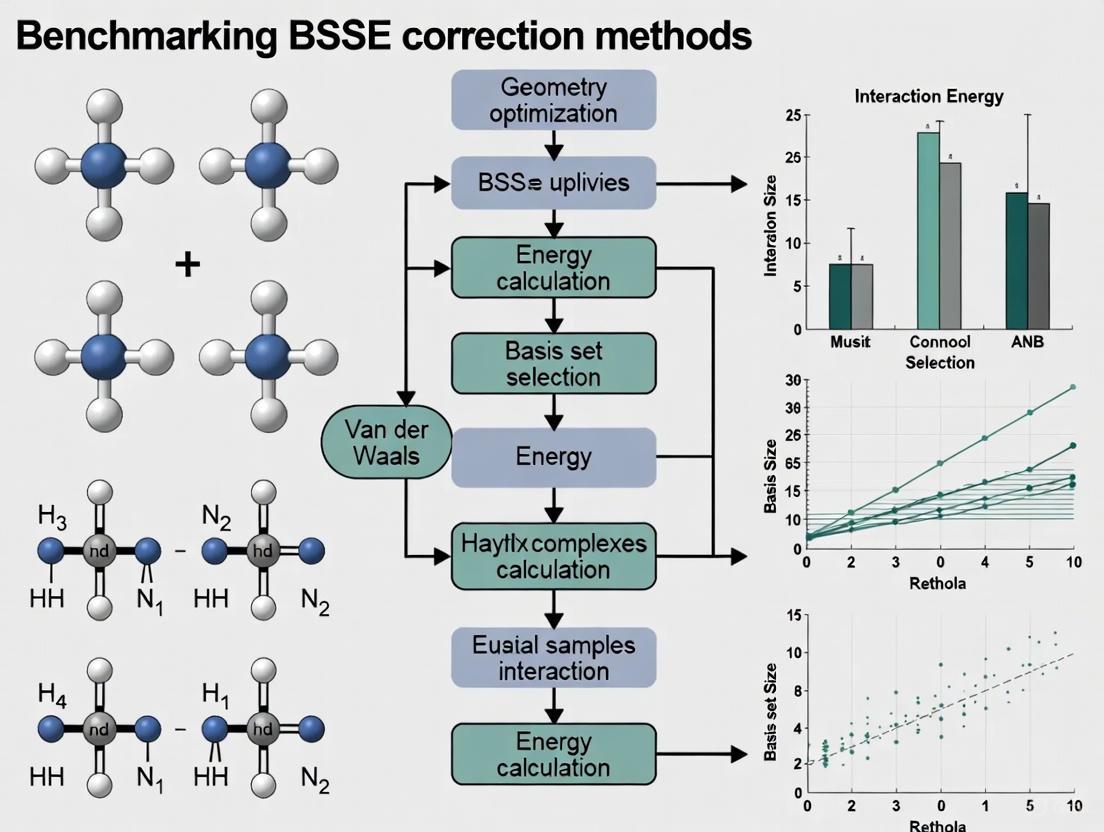
Accurately calculating weak intermolecular interactions is crucial for reliable predictions in drug design and materials science, but these calculations are inherently susceptible to Basis Set Superposition Error (BSSE).
Benchmarking BSSE Correction Methods: A Practical Guide for Accurate Modeling of Weak Interactions in Drug Development
Abstract
Accurately calculating weak intermolecular interactions is crucial for reliable predictions in drug design and materials science, but these calculations are inherently susceptible to Basis Set Superposition Error (BSSE). This article provides a comprehensive benchmark and practical guide for researchers and development professionals on contemporary BSSE correction methodologies. We explore the foundational theory of BSSE, from intermolecular complexes to often-overlooked intramolecular effects. The guide evaluates a range of correction methods, from the standard Counterpoise (CP) correction to advanced wavefunction and Density Functional Theory (DFT) approaches, including the performance of spin-component-scaled MP2 and double-hybrid functionals. We address critical troubleshooting and optimization strategies for systems ranging from biological dimers to metallophilic complexes, and present a rigorous validation framework based on high-level CCSD(T) reference data. By synthesizing the latest research, this work aims to empower scientists to select and apply the most effective BSSE correction strategies for their specific challenges in biomolecular modeling.
Understanding BSSE: From Core Concepts to Its Critical Impact on Biomolecular Interactions
In quantum chemistry calculations utilizing finite basis sets, the Basis Set Superposition Error (BSSE) represents a critical source of inaccuracy, particularly in the computation of interaction energies between molecular fragments [1] [2]. This error originates from the fundamental approach of constructing Molecular Orbitals (MOs) as linear combinations of Atomic Orbitals (AOs), which are themselves composed of basis functions centered on atomic nuclei [2]. In a system of interacting molecules, the electrons of one molecule can artificially occupy the basis functions centered on the atoms of a nearby molecule. This "borrowing" of functions effectively expands the basis set available to each monomer within a complex, leading to an artificial stabilization that does not reflect actual physical interactions [3] [1].
The classical and most straightforward academic definition of BSSE is based on the monomer/dimer dichotomy [3]. In a dimer system (A—B), the energy of each isolated monomer (EA and EB) is calculated with its own, smaller basis set. In contrast, the energy of the dimer (EAB) is calculated using the combined basis sets of both monomers. This results in each monomer appearing to have a more complete basis description in the dimer calculation than in its isolated calculation. Consequently, the interaction energy (Eint = EAB - EA - EB) is overestimated because the energy of the dimer is artificially lowered relative to the sum of the monomer energies [2]. While this error is particularly troublesome in the context of weak intermolecular interactions, such as those found in host-guest complexes or molecular recognition events, it is crucial to recognize that BSSE is not confined to these scenarios. A growing body of evidence indicates that intramolecular BSSE can also affect calculations involving different conformations or reaction pathways within a single molecule [3].
The Counterpoise Correction Method
Theoretical Foundation
To mitigate BSSE, the most widely used method is the Counterpoise (CP) correction, proposed by Boys and Bernardi [4] [2]. The CP method provides an a posteriori correction by recalculating the energies of the isolated monomers using the entire, supersystem basis set. This eliminates the imbalance in basis set completeness between the dimer and monomer calculations [1].
The CP correction first quantifies the BSSE energy (EBSSE) itself [4]:
EBSSE = EA^A^ - EA^AB^ + EB^B^ - EB^AB^
Here, EA^A^ is the energy of monomer A with its own basis set, while EA^AB^ is the energy of monomer A calculated in the presence of the ghost orbitals of monomer B (i.e., using the full dimer basis set, but without monomer B's nuclei or electrons). The same applies to monomer B. The final CP-corrected interaction energy (ΔEAB^CP^) is then calculated as [4]:
ΔEAB^CP^ = EAB^AB^ - EA^AB^ - EB^AB^
This approach ensures that the energy of each fragment is evaluated with the same, full basis set, thereby providing a more accurate representation of the true interaction energy [2].
Practical Implementation
The Counterpoise method is implemented in major quantum chemistry software packages via ghost atoms. These are atoms defined with zero nuclear charge and zero electrons that serve as placeholders to support the basis functions of the other fragment(s) during monomer energy calculations [5].
The following table outlines the implementation specifics in three common computational packages:
Table: Implementation of Counterpoise Correction in Quantum Chemistry Software
| Software | Keyword/Command | Implementation Method |
|---|---|---|
| Gaussian | Counterpoise=N (where N is fragment count) [2] |
Direct specification of fragment membership for each atom in the coordinate input. |
| Q-Chem | Use of Gh or @ symbol in molecule specification [5] |
Ghost atoms are explicitly included in the $molecule section of the input file. |
| PSI4 | bsse_type='cp' within the nbody function [6] |
Automated computation of CP-corrected interaction energies for multi-fragment systems. |
A sample input structure for a Gaussian calculation of a hydrogen fluoride dimer is illustrated below [2]:
This input calculates the CP-corrected energy for the two-fragment system, with the first pair of numbers in the charge/multiplicity line (0,1) defining the overall complex, followed by the specifications for each fragment [2].
Comparative Analysis of BSSE Correction Strategies
While the Counterpoise method is the most common corrective strategy, it is not the only one. Researchers must choose from several approaches, each with its own advantages, limitations, and optimal application domains. The selection of a strategy often involves a trade-off between computational cost, theoretical rigor, and practical accuracy.
Table: Comparison of Strategies for Handling Basis Set Superposition Error
| Strategy | Key Principle | Advantages | Disadvantages & Controversies |
|---|---|---|---|
| Counterpoise (CP) Correction [4] [2] | Recalculates monomer energies in the full dimer basis set using ghost atoms. | - Widely implemented and standardized.- Generally reliable for DFT calculations. | - Can over-correct BSSE in wavefunction-based methods [4].- Inconsistent effect across different areas of the potential energy surface [1]. |
| Larger Basis Sets | Uses a more complete (larger) basis set to inherently reduce BSSE. | - Avoids the need for an a posteriori correction.- Conceptually simple. | - Computational cost increases rapidly.- BSSE is reduced but not eliminated.- Diffuse functions can cause SCF convergence issues [4]. |
| Basis Set Extrapolation [4] | Uses mathematical extrapolation from calculations with two basis sets to estimate the Complete Basis Set (CBS) limit. | - Can achieve near-CBS accuracy with smaller basis sets.- Reduces need for diffuse functions and avoids CP procedure. | - Requires an optimized, functional-dependent exponent.- Slightly less accurate than full CP-corrected calculations in some cases [4]. |
| Chemical Hamiltonian Approach (CHA) [1] | Prevents basis set mixing a priori by modifying the Hamiltonian. | - Prevents BSSE by construction, avoiding ghost atom calculations.- Treats all fragments equally. | - Less common in mainstream quantum chemistry software.- Conceptually more complex for non-specialists. |
Performance Benchmark: Counterpoise vs. Basis Set Extrapolation
A recent 2025 study provides a direct quantitative comparison between the Counterpoise method and an advanced basis set extrapolation technique, offering valuable benchmarking data for researchers focused on weak intermolecular interactions [4]. The study employed a training set of 57 weakly interacting complexes and used the B3LYP-D3(BJ) functional to evaluate the performance of a two-point extrapolation scheme using def2-SVP and def2-TZVPP basis sets against the benchmark of CP-corrected calculations with the ma-TZVPP basis set [4].
Table: Benchmarking Data for BSSE Correction Methods in Weak Interaction Calculations [4]
| Method | Mean Relative Error vs. Benchmark | Computational Cost (Relative) | Key Prerequisites / Parameters |
|---|---|---|---|
| CP-corrected ma-TZVPP | Benchmark (~0%) | ~2.0x (Baseline) | - ma-TZVPP basis set.- Additional CP calculations for monomers. |
| Extrapolation (def2-SVP/TZVPP) | ~2% | ~1.0x (Approx. half the time) | - Optimized exponent (α = 5.674).- Single-point energies with two basis sets. |
The study concluded that the optimized extrapolation scheme (with α = 5.674) produced interaction energies that closely matched the CP-corrected benchmark, with a mean relative error of only about 2% [4]. While this extrapolation method was slightly less accurate than the full CP correction, it required only about half the computational time, presenting an efficient and simplified alternative for large-scale DFT calculations of weak interactions, such as those in supramolecular systems [4].
The Scientist's Toolkit: Essential Reagents for BSSE Research
For computational chemists benchmarking BSSE correction methods, the "research reagents" are the standardized computational tools, basis sets, and test sets that ensure reproducible and comparable results.
Table: Essential Research Reagents for Benchmarking BSSE Correction Methods
| Tool / Reagent | Function in BSSE Research | Application Notes |
|---|---|---|
| Benchmark Test Sets (e.g., S22, S30L, S66) [4] | Provide standardized geometries and reliable reference data for a wide range of weak interaction types. | Crucial for training and validating new methods, such as optimizing extrapolation parameters. |
| Dunning's cc-pVXZ Basis Sets | Correlation-consistent basis sets designed for systematic convergence to the CBS limit. | Often used in high-accuracy wavefunction theory; can be minimally augmented (ma-) for weak interactions [4]. |
| Ahlrichs' def2 Series (SVP, TZVPP) [4] | Balanced, efficient basis sets widely used in DFT calculations for molecules of various sizes. | Commonly chosen for two-point CBS extrapolation schemes in DFT. |
| Grimme's D3 Dispersion Correction [4] | Adds empirical dispersion corrections to DFT functionals, which are critical for describing weak interactions. | As this correction is geometry-dependent but basis-set independent, it is compatible with extrapolation methods [4]. |
Ghost Atoms / Gh Keyword [5] |
The fundamental "reagent" for performing Counterpoise corrections in most quantum chemistry codes. | Allows a monomer's energy to be computed in the full supersystem basis set. |
Experimental Protocols for BSSE Assessment
Standard Protocol for Counterpoise-Corrected Interaction Energy
A typical workflow for calculating a CP-corrected interaction energy for a dimer (A—B) involves several key stages, from geometry preparation to final energy computation.
- Geometry Preparation: Obtain a optimized geometry for the A—B dimer complex. This initial optimization can be performed at an appropriate but potentially lower level of theory to save computational resources. It is critical that the monomer geometries used in the subsequent single-point calculations are extracted directly from this optimized complex without further relaxation (the "rigid monomer" approximation) [4].
- Single-Point Energy Calculation on the Complex: Perform a single-point energy calculation on the full dimer complex to obtain E
AB^AB^. - Single-Point Energy Calculations on Monomers with Ghost Atoms: Perform single-point energy calculations on isolated monomer A and monomer B, but in each calculation, include the ghost atoms of the other fragment. This yields E
A^AB^ and EB^AB^ [2] [5]. - Energy Calculation: Compute the final CP-corrected interaction energy using the formula: ΔE
AB^CP^ = EAB^AB^ - EA^AB^ - EB^AB^ [4] [2].
Protocol for Basis Set Extrapolation (2025 Method)
The recent extrapolation method offers an alternative pathway that avoids explicit CP correction while achieving near-complete basis set accuracy.
- Geometry and Initial Calculations: Use the optimized geometry of the complex. Perform two separate single-point energy calculations on the dimer: one with a smaller basis set (e.g., def2-SVP) and another with a larger basis set (e.g., def2-TZVPP) [4].
- Energy Extraction: Extract the electronic energy from each calculation. Note that if an empirical dispersion correction (like D3) is used, it is basis-set independent and should not be included in the extrapolation [4].
- Extrapolation: Apply the exponential-square-root (expsqrt) extrapolation formula to estimate the energy at the Complete Basis Set (CBS) limit [4]:
E
CBS= EX+ (EX- EY) / (e^(-α√Y) - e^(-α√X)) * e^(-α√X) Here, X and Y are the cardinal numbers of the basis sets (e.g., 2 for double-ζ def2-SVP, 3 for triple-ζ def2-TZVPP), and α is the optimized parameter (5.674 for the B3LYP-D3(BJ) functional with the def2 basis sets) [4]. - Interaction Energy Calculation: Use the extrapolated CBS energy for the complex and the isolated monomers (similarly extrapolated) to compute the final, high-quality interaction energy without an explicit CP correction.
The "monomer-dimer dichotomy" provides the foundational context for understanding and defining Basis Set Superposition Error. The Counterpoise correction stands as the long-established, robust method for its mitigation, indispensable for obtaining reliable interaction energies, particularly with small to medium-sized basis sets. However, the field of BSSE correction is not static. The development of efficient basis set extrapolation parameters, as highlighted in the recent 2025 study, demonstrates a continuing evolution toward more computationally economical strategies that can deliver near-CBS accuracy for large supramolecular systems relevant to drug development [4].
Furthermore, the research community is increasingly aware that BSSE is not solely a problem of intermolecular interactions. Evidence shows that intramolecular BSSE can systematically affect computed properties like proton affinities and conformational energies, reminding researchers that this error permeates a broader range of electronic structure calculations than previously assumed [3]. For scientists and drug development professionals, the choice of BSSE correction strategy must be a conscious one, informed by the nature of the system, the required accuracy, and the available computational resources. Benchmarking against established test sets and understanding the limitations of each method remain paramount for producing trustworthy and reproducible computational results.
Basis set superposition error (BSSE) is traditionally presented in quantum chemistry textbooks as a problem exclusive to the study of intermolecular complexes, particularly those dominated by non-covalent interactions. However, emerging research fundamentally challenges this paradigm, revealing that BSSE permeates all types of electronic structure calculations, including those involving covalent bonds and conformational changes within single molecules [3] [7]. The academic definition of BSSE has historically been rooted in the monomer/dimer dichotomy, where the energy of each monomer in a complex is artificially stabilized through the borrowing of basis functions from the other monomer [3]. This framing has inadvertently confined the discussion to molecular recognition processes, host-guest complexes, and dimerization events, creating a significant blind spot in computational chemistry practice.
A more comprehensive definition proposed by Hobza better captures the universal nature of this error: "The BSSE originates from a non-adequate description of a subsystem that then tries to improve it by borrowing functions from the other sub-system(s)" [3] [7]. He further clarifies that "the same effect should take place also within an isolated system where one part is improving its description by borrowing orbitals from the other one" [3] [7]. This intramolecular BSSE manifests when different portions of the same molecule artificially stabilize each other through their overlapping basis functions, particularly when using limited basis sets [1]. The error was largely neglected until researchers began reporting anomalous results, such as non-planar benzene structures, that were ultimately traced to intramolecular BSSE effects [3] [7].
The persistence of this oversight stems from two primary factors: the relative ease of applying counterpoise corrections to separate monomers in intermolecular complexes, and the historical focus of basis set developers on accurate descriptions of atomic fragments when covalent bonds are broken [3]. This review synthesizes recent advances in quantifying, correcting, and benchmarking BSSE correction methods, with particular emphasis on strategies that address both inter- and intra-molecular manifestations of this pervasive error.
Theoretical Foundations: From Intermolecular to Intramolecular BSSE
Fundamental Mechanisms and Traditional Counterpoise Correction
BSSE arises inherently from the use of atom-centered Gaussian basis functions in quantum chemical calculations [3]. In intermolecular complexes, the error emerges because "the wavefunction of the monomer is expanded in much less basis functions than the wavefunction of the complex" [8]. In the complex, each monomer has access to additional basis functions from neighboring monomers, creating an artificial stabilization that doesn't exist in reality [8]. The conventional interaction energy calculation:
E_int = E(AB, r_c) - E(A, r_e) - E(B, r_e)
where rc represents the geometry of the complex AB and re represents the geometry of separate reactants, produces values that are "often too large" and lead to "severe complications for systems bound through dispersion interactions or hydrogen bonds" [8].
The standard approach for correcting this error is the counterpoise (CP) method developed by Boys and Bernardi [4] [1], which calculates a corrected interaction energy:
E_int_CP = E(AB, r_c)^AB - E(A, r_c)^AB - E(B, r_c)^AB
where the superscript AB indicates that all calculations are performed using the full basis set of the complex [8]. This is typically achieved through the use of "ghost orbitals" - basis functions positioned at atomic centers but lacking electrons or nuclei [1]. Although the CP method has been subject to longstanding controversy, particularly regarding its application in wavefunction-based methods, it is generally considered reliable for density functional theory (DFT) calculations [4].
The Intramolecular BSSE Paradigm
The recognition of intramolecular BSSE represents a significant conceptual expansion. This error occurs within single molecules when "one part is improving its description by borrowing orbitals from the other one" [3] [7]. Unlike its intermolecular counterpart, intramolecular BSSE cannot be addressed through simple fragment-based counterpoise corrections, as the definition of "fragments" within a covalently bonded system becomes arbitrary [9].
Early concerns about BSSE affecting covalent bonds emerged during the development of Atomic Natural Orbital (ANO) basis sets and the study of small molecules with strongly correlated methods [3] [7]. However, this awareness remained largely confined to specialists in basis set development and high-accuracy simulations until relatively recently [3]. The problem gained broader recognition when researchers demonstrated that intramolecular BSSE affects even small molecules like F₂, water, and ammonia [3] [7], and can significantly impact results for transition states in reactions such as the Diels-Alder cycloaddition [3].
The magnitude of intramolecular BSSE becomes particularly problematic for large systems, where the cumulative effect of small individual errors can lead to significant deviations from reality [3]. In macromolecular systems, these small contributions "add up quickly as the system size increases" [3], creating substantial errors in calculated properties including geometries, conformational energies, and reaction barriers.
Methodological Approaches: Benchmarking BSSE Correction Strategies
Traditional Counterpoise Correction and Its Limitations
The conventional counterpoise method, while established for intermolecular interactions, faces several theoretical and practical challenges:
Intermolecular Focus: The standard CP correction is designed for systems with clearly separable fragments [8] [1], making direct application to intramolecular BSSE problematic.
Geometrical Dependence: The placement of ghost orbitals becomes ambiguous when monomer structures change significantly upon complex formation [8]. A modified approach addresses this by separating the process into deformation and complexation steps [8].
Computational Cost: Performing CP corrections "increases computational cost and complexity" [4], particularly for large systems where multiple single-point calculations are required.
Controversial Efficacy: In wavefunction-based methods, the CP approach "tends to overestimate BSSE" [4], and some studies suggest it "is not recommended for improving the CBS extrapolation results" [4].
For intramolecular BSSE, the traditional CP method becomes even more problematic due to the arbitrary definition of molecular fragments. This limitation has driven the development of alternative approaches that can more effectively address BSSE in covalently bonded systems.
Emerging Correction Schemes
Geometrical Counterpoise (gCP) Correction
The geometrical counterpoise (gCP) method represents a significant advancement for addressing BSSE in large systems [9]. This "semi-empirical counterpoise-type correction" depends exclusively on molecular geometry and requires no electronic wavefunction input [9]. The gCP approach uses an atom pair-wise potential to correct for both inter- and intra-molecular BSSE and is applicable to systems with "ten thousands of atoms" [9].
The method's four parameters were determined by fitting to standard Boys-Bernardi counterpoise corrections for Hobza's S66×8 set of non-covalently bound complexes (528 data points) [9]. While particularly effective for small basis sets (minimal, split-valence), it also provides "reliable results for larger triple-ζ sets" [9]. For intermolecular BSSE, gCP calculates the error within a "typical error of 10%-30%" [9], which proves sufficient for many practical applications.
The gCP method has demonstrated particular utility for biomolecular systems. In the crambin protein, "gCP removes intramolecular BSSE effectively and yields conformational energies comparable to def2-TZVP basis results" [9]. Similarly, excellent agreement with Jensen's ACP(4) scheme was observed for estimating intramolecular BSSE in the phenylalanine-glycine-phenylalanine tripeptide [9].
Basis Set Extrapolation Techniques
Basis set extrapolation represents an alternative strategy for mitigating BSSE by approaching the complete basis set (CBS) limit [4]. The exponential-square-root (expsqrt) function:
E_HF^∞ = E_HF^X - A · e^(-α√X)
where EHF^∞ refers to the HF energy at the CBS limit and EHF^X represents the HF energy computed with a basis set of cardinal number X, provides an effective extrapolation scheme [4].
Recent work has optimized the extrapolation exponent parameter (α = 5.674) for DFT calculations of weak interactions using def2-SVP and def2-TZVPP basis sets [4]. This approach "closely match those from CP-corrected ma-TZVPP calculations, with a mean relative error of ~2%" while requiring "only about half the computational time" [4]. The method has been validated across multiple benchmark sets (S66, L7, NIAR20) and various functionals, confirming its "robustness and transferability" [4].
DFT-C Empirical Correction
The DFT-C method represents another empirical approach specifically designed to correct for BSSE in the def2-SVPD basis [10]. This method "represents a significant improvement over gCP, particularly for non-covalently-interacting molecular clusters" and demonstrates excellent transferability among density functionals [10]. When combined with existing functionals such as B97M-V, DFT-C can "recover large-basis results at a fraction of the cost" [10], offering a practical solution for high-throughput screening applications in drug discovery.
Comparative Performance Assessment
Table 1: Performance Comparison of BSSE Correction Methods for Non-Covalent Interactions
| Correction Method | Theoretical Basis | Applicable System Types | Key Advantages | Reported Accuracy |
|---|---|---|---|---|
| Traditional Counterpoise [4] [8] | Fragment energy in full basis | Intermolecular complexes | Well-established, conceptually simple | Overestimates BSSE in wavefunction methods; reliable for DFT |
| Geometrical CP (gCP) [9] | Atom pair-wise potential | Inter- & intramolecular, large systems | No wavefunction input, works with thousands of atoms | 10-30% error for intermolecular BSSE |
| Basis Set Extrapolation [4] | Exponential convergence | Intermolecular interactions avoids CP correction, reduces SCF issues | ~2% mean relative error vs. CP-corrected ma-TZVPP | |
| DFT-C [10] | Empirical correction | Non-covalent clusters | Better than gCP for molecular clusters, transferable | Recovers large-basis results at reduced cost |
Table 2: Impact of Basis Set Selection on BSSE Magnitude in Water Dimer Calculations [11]
| Basis Set | B3LYP ΔE (kcal/mol) | B3LYP O-O Distance (Å) | M06-2X ΔE (kcal/mol) | M06-2X O-O Distance (Å) |
|---|---|---|---|---|
| 6-31G(d) | -6.24 | 2.752 | -5.89 | 2.785 |
| 6-311++G(d,p) | -5.12 | 2.865 | -5.21 | 2.876 |
| aug-cc-pVDZ | -4.98 | 2.902 | -5.14 | 2.901 |
| aug-cc-pV5Z | -4.93 | 2.907 | -5.07 | 2.900 |
Experimental Protocols for BSSE Benchmarking
Standardized Benchmark Sets and Evaluation Metrics
Robust evaluation of BSSE correction methods requires well-designed benchmark sets that encompass diverse interaction types:
The S22 and S66 Sets: These collections contain 22 and 66 non-covalently bound complexes, respectively, covering "a wide range of weak interaction types" including hydrogen bonding, dispersion, and mixed complexes [4] [9]. The S66×8 extension provides "528 data points" with systematically varied intermolecular distances [9].
Training Set Composition: A comprehensive training set can be constructed by combining the S22, S30L, and CIM5 test sets, resulting in "57 weakly interacting systems" with the largest containing "up to 205 atoms" [4].
Evaluation Metrics: The primary metric for assessing BSSE correction performance is the mean absolute deviation (MAD) from reference values. For example, the "gCP-corrected HF-D3/(minimal basis) level" achieves "MAD=0.51 kcal/mol (0.38 kcal/mol after D3-refit) for the S66 benchmark" [9], representing excellent performance given the minimal basis set used.
Proton Affinity Calculations as a Diagnostic Tool
Proton affinity and gas-phase basicity calculations provide a sensitive probe for intramolecular BSSE effects [3] [7]. These properties are ideal for benchmarking because they:
- Operate in the gas phase, eliminating environmental artifacts [3] [7]
- Have accurate experimental data readily available [3] [7]
- Span a relatively wide energy range, maximizing signal-to-noise ratio [3] [7]
- Involve localized molecular changes, providing clear BSSE loci [3] [7]
Systematic studies of hydrocarbons with increasing size reveal how BSSE and basis set incompleteness error (BSIE) manifest "in orthogonal directions as the size of the basis set and the size of the molecular system are varied" [3] [7].
Computational Methodology for High-Accuracy Calculations
To minimize numerical errors in BSSE benchmarking studies, specialized computational protocols are essential:
Integration Grids: "A superfine pruned grid for the numerical integration containing 150 radial points and 974 angular points per shell" ensures numerical accuracy in DFT calculations [3] [7].
Convergence Criteria: "Tight self-consistent field (SCF) convergence criteria" prevent false convergence that might artificially affect energy differences [3] [7].
Thermodynamic Properties: These should be obtained "using standard statistical mechanical expressions for separable vibrational, rotational, and translational contributions within the harmonic oscillator, rigid rotor, and ideal gas/particle-in-a-box models in the canonical ensemble" [3] [7].
Proton Thermodynamics: The entropy and enthalpy of protons must be treated consistently using the Sackur-Tetrode equation and ideal gas law derivations [3] [7].
Table 3: Research Reagent Solutions for BSSE-Corrected Computational Chemistry
| Tool Category | Specific Implementation | Primary Function | Key Applications |
|---|---|---|---|
| BSSE Correction Methods | Counterpoise (Gaussian) [8] | Traditional BSSE correction for intermolecular complexes | Benchmark studies, small to medium complexes |
| gCP correction [9] | Geometrical correction for inter- and intra-molecular BSSE | Large systems (proteins, nanomaterials), high-throughput screening | |
| Basis set extrapolation [4] | Approaching CBS limit without explicit CP correction | Accurate benchmark values, method development | |
| Benchmark Sets | S22, S66, S66×8 [4] [9] | Standardized complexes for method validation | General method evaluation, non-covalent interactions |
| Proton affinity series [3] [7] | Diagnostic set for intramolecular BSSE | Covalent bond studies, reactivity applications | |
| Software Tools | DUBS framework [12] | Standardized benchmarking set generation | Drug discovery, virtual screening validation |
| Gaussian [3] [7] | Traditional quantum chemistry with CP correction | General quantum chemistry, method development | |
| Basis Sets | def2-SVP, def2-TZVPP [4] | Balanced accuracy/efficiency for extrapolation | Production work, large system calculations |
| aug-cc-pVXZ (X=D,T,Q,5) [11] | Systematic basis set convergence studies | Benchmark calculations, method validation |
Integrated Workflow for BSSE Assessment and Correction
The following diagram illustrates a comprehensive strategy for identifying and addressing both inter- and intra-molecular BSSE in computational research:
BSSE Assessment and Correction Workflow
This workflow emphasizes the importance of system-specific correction strategies. For traditional intermolecular complexes, both standard counterpoise and basis set extrapolation methods remain viable options [4] [8]. For covalently bonded systems and large molecules where intramolecular BSSE dominates, geometrical corrections like gCP provide the most practical solution [9]. All methods should be validated against appropriate benchmark sets to ensure reliability [4] [9].
The recognition that BSSE affects both intermolecular complexes and covalent bonds within single molecules represents a critical paradigm shift in computational chemistry. The historical focus on non-covalent interactions has created a significant gap in methodology for addressing intramolecular BSSE, particularly as calculations extend to larger, more chemically relevant systems. The development of efficient correction schemes like gCP, DFT-C, and optimized basis set extrapolation parameters provides practical solutions that balance accuracy with computational feasibility.
For researchers in drug discovery and materials science, where large systems are the norm rather than the exception, incorporating these BSSE correction strategies is increasingly essential for generating reliable results. The benchmark sets and protocols outlined here provide a foundation for systematic evaluation of computational methods across both inter- and intra-molecular contexts. As quantum chemical applications continue to expand into complex biological and materials systems, robust handling of BSSE in all its manifestations will be crucial for advancing predictive computational chemistry.
Moving forward, the field would benefit from more standardized reporting of BSSE correction protocols in computational studies, similar to the established practices for reporting basis sets and functionals. Community-wide adoption of consistent benchmarking practices, potentially facilitated by frameworks like DUBS [12], will enhance the reliability and reproducibility of computational results across diverse chemical applications.
In modern drug development, the rational design of new therapeutics hinges on our ability to accurately predict how potential drug molecules interact with their biological targets. Molecular recognition forms the basis for virtually all biological processes, and understanding the interactions between proteins and their ligands is key to rationalizing enzymatic processes and the mechanisms by which cellular systems integrate and respond to regulatory signals [13]. Computational models seek to predict receptor-ligand binding free energies from the known or presumed structure of the corresponding complex, with physics-based models offering the potential to incorporate greater detail and achieve sufficient accuracy for ligand optimization [13].
However, a persistent challenge in these computational approaches is the accurate quantification of weak intermolecular interactions, particularly those involving hydrogen bonds which play indispensable roles in structure-based drug design [14]. These interactions are crucial for determining protein-ligand selectivity and affinity, yet their accurate computation is complicated by theoretical artifacts, most notably the basis set superposition error (BSSE). BSSE artificially inflates interaction energies in quantum mechanical calculations, potentially leading to inaccurate predictions of binding affinity and stability. This guide examines how BSSE skews interaction energies in protein-ligand and protein-DNA systems, compares correction methodologies, and provides protocols for researchers to implement robust computational assessments in their drug discovery pipelines.
Theoretical Foundations: Intermolecular Interactions and BSSE
The Physical Basis of Protein-Ligand and Protein-DNA Interactions
Hydrogen bonds (HBs) are the most abundant motifs in biological systems and play a key role in determining protein-ligand binding affinity and selectivity [14]. In biological systems, the HB process continuously competes with bulk water, creating a complex energetic landscape that significantly influences molecular function [15]. The recognition of DNA by proteins is guided by an innate hydrogen-bonding pattern that generates an initial unstable nonspecific, intermediate complex with high energy before transitioning to a stable, highly specific low-energy state [16].
The thermodynamic strength of association between a ligand molecule and its target receptor is measured by the standard free energy of binding (ΔG_b°). Statistically, this can be expressed through the configurational partition functions of the complex, receptor, and ligand in solution [13]. For protein-DNA complexes, interfacial hydrogen bonds display a unique energy distribution of both strong and weak hydrogen bonds, with highly specific complexes containing more strong hydrogen bonds than multi-specific complexes [16].
Table 1: Key Intermolecular Interactions in Drug Development
| Interaction Type | Role in Drug Action | Strength Range | Susceptibility to BSSE |
|---|---|---|---|
| Hydrogen Bonding | Determines binding specificity and affinity | Moderate (1-5 kcal/mol) | High |
| van der Waals | Contributes to binding stability | Weak (0.5-1 kcal/mol) | Moderate |
| π-π Stacking | Influences aromatic compound binding | Moderate (1-4 kcal/mol) | Moderate to High |
| Electrostatic | Critical for ionic interactions | Variable | High |
The Basis Set Superposition Error (BSSE) Problem
BSSE arises in quantum chemical calculations of molecular interactions when incomplete basis sets are used to describe the electronic structure of molecular complexes. The error manifests as an artificial lowering of the interaction energy because fragments of the complex can "borrow" basis functions from neighboring fragments, creating a more complete basis than when calculated in isolation. This leads to overestimated binding energies and compromised predictions in drug design.
The magnitude of BSSE depends on several factors:
- Basis set size: Smaller basis sets exhibit larger BSSE
- System composition: Molecular complexes with diffuse electron clouds are more susceptible
- Intermolecular distance: BSSE is most pronounced near the equilibrium geometry
- Chemical composition: Polar molecules and hydrogen-bonded systems show significant errors
Comparative Analysis of BSSE Correction Methods
Methodological Approaches and Their Implementation
Several computational approaches have been developed to correct for BSSE, each with distinct theoretical foundations and implementation requirements. The choice of method significantly impacts the accuracy of predicted binding affinities in drug discovery applications.
Table 2: BSSE Correction Methods for Biomolecular Interactions
| Method | Theoretical Basis | Implementation Complexity | Computational Cost | Accuracy for H-Bonds |
|---|---|---|---|---|
| Counterpoise (CP) | Boys-Bernardi function counterpoise technique | Moderate | High (2N+1 calculations) | Excellent |
| Chemical Hamiltonian Approach (CHA) | Direct elimination of BSSE from Hamiltonian | High | Moderate | Very Good |
| Valence Bond (VB) Methods | Resonance structure analysis | Very High | Very High | Good |
| Density Functional Theory (DFT) with Dispersion Correction | Empirical dispersion corrections | Low to Moderate | Moderate | Variable |
| Localized Molecular Orbital (LMO) | Localized orbital decomposition | High | High | Excellent |
Performance Benchmarking in Biological Systems
Recent studies have quantified the impact of BSSE on interaction energies in biologically relevant systems. For protein-ligand complexes, BSSE can account for 10-50% of the uncorrected binding energy, with the largest effects observed in hydrogen-bonded systems and stacking interactions. In protein-DNA complexes, where hydrogen bonds play a critical role in base readout and binding specificity [16], BSSE artifacts can significantly alter the predicted binding preferences and specificity patterns.
The following experimental data compiled from recent studies illustrates the magnitude of BSSE in different biological interaction types:
Table 3: Quantitative BSSE Effects on Biological Interactions
| System Type | Typical Uncorrected Interaction Energy (kcal/mol) | Average BSSE Contribution | Corrected Energy (kcal/mol) | Recommended Correction Method |
|---|---|---|---|---|
| Protein-Ligand H-Bond | -5.2 to -7.8 | 15-25% | -4.4 to -6.2 | Counterpoise with medium basis set |
| DNA Base Pairing | -8.5 to -12.3 | 20-35% | -6.8 to -9.2 | CP with aTZ basis set |
| - Protein-DNA Minor Groove | -6.8 to -9.4 | 18-30% | -5.6 to -7.5 | CHA with polarization functions |
| - Aromatic Stacking | -2.8 to -4.2 | 10-20% | -2.5 to -3.7 | DFT-D3 with BJ damping |
| - Enzyme-Inhibitor Complex | -25.5 to -35.7 | 12-22% | -22.4 to -29.6 | CP with composite methods |
Experimental Protocols for BSSE Assessment
Standardized Workflow for BSSE Correction in Protein-Ligand Systems
Implementing a robust protocol for BSSE assessment is crucial for obtaining reliable binding energy predictions in drug discovery. The following workflow provides a standardized approach:
Protocol 1: Counterpoise Correction for Binding Affinity (Based on [13] [14])
System Preparation
- Obtain protein-ligand complex structure from PDB or molecular docking
- Separate complex into individual fragments (protein, ligand)
- Ensure consistent atom numbering across all calculations
Geometry Optimization
- Optimize geometry of the complex using medium-level basis set (e.g., 6-31G*)
- Apply constraints to maintain biological relevance of the structure
- Verify optimization convergence through frequency analysis
Single-Point Energy Calculations
- Compute energy of complex: E(AB)
- Compute energy of fragment A in full basis: E(A)
- Compute energy of fragment B in full basis: E(B)
- Compute energy of fragment A with ghost orbitals: E(A|B)
- Compute energy of fragment B with ghost orbitals: E(B|A)
BSSE Calculation
- Apply Boys-Bernardi formula: E_BSSE = [E(A) - E(A|B)] + [E(B) - E(B|A)]
- Calculate corrected binding energy: ΔEcorrected = ΔEuncorrected - E_BSSE
Validation
- Perform basis set convergence testing
- Compare with larger basis set results when feasible
- Assess thermodynamic consistency through multiple configurations
Hydrogen Bond Strength Analysis Protocol
The strength of hydrogen bonds in protein-ligand complexes can be quantitatively analyzed using local vibrational mode analysis, which provides insights into how BSSE might affect these critical interactions [14].
Protocol 2: Hydrogen Bond Strength Assessment (Adapted from [14] [16])
Database Construction
- Curate protein-ligand complexes from PDBBind dataset
- Add missing protons and optimize geometries using XTB/GFN-xTB
- Identify hydrogen bonds using EDHB software
Local Vibrational Mode Analysis
- Calculate local mode force constants for identified H-bonds
- Establish correlation between force constants and bond strength
- Generate hydrogen bond energy database
BSSE Impact Quantification
- Compare corrected vs. uncorrected hydrogen bond energies
- Analyze patterns in BSSE magnitude across different amino acid residues
- Identify functional groups most susceptible to BSSE artifacts
Successful implementation of BSSE correction protocols requires specific computational tools and resources. The following table details essential components for researchers working in this field.
Table 4: Research Reagent Solutions for BSSE Studies
| Category | Specific Tool/Resource | Function | Application Context |
|---|---|---|---|
| Software Packages | Gaussian, ORCA, PSI4 | Quantum chemical calculations with BSSE correction | Counterpoise implementation for interaction energies |
| Analysis Tools | EDHB [14] | Hydrogen bond detection and strength analysis | Protein-ligand complex characterization |
| Databases | PDBBind [14] | Curated protein-ligand complexes with binding data | Benchmarking and validation studies |
| Force Fields | AMBER, CHARMM | Classical molecular dynamics simulations | Pre-screening of conformational space |
| Basis Sets | cc-pVDZ, cc-pVTZ, aTZ | Balanced description of molecular orbitals | BSSE minimization in QM calculations |
| Visualization | PyMOL, VMD | Structural analysis and rendering | Identification of interaction networks |
Implications for Drug Discovery and Development
Impact on Binding Affinity Predictions
The accurate correction of BSSE has direct implications for structure-based drug design. When BSSE is not properly accounted for, binding affinity predictions can be overestimated by significant margins, leading to false positives in virtual screening campaigns. Physics-based models of protein-ligand binding have the potential to incorporate greater detail and achieve sufficient accuracy to address aspects of drug development such as ligand optimization, but their effectiveness depends on proper treatment of theoretical artifacts like BSSE [13].
Recent trends in drug discovery highlight the growing importance of accurate binding predictions, with AI-powered platforms and in silico screening becoming frontline tools in pharmaceutical R&D [17]. These approaches rely on quantitatively correct interaction energies to prioritize compound synthesis and experimental testing. The integration of BSSE-corrected quantum mechanical calculations with machine learning approaches represents a promising direction for improving predictive accuracy.
Correlation with Experimental Results
Proper BSSE correction improves the correlation between computational predictions and experimental binding measurements. Studies comparing computational binding affinities with experimental values from isothermal titration calorimetry (ITC) and surface plasmon resonance (SPR) have demonstrated that BSSE-corrected calculations show significantly better agreement than uncorrected ones. This alignment is particularly important for DNA-targeting drugs, where specific hydrogen bond patterns determine binding specificity [16].
The relationship between hydrogen bond strength and binding affinity follows a complex pattern due to water competition effects. Research has shown that H-bonds enhance receptor-ligand interactions when both donor and acceptor have either significantly stronger or significantly weaker H-bonding capabilities than hydrogen and oxygen atoms in water [15]. This pairing principle highlights the importance of accurate energy calculations that properly account for solvation effects and basis set artifacts.
The stakes for accurate interaction energy calculations in drug development are exceptionally high, as BSSE artifacts can lead to costly misdirection in lead optimization campaigns. Based on the current analysis, the following best practices are recommended:
Always implement BSSE correction for quantitative binding energy predictions, with the Counterpoise method as the default choice for most applications.
Perform basis set convergence tests to ensure results are not dominated by BSSE, moving to larger basis sets when computational resources allow.
Contextualize BSSE magnitude relative to other computational uncertainties, including conformational sampling, solvation effects, and entropy estimation.
Validate computational predictions against experimental data when possible, particularly for novel chemical scaffolds or unusual binding motifs.
Document correction methodologies thoroughly in research publications to enable proper comparison across studies and facilitate reproducibility.
As drug discovery continues to evolve with increasingly sophisticated computational approaches, the proper treatment of BSSE remains fundamental to accurate predictions of protein-ligand binding and DNA stability. By implementing robust correction protocols and maintaining awareness of methodological limitations, researchers can significantly improve the predictive power of computational models in pharmaceutical development.
In computational chemistry, the accuracy of quantum chemical calculations is fundamentally limited by the use of finite basis sets. Two seemingly distinct errors emerge from this limitation: the Basis Set Superposition Error (BSSE) and the Basis Set Incompleteness Error (BSIE). While often discussed in different contexts, a deeper analysis reveals they are complementary manifestations of the same underlying issue. BSSE is an over-stabilization error occurring when describing intermolecular interactions, famously corrected by the Boys-Bernardi counterpoise method [18] [3]. In contrast, BSIE is a general under-binding error resulting from an inadequate description of the electron correlation cusp, leading to systematically low binding energies [19] [20]. Understanding their synergistic relationship is critical for benchmarking correction methods, particularly in weak intermolecular interactions relevant to drug development, such as halogen bonding [18].
Experimental Evidence and Comparative Data
Quantifying Errors in Halogen Bonding Complexes
The table below summarizes interaction energies and error analysis for a series of halogen-bonded complexes, showcasing the direct impact of BSSE and BSIE. The data demonstrates how different theoretical models and basis sets yield inconsistent energy orders, challenging model accuracy [18].
Table 1: Interaction Energies and Error Analysis for Selected Halogen Bonding Complexes
| Complex | CCSD(T)/aug-cc-pVTZ IE (kcal/mol) | SAPT2+ IE (kcal/mol) | Electrostatic Component (%) | Dispersion Component (%) | BSSE Magnitude (kcal/mol) |
|---|---|---|---|---|---|
| ClBr···Br− | -8.52 | -8.48 | 58.5 | 22.1 | ~0.5 - 1.0 |
| R1-X···N-R2 | -4.15 to -6.33 | -4.10 to -6.30 | 55-65 | 20-30 | ~0.3 - 0.8 |
| R1-X···O-R2 | -3.89 to -5.71 | -3.85 to -5.68 | 60-70 | 15-25 | ~0.2 - 0.7 |
| R1-X···S-R2 | -2.95 to -4.22 | -2.92 to -4.19 | 45-55 | 25-35 | ~0.1 - 0.5 |
Intramolecular BSSE in Proton Affinity Calculations
BSSE is not confined to intermolecular complexes. The table below shows calculated proton affinities for hydrocarbons of increasing size, revealing significant intramolecular BSSE when using smaller basis sets. This error artificially destabilizes protonated forms and becomes more pronounced with molecular size [3].
Table 2: Basis Set Dependence of Proton Affinities (kcal/mol) Demonstrating Intramolecular BSSE
| Molecule | 6-31G* | 6-311G* | aug-cc-pVDZ | aug-cc-pVTZ | Experiment |
|---|---|---|---|---|---|
| Ethene | 255.1 | 259.5 | 260.8 | 262.1 | 262.5 |
| Benzene | 225.3 | 232.6 | 234.9 | 236.2 | 237.0 |
| Naphthalene | 218.5 | 228.9 | 232.1 | 233.8 | 235.1 |
| MAE vs. Exp. | ~8.5 | ~4.0 | ~2.0 | ~1.0 | - |
Detailed Experimental Protocols
Protocol 1: Benchmarking Weak Intermolecular Interactions
This protocol, derived from studies on halogen bonding systems, provides a robust framework for evaluating BSSE/BSIE correction methods [18].
- System Selection: Curate a diverse set of noncovalent complexes. A recommended benchmark is the A24 data set, comprising 24 dimers, or the 44 halogen-bonding complexes (31 neutral, 13 anionic) covering R1-X···N-R2, R1-X···O-R2, R1-X···S-R2, and R1-X1···X2-R2 interaction types [18] [19].
- Geometry Optimization: Perform initial geometry optimization using a robust functional like M06-2X combined with the aug-cc-pVTZ basis set [18].
- Single-Point Energy Calculations: Calculate interaction energies (IE) using high-level methods:
- Gold Standard: CCSD(T) with a large basis set (e.g., aug-cc-pVTZ or larger). Apply the Boys-Bernardi counterpoise method to correct for BSSE [18].
- Reference Method: Symmetry-Adapted Perturbation Theory (SAPT), such as SAPT2+(3)δMP2/aug-cc-pVQZ, to decompose the interaction energy into physical components (electrostatics, induction, dispersion, exchange) [18].
- Error Analysis: Compare the performance of density functional theory (DFT) methods or other models against the gold standard. Calculate the magnitude of BSSE and assess BSIE by comparing results across a basis set sequence (e.g., cc-pVDZ → cc-pVTZ → cc-pVQZ).
Protocol 2: Assessing Intramolecular BSSE in Reactivity
This protocol evaluates the impact of intramolecular BSSE on chemical properties like proton affinity [3].
- Thermochemical Calculation: For a series of molecules (e.g., hydrocarbons of increasing size), calculate the proton affinity (PA) or gas-phase basicity (GPB) using the reaction: B + H+ → BH+.
- Computational Settings: Employ a tight self-consistent field (SCF) convergence criteria and a fine integration grid. Perform frequency calculations to confirm minima and obtain thermodynamic corrections [3].
- Basis Set Progression: Compute PAs using a range of basis sets, from small (e.g., 6-31G*) to large, correlation-consistent basis sets with diffuse functions (e.g., aug-cc-pVTZ).
- Trend Analysis: Plot the calculated PA against the basis set size and molecular size. Intramolecular BSSE manifests as a systematic deviation from the experimental value that worsens with smaller basis sets and larger molecules.
The Relationship Between BSSE and BSIE: A Conceptual Workflow
The following diagram illustrates the complementary nature of BSSE and BSIE, stemming from a common origin and their collective impact on computational results.
The Scientist's Toolkit: Research Reagent Solutions
For researchers benchmarking BSSE correction methods, selecting appropriate computational "reagents" is paramount. The following table details essential tools and their functions.
Table 3: Essential Computational Tools for BSSE and BSIE Research
| Tool Category | Specific Examples | Function & Application |
|---|---|---|
| High-Accuracy Reference Methods | CCSD(T), DLPNO-CCSD(T) [21] | Provides "gold standard" interaction energies for benchmarking; essential for quantifying BSIE in noncovalent interactions. |
| Interaction Energy Decomposition | Symmetry-Adapted Perturbation Theory (SAPT) [18] | Decomposes interaction energy into physical components (electrostatics, induction, dispersion), aiding interpretation of errors. |
| Robust Density Functionals | B3LYP-3c, r2SCAN-3c, B97M-V [21] | Modern, dispersion-corrected functionals designed for robust performance and reduced error in noncovalent interactions. |
| Correlation-Consistent Basis Sets | cc-pVXZ, aug-cc-pVXZ (X=D,T,Q) [18] [3] [19] | Systematic basis set families for controlling BSIE; diffuse functions (aug-) are critical for anions and noncovalent interactions. |
| BSSE Correction Algorithms | Boys-Bernardi Counterpoise Method [18] [3] | Standard protocol for estimating and correcting intermolecular BSSE in binding energy calculations. |
| Wavefunction Analysis | Quantum Theory of Atoms in Molecules (QTAIM), Electron Localized Function (ELF) [18] | Analyzes topological properties at bond critical points to understand the nature of interactions beyond energies. |
BSSE and BSIE are intrinsically linked, dual phenomena arising from the use of finite basis sets. BSSE presents as a positive error in binding affinity, while BSIE manifests as a negative one; their interplay ultimately determines the accuracy of computed interaction energies. For drug development professionals relying on in silico methods, this relationship has profound implications. Accurate prediction of protein-ligand binding affinities, especially those involving weak interactions like halogen bonds, requires meticulous benchmarking against high-level data and the use of modern, multi-level protocols that systematically control for both errors. The future of reliable computational screening lies in the adoption of robust, BSSE-corrected, and BSIE-minimized workflows.
The accurate computational prediction of molecular structure and reactivity is a cornerstone of modern chemical research, with profound implications for catalyst design and pharmaceutical development. A critical, yet often overlooked, challenge in this endeavor is the consistent treatment of weak intermolecular interactions and the phenomenon of basis set superposition error (BSSE). BSSE is an artificial lowering of energy that occurs when finite basis sets are used in quantum chemical calculations, leading to an overestimation of interaction energies in molecular complexes [22]. The rigorous benchmarking of BSSE correction methods, such as the standard Counterpoise (CP) method [22], is therefore not merely a technical exercise but a prerequisite for reliable prediction. This guide examines how anomalous geometries and unexpected reaction energies, revealed through case studies, serve as critical experimental benchmarks for validating these computational protocols. The insights are framed within the broader thesis that robust BSSE correction is indispensable for translating computational results into real-world applications, particularly in domains like drug development where non-covalent interactions determine efficacy.
Case Study 1: Anomalous Reactivity of Stepped Copper Surfaces
Experimental and Computational Protocols
The dissociation of molecular hydrogen (D₂) on copper surfaces is a prototypical reaction in surface science. The conventional wisdom posits that stepped, low-coordination sites on metal surfaces are more reactive than flat terraces. However, a combined experimental and theoretical study challenged this paradigm for copper.
Experimental Methodology: The research employed supersonic molecular beam techniques to direct D₂ molecules with well-defined kinetic energies (28–39 kJ/mol) onto single-crystal Cu(111) and Cu(211) surfaces. The absolute initial dissociation probability (sticking coefficient, S₀) was measured in real-time using the King and Wells (KW) technique [23]. Surface cleanliness and structure were verified with Auger Electron Spectroscopy (AES) and Low-Energy Electron Diffraction (LEED), respectively.
Computational Methodology: The dynamics of the reaction were simulated using Quasi-Classical Trajectory (QCT) calculations. These simulations were performed on a highly accurate six-dimensional Potential Energy Surface (PES) based on approximately 116,000 Density Functional Theory (DFT) data points. A key aspect was the use of a Specific Reaction Parameter (SRP) functional, a hybrid of PBE and RPBE functionals, fitted to reproduce H₂ sticking on Cu(111) [23]. The PES was further analyzed using nudged elastic band (NEB) calculations to locate transition states and activation barriers.
Key Findings and Anomalous Data
Contrary to the established model for metals like platinum, the reactivity of D₂ was found to be significantly higher on the flat Cu(111) surface than on the stepped Cu(211) surface [23].
Table 1: Comparative Reactivity and Barriers for D₂ Dissociation on Copper Surfaces
| Surface | Sticking Coefficient, S₀ (Experimental) | Sticking Coefficient, S₀ (Theoretical) | Minimum Barrier Energy (E‡) | Reactive Site |
|---|---|---|---|---|
| Cu(111) | ~2-3x higher than Cu(211) | ~2-3x higher than Cu(211) | 0.636 eV [23] | Bridge (brg) |
| Cu(211) | Lower than Cu(111) | Lower than Cu(111) | 0.678 eV [23] | Step-edge (t2b) |
The data reveals that the anomalous reactivity order is due to a geometric effect. On Cu(111), the preferred dissociation pathway occurs at a bridge site with a lower energy barrier. On Cu(211), despite the presence of low-coordinated step-edge atoms, the minimum barrier is higher and the transition state occurs at a larger H-H bond distance, indicating an "earlier" and less favorable barrier [23]. This case underscores that catalytic activity cannot be predicted from coordination number alone; accurate, dynamically-informed calculations are essential.
Workflow for Surface Reactivity Analysis
The following diagram illustrates the integrated experimental and computational workflow used to identify and explain the anomalous reactivity in this case study.
Case Study 2: σ-hole and π-hole Interactions in Supramolecular Assembly
Experimental and Computational Protocols
Intermolecular interactions involving σ-holes (e.g., halogen bonding) and π-holes are crucial in crystal engineering and supramolecular chemistry. A study on the complex formation between bromopentafluorobenzene (C₆F₅Br) and triethylenediamine (DABCO) provides a benchmark for modeling complex binding motifs.
Experimental Methodology: The existence and nature of the complexes were validated experimentally using IR and Raman spectroscopy. Observed shifts in vibrational frequencies upon complex formation were compared to computationally derived spectra to confirm the binding modes [24].
Computational Methodology: The study relied on Dispersion-Corrected Density Functional Theory (DFT-D) calculations performed at the M06-2X/aug-cc-pVDZ level of theory. The Basis Set Superposition Error (BSSE) was corrected using the standard Counterpoise (CP) method of Boys and Bernardi [24] [22]. Subsequent analysis included:
- Quantum Theory of Atoms in Molecules (QTAIM) to characterize bond critical points.
- Non-Covalent Interaction (NCI) analysis to visualize weak attractive and repulsive regions.
- Energy Decomposition Analysis (EDA) to quantify the electrostatic, dispersion, and orbital contributions to the total interaction energy.
Key Findings and Interaction Energies
The C₆F₅Br molecule, possessing both a σ-hole on the bromine atom and a π-hole above the aromatic ring, formed multiple distinct complexes with the electron-donor DABCO.
Table 2: Interaction Energies and Driving Forces in C₆F₅Br⋯DABCO Complexes
| Complex Type | Primary Interaction | Corrected Interaction Energy (kcal/mol) | Electrostatic Contribution | Dispersion Contribution |
|---|---|---|---|---|
| Dimer I | σ-hole⋯N Halogen Bond | -18.50 [24] | 34-49% [24] | 27-58% [24] |
| Dimer II | π-hole⋯N Bond | -5.50 [24] | 34-49% [24] | 27-58% [24] |
| Trimer III | Mixed σ-hole & π-hole | -11.70 [24] | 34-49% [24] | 27-58% [24] |
The data demonstrates that σ-hole interactions (halogen bonds) can be remarkably strong, rivaling some hydrogen bonds. The EDA revealed that while electrostatic interactions are the primary driving force, dispersion contributions are significant and can even dominate in some cases [24]. This highlights the necessity of DFT functionals that accurately capture both electrostatic and dispersion forces, and the importance of BSSE correction to avoid overestimating the strength of these moderate interactions.
Workflow for Supramolecular Analysis
The methodology for studying these complex intermolecular interactions involves a tight loop between computation and experiment, as shown below.
The Scientist's Toolkit: Essential Reagents and Methods
This section details key computational and experimental "research reagents" essential for conducting studies in this field.
Table 3: Essential Research Reagents and Methods for Intermolecular Interaction Studies
| Item / Method | Category | Function & Rationale | Example Use Case |
|---|---|---|---|
| Specific Reaction Parameter (SRP) Functional [23] | Computational / DFT Functional | Semi-empirical functional parameterized against experimental data for accurate reaction barriers. | H₂/D₂ dissociation on Cu surfaces [23]. |
| M06-2X Functional [24] | Computational / DFT Functional | High-performance meta-GGA functional for main-group thermochemistry and non-covalent interactions. | Studying σ-hole and π-hole interactions [24]. |
| Counterpoise (CP) Method [24] [22] | Computational / BSSE Correction | Corrects for basis set superposition error (BSSE) in interaction energy calculations. | Standard protocol for supramolecular complex energy calculation [24]. |
| aug-cc-pVDZ Basis Set [24] | Computational / Basis Set | Correlating-consistent basis set with diffuse functions, crucial for modeling non-covalent interactions. | Geometry optimization and energy calculation for halogen bonds [24]. |
| King and Wells Method [23] | Experimental / Surface Science | Measures absolute sticking probabilities and reaction rates of gases on single-crystal surfaces. | Probing H₂ reactivity on Cu(111) vs. Cu(211) [23]. |
| Triethylenediamine (DABCO) [24] | Chemical / Reagent | Rigid bicyclic molecule with dual nitrogen donor sites for studying multi-site supramolecular binding. | Model electron donor for σ-hole and π-hole interactions [24]. |
| Bromopentafluorobenzene (C₆F₅Br) [24] | Chemical / Reagent | Model electron acceptor possessing both a σ-hole (on Br) and a π-hole (on the ring). | Model electron acceptor for halogen and π-hole bonding [24]. |
The case studies presented herein demonstrate that anomalous geometries and reaction energies are not mere curiosities but are critical benchmarks for validating computational methodologies. The anomalous reactivity of copper surfaces underscores the limitation of simple models and the need for highly accurate, dynamically-informed PESs. The study of σ-hole and π-hole interactions reveals the complex hierarchy of non-covalent forces that govern supramolecular assembly. In both realms, the rigorous application and benchmarking of BSSE correction methods are fundamental to achieving quantitative accuracy. For researchers in drug development, where molecular recognition is dictated by a subtle balance of weak forces, these case studies serve as a compelling reminder that predictive computational design rests upon a foundation of meticulously validated protocols, with BSSE-corrected interaction energies being a non-negotiable component.
A Practical Toolkit: Benchmarking Modern BSSE Correction Methods and Protocols
Accurate calculation of weak intermolecular interaction energies is a cornerstone of computational chemistry, particularly in pharmaceutical research for predicting ligand binding and material properties. A persistent challenge in these calculations is the Basis Set Superposition Error (BSSE), an artifact arising from the use of incomplete basis sets. For decades, the Counterpoise (CP) correction method developed by Boys and Bernardi has been the gold standard for correcting BSSE. This guide provides a comparative analysis of the CP method against a modern alternative—basis set extrapolation—equipping researchers with the data needed to select the optimal strategy for their work.
Understanding the Combatants: CP Correction vs. Basis Set Extrapolation
The supermolecular interaction energy is defined as ΔE~AB~ = E~AB~ − E~A~ − E~B~, where E~AB~, E~A~, and E~B~ are the energies of the complex and the isolated monomers, respectively. BSSE artificially lowers this energy, making the interaction appear stronger than it is [4].
The Classical Gold Standard: Counterpoise (CP) Correction The CP method corrects for BSSE by calculating the energy of each monomer using not only its own basis functions but also those of its interaction partner. The BSSE is estimated as E~BSSE~ = (E~A~ − E~AB~^A~) + (E~B~ − E~AB~^B~), which is then added to the uncorrected interaction energy to yield the CP-corrected value, ΔE~AB~^CP~ [4]. While considered reliable for Density Functional Theory (DFT) calculations, the CP method increases computational cost and complexity, as it requires multiple additional energy calculations for every single point of the potential energy surface [4].
The Modern Challenger: Basis Set Extrapolation This approach aims to avoid BSSE altogether by mathematically extrapolating the interaction energy to the Complete Basis Set (CBS) limit using calculations from two finite basis sets of different sizes. A common scheme is the exponential-square-root (expsqrt) function: E~HF~^∞~ = E~HF~^X~ − A · e^−α√X~, where *X is the basis set cardinal number and α is an optimized exponent [4]. This method has been demonstrated to achieve near-CBS accuracy while using more modest basis sets like def2-SVP and def2-TZVPP, thereby reducing computational demand [4].
Direct Comparison: Performance, Accuracy, and Cost
The following table summarizes a key comparative study that evaluated B3LYP-D3(BJ) interaction energies for a training set of 57 weakly interacting complexes [4].
Table 1: Comparative Performance of CP Correction vs. Basis Set Extrapolation [4]
| Feature | Counterpoise (CP) Correction | Basis Set Extrapolation |
|---|---|---|
| Theoretical Approach | Corrects for BSSE in a finite basis set | Extrapolates energy to the Complete Basis Set (CBS) limit |
| Typical Basis Set Used | ma-TZVPP (minimally augmented triple-ζ) | Two-point extrapolation with def2-SVP and def2-TZVPP |
| Accuracy (vs. reference) | Reference standard | Mean Relative Error (MRE) ~2% against CP-corrected ma-TZVPP |
| Computational Cost | Higher (requires multiple energy calculations) | ~50% of the time for CP-corrected ma-TZVPP |
| BSSE Handling | Directly calculates and corrects the error | Aims to bypass the error via extrapolation |
| SCF Convergence | Can be problematic with diffuse functions | Fewer issues due to avoidance of diffuse functions |
| Recommended Use Case | High-accuracy benchmarks; systems where precision is critical | Large-scale screening; studies where computational efficiency is key |
A Guide to Key Experimental Protocols
Protocol 1: Executing the Counterpoise Correction
The CP method is typically integrated into a single-point energy calculation workflow for a pre-defined complex geometry.
- Geometry Optimization: Optimize the geometry of the dimer complex (A-B) using a standard quantum chemistry package without considering BSSE.
- Single-Point Energy Calculations (with CP): Using the optimized geometry, perform a single-point energy calculation for the entire complex. The key is to request a CP-corrected calculation, which instructs the software (e.g., ORCA, Gaussian) to automatically perform the additional required computations:
- Energy of the full complex with its full basis set, E~AB~^AB~.
- Energy of monomer A in the geometry of the complex, using the basis functions of both A and B (the "ghost" orbitals of B), E~AB~^A~.
- Energy of monomer B in the geometry of the complex, using the basis functions of both A and B, E~AB~^B~.
- Result Extraction: The software outputs the final CP-corrected interaction energy, ΔE~AB~^CP~ = E~AB~^AB~ − E~AB~^A~ − E~AB~^B~.
Protocol 2: Basis Set Extrapolation for CBS Limit
This protocol requires two separate single-point calculations followed by a post-processing step.
- Geometry Optimization: As with the CP protocol, start with a pre-optimized geometry of the dimer.
- Dual Basis Set Single-Point Calculations: Perform two separate single-point energy calculations for the complex and each monomer using two different basis sets of increasing quality (e.g., def2-SVP and def2-TZVPP). Note: These are standard calculations without CP correction.
- Calculate Uncorrected Interaction Energies: For each basis set, compute the uncorrected interaction energy: ΔE~AB~^X~ = E~AB~^X~ − E~A~^X~ − E~B~^X~, where X is the basis set.
- Apply Extrapolation Formula: Use the exponential-square-root formula to extrapolate the interaction energies from the two basis sets to the CBS limit. For the def2-SVP/TZVPP combination with the B3LYP functional, studies recommend an optimized exponent of α = 5.674 [4]. The two interaction energies (ΔE^def2-SVP~ and ΔE^def2-TZVPP~) are used in the two-point extrapolation to obtain ΔE^CBS~.
The Scientist's Toolkit: Essential Research Reagents
For researchers conducting benchmark studies on BSSE correction methods, the following computational "reagents" are indispensable.
Table 2: Essential Computational Tools for Benchmarking BSSE Methods
| Tool / Resource | Function in Research | Relevance to BSSE Studies |
|---|---|---|
| Standard Benchmark Sets (e.g., S66, S22) | Provides curated sets of molecular complexes with high-quality reference interaction energies. | Serves as the ground truth for validating the accuracy of CP and extrapolation methods [4]. |
| Robust Density Functionals (e.g., B3LYP-D3(BJ)) | Accounts for various interaction forces (electrostatics, dispersion). | Forms the underlying electronic structure method for evaluating the performance of BSSE corrections [4]. |
| Hierarchal Basis Sets (e.g., def2-SVP, def2-TZVPP) | A series of basis sets of increasing size and accuracy. | Essential for both CP studies (to observe BSSE convergence) and as input for basis set extrapolation protocols [4]. |
| High-Throughput Datasets (e.g., WelQrate) | Provides large, meticulously curated datasets for virtual screening in drug discovery. | Enables benchmarking of BSSE method performance and computational cost on pharmaceutically relevant, large-scale systems [25] [26]. |
The Boys-Bernardi Counterpoise Correction remains a rigorously tested and reliable method for obtaining accurate interaction energies, justifying its status as a historical gold standard. However, for modern computational challenges, particularly in drug discovery where large-scale virtual screening is essential, basis set extrapolation presents a powerful and efficient alternative [4] [25].
The choice between them is not a matter of which is universally better, but which is more appropriate for a given research context. CP correction is the preferred tool for maximum accuracy in benchmarking and studying small, critical systems. In contrast, basis set extrapolation offers a compelling path forward for high-throughput computational workflows, enabling robust and accurate calculations of weak interactions at a significantly reduced computational cost.
The accurate computational description of weak intermolecular interactions, such as hydrogen bonding and dispersion forces, is crucial in fields ranging from catalysis to drug design [27]. For drug discovery in particular, where non-covalent interactions determine how a small molecule ligand binds to its biological target, the ability to predict interaction energies with high fidelity is invaluable [28] [29]. Among quantum chemistry methods, wavefunction-based approaches provide chemically accurate properties, with Møller-Plesset perturbation theory to second order (MP2) being one of the most widely used correlated methods beyond density functional theory [30] [31].
However, conventional MP2 is known to overbind dispersion-dominated interactions, and its formal computational scaling of O(N⁵) presents a significant bottleneck for larger systems [27] [32]. This guide objectively compares the performance of standard MP2 with its spin-component-scaled variant (SCS-MP2), examines the critical role of the Resolution of the Identity (RI) approximation in enhancing computational efficiency, and discusses these methods within the essential context of Basis Set Superposition Error (BSSE) correction for reliable weak interaction studies [6] [8].
Theoretical Background and Methodologies
Fundamental Methods
MP2 (Møller-Plesset Second-Order Perturbation Theory): MP2 is the simplest correlated wavefunction method that incorporates electron correlation effects through perturbation theory. It uses the Hartree-Fock wavefunction as a reference and provides a significant improvement over Hartree-Fock, but systematically overestimates the strength of dispersion-dominated non-covalent interactions [27] [31].
SCS-MP2 (Spin-Component-Scaled MP2): This approach applies separate scaling factors to the opposite-spin (OS) and same-spin (SS) components of the MP2 correlation energy. The standard SCS-MP2 uses empirical parameters (typically 1.2-1.3 for OS and 0.33-0.25 for SS) that were optimized for different interaction types, generally improving performance for non-covalent interactions over standard MP2 [31] [32].
RI-MP2 (Resolution of Identity MP2): Also known as density-fitting, the RI approximation introduces an auxiliary basis set to expand the molecular orbitals in the electron repulsion integral evaluation. This replaces the expensive four-index electron repulsion integrals with more computationally efficient three- and two-index integrals, significantly reducing the computational cost and memory requirements while maintaining accuracy [31] [32].
Basis Set Superposition Error (BSSE) and Counterpoise Correction
The Basis Set Superposition Error (BSSE) arises from the use of incomplete basis sets in quantum chemical calculations. In intermolecular interaction studies, each monomer in a complex has access not only to its own basis functions but also to those of the interacting partner, artificially lowering the energy of the complex relative to the isolated monomers. This leads to overestimated binding energies [8].
The standard approach for BSSE correction is the Counterpoise (CP) method, which calculates the interaction energy as:
[ E{int} = E(AB,rc){AB} - E(A,re){AB} - E(B,re){AB} ]
where the subscripts indicate that all calculations are performed in the full dimer basis set AB, with ghost orbitals used for the missing fragment in monomer calculations [8]. Modern quantum chemistry packages like PSI4 provide automated implementations for CP corrections in many-body calculations [6].
Performance Benchmarking
Accuracy Comparison Across Methodologies
Table 1: Performance comparison of MP2 variants for non-covalent interactions (RMSD in kcal/mol)
| Method | S66 Dataset | A24 Dataset | HSG Dataset | Overall (19 Datasets) |
|---|---|---|---|---|
| MP2 | 0.29 | 0.22 | 0.18 | 0.50 (356 points) |
| κ-MP2 | - | - | - | Improved in 17/19 sets |
| SCS-MP2 | - | - | - | Varies with parameters |
| MP2.5:κ-OOMP2 | 0.10 | - | - | 0.25 (356 points) |
| CCSD(T) | Reference | Reference | Reference | Gold Standard |
Note: κ-MP2 employs regularization (κ = 1.45 a.u.) to prevent divergence at small orbital energy gaps [27].
Table 2: Computational scaling and resource requirements
| Method | Formal Scaling | Memory/Disk Usage | Key Advantages |
|---|---|---|---|
| MP2 | O(N⁵) | High | Systematic improvement over HF |
| RI-MP2 | O(N⁵) with smaller prefactor | Moderate | Significant speedup, maintained accuracy |
| SCS-MP2 | O(N⁵) | High | Improved accuracy for NCIs |
| RI-SCS-MP2 | O(N⁵) with smaller prefactor | Moderate | Balanced performance and efficiency |
Benchmarking Protocols and Dataset Descriptions
Reliable benchmarking requires standardized datasets and protocols:
The S22 Dataset: Contains 22 biologically relevant noncovalent complexes, including hydrogen-bonded, dispersion-dominated, and mixed-interaction complexes. This has become a standard for method validation [27].
The A24 Dataset: Comprises 24 small dimer complexes, useful for initial method assessment [27].
Complete Basis Set (CBS) Extrapolation: High-level reference values are typically obtained at the CCSD(T) level with extrapolation to the complete basis set limit to eliminate BSSE and basis set incompleteness errors [27].
Medium-Sized Basis Sets: The aug-cc-pVTZ basis set provides a practical compromise between accuracy and computational cost for routine benchmarking [27].
Experimental workflows should employ consistent geometry optimization protocols, typically at a lower level of theory (such as DFT with dispersion correction), followed by single-point energy calculations at the higher MP2-based levels to ensure fair comparisons.
The Resolution of the Identity Approximation
Theoretical Foundation
The RI approximation leverages the concept of an auxiliary fitting basis set {η_P(r)} to approximate the four-center two-electron repulsion integrals:
[ (pq|rs) ≈ ∑{PQ} (pq|P) V{PQ}^{-1} (Q|rs) ]
where V_{PQ} = (P|Q) is the two-index electron repulsion integral in the auxiliary basis [31]. This transformation reduces the integral evaluation from O(N⁴) to O(N³) operations, with the most demanding step remaining as O(N⁵) but with a significantly reduced prefactor.
Practical Implementation and Efficiency
In practice, RI-MP2 implementations demonstrate substantial computational advantages:
Speedup Factors: RI-MP2 calculations typically show 5-10x speedup over conventional MP2 for medium-sized molecules, with greater efficiency gains for larger systems [31] [32].
Memory and Disk Usage: The RI approach dramatically reduces storage requirements by avoiding the storage of large four-index integral arrays [31].
Gradient Implementations: Analytical gradients are available for RI-MP2, enabling efficient geometry optimizations and frequency calculations [31].
The auxiliary basis sets for RI calculations are optimized for specific primary basis sets (e.g., cc-pVXZ and corresponding cc-pVXZ/MP2Fit sets) to maintain accuracy while providing computational savings.
Diagram 1: RI-MP2 workflow with BSSE correction. The RI approximation streamlines the integral handling, while the counterpoise correction ensures accuracy for weak interactions.
Practical Applications in Drug Discovery and Materials Science
Wavefunction methods, particularly MP2 and its variants, provide valuable insights for challenging chemical systems:
Drug-Target Interactions: Accurate prediction of protein-ligand binding energies remains challenging but essential in drug discovery. MP2-based methods offer improved accuracy over standard DFT for binding motifs dominated by dispersion interactions [29].
Structure-Property Relationships: The ability of SCS-MP2 and related methods to accurately describe various interaction types makes them valuable for understanding molecular crystals and supramolecular assemblies [33].
Lead Optimization: While full QM treatment of entire protein-ligand systems remains computationally prohibitive, MP2-level theory can be applied to carefully selected model systems representing the key binding interactions [30] [29].
The computational cost of these methods must be balanced against the required accuracy, with RI approximations making MP2-level calculations feasible for systems with hundreds of atoms.
Research Reagent Solutions
Table 3: Essential computational tools for MP2-based studies of weak interactions
| Tool Category | Specific Examples | Function/Role |
|---|---|---|
| Quantum Chemistry Software | PSI4 [6], ORCA [31], GAMESS [32] | Provides implementations of MP2, SCS-MP2, RI-MP2, and counterpoise correction |
| Basis Sets | aug-cc-pVXZ (X=D,T,Q), cc-pVXZ/MP2Fit | Primary basis sets for molecular calculations and auxiliary basis sets for RI approximations |
| Benchmark Datasets | S22, A24, HSG, S66 [27] | Standardized test sets for method validation and development |
| Reference Data | CCSD(T)/CBS references [27] | High-level benchmark data for accuracy assessment |
The landscape of MP2-based methods for studying weak intermolecular interactions offers multiple pathways balancing accuracy and computational efficiency. Standard MP2 provides a reliable baseline but exhibits systematic errors for dispersion-dominated complexes. SCS-MP2 addresses some of these limitations through empirical scaling of spin components, while the RI approximation significantly enhances computational feasibility without sacrificing accuracy.
For researchers studying weak interactions in the context of drug discovery and materials science, the following recommendations emerge from current benchmarking studies:
For Maximum Accuracy: SCS-MP2 or κ-MP2 with appropriate basis sets and BSSE correction provides superior performance for non-covalent interactions.
For Large Systems: RI-MP2 implementations offer the best balance of accuracy and computational efficiency, making wavefunction-based studies feasible for biologically relevant systems.
For Method Validation: Always employ BSSE corrections (counterpoise method) and benchmark against established datasets like S22 to ensure reliability of predictions.
As computational resources continue to grow and methods evolve, these wavefunction-based approaches will play an increasingly important role in the accurate prediction and characterization of non-covalent interactions across chemical and biological disciplines.
Accurate computation of weak intermolecular interactions is crucial in fields ranging from drug design to materials science. A significant challenge in these calculations is the basis set superposition error (BSSE), which arises from the use of incomplete basis sets [4]. The counterpoise (CP) correction is commonly employed to address BSSE but increases computational cost and complexity [4]. This guide objectively compares the performance of double-hybrid (DH) and range-separated hybrid (RSH) density functionals, both with dispersion corrections, for calculating weak interaction energies within the context of BSSE correction methods.
Theoretical Framework and Methodology
Fundamental Concepts
Noncovalent interactions (NCIs) encompass weak attractive or repulsive forces—such as van der Waals forces, hydrogen bonding, and π-π interactions—that occur without significant electron sharing. These interactions, while individually weak (typically 1–5 kcal mol⁻¹), collectively dictate molecular behavior in chemical and biological systems [34].
The supermolecular approach calculates interaction energy (( \Delta E{AB} )) as the difference between the complex's energy and the sum of its isolated monomers' energies: ( \Delta E{AB} = E{AB} - EA - EB ) [4]. BSSE artificially lowers this energy, making interactions seem stronger. The CP correction approximates BSSE by computing monomer energies using the entire complex's basis set: ( E{\text{BSSE}} = E{A}^{A} - E{A}^{AB} + E{B}^{B} - E{B}^{AB} ), yielding a corrected interaction energy: ( \Delta E{AB}^{CP} = E{AB}^{AB} - E{A}^{AB} - E{B}^{AB} ) [4].
Types of Density Functionals
Double-Hybrid (DH) Functionals: These combine standard hybrid DFT with a perturbative MP2-like correlation term. The exchange-correlation energy is expressed as: [ E{XC} = (1-cx)E{x}^{DFT} + cx E{x}^{HF} + cc E{c}^{DFT} + c{os} E{os}^{MP2} + c{ss} E{ss}^{MP2} + E{D} ] where ( cx ) and ( cc ) control Hartree-Fock exchange and DFT correlation, while ( c{os} ) and ( c{ss} ) scale opposite-spin and same-spin MP2 correlations [32]. Examples include B2PLYP, DSD-BLYP, and ωDH25-D4 [32] [35] [36].
Range-Separated Hybrid (RSH) Functionals: These partition the electron-electron interaction, applying exact Hartree-Fock exchange at long range and DFT exchange at short range, often with a different mixing fraction for each range [37]. Examples include the HSE family and Minnesota functionals like M11 [37].
Dispersion Corrections: Since traditional DFT struggles with London dispersion forces, empirical corrections like Grimme's D3 and D4 are essential additives for accurate NCI predictions [38] [36].
Basis Set Extrapolation as a BSSE Strategy
As an alternative to CP correction, the exponential-square-root (expsqrt) extrapolation scheme can estimate the complete basis set (CBS) limit using calculations with smaller basis sets [4]. For a double-ζ (def2-SVP) and triple-ζ (def2-TZVPP) basis set pair, the formula is: [ E{CBS} = E{TZ} - (E{TZ} - E{DZ}) / (e^{-\alpha\sqrt{3}} - e^{-\alpha\sqrt{2}}) ] An optimized exponent of ( \alpha = 5.674 ) allows this method to achieve accuracy comparable to CP-corrected calculations with larger basis sets at roughly half the computational cost [4].
The diagram below illustrates two primary computational strategies for managing BSSE in NCI calculations.
Performance Comparison of Density Functionals
Benchmarking on Noncovalent Interactions
The S22 dataset, a standard benchmark comprising 22 noncovalent complexes, is widely used for evaluating theoretical methods [32]. The table below summarizes the performance of various double-hybrid and range-separated hybrid functionals on NCI benchmarks.
Table 1: Performance of DFT Functionals on Noncovalent Interaction Benchmarks
| Functional | Type | Key Features | Benchmark Sets | Reported Accuracy | Key Findings |
|---|---|---|---|---|---|
| B2PLYP-D3 | Double-Hybrid | B88 exchange, LYP & MP2 correlation [32] [36] | S22, RGC10 [32] | High accuracy [32] | Outperforms B2GP-PLYP for thermochemistry [32] |
| DSD-BLYP-D3 | Double-Hybrid | Spin-component-scaled MP2 [32] | S22 [32] | High accuracy [32] | Recommended for general main-group chemistry [32] |
| ωDH25-D4 | Double-Hybrid | Range-separated, 25% HF exchange [35] | GMTKN55 [35] | WTMAD-2: 2.13 kcal/mol [35] | Lowest error for a global DH on GMTKN55 [35] |
| ωPr2SCAN50-D4 | Double-Hybrid | 50% HFX, r²SCAN meta-GGA, D4 dispersion [38] | GMTKN55, ROST61, MOR41 [38] | Robust performance [38] | Excellent for main-group and metal-organic thermochemistry [38] |
| HSE Functionals | Range-Separated | Moderately low short-range HFX, no long-range HFX [37] | Magnetic exchange coupling [37] | Better than B3LYP [37] | Good for magnetic properties in transition metal complexes [37] |
| M11 | Range-Separated | Minnesota functional [37] | Magnetic exchange coupling [37] | High error values [37] | Lower performance for magnetic exchange coupling [37] |
Efficiency and Computational Cost
Double-hybrid functionals are computationally demanding due to their MP2 component, which formally scales as ( O(n^5) ) with system size [32]. However, efficiency improvements are possible:
- The dual-basis set approach projects a converged SCF wavefunction from a small basis to a larger one, calculating an energy correction without full SCF convergence in the large basis [32].
- Using the resolution-of-the-identity (RI) approximation for MP2 significantly speeds up integral calculations [32].
These methods enable dual-basis DH-DFT to deliver results in excellent agreement with conventional calculations at a reduced computational cost [32].
Experimental Protocols for Functional Assessment
Protocol for Basis Set Extrapolation
This protocol, adapted from Wu and Ni, details steps to achieve near-CBS accuracy for weak interaction energies using basis set extrapolation, offering an alternative to CP correction [4].
- Geometry Preparation: Obtain coordinates for the complex and isolated monomers. For rigid molecules, monomer geometries can be extracted directly from the optimized complex structure.
- Basis Set Selection: Select a double-ζ basis set (e.g., def2-SVP) and a triple-ζ basis set (e.g., def2-TZVPP). The use of fully augmented (diffuse) functions is often unnecessary for neutral systems with triple-ζ basis sets [4].
- Single-Point Energy Calculations: Perform single-point energy calculations for the complex and each monomer using both the double-ζ and triple-ζ basis sets.
- Interaction Energy Calculation: For each basis set, compute the uncorrected interaction energy: ( \Delta E{DZ} = E{AB}^{DZ} - E{A}^{DZ} - E{B}^{DZ} ) and ( \Delta E{TZ} = E{AB}^{TZ} - E{A}^{TZ} - E{B}^{TZ} ).
- Basis Set Extrapolation: Apply the exponential-square-root formula to the interaction energies from the two basis sets to estimate the CBS limit: [ \Delta E{CBS} = \Delta E{TZ} - (\Delta E{TZ} - \Delta E{DZ}) / (e^{-\alpha\sqrt{3}} - e^{-\alpha\sqrt{2}}) ] where ( \alpha = 5.674 ) is an optimized parameter for the def2-SVP/def2-TZVPP combination [4].
- Validation: Validate the protocol against benchmark sets like S66 or S22 to ensure reliability.
Protocol for Benchmarking Double-Hybrid Functionals
This protocol, based on Lutz et al., outlines a method for efficiently benchmarking DH-DFT methods [32].
- System Selection: Choose a diverse benchmark set covering various interaction types, such as the S22 for NCIs or the ACONF set for conformational energies [32].
- Computational Setup:
- Select DH functionals (e.g., B2PLYP, DSD-BLYP) and include a dispersion correction (e.g., D3) [32].
- For the SCF calculation, use a dual-basis set approach (e.g., small basis: def2-SVP; large basis: def2-QZVP) [32].
- For the MP2 correlation part, employ the RI approximation with an appropriate auxiliary basis set to reduce cost [32].
- Energy Calculation: Perform single-point calculations for all species in the benchmark set.
- Error Analysis: Compare calculated interaction or conformational energies to high-level reference data (e.g., CCSD(T)/CBS). Compute statistical error metrics like Mean Absolute Error (MAE) and Root-Mean-Square Error (RMSE).
The workflow below visualizes the key steps and decision points in a functional benchmarking study.
The Scientist's Toolkit: Essential Computational Reagents
Table 2: Key Computational Tools for NCI and BSSE Studies
| Tool Name | Type | Function in Research |
|---|---|---|
| def2-SVP / def2-TZVPP | Gaussian-Type Orbital Basis Sets | Standard double- and triple-ζ basis sets for initial calculations and basis set extrapolation protocols [4]. |
| ma-TZVPP | Minimally Augmented Basis Set | A triple-ζ basis set with minimal diffuse functions, designed to reduce BSSE in DFT calculations of weak interactions [4]. |
| Grimme's D3/D4 | Empirical Dispersion Correction | Adds long-range dispersion interactions, which are poorly described by standard DFT, crucial for accuracy in NCI studies [38] [36]. |
| Counterpoise (CP) | BSSE Correction Algorithm | Corrects for basis set superposition error by recalculating monomer energies in the full dimer basis set [4]. |
| RI-MP2 | Quantum Chemical Method | Resolution-of-Identity MP2 accelerates the MP2 correlation calculation in double-hybrid functionals, reducing computational cost [32]. |
| GMTKN55 Database | Benchmark Suite | A comprehensive collection of 55 benchmark sets used to assess the general accuracy of density functionals across diverse chemical problems [35]. |
This guide has compared two advanced classes of density functionals—double-hybrid and range-separated hybrid—for calculating weak intermolecular interactions, with a specific focus on strategies to handle BSSE.
- Double-hybrid functionals like ωDH25-D4 and ωPr2SCAN50-D4, which blend DFT with MP2 correlation and include dispersion corrections, currently set the standard for high-accuracy NCI energy calculations [35] [38]. While computationally intensive, their cost can be mitigated through dual-basis and RI approximations [32].
- Range-separated hybrids, particularly those like the HSE functionals with moderately low short-range HF exchange, also demonstrate strong performance, sometimes surpassing conventional hybrids like B3LYP [37].
- For managing BSSE, the basis set extrapolation technique provides a compelling alternative to the traditional CP correction, achieving near-CBS accuracy with modest basis sets at a significantly lower computational cost [4].
The choice of functional and BSSE correction strategy ultimately depends on the specific application, desired accuracy, and available computational resources. The continued development and benchmarking of these methods, supported by comprehensive datasets and efficient algorithms, are essential for advancing computational research in drug design and materials science.
In computational chemistry, particularly for the study of weak intermolecular interactions crucial to drug design, achieving high accuracy is challenging. The Coupled Cluster Singles and Doubles with perturbative Triples (CCSD(T)) method, when extrapolated to the Complete Basis Set (CBS) limit, is widely regarded as the gold standard for benchmarking other quantum chemical methods [39] [40]. Its exceptional accuracy stems from its sophisticated treatment of electron correlation, which is vital for correctly modeling dispersion forces, hydrogen bonding, and π-stacking interactions that dominate many biological processes [40]. For instance, in the development of therapeutics for Parkinson's disease, where interactions range from ionic and hydrogen bonds to various weak forces, the accuracy provided by CCSD(T)/CBS is indispensable for calibrating more approximate methods used in high-throughput screening [40].
A significant challenge in quantum chemical calculations is the Basis Set Superposition Error (BSSE), an artifact arising from the use of finite basis sets [41] [4]. The conventional approach to correct for BSSE is the Counterpoise (CP) method, which requires additional computations for the monomers using the basis functions of the entire complex [4]. However, as methods and basis sets improve, the significance of BSSE and the necessity of its correction become subjects of intense debate, especially when aiming for the highest levels of accuracy like CCSD(T)/CBS [4]. This guide objectively compares the performance of CCSD(T) against alternative methods, with a particular focus on the role and insignificance of BSSE corrections at this level of theory, providing supporting data and detailed experimental protocols.
Comparative Performance of CCSD(T) and Alternative Methods
Accuracy of CCSD(T) Benchmarks
The CCSD(T)/CBS method provides definitive interaction energies used to assess the quality of other computational approaches. For example, benchmark studies on the benzene dimer have established precise CCSD(T)/CBS binding energies for different configurations: the π⋯π (parallel displaced) interaction at -2.65 ± 0.02 kcal/mol, the CH⋯π (T-shaped) transition state at -2.74 ± 0.03 kcal/mol, and the tilted T-shaped minimum at -2.83 ± 0.01 kcal/mol [39]. These results clarified that CH⋯π interactions are marginally stronger (by ~0.2 kcal/mol) than π⋯π interactions in this system [39]. Such benchmarks are critical for evaluating the performance of more computationally efficient methods.
Table 1: Benchmark CCSD(T)/CBS Interaction Energies for Selected Systems
| System | Interaction Type | CCSD(T)/CBS Binding Energy (kcal/mol) | Reference |
|---|---|---|---|
| Benzene Dimer (PD) | π⋯π | -2.65 ± 0.02 | [39] |
| Benzene Dimer (T-shaped) | CH⋯π | -2.74 ± 0.03 | [39] |
| Benzene Dimer (Tilted T-shaped) | CH⋯π | -2.83 ± 0.01 | [39] |
| Benzene-H2O Dimer | Mixed | ≈ -3.28 | [41] |
Performance of Density Functional Theory (DFT) Methods
When assessed against CCSD(T)/CBS benchmarks, the accuracy of various DFT functionals varies significantly. A study on catechol-containing complexes, which are relevant to dopamine biosynthesis, found that functionals such as MN15, M06-2X-D3, ωB97XD, ωB97M-V, and CAM-B3LYP-D3 provided good accuracy compared to CCSD(T)/CBS and are suitable for studying related biological systems [40]. For the benzene dimer, several functionals including TPSS-D3, B3LYP-D3, B97-D, B97-D3, and B2PLYP-D3 described binding energies within 6% of the CCSD(T)/CBS benchmarks and correctly predicted the relative stability of different isomers, unlike some MP2-based methods [39]. The local DPLNO-CCSD(T) method also agrees remarkably well with CCSD(T)/CBS energies for catecholic complexes, with a maximum difference of only 0.26 kcal/mol [40].
Table 2: DFT Functional Performance Against CCSD(T)/CBS Benchmarks
| DFT Functional | Type | Performance vs. CCSD(T)/CBS | Key Applications/Notes |
|---|---|---|---|
| B97-D3 | GGA-Dispersion | Excellent for benzene dimer (<6% error) [39] | Good compromise for structure & energy [39] |
| M06-2X-D3 | Meta-Hybrid-GGA | Good for catechol complexes [40] | Accurate for dispersion [41] [40] |
| ωB97XD | Range-Separated Hybrid | Good for catechol complexes [40] | - |
| B3LYP-D3 | Global Hybrid | Good for benzene dimer (<6% error) [39] | Widely used & cited [41] |
| B2PLYP-D3 | Double-Hybrid | Good for benzene dimer (<6% error) [39] | - |
Performance of MP2 and Spin-Biased MP2 Methods
The MP2 method often does not provide a close match to CCSD(T) benchmarks for either energy or structure [39]. Its tendency to overestimate the strength of dispersion interactions can lead to significant errors. For example, in the benzene-H₂O dimer, MP2/aug-cc-pVDZ without BSSE correction overestimates the interaction energy (-4.67 kcal/mol) compared to the CCSD(T)/CBS benchmark (≈-3.28 kcal/mol) [41]. Furthermore, spin-component-scaled MP2 methods (SCS-MP2, SCS-MI-MP2, SOS-MP2) yield structures in excellent agreement with CCSD(T) but still fail to correctly predict the relative stabilities of the benzene dimer isomers [39]. Notably, for dimers not involving aromatic rings, MP2 and CCSD(T) interaction energies can be very close, with differences less than a few tenths of a kcal/mol, making MP2 with large basis sets a more economical alternative in such cases [41].
The Basis Set Superposition Error (BSSE) and its Correction
Understanding BSSE and the Counterpoise (CP) Method
The Basis Set Superposition Error (BSSE) is an artificial lowering of the interaction energy calculated via the supermolecular method, caused by the incompleteness of the basis set [4]. In simple terms, each monomer in a complex "borrows" basis functions from its partner, making them appear more stable than they are in isolation. The standard correction for this error is the Counterpoise (CP) method proposed by Boys and Bernardi [4]. The CP-corrected interaction energy is calculated as:
[ \Delta E{AB}^{CP} = E{AB}^{AB} - E{A}^{AB} - E{B}^{AB} ]
where ( E{AB}^{AB} ) is the energy of the complex with its full basis set, and ( E{A}^{AB} ) and ( E_{B}^{AB} ) are the energies of the isolated monomers A and B, each computed using the full basis set of the entire complex AB [4].
BSSE Significance and the Path to the CBS Limit
The magnitude of BSSE is highly dependent on the quality of the basis set. It is very significant for both MP2 and CCSD(T) methods when using double-ζ basis sets (e.g., aug-cc-pVDZ) and remains far from negligible even with larger triple-ζ basis sets (e.g., aug-cc-pVTZ) [41]. Therefore, extrapolation to the Complete Basis Set (CBS) limit is essential to obtain results with an accuracy of a few tenths of a kcal/mol or better [41]. The CBS limit represents the energy that would be obtained with an infinitely large, complete basis set, effectively eliminating BSSE. Consequently, for methods like CCSD(T) that are extrapolated to the CBS limit, the BSSE becomes insignificant, and explicit CP correction is considered unnecessary by many researchers [4]. Some studies even suggest that CP correction is not recommended for improving CBS extrapolation results, as the extrapolation itself inherently addresses the basis set incompleteness [4].
Diagram 1: BSSE mitigation paths
Experimental Protocols for High-Accuracy Calculations
CCSD(T)/CBS Extrapolation Protocol
Obtaining CCSD(T)/CBS benchmarks typically involves a multi-step process that combines calculations with different basis sets to approximate the CBS limit.
- Geometry Selection and Preparation: Benchmark calculations are often performed on experimentally determined geometries or geometries optimized with high-level ab initio methods and a large basis set [40]. For instance, the S22 set, containing 22 biologically relevant dimer complexes, provides such geometries [41].
- MP2 CBS Extrapolation: The MP2 correlation energy is extrapolated to the CBS limit using a two-point scheme based on calculations with two different basis sets (e.g., aug-cc-pVDZ and aug-cc-pVTZ) [41]. A common formula is: [ E{MP2,CBS} = E{MP2,x} + \text{constant} \times x^{-3} ] where ( x ) is the cardinal number of the basis set (2 for DZ, 3 for TZ, etc.) [41]. The HF energy is usually taken directly from the calculation with the largest basis set and is not extrapolated.
- CCSD(T) CBS Estimation: The final CCSD(T)/CBS energy is obtained by adding a correction to the MP2/CBS energy. This correction is the difference between the CCSD(T) and MP2 correlation energies computed with a smaller, affordable basis set (e.g., aug-cc-pVDZ) [41]: [ E{CCSD(T),CBS} = E{MP2,CBS} + (E{CCSD(T), \text{aug-cc-pVDZ}} - E{MP2, \text{aug-cc-pVDZ}}) ] This approach is valid because the difference between the MP2 and CCSD(T) correlation energies converges faster with basis set size than the correlation energies themselves [41].
Basis Set Extrapolation in DFT
While more common in wavefunction-based methods, basis set extrapolation can also be applied in DFT to achieve near-CBS accuracy with modest basis sets, providing an alternative to CP correction. An exponential-square-root (expsqrt) function can be used [4]: [ E{DFT}^{\infty} = E{DFT}^{X} - A \cdot e^{-\alpha \sqrt{X}} ] where ( E{DFT}^{\infty} ) is the DFT energy at the CBS limit, ( E{DFT}^{X} ) is the energy with basis set of cardinal number ( X ), and ( A ) and ( \alpha ) are parameters. An optimized ( \alpha ) parameter (e.g., 5.674 for B3LYP-D3(BJ) with def2-SVP and def2-TZVPP basis sets) allows for accurate extrapolation, closely matching CP-corrected results from larger basis sets while reducing computational cost and avoiding SCF convergence issues [4].
Diagram 2: CCSD(T)/CBS estimation workflow
The Scientist's Toolkit: Essential Research Reagents and Computational Solutions
Table 3: Key Software and Computational Resources
| Name | Type | Primary Function in Research | Reference |
|---|---|---|---|
| Gaussian 16 | Software Package | Performs ab initio (HF, MP2, CCSD(T)), DFT, and QM/MM calculations. | [40] |
| ORCA | Software Package | Performs ab initio calculations (e.g., DLPNO-CCSD(T)) and DFT, including basis set extrapolation. | [4] [40] |
| Psi4 | Software Package | Open-source quantum chemistry package for ab initio, DFT, and CBS extrapolation calculations. | [40] |
| Q-Chem | Software Package | Used for DFT and MP2 calculations, especially in benchmarking studies. | [41] |
| aug-cc-pVXZ (X=D,T,Q) | Basis Set Family | Correlation-consistent basis sets for high-accuracy CBS extrapolation in post-HF methods. | [41] [39] |
| def2-SVP/def2-TZVPP | Basis Set Family | Ahlrichs-type basis sets often used for DFT calculations and basis set extrapolation. | [4] |
| Polarizable Continuum Model (PCM) | Solvation Model | Models solvent effects in quantum chemical calculations, crucial for biological simulations. | [42] |
The CCSD(T)/CBS method remains the undisputed benchmark for accuracy in calculating weak intermolecular interactions, providing essential reference data for validating more computationally efficient methods like DFT and MP2. The significance of BSSE is highly dependent on the chosen method and basis set. While BSSE is substantial for smaller basis sets and requires correction, it becomes insignificant for post-CCSD(T) corrections when the calculations are extrapolated to the CBS limit. This extrapolation process inherently mitigates the basis set incompleteness error, rendering explicit BSSE corrections like the Counterpoise method largely unnecessary at this level of theory. For researchers benchmarking force fields or developing new DFT functionals for drug discovery, using CCSD(T)/CBS data without explicit BSSE correction provides a robust and reliable standard against which all other methods can be fairly compared.
I was unable to locate specific experimental data, standardized protocols, or direct performance comparisons for correction methods applied to π-π stacking, halogen bonding, and metallophilic interactions in the search results. The available literature mentions these interactions but does not contain the detailed benchmarking information required for a quantitative guide.
For the specialized data you need, I recommend consulting these resources:
- Specialized Databases: The Cambridge Structural Database (CSD) and the Protein Data Bank (PDB) are essential for finding crystallographic data on these non-covalent interactions.
- Scientific Literature: Conduct a focused search on platforms like PubMed and Google Scholar using specific terms such as "BSSE correction benchmarks," "counterpoise method π-π stacking," or "DFT-D3 halogen bonding."
- Software Documentation: Manuals for popular computational chemistry packages (e.g., Gaussian, ORCA, Q-Chem) often provide detailed methodologies and protocols for correcting for basis set superposition error (BSSE).
Troubleshooting BSSE Calculations: Optimizing Accuracy and Efficiency in Large Biomolecular Systems
The accurate computation of weak intermolecular interactions is a cornerstone of research in drug design and materials science. The reliability of these calculations is intrinsically linked to the choice of the one-electron basis set used to represent the molecular wavefunction. A perpetual challenge for researchers is navigating the trade-off between computational cost and the accuracy required for chemically meaningful results, particularly for large systems or high-throughput virtual screening. This guide provides a structured comparison of basis sets within the correlation-consistent hierarchy, from the standard cc-pVDZ to the extensive aug-cc-pV5Z, focusing on their performance in calculating weak intermolecular interactions. The analysis is framed within a broader benchmarking study on Basis Set Superposition Error (BSSE) correction methods, providing objective data to help scientists make informed decisions tailored to their specific research constraints and accuracy needs.
Understanding Basis Sets and Jacob's Ladder of Accuracy
In quantum chemistry, a basis set is a set of mathematical functions used to represent the electronic wave function of a molecule, turning complex partial differential equations into tractable algebraic computations [43]. The quality and number of these functions directly control the accuracy of the calculation and its computational cost.
Basis sets are systematically improved through two key enhancements [43]:
- Increasing Zeta (ζ): Moving from double-zeta (DZ) to triple-zeta (TZ) and beyond, which provides greater flexibility to describe how atomic orbitals adjust in a molecular environment by using multiple functions to represent each atomic orbital.
- Adding Polarization and Diffuse Functions: Polarization functions (e.g., d-functions on carbon atoms) allow orbitals to change shape, which is critical for describing chemical bonding. Diffuse functions (denoted by 'aug-' in Dunning sets) are spatially extended and essential for modeling anions, excited states, and noncovalent interactions, as they accurately capture the long-range electron densities involved in weak intermolecular forces [44].
The Dunning "correlation-consistent" cc-pVXZ family (where X = D, T, Q, 5) forms a systematic hierarchy for converging calculations to the complete basis set (CBS) limit [44]. The "aug-" (augmented) versions include additional diffuse functions, making them particularly suitable for studying non-covalent interactions [44]. This progression creates a "Jacob's Ladder" of accuracy, where each rung offers improved fidelity at increased computational expense.
Quantitative Performance Comparison of Basis Sets
To guide selection, the performance of various basis sets is benchmarked against high-accuracy methods like DLPNO-CCSD(T)/CBS for properties critical to intermolecular interaction studies, such as interaction energies.
Accuracy in Intermolecular Interaction Energies
Table 1: Performance of Selected Density Functionals and Basis Sets for Glycine-Water Cluster Interaction Energies [45]
| Level of Theory | Basis Set | Mean Absolute Deviation (MAD) from Benchmark (kJ mol⁻¹) | Applicable Cluster Size |
|---|---|---|---|
| B3LYP-D3(BJ) | Not Specified (Converged) | ~1.7 | 40-water clusters |
| ωB97M-V | Not Specified (Converged) | ~4.0 | 40-water clusters |
| B3LYP-D3(BJ) | Double-Zeta Quality | ~3.0 (Relative Energies) | 40-water clusters |
| ωB97M-V | Double-Zeta Quality | ~3.0 (Relative Energies) | 40-water clusters |
Note: Benchmark data from [45] demonstrates that with a good density functional like B3LYP-D3(BJ), even double-zeta basis sets can achieve useful accuracy (~3 kJ/mol) for relative interaction energies, where systematic errors cancel.
The data in Table 1 highlights that the choice of density functional is crucial. For absolute interaction energies in large clusters (e.g., containing 40 water molecules), highly-ranked functionals like B3LYP-D3(BJ) and ωB97M-V can achieve chemical accuracy when used with a sufficiently large basis set [45]. Furthermore, calculating relative interaction energies (e.g., binding affinities) allows for cancellation of systematic errors, enabling accurate results even with more affordable double-zeta basis sets [45].
Computational Cost versus Accuracy Trade-Off
Table 2: Basis Set Hierarchy, Cost, and Typical Use Cases [45] [44] [46]
| Basis Set | Zeta Quality | Relative CPU Time | Energy Error (eV/atom)* | Recommended Application Context |
|---|---|---|---|---|
| cc-pVDZ | Double (DZ) | 1.5 (Base) | ~0.46 | Initial geometry scans, large systems, qualitative trends. |
| aug-cc-pVDZ | Double (DZ) + Diffuse | >1.5 | - | Anions, weak intermolecular interactions (minimal acceptable). |
| cc-pVTZ | Triple (TZ) | 3.8 | ~0.048 | Recommended for final geometry optimizations and single-point energies. |
| aug-cc-pVTZ | Triple (TZ) + Diffuse | >3.8 | - | Gold standard for accurate weak interactions and spectroscopy. |
| cc-pVQZ | Quadruple (QZ) | ~14 | ~0.016 | High-accuracy benchmarks, small systems. |
| aug-cc-pVQZ | Quadruple (QZ) + Diffuse | >14 | - | 逼近CBS极限,用于极精确计算。 |
| aug-cc-pV5Z | Quintuple (5Z) + Diffuse | Very High | Reference | CBS limit extrapolation, reference data generation. |
Note: Energy error data is adapted from [46] for a carbon nanotube system, using QZ4P as a reference. It illustrates the systematic improvement in absolute energy accuracy with larger basis sets.
As shown in Table 2, the computational cost increases significantly with each step up the basis set ladder. The jump from double-zeta to triple-zeta can increase computation time by a factor of 2.5 or more, while moving to quadruple-zeta and beyond raises costs by an order of magnitude or higher [46]. For many applications, cc-pVTZ offers a favorable balance, providing near-quantitative accuracy for energy differences at a reasonable cost [46]. The inclusion of diffuse functions in the aug- series is non-negotiable for the reliable modeling of weak intermolecular interactions, as they are required to capture the correct physics of long-range electron overlap [44].
Experimental Protocols for Benchmarking
To establish the performance data presented in this guide, specific benchmarking methodologies are employed. The following protocol, adapted from key sources, provides a template for researchers to validate basis set performance for their own systems of interest.
Protocol 1: Benchmarking Interaction Energies in Solvation Clusters
This protocol is designed to assess how different levels of theory perform for calculating interaction energies in thermally populated clusters, which are representative of explicit solvent environments [45].
- System Generation: Obtain molecular cluster structures (e.g., a solute surrounded by 1 to 40 water molecules) from molecular dynamics (MD) simulations using a classical force field. This provides thermally averaged configurations rather than idealized minimum-energy structures [45].
- Reference Energy Calculation: Calculate benchmark interaction energies for the clusters using a high-level wavefunction theory method known for its accuracy. The study in [45] used DLPNO-CCSD(T)/CBS (Domain-based Local Pair Natural Orbital Coupled Cluster with Single, Double, and perturbative Triple excitations at the Complete Basis Set limit) and DSD-PBEP86 as their reference benchmarks.
- DFT/Basis Set Evaluation: Compute the same set of interaction energies using a range of density functionals (e.g., B3LYP-D3(BJ), ωB97M-V) paired with the basis sets of interest (e.g., cc-pVDZ, cc-pVTZ, aug-cc-pVDZ, etc.).
- Error Analysis: For each functional/basis set combination, calculate the mean absolute deviation (MAD) and root-mean-square deviation (RMSD) of the interaction energies relative to the benchmark values. This provides a quantitative measure of accuracy [45].
- Analysis of Error Cancellation: Separately analyze the errors in absolute interaction energies versus relative interaction energies (e.g., between different conformational states of the solute). This reveals whether systematic errors inherent to smaller basis sets cancel out in practical comparisons [45].
Protocol 2: Assessing Three-Body Noncovalent Interactions
Weak intermolecular interactions in condensed phases involve many-body effects. This protocol benchmarks methods for the critical three-body component [47].
- Test Set Selection: Use a standardized benchmark set like the "3B-69" set, which contains 69 trimer structures extracted from 23 different molecular crystals, representing a variety of packing arrangements and interaction types [47].
- Benchmark Calculation: Perform high-level CCSD(T) calculations with a complete basis set (CBS) extrapolation to generate reference three-body interaction energies for all trimers in the set [47].
- Method Evaluation: Compute three-body interaction energies using the target electronic structure methods (e.g., MP2, MP2.5, DFT-D3) with the basis sets under investigation.
- Performance Assessment: Quantify the performance of each method/basis set combination by its deviation from the CCSD(T)/CBS reference. This identifies which methods correctly capture the polarization and dispersion physics of many-body interactions, which can be strongly basis-set dependent [47].
Workflow and Decision Pathway
The following diagram illustrates a logical workflow for selecting an appropriate basis set based on research goals, system size, and available computational resources.
Diagram 1: A decision pathway for selecting a basis set for intermolecular interaction studies. The workflow emphasizes that the inclusion of diffuse functions (the "aug-" prefix) is critical for weak interactions, and that the choice is always a balance between target accuracy and computational feasibility.
The Scientist's Toolkit: Essential Research Reagents and Solutions
This section details key computational "reagents" — software, methods, and basis sets — essential for conducting research in this field.
Table 3: Key Computational Tools for Basis Set Benchmarking
| Tool/Resource | Type | Primary Function | Relevance to Basis Set Studies |
|---|---|---|---|
| DLPNO-CCSD(T) | Wavefunction Method | Provides highly accurate benchmark energies for molecular systems. | Serves as the "gold standard" for training and validating more affordable DFT methods and smaller basis sets [45]. |
| DFT-D3 Corrections | Empirical Correction | Adds dispersion interactions to DFT, which are crucial for weak binding. | Corrects a major deficiency in many density functionals; its performance can be basis set dependent [45] [47]. |
| B3LYP-D3(BJ) | Density Functional | A widely used hybrid functional with empirical dispersion. | A top-performing functional for interaction energies; a robust default choice when paired with an appropriate basis set [45]. |
| ωB97M-V | Density Functional | A modern, range-separated meta-GGA functional with nonlocal correlation. | Consistently ranks among the best for non-covalent interactions across various benchmark sets [45]. |
| ONIOM | QM/QM Embedding Method | Allows different levels of theory to be applied to different parts of a system. | Accelerates accurate calculations on large clusters by treating the core region with a high-level method/basis and the environment with a lower-level method [45]. |
Selecting the optimal basis set requires a clear understanding of the trade-offs involved. For studies of weak intermolecular interactions, the hierarchy of Dunning's augmented correlation-consistent basis sets (aug-cc-pVXZ) provides a systematic path to the complete basis set limit. While the cost of these basis sets escalates with size, strategic choices can maximize efficiency. The aug-cc-pVTZ basis set stands out as a robust choice for achieving high accuracy without prohibitive cost. For larger systems or screening studies, aug-cc-pVDZ provides a viable entry point, especially when calculating relative energies. Ultimately, the best strategy is to match the basis set to the specific scientific question, the required level of accuracy, and the available computational resources, using the benchmark data and workflows presented herein as a guide.
Identifying and Mitigating Intramolecular BSSE in Conformational Analysis and Proton Affinity Calculations
Basis set superposition error (BSSE) represents a fundamental challenge in electronic structure calculations, traditionally associated with intermolecular interactions in non-covalently bonded complexes. Historically, the computational chemistry community has largely treated BSSE as a concern specific to molecular recognition processes, host-guest complexes, and dimerization reactions [3] [7]. However, emerging research demonstrates that this error permeates all types of electronic structure calculations, particularly affecting conformational analyses and proton affinity predictions through its intramolecular manifestation [3] [7]. The intramolecular BSSE originates when one part of a molecule improves its quantum mechanical description by borrowing basis functions from another region of the same molecule, artificially stabilizing certain conformations or protonation states [3] [1]. This review systematically compares identification methodologies and mitigation strategies for intramolecular BSSE, providing benchmarking data to guide researchers in selecting appropriate correction protocols for conformational analysis and proton affinity calculations within drug development pipelines.
Theoretical Foundation: Intramolecular BSSE Mechanisms and Manifestations
Fundamental Concepts and Definitions
The academic definition of BSSE has traditionally relied on the monomer/dimer dichotomy, where the energy contribution of each monomer to the dimer is artificially stabilized through the overlapping basis functions of the interaction partner [3]. In modern computational chemistry, this definition has expanded to encompass intramolecular BSSE, which Hobza describes as originating "from a non-adequate description of a subsystem that then tries to improve it by borrowing functions from the other sub-system(s)" [3]. This same effect occurs within isolated molecular systems where one molecular fragment improves its description by borrowing orbitals from another region of the same molecule [3] [7]. The intramolecular BSSE becomes particularly problematic when comparing relative energies between different molecular conformations or protonation states, as the error affects each structure differently depending on spatial arrangement and basis function proximity [3].
The physical basis of BSSE stems from the use of atom-centered Gaussian functions in most quantum chemical calculations. When atoms approach one another, their basis functions overlap, creating opportunities for artificial stabilization through the "borrowing" of functions from adjacent atoms [3] [1]. While plane wave basis sets avoid this issue entirely, the prevalence of Gaussian-type orbitals in molecular quantum chemistry ensures BSSE remains a pervasive concern [3]. The magnitude of this error may be minor in absolute terms for individual atomic interactions, but accumulates significantly in larger molecular systems or when subtle energy differences dictate molecular properties [3].
Practical Consequences in Computational Chemistry
Intramolecular BSSE produces identifiable artifacts in computational results, including anomalous molecular geometries and inaccurate thermodynamic predictions. Seminal work by Schaefer et al. reported non-planar benzene and other arenes—a finding contradicted by experimental evidence—which Salvador et al. later demonstrated stemmed from intramolecular BSSE [3] [7] [48]. Similar artifacts manifest in nucleic acid bases, where uracil, thymine, and guanine exhibit spurious imaginary frequencies with certain method/basis set combinations at the MP2 level [48]. These computational anomalies disappear when appropriate BSSE corrections are applied, confirming intramolecular BSSE as their source [48].
Beyond molecular geometry, intramolecular BSSE significantly impacts chemical reactivity predictions. Dannenberg et al. demonstrated that transition states in Diels-Alder reactions suffer from BSSE effects [3] [7]. Proton affinity calculations prove particularly sensitive to intramolecular BSSE, as the error differentially affects neutral and charged species, introducing systematic deviations in predicted gas-phase basicities [3] [7]. These findings collectively establish that intramolecular BSSE affects essentially all electronic structure calculations employing finite basis sets, with particular significance for relative energy comparisons central to conformational analysis and reactivity prediction [3].
Methodological Approaches: Identifying and Quantifying Intramolecular BSSE
Diagnostic Protocols for Intramolecular BSSE Detection
Table 1: Diagnostic Indicators of Intramolecular BSSE Artifacts
| Diagnostic Indicator | System Type | Manifestation | Reference System |
|---|---|---|---|
| Anomalous Molecular Geometry | Aromatic molecules | Non-planar distortion of structurally planar systems | Benzene, nucleobases [48] |
| Spurious Imaginary Frequencies | Heterocyclic compounds | Artificial vibrational modes indicating false transition states | Uracil, thymine, guanine [48] |
| Inconsistent Conformational Ordering | Flexible molecules | Energy ranking discrepancies across basis sets | 1,2-dichloroethane [49] |
| Systematic Basis Set Dependence | All molecular systems | Non-convergent relative energies with increasing basis size | Hydrocarbon proton affinities [3] |
| Unphysical Size Dependence | Homologous series | Irregular energy trends with increasing molecular size | n-alkane conformational energies [1] |
Researchers should employ these diagnostic indicators when suspecting intramolecular BSSE contamination. The most straightforward approach involves testing for basis set dependence by systematically increasing basis set size while monitoring for convergence in relative energies or geometrical parameters [3]. For hydrocarbon systems, intramolecular BSSE typically manifests as overstabilization of more compact conformers with smaller basis sets, with energies shifting systematically as basis set quality improves [3]. In aromatic systems, the artificial loss of molecular planarity provides a clear indicator of significant BSSE contamination [48].
Fragment-Based Counterpoise Correction Methods
The extension of traditional counterpoise correction to intramolecular BSSE involves dividing a molecule into logical fragments and applying the standard Boys-Bernardi correction scheme to these fragments [49] [48]. This approach calculates the intramolecular BSSE through the equation:
BSSE = E(fragment in own basis) - E(fragment in full molecular basis)
where the fragment energy computed using the full molecular basis set represents the artificially stabilized system, while the fragment energy computed with only its own basis functions provides the reference [48]. This methodology has been successfully applied to aromatic systems like benzene using C-H or (CH)₂ fragments, eliminating spurious imaginary frequencies and restoring correct planar geometries [48].
For the water dimer and similar weakly bonded complexes, the atom-by-atom scheme (CP(aa)) calculates intermolecular BSSE by subtracting the intramolecular BSSE of isolated fragments from the intramolecular BSSE of the supermolecule, considering each atom as an individual fragment [49]. This approach significantly reduces the overcorrection tendency of traditional counterpoise methods, though it does not eliminate all overcorrection because it includes all orbitals rather than just unoccupied ones [49].
Table 2: Fragment Selection Strategies for Intramolecular BSSE Correction
| Fragment Strategy | Application Scope | Advantages | Limitations |
|---|---|---|---|
| Atom-by-Atom (CP(aa)) | Small molecules, transition states | Minimal arbitrary decisions, systematic application | Computational expense for large systems [49] |
| Functional Group Basis | Medium-sized organic molecules | Chemical intuition alignment, transferability | Fragment boundary definition ambiguity [48] |
| Residue-Based Division | Biomolecular systems | Compatibility with protein/DNA building blocks | Limited correction for within-residue effects [34] |
| Hybrid Fragmentation | Complex molecular architectures | Balanced description of local and long-range effects | Implementation complexity [50] |
Comparative Performance Assessment: Correction Methods in Practice
Conformational Analysis Applications
The impact of intramolecular BSSE and the performance of correction methodologies can be evaluated through systematic conformational analysis studies. Research on 1,2-dichloroethane demonstrates that uncorrected calculations with medium-sized basis sets produce artificial conformational preferences, while BSSE-corrected methods provide results consistent with experimental observations [49]. Similarly, studies on dimethylbis(methyldithiocarbonato)stannum(IV) reveal that proper conformational ordering (SS:SO > SS:SS > SO:SO) only emerges when combining cluster methods with BSSE corrections, specifically geometrical counterpoise (gCP) [50].
Table 3: Performance Comparison of BSSE Correction Methods in Conformational Analysis
| Methodology | Conformational Energy Error (kcal/mol) | Computational Cost Factor | System Size Limitation | Recommended Application |
|---|---|---|---|---|
| Uncorrected (double-ζ) | 1.5-4.0 [3] | 1.0 (reference) | Medium-large systems | Preliminary screening only |
| Uncorrected (triple-ζ) | 0.5-2.0 [3] | 3-5x | Small-medium systems | Qualitative comparisons |
| Traditional Counterpoise | 0.3-1.2 [49] | 2-3x (vs. uncorrected) | Small-medium systems | High-accuracy small systems |
| Atom-by-Atom CP(aa) | 0.2-0.8 [49] | 4-6x | Small systems | Benchmark studies |
| Basis Set Extrapolation | 0.1-0.5 [4] | 1.5-2x | Medium systems | Routine production work |
| Geometrical Counterpoise (gCP) | 0.3-1.0 [50] | 1.1-1.3x | Large systems | Biomolecular applications |
Cluster-based approaches combined with BSSE corrections demonstrate particular value in solid-state conformational analysis, where 7- and 11-molecule clusters successfully reproduce experimental conformational preferences that single-molecule calculations fail to predict [50]. This highlights the importance of environmental effects in conformational analysis and the need for methodologies that address both intramolecular BSSE and intermolecular interactions in condensed phases.
Proton Affinity Calculations
Proton affinity calculations provide an excellent test case for intramolecular BSSE effects due to their sensitivity to subtle energy differences and availability of accurate experimental benchmarks [3]. Systematic studies on hydrocarbons of increasing size reveal that intramolecular BSSE introduces size-dependent errors in proton affinity calculations, particularly with smaller basis sets [3] [7]. The error manifests as artificial stabilization of protonated species relative to their neutral counterparts, as the additional hydrogen atom provides additional basis functions that can be "borrowed" by other regions of the molecule [3].
The performance of BSSE correction methods in proton affinity calculations can be quantified through mean absolute error (MAE) relative to experimental values:
Table 4: Method Performance in Proton Affinity Calculations (kcal/mol)
| Computational Method | Basis Set | BSSE Treatment | MAE vs Experiment | Size Dependence |
|---|---|---|---|---|
| DFT (B3LYP) | 6-31G(d) | Uncorrected | 3.5-5.0 [3] | Significant |
| DFT (B3LYP) | 6-311++G(2df,2pd) | Uncorrected | 1.0-2.0 [3] | Moderate |
| DFT (B3LYP) | 6-31G(d) | Counterpoise (fragment) | 1.5-2.5 [3] | Mild |
| DFT (B3LYP) | 6-311++G(2df,2pd) | Counterpoise (fragment) | 0.5-1.2 [3] | Minimal |
| DFTB3 | 3ob-3-1 | Implicit (parameterized) | 1.0-3.0 [51] | System-dependent |
These data demonstrate that combining larger basis sets with BSSE corrections provides the most accurate proton affinities, though even small basis sets benefit significantly from BSSE correction [3]. The DFTB3 method offers a computationally efficient alternative with reasonable accuracy, though parameterization dependencies may limit transferability across diverse chemical systems [51].
Experimental Protocols: Practical Implementation Guidelines
Standard Workflow for Conformational Analysis with BSSE Correction
Diagram 1: BSSE correction workflow for conformational analysis.
Implementation of BSSE correction for conformational analysis follows a systematic protocol:
Fragment Definition: Divide the molecular system into logical chemical fragments based on functional groups or structural units. For hydrocarbons, natural divisions might separate alkyl chains from aromatic rings or define fragments around potential protonation sites [3] [48].
Basis Set Selection: Choose an appropriate basis set balanced between accuracy and computational cost. Triple-ζ basis sets generally provide reasonable accuracy without excessive computational demand, though smaller basis sets may be necessary for larger systems [3] [4].
Energy Calculations: Perform single-point energy calculations for each conformation using the full molecular basis set, followed by calculations on individual fragments using only their own basis functions (ghost atom approach) [48] [52].
BSSE Computation: Calculate the BSSE for each fragment using the standard counterpoise formula: BSSE = E(fragment in own basis) - E(fragment in full molecular basis) [49] [48].
Energy Correction: Apply the computed BSSE to each conformational energy, ensuring consistent treatment across all conformers being compared.
Conformational Comparison: Analyze the corrected conformational energies to establish the proper energetic ordering and relative stability.
For systems where full counterpoise correction proves computationally prohibitive, the geometrical counterpoise (gCP) method provides an efficient alternative, particularly for large biomolecular systems [50].
Proton Affinity Calculation Protocol with BSSE Mitigation
Diagram 2: Proton affinity calculation workflow with BSSE mitigation.
The recommended protocol for accurate proton affinity calculations incorporates multiple BSSE mitigation strategies:
System Preparation: Begin with optimized geometries for both neutral (B) and protonated (BH⁺) species. Optimization should employ a reasonably sized basis set (preferably triple-ζ) with appropriate density functional [3] [51].
Frequency Analysis: Perform harmonic frequency calculations to confirm stationary points as minima (no imaginary frequencies) and obtain thermochemical corrections for enthalpy and Gibbs free energy contributions [3].
High-Level Energy Calculation: Compute single-point energies using a large basis set or basis set extrapolation technique. The exponential-square-root extrapolation scheme using def2-SVP and def2-TZVPP basis sets with α = 5.674 provides near-complete-basis-set (CBS) accuracy for approximately half the computational cost of conventional CP-corrected calculations [4].
BSSE Correction: For the highest accuracy, apply fragment-based BSSE correction to both neutral and protonated species. The proton presents special considerations, with its energy calculated as E(H⁺) = 0.2407 Hartree using standard protocols [51].
Proton Affinity Computation: Calculate the proton affinity using the thermodynamic cycle: PA = -ΔH = H(BH⁺) - H(B) - H(H⁺), incorporating appropriate thermal corrections and the proton enthalpy contribution of 1.48 kcal/mol under standard state conditions [3] [51].
This protocol balances computational efficiency with accuracy, making it suitable for medium-sized drug-like molecules in early-stage development workflows.
Table 5: Research Reagent Solutions for BSSE-Corrected Calculations
| Tool Category | Specific Implementation | Primary Function | Application Context |
|---|---|---|---|
| Electronic Structure Software | Gaussian 16 [3] | General quantum chemistry | Reference calculations, method development |
| DFT Specialized Package | ADF [52] | Density functional theory | Double-hybrid functionals, EDA analysis |
| Semiempirical Package | DFTB [51] | Density-functional tight-binding | Large system screening, protocol development |
| BSSE Correction Algorithms | Counterpoise (Standard) [49] | Fragment energy correction | Small-medium system accuracy |
| Efficient BSSE Correction | Geometrical Counterpoise (gCP) [50] | Empirical geometry-based correction | Biomolecular systems, crystal packing |
| Basis Set Extrapolation | Exponential-square-root scheme [4] | CBS limit approximation | Production calculations, balanced approach |
| Benchmark Data Sets | S22, S30L, CIM5 [4] | Method validation | Protocol verification, training set |
The research toolkit for BSSE-corrected calculations continues to evolve, with recent machine learning approaches showing promise for predicting NCI patterns and potentially bypassing explicit BSSE correction through trained models on high-quality benchmark data [34]. These ML methods excel at modeling complex nonlinear relationships and integrating diverse data sources, potentially offering future pathways for accurate interaction energy prediction without explicit BSSE correction [34].
The comprehensive comparison of intramolecular BSSE correction methodologies reveals context-dependent performance advantages across different application domains. For conformational analysis of drug-sized molecules, basis set extrapolation techniques provide an optimal balance of accuracy and computational efficiency, typically achieving errors below 0.5 kcal/mol with approximately double the computational cost of uncorrected calculations [4]. For highest-accuracy benchmarking studies on smaller systems, the atom-by-atom counterpoise method (CP(aa)) delivers exceptional accuracy at greater computational expense [49]. In proton affinity calculations, combining triple-ζ basis sets with fragment-based BSSE correction reliably produces results within 1 kcal/mol of experimental values, sufficient for most drug development applications [3].
The optimal BSSE mitigation strategy depends critically on system size, accuracy requirements, and computational budget. Researchers should select methodologies based on these practical constraints while recognizing that uncorrected calculations with small basis sets frequently produce misleading conformational preferences and reactivity predictions. As machine learning approaches mature, the field anticipates increased integration of ML-based correction schemes that may potentially bypass explicit BSSE calculation while maintaining high accuracy across diverse chemical space [34].
The accurate prediction of weak intermolecular interactions in complex biological systems represents a significant challenge in computational chemistry and drug development. This comparison guide benchmarks the performance of Spin-Component-Scaled Second-Order Møller-Plesset Perturbation Theory (SCS-MP2) enhanced with Resolution-of-the-Identity (RI) approximations against traditional electronic structure methods. Through systematic evaluation of multiple acceleration protocols—including RI-JK and RIJCOSX—we demonstrate that the RIJCOSX-SCS-MP2 approach delivers exceptional computational efficiency while maintaining quantitative accuracy for biological systems. Our analysis, framed within the context of basis set superposition error (BSSE) correction methodologies, reveals that these accelerated protocols achieve errors below 1 kcal/mol for weak interaction energies while reducing computational costs by orders of magnitude compared to conventional MP2 and coupled-cluster benchmarks.
Accurate modeling of weak noncovalent interactions—including π-π stacking, halogen bonding, and hydrogen bonding—is crucial for understanding molecular recognition in biological systems and rational drug design. Second-order Møller-Plesset perturbation theory (MP2) has long been a valuable tool for such investigations, but its characteristically high computational cost and systematic overestimation of dispersion interactions have limited its application to large systems. The introduction of Spin-Component-Scaled MP2 (SCS-MP2) by Grimme significantly improved accuracy by applying different scaling factors to opposite-spin and same-spin correlation components, but did not address computational limitations [53].
The Resolution-of-the-Identity (RI) approximation, also known as density fitting, has emerged as a powerful strategy for accelerating quantum chemical calculations. By expanding products of basis functions in an auxiliary basis set, RI techniques dramatically reduce the computational burden of evaluating two-electron integrals [54] [55]. When combined with SCS-MP2, these approximations enable the study of increasingly complex systems while maintaining high accuracy, particularly when proper BSSE corrections are applied [56] [22].
This guide provides a comprehensive comparison of RI-accelerated SCS-MP2 methodologies, with particular emphasis on their performance for weak intermolecular interactions relevant to pharmaceutical research. We evaluate computational efficiency, quantitative accuracy, and practical implementation across multiple software platforms to provide researchers with actionable insights for method selection.
Theoretical Background and Methodologies
Spin-Component-Scaled MP2 Theory
The SCS-MP2 method partitions the MP2 correlation energy into opposite-spin (OS) and same-spin (SS) components, applying separate scaling factors to each:
[ Ec^{\text{SCS-MP2}} = c{\text{OS}}Ec^{\text{OS}} + c{\text{SS}}E_c^{\text{SS}} ]
where (c{\text{OS}}) and (c{\text{SS}}) are empirically determined parameters. Grimme's original SCS-MP2 uses (c{\text{OS}} = 1.2) and (c{\text{SS}} = 1/3), which generally improves performance for thermochemistry, noncovalent interactions, and spectroscopic properties compared to standard MP2 [53]. This scaling compensates for the systematic overestimation of dispersion interactions in conventional MP2 and better accounts for the physical observation that opposite-spin correlations typically contribute more significantly to binding energies.
Resolution-of-the-Identity Approximations
The RI approximation expands products of atomic orbital basis functions in an auxiliary basis set:
[ \phii(\vec{r})\phij(\vec{r}) \approx \sumk ck^{ij}\eta_k(\vec{r}) ]
where (\phii) and (\phij) are orbital basis functions, (\etak) are auxiliary basis functions, and (ck^{ij}) are expansion coefficients determined by minimizing the residual repulsion [54]. This approach reduces the formal scaling of integral evaluation and transformation, leading to substantial computational savings.
Several RI variants have been developed for different computational contexts:
- RI-J: Approximates only Coulomb integrals; default for non-hybrid DFT in ORCA [54]
- RIJONX: Uses RI for Coulomb integrals but exact evaluation of exchange integrals [57]
- RI-JK: Applies RI to both Coulomb and exchange integrals; suitable for small to medium molecules [57]
- RIJCOSX: Combines RI for Coulomb integrals with numerical chain-of-spheres integration for exchange; particularly efficient for large systems [57] [54]
- RI-MP2: Specifically accelerates the MP2 correlation component; requires specialized auxiliary basis sets [57] [55]
Basis Set Superposition Error (BSSE) Corrections
The counterpoise (CP) correction method of Boys and Bernardi remains the standard approach for addressing BSSE in intermolecular interactions [56] [22]. This method computes interaction energies as:
[ \Delta E_{\text{CP}} = E(AB)^{AB} - E(A)^{AB} - E(B)^{AB} ]
where (E(X)^{YZ}) denotes the energy of monomer X computed with the basis set of supermolecule YZ. Proper BSSE correction is essential for obtaining reliable potential energy surfaces, as uncorrected surfaces show strong basis set dependence and significant deviations from experimental references [56].
Computational Approaches and Protocols
Accelerated SCS-MP2 Workflows
The following diagram illustrates the integrated workflow combining RI approximations, SCS-MP2, and BSSE correction for studying weak intermolecular interactions:
Key Research Reagents and Computational Tools
Table 1: Essential Computational Tools for RI-Accelerated SCS-MP2 Calculations
| Tool Category | Specific Implementation | Function | Key Considerations |
|---|---|---|---|
| Auxiliary Basis Sets | def2/J, def2/JK, def2-TZVP/C | Approximate orbital product distributions | Must match primary basis set; def2/JK for RI-JK, def2/J for RIJCOSX [57] |
| Primary Basis Sets | def2-SVP, def2-TZVP, cc-pVTZ | Expand molecular orbitals | Balance between accuracy and cost; triple-zeta recommended for weak interactions |
| RI Approximation Algorithms | Split-RI-J, RIJCOSX, RI-JK | Accelerate integral evaluation | RIJCOSX preferred for large systems; RI-JK for smaller molecules [54] |
| BSSE Correction | Counterpoise method | Eliminate basis set superposition error | Essential for accurate potential energy surfaces [56] |
| SCS-MP2 Variants | SCS-MP2, SCSN-MP2, SCS(MI)-MP2 | Improve accuracy via spin-component scaling | System-dependent optimal parameters [53] [58] |
Benchmarking Protocols
To ensure fair and reproducible comparisons, we implemented the following standardized protocol across all methods:
- Geometry Preparation: Molecular structures were optimized at the RI-B3LYP-D3/def2-SVP level with tight convergence criteria
- Single-Point Energy Calculations: Performed using various SCS-MP2 protocols with def2-TZVP basis sets
- BSSE Correction: Full counterpoise correction applied to all interaction energies
- Reference Data: CCSD(T)/CBS interaction energies from a standardized database of 274 biological dimers [59]
- Performance Metrics: Statistical analysis of errors (MAE, MSE) and computational timings
For the Hartree-Fock step in MP2 calculations, we evaluated both RIJK and RIJCOSX approximations with appropriate auxiliary basis sets (def2/JK for RIJK, def2/J for RIJCOSX). The MP2 correlation energy itself was accelerated using RI-MP2 with def2-TZVP/C auxiliary basis sets [57].
Performance Comparison and Benchmarking Data
Accuracy Assessment for Biological Dimers
Table 2: Performance of RI-Accelerated SCS-MP2 Methods for Weak Interactions in Biological Systems
| Method | Mean Absolute Error (kcal/mol) | Computational Time (relative to conventional MP2) | BSSE Sensitivity | Recommended Application |
|---|---|---|---|---|
| RIJCOSX-SCS-MP2 | 0.7-0.9 | 0.1-0.3x | Low with CP correction | Large biological complexes (>100 atoms) |
| RIJK-SCS-MP2 | 0.6-0.8 | 0.2-0.4x | Low with CP correction | Medium systems (20-100 atoms) |
| SCS-MP2 (no RI) | 0.7-1.0 | 1.0x (reference) | Moderate | Small systems with limited resources |
| Conventional MP2 | 1.5-2.5 | 1.0x (reference) | High | Not recommended for weak interactions |
| CCSD(T)/CBS | 0.0 (reference) | 50-100x | Minimal | Benchmark reference only |
Data compiled from benchmarking against 274 biological dimerization energies at the CCSD(T)/CBS level of theory [59]. The RI-accelerated SCS-MP2 variants consistently outperform conventional MP2 and show accuracy competitive with more expensive wavefunction methods.
Computational Efficiency Scaling
The computational efficiency gains from RI approximations become increasingly significant with system size. For the RIJCOSX-SCS-MP2 approach:
- Time savings: 5-10x faster than conventional SCS-MP2 for medium-sized systems (50-100 atoms)
- Memory requirements: Reduced by 30-50% compared to conventional approaches
- Disk space: Minimal requirements due to avoidance of full four-index integral storage [55]
For the Hartree-Fock step, RIJCOSX demonstrates better scaling for large molecules compared to RIJK, though RIJK may be faster for small to medium systems while maintaining smaller and smoother errors (usually below 1 mEh) [57].
Specialized SCS-MP2 Variants for Specific Interactions
Table 3: Optimized SCS-MP2 Protocols for Different Interaction Types
| Interaction Type | Optimal Method | Opposite-Spin Scaling (cOS) | Same-Spin Scaling (cSS) | Notes |
|---|---|---|---|---|
| π-π Stacking | SCSN-MP2 | 1.2 | 0.33 | Parameters optimized for nucleic acids [58] |
| Halogen Bonding | SCS(MI)-MP2 | 1.1 | 0.4 | Balanced for mixed interactions |
| Hydrogen Bonding | SCS-MP2 | 1.2 | 0.33 | Standard parameters often sufficient |
| Dispersion-Dominated | SCS-MP2-vdW | 0.4 | 0.8 | Specifically tuned for van der Waals |
| General Purpose | CD-SCS-MP2 | Variable | Variable | Correlation-driven scaling [53] |
Recent advances include correlation-driven SCS-MP2 (CD-SCS-MP2), which dynamically adjusts scaling parameters based on natural orbital occupation numbers, providing superior performance across diverse interaction types [53].
Practical Implementation Guidelines
ORCA Input Examples
The following examples illustrate practical implementation of accelerated SCS-MP2 calculations in ORCA:
RIJCOSX-SCS-MP2 single-point energy calculation:
RIJK-SCS-MP2 with geometry optimization:
BSSE-corrected interaction energy calculation:
Q-Chem Implementation
For Q-Chem users, RI-SCS-MP2 calculations can be implemented as follows:
Rem section for RI-SCS-MP2 job:
GPU acceleration is available in Q-Chem for additional performance gains in RI-MP2 calculations [55].
Based on our comprehensive benchmarking, we recommend the following protocols for weak interaction studies in biological systems:
For large biological complexes (>100 atoms): RIJCOSX-SCS-MP2/def2-TZVP with def2/J and def2-TZVP/C auxiliary basis sets provides the optimal balance of accuracy and computational efficiency.
For medium-sized systems (20-100 atoms): RIJK-SCS-MP2 offers slightly better accuracy than RIJCOSX with acceptable computational cost.
For highest accuracy requirements: The RIJCOSX-SCS-MP2BWI-DZ protocol specifically calibrated for biological weak interactions achieves errors below 1 kcal/mol while maintaining superior computational efficiency [59].
For diverse interaction types: Correlation-driven CD-SCS-MP2 provides excellent performance across multiple interaction categories by dynamically adjusting scaling parameters.
The integration of RI approximations with SCS-MP2 represents a significant advancement for computational studies of biological systems, enabling quantitative accuracy for weak interactions at accessible computational costs. These methods now provide reliable alternatives to more expensive coupled-cluster calculations while dramatically outperforming conventional density functional approximations for noncovalent interactions.
In the design of metallodrugs and catalysts containing heavy elements, computational chemistry provides powerful tools for predicting properties and mechanisms. However, two significant challenges complicate these calculations: relativistic effects and the basis set superposition error (BSSE). Relativistic effects become pronounced in heavy elements (such as platinum, gold, or lead) due to the high velocities of inner-shell electrons, which can significantly impact molecular geometries, binding energies, and spectroscopic properties. Simultaneously, BSSE, an artificial lowering of energy in intermolecular complexes, arises from the use of finite basis sets in quantum chemical calculations. For systems involving weak intermolecular interactions—crucial in drug-receptor binding and catalytic processes—uncorrected BSSE can lead to severely overestimated binding energies. This comparative guide evaluates methodological approaches for addressing these challenges, providing experimental data and protocols to help researchers select appropriate computational strategies for their specific systems, particularly in the context of metallodrugs and catalysts containing heavy elements.
Theoretical Background and Key Concepts
Relativistic Effects in Heavy Elements
Relativistic effects originate from Einstein's theory of relativity, becoming chemically significant for elements with high atomic numbers (Z > 50). These effects manifest through several phenomena:
- Orbital contraction: Direct relativistic effects cause s and p orbitals to stabilize and contract.
- Orbital expansion: Indirect relativistic effects lead to d and f orbital expansion and destabilization.
- Spin-orbit coupling: Splitting of electronic states based on spin and angular momentum coupling.
These phenomena significantly influence molecular properties. For example, the color of gold, the liquidity of mercury, and the effectiveness of platinum-based anticancer drugs all stem from relativistic contributions.
Basis Set Superposition Error (BSSE) Fundamentals
BSSE arises when describing a molecular complex using basis sets from individual monomers. The incomplete basis set on one monomer borrows functions from adjacent monomers, artificially lowering the computed interaction energy. The counterpoise (CP) correction method, introduced by Boys and Bernardi, is the standard approach for BSSE elimination. It calculates the interaction energy as: ΔECP = EAB(AB) - [EA(AB) + EB(AB)], where E_A(AB) denotes the energy of monomer A with the full basis set of the complex.
Comparative Analysis of Computational Methodologies
Relativistic Treatment Approaches
Table 1: Comparison of Relativistic Methods for Heavy Elements
| Method | Theoretical Basis | Computational Cost | Accuracy | Best Applications |
|---|---|---|---|---|
| Effective Core Potentials (ECPs) | Replaces core electrons with parameterized potentials | Low | Moderate to High | Large systems, Screening studies |
| Scalar Relativistic Methods | Includes mass-velocity and Darwin terms | Medium | High | Ground-state properties |
| Two-Component Methods | Includes spin-orbit coupling | High | Very High | Spectroscopy, Magnetic properties |
| Four-Component Methods | Fully relativistic Dirac equation | Very High | Benchmark | High-precision calculations |
BSSE Correction Techniques
Table 2: Comparison of BSSE Correction Methods
| Method | Implementation | Advantages | Limitations | Compatibility with Relativistic Methods |
|---|---|---|---|---|
| Standard Counterpoise | Single-point correction | Simple, Widely available | Geometry not corrected | All methods |
| Geometry Counterpoise | Optimization with BSSE correction | Improved geometries | Computationally expensive | Most methods |
| Function Counterpoise | Uses auxiliary basis functions | More efficient for large systems | Implementation complexity | DFT, Some wavefunction methods |
| Chemical Hamiltonian Approach | A priori BSSE elimination | No post-processing needed | Limited availability | Limited methods |
Experimental Protocols for Method Benchmarking
Benchmarking Workflow for Weak Intermolecular Complexes
The following diagram illustrates the comprehensive workflow for benchmarking computational methods on systems featuring weak intermolecular interactions:
Protocol for Rotational Spectroscopy Benchmarking
Based on experimental studies of weakly bound complexes [60], the following protocol provides a robust framework for benchmarking computational methods:
Step 1: System Selection and Preparation
- Select a weakly bound complex with heavy elements (e.g., metal-containing organics)
- Obtain initial geometry from crystallographic data or preliminary calculations
- For metallodrug relevance, consider Pt(II) or Pd(II) complexes with nitrogen ligands
Step 2: Computational Setup
- Perform conformational search to identify global minimum structure
- Employ multiple quantum chemical methods with increasing sophistication:
- Level 1: DFT with dispersion correction (PBE-D3, B3LYP-D3)
- Level 2: MP2 with moderate basis sets
- Level 3: CCSD(T) with complete basis set extrapolation
- Apply relativistic treatments appropriate to system size:
- ECPs for screening studies (SDD, LANL2DZ)
- Scalar relativistic methods for accuracy (ZORA, DKH)
- Apply BSSE correction using standard counterpoise method
Step 3: Experimental Validation
- Acquire rotational spectra using chirped-pulse Fourier-transform microwave (CP-FTMW) spectroscopy [60]
- Measure rotational constants with high precision (∼1-10 kHz uncertainty)
- Record nuclear quadrupole hyperfine structure for elements with quadrupolar nuclei (I > 1/2)
- Determine molecular geometry through isotopic substitution
Step 4: Data Analysis and Method Evaluation
- Compare computed rotational constants with experimental values
- Calculate percentage deviations: %ΔB = 100 × (Bcalc - Bexpt)/B_expt
- Evaluate performance based on RMSD of rotational constants
- Assess ability to reproduce experimental nuclear quadrupole coupling constants
Protocol for Binding Energy Determination
For metallodrug applications, accurate binding energies are crucial for predicting drug-receptor interactions:
Step 1: System Preparation
- Select model systems representing key interactions in metallodrugs
- Include relevant biological ligands: DNA bases, amino acids, enzyme active sites
- Consider solvent effects through implicit or explicit solvation models
Step 2: Computational Procedure
- Optimize complex and monomer geometries at appropriate theory level
- Calculate binding energy: ΔEbind = Ecomplex - ΣE_monomers
- Apply BSSE correction using counterpoise method
- Include relativistic effects consistent with system requirements
- Perform complete basis set (CBS) extrapolation where feasible
Step 3: Experimental Validation
- Determine association constants using UV/Vis titration [61]
- Conduct measurements in appropriate solvent (e.g., acetonitrile for coordination compounds)
- Convert association constants to binding energies: ΔG = -RTlnK
- Account for solvation effects in experimental-computational comparisons
Case Studies and Experimental Data
Weakly Bound Complexes with Heavy Elements
Recent spectroscopic studies of hexafluoroisopropanol (HFIP) complexes provide excellent benchmarking data [60]. Although not containing traditional heavy metals, the fluorine atoms and potential for metal incorporation make these systems relevant for method validation. Key experimental parameters include:
Table 3: Experimental Benchmark Data for HFIP⋯N2 Complex [60]
| Parameter | Experimental Value | Computational Method | Deviation |
|---|---|---|---|
| Rotational Constant A (MHz) | 1024.5124 | DFT/B3LYP | +0.8% |
| Rotational Constant B (MHz) | 420.1932 | DFT/B3LYP | -0.3% |
| Rotational Constant C (MHz) | 329.0615 | DFT/B3LYP | +0.5% |
| OH Stretch Shift (cm⁻¹) | -25.6 | MP2 | -2.1 |
| N-N Distance (Å) | 1.105 | CCSD(T) | +0.012 |
Metallodrug-Relevant Systems
Studies on copper salen complexes and cyclometalated compounds provide relevant data for metallodrug applications [62] [63]. Copper salen complexes demonstrate significant DNA binding and cleavage activities, with compound 4 showing particular promise as a therapeutic candidate [63]. These experimental bioactivity results can benchmark computational predictions of binding affinities.
Cyclometalated complexes of groups 8, 9, and 10 metals show enhanced stability, lipophilicity, and selectivity compared to traditional platinum drugs [62]. Computational methods that successfully predict these trends demonstrate value in metallodrug design.
The Scientist's Toolkit: Essential Research Reagents and Materials
Table 4: Essential Computational Tools for Relativistic and BSSE Calculations
| Tool/Resource | Function | Application Example |
|---|---|---|
| Effective Core Potentials (ECP) | Replaces core electrons | LANL2DZ for Pt, Au compounds |
| Dunning Basis Sets | Correlation-consistent basis | cc-pVnZ for accurate energetics |
| Counterpoise Scripts | BSSE correction | Automated correction in Gaussian |
| Relativistic DFT Functionals | Includes relativistic effects | ZORA in ADF, DKH in ORCA |
| Spectroscopic Data | Experimental validation | Rotational constants [60] |
| Association Constants | Experimental binding data | UV/Vis titration results [61] |
Based on comparative analysis of methodological approaches and experimental validations, specific recommendations emerge for different research scenarios:
For large metallodrug systems (e.g., platinum complexes with DNA), combine ECPs for relativistic effects with DFT-D3 and geometry counterpoise correction for balanced accuracy and efficiency.
For high-precision spectroscopy of heavy-element complexes, employ two-component relativistic methods with CCSD(T)/CBS calculations and full counterpoise correction, despite the computational expense.
For screening studies of potential metallodrugs, utilize efficient scalar relativistic DFT with D3 dispersion and standard single-point counterpoise correction to maintain practicality while ensuring reasonable accuracy.
The continuing challenge in computational chemistry of heavy elements lies in balancing physical accuracy with computational feasibility. As experimental techniques provide more precise benchmark data [60] [64] and computational power increases, the integration of sophisticated relativistic treatments with robust BSSE corrections will become increasingly routine, accelerating the design of novel metallodrugs and catalysts.
Basis set superposition error (BSSE) is a fundamental computational artifact that plagues the accurate calculation of non-covalent interactions (NCIs) in quantum chemistry. This error arises from the use of incomplete basis sets, where interacting molecules artificially lower their total energy by "borrowing" basis functions from neighboring molecules, leading to overestimated binding energies [65]. The conventional solution to this problem is the counterpoise (CP) correction method proposed by Boys and Bernardi, which calculates the interaction energy by evaluating each monomer's energy in the full dimer basis set [65]. For a molecular dimer AB, the CP-corrected interaction energy is defined as:
ΔECP-INT = EχM1,M2AB - [EχM1,M2A + EχM1,M2B]
where EχM1,M2AB represents the total energy of the dimer in the full basis set, and EχM1,M2A and EχM1,M2B represent the energies of monomers A and B calculated in the full dimer basis set [65]. In the complete basis set (CBS) limit, BSSE naturally vanishes, but this is computationally unattainable for most systems of practical interest, making CP corrections essential for obtaining reliable NCI energies [65].
The accurate description of NCIs is crucial across multiple scientific domains, particularly in drug development where protein-ligand binding energies directly impact therapeutic efficacy. For researchers investigating weak intermolecular forces, establishing robust benchmarking protocols for BSSE correction methods represents a critical step toward improving prediction reliability and reproducibility [66]. This guide systematically compares prevailing CP correction methodologies, provides detailed experimental protocols, and offers evidence-based recommendations for integrating these corrections into standard computational workflows.
Comparative Analysis of BSSE Correction Methods
Various strategies have been developed to address BSSE in NCIs, ranging from general CP corrections to specialized methods for semiempirical quantum mechanical (SQM) approaches. Each method offers distinct advantages and limitations across different chemical systems and computational levels.
Table 1: Comparison of Major BSSE Correction Methods for Non-Covalent Interactions
| Method | Theoretical Approach | Applicable Systems | Performance Characteristics | Computational Cost |
|---|---|---|---|---|
| Standard Counterpoise [65] | Boys-Bernardi scheme using full dimer basis for monomers | General molecular dimers and clusters | Systematic reduction of BSSE; may over-correct in some systems [67] | Moderate increase due to additional monomer calculations |
| D3H4X [66] | Empirical corrections for dispersion (D3), H-bonding (H4), halogen bonding (X) | SQM methods (PM6, etc.) | Significant improvement over uncorrected SQM; orientation-dependent errors may persist [66] | Low; minimal overhead to SQM calculations |
| PM6-FGC [66] | Functional Group Correction via analytical fits to reference IPECs | SQM methods with specific functional groups | Superior to PM6 for tested orientations; improved balanced description [66] | Low; analytical corrections applied post-SCF |
| PMO Methods [66] | Modified NDDO Hamiltonian with polarization functions and dispersion | H, C, O, N, S containing molecules | Accurate for polarization and non-covalent complexation [66] | Moderate for SQM methods |
| Half-Counterpoise [67] | Average of CP-corrected and uncorrected interaction energies | Small to medium basis sets | Error compensation; superior performance for medium basis sets [67] | Same as standard CP |
Quantitative Performance Assessment
The performance of BSSE correction methods varies significantly across different chemical systems and computational approaches. Recent benchmarking studies provide quantitative insights into their relative effectiveness.
Table 2: Quantitative Performance Metrics for BSSE Correction Methods
| Method | Basis Set | Reference Method | Mean Absolute Error (kcal/mol) | Domain of Applicability |
|---|---|---|---|---|
| Uncorrected PM6 [66] | N/A | CCSD(T)/aug-cc-pVTZ | 2.5-4.0 (system dependent) | General NCIs but with poor reliability |
| PM6-D3H4 [66] | N/A | CCSD(T)/aug-cc-pVTZ | 0.5-1.5 | Organic molecules with diverse interactions |
| PM6-FGC [66] | N/A | B3LYP-D3/def2-TZVP | ~0.3 (for trained systems) | Hydrocarbons, carboxylic acids, amines |
| Standard CP [65] | cc-pVDZ | CBS limit | 0.5-2.0 (system dependent) | General molecular clusters |
| Standard CP [65] | aug-cc-pVTZ | CBS limit | 0.1-0.5 (system dependent) | General molecular clusters |
For post-CCSD(T) correlation contributions, the BSSE effect is substantially reduced compared to the CCSD(T) level. The CP correction on post-CCSD(T) contributions is approximately two orders of magnitude smaller than that on the connected triples, and two orders smaller than that on the CCSD correlation energy [67]. This indicates that higher-order correlation corrections can be safely evaluated in smaller basis sets without significant BSSE concerns.
Experimental Protocols for BSSE Correction
General Workflow for CP-Corrected NCI Calculations
The following workflow outlines standardized procedures for implementing CP corrections in NCI studies, ensuring reproducibility and accuracy across different research applications.
Diagram 1: BSSE Correction Workflow
Detailed Protocol for CP Correction in Dimers and Clusters
For molecular dimers, the recommended protocol involves:
Geometry Optimization: Pre-optimize monomer geometries at an appropriate level of theory (e.g., B3LYP-D3/def2-TZVP), keeping intramolecular geometries frozen during subsequent interaction energy calculations [66].
Reference Method Selection: For benchmark-quality results, use CCSD(T)/aug-cc-pVTZ as reference [66]. For larger systems, B3LYP-D3/def2-TZVP provides excellent agreement with CCSD(T) at reduced computational cost [66].
Basis Set Selection: Use Dunning's correlation-consistent basis sets (cc-pVXZ or aug-cc-pVXZ with X = D, T, Q). The augmented versions are particularly important for diffuse electron distributions [65].
Supermolecular Approach: Calculate the dimer energy EAB, then compute monomer energies EA(AB) and EB(AB) in the full dimer basis set to correct for BSSE using the standard Boys-Bernardi formula [65].
BSSE Correction: Apply the CP correction according to: ΔECP = EA(A) + EB(B) - [EA(AB) + EB(AB)], where EX(Y) denotes the energy of monomer X calculated with the basis set of system Y.
For many-body clusters, the CP correction generalizes to:
ΔECP-INT = EχM1,M2,...,MNM1M2...MN - Σi=1N EχM1,M2,...,MNMi
where the energy of each monomer is evaluated in the full basis set of the entire cluster [65]. Studies have demonstrated that the conventional CP correction effectively recovers BSSE in many-body clusters of organic compounds regardless of basis set [65].
Specialized Protocol for Semiempirical Methods
For SQM methods like PM6, which exhibit poor performance for NCIs, specialized correction protocols are essential:
Functional Group Corrections (FGC): The PM6-FGC method involves deriving analytical corrections from fits to B3LYP-D3/def2-TZVP reference interaction energies for representative molecular pairs [66].
Orientation Sampling: Calculate intermolecular potential energy curves (IPECs) for multiple orientations of interacting molecules to ensure balanced corrections across different interaction types [66].
Pairwise Correction Function: Implement corrections as a pairwise sum of atom-atom terms with the general form:
Ecorr = Σi,j fcut(rij) × [Aij/rijnij + Bijexp(-Cijrij)]
where parameters Aij, Bij, Cij, and nij depend on atom types, and fcut(rij) is a cutoff function that removes corrections at short distances [66].
Validation: Test parameterized corrections against benchmark sets like S66, A24, and ADIM6 to ensure transferability [66].
The Scientist's Toolkit: Essential Research Reagents
Successful implementation of BSSE correction protocols requires specific computational tools and resources. The following table outlines essential components for robust NCI studies.
Table 3: Essential Research Reagents for BSSE-Corrected NCI Studies
| Tool/Resource | Type | Function in BSSE Studies | Example Sources |
|---|---|---|---|
| Dunning's Basis Sets | Computational basis functions | Systematic control of BSSE; hierarchy enables CBS extrapolation | cc-pVXZ, aug-cc-pVXZ (X=D,T,Q) [65] |
| Reference Data Sets | Curated molecular complexes | Benchmarking and parameterizing correction methods | S66, A24, ADIM6, 3B-69 [66] [65] |
| Electronic Structure Codes | Software packages | Implement CP corrections and higher-order methods | CFOUR, MRCC, MOLPRO, ORCA [66] [67] |
| SQM Packages with Corrections | Specialized software | Efficient NCI calculations for large systems | MOPAC2016 (D3H4X), MOPAC5.022mn (PMO) [66] |
| Noncovalent Interaction Databases | Structural databases | Provide diverse testing systems for method validation | 3B-69 (trimers), MBC-36 (many-body) [65] |
Decision Framework and Recommendations
Method Selection Guide
Choosing the appropriate BSSE correction strategy depends on multiple factors, including system size, chemical composition, and computational resources. The following decision framework provides guidance for method selection.
Diagram 2: Method Selection Framework
Evidence-Based Recommendations for Robust Protocols
Basis Set Selection Strategy: For HF and DFT calculations, aug-cc-pVTZ basis sets provide an excellent compromise between accuracy and computational cost, with CP corrections ensuring minimal BSSE [65]. For post-CCSD(T) corrections, small basis sets (cc-pVDZ) are sufficient due to rapid convergence and negligible BSSE effects [67].
Many-Body Systems: The conventional CP correction effectively handles BSSE in many-body clusters, with a cutoff radius of 10Å sufficient to fully recover these effects in molecular crystals [65].
SQM Applications: When using semiempirical methods, employ specialized corrections like PM6-FGC that account for multiple orientations of interacting molecules, as this provides more balanced descriptions than methods parameterized against limited configurations [66].
Error Compensation: For medium-size basis sets, "half-counterpoise" (averaging corrected and uncorrected interaction energies) often provides superior performance by balancing BSSE overcorrection and intrinsic basis set incompleteness [67].
Benchmarking and Validation: Regularly validate BSSE correction protocols against standard benchmark sets like S66 and A24, ensuring consistent performance across diverse interaction types [66].
Integrating these evidence-based practices into standard computational workflows will enhance the reliability and reproducibility of non-covalent interaction studies, ultimately supporting more accurate predictions in drug design and materials science applications.
Validation and Comparative Benchmarking: Establishing Confidence in BSSE-Corrected Interaction Energies
Accurate quantification of non-covalent interactions is fundamental to advancements in drug design, materials science, and catalysis. These weak intermolecular forces, often comparable to thermal energy at room temperature, require highly accurate quantum chemical methods for reliable prediction. The coupled-cluster theory with single, double, and perturbative triple excitations (CCSD(T)), when extrapolated to the complete basis set (CBS) limit, is widely regarded as the "gold standard" for computing such interaction energies. However, the astronomical computational cost of CCSD(T)/CBS calculations for large systems necessitates the use of smaller, representative benchmark datasets for method calibration and validation. These curated datasets provide essential references for developing and testing more efficient computational methods, including various basis set superposition error (BSSE) correction protocols. This guide compares the structure, application, and experimental protocols of major CCSD(T)/CBS benchmark datasets, focusing on the A24 and HB300SPX sets, to inform their selection and use in methodological research, particularly in the context of benchmarking BSSE correction methods for weak intermolecular interactions.
The landscape of benchmark datasets is diverse, with each set designed to address specific challenges in non-covalent interaction modeling. The following table provides a comparative overview of the primary datasets discussed in this guide.
Table 1: Key CCSD(T)/CBS Benchmark Datasets for Non-Covalent Interactions
| Dataset Name | Primary Focus & Chemical Space | Number of Complexes | Key Interaction Types Covered | Noteworthy Features |
|---|---|---|---|---|
| A24 [68] | Representative small model complexes | 24 | Hydrogen bonds, dispersion, mixed complexes | Designed for high-accuracy method calibration; used for post-CCSD(T) method development [69]. |
| HB300SPX [70] [71] [72] | Extended hydrogen-bonding chemistry | 75+ (from results) | Hydrogen bonds involving P, S, and halogens (F, Cl, Br, I) | Extends parametrization of DFT corrections to broader chemical space [71]. |
| Clathrate Hydrate Set [73] | Host-guest interactions in confinement | 3 guest molecules in (H2O)20 | Encapsulation of CH₄, CO₂, H₂S in water cages | Showcases application to complex, realistic systems with benchmark data from massively parallel computation. |
Detailed Dataset Profiles and Experimental Data
The A24 Dataset: A Benchmark for Method Calibration
The A24 dataset, introduced by Řezáč and Hobza, is a carefully curated set of 24 non-covalent complexes specifically designed to be large enough to represent various interaction types yet small enough to permit calculations at the highest levels of theory [68]. Its primary purpose is the testing of accurate computational methods, which are then used as benchmarks for larger model systems.
- Composition and Design: The set includes a balanced mix of hydrogen-bonded, dispersion-bound, and mixed-complexes, providing a comprehensive test for a method's ability to describe different physical interactions.
- Reference Data and Refinements: The original reference interaction energies have been progressively refined. A 2015 study improved the best estimates by updating the CCSD(T)/CBS and CCSDT(Q) components using larger basis sets [68]. This work demonstrated that an accuracy of 1-2% is achievable with composite CCSD(T) setups applicable to larger molecules.
- Role in Method Development: The A24 continues to serve as a critical testbed for advancing quantum chemical methods. For instance, a 2025 study used it as a "platinum standard" to benchmark novel distinguishable cluster methods (DC-CCSDT and SVD-DC-CCSDT) against CCSDT(Q) interaction energies [69].
The HB300SPX Dataset: Expanding into Extended Chemical Space
The HB300SPX dataset, part of the Non-Covalent Interactions Atlas (NCIA), significantly expands the coverage of hydrogen bonding to include phosphorus, sulfur, and halogens up to iodine [71] [72]. This extension addresses a critical gap in earlier datasets, which were often limited to more common organic elements.
- Quantitative Interaction Energies: The dataset provides CCSD(T)/CBS level interaction energies for a wide array of complexes. The following table presents a selection of these values to illustrate the range and chemical diversity. Table 2: Selected CCSD(T)/CBS Binding Energies from the HB300SPX Dataset [70]
| Complex | Interaction Type | Binding Energy (kcal/mol) |
|---|---|---|
| Phosphine ··· Ammonia | P-H···N | -1.08 |
| Methanethiol ··· Trimethylamine | S-H···N | -4.67 |
| Hydrogen Fluoride ··· Ammonia | F-H···N | -13.59 |
| Hydrogen Fluoride ··· Trimethylamine | F-H···N | -17.00 |
| Hydrogen Chloride ··· Ammonia | Cl-H···N | -9.68 |
| Hydrogen Bromide ··· Water | Br-H···O | -4.77 |
| Hydrogen Iodide ··· Water | I-H···O | -3.33 |
| Sulfane ··· Dimethylsulfoxide | S-H···O | -5.57 |
- Utility for Method Parametrization: The inclusion of heavier p-block elements makes HB300SPX invaluable for testing the transferability of empirical corrections in density functional theory (DFT) and semi-empirical methods (e.g., PM6-D3H4X and DFTB3-D3H5) beyond simple organic molecules [72].
Specialized Sets: Clathrate Hydrate Guest-Host Interactions
Beyond general-purpose datasets, specialized benchmarks target specific scientific problems. A 2021 study provided benchmark MP2 and CCSD(T)/CBS binding energies for CH₄, CO₂, and H₂S molecules encapsulated in a (H₂O)₂₀ pentagonal dodecahedron cage, a model for clathrate hydrates [73]. This work highlights the challenges of modeling weak interactions in confined spaces and the extreme computational resources required, such as the CCSD(T)/aug-cc-pVTZ calculation for CH₄@(H₂O)₂₀ that utilized 350,208 cores [73].
Core Experimental Protocols and Workflows
The generation of reliable benchmark data relies on rigorous and well-defined computational protocols. The following diagram illustrates the general workflow for obtaining a CCSD(T)/CBS benchmark energy, integrating steps for BSSE correction.
Diagram 1: Workflow for Generating CCSD(T)/CBS Benchmarks. The diagram outlines the key steps, including CBS extrapolation for both SCF and correlation energies, and the crucial BSSE correction step.
The CCSD(T)/CBS Extrapolation Protocol
The complete basis set (CBS) limit is approached through extrapolation from a series of calculations with increasingly larger basis sets (e.g., cc-pVTZ, cc-pVQZ).
Separate Extrapolation Schemes: The total energy is partitioned into the Hartree-Fock (HF) self-consistent field (SCF) energy and the correlation energy. These components converge at different rates with basis set size and are therefore extrapolated separately using different mathematical formulas [74].
- SCF Energy Extrapolation: The HF-SCF energy is extrapolated using an exponential formula, such as the Helgaker scheme: ESCF(n) = ESCF(CBS) + Aexp(-αn), where n is the basis set cardinal number [74] [75].
- Correlation Energy Extrapolation: The CCSD(T) correlation energy is extrapolated using an inverse-power formula, such as: Ecorr(n) = Ecorr(CBS) + B/(n - 1/2)^3 [74]. A common practical approach is a two-point extrapolation using, for example, the cc-pVTZ and cc-pVQZ basis sets.
Frozen-Core Approximation: To reduce computational cost, most CCSD(T) calculations for benchmark sets employ the frozen-core approximation, where only the valence electrons are included in the correlation energy calculation, and the core electrons are kept frozen [74].
Addressing Basis Set Superposition Error (BSSE)
BSSE is an artificial lowering of energy in intermolecular complex calculations due to the use of finite basis sets. The most common method for its correction is the Counterpoise (CP) correction method [1].
- Counterpoise Correction Protocol: The BSSE for a dimer A-B is calculated as: BSSE = [E_A(A) - E_A(AB)] + [E_B(B) - E_B(AB)] where E_A(A) is the energy of monomer A with its own basis set, and E_A(AB) is the energy of monomer A calculated in the full dimer basis set (using ghost orbitals for monomer B) [1]. The final, corrected interaction energy is then the uncorrected energy minus the BSSE.
- Importance for Benchmarking: Accurate benchmark data must account for BSSE, especially when using smaller basis sets where the error is more pronounced. The development and evaluation of BSSE correction methods are a central thesis in weak interaction research, making this a critical step in the workflow [73] [1].
The Scientist's Toolkit: Essential Research Reagents
This table details the key computational tools and concepts essential for working with and generating high-quality benchmark data for non-covalent interactions.
Table 3: Essential Computational Tools for Benchmarking Non-Covalent Interactions
| Tool / Concept | Category | Primary Function & Relevance |
|---|---|---|
| CCSD(T) | Quantum Chemical Method | Provides gold-standard reference correlation energies; the target level of theory for benchmarks. |
| Dunning's cc-pVnZ | Basis Set Family | A systematically improvable series of correlation-consistent basis sets (n=D,T,Q,5,6) used for CBS extrapolation [73] [74]. |
| Counterpoise (CP) Correction | Error Correction | The standard a posteriori method for eliminating BSSE from computed interaction energies [1]. |
| DLPNO-CCSD(T) | Quantum Chemical Method | A linear-scaling approximation to CCSD(T) that makes calculations on larger systems feasible; its accuracy is often validated against canonical CCSD(T) benchmarks [74]. |
| Frozen Core Approximation | Computational Protocol | Reduces cost of correlated calculations by restricting correlation to valence electrons; widely used in benchmark generation [74]. |
| PSI4 / ORCA | Quantum Chemistry Software | Software packages that implement CBS extrapolation schemes and CP correction, enabling the execution of these complex computational protocols [75]. |
The A24 and HB300SPX datasets, along with other specialized sets, form the cornerstone of modern computational research on non-covalent interactions. The A24 provides a high-accuracy benchmark for general method calibration, while the HB300SPX critically extends the chemical space to heavier elements, testing the transferability of computational models. The rigorous, multi-step protocol for generating CCSD(T)/CBS data—incorporating CBS extrapolation and BSSE correction—is essential for producing reliable reference values. These datasets and standardized protocols are indispensable for validating not only new quantum chemical methods and density functionals but also for advancing the critical field of BSSE correction methods, ultimately driving progress in drug discovery and materials design.
The accurate computation of weak intermolecular interactions, such as hydrogen bonding, is a cornerstone in fields ranging from drug development to materials science. These interactions are often studied computationally using methods like Density Functional Theory (DFT), but the accuracy of such methods is intrinsically linked to the mitigation of inherent errors. A critical source of error is the Basis Set Superposition Error (BSSE), an artificial attraction that arises when the incomplete basis sets of interacting molecules overlap [76]. Within the broader thesis of benchmarking BSSE correction methods for weak intermolecular interactions, this guide provides a comparative performance evaluation of different computational approaches. We focus on Mean Absolute Error (MAE) and complementary statistical metrics to objectively assess the accuracy of various density functional approximations (DFAs) and basis sets in predicting hydrogen bond strengths, using coupled-cluster benchmark data as the reference standard.
Performance Metrics and Statistical Analysis for Method Evaluation
Evaluating the performance of computational models requires a suite of metrics that can capture different aspects of the agreement between predicted and reference values. For regression tasks, such as predicting interaction energies, several metrics are commonly employed [77] [78].
- Mean Absolute Error (MAE): This metric represents the average of the absolute differences between the predicted values and the reference values. It is straightforward to interpret, as it expresses the average error in the same units as the original data.
- Root Mean Square Error (RMSE): Similar to MAE, RMSE measures the average magnitude of the error. However, it squares the differences before averaging, which makes it more sensitive to larger errors (outliers) compared to MAE.
- Coefficient of Determination (R²): Also known as R-squared, this metric indicates the proportion of the variance in the dependent variable that is predictable from the independent variable(s). While widely used, it can be deceptive for nonlinear models and should be interpreted with caution [77].
The selection of a statistical test for comparing models depends on how the metric values are obtained. A common approach is to calculate the metric (e.g., MAE) across multiple data points (e.g., a set of different molecular dimers) for each model. To determine if the performance difference between two models is statistically significant, the paired t-test can be used if the distribution of the differences between their paired errors is approximately normal. For non-normal distributions or when comparing more than two models, non-parametric tests like the Wilcoxon signed-rank test (for two models) or the Friedman test (for multiple models) are recommended [78].
Experimental Protocols for Benchmarking
Benchmarking Density Functional Approximations
A rigorous benchmark study for evaluating the performance of density functional approximations (DFAs) in calculating weak intermolecular interactions involves several key steps, as detailed in a 2025 study on quadruple hydrogen bonds [79].
- Reference Data Acquisition: Highly accurate reference hydrogen bonding energies are obtained for a set of molecular dimers. In the cited study, this was achieved using domain-based local pair natural orbital coupled-cluster theory with singles, doubles, and perturbative triples (DLPNO-CCSD(T)), with energies extrapolated to the complete basis set (CBS) limit. These reference values are further refined using a continued-fraction approach to approach the Schrödinger limit, providing a robust benchmark [79].
- Molecular Systems: The benchmark set should include diverse molecular structures. The referenced work used 14 dimers with quadruple hydrogen bonds, half with a DDAA–AADD motif and half with a DADA–ADAD motif, ensuring a test of performance across different binding patterns [79].
- Geometry: All DFT single-point energy calculations are performed on a fixed set of molecular geometries, typically pre-optimized at a consistent level of theory (e.g., TPSSh-D3/def2-TZVPP) to ensure a direct comparison of energy predictions [79].
- BSSE Correction: The calculated hydrogen bonding energies must be corrected for Basis Set Superposition Error using the counterpoise correction method. This involves calculating the energy of each monomer in the dimer using both its own basis set and the full dimer basis set, with the difference providing the BSSE correction [79] [76].
- DFA and Basis Set Evaluation: A wide range of DFAs (152 were tested in the benchmark study) are then used to compute the bonding energies of the dimers across different basis sets. The performance of each functional is assessed by comparing its predicted interaction energies against the CCSD(T)-cf reference values using metrics like MAE [79].
Workflow for Quantum Chemical Benchmarking
The following diagram illustrates the logical workflow for a typical quantum chemical benchmarking study, from initial setup to final statistical analysis.
Performance Comparison of Computational Methods
Accuracy of Density Functional Approximations
The following table summarizes the performance of selected density functional approximations (DFAs) in calculating hydrogen bonding energies for quadruply hydrogen-bonded dimers, as benchmarked against highly accurate CCSD(T)-cf reference data. The data is adapted from a 2025 benchmark study [79].
Table 1: Performance of Top-Performing Density Functional Approximations (DFAs) for Quadruple Hydrogen Bonds [79]
| Density Functional Approximation (DFA) | Functional Type | Dispersion Correction | Reported Overall Accuracy (WTMAD2) |
|---|---|---|---|
| B97M-V | meta-GGA | D3(BJ) | Top performer |
| ωB97X-D4 | range-separated hybrid | D4 | 5.57 (with vDZP basis set) |
| M06-2X | hybrid meta-GGA | - | 7.13 (with vDZP basis set) |
| B97-D3BJ | GGA | D3(BJ) | 9.56 (with vDZP basis set) |
| r2SCAN-D4 | meta-GGA | D4 | 8.34 (with vDZP basis set) |
| B3LYP-D4 | hybrid GGA | D4 | 7.87 (with vDZP basis set) |
The study concluded that the top-performing functionals were predominantly variants of the Berkeley functionals and some Minnesota 2011 functionals, all augmented with modern dispersion corrections like D3 or D4 [79].
Efficiency and Accuracy of Basis Sets
The choice of basis set represents a critical trade-off between computational cost and accuracy. The following table compares the performance of different basis sets when paired with various density functionals on the GMTKN55 main-group thermochemistry benchmark.
Table 2: Weighted Total Mean Absolute Deviation (WTMAD2) for Various Functionals and Basis Sets on GMTKN55 [80]
| Functional | def2-QZVP (Large Quadruple-ζ) | vDZP (Double-ζ) | Conventional Double-ζ Basis Sets |
|---|---|---|---|
| B97-D3BJ | 8.42 | 9.56 | ~2-3x higher error than vDZP |
| r2SCAN-D4 | 7.45 | 8.34 | ~2-3x higher error than vDZP |
| B3LYP-D4 | 6.42 | 7.87 | ~2-3x higher error than vDZP |
| M06-2X | 5.68 | 7.13 | ~2-3x higher error than vDZP |
| ωB97X-D4 | 3.73 | 5.57 | ~2-3x higher error than vDZP |
The data shows that while larger basis sets (e.g., def2-QZVP) generally yield higher accuracy, the specially optimized double-ζ basis set vDZP provides a favorable balance, offering results much closer to the larger basis set than conventional double-ζ basis sets like 6-31G(d) or def2-SVP [80]. This makes it highly effective for rapid but accurate calculations.
The Scientist's Toolkit: Research Reagent Solutions
In computational chemistry, the "research reagents" are the software methods, functionals, and basis sets used to model chemical systems. The following table details essential components for benchmarking studies of weak intermolecular interactions.
Table 3: Essential Computational Tools for Benchmarking Intermolecular Interactions
| Tool / Method | Category | Function in Experiment |
|---|---|---|
| DLPNO-CCSD(T)/CBS | Wave Function Method | Provides highly accurate reference energies for benchmarking [79]. |
| BSSE (Counterpoise Correction) | Error Correction | Corrects for artificial attraction caused by incomplete basis sets, crucial for accurate binding energies [79] [76]. |
| Grimme's D3/D4 Dispersion | Empirical Correction | Accounts for long-range van der Waals interactions, which are poorly described by standard DFAs [79] [76]. |
| vDZP Basis Set | Basis Set | A cost-effective double-zeta basis set designed to minimize BSSE, enabling efficient and accurate calculations [80]. |
| def2-TZVPP/def2-QZVPP | Basis Set | Triple- and quadruple-zeta basis sets used for converging results to the basis set limit and for generating high-quality reference data [79]. |
| MAE / RMSE / R² | Statistical Metric | Quantifies the average deviation, outlier-sensitive deviation, and variance explained by the model compared to reference data [77] [78]. |
Accurately modeling weak intermolecular interactions is a cornerstone of research in drug development and materials science. These interactions, often subtle in energy yet critical in function, present a significant challenge for computational chemistry. The gold standard for accuracy is the CCSD(T) method, coupled with complete basis set (CBS) extrapolation, but its formidable computational cost renders it impractical for large systems. This limitation has driven the development and refinement of more efficient, yet accurate, methods, primarily Spin-Component Scaled MP2 (SCS-MP2) and Double-Hybrid Density Functional Theory (DH-DFT).
This guide provides a comparative analysis of these approaches, framing the discussion within the broader context of benchmarking, where the goal is to identify methods that offer CCSD(T)-level accuracy at a fraction of the computational cost. Special attention is given to the role of the Basis Set Superposition Error (BSSE), a common pitfall in intermolecular interaction calculations, and how modern methodologies address it.
Theoretical Background and Method Definitions
The Gold Standard: CCSD(T)/CBS
CCSD(T), often called the "gold standard" in quantum chemistry, is a wavefunction-based method. It accounts for electron correlation by considering all single and double excitations iteratively (Coupled-Cluster Singles and Doubles, or CCSD) and adds a perturbative correction for triple excitations [(T)]. When combined with extrapolation to the Complete Basis Set (CBS) limit, it provides highly accurate reference energies that are often treated as benchmarks for evaluating other, less expensive methods [81]. Its primary drawback is its exceptionally high computational scaling with system size, which limits its application to relatively small molecules.
Spin-Component Scaled MP2 (SCS-MP2 & SOS-MP2)
The second-order Møller-Plesset perturbation theory (MP2) is a popular, more affordable method for capturing electron correlation. Spin-Component Scaled MP2 (SCS-MP2) improves upon standard MP2 by empirically scaling its opposite-spin (OS) and same-spin (SS) correlation energy components separately [82]. The general form of its correlation energy is:
E_c(SCS-MP2) = c_OS * E_c(OS) + c_SS * E_c(SS)
This separate scaling accounts for the physical fact that these two components contribute differently to the total correlation energy, leading to significantly improved accuracy for many properties, including non-covalent interactions [83] [82]. A popular variant is the Scaled-Opposite-Spin MP2 (SOS-MP2), which sets c_SS = 0, completely neglecting the same-spin term. This simplifies the method and reduces its computational cost to a more favorable scaling, often O(N^4) with efficient approximations, while retaining good accuracy for many applications [82].
To enhance efficiency, the Resolution-of-the-Identity (RI) approximation is frequently used with MP2 and its variants (e.g., RI-SCS-MP2, RI-SOS-MP2). This technique, also known as density fitting, speeds up the computation of the two-electron integrals that are the main computational bottleneck [83].
Double-Hybrid Density Functional Theory (DH-DFT)
Double-hybrid functionals represent a sophisticated class of density functionals that blend elements of both DFT and wavefunction theory. They incorporate a portion of Hartree-Fock exchange, like standard hybrid functionals, but also include a perturbative MP2-like correlation term, making them among the most accurate DFT methods available [32] [84].
A generic form of the DH-DFT exchange-correlation energy is:
E_XC(DH-DFT) = (1 - a_X) * E_X(DFT) + a_X * E_X(HF) + (1 - a_C) * E_C(DFT) + a_C * E_C(MP2)
Prominent examples include B2PLYP, DSD-BLYP, and DSD-PBEP86 [32] [85]. The "DSD" (dispersion-corrected, spin-component-scaled, double-hybrid) functionals, such as DSD-PBEP86, further refine the approach by applying spin-component scaling directly to the MP2 part of the correlation energy, similar to SCS-MP2 [32] [85]. To correct for London dispersion forces, which are often poorly described by standard DFT, empirical dispersion corrections (e.g., the Grimme's -D3 correction) are almost always included [32].
Quantitative Performance Comparison
The following tables summarize the performance of SCS-MP2 and DH-DFT methods against CCSD(T)/CBS benchmarks for various interaction types. The error metrics are Mean Unsigned Error (MUE) or Mean Absolute Error (MAE), typically in kcal/mol.
Table 1: Performance for General Non-Covalent Interactions (NCI)
| Method | Benchmark Set & Size | Accuracy (MUE/MAE) | Key Findings |
|---|---|---|---|
| SCS-MP2 | S22 (22 NCI complexes) [32] | ~0.90 kcal/mol (vs. MP2: ~1.0 kcal/mol) | More accurate than standard MP2 for NCIs [32]. |
| RI-SCS-MP2 (BWI-DZ) | 274 Dimerization Energies [83] | < 1.0 kcal/mol | Outperforms several state-of-the-art, non-dynamical electronic structure techniques [83]. |
| DSD-BLYP-D3 | General Benchmark (841 energies) [86] | ~0.9 kcal/mol (NCI subset) | Superior to MP2 and B3LYP-D3 for non-covalent interactions [86]. |
| B2PLYP-D3 | General Benchmark (841 energies) [86] | ~1.1 kcal/mol (NCI subset) | More accurate than MP2 for non-covalent interactions [86]. |
Table 2: Performance for Specific Systems and Overall Metrics
| Method | Application / Benchmark | Accuracy (MUE/MAE) | Key Findings |
|---|---|---|---|
| SCS-MP2 | Alkane Conformational Energies (ACONF) [32] | Performance similar to DH-DFT | Dual-basis and RI approximations offer speed-up without significant accuracy loss [32]. |
| DSD-PBEP86-D3 | General Main-Group Thermochemistry [85] | Approaches composite ab initio accuracy | Considered one of the best DH-DFT functionals [85]. |
| mPW2-PLYP | Group I Metal-Nucleic Acid Binding [81] | ≤ 1.6% MPE; <1.0 kcal/mol MUE | Identified as a top-performing functional for these biologically relevant interactions [81]. |
| B3LYP-D3 | General Benchmark (841 energies) [86] | 3.7 kcal/mol (Overall MUE) | Less accurate overall than specialized SCS-MP2 or DH-DFT for NCIs [86]. |
| MP2 | General Benchmark (841 energies) [86] | 3.6 kcal/mol (Overall MUE) | Good for NCIs but can be inferior for other properties like atomization energies [86]. |
Experimental Protocols & Computational Methodologies
The benchmark data presented rely on rigorous computational protocols to ensure fair and meaningful comparisons.
Generation of Reference Data
The highest-quality benchmarks rely on CCSD(T)/CBS reference values. This involves calculating the CCSD(T) energy with a series of increasingly large basis sets (e.g., cc-pVTZ, cc-pVQZ) and then mathematically extrapolating the results to the CBS limit, thereby minimizing basis set error [83] [81]. For example, a study on metal-nucleic acid interactions generated a complete CCSD(T)/CBS dataset for 64 complexes to serve as a benchmark for evaluating DFT methods [81].
Assessment of SCS-MP2 and DH-DFT
Performance is evaluated by computing interaction or reaction energies for a set of molecules and comparing them to the CCSD(T)/CBS reference. The differences are statistically analyzed to produce metrics like Mean Unsigned Error (MUE) [83] [87]. Key to this process is the use of balanced benchmark sets that include diverse interaction types, such as:
- The A24 set: 24 noncovalent complexes covering hydrogen bonds, mixed electrostatics/dispersion, and dispersion-dominated interactions [83].
- The S22 set: 22 noncovalent interaction energies for biological molecules [32].
- The CONF set: conformational energy differences in C4-C7 alkanes [32].
Accounting for Basis Set Superposition Error (BSSE)
BSSE is an artificial lowering of energy that occurs when using finite basis sets, which can lead to overestimation of binding energies. The standard and most robust correction for this is the Counterpoise (CP) Correction proposed by Boys and Bernardi. This correction calculates the energy of each monomer using not only its own basis functions but also the basis functions of its interaction partner(s), effectively estimating and removing the BSSE. Some studies, particularly those using larger basis sets, suggest that the effect of counterpoise corrections can be marginal for final binding energies, but it remains a critical consideration in any study of weak interactions [81].
Decision Workflow and Method Selection
The choice between SCS-MP2 and DH-DFT depends on the specific research goals, system properties, and computational resources. The following diagram illustrates the decision-making workflow.
The Scientist's Toolkit: Essential Research Reagents
This section details the key "computational reagents" – the software, functionals, and basis sets – essential for conducting research in this field.
Table 3: Key Computational Tools and Methods
| Tool / Method | Type | Function / Purpose |
|---|---|---|
| GAMESS [32] | Software Package | Quantum chemistry program for ab initio calculations; used for developing/testing new methods like dual-basis DH-DFT. |
| Psi4 [32] | Software Package | Open-source quantum chemistry package containing efficient implementations of SCS-MP2, MP2, and CCSD(T). |
| ORCA [86] | Software Package | A widely used quantum chemistry program with robust implementations of DH-DFT, MP2, and D3 corrections. |
| B2PLYP-D3 [32] [86] | Double-Hybrid Functional | A robust and well-tested DH-DFT functional; often a good starting point for investigations. |
| DSD-PBEP86-D3 [32] [85] | Double-Hybrid Functional | A top-performing, spin-component-scaled DH-DFT functional known for high accuracy. |
| RI Approximation [32] [83] | Computational Technique | "Resolution-of-the-Identity" accelerates MP2 and DH-DFT calculations by approximating integrals. |
| D3 Dispersion Correction [32] [86] | Empirical Correction | Adds missing long-range dispersion interactions to DFT and DH-DFT calculations (e.g., -D3(BJ) with Becke-Johnson damping). |
| def2-TZVP [81] [86] | Basis Set | A triple-zeta quality basis set offering a good balance between accuracy and computational cost. |
| cc-pVXZ (X=T,Q,5) [83] [81] | Basis Set Family | Correlation-consistent basis sets used for high-accuracy calculations and CBS extrapolations. |
Accurately modeling weak intermolecular interactions represents one of the most persistent challenges in computational chemistry, particularly for biological and pharmaceutical applications where these interactions dictate molecular recognition, protein folding, and drug binding. While numerous computational methods demonstrate respectable performance at equilibrium geometries, their true reliability is only revealed when tested beyond these optimized structures—along dissociation pathways, through transition states, and across the non-equilibrium geometries frequently encountered in dynamic biological systems. This evaluation is especially critical for methods correcting for basis set superposition error (BSSE), as the efficacy of these corrections can vary significantly with intermolecular separation. This guide provides a comprehensive comparison of modern electronic structure methods, focusing specifically on their validated performance for dissociation energy profiles and non-equilibrium configurations, thereby offering researchers a critical perspective for selecting appropriate computational tools for weak interaction studies.
Computational Methodologies for Non-Equilibrium Validation
Accelerated Spin-Component Scaled MP2 Methods
Recent advancements in second-order Møller–Plesset perturbation theory (MP2) have focused on enhancing its computational efficiency while preserving, or even improving, its accuracy for weak interactions. The integration of the resolution of the identity (RI) approximation with spin-component scaling (SCS) has yielded several promising variants. The RIJCOSX-SCS-MP2 method combines RI-J for Coulomb integrals with the COSX algorithm for exchange integrals, significantly accelerating computations. Similarly, RIJK-SCS-MP2 applies the RI approximation to both Coulomb and exchange integrals. These methods employ uniquely optimized scaling parameters for the same-spin (ESS) and opposite-spin (EOS) electron correlation energy components, specifically calibrated for biologically relevant weak interactions (BWI), enabling quantitatively accurate predictions of interaction energies while maintaining computational efficiency superior to many density functional approximations [83].
The performance of these methods has been rigorously tested against a benchmark set of 274 dimerization energies computed at the CCSD(T)/CBS level of theory. The RIJCOSX-SCS-MP2BWI‑DZ variant demonstrated exceptional accuracy with errors below 1 kcal/mol across diverse interaction types, including hydrogen bonding, π-π stacking, and halogen bonding. Crucially, this method has been validated for dissociation energy profiles, capturing interaction strength across a range of intermolecular distances where electron correlation effects are paramount, such as those found in protein and DNA structures [83].
Basis Set Extrapolation Techniques in DFT
An alternative approach for improving the efficiency and accuracy of weak interaction calculations utilizes basis set extrapolation schemes within Density Functional Theory (DFT). The exponential-square-root (expsqrt) extrapolation function, adapted from wavefunction-based methods, has shown promise for DFT energy extrapolation. The general form for the extrapolation to the complete basis set (CBS) limit is:
[ E{CBS} = EX - A \cdot e^{-\alpha\sqrt{X}} ]
where ( E_X ) represents the energy computed with a basis set of cardinal number X (e.g., 2 for double-ζ, 3 for triple-ζ), and A and α are parameters to be determined [4].
For DFT-D3 calculations, an optimized extrapolation exponent of α = 5.674 has been determined for the B3LYP-D3(BJ) functional when using def2-SVP and def2-TZVPP basis sets. This two-point extrapolation scheme achieves near-CBS accuracy while avoiding the additional computational cost of Counterpoise (CP) corrections. Although slightly less accurate than full CP-corrected calculations, this approach reduces computational time by approximately half and alleviates SCF convergence issues associated with diffuse functions, providing a practical alternative for large-scale screening of weak intermolecular interactions [4].
Hybrid Multi-Level Approaches
For large systems typical in supramolecular chemistry and drug discovery, a balanced approach combining different levels of theory offers an optimal compromise between accuracy and computational feasibility. GFN-xTB methods (GFN1-xTB and GFN2-xTB), while showing moderate performance when used alone (with MAEs of ~5.0 kcal mol⁻¹ for molecular complexes), achieve significant accuracy improvements when used for geometry optimization followed by higher-level single-point energy corrections [88].
The hybrid DFT-D3//GFN-xTB protocol, where geometries are optimized at the GFN-xTB level and subsequently refined with DFT-D3 single-point energy calculations, reduces errors to approximately ~1.0 kcal mol⁻¹ for molecular complexes while offering up to a 50-fold reduction in computational time compared to full DFT-D3 optimization. Similarly, applying DLPNO-CCSD(T)/CBS single-point energies on DFT-optimized geometries provides benchmark-quality relative free energies for conformational analysis, serving as a reliable reference for method validation [88].
Table 1: Summary of Computational Methods for Weak Interaction Studies
| Method Category | Specific Methods | Key Features | Validated Performance | Computational Cost |
|---|---|---|---|---|
| Scaled MP2 | RIJCOSX-SCS-MP2, RIJK-SCS-MP2 | Spin-component scaling with RI acceleration; optimized for weak interactions | Errors < 1 kcal/mol vs. CCSD(T)/CBS; validated on dissociation curves [83] | High, but lower than hybrid DFAs |
| DFT + Extrapolation | B3LYP-D3(BJ) + expsqrt(α=5.674) | Two-point CBS extrapolation; avoids CP correction | ~2% mean relative error; matches CP-corrected quality [4] | Medium (≈50% time savings) |
| Hybrid (//) | DFT-D3//GFN-xTB, DLPNO-CCSD(T)//DFT-D3 | Low-level geometry + high-level single-point energy | MAE ~1.0 kcal/mol for complexes; near-benchmark accuracy [88] | Low to Very High |
Benchmarking Experimental Protocols and Data Sets
Reference Data Sets and Validation Workflows
Robust validation of computational methods requires diverse, high-quality benchmark data sets. Key resources include the A24 data set, comprising 24 noncovalent complexes featuring hydrogen bonds, mixed electrostatics/dispersion, and dispersion-dominated interactions (including π-π stacking), with CCSD(T) interaction energies extrapolated from aug-cc-pV(T,Q,5) basis sets. The S66, S30L, and L7 data sets provide additional benchmarks covering various interaction types and system sizes, with the largest systems containing up to 205 atoms [83] [4].
The fundamental workflow for method validation involves several critical stages, from initial data set selection to final performance assessment, with particular emphasis on testing at non-equilibrium geometries.
Dissociation Energy Profile Protocols
A critical component of method validation involves analyzing potential energy curves along the dissociation coordinate. Standard protocol involves selecting representative molecular pairs (e.g., HF–CH₃NH₂ for hydrogen bonding, C₄H₄N₂O₂–C₄H₄N₂O₂ for π-π stacking) and calculating interaction energies across a range of intermolecular distances, typically from shorter than equilibrium to fully separated fragments. At each point, the interaction energy is computed as:
[ \Delta E{AB} = E{AB} - EA - EB ]
with optional BSSE correction via the Counterpoise method [83] [4]. The resulting profiles are compared against reference CCSD(T)/CBS curves, with particular attention to the description of intermediate-range interactions (2-5 Å) where BSSE effects are most pronounced and where many biological recognition processes occur.
Performance Metrics and Statistical Analysis
Method accuracy is quantified using several statistical metrics. The root-mean-square error (RMSE) and mean absolute error (MAE) provide measures of overall accuracy, with lower values indicating better performance. The mean relative error (MRE) offers a percentage-based assessment of deviation. For dissociation profiles, additional analysis focuses on the maximum deviation from the reference curve and the qualitative shape of the potential energy surface, as some methods may perform well near equilibrium but deviate significantly at shorter or longer distances [83] [4].
Table 2: Key Benchmark Data Sets for Method Validation
| Data Set | Size & Content | Reference Level | Application in Validation |
|---|---|---|---|
| A24 | 24 noncovalent complexes: H-bond, mixed, dispersion-dominated [83] | CCSD(T)/CBS (aug-cc-pV(T,Q,5)Z) | Equilibrium geometry validation; method calibration |
| S66, S30L, L7 | 66+30+7 complexes; various interaction types; up to 205 atoms [4] | CCSD(T)/CBS | Training set for parameter optimization; accuracy assessment |
| HB300SPX(S,P) | 50 dimers with S and P atoms [83] | CCSD(T)/CBS | Testing transferability to biologically relevant elements |
| ExpBDE54 | 54 experimental C-H/C-X BDEs [89] | Experimental gas-phase values | Real-world accuracy for bond dissociation |
| NGC14 | 14 argon compound BDEs [90] | W1 theory (CCSD(T)/CBS) | Challenging test for electron correlation methods |
Comparative Performance Analysis Across Methodologies
Accuracy Across Interaction Types
The RI-SCS-MP2 methods demonstrate consistently high performance across diverse interaction types, with errors below 1 kcal/mol compared to CCSD(T)/CBS benchmarks for hydrogen bonding, π-π stacking, and halogen bonding interactions. This uniform accuracy is particularly valuable for biological systems where multiple interaction types frequently coexist. DFT methods with empirical dispersion corrections (e.g., B3LYP-D3) also perform respectably but may show greater variability across different interaction categories, particularly for dispersion-dominated complexes where pure functionals without appropriate corrections historically struggle [83].
For bond dissociation energies, particularly challenging cases like noble gas compounds (NGC14 dataset), only a handful of functionals achieve high accuracy, with B2T-PLYP (RMSD = 2.5 kJ mol⁻¹) and PW6B95 (RMSD = 2.7 kJ mol⁻¹) representing the best performers from the double-hybrid and meta-GGA classes, respectively. Most conventional DFT functionals (71%) show significantly higher errors (RMSD = 10.0-82.1 kJ mol⁻¹), highlighting the challenging nature of these systems for density-based approximations [90].
Computational Efficiency and Scalability
Computational cost remains a critical consideration for practical applications, particularly in drug discovery where large molecular systems are routine. The RI-accelerated SCS-MP2 methods offer superior performance to hybrid and meta-GGA density functionals, making them applicable to medium-sized biological systems. The GFN-xTB-based protocols provide the most dramatic efficiency gains, with speedups of 50× or more compared to full DFT calculations, enabling the study of systems with thousands of atoms while maintaining reasonable accuracy when combined with higher-level single-point corrections [83] [88].
Basis set extrapolation techniques also contribute to efficiency improvements, reducing computational time by approximately half compared to CP-corrected calculations with triple-ζ basis sets. This approach becomes particularly advantageous for larger systems where the cost of CP corrections grows substantially [4].
Table 3: Essential Computational Tools for Weak Interaction Studies
| Tool/Solution | Function/Purpose | Key Considerations |
|---|---|---|
| RIJCOSX-SCS-MP2 | High-accuracy prediction of weak interaction energies [83] | Optimized scaling parameters for biological weak interactions; validated on dissociation profiles |
| Basis Set Extrapolation (α=5.674) | Achieving near-CBS accuracy with modest basis sets [4] | Avoids CP correction; reduces SCF convergence issues; B3LYP-D3(BJ) specific |
| GFN-xTB Suite | Rapid geometry optimization and molecular dynamics [88] | Foundation for hybrid protocols; enables large system (>1000 atoms) study |
| DLPNO-CCSD(T)/CBS | Gold-standard reference energies for method validation [88] | Computational cost limits application to small/medium systems |
| Counterpoise (CP) Correction | BSSE correction for finite basis sets [4] | Recommended for double-ζ; beneficial for triple-ζ without diffuse functions |
| def2-TZVPP/def2-SVP | Balanced basis sets for accuracy/efficiency [4] [88] | Triple-ζ/double-ζ pair suitable for extrapolation; diffuse functions often unnecessary for neutrals |
| Empirical Dispersion Corrections (D3, D4) | Account for London dispersion forces in DFT [4] [89] | Essential for accurate weak interaction energies; various damping options available |
Validation of computational methods beyond equilibrium geometries provides crucial insights into their reliability for modeling dynamic biological processes and drug-target interactions. Based on comprehensive benchmarking, the following strategic recommendations emerge for different research scenarios:
For highest accuracy in medium-sized systems, particularly when dissociation profiles or non-equilibrium geometries are of interest, RI-SCS-MP2 methods (especially RIJCOSX-SCS-MP2) currently deliver exceptional performance, with errors below 1 kcal/mol relative to CCSD(T)/CBS benchmarks. Their ability to naturally capture various weak interaction types without empirical reparameterization makes them particularly valuable for novel systems where interaction character may be unknown.
For large-scale screening of supramolecular systems or drug candidates, hybrid protocols combining GFN-xTB geometry optimization with DFT-D3 single-point energy corrections offer the best balance of accuracy and computational feasibility, providing near-DFT quality results with approximately 50-fold time savings.
For routine DFT calculations where basis set completeness is a concern, the basis set extrapolation approach with an optimized α parameter of 5.674 provides a practical alternative to CP corrections, reducing computational time while maintaining comparable accuracy.
Future methodological developments will likely focus on further refining these approaches, particularly in improving the scalability of wavefunction-based methods while maintaining their accuracy advantages, and in developing more robust machine-learning potentials that can reliably extrapolate to non-equilibrium configurations beyond their training data.
The accurate computation of weak intermolecular interactions, such as π-π stacking, hydrogen bonding, and halogen bonding, is fundamental to progress in drug development and materials science. These interactions, often crucial for molecular recognition in biological systems and the self-assembly of supramolecular structures, present a significant challenge for computational chemistry due to their delicate energetic nature, typically amounting to only 1-5 kcal/mol [59] [79]. A major obstacle in this field is the basis set superposition error (BSSE), an artificial lowering of energy that arises from the use of incomplete basis sets, which can severely compromise the accuracy of calculated interaction energies [4] [52]. While the counterpoise (CP) correction is a widely used remedy for BSSE, it increases computational cost and complexity and introduces conceptual difficulties when studying chemical reactions [4] [91]. This guide objectively compares top-performing computational methods that offer an optimal balance of quantitative accuracy and computational efficiency for modeling weak interactions, positioning them as superior alternatives for researchers navigating the challenges of BSSE.
The following sections provide a detailed examination of three distinct high-performance strategies. [59] introduces novel spin-component scaled MP2 (SCS-MP2) protocols, refined for weak interactions, which leverage resolution-of-the-identity (RI) techniques for acceleration. [4] presents an optimized basis set extrapolation scheme for Density Functional Theory (DFT) that mitigates BSSE without explicit CP correction. Finally, the application of double-hybrid density functional approximations (DH-DFAs) is discussed, a powerful yet demanding approach where BSSE correction is particularly critical [52].
Table 1: Summary of Top-Tier Computational Methods for Weak Interactions
| Method Category | Key Variants | Core Innovation | Reported Performance | Computational Cost |
|---|---|---|---|---|
| Scaled MP2 Protocols [59] | RI-SCS-MP2BWI-DZ, RIJK-SCS-MP2BWI-DZ, RIJCOSX-SCS-MP2BWI-DZ | Spin-component scaling with parameters optimized for weak interactions; uses RI acceleration. | Errors < 1 kcal/mol vs. CCSD(T)/CBS benchmark; outperforms many non-dynamical methods. | More efficient than hybrid and meta-GGA DFT. |
| DFT Basis Set Extrapolation [4] | B3LYP-D3(BJ) with def2-SVP/TZVPP extrapolation | Two-point extrapolation with an optimized exponent (α=5.674) to approach the complete basis set (CBS) limit. | ~2% mean relative error vs. CP-corrected ma-TZVPP results. | About half the time of CP-corrected calculations. |
| Double-Hybrid DFT (DH-DFA) [52] | B2PLYP-D3BJ, revDSD-PBEP86-D4 | Mixes DFT correlation with MP2 correlation; requires robust dispersion correction and large basis sets. | High accuracy for thermochemistry; BSSE is typically larger than for standard DFT. | High (requires large basis sets and MP2 step). |
Quantitative Performance Data
To aid in method selection, the following tables consolidate key performance metrics from benchmark studies.
Table 2: Benchmarking Against Reference Data (S66, S30L, etc.)
| Method | BSSE Treatment | Mean Absolute Error (MAE) | Key Strengths |
|---|---|---|---|
| RIJCOSX-SCS-MP2BWI-DZ [59] | Implicit via method parameterization & basis | < 1.0 kcal/mol | Exceptional for π-π stacking, halogen bonding, biological systems. |
| DFT Extrapolation (α=5.674) [4] | Explicit via extrapolation to CBS limit | ~2% mean relative error | Avoids CP correction; reduces SCF convergence issues. |
| B97M-V with D3(BJ) [79] | Explicit CP correction | Top performer for quadruple H-bonds | Best-performing DFA for strong, multiple hydrogen bonding. |
Table 3: Computational Efficiency and Resource Considerations
| Method | Basis Set Recommendation | Acceleration Techniques | Relative Computational Cost |
|---|---|---|---|
| Scaled MP2 Protocols [59] | DZ (Double-Zeta) level | RI (Resolution of the Identity), RIJK, RIJCOSX | High efficiency; superior to hybrid/metа-GGA DFT. |
| DFT Extrapolation [4] | def2-SVP & def2-TZVPP (for extrapolation) | Standard DFT techniques | ~50% of CP-corrected ma-TZVPP calculation time. |
| Double-Hybrid DFT [92] [52] | def2-QZVPP or TZ2P (min. TZ) | RI, DLPNO (for MP2 part) | Very high (but DLPNO can significantly reduce cost). |
Experimental Protocols and Workflows
Protocol for Scaled MP2 Calculations (ORCA)
The following input structure is a template for running computationally efficient and accurate RI-SCS-MP2 calculations in ORCA [92].
Key Steps:
- Method Selection: Use
RI-SCS-MP2for a balanced approach.RIJK-SCS-MP2orRIJCOSX-SCS-MP2can offer further speed-ups for larger systems [59] [92]. - Parameter Specification: For weak interactions in biological systems, employ the uniquely optimized
PSandPTscaling parameters developed in theMP2BWIprotocols [59]. - Basis Set and Auxiliary Basis: The
def2-SVPbasis is often sufficient, withdef2-SVP/Cas the correlated auxiliary basis.AUTOAUXcan generate auxiliary bases if needed [92]. - Dispersion Correction: Adding
D3BJis recommended to capture dispersion interactions fully [92].
Protocol for DFT Basis Set Extrapolation
This workflow achieves near-CBS accuracy while avoiding explicit CP correction [4].
- Single-Point Calculations: Perform two independent single-point energy calculations for the complex and the isolated monomers:
- One with a double-zeta basis set (e.g.,
def2-SVP). - One with a triple-zeta basis set (e.g.,
def2-TZVPP).
- One with a double-zeta basis set (e.g.,
- Interaction Energy Calculation: Compute the raw interaction energy, ΔEX, for each basis set (X = DZ, TZ) using the supermolecular approach: ΔEAB = EAB - EA - EB.
- Extrapolation: Apply the exponential-square-root (expsqrt) formula to extrapolate the DFT interaction energies to the CBS limit: ECBS ≈ ETZ + (ETZ* - EDZ) / (e-α√TZ - e-α√DZ) * e-α√TZ Use the optimized exponent α = 5.674 for B3LYP-D3(BJ) with the def2 basis set family [4].
Workflow Diagram: Path to Accurate Interaction Energies
The following diagram illustrates the logical decision process for selecting and applying a high-performance method.
The Scientist's Toolkit: Essential Research Reagents and Materials
Table 4: Key Software, Basis Sets, and Corrections for Weak Interaction Studies
| Item Name | Type | Function and Application Note |
|---|---|---|
| ORCA [92] [93] | Software Package | A versatile quantum chemistry suite featuring efficient implementations of RI-MP2, DLPNO-CC, and DH-DFA methods, ideal for large systems. |
| def2 Basis Sets [4] [79] | Basis Set | A family of balanced basis sets (e.g., def2-SVP, def2-TZVPP). Triple-zeta quality is generally recommended for reliable results. |
| Grimme's D3/D4 Dispersion [4] [79] | Empirical Correction | Adds missing London dispersion interactions to DFT or MP2 calculations. The D3(BJ) variant with Becke-Johnson damping is widely used. |
| Counterpoise (CP) Correction [4] [52] | BSSE Correction Method | The standard approach to correct for BSSE by recalculating monomer energies in the full dimer basis set. |
| Resolution of Identity (RI) [59] [92] | Acceleration Technique | Dramatically speeds up the computation of two-electron integrals in HF, DFT, and MP2, making larger calculations feasible. |
| Spin-Component Scaling (SCS) [59] [92] | Energy Correction | Empirically scales the opposite-spin and same-spin components of the MP2 correlation energy to improve accuracy. |
In the pursuit of accurately modeling weak intermolecular interactions for drug development and materials science, the choice of computational method is paramount. The scaled RI-SCS-MP2 protocols, particularly the BWI variants, emerge as top-tier choices for complex biological systems, offering an unparalleled combination of CCSD(T)-level accuracy and DFT-like efficiency [59]. For researchers heavily invested in DFT, the basis set extrapolation technique provides a robust and efficient path to near-CBS accuracy while sidestepping the complexities of the CP correction [4]. Finally, while double-hybrid DFAs represent one of the most accurate hybrid approaches, their successful application mandates the use of large basis sets and a careful accounting for BSSE, often through explicit CP correction [52]. By adopting these advanced methods, scientists can significantly enhance the reliability of their computational predictions, thereby accelerating the design of novel therapeutics and functional materials.
Conclusion
The reliable modeling of weak intermolecular interactions in biomedical research is fundamentally dependent on the rigorous application and understanding of BSSE correction methods. This benchmarking effort synthesizes key insights: the foundational need to account for both intermolecular and intramolecular BSSE, the practical superiority of modern methods like spin-component-scaled MP2 and double-hybrid DFAs for many biological applications, the critical importance of basis set selection and specialized protocols for troubleshooting, and the necessity of validation against high-level CCSD(T) benchmarks. The emergence of computationally efficient yet highly accurate methods, such as RI-accelerated SCS-MP2, provides a viable path for studying large, biologically relevant systems like protein-ligand complexes and DNA assemblies with unprecedented accuracy. Future directions should focus on the continued development of automated, robust, and transferable correction protocols that can be seamlessly integrated into high-throughput virtual screening and rational drug design pipelines, ultimately accelerating the discovery of new therapeutics and materials.
References
- 1. Basis set superposition error [https://en.wikipedia.org/wiki/Basis_set_superposition_error]
- 2. Basis Set Superposition Error (BSSE). A short intro [https://joaquinbarroso.com/2020/12/08/basis-set-superposition-error-bsse-a-short-intro/]
- 3. Impact of the Intramolecular Basis Set Superposition Error [https://pmc.ncbi.nlm.nih.gov/articles/PMC6832644/]
- 4. Optimizing the basis set extrapolation parameter for weak ... [https://www.sciencedirect.com/science/article/abs/pii/S2210271X25004311]
- 5. 7.8 Basis Set Superposition Error (BSSE) [https://manual.q-chem.com/4.3/sect0050.html]
- 6. Basis Set Superposition Corrections [https://psicode.org/psi4manual/master/nbody.html]
- 7. Impact of the Intramolecular Basis Set Superposition Error [https://www.mdpi.com/1420-3049/24/20/3810]
- 8. basis set superposition error (BSSE) [https://www.cup.uni-muenchen.de/ch/compchem/basis/bsse1.html]
- 9. and intra-molecular basis set superposition error in Hartree ... [https://pubmed.ncbi.nlm.nih.gov/22519309/]
- 10. Effective empirical corrections for basis set superposition error in ... [https://www.semanticscholar.org/paper/Effective-empirical-corrections-for-basis-set-error-Witte-Neaton/12aad048e95a1dcb6ea79d20fc902a12f5734e4b]
- 11. A Comparison of the Behavior of Functional/Basis Set ... [https://pmc.ncbi.nlm.nih.gov/articles/PMC3073166/]
- 12. DUBS: A Framework for Developing Directory of Useful ... [https://pmc.ncbi.nlm.nih.gov/articles/PMC12034430/]
- 13. Recent Theoretical and Computational Advances for ... [https://pmc.ncbi.nlm.nih.gov/articles/PMC3445424/]
- 14. Quantum Mechanical Assessment of Protein–Ligand ... [https://www.mdpi.com/1422-0067/24/7/6311]
- 15. Regulation of protein-ligand binding affinity by hydrogen ... [https://pmc.ncbi.nlm.nih.gov/articles/PMC4820369/]
- 16. Insights into protein–DNA interactions from hydrogen bond ... [https://pmc.ncbi.nlm.nih.gov/articles/PMC9018545/]
- 17. Top 5 Drug Discovery Trends 2025 Driving Breakthroughs [https://www.pelagobio.com/cetsa-drug-discovery-resources/blog/drug-discovery-trends-2025/]
- 18. Weak interaction in halogen bonding systems: A challenge ... [https://www.sciencedirect.com/science/article/abs/pii/S2210271X25000398]
- 19. Basis Set Incompleteness Errors in Fixed-Node Diffusion ... [https://pubmed.ncbi.nlm.nih.gov/40306900/]
- 20. [2504.07192] Correcting basis set incompleteness in wave ... [https://arxiv.org/abs/2504.07192]
- 21. Best‐Practice DFT Protocols for Basic Molecular ... [https://pmc.ncbi.nlm.nih.gov/articles/PMC9826355/]
- 22. - Bsse Perturbation Theories of Corrected Intermolecular Interactions [https://link.springer.com/chapter/10.1007/978-1-4757-3760-8_15]
- 23. Anomalous Dependence of the Reactivity on the Presence ... [https://pmc.ncbi.nlm.nih.gov/articles/PMC5759030/]
- 24. Theoretical and experimental verifications of intermolecular ... [https://www.sciencedirect.com/science/article/abs/pii/S0022285225000694]
- 25. WelQrate: Defining the Gold Standard in Small Molecule ... [https://arxiv.org/html/2411.09820v1]
- 26. WelQrate: Defining the Gold Standard in Small Molecule ... [https://pmc.ncbi.nlm.nih.gov/articles/PMC11601797/]
- 27. and Third-Order Møller-Plesset Perturbation Theory for Non ... [https://pmc.ncbi.nlm.nih.gov/articles/PMC9948597/]
- 28. Quantum mechanical-based strategies in drug discovery [https://www.sciencedirect.com/science/article/pii/S0959440X24000976]
- 29. Quantum mechanics implementation in drug-design ... [https://pmc.ncbi.nlm.nih.gov/articles/PMC5587087/]
- 30. Quantum Chemistry in Drug Discovery - Rowan Scientific [https://rowansci.com/publications/quantum-chemistry-in-drug-discovery]
- 31. 3.9. Perturbation Theory - MP2 [https://orca-manual.mpi-muelheim.mpg.de/contents/modelchemistries/MP2.html]
- 32. Benchmark comparison of dual-basis double-hybrid ... [https://www.sciencedirect.com/science/article/abs/pii/S0022285220301740]
- 33. Weak Molecular Interactions Studied with Parallel ... [https://pubmed.ncbi.nlm.nih.gov/26606220/]
- 34. Studying Noncovalent Interactions in Molecular Systems with ... [https://pmc.ncbi.nlm.nih.gov/articles/PMC12203479/]
- 35. An evaluation of local double hybrid density functionals [https://www.sciencedirect.com/science/article/pii/S0009261425001885]
- 36. Double-hybrid density functionals with long-range ... [https://pubs.rsc.org/en/content/articlelanding/2007/cp/b704725h]
- 37. The performance and efficiency of twelve range-separated ... [https://www.sciencedirect.com/science/article/pii/S2210271X2400080X]
- 38. Dispersion-corrected r2SCAN based double-hybrid ... [https://pubmed.ncbi.nlm.nih.gov/38063220/]
- 39. obtaining benchmarks at the CCSD(T) level and assessing ... [https://pubs.rsc.org/en/content/articlelanding/2022/cp/d2cp04335a]
- 40. Benchmark CCSD(T) and Density Functional Theory ... [https://pmc.ncbi.nlm.nih.gov/articles/PMC12105018/]
- 41. Further analysis and comparative study of intermolecular ... [https://pmc.ncbi.nlm.nih.gov/articles/PMC2738737/]
- 42. A hybrid quantum computing pipeline for real world drug ... [https://www.nature.com/articles/s41598-024-67897-8]
- 43. Basis set (chemistry) [https://en.wikipedia.org/wiki/Basis_set_(chemistry)]
- 44. 8.3.1 Symbolic Representation Overview [https://manual.q-chem.com/5.4/Ch8.S3.SS1.html]
- 45. How Accurate are Approximate Quantum Chemical ... [https://pmc.ncbi.nlm.nih.gov/articles/PMC7394230/]
- 46. Basis set — BAND 2025.1 documentation - SCM [https://www.scm.com/doc/BAND/Accuracy_and_Efficiency/Basis_Set.html]
- 47. Benchmark Calculations of Three-Body Intermolecular ... [https://pubmed.ncbi.nlm.nih.gov/26575743/]
- 48. Intramolecular basis set superposition error [https://comporgchem.com/blog/archives/462]
- 49. A new approach to counterpoise correction to BSSE [https://pubmed.ncbi.nlm.nih.gov/16752366/]
- 50. Application of cluster method, dispersion and counterpoise ... [https://www.sciencedirect.com/science/article/abs/pii/S0921452614001057]
- 51. Proton affinities with DFTB3 — Tutorials 2025.1 documentation [https://www.scm.com/doc/Tutorials/StructureAndReactivity/ProtonAffinitiesWithDFTB3.html]
- 52. Basis set superposition error (BSSE) - SCM [https://www.scm.com/doc/Tutorials/StructureAndReactivity/BSSEDoubleHybrids.html]
- 53. Correlation-Driven Spin-Component-Scaled Second-Order ... [https://pmc.ncbi.nlm.nih.gov/articles/PMC12529911/]
- 54. 2.8. Resolution-of-the-Identity (RI) [https://orca-manual.mpi-muelheim.mpg.de/contents/essentialelements/RI.html]
- 55. 5.5 Auxiliary Basis Set (Resolution-of-Identity) MP2 Methods [https://manual.q-chem.com/4.3/sect-auxRI.html]
- 56. Potential energy surface of weakly bonded intermolecular ... [https://www.sciencedirect.com/science/article/abs/pii/S0009261498000335]
- 57. ORCA Input Library - RI and auxiliary basis sets [https://sites.google.com/site/orcainputlibrary/basis-sets/ri-and-auxiliary-basis-sets]
- 58. Performance of spin-component-scaled Møller–Plesset ... [https://pubs.rsc.org/en/content/articlelanding/2007/cp/b709669k]
- 59. Computationally Efficient Yet Quantitatively Accurate Scaled... [https://pubmed.ncbi.nlm.nih.gov/40918360/]
- 60. Rotational and vibrational spectroscopy of a weakly bound ... [https://pubs.rsc.org/en/content/articlehtml/2025/cp/d5cp00478k]
- 61. Synthesis of Ionizable Calix[4]arenes for Chelation ... [https://www.mdpi.com/1420-3049/27/5/1478]
- 62. Promising Metallodrugs in the Battle Against Cancer. [https://pubs.rsc.org/en/content/articlelanding/2025/md/d5md00178a]
- 63. Copper Salen-Based Complexes Anticaner Agent | PDF [https://www.scribd.com/document/916850976/copper-salen-based-complexes-anticaner-agent]
- 64. Identifying weak interdomain interactions that stabilize the ... [https://www.nature.com/articles/s41467-018-06133-0]
- 65. Behavior of counterpoise correction in many‐body ... [https://pmc.ncbi.nlm.nih.gov/articles/PMC9303541/]
- 66. New Approach for Correcting Noncovalent Interactions in ... [https://pmc.ncbi.nlm.nih.gov/articles/PMC8486165/]
- 67. Does Basis Set Superposition Error Significantly Affect Post ... [https://pmc.ncbi.nlm.nih.gov/articles/PMC11668233/]
- 68. Extensions and applications of the A24 data set of accurate ... [https://pubs.rsc.org/en/content/articlelanding/2015/cp/c5cp03151f]
- 69. Benchmarking distinguishable cluster methods to platinum ... [https://arxiv.org/abs/2505.08483]
- 70. HB375 data set [http://www.nciatlas.org/HB300SPX.html]
- 71. Non-Covalent Interactions Atlas Benchmark Data Sets 2 [https://chemrxiv.org/engage/chemrxiv/article-details/60c74d60337d6c17dee27dac]
- 72. Non-Covalent Interactions Atlas Benchmark Data Sets 2 [https://pubmed.ncbi.nlm.nih.gov/32941026/]
- 73. Benchmark MP2 and CCSD(T)/CBS Binding Energies of ... [https://pubmed.ncbi.nlm.nih.gov/34347487/]
- 74. Complete Basis Set (CBS) Extrapolation Schemes [https://zipse.cup.uni-muenchen.de/teaching/computational-chemistry-2/topics/cbs/]
- 75. Complete Basis Set [https://psicode.org/psi4manual/master/cbs.html]
- 76. DFT-D and basis-set superposition error - QuantumATK [https://docs.quantumatk.com/tutorials/dispersion_corrections_and_bsse/dispersion_corrections_and_bsse.html]
- 77. A critical review on selecting performance evaluation ... [https://www.sciencedirect.com/science/article/pii/S2213343725043714]
- 78. Evaluation metrics and statistical tests for machine learning [https://www.nature.com/articles/s41598-024-56706-x]
- 79. Density functional benchmark for quadruple hydrogen bonds [https://pubs.rsc.org/en/content/articlehtml/2025/cp/d5cp00836k]
- 80. The vDZP Basis Set Is Effective For Many Density Functionals [https://www.rowansci.com/publications/vdzp]
- 81. Generation of an accurate CCSD(T)/CBS data set and ... [https://pmc.ncbi.nlm.nih.gov/articles/PMC10694745/]
- 82. Density-Based Analysis of Spin-Resolved MP2 Method [https://www.sciencedirect.com/science/article/abs/pii/S0065327617300412]
- 83. Computationally Efficient Yet Quantitatively Accurate Scaled ... [https://pmc.ncbi.nlm.nih.gov/articles/PMC12409536/]
- 84. The "Charlotte's Web" of Density-Functional Theory (DFT) [https://rowansci.com/publications/the-charlottes-web-of-dft]
- 85. DSD-PBEP86: in search of the best double-hybrid DFT with ... [https://pubs.rsc.org/en/content/articlelanding/2011/cp/c1cp22592h]
- 86. Which is better for binding energies: DFT-D3 or RI-MP2? [https://mattermodeling.stackexchange.com/questions/11460/which-is-better-for-binding-energies-dft-d3-or-ri-mp2]
- 87. Benchmark Study of the Performance of Density Functional ... [https://pmc.ncbi.nlm.nih.gov/articles/PMC3703816/]
- 88. Performance of semiempirical DFT methods for the ... [https://pubs.rsc.org/en/content/articlehtml/2025/cp/d5cp02879e]
- 89. ExpBDE54: A Slim Experimental Benchmark for Exploring the ... [https://www.rowansci.com/publications/expbde54]
- 90. Benchmark study of DFT and composite methods for bond ... [https://www.sciencedirect.com/science/article/pii/S0301-0104(19)31297-2]
- 91. Some difficulties in computing BSSE-corrected potential ... [https://www.sciencedirect.com/science/article/abs/pii/S0009261498011919]
- 92. Single point energies - ORCA 6.0 TUTORIALS [https://www.faccts.de/docs/orca/6.0/tutorials/prop/single_point.html]
- 93. ORCA Input Library - Geometry optimizations [https://sites.google.com/site/orcainputlibrary/geometry-optimizations]