Benchmarking Beyond Li-ion Batteries: A Framework for Standardizing Next-Generation Energy Material Performance
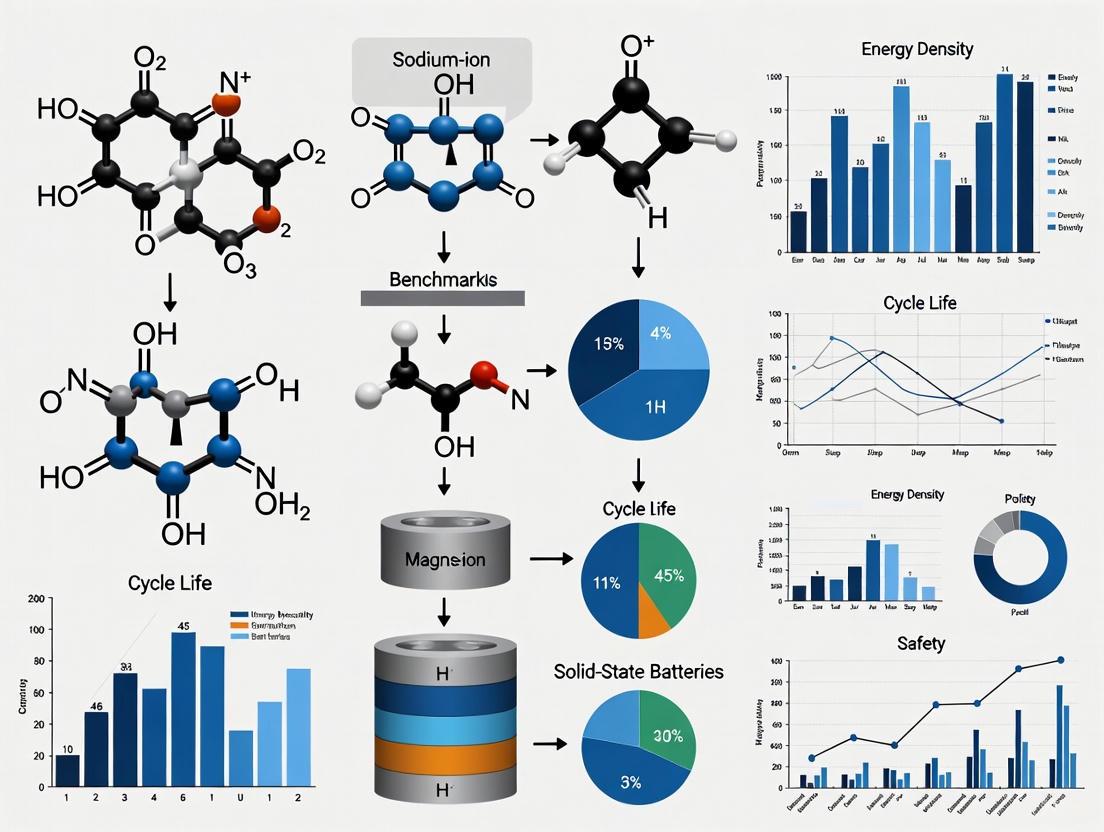
This article provides a comprehensive guide for researchers and scientists on performance benchmarking for next-generation battery materials.
Benchmarking Beyond Li-ion Batteries: A Framework for Standardizing Next-Generation Energy Material Performance
Abstract
This article provides a comprehensive guide for researchers and scientists on performance benchmarking for next-generation battery materials. It covers the landscape of emerging chemistries like solid-state, sodium-ion, and lithium-sulfur batteries, details methodological frameworks for electrochemical testing, addresses critical troubleshooting for reproducibility, and establishes protocols for validation and cross-technology comparison. The content synthesizes current research and interlaboratory studies to offer a standardized approach for evaluating and comparing beyond Li-ion technologies, addressing a critical need in the field as these technologies approach commercialization.
The Landscape of Beyond Li-ion Chemistries: From Solid-State to Sodium-Ion
Lithium-ion (Li-ion) batteries have revolutionized portable electronics and electric vehicles, but their limitations in energy density, safety, resource scarcity, and cost have spurred research into alternative technologies. "Beyond Li-ion" refers to a class of next-generation electrochemical energy storage systems that employ fundamentally different chemistries, materials, or architectures to surpass these limitations. These technologies represent a paradigm shift from incremental improvements to existing Li-ion systems, offering transformative potential for applications ranging from electric transportation to grid-scale energy storage. This guide provides an objective comparison of the most prominent beyond Li-ion battery technologies, focusing on their operational principles, performance benchmarks, and experimental methodologies critical for research and development professionals.
Defining the "Beyond Li-ion" Landscape
The term "Beyond Li-ion" encompasses battery technologies that deviate from the conventional lithium-ion paradigm in one or more fundamental aspects: the charge carrier ion (e.g., sodium instead of lithium), the electrode reaction mechanism (e.g., conversion instead of intercalation), or the electrolyte physical state (e.g., solid instead of liquid). These technologies are not merely iterations of existing Li-ion chemistry but represent foundational changes aimed at achieving radical improvements in performance, safety, sustainability, and cost. Key drivers for their development include the surging demand for electric vehicles (projected to comprise over half of new car sales by 2030), concerns about lithium and cobalt scarcity, and the need for safer energy storage with higher energy densities [1].
The most mature and widely researched beyond Li-ion technologies include:
- Lithium-Sulfur (Li-S) Batteries: Utilize a lithium metal anode and sulfur-based cathode with a conversion reaction mechanism.
- Solid-State Batteries (SSBs): Replace flammable liquid electrolytes with solid alternatives, enabling the use of lithium metal anodes.
- Sodium-Ion Batteries (SIBs): Use abundant sodium instead of lithium as the charge carrier, offering cost and supply chain advantages.
Each technology presents a unique value proposition and set of challenges, which are quantitatively compared in the following sections.
Performance Benchmarking of Beyond Li-ion Technologies
Comprehensive Performance Metrics Comparison
Table 1: Comparative Analysis of Key Battery Technologies
| Performance Metric | Conventional Li-ion | Lithium-Sulfur (Li-S) | Solid-State (Li-metal) | Sodium-Ion (SIB) |
|---|---|---|---|---|
| Theoretical Energy Density (Wh/kg) | 150-270 [2] | ~2600 [3] | 300-500 (projected) [1] | 120-200 [4] |
| Practical Energy Density (Wh/kg) | 60-270 [2] | Target: ~500 [3] | N/A | Up to 200 (recent) [4] |
| Cycle Life (cycles) | Up to 5,000 [2] | 300-500 [2] | Under development | Shorter than Li-ion [4] |
| Current Cost ($/kWh) | ~139 (pack) [5] | Potentially lower (materials) [2] | Currently high | Lower projected [4] |
| Safety Profile | Thermal runaway risk [6] | Improved stability [2] | Inherently safer (non-flammable) [7] | High safety [4] |
| Key Challenges | Cobalt scarcity, cost, safety [8] | Polysulfide shuttle, cycling life [3] | Interface resistance, manufacturability [7] | Lower energy density [4] |
Technology-Specific Performance Analysis
Lithium-Sulfur Batteries offer the highest theoretical energy density (2600 Wh/kg) of the technologies surveyed, with a practical target of 500 Wh/kg at the cell level [3]. This stems from the high capacity of sulfur (1675 mAh/g) and the lightweight nature of its components. However, their cycle life remains limited to 300-500 cycles due to the polysulfide shuttle effect and rapid capacity fade [2]. Recent data-driven analysis of 866 galvanostatic cycling tests reveals that the electrolyte-to-sulfur ratio (E/S) has a stronger correlation (r = -0.8) with specific energy than sulfur loading (r = +0.50), highlighting a critical parameter for optimization [3].
Solid-State Batteries represent a architectural shift rather than a new chemistry. By replacing flammable liquid electrolytes with solid materials, they address safety concerns and enable the use of high-energy lithium metal anodes. Different solid electrolytes present distinct trade-offs: sulfides offer high ionic conductivity but manufacturing and toxicity challenges; oxides provide excellent stability but suffer from high interface resistance; and polymers are scalable but require higher operating temperatures [7]. The market for solid-state batteries is forecast to grow significantly, potentially reaching a US$9 billion market by 2035 [7].
Sodium-Ion Batteries represent the most direct chemical alternative to Li-ion, leveraging sodium's abundance (20,000 ppm in Earth's crust vs. ~20 ppm for lithium) and geographic distribution [1]. While their energy density is typically lower than Li-ion, recent breakthroughs have seen manufacturer CATL achieve energy densities exceeding 200 Wh/kg, enhancing their competitiveness for applications where weight is less critical [4]. Their primary advantages include cost-effectiveness, superior safety, and resilience in extreme conditions, such as low temperatures where LIBs may fail [4].
Table 2: Key Material Properties and Research Focus Areas
| Technology | Cathode Materials | Anode Materials | Electrolyte Systems | Key Research Focus |
|---|---|---|---|---|
| Lithium-Sulfur | Sulfur composites, functional hosts [3] | Lithium metal [3] | Ether-based liquids (e.g., DOL:DME) [3] | Polysulfide confinement, sulfur host design [3] |
| Solid-State | High-voltage NMC, NCA [6] | Lithium metal, silicon [7] | Sulfide, oxide, polymer solids [7] | Interface engineering, dendrite suppression [7] |
| Sodium-Ion | Layered oxides, Prussian blue analogs [4] | Hard carbon, alloy materials [4] | Organic liquids (carbonate/ether-based) [4] | Anode capacity improvement, cycle life extension [4] |
Experimental Protocols and Methodologies
Advanced Sulfur Host Evaluation for Li-S Batteries
A comprehensive data-driven benchmarking study analyzed 866 galvanostatic cycling and rate capability plots from 184 recent articles to establish performance trends and optimization guidelines for Li-S batteries [3].
Cell Assembly Protocol:
- Electrode Fabrication: Composite sulfur cathodes are prepared by mixing sulfur-infused host material (70-90 wt%), conductive carbon (5-20 wt%), and binder (5-10 wt%) in an appropriate solvent to form a homogeneous slurry. The slurry is coated onto an aluminum current collector and dried under vacuum.
- Cell Configuration: CR2032 coin cells are assembled in an argon-filled glovebox with the sulfur composite cathode, lithium metal anode (typically 200-400 μm thickness), Celgard separator, and ether-based electrolyte (1M LiTFSI in DOL:DME with LiNO₃ additive).
- Electrolyte Optimization: The electrolyte-to-sulfur ratio (E/S) is carefully controlled, with studies indicating optimal performance in the range of 5-15 μL/mg depending on sulfur loading [3].
Testing Parameters:
- Cycling Conditions: Galvanostatic charge-discharge cycling between 1.7-2.8V at various C-rates (typically 0.1C-1C)
- Specific Energy Calculation: Calculated using the formula incorporating sulfur mass, reversible capacity, average voltage, and all cell component weights [3]
- N/P Ratio: Standardized to 1.5 for benchmarking to account for lithium anode degradation while maintaining reasonable energy density [3]
Key Findings: Analysis revealed that achieving high specific energy requires balancing sulfur loading (>6 mg/cm²) and E/S ratio (<10 μL/mg), as excessive loading leads to transport limitations while insufficient electrolyte causes rapid performance fade [3].
Atomic-Filtration Membrane Development for Li-S Batteries
A recent breakthrough demonstrated a molecular filtration approach to address the polysulfide shuttle effect in Li-S batteries [9].
Graphene Membrane Fabrication:
- Substrate Preparation: Copper foil is cleaned and loaded into a chemical vapor deposition (CVD) chamber.
- Graphene Synthesis: The chamber is heated to 1000°C under hydrogen atmosphere, then methane is introduced as a carbon source. Precise control of temperature, pressure, and gas flow rates creates a monolayer graphene film with defined pore structures.
- Membrane Transfer: The graphene layer is transferred from copper to a standard battery separator using polymethyl methacrylate (PMMA) as a support layer.
Characterization and Testing:
- Pore Size Distribution: Analyzed using scanning tunneling microscopy to ensure uniform pore size that permits lithium ion transit but blocks larger polysulfide chains (Li₂S₄-Li₂S₈).
- Electrochemical Validation: Cells with graphene-filter separators demonstrated stable performance over 150 cycles with minimal capacity fade, compared to rapid degradation in unfiltered cells [9].
- Post-Mortem Analysis: X-ray photoelectron spectroscopy of cycled electrodes showed significantly reduced polysulfide deposition on the lithium anode in filtered cells.
Solid-State Battery Interface Engineering
Solid-state battery research focuses heavily on interface stability between solid electrolytes and electrodes, particularly with lithium metal anodes.
Interface Stabilization Protocol:
- Electrolyte Processing: Sulfide solid electrolytes (e.g., LGPS-type) are synthesized via mechanical milling and heat treatment, while oxide electrolytes (e.g., LLZO) require high-temperature sintering [6].
- Cathode Composite Preparation: Cathode active material (NMC), solid electrolyte, and conductive additive are thoroughly mixed to form a composite cathode with percolating ion and electron pathways.
- Stack Pressure Application: Cells are assembled under controlled stack pressure (typically 1-10 MPa) to maintain intimate contact between solid components during cycling.
- Electrochemical Formation: Initial cycles use low current densities (0.05-0.1C) to form stable interfaces without excessive degradation.
Performance Metrics: Critical measurements include interfacial resistance (via electrochemical impedance spectroscopy), critical current density (maximum current before dendrite formation), and long-term cycling stability under practical conditions [7].
Logical Framework for Beyond Li-ion Battery Classification
This classification framework illustrates the three primary pathways beyond conventional lithium-ion technology: fundamentally new electrochemical reactions (e.g., Li-S conversion chemistry), architectural changes to cell components (e.g., solid-state electrolytes), and alternative charge carriers (e.g., sodium ions). Each pathway addresses specific limitations of current Li-ion batteries while introducing new research challenges.
The Researcher's Toolkit: Essential Materials and Reagents
Table 3: Key Research Reagents and Materials for Beyond Li-ion Battery Development
| Reagent/Material | Function/Application | Technical Specifications | Research Considerations |
|---|---|---|---|
| Sulfur-C Composite | Cathode active material for Li-S batteries | High sulfur content (>70 wt%), porous carbon host | Specific surface area, polysulfide adsorption energy critical [3] |
| Lithium Bis(trifluoromethanesulfonyl)imide (LiTFSI) | Lithium salt for Li-S electrolytes | 1M concentration in DOL:DME (1:1 v/v) | LiNO₃ (0.5-2 wt%) additive essential for anode protection [3] |
| Sulfide Solid Electrolyte (e.g., LGPS) | High-conductivity solid electrolyte | Ionic conductivity >10⁻³ S/cm, particle size <10μm | Moisture sensitivity requires dry room processing [6] |
| Halide Solid Electrolyte (e.g., Li₃InCl₆) | Cathode-compatible solid electrolyte | High oxidative stability (>4V), moisture resistant | Emerging class with promise for direct composite cathodes [6] |
| Sodium Layered Oxide (e.g., NVP) | Cathode material for SIBs | Theoretical capacity ~120 mAh/g, voltage ~3.4V | Manganese and iron-based systems for cost reduction [4] |
| Hard Carbon | Anode material for SIBs | Disordered carbon structure, capacity ~300 mAh/g | Cost and specific capacity optimization focus areas [4] |
| Monolayer Graphene | Molecular filter for Li-S separators | CVD-grown, precise pore size control | Pore size distribution critical for ion selectivity [9] |
| Lithium Metal Foil | Anode for Li-S and solid-state batteries | Thickness 20-50μm for practical cells, high purity | Electrochemical reversibility challenges require interface engineering [7] |
The beyond Li-ion battery landscape represents a dynamic and rapidly evolving research frontier where multiple technologies show promise for specific applications. Lithium-sulfur batteries offer the highest theoretical energy density but require solutions to the polysulfide shuttle and limited cycle life. Solid-state batteries provide enhanced safety and compatibility with lithium metal anodes but face challenges in interfacial resistance and manufacturing scalability. Sodium-ion batteries present compelling cost and sustainability advantages but currently lag in energy density.
For researchers and development professionals, the optimal technology pathway depends heavily on application requirements: Li-S for maximum energy density where weight is critical, solid-state for applications prioritizing safety and performance, and sodium-ion for cost-sensitive stationary storage or shorter-range mobility. Future advancements will likely emerge from interdisciplinary approaches combining materials science, electrochemistry, and advanced manufacturing to address the fundamental limitations of each technology. The experimental protocols and benchmarking data presented here provide a foundation for systematic comparison and targeted research in this critical field of energy storage.
The global push for electrification and renewable energy is driving the search for battery technologies that surpass the performance and safety limits of conventional lithium-ion (Li-ion) systems. While Li-ion batteries have dominated the energy storage landscape for decades, researchers are actively developing next-generation chemistries to achieve higher energy density, improved safety, reduced costs, and greater sustainability. This guide provides a performance benchmarking analysis of four key post-lithium-ion battery chemistries: Solid-State, Sodium-Ion, Lithium-Sulfur, and Lithium-Metal. Framed within the context of advanced materials research, this comparison synthesizes quantitative data, experimental protocols, and key research tools to inform the work of researchers and scientists in the field.
Performance Benchmarking: A Quantitative Comparison
The following tables summarize the core performance characteristics, advantages, and challenges of each chemistry, providing a baseline for comparison against conventional Li-ion systems and for identifying suitable application niches.
Table 1: Core Performance Metrics of Key Battery Chemistries
| Chemistry | Theoretical Energy Density | Current Practical Energy Density | Cycle Life (Target) | Safety Profile | Estimated Cost (per Wh) |
|---|---|---|---|---|---|
| Solid-State | >500 Wh/kg (with Li-metal anode) [10] | ~250-400 Wh/kg (prototype cells) [11] | >1,000 cycles [12] | High (Non-flammable electrolyte) [10] [12] | High (currently), projected to decrease [13] |
| Sodium-Ion | - | 150-180 Wh/kg [14] | 3,000 - >7,000 cycles (selected products) [14] | High (better thermal stability) [14] | Low (~$0.04-0.06) [14] |
| Lithium-Sulfur | 2600 Wh/kg [15] [3] | ~500 Wh/kg (practical target) [15] | >1000 cycles (for commercialization) [15] | Moderate (issues with polysulfide shuttle) [16] | Low (abundant sulfur) [16] |
| Lithium-Metal (with liquid electrolyte) | >400 Wh/kg (cell-level) [11] | ~350-400 Wh/kg (advanced prototypes) [11] | Hundreds of cycles (challenge) [17] | Lower (dendrite growth and short circuits) [11] | Moderate to High |
Table 2: Comparative Advantages and Challenges
| Chemistry | Key Advantages | Primary Challenges |
|---|---|---|
| Solid-State | High energy density potential; Enhanced safety; Fast charging [10] [12] | Manufacturing complexity and cost; Interfacial resistance; Dendrite penetration [10] [12] |
| Sodium-Ion | Abundant, low-cost materials; Excellent low-temperature performance; High safety [14] | Lower energy density; Less mature supply chain [14] |
| Lithium-Sulfur | Ultra-high theoretical energy density; Low cost of sulfur; Sustainability [16] [15] | Polysulfide shuttle effect; Poor conductivity of S/Li₂S; Large volume expansion (~80%) [15] [3] |
| Lithium-Metal | Highest theoretical capacity (3,860 mAh/g); Enables high energy density [10] [11] | Lithium dendrite formation; Unstable solid electrolyte interphase (SEI); Short cycle life [11] [17] |
Experimental Protocols and Methodologies
Analyzing the Solid Electrolyte Interface (SEI) in Lithium-Metal Anodes
Objective: To accurately characterize the chemical composition and morphology of the native Solid Electrolyte Interface (SEI) on lithium-metal anodes without introducing measurement artifacts.
Background: The SEI is a critical nanoscale layer that forms on the lithium anode, governing ion transport and battery stability. Traditional X-ray Photoelectron Spectroscopy (XPS) analysis, conducted at room temperature and ultra-high vacuum, can alter the SEI's chemistry and thickness, leading to inaccurate data [17].
Protocol: Cryogenic XPS (cryo-XPS) [17]
- Cell Operation and SEI Formation: Assemble and cycle lithium-metal battery cells under controlled conditions to form the SEI layer.
- Flash-Freezing: Immediately after battery operation, rapidly disassemble the cell in an inert atmosphere and flash-freeze the lithium-metal anode containing the pristine SEI at approximately -200°C (-328°F).
- Cryogenic Transfer and Analysis: Transfer the frozen sample to the XPS instrument under cryogenic conditions without exposure to air. Perform XPS analysis while maintaining the sample at cryogenic temperatures (approximately -110°C or -166°F).
- Data Interpretation: Analyze the XPS spectra to identify chemical compounds (e.g., LiF, Li₂O) in the native SEI. Compared to room-temperature XPS, cryo-XPS provides a more accurate correlation between SEI composition and actual battery performance, preventing misinterpretations caused by the measurement process itself [17].
Benchmarking Performance in Lithium-Sulfur Pouch Cells
Objective: To evaluate Lithium-Sulfur (Li-S) battery performance under conditions that reflect practical application requirements, moving beyond idealized lab-scale coin cells.
Background: Laboratory research often uses coin cells with low sulfur loading, high electrolyte volume, and a large excess of lithium, reporting impressive but non-practical metrics. Translating this performance to larger pouch cells is a significant hurdle for commercialization [15] [3].
Protocol: Practical Li-S Pouch Cell Assessment [15] [3]
- Cell Design with Strict Parameters:
- Sulfur Loading: Target >5 mg/cm² (aiming for areal capacities of 5-10 mAh/cm²).
- Electrolyte-to-Sulfur (E/S) Ratio: Minimize to <5 µL/mg, ideally around 3 µL/mg, to maximize energy density.
- Negative-to-Positive (N/P) Capacity Ratio: Use a minimal excess of lithium. A ratio of 1.5 is suggested for standardized benchmarking instead of the >50 ratios common in research [3].
- Cell Fabrication: Fabricate large-format pouch cells incorporating the above design parameters.
- Electrochemical Testing:
- Perform galvanostatic cycling at relevant C-rates (e.g., 0.1C to 0.5C).
- Measure and report the cell-level specific energy (Wh/kg) including the weight of all components (electrodes, electrolyte, current collectors, separator).
- Monitor capacity retention and coulombic efficiency over hundreds of cycles.
- Data Analysis: The key performance indicator is achieving a cell-level specific energy exceeding 500 Wh/kg while maintaining a cycle life of at least 1000 cycles, which is considered a benchmark for commercial viability [15].
The Scientist's Toolkit: Key Research Reagents and Materials
Table 3: Essential Materials for Next-Generation Battery Research
| Material / Component | Primary Function | Key Considerations for Research |
|---|---|---|
| Solid-State Electrolytes (Sulfide, Oxide, Polymer) [12] | Replaces flammable liquid electrolyte; enables use of lithium-metal anode. | Sulfide (e.g., LGPS): High conductivity but toxic. Oxide (e.g., LLZO): Stable but high interfacial resistance. Polymer (e.g., PEO): Flexible but requires elevated temperature [10] [12]. |
| Lithium Metal Foil (Anode) [11] | Provides the highest theoretical anode capacity. | Purity, thickness uniformity, and surface smoothness are critical. Dendrite formation during plating/stripping is the main research challenge [11] [17]. |
| Sulfur Composite Cathode (for Li-S) [15] [3] | Serves as the high-capacity positive electrode. | Requires a "functional host" (e.g., porous carbon, polar compounds) to trap polysulfides and conduct electrons [3]. Sulfur loading and content are key variables. |
| Ether-Based Electrolyte (for Li-S) [15] | Facilitates ion transport and sulfur redox reactions. | Typically 1M LiTFSI in DOL:DME with LiNO₃ additive. The Electrolyte-to-Sulfur (E/S) ratio is a critical design parameter [15] [3]. |
| Sodium Transition Metal Oxide (Cathode for Na-ion) [14] | Host structure for sodium ions in the cathode. | Abundant and lower cost than Li-ion NMC counterparts. Performance is competitive with lower-tier Li-ion chemistries [14]. |
The future energy storage landscape will not be dominated by a single "winner" but will evolve into a multi-chemistry ecosystem where each technology serves specific applications based on its performance profile. Solid-state batteries offer a promising path to higher safety and energy density for electric vehicles and premium electronics, though manufacturing challenges remain. Lithium-sulfur batteries hold the promise of ultra-high energy density for aviation and long-range transport, contingent on solving the polysulfide shuttle and cycle life problems. Lithium-metal batteries (with liquid or solid electrolytes) are the cornerstone for achieving high energy density, with research intensely focused on stabilizing the anode interface. Finally, sodium-ion batteries are poised to capture large segments of the stationary storage and low-cost electric mobility markets, offering a cost-effective and sustainable alternative without the resource constraints of lithium.
The benchmarking data and experimental frameworks presented here provide a foundation for researchers to navigate this complex and rapidly advancing field. The convergence of these technologies, guided by rigorous and practical experimental protocols, will be instrumental in building a more sustainable and electrified future.
The global transition toward electrification and sustainable energy is fundamentally reshaping the energy storage industry. While lithium-ion (Li-ion) batteries currently dominate the market, their trajectory is increasingly influenced by internal chemistry evolution and external competition from emerging technologies. This guide provides an objective comparison of incumbent and alternative battery technologies, framing their growth within a broader performance benchmarking framework that extends beyond conventional Li-ion materials research. Understanding these dynamics is crucial for researchers, scientists, and industry professionals navigating the complex interplay of performance metrics, supply chain security, and application-specific requirements. The market is characterized by a diversification of chemistries, each finding optimal niches based on their unique performance characteristics and cost structures, driven by global demands for clean energy, electric mobility, and grid resilience [5] [18].
The energy storage market is experiencing exponential growth, fueled primarily by the electric vehicle (EV) revolution and the large-scale integration of renewable energy. The global lithium-ion battery market is projected to grow from USD 194.66 billion in 2025 to USD 426.37 billion by 2033, representing a compound annual growth rate (CAGR) of 10.3% [19]. This expansion is underpinned by massive investments in gigafactories and continuous technological improvements. Beyond Li-ion, alternative technologies like sodium-ion (Na-ion) are poised for significant growth, with demand forecast to reach just over 90 GWh by 2035, growing from 4 GWh in 2024 at a remarkable CAGR of 33% [18]. The cathode materials market specifically is set to expand from USD 37.78 billion in 2025 to USD 65.15 billion by 2030, at an 11.5% CAGR, reflecting the critical role of material innovations in driving performance enhancements [20].
Table 1: Global Market Outlook for Battery Technologies and Key Materials (2025-2035)
| Technology / Segment | Market Size (2025) | Projected Market Size (2033/2035) | CAGR | Key Growth Drivers |
|---|---|---|---|---|
| Lithium-ion Battery Market [19] | USD 194.66 billion | USD 426.37 billion (2033) | 10.3% | EV adoption, renewable energy integration, consumer electronics |
| Sodium-ion Battery Demand [18] | 4 GWh (2024 baseline) | >90 GWh (2035) | 33% | Supply chain diversification, cost reduction, grid storage needs |
| Cathode Materials Market [20] | USD 37.78 billion | USD 65.15 billion (2030) | 11.5% | Advancements in NMC and LFP chemistries, EV penetration |
| Lithium Nickel Manganese Cobalt Oxide (NMC) Market [21] | USD 6.2 billion (2024 baseline) | USD 19.1 billion (2033) | 14.8% | High energy density requirements for EVs and premium electronics |
| Battery Recycling Equipment [22] | USD 12.99 billion | USD 98.4 billion (2034) | 25.4% | Regulatory pressure, circular economy initiatives, EV battery retirements |
Technology-Specific Adoption Curves
Lithium-Ion Battery Chemistries: LFP vs. NMC
The Li-ion market is experiencing a significant internal shift in chemistry dominance. Nickel Manganese Cobalt (NMC) batteries currently hold approximately 60% market share, while Lithium Iron Phosphate (LFP) is rapidly gaining ground at around 30% [5]. Projections indicate LFP's global share could reach approximately 44% by the end of 2025, a trend particularly pronounced in China where passenger EVs with LFP technology increased from 45% in 2021 to 60% by 2023 [5]. This transition is driven by several factors: cost efficiency (LFP requires significantly lower production costs), superior safety characteristics (higher ignition point reduces thermal runaway risks), and improved supply chain security (utilizing abundant iron and phosphate rather than scarce cobalt) [5]. Recent innovations have also narrowed the energy density gap between LFP and NMC batteries, further accelerating LFP adoption [5].
Table 2: Performance Benchmarking of Major Battery Chemistries
| Parameter | NMC | LFP | LTO | Sodium-ion | Lithium-Sulfur |
|---|---|---|---|---|---|
| Energy Density (Wh/kg) [5] [23] | 150-250 (up to 320 for NMC811) | 140-160 (200-220 with improvements) | 60-90 | Similar to LFP [18] | Theoretical: 2600; Practical Target: 500 [3] |
| Cycle Life (cycles) [5] | 500-1,000 | 2,000+ | 20,000+ | Data Not Provided | Data Not Provided |
| Cost Structure | Higher (uses cobalt) | Lower (cobalt-free) | Highest | Lower than Li-ion [18] | Potentially Lower [3] |
| Safety Profile | Moderate thermal stability | High thermal stability | Very High | Good [18] | Challenges with shuttle effect [3] |
| Fast Charge Capability | Good | Moderate | Excellent (10-15 min) [5] | Good [18] | Limited by kinetics [3] |
| Key Applications [5] [18] [3] | High-end EVs, portable electronics | Mass-market EVs, energy storage, RV | Public transportation, grid stabilization | Electric two/three-wheelers, grid storage | Next-generation EVs, specialized applications |
Emerging Battery Technologies
Sodium-ion (Na-ion) Batteries: Positioned as a complementary technology to Li-ion rather than a replacement, Na-ion batteries excel in applications where high energy density is not critical. Their value proposition includes cost competitiveness (with cell-level costs potentially decreasing to ~US$40/kWh), enhanced safety, and superior low-temperature performance [18]. The technology requires minimal modifications to existing lithium-ion manufacturing infrastructure, primarily relying on different materials rather than entirely new facilities, which facilitates faster scaling [18]. Key initial applications include starter-lighting-ignition (SLI) batteries, electric two- and three-wheelers, microcars, and grid-scale energy storage systems [18].
Lithium-Sulfur (Li-S) Batteries: As strong contenders in the next-generation energy storage landscape, Li-S batteries offer an impressive theoretical specific energy of 2600 Wh/kg, with practical cell-level targets of 500 Wh/kg [3] [24]. However, several challenges remain, including low electronic conductivity in sulfur and Li₂S, polysulfide solubility causing shuttle effect and self-discharge, volume changes during conversions, and lithium anode instability [3]. Research focuses heavily on developing functional sulfur host materials (38.6% of recent scholarly works) that offer features such as high electronic and ionic conductivity, porous structure, and active sites serving as polysulfide adsorbers or immobilizers [3].
Application-Specific Adoption Trends
The adoption of different battery technologies is increasingly segmented by application requirements, driving distinct growth trajectories across sectors.
Electric Vehicles: The EV sector remains the primary driver for Li-ion batteries, accounting for 67% of the market in 2024 and predicted to exceed USD 225 billion by 2034 [5]. Within this sector, a stratification is occurring: high-nickel NMC variants (NMC811) dominate premium vehicles requiring maximum range, while LFP is capturing mass-market segments due to its cost-effectiveness and safety [5] [21]. Sodium-ion batteries are beginning to penetrate the EV space in applications where high energy density is less critical, such as microcars and low-speed vehicles [18].
Energy Storage Systems (ESS): The ESS market represents the fastest-growing segment for battery technologies, projected to expand from USD 8.6 billion in 2025 to USD 41.8 billion by 2032, at a 25.2% CAGR [5]. LFP chemistry is particularly dominant in this sector due to its longevity, safety, and cost advantages for frequent cycling [5]. Sodium-ion batteries are also increasingly competitive for grid storage, where energy density is less critical than cost per kWh per cycle [18].
Consumer Electronics and Industrial Applications: NMC batteries maintain strong positions in consumer electronics such as smartphones, laptops, and power tools where energy density and compact form factors are priorities [21]. The industrial sector leverages various chemistries for applications including backup power, UPS, and material handling equipment, with LFP gaining share due to its lifecycle advantages [20].
Experimental Benchmarking Methodologies
Performance Evaluation of Lithium-Sulfur Batteries
A comprehensive benchmarking methodology for emerging battery technologies is crucial for objective comparison. Recent research on lithium-sulfur batteries provides a exemplary framework involving the digitization of 866 galvanostatic cycling and rate capability plots from 184 recent articles to standardize performance using specific energy and power metrics [3] [24]. This data-driven approach enables mapping field advancements and identifying impactful research contributions through systematic analysis of key parameters:
Cell-Level Specific Energy Calculation: The methodology calculates cell-level specific energy (Wh/kg) using a standardized equation that incorporates reversible discharge capacity, average discharge voltage, and the masses of all cell components including electrodes, electrolyte, current collectors, and separator [3].
Parameter Sensitivity Analysis: Research reveals strong correlations between electrolyte-to-sulfur ratio (E/S) and specific energy (r = -0.8), and between sulfur loading and specific energy (r = +0.50) [3]. This analysis helps identify optimal operating conditions and trade-offs between different cell design parameters.
Performance Mapping: The methodology enables creating performance maps that disclose general patterns applicable across all cells, highlighting constructive and detrimental regions of the design-parameter space, and revealing potential synergies between different optimization approaches [3].
LFP Kinetics Improvement Strategies
Experimental protocols for enhancing LFP performance focus on addressing its inherent limitations in lithium-ion diffusion and electronic conductivity. Key methodological approaches include:
Increasing Diffusion Coefficient: Strategies include particle nano-structuring to shorten lithium-ion diffusion pathways, cation doping to enhance intrinsic lithium mobility, and defect engineering to create favorable diffusion channels [25].
Enhancing Electronic Conductivity: Common approaches involve carbon coating (using various carbon sources including synthetic polymer carbon, biomass carbon, and carbohydrate carbon), metallic particle decoration, and conductive polymer composites to facilitate electron transport throughout the electrode [25] [23].
Simultaneous Optimization: Advanced strategies seek to co-optimize both ionic and electronic transport through composite architectures, graded structures, and multifunctional coatings that address both limitations simultaneously [25].
Diagram 1: Experimental Pathways for LFP Cathode Optimization. This workflow illustrates the multi-faceted approaches researchers employ to enhance the kinetics of lithium iron phosphate cathodes, addressing both ionic and electronic transport limitations through individual and synergistic strategies.
Research Reagents and Materials Toolkit
Table 3: Essential Research Reagents and Materials for Advanced Battery Development
| Research Reagent / Material | Function and Application | Experimental Notes |
|---|---|---|
| Functional Sulfur Host Materials [3] | Provide porous framework for sulfur containment in Li-S batteries; offer polysulfide adsorption sites and redox mediation. | Key properties: specific surface area, polysulfide binding/adsorption energy. Critical for controlling shuttle effect. |
| Ammonium Salt Dispersants [23] | Improve microstructure of LFP cathode slurries; reduce particle agglomeration during electrode fabrication. | Forms negatively charged ion groups that adsorb onto iron phosphate particles, enhancing reaction during sintering. |
| Carbon Coating Precursors [23] | Enhance electronic conductivity of LFP particles; improve rate capability and low-temperature performance. | Optimal ID/IG Raman intensity ratio of 0.75-1.2 promotes desired carbon structure for electrolyte infiltration. |
| Vinylene Carbonate (VC) Electrolyte Additive [23] | Improves negative electrode stability in LFP batteries; enhances capacity retention and cycle life. | Used in weight ratio to DMC of 0-0.2; particularly beneficial for high-loading LFP electrodes (450-740 mg/cm²). |
| Copolymer Dispersants (Nitrile/Conjugated Diene) [23] | Enhance dispersion of LFP particles in electrode slurries; enable uniform coating and improved cycle life. | Mass ratio of residual double bonds between 0.05-10 mass% provides optimal dispersion without aggregation. |
| Lithium Bis(trifluoromethanesulfonyl)imide (LiTFSI) [3] | Common lithium salt for Li-S battery electrolytes; enables high lithium-ion conductivity in ether-based systems. | Typically used in 1M concentration with 1:1 DOL:DME solvents and 0.5-2 wt.% LiNO₃ additive. |
Regional Adoption Dynamics and Supply Chain Considerations
The adoption curves for various battery technologies exhibit distinct regional patterns influenced by industrial policy, resource availability, and market dynamics:
Asia Pacific: Dominates Li-ion battery production, accounting for approximately 58.5% of global installations (295.2 GWh) [5]. China's leadership extends to emerging technologies, as evidenced by its dominance in Na-ion patent applications and production scaling efforts [18].
North America: Experiencing a supply transition from undersupply of approximately 50 GWh in 2025 to projected oversupply by 2030, although the upstream supply chain for active materials remains underdeveloped [5]. The Inflation Reduction Act (IRA) incentives are accelerating local manufacturing and creating favorable conditions for Na-ion adoption in grid storage applications [18].
Europe: Confronts ongoing supply constraints with an expected lithium-ion battery undersupply of approximately 70 GWh in 2025, despite significant investments in gigafactories across Germany, Poland, and Hungary [5]. European initiatives like the Sodium-Ion-Battery Deutschland-Forschung project are accelerating alternative technology research [18].
Diagram 2: Regional Technology Adoption Profiles. This diagram compares the distinct adoption dynamics across major regions, highlighting different supply-demand conditions, policy drivers, and technological focuses that shape application-specific adoption curves for various battery technologies.
The energy storage landscape is evolving toward a diversified ecosystem where multiple battery technologies coexist, each serving specific application niches based on their performance characteristics and cost structures. While Li-ion batteries will maintain dominance in the foreseeable future, particularly in high-energy-density applications, the internal chemistry mix is shifting toward LFP for cost-sensitive and safety-critical applications. Meanwhile, Na-ion batteries are establishing a foothold in applications where energy density is secondary to cost and safety, and advanced technologies like Li-S continue progression toward commercialization. For researchers and industry professionals, success in this evolving landscape requires attention to both technical performance metrics and broader supply chain, manufacturing, and regional policy dynamics that collectively determine technology adoption curves across different applications. The ongoing benchmarking beyond conventional Li-ion materials research will be crucial for identifying optimal technology applications and guiding future research investment toward the most promising performance enhancements.
For researchers and scientists driving innovation in energy storage, moving beyond fundamental materials discovery to systematic performance benchmarking is a critical step in the technology transition from lab to market. Battery performance is a complex, multi-faceted challenge where excelling in a single metric is insufficient for commercial viability. Performance benchmarking requires a holistic understanding of the inherent trade-offs between energy density, safety, lifetime, and cost across different chemistries. This guide provides a structured framework for objectively comparing leading and emerging battery technologies, with a focus on the specific electrochemical and materials science hurdles that define their performance boundaries. By establishing standardized comparison methodologies and identifying key failure modes, this analysis aims to support more targeted research and development efforts across the energy storage field.
Performance Hurdles of Established Lithium-ion Chemistries
Chemistry-Specific Challenges and Trade-offs
The landscape of commercial lithium-ion batteries is characterized by chemistries with specialized performance profiles, each with distinct advantages and inherent limitations. The selection of a specific chemistry often involves navigating critical trade-offs, particularly between energy density, safety, and cycle life [26].
Lithium Cobalt Oxide (LCO) batteries excel in energy density, achieving up to 240 Wh/kg, making them ideal for portable electronics where compact size is paramount [26]. However, this comes at the cost of a shorter cycle life (typically 500-1,000 cycles) and heightened thermal sensitivity that requires sophisticated management systems [26]. Their composition also raises concerns about cobalt sourcing [26].
Lithium Iron Phosphate (LFP) chemistry sacrifices some energy density but offers superior safety and longevity. Its stable olivine structure provides exceptional thermal stability, significantly reducing overheating risks [26] [27]. LFP batteries also achieve longer lifespans (up to 10 years) and avoid cobalt-related supply chain issues, making them increasingly attractive for electric vehicles and stationary storage [26] [27]. The primary compromise is their lower volumetric energy density, though innovations like BYD's Blade Battery are helping to close this gap [28].
Nickel-Rich Cathodes (NMC/NCA) aim to balance these trade-offs by incorporating nickel for high energy density and reducing cobalt content. They are frontrunners for electric vehicle applications requiring extended range, but this introduces challenges with structural stability at high voltages and sensitivity to transition metal dissolution, which can accelerate capacity fade [29].
Table 1: Performance Hurdles of Commercial Lithium-ion Battery Chemistries
| Chemistry | Primary Strength | Core Performance Hurdle | Key Failure Modes | Typical Cycle Life |
|---|---|---|---|---|
| LCO | High energy density (up to 240 Wh/kg) [26] | Thermal sensitivity & cobalt dependency [26] | Structural instability, oxygen release at high voltage [29] | 500-1,000 cycles [26] |
| LFP | Exceptional safety & long life [26] [27] | Lower energy density [26] | Limited by conductive carbon network performance [29] | 3,000+ cycles (up to 10 years) [26] |
| NMC/NCA | Balanced high energy & power [20] | Voltage-related degradation & Ni-induced instability [29] | Transition metal dissolution, cathode electrolyte interface growth [29] [30] | 1,000-2,000 cycles [20] |
High-Voltage Operation Challenges
A common strategy for increasing the energy density of lithium-ion batteries involves pushing to higher operating voltages, but this introduces significant materials challenges. When charging voltages exceed 4.3V, most cathode materials undergo parasitic oxidation reactions with the electrolyte, leading to gas generation, increased impedance, and active lithium loss [29]. These reactions form a cathode-electrolyte interface (CEI) layer, analogous to the SEI on anodes, but often with poorer protective qualities [29].
For LCO and NMC chemistries, high voltages can trigger structural degradation, including irreversible phase transitions and mechanical fracture from anisotropic lattice strain [29]. Simultaneously, the dissolution of transition metals (especially manganese in NMC) from the cathode and their subsequent migration to the anode can catalyze further SEI growth, depleting electrolyte and increasing resistance [29] [30]. These interconnected degradation pathways create a fundamental voltage window constraint for conventional liquid electrolytes.
Next-Generation Chemistries: Emerging Hurdles
Solid-State Lithium Metal Batteries
Solid-state batteries with lithium metal anodes represent a paradigm shift, potentially offering energy densities exceeding 400 Wh/kg by replacing graphite with lithium metal [11] [31]. This configuration eliminates flammable liquid electrolytes, addressing a critical safety concern, but introduces a new set of challenges centered on interface stability and manufacturing complexity [31].
The solid electrolyte interface presents a primary hurdle. Unlike self-healing liquid interfaces, the solid-solid contact suffers from poor wettability, leading to high interfacial resistance that impedes ion transport [31]. During cycling, the volume changes of the lithium metal anode can cause contact loss, forming voids that increase local current density and accelerate dendrite formation [31]. While ceramic electrolytes like garnet-type LLZO offer high mechanical strength to block dendrites, their brittle nature makes them susceptible to cracking during cell assembly and operation [31].
Table 2: Performance Hurdles of Next-Generation Battery Chemistries
| Chemistry | Theoretical Advantage | Critical Research Hurdle | Primary Degradation Mechanism | Commercialization Timeline |
|---|---|---|---|---|
| Solid-State Li-Metal | High safety & energy density (>400 Wh/kg) [31] | Interfacial resistance & lithium dendrite propagation [31] | Contact loss at anode interface, void formation [31] | Initial commercialization 2025-2028 [11] |
| Lithium-Sulfur | Ultra-high theoretical energy density, low cost [11] | Polysulfide shuttle effect & poor sulfur conductivity [11] | Active material loss, cathode swelling forces [11] | Niche applications 2025-2030 [11] |
| Lithium-Air | Highest theoretical energy density | Oxygen electrode clogging & electrolyte decomposition | Discharge product accumulation, parasitic reactions | Research phase [11] |
Lithium-Sulfur and Beyond
Lithium-sulfur (Li-S) chemistry offers an alternative high-energy-density pathway with a theoretical specific energy of 2,500 Wh/kg, significantly surpassing current lithium-ion technologies [11]. The technology faces two fundamental hurdles: the polysulfide shuttle effect and the poor electronic conductivity of sulfur and its discharge products [11].
During discharge, lithium polysulfide intermediates dissolve into the electrolyte, migrating between electrodes and causing active material loss, low Coulombic efficiency, and rapid capacity fade [11]. Simultaneously, the insulating nature of sulfur necessitates significant conductive additives, reducing practical energy density. Volume expansion during discharge (approximately 80%) creates substantial mechanical stress on electrode architecture, leading to structural degradation over cycling [11].
Experimental Protocols for Performance Benchmarking
Standardized Testing Methodologies
Objective performance benchmarking requires standardized protocols that enable direct comparison across chemistries. The following methodologies form the foundation of rigorous battery evaluation.
Cycle Life Testing Protocol aims to quantify battery longevity under controlled conditions. The standard method involves repeated charge-discharge cycles at a specified C-rate (often 1C) within the manufacturer's voltage window, maintained at a constant temperature (typically 20-25°C) [30]. Key measurements include capacity retention percentage, energy efficiency over cycles, and internal resistance growth via electrochemical impedance spectroscopy. The test endpoint is typically defined as the cycle count where capacity drops to 80% of initial value, with regular checkpoints (every 50-100 cycles) for detailed dV/dQ analysis to identify degradation modes [30].
Thermal Stability Assessment evaluates safety thresholds using Accelerating Rate Calorimetry. The standard protocol places a fully charged cell in an adiabatic chamber with temperature ramp (typically 5°C/min) while monitoring for exothermic reactions [29]. Key metrics include self-heating onset temperature, thermal runaway maximum temperature, and voltage response during heating. Additional nail penetration tests following UL standards provide practical safety validation, with pass/fail criteria based on whether cells vent, smoke, or catch fire [26].
High-Rate Capability Testing probes kinetic limitations through multi-rate testing. The methodology involves consecutive charge-discharge cycles at increasing C-rates (0.2C, 0.5C, 1C, 2C, 3C) with return to baseline C-rate between intervals to monitor recovery [29]. Capacity retention at each rate relative to baseline and voltage polarization (ΔV) provide insights into internal resistance and mass transport limitations.
Diagram: Standardized Battery Testing Workflow
Advanced Characterization Techniques
Beyond performance testing, understanding degradation mechanisms requires sophisticated characterization methods that probe structural and interfacial changes.
Post-Mortem Analysis begins with careful disassembly of cycled cells in an argon-filled glovebox (O₂ & H₂O < 0.1 ppm) [30]. Electrodes are extracted and rinsed with dimethyl carbonate to remove residual electrolyte salts. Scanning Electron Microscopy reveals morphological changes including crack formation, particle disintegration, and dendrite growth. X-ray Photoelectron Spectroscopy depth profiling characterizes the composition and thickness of SEI/CEI layers, identifying inorganic (LiF, Li₂O) and organic (lithium alkyl carbonates) components [29].
Synchrotron X-ray Diffraction provides non-destructive analysis of structural evolution during cycling. Operando cells with X-ray transparent windows enable monitoring of lattice parameter changes, phase transitions, and crystallinity loss in real-time [29]. Rietveld refinement quantifies phase fractions and detects minority phases that may catalyze degradation.
Three-Electrode Cell Configurations enable separate monitoring of anode and cathode potentials during cycling. The setup incorporates a lithium reference electrode positioned between working and counter electrodes, allowing precise attribution of overpotentials and degradation to specific electrodes [29]. This is particularly valuable for identifying lithium plating thresholds in fast-charging applications.
The Researcher's Toolkit: Essential Materials and Reagents
Table 3: Essential Research Reagents and Materials for Battery Performance Testing
| Reagent/Material | Function in Research | Key Considerations |
|---|---|---|
| High-Voltage Electrolyte Additives (e.g., FEC, LiPO₂F₂, DTD) [29] | Form stable interface layers at high voltage, suppress transition metal dissolution | Concentration optimization critical (typically 0.5-5%), compatibility with specific cathode chemistry |
| Reference Electrodes (Li metal, Ag/Ag+) [29] | Enable three-electrode measurements for electrode-specific degradation analysis | Precise positioning critical, stability over long-term testing, compatibility with electrolyte system |
| Ceramic Solid Electrolytes (LLZO, LATP, LGPS) [31] | Enable solid-state battery research, high Li+ conductivity without flammable liquids | Moisture sensitivity (sulfides), brittleness, interfacial compatibility with electrodes |
| Conductive Carbon Additives (Super P, CNTs, graphene) [29] | Enhance electronic conductivity in composite electrodes, form conductive networks | Distribution homogeneity, influence on porosity and tortuosity, potential catalytic activity |
| Polymer Matrix Materials (PEO, PVDF-HFP) [31] | Serve as electrolyte hosts (SPEs) or electrode binders, provide mechanical flexibility | Molecular weight distribution, crystallinity, electrochemical stability window |
| Lithium Salts (LiPF₆, LiTFSI, LiFSI) [29] | Provide lithium ions for conduction, influence SEI composition and stability | Hydrolytic stability (LiPF₆), corrosiveness to Al current collector (LiTFSI/FSI) |
Manufacturing and Quality Control Challenges
Scaling any battery chemistry from laboratory cells to commercial production introduces a distinct set of challenges related to manufacturing precision and quality control. At the gigawatt-hour scale, a single production line may output over 70 cells per second, each requiring geometric tolerances on the order of a few microns while avoiding similarly-sized particle contaminants [30]. This manufacturing precision is complicated by the fact that batteries are highly sensitive to minor variations in electrode coating, calendering, and electrolyte filling processes [30].
The impact of manufacturing defects becomes magnified at the pack level, where the failure of a single cell can compromise an entire system. An open-circuit failure renders all series-connected cells inoperable, while a short-circuit failure causes overcharging of series-connected cells and rapid discharge of parallel-connected cells [30]. These failure modes highlight why top-tier cell producers differentiate themselves through sophisticated statistical process control and 100% cell testing, though this adds significant cost [30].
Diagram: Manufacturing Defect Propagation Pathway
For next-generation chemistries, these manufacturing challenges are amplified. Solid-state batteries require precisely engineered interfaces and often involve pressure application during operation, while lithium-sulfur systems must contain liquid polysulfides and manage significant cathode expansion [11] [31]. The industry's ability to overcome these manufacturing hurdles will be as important as the underlying chemistry innovations in determining the pace of commercial adoption.
The performance hurdles facing battery chemistries are as diverse as their potential applications. Established lithium-ion systems face well-characterized trade-offs between energy density, safety, and lifetime, while next-generation technologies grapple with fundamental interface and stability challenges. What remains consistent across this landscape is that meaningful performance benchmarking requires a multi-faceted approach that combines standardized testing, sophisticated characterization, and careful attention to manufacturing scalability. For researchers and developers, success depends not only on pushing individual performance metrics but on understanding and managing the complex interrelationships between electrochemical properties, materials interfaces, and production realities. As the industry advances, this holistic approach to performance benchmarking will be essential for matching the right chemistry to the right application and accelerating the development of improved energy storage systems.
The Critical Role of Standardized Benchmarking in Accelerating R&D
In the face of growing technological complexity and intense global competition, Research and Development (R&D) organizations across industries are under increasing pressure to optimize performance, control costs, and accelerate innovation cycles. Standardized benchmarking has emerged as a critical discipline for addressing these challenges, providing objective frameworks for evaluating R&D effectiveness, identifying performance gaps, and facilitating evidence-based decision-making. Unlike informal assessments, standardized benchmarking establishes consistent metrics, protocols, and datasets that enable valid cross-organizational and cross-method comparisons, transforming R&D from an art into a rigorously managed science.
The absence of standardized benchmarking carries significant costs. Companies without robust measurement programs struggle to assess their product development performance and the return on investment of their R&D expenditures, often focusing on limited project-level metrics while neglecting crucial portfolio and predictive measures [32]. In scientific fields like materials research, the lack of cohesive benchmarking frameworks leads to fragmented data, non-reproducible results, and inefficient resource allocation, ultimately slowing the pace of innovation [33]. This article explores how standardized benchmarking methodologies are accelerating R&D across diverse domains, from pharmaceutical development to energy storage research, through structured performance comparison and rigorous experimental protocols.
Benchmarking Frameworks Across R&D Domains
R&D Performance Maturity Model
Organizational benchmarking in product development often follows capability maturity models that characterize evolution through defined stages. One such framework identifies five distinct maturity stages:
- Stage 0 (Informal Management): Characterized by an absence of formal product development practices, typically seen in startups with singular focus and minimal process formality.
- Stage 1 (Functional Strength): Focuses on building strong foundational functional capabilities in engineering, manufacturing, and marketing.
- Stage 2 (Project Excellence): Implements cross-functional product development with aligned processes for effective project execution.
- Stage 3 (Portfolio Excellence): Establishes common processes across all projects to achieve strategic alignment and optimal portfolio returns.
- Stage 4 (Co-development Excellence): Leverages collaborative development with external partners to boost innovation and productivity [32].
Companies advancing through these stages demonstrate measurable performance improvements. Organizations at Stages 3 and 4 achieve up to two times the industry average for return on investment, 90% project success rates, and 25% profit margins compared to 12-18% for less mature organizations [32].
Essential Benchmarking Design Principles
Effective benchmarking requires meticulous design across the entire research pipeline. The following principles are essential for rigorous, unbiased benchmarking studies:
- Clearly Defined Purpose and Scope: Establishing whether the benchmark serves to introduce a new method, neutrally compare existing methods, or function as a community challenge [34].
- Comprehensive Method Selection: Including all available methods for a given analysis type or establishing clear, unbiased inclusion criteria for a representative subset [34].
- Appropriate Dataset Selection: Utilizing diverse datasets that accurately represent real-world conditions, including both simulated data (with known ground truth) and experimental data [34].
- Balanced Evaluation Criteria: Employing multiple, complementary performance metrics that provide a comprehensive view of method effectiveness [34].
- Robust Statistical Practices: Implementing fixed test/validation splits, reporting variability measures, and using appropriate statistical tests to ensure results are reproducible and statistically sound [35].
Performance Metrics and Comparative Analysis
Cross-Domain R&D Performance Metrics
Standardized benchmarking employs balanced scorecards with multiple metric types to provide a comprehensive view of R&D performance. The table below summarizes key metric categories and their applications across domains.
Table 1: R&D Performance Metric Categories and Applications
| Metric Category | Definition & Examples | Primary Applications | Performance Implications |
|---|---|---|---|
| Project Execution | Time to market, schedule slippage, cost variance, time to profitability [32] | Product development across industries | Measures efficiency of individual project execution |
| Portfolio & Pipeline | R&D throughput, resource capacity load, portfolio balance of R&D investment [32] | Pharmaceutical R&D, technology development | Optimizes strategic alignment and return on portfolio investment |
| Technology & Innovation | Patent filings, technology readiness, commercialization success [32] | Materials research, drug discovery | Tracks innovation output and technology maturation |
| Financial Performance | R&D spending, revenue from new products, return on investment [32] | Cross-industry financial steering | Quantifies financial efficiency and return on R&D investment |
| Clinical Development | Trial cycle times, probability of success, enrolment metrics, protocol amendments [36] | Pharmaceutical clinical trials | Benchmarks efficiency and effectiveness of clinical operations |
Quantitative Benchmarking Data from Industry Studies
Industry benchmarking studies provide quantitative insights into performance variations between organizations and the impact of implemented practices.
Table 2: Comparative R&D Performance Metrics Across Industries
| Performance Dimension | Top Performers | Median Performers | Lower Performers | Data Source |
|---|---|---|---|---|
| Project Success Rate | ~90% | Not specified | Significantly lower | Product Development [32] |
| Return on Investment | 2x industry average | Industry average | Below average | Product Development [32] |
| Profit Margins | ~25% | Not specified | 12-18% | Product Development [32] |
| R&D Spend vs. Revenue | Not specified | ~20% of sales revenue | Not specified | Pharmaceutical Industry [36] |
| Cycle Time Reduction | Significant improvements | Moderate improvements | Minimal improvements | Multiple Industries |
Experimental Protocols for Standardized Benchmarking
Benchmarking Protocol Structure
Experimental protocols for benchmarking provide "rigorously-defined recipes for evaluating systems, algorithms, or devices in a scientific manner that ensures comparability, statistical validity, and reproducibility" [35]. These protocols consist of two key components:
- Benchmark Definition: Specifies the tasks or problem suites, datasets or input populations, and explicit performance metrics.
- Experimental Protocol: Details system initialization, execution procedures, and statistical analysis specifications [35].
This structured approach guarantees three core scientific criteria: reproducibility (others can obtain the same results), comparability (results can be meaningfully compared across models and labs), and statistical rigor (reported differences are meaningful rather than random variations) [35].
Domain-Specific Protocol Implementations
Protocol implementation varies significantly across domains while maintaining the same underlying principles:
- Optimization & Black-Box Evaluation: Protocols like COCO employ deterministic seeding of problem instances, fixed evaluation budgets, independent replicates with re-initialization, and standardized statistical reporting with bootstrapped confidence intervals and nonparametric comparisons [35].
- Computational Method Benchmarking: Essential practices include using blinded analysis to prevent bias, comprehensive method selection without favoring specific approaches, and ensuring all methods are evaluated under optimal but comparable conditions [34].
- Materials Research Benchmarking: Protocols standardize performance calculations using specific equations with clearly defined parameters, establish consistent assumptions across studies, and employ plot digitization to extract comparable data from literature sources [33].
Case Studies in Benchmarking Implementation
Pharmaceutical R&D Benchmarking
The Centre for Medicines Research (CMR) International maintains one of the most comprehensive pharmaceutical R&D benchmarking programs, tracking metrics across the entire drug development lifecycle from late discovery to regulatory approval and launch [36]. Their Global R&D Performance Metrics Program captures:
- Cycle Times: Phase transitions and decision-making durations
- Success Rates: Probability of technical and regulatory success
- Pipeline Volumes: Project progression and termination reasons
- Productivity Measures: Return on R&D investment across therapeutic areas [36]
This benchmarking data reveals that pharmaceutical R&D spend is steadily growing and expected to reach approximately $200 billion by 2025, representing about 20% of sales revenues reinvested into drug pipelines [36]. Such benchmarks help organizations identify inefficiencies, optimize portfolio strategies, and improve clinical trial design through comparative performance analysis.
Battery Materials Research Benchmarking
In energy storage research, standardized benchmarking has emerged as a critical tool for evaluating performance claims and guiding research directions. A comprehensive analysis of lithium-sulfur batteries digitized 866 galvanostatic cycling and rate capability plots from 184 articles, standardizing performance using specific energy and specific power metrics [33]. This approach enabled:
- Systematic performance mapping across different material chemistries and cell designs
- Identification of general patterns applicable universally across all cell formats
- Clear delineation of constructive and detrimental regions in the design-parameter space [33]
Similarly, benchmarking studies of machine learning methods for predicting Li-ion migration barriers have led to the creation of specialized datasets like LiTraj (containing 13,000 percolation and 122,000 migration barriers) to evaluate the accuracy of classical ML models and graph neural networks against standardized reference data [37].
The Scientist's Toolkit: Essential Research Reagents & Materials
Standardized benchmarking relies on specific tools, datasets, and methodologies to ensure consistent and reproducible results across laboratories and research groups.
Table 3: Essential Resources for R&D Benchmarking
| Resource Category | Specific Examples | Function in Benchmarking | Field of Application |
|---|---|---|---|
| Reference Datasets | LiTraj dataset [37], CMR benchmarking data [36] | Provide standardized reference data for method comparison and validation | Materials informatics, pharmaceutical R&D |
| Analysis Methodologies | Differential Voltage Analysis (DVA) [38], Bond Valence Site Energy (BVSE) method [37] | Enable consistent performance evaluation across different studies | Battery research, ionic conductor development |
| Software & Algorithms | Bayesian optimization, gradient descent [38], universal ML interatomic potentials [37] | Provide computational frameworks for automated analysis and prediction | Materials informatics, drug discovery |
| Performance Metrics | Specific energy, specific power [33], probability of success, cycle times [36] | Quantify performance for comparative analysis | Cross-domain R&D assessment |
| Experimental Protocols | COCO protocol [35], standardized cell-level calculations [33] | Ensure reproducible and comparable experimental execution | Optimization, energy storage research |
Standardized benchmarking has evolved from an optional assessment exercise to a fundamental discipline essential for accelerating R&D across industries. By implementing rigorous benchmarking frameworks with balanced metrics, standardized protocols, and comprehensive datasets, organizations can transform subjective evaluations into objective, data-driven decisions. The continued development and adoption of these practices will be crucial for addressing growing R&D complexities, optimizing resource allocation, and ultimately accelerating the pace of innovation from the laboratory to the market.
Building a Robust Benchmarking Protocol: From Cell Assembly to Data Collection
This guide provides an objective comparison of core performance metrics across contemporary electrochemical energy storage systems, including lithium-ion batteries (LIBs), emerging lithium metal batteries, and aqueous zinc-ion batteries. It is structured to serve researchers and scientists in the benchmarking of next-generation materials and systems beyond traditional LIBs.
The performance, longevity, and commercial viability of electrochemical energy storage systems are quantified through a set of core metrics. Capacity (or specific capacity) measures the total charge a battery can store, typically in ampere-hours (Ah) or milliampere-hours per gram (mAh g⁻¹). Coulombic Efficiency (CE), expressed as a percentage, is the ratio of discharge capacity to charge capacity for a given cycle, reflecting the reversibility of electrochemical reactions. Rate Capability describes a cell's ability to be charged or discharged at high currents without significant capacity loss, while Cycle Life is the number of complete charge-discharge cycles a battery can undergo before its capacity falls to a specified percentage (e.g., 80%) of its initial value [39] [40] [41].
These metrics are intrinsically linked. For instance, the First Coulombic Efficiency (FCE) is critical as it directly impacts the battery's achievable energy density and subsequent cycling stability. Losses during the first cycle are primarily attributed to the formation of the Solid Electrolyte Interphase (SEI) on the anode and irreversible lithium intercalation, which permanently consumes active lithium ions [40]. Furthermore, recent research highlights a complex, non-linear relationship between coulombic efficiency and long-term capacity fade, moving beyond the traditional assumption that they are directly equivalent [41]. Accurately measuring and interpreting these parameters is foundational for the rational design of advanced energy storage systems.
Metric Comparison Across Electrochemical Systems
The following tables provide a quantitative comparison of key metrics across different battery chemistries, highlighting their relative strengths and limitations.
Table 1: Comparison of Core Performance Metrics for Selected Battery Chemistries
| Battery Chemistry | Specific Capacity (Anode) | Gravimetric Energy Density | Typical Cycle Life (to 80% capacity) | Key Strengths & Limitations |
|---|---|---|---|---|
| NMC532-Graphite LIB [38] [41] | ~170 mAh g⁻¹ (Cathode) | ~200-250 Wh kg⁻¹ | ~1000-1500 cycles | Mature technology, moderate energy density, concerns over critical materials [11]. |
| Lithium Metal (Liquid Electrolyte) [11] | 3,860 mAh g⁻¹ (Li metal) | >400 Wh kg⁻¹ | Varies widely; under development | High energy density, but challenged by dendrite formation and cycle life [11]. |
| Lithium-Sulfur (Li-S) [11] | 1,675 mAh g⁻¹ (S cathode) | High theoretical value | Under development | High specific energy, low cost, but plagued by polysulfide shuttle effect [11]. |
| Aqueous Zn-ion (Zn//GF) [42] | - | - | >2300 cycles | Ultra-low cost, high safety (aqueous electrolyte), excellent cycle life demonstrated [42]. |
| Solid-State Lithium Metal [11] | 3,860 mAh g⁻¹ (Li metal) | >400 Wh kg⁻¹ | Target for commercialization | Potential for enhanced safety and high energy density; manufacturing and interface challenges remain [11]. |
Table 2: Comparison of Efficiency and Degradation Characteristics
| Chemistry | First Coulombic Efficiency (FCE) | Typical Cycling Coulombic Efficiency | Primary Degradation Modes |
|---|---|---|---|
| Graphite Anode LIBs [40] [41] | ~90% | >99.9% | Loss of Lithium Inventory (LLI), Loss of Active Material (LAM) at both electrodes [41]. |
| Silicon-based Anodes [41] | Can be low (~60-80%) | Can be >99.9% with optimization | Massive volume expansion, persistent SEI growth and fracture, accelerated active ion consumption [40] [41]. |
| Aqueous Zn-ion [42] | Nearly 100% (cathode) | Nearly 100% | Avoids disproportionation reaction and gas production; deposition/dissolution mechanism [42]. |
Experimental Protocols for Metric Evaluation
Standardized experimental protocols are essential for obtaining reliable and comparable data. Below are detailed methodologies for key measurements.
Determining Capacity and Coulombic Efficiency
Objective: To measure the specific capacity, first coulombic efficiency (FCE), and cycle-level coulombic efficiency of an electrode material or full cell. Method: Galvanostatic Charge-Discharge. Procedure:
- Cell Assembly: Assemble a coin cell or pouch cell using the material of interest as the working electrode, a lithium metal (or other relevant) counter electrode, a separator, and a compatible electrolyte.
- Formation Cycle: Perform the first charge-discharge cycle at a low, standardized current rate (e.g., C/10). The charge capacity (Qcharge) and discharge capacity (Qdischarge) are recorded.
- Calculation:
- First Coulombic Efficiency (FCE) = (Qdischarge / Qcharge) × 100% [40].
- Specific Capacity = Q_discharge / mass of active material in the working electrode.
- Cycling: Continue repeated charge-discharge cycles between specified voltage limits. The Cycle Life is the number of cycles at which the discharge capacity fades to 80% of the maximum value from the formation cycles [39].
- Cycle Coulombic Efficiency: For each cycle (i), CEi = (Qdischargei / Qcharge_i) × 100% [41].
Key Considerations: The FCE of the anode material is particularly critical as it determines the amount of irreversible active ion loss, directly influencing the energy density of the full cell. Pre-lithiation strategies are often employed for anode materials with low FCE, such as silicon [40].
Evaluating Rate Capability
Objective: To assess the performance of a cell under high charge and discharge currents. Method: Multi-Rate Galvanostatic Testing. Procedure:
- Baseline Measurement: Cycle the cell at a low C-rate (e.g., C/10) to establish a baseline capacity.
- Increasing C-rates: Subject the cell to a series of charge-discharge cycles at progressively higher C-rates (e.g., C/5, C/2, 1C, 2C, 5C). It is common to use the same rate for both charge and discharge steps.
- Recovery Test: Return to the initial low C-rate to measure capacity recovery and assess any permanent damage caused by high-rate cycling.
- Data Reporting: Report the discharge capacity at each C-rate. The results are often presented as a percentage of the baseline capacity retained at each rate [40].
Advanced Diagnostics: Differential Voltage Analysis (DVA)
Objective: To deconvolute the contributions of individual electrodes to full cell degradation, identifying Loss of Active Material (LAM) or Loss of Lithium Inventory (LLI) [38]. Method: Half-Cell Reference Profile Fitting. Procedure:
- Reference Data: Obtain half-cell differential voltage (dV/dQ) curves for the pristine cathode and anode materials versus Li/Li+.
- Full Cell Data: Cycle the full cell and perform a low-rate (e.g., C/25) discharge to obtain a high-precision voltage-capacity (V-Q) curve. Calculate the dV/dQ vs. Q curve for the full cell.
- Optimization: Use an optimization algorithm (e.g., Bayesian optimization or gradient descent) to find the best-fit parameters (shifting and scaling) for the half-cell reference curves that, when combined, reproduce the full cell's dV/dQ curve.
- Degradation Tracking: The changes in the fitting parameters (e.g., capacity shifts) for each electrode over many cycles quantify the LAM and LLI, providing deep insight into the primary aging mechanisms [38].
Figure 1: Differential Voltage Analysis (DVA) Workflow
The Scientist's Toolkit: Essential Research Reagents & Materials
Table 3: Key Materials and Equipment for Electrochemical Battery Research
| Item | Function & Rationale |
|---|---|
| High-Precision Battery Cycler | Essential for applying controlled charge/discharge protocols and accurately measuring voltage, current, and capacity with high resolution. Required for CE and cycle life tests [41]. |
| Electrochemical Quartz Crystal Microbalance (EQCM) | Provides in-situ mass change measurements during cycling, invaluable for studying SEI formation, deposition efficiency, and dissolution processes [42]. |
| Reference Electrodes (e.g., Li, Ag/AgCl) | Enable precise measurement and control of the potential of individual working electrodes in a three-electrode cell configuration, separating anode and cathode contributions [42]. |
| Ultra-High Precision Charger (UHPC) | Equipment capable of measuring coulombic efficiency with precision up to 0.0001% (1 ppm), crucial for detecting subtle differences in parasitic reaction rates that dictate long-term cycle life [41]. |
| Electrolyte Additives (e.g., LiO-t-C4F9) | Sacrificial molecules that preferentially decompose to form stable interface layers on electrode surfaces, improving cycle life despite causing initial coulombic consumption [41]. |
| Porous Carbon/Graphite Felt | Serves as a conductive, high-surface-area substrate or current collector for deposition/dissolution-type reactions in systems like zinc-ion batteries [42]. |
The benchmarking data and methodologies presented here underscore the trade-offs inherent in selecting electrochemical systems. While lithium-metal and lithium-sulfur chemistries offer a path to significantly higher energy densities, they face substantial challenges in cycle life and efficiency rooted in complex interfacial phenomena. Alternative systems, such as aqueous zinc-ion batteries, present compelling advantages in cost, safety, and cycle life, albeit often at the expense of energy density. The field is increasingly moving towards advanced diagnostic techniques, such as DVA and high-precision coulombic efficiency tracking, to move beyond simple performance reporting and develop a fundamental, physics-based understanding of degradation. This deeper insight is critical for accelerating the development of next-generation energy storage materials that meet the demanding performance and reliability requirements for applications from electric vehicles to grid-scale storage.
In the pursuit of advanced energy storage, research has predominantly focused on the development of novel cathode and anode materials. However, the performance of any battery is dictated not only by its chemistry but also by its physical architecture and assembly conditions. The form factor of a cell—whether prismatic, pouch, or cylindrical—determines fundamental characteristics such as energy density, thermal management, and mechanical stability [43] [44]. Furthermore, a critical yet often overlooked parameter in cell assembly is the application of controlled stack pressure, which has been shown to directly influence the formation of the solid electrolyte interphase (SEI), cycle life, and safety [45] [46]. This guide moves beyond a pure materials-centric view to provide a performance benchmarking of cell configurations, with a specific focus on the role of stack pressure, to equip researchers with the holistic understanding needed for next-generation battery design.
Cell Configuration Comparison: Pouch vs. Prismatic
The choice of cell configuration is a primary design decision that involves significant trade-offs. "Press cells" is not a standard industry term for a distinct cell category; it most often refers to the assembly process where stack pressure is applied, particularly relevant to pouch cell formatting and testing. The following comparison details the two most common formats for custom and high-performance applications: pouch and prismatic cells. Cylindrical cells, while important, are less frequently the subject of specialized stack pressure studies in an assembly context.
Table 1: Key Performance and Characteristics of Pouch and Prismatic Cells
| Feature | Pouch Cells | Prismatic Cells |
|---|---|---|
| Shape & Casing | Flexible, flat pouch made of aluminum-plastic laminate [43] [47] | Rigid, rectangular or square metal (aluminum/steel) casing [43] [48] |
| Weight | Lighter due to minimal packaging [43] [44] | Heavier [43] |
| Volumetric Energy Density | High (300 - 350 Wh/L) [48] | Moderate (250 - 300 Wh/L) [48] |
| Gravimetric Energy Density | High (200 - 260 Wh/kg) [48] | Moderate (170 - 220 Wh/kg) [48] |
| Durability & Mechanical Strength | More delicate, prone to swelling and puncture without external support [43] [48] | Strong, impact-resistant, and resistant to vibrations due to rigid casing [43] [47] |
| Thermal Management | Large surface area aids cooling in single cells; heat can build up in tightly packed stacks [48] [47] | Metal casing offers good thermal conductivity; heat buildup can be an issue in center of packs [48] [47] |
| Safety | Higher risk; swelling or puncture can lead to rapid gas buildup and thermal runaway [48] | Robust casing contains swelling; failure of a large cell can release significant energy [48] |
| Cost & Manufacturing | Often cheaper to manufacture; adaptable to custom shapes [43] [47] | More expensive to make; efficient for automated, high-volume production [43] [47] |
| Typical Applications | Wearable devices, drones, mobile robots, custom-shaped electronics [43] [47] | Electric vehicles, energy storage systems (ESS), power tools [43] [47] |
The Critical Role of Stack Pressure
Stack pressure, the force applied to a battery cell by its housing or fixture, is a fundamental electrochemomechanical variable [46]. It is not merely a mechanical consideration but a critical factor that bridges the mechanical and electrochemical domains within a cell, influencing longevity, performance, and safety [45] [46].
The Stack Pressure Mechano-Chemical Coupling
The effects of stack pressure are multifaceted. Its primary role is to ensure and maintain intimate solid-solid contact at the interfaces between components, particularly between electrodes and separators (or solid electrolytes) [46]. This intimate contact is crucial for efficient ionic and electronic transport. Insufficient pressure leads to high interfacial resistance and poor performance, while excessive pressure can cause mechanical failure of components [46]. Furthermore, during the initial charge cycles, a uniform stack pressure is critical for the formation of a stable and consistent solid electrolyte interphase (SEI) on the anode surface [45]. Non-uniform pressure can lead to inconsistent SEI layers, fostering the growth of lithium dendrites and leading to accelerated capacity fade and potential internal short circuits [45].
Impact on Different Cell Configurations
The cell format dictates how internal and applied pressures are managed.
- Pouch Cells: These cells have a flexible exterior and no inherent rigid structure. Without adequate external constraint, the internal pressures generated from electrode expansion during cycling can cause swelling, delamination of internal layers, and rapid degradation [48] [49]. Therefore, the application of an optimized, uniform external stack pressure is essential for maintaining mechanical integrity and long cycle life [49].
- Prismatic Cells: Their rigid metal casing provides a built-in mechanical constraint that applies some degree of stack pressure to the internal jelly roll or stack. However, this can also be a disadvantage if the internal pressure becomes too high, as the rigid cell may be forced to vent, or the internal components could be damaged [48].
Experimental Protocols for Stack Pressure Optimization
For researchers designing experiments to benchmark cell performance or optimize assembly parameters, controlling and measuring stack pressure is a critical protocol. The following methodology outlines a standardized approach.
Protocol: Quantifying the Impact of Stack Pressure on Pouch Cell Performance
1. Objective: To determine the optimal stack pressure for maximizing the cycle life and Coulombic efficiency of a lithium-ion pouch cell by investigating its effect on SEI formation and degradation.
2. Materials & Equipment:
- Cell Components: Electrodes (anode and cathode), separator, electrolyte.
- Pouch Cell Assembly: Laminator, vacuum sealer, aluminum-laminate pouch material.
- Pressure Application & Measurement: A fixture capable of applying a controllable and quantifiable force (e.g., using springs or a pneumatic piston) is required. Crucially, this fixture should integrate a pressure mapping system with a thin, flexible sensor grid (e.g., Tekscan I-Scan) placed between the cell and the plate to measure pressure distribution in real-time, not just average pressure [45].
- Electrochemical Testing: Battery cycler (e.g., Arbin BT2000, Bio-Logic VMP3) for formation cycling and long-term cycle life testing. Environmental chamber for temperature control.
3. Detailed Workflow:
- Step 1: Cell Assembly. Fabricate pouch cells under an inert atmosphere using standard slurry coating, calendaring, and stacking procedures.
- Step 2: Fixture Setup. Place the assembled (unformed) pouch cell into the test fixture. Insert the pressure mapping sensor between one of the cell's large faces and a flat fixture plate to ensure it does not impede electrolyte filling.
- Step 3: Pressure Calibration. Apply a range of static stack pressures (e.g., 0.5, 1.0, 1.5, 2.0 MPa) to different cells. Use the pressure mapping system to verify that the pressure is uniform across the cell surface and matches the target value [45].
- Step 4: Formation Cycling. Perform the initial charge (formation) cycles on the cells while under the designated stack pressures. The pressure mapping system provides a real-time view of internal pressure dynamics, ensuring consistency [45].
- Step 5: Long-Term Cycling. Continue cycling the cells (e.g., at 1C/1C charge/discharge) for hundreds of cycles while maintaining the constant stack pressure. Monitor capacity retention, Coulombic efficiency, and voltage polarization.
- Step 6: Post-Mortem Analysis. After cycling, disassemble cells in a glovebox for visual inspection and analysis of electrodes (e.g., SEM for surface morphology) to correlate pressure conditions with physical degradation.
4. Key Measurables & Data Analysis:
- Cycle Life: Number of cycles until capacity fade to 80% of initial capacity.
- Coulombic Efficiency: Average Coulombic efficiency over the first 100 cycles.
- Pressure Uniformity: Standard deviation of pressure across the cell surface, as reported by the mapping system [45].
- Degradation Analysis: Correlate optimal pressure with minimal electrode degradation and a uniform SEI layer.
Diagram 1: Stack pressure experiment workflow.
The Scientist's Toolkit: Key Research Reagents & Materials
Table 2: Essential Materials for Cell Assembly and Stack Pressure Research
| Item | Function/Description | Example/Note |
|---|---|---|
| Pressure Mapping System | A thin, flexible sensor grid that provides a real-time, two-dimensional map of pressure distribution across a cell surface, crucial for ensuring uniformity [45]. | Tekscan I-Scan or similar systems. |
| Programmable Test Fixture | A mechanical fixture capable of applying a precise and constant force to a cell during formation and cycling. | Can use spring-loaded, pneumatic, or screw-based systems. |
| Battery Cycler | Instrument for applying controlled charge/discharge protocols and measuring voltage, current, and capacity with high precision. | Arbin BT2000, Bio-Logic VMP3. |
| Pouch Cell Laminator | Heated roller system used to seal the aluminum-laminate pouch material around the electrode stack, creating a moisture-proof and gas-tight enclosure. | |
| Glovebox | Provides an inert, moisture-free, and oxygen-free atmosphere (e.g., with Argon gas) for handling air-sensitive materials like electrolytes and lithium metal. | |
| Celgard Separator | A microporous polyolefin membrane that prevents electrical short circuits between anode and cathode while allowing ionic current to flow [50]. | Celgard 2500 (25 μm PP) or similar. |
| LiPF₆ Salt in Carbonate Solvents | A common lithium salt dissolved in organic solvents to create the electrolyte, facilitating the transport of lithium ions [50]. | e.g., 1 M LiPF₆ in EC:EMC [50]. |
Performance Benchmarking and Data Presentation
Quantitative data from experiments should be standardized to allow for cross-comparison. The following table provides a hypothetical dataset based on trends observed in the literature, illustrating how performance metrics can be structured.
Table 3: Hypothetical Benchmarking Data for Pouch Cells under Different Stack Pressures
| Stack Pressure (MPa) | Average Pressure Uniformity (Std. Dev.) | Cycle Life (to 80% Cap.) | Average Coulombic Efficiency (First 100 cycles) | Observed Failure Mode |
|---|---|---|---|---|
| 0.2 | High (> 0.15 MPa) | ~300 cycles | 99.2% | Severe swelling, delamination |
| 0.8 | Low (< 0.05 MPa) | ~800 cycles | 99.8% | Stable performance |
| 1.5 | Low (< 0.05 MPa) | ~1000 cycles | 99.9% | Stable performance |
| 3.0 | Low (< 0.05 MPa) | ~600 cycles | 99.5% | Electrode cracking, increased resistance |
The relationship between these key parameters can be visualized to identify the "sweet spot" for optimal performance, illustrating the concept of a critical stack pressure [46].
Diagram 2: Stack pressure impact on performance.
This guide establishes that achieving breakthrough performance in energy storage requires a holistic approach that integrates materials chemistry with cell engineering. The selection between pouch and prismatic configurations involves a direct trade-off among energy density, durability, and thermal management [43] [48] [47]. For pouch cells, and to a significant extent in all cell types, the controlled application of stack pressure is not an ancillary concern but a fundamental performance-defining parameter [45] [46]. It directly governs the quality of interfacial contact, the stability of the SEI layer, and the long-term mechanical health of the cell. Future research must continue to build standardized benchmarking frameworks that include these critical mechanical parameters, moving beyond the electrode material's innate properties to the optimized system in which it operates.
In the field of performance benchmarking beyond Li-ion battery materials research, the establishment of a standardized cycling protocol is not merely a procedural formality but a scientific necessity. The absence of universally accepted testing parameters introduces significant variability, making cross-study comparisons challenging and potentially misleading. Research indicates that conventional constant-current cycling protocols, long considered the laboratory standard, may fail to accurately represent degradation in real-world applications, potentially underestimating battery lifetime by up to 38% compared to dynamic profiles [51]. This discrepancy highlights a critical gap between academic research and practical performance validation.
This guide objectively compares existing cycling methodologies by synthesizing current experimental data. It provides researchers with a structured framework for evaluating voltage windows, C-rates, and temperature control—the three pillars of electrochemical characterization. By standardizing these parameters across research institutions, the scientific community can accelerate the development of reliable energy storage solutions with directly comparable performance metrics.
Core Components of a Cycling Protocol
Voltage Window: Defining Operational Boundaries
The voltage window establishes the upper and lower electrochemical potential limits during charge and discharge, directly influencing longevity, safety, and degradation mechanisms. Operating outside the manufacturer-specified voltage range accelerates parasitic reactions, including solid-electrolyte interphase (SEI) breakdown, electrolyte decomposition, and transition metal dissolution [52].
Table 1: Typical Voltage Windows by Cell Chemistry
| Cell Chemistry | Typical Voltage Window | Rationale and Risks |
|---|---|---|
| NMC (LiNiMnCoO₂) | 3.0 V - 4.2 V | Higher upper voltages increase capacity but promote cathode electrolyte interphase (CEI) formation and transition metal dissolution [52]. |
| LFP (LiFePO₄) | 2.5 V - 3.6 V | Flat voltage profile enhances stability; overcharge leads to electrolyte oxidation [5]. |
| NMC with Si-Graphite Anode | 3.0 V - 4.2 V | Silicon anode volume changes require careful lower limit control to prevent particle cracking [51]. |
| High-Power NMC | 2.5 V - 4.2 V | Slightly expanded window to accommodate high-current pulses without violating safety limits [52]. |
C-Rate: The Pulse of Power Demand
C-rate, defined as the charge or discharge current relative to the battery's nominal capacity, is a critical scaling factor for power. High C-rate operation (typically defined as ≥3C [52]) accelerates specific degradation modes, including lithium plating at low temperatures and SEI breakdown at high temperatures [52].
Table 2: C-Rate Impact on Performance and Degradation
| C-Rate | Use Case | Observed Impact |
|---|---|---|
| C/40 | Reference Performance Test (RPT) | Used to probe non-kinetic properties and measure loss of active material with minimal polarization [51]. |
| C/3 | Standard Capacity Check | Baseline for capacity fade tracking; used in screening protocols to calculate ( Q_{C/3} ) [52]. |
| C/2 - 1C | Electric Vehicle Driving | Realistic average rate; balances time-induced and cycling ageing. A tipping point exists between 0.3C and 0.5C where cycling ageing begins to dominate [51]. |
| 3C and Above | High-Power Applications (eVTOL, Racing) | High-power cells are designed to withstand these rates, but they can still induce particle cracking and mechanical stress [52]. |
Temperature Control: The Thermal Imperative
Temperature is arguably the most critical external parameter, governing reaction kinetics, transport phenomena, and degradation rates. Insufficient temperature supervision can lead to rapid capacity degradation and, in extreme conditions, thermal runaway [53]. Standardized testing mandates precise thermal control, with common set points being 5°C, 25°C, and 40°C [52].
- Low Temperature (5°C): Promotes lithium plating on the negative electrode due to slower reaction kinetics [52].
- Room Temperature (25°C): Standard baseline condition for most characterization tests [52].
- Elevated Temperature (35°C-40°C): Accelerates degradation mechanisms like SEI decomposition and is used for technologically relevant ageing studies [51].
Advanced research now employs internal fiber optic sensors (e.g., Fiber Bragg Gratings) to track the internal temperature evolution, as surface measurements can significantly underestimate the core temperature, especially during high-rate operation [53].
Comparative Analysis of Cycling Regimens
Constant Current vs. Dynamic Discharge Profiles
A pivotal 2025 study systematically compared constant current (CC) profiles with 47 different dynamic discharge profiles representative of electric vehicle driving [51]. The findings challenge long-standing laboratory practices.
Table 3: Constant Current vs. Dynamic Discharge Profil
| Protocol Feature | Constant Current (CC) | Dynamic Discharge |
|---|---|---|
| Experimental Prevalence | Well-accepted laboratory standard [51] | Growing adoption for realistic modelling |
| Lifetime (EFCs at EoL) | Baseline for comparison | Up to 38% higher than CC [51] |
| Real-World Representativeness | Low; does not reflect realistic use cases [51] | High; incorporates pulses, oscillations, and rests from field data [51] |
| Ageing Mechanism Insights | Simplifies analysis but may miss key interactions | Reveals complex interplay between time-induced and cycling ageing [51] |
| Key Finding | Underestimates battery lifetime in real applications | More accurately represents ageing in real-use conditions like EVs [51] |
The study demonstrated that the more realistic the discharge profile, the greater the gain in lifetime compared to constant current cycling. Furthermore, it identified an optimal C-rate window between 0.3C and 0.5C that balances time-induced ageing and cycling ageing, which is crucial for battery pack sizing and lifetime optimization [51].
Protocol for Characterizing High-Power Cells
For benchmarking high-power cells, a detailed methodology is outlined below. This protocol is designed to capture cell-to-cell variations and assess performance under strenuous conditions [52].
Phase 1: Cell Screening (Selection of 12 cells from a batch of 45)
- Objective: Minimize initial cell-to-cell variability.
- Preconditioning: Standard charge/discharge cycles to stabilize the cells.
- Screening Test: A constant-current C/3 discharge with three superimposed 1C pulses at 20%, 50%, and 80% state of charge (SOC).
- Selection Criteria: Cells are selected based on their C/3 capacity (( Q{C/3} )) and pulse resistance (( R{pulse} )) calculated at 3.4 V, 3.7 V, and 4.0 V [52].
Phase 2: In-Depth Characterization
- Objective: Comprehensive performance and degradation analysis.
- Tests Performed at 5°C, 25°C, and 40°C:
- Constant Discharging Test (CDT): Measures capacity at various C-rates.
- High C-rate Pulse with GITT Test (HCGT): Evaluates power capability and voltage response under high loads (e.g., pulses at 3C, 4C).
- Electrochemical Impedance Spectroscopy (EIS): Quantifies internal resistance and characterizes kinetic limitations [52].
The Scientist's Toolkit: Essential Research Reagents & Materials
Table 4: Essential Materials and Equipment for Battery Cycling Experiments
| Item | Function & Specification | Experimental Role |
|---|---|---|
| High-Power NMC Cell | e.g., Molicel INR-21700-P42A; NMC cathode with Si-Graphite anode [52]. | The unit under test (UUT) for benchmarking. |
| Battery Cycler | Arbin or BioLogic cycler with wide current range (e.g., ±250A) and high voltage accuracy [52]. | Applies precise charge/discharge profiles. |
| Thermal Chamber | Amerex or AES chamber with tight temperature control (e.g., -5°C to 65°C range) [52]. | Maintains isothermal conditions during testing. |
| EIS Analyzer | Gamry 1010E or similar potentiostat [52]. | Measures internal impedance and resistance. |
| Fiber Bragg Grating (FBG) Sensor | Polyimide-coated glass fiber for internal temperature sensing [53]. | Monitors internal temperature evolution, overcoming surface measurement limitations. |
| Data Processing Software | Custom scripts (Python/MATLAB) for analyzing capacity, resistance, and SOH. | Extracts degradation metrics from cycling data. |
The comparative data reveals that a robust, standardized cycling protocol must integrate dynamic discharge profiles, multi-temperature validation, and internal state monitoring to achieve true performance benchmarking. The reliance on constant current cycling, while experimentally convenient, presents a distorted view of real-world battery lifetime and degradation pathways. The integration of explainable machine learning models can further deconvolute the impact of specific profile features, such as low-frequency current pulses, on longevity metrics [51].
Moving forward, standardization efforts should prioritize protocols that balance experimental control with real-world relevance. Adopting such rigorous and representative methodologies will enable researchers, scientists, and development professionals to generate comparable, high-fidelity data, ultimately accelerating the transition to more reliable and durable energy storage systems.
The transition toward beyond lithium-ion batteries, such as solid-state, lithium-sulfur, and sodium-ion systems, introduces complex new material challenges that demand advanced characterization methodologies. [54] These next-generation batteries contain volatile interfaces, fragile solid electrolytes, and multi-scale hierarchical structures that remain difficult to analyze quantitatively. [55] Performance benchmarking across this rapidly evolving materials landscape requires an integrated characterization approach that correlates data across multiple length scales—from atomic arrangement to bulk microstructure. No single technique can fully unravel the structure-property-performance relationships in these complex systems. This guide provides a systematic comparison of scanning electron microscopy (SEM), X-ray tomography, and spectroscopy techniques, establishing a framework for their complementary application in accelerating the development of future energy storage materials.
Technique Comparison: Capabilities and Limitations
The selection of an appropriate characterization technique depends on specific research questions regarding spatial resolution, elemental sensitivity, dimensional analysis, and sample preservation requirements. The table below provides a quantitative comparison of key microscopy and spectroscopy methods.
Table 1: Technical comparison of SEM, X-ray Tomography, and Spectroscopy techniques
| Characteristic | X-ray Micro-CT | SEM (with EDS) | FIB-SEM | EDX Spectroscopy | STEM-EDX Tomography |
|---|---|---|---|---|---|
| Spatial Resolution | 0.5-100 μm [56] | 1-10 nm [56] | 1-10 nm (SEM) | ~1 μm (lateral) [57] | 1-10 nm (2D), >20 nm (3D) [58] |
| Dimensional Information | 3D (volumetric) [56] | 2D (surface) [59] | 3D (destructive serial sectioning) [59] | 2D elemental mapping [56] | 3D elemental mapping [58] |
| Elemental Analysis | Indirect via density contrast [56] | Yes, with EDS [56] [59] | Yes, with EDS [59] | Direct elemental identification and quantification [57] | Direct 3D elemental quantification [58] |
| Maximum Sample Size | Up to 1-2 meters [56] [59] | Typically <6 inches diameter [56] [59] | Typically <6 inches diameter | Limited by SEM chamber size [56] | TEM grid, needle-shaped samples [58] |
| Destructive to Sample? | Non-destructive [56] [59] | Minimal for inorganics; may require coating for organics [56] | Destructive (FIB milling) [59] | Non-destructive for most inorganics [57] | Non-destructive at acquisition; sample preparation is destructive [58] |
| Sample Preparation Complexity | Minimal [56] [59] | Moderate (often requires conductive coating) [59] | High (requires precise FIB milling) [59] | Moderate (requires conductive coating) [57] | High (requires electron-transparent samples) [58] |
| Crystallographic Analysis | Limited to density differences [59] | Yes, with EBSD detector [59] | Yes, with EBSD detector [59] | No | Limited |
| Typical Measurement Time | 30 minutes to several hours [59] | Several hours for comprehensive analysis [59] | Several hours to days | Minutes to hours per map | Several hours to days [58] |
| Key Material Limitations | Limited density contrast; high-density materials challenging [56] | Vacuum-incompatible samples; non-conductive samples without coating [56] | All samples damaged by ion beam [59] | Light elements (Z<11) challenging; overlapping peaks possible [57] | Extreme beam sensitivity; very thin samples required [58] |
Table 2: Analysis capabilities for specific battery material challenges
| Battery Material Challenge | Optimal Technique | Complementary Technique | Key Obtainable Data |
|---|---|---|---|
| Cathode Microstructure | X-ray Micro-CT [56] | SEM-EDS [59] | 3D particle size distribution, pore connectivity, cracking [56] |
| Solid-Electrolyte Interphase (SEI) Composition | STEM-EDX Tomography [58] | Cryo-TEM [54] | 3D elemental distribution at buried interfaces [58] |
| Lithium Dendrite Formation | FIB-SEM [59] | X-ray Micro-CT [60] | 3D dendrite morphology and distribution [59] |
| Elemental Segregation in Nanoparticles | STEM-EDX Tomography [58] | SEM-EDS [56] | Atomic-scale 3D elemental distribution [58] |
| Particle Fracture | X-ray Micro-CT [56] | SEM-EBSD [59] | 3D crack propagation, strain mapping [56] |
| Interface Stability | FIB-SEM with EDS [59] | X-ray Micro-CT [60] | Cross-sectional elemental interdiffusion [59] |
Experimental Protocols: Standardized Methodologies for Reproducible Analysis
SEM-Based Nano-CT for Microstructural Evolution
SEM-based nano-computed tomography enables non-destructive, time-dependent observation of microstructural changes in battery materials, such as the annealing effects in alloy anodes. The protocol below has been successfully applied to track morphological changes in aluminum-germanium alloys, revealing grain coarsening and precipitation formation in the 300-1000 nm size range. [60]
Sample Preparation:
- Prepare a representative sample section (<5 mm in largest dimension) compatible with the SEM chamber.
- For non-conductive materials, apply a thin (5-10 nm) metallic coating (gold or platinum) via sputter coating to prevent charging.
- Mount the sample on a specialized CT stub ensuring mechanical stability throughout the tilt series.
Data Acquisition:
- Identify the region of interest (ROI) using low-magnification overview scans.
- Align the sample to ensure the tilt axis is perpendicular to the electron beam.
- Acquire projection images across a tilt range of ±70° with 1-5° increments, using an acceleration voltage of 20-30 kV.
- Maintain consistent focus and brightness across all images using automated correction routines.
- Apply a flat-field correction using a reference image acquired without the sample.
Reconstruction and Analysis:
- Align the projection series to correct for sample drift during acquisition.
- Reconstruct the 3D volume using filtered back-projection or iterative reconstruction algorithms.
- Segment the reconstructed volume using gray-scale thresholding to distinguish different phases.
- Quantify microstructural parameters (volume fractions, particle sizes, connectivity) using 3D morphological analysis.
EDX Tomography for 3D Elemental Mapping
Energy dispersive X-ray (EDX) tomography within the scanning transmission electron microscope (STEM) provides unparalleled 3D elemental distribution analysis at the nanoscale, particularly valuable for studying elemental segregation in battery cathode nanoparticles. [58]
Sample Preparation for EDX Tomography:
- For nanoparticle systems, deposit a dilute suspension onto a holey carbon TEM grid (preferably beryllium to minimize spurious X-rays). [58]
- Clean the TEM grid by washing with pure methanol or ethanol using a pipette to apply 10-20 drops while holding the grid with anti-capillary tweezers. [58]
- Anneal the grid at approximately 80°C (preferably in vacuum) to reduce contamination under the electron beam. [58]
Detector Characterization and Shadowing Correction:
- Load the sample into a tomography holder and insert into the TEM.
- After vacuum stabilization (<1.8×10⁻⁷ Torr), align the STEM using an amorphous carbon region.
- Identify a representative nanoparticle in the center of a grid square to minimize shadowing from grid bars.
- Acquire HAADF and EDX spectrum images using a constant acquisition time (e.g., 5 minutes) over the full tilt range (±70°) at 5-10° increments.
- Characterize detector shadowing by measuring X-ray counts at different tilt angles using a spherical calibration sample.
- Establish angular-dependent acquisition times or correction factors to compensate for shadowing.
EDX Tomography Data Acquisition:
- Trace the outline of the grid square using 'Show Tracks' feature to ensure measurements remain in low-shadowing regions.
- Tilt through the full range while imaging to verify the nanoparticle remains unobscured by grid bars.
- Acquire HAADF and EDX spectrum images with exposure times adjusted based on the shadowing characterization.
- For each tilt angle, first acquire an overview HAADF image, then select a mapping window around the nanoparticle for EDX acquisition.
Tomographic Reconstruction:
- Extract characteristic X-ray counts from EDX spectrum datacubes by summing intensity slices corresponding to elemental peaks of interest.
- Align the sinograms using cross-correlation methods.
- Reconstruct the 3D elemental distribution using computed tomography algorithms (e.g., SIRT or SART) applied to the EDX sinograms.
- Correlate the elemental maps with the HAADF-STEM tomogram for comprehensive microstructure-composition analysis.
Integrated Characterization Workflow for Battery Materials
The Scientist's Toolkit: Essential Research Reagent Solutions
Table 3: Essential research reagents and materials for advanced materials characterization
| Item | Function | Application Notes |
|---|---|---|
| Beryllium TEM Grids | Minimizes spurious X-rays during EDX analysis [58] | Preferred over copper or gold grids when analyzing elements with overlapping peaks |
| Holey Carbon Films | Supports nanoparticles for TEM/STEM analysis [58] | Provides adequate support while maximizing areas for unobstructed analysis |
| Conductive Coatings (Au, Pt, C) | Prevents charging of non-conductive samples in SEM [59] | Thin (5-10 nm) coatings applied via sputter coating; critical for biological samples or polymers |
| Polyvinyl-pyrrolidone (PVP) | Serves as capping agent in nanoparticle synthesis [58] | Controls particle growth and prevents aggregation; molecular weight affects stabilization |
| Anti-Capillary Tweezers | Handles TEM grids during cleaning procedures [58] | Prevents liquid retention between tweezers tips that could damage grid integrity |
| Silicon Drift Detectors (SDD) | High-resolution X-ray detection for EDS [57] | Provides high count rates and better resolution than traditional Si(Li) detectors |
| Focused Ion Beam (FIB) Systems | Site-specific cross-sectioning, milling, and deposition [59] | Gallium ions typically used for milling; enables precise access to sub-surface features |
| Cryo-Stages | Enables low-temperature analysis of beam-sensitive materials [54] | Preserves native state of hydrated, organic, or beam-sensitive battery materials |
Integrated Workflow for Battery Material Analysis
A multi-technique approach provides comprehensive understanding of battery materials by correlating structural, chemical, and temporal evolution data. The sequential workflow below demonstrates how these techniques complement each other across different length scales.
Multi-scale Investigation Workflow for Battery Materials
Application in Beyond Li-ion Battery Research
The integration of characterization techniques is particularly critical for benchmarking next-generation battery systems. For example, researchers at Stanford and SLAC have developed innovative iron-based cathode materials that can achieve higher energy densities by pushing iron to a high oxidation state. [61] To confirm this unusual electronic structure, the team employed synchrotron X-rays and computational modeling, revealing that both iron and oxygen atoms contribute electrons—a finding that required multiple complementary characterization methods to validate. [61]
Similarly, the development of solid-state batteries benefits tremendously from correlated characterization. While X-ray CT can identify void formation at electrode-electrolyte interfaces non-destructively, subsequent FIB-SEM cross-sectioning with EDS analysis can reveal elemental interdiffusion at these critical interfaces. [59] [54] This combined approach has accelerated the understanding of failure mechanisms in solid-state batteries, particularly regarding lithium dendrite propagation through solid electrolytes.
For lithium-sulfur batteries, STEM-EDX tomography has proven invaluable for visualizing the three-dimensional distribution of sulfur species within the cathode architecture, directly mapping the polysulfide shuttle effect that plagues these systems. [58] When correlated with SEM-based nano-CT of the carbon host structure, researchers can establish precise structure-property relationships guiding the design of more effective sulfur confinement strategies.
The benchmarking of next-generation battery materials demands an integrated characterization methodology that strategically combines the complementary strengths of SEM, X-ray tomography, and spectroscopy techniques. As battery materials grow increasingly complex—incorporating multi-element compositions, hierarchical architectures, and unstable interfaces—no single characterization approach can fully elucidate their structure-property relationships. The experimental frameworks and standardized protocols presented here establish a rigorous foundation for comparative materials evaluation across research institutions, enabling meaningful performance benchmarking essential for accelerating the development of beyond lithium-ion battery technologies.
Within the rigorous framework of performance benchmarking, identifying predictive, non-destructive metrics is paramount. This principle extends beyond the development of novel materials, such as those for Li-ion batteries, into fields like drug development where pre-clinical assays determine experimental success. In battery research, Open Circuit Voltage (OCV) has emerged as a critical, early indicator of a cell's intrinsic state and future performance. This analysis objectively compares the predictive power of OCV against alternative methods, providing researchers with a validated toolkit for accurate performance forecasting. The stable, thermodynamic nature of OCV provides a foundational benchmark, much as a well-defined biological assay offers a baseline for compound efficacy, enabling reliable comparison across diverse systems and conditions [62].
The Critical Role of OCV in State Estimation
The Open Circuit Voltage represents the equilibrium potential of a battery when no current is flowing, a direct reflection of its internal thermodynamic state [62]. Its most critical application is in estimating the State of Charge (SOC), which is essential for evaluating a battery's immediate capability [63]. The relationship between OCV and SOC is a unique, reproducible fingerprint for a given battery chemistry. However, accurately measuring OCV traditionally requires long relaxation periods—often several hours—for the voltage to stabilize after charging or discharging, a major impediment to rapid testing and evaluation [63] [62]. Consequently, a primary focus of modern research is the development of methods to predict the stable OCV quickly, using minimal data from a short relaxation period or dynamic operation [63]. This capability is the cornerstone of effective pre-cycling analysis, transforming OCV from a slow, lab-based measurement into a fast, predictive metric for success.
Experimental Protocols for OCV-Based Prediction
Methodologies for leveraging OCV have evolved from simple measurement to sophisticated prediction. The following protocols detail key experimental approaches.
Protocol A: BP Neural Network for Fast OCV Prediction
Objective: To accurately predict the stable OCV in a short time using a data-driven BP Neural Network, avoiding the need for lengthy relaxation periods [63].
- Data Acquisition: Design experiments to collect a large dataset of battery parameters. This includes terminal voltage and current during dynamic driving cycles, and the corresponding stable OCV measured after a long relaxation time [63].
- Network Training: Train the BP neural network using the collected data. The inputs are typically short-term sequences of terminal voltage and current, and the target output is the stable OCV [63].
- OCV Prediction & SOC Location: Feed new, short-term operational data into the trained model. The network outputs a predicted stable OCV, which is then mapped to a precise SOC value using the known OCV-SOC relationship [63].
- Capacity Estimation: Calculate the battery capacity using the SOC values located at two different times (t1 and t2) and the integrated current between those times, according to the formula: ( C{cap} = \frac{\int{t1}^{t2} \eta * I(t) dt}{SOC1 - SOC2} ) [63].
Supporting Data: This method has been shown to control the error of capacity estimation within 3% in laboratory settings [63].
Protocol B: Pseudo-OCV Modeling for LiFePO4 Batteries
Objective: To overcome the challenge of flat OCV-SOC curves in LiFePO4 (LFP) batteries by constructing a "Pseudo-OCV" with a steeper slope, enabling accurate SOC feedback in the plateau region [62].
- Characterization: Obtain the natural OCV-SOC curve for the LFP battery using a low-current discharge (e.g., 1/40C) [62].
- Error Relationship Derivation: Establish the mathematical relationship between SOC estimation error, voltage measurement error, and OCV slope. This reveals that a small voltage error on a flat OCV plateau can result in a very large SOC error [62].
- Pseudo-OCV Construction: Use the derived relationship and a user-confirmed SOC error threshold to computationally construct a new Pseudo-OCV curve. This curve is designed to have a steeper slope in the traditional plateau region [62].
- SOC Estimation: Implement the Pseudo-OCV curve within a closed-loop SOC estimator (e.g., using a Kalman Filter). This expands the SOC interval where accurate correction is possible [62].
Supporting Data: This method can expand the model trust interval from 6% to 20% of the SOC range, maintaining SOC estimation errors below 3% across various driving conditions [62].
Comparative Analysis of Predictive Methods
The following table summarizes the performance of OCV-based methods against other common approaches for SOC and capacity estimation.
Table 1: Comparison of Battery State and Capacity Estimation Methods
| Method | Underlying Principle | Key Experimental Steps | Reported Accuracy | Advantages | Limitations |
|---|---|---|---|---|---|
| OCV (BP Neural Network) [63] | Data-driven prediction of stable OCV from short-term operational data. | 1. Large dataset collection.2. Neural network training.3. OCV prediction & SOC lookup.4. Capacity calculation. | Capacity error < 3% (lab), < 5% (real vehicle) | Fast prediction; no complex electrochemical models needed. | Requires large, high-quality dataset for training. |
| Pseudo-OCV Modeling [62] | Mathematical construction of a steeper OCV curve to improve feedback in flat regions. | 1. Natural OCV characterization.2. Derivation of error relationships.3. Computational curve construction.4. Closed-loop estimation. | SOC error < 3% | Solves the LFP flat OCV plateau problem; expands correctable SOC range. | Requires careful derivation and validation of the model. |
| Incremental Capacity Analysis [63] | Analysis of voltage derivatives to identify features correlated with capacity fade. | 1. Collect voltage/capacity data during charge.2. Compute dQ/dV curves.3. Track peak shifts/amplitude changes. | Varies with application | Directly links to battery health and aging mechanisms. | Sensitive to measurement noise; requires high data resolution. |
| Model-Based (EKF, PF) [62] | Combination of an electrical circuit model with a statistical filter for state estimation. | 1. Parameter identification for the model.2. Implementation of filter algorithm (e.g., EKF).3. Real-time state correction. | High if model is accurate | Robust to measurement noise; provides real-time estimates. | Relies heavily on model accuracy; complex parameterization. |
The Researcher's Toolkit: Essential Materials and Reagents
Successful implementation of these advanced analytical methods depends on access to specific, high-quality materials and instrumentation.
Table 2: Essential Research Reagent Solutions for OCV Analysis
| Item | Function/Description | Critical Specification |
|---|---|---|
| Lithium-Ion Test Cells | The primary unit under test (e.g., LFP, NMC). | Consistent manufacturing lot, known initial capacity and history. |
| High-Precision Battery Cycler | Applies controlled charge/discharge profiles and measures response. | High accuracy in current/voltage measurement (e.g., ±0.02% of reading) [62]. |
| Thermal Chamber | Maintains a stable ambient temperature for testing. | Stable temperature control (e.g., 25°C ±1°C) [62]. |
| Data Acquisition System | Logs time-synchronized voltage, current, and temperature data. | High sampling rate and synchronization to capture dynamic behavior. |
| BP Neural Network Software | Implements the data-driven OCV prediction model. | Platform with deep learning libraries (e.g., TensorFlow, PyTorch) [63]. |
Visualizing Workflows and Relationships
The following diagrams illustrate the core logical relationships and experimental workflows described in this article.
Pre-cycling Analysis Workflow
OCV Slope Impact on SOC Error
The integration of advanced OCV analysis, particularly through data-driven and pseudo-modeling techniques, represents a transformative step in pre-cycling analysis. The experimental data confirms that these methods provide a highly accurate and rapid predictor of battery state and capacity, outperforming more traditional or complex approaches in key scenarios. This paradigm of using a fundamental, predictive metric for performance benchmarking offers a powerful framework. Its principles are directly transferable to other scientific fields, including drug development, where the early identification of critical, predictive signatures can de-risk projects and accelerate the path to successful outcomes.
Solving the Reproducibility Crisis: A Troubleshooting Guide for ASSB and Novel Chemistries
Reproducibility and replicability are fundamental pillars of the scientific method, yet the scientific community faces significant challenges in consistently achieving them. These issues have evolved into a central concern across multiple disciplines, from life sciences to engineering. The terms "reproducibility" and "replicability" themselves are subject to ongoing debate and conflicting definitions across different scientific fields, which complicates both understanding and addressing the underlying problems [64]. In some disciplines, reproducibility refers to the ability to regenerate the same results using the original data and code, while replicability refers to obtaining consistent results when collecting new data to address the same scientific question. Other fields use these terms in directly opposing ways, creating confusion that hampers progress on improving research reliability [64].
The growing recognition of a "reproducibility crisis" has been highlighted by high-profile publications and studies across various domains. A 2013 cover story in The Economist titled "How Science Goes Wrong" brought public attention to these issues, noting that substantial parts of published research may not be reliable or reproducible [64]. Subsequent investigations have revealed problems with publication bias, selective reporting, and misaligned incentives that favor positive results over negative or non-confirmatory findings [64]. This article examines quantitative evidence from interlaboratory studies to assess the scope and scale of reproducibility challenges, providing researchers with methodological insights and practical tools to enhance the reliability of their work.
Quantitative Evidence from Interlaboratory Studies
Case Study: Chemical Analysis of Ancient Bronzes
A systematic evaluation of analytical data from multiple laboratories working on ancient Chinese bronzes provides compelling quantitative evidence of reproducibility challenges. Researchers assessed the accuracy and inter-laboratory reproducibility of compositional data using 10 bronze reference materials, revealing significant variation in performance across different elements [65].
Table 1: Interlaboratory Reproducibility in Bronze Composition Analysis
| Element | Reproducibility Performance | Key Findings |
|---|---|---|
| Copper (Cu), Tin (Sn), Iron (Fe), Nickel (Ni) | Satisfactory | Consistent results across multiple laboratories |
| Lead (Pb), Antimony (Sb), Bismuth (Bi), Silver (Ag) | Relatively poor | Significant variation between laboratories |
| Zinc (Zn), Cobalt (Co), Arsenic (As), Manganese (Mn), Aluminum (Al), Cadmium (Cd) | Relatively poor | Notable inconsistencies in reported values |
This study demonstrated that while results were generally acceptable for major elements like copper and tin, they were considerably less reliable for trace elements including lead, antimony, bismuth, and silver [65]. The research team developed statistical methods to estimate data variation among different laboratories, providing a framework for more quantitative use of legacy data despite these reproducibility challenges. This approach highlights how understanding the specific patterns of variability can help researchers account for and mitigate reproducibility issues in their analyses.
Interlaboratory Variation in Battery Performance Testing
Research on lithium-ion battery performance reveals another dimension of the reproducibility problem, highlighting how cell-to-cell variations can exceed experimental errors in carefully controlled environments. A study employing analysis of variance (ANOVA) and design of experiments (DOE) to assess factors affecting power output in lithium-ion LCO pouch cells found that cell-to-cell variation had a more pronounced impact on power output measurements than either degradation or random experimental errors [66].
Table 2: Factors Affecting Reproducibility in Battery Performance Testing
| Factor | Impact on Reproducibility | Statistical Significance |
|---|---|---|
| Cell-to-cell variation | More significant than experimental errors | Highly significant |
| Temperature | Significant influence on power availability | p-value < 0.05 |
| State of Charge (SOC) | Significant influence on power availability | p-value < 0.05 |
| Stack pressure (20-60 kPa) | Negligible impact | Not statistically significant |
| Load history | Potential importance in dynamic load profiles | p-value = 0.06 (approached significance) |
The study demonstrated that temperature and state of charge had statistically significant effects on power availability measurements, while stack pressure within the tested range showed no significant impact [66]. Notably, load history approached the statistical significance threshold with a p-value of 0.06, suggesting its potential importance in highly dynamic load profiles at increased C-rates. These findings underscore the importance of controlling for intrinsic material variations and environmental conditions in experimental design to enhance reproducibility, even before considering methodological differences between laboratories.
Experimental Protocols for Assessing Reproducibility
Standardized Testing Frameworks
The development and adoption of standardized testing protocols represents a critical approach to addressing reproducibility challenges across scientific domains. In battery research, standards such as IEC 62660-1 provide structured methodologies for evaluating performance under consistent conditions [67]. This international standard specifies test methods for assessing the performance and cycle life of secondary lithium-ion cells used in electric vehicle applications, creating a common framework that enables meaningful comparisons between studies and laboratories [67].
Implementation of the IEC 62660-1 standard typically involves a series of controlled charge-discharge experiments conducted under specific environmental conditions. Tests are performed using constant current/constant voltage (CC/CV) protocols at multiple current levels (e.g., 1A, 3A, and 5A) at controlled room temperature [67]. The standard mandates precise measurement of key parameters including open-circuit voltage (OCV), closed-circuit voltage (CCV), capacity, internal resistance, and their evolution over multiple cycles. This systematic approach allows researchers to compare results across different laboratories and time periods with greater confidence, providing a baseline for assessing reproducibility in battery performance metrics.
Statistical Methods for Reproducibility Analysis
Advanced statistical approaches have been developed specifically to quantify and address reproducibility challenges, particularly in high-throughput experiments where multiple factors can contribute to variability. A Bayesian hierarchical model proposed for identifying reproducible targets in high-throughput biological assays offers a powerful framework for assessing reproducibility [68]. This method classifies test statistics from replicate experiments using a Gaussian mixture model that distinguishes between reproducible and irreproducible signals based on their consistency across studies [68].
The methodology involves several key steps: First, researchers collect test statistics from replicate studies examining the same targets under similar conditions. These statistics are then modeled using a mixture of multivariate Gaussian distributions, with one component representing irreproducible targets (with zero-mean) and other components representing reproducible targets with consistent directional effects [68]. The approach calculates posterior probabilities for targets belonging to the reproducible components, providing a quantitative measure of reproducibility that accounts for both statistical significance and effect direction. This method offers advantages over simpler approaches that rely solely on p-values, as it can identify targets with statistically significant but contradictory results across studies and correctly classify them as irreproducible [68].
Enhancing Reproducibility Through Open Science Practices
Data and Code Sharing Frameworks
The reproducible research movement, initiated in the 1990s by Jon Claerbout, emphasized that making data and code openly available is essential for verifying computational results [64]. This approach recognizes that even minor errors in code can lead to significant mistakes in interpretation and reported findings. The core principle is that reanalysis of the same data using the same methods should produce identical results, providing a fundamental check on computational research [64].
Multiple scientific communities have developed infrastructure to support this vision. In computational fields, researchers are encouraged to create complete digital compendia containing datasets, analysis code, and documentation [64]. Organizations like the Association for Computing Machinery have implemented badge systems that recognize articles which make their artifacts available, creating incentives for researchers to adopt these practices [64]. These approaches are particularly valuable for fields relying on complex data analysis pipelines, where transparency enables other researchers to identify potential errors, confirm findings, and build more effectively on published work.
Standardized Data Collection in Battery Research
The battery research community has made significant strides in developing shared datasets that enable more direct comparison of methods and results across laboratories. Multiple research groups have created publicly available battery datasets that document performance under various conditions, providing valuable resources for validation and comparative analysis [69]. These include the NASA Prognostic Data Repository, CALCE battery datasets from the University of Maryland, and Stanford's fast-charging datasets, each offering different types of cycling data collected under controlled conditions [69].
These shared resources address a critical challenge in battery research: the resource-intensive nature of experimental testing, which requires specialized equipment and often months of continuous cycling [69]. By providing common datasets, the community can compare analytical approaches without repeating expensive experiments, facilitating more rapid progress and direct comparison of methods. The availability of these datasets also supports the development of more robust models and algorithms, as researchers can test their approaches against standardized benchmarks rather than proprietary datasets collected under different conditions.
Table 3: Key Research Reagent Solutions for Enhanced Reproducibility
| Resource Category | Specific Examples | Function in Reproducibility |
|---|---|---|
| Reference Materials | Bronze reference materials [65], Battery reference cells | Provide standardized materials for cross-lab calibration and method validation |
| Standard Testing Protocols | IEC 62660-1 standard [67], NASA battery testing protocols [69] | Establish consistent methodologies for comparable results across studies |
| Statistical Tools | Bayesian hierarchical models [68], ANOVA frameworks [66] | Quantify and account for variability in experimental systems |
| Open Data Resources | NASA Prognostic Data Repository [69], CALCE battery datasets [69] | Enable direct comparison of analytical methods using common datasets |
| Reference Electrodes | Open-circuit voltage measurement systems [67] | Ensure consistent electrochemical measurements across laboratories |
The resources listed in Table 3 represent essential tools for researchers aiming to enhance the reproducibility of their work. Reference materials with well-characterized properties allow laboratories to calibrate their instruments and methods against common standards, providing a foundation for comparable results [65]. Standardized testing protocols, such as the IEC 62660-1 standard for battery testing, establish consistent methodologies that minimize variability introduced by differing experimental approaches [67]. Statistical frameworks specifically designed for reproducibility analysis, including Bayesian hierarchical models, help researchers distinguish reproducible signals from variability [68]. The growing availability of open data resources enables direct method comparison and validation across research groups [69]. Finally, proper measurement systems, such as those for assessing open-circuit voltage in battery research, ensure that fundamental parameters are consistently measured across different experimental setups [67].
The quantitative evidence from interlaboratory studies across multiple disciplines reveals both the scope of the reproducibility challenge and potential pathways toward solutions. Research on ancient bronzes demonstrates that reproducibility varies significantly across different analytes, with major elements showing satisfactory consistency while trace elements exhibit substantial variability between laboratories [65]. Battery research highlights how intrinsic material variations can exceed measurement errors, emphasizing the need to account for these factors in experimental design [66]. Statistical frameworks, particularly Bayesian approaches, provide powerful methods for distinguishing reproducible signals from variability [68]. Standardized testing protocols and shared datasets offer practical mechanisms for enhancing comparability across studies and laboratories [67] [69].
Addressing reproducibility challenges requires a multifaceted approach that includes methodological rigor, statistical sophistication, and cultural shifts toward greater transparency in research practices. The tools and frameworks discussed in this article provide researchers with concrete strategies for enhancing the reliability of their work, ultimately strengthening the scientific foundation across fields from materials science to drug development. As research continues to increase in complexity and interdisciplinary collaboration, these approaches to ensuring reproducibility will become increasingly essential for building a robust and reliable body of scientific knowledge.
The pursuit of higher energy density, longer cycle life, and enhanced safety in lithium-ion batteries necessitates a thorough understanding of their fundamental failure mechanisms. Interface degradation, short-circuiting, and contact loss represent three critical failure points that limit battery performance and longevity, particularly as new materials and cell designs emerge. These phenomena are interconnected and often propagate across multiple components within the cell structure. A comprehensive analysis of these failure modes, supported by experimental data and comparative performance metrics, provides invaluable insights for researchers and developers working not only on battery technology but also across other fields where material interfaces and electrochemical stability are paramount.
This guide objectively compares the performance of different battery materials and designs in mitigating these failure points, presenting quantitative data from experimental studies to establish performance benchmarks. The findings have broader implications for performance benchmarking beyond Li-ion battery materials research, offering methodologies and analytical frameworks applicable to material science, drug development, and other research domains where interface stability and degradation pathways critically influence performance and reliability.
Comparative Analysis of Failure Modes
The following sections provide a detailed comparison of the three primary failure modes, including their root causes, performance impacts, and the effectiveness of various mitigation strategies developed by leading research institutions and corporations.
Interface Degradation
Table 1: Comparative Analysis of Interface Degradation Mitigation Strategies
| Mitigation Strategy | Developer/Institution | Key Material/Design Feature | Performance Results | Cyclability (Maintained Performance) |
|---|---|---|---|---|
| Porous Active Material | Toyota | Li₂₂Si₅ crystal phase with porous structure | Reduced volume change during charging/discharging [70] | Not Specified |
| Composite Interlayer | GM Global Technology Operations | Lithium nitrate in organic matrix | Reduced impedance at Li-metal/solid electrolyte interface [70] | Improved cycle life |
| Zirconium-Enriched Surface Layer | Umicore | Li-Ni-Mn-Co oxide with Zr-rich surface | First charge capacity ≥160 mAh/g [70] | Not Specified |
| Multiphase Thin Film Electrolyte | QuantumScape | Cubic Li-stuffed garnet (70-99.9%) with secondary phase | Improved stability, density, and strength [70] | Not Specified |
| Core-Shell Active Material | Contemporary Amperex Technology Co. | Li₁₊ₓMn₁₋ᵧAᵧP₁₋₂R₂O₄ with pyrophosphate/phosphate layers | Suppressed manganese dissolution, improved stability [70] | Long cycle life |
Interface degradation occurs at the boundaries between electrode materials and electrolytes, leading to increased impedance and capacity fade. Solid-state batteries particularly suffer from this phenomenon due to mechanical stress from volume changes during cycling, which can create voids and cracks. Current interfaces typically show significant degradation after 100-1,000 cycles, with contact losses exceeding 20% of the original interface area [70].
The fundamental challenge lies in maintaining stable mechanical and chemical contact between solid electrodes and electrolytes while accommodating the volume changes and electrochemical reactions that occur during battery operation. Research by Toyota addresses this through porous active materials with specific crystal phases (Li₂₂Si₅) that create internal voids to accommodate volume changes, thereby stabilizing the interface [70]. Similarly, Umicore's approach of zirconium-enriched surface layers on cathode materials improves first charge capacity while maintaining interface stability.
Short-Circuiting
Table 2: Comparative Analysis of Short-Circuiting Mitigation Strategies
| Mitigation Strategy | Developer/Institution | Key Material/Design Feature | Performance Results | Dendrite Suppression Effectiveness |
|---|---|---|---|---|
| Polymer-Based Electrolyte | TUM Research | Polymer electrolyte matrix | Dendrite formation observed within electrolyte itself [71] | Partial (dendrites form but may grow slower) |
| Composite Electrolyte | QuantumScape | Inorganic solid electrolyte in polymer matrix | Fracture strength 5-250 MPa; prevents dendrite growth [70] | High |
| Three-Layer Separator | University of Dayton | Ceramic-coated polymer core | Better electrolyte uptake, ionic conductivity [70] | Prevents dendrite formation |
| Selective Anode Coating | Toyota | Lithium titanate coating on anode current collector | Prevents uneven charge reaction progression [70] | Prevents short circuits in anode |
| Composite Solid-State Electrolyte | Contemporary Amperex Technology Co. | Sulfide & polymer phases with structured additive | Improved cycling stability [70] | Reduces short circuiting |
Short-circuiting in lithium batteries primarily results from dendrite formation - needle-like metallic lithium structures that can grow through the electrolyte separator, creating direct electrical connections between anode and cathode. Contrary to conventional wisdom that dendrites only form at electrode interfaces, research from the Technical University of Munich (TUM) has revealed that such structures can also form within polymer-based electrolytes themselves, challenging a central assumption in battery research [71].
This discovery was made possible through nanofocus wide-angle X-ray scattering experiments at the German Electron Synchrotron DESY, using an X-ray beam with a diameter of just 350 nanometers to visualize microscopic changes inside a polymer-based electrolyte during actual battery operation [71]. This finding is crucial for the development of future solid-state batteries, as it indicates that simply using solid electrolytes may not be sufficient to prevent short-circuit risks.
QuantumScape's composite electrolyte approach, which embeds a high volume fraction of inorganic solid electrolyte in an organic polymer matrix, demonstrates fracture strengths between 5-250 MPa, effectively preventing dendrite formation and enabling cycling at high current densities without cracking [70]. Similarly, the University of Dayton's three-layer separator with ceramic coatings on either side of a polymer core provides both high ionic conductivity and dendrite prevention [70].
Contact Loss
Table 3: Comparative Analysis of Contact Loss Mitigation Strategies
| Mitigation Strategy | Developer/Institution | Key Material/Design Feature | Performance Results | Contact Maintenance Effectiveness |
|---|---|---|---|---|
| Adjustable Compression Plates | BMW | Variable spacing between compression plates | Maintains consistent cell tension during charge/discharge [70] | Prevents cell buckling/misalignment |
| Compressible Buffer Pad | Contemporary Amperex Technology Co. | Matched thickness regions for uniform compression | Prevents wrinkling during expansion [70] | Absorbs expansion force, reduces stress |
| Zig-Zag Stacked Electrodes | GM Global Technology Operations | Continuous bendable electrodes in zig-zag pattern | Scalable production with improved mechanical flexibility [70] | Maintains contact through flexibility |
| Nanometer-Scale Polymer Fibers | Toshiba | Polymer fibers (1-100 nm diameter) with inorganic particles | Prevents expansion/contraction resistance [70] | Reduces cycle degradation |
| Core-Embedded Carbon Electrodes | Sila Nanotechnologies, Georgia Tech | Carbon embedded in core with hierarchical protective shells | Improved stability and performance [70] | Multiple protection levels |
Contact loss represents a critical failure mechanism, particularly in solid-state batteries where maintained physical contact between components is essential for ionic conduction. This phenomenon occurs when volume changes during cycling cause separation between electrodes and electrolytes or within composite electrodes themselves. The resulting increase in impedance leads to rapid performance degradation and eventual battery failure.
BMW's battery module design with adjustable compression plates addresses this challenge by maintaining consistent cell tension during charging and discharging through variable spacing between compression plates based on cell size changes [70]. This prevents cell buckling or misalignment as cells expand during charge, a common cause of contact loss. Similarly, Contemporary Amperex Technology Co.'s compressible buffer pad with thickness-matched regions wrapped around the cell main body provides uniform compression, preventing wrinkling during expansion and absorbing expansion forces to reduce stress between cells [70].
At the material level, Toshiba's incorporation of nanometer-scale polymer fibers (1-100 nm diameter) with inorganic solid particles in positive electrodes helps prevent expansion and contraction of active material during charge/discharge cycles, significantly reducing resistance increases and cycle degradation [70].
Experimental Protocols and Methodologies
Differential Voltage Analysis with Reference Electrodes
A study published in Applied Energy (July 2025) details a sophisticated methodology for investigating lithium-ion battery degradation using corrected differential voltage analysis (DVA) based on reference electrode measurements [72]. This protocol enables non-destructive analysis of degradation mechanisms, including loss of active material (LAM) in anode and cathode, loss of lithium inventory (LLI), and impedance increases.
Experimental Workflow: Differential Voltage Analysis
The experimental framework involved preparing four types of three-electrode batteries combining two types of reference electrodes (lithium metal and lithium alloys) with two types of pouch batteries (single-layer and jelly-roll configurations) [72]. The cathode material was Li(Ni₀.₅Co₀.₂Mn₀.₃)O₂ (NCM523) with graphite anode. Cycling aging experiments were conducted to decouple the voltages of cathode and anode over the entire battery lifespan, revealing false peaks in the differential voltage curves that traditional two-electrode measurements cannot detect.
Key steps in the methodology included:
- Three-Electrode Cell Preparation: Customized batteries with reference electrodes positioned between electrode stack and pouch case for accurate potential measurement [72].
- Cycling Aging Experiments: Systematic charge-discharge cycles under controlled conditions to induce degradation.
- Voltage Decoupling: Continuous monitoring of anode, cathode, and full cell voltages using reference electrodes.
- Differential Voltage Analysis: Processing voltage-capacity data to generate dV/dQ curves identifying degradation mechanisms.
- Electrochemical Impedance Spectroscopy (EIS): Complementary impedance measurements to correlate DVA findings with resistance increases.
- Post-Mortem Analysis: Physical disassembly, coin half-cell reassembly, and material characterization using SEM, EDS, and XPS to validate degradation mechanisms [72].
This methodology successfully validated and corrected the DVA method, enabling more accurate non-destructive degradation analysis and identifying distinct failure mechanisms under different operating conditions.
Nanofocus X-Ray Scattering for Dendrite Detection
The Technical University of Munich (TUM) research team employed advanced imaging techniques to investigate dendrite formation in polymer-based electrolytes, with surprising results that challenge conventional understanding [71].
Experimental Pathway: Dendrite Investigation
The experimental protocol featured:
- Specialized Miniature Cell Design: Development of a custom electrochemical cell enabling observation under real operating conditions [71].
- Operando Nanofocus Wide-Angle X-Ray Scattering (WAXS): Real-time monitoring of structural changes during battery operation at DESY (German Electron Synchrotron) [71].
- High-Resolution Beam Configuration: Utilization of an X-ray beam with just 350nm diameter to achieve unprecedented spatial resolution of microscopic changes within the polymer electrolyte [71].
- Crystallization Monitoring: Tracking of lithium metal structure formation at unexpected locations within the electrolyte bulk, not just at electrode interfaces.
This methodology revealed that dendrite-like structures can form directly inside polymer electrolytes, contrary to the established understanding that growth occurs only at electrode-electrolyte interfaces [71]. This finding has profound implications for solid-state battery development, suggesting that material improvements must address bulk electrolyte properties in addition to interface engineering.
The Scientist's Toolkit: Essential Research Reagents and Materials
Table 4: Essential Research Materials for Battery Failure Analysis
| Material/Reagent | Function in Research | Application Context |
|---|---|---|
| Reference Electrodes (Li-metal, Li-Al alloy) | Enables decoupling of anode/cathode voltages | Three-electrode battery configurations for degradation analysis [72] |
| Polymer-Based Electrolytes | Solid-state ion conduction with mechanical flexibility | Dendrite growth studies in solid-state batteries [71] |
| Li(Ni₀.₅Co₀.₂Mn₀.₃)O₂ (NCM523) | Cathode active material with balanced performance | Baseline material for degradation mechanism studies [72] |
| Graphite Anode Material | Standard intercalation anode with well-understood properties | Control material for comparison with new anode technologies [72] |
| Lithium Nitrate (LiNO₃) | Forms protective interlayers on lithium metal surfaces | Interface stabilization in lithium metal batteries [70] |
| Zirconium Oxide (ZrO₂) | Surface modification agent for cathode materials | Improves first charge capacity and interface stability [70] |
| Sulfide Electrolytes | High ionic conductivity solid electrolytes | Composite electrolyte formulations for solid-state batteries [70] |
| Carbon Nanotubes | Conductive additives for enhanced electron transport | Electrode formulations to maintain electrical contact [73] |
This toolkit comprises essential materials consistently appearing in cutting-edge battery failure research. Reference electrodes, particularly lithium metal and lithium-aluminum alloys, are crucial for decoupling electrode potentials in three-electrode cell configurations, enabling precise identification of degradation origins [72]. Polymer-based electrolytes serve both as safer alternatives to liquid electrolytes and as model systems for studying dendrite formation mechanisms in solid-state batteries [71].
NCM523 cathode material represents a balanced nickel-cobalt-manganese composition widely used as a benchmark for comparing next-generation cathode materials, while graphite remains the standard anode material for control experiments [72]. Lithium nitrate has emerged as a critical additive for forming stable protective interlayers on lithium metal anodes, particularly in solid-state configurations [70].
Zirconium oxide serves as a surface modification agent for cathode materials, improving first charge capacity and interface stability in solid-state batteries [70]. Sulfide electrolytes offer high ionic conductivity but present challenges in interface stability, making them important for composite electrolyte research. Carbon nanotubes function as conductive additives that maintain electrical contact within electrodes despite volume changes during cycling [73].
The comparative analysis of interface degradation, short-circuiting, and contact loss reveals both the complex challenges and promising solutions in advanced battery development. Quantitative data demonstrates that while each failure mode presents distinct characteristics, they frequently interrelate and compound each other's effects. The development of sophisticated experimental methodologies, particularly corrected differential voltage analysis with reference electrodes and operando nanofocus X-ray scattering, has enabled researchers to identify previously misunderstood failure mechanisms, such as dendrite formation within electrolyte bulk rather than solely at interfaces.
The performance benchmarks established in this guide provide objective criteria for evaluating emerging battery technologies, with solid-state systems showing particular promise despite their unique challenges in interface stability. The broader implications for performance benchmarking extend beyond battery research, offering analytical frameworks applicable to any field where material interfaces, degradation pathways, and failure mechanisms critically influence performance and reliability. These methodologies enable researchers across disciplines to establish quantitative performance metrics, develop accelerated testing protocols, and implement predictive modeling approaches for more efficient technology development cycles.
In the pursuit of performance benchmarking beyond Li-ion battery materials research, optimizing assembly parameters represents a critical frontier for enhancing the durability, efficiency, and reliability of next-generation energy storage and structural systems. Parameters such as compression pressure, duration, and relaxation are not merely manufacturing variables but are fundamental determinants of electrochemical and mechanical performance. This guide objectively compares the impact of these parameters across lithium-ion pouch cells and composite bolted joints—two systems where precise assembly control is paramount. We synthesize experimental data to illustrate how optimized compression mitigates degradation mechanisms like lithium plating in batteries and improves bearing reliability in composites, providing researchers with validated protocols and analytical frameworks applicable across material classes.
Comparative Analysis of Assembly Parameters Across Systems
The effects of compression are system-dependent, governed by unique underlying mechanisms. The following table summarizes key performance comparisons and optimal parameter ranges identified in experimental studies.
Table 1: Comparative Impact of Assembly Parameters on System Performance
| System | Key Performance Metrics | Optimal Pressure Range | Impact of Excessive Pressure | Impact of Insufficient Pressure |
|---|---|---|---|---|
| Lithium-Ion Pouch Cell [74] [75] | Capacity retention, Cycle life, Lithium plating suppression | Tens to hundreds of kPa [75] | Separator pore closure, accelerated lithium plating, internal short circuits [74] [75] | Poor electrode contact, rapid capacity fade, localized lithium plating and overheating [75] |
| Composite Bolted Joint [76] | Bearing strength, Reliability, Structural stiffness | Not explicitly quantified (Positive correlation with initial bolt tension) [76] | Damage to composite laminate, crushing around peri-hole region [76] | Reduced bearing limit, high performance dispersion, joint instability [76] |
| Precision Opto-Mechanical System [77] | Pointing accuracy, Surface distortion (wavefront error) | Not Applicable (Assembled via adjustment) | Induced internal stresses causing surface deformation [77] | Component misalignment, leading to poor pointing accuracy and optical aberrations [77] |
Table 2: Quantitative Experimental Data on Parameter Effects
| System | Experimental Condition | Quantitative Result | Reference |
|---|---|---|---|
| Lithium-Ion Pouch Cell | Local compression of 6 MPa at 3C cycling | Accelerated capacity fade; three distinct degradation stages leading to 80% SOH (State of Health) [74] | [74] |
| Lithium-Ion Pouch Cell | Localized compression at boundary | Lithium plating initiated when local anode overpotential fell below 0 V [74] | [74] |
| Composite Bolted Joint | Aperture clearance and bolt tension | Negative correlation between hole clearance and bearing limit; positive correlation between bolt tension and bearing limit [76] | [76] |
| Composite Bolted Joint | Optimization of assembly parameters (washer, friction, torque) | Significant reduction in bearing strength dispersion and improvement in time-varying reliability [76] | [76] |
Detailed Experimental Protocols and Methodologies
Lithium-Ion Pouch Cell Under Localized Compression
Objective: To investigate the impact of localized mechanical compression on lithium plating evolution and capacity degradation in commercial lithium-ion pouch cells [74].
Cell Specification: The study used ATL 854670 pouch cells (3.7 Ah, NCM cathode/graphite anode), with an operating voltage range of 3.2–4.25 V [74].
Compression and Cycling Protocol:
- Loading Platform: A self-constructed loading device applied localized compression to the pouch cells. This setup enabled real-time monitoring of surface pressure during cycling [74].
- Cycling Parameters: Cells were cycled under a 3C rate and 6 MPa of localized pressure until they reached 80% State of Health (SOH), which was defined as the cycle life endpoint [74].
- Electrochemical Impedance Spectroscopy (EIS): EIS tests were conducted at different aging stages to identify dominant degradation mechanisms like Loss of Lithium Inventory (LLI) and Loss of Active Material (LAM) [74].
Post-Mortem Analysis:
- Disassembly and Imaging: Cells were disassembled in a controlled environment for visual inspection and imaging.
- Scanning Electron Microscopy (SEM): SEM characterization was performed on electrodes and separators from compressed regions to examine lithium plating morphology and structural changes [74].
- Energy-Dispersive X-ray Spectroscopy (EDS): EDS was used to map the distribution of elements, confirming the presence and spread of plated lithium [74].
Key Findings: The study identified a clear evolution pattern of mechanical stress, divided into stress relaxation and stress accumulation stages. Localized compression caused separator pore closure at the boundary of the compressed region, leading to non-uniform lithium-ion transport and a ring-shaped region of high lithium-ion concentration on the anode, initiating lithium plating when the overpotential was less than 0 V [74].
Composite Bolted Joint Assembly and Reliability Optimization
Objective: To establish a bearing reliability evaluation method and optimize assembly parameters (washer structure, interfacial friction, tightening process) for a typical composite bolted joint [76].
Joint Specification: The typical joint consisted of composite laminates (CFRP), threaded fasteners, and washers [76].
Experimental and Numerical Workflow:
- Uncertainty Quantification: The uncertainties in key assembly parameters were first quantitatively analyzed through a large number of experiments [76].
- High-Fidelity Finite Element Modeling: A detailed 3D finite element model of the bolted joint was created, incorporating progressive damage analysis for the composite material to predict the bearing limit computationally [76].
- Virtual Assembly-Tensile Experiment: The model simulated the assembly process (applying bolt pre-tension) followed by a tensile test to calculate the bearing strength, bypassing the cost of physical tests for every parameter set [76].
- Monte Carlo Simulation: Using the statistical distributions of the assembly parameters as input, a Monte Carlo sampling approach was used to run numerous virtual experiments, generating a probability distribution of the bearing limit and enabling time-varying reliability evaluation [76].
- Experimental Validation: A subset of the predictions was validated through physical bearing limit tests on composite bolted joints [76].
Key Findings: The research demonstrated that optimizing assembly parameters significantly reduced the dispersion of the joint's bearing strength and improved its time-varying reliability, providing a methodology for reliability-driven design [76].
Signaling Pathways and Workflow Visualization
Lithium Plating Evolution Under Compression
Reliability-Optimized Joint Assembly Workflow
The Scientist's Toolkit: Research Reagent Solutions
Table 3: Essential Materials and Experimental Tools
| Item Name | Function / Rationale | Application Context |
|---|---|---|
| Custom Load Compression Fixture | Applies and monitors localized mechanical pressure in real-time during cycling. | Lithium-ion battery degradation studies under mechanical load [74]. |
| Electrochemical Impedance Spectrometer (EIS) | Identifies dominant degradation mechanisms (LLI, LAM) by measuring cell impedance at different aging stages. | Tracking battery aging under various stress conditions [74]. |
| Scanning Electron Microscope (SEM) / EDS | Provides post-mortem morphological characterization and elemental mapping to confirm lithium plating and analyze electrode/separator structure. | Failure analysis of battery components and composite materials [74] [76]. |
| High-Fidelity Finite Element Model | A computational tool for virtual assembly and progressive damage analysis, predicting bearing limits without costly physical tests. | Reliability analysis and optimization of composite bolted joints [76]. |
| Monte Carlo Simulation Software | Uses parameter uncertainty distributions to perform statistical analysis and predict the probability of structural failure or performance loss. | Probabilistic reliability assessment for batteries and composite structures [76]. |
| Non-Standard Washers (N-SW) | Custom-designed washers used to optimize load distribution and reduce stress concentrations in bolted joints. | Assembly and performance enhancement of composite bolted joints [76]. |
The experimental data and comparisons presented in this guide underscore a critical principle: optimal assembly is system-specific and exists within a precise window. The "dual nature" of pressure—beneficial in moderation but detrimental in excess—is a recurring theme across electrochemical and structural systems [75]. For lithium-ion batteries, this means applying uniform, moderate stack pressure to enhance interface contact and suppress lithium plating, while carefully avoiding localized stress points that accelerate degradation [74] [75]. For composite bolted joints, the focus shifts to managing the dispersion of multiple parameters like bolt tension and friction to maximize joint reliability and minimize performance uncertainty [76]. The methodologies detailed here, from in-situ pressure monitoring to data-driven reliability modeling, provide a robust toolkit for researchers aiming to benchmark and optimize performance in beyond Li-ion technologies, solid-state batteries, and advanced composite systems.
The pursuit of higher energy density batteries has catalyzed a shift beyond conventional lithium-ion (Li-ion) technology, driving intensive research into anode-free (AFLB) and lithium-metal (LMB) configurations. While these platforms promise significant performance gains—with theoretical capacities reaching 3860 mAh g⁻¹ for lithium metal—their practical deployment is hampered by complex chemo-mechanical failure mechanisms. Effective mitigation requires a rigorous benchmarking approach, where performance is evaluated not in isolation, but through direct, controlled comparison of failure modes and the strategies to counter them. This guide synthesizes recent experimental data to objectively compare the performance of AFLB and LMB under various mitigation strategies, providing a framework for researchers to assess these advanced systems. The principles of controlled testing, standardized protocols, and multi-faceted analysis detailed herein offer a model for performance benchmarking that can be extended to other material-intensive fields, including pharmaceutical development.
Comparative Analysis of Failure Mechanisms
The degradation pathways in AFLB and LMB are intrinsically linked to the instability of interfaces and the mechanical stresses induced by lithium cycling.
Anode-Free Li-Metal Battery (AFLB) Failure Modes
In AFLBs, the initial absence of a lithium reservoir means lithium is plated directly onto a bare copper current collector during the first charge. This configuration is highly sensitive to the native solid electrolyte interphase (SEI) that forms on the copper. Research has demonstrated that the initial inorganic-rich SEI formed by solvent decomposition is unstable and undergoes significant compositional change during subsequent cycling, largely due to continued decomposition of anions like FSI⁻ [78]. This fragile SEI leads to non-uniform, fibrous lithium deposition with many voids, accelerating capacity fade. Furthermore, the decomposition of salt anions depletes the electrolyte concentration, increasing the proportion of free solvent molecules that are prone to oxidation at the cathode, creating a coupled anode-cathode degradation scenario [78].
Lithium-Metal Battery (LMB) Failure Modes
In contrast, LMBs begin with a lithium foil anode. When paired with solid-state electrolytes (SSEs), the primary failure modes shift to interface contact loss and lithium filament penetration. At the Li/SSE interface, imperfect contact can lead to void formation during lithium stripping (dealloying), increasing local current density and promoting dendritic lithium growth that can penetrate the electrolyte [79]. This electro-chemo-mechanical failure is strongly influenced by operational parameters such as stack pressure and current density. The mechanical properties of the SSE itself, particularly grain size and grain boundary strength, are critical in determining resistance to crack propagation initiated by lithium filament growth [80].
Table 1: Primary Chemo-Mechanical Failure Mechanisms in Anode-Free and Lithium-Metal Configurations
| Configuration | Primary Failure Mechanism | Spatial Location | Key Influencing Factors |
|---|---|---|---|
| Anode-Free (AFLB) | Unstable SEI reconstruction & non-uniform Li deposition | Anode/Current Collector Interface | Electrolyte composition, salt concentration, substrate properties |
| Lithium-Metal with Liquid Electrolyte | Uncontrolled dendrite growth & continuous electrolyte consumption | Anode/Electrolyte Interface | Current density, electrolyte volume, cycling pressure |
| Lithium-Metal with Solid Electrolyte | Interfacial void formation & Li filament penetration through grain boundaries | Li/SSE Interface & SSE Bulk | Stack pressure, current density, SSE grain size, GB strength |
Experimental Protocols for Benchmarking Performance
A direct comparison of technologies requires standardized testing. The following protocols, derived from recent studies, allow for the quantitative assessment of failure mitigation strategies.
Protocol 1: Benchmarking Lithium Metal Anode Quality
The quality of the lithium metal anode itself is a critical variable often overlooked in performance comparisons. A reproducible benchmarking method has been proposed involving the assembly of Li||Li symmetric cells in a coin-cell format with a commercial liquid electrolyte [81].
- Methodology: Assemble symmetric cells (e.g., CR2032) using lithium foils from different sources. Use a standardized commercial electrolyte (e.g., 1M LiPF₆ in EC/DEC). Cycle the cells under identical conditions (e.g., 0.5 mA/cm² for 1 h plating/1 h stripping).
- Key Metrics: Measure and compare voltage hysteresis during cycling, cycle life before failure, and interfacial resistance via electrochemical impedance spectroscopy (EIS). Correlate electrochemical performance with physical characterization of the Li foil, including surface contamination (via XPS), roughness, and grain size distribution [81].
- Aging Studies: To simulate practical manufacturing conditions, expose Li foils to a dry room atmosphere (dew point ≈ -60 °C) for varying durations (e.g., up to 3 weeks) and repeat the electrochemical testing to assess performance degradation upon aging [81].
Protocol 2: Evaluating Electrolyte and Interface Stability in AFLBs
To probe the stability of the Cu/electrolyte interface in AFLBs, a full-cell configuration with a high-capacity cathode (e.g., NCM811) is used.
- Methodology: Fabricate Cu||NCM811 cells without any pre-stored lithium. Use a controlled electrolyte system (e.g., 3M LiFSI in FSA solvent) [78]. Cycle the cells under realistic conditions (e.g., C/3 rate).
- Key Metrics: Track Coulombic Efficiency (CE) over time, capacity retention, and capacity fade rate. Post-mortem analysis is crucial: use techniques like XPS and SEM to analyze the composition of the SEI on the copper substrate at different states-of-charge and after different cycle numbers to monitor its evolution [78]. Distribution of Relaxation Times (DRT) analysis from EIS measurements can be used to decouple different interfacial processes [78].
Protocol 3: Assessing Solid-State Interface Stability under Low Stack Pressure
For solid-state LMBs, performance at low stack pressure is a key indicator of practical viability. This protocol uses a single-crystal or textured cathode to isolate the chemomechanical contribution.
- Methodology: Construct a Li||SSE||Textured LCO (LiCoO₂) cell. Utilize model electrodes with defined crystallographic orientation (e.g., P-LCO, Z-LCO, N-LCO) to control the chemomechanical stress response [82]. Cycle the cell under a low, commercially relevant stack pressure (<1 MPa).
- Key Metrics: Monitor the evolution of axial pressure during cycling to quantify the chemomechanical stress generated by the cathode. Correlate the magnitude and sign (tensile/compressive) of this stress with the Li plating/stripping efficiency at the anode and the overall cell cycle life [82].
Performance Data and Comparison of Mitigation Strategies
The table below synthesizes experimental data from recent studies, providing a direct comparison of the performance outcomes for different mitigation strategies applied to AFLB and LMB configurations.
Table 2: Experimental Performance Comparison of Mitigation Strategies for Anode-Free and Lithium-Metal Batteries
| Battery Configuration | Mitigation Strategy | Key Experimental Parameters | Reported Performance Outcome | Inferred Failure Mechanism Addressed | ||||
|---|---|---|---|---|---|---|---|---|
| Anode-Free Cell | 3M LiFSI in FSA electrolyte [78] | Cu | NCM811; ~1 mAh/cm² | Rapid CE fade & capacity drop | Unstable SEI on Cu; FSI⁻ anion decomposition | |||
| Anode-Free Cell | Tin-coated Cu substrate [78] | Model cell for deposition | Improved Li adhesion & uniform deposition | Poor nucleation & fibrous Li growth on bare Cu | ||||
| Solid-State LMB | Textured Cathode (N-LCO) [82] | Li | SSE | LCO; 1 MPa; RT | Stable cycling at 5 mAh/cm² | Cathode tensile stress aiding Li stripping | ||
| Solid-State LMB | Fine-grained SSE [80] | Modeled grain size: 0.5 μm | High resistance to crack propagation | Li filament penetration along weak GBs | ||||
| Solid-State LMB | Optimized Stack Pressure [79] | Phase-field model validation | Stable Li plating/stripping zone identified | Interfacial void formation & Li penetration |
Strategic Insights from Comparative Data
The data in Table 2 reveals distinct strategic priorities for each configuration:
- For AFLBs, the dominant strategy is interface engineering at the current collector and electrolyte formulation to guide uniform lithium nucleation and create a stable SEI [78].
- For Solid-State LMBs, the focus shifts to microstructural control and mechanical management. This includes designing SSEs with fine grains and strong grain boundaries to resist fracture [80], tuning cathode chemomechanics to minimize detrimental stresses [82], and applying an optimal stack pressure to maintain interface contact without causing damage [79].
The Scientist's Toolkit: Essential Research Reagents and Materials
Success in this field relies on specialized materials and characterization tools. The following table lists key solutions and their functions for developing and benchmarking next-generation batteries.
Table 3: Key Research Reagent Solutions for Lithium Metal and Anode-Free Battery Research
| Research Reagent / Material | Primary Function in Research | Example Application Context | ||
|---|---|---|---|---|
| Concentrated LiFSI-FSA Electrolyte | Forms an initial inorganic-rich SEI on Cu; enhances Coulombic efficiency [78]. | Anode-free cell electrolyte studies [78]. | ||
| Lithium Hexafluorophosphate (LiPF₆) in Carbonate Solvents | Standard liquid electrolyte for controlled benchmarking experiments [81]. | Symmetric Li | Li cell testing for anode quality [81]. | |
| Halide Solid-State Electrolytes (e.g., Li₃YCl₆) | Enables cycling of high-voltage cathodes; studied for interface stability [82]. | Solid-state battery full-cell tests [82]. | ||
| Textured Single-Crystal Cathodes (e.g., LCO) | Model electrodes to isolate and study the effect of cathode chemomechanics [82]. | Probing impact of electrode stress on full-cell performance [82]. | ||
| Metallic Coating Solutions (e.g., Sn) | Creates a lithiophilic layer on current collectors to guide uniform Li plating [78]. | Substrate modification for anode-free cells [78]. |
Visualizing Failure and Mitigation Pathways
The following diagrams map the logical relationships and workflows central to understanding and mitigating chemo-mechanical failure.
Anode-Free Cell Failure Pathway
The diagram below illustrates the cascade of failure events in a typical anode-free lithium-metal battery, from the initial SEI formation to ultimate cell failure.
Solid-State LMB Failure and Mitigation
This diagram contrasts the two primary failure modes in solid-state lithium-metal batteries with their corresponding mitigation strategies.
Lithium Anode Benchmarking Workflow
This flowchart outlines the standardized experimental workflow for benchmarking the quality and electrochemical performance of different lithium metal anodes.
This comparison guide demonstrates that mitigating chemo-mechanical failure in next-generation batteries is not a single-threaded endeavor but requires a multi-pronged, strategically differentiated approach. The experimental protocols and performance data presented provide a blueprint for the rigorous, comparative analysis essential for progress. The core principles embodied here—standardizing test methods to isolate variables, employing multi-modal characterization to link structure and function, and using model systems to deconvolute complex interactions—form a robust benchmarking framework. This methodology extends its utility beyond energy storage, offering a template for the evaluation of complex material systems in fields like drug development, where the performance of novel formulations and delivery mechanisms must be objectively compared against a landscape of evolving alternatives.
In the domain of high-value electronics manufacturing, yield is a paramount metric directly influencing cost, reliability, and time-to-market. While performance benchmarking is extensively discussed in fields like Li-ion battery research [83] [84], achieving high yields in electronics assembly hinges on controlling fundamental preparation-related processes. Among these, mitigating moisture-induced failures represents a critical frontier. This guide objectively compares prevalent techniques and emerging solutions for managing moisture-sensitive components (MSDs) and reducing preparation-related defects, providing a structured framework for researchers and development professionals to evaluate and select appropriate strategies for their specific applications.
Understanding the Failure Mechanisms
Moisture Sensitivity in Electronic Components
Moisture-sensitive components (MSDs), such as integrated circuits (ICs), LEDs, and System-in-Package (SiP) modules, are typically packaged in permeable materials like plastics. These materials allow ambient moisture to diffuse inward and accumulate at internal material interfaces [85]. During the high-temperature solder reflow process, this absorbed moisture rapidly vaporizes, generating significant internal pressure. The resulting failures include:
- "Popcorning" or package cracking: Literal cracking of the component package [85].
- Internal delamination: Separation of material layers within the component [85] [86].
- Corrosion: Long-term corrosion of fine interconnects [86].
Industry statistics indicate that 20-30% of SiP failures are directly attributable to moisture-related issues, underscoring the critical nature of this problem [86].
Preparation-Related and Process-Induced Failures
Beyond moisture, other preparation and assembly steps introduce yield-limiting defects:
- Solder Joint Fatigue: Caused by coefficient of thermal expansion (CTE) mismatch between different materials in a package during thermal cycling [86].
- Mechanical Shock Failures: In portable electronics, drop events generate stress waves that cause component fracture and solder joint failure [86].
- Process Variation: Deviations in solder paste volume, component placement, or reflow profiles in high-density assemblies can significantly impact joint quality and long-term reliability [86].
Comparative Analysis of Mitigation Techniques
The industry employs a multi-faceted approach to combat moisture sensitivity and preparation-related failures. The following sections and tables provide a direct comparison of these techniques, their effectiveness, and applicable standards.
Moisture Sensitivity Level (MSL) Classification and Handling
The IPC/JEDEC J-STD-020E standard classifies MSDs into Moisture Sensitivity Levels (MSLs) from 1 to 6, with level 1 being the least sensitive and level 6 the most [85]. The classification determines the component's allowable "floor life" — the maximum time it can be exposed to ambient factory conditions before requiring baking.
Table 1: Moisture Sensitivity Levels (MSLs) and Required Handling Protocols
| MSL | Floor Life at ≤ 30°C/60% RH | Key Handling Requirements | Potential Failure Rate Reduction |
|---|---|---|---|
| MSL 1 | Unlimited | No dry packaging required. | Baseline |
| MSL 2 | 1 Year | Must be sealed in MBB with desiccant. | >15% [85] |
| MSL 3 | 168 Hours | Must be sealed in MBB; limited open time. | 15-20% [85] |
| MSL 4 | 72 Hours | Must be sealed in MBB; shorter open time. | 15-20% [85] |
| MSL 5 | 48 Hours | Must be sealed in MBB; very short open time. | 15-20% [85] |
| MSL 6 | Mandatory Bake Before Use | Must be baked immediately before use; time-critical after bag opening. | >20% [85] |
Adherence to these specified exposure limits is critical. Failure to do so can reduce a PCB's reliability by up to 30% in high-humidity conditions [85].
Baking and Dry Storage Techniques Comparison
When MSDs exceed their floor life, baking is a standard procedure to drive out absorbed moisture. The table below compares different drying and storage methods.
Table 2: Comparison of Moisture Removal and Storage Techniques
| Technique | Typical Parameters | Primary Use Case | Advantages | Limitations |
|---|---|---|---|---|
| Conventional Baking | 100-125°C for 24-48 hours [85] | Restoring components exceeding floor life. | Reliable, well-understood process. | High energy use; long process time; thermal stress on components. |
| Vacuum Desorption | 80-100°C under vacuum [85] | Sensitive components unable to withstand high temps. | Lower temperature, faster than conventional baking. | Higher equipment cost. |
| Dry Cabinets | <5% Relative Humidity [85] | Short-term storage of opened MSDs. | Extends component shelf life by up to 50%; reduces handling errors. | Capital expenditure for equipment. |
| Nitrogen Cabinets | Nitrogen-purged environment [85] | High-reliability applications (e.g., aerospace, medical). | Eliminates oxygen and moisture almost completely. | Cost-prohibitive for most applications. |
| Moisture Barrier Bags (MBB) | Sealed with desiccant & HIC [85] | Long-term storage and transport of unopened MSDs. | Low-cost; effective for unopened bags. | Requires inspection for damage; single-use. |
Advanced Inspection and Process Control Techniques
Catching defects early is crucial for yield improvement. Automated inspection and data-driven process control are key enablers.
Table 3: Comparison of Advanced Inspection & Control Methods for Yield Improvement
| Technique | Defect Detection Capability | Reported Effectiveness | Key Limitations |
|---|---|---|---|
| Automated Optical Inspection (AOI) | Missing components, solder bridges, misalignments, surface contamination [87]. | 99%+ defect coverage; reduces false positives to 4% with AI [87]. | Cannot detect hidden or internal faults (e.g., shorts under BGAs) [87]. |
| In-Line Parts Average Testing (I-PAT) | Identifies die with outlier defect populations for latent defects [88]. | 20-30% improvement in reliability with a 0.5-2.5% yield sacrifice [88]. | Requires extensive in-line inspection data and statistical analysis. |
| Scanning Acoustic Microscopy (SAM) | Internal delamination, "popcorning" [85]. | Essential for quality control in high-value assemblies [85]. | Slower than optical methods; higher equipment cost. |
| AI-Powered Process Control | Uses FDC and sensor data tied to design margin to control process parameters [88]. | Improves CD uniformity by 25%; reduces defect counts by factor of 2 [88]. | Requires significant data infrastructure and expertise. |
Experimental Protocols for Validation
To objectively compare the efficacy of different mitigation strategies, standardized testing and data collection are imperative. The following protocols are widely adopted in the industry.
Protocol 1: Moisture Sensitivity Level (MSL) Qualification
This protocol determines the MSL classification for a component, as defined in IPC/JEDEC J-STD-020E [85].
- Preconditioning: A sample of components is subjected to one of the standard moisture soak conditions (e.g., 85°C/85% RH for 168 hours for MSL 3) to simulate moisture absorption.
- Reflow Simulation: The preconditioned components undergo three standard solder reflow profiles, simulating the temperatures peaks of lead-free assembly (up to 260°C).
- Failure Analysis: The components are then inspected for internal damage using C-SAM to detect delamination or cracking. Electrical testing is also performed to verify functionality.
- Classification: The highest MSL that the component passes without failure is assigned.
Protocol 2: Board-Level Reliability Testing for Solder Fatigue
This protocol evaluates the resistance of solder joints to thermal cycling, a key failure mechanism [86].
- Sample Preparation: Assembled boards with the components under test are prepared using standard manufacturing processes.
- Thermal Cycling: The boards are placed in a thermal chamber and subjected to repeated temperature cycles (e.g., -40°C to +125°C) for hundreds or thousands of cycles.
- In-Situ Monitoring: The electrical continuity of daisy-chained solder joints is monitored in real-time during cycling to detect the first sign of failure (intermittent or permanent open circuit).
- Data Analysis: The number of cycles to failure for each unit is recorded. The data is used to generate a Weibull plot to characterize the characteristic life and failure distribution of the solder joints.
Protocol 3: In-Line Defect Monitoring and Correlation (I-PAT)
This methodology leverages in-line inspection data to predict and cull unreliable die before final test and shipment [88].
- Data Collection: Perform in-line defect inspection at multiple critical process steps throughout the manufacturing flow, collecting defect location and type data for every die on the wafer.
- Statistical Outlier Identification: For each wafer, analyze the defect population of each die. Identify statistical outliers—dies whose defect count or pattern significantly deviates from the population mean, even if the individual defects are not necessarily "killer" defects.
- Culling/Inking: The identified outlier die are marked (inked) and excluded from shipment.
- Reliability Correlation: Correlate the in-line outlier data with downstream electrical test results and reliability data to validate and refine the outlier model.
Workflow and Pathway Visualization
The following diagram illustrates the integrated workflow for managing moisture-sensitive components, from receipt to final assembly, highlighting critical control points to prevent yield loss.
The Scientist's Toolkit: Essential Research Reagent Solutions
The experimental protocols and mitigation strategies discussed rely on a suite of essential materials and tools. The table below details these key items and their functions.
Table 4: Key Research Reagent Solutions for Yield and Reliability Research
| Tool/Reagent | Function in Research & Development | Critical Parameters |
|---|---|---|
| Moisture Barrier Bag (MBB) | Provides a hermetic seal against moisture ingress during storage and transport of MSDs [85]. | Water vapor transmission rate (WVTR); seal strength. |
| Humidity Indicator Card (HIC) | A colorimetric sensor placed inside the MBB to provide a visual indication of internal humidity levels [85]. | Accuracy at key thresholds (e.g., 10% RH); response time. |
| Desiccant | Actively absorbs moisture within a sealed MBB to maintain a low-humidity environment [85]. | Adsorption capacity; moisture retention. |
| Low-Water Absorption Molding Compounds | Advanced epoxy molding compounds used in package encapsulation to inherently reduce moisture uptake [86]. | Water absorption rate (% weight); glass transition temperature (Tg). |
| Specialized Solder Pastes & Underfill Materials | Formulations designed to enhance solder joint reliability and provide mechanical reinforcement against thermal and mechanical stress [86]. | Composition (e.g., dopants for fatigue resistance); coefficient of thermal expansion (CTE); curing profile. |
| Conformal Coating | A protective polymeric layer applied to the assembled PCB to create a barrier against moisture and contaminants [85]. | Chemistry (acrylic, urethane, silicone); dielectric strength; moisture resistance. |
Reducing preparation-related failures, particularly those driven by moisture sensitivity, requires a disciplined, data-driven approach grounded in industry standards. The comparative analysis presented demonstrates that no single solution exists; rather, a combination of proper MSL classification, adherence to strict handling protocols like baking and dry storage, and the implementation of advanced inspection and process control techniques is essential for maximizing yield. As electronic packages continue to evolve towards greater complexity and miniaturization, the principles of rigorous benchmarking and controlled experimentation—well-established in adjacent fields like battery research—will become increasingly critical for achieving reliability and cost targets in electronics manufacturing.
Validation, Cross-Technology Comparison, and Establishing a Ground Truth
For researchers and scientists exploring next-generation energy storage, establishing a rigorous performance baseline against commercial lithium-ion (Li-ion) batteries is a critical first step. While emerging battery chemistries promise advantages in specific areas, their development must be contextualized against the mature and highly optimized performance of existing Li-ion technology. This guide provides a structured framework for the objective comparison of new battery materials, focusing on sodium-ion (Na-ion) technology as a prominent Li-ion alternative. It outlines standardized performance metrics, details essential experimental protocols for data generation, and presents a toolkit for analysis, enabling a transparent and reproducible benchmarking process that moves beyond isolated materials research to system-level evaluation.
Performance Benchmarking: Sodium-ion vs. Commercial Lithium-ion
A comprehensive comparison between emerging sodium-ion batteries and established commercial lithium-ion batteries reveals a complementary performance profile, with each technology exhibiting distinct advantages. The following table summarizes key quantitative metrics essential for an objective baseline assessment.
Table 1: Performance Benchmarking: Sodium-ion vs. Lithium-ion Batteries
| Performance Metric | Sodium-ion (Na-ion) Battery | Lithium-ion (Li-ion) Battery |
|---|---|---|
| Energy Density (Wh/kg) | 100 – 160 Wh/kg [89] [90] | 180 – 260 Wh/kg (NMC); 140 – 210 Wh/kg (LFP) [89] [90] |
| Cycle Life (Cycles) | 3,000 – 6,000 cycles [89] [90] | 1,500 – 4,000 cycles (NMC: ~1,000-2,000; LFP: ~3,000-4,000) [89] [90] |
| Nominal Voltage | ~3.6 V [89] | ~3.6 V (NMC); ~3.2 V (LFP) [89] |
| Charge Rate Performance | Moderate to Fast [89] [90] | Moderate [90] |
| Low-Temperature Performance | Excellent performance at -20°C and below [90] | Reduced performance; slows down in the cold [89] [90] |
| Raw Material Cost & Abundance | Sodium: Abundant (2.6% of Earth's crust); Low cost (~$600-650/ton carbonate) [89] [90] | Lithium: Less abundant (0.0017% of Earth's crust); Higher cost (~$10,000-11,000/ton carbonate) [89] [90] |
| Estimated Cost per kWh | $40 – $70 USD (Theoretical potential lower) [90] | $90 – $120 USD (LFP); $120 – $160 USD (NMC) [90] |
| Safety Profile | Higher; lower thermal runaway risk, more stable chemistry [89] [90] | Lower; flammable electrolyte, medium risk of thermal runaway [89] [90] |
| Current Collector | Aluminum for both anode and cathode [90] | Copper for anode, aluminum for cathode [90] |
The data indicates that Li-ion, particularly Nickel Manganese Cobalt (NMC) chemistry, remains the leader for applications requiring high energy density and low weight, such as portable electronics and long-range electric vehicles (EVs) [90]. In contrast, Na-ion excels in cost-effectiveness, safety, and environmental sustainability, making it a strong candidate for large-scale stationary energy storage, grid stabilization, and lower-speed electric mobility where weight is less critical [89] [90]. Its superior performance in low-temperature conditions also opens avenues for applications in harsh environments [90].
Experimental Protocols for Battery Benchmarking
Generating reliable and comparable performance data requires adherence to standardized testing methodologies. The following protocols are critical for a comprehensive evaluation.
Electrical Performance Characterization (IEC 62660-1 Standard)
The IEC 62660-1 standard provides a globally recognized methodology for evaluating the electrical performance of secondary battery cells used in vehicle propulsion [67]. Its application ensures data consistency and is highly relevant for automotive and high-power use cases.
- Objective: To characterize key electrical properties, including capacity, energy, power density, and efficiency under dynamic charge/discharge profiles.
- Equipment: Bi-directional programmable DC power supply, environmental chamber, data acquisition system.
- Procedure:
- Cell Conditioning: Begin with a full charge/discharge cycle to stabilize the cell.
- Dynamic Discharge Test: Apply a sequence of constant-current (CC) and pulsed discharge profiles at various rates (e.g., 1C, 3C, 5C) at a standard temperature (e.g., 25°C). Measure voltage response and temperature.
- Capacity Measurement: Discharge the fully charged cell at a constant current to a specified cut-off voltage to determine rated capacity.
- Energy and Power Density Calculation: Calculate from discharge data obtained at different current rates.
- Data Output: Capacity (Ah), Energy (Wh), Power (W), and Efficiency (%) across various C-rates.
Cycle Life Testing
This test evaluates the battery's capacity retention and longevity over repeated charge-discharge cycles.
- Objective: To determine the number of cycles a battery can undergo before its capacity falls below a threshold (typically 80% of initial capacity).
- Equipment: Automated battery cycler, thermal chamber.
- Procedure:
- Cycle the battery between specified voltage limits using a standard charge/discharge protocol (e.g., CC/CV charge, CC discharge).
- Periodically (e.g., every 100 cycles) perform a reference performance test (capacity check) at a standard C-rate.
- Continue cycling until the measured capacity is ≤80% of the initial rated capacity.
- Data Output: Cycle life (number of cycles to 80% capacity), capacity fade curve.
Open-Circuit Voltage (OCV) and Internal Resistance
Understanding the relationship between Open-Circuit Voltage (OCV) and State of Charge (SoC) is fundamental for accurate battery modeling and management system design.
- Objective: To establish the OCV-SoC relationship and characterize internal resistance.
- Procedure:
- OCV-SoC Curve: Fully charge the cell, then apply a low current (e.g., C/20) for a short period (e.g., 10 minutes), followed by a long rest period (e.g., 1-2 hours) to allow the voltage to relax to OCV. Repeat until fully discharged. The OCV is measured at the end of each rest period [67].
- Internal Resistance: Can be derived from the instantaneous voltage drop upon applying a current pulse (R = ΔV / I).
- Data Output: OCV-SoC lookup table, internal resistance as a function of SoC and temperature.
The Scientist's Toolkit: Essential Research Reagents & Materials
Successful benchmarking relies on precise control over cell components and chemistry. The table below details key materials and their functions in Na-ion and Li-ion systems.
Table 2: Key Materials and Components for Battery Research
| Component | Function in Li-ion | Function in Na-ion | Key Research Considerations |
|---|---|---|---|
| Cathode Active Material | • NMC: LiNiₓMnᵧCo₂O₂• LFP: LiFePO₄ [90] | • Layered Oxides (NaMnO₂)• Prussian White/Analogs• Polyanionic (e.g., Na₃V₂(PO₄)₂F₃) [89] [90] | Specific capacity, operating voltage, structural stability during cycling, cost, and elemental abundance. |
| Anode Active Material | Graphite, Silicon-Carbon composites [90] | Hard Carbon [90] | Capacity, initial Coulombic efficiency, cycling stability, and compatibility with electrolyte. |
| Electrolyte | Lithium salts (e.g., LiPF₆) in organic solvents [90] | Sodium salts (e.g., NaPF₆) in organic solvents [90] | Ionic conductivity, electrochemical stability window, and compatibility with electrodes to form stable interphases. |
| Current Collector (Anode) | Copper (dissolution risk if used in Na-ion) [90] | Aluminum (cost advantage) [90] | Electrochemical stability at the operational potential, weight, and cost. |
| Current Collector (Cathode) | Aluminum [90] | Aluminum [90] |
Workflow for Systematic Battery Benchmarking
A structured workflow is essential for obtaining consistent and comparable data. The following diagram outlines the key stages from planning to data analysis in a battery benchmarking study.
Material Properties and Performance Relationships
The fundamental electrochemical properties of the charge-carrier ions directly dictate macroscopic battery performance. The following diagram illustrates the logical connection from atomic-scale properties to application-level trade-offs.
The global push for electrification and renewable energy integration has intensified the search for superior energy storage solutions. While lithium-ion (Li-ion) batteries have dominated the landscape for decades, performance benchmarks for energy density, safety, cost, and sustainability are increasingly being defined by next-generation technologies. This guide provides a comparative framework for researchers and scientists evaluating battery chemistries beyond conventional Li-ion, focusing on solid-state, sodium-ion, and Lithium Iron Phosphate (LiFePO4) batteries. The objective is to deliver a performance benchmarking tool grounded in quantitative data and experimental insights, moving the focus from basic materials research to applied system-level evaluation.
Emerging battery technologies each offer a distinct profile of advantages and trade-offs, shaped by their underlying electrochemistry. The table below provides a high-level summary of the key alternatives to conventional Lithium Nickel Manganese Cobalt Oxide (NMC) batteries.
Table 1: Overview of Prominent Battery Chemistries Beyond Conventional Li-ion
| Battery Technology | Key Chemistries / Materials | Primary Advantages | Primary Limitations |
|---|---|---|---|
| Lithium Iron Phosphate (LFePO4) | Cathode: LiFePO₄; Anode: Graphite; Electrolyte: Liquid | High safety, long cycle life (3,000-6,000 cycles), cost-effective [91] [92] | Lower energy density (120-160 Wh/kg) [93] [92] |
| Sodium-Ion (Na-Ion) | Cathode: Layered Oxide, Prussian Blue, Polyanion; Anode: Hard Carbon; Electrolyte: Liquid | Abundant raw materials, low cost, high safety, good low-temperature performance [94] [95] [96] | Lower energy density (160-200 Wh/kg), heavier, emerging supply chain [96] [92] |
| Solid-State | Solid Electrolyte: Ceramics (sulfides, oxides), Polymers; Electrodes: Lithium Metal Anode | High energy density (theoretical >400 Wh/kg), superior safety, fast charging potential [94] [97] [92] | High cost, manufacturing challenges, interface stability issues [94] [97] |
| Lithium Nickel Manganese Oxide (LNMO) | Cathode: LNMO; Anode: Graphite/Silicon; Electrolyte: Liquid | Cobalt-free, high power, fast-charging capability [92] | Still in development, lower maturity than other chemistries [92] |
Quantitative Performance Comparison
A rigorous comparative framework requires objective, quantitative data across standardized metrics. The following section synthesizes the latest experimental and commercial performance data for critical parameters.
Core Performance Metrics
Table 2: Comparative Performance Metrics for Battery Technologies (2025 Benchmark Data)
| Technology | Energy Density (Wh/kg) | Cycle Life (to 80% capacity) | Fast Charging (to 80%) | Estimated Cost ($/kWh) | Operational Temp. Range |
|---|---|---|---|---|---|
| NMC (Li-ion) | 250 - 300 [92] | ~1,000 - 2,000 [92] | 30 - 45 min [94] | ~89 [92] | -20°C to 60°C |
| LFP (Li-ion) | 120 - 160 [93] [92] | 3,000 - 6,000 [91] [92] | 30 - 60 min | 50 - 80 [92] | -20°C to 60°C [93] |
| Sodium-Ion | 160 - 200 [96] [92] | 4,000 - 20,000* [96] [92] | 15 - 30 min [95] | 50 - 70 [92] | -40°C to 60°C [96] |
| Solid-State | 350 - 700 (theoretical) [94] | 1,000 - 2,000 (early prototypes) | 12 - 15 min [94] | 800 - 1,200 (current) [94] | -30°C to 60°C [92] |
| LNMO | 250 - 280 [92] | Data Incomplete | < 15 min [92] | Comparable to LFP [92] | Data Incomplete |
Note: Cycle life for Sodium-Ion can reach up to 50,000 cycles for specific applications like grid storage [92].
Safety and Sustainability Profile
Table 3: Safety, Material, and Environmental Comparative Analysis
| Technology | Safety & Stability | Critical & Scarce Materials | Recyclability |
|---|---|---|---|
| NMC (Li-ion) | Risk of thermal runaway and fire; requires complex battery management systems (BMS) and cooling [94] | High use of Cobalt (supply chain concerns), Nickel, Lithium [92] | Established but complex recycling processes; high value of recovered materials |
| LFP (Li-ion) | High thermal stability; very low risk of thermal runaway [91] | Lithium, Iron, Phosphorus (all relatively abundant) [92] | Good recyclability; lower economic incentive due to less valuable materials |
| Sodium-Ion | Non-flammable characteristics; high safety; virtually no thermal runaway risk [92] | Sodium (abundant), Aluminum current collectors; no Cobalt, Nickel, or Lithium [96] [92] | Emerging recycling techniques; similar processes to Li-ion expected |
| Solid-State | Enhanced safety; no flammable liquid electrolytes; eliminates thermal runaway risk [94] [97] | Lithium; potential for higher material purity requirements [97] | Recycling processes under development; potential for simplified disassembly |
| LNMO | Safety profile likely similar to NMC | Nickel, Manganese; Cobalt-free [92] | Recyclability expected to be high due to Nickel and Manganese content |
Experimental Protocols and Methodologies
Valid performance benchmarking relies on standardized testing protocols. This section outlines key experimental methodologies cited in recent literature for evaluating emerging battery technologies.
Protocol for High-Voltage Cathode Cycling Stability
Objective: To assess the capacity retention and structural stability of layered oxide cathodes for sodium-ion batteries under high-voltage operation (up to 4.3-4.4 V) to maximize energy density [95].
- Cell Configuration: CR2032 coin cells or custom pouch cells.
- Materials: Test cathode (e.g., O3-type or P2-type NaMO₂), sodium metal anode (or hard carbon for full cells), glass fiber separator, and electrolyte (e.g., carbonate-based or Localized High Concentration Electrolyte (LHCE)).
- Methodology:
- Electrochemical Cycling: Cells are cycled at a specified C-rate (e.g., C/10 for formation, then C/3) between set voltage limits (e.g., 2.0V - 4.3V) using a battery cycler.
- Post-Mortem Analysis: After a predetermined number of cycles (e.g., 100-200), cells are disassembled in an argon-filled glove box.
- Electrode Characterization:
- Scanning Electron Microscopy (SEM): To observe surface morphology changes, cracks, and cathode-electrolyte interface (CEI) layer formation.
- X-ray Diffraction (XRD): To analyze bulk crystal structure changes and phase transitions.
- Time-of-Flight Secondary Ion Mass Spectrometry (ToF-SIMS): To characterize the composition and thickness of the CEI layer.
- Key Metrics: Capacity retention (%) over cycles, voltage profile smoothness, Coulombic efficiency, and gas evolution (via in-situ pressure analysis) [95].
Protocol for Solid Electrolyte Ionic Conductivity and Interface Stability
Objective: To measure the ionic conductivity of a solid electrolyte and evaluate its electrochemical stability against lithium metal anodes [97].
- Cell Configuration: Symmetric Li | Solid Electrolyte | Li cells for interface stability; blocking electrode cells (e.g., Stainless Steel | Solid Electrolyte | Stainless Steel) for conductivity.
- Materials: Solid electrolyte pellet (e.g., ceramic sulfide, oxide, or polymer), lithium metal foil.
- Methodology:
- Ionic Conductivity: The solid electrolyte pellet is sandwiched between two blocking electrodes. Electrochemical Impedance Spectroscopy (EIS) is performed over a wide frequency range (e.g., 1 MHz to 0.1 Hz). The ionic conductivity (σ) is calculated from the bulk resistance (R₆) obtained from the Nyquist plot, using the formula σ = L / (R₆ * A), where L is pellet thickness and A is contact area.
- Critical Current Density (CCD): The current density is progressively increased in a symmetric Li cell until the internal cell resistance spikes or a short circuit occurs, indicating dendrite formation. The maximum sustainable current density is the CCD.
- Cycling Stability: The symmetric Li cell is subjected to repeated plating/stripping cycles at a fixed current density. The evolution of overpotential is monitored to assess interface degradation [97].
- Key Metrics: Ionic conductivity (S/cm), activation energy (eV), Critical Current Density (mA/cm²), and cycling overpotential stability.
Research Reagent Solutions for Next-Generation Battery Testing
Table 4: Essential Materials and Reagents for Experimental Battery Research
| Reagent / Material | Function / Application | Example & Rationale |
|---|---|---|
| Localized High Concentration Electrolyte (LHCE) | Enhances interfacial stability and enables high-voltage operation in sodium-ion and lithium-ion cells. Reduces flammability [95]. | Example: 1.1 M NaFSI + 0.3 M NaNO₃ in Trimethyl Phosphate (TMP). Rationale: Creates a non-flammable electrolyte that forms stable interphases, suppressing gas evolution and transition metal dissolution [95]. |
| Hard Carbon Anode | The standard anode material for sodium-ion batteries, as graphite has limited sodium intercalation capacity [95]. | Rationale: Provides a host structure for sodium ions with reasonable capacity and cycling stability. Performance is highly dependent on precursor material and pyrolysis conditions. |
| Solid Electrolyte Materials | Enables solid-state battery operation, replacing flammable liquid electrolytes. Key classes have distinct properties [97]. | Sulfides (e.g., LGPS): High ionic conductivity but sensitivity to moisture. Oxides (e.g., LLZO): Good stability but high sintering temperatures. Polymers (e.g., PEO): Flexible and processable but lower conductivity at room temperature. |
| Single-Crystal Cathode Particles | Used to improve cycle life by reducing microcrack formation at grain boundaries during cycling [95]. | Rationale: Single-crystal morphology (e.g., octahedral) mitigates particle fracture caused by anisotropic lattice strain, leading to superior capacity retention compared to polycrystalline counterparts. |
| Polyamide Macromolecules | Electrolyte additive to create advantageous solvation structures without using fluorinated ethers [95]. | Rationale: When added to standard carbonate solvents, these molecules can mimic the beneficial properties of LHCEs, enabling stable cycling at very high voltages (e.g., 4.4 V). |
Visualized Framework and Workflows
Next-Generation Battery Evaluation Framework
The following diagram illustrates the logical framework for benchmarking battery performance, connecting core evaluation criteria to specific metrics and experimental pathways.
Diagram Title: Battery Performance Evaluation Framework
Cathode Material Synthesis and Testing Workflow
This workflow details the experimental process for developing and validating advanced cathode materials, as referenced in recent sodium-ion and solid-state battery research.
Diagram Title: Cathode Development and Testing Workflow
The benchmarking data reveals a clear trend: no single battery technology universally outperforms all others across energy density, safety, cost, and sustainability. Instead, the landscape is diversifying into application-specific optimal choices. LFP batteries have cemented their role in applications prioritizing safety and cycle life. Sodium-ion technology is poised to disrupt the market for large-scale stationary storage and entry-level EVs, leveraging its material abundance and cost advantage. Solid-state batteries hold the long-term promise for high-energy-density applications like premium electric vehicles and aerospace, pending the resolution of manufacturing and cost challenges.
Future performance benchmarking will focus on overcoming existing limitations. For sodium-ion, this means further innovations in cathode materials (e.g., Mn-rich layered oxides) and electrolytes to close the energy density gap [95] [96]. For solid-state, the critical path involves solving interface stability issues and developing scalable, cost-effective manufacturing processes [97]. The collective progress in these technologies, supported by the rigorous experimental frameworks outlined in this guide, is essential for building a sustainable, diversified, and high-performance energy storage ecosystem.
In performance benchmarking, from drug development to materials science, robust statistical validation is the cornerstone of credible and reproducible research. This guide objectively compares the outcomes of employing different statistical validation methodologies, using experimental data to demonstrate that reporting data in triplicate alongside appropriately selected error bars is not merely a convention but a fundamental imperative. The supporting data and protocols provided herein offer a framework for researchers across disciplines to enhance the reliability and interpretative power of their comparative analyses.
The objective comparison of product performance, whether of a new therapeutic compound or a novel catalyst, demands more than just reporting average values. Reliable benchmarking requires a clear demonstration of the data's reliability and precision. Statistical validation through independent replication and the visual communication of variability via error bars provides the evidence needed to distinguish true performance differences from random noise. This practice is critical for making informed decisions in research and development, ensuring that conclusions are built upon a solid, reproducible foundation.
The Scientist's Toolkit: Essential Reagents and Materials for Performance Benchmarking
The following table details key research reagent solutions and materials essential for conducting robust, statistically sound performance comparisons in experimental biology and drug development.
Table 1: Essential Research Reagent Solutions for Performance Assays
| Item Name | Function/Brief Explanation |
|---|---|
| Cell Culture Triplicates | Independent cell culture samples used to assess biological variability and the reproducibility of a treatment's effect; the experimental unit for n [98]. |
| MTS/MTT Assay Kit | A colorimetric method to measure cell proliferation and metabolic activity; often read using a plate reader to generate quantitative data for comparison. |
| ANOVA with Post-Hoc Test | A statistical reagent used to determine if there are statistically significant differences between the means of three or more independent groups. |
| Colorblind-Friendly Palette | A set of colors (e.g., blue/orange) for data visualization that ensures accessibility for audiences with color vision deficiencies (CVD) [99]. |
| Primary Antibody | A highly specific antibody that binds to the target protein of interest (e.g., a biomarker) in an immunoassay like Western Blot or ELISA. |
Core Statistical Concepts: Replicates, Independent Experiments, and Error Bars
A foundational understanding of statistical units and variability metrics is crucial for correct experimental design and data interpretation.
Independent Experiments vs. Technical Replicates
A critical distinction must be made between technical replicates and independent experiments.
- Technical Replicates are repeated measurements of the same sample. They assess the precision of your pipetting or assay technique but do not inform on biological or experimental variability. For example, pipetting the same cell suspension into three adjacent wells on a plate creates technical replicates [98].
- Independent Experiments (Biological Replicates) are experiments or samples that are independently performed or collected on different occasions. They capture the full scope of variability in the system. If an experiment involving triplicate cultures is repeated four independent times, then the sample size
n = 4, not 3 or 12 [98].
Rule: Error bars and statistics should only be shown for independently repeated experiments, and never for replicates. If a "representative" experiment is shown, it should not have error bars because n = 1 [98].
Interpreting Common Error Bars
Error bars graphically represent the variability or uncertainty in the data, but different types communicate distinct information. The figure legend must always state what the error bars represent [98].
Table 2: Comparison of Common Error Bar Types
| Error Bar Type | Category | What It Shows | When to Use |
|---|---|---|---|
| Standard Deviation (SD) | Descriptive | The typical spread or variability of the individual data points around the mean [98] [100]. | To describe the distribution of your data sample. |
| Standard Error (SE) | Inferential | The precision of the sample mean as an estimate of the true population mean. It shows how variable the mean would be if you repeated the entire study many times [98]. | For inferential comparisons between groups to make estimates about populations. |
| 95% Confidence Interval (CI) | Inferential | A range of values that you can be 95% confident contains the true population mean [98]. | Often preferred over SE for inferential statistics as it provides a more intuitive range [98]. |
Experimental Protocol: A Framework for Statistical Validation
This detailed methodology outlines the process for generating statistically validated performance comparison data.
Workflow for Statistically Validated Performance Comparison
The diagram below outlines the key stages of this experimental protocol.
Protocol Details
- Experimental Design: For each product or condition being compared (e.g., Drug A vs. Drug B vs. Control), prepare a minimum of three independent samples (
n = 3). This constitutes the triplicate data. The experiment should be repeated independently at least three times to ensure robustness [98]. - Data Collection: Measure the outcome variable (e.g., cell viability, enzyme activity) for each independent sample. Record all raw data.
- Statistical Analysis:
- Calculate the mean for each group.
- Calculate the Standard Deviation (SD) to understand data spread.
- Calculate the Standard Error (SE = SD/√n) or 95% Confidence Interval (CI) for inferential comparison [98].
- Perform an appropriate statistical test (e.g., t-test for two groups, ANOVA for more than two) to obtain P values. Report exact P values (e.g.,
P=.03) rather than thresholds (e.g.,P<.05), unlessP<.001[101].
- Data Visualization & Reporting:
- Plot the group means with the selected error bars.
- In the figure legend, explicitly state the sample size (
n), the type of error bar used (e.g., "Data are presented as mean ± SD"), and the statistical test results [98]. - Use a color palette that is accessible to those with color vision deficiencies, such as blue/orange, and avoid problematic pairings like red/green alone [99].
Comparative Experimental Data: The Impact of Statistical Validation
The following tables present simulated data from a drug efficacy study, contrasting the conclusions drawn from a single experiment with replicates versus multiple independent experiments with proper error bars.
Table 3: Data from a "Representative Experiment" (n=1 with technical triplicates)
| Drug Treatment | Viability (Replicate 1) | Viability (Replicate 2) | Viability (Replicate 3) | Mean Viability | SD (Descriptive) |
|---|---|---|---|---|---|
| Control | 100% | 98% | 102% | 100.0% | 2.0% |
| Drug A | 75% | 78% | 72% | 75.0% | 3.0% |
| Drug B | 45% | 47% | 43% | 45.0% | 2.0% |
This data, while precise, cannot be used to infer significance as n=1. The small SDs only reflect pipetting precision, not biological variability.
Table 4: Data from Three Independent Experiments (n=3)
| Drug Treatment | Viability (Exp 1) | Viability (Exp 2) | Viability (Exp 3) | Mean Viability | SD (Descriptive) | SE (Inferential) | 95% CI (Inferential) |
|---|---|---|---|---|---|---|---|
| Control | 100% | 92% | 105% | 99.0% | 6.6% | 3.8% | 99.0% ± 9.4% |
| Drug A | 75% | 68% | 82% | 75.0% | 7.0% | 4.0% | 75.0% ± 9.9% |
| Drug B | 45% | 40% | 50% | 45.0% | 5.0% | 2.9% | 45.0% ± 7.1% |
This data allows for statistical inference. The wider SDs reflect true biological variation. The 95% CIs show the plausible range for the true mean effect.
Visualizing the Comparison: Interpreting Error Bars
The following diagram illustrates the key logical relationships for interpreting different error bar types in performance comparisons, using the principles of colorblind-friendly design.
The practice of reporting data in triplicate and providing appropriate error bars is a non-negotiable standard for rigorous performance benchmarking. It moves analysis from simply reporting observations to making statistically valid inferences. By clearly distinguishing between independent experiments and technical replicates, and by using error bars to visualize either descriptive spread or inferential confidence, researchers across all scientific disciplines can ensure their comparisons are both objectively grounded and transparently communicated.
The global pursuit of advanced energy storage solutions is driving research beyond conventional lithium-ion (Li-ion) technology. With concerns about lithium scarcity, supply chain vulnerabilities, and performance limitations, two emerging contenders—solid-state and sodium-ion batteries—present distinct pathways for the future. This case study provides a performance benchmark analysis of these technologies, examining their core operating principles, quantitative performance metrics, and experimental methodologies.
Solid-state batteries fundamentally enhance the traditional Li-ion architecture by replacing flammable liquid electrolytes with solid alternatives, aiming for superior safety and energy density [102]. Sodium-ion batteries take a different approach, substituting lithium with abundantly available sodium as the primary charge carrier, targeting cost reduction and supply chain stability [103]. While both technologies offer alternatives to Li-ion, their performance characteristics suit different application niches, from high-performance electric vehicles to large-scale grid storage.
Solid-State Batteries
2.1.1 Core Architecture All-solid-state batteries (ASSBs) are defined by their use of a solid electrolyte, completely replacing the liquid or gel electrolytes found in conventional batteries [102]. A newly established standard from the China Society of Automotive Engineers provides a clear technical definition, specifying that a battery must have a liquid electrolyte content of less than 1% by weight to be classified as an "all-solid-state" battery [104]. This fundamental change in architecture enables the use of high-capacity lithium metal anodes, which are often incompatible with liquid electrolytes due to dendrite formation and safety risks [105].
2.1.2 Primary Electrolyte Systems Three primary solid electrolyte systems are under development, each with distinct characteristics:
- Sulfide-based electrolytes offer high ionic conductivity (>5.0 mS/cm), approaching that of liquid electrolytes, but face challenges with stability and manufacturing [106].
- Oxide-based electrolytes (e.g., LLZO) provide excellent thermal stability with decomposition temperatures exceeding 600°C, making them inherently safer, though they typically exhibit higher interfacial resistance [104].
- Polymer-based electrolytes boast superior manufacturability and adhesion properties, allowing operation under low external pressure (~2 atm), but historically required elevated temperatures to achieve sufficient ionic conductivity [106].
Sodium-Ion Batteries
2.2.1 Fundamental Chemistry Sodium-ion batteries operate on a similar "rocking-chair" principle to Li-ion, where sodium ions move between cathode and anode during charge and discharge cycles [103]. However, sodium's physicochemical properties differ significantly from lithium's—it has a larger ionic radius, is heavier, and is a fundamentally weaker reducing agent, which translates to lower cell voltages and energy densities [95]. Despite these inherent limitations, sodium's abundance (1,000 times more abundant than lithium) and global availability drive development efforts [107].
2.2.2 Key Material Configurations Sodium-ion technology employs several distinct material systems:
- Cathode materials primarily fall into three categories: layered oxides (e.g., P2-type Na(x)MO(2)), polyanion compounds (e.g., sodium iron phosphate), and Prussian blue analogs, each offering different trade-offs between energy density, stability, and cost [95].
- Anode materials predominantly use hard carbon, as graphite—the standard in Li-ion batteries—does not effectively intercalate sodium ions [95].
- Electrolyte systems range from conventional liquid electrolytes to emerging solid-state options, with localized high-concentration electrolytes (LHCEs) showing particular promise for improving interfacial stability and enabling higher voltage operation [95].
Table 1: Core Technology Comparison
| Feature | Solid-State Batteries | Sodium-Ion Batteries |
|---|---|---|
| Charge Carrier | Lithium ions | Sodium ions |
| Electrolyte State | Solid (polymer, oxide, sulfide) | Typically liquid, solid-state emerging |
| Anode Material | Lithium metal (potential) | Hard carbon |
| Cathode Material | NMC, LFP, LMFP compatible | Layered oxides, Prussian blue, polyanions |
| Abundance/Sourcing | Still requires lithium | Sodium is 1000x more abundant than lithium [107] |
Performance Benchmarking: Quantitative Analysis
Energy Density and Specific Energy
Energy density remains a critical differentiator between these technologies. Solid-state batteries demonstrate significant advantages in both gravimetric and volumetric energy density, particularly when leveraging lithium metal anodes.
Solid-State Performance: Prototype solid-state cells have achieved remarkable energy densities, with QuantumScape reporting 844 Wh/L, significantly higher than the 300-700 Wh/L range of commercial Li-ion batteries [107]. In terms of specific energy, Factorial's sulfide-based solid-state cells target 450 Wh/kg with NMC cathodes, while Blue Solutions' Gen 4 polymer-based system promises 315 Wh/kg with LFP, 350 Wh/kg with LMFP, and 450 Wh/kg with NMC cathodes [106]. These values substantially exceed current Li-ion capabilities.
Sodium-Ion Performance: Commercial-grade sodium-ion batteries currently achieve energy densities of 130-160 Wh/kg, with leading manufacturers like CATL reaching 175 Wh/kg [107] [108]. Research efforts aim to push beyond 200 Wh/kg, approximately matching today's LFP batteries [108]. The fundamental voltage limitations of sodium chemistry (as a weaker reducing agent) present challenges for further significant improvements [95].
Cycle Life and Durability
Cycle life performance varies considerably based on specific chemistry and operating conditions.
Solid-State Longevity: The enhanced stability of solid electrolytes can potentially deliver extended cycle life. Toyota claims their solid-state technology can enable EVs to replenish 300 km of range within 15 minutes—three times faster than current Li-ion systems—suggesting robust high-rate capability [107]. University of California, Riverside research indicates solid-state batteries could remain functional for 15-20 years in electric vehicle applications, significantly outperforming the 5-8 year typical lifespan of conventional Li-ion [105].
Sodium-Ion Endurance: Cycle life for sodium-ion batteries is improving through material optimization. Researchers have demonstrated cells retaining 98% capacity after 150 cycles through cathode structure engineering [95]. With electrolyte optimization (localized high-concentration electrolytes), full pouch cells have shown 70% energy retention after 400 cycles, though this still trails advanced lithium-based systems [95].
Thermal Performance and Safety
Solid-State Safety Advantages: The elimination of flammable liquid electrolytes fundamentally improves safety characteristics. Solid-state batteries offer thermal stability and non-flammability, drastically reducing risks of thermal runaway [102]. Oxide-based solid electrolytes can withstand temperatures exceeding 600°C without decomposition [104].
Sodium-Ion Thermal Behavior: Sodium-ion batteries demonstrate stable electrochemical performance at low temperatures, retaining over 90% of capacity at -40°C, where Li-ion batteries typically retain only about 60% [108]. Their inherently lower risk of thermal runaway and greater material stability enhance safety for various applications [103].
Charging Performance
Solid-State Charging Speed: The solid electrolyte in ASSBs facilitates efficient ion transfer, enabling dramatically faster charging times. Where today's batteries may take 30-45 minutes to reach 80% charge, solid-state models can cut that time to 12 minutes, and in some cases, as little as three minutes [105].
Sodium-Ion Charging Capability: Sodium's larger cation is less strongly solvated, allowing it to move more quickly through solvent and potentially enabling improved charge/discharge rates [95]. CATL claims it can charge 80% of its sodium-ion cells in 15 minutes, though limited fast-charging capabilities remain a challenge for some sodium-ion systems [108].
Table 2: Comprehensive Performance Benchmarking
| Performance Parameter | Solid-State Batteries | Sodium-Ion Batteries | Traditional Li-ion (Reference) |
|---|---|---|---|
| Volumetric Energy Density | 844 Wh/L (prototype) [107] | 20-40% lower than Li-ion [108] | 300-700 Wh/L [107] |
| Gravimetric Energy Density | 315-450 Wh/kg (projected) [106] | 130-175 Wh/kg (commercial) [107] [108] | 150-250 Wh/kg (LFP) |
| Cycle Life | 15-20 years (projected EV lifespan) [105] | 70% retention after 400 cycles (advanced) [95] | Varies by chemistry |
| Low-Temp Performance | Challenging for some designs [102] | >90% capacity at -40°C [108] | ~60% capacity at -40°C [108] |
| Fast-Charging Capability | 80% in 12 minutes (projected) [105] | 80% in 15 minutes (claimed) [108] | 30-45 minutes to 80% |
| Safety | Non-flammable electrolyte [102] | Reduced thermal runaway risk [103] | Flammable liquid electrolyte |
Experimental Protocols and Methodologies
Standardized Testing for Solid-State Batteries
The recent "All-Solid-State Battery Identification Method" standard (T/CSAE 434—2025) establishes rigorous testing protocols specifically for solid-state batteries [104]. The methodology centers on quantifying liquid electrolyte content, a critical differentiator for true all-solid-state systems.
4.1.1 Liquid Content Verification Protocol:
- Preconditioning: Cells undergo charge-discharge cycles at 0.1C (25°C ± 2°C, relative humidity ≤ 0.035%) until capacity variation between consecutive cycles is within 3%
- Cell Opening: Prismatic cells are opened at the explosion-proof valve (length ≥ 10% of the longest side); pouch cells at the side seal, with exposure time not exceeding 5 minutes
- Vacuum Drying: Heating at 120 ± 5°C for 6 hours under vacuum of -0.095 to -0.1 MPa
- Calculation: Liquid content (η) = (m₀ - m₁)/m₀ × 100%, where m₀ is initial mass and m₁ is mass after drying
4.1.2 Electrochemical Impedance Spectroscopy (EIS) for Interface Analysis: EIS serves as a core characterization technique for analyzing interfacial properties in solid-state batteries [104]. The standard protocol involves:
- Applying an AC signal across a frequency range of 10 mHz to 1 MHz
- Generating Nyquist plots to separate bulk resistance (Rb), interfacial charge transfer resistance (Rct), and double-layer capacitance (Cdl)
- Calculating ionic conductivity using: σ = L/(Rb × A), where L is electrolyte thickness, A is electrode area
Advanced Characterization for Sodium-Ion Batteries
Research laboratories have developed specialized protocols to address sodium-ion batteries' unique challenges, particularly regarding cathode-electrolyte interfaces and stability at high voltages.
4.2.1 Cathode Structure Engineering Protocol:
- Material Synthesis: Creating P2-type layered oxide cathodes with high manganese content (e.g., 67% Mn, 33% Ni in transition metal layers)
- Heat Annealing: Inducing "intergrowth framework" with mixed layered structure and disordered rock-salt-like nano domains
- Electrochemical Validation: Cycling between 2.0-4.3 V with comparison of capacity retention (98% vs. 28% in untreated cathodes) [95]
4.2.2 Localized High-Concentration Electrolyte (LHCE) Optimization:
- Baseline Preparation: Starting with high salt concentration (1.1 M NaFSI) to reduce flammability and improve interface properties
- Dilution: Adding non-solvating diluent (0.3 M NaNO₃ in trimethyl phosphate) to preserve local ion solvation while reducing viscosity and cost
- Performance Validation: Testing in full NaNi({1/3})Fe({1/3})Mn({1/3})O(2) pouch cells operating up to 4.2 V for 400 cycles with 70% energy retention [95]
The following workflow diagram illustrates the key experimental procedures for characterizing these battery technologies:
The Researcher's Toolkit: Essential Materials and Methods
Critical Research Reagents and Equipment
Table 3: Essential Research Tools for Battery Development
| Tool/Reagent | Function | Application Examples |
|---|---|---|
| Sulfide-based Solid Electrolytes | Li-ion conduction in solid state | Argyrodite ceramics (Li(6)PS(5)X) for high conductivity >5.0 mS/cm [106] |
| Oxide-based Solid Electrolytes | Thermally stable Li-ion conduction | LLZO electrolytes for stability >600°C [104] |
| Localized High-Concentration Electrolytes (LHCE) | Sodium-ion conduction with stable interfaces | 1.1 M NaFSI + 0.3 M NaNO(_3) in TMP for high-voltage Na-ion cells [95] |
| Hard Carbon Anode | Sodium ion intercalation | Preferred anode material for Na-ion cells (graphite incompatible) [95] |
| Prussian White Cathode | Sodium host material with high capacity | NaFeHexacyanoferrate in CATL's 175 Wh/kg cells [108] |
| Electrochemical Impedance Spectrometer | Interface and bulk resistance analysis | Frequency range 10 mHz-1 MHz for Nyquist plotting [104] |
| High-Precision Battery Tester | Charge-discharge cycling with accurate measurement | NEWARE 4/8 Series with ±0.05% f.s. accuracy for solid-state testing [104] |
| Solid-State Battery Mold | Apply pressure during cell assembly | PEEK material for in-glovebox use, improves solid-solid contact [104] |
This performance benchmarking reveals that solid-state and sodium-ion technologies are not direct competitors but complementary solutions for different segments of the energy storage market. Solid-state batteries, with their superior energy density and safety profile, are positioned for high-performance applications where cost is secondary, particularly electric vehicles requiring extended range and fast charging [107] [105]. Commercialization timelines estimate mass production emerging around 2027-2030, with initial applications in premium EVs, aerospace, and medical devices [106].
Sodium-ion batteries excel in cost-sensitive applications where abundance of materials and supply chain security outweigh the need for maximum energy density [108]. Their strong low-temperature performance and inherent safety make them ideal for grid storage, low-speed electric vehicles, and backup power systems [103]. With current production scaling and projections suggesting potential capture of 15.5% of the global battery market within a decade, sodium-ion technology addresses critical diversification needs beyond lithium dependence [108].
The ongoing research in both fields continues to push performance boundaries. For solid-state batteries, interface engineering and manufacturing scalability remain the primary challenges [104]. For sodium-ion batteries, cathode optimization and energy density improvements represent key research frontiers [95]. Together, these technologies significantly expand the toolkit for researchers and engineers working toward a diversified, sustainable energy storage ecosystem beyond conventional lithium-ion batteries.
The pursuit of scientific advancement relies not only on discovery but also on the ability to verify, compare, and build upon research findings. In fields dependent on experimental performance data, a lack of standardized reporting severely undermines these pillars, leading to a reproducibility crisis that wastes resources and slows progress. This challenge is acutely visible in energy storage research, where the absence of common protocols creates significant barriers to translating laboratory breakthroughs into commercial technologies. For instance, in all-solid-state batteries (ASSBs), the use of diverse custom cell setups and assembly parameters has been identified as a major source of performance variability, making it difficult to distinguish true material advancements from artifacts of specific assembly procedures [109].
The core thesis of this article is that adopting a framework of minimum reporting parameters (MRPs) is essential for performance benchmarking across experimental sciences. Such universal standards are not intended to stifle innovation but to provide a consistent foundation that enhances the reliability, interpretability, and ultimate value of reported data. By examining the principles and practices emerging in battery research, this guide proposes a transferable model for MRPs that can be adapted to other technology domains, including drug development.
The Reproducibility Challenge: A Case Study from Battery Research
A recent interlaboratory study on ASSBs provides a powerful, quantified example of the reproducibility challenge. In this study, 21 different research groups were provided with the exact same battery materials—LiNi₀.₆Mn₀.₂Co₀.₂O₂ (NMC 622) positive electrode material, Li₆PS₅Cl solid electrolyte, and indium negative electrode—and asked to assemble and test cells using their own protocols [109]. The results revealed striking inconsistencies:
- Assembly Pressure Variability: The pressures applied to compress the cell components varied enormously, with average cycling pressures ranging from 10–70 MPa and positive electrode compression pressures ranging from 250–520 MPa [109].
- Processing Time Disparities: The duration of compression steps differed by several orders of magnitude across groups [109].
- High Failure Rate: Of 68 cells attempted, 57% were cycling by the 50th cycle, while 31% failed during preparation and 7% failed during cycling [109]. Such high failure rates are seldom reported in standard literature, creating a biased perception of performance and ease of fabrication.
This variability in basic assembly parameters led to a wide distribution in electrochemical performance. The study concluded that reporting data in triplicate and adhering to a common set of cell assembly and reporting parameters are critical steps toward improved comparability and reproducibility [109]. This case underscores that without standardizing the input parameters (the how), the output parameters (the performance data) become nearly impossible to compare meaningfully.
A Proposed Framework for Universal Minimum Reporting Parameters
Drawing from the lessons in benchmarking studies, a universal framework for MRPs can be constructed. This framework is built on the principle that reporting must transparently cover the materials, methods, and conditions of an experiment to allow for meaningful comparison and reproduction.
Core Components of the MRP Framework
The proposed MRP framework is organized into three interconnected layers, which ensure that a performance result can be understood from the fundamental materials used to the specific conditions under which it was measured.
- Material Identity and Provenance: Precise chemical formulations, material sources (manufacturer, batch number), and key physicochemical properties (e.g., specific surface area, particle size distribution, purity).
- Experimental Assembly and Processing: A step-by-step accounting of the protocol, including quantities, environmental conditions (e.g., in a glovebox), and critical processing parameters (e.g., pressures, temperatures, durations).
- Test Conditions and Data Acquisition: The exact conditions under which performance was measured, including equipment specifications, measurement parameters, and data processing methods.
Table: Proposed Minimum Reporting Parameters (MRPs) for Experimental Performance Benchmarking
| Parameter Category | Specific Examples from Battery Research | Generalized Principle for Other Fields |
|---|---|---|
| Material Specifications | Active material batch, conductive additive type & ratio, binder type & ratio [33] | Chemical identity, supplier, source (synthetic/natural), key characterizing properties |
| Assembly & Formulation | Electrolyte-to-sulfur ratio (E/S), sulfur loading, compression pressure/time [109] | Precise compositional ratios, step-by-step fabrication protocol, critical processing variables |
| Test Protocol & Environment | C-rate, voltage window, temperature, cycling protocol [110] | Assay conditions, dosage, timing, temperature, equipment model |
| Data Reporting & Metrics | Specific energy (Wh/kg), specific power (W/kg), capacity retention, Coulombic efficiency [33] | Primary & secondary efficacy metrics, statistical measures (n, mean, error), raw data accessibility |
The Role of Visualization in Standardized Workflows
A core tenet of effective standardization is clear communication of experimental workflows. Visual representations of protocols can instantly convey complexity and key steps, making it easier for researchers to identify, compare, and adhere to critical parameters.
The diagram below illustrates a generalized experimental workflow for performance benchmarking, highlighting key stages where minimum reporting parameters must be documented.
Generalized Performance Benchmarking Workflow. This diagram outlines the key stages of an experimental benchmarking process, from material preparation to final data reporting. Each stage contains critical steps (shown as sub-nodes) where Minimum Reporting Parameters (MRPs) must be documented to ensure reproducibility and valid comparison. The color progression signifies the sequence from input (yellow) to process (green/blue) to output (red).
Comparative Performance Analysis: The Impact of Standardized Metrics
When performance data is generated using common parameters and metrics, it becomes possible to conduct objective and insightful comparisons. The following table synthesizes performance data from two distinct battery chemistry benchmarks, highlighting how standardized metrics like specific energy and specific power enable cross-technology evaluation.
Table: Performance Benchmarking of High-Power Li-ion and Lithium-Sulfur Battery Cells
| Cell Chemistry / Type | Key Reported Metric | Test Conditions | Performance Value | Implications for Application |
|---|---|---|---|---|
| Graphite/NMC High-Power Li-ion [110] | Internal Resistance | 25°C | Very low resistance | Suitable for high dynamic loads (recuperation/boost) in 48V systems |
| Lithium-Sulfur (LSB) [33] | Specific Energy (Cell-level) | Varies with E/S ratio & loading | Up to 500 Wh/kg (practical) | High energy density for extended operation, sensitive to design parameters |
| LTO/NMC High-Power Li-ion [110] | Capacity Retention | Wide temp. range (-25°C to 55°C) | High stability over SOC range | Provides wide, flexible energy window for CO₂-reducing functionalities |
| Lithium-Sulfur (LSB) [33] | Specific Power (C-rate dependent) | Calculated from C-rate | Highly C-rate sensitive | Power capability is a direct function of cell design and material choices |
This comparative analysis demonstrates that universal metrics, when applied across different systems, reveal intrinsic strengths and weaknesses. For example, while lithium-sulfur chemistry promises high specific energy, its performance is highly sensitive to design parameters like the electrolyte-to-sulfur ratio [33]. Conversely, high-power lithium-ion cells based on LTO anodes show robust capacity retention across a wide temperature range, making them suitable for demanding, dynamic applications [110]. Such clear, metric-driven comparisons are only possible when studies report a congruent set of data.
Essential Research Reagent Solutions
The reliability of any benchmark is contingent on the quality and consistency of the underlying materials. The following table details key reagents and components used in the cited battery research, serving as a model for documenting essential research resources in any experimental field.
Table: Key Research Reagent Solutions for Battery Performance Benchmarking
| Reagent / Component | Function in the Experiment | Example from Literature |
|---|---|---|
| Positive Electrode Active Material | Primary host for lithium ions; source of reversible capacity | LiNi₀.₆Mn₀.₂Co₀.₂O₂ (NMC 622) single crystals [109] |
| Solid Electrolyte Separator | Mediates ionic transport between electrodes; electronic insulator | Li₆PS₅Cl (lithium chloride argyrodite) powder [109] |
| Negative Electrode Material | Counter electrode for lithium; determines cell voltage & safety | Indium foil (forms Li-In alloy) [109] / Lithium metal [110] |
| Conductive Additive | Enhances electronic conductivity within a composite electrode | Carbon black or acetylene black [33] |
| Liquid Electrolyte | Liquid medium for ion conduction in non-solid-state cells | 1M LiTFSI in DOL:DME with LiNO₃ additive [33] |
Detailed Experimental Protocols
To ensure that benchmarks can be accurately reproduced, the detailed methodology for key experiments must be provided. The following protocols are adapted from the benchmark studies cited in this article.
Protocol 1: Benchmarking All-Solid-State Battery Cell Performance
This protocol is derived from the interlaboratory study on ASSB reproducibility [109].
Cell Assembly:
- Prepare Positive Composite Electrode: Hand-grind the provided single-crystal NMC 622 active material and Li₆PS₅Cl solid electrolyte powder in a mass ratio of 70:30 (m(CAM):m(SE)). No conductive additives are to be used.
- Compress Separator Layer: Uniaxially compress the solid electrolyte separator powder in a die to form a pellet. Record the applied pressure (MPa) and pressing duration.
- Apply Positive Electrode: Distribute the positive composite electrode mixture on top of the pressed separator pellet to achieve an areal CAM loading of 10 mg cm⁻². Apply a second compression step. Record the pressure and duration.
- Add Negative Electrode: Place the provided indium foil on the opposite side of the separator pellet. Use locally sourced lithium metal to form an In-Li alloy negative electrode. Record the atomic In-to-Li ratio.
- Apply Stack Pressure: Transfer the entire component stack to a cell fixture and apply a fixed stack pressure (cycling pressure). Record this pressure.
Electrochemical Testing:
- Measure Open Circuit Voltage (OCV): After assembly, measure the OCV of the cell after a predetermined equilibration time. Convert to V vs Li+/Li for comparison.
- Execute Cycling Protocol: Cycle the cells using a constant current charge-discharge protocol between specified voltage limits. The C-rate should be defined relative to the theoretical capacity of the active material (e.g., 1C = 180 mA g⁻¹ for NMC 622). Report the initial discharge capacity, capacity retention over 50 cycles, and Coulombic efficiency.
Protocol 2: Performance Benchmark of High-Power Lithium-Ion Cells
This protocol summarizes the characterization tests performed on high-power cells for low-voltage applications [110].
- Characterization Tests:
- Capacity Test: Determine the nominal capacity of the cell by discharging it at a low, constant current (e.g., 1C) from 100% state-of-charge (SOC) to the lower voltage limit at a constant temperature.
- Open Circuit Voltage (OCV) & Hysteresis: Measure the equilibrium voltage of the cell at various SOC levels. Charge and discharge the cell to the same SOC points to quantify voltage hysteresis.
- Internal Resistance Measurement: Determine the cell's internal resistance using pulse tests. Apply short charge and discharge current pulses (e.g., up to 30C) at different SOC levels (e.g., 10%, 50%, 90%) and temperatures (e.g., -25°C, 25°C, 55°C). Calculate resistance from the instantaneous voltage response.
The establishment of universal minimum reporting parameters is a critical step toward maturing any research field from exploratory science to reliable engineering. The case studies from battery research provide a clear roadmap: without standardized reporting of materials, methods, and conditions, the scientific community is left with a collection of incomparable, and sometimes irreproducible, data points. The proposed MRP framework and the accompanying tools—standardized workflows, comparative tables, and detailed protocols—offer a transferable model. By adopting such standards, researchers across disciplines, from energy storage to drug development, can significantly enhance the rigor, transparency, and cumulative power of their work, thereby accelerating the translation of laboratory innovation into real-world technologies.
Conclusion
The path to commercializing beyond Li-ion batteries is intrinsically linked to the development of robust, universally accepted benchmarking practices. As this article has detailed, overcoming the significant reproducibility challenges requires a concerted shift from isolated, lab-specific protocols to standardized methodologies encompassing cell assembly, electrochemical testing, and data reporting. The future of energy storage research depends on this foundation of reliable comparability. Key next steps include the widespread adoption of proposed reporting standards, deeper investigation into interface stabilization, and the development of accelerated stress tests that can predict long-term performance. By embracing these rigorous benchmarking frameworks, researchers and developers can de-risk the innovation pipeline and accelerate the arrival of safer, higher-energy-density batteries to the market.
References
- 1. Beyond Lithium-Ion: The Future of Battery Technology [https://www.battermachine.com/post/beyond-lithium-ion-the-future-of-battery-technology]
- 2. Lithium-Sulfur Batteries vs Lithium-Ion: Key Features ... [https://www.large-battery.com/blog/lithium-sulfur-vs-lithium-ion-batteries/]
- 3. Performance benchmarking and analysis of lithium-sulfur ... [https://www.nature.com/articles/s41467-025-60528-4]
- 4. Beyond Lithium: Evaluating Sodium-Ion Batteries for the ... [https://www.mdpi.com/2673-4591/113/1/41]
- 5. Li Ion Battery Supplier Guide 2025: Hidden Facts From 15 ... [https://www.large-battery.com/blog/li-ion-battery-supplier-guide-2025-hidden-facts-from-15-years-industry-expert/]
- 6. <2025> Latest Status and Outlook of All-Solid-State Battery ... [https://sneresearch.com/en/business/report_view/212/page/0]
- 7. Solid-State and Polymer Batteries 2025-2035 [https://www.idtechex.com/en/research-report/solid-state-and-polymer-batteries-2025/1070]
- 8. Lithium-ion batteries and the future of sustainable energy [https://www.sciencedirect.com/science/article/pii/S1364032125006446]
- 9. Tiny filter, big breakthrough: UF team helps lithium–sulfur ... [https://news.ufl.edu/2025/10/sulfur-battery-separator/]
- 10. Solid-state batteries: Hype, hopes, and hurdles - Physics Today [https://physicstoday.aip.org/features/solid-state-batteries-hype-hopes-and-hurdles]
- 11. Lithium Metal Batteries 2025-2035: Technology, Players, ... [https://www.idtechex.com/en/research-report/lithium-metal-batteries-2025/1069]
- 12. Solid-State Batteries 2026-2036: Technology, Forecasts, ... [https://www.idtechex.com/en/research-report/solid-state-batteries/1130]
- 13. $1.6 Bn Solid State Battery Market - Global Forecasts from ... [https://finance.yahoo.com/news/1-6-bn-solid-state-080300346.html]
- 14. Sodium Ion vs Lithium Ion Battery: Who Will Lead the Future ... [https://batteryswapstation.com/sodium-ion-vs-lithium-ion-battery/]
- 15. Advances in lithium‑sulfur batteries for commercialization [https://www.sciencedirect.com/science/article/abs/pii/S2214993725002684]
- 16. Lithium-Sulfur Batteries: Strengths, Challenges, and ... [https://www.batterytechonline.com/materials/lithium-sulfur-batteries-strengths-challenges-and-opportunities]
- 17. New observation method improves outlook for lithium metal ... [https://news.stanford.edu/stories/2025/10/observation-method-lithium-metal-battery-cryo-xps]
- 18. Sodium-ion Batteries 2025-2035: Technology, Players, ... [https://www.idtechex.com/en/research-report/sodium-ion-batteries-2025-2035-technology-players-markets-and-forecasts/1082]
- 19. Lithium-ion Battery Market Size, Share, Trends and Growth ... [https://www.marketsandmarkets.com/Market-Reports/lithium-ion-battery-market-49714593.html]
- 20. Cathode Materials Market Research Report 2025-2030 [https://finance.yahoo.com/news/cathode-materials-market-research-report-122500393.html]
- 21. Lithium Nickel Manganese Cobalt Oxide (NMC) Market [https://dataintelo.com/report/lithium-nickel-manganese-cobalt-oxide-market]
- 22. Top 3 Trends Driving Lithium‑Ion Battery Equipment & ... [https://www.msesupplies.com/blogs/access-by-email/top-3-trends-driving-lithium-ion-battery-equipment-materials-in-2025?srsltid=AfmBOopsK01WaZVbvIAZYQKI6SelbuLu3QKNAOCPQrZfHGeIunjKkT3N]
- 23. Lithium Iron Phosphate Cathode Development for EV Battery [https://xray.greyb.com/ev-battery/lithium-iron-phosphate]
- 24. Performance benchmarking and analysis of lithium-sulfur ... [https://pubmed.ncbi.nlm.nih.gov/40592837/]
- 25. Comprehensive analysis of improved LiFePO4 kinetics [https://www.sciencedirect.com/science/article/abs/pii/S037877532500583X]
- 26. Comparing LCO Batteries to Other Lithium-ion Options in ... [https://www.large-battery.com/blog/lco-battery-vs-other-lithium-ion-types-2025/]
- 27. Lithium Iron Phosphate Batteries Industry Research 2025- ... [https://finance.yahoo.com/news/lithium-iron-phosphate-batteries-industry-094100719.html]
- 28. Lithium Iron Phosphate Battery Market Size, Share & ... [https://www.researchnester.com/reports/lithium-iron-phosphate-lifepo4-battery-market/3676]
- 29. Challenges in Li-ion battery high-voltage technology and ... [https://www.sciencedirect.com/science/article/abs/pii/S2095495623007118]
- 30. Challenges and opportunities for high-quality battery ... [https://www.nature.com/articles/s41467-025-55861-7]
- 31. Solid-State Lithium Batteries: Advances, Challenges, and ... [https://www.mdpi.com/2313-0105/11/3/90]
- 32. R&D performance measurement and benchmarking [https://www.pmi.org/learning/library/benchmarking-process-performance-research-development-7745]
- 33. Performance benchmarking and analysis of lithium-sulfur ... [https://pmc.ncbi.nlm.nih.gov/articles/PMC12214508/]
- 34. Essential guidelines for computational method benchmarking [https://pmc.ncbi.nlm.nih.gov/articles/PMC6584985/]
- 35. Benchmark and Experimental Protocols [https://www.emergentmind.com/topics/benchmark-and-experimental-protocol]
- 36. Benchmarking and R&D Consulting Services [https://clarivate.com/life-sciences-healthcare/consulting-services/benchmarking-and-rd-consulting-services/]
- 37. Benchmarking machine learning models for predicting ... [https://www.nature.com/articles/s41524-025-01571-z]
- 38. Benchmarking optimization methods for materials research [https://www.sciencedirect.com/science/article/abs/pii/S0378775325018853]
- 39. Early life prediction of fast-charging battery based on ... [https://www.sciencedirect.com/science/article/abs/pii/S2352152X25016822]
- 40. Battery Capacity, First Coulombic Efficiency, and Energy ... [https://www.neware.net/news/battery-capacity-first-coulombic-efficiency-and-energy-density-power-density/230/128.html]
- 41. Deciphering coulombic loss in lithium-ion batteries and ... [https://www.nature.com/articles/s41467-025-60833-y]
- 42. Ultra-low cost and high Coulombic efficiency aqueous zinc- ... [https://www.sciopen.com/article/10.26599/NR.2025.94907708]
- 43. Pouch Cell Vs Prismatic Cell — A Simple Comparison - Tycorun [https://www.tycorunenergy.com/pouch-cell-vs-prismatic-cell/]
- 44. Prismatic vs Pouch vs Cylindrical Lithium Ion Battery Cell [https://www.grepow.com/blog/prismatic-vs-pouch-vs-cylindrical-lithium-ion-battery-cell.html]
- 45. How Stack Pressure Influences SEI Layer Formation [https://www.tekscan.com/blog/pressure-mapping/how-stack-pressure-influences-sei-layer-formation]
- 46. Why Stack Pressure Matters in Battery Performance [https://bioengineer.org/why-stack-pressure-matters-in-battery-performance/]
- 47. LiFePO4 Pouch Cell vs. Prismatic Cell [https://www.evlithium.com/Blog/lifepo4-pouch-cell-vs-prismatic-cell.html]
- 48. Pouch vs. Prismatic vs. Cylindrical? Your Lithium Battery ... [https://battlebornbatteries.com/pouch-vs-prismatic-vs-cylindrical-lithium-battery-cells/?srsltid=AfmBOoqL7xjLDUUIKTksZxDZXsCSENL79SgfXApWinFM5plq-ArOJbmf]
- 49. Mechanical stresses in pouch cells: a reduced-order model [https://link.springer.com/article/10.1007/s10665-025-10470-7]
- 50. DOE's Materials Research for Advanced Lithium Ion Batteries [https://www.sigmaaldrich.com/US/en/technical-documents/technical-article/materials-science-and-engineering/batteries-supercapacitors-and-fuel-cells/us-dept-materials-research-ion-batteries?srsltid=AfmBOorGsmWvhb2BmhTBpD-i_LFXEXgvf6wu-QWjN4ed02uG3in-niSG]
- 51. Dynamic cycling enhances battery lifetime [https://www.nature.com/articles/s41560-024-01675-8]
- 52. High-power lithium-ion battery characterization dataset for ... [https://www.nature.com/articles/s41597-025-05725-y]
- 53. Internal temperature evolution of lithium-ion battery over ... [https://www.sciencedirect.com/science/article/pii/S0378775325014405?dgcid=rss_sd_all]
- 54. Engineering the Future of Battery Technology [https://www.azom.com/article.aspx?ArticleID=24429]
- 55. JARVIS-Leaderboard: a large scale benchmark of ... [https://www.nature.com/articles/s41524-024-01259-w]
- 56. CT vs. SEM: Which Is Better? [https://rigaku.com/products/imaging-ndt/x-ray-ct/learning/blog/ct-vs-sem-which-is-better]
- 57. Energy-dispersive X-ray spectroscopy [https://en.wikipedia.org/wiki/Energy-dispersive_X-ray_spectroscopy]
- 58. Energy Dispersive X-ray Tomography for 3D Elemental ... [https://pmc.ncbi.nlm.nih.gov/articles/PMC4993322/]
- 59. CT vs SEM: 10 Comparisons for Subsurface Imaging ... [https://covalentmetrology.com/blog/ct-vs-sem-10-comparisons-for-subsurface-imaging-analysis/]
- 60. Three-dimensional imaging of microstructural evolution in ... [https://www.sciencedirect.com/science/article/pii/S2949673X23000074]
- 61. Scientists unlock new energy potential in iron-based materials [https://news.stanford.edu/stories/2025/10/iron-based-batteries-energy-storage-research]
- 62. A novel pseudo-open-circuit voltage modeling method for ... [https://www.sciencedirect.com/science/article/abs/pii/S0306261923007705]
- 63. A Fast Prediction of Open-Circuit Voltage and a Capacity ... [https://www.mdpi.com/2313-0105/8/12/289]
- 64. Understanding Reproducibility and Replicability - NCBI - NIH [https://www.ncbi.nlm.nih.gov/books/NBK547546/]
- 65. Evaluating accuracy and inter-laboratory reproducibility of ... [https://www.sciencedirect.com/science/article/pii/S266713602300016X]
- 66. Experimental investigation of power available in lithium-ion ... [https://www.sciencedirect.com/science/article/pii/S0378775324011200]
- 67. Experimental Testing and Modeling of Li-Ion Battery ... [https://www.mdpi.com/2313-0105/11/8/314]
- 68. Quantitative reproducibility analysis for identifying ... [https://bmcsystbiol.biomedcentral.com/articles/10.1186/s12918-017-0444-y]
- 69. Comparison of Open Datasets for Lithium-ion Battery Testing [https://volta.foundation/featured-post/comparison-of-open-datasets-for-lithium-ion-battery-testing]
- 70. Stability of Interface in Solid-State Lithium Batteries - XRAY [https://xray.greyb.com/ev-battery/stable-interface-in-solid-state-batteries]
- 71. Preventing dangerous short circuits in lithium batteries [https://www.tum.de/en/news-and-events/all-news/press-releases/details/preventing-dangerous-short-circuits-in-lithium-batteries]
- 72. Investigation of lithium-ion battery degradation by corrected ... [https://www.sciencedirect.com/science/article/abs/pii/S0306261925004659]
- 73. Advanced Li-ion Batteries 2025-2035 [https://www.idtechex.com/tw/research-report/advanced-li-ion-batteries-2025-2035-technologies-players-markets-forecasts/1087]
- 74. Impact of localized compression on lithium plating and ... [https://www.sciencedirect.com/science/article/abs/pii/S0378775325014934]
- 75. Battery Pressure Explained: Causes, Effects, and Control ... [https://batteryswapstation.com/battery-pressure-explained/]
- 76. Optimization of assembly parameters for composite bolted ... [https://www.sciencedirect.com/science/article/abs/pii/S0263822325002788]
- 77. Research on assembly performance prediction, optimal ... [https://www.sciencedirect.com/science/article/abs/pii/S014163592500100X]
- 78. Unveiling degradation mechanisms of anode-free Li-metal ... [https://www.sciencedirect.com/science/article/abs/pii/S2405829724006524]
- 79. Modeling the electro-chemo-mechanical failure at ... [https://www.sciencedirect.com/science/article/pii/S0022509624002655]
- 80. Dominative role in electro-chemo-mechanical failure of ... [https://www.sciencedirect.com/science/article/abs/pii/S2405829723005482]
- 81. Method for Benchmarking Li Metal Anodes: A Mandatory ... [https://www.mdpi.com/2313-0105/9/7/368]
- 82. Cathode chemomechanics controls Li metal solid-state ... [https://www.nature.com/articles/s41467-025-64358-2]
- 83. Comprehensive review of lithium-ion battery materials and ... [https://www.sciencedirect.com/science/article/abs/pii/S1364032124005094]
- 84. A Comprehensive Review on Lithium-Ion Battery Lifetime ... [https://www.mdpi.com/2313-0105/11/4/127]
- 85. How to Handle Moisture-Sensitive Components During ... [https://www.allpcb.com/blog/pcb-assembly/how-to-handle-moisture-sensitive-components-during-assembly.html]
- 86. Moisture Sensitivity, Solder Fatigue And Drop Performance [https://eureka.patsnap.com/report-system-in-package-reliability-moisture-sensitivity-solder-fatigue-and-drop-performance]
- 87. Yield Improvement in Manufacturing through AOI [https://averroes.ai/blog/yield-improvement-in-manufacturing]
- 88. Controlling IC Manufacturing Processes For Yield [https://semiengineering.com/controlling-ic-manufacturing-processes-to-boost-yield/]
- 89. Sodium- ion vs Battery - Lithium ( ion Update) Battery 2025 [https://www.bonnenbatteries.com/sodium-ion-battery-vs-lithium-ion-battery-a-friendly-comparison/]
- 90. - Li vs. Sodium- Ion ( Battery ) Ion Battery 2025 Comparison [https://www.ufinebattery.com/blog/sodium-ion-battery-vs-lithium-ion-battery-which-one-is-better/]
- 91. The Ultimate Guide to LiFePO4 BMS Technology in 2025 [https://www.ayaatech.com/news/lifepo4-bms/]
- 92. Competing Battery Technologies Reshaping the EV Industry [https://discoveryalert.com.au/competing-battery-technologies-ev-industry-2025-analysis/]
- 93. LiFePO4 Battery Pack: 2025 Technical Parameters Guide [https://www.docanpower.com/Read%20the%20latest%20blogs%20and%20customer%20feedbacks%20from%20Docan%20Power/mastering-the-lifepo4-battery-pack-21-technical-parameters-for-2025?srsltid=AfmBOoow86dAfEA7kkd1JARWPxh-095EbSL6CZoU1KB6VCd76fogpys5]
- 94. Emerging Trends Shaping the Global Battery Market in 2025 [https://www.large-battery.com/blog/emerging-trends-global-battery-markets-2025/]
- 95. Sodium-Ion at the 2025 Solid-State and ... [https://www.batterypoweronline.com/news/sodium-ion-at-the-2025-solid-state-and-sodium-ion-battery-conference/]
- 96. What's Currently Happening in Sodium-Ion Batteries? 2025 [https://sodiumbatteryhub.com/2025/04/10/whats-currently-happening-in-sodium-ion-batteries-2025/]
- 97. Solid-State technology: A strategic breakthrough in Saft's ... [https://saft.com/en/media-resources/our-stories/solid-state-technology-strategic-breakthrough-safts-battery-development]
- 98. Error bars in experimental biology - PMC - PubMed Central [https://pmc.ncbi.nlm.nih.gov/articles/PMC2064100/]
- 99. 5 Tips on Designing Colorblind-Friendly Visualizations [https://www.tableau.com/blog/examining-data-viz-rules-dont-use-red-green-together]
- 100. Understanding Error Bars in Data Analysis | by Tingyu Zou [https://medium.com/@TingyuZou/understanding-error-bars-in-data-analysis-f35e6f2936be]
- 101. Guidelines for Reporting Statistics [https://support.jmir.org/hc/en-us/articles/360019690851-Guidelines-for-Reporting-Statistics]
- 102. What Are All-Solid-State Batteries? Pros, Cons, and What ... [https://www.thebatteryshow.asia/what-are-all-solid-state-batteries-pros-cons-and-what-you-need-to-know/]
- 103. Sodium-ion Battery: How Does it Work? Pros & Cons ... [https://www.thebatteryshow.asia/sodium-ion-battery-how-does-it-work-pros-cons-explained/]
- 104. Defining the All-Solid-State Battery: New Standard Sets 1% ... [https://www.neware.net/news/defining-the-all-solid-state-battery-new-standard-sets-1-electrolyte-threshold/230/144.html]
- 105. Solid-state batteries charge faster, last longer - UCR News [https://news.ucr.edu/articles/2025/07/16/solid-state-batteries-charge-faster-last-longer]
- 106. Highlights from 2025 Solid-State & Sodium-Ion Battery ... [https://www.batterypoweronline.com/news/highlights-from-2025-solid-state-sodium-ion-battery-summit/]
- 107. Solid-State vs Sodium-Ion: The Future of Energy Storage [https://sodiumbatteryhub.com/2025/04/11/solid-state-vs-sodium-ion-the-future-of-energy-storage/]
- 108. Sodium-ion batteries: Should we believe the hype? - C&EN [https://cen.acs.org/energy/energy-storage-/Sodium-ion-batteries-Should-believe/103/web/2025/11]
- 109. Benchmarking the reproducibility of all-solid-state battery ... [https://www.nature.com/articles/s41560-024-01634-3]
- 110. Performance benchmark of state-of-the-art high-power ... [https://www.sciencedirect.com/science/article/abs/pii/S2352152X21001389]