Harnessing Light: Mechanisms and Innovations in Metal Oxide Photocatalysts for Advanced Applications
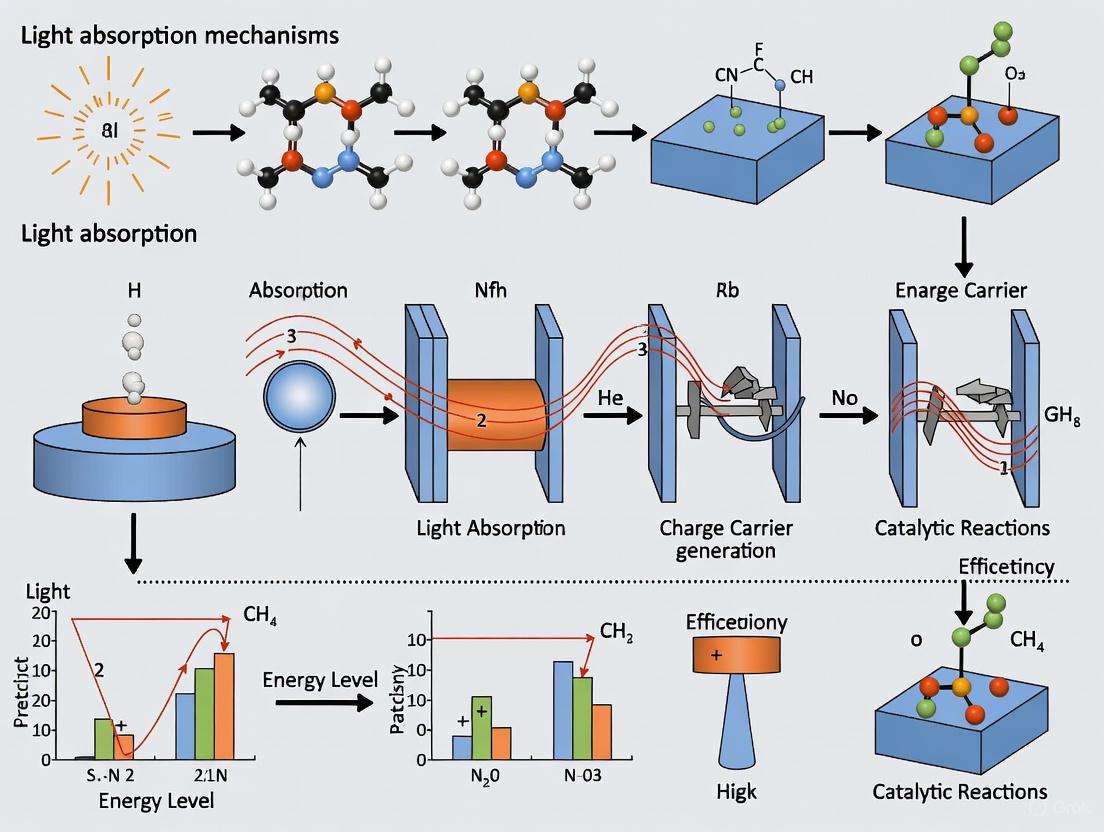
This article provides a comprehensive examination of light absorption mechanisms in metal oxide photocatalysts, tailored for researchers and scientists in material science and drug development.
Harnessing Light: Mechanisms and Innovations in Metal Oxide Photocatalysts for Advanced Applications
Abstract
This article provides a comprehensive examination of light absorption mechanisms in metal oxide photocatalysts, tailored for researchers and scientists in material science and drug development. It explores the foundational principles of photocatalysis, including band theory and charge carrier dynamics. The scope extends to advanced material design strategies such as doping and heterojunction construction, tackles prevalent challenges like electron-hole recombination, and evaluates cutting-edge validation techniques including machine learning and computational fluid dynamics. By synthesizing insights across these four core intents, this review serves as a strategic guide for the rational design of high-performance photocatalytic systems with enhanced light absorption capabilities for biomedical and environmental applications.
The Photocatalytic Blueprint: Fundamental Light Absorption and Electronic Processes in Metal Oxides
Photocatalysis is a light-driven process where a semiconductor material, known as a photocatalyst, absorbs photons to generate electron-hole pairs that accelerate chemical reactions without being consumed itself [1]. This technology has emerged as a promising solution for addressing global environmental and energy challenges, including water purification, air detoxification, and renewable fuel production [2]. The process harnesses solar energy to activate chemical transformations, offering a sustainable pathway for both environmental remediation and energy storage [3].
Metal oxide semiconductors have garnered significant research attention due to their favorable properties for photocatalytic applications. These materials, including titanium dioxide (TiO₂), zinc oxide (ZnO), tungsten trioxide (WO₃), and various bismuth-based oxides, offer excellent stability, abundance, cost-effectiveness, and tunable electronic structures that can be tailored for specific redox reactions [2]. The fundamental principle of metal oxide photocatalysis lies in the generation of electron-hole pairs upon light absorption, which then migrate to the surface to participate in reduction and oxidation reactions with adsorbed species [2] [1].
Table 1: Fundamental Photocatalytic Processes in Metal Oxides
| Process Stage | Description | Governing Factors |
|---|---|---|
| Photon Absorption | Electron excitation from valence to conduction band | Bandgap energy, light intensity and wavelength |
| Charge Separation | Generation of electron-hole (eâ»-hâº) pairs | Semiconductor electronic structure, crystal defects |
| Charge Migration | Movement of carriers to catalyst surface | Crystal structure, morphology, particle size |
| Surface Reactions | Redox reactions with adsorbed species | Surface area, active sites, adsorbate concentration |
Mechanisms of Metal Oxide Photocatalysis
The photocatalytic mechanism in metal oxides follows a well-defined sequence of events initiated by light absorption. When a photon with energy equal to or greater than the material's bandgap is absorbed, it promotes an electron (eâ») from the valence band (VB) to the conduction band (CB), creating a positively charged hole (hâº) in the valence band [1]. This separation of charge creates an electron-hole pair, or exciton, which must then migrate to the surface of the photocatalyst before recombination occurs.
Once at the surface, these charge carriers participate in redox reactions with adsorbed species. The photogenerated electrons typically reduce molecular oxygen (Oâ‚‚) to superoxide radicals (•Oâ‚‚â»), while the holes oxidize water (Hâ‚‚O) or hydroxide ions (OHâ») to generate hydroxyl radicals (•OH) [1]. These highly reactive oxygen species then non-selectively attack and degrade organic pollutants, eventually mineralizing them to carbon dioxide, water, and inorganic salts [4].
Diagram 1: Photocatalytic Mechanism in Metal Oxides
The efficiency of this process depends critically on the relationship between the semiconductor's band structure and the redox potentials of the target reactions. For a photocatalytic reaction to proceed thermodynamically, the conduction band minimum must be more negative than the reduction potential of the reaction, while the valence band maximum must be more positive than the oxidation potential [1]. This energy alignment ensures the photogenerated carriers possess sufficient energy to drive the desired redox processes.
Critical Material Properties and Design Strategies
Essential Photocatalyst Characteristics
The photocatalytic performance of metal oxides is governed by several interconnected material properties that must be carefully optimized:
Suitable Bandgap: The energy difference between valence and conduction bands determines the range of light absorption. While smaller bandgaps enable visible light absorption, they must still provide sufficient redox potential for water splitting or pollutant degradation [1]. Metal oxides typically exhibit bandgaps ranging from 2.0 eV (e.g., Fe₂O₃) to 3.4 eV (e.g., NiO) [4].
High Surface Area: Nanoscale dimensions significantly enhance photocatalytic activity by providing more active sites and reducing the distance charge carriers must travel to reach the surface [1]. Quantum size effects in nanomaterials also increase redox potential by discretizing energy levels [1].
Morphological Control: Crystal size, shape, porosity, and surface functionalization dictate key physicochemical parameters such as charge carrier mobility, adsorption capacity, and light scattering properties [2].
Stability: Photocatalysts must resist photocorrosion during operation. Strategies to enhance stability include crystal structure modification, doping, hybridization with other semiconductors, and optimization of reaction conditions [1].
Bandgap Engineering Strategies
Overcoming the inherent limitations of pristine metal oxides has driven extensive research into bandgap engineering and material modifications:
Doping: Introducing transition metals (e.g., Fe, Cu, Co) or non-metals (e.g., N, C, S) into the oxide lattice creates intermediate energy levels that reduce the effective bandgap and extend light absorption into the visible spectrum [2] [5].
Heterojunction Construction: Combining two or more semiconductors with aligned band structures enhances charge separation through internal electric fields. Particularly effective are Z-scheme heterojunctions that mimic natural photosynthesis by facilitating vectorial electron transfer between components [3].
Nanocomposite Formation: Integrating metal oxides with complementary materials such as carbon nanostructures, polymers, or metal sulfides creates synergistic effects that improve charge separation, broaden light absorption through sensitization, and increase surface area [4].
Defect Engineering: Controlled creation of oxygen vacancies or other defects modulates the electronic structure and introduces active sites that enhance adsorption and reaction kinetics [2] [4].
Table 2: Performance of Engineered Metal Oxide Photocatalysts
| Photocatalyst System | Modification Strategy | Application | Performance Metric | Reference |
|---|---|---|---|---|
| TiOâ‚‚/CuO | Heterojunction composite | Imazapyr degradation | Highest photonic efficiency | [5] |
| MNbâ‚‚O₆/g-C₃Nâ‚„ | Z-scheme heterostructure | Water splitting (Hâ‚‚ production) | 146 mmol hâ»Â¹ gâ»Â¹ | [6] |
| La-based perovskites | Bandgap engineering | Solar water splitting | Ideal bandgap (1.38-2.98 eV) | [7] |
| CdS QDs/ZnO | Quantum dot sensitization | Photocurrent generation | 100× higher efficiency | [8] |
Experimental Protocols and Methodologies
Synthesis of Metal Oxide Photocatalysts
Various synthesis methods enable precise control over the structural and morphological properties of metal oxide photocatalysts:
Sol-Gel Processing: This versatile method involves hydrolysis and polycondensation of metal precursors to form colloidal suspensions (sols) that evolve into integrated networks (gels). The process allows excellent control over composition, porosity, and particle size at low temperatures [2].
Hydrothermal/Solvothermal Synthesis: Crystallization from aqueous or non-aqueous solutions under elevated temperature and pressure conditions enables morphology control and high crystallinity without requiring post-annealing [2] [6].
Green/Bio-inspired Synthesis: Environmentally benign approaches using plant extracts, microorganisms, or biomolecular templates offer sustainable pathways for nanoparticle synthesis with controlled sizes and shapes [2].
Photocatalytic Performance Evaluation
Standardized protocols are essential for reliable assessment of photocatalytic activity:
Pollutant Degradation Assay: Typically performed using model organic contaminants (e.g., herbicides like Imazapyr, organic dyes) in aqueous solutions under controlled irradiation. The degradation efficiency is monitored through UV-Vis spectroscopy or HPLC analysis to track pollutant concentration over time [5].
Water Splitting Measurement: Photocatalytic hydrogen evolution is quantified using gas chromatography to measure gases produced from water splitting under irradiation. Sacrificial reagents (e.g., methanol, Na₂S/Na₂SO₃) are often employed to consume photogenerated holes and enhance electron availability for proton reduction [4] [1].
Quantum Efficiency Calculation: The apparent quantum yield (AQY) is determined using monochromatic light and calculated as: AQY = (Number of reacted electrons / Number of incident photons) × 100 [5].
Diagram 2: Experimental Workflow for Photocatalyst Development
Advanced Material Architectures
Nanocomposite Systems
The integration of metal oxides with complementary materials has emerged as a powerful strategy to overcome limitations of single-component systems:
Metal Oxide Heterostructures: Combining TiO₂ with secondary metal oxides (ZrO₂, ZnO, Ta₂O₅, SnO, Fe₂O₃, CuO) creates interfaces that enhance charge separation through energy level alignment. Studies demonstrate the photocatalytic activity follows the order: TiO₂/CuO > TiO₂/SnO > TiO₂/ZnO > TiO₂/Ta₂O₅ > TiO₂/ZrO₂ > TiO₂/Fe₂O₃ > pristine TiO₂ [5].
Carbon-Metal Oxide Composites: Graphene, carbon nanotubes, or graphitic carbon nitride combined with metal oxides improve electrical conductivity, provide high surface area support, and enhance adsorption capacity. The carbon phase also acts as an electron acceptor, reducing charge recombination [4].
Quantum Dot-Sensitized Systems: Semiconductor quantum dots (e.g., CdS, PbS) attached to metal oxide scaffolds (TiOâ‚‚, ZnO) extend light absorption into the visible range through sensitization and enable multiple exciton generation effects [8].
Emerging Material Classes
Recent research has identified several promising material families with enhanced photocatalytic properties:
MNb₂O₆ Niobates: Transition metal niobates with the general formula MNb₂O₆ (M = Cu, Ni, Mg, Zn, Co, Fe, Mn) exhibit tunable band structures, chemical robustness, and visible-light activity. These materials typically display orthorhombic or monoclinic crystal structures with bandgaps ranging from ~2.0 to 3.0 eV, making them promising for solar water splitting [6].
Perovskite Oxides: ABO₃-type perovskites like La-based oxides (LaZO₃) offer tunable bandgaps (1.38-2.98 eV) with band edges well-aligned with water redox potentials. Their favorable electron-hole mobility ratios (D = 1.19-4.73) enable efficient charge transport and reduced carrier recombination [7].
The Scientist's Toolkit: Essential Research Reagents and Materials
Table 3: Key Research Reagents for Photocatalysis Experiments
| Reagent/Material | Function | Application Notes |
|---|---|---|
| Titanium Dioxide (TiOâ‚‚) | Benchmark photocatalyst | Available in anatase, rutile, or mixed phases; Hombikat UV-100 is common commercial standard |
| Metal Oxide Precursors | Synthesis of photocatalysts | Titanium isopropoxide, zinc acetate, zirconium oxychloride for sol-gel and hydrothermal methods |
| Sacrificial Reagents | Enhance charge separation | Methanol, ethanol, Na₂S/Na₂SO₃, EDTA; consume holes to improve electron availability |
| Pollutant Models | Performance evaluation | Imazapyr, methylene blue, rhodamine B; represent environmental contaminants |
| Co-catalysts | Enhance surface reactions | Pt, Au, Ag nanoparticles; facilitate Hâ‚‚ evolution or oxidation kinetics |
| pH Buffers | Control reaction conditions | Phosphate, carbonate, or borate buffers; maintain optimal pH for specific applications |
| DBCO-PEG13-NHS ester | DBCO-PEG13-NHS ester, MF:C52H75N3O19, MW:1046.2 g/mol | Chemical Reagent |
| 5-Formyl-2'-O-methyluridine | 5-Formyl-2'-O-methyluridine|Research Chemical | Explore 5-Formyl-2'-O-methyluridine for RNA research. This modified nucleoside is used in oligonucleotide studies. For Research Use Only. Not for human use. |
Photocatalysis represents a sophisticated intersection of materials science, surface chemistry, and photophysics that enables the direct conversion of solar energy into chemical potential. Metal oxides serve as the foundational platform for these technologies due to their tunable electronic structures, stability, and diverse morphological possibilities. Current research focuses on developing integrated material systems through heterojunction engineering, defect control, and nanoscale architecture to optimize light absorption, charge separation, and surface reaction kinetics.
The future trajectory of photocatalysis research will likely involve multifunctional systems capable of simultaneous energy production and environmental remediation, advanced Z-scheme configurations that mimic natural photosynthesis with high efficiency, and the integration of computational materials design with experimental synthesis to accelerate discovery. As these technologies mature from laboratory demonstrations to practical applications, considerations of scalability, long-term stability, and economic viability will become increasingly central to research directions. The continued refinement of metal oxide photocatalysts holds significant promise for contributing to sustainable energy and environmental solutions.
Band theory is the foundational theoretical model in solid-state physics that describes the states of electrons in solid materials, which can possess energy only within specific, allowed ranges [9]. This theory explains why materials exhibit vastly different electrical properties, classifying them as metals, semiconductors, or insulators based on their electronic band structure. In the context of metal oxide photocatalysts, understanding band theory is not merely academic; it provides the essential framework for designing materials that efficiently harness solar energy for environmental remediation and renewable fuel production [2] [4]. The precise arrangement of energy bands—particularly the valence band, conduction band, and the bandgap between them—directly determines a material's capability to absorb light and initiate photocatalytic reactions that can address pressing global challenges related to energy and pollution.
The evolution of band theory has enabled scientists to systematically engineer materials with tailored electronic properties. When individual atoms are brought together to form a solid, their discrete atomic energy levels interact and broaden into continuous bands of allowed energy states [9]. The valence band represents the highest range of electron energies where electrons are normally present at absolute zero temperature, while the conduction band constitutes the lowest range of vacant electronic states available for electrons to move freely through the material [10]. The transition from atomic orbitals to electronic bands is particularly crucial for metal oxides, where the interplay between metal and oxygen ions creates diverse electronic structures that can be precisely tuned for specific photocatalytic applications [4].
Fundamental Concepts: Valence Band, Conduction Band, and Band Gap
Valence Band
The valence band is the highest energy band populated by electrons at absolute zero temperature [10]. These electrons are primarily involved in chemical bonding between atoms and are not free to move throughout the crystal lattice. In metal oxides, the valence band typically consists primarily of oxygen 2p orbitals, which have significant electronegativity and hold electrons tightly [4]. For example, in nickel oxide (NiO), the valence band originates mainly from oxygen 2p orbitals, creating a stable electronic configuration that requires substantial energy to disrupt [4]. The energy level at the top of the valence band represents the highest occupied molecular orbital (HOMO) in the solid-state system and serves as a reference point for determining the material's Fermi level and work function.
Conduction Band
The conduction band is the lowest energy band that is vacant or partially filled at absolute zero temperature [10]. When electrons gain sufficient energy to jump from the valence band to the conduction band, they become delocalized and can move freely throughout the material, enabling electrical conductivity. In metal oxides, the conduction band generally comprises empty d-orbitals of the transition metal cations [4]. In the case of NiO, the conduction band originates mainly from nickel 3d orbitals [4]. The energy level at the bottom of the conduction band represents the lowest unoccupied molecular orbital (LUMO) in the solid-state system. The position of the conduction band minimum relative to the vacuum level determines the reducing power of photogenerated electrons in photocatalytic systems.
Band Gap
The band gap represents the forbidden energy range between the top of the valence band and the bottom of the conduction band where no electron states can exist due to the quantization of energy [10]. This critical parameter determines the electrical conductivity and optical properties of materials. According to band theory, solids can be categorized based on their band gap characteristics:
- Metals: Conductors with no band gap or overlapping bands [10] [9]
- Semiconductors: Materials with relatively narrow forbidden gaps (typically 0.1-2.0 eV) that can be crossed by electrons with thermal or light energy [9]
- Insulators: Materials with wide forbidden energy gaps (several electron volts) that cannot be easily crossed [9]
The band gap energy (Eg) serves as the minimum photon energy required to excite an electron from the valence band to the conduction band, creating an electron-hole pair that can participate in photocatalytic reactions [10] [4].
Table 1: Band Gap Classification of Materials and Their Properties
| Material Type | Band Gap Range | Electrical Conductivity | Examples |
|---|---|---|---|
| Conductors | No band gap | Very high | Copper, Silver, Gold |
| Semiconductors | Narrow (∼1 eV) | Intermediate, tunable | Silicon, Germanium, TiO₂, ZnO |
| Insulators | Wide (>4 eV) | Very low | Diamond, Quartz, Al₂O₃ |
Band Theory in the Context of Metal Oxide Photocatalysts
Electronic Structure of Metal Oxides
Metal oxides exhibit a diverse range of optical, structural, and electronic properties that make them particularly suitable for photocatalytic applications [4]. Their electronic structures arise from the complex interplay between metal and oxygen ions, influenced by the metal's oxidation state, coordination geometry, and crystal structure. Metal oxides display various structural configurations, from simple rock salt (e.g., MgO) to complex perovskite (e.g., SrTiO₃) and layered structures (e.g., MoO₃) [4]. This structural diversity significantly impacts their electronic band structure and optical properties. Closely packed structures often lead to wide band gaps and transparent/insulating behavior, while open structures with transition metals can exhibit smaller band gaps, resulting in semiconducting or metallic conductivity [4].
Transition metal oxides frequently absorb visible light and exhibit characteristic colors due to partially filled d-orbitals and phenomena like d-d transitions, charge transfer transitions, and plasmon resonances [4]. For instance, NiO is optically renowned for its characteristic deep green color, which arises from electronic transitions within the visible range [4]. Its absorption spectrum exhibits pronounced absorption in the ultraviolet (UV) region, extending into the visible range, attributed to charge transfer transitions between the valence band (oxygen 2p orbitals) to the conduction band (nickel 3d orbitals) [4]. The bandgap energy of NiO typically resides around 3.4-4.0 eV, classifying it as a wide-bandgap material suitable for applications in the UV region [4].
Band Edge Shifts in Semiconductor Nanoparticles
The edge shifting of size-dependent conduction and valence bands represents a significant phenomenon studied in semiconductor nanocrystals [10]. When semiconductor nanocrystal size is restricted below the effective Bohr radius of the nanocrystal, quantum confinement effects become pronounced. The conduction and/or valence band edges shift to higher energy levels under this radius limit due to discrete optical transitions when the semiconductor nanocrystal is confined by the exciton [10]. As a result of this edge shifting, the effective band gap increases, providing a powerful strategy for tuning the optical and electronic properties of metal oxide photocatalysts. This size-dependent edge shifting of conduction and valence bands provides valuable information regarding the size or concentration of semiconductor nanoparticles and their band structures, enabling precise engineering of photocatalytic materials for specific applications [10].
Table 2: Selected Metal Oxides and Their Band Gap Properties
| Metal Oxide | Band Gap (eV) | Crystal Structure | Primary Applications |
|---|---|---|---|
| TiOâ‚‚ | 3.0-3.2 [2] | Anatase, Rutile, Brookite | Photocatalysis, UV protection |
| ZnO | ~3.3 [2] | Wurtzite | Sensors, Transparent electrodes |
| WO₃ | 2.6-2.8 [2] | Monoclinic, Tetragonal | Electrochromic devices, Photocatalysis |
| NiO | 3.4-4.0 [4] | Rock salt | p-type semiconductor, Catalysis |
| BiVOâ‚„ | ~2.4 [2] | Monoclinic, Tetragonal | Visible-light photocatalysis |
Light Absorption Mechanisms in Metal Oxide Photocatalysts
Fundamental Photocatalytic Process
Photocatalysis using metal oxides is a prominent research domain within environmental remediation, energy conversion, and green chemistry [2]. The fundamental principle of metal oxide photocatalysis lies in the generation of electron-hole pairs upon light absorption [2]. When a photon with energy equal to or greater than the material's band gap strikes the semiconductor, it promotes an electron from the valence band to the conduction band, creating a highly reactive electron-hole pair [4]. This process leaves behind a positive hole in the valence band that can oxidize donor molecules, while the excited electron in the conduction band can reduce acceptor molecules [4].
The photocatalytic process typically involves three essential steps: (i) light absorption, (ii) charge separation and migration, and (iii) surface reactions [11]. In the initial stage, when a photocatalyst is illuminated with solar energy that matches or exceeds its band gap energy, it results in the creation of electron-hole pairs (eâ»/hâº) [11]. This entails electrons being excited from the valence band (VB) to the conduction band (CB), leaving holes in the VB. The efficiency of this process depends critically on the relationship between the photon energy and the band gap energy of the metal oxide.
Charge Carrier Dynamics and Band Engineering
The electrical conductivity of non-metals is determined by the susceptibility of electrons to be excited from the valence band to the conduction band [10]. In semiconductors, some conductivity exists due to thermal excitation, where some electrons acquire sufficient energy to jump the band gap in one go [10]. Once in the conduction band, these electrons can conduct electricity, as can the holes they leave behind in the valence band. The hole is an empty state that allows electrons in the valence band some degree of freedom [10].
However, pristine metal oxides often face limitations such as nanoparticle agglomeration, rapid electron-hole recombination, limited visible light absorption, and low charge carrier mobility, which hinder their photocatalytic performance [4]. To overcome these challenges, researchers employ various band engineering strategies, including doping, creating heterojunctions, surface functionalization, and morphology control [4]. Combining metal oxides with other materials (semiconductors, carbonaceous nanomaterials, noble metals, or polymers) creates synergistic effects that enhance photocatalytic activity through improved charge separation, broadened light absorption, increased surface area, and enhanced stability [4].
Diagram 1: Band Theory and Photocatalytic Process in Metal Oxides - This diagram illustrates the fundamental process of electron excitation across the band gap upon photon absorption, leading to charge separation and subsequent redox reactions in photocatalytic metal oxides.
Experimental Protocols for Band Structure Analysis
Methodology for Band Gap Determination
The accurate determination of band gap energy is crucial for characterizing metal oxide photocatalysts. Several experimental techniques have been developed to measure this critical parameter:
UV-Vis Diffuse Reflectance Spectroscopy (DRS): This is the most widely used technique for determining the band gap energy of powder semiconductor samples. The experimental protocol involves:
- Grinding the metal oxide sample to a fine powder to ensure consistent reflectance
- Loading the powder into a sample holder with a transparent window
- Collecting reflectance spectra in the 200-800 nm range using an integrating sphere attachment
- Converting reflectance data to the Kubelka-Munk function: F(R) = (1-R)²/2R, where R is the reflectance
- Plotting [F(R)hv]â¿ versus photon energy (hv), where n = 1/2 for indirect band gaps and n = 2 for direct band gaps
- Extrapolating the linear portion of the plot to [F(R)hv]â¿ = 0 to determine the band gap energy
Photoluminescence (PL) Spectroscopy: This technique provides information about charge carrier recombination processes and defect states within the band gap. The standard protocol includes:
- Exciting the sample with a laser source at energy greater than the band gap
- Collecting the emitted radiation at right angles to the excitation source
- Analyzing the emission spectrum to identify band-to-band transitions and defect-related emissions
- Calculating the Stokes shift between absorption and emission maxima
Photoelectrochemical Measurements: These methods provide both band gap information and insight into charge carrier dynamics:
- Preparing working electrodes by depositing metal oxide films on conducting substrates
- Performing Mott-Schottky analysis at the semiconductor-electrolyte interface
- Determining the flat band potential from the x-intercept of the Mott-Schottky plot
- Calculating the conduction band position from the flat band potential
Advanced Characterization Techniques
For comprehensive understanding of band structure in metal oxide photocatalysts, researchers employ several sophisticated characterization methods:
X-ray Photoelectron Spectroscopy (XPS): This technique provides information about elemental composition, chemical state, and valence band maximum position. The experimental workflow involves:
- Mounting powder samples on conductive tape or pellets
- Acquiring high-resolution spectra of relevant core levels and valence band region
- Calibrating binding energy scale using carbon 1s peak at 284.8 eV
- Extrapolating the valence band spectrum to determine the valence band maximum
Electron Energy Loss Spectroscopy (EELS): When coupled with transmission electron microscopy, EELS provides band gap information with high spatial resolution, enabling the analysis of individual nanoparticles and heterojunctions.
Ultraviolet Photoelectron Spectroscopy (UPS): This method directly measures the valence band structure and work function of materials, offering crucial information for understanding electron transfer processes in photocatalytic systems.
Table 3: Experimental Techniques for Band Structure Analysis
| Technique | Information Obtained | Sample Requirements | Limitations |
|---|---|---|---|
| UV-Vis DRS | Band gap energy, Absorption edge | Powder or thin film | Indirect measurement, Requires extrapolation |
| Photoluminescence | Recombination processes, Defect states | Solid samples | Surface-sensitive, Complex interpretation |
| XPS/UPS | Valence band maximum, Chemical states | Ultra-high vacuum compatible | Surface contamination issues |
| Mott-Schottky | Flat band potential, Carrier density | Electrode in electrolyte | Limited to electrolyte-compatible materials |
The Scientist's Toolkit: Essential Research Reagents and Materials
The experimental investigation of band structures in metal oxide photocatalysts requires specific materials and analytical tools. The following table details essential research reagents and their functions in band structure analysis and photocatalyst development.
Table 4: Essential Research Reagents and Materials for Band Structure Studies
| Reagent/Material | Function | Application Example |
|---|---|---|
| Titanium Dioxide (TiOâ‚‚) | Reference photocatalyst with well-characterized band structure (Eg = 3.0-3.2 eV) [2] | Benchmarking new materials, UV-driven photocatalysis |
| Zinc Oxide (ZnO) | Wide band gap semiconductor with good electron mobility [2] | Sensor development, Transparent conductive oxides |
| Tungsten Trioxide (WO₃) | Visible-light-responsive semiconductor (Eg = 2.6-2.8 eV) [2] | Photoelectrochemical water splitting, Smart windows |
| Bismuth Vanadate (BiVO₄) | Promising visible-light photocatalyst (Eg ≈ 2.4 eV) [2] | Solar water oxidation, Environmental remediation |
| Nitrogen Doping Agents (e.g., urea, NH₃) | Anion doping to reduce band gap via band narrowing [4] | Enhancing visible light absorption of wide band gap oxides |
| Transition Metal Dopants (Fe, Cu, Mn) | Cation doping to create intra-band gap states [4] | Extending light absorption range, Reducing recombination |
| Carbon-based Materials (graphene, CNTs) | Electron acceptors and conductive supports [4] | Enhancing charge separation in composite photocatalysts |
| Platinum/Noble Metal Cocatalysts | Electron sinks for enhanced charge separation [4] | Improving hydrogen evolution in photocatalytic water splitting |
| 2-Iodo-5-nitrosobenzamide | 2-Iodo-5-nitrosobenzamide | High-purity 2-Iodo-5-nitrosobenzamide for research. Explore its potential as a synthetic intermediate. For Research Use Only. Not for human use. |
| Dichapetalin I | Dichapetalin I | Dichapetalin I is a cytotoxic merotriterpenoid for cancer research. This product is for Research Use Only (RUO). Not for human or veterinary use. |
Diagram 2: Experimental Workflow for Band Structure Analysis - This workflow outlines the comprehensive methodology for characterizing the band structure of metal oxide photocatalysts, from sample preparation through structural, optical, and electronic characterization to performance evaluation.
The fundamental principles of band theory—encompassing the valence band, conduction band, and the crucial bandgap—provide the essential theoretical framework for understanding and engineering metal oxide photocatalysts. The precise arrangement of these electronic bands determines a material's capacity to absorb light, generate charge carriers, and drive photocatalytic reactions for environmental remediation and renewable energy production. Current research continues to focus on band gap engineering strategies, including doping, heterojunction formation, nanostructuring, and composite development, to enhance the visible light absorption and charge separation efficiency of metal oxide photocatalysts. As characterization techniques advance and our understanding of charge carrier dynamics deepens, the rational design of photocatalysts with optimized band structures will play an increasingly vital role in addressing global energy and environmental challenges through solar-driven chemical transformations.
Photocatalysis represents a promising technology that harnesses light energy to drive chemical reactions, offering significant potential for addressing environmental and energy challenges [12]. In metal oxide photocatalysts, this process initiates when photons are absorbed, generating electron-hole pairs that subsequently enable a cascade of redox reactions at the catalyst surface [1]. This technical guide examines the fundamental principles and mechanisms of the photocatalytic cycle, with particular emphasis on reactive oxygen species (ROS) generation within the context of light absorption mechanisms in metal oxide research. For researchers and drug development professionals, understanding these processes is crucial for designing efficient photocatalytic systems for applications ranging from environmental remediation to advanced oxidation therapies.
The photocatalytic activity of metal oxides depends critically on their electronic structure, morphological characteristics, and surface properties [1]. Titanium dioxide (TiO₂), zinc oxide (ZnO), iron oxide (Fe₂O₃), and tungsten oxide (WO₃) are among the most studied metal oxides, each exhibiting distinct band gap energies, charge carrier dynamics, and stability profiles that dictate their photocatalytic performance [1]. This review systematically explores the photophysical and photochemical processes in these materials, from initial photon absorption to the formation of highly reactive oxygen species, with supporting quantitative data and experimental methodologies relevant to current research practices.
Fundamental Principles of Photocatalysis in Metal Oxides
Band Structure and Photon Absorption
Metal oxide photocatalysts are semiconducting materials characterized by their electronic band structure, consisting of a valence band (VB) filled with electrons and a conduction band (CB) that is generally empty, separated by a forbidden energy range known as the band gap [1] [13]. The photocatalytic process initiates when a photon with energy equal to or greater than the material's band gap is absorbed, promoting an electron (eâ») from the valence band to the conduction band, thereby creating a positively charged hole (hâº) in the valence band [1]. This electron-hole pair, termed an exciton, represents the primary photo-generated charge carriers that drive subsequent photocatalytic reactions.
The band gap energy fundamentally determines the light absorption capabilities of a photocatalyst. Metal oxides exhibit a range of band gap energies, which correspondingly dictate the wavelengths of light they can utilize [1]. For instance, titanium dioxide (TiO₂) possesses a wide band gap (~3.2 eV for anatase phase), requiring UV light for activation, while iron oxide (Fe₂O₃) has a narrower band gap (<2.1 eV), enabling visible light absorption [1]. The band structure must also align thermodynamically with the desired redox reactions; specifically, the conduction band minimum must be more negative than the reduction potential of target electron acceptors, while the valence band maximum must be more positive than the oxidation potential of electron donors [1].
Table 1: Band Gap Energies and Light Absorption Characteristics of Common Metal Oxide Photocatalysts
| Metal Oxide | Band Gap (eV) | Primary Absorption Range | Light Absorption Capacity |
|---|---|---|---|
| TiOâ‚‚ (Anatase) | ~3.2 | UV | High UV absorption |
| ZnO | ~3.3 | UV | High UV absorption |
| Fe₂O₃ | <2.1 | Visible | Extensive visible light absorption |
| WO₃ | ~2.8 | Visible | Visible-light sensitive |
| SnOâ‚‚ | ~3.6 | UV | Activation at ~350 nm |
Charge Carrier Dynamics
Following photon absorption and exciton formation, the photogenerated electrons and holes undergo several competing processes: (1) migration to the catalyst surface to participate in redox reactions, (2) recombination in the bulk, or (3) trapping at surface states [1] [14]. The efficiency of photocatalysis depends critically on the successful separation and migration of charge carriers to surface reaction sites before recombination occurs [1].
Nanoscale metal oxide particles significantly enhance photocatalytic performance by reducing the distance charge carriers must travel to reach the surface, thereby diminishing recombination probabilities [1]. Quantum size effects in nanomaterials also cause the conduction and valence bands to become discrete energy levels, increasing the redox potential of photogenerated electrons and holes and consequently enhancing their reactivity [1]. Surface area optimization represents another crucial factor, as higher specific surface areas provide more active sites for reactant adsorption and surface reactions [1].
The Photocatalytic Mechanism: From Charge Separation to ROS Generation
Initial Charge Separation and Migration
The photocatalytic mechanism begins with charge separation and the migration of photogenerated carriers to the catalyst surface. The following diagram illustrates this fundamental process in a metal oxide semiconductor nanoparticle:
Upon reaching the surface, these charge carriers initiate various redox reactions with adsorbed species. The holes exhibit strong oxidizing potential, while the electrons possess reducing capability, enabling them to participate in the formation of reactive oxygen species [1].
Reactive Oxygen Species (ROS) Generation Pathways
The generation of reactive oxygen species occurs through well-defined electron transfer pathways involving oxygen and water molecules adsorbed on the catalyst surface. The primary ROS generation mechanisms include:
1. Superoxide Anion Formation: Conduction band electrons reduce molecular oxygen to form superoxide anion radicals [15]: [ O2 + e^- \rightarrow \bullet O2^- ]
2. Hydroxyl Radical Formation: Valence band holes oxidize water or hydroxide ions to generate hydroxyl radicals [1] [15]: [ H_2O + h^+ \rightarrow \bullet OH + H^+ ] [ OH^- + h^+ \rightarrow \bullet OH ]
3. Hydrogen Peroxide Formation: Superoxide anions can undergo further reduction and protonation to form hydrogen peroxide [15]: [ \bullet O2^- + e^- + 2H^+ \rightarrow H2O2 ] Alternatively, hydrogen peroxide can form through hydroxyl radical recombination: [ \bullet OH + \bullet OH \rightarrow H2O_2 ]
4. Singlet Oxygen Formation: Energy transfer from the excited photocatalyst to molecular oxygen can produce singlet oxygen, though this pathway is less common in metal oxide photocatalysis [15].
The following diagram illustrates the complete photocatalytic cycle, integrating photon absorption, charge separation, and ROS generation pathways:
Table 2: Characteristics of Primary Reactive Oxygen Species in Photocatalysis
| ROS Species | Formation Pathway | Redox Potential (V) | Primary Reactivity |
|---|---|---|---|
| Hydroxyl Radical (•OH) | H₂O/OH⻠oxidation by h⺠| +2.8 | Non-selective, highly reactive oxidation |
| Superoxide Anion (•Oâ‚‚â») | Oâ‚‚ reduction by eâ» | -0.33 | Selective reduction, protonation to Hâ‚‚Oâ‚‚ |
| Hydrogen Peroxide (H₂O₂) | •O₂⻠reduction or •OH recombination | +1.78 | Oxidizing agent, precursor to •OH |
| Singlet Oxygen (¹O₂) | Energy transfer to O₂ | +0.65 | Selective oxidation of organics |
Thermodynamics and Energetic Considerations
The thermodynamic feasibility of ROS generation depends critically on the band edge positions of the metal oxide relative to the redox potentials of the relevant species. For instance, the conduction band must be more negative than the Oâ‚‚/•Oâ‚‚â» redox potential (-0.33 V vs. NHE) for superoxide formation to occur, while the valence band must be more positive than the OHâ»/•OH potential (+1.99 V vs. NHE) for hydroxyl radical generation [1] [15].
Computational studies using Møller-Plesset second-order perturbation theory (MP2) have provided quantitative insights into the thermochemical properties of ROS formation [15]. These calculations reveal that the transformation from triplet oxygen to singlet oxygen requires significant energy (ΔG = 126 kJ molâ»Â¹), while the reduction of oxygen to superoxide anion is energetically favorable (ΔG = -281 kJ molâ»Â¹) [15]. Such theoretical approaches complement experimental observations in understanding the relative stability and reactivity of different ROS in photocatalytic systems.
Advanced Computational Methods in Photocatalysis Research
Theoretical Modeling Approaches
Computational methods have become indispensable tools for elucidating photocatalytic mechanisms at the molecular level. Density Functional Theory (DFT) and time-dependent DFT (TDDFT) calculations provide insights into electronic structures, band gaps, and reaction pathways [16] [13]. Hybrid functionals such as HSE06 offer improved accuracy over standard local functionals by including a portion of exact Hartree-Fock exchange, better reproducing band gaps and excited-state properties [16].
Linear response time-dependent density functional theory (LR-TDDFT) has emerged as a particularly valuable method for investigating excited-state processes in photocatalytic systems [16]. For instance, LR-TDDFT simulations of water oxidation on rutile TiOâ‚‚ surfaces have revealed that Oâ‚‚ formation follows a thermocatalytic pathway occurring at room temperature, while Hâ‚‚Oâ‚‚ desorption is photocatalytic, requiring light to overcome a high-energy barrier [16]. This explains the experimental observation that Oâ‚‚ formation is typically more favorable in TiOâ‚‚ photocatalysis.
Advanced quantum chemical methods, including Møller-Plesset second-order perturbation theory (MP2), provide accurate thermochemical data for ROS formation pathways and stability [15]. These computational approaches enable researchers to map energetic profiles and predict favorable reaction pathways under various conditions.
Multiscale Modeling and Machine Learning
Multiscale modeling approaches integrate quantum mechanical calculations with kinetic models and macroscopic transport phenomena, providing a comprehensive understanding of photocatalytic processes across different length and time scales [13]. This hierarchical strategy optimizes resource distribution by applying appropriate computational methods to each scale of the problem.
Machine learning (ML) techniques are increasingly employed to accelerate photocatalyst discovery and optimization [13]. ML models can predict material properties, identify key performance descriptors, and guide the design of novel metal oxide compositions with enhanced photocatalytic activity. Quantum computing represents another emerging frontier, offering potential breakthroughs in solving complex quantum mechanical equations governing electronic and optical properties of photocatalytic materials [13].
Experimental Methodologies and Characterization
Quantum Efficiency Determination
Quantum efficiency represents a fundamental property of photocatalytic processes, defined as the number of target molecules converted per photon absorbed [17]. Accurate determination of quantum efficiency requires simultaneous solution of mass balance (to quantify reactant conversion) and radiation balance (to quantify photon absorption) within the reactor system [17].
Monte Carlo simulation methods have been developed to model the local volumetric rate of photon absorption (LVRPA) in photocatalytic reactors [17]. This approach tracks the trajectory of a statistically significant number of photons inside the reactor until they are either absorbed or scattered, recording the spatial location of absorbed photons. The method provides highly accurate results without introducing major simplifications, though it is computationally intensive [17].
Experimental protocols for quantum efficiency measurements typically involve:
- Synthesis and characterization of metal oxide photocatalysts with controlled properties
- Establishment of adsorption-desorption equilibrium in target compounds before irradiation
- Controlled irradiation with characterized light sources (UVA, visible, etc.)
- Sampling and analysis of reaction progress (e.g., via UV-Vis spectroscopy, TOC measurements)
- Photon flux determination using chemical actinometers (e.g., ferrioxalate actinometer)
- Calculation of quantum efficiency based on reactant conversion and absorbed photons [17]
The Scientist's Toolkit: Essential Research Reagents and Materials
Table 3: Key Research Reagent Solutions for Photocatalytic ROS Studies
| Reagent/Material | Function/Application | Representative Examples |
|---|---|---|
| Metal Oxide Photocatalysts | Light absorption, charge generation, surface reactions | TiO₂ (P25), ZnO, Fe₂O₃, WO₃ nanoparticles [1] |
| Target Probe Compounds | ROS detection and quantification | Formic acid (minimal adsorption), Salicylic acid (strong adsorption) [17] |
| Sacrificial Reagents | Enhanced charge separation, increased photo-efficiency | Methanol, Naâ‚‚S, ethanol, Naâ‚‚SOâ‚„ [1] |
| Actinometers | Photon flux quantification | Ferrioxalate actinometer for light source characterization [17] |
| pH Modifiers | Reaction condition control, ROS speciation influence | Acids/bases for pH adjustment [15] |
| Dopants/Cocatalysts | Band gap engineering, charge separation enhancement | Transition metals, noble metals, graphite, graphene [1] |
| 7-Acetyl-5-fluoro-1H-indole | 7-Acetyl-5-fluoro-1H-indole | 7-Acetyl-5-fluoro-1H-indole (CAS 1221684-52-1) is a fluorinated indole building block for research. This product is for Research Use Only (RUO) and not for human or veterinary use. |
| 1-(P-Tolyl)hex-5-EN-1-one | 1-(P-Tolyl)hex-5-EN-1-one, MF:C13H16O, MW:188.26 g/mol | Chemical Reagent |
Applications and Future Perspectives
The photocatalytic generation of ROS has enabled diverse applications in environmental remediation, energy production, and biomedical fields. In environmental contexts, ROS-driven oxidation processes effectively degrade organic pollutants, pesticides, and inorganic contaminants in wastewater [1] [18]. The strong oxidizing power of hydroxyl radicals, in particular, enables mineralization of persistent organic pollutants to COâ‚‚ and Hâ‚‚O.
Photocatalytic water splitting represents another significant application, where photogenerated electrons reduce H⺠to H₂ while corresponding holes oxidize H₂O to O₂ [1]. This process requires careful catalyst design to mitigate electron-hole recombination issues, often addressed through doping, heterojunction formation, or addition of sacrificial reagents [1].
Emerging applications include ROS-based therapies in biomedicine, where nanoplatforms generating controlled oxidative stress show promise for cancer treatment [15] [18]. The selective cytotoxicity of ROS enables targeted apoptosis of cancer cells while minimizing damage to healthy tissue.
Future research directions should address critical challenges in photocatalyst stability, scalability, and environmental compatibility [18]. The development of standardized ROS quantification protocols, computation-assisted material design, and large-scale fabrication methods will accelerate the translation of photocatalytic technologies from laboratory demonstrations to practical implementations [18]. Additionally, fundamental studies exploring the intricate relationships between metal oxide structure, surface properties, and ROS generation mechanisms will continue to drive innovation in this field.
Metal oxide semiconductors represent a cornerstone of modern photocatalytic research, driving advancements in environmental remediation, renewable energy, and sustainable chemistry. The efficacy of these materials is fundamentally governed by their intrinsic electronic structures and optical properties, particularly their bandgap energies, which determine the portion of the solar spectrum they can harness. Among the numerous metal oxides investigated, titanium dioxide (TiO₂), zinc oxide (ZnO), iron (III) oxide (Fe₂O₃), and tungsten trioxide (WO₃) have emerged as key players due to their favorable charge transport characteristics, tunable surface properties, and exceptional chemical stability.
This technical guide provides a systematic examination of these four pivotal metal oxides, framing their characteristics within the context of light absorption mechanisms crucial for photocatalytic applications. We present a detailed analysis of their crystal structures, intrinsic bandgap energies, and band edge positions, supplemented with experimentally-verified methodologies for their synthesis and characterization. The information herein is designed to serve researchers and scientists engaged in the rational design of photocatalytic systems, particularly those working at the intersection of materials science and environmental technology.
Fundamental Properties of Key Metal Oxides
Table 1: Fundamental Structural and Electronic Properties of Key Metal Oxides
| Material | Primary Crystal Structure(s) | Intrinsic Bandgap (eV) | Bandgap Nature | Key Characteristics & Challenges |
|---|---|---|---|---|
| TiOâ‚‚ | Anatase, Rutile, Brookite (Tetragonal) | 3.2 (Anatase), 3.0 (Rutile) [19] | Indirect (Anatase) | Highly stable, non-toxic, but rapid electron-hole recombination limits efficiency [20] [19]. |
| ZnO | Wurtzite (Hexagonal) | ~3.37 [21] [22] | Direct | Large exciton binding energy (~60 meV), but optical absorption is restricted to UV light [21] [22]. |
| Fe₂O₃ | Hematite (Rhombohedral) | 1.9 - 2.2 [22] | Indirect | Visible light absorption, widespread availability, but suffers from low electronic conductivity [22]. |
| WO₃ | Perovskite-like (Monoclinic) | 2.4 - 2.8 [23] | Indirect | Strong visible and near-infrared absorption, high photoconductivity, suitable for electrochromic devices [23]. |
The bandgap values for Fe₂O₃ and WO₃ are presented as ranges, reflecting the variability reported in the literature due to differences in synthesis methods, crystallinity, and nanoscale effects [23] [22]. The crystal structure directly influences charge carrier mobility and surface reactivity, making polymorph control a critical aspect of material synthesis.
Bandgap Engineering and Enhanced Photocatalytic Performance
A significant challenge with pristine metal oxides is their limited visible-light absorption. Bandgap engineering through doping and composite formation is a primary strategy to enhance their photocatalytic activity.
Table 2: Bandgap Modulation via Doping and Composite Formation
| Material | Engineering Strategy | Specific Example | Resulting Bandgap | Performance Enhancement |
|---|---|---|---|---|
| TiOâ‚‚ | Co-doping with metals and non-metals | Al³âº/Al²⺠(2%) and Sâ¶âº (8%) co-doping [20] | 1.98 eV (from 3.23 eV) | 96.4% MB degradation in 150 min vs. 15% for pure TiOâ‚‚ [20]. |
| TiOâ‚‚ | Non-metal/Metal tri-doping | C, N, and Ni tri-doping (Computational) [19] | Significant reduction predicted | Emergence of mid-gap states, enhanced optical absorption in visible region [19]. |
| ZnO | Rare-earth ion doping | Eu³âº-doped ZnO Quantum Dots [24] | Tunable emission | Enhanced red emission; energy transfer from ZnO host to Eu³⺠ions [24]. |
| ZnO | Composite with narrow bandgap semiconductor | ZnO/Feâ‚‚O₃ nanocomposites [22] | N/A (Composite) | Superior photocatalytic and antimicrobial efficacy; efficient eâ»/h⺠separation [22]. |
| WO₃ | Doping and nanostructuring | Cr, Sn, Fe, S doping & nanostructure engineering [23] | Tunable within 2.4-2.8 eV range | Enhanced performance for water splitting, sensing, and electrochromic devices [23]. |
These strategies demonstrate that the optical absorption and, consequently, the photocatalytic efficiency of metal oxides can be profoundly altered through deliberate material design, pushing their functional boundaries into the visible light spectrum.
Experimental Protocols for Synthesis and Characterization
Detailed Synthesis Protocol: Hydrothermal Synthesis of Al/S Co-doped TiOâ‚‚ Nanoparticles
The following methodology is adapted from a documented procedure for enhanced visible-light photocatalysis [20].
Objective: To synthesize Al³âº/Al²⺠and Sâ¶âº co-doped TiOâ‚‚ nanoparticles with a modulated bandgap for improved photocatalytic degradation under visible light.
Materials (Research Reagent Solutions):
- Titanium Precursor: Titanium (III) chloride hexahydrate (TiCl₃·6H₂O), 99.999%.
- Dopant Sources: Aluminum (III) chloride hexahydrate (AlCl₃·6H₂O, 99.999%) and Thiourea (SC(NH₂)₂, 99.9%).
- Precipitation Agent: Sodium hydroxide (NaOH, 99.999%).
- Solvent: De-ionized water.
Procedure:
- Precursor Preparation: Dissolve 2 g of TiCl₃·6H₂O in 50 mL of deionized water using a magnetic stirrer for 30 minutes to ensure a homogeneous solution.
- NaOH Solution Preparation: Dissolve 0.5 g of NaOH in 20 mL of deionized water with stirring for 20 minutes.
- Co-precipitation: Add the NaOH solution dropwise to the TiCl₃ solution using a pipette. Allow the mixture to stand for 10 minutes at room temperature before resuming vigorous magnetic stirring for 50 minutes.
- Dopant Incorporation: For doped samples, add stoichiometric amounts of Aluminum nitrate nonahydrate (Al(NO₃)₃·9H₂O) and sodium sulfate (Na₂SO₄) to the Ti precursor solution. Adjust the pH of the final mixture to approximately 9 using ammonium hydroxide to facilitate uniform precipitation.
- Hydrothermal Reaction: Transfer the resulting solution into a 100 mL Teflon-lined stainless steel autoclave. Heat the autoclave in an oven at 150°C for 24 hours, ensuring a controlled heating rate (e.g., 5°C/min).
- Post-processing:
- After reaction, cool the autoclave to room temperature.
- Centrifuge the resultant product and wash repeatedly with deionized water until the supernatant reaches a neutral pH of 7.
- Transfer the washed precipitate to a beaker and dry in an oven at 60°C for 24 hours.
- For crystallinity and dopant inclusion, calcine the dried powder at 500°C for 3 hours in air.
Key Characterization Workflow
The properties of synthesized metal oxides are typically validated through a series of characterization techniques. The following diagram illustrates the logical workflow from synthesis to functional assessment.
Diagram 1: Experimental characterization workflow for metal oxide photocatalysts.
Key Techniques:
- X-ray Diffraction (XRD): Determines crystalline phase, estimates crystallite size via Scherrer's equation, and detects lattice strain induced by dopants [20] [21].
- Raman Spectroscopy: Probes phase purity and lattice vibrations; peak shifts and broadening confirm successful dopant incorporation and resultant strain [20] [24].
- UV-Vis Spectroscopy: Measures the optical absorption edge. The bandgap is calculated using Tauc plots from the absorption data [20] [23].
- Photoluminescence (PL) Spectroscopy: Reveals information about charge carrier recombination dynamics. A reduction in PL intensity often indicates suppressed electron-hole recombination [20] [24].
- X-ray Photoelectron Spectroscopy (XPS): Confirms elemental composition, chemical states, and the successful incorporation of dopants into the host lattice [22] [24].
The Scientist's Toolkit: Essential Research Reagents
Table 3: Key Research Reagents for Metal Oxide Synthesis and Analysis
| Reagent / Material | Function in Research | Example Application |
|---|---|---|
| Titanium (III) Chloride Hexahydrate (TiCl₃·6H₂O) | Precursor for TiO₂ synthesis, providing titanium ions. | Hydrothermal synthesis of TiO₂ nanoparticles [20]. |
| Zinc Acetate Dihydrate (Zn(CH₃COO)₂·2H₂O) | Common zinc precursor for wet-chemical synthesis of ZnO. | Synthesis of ZnO quantum dots and nanoparticles [24]. |
| Thiourea (SC(NHâ‚‚)â‚‚) | Source of sulfur (Sâ¶âº) for non-metal doping. | Co-doping of TiOâ‚‚ to create oxygen vacancies and reduce bandgap [20]. |
| Ammonium Hydroxide (NHâ‚„OH) | pH regulator in precipitation and hydrothermal synthesis. | Used to adjust pH to ~9 for uniform precipitation during doping [20]. |
| Oleylamine (Câ‚₈H₃₇N) | Surfactant and stabilizing agent in nanomaterial synthesis. | Used in the synthesis of Eu³âº-doped ZnO QDs to control growth and prevent aggregation [24]. |
| Methylene Blue (Câ‚₆Hâ‚₈ClN₃S) | Model organic pollutant for evaluating photocatalytic activity. | Standard dye for testing degradation efficiency under visible light [20] [22]. |
| (S)-2-Isobutylsuccinic acid | (S)-2-Isobutylsuccinic acid, CAS:63163-11-1, MF:C8H14O4, MW:174.19 g/mol | Chemical Reagent |
| N-Formyl tranexamic acid | N-Formyl Tranexamic Acid|CAS 1599413-49-6|RUO | N-Formyl Tranexamic Acid, a Tranexamic Acid impurity (CAS 1599413-49-6). For Research Use Only. Not for human or veterinary diagnostic or therapeutic use. |
TiO₂, ZnO, Fe₂O₃, and WO₃ form a versatile portfolio of metal oxide semiconductors, each with distinct structural and electronic properties that dictate their applicability in photochemical processes. While their intrinsic wide bandgaps pose a limitation, the strategic implementation of doping and composite formation provides a powerful pathway for bandgap modulation and functional enhancement. The experimental protocols and characterization workflows outlined in this guide provide a foundational framework for researchers to synthesize, modify, and validate these materials. The ongoing research, as evidenced by the latest studies, continues to refine these strategies, pushing the boundaries toward highly efficient, visible-light-driven photocatalytic systems for a sustainable future.
The efficiency of photocatalytic processes in transition metal oxides (TMOs)—ranging from pollutant degradation and CO₂ reduction to renewable energy generation—is fundamentally governed by their electronic transition characteristics. When photon energy interacts with a photocatalytic material, electrons undergo transitions between different energy states, primarily through two distinct mechanisms: charge-transfer (CT) transitions and d-d transitions. These transitions dictate how effectively a material harnesses solar energy, particularly in metal oxide systems where the interplay between metal centers and ligand environments creates unique optical properties. Understanding these electronic transitions is crucial for designing advanced photocatalytic systems that optimize solar energy conversion across the electromagnetic spectrum, from ultraviolet to infrared regions.
The strategic engineering of these transitions enables researchers to overcome inherent limitations in classic TMOs such as TiO₂, ZnO, and WO₃, which typically suffer from wide bandgaps restricting light absorption to ultraviolet regions, rapid charge carrier recombination, and poor electrical conductivity. Recent advances demonstrate that manipulation of charge transfer pathways and d-d transition characteristics can significantly enhance photocatalytic performance, providing a foundation for next-generation environmental and energy technologies.
Fundamental Concepts of Electronic Transitions
d-d Transitions
d-d transitions represent electronic excitations between molecular orbitals that are predominantly metal in character—specifically, between the crystal field-split d-orbitals of a transition metal ion in a coordination complex. These transitions occur when an electron moves from one d-orbital to another within the same metal center, typically in octahedral or tetrahedral coordination environments. For instance, in octahedral complexes, d-d transitions occur between the tâ‚‚g and e_g orbitals across the crystal field splitting energy (Δ). A crucial characteristic of d-d transitions is that they are only possible in metal ions with partially filled d-orbitals (d¹ to dâ¹ configurations); they cannot occur in systems with completely empty (dâ°) or completely full (d¹â°) d-orbitals [25].
These transitions are classified as "parity-forbidden" due to the same angular momentum quantum number of the initial and final orbitals, resulting in relatively weak absorption bands with molar extinction coefficients (ε) typically below 1,000 Mâ»Â¹cmâ»Â¹ [25]. However, in certain coordination environments where strong p-d orbital coupling occurs between metal centers and coordinating groups—such as in hydrotalcite-like hydroxy salts—this forbidden character can be partially lifted, enabling d-d transitions to contribute significantly to light absorption, even in the infrared region [26].
Charge-Transfer Transitions
In contrast to d-d transitions, charge-transfer (CT) transitions involve electron movement between orbitals that are predominantly localized on different chemical species—typically from ligand to metal or metal to ligand. These transitions are classified into two primary categories [27] [25]:
Ligand-to-Metal Charge Transfer (LMCT): Electrons transition from molecular orbitals primarily associated with ligands to those primarily associated with the metal center. This occurs most readily when metals are in high oxidation states with low-energy empty d-orbitals, combined with ligands possessing high-energy filled orbitals (e.g., π-donor ligands like oxo or halo ligands) [27].
Metal-to-Ligand Charge Transfer (MLCT): Electrons transition from molecular orbitals primarily associated with the metal center to those primarily associated with the ligands. This is favored when metals are in low oxidation states with high-energy filled d-orbitals, combined with ligands possessing low-energy empty π* orbitals [27] [25].
Charge-transfer transitions are both spin- and Laporte-allowed, resulting in intense absorption bands with extinction coefficients (ε) typically much greater than 1,000 Mâ»Â¹cmâ»Â¹â€”often orders of magnitude stronger than d-d transitions [27] [25]. These transitions are frequently responsible for the intense colors observed in many coordination compounds and play a crucial role in photocatalytic applications by facilitating efficient light harvesting and charge separation.
Table 1: Comparative Characteristics of d-d and Charge-Transfer Transitions
| Characteristic | d-d Transitions | Charge-Transfer Transitions |
|---|---|---|
| Electronic Nature | Within metal-centered d-orbitals | Between ligand and metal orbitals |
| Spectral Intensity | Weak (ε < 1,000 Mâ»Â¹cmâ»Â¹) | Strong (ε > 1,000 Mâ»Â¹cmâ»Â¹) |
| Selection Rules | Parity-forbidden | Spin- and Laporte-allowed |
| Metal Requirements | Partially filled d-orbitals (d¹-dâ¹) | Dependent on oxidation state and ligand type |
| Spectral Range | Often visible region | UV to visible region |
| Ligand Dependence | Dependent on field strength | Dependent on π-donor/acceptor properties |
| Solvent Effects | Generally minimal | Often solvatochromic |
Experimental Characterization Methodologies
Spectroscopic Techniques
The characterization of electronic transitions in photocatalytic materials employs several sophisticated spectroscopic techniques that provide insights into both thermodynamic and kinetic aspects of electron transfer processes.
Ultraviolet-Visible (UV-Vis) Spectroscopy serves as the fundamental tool for identifying electronic transitions through absorption measurements. This technique enables researchers to determine bandgap energies via Tauc plot analysis and distinguish between d-d and CT transitions based on their characteristic intensities and spectral positions. CT transitions typically manifest as intense, broad bands in the UV-visible region, while d-d transitions appear as weaker features, often in the visible region [27] [28]. For metal oxides, diffuse reflectance spectroscopy (DRS) is particularly valuable for powdered samples, allowing bandgap determination for photocatalytic suitability assessment.
Femtosecond Transient Absorption (fs-TA) Spectroscopy represents a more advanced approach for investigating the dynamics of photogenerated charge carriers. This pump-probe technique employs ultrafast laser pulses to trigger electronic transitions with a pump beam and subsequently probes the excited state dynamics with a time-delayed probe beam [29]. The methodology involves:
Sample Excitation: A femtosecond pump pulse (typically visible light) excites the sample, promoting electrons to higher energy states.
Time-Delayed Probing: A delayed probe pulse (visible, near-infrared, mid-infrared, or terahertz) monitors absorption changes as a function of time delay.
Signal Detection: The absorption difference (ΔA) between pumped and unpumped conditions is measured: ΔA = Apump-on − Apump-off = lg(Ipump-off/Ipump-on), where Ipump-on and Ipump-off represent detected light intensities with and without pump excitation [29].
Kinetic Analysis: Characteristic signals including Ground State Bleaching (GSB), Stimulated Emission (SE), and Excited State Absorption (ESA) are analyzed to extract kinetic information about charge separation, recombination, and transfer processes across femtosecond to second timescales [29].
This technique has proven invaluable for studying carrier dynamics in semiconductor photocatalysts such as CdS, TiO₂, g-C₃N₄, BiVO₄, perovskites, and metal-organic framework (MOF) composites, providing direct insight into the charge separation efficiencies that ultimately determine photocatalytic performance [29].
X-ray Absorption Spectroscopy techniques, including X-ray Absorption Near Edge Structure (XANES) and Extended X-ray Absorption Fine Structure (EXAFS), provide element-specific information about oxidation states and local coordination environments around metal centers. These methods are particularly useful for characterizing the active sites in transition metal oxide catalysts and monitoring their evolution during catalytic processes [26].
Theoretical Modeling Approaches
Density Functional Theory (DFT) calculations provide complementary theoretical insights into electronic structure and transition mechanisms. DFT enables the prediction of density of states (DOS), band structures, and optical absorption spectra, facilitating the interpretation of experimental observations. For example, DFT simulations of two-dimensional hydrotalcite-like hydroxy salts have revealed splitting d orbitals within band gaps that enable normally parity-forbidden d-d transitions under infrared light irradiation [26]. These calculations typically involve:
- Model Construction: Building atomic-scale models of photocatalytic materials, often with specific surface terminations.
- Electronic Structure Calculation: Determining band structures, density of states, and projected density of states.
- Optical Property Prediction: Computing theoretical absorption spectra and transition probabilities.
- Reaction Pathway Modeling: Calculating Gibbs free energy diagrams for catalytic processes.
Table 2: Key Experimental Techniques for Studying Electronic Transitions
| Technique | Information Obtained | Applications in Photocatalysis Research |
|---|---|---|
| UV-Vis Spectroscopy | Bandgap energy, transition energies and intensities | Initial material screening, bandgap engineering studies |
| Femtosecond Transient Absorption | Charge carrier dynamics, recombination rates, lifetimes | Mechanism elucidation, material optimization |
| X-ray Absorption Spectroscopy | Oxidation states, local coordination environments | Active site characterization, structural evolution |
| Photoluminescence Spectroscopy | Charge recombination processes, defect states | Quality assessment, recombination center identification |
| DFT Calculations | Electronic structure, theoretical spectra, transition pathways | Mechanism verification, material design |
Electronic Transitions in Metal Oxide Photocatalysts: Mechanisms and Applications
Charge Transfer Transitions in Photocatalytic Systems
Charge transfer transitions play a pivotal role in enhancing the photocatalytic performance of metal oxide systems by improving light absorption and facilitating charge separation. In transition metal oxide/graphene oxide (TMO/GO) nanocomposites, CT transitions between the TMO and GO components significantly enhance charge separation efficiency, thereby improving photocatalytic dye degradation and energy storage capabilities [30]. For instance, Fe-doped Co₃O4/GO composites exhibit enhanced visible-light absorption through CT transitions, leading to improved photocatalytic degradation of organic pollutants.
In metal-organic frameworks (MOFs), strategic introduction of cluster-to-metal charge transfer transitions has been employed to enhance photocatalytic performance. For example, transition metal-modified UiO-66-NH₂ MOFs exhibit significantly enhanced photocatalytic degradation of bisphenol A in the presence of peroxymonosulfate under visible light irradiation [31]. Embedding Fe ions into UiO-66-NH₂ not only modifies the band structure but also dramatically boosts visible light absorption through enhanced charge transfer characteristics. The resulting materials demonstrate exceptional photocatalytic activity, achieving complete degradation of bisphenol A within 60 minutes—significantly outperforming unmodified counterparts.
Two-dimensional transition metal oxides (2D TMOs) leverage their unique electronic structures to facilitate efficient charge transfer processes. Materials such as WO₃, MoO₃, and V₂O₅ exhibit bandgap energies between 2.6 and 3.0 eV, enabling better visible light absorption compared to conventional TiO₂ and ZnO [32]. The 2D planar configuration of these materials promotes dominant exposure of specific crystal facets with distinct atomic arrangements that enhance charge separation and utilization of photons through optimized band bending at the catalyst-electrolyte interface [32].
d-d Transitions in Photocatalytic Applications
While traditionally considered less efficient for photocatalysis due to their forbidden nature, d-d transitions have recently been exploited in innovative photocatalytic systems. In ultrathin Cu-based hydrotalcite-like hydroxy salts, strong p-d orbital coupling between coordinating groups and metal ions leads to degeneracy of valence band d orbitals, creating empty d orbitals within the band gap that serve as "cushion steps" for sequential d-d transitions [26]. This mechanism enables unexpected photocatalytic activity under infrared light irradiation, which normally possesses insufficient energy for direct bandgap excitation.
For example, Cuâ‚„(SOâ‚„)(OH)₆ nanosheets exhibit excellent activity for IR light-driven COâ‚‚ reduction, with production rates of 21.95 μmol gâ»Â¹ hâ»Â¹ for CO and 4.11 μmol gâ»Â¹ hâ»Â¹ for CHâ‚„, surpassing most reported catalysts under similar conditions [26]. This exceptional performance is achieved through a cascaded electron transfer process based on d-d orbital transitions, where electrons first transition from filled to empty d orbitals using IR photons, then subsequently absorb additional IR photons to reach the conduction band and participate in reduction reactions. Similar behavior has been observed in related Cu-based systems including Cuâ‚‚(NO₃)(OH)₃, Cu₃(POâ‚„)(OH)₃, and Cuâ‚‚(CO₃)(OH)â‚‚ nanosheets, demonstrating the generality of this approach for accessing normally inaccessible regions of the solar spectrum.
Synergistic Effects in Advanced Photocatalytic Systems
Advanced photocatalytic materials often exploit both charge-transfer and d-d transitions to achieve broad-spectrum solar energy harvesting. In multifunctional transition metal oxide/graphene oxide nanocomposites, synergistic effects between these transition mechanisms enable simultaneous photocatalytic dye degradation and energy storage applications [30]. For example, Fe-doped Co₃Oâ‚„ systems leverage both the Co²âº/Co³⺠and Fe³⺠redox couples through charge transfer processes while simultaneously benefiting from d-d transitions that enhance visible light absorption.
Heterojunction engineering represents another strategic approach for optimizing electronic transitions in photocatalytic systems. By constructing interfaces between different semiconductors with aligned band structures, researchers can create internal electric fields that enhance charge separation while maintaining efficient light absorption through both CT and d-d transitions. For instance, Co₃O₄-coated TiO₂ core-shell structures establish p-n junctions that improve charge separation while maintaining UV-driven photocatalytic activity, achieving nearly 100% degradation of methylene blue within 1.5 hours compared to 80% for unmodified TiO₂ [30].
Table 3: Performance of Selected Photocatalytic Systems Leveraging Different Electronic Transitions
| Photocatalytic System | Primary Transition Mechanism | Application | Performance Metrics |
|---|---|---|---|
| Fe-UiO-66-NHâ‚‚ | Cluster-to-metal charge transfer | Bisphenol A degradation | Complete degradation in 60 min [31] |
| Cuâ‚„(SOâ‚„)(OH)₆ nanosheets | d-d transitions | IR-driven COâ‚‚ reduction | 21.95 μmol gâ»Â¹ hâ»Â¹ CO, 4.11 μmol gâ»Â¹ hâ»Â¹ CHâ‚„ [26] |
| Co₃O₄/TiO₂ core-shell | Charge transfer + heterojunction | Methylene blue degradation | ~100% degradation in 1.5 h (vs. 80% for TiO₂) [30] |
| Fe-doped Co₃Oâ‚„/GO | Charge transfer + d-d transitions | Dye degradation + supercapacitors | Specific capacitance: 588.5 F gâ»Â¹ [30] |
The Scientist's Toolkit: Essential Research Reagents and Materials
The investigation and optimization of electronic transitions in photocatalytic metal oxides requires specialized reagents and materials tailored to specific synthetic and characterization needs. The following table summarizes key research reagents and their functions in studying charge-transfer and d-d transitions.
Table 4: Essential Research Reagents for Electronic Transition Studies
| Reagent/Material | Function in Research | Application Examples |
|---|---|---|
| Transition Metal Salts (e.g., FeCl₃·6H₂O, CoCl₂·6H₂O, NiCl₂·6H₂O) | Metal ion precursors for catalyst synthesis | Modifying UiO-66-NH₂ to enhance cluster-to-metal charge transfer [31] |
| Peroxymonosulfate (PMS) | Oxidant for sulfate radical-based advanced oxidation processes | Studying charge transfer-enhanced pollutant degradation [31] |
| N,N-Dimethylformamide (DMF) | Solvent for solvothermal synthesis | MOF synthesis and transition metal modification [31] |
| 2-Aminoterephthalic Acid | Organic linker for MOF synthesis | Constructing UiO-66-NHâ‚‚ frameworks [31] |
| Graphene Oxide | Support material for nanocomposites | Enhancing charge separation in TMO/GO systems [30] |
| Isopropyl Alcohol (IPA) | Hydroxyl radical scavenger | Mechanistic studies of radical species in photocatalysis [31] |
| tert-Butyl Alcohol (TBA) | Hydroxyl and sulfate radical scavenger | Probing reaction mechanisms in SR-AOPs [31] |
| Ethylene Diamine Tetraacetic Acid (EDTA) | Hole scavenger | Investigating hole-mediated oxidation pathways [31] |
| AgNO₃ | Electron scavenger | Studying electron transfer pathways [31] |
| (3-iodopropoxy)Benzene | (3-iodopropoxy)Benzene, MF:C9H11IO, MW:262.09 g/mol | Chemical Reagent |
| 8-Methylnona-1,7-dien-5-yne | 8-Methylnona-1,7-dien-5-yne|C10H14|CAS 89454-85-3 | 8-Methylnona-1,7-dien-5-yne (C10H14) is a high-purity reference standard for research. This product is For Research Use Only (RUO) and is not intended for personal use. |
The strategic manipulation of charge-transfer and d-d transitions represents a powerful approach for enhancing the photocatalytic performance of transition metal oxide materials. While charge-transfer transitions offer intense, allowed transitions that efficiently harvest light and facilitate charge separation, d-d transitions—though inherently weaker—provide opportunities for exploiting otherwise inaccessible regions of the solar spectrum, particularly in the infrared region. The continued development of advanced characterization techniques, particularly femtosecond transient absorption spectroscopy, enables unprecedented insights into the ultrafast dynamics of these electronic processes, guiding rational material design.
Future research directions will likely focus on the precise engineering of electronic structures through defect control, heterojunction formation, and molecular-level integration of complementary components to optimize both charge-transfer and d-d transition characteristics. Additionally, the exploration of novel material systems such as two-dimensional hydrotalcite-like hydroxy salts and multivariate MOFs presents exciting opportunities for achieving unprecedented control over electronic transitions. As our fundamental understanding of these processes deepens, we can anticipate the development of increasingly efficient photocatalytic systems that maximize solar energy utilization across the entire spectral range, addressing critical challenges in environmental remediation and renewable energy generation.
Engineering Light Absorption: Strategic Design and Synthesis for Enhanced Performance
Bandgap engineering represents a cornerstone of modern materials science, particularly in the development of advanced photocatalysts for energy conversion and environmental remediation. The intrinsic limitation of many semiconductor metal oxides, notably their wide bandgaps, restricts their light absorption predominantly to the ultraviolet (UV) region, which constitutes a mere 5% of the solar spectrum [33]. This limitation has spurred intensive research into doping methodologies as a primary strategy for tailoring the electronic and optical properties of these materials. Doping, the intentional introduction of impurity atoms into a host lattice, enables precise control over a semiconductor's band structure, thereby extending its photoresponse into the visible light region, which encompasses about 45% of solar energy [33] [34]. This review provides an in-depth examination of two fundamental doping approaches—non-metal and metal doping—within the context of enhancing light absorption mechanisms in metal oxide photocatalysts. We explore the underlying electronic mechanisms, present comparative experimental data, detail synthesis protocols, and discuss the synergistic effects of co-doping, providing researchers with a comprehensive technical guide for designing next-generation photocatalytic materials.
Non-Metal Doping of Metal Oxides
Non-metal doping involves the incorporation of anions such as nitrogen (N), sulfur (S), carbon (C), or phosphorus (P) into the crystal lattice of metal oxides, typically substituting oxygen sites. This approach primarily modifies the valence band (VB) maximum by mixing its p-states with the O 2p orbitals, resulting in a raised VB edge and a consequent reduction of the bandgap [33] [34]. The ensuing bandgap narrowing enables the absorption of lower-energy photons, a critical requirement for visible-light-driven photocatalysis.
Electronic Mechanisms and Dopant Effects
The electronic modifications induced by non-metal dopants can manifest in two distinct forms: (1) the creation of discrete impurity energy levels within the bandgap, or (2) the continuous band narrowing through orbital hybridization. For instance, nitrogen doping in Ta₂O₅ introduces N 2p states above the O 2p valence band maximum, significantly reducing the bandgap from 4.4 eV to approximately 3.2 eV and enabling visible light absorption up to 500 nm [34]. Similarly, C-, P-, Si-, and Se-doped λ-Ta₂O₅ have been predicted as promising photocatalysts for visible-light-driven water splitting and organic pollutant decomposition [34].
Table 1: Bandgap Modification via Non-Metal Doping in Selected Metal Oxides
| Host Material | Dopant | Undoped Bandgap (eV) | Doped Bandgap (eV) | Absorption Edge Shift | Primary Electronic Effect |
|---|---|---|---|---|---|
| TiO₂ | Nitrogen (N) | 3.2 (Anatase) | ~2.8 - 3.0 | UV → Blue/Green | N 2p states above O 2p VB [33] |
| λ-Ta₂O₅ | Nitrogen (N) | 4.4 | ~3.2 | UV → Visible (~500 nm) | N 2p states above O 2p VB [34] |
| λ-Ta₂O₅ | Carbon (C) | 4.4 | ~2.5 | UV → Visible | C 2p states hybridized with VB [34] |
| λ-Ta₂O₅ | Sulfur (S) | 4.4 | ~2.0 | UV → Visible | S 3p states above VB [34] |
| g-C₃N₄ | Carbon (C) | ~2.7 | ~2.4 (in C+Fe co-doping) | Enhanced visible absorption | Bandgap narrowing & VB shift [35] |
Experimental Protocol: Non-Metal Doping via Thermal Treatment
Objective: To incorporate nitrogen dopants into a Taâ‚‚Oâ‚… lattice to enhance its visible-light absorption [34].
Synthesis Methodology:
- Precursor Preparation: Dissolve tantalum precursors (e.g., tantalum chloride or tantalum ethoxide) in an appropriate solvent (e.g., ethanol) under vigorous stirring.
- Nitrogen Source Addition: Introduce a nitrogen source (e.g., urea, ammonium hydroxide, or ammonia gas) to the precursor solution. The molar ratio of the nitrogen source to the metal precursor typically ranges from 1:1 to 10:1, depending on the desired dopant concentration.
- Sol-Gel Processing: Hydrolyze the solution to form a gel, followed by aging for 12-24 hours to complete the reaction and develop the solid network.
- Drying: Dry the gel at 80-120°C for 12 hours to remove the solvent and obtain a xerogel.
- Thermal Annealing: Calcine the dried powder in a tubular furnace under an inert atmosphere (e.g., N₂ or Ar) at temperatures between 400-600°C for 2-4 hours. The annealing temperature and time are critical for achieving crystallinity while ensuring effective nitrogen incorporation into the lattice.
- Characterization: Confirm successful doping using techniques such as:
- X-ray Photoelectron Spectroscopy (XPS): To identify the chemical state of nitrogen and confirm its incorporation into the lattice.
- UV-Vis Diffuse Reflectance Spectroscopy (DRS): To measure the bandgap reduction and extension of the absorption edge into the visible region.
- X-ray Diffraction (XRD): To verify the crystal structure and phase purity of the doped material.
Diagram 1: Non-metal doping synthesis workflow.
Metal Doping Strategies
Metal doping involves the substitution of cations in the host lattice with transition or rare earth metals. This approach primarily influences the conduction band (CB) by introducing new energy levels below the native CB minimum, effectively creating intermediate states that facilitate visible light excitation through a two-step photon absorption process [36]. Additionally, certain metal dopants can serve as electron traps, mitigating the recombination of photogenerated charge carriers and thereby enhancing photocatalytic efficiency.
Rare Earth and Transition Metal Dopants
Rare earth (RE) metals, characterized by their unique 4f electronic configurations, are particularly effective dopants. Their incorporation into metal oxides like ZnO can significantly modify the material's optical, luminescent, and surface properties [37] [36]. The vacant 4f orbitals in RE elements readily interact with functional groups, leading to enhanced surface properties and reduced charge carrier recombination. Doping with transition metals such as iron (Fe) can similarly introduce new energy levels within the bandgap and improve electrical conductivity [35].
Table 2: Bandgap Engineering via Metal Doping in Selected Materials
| Host Material | Dopant | Undoped Bandgap (eV) | Doped Bandgap (eV) | Key Observed Effect |
|---|---|---|---|---|
| ZnO | Rare Earths (e.g., Eu, Dy) | ~3.3 | Variable reduction | Absorbance shift to visible region; Reduced charge recombination [37] [36] |
| g-C₃N₄ | Iron (Fe) | ~2.7 | ~2.4 (in C+Fe co-doping) | Enhanced electrical conductivity; Positively shifted VB [35] |
| MAPbâ‚€.â‚‚Snâ‚€.₈I₃ | Bismuth (Bi³âº) | ~1.2 | ~1.0 | Extended IR absorption up to 1360 nm [38] |
| 4H-SiC | Aluminum (Al) | 2.11 | 1.21 | Reduced bandgap for power electronics [39] |
Experimental Protocol: Rare Earth Metal Doping of ZnO via Sol-Gel Method
Objective: To synthesize rare earth-doped ZnO nanoparticles with enhanced visible-light photocatalytic activity [36].
Synthesis Methodology:
- Precursor Solution: Prepare a 0.5 M zinc precursor solution by dissolving zinc acetate dihydrate (Zn(CH₃COO)₂·2H₂O) in a mixture of ethanol and diethylene glycol under stirring.
- Dopant Incorporation: Add a calculated molar percentage (typically 1-5 at%) of the rare earth salt (e.g., europium nitrate, dysprosium chloride) to the zinc precursor solution. Stir for 1 hour to ensure homogeneous mixing.
- Precipitation and Gelation: Add a precipitating agent (e.g., oxalic acid in ethanol) dropwise to the solution under continuous stirring until a gel forms.
- Aging: Age the gel for 24 hours at room temperature.
- Washing and Drying: Wash the resultant precipitate multiple times with ethanol and deionized water to remove impurities, then dry in an oven at 80°C for 12 hours.
- Calcination: Calcine the dried powder at 400-500°C in air for 2-3 hours to obtain crystalline RE-doped ZnO nanoparticles.
- Characterization:
- Photoluminescence (PL) Spectroscopy: To observe changes in recombination kinetics and the appearance of new emission peaks related to RE ions.
- UV-Vis DRS: To confirm the extension of optical absorption into the visible region.
- Transmission Electron Microscopy (TEM): To analyze particle size and morphology.
Advanced Co-Doping and Hybrid Approaches
Single-element doping, while effective, often faces limitations such as charge compensation and the introduction of recombination centers. Co-doping, the simultaneous incorporation of both metal and non-metal elements, has emerged as a superior strategy to overcome these drawbacks and achieve synergistic effects [35]. This approach enables more precise control over the band structure, including independent tuning of the valence and conduction bands.
Mechanisms and Benefits of Co-Doping
A prime example is the C and Fe co-doping of graphitic carbon nitride (g-C₃N₄). This dual modification leads to a narrower bandgap and a remarkable positive shift of the valence band, which not only expands the light-absorption range but also increases the oxidation capability of the photocatalyst [35]. The catalytic efficiency of C+Fe-codoped g-C₃N₄ for photodegrading rhodamine B was found to be 14 times higher than that of pristine g-C₃N₄ under visible light [35]. The synergistic enhancement is attributed to the combined effects of band structure tuning, improved charge separation, and increased electrical conductivity.
Diagram 2: Band structure modification via co-doping.
The Scientist's Toolkit: Essential Research Reagents
The experimental realization of doped photocatalysts requires a precise selection of precursors and reagents. The following table catalogues essential materials used in the synthesis protocols cited in this review.
Table 3: Essential Research Reagents for Doping Experiments
| Reagent/Material | Function | Example Application | Key Consideration |
|---|---|---|---|
| Urea (CHâ‚„Nâ‚‚O) | Nitrogen source for non-metal doping | N-doping of Taâ‚‚Oâ‚… [34] | Concentration controls dopant level; Decomposes during annealing. |
| Ammonia Gas (NH₃) | Reactive atmosphere for nitridation | N-doping of oxides [33] | Requires gas-flow furnace; allows uniform doping. |
| Rare Earth Salts | Source for metal cation dopants | Eu³⺠or Dy³⺠doping of ZnO [36] | Ionic radius mismatch with host can induce lattice strain. |
| Bismuth Iodide (BiI₃) | Bi³⺠source for perovskite doping | Bandgap narrowing in MASnâ‚€.₆Pbâ‚€.â‚„I₃ [38] | Similar ionic radius to Pb²âº/Sn²⺠favors incorporation. |
| Tin(II) Fluoride (SnF₂) | Additive for perovskite stabilization | Prevents Sn²⺠oxidation in Sn-Pb perovskites [38] | Critical for achieving high crystallinity and low defects. |
| Tantalum Ethoxide | Metal precursor for sol-gel synthesis | Preparation of Taâ‚‚Oâ‚… host matrix [34] | Moisture-sensitive; requires handling in controlled atmosphere. |
| F4TCNQ | Molecular p-type dopant (electron acceptor) | Surface doping of graphene bilayers [40] | Strong electron acceptor; used for surface charge transfer. |
| N-Hexanoyl-L-phenylalanine | N-Hexanoyl-L-phenylalanine|P450 Peroxygenase Activator | N-Hexanoyl-L-phenylalanine is a dual-functional small molecule (DFSM) that enhances P450BM3 peroxygenase activity. This product is for research use only. Not for human or veterinary use. | Bench Chemicals |
| 1-Chloro-1-methoxypropane | 1-Chloro-1-methoxypropane | 1-Chloro-1-methoxypropane is a chemical reagent for research use only (RUO). It is not for human or veterinary use. Explore its applications in synthesis. | Bench Chemicals |
Doping methodologies, encompassing both non-metal and metal strategies, provide a powerful and versatile toolkit for bandgap engineering in semiconductor photocatalysts. Non-metal doping effectively raises the valence band maximum through p-orbital hybridization, while metal doping introduces intra-bandgap states from d- or f-orbitals that facilitate sub-bandgap photon absorption. The advanced co-doping approach harnesses synergistic effects to independently control the valence and conduction band positions, leading to superior optical properties and enhanced photocatalytic performance. As the field progresses, the rational design of doped photocatalysts will increasingly rely on a fundamental understanding of electronic structures, guided by theoretical calculations and precise synthetic control, to unlock new frontiers in solar energy conversion.
The development of efficient photocatalytic systems for renewable energy and environmental remediation represents a cornerstone of modern materials science. A critical bottleneck in this field is the rapid recombination of photogenerated electron-hole pairs within semiconductor materials, which significantly limits photocatalytic efficiency [41]. Overcoming this challenge is paramount for advancing technologies such as photocatalytic water splitting for hydrogen production and carbon dioxide reduction to sustainable fuels. Heterojunction engineering has emerged as a powerful strategy to spatially separate charge carriers, thereby inhibiting their recombination and enhancing photocatalytic performance [41] [42]. By strategically integrating two or more semiconducting materials with appropriate electronic properties, heterojunctions create built-in electric fields and interfacial driving forces that direct electrons and holes to different components of the system. This review provides a comprehensive technical analysis of three predominant heterojunction architectures—Type-II, Z-scheme, and S-scheme—focusing on their fundamental charge transfer mechanisms, construction methodologies, and experimental characterization protocols. Within the broader context of light absorption mechanisms in metal oxide photocatalysts research, understanding these charge separation pathways is essential for designing next-generation photocatalytic systems with superior quantum yields and practical applicability.
Fundamental Charge Separation Mechanisms
In photocatalytic systems, charge separation is primarily governed by two distinct mechanisms: Asymmetric Energetics (AE) and Asymmetric Kinetics (AK), which differ fundamentally in their underlying driving forces [41].
Asymmetric Energetics (AE) relies on an internal electric field within the photocatalyst, which directs electrons and holes to different reaction sites. This electric field arises from spatial variations in electrochemical potential, band bending, built-in potentials, or space-charge regions. The formation of AE occurs naturally in semiconductor-based photocatalysts where a difference in energy levels across different sites induces charge migration. In AE-driven systems, charge transport is primarily governed by drift motion induced by the built-in electric field, forcing electrons toward reductive sites and holes toward oxidative sites [41].
Asymmetric Kinetics (AK) does not rely on an internal electric field but instead depends on the differential charge-transfer rates at various reaction sites. In this mechanism, one type of charge carrier is preferentially transferred at a much faster rate than the other, preventing recombination by ensuring rapid migration of one carrier. AK-driven systems rely on diffusion rather than drift for charge transport, where charge carriers move based on concentration gradients. This pathway is more susceptible to recombination losses, as it lacks an intrinsic field to sustain spatial separation [41].
Most heterojunction systems, including Type-II and S-scheme, primarily utilize AE mechanisms, though kinetic aspects also play a crucial role in their overall efficiency.
Heterojunction Architectures: Mechanisms and Characteristics
Type-II Heterojunction
The Type-II heterojunction, also referred to as a "staggered" heterojunction, facilitates charge separation through a specific band alignment where the conduction band (CB) and valence band (VB) of one semiconductor are both energetically higher than those of the second semiconductor [41] [43]. Upon photoexcitation, electrons migrate from the higher CB to the lower CB, while simultaneously, holes transfer from the lower VB to the higher VB. This directional movement results in the spatial separation of electrons and holes into different semiconductor components, effectively reducing their recombination probability [41] [43].
Table 1: Key Characteristics of Type-II Heterojunctions
| Feature | Description | Impact on Photocatalysis |
|---|---|---|
| Band Alignment | Staggered alignment with both CB and VB of semiconductor A higher than semiconductor B | Creates thermodynamic driving force for charge separation |
| Charge Transfer Path | Electrons flow to lower CB, holes flow to higher VB | Spatial separation of redox sites |
| Redox Capability | Charge carriers accumulate on bands with lower redox potential | Often sacrifices redox power for improved separation efficiency |
| Primary Applications | Water splitting, pollutant degradation [4] | Suitable for reactions not requiring extreme redox potentials |
A critical limitation of the Type-II system is that the spatially separated electrons and holes accumulate on energy bands with weaker redox abilities [41]. The electrons gather on the semiconductor with the higher (more negative) conduction band, which has lower reduction power, while the holes accumulate on the material with the lower (more positive) valence band, which has lower oxidation power. This trade-off between charge separation efficiency and redox power represents the fundamental compromise of Type-II heterojunctions.
S-Scheme Heterojunction
The S-scheme (Step-scheme) heterojunction represents a more advanced architecture designed to overcome the redox limitation of Type-II systems [43] [44]. This configuration typically consists of an oxidation photocatalyst (OP) and a reduction photocatalyst (RP) in close contact. The OP typically has a higher Fermi level and smaller work function, while the RP has a lower Fermi level and larger work function [43]. When these two semiconductors contact each other, electrons flow from the OP to the RP until their Fermi levels align, creating a built-in electric field (IEF) at the interface directed from the OP to the RP [44]. This IEF, combined with band bending, drives the recombination of useless electrons in the RP and holes in the OP, while preserving the most useful charge carriers—the electrons in the RP's CB and the holes in the OP's VB [43]. This selective charge recombination mechanism ultimately preserves the strongest redox capabilities of both components.
Table 2: Key Characteristics of S-Scheme Heterojunctions
| Feature | Description | Impact on Photocatalysis |
|---|---|---|
| Component Roles | Oxidation Photocatalyst (OP) + Reduction Photocatalyst (RP) | Maximizes both oxidation and reduction power |
| Charge Transfer | Useful carriers preserved, useless carriers recombined | Simultaneous high charge separation and strong redox potential |
| Internal Electric Field | Directed from OP to RP | Drives selective charge recombination and separation |
| Redox Capability | Maintains electrons in lower CB (strong reduction) and holes in higher VB (strong oxidation) | Superior for demanding redox reactions like COâ‚‚ reduction [45] |
| Evidence | In-situ XPS, ESR, SPV [43] | Direct observation of charge transfer pathways |
The S-scheme mechanism has demonstrated exceptional performance in applications requiring high redox power. For instance, an S-scheme H-TiOâ‚‚/g-C₃Nâ‚„/Ti₃Câ‚‚ heterojunction exhibited a remarkable photocatalytic hydrogen evolution rate of 53.67 mmol gâ»Â¹ hâ»Â¹, significantly outperforming its individual components [44]. Similarly, S-scheme Bi₇O₉I₃-BiOBr heterojunctions showed enhanced visible-light photocatalytic removal of NO due to efficient charge migration and separation [44].
Z-Scheme Heterojunction
The Z-scheme heterojunction mimics natural photosynthesis by creating a light-driven charge transfer system that maintains high redox potentials [46] [42]. Traditional Z-schemes utilize a redox mediator (such as IO₃â»/Iâ», Fe³âº/Fe²âº, or [Co(bpy)₃]³âº/²âº) to shuttle electrons between the two semiconductors. In this configuration, photoexcited electrons in the CB of the oxidation photocatalyst (OP) combine with holes in the VB of the reduction photocatalyst (RP) through the redox mediator. This transfer leaves the useful electrons in the CB of the RP (with strong reduction capability) and the useful holes in the VB of the OP (with strong oxidation capability) [42]. More recent developments include direct Z-scheme systems where the electron transfer occurs directly between the two semiconductors without a mediator, facilitated by intimate interfacial contact [42]. For instance, a TiOâ‚‚â‚‹â‚“/g-C₃Nâ‚„â‚‹â‚“ photocatalyst with oxygen and nitrogen double vacancies arranged in a Z-scheme configuration demonstrated a Hâ‚‚Oâ‚‚ production rate 5.85 times greater than the control catalyst [44].
Experimental Characterization Techniques
Distinguishing between heterojunction types, particularly Type-II and S-scheme, requires sophisticated characterization techniques since they often exhibit similar band alignments but fundamentally different charge transfer mechanisms [43].
In-situ X-ray Photoelectron Spectroscopy (XPS) can detect binding energy shifts in core levels under light irradiation. In an S-scheme heterojunction, the binding energy of the OP component decreases while that of the RP component increases under illumination, confirming the proposed charge transfer pathway [43].
Electron Spin Resonance (ESR) with radical trapping agents (e.g., DMPO for •O₂⻠and •OH, TEMP for ¹O₂) can identify the active species generated during photocatalysis. In an S-scheme system, •O₂⻠radicals are typically produced by electrons in the RP's CB, while •OH radicals are generated by holes in the OP's VB [43] [44].
Surface Photovoltage Spectroscopy (SPS) measures light-induced voltage changes on material surfaces. S-scheme heterojunctions typically exhibit stronger SPV signals compared to single semiconductors or Type-II heterojunctions, indicating more efficient charge separation [43].
Photoluminescence (PL) Spectroscopy probes the recombination behavior of photogenerated charges. A significant quenching of PL intensity in a heterojunction suggests inhibited charge recombination, common to both Type-II and S-scheme systems. However, time-resolved PL can provide additional insights into charge carrier lifetimes [43].
Photodeposition of Metals and Metal Oxides can reveal charge distribution. For example, photodeposited Pt particles (reduction sites) on one component and PbOâ‚‚ particles (oxidation sites) on the other component provide direct evidence of charge separation in heterojunctions [43].
Table 3: Experimental Techniques for Characterizing Heterojunctions
| Technique | Measured Parameter | Interpretation for Heterojunction Type |
|---|---|---|
| In-situ XPS | Binding energy shifts under illumination | Confirms electron depletion/accumulation in S-scheme |
| ESR with Spin Traps | Identification of radical species | Maps active species to specific band positions |
| Surface Photovoltage | Light-induced surface voltage | Stronger signals indicate better charge separation |
| Photoluminescence | Charge recombination intensity | Quenching indicates reduced recombination |
| Photodeposition | Spatial distribution of redox products | Visualizes reduction and oxidation sites |
| Nitro Blue Tetrazolium (NBT) Test | •O₂⻠radical quantification | Confirms reduction capability preservation in S-scheme |
The Scientist's Toolkit: Essential Research Reagents and Materials
Table 4: Essential Research Reagents and Materials for Heterojunction Studies
| Reagent/Material | Function | Application Examples |
|---|---|---|
| Metal Oxide Precursors | Source materials for photocatalyst synthesis | CeOâ‚‚-based heterojunctions for COâ‚‚ reduction and Hâ‚‚ production [46] |
| 2D Materials (Câ‚‚N, MXenes) | Heterojunction components with high surface area | CdS/Câ‚‚N-h2D heterojunctions for enhanced carrier separation [47] |
| Spin Trap Agents (DMPO, TEMP) | Detection of radical intermediates in ESR | Identifying •Oâ‚‚â», •OH, and ¹Oâ‚‚ in S-scheme systems [43] [44] |
| Sacrificial Agents | Consume less useful charge carriers to study the other | Methanol (hole scavenger), AgNO₃ (electron scavenger) |
| Redox Mediators | Electron shuttles in Z-scheme systems | IO₃â»/Iâ», Fe³âº/Fe²⺠pairs [42] |
| Co-catalysts | Enhance surface reaction kinetics | Pt, NiS, MoSâ‚‚ for HER; RuOâ‚‚, IrOâ‚‚ for OER [44] |
| Fmoc-Gln(Trt)-Thr(tBu)-OH | Fmoc-Gln(Trt)-Thr(tBu)-OH, MF:C47H49N3O7, MW:767.9 g/mol | Chemical Reagent |
| (2r,3s)-2,3-Hexanediol | (2R,3S)-2,3-Hexanediol|C6H14O2 | High-purity (2R,3S)-2,3-Hexanediol for entomology and chemical ecology research. This product is for research use only (RUO) and not for human or veterinary use. |
The strategic construction of heterojunctions represents a powerful paradigm for enhancing charge separation in photocatalytic systems. While Type-II heterojunctions provide a straightforward approach for spatial charge separation, they often compromise redox potential. The emerging S-scheme heterojunctions address this limitation by implementing a selective charge recombination mechanism that preserves the strongest redox capabilities of both components, making them particularly suitable for demanding photocatalytic applications such as COâ‚‚ reduction and water splitting. Z-scheme systems, particularly direct Z-schemes, offer an alternative pathway for maintaining high redox potentials while achieving effective charge separation. Accurate characterization of these heterojunctions requires a multifaceted experimental approach combining in-situ XPS, ESR, SPV, and other techniques to unequivocally confirm charge transfer pathways. As research progresses, the rational design of heterojunction interfaces with optimized electronic structures and intimate interfacial contact will be crucial for developing next-generation photocatalytic systems with superior quantum efficiencies and practical applicability in sustainable energy technologies.
In the pursuit of efficient solar-driven technologies, the field of metal oxide photocatalysts research is increasingly focused on mastering light absorption mechanisms. The ability to control material architecture at the nanoscale represents a fundamental pathway to enhancing photocatalytic performance. Quantum size effects and high surface area architectures emerge as two pivotal, interconnected concepts that directly govern a material's capacity to capture photon energy and facilitate subsequent photochemical reactions [1] [48].
When the physical dimensions of a semiconductor material are reduced to a scale comparable to or smaller than the Bohr exciton radius, quantum confinement effects become prominent [48] [49]. This phenomenon drastically alters the electronic structure, leading to a widening of the band gap as particle size decreases. Consequently, this widening enhances the redox potential of photogenerated charge carriers, making them more energetically potent for driving chemical transformations [1]. Simultaneously, engineering materials with high surface area is crucial, as it provides a greater density of active sites where photocatalytic reactions can occur. Nanoscale structuring ensures that these photogenerated electrons and holes can efficiently reach the surface before recombining, thereby maximizing the quantum efficiency of the process [1] [50]. This technical guide delves into the principles, methodologies, and characterization techniques essential for harnessing these effects to develop advanced metal oxide photocatalysts with superior light absorption capabilities.
Theoretical Foundations
Quantum Confinement in Metal Oxides
Quantum confinement is a phenomenon observed in semiconductor nanostructures when their size is reduced to a scale where the electronic properties become size-dependent. This occurs specifically when the particle's diameter approaches or falls below the Bohr exciton radius of the material, typically in the 1-10 nm range for many metal oxides [48]. In this regime, the charge carriers (electrons and holes) experience spatial confinement, leading to discrete energy levels instead of the continuous bands found in bulk semiconductors.
The primary consequence of this effect is the widening of the fundamental band gap ((E_g)). The relationship between the band gap energy and the particle radius ((R)) for a spherical quantum dot is often described by the Brus equation:
[ Eg^{(nano)} = Eg^{(bulk)} + \frac{\hbar^2 \pi^2}{2 R^2} \left( \frac{1}{me^*} + \frac{1}{mh^*} \right) - \frac{1.8 e^2}{4 \pi \varepsilon R} ]
where (Eg^{(bulk)}) is the bulk band gap, (\hbar) is the reduced Planck constant, (me^) and (m_h^) are the effective masses of electrons and holes, respectively, (e) is the electron charge, and (\varepsilon) is the dielectric constant of the material [48]. This size-tunable band gap allows for precise control over the light absorption profile of metal oxide photocatalysts, enabling customization for specific applications requiring particular wavelength activation.
For photocatalytic applications, an enlarged band gap due to quantum confinement increases the redox potential of the photogenerated charge carriers [1] [49]. This enhanced potential provides greater driving force for redox reactions at the catalyst surface, such as water splitting for hydrogen production or the degradation of persistent organic pollutants [1]. Furthermore, the quantum confinement effect reduces the probability of charge carrier recombination due to the spatial proximity of electron-hole pairs and their more rapid migration to the surface reaction sites [48].
The Critical Role of High Surface Area
While quantum confinement optimizes the photophysical properties of metal oxides, the practical efficacy of a photocatalyst is ultimately determined by its interfacial contact with the reactant species. High surface area architectures are therefore essential for maximizing photocatalytic efficiency [1].
Nanostructuring metal oxides to create high surface area materials provides numerous advantages:
- Increased Active Sites: More surface atoms are available to participate in catalytic reactions, directly increasing the potential reaction rate [1].
- Enhanced Adsorption Capacity: A greater surface area improves the adsorption of reactant molecules (e.g., organic pollutants, water molecules) close to where photoexcitation occurs [1] [48].
- Shortened Charge Migration Paths: In nanoscale materials, photogenerated electrons and holes have shorter distances to travel to reach the surface, significantly reducing the likelihood of bulk recombination and increasing the quantum yield of surface reactions [1] [49].
The synergy between quantum confinement and high surface area is particularly powerful. Quantum dots, with their tunable band gaps and high surface-to-volume ratio, represent an ideal manifestation of this combination. Studies on α-Fe₂O₃ quantum dots have demonstrated superior photocatalytic activity for methyl orange degradation compared to nanorods or commercial particles, directly attributable to both quantum size effects and increased surface area [49].
Table 1: Comparison of Nanostructure Morphologies for Photocatalysis
| Morphology | Typical Size Range | Key Advantages | Limitations |
|---|---|---|---|
| Quantum Dots | 2-10 nm [48] | Size-tunable band gap, high surface-to-volume ratio, efficient charge separation | Potential aggregation, complex synthesis |
| Nanorods/Nanowires | Diameter: 10-100 nm, Length: several µm [51] | Directed charge transport, high aspect ratio | Lower surface area compared to QDs |
| Mesoporous Networks | Pore size: 2-50 nm | Extremely high surface area, enhanced mass transport | Potential pore blockage, reduced quantum confinement |
| 2D Nanosheets | Thickness: 1-10 atomic layers | Large exposed surface, unique electronic properties | Restacking issues, anisotropic charge transport |
Experimental Protocols for Nanostructure Synthesis
Microwave-Assisted Synthesis of α-Fe₂O₃ Quantum Dots
The synthesis of quantum-confined metal oxide nanostructures requires precise control over reaction conditions to inhibit uncontrolled growth. Microwave-assisted synthesis has emerged as a powerful technique for the rapid, uniform preparation of quantum dots due to its capacity for instantaneous and homogeneous heating [49].
Materials Required:
- Iron nitrate nonahydrate (Fe(NO₃)₃·9H₂O), analytical grade
- Ionic liquid: 1-Butyl-3-methylimidazolium tetrafluoroborate (BMIMBFâ‚„)
- Deionized water
- Domestic microwave oven (600 W capability)
- Round-bottom flask
Step-by-Step Protocol:
- Precursor Preparation: Dissolve 0.02 M of iron nitrate and the ionic liquid BMIMBFâ‚„ in 50 mL deionized water within a round-bottom flask. The ionic liquid acts as a structure-directing agent and microwave absorber [49].
- Microwave Irradiation: Place the flask in a domestic microwave oven and irradiate at 600 W power for 10 minutes. The microwave irradiation facilitates rapid nucleation and limits particle growth, essential for quantum dot formation.
- Cooling and Collection: After irradiation, allow the solution to cool naturally to room temperature. The resulting precipitate contains the α-Fe₂O₃ quantum dots.
- Purification: Isolate the product by centrifugation and wash repeatedly with deionized water and ethanol to remove residual ionic liquid and byproducts.
- Drying: Dry the purified quantum dots in an oven at 60°C for 12 hours to obtain the final powder for characterization and application.
This method has been shown to produce highly crystalline α-Fe₂O₃ quantum dots with diameters of ~10-13 nm, exhibiting strong quantum confinement effects and superior photocatalytic activity compared to bulk and 1D nanostructures [49].
Solvent Exchange Method for Nanostructure Morphology Control
Controlling the dimensionality and morphology of nanostructures is crucial for tailoring their properties. The solvent exchange method provides a versatile approach for producing various nanostructured morphologies, including 1D nanowires, 2D nanoribbons, and 3D nanoplates, through self-assembly processes [51].
Materials Required:
- Tetraaniline (or other molecular precursor)
- Hydrochloric acid (HCl, 0.1 M)
- Ethanol (absolute)
- Deionized water
- Dialysis membrane
Step-by-Step Protocol:
- Dispersion Preparation: Add 2.0 mg of finely powdered tetraaniline to a solvent mixture comprising 1.0 mL of ethanol and 4.0 mL of an aqueous acidic solution (0.1 M HCl). The acid acts as a doping agent while ethanol moderates solubility [51].
- Equilibration: Shake the mixture vigorously for a few seconds and then leave it undisturbed for 4-5 days at room temperature. During this period, the gradual change in solvent composition drives the self-assembly process.
- Morphology Control: Vary the dopant acid type and concentration to tune the resulting morphology. Different acids influence the packing arrangements of molecules, leading to distinct nanostructural dimensionalities.
- Purification: Purify the resulting nanostructure dispersion by dialysis against deionized water for approximately 24 hours to remove small molecular debris and byproducts.
- Collection: Separate the top nanostructured dispersion from any granular debris that settles at the bottom of the vial. The nanostructures remain well-dispersed and can be collected for further use.
This method exemplifies how subtle changes in synthesis parameters can dramatically alter nanoscale morphology, enabling precise control over the resulting architectural features and their associated properties [51].
Characterization of Nanoscale Properties
Structural and Morphological Analysis
Comprehensive characterization is essential to correlate nanoscale structural features with photocatalytic performance. X-ray diffraction (XRD) provides critical information about crystal structure, phase purity, and crystallite size. For quantum-confined structures, XRD patterns typically exhibit broadening of diffraction peaks, which can be analyzed using the Scherrer equation to estimate crystallite size [49] [52]. High-resolution transmission electron microscopy (HRTEM) offers direct visualization of nanostructure size, shape, and crystallinity. Lattice fringes observed in HRTEM confirm crystalline quality, while selected area electron diffraction (SAED) patterns provide additional structural information [49].
Raman spectroscopy serves as a sensitive probe for detecting structural modifications induced by quantum confinement and doping. Shifts in characteristic Raman peaks can indicate strain, defects, or symmetry changes in nanostructured materials compared to their bulk counterparts [52]. For instance, in MoSâ‚‚ monolayers, Raman peaks serve as reliable indicators of layer thickness due to changes in interlayer interactions [53].
Table 2: Key Characterization Techniques for Nanoscale Metal Oxides
| Technique | Information Obtained | Relevance to Photocatalysis |
|---|---|---|
| UV-Vis Absorption Spectroscopy | Band gap energy, excitonic features | Quantifies light absorption range and quantum confinement effects |
| Transmission Electron Microscopy (TEM) | Particle size, morphology, crystallinity | Direct visualization of nanostructure architecture |
| X-ray Photoelectron Spectroscopy (XPS) | Surface composition, elemental oxidation states | Determines surface chemistry relevant to catalytic sites |
| Photoluminescence (PL) Spectroscopy | Charge carrier recombination dynamics | Assesses efficiency of charge separation and trapping |
| Surface Area Analysis (BET) | Specific surface area, pore size distribution | Quantifies available surface for reactions |
Photocatalytic Activity Assessment
Standardized testing protocols are necessary to evaluate the photocatalytic performance of nanostructured materials. The degradation of organic dyes such as methyl orange (MO) or methylene blue (MB) under controlled illumination provides a quantitative measure of photocatalytic efficiency [49].
Experimental Setup:
- Reaction Mixture: Prepare an aqueous solution of the target pollutant (e.g., 10 mg/L methyl orange) and disperse the photocatalyst (typically 0.5-1.0 g/L).
- Adsorption-Desorption Equilibrium: Stir the mixture in the dark for 30-60 minutes to establish adsorption-desorption equilibrium between the catalyst surface and pollutant molecules.
- Illumination: Expose the mixture to a light source with controlled wavelength and intensity (e.g., Xenon lamp with appropriate filters for visible light studies).
- Sampling and Analysis: At regular time intervals, withdraw aliquots from the reaction mixture, remove the catalyst by centrifugation, and analyze the supernatant by UV-Vis spectroscopy to monitor the decrease in pollutant concentration at its characteristic absorption maximum.
The photocatalytic efficiency is calculated using the formula:
[ \text{Degradation Efficiency (\%)} = \frac{C0 - Ct}{C_0} \times 100\% ]
where (C0) is the initial concentration and (Ct) is the concentration at time (t). The apparent rate constant ((k_{app})) can be determined by fitting the degradation data to a pseudo-first-order kinetic model:
[ \ln\left(\frac{C0}{Ct}\right) = k_{app} \cdot t ]
Studies have demonstrated that α-Fe₂O₃ quantum dots synthesized via microwave-assisted methods exhibit significantly higher degradation rate constants for methyl orange compared to nanorods or commercial particles, directly linking quantum confinement to enhanced photocatalytic performance [49].
Advanced Architectures: Nanocomposite Systems
The integration of metal oxide quantum dots with complementary materials represents a cutting-edge approach to further enhance photocatalytic performance. Particularly, the formation of 0D-2D heterostructures, where quantum dots are decorated on two-dimensional substrates, has shown remarkable promise [50].
Graphitic carbon nitride (g-C₃N₄) has emerged as an excellent 2D support material for metal oxide quantum dots due to its chemical stability, tunable band gap, and appropriate energy level alignment with many metal oxides [50]. The combination creates synergistic effects that address the limitations of individual components:
- Extended Light Absorption: The composite system can harness a broader spectrum of solar radiation through complementary absorption profiles.
- Enhanced Charge Separation: Photoinduced electrons and holes are efficiently separated across the heterojunction interface, reducing recombination losses.
- Increased Active Sites: The high surface area of both components provides abundant reaction sites for photocatalytic processes.
Similar enhancement principles apply to other composite systems, such as metal oxide quantum dots integrated with graphene derivatives or supported on mesoporous oxides, where interfacial engineering optimizes charge transfer pathways and surface reactivity [54].
The Scientist's Toolkit: Essential Research Reagents and Materials
Table 3: Key Research Reagents for Nanoscale Morphology Control
| Reagent/Material | Function in Research | Application Example |
|---|---|---|
| Ionic Liquids (e.g., BMIMBF₄) | Green solvent, structure-directing agent, microwave absorber | Synthesis of α-Fe₂O₃ quantum dots [49] |
| Structure-Directing Agents (Surfactants) | Control nucleation and growth, prevent aggregation | Morphological control in nanorod/nanowire synthesis |
| Dopant Precursors (e.g., Eu, Sm salts) | Modify electronic structure, introduce defect states | Enhancing visible light absorption in SnOâ‚‚ [52] |
| Sacrificial Reagents (e.g., methanol, Naâ‚‚S) | Consume photogenerated holes or electrons | Increasing Hâ‚‚ production efficiency in water splitting [1] |
| 2D Support Materials (e.g., g-C₃N₄) | Provide high-surface-area substrate, enhance charge separation | 0D-2D nanocomposites for enhanced photocatalysis [50] |
| Benz[k]acephenanthrylene | Benz[k]acephenanthrylene, CAS:212-41-9, MF:C20H12, MW:252.3 g/mol | Chemical Reagent |
| 3-(Benzylamino)butanamide | 3-(Benzylamino)butanamide |
The precise control of nanoscale morphology through quantum confinement and high surface area architectures represents a cornerstone strategy in advancing metal oxide photocatalysts. By systematically engineering materials at the nanoscale, researchers can directly influence the fundamental light absorption mechanisms and charge carrier dynamics that govern photocatalytic efficiency. The experimental methodologies and characterization approaches outlined in this guide provide a framework for developing next-generation photocatalytic materials with tailored properties for specific applications, from environmental remediation to solar fuel production. As research in this field progresses, the integration of computational design with sophisticated synthetic control will further unlock the potential of nanoscale architecture in optimizing light-driven chemical transformations.
Diagrams
Quantum Confinement Effect Diagram
Charge Transfer in 0D-2D Nanocomposite
Surface Functionalization and Plasmonic Enhancement Using Noble Metals
The integration of noble metals with semiconductor photocatalysts represents a paradigm shift in photochemistry, primarily driven by the unique phenomenon of localized surface plasmon resonance (LSPR). This technical guide examines surface functionalization strategies and plasmonic enhancement mechanisms within the broader context of light absorption engineering for metal oxide photocatalysts research. Traditional metal oxide semiconductors, such as TiO₂, ZnO, and WO₃, face intrinsic limitations including wide bandgaps restricting activity to ultraviolet light (constituting merely ~5% of solar spectrum) and rapid recombination of photogenerated electron-hole pairs that diminishes quantum efficiency. [55] [56] Plasmonic noble metal nanoparticles (Au, Ag, Cu) address these constraints through their exceptional ability to concentrate light energy at nanoscale dimensions and enable novel energy conversion pathways. [57] [55]
The strategic functionalization of noble metal nanostructures onto semiconductor surfaces creates hybrid architectures that exhibit dramatically enhanced photocatalytic performance for applications spanning hydrogen production via water splitting, COâ‚‚ reduction to valuable fuels, and environmental remediation through pollutant degradation. [58] [55] [56] This guide provides a comprehensive technical framework for understanding fundamental plasmonic mechanisms, implementing advanced functionalization methodologies, characterizing hybrid nanostructures, and applying these systems to address critical energy and environmental challenges.
Fundamental Plasmonic Mechanisms
Localized Surface Plasmon Resonance (LSPR) Fundamentals
Localized Surface Plasmon Resonance is a coherent oscillation of conduction electrons in noble metal nanoparticles when excited by incident photons at resonant frequencies. [57] [56] This phenomenon occurs when nanoparticle dimensions are significantly smaller than the excitation wavelength, creating confined surface plasmons that generate intense electromagnetic fields localized at nanoparticle surfaces. [59] The LSPR effect is highly dependent on multiple factors including nanoparticle composition, size, shape, crystal facets, and the dielectric properties of the surrounding medium. [60] [55]
The spectral position and intensity of LSPR absorption can be precisely tuned through rational nanostructure design. For instance, anisotropic structures such as nanorods exhibit multiple resonance modes compared to spherical nanoparticles, while crystal facet engineering enables charge distribution control at atomic levels. [57] [56] Silver nanoparticles typically display sharp, intense LSPR bands in the visible region (400-450 nm), gold nanostructures offer tunability across visible to near-infrared ranges with superior chemical stability, and copper provides an economical alternative with reasonable plasmonic performance despite oxidation challenges. [55]
Plasmonic Enhancement Pathways
Plasmonic enhancement operates through four primary mechanisms that can function independently or synergistically:
Local Electromagnetic Field Enhancement: Resonant oscillation of surface electrons creates localized electromagnetic fields that can enhance light-matter interactions by several orders of magnitude, dramatically increasing photon absorption rates in adjacent semiconductors. [55] This field intensification directly boosts electron-hole pair generation in semiconductor components while concentrating light energy at catalytic interfaces.
Hot Carrier Injection: Non-radiative Landau damping of surface plasmons generates highly energetic "hot" electrons and holes through intraband and interband transitions. [58] [59] These hot carriers with energies exceeding the metal Fermi level can be injected across Schottky barriers into semiconductor bands, provided proper energy alignment conditions are met. [55] Recent quantification studies reveal hot electron dominance (~57%) in hydrogen evolution reactions. [58]
Plasmon Resonance Energy Transfer (PRET): Direct non-radiative energy transfer from excited plasmons to semiconductor materials enhances charge carrier generation without electron transfer. [58] This mechanism particularly dominates (~54%) in oxidative environments such as oxygen evolution reactions and operates efficiently even with insulating interlayers that block physical charge transport. [58]
Photothermal Heating: Phonon-assisted relaxation of hot carriers produces localized heating that elevates reaction kinetics and helps overcome thermodynamic barriers. [55] [56] The photothermal effect is particularly beneficial for endothermic reactions like COâ‚‚ reduction and can be optimized through materials selection and nanostructure design. [56]
Table 1: Quantitative Comparison of Plasmonic Enhancement Mechanisms
| Mechanism | Timescale | Spatial Range | Dominant Contribution | Key Requirements |
|---|---|---|---|---|
| Field Enhancement | Femtoseconds | 10-50 nm | Up to 10³-fold absorption increase | Spectral overlap, proximity |
| Hot Carrier Injection | 10-100 fs | <5 nm | ~57% in Hâ‚‚ evolution | Schottky barrier, energy alignment |
| Resonance Energy Transfer | 1-100 ps | 5-20 nm | ~54% in Oâ‚‚ evolution | Spectral overlap, dipole coupling |
| Photothermal Effect | Picoseconds-nanoseconds | Entire nanoparticle | Local temperature increase >100°C | High absorption cross-section |
Surface Functionalization Strategies
Direct Attachment Methods
Direct functionalization establishes intimate contact between noble metal components and semiconductor surfaces, facilitating efficient charge transfer pathways:
Electrostatic Assembly: Utilizing oppositely charged surfaces for spontaneous adsorption of plasmonic nanoparticles onto metal oxide substrates. This approach employs pH modulation to control surface charge characteristics of both components, with common functionalization using polyelectrolyte interlayers like PDDA (poly(diallyldimethylammonium chloride)) or PSS (poly(sodium styrenesulfonate)). [57]
Linker-Mediated Conjugation: Molecular bridges with specific terminal functionalities enable covalent bonding between metal and semiconductor interfaces. [58] Thiol-terminated linkers (e.g., HS-PEG-COOH) form robust Au-S bonds with gold surfaces while carboxylate groups coordinate with metal oxide surfaces. Silane-based linkers (e.g., APTES) provide alternative anchoring strategies for oxide-rich surfaces. [58]
In Situ Reduction: Direct nucleation and growth of noble metal nanostructures on semiconductor surfaces through chemical reduction of metal precursors (e.g., HAuCl₄, AgNO₃). This method ensures maximal interfacial contact and enables precise crystal facet control through capping agents and reduction kinetics manipulation. [56]
Core-Shell and Hybrid Architectures
Advanced nanostructuring creates multifunctional composites with tailored plasmonic-catalytic interactions:
Core-Shell Structures: Plasmonic cores (Au, Ag) encapsulated within semiconductor shells (TiOâ‚‚, ZnO) create confined electromagnetic hotspots while protecting metal components from chemical degradation. [55] Varying shell thickness (2-20 nm) enables tuning of both plasmonic field penetration and molecular diffusion pathways to active sites.
Antenna-Reactor Complexes: Spatial decoupling of light-harvesting (antenna) and catalytic (reactor) functions optimizes respective components independently. [58] [57] Recent prototypes feature Au nanoantennas coupled with molecular catalysts like [Fe(bpy)₃]²⺠through both conductive (PEG) and insulating (SiO₂) bridges, enabling mechanism-specific enhancement pathways. [58]
Plasmonic Alloys and Intermetallics: Incorporating post-transition metals (Ga, In, Sn) into noble metal matrices tunes interband transition energies and LSPR characteristics. [60] [59] Liquid metal alloys like EGaIn (eutectic Gallium-Indium) exhibit transformable plasmon resonances across UV-visible-NIR ranges, enabling reconfigurable optical properties through shape manipulation. [60]
Diagram 1: Functionalization and enhancement pathways
Advanced Functionalization Techniques
Emerging methodologies enable unprecedented control over interfacial properties and charge dynamics:
Facet-Selective Deposition: Preferential attachment of noble metals to specific semiconductor crystal facets exploits anisotropic surface energies and atomic arrangements to direct charge separation. [56] Au deposition on TiOâ‚‚ {001} facets versus {101} facets demonstrates facet-dependent Schottky barrier formation and hot electron injection efficiencies.
Bio-Inspired Assembly: Biomolecular templates (DNA, peptides, proteins) program hierarchical organization of plasmonic components with sub-nanometer precision. [56] Sequence-specific DNA origami enables predictable positioning of Au and Ag nanoparticles with controlled interparticle distances for coupled plasmon modes.
Electrostatic Directed Assembly: Charged polymer matrices create spatial potential gradients that guide noble metal nucleation with controlled particle size distributions and loading densities. [57] This approach particularly benefits large-scale fabrication of plasmonic photocatalyst films and monoliths.
Characterization and Experimental Protocols
Structural and Optical Characterization
Comprehensive analysis of plasmonic hybrid systems requires multi-modal characterization approaches:
Electronic Structure Analysis: X-ray photoelectron spectroscopy (XPS) confirms chemical states and interfacial charge transfer through binding energy shifts of core levels. [58] For Au-functionalized systems, Au 4f peaks shift from 83.4/87.0 eV (Auâ°) to 84.8/88.8 eV (Auâº) upon thiol bonding, indicating successful functionalization. [58]
Optical Property Mapping: UV-visible-NIR spectroscopy quantifies LSPR characteristics including resonance wavelength, bandwidth, and extinction coefficients. [60] Successful hybridization produces absorbance enhancement beyond simple physical mixtures, with reported doubling at 524 nm for Au-[Fe(bpy)₃]²⺠systems. [58]
Morphological Analysis: High-resolution transmission electron microscopy (HRTEM) with energy-dispersive X-ray spectroscopy (EDS) elemental mapping verifies nanostructure dimensions, crystallinity, and component distribution. [58] EDS line profiling confirms colocalization of Au and Fe signals in antenna-reactor complexes. [58]
Table 2: Essential Characterization Techniques for Plasmonic Hybrids
| Technique | Information Obtained | Key Parameters | Protocol Considerations |
|---|---|---|---|
| UV-vis-NIR Spectroscopy | LSPR position, intensity, bandwidth | Extinction cross-section, resonance condition | Background subtraction, colloidal stability |
| High-Resolution TEM | Particle size, shape, crystallinity, interface | Lattice fringes, d-spacing, defects | Sample preparation, beam sensitivity |
| XPS | Chemical states, interfacial charge transfer | Binding energy shifts, oxidation states | Charge referencing, depth profiling |
| Single-Particle Spectroscopy | Heterogeneity, structure-function correlation | Scattering vs absorption contribution | Sub-diffraction limitation, correlated imaging |
Protocol: Antenna-Reactor Hybrid Fabrication
This detailed protocol describes the synthesis of Au-[Fe(bpy)₃]²⺠plasmonic nanocatalysts as a representative functionalization procedure: [58]
Materials:
- HAuCl₄·3H₂O (gold precursor)
- Trisodium citrate (reducing agent/stabilizer)
- HS-PEG-COOH linker (Mw = 456 Da)
- Fe(bpy)₃₂ molecular catalyst
- Ultrapure water (18.2 MΩ·cm)
Synthesis Procedure:
Au Nanoparticle Synthesis:
- Prepare 100 mL of 1 mM HAuClâ‚„ aqueous solution
- Heat to boiling under reflux with vigorous stirring
- Rapidly add 10 mL of 38.8 mM trisodium citrate
- Maintain boiling for 30 minutes until deep red color develops
- Cool to room temperature while stirring
- Characterize by UV-vis (λmax ≈ 520 nm) and TEM (diameter ≈ 60 nm)
Surface Functionalization:
- Adjust Au colloid concentration to 1 nM
- Add 1 mM HS-PEG-COOH solution (10% v/v)
- Incubate for 12 hours at 25°C with gentle shaking
- Purify by centrifugal filtration (100 kDa MWCO, 3 cycles)
- Resuspend in ultrapure water
[Fe(bpy)₃]²⺠Integration:
- Add 150 μL of 5.65 mM Fe(bpy)₃₂ solution to 1 mL functionalized Au colloid
- Incubate for 4 hours at 25°C
- Monitor binding saturation by DLS and zeta potential measurements
- Purify by centrifugal filtration (100 kDa MWCO, 2 cycles)
- Final Fe concentration: 12.56 ± 2.10 ppm
Validation Methods:
- Raman spectroscopy: Verify characteristic peaks at 1322, 1492, 1608 cmâ»Â¹
- Zeta potential: Track surface charge evolution from -35 mV (citrate-Au) to -15 mV after functionalization
- TEM: Confirm linker layer thickness (~2.5 nm) and elemental colocalization
Diagram 2: Experimental workflow for plasmonic hybrid fabrication
The Scientist's Toolkit: Essential Research Reagents
Table 3: Critical Reagents for Plasmonic Functionalization Research
| Reagent/Category | Functionality | Application Notes | Representative Examples |
|---|---|---|---|
| Noble Metal Precursors | Source of plasmonic elements | Determines final size, shape, crystallinity | HAuCl₄, AgNO₃, CuCl₂ |
| Molecular Linkers | Interface engineering | Control intercomponent distance, charge transfer | HS-PEG-COOH, APTES, MPA |
| Stabilizing Agents | Colloidal stability, facet control | Influence growth kinetics, surface energy | Citrate, CTAB, PVP |
| Molecular Catalysts | Reactor components | Provide catalytic specificity | [Fe(bpy)₃]²âº, Ru(bpy)₃²âº, metal porphyrins |
| Semiconductor Substrates | Charge separation platforms | Band gap engineering, surface chemistry | TiO₂, ZnO, WO₃, Cu₂O |
Performance Evaluation and Applications
Photocatalytic Efficiency Metrics
Standardized performance evaluation enables meaningful comparison across different plasmonic hybrid systems:
Quantum Yield Determination: Photons converted to products relative to photons absorbed, with advanced plasmonic systems achieving 10-50% improvement over semiconductor-only references. [55] Calculation requires precise actinometry and product quantification.
Enhancement Factor Analysis: Ratio of reaction rates between hybrid and reference systems under identical conditions, with reported values reaching 10-100× for optimal configurations. [58] [56] Must account for potential light shielding effects at high metal loadings.
Wavelength-Dependent Activity: Action spectrum analysis decouples plasmonic contributions from semiconductor bandgap excitation, confirming LSPR-mediated enhancement through resonant wavelength correlation. [58]
Application-Specific Optimization
Tailoring plasmonic hybrids for targeted photocatalytic applications requires mechanism-specific design principles:
Hydrogen Evolution Reaction: Hot electron injection dominates (~57%), favoring conductive linkage and optimal Schottky barriers (0.5-1.0 eV). [58] Au-Pt-TiOâ‚‚ ternary systems demonstrate synergistic enhancement with Hâ‚‚ production rates exceeding 10 mmol·gâ»Â¹Â·hâ»Â¹. [55]
COâ‚‚ Reduction: Combined hot electron transfer and photothermal effects drive multi-electron processes. [56] Cu-Ag bimetallic systems on TiOâ‚‚ achieve 85% selectivity for CO with minimal Hâ‚‚ competition through tailored intermediate adsorption. [56]
Organic Pollutant Degradation: Plasmon resonance energy transfer enables efficient hydroxyl radical generation even with insulating spacers. [61] Ag-WO₃ composites demonstrate complete mineralization of dyes like rhodamine B within 30 minutes under visible light. [61]
Surface functionalization of noble metals for plasmonic enhancement represents a sophisticated approach to overcoming fundamental limitations in metal oxide photocatalysts. The strategic integration of plasmonic nanoantennas with catalytic reactors through controlled interfacial engineering enables unprecedented light absorption capabilities and charge manipulation at nanoscale dimensions. Future research directions will likely focus on several key areas:
Dynamic and Reconfigurable Systems: Liquid metal alloys and stimuli-responsive polymers will enable tunable plasmon resonances adaptable to varying illumination conditions and reaction requirements. [60]
Multi-Modal Enhancement: Simultaneous optimization of all plasmonic mechanisms (hot carriers, energy transfer, photothermal effects) within single architectures will push performance beyond current limitations. [55]
Advanced In Situ Characterization: Operando spectroscopy and single-particle techniques will provide unprecedented insights into real-time interfacial processes and structure-function relationships. [58] [59]
Earth-Abundant Alternatives: Development of non-noble metal plasmonic systems based on Bi, Cu, and metal oxides will enhance sustainability and scalability for industrial applications. [56]
The continued refinement of surface functionalization strategies and deepening understanding of plasmonic enhancement mechanisms will accelerate the development of efficient photocatalytic systems for sustainable energy conversion and environmental remediation.
The pursuit of efficient photocatalytic systems for environmental remediation and renewable energy hinges on the development of advanced semiconductor materials, with metal oxides occupying a central role in this research domain. The efficacy of these metal oxide photocatalysts is intrinsically governed by their light absorption capabilities and charge carrier dynamics, which are in turn dictated by their structural, morphological, and surface properties. Tailoring these properties for enhanced photocatalytic performance is achieved primarily through controlled synthesis routes. The selection of a synthesis method is a critical determinant of a material's final characteristics, influencing its crystallinity, phase composition, surface area, defect concentration, and ultimately, its photocatalytic quantum yield [2].
This technical guide provides an in-depth analysis of three pivotal synthesis techniques—sol-gel, hydrothermal, and green synthesis—framed within the context of optimizing light absorption mechanisms in metal oxide photocatalysts. It delves into the fundamental principles of each method, their operational parameters, and how these parameters can be manipulated to engineer materials with tailored electronic structures. Furthermore, the guide presents structured quantitative data, detailed experimental protocols, and essential reagent information, serving as a comprehensive resource for researchers and scientists engaged in the design of next-generation photocatalytic systems.
Synthesis Methods and Photocatalytic Property Engineering
The intricate relationship between synthesis technique and material properties is the cornerstone of designing efficient photocatalysts. Each method offers a unique set of levers to control the material's architecture at the nano- and micro-scale, directly impacting the key processes in photocatalysis: photon absorption, charge separation, and surface reactivity.
Table 1: Comparative Analysis of Synthesis Methods for Metal Oxide Photocatalysts
| Synthesis Method | Key Process Parameters | Typical Morphological Outcomes | Influence on Photocatalytic Properties | Scalability & Environmental Impact |
|---|---|---|---|---|
| Sol-Gel | Precursor type, pH, temperature, chelating agents, annealing temperature & atmosphere [62] [63] [64]. | Thin films, nanoparticles, aerogels; amorphous or crystalline with heat treatment [63]. | Excellent control over stoichiometry and doping; can reduce bandgap via composite formation (e.g., Zn-O-Si bonds) [64]; annealing controls crystallinity and defect states. | High scalability for coatings [62] [64]; can involve toxic solvents, but aqueous routes are possible. |
| Hydrothermal/Solvothermal | Temperature, pressure, reaction time, precursor concentration, pH, filler capacity [62] [65] [66]. | Crystalline nanoparticles, nanorods, hierarchical 3D structures; high crystallinity often without calcination [65] [66]. | Enhances crystallinity, minimizing recombination centers [66]; enables heterojunction design (e.g., Bi2O3/Bi2WO6) for improved charge separation [65]. | Moderate scalability; closed system minimizes emissions; requires high-pressure equipment. |
| Green Synthesis | Plant extract concentration, pH, temperature, reaction time [62]. | Nanoparticles of varied shapes (spheres, triangles); often capped with biomolecules. | Biomolecule capping can passivate surfaces or act as sensitizers; may introduce defects for visible-light absorption [62]. | Highly sustainable and low-cost; ideal for mass production; reduces hazardous waste [62]. |
Impact on Light Absorption and Charge Dynamics
The synthesis method profoundly influences the electronic structure of the resulting metal oxide. The sol-gel process is particularly effective for creating composite materials where synergistic interactions can modify the band structure. For instance, in ZnO-SiO2 nanocomposites, the formation of Zn-O-Si bonds at the interface can alter the optical properties and extend spectral response [64]. Similarly, the hydrothermal method is unparalleled in constructing well-defined heterojunctions, such as the Bi2O3/Bi2WO6 p-n junction, which enhances visible-light absorption and spatially separates electrons and holes, drastically reducing recombination [65]. Green synthesis leverages bio-molecules that can function as natural sensitizers, potentially shifting the absorption edge of wide-bandgap semiconductors into the visible region.
Beyond light absorption, the carrier lifetime is a critical factor for photocatalytic efficiency. Recent fundamental studies have established a direct link between the electronic configuration of the metal cation in transition metal oxides and their intrinsic carrier recombination pathways. Materials with open d-shell configurations (e.g., Fe₂O₃, Co₃O₄, NiO) possess metal-centred ligand field states that act as efficient relaxation channels, leading to sub-picosecond recombination and poor quantum yields. In contrast, dⰠ(e.g., TiO₂) and d¹Ⱐ(e.g., BiVO₄) oxides lack these states, resulting in significantly longer-lived charge carriers and higher photocatalytic activities [67]. This insight is crucial for selecting the host material and justifies the use of dopants and composite formation to engineer the electronic structure favorably.
Experimental Protocols for Key Syntheses
Sol-Gel Synthesis of ZnO-SiO2 Nanocomposites
This protocol details the synthesis of a ZnO-SiO2 nanocomposite, a strategy to enhance charge separation and stability in a wide-bandgap semiconductor [64].
Research Reagent Solutions:
- Zinc Acetate Dihydrate (Zn(CH₃COO)₂·2H₂O): Metal oxide precursor.
- Tetraethyl Orthosilicate (TEOS, Si(OCâ‚‚Hâ‚…)â‚„): Silicon dioxide precursor.
- Ethanol (Câ‚‚Hâ‚…OH): Solvent.
- Sodium Hydroxide (NaOH, 1M): Precipitation agent for ZnO.
- Acetic Acid (CH₃COOH, 0.05 mol per mol TEOS): Catalyst for SiO₂ hydrolysis.
Procedure:
- Synthesis of SiO₂ Matrix: Prepare a mixture with a TEOS:EtOH:H₂O molar ratio of 1:10:4, catalyzed by acetic acid. Stir vigorously for 3 hours at 25°C to form a clear sol. Allow the sol to gel at 75°C, then age for 18 hours to strengthen the Si-O-Si network. Dry the gel at 120°C and subsequently anneal in the 700–900°C range to achieve the desired densification [64].
- Synthesis of ZnO Nanoparticles: Dissolve 10 g of zinc acetate dihydrate in 100 mL of ethanol. Precipitate ZnO nanoparticles by the dropwise addition of 1 M NaOH under constant stirring. Age the precipitate for 24 hours to ensure complete conversion to zinc hydroxide. Recover the powder and calcine at 450°C for 2 hours to form crystalline ZnO [64].
- Formation of ZnO-SiOâ‚‚ Nanocomposite: The ZnO and SiOâ‚‚ components are integrated following a specific methodology to form a homogeneous composite with a 10:90 mass ratio. The composite is then subjected to thermal treatment to ensure the formation of interfacial Zn-O-Si bonds, which are critical for its modified optoelectronic properties [64].
Hydrothermal Synthesis of Bi2O3/Bi2WO6 Heterojunctions
This protocol describes the creation of a p-n heterojunction photocatalyst designed for enhanced visible-light activity and charge separation [65].
Research Reagent Solutions:
- Sodium Tungstate Dihydrate (Na₂WO₄·2H₂O): Tungsten source.
- Bismuth Nitrate Pentahydrate (Bi(NO₃)₃·5H₂O): Bismuth source.
- Acetic Acid (CH₃COOH): Solvent and pH adjuster.
- Urea (NHâ‚‚CONHâ‚‚): Precipitating agent.
- Polyethylene Glycol (PEG, MW 10,000): Dispersant.
Procedure:
- Synthesis of WO₃ Nanoparticles: Dissolve 0.03 mol (9.9 g) of sodium tungstate in 150 mL distilled water. Add 3.75 g of PEG and stir for 1 hour. Adjust the pH to 2-3 using concentrated acetic acid, leading to a white suspension. Transfer the solution to a Teflon-lined autoclave and conduct the hydrothermal reaction at 160°C for 24 hours. Recover the product by washing and centrifugation, dry at 100°C, and finally calcinate at 500°C for 2 hours to obtain crystalline WO₃ nanoparticles [65].
- Formation of Biâ‚‚O₃/Biâ‚‚WO₆ Heterojunction: Dissolve 14.55 g of Bi(NO₃)₃·5Hâ‚‚O in 100 mL of acetic acid. Slowly add this solution to 50 mL of deionized water containing 2.32 g of the as-synthesized WO₃ nanoparticles. Add a urea solution (in a 1:5 molar ratio relative to Bi³âº) under vigorous stirring. After 30 minutes, transfer the suspension to an autoclave and maintain it at 160°C for 24 hours. Once cooled, collect the precipitate via centrifugation, wash thoroughly, and dry to obtain the final heterojunction photocatalyst [65].
Hydrothermal Synthesis of ZnO/Metal Oxide Heterostructures
This general protocol is for synthesizing p-n heterojunctions between ZnO and various p-type metal oxides (e.g., Fe₃O₄, CuO) to improve visible-light response and charge separation [66].
Research Reagent Solutions:
- Zinc Chloride (ZnClâ‚‚): Zinc precursor.
- Metal Salts: e.g., Iron(II) Sulfate Heptahydrate (FeSO₄·7H₂O), Copper Sulfate Pentahydrate (CuSO₄·5H₂O).
- Sodium Hydroxide (NaOH): Precipitation and pH control agent.
Procedure:
- Dissolve 2 g of ZnCl₂ and an equimolar amount of the second metal salt (e.g., FeSO₄·7H₂O) in 20 mL of distilled water.
- While stirring, add 10 mL of NaOH solution dropwise to the mixture over time, adjusting the final pH to 8.
- Continue stirring for 30 minutes, then transfer the solution to a 50 mL Teflon-lined stainless steel autoclave.
- Heat the autoclave in an oven at 110°C for 24 hours, then allow it to cool to room temperature naturally.
- Filter the resulting precipitate and rinse repeatedly with ethanol and distilled water.
- Dry the powder at 80°C for 12 hours, then grind and calcinate at 500°C for 5 hours to achieve high crystallinity [66].
The Scientist's Toolkit: Essential Research Reagents
Table 2: Key Reagents for Metal Oxide Photocatalyst Synthesis
| Reagent Name | Function in Synthesis | Specific Example of Use |
|---|---|---|
| Metal Alkoxides (e.g., Ti(OBu)₄) | High-purity precursor in sol-gel processes; undergoes hydrolysis and polycondensation to form the metal oxide network [62] [68]. | Used as the titanium source in the sol-gel synthesis of TiO₂-Fe₂O₃/PVP hybrids [68]. |
| Metal Salts (Nitrates, Chlorides, Acetates) | Common and cost-effective precursors for all synthesis methods; anion affects reactivity and purity [62] [66] [64]. | Zinc acetate for ZnO synthesis [64]; Bismuth nitrate for Bi₂O₃ formation [65]. |
| Structure-Directing Agents (e.g., PVP, PEG) | Controls particle size, prevents agglomeration, and can influence morphology [68] [65]. | PVP acts as a capping agent in TiO₂-Fe₂O₃ composites, decreasing particle size [68]. PEG is used as a dispersant during WO₃ nanoparticle synthesis [65]. |
| Precipitation Agents (e.g., NaOH, Urea, NH₄OH) | Controls the hydrolysis rate of metal precursors, affecting nucleation and growth kinetics [65] [66]. | NaOH used to precipitate ZnO and adjust pH in hydrothermal synthesis [66]. Urea provides a slow-release source of hydroxide ions in Bi₂O₃/Bi₂WO₆ synthesis [65]. |
| Plant Extracts (e.g., Aloe Vera, Neem) | Acts as a reducing agent, capping agent, and stabilizer in green synthesis; can introduce functional groups [62]. | Used as a sustainable alternative to chemical reagents for synthesizing nanoparticles like SnOâ‚‚ [62]. |
Synthesis Workflow and Structure-Property Relationships
The pathway from precursor selection to a functional photocatalyst involves a series of controlled steps, with decisions at each stage dictating the final material's properties. The following diagram visualizes this workflow and the causal relationships that underpin photocatalyst design.
The strategic selection and precise execution of synthesis routes are fundamental to advancing the field of metal oxide photocatalysis. As this guide has detailed, the sol-gel method offers unparalleled control over composition and is ideal for crafting thin films and homogeneous composites. The hydrothermal technique excels in producing highly crystalline materials and complex heterostructures with enhanced charge separation capabilities. Meanwhile, green synthesis emerges as a sustainable and economically viable pathway for large-scale production.
The ultimate goal of these synthesis efforts is to engineer materials that maximize solar energy conversion by optimizing light absorption and minimizing energy losses through recombination. The intricate relationship between synthesis parameters, material properties, and photocatalytic performance, as illustrated in the workflow diagram, provides a rational framework for material design. Future research will continue to refine these methods, perhaps through machine-learning-assisted optimization [63] and the development of novel hybrid techniques, to unlock the full potential of metal oxides in addressing global energy and environmental challenges.
The escalating presence of pharmaceutical residues in water bodies, originating from human excretion and improper disposal, poses a significant threat to aquatic ecosystems and human health. Conventional wastewater treatment processes often prove inadequate for the complete removal of these persistent, low-concentration contaminants [69]. Photocatalysis, a prominent advanced oxidation process (AOP), has emerged as a powerful clean technology for addressing this challenge. This technique utilizes semiconductor materials, predominantly metal oxides (MOx), which, upon light irradiation, generate reactive oxygen species (ROS) capable of mineralizing complex organic pollutants into benign products like COâ‚‚ and Hâ‚‚O [69] [70]. Within the broader context of research on light absorption mechanisms in metal oxides, this whitepaper explores the application of photocatalysis for pharmaceutical degradation and water purification, providing a technical guide for researchers and scientists.
Fundamental Principles and Metal Oxide Photocatalysts
Photocatalytic Mechanism
The degradation process begins when a photocatalyst absorbs a photon with energy greater than or equal to its bandgap, exciting an electron (( e^- )) from the valence band (VB) to the conduction band (CB), thereby creating a hole (( h^+ )) in the VB [1]. This photogenerated electron-hole pair migrates to the catalyst surface to drive redox reactions [69] [1]:
- The electron reduces dissolved oxygen to form superoxide radical anions (( \cdot O_2^- )).
- The hole oxidizes water or hydroxide ions to generate hydroxyl radicals (( \cdot OH )) [70] [1].
These highly reactive ROS non-selectively attack and break down pharmaceutical molecules [69].
Critical Role of Electronic Structure in Metal Oxides
The efficiency of this process is fundamentally governed by the light absorption and charge carrier dynamics of the metal oxide. A critical descriptor for performance is the electronic configuration of the transition metal cation [67]:
- dⰠand d¹ⰠOxides (e.g., TiO₂, ZnO, BiVO₄): These materials lack metal-centred ligand field states, which function as fast relaxation pathways for excited charges. Consequently, they can generate long-lived charge carriers, a key factor behind the high quantum efficiencies observed in TiO₂ [67].
- Open d-shell Oxides (e.g., Fe₂O₃, Co₃O₄, NiO): These materials possess ligand field states that open intrinsic sub-picosecond relaxation channels, leading to severely compromised carrier lifetimes and lower quantum yields. Among them, Fe₂O³ performs relatively better because its ligand field transitions are spin-forbidden, partially mitigating this fast recombination [67].
This understanding of electronic structure provides a foundational principle for selecting and designing photocatalysts with intrinsically long-lived charges, which is essential for driving the kinetically slow reactions involved in pharmaceutical degradation.
Performance of Metal Oxide Photocatalysts
The effectiveness of various metal oxides in degrading pharmaceuticals has been quantitatively demonstrated in recent studies. The following table summarizes key performance data under optimized conditions.
Table 1: Photocatalytic Degradation of Pharmaceuticals by Metal Oxides
| Pharmaceutical | Photocatalyst | Optimal Catalyst Dosage (mg/L) | Light Source | Degradation Efficiency | Half-Life (min) | Rate Constant (minâ»Â¹) | Reference |
|---|---|---|---|---|---|---|---|
| Propranolol | TiOâ‚‚ (Degussa P25) | 150 | UV-Vis | Rapid Degradation | 1.9 | 0.28 (in sewage) | [69] |
| Mebeverine | TiOâ‚‚ (Degussa P25) | 150 | UV-Vis | Rapid Degradation | 2.1 | 0.21 (in sewage) | [69] |
| Carbamazepine | TiOâ‚‚ (Degussa P25) | 150 | UV-Vis | Rapid Degradation | 3.2 | 0.15 (in sewage) | [69] |
| Various Antibiotics & Dyes | TiO₂, ZnO, WO₃, Fe₂O₃ | Varies by system | UV/Visible/Solar | High (up to >99%) | System-dependent | System-dependent | [70] |
Beyond pristine metal oxides, interfacial engineering to create nanocomposites is a key strategy to enhance performance by improving charge separation and visible light absorption [4]. For instance, combining MOx with carbon-based materials, polymers, or other semiconductors can create synergistic effects that address inherent limitations like rapid electron-hole recombination [4].
Experimental Protocols and Methodologies
This section provides a detailed, actionable protocol for conducting photocatalytic degradation experiments, based on methodologies cited in recent literature [69].
Standardized Photocatalysis Experiment
1. Reagent and Solution Preparation:
- Pharmaceutical Stock Solution: Prepare a concentrated stock solution (e.g., 1000 mg/L) of the target pharmaceutical (e.g., propranolol, carbamazepine) in a suitable solvent like methanol. Store at -18°C.
- Working Solution: Dilute the stock solution in ultrapure water to achieve an environmentally relevant concentration (e.g., 18–1000 ng/L) for experiments. For initial method testing, higher concentrations (mg/L range) may be used.
- Catalyst Suspension: Weigh an appropriate amount of the metal oxide photocatalyst (e.g., Degussa P25 TiOâ‚‚). The optimal dosage must be determined empirically; a typical starting point is 150 mg/L [69].
2. Experimental Setup and Procedure:
- a. Use a photo-reactor equipped with a suitable light source (e.g., a medium-pressure Hg-vapor lamp for UV-visible light).
- b. Add a known volume (e.g., 0.4 L) of the pharmaceutical working solution to the reactor vessel.
- c. With constant stirring using a magnetic stirrer, add the predetermined mass of photocatalyst to the solution.
- d. Stir the suspension in the dark for 30 minutes to establish adsorption-desorption equilibrium.
- e. Turn on the light source to initiate the photocatalytic reaction. Maintain constant stirring throughout the irradiation period.
- f. Withdraw aliquots of the suspension at regular time intervals.
- g. Centrifuge or filter the aliquots (e.g., using 0.7 μm GF/F filters) to remove the catalyst particles before analysis.
3. Analysis and Quantification:
- Analyze the filtered samples using techniques like High-Performance Liquid Chromatography (HPLC) coupled with mass spectrometry (LC-MS) or UV detectors.
- Use internal standards (e.g., diuron-d6) for accurate quantification.
- Plot the concentration remaining (C/Câ‚€) versus time to determine degradation kinetics and fit the data to a pseudo-first-order model: ( \ln(C_0/C) = kt ), where ( k ) is the apparent rate constant.
Investigating the Role of Reactive Oxygen Species (ROS)
To elucidate the degradation mechanism, radical scavenging experiments are essential.
- Procedure: Introduce specific scavengers to the reaction mixture before irradiation.
- Common Scavengers:
- 2-Propanol: A potent scavenger for hydroxyl radicals ((\cdot OH)). The observed inhibition of the degradation rate in its presence confirms the significant role of (\cdot OH) [69].
- Other Scavengers: Nitrate ions can sometimes enhance photocatalysis, possibly by acting as an electron scavenger, thereby reducing electron-hole recombination [69].
The Scientist's Toolkit: Essential Research Reagents and Materials
Selecting appropriate materials is critical for experimental success. The following table catalogs key components used in foundational studies.
Table 2: Key Research Reagent Solutions for Photocatalytic Experiments
| Reagent/Material | Function/Role | Specific Examples & Notes | Reference |
|---|---|---|---|
| TiO₂ (Degussa P25) | Benchmark photocatalyst; high activity for UV-driven degradation. | ~70% Anatase, ~30% Rutile; 50 m²/g BET surface area; optimal at 150 mg/L. | [69] |
| Other Metal Oxides | Alternative photocatalysts with varying band gaps and properties. | Hombikat UV100 (pure anatase, high surface area), Aldrich TiO₂, ZnO, Fe₂O₃, WO₃. | [69] [70] |
| Target Pharmaceuticals | Model pollutants for degradation studies. | Propranolol, Mebeverine, Carbamazepine; chosen for high-risk characterization and prevalence. | [69] |
| Radical Scavengers | Mechanistic probes to identify active ROS in the system. | 2-Propanol (for (\cdot OH)), Nitrate ions (can enhance degradation). | [69] |
| Natural Aquatic Colloids | Simulate the effect of dissolved organic matter (DOM) in real water. | Can enhance or inhibit photocatalysis; effect correlated with aromatic carbon content. | [69] |
| Internal Standards | Ensure analytical accuracy during quantification via MS or HPLC. | Diuron-d6, 13C-phenacetin. | [69] |
Photocatalysis using metal oxides presents a potent, sustainable solution for the critical challenge of pharmaceutical pollution in water. Its efficacy, demonstrated under realistic conditions with very low contaminant concentrations, underscores its potential as a tertiary treatment technology. The performance of these materials is intrinsically linked to their light absorption mechanisms and electronic structure, particularly the presence or absence of metal-centred ligand field states that govern charge carrier lifetimes. Future research focused on engineering metal oxide composites to suppress recombination pathways and enhance visible light absorption will be crucial for advancing this technology from the laboratory to large-scale, solar-driven water purification applications.
Overcoming Efficiency Barriers: Strategies to Combat Recombination and Limited Light Absorption
In the field of semiconductor photocatalysis, light absorption serves as the critical initiation step for driving chemical transformations, including environmental remediation and solar fuel generation [2] [71]. When a photon with energy equal to or greater than the semiconductor's bandgap energy is absorbed, it promotes an electron from the valence band (VB) to the conduction band (CB), creating an electron-hole pair [71]. These photogenerated charge carriers are fundamentally responsible for the redox reactions that characterize photocatalytic processes [2]. However, the efficiency of these processes is severely limited by a competing phenomenon: the rapid recombination of electrons and holes before they can migrate to the catalyst surface and participate in chemical reactions [71] [72]. This recombination represents the most significant bottleneck in photocatalytic systems, often resulting in low quantum yields and hindering practical applications [71] [73]. Within the broader context of light absorption mechanisms in metal oxide photocatalysts research, understanding and mitigating this electron-hole recombination is paramount for advancing the field toward commercial viability.
The Kinetics of Recombination and Charge Transfer
The timescales involved in the lifecycle of photogenerated charge carriers reveal why recombination poses such a formidable challenge. Experimental studies using techniques like laser flash photolysis have shown that the recombination of electron-hole pairs occurs on an extremely fast timescale, typically in the picosecond to nanosecond range [71]. In contrast, the processes of charge carrier migration to the surface and subsequent transfer to adsorbed species (e.g., pollutants, water molecules, or CO2) occur much more slowly, typically in the microsecond to millisecond range [71]. This orders-of-magnitude discrepancy in timescales means that the majority of photogenerated charge carriers recombine rather than engage in useful chemical work, drastically reducing photocatalytic efficiency [71] [72].
The recombination process can proceed through several pathways: (1) Radiative recombination, where an electron and hole recombine with the emission of a photon; (2) Non-radiative recombination, where the energy is released as heat through lattice vibrations; and (3) Surface recombination at defect sites, which often dominates in nanostructured materials [71] [72]. The following table summarizes key kinetic parameters of charge carrier processes in representative metal oxide photocatalysts:
Table 1: Timescales of Charge Carrier Processes in Metal Oxide Photocatalysts
| Process | Representative Timescale | Factors Influencing Kinetics |
|---|---|---|
| Light Absorption & Charge Generation | Femtoseconds (10â»Â¹âµ s) [71] | Photon energy, absorption coefficient, bandgap energy [2] |
| Charge Carrier Trapping | Picoseconds (10â»Â¹Â² s) [71] | Surface defects, oxygen vacancies, crystal structure [73] |
| Bulk Electron-Hole Recombination | Picoseconds to Nanoseconds (10â»Â¹Â² to 10â»â¹ s) [71] | Crystallinity, particle size, dopants [72] |
| Charge Carrier Migration to Surface | Nanoseconds to Microseconds (10â»â¹ to 10â»â¶ s) [71] | Particle morphology, porosity, heterojunctions [73] |
| Surface Charge Transfer | Microseconds to Milliseconds (10â»â¶ to 10â»Â³ s) [71] | Surface area, adsorption capacity, co-catalysts [2] |
Material Engineering Strategies to Suppress Recombination
Heterojunction Construction
Creating interfaces between different semiconductors with aligned band structures is a highly effective strategy for spatially separating electrons and holes [73] [74]. In a typical type-II heterojunction, the CB and VB of one semiconductor are at higher energy levels than those of the other. This energy alignment drives the migration of electrons to one material and holes to the other, thereby reducing their recombination probability [74]. More recently, Z-scheme heterojunctions, which mimic natural photosynthesis, have gained prominence for creating systems where useful electrons and holes with strong redox power are preserved and spatially separated [75]. For instance, a Z-scheme composite of zeolitic imidazolate framework-11 and graphitic carbon nitride (ZIF-11/g-C₃N₄) demonstrated significantly reduced electron-hole recombination, leading to a 72.7% degradation efficiency of methylene blue under visible light [75].
Doping and Defect Engineering
Introducing foreign atoms into the crystal lattice of a metal oxide can create intermediate energy levels that facilitate charge separation [73]. Cation doping with transition metals (e.g., Fe³⺠in ZnO or TiO₂) can trap photogenerated electrons, while anion doping with non-metals like nitrogen or sulfur creates states that trap holes, thus hindering recombination [72] [54]. Simultaneously, controlled creation of oxygen vacancies serves as an effective form of defect engineering [73]. These vacancies can act as electron traps, prolonging the lifetime of charge carriers and often enhancing adsorption of reactant molecules [76] [54]. However, excessive defects can become recombination centers, requiring precise control over defect density and type [73].
Cocatalyst Deposition and Morphological Control
The deposition of noble metal nanoparticles (e.g., Pt, Ag, Au) on metal oxide surfaces provides electron sinks due to the formation of a Schottky barrier at the metal-semiconductor interface [71] [73]. This phenomenon promotes electron transfer from the semiconductor to the metal, effectively separating it from holes in the semiconductor. Furthermore, architectural control at the nanoscale, such as synthesizing porous structures, nanowires, or core-shell configurations, can provide shorter migration pathways for charge carriers to reach the surface [2] [72]. For example, designing low-dimensional structures like nanorods can establish directional charge transport that inherently reduces bulk recombination [72].
Table 2: Material Modification Strategies and Their Impact on Recombination
| Strategy | Mechanism of Action | Key Materials Examples | Impact on Recombination |
|---|---|---|---|
| Heterojunction Construction | Spatial charge separation via band alignment [74] | TiO₂/WO₃, ZnO/Fe₂O₃, ZIF-11/g-C₃N₄ [74] [75] | Reduces recombination by separating electrons and holes into different phases [75] |
| Elemental Doping | Creates charge trapping sites within the bandgap [73] | N-doped TiOâ‚‚, Fe-doped ZnO, S-doped CuO [73] [72] | Traps one type of carrier, delaying recombination; excessive doping can create new recombination centers [72] |
| Defect Engineering | Introduces vacancies that act as electron traps [73] | ZnO with oxygen vacancies, TiO₂ with Ti³⺠sites [76] [54] | Oxygen vacancies can capture electrons, but uncontrolled defects may enhance recombination [73] |
| Cocatalyst Deposition | Provides electron sinks via Schottky barriers [71] | Pt/TiO₂, Ag/ZnO, Au/WO₃ [71] [73] | Significantly reduces recombination by extracting electrons from the semiconductor [71] |
| Morphological Control | Shortens charge migration path to surface [2] | Mesoporous TiO₂, ZnO nanorods, WO₃ nanosheets [2] [72] | Reduces bulk recombination by providing faster access to surface reaction sites [72] |
Experimental Characterization of Recombination Dynamics
Spectroscopic Techniques
Transient absorption spectroscopy (TAS) is a powerful pump-probe technique used to directly monitor the dynamics of photogenerated charge carriers [71]. In a typical TAS experiment, a pulsed "pump" laser excites the photocatalyst, generating electron-hole pairs, while a delayed "probe" beam monitors changes in absorption caused by these excited states. The decay of the transient absorption signal provides direct information about recombination rates [71]. Photoluminescence (PL) spectroscopy is another essential technique where the emission of light from charge carrier recombination is measured [75]. A lower PL intensity generally indicates suppressed recombination, as seen in ZIF-11/g-C₃N₄ composites where the Z-scheme mechanism effectively quenched the PL signal compared to the individual components [75].
Electrochemical and Photoelectrochemical Methods
Electrochemical impedance spectroscopy (EIS) measures the charge transfer resistance at the semiconductor-electrolyte interface [75]. A smaller arc radius in Nyquist plots indicates lower charge transfer resistance and more efficient separation of photogenerated carriers [75]. In photocurrent response measurements, the photocatalyst is deposited on a conducting substrate and illuminated under modulated light, generating a measurable current. A higher and more stable photocurrent suggests better charge separation and reduced recombination, as separated electrons are successfully collected by the external circuit [72].
Research Reagent Solutions for Recombination Studies
Table 3: Essential Research Reagents and Materials for Studying Electron-Hole Recombination
| Reagent/Material | Function in Recombination Studies | Application Example |
|---|---|---|
| Laser Flash Photolysis System | Directly measures charge carrier recombination kinetics on picosecond-nanosecond timescales [71] | Quantifying recombination rates in novel photocatalyst materials [71] |
| Photoluminescence Spectrometer | Measures emission from radiative recombination; quenched signal indicates suppressed recombination [75] | Comparing recombination in pristine vs. modified ZnO nanoparticles [72] |
| Electrochemical Workstation with EIS | Characterizes charge transfer resistance and interfacial properties [75] | Evaluating charge separation efficiency in heterojunction thin films [75] |
| Metal Oxide Precursors | Synthesis of base photocatalysts with controlled properties [2] | Sol-gel synthesis of TiOâ‚‚ using titanium isopropoxide [2] |
| Dopant Precursors | Introducing foreign elements to modify band structure and create trapping sites [73] | Urea for nitrogen-doping of TiOâ‚‚; metal salts for cation doping [73] [72] |
| Sacrificial Reagents | Selectively consuming one type of charge carrier to study the other [71] | Methanol as hole scavenger to study electron-driven reactions [71] |
Charge Carrier Dynamics and Mitigation Pathways
The following diagram illustrates the fundamental processes in photocatalysis and major strategies to suppress electron-hole recombination:
The challenge of rapid electron-hole recombination represents a critical barrier limiting the efficiency of metal oxide photocatalysts. As detailed in this technical guide, the fundamental issue lies in the kinetic imbalance between recombination processes (picoseconds to nanoseconds) and productive charge transfer reactions (microseconds to milliseconds) [71]. Through advanced material design strategies including heterojunction engineering, precise doping, defect control, and nanostructural optimization, significant progress has been made in mitigating recombination losses [73] [74] [75]. The continued development of sophisticated characterization techniques provides researchers with powerful tools to probe recombination dynamics at increasingly faster timescales [71] [75]. Moving forward, the integration of computational design with experimental synthesis holds particular promise for rationally developing next-generation photocatalysts where charge separation is maximized, ultimately enabling more efficient solar energy conversion for environmental and energy applications [2] [76].
Metal oxides are a cornerstone of photocatalysis research, with applications spanning environmental remediation and solar fuel production. Their appeal lies in their general stability, abundance, and favorable charge transport characteristics [77]. However, a significant majority of these materials are wide-bandgap semiconductors, such as TiO2, which primarily absorb ultraviolet (UV) light. This constitutes a major "Visible Light Hurdle," as the UV region accounts for only about 4% of the solar spectrum, severely limiting the practical efficiency of solar-powered photocatalytic processes [4]. Overcoming this hurdle is a central challenge in the field. The quest is to strategically engineer the bandgap of these metal oxides without compromising their intrinsic catalytic advantages, thereby unlocking their full potential for technologies like water splitting and pollutant degradation under abundant visible light [78]. This guide details the core strategies being employed to narrow the wide bandgaps of metal oxide photocatalysts, framed within the broader context of light absorption mechanisms.
Core Bandgap Narrowing Strategies and Methodologies
Researchers have developed multiple sophisticated strategies to introduce visible-light absorption into wide-bandgap metal oxides. The following sections and Table 1 summarize the primary approaches, their implementation methods, and key performance outcomes.
Table 1: Quantitative Comparison of Bandgap Narrowing Strategies
| Strategy | Exemplary Material | Original Bandgap (eV) | Modified Bandgap (eV) | Key Experimental Outcome | Citation |
|---|---|---|---|---|---|
| Cation Doping | Rh/Sb-codoped SrTiO3 | ~3.2 (SrTiO3) | Visible light response | Enabled overall water splitting under visible light | [78] |
| Anion Doping | N-doped HEMO (High-Entropy Metal Oxide) | 3.55 | ≈2.46 | Tenfold increase in electronic conductivity | [79] |
| Single-Atom Catalysts | Co/W on TiO2-rGO | ~3.2 (TiO2) | Not Specified | Enhanced H2 generation; reduced e−/h+ recombination | [80] |
| Electric Field Application | Zn-porphyrin/GO composite | Not Specified | Not Applicable | 2.3x increase in pollutant destruction rate | [81] |
| Non-Invasive Modification | a-BON/TiO2 heterostructure | ~3.2 (TiO2) | Visible light response | Superior activity vs. conventional doped TiO2 | [82] |
Cation Substitution and Doping
This strategy involves the partial replacement of the host metal cations in the oxide lattice with foreign metal cations. The introduced metal states can form new energy levels within the original bandgap, effectively reducing the energy required for electron transitions [78].
- Experimental Protocol (Metal Ion Implantation): An advanced method for cation doping is the metal ion-implantation technique [83]. The process begins with a high vacuum chamber containing the pristine metal oxide sample (e.g., TiO2). Ions of the desired dopant metal (e.g., Cr³âº, Vâµâº) are generated in an ion source and accelerated to high voltages (typically 50-200 keV). The accelerated ions are then directed to bombard the surface of the metal oxide, penetrating the lattice and becoming embedded. A critical final step is annealing the material in an oxygen atmosphere at temperatures of 500-800 °C. This annealing repairs lattice damage and stabilizes the implanted ions in their intended oxidation states, ensuring the formation of active doping sites rather than mere defects.
Anion Substitution
Anion substitution focuses on modifying the anionic sublattice of the metal oxide, most commonly by replacing oxygen with nitrogen or sulfur [78] [79]. The lower electronegativity of these anions raises the energy of the valence band maximum, leading to bandgap narrowing.
- Experimental Protocol (Anion-Lattice Doping in High-Entropy Oxides): A modern approach involves anion doping in high-entropy metal oxides (HEMOs) [79]. First, a single-phase HEMO powder (e.g., (Co,Cu,Mg,Ni,Zn)O) is synthesized, often via mechanochemical or sol-gel routes. The doping is then performed by calcining the HEMO powder under a flowing ammonia (NH₃) atmosphere. A typical protocol might involve heating to 500-600 °C for 1-4 hours. The level of nitrogen incorporation, and thus the degree of bandgap reduction, can be precisely controlled by varying the calcination temperature and duration. This transforms part of the oxide into a nitride, creating a homogeneous HEMO:HEMN (high-entropy metal nitride) solid solution with a uniformly narrowed bandgap.
Single-Atom Catalysts (SACs) and Heterostructures
Dispersing isolated metal atoms on a metal oxide support creates Single-Atom Catalysts (SACs). These atoms can act as efficient traps for photogenerated electrons, drastically reducing charge carrier recombination (e.g., e−/h+ pairs) and enhancing the efficiency of the photocatalytic process [80]. When combined with a support like reduced Graphene Oxide (rGO), electron migration is further improved.
- Experimental Protocol (Hydrothermal Synthesis of SACs): A common method involves a hydrothermal synthesis [80]. For example, to create a Co/W single-atom catalyst on TiO2-rGO, the precursors (e.g., 420 mg TiO2 nanorods, 30 mg rGO, 150 mg heteropoly acid like H4[PVW11O40]) are dispersed in a solvent mixture of ethylene glycol and ethylenediamine (e.g., 40 mL total volume). After stirring for several hours at room temperature, the mixture is transferred to a Teflon-lined stainless-steel autoclave. The sealed autoclave is heated in an oven at a set temperature (e.g., 180 °C) for a prolonged period (e.g., 12 hours). The high temperature and pressure facilitate the uniform anchoring of single metal atoms onto the support. The final solid product is collected via centrifugation, washed, and dried.
Application of External Electric Fields
Recent research demonstrates that a static external electric field (EEF) can be used to enhance photocatalytic activity without permanently modifying the catalyst's chemical structure [81]. The EEF is believed to polarize the catalyst, facilitating electron transfer from the catalyst to water or the target pollutant.
- Experimental Protocol (Electric Field Application): The experiment is conducted in a custom contactless transparent static electric cell [81]. The photocatalyst (e.g., graphene oxide functionalized with zinc porphyrins) is placed in the cell containing an aqueous solution of the target pollutant (e.g., 1,5-dihydroxynaphthalene). A high voltage (e.g., 4 kV) is applied across the cell to generate a strong static EEF. The photocatalytic reaction is then initiated by illuminating the cell with visible light. The reaction rate is compared to an identical control experiment performed without the applied EEF, demonstrating a significant amplification of activity.
Non-Invasive Surface Modification
This strategy aims to avoid creating recombination centers that often accompany traditional doping. It involves constructing an ultrathin insulating heterolayer (e.g., amorphous boron oxynitride, a-BON) on the surface of the wide-bandgap photocatalyst [82]. The heterolayer modifies the electronic structure at the interface through contact, enabling visible light absorption without invasive lattice doping.
- Experimental Protocol (Constructing an a-BON Heterolayer): The specific synthesis method can vary, but it typically involves depositing a thin layer of the modifying material (e.g., boron oxynitride) onto the pre-synthesized metal oxide nanoparticles. This can be achieved through techniques like chemical vapor deposition (CVD) or atomic layer deposition (ALD). The process allows for precise control over the heterolayer's thickness at the nanometer scale, which is critical for effective electronic interaction without completely blocking the active sites of the underlying photocatalyst.
The logical relationships and workflows for these bandgap engineering strategies are synthesized in the diagram below.
The Scientist's Toolkit: Essential Research Reagents and Materials
The experimental protocols outlined above rely on a suite of specialized materials and reagents. Key items essential for research in this field are listed in the table below.
Table 2: Key Research Reagents and Materials for Bandgap Engineering
| Reagent/Material | Function in Research | Exemplary Use Case |
|---|---|---|
| Transition Metal Salts (e.g., Cr, V, Rh salts) | Source of doping cations for introducing intra-gap states. | Cation doping via ion implantation [83]. |
| Ammonia (NH₃) Gas | Nitrogen source for anion (N³â») doping of the oxide lattice. | Anion-lattice doping in high-entropy oxides [79]. |
| Heteropoly Acids (HPAs) (e.g., Hâ‚„[PVWâ‚â‚Oâ‚„â‚€]) | Precursors for forming single-atom catalysts (SACs) on supports. | Hydrothermal synthesis of W-based SACs [80]. |
| Reduced Graphene Oxide (rGO) | A conductive support material that enhances electron migration and stabilizes single atoms. | Component in SAC composites for improved charge separation [80]. |
| Ethylenediamine | A chelating and structure-directing agent in hydrothermal synthesis. | Used in the synthesis of SACs to control metal atom dispersion [80]. |
The strategic engineering of wide bandgaps in metal oxides is a dynamic and critical frontier in photocatalysis research. The array of techniques—from cationic and anionic doping to the sophisticated use of single-atom catalysts and external fields—provides a powerful toolkit for researchers. The fundamental understanding of light absorption mechanisms, particularly the detrimental role of metal-centered ligand field states in open d-shell oxides [67], is guiding the rational design of new materials. Future progress hinges on developing even more precise synthesis techniques, deepening the understanding of charge carrier dynamics at interfaces, and creating eco-friendly, scalable, and cost-effective photocatalysts. The ultimate goal remains the design of metal oxide photocatalysts that combine broad visible-light absorption with long charge carrier lifetimes, finally overcoming the "visible light hurdle" for efficient solar energy conversion.
Advanced Co-catalyst Loading and Defect Engineering for Improved Charge Transfer
The pursuit of efficient solar-driven chemical transformations is a cornerstone of modern sustainable energy research. Within this domain, metal oxide photocatalysts have emerged as prominent materials for applications ranging from water splitting for hydrogen production to carbon dioxide reduction and environmental remediation [2]. Their popularity stems from inherent advantages, including notable stability, abundance, and cost-effectiveness. However, a fundamental challenge constrains their broader application: the rapid recombination of photogenerated electron-hole pairs, which significantly reduces quantum efficiency and practical utility [2] [67]. This technical whitepaper examines two advanced, synergistic strategies—co-catalyst loading and defect engineering—framed within the critical context of optimizing light absorption mechanisms. These methodologies directly target the enhancement of charge separation and transfer dynamics, thereby unlocking the full potential of metal oxide-based photocatalytic systems.
The core challenge lies in the fact that photoexcitation generates charge carriers that must migrate to the catalyst surface to participate in redox reactions. In many metal oxides, especially those with open d-shell configurations (e.g., Fe₂O₃, Co₃O₄), inherent electronic structures facilitate rapid deactivation pathways. Recent research reveals that ligand field states in these materials act as relaxation channels, leading to sub-picosecond recombination of charges, a phenomenon more reminiscent of molecular complexes than classic semiconductors [67]. This underscores the necessity for deliberate material design strategies that not only improve light harvesting but also, more critically, extend the lifetime of photogenerated charges, enabling their participation in otherwise kinetically slow surface reactions.
Theoretical Foundations: Charge Transfer Mechanisms and Engineering Principles
The Critical Role of Co-catalysts
A co-catalyst, typically a noble or non-noble metal, metal oxide, or other conductive material, is loaded onto the primary semiconductor photocatalyst to profoundly enhance its activity. Its functions are multifactorial and crucial for improving the hydrogen evolution reaction (HER) and other reduction processes [84] [85].
- Electron Sinks and Active Sites: Co-catalysts function as preferential electron sinks, extracting photogenerated electrons from the semiconductor bulk. This separation suppresses the recombination of electron-hole pairs. Furthermore, they provide abundant, highly active sites for surface redox reactions, significantly lowering the activation energy required for processes like proton reduction [86] [84].
- Reaction Kinetics and Stability: By lowering the overpotential for the target reaction, co-catalysts drastically accelerate reaction kinetics. They also enhance the photostability of the primary catalyst by mitigating direct contact with the reaction medium and preventing surface corrosion [85].
The efficacy of charge transfer from the photocatalyst to the co-catalyst is heavily dependent on their interfacial structure. Strategic interface engineering is therefore paramount. For instance, tailoring the contact between an oxyhalide photocatalyst and an IrOâ‚‚ co-catalyst to align with the material's intrinsic hole accumulation layer resulted in a 17-fold enhancement in Oâ‚‚ evolution rate, showcasing the profound impact of controlled interfacial design [87].
Defect Engineering for Electronic Structure Modulation
Defect engineering involves the intentional introduction of atomic-scale imperfections, such as vacancies, dopants, or grain boundaries, to actively tune the electronic and optical properties of a photocatalyst [88] [89].
- Bandgap Tuning and Light Absorption: Defects can create intra-bandgap states that effectively narrow the apparent bandgap of the material, thereby extending its light absorption profile into the visible region of the solar spectrum. This is a key strategy for overcoming the inherent limitation of wide-bandgap metal oxides like TiOâ‚‚ [2] [90].
- Charge Separation and Trapping: Vacancies and dopants can act as trapping centers for specific charge carriers. For example, sulfur vacancies and oxygen doping in MoS₂ were shown to alter the electronic structure, creating a larger interfacial potential difference when composited with a carbon material, which enhanced the driving force for electron transfer and boosted hydrogen evolution [90]. Similarly, oxygen vacancies in α-Fe₂O₃ are known to significantly influence CO₂ adsorption, charge separation, and surface activation [91].
Table 1: Types and Functions of Common Defects in Photocatalysts
| Defect Type | Specific Example | Primary Function | Impact on Charge Dynamics |
|---|---|---|---|
| Anion Vacancy | Oxygen Vacancy (Oᵥ) in Fe₂O₃ [91] | Enhances CO₂ adsorption, creates donor states | Improves charge separation, reduces energy barrier for intermediate formation |
| Cation Vacancy | -- | -- | -- |
| Heteroatom Doping | Oxygen doping in MoSâ‚‚ [90] | Modifies electronic structure, introduces new active sites | Increases interfacial potential difference, accelerates electron transfer |
| Grain Boundaries | In 2D Materials [88] | Acts as charge transfer highways | Provides pathways for efficient lateral charge transport |
Synergistic Integration in Heterojunction Architectures
The individual benefits of co-catalysts and defects are powerfully amplified when integrated within heterojunction systems. Constructing Z-scheme heterojunctions, for instance, allows for the simultaneous preservation of strong redox potentials and efficient spatial separation of charge carriers [88] [91]. In a defect-engineered Fe₂O₃/PCN Z-scheme system, oxygen vacancies in Fe₂O₃ work in concert with the heterojunction's built-in electric field to direct electrons and holes along desired pathways, facilitating superior charge separation while maintaining the high reducing power of electrons in the PCN component for CO₂ reduction [91].
The following diagram illustrates the synergistic charge transfer pathways in a co-catalyst-loaded, defect-engineered heterojunction system.
Diagram 1: Synergistic charge transfer in a modified photocatalyst. Defect sites trap photogenerated holes (hâº), while the co-catalyst extracts electrons (eâ»), leading to spatial charge separation and driving surface redox reactions.
Experimental Methodologies: Protocols for Synthesis and Characterization
Defect Engineering via Thermal Hydrogenation
The introduction of oxygen vacancies into metal oxides through thermal hydrogenation is a well-established and controllable method.
- Protocol for Oxygen-Deficient α-Fe₂O₃ (Fe-Ovₓ) [91]:
- Precursor Synthesis: First, synthesize α-Fe₂O₃ nanorods using a hydrothermal method. A typical procedure involves dissolving Fe(NO₃)₃·9H₂O in a mixture of water and ethanol, transferring the solution to a Teflon-lined autoclave, and heating (e.g., at 120°C for 12 hours).
- Hydrogenation Treatment: Place the as-synthesized α-Fe₂O₃ in a tube furnace. Purge the system with an inert gas (e.g., N₂ or Ar) to remove air. Introduce a hydrogen gas flow (e.g., 5% H₂ in Ar). Heat the sample to a target temperature (e.g., 200°C, 300°C, 400°C, denoted as 'x' in Fe-Ovₓ) for 1-2 hours. The vacancy concentration is directly tunable by varying this treatment temperature.
- Post-processing: After the treatment, allow the sample to cool to room temperature under an inert atmosphere to prevent premature oxidation of the defects.
Co-catalyst Loading via Two-Step Impregnation
Sequential loading of multiple co-catalysts allows for precise control over the final catalyst's architecture.
- Protocol for Ni and CoO Nanodots on Porous Carbon Nitride (Niâ‚-PCN-CoOâ‚€.â‚…) [86]:
- Support Preparation: Synthesize porous carbon nitride (PCN) with a high specific surface area. This can be achieved by thermal polymerization of nitrogen-rich precursors (e.g., melamine, cyanuric acid) followed by a secondary thermal treatment or chemical etching to create porosity.
- First Co-catalyst Loading (CoO): Disperse the PCN powder in an aqueous solution of cobalt chloride (CoCl₂·6H₂O). Stir the mixture vigorously to ensure homogeneous adsorption of Co²⺠ions onto the PCN surface. Recover the solid via filtration or centrifugation and subsequently calcine it in air at a moderate temperature (e.g., 300°C) to convert the adsorbed cobalt species into cobalt oxide (CoO) nanodots.
- Second Co-catalyst Loading (Ni): Disperse the CoO-loaded PCN (PCN-CoO) in an aqueous solution of nickelous nitrate (Ni(NO₃)₂·6Hâ‚‚O). After stirring, recover the solid and subject it to a second calcination step, often under a reducing atmosphere (e.g., 5% Hâ‚‚ in Ar) or inert gas, to form metallic nickel (Ni) nanodots. The optimized photocatalyst Niâ‚-PCN-CoOâ‚€.â‚… demonstrated a remarkable HER activity of 1780 μmol hâ»Â¹ gâ»Â¹ under visible light.
Characterization Techniques for Verification
Confirming the successful introduction of defects and co-catalysts requires a combination of analytical techniques.
- Structural and Morphological: X-ray diffraction (XRD) confirms crystal phase purity. Scanning/Transmission Electron Microscopy (SEM/TEM) reveals morphology and visually identifies the dispersion of co-catalyst nanodots [86] [91].
- Chemical and Electronic: X-ray Photoelectron Spectroscopy (XPS) is indispensable for determining elemental composition, chemical states (e.g., metallic Ni vs. Ni oxide), and the presence of oxygen vacancies via binding energy shifts [91] [90]. Electron Paramagnetic Resonance (EPR) can provide a definitive signature of unpaired electrons associated with certain vacancy types [91].
- Photophysical: Transient Absorption Spectroscopy directly probes the dynamics of photogenerated charge carriers, quantifying the extension of carrier lifetimes achieved through engineering efforts [67].
Performance Data and Comparative Analysis
The implementation of co-catalyst loading and defect engineering has led to significant, quantifiable improvements in the performance of metal oxide and related photocatalysts. The following table summarizes key results from recent studies.
Table 2: Quantitative Performance Enhancement from Engineering Strategies
| Photocatalyst System | Engineering Strategy | Application | Performance Metric | Reference |
|---|---|---|---|---|
| Niâ‚-PCN-CoOâ‚€.â‚… [86] | Dual co-catalyst (Ni, CoO NDs) on porous C₃Nâ‚„ | Hâ‚‚ Evolution | 1780 μmol hâ»Â¹ gâ»Â¹ (λ ≥ 420 nm) | [86] |
| Fe-Ov₃₀₀/PCN [91] | Oxygen vacancies + Z-scheme heterojunction | CO₂ to CH₄ | Superior activity vs. pristine PCN & Fe₂O₃/PCN | [91] |
| O₃-MoS₂₋ₓ/H-GDY [90] | S-vacancies, O-doping + Type-II heterojunction | H₂ Evolution | Enhanced activity via improved charge separation | [90] |
| Acid-treated Bi₄NbO₈Cl/IrO₂ [87] | Interface engineering for hole transfer | O₂ Evolution | 17x rate enhancement; AQE = 16% | [87] |
The data unequivocally demonstrates that synergistic strategies outperform modifications involving single components. For instance, the dual co-catalyst system (Ni and CoO) exploits the complementary properties of each component: CoO nanodots enhance water adsorption, while Ni nanodots serve as superior electron acceptors and active sites for proton reduction [86]. This synergy results in a system more effective than those loaded with either co-catalyst alone.
The Scientist's Toolkit: Essential Research Reagents and Materials
Table 3: Key Reagents and Materials for Photocatalyst Development
| Material/Reagent | Function in Research | Technical Note |
|---|---|---|
| Melamine (C₃H₆N₆) | Precursor for graphitic carbon nitride (g-C₃N₄/PCN) synthesis [86] [91] | High-purity grade required for reproducible thermal polymerization. |
| Transition Metal Salts (e.g., Fe(NO₃)₃, Ni(NO₃)₂, CoCl₂) | Sources for metal oxide synthesis and co-catalyst impregnation [86] [91] | Analytical grade; solution concentration controls loading amount. |
| Triethanolamine (TEOA) | Sacrificial electron donor (hole scavenger) in Hâ‚‚ evolution tests [86] [90] | Purges holes, preventing recombination and enabling measurement of electron-driven reactions. |
| Hydrogen-Argon Mixture (e.g., 5% Hâ‚‚/Ar) | Creating oxygen vacancies via thermal reduction [91] | Temperature and time critically control defect concentration. |
| Ammonium Heptamolybdate | Molybdenum source for MoSâ‚‚ synthesis | -- |
| Thioacetamide | Sulfur source for MoSâ‚‚ synthesis | -- |
The integration of advanced co-catalyst loading with atomic-scale defect engineering represents a paradigm shift in the design of high-performance metal oxide photocatalysts. These strategies directly address the core limitation of charge recombination, thereby enhancing the efficiency of light absorption and utilization. The experimental protocols and data presented provide a roadmap for researchers to systematically develop and optimize next-generation photocatalytic materials.
Future research directions will likely focus on achieving even more precise control over these engineering processes. This includes the atomic-level deposition of co-catalysts, the creation of single-atom catalysts to maximize atom efficiency, and the fine-tuning of defect types and concentrations using advanced computational predictions guided by density functional theory (DFT) [88] [67]. Furthermore, addressing the challenges of scalability and long-term stability under operational conditions will be crucial for translating these laboratory successes into commercially viable technologies for renewable energy and environmental protection [89]. The continued synergy between sophisticated material engineering and fundamental mechanistic understanding will undoubtedly drive the field forward.
The pursuit of efficient solar-driven photocatalysis represents a cornerstone of sustainable energy and environmental remediation research. Central to this field are metal oxide semiconductors, prized for their favorable band structures, cost-effectiveness, and chemical stability [4] [1]. These materials harness light energy to drive critical redox reactions, such as water splitting for hydrogen production and photocatalytic degradation of organic pollutants [4] [1]. However, their operational stability is fundamentally threatened by photocorrosion, a light-induced degradation process where the photocatalyst itself undergoes oxidation or reduction rather than facilitating the desired surface reactions [1]. This phenomenon severely limits the practical deployment and long-term viability of metal oxide photocatalysts.
Photocorrosion initiates when photogenerated charge carriers (electrons and holes) interact destructively with the crystal lattice of the semiconductor instead of reacting with surface-adsorbed species [1]. For instance, in an n-type semiconductor, photogenerated holes can oxidize the metal oxide material (MOx) itself: MOx + 2h+ → M + ½ O2. This reaction leads to the loss of active material, a gradual decline in photocatalytic activity, and potential contamination of the reaction environment with metal ions [1] [92]. The susceptibility to photocorrosion is intrinsically linked to the material's electronic structure and the energy levels of its valence and conduction bands relative to its electrochemical decomposition potentials [1]. Therefore, developing robust anti-photocorrosion strategies is not merely an engineering challenge but a fundamental requirement for advancing the field of photocatalysis within the broader context of optimizing light absorption and charge utilization in metal oxides.
Fundamental Mechanisms Linking Light Absorption to Photocorrosion
The electronic structure of a metal oxide photocatalyst dictates both its light-harvesting capability and its thermodynamic susceptibility to corrosion. When a photon with energy equal to or greater than the material's bandgap is absorbed, it promotes an electron from the valence band (VB) to the conduction band (CB), creating an electron-hole (e--h+) pair [1]. These photogenerated carriers are essential for photocatalysis but also pose a latent threat.
The redox potential of these charge carriers determines their thermodynamic capability to drive the photocatalyst's own decomposition [41]. If the energy of the photogenerated holes is more positive than the oxidation potential of the semiconductor lattice, or if the electrons are more negative than its reduction potential, photocorrosion becomes thermodynamically favorable [1]. This delicate balance explains why materials with excellent light absorption properties are not always practically useful. For example, despite its narrow bandgap and excellent visible light absorption, iron oxide (Fe₂O₃) suffers from instability issues, as its valence band position makes it susceptible to oxidation by its own photogenerated holes [1]. The following table summarizes the bandgap energies and relative photocorrosion susceptibilities of common metal oxide photocatalysts.
Table 1: Bandgap Energies and Photocorrosion Susceptibility of Common Metal Oxide Photocatalysts
| Photocatalyst | Bandgap Energy (eV) | Primary Excitation Wavelength | Relative Photocorrosion Susceptibility | Key Stability Limitation |
|---|---|---|---|---|
| TiOâ‚‚ | ~3.2 (Anatase) | UV | Low [1] | High stability in aqueous environments; benchmark for robustness. |
| ZnO | ~3.3 | UV | Moderate to High [1] | Dissolves under acidic or strong illumination: ZnO + 2h+ → Zn²+ + ½O₂ |
| Fe₂O₃ | ~2.1 | Visible | High [1] | Self-oxidation via photogenerated holes limits widespread application. |
| WO₃ | ~2.7 | Visible | Low [1] | Good chemical stability but suffers from photocorrosion in alkaline conditions. |
| SrTiO₃ | ~3.2-3.4 | UV | Low (with doping) [93] | Intrinsic defects (oxygen vacancies) create trap states; Al doping suppresses these. |
The kinetics of charge carrier dynamics also play a crucial role. The rapid recombination of electron-hole pairs is a primary source of energy loss in semiconductors, often occurring via defect-induced gap states that also serve as initiation points for photocorrosion [93]. For instance, oxygen vacancies in SrTiO₃ provide in-gap states that are active for carrier capture and recombination, making the material more vulnerable [93]. Consequently, effective anti-photocorrosion strategies must address both the thermodynamic stability of the material and the kinetic management of photoexcited charges.
Material Design and Engineering Strategies
Heterojunction Construction for Spatial Charge Separation
Creating heterojunctions by coupling two or more semiconducting materials is a highly effective strategy to enhance charge separation and suppress recombination, thereby reducing the density of corrosive holes at the host material's surface [41]. The internal electric field at the junction interface drives the spatial separation of electrons and holes into different components.
- Type-II Heterojunctions: In these staggered band alignments, the conduction band minimum (CBM) and valence band maximum (VBM) of one semiconductor are both higher than those of the other. This alignment drives electrons to migrate to the semiconductor with the lower CBM and holes to the one with the higher VBM, achieving efficient spatial charge separation and reducing the opportunity for surface photocorrosion [41].
- S-Scheme (Step-Scheme) Heterojunctions: This more recent concept involves combining an oxidation photocatalyst and a reduction photocatalyst. During contact, internal electric fields facilitate the recombination of less useful charge carriers while preserving the most energetically powerful electrons and holes for redox reactions. This not only enhances overall activity but also reduces the population of corrosive holes in the reduction photocatalyst, thereby improving its stability [41].
Table 2: Comparative Analysis of Heterojunction Strategies for Anti-Photocorrosion
| Heterojunction Type | Charge Separation Mechanism | Impact on Photocorrosion | Example System |
|---|---|---|---|
| Type-II | Drift-induced separation via band alignment; electrons and holes move to different semiconductors [41]. | Reduces hole density on the more vulnerable material, shielding it from oxidation. | ZnO/TiOâ‚‚ [41] |
| S-Scheme | Recombination of low-energy carriers via internal field; preservation of high-potential carriers [41]. | Selectively removes holes with weak oxidative power, protecting the reduction catalyst. | TiO₂/g-C₃N₄ [41] |
| Carbon-Metal Oxide Hybrid | r-GO acts as an electron acceptor and reservoir, facilitating rapid electron extraction from the metal oxide [94]. | Electron withdrawal from metal oxide minimizes its reduction and suppresses hole accumulation. | r-GO/ZnO [94] |
The following diagram illustrates the charge separation mechanisms in Type-II and S-Scheme heterojunctions that underpin their anti-photocorrosion functionality.
Surface Passivation and Defect Engineering
Defects in the crystal lattice, particularly at the surface, act as recombination centers for charge carriers and often serve as initiation sites for photocorrosion. Defect engineering through passivation is therefore a critical anti-photocorrosion strategy.
Extrinsic Passivation via Doping: The incorporation of specific dopants can neutralize destructive defect states. A seminal example is the aluminum (Al) doping of SrTiO₃. First-principles calculations reveal that oxygen vacancies (VO) are a primary defect species under common synthetic conditions, creating deep trap states (Ti³+) that promote recombination [93]. Al³+, preferring Ti sites adjacent to an oxygen vacancy, forms a [VO-Al_Ti] defect complex. Crucially, the absence of valence d-orbitals in Al deactivates the Ti 3d–Ti 3d interactions across the vacancy, effectively eliminating the in-gap state and suppressing a major channel for non-radiative recombination and photocorrosion initiation [93]. This "defect tolerance" achieved via extrinsic passivation can dramatically enhance photochemical stability, as demonstrated by SrTiO₃:Al achieving >90% quantum efficiency in water splitting [93].
Surface Co-catalyst Deposition: The deposition of noble metals (e.g., Pt, Ag) or metal oxides (e.g., IrOâ‚‚, CoO_x) as co-catalysts creates preferred reaction sites that facilitate the rapid consumption of photogenerated charges in the desired surface redox reactions [1] [41]. This kinetic enhancement reduces the lifetime of charge carriers in the host photocatalyst, thereby minimizing their opportunity to attack the lattice. While noble metals are effective, their cost and potential toxicity have spurred interest in alternatives like reduced graphene oxide (r-GO). r-GO acts as an excellent electron acceptor and transporter, extracting electrons from metal oxides to enhance charge separation and impede recombination, thus functioning as a non-metallic anti-photocorrosion layer [94].
Hybridization with Protective Matrices and Supports
Creating composite materials where the metal oxide photocatalyst is embedded within or coated by a protective matrix provides a physical barrier against corrosion.
- Carbon-Based Matrices: Integrating metal oxides with carbonaceous materials like reduced graphene oxide (r-GO) yields composites with improved strength, durability, and resistance to heat, UV radiation, and fire [94]. The r-GO sheet can shield the metal oxide from direct contact with the corrosive electrolyte while simultaneously acting as an electron sink, as previously mentioned [94].
- Floatable Substrates: An innovative approach to reduce photocorrosion involves immobilizing photocatalysts on low-density, floatable substrates (e.g., polymers, hollow glass microspheres) [95]. This configuration allows the catalyst to operate primarily at the water-air interface, potentially minimizing continuous immersion in the aqueous electrolyte and reducing the concentration of corrosive species (e.g., OHâ», Hâº) at the active sites.
Experimental Protocols for Evaluating Anti-Photocorrosion Performance
Photocorrosion Testing and Long-Term Stability Assessment
A robust assessment of anti-photocorrosion strategies requires quantitative and qualitative evaluation of catalyst stability over multiple operational cycles.
Protocol: Cyclic Photocatalytic Testing
- Setup: A standard batch photocatalytic reactor is used, equipped with a light source (e.g., Xenon lamp simulating solar spectrum) with adjustable intensity, and magnetic stirring for homogenization [1] [92].
- Procedure: The photocatalyst is dispersed in the target pollutant solution (e.g., 10 mg/L methylene blue for degradation studies) or pure water for water-splitting tests. The suspension is stirred in the dark for 30-60 minutes to establish adsorption-desorption equilibrium.
- Illumination & Sampling: The light is turned on, and liquid samples are withdrawn at regular intervals. The concentration of the pollutant is measured via UV-Vis spectroscopy, and/or the production of Hâ‚‚ (for water splitting) is quantified using gas chromatography [1].
- Recycling: After one cycle (e.g., 2-4 hours), the catalyst is recovered via centrifugation or filtration (magnetic separation if the catalyst is magnetic), washed gently, and then re-dispersed in a fresh solution for the next cycle [1] [92].
- Analysis: The degradation rate or Hâ‚‚ production rate is calculated for each cycle. A stable catalyst will show minimal loss of activity over multiple cycles (e.g., >90% activity retention after 5 cycles) [92].
Protocol: Ion Leaching Analysis
- Sample Collection: During or after photocatalytic tests, the reaction solution is filtered through a 0.22 μm membrane to remove all solid catalyst particles.
- Quantification: The filtrate is analyzed for leached metal ions (e.g., Zn²+ from ZnO, Tiâ´+ from TiOâ‚‚) using inductively coupled plasma mass spectrometry (ICP-MS) or atomic absorption spectroscopy (AAS) [1] [92].
- Interpretation: A low concentration of leached metal ions indicates successful suppression of photocorrosion. This data provides a direct, quantitative measure of structural degradation.
Material Characterization for Stability Verification
Pre- and post-testing material characterization is essential to confirm that the photocatalyst's structure has not degraded.
- Surface Analysis via XPS: X-ray Photoelectron Spectroscopy (XPS) is used to detect changes in surface chemical states and composition. For instance, a shift in the Ti 2p peak or the appearance of Ti³+ states in TiO₂-based catalysts after reaction indicates surface reduction and photocorrosion [93]. The suppression of such changes in a passivated sample (e.g., Al-doped SrTiO₃) confirms the effectiveness of the strategy [93].
- Structural Integrity via XRD and SEM: X-ray Diffraction (XRD) patterns are compared before and after reaction to identify any phase changes or loss of crystallinity. Scanning Electron Microscopy (SEM) imaging can reveal morphological changes, such as surface etching, pitting, or particle fragmentation, which are direct visual evidence of photocorrosion [1] [92].
Table 3: Key Reagents and Materials for Anti-Photocorrosion Research
| Research Reagent / Material | Function in Anti-Photocorrosion Studies | Technical Notes |
|---|---|---|
| Aluminum Nitrate Nonahydrate (Al(NO₃)₃·9H₂O) | Precursor for Al³+ doping to passivate oxygen vacancy defects in oxides like SrTiO₃ [93]. | High purity (>99%) required for controlled doping; solubility in water facilitates wet-chemical synthesis. |
| Reduced Graphene Oxide (r-GO) | Electron-accepting co-catalyst to form composites; enhances charge separation and provides a protective layer [94]. | Quality (defect density, layer number) varies with synthesis method (e.g., chemical, thermal reduction). |
| Hydrogen Hexachloroplatinate(IV) (H₂PtCl₆) | Precursor for Pt co-catalyst nanoparticles; facilitates rapid hydrogen evolution, diverting electrons from the catalyst lattice [1]. | Even deposition is critical; often photodeposited in-situ. High cost drives need for minimal loading. |
| Polymer Substrates (e.g., Polystyrene, Polyurethane Foam) | Floatable supports for immobilizing photocatalysts; minimize continuous electrolyte contact [95]. | Must be chemically inert and stable under illumination; surface functionalization may be needed for binding. |
| Methylene Blue / Rhodamine B | Model organic pollutant dyes for standardized photocatalytic degradation and stability tests [92]. | Monitor degradation via UV-Vis absorption decay; ensures tests are comparable across different studies. |
The following workflow diagram integrates these experimental protocols into a coherent process for evaluating new anti-photocorrosion strategies.
Despite significant advances, challenges remain in the universal application of anti-photocorrosion strategies. Scaling up the synthesis of complex heterostructures or precisely doped materials is non-trivial. The long-term stability of some protective layers (e.g., polymers) under intense UV irradiation is also a concern [95]. Future research is likely to focus on several key areas:
- Advanced Material Designs: Exploring multi-component heterojunctions (e.g., Z-scheme systems) and novel passivators beyond Al, such as other non-transition metals or organic ligands, that can provide more robust defect tolerance [41] [93].
- In-situ/Operando Characterization: Utilizing techniques like in-situ XPS and environmental TEM to observe photocorrosion processes in real-time, providing unprecedented insight into degradation mechanisms [92].
- Machine Learning: Leveraging computational power to screen for new, intrinsically stable photocatalysts or optimal dopant-host combinations by predicting formation energies of defects and their electronic structures [4].
In conclusion, photocorrosion presents a formidable barrier to the sustainable application of metal oxide photocatalysts. As this technical guide has detailed, a multi-faceted approach is required to ensure long-term catalytic stability. Strategies ranging from heterojunction construction and defect passivation to protective hybridization, when validated through rigorous cyclic testing and advanced characterization, can significantly inhibit degradation. The continued evolution of these anti-photocorrosion tactics, deeply intertwined with the fundamental understanding of light absorption and charge carrier dynamics, is paramount to transforming promising laboratory photocatalysts into durable, real-world technologies for environmental cleanup and renewable energy generation.
The efficiency of photocatalytic processes using metal oxides is governed by a complex interplay between the material's intrinsic properties and key external operational parameters. Within the broader context of light absorption mechanisms in metal oxide photocatalysts research, optimizing these parameters is crucial for bridging the gap between theoretical potential and practical application [2]. Factors such as catalyst dosage, initial pollutant concentration, and incident light intensity directly influence the generation, separation, and utilization of photogenerated charge carriers, thereby dictating the overall quantum yield and process economics [96] [97]. This technical guide provides an in-depth analysis of these core parameters, offering structured quantitative data, detailed experimental methodologies, and visual frameworks to aid researchers in the rational design and scaling of efficient photocatalytic systems for environmental remediation and energy applications.
Fundamental Principles Linking Parameters to Photocatalytic Efficiency
The photocatalytic process begins with the absorption of photons with energy equal to or greater than the bandgap of the metal oxide semiconductor (e.g., TiOâ‚‚, ZnO, Feâ‚‚O₃), leading to the generation of electron-hole pairs [97] [67]. These charge carriers drive redox reactions at the catalyst surface, generating reactive oxygen species (ROS) such as hydroxyl radicals (•OH) and superoxide anions (O₂•â») responsible for pollutant degradation [4] [98].
The operational parameters directly control the kinetics of these fundamental steps:
- Light Intensity determines the rate of carrier generation. However, the relationship is often sublinear at higher intensities due to increased electron-hole recombination [99].
- Catalyst Dosage determines the number of active sites available for reactions and light absorption, up to a threshold where light penetration is hindered [100].
- Pollutant Concentration affects the probability of reactant molecules interacting with surface-bound ROS, with high concentrations potentially leading to intermediate accumulation and scavenging effects [96] [101].
Understanding these interdependencies is essential for system optimization. For instance, in open d-shell metal oxides like Fe₂O₃, carrier lifetimes are intrinsically limited by metal-centred ligand field states, making operational optimization even more critical to compete with recombination losses [67].
Quantitative Analysis of Operational Parameters
Catalyst Dosage
Table 1: Optimal Catalyst Dosage for Various Metal Oxide Photocatalysts
| Photocatalyst System | Target Pollutant | Optimal Dosage (g/L) | Degradation Efficiency/ Hâ‚‚ Production Rate | Key Rationale & Observed Limitation |
|---|---|---|---|---|
| Y₂O₃/Fe₂O₃ [99] | Sulfide ions (H₂ production) | 0.2 | 340 mL H₂/h | Maximum active sites; beyond 0.2 g/L, light scattering reduces efficacy. |
| Fe₂O₃ [99] | Rhodamine B (RhB) dye | 0.2 | 94% degradation | Sufficient surface area for dye adsorption and photon absorption. |
| Fe³âº-doped TiOâ‚‚ [100] | Metronidazole | 0.5 | 97% degradation | High dispersion and active sites; aggregation occurs at higher loadings. |
| ZnO nanoparticles [100] | Ciprofloxacin | 0.02 | 48% degradation | Sufficient active sites at neutral pH; higher dosages induce agglomeration. |
The optimal dosage represents a balance between providing sufficient active surface area and maintaining efficient light penetration through the reaction medium. Exceeding this optimum leads to agglomeration of particles, increased light scattering and shielding, and reduced mass transport, ultimately decreasing the degradation efficiency per unit mass of catalyst [100] [99].
Pollutant Concentration
Table 2: Effect of Initial Pollutant Concentration on Degradation Efficiency
| Pollutant Type | Photocatalyst | Concentration Range Studied | Optimal Concentration & Performance | Observed Beyond Optimum |
|---|---|---|---|---|
| Sulfide Ions [99] | Y₂O₃/Fe₂O₃ | 0.05 - 0.3 M | 0.25 M (Max H₂ production) | Reaction rate plateaus, no significant benefit. |
| Rhodamine B (RhB) Dye [99] | Fe₂O₃ | Up to 5 mg/L (test conc.) | High efficiency at 5 mg/L (94%) | Requires more ROS for complete mineralization. |
| Ciprofloxacin [100] | ZnO nanoparticles | 5 mg/L (test conc.) | 48% at 5 mg/L | — |
| Tetracycline [101] | CD-Oxygen-rich TiO₂ | Not Specified | 94.1% Degradation Rate | — |
A higher pollutant concentration increases the driving force for adsorption onto the catalyst surface. However, beyond a system-specific threshold, the fixed number of active sites and constant ROS generation rate become saturated [96] [99]. Furthermore, high concentrations of complex organics can lead to the accumulation of intermediate products that compete with the parent pollutant for ROS, reducing the overall degradation rate and potentially leading to incomplete mineralization [96].
Light Intensity
Table 3: Impact of Light Intensity on Photocatalytic Reaction Kinetics
| Light Source | Photocatalyst | Process | Key Finding on Intensity | Implication for Mechanism |
|---|---|---|---|---|
| Natural Sunlight [99] | Y₂O₃/Fe₂O₃ | H₂ Production | Peak production during peak sunlight intensity (12-2 PM). | Direct correlation with photon flux. |
| 125 W Visible Lamp [99] | Fe₂O₃ | RhB Degradation | Efficient activity under visible light. | Effective utilization of visible photons. |
| General Principle [2] | Metal Oxides | General Photocatalysis | Rate is proportional to Iâ¿ (n≤1). | At high I, eâ»/h⺠recombination dominates. |
The rate of a photocatalytic reaction typically shows a power-law dependence on light intensity (Rate ∠Iâ¿). At low intensities, the exponent n is often close to 1, indicating that electron-hole generation is the rate-limiting step. At higher intensities, n approaches 0.5, signaling that the rate of electron-hole recombination becomes significant and competes effectively with the interfacial charge transfer [2] [97]. This is particularly critical for metal oxides with inherent recombination centers, such as those with open d-shell configurations [67].
Experimental Protocols for Parameter Optimization
Standardized Procedure for Determining Optimal Catalyst Dosage
Objective: To determine the catalyst dosage that maximizes the degradation rate of a target pollutant without causing significant light scattering or agglomeration.
Materials:
- Photocatalyst: e.g., Fe₂O₃, Y₂O₃/Fe₂O₃ nanocomposite [99].
- Target Pollutant: e.g., Rhodamine B (RhB) dye solution (5 mg/L) [99] or Ciprofloxacin (5 mg/L) [100].
- Reactor: A double-jacketed quartz reactor with a constant temperature maintained at 25 ± 2°C [99].
- Light Source: A visible light source (e.g., 125 W Vis Lamp) [99].
- Analytical Instrument: UV-Vis Spectrophotometer for concentration monitoring [99].
Methodology:
- Solution Preparation: Prepare a series of identical pollutant solutions (e.g., 1 L of 5 mg/L RhB) [99].
- Dosage Variation: Add different masses of the photocatalyst (e.g., 0.1, 0.2, 0.3, 0.4 g/L) to each solution [99].
- Adsorption-Desorption Equilibrium: Stir all suspensions in the dark for 30-60 minutes to establish adsorption-desorption equilibrium before illumination [99].
- Illumination and Sampling: Turn on the light source and maintain constant stirring (e.g., 600 rpm). Withdraw samples (e.g., 3-5 mL) at regular time intervals [99].
- Analysis: Centrifuge the samples to remove catalyst particles. Analyze the supernatant using a UV-Vis spectrophotometer at the pollutant's characteristic wavelength (e.g., 554.8 nm for RhB) [99].
- Data Analysis: Plot degradation efficiency or apparent rate constant (k) against catalyst dosage. The optimal dosage is identified at the point where the efficiency plateaus or the rate constant begins to decrease.
Protocol for Evaluating Pollutant Concentration Effects
Objective: To assess the process efficiency across a range of pollutant concentrations and identify the limit for effective treatment.
Materials: (Similar to Section 4.1)
- Stock Solution: Prepare a concentrated stock solution of the pollutant (e.g., 50 mg/L RhB) for serial dilution [99].
Methodology:
- Dilution Series: Prepare a set of solutions with varying initial pollutant concentrations (e.g., 1, 5, 10, 15, 20 mg/L) from the stock solution.
- Constant Catalyst Loading: Use the optimal catalyst dosage determined from the previous experiment for all runs.
- Photocatalytic Testing: Follow steps 3-5 from the dosage protocol for each concentration.
- Data Analysis: Calculate the apparent first-order rate constant (k) for each concentration. A linear Langmuir-Hinshelwood plot of
1/kvs.initial concentrationcan confirm the model's applicability. The "optimal" concentration is often the highest one that still maintains a high degradation rate and acceptable mineralization before plateauing [96].
Protocol for Investigating Light Intensity Dependence
Objective: To quantify the relationship between incident light intensity and photocatalytic reaction rate.
Materials:
- Light Source with Intensity Control: A lamp system where the intensity can be varied (e.g., by changing the distance or using neutral density filters).
- Radiometer: To measure the photon flux at the reactor surface.
Methodology:
- Constant Reaction Setup: Use a fixed catalyst dosage and pollutant concentration for all experiments.
- Intensity Variation: Set the light source to different intensities (Iâ‚, Iâ‚‚, I₃, ... Iâ‚™), measuring the photon flux at the reactor face for each.
- Kinetic Measurement: For each intensity, conduct the photocatalytic test and determine the initial rate of reaction (râ‚€) or the apparent rate constant.
- Data Analysis: Plot the logarithm of the reaction rate (log râ‚€) against the logarithm of the light intensity (log I). The slope of the linear fit gives the exponent
nin the relationshiprâ‚€ ∠Iâ¿. This value reveals the dominant mechanism, as detailed in Table 3 [2].
Visualizing the Interplay of Operational Parameters
The following diagram illustrates the interconnected effects and optimization logic for the three key operational parameters in a photocatalytic system.
Diagram Title: Parameter Interplay in Photocatalysis
This diagram visualizes the complex optimization logic. The primary goal is achieved by synergistically balancing the positive effects (e.g., increased carrier generation, surface area, and adsorption) against the negative effects (e.g., recombination, light scattering, and site saturation) that emerge when any single parameter is increased beyond its optimal range.
The Scientist's Toolkit: Essential Research Reagents and Materials
Table 4: Key Reagent Solutions and Materials for Photocatalytic Experiments
| Item | Function & Rationale | Example from Literature |
|---|---|---|
| Metal Oxide Photocatalysts (e.g., Fe₂O₃, Y₂O₃/Fe₂O₃, TiO₂, ZnO) | Light absorption and generation of electron-hole pairs. The core material where bandgap engineering dictates activity [4] [99]. | Synthesized via combustion method using cow urine as a natural urea source [99]. |
| Model Organic Pollutants (e.g., Rhodamine B (RhB), Ciprofloxacin, Tetracycline) | Target contaminants to benchmark photocatalytic performance under controlled conditions [100] [99]. | RhB (5 mg/L initial conc.) for dye degradation [99]; Ciprofloxacin for antibiotic removal [100]. |
| Sacrificial Agents (e.g., Sulfide ions S²â») | Electron donors that consume photogenerated holes, thereby suppressing eâ»/h⺠recombination and enhancing Hâ‚‚ evolution [99]. | 0.25 M Sulfide solution used for Hâ‚‚ production from wastewater [99]. |
| pH Buffers | Control the surface charge of the catalyst and the speciation of pollutants, significantly affecting adsorption and reaction pathways [96]. | Fe³âº-doped TiOâ‚‚ achieved 97% metronidazole degradation at pH=11 [100]. |
| Characterization Tools (UV-Vis DRS, XRD, SEM) | UV-Vis DRS determines bandgap; XRD confirms crystal structure; SEM analyzes morphology. Essential for linking structure to activity [4] [99]. | Used to characterize Fe₂O₃-based photocatalysts [99]. |
The optimization of catalyst dosage, pollutant concentration, and light intensity is a foundational step in advancing metal oxide photocatalysis from a laboratory phenomenon to a viable technology. As research into light absorption mechanisms progresses, particularly with strategies to extend carrier lifetimes in visible-light-absorbing metal oxides [67], the precise control over these operational parameters will become even more critical. Future work should integrate real-time monitoring and advanced process control to dynamically adjust these parameters in response to fluctuating conditions in complex waste streams, paving the way for more efficient, scalable, and economically feasible photocatalytic applications.
Benchmarking Performance: Computational and Experimental Validation of Photocatalytic Mechanisms
In the field of metal oxide photocatalysts research, understanding light absorption mechanisms is fundamental to developing efficient materials for applications ranging from environmental remediation to renewable energy production [102]. The performance of these semiconductors is intrinsically linked to their structural, optical, and morphological properties, which collectively determine their ability to harvest solar energy and facilitate photocatalytic reactions [1] [97]. This technical guide provides an in-depth examination of three cornerstone characterization techniques—UV-Visible Diffuse Reflectance Spectroscopy (UV-Vis DRS), X-ray Diffraction (XRD), and Scanning/Transmission Electron Microscopy (SEM/TEM)—that researchers employ to elucidate the structure-property relationships governing light absorption in metal oxide photocatalysts. These analytical methods form an essential toolkit for optimizing materials like TiO₂, ZnO, CeO₂, and their modified forms, enabling precise correlation between synthetic parameters and photocatalytic performance [103] [104] [105].
Fundamental Principles of Metal Oxide Photocatalysts
Metal oxide photocatalysts are semiconducting materials that initiate or accelerate chemical reactions upon absorbing light energy [1]. The photocatalytic process begins when a photon with energy equal to or greater than the material's bandgap is absorbed, promoting an electron from the valence band (VB) to the conduction band (CB), thereby creating an electron-hole pair (eâ»/hâº) [1] [106]. This photogenerated charge separation enables redox reactions at the catalyst surface, making these materials valuable for diverse applications including water splitting for hydrogen production, degradation of organic pollutants, and microbial inactivation [103] [1] [106].
The efficiency of these processes is heavily influenced by several intrinsic material properties that can be probed through specific characterization techniques:
- Bandgap Energy: Determines the range of the solar spectrum that can be harvested [1]
- Crystal Structure and Phase: Affects charge carrier mobility and surface reactivity [97]
- Morphology and Surface Area: Influences light absorption depth and active site availability [1]
Table 1: Key Properties of Metal Oxide Photocatalysts and Their Impact on Performance
| Property | Impact on Photocatalytic Activity | Characterization Technique |
|---|---|---|
| Bandgap Energy | Determines light absorption range; narrower bandgaps enable visible light activity | UV-Vis DRS |
| Crystallite Size & Phase | Affects charge recombination rates; specific crystal phases often show enhanced activity | XRD |
| Particle Size & Morphology | Influences surface area and charge carrier migration distance to surface | SEM/TEM |
| Surface Composition | Determines active sites for adsorption and reaction | XPS (complementary technique) |
UV-Visible Diffuse Reflectance Spectroscopy (UV-Vis DRS)
Theoretical Background
UV-Visible Diffuse Reflectance Spectroscopy is an essential analytical technique for determining the optical properties and electronic structure of metal oxide photocatalysts [104]. Unlike conventional UV-Vis spectroscopy that measures transmission through solutions, DRS collects and analyzes light scattered from solid powder samples, making it ideally suited for characterizing photocatalytic materials typically employed in powder form [106]. This technique provides critical information about a material's light absorption characteristics, which directly influences its ability to harness solar energy for photocatalytic applications [1].
When light interacts with a semiconductor material, photons with energy greater than or equal to the bandgap energy can promote electrons from the valence band to the conduction band, leading to characteristic absorption features [106]. The measurement of these absorption characteristics in powdered samples via DRS enables researchers to determine key optical parameters, particularly the bandgap energy, which dictates the wavelength range of light that can activate the photocatalyst [104].
Experimental Protocols
Sample Preparation:
- Reference Standard: Load barium sulfate (BaSOâ‚„) or spectralon as a white reference material into the sample holder [106]. BaSOâ‚„ serves as an ideal reference due to its high and uniform reflectance across the UV-visible spectrum.
- Sample Preparation: Gently grind the photocatalyst powder to ensure uniform particle size and avoid excessive pressure that might alter the crystal structure. Pack the powder uniformly into the sample holder to ensure consistent surface topography.
- Baseline Correction: Measure the baseline spectrum using the reference standard to account for instrument characteristics and environmental factors.
Data Acquisition:
- Configure the spectrophotometer to measure diffuse reflectance across the spectral range of interest (typically 200-800 nm for metal oxide photocatalysts).
- Collect reflectance data (R) from the sample at controlled temperature and humidity conditions to minimize external influences.
- Repeat measurements for multiple batches to ensure reproducibility and statistical significance.
Data Analysis:
- Kubelka-Munk Transformation: Convert reflectance data to the Kubelka-Munk function F(R) using the equation: F(R) = (1 - R)² / 2R, where R is the measured reflectance [104].
- Tauc Plot Construction: Plot [F(R) × hν]⿠versus photon energy (hν), where h is Planck's constant and ν is light frequency [107]. The exponent n depends on the nature of the electronic transition:
- n = 1/2 for direct bandgap semiconductors
- n = 2 for indirect bandgap semiconductors
- Bandgap Determination: Extrapolate the linear region of the Tauc plot to the x-axis ([F(R) × hν]⿠= 0) to determine the bandgap energy [107].
Table 2: Bandgap Values of Common Metal Oxide Photocatalysts
| Photocatalyst | Bandgap (eV) | Light Absorption Range | Application Examples |
|---|---|---|---|
| TiOâ‚‚ (Anatase) | 3.2 | UV | Pollutant degradation, hydrogen production [97] |
| ZnO | ~3.2 | UV | Polyethylene degradation [107] |
| Fe₂O₃ | <2.1 | Visible | Environmental remediation [1] |
| WO₃ | ~2.8 | Visible | Water treatment [1] |
| CeOâ‚‚ | 2.8-3.2 | UV-Visible | PVC degradation [107] |
| Ag₃PO₄ | 2.45 | Visible | Organic dye degradation [108] |
Case Studies in Photocatalyst Research
The application of UV-Vis DRS has been instrumental in advancing visible-light-active photocatalysts. For instance, carbon-doped TiOâ‚‚ materials show a distinct red-shift in absorption edge compared to pure TiOâ‚‚, indicating bandgap narrowing and enhanced visible light absorption [103]. Similarly, characterization of tantalum oxide (Taâ‚‚Oâ‚…) nanoparticles via UV-Vis DRS with Tauc plot analysis revealed a bandgap suitable for visible-light-driven degradation of organic dyes like rhodamine B [104].
In studies of polymer degradation, Victoria and colleagues utilized UV-Vis DRS to demonstrate that ceria, zinc oxide, and copper sulfide photocatalysts exhibit significant activity in the visible spectrum, enabling enhanced degradation of polyethylene and polyvinyl chloride under solar and fluorescent radiation [107]. The ability to accurately quantify bandgap modifications through DRS measurements provides critical insights for designing more efficient photocatalyst systems.
X-ray Diffraction (XRD)
Theoretical Foundations
X-ray Diffraction is a powerful non-destructive technique for determining the crystal structure, phase composition, and crystallographic parameters of metal oxide photocatalysts [104]. The fundamental principle underlying XRD is Bragg's Law (nλ = 2d sinθ), which describes the condition for constructive interference of X-rays scattered by crystal lattice planes [108]. When a crystalline sample is irradiated with X-rays of specific wavelength λ, the resulting diffraction pattern provides a unique fingerprint of the atomic arrangement within the material.
The crystalline phase of metal oxides significantly influences their photocatalytic performance, as different crystal structures exhibit varying electronic properties, surface energies, and charge carrier dynamics [97]. For example, anatase TiOâ‚‚ generally demonstrates higher photocatalytic activity than rutile or brookite phases, though synergistic effects often occur in mixed-phase systems like the commercially popular P25 TiOâ‚‚ [97].
Experimental Methodology
Sample Preparation:
- Powder Requirements: Gently grind the photocatalyst powder to achieve uniform sub-micron particle size without inducing phase transformations through excessive mechanical stress.
- Sample Loading: Pack the powder into a sample holder with a cavity, ensuring a flat, uniform surface for analysis. Avoid preferred orientation effects by using back-loading preparation techniques.
- Standard Reference: Include a standard reference material (such as silicon powder) when precise lattice parameter determination is required.
Data Collection Parameters:
- X-ray Source: Typically Cu Kα radiation (λ = 1.5406 Å) or Mo Kα (λ = 0.7107 Å) for materials containing heavy elements.
- Scan Range: 2θ range of 10-80° is typically sufficient for most metal oxide photocatalysts.
- Step Size: 0.01-0.02° for high-resolution patterns suitable for Rietveld refinement.
- Counting Time: 1-5 seconds per step, depending on sample crystallinity and concentration.
Data Analysis Techniques:
- Phase Identification: Compare diffraction patterns with reference databases such as the International Centre for Diffraction Data (ICDD) using search-match algorithms.
- Crystallite Size Determination: Apply the Scherrer equation: D = Kλ / (β cosθ), where D is crystallite size, K is the shape factor (~0.9), λ is X-ray wavelength, β is the full width at half maximum (FWHM) of the diffraction peak in radians, and θ is the Bragg angle [108].
- Rietveld Refinement: For advanced structural analysis, employ whole-pattern fitting to extract precise lattice parameters, atomic coordinates, and phase percentages in mixed systems.
Research Applications
XRD analysis plays a crucial role in photocatalyst development and optimization. In the synthesis of Ag₃PO₄/TiO₂ heterostructures, XRD confirmed the successful formation of a composite material with distinct diffraction peaks corresponding to both anatase TiO₂ and cubic Ag₃PO₄ phases [108]. The crystallinity of TiO₂ was also shown to increase with higher calcination temperatures (300°C to 500°C), which influences photocatalytic activity.
Similarly, characterization of Taâ‚‚Oâ‚… nanoparticles prepared through controlled hydrolysis of tantalum oxo-ethoxide revealed the formation of highly crystalline material after calcination at 750°C [104]. The crystal structure was solved in the monoclinic space group P2â‚/n, demonstrating the power of XRD in determining precise atomic arrangements in photocatalyst materials.
Figure 1: XRD Characterization Workflow for Photocatalyst Analysis
Scanning and Transmission Electron Microscopy (SEM/TEM)
Principles and Capabilities
Scanning and Transmission Electron Microscopy provide direct visualization of photocatalyst morphology, particle size, and structural features at the nanoscale, offering complementary information to spectroscopic and diffraction techniques [104] [108]. SEM generates images by scanning a focused electron beam across the sample surface and detecting secondary or backscattered electrons, revealing topological information and particle morphology [108]. In contrast, TEM transmits electrons through an ultra-thin specimen, providing information about internal structure, crystal defects, and atomic arrangements with significantly higher resolution.
The morphological characteristics revealed by electron microscopy directly impact photocatalytic performance through several mechanisms:
- Surface Area: Nanoscale particles with high surface-to-volume ratios provide more active sites for reactant adsorption and surface reactions [1]
- Charge Transport: Smaller particle sizes reduce the distance photogenerated charges must travel to reach the surface, minimizing recombination losses [1]
- Light Scattering: Particle size and shape influence light penetration and scattering within photocatalyst beds [97]
Experimental Procedures
Sample Preparation for SEM:
- Dispersion: Suspend powder photocatalysts in ethanol or isopropanol and sonicate to break aggregates.
- Substrate Mounting: Deposit a drop of the suspension onto a conductive substrate (typically aluminum stub with carbon tape or silicon wafer).
- Conductive Coating: Sputter-coat non-conductive samples with a thin layer (5-15 nm) of gold, platinum, or carbon to prevent charging under electron beam.
- Alternative Approach: For advanced analysis, disperse samples on conductive carbon tabs without coating using low-voltage imaging conditions.
Sample Preparation for TEM:
- Grid Preparation: Use copper or gold grids (200-400 mesh) coated with ultrathin carbon or holy carbon support films.
- Sample Deposition: Apply a dilute suspension of photocatalyst in solvent onto the grid and allow to dry.
- Advanced Techniques: For high-resolution TEM (HRTEM), ensure sample thickness below 50 nm to minimize multiple scattering effects.
Imaging and Analysis Conditions:
- SEM Operating Parameters: Accelerating voltage of 5-20 kV, appropriate working distance (5-10 mm), and detection of secondary electrons for topological contrast.
- TEM Operating Parameters: Accelerating voltage of 200-300 kV for high-resolution imaging, with selected area electron diffraction (SAED) for crystal structure analysis.
- Complementary Techniques: Energy-dispersive X-ray spectroscopy (EDS/EDX) for elemental composition mapping [108].
Advanced Applications in Photocatalyst Research
Electron microscopy techniques have revealed critical structure-property relationships in advanced photocatalyst systems. In the study of Ag₃PO₄/TiO₂ heterostructures, SEM clearly showed TiO₂ nanoparticles deposited on the surface of Ag₃PO₄ microcrystals, while HRTEM revealed lattice fringes with spacings of 0.3516 nm and 0.245 nm corresponding to the (101) plane of TiO₂ and (211) plane of Ag₃PO₄, respectively [108]. The intimate contact between these phases, confirmed by electron microscopy, was essential for efficient charge transfer and enhanced photocatalytic activity.
Similarly, TEM analysis of "core/shell" nanocomposites based on ferrite cores (MFeâ‚‚Oâ‚„, where M = Zn or Co) coated with SiOâ‚‚ and TiOâ‚‚ layers confirmed the successful formation of these complex architectures designed for improved photocatalytic performance and magnetic separability [105]. The ability to directly visualize these hierarchical structures provides invaluable feedback for synthetic optimization.
Table 3: Electron Microscopy Applications in Photocatalyst Characterization
| Technique | Information Obtained | Typical Resolution | Sample Requirements |
|---|---|---|---|
| SEM | Particle morphology, size distribution, surface topography | 1-10 nm | Conductive coating often required |
| TEM | Internal structure, crystal defects, particle size | 0.1-1 nm | Ultra-thin samples (<100 nm) |
| HRTEM | Lattice fringes, crystal structure, interface analysis | 0.05-0.2 nm | Very thin samples (<50 nm) |
| SAED | Crystal structure, phase identification | - | Crystalline regions |
| EDX/EDS | Elemental composition, distribution mapping | 1-3 nm | Standard SEM/TEM samples |
Integrated Characterization Approach
Correlating Structural and Optical Properties
Comprehensive understanding of metal oxide photocatalysts requires integration of data from multiple characterization techniques to establish meaningful structure-property relationships [103] [104]. For example, XRD identifies crystal phase composition and crystallite size, UV-Vis DRS determines bandgap energy and light absorption characteristics, while SEM/TEM reveals morphological features and elemental distribution. Together, these techniques provide a holistic view of the material properties governing photocatalytic performance.
In the development of carbon-doped TiO₂, researchers employed this multi-technique approach to demonstrate that carbon incorporation creates localized states within the bandgap, narrowing the effective bandgap while maintaining the crystal structure of TiO₂, thereby enabling visible light absorption without compromising structural integrity [103]. Similarly, characterization of single-metal-atom oxides on supports like TiO₂, Fe₃O₄, and rGO combines XRD for structural analysis, UV-Vis DRS for optical properties, and TEM for visualizing atomic dispersion [80].
Experimental Design and Workflow
A systematic approach to photocatalyst characterization follows a logical progression from structural analysis to optical properties and morphological examination:
Figure 2: Integrated Characterization Approach for Photocatalyst Development
Research Reagent Solutions and Materials
Table 4: Essential Research Reagents and Materials for Photocatalyst Characterization
| Reagent/Material | Function/Application | Technical Specifications | Representative Use Cases |
|---|---|---|---|
| Barium Sulfate (BaSOâ‚„) | Reference standard for UV-Vis DRS | High-purity, >99%, reflectance grade | Baseline correction in diffuse reflectance measurements [106] |
| Aluminum Sample Stubs | SEM sample mounting | Standard diameter (12.5 mm), with carbon tape | Secure mounting of powder photocatalysts for electron microscopy [108] |
| Copper TEM Grids | Sample support for TEM analysis | 200-400 mesh, coated with carbon/formvar | High-resolution imaging and electron diffraction studies [108] |
| Gold/Palladium | Conductive coating for SEM | High-purity sputtering target (>99.9%) | Creating conductive surface on insulating samples to prevent charging [107] |
| Silicon Powder | XRD reference standard | NIST-traceable, crystalline | Instrument calibration and line shape analysis [104] |
| Solvents (Ethanol, Isopropanol) | Sample dispersion medium | HPLC or spectroscopic grade | Preparing uniform suspensions for sample deposition [108] |
The comprehensive characterization of metal oxide photocatalysts through UV-Vis DRS, XRD, and SEM/TEM provides indispensable insights into the structural and optical properties governing their light absorption mechanisms and photocatalytic performance. These techniques enable researchers to establish critical structure-property relationships, guiding the rational design of more efficient photocatalytic materials. As research advances toward developing visible-light-active photocatalysts with reduced charge recombination, the integrated application of these characterization methods will continue to play a pivotal role in unlocking new material architectures and understanding fundamental processes at the nanoscale. The ongoing refinement of these techniques, coupled with emerging methods in surface spectroscopy and computational modeling, promises to accelerate the development of next-generation photocatalysts for addressing pressing energy and environmental challenges.
The Role of Density Functional Theory (DFT) in Predicting Electronic Structure and Band Edges
The pursuit of efficient photocatalytic materials for solar energy conversion represents a cornerstone of modern sustainable energy research. Metal oxide photocatalysts are particularly promising due to their stability, abundance, and tunable electronic structures [2]. The effectiveness of these materials in processes such as photocatalytic water splitting and pollutant degradation hinges critically on their electronic band structure—specifically, the energy gap between the valence band maximum (VBM) and conduction band minimum (CBM), and the alignment of these band edges with water redox potentials [109] [110]. Density Functional Theory (DFT) has emerged as the predominant computational tool in materials science for predicting these essential properties, enabling researchers to understand and design novel photocatalytic systems at the atomic level before embarking on costly synthetic procedures [109] [111].
The fundamental challenge in photocatalyst design lies in optimizing three crucial steps: light absorption, charge carrier separation, and surface redox reactions [109]. The electronic band gap directly determines which portion of the solar spectrum a material can harness, while the positions of the band edges govern the thermodynamic feasibility of hydrogen evolution reaction (HER) and oxygen evolution reaction (OER) [110]. For a metal oxide to function as an effective water-splitting photocatalyst, its CBM must be more negative than the Hâº/Hâ‚‚ reduction potential (0 V vs. NHE at pH 0), and its VBM must be more positive than the Hâ‚‚O/Oâ‚‚ oxidation potential (1.23 V vs. NHE) [112]. However, standard DFT methodologies face significant challenges in accurately predicting these properties, particularly for systems with strongly correlated electrons such as transition metal oxides, necessitating advanced computational approaches [113].
Fundamental DFT Methodologies for Band Structure Prediction
Exchange-Correlation Functionals: From Standard to Advanced Approximations
The accuracy of DFT calculations depends critically on the choice of the exchange-correlation (XC) functional, which approximates the complex quantum mechanical interactions between electrons. Standard functionals like the Local Density Approximation (LDA) and Generalized Gradient Approximation (GGA), particularly the Perdew-Burke-Ernzerhof (PBE) parameterization, often provide reasonable structural properties but systematically underestimate band gaps—a fundamental limitation for photocatalytic applications [111]. This deficiency has spurred the development of more advanced functionals:
- DFT+U: The Hubbard U correction addresses the inadequate description of strongly correlated d and f electrons in transition metals and rare-earth elements by adding an on-site Coulomb interaction term (Ueff = U - J) [113] [110]. This approach significantly improves band gap predictions for metal oxides like TiOâ‚‚, CeOâ‚‚, and ZnO at a reasonable computational cost [113] [114].
- Hybrid Functionals: These mix a portion of exact Hartree-Fock exchange with DFT exchange, with HSE06 being particularly popular for solid-state systems [111]. While significantly improving band gap accuracy, they require substantial computational resources.
- TB-mBJ (Tran-Blaha modified Becke-Johnson): This non-empirical potential provides band gaps comparable to hybrid functionals at lower computational cost, making it particularly effective for semiconductors and insulators [115] [111].
Table 1: Comparison of Exchange-Correlation Functionals for Band Gap Prediction
| Functional Type | Examples | Band Gap Accuracy | Computational Cost | Best Use Cases |
|---|---|---|---|---|
| Standard GGA | PBE, RPBE | Severe underestimation | Low | Structural optimization |
| DFT+U | PBE+U | Moderate to good | Moderate | Transition metal oxides |
| meta-GGA | SCAN | Good | Moderate | Thermochemical properties |
| Potential Approach | TB-mBJ | Good | Moderate | Semiconductors, insulators |
| Hybrid | HSE06 | Excellent | High | Accurate electronic structure |
Incorporating Environmental Effects: Beyond the Vacuum Assumption
Traditional DFT calculations model surfaces in vacuum, neglecting the significant influence of the operational environment on electronic structure. For photocatalytic applications typically occurring in aqueous environments, this represents a critical limitation [110]. Experimental measurements reveal substantial differences between band edge positions measured in vacuum versus aqueous solutions [110].
Implicit solvation models, such as the Polarization Continuum Model (PCM), treat the solvent as a dielectric continuum and provide modest improvements for calculating surface energies and reaction barriers but fail to accurately reproduce the band edge shifts observed experimentally [110]. In contrast, explicit solvation methods, which include discrete water molecules at the material interface, successfully replicate experimental band edge measurements by explicitly modeling the electron transfer and interfacial dipole formation that occur at solid-liquid junctions [110] [112]. For instance, Wu et al. pioneered an explicit solvation approach that successfully reproduces experimental band edge positions for various materials [110].
Computational Workflows for Band Edge Prediction
Accurately predicting the band edges of photocatalytic materials requires a systematic computational approach that integrates advanced electronic structure methods with appropriate environment modeling. The following workflow diagram illustrates the key decision points and methodologies:
Diagram 1: Computational Workflow for Predicting Band Edges in Photocatalysts (Max Width: 760px)
Workflow Implementation and Methodology
The computational workflow begins with system definition, where the crystal structure, surface orientation, and stoichiometry are established. Surface characteristics significantly impact band edge positions, with oxygen vacancy concentration notably shifting the Fermi level and work function [110]. Initial electronic structure calculations typically employ standard GGA functionals (e.g., PBE) for structural optimization, providing a computationally efficient though often quantitatively inaccurate baseline.
If the standard functional yields an unsatisfactory band gap, advanced electronic structure methods are employed. For transition metal oxides, the DFT+U approach is particularly valuable. Recent studies demonstrate that applying Hubbard U corrections to both metal d/f orbitals (Uâ‚š) and oxygen p orbitals (Uâ‚š) significantly enhances the accuracy of predicted band gaps and lattice parameters [113]. For instance, optimal (Uâ‚š, Uâ‚”) pairs identified for various oxides include (8 eV, 8 eV) for rutile TiOâ‚‚, (6 eV, 12 eV) for cubic ZnO, and (7 eV, 12 eV) for cubic CeOâ‚‚ [113].
The environmental modeling stage is crucial for photocatalytic applications. While implicit solvation models offer computational efficiency, explicit solvation provides physical accuracy by modeling the specific interactions at the solid-liquid interface, including water dipole orientation, hydrogen bonding, and electron redistribution effects [110] [112]. For 2D photocatalysts like MoSâ‚‚, explicit solvation reveals that CBM and VBM shift by different magnitudes due to water, contradicting the assumption of rigid band shifting [112].
The final stages involve calculating band edge positions relative to water redox potentials and experimental validation using techniques such as ultraviolet photoelectron spectroscopy (UPS) for vacuum measurements and flat band potential determinations for aqueous environments [110].
Table 2: Essential Software and Computational Resources for DFT Studies of Photocatalysts
| Resource Category | Specific Tools | Key Functionality | Application in Photocatalysis |
|---|---|---|---|
| DFT Software Packages | VASP, WIEN2k, Quantum ESPRESSO, CASTEP | Electronic structure calculation, geometric optimization, DOS/band structure | Prediction of band gaps, density of states, and charge distributions [109] [115] [111] |
| Post-Processing Tools | Phonopy, BoltzTraP | Phonon spectra, thermodynamic properties, transport coefficients | Analysis of dynamic stability and charge carrier mobility [111] |
| Machine Learning Frameworks | scikit-learn, TensorFlow, PyTorch | Regression models, neural networks | Accelerated prediction of material properties [113] |
| Materials Databases | Materials Project | Crystal structures, thermodynamic data | Reference data for computational studies [113] |
Key Methodological Considerations
Successful implementation of DFT for band edge prediction requires careful attention to several methodological aspects:
U Parameter Determination: The Hubbard U parameter can be computed using various ab initio methods, including the linear response approach, constrained random phase approximation (cRPA), constrained LDA (cLDA), and the Agapito-Curtarolo-Buongiorno Nardelli (ACBN0) method [113]. Each method has distinct advantages and computational demands.
k-Point Sampling and Convergence: Accurate Brillouin zone sampling using Monkhorst-Pack k-meshes with sufficient density is essential for converging total energies and electronic properties [115].
Band Alignment Methodology: Proper alignment of band structures with water redox potentials requires careful reference to the vacuum level, particularly when comparing calculations with different system sizes or boundary conditions [112].
Applications in Metal Oxide Photocatalyst Design
Band Engineering Through Doping and Defect Control
DFT calculations provide critical insights for tailoring the band structures of metal oxides through strategic doping. For instance, thallium (Tl) insertion into α-Al₂O₃ reduces its large band gap, making it responsive to visible light [116]. DFT analysis reveals that various Tl concentrations reduce the band gap to 2.38 eV, with the absorption coefficient shifting to lower photon energy (2.27 eV) [116]. Similarly, doping Nb₃O₇(OH) with tantalum (Ta) or antimony (Sb) decreases the band gap from 1.7 eV to 1.266 eV and 1.203 eV, respectively, while shifting the optical absorption threshold to the visible region [115].
Beyond band gap reduction, DFT studies elucidate the electronic origins of these changes through projected density of states (PDOS) analysis. In Tl-doped α-Al₂O₃, the band gap reduction originates from Tl states appearing within the original gap [116]. For Ta/Sb-doped Nb₃O₇(OH), PDOS reveals that O p orbitals and Nb d/Ta d/Sb d orbitals contribute to the valence and conduction bands, respectively [115].
Interface Engineering and Heterostructures
DFT enables the rational design of heterostructures with optimized band alignments for charge separation. In 2D van der Waals heterostructures, combining different materials creates tailored electronic properties surpassing those of individual components [117]. For example, GeC/MoSâ‚‚ heterostructures exhibit type-II band alignment, enabling spontaneous separation of photogenerated electrons and holes across different layers [117].
External perturbations including electric fields and strain can further optimize heterostructure performance. Jia et al. demonstrated that external electric fields induce transitions from indirect to direct bandgaps in GaTe/CdS hetero-bilayers, while biaxial strain triggers semiconductor-to-metal transitions within the material's elastic range [117].
Emerging Approaches and Future Outlook
Integration with Machine Learning
The integration of DFT with machine learning (ML) represents a paradigm shift in computational materials discovery. ML models trained on DFT data can predict material properties at a fraction of the computational cost of full ab initio calculations [113] [111]. For metal oxides, supervised ML models have demonstrated remarkable accuracy in predicting band gaps and lattice parameters, generalizing well to related polymorphs [113]. This hybrid approach enables high-throughput screening of potential photocatalytic materials, accelerating the discovery of optimal compositions for specific applications.
Advanced Electronic Structure Methods
Continued development of exchange-correlation functionals remains crucial for improving predictive accuracy. The Strongly Constrained and Appropriately Normed (SCAN) meta-GGA functional shows promise for simultaneously describing diverse material properties with minimal empiricism [111]. For complex systems requiring high accuracy, range-separated hybrid functionals and GW approximations offer improved electronic structure description, though at substantially increased computational cost.
Density Functional Theory has transformed the research landscape for metal oxide photocatalysts by providing profound insights into their electronic structure and band edge properties. Through advanced methodologies including DFT+U, hybrid functionals, explicit solvation models, and machine learning integration, researchers can now accurately predict and rationally design materials with optimized light absorption and charge separation capabilities. As computational power increases and methodologies refine further, DFT will continue to play an indispensable role in bridging fundamental understanding with practical photocatalytic applications, ultimately accelerating the development of efficient solar energy conversion systems.
Machine Learning Models for Predicting Photocatalytic Efficiency and Optimizing Parameters
The pursuit of efficient photocatalytic systems based on metal oxides is a cornerstone of modern research in renewable energy and environmental remediation. The efficacy of these systems is fundamentally governed by their light absorption mechanisms and the subsequent dynamics of photogenerated charge carriers [2] [1]. However, the complex, non-linear interplay between a photocatalyst's intrinsic properties, its synthesis parameters, and the operational conditions of the reaction makes traditional trial-and-error optimization inefficient and time-consuming [118] [119]. In this context, artificial intelligence (AI) and machine learning (ML) have emerged as transformative tools. This technical guide provides an in-depth examination of how various ML models are being deployed to predict photocatalytic efficiency and optimize critical parameters, thereby accelerating the development of next-generation metal oxide photocatalysts. By integrating data-driven approaches with fundamental principles of photochemistry, researchers can navigate the vast design space more effectively, establishing a synergistic loop between computational prediction and experimental validation [118] [120].
Fundamental Photocatalytic Mechanisms in Metal Oxides
The photocatalytic process in metal oxides begins with the absorption of a photon with energy equal to or greater than the material's bandgap. This event promotes an electron from the valence band (VB) to the conduction band (CB), creating a photogenerated electron-hole pair [1]. The energy of the bandgap is a critical determinant of the light absorption mechanism, dictating which portion of the solar spectrum can be harnessed [2] [121].
For a photocatalytic reaction, such as water splitting or pollutant degradation, to proceed, the photogenerated charge carriers must migrate to the catalyst surface without recombining. The electrons then drive reduction reactions (e.g., proton reduction to Hâ‚‚ or COâ‚‚ reduction to fuels), while the holes drive oxidation reactions (e.g., water oxidation to Oâ‚‚ or degradation of organic pollutants) [1] [54]. The thermodynamic feasibility of these reactions is governed by the relative positions of the CB and VB edges with respect to the redox potentials of the target reactions [122]. For instance, effective water splitting requires that the CBM is more negative than the Hâº/Hâ‚‚ reduction potential (0 V vs. NHE), and the VBM is more positive than the Hâ‚‚O/Oâ‚‚ oxidation potential (1.23 V vs. NHE) [122]. Key challenges that limit efficiency include rapid electron-hole recombination, limited visible-light absorption due to wide bandgaps, and sluggish surface reaction kinetics [2] [54]. These intrinsic characteristics form the physical basis for the features used in machine learning models.
Machine Learning Approaches in Photocatalysis
The application of machine learning in photocatalysis spans material discovery, performance prediction, and process optimization. These models learn from existing experimental or computational data to uncover hidden patterns and establish predictive relationships.
Model Architectures and Their Applications
Different ML models are chosen based on the specific task, whether it is predicting continuous properties (regression) or categorizing materials (classification).
- Graph Neural Networks (GNNs) are highly effective for representing atomic structures, as they operate directly on graph representations of molecules and crystals. They have been used to predict material properties like bandgap energy with high accuracy (within ±0.05 eV) by capturing intricate atomic and chemical relationships [118].
- Multi-Task Regression Models (MTRM) address the challenge of predicting multiple interrelated properties simultaneously. A deep neural network with a multi-branch architecture can jointly predict the conduction band minimum (CBM), valence band maximum (VBM), and solar-to-hydrogen (STH) efficiency. This approach enables feature sharing and joint optimization, significantly outperforming traditional cascading models where errors propagate from one prediction to the next [122].
- Tree-Based Ensembles, including Gradient Boosting Regressors (GBR) and models like XGBoost, are powerful for both regression and classification tasks. A GBR model achieved a high coefficient of determination (R² = 0.98) in predicting product yields in CO₂ conversion reactions [123]. Similarly, XGBoost has been used to screen metal oxide catalysts for water splitting, demonstrating a high degree of fitting (R² = 0.908) for energy level prediction [119].
- Physics-Informed Neural Networks (PINNs) incorporate physical laws and constraints into the learning process. This ensures that model predictions, such as those for reaction pathways and intermediate states, are consistent with fundamental thermodynamic and kinetic principles, thereby enhancing their reliability and physical meaningfulness [118].
- Other Supervised Learning Models, including Support Vector Machines (SVM), Decision Trees (DT), Random Forests (RF), and Artificial Neural Networks (ANN), are widely used for predicting photocatalytic degradation efficiency. These models often achieve high predictive accuracy (R² > 0.95) for pollutant removal [120].
Input Features and Model Interpretation
The predictive power of ML models hinges on the selection of meaningful input features, which can be broadly categorized into:
- Catalyst Properties: Composition, crystal structure (space group), bandgap energy, surface area, and morphology [120] [119].
- Synthesis Parameters: Preparation method, doping elements, and calcination temperature [2] [123].
- Operational Conditions: Light wavelength and intensity, pollutant type and initial concentration, catalyst dosage, pH, and reaction temperature [120] [123].
Model interpretability is crucial for extracting scientific insight. Techniques like SHapley Additive exPlanations (SHAP) are employed to quantify the contribution of each input feature to the model's prediction. For instance, analyses have consistently shown that light wavelength and intensity are among the most influential parameters for COâ‚‚ conversion [123], while pH and light intensity are pivotal for photocatalytic dye degradation [120].
Table 1: Performance Metrics of Selected Machine Learning Models in Photocatalysis Research
| Model | Application | Key Performance Metrics | Reference |
|---|---|---|---|
| Gradient Boosting Regressor (GBR) | Predicting CO₂ conversion product yield | R² = 0.98, minimal training time (<1 second) | [123] |
| Multi-Task Regression Model (MTRM) | Predicting CBM, VBM, and STH efficiency | For STH: MSE = 0.0001, R² = 0.8265 | [122] |
| XGBoost Regression | Screening metal oxides for water splitting | R² = 0.908, MSE = 0.04 | [119] |
| Ensemble Learning Tree with PSO | Predicting photocatalytic dye degradation | R² = 0.992, RMSE = 2.6410 × 10â»â´ | [120] |
| Graph Neural Networks (GNNs) | Predicting material properties (e.g., bandgap) | Accuracy within ± 0.05 eV | [118] |
| CatBoost | Predicting Rhodamine B degradation with doped ZnO | R² = 0.96 | [120] |
Integrated AI-Driven Workflow for Photocatalyst Development
A holistic AI-driven framework integrates multiple models to streamline the entire development pipeline, from initial material design to experimental synthesis and optimization. The following workflow diagram illustrates this integrated approach.
Stage 1: Data Curation and Material Library Generation
The process begins with the compilation of a comprehensive material library. This involves gathering data on inorganic compounds from existing databases (e.g., SNUMAT, Material Explore) [119] [122]. The dataset includes features such as chemical composition, crystallographic information, bandgap, and calculated electronic properties like CBM and VBM. For instance, one study created a library of over 800 monometallic and bimetallic oxides [119], while another leveraged data from over 15,000 materials in the SNUMAT database [122]. This stage is foundational, as the quality and breadth of the data directly impact the model's predictive capability.
Stage 2: Machine Learning Screening and Prediction
Trained ML models are applied to the material library to screen for promising candidates. For example, an XGBoost model was used to predict the band edges of metal oxides, identifying ten promising candidates for photocatalytic water splitting from the initial 800 [119]. In parallel, multi-task learning models can simultaneously predict critical performance indicators like CBM, VBM, and STH efficiency, providing a more holistic assessment of a material's potential [122]. This virtual screening drastically narrows the experimental focus.
Stage 3: Validation and Synthesis Optimization
The top candidate materials identified by ML are validated using high-fidelity computational methods like Density Functional Theory (DFT) to confirm their predicted electronic structures and thermodynamic viability [119]. Once validated, AI guides their synthesis. Reinforcement Learning (RL) and Bayesian Optimization (BO) are used to dynamically optimize synthesis parameters (e.g., temperature, precursor concentrations), reducing experimental iterations by up to 40% [118]. This accelerates the translation of a virtual candidate into a physical specimen.
Stage 4: Experimental Testing and Model Refinement
The synthesized catalysts undergo experimental testing for the target application (e.g., Hâ‚‚ production, COâ‚‚ reduction, pollutant degradation). The performance data generated from these experiments are fed back into the ML models in an iterative feedback loop. This continuous retraining with new empirical data refines the models, enhancing their predictive accuracy and generalizability over time, and closing the loop between prediction and validation [118] [123].
Experimental Protocols and Reagent Toolkit
To ensure reproducibility and provide a practical resource, this section outlines a generalized experimental protocol for evaluating metal oxide photocatalysts and details a toolkit of essential research reagents.
Detailed Methodology for Photocatalytic Hydrogen Production Testing
A typical experimental protocol for assessing photocatalytic water splitting activity involves the following steps [119] [122]:
- Photocatalyst Synthesis: The metal oxide catalyst is synthesized via a method such as sol-gel, hydrothermal, or co-precipitation. For ML-optimized synthesis, parameters like pH, temperature, and precursor ratios are determined by algorithms like Bayesian Optimization [118].
- Reactor Setup: A slurry-type photocatalytic reactor is employed. A precise amount of the catalyst (e.g., 50 mg) is dispersed in an aqueous solution (e.g., 100 mL) within a reaction vessel. To enhance efficiency, a sacrificial agent, such as methanol or Na₂S/Na₂SO₃, is often added to consume photogenerated holes and promote electron availability for proton reduction [1].
- Light Irradiation: The reactor is sealed and purged with an inert gas (e.g., Argon) to remove dissolved air. A light source (e.g., a Xe lamp with an AM 1.5G filter to simulate solar light) is used for irradiation. The wavelength and intensity are key controlled parameters, often identified as highly influential by feature importance analysis [123].
- Gas Product Analysis: The evolved gases (Hâ‚‚ and Oâ‚‚) are quantified at regular intervals using gas chromatography (GC) equipped with a thermal conductivity detector (TCD). The GC is calibrated with standard gas mixtures of known concentration.
- Performance Calculation: The hydrogen evolution rate (HER) is calculated based on the volume of Hâ‚‚ produced per unit time per mass of catalyst (e.g., μmol·hâ»Â¹Â·gâ»Â¹). The apparent quantum efficiency (AQE) at a specific wavelength can also be determined.
The Scientist's Toolkit: Essential Research Reagents
Table 2: Key Research Reagent Solutions and Materials in Photocatalysis
| Reagent/Material | Function in Experimental Research | Example Application |
|---|---|---|
| Titanium Dioxide (TiOâ‚‚) Nanoparticles | Benchmark photocatalyst; used for validation and comparison of new materials due to its well-known activity and stability. | UV-driven photocatalytic hydrogen production and pollutant degradation [2] [1]. |
| Zinc Oxide (ZnO) Nanoparticles | A low-cost, high-performance alternative to TiOâ‚‚; often used as a base material for doping and composite studies. | ML-guided doping for enhanced degradation of dyes like Rhodamine B [120]. |
| Methanol / Ethanol | Sacrificial electron donors; scavenge photogenerated holes to suppress charge recombination and boost Hâ‚‚ evolution. | Added to the reaction solution in photocatalytic water splitting systems [1]. |
| Sodium Sulfide/Sulfite (Na₂S/Na₂SO₃) | Sacrificial reagents; effectively consume holes, thereby protecting the catalyst from photocorrosion and enhancing H₂ yield. | Commonly used in conjunction with sulfide or sulfite-based photocatalysts [1]. |
| Metal Salt Precursors | Sources of metal cations (e.g., Ti, Zn, Bi, W) for the synthesis of metal oxide nanoparticles via various chemical routes. | Used in sol-gel, hydrothermal, and co-precipitation synthesis methods [2] [54]. |
Quantitative Data and Feature Importance
Understanding which parameters most significantly impact photocatalytic efficiency is a primary outcome of ML analysis. The following table summarizes feature importance findings from key studies.
Table 3: Key Influencing Parameters on Photocatalytic Efficiency Identified by ML Models
| Photocatalytic Process | Most Influential Parameters | Identified by | Impact on Efficiency |
|---|---|---|---|
| COâ‚‚ Conversion to Fuels | 1. Light Wavelength & Intensity2. Catalyst Composition3. Reaction Conditions | SHAP analysis on a GBR model [123] | Directly determines photon energy and flux; dictates reduction potential. |
| Photocatalytic Dye Degradation | 1. pH2. Light Intensity3. Initial Dye Concentration4. Catalyst Dosage | SHAP & Sensitivity Analysis on Ensemble Learning Tree [120] | Affects catalyst surface charge and radical generation pathways. |
| Photocatalytic Hâ‚‚ Production from Water | 1. Conduction Band Minimum (CBM)2. Valence Band Maximum (VBM)3. Bandgap Energy | Multi-Task Regression Model [122] | Determines thermodynamic driving force for Hâ‚‚ evolution reaction. |
The integration of machine learning with the research and development of metal oxide photocatalysts represents a paradigm shift, moving beyond serendipitous discovery to a rational, data-driven design framework. By accurately predicting key properties like band edges and photocatalytic efficiency, and by optimizing complex synthesis and reaction parameters, ML models are dramatically accelerating the discovery cycle. This guide has detailed the core ML architectures, from GNNs and multi-task learners to tree-based ensembles, and placed them within an integrated workflow that connects virtual screening with physical experimentation. As these models continue to evolve, particularly with the incorporation of physical laws and the generation of larger, higher-quality datasets, their predictive power and utility will only increase. This AI-driven approach holds the key to unlocking the full potential of metal oxide photocatalysts, paving the way for more efficient and scalable solutions for sustainable energy production and environmental protection.
The field of photocatalysis has garnered significant attention for its promising applications in environmental remediation, water purification, and energy conversion. Among photocatalysts, titanium dioxide (TiOâ‚‚) stands out as one of the most extensively studied and widely used materials due to its excellent photocatalytic properties, chemical stability, and non-toxicity [5]. However, the practical application of TiOâ‚‚ is limited by fundamental problems, including a wide bandgap that restricts activity to the ultraviolet (UV) portion of the solar spectrum and a high rate of electron-hole recombination that drastically lowers overall efficiency [5] [124].
To overcome these limitations, researchers have developed various TiO₂-based composite materials. This review provides a comparative investigation of three strategically important composites: TiO₂/CuO, TiO₂/ZnO, and TiO₂/Fe₂O₃. These composites enhance photocatalytic performance through improved light absorption, enhanced charge separation, and increased surface area, all of which contribute to enhanced photocatalysis [5]. The systematic comparison of these composites under identical experimental conditions provides valuable insights into how each additive affects the photocatalytic performance of TiO₂, offering guidance for the development of advanced photocatalysts for environmental and energy applications [5].
Fundamental Properties and Photocatalytic Mechanisms
Electronic and Structural Characteristics
The photocatalytic efficiency of semiconductor materials is fundamentally governed by their electronic structure, particularly their band gap energy and band edge positions. Titanium dioxide (TiO₂) exists primarily in two crystalline forms: anatase (band gap ~3.2 eV) and rutile (band gap ~3.0 eV), both requiring UV light for activation [5] [124]. Zinc oxide (ZnO) possesses a similar wide band gap of approximately 3.37 eV with high exciton binding energy, making it effective under UV illumination but inefficient for visible light harvesting [125]. In contrast, copper oxide (CuO) is a p-type semiconductor with a narrow band gap of 1.3-1.7 eV, while ferric oxide (Fe₂O₃, hematite) has a band gap of 1.9-2.3 eV, both enabling visible light absorption [126] [127].
Table 1: Fundamental Properties of Semiconductor Materials
| Material | Band Gap (eV) | Conductivity Type | Electron Affinity (eV) | Primary Crystal Structures |
|---|---|---|---|---|
| TiOâ‚‚ | 2.9-3.4 | n-type | 3.9-4.3 | Anatase, Rutile, Brookite |
| ZnO | 3.1-3.4 | n-type | 4.2-4.5 | Wurtzite |
| CuO | 1.3-1.7 | p-type | - | Monoclinic |
| Fe₂O₃ | 1.9-2.3 | n-type | 4.3-5.0 | Hematite |
When these metal oxides are combined with TiO₂, they form composite structures that significantly alter the optical and electronic properties of the resulting material. The formation of heterojunctions, particularly p-n junctions in the case of TiO₂/CuO, creates an internal electric field that facilitates charge separation [126]. For TiO₂/Fe₂O₃ composites, doping enables visible light absorption by narrowing the photocatalyst's band gap from 3.76 eV (in pure TiO₂) to 2.83 eV [128].
Charge Transfer Mechanisms
The enhanced photocatalytic performance in TiOâ‚‚-based composites originates from improved charge separation mechanisms at the semiconductor interfaces. The different energy levels between the composite components create driving forces for electron and hole separation, reducing recombination losses.
TiOâ‚‚/CuO p-n Heterojunction Mechanism: The contact between p-type CuO and n-type TiOâ‚‚ creates a p-n junction with a built-in electric field. Under visible light illumination, electrons are excited from the valence band to the conduction band of CuO. The internal electric field then drives the transfer of photogenerated electrons from CuO to TiOâ‚‚, while holes move in the opposite direction. This spatial separation of charge carriers significantly reduces recombination rates and enhances photocatalytic efficiency [126].
TiOâ‚‚/ZnO Heterojunction Mechanism: As both TiOâ‚‚ and ZnO are n-type semiconductors, their composite forms a staggered-type (type-II) band alignment. When the composite is irradiated, photogenerated electrons tend to migrate to TiOâ‚‚ while holes transfer to ZnO, facilitating charge separation. The similar band gap energies but different band positions enable this charge separation process, which is effective under UV illumination [5] [124].
TiO₂/Fe₂O₃ Heterojunction Mechanism: The composite between TiO₂ and Fe₂O₃ creates a heterojunction that allows for visible light absorption through the narrower band gap of Fe₂O₃. The conduction band of Fe₂O₃ is more positive than that of TiO₂, promoting electron transfer from Fe₂O₃ to TiO₂ under illumination. This arrangement extends the light absorption into the visible range while maintaining the strong redox potential of TiO₂ [128].
Diagram 1: Charge transfer mechanisms in TiOâ‚‚-based heterojunctions. The diagrams illustrate the distinct electron (eâ») and hole (hâº) migration pathways that enhance charge separation in each composite system [126] [128].
Comparative Photocatalytic Performance
Efficiency Metrics and Quantum Yields
The photocatalytic performance of TiO₂-based composites has been systematically evaluated through degradation studies of various organic pollutants under both UV and visible light illumination. A comprehensive comparative study assessing TiO₂ composites with ZrO₂, ZnO, Ta₂O₅, SnO, Fe₂O₃, and CuO additives revealed that all composites exhibited superior performance compared to commercial Hombikat UV-100 TiO₂ [5]. The photonic efficiency was arranged in the order: TiO₂/CuO > TiO₂/SnO > TiO₂/ZnO > TiO₂/Ta₂O₅ > TiO₂/ZrO₂ > TiO₂/Fe₂O₃ > Hombikat TiO₂-UV100 [5].
Table 2: Comparative Photocatalytic Performance of TiOâ‚‚-Based Composites
| Composite | Band Gap (eV) | Light Absorption Range | Primary Applications | Key Advantages |
|---|---|---|---|---|
| TiOâ‚‚/CuO | 1.3-3.2 (composite) | UV-Visible | Organic pollutant degradation, Antibacterial activity | Excellent visible light activity, p-n junction enhances charge separation |
| TiOâ‚‚/ZnO | 3.1-3.4 (composite) | UV | Herbicide degradation, Water purification | High quantum efficiency under UV, improved charge separation |
| TiO₂/Fe₂O₃ | 2.83 (composite) | UV-Visible | Dye degradation, Solar photocatalysis | Narrowed bandgap for visible light absorption, cost-effective |
For TiOâ‚‚/CuO composites, the exceptional performance is attributed to the formation of an exotic p-n heterojunction that efficiently separates photogenerated electron-hole pairs under visible light illumination [126]. This composite has demonstrated remarkable effectiveness in degrading 4-chlorophenol and exhibiting enhanced antibacterial activity against Escherichia coli [126]. The optimal composition was found to be TiOâ‚‚/CuO (95:05), where CuO particles (~10 nm) are dispersed over the surface of TiOâ‚‚ particles (~20 nm) [126].
TiOâ‚‚/ZnO composites maintain high efficiency under UV illumination due to the favorable band alignment that promotes charge separation. While both TiOâ‚‚ and ZnO are wide bandgap semiconductors, their combination creates a heterojunction that reduces electron-hole recombination, leading to improved quantum efficiency compared to the individual semiconductors [5] [124].
TiO₂/Fe₂O₃ composites exhibit enhanced performance under solar irradiation due to the narrowed bandgap (2.83 eV compared to 3.76 eV for pure TiO₂), enabling visible light absorption [128]. Solar photocatalytic degradation using Fe₂O₃-doped TiO₂ resulted in complete (100%) removal of reactive blue dye 171 within 2 hours under solar irradiation for all concentrations studied (1-3 ppm) [128].
Degradation Efficiency for Specific Pollutants
The efficacy of each composite varies depending on the target pollutant and experimental conditions. Recent studies have provided quantitative data on degradation efficiencies:
TiOâ‚‚/CuO: Demonstrated exceptional performance in degradation of 4-chlorophenol, a non-biodegradable organic toxin that causes mutations and carcinogenic effects in humans [126]. The p-n heterojunction facilitated rapid degradation under visible light irradiation.
TiOâ‚‚/ZnO: Effectively degraded the herbicide Imazapyr under UV illumination, showing superior performance compared to commercial TiOâ‚‚ [5]. Imazapyr is a persistent herbicide that can remain in soil for 6-12 months without breaking down and poses significant environmental risks due to its high water solubility [5].
TiO₂/Fe₂O₃: Achieved 100% removal of reactive blue dye 171 within 2 hours under solar irradiation, maintaining high efficiency (>85%) after four cycles of use, confirming significant activity and high stability of the nanocomposite [128]. The composite performed better in neutral and acidic solutions compared to basic conditions.
Experimental Protocols and Methodologies
Synthesis Techniques
Various synthesis methods have been employed to fabricate TiOâ‚‚-based composites with controlled morphologies and interfacial properties. The synthesis approach significantly influences the structural characteristics and subsequent photocatalytic performance of the materials.
Two-Step Sol-Gel and Chemical Precipitation Method (for TiOâ‚‚/CuO): This method involves first preparing TiOâ‚‚ through a sol-gel technique using titanium tetra isopropoxide as a precursor [126]. The resulting TiOâ‚‚ is then combined with copper acetate through chemical precipitation to form the composite. Specifically, different ratios of TiOâ‚‚/CuO (97:03, 95:05, and 90:10) can be synthesized by varying the precursor concentrations [126]. The optimal performance was observed with TiOâ‚‚/CuO (95:05) composition, where CuO particles of approximately 10 nm are dispersed over the surface of TiOâ‚‚ particles of about 20 nm [126].
Ultrasonic-Assisted Sol-Gel Method (for TiO₂/Fe₂O₃): This approach involves synthesizing ferric oxide and titanium precursor through ultrasonic-assisted sol-gel method or using iron (III) nitrate nonahydrate with commercial titanium dioxide [128]. The ultrasonic treatment enhances the mixing and dispersion of components, leading to more homogeneous composites with improved interfacial contact. The synthesized photocatalysts are characterized using FTIR Spectroscopy, SEM, XRD analyses, and UVDRS to determine their chemical composition, morphology, crystallinity, and light absorption, respectively [128].
Standard Composite Formation Methods: General approaches for forming TiOâ‚‚-based composites include doping strategies, semiconductor coupling, and heterostructure design [5] [102]. These methods aim to create intimate contact between the component materials to facilitate efficient charge transfer across interfaces.
Characterization Techniques
Comprehensive characterization is essential to correlate the structural and morphological properties of composites with their photocatalytic performance. Standard characterization techniques include:
X-ray diffraction (XRD): Used to determine crystal structure, phase composition, and crystallite size. For TiOâ‚‚/CuO composites, XRD confirms the presence of monoclinic CuO and tetragonal TiOâ‚‚ structures [126].
Electron microscopy (SEM, TEM, HR-TEM): Provides information on morphology, particle size, and structural features. HR-TEM of TiOâ‚‚/CuO reveals spherical shapes with agglomeration, where CuO particles (~10 nm) are dispersed over TiOâ‚‚ particles (~20 nm) [126].
UV-Vis spectroscopy (UVDRS): Determines light absorption characteristics and band gap energy. For TiO₂/Fe₂O₃ composites, UVDRS analysis confirms extended visible light absorption with band gap narrowing from 3.76 eV (pure TiO₂) to 2.83 eV [128].
Surface area analysis (BET): Measures specific surface area and pore structure, which influence adsorption capacity and accessibility of active sites.
X-ray photoelectron spectroscopy (XPS): Analyzes surface chemical composition and oxidation states of elements.
Diagram 2: Experimental workflow for developing and evaluating TiOâ‚‚-based photocatalysts. The process encompasses synthesis, characterization, application testing, and performance evaluation stages [5] [126] [128].
The Scientist's Toolkit: Essential Research Reagents and Materials
The development and evaluation of TiOâ‚‚-based photocatalysts require specific reagents, precursors, and characterization tools. The following table compiles essential materials and their functions based on experimental protocols from recent studies.
Table 3: Essential Research Reagents and Materials for Photocatalyst Development
| Material/Reagent | Function | Specific Examples | References |
|---|---|---|---|
| Titanium Precursors | Source of TiOâ‚‚ | Titanium tetra isopropoxide (Câ‚â‚‚H₂₈Oâ‚„Ti) | [126] |
| Metal Oxide Precursors | Source of additive metals | Copper acetate (Cu(CH₃COO)₂), Iron (III) nitrate nonahydrate | [126] [128] |
| Solvents | Reaction medium | Isopropyl alcohol (C₃H₈O), Ethanol, Double distilled water | [126] |
| pH Modifiers | Control synthesis conditions | Sodium hydroxide (NaOH), Citric acid (C₆H₈O₇), Acetic acid | [126] |
| Target Pollutants | Photocatalytic activity assessment | Imazapyr herbicide, 4-chlorophenol, Reactive blue dye 171, Rhodamine B | [5] [126] [128] |
| Characterization Standards | Reference materials for analysis | JCPDS files for XRD, Standard spectra for FTIR | [126] |
The selection of appropriate precursors is critical for controlling the morphology, crystal structure, and interfacial properties of the resulting composites. For instance, titanium tetra isopropoxide is commonly used in sol-gel synthesis due to its reactivity and ability to form homogeneous solutions [126]. The choice of solvent influences particle growth and aggregation during synthesis, with isopropyl alcohol and ethanol being commonly used for their appropriate polarity and evaporation rates.
For photocatalytic testing, standard organic pollutants with different chemical structures are employed to evaluate performance under various conditions. Imazapyr [(RS)-2-(4-methyl-5-oxo-4-propan-2-yl-1H-imidazol-2-yl) pyridine-3-carboxylic acid] represents a persistent herbicide that poses significant environmental risks due to its longevity in soil (6-12 months without degradation) and high water solubility [5]. 4-Chlorophenol serves as a model compound for non-biodegradable organic toxins that are widely used in paper, agriculture, pharmaceutical, and textile industries [126].
The comparative analysis of TiO₂/CuO, TiO₂/ZnO, and TiO₂/Fe₂O₃ composites reveals distinct advantages and limitations for each system. TiO₂/CuO exhibits superior photocatalytic efficiency under visible light, attributed to the formation of an effective p-n heterojunction that enhances charge separation [5] [126]. TiO₂/ZnO maintains high activity under UV illumination through improved electron-hole separation, though its wide bandgap limits visible light utilization [5] [124]. TiO₂/Fe₂O₃ offers a balanced approach with visible light activity, cost-effectiveness, and environmental compatibility, though with generally lower efficiency than TiO₂/CuO systems [5] [128].
Future research should focus on optimizing composite ratios, developing more precise interface engineering techniques, and exploring ternary composite systems that combine the advantages of multiple additives. Additionally, scaling up synthesis methods while maintaining control over nanostructural features remains a challenge for commercial application. The stability and reusability of these composites under operational conditions require further investigation to assess their practical viability for large-scale environmental remediation applications.
As photocatalysis continues to evolve as a promising technology for addressing energy and environmental challenges, TiOâ‚‚-based composites represent a versatile platform for harnessing solar energy. The insights gained from comparing these three composite systems provide valuable guidance for the rational design of next-generation photocatalysts with enhanced efficiency, stability, and practical applicability.
Computational Fluid Dynamics (CFD) in Photoreactor Design and Process Scale-Up
The integration of Computational Fluid Dynamics (CFD) into photoreactor design and scale-up represents a paradigm shift in photocatalytic research, particularly within studies focused on light absorption mechanisms of metal oxide photocatalysts. Traditional empirical scale-up methods, which rely on building multiple intermediate-sized pilot plants, are notoriously slow, costly, and ineffective at addressing the fundamental phenomena that cause performance gaps across scales [129]. CFD modeling addresses these challenges by providing a physics-based computational approach to simulate the complex interplay of hydrodynamics, radiation transfer, mass transport, and chemical reaction kinetics within photocatalytic systems [130]. This capability is crucial for optimizing reactor performance and accelerating the commercialization of photocatalytic technologies for environmental remediation and pharmaceutical applications [131] [132].
For researchers investigating metal oxides—from classic TiO₂ and ZnO to emerging visible-light-absorbing Fe₂O₃ and WO₃—CFD provides the essential link between nanoscale electronic phenomena and macroscopic reactor performance. The electronic structure of the photocatalyst, including the presence of ligand field states in open d-shell transition metals, directly influences charge carrier lifetimes and recombination rates [67]. These electronic properties ultimately determine the kinetic parameters that CFD simulations incorporate when predicting overall reactor efficiency, enabling a comprehensive design methodology from fundamental material properties to operational reactor systems.
Fundamental Principles: Integrating Photocatalyst Properties with Reactor Physics
Photocatalytic Mechanisms in Metal Oxides
Metal oxide photocatalysts function through a well-defined mechanism that begins with photon absorption. When a photon with energy equal to or greater than the material's band gap is absorbed, it promotes an electron from the valence band (VB) to the conduction band (CB), creating an electron-hole pair [1]. The photogenerated charges migrate to the catalyst surface where they drive redox reactions—electrons typically reduce oxygen to superoxide radicals (•Oâ‚‚â»), while holes oxidize water or hydroxide ions to hydroxyl radicals (•OH) [1]. These highly reactive radicals then degrade organic pollutants or drive energy-related reactions such as water splitting.
The efficacy of this process depends critically on the electronic structure of the metal oxide. Recent research has revealed that carrier lifetimes vary dramatically between different classes of transition metal oxides [67]. Materials with dⰠ(e.g., TiO₂, SrTiO₃) or d¹Ⱐelectronic configurations demonstrate significantly longer-lived charge carriers compared to open d-shell oxides (e.g., Fe₂O₃, Co₃O₄, Cr₂O₃, NiO), which suffer from rapid deactivation through metal-centered ligand field states [67]. This fundamental understanding of charge carrier dynamics must inform both photocatalyst selection and the reactor design process.
Multiphysics Phenomena in Photoreactors
Photocatalytic reactors represent complex multiphysics environments where multiple phenomena interact simultaneously:
- Radiation Transport: The distribution of photons within the reactor must be quantified through radiation modeling that accounts for absorption, scattering, and reflection, typically characterized by the Local Superficial Rate of Photon Absorption (LSRPA) [133].
- Fluid Dynamics and Mass Transfer: Fluid flow patterns determine how reactants are delivered to catalyst surfaces and products are removed. Both laminar and turbulent regimes must be considered, with turbulence parameters like Turbulent Kinetic Energy (TKE) enhancing mixing and mass transfer [134].
- Chemical Reaction Kinetics: Surface reactions follow Langmuir-Hinshelwood-type kinetics that depend on both reactant concentration and LSRPA, with rates ultimately limited by charge carrier generation and recombination dynamics [130] [133].
The interdependence of these phenomena creates scale-dependent behaviors that complicate traditional scale-up approaches. As reactor dimensions increase, flow patterns change, radiation penetration depths vary, and concentration gradients develop differently—all factors that CFD is uniquely positioned to address.
CFD Implementation: Methodologies for Photoreactor Analysis
Core Components of Photoreactor CFD Models
A comprehensive CFD model for photocatalytic reactors incorporates several coupled physical models:
Table 1: Essential Physics Modules in Photoreactor CFD
| Physics Module | Governing Equations | Key Parameters | Role in Photoreactor Simulation |
|---|---|---|---|
| Fluid Flow | Navier-Stokes equations | Velocity, pressure, turbulence parameters | Determines reactant distribution & mixing |
| Radiation Transfer | Radiative Transfer Equation (RTE) | LSRPA, absorption/scattering coefficients | Predicts light distribution on catalyst surfaces |
| Species Transport | Convection-diffusion-reaction equations | Concentration fields, reaction rates | Models pollutant degradation & intermediate formation |
| Reaction Kinetics | Langmuir-Hinshelwood rate equations | Kinetic constants, adsorption parameters | Links radiation absorption to chemical conversion |
The coupling between these physical phenomena is typically implemented through user-defined functions (UDFs) in commercial CFD software such as ANSYS Fluent, which allows for custom rate expressions that connect local radiation fields with chemical reaction rates [134].
Experimental Protocols for Model Validation
CFD models require rigorous experimental validation to ensure predictive accuracy. The following protocol outlines a standardized approach for validating photoreactor CFD simulations:
Protocol 1: CFD Model Validation for Annular Slurry Photoreactor
- Reactor Configuration: Establish an annular photoreactor with catalyst in slurry suspension (e.g., TiOâ‚‚ at 0.005–5 g·Lâ»Â¹) [130].
- Hydrodynamic Validation:
- Inject tracer compound at reactor inlet
- Measure residence time distribution (RTD) at outlet
- Compare experimental tracer concentration vs. time curve with CFD-predicted values
- Adjust turbulence model parameters until agreement within 5% achieved
- Radiation Field Validation:
- Measure light intensity at multiple positions using miniature radiometer probes
- Compare with CFD-predicted radiation fields
- Confirm optimum catalyst loading (typically 0.1–0.2 g·Lâ»Â¹ for TiOâ‚‚) where radiation absorption profile is uniform [130]
- Kinetic Validation:
- Conduct degradation experiments with model pollutant (e.g., methanol oxidation)
- Measure conversion at outlet under varying inlet concentrations and flow rates
- Compare with CFD predictions, targeting errors between 2-10% [130]
Protocol 2: Immobilized Catalyst Reactor with Coated Spheres
- Reactor Preparation:
- Coat glass spheres (3-5 mm diameter) with photocatalyst (e.g., TiOâ‚‚ P25 suspension)
- Pack coated spheres in PMMA column with precise geometric arrangement [134]
- System Characterization:
- Measure degradation of model pollutant (e.g., methyl orange) at various flow rates (1-15 mL/min)
- Quantify turbulence parameters (TKE, TDR) using particle image velocimetry (PIV)
- CFD Simulation:
- Develop 2D computational domain with exact sphere arrangement
- Apply radiation boundary conditions (from one or both walls)
- Solve coupled momentum, mass, and radiation transport equations
- Compare predicted vs. experimental degradation efficiencies [134]
Scale-up Methodologies: From Bench to Industrial Scale
Integrated Design Methodology
A systematic methodology for photoreactor scale-up integrates fundamental kinetic studies with CFD simulations to create predictive models applicable across scales [133]. This approach begins with intrinsic kinetic parameter determination in an optically differential photoreactor, typically featuring a simple geometry such as a flat plate configuration to ensure uniform radiation flux and eliminate mass transfer limitations [133]. The validated kinetics are then incorporated into CFD simulations of larger, more complex reactor geometries, enabling performance prediction before physical prototyping.
The integral methodology follows these key stages:
- Kinetic Study: Determination of intrinsic kinetics in laboratory-scale reactor under kinetic control
- Radiation Modeling: Characterization of optical properties and simulation of radiation field
- CFD Implementation: Incorporation of kinetics and radiation models into multiphysics simulation
- Validation: Comparison of simulation results with experimental data from bench-scale reactors
- Optimization: Iterative refinement of reactor geometry and operating conditions
- Scale-up Prediction: Application of validated model to industrial-scale design [133]
Model-Assisted Scale-up Framework
Modern scale-up approaches replace traditional empirical methods with integrated frameworks that combine targeted experimentation with multi-scale modeling:
This model-assisted framework significantly reduces the need for multiple pilot plants, cutting both timeline and cost while providing more fundamental understanding of scale-up principles [129]. The CFD component specifically addresses the hydrodynamic changes that occur with increasing reactor size, ensuring that mass and photon transfer limitations are properly accounted for in the final design.
Case Studies and Quantitative Applications
CFD-Optimized Reactor Designs
CFD simulations have demonstrated significant impacts on photoreactor optimization across multiple geometries and applications:
Table 2: CFD Applications in Photoreactor Optimization
| Reactor Type | Key CFD Insights | Performance Improvement | Reference Application |
|---|---|---|---|
| Annular Slurry Reactor | Identification of dead zones and recirculation areas; optimum catalyst loading determination | Prediction errors <10% for methanol oxidation; optimal TiOâ‚‚ concentration: 0.1-0.2 g·Lâ»Â¹ [130] | Water treatment, chemical synthesis |
| Immobilized Sphere Reactor | Enhanced turbulence (TKE up to 0.47 m²/s²) with larger spheres improves mass transfer; radiation distribution mapping | Higher degradation efficiency with optimized sphere size and arrangement [134] | Wastewater treatment, pharmaceutical degradation |
| Corrugated Wall Reactor | Identification of optimal folding angle for maximum surface area and radiation exposure | Improved formaldehyde elimination from air streams [133] | Air purification, VOC removal |
| Multi-lamp Slurry Reactor | Radiation field optimization through lamp arrangement | Reaction rate increase up to 123% with proper lamp configuration [134] | Large-scale water treatment |
Impact of Metal Oxide Properties on Reactor Performance
The electronic properties of metal oxide photocatalysts significantly influence reactor design parameters, creating important relationships that CFD models must capture:
Table 3: Metal Oxide Electronic Properties and Reactor Design Implications
| Photocatalyst Type | Electronic Configuration | Carrier Lifetime | Light Absorption Range | Reactor Design Implications |
|---|---|---|---|---|
| TiO₂, SrTiO₃, ZnO | dⰠ(empty d-shell) | Long-lived (nanoseconds) | UV region only | High quantum efficiency (~unity); requires UV sources or solar concentrators [67] |
| BiVO₄ | d¹Ⱐ(closed d-shell) | Moderate | Visible light | Suitable for solar-driven reactors; may require sacrificial reagents [67] |
| Fe₂O₃ (Hematite) | dⵠ(open d-shell) | Short (picoseconds) but longer than other open d-shell | Visible light | Higher photoelectrochemical activity than other visible-light absorbers; designs must minimize charge transport distances [67] |
| Co₃O₄, Cr₂O₃, NiO | Open d-shell | Very short (sub-picoseconds) | Visible light | Limited photocatalytic efficiency despite visible light absorption; may benefit from extremely thin catalyst layers [67] |
For open d-shell TMOs like Fe₂O₃, the presence of metal-centered ligand field states creates fast deactivation pathways that limit charge carrier lifetimes to picosecond timescales [67]. This fundamental material constraint necessitates reactor designs that minimize charge transport distances—typically through nanostructured catalysts or extremely thin films—to maximize charge utilization before recombination occurs.
Essential Research Tools and Reagent Solutions
Successful implementation of CFD in photoreactor design requires both computational and experimental resources:
Table 4: Essential Research Toolkit for Photoreactor CFD
| Category | Specific Tools/Reagents | Function/Role | Application Notes |
|---|---|---|---|
| CFD Software | ANSYS Fluent, COMSOL Multiphysics | Solving coupled equations of fluid flow, radiation, and reaction | User-defined functions (UDFs) often required for custom radiation and reaction kinetics [134] |
| Radiation Modeling | Discrete Ordinates (DO) model, Monte Carlo ray tracing | Predicting light distribution within reactor | Requires optical properties of catalyst suspensions or coatings [130] |
| Turbulence Models | k-ε, k-ω, Large Eddy Simulation (LES) | Predicting flow behavior and mixing | Choice depends on flow regime and computational resources [134] |
| Metal Oxide Catalysts | TiO₂ (P25), ZnO, Fe₂O₃, WO₃ | Light absorption and radical generation | Selection based on electronic properties (dⰠvs. open d-shell) and application requirements [1] [67] |
| Experimental Validation | Tracer compounds, miniature radiometers, online spectrophotometers | CFD model validation | Residence time distribution, radiation measurements, and conversion data for comparison [130] [134] |
| Reactor Materials | PMMA, glass, stainless steel | Reactor construction | UV-transparent materials required for UV-activated catalysts [134] |
CFD has emerged as an indispensable tool in photoreactor design and scale-up, providing unprecedented insights into the complex interplay of physical and chemical phenomena that determine photocatalytic efficiency. By integrating fundamental material properties—including the electronic structure of metal oxide photocatalysts and their resulting charge carrier dynamics—with multiphysics reactor simulations, researchers can now design more efficient systems with reduced experimental effort.
The future of CFD in photocatalytic reactor design will likely involve tighter coupling between nanoscale electronic structure calculations and macroscopic transport phenomena, creating multi-scale models that predict performance from first principles. Additionally, the integration of machine learning with CFD may further accelerate optimization and scale-up processes. As these computational approaches continue to mature, they will play an increasingly vital role in translating promising photocatalytic materials into practical industrial systems for environmental protection, energy generation, and pharmaceutical applications.
Conclusion
The strategic manipulation of light absorption mechanisms in metal oxides is paramount for advancing photocatalytic technology. Foundational knowledge of band theory provides the essential framework, while methodological innovations in doping and heterojunction design directly enhance visible light activity and charge separation. Addressing critical challenges such as electron-hole recombination through structural and surface engineering is key to unlocking higher quantum efficiencies. Furthermore, the integration of advanced validation tools like machine learning and computational modeling accelerates the discovery and optimization of next-generation photocatalysts. For biomedical and clinical research, these advancements promise significant implications, including the development of more efficient systems for water purification to remove pharmaceutical contaminants, potential applications in targeted drug delivery systems, and the creation of antimicrobial surfaces. Future research should focus on the development of intelligent, adaptive photocatalytic systems and their integration into practical biomedical devices and environmental remediation technologies, bridging the gap between laboratory innovation and real-world application.
References
- 1. An Introduction to Metal Oxide Photocatalysts [https://www.ossila.com/pages/metal-oxide-photocatalysts]
- 2. Review Tunable photocatalytic activity of metal oxides [https://www.sciencedirect.com/science/article/abs/pii/S0301479725036734]
- 3. Photocatalysis Unveiled: Fundamentals, Mechanisms, And ... [https://journals.stmjournals.com/article/article=2025/view=198113/]
- 4. Interfacially engineered metal oxide nanocomposites for ... [https://pubs.rsc.org/en/content/articlehtml/2025/ra/d4ra08780a]
- 5. A comparative study for optimizing photocatalytic activity of ... [https://www.nature.com/articles/s41598-024-77752-5]
- 6. Recent Progress and Future Perspectives of MNb2O6 ... [https://pmc.ncbi.nlm.nih.gov/articles/PMC12347838/]
- 7. First-principles insights into band gap engineering and ... [https://link.springer.com/article/10.1140/epjb/s10051-025-01070-6]
- 8. Exponential developments of quantum dots ecosystem for ... [https://www.sciencedirect.com/science/article/abs/pii/S002554082400549X]
- 9. Band theory | Definition, Explanation, & Facts [https://www.britannica.com/science/band-theory]
- 10. Valence and conduction bands [https://en.wikipedia.org/wiki/Valence_and_conduction_bands]
- 11. Emerging trends in metal organic framework based ... [https://www.sciencedirect.com/science/article/abs/pii/S0010854525002760]
- 12. Photocatalytic systems: reactions, mechanism, and ... [https://pmc.ncbi.nlm.nih.gov/articles/PMC11215501/]
- 13. Advances in Computational Methods for Modeling ... [https://pmc.ncbi.nlm.nih.gov/articles/PMC11085804/]
- 14. Determining the sequence of charge transport events and ... [https://www.sciencedirect.com/science/article/pii/S2590238523002266]
- 15. Ab Initio Study of Formation Mechanisms and ... [https://pmc.ncbi.nlm.nih.gov/articles/PMC12469441/]
- 16. Revealing the photocatalytic dissociation of water molecules ... [https://pubs.rsc.org/en/content/articlehtml/2025/sc/d5sc02736e]
- 17. N-TiO 2 Photonic and Quantum Photocatalytic Efficiency ... [https://www.sciepublish.com/article/pii/727]
- 18. Nanomaterials ROS: a comprehensive review for ... [https://pubs.rsc.org/en/content/articlehtml/2025/en/d5en00049a]
- 19. doped TiO2 for Photoelectrochemical Applications [https://www.sciencedirect.com/science/article/abs/pii/S2352214325001364]
- 20. Phase transition and bandgap modulation in TiO 2 ... [https://www.nature.com/articles/s41598-025-07000-x]
- 21. ZnO Nanoparticles: Strain-Engineered Photocatalytic ... [https://www.sciencedirect.com/science/article/abs/pii/S092583882503926X]
- 22. In-situ treated ZnO/Fe2O3 nanocomposites synthesized via ... [https://www.sciencedirect.com/science/article/abs/pii/S0921510724006081]
- 23. Machine learning-based prediction of optical band gap in ... [https://www.sciencedirect.com/science/article/abs/pii/S0030402623008070]
- 24. Eu 3+ -doped ZnO quantum dots: structure, vibration ... [https://pubs.rsc.org/en/content/articlehtml/2025/na/d4na00858h]
- 25. 11.3: Electronic Spectra of Coordination Compounds [https://chem.libretexts.org/Bookshelves/Inorganic_Chemistry/Inorganic_Chemistry_(LibreTexts)/11%3A_Coordination_Chemistry_III_-_Electronic_Spectra/11.03%3A_Electronic_Spectra_of_Coordination_Compounds]
- 26. Accessing parity-forbidden d-d transitions for photocatalytic ... [https://www.nature.com/articles/s41467-023-39666-0]
- 27. 11.3.7: Charge-Transfer Spectra [https://chem.libretexts.org/Bookshelves/Inorganic_Chemistry/Inorganic_Chemistry_(LibreTexts)/11%3A_Coordination_Chemistry_III_-_Electronic_Spectra/11.03%3A_Electronic_Spectra_of_Coordination_Compounds/11.3.07%3A_Charge-Transfer_Spectra]
- 28. D-d transitions - (Inorganic Chemistry I) - Vocab, Definition, ... [https://fiveable.me/key-terms/inorganic-chemistry-i/d-d-transitions]
- 29. Exploring the Dynamics of Charge Transfer in Photocatalysis [https://pmc.ncbi.nlm.nih.gov/articles/PMC11396338/]
- 30. Multifunctional transition metal oxide/graphene oxide ... [https://pubs.rsc.org/en/content/articlehtml/2025/ra/d5ra04806k?page=search]
- 31. Introduction of cluster-to-metal charge transfer in UiO-66 ... [https://www.sciencedirect.com/science/article/abs/pii/S1383586622005755]
- 32. Two-Dimensional Transition Metal Oxide and ... [https://pmc.ncbi.nlm.nih.gov/articles/PMC6199073/]
- 33. Non-metal doping of transition metal oxides for visible-light ... [https://www.sciencedirect.com/science/article/abs/pii/S0920586113005798]
- 34. Impact of non-metal dopants on band-gap engineering and ... [https://www.sciencedirect.com/science/article/abs/pii/S0925838817300440]
- 35. Bandgap engineering and mechanism study of nonmetal ... [https://pubmed.ncbi.nlm.nih.gov/24989942/]
- 36. Rare earth doped metal oxide nanoparticles for ... [https://pubmed.ncbi.nlm.nih.gov/34915455/]
- 37. The effects in elevated physical and optical properties of ZnO [https://www.sciencedirect.com/science/article/pii/S2666831925000141]
- 38. Bandgap Engineering via Doping Strategies for Narrowing ... [https://pmc.ncbi.nlm.nih.gov/articles/PMC11478006/]
- 39. Wide Bandgap Monthly Insights - October 2025 [https://www.powerelectronicsnews.com/wide-bandgap-monthly-insights-october-2025/]
- 40. Difference in gating and doping effects on the band gap ... [https://www.nature.com/articles/s41598-017-11822-9]
- 41. : where are they headed? Heterojunction photocatalysts [https://pubs.rsc.org/en/content/articlehtml/2025/lf/d5lf00037h]
- 42. Recent Advances in Semiconductor Heterojunctions and Z - Schemes ... [https://pmc.ncbi.nlm.nih.gov/articles/PMC9587104/]
- 43. Distinguishing between type and II - S ... | CoLab scheme heterojunction [https://colab.ws/articles/10.1016%2Fj.apsadv.2023.100536]
- 44. Top 544 papers published in the topic of Heterojunction in 2025 [https://scispace.com/topics/heterojunction-1mshovrf/2025]
- 45. Advances in molecular interfacial engineering of ... [https://pubs.rsc.org/en/content/articlehtml/2025/gc/d5gc01228g]
- 46. Advanced CeO 2 -Based Heterojunctions : Aspects of... [https://link.springer.com/article/10.1007/s12209-025-00452-2]
- 47. Forming of organic/inorganic material heterojunction [https://www.sciencedirect.com/science/article/abs/pii/S0921452623008530]
- 48. Recent progress in transition metal oxide/sulfide quantum ... [https://www.sciencedirect.com/science/article/abs/pii/S0045653521003180]
- 49. Quantum-confinement induced enhancement in ... [https://www.sciencedirect.com/science/article/abs/pii/S0272884214011535]
- 50. Recent Innovative Progress of Metal Oxide Quantum-Dot ... [https://www.mdpi.com/2073-4344/13/11/1414]
- 51. Nanoscale Morphology, Dimensional Control and ... [https://pmc.ncbi.nlm.nih.gov/articles/PMC2917110/]
- 52. Nanoscale insights into doping behavior, particle size and ... [https://www.nature.com/articles/s41598-017-09026-2]
- 53. Spatially resolved photocatalytic active sites and quantum ... [https://www.nature.com/articles/s41467-025-62284-x]
- 54. Interfacially engineered metal oxide nanocomposites for ... [https://pmc.ncbi.nlm.nih.gov/articles/PMC12068376/]
- 55. Plasmonic nanostructures for enhanced photocatalytic ... [https://pmc.ncbi.nlm.nih.gov/articles/PMC12205832/]
- 56. Advances in the design of plasmonic photocatalysts for ... [https://www.sciencedirect.com/science/article/abs/pii/S1383586624033264]
- 57. Noble Metal Plasmon–Molecular Catalyst Hybrids for ... - PMC [https://pmc.ncbi.nlm.nih.gov/articles/PMC11487674/]
- 58. Quantifying the distinct role of plasmon enhancement ... [https://www.nature.com/articles/s41467-025-57569-0]
- 59. Review of the Current State of Optical Characterization and ... [https://pmc.ncbi.nlm.nih.gov/articles/PMC12566746/]
- 60. Shape and size-dependent surface plasmonic resonances of ... [https://pubs.rsc.org/en/content/articlehtml/2025/nr/d5nr02502h]
- 61. A review on transition metal oxides based photocatalysts ... [https://www.sciencedirect.com/science/article/abs/pii/S1001074223000979]
- 62. A comprehensive review on synthesis methods ... [https://www.sciencedirect.com/science/article/abs/pii/S0022231325005241]
- 63. Sol–Gel-Synthesized Metal Oxide Nanostructures [https://www.mdpi.com/2310-2861/11/8/657]
- 64. Sol–gel synthesis and characterization of ZnO–SiO 2 ... [https://pubs.rsc.org/en/content/articlehtml/2025/na/d5na00612k]
- 65. Hydrothermal synthesis and structural optimization of Bi 2 ... [https://www.nature.com/articles/s41598-025-01925-z]
- 66. Synthesis and comparative study of the structural ... [https://pmc.ncbi.nlm.nih.gov/articles/PMC9942456/]
- 67. Metal-centred states control carrier lifetimes in transition ... [https://www.nature.com/articles/s41557-025-01868-y]
- 68. Synthesis, Optical Properties and Photocatalytic Testing of ... [https://www.mdpi.com/2673-3269/6/2/22]
- 69. Photocatalytic Degradation of Pharmaceutical Residues ... [https://pmc.ncbi.nlm.nih.gov/articles/PMC10821327/]
- 70. Metal oxide-based photocatalysts for the efficient degradation ... [https://pmc.ncbi.nlm.nih.gov/articles/PMC11382149/]
- 71. Kinetics and mechanisms of charge transfer processes in ... [https://www.sciencedirect.com/science/article/pii/S1389556712000457]
- 72. Impact of electron–hole recombination mechanism on the ... [https://link.springer.com/article/10.1007/s10971-024-06385-x]
- 73. Advances in metal oxide composites for sustainable ... [https://www.sciencedirect.com/science/article/abs/pii/S1387700325007579]
- 74. Advanced photocatalytic degradation of POPs and other ... [https://pubs.rsc.org/en/content/articlehtml/2025/ra/d5ra04336k?page=search]
- 75. Reduced electron/hole recombination in Z-scheme ... [https://www.nature.com/articles/s41598-023-49315-7]
- 76. Theoretical insights into the mechanism of photocatalytic ... [https://www.sciencedirect.com/science/article/pii/S1389556722000570]
- 77. as Metal -Bohrium oxides photocatalysts [https://www.bohrium.com/paper-details/metal-oxides-as-photocatalysts/814637474847391744-3456]
- 78. responsive Visible developed by substitution with... light photocatalysts [https://link.springer.com/article/10.1007/s11708-021-0774-8]
- 79. A General Strategy for Bandgap Engineering Via Anion ... [https://www.osti.gov/pages/biblio/3002601]
- 80. Single metal atom oxides as photocatalysts: synthesis ... [https://link.springer.com/article/10.1007/s44405-025-00005-0]
- 81. Electric field-induced amplification of graphene oxide 's visible ... light [https://pubs.rsc.org/en/content/articlelanding/2025/ta/d4ta06034b]
- 82. Noninvasively Modifying Band Structures of Wide-Bandgap Metal ... [https://pubmed.ncbi.nlm.nih.gov/29457289/]
- 83. Use of visible . Second-generation titanium light ... oxide photocatalysts [https://www.degruyterbrill.com/document/doi/10.1351/pac200072091787/html]
- 84. Semiconductor photocatalysts for hydrogen evolution [https://pubs.rsc.org/en/content/articlehtml/2025/cc/d5cc04459f?page=search]
- 85. Unravelling the Role of Hydrogen Evolution Reaction Co ... [https://www.sciepublish.com/article/pii/443]
- 86. Improved carriers transfer dynamics through dual ... [https://www.sciencedirect.com/science/article/abs/pii/S0926337325008410]
- 87. Interface Engineering between Photocatalyst and Cocatalyst [https://pubmed.ncbi.nlm.nih.gov/40534464/]
- 88. Harnessing atomic-scale defect engineering in 2D ... [https://pubs.rsc.org/en/content/articlelanding/2025/ra/d5ra05074j]
- 89. Harnessing atomic-scale defect engineering in 2D ... [https://pmc.ncbi.nlm.nih.gov/articles/PMC12445102/]
- 90. Enhanced charge transfer through defect and doping ... [https://www.sciencedirect.com/science/article/abs/pii/S0926337324011354]
- 91. Defect engineering of Z-scheme heterojunction catalysts ... [https://www.sciencedirect.com/science/article/abs/pii/S1385894725036265]
- 92. Surface defect engineering of metal oxides photocatalyst ... [https://www.sciencedirect.com/science/article/pii/S2352847820305025]
- 93. Defect Tolerance via External Passivation in the ... [https://pmc.ncbi.nlm.nih.gov/articles/PMC12232298/]
- 94. Recent advances and prospects on the r-GO incorporated ... [https://www.sciencedirect.com/science/article/abs/pii/S2214714424018622]
- 95. Hybrid metal-free floatable photocatalysts for catalytic ... [https://www.sciencedirect.com/science/article/pii/S2666523925001199]
- 96. Metal oxide-based photocatalysts for the efficient ... [https://pubs.rsc.org/en/content/articlelanding/2024/na/d4na00517a]
- 97. Experimental and computational study of metal oxide ... [https://pmc.ncbi.nlm.nih.gov/articles/PMC10278095/]
- 98. The photocatalytic degradation of organic pollutants-a ... [https://www.sciencedirect.com/science/article/pii/S2211715625007416]
- 99. Highly efficient visible light active iron oxide-based ... [https://www.nature.com/articles/s41598-024-69413-4]
- 100. Metal Oxide Nanostructures (MONs) as Photocatalysts for ... [https://pmc.ncbi.nlm.nih.gov/articles/PMC10253891/]
- 101. Oxides and Metal Oxide/Carbon Hybrid Materials for ... [https://www.mdpi.com/2073-4344/15/2/134]
- 102. Photocatalytic systems: reactions, mechanism, and applications [https://pubs.rsc.org/en/content/articlehtml/2024/ra/d4ra03259d]
- 103. A review on the synthesis, characterization, and recent ... [https://www.sciencedirect.com/science/article/pii/S2949829524000433]
- 104. Characterization and photocatalytic study of tantalum oxide ... [https://www.beilstein-journals.org/bjnano/articles/5/121]
- 105. IJMS | Special Issue : Metal Oxide-Based Photocatalysts [https://www.mdpi.com/journal/ijms/special_issues/VS6GA4P7GI]
- 106. Principles of Photocatalysts and Their Different Applications [https://pmc.ncbi.nlm.nih.gov/articles/PMC10618379/]
- 107. VISIBLE RANGE PHOTOCATALYSTS FOR SOLID PHASE ... [https://www.scielo.cl/scielo.php?pid=S0717-97072017000100018&script=sci_arttext]
- 108. Fabrication of Z-scheme Ag3PO4/TiO2 Heterostructures for ... [https://pmc.ncbi.nlm.nih.gov/articles/PMC6565768/]
- 109. Review General applications of density functional theory in ... [https://www.sciencedirect.com/science/article/abs/pii/S1872206724600069]
- 110. Optimal methodology for explicit solvation prediction of ... [https://www.nature.com/articles/s42004-019-0179-3]
- 111. State of the Art and Future Perspectives of DFT ... [https://www.preprints.org/manuscript/202510.0795/v1]
- 112. Electronic structure of aqueous two-dimensional ... [https://www.nature.com/articles/s41524-021-00516-6]
- 113. Integrating density functional theory with machine learning ... [https://pubs.rsc.org/en/content/articlehtml/2025/cp/d4cp03397c]
- 114. Integrating density functional theory with machine learning ... [https://www.osti.gov/pages/biblio/2528123]
- 115. Band structure engineering, optical, transport, and ... [https://pmc.ncbi.nlm.nih.gov/articles/PMC11758504/]
- 116. A DFT approach to study the band structure and optical ... [https://www.sciencedirect.com/science/article/pii/S2405844024030603]
- 117. A Review of Bandgap Engineering and Prediction in 2D ... [https://pmc.ncbi.nlm.nih.gov/articles/PMC11641676/]
- 118. An integrated AI-driven framework for maximizing the ... [https://www.nature.com/articles/s41598-025-10785-6]
- 119. Machine learning accelerates the screening of efficient ... [https://www.sciencedirect.com/science/article/abs/pii/S0025540824002873]
- 120. Artificial Intelligence-Guided Supervised Learning Models ... [https://www.mdpi.com/2673-2688/6/10/258]
- 121. Harnessing visible light: Advanced photocatalytic ... [https://www.sciencedirect.com/science/article/pii/S1385894725057870]
- 122. Multi-Task Regression Model for Predicting Photocatalytic ... [https://www.mdpi.com/2073-4344/15/7/681]
- 123. Data-driven model development for the prediction of ... [https://www.sciencedirect.com/science/article/abs/pii/S0016236125023919]
- 124. Strategies of making TiO2 and ZnO visible light active [https://www.sciencedirect.com/science/article/abs/pii/S0304389409008097]
- 125. A Review of Visible-Light-Active Zinc Oxide Photocatalysts ... [https://www.mdpi.com/2073-4344/15/2/100]
- 126. Visible light driven exotic p (CuO) - n (TiO2) heterojunction ... [https://www.sciencedirect.com/science/article/abs/pii/S0269749121008861]
- 127. Binary Oxide Ceramics (TiO 2 , ZnO, Al 2 O ... [https://www.mdpi.com/2571-6131/8/4/119]
- 128. Effect of TiO2/Fe2O3 nanopowder synthesis method on ... [https://www.sciencedirect.com/science/article/pii/S2405844024056792]
- 129. Scaling Smarter: How Advanced Modeling Accelerates ... [https://becht.com/becht-blog/entry/scaling-smarter-how-advanced-modeling-accelerates-chemical-process-scale-up/]
- 130. Comprehensive multiphysics modeling of photocatalytic ... [https://www.sciencedirect.com/science/article/pii/S1385894716310270]
- 131. Visible-Light Photocatalysis as an Enabling Technology for ... [https://pmc.ncbi.nlm.nih.gov/articles/PMC7667657/]
- 132. Unleashing the Power of Photocatalysis [https://www.acceledbio.com/articles/photocatalysis-small-molecule-reactions]
- 133. Integral Design Methodology of Photocatalytic Reactors for Air ... [https://pmc.ncbi.nlm.nih.gov/articles/PMC6152651/]
- 134. A CFD Study on Optimization of Mass Transfer and Light ... [https://www.mdpi.com/2073-4441/16/13/1828]