Harnessing Inorganic Photocatalysts for Advanced Sterilization: Mechanisms, Applications, and Future Frontiers in Biomedicine
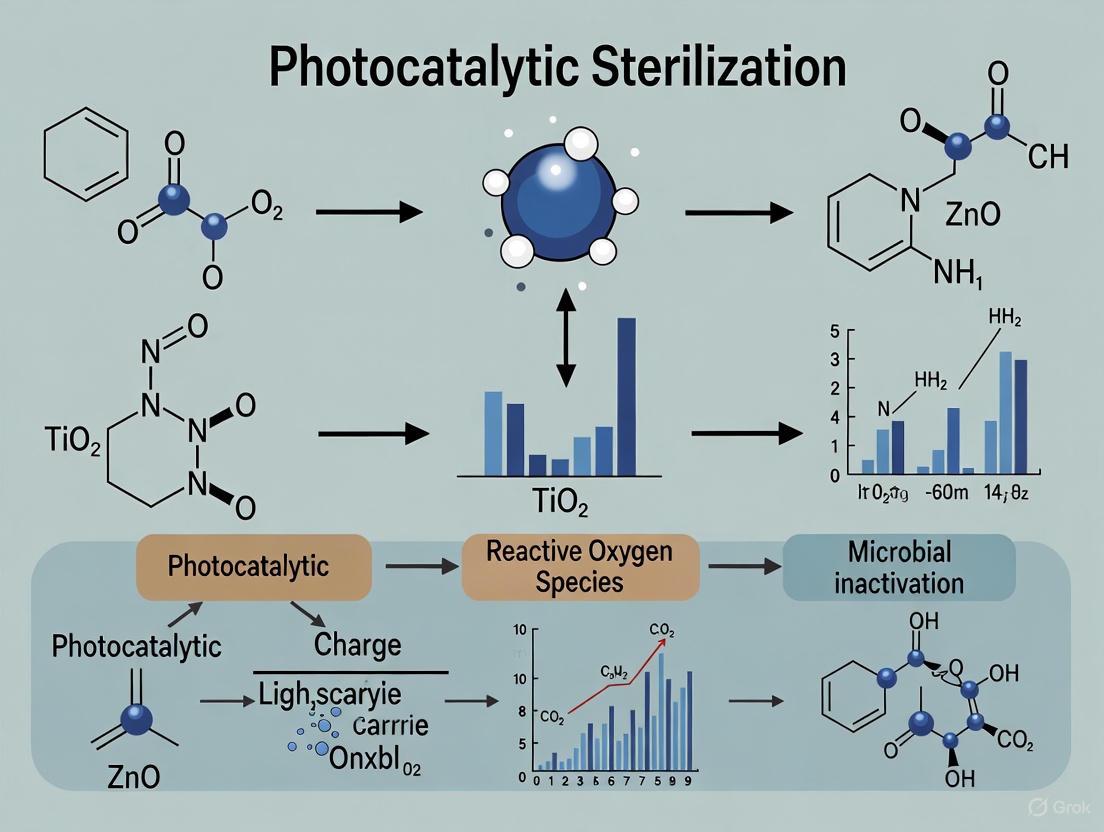
This article provides a comprehensive analysis of photocatalytic sterilization using inorganic compounds, a promising green technology for combating pathogenic microorganisms.
Harnessing Inorganic Photocatalysts for Advanced Sterilization: Mechanisms, Applications, and Future Frontiers in Biomedicine
Abstract
This article provides a comprehensive analysis of photocatalytic sterilization using inorganic compounds, a promising green technology for combating pathogenic microorganisms. Tailored for researchers, scientists, and drug development professionals, it explores the fundamental mechanisms of reactive oxygen species (ROS) generation and microbial inactivation. The scope extends to the design of advanced photocatalysts like TiO2 and silver composites, their application in water disinfection and surface sterilization, and the critical parameters for optimizing performance. The review also covers advanced validation techniques and comparative analyses with conventional methods, concluding with future directions for clinical translation and the development of novel, visible-light-activated materials to address current commercialization challenges.
The Fundamental Principles of Photocatalytic Sterilization
Fundamental Principles and Mechanisms
Photocatalytic sterilization represents an advanced oxidation process (AOP) that utilizes light-activated semiconductor materials to generate reactive oxygen species (ROS) capable of inactivating microorganisms and degrading organic pollutants. This process operates under mild conditions and can utilize natural sunlight, making it an energy-efficient and cost-effective approach for disinfection applications [1].
The fundamental mechanism begins when a photocatalyst, typically a semiconductor, absorbs photons with energy equal to or greater than its band gap (Eg). This absorption excites an electron (e-) from the valence band (VB) to the conduction band (CB), creating a positively charged hole (h+) in the valence band. The narrowness of the band gap directly influences the generation of these electron-hole pairs [1].
For effective sterilization, the recombination of these electron-hole pairs must be minimized through strategies such as doping, introducing surface defects, or coupling with other catalysts. The excited electrons in the conduction band act as reductants, while the holes in the valence band facilitate oxidation. These species then react with water and oxygen to generate ROS, including hydroxyl radicals (•OH) and superoxide anions (O2•-), which drive the degradation of microbial cellular components and organic pollutants [1].
Figure 1: Photocatalytic sterilization mechanism showing ROS generation.
Current Market Landscape and Applications
The global market for photocatalytic technologies demonstrates robust growth, reflecting increasing adoption across multiple sectors. The photocatalytic sterilization module market specifically was valued at $8.79 billion in 2025 and is projected to reach $19.11 billion by 2033, growing at a compound annual growth rate (CAGR) of 13.82% [2]. Similarly, the broader photocatalysts market shows parallel expansion, expected to grow from $3.0 billion in 2025 to $5.9 billion by 2032 at a CAGR of 10.1% [3].
| Market Segment | 2025 Value (USD Billion) | Projected 2032/2033 Value (USD Billion) | CAGR (%) | Dominant Region/Share |
|---|---|---|---|---|
| Photocatalytic Sterilization Module [2] | 8.79 | 19.11 (2033) | 13.82 | Asia Pacific (65%) |
| Photocatalysts (Overall Market) [3] | 3.0 | 5.9 (2032) | 10.1 | Asia Pacific (65%) |
Regional adoption patterns highlight Asia Pacific as the dominant market, accounting for approximately 65% of global photocatalyst consumption [3]. This leadership is driven by rapid industrialization, urbanization, and strong governmental support for environmental technologies, particularly in Japan, China, and South Korea [2] [3]. North America represents the fastest-growing regional market, supported by $71 billion in clean energy investments and stringent environmental regulations [3].
Application diversity continues to expand across sectors. The building materials segment leads with a 58% market share, incorporating self-cleaning and air-purifying functionalities [3]. The automotive sector demonstrates the fastest growth, integrating photocatalytic air purification systems to meet emission regulations and consumer demands for improved cabin air quality [3]. Healthcare, water treatment, and air purification constitute other significant application areas [2] [1].
Key Operational Parameters and Optimization
Photocatalytic sterilization efficiency depends critically on several operational parameters that must be optimized for maximum performance:
- Contact Time and Catalyst Dose: Longer exposure enhances pollutant removal until saturation, while excessive catalyst loading can reduce efficiency due to light scattering and particle aggregation [1].
- Light Intensity and Wavelength: While UV light is most commonly used, recent research focuses on developing visible-light-active catalysts to reduce energy costs. Visible light activation significantly enhances practical applicability [1] [3].
- Solution pH: The pH affects the photocatalyst surface charge and degradation pathways. When pH is below the point of zero charge (PZC), the surface becomes positively charged, attracting anionic pollutants, while pH above PZC creates a negative surface that attracts cationic pollutants [1].
- Temperature: Most reactions occur at room temperature, but temperatures below 0°C slow reaction rates, while excessively high temperatures can degrade the photocatalyst. Moderate temperatures generally accelerate reaction kinetics [1].
- Oxidizing Agents: These can improve degradation by promoting ROS formation but require careful concentration control as excessive amounts could break down the catalyst [1].
- Inorganic Ions and Pollutant Concentration: In real wastewater systems, inorganic ions may interfere by scavenging reactive species or occupying active sites. Higher pollutant concentrations typically hinder degradation due to reduced light penetration [1].
Table 2: Key Parameters Affecting Photocatalytic Efficiency
| Parameter | Optimal Condition | Effect on Process | Considerations for Scaling |
|---|---|---|---|
| Catalyst Type | Modified TiOâ‚‚ (visible light) | Band gap determines activation energy; doping reduces recombination | Cost, stability, and reusability are critical |
| Light Source | Visible spectrum (sunlight) | UV: higher energy but costly; Visible: sustainable but lower energy | Solar irradiation maximizes economic viability |
| pH Level | Dependent on pollutant & catalyst PZC | Affects catalyst surface charge and pollutant adsorption | Requires adjustment for different wastewater streams |
| Catalyst Loading | System-dependent optimum | Excess causes light scattering & reduced penetration | Optimization needed for each reactor configuration |
| Temperature | Room to moderate (e.g., 20-40°C) | Higher temperatures enhance kinetics but may destabilize catalyst | Often controlled by ambient conditions in large-scale applications |
| Reaction Time | Contaminant-dependent | Longer times increase degradation but reduce throughput | Balance between efficiency and processing capacity |
Experimental Protocols for Photocatalytic Sterilization
Protocol 1: Standard Laboratory-Scale Bacterial Inactivation Assay
Objective: To evaluate the efficacy of a photocatalyst in inactivating model microorganisms (e.g., Escherichia coli) under controlled illumination.
Materials:
- Photocatalyst powder (e.g., TiOâ‚‚ P25, ZnO, or modified visible-light catalyst)
- Bacterial suspension (e.g., E. coli ATCC 25922 in nutrient broth, mid-log phase)
- Photoreactor system with light source (e.g., Xenon lamp with appropriate filters)
- Magnetic stirrer
- Serial dilution apparatus and nutrient agar plates
- Colony counter
Methodology:
- Catalyst Preparation: Prepare a suspension of the photocatalyst in sterile phosphate-buffered saline (PBS) at a concentration of 0.1-1.0 g/L. Sonicate for 15 minutes to ensure dispersion.
- Microbial Inoculation: Add the bacterial suspension to the catalyst suspension to achieve an initial concentration of approximately 10ⶠCFU/mL.
- Dark Adsorption Phase: Place the mixture in the photoreactor and stir in darkness for 30 minutes to establish adsorption-desorption equilibrium.
- Illumination Phase: Turn on the light source while maintaining continuous stirring. Withdraw aliquots (1 mL) at predetermined time intervals (e.g., 0, 5, 15, 30, 60, 120 minutes).
- Sample Analysis: Serially dilute aliquots, plate on nutrient agar, and incubate at 37°C for 24 hours. Count viable colonies and calculate log reduction.
- Control Experiments: Perform identical tests with (a) no catalyst, (b) no light, and (c) both catalyst and light to confirm photocatalytic effect.
Protocol 2: Advanced Visible-Light Photocatalyst Performance Evaluation
Objective: To assess the sterilization performance of a novel visible-light-active photocatalyst and identify optimal operational parameters.
Materials:
- Visible-light-active photocatalyst (e.g., nitrogen-doped TiOâ‚‚, composite material)
- Simulated wastewater containing target pollutants and inorganic ions
- LED light source (wavelength > 420 nm) with calibrated irradiance
- Spectrophotometer or HPLC for pollutant concentration analysis
- Reactive oxygen species detection probes (e.g., nitroblue tetrazolium for O₂•â», terephthalic acid for •OH)
Methodology:
- Experimental Matrix Setup: Design a multifactorial experiment varying catalyst loading (0.1-1.0 g/L), pH (5-9), and light intensity.
- ROS Detection: Incorporate specific scavengers (e.g., isopropanol for •OH, benzoquinone for O₂•â») to identify the primary reactive species responsible for inactivation.
- Kinetic Analysis: Monitor microbial inactivation and pollutant degradation kinetics. Fit data to appropriate models (e.g., pseudo-first-order kinetics).
- Catalyst Reusability: After each experiment, recover the catalyst through centrifugation, wash thoroughly, and test for five consecutive cycles to assess stability.
- Characterization: Analyze fresh and used catalysts using XRD, SEM, and BET surface area analysis to correlate performance with structural properties.
Figure 2: Experimental workflow for photocatalytic sterilization assays.
Essential Research Reagents and Materials
Successful photocatalytic sterilization research requires carefully selected materials and characterization tools. The selection of appropriate photocatalysts, microorganisms, and analytical methods is crucial for generating reliable, reproducible data.
Table 3: Research Reagent Solutions for Photocatalytic Sterilization
| Reagent/Material | Function/Application | Examples/Specifications |
|---|---|---|
| Semiconductor Photocatalysts | Primary light-activated material generating ROS | TiO₂ (P25 Degussa), ZnO, WO₃, g-C₃N₄; particle size <100 nm preferred |
| Dopants/Co-catalysts | Enhance visible light absorption and reduce charge recombination | Nitrogen, sulfur, graphene, noble metals (Pt, Ag) |
| Model Microorganisms | Standardized strains for evaluating biocidal efficacy | E. coli (ATCC 25922), S. aureus (ATCC 25923), B. subtilis (spores) |
| Culture Media | Microbial propagation and viability assessment | Nutrient broth/agar, LB medium; prepared per manufacturer specifications |
| ROS Detection Probes | Identify and quantify reactive oxygen species | Nitroblue tetrazolium (O₂•â»), terephthalic acid (•OH), DPBF (singlet oxygen) |
| Analytical Instruments | Quantify microbial inactivation and pollutant degradation | UV-Vis spectrophotometer, HPLC, colony counter, fluorescence microscope |
| Light Sources | Provide controlled irradiation for photoactivation | Xenon lamp (solar simulator), LED arrays (specific wavelengths), UV lamps |
Titanium dioxide (TiOâ‚‚) continues to dominate research applications with over 80% market share in the photocatalysts product segment due to its proven effectiveness, chemical stability, and extensive commercial validation [3]. Recent innovations focus on modified TiOâ‚‚ formulations that operate under fluorescent and natural lighting conditions, improving performance by up to 30% according to studies cited in the Journal of Environmental Chemical Engineering [3].
The incorporation of nanotechnology through materials such as graphene and nanoscale TiOâ‚‚ has dramatically improved photocatalytic performance and enabled new applications. Japanese companies like TOTO Ltd. and Ishihara Sangyo Kaisha have pioneered breakthrough technologies with products demonstrating significant antiviral and antibacterial activity under indoor lighting conditions, revolutionizing applications in healthcare facilities and public spaces [3].
Semiconductor-based photocatalytic sterilization represents a promising green technology for microbial inactivation. The core mechanism initiates with photoexcitation, where semiconductors absorb photons with energy equal to or greater than their bandgap energy, prompting electron (eâ») transitions from the valence band (VB) to the conduction band (CB). This process generates positively charged holes (hâº) in the valence band, creating electron-hole pairs [4].
The resulting charge carriers undergo separation and migration to the semiconductor surface, where they participate in redox reactions. The holes are powerful oxidants that can directly attack microbial cells or react with water or hydroxide ions to generate hydroxyl radicals (·OH). Simultaneously, the electrons typically reduce molecular oxygen (Oâ‚‚) adsorbed on the surface, forming superoxide anion radicals (·Oâ‚‚â») and other reactive oxygen species (ROS) [4]. These highly reactive oxygen species are primarily responsible for the oxidative destruction of microbial components, including proteins, lipids, and nucleic acids, leading to effective sterilization [5] [4].
Reactive Oxygen Species (ROS) Generation Pathways
The generation of various Reactive Oxygen Species (ROS) is critical to the efficacy of photocatalytic sterilization. Table 1 summarizes the primary ROS, their formation pathways, and oxidative potentials.
Table 1: Primary Reactive Oxygen Species (ROS) in Photocatalysis
| ROS Species | Formation Pathway | Oxidative Potential (V vs. NHE) | Role in Sterilization |
|---|---|---|---|
| Hydroxyl Radical (·OH) | h⺠+ H₂O/OH⻠→ ·OH | +2.8 [6] | Non-selectively oxidizes cell membranes, proteins, and DNA [4]. |
| Superoxide Anion (·Oâ‚‚â») | eâ» + Oâ‚‚ → ·Oâ‚‚â» | -0.33 [7] | Initiates destructive chain reactions within microbial cells [7]. |
| Hydrogen Peroxide (H₂O₂) | ·O₂⻠+ 2H⺠+ e⻠→ H₂O₂ 2h⺠+ 2H₂O → H₂O₂ [7] | +1.78 | Acts as a stable precursor for other ROS, penetrating and damaging cells. |
| Singlet Oxygen (¹O₂) | Energy transfer to O₂ [7] | +1.48 | Selective oxidation of biomolecules, contributes to toxin degradation [7]. |
The following diagram illustrates the sequential pathways of ROS generation following semiconductor photoexcitation:
Quantitative Analysis of Key Photocatalytic Semiconductors
The performance of a semiconductor in photocatalytic sterilization is governed by its intrinsic electronic and structural properties. Table 2 compares key parameters of several prominent inorganic semiconductors, including traditional and emerging bismuth-based materials known for their visible-light activity.
Table 2: Properties of Key Inorganic Semiconductor Photocatalysts
| Semiconductor | Bandgap (eV) | Light Response Range | Key ROS Generated | Reported Antimicrobial Efficacy |
|---|---|---|---|---|
| TiOâ‚‚ (Anatase) | 3.2 [5] | Ultraviolet | ·OH, ·Oâ‚‚â», Hâ‚‚Oâ‚‚ | Effective against >20 Gram-± bacteria, viruses, fungi [5] |
| Bi₂O₃ | 2.0 - 3.96 [5] | Visible Light | ·OH, ·O₂⻠| Promising performance in visible-light antifouling coatings [5] |
| WO₃ | ~2.7 | Visible Light | ·OH, ·O₂⻠| Enhanced activity via oxygen vacancy engineering [8] |
| g-C₃Nâ‚„ | ~2.7 [9] | Visible Light | ·OH, ·Oâ‚‚â», Hâ‚‚Oâ‚‚ | High compatibility for heterojunctions; COâ‚‚ reduction [9] |
| CdS | ~2.4 | Visible Light | ·OH, ·O₂⻠| Suffers from photo-corrosion (Cd-O bond formation) [9] |
Experimental Protocol: Quantifying Hydroxyl Radicals via Electrochemical Detection
Accurately quantifying ROS generation is essential for evaluating and developing efficient photocatalysts. The following protocol details a modern electrochemical method for in-situ monitoring of hydroxyl radicals (·OH) using coumarin as a probe molecule, addressing limitations of traditional fluorescence techniques [6].
Principle
Coumarin reacts with photogenerated ·OH radicals to form various mono-hydroxylated products (e.g., 7-hydroxycoumarin, 6-hydroxycoumarin). An electrochemical method detects all main mono-hydroxylated products, providing a more comprehensive and representative quantification of ·OH yield compared to fluorescence spectroscopy, which only detects fluorescent products like 7-hydroxycoumarin [6].
Materials and Reagents
- Photocatalyst: e.g., TiOâ‚‚ P25 (Evonik Degussa) [6].
- Probe Molecule: Coumarin (≥99% purity) [6].
- Solvent: Phosphate Buffer (1.0 M, pH ~7), prepared from potassium phosphate salts [6].
- Hydroxylated Coumarin Standards: 3-, 4-, 5-, 6-, 7-, 8-hydroxycoumarin for calibration [6].
- Equipment: Electrochemical workstation, three-electrode system (working, counter, reference), photocatalytic reactor, UV-LED light source (365-370 nm), magnetic stirrer [6].
Procedure
- Reaction Setup: In a borosilicate glass beaker, add 100 mL of phosphate buffer, coumarin (typical concentration 100-1000 μM), and 50 mg of photocatalyst [6].
- Adsorption Equilibrium: Stir the suspension in the dark for 30-60 minutes to establish adsorption-desorption equilibrium.
- Photocatalytic Reaction: Initiate irradiation with the UV-LED strip while maintaining constant stirring.
- In-Situ Electrochemical Monitoring:
- Immerse the electrochemical cell electrodes directly into the reacting suspension.
- Apply a potential scan (e.g., Differential Pulse Voltammetry) from 0.3 V to 1.1 V (vs. Ag/AgCl) to oxidize the hydroxylated coumarin products.
- Record voltammograms at regular time intervals (e.g., every 5-10 minutes). The cumulative peak area of the oxidation signals corresponds to the total concentration of mono-hydroxylated products, which is proportional to the ·OH generated [6].
- Data Analysis: Quantify the total ·OH radical yield using a calibration curve constructed from the hydroxycoumarin standards.
The workflow for this protocol is visualized below:
The Scientist's Toolkit: Key Research Reagents and Materials
Successful research into photocatalytic sterilization requires specific reagents and materials for synthesizing catalysts, conducting experiments, and analyzing results. The following table outlines essential components of the researcher's toolkit.
Table 3: Essential Reagents and Materials for Photocatalytic Sterilization Research
| Item | Function/Application | Example & Notes |
|---|---|---|
| Model Photocatalysts | Benchmarking activity and understanding fundamental mechanisms. | TiO₂ P25 [6]; Bi₂O₃ for visible-light studies [5]. |
| Chemical Probe: Coumarin | Trapping and indirect quantification of hydroxyl radicals (·OH). | Requires high purity (≥99%); forms multiple hydroxycoumarins upon ·OH attack [6]. |
| Hydroxylated Coumarin Standards | Calibration for accurate quantification of ·OH yield. | 3-, 4-, 5-, 6-, 7-, 8-hydroxycoumarin [6]. |
| Characterization Tools | In-situ monitoring of catalyst dynamics and surface reactions. | In-situ XPS, XAS (valence state) [9]; FTIR, Raman (surface intermediates) [9]; EPR (ROS/Oxygen vacancies) [9]. |
| Microbial Strains | Evaluating biocidal efficacy across different organisms. | Gram-negative (e.g., E. coli), Gram-positive (e.g., S. aureus), fungal species [5]. |
| CFI02 | CFI02 | CFI02 is a potent, selective inhibitor of human cytomegalovirus (HCMV) glycoprotein B-mediated fusion. For Research Use Only. Not for human or veterinary use. |
| CBD-1 | CBD-1 Reagent|Cannabidiol for Research Use |
Photocatalytic sterilization using inorganic compounds represents a promising advanced oxidation process for addressing the challenge of microbial resistance. This application note delineates the primary microbial inactivation pathways initiated by photocatalysts, focusing on the sequence of events from initial cell wall damage to pervasive intracellular oxidative stress. The protocols and data presented herein are designed to support researchers and scientists in developing effective photocatalytic antimicrobial strategies.
Fundamental Mechanism of Photocatalytic Microbial Inactivation
The antimicrobial efficacy of photocatalysts arises from their ability to generate reactive oxygen species (ROS) upon light irradiation. When a photocatalyst absorbs photons with energy equal to or greater than its bandgap energy, electrons ((e^-)) are promoted from the valence band (VB) to the conduction band (CB), creating positively charged holes ((h^+)) in the VB [10] [11]. These photogenerated charge carriers then migrate to the catalyst surface and react with adsorbed water and oxygen molecules, yielding powerful ROS including hydroxyl radicals ((\bullet OH)), superoxide anions ((O2^{ \bullet - })), hydrogen peroxide ((H2O2)), and singlet oxygen ((^1O2)) [12] [13].
The resulting ROS collectively initiate a cascade of oxidative damage events on microbial cells, beginning with the external cell structures and progressing to intracellular components, ultimately leading to complete cell inactivation and mineralization [10] [13].
Figure 1: Microbial Inactivation Pathway by Photocatalysts. This diagram illustrates the sequential mechanism from photon absorption to complete cell mineralization.
Quantitative Efficacy of Photocatalytic Materials
The antimicrobial performance of various photocatalytic materials has been quantitatively demonstrated against multiple pathogenic microorganisms. The following table summarizes efficacy data from recent studies:
Table 1: Antimicrobial Efficacy of Photocatalytic Materials
| Photocatalyst Material | Microorganism | Experimental Conditions | Reduction Efficiency | Time | Reference |
|---|---|---|---|---|---|
| TiOâ‚‚/Agâ‚‚O/Auâ° NTs | S. aureus (MSSA) | Visible light | Complete inactivation | 60 min | [14] |
| TiOâ‚‚/Agâ‚‚O/PtOâ‚“ NTs | E. coli | Visible light | Complete inactivation | 60 min | [15] |
| TiOâ‚‚/Cuâ‚‚O/Auâ° NTs | Clostridium sp. | Visible light | Complete inactivation | 60 min | [14] |
| Ag₃PO₄/P25 | E. faecalis VRE 037 | Visible light | 100% eradication (6 log reduction) | 60 min | [16] |
| Ag₃PO₄/HA | S. aureus USA 300 | Visible light | 100% eradication (6 log reduction) | 60 min | [16] |
| TiOâ‚‚/Agâ‚‚O/PtOâ‚“ NTs | K. oxytoca (ESBL) | Visible light | Complete inactivation | 60 min | [15] |
Experimental Protocols
Protocol 1: Synthesis of Ternary Photocatalytic Nanotubes via Anodic Oxidation
This protocol describes the fabrication of visible-light-active nanotube arrays through one-step anodic oxidation of titanium-based alloys, adapted from studies demonstrating high antimicrobial activity [14] [15].
Materials and Equipment
- Substrate Material: Titanium-based alloy foils (Ti94Ag5Au1, Ti94Cu5Pt1, Ti94Cu5Au1, Ti94Ag5Pt1 composition)
- Chemicals: Ethylene glycol (98%), ammonium fluoride (NH₄F, ≥99%), acetone, isopropanol, methanol
- Equipment: DC power supply, platinum mesh cathode, ultrasonic bath, furnace, two-electrode electrochemical cell
Procedure
Substrate Preparation:
- Cut alloy foils into 2.5 cm × 2.5 cm pieces
- Clean sequentially in ultrasonic bath: 10 min acetone → 10 min isopropanol → 10 min methanol → 10 min deionized water
- Dry thoroughly with air stream
Electrolyte Preparation:
- Prepare 150 mL of electrolyte containing:
- Ethylene glycol (98 vol%)
- Deionized water (2 vol%)
- NHâ‚„F (0.09 M)
- Stir at 500 rpm to ensure complete dissolution
- Prepare 150 mL of electrolyte containing:
Anodization Process:
- Set up electrochemical cell with alloy sample as anode and platinum mesh as cathode (2 cm distance)
- Apply constant voltage of 30 V (current density will decrease from ~25 mA/cm² to ~2 mA/cm²)
- Maintain reaction for 60-90 minutes under continuous stirring
- Monitor temperature to maintain at 20-25°C
Post-treatment:
- Sonicate samples in deionized water to remove surface debris
- Dry in air stream at 80°C for 24 hours
- Calcinate in furnace at 450°C for 1 hour with heating rate of 2°C/min
Quality Control
- Characterize nanotube morphology by SEM: Inner diameter should be 54-65 nm, length 2.3-2.6 μm
- Verify composition by XPS and phase composition by XRD
- Confirm presence of metal/metal oxide nanoparticles on surface and inside nanotube walls
Protocol 2: Photocatalytic Antimicrobial Susceptibility Testing
This protocol standardizes the evaluation of photocatalytic materials against pathogenic bacteria, incorporating methodology from recent studies [16] [15].
Materials and Equipment
- Test Organisms: Methicillin-susceptible S. aureus (MSSA), E. coli, Clostridium sp., ESBL K. oxytoca
- Culture Media: Appropriate broth and agar for each bacterial strain
- Photocatalyst Samples: Ternary nanotubes or composite powders
- Equipment: Visible light source (λ ≥ 400 nm, 300 W Xe lamp with UV filter), shaking incubator, colony counter
Procedure
Bacterial Culture Preparation:
- Inoculate single colonies in appropriate broth
- Incubate overnight at optimal temperature with shaking
- Harvest cells in mid-logarithmic phase (OD₆₀₀ ≈ 0.4-0.6)
- Centrifuge, wash, and resuspend in physiological saline to ~10ⶠCFU/mL
Photocatalytic Inactivation Assay:
- For suspended powders: Add photocatalyst (750-1500 μg/mL) to bacterial suspension
- For nanotube films: Place films in sterile containers with bacterial suspension
- Maintain dark control (catalyst + bacteria, no light) and light control (bacteria + light, no catalyst)
- Expose to visible light irradiation with continuous shaking
- Sample at intervals (0, 30, 60 minutes)
Viability Assessment:
- Serially dilute samples in physiological saline
- Spread plate appropriate dilutions on agar plates
- Incubate at optimal temperature for 24-48 hours
- Count colonies and calculate Logâ‚â‚€ reduction: Log(Nâ‚€/N)
- Nâ‚€ = initial viable count (CFU/mL)
- N = viable count after treatment (CFU/mL)
Mechanistic Studies
ROS Detection:
- Use fluorescent probes (DCFH-DA for intracellular ROS, HPF for •OH)
- Monitor fluorescence intensity by spectrofluorometry
Cell Membrane Integrity:
- Assess potassium ion leakage using atomic absorption spectroscopy
- Measure metabolite release by monitoring 260 nm absorbance
Morphological Analysis:
- Fix samples with glutaraldehyde (2.5%) and osmium tetroxide (1%)
- Dehydrate through ethanol series, critical point dry
- Examine by TEM/SEM for structural damage
The Scientist's Toolkit: Essential Research Reagents
Table 2: Key Research Reagent Solutions for Photocatalytic Antimicrobial Studies
| Reagent/Material | Function/Application | Examples/Specifications |
|---|---|---|
| Ternary Alloy Substrates | Source for nanotube fabrication via anodization | Ti94Ag5Au1, Ti94Cu5Pt1 (94% Ti, 5% Ag/Cu, 1% Au/Pt) |
| Ethylene Glycol Electrolyte | Medium for electrochemical anodization | 98% ethylene glycol, 2% Hâ‚‚O, 0.09M NHâ‚„F |
| Ag₃PO₄-Based Composites | Visible-light-active photocatalysts | Ag₃PO₄/P25, Ag₃PO₄/HA (hydroxyapatite) |
| ROS Detection Probes | Detection of reactive oxygen species | DCFH-DA (intracellular ROS), HPF (hydroxyl radicals) |
| Pathogenic Bacterial Strains | Model organisms for efficacy testing | S. aureus MSSA, E. coli, E. faecalis VRE, Clostridium sp. |
| Visible Light Source | Activation of photocatalysts | 300W Xe lamp with 400nm cutoff filter |
| OdD1 | OdD1 | Chemical Reagent |
| YS-49 | YS-49, CAS:132836-42-1, MF:C20H20BrNO2, MW:386.3 g/mol | Chemical Reagent |
The sequential microbial inactivation pathway initiated by photocatalytic materials provides a comprehensive mechanism for effective sterilization. Beginning with ROS-mediated cell wall damage and progressing through membrane disruption to intracellular oxidative stress, this cascade ultimately leads to complete cell mineralization. The experimental protocols and research tools detailed in this application note provide researchers with standardized methodologies for developing and evaluating novel photocatalytic antimicrobial systems for healthcare, water purification, and surface sterilization applications.
Photocatalytic sterilization using inorganic semiconductors presents a sustainable and effective strategy for combating microbial contamination and addressing the challenge of antimicrobial resistance (AMR). This process leverages light energy to generate highly reactive oxygen species (ROS) on the catalyst's surface, which inactivate microbial species through oxidative damage to cell membranes, proteins, and nucleic acids [13]. Titanium Dioxide (TiOâ‚‚), Silver Composites (Ag), and Zinc Oxide (ZnO) stand as the most prominent photocatalysts for these applications, each offering a unique combination of potent antimicrobial activity, environmental friendliness, and material stability [13] [17] [18]. Their ability to simultaneously degrade organic pollutants and inactivate pathogens makes them particularly valuable for environmental remediation and biomedical applications, from water purification to self-disinfecting surfaces [13] [17].
Catalyst Mechanisms and Antibacterial Activity
Fundamental Photocatalytic Mechanism
The antimicrobial action of these inorganic photocatalysts originates from a light-induced redox reaction. Upon irradiation with light of energy greater than the material's bandgap, electrons (eâ») are promoted from the valence band (VB) to the conduction band (CB), creating electron-hole (eâ»/hâº) pairs [13]. These charge carriers migrate to the catalyst surface and react with adsorbed water and oxygen, generating a suite of reactive oxygen species (ROS), including the hydroxyl radical (•OH), superoxide radical anion (O₂•â»), and hydrogen peroxide (Hâ‚‚Oâ‚‚) [13] [19]. The resulting ROS inflict comprehensive damage to microbial cells, leading to cell death.
- Primary Oxidative Damage: The hydroxyl radical (•OH), one of the most potent oxidizers, and other ROS cause peroxidation of lipids, oxidation of proteins, and disruption of essential cellular enzymes [13].
- Cell Membrane Disruption: ROS attack and degrade the bacterial cell wall and cytoplasmic membrane, compromising structural integrity and increasing permeability. This can lead to leakage of intracellular components and eventual cell lysis [13] [18]. Silver composites exert an additional mechanism where nanoparticles interact directly with and disrupt microbial membranes [18].
- Intracellular and Genetic Damage: After membrane compromise, ROS and, in some cases, a fraction of nanoparticles can penetrate the cytoplasm. This causes oxidative damage to chromosomal and plasmid DNA, resulting in strand breaks, cross-links, and base oxidation, which prevents replication and transcription [13]. This dual action of microbial inactivation and genetic material degradation highlights the potential of photocatalysis to also reduce the spread of antibiotic resistance genes (ARGs) [13].
The diagram below illustrates this sequential process of photocatalytic bacterial inactivation.
Comparative Antibacterial Performance
The antibacterial efficacy of TiOâ‚‚, Ag composites, and ZnO varies based on their intrinsic properties and the target microorganisms. Gram-negative bacteria (e.g., E. coli), with their thinner peptidoglycan layer and outer membrane rich in lipopolysaccharides, are generally more susceptible to photocatalytic inactivation than Gram-positive bacteria (e.g., S. aureus), which have a thicker peptidoglycan layer [13]. Furthermore, bacterial species with higher inherent superoxide dismutase (SOD) activity can better mitigate oxidative stress, contributing to variations in susceptibility [13].
Table 1: Comparative Antibacterial Performance of Key Photocatalysts
| Photocatalyst | Key Antibacterial Mechanisms | Advantages for Sterilization | Limitations & Notes |
|---|---|---|---|
| Titanium Dioxide (TiOâ‚‚) | Primary: ROS-induced oxidative damage [13]. | High oxidative power, chemical stability, non-toxicity, eco-friendly, can degrade antibiotic resistance genes [13]. | Limited to UV activation (pristine TiOâ‚‚), electron-hole recombination reduces efficiency [13] [20]. |
| Silver Composites (Ag) | 1. Release of bactericidal Ag⺠ions [18].2. ROS generation [18].3. Direct membrane disruption [18]. | Broad-spectrum activity, multiple simultaneous mechanisms, effective at low concentrations, suitable for coatings [21] [18]. | Potential environmental toxicity, cost, aggregation can reduce efficacy [13] [21]. |
| Zinc Oxide (ZnO) | 1. ROS-induced oxidative damage [17].2. Release of Zn²⺠ions [17]. | High photocatalytic efficiency, low cost, biocompatibility, piezoelectric properties [22] [17]. | Photocorrosion in aqueous environments can limit reusability; bandgap similar to TiO₂ [17]. |
Quantitative Performance Data in Applications
The performance of photocatalysts is quantified in various applications, including dye degradation in wastewater and direct bacterial inactivation. The following table summarizes key metrics reported in recent studies.
Table 2: Quantitative Performance of Photocatalysts in Key Applications
| Photocatalyst | Application/Test | Experimental Conditions | Reported Efficiency / Result | Source Context |
|---|---|---|---|---|
| ZnO (Sol-Gel with Ethanol) | Methylene Blue (MB) dye degradation | 0.1 g catalyst, 5 mg/L MB, 100 mL, UV light [22]. | 98% degradation achieved [22]. | [22] |
| TiOâ‚‚/CuO Composite | Herbicide (Imazapyr) degradation | UV illumination [20]. | Highest photonic efficiency among TiOâ‚‚ composites tested [20]. | [20] |
| Biosynthesized AgNPs | Antibacterial activity & Methylene Blue (MB) dye degradation | Synthesized using L. rhamnosus; AgNP characteristics: 199.7 nm avg. size, -36.3 mV zeta potential [21]. | Strong antibacterial activity & high photocatalytic efficiency reported [21]. | [21] |
| TiOâ‚‚ (General) | Photocatalytic bacterial inactivation | UV light, close contact with bacterial cells required [13]. | Efficiency depends on material modification, ROS generation kinetics, and bacterial species [13]. | [13] |
Synthesis and Experimental Protocols
Modified Sol-Gel Synthesis of ZnO Nanoparticles
This protocol describes a sol-gel method for synthesizing ZnO nanoparticles, adapted from a study investigating the effect of solvent choice (ethanol, 1-propanol, 1,4-butanediol) on photocatalytic performance [22]. Ethanol was found to produce ZnO with superior activity, achieving 98% degradation of Methylene Blue dye in a short duration [22].
Principle: Zinc acetate dihydrate reacts with oxalic acid dihydrate in a solvent to form a zinc oxalate precursor, which upon calcination, decomposes to phase-pure ZnO nanoparticles [22].
Materials:
- Zinc Acetate Dihydrate (Zn(CH₃COO)₂·2H₂O): Metal ion precursor.
- Oxalic Acid Dihydrate ((COOH)₂·2H₂O): Precipitating and complexing agent.
- Solvents (Ethanol, 1-Propanol, 1,4-Butanediol): Reaction medium; influences particle morphology and size.
- Deionized Water: For washing and purification.
Procedure:
- Solution A: Dissolve a measured amount of zinc acetate dihydrate in 50 mL of ethanol using a magnetic stirrer at 50°C for 30 minutes [22].
- Solution B: Dissolve an equimolar amount of oxalic acid dihydrate in 25 mL of ethanol at room temperature [22].
- Gel Formation: Slowly add Solution B to Solution A with continuous stirring. Heat the mixture to 70°C with constant stirring until a viscous white gel forms [22].
- Drying: Transfer the gel to an oven and dry at 80°C overnight to remove residual solvents [22].
- Calcination: Place the dried precursor in a furnace and calcine at 600°C for 4 hours (240 minutes) to thermally decompose zinc oxalate into ZnO nanoparticles [22].
- Milling: Gently crush the resulting powder using an agate mortar and pestle to obtain a fine, homogeneous ZnO nanopowder [22].
The workflow for this synthesis is summarized below.
Biosynthesis of Silver Nanoparticles (AgNPs) Using Probiotics
This protocol outlines a green synthesis method for AgNPs using the probiotic strain Lacticaseibacillus rhamnosus, which acts as both a reducing and a stabilizing agent, producing stable nanoparticles with antibacterial and photocatalytic properties [21].
Principle: Metabolic enzymes and biomolecules in the bacterial extracellular extract facilitate the reduction of silver ions (Agâº) to elemental silver (Agâ°), forming nanoparticles capped by biological molecules that prevent aggregation [21].
Materials:
- Probiotic Strain: Lacticaseibacillus rhamnosus (e.g., BCRC16000).
- Silver Nitrate (AgNO₃) Solution: Source of Ag⺠ions.
- Growth Medium (e.g., MRS Broth): For culturing the probiotic strain.
- Centrifuge and Filtration Units: For cell separation.
Procedure:
- Culture Preparation: Inoculate L. rhamnosus in a suitable growth medium and incubate under optimal conditions (e.g., 37°C for 24-48 hours) to obtain a stationary-phase culture [21].
- Cell-Free Supernatant: Centrifuge the culture (e.g., at 10,000 rpm for 10 minutes) to pellet the bacterial cells. Filter the supernatant through a 0.22 µm membrane filter to obtain a clear, cell-free extract [21].
- Reaction Mixture: Add a predetermined volume of aqueous AgNO₃ solution (e.g., 1-10 mM final concentration) to the cell-free supernatant. The mixture should turn from pale yellow to deep brown, indicating AgNP formation [21].
- Incubation and Synthesis: Incubate the reaction mixture in the dark at room temperature with gentle stirring for 24-48 hours to allow complete reduction [21].
- Purification: Centrifuge the AgNP suspension at high speed (e.g., 15,000 rpm for 30 minutes) to pellet the nanoparticles. Discard the supernatant and resuspend the pellet in deionized water. Repeat this washing step 2-3 times to remove residual ions and biomolecules [21].
- Characterization: Redisperse the purified AgNPs in water and characterize using UV-Vis spectroscopy (peak ~443 nm), DLS (for size distribution), and SEM [21].
Protocol for Evaluating Photocatalytic Antibacterial Activity
A standard procedure for assessing the efficacy of a photocatalyst in inactivating bacteria.
Principle: A bacterial suspension is exposed to the photocatalyst under controlled light irradiation. Samples are taken at intervals, and the number of viable cells is determined via serial dilution and plating, allowing for the quantification of inactivation kinetics [13].
Materials:
- Test Microorganism: e.g., Escherichia coli (Gram-negative) or Staphylococcus aureus (Gram-positive).
- Photocatalyst: TiOâ‚‚, ZnO, or AgNP powder/suspension.
- Light Source: UV lamp (e.g., Philips TL 8W BLB) or simulated solar light with appropriate filters.
- Nutrient Broth/Agar: For bacterial culture and viability assessment.
- Phosphate Buffered Saline (PBS): For serial dilutions.
Procedure:
- Catalyst Dispersion: Disperse a known concentration of the photocatalyst (e.g., 0.1 mg/mL) in a saline solution or minimal medium within a reaction vessel. Ensure homogeneity using a magnetic stirrer or sonication [13] [22].
- Bacterial Inoculation: Introduce a standardized inoculum of mid-log phase bacteria to the catalyst suspension to achieve a initial concentration of ~10â¶-10â· CFU/mL.
- Dark Adsorption Control: Keep the mixture in the dark for 30 minutes with stirring to establish adsorption-desorption equilibrium between the bacteria and catalyst [13].
- Light Irradiation: Expose the mixture to light irradiation under continuous stirring. Maintain constant temperature (e.g., 25°C) using a water bath if necessary.
- Sampling: At predetermined time intervals (e.g., 0, 15, 30, 60, 120 min), withdraw aliquots from the reaction mixture.
- Serial Dilution and Plating: Perform serial 10-fold dilutions of each aliquot in PBS. Spread plate appropriate dilutions onto nutrient agar plates in duplicate.
- Viability Count: Incubate the plates at 37°C for 24-48 hours. Count the formed colonies and calculate the viable bacterial concentration (CFU/mL) for each time point.
- Control Experiments: Perform simultaneous control experiments: (a) catalyst in dark, (b) light without catalyst, (c) neither light nor catalyst.
The Scientist's Toolkit: Essential Research Reagents and Materials
Table 3: Key Reagents and Materials for Photocatalyst Research and Application
| Item Name | Function/Application in Research |
|---|---|
| Titanium Dioxide (Hombikat UV-100) | A common commercial TiOâ‚‚ benchmark photocatalyst (primarily anatase) used for performance comparison in degradation and antibacterial studies [20]. |
| Zinc Acetate Dihydrate | A common, soluble zinc salt precursor used in the sol-gel synthesis of ZnO nanoparticles [22]. |
| Silver Nitrate (AgNO₃) | The standard source of silver ions (Agâº) for the synthesis of various silver-based nanoparticles and composites [21]. |
| Methylene Blue (MB) | A standard organic dye used as a model pollutant for quantifying the photocatalytic degradation efficiency of catalysts under UV/visible light [22] [21]. |
| Reactive Oxygen Species (ROS) Probes | Chemical probes (e.g., for detecting •OH, O₂•â») used to confirm and quantify the generation of reactive species during photocatalysis, linking to the mechanism of action [13]. |
| Lacticaseibacillus rhamnosus | A probiotic bacterial strain that can be used as a sustainable, biological agent for the green synthesis of stable silver nanoparticles [21]. |
| ACES | ACES, CAS:7365-82-4, MF:C4H10N2O4S, MW:182.20 g/mol |
| RD162 | RD162, CAS:915087-27-3, MF:C22H16F4N4O2S, MW:476.4 g/mol |
Titanium dioxide (TiO2) is a cornerstone semiconductor photocatalyst for environmental purification and sterilization applications, valued for its strong photocatalytic activity, chemical stability, and non-toxicity [23] [24]. Its efficacy is profoundly influenced by intrinsic structural properties, primarily its crystal phase, particle size, and specific surface area. TiO2 exists predominantly in three crystalline polymorphs: anatase, rutile, and brookite [25]. Among these, anatase is generally recognized for its superior photocatalytic activity, while rutile and brookite have distinct electronic properties that can be harnessed in composite systems [24] [26]. The photocatalytic process is initiated by the absorption of a photon with energy greater than the material's band gap, promoting an electron (eâ») from the valence band to the conduction band, thereby generating a hole (hâº) [24]. These charge carriers then migrate to the catalyst surface to drive redox reactions, generating Reactive Oxygen Species (ROS) such as hydroxyl radicals (•OH) and superoxide anions (O₂•â»), which are responsible for the oxidative destruction of microbial cells [23] [24]. This application note delineates the structural factors governing TiO2 efficiency and provides detailed protocols for material evaluation and application in photocatalytic sterilization, framed within research on inorganic compounds.
Comparative Analysis of TiO2 Polymorphs
Fundamental Properties and Photocatalytic Mechanisms
The three main TiO2 polymorphs—anatase, rutile, and brookite—differ in their crystal lattice arrangements, which directly dictates their electronic properties and photocatalytic performance [25].
- Anatase possesses a tetragonal structure characterized by octahedra that share four edges, leading to a slightly larger band gap (~3.2 eV) compared to rutile [27] [25]. This larger band gap provides a higher redox potential, particularly for hole-driven oxidation reactions, increasing the "power" of the generated radicals [27]. A critical factor behind its high activity is its indirect band gap, which results in longer charge carrier lifetimes compared to the direct band gap of rutile, giving electrons and holes more time to reach the surface and participate in reactions [27] [26]. Furthermore, studies on epitaxial films have demonstrated that anatase exhibits a longer effective charge carrier diffusion length (~5 nm) than rutile (~2.5 nm), meaning charge carriers excited deeper in the bulk can contribute to surface reactions [27].
- Rutile, the thermodynamically most stable phase, also has a tetragonal structure but is composed of octahedra that share two edges, with a narrower band gap of ~3.0 eV [27] [25]. This allows it to absorb a broader spectrum of light, including a small portion of visible light. However, rutile suffers from a significantly higher rate of charge carrier recombination, which is often attributed to deeper electron traps that prevent electrons from participating in surface reactions [26].
- Brookite, an orthorhombic phase, is less studied. Its structure involves octahedra sharing three edges [25]. Recent evidence suggests that the presence of shallow electron traps in brookite can effectively extend the lifetime of photogenerated holes, making it a potent photocatalyst, especially when synthesized with a high surface area [26].
The following table summarizes the key characteristics of these polymorphs.
Table 1: Structural and Electronic Properties of TiO2 Polymorphs
| Property | Anatase | Rutile | Brookite |
|---|---|---|---|
| Crystal Structure | Tetragonal | Tetragonal | Orthorhombic |
| Band Gap (eV) | ~3.2 [27] | ~3.0 [27] | ~3.1-3.4 [25] |
| Band Gap Type | Indirect [27] | Direct [27] | - |
| Charge Carrier Lifetime | Longer [27] [26] | Shorter [26] | Intermediate (long hole lifetime) [26] |
| Relative Photocatalytic Activity | Generally Highest [27] [24] | Lower [27] [24] | Can be comparable to anatase with high SSA [26] |
| Key Advantage | High charge carrier mobility & lifetime [27] | Broader UV absorption [28] | Shallow electron traps [26] |
The Synergistic "Mixed-Phase" Effect
While anatase often demonstrates superior performance alone, a synergistic effect is famously observed in mixed-phase catalysts, such as the commercial benchmark Evonik AEROXIDE P25 (approximately 80% anatase, 20% rutile) [28] [24]. This enhanced activity is attributed to efficient charge separation at the interfaces between the two phases. The prevailing model suggests that photoexcited electrons tend to accumulate in the anatase conduction band, while holes migrate to the rutile phase, thereby reducing the bulk recombination of electron-hole pairs and increasing the number of charge carriers available for surface reactions [28].
Mechanism of Photocatalytic Sterilization
The antimicrobial action of TiO2 is a direct consequence of the redox reactions initiated by the photogenerated charge carriers on its surface. The following diagram illustrates the sequential mechanism of photocatalytic disinfection.
Diagram 1: Mechanism of Photocatalytic Disinfection. The process begins with light absorption and culminates in microbial cell destruction via ROS-induced oxidative damage.
The primary ROS, the hydroxyl radical (•OH), possesses a reaction energy (120 kcal molâ»Â¹) higher than the bond energies of key organic molecules (e.g., C-C, C-H, C-O), enabling it to efficiently decompose lipids, proteins, and nucleic acids that constitute microbial cells [23]. This multi-target oxidative assault leads to extensive damage to the cell structure, causing leakage of cellular contents and ultimately resulting in cell lysis and complete mineralization [24].
Quantitative Data on Structural Influences
The Interplay of Particle Size and Surface Area
The physical dimensions of TiO2 particles are intrinsically linked to their specific surface area (SSA), which is a critical parameter determining the density of available active sites for reactant adsorption and surface reactions [29]. A systematic study on anatase TiO2 with varying primary particle sizes revealed a clear trend: as the primary particle size increases, the SSA decreases [29]. For instance, 6 nm anatase particles had an SSA of 253.9 m²/g, while 104 nm particles had an SSA of only 15.0 m²/g [29]. This relationship directly impacts photocatalytic efficiency, as a higher SSA generally promotes higher activity by providing more reaction sites. However, the effect of particle size is complex and can be phase-dependent. For anatase, an increase in crystallite size (from 10 nm to 20 nm) was found to compensate for the negative effect of a decreasing SSA (from 129.5 m²/g to 65.0 m²/g), likely due to improved crystallinity reducing bulk recombination [26]. In contrast, for brookite, photocatalytic activity dropped sharply with decreasing SSA (from 17.2 m²/g to 3.0 m²/g) while the crystallite size was held constant, indicating a more direct dependence on surface area for this phase [26].
Table 2: Effect of Anatase Primary Particle Size and Specific Surface Area on Dispersion Properties in Deionized Water [29]
| Primary Particle Size (nm) | Specific Surface Area (m²/g) | Hydrodynamic Size (nm) | Isoelectric Point (IEP) |
|---|---|---|---|
| 6 | 253.9 | ~200 | 6.0 |
| 16 | 102.1 | ~250 | 5.2 |
| 26 | 61.5 | ~300 | 4.8 |
| 38 | 41.2 | ~400 | 4.5 |
| 53 | 29.7 | ~500 | 4.2 |
| 104 | 15.0 | >1000 | 3.8 |
Experimental Protocols
Protocol: Evaluating Photocatalytic Disinfection Activity
This protocol details a standard procedure for assessing the sterilization efficiency of TiO2 photocatalysts against model microorganisms like Escherichia coli.
1. Reagent and Material Preparation:
- Photocatalyst: Weigh a precise mass (e.g., 5-50 mg) of the TiO2 sample (powder or immobilized on a substrate).
- Bacterial Suspension: Prepare a suspension of the target microorganism (e.g., E. coli at ~10ⶠCFU/mL) in a sterile physiological solution (e.g., 0.85% NaCl) or a nutrient-poor buffer.
- Reaction Vessel: Use a sterile beaker or quartz reactor. For powder catalysts, magnetic stirring is essential to maintain suspension.
2. Adsorption-Desorption Equilibrium:
- Add the catalyst to the bacterial suspension in the reactor.
- Place the reactor in the dark with continuous stirring for a predetermined period (typically 30-60 minutes). This step ensures that the decrease in viable cells upon illumination is due to photocatalysis and not simple adsorption or dark inactivation.
- Take a 1 mL sample at the end of the dark period for the "time zero" (tâ‚€) bacterial count.
3. Photocatalytic Reaction:
- Initiate illumination using a light source with appropriate wavelength and intensity (e.g., UVA lamp, 365 nm, 1-10 mW/cm²). A cut-off filter (<385 nm) may be used to ensure only UV light activates the catalyst if studying pure phase TiO2.
- Maintain constant stirring and temperature (e.g., 25°C) throughout the experiment.
- Withdraw aliquots (e.g., 1 mL) at regular time intervals (e.g., 0, 15, 30, 60, 120 min).
4. Analysis and Quantification:
- Viable Cell Count: Serially dilute the withdrawn samples in a sterile diluent. Spread plate appropriate dilutions onto nutrient agar plates in duplicate. Incubate the plates at 37°C for 24-48 hours, then enumerate the colony-forming units (CFU). The disinfection efficiency can be calculated as log reduction: Logâ‚â‚€(Nâ‚€/N), where Nâ‚€ and N are the viable cell counts at tâ‚€ and time t, respectively.
- Control Experiments: Conduct mandatory control experiments:
- Light Control: Bacteria + Light, without catalyst.
- Dark Control: Bacteria + Catalyst, in the dark.
Protocol: Assessing Charge Carrier Dynamics via Dye Degradation
The photocatalytic activity can also be probed by monitoring the degradation of a model organic dye, such as Methyl Orange (MO), under UV or visible light.
1. Standard Reaction Setup:
- Prepare an aqueous MO solution (e.g., 20 µM).
- Disperse a known mass of TiO2 powder (e.g., 5 mg) in a known volume of MO solution (e.g., 50 mL) in a quartz reactor.
- Place the mixture in the dark with stirring for 30-60 minutes to establish adsorption-desorption equilibrium.
2. Photocatalytic Degradation:
- Start illumination under stirring. Use a UVA or simulated solar light source.
- Withdraw samples (e.g., 3-4 mL) at regular intervals.
- Immediately centrifuge the samples (or filter through a 0.22 µm membrane) to remove catalyst particles.
3. Quantitative Analysis:
- Measure the absorbance of the clear supernatant at the characteristic maximum absorption wavelength of MO (e.g., 464 nm) using a UV-Vis spectrophotometer.
- The degradation efficiency is calculated as (C₀ - C)/C₀ × 100%, where C₀ is the initial concentration of MO after the dark period, and C is the concentration at time t. The apparent rate constant (k) can be determined by fitting the concentration-time data to a pseudo-first-order kinetic model: ln(C₀/C) = kt.
The Scientist's Toolkit: Essential Research Reagents & Materials
Table 3: Key Reagents and Materials for Photocatalytic Sterilization Research
| Item | Function/Description | Example Use Case |
|---|---|---|
| Evonik AEROXIDE P25 | Benchmark mixed-phase (80/20 anatase/rutile) TiO2 photocatalyst; used for comparative activity studies. | Positive control in dye degradation and disinfection experiments [28] [24]. |
| Anatase & Rutile TiO2 Nanopowders | High-purity, single-phase catalysts for structure-activity relationship studies. | Synthesized via sol-gel or flame aerosol methods to investigate polymorph-specific efficacy [27] [29]. |
| Methyl Orange (MO) | Azo dye used as a model organic pollutant for quantifying photocatalytic oxidation efficiency. | Probe for hydroxyl radical activity under UV light; measurement via UV-Vis spectrophotometry [28]. |
| Escherichia coli (E. coli) K-12 | Gram-negative bacterium, commonly used as a model organism for photocatalytic disinfection assays. | Assessing bactericidal activity via standard plate count method (CFU enumeration) [23] [24]. |
| UVA Light Source (e.g., 365 nm LED/Lamp) | Provides photons with energy exceeding the band gap of TiO2 to initiate photocatalysis. | Primary activation source for pure and modified TiO2 in sterilization and degradation protocols. |
| Dynamic Light Scattering (DLS) Zetasizer | Instrument for characterizing hydrodynamic size and zeta potential of nanoparticle dispersions. | Evaluating colloidal stability and agglomeration state of TiO2 in aqueous suspensions [29]. |
| ML268 | ML268 TRPML3 Agonist| Available|RUO | |
| ML186 | ML186|GPR55 Agonist|For Research Use Only | ML186 is a potent and selective GPR55 agonist for research. This product is for Research Use Only (RUO). Not for human or veterinary use. |
Designing and Applying Advanced Photocatalytic Systems
The development of advanced inorganic photocatalysts for sterilization applications hinges on precise control over material synthesis and structure. Sol-gel methods, hydrolysis, and nanostructuring have emerged as cornerstone techniques for fabricating semiconductor photocatalysts with enhanced activity against microbial pathogens. These processes enable fine-tuning of critical parameters including crystal phase, band gap energy, surface area, and particle morphology, which collectively determine photocatalytic efficiency. Within the context of photocatalytic sterilization, materials such as TiO₂, Fe₂O₃, and metal-organic frameworks (MOFs) like ZIF-8 are synthesized and modified to generate reactive oxygen species (ROS) under light irradiation, leading to microbial inactivation. This document provides detailed application notes and experimental protocols for synthesizing and evaluating such photocatalysts, framed within a research thesis on photocatalytic sterilization using inorganic compounds.
Synthesis Methods and Comparative Analysis
The sol-gel process is a versatile wet-chemical technique enabling the fabrication of metal oxides with high purity and homogeneity at relatively low temperatures [30]. Concurrently, controlled hydrolysis routes are pivotal for structuring materials like MOFs. The table below summarizes key synthesis strategies for prominent photocatalytic materials.
Table 1: Comparative Analysis of Photocatalyst Synthesis Strategies
| Material System | Synthesis Method | Key Structural Features | Band Gap Energy (eV) | Primary Antimicrobial Mechanism |
|---|---|---|---|---|
| TiOâ‚‚-Based (e.g., Feâ‚‚O₃-doped) | Acid-catalyzed sol-gel [30] [31] | Anatase/rutile phase mixture, high surface area, nanoscale particles | ~3.0 (bare TiOâ‚‚); reduces with doping [32] [31] | ROS generation (•OH, •Oâ‚‚â») causing protein oxidation and cell membrane disruption [33] |
| Hydrolyzed ZIF-8/ZnS Composite | Aqueous reflux hydrolysis [34] | Z-scheme heterojunction, improved aqueous stability, fused crystallite topology | Not specified | Enhanced charge separation, ROS production via Hâ‚‚Oâ‚‚-assisted Advanced Oxidation Process (AOP) [34] |
| Nanostructured TiOâ‚‚ | Sol-gel in Spinning Disc Reactor (SDR) [32] | Controlled particle size (e.g., ~40 nm), tunable anatase/rutile ratio | 3.00; 2.53 (Cu-doped) [32] | Not specifically studied for disinfection, but mechanism presumed via ROS generation. |
Detailed Experimental Protocols
Protocol 1: Sol-Gel Synthesis of TiO₂-Fe₂O₃/PVP Hybrid Powders
This protocol describes the synthesis of ternary hybrid powders for the photocatalytic degradation of tetracycline hydrochloride, with relevance to antibacterial activity [31].
Research Reagent Solutions
Table 2: Essential Reagents for Sol-Gel Synthesis of TiO₂-Fe₂O₃/PVP
| Reagent | Function/Role | Specifications/Notes |
|---|---|---|
| Titanium(IV) tetrabutoxide (Ti(OBu)₄) | Primary TiO₂ precursor | Reagent grade, ≥97%. Handle under inert atmosphere if necessary. |
| Iron(III) nitrate nonahydrate (Fe(NO₃)₃·9H₂O) | Fe₂O₃ dopant precursor | p.a. (pro analysis) grade. |
| Polyvinylpyrrolidone (PVP) | Capping agent, polymer matrix | Mr 24,000. Prevents particle agglomeration and controls growth. |
| Ethanol (Câ‚‚Hâ‚…OH) | Solvent | 96% purity. |
| Deionized Water | Hydrolysis agent | Acidified to pH 1 for controlled reaction. |
Step-by-Step Procedure
- Preparation of Solution A: Dissolve 10 mmol of Ti(OBu)â‚„ in 20 mL of absolute ethanol under vigorous magnetic stirring (400-500 rpm) at room temperature for 10 minutes.
- Preparation of Solution B: Dissolve PVP, Fe(NO₃)₃·9H₂O (to achieve 10 or 20 wt% Fe₂O₃), and acidified water (pH 1) in a mass ratio of PVP/Fe₂O₃/H₂O = 3:1:1 in 20 mL of ethanol. Stir until complete dissolution.
- Mixing and Gelation: Slowly add Solution B to Solution A under continuous stirring. The gelation occurs immediately.
- Aging: Allow the resulting gel to age in air at room temperature for 72 hours to complete the hydrolysis and condensation reactions.
- Drying and Calcination: Dry the aged gel at 80°C for 12 hours. For subsequent thermal treatment, calcine the powder in a muffle furnace at 500°C for 2 hours in air to induce crystallization.
The following workflow diagram illustrates the sol-gel synthesis process:
Protocol 2: Hydrolyzed Mo@h-ZIF-8/ZnS Composite via Reflux
This protocol outlines a green synthesis for a water-stable, hydrolyzed MOF-based photocatalyst effective against various dyes, demonstrating potential for water disinfection [34].
Research Reagent Solutions
Table 3: Essential Reagents for Synthesis of Mo@h-ZIF-8/ZnS Composite
| Reagent | Function/Role | Specifications/Notes |
|---|---|---|
| Zinc Nitrate Hexahydrate [Zn(NO₃)₂·6H₂O] | Zn source for ZnS and ZIF-8 | 99% purity. |
| Sodium Sulfide Flakes [Na₂S·9H₂O] | Sulfur source for ZnS | 98% purity. |
| 2-Methylimidazole [Hmim] | Organic linker for ZIF-8 | >97% purity. |
| Ammonium Heptamolybdate [(NH₄)₆Mo₇O₂₄·4H₂O] | Molybdenum dopant source | 99% purity. Enhances charge separation. |
| Cetyltrimethylammonium Bromide (CTAB) | Surfactant and capping agent for ZnS | 99% purity. Controls particle size and morphology. |
Step-by-Step Procedure
Synthesis of ZnS Substrate:
- Dissolve 1 g of Zn(NO₃)₂·6H₂O and 0.02 g of CTAB in 40 mL of distilled water. Stir for 1 hour.
- Separately, dissolve 0.806 g of Na₂S·9H₂O in a minimal volume of water.
- Add the Naâ‚‚S solution dropwise to the Zn/CTAB solution under continuous stirring.
- Stir the mixture for 3 hours at room temperature.
- Centrifuge the greyish-white precipitate, wash with distilled water and ethanol, and dry at 50°C overnight.
Synthesis of Hydrolyzed ZIF-8 (h-Z8):
- Dissolve 1 g of Zn(NO₃)₂·6H₂O and 2.4 g of 2-methylimidazole separately in 50 mL of distilled water each.
- Slowly add the zinc solution to the ligand solution with stirring to form a cloudy mixture.
- Transfer the mixture to a round-bottom flask and reflux at 90°C for 12 hours with magnetic stirring.
- Collect the white h-Z8 precipitate by centrifugation, wash, and dry at 50°C overnight.
Fabrication of Mo@h-ZIF-8/ZnS Composite:
- Disperse 200 mg of the as-synthesized ZnS in 50 mL of distilled water.
- In a separate container, dissolve the molybdenum precursor and combine with the h-Z8 suspension.
- Add this mixture to the dispersed ZnS and subject the final mixture to reflux condensation to form the composite catalyst.
Material Characterization and Photocatalytic Testing
Key Characterization Techniques
Rigorous characterization is essential to correlate synthesis parameters with photocatalytic performance.
- X-Ray Diffraction (XRD): Determines crystal phase composition (e.g., anatase/rutile ratio), crystallite size, and unit cell parameters via Rietveld refinement [31].
- UV-Vis Diffuse Reflectance Spectroscopy: Measures optical absorption and determines band gap energy using Tauc plots [32] [31].
- Scanning Electron Microscopy (SEM): Images particle morphology, size, and surface topography [31].
- Surface Area Analysis (BET): Quantifies specific surface area via low-temperature nitrogen adsorption, a critical factor for pollutant adsorption and ROS generation sites [31].
- Infrared (IR) Spectroscopy: Identifies functional groups and confirms the presence of polymers like PVP in hybrids [31].
Photocatalytic Activity and Antibacterial Assessment
Degradation of Organic Pollutants
- Setup: A slurry reactor with the photocatalyst dispersed in a model pollutant solution (e.g., 10 ppm Tetracycline Hydrochloride or Malachite Green). The light source (e.g., UV blacklight, simulated solar light, or natural sunlight) is positioned at a fixed distance (e.g., 7 cm) above the solution [31] [34].
- Procedure: The suspension is stirred in the dark initially to establish adsorption-desorption equilibrium. After turning on the light, aliquots are taken at regular intervals, centrifuged to remove catalyst particles, and analyzed by UV-Vis spectroscopy or High-Resolution Liquid Chromatography-Mass Spectrometry (HR-LCMS) to monitor degradation and identify intermediates [31] [34].
- Data Analysis: Degradation efficiency is calculated from the decrease in characteristic absorption peak intensity. Response Surface Methodology (RSM) can optimize parameters like catalyst loading, pollutant concentration, and irradiation time [34].
Antibacterial Activity Testing
- Model Organism: E. coli ATCC 25922 is a commonly used gram-negative bacterial model [31].
- Procedure: The catalyst is tested against bacterial suspensions in the presence of light (e.g., UVA). Antibacterial action is assessed by monitoring bacterial growth inhibition, often via colony counting methods, and is attributed to ROS-induced oxidative stress and cell membrane disruption [33] [31].
The following diagram illustrates the photocatalytic mechanism for sterilization:
Performance Data from Case Studies
The table below summarizes quantitative performance data from the cited research, providing benchmarks for expected outcomes.
Table 4: Photocatalytic Performance of Synthesized Materials
| Photocatalyst | Application/Target | Optimal Conditions | Reported Performance |
|---|---|---|---|
| 90TiO₂-10Fe₂O₃/PVP (sol-gel, calcined) [31] | Degradation of Tetracycline Hydrochloride (TCH) | UV or solar light, 10 ppm TCH | Exhibited the best photocatalytic efficiency among tested hybrids. |
| Mo@h-ZIF-8/ZnS (hydrolysis) [34] | Degradation of Malachite Green (MG) dye | 0.05 mM Hâ‚‚Oâ‚‚, 6.5 mg catalyst, 66.5 ppm MG, 50-53 min sunlight | 99.14% degradation (predicted), 98.95% (experimental). >80% efficiency for multiple dyes. |
| Nanostructured TiOâ‚‚ (SDR, Cu-doped) [32] | COâ‚‚ Reduction to Formate | 0.5 g Lâ»Â¹ loading, 4 mL minâ»Â¹ flow rate, UV (254 nm) | Formate production rate: 500 μmol gâ»Â¹ hâ»Â¹ (bare); enhanced with Cu-doping. |
| Pt/C-TiO(B)-650 [35] | Methanol dehydrogenative coupling | Pt-loaded catalyst, 55°C, UV light (320-400 nm) | Turnover Frequency: 2754 hâ»Â¹; Accumulated TON: 120,000 in 130 h. |
The synthesized materials demonstrate high efficacy in photocatalytic reactions, which is directly translatable to sterilization applications. The ROS generated to degrade organic dyes are the same species that inactivate microorganisms by damaging their cell walls, proteins, and genetic material [33].
For researchers aiming to employ these protocols for sterilization studies, the following points are critical:
- Material Selection: TiO₂-based systems are excellent for UV light sources, while composites like Fe₂O₃/TiO₂ and hydrolyzed MOFs can leverage visible/solar light, enhancing practical applicability [30] [34].
- Process Optimization: Use statistical tools like RSM to efficiently determine the optimal combination of catalyst dose, light intensity, and treatment time for specific bacterial targets [34].
- Stability and Reusability: Always assess catalyst stability and reusability over multiple cycles. As demonstrated by the Mo@h-ZIF-8/ZnS composite, a robust catalyst can retain over 76% efficiency after six cycles [34].
These synthesis strategies provide a solid foundation for developing advanced photocatalytic materials tailored for effective and sustainable sterilization technologies.
Application Notes
The integration of plasmonic silver nanoparticles (Ag NPs) with graphitic carbon nitride (g-C₃N₄) and the strategic doping of semiconductors represent a significant advancement in the field of photocatalytic sterilization. These material innovations enhance the efficiency of visible-light-driven photocatalysis, addressing critical challenges in environmental remediation and water disinfection.
Plasmonic Silver and g-C₃N₄ Composites
The combination of plasmonic Ag NPs with g-C₃N₄ creates composite materials that exhibit significantly enhanced photocatalytic activity under visible light. The primary mechanism for this enhancement is the Surface Plasmon Resonance (SPR) effect of metallic silver, which increases the absorption of visible light and promotes the generation of photoinduced charge carriers [36]. Furthermore, the formation of a Schottky barrier at the metal-semiconductor interface acts as an efficient electron trap, preventing the recombination of electron-hole pairs and thereby increasing the availability of charge carriers for redox reactions [37] [38].
These composites have demonstrated high efficacy in both pollutant degradation and microbial inactivation. For instance, a composite membrane integrating g-C₃N₄ and Ag₂C₂O₄ achieved a remarkable 7.48 and 7.70 log inactivation of E. coli and S. aureus, respectively, within 80 minutes of visible light irradiation [38].
Doped Semiconductors for Enhanced Performance
Doping is a powerful strategy to modulate the electronic structure of semiconductors, thereby improving their visible-light response and charge separation efficiency.
- Metal Doping: Introducing transition metals like Mn, Co, or Cu into g-C₃N₄ creates mid-gap states that enhance visible-light absorption and serve as active sites for the generation of Reactive Oxygen Species (ROS). Mn-doped g-C₃N₄ has been shown to achieve complete inactivation of E. coli (a 6-log reduction) within 6 hours [39].
- Non-Metal Doping: Doping TiOâ‚‚ with non-metal elements like Nitrogen (N) is an effective method to reduce its bandgap, extending its photocatalytic activity from the UV into the visible light region [23].
Ternary Hybrid Photocatalysts
Constructing ternary hybrids, such as Ag/AgBr/g-C₃N₄, combines the advantages of multiple components. In this system, the synergistic effect between Ag/AgBr and g-C₃N₄, coupled with the SPR of Ag NPs, results in a multifaceted improvement: enhanced light absorption, efficient charge separation, and strong redox ability [40]. One study reported that such a ternary hybrid exhibited a hydrogen evolution rate 27 times higher than that of pristine g-C₃N₄ [40].
Table 1: Performance Summary of Selected Photocatalytic Materials
| Material | Application | Performance Metric | Result | Reference |
|---|---|---|---|---|
| 1.0 wt% Ag/g-C₃Nâ‚„ | MO Degradation | Reaction Rate Constant | 0.0294 minâ»Â¹ (2.3x > pure g-C₃Nâ‚„) | [36] |
| 1.0 wt% Ag/g-C₃N₄ | H₂ Evolution | Hydrogen Production | 20 µmol in 12 h | [36] |
| 5 wt% Ag/exfoliated g-C₃N₄ | MB Degradation | Dye Removal | 94% in 180 min | [37] |
| g-C₃N₄/Ag₂C₂O₄ Membrane | Water Disinfection | Bacterial Inactivation (E. coli / S. aureus) | 7.48 / 7.70 log in 80 min | [38] |
| 18%Ag/AgBr/g-C₃N₄ | H₂ Evolution | Hydrogen Production | 27x > pure g-C₃N₄ | [40] |
| Mn-doped g-C₃N₄ | Water Disinfection | E. coli Inactivation | 6-log reduction in 6 h | [39] |
Experimental Protocols
Protocol 1: Synthesis of Plasmonic Ag/g-C₃N₄ Nanocomposite
This protocol outlines the preparation of silver nanoparticle-decorated graphitic carbon nitride via a thermal polymerization and chemical reduction method [37].
Materials
- Precursor: Dicyandiamide (Câ‚‚Hâ‚„Nâ‚„)
- Silver Source: Silver nitrate (AgNO₃)
- Reducing Agent: Sodium borohydride (NaBHâ‚„)
Procedure
- Synthesis of Bulk g-C₃Nâ‚„: Place 10g of dicyandiamide in a covered alumina crucible. Heat in a muffle furnace to 500°C for 2 hours using a heating ramp of 4°C minâ»Â¹. Allow to cool to room temperature to obtain bulk g-C₃Nâ‚„ as a yellow solid [37].
- Thermal Exfoliation: Subject the bulk g-C₃Nâ‚„ to a second calcination step at 500°C for 2 hours (ramp: 4°C minâ»Â¹) to obtain exfoliated g-C₃Nâ‚„ nanosheets with a high surface area [37].
- Deposition of Silver Nanoparticles: a. Suspend 500 mg of exfoliated g-C₃N₄ in 100 mL deionized water and stir for 30 minutes. b. Add an aqueous solution of AgNO₃ to achieve the desired Ag loading (e.g., 1-15 wt.%). c. Stir the mixture for an additional 5 minutes. d. Reduce the silver ions by adding a NaBH₄ aqueous solution (Ag/NaBH₄ molar ratio of 1/5) under constant stirring. e. Rinse the resulting solid profusely with deionized water, collect by centrifugation, and dry at 80°C [37].
- Labeling: The final product is labeled as xAg/g-C₃N₄, where x indicates the weight percentage of Ag.
Protocol 2: Evaluation of Photocatalytic Disinfection Activity
This protocol describes a standard procedure for assessing the bactericidal efficacy of the synthesized photocatalysts against model microorganisms like Escherichia coli [39].
Materials
- Test Organism: Escherichia coli (ATCC 25922 or equivalent)
- Culture Media: Luria-Bertani (LB) Broth and LB Agar
- Photocatalyst: The material to be tested (e.g., Ag/g-C₃N₄, doped g-C₃N₄)
- Light Source: Visible light source (e.g., 300 W Xe lamp with a 420 nm cut-off filter)
- Equipment: Serial dilution tubes, colony counter
Procedure
- Bacterial Culture: Inoculate E. coli in LB broth and incubate at 37°C overnight with shaking (150 rpm) to reach the mid-exponential growth phase.
- Cell Harvesting: Centrifuge the bacterial culture, discard the supernatant, and resuspend the pellet in sterile saline solution (0.9% NaCl) to achieve a concentration of approximately 10⸠CFU/mL.
- Photocatalytic Reaction: In a sterile reactor, mix 100 mL of the bacterial suspension with the photocatalyst at a typical concentration of 0.1-1.0 mg/mL. Keep the suspension under constant stirring.
- Dark Adsorption: Prior to illumination, keep the mixture in the dark for 30 minutes to establish adsorption-desorption equilibrium.
- Illumination: Expose the reactor to the visible light source under continuous stirring. Maintain the temperature at 25±2°C using a water-cooling system.
- Sampling and Analysis: a. At predetermined time intervals (e.g., 0, 20, 40, 60, 80 min), withdraw 1 mL aliquots. b. Perform serial dilutions in sterile saline. c. Plate 100 µL of appropriate dilutions onto LB agar plates in duplicate. d. Incubate the plates at 37°C for 24 hours and count the viable colonies.
- Control Experiments: Run two control experiments in parallel: a) with light but no photocatalyst, and b) with photocatalyst but in the dark.
Data Analysis
Calculate the bacterial inactivation using the formula: Inactivation (log CFU/mL) = log(Nâ‚€/N) Where Nâ‚€ is the initial viable cell count (CFU/mL) and N is the viable cell count at time t.
Table 2: Key Research Reagents and Materials
| Reagent/Material | Function/Description | Key Consideration |
|---|---|---|
| Dicyandiamide | Precursor for g-C₃N₄ synthesis | Thermal condensation temperature (450-600°C) critically affects crystallinity and bandgap [39]. |
| Silver Nitrate (AgNO₃) | Source of Ag⺠ions for nanoparticle formation | Concentration controls Ag loading %; affects SPR intensity and electron trapping [37]. |
| Sodium Borohydride (NaBH₄) | Reducing agent for Ag⺠to AgⰠ| A molar ratio of Ag/NaBH₄ = 1/5 is recommended for complete reduction [37]. |
| Urea | Alternative precursor for g-C₃N₄ | Can yield a more porous structure compared to dicyandiamide [39]. |
| Transition Metal Salts | Precursors for doping (e.g., Mn, Co, Cu) | Introduces mid-gap states, modulating ROS generation pathways and enhancing disinfection [39]. |
Signaling Pathways and Workflow
The photocatalytic sterilization process involves the generation of reactive oxygen species (ROS) that fatally damage bacterial cells. The following diagram illustrates this mechanism and a generalized experimental workflow.
Photocatalytic Sterilization Mechanism and Workflow
This diagram integrates the photocatalytic mechanism with a practical research workflow. The process begins when visible light excites the Ag/g-C₃Nâ‚„ composite, generating electron-hole pairs. The Surface Plasmon Resonance (SPR) from Ag NPs enhances this light absorption, while the metal-semiconductor interface suppresses charge recombination [36] [37]. The electrons (eâ») reduce surface oxygen to form superoxide radicals (O₂•â»), and holes (hâº) oxidize water to form hydroxyl radicals (•OH) [23]. These highly reactive ROS then attack bacterial cells, causing extensive damage to the cell membrane, intracellular enzymes, and DNA, ultimately leading to cell death [23] [38]. The experimental workflow, from catalyst synthesis to performance evaluation, provides a roadmap for researchers to develop and test new photocatalytic materials.
Photocatalytic disinfection has emerged as a sustainable and efficient advanced oxidation process (AOP) for addressing microbial contamination in water. This technology utilizes semiconductor materials to generate reactive oxygen species (ROS) under light irradiation, effectively inactivating a broad spectrum of pathogenic microorganisms, including bacteria, viruses, and fungi [41]. Unlike conventional disinfection methods that often involve toxic chemicals, produce harmful by-products, or face issues with microbial resistance, photocatalysis offers an environmentally friendly alternative capable of achieving complete microbial inactivation through redox reactions [41] [42]. The process operates under mild conditions and can be driven by solar energy, making it particularly promising for applications in diverse settings, from centralized water treatment facilities to decentralized systems in resource-limited areas [42] [43].
The fundamental advantage of photocatalytic disinfection lies in its broad-spectrum activity and minimal risk of promoting antimicrobial resistance. As microbial contamination continues to threaten water security globally—with waterborne pathogens causing diseases such as cholera, diarrhea, dysentery, and typhoid—the development of robust, sustainable disinfection technologies becomes increasingly critical [41]. Photocatalysis addresses these challenges by generating powerful, non-selective oxidants that target essential microbial structures and functions, effectively neutralizing diverse pathogens without contributing to the selection of resistant strains [24].
Mechanisms of Microbial Inactivation
Fundamental Photocatalytic Process
The antimicrobial activity of photocatalysts originates from a light-induced electron excitation process. When a photocatalyst, such as titanium dioxide (TiOâ‚‚), absorbs a photon with energy equal to or greater than its band gap energy (approximately 3.2 eV for anatase TiOâ‚‚, corresponding to wavelengths below 385 nm), an electron (eâ») is promoted from the valence band to the conduction band, leaving a positively charged hole (hâº) in the valence band [24]. These photogenerated charge carriers then migrate to the catalyst surface where they participate in redox reactions with adsorbed species. The holes can react with water molecules or hydroxyl ions to generate hydroxyl radicals (•OH), while the electrons typically reduce molecular oxygen to form superoxide radical ions (O₂•â») [41] [24]. These reactive oxygen species, particularly hydroxyl radicals, possess strong oxidizing power that enables them to degrade organic contaminants and inactivate microorganisms.
Figure 1: Photocatalytic Mechanism for Microbial Inactivation. The diagram illustrates the fundamental process where light excitation generates electron-hole pairs that subsequently produce reactive oxygen species (ROS) responsible for microbial inactivation.
Microbial-Specific Inactivation Pathways
The mechanism of photocatalytic inactivation varies depending on the type of microorganism, though all ultimately involve oxidative damage to critical cellular components:
Bacterial Inactivation: For Gram-negative and Gram-positive bacteria, the primary mechanism involves damage to the cell wall and cytoplasmic membrane through lipid peroxidation and protein oxidation [41] [24]. This initial damage compromises membrane integrity, leading to leakage of intracellular components and eventual cell lysis. Research using Escherichia coli as a model organism has demonstrated that photocatalytic treatment rapidly impairs cell motility due to disruption of the proton motive force (PMF), which powers flagellar movement and other essential energy-dependent processes [44]. Further oxidative damage extends to intracellular targets, including genomic DNA (causing strand breaks and inhibition of replication) and enzyme systems [24].
Viral Inactivation: The photocatalytic destruction of viruses primarily targets the capsid proteins and viral envelope (if present). Reactive oxygen species disrupt the protein structure through oxidation of amino acid residues, alteration of protein cross-linkages, and changes in charge and mass distribution [45]. For enveloped viruses like influenza and coronaviruses, ROS can damage the lipid envelope and spike glycoproteins, effectively baldening the virion and destroying its infectivity [45]. In some cases, photocatalytic treatment may also degrade viral genetic material (RNA or DNA), preventing replication even if the capsid remains partially intact [41].
Fungal Inactivation: Fungal cells, including both unicellular yeasts and filamentous forms, experience similar oxidative damage to their cellular membranes and walls. The complex structure of fungal cell walls, often containing chitin, glucans, and other polysaccharides, can be degraded by sustained photocatalytic attack [41]. Additionally, fungi may suffer damage to organelles and loss of membrane potential, leading to metabolic disruption and cell death. Fungal spores, with their thicker protective coats, generally exhibit greater resistance to photocatalytic inactivation compared to vegetative cells, requiring longer treatment times or higher catalyst activity [24].
Performance Data and Comparative Efficacy
Table 1: Photocatalytic Inactivation Efficacy Against Various Microorganisms
| Microorganism | Photocatalyst | Experimental Conditions | Inactivation Efficiency | Time | Reference |
|---|---|---|---|---|---|
| Escherichia coli (Bacteria) | TiOâ‚‚ Nanowires | UV-A illumination, catalyst suspension | Correlation between motility loss and viability loss | ~2-3 hours | [44] |
| Staphylococcus aureus (Bacteria) | Ag/InVOâ‚„/BiOBr | Visible light, composite catalyst | High sterilization efficiency | Not specified | [46] |
| Candida albicans (Fungus) | Cu-MOF nanocomposite | Visible light, gamma-irradiated | MIC: 62.5 µg mLâ»Â¹, ZOI: 32.5 mm (1000 ppm) | Not specified | [47] |
| Aspergillus flavus (Fungus) | Various photocatalysts | Light irradiation | Efficient disinfection reported | Not specified | [41] |
| MS2 Bacteriophage (Virus) | TiOâ‚‚ (Anatase-Rutile mixture) | UV illumination | Effective inactivation | Not specified | [24] |
| Human Adenovirus (Virus) | g-C₃N₄-based photocatalysts | Visible light irradiation | Successful inactivation demonstrated | Not specified | [45] |
Table 2: Key Operational Parameters Influencing Photocatalytic Disinfection Efficiency
| Parameter | Optimal Range/Condition | Impact on Disinfection Efficiency |
|---|---|---|
| Light Intensity & Wavelength | UV-A (315-400 nm) or visible spectrum (for modified catalysts) | Higher intensity typically increases ROS generation; must match catalyst absorption spectrum |
| Catalyst Dosage | System-dependent (e.g., 0.02 g/50 mL for CdSe) [48] | Efficiency increases with dosage until optimum, then may decrease due to light scattering |
| Initial pH | Varies by system (e.g., pH 9.0 for Cu-MOF [47], pH 8 for CdSe [48]) | Affects catalyst surface charge, microbial cell surface properties, and ROS generation |
| Microorganism Concentration | Lower concentrations typically achieve faster inactivation | Higher microbial loads require longer treatment times or higher catalyst activity |
| Temperature | Ambient to moderately elevated (varies by system) | Generally increases reaction rates within stability limits of catalyst and microorganisms |
| Catalyst Form | Suspended vs. Immobilized | Suspended often more efficient but requires separation; immobilized offers easier recovery |
Experimental Protocols
Protocol 1: Photocatalytic Disinfection of Bacteria Using Titanium Dioxide Nanowires
This protocol describes a method for evaluating the efficacy of TiOâ‚‚ nanowires for disinfecting Escherichia coli in water, incorporating real-time monitoring of cell motility as an indicator of inactivation [44].
Materials and Reagents
- TiO₂ Nanowires: Synthesized via solvo-plasma method (Anatase phase, diameters: ~100 nm, lengths: ~2-10 μm)
- Bacterial Strain: Escherichia coli (or other target bacteria) in pure culture
- Growth Medium: Lennox broth agar plates (or equivalent nutrient agar)
- Light Source: UV-A lamp (e.g., SunLite 20 W, 15 Lumens Blacklight, emission peak ~365 nm)
- Experimental Vessel: Cardboard box lined with aluminum foil or specialized photocatalytic reactor
- Microscopy Equipment: Phase-contrast microscope with particle tracking capability
- Dilution Buffers: Sterile phosphate-buffered saline (PBS) or physiological saline
Procedure
- Catalyst Preparation: Disperse TiOâ‚‚ nanowires in purified deionized water to create a homogeneous suspension. Sonicate for 15-30 minutes to break up aggregates.
- Bacterial Culture Preparation: Grow E. coli to mid-logarithmic phase (OD₆₀₀ ≈ 0.4-0.6) in appropriate liquid medium. Harvest cells by centrifugation (5,000 × g, 10 minutes), wash twice with sterile PBS, and resuspend in sterile water to approximately 10â¶-10â· CFU/mL.
- Reaction Setup: In the experimental vessel, combine bacterial suspension with TiOâ‚‚ nanowire suspension to achieve desired final catalyst concentration (e.g., 0.1-1.0 mg/mL). Maintain control samples without catalyst, without light, and without both.
- Photocatalytic Treatment: Expose the reaction mixture to UV-A illumination under continuous stirring to maintain suspension. Maintain temperature at 25±2°C.
- Real-Time Motility Assessment:
- At predetermined time intervals (e.g., 0, 15, 30, 60, 120 minutes), withdraw small aliquots from the reaction mixture.
- Immediately analyze samples using phase-contrast microscopy (20-40x objective) coupled with particle tracking software.
- Track individual bacterial cells for 30-60 seconds to determine mean velocity and percentage of motile cells.
- Viability Assessment:
- At the same time intervals, serially dilute samples in sterile PBS and spread on Lennox broth agar plates.
- Incubate plates at 37°C for 24 hours and enumerate colony-forming units (CFU).
- Data Analysis: Correlate motility loss (decrease in mean velocity and percentage of motile cells) with viability loss (decrease in CFU/mL) over time. Calculate inactivation kinetics.
Figure 2: Bacterial Disinfection Assessment Workflow. The experimental procedure for evaluating photocatalytic disinfection efficacy against bacteria, combining real-time motility analysis with traditional viability assessment.
Protocol 2: Evaluation of Antiviral Activity Using Graphitic Carbon Nitride-Based Photocatalysts
This protocol outlines a method for assessing the virucidal performance of graphitic carbon nitride (g-C₃N₄)-based photocatalysts against enveloped and non-enveloped viruses [45].
Materials and Reagents
- Photocatalyst: g-C₃N₄ or modified g-C₃N₄ composites (e.g., metal-doped, heterojunctions)
- Viral Stock: Purified viral preparation (e.g., bacteriophage MS2, human adenovirus) with known titer
- Cell Culture: Appropriate host cells for viral propagation and plaque assays (if applicable)
- Buffer Solutions: Sterile PBS or tris-buffered saline
- Light Source: Visible light source (e.g., solar simulator, LED array matching catalyst absorption)
- Reaction Vessels: Multi-well plates or specialized photocatalytic reactors
- Assay Reagents: Materials for plaque assays, PCR, or ELISA depending on detection method
Procedure
- Catalyst Preparation: Suspend g-C₃N₄-based photocatalyst in sterile buffer to desired concentration (typically 0.1-1.0 mg/mL). Sonicate to ensure homogeneous dispersion.
- Viral Inoculum Preparation: Dilute viral stock in sterile buffer to achieve approximately 10âµ-10ⶠplaque-forming units (PFU)/mL or equivalent measure of infectivity.
- Reaction Setup: Combine viral suspension with catalyst suspension in reaction vessels. Include appropriate controls (no catalyst, no light, dark with catalyst).
- Photocatalytic Treatment: Expose reaction mixtures to visible light irradiation with continuous agitation. Maintain temperature appropriate for viral stability.
- Sample Collection: At predetermined time intervals (0, 30, 60, 120 minutes), withdraw aliquots and immediately separate catalyst from suspension by centrifugation or filtration.
- Viral Infectivity Assessment:
- Perform plaque assays by inoculating appropriate host cell monolayers with serial dilutions of samples.
- Alternatively, use quantitative PCR to assess viral genome integrity or ELISA to detect capsid damage.
- Structural Damage Analysis:
- Use transmission electron microscopy (TEM) to examine viral morphology and structural integrity.
- Employ protein assays to quantify capsid protein degradation.
- Data Analysis: Calculate viral titer reduction over time and determine inactivation rate constants.
Protocol 3: Assessment of Antifungal Activity Using Metal-Organic Framework Composites
This protocol describes the evaluation of copper-based metal-organic framework (Cu-MOF) nanocomposites for photocatalytic inactivation of fungal pathogens [47].
Materials and Reagents
- Photocatalyst: Gamma-irradiated Cu-MOF nanocomposite
- Fungal Strains: Target fungi such as Candida albicans, Aspergillus flavus, or other relevant species
- Culture Media: Sabouraud dextrose agar (SDA) or potato dextrose agar (PDA)
- Light Source: Visible or UV light source appropriate for catalyst activation
- Microdilution Trays: 96-well plates for minimum inhibitory concentration (MIC) determination
- Staining Solutions: Resazurin or MTT for viability assessment, fluorescent dyes for membrane integrity tests
Procedure
- Catalyst Preparation: Prepare sterile suspensions of Cu-MOF nanocomposite in appropriate buffer or culture medium at stock concentration (e.g., 1000 µg/mL). Serially dilute for dose-response studies.
- Fungal Inoculum Preparation: Harvest fungal spores or yeast cells from fresh cultures (typically 3-7 days old for molds, 24-48 hours for yeasts). Adjust suspension to approximately 1-5 × 10³ spores/cells per mL using hemocytometer counting.
- Photocatalytic Treatment:
- Combine fungal suspension with catalyst suspensions in multi-well plates.
- Expose to appropriate light irradiation with continuous shaking.
- Include controls without catalyst, without light, and media blanks.
- Viability Assessment:
- After treatment periods (e.g., 0, 2, 4, 8, 24 hours), aliquot samples for viability testing.
- Spread on SDA/PDA plates for colony formation or use metabolic indicators like resazurin.
- For MIC determination, use the lowest concentration showing no visible growth.
- Membrane Integrity Evaluation:
- Use fluorescent staining (e.g., propidium iodide) to assess membrane damage.
- Quantify fluorescence intensity using microplate reader or fluorescence microscopy.
- Zone of Inhibition (ZOI) Assay:
- Spread fungal suspension evenly on agar plates.
- Place catalyst-impregnated disks or add catalyst solutions to wells cut in agar.
- After incubation, measure clear zones around disks/wells indicating growth inhibition.
- Data Analysis: Calculate percentage inhibition, MIC values, and ZOI diameters. Determine time- and dose-dependent antifungal effects.
The Scientist's Toolkit: Essential Research Reagents and Materials
Table 3: Key Research Reagent Solutions for Photocatalytic Disinfection Studies
| Reagent/Material | Function/Application | Examples/Specifications |
|---|---|---|
| TiOâ‚‚-based Photocatalysts | Primary photocatalyst for UV-driven disinfection | Degussa P25 (80% anatase, 20% rutile); TiOâ‚‚ nanowires; doped TiOâ‚‚ (Cu, N, S) |
| g-C₃N₄-based Photocatalysts | Metal-free visible-light-active photocatalyst | Bulk g-C₃N₄ (bandgap ~2.7 eV); modified g-C₃N₄ composites |
| Metal-Organic Frameworks (MOFs) | Porous crystalline materials with tunable properties | Cu-MOFs; ZIF-8; MIL-100; UiO-66; often functionalized with antimicrobial metals |
| Reactive Oxygen Species Scavengers | Mechanism elucidation by quenching specific ROS | Isopropanol (•OH scavenger); EDTA (h⺠scavenger); benzoquinone (O₂•⻠scavenger) [48] |
| Microbiological Culture Media | Microbial propagation and viability assessment | Lennox broth (E. coli); Sabouraud dextrose agar (fungi); host cells for viruses |
| Viability Stains and Indicators | Cell viability and membrane integrity assessment | Propidium iodide (membrane damage); Resazurin (metabolic activity); CFDA-AM (esterase activity) |
| Light Sources | Photocatalyst activation | UV-A lamps (315-400 nm); solar simulators; visible LED arrays; xenon arc lamps |
| ML150 | ML150, MF:C17H17N9S, MW:379.4 g/mol | Chemical Reagent |
| ML094 | ML094, MF:C23H15FN2O3S, MW:418.4 g/mol | Chemical Reagent |
Reactor Configurations and Implementation Considerations
The effective implementation of photocatalytic disinfection requires appropriate reactor design tailored to specific application contexts. Several reactor configurations have been developed, each with distinct advantages and limitations:
Slurry Reactors: These systems utilize photocatalysts in suspended form, typically offering high efficiency due to optimal catalyst-pollutant contact and large surface area [42] [44]. The primary challenge involves post-treatment catalyst separation and recovery, which can be addressed through centrifugation, filtration, or settling [41].
Immobilized Catalyst Systems: In these configurations, photocatalysts are fixed onto supporting substrates such as glass beads, reactor walls, or specialized membranes [41] [42]. This approach eliminates the need for catalyst recovery but may experience reduced efficiency due to mass transfer limitations between the catalyst surface and microbial targets in the liquid phase [44].
Membrane Photocatalytic Reactors: These hybrid systems combine photocatalysis with membrane filtration, providing simultaneous disinfection and catalyst retention [42]. The membrane ensures complete catalyst separation while the photocatalytic process mitigates membrane fouling through degradation of organic foulants and microbial contaminants [41].
Solar-Driven Reactors: Designed for sustainability and reduced operational costs, these reactors utilize solar radiation, either directly or through compound parabolic collectors [42] [43]. Their efficiency depends on geographic location, weather conditions, and the development of visible-light-active photocatalysts that can harness a broader spectrum of solar energy [45].
Critical operational parameters influencing reactor performance include light distribution and intensity, hydraulic retention time, catalyst concentration or loading, mixing efficiency, and water quality parameters such as pH, turbidity, and presence of natural organic matter [41] [42]. The optimization of these parameters is essential for scaling laboratory efficacy to practical implementation in water treatment systems.
Photocatalytic disinfection represents a promising sustainable technology for addressing diverse microbial contaminants in water treatment applications. The mechanistic basis—generation of reactive oxygen species that inflict irreversible damage on bacterial cell membranes, viral capsids, and fungal structures—provides broad-spectrum efficacy against waterborne pathogens while minimizing the potential for resistance development. Current research continues to enhance photocatalytic efficiency through material innovations such as bandgap engineering, heterojunction construction, and nanocomposite formation to extend light absorption into the visible spectrum and reduce charge carrier recombination [41] [45].
Despite significant laboratory-scale demonstrations of efficacy, challenges remain in scaling photocatalytic disinfection technologies for widespread implementation. Future research directions should focus on optimizing reactor designs for enhanced light utilization and mass transfer, developing cost-effective and durable visible-light-active photocatalysts, and establishing standardized testing protocols for reliable comparison of photocatalytic performance across studies [44] [43]. The integration of photocatalytic processes with existing water treatment schemes—such as combination with membrane filtration, biological treatment, or adsorption technologies—offers promising pathways toward holistic water treatment solutions that effectively address the persistent challenge of microbial contamination in water resources [42] [43].
Photocatalytic sterilization, primarily driven by inorganic semiconductors, represents a advanced oxidation process that is gaining significant traction for surface and air purification. This technology leverages light-activated materials to generate reactive oxidative species (ROS), which effectively inactivate a broad spectrum of pathogens, including bacteria, fungi, and viruses, and decompose organic pollutants [33]. The global photocatalytic sterilization module market, valued at 8.79 billion in 2025, is projected to grow at a compound annual growth rate (CAGR) of 13.82%, reaching 19.11 billion by 2033, underscoring its expanding application and commercial viability [2]. The core principle involves the illumination of a semiconducting material (e.g., TiOâ‚‚) with light energy equal to or greater than its bandgap, prompting the generation of electron-hole pairs. These charge carriers subsequently interact with water vapor and oxygen to produce potent ROS, such as hydroxyl radicals (•OH) and superoxide anions (•Oâ‚‚â»), which inflict irreparable damage to microbial cell structures and viral capsids, leading to their inactivation [33] [49]. This application note details the protocols and key considerations for implementing this technology across self-cleaning coatings, medical devices, and fabrics, contextualized within a broader research thesis on inorganic photocatalysts.
Application Notes
Self-Cleaning Coatings for Buildings and Infrastructure
Self-cleaning coatings are engineered to maintain surface cleanliness by leveraging two primary properties: photocatalytic activity for the decomposition of organic pollutants and either superhydrophilicity or superhydrophobicity to facilitate the efficient removal of dirt via rainwater [50]. The development of graphite-phase carbon nitride (g-C₃N₄) based composites has emerged as a promising area of research due to the material's excellent physical/chemical stability, unique band structure, and high catalytic activity [51].
A notable advancement is the g-C₃N₄/MoS₂@PDMS coating, which exhibits high photocatalytic activity, stability, and durability [51]. The synthesis involves a low-temperature calcination and hydrothermal process to create the g-C₃N₄/MoS₂ heterojunction, which is subsequently modified with polydimethylsiloxane (PDMS). This coating, when applied to concrete, demonstrated excellent degradation capability for organic pollutants like Rhodamine B and maintained its performance for up to three months under natural conditions. The heterojunction structure effectively enhances the separation of photogenerated electron-hole pairs, thereby boosting photocatalytic efficiency, while the PDMS matrix provides hydrophobicity and improves the coating's adhesion and environmental resilience [51].
Table 1: Performance Summary of g-C₃N₄/MoS₂@PDMS Self-Cleaning Coating
| Property | Performance Metric | Remarks |
|---|---|---|
| Photocatalytic Activity | High degradation efficiency for RhB | Heterojunction enhances charge separation [51] |
| Stability & Durability | Excellent performance for 3 months | Maintains degradation capability under natural conditions [51] |
| Key Advantage | Green, low-cost, simple fabrication | Suitable for large-scale application [51] |
Air Purification and Disinfection in Medical Settings
Airborne microorganisms constitute a significant transmission route for infections, particularly for immunocompromised patients such as those with cancer experiencing febrile neutropenia (FN) [49]. Photocatalytic air disinfection offers a continuous, chemical-free, and environmentally friendly alternative to conventional methods like HEPA filtration.
A clinical study demonstrated the efficacy of an air purifier equipped with a platinum-added titanium dioxide (Pt/TiO₂) photocatalyst and a 405 nm LED light source (LED-TiO₂ device) [49]. The device was installed in hospital rooms (one unit per 21.5–35 m³) and operated at an air flow rate of 72 m³/h, treating the room's air approximately once every 30 minutes. The results were significant:
- The incidence of FN was drastically reduced from 9 out of 13 patients before installation to 2 out of 12 patients after installation.
- In unoccupied rooms, the device reduced the count of airborne microorganisms by approximately 75% within 2 hours.
- During medical procedures in occupied rooms, the device maintained airborne microorganism counts about 50% lower than in rooms without the device after 20 minutes of the procedure [49].
This technology leverages the strong oxidative power of the Pt/TiOâ‚‚ catalyst under safe, visible-light irradiation to decompose bacteria, fungi, and viruses, including aerosolized SARS-CoV-2 [49]. The ROS generated attack the cell membranes of microorganisms, leading to their inactivation.
Table 2: Performance of LED-TiOâ‚‚ Device in Hospital Air Disinfection
| Scenario | Performance Metric | Outcome |
|---|---|---|
| Patient Outcome | Incidence of Febrile Neutropenia (FN) | Significant reduction (9/13 vs. 2/12) after installation [49] |
| Empty Room | Reduction in Airborne Microbes | ~75% reduction after 2 hours of operation [49] |
| Occupied Room | Reduction during Medical Procedures | ~50% lower after 20 min vs. rooms without the device [49] |
Viral Inactivation for Pandemic Control
The COVID-19 pandemic highlighted the critical need for effective disinfection technologies for surfaces, air, and wastewater, which are significant transmission media for SARS-CoV-2 and other viruses [33]. Semiconductor-based photocatalysis has been validated as a promising strategy for viral inactivation, targeting the virus's structure through three proposed routes:
- Physical damage to the capsid protein shell.
- Metal ion toxicity working in synergy with photocatalysis.
- Chemical oxidation by ROS, which is considered the most effective mechanism, leading to damage of the viral cell wall, cytoplasmic membrane, and RNA [33].
The effectiveness of this technology against viruses has been demonstrated in commercial applications. For instance, the aforementioned LED-TiOâ‚‚ device was shown to inactivate aerosolized SARS-CoV-2 viruses within 20 minutes in a controlled test [49]. The scalability of this approach is supported by the expanding market and regional technological advancements, particularly in Asia-Pacific countries like China, Japan, and South Korea, which are leaders in photocatalytic innovation [2].
Experimental Protocols
Protocol: Preparation of a g-C₃N₄/MoS₂@PDMS Self-Cleaning Coating
This protocol details the synthesis of a highly efficient and stable photocatalytic coating for concrete surfaces, adapted from published research [51].
Research Reagent Solutions
Table 3: Essential Materials for Coating Preparation
| Item Name | Function/Description |
|---|---|
| Melamine or Urea | Precursor for synthesizing graphitic carbon nitride (g-C₃N₄) [51] |
| Ammonium heptamolybdate & Thiourea | Precursors for the hydrothermal synthesis of molybdenum disulfide (MoSâ‚‚) [51] |
| Polydimethylsiloxane (PDMS) | Polymer matrix to form the coating; provides hydrophobicity, stability, and adhesion [51] |
| Solvent (e.g., Ethanol) | Dispersion medium for creating a uniform coating slurry |
Step-by-Step Methodology
Synthesis of g-C₃N₄: Place a sufficient amount of melamine or urea in a covered alumina crucible and calcine in a muffle furnace. The typical protocol involves heating to 500-550°C for 2-4 hours. After cooling to room temperature, collect the resulting yellow g-C₃N₄ bulk solid and grind it into a fine powder using an agate mortar [51].
Preparation of g-C₃N₄/MoS₂ Composite: Use a simple hydrothermal process to combine the g-C₃N₄ powder with precursors for MoS₂ (e.g., ammonium heptamolybdate and thiourea) in a defined mass ratio. Transfer the mixture into a Teflon-lined stainless-steel autoclave and maintain it at a specific temperature (e.g., 180-220°C) for several hours (e.g., 12-24 h). After the reaction, collect the resulting solid precipitate by filtration or centrifugation, wash it thoroughly with deionized water and ethanol, and dry it in an oven [51].
Fabrication of g-C₃N₄/MoS₂@PDMS Coating: Disperse the synthesized g-C₃N₄/MoS₂ composite powder uniformly into a PDMS solution using a suitable solvent (e.g., ethanol) and magnetic stirring. For optimal dispersion, use an ultrasonic bath for 30-60 minutes to create a homogeneous slurry. Apply the resulting slurry to a clean, dry substrate (e.g., a concrete block) using a coating technique such as spray-coating or doctor-blading. Finally, allow the coating to dry and cure at room temperature or in a mild oven to form the final film [51].
Quality Control and Characterization
- X-ray Diffraction (XRD): Confirm the successful loading of MoS₂ by identifying its characteristic peaks at 14.5°, 34.1°, and 58.3°, corresponding to its crystal planes [51].
- Fourier-Transform Infrared Spectroscopy (FTIR): Verify the chemical structure of g-C₃Nâ‚„ and its composite, looking for characteristic absorption peaks at 800 cmâ»Â¹ (bending vibration of carbon-nitrogen rings) and between 1200-1600 cmâ»Â¹ (stretching vibrations of the CN heterocycle) [51].
- Photocatalytic Activity Test: Evaluate performance by monitoring the degradation rate of a model organic pollutant like Rhodamine B (RhB) under simulated solar or visible light irradiation.
Protocol: Assessing Photocatalytic Air Disinfection in a Clinical Setting
This protocol outlines the methodology for evaluating the efficacy of a photocatalytic air purifier in reducing airborne microorganisms and infection incidence in a hospital environment, based on a published clinical study [49].
Research Reagent Solutions
Table 4: Essential Materials for Clinical Air Disinfection Assessment
| Item Name | Function/Description |
|---|---|
| LED-TiOâ‚‚ Air Purifier | Device with Pt/TiOâ‚‚ sheet & 405nm LED light source for spatial disinfection [49] |
| BioTrak Viable Particle Counter | Instrument for real-time counting and sizing of viable airborne microorganisms [49] |
| Culture Media | Blood agar, potato dextrose agar, etc., for microbial identification [49] |
| MALDI-TOF Mass Spectrometry | For precise identification of recovered bacterial and fungal strains [49] |
Step-by-Step Methodology
Device Installation: Install one LED-TiO₂ air purifier unit per 21.5–35 m³ of room space. Position the device at a height of approximately 1.5 meters, ideally at the midpoint between the room's window and entrance. Ensure the device is set to operate continuously at the specified air flow rate (e.g., 72 m³/h) [49].
Airborne Microorganism Monitoring: Use a real-time viable particle counter (e.g., BioTrak 9510-BD) to measure the number of viable airborne bacteria and fungi. Conduct measurements in two key scenarios:
- Empty Room: Measure the baseline microbial count and then again after 2 hours of device operation.
- Occupied Room during Procedures: Measure microbial counts before, during, and after a medical procedure is performed on a patient in the room, with the device running [49].
Microbial Identification: To correlate disinfection with infection prevention, collect air samples and culture any viable microorganisms. Identify the resulting bacterial and fungal colonies using standardized methods such as MALDI-TOF Mass Spectrometry and visual morphological observation. Compare the identified species with those known to cause nosocomial infections in the facility [49].
Clinical Outcome Assessment: In a controlled study design, compare the incidence of target infections (e.g., Febrile Neutropenia) in patient groups residing in rooms without and with the installed photocatalytic air purifier over a defined period. Ensure patient groups are matched for relevant clinical characteristics, such as underlying disease, neutrophil count, and prophylactic antimicrobial therapy [49].
The Scientist's Toolkit: Mechanisms and Workflows
Fundamental Mechanism of Photocatalytic Sterilization
The disinfection power of inorganic photocatalysts stems from a light-induced redox reaction. The following diagram illustrates the primary mechanism, which involves the generation of Reactive Oxygen Species (ROS) and their subsequent attack on microorganisms [33] [49].
Material Innovation: Inorganic-Organic Hybrid Photocatalysts
While traditional inorganic semiconductors like TiO₂ are effective, they face limitations such as narrow light absorption ranges and rapid recombination of photogenerated charge carriers [52]. A powerful strategy to overcome these bottlenecks is the development of inorganic–organic hybrid photocatalysts. These systems synergistically combine the efficient charge transport of inorganic frameworks (e.g., metal oxides, SrTiO₃) with the structural adaptability, visible-light absorption, and synthetic versatility of organic materials (e.g., covalent organic frameworks - COFs, polyaniline) [52]. Rationally designed hybrid interfaces can significantly enhance light harvesting, facilitate exciton dissociation, suppress charge recombination, and improve the overall efficiency of the photocatalytic process for applications ranging from water splitting to sterilization [52].
The strategic fusion of peptide science and photocatalysis is revolutionizing biomedical research, enabling unprecedented precision in biomolecule engineering. These innovative methodologies provide researchers with powerful tools for installing modifications, labels, and functional handles onto peptide substrates with exceptional spatial and temporal control. The application of these techniques is particularly relevant in the context of advanced sterilization and antimicrobial strategies, where light-activated processes can trigger specific biocidal mechanisms. This document outlines key emerging applications, provides detailed experimental protocols for implementing these cutting-edge techniques, and contextualizes their relevance to photocatalytic sterilization research involving inorganic compounds. We focus on practical methodologies that leverage light-driven reactions to achieve site-selective peptide modifications, facilitating the development of novel therapeutic agents, diagnostic tools, and functionalized biomaterials.
Table 1: Core Photocatalytic Techniques for Peptide Functionalization
| Technique Name | Key Photocatalyst | Reaction Trigger | Primary Application in Bioconjugation |
|---|---|---|---|
| Photocatalytic Diselenide Contraction (PDC) | [Ir(dF(CF3)ppy)₂(dtbpy)]PF₆ [53] | 450 nm Blue LED [53] | Site-specific dimerization and functionalization at selenocysteine [53] |
| Green Light Uncaging | Dicyanocoumarin derivative (DEAdcCE) [54] | Biologically Compatible Green Light [54] | Photocontrolled targeted drug delivery (e.g., RGD peptide uncaging) [54] |
| Decarboxylative Functionalization | Carbazolyl Benzonitrile (CzBN)-Peptide Conjugates [55] | Light Irradiation (Photoredox) [55] | Functionalization of the peptide C-terminus [55] |
| Peptide-Porphyrin Hybrid Catalysis | Self-assembled Porphyrin-Dipeptide Nanostructures [56] | Visible Light Irradiation [56] | Photocatalytic hydrogen generation; model for light-driven reactive oxygen species (ROS) production [56] |
| DMeOB | DMeOB, CAS:40252-74-2, MF:C16H16N2O2, MW:268.31 g/mol | Chemical Reagent | Bench Chemicals |
| YM17E | YM17E, MF:C40H56N6O2, MW:652.9 g/mol | Chemical Reagent | Bench Chemicals |
Key Application Notes
Photocatalytic Diselenide Contraction for Site-Selective Bioconjugation
The Photocatalytic Diselenide Contraction (PDC) represents a transformative advance for achieving site-specific modification of peptides and proteins. This method capitalizes on the unique properties of the rare amino acid selenocysteine (Sec). The PDC reaction enables the conversion of a diselenide bond into a reductively stable selenoether bridge, effectively extruding one selenium atom, and can be utilized for either peptide dimerization or the installation of functional groups via phosphine reagents. Its exceptional regioselectivity stems from selenocysteine's scarcity in native proteins, making it an ideal bioorthogonal handle. The reaction proceeds under mild, biocompatible conditions (aqueous buffer, room temperature) and is driven by visible light, offering a potent tool for generating homogeneous protein conjugates, which are crucial for developing targeted therapies and diagnostic agents. The relevance to photocatalytic sterilization lies in the fundamental mechanism of light-induced chemical transformation, which can be adapted to create peptide-inorganic hybrid materials with sterilizing properties [53].
Self-Assembled Peptide-Porphyrin Hybrids for Photocatalysis
Self-assembled peptide-porphyrin hybrids exemplify the power of supramolecular design in creating functional photocatalytic materials. These systems combine the structural programming encoded in peptide sequences with the superior light-harvesting capabilities of porphyrin chromophores. Driven by non-covalent interactions like hydrogen bonding, Ï€-Ï€ stacking, and hydrophobic effects, these conjugates form well-defined nanostructures such as tubules, fibrils, and vesicles. The morphology directly dictates photocatalytic efficiency; for instance, tubular nanostructures have demonstrated a high hydrogen production activity of 32.7 mmol·gâ»Â¹Â·hâ»Â¹ from water. This principle is directly transferable to photocatalytic sterilization, where similar nanostructures could be engineered to generate reactive oxygen species (ROS) or other cytotoxic agents upon visible light irradiation, providing a potent and tunable platform for antimicrobial applications [56].
Peptide-Based Biosensors for Diagnostic Applications
Peptide-based biosensors are emerging as robust platforms for clinical diagnostics, environmental monitoring, and bioanalysis. Peptides serve as excellent biorecognition elements, enzyme substrates, and antifouling agents in electrochemical and optical biosensors. Their high stability, specificity, and ease of synthetic modification make them ideal for detecting proteases, kinases, metal ions, and whole proteins. For example, peptides immobilized on electrodes can detect disease biomarkers like C-reactive protein (CRP) and matrix metalloproteinases (MMPs) with high sensitivity. The integration of photocatalytic elements, such as light-triggered signal generation or photo-cleavable peptide linkers, can further enhance the functionality and application scope of these biosensors, enabling novel detection modalities for pathogens and biomarkers relevant to sterility assurance [57] [58].
Detailed Experimental Protocols
Protocol: Photocatalytic Diselenide Contraction (PDC) for Peptide Dimerization
This protocol details the dimerization of a model selenopeptide, [Hâ‚‚N-USPGYS-NHâ‚‚]â‚‚, via the PDC reaction to form a reductively stable selenoether-bridged dimer [53].
3.1.1 Materials and Reagents
- Peptide Substrate: Diselenide-linked peptide
[H₂N-USPGYS-NH₂]₂(1) [53]. - Photocatalyst: [Ir(dF(CF3)ppy)₂(dtbpy)]PF₆ (5) [53].
- Phosphine: 1,3,5-Triaza-7-phosphaadamantane (PTA, 4) [53].
- Solvent: Aqueous buffer (e.g., phosphate-buffered saline, pH 7.4).
- Light Source: Blue LED lamp capable of emitting light at 450 nm.
- Purification: Reverse-phase HPLC system with a C18 column.
3.1.2 Step-by-Step Procedure
- Peptide Solution Preparation: Dissolve the diselenide peptide
1in the aqueous buffer to a final concentration of 0.1 mM in a clear glass or quartz vial. - Catalyst and Reagent Addition:
- Add the iridium photocatalyst
5to the solution to a final concentration of 1 mol% relative to the peptide. - Add the phosphine PTA (
4) as a solid or stock solution to a final concentration of 4 equivalents relative to the peptide. - Gently mix the solution to ensure homogeneity.
- Add the iridium photocatalyst
- Photoreaction:
- Place the reaction vial at a fixed distance (e.g., 5 cm) from the 450 nm blue LED light source.
- Irradiate the reaction mixture for 60 seconds with constant stirring.
- Reaction Monitoring and Purification:
- Monitor the reaction progress by analytical HPLC or LC-MS.
- Upon completion, purify the crude mixture directly using reverse-phase HPLC.
- Lyophilize the collected fractions to obtain the selenoether-bridged dimeric peptide
3as a pure solid.
3.1.4 Expected Results and Characterization
The successful conversion should yield the dimeric selenoether peptide 3 with an isolated yield of approximately 76%. Confirm the product by High-Resolution Mass Spectrometry (HRMS) and verify the retention of stereochemical integrity at the Cα-center of the Sec residue by ¹H and â·â·Se NMR spectroscopy [53].
Protocol: Synthesis and Self-Assembly of Porphyrin-Dipeptide Conjugates
This protocol describes the synthesis of a porphyrin-dipeptide hybrid (ZAF-TPP) and its subsequent self-assembly into photocatalytic nanostructures [56].
3.2.1 Materials and Reagents
- Dipeptide: Cbz-Alanine-Phenylalanine-OH (ZAF) [56].
- Porphyrin: 5-(4-Aminophenyl)-10,15,20-triphenylporphyrin (TPP-NHâ‚‚) [56].
- Coupling Reagents: Standard amide coupling reagents (e.g., HATU, DIC, or HOBt).
- Base: N,N-Diisopropylethylamine (DIPEA).
- Solvents: Dimethylformamide (DMF), Dichloromethane (DCM), Methanol, Diethyl ether.
- Assembly Solvents: "Good" solvent (e.g., DMSO or DMF), "Bad" solvent (e.g., Water).
3.2.2 Step-by-Step Procedure
Part A: Synthesis of ZAF-TPP Conjugate
- Activation: Dissolve Cbz-Ala-Phe-OH (1.0 equiv) and TPP-NHâ‚‚ (1.1 equiv) in anhydrous DMF.
- Coupling: Add the coupling reagent (e.g., HATU, 1.2 equiv) and DIPEA (2.5 equiv) to the solution. Stir the reaction mixture at room temperature under an inert atmosphere for 4-16 hours.
- Work-up: Upon completion (monitored by TLC or LC-MS), pour the reaction mixture into cold water or diethyl ether to precipitate the crude product.
- Purification: Collect the precipitate by centrifugation or filtration. Purify the solid further by preparative HPLC or flash chromatography to obtain the pure ZAF-TPP conjugate. Characterize the final product by ¹H NMR, ¹³C NMR, UV-Vis, and MALDI-TOF mass spectrometry [56].
Part B: Self-Assembly into Nanostructures
- Stock Solution: Dissolve the purified ZAF-TPP conjugate in a "good" solvent (e.g., DMSO) to prepare a concentrated stock solution (e.g., 10 mg/mL).
- Induction of Assembly: Slowly add a "bad" solvent (e.g., water) to the stock solution under vigorous stirring. A typical final solvent ratio is 1:9 (DMSO:Water, v/v).
- Incubation: Allow the mixture to stand undisturbed for 24 hours at room temperature to facilitate the self-assembly process.
- Characterization: Analyze the morphology of the resulting nanostructures using Scanning Electron Microscopy (SEM). The specific architecture (fibrils, tubes, spheres) will depend on the solvent system, concentration, and the specific porphyrin-peptide conjugate used [56].
The Scientist's Toolkit: Research Reagent Solutions
Table 2: Essential Reagents for Photocatalytic Peptide Functionalization
| Reagent / Material | Function / Application | Key Characteristics | Example Source / Citation |
|---|---|---|---|
| Iridium Photocatalyst 5 | Photoredox catalyst for PDC and other light-driven reactions. | Absorbs blue light (450 nm), high reducing potential. | [53] |
| Dicyanocoumarin (DEAdcCE) | Photocleavable protecting group ("cage") for carboxylates. | Enabled by green light, Fmoc-SPPS compatible. | [54] |
| Selenocysteine (Sec) | Rare amino acid for site-selective bioconjugation. | Low pKa, high nucleophilicity, bioorthogonal handle. | [53] |
| Cbz-Protected Dipeptides | Minimal building blocks for self-assembling hybrid materials. | Combines aliphatic/aromatic parts, forms ordered nanostructures. | [56] |
| Carbazolyl Benzonitrile (CzBN) | Organic photocatalyst for functionalizing peptide C-terminus. | Delayed fluorescence, tunable redox properties, water-soluble. | [55] |
| Peptide–Copper Complexes | Coordination centers for biosensors and catalytic applications. | Fluorescence quenching, redox activity, mimics enzyme active sites. | [57] |
| AP102 | AP102, CAS:846569-60-6, MF:C50H66I2N12O10S2, MW:1313.1 g/mol | Chemical Reagent | Bench Chemicals |
| ABC-1 | ABC-1, CAS:309735-05-5, MF:C16H16N2OS, MW:284.4 g/mol | Chemical Reagent | Bench Chemicals |
Workflow and Signaling Pathway Diagrams
Photocatalytic Diselenide Contraction (PDC) Mechanism
Self-Assembly and Photocatalysis of Peptide-Porphyrin Hybrids
Overcoming Limitations and Optimizing Sterilization Efficiency
In the pursuit of advanced photocatalytic sterilization technologies, two interconnected scientific bottlenecks persistently limit practical application: rapid charge carrier recombination and insufficient visible-light absorption. While photocatalysts like titanium dioxide exhibit excellent activity under ultraviolet light, their efficiency dramatically declines under visible light spectra that constitute most solar radiation and ambient lighting conditions. The core scientific challenge lies in the fundamental trade-off between bandgap narrowing for visible light absorption and maintaining adequate redox potentials for generating reactive oxygen species crucial for microbial inactivation.
For inorganic compounds deployed in sterilization applications, photogenerated electrons and holes must separate efficiently, migrate to the surface, and react with water or oxygen to produce hydroxyl radicals (•OH) and superoxide anions (O₂•â») with sufficient lifetime to damage microbial structures. Current research focuses on developing advanced material architectures that simultaneously address both limitations through bandgap engineering, heterostructure design, and morphology control. This Application Note synthesizes recent breakthroughs in characterizing and mitigating these bottlenecks, providing standardized protocols for evaluating photocatalytic sterilization efficacy.
Quantitative Analysis of Efficiency-Limiting Parameters
Table 1: Key Material Parameters Affecting Charge Carrier Dynamics in Visible-Light Photocatalysts
| Material System | Bandgap (eV) | Carrier Lifetime | Recombination Rate Constant | Visible Light Absorption Edge (nm) | Primary Recombination Pathway |
|---|---|---|---|---|---|
| Y₂Ti₂O₅S₂ oxysulfide [59] | 1.9 | ~6 ns (effective) | Pump-fluence dependent | 650 | Bimolecular recombination (ns), hole detrapping (µs) |
| BiVOâ‚„ [60] | ~2.4 | - | - | ~520 | Trap-assisted (SRH) |
| Ta₃N₅ [59] | ~2.1 | - | - | ~590 | Defect-mediated |
| CaBiO₂Cl/g-C₃N4 composite [61] | ~2.7 (g-C₃N4) | - | - | ~460 | Interface charge transfer |
Table 2: Performance Metrics of Advanced Photocatalysts for Environmental Applications
| Photocatalyst | Application | Performance Metric | Value | Enhancement Strategy |
|---|---|---|---|---|
| CaBiOâ‚‚Cl/10 wt% g-C₃N4 [61] | Rh6G degradation | Reaction rate constant (k) | 0.0568 hâ»Â¹ | Heterostructure formation |
| CaBiOâ‚‚Cl/10 wt% g-C₃N4 [61] | COâ‚‚ reduction | CH4 production rate | 0.5652 μmol gâ»Â¹ hâ»Â¹ | Composite formation |
| Organic-inorganic hybrids [19] | Hâ‚‚Oâ‚‚ production | Hâ‚‚Oâ‚‚ yield | ~mmol/h | Hybrid interface engineering |
| Yâ‚‚Tiâ‚‚Oâ‚…Sâ‚‚ [59] | Overall water splitting | Solar-to-hydrogen efficiency | 0.007% (current), 20.9% (theoretical) | Tail-states parameter control |
Charge Carrier Dynamics: Characterization and Analysis Protocols
Time-Resolved Spectroscopic Analysis of Recombination Pathways
Principle: Charge recombination occurs across multiple timescales, from femtoseconds to microseconds, with each timeframe dominated by distinct physical processes. Understanding these pathways is essential for designing materials with prolonged carrier lifetimes sufficient for antimicrobial reactions.
Protocol: Transient Diffuse Reflectance Spectroscopy (TDRS)
Sample Preparation:
- Synthesize Yâ‚‚Tiâ‚‚Oâ‚…Sâ‚‚ photocatalyst via solid-state reaction method as detailed in [59]
- Prepare finely-ground powder samples to ensure optical homogeneity
- Load samples into spectrophotometric cells without further processing to maintain natural surface states
Instrumentation Parameters:
- Pump pulse energy: 0.075 to 4.5 μJ per pulse (tunable)
- Probe photon energy: 0.24 eV for monitoring carrier dynamics
- Time resolution: Nanosecond to microsecond range
- Detection: Diffuse reflection mode for powder samples
Data Interpretation:
- Early nanosecond range: Analyze pump-fluence-dependent decay dynamics as signature of bimolecular recombination
- Late microsecond range: Identify power-law decay kinetics indicative of hole detrapping from exponential tail trap states
- Theoretical modeling: Fit decay curves to determine efficiency-limiting parameters (recombination rate constant, doping density, tail-states parameters)
Key Considerations:
- Distinguish between bimolecular recombination (early ns) and trap-mediated recombination (late µs)
- Correlate effective carrier lifetime with photocatalytic sterilization efficiency
- For Yâ‚‚Tiâ‚‚Oâ‚…Sâ‚‚, the ~6 ns effective carrier lifetime represents a benchmark for visible-light materials [59]
Advanced Protocol: Tail-State Parameter Quantification
Objective: Characterize exponential tail trap states of valence band that dominate microsecond-scale recombination [59]
Procedure:
- Monitor absorption signal decay over nanosecond to microsecond timeframe
- Apply power-law decay kinetics model for late microsecond range
- Extract tail-state parameters using calibrated theoretical models
- Correlate detrapping kinetics with photocatalytic sterilization efficiency
Material Design Strategies to Overcome Bottlenecks
Bandgap Engineering for Enhanced Visible Light Absorption
Protocol: Anion Substitution for Valence Band Control
Rationale: Raising valence band maximum through incorporation of elements with higher-energy p-orbitals narrows bandgap while maintaining conduction band position for sufficient redox power [61].
Procedure:
- Select host metal oxide with proven photocatalytic activity (e.g., TiOâ‚‚, BiVOâ‚„)
- Incorporate sulfur or nitrogen atoms via solid-state reaction or hydrothermal synthesis
- For oxysulfides: Partial substitution of oxygen with sulfur in metal oxide lattice
- For Y₂Ti₂O₅S₂: Solid-state reaction of Y₂O₃, TiO₂, and S sources at optimized temperatures [59]
- Characterize band structure changes via diffuse reflectance spectroscopy and valence band XPS
Validation Metrics:
- Diffuse reflectance spectroscopy confirming absorption edge extension to 600-650 nm [59]
- Bandgap reduction to ~1.9 eV while maintaining water redox potentials [59]
- Maintained crystallinity confirmed by XRD with pure phase formation [59]
Heterostructure Engineering for Charge Separation
Protocol: Fabrication of CaBiO₂Cl/g-C₃N4 Composite Photocatalysts
Rationale: Combining materials with staggered band alignment creates internal electric fields that drive charge separation, reducing recombination [61].
Procedure:
- Synthesize perovskite-type CaBiO₂Cl through calcination at 800°C [61]
- Prepare g-C₃N4 via thermal polycondensation of melamine or urea
- Create composite through mechanical mixing or in-situ growth:
- Mechanical mixing: Grind CaBiO₂Cl with varying weight percentages (5-15%) of g-C₃N4
- In-situ growth: Deposit CaBiO₂Cl onto g-C₃N4 nanosheets during synthesis
- Anneal composite at 300-400°C under inert atmosphere to improve interfacial contact
Characterization:
- XRD analysis to confirm composite formation without structural degradation [61]
- FT-IR spectroscopy to verify presence of characteristic peaks from both components [61]
- Photoluminescence spectroscopy to demonstrate reduced recombination versus individual components
- Transient absorption spectroscopy to quantify enhanced charge carrier lifetimes
Diagram 1: Charge dynamics in photocatalytic sterilization.
The Scientist's Toolkit: Essential Research Reagents and Materials
Table 3: Key Research Reagent Solutions for Photocatalytic Sterilization Studies
| Material/Reagent | Function | Application Context | Key Characteristics |
|---|---|---|---|
| Yâ‚‚Tiâ‚‚Oâ‚…Sâ‚‚ oxysulfide | Visible-light photocatalyst | Fundamental charge dynamics studies | Bandgap ~1.9 eV, absorption to 650 nm, tetragonal crystal structure [59] |
| CaBiO₂Cl/g-C₃N4 composite | Heterostructure photocatalyst | Sterilization performance testing | Sillén X1 structure, enhanced charge separation, visible light active [61] |
| Rhodamine 6G (Rh6G) | Model organic pollutant | Photocatalytic activity validation | Visible light absorption, fluorescence for tracking degradation [61] |
| Transient Diffuse Reflectance Spectrometer | Charge dynamics characterization | Time-resolved recombination analysis | Nanosecond to microsecond resolution, pump-probe capability [59] |
| BF389 | BF389 Biofor 389|COX-2 Inhibitor for Research | BF389 is a potent, dual COX/5-LOX inhibitor for anti-inflammatory and arthritis research. For Research Use Only. Not for human or veterinary use. | Bench Chemicals |
| Bag-2 | Bag-2, MF:C24H26N2O2, MW:374.5 g/mol | Chemical Reagent | Bench Chemicals |
Advanced Material Systems and Characterization
Organic-Inorganic Hybrid Photocatalysts
Emerging Protocol: Fabrication of Hybrid Systems for Enhanced Hâ‚‚Oâ‚‚ Production
Rationale: Organic-inorganic hybrids combine the visible light absorption of organic semiconductors with the stability and charge transport of inorganic materials, particularly beneficial for generating Hâ‚‚Oâ‚‚ as a disinfectant [19].
Procedure:
- Select inorganic component (e.g., TiOâ‚‚, BiVOâ‚„) for charge transport stability
- Choose organic semiconductor (e.g., g-C₃N₄, conjugated polymers) for visible light absorption
- Fabricate hybrid via:
- In-situ growth: Synthesize inorganic component in presence of organic semiconductor
- Post-synthetic modification: Graft organic molecules onto pre-formed inorganic nanostructures
- Optimize interface quality through controlled thermal treatment
Application in Sterilization:
- Hâ‚‚Oâ‚‚ production via two-electron oxygen reduction reaction (2eâ» ORR) [19]
- Simultaneous generation of other reactive oxygen species (•OH, O₂•â»)
- Enhanced microbial inactivation through multiple oxidative pathways
Diagram 2: Material design logic for enhanced photocatalysis.
The integrated approach addressing both charge carrier recombination and visible light absorption represents the most promising pathway toward practical photocatalytic sterilization systems. The protocols and material systems detailed in this Application Note provide a standardized framework for evaluating and developing advanced photocatalysts specifically for antimicrobial applications. Future research directions should focus on precisely controlling interface engineering in heterostructures, developing real-time monitoring of reactive oxygen species generation during microbial inactivation, and scaling synthesis protocols for commercial application while maintaining photocatalytic performance.
The efficacy of photocatalytic sterilization is highly dependent on the precise control of several critical experimental parameters. Within the context of a broader thesis on photocatalytic sterilization applications using inorganic compounds, this document provides detailed application notes and protocols for researchers and scientists. The optimization of catalyst dosage, light wavelength/intensity, pH, and temperature directly influences the generation of reactive oxygen species (ROS), charge carrier dynamics, and ultimately, the antimicrobial efficiency of the photocatalytic process. This guide consolidates findings from recent studies to establish standardized methodologies for parameter optimization, ensuring reproducible and effective sterilization outcomes.
The following tables summarize key quantitative data from recent studies on photocatalytic sterilization, providing a reference for parameter selection.
Table 1: Optimization of Catalyst Dosage and pH
| Photocatalyst | Target Pollutant/Microbe | Optimal Catalyst Dosage | Optimal pH | Removal/Inactivation Efficiency | Key Findings |
|---|---|---|---|---|---|
| TiOâ‚‚ [62] | Synthetic High COD Wastewater (COD ~7500 mg/L) | 1 - 1.5 g/L | 6.8 (Normal pH) | 86% COD reduction | Acidic pH was unfavorable; reaction rate enhanced with Hâ‚‚Oâ‚‚ as an additional oxidant. [62] |
| N-doped Ti₃O₅ [63] | Phenolic Compounds | 1 g/L | 7 | 99.87% (UV), 99.78% (Visible), 99.77% (Sunlight) | Superior to TiO₂; excellent stability and recyclability over 4 cycles. [63] |
| Ag-ZnO [64] | S. flexneri in Wastewater | 3 g/L | Not Specified | Complete removal of 10⸠CFU/mL in 3h | Dosage >3 g/L led to agglomeration and reduced efficiency due to turbidity. [64] |
| Fusiform Bi/BiOCl [65] | Rhodamine B (RhB) | 0.3 g/L | 3.0 | ~97% RhB removal | Formation of a Bi/BiOCl heterojunction at acidic pH; efficiency dropped to 53.5% at pH 7. [65] |
Table 2: Optimization of Light Wavelength and Bandgap Engineering
| Photocatalyst | Light Source / Wavelength | Bandgap (eV) | Photocatalytic Enhancement Strategy | Application & Outcome |
|---|---|---|---|---|
| g-C₃N₄ (500°C) [39] | Visible Light | 2.66 | Optimized synthesis temperature for improved π-conjugation and charge separation. | Achieved complete (6-log) E. coli inactivation within 6 hours. [39] |
| Mn-doped g-C₃N₄ [39] | Visible Light | Not Specified | Metal doping to create mid-gap states, enhancing ROS generation. | Enabled reusable self-cleaning surfaces with sustained bactericidal activity. [39] |
| Ag/Ag₂O [66] | 808 nm NIR Laser (0.5 W/cm²) | 1.3 (for Ag₂O) | Formation of a Schottky barrier and LSPR effect, combining photocatalysis with a low-temperature photothermal effect. | Rapid pathogen killing and biofilm cleavage; promoted infectious wound healing in vivo. [66] |
| ZnDMZ Nanohybrid [67] | 660 nm Light | Reduced via Zn doping | Zn-doping reduced work function and bandgap; combination with ZIF-8 created a built-in electric field for charge separation. | Achieved 99.9% antibacterial efficacy against S. aureus with no cytotoxicity. [67] |
| N-doped Ti₃O₅ [63] | UV, Visible, Sunlight | 2.45 | Nitrogen doping reduced bandgap compared to TiO₂ (2.75 eV), enabling visible light activation. | Highly effective under natural sunlight, providing a practical solution for industrial wastewater. [63] |
Experimental Protocols
Protocol 1: Optimization of Catalyst Dosage and pH for Organic Content Reduction
- Objective: To determine the optimal catalyst dosage and pH for the maximum reduction of chemical oxygen demand (COD) in high-organic wastewater using solar photocatalysis.
- Materials:
- Parabolic trough photoreactor [62]
- TiOâ‚‚ photocatalyst (e.g., Anatase phase) [62]
- Synthetic high COD wastewater (e.g., prepared per [62])
- Hâ‚‚SOâ‚„ and NaOH solutions (for pH adjustment) [62]
- Hydrogen Peroxide (Hâ‚‚Oâ‚‚), optional [62]
- Solarimeter, pH meter, digital temperature indicator [62]
- COD analysis apparatus (per Standard Methods) [62]
- Methodology:
- Preparation: Prepare 5L of synthetic wastewater. Adjust the pH of individual batches to values of 2, 4, 6, 8, 10, and the initial/normal pH (e.g., ~6.8) using Hâ‚‚SOâ‚„ or NaOH [62].
- Dark Adsorption: For each pH condition, add a predetermined catalyst dose (e.g., 0.5, 1.0, 1.5, 2.0 g/L of TiOâ‚‚) to the wastewater. Stir the suspension in the dark for 60 minutes. Sample at the end to establish baseline adsorption [62] [65].
- Photocatalytic Reaction: Transfer the suspension to the photoreactor. Begin irradiation using the solar simulator or natural sunlight. If using, add a fixed concentration of Hâ‚‚Oâ‚‚ (e.g., 50 mM) at this stage [62].
- Sampling and Analysis: Collect samples at regular intervals (e.g., every 60 minutes for 300 minutes). Immediately centrifuge samples to remove catalyst particles. Analyze the supernatant for COD concentration according to standard methods [62].
- Data Analysis: Plot COD removal percentage versus time for each combination of pH and catalyst dosage. The conditions yielding the highest COD reduction rate and final removal efficiency are considered optimal.
Protocol 2: Evaluation of Light Wavelength and Catalyst Bandgap for Bacterial Inactivation
- Objective: To assess the disinfection kinetics of a metal-doped photocatalyst under different light wavelengths and correlate it with the material's optical properties.
- Materials:
- Photocatalyst (e.g., Mn-doped g-C₃N₄ [39], Ag/Ag₂O [66])
- Bacterial culture (e.g., E. coli [39] or S. aureus [66])
- Light sources: UV-A (365 nm), Visible (e.g., 500 W iodine tungsten lamp [65]), NIR (808 nm laser [66])
- Photoreactor with temperature control
- UV-Vis Spectrophotometer, FTIR, Photoluminescence (PL) Spectrometer [39]
- Colony counting equipment and growth media
- Methodology:
- Catalyst Characterization:
- Bandgap Analysis: Perform UV-Vis Diffuse Reflectance Spectroscopy (DRS) on the catalyst. Use the Tauc plot method to determine the optical bandgap energy [39] [63].
- Charge Recombination: Acquire Photoluminescence (PL) spectra. A lower PL intensity indicates suppressed electron-hole recombination [39] [66].
- Photocatalytic Disinfection:
- Inoculate a sterile saline or nutrient broth solution with a target bacterial concentration (e.g., 10ⶠCFU/mL). Add the optimal catalyst dosage (e.g., 1 mg/mL for Ag/Ag₂O [66]).
- Place the suspension under the selected light source at a specified power intensity (e.g., 0.5 W/cm² for NIR [66]). Maintain constant stirring.
- Control experiments should include: dark condition with catalyst, light condition without catalyst, and light condition with undoped catalyst.
- Viability Assessment: Sample at regular intervals. Serially dilute the samples, plate on agar, and incubate. Count the colony-forming units (CFU) to determine bacterial viability [39] [64].
- ROS Detection: Use Electron Spin Resonance (ESR) spectroscopy with spin traps like DMPO to detect and quantify generated ROS (e.g., •OH, •Oâ‚‚â») under irradiation [39] [66].
- Data Analysis: Plot log(CFU/mL) versus irradiation time. Calculate the pseudo-first-order disinfection rate constant. Correlate the disinfection efficiency with the catalyst's bandgap and ROS generation profile.
- Catalyst Characterization:
Signaling Pathways and Workflows
Photocatalytic Sterilization Mechanism
Diagram Title: Mechanisms of Photocatalytic Sterilization and Key Influencing Parameters
Parameter Optimization Workflow
Diagram Title: Workflow for Systematic Optimization of Photocatalytic Parameters
The Scientist's Toolkit: Research Reagent Solutions
Table 3: Essential Materials for Photocatalytic Sterilization Research
| Item | Function / Application | Example from Literature |
|---|---|---|
| TiOâ‚‚ (Anatase) | Benchmark photocatalyst; requires UV light for activation; used for organic pollutant degradation [62]. | Used for 86% COD reduction of high-organic wastewater at optimal pH 6.8 [62]. |
| g-C₃N₄ | Metal-free, visible-light-responsive semiconductor; structure and performance are highly dependent on synthesis temperature [39]. | Synthesized at 500°C for optimal structure, achieving complete E. coli inactivation; serves as a base for doping [39]. |
| ZIF-8 MOF | Metal-Organic Framework; provides high surface area and porosity for oxygen adsorption; degrades to release antibacterial Zn²⺠ions [67]. | Combined with Zn-MoS₂ to form a nanohybrid (ZnDMZ), enhancing ROS production and promoting wound healing [67]. |
| Ag/Agâ‚‚O Heterostructure | NIR-responsive heterojunction; Schottky barrier and LSPR effect enhance charge separation and introduce a photothermal effect [66]. | Achieved rapid bacterial killing and biofilm cleavage under 808 nm NIR laser irradiation [66]. |
| Dopants (Mn, Co, Zn, N) | Modify electronic structure, reduce bandgap, create mid-gap states, and enhance visible-light absorption and ROS generation [39] [67] [63]. | Mn-doped g-C₃N₄ showed enhanced disinfection; Zn-doping reduced the bandgap of MoS₂; N-doping enabled visible light activity for Ti₃O₅ [39] [67] [63]. |
| Chemical Oxidants (Hâ‚‚Oâ‚‚, Persulfate) | Additional oxidants that can be activated by light or catalysts to generate additional radicals (•OH, SO₄•â»), boosting the oxidation process [62] [64]. | Hâ‚‚Oâ‚‚ enhanced the reaction rate for COD reduction; persulfate addition increased disinfection kinetics by ~1.5 times [62] [64]. |
| Spin Traps (e.g., DMPO) | Used in Electron Spin Resonance (ESR) spectroscopy to detect, identify, and quantify short-lived free radical species (e.g., •OH, •Oâ‚‚â») generated during photocatalysis [66] [65]. | Critical for elucidating the mechanism of action by confirming the type of ROS responsible for antibacterial activity or pollutant degradation [66]. |
The escalating challenges of microbial contamination and environmental pollution necessitate the development of advanced sterilization technologies. Photocatalytic sterilization using inorganic compounds has emerged as a potent solution, leveraging solar energy to generate reactive oxygen species that effectively inactivate microorganisms. The efficacy of this process hinges on the photocatalytic material's ability to absorb light efficiently and separate photogenerated charge carriers. This application note details three pivotal engineering strategies—heterojunction construction, morphology and porosity control, and photonic efficiency optimization—to significantly enhance the performance of photocatalysts for sterilization applications. Framed within ongoing thesis research on inorganic compound-based photocatalysts, these protocols provide researchers and drug development professionals with actionable methodologies to advance their investigative work.
Heterojunction Engineering for Enhanced Charge Separation
Concept and Rationale
Heterojunction engineering involves the interfacial coupling of two or more semiconductor materials with dissimilar electronic structures to create a composite photocatalyst. This strategy fundamentally addresses the rapid recombination of photogenerated electron-hole pairs—a primary limitation in single-component photocatalysts like Biâ‚‚MoO₆. The built-in electric field at the semiconductor interface promotes the spatial separation of charge carriers, thereby increasing the population of electrons and holes available for surface redox reactions essential for sterilization [68]. These reactions generate lethal reactive oxygen species (ROS), such as •OH and O₂•â», which damage microbial cell walls, proteins, and DNA.
Experimental Protocol: Constructing a BiIO₄/Bi₂MoO₆ Heterojunction
The following protocol describes the one-step hydrothermal synthesis of a BiIO₄/Bi₂MoO₆ heterojunction, which has demonstrated significantly enhanced visible-light photocatalytic activity compared to its individual components [68].
Key Research Reagent Solutions:
| Reagent/Material | Function in the Protocol |
|---|---|
| Bismuth Nitrate Pentahydrate (Bi(NO₃)₃•5H₂O) | Provides Bi³⺠precursor for crystal formation |
| Sodium Molybdate Dihydrate (Na₂MoO₄•2H₂O) | Provides MoO₄²⻠precursor for Bi₂MoO₆ formation |
| Potassium Iodate (KIO₃) | Provides IO₄⻠precursor for BiIO₄ formation |
| Nitric Acid (HNO₃) | Creates acidic environment to prevent premature precipitation |
| Deionized Water | Solvent for the hydrothermal reaction |
| Ethanol (Absolute) | Washing agent to purify the final product |
Procedure:
- Precursor Solution Preparation: Dissolve 2 mmol of Bi(NO₃)₃•5H₂O in 20 mL of deionized water acidified with 2 mL of dilute nitric acid (1 M) under vigorous magnetic stirring. In a separate beaker, dissolve a stoichiometric mixture of Na₂MoO₄•2H₂O and KIO₃ (totaling 1 mmol, with a molar ratio tailored to the desired final composite, e.g., 1:1) in 20 mL of deionized water.
- Mixing: Slowly add the Na₂MoO₄/KIO₃ solution dropwise into the Bi(NO₃)₃ solution under continuous stirring. The resulting mixture should be stirred for a further 60 minutes to ensure homogeneity.
- Hydrothermal Reaction: Transfer the final suspension into a 50 mL Teflon-lined stainless-steel autoclave. Seal the autoclave and maintain it at 160°C for 12 hours in a forced-air oven.
- Product Recovery: After natural cooling to room temperature, collect the resulting precipitate by centrifugation.
- Purification: Wash the solid product sequentially with deionized water and absolute ethanol at least three times each to remove ionic impurities and residual organics.
- Drying: Dry the purified product in a laboratory oven at 60°C for 12 hours to obtain the final BiIO₄/Bi₂MoO₆ heterojunction photocatalyst.
Characterization and Validation:
- X-ray Diffraction (XRD): Confirm the coexistence of crystalline BiIO₄ and Bi₂MoO₆ phases.
- Electron Microscopy (SEM/TEM): Visualize the heterojunction interface and composite morphology.
- Photoelectrochemical Tests: Validate enhanced charge separation via photocurrent response and electrochemical impedance spectroscopy (EIS). A higher photocurrent and a smaller arc radius in the EIS Nyquist plot indicate more efficient charge separation and transfer [68].
Diagram 1: Charge transfer mechanism in a Type-II heterojunction photocatalyst for microbial inactivation.
Morphology and Porosity Engineering
Concept and Rationale
Morphology and porosity engineering controls the physical structure of a photocatalyst at the nano- and micro-scale to improve its performance. A refined mesoporous network increases the specific surface area, providing more active sites for surface reactions and enhancing the adsorption of reactant molecules (e.g., Oâ‚‚ and Hâ‚‚O) vital for ROS generation. Furthermore, an interconnected pore structure facilitates mass transport, allowing for better diffusion of reactants and products. This strategy also influences electronic properties; for instance, engineering a lower electronic work function can enhance the material's ability to donate electrons to adsorbed oxygen, a key step in the photocatalytic sterilization pathway [69].
Experimental Protocol: Tuning Mesoporous CeTi₂O₆ with Surfactant Templates
This protocol outlines a sol-gel method for synthesizing mesoporous cerium titanate (CeTi₂O₆) using different surfactant templates (e.g., F127, PL3, CTAB, X114) to systematically tailor its porosity and morphology for enhanced photocatalytic activity [69].
Key Research Reagent Solutions:
| Reagent/Material | Function in the Protocol |
|---|---|
| Cerium Precursor (e.g., Ce(NO₃)₃•6Hâ‚‚O) | Provides Ce³âº/Ceâ´âº for the metal oxide framework |
| Titanium Precursor (e.g., Ti(iOPr)â‚„) | Provides Tiâ´âº for the metal oxide framework |
| Surfactant Templates (F127, CTAB, etc.) | Structure-directing agents to create mesopores |
| Solvent (e.g., Ethanol) | Medium for the sol-gel reaction |
| Hydrochloric Acid (HCl) / Nitric Acid (HNO₃) | Catalyzes the hydrolysis and condensation reactions |
Procedure:
- Template Solution Preparation: Dissolve the selected surfactant template (e.g., 1.0 g of Pluronic F127) in 20 mL of absolute ethanol with stirring.
- Precursor Mixing: Add the cerium and titanium precursors to the template solution in a stoichiometric molar ratio (Ce:Ti = 1:2). Stir the mixture for 60 minutes to form a homogeneous sol.
- Gelation and Aging: Allow the sol to undergo gelation under ambient conditions for 24 hours.
- Drying: Age the gel at 60°C for 48 hours to remove the solvent and form a xerogel.
- Calcination: Heat the dried powder in a muffle furnace in air. Use a controlled ramp rate (e.g., 1-2°C/min) to a final temperature of 500°C and hold for 2-4 hours to thermally decompose the surfactant template and crystallize the CeTi₂O₆ framework.
Characterization and Performance:
- Nitrogen Physisorption (BET): Quantify the specific surface area, pore volume, and pore size distribution.
- Electron Microscopy (SEM/TEM): Visualize the resulting morphology and porous network.
- Methylene Blue Degradation Test: Evaluate the photocatalytic activity by degrading methylene blue (MB) under visible light. As demonstrated, F127-directed CeTi₂O₆ achieved 90.6% MB degradation within 40 minutes, attributed to its interconnected pore network and high pore volume [69]. This high activity against organic dyes correlates strongly with potent antimicrobial efficacy.
Table 1: Photocatalytic performance of CeTi₂O₆ synthesized with different surfactant templates.
| Surfactant Template | Specific Surface Area (m²/g) | Pore Volume (cm³/g) | Methylene Blue Degradation (%) |
|---|---|---|---|
| F127 | ~125 | ~0.28 | 90.6% (40 min) |
| CTAB | ~98 | ~0.21 | Data not fully specified |
| X114 | ~85 | ~0.18 | Data not fully specified |
| PL3 | ~110 | ~0.24 | Data not fully specified |
Photonic and Quantum Efficiency Optimization
Concept and Rationale
Optimizing photonic and quantum efficiency is crucial for maximizing the utilization of incident light in photocatalytic reactions. Quantum efficiency (QE) is defined as the number of molecules converted per photon absorbed. In the context of sterilization, a higher QE means more efficient generation of microbicidal ROS for a given light input. This strategy involves both material design, such as nitrogen-doping of TiOâ‚‚ to extend its absorption into the visible spectrum, and rigorous quantification of photon absorption within a reactor system using advanced modeling techniques like Monte Carlo simulation [70]. Accurate QE determination allows for meaningful comparison of different photocatalysts and rational reactor design.
Experimental Protocol: Determining Quantum Efficiency via Monte Carlo Simulation
This protocol describes a method for determining the quantum efficiency of a photocatalyst like N-TiOâ‚‚, combining a standardized photocatalytic experiment with Monte Carlo simulation to model the local volumetric rate of photon absorption (LVRPA) [70].
Key Research Reagent Solutions:
| Reagent/Material | Function in the Protocol |
|---|---|
| N-TiOâ‚‚ Photocatalyst | Target visible-light-active material |
| Formic Acid (HCOOH) | Non-adsorbing model pollutant |
| Salicylic Acid (C₇H₆O₃) | Adsorbing model pollutant |
| Ferrioxalate Actinometer | Solution for calibrating photon flux |
| Deionized Water | Solvent for all reactions |
Procedure:
- Photocatalyst Synthesis (N-TiO₂): Synthesize via sol-gel using titanium isopropoxide and urea as a nitrogen source. Calcinate the resulting powder at 500°C to achieve crystallization [70].
- Photon Flux Calibration: Use the potassium ferrioxalate chemical actinometer to experimentally determine the photon flux emitted by your light sources (e.g., UVA, white, blue LED) into the reactor volume [70].
- Photocatalytic Reaction:
- Prepare a 100 mL suspension of your target compound (e.g., 2.5×10â»â´ M formic acid or 1.0×10â»â´ M salicylic acid) with a photocatalyst load of 1.0 g/L.
- Stir in the dark for 30 minutes to establish adsorption-desorption equilibrium.
- Illuminate the suspension with the calibrated light source, taking samples at regular intervals.
- Analysis: Monitor the degradation of the target compound. For formic acid, which mineralizes directly to COâ‚‚, measure the reduction in Total Organic Carbon (TOC). For salicylic acid, track the decrease in concentration via UV-Vis absorbance at 296 nm.
- Monte Carlo Simulation for LVRPA:
- Measure the optical properties (absorption and scattering coefficients) of the catalyst suspension using an integrating sphere spectrophotometer.
- Develop a Monte Carlo model of the reactor. The model tracks the fate of a large number of photons, using random numbers to determine their path (absorption or scattering) based on the measured optical properties.
- The output is the spatially-resolved LVRPA within the reactor, which quantifies the rate at which photons are absorbed at any point.
Quantum Efficiency Calculation: Calculate the quantum efficiency (QE) using the formula: QE = (Rate of molecule conversion) / (Volumetric integral of LVRPA in the reactor). This provides a fundamental efficiency metric independent of reactor geometry [70].
Diagram 2: Workflow for determining photocatalytic quantum efficiency via experiment and simulation.
The Scientist's Toolkit: Essential Reagents for Photocatalytic Sterilization Research
Table 2: Key research reagents and materials for experimental protocols in photocatalytic sterilization.
| Reagent/Material | Core Function | Application Example |
|---|---|---|
| Metal Salt Precursors (e.g., Bi(NO₃)₃•5Hâ‚‚O, Ce(NO₃)₃•6Hâ‚‚O) | Provides metal cations (Bi³âº, Ceâ´âº) for the inorganic photocatalyst framework. | Synthesis of Biâ‚‚MoO₆, CeTiâ‚‚O₆, and other metal oxide-based photocatalysts [68] [69]. |
| Structure-Directing Agents (e.g., Pluronic F127, CTAB) | Forms mesoporous templates during synthesis to control pore size, volume, and morphology. | Engineering high-surface-area CeTi₂O₆ for enhanced adsorption and activity [69]. |
| Nitrogen Dopants (e.g., Urea) | Introduces nitrogen into metal oxide lattices to narrow the bandgap for visible-light absorption. | Preparation of visible-light-responsive N-TiOâ‚‚ photocatalysts [70]. |
| Model Organic Pollutants (e.g., Methylene Blue, Formic Acid) | Serves as a standard compound for quantifying photocatalytic degradation efficiency. | Benchmarking catalyst performance; formic acid is used for reliable quantum yield calculation [69] [70]. |
| Chemical Actinometer (e.g., Potassium Ferrioxalate) | Absolutely measures the photon flux entering a photocatalytic reactor system. | Calibrating light sources for accurate quantum efficiency determination [70]. |
In the pursuit of effective photocatalytic sterilization using inorganic compounds, researchers face significant operational challenges that can impede efficiency and scalability. Scavenging effects, catalyst fouling, and photocorrosion represent three critical hurdles that can substantially diminish performance in real-world applications. This Application Note delineates these challenges within the context of photocatalytic sterilization and provides structured data, validated protocols, and strategic frameworks to mitigate them, thereby enhancing the reliability and efficacy of research and development efforts.
Scavenging Effects: Identification and Quantification
Fundamental Concepts and Impact on Sterilization
In photocatalytic systems, reactive oxygen species (ROS) such as hydroxyl radicals (•OH), superoxide ions (O₂•â»), and singlet oxygen (¹Oâ‚‚) are primarily responsible for the oxidative destruction of pathogenic microorganisms [71] [72]. However, the presence of certain inorganic ions and organic molecules in the water matrix can scavenge these reactive species, effectively reducing the sterilization efficiency. Understanding and quantifying these effects is paramount for designing robust systems.
Table 1: Common Scavengers and Their Effects on Photocatalytic Sterilization Efficiency
| Scavenger | Target Reactive Species | Observed Impact on Efficiency | Experimental Concentration |
|---|---|---|---|
| Bicarbonate (HCO₃â») | Hydroxyl Radical (•OH) | Significant decrease in bacterial inactivation rate [71] | 1-20 mM |
| Chloride (Clâ») | Hydroxyl Radical (•OH), Hole (hâº) | Reduced degradation of organic pollutants and bacterial cells [73] [71] | 1-100 mM |
| Phosphate (PO₄³â») | - (Adsorbs to catalyst surface) | Decreased TOC removal and antibacterial efficacy [73] | 1 mM |
| Nitrate (NO₃â») | - (Competes for UV absorption) | Minor reduction in reaction kinetics [73] [71] | 1 mM |
| Sulfate (SO₄²â») | - (Adsorbs to catalyst surface) | Moderate reduction in catalytic performance [73] | 1 mM |
| Humic Acids | - (Light shielding, surface coverage) | Drastic reduction in photocatalytic degradation rate [71] | 5-20 mg/L |
| Isopropanol | Hydroxyl Radical (•OH) | Used to confirm •OH role in mechanism [71] | 50 µM – 50 mM |
| Sodium Azide | Singlet Oxygen (¹O₂) | Used to confirm ¹O₂ role in mechanism [71] | 50 µM – 50 mM |
Experimental Protocol: Scavenger Influence Assessment
Objective: To quantitatively evaluate the impact of various scavengers on the efficiency of a photocatalytic sterilization process.
Materials:
- Photocatalytic reactor with immobilized TiOâ‚‚ (e.g., on glass fiber mesh) [71].
- Target microorganisms (e.g., E. coli, S. aureus) [72].
- Ultraviolet light source (e.g., 365 nm UVA lamps).
- Scavenger stock solutions: Sodium bicarbonate, Sodium chloride, Sodium phosphate, Sodium nitrate, Sodium sulfate, Humic acids, Isopropanol, Sodium azide.
- Phosphate Buffered Saline (PBS) for serial dilutions.
- Culture media for microbial enumeration.
Methodology:
- Preparation: Suspend the target microorganisms in a sterile aqueous matrix at a standardized concentration (e.g., 10ⶠCFU/mL).
- Scavenger Addition: Spike the suspension with the scavenger of interest at the desired final concentration (see Table 1).
- Adsorption Equilibrium: Introduce the suspension to the reactor and stir in the dark for 30 minutes to establish adsorption-desorption equilibrium.
- Photocatalysis: Initiate illumination. Withdraw samples at predetermined time intervals (e.g., 0, 5, 15, 30, 60 min).
- Analysis: Serially dilute samples in PBS, plate on appropriate culture media, and incubate. Count viable colonies to determine CFU/mL.
- Kinetics Calculation: Plot log(CFU/mL) versus time. The slope of the linear region provides the inactivation rate constant (k). Compare the k values with and without scavengers to quantify the inhibition effect.
Catalyst Fouling: Mechanisms and Mitigation
Adsorption and Surface Blockage
Catalyst fouling, often resulting from the strong adsorption of inorganic ions or organic matter, blocks active sites and reduces the catalyst's capacity to generate ROS. This is distinct from, but often concurrent with, scavenging effects [73].
Table 2: Adsorption Capacities of Inorganic Ions on Common Catalysts
| Catalyst | Ion | Adsorption Capacity (mg/g) | Impact on TOC Removal | Experimental Conditions |
|---|---|---|---|---|
| γ-Alâ‚‚O₃ | Phosphate (PO₄³â») | 42.2 | Significant decrease [73] | pH 5, 1 mM ion |
| γ-Alâ‚‚O₃ | Sulfate (SO₄²â») | 31.5 | Moderate decrease [73] | pH 5, 1 mM ion |
| γ-Alâ‚‚O₃ | Nitrate (NO₃â») | 2.9 | Minor decrease [73] | pH 5, 1 mM ion |
| TiOâ‚‚ (Anatase) | Phosphate (PO₄³â») | 26.4 | Significant decrease [73] | pH 5, 1 mM ion |
| TiOâ‚‚ (Anatase) | Sulfate (SO₄²â») | 13.4 | Moderate decrease [73] | pH 5, 1 mM ion |
| TiOâ‚‚ (Anatase) | Nitrate (NO₃â») | 1.4 | Minor decrease [73] | pH 5, 1 mM ion |
The adsorption is highly pH-dependent, influenced by the surface charge of the catalyst (point of zero charge, PZC) and the ionic species in solution. For example, Al₂O₃ (PZC ~9) and TiO₂ (PZC ~6.5) are positively charged at lower pH, favoring the adsorption of anions like phosphate [73].
Protocol: Evaluating and Overcoming Catalyst Fouling
Objective: To assess the degree of catalyst fouling by inorganic ions and demonstrate a regeneration technique.
Materials:
- Fouled photocatalyst (e.g., after use in a phosphate-rich medium).
- Regeneration solutions: 0.1 M NaOH, 0.1 M HNO₃, or pure water.
- Laboratory shaker or stirring apparatus.
Methodology:
- Fouling: Artificially foul a catalyst sample by stirring it in a high-concentration phosphate solution (e.g., 10 mM) for 2 hours.
- Performance Test: Measure the photocatalytic sterilization efficiency of the fouled catalyst using the protocol from Section 2.2 and compare it to a pristine catalyst.
- Regeneration: Wash the fouled catalyst with a regeneration solution. Basic solutions (NaOH) are often effective for desorbing anions like phosphate. A multi-step wash (base → water → acid → water) can be used for comprehensive regeneration [73].
- Validation: Re-test the sterilized and regenerated catalyst's performance to confirm the recovery of its activity. The adsorption capacity data from Table 2 can guide the choice of washing solution based on the fouling agent.
Photocorrosion: Stability of Photocatalysts
Understanding Material Degradation
Photocorrosion is the light-induced self-decomposition of a semiconductor photocatalyst, a critical issue for non-oxide materials like CdS [74]. This process occurs when photogenerated holes oxidize the sulfide ions in the lattice, leading to the release of cadmium ions and sulfur, thereby destroying the catalyst:
CdS + 2h⺠→ Cd²⺠+ S
This degradation results in a rapid loss of catalytic activity and potential metal ion contamination, which is unacceptable for sterilization applications.
Strategies for Photocorrosion Inhibition
Several material design strategies have been developed to enhance the stability of vulnerable photocatalysts:
- Construction of Heterojunctions: Coupling CdS with other semiconductors (e.g., TiOâ‚‚, MoSâ‚‚) to facilitate the rapid transfer of holes away from the CdS lattice [74].
- Surface Passivation: Coating the catalyst with a stable, protective layer (e.g., carbon, polymers) that physically shields it from the corrosive electrolyte [74].
- Use of Hole Scavengers: Adding sacrificial agents (e.g., S²â»/SO₃²â», alcohols) that preferentially react with holes, preventing them from attacking the catalyst lattice [74].
- Employing Stable Alternatives: Where possible, using more inherently stable metal oxides like TiO₂ or WO₃ for sterilization applications, though these may have a wider bandgap and require UV light [19] [72].
The Scientist's Toolkit: Key Research Reagent Solutions
Table 3: Essential Reagents for Photocatalytic Sterilization and Mechanism Studies
| Reagent | Function/Brief Explanation | Example Use Case |
|---|---|---|
| TiOâ‚‚ (Aeroxide P25) | Benchmark photocatalyst; high activity under UV, mix of anatase/rutile phases [71]. | General photocatalysis, standard for comparison. |
| Isopropanol (IPA) | Hydroxyl radical (•OH) scavenger; quenches •OH in solution to determine its role [71]. | Mechanistic studies to probe reactive species contribution. |
| Sodium Azide (NaN₃) | Singlet oxygen (¹O₂) scavenger; used to confirm the involvement of ¹O₂ in the pathway [71]. | Mechanistic studies. |
| p-Benzoquinone (BQ) | Superoxide ion (O₂•â») scavenger; inhibits pathways involving superoxide radicals [71]. | Mechanistic studies. |
| Potassium Persulfate (Kâ‚‚Sâ‚‚O₈) | Electron scavenger; accepts conduction band electrons to reduce eâ»/h⺠recombination, generating SO₄•⻠[73]. | Enhancing oxidation performance in radiocatalytic systems. |
| Hydrogen Peroxide (H₂O₂) | Electron scavenger; accepts electrons to form •OH, suppressing recombination [73]. | Enhancing oxidation performance. |
| Humic Acids | Model natural organic matter; simulates light-shielding and surface-fouling effects in natural waters [71]. | Testing performance in complex water matrices. |
Visualizing Challenges and Mitigation Pathways
The following diagrams illustrate the core challenges and strategic solutions in photocatalytic sterilization.
Scavenging and Fouling Mechanisms
Mechanisms of Performance Loss
This diagram illustrates how scavengers deplete reactive oxygen species (ROS) and how fouling ions block active sites on the catalyst surface, collectively reducing sterilization efficiency.
Photocorrosion and Protection Strategies
Photocorrosion Pathway and Mitigation
This diagram shows the destructive pathway of photocorrosion in a vulnerable catalyst like CdS, and two key mitigation strategies: using a hole scavenger to consume the damaging holes, or transferring the holes to a stable co-catalyst.
Photoelectrocatalysis (PEC) represents a sophisticated advancement over conventional photocatalysis by integrating semiconductor photoelectrodes with an applied external bias. This configuration fundamentally enhances the separation and migration of photogenerated charge carriers, which is a critical limitation in standard photocatalytic systems [75]. In the context of photocatalytic sterilization, this translates to more efficient generation of reactive oxygen species (ROS) and other antibacterial agents, leading to more reliable and effective inactivation of pathogens.
The core principle involves a semiconductor electrode that absorbs photons with energy equal to or greater than its bandgap, exciting electrons from the valence band (VB) to the conduction band (CB) and creating electron-hole pairs. In a PEC system, the combination of irradiation and an external bias facilitates the directional separation of these charge carriers, driving electrons toward the counter electrode for reduction reactions and holes toward the semiconductor-electrolyte interface for oxidation reactions [75]. This mechanism is particularly valuable for sterilization applications where consistent and potent oxidative capacity is required to disrupt microbial cellular structures.
Table 1: Key Advantages of PEC over Photocatalysis for Sterilization Applications
| Feature | Standard Photocatalysis | Photoelectrocatalysis (PEC) | Relevance to Sterilization |
|---|---|---|---|
| Charge Separation | Relies on inherent band bending; high recombination losses | Enhanced by external bias; directed charge transport | Higher sustained ROS (e.g., •OH, O₂•â», Hâ‚‚Oâ‚‚) production |
| Reaction Kinetics | Can be sluggish due to recombination | Accelerated by efficient hole/electron migration | Faster and more reliable microbial inactivation |
| System Stability | Photocorrosion can deactivate catalysts | Applied potential can mitigate degradation | Longer operational lifespan for sterile environments |
| Process Control | Limited to catalyst and light source | Tunable via applied bias potential | Precise control over sterilization intensity and duration |
Quantitative Performance Enhancement from Applied Bias
The application of an external electrical bias in PEC systems directly targets the most significant inefficiency in photocatalysis: charge recombination. The resulting improvement in performance can be quantified through several key metrics, as demonstrated by studies on various photoanode materials.
For instance, the strategic design of heterojunctions alone can yield substantial gains. A CuO-Feâ‚‚O3@g-C3N4 nanocomposite achieved a photocurrent density of 1.33 mA cmâ»Â², significantly outperforming its individual components. This was attributed to the synergistic effect where g-C3N4 acts as a photoactive material, while the CuO-Feâ‚‚O3 heterojunction enables efficient carrier separation and mobility [76]. Further performance enhancements are achieved by applying an external bias, which adds to the built-in potential of such heterojunctions, further accelerating charge separation.
The performance of a photoanode is often quantified by its charge separation efficiency (ηsep) and charge transfer efficiency (ηtrans). For BiVO4 photoanodes, a detailed analysis of the photocurrent density (J_ph), absorbed photon flux (J_abs), and recombination losses (J_sr for surface recombination and J_br for bulk recombination) is used. The net photocurrent contributing to the desired reaction is given by:
J_H2O = J_abs - (J_sr + J_br) [77].
Strategies that enhance ηsep and ηtrans, such as nanostructuring to shorten charge transport paths and cocatalyst integration to expedite surface reactions, directly increase J_H2O [77]. In a sterilization context, this equation translates to a higher yield of oxidative holes at the photoanode surface for direct microbe attack or for generating ROS in the solution.
Table 2: Performance Metrics of Selected Photoanode Materials under PEC Conditions
| Photoanode Material | Key Enhancement Strategy | Reported Photocurrent Density (mA cmâ»Â²) | Implication for Sterilization Efficiency |
|---|---|---|---|
| Ta₃N₅ (Bandgap: 2.1 eV) | Gradient Mg doping & heterojunction | ABPE* of ~3.5% achieved [75] | Efficient visible light use for deep-penetration or low-intensity sterilization |
| BiVOâ‚„ (Bandgap: ~2.4 eV) | Cocatalyst integration & doping | Target: ~5.8 mA cmâ»Â² [75] | Strong oxidative potential suitable for degrading robust bacterial spores |
| CuO-Feâ‚‚O₃@g-C₃Nâ‚„ | Ternary heterojunction formation | 1.33 mA cmâ»Â² [76] | Demonstrated model for a stable, high-surface-area antimicrobial electrode |
| N-doped TiOâ‚‚ | Electrolyte-assisted polarization | STH efficiency of 15.9% [78] | High efficiency in complex media (e.g., buffered solutions, biological fluids) |
| *ABPE: Applied Bias Photon-to-Current Efficiency | STH: Solar-to-Hydrogen Efficiency |
Experimental Protocols for PEC Sterilization Research
Protocol 1: Fabrication and Testing of a Ternary Nanocomposite Photoanode
This protocol details the synthesis of a CuO-Fe₂O₃@g-C₃N₄ nanocomposite, a model system for a stable, visible-light-active photoanode [76].
1. Materials and Synthesis
- Synthesis of g-C₃N₄ precursor: Typically obtained via thermal polycondensation of urea or melamine.
- Hydrothermal Synthesis:
- Dissolve 5 mM of copper(II) acetate monohydrate in 60 mL deionized water with stirring.
- Gradually add 8.45 mM of iron(III) chloride hexahydrate to the solution and stir for 10 minutes for complete mixing.
- Disperse 0.25 g of pre-synthesized
g-C₃N₄in 5 mL deionized water via sonication and add to the metal precursor solution. - Introduce 0.7 g of hexamethylenetetramine (HMTA) as a stabilizing agent.
- Transfer the mixture to a Teflon-lined autoclave and conduct hydrothermal processing at 150 °C for 8 hours.
- Wash the resulting precipitate repeatedly with deionized water and ethanol.
- Dry the final product overnight in a hot-air oven at 80 °C.
2. Electrode Preparation and PEC Characterization
- Electrode Fabrication: Prepare a photoanode ink by dispersing the synthesized powder in a mixture of water, ethanol, and a binder (e.g., Nafion). Drop-cast or spin-coat the ink onto a conductive Fluorine-doped Tin Oxide (FTO) glass substrate, followed by drying.
- PEC Measurements: Use a standard three-electrode system (the prepared photoanode as working electrode, Pt foil as counter electrode, and Ag/AgCl as reference electrode) in an electrolyte such as 0.1 M Naâ‚‚SOâ‚„ or a phosphate-buffered saline (PBS) for sterilization-relevant conditions.
- Key Tests:
- Linear Sweep Voltammetry (LSV): Perform under dark and illuminated conditions (e.g., with a simulated solar light source, AM 1.5G) to determine the photocurrent response.
- Chronoamperometry (I-t): Measure the steady-state photocurrent density at a fixed applied bias (e.g., 1.23 V vs. RHE) to assess stability.
- Electrochemical Impedance Spectroscopy (EIS): Conduct to understand charge transfer resistance.
Diagram 1: Experimental workflow for photoanode fabrication and testing.
Protocol 2: Investigating Electrolyte Effects in PEC Systems
The electrolyte composition significantly influences charge separation, a critical factor for sterilization in biological fluids or saline solutions [78].
1. Methodology for Electrolyte-Assisted Polarization Study
- Photoanode Preparation: Use a well-characterized, facet-controlled photoanode like N-doped TiOâ‚‚.
- Electrolyte Variation: Prepare a series of electrolytes with varying ionic strength and composition.
- NaCl Series: 0.1 M to 6.0 M NaCl solutions.
- Artificial Seawater: To simulate complex ionic environments.
- Phosphate Buffered Saline (PBS): For biologically relevant conditions.
- PEC Testing: Perform chronoamperometry and LSV in different electrolytes under standardized illumination and temperature (e.g., 270 °C for some thermo-assisted systems [78]).
- Charge-Carrier Lifetime Analysis: Use Time-Resolved Photoluminescence (TRPL) spectroscopy to quantitatively measure how ionic species in the electrolyte prolong the charge-carrier lifetime.
2. Application in Sterilization Testing
- Microbial Inactivation Assay: Introduce a model microorganism (e.g., E. coli, S. aureus) into the PEC cell containing a sterile electrolyte like PBS.
- Apply the optimized bias and illuminate, taking samples at regular time intervals.
- Viability Assessment: Plate the samples on agar and count colony-forming units (CFUs) to determine the log-reduction in viability compared to a dark control.
- ROS Detection: Use fluorescent probes (e.g., DCFH-DA for intracellular ROS) to correlate PEC performance with oxidative stress generation on microbes.
Charge Separation Pathways and Material Design Logic
The superior charge separation in PEC systems is governed by the synergistic effect of the semiconductor's electronic structure and the applied bias. This can be visualized through the energy band diagrams of key materials.
Diagram 2: The core PEC mechanism showing how light and external bias work together to drive charge separation for sterilization.
The design of advanced materials like CuO-Fe₂O₃@g-C₃N₄ creates internal heterojunctions that work in concert with the external bias. In this system, g-C₃N4 acts as a primary photosensitizer. The CuO-Fe₂O₃ heterojunction creates an intrinsic electric field at the p-n junction, providing a built-in potential for initial charge separation. When an external bias is applied, it augments this internal field, leading to exceptionally efficient carrier separation and mobility, which suppresses electron-hole recombination and enhances the long-term stability of the photoelectrode [76].
The Scientist's Toolkit: Essential Research Reagents and Materials
Table 3: Key Research Reagent Solutions for PEC Sterilization Studies
| Reagent/Material | Function/Description | Application Note |
|---|---|---|
| Fluorine-doped Tin Oxide (FTO) Glass | Conductive, transparent substrate for photoelectrodes. | Preferred over ITO for better temperature and chemical stability. |
| Phosphate Buffered Saline (PBS) | Standard electrolyte for biologically relevant PEC studies. | Maintains pH; its ions can influence charge polarization effects. |
| Sacrificial Reagents (e.g., Na₂SO₃) | Rapid hole scavengers used to quantify bulk charge separation. | Useful in initial photoactivity tests to isolate surface recombination losses. |
| Oxygen Evolution Cocatalysts (e.g., CoOâ‚“, Ni(OH)â‚“) | Nanoparticles deposited on photoanode surface to lower OER overpotential. | Crucial for accelerating surface reaction kinetics and improving stability. |
| Microbial Viability Stains (e.g., LIVE/DEAD BacLight) | Fluorescent dyes for visualizing live/dead cells post-PEC treatment. | Enables rapid, quantitative assessment of antimicrobial efficacy. |
| ROS-Sensitive Probes (e.g., DCFH-DA, HPF) | Cell-permeable dyes that fluoresce upon oxidation by specific ROS. | Correlates PEC performance with oxidative stress generation on microbes. |
Validating Efficacy and Benchmarking Against Conventional Methods
Application Note: Plate Counting for Bacterial Enumeration
Plate counting remains a foundational technique for quantifying viable bacteria in photocatalytic sterilization studies, providing a direct measure of antimicrobial efficacy. The drop plate method offers a practical and resource-efficient alternative to the traditional spread plate technique, enabling rapid assessment of bacterial viability after treatment with photocatalytic inorganic compounds [79].
Comparative Data: Drop Plate vs. Spread Plate Methods
Table 1: Statistical comparison of drop plate and spread plate methods for bacterial enumeration
| Parameter | Salmonella Typhimurium | Lactobacillus casei | Statistical Interpretation |
|---|---|---|---|
| Parametric t-test p-value | 0.8867 | 0.4256 | No significant difference between means (p > 0.05) |
| Mann-Whitney test p-value | 0.7799 | 0.1363 | No significant difference between medians (p > 0.05) |
| Spearman's rho (r) | 0.62 | 0.87 | Moderately strong and strong positive correlation, respectively |
| Overall Correlation Significance | p < 0.001 | p < 0.001 | Strong, statistically significant correlation between methods |
Detailed Protocol: Drop Plate Method for Photocatalytic Studies
Principle: Serially diluted bacterial suspensions are dispensed as small, discrete drops onto agar plates. After incubation, viable bacteria form countable colonies, allowing for calculation of colony-forming units (CFU) per milliliter [79].
Materials:
- Brain Heart Infusion (BHI) Agar or de Mann, Rogosa and Sharp (MRS) Agar
- Buffered Peptone Water (for serial dilutions)
- Sterile multichannel pipette and tips
- Colony counter
Procedure:
- Sample Preparation: After photocatalytic treatment, serially dilute the bacterial suspension in buffered peptone water to achieve expected concentrations of 30-300 CFU per drop.
- Agar Plating: Dispense 10 µL drops of each dilution in duplicate or triplicate onto pre-dried appropriate selective agar plates.
- Drop Absorption: Allow drops to be fully absorbed into the agar (approximately <30 minutes) without spreading.
- Incubation: Incubate plates in an inverted position under optimal conditions:
- For Salmonella Typhimurium: 30±1°C for 17-20 hours, aerobic.
- For Lactobacillus casei: 37±1°C for 48 hours in a 5% CO₂ atmosphere.
- Enumeration: Count colonies from drops containing 3-30 colonies. Calculate CFU/mL using the formula: [ \text{CFU/mL} = \frac{\text{Average count per drop}}{\text{Volume per drop (mL)} \times \text{Dilution Factor}} ]
Validation Notes: The drop plate method demonstrates statistical equivalence to the spread plate method while offering advantages of reduced time, media consumption, incubator space, and labor intensity [79].
Application Note: SEM for Morphological Damage Analysis
Scanning Electron Microscopy (SEM) provides high-resolution visualization of morphological damage to bacterial cells following photocatalytic treatment. This method reveals ultrastructural changes such as membrane rupture, cell wall distortion, and cellular content leakage, offering visual evidence of the antimicrobial mechanism of action [80].
Quantitative Morphological Changes During SEM Preparation
Table 2: Quantified morphological changes during SEM sample preparation steps
| Sample Preparation Step | Average Cell Boundary Retraction | Key Findings & Recommendations |
|---|---|---|
| Chemical Drying (HMDS) | ~60 nm | Mild cellular boundary retraction observed |
| Critical Point Drying (CPD) | ~60 nm | Similar retraction to chemical drying method |
| OsOâ‚„ Post-fixation | Additional ~40 nm | Significant additional retraction; coating with adhesion molecules (e.g., fibronectin) reduces this distortion |
| Overall Procedure | ~100 nm total retraction | Use correlative super-resolution microscopy for baseline measurement |
Detailed Protocol: SEM Sample Preparation for Bacterial Morphology
Principle: Bacterial samples are fixed, dehydrated, and dried to preserve their ultrastructure for high-resolution imaging under electron microscopy, allowing detailed observation of photocatalytic damage [80].
Materials:
- Glutaraldehyde (2.5% in buffer)
- Osmium tetroxide (OsOâ‚„, 1-2%)
- Ethanol series (30%, 50%, 70%, 90%, 100%)
- Hexamethyldisilazane (HMDS) or Critical Point Dryer
- Conductive coating material (gold/palladium)
- Glass coverslips coated with fibronectin
Procedure:
- Primary Fixation: Fix bacterial samples on fibronectin-coated coverslips with 2.5% glutaraldehyde in appropriate buffer for 1-2 hours at room temperature.
- Washing: Rinse 3 times with same buffer, 5 minutes each.
- Optional Post-fixation: Treat with 1% OsOâ‚„ for 1 hour (note: causes additional ~40 nm retraction).
- Dehydration: Immerse samples in graded ethanol series:
- 30%, 50%, 70%, 90%, 100% (twice)
- 10-15 minutes per step
- Drying: Use either:
- Chemical Drying: Treat with HMDS for 5 minutes, air dry.
- Critical Point Drying: Process through liquid COâ‚‚.
- Coating: Sputter-coat with 10-15 nm gold/palladium layer.
- Imaging: Observe under SEM at appropriate accelerating voltage (5-15 kV).
Technical Notes: Correlative super-resolution microscopy can be used as a baseline for quantifying morphological changes during SEM preparation. Fibronectin coating helps reduce cell distortion from OsOâ‚„ post-fixation [80].
Application Note: ROS Detection for Mechanism Validation
Reactive Oxygen Species (ROS) generation is a primary mechanism in photocatalytic sterilization. Detection and quantification of hydroxyl radicals (•OH) and other ROS provides crucial evidence for understanding the antimicrobial action of inorganic photocatalysts [67] [6].
Comparative Data: ROS Detection Methods
Table 3: Comparison of methods for detecting photocatalytic ROS generation
| Detection Method | Target Analytes | Sensitivity | Advantages | Limitations |
|---|---|---|---|---|
| Fluorescence Spectroscopy | 7-hydroxycoumarin (from •OH attack on coumarin) | 5 nM (0.81 μg/L) for 7-OHC | Sensitive, reproducible, cost-effective | Only detects 7-OHC (~6.1% of products); inner filter effect |
| Electrochemical Detection | All mono-hydroxylated coumarin products | High (nM range) | Portable, rapid, in situ capability, comprehensive product profile | Requires specialized equipment |
| HPLC Analysis | All hydroxylated coumarin products | High | Gold standard, accurate quantification | Time-consuming, not suitable for rapid or in situ analysis |
Detailed Protocol: Electrochemical Detection of Hydroxyl Radicals
Principle: Coumarin reacts with photogenerated hydroxyl radicals to form various hydroxycoumarins, which are electrochemically active and can be quantified using electrochemical detection, providing a comprehensive measure of •OH production [6].
Materials:
- Coumarin (99% purity)
- Phosphate buffer (1.0 M, pH 7.0)
- Photocatalyst material (e.g., Aeroxide P25 TiOâ‚‚)
- Electrochemical workstation with three-electrode system
- UV-LED array (365-370 nm)
Procedure:
- Reaction Setup:
- Prepare 100 mL of phosphate buffer with coumarin (100-1000 μM)
- Add 50 mg of photocatalyst
- Stir in dark for 30 minutes to establish adsorption-desorption equilibrium
Irradiation:
- Expose to UV-LED (365-370 nm) with intensity measured
- Maintain constant stirring during irradiation
- Control temperature if necessary
Sampling & Analysis:
- For in situ analysis: immerse electrochemical cell directly
- For ex situ analysis: collect 1 mL samples at timed intervals
- Centrifuge to remove photocatalyst particles
- Transfer supernatant to electrochemical cell
Electrochemical Detection:
- Use three-electrode system: working, reference, counter electrodes
- Apply potential scan from 0.3 to 1.1 V vs Ag/AgCl
- Monitor oxidation peaks of hydroxycoumarin products
- Quantify using standard calibration curves
Calculation:
- Measure peak areas for all mono-hydroxylated products
- Calculate total •OH production based on sum of all products
- Express as •OH production rate (μM/min)
Validation Notes: The electrochemical method detects all main mono-hydroxylated products (3-OHC, 4-OHC, 5-OHC, 6-OHC, 7-OHC, 8-OHC), providing a more comprehensive quantification of •OH generation compared to fluorescence methods that only detect 7-OHC [6].
Research Reagent Solutions
Table 4: Essential research reagents and materials for photocatalytic sterilization studies
| Reagent/Material | Application | Function & Specifications | Example Use Cases |
|---|---|---|---|
| Selective Agar Media | Bacterial enumeration | Supports growth of target bacteria while inhibiting contaminants; MRS agar for Lactobacillus, BSA for Salmonella | Differential counting in mixed cultures [79] |
| Coumarin (99% purity) | ROS detection probe | OH radical trap forming electrochemically active hydroxycoumarins | Quantifying photocatalytic activity under UV irradiation [6] |
| Phosphate Buffer (1.0 M) | ROS detection assays | Maintains physiological pH during photocatalytic reactions | Electrochemical detection of hydroxycoumarins [6] |
| Glutaraldehyde (2.5%) | SEM sample preparation | Primary fixative that crosslinks proteins preserving cellular structure | Fixing bacterial morphology after photocatalytic damage [80] |
| OsOâ‚„ (1-2%) | SEM sample preparation | Secondary fixative that stabilizes lipids; causes ~40 nm cell retraction | Enhancing membrane contrast in SEM; use with caution [80] |
| Fibronectin-Coated Coverslips | SEM substrate | Improves cell adhesion, reduces distortion during processing | Minimizing OsOâ‚„-induced retraction in bacterial samples [80] |
| Aeroxide P25 TiOâ‚‚ | Reference photocatalyst | Standardized material for method validation and comparison | Positive control in photocatalytic sterilization studies [6] |
| Hexamethyldisilazane (HMDS) | SEM sample preparation | Chemical drying agent alternative to critical point drying | Rapid drying with minimal equipment [80] |
Integrated Analytical Approach
The combination of plate counting, SEM morphological analysis, and ROS detection provides a comprehensive validation framework for photocatalytic sterilization systems. Plate counting offers quantitative assessment of antimicrobial efficacy, SEM reveals the physical manifestation of cellular damage, and ROS detection elucidates the fundamental mechanism of action. This multi-faceted approach enables researchers to establish robust correlations between material properties, ROS generation, physical damage, and ultimate bactericidal efficiency, accelerating the development of advanced photocatalytic antimicrobial agents [79] [67] [6].
The increasing demand for advanced sterilization technologies has positioned semiconductor-based photocatalysis as a leading "green" advanced oxidation process (AOP) for microbial control [81] [33]. This application note provides a standardized framework for quantifying the efficacy of photocatalytic sterilization methods using key metrics: inactivation kinetics and log-reduction values. These parameters are critical for comparing novel photocatalysts, optimizing reactor designs, and facilitating the translation of research findings into practical antimicrobial applications. The protocols herein are contextualized within a broader thesis on photocatalytic sterilization using inorganic compounds, focusing on the quantitative assessment of antimicrobial activity against model microorganisms, including bacterial spores, vegetative bacteria, and viruses [82] [83] [33].
Quantitative Efficacy Metrics for Microbial Inactivation
Key Performance Parameters
The efficacy of photocatalytic sterilization is primarily evaluated through two quantitative measures: the log-reduction value, which expresses the microbial population decrease on a logarithmic scale, and the inactivation rate constant, which describes the kinetics of the microbial kill process [82] [83].
- Log-Reduction Value: Calculated as ( \text{Log}{10}(N0/N) ), where ( N_0 ) is the initial microbial concentration and ( N ) is the concentration post-treatment. A 1-log reduction equals a 90% kill, a 2-log reduction equals a 99% kill, and so on.
- D10-value (Inactivation Rate Constant): The UV dose or treatment time required to achieve a 1-log reduction in the microbial population. Lower D10-values indicate higher susceptibility of the microorganism to the treatment [82].
Model Fitting for Inactivation Kinetics
Microbial inactivation often deviates from simple linear kinetics. The Weibull model is frequently the best-fitting model to describe nonlinear survival curves, accounting for initial shoulder or tailing regions [82]. Model selection should be guided by statistical criteria such as the Akaike Information Criterion (AIC) and Bayesian Information Criterion (BIC).
Efficacy Data for Model Microorganisms
The following tables consolidate quantitative inactivation data for various microorganisms treated with UV-C light and photocatalytic processes, serving as a benchmark for performance evaluation.
Table 1: UV-C Inactivation Kinetics for Bacterial Spores and Pathogens
| Microorganism | Strain | UV-C Wavelength (nm) | D10-value (mJ/cm²) | 4-log Reduction Dose (mJ/cm²) | Key Findings |
|---|---|---|---|---|---|
| Alicyclobacillus acidoterrestris (Spores) | WAC | 254 | 2.76 | 100 | Most UV-resistant strain among those tested [82] |
| Alicyclobacillus acidoterrestris (Spores) | SAC | 254 | 1.87 | 47.92 | Most UV-sensitive strain among those tested [82] |
| Alicyclobacillus acidoterrestris (Spores) | WAC | 268 | 5.89 | >100 | Demonstrates wavelength-dependent efficacy [82] |
| Vibrio parahaemolyticus | ATCC 17802 | 265 | 0.82 (k = 1.22 cm²/mJ) | ~9.2 (Estimated) | More UV-sensitive than V. alginolyticus; 2-log reduction required 2.89-3.68 mJ/cm² [83] |
| Vibrio alginolyticus | ATCC 17749 | 275 | 1.45 (k = 0.69 cm²/mJ) | ~13.3 (Estimated) | More UV-resistant than V. parahaemolyticus; 2-log reduction required 5.53-6.85 mJ/cm² [83] |
Table 2: Efficacy of Photocatalytic Sterilization Against Microorganisms
| Photocatalyst | Target Microorganism | Experimental Conditions | Key Efficacy Results |
|---|---|---|---|
| TiOâ‚‚ (Various forms) | Broad-spectrum bacteria (e.g., E. coli) | UV or visible light irradiation | Total mineralization of bacterial cells to COâ‚‚ and Hâ‚‚O is achievable [81]. |
| TiO₂–Ag | Serratia marcescens | 640 W/m², 20 minutes | Exhibited the best sterilization performance, with bacterial concentration decreasing logarithmically [84]. |
| MnO₂–TiO₂ | Serratia marcescens | 640 W/m², 20 minutes | Significant sterilization performance; doping narrows bandgap for visible-light activity [84]. |
| TiOâ‚‚-based | SARS-CoV-2 (Virus) | Simulated sunlight/UV | Ruptures viral capsid protein shells via ROS, leading to loss of pathogenicity [33]. |
Standardized Experimental Protocols
Protocol 1: UV Inactivation Kinetics Assay
This protocol outlines the procedure for determining the inactivation kinetics of microorganisms using collimated beam UV-LED systems, adapted from studies on Vibrio species and bacterial spores [82] [83].
Reagents and Equipment
- Microbial Strains: Glycerol stock of target microorganism (e.g., Vibrio alginolyticus ATCC 17749).
- Growth Medium: Appropriate broth and agar (e.g., Marine Broth for marine bacteria).
- PBS: Phosphate-buffered saline, clear and sterile, for sample suspension.
- UV-C Source: Collimated beam device equipped with UV-LEDs emitting at specific wavelengths (e.g., 265 nm, 275 nm, 268 nm).
- Radiometer: Calibrated for accurate measurement of UV fluence (mJ/cm²).
- Dilution Blanks: Sterile buffered diluent for serial dilutions.
- Cell Culture Plates: For standard plate count method.
Detailed Workflow
- Culture Preparation: Revive lyophilized or frozen stock cultures by inoculating into broth and incubating under optimal conditions (e.g., 30°C for 24 h for Vibrio). Perform two consecutive sub-cultures to ensure active growth.
- Cell Harvesting: Transfer 45 mL of sub-culture into sterile tubes. Centrifuge at 3000 rpm for 10 minutes. Discard the supernatant and re-suspend the pellet in sterile PBS to achieve a concentrated microbial suspension (~10⸠CFU/mL) [83].
- UV Exposure: a. Place the suspension under a collimated beam of UV light. b. Expose samples to a series of calibrated UV doses (e.g., 0, 1, 3, 6, 10, 20 mJ/cm²). The dose is controlled by varying exposure time based on the measured irradiance. c. Keep samples in the dark post-exposure to prevent photoreactivation.
- Viability Assessment: a. Perform serial 10-fold dilutions of exposed and control samples in dilution blanks. b. Plate appropriate dilutions onto agar plates in duplicate. c. Incubate plates at the optimal temperature for 24-48 hours.
- Data Analysis: a. Count colony-forming units (CFU) and calculate log survival: ( \text{Log}{10}(N/N0) ). b. Plot log survival against UV fluence. c. Fit the data to linear or non-linear models (e.g., Weibull model) using tools like GInaFiT to determine the D10-value and kinetic parameters [82].
The following diagram illustrates the key steps in this protocol.
Protocol 2: Photocatalytic Sterilization Efficacy Assay
This protocol evaluates the antimicrobial performance of photocatalytic materials (e.g., TiOâ‚‚-based nanoparticles) in suspension or as immobilized coatings [81] [84].
Reagents and Equipment
- Photocatalyst: Test material in powder form (e.g., TiO₂–Ag) or as an immobilized film.
- Light Source: Solar simulator or lamp with specific spectral output (Xe lamp with filters for visible/UV). A calibrated light meter is required to measure intensity (W/m²).
- Reaction Vessel: Photoreactor with mixing capability to ensure uniform suspension and illumination.
- Microbial Strains and Media: As described in Protocol 4.1.1.
Detailed Workflow
- Sample Preparation: a. For powder catalysts: Disperse a known concentration (e.g., 100-1000 ppm) in a microbial suspension prepared in PBS. b. For immobilized catalysts: place the coated substrate in the reactor and add the microbial suspension. c. Include controls: dark control (catalyst, no light), light control (light, no catalyst), and absolute control (no catalyst, no light).
- Photocatalytic Reaction: a. Mix the suspension in the dark for 30 minutes to establish adsorption-desorption equilibrium. b. Initiate irradiation while maintaining constant mixing. Sample at predetermined time intervals (e.g., 0, 5, 10, 20, 30 min).
- Viability Assessment and Analysis: a. Serially dilute and plate samples immediately following Protocol 4.1.2, steps 4a-4c. b. Plot log survival against irradiation time. c. Determine the log-reduction achieved and calculate the first-order inactivation rate constant from the linear portion of the survival curve.
The Scientist's Toolkit: Research Reagent Solutions
Table 3: Essential Materials for Photocatalytic Sterilization Research
| Reagent/Material | Function in Research | Example Application |
|---|---|---|
| TiOâ‚‚-based Photocatalysts | The primary semiconductor material that generates reactive oxygen species (ROS) upon light excitation, initiating microbial inactivation [81]. | Used as a benchmark material to evaluate and compare the efficacy of novel photocatalysts. |
| Doped Photocatalysts (e.g., TiO₂–Ag, MnO₂–TiO₂) | Enhanced photocatalysts where doping improves visible light absorption, reduces charge carrier recombination, and boosts ROS generation [84]. | TiO₂–Ag demonstrates superior sterilization rates; MnO₂–TiO₂ enables visible-light activation. |
| Collimated Beam UV-LED System | Provides monochromatic, calibrated UV irradiation for precise determination of microbial inactivation kinetics without geometric variables [82] [83]. | Quantifying D10-values at specific wavelengths (254 nm, 265 nm, 275 nm). |
| Reactive Oxygen Species (ROS) Scavengers | Chemical probes (e.g., isopropanol for •OH, EDTA for hâº) used to quench specific ROS, allowing researchers to elucidate the primary mechanism of inactivation [85]. | Mechanistic studies to determine the contribution of •OH, •Oâ‚‚â», and h⺠in the photocatalytic killing process. |
Mechanisms of Photocatalytic Microbial Inactivation
The antimicrobial action of photocatalysts is a multi-stage process involving the generation of reactive oxygen species (ROS) that progressively damage microbial components, leading to cell death and potentially total mineralization [81] [33]. The following diagram outlines the primary mechanisms and consequences.
The selection of an appropriate water disinfection method is a critical decision in public health, industrial processes, and pharmaceutical development. While traditional methods like chlorination, ozonation, and UV disinfection have established roles, emerging photocatalytic sterilization technologies using inorganic compounds present promising alternatives with unique mechanisms of action. This application note provides a systematic comparison of these three established disinfection modalities, framing their performance characteristics within the context of advanced photocatalytic research. We present standardized experimental protocols and quantitative data to enable researchers to make informed decisions based on efficacy, operational parameters, and environmental impact.
The fundamental mechanisms of these disinfection methods vary significantly. Chlorination relies on chemical oxidation, ozonation employs a powerful oxidant, and UV disinfection utilizes physical radiation to disrupt microorganisms. Understanding these core principles provides a foundation for evaluating emerging photocatalytic systems that combine elements of both chemical and physical disinfection processes.
Performance Comparison Data
The following tables summarize the key performance characteristics, advantages, and limitations of each disinfection method, incorporating quantitative data from comparative assessments.
Table 1: Quantitative Comparison of Disinfection Performance and Operational Parameters
| Parameter | Chlorination | Ozonation | UV Disinfection |
|---|---|---|---|
| Microbial Efficacy | Effective against bacteria, viruses; less effective against Cryptosporidium, Giardia [86] [87] | Effective against a broad spectrum, including chlorine-resistant protozoa [88] [87] | Up to 99.9% effective against viruses, bacteria, and protozoa [88] |
| Mechanism of Action | Oxidative degradation of amino acids, DNA/RNA damage, altered cell permeability [89] | Powerful oxidation destroying cell walls; oxidative degradation [88] [89] | DNA/RNA disruption (thymine dimer formation) preventing replication [89] |
| Residual Effect | Provides persistent residual disinfectant [86] [90] | No residual disinfectant [90] [87] | No residual disinfectant [88] [86] |
| Contact Time | Longer contact time required (minutes to hours) [87] | Short contact time (seconds) [86] | Very short contact time (20-30 seconds) [86] |
| Byproduct Formation | Trihalomethanes (THMs), haloacetic acids (HAAs), chloramines [86] [91] | Bromate (if bromide present), aldehydes, ketones [86] [87] | No significant chemical byproducts reported [88] |
Table 2: Comparative Analysis of Operational and Economic Factors
| Factor | Chlorination | Ozonation | UV Disinfection |
|---|---|---|---|
| Relative Cost | Low capital and operational cost [86] [87] | High capital investment and operational cost [88] [86] | Moderate capital cost; operational cost depends on electricity [90] |
| Key Advantages | Cost-effective, residual protection, well-established [86] [90] | Powerful, broad-spectrum disinfection, improves taste/odor [86] [87] | No chemical addition, no DBPs, immediate effect, compact [88] [86] |
| Key Limitations | Hazardous chemical handling, DBPs formation, corrosion [88] [86] | High energy demand, no residual, toxic gas handling, byproduct risk [88] [90] | No residual, susceptible to water quality (turbidity), potential microbial reactivation [86] |
| Environmental Impact (LCA) | Moderate impacts; chemical production and DBP formation are concerns [89] | Highest environmental impacts in most categories due to high electricity consumption [89] | Lowest environmental impact (LP UV system); impact rises with electricity use [89] |
Experimental Protocols for Disinfection Assessment
To ensure reproducible and comparable results in disinfection efficacy studies, the following standardized protocols are recommended. These methodologies are adapted for laboratory-scale evaluation of disinfection technologies, including emerging photocatalytic systems.
Protocol for Chlorination Disinfection Assay
Principle: This protocol evaluates disinfection efficacy using sodium hypochlorite (NaOCl) by introducing a controlled chlorine dose and measuring microbial inactivation after a specified contact time [86].
Reagents and Materials:
- Sodium hypochlorite solution (commercial bleach, reagent grade)
- Phosphate buffered saline (PBS, 0.1 M, pH 7.2)
- Sodium thiosulfate (Na₂S₂O₃, 0.1 N) for neutralization
- Test microbial strain (e.g., E. coli ATCC 25922)
- Nutrient agar plates
Procedure:
- Sample Preparation: Suspend the test microorganism in PBS to a density of approximately 1×10^6 CFU/mL. Confirm initial concentration by serial dilution and plating.
- Chlorination: Add a predetermined volume of NaOCl stock solution to the microbial suspension to achieve a target chlorine concentration (e.g., 1-5 mg/L). Mix thoroughly.
- Contact Time: Maintain the reaction mixture at 20±2°C for a defined contact period (e.g., 10, 30, 60 minutes).
- Reaction Quenching: At the end of the contact time, immediately add a stoichiometric excess of sterile sodium thiosulfate solution to neutralize residual chlorine.
- Viability Assay: Perform serial dilutions of the quenched sample in PBS. Spread plate appropriate dilutions onto nutrient agar. Incubate plates at 37°C for 24-48 hours.
- Analysis: Count viable colonies and calculate log reduction compared to the initial control (no chlorine).
Protocol for UV Disinfection Assay
Principle: This protocol measures the inactivation of microorganisms exposed to controlled UV-C radiation at 254 nm in a collimated beam apparatus [91].
Reagents and Materials:
- UV-C lamp (Low-pressure mercury lamp, 254 nm)
- Collimated beam apparatus
- Magnetic stirrer and stir bars
- PBS (0.1 M, pH 7.2)
- Test microbial strain
Procedure:
- Apparatus Calibration: Measure the UV irradiance (mW/cm²) at the surface of the sample using a calibrated UV radiometer.
- Sample Preparation: Prepare a well-mixed microbial suspension in PBS (≈1×10^6 CFU/mL) in a shallow, sterile Petri dish. Keep sample depth <2 mm to minimize light attenuation.
- UV Exposure: Place the sample on a magnetic stirrer under the collimated beam. Expose to UV light for calculated time intervals to achieve target fluences (e.g., 10, 40, 80 mJ/cm²). Fluence = Irradiance × Time.
- Post-Exposure Handling: Immediately after exposure, transfer an aliquot of the sample to a sterile container protected from light.
- Viability Assay: Perform serial dilutions and spread plate as in 3.1. Protect plates from light during incubation to prevent photoreactivation.
- Analysis: Count viable colonies and calculate log reduction as a function of UV fluence.
Protocol for Ozonation Disinfection Assay
Principle: This protocol assesses the biocidal activity of ozone gas bubbled through a microbial suspension for a defined contact time [91].
Reagents and Materials:
- Laboratory ozone generator (Corona discharge type)
- Ozone destruct unit
- Glass bubbling reactor with fine-pore diffuser
- Potassium iodide (KI, 2%) solution for ozone quenching
- Ozone analyzer or Indigo colorimetric method reagents
Procedure:
- Ozone Generation and Measurement: Set up the ozone generator to produce a consistent gas stream. Measure the ozone concentration in the gas feed (mg/L) using an ozone analyzer or the Indigo colorimetric method.
- Sample Preparation: Place a known volume of microbial suspension (≈1×10^6 CFU/mL in PBS) into the bubbling reactor.
- Ozonation: Sparge ozone gas through the suspension via the diffuser at a controlled flow rate (e.g., 0.5 L/min) for specific time intervals (e.g., 1, 5, 10 minutes). Maintain constant stirring.
- Reaction Quenching: After the contact time, immediately transfer an aliquot to a vessel containing excess KI solution to quench residual ozone.
- Viability Assay: Perform serial dilutions of the quenched sample and spread plate as in 3.1.
- Analysis: Determine viable counts and calculate log reduction. The applied ozone dose (mg·min/L) can be calculated from the gas concentration, flow rate, and contact time.
Visualizing Disinfection Mechanisms and Experimental Workflows
The following diagrams, generated using Graphviz DOT language, illustrate the core mechanisms of each disinfection method and a generalized experimental workflow for performance comparison.
Diagram 1: Disinfection Mechanism Pathways
Diagram 2: Disinfection Efficacy Assessment
The Scientist's Toolkit: Essential Research Reagents and Materials
This section details key reagents, materials, and instrumentation essential for conducting disinfection research, with particular relevance to the evaluation of novel photocatalytic antimicrobial agents.
Table 3: Essential Research Reagents and Materials for Disinfection Studies
| Item Name | Specification/Type | Primary Function in Research |
|---|---|---|
| Sodium Hypochlorite | Reagent grade, 4-6% available chlorine | Standard chlorination agent for generating hypochlorous acid (HOCl) in solution for baseline chemical disinfection studies [86]. |
| Ozone Generator | Laboratory corona discharge type | On-site production of ozone (O₃) gas for evaluating the efficacy of a powerful chemical oxidant against target microorganisms [86] [91]. |
| Low-Pressure UV Lamp | Primary output at 254 nm | Source of germicidal UV-C radiation for establishing baseline microbial inactivation kinetics via DNA damage [88] [91]. |
| Inorganic Photocatalyst (e.g., TiOâ‚‚, ZnO) | Nano-powder, high purity (>99%) | Semiconductor material for photocatalytic disinfection studies; generates reactive oxygen species (ROS) under light irradiation [92] [85]. |
| Reactive Oxygen Species (ROS) Probe | Chemical probes (e.g., for •OH, H₂O₂) | Detection and quantification of reactive oxygen species generated during advanced oxidation and photocatalytic disinfection processes [67] [85]. |
| Neutralizing Agents | Sodium thiosulfate (for Cl₂, O₃), KI | Quenching residual disinfectant activity immediately after contact time to enable accurate viability assessment without continued antimicrobial action [86] [91]. |
| Culture Media (Agar/Broth) | Nutrient Agar, Brain Heart Infusion (BHI) | Culturing and enumerating viable microorganisms pre- and post-disinfection; BHI is particularly effective for recovering sub-lethally injured cells [91]. |
This application note provides a structured framework for comparing the performance of chlorination, ozonation, and UV disinfection. The data and protocols presented highlight a critical trade-off: chlorination offers residual protection but forms regulated byproducts; ozonation is highly effective but costly and complex; UV provides rapid, chemical-free disinfection but offers no residual effect. Recent Life Cycle Assessment (LCA) studies indicate that UV disinfection with low-pressure lamps generally has the lowest environmental impact, followed by chlorination, with ozonation having the highest impact due to significant energy consumption [89].
For researchers in photocatalytic sterilization, these established methods serve as essential benchmarks. The future of disinfection likely lies in hybrid systems—for example, using UV or ozone for primary treatment followed by a low level of chlorination for residual protection [87]—or in the development of novel photocatalytic materials that offer high efficacy with minimal energy and chemical inputs. The experimental tools and comparative data provided here are designed to facilitate the evaluation and development of these next-generation disinfection technologies.
Assessing By-Product Formation and Long-Term Catalyst Stability
Within photocatalytic sterilization research, the long-term efficacy and safety of a treatment process are paramount. A catalyst's initial high reactivity does not guarantee its practical application, as deactivation over time and the formation of harmful by-products can critically undermine the sterilization process. This Application Note provides detailed protocols for a comprehensive assessment framework, enabling researchers to systematically evaluate catalyst stability and identify potential transformation products during photocatalytic sterilization using inorganic compounds. Adhering to these practices is essential for developing reliable and safe photocatalytic sterilization technologies.
Analytical Methods for By-Product Identification and Quantification
Rigorous analysis is required to detect and quantify potential by-products, including incomplete oxidation products or leached catalyst components. The following table summarizes the key analytical techniques.
Table 1: Key Analytical Techniques for By-Product and Stability Assessment
| Analytical Technique | Acronym | Primary Application in Assessment | Key Information Obtained |
|---|---|---|---|
| Inductively Coupled Plasma Mass Spectrometry | ICP-MS | Catalyst Stability | Quantifies trace metal leaching from the catalyst into the solution [93] [94]. |
| Ion Chromatography | IC | Catalyst Stability / By-Products | Measures anion leaching (e.g., Fâ», Clâ») from catalysts and detects inorganic by-products like nitrate/nitrite [93]. |
| High-Performance Liquid Chromatography Mass Spectrometry | HPLC-MS | By-Product Formation | Separates, identifies, and quantifies organic transformation products and intermediates [95]. |
| Electron Paramagnetic Resonance | EPR | By-Product Formation | Identifies and quantifies short-lived reactive oxygen species (e.g., •OH) using spin traps like DMPO [93]. |
| X-Ray Photoelectron Spectroscopy | XPS | Catalyst Stability | Analyzes surface elemental composition and chemical states of the catalyst before and after reaction [93] [94]. |
Experimental Protocol: Monitoring Catalyst Leaching via ICP-MS and IC
This protocol assesses catalyst stability by measuring the leaching of metal and non-metal components into the solution phase during operation.
- Step 1: Experimental Setup. Conduct the photocatalytic sterilization experiment under standard operating conditions (e.g., catalyst loading, light intensity, solution matrix).
- Step 2: Sample Collection. At predetermined time intervals, withdraw a representative aliquot (e.g., 5-10 mL) from the reaction system.
- Step 3: Sample Preparation. Centrifuge the aliquot at high speed (e.g., 10,000 rpm for 15 minutes) to separate the catalyst particles from the aqueous phase. Carefully filter the supernatant through a 0.22 μm membrane filter to ensure complete particle removal.
- Step 4: Analysis.
- ICP-MS: Acidify the filtered sample with high-purity nitric acid to a concentration of 2% (v/v) and analyze for the metal constituents of the catalyst (e.g., Fe, Cu, Ti). Quantify leaching against a standard calibration curve [93] [94].
- IC: Analyze the filtered sample without acidification for relevant anions. For oxyhalide catalysts (e.g., FeOF, FeOCl), this is critical for tracking fluoride or chloride ion leaching, a primary cause of deactivation [93].
- Step 5: Data Reporting. Report leaching concentrations in mg/L over time. The total leached mass should be compared to the initial catalyst mass to assess material stability.
Experimental Protocol: Identifying Transformation Products via HPLC-MS
This protocol is used to identify and track organic by-products that may form during the photocatalytic sterilization process.
- Step 1: Sample Preparation. Prepare samples as described in Steps 1-3 of the leaching protocol. For trace-level analysis, solid-phase extraction (SPE) may be required to concentrate the analytes.
- Step 2: HPLC Separation.
- Column: Use a reverse-phase C18 column.
- Mobile Phase: Employ a gradient elution with water (with 0.1% formic acid) and acetonitrile (with 0.1% formic acid). The gradient should be optimized for the separation of expected polar intermediates.
- Flow Rate: 0.3 - 0.5 mL/min.
- Injection Volume: 10 - 20 μL.
- Step 3: Mass Spectrometry Detection.
- Ionization: Use electrospray ionization (ESI) in both positive and negative modes.
- Scan Mode: Perform full scans (e.g., m/z 50-1000) to identify potential molecular ions. Data-dependent MS/MS scans should be triggered to obtain fragmentation patterns for structural elucidation.
- Step 4: Data Analysis. Use analytical software to identify compounds by comparing fragmentation patterns with literature data or mass spectral libraries.
Protocols for Assessing Long-Term Catalyst Stability
Evaluating stability requires going beyond a single batch reaction to assess performance over extended operation and multiple use cycles.
Experimental Protocol: Continuous-Flow Stability Testing
Spatial confinement in a catalytic membrane reactor presents a promising strategy for enhancing long-term stability, as demonstrated by FeOF catalysts confined in graphene oxide layers [93].
- Step 1: Reactor Configuration. Fabricate or obtain a continuous-flow membrane reactor. The catalyst can be immobilized on a support (e.g., cellulose acetate, polymer membranes) via techniques like dip-coating or phase inversion [95] [93].
- Step 2: Operation. Operate the system in a flow-through mode, continuously feeding a solution containing the target pollutant (e.g., a model microorganism or chemical surrogate) and any necessary oxidant (e.g., Hâ‚‚Oâ‚‚) at a defined hydraulic retention time.
- Step 3: Long-Term Monitoring. Run the experiment continuously for an extended period (e.g., >200 hours). Periodically measure the pollutant removal efficiency and monitor for leached species in the permeate.
- Step 4: Data Analysis. Plot pollutant removal efficiency (%) and cumulative leaching versus operational time. A stable catalyst will maintain high removal efficiency with minimal leaching.
Experimental Protocol: Catalyst Reusability and Regeneration
- Step 1: Batch Cycling.
- Conduct a standard batch photocatalytic sterilization experiment (e.g., 2-4 hours).
- After each cycle, recover the catalyst by centrifugation and filtration.
- Wash the catalyst gently with the reaction solvent (e.g., water) to remove adsorbed species.
- Re-disperse the catalyst in a fresh solution of the pollutant and begin the next cycle.
- Step 2: Activity Measurement. Track the degradation rate or efficiency of the target pollutant in each successive cycle. A significant drop in activity indicates catalyst deactivation.
- Step 3: Regeneration Testing. If activity declines, investigate regeneration methods. A common approach is chemical regeneration; for example, washing with Hâ‚‚Oâ‚‚ solution has been shown to restore activity to some immobilized catalytic systems [95].
- Step 4: Post-Mortem Characterization. After the final cycle, characterize the spent catalyst using techniques like XPS and SEM/TEM and compare them to the fresh catalyst. This helps identify the cause of deactivation, such as surface fouling, elemental leaching, or morphological changes [93] [94].
Integrated Experimental Workflow
The diagram below illustrates the logical workflow for a comprehensive assessment of by-product formation and catalyst stability, integrating the protocols described above.
The Scientist's Toolkit: Key Research Reagent Solutions
Table 2: Essential Reagents and Materials for Assessment Experiments
| Reagent/Material | Function in Assessment | Example & Notes |
|---|---|---|
| Spin Trap Agents | Traps short-lived radical species for EPR detection and identification. | 5,5-dimethyl-1-pyrroline N-oxide (DMPO): Used to confirm •OH radical generation, a key reactive oxygen species in advanced oxidation processes [93]. |
| Internal Standards | Quantifies analyte recovery and corrects for matrix effects in ICP-MS. | Indium (In), Rhodium (Rh), or Germanium (Ge): Added to samples and calibration standards to improve accuracy in trace metal leaching analysis [94]. |
| Catalyst Immobilization Supports | Provides a substrate for anchoring catalyst particles for continuous-flow and reusability studies. | Cellulose Acetate, Graphene Oxide Layers: Used to create catalytic membranes or immobilized catalysts, enhancing stability and enabling flow-through reactor designs [95] [93]. |
| Regeneration Agents | Reactivates spent catalysts by removing surface fouling or restoring active sites. | Hydrogen Peroxide (Hâ‚‚Oâ‚‚): A chemical oxidant used to wash and regenerate immobilized catalysts that have lost activity due to fouling [95]. |
| High-Purity Gases & Traps | Ensures feed gas is free of nitrogenous contaminants that can cause false positives in activity measurements. | Copper Catalyst, KMnOâ‚„ Alkaline Solution: Gas purification systems to remove adventitious ammonia and NOx species from Nâ‚‚ or air feed streams [96]. |
The pursuit of effective sterilization technologies is critical in addressing global food safety challenges and hygiene issues caused by pathogenic microorganisms. Inorganic photocatalysts, particularly titanium dioxide (TiOâ‚‚) nanoparticles, have emerged as promising environmentally friendly agents with excellent sterilization performance against common pathogens including Escherichia coli, Staphylococcus aureus, and Candida albicans [97]. However, the traditional development of new photocatalysts relies on time-consuming and costly trial-and-error experimental approaches that do not necessarily achieve optimal performance [98].
The integration of artificial intelligence, especially neural network models, has revolutionized photocatalyst research by enabling accurate performance prediction and optimization. Backpropagation (BP) neural networks have demonstrated remarkable capability in predicting photocatalytic sterilization performance, with correlation coefficients between network-predicted and experimental values reaching 0.9789 [97]. These intelligent modeling approaches are making photocatalysis research more promising by reducing development time and costs while enhancing the efficiency of new catalyst design [98].
Neural Network Applications in Photocatalytic Sterilization
Performance Prediction Modeling
Neural network models have been successfully implemented to predict the photocatalytic sterilization performance of TiOâ‚‚ nanoparticles with high accuracy. The constructed BP neural network exhibits high training accuracy and good generalization ability, supporting research on the intelligent processing of photocatalytic sterilization [97]. The model processes experimental parameters and catalyst characteristics to forecast elimination rates against various pathogens, enabling researchers to optimize conditions without extensive laboratory experimentation.
Intelligent algorithms are primarily applied in three key aspects of photocatalysis: developing new photocatalysts by combining with first-principles calculation, predicting degradation rates after exploring environmental parameter effects, and forecasting photocatalytic activity by training absorbance curves [98]. The application depends on model characteristics and data structure, with different algorithms suited to various types of photocatalytic data.
Table 1: Photocatalytic Sterilization Performance of TiOâ‚‚ Nanoparticles Under UV Irradiation (254 nm)
| Pathogen | Type | Elimination Rate (30 min) | Key Experimental Conditions |
|---|---|---|---|
| Escherichia coli | Gram-negative bacterium | 97.8% | UV irradiation, TiOâ‚‚ nano-photocatalyst |
| Staphylococcus aureus | Gram-positive bacterium | 99.4% | UV irradiation, TiOâ‚‚ nano-photocatalyst |
| Candida albicans | Pathogenic yeast | 93.6% | UV irradiation, TiOâ‚‚ nano-photocatalyst |
Table 2: Neural Network Models for Photocatalytic Performance Prediction
| Neural Network Type | Key Advantages | Reported Performance | Limitations |
|---|---|---|---|
| Backpropagation (BP) Neural Network | Adjustable connection weights, good generalization capabilities | Correlation coefficient: 0.9789 [97] | Slow convergence, easily restricted to local extreme values |
| Genetic Algorithm-Optimized NN | Overcomes local minima, global optimization | Improved prediction accuracy | Complex implementation, computationally intensive |
| Particle Swarm Optimization NN | Faster convergence, simple implementation | Enhanced prediction ability | Parameter sensitivity |
| Whale Algorithm-Optimized NN | Effective for complex optimization problems | Good for photocatalytic performance prediction | Limited track record |
Intelligent Optimization Algorithms
Traditional neural network models often cannot meet computational requirements for complex photocatalytic performance prediction, leading to the integration of intelligent optimization algorithms. Genetic algorithms, whale algorithms, sparrow search algorithms, and particle swarm optimization algorithms have been successfully used to optimize neural network models for predicting photocatalytic performance [98]. These hybrid approaches overcome limitations of standard neural networks, such as slow convergence and susceptibility to local extreme values, by adding specialized terms or combining with other algorithms.
The optimization process typically involves selecting appropriate neural network architectures, tuning hyperparameters, and enhancing training efficiency through these intelligent algorithms. This approach has proven effective for predicting various photocatalytic performance metrics, including bandgap values (Eg) of semiconductor materials, degradation rates of pollutants under specific conditions, and absorbance curves of degraded pollutants [98].
Experimental Protocols
TiOâ‚‚ Nano-Photocatalyst Synthesis via Sol-Gel Method
Principle: The sol-gel process using tetrabutyl titanate (TBT) as a precursor produces high-purity TiOâ‚‚ nanoparticles with controlled size and phase structure, optimal for photocatalytic sterilization [97].
Materials:
- Tetrabutyl titanate (Câ‚₆H₃₆Oâ‚„Ti), CP grade
- Anhydrous ethanol, AR grade
- Nitric acid, AR grade
- Ultrapure water
Procedure:
- Mix 10 mL tetrabutyl titanate with 30 mL anhydrous ethanol in a clean reaction vessel.
- Prepare a separate solution mixture containing 50 mL ethanol, 3 mL ultrapure water, and 1.5 mL nitric acid.
- Add the ethanol-water-nitric acid solution dropwise into the TBT-ethanol solution under continuous stirring to obtain a light-yellow gel.
- Mix the gel thoroughly for 12 hours using a magnetic stirrer at room temperature.
- Allow the gel to stand at room temperature for 24 hours for aging.
- Transfer the aged gel to a water bath at 80°C to evaporate the solvent until a dry precursor forms.
- Mill the dried gel using a ball mill for 2 hours to obtain a fine powder.
- Calcinate the powder in a temperature-programmed muffle furnace under inert N₂ atmosphere at 450°C for 2 hours.
- Mill the calcined powder again to produce the final TiOâ‚‚ nano-photocatalyst product.
Characterization:
- Specific surface area: 76.5 m²/g (Brunauer-Emmett-Teller method)
- Particle size range: 15-18 nm (Transmission Electron Microscopy)
- Crystal structure: Anatase-dominated multiphase (X-ray Diffraction)
- Surface composition: Characteristic peaks for Ti-O, ˙OH, and chemisorbed oxygen (X-ray Photoelectron Spectroscopy)
Photocatalytic Sterilization Assessment
Principle: The plate count method evaluates the elimination efficiency of TiOâ‚‚ photocatalyst against representative pathogens under UV irradiation by quantifying viable cell reduction [97].
Materials:
- Test microorganisms: E. coli (GIM 1.355), S. aureus (GIM 1.221), C. albicans (GIM 2.130)
- Culture media: Brilliant green lactose bile broth, lactose bile fermentation broth, Sabouraud liquid medium, plate count agar
- TiOâ‚‚ nano-photocatalyst (synthesized as above)
- UV lamp (254 nm wavelength)
- Phosphate buffered saline (PBS, pH 7.4)
Procedure:
- Prepare standardized microbial suspensions (approximately 10ⶠCFU/mL) in sterile PBS.
- Add TiOâ‚‚ nano-photocatalyst to microbial suspensions at predetermined concentrations (typically 0.1-1.0 mg/mL).
- Expose the mixture to UV irradiation at 254 nm wavelength for specific time intervals (0-30 minutes).
- Withdraw samples at regular time points and perform serial dilutions in sterile PBS.
- Plate appropriate dilutions on selective agar media in triplicate.
- Incubate plates at optimal temperatures: 37°C for E. coli and S. aureus, 25-30°C for C. albicans.
- Count viable colonies after 24-48 hours of incubation.
- Calculate elimination rates using the formula: Elimination Rate (%) = [(N₀ - Nₜ)/N₀] × 100, where N₀ is initial CFU/mL and Nₜ is CFU/mL at time t.
Quality Control:
- Include negative controls (microorganisms without TiOâ‚‚) and catalyst controls (TiOâ‚‚ without microorganisms)
- Maintain consistent UV intensity throughout experiments
- Ensure uniform suspension of photocatalyst during irradiation
- Perform all experiments under sterile conditions
Neural Network Model Development for Performance Prediction
Principle: BP neural networks learn complex relationships between catalyst properties, experimental conditions, and sterilization efficiency through iterative adjustment of connection weights [97] [98].
Data Requirements:
- Input parameters: Catalyst properties (surface area, crystal structure, particle size), experimental conditions (UV intensity, catalyst concentration, pH, temperature), pathogen characteristics
- Output parameters: Elimination rates at different time intervals
- Minimum dataset size: Several hundred data points recommended for robust model training
Implementation Steps:
- Collect and preprocess experimental data from systematic studies or literature.
- Normalize all input and output variables to standard ranges (typically 0-1).
- Randomly split data into training (70-80%), validation (10-15%), and test (10-15%) sets.
- Design network architecture: input layer (number of neurons equals input parameters), hidden layers (1-3 layers with 5-20 neurons each), output layer (number of neurons equals prediction targets).
- Initialize connection weights with small random values.
- Train network using backpropagation algorithm with gradient descent optimization.
- Monitor validation set performance to prevent overfitting through early stopping.
- Evaluate final model performance on test set using correlation coefficients, mean squared error, and other relevant metrics.
- Deploy trained model for prediction of new catalyst systems or optimization of sterilization conditions.
The Scientist's Toolkit: Research Reagent Solutions
Table 3: Essential Materials for Photocatalytic Sterilization Research
| Reagent/Material | Specifications | Function | Application Notes |
|---|---|---|---|
| Tetrabutyl Titanate (TBT) | CP grade, ≥99.0% | TiO₂ precursor for sol-gel synthesis | Moisture-sensitive; store under inert atmosphere |
| Anatase TiOâ‚‚ Reference | Nanopowder, <25 nm particle size | Benchmark photocatalyst | Commercial standard for performance comparison |
| E. coli (GIM 1.355) | Gram-negative bacterium | Model pathogen for sterilization tests | Culture in brilliant green lactose bile broth |
| S. aureus (GIM 1.221) | Gram-positive bacterium | Model pathogen with different cell wall structure | Demonstrates broad-spectrum efficacy |
| C. albicans (GIM 2.130) | Pathogenic yeast | Eukaryotic microorganism model | Tests efficacy against fungal pathogens |
| Plate Count Agar | Standard microbiological grade | Viable cell enumeration | Supports growth of all test microorganisms |
| UV Lamp | 254 nm wavelength, 15W | Light source for photocatalysis | Consistent intensity critical for reproducibility |
Workflow Integration
The integrated workflow for intelligent photocatalyst development begins with catalyst design informed by neural network predictions, proceeds through synthesis and experimental validation, and completes the loop with performance data feeding back to refine the model. This approach harnesses the power of machine learning to accelerate the discovery and optimization of photocatalytic materials for sterilization applications, potentially reducing development time and costs while achieving superior performance compared to traditional trial-and-error methods [97] [98]. As research in this field progresses, the combination of various intelligent optimization algorithms with neural network models is expected to become increasingly sophisticated, further enhancing our ability to design effective photocatalytic sterilization systems.
Conclusion
Photocatalytic sterilization using inorganic compounds presents a powerful, sustainable alternative to conventional disinfection methods, capable of inactivating a broad spectrum of microorganisms without producing harmful residuals. The synergy between foundational mechanistic understanding, innovative material design, and strategic process optimization is key to enhancing efficiency. Future progress hinges on developing robust, visible-light-active photocatalysts that overcome current limitations in charge recombination and light absorption. For biomedical and clinical research, the implications are profound, offering pathways for novel antibacterial coatings on medical devices, advanced wound care, and sophisticated bioconjugation techniques for drug development. Translating this technology from the lab to real-world clinical and environmental applications will require interdisciplinary collaboration to address scalability, cost-effectiveness, and long-term safety, ultimately solidifying its role in the future of public health and antimicrobial strategies.
References
- 1. Recent prospects, challenges and advancements of ... [https://www.oaepublish.com/articles/wecn.2025.03]
- 2. Photocatalytic Sterilization Module Market SWOT by ... [https://www.linkedin.com/pulse/photocatalytic-sterilization-module-market-swot-region-2025-vietnam-q0cmc]
- 3. Photocatalyst Market Size, Trends & Leading Players, 2032 [https://www.persistencemarketresearch.com/market-research/photocatalysts-market.asp]
- 4. ã€å…‰å‚¬åŒ–消毒】,ã€åŽéªŒã€‘ç«‹è¯´ï¼ - 深圳市é’åŽæ£€éªŒæœ‰é™å…¬å¸ [https://www.sinoolab.com/show-248.html]
- 5. é“‹ç³»å¯è§å…‰å‚¬åŒ–海洋防污ææ–™ç ”ç©¶è¿›å±• [https://www.jcscp.org/article/2019/1005-4537/1005-4537-39-5-375.shtml]
- 6. Enhanced Monitoring of Photocatalytic Reactive Oxygen ... [https://pmc.ncbi.nlm.nih.gov/articles/PMC10278141/]
- 7. æ— é‡‘å±žå‚¬åŒ–å‰‚ç ´å±€è¿‡æ°§åŒ–æ°¢ç»¿è‰²åˆæˆï¼æ–°åž‹æœ‰æœºåŠå¯¼ä½“实现 ... [https://www.eurekalert.org/news-releases/1091838?language=chinese]
- 8. 3天2篇JACSï¼ç¦å·žå¤§å¦çŽ‹å¿ƒæ™¨æ•™æŽˆå›¢é˜Ÿï¼Œæˆæžœæ–ç„¶ï¼ [https://www.huasuankeji.com/news/?p=331081]
- 9. 综述:åŠå¯¼ä½“光催化剂的原ä½è¡¨å¾æŠ€æœ¯ [https://www.ebiotrade.com/newsf/2025-7/20250729001434851.htm]
- 10. Fundamentals, mechanisms, kinetics and recent advances [https://www.sciencedirect.com/science/article/abs/pii/S0926337317310731]
- 11. Understanding Mechanism of Photocatalytic Microbial ... [https://www.frontiersin.org/journals/chemistry/articles/10.3389/fchem.2018.00033/full]
- 12. Perovskite-Based Photocatalysis for Microbial Inactivation [https://pubs.rsc.org/en/content/articlelanding/2025/na/d5na00737b]
- 13. Application of TiO2 in Photocatalytic Bacterial Inactivation [https://www.mdpi.com/1422-0067/26/21/10593]
- 14. Detailed Insight into Photocatalytic Inactivation of ... [https://pmc.ncbi.nlm.nih.gov/articles/PMC10934703/]
- 15. Detailed Insight into Photocatalytic Inactivation of ... [https://www.mdpi.com/2079-4991/14/5/409]
- 16. Mechanism of Action and Efficiency of Ag3PO4-Based ... [https://pmc.ncbi.nlm.nih.gov/articles/PMC10487690/]
- 17. Recent advances in ZnO based photocatalysts for ... [https://link.springer.com/article/10.1007/s42452-025-07530-z]
- 18. Silver Nanoparticle-Based Antimicrobial Coatings [https://www.mdpi.com/2036-7481/16/6/110]
- 19. Organic–Inorganic Hybrid Photocatalysts for Solar-Driven ... [https://link.springer.com/article/10.1007/s12209-025-00442-4]
- 20. A comparative study for optimizing photocatalytic activity of ... [https://www.nature.com/articles/s41598-024-77752-5]
- 21. Antibacterial and Photocatalytic Applications of Silver ... [https://pmc.ncbi.nlm.nih.gov/articles/PMC11546108/]
- 22. Enhanced photocatalytic efficiency of eco-friendly synthesized ... [https://pubs.rsc.org/en/content/articlehtml/2025/ma/d5ma00026b]
- 23. Research progress of photocatalytic sterilization over ... [https://pmc.ncbi.nlm.nih.gov/articles/PMC9065562/]
- 24. Photocatalytic disinfection using titanium dioxide [https://pmc.ncbi.nlm.nih.gov/articles/PMC7079867/]
- 25. Enhancing Photocatalytic Properties of TiO2 Photocatalyst ... [https://pmc.ncbi.nlm.nih.gov/articles/PMC10742597/]
- 26. Brookite vs. rutile vs. anatase: What`s behind their various ... [https://www.sciencedirect.com/science/article/pii/S2213343722005954]
- 27. Why is anatase a better photocatalyst than rutile? [https://www.nature.com/articles/srep04043]
- 28. Enhanced visible-light photocatalytic activity of anatase ... [https://pmc.ncbi.nlm.nih.gov/articles/PMC7029928/]
- 29. Role of Surface Area, Primary Particle Size, and Crystal ... [https://pmc.ncbi.nlm.nih.gov/articles/PMC3211333/]
- 30. A Review of Photocatalysts Prepared by Sol-Gel Method ... [https://pmc.ncbi.nlm.nih.gov/articles/PMC2904920/]
- 31. Synthesis, Optical Properties and Photocatalytic Testing of ... [https://www.mdpi.com/2673-3269/6/2/22]
- 32. Solvent-free synthesis of nanostructured TiO 2 in a ... [https://www.sciencedirect.com/science/article/pii/S2773223123000067]
- 33. The practicality and prospects for disinfection control by ... [https://pmc.ncbi.nlm.nih.gov/articles/PMC8789448/]
- 34. Hydrolyzed MOF based Mo@h-ZIF-8/ZnS composite for ... [https://pmc.ncbi.nlm.nih.gov/articles/PMC12361565/]
- 35. Photocatalytic synthesis of ethylene glycol and hydrogen ... [https://www.nature.com/articles/s41467-025-59125-2]
- 36. Plasmonic Ag nanoparticles decorated g-C 3 N 4 for ... [https://www.sciencedirect.com/science/article/pii/S2772443321000040]
- 37. Photocatalytic Activity of Ag Nanoparticles Deposited on ... [https://pmc.ncbi.nlm.nih.gov/articles/PMC11013134/]
- 38. Facile synthesis of g-C3N4/Ag2C2O4 heterojunction ... [https://pubmed.ncbi.nlm.nih.gov/35131277/]
- 39. Unraveling the Effect of Synthesis Temperature and Metal ... [https://www.mdpi.com/2304-6740/13/8/262]
- 40. Plasmonic ternary hybrid photocatalyst based on polymeric ... [https://www.nature.com/articles/s41598-020-57493-x]
- 41. Photocatalytic disinfection of micro-organisms [https://www.sciencedirect.com/science/article/abs/pii/S2352186421005575]
- 42. Heterogeneous Photocatalysis for Advanced Water ... [https://www.mdpi.com/2076-3417/15/10/5681]
- 43. Photocatalytic Bioreactors in Water Treatment [https://ui.adsabs.harvard.edu/abs/2025WASP..236..312K/abstract]
- 44. Cell Motility and Particle Tracking [https://pmc.ncbi.nlm.nih.gov/articles/PMC10778399/]
- 45. Photocatalytic Inactivation of Viruses Using Graphitic ... [https://www.mdpi.com/2073-4344/11/12/1448]
- 46. Effective photocatalytic sterilization based on composites of ... [https://www.sciencedirect.com/science/article/pii/S1383586623019196]
- 47. Gamma-irradiated copper-based metal organic framework ... [https://pmc.ncbi.nlm.nih.gov/articles/PMC11539452/]
- 48. Optimization, kinetics and thermodynamics studies for ... [https://www.nature.com/articles/s41545-022-00178-x]
- 49. Space disinfection using TiO2 photocatalyst reduces the ... [https://www.nature.com/articles/s41598-024-82229-6]
- 50. Present and Potential Self-Cleaning Coating Materials [https://www.nature.com/articles/s41597-024-02983-0]
- 51. Preparation and Application of Highly Efficient Self- ... [https://www.mdpi.com/2073-4344/15/1/10]
- 52. Emerging inorganic–organic hybrid photocatalysts for solar ... [https://pubs.rsc.org/en/content/articlehtml/2025/cs/d5cs00378d]
- 53. Site-selective photocatalytic functionalization of peptides ... [https://www.nature.com/articles/s41467-022-34530-z]
- 54. A Green Light-Triggerable RGD Peptide for ... [https://pubmed.ncbi.nlm.nih.gov/27934458/]
- 55. Peptide-Carbazolyl Cyanobenzene Conjugates: Enabling ... [https://chemrxiv.org/engage/chemrxiv/article-details/673c8ae55a82cea2faa8f33b]
- 56. Modulation of Selfâ€Assembly and Enhanced Photocatalytic ... [https://pmc.ncbi.nlm.nih.gov/articles/PMC12584965/]
- 57. Progress in the Development of Biosensors Based on ... [https://pmc.ncbi.nlm.nih.gov/articles/PMC9599103/]
- 58. Peptide-Based Diagnostics: Powering Next Generation ... [https://www.biosynth.com/blog/peptide-biosensors]
- 59. Unveiling charge dynamics of visible light absorbing ... [https://www.nature.com/articles/s41467-021-27199-3]
- 60. Harnessing visible light: Advanced photocatalytic ... [https://www.sciencedirect.com/science/article/pii/S1385894725057870]
- 61. Visible-Light-Driven Photocatalysis of Carbon Dioxide and ... [https://pmc.ncbi.nlm.nih.gov/articles/PMC12472916/]
- 62. Preliminary study on optimization of pH, oxidant and catalyst ... [https://pmc.ncbi.nlm.nih.gov/articles/PMC3561206/]
- 63. Photocatalytic performance of N-doped Ti 3 O 5 nano- ... [https://www.nature.com/articles/s41598-025-93414-6]
- 64. UV-A based photocatalytic disinfection of secondary ... [https://sciety-discovery.elifesciences.org/articles/by?article_doi=10.21203/rs.3.rs-6790617/v1]
- 65. Effects of pH on the Photocatalytic Activity and Degradation ... [https://www.mdpi.com/2073-4441/16/17/2389]
- 66. Ag/Ag2O with NIR-Triggered Antibacterial Activities [https://pmc.ncbi.nlm.nih.gov/articles/PMC10046159/]
- 67. The enhanced photocatalytic sterilization of MOF-Based ... [https://pmc.ncbi.nlm.nih.gov/articles/PMC8843951/]
- 68. Bi2MoO6-based photocatalysts: engineering strategies for ... [https://pmc.ncbi.nlm.nih.gov/articles/PMC12584979/]
- 69. Morphology and Porosity Engineering Enhance ... [https://pubs.rsc.org/en/content/articlelanding/2025/cp/d5cp03157e]
- 70. N-TiO 2 Photonic and Quantum Photocatalytic Efficiency ... [https://www.sciepublish.com/article/pii/727]
- 71. Photocatalytic Activity of TiO2 for the Degradation ... [https://pmc.ncbi.nlm.nih.gov/articles/PMC9565840/]
- 72. Photocatalytic degradation of pathogenic bacteria with AgI/ ... [https://pubmed.ncbi.nlm.nih.gov/17373834/]
- 73. Adsorption effects of electron scavengers and inorganic ... [https://www.sciencedirect.com/science/article/abs/pii/S004565352400568X]
- 74. Photocorrosion inhibition of CdS-based catalysts for ... [https://pubs.rsc.org/en/content/articlelanding/2020/nr/c9nr09183a]
- 75. Recent advances of interfacial modification over tantalum ... [https://www.frontiersin.org/journals/chemistry/articles/10.3389/fchem.2025.1600959/full]
- 76. Photosensitizer and Charge Separator Roles of g-C₃N₄ ... [https://pmc.ncbi.nlm.nih.gov/articles/PMC11990803/]
- 77. Strategies for Enhancing BiVO 4 Photoanodes for PEC ... [https://www.mdpi.com/2079-4991/15/19/1494]
- 78. Electrolyte-assisted polarization leading to enhanced ... [https://www.nature.com/articles/s41929-023-01069-1]
- 79. Validation of drop plate technique for bacterial ... [https://pmc.ncbi.nlm.nih.gov/articles/PMC4312378/]
- 80. Quantitating morphological changes in biological... | PLOS One [https://journals.plos.org/plosone/article?id=10.1371/journal.pone.0176839]
- 81. Photocatalytic Bacterial Destruction and Mineralization by ... [https://pmc.ncbi.nlm.nih.gov/articles/PMC11123885/]
- 82. Inactivation Kinetics of Alicyclobacillus acidoterrestris ... [https://www.sciencedirect.com/science/article/pii/S0362028X25000250]
- 83. UV-LED disinfection of emerging Vibrio pathogens [https://www.frontiersin.org/journals/marine-science/articles/10.3389/fmars.2025.1608367/full]
- 84. Investigation into the Sterilization Efficacy of Photocatalysts ... [https://www.sustainable-bio.com/investigation-into-the-sterilization-efficacy-of-photocatalysts-employed-in-indoor-air-purification.html]
- 85. Photocatalytic Degradation of Organic and Inorganic ... [https://www.mdpi.com/2073-4344/13/2/380]
- 86. Wastewater Disinfection Methods: Chlorine, UV Light, and ... [https://alpha-measure.com/wastewater-disinfection-methods-chlorine-uv-light-and-ozone/]
- 87. Comparing Ozonation and Chlorination: Which Is the Better ... [https://alantech.in/blog/ozonation-vs-chlorination-water-treatment]
- 88. Comparing Disinfection Methods: UV, Ozone, and Chlorine [https://uv-l.com/articles/wastewater-disinfection-comparing-chlorine-ozone-and-ultraviolet-treatment/]
- 89. Comparative Life Cycle Assessment of Four Municipal ... [https://www.mdpi.com/2071-1050/16/14/6104]
- 90. Water Treatment Methods: Comparison [https://pipetestingservices.co.uk/water-treatment-methods-chlorination-uv-disinfection-and-ozonation/]
- 91. Changes in groundwater and surface water bacterial ... [https://pmc.ncbi.nlm.nih.gov/articles/PMC11225702/]
- 92. Photocatalytic antibacterial agents based on inorganic ... [https://pubs.rsc.org/en/content/articlelanding/2024/nr/d3nr06531f]
- 93. Overcoming the reactivity-stability challenge in water ... [https://www.nature.com/articles/s41467-025-64684-5]
- 94. Photocatalytic Activity: Experimental Features to Report in ... [https://www.mdpi.com/1996-1944/11/10/1990]
- 95. Treatment, catalyst stability, immobilization, and regeneration [https://www.sciencedirect.com/science/article/abs/pii/S1385894724061217]
- 96. Prospects and good experimental practices for ... [https://www.nature.com/articles/s41467-022-35489-7]
- 97. Structural characterization and catalytic sterilization of... performance [https://pmc.ncbi.nlm.nih.gov/articles/PMC7382112/]
- 98. Intelligent Algorithms Enable Photocatalyst Design and Performance ... [https://www.bohrium.com/paper-details/intelligent-algorithms-enable-photocatalyst-design-and-performance-prediction/978112689530208262-3524]