Accelerating Discovery: High-Throughput Experimentation and Automation in Organic Synthesis
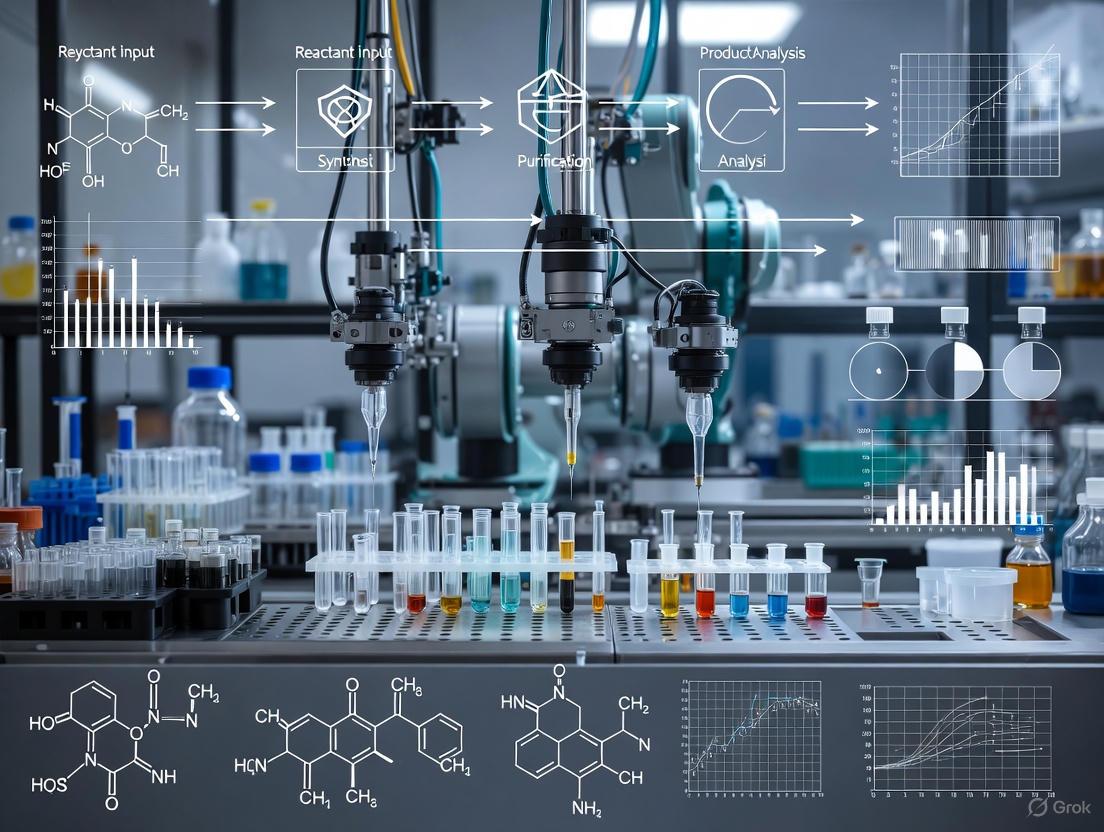
This article explores the transformative impact of high-throughput experimentation (HTE) and automation in organic synthesis, a critical advancement for researchers, scientists, and drug development professionals.
Accelerating Discovery: High-Throughput Experimentation and Automation in Organic Synthesis
Abstract
This article explores the transformative impact of high-throughput experimentation (HTE) and automation in organic synthesis, a critical advancement for researchers, scientists, and drug development professionals. It covers foundational principles, from the core challenges HTE solves to the latest robotic platforms and software orchestration. The scope extends to cutting-edge methodological applications, including microdroplet-based synthesis and self-driving laboratories, followed by practical strategies for troubleshooting and optimizing automated workflows. Finally, it provides a rigorous framework for validating HTE systems and comparing their performance against traditional methods, offering a comprehensive guide for integrating these powerful technologies into modern research and development pipelines.
What is High-Throughput Experimentation? Unlocking the Core Concepts and Strategic Advantages
High-Throughput Experimentation (HTE) represents a paradigm shift in research methodology, enabling the rapid execution of vast numbers of experiments to accelerate discovery and optimization processes. While its roots are deeply embedded in biological screening, particularly in pharmaceutical development, the principles of HTE have been innovatively adapted to chemical synthesis. This expansion addresses critical challenges in modern chemistry and materials science, where traditional one-experiment-at-a-time approaches create significant bottlenecks [1].
In pharmaceutical development, HTE emerged from High-Throughput Screening (HTS), where hundreds of thousands of compounds are screened to identify potential drug candidates [1]. The evolution into chemical HTE has transformed how researchers approach synthesis optimization, materials discovery, and process development. This transition is characterized by the miniaturization of reactions, extensive automation, and the integration of sophisticated data analysis techniques, allowing chemists to explore chemical space with unprecedented efficiency [2].
The implementation of HTE in chemistry, particularly for inorganic synthesis and drug development, has demonstrated remarkable improvements in efficiency. As documented at AstraZeneca, HTE implementation led to screening capacity increasing from 20-30 reactions per quarter to approximately 50-85 per quarter, while the number of conditions evaluated surged from under 500 to nearly 2000 over the same period [1]. This dramatic enhancement in throughput is revolutionizing the pace of scientific discovery across multiple domains.
HTE Applications: Quantitative Comparison
The application of HTE methodologies spans multiple scientific domains, each with distinct objectives, scale requirements, and primary benefits. The following table summarizes key quantitative and qualitative aspects of HTE across different fields.
Table 1: Comparative Analysis of HTE Applications Across Domains
| Application Domain | Primary Objective | Typical Scale/Throughput | Key Quantitative Benefits | Primary Challenges |
|---|---|---|---|---|
| Pharmaceutical Small Molecule Discovery [1] | Lead optimization & reaction screening | 50-85 screens/quarter; ~2000 conditions evaluated | 5-10 minutes/vial manual weighing reduced to <30 minutes for entire automated experiment; >10x throughput increase | Handling diverse solid forms; catalyst reactivity preservation; miniaturization |
| Inorganic Materials Synthesis [3] | Discovery of novel energy materials (e.g., battery materials) | Several dozen gram-scale samples per week | High reproducibility; minimal manual intervention; efficient composition screening | Accessible modular infrastructure; integration of multiple synthesis methods |
| Biopharmaceuticals & biologics [1] | Monoclonal antibodies, proteins, TIDES | Facility with 3 compartmentalized HTE workflows | Dedicated environments for solids processing, reaction validation, and manual pipetting | Larger molecule complexity; specialized handling requirements |
| Oncology Drug Discovery [1] | Candidate selection and optimization | Screen size increased from ~20-30 to ~50-85 per quarter | $1.8M capital investment significantly increased efficiency; conditions evaluated <500 to ~2000 | Colocation of specialists with medicinal chemists; cooperative vs. service-led approach |
Core HTE Methodology and Workflow
The implementation of HTE follows a systematic workflow that integrates automated equipment, specialized software, and analytical techniques. This methodology enables researchers to efficiently explore complex experimental spaces that would be impractical using conventional approaches.
Automated Workflow Components
HTE platforms typically incorporate several integrated systems that work in concert to enable high-throughput capabilities:
Automated Solid Dosing Systems: Systems like the CHRONECT XPR provide precise powder dispensing ranging from 1 mg to several grams, handling various powder types including free-flowing, fluffy, granular, or electrostatically charged materials [1]. These systems achieve dispensing times of 10-60 seconds per component, with high accuracy (<10% deviation at sub-mg to low single-mg masses; <1% deviation at >50 mg masses) [1].
Liquid Handling Modules: Custom-designed modules capable of performing multiple synthesis types including sol-gel, Pechini, solid-state, and hydro/solvothermal syntheses [3]. These systems typically operate within inert atmosphere gloveboxes to maintain controlled environments.
Reaction Array Platforms: Replacement of traditional round-bottomed flasks with vial arrays (typically 96-well formats) in heated or cooled manifolds, significantly reducing reagent and solvent consumption while enabling parallel processing [1].
Experimental Design Considerations
Effective HTE implementation requires careful experimental planning:
Library Validation Experiments (LVE): Systematic evaluation of building block chemical space against specific variables such as catalyst type and solvent choice [1].
Principal Component Analysis: Multivariate analysis to accelerate understanding of reaction mechanisms and kinetics [1].
Miniaturization Strategy: Deliberate reduction of reaction scales to mg levels to minimize material requirements, reduce environmental impact, and simplify sample handling and storage [1].
Diagram 1: Comprehensive HTE workflow for chemical synthesis
Detailed Experimental Protocols
Protocol: Automated Solid Dispensing for Reaction Screening
This protocol details the procedure for automated solid weighing using systems such as the CHRONECT XPR, as implemented in pharmaceutical HTE laboratories [1].
Materials and Equipment
- CHRONECT XPR automated powder dispensing system or equivalent
- Mettler Toledo standard dosing heads (up to 32)
- Target vials (2 mL, 10 mL, 20 mL sealed and unsealed; unsealed 1 mL vials)
- Solid reagents: transition metal complexes, organic starting materials, inorganic additives
- Inert atmosphere glovebox (for air-sensitive compounds)
Procedure
System Preparation
- Ensure the CHRONECT XPR is calibrated according to manufacturer specifications.
- Install appropriate dosing heads for the solid types being dispensed.
- Place target vials in the designated rack positions within the system workspace.
- For air-sensitive compounds, perform all operations within an inert atmosphere glovebox.
Experiment Planning
- Program the desired mass targets for each solid component (range: 1 mg to several grams).
- Configure the sequence of additions to optimize throughput.
- For complex reactions such as catalytic cross-coupling, plan the addition sequence to minimize interaction between components during dispensing.
Dispensing Execution
- Initiate the automated dispensing sequence.
- Monitor initial dispensations to verify accuracy, particularly for masses below 1 mg.
- The system typically requires 10-60 seconds per component, depending on compound characteristics.
Quality Assessment
- Verify mass accuracy: <10% deviation for sub-mg to low single-mg targets; <1% deviation for masses >50 mg.
- Document any dispensing errors or irregularities for process improvement.
Throughput Comparison
- Manual weighing: 5-10 minutes per vial
- Automated weighing: complete experiment (including planning and preparation) in less than 30 minutes
Applications
- Library Validation Experiments (LVE) for building block chemical space evaluation
- Catalytic reaction screening (e.g., cross-coupling reactions)
- Dose-response studies for catalyst and additive optimization
Protocol: High-Throughput Inorganic Materials Synthesis
This protocol adapts methodologies from the Materials Acceleration and Innovation plaTform for ENergy Applications (MAITENA) for lab-scale high-throughput synthesis of inorganic materials [3].
Materials and Equipment
- In-house-designed liquid-handling modules capable of sol-gel, Pechini, solid-state, and hydro/solvothermal syntheses
- Automated solid dispensing system (e.g., CHRONECT XPR)
- Array platforms for parallel synthesis (96-well format or equivalent)
- Sealed reaction vessels appropriate for synthesis method
Procedure
Composition Planning
- Define the compositional space to be explored based on computational screening or literature precedent.
- Determine the synthesis method(s) most appropriate for the target material class.
Automated Reagent Dispensing
- Utilize automated solid dispensing for precise delivery of precursor materials.
- Implement liquid handling systems for solvent and solution-based precursor addition.
- Maintain consistent mixing and homogenization throughout dispensing process.
Parallel Reaction Execution
- Execute syntheses in parallel using arrayed reaction vessels.
- Apply appropriate temperature profiles and pressure conditions for each synthesis method.
- Monitor reaction progress through in-situ analytics where available.
Sample Processing and Characterization
- Implement automated workup procedures for reaction quenching and product isolation.
- Utilize high-throughput characterization techniques for rapid material property assessment.
- Compile data in structured format for subsequent analysis.
Data Integration and Analysis
- Correlate synthesis parameters with material properties.
- Identify promising composition spaces for further optimization.
- Refine synthesis protocols based on initial results.
Applications
- Battery material discovery and optimization
- Functional ceramic development
- Catalyst synthesis and screening
- Energy material innovation
Research Reagent Solutions and Essential Materials
Successful HTE implementation requires specialized equipment and reagents designed for automated, miniaturized workflows. The following table details key components of a comprehensive HTE platform.
Table 2: Essential Research Reagent Solutions for HTE Implementation
| Component Category | Specific Examples | Function in HTE | Key Specifications | Throughput Impact |
|---|---|---|---|---|
| Automated Powder Dosing Systems [1] | CHRONECT XPR Workstations; Flexiweigh robot (Mettler Toledo) | Precise solid dispensing for reaction arrays | Range: 1 mg - several grams; 10-60 seconds/component; handles free-flowing, fluffy, granular, or electrostatically charged powders | Reduces manual weighing time from 5-10 min/vial to <30 min for full experiment; enables 96-well plate preparation |
| Liquid Handling Systems [1] | Minimapper robot; Custom in-house designed modules | Automated liquid reagent addition; solution-based synthesis | Resealable gasket to prevent evaporation; compatibility with 24-tube Miniblock-XT or 96-well arrays | Enables sol-gel, Pechini, solid-state, and hydro/solvothermal syntheses in parallel |
| Reaction Vessels & Arrays [1] | 96-well array manifolds; Sealed and unsealed vials (1 mL, 2 mL, 10 mL, 20 mL) | Miniaturized reaction environments for parallel synthesis | Compatible with heating/cooling systems; chemical resistance; sealing integrity | Replaces traditional round-bottomed flasks; enables massive scale reduction |
| Inert Atmosphere Workstations [1] | Gloveboxes (A, B, C compartmentalization) | Safe handling of air-sensitive compounds; hazardous condition operation | Compact footprint; integrated robotics; secure solid storage | Enables work with sensitive catalysts; provides safe powder handling environment |
| Catalyst Libraries [1] | Transition metal complexes; Organocatalysts | Screening catalytic reactions; optimization of catalytic systems | Diverse structural classes; well-characterized performance; stability under storage conditions | Foundation for twenty catalytic reactions screened per week target |
Implementation Case Study: AstraZeneca's HTE Evolution
The implementation of HTE at AstraZeneca over a 20-year period provides a compelling case study in the maturation of chemical high-throughput experimentation [1]. This evolution demonstrates both the technical requirements and strategic considerations for successful HTE integration in pharmaceutical research and development.
Initial Implementation Phase
The initial HTE implementation at AstraZeneca established five key goals that guided development:
- Delivery of high-quality reactions with reproducible results
- Screening capacity of twenty catalytic reactions per week within three years of implementation
- Development of a comprehensive catalyst library
- Moving beyond simple reaction 'hits' to comprehensive reaction understanding
- Employment of principal component analysis to accelerate knowledge of reaction mechanisms and kinetics [1]
Early challenges included automation of solids and corrosive liquids handling, along with minimizing sample evaporation. Initial solutions incorporated inert atmosphere gloveboxes, Minimapper robots for liquid handling, and Flexiweigh automated weighing robots, which served as foundational technologies despite their limitations [1].
Technology Advancement and Refinement
The collaboration between AstraZeneca and equipment manufacturers led to significant technological improvements, particularly in powder dosing technology. This partnership helped develop user-friendly software for Quantos Weighing technology, eventually evolving into the CHRONECT Quantos and modern CHRONECT XPR systems through integration of Trajan's robotics expertise with Mettler's weighing technology [1].
Key advancements included:
- Compact footprint systems enabling safe powder handling in inert environments
- Improved dosing accuracy across a wide mass range
- Enhanced software integration for experimental planning and execution
- Compatibility with diverse vial formats and sample types
Organizational Integration Strategy
A critical success factor identified in AstraZeneca's HTE implementation was the colocation of HTE specialists with general medicinal chemists, fostering a cooperative rather than service-led approach [1]. This organizational model enhanced collaboration and knowledge transfer, accelerating the adoption of HTE methodologies across research teams.
The implementation of specialized HTE facilities, such as the 1000 sq. ft facility in Gothenburg with three compartmentalized workflows, demonstrated the value of dedicated infrastructure:
- Glovebox A: Automated processing of solids with CHRONECT XPR system and secure catalyst storage
- Glovebox B: Automated reactions and validation of HTE conditions to gram scales
- Glovebox C: Standardized equipment for global HTE teams, combining liquid automation with manual pipetting options [1]
Diagram 2: Organizational and strategic framework for HTE implementation
Future Directions and Development Needs
While significant progress has been made in HTE hardware development, future advancements will focus increasingly on software integration and autonomous operation. As noted in the AstraZeneca case study, "much of the hardware for HTE was either now developed, or will likely to be developed, in the not-so-distant future" [1]. The primary unmet need lies in software development to enable full closed-loop autonomous chemistry.
Key development areas include:
- Advanced Software Platforms: Implementation of sophisticated software to integrate experimental planning, execution, and analysis without extensive human intervention [1]
- Self-Optimizing Systems: Development of systems capable of autonomous reaction optimization based on real-time analytical data [1]
- Artificial Intelligence Integration: Leveraging AI techniques for predictive modeling and experimental design [2]
- Materials Acceleration Platforms (MAPs): Implementation of integrated systems combining computational screening, high-throughput experimentation, and AI [3]
- Self-Driving Laboratories (SDL): Development of fully autonomous research environments capable of iterative hypothesis testing and optimization [3]
These advancements will further accelerate the pace of discovery across chemical and materials science domains, ultimately redefining the rate of chemical synthesis and innovating the way materials are manufactured [2].
The pharmaceutical industry faces a persistent challenge: the slow and expensive process of drug discovery, with an estimated development cost of $2.8 billion per new medicine from inception to launch [1]. High-Throughput Experimentation (HTE) has emerged as a transformative approach to address this challenge by miniaturizing and parallelizing reactions, dramatically accelerating compound library generation and reaction optimization [4]. This methodology is particularly crucial in organic synthesis, where it enables researchers to collect comprehensive data for machine learning applications while working with increasingly complex molecular architectures under material-limited conditions. The global High Throughput Screening (HTS) market expansion, expected to grow at a CAGR of 10.6% from 2024 to 2029, reflects the critical importance of these technologies in modern drug development pipelines [5].
The implementation of HTE represents a paradigm shift from traditional synthetic approaches, allowing researchers to explore chemical space more efficiently while reducing reagent consumption and environmental impact. However, this transition introduces significant challenges in reaction design, execution, analysis, and data management due to the diverse workflows and specialized reagents required [4]. This application note examines the pressing need for HTE in organic synthesis, providing detailed protocols and analytical frameworks to address complexity and material limitations while highlighting recent technological advances that have transformed pharmaceutical research and development.
Market Context and Quantitative Landscape
The growing adoption of HTE methodologies reflects their strategic importance in pharmaceutical research and development. Market analysis reveals robust investment and expansion in high-throughput technologies across the drug discovery sector.
Table 1: High-Throughput Screening Market Landscape and Projections
| Parameter | Value | Context/Timeframe |
|---|---|---|
| Global HTS Market Size | USD 18,803.5 million | Projected value for 2025-2029 period [5] |
| Compound Annual Growth Rate (CAGR) | 10.6% | Forecast period 2024-2029 [5] |
| North America Market Share | 50% | Dominant region during forecast period [5] |
| Target Identification Segment Value | USD 7.64 billion | Historical value from 2023 [5] |
| Development Timeline Reduction | Approximately 30% | Enabled by HTS implementation [5] |
| Forecast Accuracy Improvement | Up to 18% | In materials science applications [5] |
| Traditional Drug Development Timeline | 12-15 years | From inception to market launch [1] |
The quantitative landscape demonstrates substantial resource allocation toward HTE technologies, with the pharmaceutical sector accounting for the largest revenue share [5]. This investment is driven by the compelling efficiency gains achievable through high-throughput approaches, including the ability to identify potential drug targets up to 10,000 times faster than traditional methods while lowering operational costs by up to 15% [5]. The market expansion is further fueled by continuous growth in global research and development expenditures, particularly focused on addressing disease burdens in developing countries through establishing new laboratories and research facilities [5].
Critical Challenges in Modern Organic Synthesis
Analytical and Purification Bottlenecks
Purification has long been considered the primary bottleneck in high-throughput synthetic workflows, creating a significant impediment to the design-make-test cycle of new drugs [6]. The advent of combinatorial chemistry enabled compound libraries to expand from low thousands to low millions in a short period, but this rapid increase in synthesis rates was not matched by corresponding purification capacity [6]. Consequently, as compound numbers increased dramatically, quality control plummeted, resulting in poor false positive/negative data and low follow-on hit confirmation success rates [6].
The current paradigm emphasizes extracting high-level data from early-stage projects, including structure-activity relationship and metabolic stability profiles, creating an imperative need for highly purified compound libraries [6]. This requirement is particularly acute in pharmaceutical settings where colored dimethyl sulfoxide (DMSO) solutions from multi-component reactions can interfere with biological assays and lead research projects down expensive unproductive paths [6].
Quantification and Material Handling Limitations
Reducing compound quantities to low milligram and sub-milligram levels presents new challenges in quantification accuracy. Gravimetric measurements at these scales become increasingly problematic due to static build-up during handling, with repeated tare weighing of 96-well polypropylene tubes showing errors of ±2 mg [6]. Additional complications arise from incomplete drying of HPLC fractions and potential issues with small molecular weight or volatile compounds during prolonged drying processes [6].
The implementation of HTE also demands specialized expertise and equipment for handling diverse reagent types, particularly solids and corrosive liquids [1]. Early HTE implementations addressed these challenges through inert atmosphere gloveboxes and resealable gaskets to prevent solvent evaporation, but significant limitations remained in automated powder dosing capabilities [1].
HTE Experimental Protocols
High-Throughput Purification Workflow
Objective: Purify compound libraries from reaction mixtures to achieve >95% purity suitable for biological screening.
Materials:
- Crude reaction mixtures (1-10 mg in 0.5-2 mL solvent)
- Preparative HPLC system with LCMS capability (C18 column, 21 mm diameter)
- 96-well collection plates
- Mobile phases: Water (A) and acetonitrile (B), both with 0.1% formic acid
- Liquid handling robotics
Procedure:
- Sample Preparation: Transfer crude reaction mixtures to 96-well plates using liquid handling robotics. Centrifuge at 3000 rpm for 5 minutes to precipitate particulates.
- Method Development: Implement a generic gradient method: 5-100% B over 10 minutes, hold at 100% B for 2 minutes, then re-equilibrate at 5% B for 3 minutes. Flow rate: 20-30 mL/min.
- Fraction Collection: Configure mass-directed fraction collection triggered by target ion detection. Collect fractions into 96-well plates.
- Analysis: Analyze fractions using LCMS with Charged Aerosol Detection (CAD) for accurate quantification.
- Solvent Removal: Evaporate solvents using centrifugal evaporation with controlled heating (≤30°C).
- Reconstitution: Dissolve dried samples in DMSO to 10 mM concentration using automated liquid handling.
- Quality Control: Transfer samples to storage plates and register in compound management system.
Critical Notes:
- CAD quantification provides superior accuracy (7-11% variability) compared to gravimetric measurements for diverse compounds [6].
- For sub-mg scales, employ columns with <5 μm fully porous particles for better separation at flow rates of 1-5 mL/min [6].
- Supercritical fluid chromatography (SFC)-MS purification offers comparable success rates to HPLC-MS for appropriate compound classes [6].
Automated Solid Dosing Protocol
Objective: Accurately dispense solid reagents (1 mg to several grams) for HTE reaction arrays.
Materials:
- CHRONECT XPR automated powder dosing system [1]
- Up to 32 Mettler Toledo standard dosing heads [1]
- Free-flowing, fluffy, granular, or electrostatically charged powders
- Target vials (2 mL, 10 mL, 20 mL sealed and unsealed; unsealed 1 mL vials)
Procedure:
- System Setup: Install appropriate dosing heads for specific powder characteristics. Prime system with inert gas for oxygen-sensitive compounds.
- Method Optimization: Calibrate dispensing parameters for each solid compound. Typical dispensing time: 10-60 seconds per component.
- Plate Configuration: Load destination vials in 24-, 96-, or 384-well formats according to experimental design.
- Automated Dispensing: Execute dosing protocol with verification weighing at specified intervals.
- Quality Assessment: Validate dispensing accuracy: <10% deviation for sub-mg to low single-mg masses; <1% deviation for >50 mg masses [1].
Critical Notes:
- Automated solid dosing reduces manual weighing time from 5-10 minutes per vial to less than half an hour for entire experiments [1].
- Significant error reduction is achieved compared to manual weighing, especially for complicated reactions like catalytic cross-coupling at 96-well plate scales [1].
Diagram 1: Integrated HTE Workflow
The Scientist's Toolkit: Essential Research Reagent Solutions
Table 2: Key Research Reagent Solutions for HTE Implementation
| Tool/Reagent | Function | Application Notes |
|---|---|---|
| CHRONECT XPR | Automated powder dispensing (1 mg to grams) | Handles free-flowing, fluffy, granular, or electrostatically charged powders; 10-60 sec dispensing time [1] |
| Charged Aerosol Detection (CAD) | Universal quantitative analysis | Provides accurate quantification (7-11% variability) for diverse compounds; superior to gravimetric methods [6] |
| Prep-LCMS | Mass-directed purification | "Gold standard" for targeted peak selection; achieves "one sample injected–one fraction collected" [6] |
| Automated Liquid Handling | Precise liquid transfers | Enables 96-, 384-, and 1536-plate formats; integrates with microfluidics and sonic sampling [6] |
| Flexiweigh Robot | Automated weighing | Early-generation weighing technology; foundation for modern dosing systems [1] |
| Indium--magnesium (1/3) | Indium--magnesium (1/3), CAS:12423-31-3, MF:InMg3, MW:187.73 g/mol | Chemical Reagent |
| 2-Benzoyl-1-indanone | 2-Benzoyl-1-indanone | Explore 2-Benzoyl-1-indanone for anti-inflammatory and anticancer research. This compound is for Research Use Only. Not for human or veterinary use. |
Integrated Workflow Implementation
Successful HTE implementation requires seamless integration across multiple systems to avoid simply moving bottlenecks through the workflow. Fully automated systems capable of running continuously must integrate fraction collection/pooling, dry-down, quantitative analysis, dissolution in DMSO, and cherry-picking/plating for specific projects [6]. Advanced implementations, such as the AbbVie system, achieve remarkable turnaround times of 24-36 hours from starting materials to assay results [6].
The integration of artificial intelligence brings transformative potential to HTE workflows, enabling enhanced target intelligence and more focused libraries [6]. However, these advances heighten the need for rapid synthesis, purification, and testing capabilities, making the resolution of purification rate-limiting steps increasingly critical [6]. Future developments may revisit multi-column approaches from the combinatorial chemistry era, combining sub-mg scale chemistry with four- or eight-column HPLC prep systems, mass spectrometer-directed fraction collection, CAD quantitative analysis, and full integration to deliver screen-test-ready plates [6].
Diagram 2: Closed-Loop HTE System
The pressing need for HTE in organic synthesis stems from fundamental challenges in addressing molecular complexity under material constraints, coupled with the pharmaceutical industry's imperative to accelerate discovery timelines. The protocols and methodologies detailed in this application note provide a framework for implementing integrated HTE workflows that address critical bottlenecks in purification, quantification, and material handling. As the field advances, the convergence of automation, advanced analytics, and artificial intelligence promises to further transform HTE into a fully integrated, flexible, and democratized platform that drives innovation in organic synthesis [4]. The remarkable success of implementations at leading pharmaceutical companies demonstrates that with appropriate investment in both hardware and software, HTE can deliver substantial improvements in research efficiency while maintaining the quality standards essential for drug discovery.
High-Throughput Experimentation (HTE) represents a paradigm shift in inorganic materials research, enabling the rapid synthesis and characterization of thousands of samples through integrated automation. This approach has become essential for accelerating the discovery and optimization of advanced materials in fields ranging from battery technology to pharmaceuticals. The global laboratory automation market, valued at $5.2 billion in 2022, is projected to grow to $8.4 billion by 2027, driven by sectors including pharmaceuticals, biotechnology, and environmental monitoring [7]. HTE workflows provide the foundational framework for this growth by systematizing the "Design, Make, Test, Analyze" cycle, dramatically reducing the traditional timeline for materials development from years to weeks while improving reproducibility and data quality.
The core innovation of modern HTE lies in the seamless integration of computational design, robotic synthesis, automated characterization, and data analysis into a continuous, iterative workflow. This integration enables researchers to navigate complex, multidimensional phase diagrams and synthesis parameter spaces that would be prohibitively time-consuming to explore manually [8]. As the field advances toward fully autonomous "self-driving laboratories," the standardized protocols and structured workflow components described in this document become increasingly critical for both human and robotic experimentalists [3].
Core Workflow Components
The HTE workflow for inorganic synthesis comprises four interconnected components that form an iterative cycle for materials discovery and optimization. Each component addresses distinct challenges in traditional materials research while generating standardized data outputs that feed into subsequent stages.
Design
The Design phase establishes the experimental foundation through computational planning and precursor selection. This stage leverages materials informatics and thermodynamic modeling to maximize the efficiency of experimental resources. Advanced computational methods screen chemical spaces and predict synthetic pathways before any laboratory work begins.
Table 1: Key Design Phase Components and Their Functions
| Component | Function | Data Output |
|---|---|---|
| Precursor Selection Algorithm | Identifies optimal starting materials based on thermodynamic principles | List of precursor candidates with predicted reaction energies |
| Phase Diagram Navigation | Maps potential reaction pathways to avoid kinetic traps | Thermodynamic landscape with competing phases identified |
| Experimental Design Matrix | Defines composition and processing parameter spaces | Array of experimental conditions with controlled variables |
| Digital Sample Tracking | Assigns unique identifiers to planned experiments | Sample registry with predefined characterization protocols |
The design principles for effective precursor selection include: (1) favoring reactions that initiate between only two precursors to minimize simultaneous pairwise reactions, (2) selecting relatively high-energy (unstable) precursors to maximize thermodynamic driving force, (3) ensuring the target material is the deepest point in the reaction convex hull, (4) choosing composition slices that intersect minimal competing phases, and (5) prioritizing targets with large inverse hull energies when by-products are unavoidable [8].
Make
The Make phase translates computational designs into physical samples through automated synthesis platforms. This component addresses the critical bottleneck of traditional materials synthesis by implementing robotic systems capable of preparing numerous samples with minimal human intervention. Automated synthesis modules can perform various synthesis methods including sol-gel, Pechini, solid-state, and hydro/solvothermal reactions, preparing several dozen gram-scale samples per week with high reproducibility [3].
Table 2: Automated Synthesis Modules and Capabilities
| Module Type | Synthesis Methods | Throughput | Key Features |
|---|---|---|---|
| Liquid Handling Robots | Sol-gel, Pechini, Precipitation | 100+ samples/week | Nanoliter precision, multi-solvent compatibility |
| Robotic Powder Processing | Solid-state reactions, Mechanochemistry | 50-100 samples/week | Automated milling, mixing, and pressing |
| Hydrothermal Reactor Arrays | Hydro/solvothermal, Precipitation | 24-48 samples/batch | Parallel reactor blocks with temperature control |
| Integrated Flow Chemistry | Continuous flow synthesis, Precipitation | 200+ samples/week | Telescoped reactions, real-time monitoring |
Implementation of the Make phase requires specialized hardware and software integration. Robotic arms transport assay microplates between stations for reagent addition, mixing, incubation, and intermediate processing [9]. Automated platforms typically utilize microtiter plates with 96, 192, 384, or higher well densities, with each well representing a distinct experimental condition [9]. Recent advances include flow chemistry platforms that enable sequential Suzuki and Buchwald-Hartwig coupling transformations through telescoped synthesis approaches [10].
Test
The Test phase employs automated characterization techniques to analyze the synthesized materials' structural and functional properties. This component generates standardized, high-quality data essential for establishing structure-property relationships. Modern HTE platforms integrate multiple analytical techniques into unified workflows, often with centralized instrumentation serving multiple synthesis laboratories [7].
Protocol 1: Automated Structural and Compositional Characterization
- Sample Transfer: Robotic systems transfer samples from synthesis platforms to analysis stations using custom grippers or conveyor systems.
- X-ray Diffraction (XRD):
- Analysis Parameters: 5-90° 2θ range, 0.01° step size, 0.5-2 seconds/step
- Throughput: 200-300 samples/day with automated sample changers
- Data Output: Crystal structure identification, phase purity quantification, Rietveld refinement
- X-ray Fluorescence (XRF):
- Analysis Parameters: Helium atmosphere for light elements, vacuum for heavier elements
- Data Output: Elemental composition verification, stoichiometry confirmation
- Automated Electron Microscopy:
- Preparation: Automated sample plating and sputter coating
- Analysis: Pre-programmed stage movements with automated image acquisition
- Data Output: Morphological analysis, particle size distribution, elemental mapping
Centralized analytical facilities enable efficient resource utilization, with examples including multiple chemistry labs connected to centralized LC-MS and NMR platforms [7]. For battery materials specifically, automated electrochemical testing systems can simultaneously cycle dozens of coin cells, collecting performance data under standardized conditions.
Analyze
The Analyze phase transforms raw experimental data into actionable knowledge through computational data analysis and machine learning. This component completes the HTE cycle by extracting meaningful patterns and relationships that inform the next Design iteration. Advanced data analysis techniques address the unique challenges of materials science data, including high dimensionality, complex correlations, and multiple performance objectives.
Protocol 2: Data Analysis and Machine Learning Workflow
Data Preprocessing:
- Quality Control: Apply Z-factor or SSMD (Strictly Standardized Mean Difference) metrics to identify failed experiments or outlier data points [9]. The Z-factor calculation: ( Z = 1 - \frac{3\sigma{p} + 3\sigma{n}}{|\mu{p} - \mu{n}|} ), where σ and μ represent the standard deviation and mean of positive (p) and negative (n) controls.
- Feature Extraction: Convert raw characterization data (XRD patterns, spectra) into structured features (peak positions, intensities, widths) using automated peak fitting algorithms.
- Data Normalization: Apply plate-position normalization to correct for systematic spatial biases using B-score methods or similar approaches [9].
Hit Identification:
- Primary Screening: For screens without replicates, use robust statistical methods like z-score or SSMD for hit selection: ( z* = \frac{x - median{N}}{MAD{N}} ), where MAD_N is the median absolute deviation of negative controls [9].
- Confirmatory Screening: For screens with replicates, use t-statistics or SSMD with replicates to identify hits with significant effects.
Model Building:
- Feature Selection: Apply random forest or mutual information criteria to identify the most influential synthesis parameters.
- Regression Modeling: Train machine learning models (neural networks, gradient boosting) to predict material properties from synthesis parameters.
- Classification Modeling: Develop classifiers to predict synthesis success or failure based on precursor characteristics and reaction conditions.
Design Optimization:
- Sequential Learning: Implement Bayesian optimization or evolutionary algorithms to suggest improved synthesis conditions for the next experimental cycle.
- Multi-objective Optimization: Use Pareto front analysis to balance competing objectives (e.g., purity vs. cost, performance vs. synthesis temperature).
The analysis phase increasingly incorporates AI-powered tools, such as machine learning-based liquid chromatography systems that autonomously optimize gradients and integration with digital lab environments [7]. For inorganic materials specifically, natural language processing approaches have been applied to extract synthesis information from scientific literature, creating structured datasets that inform experimental design [11].
Integrated Workflow Implementation
The full power of HTE emerges when the four components are integrated into a continuous, automated cycle. This integration enables "closed-loop" materials discovery, where experimental results directly inform subsequent designs without human intervention. Two distinct implementation models have emerged: fully integrated platforms and modular federated systems.
Diagram 1: HTE Workflow Cycle (43 characters)
Fully integrated platforms such as the Cyclofluidic Optimisation Platform (CyclOps) demonstrate complete workflow integration, encompassing design, synthesis, and biological assay in a single closed-loop system [10]. These systems can prepare and assay 14 compounds in less than 24 hours, dramatically accelerating the discovery cycle [10]. Alternatively, modular approaches like the Materials Acceleration and Innovation plaTform for ENergy Applications (MAITENA) implement semi-automated stations for specific synthesis methods while maintaining integration through standardized data formats and sample tracking [3].
Protocol 3: Implementing an Integrated HTE Workflow
System Architecture:
- Deploy a centralized data management system to track samples and data across all workflow stages
- Establish standardized data formats for experimental parameters and results
- Implement sample tracking using barcodes or RFID tags to maintain chain of custody
Automation Integration:
- Connect synthesis robots with analytical instruments via robotic sample transfer or conveyor systems
- Implement scheduling software to optimize instrument utilization across multiple users
- Establish automated data pipelines from instruments to analysis databases
Quality Control:
- Incorporate control samples in each experimental batch to monitor system performance
- Implement real-time monitoring of instrument performance and data quality
- Apply statistical process control to detect deviations in synthesis or analysis
Iterative Optimization:
- Establish criteria for cycle termination (performance targets, diminishing returns)
- Implement automated reporting of results to researchers
- Maintain complete data provenance for regulatory compliance and publication
Essential Research Reagents and Materials
Successful implementation of HTE workflows requires specialized materials and reagents optimized for automated platforms. The selection of these components significantly impacts experimental outcomes, reproducibility, and throughput.
Table 3: Essential Research Reagent Solutions for HTE
| Reagent/Material | Function | HTE-Specific Considerations |
|---|---|---|
| Precursor Libraries | Source of chemical elements for synthesis | Pre-dissolved solutions at standardized concentrations; compatibility with liquid handling systems |
| Functionalized Microtiter Plates | Sample containers for synthesis and analysis | Material compatibility (temperature, solvent, pH); well geometry optimized for specific characterizations |
| Specialized Solvents | Media for solution-based synthesis | Low viscosity for pipetting; high purity to prevent contamination; compatibility with sealing films |
| Catalyst Libraries | Acceleration of chemical transformations | Immobilized formats for easy separation; standardized loading for consistent screening |
| Reference Standards | Quality control and instrument calibration | Stable under automated storage conditions; traceable certification for data validation |
| Stable Isotope Labels | Tracing reaction pathways and mechanisms | Compatible with online analysis techniques; minimal interference with native chemistry |
The development of large-scale synthesis datasets, such as the 35,675 solution-based inorganic materials synthesis procedures extracted from scientific literature, provides valuable resources for selecting appropriate reagents and predicting their behavior in HTE contexts [11]. Similarly, the Unified Language of Synthesis Actions (ULSA) offers a standardized vocabulary for describing synthesis procedures, facilitating the transfer of protocols between research groups and automated platforms [12].
The integrated Design, Make, Test, Analyze workflow represents the cornerstone of modern high-throughput experimentation in inorganic materials synthesis. By systematically implementing the protocols and utilizing the specialized materials described in this document, researchers can dramatically accelerate the discovery and optimization of novel materials. As the field advances toward increasingly autonomous laboratories, these standardized workflows will enable more efficient data generation, better reproducibility, and ultimately, faster translation of materials from concept to application.
The future development of HTE will likely focus on improving integration between workflow components, enhancing AI-driven experimental design, and expanding the range of synthesis methods amenable to automation. With the global laboratory automation market continuing its rapid growth, these core workflow components will play an increasingly vital role in materials research across academic, government, and industrial settings [7].
In the field of inorganic materials research, the slow and resource-intensive nature of traditional discovery processes has created a significant bottleneck, particularly in strategic sectors like energy and pharmaceuticals. High-Throughput Experimentation (HTE) automation represents a paradigm shift, integrating robotics, artificial intelligence, and data science to overcome these challenges. This application note details how automated platforms deliver three fundamental benefits: a dramatically accelerated discovery cycle, minimized consumption of valuable materials, and enhanced reproducibility of experimental outcomes. Framed within the broader context of materials acceleration platforms (MAPs) and self-driving laboratories (SDLs), we provide quantitative evidence and detailed protocols to guide researchers in implementing these transformative technologies.
Accelerating Discovery
The primary advantage of HTE automation is the profound acceleration of the research-to-discovery timeline. Traditional synthesis approaches, which are often sequential and manual, cannot compete with the parallel processing and continuous operation of automated platforms.
Quantitative Evidence of Increased Throughput
Data from recent implementations demonstrate the dramatic gains in efficiency. The following table summarizes key performance metrics from leading research initiatives.
Table 1: Throughput Metrics of Automated Platforms
| Platform/Institution | Key Throughput Metric | Experimental Duration | Output / Outcome | Citation |
|---|---|---|---|---|
| A-Lab (Autonomous Lab) | 41 novel inorganic powders synthesized | 17 days of continuous operation | 71% success rate from 58 target compounds | [13] |
| AstraZeneca HTE (Oncology) | Screening conditions evaluated | Post-automation (Q1 2023 onward) | Increased from <500 to ~2000 conditions per quarter | [1] |
| MAITENA Platform | Several dozen gram-scale samples | Per week, per module | Enabled via semi-automated liquid-handling modules | [3] [14] |
Enabling Technologies and Workflows
This acceleration is enabled by integrated systems that combine computation, robotics, and intelligent planning. The A-Lab, for instance, operates a closed-loop workflow: it uses computations and historical data to plan synthesis recipes, executes them with robotics, characterizes the products via automated X-ray diffraction (XRD), and employs active learning to interpret outcomes and propose next experiments [13]. This autonomy allows for continuous operation beyond human working hours, compressing years of research into weeks.
Minimizing Material Use
Automation enables miniaturization, allowing researchers to conduct meaningful experiments at vastly reduced scales. This reduces costs, minimizes waste, and allows for the exploration of precious or hazardous compounds.
Case Study: Pharmaceutical HTE
In pharmaceutical research, AstraZeneca's implementation of automated solid weighing systems like the CHRONECT XPR allows for precise dosing of a wide range of solids, including transition metal complexes and organic starting materials. This system demonstrated high accuracy with less than 10% deviation at sub-milligram masses and under 1% deviation at masses greater than 50 mg. Most significantly, it reduced the weighing time for a 96-well plate from multiple manual hours to less than half an hour of automated operation, while also eliminating the "significant" human errors associated with manual handling at small scales [1].
Case Study: Inorganic Materials Research
The MAITENA platform showcases miniaturization for inorganic materials. Its automated liquid-handling modules prepare hundreds of milligrams to gram-scale samples, which is sufficient for comprehensive characterization while drastically reducing precursor consumption compared to traditional bulk synthesis [3] [14]. This "goldilocks" scale is ideal for discovery, providing enough material for validation without being resource-prohibitive.
Enhancing Reproducibility
Reproducibility is a cornerstone of the scientific method, yet the "reproducibility crisis" remains a significant challenge. Automated platforms directly address key sources of irreproducibility by standardizing protocols, minimizing human error, and ensuring precise documentation.
Standardization and Error Reduction
Human researchers inevitably introduce subtle variations in experimental procedures. Automation eliminates this variability. By encoding a synthesis into a Standard Operating Procedure (SOP) executable by a robot, every experiment is performed with the same precision, from reagent dispensing to mixing times and temperature control [15]. This is crucial for collaborative science, as protocols can be shared and executed identically across different laboratories. For example, the universal chemical programming language (χDL) allows synthetic procedures to be standardized and performed reliably across different automated platforms at separate institutions [16].
Data Provenance and Computational Reproducibility
Automation platforms generate comprehensive audit trails that track every aspect of an experiment, from raw data to analysis [15]. Furthermore, the principles of reproducible research are being applied to the computational components of these workflows. The use of container technologies like Docker allows researchers to encapsulate the entire computing environment—including operating system, software, and library versions—ensuring that computational analyses can be exactly reproduced later or by other research groups [17] [18].
Detailed Experimental Protocols
Protocol: Automated Solid-State Synthesis of Inorganic Powders (A-Lab Protocol)
This protocol outlines the autonomous synthesis of novel inorganic materials, as demonstrated by the A-Lab [13].
I. Research Reagent Solutions
Table 2: Essential Materials for Automated Solid-State Synthesis
| Item | Function |
|---|---|
| Precursor Powders (e.g., metal oxides, phosphates) | Starting materials for solid-state reactions. |
| Alumina Crucibles | Inert, high-temperature containers for reactions. |
| Milling Media (e.g., zirconia balls) | For homogenizing precursor mixtures. |
II. Procedure
- Target Identification: Select target compounds from computational databases (e.g., Materials Project) predicted to be stable.
- Recipe Generation: Input the target into the management system. The platform will use natural language models trained on historical literature to propose up to five initial synthesis recipes and heating temperatures.
- Automated Preparation: A robotic arm dispenses and mixes the precursor powders in the calculated stoichiometric ratios. The mixture is transferred to an alumina crucible.
- Robotic Heating: A second robotic arm loads the crucible into one of four box furnaces. The sample is heated according to the proposed recipe.
- Automated Characterization: After cooling, a robot transfers the sample to a station where it is ground into a fine powder and measured by XRD.
- Phase Analysis: Machine learning models analyze the XRD pattern to identify phases and calculate weight fractions of the product. This is confirmed by automated Rietveld refinement.
- Active Learning Loop: If the target yield is below a threshold (e.g., 50%), an active learning algorithm (ARROWS3) analyzes the outcome and proposes a new, optimized synthesis recipe. The loop (steps 3-7) continues until success or recipe exhaustion.
III. Workflow Diagram
Diagram Title: A-Lab Autonomous Synthesis Workflow
Protocol: High-Throughput Solvothermal Synthesis (MAITENA Protocol)
This protocol describes the use of an automated liquid-handling module for the solvothermal synthesis of inorganic materials, such as battery electrodes [3] [14].
I. Research Reagent Solutions
Table 3: Essential Materials for Automated Solvothermal Synthesis
| Item | Function |
|---|---|
| Precursor Salt Solutions | Liquid sources of metal ions. |
| Solvents (e.g., Water, Alcohols) | Reaction medium. |
| Mineralizers (e.g., NaOH, NHâ‚„F) | Agents to enhance solubility and crystal growth. |
| Sealed Vials/Reactors (2-20 mL) | Containers for reactions under autogenous pressure. |
II. Procedure
- System Setup: Load precursor solutions and solvents into the designated reservoirs of the liquid-handling module (e.g., Module-II of the MAITENA platform).
- Programming: Input the desired stoichiometries and final volumes for up to 12 parallel reactions into the control software.
- Automated Dispensing: The robotic system (using a CNC table or robotic arm) and programmable pumps accurately dispense the calculated volumes of each solution directly into the individual reaction vials.
- Mixing: Secure the vials and initiate mixing using a magnetic stirrer or a vertical stirrer integrated into the module.
- Reaction: Transfer the sealed vials to a conventional or microwave oven for heating according to the desired solvothermal profile (e.g., 180°C for 24 hours).
- Work-up and Characterization: After the reaction, the products are collected by filtration or centrifugation. The platform can be integrated with high-throughput characterization tools like automated XRD for analysis.
III. Workflow Diagram
Diagram Title: Automated Parallel Solvothermal Synthesis
The pursuit of scientific discovery has long been governed by a traditional, iterative approach to experimentation, where single experiments are meticulously designed, executed, and analyzed to inform the next logical step. While this method has yielded profound insights, it is inherently slow and linear, often requiring months or years to optimize a single process or identify a promising candidate material or molecule. High-Throughput Experimentation (HTE) represents a fundamental paradigm shift from this conventional model. HTE is a process of scientific exploration involving lab automation, effective experimental design, and the execution of hundreds to thousands of rapid parallel or serial experiments [19]. This approach transforms the sequential nature of traditional research into a highly parallelized process, enabling researchers to explore vast experimental landscapes in a fraction of the time. In the context of inorganic synthesis automation research, this acceleration is critical for addressing global challenges in energy and sustainability by rapidly discovering and optimizing new materials [3]. This article will dissect the core contrasts between HTE and traditional methods, provide detailed protocols for implementation, and visualize the workflows that make HTE a transformative tool for modern researchers, scientists, and drug development professionals.
Core Contrasts: HTE vs. Traditional Single-Experiment Approaches
The differences between HTE and traditional methods extend far beyond the simple distinction of "parallel versus serial." They represent a fundamental difference in philosophy, infrastructure, and data management. The table below provides a structured, quantitative comparison of these two approaches.
Table 1: A systematic comparison of High-Throughput Experimentation and Traditional Single-Experiment approaches.
| Feature | High-Throughput Experimentation (HTE) | Traditional Single-Experiment |
|---|---|---|
| Experimental Mindset | Parallel, data-rich exploration of broad parameter spaces [20]. | Sequential, iterative, and guided by immediate prior results [20]. |
| Primary Goal | Rapidly gather maximum data to inform decisions and build predictive models [19] [21]. | Solve an immediate problem and understand a specific reaction. |
| Experimental Scale | Microscale (e.g., mg reagents, μL solvents) in 96- or 384-well plates [22]. | Macroscale (e.g., g to kg reagents) in standard lab glassware. |
| Weekly Throughput | Dozens to hundreds of gram-scale samples per week [3] or thousands of molecular screens [19]. | A handful of experiments per week. |
| Typical Workflow | Automated, integrated systems for dispensing, reaction, and analysis [13]. | Manual, discrete steps performed by a scientist. |
| Automation & Hardware | Relies on robotics, liquid handlers, solid dispensers, and automated analysis platforms [19] [23] [22]. | Primarily manual; uses magnetic stirrers, hot plates, round-bottom flasks. |
| Data Output & Management | Generates immense, structured datasets requiring FAIR (Findable, Accessible, Interoperable, Reusable) principles and specialized software [19] [21]. | Generates limited, often unstructured data recorded in paper notebooks or basic ELNs. |
| Key Advantage | Speed, reproducibility, ability to find non-intuitive optima, and generation of knowledge capital [23] [20]. | Low initial setup cost and deep, intuitive engagement with a single experiment. |
| Primary Challenge | High initial investment and complex data integration/management [19] [21]. | Slow cycle times and potential for missed optimal conditions [20]. |
The HTE Workflow: From Hypothesis to Data
The power of HTE is realized through a structured, automated workflow that integrates computational design, robotic execution, and intelligent data analysis. This process is a closed-loop system, where the results of one campaign directly inform the design of the next. The following diagram illustrates this continuous, adaptive workflow, which is fundamental to autonomous materials discovery platforms like the A-Lab [13].
Diagram 1: The HTE closed-loop workflow for materials synthesis.
Workflow Stages:
- Target Identification & Experimental Design: The process begins with computational screening to identify promising target materials, such as those from the Materials Project database [13]. An initial set of synthesis recipes is then generated. This can be achieved through:
- Literature Mining: Using natural-language processing models trained on historical synthesis data to propose recipes based on analogy to known materials [13].
- Design of Experiments (DoE): Statistically designing experiments to efficiently explore the influence of multiple continuous parameters (e.g., temperature, concentration, equivalents) and categorical parameters (e.g., catalysts, solvents) [20].
- Automated Execution: Robotic systems handle the physical experimentation. For inorganic synthesis, this involves:
- Powder Dosing: Automated solid dispensers (e.g., CHRONECT XPR) accurately weigh and dispense precursor powders from sub-milligram to gram scales into reaction vials or crucibles [3] [22].
- Liquid Handling: Non-contact liquid handlers dispense solvents and liquid reagents [23].
- Reaction Control: Samples are transferred to automated stations for heating (e.g., box furnaces, heated well-plates) under controlled atmospheres [13].
- Automated Analysis & Data Interpretation: After reactions conclude, robotic arms transfer samples to analysis stations. For inorganic powders, X-ray Diffraction (XRD) is a primary technique [13]. Machine learning models then analyze the diffraction patterns to identify phases and quantify the yield of the target material [13].
- Active Learning & Iteration: This is the critical feedback loop that enables autonomy. If the yield is unsatisfactory, an active learning algorithm (e.g., ARROWS³) analyzes the failure and proposes new, improved synthesis recipes by integrating the observed data with thermodynamic computations [13]. This loop continues until the target is successfully synthesized or all options are exhausted.
Detailed Experimental Protocol: HTE for Inorganic Solid-State Synthesis
The following protocol is adapted from methodologies used by autonomous laboratories and affordable automated modules for the lab-scale high-throughput synthesis of inorganic materials, such as battery components [3] [13].
Application Note: Accelerated Discovery of Oxide-Based Li-Ion Battery Cathode Materials.
Objective: To synthesize and identify novel, phase-pure oxide materials with high Li-ion conductivity from a computationally derived target list.
The Scientist's Toolkit: Research Reagent Solutions
Table 2: Essential materials and equipment for an inorganic HTE campaign.
| Item | Function / Specification | Example |
|---|---|---|
| Precursor Powders | High-purity metal oxides, carbonates, or phosphates as cation sources. | Li₂CO₃, MnO₂, Co₃O₄, NiO, Fe₂O₃, NH₄H₂PO₄ |
| Solid Dispensing Robot | Automated, precise dispensing of solid precursors (1 mg to several grams). | CHRONECT XPR [22] |
| Liquid Handling Robot | For dispensing solvents, fuels for sol-gel, or mineralizers. | I.DOT Liquid Handler [23] |
| Reaction Vessels | Chemically resistant crucibles or sealed vials for high-temperature reactions. | 96-well alumina crucible array [13] or 10-20 mL vials [22] |
| Automated Furnace | For controlled heating profiles under air or inert atmosphere. | 4-station box furnace with robotic loader [13] |
| X-ray Diffractometer (XRD) | For high-throughput phase identification and quantification. | Automated XRD with sample changer |
| Informatics Platform | Software to manage experimental design, data, and analysis (FAIR data). | Katalyst D2D, Custom platforms [21] |
Step-by-Step Protocol:
Target Selection & Precursor Mapping:
- Select a list of target compositions (e.g., Liâ‚‚MnSiOâ‚„, LiCoPOâ‚„) from an ab initio database like the Materials Project, filtered for air stability [13].
- For each target, use a literature-data-trained ML model to propose 3-5 precursor sets based on successful syntheses of analogous materials [13].
- Input the list of precursors and target masses into the solid-dispensing robot's software.
Automated Precursor Dispensing:
- Load the precursor powders into the designated hoppers of the CHRONECT XPR or equivalent system within an inert glovebox if moisture-sensitive.
- Load the reaction vessels (e.g., alumina crucibles) into the robotic worktable.
- Execute the dispensing protocol. The system will autonomously dispense the precise masses of each solid precursor into the correct vessel. A 96-well experiment can be prepared in a few hours, significantly faster than manual weighing [22].
Mixing and Reaction Setup:
- Transfer the crucible array to a mixing station, where a robotic arm adds grinding media (e.g., zirconia balls) and performs wet or dry milling to ensure homogenization.
- For sol-gel or Pechini methods, use the liquid handler to dispense solvents (e.g., ethanol) and chelating agents (e.g., citric acid) into the powder mixtures [3].
- The robotic arm loads the crucibles into the box furnaces.
High-Temperature Synthesis:
- Execute a programmed heating profile (e.g., ramp to 500°C for 2 hours to decompose carbonates, then ramp to 900°C for 12 hours for crystallization).
- After cooling, the robotic arm unloads the samples.
- For hydro/solvothermal synthesis, the protocol would use sealed vials and a heated block instead of a furnace [3].
Product Characterization and Analysis:
- Samples are automatically transferred to a grinding station to create a fine powder for analysis.
- The powders are then presented to an automated XRD system for data collection.
- The XRD patterns are analyzed by a machine learning model trained on the Inorganic Crystal Structure Database (ICSD) to identify crystalline phases. This is followed by automated Rietveld refinement to quantify the weight fraction of the target phase [13].
Data Management and Decision Making:
- All experimental parameters (precursors, masses, heating profile) and analytical results (XRD pattern, phase fractions) are automatically linked and stored in a FAIR-compliant database [19] [21].
- For reactions where the target yield is below a set threshold (e.g., <50%), the active learning algorithm (ARROWS³) uses the observed reaction pathway and thermodynamic data to propose a new set of precursors or modified conditions (e.g., higher temperature, different precursor mix) [13].
- The system automatically schedules and executes the next iteration of experiments, closing the autonomous loop.
Case Study & Data Output: The A-Lab
The efficacy of this HTE workflow is powerfully demonstrated by the "A-Lab," an autonomous laboratory for solid-state synthesis. In a 17-day continuous run [13]:
- Targets: 58 novel inorganic compounds predicted to be stable.
- Success Rate: 41 compounds successfully synthesized (71% success rate).
- Methods: 35 compounds were made using literature-inspired recipes from ML models, while 6 required optimization via the active learning loop.
- Throughput: The lab synthesized novel materials at a rate of approximately 2.4 per day.
Table 3: Quantitative outcomes from the A-Lab case study demonstrating HTE performance. [13]
| Metric | Result | Implication |
|---|---|---|
| Total Novel Compounds Synthesized | 41 | Validates computational predictions at high speed. |
| Overall Success Rate | 71% (41/58) | Demonstrates high effectiveness of autonomous discovery. |
| Success via Literature ML Models | 35 compounds | Shows value of historical data mining for initial attempts. |
| Success via Active Learning | 6 compounds | Proves necessity of closed-loop optimization for challenging targets. |
| Synthesis Scale | Multi-gram quantities | Enables immediate device-level testing and application. |
The contrast between High-Throughput Experimentation and traditional single-experiment approaches is not merely a matter of scale but a fundamental reimagining of the scientific process. HTE replaces sequential, intuition-guided experimentation with a parallelized, data-driven, and autonomous workflow. This paradigm, enabled by integrated robotics, sophisticated informatics, and intelligent algorithms, dramatically accelerates the discovery and optimization of new materials and molecules. As the A-Lab case study proves, the integration of computation, historical data, and robotics can successfully bridge the gap between theoretical prediction and experimental realization. For researchers in inorganic synthesis and drug development, the adoption of HTE is no longer a fringe advantage but a core strategy for maintaining competitiveness and achieving breakthroughs at an unprecedented pace.
HTE in Action: Cutting-Edge Platforms, Microdroplet Synthesis, and Self-Driving Labs
The transition from manual, trial-and-error experimentation to automated, high-throughput workflows represents a paradigm shift in inorganic materials and pharmaceutical development. Automated synthesis platforms integrate robotics, artificial intelligence (AI), and sophisticated data analysis to create closed-loop systems capable of planning, executing, and analyzing experiments with minimal human intervention. These systems are crucial for accelerating the discovery of novel materials [13] and optimizing the synthesis of complex molecules [22], directly addressing the challenges of traditional methods, which are often time-consuming, labor-intensive, and prone to inconsistency. By leveraging technologies ranging from microplate handlers for parallel processing to mobile robotic manipulators for flexible task execution, these platforms significantly enhance reproducibility, efficiency, and the ability to explore vast chemical spaces.
Core Technologies and System Architectures
The foundation of any automated synthesis platform is its hardware, which physically handles reagents and executes reactions. The architecture can range from compact, modular stations to fully integrated, mobile robotic systems.
- Microplate and Liquid Handling Systems: Central to high-throughput experimentation (HTE) are microplates and robotic liquid handlers. These systems enable the parallel synthesis and screening of hundreds of reactions at milligram scales in 96-well arrays, drastically reducing solvent use and manual labor [22]. Precision in microplate handling is critical, with research demonstrating that robotic systems can achieve positioning accuracies of ±1.2 mm and ±0.4°, which is essential for reliable transfer between instruments [24].
- Automated Powder Dosing: For solid-state and inorganic chemistry, precise dispensing of solid precursors is a major challenge. Automated powder-dosing workstations, such as the CHRONECT XPR, are designed to handle a wide range of solids—from free-flowing to electrostatically charged powders—with high accuracy. Case studies report deviations of less than 10% at sub-milligram targets and under 1% for masses above 50 mg, eliminating significant human error inherent in manual weighing at small scales [22].
- Mobile Robotic Manipulators: Beyond fixed workstations, mobile manipulators like the bi-manual SIMO robot offer flexibility. These systems use a combination of simultaneous localization and mapping (SLAM), computer vision, and tactile feedback to navigate laboratory environments and perform complex tasks such as transporting microplates between different instruments (e.g., pipetting stations, plate sealers, and readers) [24]. This mimics human dexterity and is key to automating multi-stage protocols.
Table 1: Key Hardware Modules for Automated Synthesis
| Module Type | Key Function | Reported Performance Metrics | Applications |
|---|---|---|---|
| Microplate Handler [24] [22] | Precise transfer and positioning of sample plates | Positioning accuracy of ±1.2 mm and ±0.4° [24] | High-throughput reaction screening, bioassays |
| Automated Powder Dosing [22] | Dispensing solid reagents and catalysts | <10% deviation at <1 mg; <1% deviation at >50 mg [22] | Solid-state synthesis, catalyst screening, inorganic materials |
| Liquid Handling Robot [25] [22] | Dispensing and mixing liquid reagents | Enables preparation of dozens of gram-scale samples per week [22] | Sol-gel synthesis, nanoparticle synthesis, reagent addition |
| Mobile Bi-manual Robot [24] | Mobile transport and manipulation of labware | 95% success rate in pick-and-place tasks across varied conditions [24] | Multi-step protocols involving multiple instruments |
Visualization: Workflow of a Closed-Loop Autonomous Laboratory
The following diagram illustrates the integrated design-make-test-analyze cycle that defines a closed-loop, autonomous laboratory system.
Autonomous Lab Closed-Loop Workflow
Application Notes and Protocols
This section provides detailed methodologies for implementing automated synthesis in two key areas: solid-state inorganic materials and metallic nanoparticles.
Protocol 1: High-Throughput Solid-State Synthesis of Inorganic Materials
This protocol is adapted from the workflow of the A-Lab [13] and affordable automated modules [3], designed for the synthesis of inorganic powders.
- Objective: To autonomously synthesize and optimize novel inorganic materials from a computed target list.
- Primary Instruments: Automated powder dispensing station, robotic arms, box furnaces, and an X-ray diffractometer (XRD) with an automated sample changer [13].
Reagent Solutions: A curated library of solid-state precursors (e.g., metal oxides, carbonates, phosphates) [13] [22].
Step 1: Target Identification and Recipe Proposal. The process begins with a list of target materials identified from computational databases (e.g., Materials Project). An AI planner, trained on historical literature data, proposes initial synthesis recipes, including precursor selection and mixing ratios [13].
- Step 2: Automated Sample Preparation. A robotic system dispenses solid precursors according to the proposed recipe. The powders are transferred to a mixing apparatus (e.g., a mill) and subsequently loaded into crucibles [13].
- Step 3: Robotic Heating and Reaction. A robotic arm transfers the crucibles to one of multiple box furnaces for heating. The heating profile (ramp rate, target temperature, dwell time) is executed automatically [13].
- Step 4: Product Characterization and Analysis. After cooling, the sample is transferred to an XRD station. The diffraction pattern is analyzed by machine learning models to identify phases and quantify the yield of the target material [13].
- Step 5: Autonomous Iteration and Optimization. If the target yield is below a set threshold (e.g., 50%), an active learning algorithm (e.g., ARROWS³) analyzes the failure and proposes a modified recipe with adjusted precursors, ratios, or heating conditions. The loop (Steps 2-5) repeats until success or recipe exhaustion [13].
Protocol 2: Autonomous Synthesis and Optimization of Nanoparticles
This protocol is based on a platform that integrates a large language model (GPT) for method retrieval with the A* algorithm for closed-loop optimization [25].
- Objective: To synthesize metallic nanoparticles (e.g., Au, Ag) with target optical properties (e.g., Localized Surface Plasmon Resonance peak).
- Primary Instruments: Integrated PAL (Prep and Load) system with liquid handling robotic arms, agitators, a centrifuge module, and an in-line UV-vis spectrophotometer [25].
Reagent Solutions: Metal salt solutions (e.g., HAuCl₄, AgNO₃), reducing agents, and shape-directing surfactants [25].
Step 1: Literature Mining and Initial Method Generation. A GPT model, queried with the target material (e.g., "gold nanorods"), processes scientific literature to generate a potential synthesis method and parameters [25].
- Step 2: Script Editing and Automated Execution. A researcher edits or confirms the automated script based on the GPT output. The robotic platform then executes the synthesis: dispensing liquids, mixing reagents in reaction vials, and controlling reaction temperature and time [25].
- Step 3: In-line Characterization. The reaction product is transferred to the integrated UV-vis module for characterization of its optical properties [25].
- Step 4: Heuristic Optimization via A* Algorithm. The UV-vis data (e.g., LSPR peak position and full width at half maximum) is fed to the A* algorithm. This algorithm treats the parameter space as a discrete network and heuristically navigates from the initial parameters to the target outcome, proposing the next set of synthesis parameters for iteration [25].
- Step 5: Validation and Morphology Confirmation. Once the target properties are achieved, transmission electron microscopy (TEM) is used off-line to confirm the nanoparticle morphology and size distribution [25].
Table 2: Key Research Reagent Solutions and Their Functions
| Reagent Category | Specific Examples | Function in Synthesis |
|---|---|---|
| Solid Precursors [13] [22] | Metal oxides (e.g., Li₂O, Fe₂O₃), carbonates, phosphates | Provide the elemental composition for solid-state reactions to form target inorganic materials. |
| Metal Salt Solutions [25] | Chloroauric acid (HAuCl₄), Silver nitrate (AgNO₃) | Act as the metal ion source for the nucleation and growth of metallic nanoparticles. |
| Shape-Directing Agents [25] | Cetyltrimethylammonium bromide (CTAB) | Direct the anisotropic growth of nanoparticles, controlling final morphology (e.g., rods, cubes). |
| Reducing Agents [25] | Sodium borohydride (NaBHâ‚„), Ascorbic acid | Convert metal ions (e.g., Au³âº) to their elemental state (Auâ°) to form nanoparticles. |
Visualization: Robotic Microplate Handling Logic
The precise handling of microplates by a mobile robot involves a multi-stage sensing and manipulation process, as detailed in the diagram below.
Robotic Microplate Handling Logic
Case Studies and Performance Data
Real-world implementations demonstrate the transformative impact of automated synthesis platforms.
- The A-Lab for Novel Inorganic Materials: In a landmark 17-day continuous operation, the A-Lab successfully synthesized 41 out of 58 novel inorganic compounds identified computationally, achieving a 71% success rate. Of these, 35 were synthesized using recipes proposed by AI models trained on literature data, while the active learning loop successfully optimized recipes for six more that initially failed. This showcases the power of integrating computation, historical data, and robotics [13].
- AstraZeneca's High-Throughput Experimentation Platform: The implementation of automated workstations, including CHRONECT XPR for powder dosing, led to a dramatic increase in productivity. At one facility, the average screen size increased from ~20-30 per quarter to ~50-85 per quarter. Furthermore, the number of reaction conditions evaluated skyrocketed from under 500 to approximately 2000 over a similar period. This acceleration in screening capacity is critical for rapid drug candidate optimization [22].
- Nanoparticle Synthesis Platform: An AI-driven platform using the A* algorithm comprehensively optimized the synthesis parameters for multi-target gold nanorods (with LSPR across 600-900 nm) over 735 experiments. The platform also demonstrated high reproducibility, with deviations in the characteristic UV-vis peak and FWHM of ≤1.1 nm and ≤2.9 nm, respectively, under identical parameters [25].
Automated synthesis platforms have evolved from simple liquid handlers to sophisticated, integrated systems that are reshaping research in materials science and pharmaceuticals. The fusion of reliable robotic hardware—capable of handling solids and liquids with high precision—with intelligent AI-driven software creates a powerful engine for discovery and optimization. The documented case studies confirm that these platforms deliver on their promise: drastically reducing manual labor, improving reproducibility, and accelerating the exploration of chemical space.
The future of these platforms lies in enhancing the level of autonomy and broadening their applicability. Key development areas will focus on advanced software to enable full closed-loop operation for a wider range of chemistry [22], improving robustness to the dynamic nature of laboratory environments [24], and making the platforms more accessible and modular [3]. As these technologies mature, the vision of the self-driving laboratory, where scientists define problems and machines autonomously find and execute the solutions, is rapidly becoming a practical reality.
The acceleration of drug discovery is critically dependent on technologies that enable the rapid synthesis and screening of novel molecular entities. High-throughput (HT) experimentation has transformed reaction screening and biological assessment, but automated synthesis platforms for small molecules have lagged behind, particularly for late-stage functionalization of complex scaffolds [26]. Traditional automated systems often operate at relatively large scales (milliliter volumes) with throughputs of hours per reaction, creating a significant bottleneck in early drug discovery pipelines [26].
Microdroplet-based array-to-array synthesis represents a transformative approach that addresses these limitations by leveraging unique phenomena in microscale fluid dynamics and interfacial chemistry. This technology enables picomole-scale synthesis with reaction acceleration factors of 10³-10ⶠcompared to bulk solution chemistry, allowing chemical transformations to occur in milliseconds rather than hours [26]. The integration of automated array handling with microdroplet chemistry creates a powerful platform for accelerating structure-activity relationship studies and compound library generation.
This Application Note details the principles, operational parameters, and implementation protocols for automated microdroplet-based synthesis systems, with specific emphasis on applications in late-stage functionalization of bioactive molecules—a strategy of particular importance in medicinal chemistry for rapidly diversifying core scaffolds [26].
Fundamental Principles
Microdroplet array-to-array synthesis operates on the principle of reaction acceleration in confined microenvironments. When reactions occur in microdroplets, the extreme surface-to-volume ratio creates unique interfacial phenomena that dramatically enhance reaction rates. Three primary factors contribute to this acceleration: (1) partial solvation of reagents at the air-liquid interface, (2) strong electric fields at the droplet surface, and (3) the presence of highly reactive species (e.g., hydronium/hydroxide and redox species) in this unique environment [26]. These combined effects enable chemical transformations to reach high conversions during the milliseconds of droplet flight between arrays [27] [26].
The array-to-array transfer concept builds upon these principles by creating an integrated system where reaction mixtures are desorbed from a predefined reactant array, undergo transformation during microdroplet flight, and are collected at corresponding positions in a product array. This spatial mapping preserves the organizational structure of chemical libraries throughout the synthetic process, enabling traceability from precursor to product [26].
System Components and Architecture
The automated microdroplet synthesis platform comprises four integrated subsystems:
DESI (Desorption Electrospray Ionization) Sprayer: A homebuilt nebulizer that generates charged secondary microdroplets from pre-deposited reaction mixtures on the precursor array. The sprayer is mounted on an adjustable stage that controls the impact angle and position relative to the sample surface [26].
Precursor Array Module: A XYZ moving stage that positions a two-dimensional reactant array beneath the DESI sprayer. This module uses a 3D-printed holder to secure the precursor plate and provides three-dimensional movement for rastering across different array positions and adjusting the distance to the collection surface [26].
Product Array Module: A collection system that holds the array of reaction products, employing a typewriter-inspired mechanism with linear translation for intra-row movement and rotary motion for advancing between rows. Filter paper or other suitable substrates serve as the collection surface [26].
System Controller: An Arduino-based control unit that orchestrates five independent stepper motors to synchronize the movements of all components. Custom software enables automated motion patterns tailored for array-to-array transfer operations [26].
Table 1: Core System Components and Their Functions
| Component | Key Functions | Technical Specifications |
|---|---|---|
| DESI Sprayer | Generation of charged microdroplets; Acceleration of chemical reactions | Adjustable impact angle and position; Pneumatically propelled solvent spray |
| Precursor Array Module | Precise positioning of reactant mixtures | XYZ moving stage; 3D-printed sample holder |
| Product Array Module | Spatially resolved collection of products | Typewriter-inspired mechanism; Linear and rotary motions |
| System Controller | Synchronization of automated movements | Arduino controller with five stepper motors; Custom control software |
Workflow Visualization
The following diagram illustrates the complete experimental workflow for microdroplet-based array-to-array synthesis, from sample preparation to final analysis:
Diagram 1: Experimental workflow for microdroplet-based array-to-array synthesis, showing key steps from sample preparation to final analysis.
Performance Metrics and Quantitative Analysis
Throughput and Efficiency Benchmarks
The microdroplet synthesis system achieves remarkable throughput compared to conventional automated synthesis platforms. Quantitative performance data collected from functionalization campaigns demonstrates the operational efficiency of the technology:
Table 2: System Performance and Throughput Metrics
| Parameter | Performance Metric | Experimental Context |
|---|---|---|
| Synthesis Throughput | ∼45 seconds/reaction | Includes droplet formation, reaction, and collection steps [27] [26] |
| Reaction Acceleration | 10³-10ⶠtimes vs. bulk | Rate constant ratio in microdroplets relative to bulk solution [26] |
| Collection Efficiency | 16 ± 7% (current prototype) | Includes both products and reactants; validated by nESI-MS and LC-MS/MS [26] |
| Success Rate | 64% (172 analogs generated) | Multiple reaction types for late-stage functionalization [27] [26] |
| Material Consumption | Picomole scale | Low ng to low μg of product sufficient for bioactivity screening [27] [26] |
The 64% success rate across 172 analog generations demonstrates the robustness of this methodology across diverse reaction chemistries, while the picomole-scale consumption of materials aligns with the pressing need for miniaturization and efficiency in early drug discovery [26].
Late-Stage Functionalization Applications
The technology has been specifically validated for late-stage diversification of bioactive molecules, a strategy that enables rapid exploration of structure-activity relationships while maintaining complex molecular scaffolds. Key demonstrated applications include:
Sulfonation Reactions: Functionalization of 3-[(dimethylamino)methyl]phenol (S1), an acetylcholinesterase inhibitor precursor, introducing sulfonate groups to modulate physicochemical properties [26].
Ene-type Click Reactions: Modification of naloxone (S3), an opioid antagonist, through rapid, selective addition chemistry compatible with the complex fused ring system of the molecule [26].
These applications highlight the compatibility of microdroplet synthesis with medicinally relevant chemotypes and its ability to perform diverse bond-forming reactions under accelerated conditions.
Experimental Protocols
System Setup and Configuration
Materials Required:
- Microdroplet synthesis instrument (DESI sprayer, precursor and product array modules, controller)
- Solvent-resistant gloves and safety glasses
- HPLC-grade solvents (acetonitrile, methanol, water)
- Filter paper collection sheets
- Precursor compounds (50 nL spotting volumes)
- Internal standards for quantification
Initialization Procedure:
- Mount the DESI sprayer on the adjustable stage, setting the impact angle to 10° relative to the sample surface [26].
- Secure the precursor array in the 3D-printed holder on the XYZ moving stage.
- Load filter paper onto the product array module's platen roller, ensuring proper tensioning.
- Power the Arduino controller and initialize the custom control software.
- Calibrate the spatial alignment between precursor and product arrays using reference dye spots (Figure 2C-D) [26].
- Verify DESI spray stability and droplet formation using visualization techniques.
Sample Preparation and Array Loading
Protocol:
- Prepare reactant mixtures in source plates at appropriate concentrations for pin transfer.
- Deposit 50 nL volumes per spot using automated pin tools, creating a 3×3 spot pattern (9 spots total, 450 nL total volume) for each unique reaction mixture [26].
- Arrange samples in a two-dimensional grid on the precursor array, maintaining spatial indexing for tracking.
- Allow solvent evaporation to occur under controlled atmosphere if required by specific chemistry.
- Document array layout with sample identifiers for subsequent data analysis.
Automated Synthesis Operation
Operational Protocol:
- Program the custom motion pattern into the control software, specifying:
- Raster speed across sample positions
- Number of oscillations per sample
- Step size for movement between positions
- Synchronization parameters between precursor and product array movements [26]
- Initiate the automated array-to-array transfer sequence:
- Precursor array moves in X-axis to access each sample position
- Simultaneous linear motion of product array module collects material in corresponding positions
- Y-axis motion of precursor module and rotation of collection module advance system to new rows
- Z-axis control maintains optimal distance throughout, lowering array during row transitions to avoid cross-contamination [26]
- Monitor collection process qualitatively using dye markers or quantitatively with added standards.
- Upon completion, carefully remove product array from collection surface for analysis.
Product Collection and Analysis
Extraction and Quantification:
- Extract collected materials from individual positions on product array using appropriate solvents.
- Analyze extracts using nanoelectrospray ionization mass spectrometry (nESI-MS) under non-accelerating conditions to prevent further transformations during analysis [26].
- Quantify reaction outcomes using relative ion ratios of drug substrate or functionalized product to structurally-similar internal standards.
- Validate quantitative results for selected reactions using LC-MS/MS with external calibration curves [26].
- Calculate collection efficiency as (amount collected / amount initially deposited) × 100%.
The Scientist's Toolkit: Essential Research Reagents and Materials
Successful implementation of microdroplet-based array-to-array synthesis requires specific materials and reagents optimized for the platform's unique characteristics:
Table 3: Essential Research Reagents and Materials
| Item | Specification | Function/Application |
|---|---|---|
| DESI Spray Solvent | Appropriate polarity for analytes; Typically methanol-water or acetonitrile-water mixtures | Generation of stable microdroplets; Efficient desorption of reactants from surface |
| Collection Substrate | Filter paper (standard chromatography grade) | High-efficiency capture of microdroplets; Compatibility with downstream extraction |
| Internal Standards | Structurally similar to analytes (e.g., (S)-3-[1-(dimethylamino)ethyl]phenol for S1 analogs) | Quantification of collection efficiency and reaction conversion [26] |
| Precursor Arrays | Solvent-resistant plates with precise well geometry | Accurate deposition and organization of reactant mixtures |
| Reaction Components | Bioactive molecules (e.g., S1, S3); Functionalization reagents | Late-stage diversification of complex molecular scaffolds |
| N-Hexyl-2-iodoacetamide | N-Hexyl-2-iodoacetamide, CAS:5345-63-1, MF:C8H16INO, MW:269.12 g/mol | Chemical Reagent |
| 1-Cyclopentylazepane | 1-Cyclopentylazepane|C11H21N|Research Chemical | Buy 1-Cyclopentylazepane (C11H21N) for lab use. This high-purity azepane derivative is for research applications only. Not for human or veterinary use. |
System Architecture and Operational Logic
The coordinated operation of the microdroplet synthesis system relies on precise mechanical control and synchronization. The following diagram illustrates the operational logic and component interactions:
Diagram 2: System architecture diagram showing component relationships and control pathways in the automated microdroplet synthesis platform.
Applications in Drug Discovery
The integration of microdroplet-based synthesis with high-throughput screening creates powerful synergies for accelerated drug discovery. The technology bridges the capabilities of HT-DESI for reaction screening and label-free bioassays, consolidating key early discovery steps around a single synthetic-analytical technology [27] [26]. Specific applications include:
RSAR (Rapid Structure-Activity Relationship) Studies: Generation of analog libraries around hit compounds with minimal material consumption, enabling efficient optimization of potency and selectivity.
Metabolic Soft Spot Remediation: Late-stage functionalization to block problematic metabolic pathways while maintaining target engagement.
Prodrug Strategy Exploration: Rapid synthesis of candidate prodrug derivatives for improved pharmacokinetic properties.
Lead Diversification Campaigns: Efficient exploration of chemical space around lead compounds to establish intellectual property positions.
The system's throughput of approximately 45 seconds per reaction, combined with minimal material requirements, enables comprehensive exploration of structure-activity relationships that would be prohibitively time-consuming or resource-intensive using conventional synthetic approaches [27] [26].
Microdroplet-based array-to-array synthesis represents a significant advancement in high-throughput experimentation for automated organic synthesis. By leveraging the dramatic reaction acceleration phenomena in microdroplets and integrating automated array handling, this technology enables rapid, efficient diversification of complex molecular scaffolds at the picomole scale.
The platform's demonstrated success in late-stage functionalization of bioactive molecules, with a 64% success rate across multiple reaction types and a throughput of approximately 45 seconds per reaction, positions it as a transformative tool for accelerating drug discovery. The minimal material requirements (low ng to low μg) align perfectly with the needs of early-stage discovery where compound availability is often limited.
As the field continues to evolve, further optimization of collection efficiency and expansion of compatible reaction classes will enhance the technology's utility. Integration with machine learning algorithms for reaction prediction and automated analysis pipelines will likely create even more powerful platforms for accelerated chemical synthesis and optimization.
For researchers implementing this technology, attention to system optimization parameters—including movement step size, number of oscillations, and raster speed—is critical for achieving optimal performance. The protocols and application notes provided herein offer a foundation for successful implementation in diverse drug discovery settings.
Self-driving laboratories (SDLs) represent a transformative paradigm in scientific research, integrating artificial intelligence (AI), robotics, and data science to automate the entire experimental lifecycle. These platforms are designed to accelerate the pace of discovery in fields such as materials science and drug development by autonomously planning, executing, and analyzing thousands of experiments with minimal human intervention [28] [29]. The core vision is to close the loop between computational prediction, experimental synthesis, and characterization, thereby reducing the traditional discovery timeline from years to months [29].
Within high-throughput experimentation (HTE) for inorganic synthesis, SDLs address a critical bottleneck: while computational methods can screen millions of potential materials in silico, their experimental realization remains slow, challenging, and resource-intensive [13] [30]. By harnessing automation and AI, SDLs like the A-Lab demonstrated the ability to realize 41 novel inorganic compounds from a set of 58 targets over 17 days of continuous operation—a success rate of 71% that showcases the potent synergy of computation, historical knowledge, and robotics [13].
Key Components and Architectural Framework
A fully functional Self-Driving Lab for inorganic synthesis is built upon several interconnected technological pillars. The workflow is cyclical, creating a closed-loop system that continuously learns from experimental outcomes.
Core Workflow of an Autonomous Discovery Platform
The following diagram illustrates the integrated computational and experimental workflow of a self-driving laboratory.
Diagram 1: SDL Workflow. The autonomous R&D cycle, from computational target identification to experimental validation and AI-led learning [13].
This workflow is enabled by specific, integrated hardware and software modules:
- Computational Target Identification: Targets are identified from large-scale ab initio phase-stability databases, such as the Materials Project, focusing on compounds predicted to be thermodynamically stable or near-stable [13].
- AI-Driven Experiment Planning: Synthesis recipes are proposed using machine learning models trained on historical literature data. These models assess target "similarity" to known materials to suggest effective precursors and heating conditions [13].
- Robotic Execution: Automated stations handle powder dispensing, mixing, and heat treatment. Systems like the CHRONECT XPR can dispense solids ranging from sub-milligram to several grams into various vial formats within an inert environment [1].
- Automated Characterization & Analysis: X-ray diffraction (XRD) is typically used for high-throughput characterization. The data is then analyzed by probabilistic ML models to identify phases and quantify their weight fractions via automated Rietveld refinement [13].
- Active Learning Loop: If the initial synthesis fails, an active learning algorithm (e.g., ARROWS3) uses observed reaction data and thermodynamic calculations to propose improved follow-up recipes, optimizing the reaction pathway [13].
Synthesis and Reactor Station Configuration
The physical execution of experiments is managed by an integrated robotic station. The configuration below details a typical setup for solid-state and hydrothermal synthesis.
Diagram 2: Reactor Station. Integrated modules for preparation, thermal treatment, and characterization prep [13] [3].
Application Notes: Performance Metrics and Case Studies
The implementation of SDLs has led to documented successes in accelerating the discovery and optimization of inorganic materials, particularly for energy storage applications [28].
Quantitative Performance of the A-Lab
The performance of autonomous laboratories can be quantified in terms of throughput, success rate, and operational efficiency. The table below summarizes key metrics from a landmark study.
Table 1: Performance Metrics from a 17-Day A-Lab Campaign [13]
| Metric | Result | Context and Impact |
|---|---|---|
| Operation Duration | 17 days | Continuous, unattended operation demonstrating robustness. |
| Target Compounds | 58 | Novel, predicted stable oxides and phosphates. |
| Successfully Synthesized | 41 compounds | 71% success rate in first attempts at novel materials. |
| Potential Improved Rate | 78% | Achievable with minor algorithmic & computational tweaks. |
| Synthesis Methods | Solid-state, hydrothermal | Versatility across multiple inorganic synthesis techniques. |
| Primary Success Driver | 35/41 from literature-inspired AI | ML using historical data for initial recipe proposal. |
| Active Learning Impact | 6/41 optimized via active learning | AI refined recipes for targets that initially failed. |
Case Study: AstraZeneca's High-Throughput Experimentation (HTE)
In pharmaceutical development, AstraZeneca (AZ) has implemented automated HTE workflows to accelerate the optimization of chemical synthesis, a related and complementary application of autonomy.
- Implementation Goals: AZ's 20-year HTE program focused on delivering high-quality reactions, screening 20 catalytic reactions per week, and developing a deeper mechanistic understanding of reactions rather than just finding "hits" [1].
- Technology Integration: The deployment of the CHRONECT XPR automated powder-dosing system enabled the handling of a wide range of solids (e.g., metal complexes, organic starting materials) at scales from sub-milligram to grams. This system demonstrated less than 10% deviation at low masses (<1 mg) and less than 1% deviation at higher masses (>50 mg) [1].
- Impact on Oncology Discovery: At AZ's Boston facility, the installation of CHRONECT XPR and liquid handling systems led to a dramatic increase in lab efficiency. The average screen size increased from 20-30 per quarter to 50-85 per quarter, while the number of conditions evaluated surged from under 500 to approximately 2000 over a comparable period [1].
Detailed Experimental Protocols
Protocol: Autonomous High-Throughput Synthesis of Inorganic Powders via Solid-State Reaction
This protocol is adapted from the A-Lab procedures and is designed for the synthesis of novel oxide materials identified as stable by computational screening [13].
I. Pre-Experiment Computational Planning
- Target Identification: Select target compounds from databases (e.g., Materials Project) with a decomposition energy <10 meV per atom from the convex hull. Filter for air stability [13] [30].
- Initial Recipe Generation: Input the target composition into a natural-language processing (NLP) model trained on historical synthesis literature (e.g., the text-mined database from scientific articles). The model proposes up to five precursor sets based on chemical analogy [13].
- Temperature Selection: A second machine learning model, trained on literature heating data, recommends an initial synthesis temperature and heating duration [13].
II. Robotic Execution of Synthesis
- Step 1: Automated Powder Dosing.
- The robotic system (e.g., CHRONECT XPR) selects and doses precursor powders into an alumina crucible. The system handles masses from 1 mg to several grams. For a target 1-gram scale product, dispense stoichiometric masses of precursors with a total mass of 1.0-1.2 g to account for yield [1].
- Critical Parameter: Ensure dispensing environment is inert (e.g., in a glovebox) for air- or moisture-sensitive precursors [1].
- Step 2: Powder Mixing and Milling.
- Transfer the crucible to a mixing station. Use a robotic pestle to mix and grind the precursor powders for a set duration (e.g., 5-10 minutes) to ensure homogeneity and increase reactivity [13].
- Step 3: Thermal Treatment.
- A robotic arm loads the crucible into a pre-heated box furnace. Use the AI-proposed temperature profile (e.g., heat at 5 °C/min to 1000 °C, hold for 12 hours, then cool at 5 °C/min to room temperature) [13].
- Step 4: Post-treatment Grinding.
- After cooling, the sintered pellet is automatically transferred to a grinding station and ground into a fine powder for characterization [13].
III. Automated Characterization and Analysis
- XRD Data Collection: Mount the ground powder onto an XRD sample holder. Collect a diffraction pattern with a standard protocol (e.g., Cu Kα radiation, 2θ range 10°–80°).
- Phase Analysis: Process the XRD pattern using a probabilistic ML model trained on experimental structures (ICSD). The model identifies present phases and their approximate weight fractions.
- Yield Validation: Perform automated Rietveld refinement on the identified phases. A synthesis is considered successful if the target compound is the majority phase (>50% yield) [13].
IV. Active Learning and Iteration
- If the yield is below 50%, the active learning algorithm (ARROWS3) takes over.
- The algorithm consults a growing database of observed pairwise solid-state reactions and uses thermodynamic driving forces (from computed formation energies) to propose a new precursor set or modified heating profile that avoids low-driving-force intermediates.
- The loop (dosing → heating → characterization → analysis) repeats until success or recipe exhaustion [13].
The Scientist's Toolkit: Essential Research Reagent Solutions
The following table catalogs key reagents, hardware, and software components critical for establishing a self-driving lab for inorganic synthesis.
Table 2: Essential Components for an Inorganic Synthesis SDL [13] [1] [3]
| Category | Item/Component | Function & Application Notes |
|---|---|---|
| Computational Resources | Materials Project Database | Source of thermodynamically stable target materials and their computed properties [13]. |
| Natural Language Processing (NLP) Model | Trained on literature data to propose initial synthesis recipes by chemical analogy [13]. | |
| Active Learning Algorithm (e.g., ARROWS3) | Proposes iterative experiments by combining observed reaction data with thermodynamic calculations [13]. | |
| Robotic Hardware | Automated Powder Dosing System (e.g., CHRONECT XPR) | Precisely dispenses free-flowing, fluffy, or electrostatic powders in an inert environment; range 1 mg–several grams [1]. |
| Robotic Arms & Transfer Systems | Moves samples and labware between preparation, heating, and characterization stations [13]. | |
| Box Furnaces & Heated Stations | Provides controlled high-temperature environment for solid-state reactions [13] [3]. | |
| Labware & Precursors | Alumina Crucibles | High-temperature vessels for solid-state reactions. |
| High-Purity Precursor Oxides/Carbonates/Phosphates | Starting materials for synthesis. Purity >99.9% is recommended to minimize side reactions. | |
| Characterization & Analysis | X-Ray Diffractometer (XRD) | Workhorse for high-throughput phase identification and quantification [13]. |
| ML-Powered Phase Analysis Software | Analyzes XRD patterns to identify phases and perform Rietveld refinement without human intervention [13]. | |
| Cobalt;hafnium | Cobalt;Hafnium (CoHf) | Cobalt;Hafnium (CoHf) for advanced energy storage and electronics research. This product is for research use only (RUO). Not for personal use. |
| But-2-eneperoxoic acid | But-2-eneperoxoic Acid|High-Purity RUO | But-2-eneperoxoic acid is a specialized peroxycarboxylic acid for research (RUO). Explore its properties and applications. For Research Use Only. Not for human consumption. |
Discussion and Outlook
The rise of self-driving laboratories marks a fundamental shift in the scientific method. While the A-Lab and similar platforms have demonstrated remarkable success in synthesizing predicted materials, several challenges and opportunities remain.
A primary challenge is kinetic limitations. For 11 of the 17 failed syntheses in the A-Lab study, sluggish reaction kinetics, often associated with low thermodynamic driving forces (<50 meV per atom), prevented success [13]. Future work must integrate kinetic models and alternative synthesis routes (e.g., hydrothermal methods) to access these compounds [3] [30]. Furthermore, as noted by AstraZeneca, while hardware for automation is rapidly maturing, software for full closed-loop autonomy requires significant development to further minimize human involvement in analysis and planning [1].
The future of SDLs lies in their increased specialization, accessibility, and interconnection. The development of affordable, modular automated synthesis stations, as demonstrated by the MAITENA platform, which can perform sol-gel, Pechini, solid-state, and hydro/solvothermal syntheses, will democratize this technology [3]. The ultimate vision is a global network of self-driving labs, sharing knowledge and data, to systematically navigate the vast chemical space and solve critical challenges in energy, healthcare, and sustainability at an unprecedented pace.
The discovery and development of novel inorganic materials for energy, catalysis, and other advanced applications have traditionally been dominated by time-consuming, sequential trial-and-error methodologies. This Edisonian approach often requires up to two decades for new materials technologies to reach the market, creating a significant bottleneck in innovation pipelines [31] [13]. High-Throughput Experimentation (HTE) has emerged as a transformative strategy to accelerate this process by enabling the parallel synthesis and testing of numerous compositional variations and processing conditions, thereby generating experimental data at unprecedented rates [1] [3]. However, the true potential of HTE is only realized when coupled with intelligent decision-making systems that can effectively plan experiments and interpret resulting data.
The Design-Make-Test-Analyze (DMTA) cycle forms the core computational backbone of modern accelerated materials discovery. This iterative process begins with the design of experiments through computational methods, proceeds to the robotic making of target materials, advances to the automated testing and characterization of properties, and culminates in the AI-driven analysis of results to inform the next cycle of experiments [13]. The integration of these stages into a seamless, autonomous workflow represents a paradigm shift in materials research, enabling the rapid exploration of complex chemical spaces with minimal human intervention.
Orchestration software platforms serve as the central nervous system of self-driving laboratories, coordinating the entire DMTA workflow by integrating robotic hardware, computational resources, and artificial intelligence algorithms. These platforms are specifically engineered to overcome the historical challenges in deploying autonomous laboratories, including hardware interoperability issues, data management complexities, and the need for specialized expertise [31] [32]. By providing a structured framework for autonomous discovery, orchestration software such as ChemOS has become indispensable for managing the end-to-end experimentationæµç¨‹ in modern inorganic synthesis research.
Workflow Orchestration in Self-Driving Laboratories
Architectural Framework of Orchestration Platforms
Self-driving laboratories represent the pinnacle of automated materials research, combining robotic hardware with artificial intelligence to enable autonomous experimentation. The architecture of orchestration software platforms like ChemOS is fundamentally modular, comprising a central workflow manager that coordinates six independent functional modules: (1) AI algorithms for experiment planning, (2) automation and robotics for experiment execution, (3) characterization equipment for performance assessment, (4) databases for long-term data storage, (5) interfaces for researcher interaction, and (6) online results analysis tools [32]. This modular design ensures flexibility and extensibility, allowing researchers to adapt the system to specific experimental needs and hardware configurations.
ChemOS operates through a portable, modular, and versatile software package that supplies the structured layers necessary for the deployment and operation of self-driving laboratories [32]. The platform facilitates the integration of automated equipment and enables remote control of distributed laboratory infrastructure, functioning effectively across various degrees of autonomy—from fully unsupervised experimentation to workflows that actively incorporate researcher inputs and feedback. This flexibility is crucial for addressing diverse research challenges across different domains of inorganic synthesis, from solid-state materials to solution-processed compounds.
The ChemOS 2.0 architecture represents an evolution of this concept, providing a generalized framework for creating self-driving laboratories tailored to specific applications in chemistry and materials science [31]. This orchestration architecture specifically addresses the integration of computational and experimental tools within a unified framework, enabling researchers to overcome the resource and expertise barriers that have historically hindered widespread adoption of autonomous discovery platforms. By abstracting common processes across different experimental domains, ChemOS 2.0 provides a foundation upon which specialized autonomous laboratories can be constructed without requiring extensive software development expertise.
DMTA Cycle Implementation
The implementation of the DMTA cycle within orchestration platforms follows a structured workflow that transforms computational designs into physical materials with optimized properties. The A-Lab, an autonomous laboratory for the solid-state synthesis of inorganic powders, exemplifies this implementation by integrating computations, historical data from literature, machine learning, and active learning to plan and interpret experiments performed using robotics [13]. Over 17 days of continuous operation, this approach successfully realized 41 novel compounds from a set of 58 targets, demonstrating the remarkable efficiency of properly orchestrated autonomous discovery.
The DMTA cycle begins with the Design phase, where target materials are identified using large-scale ab initio phase-stability data from computational databases such as the Materials Project [13]. For each proposed compound, initial synthesis recipes are generated by machine learning models that assess target "similarity" through natural-language processing of extensive synthesis databases extracted from literature [13]. This literature-informed approach mimics human reasoning by basing initial synthesis attempts on analogy to known related materials, with a second ML model proposing appropriate synthesis temperatures based on historical heating data [13].
In the Make phase, robotic systems execute the designed experiments. The A-Lab employs three integrated stations for sample preparation, heating, and characterization, with robotic arms transferring samples and labware between them [13]. The first station dispenses and mixes precursor powders before transferring them into crucibles, which are then loaded into box furnaces for heating by a second robotic arm. This automation enables the continuous operation of synthesis workflows without manual intervention, dramatically increasing throughput compared to traditional methods.
The Test phase involves automated characterization of synthesis products. In the A-Lab, after cooling, a robotic arm transfers samples to a characterization station where they are ground into fine powders and measured by X-ray diffraction (XRD) [13]. The integration of automated characterization is crucial for closing the autonomous loop, as it provides the experimental data required for subsequent analysis and decision-making.
The Analyze phase represents the cognitive core of the DMTA cycle, where experimental results are interpreted to inform subsequent experimentation. In the A-Lab, the phase and weight fractions of synthesis products are extracted from their XRD patterns by probabilistic machine learning models trained on experimental structures from crystal structure databases [13]. The resulting weight fractions are reported to the laboratory management server to inform subsequent experimental iterations, completing the autonomous cycle and enabling continuous refinement of synthesis strategies.
Table 1: Performance Metrics of Autonomous Laboratories Implementing the DMTA Cycle
| Platform/System | Success Rate | Throughput | Experimental Duration | Key Achievement |
|---|---|---|---|---|
| A-Lab [13] | 71% (41/58 targets) | N/A | 17 days continuous operation | Synthesis of 41 novel compounds from 58 targets |
| AstraZeneca HTE [1] | N/A | 50-85 screens per quarter | Ongoing | Increased from 20-30 screens per quarter prior to automation |
| Affordable Automated Modules [3] | N/A | Several dozen gram-scale samples per week | Continuous operation | High reproducibility with minimal manual intervention |
Quantitative Performance of Orchestrated Workflows
Success Rates and Experimental Efficiency
The implementation of orchestrated DMTA cycles in self-driving laboratories has demonstrated remarkable experimental efficiency and success rates in synthesizing novel inorganic materials. The A-Lab's achievement of realizing 41 novel compounds from 58 targets over just 17 days of continuous operation represents a paradigm shift in materials discovery throughput [13]. This 71% success rate is particularly impressive considering the diversity of the target set, which spanned 33 elements and 41 structural prototypes including various oxides and phosphates. Subsequent analysis suggested this success rate could be improved to 74-78% with minor modifications to decision-making algorithms and computational techniques, highlighting the potential for further optimization of autonomous workflows [13].
The performance of orchestrated DMTA cycles extends beyond academic demonstrations to industrial applications. At AstraZeneca, the implementation of High-Throughput Experimentation (HTE) platforms incorporating automated powder dosing systems like the CHRONECT XPR resulted in substantial increases in screening efficiency [1]. Following the installation of these systems at oncology R&D departments in Boston and Cambridge, the average screen size increased from approximately 20-30 per quarter to 50-85 per quarter, while the number of conditions evaluated skyrocketed from <500 to approximately 2000 over the same period [1]. This dramatic enhancement in experimental throughput demonstrates the transformative impact of properly orchestrated workflows on industrial research efficiency.
The economic implications of these efficiency gains are substantial. Traditional materials discovery has been estimated to require up to two decades for fundamental and applied research before technologies reach the market [32]. Similarly, drug development processes typically take around 12-15 years and cost approximately $2.8 billion from inception to launch [1]. By dramatically compressing the initial discovery and optimization phases, orchestrated DMTA cycles have the potential to significantly reduce both the time and financial resources required to bring new materials and therapeutics to market.
Case Study: A-Lab Synthesis Campaign
The synthesis campaign conducted by the A-Lab provides compelling quantitative evidence for the effectiveness of orchestrated DMTA cycles in materials discovery. Of the 41 successfully synthesized compounds, 35 were obtained using recipes proposed by machine learning models trained on synthesis data from literature [13]. The success of these literature-inspired recipes correlated strongly with the similarity between reference materials and synthesis targets, confirming that computational assessment of "target similarity" provides an effective metric for selecting appropriate precursors [13].
The active learning component of the DMTA cycle demonstrated particular value in optimizing synthesis routes for challenging targets. The ARROWS³ (Autonomous Reaction Route Optimization with Solid-State Synthesis) algorithm successfully identified synthesis routes with improved yield for nine targets, six of which had exhibited zero yield from the initial literature-inspired recipes [13]. This optimization was guided by the avoidance of intermediate phases with small driving forces to form the target material, instead prioritizing pathways with larger thermodynamic driving forces. For example, in synthesizing CaFeâ‚‚Pâ‚‚O₉, actively avoiding the formation of FePOâ‚„ and Ca₃(POâ‚„)â‚‚ (with a driving force of just 8 meV per atom) led to an alternative route forming CaFe₃P₃Oâ‚₃ as an intermediate, from which a much larger driving force of 77 meV per atom remained to form the target, resulting in an approximately 70% increase in yield [13].
The A-Lab continuously built a database of observed pairwise reactions throughout its operation, identifying 88 unique pairwise reactions from the synthesis experiments performed [13]. This growing knowledge base enabled increasingly efficient experimentation by allowing the products of some recipes to be inferred without physical testing, reducing the search space of possible synthesis recipes by up to 80% when multiple precursor sets reacted to form the same intermediates [13]. This demonstrates how orchestrated platforms accumulate valuable chemical knowledge that enhances their efficiency over time.
Table 2: Synthesis Outcomes by Recipe Type in the A-Lab Campaign
| Recipe Type | Number of Targets Successfully Synthesized | Contribution to Overall Success | Key Characteristics |
|---|---|---|---|
| Literature-Inspired Recipes | 35 | 85% of successful syntheses | Effectiveness correlated with target similarity to known materials |
| Active Learning-Optimized Recipes | 6 | 15% of successful syntheses | Enabled synthesis of targets that failed with initial recipes |
| All Tested Recipes | 355 total recipes tested | 37% success rate per recipe | Demonstrates challenge of precursor selection even for stable materials |
Protocols for Implementing Orchestrated DMTA Cycles
Protocol: Autonomous Synthesis of Novel Inorganic Materials
Objective: To autonomously synthesize novel inorganic materials predicted to be thermodynamically stable using an orchestrated DMTA cycle integrated with robotics and AI-driven analysis.
Materials and Equipment:
- Orchestration Software: ChemOS or similar platform for workflow management [32]
- Computational Resources: Access to ab initio databases (e.g., Materials Project) for target identification and stability assessment [13]
- Precursor Powders: High-purity starting materials for solid-state synthesis
- Automated Powder Handling System: Robotic system for precise powder dispensing and mixing (e.g., CHRONECT XPR) [1]
- Robotic Furnace System: Automated furnaces with robotic loading/unloading capabilities [13]
- Automated Characterization System: XRD with robotic sample handling and preparation [13]
- Machine Learning Models: For synthesis planning, temperature prediction, and phase analysis [13]
Procedure:
- Target Identification and Validation:
- Screen computational databases (e.g., Materials Project) for potentially stable novel compounds predicted to be on or near (<10 meV/atom) the convex hull [13]
- Filter targets for air stability by excluding materials predicted to react with Oâ‚‚, COâ‚‚, or Hâ‚‚O [13]
- Select final target set representing diverse elemental compositions and structural prototypes
Initial Synthesis Planning:
- Generate up to five initial synthesis recipes per target using natural language processing models trained on literature synthesis data [13]
- Propose synthesis temperatures using ML models trained on historical heating data [13]
- Select precursor sets based on chemical similarity to known compounds with successful synthesis reports
Automated Synthesis Execution:
- Dispense and mix precursor powders using automated powder handling systems within inert atmosphere gloveboxes when necessary [1]
- Transfer mixtures to appropriate crucibles using robotic arms
- Load crucibles into box furnaces for heating according to optimized temperature profiles
- Allow samples to cool before robotic transfer to characterization stations [13]
Automated Characterization and Analysis:
- Grind synthesized samples into fine powders using automated grinding equipment
- Perform XRD measurements with robotic sample handling
- Analyze XRD patterns using probabilistic ML models to identify phases and determine weight fractions [13]
- Validate phase identification through automated Rietveld refinement
Active Learning and Optimization:
- For targets with <50% yield, employ active learning algorithms (e.g., ARROWS³) to propose improved synthesis routes [13]
- Prioritize reaction pathways that avoid intermediates with small driving forces to form the target
- Leverage growing database of observed pairwise reactions to infer products without testing
- Iterate synthesis and characterization until target yield exceeds 50% or all viable recipes are exhausted
Troubleshooting:
- For sluggish reaction kinetics (affecting ~65% of failed syntheses), consider extended reaction times, higher temperatures, or intermediate grinding steps [13]
- For precursor volatility issues, utilize sealed containers or adjust heating profiles to minimize loss of volatile components
- For amorphous products, employ alternative characterization techniques or annealing treatments to promote crystallization
- For computationally inaccurate targets, verify stability calculations and consider metastable synthesis pathways
Protocol: High-Throughput Screening for Nanomaterial Hazard Assessment
Objective: To implement an automated HTS workflow for hazard assessment of nanomaterials, integrating FAIR data principles and automated toxicity scoring.
Materials and Equipment:
- Cell Culture Models: Relevant human cell lines (e.g., BEAS-2B)
- HTS Assay Systems: Automated plate handlers, liquid handling robots, and plate readers
- Toxicity Assays: CellTiter-Glo (viability), DAPI (cell number), gammaH2AX (DNA damage), 8OHG (oxidative stress), Caspase-Glo 3/7 (apoptosis) [33]
- Data Processing Tools: ToxFAIRy Python module, Orange3-ToxFAIRy add-on for data mining [33]
- FAIR Data Infrastructure: eNanoMapper database, Nanosafety Data Interface [33]
Procedure:
- Experimental Setup:
- Culture appropriate human cell models in 96- or 384-well plates using automated plate fillers
- Treat cells with nanomaterials across a twelve-concentration dilution series using liquid handling robots
- Include appropriate controls (five reference chemicals and one nanomaterial control) [33]
- Implement multiple biological replicates (minimum four) for statistical robustness
Endpoint Measurement:
- Assess toxicity endpoints at multiple time points (e.g., 24h, 48h, 72h) to capture kinetic profiles
- Utilize complementary luminescence and fluorescence-based readouts to control for assay interference
- Perform measurements using automated plate readers integrated with robotic plate handlers
Data FAIRification:
- Annotate experimental data with comprehensive metadata using standardized templates
- Convert HTS data into NeXus format capable of integrating all data and metadata into a single file [33]
- Process data through FAIRification workflows to ensure findability, accessibility, interoperability, and reusability
Toxicity Scoring:
- Calculate multiple metrics from normalized dose-response data (first statistically significant effect, AUC, maximum effect) [33]
- Compute endpoint- and time-point-specific toxicity scores using ToxPi-based approaches
- Integrate individual scores into a comprehensive Tox5-score for holistic hazard assessment [33]
- Cluster materials based on toxicity profiles to enable grouping and read-across analysis
Data Integration and Reporting:
- Export FAIRified data to public repositories (e.g., eNanoMapper database)
- Generate interactive visualizations for data exploration and hypothesis generation
- Document grouping hypotheses based on bioactivity similarity for regulatory applications
The Scientist's Toolkit: Essential Research Reagent Solutions
Table 3: Essential Research Reagents and Equipment for Orchestrated DMTA Platforms
| Category | Specific Examples | Function in DMTA Cycle | Key Features |
|---|---|---|---|
| Orchestration Software | ChemOS [32], ChemOS 2.0 [31] | Central control system integrating all DMTA components | Modular architecture, portable, enables remote control |
| Automated Powder Dosing | CHRONECT XPR [1], Flexiweigh robot | Precise dispensing of solid precursors in Make phase | Handles 1mg-several gram range; works with free-flowing, fluffy, granular, or electrostatic powders |
| Computational Databases | Materials Project [13], ULSA [34] | Provides target identification and synthesis planning in Design phase | Large-scale ab initio phase-stability data; unified synthesis action language |
| AI/ML Models | AtomNet [35], Natural Language Processing models [13] | Experiment planning and data analysis in Design and Analyze phases | Predicts synthesis recipes, analyzes characterization data, optimizes pathways |
| High-Throughput Synthesis Modules | Affordable Automated Modules [3] | Parallel synthesis in Make phase | Enables sol-gel, Pechini, solid-state, and hydro/solvothermal syntheses |
| Automated Characterization | XRD with robotic sample handling [13] | Phase identification and quantification in Test phase | Automated sample preparation, measurement, and initial analysis |
| Data FAIRification Tools | ToxFAIRy Python module [33], eNanoMapper [33] | Data management and standardization in Analyze phase | Converts HTS data to NeXus format; enables machine-readable data storage |
| 1-Oxaspiro[5.5]undecan-5-ol | 1-Oxaspiro[5.5]undecan-5-ol | 1-Oxaspiro[5.5]undecan-5-ol is a spirocyclic building block for research. This product is For Research Use Only. Not for human or veterinary use. | Bench Chemicals |
| Anhalamine hydrochloride | Anhalamine hydrochloride, CAS:2245-90-1, MF:C11H16ClNO3, MW:245.70 g/mol | Chemical Reagent | Bench Chemicals |
Workflow Visualization
The escalating demand for novel therapeutic agents, particularly against biologically challenging or "undruggable" targets, necessitates a paradigm shift in drug discovery methodologies [36]. Late-stage functionalization (LSF) has emerged as a powerful strategy for the rapid diversification of complex bioactive molecules, facilitating the exploration of structure-activity relationships (SAR) without resorting to de novo synthesis [37]. However, traditional LSF approaches are often hampered by labor-intensive optimization procedures and substantial material requirements, creating a critical bottleneck in the drug discovery pipeline [37].
High-throughput experimentation (HTE) addresses these limitations through miniaturization, automation, and parallel processing, enabling the rapid screening of vast reaction spaces with minimal material consumption [38]. This case study examines the integration of HTE with accelerated microdroplet synthesis for the diversification of opioid-based scaffolds, demonstrating a robust platform for generating structurally diverse compound libraries with enhanced efficiency and precision [37]. The convergence of automated synthesis, chromatography-free analysis, and data-driven experimentation represents a transformative approach to accelerating medicinal chemistry campaigns within inorganic synthesis automation research frameworks.
HTE Platform Design and Workflow
The described HTE platform utilizes an automated system centered on desorption electrospray ionization mass spectrometry (DESI-MS) to achieve unprecedented throughput in late-stage diversification [37]. This integrated workflow combines automated sample handling with accelerated microdroplet chemistry and rapid analysis.
Automated Synthesis and Screening Workflow
The operational pipeline proceeds through several interconnected stages:
Figure 1. High-throughput workflow for microdroplet-based diversification. The process begins with (A) preparing 384-well plates containing bioactive molecules and functionalization reagents, (B) transferring nanoliter aliquots to PTFE-coated slides, (C) analyzing spots via DESI-MS where (D) accelerated reactions occur in charged microdroplets during millisecond flight times, (E) acquiring full-scan MS data for reaction screening, (F) identifying hits based on signal-to-control ratios, and (G) characterizing promising products via tandem MS/MS.
Key Technological Innovations
This platform incorporates several groundbreaking technological advances:
- Ultrahigh-Throughput Screening: The system achieves a screening throughput of approximately 1 reaction per second (3,600 reactions/hour), dramatically accelerating the exploration of chemical space [37].
- Microdroplet Reaction Acceleration: Reactions occurring in charged DESI microdroplets demonstrate significant rate acceleration compared to bulk solution chemistry, completing syntheses within milliseconds rather than hours or days [37]. This phenomenon is attributed to partial reagent solvation at the microdroplet interface, high interfacial electric fields, and superacid conditions [37].
- Minimal Material Consumption: The platform operates at the nanogram scale, with reaction mixtures as small as 50 nL deposited for analysis [37]. This minimal consumption enables extensive experimentation with precious bioactive scaffolds.
- Chromatography-Free Analysis: By eliminating separation steps through direct DESI-MS analysis, the system removes a critical bottleneck in traditional HTE workflows [37].
Experimental Protocols
Late-Stage Diversification of Opioid Scaffolds
This protocol details the HTE-driven diversification of PZM21 (μ-opioid receptor agonist) and naloxone (μ-opioid receptor antagonist) through sulfur fluoride exchange (SuFEx) click chemistry, representing a case study in generating targeted libraries for medicinal chemistry optimization [37].
Primary Materials and Reagents
Table 1. Essential Research Reagent Solutions
| Reagent Category | Specific Examples | Function in Protocol |
|---|---|---|
| Bioactive Scaffolds | PZM21, Naloxone [37] | Core molecular structures for diversification |
| SuFEx Reagents | Fluorosulfuryl imidazolium triflate [37] | Installs SOâ‚‚F handle onto phenol groups |
| Amine Nucleophiles | Diverse amine libraries (12 representatives) [37] | Forms sulfamate derivatives via SuFEx |
| Base Additives | DABCO (1,4-diazabicyclo[2.2.2]octane) [37] | Catalyzes SuFEx click reaction |
| Spray Solvent | Charged DESI solvent mixture [37] | Creates reactive microdroplets for acceleration |
Step-by-Step Procedure
Plate Preparation
- Prepare separate 384-well plates containing solutions of PZM21 and naloxone in appropriate solvents.
- Prepare a corresponding 384-well plate containing fluorosulfuryl imidazolium triflate (0.1 M in acetonitrile).
- Using an automated liquid handler, mix 50 nL aliquots from corresponding wells of scaffold and reagent plates.
Sample Deposition
- Transfer 50 nL of each reaction mixture to designated positions on a PTFE-coated glass slide using a 384-pin tool.
- Repeat the process with offset pinning positions to achieve high-density arrays (up to 6,144 spots per standard slide).
- Complete the entire spotting process in under 2 minutes to minimize pre-analysis reaction time.
DESI-MS Screening
- Load the spotted slide into the DESI-MS instrument.
- Analyze each spot using a charged solvent spray (acetonitrile/water with 0.1% formic acid) at a flow rate of 5 μL/min.
- Operate the mass spectrometer in positive ion mode with a mass range of 150-1500 m/z.
- Acquire full-scan mass spectra for each spot with a dwell time of approximately 1 second.
Hit Identification
- Process mass spectra to identify ions corresponding to potential fluorosulfurylation products ([M+SOâ‚‚F]âº).
- Calculate signal-to-control ratios (SCR) by comparing product ion intensities in reaction mixtures versus control spots (scaffold only).
- Designate reactions with SCR >5 as preliminary hits for further characterization.
Tandem MS Validation
- For each confirmed hit, perform automated MS/MS analysis using collision-induced dissociation.
- Use a data-dependent acquisition method with dynamic exclusion to comprehensively characterize product structures.
- Allocate approximately 6 seconds per sample for MS/MS analysis.
Sulfamate Library Synthesis via SuFEx Click Chemistry
This protocol builds upon the initial fluorosulfurylation, generating diverse sulfamate libraries through SuFEx click reactions with amine nucleophiles.
Procedure
Fluorosulfurylated Intermediate Preparation
- Scale up the synthesis of fluorosulfurylated PZM21 and naloxone using the HTE platform, pooling multiple successful reactions.
- Purify intermediates via automated flash chromatography if necessary.
SuFEx Reaction Setup
- Prepare a 384-well plate containing solutions of fluorosulfurylated scaffolds (0.1 M in DMSO).
- Prepare a corresponding plate with 12 different amine nucleophiles (0.2 M in DMSO) including aliphatic, aromatic, and functionalized amines.
- Add DABCO (0.05 M final concentration) as a base catalyst to each well containing amine solutions.
- Mix 50 nL aliquots from corresponding wells using automated liquid handling.
Screening and Characterization
- Spot reaction mixtures onto PTFE-coated slides following the same deposition protocol.
- Screen for sulfamate formation using DESI-MS with the same parameters.
- Identify successful SuFEx reactions by detecting [M+SO₂NRR']⺠ions with appropriate mass increases.
- Calculate SCR values relative to control spots (fluorosulfurylated scaffold without amine).
Results and Data Analysis
Library Generation and Characterization
The application of this HTE platform to opioid scaffold diversification yielded substantial compound libraries with high efficiency.
Table 2. Quantitative Summary of Diversification Outcomes
| Parameter | Value | Experimental Detail |
|---|---|---|
| Screening Throughput | 1 Hz (3,600 reactions/hour) [37] | Full scan MS acquisition |
| Material Consumption | 50 nL (< 3 ng material) per reaction [37] | Enables nanogram-scale screening |
| Total Reactions Screened | >500 reactions [37] | Across multiple scaffold classes |
| Functionalized Analogs Generated | 269 compounds [37] | Characterized via MS/MS |
| Scaffolds Diversified | 8 bioactive molecules [37] | Including PZM21, naloxone, acetaminophen, estriol, estradiol, N-acetyltyrosine, ezetimibe |
| SuFEx Reaction Success | 100% with amines (except weak nucleophiles) [37] | Demonstrated chemoselectivity |
Reaction Scope and Efficiency
The platform demonstrated exceptional versatility across multiple reaction classes and scaffold types:
Sulfur Fluoride Exchange (SuFEx): Achieved highly selective fluorosulfurylation of phenolic –OH groups followed by efficient conversion to sulfamates with various amine nucleophiles [37]. The reaction showed broad compatibility with diverse amine structures, failing only with exceptionally weak nucleophiles such as 4-nitroaniline.
Additional Reaction Classes: The methodology extended beyond SuFEx chemistry to include imine formation reactions and ene-type click reactions, demonstrating platform versatility for multiple diversification modalities [37].
Scaffold Generality: Successful diversification across structurally diverse bioactive molecules including steroids (estriol, estradiol), analgesics (acetaminophen), and cholesterol absorption inhibitors (ezetimibe) confirmed the methodology's broad applicability [37].
Discussion
Significance in Drug Discovery
The integration of HTE with accelerated microdroplet synthesis represents a transformative approach to late-stage diversification that addresses critical bottlenecks in modern drug discovery:
Efficiency Gains: The demonstrated throughput of 1 reaction/second represents a 100-fold acceleration compared to traditional medicinal chemistry approaches, dramatically compressing discovery timelines [37].
Material Conservation: Nanogram-scale consumption enables extensive SAR exploration with minimal quantities of precious bioactive scaffolds, particularly valuable for natural product derivatives or complex synthetic intermediates [37].
Novel Chemical Space Access: The efficient generation of 269 analogs from lead scaffolds demonstrates the power of this approach to rapidly populate chemical space around promising molecular templates [37].
Functional Diversity: By incorporating multiple diversification chemistries (SuFEx, imine formation, ene-type reactions), the platform accesses structurally distinct derivatives with potentially divergent biological activities [36].
Integration with Automation Research
This case study exemplifies key principles relevant to broader inorganic synthesis automation research:
Closed-Loop Experimentation: The platform embodies the "automation-autonomy-intelligent synthesis" paradigm through its integrated design combining automated sample handling, real-time analysis, and data-informed decision making [39].
Hardware-Software Integration: Similar to robotic synthesis systems for inorganic nanomaterials [39], this platform successfully merges specialized hardware (DESI source, automated sample deposition) with analytical software (rapid MS data processing) to create a cohesive experimental workflow.
Data-Rich Experimentation: The comprehensive MS and MS/MS data collection provides rich datasets suitable for machine learning analysis and model development, mirroring trends in autonomous materials discovery [13].
Future Directions
Several emerging technologies promise to further enhance HTE-driven diversification platforms:
Intelligent Automation: Integration with artificial intelligence for predictive reaction planning and autonomous experimental decision-making could further optimize screening efficiency [38] [13].
Expanded Reaction Scope: Incorporating photoredox, electrocatalytic, and other emerging activation modalities would broaden the accessible chemical space [38].
High-Throughput Purification: Coupling with automated purification systems would enable rapid transition from identified hits to purified compounds for biological evaluation.
Multi-parametric Optimization: Implementing systems that simultaneously optimize for yield, purity, and predicted ADMET properties would enhance the drug discovery pipeline efficiency.
This case study demonstrates that HTE-driven diversification represents a powerful paradigm for accelerating drug discovery, combining the efficiency of high-throughput experimentation with the precision of modern analytical techniques to rapidly explore structure-activity relationships around promising bioactive scaffolds.
Navigating Practical Challenges: Strategies for Optimizing HTE Workflows and Data Quality
High-Throughput Experimentation (HTE) has emerged as a powerful strategy to accelerate the discovery and optimization of inorganic materials, enabling researchers to conduct large numbers of parallel experiments efficiently [40]. However, the widespread adoption of HTE in inorganic synthesis faces significant technical challenges that can compromise experimental outcomes and slow research progress. Unlike biological HTE, which predominantly uses aqueous solutions at room temperature, chemical HTE must accommodate a wide range of volatile organic solvents, elevated temperatures, and heterogeneous mixtures, creating unique engineering obstacles [40].
Two particularly persistent challenges in inorganic materials HTE are evaporative solvent loss and reliable solid dispensing. Evaporative solvent loss introduces concentration errors, alters reaction stoichiometry, and can lead to complete reaction failure, especially in prolonged experiments or those requiring elevated temperatures [40]. Solid dispensing complexities arise from the diverse physical properties of powdered precursors – including density, flowability, particle size, and cohesion – which complicate automated delivery, especially at milligram and sub-milligram scales essential for precious compounds [41] [42]. This Application Note details these challenges within inorganic synthesis automation and provides validated protocols to overcome them.
Understanding and Mitigating Evaporative Solvent Loss
The Fundamental Challenge
Evaporative solvent loss presents a multifaceted problem in HTE workflows. The use of volatile organic solvents across varied temperature regimes introduces substantial experimental variability through concentration changes [40]. This issue is particularly acute in screening catalysts or optimizing reaction conditions where precise stoichiometry determines success. As solvent evaporates, increasing solute concentrations alter reaction kinetics and thermodynamics, potentially leading to incorrect conclusions about material properties or reaction outcomes.
Quantitative Impact Assessment
Table 1: Common Solvent Properties and Evaporation Risks in HTE
| Solvent | Boiling Point (°C) | Vapor Pressure (mmHg, 20°C) | Relative Evaporation Rate | Recommended Use Cases |
|---|---|---|---|---|
| Diethyl ether | 34.6 | 440 | 1.0 | Limited HTE use; high risk |
| Dichloromethane | 39.6 | 350 | 2.5 | Short-term, low-temperature reactions |
| Acetone | 56.0 | 185 | 1.4 | Moderate-temperature screening |
| Ethanol | 78.4 | 59 | 0.4 | General synthesis with sealing |
| Water | 100.0 | 17 | 0.3 | Hydrothermal/solvothermal synthesis |
| DMSO | 189.0 | 0.6 | <0.01 | High-temperature applications |
Experimental Protocol: Evaporation Minimization for Solvothermal Synthesis
This protocol is adapted from successful implementations in automated inorganic materials discovery platforms, including those handling sol-gel, Pechini, and hydro/solvothermal syntheses [3].
Materials and Equipment
- Reaction vessels: 96-well plate format or 2-8 mL screw-cap vials with PTFE-lined silicone septa
- Sealing system: Automated heat sealer for plates or torque-adjustable capping station for vials
- Solvent compatibility matrix: Pre-validated solvent/container combinations
- Balance: Automated microbalance integrated with liquid handling system
- Humidity control: Environmental chamber (optional, for hygroscopic solvents)
Procedure
Pre-experiment validation:
- Verify seal integrity by weighing empty, sealed containers after 24 hours; accept <1% weight loss
- Confirm chemical compatibility of seals with solvents using compatibility charts
Sample preparation with evaporation control:
- Implement automated solvent dispensing with real-time gravimetric monitoring
- For 96-well plates, maintain headspace <20% of total volume to minimize vapor volume
- Apply two-stage sealing: primary heat seal followed by adhesive overlay for plates
- For screw-cap vials, use calibrated torque settings (8-10 in-lbs) for consistent sealing
Temperature ramping with pressure management:
- Program heating stages with gradual ramp rates (1-2°C/min) to reduce pressure buildup
- Implement pressure-relief cycles for high-boiling solvents: hold at intermediate temperatures (40°C, 60°C) for 10 minutes before reaching target temperature
Post-experiment verification:
- Weigh all vessels immediately after cooling to room temperature
- Flag any samples showing >2% weight loss for repetition
- Document evaporation rates by solvent type for process refinement
Alternative Solvent Selection Strategy
When experimental constraints prevent perfect sealing, implement a tiered solvent selection approach:
- Tier 1 (Low risk): DMSO, DMF, NMP, ionic liquids for reactions <150°C
- Tier 2 (Moderate risk): Water, alcohols, acetonitrile with standard sealing
- Tier 3 (High risk): Ethers, dichloromethane, pentane – require specialized equipment
Advanced Approaches to Solid Dispensing Challenges
The Solid Handling Problem
Solid dispensing remains one of the most persistent bottlenecks in inorganic materials HTE, with 89% of all solid/powder transfers still performed manually despite the availability of automation technologies [41]. The fundamental challenge lies in the diverse physical properties of inorganic precursors, with survey respondents reporting problems with 63% of compounds due to issues with low-density fluffy materials (21%), sticky/cohesive solids (18%), or large crystals/granules (10%) [41].
Technology Comparison and Selection Guide
Table 2: Solid Dispensing Technologies for Inorganic Synthesis HTE
| Technology | Mass Range | Precision | Problematic Solids | Suitable Applications | Limitations |
|---|---|---|---|---|---|
| Archimedes Screw | 1-20 mg | ±0.3 mg | Free-flowing powders only | Many-to-many dispensing for compound management [41] | Significant starting mass requirement; limited by flow properties |
| Volumetric Probe (DisPo) | 100 μg - 100 mg | CVs ≤10% | Wide variety including cohesive | One-to-many, many-to-many modes; polymorph screening [41] | Requires calibration for different densities |
| Gravimetric Dispensing Unit (GDU) | 20-100 g (readability to 0.1 mg) | ±0.1 mg | Flowable to non-flowable, sticky, compacting | One-to-few and one-to-many dispenses; direct to reactors [41] [43] | Higher cost; requires balance integration |
| Positive Displacement (SWILE) | sub-mg to low-mg | <5% RSD | Sticky, oily, cohesive solids | Sub-milligram dispensing; reaction screening [43] | Limited to smaller quantities |
| Hopper/Feeder | mg to g | ±1-5% | Free-flowing solids only | General synthesis; library production [43] | Prone to clogging with cohesive materials |
Experimental Protocol: Reliable Solid Dispensing for Diverse Precursors
This protocol integrates methodologies from leading automated materials discovery platforms, including the A-Lab that successfully synthesized 41 novel inorganic compounds [13].
Materials and Equipment
- Dispensing system: Gravimetric Dispensing Unit (GDU) or positive displacement system
- Precursor characterization tools: Dynamic image analysis for particle size, powder rheometer
- Environmental controls: Humidity control chamber (<30% RH), electrostatic control with ionisation
- Sample plates: Standardized format (96-well, custom holders) with tare capability
- Vibration equipment: Integrated plate shaker with adjustable frequency
Material Characterization and Pre-processing
Pre-dispensing characterization:
- Determine particle size distribution (laser diffraction): flag if d90 > 250μm or d10 < 10μm
- Measure basic flowability energy (powder rheometer): classify as free-flowing (>100 mJ), cohesive (50-100 mJ), or non-flowing (<50 mJ)
- Test moisture sensitivity by weighing before/after 24h at controlled humidity
Material preconditioning:
- For hygroscopic materials, implement 24h drying at appropriate temperature (40-80°C) with desiccant
- For cohesive powders, add 0.1-0.5% fumed silica flow aid, validated for non-reactivity
- For large crystals (>500μm), implement automated pre-milling with integrated particle size verification
Calibration and Optimization Procedure
System calibration:
- Perform daily 5-point balance verification with NIST-traceable weights
- Run standard reference material (e.g., silica powder) through full dispensing cycle; accept <5% deviation from target
Material-specific parameter optimization:
- Free-flowing powders: Standard vibration (50% power), normal dispensing speed
- Cohesive powders: Increased vibration (75-90% power), slow dispensing speed, multiple small aliquots
- Fluffy/low-density powders: Minimal vibration (25% power), container tilt to improve powder bed
- Large particles: Maximum vibration (100% power), specialized large-orifice tips
Cross-contamination mitigation:
- Implement automated probe cleaning with compressed air and solvent wash between dissimilar materials
- Schedule dispensing sequence from least to most cohesive materials
- Include blank runs and verification checks every 10 samples
Integration with Autonomous Discovery Workflows
For fully autonomous laboratories like the A-Lab, solid dispensing must be integrated with computational prediction and active learning [13] [44]. The workflow below illustrates this integration, demonstrating how failed syntheses inform improved dispensing parameters through machine learning.
Integrated Workflow: Combining Solutions for Reliable HTE
The Scientist's Toolkit: Essential Research Reagent Solutions
Table 3: Key Reagents and Materials for Robust Inorganic HTE
| Item | Function | Application Notes | Validation Criteria |
|---|---|---|---|
| PTFE-lined silicone septa | Vapor pressure management | Chemical resistance to diverse solvents | <1% weight loss after 72h at 80°C |
| Fumed silica (hydrophobic) | Flow improvement for cohesive powders | 0.1-0.5% addition; verify non-reactivity | >30% improvement in flow energy |
| Ceramic milling media | Particle size reduction | Yttria-stabilized zirconia for minimal contamination | Achieve d90 < 50μm within 30min |
| Desiccant packs | Moisture control for hygroscopic materials | Integrated with storage containers | Maintain <10% RH in closed environment |
| NIST-traceable reference materials | Dispensing calibration | Silica powder, alumina of known size distribution | <2% deviation across 10 dispensing cycles |
| Anti-static solution | Electrostatic control | Surface treatment for containers and parts | Reduce adhesion by >50% for fluffy powders |
| 2-Chloroethyl heptanoate | 2-Chloroethyl heptanoate, CAS:5454-32-0, MF:C9H17ClO2, MW:192.68 g/mol | Chemical Reagent | Bench Chemicals |
| 2-Methylcyclohexyl formate | 2-Methylcyclohexyl Formate|CAS 5726-28-3|For Research | 2-Methylcyclohexyl formate (CAS 5726-28-3) is a chemical compound for research use only. It is used as a synthetic intermediate and solvent. Not for human or veterinary use. | Bench Chemicals |
Comprehensive Workflow Integration
The most successful implementations of inorganic HTE, such as the A-Lab which achieved a 71% success rate in synthesizing novel compounds, integrate solutions to both evaporative loss and solid dispensing within a continuous workflow [13]. The diagram below illustrates this integrated approach, highlighting how computational prediction, automated execution, and machine learning form a closed-loop system for materials discovery.
Implementation Protocol: End-to-End Workflow for Oxide Materials Screening
This protocol represents a complete integration of the solutions described previously, validated through the synthesis of battery materials and other inorganic compounds [3] [13].
Pre-experiment Setup
Computational target selection:
- Identify targets with decomposition energy <10 meV/atom from stability convex hull
- Filter for air stability (non-reactive with Oâ‚‚, COâ‚‚, Hâ‚‚O)
- Select precursors based on similarity to literature analogs using natural language processing models
Solid dispensing preparation:
- Characterize all precursors using powder rheometry and particle size analysis
- Pre-condition materials: dry hygroscopic compounds, mill large particles, add flow aids if needed
- Calibrate dispensing system with reference materials matching precursor flow properties
Evaporation control preparation:
- Select appropriate sealing method based on solvent boiling point and reaction temperature
- Validate seal integrity with control samples
- Program temperature ramps with pressure management for closed vessels
Execution Parameters
Dispensing sequence:
- Implement smallest-to-largest mass dispensing to minimize cross-contamination
- Include control wells with reference materials every 20 samples
- Perform real-time gravimetric verification with tolerance of ±5% from target
Reaction conditions:
- For sol-gel and Pechini syntheses: maintain 80°C with continuous mixing
- For solid-state reactions: implement graduated heating with intermediate holds
- For hydro/solvothermal reactions: use specialized vessels with pressure relief
Quality control checkpoints:
- Post-dispensing verification: mass balance check across all samples
- Pre-reaction verification: visual inspection for evaporation or dispensing errors
- Post-reaction analysis: XRD with automated phase identification and yield calculation
Data Management and Continuous Improvement
Outcome documentation:
- Record dispensing parameters specific to each precursor type
- Document evaporation rates by solvent and sealing method
- Correlate synthesis success with precursor properties and dispensing parameters
Active learning implementation:
- Apply ARROWS3 algorithm or similar active learning approach for failed syntheses
- Update dispensing parameters based on empirical success rates
- Refine precursor selection based on reaction pathway analysis
Addressing evaporative solvent loss and solid dispensing challenges requires both technical solutions and systematic workflow integration. The protocols outlined herein, validated through successful implementation in autonomous laboratories, provide a pathway to significantly improve the reliability and throughput of inorganic materials discovery. As HTE continues to evolve toward fully autonomous systems, robust solutions to these fundamental challenges will remain critical to accelerating materials innovation for energy, electronics, and sustainable technologies.
Application Notes
The Role of Machine Learning and Molecular Descriptors in Solvent Selection
Rational solvent selection is a significant challenge in chemical process development, particularly in high-throughput inorganic synthesis automation. A hybrid mechanistic-machine learning approach enables the acceleration of this process. By leveraging a library of molecular solvents described by calculated descriptors, machine learning models, such as Gaussian process surrogates, can be trained on experimental data to identify solvents that lead to superior reaction outcomes, such as high conversion and diastereomeric excess. This methodology reduces experimental bias and explores non-intuitive solvent choices, thereby enhancing the efficiency of high-throughput experimentation (HTE) workflows. [45]
The integration of this approach is crucial for areas like the data-driven design of metal-organic frameworks (MOFs) and transition metal complexes (TMCs), where large, high-quality experimental datasets are often lacking. Extracting and leveraging experimental data from literature to train machine learning models allows for the prediction of complex properties like stability and gas uptake, which are difficult to model purely from first principles. [46]
Key Molecular Descriptors for Solvent Property Spaces
In a demonstrated workflow for the asymmetric hydrogenation of a chiral α-β unsaturated γ-lactam, a set of 17 molecular descriptors was used to characterize a library of 459 solvents. [45] These descriptors can be categorized for clarity in experimental design.
Table 1: Categories of Molecular Descriptors for Solvents
| Descriptor Category | Description | Example Descriptors |
|---|---|---|
| Conventional Descriptors [45] | Standard physicochemical properties. | Dielectric constant, Dipole moment, Hydrogen bonding parameters [45] |
| Reaction-Specific Descriptors [45] | Properties calculated to be relevant to the specific reaction of interest. | Not explicitly named, but tailored to the reaction system. [45] |
| Screening Charge Density Descriptors (σ-profiles) [45] | Information-rich histograms of screening charge density on the molecular surface, derived from computational tools like COSMOtherm. | Segments of the σ-profile converted into numerical descriptors. [45] |
The transition of this physical knowledge into a machine-learning model often involves a dimensionality reduction step, such as Principal Component Analysis (PCA), to extract the most meaningful features (inputs) for the model. [45]
Protocols
Protocol for Machine Learning-Guided Solvent Selection in a Hydrogenation Reaction
This protocol details the methodology for optimizing solvent choice for a Rh(CO)â‚‚(acac)/Josiphos catalysed asymmetric hydrogenation using a hybrid mechanistic-machine learning approach. [45]
Research Reagent Solutions
Table 2: Essential Materials and Reagents
| Item Name | Function / Description |
|---|---|
| Solvent Library | A diverse set of candidate solvents (e.g., 459 solvents) from which to select and test. [45] |
| Molecular Descriptor Software | Computational software (e.g., COSMOtherm) for calculating solvent descriptors, including σ-profiles. [45] |
| Substrate | The chiral α-β unsaturated γ-lactam (I) to be hydrogenated. [45] |
| Catalyst System | Rh(CO)â‚‚(acac) catalyst precursor and Josiphos(cyclohexyl/4-methoxy-3,5-dimethylphenyl) ligand. [45] |
| High-Pressure Reactor | A screening autoclave (e.g., HEL Cat7) for conducting hydrogenation reactions under pressure. [45] |
| HPLC System with Chiral Column | For analytical measurement of conversion and diastereomeric excess (d.e.). [45] |
Procedure
Descriptor Calculation and Feature Engineering: [45]
- Calculate a set of molecular descriptors (e.g., the 17 descriptors mentioned) for each solvent in the library.
- Perform dimensionality reduction (e.g., PCA) on the full descriptor set to generate a reduced set of features for the machine learning model.
Initial Experimental Data Generation: [45]
- Conduct the hydrogenation reaction in an initial set of solvents (e.g., 25 solvents) selected to cover a diverse range of chemical classes.
- Reaction Setup: Weigh substrate, catalyst precursor, and ligand into a reaction vial in an argon-filled glovebox. Add solvent and a magnetic stirrer.
- Reaction Execution: Seal the autoclave, purge with H₂ three times, pressurize to 10 barg, and heat to 70 °C with stirring at 1000 rpm for 17 hours.
- Analysis: Determine conversion and diastereomeric excess (d.e.) via chiral HPLC.
Model Training and Multi-Objective Optimization: [45]
- Train Gaussian process surrogate models using the initial experimental data (conversion, d.e.) and the solvent features.
- Use a multi-objective optimization algorithm to identify new solvent candidates from the full library that are predicted to simultaneously improve both conversion and d.e.
Experimental Validation and Iteration: [45]
- Synthesize and test the top solvent candidates suggested by the model.
- Use the new experimental results to iteratively refine and re-train the machine learning model for further optimization if required.
Protocol for Extracting and Utilizing Experimental MOF Stability Data
This protocol describes the process of creating a dataset for machine learning by extracting metal-organic framework (MOF) stability data from the scientific literature. [46]
Research Reagent Solutions
Table 3: Essential Materials for Data Extraction Workflow
| Item Name | Function / Description |
|---|---|
| Curated Structural Database | A source of experimentally resolved MOF structures, such as the CoRE MOF 2019 ASR dataset. [46] |
| Natural Language Processing (NLP) Toolkit | Software toolkits (e.g., ChemDataExtractor) for parsing scientific text and detecting reported properties. [46] |
| Plot Digitization Tool | Software (e.g., WebPlotDigitizer) for extracting numerical data from published graphs and figures. [46] |
Procedure
Data Source Identification: [46]
- Start with a curated set of MOFs with known chemical structures and associated Digital Object Identifiers (DOIs), such as the CoRE MOF dataset.
Literature Mining and Named Entity Recognition: [46]
- Use natural language processing (NLP) to scan the manuscripts associated with the DOIs.
- Apply sentiment analysis to identify mentions of stability, such as "solvent removal stability" or "activation stability."
- Detect the presence of specific analytical techniques, such as thermogravimetric analysis (TGA), by pattern matching in the text.
Data Extraction and Digitization: [46]
- For thermal stability, digitize the TGA curves found in the main text or supporting information using a plot digitization tool.
- Apply a uniform method to determine the decomposition temperature (Td), for example, by extracting tangents to the two main regions of the TGA curve and finding their intersection.
- Manually or semi-automatically curate other stability labels, such as water, acid, or base stability, from the text.
Data Association and Model Training: [46]
- Associate the extracted stability data (e.g., Td, water stability labels) with the correct MOF structure from the curated database.
- Use the resulting dataset of structures and associated experimental stability labels to train machine learning models for predicting the stability of novel MOFs.
Visualizations
Solvent Selection Workflow
Experimental Data Extraction for ML
Optimizing for Efficiency and Collection Yield in Microdroplet and Automated Systems
In the field of high-throughput experimentation (HTE) for inorganic synthesis and drug development, the transition from discovery to analysis is often gated by the efficiency of final-stage processes. Specifically, in droplet microfluidics-based workflows, the precise dispensing of sorted "hit" droplets for off-chip analysis presents a significant bottleneck. Challenges such as droplet size variation (polydispersity) can lead to cross-contamination, reducing collection yield and compromising experimental integrity. This application note details a robust method for achieving high-efficiency, single-colony-resolution dispensing, optimized for integration with automated HTE platforms used in inorganic materials research [47] [3]. The presented protocol, which utilizes blank spacing droplets as physical barriers, enables a dispensing accuracy of 99.9% and a throughput of up to 8640 single "hit" droplets per hour, thereby enhancing overall workflow efficiency and yield [47].
Key Experimental Protocols
Protocol: Blank Spacing Droplet-Assisted Microdroplet Dispensing
This protocol describes a method to achieve precise dispensing of polydisperse "hit" droplets, overcoming the challenge of variable droplet transit speeds that cause simultaneous dispensing and cross-contamination [47].
- Principle: A large number of blank spacer droplets are mixed with "hit" droplets to maintain physical distance between hits during flow through tubing. This ensures that when a segment ("drip") is dispensed, it contains only a single "hit" droplet among hundreds of blanks, preventing mixing [47].
- Key Equipment:
- Microfluidic droplet generation and sorting system.
- Dispensing tip or nozzle.
- Off-the-shelf distance sensor.
- Linear motor for plate movement.
- Well plate or agar plate for collection.
- Reagents:
- Sample "hit" droplets (may be polydisperse).
- Oil phase (continuous phase).
- Aqueous solution for generating blank droplets.
Methodology:
- Preparation of Blank Spacer Droplets: Generate a large population of blank droplets. These can be polydisperse, produced via simple sonication (at rates up to 20,000 droplets per second), or monodisperse, generated via a microfluidic droplet generator (at rates up to 8,000 droplets per second) [47].
- Mixing "Hit" and Blank Droplets: Combine the input "hit" droplet library with the blank spacer droplets at a mixing ratio of approximately 1 "hit" to 1000 blank droplets. This high ratio ensures sufficient spacing [47].
- System Setup and Flow: Flow the mixture of "hit" and blank droplets through a channel or tubing toward the dispensing tip. The blank droplets act as physical barriers, maintaining the distance between "hit" droplets despite size variations [47].
- Drip Detection and Dispensing:
- As droplets flow out of the dispensing tip, they form a continuous stream.
- An off-the-shelf distance sensor detects the formation of a discrete "drip" (a segment containing one "hit" droplet and its associated blank droplets).
- Upon detection, a signal triggers a linear motor to move the dispensing plate (e.g., a well plate) upward, allowing the formed "drip" to be cleanly deposited into a well or onto an agar plate [47].
- Collection: The process repeats, dispensing one "drip" per well. The dispensed blank droplets also help immobilize the "hit" droplet on the plate, further preventing post-dispersion cross-contamination [47].
Application in Antimicrobial Susceptibility Test (AST)
The system's effectiveness was validated through a droplet microfluidics-based antimicrobial susceptibility test (AST) assay. The method successfully identified four resistant strains from a mixture of 11 strains, demonstrating its practical application in a complex, high-throughput biological screen [47].
The performance of the blank spacing droplet-assisted dispensing system was characterized under various operating conditions. Key quantitative results are summarized in the table below.
Table 1: Performance Characteristics of the Dispensing System
| Parameter | Result | Conditions / Notes |
|---|---|---|
| Dispensing Accuracy | 99.9% | Accuracy of dispensing a single "hit" droplet per drip [47]. |
| Throughput | 8640 drips/hour | Equivalent to 8640 single "hit" droplets per hour [47]. |
| Blank Droplet Generation Rate | 20,000 droplets/s (sonication); 8,000 droplets/s (microfluidics) | Polydisperse vs. monodisperse generation methods [47]. |
| Mixing Ratio ("Hit" : Blank) | ~1 : 1000 | Optimized to ensure single "hit" droplet per dispensed "drip" [47]. |
| Dosing Mass Deviation (Solid Dosing in HTE) | < 10% (low mass); < 1% (>50 mg) | Performance of automated solid weighing in related HTE workflows [22]. |
Workflow and System Diagrams
The following diagram illustrates the core working principle of the blank spacing droplet-assisted dispensing system.
Figure 1. Microdroplet Dispensing with Blank Spacers. The workflow shows how blank spacer droplets are mixed with "hit" droplets to maintain separation. A sensor detects "drip" formation at the tip, triggering a linear motor to position the collection plate for precise, single-drip dispensing [47].
The Scientist's Toolkit: Essential Research Reagent Solutions
The following table lists key materials and reagents essential for implementing the described high-throughput microdroplet and automated synthesis systems.
Table 2: Essential Research Reagent Solutions for HTE and Microdroplet Systems
| Item | Function / Application |
|---|---|
| Blank Spacer Droplets | Aqueous droplets used as physical barriers between "hit" droplets in a microfluidic channel to maintain spacing and prevent coalescence or cross-contamination during dispensing [47]. |
| Automated Powder Dosing System (e.g., CHRONECT XPR) | Handles solid reagents (1 mg to several grams) for HTE in inorganic and medicinal chemistry synthesis. Suitable for free-flowing, fluffy, granular, or electrostatically charged powders, operating within an inert environment [22]. |
| Liquid Handling Modules | Automated systems for precise manipulation of liquid reagents and solvents in 96-well or 384-well array formats, enabling parallel synthesis at micro-scales [3] [22]. |
| Flow Chemistry Reactor | Enables high-throughput reaction screening and optimization under controlled conditions (temperature, pressure, residence time), often with integrated process analytical technology (PAT) for real-time analysis [48]. |
| Inert Atmosphere Glovebox | Provides a controlled, oxygen- and moisture-free environment for handling air-sensitive reagents and conducting automated reactions in HTE workflows [22]. |
| 1,3-Thiaselenole-2-thione | 1,3-Thiaselenole-2-thione|Research Chemical| |
| Diethylcarbamyl azide | Diethylcarbamyl azide, CAS:922-12-3, MF:C5H10N4O, MW:142.16 g/mol |
Leveraging Bayesian Optimization and Machine Learning for Smarter Experiment Planning
In the high-stakes field of inorganic synthesis and drug development, the traditional approach of exhaustively testing every possible experimental combination has become prohibitively expensive and time-consuming. The curse of high dimensionality makes enumerating large chemical spaces practically impossible, creating an urgent need for more efficient research practices [49]. Bayesian optimization (BO) has emerged as a powerful, data-efficient machine learning strategy that addresses this fundamental challenge. This model-based sequential approach to global optimization is particularly suited to problems where both the dimensionality is high and the cost of evaluations is significant—precisely the conditions faced in experimental materials science and chemical synthesis [49].
The relevance of BO to high-throughput experimentation (HTE) in inorganic synthesis automation research cannot be overstated. As pharmaceutical companies like AstraZeneca have demonstrated through extensive HTE implementation, successfully launching new medicines takes approximately 12-15 years and costs around $2.8 billion from inception to market launch [1]. With only 50 novel drugs approved by the FDA in 2024 compared to 6,923 active clinical trials, the pressure to accelerate discovery while controlling costs is immense [1]. Bayesian optimization represents a paradigm shift from brute-force screening to intelligent experiment selection, potentially dramatically increasing the cost-effectiveness of research across the entire chemical discovery pipeline [49].
Fundamental Principles of Bayesian Optimization
Mathematical Foundations
At the heart of Bayesian optimization lies Bayes' theorem, which describes the correlation between different events and calculates conditional probabilities. If A and B are two events, the probability of A happening given that B has occurred is expressed as:
P(A|B) = [P(B|A) × P(A)] / P(B) [49]
where P(A) and P(B) are prior probabilities, and P(A|B) is the posterior probability. This theorem enables the sequential updating of beliefs about an unknown objective function as new experimental data becomes available.
The BO framework addresses the global optimization problem of finding:
x* = arg minâ‚“ g(x) [50]
where x represents parameters in the experimental domain, and g(x) is the unknown objective function (e.g., reaction yield, material property, or device performance). BO operates on the assumption that this black-box function g can be evaluated at any point x within the domain, producing potentially noisy observations (x, y) where the expected value of y given g(x) equals g(x) itself [50].
Core Components and Workflow
Bayesian optimization employs a sequential model-based strategy consisting of two fundamental components:
Surrogate Model: A probabilistic statistical model that approximates the unknown objective function. It starts with a prior distribution that is sequentially updated with collected data to yield a Bayesian posterior belief about the objective function. Common surrogate models include Gaussian Process (GP) regression, GP with Automatic Relevance Detection (ARD), and Random Forest (RF) [50].
Acquisition Function: A decision policy that uses the surrogate model's predictions to select the most promising experiment to perform next. It balances the trade-off between exploration (probing uncertain regions) and exploitation (refining known promising areas). Common acquisition functions include Expected Improvement (EI), Probability of Improvement (PI), and Lower Confidence Bound (LCB) [49] [50].
The Bayesian optimization cycle follows these key steps, as illustrated in Figure 1:
- Initialization: Start with a small set of initial experiments
- Surrogate Modeling: Fit the surrogate model to all collected data
- Acquisition Optimization: Use the acquisition function to select the next experiment
- Experiment Execution: Perform the selected experiment and measure results
- Model Update: Incorporate the new data into the surrogate model
- Iteration: Repeat steps 2-5 until convergence or budget exhaustion
Figure 1: The Bayesian optimization cycle
Performance Benchmarking and Quantitative Comparisons
Surrogate Model Performance Across Materials Domains
Comprehensive benchmarking studies have quantified the performance of Bayesian optimization across diverse experimental materials systems. Research examining BO performance across five different domains—carbon nanotube-polymer blends, silver nanoparticles, lead-halide perovskites, and additively manufactured polymer structures and shapes—reveals crucial insights into surrogate model selection [50].
Table 1: Performance comparison of surrogate models in Bayesian optimization
| Surrogate Model | Key Characteristics | Performance Advantages | Computational Considerations |
|---|---|---|---|
| Gaussian Process (GP) with isotropic kernels | Uniform lengthscale across all dimensions; simple kernel functions | Baseline performance; mathematically tractable | Often outperformed by more sophisticated models [50] |
| GP with Automatic Relevance Detection (ARD) | Anisotropic kernels with individual lengthscales for each feature dimension | Most robust performance across diverse materials systems; identifies relevant experimental parameters [50] | Higher computational cost; more hyperparameters to tune |
| Random Forest (RF) | Ensemble decision tree method; non-parametric | Competitive performance close to GP-ARD; minimal distribution assumptions; handles mixed parameter types [50] | Lower time complexity; less sensitive to hyperparameter selection |
The benchmarking reveals that both GP with ARD and Random Forest have comparable performance in Bayesian optimization and both significantly outperform the commonly used GP with isotropic kernels [50]. This performance is quantified through acceleration and enhancement metrics that compare BO algorithms against random sampling baselines.
Acquisition Function Comparison
The choice of acquisition function significantly influences the optimization trajectory and efficiency. Each function employs a different strategy for balancing the exploration-exploitation trade-off:
Table 2: Comparison of acquisition functions in Bayesian optimization
| Acquisition Function | Mathematical Formulation | Exploration-Exploitation Balance | Best Use Cases |
|---|---|---|---|
| Expected Improvement (EI) | Measures expected improvement over current best | Adaptive balance based on improvement probability | General-purpose optimization; noisy objectives |
| Probability of Improvement (PI) | Probability that a point will improve over current best | More exploitative; favors small improvements | When refinement of known good conditions is needed |
| Lower Confidence Bound (LCB) | LCB(x) = -μ(x) + λσ(x) | Explicit control via λ parameter; higher λ increases exploration | Problems where uncertainty quantification is crucial |
Software Tools for Bayesian Optimization
Multiple software libraries have been developed to facilitate the implementation of Bayesian optimization in experimental science:
Table 3: Selected Bayesian optimization software packages
| Package | Supported Models | Key Features | License |
|---|---|---|---|
| Ax | GP, others | Modular framework built on BoTorch | MIT [49] |
| BoTorch | GP, others | Multi-objective optimization; built on PyTorch | MIT [49] |
| GPyOpt | GP | Parallel optimisation | BSD [49] |
| SMAC3 | GP, RF | Hyperparameter tuning | BSD [49] |
| Dragonfly | GP | Multi-fidelity optimisation | Apache [49] |
| Phoenics | GP | Handles experimental constraints | Open Source [51] |
Experimental Protocols for Bayesian Optimization
Protocol 1: Implementing BO for Synthetic Condition Optimization
This protocol outlines the step-by-step procedure for optimizing chemical synthesis conditions using Bayesian optimization, adaptable to various inorganic synthesis applications.
Materials and Instrumentation:
- Automated synthesis platform (e.g., CHRONECT XPR for powder dosing) [1]
- Inline analytical instrumentation (HPLC, NMR, MS, or spectroscopy)
- Computing environment with BO software (see Table 3)
- Reaction vessels compatible with automation platform
Procedure:
Parameter Space Definition:
- Identify critical reaction parameters to optimize (catalyst loading, temperature, stoichiometry, solvent composition, etc.)
- Define feasible ranges for each continuous parameter and possible values for categorical parameters
- Incorporate any known experimental constraints (safety limits, solubility boundaries, etc.)
Objective Function Formulation:
- Define the primary optimization objective (reaction yield, selectivity, purity, etc.)
- Establish measurement protocol for objective quantification
- Consider multi-objective formulation if balancing multiple criteria
Initial Experimental Design:
- Select 5-10 initial experiments using space-filling design (Latin Hypercube Sampling) or based on domain knowledge
- Ensure initial design covers parameter space reasonably well
BO Loop Configuration:
- Select surrogate model (start with GP-ARD for continuous parameters or RF for mixed parameter types)
- Choose acquisition function (start with Expected Improvement for general use)
- Set convergence criteria (maximum iterations, improvement tolerance, or budget constraints)
Iterative Optimization Cycle:
- Execute automated synthesis based on current parameter suggestions
- Analyze outcomes using inline analytics
- Update surrogate model with new experimental results
- Calculate acquisition function across parameter space
- Select next experiment(s) maximizing acquisition function
- Repeat until convergence criteria met
Validation and Analysis:
- Validate optimal conditions with replicate experiments
- Analyze parameter sensitivity from surrogate model
- Document optimization trajectory and final results
Troubleshooting:
- For slow convergence: Increase initial design size, adjust acquisition function balance
- For noisy measurements: Increase replicate measurements at promising conditions
- For constraint violations: Implement constrained BO approaches [51]
Protocol 2: Human-in-the-Loop Bayesian Optimization
This protocol leverages the complementary strengths of human intuition and algorithmic optimization, demonstrated to achieve 75.6±1.8% prediction accuracy compared to 71.8±0.3% with algorithms alone and 66.3±1.8% with humans alone in inorganic chemical experiments [52].
Materials and Instrumentation:
- Bayesian optimization software platform
- Experimental data management system
- Visualization tools for model predictions
- Standard laboratory equipment for manual experimentation
Procedure:
Team Roles Definition:
- Algorithm role: Suggest experiments based on statistical models and collected data
- Human researcher role: Provide domain knowledge, intuition, and contextual constraints
Initialization Phase:
- Researchers identify promising regions of chemical space based on literature and experience
- Algorithm incorporates these preferences as priors in the surrogate model
- Jointly define parameter spaces and constraints
Interactive Optimization Cycle:
- Algorithm suggests candidate experiments based on current model
- Researchers review suggestions, filter based on practical considerations or safety
- Human-proposed experiments can be evaluated alongside algorithm suggestions
- All experimental results are incorporated into the dataset regardless of origin
Model Interpretation Sessions:
- Regular review of surrogate model predictions and uncertainty estimates
- Human experts identify patterns or anomalies that might inform search strategy
- Joint decision-making on adjustment of acquisition function parameters
Knowledge Integration:
- Human insights about reaction mechanisms or structural relationships incorporated as constraints [51]
- Algorithm reveals non-intuitive parameter interactions or optimal conditions
Figure 2: Human-in-the-loop Bayesian optimization workflow
Application Case Studies in Chemical Research
Case Study 1: Optimization of O-Xylenyl Buckminsterfullerene Adduct Synthesis
This case study demonstrates the application of constrained Bayesian optimization to the synthesis of complex fullerene derivatives, highlighting the critical importance of incorporating known experimental limitations directly into the optimization process [51].
Challenge: Optimize the synthetic conditions for o-xylenyl Buckminsterfullerene adducts under constrained flow conditions, where parameters including temperature, pressure, residence time, and reagent stoichiometry must operate within strict safety and equipment limits.
BO Implementation:
- Used constrained BO algorithms (PHOENICS/GRYFFIN) with explicit constraint handling [51]
- Incorporated non-linear, interdependent constraints related to flow chemistry apparatus
- Defined compound constraints ensuring feasible operating regions
Results:
- Successfully identified optimal synthesis conditions satisfying all constraints
- Achieved target product yield with 40% fewer experiments compared to unconstrained approach
- Demonstrated robustness of constrained BO for complex chemical synthesis optimization
Case Study 2: AstraZeneca's High-Throughput Experimentation Platform
AstraZeneca's implementation of HTE with integrated optimization algorithms represents a comprehensive real-world application of these principles at industrial scale [1].
Automation Infrastructure:
- CHRONECT XPR workstations for automated powder dispensing (1 mg to several grams) [1]
- Multiple liquid handling systems integrated with solid dosing
- 96-well array manifolds operated in inert atmosphere gloveboxes
Performance Metrics:
- At Boston facility: Increased average screen size from ~20-30 to ~50-85 per quarter [1]
- Increased evaluated conditions from <500 to ~2000 over comparable periods
- Significant reduction in weighing time: from 5-10 minutes per vial manually to <30 minutes for entire automated experiment [1]
- Dosing accuracy: <10% deviation at sub-mg to low single-mg masses; <1% deviation at >50 mg masses [1]
Organizational Model:
- Co-location of HTE specialists with medicinal chemists rather than service-led approach
- Combined expertise accelerates algorithm refinement and experimental design
Advanced Techniques and Future Directions
Handling Experimental Constraints
Real-world chemical optimization problems invariably involve multiple constraints, which can be categorized as:
- Hard constraints: Safety limits, equipment capabilities, solubility boundaries
- Soft constraints: Synthetic accessibility, cost limitations, environmental impact
- Conditional constraints: Interdependent parameters where feasible values depend on other choices
Advanced BO implementations address these challenges through:
- Constrained acquisition functions that penalize suggested experiments violating constraints [51]
- Domain transformation techniques that map constrained spaces to unconstrained ones
- Feasibility modeling using separate classifiers to predict constraint satisfaction
Multi-Objective Optimization
Many chemical optimization problems involve balancing multiple competing objectives, such as maximizing yield while minimizing cost or environmental impact. Multi-objective BO approaches include:
- Pareto optimization: Identifying the set of non-dominated solutions
- Scalarization: Combining multiple objectives into a single weighted function
- Preference learning: Incorporating human preferences into the optimization process
Integration with Autonomous Discovery Platforms
The future direction of HTE points toward fully autonomous laboratories, where Bayesian optimization serves as the decision-making core integrating with:
- Automated synthesis platforms like the CHRONECT XPR for powder and liquid handling [1]
- Inline and online analytics for real-time reaction monitoring and characterization
- Automated data pipelines that streamline the flow from experimental results to model updates
As noted by researchers at AstraZeneca, while much of the hardware for HTE is now developed, significant opportunity remains for software advancement to enable "full closed loop autonomous chemistry" [1].
The Scientist's Toolkit: Essential Research Reagents and Materials
Table 4: Key research reagents and materials for Bayesian optimization implementation
| Item | Function | Implementation Example |
|---|---|---|
| CHRONECT XPR Workstation | Automated powder dispensing for HTE | Doses solids from 1 mg to several grams; handles free-flowing, fluffy, granular, or electrostatically charged powders [1] |
| Quantos Dosing Heads | Precision powder dosing | Up to 32 standard dosing heads compatible with CHRONECT system [1] |
| Inert Atmosphere Gloveboxes | Oxygen/moisture-sensitive chemistry | Enables automation for air-sensitive inorganic synthesis [1] |
| 96-Well Array Manifolds | Miniaturized parallel reaction screening | Heated/cooled manifolds replace traditional round-bottom flasks [1] |
| Bayesian Optimization Software | Experiment selection algorithm | Packages like Ax, BoTorch, or Phoenics for implementing optimization loops [49] [51] |
| Liquid Handling Robots | Automated reagent addition | Compatible with various solvent systems and reagent types [1] |
In the evolving landscape of high-throughput experimentation for inorganic synthesis automation, the demand for robust analytical verification methods has never been greater. The integration of autonomous laboratories and automated synthesis platforms, such as the A-Lab described in Nature, necessitates equally advanced analytical techniques to validate novel material discoveries [13]. Mass spectrometry (MS) and liquid chromatography-tandem mass spectrometry (LC-MS/MS) serve as critical tools in this verification pipeline, providing the quantitative data essential for confirming synthesis outcomes. However, the integrity of this data is paramount; it forms the foundation upon which research conclusions and subsequent development decisions are made. Within high-throughput workflows, where hundreds of experiments may be conducted autonomously over days, ensuring data integrity at every stage—from sample preparation to final archival—is crucial for maintaining the credibility and utility of the research output [13] [2].
This document outlines application notes and protocols designed to embed data integrity into the core of quantitative MS and LC-MS/MS analyses, with specific consideration for the challenges and scale of automated materials discovery research.
Data Integrity Framework for the Analytical Laboratory
Data integrity is the overall accuracy, completeness, and consistency of data throughout its entire life-cycle [53]. In a bioanalytical context, particularly one supporting high-throughput automation, this translates to a proactive approach to organizing, securing, and protecting data from generation to destruction.
A holistic approach to data integrity must consider each phase of the data life cycle, as deficiencies at any stage can compromise the entire research effort. The following phases are critical, adapted for the context of an automated research environment [53]:
- Data Generation Phase: This initial stage encompasses method development, validation, and study sample analysis. It is essential to foresee and control all potential sources of variation that could lead to data integrity failure. For methods supporting high-throughput automation, this includes rigorous optimization and validation to ensure robustness across a wide range of expected sample types and matrices [53].
- Data Processing Phase: This involves the transformation of raw instrumental data into quantitative results. The integrity of this phase relies on validated software processes, secure data transfer, and predefined processing parameters to prevent unauthorized or accidental alteration.
- Data Review and Reporting: This critical step involves verifying that all data is accurate, complete, and consistent with the study protocol. The review process must include cross-checks of raw data against processed results and final reports.
- Data Archival and Retrieval: Secure, immutable long-term storage of all raw data, processed data, and associated metadata is essential for regulatory compliance and future reproducibility. Data must be stored in a format that ensures it remains accessible and readable for the required retention period.
- Data Destruction: The final disposition of data should be conducted according to a predefined and documented policy to ensure it is done securely and irreversibly.
Best Practices for LC-MS/MS Analysis
Liquid Chromatography coupled with tandem Mass Spectrometry is a cornerstone technique for quantitative analysis in complex matrices. Its robustness, however, is highly dependent on the implementation of specific best practices.
The Critical Role of Internal Standards
In an ideal scenario, identical injections of an analyte should produce identical signal responses. In practice, signal variation occurs due to inconsistencies in sample preparation, injection volume, ion suppression/enhancement (matrix effects), and instrument sensitivity [54]. The use of an Internal Standard (IS) is necessary to correct for this variability.
The internal standard method involves adding a known quantity of a reference compound to all analytical samples, calibrators, and quality controls. The IS should behave as similarly as possible to the analyte throughout the entire analytical process. The ratio of the analyte response to the IS response is then used for quantification, effectively canceling out many sources of variability [54].
Selecting the Optimal Internal Standard:
The ideal internal standard closely mimics the chemical and physical properties of the target analyte, including retention time, ionization efficiency, and extraction recovery [54]. The following hierarchy is recommended for selection:
- Stable-Labeled Isotopologues: A stable-labeled compound (e.g., deuterated analogue) that is chemically identical to the analyte but separable by the mass spectrometer is typically the gold standard. It is the best option for correcting for matrix effects and recovery losses [54].
- Structural or Homologous Analogue: If a stable-labeled IS is not readily available, a close structural analogue with similar physicochemical properties is a common alternative.
- Alternative Compound Mixture: As a last resort, when a deuterated standard is unavailable, a mixture of three different internal standards with different masses, retention times, and structures can be used. The data can be processed post-acquisition to select the IS with the best performance for that specific batch [54].
Table 1: Internal Standard Selection Guide
| Internal Standard Type | Description | Advantages | Limitations |
|---|---|---|---|
| Stable-Labeled Isotopologue | Analyte molecule with isotopes replaced (e.g., ^2^H, ^13^C) | Excellent correction for matrix effects, recovery, and ionization; behaves nearly identically to analyte | Higher cost; potential for hydrogen-deuterium exchange |
| Structural Analogue | Compound with similar chemical structure | Corrects for many procedural errors; more readily available | May not fully correct for matrix effects or chromatographic behavior |
| Alternative Compound | A functionally different compound | Useful when no analogous standard is available | Least effective at correcting for analyte-specific variability |
Monitoring and Interpreting Internal Standard Response
The consistency of the IS response across a batch is a key indicator of analytical quality. A stable IS response indicates a well-controlled process, while variation can reveal underlying problems. It is crucial to monitor the IS response in all samples, including calibrators and QCs.
As demonstrated in the search results, a drifting or low IS response can signal a loss of instrument sensitivity. However, if the analyte response drifts proportionally, the analyte-to-IS ratio—and therefore the calculated concentration—remains accurate [54]. Conversely, an inconsistent IS response between standards and samples may indicate issues with sample preparation. Monitoring this response allows for the identification of problematic runs and ensures that only reliable data is reported.
Detailed LC-MS/MS Protocol for Quantitative Analysis
This protocol provides a step-by-step methodology for a robust quantitative analysis of novel inorganic materials or their intermediates, suitable for integration into an automated workflow.
Materials and Reagents
- Analytes: Target novel materials or their digestates.
- Internal Standard: Stable-labeled isotopologue of the analyte or a closely related structural analogue.
- Mobile Phase A: Aqueous phase (e.g., 0.1% Formic Acid in water).
- Mobile Phase B: Organic phase (e.g., 0.1% Formic Acid in acetonitrile or methanol).
- Calibration Standards: Prepared in a suitable solvent at a minimum of six concentration levels, spanning the expected range in samples.
- Quality Controls (QCs): Prepared in duplicate at low, medium, and high concentrations within the calibration range.
Sample Preparation
- Aliquot Samples: Precisely aliquot a fixed volume or weight of each sample (e.g., 50 µL or 10 mg) into a labeled tube.
- Add Internal Standard: Add a fixed, known volume of the internal standard solution to every sample, including calibrators, QCs, and blanks. The IS concentration should be consistent across all samples.
- Protein Precipitation / Extraction: For solid samples, a digestion or extraction step may be required. For biological matrices, add a volume of organic solvent (e.g., 3 volumes of acetonitrile) to precipitate proteins. Vortex mix thoroughly.
- Centrifugation: Centrifuge samples at a high speed (e.g., 15,000 x g for 10 minutes) to pellet precipitate.
- Collection and Dilution: Collect the supernatant and dilute if necessary with mobile phase A to ensure compatibility with the LC starting conditions.
- Transfer to Vials: Transfer the final extract to an autosampler vial for LC-MS/MS analysis.
Instrumental Analysis
Liquid Chromatography:
- Column: Appropriate reversed-phase C18 or HILIC column (e.g., 2.1 x 50 mm, 1.7-1.8 µm particle size).
- Flow Rate: 0.3 - 0.6 mL/min.
- Injection Volume: 1-10 µL.
- Column Oven Temperature: 40-50°C.
- Gradient Elution: Optimized for the retention and separation of the analyte and IS. A typical reversed-phase gradient may start at 5% B, ramping to 95% B over 2-5 minutes, followed by a wash and re-equilibration step.
Mass Spectrometry (Triple Quadrupole):
- Ionization Mode: Electrospray Ionization (ESI) in positive or negative mode, optimized for the analyte.
- Detection Mode: Multiple Reaction Monitoring (MRM). The precursor ion > product ion transitions for both the analyte and IS must be optimized for maximum sensitivity.
- Source Parameters: Gas temperatures, flow rates, and voltages (capillary, fragmentor) should be optimized and kept constant throughout the batch.
Data Processing and Acceptance Criteria
- Calibration Curve: Generate a linear or quadratic regression curve (weighted 1/x or 1/x²) from the calibration standards, plotting the peak area ratio (Analyte/IS) against the nominal concentration.
- Calculate Concentrations: The concentration of unknown samples and QCs is determined by back-calculation from the calibration curve.
- Acceptance Criteria:
- Calibrators: ≥75% of calibrators, including one at the Lower Limit of Quantification (LLOQ), must be within ±15% of nominal (±20% at LLOQ).
- Quality Controls: ≥67% of QCs (with at least 50% at each level) must be within ±15% of nominal.
- Internal Standard Response: The IS response should be consistent across the batch. Significant deviation (>50% variation) in samples may warrant investigation, but the analyte-to-IS ratio is the primary metric for acceptance [54].
Workflow Visualization
The following diagram illustrates the integrated workflow of an autonomous synthesis and verification system, highlighting the critical role of LC-MS/MS analysis and data integrity checks within the broader context of high-throughput materials discovery.
This workflow demonstrates the closed-loop nature of an autonomous research platform like the A-Lab [13]. The LC-MS/MS analysis and subsequent data integrity check form the critical decision point, determining whether a material is successfully verified or if the synthesis route requires re-optimization via active learning.
The Scientist's Toolkit: Essential Research Reagents and Materials
The following table details key reagents and materials essential for ensuring data integrity in quantitative LC-MS/MS analysis within a high-throughput environment.
Table 2: Essential Research Reagents and Materials for Quantitative LC-MS/MS
| Item | Function & Importance for Data Integrity |
|---|---|
| Stable-Labeled Internal Standards | Corrects for sample preparation losses, matrix effects, and instrumental variability; the single most important factor for achieving precise and accurate quantification [54]. |
| Certified Reference Standards | Provides a traceable and definitive basis for accurate quantification of the target analyte. Their purity and concentration must be certified. |
| High-Purity Solvents & Reagents | Minimizes background noise and signal interference, improving sensitivity and preventing the introduction of contaminants that could skew results. |
| Quality Control Materials | Acts as a system suitability check to verify the entire analytical process is under control and results are reliable before reporting unknown samples. |
| Automated Liquid Handling Systems | Improves the precision and reproducibility of sample and reagent aliquoting, reducing human error—a key aspect of data integrity in high-throughput workflows [2]. |
| LC Columns from Reputable Suppliers | Ensures consistent chromatographic performance, retention times, and peak shape, which are critical for reproducible analyte separation and quantification. |
| Data Integrity Management Software | Provides an audit trail, electronic signatures, and user access controls to ensure data is secure, unaltered, and compliant with regulatory standards [53]. |
In the fast-paced world of high-throughput inorganic synthesis and automated discovery platforms, the role of robust quantitative analysis is not merely supportive but foundational. The acceleration of materials synthesis, as demonstrated by platforms like the A-Lab, must be matched by an unwavering commitment to data integrity in the analytical techniques that verify their outputs [13]. By systematically implementing the best practices and detailed protocols outlined herein—particularly the rigorous application of internal standards and a comprehensive data life-cycle management strategy—researchers can ensure that the data driving their discoveries and decisions is accurate, reliable, and trustworthy. This integrity is the bedrock upon which scientific progress and successful drug development are built.
Measuring Success: Validating HTE Systems and Benchmarking Against Traditional Methods
The acceleration of inorganic materials discovery is critically dependent on the implementation of high-throughput experimentation (HTE) and autonomous laboratories. Evaluating the performance of these advanced research platforms requires a standardized set of quantitative metrics that encompass success rates, experimental throughput, and data collection efficiency. These metrics provide crucial benchmarks for comparing methodologies, optimizing resource allocation, and advancing the field of automated materials synthesis. This document establishes a comprehensive framework for analyzing these performance indicators within the context of inorganic synthesis automation research, providing researchers with standardized protocols for evaluation and comparison.
Quantitative Performance Metrics from Current Systems
Data from recent implementations of automated synthesis platforms reveal significant advances in operational efficiency and success rates. The table below summarizes key quantitative metrics from leading systems:
Table 1: Quantitative Performance Metrics of Automated Synthesis Platforms
| Platform/System | Primary Function | Success Rate | Throughput Capacity | Experimental Duration | Key Performance Indicators |
|---|---|---|---|---|---|
| A-Lab [13] | Solid-state synthesis of inorganic powders | 71% (41/58 novel compounds) | 355 recipes tested over 17 days continuous operation | 17 days for 58 targets | 35 materials obtained via literature-inspired recipes; 6 additional materials via active learning optimization |
| Retro-Rank-In [55] | Precursor recommendation for inorganic synthesis | Demonstrated capability for novel precursor prediction | N/A (Computational model) | N/A (Computational model) | Correctly predicted precursor pair for \ce{Cr2AlB2} (\ce{CrB + \ce{Al}}) without training examples |
| AstraZeneca HTE (Oncology) [1] | Drug candidate screening | N/S | Increase from 20-30 to 50-85 screens per quarter; conditions evaluated: <500 to ~2000 per quarter | Quarterly reporting cycles | Implementation of CHRONECT XPR enabled significant throughput increase |
| MAITENA Platform [3] | Lab-scale high-throughput synthesis | High reproducibility reported | Several dozen gram-scale samples per week | Weekly production cycles | Capable of sol-gel, Pechini, solid-state, and hydro/solvothermal syntheses |
Abbreviation: N/S = Not Specified
Detailed Experimental Protocols
Protocol 1: Autonomous Synthesis of Novel Inorganic Compounds (A-Lab Protocol)
Objective: To autonomously synthesize novel inorganic powder compounds through integrated computational prediction, robotic execution, and active learning optimization.
Materials and Equipment:
- Robotic arms for sample transfer
- Powder dispensing and mixing station
- Box furnaces (minimum of four)
- X-ray diffractometer (XRD) with automated sample handling
- Alumina crucibles
- Precursor powders (various, target-dependent)
Procedure:
- Target Identification: Select target materials predicted to be on or near (<10 meV per atom) the convex hull of stable phases using ab initio databases (e.g., Materials Project) [13].
- Recipe Generation: Generate up to five initial synthesis recipes using machine learning models trained on historical literature data:
- Automated Synthesis Execution:
- Dispense and mix precursor powders using automated stations.
- Transfer mixtures to alumina crucibles.
- Load crucibles into box furnaces using robotic arms.
- Execute heating protocols with appropriate temperature ramps and dwell times.
- Product Characterization:
- Transfer cooled samples to XRD station via robotic arm.
- Grind samples into fine powder automatically.
- Acquire XRD patterns.
- Phase Analysis:
- Extract phase and weight fractions from XRD patterns using probabilistic ML models [13].
- Confirm phases with automated Rietveld refinement.
- Active Learning Cycle:
- If target yield is <50%, initiate ARROWS3 algorithm [13].
- Utilize observed pairwise reactions from growing database (88 unique reactions documented) to infer pathways [13].
- Prioritize intermediates with large driving force to form target (>50 meV per atom) [13].
- Propose and test modified recipes until target is obtained or all options exhausted.
Performance Assessment:
- Calculate success rate as: (Number of successfully synthesized targets / Total number of targets) × 100%
- Measure throughput as: Number of synthesis recipes tested per unit time
- Compute material efficiency as: Total target yield / Total precursor mass used
Protocol 2: High-Throughput Screening for Pharmaceutical Applications (AZ Protocol)
Objective: To implement high-throughput experimentation for drug candidate screening and optimization through automated powder and liquid handling systems.
Materials and Equipment:
- CHRONECT XPR automated solid weighing system [1]
- Liquid handling systems
- Inert atmosphere gloveboxes
- 96-well array manifolds
- Catalyst libraries
- Organic starting materials, transition metal complexes, inorganic additives
Procedure:
- Workflow Configuration:
- Compartmentalize HTE workflows into dedicated gloveboxes for:
- Automated processing of solids (Glovebox A)
- Automated reactions and validation (Glovebox B)
- Reaction screening with liquid reagents (Glovebox C) [1]
- Compartmentalize HTE workflows into dedicated gloveboxes for:
- Solid Dispensing:
- Program CHRONECT XPR system for target masses:
- For low masses (sub-mg to low single-mg): Accept <10% deviation from target
- For higher masses (>50 mg): Accept <1% deviation from target [1]
- Utilize up to 32 dosing heads for parallel processing
- Program CHRONECT XPR system for target masses:
- Reaction Execution:
- Conduct parallel synthesis in 96-well format
- Employ heated or cooled manifolds for temperature control
- Maintain inert atmosphere for oxygen/moisture-sensitive reactions
- Analysis and Optimization:
- Perform high-throughput analytical characterization
- Implement principal component analysis for reaction mechanism understanding [1]
- Utilize catalyst libraries for reaction scope evaluation
Performance Assessment:
- Calculate throughput improvement as: (Current screens per quarter - Baseline screens per quarter) / Baseline screens per quarter × 100%
- Measure dispensing accuracy as: (Actual mass - Target mass) / Target mass × 100%
- Compute time efficiency as: Manual processing time / Automated processing time
Protocol 3: Machine Learning-Guided Synthesis Optimization
Objective: To employ machine learning for optimizing synthesis conditions and enhancing process-related properties with minimal experimental trials.
Materials and Equipment:
- Standard synthesis equipment (CVD, hydrothermal reactors, etc.)
- Characterization instruments (PL, XRD, etc.)
- Computational resources for ML model training
Procedure:
- Data Collection:
- Compile historical synthesis data including precursors, temperatures, times, solvents, and outcomes
- Extract synthesis parameters text-mined from literature [56]
- Model Construction:
- Data Augmentation:
- Progressive Adaptive Model (PAM):
- Establish effective feedback loops between experimental results and model refinement [57]
- Prioritize experiments with highest potential for information gain
- Continuously update model with new experimental data
Performance Assessment:
- Measure prediction accuracy as: Number of correct predictions / Total predictions × 100%
- Calculate experimental efficiency as: Number of trials required to achieve target outcome / Baseline trials required × 100%
- Compute property improvement as: (Final property value - Initial property value) / Initial property value × 100%
Workflow Visualization
Figure 1: Autonomous Materials Discovery Workflow. This diagram illustrates the integrated computational-experimental pipeline for autonomous materials synthesis, highlighting the critical decision points and feedback mechanisms.
Figure 2: Machine Learning-Guided Synthesis Optimization Workflow. This diagram outlines the iterative process of using machine learning to predict and optimize synthesis parameters, with continuous model improvement through experimental feedback.
The Scientist's Toolkit: Essential Research Reagent Solutions
Table 2: Key Research Reagent Solutions for High-Throughput Inorganic Synthesis
| Item/Reagent | Function | Application Example | Performance Specifications |
|---|---|---|---|
| CHRONECT XPR Automated Powder Dosing System [1] | Automated dispensing of solid precursors | High-throughput screening of catalyst combinations | Range: 1 mg - several grams; Dispensing time: 10-60 seconds per component; Deviation: <10% (low mass), <1% (>50 mg) |
| Quantitative Synthesis Descriptors [56] | Digital representation of synthesis parameters | Virtual screening of synthesis parameters | Includes solvent concentrations, heating temperatures, processing times, precursors; Compressible via VAE for improved ML performance |
| Variational Autoencoder (VAE) Models [56] | Dimensionality reduction for sparse synthesis data | Predicting synthesis parameters for novel compositions | Learns compressed synthesis representations; Enables screening in reduced-dimensional space; Incorporates Gaussian prior for generalizability |
| Retro-Rank-In Framework [55] | Precursor recommendation via ranking model | Identifying novel precursor combinations for target materials | Embeds targets and precursors in shared latent space; Learns pairwise ranker on bipartite graph; Enables inference on unseen precursors |
| ARROWS3 Active Learning Algorithm [13] | Optimization of solid-state reaction pathways | Improving yield for failed initial syntheses | Integrates ab initio reaction energies with experimental outcomes; Prioritizes intermediates with large driving forces; Leverages pairwise reaction database |
The processes of reaction optimization and scaffold exploration are fundamental to advancing synthetic chemistry and drug discovery. Traditionally, these processes have relied on a chemist's intuition and manual, sequential experimentation. The emergence of High-Throughput Experimentation (HTE) represents a paradigm shift, enabling the parallel, miniaturized execution of hundreds to thousands of reactions [38]. This application note provides a comparative analysis of HTE versus traditional methods, detailing their impact on efficiency, cost, and the ability to navigate chemical space. Framed within the context of inorganic synthesis automation research, this document offers structured data comparisons, detailed experimental protocols, and visual workflows to guide researchers in adopting and implementing these powerful technologies.
The following tables summarize the key quantitative differences between HTE and traditional methodologies across critical performance metrics.
Table 1: Overall Method Comparison between Traditional and HTE Approaches
| Parameter | Traditional Methods (OVAT) | High-Throughput Experimentation (HTE) |
|---|---|---|
| Experimental Approach | One-Variable-at-a-Time (OVAT) | Highly parallel, multi-variable screening [38] |
| Typical Weekly Throughput | Low (A handful of reactions) | High (Dozen to hundreds of gram-scale samples) [3] |
| Reaction Scale | Gram to decagram | Milligram to gram [1] [38] |
| Data Richness | Low; limited factor interaction data | High; captures multi-factorial interactions and complex landscapes [38] [58] |
| Resource Consumption | High solvent/reagent consumption per data point | Low consumption per data point; reduced environmental impact [1] |
| Primary Automation Level | Manual synthesis and workup | Integrated robotic platforms for dispensing, reaction, and analysis [1] [25] |
| Optimization Efficiency | Prone to local optima; inefficient for complex spaces | Efficient navigation of high-dimensional spaces via ML-guided platforms like Minerva [58] |
Table 2: Performance Metrics from Case Studies
| Case Study / Metric | Traditional/Initial Performance | HTE/ML-Optimized Performance | Key Parameters |
|---|---|---|---|
| AstraZeneca Oncology Screening | 20-30 screens/quarter [1] | 50-85 screens/quarter; ~2000 conditions evaluated [1] | Screen size, conditions evaluated |
| Ni-catalyzed Suzuki Reaction | No success with chemist-designed plates [58] | 76% yield, 92% selectivity found in 88,000-condition space [58] | Yield, Selectivity |
| API Process Development | 6-month development campaign [58] | Identified >95% yield/selectivity conditions in 4 weeks [58] | Project Timelines |
| Automated Solid Weighing | 5-10 minutes per vial (manual) [1] | <30 minutes for a full multi-vial experiment [1] | Weighing Time |
| Nanoparticle Synthesis (A* Algorithm) | Manual trial-and-error, unstable results [25] | 735 experiments to optimize Au NRs; reproducibility deviation ≤1.1 nm [25] | Experimental cycles, Reproducibility |
The Scientist's Toolkit: Essential Research Reagent Solutions
Successful implementation of HTE relies on a suite of specialized reagents, hardware, and software solutions.
Table 3: Key Reagent and Material Solutions for HTE Workflows
| Item Name | Function/Application | Key Characteristics |
|---|---|---|
| CHRONECT XPR Workstation | Automated powder and liquid dosing for reaction setup [1] | Handles 1 mg to gram range; works with free-flowing to electrostatic powders; 32 dosing heads [1] |
| 96/384-Well Microtiter Plates | Standardized reaction vessels for parallel batch reactions [38] [48] | Typical well volumes ~300 µL; enables massive parallelization [48] |
| iChemFoundry Platform | Intelligent automated platform for high-throughput synthesis [2] | Integrates synthesis, sample treatment, and characterization with AI [2] |
| Minerva ML Framework | Machine learning software for highly parallel multi-objective reaction optimization [58] | Uses Bayesian optimization; handles batch sizes of 96+ and high-dimensional search spaces [58] |
| Vapourtec UV150 Photoreactor | Flow reactor for photochemical HTE and scale-up [48] | Enables efficient light penetration and precise control of irradiation time [48] |
| Molecular Descriptors & Fingerprints | Numerical representation of molecules for AI-driven scaffold exploration [59] | Enables quantitative analysis of chemical space and similarity searching for scaffold hopping [59] |
HTE Experimental Protocols
Protocol 1: ML-Guided Reaction Optimization in 96-Well Plate Format
This protocol outlines the use of the Minerva ML framework for optimizing a catalytic reaction, such as a Ni-catalyzed Suzuki coupling, as described in the literature [58].
1. Experimental Design and Pre-Setup
- Define Search Space: Compile a discrete set of plausible reaction conditions, including solvents, ligands, catalysts, additives, and their concentration ranges. Filter out impractical combinations (e.g., temperatures exceeding solvent boiling points) [58].
- Objective Setting: Clearly define optimization objectives (e.g., maximize yield, maximize selectivity, minimize cost). For multi-objective problems, the algorithm will seek a Pareto front of optimal compromises.
- Initial Sampling: Use a quasi-random Sobol sampling algorithm to select an initial batch of 96 diverse reaction conditions. This maximizes the initial coverage of the chemical space [58].
2. Automated Reaction Execution
- Solid Dispensing: Utilize an automated solid-dosing system (e.g., CHRONECT XPR) to accurately dispense milligram quantities of catalysts, ligands, and bases into a 96-well plate [1].
- Liquid Handling: Employ an automated liquid handler to add solvents, substrate solutions, and liquid reagents to the wells.
- Reaction Initiation & Incubation: Seal the plate and place it in a heated/shaked agitator module. The platform maintains inert atmosphere and controls temperature precisely [1] [38].
3. Analysis, Data Processing, and ML Iteration
- High-Throughput Analysis: Use integrated analytical systems, such as UHPLC-MS or GC-MS, to analyze reaction outcomes directly from the plate.
- Data Upload: Format and upload the results (e.g., yield, selectivity) for all 96 conditions to the Minerva platform.
- Next-Batch Selection: The Gaussian Process (GP) regression model within Minerva trains on all accumulated data. An acquisition function (e.g., q-NParEgo, TS-HVI) then selects the next most informative batch of 96 conditions to test, balancing exploration and exploitation [58].
- Iterate: Repeat steps 2 and 3 for several cycles (typically 3-5) until performance converges or the experimental budget is exhausted.
Protocol 2: Automated Scaffold Hopping via Generative AI and HTE Validation
This protocol leverages AI-driven molecular representation and generation for scaffold exploration, followed by HTE for rapid synthesis validation [59].
1. Molecular Representation and Generation
- Input and Representation: Select a known active compound as the starting point. Represent it using a continuous, AI-driven molecular representation, such as a latent vector from a Graph Neural Network (GNN) or a string from the SELFIES representation [59] [60].
- Generative AI Exploration: Use a generative model (e.g., a Variational Autoencoder or a Generative Pre-trained Transformer) to create novel molecular structures in the latent space surrounding the input molecule. The model is trained to generate structures that are structurally distinct but predicted to retain similar biological activity [59].
2. In Silico Screening and Selection
- Property Prediction: Screen the generated virtual library using predictive QSAR/QSPR models for desired properties (e.g., target activity, solubility, metabolic stability).
- Diversity Selection: From the top-predicted candidates, select a diverse subset (e.g., 50-200 compounds) that exhibit significant scaffold hops (e.g., heterocyclic substitutions, ring opening/closing, topology-based changes) [59].
3. HTE Synthesis and Validation
- Route Scouting: For each selected target scaffold, use a literature mining module (e.g., a GPT model trained on chemical literature) to propose potential synthetic routes and initial conditions [25].
- Parallel Library Synthesis: Execute the proposed syntheses using an automated HTE platform (as in Protocol 1). This involves parallel synthesis from late-stage precursors or building blocks to produce the target analogue libraries [1] [38].
- Biological Assay: The synthesized compounds are then tested in a parallel biological assay (e.g., a biochemical potency assay) to validate the scaffold hop and confirm the retention of desired activity.
Workflow and Relationship Visualization
The following diagrams, generated with Graphviz DOT language, illustrate the core logical workflows for the two main protocols.
ML-Guided Reaction Optimization Workflow
AI-Driven Scaffold Exploration Workflow
Application Note: The Role of Internal Standards in Quantitative LC-MS/MS
In quantitative bioanalysis using Liquid Chromatography-Tandem Mass Spectrometry (LC-MS/MS), the goal is to achieve precise and accurate measurement of analyte concentrations in complex biological matrices. The internal standard (IS) method is a fundamental technique used to correct for variability encountered throughout the analytical process. The core principle involves adding a known, fixed amount of an internal standard to all calibration standards, quality control samples, and unknown study samples [54]. The calibration curve is then constructed by plotting the ratio of the analyte response to the internal standard response against the ratio of the analyte concentration to the internal standard concentration [61]. This ratio-based approach corrects for inconsistencies in sample preparation, injection volume, and matrix effects that can cause fluctuations in absolute detector response, thereby ensuring the reliability of the final quantitative results [54].
Best Practices for Internal Standard Selection
The effectiveness of an internal standard hinges on its ability to mimic the behavior of the analyte throughout the entire analytical workflow. An optimal internal standard should co-elute with the analyte and exhibit nearly identical ionization efficiency and mass spectrometer response.
Table 1: Criteria for Selecting an Internal Standard in LC-MS/MS
| Criterion | Ideal Characteristic | Rationale |
|---|---|---|
| Chemical Structure | Stable isotope-labeled analyte (e.g., deuterated, C13-labeled) | Nearly identical chemical and physical properties to the analyte [54]. |
| Retention Time | Co-elutes or has a very close retention time to the analyte | Experiences the same chromatographic matrix effects [54]. |
| Ionization | Similar ionization efficiency in the MS source | Corrects for signal suppression/enhancement due to the sample matrix [54]. |
| Sample Preparation | Undergoes equivalent extraction recovery and losses | Compensates for variability in multi-step sample preparation protocols [61]. |
When a stable-labeled standard is not available, an alternative approach is to use a mixture of three different internal standards with different masses, retention times, and structures. The analyst can then select the one with the most consistent response for processing the entire batch of data [54].
Protocol: Implementing Internal Standard Calibration in LC-MS/MS
Title: Protocol for Quantitative LC-MS/MS Bioanalysis Using Internal Standard Calibration.
1. Scope: This protocol describes the procedure for using an internal standard to quantify an analyte in a biological matrix (e.g., plasma) via LC-MS/MS.
2. Materials and Reagents:
- Analyte reference standard
- Appropriate internal standard (see Table 1)
- Biological matrix (e.g., control plasma)
- Appropriate solvents (e.g., methanol, acetonitrile) and volatile buffers (e.g., ammonium formate, ammonium acetate) [62] [63]
- LC-MS/MS system
3. Procedure: 3.1. Preparation of Stock and Working Solutions:
- Prepare separate stock solutions of the analyte and internal standard.
- Serially dilute the analyte stock solution to create working solutions for calibration standards.
- Prepare a working solution of the internal standard at a fixed, appropriate concentration.
3.2. Sample Preparation (Liquid-Liquid Extraction Example):
- Pipette a fixed volume of the calibration, QC, or study sample (e.g., 200 µL of plasma) into a tube.
- Critical Step: Add a fixed volume of the internal standard working solution (e.g., 10 µL) to every tube [61].
- Add a buffer (e.g., 100 µL of high-pH buffer) and vortex mix.
- Add an organic extraction solvent (e.g., 500 µL of methyl-tert-butyl ether, MTBE), vortex, and centrifuge.
- Transfer the organic (upper) layer to a new tube and evaporate to dryness under a stream of nitrogen.
- Reconstitute the dried extract in a fixed volume of injection solvent (e.g., 50 µL of mobile phase) [61].
3.3. LC-MS/MS Analysis:
- Inject a fixed volume of the reconstituted sample.
- Use a gradient or isocratic LC method with a volatile buffer and a suitable column (e.g., a C18 column such as Ascentis Express C18, 15cm x 4.6 mm, 2.7µm) [62].
- Monitor analyte and internal standard using Multiple Reaction Monitoring (MRM).
3.4. Data Processing and Calibration:
- For each injection, the data system calculates the peak area for the analyte (AA) and the internal standard (AIS).
- The calibration curve is generated by plotting the response ratio (AA / AIS) against the concentration ratio (CA / CIS). The concentration of the internal standard (C_IS) is known and constant for all samples [61].
- The best-fit line (e.g., linear regression with 1/x² weighting) is determined from the calibration standards.
- The concentration of the analyte in unknown samples is calculated by back-calculating from the measured (AA / AIS) ratio using the equation of the calibration curve.
Application Note: Orthogonal Methodologies for Enhanced Specificity
The Orthogonal Approach and DMS
An orthogonal analytical method employs a separate, distinct separation mechanism to verify the results of a primary method. This is crucial for confirming the identity and quantity of an analyte, especially when dealing with complex samples or isomeric compounds that are challenging to resolve with a single technique. In LC-MS/MS, a powerful orthogonal approach is the coupling of liquid chromatography with Differential Mobility Spectrometry (DMS) [63].
DMS acts as a gas-phase ion separator placed between the LC column and the mass spectrometer. It exploits the difference in an ion's mobility under high and low electric fields in the presence of a chemical modifier gas to separate ions based on their size, shape, and collision cross-section [63]. This separation mechanism is orthogonal to LC (based on partitioning) and MS (based on mass-to-charge ratio).
Application: Resolving Isomeric Cerebrosides
A prime application of this orthogonal approach is the separation and quantification of isomeric cerebrosides, such as glucosylceramide (GlcCer) and galactosylceramide (GalCer). These lipids have virtually identical structures, producing identical product ion spectra in MS/MS, and often have very similar LC retention times, making them nearly impossible to distinguish by LC-MS/MS alone [63].
The LC/ESI/DMS/MS/MS method enables their separation by exploiting subtle differences in their ion mobility. Using a chemical modifier like isopropanol in the DMS cell, the method can achieve baseline separation of 16 isomeric GalCer-GlcCer pairs in a single run, allowing for their unambiguous assignment and reliable quantification in biological samples like human plasma and cerebrospinal fluid [63].
Table 2: Orthogonal Method Performance for Cerebroside Analysis [63]
| Parameter | Specification | Details |
|---|---|---|
| Analytical Technique | LC/ESI/DMS/MS/MS | Orthogonal separation combining chromatography and ion mobility. |
| Separation Achieved | 16 isomeric GalCer-GlcCer pairs | Resolved compounds with identical mass and similar structure. |
| Linear Range | 2.8 - 355 nM | Demonstrates suitability for quantifying a wide concentration range. |
| Biological Matrices | Human plasma, CSF | Method validated in complex, relevant samples. |
Protocol: Implementing an Orthogonal LC/DMS/MS/MS Method
Title: Protocol for Orthogonal Separation and Quantification of Isomers using LC/DMS/MS/MS.
1. Scope: This protocol describes the setup and execution of an orthogonal method for separating and quantifying isomeric cerebrosides (or analogous compounds) using liquid chromatography coupled with differential mobility spectrometry and tandem mass spectrometry.
2. Materials and Reagents:
- Analyte standards (e.g., GlcCer and GalCer isomers)
- Stable isotope-labeled internal standards (if available)
- LC-MS grade solvents: water, acetonitrile, methanol, isopropanol (IPA) [63]
- Volatile buffer: e.g., 0.01M Ammonium Formate, pH 3.0 [62]
- DMS chemical modifier: e.g., HPLC-grade isopropanol [63]
3. Procedure: 3.1. LC Method Development:
- Column: Select an appropriate UHPLC column (e.g., C18, 2.7µm).
- Mobile Phase: Use volatile buffers. Example: Eluent A: 0.01M Ammonium Formate pH 3.0; Eluent B: Acetonitrile [62].
- Gradient: Optimize for initial separation. Example: 5% B to 80% B over 7.5 minutes [62].
3.2. DMS Method Optimization:
- Install the DMS cell between the LC outlet and the MS inlet.
- Introduce a flow of chemical modifier (e.g., isopropanol) into the DMS carrier gas stream.
- Directly infuse a standard solution containing the isomeric pair into the mass spectrometer.
- While monitoring the precursor ions for both isomers, ramp the DMS compensation voltage (CoV).
- Identify the unique CoV values that transmit each isomer maximally. This CoV is the "separation voltage" specific to each isomer under the chosen DMS conditions [63].
3.3. LC/DMS/MS/MS Method:
- The final method integrates the LC gradient with timed DMS CoV switching.
- The MS is programmed to monitor specific MRM transitions for each isomer at their unique, optimized CoV values.
- Data is acquired and processed to quantify each isomer based on its specific MRM transition and CoV value.
Integration with High-Throughput Experimentation in Inorganic Synthesis
The A-Lab and the Need for Rapid Validation
The field of inorganic materials discovery is undergoing a transformation through automation and high-throughput experimentation (HTE). Platforms like the A-Lab can autonomously synthesize over 40 novel inorganic powders in a matter of days by leveraging robotics, computational data, and active learning [13]. In parallel, HTE in pharmaceutical discovery uses automated solid and liquid handling systems (e.g., CHRONECT XPR workstations) to screen thousands of reaction conditions at milligram scales [1]. These automated workflows generate samples at an unprecedented rate, creating a bottleneck if validation and characterization cannot keep pace.
The Scientist's Toolkit: Essential Research Reagent Solutions
The following table details key reagents and materials essential for the experiments and validation techniques described in these application notes.
Table 3: Research Reagent Solutions for LC-MS/MS and Orthogonal Analysis
| Reagent/Material | Function/Application | Example Specifications |
|---|---|---|
| Stable Isotope-Labeled Internal Standards | Corrects for analyte loss and matrix effects; ensures quantitative accuracy in LC-MS/MS. | Deuterated (D), C13-labeled analogs of the target analyte [54]. |
| Volatile LC-MS Buffers | Provides pH control and ion-pairing for LC separation without causing ion suppression in the MS source. | 0.01M Ammonium Formate or Acetate; pH adjusted with formic/acetic acid [62]. |
| DMS Chemical Modifiers | Enhances separation selectivity in DMS by clustering/de-clustering with analyte ions. | HPLC-grade Isopropanol (IPA) [63]. |
| High-Purity Solvents | Used for mobile phase preparation, sample reconstitution, and extraction to minimize background noise. | LC-MS grade Water, Acetonitrile, Methanol. |
| Solid-Phase Extraction (SPE) Cartridges | For automated, high-throughput sample clean-up and concentration of analytes from biological matrices. | Various chemistries (C18, Mixed-Mode) in 96-well plate format. |
| Automated Powder Dosing Systems | Enables precise, high-throughput weighing of solid precursors in HTE workflows for inorganic and organic synthesis. | CHRONECT XPR; dosing range 1 mg to several grams [1]. |
The Synergy of Synthesis and Analysis Automation
To fully realize the potential of autonomous discovery labs, analytical validation must be integrated into the automated workflow. The A-Lab exemplifies this by incorporating automated X-ray diffraction (XRD) for rapid phase identification of synthesized powders [13]. The parallel in molecular analysis is the use of automated LC-MS/MS systems with high-throughput sample introduction (e.g., multi-well plate autosamplers). When such analytical systems are equipped with orthogonal techniques like DMS, they provide the high-confidence, specific data required to guide active learning algorithms in real-time, closing the loop for fully autonomous discovery and validation cycles in both materials and drug development.
In the field of inorganic synthesis automation, the adoption of High-Throughput Experimentation (HTE) is transforming research workflows. HTE enables the rapid screening of thousands of reactions weekly, drastically accelerating materials discovery [1]. However, the true value of HTE is fully realized only when its data outputs are used to train machine learning (ML) models. The performance of these models is not primarily determined by their algorithms but by the quality, scale, and richness of the training data [64]. This application note establishes a framework for assessing data quality, arguing that high-quality, metadata-rich HTE data is superior for enabling robust, predictive ML in inorganic synthesis.
The common challenge, termed "garbage in, garbage out," is acutely felt in ML-driven research. As one analysis notes, "Unless quality is addressed in all stages of a process..., then as throughput of a system is increased, quality of the end products often suffers as a consequence" [1]. This note provides detailed protocols for data generation and curation, ensuring that the massive data volumes from HTE pipelines become a strategic asset rather than a liability.
Data Quality Dimensions in HTE
High-quality data is defined by its fitness for purpose. For ML models, this means data must accurately represent the vast, complex parameter space of inorganic synthesis to enable reliable predictions. The key dimensions of data quality are quantified in the table below.
Table 1: Key Data Quality Dimensions for HTE-ML Workflows
| Quality Dimension | Definition & HTE Context | Impact on ML Model Performance | Quantitative Example from HTE |
|---|---|---|---|
| Accuracy | Data reflects true experimental values without error [64]. | Inaccurate labels/targets prevent the model from learning correct structure-property relationships. | Automated powder dosing achieving <10% deviation at sub-mg masses and <1% at >50 mg masses [1]. |
| Completeness | All necessary attributes and entities are captured to form a full picture [64]. | Incomplete feature sets lead to biased models and an inability to generalize to new reactions. | Capturing all synthesis variables: precursor identities, stoichiometries, temperature, time, solvent, and outcome metrics (yield, phase purity) [65]. |
| Consistency | The same data appears uniformly across systems and over time [64]. | Inconsistent formatting or units force extensive data cleaning and introduce noise. | Standardized naming conventions and formats for catalysts (e.g., Pd(PPh3)4) across all experiments. |
| Timeliness | Data is up-to-date and available for model training within a relevant timeframe [64]. | Stale data, from outdated protocols, reduces model relevance for current research directions. | Real-time data validation and ingestion into a shared repository post-experiment [64]. |
| Richness (Metadata) | Data is accompanied by descriptive, structural, and administrative metadata [66]. | Enables feature engineering, provides context, and is crucial for model interpretability [66] [67]. | Linking reaction data to instrument calibration logs, raw sensor outputs, and operator notes. |
The Critical Role of Metadata
Metadata—data about data—is the cornerstone of high-quality HTE-ML workflows. It transforms raw experimental results into intelligible, context-rich, and reusable knowledge assets [66].
Types and Functions of Metadata
- Descriptive Metadata: Helps identify and discover data. For an HTE run, this includes a unique experiment ID, project name, researcher, and date.
- Structural Metadata: Describes the organization and relationships within the data. This defines how data from a 96-well plate is organized, linking the position of each vial to its specific reaction conditions.
- Administrative Metadata: Provides information to help manage the resource, such as data ownership, access permissions, and provenance (the origin and processing history of the data) [66].
How Metadata Enhances ML Models
Metadata enriches content embeddings—the mathematical representations of data used by ML models—in several key ways:
- Improves Contextual Relevance: It helps distinguish between two syntheses with similar conditions but different objectives (e.g., optimizing for yield vs. particle size) [66].
- Enables Feature Engineering: Metadata itself can be used to create powerful features for models, such as categorical data (e.g., catalyst class) or temporal features (e.g., reactor aging) [66].
- Fuels AI Algorithms: It acts as a catalyst for ML algorithms, allowing them to swiftly and accurately process, categorize, and analyze information [67]. Comprehensive metadata also supports the interpretability of AI models, fostering trust by helping to explain how a model arrived at a prediction [67].
Table 2: Essential Metadata Classes for HTE in Inorganic Synthesis
| Metadata Class | Example Fields | Role in ML Workflow |
|---|---|---|
| Provenance | Raw data source, data curator, version history. | Ensures reproducibility and tracks data lineage for error debugging. |
| Experimental Context | Synthesis method (e.g., sol-gel, hydro/solvothermal), target material class, scientific hypothesis. | Allows the model to learn within and across distinct synthetic paradigms. |
| Instrumentation & Code | Device model/firmware, software version, script for automated analysis. | Critical for identifying and correcting for batch effects or instrument drift. |
| Data Schema | File format, variable descriptions, units, relationships between tables. | Ensures seamless interoperability and automatic data ingestion by ML platforms. |
Diagram 1: Metadata Enrichment in HTE-ML Workflow. This diagram illustrates how different types of metadata are generated during an HTE experiment and aggregated with primary data to train a more robust and interpretable machine learning model.
Protocols for Generating High-Quality HTE Data
Protocol: Automated Solid Dispensing for Synthesis
This protocol is adapted from a case study at AstraZeneca, which utilized a CHRONECT XPR system for powder dosing in drug discovery [1]. The principles are directly transferable to the dispensing of inorganic precursors.
I. Purpose: To accurately and reproducibly dispense solid precursors for parallelized inorganic synthesis (e.g., in a 96-well array), minimizing human error and ensuring data accuracy for ML.
II. Experimental Procedure:
- Preparation: On a balance, tare an empty 2 mL vial placed on the XPR workstations's weighing platform. In the control software, define the target mass for the solid reagent.
- System Setup: Load the solid reagent into a designated Mettler Toledo standard dosing head. Ensure the workstation's inert atmosphere glovebox is purged to maintain an inert, dry environment, which is critical for handling air-sensitive catalysts or precursors [1].
- Dispensing Execution: Initiate the automated dispensing sequence via the Trajan's Chronos control software. The system will dispense the solid directly into the tared vial. The process typically takes 10-60 seconds per component.
- Validation: The system records the actual dispensed mass. Compare this to the target mass. For high-quality data, deviations should be <10% for sub-mg masses and <1% for masses >50 mg [1].
III. Data & Metadata Capture:
- Primary Data: Target mass, actual mass (from system log).
- Critical Metadata: Solid reagent identifier (with CAS number if available), dispensing head ID, timestamp, ambient humidity (if outside glovebox), operator.
IV. The Scientist's Toolkit: Table 3: Key Research Reagent Solutions for Automated HTE
| Item | Function/Description | Example Use Case in HTE |
|---|---|---|
| CHRONECT XPR Workstation | Automated powder-dosing robot capable of handling mg to gram quantities of free-flowing, fluffy, or electrostatic powders [1]. | Dispensing a library of transition metal salt precursors and inorganic additives for a sol-gel synthesis screen. |
| Inert Atmosphere Glovebox | Provides an oxygen- and moisture-free environment for handling air- or water-sensitive reagents [1]. | Storing and weighing catalysts like organolithium reagents or air-sensitive metal complexes to preserve reactivity. |
| Quantos Dosing Heads | Precision powder dispensers that can be swapped to handle different reagents [1]. | Maintaining a library of heads dedicated to common precursors (e.g., LiCO3, TiO2) to prevent cross-contamination. |
| Flexiweigh Robot | An earlier generation automated weighing robot, imperfect but a starting point for automation [1]. | Highlights the evolution of hardware; modern systems offer significant improvements in speed and accuracy. |
Protocol: Data Curation for ML-Ready Datasets
I. Purpose: To transform raw, heterogeneous HTE output into a clean, standardized, and annotated dataset suitable for training machine learning models. This process is vital for ensuring the completeness and consistency of the data [65].
II. Experimental Procedure:
- Data De-identification and Aggregation: Collect all raw data from HTE instruments. If applicable, remove any personally identifiable information to adhere to data governance policies.
- Schema Enforcement & Standardization: Map all data to a predefined schema. This includes:
- Enforcing consistent naming conventions (e.g., "TiO2" not "Titania" or "Titanium dioxide").
- Converting all units to a standard (e.g., "mmol" not "moles").
- Validating data types (e.g., ensuring temperature is a number).
- Validation and Gap Analysis: Run automated checks for null values, outliers (e.g., a reaction temperature of 5000°C), and physically impossible combinations. Flag missing data for review.
- Metadata Attachment: Link each data record to its relevant metadata (see Table 2), such as the specific instrument used and the analysis software version.
- Versioning and Publication: Assign a unique, persistent digital object identifier (DOI) to the final, curated dataset and deposit it in a FAIR (Findable, Accessible, Interoperable, Reusable) repository like The Cancer Imaging Archive (TCIA) model for public access [65].
III. Data & Metadata Capture:
- Primary Data: The final, clean data table in a standard format (e.g., .csv, .parquet).
- Critical Metadata: Curation pipeline version, data dictionary describing all variables, list of any excluded data and the reason for exclusion, and the assigned DOI.
Diagram 2: HTE Data Curation Pipeline. This workflow transforms raw, heterogeneous experimental data into a clean, standardized, and metadata-rich resource ready for machine learning.
Case Study: HTE in Oncology Discovery
AstraZeneca's investment in HTE infrastructure, including CHRONECT XPR systems in their Boston and Cambridge R&D oncology departments, provides a compelling case study on the impact of high-quality data [1].
The Implementation:
- Hardware: Installation of automated solid weighing (CHRONECT XPR) and liquid handling systems.
- Workflow Integration: Co-location of HTE specialists with medicinal chemists to foster a cooperative, rather than a siloed, service-led approach [1].
Quantitative Outcomes: The following table summarizes the performance improvements achieved through this automated, quality-focused HTE implementation.
Table 4: Impact of Automated HTE on Screening Efficiency at AstraZeneca [1]
| Metric | Pre-Automation (~Q1-Q4 2022) | Post-Automation (~Q1-Q3 2023) | Change |
|---|---|---|---|
| Average Screen Size (per quarter) | ~20-30 | ~50-85 | +150% to +183% |
| Average Number of Conditions Evaluated (per quarter) | < 500 | ~2000 | +300% |
Conclusion: The integration of automation ensured the generation of consistent, accurate data at a significantly increased throughput. This provided the large, high-quality datasets necessary to train predictive models for drug candidate selection and optimization, accelerating the oncology discovery pipeline [1].
In the pursuit of accelerated discovery in automated inorganic synthesis, the focus must shift from merely generating vast amounts of HTE data to producing high-quality, metadata-rich data assets. As outlined in these protocols and case studies, superior data quality—characterized by its accuracy, completeness, and rich context—is the key differentiator in building ML models that are not only predictive but also interpretable and trustworthy. By adopting the rigorous data assessment and curation practices described herein, researchers can transform their HTE pipelines into robust engines for innovation.
The development of sustainable advanced materials is increasingly driven by the need for faster, scalable, and more efficient research workflows [3]. High-Throughput Experimentation (HTE) represents a paradigm shift in inorganic materials research, enabling the rapid screening of compositions and synthesis conditions to efficiently vary materials' properties [3]. The implementation of automation infrastructure is fundamental to this approach, forming the core of what are termed Materials Acceleration Platforms (MAPs) and self-driving laboratories (SDL) [3]. This document provides a detailed cost-benefit framework and practical protocols for implementing HTE and automation infrastructure, with a specific focus on applications in energy materials and drug development.
For researchers and scientific managers, justifying the substantial capital investment required for HTE automation necessitates a robust, data-driven evaluation. A comprehensive analysis must balance significant upfront costs against long-term gains in research productivity, personnel efficiency, and accelerated discovery timelines [68] [1]. The following sections provide a structured framework for this financial evaluation and detail the experimental protocols required for successful implementation.
Financial Analysis Framework
Cost-Benefit Analysis and ROI Calculation
A standard method for evaluating the financial viability of an HTE implementation is the cost-benefit ratio, which compares the present value of benefits to the present value of costs [69]. A ratio greater than 1 indicates a positive return. The formula is:
Cost-Benefit Ratio = Sum of Present Value Benefits / Sum of Present Value Costs [69]
The ultimate measure of financial success is the Return on Investment (ROI), calculated as: ROI (%) = ((Benefits from Automation − Automation Costs) / Automation Costs) × 100 [70]
For a more granular, efficiency-focused view, Efficiency ROI can be calculated by quantifying time savings in key areas such as automated test script development time, execution time, analysis time, and maintenance time, typically standardized into workdays [70] [71].
Table 1: Fully-Loaded Cost Structure for HTE Automation Infrastructure
| Cost Category | Description | Estimated Range | Real-World Example |
|---|---|---|---|
| Capital Equipment | Automated synthesis workstations, liquid/powder handling robots, analytical interfaces. | High ($1.8M cited for AZ oncology labs [1]) | CHRONECT XPR systems for powder dosing [1]. |
| Infrastructure Setup | Lab space modification, IT infrastructure, safety systems (e.g., inert atmosphere gloveboxes). | $10,000 - $50,000+ [68] | 1000 sq. ft facility at AZ Gothenburg with 3 specialized gloveboxes [1]. |
| Personnel & Training | Hiring skilled engineers, training scientists on new platforms and software. | Engineer salary ~$85,000/year; Training: $1,000 - $5,000/employee [68] | Colocation of HTE specialists with medicinal chemists [1]. |
| Ongoing Maintenance | Software licenses, hardware servicing, consumables. | Can consume 30-50% of the total automation budget [68] | Maintenance of automated solid weighing and liquid handling systems [1]. |
Table 2: Quantified Benefits and ROI Metrics from HTE Implementation
| Benefit Category | Quantitative Metric | Real-World Performance |
|---|---|---|
| Throughput & Efficiency | Number of screens/conditions run per quarter. | AZ Boston: Screens increased from ~20-30 to ~50-85/quarter; Conditions evaluated increased from <500 to ~2000 [1]. |
| Personnel Time Savings | Reduction in manual labor time per task. | Powder dosing: Manual weighings took 5-10 min/vial vs. <30 min for a full automated 96-well plate run [1]. |
| Data Quality & Reproducibility | Deviation from target mass; elimination of human error. | Automated dosing: <10% deviation at sub-mg masses; <1% deviation at >50 mg masses [1]. |
| Accelerated Discovery | Faster transition from discovery to development. | Enabled efficient screening of compositions for Li-ion battery materials [3]. |
Key Financial Considerations
When conducting the analysis, several critical factors influence the final ROI [70]:
- Initial Investment vs. Long-Term Gains: High upfront costs are typically offset by compounding benefits over time. ROI is often negative in the first year but becomes strongly positive in subsequent years [72].
- Maintenance Effort: Ongoing script updates and system maintenance can account for 30-50% of the total budget. Investing in well-designed, modular frameworks and modern self-healing software can dramatically reduce this burden [72] [68].
- Intangible Benefits: Include team morale boost from eliminating mundane tasks, improved consistency and reliability of data, and enhanced scalability of research operations [68].
Experimental Protocols for HTE Implementation
The following diagram illustrates the core automated workflow for high-throughput inorganic synthesis, integrating the key stages from recipe planning to data analysis.
Protocol 1: Automated Powder Dispensing for Solid-State Synthesis
Purpose: To accurately and reproducibly dispense a wide range of solid precursors (e.g., metal oxides, carbonates, salts) at milligram scales for the parallel synthesis of inorganic material libraries [1].
Materials:
- Automated Powder Dosing System: e.g., CHRONECT XPR workstation equipped with Mettler Toledo dosing heads, operating within an inert atmosphere glovebox [1].
- Precision Balance: Integrated with the dosing system.
- Target Vessels: Sealed or unsealed vials (2 mL, 10 mL, 20 mL) arranged in 96-well format plates [1].
- Solid Precursors: Free-flowing, fluffy, granular, or electrostatically charged powders.
Procedure:
- System Calibration: Calibrate the dosing system for each unique solid precursor according to the manufacturer's protocol. This establishes the relationship between dispensing parameters and mass for each material.
- Recipe Programming: In the control software (e.g., Trajan's Chronos), define the experiment:
- Map the target mass for each precursor to specific well locations in the array.
- Specify the vial format being used.
- Platform Preparation: Load the precursor powders into their respective dosing head reservoirs. Place the empty target vial array onto the workstation platform.
- Automated Dispensing: Initiate the automated dispensing sequence. The system will:
- Dispense one component at a time into the designated vials.
- Record the actual dispensed mass for each well using the integrated balance.
- The process typically takes 10–60 seconds per component, depending on the compound [1].
- Data Logging: Upon completion, export the digital log file containing the actual dispensed masses for every well, which is critical for downstream data analysis.
Notes:
- For masses in the sub-milligram to low milligram range, expect a deviation of <10% from the target mass. For masses >50 mg, deviation is typically <1% [1].
- This protocol significantly reduces manual weighing time and eliminates human error, which is especially pronounced at sub-milligram scales [1].
Protocol 2: High-Throughput Sol-Gel and Hydrothermal Synthesis
Purpose: To utilize liquid handling modules for the lab-scale, high-throughput synthesis of inorganic materials via wet-chemical methods like sol-gel and hydro/solvothermal routes [3].
Materials:
- Liquid Handling Robot: In-house designed or commercial system capable of handling solvents, metal salt solutions, and organic templates (e.g., Pechini method precursors) [3].
- Reaction Vessels: 96-well array manifolds capable of withstanding heating and pressure (for hydro/solvothermal synthesis).
- Heating/Stirring Station: A system that can accommodate the 96-well array for thermal treatment and mixing.
- Precursors: Metal alkoxides (for sol-gel), metal nitrates/chlorides, complexing agents (e.g., citric acid), solvents, and structure-directing agents.
Procedure:
- Solution Preparation: Manually prepare stock solutions of all metal precursors and reagents in appropriate solvents to ensure compatibility with the liquid handler.
- Liquid Dispensing: Program the liquid handling robot to transfer precise volumes of stock solutions into the wells of the reaction array according to the desired stoichiometry.
- For sol-gel/Pechini: The robot will combine metal salt solutions with complexing agents and polyalcohols (e.g., ethylene glycol).
- The system enables the preparation of several dozen gram-scale samples per week with high reproducibility [3].
- Reaction Initiation: Securely cap the reaction array. Transfer the entire array to a heated station for reaction initiation.
- For sol-gel: This involves heating to form a gel.
- For hydrothermal synthesis: The array is placed in an autoclave or a specialized heated block that can generate pressure.
- Aging and Drying: After the reaction time is complete, transfer the array to a drying oven for solvent evaporation and gel aging.
- Calcination: For crystalline material formation, transfer the solid products to a high-temperature furnace for calcination, using a rack designed for the specific vial format.
Notes:
- This accessible and modular infrastructure offers a practical route to implementing high-throughput strategies in inorganic materials research [3].
- Case studies have successfully applied this approach to the efficient screening of Li-ion battery materials [3].
The Scientist's Toolkit: Essential Research Reagents and Solutions
Table 3: Key Research Reagent Solutions for HTE Inorganic Synthesis
| Reagent/Material | Function & Rationale | Example Use Case |
|---|---|---|
| Organic & Inorganic Structure-Directing Agents (SDAs) | Guide the crystallization of specific zeolitic frameworks by fitting within the nascent pores and cages. | Synthesis of high-silica small-pore zeolites (RHO, KFI, LTA) using tailored bicyclic diaza-crown ether analogs [73]. |
| Alkali/Alkaline-Earth Metal Cations (e.g., Li+, Na+, K+, Ca2+) | Act as inorganic SDAs to stabilize specific composite building units; charge-balance frameworks; modify reactivity. | Phase-selective crystallization in hydroxide-mediated zeolite synthesis without fluoride [73]. |
| Metal Alkoxide Precursors | Highly reactive precursors for sol-gel synthesis; allow for homogeneous mixing at the molecular level in solution. | High-throughput sol-gel synthesis of metal oxide libraries for catalyst or battery material discovery [3]. |
| Complexing Agents (e.g., Citric Acid) | Chelate metal cations in solution (Pechini method) to prevent precipitation and ensure atomic-level homogeneity in the resulting gel. | Synthesis of complex oxide materials with multiple cations for solid-state chemistry [3]. |
| Transition Metal Complexes | Serve as catalysts or active site precursors in functional materials; can be dosed automatically as solids. | Automated dispensing of palladium catalysts for cross-coupling reaction optimization in drug intermediate synthesis [1]. |
The implementation of HTE and automation infrastructure represents a significant but justified strategic investment for modern inorganic materials research and drug development. A rigorous cost-benefit analysis, as outlined in this document, consistently demonstrates a compelling long-term ROI through dramatic increases in experimental throughput, enhanced data quality and reproducibility, and the liberation of highly skilled personnel from repetitive tasks to focus on strategic analysis and innovation. The provided protocols for automated powder dispensing and parallel synthesis offer a practical starting point for laboratories seeking to adopt these transformative technologies. As the field evolves, continued advancements in software for closed-loop, autonomous experimentation promise to further accelerate the pace of discovery [1].
Conclusion
High-Throughput Experimentation and automation represent a paradigm shift in organic synthesis, fundamentally accelerating the discovery and optimization of new reactions and molecules. By integrating foundational principles with advanced methodologies like microdroplet synthesis and self-driving labs, researchers can overcome traditional bottlenecks of time and material. Effective troubleshooting and rigorous validation are key to harnessing the full potential of these technologies, which consistently demonstrate superior throughput and data quality compared to manual approaches. The future of biomedical research lies in the widespread adoption of these automated systems, which promise to rapidly expand accessible chemical space, streamline drug candidate identification, and ultimately pave the way for more efficient development of novel therapies. The next frontier involves enhancing AI-driven experiment planning and tackling the remaining challenges in handling heterogeneous systems to achieve fully autonomous molecular discovery.
References
- 1. Automation Revolutionizes High Throughput ... [https://chronect.trajanscimed.com/news/high-throughput-experimentation-hte]
- 2. Automated Intelligent Platforms for Highâ€Throughput ... [https://www.sciencedirect.com/science/article/pii/S2949747724000150]
- 3. Affordable Automated Modules for Lab-Scale High ... [https://pubmed.ncbi.nlm.nih.gov/40739852/]
- 4. Advancing Organic Chemistry Using High-Throughput ... [https://pubmed.ncbi.nlm.nih.gov/40899616/]
- 5. High Throughput Screening (HTS) Market Size 2025-2029 [https://www.technavio.com/report/high-throughput-screening-market-industry-analysis]
- 6. High-Throughput Purification in Drug Discovery: Scaling ... [https://pmc.ncbi.nlm.nih.gov/articles/PMC10351054/]
- 7. HPLC 2025 Day 1: Automating The Analytical Laboratory [https://www.chromatographyonline.com/view/hplc-2025-day-1-automation]
- 8. Navigating phase diagram complexity to guide robotic ... [https://www.nature.com/articles/s44160-024-00502-y]
- 9. High-throughput screening [https://en.wikipedia.org/wiki/High-throughput_screening]
- 10. Closing the Loop: Developing an Integrated Design, Make ... [https://pmc.ncbi.nlm.nih.gov/articles/PMC6580368/]
- 11. Dataset of solution-based inorganic materials synthesis ... [https://www.nature.com/articles/s41597-022-01317-2]
- 12. ULSA: unified language of synthesis actions for the representation of... [https://pubs.rsc.org/en/content/articlelanding/2022/dd/d1dd00034a]
- 13. An autonomous laboratory for the accelerated synthesis of ... [https://www.nature.com/articles/s41586-023-06734-w]
- 14. Affordable Automated Modules for Labâ€Scale High†... [https://pmc.ncbi.nlm.nih.gov/articles/PMC12444737/]
- 15. How to ensure lab reproducibility with automation [https://automata.tech/blog/how-to-ensure-lab-reproducibility-with-automation/]
- 16. Reproducing synthesis [https://www.nature.com/articles/s44160-024-00529-1]
- 17. Reproducibility in automated chemistry laboratories using ... [https://www.nature.com/articles/s44160-024-00649-8]
- 18. Reproducibility of computational workflows is automated ... [https://pmc.ncbi.nlm.nih.gov/articles/PMC6103790/]
- 19. High Throughput Experimentation Drives Better Outcomes [https://www.labmanager.com/high-throughput-experimentation-drives-better-outcomes-24503]
- 20. High-Throughput Experimentation (HTE) - Jstar-research [https://www.jstar-research.com/ds-dp-capabilities/process-chemistry-rd/high-throughput-experimentation-hte]
- 21. 5 Things to Consider When Creating or Expanding HTE Labs [https://www.acdlabs.com/blog/5-things-to-consider-when-creating-or-expanding-hte-labs/]
- 22. How automation has enabled AZ to develop their high ... [https://chronect.trajanscimed.com/news/how-automation-has-enabled-az-to-develop-their-high-throughput-experimentation-hte-mo-copy]
- 23. The Benefits of Automation in High Throughput Screening [https://dispendix.com/blog/benefits-of-automation-in-high-throughput-screening]
- 24. Reliable and robust robotic handling of microplates via ... [https://www.frontiersin.org/journals/robotics-and-ai/articles/10.3389/frobt.2024.1462717/full]
- 25. A chemical autonomous robotic platform for end-to- ... [https://www.nature.com/articles/s41467-025-62994-2]
- 26. High-throughput microdroplet-based synthesis using ... [https://pubs.rsc.org/en/content/articlehtml/2025/sc/d5sc00638d]
- 27. High- throughput - microdroplet using automated... based synthesis [https://pubs.rsc.org/en/content/articlelanding/2025/sc/d5sc00638d]
- 28. Autonomous Discovery [https://www.anl.gov/autonomous-discovery]
- 29. AI for Discovery and Self-Driving Labs - The Matter Lab [https://www.matter.toronto.edu/basic-content-page/ai-for-discovery-and-self-driving-labs]
- 30. How to accelerate the inorganic materials synthesis [https://pmc.ncbi.nlm.nih.gov/articles/PMC11960098/]
- 31. ChemOS 2.0: An orchestration architecture for chemical ... [https://www.sciencedirect.com/science/article/pii/S2590238524001954]
- 32. An orchestration software to democratize autonomous discovery [https://journals.plos.org/plosone/article?id=10.1371/journal.pone.0229862]
- 33. High-throughput screening data generation, scoring and ... [https://jcheminf.biomedcentral.com/articles/10.1186/s13321-025-01001-8]
- 34. ULSA: unified language of synthesis actions for the ... [https://www.sciencedirect.com/org/science/article/pii/S2635098X23001109]
- 35. AI is a viable alternative to high throughput screening [https://www.nature.com/articles/s41598-024-54655-z]
- 36. Diversity-oriented synthesis as a tool for the discovery of ... [https://www.nature.com/articles/ncomms1081]
- 37. High-throughput Diversification of Complex Bioactive ... [https://pmc.ncbi.nlm.nih.gov/articles/PMC10182919/]
- 38. Advancing Organic Chemistry Using Highâ€Throughput ... [https://pmc.ncbi.nlm.nih.gov/articles/PMC12462754/]
- 39. Intelligent Systems for Inorganic Nanomaterial Synthesis [https://www.mdpi.com/2079-4991/15/8/631]
- 40. White paper - Multi-Catalysis with High Throughput ... - SEQENS [https://www.seqens.com/knowledge-center/how-small-is-big-enough-accelerating-innovation-in-multi-catalysis-with-high-throughput-experimentation-hte/]
- 41. Automation Of Solid/Powder Dispensing: Much needed ... [https://www.ddw-online.com/automation-of-solid-powder-dispensing-much-needed-but-cautiously-used-917-200908/]
- 42. Automated gravimetric solid dispensing [https://www.chemspeed.com/news/solid-dispensing-microscale-nanoscale-reaction-screening/]
- 43. Automation isn't automatic - PMC [https://pmc.ncbi.nlm.nih.gov/articles/PMC8654080/]
- 44. Artificial intelligence-driven autonomous laboratory for ... [https://www.oaepublish.com/articles/cs.2025.66]
- 45. Machine learning and molecular descriptors enable ... [https://pmc.ncbi.nlm.nih.gov/articles/PMC6625492/]
- 46. Using experimental data in computationally guided rational ... [https://link.springer.com/article/10.1557/s43578-025-01568-w]
- 47. Size-independent and automated single-colony-resolution ... [https://pubs.rsc.org/en/content/articlehtml/2025/lc/d5lc00374a]
- 48. Flow chemistry as a tool for high throughput experimentation [https://pubs.rsc.org/en/content/articlehtml/2025/dd/d5dd00129c]
- 49. Bayesian optimisation for chemical problems - RSC Publishing [https://pubs.rsc.org/en/content/articlehtml/2024/dd/d3dd00234a]
- 50. Benchmarking the performance of Bayesian optimization ... [https://www.nature.com/articles/s41524-021-00656-9]
- 51. Bayesian optimization with known experimental and ... [https://www.sciencedirect.com/org/science/article/abs/pii/S2635098X23000608]
- 52. Intuition-Enabled Machine Learning Beats the Competition ... [https://chemrxiv.org/engage/chemrxiv/article-details/60c74060842e65baf1db1c87]
- 53. Ensuring Data Integrity: Best Practices and Considerations [https://zenovel.com/ensuring-data-integrity-best-practices-and-considerations/]
- 54. What are the Best Practices of LC-MS/MS Internal ... [https://www.nebiolab.com/what-are-the-best-practices-of-lc-ms-internal-standards/]
- 55. Retro-Rank-In: A Ranking-Based Approach for Inorganic ... [https://arxiv.org/html/2502.04289v1]
- 56. Virtual screening of inorganic materials synthesis ... [https://www.nature.com/articles/s41524-017-0055-6]
- 57. Machine learning-guided synthesis of advanced inorganic ... [https://www.sciencedirect.com/science/article/pii/S1369702120302248#!]
- 58. Highly parallel optimisation of chemical reactions through ... [https://www.nature.com/articles/s41467-025-61803-0]
- 59. Recent advances in molecular representation methods and ... [https://www.nature.com/articles/s44386-025-00017-2]
- 60. Exploring chemical space — Generative models and their ... [https://www.sciencedirect.com/science/article/pii/S2667318523000089]
- 61. When Should an Internal Standard be Used? | LCGC International [https://www.chromatographyonline.com/view/when-should-internal-standard-be-used-0]
- 62. Orthogonal Analytical Method Development And Validation ... [https://www.pnrjournal.com/index.php/home/article/view/10451]
- 63. DMS as an orthogonal separation to LC/ESI/MS/MS for ... [https://pmc.ncbi.nlm.nih.gov/articles/PMC6314254/]
- 64. Ensuring accuracy in machine learning pipelines [https://www.rudderstack.com/blog/ai-data-quality/]
- 65. high-quality data to enable machine learning research - PMC [https://pmc.ncbi.nlm.nih.gov/articles/PMC6815686/]
- 66. The role of machine learning metadata in content ... [https://codilime.com/blog/the-crucial-role-of-machine-learning-metadata-and-its-influence-on-content-embeddings/]
- 67. Why is metadata important in the age of AI? [https://www.colligo.com/why-is-metadata-important-in-the-age-of-ai/]
- 68. Test Automation Cost Benefit Analysis - Why You Need It [https://www.itconvergence.com/blog/true-cost-breakdown-of-implementing-and-supporting-test-automation/]
- 69. Cost-Benefit Analysis: A Quick Guide with Examples and ... [https://www.projectmanager.com/blog/cost-benefit-analysis-for-projects-a-step-by-step-guide]
- 70. How to Calculate Test Automation ROI [https://www.browserstack.com/guide/calculate-test-automation-roi]
- 71. Test Automation ROI - How to Calculate It? [https://www.globalapptesting.com/blog/test-automation-roi]
- 72. End-to-End Test Automation ROI: Calculate Your Testing ... [https://www.virtuosoqa.com/post/end-to-end-test-automation-roi]
- 73. Data-Driven SDA Design and High-Throughput ... [https://chemrxiv.org/engage/chemrxiv/article-details/68c2ce6b9008f1a467dbd249]